Next Article in Journal
Chemical Composition of European Armillarioid Fungi and the Potential Use of Their Metabolites in Forestry: A Review
Previous Article in Journal
Recovery of Petermann Glacier Velocity from SAR Imagery Using a Spatiotemporal Hybrid Neural Network
 
 
Due to scheduled maintenance work on our servers, there may be short service disruptions on this website between 11:00 and 12:00 CEST on March 28th.
Article

A Cross-Layer Command-to-Trajectory Planning Framework for Geosynchronous Transfer Orbit–Geostationary Earth Orbit Transfer with an Electric-Propulsion Vectoring Arm


1
College of Astronautics, Nanjing University of Aeronautics and Astronautics, Nanjing 211106, China
2
Shanghai Institute of Spacecraft Equipment, Shanghai 200240, China
3
National Key Laboratory of Aerospace Mechanism, Nanjing 211106, China
4
Shanghai Electro-Mechanical Engineering Institute, Shanghai 201109, China
*
Author to whom correspondence should be addressed.
Appl. Sci. 2026, 16(7), 3170; https://doi.org/10.3390/app16073170
Submission received: 17 February 2026 / Revised: 15 March 2026 / Accepted: 20 March 2026 / Published: 25 March 2026
(This article belongs to the Special Issue Advances in Electric Propulsion Technology for Aerospace Engineering)

Abstract

Electric-propulsion (EP) orbit raising from geosynchronous transfer orbit (GTO) to geostationary Earth orbit (GEO) requires long-duration, continuously steered low thrust, for which small pointing deviations may accumulate over time, and practical execution is constrained by spacecraft attitude and momentum management. This study develops a cross-layer command-to-execution framework that couples mission-level thrust-command generation with smooth trajectory planning of an EP vectoring arm. At the orbit layer, an engineering-oriented mission-level transfer model with dominant J2 secular correction is used to construct a time-tagged sequence of thrust magnitude and direction commands for the GTO–GEO transfer. At the execution layer, a 4-DOF revolute arm is modeled using Denavit–Hartenberg kinematics, and the desired thrust directions are mapped to feasible joint trajectories through a direction-only inverse-kinematics formulation cast as a constrained nonlinear least-squares problem with cross/dot residuals, smoothness regularization, and warm-start propagation. In numerical simulation, the GTO–GEO transfer is completed in approximately 278 days with Δv ≈ 3665 m/s, corresponding to a propellant consumption of 175 kg (spacecraft mass from 1800 kg to 1625 kg). The planned joint trajectories remain smooth over the full horizon, with maximum inter-sample variations of 1.84° and 1.04° for the major and minor motion groups, respectively. The numerical geometric thrust-direction tracking error in the kinematic mapping remains at the millidegree level, with a mean of 7.39 × 10⁻⁴° and a P95 of 0.00101°. The results demonstrate that the proposed cross-layer interface can generate executable, low-bandwidth joint commands while preserving high geometric consistency with the desired thrust directions in the numerical kinematic mapping sense, thereby providing a practical basis for implementation-oriented studies of EP orbit transfer with vectoring manipulators.

1. Introduction

Electric propulsion (EP), featuring high specific impulse and substantial propellant savings, has become one of the mainstream propulsion options for next-generation geostationary missions, enabling improved payload mass allocation and extended on-orbit lifetime. A representative application is electric orbit raising from a geosynchronous transfer orbit (GTO) to geostationary Earth orbit (GEO), which is characterized by low thrust levels sustained over long durations and requires continuous low-thrust actuation to progressively reshape both orbital energy and plane-related elements. Compared with impulsive maneuvers, low-thrust GTO–GEO transfers exhibit pronounced accumulation effects: small deviations in thrust magnitude or pointing can integrate over time into non-negligible orbit errors, while the mission is simultaneously constrained by attitude pointing requirements, thermal balance, communication geometry, and reaction-wheel momentum management [1,2,3,4,5,6,7,8,9].
A critical step in low-thrust orbit transfer is the generation of thrust commands, typically represented as a time history of thrust magnitude and a unit direction vector. Optimal-control and numerical optimization approaches—including direct transcription methods (e.g., collocation and pseudospectral schemes) and indirect formulations—can produce near-optimal thrust profiles that satisfy the terminal orbital requirements under practical constraints [9,10,11,12,13,14,15,16]. However, orbit-layer thrust vectors are often treated as ideal control inputs that can be applied directly. In practical spacecraft systems, thrust pointing is not an abstract variable; it must be realized either through whole-spacecraft attitude maneuvers or through thrust-vectoring execution hardware. Therefore, the executability and implementation cost of an orbit-layer thrust-command sequence can be strongly affected by actuator capability boundaries and geometric constraints [1,3,4,17]. In contrast to rigorous low-thrust optimal-control studies that focus on globally optimal transfer solutions, the present work focuses on the executability of a representative mission-level thrust-command sequence and its mapping to feasible manipulator trajectories.
Conventional solutions rely on spacecraft attitude steering to align the thruster with the desired inertial direction. Although conceptually straightforward, frequent or large-angle reorientation may incur substantial penalties, including reaction-wheel momentum buildup and potential saturation, increased attitude disturbance, interruptions of payload pointing, and reduced system margins [18,19]. To mitigate these issues, thrust-vectoring actuation at the propulsion mounting level has received increasing attention, including gimbaled thrusters and, more recently, multi-degree-of-freedom EP vectoring arms [20]. By enabling local, fast, and small-angle thrust-direction adjustments, an EP vectoring arm can maintain the spacecraft bus attitude approximately fixed to a constrained envelope and decouple thrust steering from major attitude maneuvers, which is advantageous for meeting system-level constraints on payload pointing and momentum management in long-horizon transfers [18,19,20].
Despite these advantages, a pronounced gap remains between orbit-layer command generation and actuator-level realizability. First, an orbit-layer thrust-vector sequence may violate the kinematic and geometric limits of a multi-joint arm, including joint bounds, motion-smoothness requirements, and safety margins, and may even drive the system toward singular or ill-conditioned configurations [21]. Second, orbit-layer thrust vectors are commonly delivered as discretized sequences without execution-oriented interface constraints (e.g., sampling design, continuity class, and direction-rate bounds). This can cause discontinuities in pointwise inverse-kinematics solutions, induce severe joint jitter, and ultimately degrade thrust-pointing accuracy and feasibility [3,4,17]. Third, even under the widely adopted engineering assumption of strong attitude control (i.e., a quasi-fixed base), arm motion still requires explicit planning-level treatment of smoothness requirements, constraint robustness, and thrust-pointing error budgets to ensure that orbit-layer commands can be reliably mapped to executable joint trajectories [22,23,24,25].
To bridge this gap, this paper proposes a cross-layer command-to-execution framework that couples mission-level thrust-command generation with constraint-consistent trajectory planning of an EP vectoring arm. In Section 2, a mission-level orbital evolution model and a phase-based thrust-command shaping strategy are used to construct a desired thrust-command sequence for the GTO–GEO scenario, represented by thrust magnitude and unit direction. In Section 3, this time-tagged thrust-direction sequence is taken as the input to an arm-level planning problem, through which executable joint trajectories are computed under joint bounds and continuity requirements. Explicit smoothness regularization is introduced to suppress discontinuities that may arise in pointwise inverse kinematics of the redundant manipulator. In addition, we provide quantitative evaluation of geometric thrust-direction tracking error and arm motion cost, forming a reproducible metric set for long-horizon, execution-oriented validation [17,18,19,21].
The main contributions of this work are summarized as follows:
  • For low-thrust GTO–GEO transfer, we establish a unified cross-layer interface between mission-level thrust-command generation and execution-layer vectoring-arm planning, formalizing a time-tagged thrust-magnitude and unit-direction sequence as the coupling variable.
  • We develop a direction-only, constraint-consistent trajectory planning method for a redundant multi-joint EP vectoring arm under joint bounds and continuity requirements, and we improve long-horizon executability through explicit regularization and warm-start propagation.
  • We provide quantitative execution-oriented validation, including geometric thrust-direction tracking statistics, joint-motion cost metrics, and regularization-sensitivity results for reproducible assessment in the GTO–GEO scenario.
The remainder of this paper is organized as follows. Section 2 presents the mission-level orbital evolution model and thrust-command shaping strategy and outputs the desired thrust-command sequence for the GTO–GEO transfer. Section 3 introduces the EP vectoring arm model and the trajectory planning method that maps desired thrust vectors to feasible joint trajectories, leveraging established constrained planning principles. Section 4 reports simulation settings and numerical results, including orbital element evolution, arm joint trajectories, and thrust-direction tracking performance. Section 5 concludes the paper and discusses future extensions.

2. Mission-Level Thrust-Command Generation for GTO–GEO Transfer

This section addresses the mission-level orbit-layer command-generation problem for continuous low-thrust transfer from GTO to GEO for an all-electric-propulsion spacecraft. Rather than pursuing a rigorous global optimal-control solution, the orbit layer in this work is used to construct an engineering-oriented, time-tagged sequence of thrust magnitude and direction commands that can be directly interfaced with the subsequent trajectory planning of a thrust-vectoring robotic arm. To this end, a mission-level orbital evolution model with dominant J 2 secular correction is established, and the thrust-direction command is parameterized in a form compatible with actuator-level implementation. On this basis, a phase-based transfer-shaping profile is generated to provide the desired thrust-command sequence for long-horizon execution-layer planning and evaluation.

2.1. Problem Setup

Consider a continuous low-thrust transfer from geostationary transfer orbit (GTO) to geostationary Earth orbit (GEO). During the transfer interval [ 0 , t f ] , the propulsion system operates continuously, and the gradual modification of the orbital energy and orbital-plane-related elements is achieved by regulating the thrust magnitude and thrust direction. The thrust direction is represented by a unit vector P ( t ) R 3 , which satisfies
P ( t ) 2 = 1 .
For implementation, the thrust direction is parameterized in the adopted command frame by an elevation–azimuth angle pair ( α ( t ) , β ( t ) ) . The equivalent unit direction vector is written as
P ( t ) = cos α ( t ) cos β ( t ) cos α ( t ) sin β ( t ) sin α ( t ) ,
where β denotes the azimuth angle measured in the reference plane, and α denotes the elevation angle measured from that plane. This representation is later used to construct the equivalent desired direction vector for execution-layer planning.

2.2. Orbit-to-Arm Command Interface

The key cross-layer coupling variable in this work is the time-tagged thrust-command sequence
U = t k , T k , P k d e s k = 0 N ,
where t k denotes the discrete time instant, T k denotes the thrust magnitude, and  P k d e s denotes the desired thrust-direction unit vector, or equivalently, the corresponding angular command pair. This sequence constitutes the interface between the orbit layer and the execution layer.
In the present framework, the orbit layer is responsible for generating the mission-level thrust command sequence required by the transfer task, while the execution layer maps the desired thrust directions to feasible joint trajectories of the vectoring arm. The thrust magnitude is treated as an externally prescribed command associated with the propulsion system, whereas the manipulator planning problem considered in this paper focuses on the realization of the desired thrust direction.
Moreover, under the commonly adopted engineering assumption of sufficiently strong spacecraft attitude control, the spacecraft base is regarded as quasi-fixed during the vectoring-arm motion. Accordingly, the cross-layer coupling addressed in this paper is realized through the mapping from orbit-layer thrust-direction commands to actuator-level joint trajectories, rather than through a fully coupled spacecraft–manipulator dynamic model.
In the present implementation, the orbit-layer command sequence is stored and transmitted in the form of RTN-frame steering angles ( α k , β k ) . Before execution-layer planning, these angle commands are converted into the equivalent desired unit vector P k d e s , which is then used in the direction-only inverse-kinematics computation. Therefore, the formal cross-layer interface can be viewed as
( α k , β k ) RTN P k d e s q k ,
where q k denotes the manipulator joint configuration at time step k.
The present cross-layer interface is one-way and open-loop: orbit-layer command generation provides the desired thrust-direction sequence, while execution-layer planning evaluates its geometric realizability; feedback from arm execution error to orbit-layer command update is beyond the current scope.

2.3. Mission-Level Orbital Evolution Model in Classical Elements with J 2 Secular Correction

In this study, classical orbital elements are adopted to describe the mission-level transfer process, while the dominant effect of Earth’s oblateness is introduced in the form of J 2 secular correction terms. The resulting model is used for engineering command construction rather than singularity-free high-fidelity orbit propagation. Under the Radial–Transverse–Normal (RTN) frame, the orbital dynamics are written in the form of Gauss’s planetary equations as
d a d t = 2 a 2 h e sin θ · a R + p r · a T d e d t = 1 h p sin θ · a R + ( p + r ) cos θ + r e · a T d i d t = r cos ( ω + θ ) h · a N d Ω d t = r sin ( ω + θ ) h sin i · a N d ω d t = 1 h e p cos θ · a R + ( p + r ) sin θ · a T r sin ( ω + θ ) cos i h sin i · a N d θ d t = h r 2 1 h e p cos θ · a R ( p + r ) sin θ · a T
where a is the semi-major axis, e is the eccentricity, i is the orbital inclination, Ω is the right ascension of the ascending node (RAAN), ω is the argument of perigee, and  θ is the true anomaly; r = p 1 + e cos θ denotes the orbital radius, p = a ( 1 e 2 ) is the semilatus rectum, and  h = μ p is the specific angular momentum; μ = 3.986004418 × 10 14 m 3 / s 2 is the Earth’s gravitational parameter; a R , a T , and  a N are the acceleration components in the RTN frame.
To capture the dominant effect of Earth’s oblateness, the secular contributions of the J 2 perturbation to the orbital rates are further considered as
Ω ˙ J 2 = 3 2 J 2 R e p 2 n cos i , ω ˙ J 2 = 3 4 J 2 R e p 2 n 5 cos 2 i 1 , M ˙ J 2 = 3 4 J 2 R e p 2 n 1 e 2 3 cos 2 i 1 .
where J 2 = 1.08262668 × 10 3 is the Earth’s second zonal harmonic (oblateness) coefficient, R e = 6,378,137 m is the Earth’s equatorial radius, and  n = μ / a 3 denotes the mean motion. In the present mission-level model, these J 2 contributions are used as dominant secular corrections and are not intended to represent a complete osculating-state perturbation propagation with full short-period dynamics.
The mass variation of the propulsion system follows the Tsiolkovsky rocket equation:
d m d t = T I sp · g 0 ,
where m denotes the spacecraft mass, T is the thrust magnitude, I sp is the specific impulse, and  g 0 = 9.80665 m / s 2 is the standard gravitational acceleration.
The thrust direction is parameterized in the RTN frame by the steering-angle pair ( α , β ) , and the corresponding thrust-acceleration components are expressed as
a R = T m sin α cos β , a T = T m cos α cos β , a N = T m sin β ,
where α denotes the elevation angle of the thrust vector with respect to the orbital plane, and  β denotes the azimuth angle of its in-plane projection with respect to the transverse direction. In the subsequent execution layer, the equivalent desired direction vector is used instead of the angle form.
It should be emphasized that the present orbit-layer model is used for mission-level command construction rather than singularity-free terminal-state propagation; accordingly, the transfer is terminated at near-GEO tolerances instead of enforcing an exact singular terminal state at e = 0 and i = 0 .

2.4. Phase-Based Mission-Level Thrust-Command Shaping

To construct a representative mission-level thrust-command profile for the subsequent execution-layer planning, the overall transfer requirement is first approximated through engineering estimates of the equivalent velocity increment. The total velocity increment Δ v required for an electric-propulsion transfer from GTO to GEO can be estimated by the following expressions:
Orbit circularization Δ v circ :
Δ v circ = k 1 v GEO v apogee ,
where k 1 = 1.15 is adopted as a representative engineering coefficient accounting for the effective loss associated with finite-thrust spiral circularization.
Inclination-change Δ v inc :
Δ v inc = k 2 · 2 v GEO sin i 0 2 ,
where k 2 = 1.2 is adopted as a representative engineering coefficient accounting for the effective loss associated with low-thrust inclination reduction.
Total Δ v total requirement:
Δ v total = Δ v circ + Δ v inc + Δ v margin ,
where Δ v margin = 150 m / s is introduced as a conservative engineering allowance for residual orbit trimming and operational uncertainties. Here, k 1 , k 2 , Δ v margin , η duty , and  η thrust are treated as engineering coefficients adopted for preliminary mission-level transfer sizing and command shaping. These quantities are not introduced as part of a rigorous optimality proof, nor are they claimed to be universally optimal values; instead, they are used to construct a physically interpretable and representative command profile for downstream cross-layer execution studies.
The mission-level thrust-command profile is generated using a phase-based engineering shaping procedure with the following steps:
  • Time discretization: Divide the total transfer time T into N = 2000 equally spaced time points;
  • Mass variation calculation: Calculate spacecraft mass at each time point based on the rocket equation;
  • Orbital element interpolation: use exponential-function interpolation to generate the time histories of the semi-major axis, eccentricity, and inclination;
  • Control-angle calculation: calculate the thrust elevation and azimuth angles according to the three-phase strategy.
Transfer time estimation is based on the concept of effective acceleration:
t transfer = Δ v total a effective ,
The effective acceleration is defined as
a effective = T m avg · η duty · η thrust ,
where m avg = m 0 + m f 2 is the average mass, η duty = 0.92 is the duty-cycle efficiency, and  η thrust = 0.85 is the effective thrust factor.
Based on the above engineering estimates, the thrust-command history is generated by a phase-based shaping strategy intended for mission-level command construction rather than by a rigorous global optimal-control solver. In practical flight, perturbations such as atmospheric drag, higher-order Earth nonsphericity, third-body gravitation from the Sun and Moon, and solar radiation pressure must be taken into account. Moreover, the trajectory is subject to power constraints, and the thruster cannot be fired during eclipse periods. Considering these factors, this paper adopts a three-stage engineering shaping strategy for mission-level command generation:
(1) Stage 1: Orbit raising. The perigee altitude is raised to leave the dense atmosphere as quickly as possible. In this stage, the thrust is applied predominantly in the tangential direction with a small radial component so as to increase the perigee altitude to above 1000 km promptly, thereby mitigating the impact of atmospheric-drag perturbations.
(2) Stage 2: Orbit circularization. The semi-major axis is increased while the inclination is simultaneously reduced, completing eccentricity damping. In this stage, the thrust direction lies in the plane spanned by the velocity direction and the orbital angular momentum vector, with an increased normal thrust component.
(3) Stage 3: Fine tuning. The eccentricity is further reduced while the inclination is driven down. The thrust direction is set perpendicular to the semi-major axis, and a normal thrust is used to accomplish the inclination adjustment, achieving the target GEO parameters with high accuracy.

3. Smooth Trajectory Planning of the Electric-Propulsion Vectoring Arm

3.1. Platform–Arm Layout and Coordinate Frames

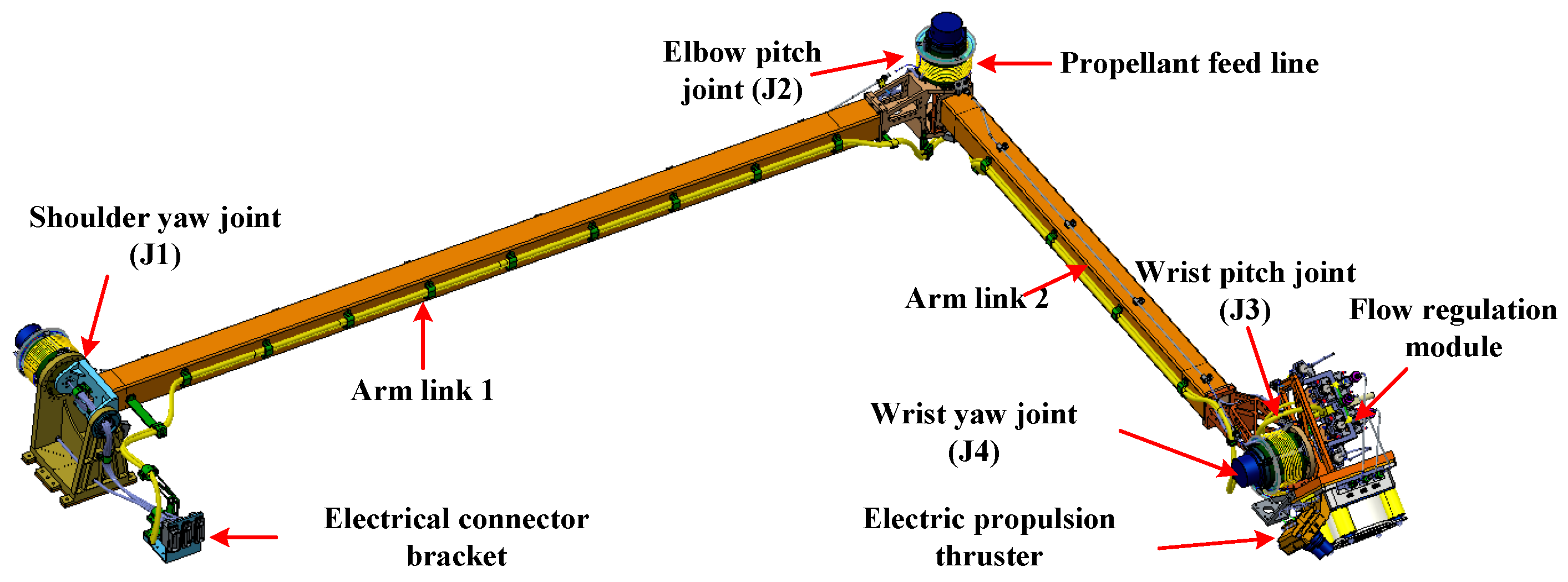
The satellite platform is equipped with two electric-propulsion vectoring manipulator arms mounted on the + X and X panels, symmetrically arranged with respect to the spacecraft Y O Z plane. Each electric-propulsion vectoring arm comprises four revolute joints (one shoulder joint, one elbow joint, and two wrist joints), a link assembly, an end-effector thruster module, and a hold-down and release mechanism. Four hold-down points are implemented, including two at the end-effector, one at the wrist, and one at the elbow; in the stowed configuration, the arm is restrained against the mounting plate by four thermal-knife release units, resulting in an overall stowage envelope of approximately 1800 mm × 1020 mm × 255 mm . During deployment, the joints are actuated sequentially according to a prescribed timing scheme. With the links fully extended, the reachable workspace can be approximated as a sector cylindrical volume with R = 2.6 m , a sweep angle of 205°, and a height of 1700 mm (radius × swing angle × height). The total gravity-offloaded mass of the deployed arm, including the joints, links, and end-effector, is approximately 18 kg , of which the electric thruster and its associated accessories at the end-effector account for approximately 8 kg . The onboard layout is illustrated in Figure 1.
The deployable vectoring adjustment mechanism enables both pointing and positional regulation of the electric thruster. Compared with conventional two-degree-of-freedom (2-DOF) electric-propulsion thrust-vector control mechanisms, the manipulator-based architecture provides a substantially enlarged motion envelope. During operation, the end-effector thruster expels propellant along a commanded direction, thereby generating the required control forces and moments for spacecraft position and attitude regulation. Representative products of a traditional 2-DOF electric-propulsion vectoring mechanism manufactured by Shanghai Electro-Mechanical Engineering Institute (Shanghai, China) and the proposed deployable electric-propulsion vectoring mechanism are shown in Figure 2.
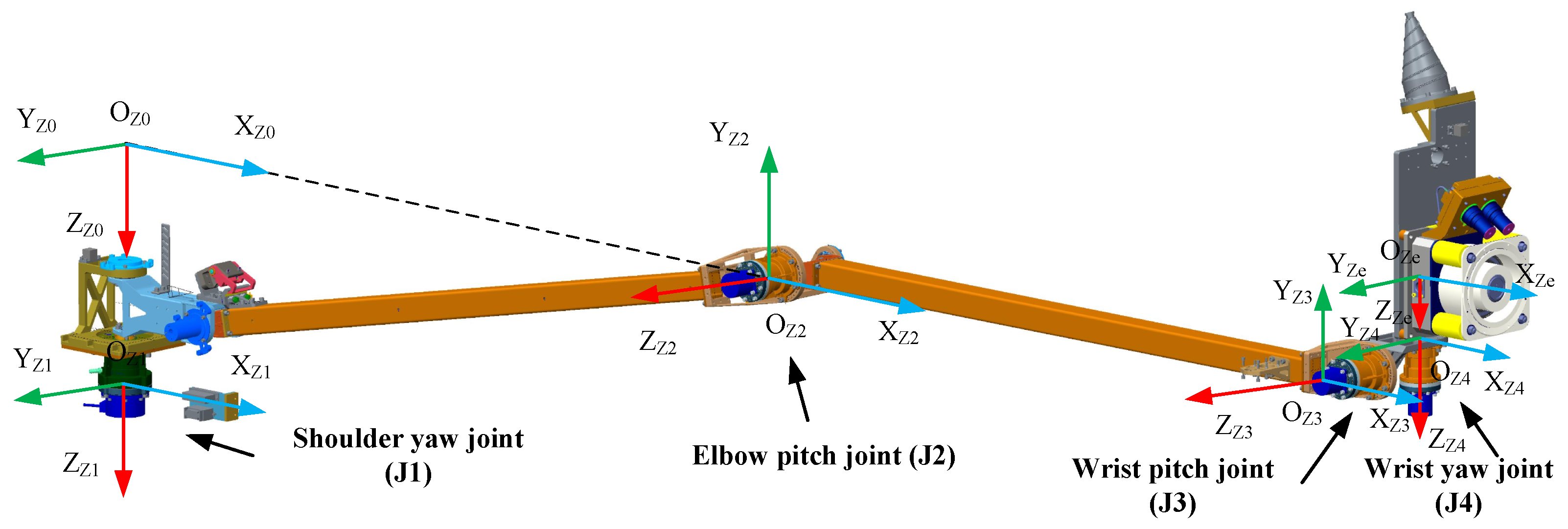
The two vectoring mechanisms are identical; therefore, without loss of generality, one mechanism is selected to establish the Denavit–Hartenberg (D–H) kinematic model. As illustrated in Figure 3, coordinate frames { 0 } { 4 } are assigned to joints { 0 } { 4 } , where frame { 0 } corresponds to the reference axes X 0 Y 0 Z 0 , and the remaining frames are defined accordingly. Frame { e } is defined as the electric-thruster frame, with its origin located at the thrust application point and rigidly attached to frame { 4 } . Using the standard D–H convention, the kinematic parameters of the mechanism are obtained. Based on Table 1, the homogeneous transformation matrices between adjacent frames can be written as
T i i 1 = cos θ i sin θ i 0 σ i 1 sin θ i cos α i 1 cos θ i cos α i 1 sin α i 1 d i sin α i 1 sin θ i sin α i 1 cos θ i sin α i 1 cos α i 1 d i cos α i 1 0 0 0 1 .
The electric-thruster coordinate frame { e } is defined with its origin located at the center of the thruster nozzle exit. During joint motions of the mechanism, this frame remains in a fixed relative pose with respect to the end-effector frame { 4 } . The corresponding homogeneous transformation relationship is given as follows:
T e 4 = 1 0 0 L 3 0 0 1 d 4 0 1 0 0 0 0 0 1 .
The base coordinate frame of the mechanism, denoted as { 0 } , has its origin located at [ x a , y a , z a ] in the spacecraft body-fixed frame. This frame is rigidly fixed to the spacecraft and therefore does not vary with joint motions. The X-axis of { 0 } is aligned with the arm-link direction, and the Z-axis is aligned with the rotation axis of Joint 1. The angle between the arm link and the spacecraft X-axis is γ = 15°. According to the definitions of the mechanism base frame and the spacecraft body frame, the transformation matrix between { 0 } and the spacecraft body-fixed frame can be derived as follows:
T 0 s a = cos 15 sin 15 0 x a sin 15 cos 15 0 y a 0 0 1 z a 0 0 0 1 .
The homogeneous transformation from the electric-thruster frame { e } to the spacecraft body frame { s a } is given by
T e s a = T 0 s a T 1 0 T 2 1 T 3 2 T 4 3 T e 4 .
Here, T 1 0 denotes the transformation from the base frame { 0 } to joint frame { 1 } , while T 2 1 , T 3 2 , and  T 4 3 are the inter-frame transformations associated with the successive joints. Moreover, T e 4 represents the transformation from frame { 4 } to the frame established at the actual thrust application point (i.e., the thruster frame { e } ). For the resulting 4 × 4 homogeneous transformation matrix T e s a , the negative of the first three elements of the third column yields the unit thrust-direction vector, and the first three elements of the fourth column give the position of the actual thrust application point expressed in the spacecraft body frame.
Equivalently, if  R e s a ( q ) denotes the rotation matrix extracted from T e s a , the actual thrust-direction unit vector can be written compactly as
P ( q ) = R e s a ( q ) e z ,
where e z = [ 0 , 0 , 1 ] T .

3.2. Smooth IK Planning

To quantitatively characterize the thrust-direction tracking accuracy, the pointing error angle is defined as
ε k = arccos sat P ( q k ) T P k des ,
where sat ( · ) clips the inner-product value to the interval [ 1 , 1 ] to prevent numerical round-off from causing invalid inputs to the inverse cosine. However, directly minimizing ε k typically introduces strong nonlinearity and non-differentiable points (when the argument approaches ± 1 ), which is unfavorable for gradient-based numerical optimization. To improve solvability and numerical robustness, we construct the direction-tracking error using a combined cross-product and dot-product residual:
r k dir ( q k ) = P ( q k ) × P k des 1 P ( q k ) T P k des .
The first three components capture the non-collinearity between the two vectors, while the last component reinforces co-directional alignment and mitigates the ambiguity associated with anti-parallel configurations. This residual exhibits favorable numerical properties in the small-error regime and is therefore well suited for least-squares optimization.
Because the thrust-direction constraint provides only two independent constraints while the vectoring manipulator possesses four rotational degrees of freedom, the inverse kinematics (IK) problem is inherently redundant and admits multiple solutions. If IK is solved independently at each time instant, the solution may jump among equivalent kinematic branches, leading to discontinuous joint trajectories or excessively large inter-sample joint variations, which degrade engineering implementability. To obtain continuous and smooth trajectories, a continuity regularization term is introduced in addition to the direction-tracking objective:
r k con ( q k ) = λ ( q k q k 1 ) ,
where λ > 0 is a weighting factor that trades off pointing accuracy against trajectory smoothness. This term is equivalent to imposing an 2 penalty on the joint increment between consecutive time steps, thereby biasing the optimizer to select the current solution in the neighborhood of the previous-step solution, which promotes branch consistency and gradual trajectory evolution. In the current implementation, only joint-position bounds are enforced as hard constraints, while inter-sample continuity is promoted through regularization and warm-start propagation rather than explicit hard rate or acceleration constraints.
By combining the direction residual and the continuity regularization, the time-discretized planning problem is formulated as a constrained nonlinear least-squares (CNLLS) problem:
min q k r k dir ( q k ) 2 2 + r k con ( q k ) 2 2 , s . t . q min q k q max .
Here, q min and q max denote the lower and upper joint-limit vectors, respectively.
For the discrete time steps k = 1 , , N , a warm-start strategy is employed to improve both convergence speed and trajectory continuity by setting
q k ( 0 ) q k 1 ,
as the initial iterate at time step k. This strategy exploits the temporal continuity of the solution so that, under sufficiently small step sizes, the solver converges rapidly and the risks of poor initialization—such as convergence to undesirable local minima or infeasible iterates—are substantially reduced.
The initial joint configuration at k = 0 , denoted by q 0 , can be selected from a calibrated pose, a nominal mid-range configuration, or a small set of candidate initial guesses. Once q 0 is determined, subsequent solutions are propagated consistently along the same kinematic branch. To further enhance robustness in practical implementation, a safeguarded mechanism can be activated when convergence failure is detected or when the pointing error exceeds a prescribed threshold, triggering bounded re-initialization and/or an adaptive increase in the regularization weight. In the present numerical study, however, this safeguard was not triggered for the tested command sequence. The resulting sequential solution procedure is summarized in Algorithm 1.
Algorithm 1 Sequential joint-trajectory planning driven by thrust-direction commands
Require: Discrete desired thrust directions { P k des } k = 0 N ; kinematic mapping P ( q ) ; joint-limit vectors q min and q max ; regularization weight λ .
Ensure: Joint trajectory { q k } k = 0 N ; pointing error { ε k } k = 0 N .
1:
Initialize q 0 nominal/calibrated pose; compute ε 0 .
2:
for   k = 1 to N do
3:
    Warm start: q k ( 0 ) q k 1 .
4:
    Construct residuals r k dir ( q k ) and r k con ( q k ) .
5:
    Solve the constrained nonlinear least-squares problem under q min q k q max to obtain q k .
6:
    Compute ε k and record solver status.
7:
end for
8:
return  { q k } k = 0 N and { ε k } k = 0 N .

4. Numerical Validation

4.1. Simulation Configuration and Parameter Settings

The mission-level GTO–GEO electric-propulsion transfer profile is constructed numerically using an analytical mission-level performance model combined with a parametric phase-based trajectory generator. The performance model estimates the required Δ v by decomposing the maneuver into (i) orbit circularization at GEO altitude and (ii) inclination reduction at GEO altitude and augments both terms with engineering efficiency factors to account for the well-known losses associated with finite-thrust spiral transfers. A fixed Δ v margin is further included to represent residual orbit trimming and operational uncertainties. The transfer duration is then estimated from the effective low-thrust acceleration, where the thrust is derated by a duty-cycle factor (thruster on-time) and an effective-thrust factor. These quantities are used here as engineering sizing coefficients for preliminary command construction rather than as components of a rigorous optimal-control proof. Accordingly, the orbit-layer results reported in this paper should be interpreted as representative mission-level command-generation results for execution-oriented studies, rather than as a strict proof of globally optimal or time-optimal low-thrust transfer.
The trajectory generator produces mission-level orbital-element histories { a ( t ) , e ( t ) , i ( t ) } using a three-phase, piecewise-smooth shaping strategy. The thrust direction is represented in the Radial–Transverse–Normal (RTN) frame using two steering angles: the elevation angle α and the azimuth angle β , whose values are shaped according to the phase-dependent mission-level steering logic. For numerical post-processing and plotting, the transfer time is uniformly discretized into N = 2000 grid points. All key constants, mission parameters, and model coefficients are summarized in Table 2.
After obtaining the orbit-layer thrust-direction commands from the mission-level transfer simulation, numerical thrust-to-joint mapping is further performed to generate the joint-angle history of the thrust-vectoring manipulator. In the present implementation, the command sequence is exported to the thrust-command file final_thrust_profile.csv, which stores the RTN-frame steering-angle representation ( α , β ) at each time instant, equivalently corresponding to the desired direction vector P d e s used in the execution layer. The angles are interpreted as follows: β is measured in the X Y plane from + X toward + Y , and  α is the elevation measured from the X Y plane toward + Z . The desired unit pointing vector is thus constructed as P des = [ cos α cos β , cos α sin β , sin α ] T . The manipulator kinematics is modeled using the standard Denavit–Hartenberg (DH) convention with four revolute joints and a fixed tool segment. The base installation error is represented by a constant rotation about the Z-axis with γ = 15°, while the base translation is set to zero since it does not affect direction-only inverse kinematics.
Direction-only inverse kinematics is formulated as a nonlinear least-squares problem with a smoothness regularization term to penalize inter-sample joint variations. Joint variables are bounded within π , π . To mitigate sensitivity to the initial guess, a multi-start strategy is applied only at the first sample (10 randomized perturbations with ±10° amplitude), and the solution is subsequently propagated in a warm-start manner using the previous solution. The pointing accuracy is quantified by the angular error ε p = arccos ( P T P des ) (deg), where the actual thrust direction is defined by the negative end-effector Z-axis, i.e., P = R ( : , 3 ) with normalization. The key parameters and numerical settings used in this stage are summarized in Table 3.

4.2. Orbit-Layer Command Generation Results

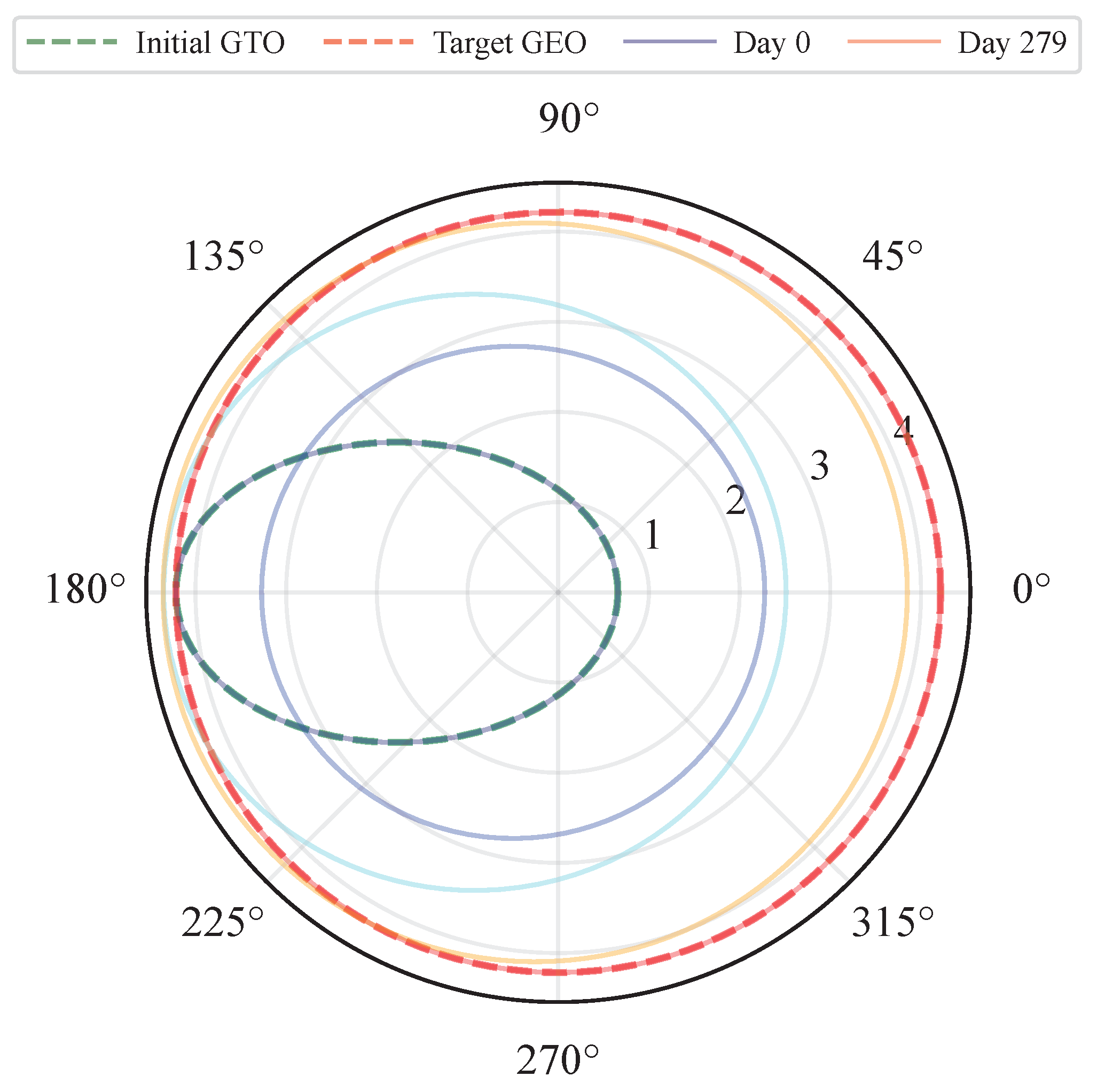
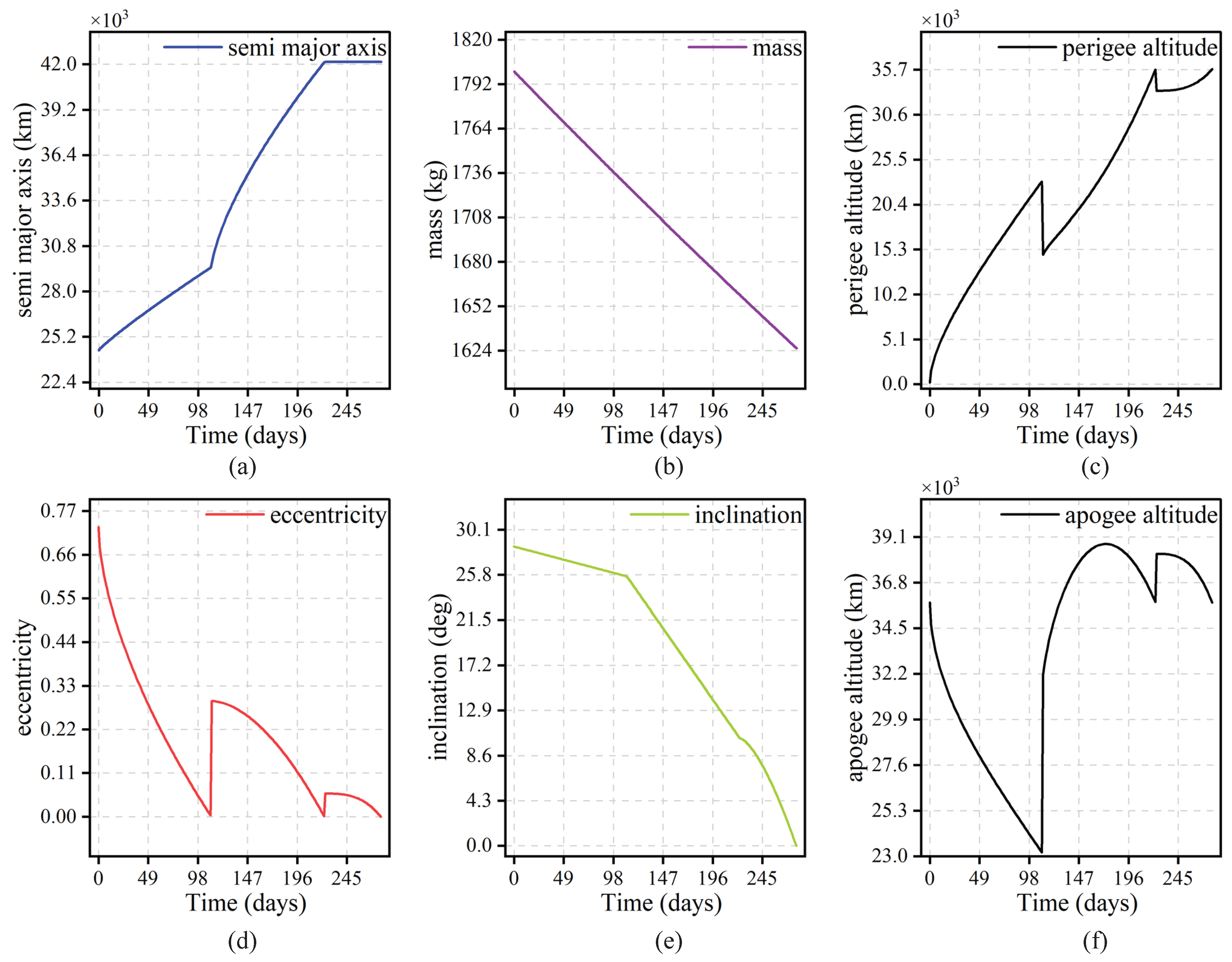
Figure 4 provides a geometric illustration using representative mission-level orbit snapshots at selected epochs, while Figure 5 summarizes the time histories of the key orbital elements, mass evolution, and thrust steering angles for the GTO-to-GEO transfer profile generated by the proposed orbit-layer command-construction method. The transfer is completed within approximately 278.6 days ( 9.2 months), with an overall Δ v of about 3665 m/s. The final spacecraft mass is around 1625 kg, corresponding to a propellant consumption of roughly 175 kg.
As shown in Figure 5, the semi-major axis increases from the initial GTO value of 24,371 km and converges to the GEO semi-major axis of 42,164 km, accompanied by a monotonic increase in the specific orbital energy toward a steady terminal level, indicating continuous orbit raising and final convergence. Consistently, the orbital period grows from about 10.5 h and approaches 24 h, confirming the achievement of the geosynchronous condition at the end of the transfer. Eccentricity exhibits an overall decreasing trend and reaches the 10 4 level. The piecewise behavior and local “jumps” mainly reflect transitions among the three shaping phases, namely, orbit raising, circularization, and final fine tuning. They should therefore be interpreted as artifacts of the phase-based mission-level command-construction strategy, rather than as physical discontinuities of a fully propagated, high-fidelity continuous-thrust orbital solution.
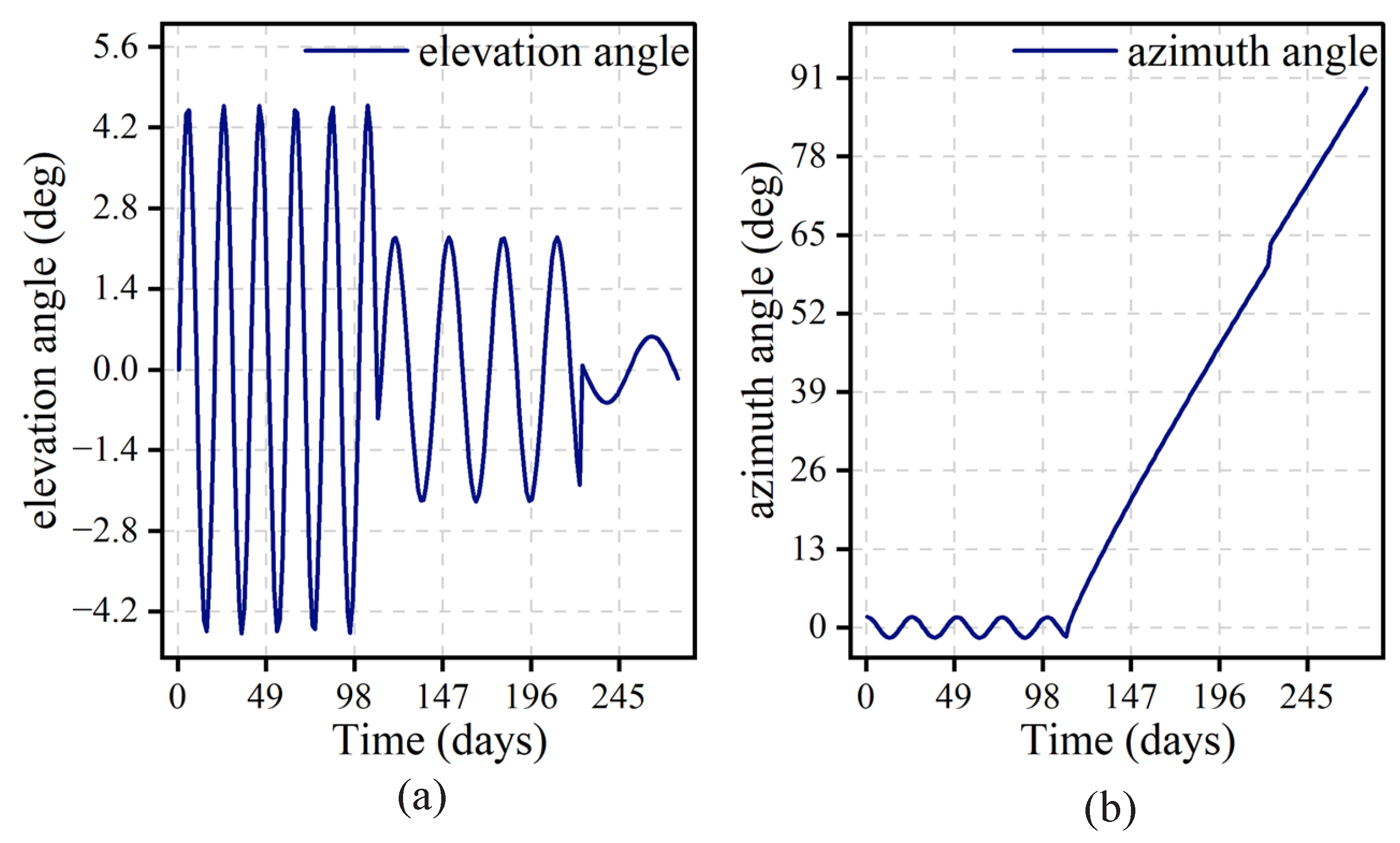
The inclination decreases from 28.5° to nearly 0° (Figure 5), demonstrating the effectiveness of the out-of-plane thrust allocation in the later stage. The corresponding steering profile reveals a progressive reallocation of thrust toward the normal component: the azimuth angle β increases from near 0° to close to 90°, whereas the elevation angle α remains a small oscillatory signal during orbit raising and gradually converges toward near-zero during the terminal tuning stage. The detailed time histories of the thrust steering angles are further shown in Figure 6, where subfigures (a) and (b) denote the elevation angle α and azimuth angle β , respectively.
The mass history is smooth and monotonically decreasing under constant thrust and high- I sp operation, consistent with an overall propellant fraction of approximately 9.7 % of the initial mass. Finally, Figure 4 visually confirms the geometric transition from the initial highly eccentric GTO to a near-circular GEO: the apogee converges toward the GEO radius while the perigee is simultaneously raised until both radii become nearly equal, which corroborates the intended orbit-raising, circularization, and inclination-adjustment pathway and terminal orbit convergence.

4.3. Vectoring Arm Trajectory Planning Results

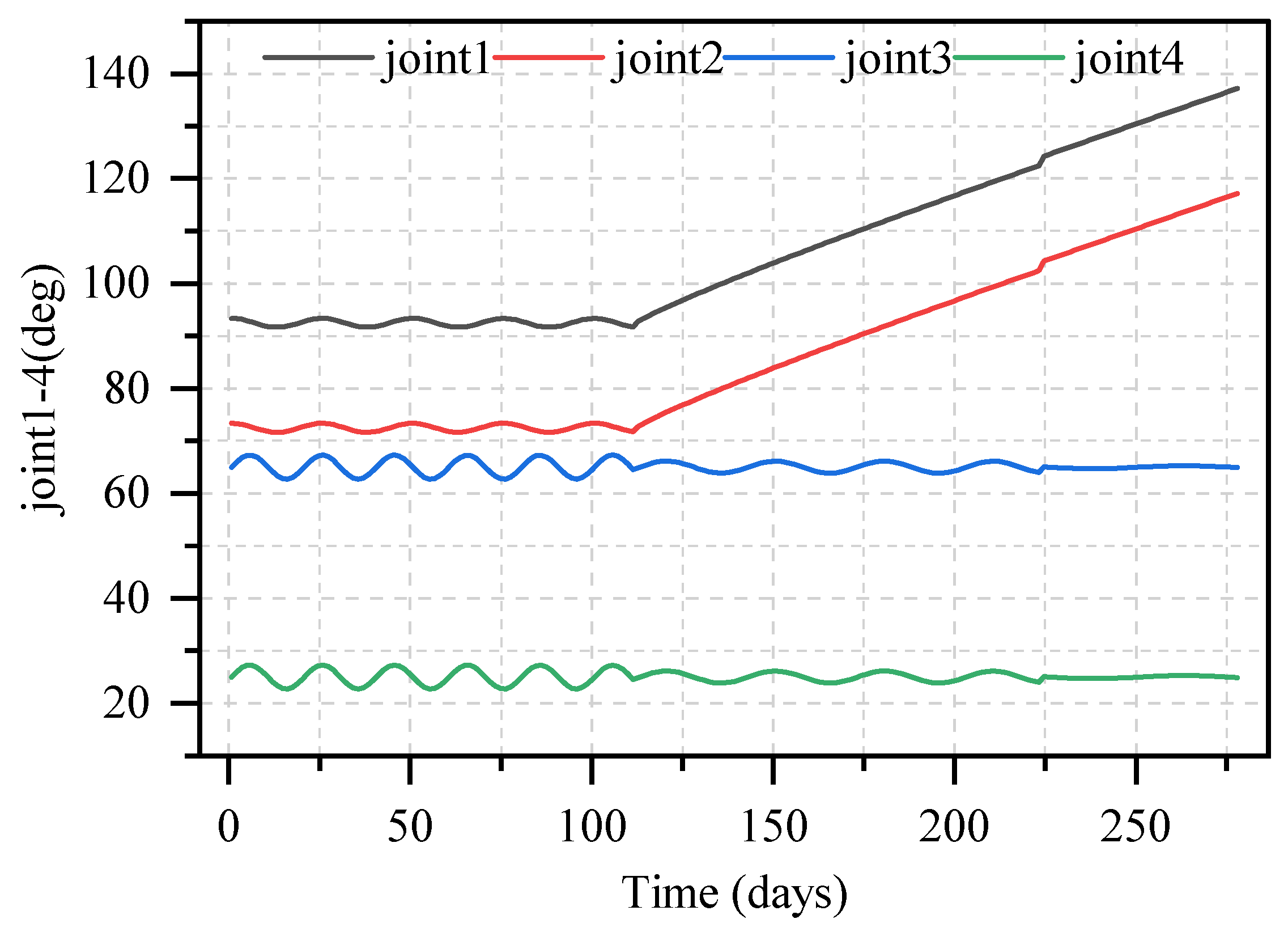
Using the thrust steering commands generated in the orbit-transfer stage, the joint trajectory of the thrust-vectoring manipulator is subsequently planned and evaluated in terms of pointing accuracy. It should be emphasized that the reported pointing error in this section represents the geometric residual of the direction-only inverse-kinematics mapping under the adopted ideal kinematic model, rather than the closed-loop thrust-pointing accuracy of a physical flight system. As illustrated by the joint-angle time histories and the corresponding pointing-error curve, all four joints evolve smoothly without high-frequency oscillations or numerical divergence. Quantitatively, the shoulder/elbow joints contribute the dominant motion for thrust-direction regulation, exhibiting a gradual, stage-dependent trend and an overall excursion of approximately 45.52°. In contrast, the wrist joints (joint3 and joint4) provide only small corrective motions, with a limited range of about 4.58°, indicating a natural division of labor under the direction-only constraint. Notably, joint1–joint2 and joint3–joint4 maintain nearly constant relative offsets, which is consistent with the coordinated solution structure arising from the manipulator geometry and the smoothness regularization in the direction-only inverse kinematics, thereby avoiding unnecessary motion induced by redundancy.
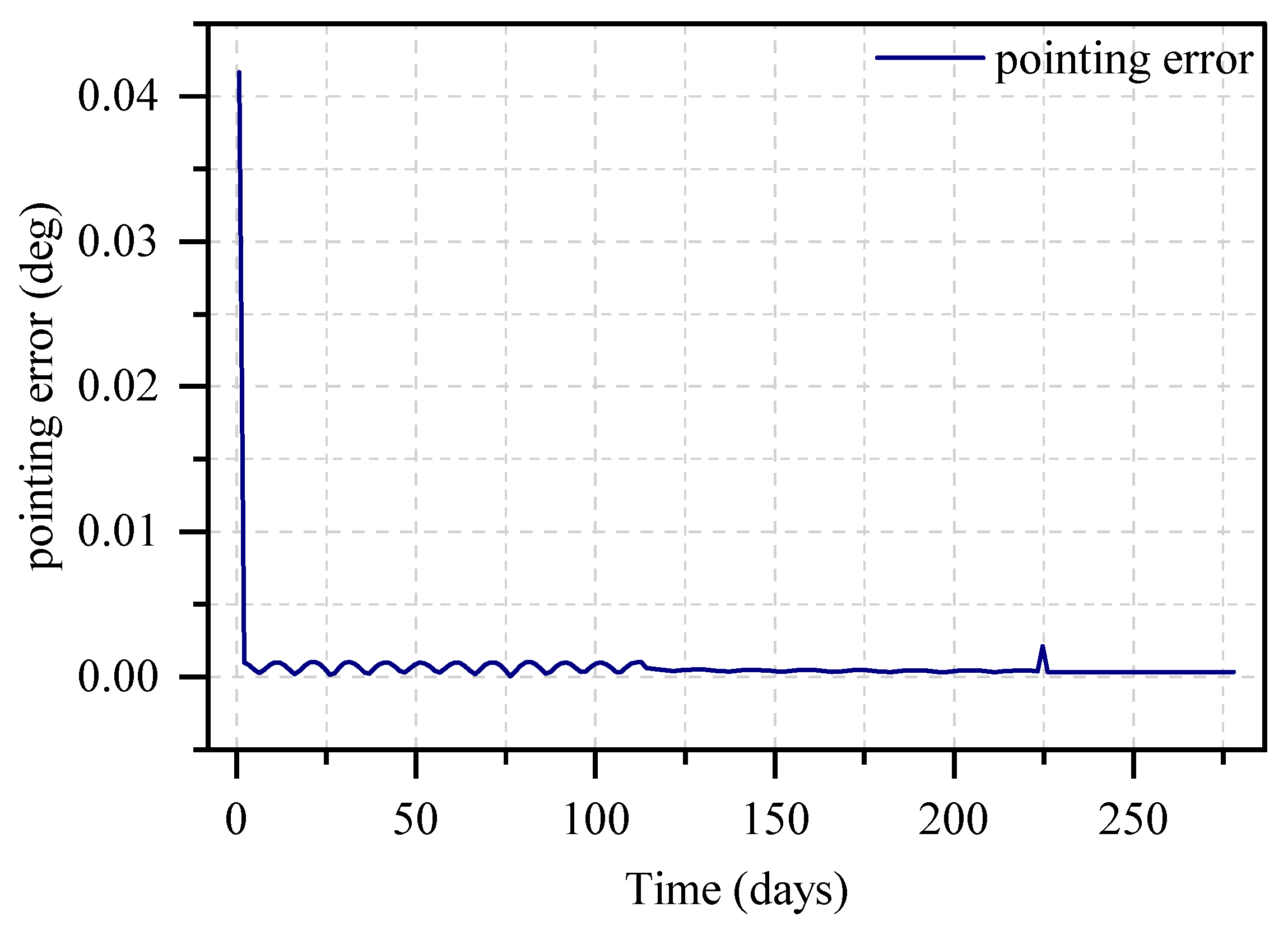
Regarding pointing performance, the pointing error angle ε p (defined as the angular separation between the desired thrust direction and the actual direction computed from the negative end-effector Z e axis) remains at the millidegree level for almost the entire trajectory in the numerical kinematic mapping sense. A transient peak of about 0.0417° occurs at the first sample, mainly due to the convergence of the initial guess or multi-start initialization. Excluding this transient, the error stays low with a maximum of approximately 0.00211° and a P 95 of about 0.00101°. The terminal error is approximately 3.43 × 10 4 deg. These results demonstrate that the planned joint trajectory satisfies the prescribed joint bounds while achieving high geometric consistency with the desired thrust-direction sequence.
The resulting joint command history can therefore be used as an execution-layer input for subsequent coupled orbit–attitude–manipulator studies and other implementation-oriented analyses.
In the present simulation, all command samples were successfully solved under the adopted geometry and joint limits, and no bounded re-initialization was triggered during the sequential planning process. The convergence success rate over all sampled commands was 100%, and no observable branch switching occurred in the tested command sequence.
It should again be noted that this metric characterizes the geometric consistency of the direction-only inverse-kinematics mapping and does not represent closed-loop on-orbit thrust-pointing accuracy in the presence of structural flexibility, actuation error, thermal deformation, or spacecraft attitude disturbances.
As shown in Figure 7 and Figure 8, the maximum discrete joint increments are 1.84°/step (joint1/2) and 1.04°/step (joint3/4). With command points spanning about 278.6 days, the corresponding maximum equivalent angular rate is approximately 6.6 × 10 3 deg/day ( 7.6 × 10 11 rad/s), indicating a very low command bandwidth requirement and thus favorable implementability from the perspective of kinematic command scheduling, although this does not replace a dedicated dynamics-level feasibility analysis. With N = 2000 command samples over approximately 278.6 days, the average command update interval is about 3.34 h. The corresponding statistics of the planned joint trajectories and pointing error are summarized in Table 4.
Although explicit joint-rate and acceleration bounds are not enforced as hard constraints in the current solver, the obtained discrete command increments remain very small over the full horizon, which supports the practical plausibility of the planned kinematic profile.

4.4. Baseline and Sensitivity Analysis of Smoothness Regularization

To further examine the role of the continuity regularization in the proposed direction-only inverse-kinematics planning method, additional comparative simulations were carried out with different values of the regularization weight λ . In this study, the same orbit-layer thrust-direction command sequence, manipulator model, initial configuration, and numerical solver settings were retained, while only the regularization parameter was varied. The tested cases were λ = 0 , 10 4 , 10 3 , and 10 2 , where λ = 0 serves as a baseline pointwise inverse-kinematics solution without explicit continuity regularization.
For each case, the tracking performance was evaluated using the mean and P 95 pointing errors, while the trajectory smoothness was assessed using both the maximum inter-sample joint increment and the smoothness metric J smooth . The corresponding quantitative results are summarized in Table 5. It can be seen that all tested values of λ lead to successful solutions over the full command sequence, and the obtained trajectories remain within the prescribed joint bounds.
The results indicate that, within the tested parameter range, the regularization weight has only a modest influence on the overall smoothness of the planned joint trajectory. As λ increases from 0 to 10 2 , the maximum inter-sample joint increment decreases slightly from 1.6425°/step to 1.5263°/step, while the smoothness metric J smooth remains nearly unchanged. By contrast, the geometric tracking accuracy exhibits a clearer dependence on λ , with both the mean error and the P 95 error increasing monotonically as the regularization weight becomes larger.
These results suggest that, for the present command sequence, the warm-start sequential solution already provides substantial trajectory continuity. Therefore, the explicit continuity regularization mainly acts as a stabilizing bias and branch-consistency aid, rather than as the dominant source of smoothing. Excessively large values of λ gradually degrade the geometric tracking accuracy without yielding a proportionally significant smoothness improvement. Accordingly, a moderate value such as λ = 10 3 is sufficient to preserve stable sequential planning while maintaining a favorable balance between continuity and geometric tracking accuracy.

5. Conclusions

This study developed a cross-layer, implementation-oriented command-to-execution framework for electric-propulsion (EP) orbit raising from GTO to GEO using a thrust-vectoring manipulator. At the orbit layer, a mission-level transfer model with dominant J 2 secular correction was used to construct a time-tagged thrust-command sequence in terms of magnitude and unit direction. At the execution layer, a 4-DOF revolute vectoring arm was modeled using Denavit–Hartenberg kinematics, and a direction-only inverse-kinematics trajectory planning problem was formulated as a constrained nonlinear least-squares program with cross/dot residuals and explicit smoothness regularization, enabling warm-started, long-horizon planning of smooth executable joint trajectories.
Numerical simulations show that GTO–GEO transfer is completed in approximately 278 days with Δ v 3665 m/s and a propellant consumption of 175 kg, corresponding to a spacecraft mass decrease from 1800 kg to 1625 kg. The planned joint profiles remain smooth over the full horizon: the dominant shoulder–elbow motions span about 45.52°, whereas the wrist joints provide only limited corrective motion of about 4.58°. The maximum inter-sample joint variations are 1.84°/step for joint1/2 and 1.04°/step for joint3/4, implying a very low bandwidth requirement for actuation. In the numerical direction-mapping process, the geometric thrust-direction tracking error remains at the millidegree level over almost the entire transfer, with a mean pointing error of 7.39 × 10 4 deg and a P 95 of 0.00101 deg. Excluding the first-sample transient, the maximum error is approximately 0.00211°, confirming the geometric feasibility of mapping orbit-layer thrust-direction commands into smooth and executable manipulator joint trajectories under the adopted ideal kinematic assumptions.
The present study is limited to numerical validation under a quasi-fixed-base assumption. Future work will incorporate higher-fidelity orbit–attitude–manipulator coupling, explicit actuator dynamics and dynamic feasibility constraints, structural flexibility, uncertainty/robustness analysis, and hardware-oriented verification to further evaluate the engineering applicability of the proposed framework.

Author Contributions

Investigation, S.W., J.W. (Jian Wang) and Y.Z.; writing—original draft, J.W. (Jian Wang); writing—review and editing, J.W. (Jianyuan Wang); supervision, J.C.; funding acquisition, J.C. All authors have read and agreed to the published version of the manuscript.

Funding

This research received no external funding.

Institutional Review Board Statement

Not applicable.

Informed Consent Statement

Not applicable.

Data Availability Statement

The original contributions presented in this study are included in the article. Further inquiries can be directed to the corresponding author.

Conflicts of Interest

Author Yexin Zhang was employed by the company Shanghai Electro-Mechanical Engineering Institute. The remaining authors declare that the research was conducted in the absence of any commercial or financial relationships that could be construed as a potential conflict of interest.

References

  1. Chadalavada, S.; Dutta, A. Sequential Low-Thrust Orbit-Raising of All-Electric Satellites. Aerospace 2020, 7, 74. [Google Scholar] [CrossRef]
  2. Macdonald, M.; Owens, S.R. Combined high and low-thrust geostationary orbit insertion with radiation constraint. Acta Astronaut. 2018, 142, 1–9. [Google Scholar] [CrossRef]
  3. Sreesawet, S.; Dutta, A. Fast and Robust Computation of Low-Thrust Orbit-Raising Trajectories. J. Guid. Control Dyn. 2018, 41, 1888–1905. [Google Scholar] [CrossRef]
  4. Han, C.; Wang, Y.; Sun, X. Practical Low-Thrust Geostationary Orbit Transfer Guidance via Linearized State Equations. J. Guid. Control Dyn. 2020, 43, 497–510. [Google Scholar] [CrossRef]
  5. Wang, Y.; Han, C.; Sun, X. Optimization of low-thrust Earth-orbit transfers using the vectorial orbital elements. Aerosp. Sci. Technol. 2021, 112, 106614. [Google Scholar] [CrossRef]
  6. Wu, D.; Wang, W.; Jiang, F.; Li, J. Minimum-time low-thrust many-revolution geocentric trajectories with analytical costates initialization. Aerosp. Sci. Technol. 2021, 119, 107146. [Google Scholar] [CrossRef]
  7. Feng, H.; Yue, X.; Wang, X. A quasi-linear local variational iteration method for orbit transfer problems. Aerosp. Sci. Technol. 2021, 119, 107222. [Google Scholar] [CrossRef]
  8. Gong, X.; Chen, W.; Chen, Z. All-aspect attack guidance law for agile missiles based on deep reinforcement learning. Aerosp. Sci. Technol. 2022, 127, 107677. [Google Scholar] [CrossRef]
  9. Vasiloff, A.; Howell, K.C. Trajectory Optimization for Orbit Transfers: Principles, Advances, Case Studies, and Outlook. Aerospace 2025, 12, 1087. [Google Scholar] [CrossRef]
  10. Betts, J.T. Survey of Numerical Methods for Trajectory Optimization. J. Guid. Control Dyn. 1998, 21, 193–207. [Google Scholar] [CrossRef]
  11. Hager, W.W. Runge–Kutta Methods in Optimal Control and the Transformed Adjoint System. Numer. Math. 2000, 87, 247–282. [Google Scholar] [CrossRef]
  12. Benson, D.A.; Huntington, G.T.; Thorvaldsen, T.P.; Rao, A.V. Direct Trajectory Optimization and Costate Estimation via an Orthogonal Collocation Method. J. Guid. Control Dyn. 2006, 29, 1435–1440. [Google Scholar] [CrossRef]
  13. Garg, D.; Patterson, M.A.; Francolin, C.; Darby, C.L.; Huntington, G.T.; Hager, W.W.; Rao, A.V. Direct Trajectory Optimization and Costate Estimation of Finite-Horizon and Infinite-Horizon Optimal Control Problems Using a Radau Pseudospectral Method. Comput. Optim. Appl. 2011, 49, 335–358. [Google Scholar] [CrossRef]
  14. Leomanni, M.; Bianchini, G.; Garulli, A.; Quartullo, R. Optimal Low-Thrust Orbit Transfers Made Easy: A Direct Approach. J. Spacecr. Rocket. 2021, 58, 1904–1914. [Google Scholar] [CrossRef]
  15. Hiraiwa, N.; Henry, D.B.; Scheeres, D.J.; Bando, M. Design of minimum-time low-thrust transfer between quasi-periodic orbits. Acta Astronaut. 2025, 237, 34–41. [Google Scholar] [CrossRef]
  16. Hurley, J.T.; Mall, K.; Wang, Z. Solving Complex Low Earth Orbit-to-Geostationary Earth Orbit Transfer Problems Using Uniform Trigonometrization Method. Aerospace 2025, 12, 960. [Google Scholar] [CrossRef]
  17. Quarta, A.A. Effects of Discrete Thrust Levels on the Trajectory Design of the BIT-3 RF Ion Thruster-Equipped CubeSat. Appl. Sci. 2025, 15, 6314. [Google Scholar] [CrossRef]
  18. Wang, J.; Jia, Q.; Yu, D. Spacecraft Attitude Stabilization Control with Fault-Tolerant Capability via a Mixed Learning Algorithm. Appl. Sci. 2023, 13, 9415. [Google Scholar] [CrossRef]
  19. Yang, X.; Liao, Y.; Li, L.; Li, Z. Agile Attitude Maneuver Control of Micro-Satellites for Multi-Target Observation Based on Piecewise Power Reaching Law and Variable-Structure Sliding Mode Control. Appl. Sci. 2024, 14, 797. [Google Scholar] [CrossRef]
  20. Shumeiko, I.; Telekh, V.; Ryzhkov, S. Thrust-vectoring schemes for electric propulsion systems: A review. Chin. J. Aeronaut. 2025, 38, 103401. [Google Scholar] [CrossRef]
  21. Zhao, S.; Chen, C.; Li, J.; Gao, S.; Guo, X. Trajectory Planning of an Aerial Robotic Manipulator Using Hybrid Particle Swarm Optimization. Appl. Sci. 2022, 12, 10892. [Google Scholar] [CrossRef]
  22. Misra, G.; Bai, X. Optimal Path Planning for Free-Flying Space Manipulators via Sequential Convex Programming. J. Guid. Control Dyn. 2017, 40, 2795–2810. [Google Scholar] [CrossRef]
  23. Crain, A.; Ulrich, S. Experimental Validation of Pseudospectral-Based Optimal Trajectory Planning for Free-Floating Robots. J. Guid. Control Dyn. 2019, 42, 2649–2663. [Google Scholar] [CrossRef]
  24. Hong, M.; Wang, L.; Liu, L.; Wang, Q.; Guo, Y. Trajectory planning of a free-floating dual-arm space robot with minimal base disturbance in obstacle environments. Adv. Space Res. 2024, 74, 1410–1423. [Google Scholar] [CrossRef]
  25. Al Ali, A.; Shi, J.F.; Zhu, Z.H. Path planning of 6-DOF free-floating space robotic manipulators using reinforcement learning. Acta Astronaut. 2024, 224, 367–378. [Google Scholar] [CrossRef]
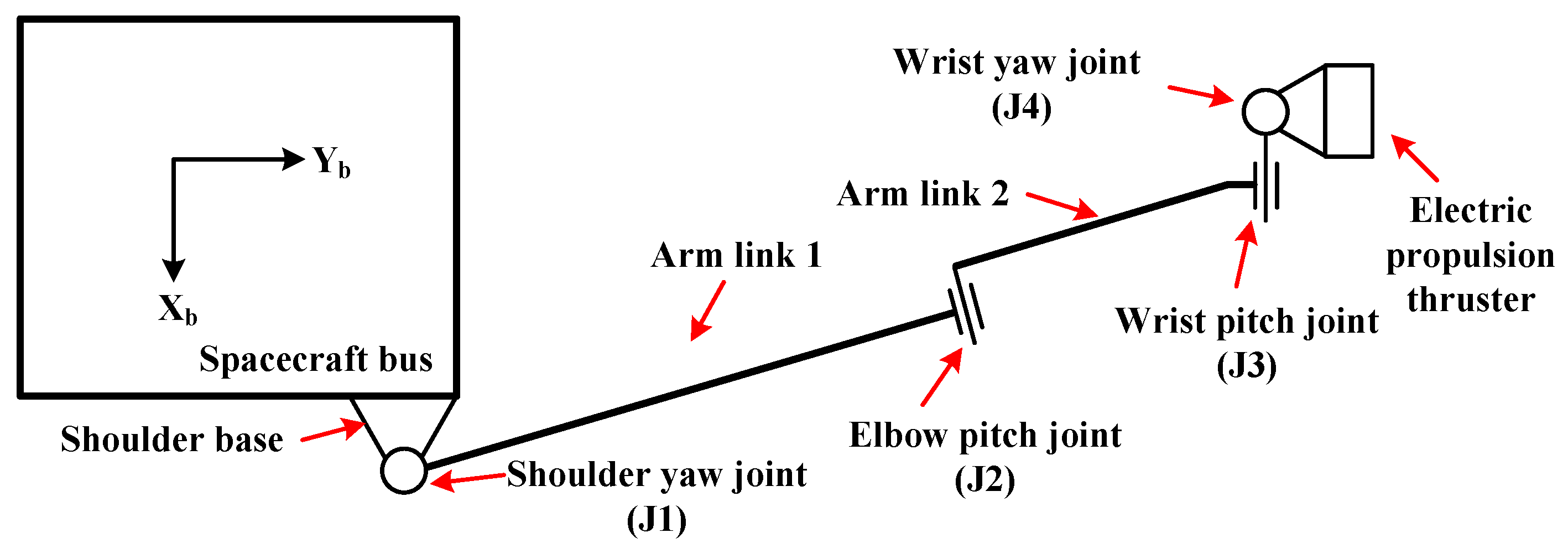
Figure 1. Schematic of the installation configuration of the thrust-vectoring mechanism on the spacecraft.
Applsci 16 03170 g001
Figure 2. Composition of the thrust-vectoring mechanism.
Applsci 16 03170 g002
Figure 3. Thrust-vectoring mechanism model and coordinate-frame definition.
Applsci 16 03170 g003
Figure 4. Mission-level schematic of the GTO–GEO transfer profile.
Applsci 16 03170 g004
Figure 5. Mission-level orbital-evolution and steering parameters for the GTO–GEO transfer: (a) semi-major axis, (b) spacecraft mass, (c) perigee altitude, (d) eccentricity, (e) inclination, and (f) apogee altitude.
Applsci 16 03170 g005
Figure 6. Thrust-vector direction angles for the GTO–GEO orbit transfer: (a) elevation angle α and (b) azimuth angle β .
Applsci 16 03170 g006
Figure 7. Joint angle profiles of the thrust-vectoring mechanism.
Applsci 16 03170 g007
Figure 8. Positioning error of the thrust-vectoring mechanism.
Applsci 16 03170 g008
Table 1. D–H parameters of the vectoring mechanism.
Index σ i 1 (m) α i 1 (°) d i (m) θ i (°)
0000 q 1
1000 q 2
2−1.25590−0.2725 q 3
3−1.0921800.048 q 4
4090−0.12650
Table 2. Simulation parameters and engineering coefficients for the mission-level GTO–GEO transfer profile.
ItemSymbolValueUnit / Note
Earth gravitational parameter μ 3.986004418 × 10¹⁴m3/s2
Earth mean radius R e 6,378,137m
Standard gravity g 0 9.80665m/s2
Total thrust (dual thrusters)T 0.33 N
Specific impulse I sp 3000s
Initial mass m 0 1800kg
GTO perigee radius r p 6.578 × 10⁶m (200 km altitude)
GTO apogee radius r a 4.2164 × 10⁷m (35,786 km altitude)
Initial semi-major axis a 0 2.4371 × 10⁷m
Initial eccentricity e 0 0.7301
Initial inclination i 0 28.5deg
Target semi-major axis (GEO) a f 4.2164 × 10⁷m
Target eccentricity e f 1.0 × 10⁻⁴
Target inclination i f 0deg
Circularization efficiency factor k circ 1.15multiplies ( v GEO v a , GTO )
Inclination efficiency factor k inc 1.20multiplies 2 v GEO sin ( i 0 / 2 )
Δ v margin Δ v m 150m/s
Duty cycle η d 0.92
Effective-thrust factor η eff 0.85
Trajectory grid sizeN2000uniform points over [ 0 , t f ]
Phase time allocation40/40/20% of t f (raise/circ/inc)
Steering angles definition ( α , β ) RTN elevation/azimuth
Nominal shaping Δ v (trajectory only) Δ v shape 3000m/s (used for intermediate m ( t ) shaping)
Table 3. Simulation parameters for thrust-command to joint-angle mapping.
ItemSymbolValueNote
Thrust-command input α , β
Desired pointing vector P des [ cos α cos β , cos α sin β , sin α ] T
Actual thrust direction P P = R ( : , 3 ) (negative Z e , normalized)
Manipulator DOFn4all revolute (R–R–R–R)
Tool segment (fixed)1fixed DH row, θ = 0
Joint bounds q i [ π , π ] rad
Base yaw misalignment γ 15deg (fixed rotation about Z)
Base translation ( x a , y a , z a ) ( 0 , 0 , 0 ) m (irrelevant for direction-only IK)
Initial guess q 0 ( 60 , 40 , 40 , 0 ) deg
Multi-start trials N ms 10random perturbation search
Perturbation amplitude Δ q ± 10 deg (independent per joint)
Regularization weight λ 10 3 smoothness term λ ( q q k 1 )
Least-squares tolerances 10 12 xtol/ftol/gtol
Max. function evaluations200max_nfev
Random seed0reproducible multi-start perturbations
Table 4. Statistics of the planned joint trajectories and pointing error.
QuantityMin (deg)Max (deg)Range (deg)Max Step (deg/step)
joint191.64137.1645.521.84
joint271.64117.1645.521.84
joint362.7167.294.581.04
joint422.7127.294.581.04
Pointing error ε p Overall: max = 0.04167°, mean = 7.39 × 10 −4°, P95 = 0.00101°
Table 5. Effect of the regularization weight on smooth IK planning performance.
λ Mean Error (deg) P 95 Error (deg)Max Step (deg/step) J smooth
0 8.79 × 10 8 8.54 × 10 7 1.64250.006907
10 4 7.41 × 10 6 1.00 × 10 5 1.53370.006865
10 3 7.44 × 10 5 1.00 × 10 4 1.53300.006865
10 2 7.44 × 10 4 1.00 × 10 3 1.52630.006878
Disclaimer/Publisher’s Note: The statements, opinions and data contained in all publications are solely those of the individual author(s) and contributor(s) and not of MDPI and/or the editor(s). MDPI and/or the editor(s) disclaim responsibility for any injury to people or property resulting from any ideas, methods, instructions or products referred to in the content.