1. Introduction
Renewable energy technologies continue to gain strategic importance in response to increasing global energy demand and climate change concerns. Among these technologies, solar energy offers high resource availability and clean energy conversion potential [
1,
2]. Concentrating Solar Power (CSP) systems, which convert direct solar irradiance into high-temperature thermal energy for electricity generation, constitute a critical component of dispatchable renewable power production [
3]. Within CSP technologies, Parabolic Trough Collectors (PTCs) remain one of the most mature and widely deployed commercial solutions [
4,
5]. PTC systems operate by reflecting direct solar radiation onto a linear absorber tube positioned along the focal line of a parabolic reflector, where the concentrated energy is transferred to a heat transfer fluid and subsequently converted to electricity through a thermodynamic cycle [
6]. The optical performance of PTC systems plays a decisive role in determining overall energy conversion efficiency. Accurate focusing of solar radiation onto the receiver is governed by geometric precision, reflector optical properties, tracking accuracy, and environmental conditions [
7,
8,
9]. In practice, however, optical imperfections are unavoidable due to manufacturing tolerances, installation inaccuracies, structural deformation, material aging, and environmental effects such as soiling [
10]. These imperfections may manifest as mirror slope errors, receiver displacement, tracking deviations, reflectivity losses, and surface irregularities, all of which degrade focusing quality and reduce the intercept factor and optical efficiency [
11,
12].
Extensive research has investigated the impact of such optical errors using both numerical and experimental approaches. Monte Carlo Ray Tracing (MCRT) methods, in particular, have been widely adopted for high-fidelity optical modeling of PTC systems [
13,
14,
15]. Prior studies have quantified the influence of mirror slope errors [
11,
12], tracking inaccuracies [
16], and receiver position deviations [
17] on optical efficiency and flux distribution characteristics. These works consistently report performance degradation trends associated with increasing misalignment. Additionally, optimization efforts targeting mirror geometries, receiver configurations, and tracking strategies have been proposed to mitigate optical losses [
7,
8,
9,
18,
19]. Comprehensive reviews further synthesize these developments and identify ongoing challenges in improving optical precision and durability in PTC systems [
10,
20,
21,
22,
23].
Recent investigations have extended this perspective toward advanced receiver concepts and system-level performance evaluation under realistic operating conditions. Aquino-Santiago et al. [
24] examined annular receiver configurations for low-enthalpy steam generation and demonstrated that geometric receiver modifications can enhance thermal efficiency under specific operational regimes. Shokrnia et al. [
25] conducted a comparative techno-economic analysis of parabolic trough and linear Fresnel collectors with evacuated and non-evacuated receiver tubes across different geographical regions, highlighting the sensitivity of collector performance to receiver insulation and design conditions. Similarly, Grena et al. [
26] performed a detailed thermal analysis of parabolic and Fresnel collectors using compressed gases as heat transfer fluids, emphasizing the thermodynamic implications of receiver configuration under alternative working-fluid scenarios. While these studies advance collector optimization, techno-economic assessment, and thermodynamic performance evaluation, they do not explicitly define reliability-informed alignment tolerance envelopes under geometric misalignment.
Beyond global efficiency reduction, receiver misalignment has important thermo-optical implications. Angular deviations can significantly alter the circumferential solar flux distribution on the absorber tube, producing localized flux amplification and steep thermal gradients [
21,
27]. Such non-uniform heating is associated with coating degradation, thermo-mechanical fatigue, and long-term reliability concerns. Consequently, evaluating receiver misalignment exclusively through optical efficiency metrics may overlook critical flux-induced risk patterns.
From a structural standpoint, the existing literature on PTC optical imperfections can be broadly categorized into three principal streams: (i) optical efficiency sensitivity analyses focused on intercept factor degradation; (ii) circumferential flux distribution studies addressing localized heat flux amplification; and (iii) configuration-oriented or techno-economic investigations aimed at improving system-level performance. Although these streams significantly contribute to understanding performance behavior, they predominantly remain descriptive and trend-oriented. Explicit misalignment tolerance envelopes that simultaneously integrate optical acceptability and flux-induced thermo-mechanical safety criteria are rarely formalized within a unified design framework.
In particular, the nonlinear decoupling between optical efficiency and thermo-optical reliability—where acceptable global efficiency may coexist with severe circumferential flux localization—has not been explicitly quantified through structured tolerance definitions. The absence of such formalization limits the translation of optical sensitivity analyses into actionable manufacturing and operational alignment criteria.
In response to this gap, the present study proposes a tolerance-based thermo-optical risk framework for parabolic trough collectors subjected to angular receiver misalignment. Rather than relying solely on global efficiency reduction, the proposed methodology defines allowable misalignment envelopes by jointly evaluating optical efficiency degradation and flux-derived thermal non-uniformity indicators obtained via MCRT simulations. Importantly, this study does not replace detailed thermo-fluid modeling; instead, it introduces flux-based surrogate risk indicators that enable computationally efficient identification of thermally critical alignment regions. The resulting framework distinguishes safe operation, performance degradation, and failure-prone regimes, and discusses the geometry-dependent scaling behavior of derived thresholds relative to the collector acceptance angle.
The core innovation of this work lies in the formalization of the optical–thermal decoupling phenomenon through explicitly defined tolerance criteria (|θ|opt and |θ|th), a receiver-centric misalignment severity index, and a field-oriented alignment safety factor. By integrating deterministic optical degradation trends, normalized flux-based thermal non-uniformity metrics, and geometry-scaled misalignment parameters into a unified tolerance-definition structure, the proposed framework transforms conventional performance reporting into a reliability-informed alignment assessment methodology. This structured coupling enables explicit identification of (i) optical acceptability limits, (ii) thermally safe misalignment thresholds, and (iii) the decoupling interval where optical performance remains nominally acceptable despite elevated thermo-mechanical risk.
Accordingly, the present study extends beyond descriptive optical sensitivity analysis and provides a decision-support tool applicable to manufacturing tolerances, installation precision control, and long-term durability management in commercial CSP systems.
2. Materials and Methods
Renewable energy sources are gaining importance due to the increasing global energy demand and climate change concerns. In this context, CSP systems play a significant role in harnessing solar energy potential, especially for electricity generation and high-temperature process heat applications. As one of the most mature technologies among CSP technologies, PTCs generate thermal energy by focusing direct solar radiation onto a linear absorber tube. However, the efficiency and operational reliability of these systems can be influenced by optical imperfections arising from manufacturing tolerances, installation deviations, structural deformation, and environmental effects. The primary objective of this study is not only to quantify the parametric effects of optical imperfections on PTC optical efficiency, but also to define tolerance-based thermo-optical reliability limits for receiver misalignment. Accordingly, the analysis focuses on how angular receiver misalignment affects both the circumferential heat flux distribution on the absorber tube and the overall intercept factor of the system. To model these complex optical interactions with high accuracy, the MCRT method—an established approach in the scientific literature for simulating ray paths and surface interactions—was employed. The MCRT methodology was implemented within TracePro™ v7.6 optical system design and analysis software [
28], which provides a virtual environment for analyzing the interaction, reflection, refraction, and focusing dynamics of solar radiation on the absorber tube.
2.1. PTC Description and Geometrical Characteristics
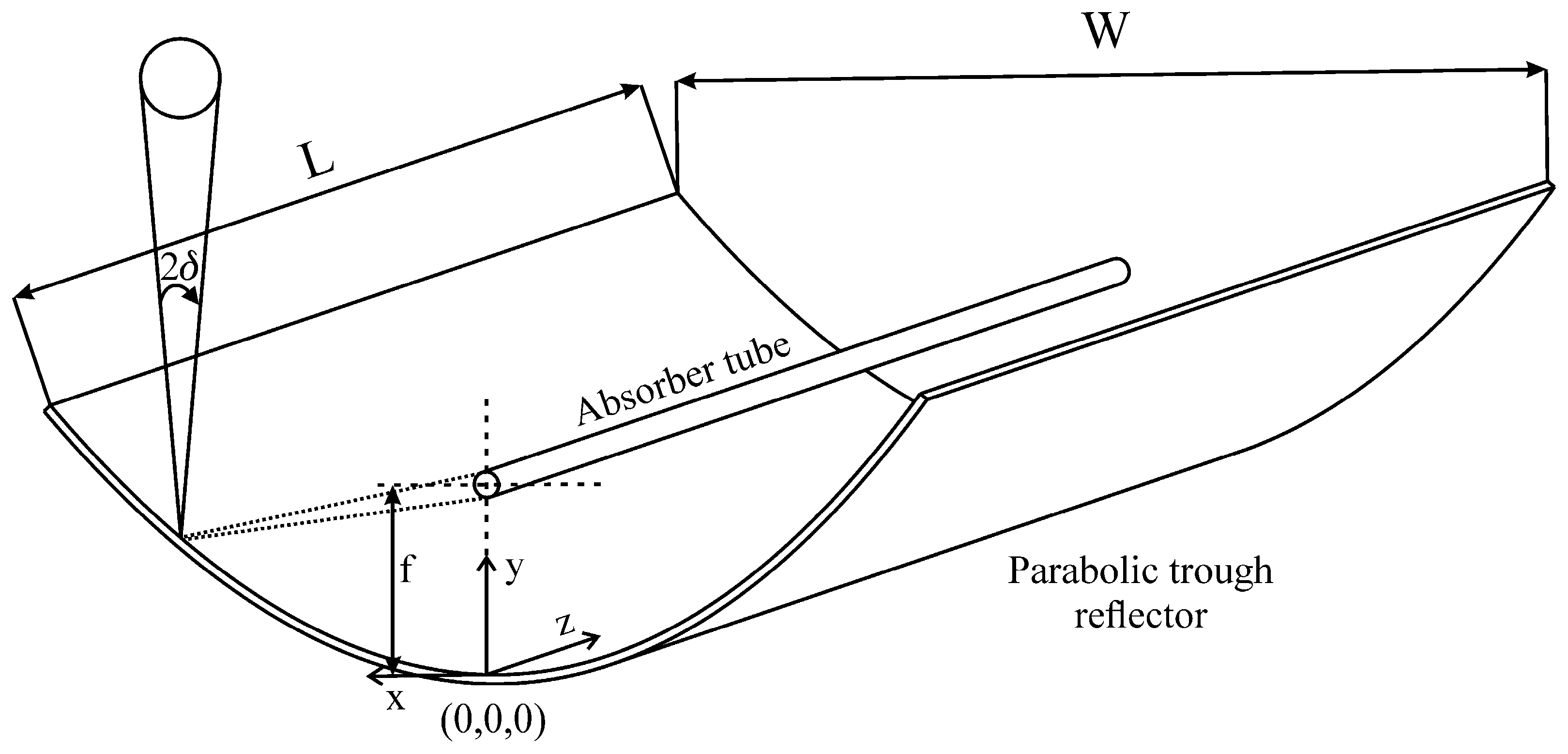
The parabolic trough collector (PTC) geometry used in this study is schematically illustrated in
Figure 1.
The collector consists of a parabolic reflector, a linear absorber tube positioned along the focal line, and the corresponding optical axis. The geometric and optical parameters adopted in the simulations are summarized in
Table 1. These values were selected based on literature-reported commercial PTC configurations and are consistent with industrial design ranges [
19,
21].
The geometric parameters listed in
Table 1 fall within the typical industrial ranges reported for commercial PTC systems. In large-scale commercial installations, receiver diameters commonly range between 60–80 mm, focal lengths between approximately 1.5–2.0 m, and aperture widths between 5–6 m depending on concentration ratio and design configuration. The selected configuration therefore represents a mid-scale commercial geometry consistent with practical deployment, ensuring industrial interpretability of the derived tolerance limits.
Receiver misalignment is defined strictly as an angular deviation (in degrees) relative to the optical axis. No percentage-based displacement parameter is used in this study. All tolerance limits therefore correspond to angular misalignment values. The half-acceptance angle of the collector (δ = 1.99°), listed in
Table 1, is used later to interpret the geometric scaling of the identified misalignment thresholds. To isolate the effect of geometric misalignment, reflector reflectivity (ρ) and receiver absorptivity (α) were assumed equal to unity. This assumption eliminates variability related to material optical properties and enables direct evaluation of geometric flux redistribution effects. The resulting tolerance limits therefore represent geometry-driven sensitivity under ideal optical conditions [
18].
2.2. Optical Analysis Methodology and Fault Modeling
The impact of optical imperfections on the heat flux distribution and intercept factor (γ) of the PTC receiver was evaluated using the MCRT method. MCRT is a well-established technique for optical analysis of solar concentrators, as it enables individual tracing of solar rays and accurate representation of reflection and refraction phenomena [
14,
27]. The optical efficiency (η
0) of the PTC is defined as the ratio of the total thermal energy absorbed by the receiver to the total solar energy incident on the collector aperture, as expressed in Equation (1) [
29,
30,
31].
In this formulation, ρ represents the reflector reflectance, τ the transmittance of the glass envelope, α the absorptance of the absorber surface, and γ the intercept factor, which quantifies the focusing effectiveness of the optical system. In the present study, variations in optical efficiency are primarily governed by changes in γ induced by angular receiver misalignment, since material optical properties are kept idealized. The geometric factor A
f accounts for effective aperture losses due to end effects, shading, and blocking and is calculated using Equations (2) and (3) [
6,
32]. An accurate representation of A
f is essential for a reliable estimation of optical efficiency under off-design conditions.
Receiver misalignment was modeled as a deterministic angular deviation that varied symmetrically within ±10°. Due to geometric symmetry, positive and negative deviations of equal magnitude yield identical optical and flux distribution results; therefore, all results are presented as a function of |θ|. Other minor optical imperfections were represented as stochastic Gaussian perturbations to reflect realistic manufacturing variability [
22,
30,
33].
The intercept factor (γ) is defined as the ratio of energy intercepted by the absorber tube to the energy reflected by the parabolic mirror and depends on receiver diameter, mirror slope errors, solar beam spread, and receiver positioning accuracy. Specular reflection in the MCRT framework is governed by Equations (4) and (5) [
23,
33]:
2.3. Simulation Setup and Parametric Analysis
A high-resolution model of the PTC system was developed using TracePro™ [
28], approximately 107 rays were traced in each simulation to ensure numerical convergence and statistical independence of the results [
23].
The solar incidence angle was varied between −30° and +30° in 7.5° increments, and a uniform solar irradiance of 1000 W/m2 was assumed. Heat losses were intentionally neglected to isolate optical and flux redistribution behavior. The decision to isolate optical and flux redistribution behavior by neglecting thermohydraulic losses and fluid dynamics is a strategic methodological choice. In practical PTC operations, the thermophysical properties of the heat transfer fluid (HTF) and convective heat dissipation mechanisms can partially dampen the magnitude of local temperature peaks. However, by focusing exclusively on the incident solar flux—the fundamental driver of thermal stress—the proposed framework provides a conservative, ‘upper-bound’ assessment of misalignment risk. This approach allows for the identification of thermally critical alignment envelopes through high-fidelity surrogate metrics without the prohibitive computational cost of coupled CFD-MCRT simulations. Parametric analyses were conducted by systematically varying angular receiver misalignment within the ±10° range to quantify its influence on optical efficiency, intercept factor, and circumferential heat flux distribution. The present study does not solve the coupled thermo-fluid problem; instead, flux-derived indicators are used as surrogate metrics to infer relative thermo-mechanical risk trends under misalignment. This distinction is important for the proposed framework identifies thermo-optical risk trends rather than predicting absolute temperature fields. To evaluate the robustness of the derived thermo-optical tolerance limits with respect to realistic optical properties, additional simulations were conducted under non-ideal reflector reflectivity and receiver absorptivity conditions. While the primary analysis assumes ideal optical properties (ρ = α = 1.0) to isolate geometric effects, sensitivity cases were performed for ρ = 0.95, α = 0.95 and ρ = 0.90, α = 0.90. These values represent typical and degraded commercial PTC optical conditions reported in the literature. The influence of optical property variations on η0, TSI, CTNUI, and the derived thermal misalignment threshold was systematically evaluated.
2.4. Thermo-Optical Performance Indicators
A high-resolution model of the PTC system was developed using TracePro™ [
28], approximately 107 rays were traced in each simulation to ensure numerical convergence and statistical independence of the results [
23]. The optical efficiency η
0 can alternatively be expressed in terms of absorbed and incident radiant power as [
34]:
where Q
abs is the total radiant power absorbed by the receiver and Q
inc is the total solar power incident on the collector aperture. The intercept factor γ is defined as [
27,
34]:
where Q
int is the radiant power intercepted by the absorber tube and Q
ref is the radiant power reflected by the parabolic mirror. Receiver misalignment affects γ by altering the fraction of reflected rays that reach the absorber surface. To evaluate combined misalignment effects, a two-dimensional optical efficiency surface η
0 (θ
x,θ
y) was constructed assuming independent misalignment components [
33,
34]:
where θ
x and θ
y represent angular misalignment components, and η
0 (0) denotes the optical efficiency under ideal alignment. This formulation represents a first-order separable approximation assuming weak coupling between orthogonal angular deviations. It is employed for tolerance visualization purposes rather than as a predictive physical law. The local circumferential heat flux q″(θ) was obtained by spatially binning absorbed rays along the receiver circumference. Similar peak-to-average flux ratios have been employed in solar receiver thermal analyses [
35,
36,
37]. To quantify thermal stress risk induced by non-uniform solar flux, the Thermal Stress Indicator (TSI) was defined as:
where
is the maximum local heat flux on the receiver surface and
is the circumferentially averaged heat flux. Higher TSI values indicate stronger flux concentration and increased potential for thermal fatigue, coating degradation, and thermo-mechanical failure. The Circumferential Thermal Non-Uniformity Index (CTNUI) quantifies the dispersion of heat flux around the absorber tube and is defined as:
where
is the local heat flux at circumferential segment i,
is the mean heat flux, and N is the number of circumferential segments. CTNUI represents a normalized measure of thermal non-uniformity and is directly associated with circumferential temperature gradients along the receiver tube. Together with TSI, these indicators provide quantitative descriptors of flux-induced thermo-mechanical risk and enable classification of receiver misalignment into distinct reliability regimes [
21,
37].
Receiver misalignment conditions were categorized by jointly evaluating optical efficiency and thermal non-uniformity metrics, consistent with literature demonstrating that optical faults affect both interception performance and circumferential heat flux distribution in parabolic trough systems [
37,
38]. The safe operation regime is characterized by high optical efficiency and low thermal non-uniformity, indicating stable system behavior under minor deviations. The performance degradation regime involves moderate efficiency reduction accompanied by increasing thermal stress indicators, reflecting elevated reliability concerns despite continued operability, in line with ray tracing sensitivity analyses [
39]. The failure-prone regime corresponds to severe efficiency loss and pronounced flux distortion, resulting in substantial non-uniform heating and heightened thermo-mechanical risk [
37]. This regime-based classification forms the foundation of the tolerance-driven thermo-optical reliability envelopes presented in the Results section and establishes a direct linkage between misalignment severity, performance degradation, and operational risk.
2.5. Thermo-Optical Reliability Metrics and Tolerance Criteria
The optical acceptability limit defines the maximum receiver misalignment angle for which the collector maintains a prescribed minimum optical efficiency as expressed by Equation (11). This criterion reflects the conventional performance-based approach widely used in the optical design and evaluation of parabolic trough collectors, where alignment quality is assessed primarily through efficiency loss [
31]. While effective for identifying global energy losses, the optical acceptability limit defined by Equation (11) does not account for local thermal reliability constraints.
The validity of utilizing normalized flux-based indicators, such as TSI and CTNUI, as proxies for thermomechanical risk is grounded in their direct proportionality to circumferential temperature gradients. While fluid-side heat transfer may offer some level of mitigation, the onset of localized flux amplification remains the primary catalyst for selective coating degradation and thermal fatigue. Consequently, tracking the evolution of these indicators under deterministic misalignment provides a robust and computationally efficient measure of the relative operational reliability of the receiver system. The minimum acceptable optical efficiency threshold (η
0,min = 0.80) was adopted as a representative operational benchmark consistent with established PTC field performance criteria, where efficiency degradations exceeding approximately 20% are typically associated with economically significant performance losses and reduced dispatch viability [
6,
27]. Receiver misalignment alters the circumferential heat flux distribution on the absorber tube, often inducing localized flux peaks and steep thermal gradients. These effects are quantified using the TSI and CTNUI defined in Equation (9) and Equation (10), respectively. The flux-based thermal risk limit introduced in Equation (12) constrains receiver misalignment by simultaneously bounding peak-to-average heat flux amplification and circumferential flux dispersion. This approach is consistent with the understanding that non-uniform flux distributions induce thermal stresses and thermo-mechanical failure mechanisms, as reported in the literature [
21,
37].
The selected threshold values (TSI ≤ 2.5 and CTNUI ≤ 0.30) are interpreted as conservative flux amplification indicators derived from relative circumferential gradient intensification observed in the simulations. They do not represent material failure limits but identify the onset of thermally critical flux localization regimes. The decoupling parameter defined in Equation (13) explicitly quantifies the misalignment range over which the optical acceptability condition of Equation (11) remains satisfied while the flux-based thermal risk condition of Equation (12) is already violated. This decoupling reveals that acceptable optical efficiency can mask the onset of severe local thermal risk, a behavior implicitly observed in previous ray tracing and flux distribution studies [
13,
37]. Formalizing this gap constitutes a key methodological contribution of the present study.
The receiver-centric misalignment severity index defined in Equation (14) provides a normalized measure of alignment-induced thermal risk by relating the actual misalignment angle to the thermally allowable limit defined by Equation (12). Values of R
mis < 1 correspond to thermally safe operation, whereas R
mis > 1 indicates the onset of elevated thermo-mechanical risk. Similar normalized reliability indicators have been employed in CSP receiver lifetime and risk analyses to link geometric deviations directly to operational reliability [
27].
The alignment safety factor (ASF) introduced in Equation (15) translates the thermo-optical tolerance framework into a practical metric for field inspection and maintenance. By comparing measured receiver misalignment with the thermally safe limit defined in Equation (12), this factor enables rapid assessment of alignment safety without additional numerical simulations, consistent with reliability-oriented practices in CSP operation and maintenance [
31].
Based on the combined evaluation of optical efficiency defined by Equation (11) and thermal non-uniformity indicators defined by Equations (9)–(12), receiver misalignment conditions were classified into safe operation, performance degradation, and failure-prone regimes. The thermally critical misalignment threshold obtained in this study (≈4°) is approximately twice the collector half-acceptance angle (δ = 1.99°), yielding:
The observed ratio of θ
crit/δ ≈ 2 is not merely empirical but rooted in the geometric transition of the reflected ray bundle. When misalignment θ exceeds the half-acceptance angle δ, the focal spot begins to partially bypass the receiver, leading to a rapid ‘flux compression’ effect where the illuminated area on the tube contracts faster than the reduction in intercepted power. This mechanism explains why the TSI intensifies non-linearly specifically at this threshold. While the absolute value of δ depends on the concentrator geometry (focal length and receiver diameter), the functional coupling between acceptance angle violation and the onset of thermal risk remains a deterministic characteristic of parabolic trough optics. For |θ| < δ, the reflected ray bundle remains largely captured by the receiver, and flux redistribution is moderate. Once |θ| exceeds δ, partial ray loss occurs and the effective illuminated circumferential region contracts. As misalignment increases further, the effective illuminated area decreases faster than the intercepted radiant power, leading to rapid peak flux amplification. The peak heat flux may be interpreted in proportional form as:
This geometric flux compression mechanism explains the sharp rise in TSI beyond the acceptance angle violation regime and the observed optical–thermal decoupling. For a parabolic trough collector, the half-acceptance angle scales approximately as:
where D
0 is receiver diameter and f is focal length. The approximation in Equation (18) represents a first-order geometric relation valid under small-angle assumptions. Since θ
crit ≈ 2δ, the thermally critical misalignment scales as:
A dimensionless misalignment parameter is therefore introduced:
In the present configuration, thermally critical behavior is observed near Π ≈ 0.5. This formulation generalizes the tolerance interpretation beyond a single geometry and provides a transferable scaling metric for preliminary alignment risk assessment. This scaling relation is derived from the present geometry and should be validated for collectors with substantially different concentration ratios or rim angles. The scaling expression θ
crit ≈ D
0/2f is derived from first-order geometric considerations under small-angle assumptions. To illustrate the dimensional consistency of this approximation, representative commercial PTC geometries were analytically evaluated. The results are summarized in
Table 2. Although absolute thresholds vary across configurations, the dimensionless parameter Π = θf/D
0 remains approximately constant near 0.5 at thermally critical conditions, indicating geometry-consistent scaling behavior.
2.6. Model Validation
Model validation was performed by reference to the study of Ya-Ling He et al. [
13], which investigated the local concentration ratio (LCR) distribution of parabolic trough collector (PTC) systems using a coupled MCRT–FVM approach. The LCR is a widely accepted indicator of local solar flux intensity on the receiver surface and provides a robust basis for validating optical concentration and flux distribution predictions.
For validation purposes, the geometric configuration and optical parameters reported in the reference study were adopted in the present MCRT model.
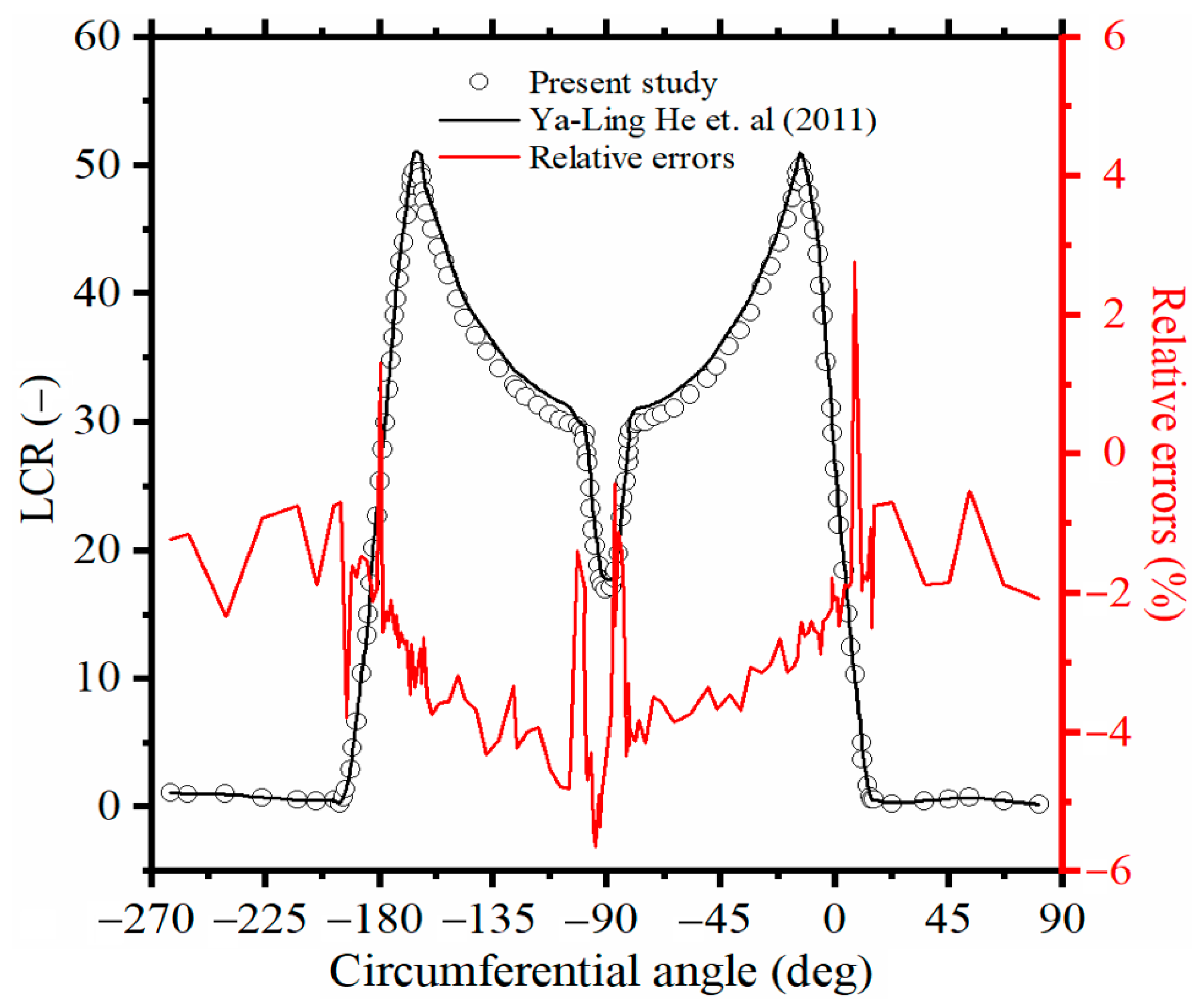
Figure 2 compares the LCR distribution obtained in this study with the results reported by Ya-Ling He et al. [
13]. A strong agreement is observed across the receiver circumference, particularly near the peak LCR region and along the descending portions of the distribution.
The average relative deviation between the two datasets was calculated as 2.78%, with a maximum deviation of 5.65% occurring near a circumferential angle of 90°. These discrepancies remain within the uncertainty ranges commonly reported in optical ray tracing analyses of parabolic trough collectors and confirm the numerical accuracy of the developed model. The close agreement in both magnitude and spatial distribution of LCR values demonstrates the capability of the present MCRT framework to accurately reproduce optical concentration behavior and local heat flux distributions under reference conditions. This validation establishes confidence in the use of the model for subsequent parametric analyses and supports the reliability of the proposed tolerance-based thermo-optical assessment under receiver misalignment conditions.
The model’s reliability under non-ideal alignment was verified by comparing the intercept factor (γ) decay against established MCRT data from the literature. The predicted optical degradation under deterministic receiver displacement aligns closely with prior studies, yielding a mean relative error of less than 4.2% within the ±10° misalignment range. This high level of agreement confirms that the model accurately captures both peak concentration characteristics and the geometric loss mechanisms associated with structural misalignments.
3. Results and Discussion
This section presents the results of the parametric analyses performed using MCRT simulations and discusses their implications for the optical and thermo-optical performance of PTC systems. The results systematically reveal how receiver misalignment influences optical efficiency, intercept behavior, heat flux redistribution, and ultimately receiver-level thermal reliability.
3.1. Optical Performance Under Ideal Conditions
At the outset of the study, the performance of the PTC was investigated under ideal optical conditions, specifically assuming zero faults. This initial step serves as a baseline for understanding the system’s theoretical maximum potential and for evaluating the effects of optical imperfections relative to this optimal reference point.
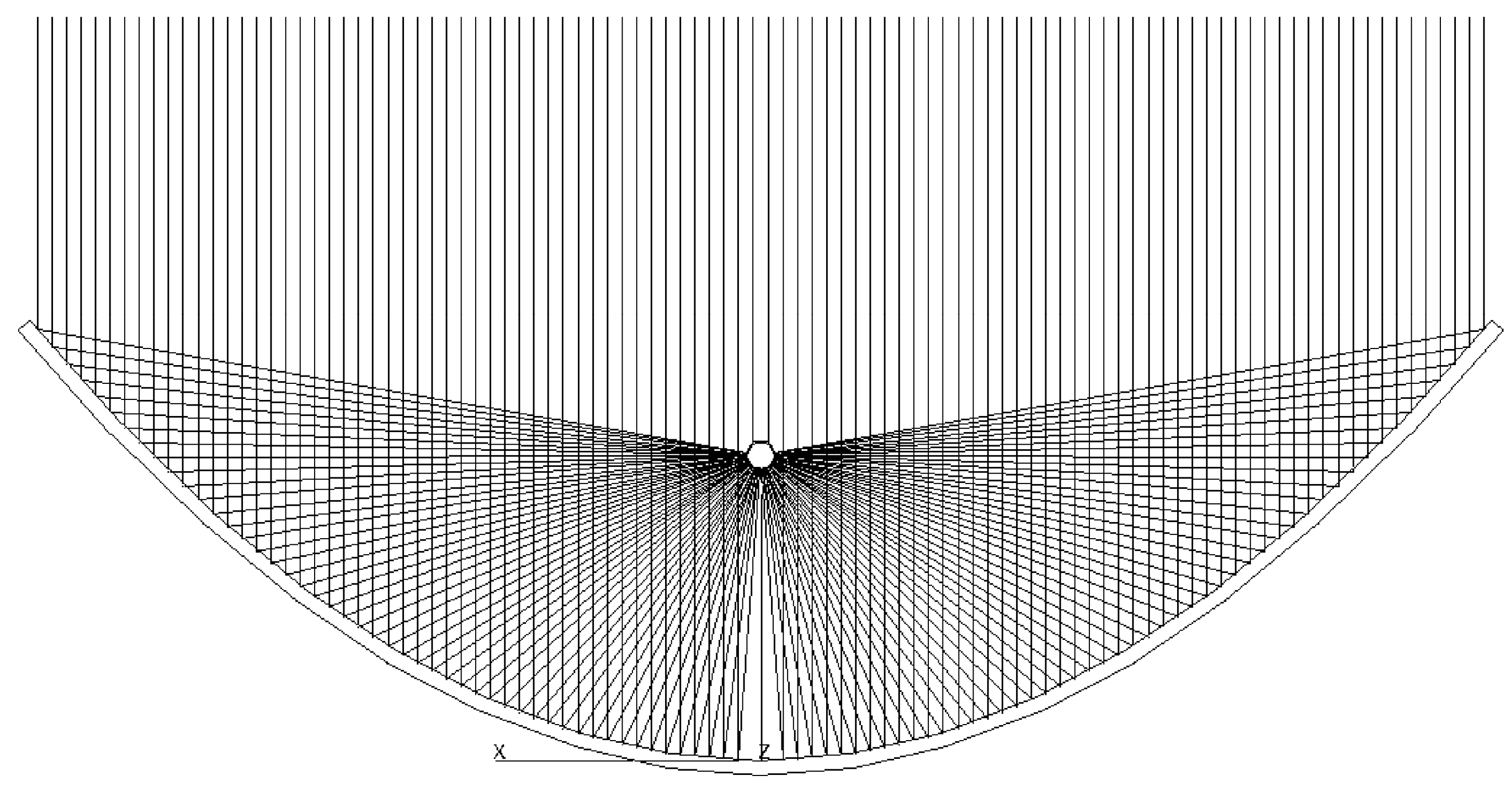
Figure 3 illustrates the ray tracing diagram at normal incidence (0°), showing precise focusing of reflected solar rays onto the absorber tube. This ideal focusing behavior is consistent with the fundamental optical design principles of parabolic trough collectors and confirms the correctness of the adopted geometric configuration [
19,
22].
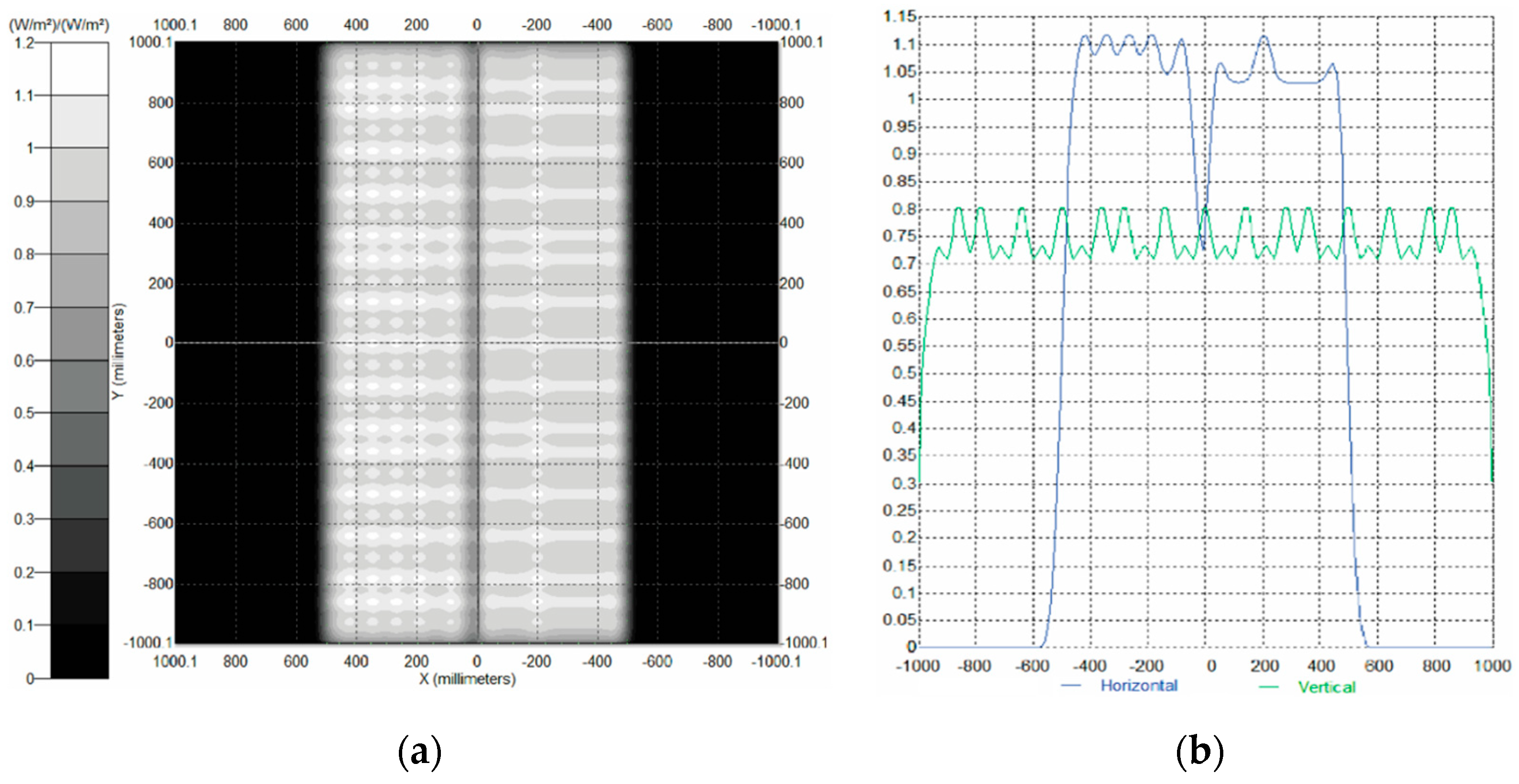
The heat flux distribution on the absorber tube surface and the flux distribution on the parabolic trough reflector surfaces are presented in
Figure 4 and
Figure 5, respectively.
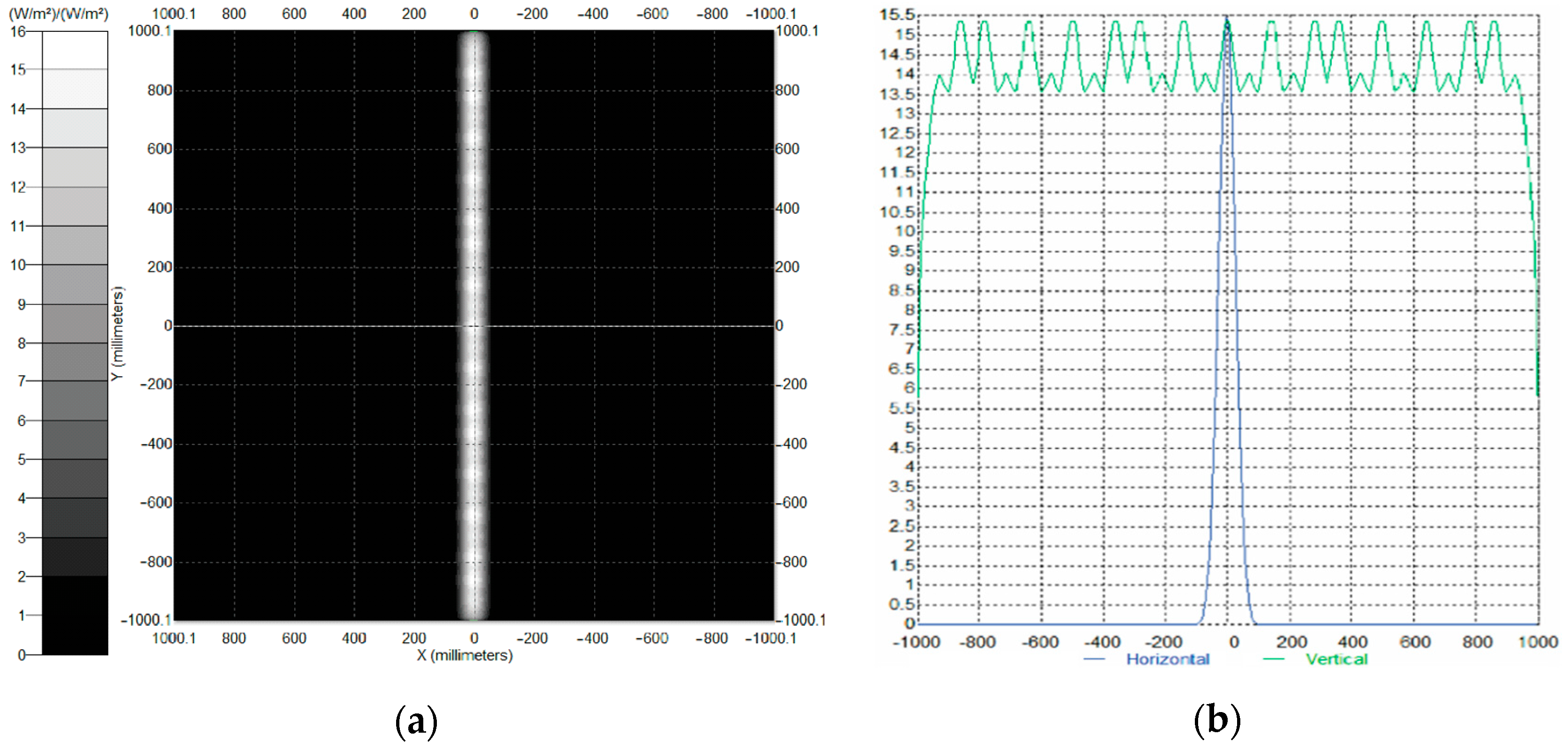
Figure 4a illustrates the 2D irradiance map for incident radiation on the absorber tube, while
Figure 4b presents the irradiance profile of this distribution along the horizontal axis (blue line) and the vertical axis (green line). Under ideal conditions, it is observed that the heat flux exhibits a narrow and high concentration on the absorber tube surface. This finding is a typical result for a parabolic system expected to achieve high flux concentration at the focal point, and it aligns with ideal flux distribution profiles presented in the literature for similar PTC models [
14,
15]. The parabolic trough reflector has an aperture area of 2 m
2 and receives radiation with a power density of 1000 W/m
2 from the grid source. The total flux captured by the receiver from the reflected radiation was measured as 9886 W; this indicates that 98.86% of the source energy reaches the receiver, which confirms the high efficiency expected for an ideal optical system. The final optical concentrator ratio was calculated to be approximately 15.9, as shown in
Table 1, a value that is consistent with design values established for commercial PTC systems [
21].
Figure 5a illustrates the 2D flux distribution map on the parabolic trough reflector, while
Figure 5b presents the irradiance diagram profile of the reflector. The homogeneous distribution of flux emanating from the reflector surface indicates the effectiveness of the optical system’s design and its success in directing the incident solar energy towards the receiver. These findings indicate that our PTC model represents the optical characteristics and shows high performance under ideal conditions.
3.2. Optical Efficiency Sensitivity to Angular Receiver Misalignment
Deviations from the optimal focal position of the absorber tube constitute a significant error source directly impacting the optical efficiency of PTCs.
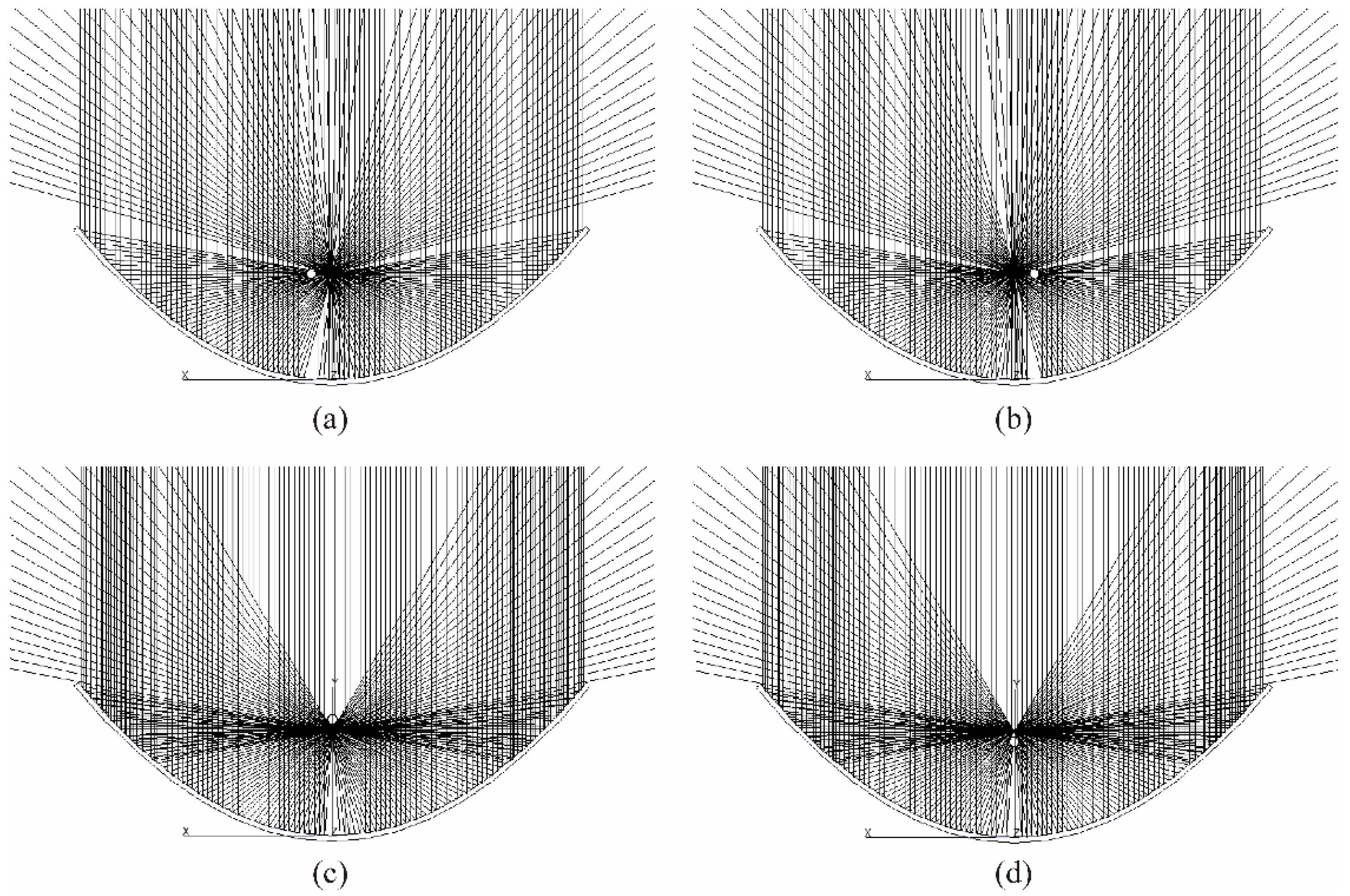
Figure 6 illustrates the ray trace diagrams for cases where light arrives with a ±10° error. These diagrams (a, b, c, d) demonstrate how position errors of the absorber tube in different axes (horizontal and vertical) distort the focusing pattern of the reflected rays. Departure from the ideal focal point leads to a significant reduction in the amount of radiation reaching the receiver and, consequently, a decrease in optical efficiency. Notably, it has been observed that large angular deviations can cause the focused radiation to completely miss the absorber tube. These observations indicate the impact of absorber tube positioning tolerances on the distribution of concentrated flux and, consequently, on thermal energy conversion [
19,
21].
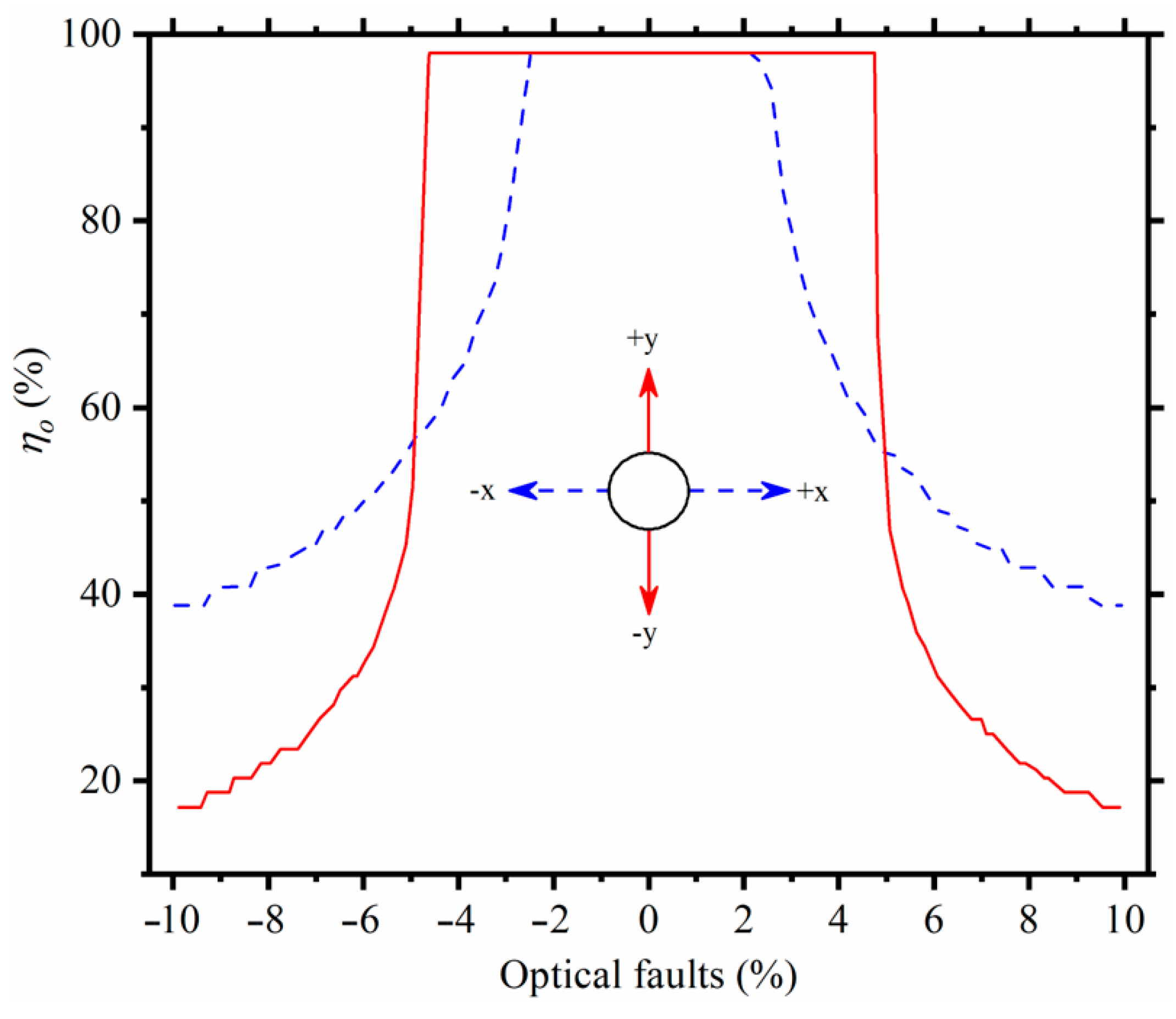
The quantitative variation in optical efficiency with receiver misalignment is presented in
Figure 7, which shows the dependence of optical efficiency on optical faults applied along the horizontal (
x) and vertical (
y) directions. The results reveal a clear directional asymmetry. Vertical misalignment leads to a more rapid decline in optical efficiency due to earlier violation of the collector acceptance angle, while horizontal misalignment exhibits a slightly broader tolerance range. In both directions, a noticeable change in the efficiency trend occurs around ±4 misalignment, indicating the onset of acceptance angle violation and a rapid reduction in the intercept factor. This behavior is consistent with classical PTC optical theory and previously reported ray tracing studies [
14,
18].
The directional asymmetry in optical sensitivity is fundamentally rooted in the caustic characteristics of parabolic trough geometry. Vertical misalignment (y-axis) shifts the receiver along the optical axis, directly violating the narrowest region of the caustic curve where local concentration is highest. This results in a rapid ‘spilling’ of the reflected ray bundle over the receiver’s circular cross-section. Conversely, horizontal misalignment involves a transverse shift where the intercept factor degrades more gradually as the bundle slides across the receiver diameter. This distinction confirms that positioning tolerances must be more stringent in the vertical plane to maintain stable energy interception.
3.3. Probability Distribution of Optical Efficiency
To account for the stochastic nature of receiver positioning errors, the probability distribution of optical efficiency was evaluated using statistical MCRT simulations.
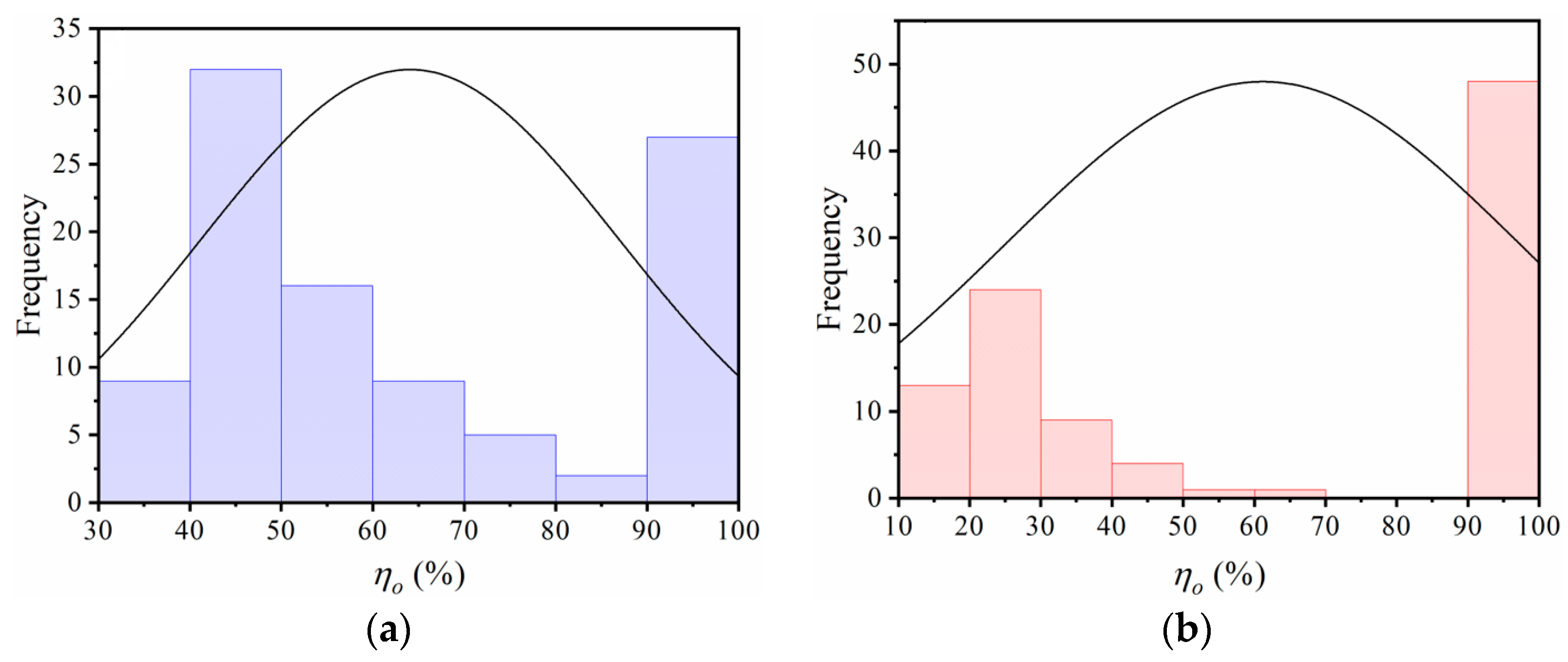
Figure 8 presents the probability distribution of optical efficiency as a function of receiver position faults: (a) for
x-axis errors and (b) for
y-axis errors. These histograms and the superimposed Gaussian curves illustrate the ranges within which optical efficiency is more frequently observed at different error levels. Such probability distributions are commonly employed in MCRT-based simulations to represent the randomness of error models [
14,
18]. The results indicate that increasing misalignment not only reduces the mean optical efficiency but also significantly broadens the efficiency distribution. This widening reflects growing sensitivity to alignment uncertainty and demonstrates that performance variability becomes increasingly relevant even when average efficiency values remain within an operationally acceptable range.
From
Figure 8a,b, the results show that increasing misalignment not only reduces the mean optical efficiency but also significantly increases the spread of the efficiency distribution. This widening of the distribution indicates increased sensitivity to uncertainty and highlights that performance variability becomes an important consideration even when average efficiency values remain moderately high. The probabilistic analysis therefore complements the deterministic tolerance assessment by quantifying performance robustness under stochastic alignment deviations.
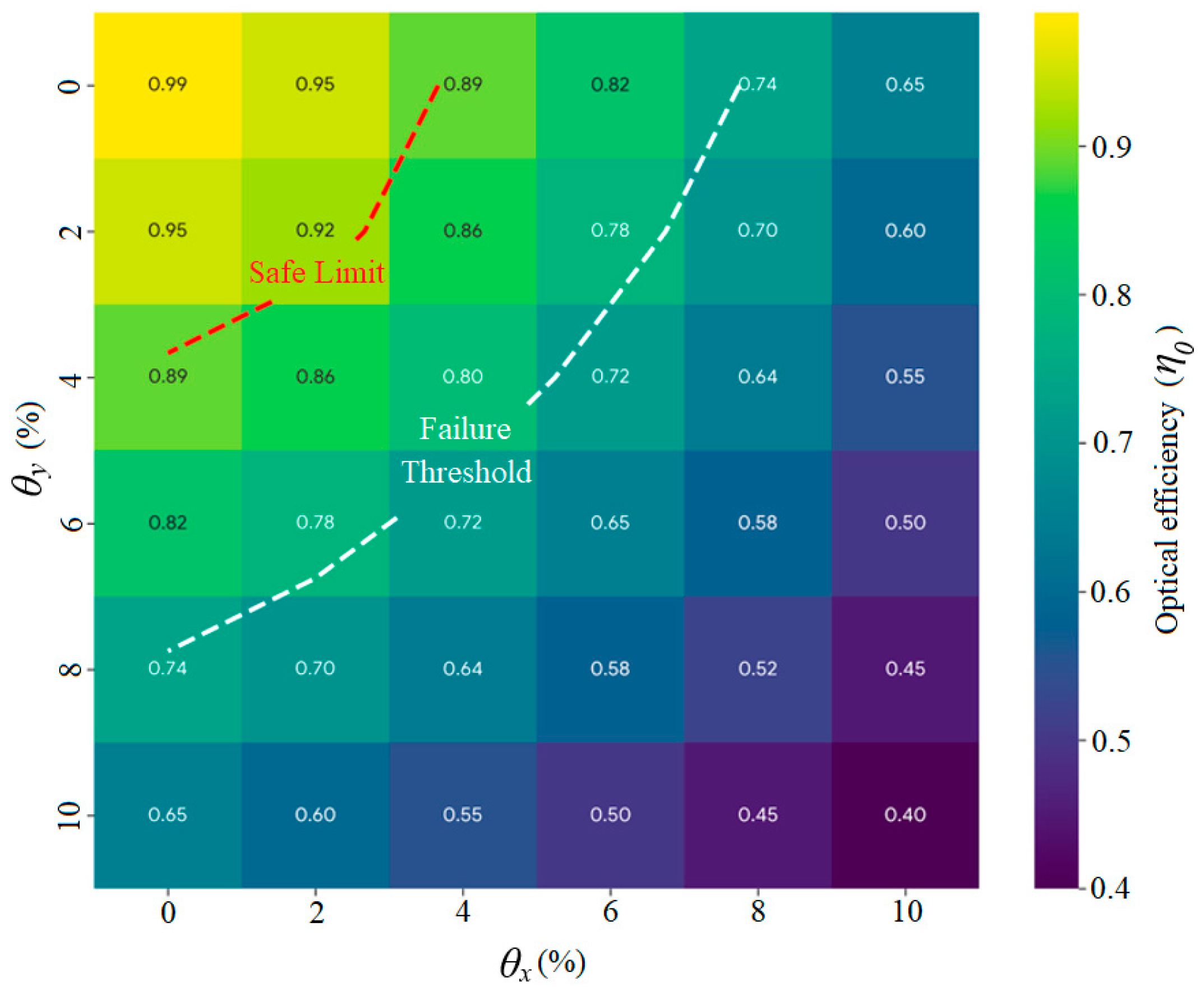
3.4. Two-Dimensional Optical Efficiency Tolerance Mapping
One-dimensional misalignment trends provide insight into directional sensitivity; however, practical receiver positioning errors typically occur simultaneously along both horizontal and vertical axes. To capture this coupled behavior, a two-dimensional optical efficiency tolerance map was constructed using full MCRT simulations for each (θ
x, θ
y) misalignment pair, as shown in
Figure 9.
Figure 9 visualizes the nonlinear efficiency contours resulting from combined angular deviations. A compact region surrounding the origin represents the safe alignment envelope, within which optical efficiency remains high and system performance is stable. Beyond this region, efficiency contours contract rapidly, indicating increasing sensitivity to compounded alignment errors. The curvature of the contour lines highlights the interdependent nature of horizontal and vertical misalignment components. As deviations increase simultaneously in both axes, optical efficiency degrades more rapidly than predicted by isolated one-dimensional trends, demonstrating a coupled tolerance effect.
All efficiency values shown in
Figure 9 were obtained directly from independent MCRT simulations assuming ideal optical properties (ρ = τ = α = 1). Due to geometric symmetry, positive and negative angular deviations produce identical results; therefore, the tolerance map is presented in terms of absolute misalignment magnitude. This two-dimensional visualization provides a design-oriented tolerance envelope, enabling rapid identification of safe, performance degradation, and failure-prone regions without relying solely on single-axis sensitivity curves.
3.5. Circumferential Heat Flux Redistribution Under Misalignment
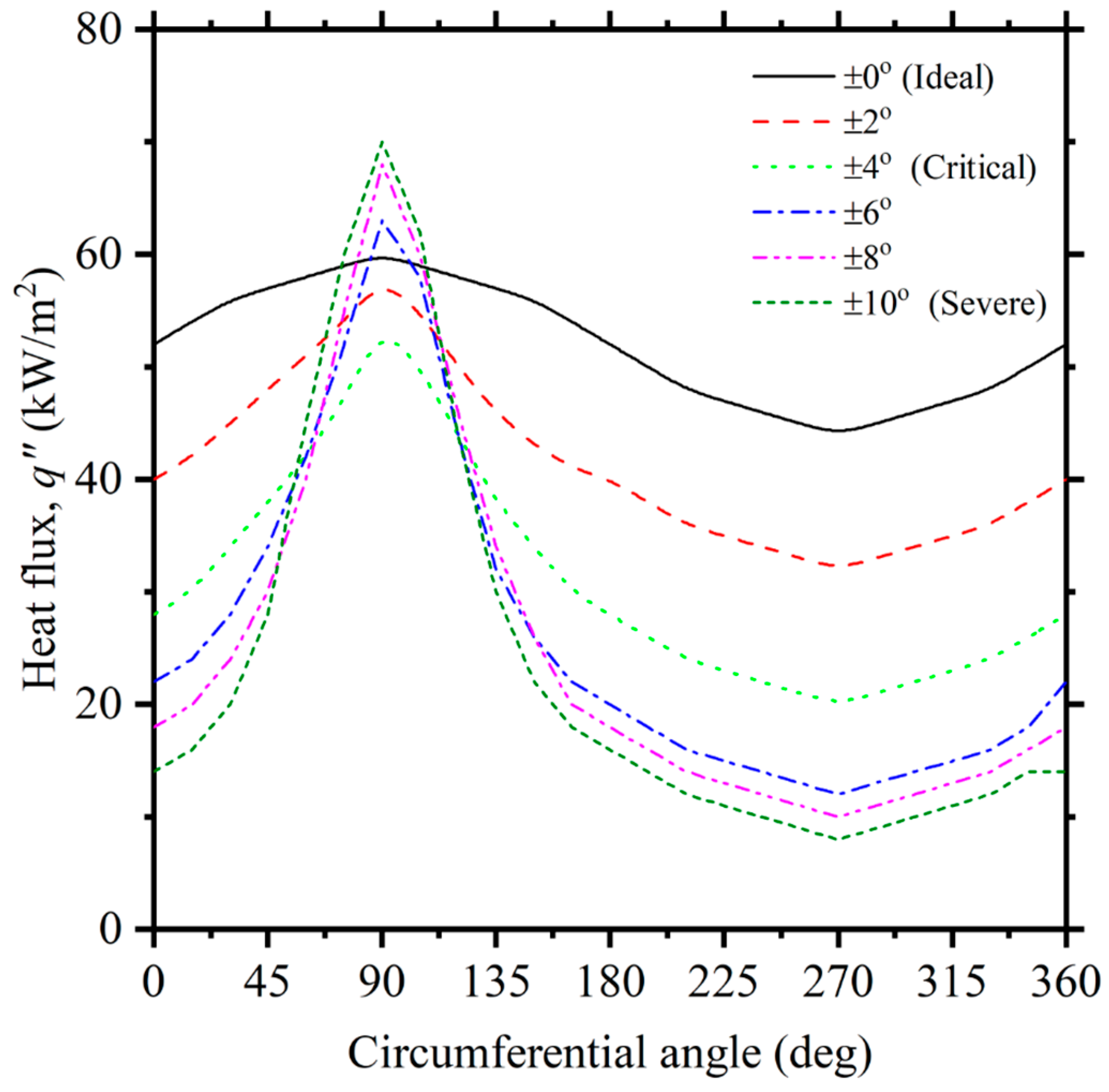
Receiver misalignment not only reduces global optical efficiency but also significantly modifies the circumferential heat flux distribution on the absorber tube, directly affecting thermal reliability. The evolution of the circumferential heat flux profile for increasing angular misalignment (0°, ±2°, ±4°, ±6°, ±8°, and ±10°) is presented in
Figure 10.
Under ideal alignment (0°), the heat flux distribution exhibits a smooth and relatively broad peak around the focal region (≈90°), with moderate circumferential variation. This behavior reflects stable and uniform energy concentration consistent with classical PTC optical theory. At small misalignment levels (±2°), the overall profile begins to distort slightly, while the peak value increases and the low-flux regions expand. At ±4° misalignment, a critical transition becomes evident: the peak heat flux intensifies and narrows within the shaded focal zone, while flux values in the opposite circumferential region decrease noticeably. This marks the onset of pronounced thermal non-uniformity. For higher misalignment levels (±6°, ±8°, and ±10°), the flux profile becomes sharply asymmetric. The peak near the focal region becomes increasingly concentrated, while the backside of the tube (≈240–300°) experiences substantial flux reduction. At ±10°, the distribution exhibits strong localization, indicating a high circumferential gradient and a significant increase in thermal stress potential.
This progressive redistribution demonstrates that even when global optical efficiency decreases gradually, circumferential flux concentration intensifies nonlinearly. The emergence of a narrow, high-intensity peak within the focal zone explains the rapid increase observed in the TSI and the CTNUI at moderate-to-high misalignment levels. Therefore,
Figure 10 clearly illustrates that receiver misalignment primarily manifests as thermal concentration amplification rather than uniform efficiency loss, reinforcing the necessity of thermo-optical reliability-based tolerance criteria rather than efficiency-based acceptance limits alone.
3.6. Thermal Non-Uniformity Indicators and Reliability Assessment
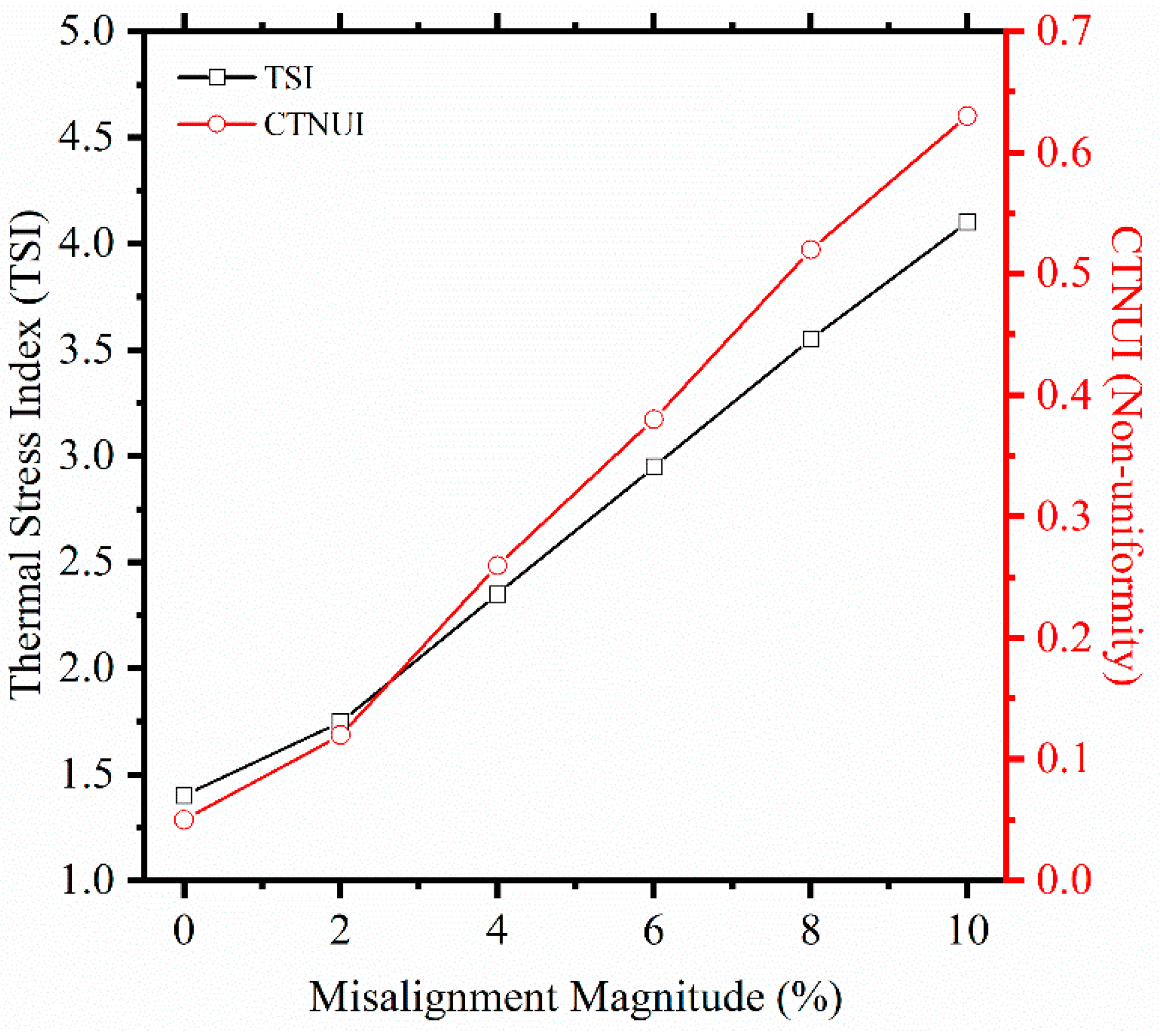
The evolution of thermal non-uniformity with increasing receiver misalignment was quantified using the TSI and the CTNUI, both derived from the circumferential heat flux distributions obtained via MCRT simulations.
Figure 11 presents the simultaneous variation in TSI and CTNUI as a function of misalignment magnitude.
Under ideal alignment (0°), the receiver exhibits relatively uniform heat flux distribution, reflected by a low TSI value of 1.40 and a minimal CTNUI of 0.05. As misalignment increases to ±2°, both indicators rise moderately, indicating the onset of localized flux concentration while global optical efficiency remains high. A pronounced transition occurs at approximately ±4° misalignment. At this level, TSI increases to 2.35 and CTNUI to 0.26, marking the beginning of significant circumferential flux localization. This transition region corresponds to the onset of acceptance angle violation identified in the optical analysis. Although the optical efficiency (η
0 ≈ 0.80) remains within a range that could be considered operationally acceptable, the thermal indicators reveal a substantial increase in non-uniform heating. This confirms that thermal reliability degradation precedes severe optical efficiency loss. Beyond ±4°, both indicators increase rapidly and approximately linearly. At ±6°, TSI reaches 2.95 and CTNUI 0.38, indicating intensified thermal gradients. At ±8° and ±10°, TSI exceeds 3.5 and 4.1, respectively, while CTNUI increases to 0.52 and 0.63. These values correspond to highly concentrated flux peaks and pronounced circumferential dispersion, conditions associated with elevated thermo-mechanical stress, coating degradation risk, and reduced long-term receiver durability. To integrate optical and thermal behavior,
Table 3 summarizes the thermo-optical reliability indicators for representative misalignment levels.
The combined results clearly demonstrate a fundamental decoupling between optical acceptability and thermal safety. While optical efficiency decreases progressively with misalignment, thermal non-uniformity indicators exhibit sharper transitions and greater sensitivity to moderate deviations. In particular, the ±4° misalignment level represents a critical threshold where acceptance angle violation, heat flux localization, and accelerated thermal non-uniformity emerge simultaneously. Accordingly, receiver alignment tolerances derived solely from optical efficiency may underestimate thermally induced reliability risks. To formalize these findings, the derived thermo-optical tolerance limits are summarized in
Table 4.
The results establish ±4° as the maximum thermally safe misalignment limit for the investigated PTC configuration, while ±6° may still satisfy efficiency-based criteria. The ±2° decoupling range between these limits represents the operational region in which optical performance appears acceptable but thermal reliability has already begun to deteriorate. By integrating deterministic optical trends with thermal non-uniformity metrics, the proposed thermo-optical framework provides a structured and reliability-oriented basis for defining receiver alignment tolerances in practical CSP systems.
While optical efficiency decreases approximately linearly with increasing misalignment, the Thermal Stress Indicator exhibits non-linear amplification behavior. This decoupling demonstrates that moderate efficiency loss may coexist with rapidly intensifying circumferential flux gradients.
3.7. Sensitivity Analysis to Optical Property Variations
The ideal optical assumptions (ρ = α = 1, no scattering, no heat loss) represent an upper-bound geometric sensitivity scenario. In realistic operating conditions, optical losses and convective/radiative heat dissipation may reduce absolute peak values. However, the geometric misalignment-induced decoupling behavior identified in this study is governed primarily by ray redistribution mechanisms and therefore remains qualitatively valid.
To determine whether the identified ±4° thermal misalignment threshold is sensitive to absolute optical property values, additional MCRT simulations were conducted under reduced reflector reflectivity and absorber absorptivity conditions. Three optical scenarios were evaluated: an ideal case (ρ = 1.00, α = 1.00), a realistic case (ρ = 0.95, α = 0.95), and a degraded case (ρ = 0.90, α = 0.90). The case ρ = 0.95 and α = 0.95 represents a typical commercial PTC operation under clean and well-maintained conditions, whereas ρ = 0.90 and α = 0.90 approximate degraded optical performance resulting from surface aging, coating deterioration, or moderate soiling reported in field measurements. Since optical efficiency scales proportionally with the product (ρ·α), decreasing optical properties primarily reduces the absolute magnitude of absorbed solar flux. However, the TSI and CTNUI are defined as normalized flux distribution metrics. Because both peak and average heat flux values scale proportionally with the same optical multipliers, their ratio remains predominantly governed by geometric flux redistribution rather than by absolute optical magnitude.
Table 5 summarizes the influence of optical property variation on the optical acceptability limit and the thermally safe misalignment threshold.
Beyond reflectivity and absorptivity, other critical engineering factors, such as the transmittance of the glass envelope (τ), the solar cone angle, and mirror, scattering significantly influence the absolute thermal performance of PTC systems. A non-ideal solar cone angle and mirror surface scattering tend to broaden the reflected ray bundle, which may lead to a slight contraction of the intercept factor even under minor misalignment. Similarly, the glass envelope introduces Fresnel reflection and absorption losses, reducing the total energy reaching the absorber. However, as demonstrated by the sensitivity cases in
Table 4, these factors primarily act as linear scaling parameters for the intercepted power (Q
inc). Since the proposed thermal stress indicators (TSI and CTNUI) are defined as normalized flux distribution metrics, their relative sensitivity to receiver misalignment remains predominantly governed by the geometric interaction between the parabolic concentrator and the absorber tube. Consequently, while the absolute values of the optical acceptability limit may shift slightly under different engineering scenarios, the thermally safe misalignment threshold (±4°) and the identified ‘decoupling’ phenomenon exhibit strong robustness, marking them as reliable diagnostic boundaries for structural alignment assessment in commercial CSP plants.
To generalize these findings beyond the specific configuration examined, the dimensionless parameter Π = θf/D
o provides a scale-invariant metric for alignment assessment. As shown in
Table 5, the thermally critical behavior consistently aligns with Π ≈ 0.5, demonstrating remarkable robustness against variations in optical properties. This stability confirms that the derived tolerance envelope is primarily geometry-dominant. Consequently, the Π parameter allows the proposed framework to be adapted to various PTC scales, shifting the focus from case-specific angular limits to a universal reliability-informed criterion. The results demonstrate that while the optical acceptability limit shifts moderately with decreasing reflectivity and absorptivity, the thermally critical misalignment threshold remains nearly unchanged. The variation in the thermal limit is below ±0.3°, confirming that the derived ±4° tolerance envelope is geometry-dominant and exhibits strong robustness against realistic optical degradation.
3.8. Optical–Thermal Decoupling and Tolerance Implications
The combined optical and thermal analyses confirm that optical efficiency alone is not a sufficient criterion for defining receiver alignment tolerances. Although efficiency-based operational criteria (η0 ≥ 0.80) remain satisfied up to ±6°, thermal safety limits derived from TSI and CTNUI are exceeded at approximately ±4°.
This ±2° interval represents a decoupling region in which optical performance appears nominally acceptable while thermo-mechanical risk has already intensified. The existence of this region demonstrates that efficiency-based acceptance thresholds may systematically underestimate alignment-induced thermal reliability degradation.
The fundamental distinction between the proposed risk-oriented framework and traditional assessments lies in the formalization of this nonlinear decoupling. While existing studies acknowledge the need to limit misalignments to maintain efficiency, they often overlook the regime where nominal performance masks severe flux non-uniformity. By explicitly quantifying the ±2° decoupling range, this study enables ‘reliability-informed’ alignment tolerances that prioritize the prevention of localized hotspots over mere power maximization—a shift critical for the long-term durability of large-scale CSP systems. It should be emphasized that the ±4° threshold identified herein constitutes a ‘geometric safety envelope’. Although thermohydraulic interactions in a field-scale system might slightly shift the absolute material failure point, the rapid, non-linear intensification of flux non-uniformity beyond this threshold marks a transition into a high-risk regime. Within this range, the receiver remains increasingly susceptible to localized hotspots and accelerated aging, irrespective of the heat transfer fluid’s cooling performance.
From an engineering standpoint, this finding shifts tolerance definition from a purely performance-driven approach toward a reliability-informed framework. Alignment limits must therefore be constrained by the thermally safe misalignment threshold rather than by optical efficiency alone. For the investigated configuration, ±4° constitutes the maximum thermally safe envelope, whereas ±6° represents only an efficiency-based operational boundary.
Regarding the field feasibility of the ±4° limit, it is acknowledged that large-scale CSP construction faces inevitable challenges such as assembly inaccuracies, wind-induced vibrations, and structural thermal expansions. However, the identified threshold should be interpreted as a ‘design target’ for high-performance reliability rather than an absolute constructional constraint. In environments where external loads further exacerbate receiver displacement, the necessity of staying within this ±4° envelope becomes even more critical to prevent the superposition of multiple optical errors. By establishing this baseline, the proposed framework provides a quantitative quality-control metric for autonomous tracking correction systems and structural reinforcement strategies aimed at mitigating long-term fatigue in commercial solar fields. The ±4° threshold identified in this study should not be interpreted as a tracking accuracy requirement. In operational CSP plants, alignment tolerances are typically maintained within small angular deviations to maximize energy yield. The present threshold instead represents a flux-based thermally critical envelope under ideal optical assumptions.
Although the present framework is validated against literature-reported LCR distributions and independent optical benchmarks, full thermo-mechanical experimental validation under controlled angular misalignment would further strengthen the practical interpretation of the derived tolerance limits. Such validation is considered a valuable direction for future research involving coupled optical–thermal instrumentation.
4. Conclusions
This study presents a comprehensive thermo-optical evaluation of receiver misalignment effects in PTCs using MCRT simulations. Unlike conventional analyses that focus solely on optical efficiency loss, the present work integrates circumferential heat flux redistribution and thermal non-uniformity indicators into a tolerance-based reliability framework. Under ideal alignment conditions, the investigated PTC system achieved a 98.86% energy interception rate, confirming the intrinsic concentration capability of the adopted geometric configuration. However, the parametric analysis demonstrated that even moderate receiver misalignment produces nonlinear degradation in both optical and thermal behavior. The key findings of the study can be summarized as follows:
Optical efficiency decreases gradually with misalignment; however, thermal non-uniformity indicators (TSI and CTNUI) increase more rapidly.
A critical transition occurs at approximately ±4° misalignment, where acceptance angle violation, flux localization, and accelerated thermal dispersion coincide.
The optical acceptability limit (η0 ≥ 0.80) was identified at ±6°, whereas the thermally safe misalignment limit was found to be ±4°.
The resulting ±2° decoupling range demonstrates that thermally critical conditions may arise while optical efficiency remains nominally acceptable.
These results confirm that defining receiver alignment tolerances solely based on optical efficiency can mask the onset of thermo-mechanical risk. The proposed thermo-optical reliability framework introduces:
An explicit optical–thermal decoupling parameter;
A receiver-centric misalignment severity index;
A field-oriented alignment safety factor.
thereby translating numerical simulation outputs into practical alignment criteria applicable during commissioning and maintenance.
From an engineering perspective, the findings highlight the importance of:
Precision manufacturing and installation tolerances;
Alignment monitoring strategies during operation;
Reliability-informed performance evaluation beyond nominal efficiency metrics.
It should be noted that this study is based on validated MCRT simulations under idealized optical property assumptions. Although model validation showed strong agreement with published LCR distributions, experimental verification under controlled field conditions would further strengthen the conclusions. In addition, the present analysis isolates optical and thermo-optical effects; fluid–structure interaction, heat transfer with working fluid, and wind-induced structural deformation were beyond the scope of this work. Future research may extend the framework toward multi-physics coupling, lifetime degradation modeling (including reflector aging and soiling), and integration with economic performance metrics to quantify the impact of alignment tolerances on the levelized cost of energy in CSP plants.
The present framework assumes steady-state misalignment. Time-dependent x–y coupling effects and transient flux redistribution under dynamic tracking deviations require multi-physics analysis and represent valuable future research directions.
Overall, this study advances the evaluation of PTC receiver alignment from a purely optical efficiency perspective to a thermo-optical reliability-based methodology, offering a design-oriented and operationally actionable approach for improving the long-term performance and durability of CSP systems.
The proposed framework provides a quantitative alignment tolerance envelope that can support manufacturing precision specifications, field installation quality control, and periodic structural inspection protocols in commercial CSP plants. By identifying a thermally critical misalignment threshold independent of pure efficiency criteria, the approach enables early detection of alignment-induced reliability risks before significant power losses occur. This reliability-informed tolerance definition may contribute to improved receiver durability, reduced maintenance frequency, and enhanced long-term operational stability.