Method and Application of Full-Space Deformation Monitoring of Surrounding Rock in Coal Mine Roadway Based on Mobile Three-Dimensional Laser Scanning

Abstract
1. Introduction
- (1)
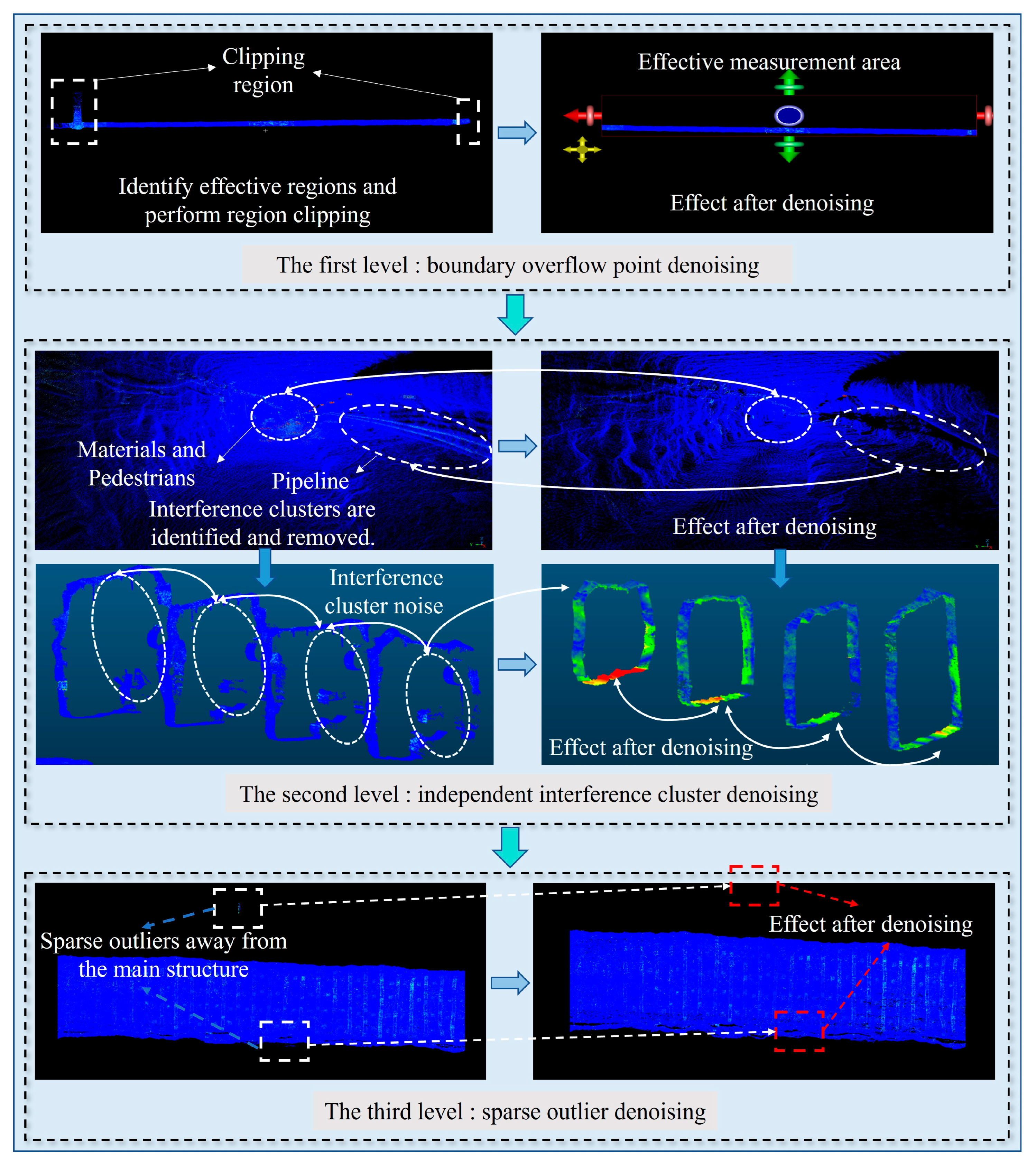
- A three-level progressive point cloud denoising method suitable for the complex environment of a coal mine is proposed. The three-level processing strategy of region clipping, improved statistical filtering and adaptive density threshold effectively improves the quality of point cloud data in an underground multi-interference source environment.
- (2)
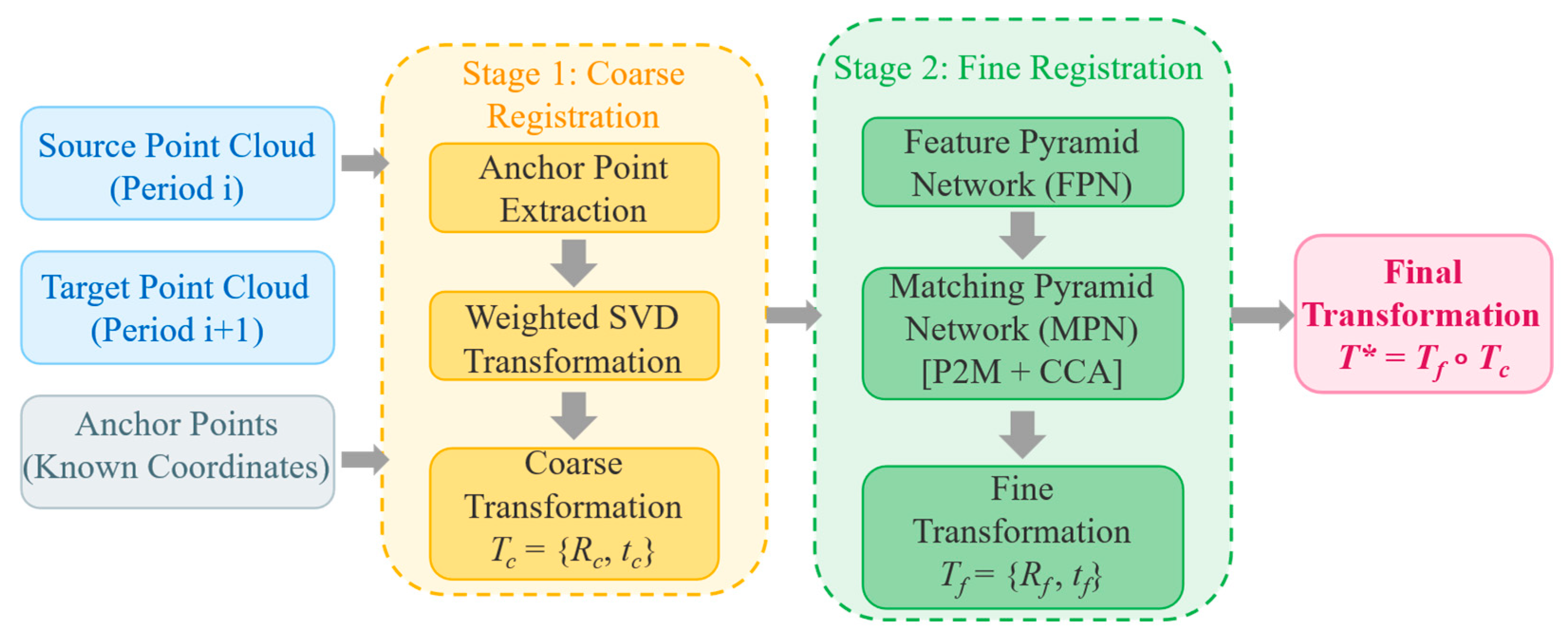
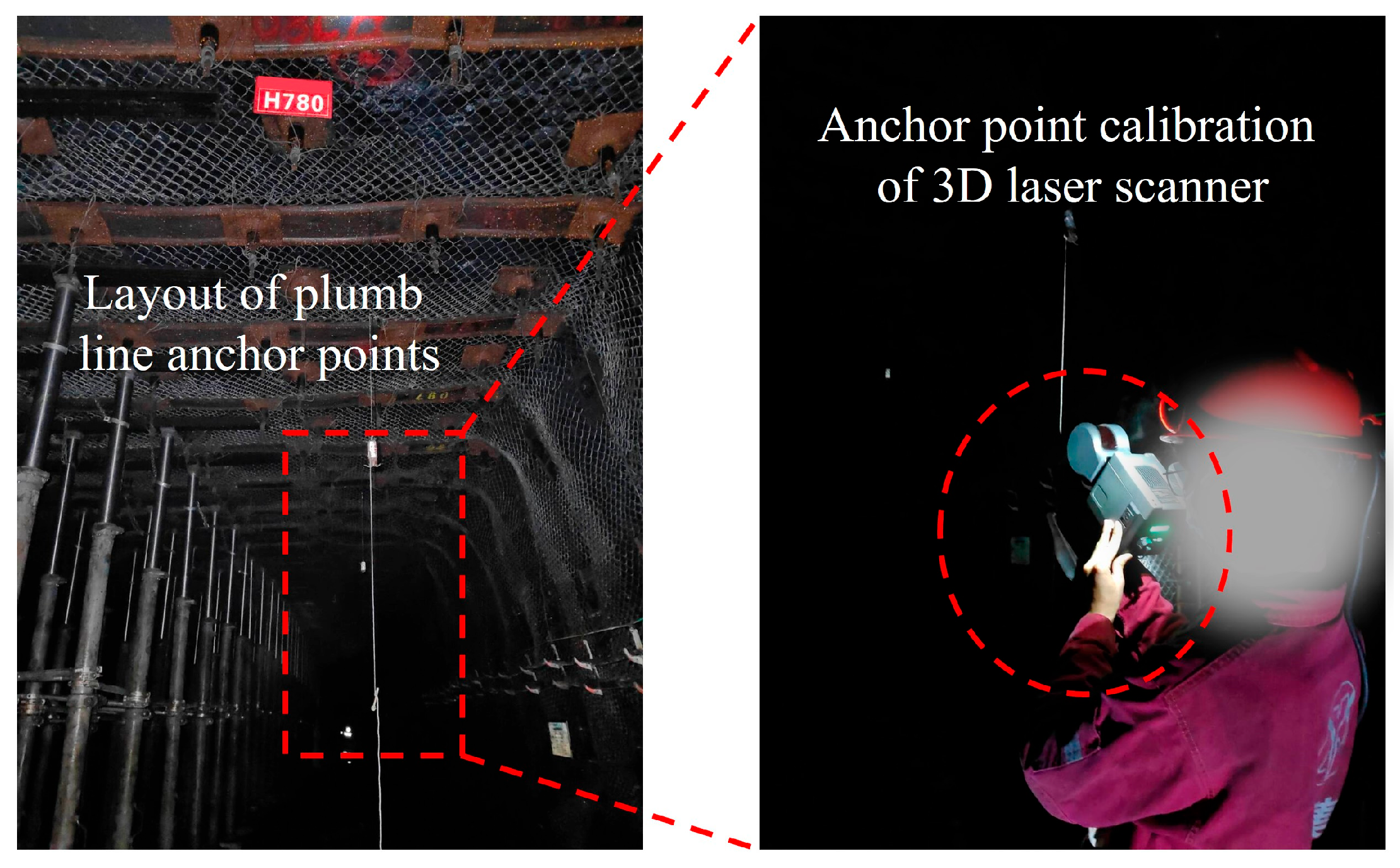
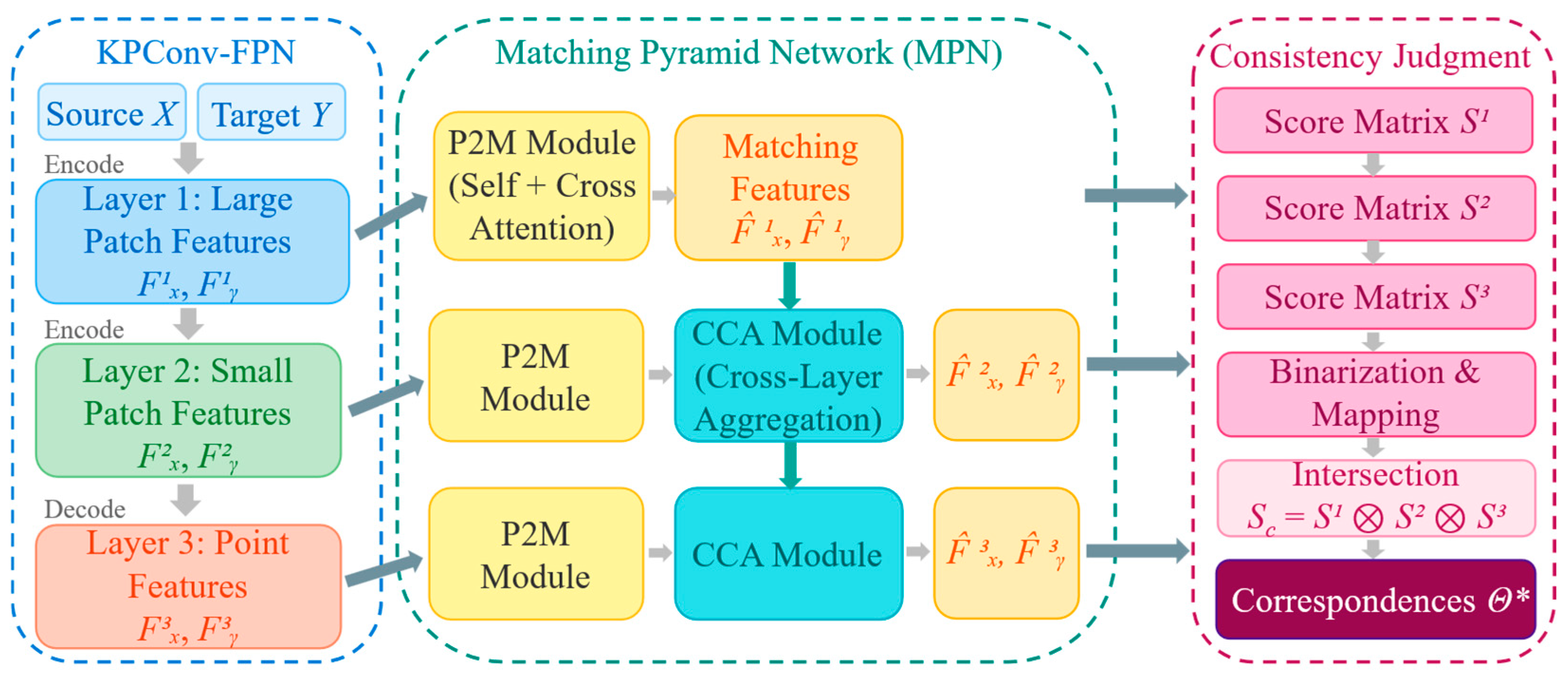
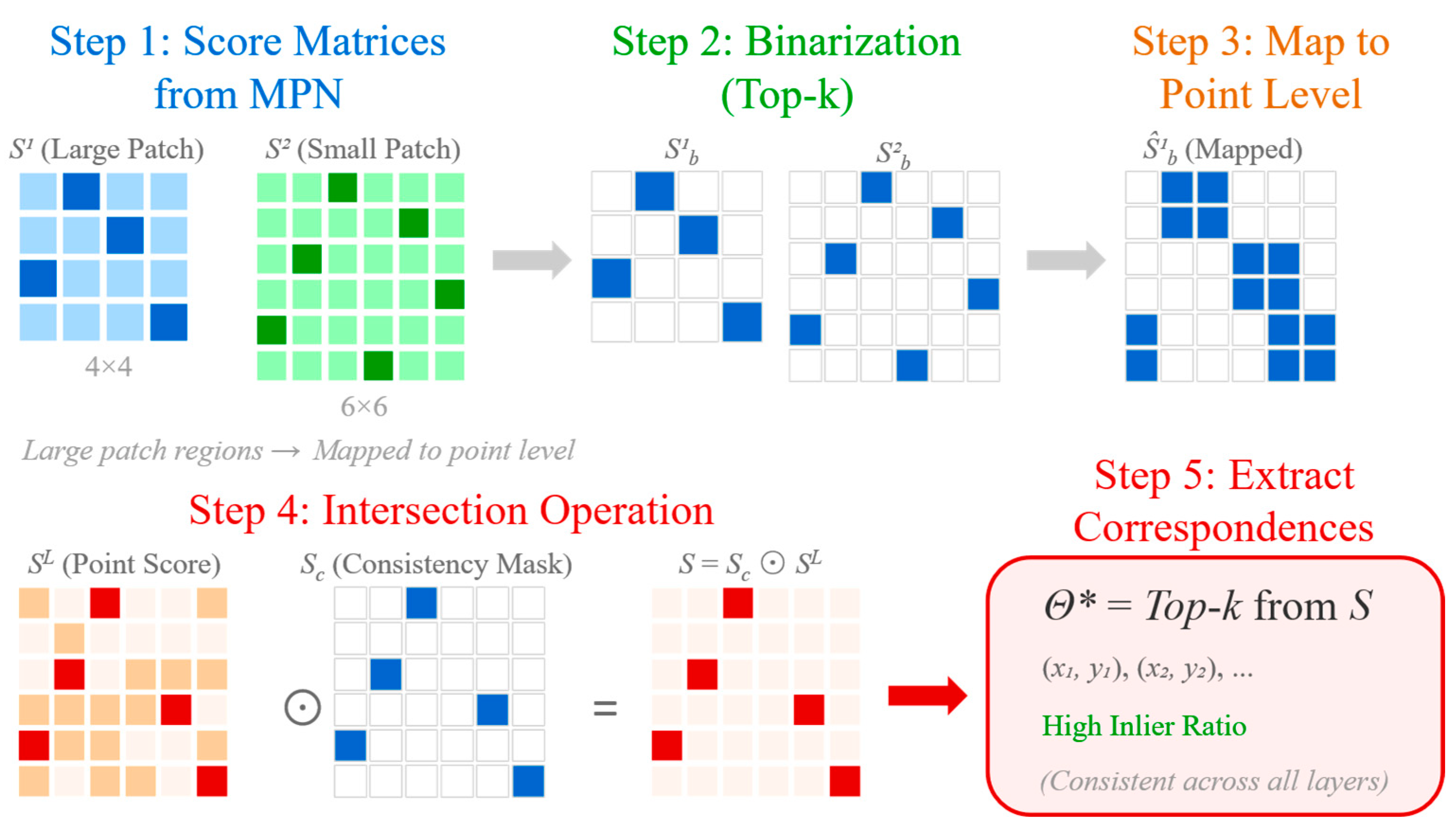
- A hierarchical point cloud registration method that combines the geometric constraints of physical anchors and the guidance of deep learning features is established. Through the two-stage strategy of ‘coarse registration-fine registration’, the high-precision registration problem of the mobile laser scanning system in low overlap rate and weak texture scenes of coal mine roadway is solved.
- (3)
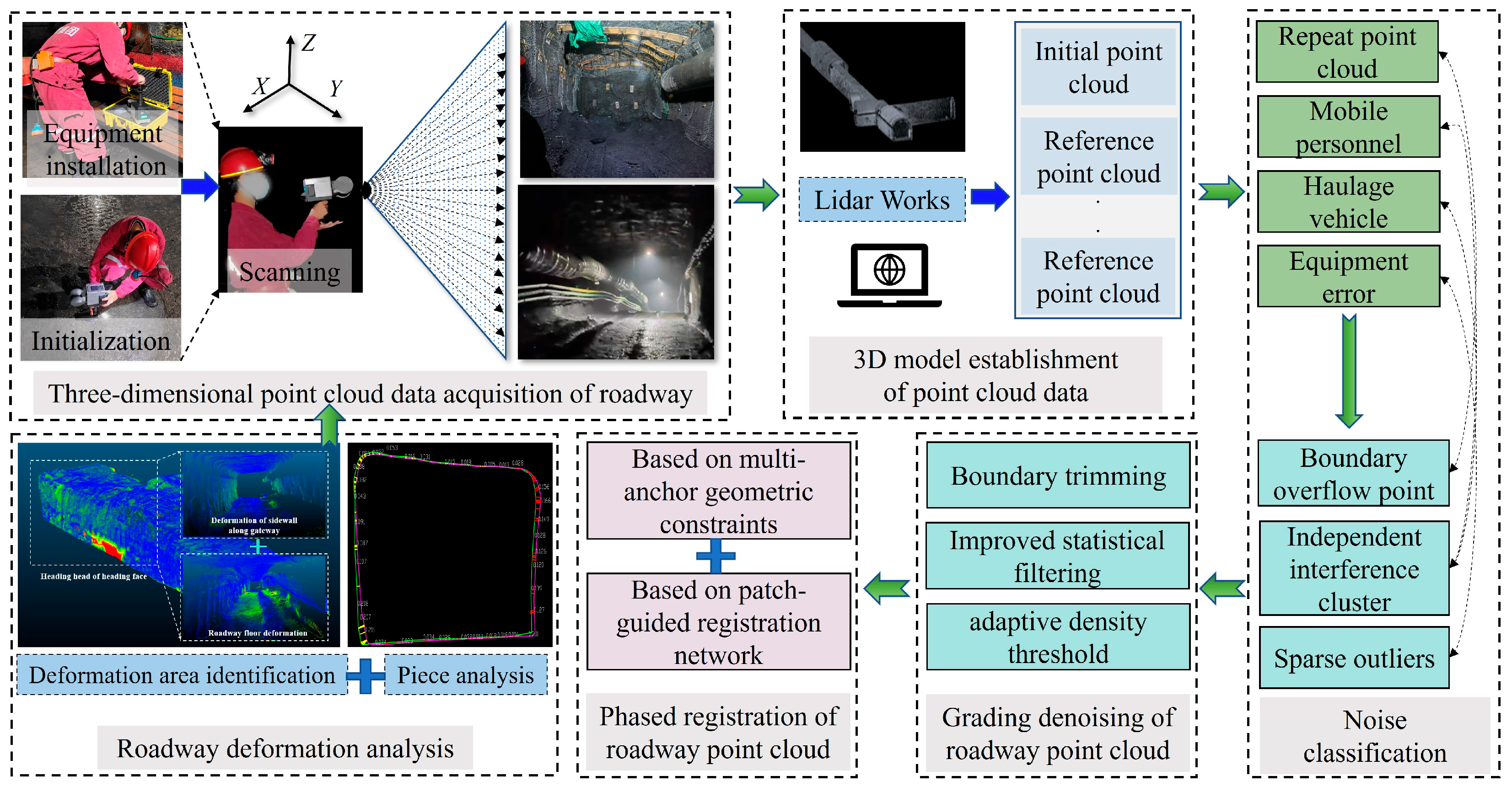
- The whole space deformation monitoring technology system of coal mine roadway surrounding rock based on explosion-proof mobile 3D laser scanning is constructed. A complete technical link from data acquisition to deformation analysis is formed, which breaks through the limitations of traditional discrete point monitoring methods and realizes high-precision deformation monitoring of the roadway surrounding rock in the whole field.
2. Engineering Background
3. 3D Laser Scanning Monitoring Roadway Deformation Method and Data Processing Technology
3.1. Roadway Deformation Monitoring Method
3.2. Roadway Deformation Monitoring Process
3.3. Data Processing Method
3.3.1. Grading Denoising of Roadway Point Cloud Data
- (1)
- Boundary overflow point: This kind of data is essentially the real reflection information on the surface of the roadway, but it is located outside the boundary of the preset collection range, resulting in the lack of integrity of the reconstructed three-dimensional model. The salient features of this category include: a large amount of data, wide distribution and high similarity with the target data in terms of geometric attributes.
- (2)
- Independent interference cluster: It refers to the non-target object point cloud that interferes with subsequent data processing. In the mine environment, it mainly comes from obstacles such as mobile personnel and transportation vehicles. Its typical characteristics are: limited space occupation range and relatively isolated location.
- (3)
- Sparse outliers: It is mainly due to the systematic measurement bias of the scanning device, which is randomly distributed in the periphery of the target data. The key characteristics of this type of data are: sparse quantity, low density and strong spatial dispersion.
- (1)
- Establishment of roadway boundary space model: According to the geometric structure characteristics of the roadway, a three-dimensional space boundary constraint model is constructed to determine the geometric parameters of the effective roadway area.
- (2)
- Set the spatial threshold range: Based on the actual roadway dimensions and the expected measurement accuracy, the boundary threshold Rb is determined to define the effective measurement region.
- (3)
- Perform region clipping operation: detect the spatial range of the original point cloud data, remove the overflow points beyond the boundary threshold Rb, and obtain the effective point cloud data set within the boundary. The principle of boundary cutting is shown in Formula (2).Among them, is the point cloud data set after the first-level denoising; is the three-dimensional coordinates of the i-th point; is the input original point cloud data set; is the distance from the point to the central axis of the roadway.
- (1)
- Constructing an enhanced KD-tree spatial index: Based on the original KD-tree construction, the neighborhood connection information is added to establish a spatial index structure with topological relations. The k nearest neighbor query is shown in Formula (3).where is the k-nearest neighbor point set of point ; is the j-th point in the neighborhood.
- (2)
- Calculate the multi-dimensional geometric feature vector: For each point pi, a three-dimensional geometric feature vector is constructed as Fi = [ci, ni, ρi], including curvature, normal vector, and local point density. The covariance matrix is calculated as follows:where the neighborhood centroid is:The curvature characteristic is:The normal vector is:The local point density is:where , , and are the three eigenvalues of the covariance matrix, arranged in descending order; is the unit eigenvector corresponding to the minimum eigenvalue ; and is the distance of the k-th nearest neighbor point.
- (3)
- Set the feature similarity threshold: establish the feature similarity measure standard and set the threshold to judge the geometric feature consistency of adjacent points. The feature similarity measure is calculated as follows:Among them, the feature similarity distance of point pi and pj; , and are the weight coefficients of curvature, normal vector and density, respectively, satisfying ; is the normal vector dot product, which represents the cosine value of the angle.
- (4)
- Perform connectivity analysis: Based on the KD-tree neighborhood relationship and feature similarity, a neighborhood connected graph G is constructed to identify point clusters with similar features. The neighborhood connected graph G is calculated as follows:Among them:Based on Equations (10)–(12), the connected cluster decomposition is carried out, and the following results are obtained:where V is the vertex set, that is, all points in the point cloud; E is the edge set, which connects the adjacent point pairs with similar features; is the feature similarity threshold; is the M-th connected cluster.
- (5)
- Identifying interference clusters based on feature consistency: Analyze the feature statistics of each cluster in the connected graph, identify independent interference clusters that do not match the surface features of the roadway, and set the cluster size threshold θcluster. Remove the interference cluster markers that are smaller than the threshold, retain the large-scale effective clusters, and complete the removal of independent interference clusters.
- (1)
- Neighborhood radius detection: establish a neighborhood range with a fixed radius r for each point and count the number of points in the neighborhood. The calculation formula of the fixed radius neighborhood is:where is the set of neighborhood points within the radius r of point .
- (2)
- Statistical neighborhood density: Calculate the point density of each point pi within the neighborhood radius r, and quantify the density of the local point cloud.Among them, the neighborhood point density is:where is the number of points in the neighborhood.
- (3)
- Set the density threshold determination: determine the minimum density threshold ρmin, as the standard to distinguish between normal points and sparse abnormal points. The global density statistics are:The density threshold is:where denotes the global mean point density of the point cloud; is the standard deviation of the point density and is a scaling coefficient used to control the density threshold.
- (4)
- Abnormal point identification and removal: For the points whose density value is lower than the threshold, the sparse abnormal points are marked and removed, and the remaining points are retained as normal points, and finally, the optimized denoising point cloud is obtained.
3.3.2. Roadway Point Cloud Registration
- (1)
- Rough registration method based on multi-anchor geometric constraints
- (2)
- Point cloud fine registration method based on patch-guided registration network
- (3)
- Fusion strategy of hierarchical registration
3.4. Comparative Analysis of Deformation of Roadway Point Cloud Data
3.4.1. Overall Deformation Recognition Based on Point Cloud Distance
3.4.2. Section Slice Deformation Analysis
4. Engineering Application and Deformation Result Analysis
4.1. Comparative Analysis of the Overall Deformation of the Roadway
4.2. Slice Quantitative Analysis of Roadway Deformation Area
4.3. Consistency of Monitoring Methods and Engineering Reliability Verification
5. Conclusions
- (1)
- A hierarchical point cloud denoising method suitable for the complex environment of coal mine roadway is proposed. Through the three-level progressive processing strategy of boundary clipping, improved statistical filtering guided by multi-dimensional geometric features and adaptive density threshold, three typical noises of boundary overflow points, independent interference clusters and sparse outliers are eliminated. On the premise of retaining the integrity of the geometric features of the roadway surface, this method significantly improves the purity and geometric accuracy of the original point cloud data, solves the key problem of poor quality of point cloud data in the multi-interference source environment of the coal mine, and provides data guarantee for subsequent high-precision registration and reliable deformation analysis.
- (2)
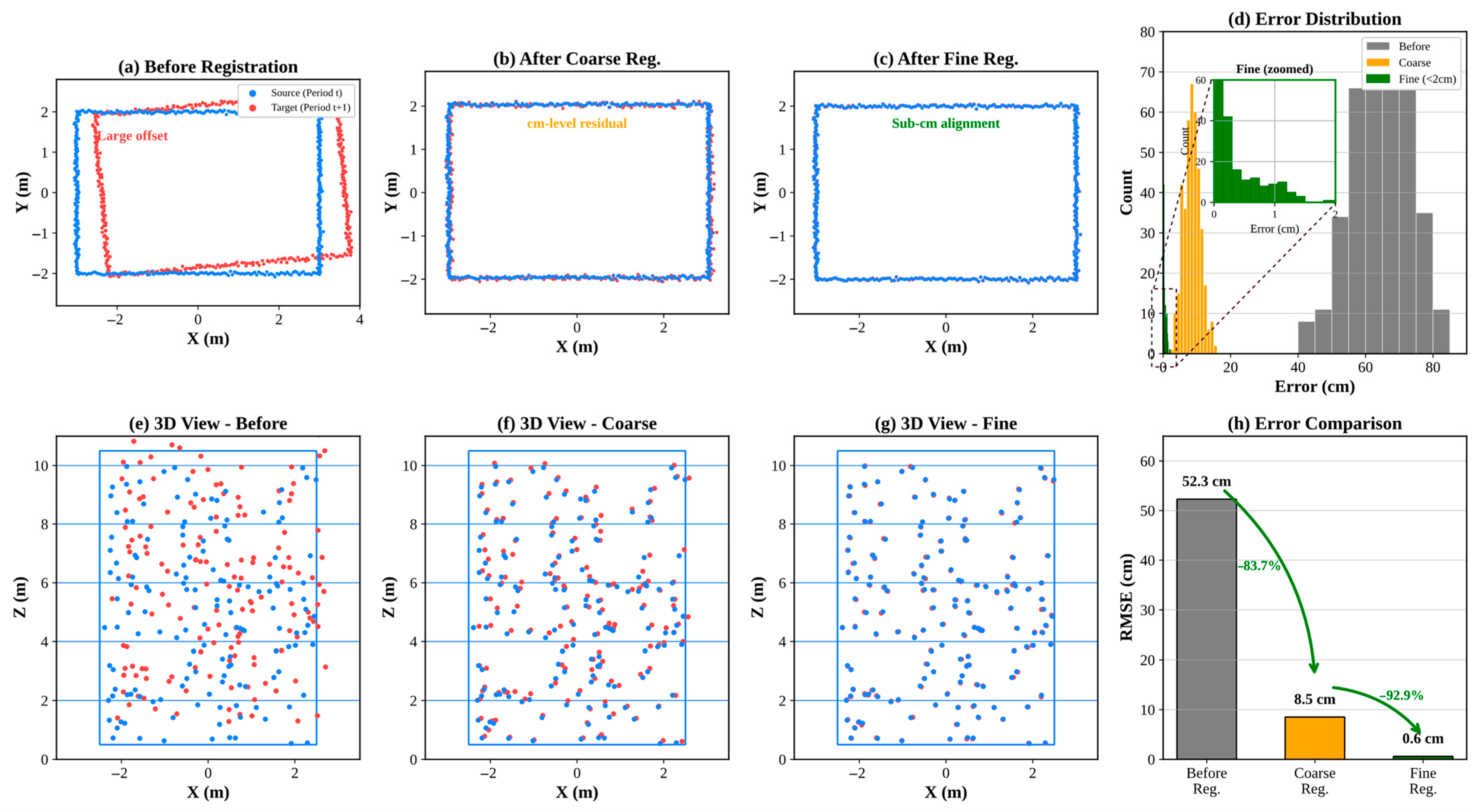
- A hierarchical point cloud registration method combining physical anchor geometric constraints and deep learning feature guidance is established, which effectively solves the registration problem of a mobile laser scanning system in low overlap rate, weak texture and high geometric repeatability scenes such as coal mine roadway. In the coarse registration stage, the pre-calibrated physical anchor points are used to achieve global coordinate alignment through weighted SVD, which reduces the registration error RMS from 52.3 cm to 8.5 cm, and the accuracy is improved by 83.7%. In the fine registration stage, the patch-guided registration network (FPN + MPN) is used, and the outlier corresponding point pairs are filtered by combining the matching consistency judgment strategy. The registration error RMS is further reduced to 0.6 cm, and the accuracy is improved by 92.9% compared with the coarse registration stage. The overall accuracy of the two-stage registration is improved by 98.9%, which ensures the engineering requirements of surrounding rock deformation monitoring.
- (3)
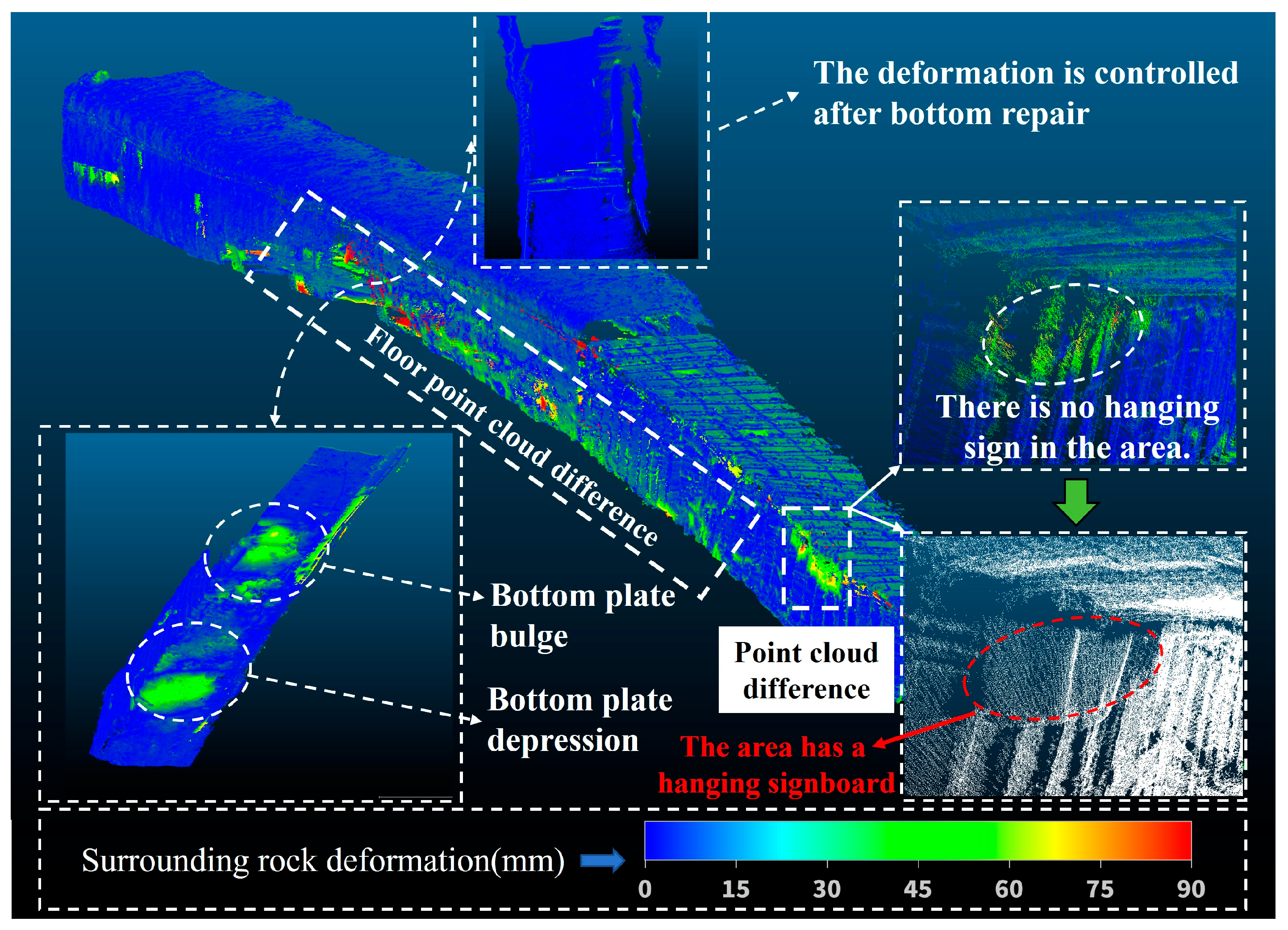
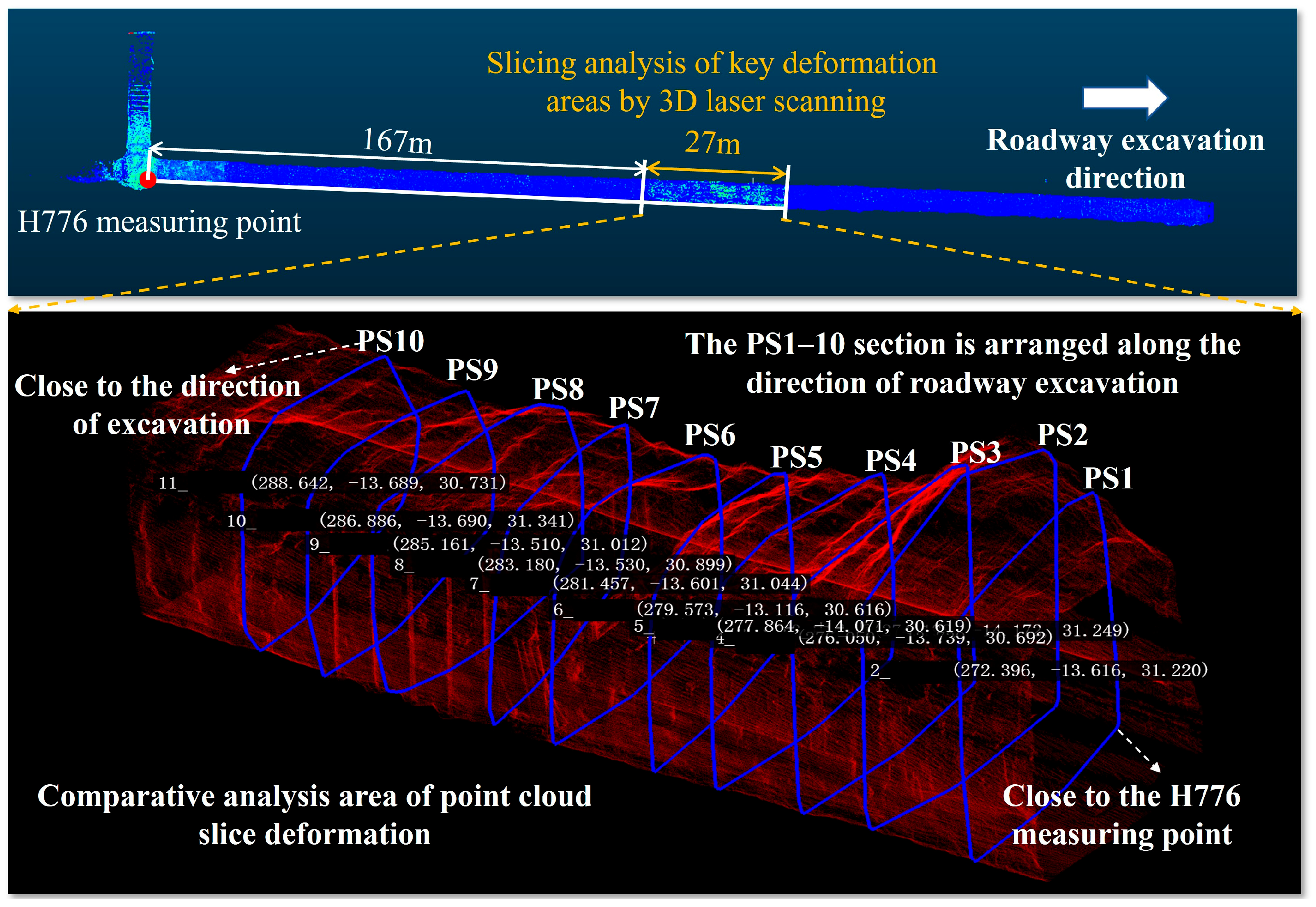
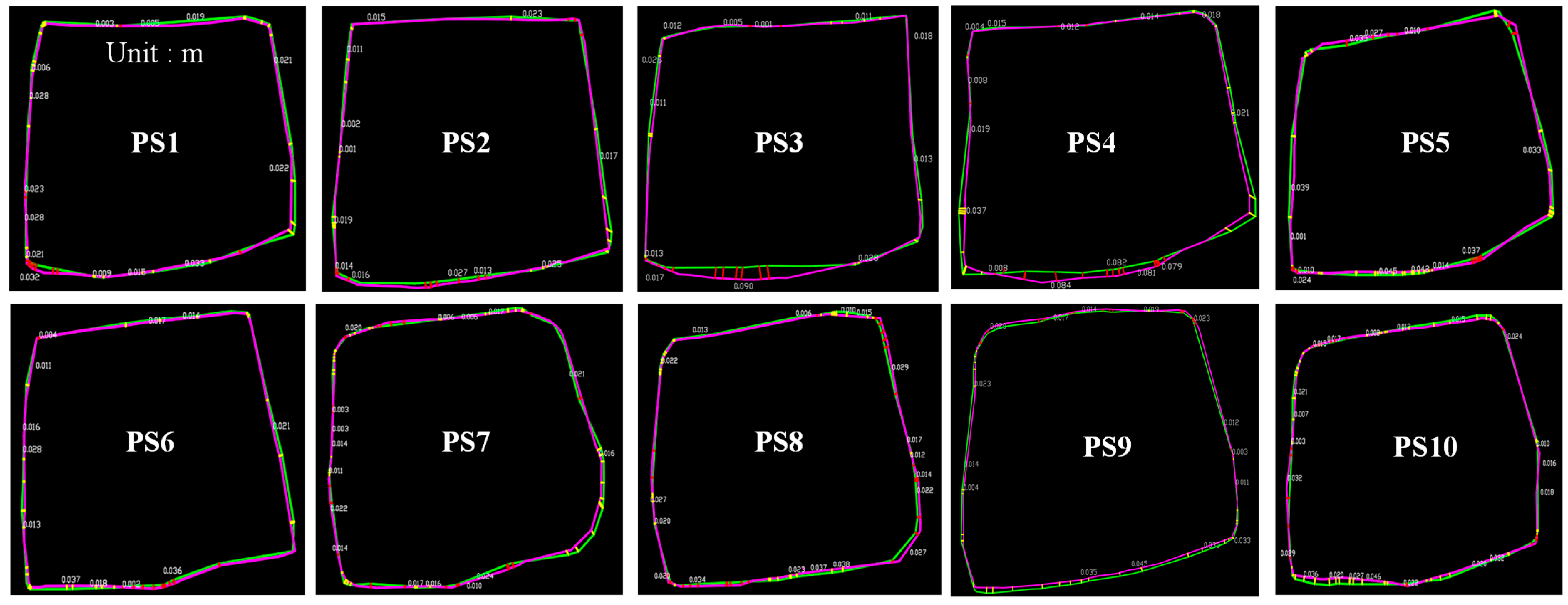
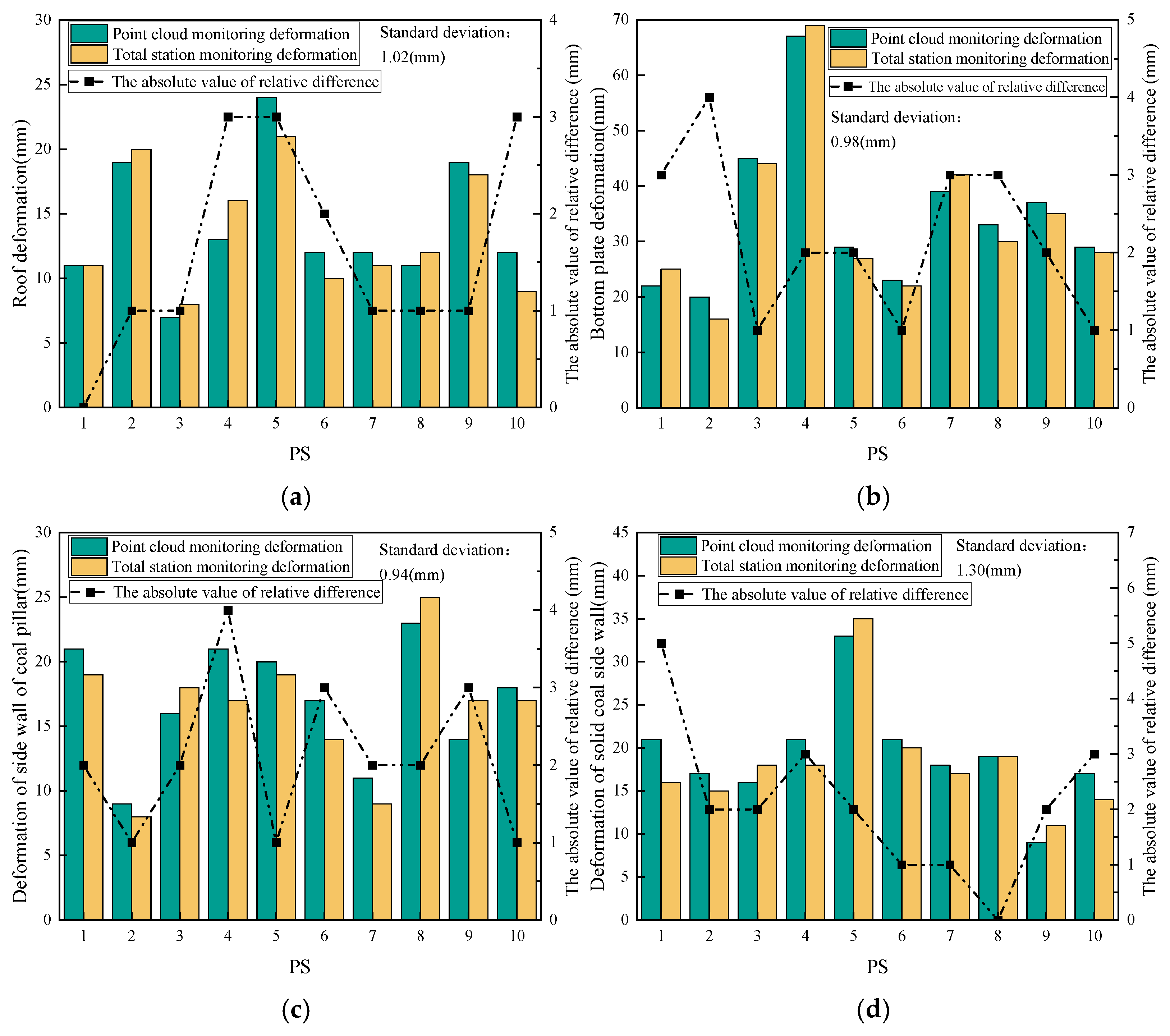
- The engineering application and consistency verification results show that this method can effectively capture the global spatial distribution information and evolution characteristics of roadway surrounding rock deformation. In the one-month monitoring of the 5111 return air crossheading test section of Yushupo Coal Mine, two deformation concentration areas were identified through global difference analysis. Quantitative analysis showed that the floor was dominated by uplift deformation, with the maximum positive displacement of +90.0 mm and the average positive displacement of +46.9 mm. The roof is mainly sinking, the maximum negative displacement is −35.0 mm, and the average negative displacement is −19.3 mm. The maximum negative displacement on the side of the coal pillar is −39 mm, and the maximum negative displacement on the side of the solid coal wall is −33 mm, showing a certain asymmetry. Compared with the total station, the results show that the maximum displacement error in each direction does not exceed 5 mm, and the standard deviation is within 1.3 mm. It shows that the method has sufficient engineering accuracy in the identification of roadway surrounding rock deformation, abnormal area positioning and safety monitoring and early warning, which can provide a reliable basis for support effect evaluation, key section review and on-site disposal decision.
Author Contributions
Funding
Institutional Review Board Statement
Informed Consent Statement
Data Availability Statement
Acknowledgments
Conflicts of Interest
Abbreviations
| IMU | Inertial measurement unit |
| FPN | Feature pyramid network |
| MPN | Matching pyramid network |
| PS | Point cloud slicing |
| SLAM | Simultaneous Localization and Mapping |
References
- Qi, J.; Gao, Y.; Peng, Z.; He, M.; Guo, S. A New Type of Non-Explosive Directional Pre-Splitting and Roof-Cutting Method for Gob-Side Entry Retaining Without Coal Pillars. Min. Metall. Explor. 2025, 42, 1575–1595. [Google Scholar] [CrossRef]
- He, F.; Tao, K.; Wang, D.; Zhang, J.; Wu, Y. Mechanism and Control of Asymmetric Deformation of Surrounding Rock in Gob-Side Roadway Driving along Narrow Coal Pillar in Extra-Thick Coal Seam. Results Eng. 2025, 28, 108042. [Google Scholar] [CrossRef]
- Chen, D.; Tang, J.; He, W.; Gao, C.; Wang, C. Research on the Deviatoric Stress Mode and Control of the Surrounding Rock in Close-Distance Double-Thick Coal Seam Roadways. Appl. Sci. 2025, 15, 10416. [Google Scholar] [CrossRef]
- Dunn, M.; Reid, P.; Malos, J. Development of a Protective Enclosure for Remote Sensing Applications-Case Study: Laser Scanning in Underground Coal Mines. Resources 2020, 9, 56. [Google Scholar] [CrossRef]
- Ma, H.; Wang, S.; Mao, Q.; Shi, Z.; Yang, Z.; Cao, X.; Xue, X.; Xia, J.; Wang, C. Key Common Technology of Intelligent Heading in Coal Mine Roadway. J. China Coal Soc. 2021, 46, 310–320. [Google Scholar] [CrossRef]
- Ma, H.; Mao, J.; Mao, Q.; Zhang, X.; Liu, B. Automatic Positioning and Orientation Method of Roadheader Based on Combination of Ins and Digital Total Station. Coal Sci. Technol. 2022, 50, 189–195. [Google Scholar] [CrossRef]
- Liu, W.; Shan, R.; Huang, P.; Chen, Y.; Bai, Y. Research on the Anchoring Instability Mechanism and Bidirectional Deformation Control of Stratified Surrounding Rock Roadway. Results Eng. 2026, 29, 109053. [Google Scholar] [CrossRef]
- Ye, T.; Wang, B.; Jiang, W.; Deng, X.; Tao, H.; Liu, J.; He, W. Research on Deformation Monitoring Method for Surrounding Rock in Roadway Based on an Omnidirectional Structured Light Vision Sensor System. Measurement 2025, 255, 117867. [Google Scholar] [CrossRef]
- Singh, S.K.; Raval, S.; Banerjee, B. Roof Bolt Identification in Underground Coal Mines from 3D Point Cloud Data Using Local Point Descriptors and Artificial Neural Network. Int. J. Remote Sens. 2021, 42, 367–377. [Google Scholar] [CrossRef]
- Trybała, P. LiDAR-Based Simultaneous Localization and Mapping in an Underground Mine in Złoty Stok, Poland. In Proceedings of the IOP Conference Series: Earth and Environmental Science; IOP Publishing Ltd.: Bristol, UK, 2021; Volume 942. [Google Scholar]
- Jiang, Q.; Shi, Y.E.; Yan, F.; Zheng, H.; Kou, Y.Y.; He, B.G. Reconstitution Method for Tunnel Spatiotemporal Deformation Based on 3D Laser Scanning Technology and Corresponding Instability Warning. Eng. Fail. Anal. 2021, 125, 105391. [Google Scholar] [CrossRef]
- Wang, L.; Song, Y.; Hu, C.; Fang, X.; Zhao, B.; Shi, H.; Feng, Y. Deformation Patterns of Deep Coal Mine Roadways Revealed by 3D Laser Scanning. Appl. Sci. 2025, 15, 12255. [Google Scholar] [CrossRef]
- Strach, M.; Dronszczyk, P. Comprehensive 3D Measurements of Tram Tracks in the Tunnel Using the Combination of Laser Scanning Technology and Traditional TPS/GPS Surveying. In Proceedings of the Transportation Research Procedia; Elsevier B.V.: Amsterdam, The Netherlands, 2016; Volume 14, pp. 1940–1949. [Google Scholar]
- Poku-Agyemang, K.N.; Reiterer, A. Model-Based Planning of Complex 3D Laser Scanning Campaigns for Bridge Digitisation. Autom. Constr. 2025, 177, 106289. [Google Scholar] [CrossRef]
- Li, P.; Wang, Q.; Li, J.; Pei, Y.; He, P. Automated Extraction of Tunnel Leakage Location and Area from 3D Laser Scanning Point Clouds. Opt. Lasers Eng. 2024, 178, 108217. [Google Scholar] [CrossRef]
- Ren, Z.; Zhu, H.; Yuan, R.; Wang, S. Review and Prospects of 3D Laser Scanning Technology in Underground Mining. J. Henan Polytech. Univ. (Nat. Sci.) 2025, 44, 89–100. [Google Scholar]
- Kumar Singh, S.; Pratap Banerjee, B.; Raval, S. A Review of Laser Scanning for Geological and Geotechnical Applications in Underground Mining. Int. J. Min. Sci. Technol. 2023, 33, 133–154. [Google Scholar] [CrossRef]
- Pejić, M. Design and Optimisation of Laser Scanning for Tunnels Geometry Inspection. Tunn. Undergr. Space Technol. 2013, 37, 199–206. [Google Scholar] [CrossRef]
- Xing, Z.; Zhao, S.; Guo, W.; Meng, F.; Guo, X.; Wang, S.; Yang, L.; He, H. Coal Resources under Carbon Peak: Integrating LOAM Livox with Laser Point Cloud for Coal Mine Working Face Environment Three-Dimensional Perception Technology. Measurement 2025, 253, 117704. [Google Scholar] [CrossRef]
- Wang, M.; Zhou, J.; Chen, J.; Jiang, N.; Zhang, P.; Li, H. Automatic Identification of Rock Discontinuity and Stability Analysis of Tunnel Rock Blocks Using Terrestrial Laser Scanning. J. Rock Mech. Geotech. Eng. 2023, 15, 1810–1825. [Google Scholar] [CrossRef]
- Ge, Y.; Xie, Z.; Tang, H.; Du, B.; Cao, B. Determination of the Shear Failure Areas of Rock Joints Using a Laser Scanning Technique and Artificial Intelligence Algorithms. Eng. Geol. 2021, 293, 106320. [Google Scholar] [CrossRef]
- Gu, Z.; Xiong, X.; Yang, C.; Cao, M. A Method for Identification Rock Mass Discontinuities in Underground Drift with Pre-Separation of Linear and Planar Point Cloud Features. Ain Shams Eng. J. 2024, 15, 103110. [Google Scholar] [CrossRef]
- Kajzar, V.; Kukutsch, R.; Waclawik, P.; Nemcik, J. Innovative Approach to Monitoring Coal Pillar Deformation and Roof Movement Using 3D Laser Technology. In Proceedings of the Procedia Engineering; Elsevier Ltd.: Amsterdam, The Netherlands, 2017; Volume 191, pp. 873–879. [Google Scholar]
- Camara, M.; Wang, L.; You, Z. Three-Dimensional Point Cloud Displacement Analysis for Tunnel Deformation Detection Using Mobile Laser Scanning. Appl. Sci. 2025, 15, 625. [Google Scholar] [CrossRef]
- Kang, J.; Li, M.; Mao, S.; Fan, Y.; Wu, Z.; Li, B. A Coal Mine Tunnel Deformation Detection Method Using Point Cloud Data. Sensors 2024, 24, 2299. [Google Scholar] [CrossRef] [PubMed]
- Jiang, Q.; Zhong, S.; Pan, P.Z.; Shi, Y.; Guo, H.; Kou, Y. Observe the Temporal Evolution of Deep Tunnel’s 3D Deformation by 3D Laser Scanning in the Jinchuan No. 2 Mine. Tunn. Undergr. Space Technol. 2020, 97, 103237. [Google Scholar] [CrossRef]
- Kukutsch, R.; Kajzar, V.; Konicek, P.; Waclawik, P.; Ptacek, J. Possibility of Convergence Measurement of Gates in Coal Mining Using Terrestrial 3D Laser Scanner. J. Sustain. Min. 2015, 14, 30–37. [Google Scholar] [CrossRef]
- Ellmann, A.; Kütimets, K.; Varbla, S.; Väli, E.; Kanter, S. Advancements in Underground Mine Surveys by Using SLAM-Enabled Handheld Laser Scanners. Surv. Rev. 2022, 54, 363–374. [Google Scholar] [CrossRef]
- Dai, G.; Sun, T. Multi Scale Fusion Point Cloud Denoising Method Based on Improved Statistical Filtering. Meitan Kexue Jishu/Coal Sci. Technol. 2025, 53, 480–492. [Google Scholar] [CrossRef]
- Chen, D.; Pang, N.; Nie, W.; Feng, J.; Kan, J.; Zhang, J. Classification-Based Point Cloud Denoising and 3D Reconstruction of Roadways. Coal Geol. Explor. 2025, 53, 54–64. [Google Scholar] [CrossRef]
- Zhao, T.; Li, L.; Tian, T.; Ma, J.; Tian, J. Patch-Guided Point Matching for Point Cloud Registration with Low Overlap. Pattern Recognit. 2023, 144, 109876. [Google Scholar] [CrossRef]
- Wang, R.; Jing, H.; Bao, Q. Point Cloud Registration Algorithm Based on Feature Extraction and Improved ICP. J. Appl. Opt. 2025, 46, 805–812. [Google Scholar]





Disclaimer/Publisher’s Note: The statements, opinions and data contained in all publications are solely those of the individual author(s) and contributor(s) and not of MDPI and/or the editor(s). MDPI and/or the editor(s) disclaim responsibility for any injury to people or property resulting from any ideas, methods, instructions or products referred to in the content. |
© 2026 by the authors. Licensee MDPI, Basel, Switzerland. This article is an open access article distributed under the terms and conditions of the Creative Commons Attribution (CC BY) license.
Share and Cite
Gao, C.; He, D.; Fang, X. Method and Application of Full-Space Deformation Monitoring of Surrounding Rock in Coal Mine Roadway Based on Mobile Three-Dimensional Laser Scanning. Appl. Sci. 2026, 16, 3156. https://doi.org/10.3390/app16073156
Gao C, He D, Fang X. Method and Application of Full-Space Deformation Monitoring of Surrounding Rock in Coal Mine Roadway Based on Mobile Three-Dimensional Laser Scanning. Applied Sciences. 2026; 16(7):3156. https://doi.org/10.3390/app16073156
Chicago/Turabian StyleGao, Chao, Dexing He, and Xinqiu Fang. 2026. "Method and Application of Full-Space Deformation Monitoring of Surrounding Rock in Coal Mine Roadway Based on Mobile Three-Dimensional Laser Scanning" Applied Sciences 16, no. 7: 3156. https://doi.org/10.3390/app16073156
APA StyleGao, C., He, D., & Fang, X. (2026). Method and Application of Full-Space Deformation Monitoring of Surrounding Rock in Coal Mine Roadway Based on Mobile Three-Dimensional Laser Scanning. Applied Sciences, 16(7), 3156. https://doi.org/10.3390/app16073156