SAMS-Net: A Stage-Decoupled Semantic Segmentation Network for Forest Fire Detection


Abstract
1. Introduction
- (1)
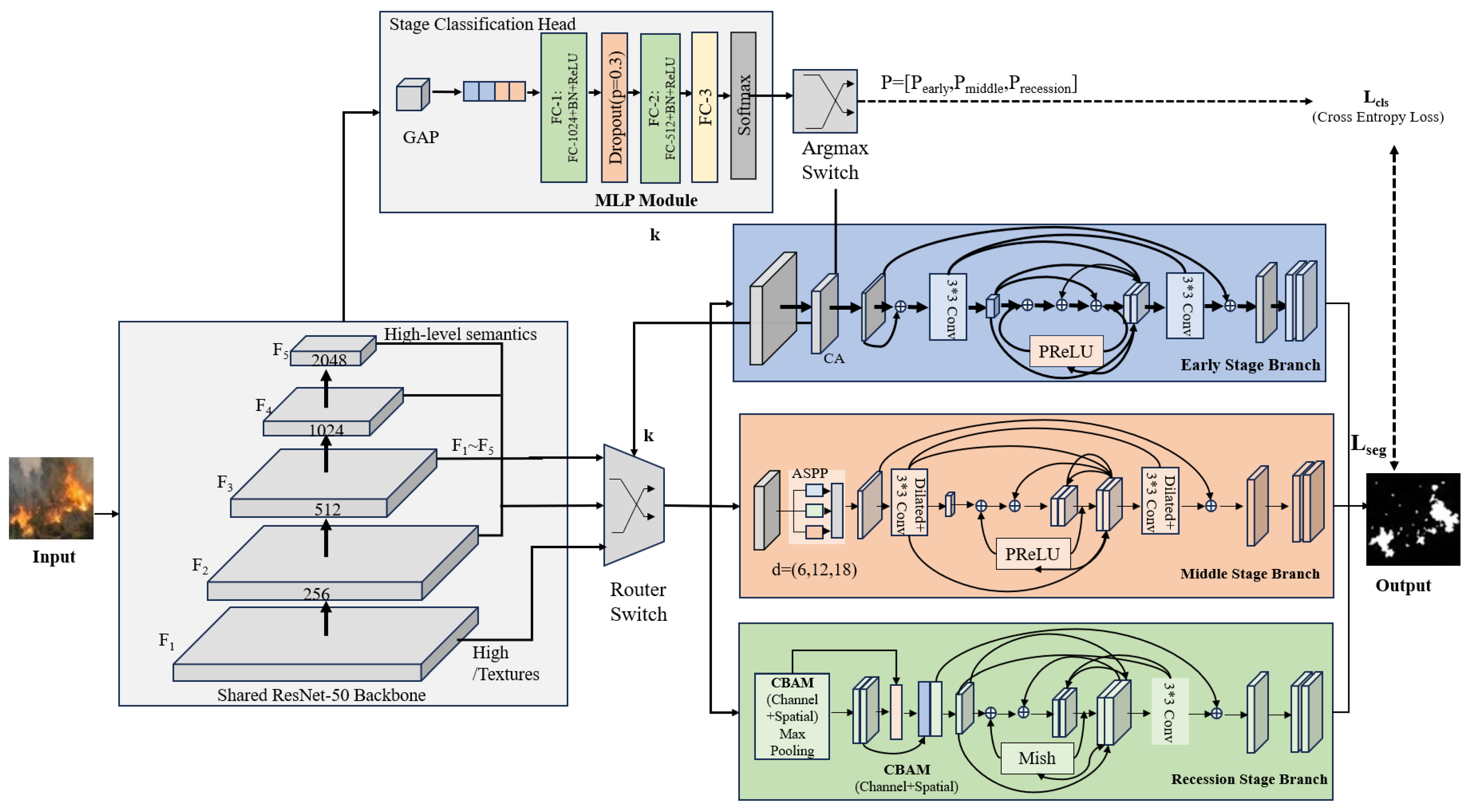
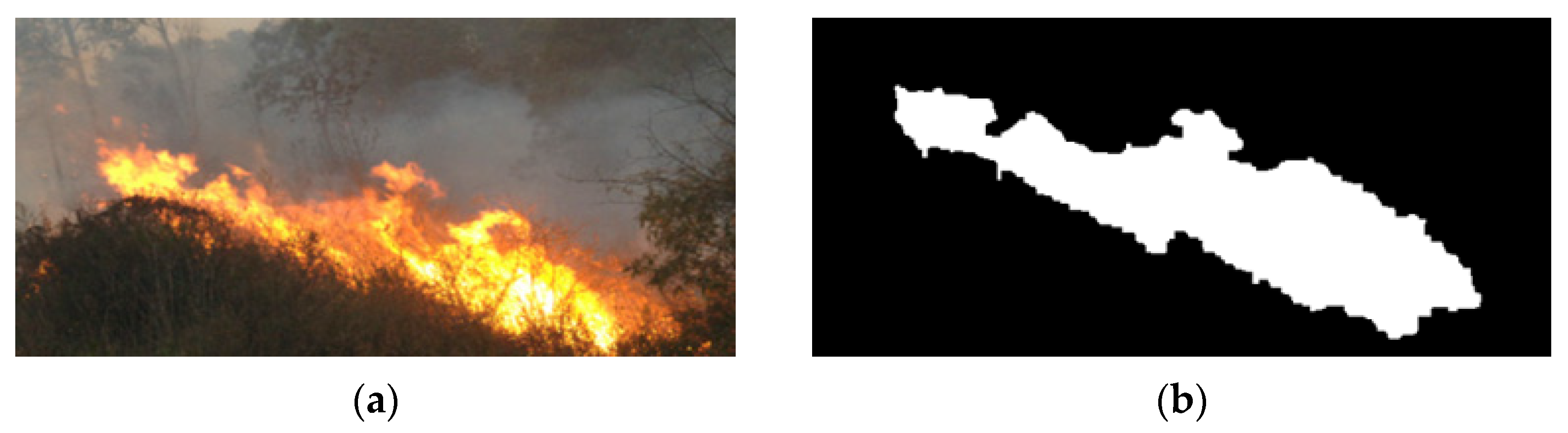
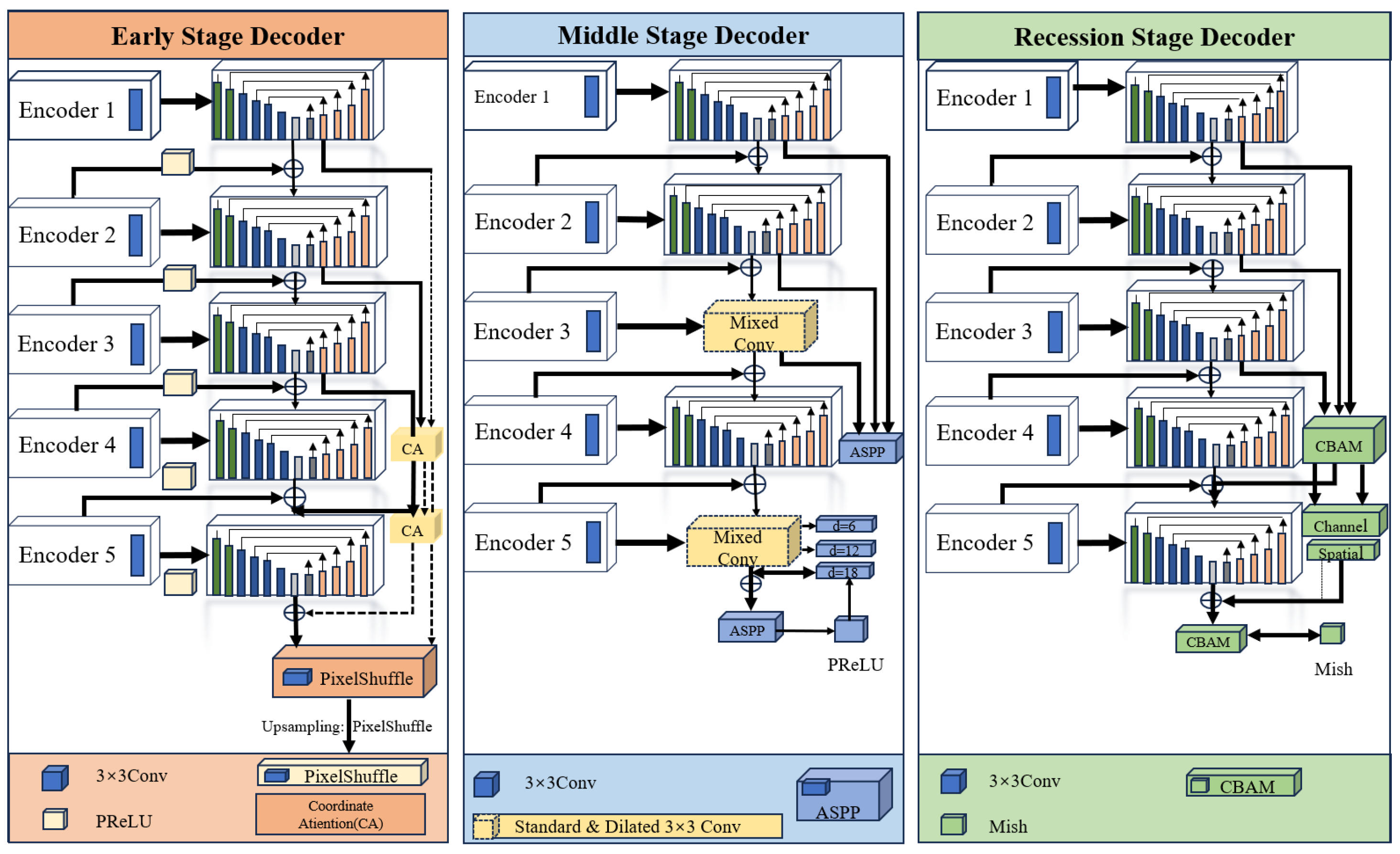
- We propose SAMS-Net, a stage-aware decoupled segmentation architecture for multi-stage forest-fire imagery. The framework separates stage classification from flame-and-ember foreground segmentation through a three-tier design consisting of a shared backbone, a routing module, and stage-specific decoders. During inference, hard-switch routing activates only the decoder corresponding to the predicted stage, enabling dynamic pruning and more adaptive segmentation across different fire-evolution stages.
- (2)
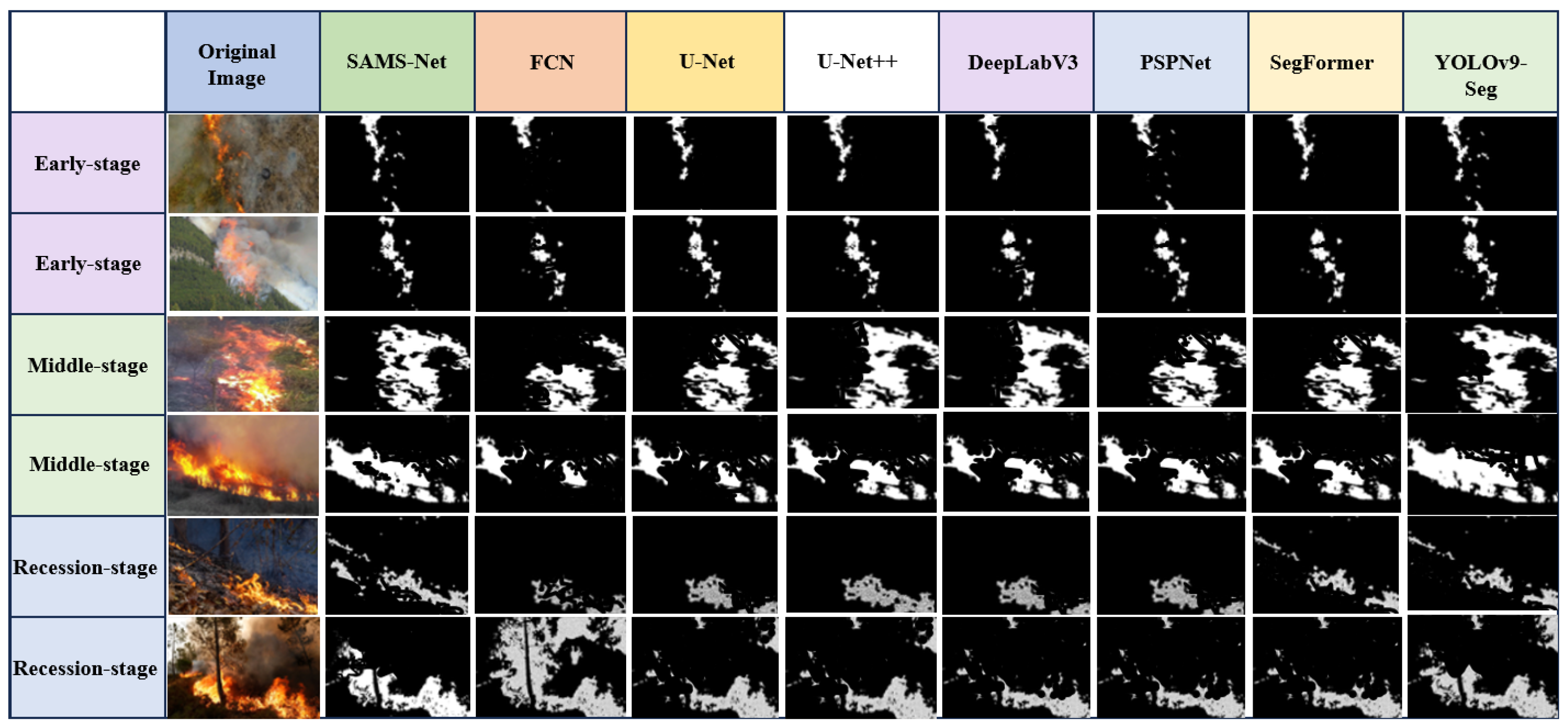
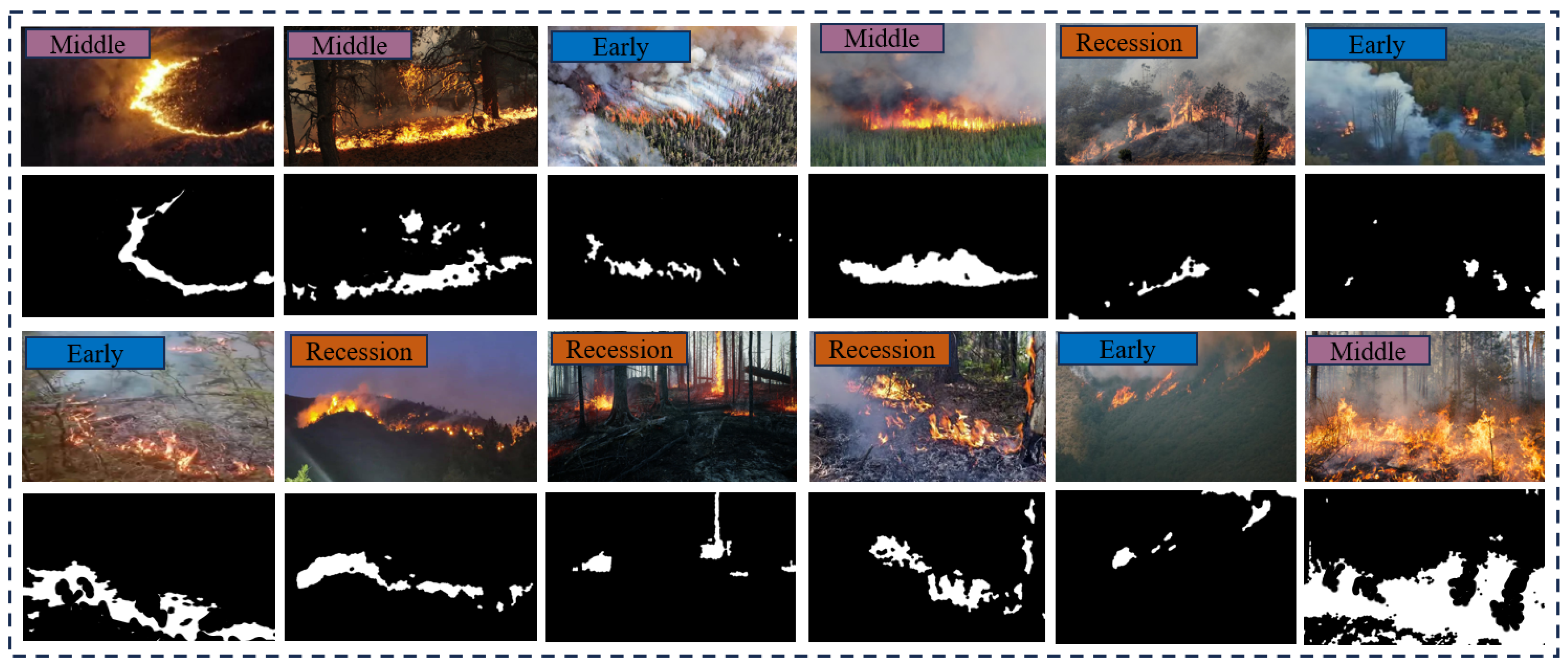
- We design stage-specific decoding modules for the distinct visual characteristics of different fire stages. PixelShuffle and Coordinate Attention (CA) are used to preserve fine details of small scattered fire spots in the early stage; a multi-dilation Atrous Spatial Pyramid Pooling (ASPP) module is employed to improve structural completeness in large contiguous flame regions in the middle stage; and the Convolutional Block Attention Module (CBAM) together with Mish enhances robustness under smoke-interfered, low-signal recession-stage conditions.
- (3)
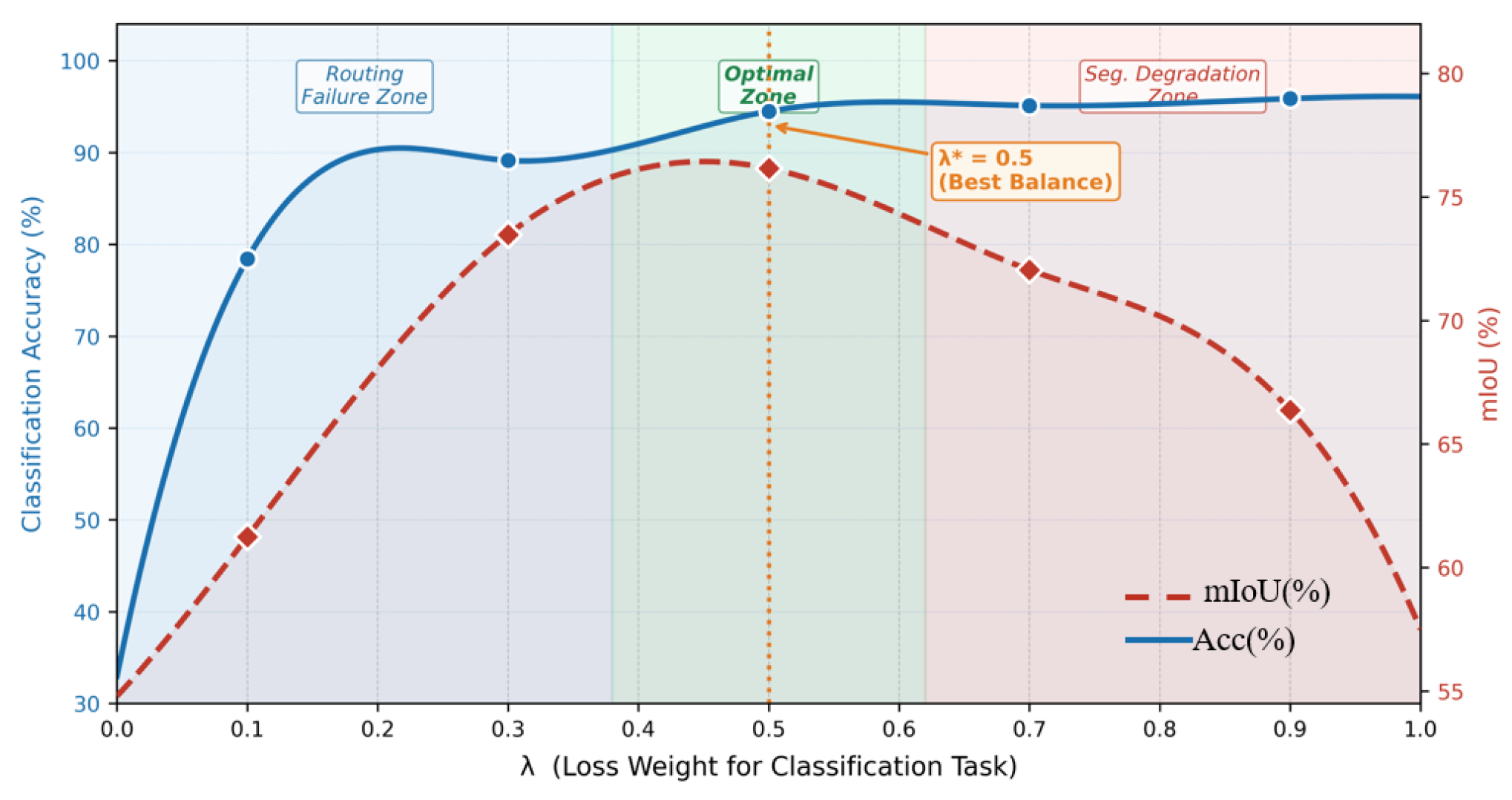
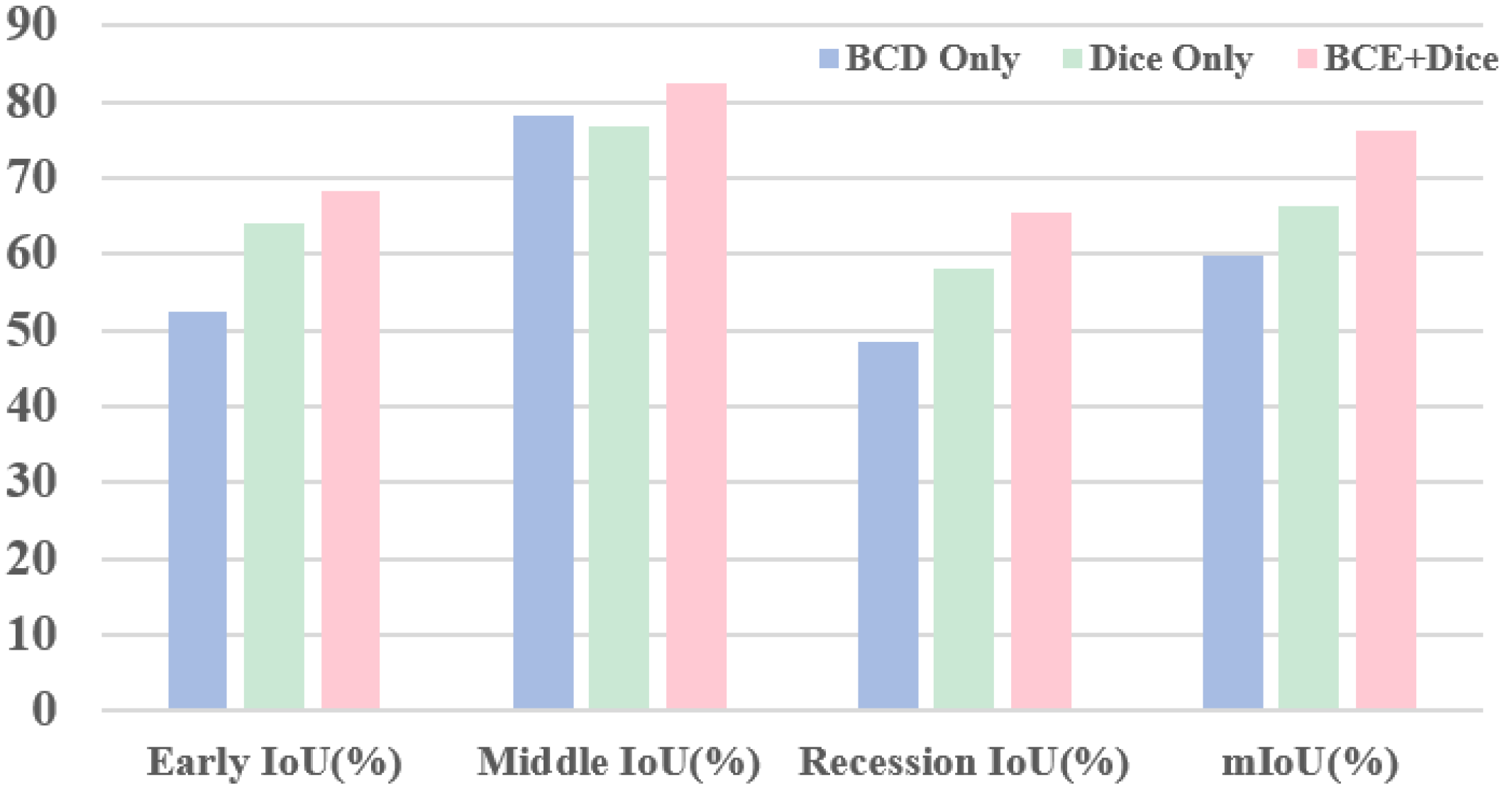
- A differentiable multi-task joint training strategy is proposed to address the non-differentiability of hard-switch routing in end-to-end training. Stage classification and stage-specific segmentation losses are explicitly decoupled, and a weighted joint loss function with hyperparameter sensitivity analysis is designed, allowing the shared backbone to simultaneously learn global stage discrimination and pixel-level reconstruction features. A hybrid Dice + BCE segmentation loss is adopted to effectively handle the severe foreground–background imbalance in forest fire scenarios.
2. Method
2.1. Overall Architecture
2.2. Shared Backbone Feature Extraction
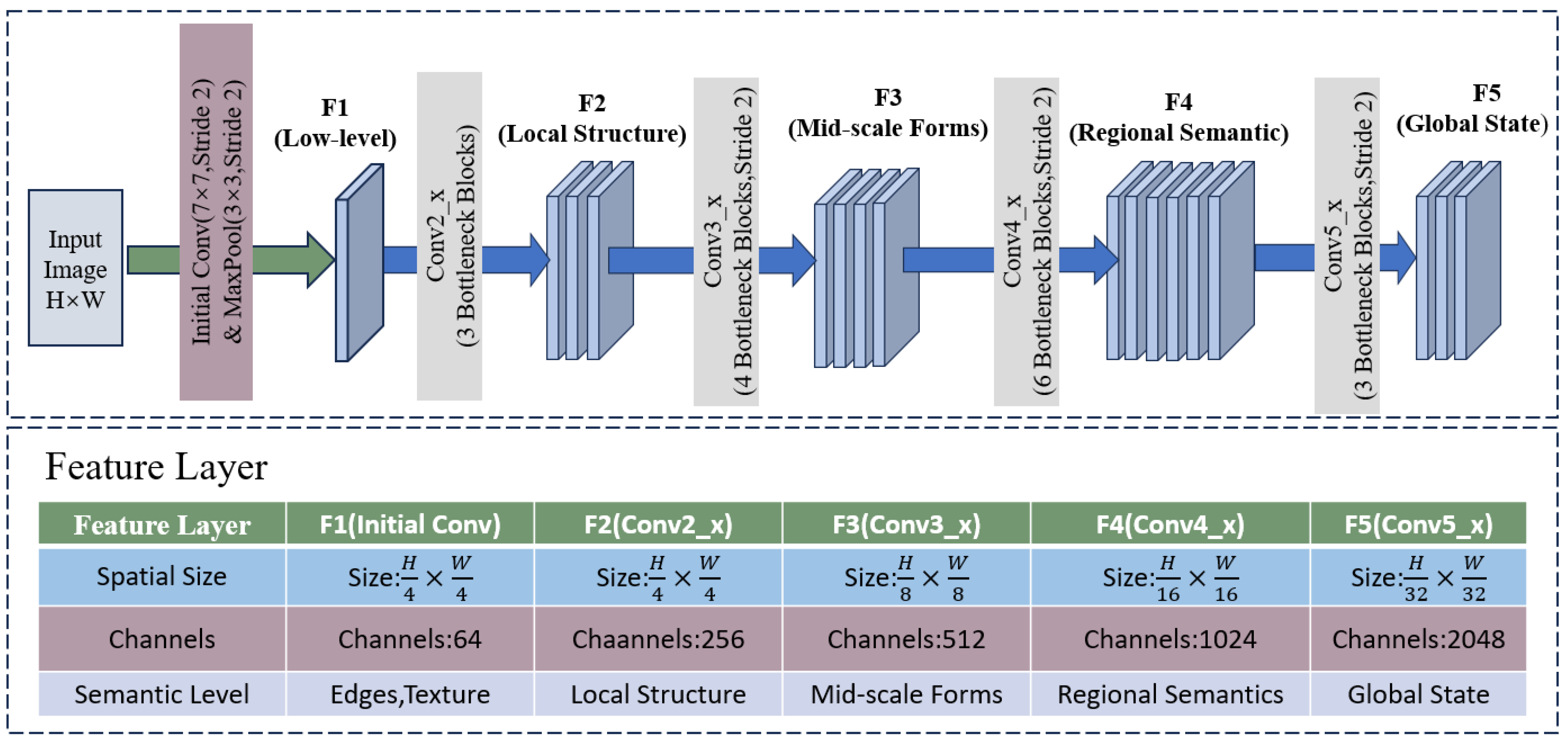
- F1: Output from the initial convolution and max-pooling layers, featuring high spatial resolution and primarily representing low-level visual information such as edges and textures.
- F2: Output from the Conv2_x stage, encoding local structural features.
- F3: Output from the Conv3_x stage, capturing mid-scale flame morphology and smoke-related background interference patterns.
- F4: Output from the Conv4_x stage, encoding stronger region-level semantic representations.
- F5: Output from the Conv5_x stage, possessing the lowest spatial resolution but the highest semantic abstraction capability, and serving as the basis for global scene-level stage classification.
2.3. Stage Classification Module
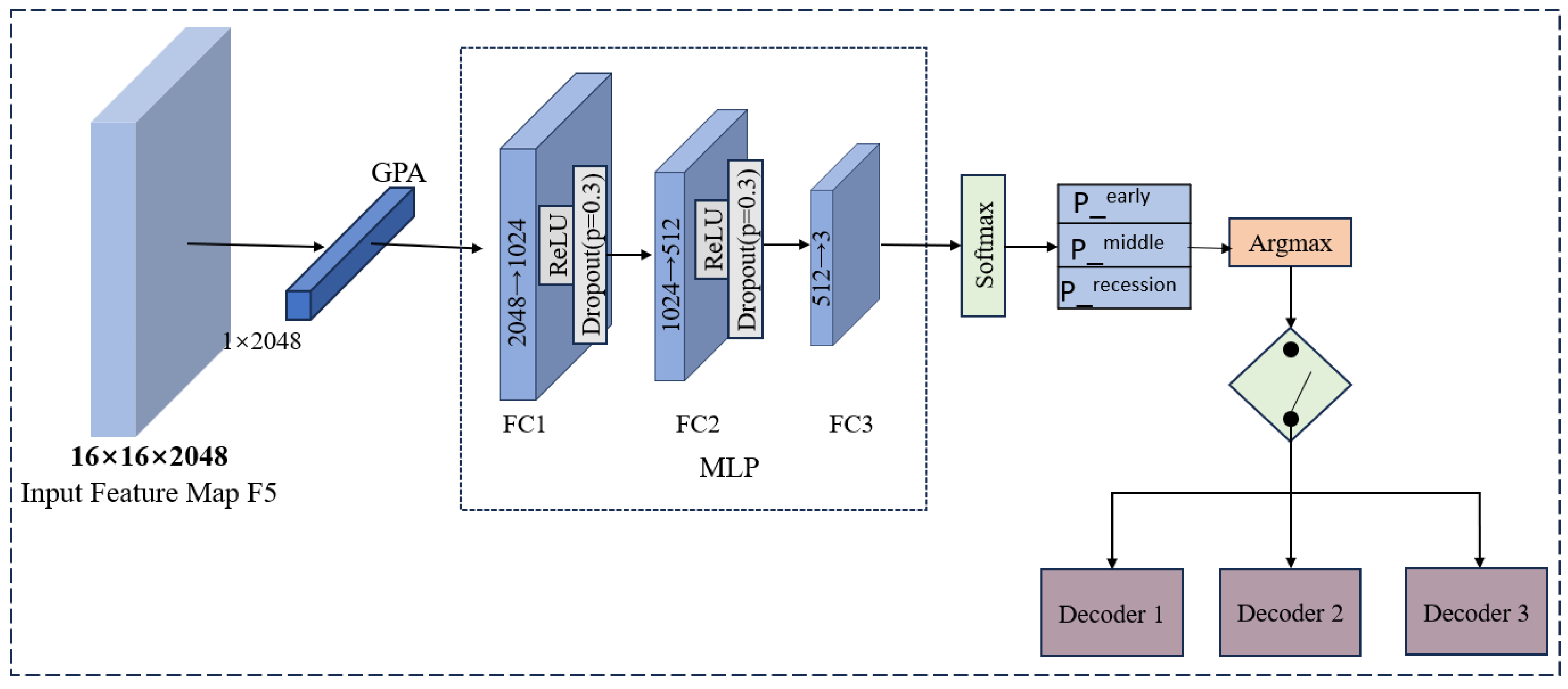
- Stage classification task
- Semantic segmentation task
2.4. Stage-Specific Decoders
- Early Stage Decoder Design
- Middle Stage Decoder Design
- Recession Stage Decoder Design
2.5. Loss Function Design
- Stage Classification Loss
- Stage-Specific Segmentation Loss
3. Experiments
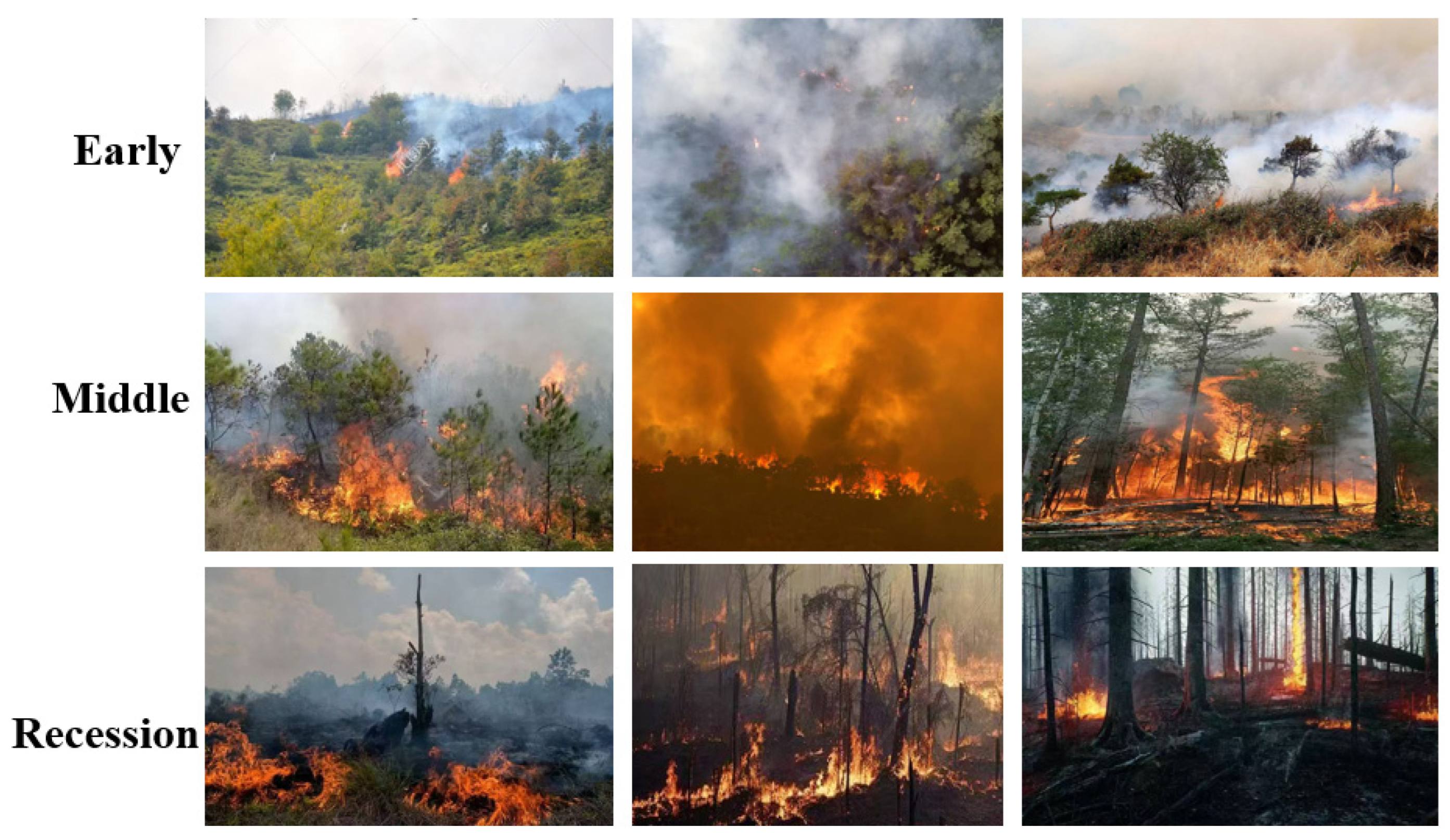
3.1. Stage Definition and Dataset Construction
3.2. Experimental Setup and Evaluation Metrics
- Experimental Setup
- Semantic Segmentation Evaluation Metrics
- Stage Classification Evaluation Metric
3.3. Comparison with Baseline Methods
3.4. Ablation Study
3.4.1. Validation of the Stage-Aware Routing Mechanism
- Baseline
- Soft-Routing
- Hard-Routing
3.4.2. Analysis of Stage-Specific Decoder Modules
3.4.3. Loss Function Configuration Analysis
- Sensitivity Analysis of Multi-Task Loss Weights
- Effectiveness Analysis of Segmentation Loss Components
3.4.4. Boundary-Ambiguity Analysis
3.5. Preliminary Zero-Shot Cross-Dataset Qualitative Analysis
4. Conclusions
5. Future Work
Author Contributions
Funding
Institutional Review Board Statement
Informed Consent Statement
Data Availability Statement
Conflicts of Interest
References
- Koukouli, M.E.; Pseftogkas, A.; Karagkiozidis, D.; Mermigkas, M.; Panou, T.; Balis, D.; Bais, A. Extreme wildfires over Northern Greece during Summer 2023–Part B. Adverse effects on regional air quality. Atmos. Res. 2025, 320, 108034. [Google Scholar] [CrossRef]
- Dare, M.; Jetten, J.; Selvanathan, H.P.; Crimston, C.R. Sense of Community and Adaptive Capacity: Insights from the 2019/2020 Australian ‘Black Summer’ Bushfires. J. Environ. Psychol. 2026, 110, 102930. [Google Scholar] [CrossRef]
- Fernandes, A.M.; Utkin, A.B.; Lavrov, A.V.; Vilar, R.M. Optimisation of location and number of lidar apparatuses for early forest fire detection in hilly terrain. Fire Saf. J. 2006, 41, 144–154. [Google Scholar] [CrossRef]
- Wang, S.D.; Miao, L.L.; Peng, G.X. An improved algorithm for forest fire detection using HJ data. Procedia Environ. Sci. 2012, 13, 140–150. [Google Scholar] [CrossRef]
- Varela, N.; Ospino, A.; Zelaya, N.A.L. Wireless sensor network for forest fire detection. Procedia Comput. Sci. 2020, 175, 435–440. [Google Scholar] [CrossRef]
- Dwivedi, R.K. Density-based machine learning scheme for outlier detection in smart forest fire monitoring sensor cloud. Int. J. Cloud Appl. Comput. 2022, 12, 1–16. [Google Scholar] [CrossRef]
- Prasanna, K.R.; Mathana, J.M.; Ramya, T.A.; Nirmala, R. LoRa network based high performance forest fire detection system. Mater. Today Proc. 2023, 80, 1951–1955. [Google Scholar] [CrossRef]
- Zhang, Q.; Lin, G.; Zhang, Y.; Xu, G.; Wang, J.J. Wildland forest fire smoke detection based on faster R-CNN using synthetic smoke images. Procedia Eng. 2018, 211, 441–446. [Google Scholar] [CrossRef]
- Zhan, J.; Hu, Y.; Zhou, G.; Wang, Y.; Cai, W.; Li, L. A high-precision forest fire smoke detection approach based on ARGNet. Comput. Electron. Agric. 2022, 196, 106874. [Google Scholar] [CrossRef]
- Hu, Y.; Zhan, J.; Zhou, G.; Chen, A.; Cai, W.; Guo, K.; Hu, Y.; Li, L. Fast forest fire smoke detection using MVMNet. Knowl.-Based Syst. 2022, 241, 108219. [Google Scholar] [CrossRef]
- Yuan, J.; Wang, H.; Yang, T.; Su, Y.; Song, W.; Li, S.; Gong, W. FF-net: A target detection method tailored for mid-to-late stages of forest fires in complex environments. Case Stud. Therm. Eng. 2025, 65, 105515. [Google Scholar] [CrossRef]
- Zhu, H.; Ling, W.; Yan, H.; Zhong, X.; Liao, F. YOLO-MP: A lightweight forest fire detection model. Ecol. Inform. 2025, 92, 103516. [Google Scholar] [CrossRef]
- Yu, Q.; Zhang, G.; Wang, Y.; Wu, X.; Xiao, J.; Kuang, W.; Zhang, J. CCLNet: An End-to-End Lightweight Network for Small-Target Forest Fire Detection in UAV Imagery. Comput. Mater. Contin. 2026, 86, 58. [Google Scholar] [CrossRef]
- Han, R.; Li, J.; Liu, Y.; Liu, H. Forest fire object detection based on multi-task model and extreme weather simulation algorithm. Eng. Appl. Artif. Intell. 2026, 163, 113099. [Google Scholar] [CrossRef]
- Yan, C.; Wang, J. MAG-FSNet: A high-precision robust forest fire smoke detection model integrating local features and global information. Measurement 2025, 247, 116813. [Google Scholar] [CrossRef]
- Zhao, Y.; Li, Q.; Gu, Z. Early smoke detection of forest fire video using CS Adaboost algorithm. Optik 2015, 126, 2121–2124. [Google Scholar] [CrossRef]
- Mambile, C.; Leo, J.; Kaijage, S. Comparative analysis of CNN architectures for satellite-based forest fire detection: A mobile-friendly approach using Sentinel-2 imagery. Remote Sens. Appl. Soc. Environ. 2025, 40, 101739. [Google Scholar] [CrossRef]
- Mahaveerakannan, R.; Anitha, C.; Thomas, A.K.; Rajan, S.; Muthukumar, T.; Rajulu, G.G. An IoT based forest fire detection system using integration of cat swarm with LSTM model. Comput. Commun. 2023, 211, 37–45. [Google Scholar] [CrossRef]
- Mowla, M.N.; Asadi, D.; Tekeoglu, K.N.; Masum, S.; Rabie, K. UAVs-FFDB: A high-resolution dataset for advancing forest fire detection and monitoring using unmanned aerial vehicles (UAVs). Data Brief 2024, 55, 110706. [Google Scholar] [CrossRef]
- Giannakidou, S.; Radoglou-Grammatikis, P.; Lagkas, T.; Argyriou, V.; Goudos, S.; Markakis, E.K.; Sarigiannidis, P. Leveraging the power of internet of things and artificial intelligence in forest fire prevention, detection, and restoration: A comprehensive survey. Internet Things 2024, 26, 101171. [Google Scholar] [CrossRef]
- Sun, Y.; Pan, J.; Jiang, L.; Tian, Y.; Zhang, J.; Liu, K. A physics-based remote sensing framework for forest fire smoke detection toward early fire warning. Int. J. Appl. Earth Obs. Geoinf. 2026, 146, 105124. [Google Scholar] [CrossRef]
- Jin, P.; Cheng, P.; Liu, X.; Huang, Y. From smoke to fire: A forest fire early warning and risk assessment model fusing multimodal data. Eng. Appl. Artif. Intell. 2025, 152, 110848. [Google Scholar] [CrossRef]
- Exaudi, K.; Stiawan, D.; Suprapto, B.Y.; Fakhrurroja, H.; Idris, M.Y.; Alghamdi, T.A.; Budiarto, R. An Improved Forest Fire Detection Model Using Audio Classification and Machine Learning. Comput. Mater. Contin. 2026, 86, 1. [Google Scholar] [CrossRef]
- Krüll, W.; Tobera, R.; Willms, I.; Essen, H.; von Wahl, N. Early forest fire detection and verification using optical smoke, gas and microwave sensors. Procedia Eng. 2012, 45, 584–594. [Google Scholar] [CrossRef]
- Shi, W.; Caballero, J.; Huszár, F.; Totz, J.; Aitken, A.P.; Bishop, R.; Rueckert, D.; Wang, Z. Real-time single image and video super-resolution using an efficient sub-pixel convolutional neural network. In Proceedings of the IEEE Conference on Computer Vision and Pattern Recognition, Las Vegas, NV, USA, 27–30 June 2016; pp. 1874–1883. [Google Scholar]
- Hou, Q.; Zhou, D.; Feng, J. Coordinate attention for efficient mobile network design. In Proceedings of the IEEE/CVF Conference on Computer Vision and Pattern Recognition, Virtual, 19–25 June 2021; pp. 13713–13722. [Google Scholar]
- Chen, L.C.; Zhu, Y.; Papandreou, G.; Schroff, F.; Adam, H. Encoder-decoder with atrous separable convolution for semantic image segmentation. In Proceedings of the European Conference on Computer Vision (ECCV), Munich, Germany, 18–24 September 2018; pp. 801–818. [Google Scholar]
- Woo, S.; Park, J.; Lee, J.Y.; Kweon, I.S. Cbam: Convolutional block attention module. In Proceedings of the European Conference on Computer Vision (ECCV), Munich, Germany, 18–24 September 2018; pp. 3–19. [Google Scholar]
- Misra, D. Mish: A self regularized non-monotonic activation function. arXiv 2019, arXiv:1908.08681. [Google Scholar] [CrossRef]
- Johnson, E.A.; Miyanishi, K. Forest Fires: Behavior and Ecological Effects; Academic Press: Cambridge, MA, USA, 2001. [Google Scholar]
- Li, H.; Sun, P. Image-based fire detection using dynamic threshold grayscale segmentation and residual network transfer learning. Mathematics 2023, 11, 3940. [Google Scholar] [CrossRef]
- Zou, R.; Xin, Z.; Liao, G.; Huang, P.; Wang, R.; Qiao, Y. A Fire segmentation method with flame detail enhancement U-net in multispectral remote sensing images under category imbalance. Remote Sens. 2025, 17, 2175. [Google Scholar] [CrossRef]





| Method | MioU (%) | Dice (%) | EarlyIoU (%) | MiddleIoU (%) | RecessionIoU (%) | PA (%) |
|---|---|---|---|---|---|---|
| SAMS-Net | 76.1 ± 0.31 | 81.3 | 68.21 ± 0.45 | 82.31 ± 0.28 | 65.37 ± 0.52 | 90.31 |
| FCN | 54.37 ± 0.82 | 67.82 | 43.52 ± 0.91 | 64.18 ± 0.74 | 32.64 ± 1.05 | 79.56 |
| U-Net | 61.83 ± 0.63 | 74.26 | 52.47 ± 0.72 | 71.93 ± 0.58 | 41.38 ± 0.84 | 84.12 |
| U-Net++ | 65.29 ± 0.54 | 77.54 | 56.83 ± 0.65 | 75.61 ± 0.49 | 46.74 ± 0.73 | 86.37 |
| DeepLabV3 | 63.74 ± 0.58 | 76.08 | 54.16 ± 0.68 | 74.29 ± 0.52 | 43.85 ± 0.79 | 85.43 |
| PSPNet | 55.21 ± 0.79 | 69.83 | 48.38 ± 0.87 | 70.42 ± 0.61 | 45.17 ± 0.83 | 78.21 |
| SegFormer | 66.81 ± 0.47 | 78.32 | 60.12 ± 0.58 | 73.21 ± 0.43 | 44.32 ± 0.71 | 84.23 |
| YOLOv9-Seg | 71.63 ± 0.38 | 75.12 | 64.72 ± 0.51 | 79.21 ± 0.34 | 55.01 ± 0.62 | 88.25 |
| Method | Acc (%) | mIoU (%) | FLOPs (G) | FPS (Frame/s) |
|---|---|---|---|---|
| Baseline | — | 65.29 | 55.48 | 86.3 |
| Soft-Routing | — | 74.85 | 166.44 | 28.5 |
| Hard-Routing | 94.5 | 76.16 | 64.12 | 75.8 |
| Stage | Configuration | KeyModules | IoU(%) |
|---|---|---|---|
| Early | Baseline | ReLU, BilinearUpsampling | 58.45 |
| +PixelShuffle | Sub-pixelConv | 63.12 | |
| SAMS-Net(Full) | +PixelShuffle & CA&PReLU | 68.21 | |
| Middle | Baseline | Standard3 × 3Conv | 75.82 |
| SAMS-Net(Full) | +ASPP | 82.31 | |
| Recession | Baseline | ReLU, NoAttention | 52.15 |
| +CBAM | Channel(MaxPool)&SpatialAttn | 60.83 | |
| SAMS-Net(Full) | +CBAM&Mish | 65.37 |
| Sample Type | N (test) | Classification Acc | Early IoU | Middle IoU | Recession IoU |
|---|---|---|---|---|---|
| Non-boundary | 185 | 95.4% | 69.5% | 83.4% | 66.9% |
| Boundary-ambiguous | 29 | 88.4% | 60.0% | 75.6% | 55.7% |
Disclaimer/Publisher’s Note: The statements, opinions and data contained in all publications are solely those of the individual author(s) and contributor(s) and not of MDPI and/or the editor(s). MDPI and/or the editor(s) disclaim responsibility for any injury to people or property resulting from any ideas, methods, instructions or products referred to in the content. |
© 2026 by the authors. Licensee MDPI, Basel, Switzerland. This article is an open access article distributed under the terms and conditions of the Creative Commons Attribution (CC BY) license.
Share and Cite
Tan, Y.; An, J.; Wang, Y.; Li, Z.; Gao, J.; Yu, F. SAMS-Net: A Stage-Decoupled Semantic Segmentation Network for Forest Fire Detection. Appl. Sci. 2026, 16, 3144. https://doi.org/10.3390/app16073144
Tan Y, An J, Wang Y, Li Z, Gao J, Yu F. SAMS-Net: A Stage-Decoupled Semantic Segmentation Network for Forest Fire Detection. Applied Sciences. 2026; 16(7):3144. https://doi.org/10.3390/app16073144
Chicago/Turabian StyleTan, Yuxin, Jiazhe An, Yabin Wang, Zhun Li, Jia Gao, and Fuxing Yu. 2026. "SAMS-Net: A Stage-Decoupled Semantic Segmentation Network for Forest Fire Detection" Applied Sciences 16, no. 7: 3144. https://doi.org/10.3390/app16073144
APA StyleTan, Y., An, J., Wang, Y., Li, Z., Gao, J., & Yu, F. (2026). SAMS-Net: A Stage-Decoupled Semantic Segmentation Network for Forest Fire Detection. Applied Sciences, 16(7), 3144. https://doi.org/10.3390/app16073144