Presence Assessment in Virtual Reality: A Systematic Literature Review
 , , and
Abstract
1. Introduction
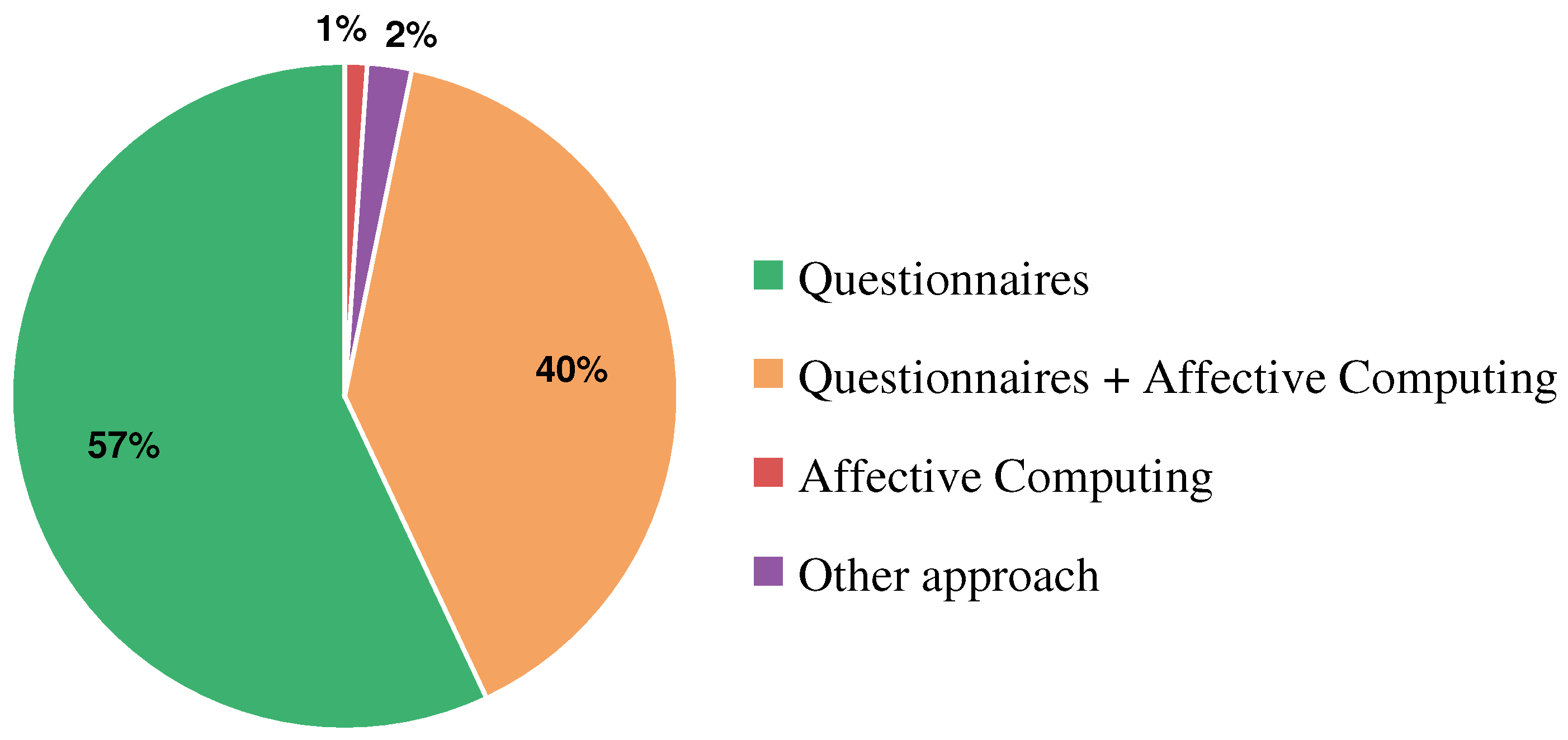
- Some studies conduct the presence assessment solely based on subjective measures (questionnaires), while others prefer a combined approach with affect detection.
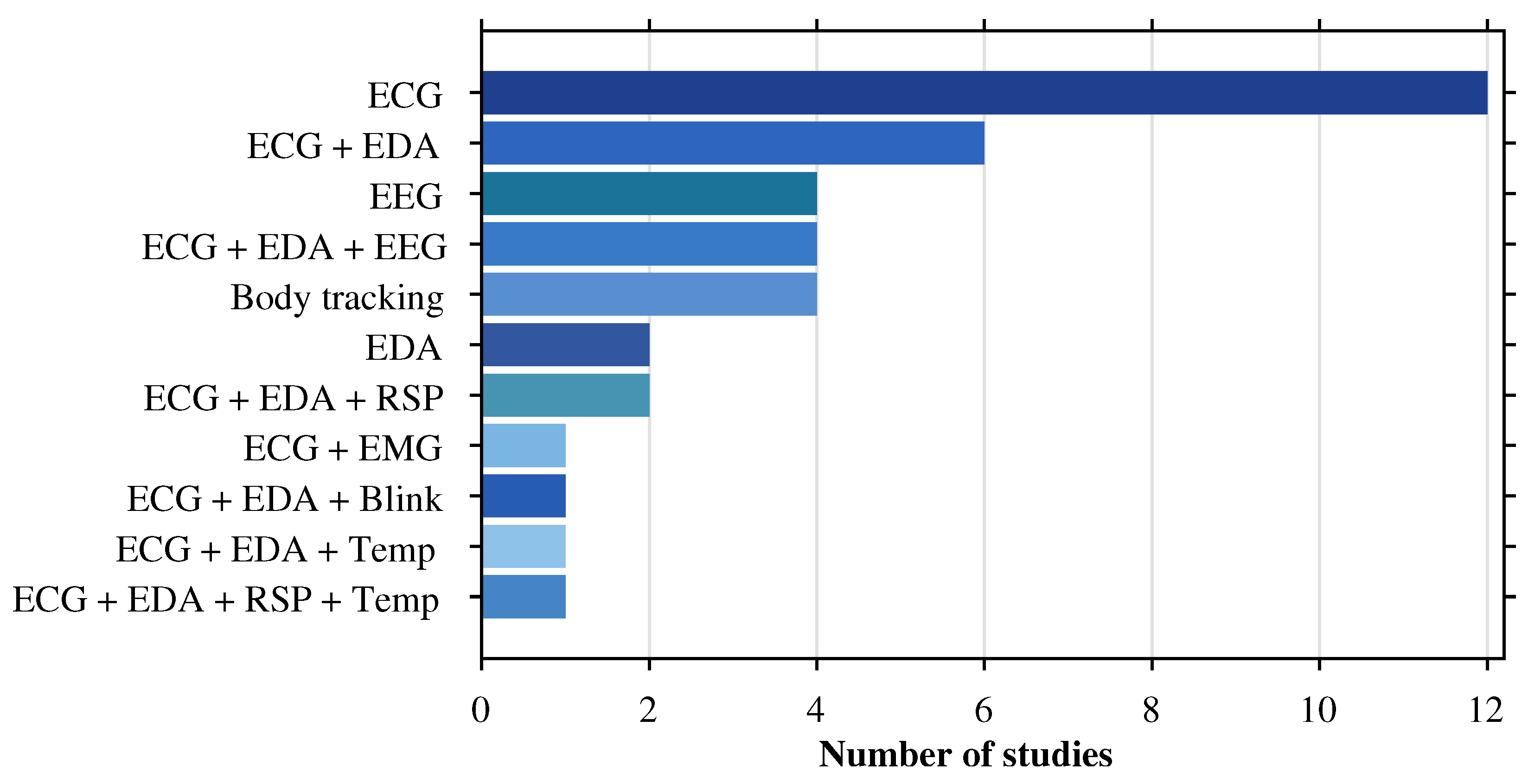
- The affect detection strategies are often focused on a limited set of physiological signals.
- There are no standards for designing and implementing VR stimuli to evoke presence; VR environments based on commercial video games, 360° videos, and in-house developments can be found; the latter are most recommended, as they provide full control of the environment.
- There is a lack of control approaches to modify VR stimuli to enhance VR experiences and enable users to achieve presence.
- RQ1. What approaches and instruments are currently used to evaluate presence in VR?
- RQ2. What kind of VR stimuli and hardware have recently been used to evoke presence?
- RQ3. Given the link between presence and affective states, which physiological signals are utilized in the affective computing strategies?
- RQ4. What areas of opportunity exist regarding presence in VR, and what could be the next steps toward personalized experiences?
2. Background
2.1. Presence’s Illusions
- Place illusion: This concept refers to the specific sense of “being there” and was proposed by [55] with the name “Telepresence” to describe the similar feeling that can arise when embodying a remote robotic device in a teleoperation system. In other words, place illusion is the sensation of feeling present within the virtual environment or as part of it [56,57].
- Plausibility: This illusion refers to the importance of generating virtual scenes whose dynamic behavior is congruent with the actual environment that the VR system is recreating. Generating plausibility represents an important challenge for developers because it requires guaranteeing the congruence and credibility of what happens in the virtual environment. For example, a flight simulator must fulfill specific hardware features and dynamics during operation while flying in a consistent virtual environment. Otherwise, the experience may be unrealistic for its target users.
- Body ownership: This illusion refers to the capability of a VR system to allow its users to see or feel their body through the avatar in the simulation. Through real-time body tracking, the virtual body should be able to move synchronously and correspondingly with its movements. Similarly, sensory feedback is desirable when the virtual body interacts with the virtual environment. This illusion is commonly also called embodiment.
- Copresence: Essentially, it refers to the degree to which a participant feels the illusion of being with other physically remote individuals in a VR system. In other words, it establishes a sense of virtual togetherness [58].
2.2. Relationship Between Presence and Affective States
3. Methodology and Data Collection
4. Synthesis of the Literature Review
4.1. Trending Presence Factors
4.2. Stimulus Signal Type
4.3. Main Display Devices
4.4. Presence Assessment
4.4.1. Subjective Assessment
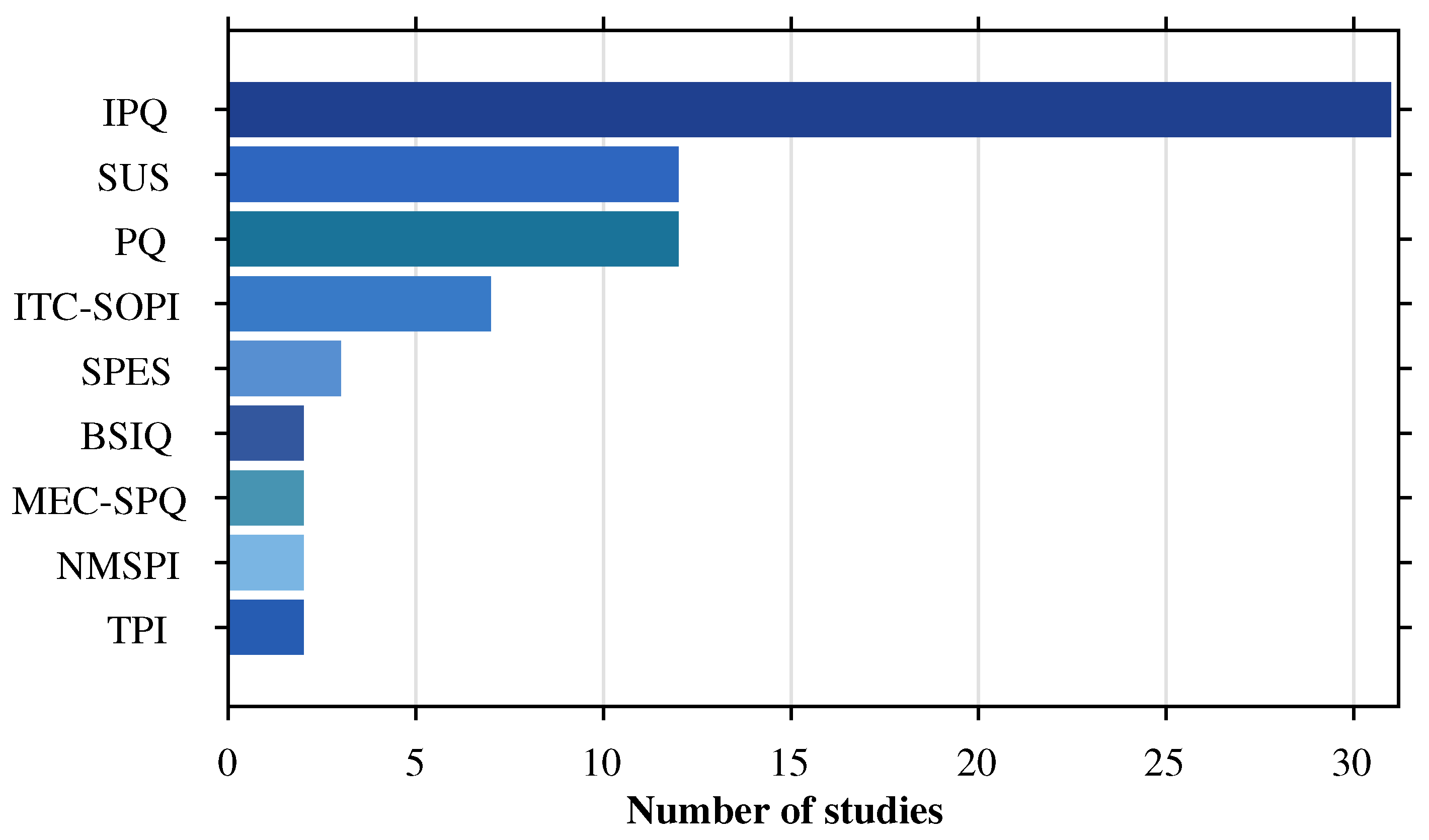
- Slater–Usoh–Steed (SUS) questionnaire: This questionnaire, presented by Slater, Usoh, and Steed in 1994 [157], consists of six questions addressing three aspects of physical presence in a virtual environment (VE). The three items include the user’s sense of being in the VE, the extent to which the VE becomes the dominant reality, and the extent to which the virtual environment is remembered as an actual place.
- Presence Questionnaire (PQ): In 1998, Witmer and Singer identified involvement and immersion as the two necessary conditions for presence [158]. Consequently, they proposed a questionnaire to assess the presence of these two conditions by identifying the factors influencing them. Initially, the questionnaire comprised 32 items, and the factors were categorized into three categories: involved/control (perceived control over the events of the VE), natural (the degree to which interactions feel natural and the level of consistency between the VE and reality), and interface quality (how control and display devices either disrupt or distract users and the degree of concentration that users can devote to the tasks in the VE). In 2005, the authors modified the questionnaire [159], reducing the number of items to 29 and dividing the factors into four categories: involvement (the degree to which the user focuses their energy and attention on a coherent set of stimuli or meaningfully related activities and events), adaptation/immersion (the perceived proficiency of interacting with and operating in the VE and how quickly the user adjusted to the VE experience.), visual fidelity (the degree to which the VE configuration permits active search or examination of the objects in the VE using vision), and interface quality (the perceived quality of the VE interface and the extent to which it does not interfere with activities in the VE).
- Igroup Presence Questionnaire (IPQ): Schubert, Friedmann, and Regenbrecht [160] postulated that presence develops from constructing a spatial-functional mental model of the virtual environment, involving two cognitive processes: construction, or the representation of bodily actions as possible actions in the VE, and suppression of incompatible sensory input. They proposed that the conscious presence encompasses two key components: spatial presence and involvement. To investigate these components, they integrated items from previously published questionnaires (Witmer and Singer [158], Hendrix [161], Carlin, Hoffman and Weghorst [162], and Slater–Usoh–Steed [157]) with newly proposed items into a unified questionnaire. The latest version of this questionnaire comprises 14 items. The IPQ is organized into three subscales and one additional general item not belonging to a specific subscale: spatial presence (the sense of being physically present in the VE), involvement (measuring the attention devoted to the VE) and experienced realism (measuring the subjective experience of realism in the VE). The extra item, the general presence, determines the overall subjective sense of being in the VE by averaging the mean scores of the spatial presence, involvement, and experienced realism subscales.
- ITC-presence Inventory (ITC-SOPI): In 2001, Lessiter et al. introduced a questionnaire focusing on users’ subjective experiences of media, without reference to objective system parameters [163]. Initially, the questionnaire comprised 63 items divided into two parts, A (7 items) and B (56 items), addressing participants’ experiences before and during the mediated environment, respectively. The primary objective was to encompass attributes considered relevant for defining presence based on the existing literature, including sense of space, involvement, attention, distraction, control and manipulation (autonomy), realness, naturalness, perception of time, awareness of behavioral responses, a sense of social interaction (parasocial and copresence), personal relevance, arousal, and adverse effects. Following a series of analyses, the authors presented a revised and reduced version of the questionnaire, totaling 44 items distributed across two parts: part A consists of 6 items, and part B comprises 38 items. Four factors were identified: sense of physical space (the feeling of being physically in the simulated environment, being able to physically control and manipulate elements of the VE, 19 items), engagement (the psychological involvement, interest, and user satisfaction with the content of the experience, 13 items), ecological validity (realism of the content and the naturalness and consistency of the VE, 5 items), and negative effects (the adverse psychological reactions of the immersion).
- Simulator Sickness Questionnaire (SSQ): Although not exclusively designed as a presence questionnaire, it is frequently employed with presence measures to evaluate the incidence of simulator sickness, a factor that can impact the overall presence. Developed by Kennedy et al. [164], the SSQ quantifies the severity of symptoms associated with simulator sickness. The questionnaire covers three main symptom clusters:
- Oculomotor symptoms—these include symptoms such as eyestrain, difficulty focusing, and blurred vision.
- Disorientation symptoms—these encompass feelings of dizziness, vertigo, and spatial disorientation.
- Nausea symptoms—symptoms related to nausea and general discomfort, such as headache and increased salivation.
Participants must complete the SSQ before, during, and after exposure to a simulator or virtual environment. Subsequently, the scores are analyzed to determine the level of discomfort or sickness experienced by the participants. Researchers and developers of virtual environments utilize the SSQ to evaluate the impact of virtual reality setups, applications, or experiences on users’ well-being. The SSQ comprises 16 items.
4.4.2. Objective Assessment
- Valence: This dimension refers to the degree of pleasure or displeasure associated with an emotion. Positive emotions, such as happiness and joy, are at the positive end of this dimension, while negative emotions, such as sadness and anger, are at the negative end.
- Arousal: This dimension refers to the physiological activation or energy level associated with an emotion. High-arousal emotions, such as anger, fear, or excitement, are at the high end of this dimension, while low-arousal emotions, such as calmness and boredom, are at the low end.
4.5. Cybersickness
- Strategies that minimize sensory mismatch demonstrate potential for reducing cybersickness and enhancing presence.
- Both presence and cybersickness are augmented by stereoscopy effect, high field-of-view display conditions, and by increasing the likelihood of inducing vection.
- Enhancing factors such as interaction and the control of navigation results in higher presence and lower cybersickness.
- Men and individuals with greater gaming experience exhibit lower cybersickness and higher presence, although the specific effects of gender and gaming experience are unclear.
5. Discussion
6. Future Perspectives
- Develop a comprehensive and standard characterization of stimuli: There is a need to systematically characterize a variety of stimuli of different modalities (visual, haptic, etc.), thereby facilitating the examination of a broader spectrum of affective states. Upon reviewing the existing literature, it becomes evident that the majority of experiments addressing this matter predominantly elicit states such as stress, anxiety, and heightened levels of arousal. Few studies delve into alternative emotional states or draw conclusions regarding valence and dominance. Moreover, no standard procedure currently exists to characterize and validate VR stimuli. This complicates following an overall procedure to reproduce previous literature experimental setups. For example, height exposure scenarios provide only general details of the experience without specifying the exposure heights, time, and illumination conditions in their virtual environments. These elements can vary in each setup, leading to different physiological/affective responses and presence states. Developing a VR stimuli database in popular game engines would mean a step towards achieving consistent and reproducible results.
- Expand the understanding of the relationship between stimuli and affective states: Section 4.4.2 discusses the use of physiological signals to estimate discrete affective states or continuous variables like arousal and valence. The extensive empirical results and conclusions around affect detection (beyond presence assessment) do not sufficiently address the fact that the relation between stimuli and affective states is not bijective. This means that different stimuli/virtual environments can produce the same affective response. For instance, height exposure scenarios [17] and first person shooter video games [173] have been used to elicit stress, despite the different nature of the stimuli and experimental purposes. Moreover, since such relation is not bijective, there does not exist an inverse function that relates arousal/valence levels or a discrete state with an specific set of stimuli. Given this issue, the relation between each stimuli or scenario and the affective responses must be carefully analyzed and validated. This could lead to the identification of specific patterns, or a combination of them that facilitates the understanding of such a complex relationship, especially for researchers outside the field of psychology. This problem also can be advanced with the characterization of stimuli described before.
- Enhance the modeling strategies used in affect detection: Most of the mathematical models involved in presence assessment consist of linear regressions or pattern recognition models. Typically, these models only determine whether presence was effectively elicited, discerning the efficacy of stimuli. Shifting this paradigm and proposing methodologies that address the question, “In which degree was presence attained by users?” will mean a step forward to advance the current results. In addition, mathematical tools like fuzzy logic, hybrid systems, or timed continuous Petri nets can be introduced to model and quantify presence, leading to its formal verification. However, the high variability among users’ characteristics, stimuli, and physiological responses makes this a challenging task that also needs to be supported by statistical tests that validate the obtained results for specific subject populations.
- Test closed-loop frameworks to adapt online the VR stimuli: Most of the reviewed literature that includes experimental results works within an open-loop framework (see tenth column in Table 2). This means that participants are exposed to a VR experience with a predefined set of stimuli, physiological responses are recorded and/or questionnaires are administered (at the end of the experience), statistical analyses are carried out, and subsequently conclusions are derived. This implies that it is not possible to modify or adjust the VR stimuli in the event of a negative VR experience. For instance, a user could face a highly demanding and stressful task or the opposite; the VR experience could become boring and unrealistic, resulting in failure to achieve presence. To change the current approach, closed-loop strategies for online control, i.e., during the experience, must complement the modeling strategies mentioned in the previous point. Some initial strategies for online-adapted VR experiences have been proposed [120,174], and others for a variety of video games [171,172,175]. However, successful implementation of the online approach faces several challenges:
- textbfVariability among subjects: This particular matter becomes challenging when dealing with physiological signals. Since each subject has specific physiological features, variability in signal responses poses a major challenge for generalizing models and analyses. Each subject has a personal baseline heart rate or skin conductivity, and, additionally, factors such as hydration, body hair, skin care products, and weather conditions can affect signal acquisition and, consequently, the results. To overcome this issue, researchers may adopt adaptive classification strategies as a basis for signal processing [176,177].
- Online physiological signal processing: An important matter to take into account is that for online presence assessment and regulation of VR stimuli, physiological signals (and their characteristics) for affect detection must be evaluated in short time windows, making some signals, like EEG, not suitable for this task. Although portable systems have been developed for online signal acquisition [178,179], the most promising approach may be the multimodal fusion systems for affect detection [180].
- Cross-cultural research: To address the bias introduced by cultural context among populations, it is necessary to carry out cross-cultural studies. This may involve populations of exchange students, foreign collaborators, or visiting collaborators to investigate the extent to which the designed virtual environment stimuli, tasks, or experimental setup affect their performance and presence in VR [109]. Cross-cultural studies have revealed interesting differences and affinities across populations from different regions. For instance, Šašinková et al. [181] observe differences in cognitive styles among five cultural groups exposed to visual stimuli in virtual reality, using eye-tracking technology for this purpose. Moreover, Lin et al. [182] implement an emergency evacuation scenario across three populations in different countries and observe similar behavioral patterns across evacuation tasks. Despite these examples results present valuable information among three or five populations, a remarkable path to follow by researchers will be to carry out a multi-lab, multi-region/country experiment to test VR stimuli among several populations like the experiment implemented by Vaidis et al. [183]. This will would provide comprehensive insights into the effects of cultural background, language, and other factors on users’ presence, and allow testing and validation of the aforementioned modeling and closed-loop control approaches.
- Presence and VR for industrial applications. Currently the study of presence assessment has been mostly focused on testing virtual reality stimuli, signal processing methods or affective elicitation scenarios. However, its true potential can bring benefits for industrial developments or scenarios. Is it not casually that among the main enabling technologies of Industry 4.0 there are virtual reality and digital twins (DTs) [184]. Such technologies enable the implementation of complex scenarios for training, teaching, or remote operation of machinery and processes. For instance, Pérez et al. [185] presented an automation monitoring system based on the digital twin of a manufacturing process. The digital twin is developed within an immersive virtual environment, where user experience plays a key role for human–robot collaboration in classification, assembly, inspection, and delivery of parts. Researchers should start targeting real-world applications for testing their presence assessment approaches, since real world scenarios can obtain direct benefits from virtual environments that provide plausible and engaging experiences. More emphasis should be placed on technological development beyond academic purposes.
7. Conclusions
Author Contributions
Funding
Conflicts of Interest
Abbreviations
| AC | Affective Computing |
| ANS | Autonomic Nervous System |
| AQ | Acrophobia Questionnaire |
| BSIQ | Bouchard’s Single-Item Questionnaire |
| CIS | Checklist Individual Strength |
| DASS-21 | Depression Anxiety Stress Scales |
| DEQ | Discrete Emotions Questionnaire |
| DTs | Digital Twins |
| ERQ | Emotion Regulation Questionnaire |
| FAS | Flight Anxiety Situations Questionnaire |
| FMS | Fast Motion Sickness Scale |
| HADS | Hospital Anxiety and Depression Scale |
| IPQ | Igroup Presence Questionnaire |
| ITC-SOPI | ITC Sense of Presence Inventory |
| KEDS | Kids’ Empathic Development Scale |
| M-DAS | Modified Differential Affect Scale |
| MEC-SPQ | MEC Spatial Presence Questionnaire |
| MEDEQ | Meditation Depth Questionnaire |
| NMSPI | Networked Minds Measure of Social Presence |
| PANAS | Positive and Negative Affect Schedule |
| PENS-PI | PENS Presence–Immersion Subscale |
| PRPSA | Personal Report of Public Speaking Anxiety Scale |
| PSS | Perceived Stress Scale |
| SAM | Self-Assessment Manikin |
| SIP | Single Item Presence |
| SPES | Spatial Presence Experience Scale |
| SPIE | Spatial Presence in Immersive Environments Questionnaire |
| SSAI | Short State Anxiety Inventory |
| SSQ | Simulator Sickness Questionnaire |
| STAI | State–Trait Anxiety Inventory |
| SUS | Slater–Usoh–Steed Presence Questionnaire |
| TCI | Temperament and Character Inventory |
| TEIQue-SF | Trait Emotional Intelligence Questionnaire Short Form |
| TPI | Temple Presence Inventory |
| TPI-SR | Temple Presence Inventory Social Richness |
| VAS | Visual Analogue Scale for Anxiety |
| VEQ | Virtual Embodiment Questionnaire |
| VHPQ | Virtual Human Plausibility Questionnaire |
| VRSQ | Virtual Reality Sickness Questionnaire |
References
- Fussell, S. Preliminary Results of a Study Investigating Aviation Student’s Intentions to use Virtual Reality for Flight Training. Int. J. Aviat. Aeronaut. Aerosp. 2020, 7, 2. [Google Scholar] [CrossRef]
- van Weelden, E.; Alimardani, M.; Wiltshire, T.J.; Louwerse, M.M. Advancing the Adoption of Virtual Reality and Neurotechnology to Improve Flight Training. In Proceedings of the 2021 IEEE 2nd International Conference on Human–Machine Systems (ICHMS), Magdeburg, Germany, 8–10 September 2021; pp. 1–4. [Google Scholar] [CrossRef]
- Ihemedu-Steinke, Q.C.; Sirim, D.; Erbach, R.; Halady, P.; Meixner, G. Development and Evaluation of a Virtual Reality Driving Simulator. In Mensch und Computer 2015—Workshopband; Weisbecker, A., Burmester, M., Schmidt, A., Eds.; De Gruyter: Berlin, Germany; München, Germany; Boston, MA, USA, 2015; pp. 491–500. [Google Scholar] [CrossRef]
- Ojados Gonzalez, D.; Martin-Gorriz, B.; Ibarra Berrocal, I.; Macian Morales, A.; Adolfo Salcedo, G.; Miguel Hernandez, B. Development and assessment of a tractor driving simulator with immersive virtual reality for training to avoid occupational hazards. Comput. Electron. Agric. 2017, 143, 111–118. [Google Scholar] [CrossRef]
- Mittelstaedt, J.; Wacker, J.; Stelling, D. Effects of display type and motion control on cybersickness in a virtual bike simulator. Displays 2018, 51, 43–50. [Google Scholar] [CrossRef]
- Grassini, S.; Laumann, K.; Rasmussen Skogstad, M. The Use of Virtual Reality Alone Does Not Promote Training Performance (but Sense of Presence Does). Front. Psychol. 2020, 11, 1743. [Google Scholar] [CrossRef]
- Bourhim, E.M.; Cherkaoui, A. Efficacy of Virtual Reality for Studying People’s Pre-evacuation Behavior under Fire. Int. J. Hum.-Comput. Stud. 2020, 142, 102484. [Google Scholar] [CrossRef]
- Morélot, S.; Garrigou, A.; Dedieu, J.; N’Kaoua, B. Virtual reality for fire safety training: Influence of immersion and sense of presence on conceptual and procedural acquisition. Comput. Educ. 2021, 166, 104145. [Google Scholar] [CrossRef]
- Eiler, T.J.; Schmücker, V.; Haßler, B.; Machulska, A.; Grünewald, A.; Klucken, T.; Gießer, C.; Brück, R. Improving the Approach-Avoidance Task in Virtual Reality Through Presence and Virtual Risk Situations. In Proceedings of the 2021 IEEE International Conference on Artificial Intelligence and Virtual Reality (AIVR), Taichung, Taiwan, 15–17 November 2021; pp. 184–188. [Google Scholar] [CrossRef]
- Braun, P.; Grafelmann, M.; Gill, F.; Stolz, H.; Hinckeldeyn, J.; Lange, A.K. Virtual Reality for Immersive Multi-User Firefighter Training Scenarios. Virtual Real. Intell. Hardw. 2022, 4, 406–417. [Google Scholar] [CrossRef]
- Tham, J.; Duin, A.H.; Gee, L.; Ernst, N.; Abdelqader, B.; McGrath, M. Understanding Virtual Reality: Presence, Embodiment, and Professional Practice. IEEE Trans. Prof. Commun. 2018, 61, 178–195. [Google Scholar] [CrossRef]
- Guo, J.; Weng, D.; Liu, Y.; Chen, Q.; Wang, Y. Analysis of teenagers’ preferences and concerns regarding HMDs in education. Virtual Real. Intell. Hardw. 2021, 3, 369–382. [Google Scholar] [CrossRef]
- Ullah, M.; Amin, S.U.; Munsif, M.; Safaev, U.; Khan, H.; Khan, S.; Ullah, H. Serious Games in Science Education. A Systematic Literature Review. Virtual Real. Intell. Hardw. 2022, 4, 189–209. [Google Scholar] [CrossRef]
- Luu, T.P.; He, Y.; Brown, S.; Nakagome, S.; Contreras-Vidal, J. Gait adaptation to visual kinematic perturbations using a real-time closed-loop brain–computer interface to a virtual reality avatar. J. Neural Eng. 2016, 13, 036006. [Google Scholar] [CrossRef]
- Schuster-Amft, C.; Eng, K.; Suica, Z.; Thaler, I.; Signer, S.; Lehmann, I.; Schmid, L.; McCaskey, M.A.; Hawkins, M.; Verra, M.L.; et al. Effect of a four-week virtual reality-based training versus conventional therapy on upper limb motor function after stroke: A multicenter parallel group randomized trial. PLoS ONE 2018, 13, e0204455. [Google Scholar] [CrossRef]
- Krijn, M.; Emmelkamp, P.; Olafsson, R.; Biemond, R. Virtual reality exposure therapy of anxiety disorders: A review. Clin. Psychol. Rev. 2004, 24, 259–281. [Google Scholar] [CrossRef]
- Diemer, J.; Lohkamp, N.; Mühlberger, A.; Zwanzger, P. Fear and physiological arousal during a virtual height challenge—Effects in patients with acrophobia and healthy controls. J. Anxiety Disord. 2016, 37, 30–39. [Google Scholar] [CrossRef]
- Mihelj, M.; Novak, V.; Beguš, S. Virtual Reality Technology and Applications; Springer: Berlin/Heidelberg, Germany, 2014; Volume 68. [Google Scholar] [CrossRef]
- Slob, N.; Hurst, W.; van de Zedde, R.; Tekinerdogan, B. Virtual reality-based digital twins for greenhouses: A focus on human interaction. Comput. Electron. Agric. 2023, 208, 107815. [Google Scholar] [CrossRef]
- Dembski, F.; Wössner, U.; Letzgus, M.; Ruddat, M.; Yamu, C. Urban Digital Twins for Smart Cities and Citizens: The Case Study of Herrenberg, Germany. Sustainability 2020, 12, 2307. [Google Scholar] [CrossRef]
- Burghardt, A.; Szybicki, D.; Gierlak, P.; Kurc, K.; Pietruś, P.; Cygan, R. Programming of Industrial Robots Using Virtual Reality and Digital Twins. Appl. Sci. 2020, 10, 486. [Google Scholar] [CrossRef]
- Slater, M.; Wilbur, S. A Framework for Immersive Virtual Environments Five: Speculations on the Role of Presence in Virtual Environments. Presence Teleoper. Virtual Environ. 1997, 6, 603–616. [Google Scholar] [CrossRef]
- Bowman, D.A.; McMahan, R.P. Virtual Reality: How Much Immersion Is Enough? Computer 2007, 40, 36–43. [Google Scholar] [CrossRef]
- Slater, M. A Note on Presence Terminology. Presence Connect. 2003, 3, 1–5. [Google Scholar]
- Gromer, D.; Reinke, M.; Christner, I.; Pauli, P. Causal Interactive Links Between Presence and Fear in Virtual Reality Height Exposure. Front. Psychol. 2019, 10, 141. [Google Scholar] [CrossRef]
- Pedersen, L.B.; Nordahl, R. Experiencing Presence in a Virtual Reality Music Video. In Proceedings of the 2021 IEEE Conference on Virtual Reality and 3D User Interfaces Abstracts and Workshops (VRW), Lisbon, Portugal, 27 March–1 April 2021; pp. 86–89. [Google Scholar] [CrossRef]
- Gonçalves, G.; Melo, M.; Vasconcelos-Raposo, J.; Bessa, M. Impact of Different Sensory Stimuli on Presence in Credible Virtual Environments. IEEE Trans. Vis. Comput. Graph. 2020, 26, 3231–3240. [Google Scholar] [CrossRef]
- Marto, A.; Melo, M.; Gonçalves, A.; Bessa, M. Multisensory Augmented Reality in Cultural Heritage: Impact of Different Stimuli on Presence, Enjoyment, Knowledge and Value of the Experience. IEEE Access 2020, 8, 193744–193756. [Google Scholar] [CrossRef]
- Niedenthal, S.; Fredborg, W.; Lundén, P.; Ehrndal, M.; Olofsson, J.K. A graspable olfactory display for virtual reality. Int. J. Hum.-Comput. Stud. 2023, 169, 102928. [Google Scholar] [CrossRef]
- Melo, M.; Coelho, H.; Gonçalves, G.; Losada, N.; Jorge, F.; Teixeira, M.S.; Bessa, M. Immersive Multisensory Virtual Reality Technologies for Virtual Tourism: A Study of the User’s Sense of Presence, Satisfaction, Emotions, and Attitudes. Multimed. Syst. 2022, 28, 1027–1037. [Google Scholar] [CrossRef]
- Ito, K.; Ban, Y.; Warisawa, S. Coldness Presentation Depending on Motion to Enhance the Sense of Presence in a Virtual Underwater Experience. IEEE Access 2022, 10, 23463–23476. [Google Scholar] [CrossRef]
- García-Valle, G.; Ferre, M.; Breñosa, J.; Vargas, D. Evaluation of Presence in Virtual Environments: Haptic Vest and User’s Haptic Skills. IEEE Access 2018, 6, 7224–7233. [Google Scholar] [CrossRef]
- Wang, L.; Chen, X.; Dong, T.; Fan, J. Virtual climbing: An immersive upslope walking system using passive haptics. Virtual Real. Intell. Hardw. 2021, 3, 435–450. [Google Scholar] [CrossRef]
- McMahan, R.P.; Bowman, D.A.; Zielinski, D.J.; Brady, R.B. Evaluating Display Fidelity and Interaction Fidelity in a Virtual Reality Game. IEEE Trans. Vis. Comput. Graph. 2012, 18, 626–633. [Google Scholar] [CrossRef]
- Slater, M.; Khanna, P.; Mortensen, J.; Yu, I. Visual Realism Enhances Realistic Response in an Immersive Virtual Environment. IEEE Comput. Graph. Appl. 2009, 29, 76–84. [Google Scholar] [CrossRef]
- Debattista, K.; Bashford-Rogers, T.; Harvey, C.; Waterfield, B.; Chalmers, A. Subjective Evaluation of High-Fidelity Virtual Environments for Driving Simulations. IEEE Trans. Hum.-Mach. Syst. 2018, 48, 30–40. [Google Scholar] [CrossRef]
- Weber, S.; Weibel, D.; Mast, F.W. How to Get There When You Are There Already? Defining Presence in Virtual Reality and the Importance of Perceived Realism. Front. Psychol. 2021, 12, 628298. [Google Scholar] [CrossRef]
- Alvarsson, J.J.; Wiens, S.; Nilsson, M.E. Stress Recovery during Exposure to Nature Sound and Environmental Noise. Int. J. Environ. Res. Public Health 2010, 7, 1036–1046. [Google Scholar] [CrossRef]
- Marín-Morales, J.; Llinares, C.; Guixeres, J.; Alcañiz, M. Emotion Recognition in Immersive Virtual Reality: From Statistics to Affective Computing. Sensors 2020, 20, 5163. [Google Scholar] [CrossRef]
- Bernardo, P.D.; Bains, A.; Westwood, S.; Mograbi, D.C. Mood Induction Using Virtual Reality: A Systematic Review of Recent Findings. J. Technol. Behav. Sci. 2021, 6, 3–24. [Google Scholar] [CrossRef]
- Somarathna, R.; Bednarz, T.; Mohammadi, G. Virtual Reality for Emotion Elicitation—A Review. IEEE Trans. Affect. Comput. 2023, 14, 2626–2645. [Google Scholar] [CrossRef]
- Skarbez, R.; Brooks, F.P., Jr.; Whitton, M.C. A Survey of Presence and Related Concepts. ACM Comput. Surv. 2017, 50, 1–39. [Google Scholar] [CrossRef]
- Steuer, J. Defining Virtual Reality: Dimensions Determining Telepresence. J. Commun. 2000, 42, 73–93. [Google Scholar] [CrossRef]
- Jerald, J. The VR Book: Human-Centered Design for Virtual Reality; Association for Computing Machinery and Morgan Claypool: San Rafael, CA, USA, 2015. [Google Scholar]
- Csikszentmihalyi, M. Flow: The Psychology of Optimal Experience by Mihaly Csikszentmihalyi; CreateSpace Independent Publishing Platform: Scotts Valley, CA, USA, 2018. [Google Scholar]
- Sheridan, T. Musings on Telepresence and Virtual Presence. Presence 1992, 1, 120–125. [Google Scholar] [CrossRef]
- Lombard, M.; Ditton, T. At the Heart of It All: The Concept of Presence. J. Comput.-Mediat. Commun. 1997, 3, JCMC321. [Google Scholar] [CrossRef]
- ISPR. Presence Defined. 2020. Available online: https://ispr.info/about-presence-2/about-presence/ (accessed on 19 March 2026).
- Lee, K. Presence, Explicated. Commun. Theory 2004, 14, 27–50. [Google Scholar] [CrossRef]
- Hartmann, T.; Wirth, W.; Vorderer, P.; Klimmt, C.; Schramm, H.; Böcking, S. Spatial Presence Theory: State of the Art and Challenges Ahead; Springer: Cham, Switzerland, 2013. [Google Scholar] [CrossRef]
- Jang, Y.; Park, E. An adoption model for virtual reality games: The roles of presence and enjoyment. Telemat. Inform. 2019, 42, 101239. [Google Scholar] [CrossRef]
- Slater, M.; Banakou, D.; Beacco, A.; Gallego, J.; Macia-Varela, F.; Oliva, R. A Separate Reality: An Update on Place Illusion and Plausibility in Virtual Reality. Front. Virtual Real. 2022, 3, 914392. [Google Scholar] [CrossRef]
- Zibrek, K.; McDonnell, R. Social presence and place illusion are affected by photorealism in embodied VR. In Proceedings of the 12th ACM SIGGRAPH Conference on Motion, Interaction and Games (MIG ’19), New York, NY, USA, 28–30 October 2019. [Google Scholar] [CrossRef]
- Bahavan, T.T.N.; Navaratnarajah, S.; Owinda, D.; Akalanka, I.; Peiris, R.; Silva, A.D. Towards an objective measurement of presence, place illusion, and plausibility illusion in virtual reality using electroencephalography. Virtual Real. 2023, 27, 2649–2664. [Google Scholar] [CrossRef]
- Minsky, M. Telepresence. OMNI Magazine, June 1980.
- Slater, M.; Sanchez-Vives, M. Enhancing Our Lives with Immersive Virtual Reality. Front. Robot. AI 2016, 3, 74. [Google Scholar] [CrossRef]
- Slater, M. Place illusion and plausibility can lead to realistic behaviour in immersive virtual environments. Philos. Trans. R. Soc. B Biol. Sci. 2009, 364, 3549–3557. [Google Scholar] [CrossRef]
- Bulu, S.T. Place presence, social presence, co-presence, and satisfaction in virtual worlds. Comput. Educ. 2012, 58, 154–161. [Google Scholar] [CrossRef]
- Picard, R.W.; Vyzas, E.; Healey, J. Toward machine emotional intelligence: Analysis of affective physiological state. IEEE Trans. Pattern Anal. Mach. Intell. 2001, 23, 1175–1191. [Google Scholar] [CrossRef]
- Calvo, R.A.; D’Mello, S. Affect Detection: An Interdisciplinary Review of Models, Methods, and Their Applications. IEEE Trans. Affect. Comput. 2010, 1, 18–37. [Google Scholar] [CrossRef]
- Slater, M. Presence and Emotions. CyberPsychol. Behav. 2004, 7, 121. [Google Scholar] [CrossRef]
- Riva, G.; Mantovani, F.; Capideville, C.S.; Preziosa, A.; Morganti, F.; Villani, D.; Gaggioli, A.; Botella, C.; Alcañiz, M. Affective Interactions Using Virtual Reality: The Link between Presence and Emotions. CyberPsychol. Behav. 2007, 10, 45–56. [Google Scholar] [CrossRef]
- Marín-Morales, J.; Higuera-Trujillo, J.L.; Greco, A.; Guixeres, J.; Llinares, C.; Scilingo, E.P.; Alcañiz, M.; Valenza, G. Affective computing in virtual reality: Emotion recognition from brain and heartbeat dynamics using wearable sensors. Sci. Rep. 2018, 8, 13657. [Google Scholar] [CrossRef]
- Yadav, M.; Sakib, M.N.; Nirjhar, E.H.; Feng, K.; Behzadan, A.; Chaspari, T. Exploring individual differences of public speaking anxiety in real-life and virtual presentations. IEEE Trans. Affect. Comput. 2020, 13, 1168–1182. [Google Scholar] [CrossRef]
- Standen, B.; Anderson, J.; Sumich, A.; Heym, N. Effects of system-and media-driven immersive capabilities on presence and affective experience. Virtual Real. 2023, 27, 371–384. [Google Scholar] [CrossRef]
- Taylor, D. ¡Presente!: The Politics of Presence; Duke University Press: Durham, NC, USA, 2020. [Google Scholar]
- Yin, J.; Huang, Y.; Ma, Z. Explore the Feeling of Presence and Purchase Intention in Livestream Shopping: A Flow-Based Model. J. Theor. Appl. Electron. Commer. Res. 2023, 18, 237–256. [Google Scholar] [CrossRef]
- Page, M.J.; McKenzie, J.E.; Bossuyt, P.M.; Boutron, I.; Hoffmann, T.C.; Mulrow, C.D.; Shamseer, L.; Tetzlaff, J.M.; Akl, E.A.; Brennan, S.E.; et al. The PRISMA 2020 statement: An updated guideline for reporting systematic reviews. BMJ 2021, 372, n71. [Google Scholar] [CrossRef] [PubMed]
- Buttussi, F.; Chittaro, L. Effects of Different Types of Virtual Reality Display on Presence and Learning in a Safety Training Scenario. IEEE Trans. Vis. Comput. Graph. 2018, 24, 1063–1076. [Google Scholar] [CrossRef] [PubMed]
- Zou, W.; Yang, F.; Zhang, W.; Li, Y.; Yu, H. A Framework for Assessing Spatial Presence of Omnidirectional Video on Virtual Reality Device. IEEE Access 2018, 6, 44676–44684. [Google Scholar] [CrossRef]
- Bailenson, J.N.; Swinth, K.; Hoyt, C.; Persky, S.; Dimov, A.; Blascovich, J. The Independent and Interactive Effects of Embodied-Agent Appearance and Behavior on Self-Report, Cognitive, and Behavioral Markers of Copresence in Immersive Virtual Environments. Presence Teleoperators Virtual Environ. 2005, 14, 379–393. [Google Scholar] [CrossRef]
- Khan, M.; Halawani, A.; Réhman, S.; Li, H. Action Augmented Real Virtuality: A Design for Presence. IEEE Trans. Cogn. Dev. Syst. 2018, 10, 961–972. [Google Scholar] [CrossRef]
- Waltemate, T.; Gall, D.; Roth, D.; Botsch, M.; Latoschik, M.E. The Impact of Avatar Personalization and Immersion on Virtual Body Ownership, Presence, and Emotional Response. IEEE Trans. Vis. Comput. Graph. 2018, 24, 1643–1652. [Google Scholar] [CrossRef]
- Selzer, M.N.; Gazcon, N.F.; Larrea, M.L. Effects of virtual presence and learning outcome using low-end virtual reality systems. Displays 2019, 59, 9–15. [Google Scholar] [CrossRef]
- Bouchard, S.; St Jacques, J.; Robillard, G.; Renaud, P. A hint on the relationship between anxiety and presence. In Proceedings of the Presentation at Cybertherapy 2004 Conference, San Diego, CA, USA, 10–12 January 2004. [Google Scholar]
- Wei, W.; Qi, R.; Zhang, L. Effects of virtual reality on theme park visitors’ experience and behaviors: A presence perspective. Tour. Manag. 2019, 71, 282–293. [Google Scholar] [CrossRef]
- Pallavicini, F.; Pepe, A.; Minissi, M.E. Gaming in Virtual Reality: What Changes in Terms of Usability, Emotional Response and Sense of Presence Compared to Non-Immersive Video Games? Simul. Gaming 2019, 50, 104687811983142. [Google Scholar] [CrossRef]
- Shu, V.; Huang, Y.Z.; Chang, S.H.; Chen, M.Y. Do virtual reality head-mounted displays make a difference? A comparison of presence and self-efficacy between head-mounted displays and desktop computer-facilitated virtual environments. Virtual Real. 2019, 23, 437–446. [Google Scholar] [CrossRef]
- Riches, S.; Elghany, S.; Garety, P.; Rus-Calafell, M.; Valmaggia, L. Factors Affecting Sense of Presence in a Virtual Reality Social Environment: A Qualitative Study. Cyberpsychol. Behav. Soc. Netw. 2019, 22, 288–292. [Google Scholar] [CrossRef]
- Chirico, A.; Gaggioli, A. When Virtual Feels Real: Comparing Emotional Responses and Presence in Virtual and Natural Environments. Cyberpsychol. Behav. Soc. Netw. 2019, 22 3, 220–226. [Google Scholar] [CrossRef]
- Weech, S.; Kenny, S.; Lenizky, M.; Barnett-Cowan, M. Narrative and gaming experience interact to affect presence and cybersickness in virtual reality. Int. J. Hum.-Comput. Stud. 2020, 138, 102398. [Google Scholar] [CrossRef]
- Cadet, L.B.; Chainay, H. Memory of virtual experiences: Role of immersion, emotion and sense of presence. Int. J. Hum.-Comput. Stud. 2020, 144, 102506. [Google Scholar] [CrossRef]
- Jeong, W.; Oh, S. Correlation between the immersion and presence: Focused on virtual reality contents. In Proceedings of the 2020 International Conference on Information and Communication Technology Convergence (ICTC), Jeju, Republic of Korea, 21–23 October 2020; pp. 474–477. [Google Scholar] [CrossRef]
- Athif, M.; Rathnayake, B.L.K.; Nagahapitiya, S.M.D.B.S.; Samarasinghe, S.A.D.A.K.; Samaratunga, P.S.; Peiris, R.L.; De Silva, A.C. Using Biosignals for Objective Measurement of Presence in Virtual Reality Environments. In Proceedings of the 2020 42nd Annual International Conference of the IEEE Engineering in Medicine and Biology Society (EMBC), Montreal, QC, Canada, 20–24 July 2020; pp. 3035–3039. [Google Scholar] [CrossRef]
- Caldas, O.I.; Aviles, O.F.; Rodriguez-Guerrero, C. Effects of Presence and Challenge Variations on Emotional Engagement in Immersive Virtual Environments. IEEE Trans. Neural Syst. Rehabil. Eng. 2020, 28, 1109–1116. [Google Scholar] [CrossRef]
- Venkatakrishnan, R.; Venkatakrishnan, R.; Anaraky, R.G.; Volonte, M.; Knijnenburg, B.; Babu, S.V. A Structural Equation Modeling Approach to Understand the Relationship between Control, Cybersickness and Presence in Virtual Reality. In Proceedings of the 2020 IEEE Conference on Virtual Reality and 3D User Interfaces (VR), Atlanta, GA, USA, 22–26 March 2020; pp. 682–691. [Google Scholar] [CrossRef]
- Hasanzadeh, S.; Polys, N.; Garza, J. Presence, Mixed Reality, and Risk-Taking Behavior: A Study in Safety Interventions. IEEE Trans. Vis. Comput. Graph. 2020, 26, 2115–2125. [Google Scholar] [CrossRef] [PubMed]
- Khenak, N.; Vézien, J.; Bourdot, P. Spatial Presence, Performance, and Behavior between Real, Remote, and Virtual Immersive Environments. IEEE Trans. Vis. Comput. Graph. 2020, 26, 3467–3478. [Google Scholar] [CrossRef]
- Uhm, J.P.; Lee, H.W.; Han, J.W. Creating sense of presence in a virtual reality experience: Impact on neurophysiological arousal and attitude towards a winter sport. Sport Manag. Rev. 2020, 23, 588–600. [Google Scholar] [CrossRef]
- Clifton, J.; Palmisano, S. Effects of steering locomotion and teleporting on cybersickness and presence in HMD-based virtual reality. Virtual Real. 2020, 24, 453–468. [Google Scholar] [CrossRef]
- Servotte, J.C.; Goosse, M.; Campbell, S.H.; Dardenne, N.; Pilote, B.; Simoneau, I.L.; Guillaume, M.; Bragard, I.; Ghuysen, A. Virtual Reality Experience: Immersion, Sense of Presence, and Cybersickness. Clin. Simul. Nurs. 2020, 38, 35–43. [Google Scholar] [CrossRef]
- Saghafian, M.; Laumann, K.; Akhtar, R.S.; Skogstad, M.R. The Evaluation of Virtual Reality Fire Extinguisher Training. Front. Psychol. 2020, 11, 593466. [Google Scholar] [CrossRef] [PubMed]
- Škola, F.; Rizvić, S.; Cozza, M.; Barbieri, L.; Bruno, F.; Skarlatos, D.; Liarokapis, F. Virtual Reality with 360-Video Storytelling in Cultural Heritage: Study of Presence, Engagement, and Immersion. Sensors 2020, 20, 5851. [Google Scholar] [CrossRef] [PubMed]
- Filter, E.; Eckes, A.; Fiebelkorn, F.; Büssing, A. Virtual Reality Nature Experiences Involving Wolves on YouTube: Presence, Emotions, and Attitudes in Immersive and Nonimmersive Settings. Sustainability 2020, 12, 3823. [Google Scholar] [CrossRef]
- Wu, H.; Cai, T.; Luo, D.; Liu, Y.; Zhang, Z. Immersive virtual reality news: A study of user experience and media effects. Int. J. Hum.-Comput. Stud. 2021, 147, 102576. [Google Scholar] [CrossRef]
- Zuniga Gonzalez, D.A.; Richards, D.; Bilgin, A.A. Making it Real: A Study of Augmented Virtuality on Presence and Enhanced Benefits of Study Stress Reduction Sessions. Int. J. Hum.-Comput. Stud. 2021, 147, 102579. [Google Scholar] [CrossRef]
- Brade, J.; Kögel, A.; Schreiber, B.; Klimant, F. Do materials matter? How surface representation affects presence in virtual environments. In Proceedings of the 2021 IEEE Conference on Virtual Reality and 3D User Interfaces Abstracts and Workshops (VRW), Lisbon, Portugal, 27 March–1 April 2021; pp. 663–664. [Google Scholar] [CrossRef]
- Qorbani, H.S.; Arya, A.; Nowlan, N.; Abdinejad, M. Simulation and Assessment of Safety Procedure in an Immersive Virtual Reality (IVR) Laboratory. In Proceedings of the 2021 IEEE Conference on Virtual Reality and 3D User Interfaces Abstracts and Workshops (VRW), Lisbon, Portugal, 27 March–1 April 2021; pp. 589–590. [Google Scholar] [CrossRef]
- Mayor, J.; Raya, L.; Sanchez, A. A Comparative Study of Virtual Reality Methods of Interaction and Locomotion Based on Presence, Cybersickness, and Usability. IEEE Trans. Emerg. Top. Comput. 2021, 9, 1542–1553. [Google Scholar] [CrossRef]
- Nakano, K.; Isoyama, N.; Monteiro, D.; Sakata, N.; Kiyokawa, K.; Narumi, T. Head-Mounted Display with Increased Downward Field of View Improves Presence and Sense of Self-Location. IEEE Trans. Vis. Comput. Graph. 2021, 27, 4204–4214. [Google Scholar] [CrossRef]
- Song, H.; Park, S.; Kim, H.; Jo, S.; Lee, J.I.; Han, S.J.; Choi, I.; Lee, J.Y. Is Anxiety-Inducing VR Experienced Differently Depending on Personality? The Mediating Role of Presence. IEEE Access 2021, 9, 42161–42168. [Google Scholar] [CrossRef]
- Aseeri, S.; Interrante, V. The Influence of Avatar Representation on Interpersonal Communication in Virtual Social Environments. IEEE Trans. Vis. Comput. Graph. 2021, 27, 2608–2617. [Google Scholar] [CrossRef]
- Magalhães, M.; Melo, M.; Bessa, M.; Coelho, A.F. The Relationship Between Cybersickness, Sense of Presence, and the Users’ Expectancy and Perceived Similarity Between Virtual and Real Places. IEEE Access 2021, 9, 79685–79694. [Google Scholar] [CrossRef]
- Kim, W.; Lee, S.; Bovik, A.C. VR Sickness Versus VR Presence: A Statistical Prediction Model. IEEE Trans. Image Process. 2021, 30, 559–571. [Google Scholar] [CrossRef] [PubMed]
- Teixeira, J.; Palmisano, S. Effects of dynamic field-of-view restriction on cybersickness and presence in HMD-based virtual reality. Virtual Real. 2021, 25, 433–445. [Google Scholar] [CrossRef]
- Gall, D.; Roth, D.; Stauffert, J.P.; Zarges, J.; Latoschik, M.E. Embodiment in Virtual Reality Intensifies Emotional Responses to Virtual Stimuli. Front. Psychol. 2021, 12, 674179. [Google Scholar] [CrossRef]
- Yung, R.; Khoo-Lattimore, C.; Potter, L.E. VR the world: Experimenting with emotion and presence for tourism marketing. J. Hosp. Tour. Manag. 2021, 46, 160–171. [Google Scholar] [CrossRef]
- Brivio, E.; Serino, S.; Cousa, E.; Zini, A.; Riva, G.; De Leo, G. Virtual reality and 360° panorama technology: A media comparison to study changes in sense of presence, anxiety, and positive emotions. Virtual Real. 2021, 25, 303–311. [Google Scholar] [CrossRef]
- Shadiev, R.; Wang, X.; Huang, Y.M. Cross-cultural learning in virtual reality environment: Facilitating cross-cultural understanding, trait emotional intelligence, and sense of presence. Educ. Technol. Res. Dev. 2021, 69, 2917–2936. [Google Scholar] [CrossRef]
- Gibbs, J.K.; Gillies, M.; Pan, X. A comparison of the effects of haptic and visual feedback on presence in virtual reality. Int. J. Hum.-Comput. Stud. 2022, 157, 102717. [Google Scholar] [CrossRef]
- Dunmoye, I.; May, D.; Hunsu, N. An Exploratory Study of Social Presence in a Collaborative Desktop Virtual Reality (VR) Land Surveying Task. In Proceedings of the 2022 IEEE Frontiers in Education Conference (FIE), Uppsala, Sweden, 8–11 October 2022; pp. 1–5. [Google Scholar] [CrossRef]
- Bayro, A.; Ghasemi, Y.; Jeong, H. Subjective and Objective Analyses of Collaboration and Co-Presence in a Virtual Reality Remote Environment. In Proceedings of the 2022 IEEE Conference on Virtual Reality and 3D User Interfaces Abstracts and Workshops (VRW), Christchurch, New Zealand, 12–16 March 2022; pp. 485–487. [Google Scholar] [CrossRef]
- Bayro, A.; Dai, T.; Jeong, H. Does Gender Influence Presence in Virtual Environments? An Analysis of Open-Source Igroup Presence Questionnaire Data. In Proceedings of the 2022 IEEE 3rd International Conference on Human–Machine Systems (ICHMS), Orlando, FL, USA, 17–19 November 2022; pp. 1–6. [Google Scholar] [CrossRef]
- Muravevskaia, E.; Gardner-McCune, C. Social Presence in VR Empathy Game for Children: Empathic Interaction with the Virtual Characters. In Proceedings of the 2022 IEEE Conference on Virtual Reality and 3D User Interfaces Abstracts and Workshops (VRW), Virtual, 12–16 March 2022; pp. 742–743. [Google Scholar] [CrossRef]
- Wang, X.; Li, X.; Chen, B.; Ghannam, R. Psychophysiological Approach for Measuring Social Presence in A Team-Based Activity: A Comparison Between Real and Virtual Environments. In Proceedings of the 2022 29th IEEE International Conference on Electronics, Circuits and Systems (ICECS), Glasgow, UK, 24–26 October 2022; pp. 1–4. [Google Scholar] [CrossRef]
- Wriessnegger, S.C.; Autengruber, L.M.; Chacón, L.A.B.; Pirker, J.; Safikhani, S. The influence of visual representation factors on bio signals and its relation to Presence in Virtual Reality Environments. In Proceedings of the 2022 IEEE International Conference on Metrology for Extended Reality, Artificial Intelligence and Neural Engineering (MetroXRAINE), Rome, Italy, 26–28 October 2022; pp. 199–204. [Google Scholar] [CrossRef]
- Tao, K.; Huang, Y.; Shen, Y.; Sun, L. Automated Stress Recognition Using Supervised Learning Classifiers by Interactive Virtual Reality Scenes. IEEE Trans. Neural Syst. Rehabil. Eng. 2022, 30, 2060–2066. [Google Scholar] [CrossRef]
- Jun, H.; Miller, M.R.; Herrera, F.; Reeves, B.; Bailenson, J.N. Stimulus Sampling With 360-Videos: Examining Head Movements, Arousal, Presence, Simulator Sickness, and Preference on a Large Sample of Participants and Videos. IEEE Trans. Affect. Comput. 2022, 13, 1416–1425. [Google Scholar] [CrossRef]
- Meirinhos, G.; Gonçalves, G.; Melo, M.; Bessa, M. Using Virtual Reality to Demonstrate and Promote Products: The Effect of Gender, Product Contextualization and Presence on Purchase Intention and User Satisfaction. IEEE Access 2022, 10, 58811–58820. [Google Scholar] [CrossRef]
- Hernández-Melgarejo, G.; Luviano-Juárez, A.; Fuentes-Aguilar, R.Q. A Framework to Model and Control the State of Presence in Virtual Reality Systems. IEEE Trans. Affect. Comput. 2022, 13, 1854–1867. [Google Scholar] [CrossRef]
- Barreda-Ángeles, M.; Hartmann, T. Psychological benefits of using social virtual reality platforms during the COVID-19 pandemic: The role of social and spatial presence. Comput. Hum. Behav. 2022, 127, 107047. [Google Scholar] [CrossRef]
- Lemmens, J.; Simon, M.; Sumter, S. Fear and loathing in VR: The emotional and physiological effects of immersive games. Virtual Real. 2022, 26, 223–234. [Google Scholar] [CrossRef]
- Anderson, C.A.; Carnagey, N.L. Causal effects of violent sports video games on aggression: Is it competitiveness or violent content? J. Exp. Soc. Psychol. 2009, 45, 731–739. [Google Scholar] [CrossRef]
- Mizuho, T.; Narumi, T.; Kuzuoka, H. Effects of the Visual Fidelity of Virtual Environments on Presence, Context-dependent Forgetting, and Source-monitoring Error. IEEE Trans. Vis. Comput. Graph. 2023, 29, 2607–2614. [Google Scholar] [CrossRef]
- Westermeier, F.; Brübach, L.; Latoschik, M.E.; Wienrich, C. Exploring Plausibility and Presence in Mixed Reality Experiences. IEEE Trans. Vis. Comput. Graph. 2023, 29, 2680–2689. [Google Scholar] [CrossRef] [PubMed]
- Covaci, A.; Saleme, E.B.; Mesfin, G.; Comsa, I.S.; Trestian, R.; Santos, C.A.S.; Ghinea, G. Multisensory 360° Videos Under Varying Resolution Levels Enhance Presence. IEEE Trans. Vis. Comput. Graph. 2023, 29, 2093–2101. [Google Scholar] [CrossRef] [PubMed]
- Mal, D.; Wolf, E.; Döllinger, N.; Wienrich, C.; Latoschik, M.E. The Impact of Avatar and Environment Congruence on Plausibility, Embodiment, Presence, and the Proteus Effect in Virtual Reality. IEEE Trans. Vis. Comput. Graph. 2023, 29, 2358–2368. [Google Scholar] [CrossRef] [PubMed]
- Llinares, C.; Higuera Trujillo, J.L.; Montañana, A. A Comparative Study of Real and Virtual Environment via Psychological and Physiological Responses. Appl. Sci. 2023, 14, 232. [Google Scholar] [CrossRef]
- Salminen, M.; Järvelä, S.; Kosunen, I.; Ruonala, A.; Hamari, J.; Ravaja, N.; Jacucci, G. Meditating in a neurofeedback virtual reality: Effects on sense of presence, meditation depth and brain oscillations. Behav. Inf. Technol. 2023, 43, 2750–2764. [Google Scholar] [CrossRef]
- Li, M.; Kim, N. Exploring multisensory home office design in virtual reality: Effects on task performance, heart rate, and emotion. Acta Psychol. 2024, 250, 104536. [Google Scholar] [CrossRef]
- Chittaro, L.; Serafini, M.; Vulcano, Y. Virtual reality experiences for breathing and relaxation training: The effects of real vs. placebo biofeedback. Int. J. Hum.-Comput. Stud. 2024, 188, 103275. [Google Scholar] [CrossRef]
- Maymon, C.; Crawford, M.; Blackburne, K.; Botes, A.; Carnegie, K.; Mehr, S.; Meier, J.; Murphy, J.; Miles, N.; Robinson, K.; et al. The Presence of Fear: How Subjective Fear, Not Physiological Changes, Shapes the Experience of Presence. J. Exp. Psychol. Gen. 2024, 153, 1500–1516. [Google Scholar] [CrossRef]
- Coelho, H.; Monteiro, P.; Gonçalves, G.; Melo, M.; Bessa, M. Evaluation of Task Presentation Methodologies in Immersive Virtual Training Environments. IEEE Access 2024, 12, 186484–186492. [Google Scholar] [CrossRef]
- Oliveira, J.; Dias, J.A.; Correia, R.; Pinheiro, R.; Reis, V.; Sousa, D.; Agostinho, D.; Simões, M.; Castelo-Branco, M. Exploring immersive multimodal virtual reality training, affective states, and ecological validity in healthy firefighters: Quasi-experimental study. JMIR Serious Games 2024, 12, e53683. [Google Scholar] [CrossRef]
- Safikhani, S.; Gattringer, V.; Schmied, M.; Pirker, J.; Wriessnegger, S.C. The Influence of Realism on the Sense of Presence in Virtual Reality: Neurophysiological Insights Using EEG. Multimodal Technol. Interact. 2024, 8, 104. [Google Scholar] [CrossRef]
- Chen, A.; Li, M.; Gao, Y. Mem-Box: VR sandbox for adaptive working memory evaluation and training using physiological signals. Vis. Comput. 2024, 40, 7559–7573. [Google Scholar] [CrossRef]
- Pears, M.; Antoniou, P.; Schiza, E.; Ntakakis, G.; Henderson, J.; Frangoudes, F.; Nikolaidou, M.; Gkougkoudi, E.; Pattichis, C.; Bamidis, P.; et al. Virtual reality reusable e-resources for clinical skills training: A mixed-methods evaluation. Pers. Ubiquitous Comput. 2024, 28, 643–654. [Google Scholar] [CrossRef]
- Narciso, D.; Melo, M.; Rodrigues, S.; Dias, D.; Cunha, J.; Vasconcelos-Raposo, J.; Bessa, M. Assessing the perceptual equivalence of a firefighting training exercise across virtual and real environments. Virtual Real. 2024, 28, 14. [Google Scholar] [CrossRef]
- Spyridonis, F.; Daylamani-Zad, D.; Nightingale, J. PublicVR: A virtual reality exposure therapy intervention for adults with speech anxiety. Virtual Real. 2024, 28, 14. [Google Scholar] [CrossRef]
- Gronowski, A.; Arness, D.; Ng, J.; Qu, Z.; Lau, C.W.; Catchpoole, D.; Nguyen, Q. The impact of virtual and augmented reality on presence, user experience and performance of Information Visualisation. Virtual Real. 2024, 28, 133. [Google Scholar] [CrossRef]
- Pavic, K.; Vergilino-Perez, D.; Gricourt, T.; Chaby, L. Age-related differences in subjective and physiological emotion evoked by immersion in natural and social virtual environments. Sci. Rep. 2024, 14, 15320. [Google Scholar] [CrossRef]
- Berni, A.; Ruiz-Pastor, L.; Borgianni, Y. User evaluation of a tiny house design through eye-tracking-integrated virtual reality: The role of sense of presence, visual behaviour and informative context. Int. J. Interact. Des. Manuf. (IJIDeM) 2024, 19, 4815–4834. [Google Scholar] [CrossRef]
- Shah, D.; Lawson, G. The role of different sensory stimuli in an at height simulation. Appl. Ergon. 2025, 129, 104559. [Google Scholar] [CrossRef]
- Bayro, A.; Ghasemi, Y.; Dai, T.; Jeong, H. Modeling physiological and perceived responses in remote collaborative virtual environments: A comparative study of HMD and desktop platforms. Comput. Hum. Behav. Rep. 2025, 18, 100691. [Google Scholar] [CrossRef]
- Ronca, V.; Babiloni, F.; Aricò, P. A Novel Mutual Information-Based Approach for Neurophysiological Characterization of Sense of Presence in Virtual Reality. IEEE Trans. Biomed. Eng. 2025, 72, 2313–2320. [Google Scholar] [CrossRef]
- Ribé-Viñes, J.; Gutiérrez-Maldonado, J.; Zabolipour, Z.; Aguilar-Gil, M.; Ferrer-García, M. The Impact of Adding Multisensory Stimulation to a Fear of Heights Virtual Reality Experience. Clin. Psychol. Psychother. 2025, 32, e70107. [Google Scholar] [CrossRef]
- Khundrakpam, B.; Segado, M.; Pazdera, J.; Shaigetz, V.; Granek, J.; Choudhury, N. An Integrated Platform Combining Immersive Virtual Reality and Physiological Sensors for Systematic and Individualized Assessment of Stress Response (bWell): Design and Implementation Study. JMIR Form. Res. 2025, 9, e64492. [Google Scholar] [CrossRef]
- Archer, D.; Li, C.; Chen, G.; Dai, Y.; Steed, A. Assessing the effect of arousal on performance in a virtual reality narrative scenario using biological signals. Front. Virtual Real. 2025, 6, 1458191. [Google Scholar] [CrossRef]
- Naud, A.; Navarro, O.; Fleury-Bahi, G.; Verhulst, E.; Arsandaux, J.; Provitolo, D.; Boudoukha, A. Behavioral and Physiological Stress Reactions During Exposure to a Tsunami in Virtual Reality. Simul. Gaming 2025, 56, 548–575. [Google Scholar] [CrossRef]
- Pannattee, P.; Shimada, S.; Yem, V.; Nishiuchi, N. A deep learning framework for automatic assessment of presence in virtual reality using multimodal behavioral cues. Neural Comput. Appl. 2025, 37, 6283–6303. [Google Scholar] [CrossRef]
- Yung, R.; Khoo-Lattimore, C.; Potter, L. Virtual reality and tourism marketing: Conceptualizing a framework on presence, emotion, and intention. Curr. Issues Tour. 2020, 24, 1505–1525. [Google Scholar] [CrossRef]
- Singh, R.P.; Javaid, M.; Kataria, R.; Tyagi, M.; Haleem, A.; Suman, R. Significant applications of virtual reality for COVID-19 pandemic. Diabetes Metab. Syndr. Clin. Res. Rev. 2020, 14, 661–664. [Google Scholar] [CrossRef]
- Ch, N.A.N.; Ansah, A.A.; Katrahmani, A.; Burmeister, J.; Kun, A.L.; Mills, C.; Shaer, O.; Lee, J.D. Virtual nature experiences and mindfulness practices while working from home during COVID-19: Effects on stress, focus, and creativity. Int. J. Hum.-Comput. Stud. 2023, 171, 102982. [Google Scholar] [CrossRef] [PubMed]
- Weech, S.; Kenny, S.; Barnett-Cowan, M. Presence and Cybersickness in Virtual Reality Are Negatively Related: A Review. Front. Psychol. 2019, 10, 158. [Google Scholar] [CrossRef] [PubMed]
- Iwasaki, Y.; Ando, K.; Iizuka, S.; Kitazaki, M.; Iwata, H. Detachable Body: The Impact of Binocular Disparity and Vibrotactile Feedback in Co-Presence Tasks. IEEE Robot. Autom. Lett. 2020, 5, 3477–3484. [Google Scholar] [CrossRef]
- Mihelj, M.; Podobnik, J. Haptics for Virtual Reality and Teleoperation; Springer: Dordrecht, The Netherlands, 2012. [Google Scholar] [CrossRef]
- Slater, M.; Usoh, M.; Steed, A. Depth of Presence in Virtual Environments. Presence 1994, 3, 130–144. [Google Scholar] [CrossRef]
- Witmer, B.G.; Singer, M.J. Measuring Presence in Virtual Environments: A Presence Questionnaire. Presence Teleoperators Virtual Environ. 1998, 7, 225–240. [Google Scholar] [CrossRef]
- Witmer, B.G.; Jerome, C.J.; Singer, M.J. The Factor Structure of the Presence Questionnaire. Presence 2005, 14, 298–312. [Google Scholar] [CrossRef]
- Schubert, T.; Friedmann, F.; Regenbrecht, H. The Experience of Presence: Factor Analytic Insights. Presence 2001, 10, 266–281. [Google Scholar] [CrossRef]
- Hendrix, C.M. Exploratory Studies on the Sense of Presence in Virtual Environments as a Function of Visual and Auditory Display Parameters. Master’s Thesis, University of Washington, Seattle, WA, USA, 1994. [Google Scholar]
- Carlin, A.S.; Hoffman, H.G.; Weghorst, S. Virtual reality and tactile augmentation in the treatment of spider phobia: A case report. Behav. Res. Ther. 1997, 35, 153–158. [Google Scholar] [CrossRef]
- Lessiter, J.; Freeman, J.; Keogh, E.; Davidoff, J. A Cross-Media Presence Questionnaire: The ITC-Sense of Presence Inventory. Presence 2001, 10, 282–297. [Google Scholar] [CrossRef]
- Kennedy, R.S.; Lane, N.E.; Berbaum, K.S.; Lilienthal, M.G. Simulator Sickness Questionnaire: An Enhanced Method for Quantifying Simulator Sickness. Int. J. Aviat. Psychol. 1993, 3, 203–220. [Google Scholar] [CrossRef]
- Bradley, M.M.; Lang, P.J. Measuring emotion: The self-assessment manikin and the semantic differential. J. Behav. Ther. Exp. Psychiatry 1994, 25, 49–59. [Google Scholar] [CrossRef]
- Koelstra, S.; Muhl, C.; Soleymani, M.; Lee, J.S.; Yazdani, A.; Ebrahimi, T.; Pun, T.; Nijholt, A.; Patras, I. DEAP: A Database for Emotion Analysis; Using Physiological Signals. IEEE Trans. Affect. Comput. 2012, 3, 18–31. [Google Scholar] [CrossRef]
- Apicella1, A.; Arpaia, P.; Mastrati, G.; Moccaldi, N. EEG-based detection of emotional valence towards reproducible measurement of emotions. Sci. Rep. 2021, 11, 21615. [Google Scholar] [CrossRef] [PubMed]
- Ekman, P. An argument for basic emotions. Cogn. Emot. 1992, 6, 169–200. [Google Scholar] [CrossRef]
- Russell, J. A Circumplex Model of Affect. J. Personal. Soc. Psychol. 1980, 39, 1161–1178. [Google Scholar] [CrossRef]
- Ramaseri Chandra, A.N.; El Jamiy, F.; Reza, H. A Systematic Survey on Cybersickness in Virtual Environments. Computers 2022, 11, 51. [Google Scholar] [CrossRef]
- Montoya, M.F.; Muñoz, J.E.; Henao, O.A. Enhancing Virtual Rehabilitation in Upper Limbs With Biocybernetic Adaptation: The Effects of Virtual Reality on Perceived Muscle Fatigue, Game Performance and User Experience. IEEE Trans. Neural Syst. Rehabil. Eng. 2020, 28, 740–747. [Google Scholar] [CrossRef] [PubMed]
- Reidy, L.; Chan, D.; Nduka, C.; Gunes, H. Facial Electromyography-Based Adaptive Virtual Reality Gaming for Cognitive Training. In Proceedings of the 2020 International Conference on Multimodal Interaction (ICMI ’20), Virtual, 25–29 October 2020; pp. 174–183. [Google Scholar] [CrossRef]
- Orozco-Mora, C.E.; Fuentes-Aguilar, R.Q.; Hernández-Melgarejo, G. Dynamic Difficulty Adaptation Based on Stress Detection for a Virtual Reality Video Game: A Pilot Study. Electronics 2024, 13, 2324. [Google Scholar] [CrossRef]
- i Badia, S.B.; Quintero, L.; Cameirȧo, M.S.; Chirico, A.; Triberti, S.; Cipresso, P.; Gaggioli, A. Toward Emotionally Adaptive Virtual Reality for Mental Health Applications. IEEE J. Biomed. Health Inform. 2019, 23, 1877–1887. [Google Scholar] [CrossRef] [PubMed]
- Lara-Álvarez, C.; Mitre-Hernandez, H.; Flores, J.J.; Pérez-Espinosa, H. Induction of Emotional States in Educational Video Games Through a Fuzzy Control System. IEEE Trans. Affect. Comput. 2021, 12, 66–77. [Google Scholar] [CrossRef]
- Hellara, H.; Kahouli, O.; Njeh, S.; Kallel, A.Y.; Kanoun, O. Overcoming behavioral variability in electromyography signals by an adaptive incremental classification approach. Comput. Struct. Biotechnol. J. 2025, 28, 498–510. [Google Scholar] [CrossRef]
- Hwang, J.; Shin, C. Toward Personalized Adaptive Learning Using Artificial Intelligence and Physiological Signals. IEEE Access 2026, 14, 14626–14644. [Google Scholar] [CrossRef]
- Jeong, J.W.; Lee, W.; Kim, Y.J. A Real-Time Wearable Physiological Monitoring System for Home-Based Healthcare Applications. Sensors 2022, 22, 104. [Google Scholar] [CrossRef]
- Porr, B.; Bohollo, L.M. BCI-Walls: A robust methodology to predict if conscious EEG changes can be detected in the presence of artefacts. PLoS ONE 2023, 18, e0290446. [Google Scholar] [CrossRef] [PubMed]
- Pan, T.; Ye, Y.; Cai, H.; Huang, S.; Yang, Y.; Wang, G. Multimodal Physiological Signals Fusion for Online Emotion Recognition. In Proceedings of the 31st ACM International Conference on Multimedia (MM ’23), Ottawa, ON, Canada, 29 October–November 2023; pp. 5879–5888. [Google Scholar] [CrossRef]
- Šašinková, A.; Čeněk, J.; Ugwitz, P.; Tsai, J.L.; Giannopoulos, I.; Lacko, D.; Stachoň, Z.; Fitz, J.; Šašinka, Č. Exploring cross-cultural variations in visual attention patterns inside and outside national borders using immersive virtual reality. Sci. Rep. 2023, 13, 18852. [Google Scholar] [CrossRef]
- Lin, J.; Zhu, R.; Li, N.; Becerik-Gerber, B. Do people follow the crowd in building emergency evacuation? A cross-cultural immersive virtual reality-based study. Adv. Eng. Inform. 2020, 43, 101040. [Google Scholar] [CrossRef]
- Vaidis, D.C.; Sleegers, W.W.A.; van Leeuwen, F.; DeMarree, K.G.; Sætrevik, B.; Ross, R.M.; Schmidt, K.; Protzko, J.; Morvinski, C.; Ghasemi, O.; et al. A Multilab Replication of the Induced-Compliance Paradigm of Cognitive Dissonance. Adv. Methods Pract. Psychol. Sci. 2024, 7, 25152459231213375. [Google Scholar] [CrossRef]
- Qi, Q.; Tao, F.; Hu, T.; Anwer, N.; Liu, A.; Wei, Y.; Wang, L.; Nee, A. Enabling technologies and tools for digital twin. J. Manuf. Syst. 2021, 58, 3–21. [Google Scholar] [CrossRef]
- Pérez, L.; Rodríguez-Jiménez, S.; Rodríguez, N.; Usamentiaga, R.; García, D.F. Digital Twin and Virtual Reality Based Methodology for Multi-Robot Manufacturing Cell Commissioning. Appl. Sci. 2020, 10, 3633. [Google Scholar] [CrossRef]



| Source | Citations | Year | Definition |
|---|---|---|---|
| [46] | 1183 | 1992 | The sense of being physically present with visual, auditory, or force displays generated by a computer. |
| [47] | 5944 | 1997 | The perceptual illusion of non-mediation. |
| [22] | 3248 | 1997 | A state of consciousness, the (psychological) sense of being in the virtual environment. |
| [43] | 8800 | 2000 | The experience of one’s physical environment; it refers not to one’s surroundings as they exist in the physical world but to the perception of those surroundings as mediated by automatic and controlled mental processes. |
| [48] | - | 2000 | A psychological state or subjective perception in which, even though part or all of an individual’s current experience is generated by and/or filtered through human-made technology, part or all of the individual’s perception fails to accurately acknowledge the role of the technology in the experience. |
| [49] | 2371 | 2004 | A psychological state in which virtual objects are experienced as actual objects in either sensory or non-sensory ways. |
| [50] | 89 | 2013 | A subjective experience of being bodily or physically located in a mediated environment. |
| [11] | 124 | 2018 | A psychological state of existence within an environment. |
| [51] | 132 | 2019 | The cognitive or psychological phenomena that a user is mediated and addicted in media technologies such as televisions, movies or games. |
| Research | Application Field | Affective State | Affective Recognition Approach | Questionnaires | Physiological Signals | Virtual Environment | Display | Stimuli Type | Control Approach |
|---|---|---|---|---|---|---|---|---|---|
| Buttussi and Chittaro (2018) [69] | Aviation safety training | Presence, engagement | Questionnaires, statistical analysis | IPQ, FAS | None | Serious game simulating an aircraft emergency evacuation | Monitor, Sony HMZ-T3W, Oculus Rift DK2 | Visual, auditory | Open loop |
| Zou et al. (2018) [70] | VR media quality evaluation | Spatial presence | Questionnaire, statistical modeling | 5-point Spatial Presence Scale [71] | None | Omnidirectional (360°) video viewing of 8 video clips | HMD not specified, monitor | Visual, auditory | Open loop |
| Khan et al. (2018) [72] | Telepresence and remote collaboration | Spatial presence, social presence | Questionnaire, descriptive statistics | Custom presence questionnaire | None | Remote collaboration setup | Google Cardboard HMD | Visual, auditory | Open loop |
| García et al. (2018) [32] | Multisensory VR | Presence | Questionnaire, statistical analysis | Custom presence/realism questionnaire | None | Post-explosion train station scenario | HTC Vive | Visual, auditory, active and thermal haptic | Open loop |
| Waltemate et al. (2018) [73] | VR embodiment and avatar personalization | Presence, arousal, valence | Questionnaires, statistical analysis | Presence single-item rating, SAM | None | Simple virtual room with mirror-based avatar embodiment setup | HTC Vive, CAVE | Visual | Open loop |
| Gromer et al. (2019) [25] | VR exposure therapy for acrophobia | Fear, presence | Questionnaires, statistical analysis | AQ, STAI, SSQ, MEC-SPQ | ECG (HR), EDA (SCL) | High mountainous environment | HTC Vive | Visual, auditory | Open loop |
| Selzer et al. (2019) [74] | Educational VR | Presence | Questionnaires, statistical analysis | PQ, single-item presence questionnaire [75] | None | Virtual wetland of Villa del Mar (Argentina) | Monitor, VR-Box, Oculus Rift CV1 | Visual, auditory | Open loop |
| Wei et al. (2019) [76] | Tourism | Presence | Questionnaire, statistical analysis | Presence scale | None | Real-world VR roller coaster | HMD not specified | Visual, auditory | Open loop |
| Jang and Park (2019) [51] | VR gaming | Presence and enjoyment | Questionnaires, structural equation modeling | Presence scale, enjoyment scale | None | Commercial VR gaming context | Not specified | Not applicable | Not applicable |
| Pallavicini et al. (2019) [77] | VR gaming, user experience | Happiness, surprise, anxiety, arousal, presence | Questionnaires, statistical analysis | Visual Analogue Scale, SUS | ECG (HR, HRV LF/HF) | Smash Hit mobile videogame | Samsung Gear VR | Visual, auditory | Open loop |
| Shu et al. (2019) [78] | Disaster education | Spatial presence | Questionnaires, statistical analysis | TPI | None | 3D earthquake simulation serious game | Monitor, HMD not specified | Visual, auditory | Open loop |
| Riches et al. (2019) [79] | Clinical psychology | Presence | Qualitative self-report | Semi-structured interviews | None | Virtual bar room | Oculus Rift DK2 | Visual, auditory | Open loop |
| Chirico and Gaggioli (2019) [80] | Emotion research in VR | Awe, amusement, anger, disgust, fear, pride, sadness, joy, presence | Questionnaires, statistical analysis | PANAS, ITC-SOPI, custom Likert emotional ratings | None | 360° nature environment | Samsung Gear VR | Visual, auditory | Open loop |
| Weech et al. (2020) [81] | VR user experience research | Presence | Questionnaires, statistical analysis | SSQ, PENS-PI, SIP, FMS | None | Lone Echo VR game | Oculus Rift CV1 | Visual, auditory | Open loop |
| Cadet and Chainay (2020) [82] | Cognitive psychology and VR research | Presence, emotion (valence and arousal) | Questionnaires, statistical analysis | ITC-SOPI, SAM, PANAS | None | Island (wildlife scenes) and City (urban scenes), each with emotional 3D stimuli (positive, neutral, negative) | HTC Vive, monitor | Visual, auditory | Open loop |
| Bourhim and Cherkaoui (2020) [7] | Emergency training and human behavior simulation | Presence, anxiety, stress | Questionnaire, behavioral analysis, statistical comparison | Custom VR experience questionnaire, Anxiety/stress response questions (self-reported) | None | Residential building fire simulation | HTC Vive | Visual, auditory | Open loop |
| Jeong and Oh (2020) [83] | VR content evaluation and user experience research | Presence | Questionnaires, correlation analysis | PQ, ITQ | None | VR contents with different purposes | HMD not specified | Visual, auditory | Open loop |
| Athif et al. (2020) [84] | Presence evaluation in VR | Presence | Questionnaires | PQ, SUS | EEG, ECG (HR, HRV LF/HF), EDA (SCL, SCR) | Forest | Oculus Rift DK2 | Visual, auditory | Open loop |
| Caldas et al. (2020) [85] | Serious games and emotional engagement | Valence, arousal, dominance, presence | Self-report emotional scales, behavioral performance analysis | SAM, VRSQ | ECG (HR, HRV LF/HF, RMSSD), EDA (SCL, SCR), RSP (breathing rate, breath variability) | Skydiving VR serious game | Oculus Rift | Visual, auditory | Open loop |
| Venkatakrishnan et al. (2020) [86] | VR user experience research | Presence | Questionnaires, structural equation modeling (SEM) | SSQ, SUS, NASA-TLX | EDA (SCL) | Virtual city driving simulation | HTC Vive Pro | Visual, auditory | Open loop |
| Gonçalves et al. (2020) [27] | Multisensory VR | Presence | Questionnaires, statistical analysis | IPQ, SSQ | None | Custom VR game “Illusions” | HTC Vive | Visual, auditory, passive haptic, olfactory | Open loop |
| Marto et al. (2020) [28] | Cultural heritage | Presence, enjoyment | Questionnaire, statistical analysis | IPQ | None | Roman archaeological ruins | Smartphone-based HMD | Visual, auditory, olfactory | Open loop |
| Hasanzadeh et al. (2020) [87] | Construction safety training and risk behavior analysis | Presence, arousal | Questionnaire, behavioral risk metrics | Single-item presence questionnaire [75] | HR, HRV | Rooftop construction hazard scenario | CAVE | Visual, auditory, passive haptic | Open loop |
| Khenak et al. (2020) [88] | Teleoperation and navigation performance research | Spatial presence | Questionnaires, behavioral metrics, statistical analysis | SPIE, SSQ | None | Warehouse-style navigation task | HTC Vive Pro | Visual, auditory | Open loop |
| Uhm et al. (2020) [89] | Sport marketing | Arousal, presence | Questionnaire, statistical analysis | Presence scale | EEG | 360° VR luge video | Samsung Gear VR, Smartphone-based HMD | Visual, auditory | Open loop |
| Clifton and Palmisano (2020) [90] | Locomotion techniques in VR | Presence | Questionnaires, statistical analysis | IPQ, SSQ | None | Nature Treks VR | HTC Vive | Visual, auditory | Open loop |
| Servotte et al. (2020) [91] | Emergency training | Presence, stress | Questionnaires, statistical analysis | PQ, SSQ | None | Mass casualty incident | HTC Vive | Visual, auditory | Open loop |
| Saghafian et al. (2020) [92] | Safety training, fire emergency response | Presence | Questionnaires, statistical analysis | Custom questionnaire | None | Room-scale VR fire training scenario | HTC Vive Pro | Visual, auditory, passive haptic | Open loop |
| Škola et al. (2020) [93] | Virtual tourism | Engagement, presence | Questionnaire, statistical analysis | VR UX questionnaire | EEG | 360° cultural heritage environments | HTC Vive | Visual, auditory | Open loop |
| Filter et al. (2020) [94] | Environmental education | Interest, joy, fear, presence | Questionnaires, statistical analysis | SPES, M-DAS | None | 360° nature videos of wild wolves in their habitat | Oculus Quest, monitor | Visual, auditory | Open loop |
| Wang et al. (2021) [33] | Virtual reality locomotion | Presence | Questionnaires, statistical analysis | SSQ, IPQ | HR | Virtual mountain slope environment | HTC Vive | Visual, passive haptic | Open loop |
| Guo et al. (2021) [12] | Education | Positive and negative affect, presence | Questionnaires, statistical analysis | PQ, PANAS, SSQ | None | Educational VR content | HTC Vive Focus | Visual, auditory | Open loop |
| Grassini et al. (2021) [6] | VR-based procedural training and skill acquisition | Presence | Questionnaires, statistical analysis | PQ, SSQ | None | Warehouse training task (assembling model airplane) in VR | HTC Vive Pro | Visual | Open loop |
| Wu et al. (2021) [95] | VR journalism | Empathy | Questionnaires, statistical analysis | TEQ, PANAS | None | Custom interactive VR news simulation based on SARS hospital investigative news | Oculus Rift | Visual, auditory | Open loop |
| Zuniga et al. (2021) [96] | Stress reduction | Presence, stress | Questionnaires, statistical analysis | PQ, SUS, Self-reported stress rating | HR | Virtual counseling room with intelligent virtual agent (IVA) | HTC Vive | Visual, passive haptic | Open loop |
| Brade et al. (2021) [97] | VR training and simulation design | Presence, engagement | Questionnaires, statistical analysis | ITC-SOPI | None | Virtual toy truck assembly environment | HTC Vive | Visual | Open loop |
| Qorbani et al. (2021) [98] | VR safety training | Presence | Questionnaire | SUS | None | Interactive virtual chemistry laboratory | Oculus Quest | Visual | Open loop |
| Pedersen and Nordahl (2021) [26] | Immersive media | Presence | Questionnaire, statistical comparison | SUS | Eye-tracking | Custom-designed VR music video environment | HTC Vive Pro Eye | Visual, auditory | Open loop |
| Eiler et al. (2021) [9] | Addiction therapy | Presence, copresence, motivation, craving | Questionnaires, behavioral task performance metrics | IPQ, PQ, VRSQ | None | Virtual bar environment | HTC Vive Pro | Visual, auditory, passive haptic | Open loop |
| Mayor et al. (2021) [99] | VR interaction/locomotion evaluation | Presence | Questionnaires, statistical analysis | IPQ, SSQ | None | Custom unity scene | HTC Vive | Visual, auditory | Open loop |
| Nakano et al. (2021) [100] | VR hardware design | Presence | Questionnaires, statistical analysis | IPQ | None | Simple indoor virtual room | HTC Vive (modified) | Visual | Open loop |
| Song et al. (2021) [101] | Virtual reality exposure therapy | Anxiety, presence | Self-report, statistical analysis | TCI, STAI, ITC-SOPI | HR, EDA, skin temperature, RSP | The Conjuring 2 VR teaser | HTC Vive | Visual, auditory | Open loop |
| Aseeri and Iterrante (2021) [102] | Communication and collaboration in virtual environments | Social presence | Questionnaire, statistical analysis | NMSPI | None | Collaborative VR interaction space | HTC Vive | Visual, auditory | Open loop |
| Magalhães et al. (2021) [103] | Cybersickness and presence research in VR navigation | Presence | Questionnaire, statistical analysis | IPQ, SSQ | None | Two virtual place experiences corresponding to real locations | Oculus Rift DK2 | Visual, auditory | Open loop |
| Kim et al. (2021) [104] | VR quality of experience | Presence | Questionnaires, statistical prediction model | 5-point single-item ratings | None | 100 Unity-based VR videos | HMD not specified | Visual, auditory | Open loop |
| Morélot et al. (2021) [8] | Safety training | Presence | Questionnaire, statistical analysis | PQ, SUS | None | Interactive fire emergency scenario | Monitor | Visual, auditory, passive haptic | Open loop |
| Teixeira and Palmisano (2021) [105] | VR interaction design | Presence | Questionnaire, statistical analysis | SSQ | Postural metrics | Marvel Powers United VR | Oculus Rift CV1 | Visual, auditory | Open loop |
| Gall et al. (2021) [106] | Affective VR, embodiment research | Embodiment, valence, arousal, dominance presence | Questionnaires, statistical analysis | SAM, Custom Embodiment Questionnaire | None | Minimalistic VR room with a virtual arm and table | HTC Vive | Visual, auditory, passive haptic | Open loop |
| Yung et al. (2021) [107] | Tourism marketing | Presence, valence, arousal | Questionnaires, statistical analysis | ITC-SOPI, SAM | None | Fully synthetic, interactive 3D model of a cruise ship | HTC Vive | Visual | Open loop |
| Brivio et al. (2021) [108] | Affective VR | Presence, anxiety | Questionnaires, statistical analysis | VAS, PANAS, SUS | HR | Relaxing nature environments | Smartphone-based HMD | Visual, auditory | Open loop |
| Shadiev et al. (2021) [109] | Cross-cultural education | Trait emotional Intelligence, presence | Questionnaires, qualitative analysis | TEIQue-SF, PQ | None | 360° cross-cultural experience videos | Samsung Gear VR | Visual, auditory | Open loop |
| Gibbs et al. (2022) [110] | VR interaction research | Presence | Questionnaires, statistical analysis | IPQ | None | Virtual stick and ball-bouncing task | Oculus Rift S | Visual, active haptic | Open loop |
| Dunmoye et al. (2022) [111] | VR in engineering education | Social presence | Qualitative affective analysis using coded interaction indicators | None | None | Desktop VR land surveying simulator | Monitor | Visual | Open loop |
| Bayro et al. (2022) [112] | Remote collaboration in VR | Presence, copresence, arousal | Questionnaire | IPQ | EDA (NS-SCRs) | Spatial™ mixed reality platform | Oculus Quest 2, monitor | Visual, auditory | Open loop |
| Bayro et al. (2022) [113] | Presence research | Spatial presence | Questionnaire, statistical modeling | IPQ | None | Multiple virtual environments | Not specified | Not specified | Open loop |
| Muravevskaia and Gardner (2022) [114] | VR educational games | Social presence, empathy, fear, distress | Qualitative affective analysis | KEDS | None | VR Empathy Game | HMD not specified | Visual, auditory | Open loop |
| Wang et al. (2022) [115] | Collaborative VR training and teamwork analysis | Social presence, engagement, satisfaction and stress | Questionnaires | Custom collaboration and engagement questionnaire | ECG (HR, HRV) | Collaborative VR game | HTC Vive | Visual | Open loop |
| Wriessnegger et al. (2022) [116] | Presence research | Presence | Questionnaires, statistical comparison | IPQ, NASA-TLX | ECG (HR, HRV) | Four virtual rooms with different visual realism and lighting conditions | HTC Vive | Visual | Open loop |
| Tao et al. (2022) [117] | VR stress induction and affective computing | Stress, anxiety, presence | Supervised machine learning classification | SSAI | ECG (HR), EDA, Eye-blink rate | Three custom interactive VR stress scenes | HTC Vive Pro | Visual, auditory | Open loop |
| Ito et al. (2022) [31] | Multisensory VR | Presence | Questionnaire, statistical analysis | IPQ | None | Custom VR underwater scene | HTC Vive Cosmos | Visual, auditory, thermal haptic | Open loop |
| Jun et al. (2022) [118] | VR media psychology | Arousal, presence | Questionnaires, behavioral metrics, statistical analysis | SAM, Custom 3-item presence scale | Head movement tracking | 360° real-world videos | HTC Vive | Visual, auditory | Open loop |
| Meirinhos et al. (2022) [119] | VR marketing | Presence | Questionnaire, statistical analysis | IPQ | None | Virtual product showroom | HTC Vive Pro | Visual | Open loop |
| Hernández et al. (2022) [120] | Presence control in VR systems | Presence | Real-time computational estimation, control theory | None | ECG (HR) | Park, height exposure environment | Oculus Rift | Visual, auditory, active haptic | Closed loop |
| Miguel and Hartmann (2022) [121] | Social VR | Spatial presence, social presence | Questionnaires, statistical analysis | NMSPI, SPES | None | Social VR platforms | Not specified | Not applicable | Not applicable |
| Melo et al. (2022) [30] | Virtual tourism | Enjoyment, presence | Questionnaires, statistical analysis. | IPQ, Enjoyment scale, Positive affect scale | None | VR reconstructed São Leonardo da Galafura viewpoint (Portugal) | HTC Vive | Visual, auditory, passive haptic, olfactory | Open loop |
| Lemmens et al. (2022) [122] | VR gaming, affective VR | Fear, hostility, enjoyment, presence, arousal | Questionnaires, statistical analysis | MEC-SPQ, Fear scale, Enjoyment scale, State Hostility Scale [123] | HR, HRV LF/HF | Resident Evil 7 VR, Doom VR | PlayStation VR, monitor | Visual, auditory | Open loop |
| Mizuho et al. (2023) [124] | VR cognitive research | Presence | Questionnaire, statistical analysis | IPQ | None | Virtual replica of a real room | Meta Quest 2 | Visual | Open loop |
| Westermeier et al. (2023) [125] | Interaction research | Presence (spatial and plausibility dimensions) | Questionnaires, statistical analysis | IPQ, Custom Plausibility Questionnaire | None | Interactive room | Varjo XR-3 | Visual | Open loop |
| Covaci et al. (2023) [126] | Cinematic VR | Presence | Questionnaire, statistical analysis | SUS | None | 360° videos | Smartphone-based HMD | Visual, auditory, olfactory | Open loop |
| Mal et al. (2023) [127] | Embodiment research in VR | Spatial presence, embodiment | Questionnaires, statistical analysis | VHPQ, VEQ, IPQ, SSQ | None | Sports fitness room, office environment | Valve Index HMD | Visual | Open loop |
| Llinares et al. (2023) [128] | Environmental psychology | Presence | Questionnaire, statistical analysis | SUS | EEG, HRV (HF), EDA | Replicated classroom environment | HTC Vive | Visual, auditory | Open loop |
| Salminen et al. (2023) [129] | Neurofeedback-based VR for meditation training | Presence | Questionnaires, statistical analysis | ITC-SOPI, MEDEQ | EEG | “RelaWorld” | Oculus Rift DK2 | Visual, auditory | Closed and Open loop |
| Li and Kim (2024) [130] | Virtual workspace design | Presence, positive and negative affect | Questionnaires, statistical analysis | IPQ, PANAS | ECG (HR) | Simulated virtual home office workspace | HMD not specified | Visual, auditory, olfactory | Open loop |
| Chittaro et al. (2024) [131] | Anxiety and stress reduction | Presence, relaxation, stress | Questionnaires, statistical analysis | IPQ, STAI, PANAS | HR, EDA, RSP | Natural coastal VR environment | Meta Quest 2 | Visual, auditory | Closed loop |
| Maymon et al. (2024) [132] | Emotion induction in VR | Fear, presence | Questionnaires, statistical analysis | PQ, IPQ, DEQ, AQ, ITQ, ERQ, SSQ | ECG (HR), EDA (SCL) | Simulación VR “Richie’s Plank Experience” | HTC Vive | Visual, auditory | Open loop |
| Coelho et al. (2024) [133] | Virtual training | Presence | Questionnaires, statistical analysis | IPQ, SSQ | None | Virtual workshop | HTC Vive Pro | Visual | Open loop |
| Oliveira et al. (2024) [134] | Firefighter training | Positive and negative affect, presence, engagement | Questionnaires, statistical analysis | PANAS, ITC-SOPI, DASS-21 | ECG (HR), EDA (SCL), EEG | FLAIM Trainer VR | HTC Vive Pro | Visual, auditory, passive and active haptic | Open loop |
| Safikhani et al. (2024) [135] | Presence research | Presence | Questionnaire, statistical analysis | IPQ | EEG | Two desert scenes | Meta Quest 2 | Visual | Open loop |
| Chen et al. (2024) [136] | Cognitive rehabilitation | Presence | Questionnaires, statistical analysis | PQ | HR, HRV, EDA | Unity-based everyday scenarios | HTC Vive Cosmos | Visual | Open loop |
| Pears et al. (2024) [137] | Healthcare education | Presence | Questionnaires, statistical analysis | SUS | None | Three VR reusable e-resources | Smartphone-based HMD | Visual, auditory | Open loop |
| Narciso et al. (2024) [138] | Firefighter training | Stress, fatigue, presence | Questionnaires, statistical analysis | IPQ, SSQ, PSS, CIS, VAS | ECG (HRV LF/HF) | Virtual training replica of real firefighting door-opening procedure | HTC Vive Pro | Visual, auditory, thermal haptic | Open loop |
| Spyridonis et al. (2024) [139] | VR exposure therapy for public speaking anxiety | Anxiety, presence | Questionnaires, statistical analysis | PRPSA, IPQ | None | Boardroom and Auditorium scenarios | Oculus Rift S | Visual, auditory | Open loop |
| Gronowski et al. (2024) [140] | Data visualization usability | Presence | Questionnaire, statistical analysis | IPQ | None | VROOM (Virtual Reality for the Observation of Oncology Models) | Oculus Quest 2 | Visual | Open loop |
| Pavic et al. (2024) [141] | Emotion induction in VR | Valence, arousal, presence | Questionnaires, statistical analysis | SAM, PANAS, SPES, TPI-SR, HADS | HR, EDA (SCL) | 360° videos | Samsung HMD Odyssey, monitor | Visual, auditory | Open loop |
| Berni et al. (2024) [142] | Product and architectural design evaluation in VR | Presence | Questionnaire, statistical analysis | Single-item Presence rating | Eye-tracking | 360° images of a real tiny-house interior | HTC Vive | Visual | Open loop |
| Shah and Lawson (2025) [143] | Height-exposure VR | Fear, presence | Questionnaires, statistical analysis | IPQ, Custom emotion questionnaire | HR | “Richie’s Plank Experience” | Pico 4 Enterprise | Visual, auditory, passive haptic | Open loop |
| Bayro et al. (2025) [144] | Remote collaboration in VR | Arousal, presence | Questionnaire, statistical analysis | IPQ | ECG (HRV, RMSSD), EDA (NS-SCRs) | Spatial.io shared 3D workspace | Meta Quest 2, monitor | Visual, auditory | Open loop |
| Ronca et al. (2025) [145] | Presence assessment in VR | Presence, arousal | Questionnaire, statistical analysis | Custom sense of presence questionnaire | EEG; ECG (HR, HRV), EDA (SCL) | Racetrack driving environment | Oculus Rift DK2 | Visual, auditory, passive haptic | Open loop |
| Ribé et al. (2025) [146] | VR exposure therapy for acrophobia | Anxiety, fear, presence | Questionnaires, statistical analysis | AQ, SUS, STAI | None | “Top Floor” height scenario | HTC Vive | Visual, auditory, passive and active haptic | Open loop |
| Khundrakpam et al. (2025) [147] | Stress elicitation and assessment in VR | Stress, presence | Questionnaires, statistical analysis | PSS, SSQ | HR, HRV, EMG | bWell platform | HTC Vive Pro Eye | Visual, auditory | Closed and Open loop |
| Archer et al. (2025) [148] | Emotion/stress manipulation in narrative VR | Arousal, stress, presence | Questionnaires, statistical analysis | SSQ, Custom questionnaire | HR, HRV LF/HF, EDA, skin temperature | London bus narrative environment | Meta Quest 2 | Visual, auditory | Open loop |
| Naud et al. (2025) [149] | Disaster risk and evacuation research | Stress, presence | Questionnaire, statistical analysis | IPQ | HR; EDA (ISCR) | Tsunami scenario | HTC Vive Pro | Visual, auditory | Open loop |
| Pannattee et al. (2025) [150] | Presence assessment | Presence | Questionnaire, statistical analysis, machine learning | IPQ | None | Eight Unity scenes | Oculus Quest Pro | Visual | Open loop |
Disclaimer/Publisher’s Note: The statements, opinions and data contained in all publications are solely those of the individual author(s) and contributor(s) and not of MDPI and/or the editor(s). MDPI and/or the editor(s) disclaim responsibility for any injury to people or property resulting from any ideas, methods, instructions or products referred to in the content. |
© 2026 by the authors. Licensee MDPI, Basel, Switzerland. This article is an open access article distributed under the terms and conditions of the Creative Commons Attribution (CC BY) license.
Share and Cite
Ojeda de Ocampo, F.; Hernández-Melgarejo, G.; Ramírez-Treviño, A.; Fuentes-Aguilar, R.Q. Presence Assessment in Virtual Reality: A Systematic Literature Review. Appl. Sci. 2026, 16, 3102. https://doi.org/10.3390/app16063102
Ojeda de Ocampo F, Hernández-Melgarejo G, Ramírez-Treviño A, Fuentes-Aguilar RQ. Presence Assessment in Virtual Reality: A Systematic Literature Review. Applied Sciences. 2026; 16(6):3102. https://doi.org/10.3390/app16063102
Chicago/Turabian StyleOjeda de Ocampo, Fernando, Gustavo Hernández-Melgarejo, Antonio Ramírez-Treviño, and Rita Q. Fuentes-Aguilar. 2026. "Presence Assessment in Virtual Reality: A Systematic Literature Review" Applied Sciences 16, no. 6: 3102. https://doi.org/10.3390/app16063102
APA StyleOjeda de Ocampo, F., Hernández-Melgarejo, G., Ramírez-Treviño, A., & Fuentes-Aguilar, R. Q. (2026). Presence Assessment in Virtual Reality: A Systematic Literature Review. Applied Sciences, 16(6), 3102. https://doi.org/10.3390/app16063102