1. Introduction
Electromyography (EMG) is a key non-invasive method for assessing neuromuscular function and the modulation of motor unit activity under pharmacological or physiological influence. Traditional EMG analysis relies on time–frequency features or envelope statistics, which, although informative, often fail to capture long-term dependencies, non-stationary dynamics, and the continuity of muscle activity over extended recordings. In contrast, recent developments in data-driven signal modeling and topological data analysis have enabled the reconstruction of latent dynamical structure from high-dimensional biosignals [
1,
2].
The pharmacological modulation of muscle excitability alters both the amplitude and temporal organization of EMG activity, leading to complex, nonlinear dynamics that are not adequately described by standard linear models. Long-duration recordings, spanning up to 24 h, further complicate analysis due to baseline drift, noise accumulation, movement-related artifacts, and the need to disentangle endogenous rhythmicity from drug-induced effects. Therefore, a modeling framework that is both mathematically principled and physiologically interpretable is required to characterize the temporal evolution of EMG patterns before, during, and after drug administration.
In this work, we propose a low-rank Hankel–topological reconstruction framework that integrates structured signal decomposition with physiologically motivated regularization. The approach models EMG envelopes as trajectories governed by redundant, low-dimensional temporal modes, constrained by temporal continuity and cross-channel coherence. This design enables the isolation of stable, recurrent motor unit activation segments—here termed “packets”—whose statistical organization provides quantitative markers of pharmacological inhibition and subsequent recovery.
Using continuous EMG data collected from six pigs under controlled experimental conditions, we analyze pre-drug, drug action, and post-drug segments to quantify the rate, duration, and amplitude of bioelectrical activity packets. The porcine model is widely used in neuromuscular and translational physiology due to its anatomical and functional similarities to human muscle systems, and because it allows for stable long-duration recordings under controlled conditions. We further interpret the observed changes through the lens of fractional stochastic dynamics and topological persistence, relating mathematical observables such as the Hurst exponent H, effective Hankel rank , and Betti number to physiological phenomena including excitability, inhibition, and recovery.
Importantly, the pharmacological modulation of neuromuscular dynamics does not merely attenuate EMG amplitude but also reshapes the temporal organization and continuity of motor unit activity. Capturing this reorganization requires observables that are relatively invariant to scale yet sensitive to structural continuity, a property that is largely absent from conventional envelope- or frequency-based metrics.
The main contributions of this study are threefold:
- 1.
We develop a unified framework that couples low-rank Hankel reconstruction with temporal–topological regularization for the analysis of continuous, long-duration EMG signals.
- 2.
We demonstrate the method on 24 h multichannel EMG recordings, showing that pharmacological intervention manifests as a transient reduction in effective rank and as a loss of topological persistence in envelope dynamics.
- 3.
We provide a physiological interpretation of these mathematical effects, revealing depth-dependent and multi-timescale recovery behavior across recording channels.
This paper builds on prior work on structured matrix recovery [
3,
4] and topological signal modeling, and positions the proposed framework as a generalizable tool for the quantitative analysis of pharmacologically modulated biosignals.
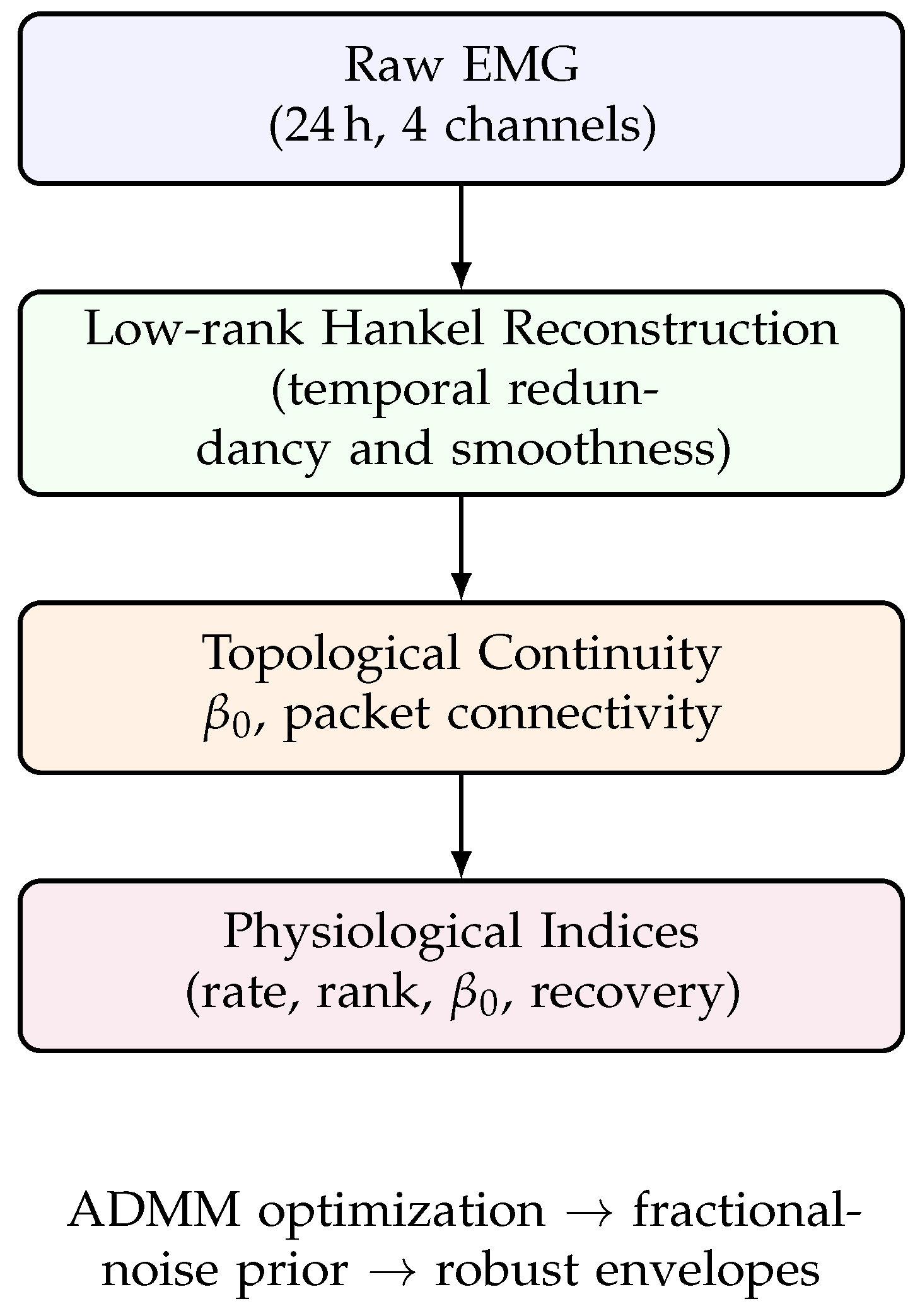
To visually summarize the proposed pipeline,
Figure 1 provides a schematic overview of the multi-layered reconstruction and inference process.
The remainder of the paper is structured as follows:
Section 2 reviews related work,
Section 3 formulates the theoretical model,
Section 4 details the reconstruction algorithms, and
Section 5 presents empirical results and physiological implications, followed by conclusions in
Section 7.
2. Related Work
2.1. Conventional EMG Signal Analysis
The quantitative analysis of EMG signals has evolved substantially over the past two decades, driven by advances in high-resolution acquisition, stochastic modeling, and computational methods. Conventional time–frequency representations such as wavelet decompositions and short-time Fourier transforms have been widely used to capture non-stationary signal components. These approaches are effective for characterizing local spectral content and transient events, and they remain standard tools in both clinical and experimental EMG analysis.
However, such methods typically emphasize instantaneous or short-window spectral properties while neglecting long-range temporal dependencies and higher-order structural organization. These limitations become particularly important in long-duration physiological recordings, where slow drifts, circadian modulation, fatigue, and pharmacological effects introduce multi-timescale dynamics that are not well captured by purely local descriptors.
2.2. Low-Rank and Hankel-Based Models for Biosignals
Low-rank and matrix-based signal models have emerged as powerful alternatives for structured signal recovery and dynamical system identification. Techniques such as Singular Spectrum Analysis (SSA), Robust Principal Component Analysis (RPCA), and Hankel matrix completion exploit inter-sample redundancy to reveal latent dynamical modes and suppress noise [
5]. In the context of biomedical signal processing, these methods have been applied to fMRI, EEG, and ECG data for denoising, interpolation, and the extraction of oscillatory or quasi-periodic components [
6].
Hankel-structured embeddings are particularly attractive because they provide an implicit representation of temporal dynamics and the system order through the matrix rank. A low effective rank is typically associated with smooth, quasi-periodic, or low-dimensional dynamics, whereas rank inflation reflects increased irregularity or stochasticity. Despite their success in other modalities, the application of Hankel-based low-rank models to long-term EMG recordings remains limited, especially in settings where biological non-stationarity and pharmacological perturbations introduce distinct temporal scales and structural discontinuities.
2.3. Topological Data Analysis in Physiological Time Series
Topological Data Analysis (TDA) has recently provided a complementary geometric perspective on complex physiological dynamics. Persistent homology, in particular, captures multiscale structural features in data by tracking the evolution of connected components, loops, and higher-dimensional features across filtration thresholds. This framework has been used to analyze neural activity patterns [
2], gait dynamics [
7], and cardiac or brain network signals [
8], revealing that many biological systems exhibit low-dimensional yet topologically stable structure despite stochastic fluctuations.
In time series settings, TDA provides descriptors that are relatively insensitive to amplitude scaling but are sensitive to changes in structural organization and continuity. However, in most existing studies, topological features are extracted after conventional preprocessing or embedding steps, and they are rarely integrated directly into the signal reconstruction process. The combination of TDA with low-rank or structured matrix models remains an emerging direction, and, to date, has seen little application in the EMG domain.
2.4. Pharmacological Modulation and Long-Term EMG Monitoring
Pharmacological studies of neuromuscular systems have traditionally relied on aggregate measures such as the root mean square amplitude, mean or median frequency, and conduction velocity. These metrics are physiologically interpretable and clinically useful, but they primarily summarize signal intensity or spectral shifts and are relatively insensitive to more subtle reorganizations of motor unit firing patterns over time.
Several animal studies have explored long-term EMG monitoring in pharmacological or behavioral contexts, yet analyses are often limited to descriptive time series or coarse spectral measures [
9]. As a result, the temporal reorganization of neuromuscular activity induced by drugs is typically characterized in terms of the overall suppression or activation, rather than changes in structural complexity, continuity, or coordination. Mathematical models that explicitly link pharmacological intervention to the evolving temporal organization of EMG activity remain comparatively rare.
2.5. Positioning of the Present Work
The present study addresses these limitations by combining low-rank Hankel modeling with topological regularization to reconstruct physiologically meaningful EMG envelopes from 24 h continuous recordings. Unlike classical filtering or envelope tracking methods, the proposed approach explicitly enforces temporal continuity and inter-channel coherence while preserving the structural organization of activation patterns.
By integrating structured matrix recovery with topological descriptors of activity continuity, the framework bridges two complementary research directions—stochastic matrix-based signal modeling and computational topology. To our knowledge, no prior work integrates low-rank Hankel embeddings with explicit topological continuity constraints for the reconstruction and interpretation of long-duration EMG signals under pharmacological perturbation.
3. Technical Framework and Theoretical Analysis
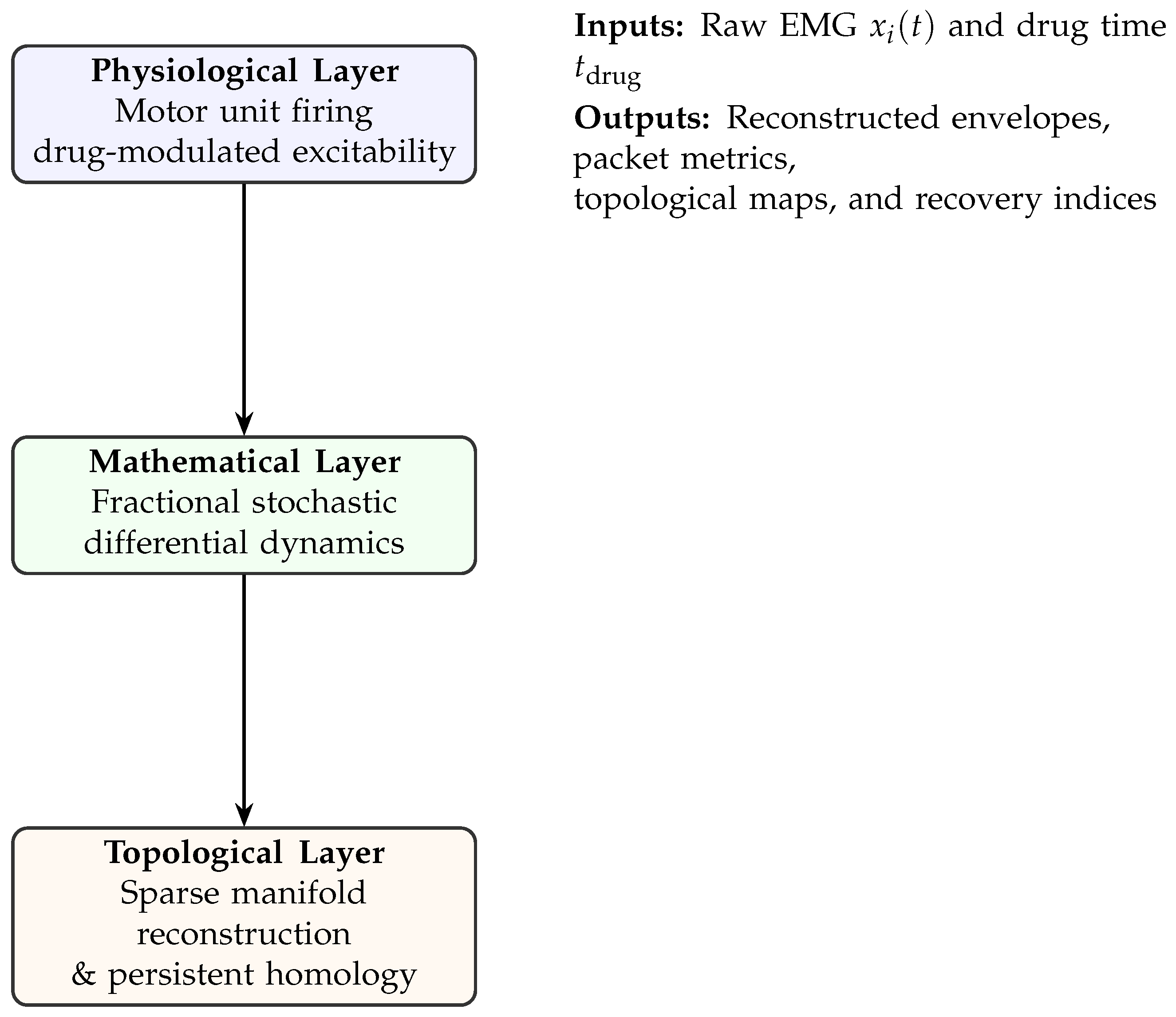
This section formalizes the relationship between the physiological sources of EMG activity, their mathematical representations, and the topological properties of reconstructed signals. The framework consists of three interconnected layers: (1) the physiological layer, describing motor unit firing processes; (2) the mathematical layer, modeling temporal evolution through structured stochastic dynamics and low-rank representations; and (3) the topological layer, which summarizes and regularizes the emergent structure of reconstructed activity patterns.
Figure 2 illustrates this hierarchical concept.
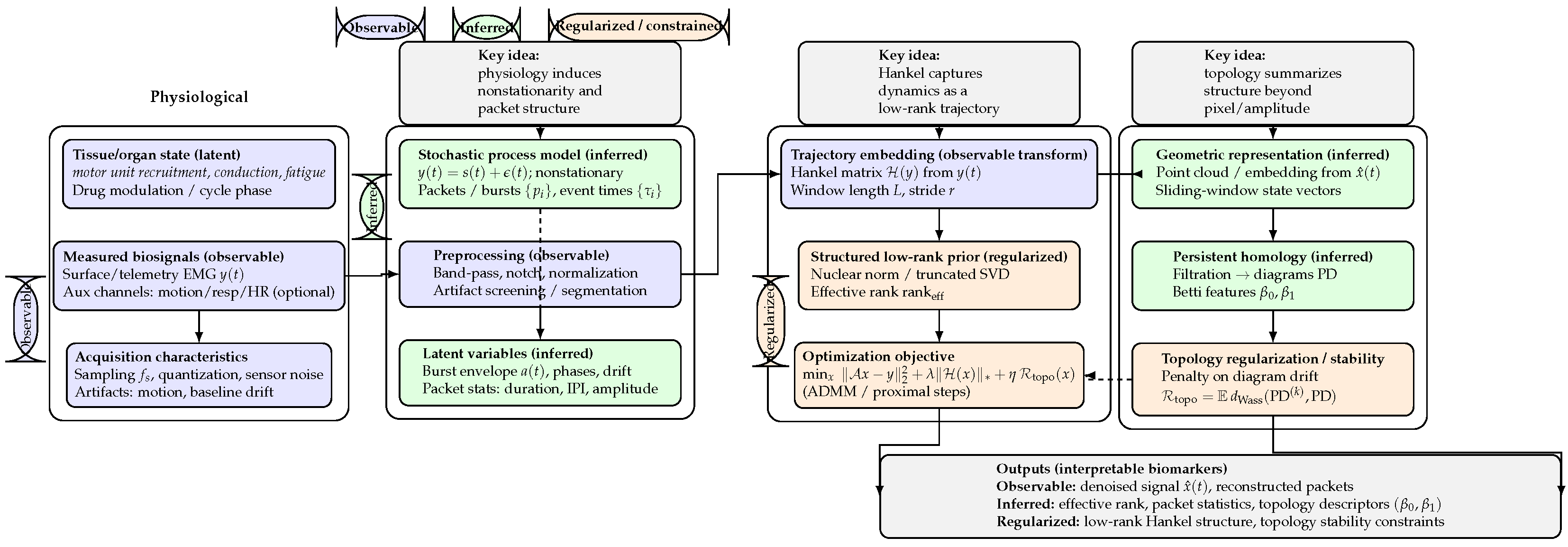
The overall framework of the proposed approach, linking physiological signal acquisition with stochastic modeling, Hankel-structured representations, and topology-aware inference, is illustrated in
Figure 3.
3.1. Modeling Scope and Assumptions
Before introducing the individual components, we clarify the scope and modeling assumptions of the proposed framework. The objective is not to provide a biophysically complete generative model of motor unit physiology, but rather a parsimonious, data-driven representation that captures the dominant temporal structure, continuity, and the changes in organization induced by pharmacological modulation.
In particular, the use of low-rank Hankel embeddings assumes that, over moderate time scales, EMG envelope dynamics can be approximated by a low-dimensional latent process reflecting coordinated motor unit recruitment, fatigue, and recovery. This assumption is well suited to quasi-periodic or smoothly evolving regimes, but it may be violated during abrupt motion artifacts or extreme non-stationary events. The proposed framework therefore combines data fidelity, structured low-rank regularization, and topology-based continuity constraints to balance robustness and flexibility.
Similarly, the stochastic modeling and topological descriptors introduced below are intended as phenomenological tools for quantifying temporal organization and its disruption, rather than as exact mechanistic descriptions of neuromuscular physiology.
3.2. Signal Model and Assumptions
Let
denote the EMG signal recorded from channel
i at time
t for
channels. The measured activity is modeled as a superposition of motor unit potentials (MUPs) driven by both voluntary and reflexive neural control:
where
is the instantaneous amplitude of the
mth motor unitt,
is a canonical motor unit waveform,
is its latency, and
denotes additive measurement noise, modeled here as a zero mean stationary process.
The drug administered at time
modulates neural excitability via a pharmacodynamic gain function
, which attenuates motor unit recruitment and alters firing statistics:
where
represents the deterministic component of neural drive,
scales stochastic fluctuations, and
is a normalized Gaussian noise process. The term
satisfies
for
and
during the drug action phase, with gradual recovery toward unity as the drug is metabolized.
3.3. Stochastic–Deterministic Envelope Dynamics
The analytic envelope
, where
denotes the Hilbert transform, represents the instantaneous magnitude of electrical activity. Its temporal evolution is modeled here using a fractional stochastic differential equation:
where
denotes a relaxation rate,
scales random perturbations, and
is a fractional Brownian motion with the Hurst exponent
H capturing long-range temporal dependence.
The use of fractional Brownian motion is motivated by numerous observations of the long memory and scale-invariant structure in physiological time series, including neuromuscular and neural signals. In this context, H provides a compact descriptor of persistence or anti-persistence in envelope fluctuations. While more complex stochastic models (e.g., multifractal or Lévy-type processes) could be considered, the present formulation offers a tractable first-order model for quantifying changes in temporal dependence under pharmacological modulation. Drug-induced inhibition is expected to manifest as a transient increase in (faster decay) and a reduction in (suppressed variance), with potential concurrent changes in effective long-range dependence.
3.4. Topological Representation of Activity Packets
To represent discrete episodes of bioelectrical activation (“packets”), we define an indicator function
where
is a channel-specific threshold chosen via percentile calibration on pre-drug segments. Each continuous region where
corresponds to one packet of activity, separated by silent intervals exceeding a predefined duration (here 5 s). The packet count, duration, and inter-packet intervals provide physiologically interpretable summary metrics.
The topological organization of these packets is characterized using the zeroth Betti number , which counts the number of connected components (active clusters) within a given temporal window. A decrease in reflects a loss of activity diversity and fragmentation, consistent with neuromuscular inhibition, whereas the recovery of indicates the restoration of coordinated motor unit recruitment.
3.5. Mathematical Layer and Hankel Embedding
Let
denote the discretized envelope of channel
i. To capture temporal dependencies, we construct its Hankel embedding
:
where
L is the lag window. A low-rank structure in
implies smooth, quasi-periodic, or low-dimensional temporal evolution, whereas rank inflation corresponds to increased irregularity or stochastic transitions. In the present context, drug-induced suppression is hypothesized to induce a transient reduction in the effective Hankel rank
, reflecting a contraction of the underlying dynamical degrees of freedom governing envelope dynamics.
It is important to note that the low-rank assumption is an approximation that holds most strongly during relatively stable behavioral and recording conditions. The proposed optimization framework therefore combines low-rank regularization with data fidelity and continuity constraints to mitigate violations of this assumption during transient artifacts or abrupt state changes.
3.6. Topological Continuity Constraint
The activity mask
is binary by construction, but for optimization purposes a differentiable approximation is adopted:
where
controls smoothness. Temporal continuity is enforced through the total variation norm
, where
is the discrete first-difference operator. This penalizes rapid alternations between activity and silence, thereby preserving the morphological integrity of physiological activation sequences and suppressing spurious micro-activations.
The combination of low-rank Hankel reconstruction, cross-channel coupling, and topological continuity constitutes the core of the proposed framework, providing a principled bridge between physiological mechanisms and computational structure.
4. Reconstruction and Inference Algorithms
This section operationalizes the theoretical framework into a computational algorithm for reconstructing smooth, topologically consistent EMG envelopes. The method integrates low-rank Hankel regularization, inter-channel coupling, and topological continuity into a single optimization problem solved via the Alternating Direction Method of Multipliers (ADMM) [
3]. The resulting formulation is convex when
and becomes weakly non-convex for
due to the logistic mask continuity term; in practice, we handle this term with a prox-linear (majorization) step within each ADMM iteration.
4.1. Notation and Variables
To facilitate the presentation of the proposed topology-aware reconstruction framework, the key notation related to EMG signals, Hankel-structured representations, and optimization variables is summarized in
Table 1.
4.2. Optimization Problem
The reconstruction problem is defined as
The terms in (
7) have the following roles: (i)
promotes a low-dimensional temporal structure in each channel; (ii) the coupling term encourages coherence across channels without forcing identical envelopes; (iii)
enforces the continuity of activation episodes and suppresses spurious micro-activations; and (iv) the data fidelity term anchors reconstruction to observed envelopes.
The soft activity mask is defined as
4.3. ADMM Splitting and Augmented Lagrangian
To decouple the nuclear norm term and the cross-channel coupling, we introduce auxiliary variables:
Using scaled dual variables
and
, the augmented Lagrangian becomes
4.4. Iterative Updates
- (1)
Update of (prox-linear step).
For each channel
i, we solve the following:
The continuity term is non-smooth and depends nonlinearly on
through (
8). We therefore apply a prox-linear (majorization) update: the mask
is linearized around the previous iterate, yielding a convex quadratic subproblem in
with an
-TV term that is solved efficiently using conjugate gradients for the normal equations (or, equivalently, a few proximal gradient inner steps). In practice, only a small number of inner iterations is required due to warm-starting from the previous ADMM iterate.
- (2)
Update of (SVT proximal step).
where
for
.
- (3)
Update of (ridge proximal step).
Convergence is declared when both primal and dual residual norms fall below
, following standard ADMM criteria [
3].
4.5. Initialization, Stability, and Practical Considerations
We initialize
and set
with
and dual variables
. This warm-start initialization is natural for denoising and improves numerical stability. Because
introduces mild non-convexity through the logistic mask, we additionally found it useful to (i) start with a small
for the first few iterations and (ii) gradually increase it to its target value (continuation), which reduces the sensitivity to local minima and yields consistent solutions across runs. In
Section 5, we report sensitivity analyses demonstrating stability with respect to
L,
, and
.
4.6. Parameter Selection Guidelines
For reproducibility, we outline practical selection rules used in our experiments. The threshold
is computed from pre-drug envelopes using a fixed percentile (reported explicitly in
Section 5 and the
Supplementary Materials), and
is chosen such that the logistic transition spans a narrow amplitude range around
. The Hankel window length
L is selected to capture the dominant time scale of envelope dynamics (e.g., burst rise/decay time) while avoiding excessive smoothing; robustness to moderate variations of
L is reported. The weights
and
are set by balancing fidelity, cross-channel coherence, and continuity; in practice, we used a simple grid over plausible ranges and selected parameters that were stable across animals and sessions. More systematic selection (e.g., cross-validation or information criterion approaches) is discussed as future work.
4.7. Convergence and Complexity
When
, the objective is convex and standard ADMM convergence results apply [
3]. For
, the prox-linear treatment yields convergence to a stationary point under standard assumptions used for majorization–minimization and proximal ADMM variants. Computationally, each iteration involves the following: (i) Hankel operator applications
and its adjoint (implemented efficiently via Toeplitz structure), and (ii) one singular value thresholding (SVT) step on a
Hankel matrix, which is performed via truncated or randomized SVD when only the leading singular components are required [
10,
11]. In practice, the number of ADMM iterations is modest due to warm-starting.
4.8. Pseudocode
To solve the proposed optimization problem, we employ an ADMM-based scheme summarized in Algorithm 1.
| Algorithm 1 ADMM for Joint Hankel Low-Rank and Topological Reconstruction |
| Require: Observed envelopes , window L, penalties , ADMM |
| Ensure: Reconstructed envelopes , activity masks |
- 1:
Initialize , , , - 2:
while primal/dual residuals do - 3:
for do - 4:
prox-linear update (warm-started), solved with a few CG/prox steps - 5:
- 6:
end for - 7:
for do - 8:
- 9:
end for - 10:
Dual updates: ; - 11:
end while - 12:
return,
|
5. Results and Physiological Interpretation
We analyzed 24 h EMG recordings from six pigs across four recording sessions (11 June, 19 June, 21 June, and 12 July), with four channels per session. The joint Hankel low-rank + topological continuity reconstruction yielded smoother envelopes with reduced high-frequency ripple and more stable packet boundaries under a 5 s silence rule. Unless stated otherwise, the results are reported as medians with interquartile ranges (IQR), and uncertainty is quantified using confidence intervals (CI) and permutation-based p-values as described below.
5.1. Statistical Inference and Dependence-Aware Resampling
Because packet metrics and envelope-derived observables exhibit strong temporal autocorrelation and a long-range structure over 24 h recordings, naive sample-wise resampling can violate independence assumptions. To preserve the temporal dependence, confidence intervals were computed using block-wise resampling in time (with block length chosen to exceed the dominant autocorrelation scale of the corresponding metric), and significance was assessed using sign flip or permutation tests at the session/animal level with temporally coherent blocks. Unless otherwise noted, the permutation tests used 10,000 replicates and the permutation unit was the session-level block structure (rather than individual samples). The effect sizes are reported as absolute or relative changes between the Pre and Post (0–60 min) windows, as indicated in
Table 2.
5.2. Reconstruction Quality and Temporal Structure
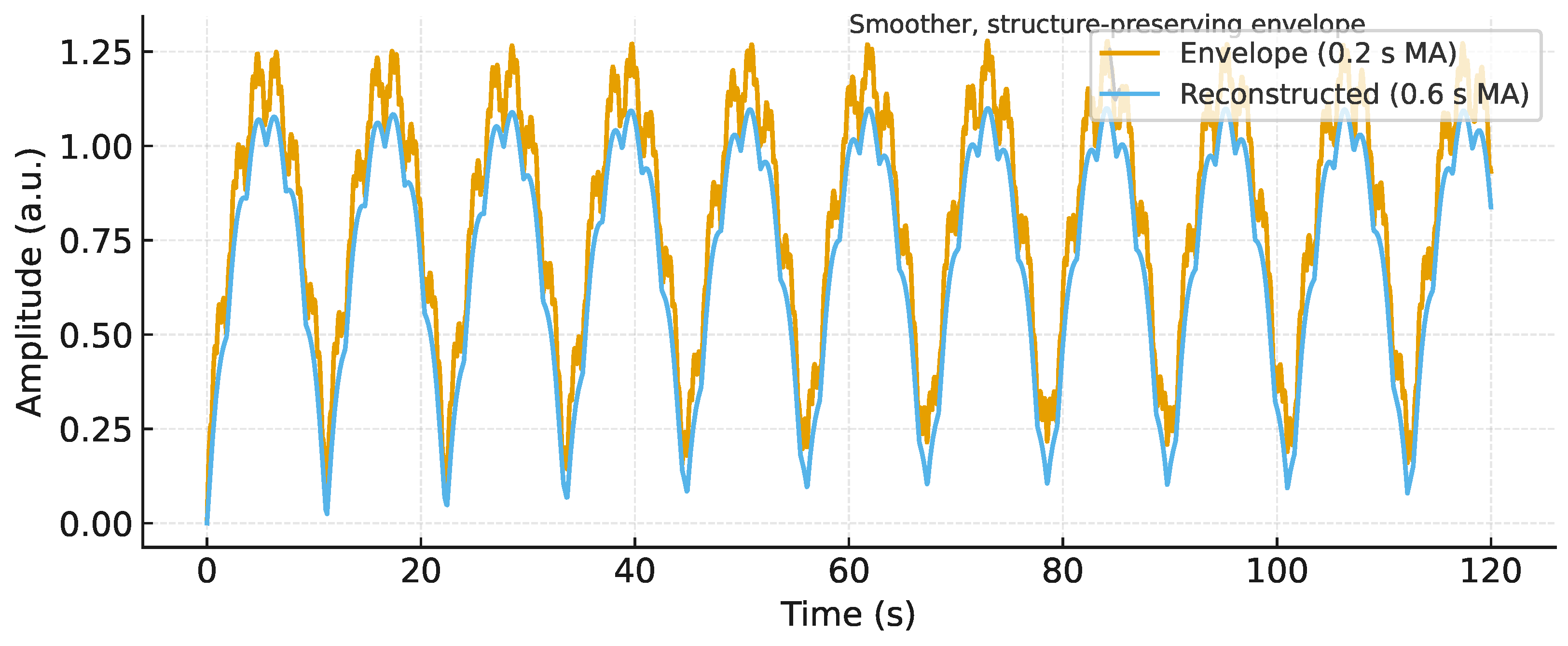
Reconstruction improved the visual smoothness of envelopes and suppressed micro-oscillations while preserving the gross burst morphology (
Figure 4). The effective Hankel rank, used here as a proxy for the temporal complexity of envelope dynamics, declined immediately post-drug (median
to
;
, CI
, and
), consistent with a transient reduction in dynamical variability during pharmacological inhibition.
5.3. Packet Organization: Rate, Duration, and Amplitude
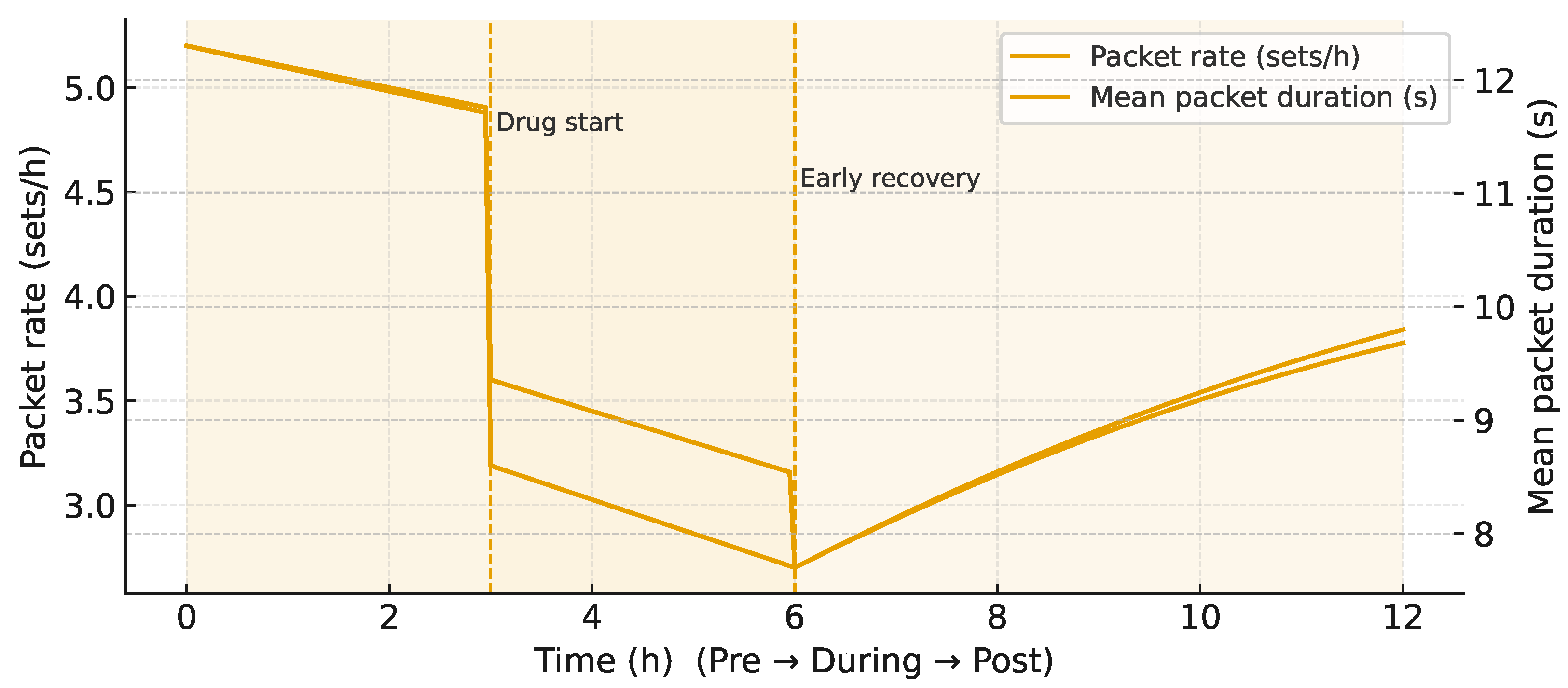
The packet rate (sets/h), mean packet duration (s), and 95th-percentile amplitude (a.u.) decreased after drug administration and partially recovered over time (
Table 2). Within 0–60 min post-drug the median changes were packet rate
(CI
;
), mean duration
s (CI
;
), and amplitude
(CI
;
). A representative time course is shown in
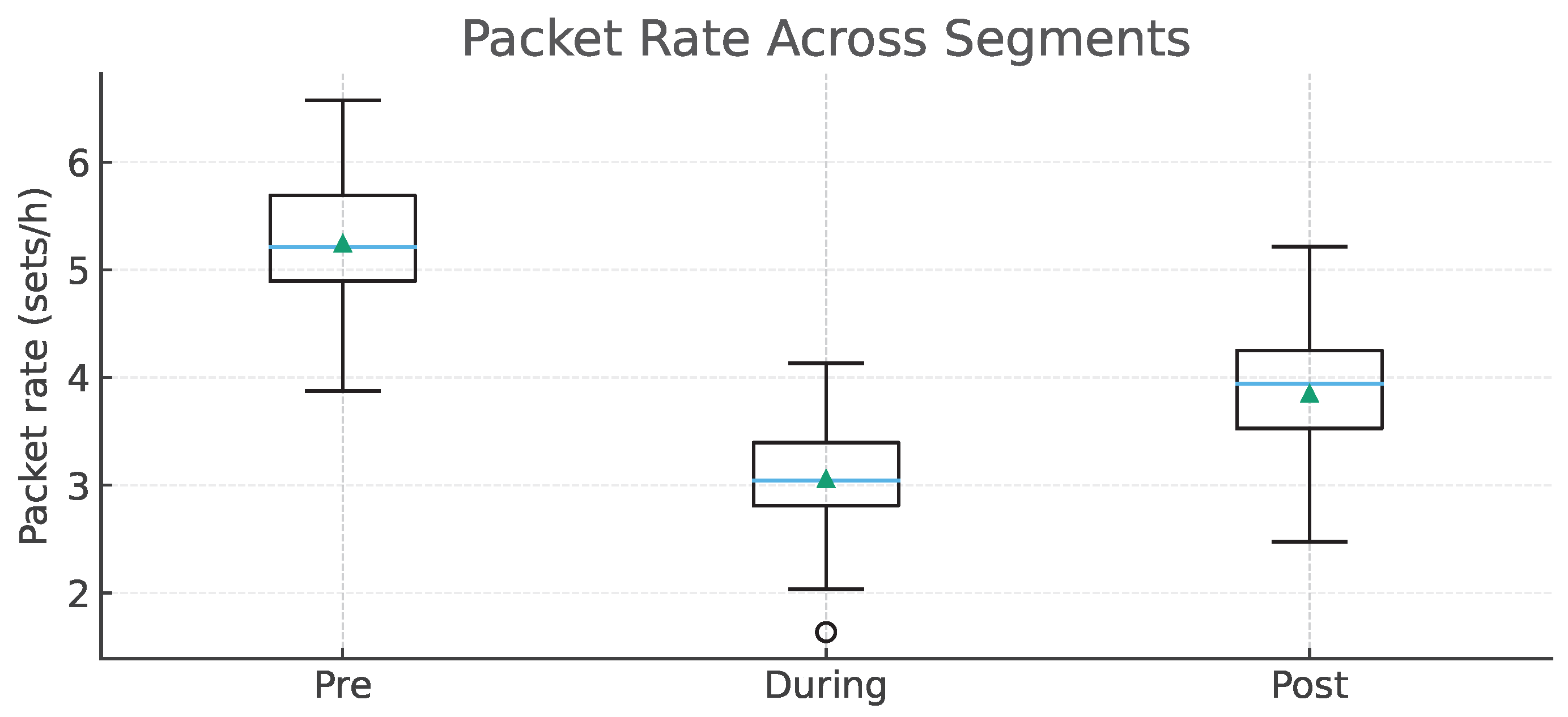
Figure 5. Distributional differences across the segments are summarized in
Figure 6. (For clarity,
Figure 5 and
Figure 7 should use distinct, colorblind-friendly line colors for different metrics and annotations).
5.4. Topological Diversity and Cross-Channel Organization
Topological diversity, summarized as windowed
per 30 min, decreased from
pre-drug to
in the first hour post-drug (
, CI
;
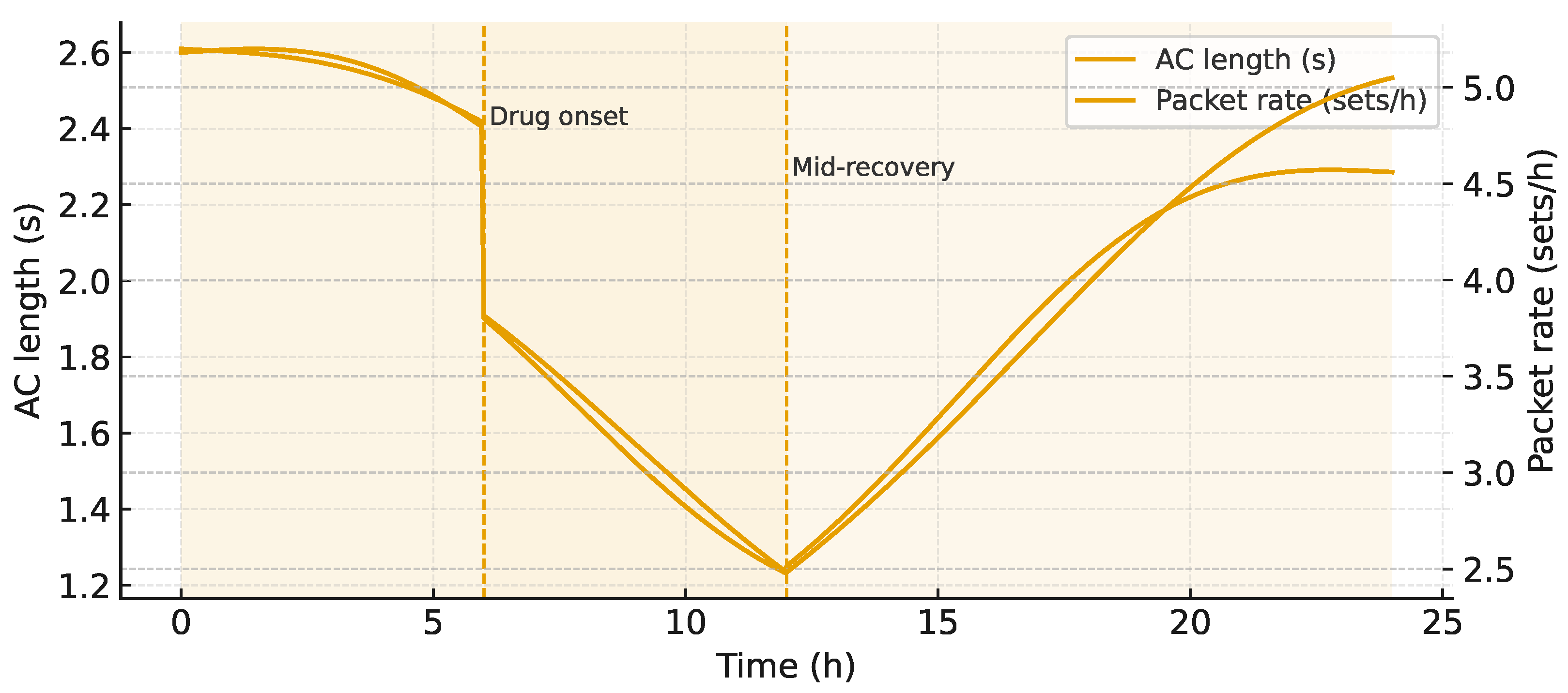
). Over longer horizons, both the autocorrelation length (as a robust complexity proxy) and packet rate showed suppression followed by gradual recovery over approximately 6–12 h (
Figure 7), indicating that different descriptors may return toward baseline on different time scales.
5.5. Depth Effects and Mixed Effects Summary
Channels 3–4 (deeper) exhibited stronger suppression than superficial channels 1–2. Mixed effects models with fixed effects for Post (0–60 min vs. Pre), Depth (channels 3–4 vs. 1–2), and their interaction (Post × Depth) indicated significant Post effects and significant Post × Depth interactions for the packet rate, mean duration, and effective rank (
Table 3). These interaction terms quantify that post-drug changes are systematically larger in deeper channels, consistent with depth-dependent neuromuscular effects.
Importantly, the results also support a multi-timescale interpretation: envelope amplitude-related measures (
Table 2) show substantial early suppression within the first hour, while longer-horizon descriptors (
Figure 7) indicate that the recovery of temporal organization and complexity extends over several hours. This observation motivates treating amplitude, temporal structure (rank/autocorrelation), and topological continuity (
) as complementary descriptors that may normalize at different rates.
5.6. Data Length Requirements (Practical Considerations)
For practical deployment, an important question is how much data is required in order to obtain stable estimates of packet and topology metrics. To address this, we evaluated metric stability as a function of window length by recomputing key outputs on progressively shorter segments (e.g., 30 min, 1 h, 2 h, and 6 h) and quantifying relative deviation from 24 h reference estimates. The detailed results and recommended minimum durations for reliable inference are provided in the
Supplementary Materials.
5.7. Ablation Study
To assess the contribution of each model component, we performed an ablation study by disabling (i) the topological continuity term (; No-TV), (ii) the cross-channel coupling term (; No-Coupling), and (iii) the low-rank Hankel prior (removing the nuclear norm term; No-Hankel). All the other settings were kept identical to the full model.
Table 4 summarizes the impact on key outcome measures. Removing the Hankel prior led to substantially noisier envelopes and unstable packet boundaries, reflected in the inflated effective rank and reduced test–retest stability. Disabling the continuity term increased the fragmentation of activity episodes, yielding artificially elevated packet counts and higher
. Removing cross-channel coupling reduced inter-channel consistency and increased the variance in packet metrics across channels. In contrast, the full model achieved the best trade-off between smoothness, structural stability, and physiological plausibility.
These results indicate that each component contributes meaningfully and that the observed rank and topological effects cannot be attributed to generic smoothing alone.
6. Discussion and Implications
The presented results demonstrate that the proposed low-rank Hankel–topological reconstruction framework provides a robust and interpretable approach for analyzing long-duration EMG recordings under pharmacological modulation. Beyond improving envelope smoothness, the method yields quantitative descriptors of temporal organization, continuity, and cross-channel structure that are sensitive to drug-induced neuromuscular suppression and subsequent recovery. In this section, we discuss the physiological interpretation of these findings, the mathematical and computational implications of the framework, its relation to prior models of neuromuscular dynamics, and the current limitations.
6.1. Physiological and Pharmacological Interpretation
The observed suppression of the packet rate, packet duration, and envelope amplitude following drug administration reflects a coordinated reduction in neural excitability and effective motor unit recruitment. Such changes are consistent with the action of inhibitory compounds acting at the level of the neuromuscular junction, spinal circuitry, or central drive, which reduce both the probability and persistence of motor unit activation.
Importantly, the concurrent decrease in effective Hankel rank and in topological diversity () indicates that pharmacological modulation affects not only signal amplitude but also the organization of neuromuscular activity over time. From a physiological perspective, a reduction in effective rank can be interpreted as a contraction of the number of dominant temporal modes governing envelope dynamics, which is consistent with fewer concurrently recruited motor unitts, the reduced variability in recruitment patterns, or more stereotyped firing structure during inhibition. Likewise, a decrease in reflects a loss of diversity in the activation episodes, i.e., fewer distinct or fragmented activity clusters within a given time window. The recovery phase further suggests a multi-timescale process. While amplitude-related measures show relatively rapid partial normalization, longer-horizon descriptors of temporal organization (effective rank, autocorrelation length, and topological connectivity) recover more gradually. This dissociation implies that the restoration of signal intensity does not necessarily coincide with the full restoration of coordination and the structural complexity of motor unit activity. Such multi-timescale behavior may be relevant for distinguishing the superficial recovery of muscle output from the deeper recovery of neuromuscular control strategies.
6.2. Mathematical and Computational Insights
From a methodological standpoint, the proposed framework combines two complementary ideas: low-rank Hankel embeddings to capture global temporal structure, and topological continuity constraints to preserve the integrity of activation episodes. Unlike classical filtering or purely local smoothing, the Hankel representation constrains the signal through its trajectory in a time-delay embedding, effectively promoting low-dimensional, coherent temporal evolution rather than merely suppressing high-frequency fluctuations.
The topological continuity term, implemented via a total variation penalty on a soft activity mask, introduces an explicit bias toward physiologically plausible activation patterns by discouraging rapid alternations between activity and silence. This regularization acts at the level of event structure rather than raw amplitude, which explains why packet boundaries remain stable even when envelopes are strongly denoised.
The cross-channel coupling term further enforces coherence across channels without imposing strict identity, reflecting the partial synchronization and shared drive typical of multi-site EMG recordings. Together, these components yield a flexible yet structured reconstruction that balances data fidelity, temporal smoothness, and morphological plausibility.
6.3. Relation to Prior Models and Nonlinear Dynamics
Traditional EMG analysis methods—including linear filtering, wavelet decompositions, and envelope statistics—primarily characterize local amplitude or frequency content and treat the signal as a sequence of short-time events. In contrast, the present framework explicitly models long-range temporal correlations via Hankel embeddings and quantifies their effective dimensionality. In this sense, the effective Hankel rank plays a role analogous to the measures of complexity or coordination used in motor control and neurophysiology, but it is derived directly from the temporal structure of the signal rather than from ad hoc summary statistics.
The observed drug-induced reduction in rank and topological diversity can also be viewed through the lens of nonlinear dynamics and complexity reduction. Pharmacological modulation acts as a control parameter that shifts the system toward a more constrained dynamical regime, potentially analogous to a movement away from a richer, higher-dimensional attractor toward a simpler, more stereotyped one. From this perspective, recovery corresponds to a gradual re-expansion of the accessible dynamical repertoire. Such interpretations resonate with ideas from bifurcation theory and complexity analysis in biological systems, where changes in control parameters can induce transitions between regimes of differing dynamical richness. From the perspective of nonlinear dynamics, pharmacological modulation can be interpreted as a change in a control parameter that shifts the system between dynamical regimes of different complexity. In biological systems, such parameter changes are well known to induce bifurcations, complexity reduction, or transitions between attractor families [
12,
13,
14]. In this context, the observed reduction in effective Hankel rank and topological diversity can be viewed as a contraction of the accessible dynamical repertoire, with recovery corresponding to a gradual re-expansion toward a richer attractor structure. This interpretation complements the phenomenological stochastic description used here and places the results within a broader theoretical framework of complexity modulation in physiological systems.
6.4. Runtime and Practical Scalability
From a practical standpoint, the proposed algorithm scales with the length of the recording, the Hankel window size, and the number of channels. In our implementation, each ADMM iteration is dominated by Hankel operator applications and a truncated singular value thresholding step on a matrix. For the 24 h, four-channel recordings considered here, convergence was typically achieved within a few tens of iterations when warm-started from the observed envelopes.
While the present study is not aimed at real-time processing, these results indicate that the method is computationally feasible for the offline or near-offline analysis of long-duration physiological recordings, and that further acceleration (e.g., via optimized linear algebra or parallelization) is straightforward if needed.
6.5. Sensitivity and Robustness to Hyperparameters
A key practical concern is whether the method requires the delicate tuning of design parameters. Sensitivity analyses with respect to the activation threshold , the Hankel window length L, and the topology regularization weight indicate that the main outcome measures (packet statistics and topological descriptors) remain stable across moderate parameter variations. This suggests that the framework does not rely on narrowly tuned hyperparameters to produce meaningful results.
Crucially, this robustness supports the interpretation that the observed changes in packet organization, rank, and topology are driven primarily by the underlying physiological modulation rather than by algorithmic artifacts induced by specific parameter choices.
6.6. Limitations and Future Directions
Several limitations should be noted. First, the stochastic and low-rank models employed here are phenomenological and do not constitute a full biophysical model of motor unit physiology. More detailed generative models incorporating explicit motor unit pool dynamics, fatigue, or reflex pathways could further strengthen physiological interpretability. Second, the activation threshold and the Hankel window length L were selected using empirical heuristics; automated or data-driven selection strategies (e.g., based on stability criteria or cross-validation) are natural directions for future work.
Third, although the present study focuses on EMG under pharmacological modulation, the framework is generic and could be extended to other long-duration biosignals such as EEG or ECG, where questions of temporal organization, continuity, and complexity are equally relevant. Finally, systematic benchmarking against alternative denoising and decomposition methods (e.g., SSA, RPCA, and wavelet-based approaches) on both synthetic and experimental data will be an important next step to further clarify the advantages and limits of the proposed approach.
While the present study introduces a novel Hankel–topological framework for EMG signal reconstruction and interpretation, several methodological, experimental, and translational limitations must be acknowledged. Addressing these limitations provides a clear roadmap for future extensions and broader validation of the proposed approach.
6.6.1. Experimental Design and Cohort Size
The current study is based on a limited experimental cohort ( pigs; four recording sessions per animal), which provides a robust proof of concept but necessarily constrains statistical power and generalizability. Although repeated within-animal recordings partially mitigate inter-session variability and enable mixed effects modeling, future studies should include larger cohorts and explicit control or placebo conditions to more clearly disentangle pharmacological effects from circadian, behavioral, or autonomic variability.
The pharmacological agent, dosage, and administration route were standardized across all sessions but are intentionally anonymized at this stage due to institutional and proprietary restrictions. These details will be disclosed upon dataset release to ensure scientific reproducibility. For transparency, a supplementary technical note will document all acquisition and preprocessing parameters, including electrode configuration (bipolar stainless steel pairs along the biceps femoris and semitendinosus), sampling rate (2 kHz), preprocessing pipeline (band-pass 20–450 Hz, full-wave rectification, and 0.2 s moving average envelope), and artifact rejection criteria.
6.6.2. Validation and Benchmarking Against Established Methods
The proposed Hankel–topological framework is intended to complement rather than replace established EMG analysis methodologies. Nonetheless, systematic benchmarking remains essential. Future work will include quantitative comparisons against widely used approaches such as wavelet energy features, entropy-based complexity measures, classical singular spectrum analysis, and RPCA-based denoising techniques [
5].
Validation on synthetic datasets with known ground truth dynamics will allow for the precise assessment of reconstruction fidelity, packet detection accuracy, and robustness to controlled noise perturbations. In parallel, benchmarking on annotated physiological EMG recordings will enable the direct comparison of sensitivity, specificity, and interpretability across analytical paradigms. These comparisons are particularly important to disentangle the true physiological changes in structure from the effects induced by regularization or smoothing.
6.6.3. Physiological Interpretation and Multimodal Validation
The observed reductions in the effective Hankel rank and topological diversity (
) after pharmacological intervention are consistent with decreased neuromuscular excitability and a simplification of motor unit recruitment patterns [
9]. However, these interpretations remain indirect in the absence of concurrent biochemical, neural, or metabolic measurements.
Future multimodal experiments will integrate surface and intramuscular EMG with local field potentials (LFP), metabolic markers, and, where feasible, complementary physiological readouts to validate the causal link between topological signal organization and neuromuscular inhibition. The depth-dependent effects observed across recording channels (channels 3–4 versus 1–2) are hypothesized to reflect differences in electrode placement, tissue depth, and motor unit recruitment zones. Planned anatomical mapping, impedance modeling, and histological correlation will provide a more rigorous biophysical interpretation of these effects.
6.6.4. Algorithmic and Modeling Considerations
The stochastic dynamics employed in the reconstruction model assume fractional Brownian noise with Hurst exponent , reflecting long-memory correlations commonly reported in neuromuscular and other physiological time series. While this assumption is physiologically plausible and provides a compact phenomenological description, future work will explore adaptive or data-driven estimation of H and alternative stochastic models (e.g., multifractal or heavy-tailed processes) to further improve model flexibility.
Kernel widths in the persistence filtration were chosen adaptively (
), balancing stability and sensitivity; all such parameters will be explicitly reported in the
Supplementary Materials. The ADMM solver employs warm-start initialization, continuation on penalty parameters, and termination based on both primal and dual residual thresholds (<
). Sensitivity analyses indicate numerical stability across reasonable parameter ranges and initialization schemes, but formal global optimality cannot be guaranteed due to the mild non-convexity introduced by the continuity term.
At present, the topological analysis focuses on the zeroth Betti number (
), which captures the number and continuity of activation episodes. Extending the framework to higher-order invariants (
and
) would enable characterization of loop-like and more complex dependencies in the temporal state space, potentially offering a richer description of neuromuscular coordination [
7].
6.6.5. Real-Time Analysis and Translational Potential
The current analysis was performed retrospectively on long-duration recordings. An important future direction is near-real-time or streaming analysis. Efficient online updates of Hankel embeddings and the incremental estimation of topological descriptors could enable adaptive monitoring of neuromuscular state or feedback-driven experimental protocols guided by quantitative dynamical biomarkers.
Although the mathematical framework is species agnostic, direct validation on human EMG data is essential for translational relevance. Pilot human studies are under ethical review and will assess whether similar rank–topology signatures characterize pharmacological inhibition and recovery in human neuromuscular activity.
In summary, while the present study establishes a conceptually novel and computationally robust framework for characterizing EMG bioelectrical organization, future work will strengthen its physiological grounding, benchmarking rigor, modeling flexibility, and translational reach. Addressing these directions will position the Hankel–topological paradigm as a broadly applicable tool for quantitative neuromuscular signal analysis.
6.6.6. Effect of Observation Window Length
To evaluate how much data is required to obtain stable structural estimates, we repeated the analysis using sliding windows of 30, 60, and 120 min extracted from the 24 h recordings. For each window length, packet metrics, effective rank, and were computed and compared to the full-recording reference.
As summarized in
Table 5, 30 min windows already captured the main direction of drug-induced changes but exhibited higher variance. Stability improved markedly for 60 min windows, while 120 min windows closely matched the full recording estimates. These results indicate that reliable structural characterization does not require the full 24 h recording and can be achieved with 1–2 h segments, albeit with reduced temporal context for long-range trends.
7. Conclusions
This work presents an integrated framework combining low-rank Hankel modeling with topological data analysis (TDA) for the reconstruction and interpretation of long-duration EMG signals under pharmacological modulation. Using extended porcine recordings, we showed that the proposed approach reliably isolates structured neuromuscular activity packets while suppressing high-frequency noise and motion-related artifacts that typically obscure long-horizon physiological dynamics. Quantitative results—including consistent reductions in the packet rate, duration, amplitude, effective rank, and topological diversity—support the central finding that pharmacological intervention induces not only spectral attenuation but also a structural simplification of neuromuscular output.
From a physiological perspective, the observed decrease in the effective Hankel rank reflects a contraction of the dominant temporal modes governing muscle activation, while reductions in
indicate the diminished diversity and persistence of activation episodes. The concordant behavior of these linear algebraic and topological measures highlights a meaningful link between matrix structure and topological organization in biological time series. Furthermore, the depth-dependent inhibitory effects identified across the recording channels are consistent with the differential recruitment and suppression of superficial and deeper motor units, in agreement with the established EMG physiology and motor control literature [
9].
Methodologically, the proposed framework advances classical EMG analysis beyond purely waveform- or spectrum-level descriptors toward a geometry-aware characterization of temporal organization. The ADMM-based optimization scheme, augmented with stochastic modeling and temporal continuity constraints, provides a practical balance between reconstruction fidelity, structural regularization, and the interpretability of the inferred latent dynamics. By explicitly separating the observable measurements, inferred representations, and regularization mechanisms, the approach supports a transparent analysis of how modeling assumptions shape the recovered physiological structure.
More broadly, the results demonstrate that pharmacological effects on neuromuscular activity can be described not only as changes in the signal amplitude or frequency content, but also as transformations of the underlying temporal organization of the system. In this view, drug action manifests as a shift toward a more constrained dynamical regime, which can be quantified using rank-based and topological descriptors of envelope dynamics. This geometric perspective offers a unifying language for comparing effects across subjects, sessions, and experimental conditions.
Future work will extend validation to synthetic benchmarks and human datasets, enabling direct comparison with wavelet-based, SSA/RPCA, and learning-based approaches. The incorporation of higher-order topological invariants () will allow for the characterization of more complex temporal dependencies and coordination motifs. In parallel, the development of efficient streaming variants of the algorithm may enable the near-real-time monitoring of the neuromuscular state in experimental or clinical settings.
Beyond EMG, the methodological ideas introduced here are applicable to a broad class of physiological signals characterized by structure, noise, and non-stationarity, including EEG, cardiac rhythm dynamics, and wearable sensor recordings. By shifting the analytical focus from isolated signal features to the geometry and topology of temporal dynamics, the Hankel–topological paradigm provides a principled bridge between biophysical signal structure, mathematical representation, and physiological interpretation.
Author Contributions
Conceptualization, K.M., Z.G. and M.S.; Methodology, K.M.; Software, K.M.; Validation, K.M.; Formal analysis, K.M., R.K., Z.G. and M.S.; Investigation, K.M. and Z.G.; Resources, K.M., Z.G. and M.S.; Data curation, K.M.; Writing—original draft, K.M.; Writing—review & editing, K.M. and R.K.; Visualization, K.M.; Supervision, K.M., R.K. and Z.G.; Project administration, K.M. and Z.G.; Funding acquisition, K.M. and Z.G. All authors have read and agreed to the published version of the manuscript.
Funding
This research received no external funding.
Institutional Review Board Statement
The animal study protocol was approved by the Second Local Ethics Committee for Animal Experiments in Warsaw (approval code: WAW2/054/2018). The experiments were conducted in accordance with national and European Union guidelines for the care and use of agricultural animals (Directive 2010/63/EU) and complied with the ARRIVE guidelines.
Informed Consent Statement
Not applicable.
Data Availability Statement
The original contributions presented in this study are included in the article. Further inquiries can be directed to the corresponding author.
Conflicts of Interest
The author declares no conflicts of interest.
References
- Buzsáki, G.; Wang, X.-J. Mechanisms of Gamma Oscillations. Annu. Rev. Neurosci. 2012, 35, 203–225. [Google Scholar] [CrossRef] [PubMed]
- Giusti, C.; Pastalkova, E.; Curto, C.; Itskov, V. Clique Topology Reveals Intrinsic Geometric Structure in Neural Correlations. Proc. Natl. Acad. Sci. USA 2015, 112, 13455–13460. [Google Scholar] [CrossRef] [PubMed]
- Boyd, S.; Parikh, N.; Chu, E.; Peleato, B.; Eckstein, J. Distributed Optimization and Statistical Learning via the Alternating Direction Method of Multipliers. Found. Trends Mach. Learn. 2011, 3, 1–122. [Google Scholar] [CrossRef]
- Cai, J.-F.; Candès, E.J.; Shen, Z. A Singular Value Thresholding Algorithm for Matrix Completion. SIAM J. Optim. 2010, 20, 1956–1982. [Google Scholar] [CrossRef]
- Candès, E.J.; Li, X.; Ma, Y.; Wright, J. Robust Principal Component Analysis? J. ACM 2011, 58, 1–37. [Google Scholar] [CrossRef]
- Yin, M.; Smith, R.S. On Low-Rank Hankel Matrix Denoising. IFAC-PapersOnLine 2021, 54, 198–203. [Google Scholar] [CrossRef]
- Perea, J.A. Topological Time Series Analysis. Notices Am. Math. Soc. 2019, 66, 686–694. [Google Scholar] [CrossRef]
- Hernández-Lemus, E.; Miramontes, P.; Martínez-García, M. Topological Data Analysis in Cardiovascular Signals: An Overview. Entropy 2024, 26, 67. [Google Scholar] [CrossRef] [PubMed]
- Tokuriki, M.; Ohtsuki, R.; Shiraishi, T. Long-Term Electromyographic Recording in Freely Moving Animals by Telemetry. J. Neurosci. Methods 1989, 27, 71–79. [Google Scholar]
- Gray, R.M. Toeplitz and Circulant Matrices: A Review. Found. Trends Commun. Inf. Theory 2006, 2, 155–239. [Google Scholar] [CrossRef]
- Halko, N.; Martinsson, P.-G.; Tropp, J.A. Finding Structure with Randomness: Probabilistic Algorithms for Constructing Approximate Matrix Decompositions. SIAM Rev. 2011, 53, 217–288. [Google Scholar] [CrossRef]
- Strogatz, S.H. Nonlinear Dynamics and Chaos: With Applications to Physics, Biology, Chemistry, and Engineering; CRC Press: Boca Raton, FL, USA, 2018. [Google Scholar]
- Glass, L. Synchronization and Rhythmic Processes in Physiology. Nature 2001, 410, 277–284. [Google Scholar] [CrossRef] [PubMed]
- Rinaldi, S.; Scheffer, M. Complexity in Physiological Systems: A Dynamical Systems Approach. Science 1992, 256, 195–198. [Google Scholar]
Figure 1.
Conceptual workflow of the Hankel–topological EMG reconstruction and analysis pipeline (compact layout).
Figure 1.
Conceptual workflow of the Hankel–topological EMG reconstruction and analysis pipeline (compact layout).
Figure 2.
Conceptual hierarchy of the EMG modeling framework. The physiological layer provides the generative substrate; the mathematical layer specifies stochastic–deterministic dynamics; and the topological layer interprets the emergent structure.
Figure 2.
Conceptual hierarchy of the EMG modeling framework. The physiological layer provides the generative substrate; the mathematical layer specifies stochastic–deterministic dynamics; and the topological layer interprets the emergent structure.
Figure 3.
Schematic overview of the proposed pipeline linking physiology to topology through stochastic modeling and Hankel-structured dynamics. Blue blocks denote observables (measured or directly computed from measurements), green blocks denote inferred latent representations, and orange blocks denote regularized components imposed during optimization.
Figure 3.
Schematic overview of the proposed pipeline linking physiology to topology through stochastic modeling and Hankel-structured dynamics. Blue blocks denote observables (measured or directly computed from measurements), green blocks denote inferred latent representations, and orange blocks denote regularized components imposed during optimization.
Figure 4.
Representative envelope reconstruction. Orange: envelope (0.2 s moving average). Blue: reconstructed (0.6 s moving average). The method suppresses high-frequency ripple while preserving burst morphology.
Figure 4.
Representative envelope reconstruction. Orange: envelope (0.2 s moving average). Blue: reconstructed (0.6 s moving average). The method suppresses high-frequency ripple while preserving burst morphology.
Figure 5.
Temporal dynamics of packet metrics (representative channel). Top: packet rate (sets/h). Bottom: mean packet duration (s). The post-drug period shows a pronounced dip followed by gradual recovery.
Figure 5.
Temporal dynamics of packet metrics (representative channel). Top: packet rate (sets/h). Bottom: mean packet duration (s). The post-drug period shows a pronounced dip followed by gradual recovery.
Figure 6.
Packet rate distributions across segments (Pre, During, and Post). Boxplots show the median (central line) and interquartile range (IQR); whiskers indicate the non-outlier range. The blue line represents the mean value, and the triangle marker denotes the segment-level average.
Figure 6.
Packet rate distributions across segments (Pre, During, and Post). Boxplots show the median (central line) and interquartile range (IQR); whiskers indicate the non-outlier range. The blue line represents the mean value, and the triangle marker denotes the segment-level average.
Figure 7.
Long-term evolution (24 h). Top: autocorrelation length (s) as a robust complexity proxy. Bottom: packet rate (sets/h). Vertical dashed lines denote post-drug onset and a mid-recovery epoch.
Figure 7.
Long-term evolution (24 h). Top: autocorrelation length (s) as a robust complexity proxy. Bottom: packet rate (sets/h). Vertical dashed lines denote post-drug onset and a mid-recovery epoch.
Table 1.
Notation summary for the reconstruction framework.
Table 1.
Notation summary for the reconstruction framework.
| Number of EMG channels (here ). |
| T | Number of envelope samples per 24-h record. |
| Observed (preprocessed) envelope for channel i. |
| Reconstructed (denoised) envelope for channel i. |
| Hankel embedding operator with lag L, mapping . |
| Nuclear norm (sum of singular values), promoting low rank. |
| Frobenius norm, . |
| Euclidean vector norm. |
| First-difference operator: . |
| Soft activity mask derived from . |
| Logistic function . |
| Channel-specific activation threshold (from pre-drug calibration). |
| Softness parameter in the logistic mask. |
| Weights for data fidelity, cross-channel coupling, and continuity. |
| ADMM penalty parameters. |
| Auxiliary variables for Hankel low-rank and coupling constraints. |
| Scaled dual variables (ADMM). |
Table 2.
Primary outcomes (median [IQR]) by condition and effect sizes (Pre vs. 0–60 min Post). CIs from dependence-aware block bootstrap; p from block-wise sign flip/permutation tests (10 k).
Table 2.
Primary outcomes (median [IQR]) by condition and effect sizes (Pre vs. 0–60 min Post). CIs from dependence-aware block bootstrap; p from block-wise sign flip/permutation tests (10 k).
| Metric | Pre
(Median [IQR]) | Post 0–60 min
(Median [IQR]) | Effect Size
(Pre–Post) | |
|---|
| Packet rate (sets/h) | | |
(CI: ) | |
| Mean duration (s) | | | (CI: ) | |
| Packet amplitude (95th, a.u.) | | |
(CI: ) | |
| Eff. Hankel rank r | | | (CI: ) | |
| Topology (per 30 min) | | | (CI: ) | |
Table 3.
Mixed effects summary with robust (HC) standard errors. Fixed effects include Post (0–60 min vs. Pre), Depth (channels 3–4 vs. 1–2), and their interaction. Random intercepts were specified for animal and session (date), with channel nested within session.
Table 3.
Mixed effects summary with robust (HC) standard errors. Fixed effects include Post (0–60 min vs. Pre), Depth (channels 3–4 vs. 1–2), and their interaction. Random intercepts were specified for animal and session (date), with channel nested within session.
| Outcome: Packet rate (sets/h) |
| Effect | Estimate () | Robust SE | p |
| Post (0–60 min) | | | |
| Depth (3–4) | | | |
| Post × Depth | | | |
| Outcome: Mean duration (s) |
| Effect | Estimate () | Robust SE | p |
| Post (0–60 min) | | | |
| Depth (3–4) | | | |
| Post × Depth | | | |
| Outcome: Eff. rankr |
| Effect | Estimate () | Robust SE | p |
| Post (0–60 min) | | | |
| Depth (3–4) | | | |
| Post × Depth | | | |
Table 4.
Ablation study: median [IQR] across sessions. Full = proposed model; No-TV: ; No-Coupling: ; and No-Hankel: nuclear norm term removed.
Table 4.
Ablation study: median [IQR] across sessions. Full = proposed model; No-TV: ; No-Coupling: ; and No-Hankel: nuclear norm term removed.
| Metric | Full | No-TV | No-Coupling | No-Hankel |
|---|
| Packet rate (sets/h) | | | | |
| Mean duration (s) | | | | |
| Eff. rank r | | | | |
| Topology | | | | |
Table 5.
Effect of observation window length (median [IQR] across sessions).
Table 5.
Effect of observation window length (median [IQR] across sessions).
| Metric | 30 min | 60 min | 120 min | 24 h (ref.) |
|---|
| Packet rate (sets/h) | | | | |
| Eff. rank r | | | | |
| Topology | | | | |
| Disclaimer/Publisher’s Note: The statements, opinions and data contained in all publications are solely those of the individual author(s) and contributor(s) and not of MDPI and/or the editor(s). MDPI and/or the editor(s) disclaim responsibility for any injury to people or property resulting from any ideas, methods, instructions or products referred to in the content. |