Enhancing Reflection in VR-Based Evacuation Training Through Synchronized Auditory Clue Presentation: A Pilot Study



Abstract
1. Introduction
- RQ1: How do synchronized auditory clues assist participants in recalling their internal decision-making processes?
- RQ2: To what extent do these clues contribute to the formulation of concrete survival concepts?
2. Theoretical Framework
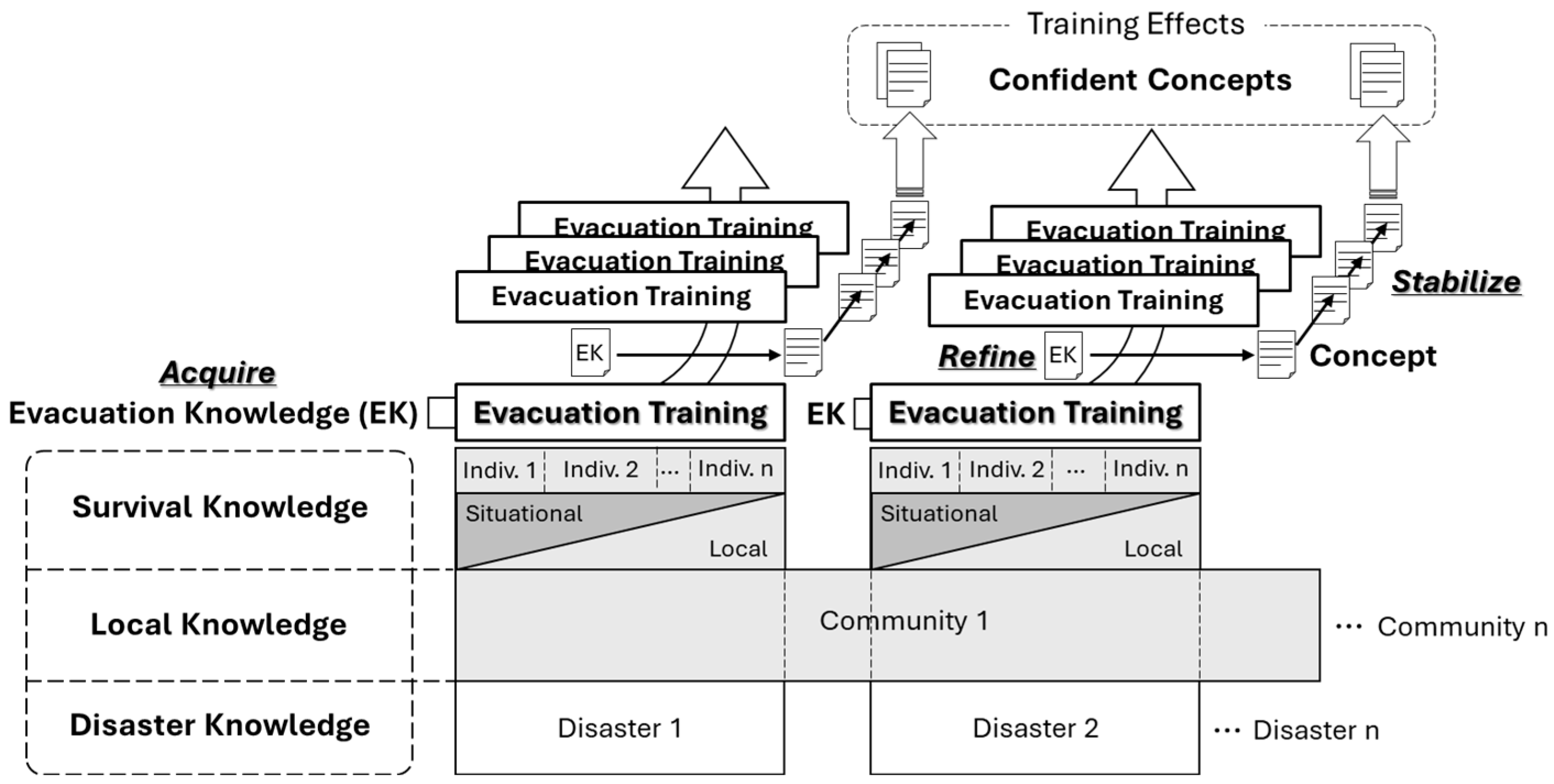
2.1. Evacuation Knowledge Hierarchy and Training Effect
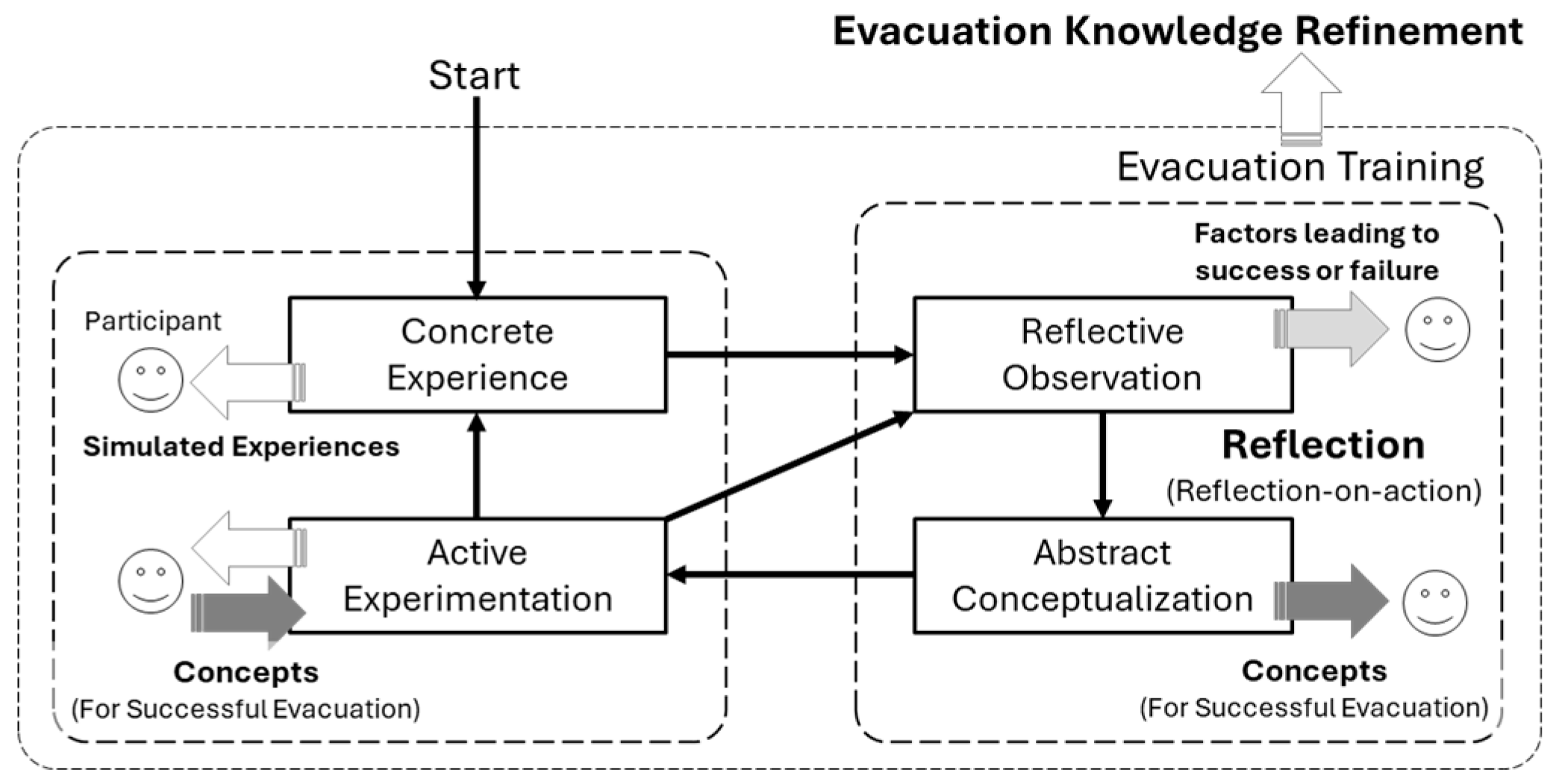
2.2. Cyclic Training Model Based on Experiential Learning
- Concrete Experience (CE): The participant is immersed in a high-fidelity disaster scenario, requiring real-time decision-making against dynamic hazards.
- Reflective Observation (RO): After the simulation, the participant observes their performance from multiple perspectives to identify factors that led to successful or failed outcomes.
- Abstract Conceptualization (AC): Based on these observations, the participant formulates or modifies their survival concepts (e.g., “I must prioritize wide routes over familiar narrow ones during a fire”).
- Active Experimentation (AE): The newly formed concepts are tested in subsequent simulations, initiating a new cycle of learning.
2.3. Necessity of Multi-Modal Reflection Support
2.4. Focused Literature Review
3. Reflection Support
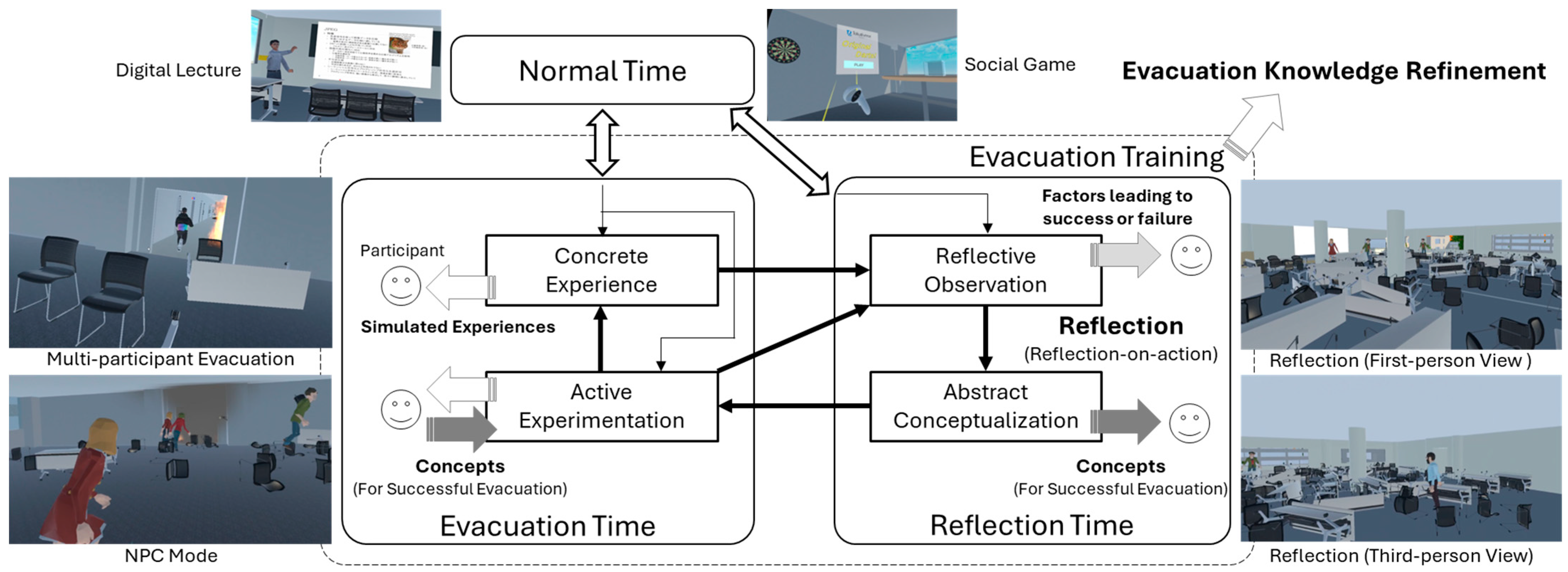
3.1. Base System Overview
3.1.1. Normal Time (NT)
3.1.2. Emergency Time (ET)
3.1.3. Reflection Time (RT)
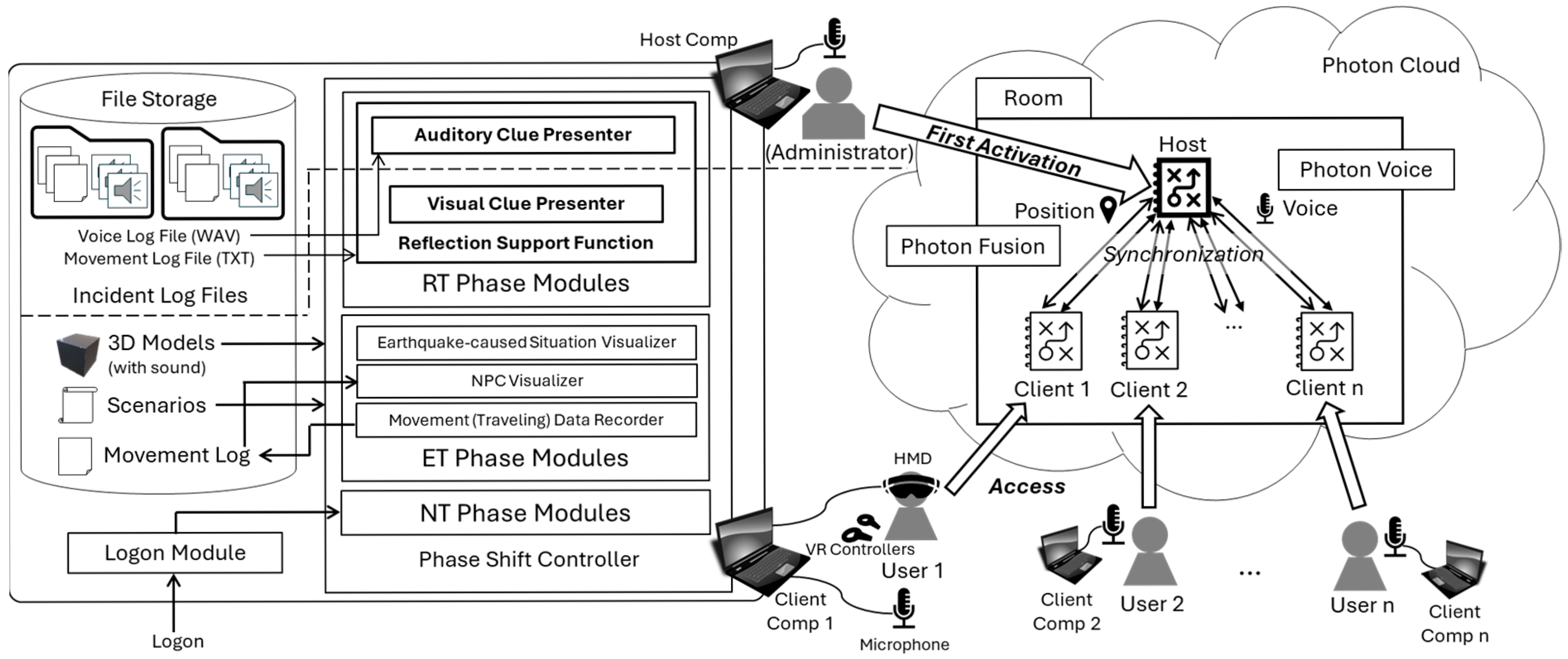
- Log loading: The system loads the observer’s selected incident log and associated logs of other participants.
- Environment reconstruction: Disaster objects are reallocated according to the original scenario.
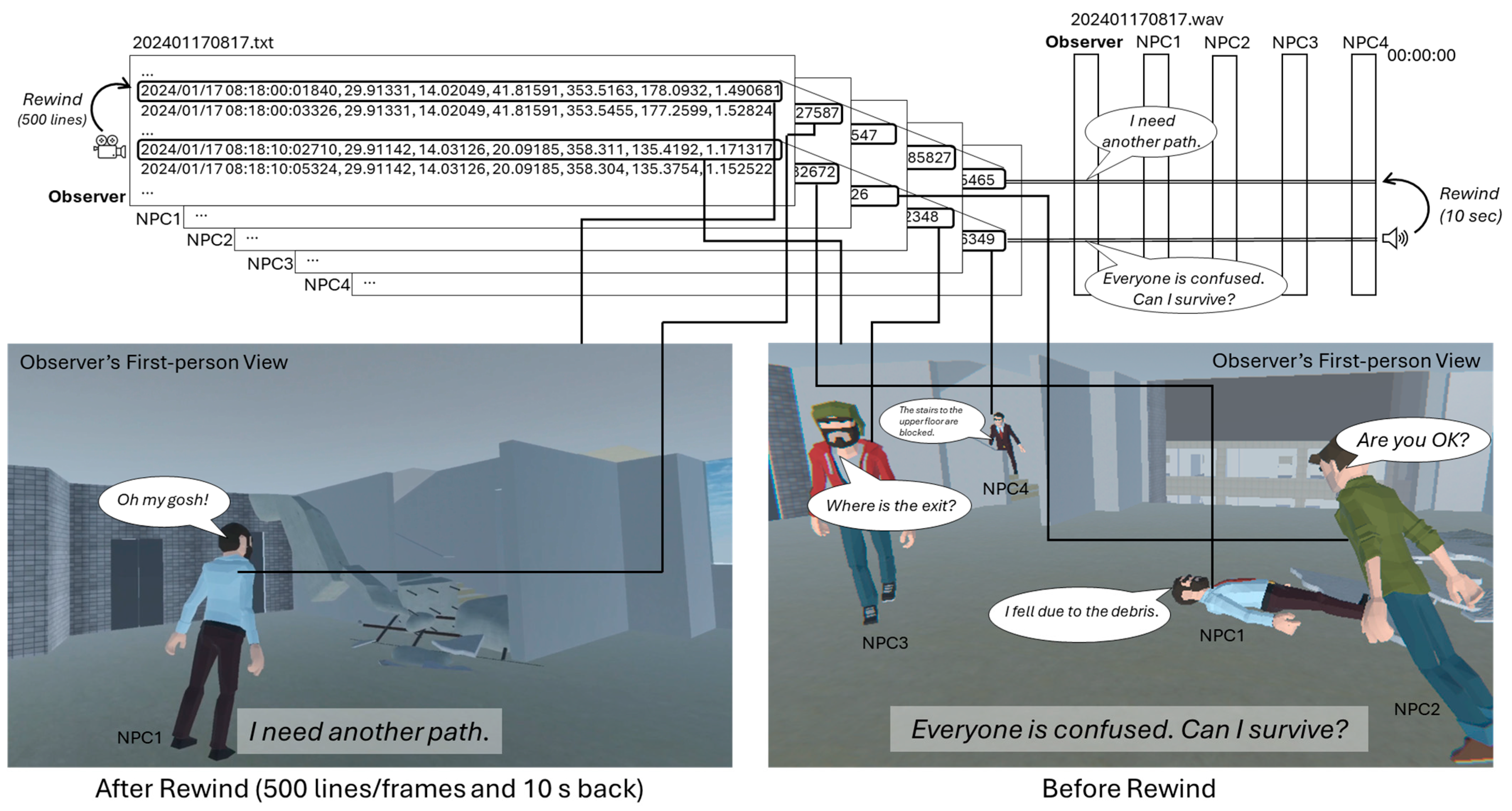
- Avatar replay: Avatars are placed at their initial coordinates and moved/rotated at the recorded intervals.
3.2. Auditory Clue Presentation
3.2.1. Overview
3.2.2. Module Composition
3.2.3. Sound Play
- If an NPC is behind a wall, the volume is reduced by 50%.
- If an NPC is on a separate floor, the volume is muted (0%).
4. Preliminary Experiment
4.1. Settings
4.1.1. Participants
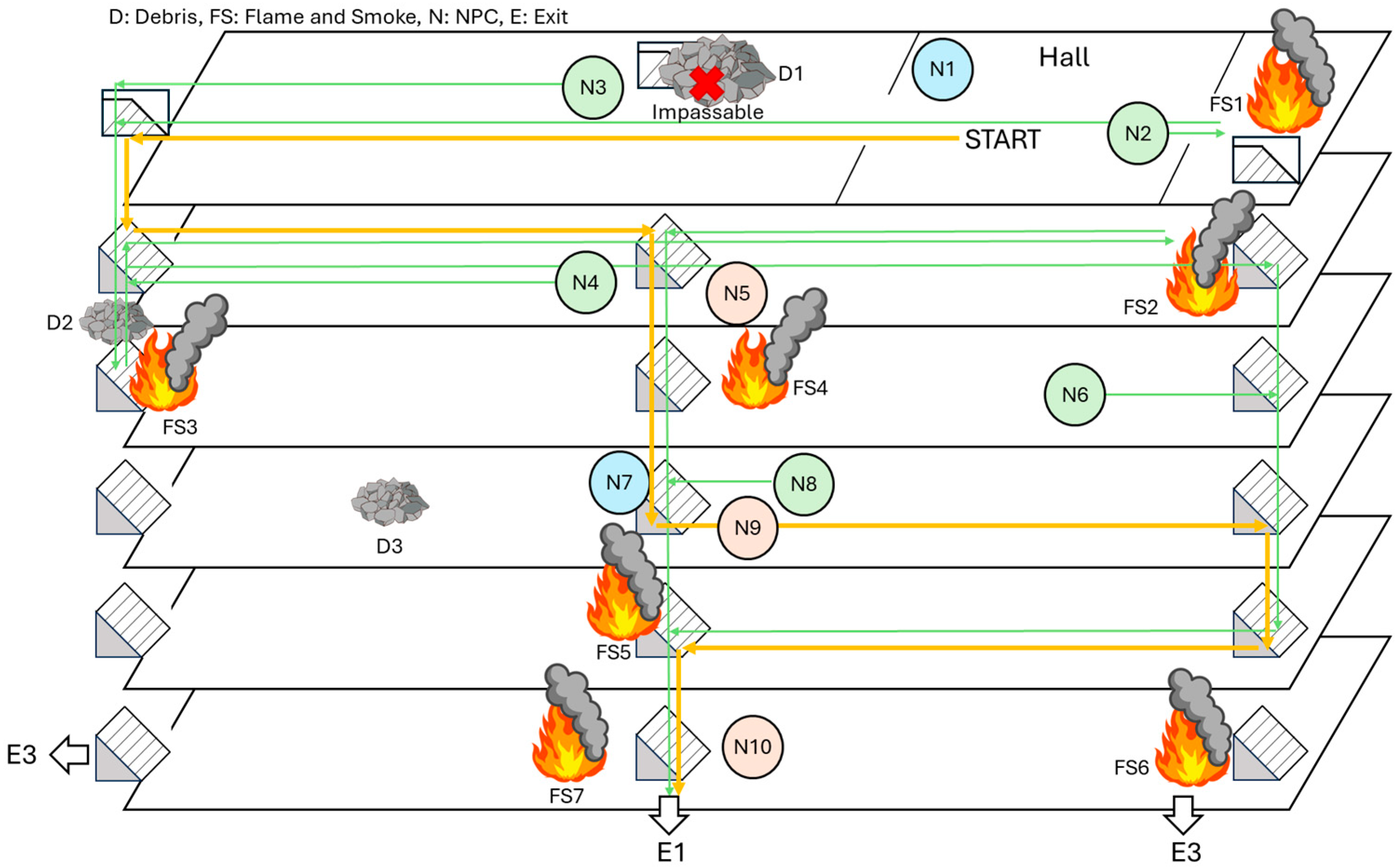
4.1.2. Scenario and NPCs
- Unconscious NPCs (N = 3): Remained stationary and silent, except for occasional faint moans.
- Active NPCs (N = 7): Simulated uninjured evacuees, providing approximately three minutes of pre-recorded verbal utterances tied to their actions and surroundings. For example, an NPC near fire would exclaim, “It’s too hot to get close!”
4.1.3. Procedure
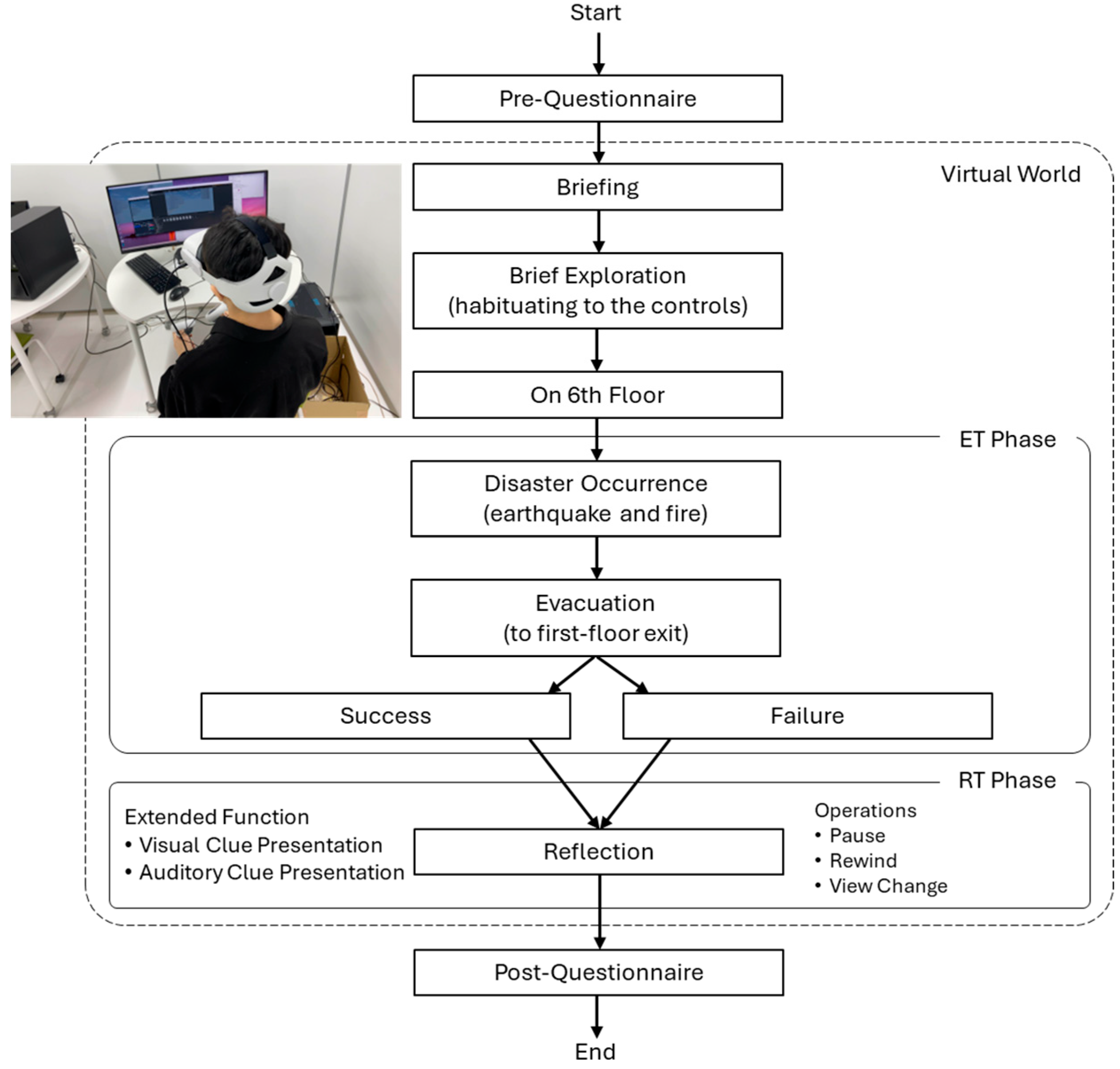
- ET phase: When a participant reached the sixth-floor hall, a massive earthquake was triggered. To prevent VR sickness caused by visual processing delays and perceptual discrepancies, the earthquake was represented by an Earthquake Early Warning alert and 10 s of rumbling and glass-breaking sounds, rather than shaking the visual display. Following a fire alarm, the participant evacuated the building. The system recorded their voice and avatar movements (incident logs), and the screen was video-recorded for data analysis.
- Transition: The phase ended when the participant exited the building (within a 20 min limit) or was declared dead. In the latter case, the cause of death was displayed before transitioning to the RT phase.
- RT phase: Participants were instructed on how to use the extended reflection function. They could choose to view the replay via the HMD or a 2D monitor and were free to toggle between first- and third-person views. While they were required to watch the replay until the end, there were no limits on the duration of reflection or the frequency of playback operations (pause, rewind, view change). All user operations during this phase were logged.
4.2. Results
4.2.1. Behavioral Data and Scores in the ET Phase
- Auditory-driven decisions: P6 and P8 immediately detoured upon hearing N2’s voice near a hazard (FS1). P8 also approached N9 after hearing another NPC (N8) ask, “Are you okay?”
- Social/NPC interaction: P2 and P7 followed nearby NPCs without overtaking them and paused to check unconscious NPCs. In contrast, P3 and P4 moved more aggressively, often overtaking NPCs.
- Risk-taking: P1 and P5 chose to pass through fire (FS1 and FS2, respectively) despite hearing NPC warnings.
4.2.2. Replay Interaction During the RT Phase
- Environmental scanning: Many participants (P1, P2, P5, and P7) paused in the hall or near hazards to observe their surroundings from a third-person perspective.
- Reviewing interactions: P2 focused her reflection on the area around N5, switching views while rewinding to re-examine the interaction. P6 specifically reviewed his decisions near flames (FS1 and FS3&D2) and NPCs.
- Linear viewing: P8 was the only participant who watched the replay until the end without any control operations.
4.2.3. Post-Questionnaire
4.3. Discussion
4.3.1. Behavioral Analysis of Decision-Making in the ET Phase
4.3.2. Cognitive Impact of Multi-Modal Reflection in the RT Phase
- P3 and P6: Emphasized the importance of speedy evacuation and early hazard detection.
- P4 and P5: Recognized that prior knowledge of multiple routes is essential to avoid indecision during fire events.
- P8: Developed a concept of calm, independent decision-making while maintaining situational awareness.
- P1, P2, and P7: While they gained insights into their susceptibility to social influence, their concepts remained more tentative, suggesting that some participants may require more structured guidance or multiple cycles to finalize their evacuation knowledge.
4.3.3. Summary
4.4. Limitations
- Expanding the sample size: Increasing the number of participants to allow for rigorous statistical inference and hypothesis testing.
- Diversifying the demographics: Recruiting a more representative sample, including elderly individuals and professionals, to evaluate how different life experiences influence the perception of auditory cues in disaster scenarios.
- Implementing a control group: Conducting a comparative experiment between visual-only and visual–auditory reflection groups to quantitatively isolate the training effect of auditory clue presentation.
5. Conclusions
Author Contributions
Funding
Institutional Review Board Statement
Informed Consent Statement
Data Availability Statement
Acknowledgments
Conflicts of Interest
Abbreviations
| CE | Concrete Experience |
| RO | Reflective Observation |
| AC | Abstract Conceptualization |
| AE | Active Experimentation |
| NT | Normal Time |
| ET | Emergency Time |
| RT | Reflection Time |
| FS | flame and smoke |
| D | debris |
| N | NPC (non-player character) |
| E | exit |
| P | participant |
| NE | no encounter |
| PT | pass through |
| DT | detour |
| SL | stop and look |
References
- Fares, O.H.; Aversa, J.; Lee, S.H.; Jacobson, J. Virtual reality: A review and a newframework for integrated adoption. Int. J. Consum. Stud. 2024, 48, e13040. [Google Scholar] [CrossRef]
- Marougkas, A.; Troussas, C.; Krouska, A.; Sgouropoulou, C. Virtual Reality in Education: A Review of Learning Theories, Approaches and Methodologies for the Last Decade. Electronics 2023, 12, 2832. [Google Scholar] [CrossRef]
- Conrad, M.; Kablitz, D.; Schumann, S. Learning effectiveness of immersive virtual reality in education and training: A systematic review of findings. Comput. Educ. X Real. 2024, 4, 100053. [Google Scholar] [CrossRef]
- Schott, C.; Milligan, A.; Marchall, S. Immersive VR for K-12 experiential education—Proposing a pedagogies, practicalities, and perspectives informed framework. Comput. Educ. X Real. 2024, 4, 100068. [Google Scholar] [CrossRef]
- Stracke, C.M.; Bothe, P.; Adler, S.; Heller, E.S.; Deuchler, J.; Pomino, J.; Wölfel, M. Immersive virtual reality in higher education: A systematic review of the scientific literature. Virtual Real. 2025, 29, 64. [Google Scholar] [CrossRef]
- Samala, A.D.; Rawas, S.; Rahmadika, S.; Criollo-C, S.; Fikri, R.; Sandra, R.P. Virtual reality in education: Global trends, challenges, and impacts—Game changer or passing trend? Discov. Educ. 2025, 4, 229. [Google Scholar] [CrossRef]
- Tan, A.; Dorneich, M.C.; Cotos, E. Developing and evaluating the fidelity of virtual reality-artificial intelligence (VR-AI) environment for situated learning. Front. Virtual Real. 2025, 6, 1587768. [Google Scholar] [CrossRef]
- Hong, S.; Moon, J.; Eom, T.; Awoyemi, I.D.; Hwang, J. Generative AI-Enhanced Virtual Reality Simulation for Pre-Service Teacher Education: A Mixed-Methods Analysis of Usability and Instructional Utility for Course Integration. Educ. Sci. 2025, 15, 997. [Google Scholar] [CrossRef]
- Guo, X.; Liu, Y.; Tan, Y.; Xia, Z.; Fu, H. Hazard identification performance comparison between virtual reality and traditional construction safety training modes for different learning style individuals. Saf. Sci. 2024, 180, 106644. [Google Scholar] [CrossRef]
- Sabir, A.; Hussain, R.; Pedro, A.; Park, C. Personalized construction safety training system using conversational AI in virtual reality. Autom. Constr. 2025, 175, 106207. [Google Scholar] [CrossRef]
- Fracaro, S.G.; Tehreem, Y.; Toyoda, R.; Gallagher, T.; Glassey, J.; Bernaerts, K.; Wilk, M. Benefits and impact of emergency training in a VR environment. Educ. Chem. Eng. 2024, 48, 63–72. [Google Scholar] [CrossRef]
- Scorgie, D.; Feng, Z.; Paes, D.; Parisi, F.; Yiu, T.W.; Lovreglio, R. Virtual reality for safety training: A systematic literature review and meta-analysis. Saf. Sci. 2024, 171, 106372. [Google Scholar] [CrossRef]
- Faiz, T.; Tsun, M.T.K.; Mahmud, A.A.; Sim, K.Y. A Scoping Review on Hazard Recognition and Prevention Using Augmented and Virtual Reality. Computers 2024, 13, 307. [Google Scholar] [CrossRef]
- Scippo, S.; Luzzi, D.; Cuomo, S.; Ranieri, M. Innovative Methodologies Based on Extended Reality and Immersive Digital Environments in Natural Risk Education: A Scoping Review. Educ. Sci. 2024, 14, 885. [Google Scholar] [CrossRef]
- De Fino, M.; Cassano, F.; Bernardini, G.; Quagliarini, E.; Fatiguso, F. On the user-based assessments of virtual reality for public safety training in urban open spaces depending on immersion levels. Saf. Sci. 2025, 185, 106803. [Google Scholar] [CrossRef]
- Liu, R.; Becerik-Gerber, B.; Lucas, G.M.; Busta, K. Impact of behavior-based virtual training on active shooter incident preparedness in healthcare facilities. Int. J. Disaster Risk Reduct. 2025, 118, 105225. [Google Scholar] [CrossRef]
- Li, X.; Song, S.; Liu, S.; Yin, D.; Wang, R.; Gong, B. Application of Virtual Reality Technology in Enhancing the Teaching Effectiveness of Coal Mine Disaster Prevention. Sustainability 2025, 17, 79. [Google Scholar] [CrossRef]
- Gagliardi, E.; Bernardini, G.; Quagliarini, E.; Schumacher, M.; Calvaresi, D. Characterization and future perspectives of virtual reality evacuation drills for safe built environments: A systematic literature review. Saf. Sci. 2023, 163, 106141. [Google Scholar] [CrossRef]
- Menzemer, L.W.; Ronchi, E.; Karsten, M.M.V.; Gwynne, S.; Frederiksen, J. A scoping review and bibliometric analysis of methods for fire evacuation training in buildings. Fire Saf. J. 2023, 136, 103742. [Google Scholar] [CrossRef]
- Hung, M.-C.; Lin, C.-Y.; Hsiao, G.L.-K. Virtual Reality in Building Evacuation: A Review. Fire 2025, 8, 80. [Google Scholar] [CrossRef]
- Liu, Q.; Liu, R. Virtual reality for indoor emergency evacuation studies: Design, development, and implementation review. Saf. Sci. 2025, 181, 106678. [Google Scholar] [CrossRef]
- Zimmerman, B.J. Becoming a self-regulated learner: Which are the key subprocesses? Contemp. Educ. Psychol. 1986, 11, 307–313. [Google Scholar] [CrossRef]
- Kolb, D.A. Experiential Learning: Experience as the Source of Learning and Development; Prentice Hall: Englewood Cliffs, NJ, USA, 1984. [Google Scholar]
- Mitsuhara, H. Metaverse-Based Evacuation Training: Design, Implementation, and Experiment Focusing on Earthquake Evacuation. Multimodal Technol. Interact. 2024, 8, 112. [Google Scholar] [CrossRef]
- Mitsuhara, H.; Yamanaka, R.; Matsushige, M.; Kozuki, Y. Reflection Support Function in a Metaverse-Based Evacuation Training System. In Proceedings of the 2024 9th International Conference on Business and Industrial Research (ICBIR), Bangkok, Thailand, 23–24 May 2024; pp. 1570–1575. [Google Scholar] [CrossRef]
- Keya, R.T.; Heldal, I.; Patel, D.; Murano, P.; Wijkmark, C.H. Implementing Virtual Reality for Fire Evacuation Preparedness at Schools. Computers 2025, 14, 286. [Google Scholar] [CrossRef]
- Fu, Y.; Li, Q. A Virtual Reality–Based Serious Game for Fire Safety Behavioral Skills Training. Int. J. Hum. Comput. Interact. 2024, 40, 5980–5996. [Google Scholar] [CrossRef]
- Zhang, Y.; Paes, D.; Feng, Z.; Scorgie, D.; He, P.; Lovreglio, R. Comparative analysis of fire evacuation decision-making in immersive vs. non-immersive virtual reality environments. Autom. Constr. 2025, 179, 106441. [Google Scholar] [CrossRef]
- Munby, H. Reflection-in-action and reflection-on-action. Educ. Cult. 1989, 9, 31–42. [Google Scholar] [CrossRef]
- Mitsuhara, H.; Tanimura, C.; Nemoto, J.; Shishibori, M. Location-based game for thought-provoking evacuation training. Multimodal Technol. Interact. 2023, 7, 59. [Google Scholar] [CrossRef]
- Renner, B.; Prilla, M.; Cress, U.; Kimmerle, J. Effects of Prompting in Reflective Learning Tools: Findings from Experimental Field, Lab, and Online Studies. Front. Psychol. 2016, 7, 820. [Google Scholar] [CrossRef]
- Lu, S.; Feng, Z.; Lovreglio, R.; Wang, F.; Yuan, X. Comparing the productive failure and directive instruction for declarative safety knowledge training using virtual reality. J. Comput. Assist. Learn. 2024, 40, 1040–1051. [Google Scholar] [CrossRef]
- Sun, Y.; Yamori, K.; Kondo, S. Single-person drill for tsunami evacuation and disaster education. J. Integr. Disaster Risk Manag. 2014, 4, 30–47. [Google Scholar] [CrossRef]
- Leelawat, N.; Suppasri, A.; Latcharote, P.; Abe, Y.; Sugiyasu, K.; Imamura, F. Tsunami evacuation experiment using a mobile application: A design science approach. Int. J. Disaster Risk Reduct. 2018, 29, 63–72. [Google Scholar] [CrossRef]
- Yamori, K.; Sugiyama, T. Development and social implementation of smartphone app Nige-Tore for improving tsunami evacuation drills: Synergistic effects between commitment and contingency. Int. J. Disaster Risk Sci. 2020, 11, 751–761. [Google Scholar] [CrossRef]
- Shiradkar, S.; Rabelo, L.; Alasim, F.; Nagadi, K. Virtual World as an Interactive Safety Training Platform. Information 2021, 12, 219. [Google Scholar] [CrossRef]
- Liu, R.; Becerik-Gerber, B.; Lucas, G.M. Effectiveness of VR-based training on improving occupants’ response and preparedness for active shooter incidents. Saf. Sci. 2023, 164, 106175. [Google Scholar] [CrossRef]
- Ahmadi, M.; Yousefi, S.; Ahmadi, A. Exploring the most effective feedback system for training people in earthquake emergency preparedness using immersive virtual reality serious games. Int. J. Disaster Risk Reduct. 2024, 110, 104630. [Google Scholar] [CrossRef]
- Feng, Z.; González, V.A.; Mutch, C.; Amor, R.; Rahouti, A.; Baghouz, A.; Li, N.; Cabrera-Guerrero, G. Towards a customizable immersive virtual reality serious game for earthquake emergency training. Adv. Eng. Inform. 2020, 46, 101134. [Google Scholar] [CrossRef]
- Feng, Z.; González, V.A.; Mutch, C.; Amor, R.; Cabrera-Guerrero, G. Instructional mechanisms in immersive virtual reality serious games: Earthquake emergency training for children. J. Comput. Assist. Learn. 2021, 37, 542–556. [Google Scholar] [CrossRef]
- Feng, Z.; González, V.A.; Mutch, C.; Amor, R.; Cabrera-Guerrero, G. Exploring spiral narratives with immediate feedback in immersive virtual reality serious games for earthquake emergency training. Multimed. Tools Appl. 2023, 82, 125–147. [Google Scholar] [CrossRef]
- van der Wal, C.N.; Robinson, M.A.; Bruine de Bruin, W.; Gwynne, S. Evacuation behaviors and emergency communications: An analysis of real-world incident videos. Saf. Sci. 2021, 136, 105121. [Google Scholar] [CrossRef] [PubMed]
- Wang, B.; Ren, G.; Li, H.; Zhang, J.; Qin, J. Developing a Framework Leveraging Building Information Modelling to Validate Fire Emergency Evacuation. Buildings 2024, 14, 156. [Google Scholar] [CrossRef]
- Tucker, A.; Marsh, K.L.; Gifford, T.; Lu, X.; Luh, P.B.; Astur, R.S. The effects of information and hazard on evacuee behavior in virtual reality. Fire Saf. J. 2018, 99, 1–11. [Google Scholar] [CrossRef]
- Lin, J.; Peng, Z.; Zhu, R.; Xue, Y. Formation and evolution of individual evacuation roles in building emergencies: A role-playing immersive virtual reality study. Int. J. Disaster Risk Reduct. 2025, 126, 105632. [Google Scholar] [CrossRef]





| NPC | Floor | Action | Voice (Excerpts) |
|---|---|---|---|
| N1 | 6 | Remaining stationary | “We should wait for directions from the authorities.” |
| N2 | 6 | Approaching fire, then retreating in hesitation | “It’s hot! Can I even get through these flames?” |
| N3 | 6 | Moving slowly with disorientation | “Where is the exit?” |
| N4 | 5 | Evacuating calmly | “It is okay; we can evacuate without rushing.” |
| N5 | 5 | Unconscious | (Occasional faint moaning or heavy breathing) |
| N6 | 4 | Running along a safe route in panic | “Oh my gosh! This is so dangerous!” |
| N7 | 3 | Remaining stationary and indecisive | “I have no idea where to evacuate.” |
| N8 | 3 | Attempting to rescue N8 and then abandoning the effort | “Are you okay? We might need an AED.” |
| N9 | 3 | Unconscious | Same above |
| N10 | 1 | Unconscious | Same above |
| Participant | FS1 | FS2 | FS3&D2 | N5 | N9 | FS5 | FS6 | N10 |
|---|---|---|---|---|---|---|---|---|
| P1 | PT | DT | NE | NE | NE | NE | DT | PT |
| P2 | NE | NE | DT | SL | SL | NE | DT | SL |
| P3 | NE | NE | DT | PT | PT | DT | DT | PT |
| P4 | NE | PT | DT | PT | NE | NE | NE | PT |
| P5 | NE | PT | DT | PT | PT | NE | DT | PT |
| P6 | DT | DT | DT | SL | PT | NE | DT | PT |
| P7 | NE | NE | DT | SL | SL | DT | DT | PT |
| P8 | DT | NE | DT | PT | SL | DT | DT | PT |
| Question | Representative Replies and Statistics |
|---|---|
| Q1. Did you feel a sense of realism during the evacuation? (5-point Likert scale) What specific aspects contributed to the realism? | P1 (4): The voices of others felt very realistic. P2 (3): There were discrepancies between avatar appearances (e.g., estimated age) and their voices. There was also a lack of vocal variety. P3 (4): The chaotic atmosphere of the panic was well represented. P4 (4): Hearing NPC voices and coughing sounds created a strong sense of urgency. P5 (4): The sight of everyone wandering combined with their anxious voices heightened the realism. P6 (4): I understood the severity of the situation through the NPCs’ dialogue, which prompted me to run or turn back at dangerous spots. P7 (3): Avatars speaking while evacuating improved immersion, but the mismatch between their looks and voices was distracting. P8 (5): A few NPCs who seemed unsure of their next move or were heading upstairs felt somewhat out of place. Median = 4.0 (MAD = 0.0) |
| Q2. What did you recall or observe while watching the replay? | P1: I recalled why I hesitated at certain points and what my internal thoughts were at the time. P2: I observed my physical actions, such as gaze direction and where I decided to change my route, as well as the underlying reasons for those choices. P3: I evaluated whether I took unnecessary or dangerous actions. P4: I observed the overall situational context surrounding me during the evacuation. P5: I reflected on whether I chose the optimal route and how I felt when encountering the unconscious NPCs. P6: I observed the distance to hazards, the paths I missed while evacuating, and how others were moving. P7: I assessed whether any of my actions were incorrect. P8: I checked whether I remained calm and if I followed the evacuation route as remembered. |
| Q3. What did you realize regarding the NPCs during the reflection? | P1: I realized that since people react differently, I must decide my own disaster response in advance. P2: The NPCs made me realize that other people might be slower to escape than expected. P3: I obtained early information about fire and casualties through the NPCs’ verbal cues. P4: I was focused on my own evacuation; I noticed the screaming and coughing but did not prioritize helping them. P5: I realized that people wandering aimlessly leads to chaos and potential accidents. P6: I realized that the absence of authority figures can lead to rushing. Seeing and hearing an NPC retreat from the heat helped me understand the risk of flames. I also realized the need to avoid debris after hearing an NPC mention broken glass. P7: None. P8: I realized the importance of independent decision-making and prioritizing my own safety without hesitation in a confused state. |
| Q4. What lessons did you learn through this reflection? | P1: I realized that unfamiliar situations can leave me momentarily paralyzed. P2: The presence of others can be a distraction and may increase my own evacuation time. P3: I noticed my movements were slow, which taught me the need to escape more rapidly. P4: Knowing evacuation routes in advance is essential for survival. P5: I need to prepare specifically for fire events; I was flustered because I hadn’t thought about alternative routes. P6: I realized I didn’t begin evacuating immediately despite my knowledge. The replay showed I was following NPCs rather than using my own knowledge of the building, and the third-person view revealed I was stepping on debris without noticing. P7: I realized that in a real disaster, the difficulty of rescue operations might result in me prioritizing my own evacuation over helping the injured. P8: Hearing the anxiety in others’ voices made me anxious. I learned to stay calm and scan the environment to identify safe routes. |
| Q5. Did you feel immersed during the reflection phase? | P1–P8: (4, 5, 4, 4, 5, 3, 2, 4) Median = 4.0 (MAD = 0.5) |
| Q6. Was the reflection process easy to perform? | P1–P8: (2, 4, 4, 4, 4, 4, 4, 4) Median = 4.0 (MAD = 0.0) |
| Q7. Did the reflection increase your disaster awareness? | P1–P8: (4, 4, 4, 4, 5, 5, 3, 4) Median = 4.0 (MAD = 0.0) |
Disclaimer/Publisher’s Note: The statements, opinions and data contained in all publications are solely those of the individual author(s) and contributor(s) and not of MDPI and/or the editor(s). MDPI and/or the editor(s) disclaim responsibility for any injury to people or property resulting from any ideas, methods, instructions or products referred to in the content. |
© 2026 by the authors. Licensee MDPI, Basel, Switzerland. This article is an open access article distributed under the terms and conditions of the Creative Commons Attribution (CC BY) license.
Share and Cite
Mitsuhara, H.; Yamanaka, R.; Matsushige, M.; Kozuki, Y. Enhancing Reflection in VR-Based Evacuation Training Through Synchronized Auditory Clue Presentation: A Pilot Study. Appl. Sci. 2026, 16, 3048. https://doi.org/10.3390/app16063048
Mitsuhara H, Yamanaka R, Matsushige M, Kozuki Y. Enhancing Reflection in VR-Based Evacuation Training Through Synchronized Auditory Clue Presentation: A Pilot Study. Applied Sciences. 2026; 16(6):3048. https://doi.org/10.3390/app16063048
Chicago/Turabian StyleMitsuhara, Hiroyuki, Ryoichi Yamanaka, Maya Matsushige, and Yasunori Kozuki. 2026. "Enhancing Reflection in VR-Based Evacuation Training Through Synchronized Auditory Clue Presentation: A Pilot Study" Applied Sciences 16, no. 6: 3048. https://doi.org/10.3390/app16063048
APA StyleMitsuhara, H., Yamanaka, R., Matsushige, M., & Kozuki, Y. (2026). Enhancing Reflection in VR-Based Evacuation Training Through Synchronized Auditory Clue Presentation: A Pilot Study. Applied Sciences, 16(6), 3048. https://doi.org/10.3390/app16063048