Review

Advanced Studies in Molecular and Metabolic Mechanisms of Diabetes: Pathogenic Crosstalk, Biomarkers, and Translational Therapeutics


by
Iliyana Sazdova
1,
Hristo Gagov
1,*,
Nikola Hadzi-Petrushev
2,
Marina Konaktchieva
3,
Rossitza Konakchieva
4 and
Mitko Mladenov
2,5
1
Department of Animal and Human Physiology, Faculty of Biology, Sofia University “St. Kliment Ohridski”, 1164 Sofia, Bulgaria
2
Institute of Biology, Faculty of Natural Sciences and Mathematics, Ss. Cyril and Methodius University, 1000 Skopje, North Macedonia
3
Gastroenterology Department, Military Medical Academy, Sofia Center, Ul. “Sveti Georgi Sofiyski” 3, 1606 Sofia, Bulgaria
4
Department of Cell and Developmental Biology, Faculty of Biology, Sofia University “St. Kliment Ohridski”, 1164 Sofia, Bulgaria
5
Department of Fundamental and Applied Physiology, Russian State Medical University, 117997 Moscow, Russia
*
Author to whom correspondence should be addressed.
Appl. Sci. 2026, 16(6), 3027; https://doi.org/10.3390/app16063027
Submission received: 28 January 2026 / Revised: 12 March 2026 / Accepted: 18 March 2026 / Published: 20 March 2026
(This article belongs to the Special Issue Advanced Studies in Molecular and Metabolic Mechanisms of Diabetes)

Abstract

Diabetes mellitus is a rapidly escalating worldwide health issue that involves intricate molecular, metabolic, and systemic dysregulation. In addition to hyperglycemia, disease pathogenesis involves β-cell dysfunction, insulin resistance, mitochondrial dysfunction, endoplasmic reticulum stress (ER stress), redox imbalance, lipotoxicity, chronic inflammation, and inappropriate epigenetic modifications. New evidence also emphasizes the participation of mechanotransduction, ion channel signaling, circadian regulation, and organ cross-talk among the pancreas, liver, adipose tissue, skeletal muscle, heart, brain, and gut in modulating disease heterogeneity and progression. This review highlights updates of molecular mechanisms in diabetes, focusing on the β-cell response to stress, the AMPK–Sirtuin 1 (or PGC-1α) signaling pathway, mitochondrial quality control, mechanosensitive ion channels, immunometabolic crosstalk, and epigenetic regulation. We consider the increasing importance of multi-omics methods for early identification of pathogenic signatures and integration of artificial intelligence to enable precision stratification and therapeutic tailoring. Finally, we highlight novel experimental and translational tools, such as iPSC-derived β-cells or organoids, CRISPR-based gene editing, sophisticated metabolic imaging, and electrophysiology. Taken together, this review shifts the paradigm of diabetes as a system-level network disease and emphasizes the importance of data-driven multi-target strategies for prevention and reduction in long-term complications.

1. Introduction

Diabetes mellitus has emerged as one of the most pressing global health crises of the 21st century, with a scale and trajectory that far exceed earlier projections. The 11th edition of the International Diabetes Federation Diabetes Atlas estimates that more than half a billion adults worldwide are currently living with diabetes, with global prevalence expected to rise further by 2050 if current trends continue [1]. Complementary analyses from the Global Burden of Disease program project that over 1.3 billion people may be affected by diabetes by mid-century, the vast majority with type 2 diabetes (T2D) [2]. These trends are paralleled by World Health Organization (WHO) data showing that the number of adults living with diabetes has more than quadrupled over recent decades, largely driven by population aging, rapid urbanization, and escalating rates of overweight and obesity [3]. Recent national and regional evaluations confirm a persistent upward trajectory in diabetes-related mortality and disability-adjusted life years through 2050 [4]. Collectively, these data underscore that T2D (accounting for over 90% of cases globally) has become a dominant driver of cardiometabolic morbidity and health-care expenditure [5].
At the same time, our understanding of diabetes as a disease has evidently increased. Beyond the classical dichotomy between type 1 diabetes (T1D) and T2D, several intermediate or overlapping subtypes have gained prominence. Latent autoimmune diabetes in adults (LADA) is now recognized as a slowly progressive autoimmune diabetes with features of both T1D and T2D, accounting for a substantial proportion (often 5–10%) of adult diabetes previously misclassified as T2D [6,7]. In parallel, maturity-onset diabetes of the young (MODY) represents a collection of monogenic, autosomal-dominant forms of non-insulin-dependent diabetes, typically presenting in adolescence or early adulthood but frequently misdiagnosed as either T1D or T2D, leading to suboptimal therapy [8,9,10]. More recently, the concept of “double diabetes”—T1D coexisting with obesity and insulin resistance or metabolic syndrome—has been formalized, with evidence that this phenotype carries a particularly high risk of micro- and macro-vascular complications and poses unique therapeutic challenges [11,12,13]. Together, these entities illustrate that diabetes is best viewed as a heterogeneous spectrum of metabolic and immunological disorders, rather than a single disease.
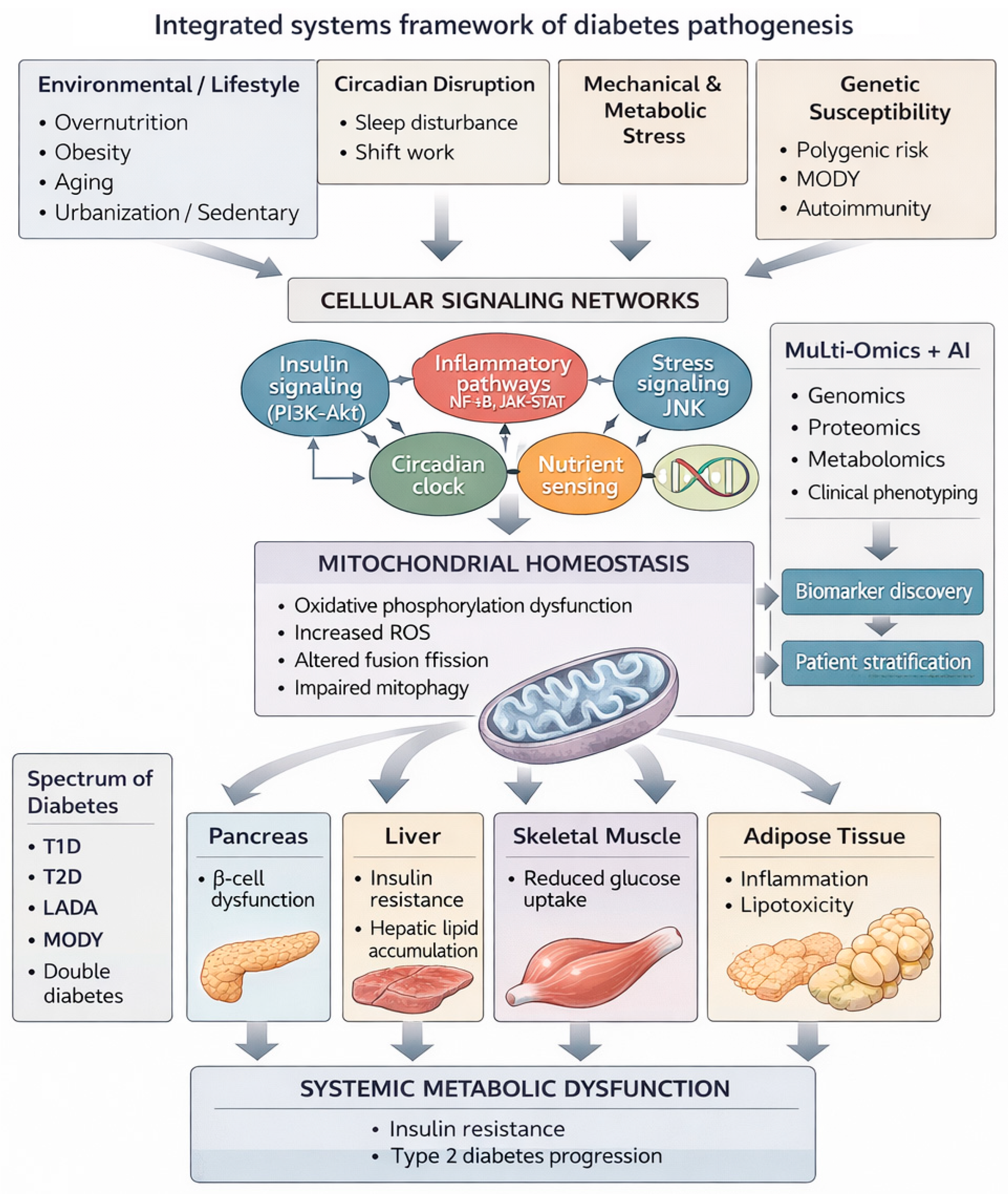
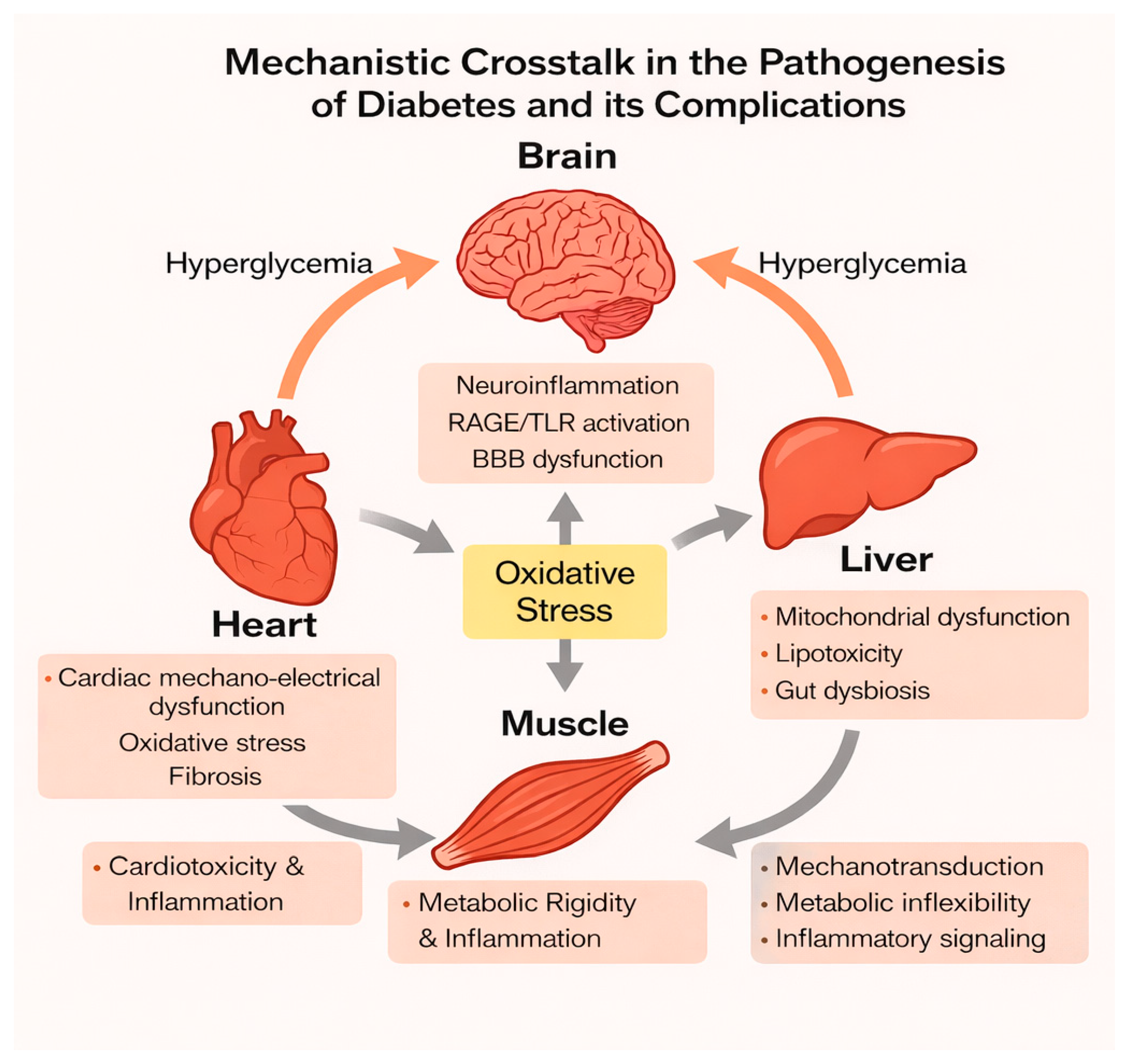
Historically, research and clinical strategies have been framed within a glucose-centric paradigm, emphasizing hyperglycemia, insulin deficiency or resistance, and the prevention of classical micro- and macrovascular complications. While indispensable, this framework increasingly fails to capture the full complexity of diabetes onset, heterogeneity, and progression. Sophisticated human and experimental data now converge on the view that overt hyperglycemia is a late, downstream manifestation of a network of molecular disturbances. Comprehensive reviews of adult T2D pathogenesis highlight the central role of β-cell failure, chronic low-grade inflammation, ectopic lipid accumulation, oxidative stress, and dysregulated intracellular signaling pathways (including insulin/phosphoinositide 3-kinase–protein kinase B (PI3K–Akt), nuclear factor kappa-light-chain-enhancer of activated B cells (NF-κB), Janus kinase/signal transducer and activator of transcription (JAK/STAT), c-Jun N-terminal kinase (JNK), and mechanistic target of rapamycin (mTOR)) long before clinical diagnosis (Figure 1) [5]. Large human studies further emphasize that variability in β-cell resilience is a major determinant of individual susceptibility to diabetes, not simply the degree of insulin resistance [6].
Among the upstream mechanisms implicated in these processes, mitochondrial dysfunction has emerged as a central node. Multiple recent reviews have demonstrated that impaired mitochondrial oxidative capacity, altered dynamics (fusion/fission), defective mitophagy, and increased mitochondrial ROS generation contribute to both insulin resistance in skeletal muscle, liver, and adipose tissue, as well as to β-cell dysfunction and death [14,15,16,17]. Mitochondrial quality control pathways, including biogenesis, the fission–fusion balance, and mitophagy, are increasingly recognized as critical determinants of cellular resilience to nutrient overload and lipotoxicity in T2D and its complications (Figure 1) [15,16]. These insights reinforce the concept that diabetes arises in part from a failure of energy sensing and organellar homeostasis, rather than from isolated defects in glucose handling.
Among the interconnected metabolic regulatory networks implicated in diabetes pathogenesis, the AMP-activated protein kinase (AMPK)–sirtuin 1 (SIRT1)–peroxisome proliferator-activated receptor gamma coactivator 1-alpha (PGC-1α) (AMPK–SIRT1–PGC-1α) signaling axis represents a central metabolic integration hub, coordinating cellular energy sensing, mitochondrial biogenesis, and adaptive responses to metabolic stress [18,19,20]. Because this pathway intersects with multiple processes discussed throughout this review—including mitochondrial dysfunction, mechanotransduction, circadian regulation, and metabolic therapeutics—it is introduced here as a unifying regulatory framework. As a second major mechanistic axis, the AMPK–SIRT1–PGC-1α signaling network integrates cellular energy status, redox balance, and metabolic adaptation [18]. PGC-1α functions as a master co-regulator of mitochondrial biogenesis and antioxidant defenses, closely linked to inflammatory signaling and metabolic flexibility [18]. Dysregulation of this axis, driven by chronic overnutrition, physical inactivity, and adipokine imbalance, compromises cellular adaptive capacity to metabolic stress, thereby promoting insulin resistance and accelerating β-cell failure [14,19,20].
Endoplasmic reticulum (ER) stress and the unfolded protein response (UPR) constitute another critical condition of β-cell and peripheral tissue vulnerability. Pancreatic β-cells are particularly sensitive to disruptions in ER proteostasis because of their high secretory load (Figure 1). Experimental and human data show that unresolved or chronic ER stress activates pro-apoptotic UPR branches, impairs insulin biosynthesis and processing, and contributes directly to β-cell death in both T1D and T2D [21,22]. Circulating ER-stress biomarkers have been associated with glycemic control, insulin resistance, and β-cell function in people with T2D, reinforcing their translational relevance [22].
Closely intertwined with ER and mitochondrial stress is lipotoxicity—the deleterious effect of chronic exposure to elevated free fatty acids and ectopic lipid deposition on β-cells and insulin-sensitive tissues. Over two decades of work, now summarized in several recent reviews, indicate that lipotoxicity impairs insulin secretion, promotes ER and oxidative stress, triggers inflammatory signaling, and ultimately leads to β-cell apoptosis and loss of functional mass [23,24,25]. In parallel, long-term exposure to excess lipids in liver and muscle disrupts insulin signaling, contributes to metabolic inflexibility, and exacerbates systemic insulin resistance [5,14,19]. Together, glucotoxicity, lipotoxicity, and glucolipotoxicity form a self-reinforcing network of damage affecting β-cells and peripheral organs (Figure 1).
Against this complex mechanistic backdrop, there is growing recognition that traditional “one-size-fits-all” approaches to diabetes management are inadequate. Recent reviews advocate for a multiomics framework in T2D, integrating genomics, epigenetics, transcriptomics, proteomics, metabolomics, and microbiome data to improve prediction of drug response, adverse effects, and optimal therapeutic strategies [26,27]. More broadly, multi-omics studies in diabetes have begun to map convergent molecular networks underlying β-cell dysfunction, insulin resistance, and diabetes-related complications while also identifying distinct molecular subtypes within clinically defined T1D and T2D populations [28,29,30]. The integration of multiple omics layers with advanced artificial intelligence (AI) and machine-learning approaches, particularly in pharmacogenomics and systems medicine, offers promising avenues for precision stratification and individualized therapeutic interventions in diabetes [29]. The integration of artificial intelligence (AI) and machine-learning approaches with multi-omics datasets has the potential to transform diabetes risk prediction, disease stratification, and therapeutic decision-making. However, translation of AI-based predictive models into clinical practice requires adherence to established methodological and reporting standards. Contemporary frameworks emphasize the importance of external validation in independent populations, calibration assessment, demonstration of clinical utility, and evaluation of algorithmic fairness across demographic subgroups to ensure generalizability and safe implementation [31,32]. These principles are reflected in recently developed reporting and evaluation guidelines such as TRIPOD-AI and PROBAST-AI, which aim to improve transparency, reproducibility, and risk-of-bias assessment in AI-based clinical prediction models. Incorporating such evaluation frameworks is essential to ensure that data-driven stratification tools contribute meaningfully to precision medicine in diabetes rather than remaining purely exploratory computational tools [33,34].
Recent landmark clinical trials further demonstrate how mechanistic insights into metabolic signaling pathways are beginning to translate into therapeutic advances in diabetes and its complications. For example, the SELECT trial showed that the glucagon-like peptide-1 (GLP-1) receptor agonist semaglutide significantly reduced major adverse cardiovascular events in overweight or obese individuals without diabetes, highlighting the systemic cardiometabolic benefits of incretin-based signaling beyond glycemic control [35]. Similarly, the FLOW (evaluate renal function with semaglutide once weekly) trial demonstrated that the non-steroidal mineralocorticoid receptor antagonist finerenone slows the progression of diabetic kidney disease and reduces renal and cardiovascular outcomes, validating inflammatory and fibrotic pathways as clinically actionable targets in diabetic complications [36]. In parallel, regenerative medicine approaches are emerging as potential disease-modifying strategies; early clinical data from Vertex Pharmaceuticals indicate that transplantation of stem-cell-derived pancreatic islet cells can restore endogenous insulin production in individuals with T1D, offering a proof of concept for β-cell replacement therapies [37,38]. These translational advances illustrate how molecular insights into incretin signaling, mineralocorticoid receptor pathways, and β-cell biology are now informing therapeutic innovation.
Within this evolving context, the present review aims to move beyond a purely glucose-centric description and instead provide an integrated account of advanced molecular and metabolic mechanisms of diabetes. Specifically, we will (i) dissect the roles of mitochondrial dysfunction, ER stress, oxidative and reductive stress, and lipotoxicity in β-cell failure and peripheral insulin resistance; (ii) highlight the AMPK-SIRT1-PGC-1α and related signaling hubs as central regulators of metabolic adaptation; (iii) explore organ-level crosstalk among the pancreas, liver, adipose tissue, skeletal muscle, heart, and brain; and (iv) discuss how multi-omics and AI-enabled analytics can be leveraged to transform these mechanistic insights into translational targets and precision-medicine strategies. Framing diabetes as a systemic molecular–metabolic disorder, rather than solely a disturbance of glucose homeostasis, we argue, is essential for designing next-generation interventions capable of modifying disease trajectories, preventing complications, and ultimately reducing the global burden of this complex disease.

2. Literature Search Strategy and Review Methodology

The present article was conducted as a narrative review supported by a structured literature search in order to enhance transparency and reduce potential selection bias. Although narrative reviews traditionally provide a qualitative synthesis of existing knowledge, the methodology of the present review was informed by established frameworks for evidence synthesis, including the Preferred Reporting Items for Systematic Reviews and Meta-Analyses (PRISMA 2020) recommendations and methodological guidance for scoping and narrative reviews [39,40,41,42].

2.1. Literature Databases and Search Period

A comprehensive search of the scientific literature was conducted using multiple electronic databases to ensure broad coverage of relevant biomedical and translational research. The following databases were searched:
  • PubMed/MEDLINE
  • Scopus
  • Web of Science Core Collection
  • Google Scholar (used for supplementary searches and citation tracking)
The search covered publications from January 2000 to December 2025, with particular emphasis placed on studies published during the last decade that addressed advances in molecular mechanisms, metabolic signaling, and translational approaches in diabetes research.

Search Strategy and Keywords

The literature search combined controlled vocabulary terms (e.g., Medical Subject Headings, MeSH) and free-text keywords relevant to diabetes pathophysiology and molecular biology. Boolean operators (AND, OR) were used to construct search strings and refine the results.
Representative search queries included:
  • “diabetes mellitus AND molecular mechanisms”
  • “β-cell dysfunction AND oxidative stress”
  • “mitochondrial dysfunction AND insulin resistance”
  • “AMPK–SIRT1–PGC-1α signaling AND diabetes”
  • “epigenetic regulation AND diabetes mellitus”
  • “mechanotransduction OR ion channels AND pancreatic β-cells”
  • “multi-omics biomarkers AND diabetes”
Additional relevant publications were identified through manual screening of reference lists and citation tracking of key review articles and landmark studies.

2.2. Inclusion and Exclusion Criteria

Studies were considered eligible for inclusion based on predefined criteria consistent with methodological recommendations for structured narrative and scoping reviews [39,40].

2.2.1. Inclusion Criteria

  • Peer-reviewed original research articles, systematic reviews, or meta-analyses
  • Publications written in English
  • Studies addressing molecular, cellular, or metabolic mechanisms of diabetes
  • Research involving human studies, animal models, or mechanistic cellular systems
  • Articles examining emerging biomarkers, multi-omics approaches, or translational technologies relevant to diabetes

2.2.2. Exclusion Criteria

  • Non-peer-reviewed literature or conference abstracts without full text
  • Publications not directly related to diabetes pathophysiology
  • Studies lacking mechanistic relevance to metabolic regulation or β-cell biology
  • Duplicate records retrieved across multiple databases

2.3. Study Selection and Screening Process

All retrieved records were initially screened by title and abstract to determine relevance. Potentially eligible publications were subsequently evaluated through full-text assessment. The selection process prioritized high-quality evidence, including systematic reviews, meta-analyses, and landmark mechanistic studies that significantly contributed to the understanding of diabetes pathogenesis.
The final body of literature was organized into thematic domains corresponding to the major topics addressed in this review, including β-cell stress responses, mitochondrial dysfunction, mechanosensitive signaling pathways, immunometabolic regulation, epigenetic mechanisms, and emerging multi-omics biomarkers.

Evidence Synthesis

Consistent with established typologies of narrative reviews [42], the included literature was synthesized using a thematic and conceptual approach rather than quantitative meta-analysis. Evidence from experimental, clinical, and translational studies was integrated to provide a comprehensive overview of interconnected molecular mechanisms underlying diabetes and their implications for biomarker discovery and precision medicine.
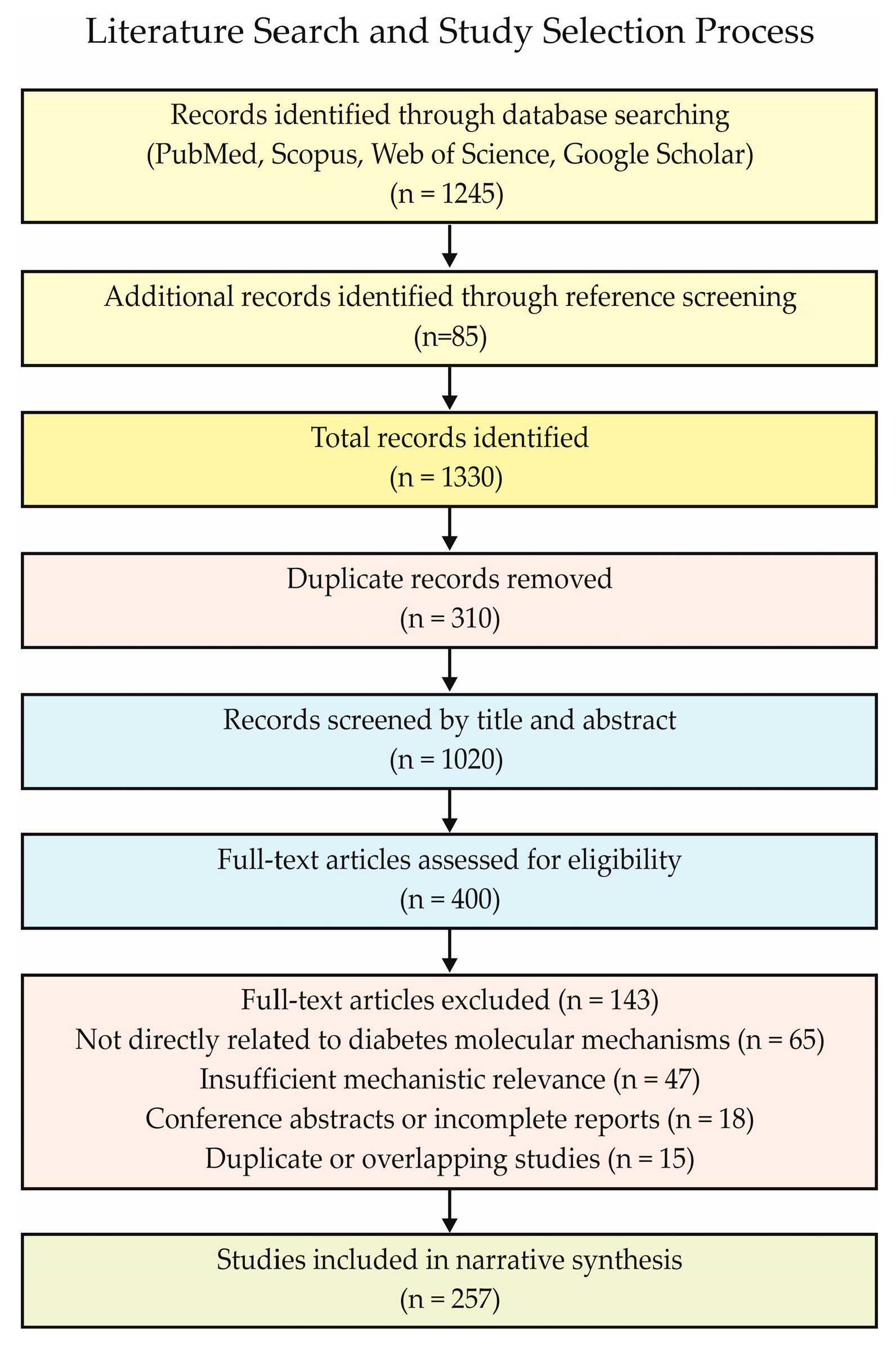
A PRISMA-style flow diagram summarizing the identification, screening, eligibility assessment, and final inclusion of studies is presented in Figure 2 to illustrate the literature selection process.

3. Molecular Pathophysiology of Diabetes

3.1. Insulin Production, β-Cell Failure, and Apoptotic Pathways

Pancreatic β-cells are uniquely specialized for high-capacity insulin biosynthesis and regulated secretion, but this specialization comes at the cost of remarkable vulnerability to metabolic, inflammatory, and oxidative stress. Contemporary reviews of β-cell biology in T1D and T2D emphasize that progressive β-cell dysfunction and loss, rather than insulin resistance alone, are central drivers of disease onset and progression, with β-cell stress responses becoming maladaptive over time [43,44].
In both T1D and T2D, chronic metabolic overload, inflammatory cytokines, and glucolipotoxic conditions converge on a set of conserved intracellular stress pathways, prominent ER stress and the UPR, noncoding RNA-mediated regulation, and redox imbalance, ultimately tipping the balance from adaptive compensation to apoptosis and dedifferentiation [21,22,45,46].

3.1.1. ER Stress, UPR Maladaptation, and β-Cell Apoptosis

Because β-cells synthesize and process enormous amounts of proinsulin, they rely on a finely tuned ER proteostasis network. The UPR, orchestrated by the three canonical ER stress sensors, protein kinase R (PKR)-like ER kinase (PERK), inositol-requiring enzyme 1 alpha (IRE1α), and activating transcription factor 6 (ATF6), normally promotes adaptation by attenuating protein translation, increasing chaperone capacity, and enhancing ER-associated degradation (ERAD) [21,46,47]. In early or moderate stress, this adaptive UPR preserves β-cell identity and function by restoring ER homeostasis and supporting survival. However, in diabetes, chronic nutrient overload, cytokine exposure, and oxidative insults drive a prolonged and maladaptive ER stress response, in which UPR signaling becomes dysregulated, shifting towards pro-apoptotic outputs [21,22,45,48].
Human islet and animal studies demonstrate increased expression of ER stress markers and UPR components in diabetic β-cells, accompanied by altered expression of chaperones binding immunoglobulin protein/glucose-regulated protein 78 (BiP/GRP78), transcription factors (CCAAT/enhancer-binding protein homologous protein (CHOP), activating transcription factor 4 (ATF4), and ATF6), and spliced X-box binding protein 1 (XBP1s) [21,22,45,46,49]. In T2D, aberrant UPR signaling and insufficient adaptive responses correlate with declining insulin secretory capacity and loss of β-cell mass, while in T1D, ER stress interacts with autoimmune and inflammatory mechanisms to amplify β-cell antigen presentation and vulnerability to immune attack [22,45,50].
Mechanistically, PERK activation reduces global protein synthesis via eukaryotic initiation factor 2 alpha (eIF2α) phosphorylation while also inducing ATF4 and CHOP, which promote apoptosis when stress is unresolved. IRE1α, a dual kinase–endoribonuclease, splices XBP1 to support adaptive responses but can also trigger proinflammatory and pro-apoptotic JNK signaling under chronic activation. ATF6 translocates to the Golgi apparatus, where it is cleaved into an active transcription factor that upregulates chaperones and ERAD components; however, sustained ATF6 activity can contribute to β-cell exhaustion [21,46,47,48]. Crosstalk between ER stress and inflammasome pathways is increasingly recognized; for example, PERK/IRE1α-dependent induction of thioredoxin-interacting protein (TXNIP) can activate the NLRP3 inflammasome and promote interleukin-1 beta (IL-1β) production, further aggravating β-cell injury [48,51].
ER stress is tightly coupled to ER Ca2+ handling and ER–mitochondria communication. Perturbations in ER Ca2+ homeostasis compromise insulin biosynthesis and proinsulin folding, while sustained Ca2+ leakage into the cytosol and mitochondria promotes mitochondrial dysfunction and apoptosis. Recent work highlights that disrupted ER Ca2+ handling and impaired ER–mitochondria contact sites are critical contributors to β-cell failure in diabetes, linking ER stress to mitochondrial ROS production and cell death [49,50,51]. Together, these studies support a model in which chronic activation of PERK, IRE1α, and ATF6, beyond their adaptive window, drives β-cell apoptosis, dedifferentiation, and loss of insulin secretory capacity.

3.1.2. miRNAs, lncRNAs, and Exosomal Signals in β-Cell Resilience

Beyond protein-based signaling, noncoding RNAs (ncRNAs)—particularly microRNAs (miRNAs), long noncoding RNAs (lncRNAs), and exosome-associated ncRNAs—have emerged as crucial modulators of β-cell stress responses, identity, and survival. Comprehensive reviews of ncRNAs in T2D indicate that disease-associated shifts in miRNA and lncRNA expression alter pathways controlling β-cell proliferation, insulin biosynthesis, UPR signaling, oxidative stress responses, and apoptosis [52,53,54].
Several β-cell-enriched miRNAs (e.g., miR-375, miR-7, and miR-200 family members) regulate insulin gene expression, exocytotic machinery, and susceptibility to metabolic stress; dysregulation of these miRNAs under diabetic conditions contributes to impaired insulin secretion and accelerated β-cell failure [52,53]. Circulating miRNAs released from stressed β-cells (or from immune and metabolic tissues) are detectable in plasma and have been proposed as minimally invasive biomarkers of β-cell stress, β-cell mass, and risk of complications in T2D [55,56,57,58,59,60]. In parallel, meta-analytic work on diabetes complication-related miRNAs suggests that miRNA signatures not only reflect ongoing tissue damage but may actively participate in pathogenic pathways in nephropathy, retinopathy, neuropathy, and cardiomyopathy [60].
lncRNAs add another regulatory layer. Stress-related lncRNAs modulate chromatin architecture, transcription factor activity, and mRNA stability for genes involved in insulin biosynthesis, ER stress responses, oxidative stress handling, and inflammatory signaling [56]. Recent reviews describe lncRNAs that are induced by hyperglycemia, cytokines, or lipotoxicity and that, in turn, either exacerbate β-cell apoptosis or enhance adaptive UPR and antioxidant responses, thereby influencing β-cell resilience [52,56].
Exosomes and other extracellular vesicles function as intercellular carriers of noncoding RNAs (ncRNAs) and proteins, enabling crosstalk between β-cells, immune cells, adipose tissue, and stem and progenitor cells. Mesenchymal stem cell-derived exosomes enriched in protective miRNAs and lncRNAs have been shown to reduce ER stress, attenuate oxidative damage, and improve insulin secretion in experimental models of diabetes, positioning exosomal cargo as a promising therapeutic modality for β-cell-targeted therapy [57,58,61]. Conversely, exosomes released from metabolically stressed β-cells may carry proinflammatory or pro-apoptotic signals that amplify islet inflammation and accelerate β-cell loss [52,53].
Taken together, these findings support the notion that ncRNAs and exosomal communication form a dynamic regulatory network that can either buffer β-cells against ER and oxidative stress or, when dysregulated, propagate dysfunction within the islet and systemically. Therapeutically, modulation of ncRNA expression or exosomal cargo represents an emerging strategy to restore β-cell resilience under diabetogenic conditions [52,53,54,55,56,57,58].

3.1.3. Oxidative and Reductive Stress: A Delicate Redox Balance

β-cells are characterized by relatively low expression of classical antioxidant enzymes (e.g., catalase, glutathione peroxidase), making them particularly susceptible to oxidative stress. Sustained glucotoxic and lipotoxic exposure increases mitochondrial ROS production and disrupts redox homeostasis, leading to DNA damage, protein oxidation, lipid peroxidation, and activation of stress kinases that drive β-cell dysfunction and apoptosis [60,61,62,63]. Recent detailed reviews highlight that oxidative stress not only contributes to β-cell destruction in T1D and T2D but also affects β-cell identity by impairing key transcription factors such as pancreatic and duodenal homeobox 1 (PDX1) and V-maf musculoaponeurotic fibrosarcoma oncogene homolog A (MafA), thereby lowering insulin gene expression and promoting dedifferentiation [60,64].
At the same time, physiological ROS levels play important roles in insulin secretion and signaling, acting as second messengers in glucose-stimulated insulin secretion and adaptive proliferation. Thus, it is not absolute ROS presence but loss of redox balance—either toward chronic oxidative stress or, less commonly, toward reductive stress—that is deleterious [60,61,62]. Emerging work on the β-cell ER–mitochondria redox axis shows that disruptions in electron transfer, nicotinamide adenine dinucleotide phosphate (NADPH) generation, and thiol-based antioxidant systems perturb both ER protein folding and mitochondrial ATP production, tightly linking redox imbalance to ER stress and UPR maladaptation [50,60,62].
Conceptually, oxidative and reductive stress should be viewed as two ends of a continuum. Excessive ROS generation overwhelms antioxidant defenses, whereas excessive reductive drive (e.g., from unbalanced antioxidant supplementation or impaired ROS-dependent signaling) can interfere with normal redox-sensitive signaling pathways, including those governing insulin secretion and adaptive stress responses [62]. In diabetes, the predominant problem is chronic oxidative stress; however, recognition of reductive stress as a potential contributor to maladaptive responses is gaining traction and may help explain why some antioxidant interventions have produced disappointing results in clinical trials.
Overall, the interplay between ER stress/UPR signaling, ncRNA-mediated regulation, and redox imbalance constitutes a central axis of β-cell vulnerability in diabetes. When these pathways operate within an adaptive range, they support high-capacity insulin production and stress resilience; however, when chronically perturbed, they converge to promote β-cell apoptosis, dedifferentiation, and the eventual failure of insulin secretory capacity—critical turning points in the natural history of both T1D and T2D [21,22,43,44,45,46,47,48,49,50,51,60,61,62,63,64,65].

3.2. Mechanosensing and Metabolic Regulation in Pancreatic Tissue

Pancreatic islets are embedded in a mechanically active microenvironment composed of extracellular matrix (ECM), vascular structures, and exocrine tissue. Beyond classical nutrient and hormonal cues, mechanical signals, including matrix stiffness, cell stretching, osmotic swelling, and shear stress, are now recognized as critical modulators of β-cell excitability, insulin secretion, and survival. Mechanotransduction in β-cells is mediated by a combination of mechanosensitive ion channels (transient receptor potential (TRP) family members, piezo-type mechanosensitive ion channel component 1 (Piezo1), and ATP-sensitive potassium (KATP) channels), integrin-dependent adhesion complexes, and downstream nutrient-sensing pathways such as mTOR, AMPK, and SIRT1 [66,67,68,69,70].

3.2.1. Ion Channels and Metabolic Stretch Signaling (TRPM7, Piezo1, KATP)

TRP channels are polymodal cation channels that respond to diverse physical and chemical stimuli, including mechanical stress. Several TRP isoforms (TRPM2, TRPM3, TRPM4, TRPM7, TRPV1, TRPA1) are expressed in β-cells and contribute to Ca2+ handling, membrane depolarization, and insulin exocytosis [66,67,70]. Foundational studies summarizing TRP channels in β-cells established their role in shaping oscillatory Ca2+ signals underlying pulsatile insulin release [66]. More recent reviews further emphasize that these channels are attractive drug targets for modulating endocrine function due to their dual sensitivity to metabolic and mechanical cues [67].
TRPM7 is a “chanzyme” combining an ion channel permeable to Mg2+ and Ca2+ with a C-terminal serine/threonine kinase. Genetic and functional studies show that TRPM7 is required for normal pancreatic endocrine development, β-cell proliferation, and Mg2+ homeostasis, and modulates glucose-stimulated Ca2+ influx and insulin secretion [68,69]. In mice, β-cell-specific deletion or kinase-inactivating mutations in TRPM7 impair compensatory β-cell expansion and insulin production under obesogenic diets, leading to glucose intolerance [68,69]. These findings position TRPM7 as a mechanosensitive-metabolic integrator, coupling ionic fluxes and kinase signaling to β-cell growth and functional adaptation.
The discovery of Piezo channels has transformed our understanding of cellular mechanosensing. In β-cells, Piezo1 acts as a bona fide mechanosensor linking mechanical stimuli to insulin secretion. Pharmacological activation of Piezo1 using the agonist Yoda1, as well as hypotonicity-induced cell swelling, elicits Ca2+ influx and stimulates insulin secretion in β-cell lines and isolated mouse islets; these effects are blocked by Piezo1 knockdown or genetic haplo-insufficiency [70]. A landmark study by Ye et al. demonstrated that Piezo1 is required for glucose-induced insulin secretion: β-cell-specific Piezo1 deletion reduces insulin release and alters β-cell electrical activity and gene expression in both rodent and human islets, implicating mechanosensing as an integral component of glucose-stimulated insulin secretion [71].
ECM stiffness and Piezo1: Recent mechanobiology work extends these findings to the tissue scale. Johansen et al. (2024) demonstrated that ECM stiffness regulates insulin secretion in mouse and human islets via Piezo1-mediated Ca2+ dynamics: increasing matrix stiffness enhances glucose sensitivity and alters β-cell Ca2+ oscillations, whereas Piezo1 inhibition or knockdown attenuates stiffness-induced changes in insulin secretion [72]. This study, together with broader reviews on ECM stiffness in pancreatic disease, supports the concept that the islet ECM provides both biochemical and mechanical signals that fine-tune β-cell function [73,74,75].
KATP channels are metabolic–mechanical sensors. ATP-sensitive K+ (KATP) channels, composed of inwardly rectifying potassium channel 6.2 (Kir6.2) and sulfonylurea receptor 1 (SUR1) subunits, are classical metabolic sensors that couple ATP/ADP ratios to β-cell membrane potential and insulin secretion [76,77,78]. Glucose metabolism closes KATP channels, depolarizing the membrane and opening voltage-gated Ca2+ channels; conversely, gain- or loss-of-function mutations in KATP genes cause neonatal diabetes or congenital hyperinsulinism [76]. Recent work has introduced an important mechanobiological dimension, demonstrating that a plasma membrane-associated glycolytic metabolon organized around KATP channels locally couples ATP production to channel gating and β-cell excitability, thereby underscoring a tight spatial integration between cellular metabolism, ion channel function, and potentially membrane mechanics. Although KATP channels are not classically mechanosensitive like Piezo1 channels, they are increasingly recognized as metabolic “stretch” sensors. Alterations in cell volume, membrane tension, and cytoskeletal organization modulate KATP channel gating, thereby integrating metabolic and mechanical cues into a unified electrical output [76,77,78,79]. Together, TRPM7, Piezo1, and KATP channels form a mechanosensitive ion channel network that links ECM stiffness, cell swelling, and intracellular ionic milieu to insulin secretion, β-cell proliferation, and survival.

3.2.2. Cross-Talk with Nutrient Sensing (mTOR, AMPK, SIRT1)

Mechanical and ionic signals do not act in isolation; they converge on nutrient- and energy-sensing pathways that orchestrate β-cell metabolism and fate. Central among these are mTOR complex 1 (mTORC1), AMPK, and SIRT1, which integrate information about glucose, amino acids, lipids, growth factors, and cellular energy/redox status.
mTORC1 is activated by nutrient abundance and growth factors, promoting protein synthesis, cell growth, and anabolic metabolism. In β-cells, physiological mTORC1 activity supports insulin biosynthesis and adaptive expansion in response to insulin resistance; however, chronic overactivation contributes to ER stress, impaired autophagy, and eventual β-cell failure [80,81,82,83]. AMPK, in contrast, is activated by energetic stress (elevated AMP/ATP ratios) and promotes catabolic processes (e.g., fatty acid oxidation, autophagy) while inhibiting anabolic pathways, including mTORC1 [19,70,84]. SIRT1, a nicotinamide adenine dinucleotide (NAD+)-dependent deacetylase, senses cellular redox and nutrient status to regulate transcription factors and coregulators (forkhead box O (FOXO), PGC-1α, peroxisome proliferator-activated receptors (PPARs) that control mitochondrial function, oxidative stress defenses, and insulin sensitivity) [81,85].
Mechanical signals converge with classical metabolic sensing pathways that regulate β-cell adaptation and survival. Among these, the AMPK–SIRT1–PGC-1α axis—introduced earlier as a central metabolic integration hub (Section 1)—plays a key role in coordinating mitochondrial biogenesis, autophagy, and oxidative stress responses. In pancreatic β-cells, activation of AMPK and SIRT1 enhances mitochondrial quality control and metabolic flexibility, while chronic nutrient excess suppresses this pathway and promotes sustained mTORC1 activation, ER stress, and β-cell dysfunction [81].
Mechanosensitive channels appear to converge on these pathways. Piezo1-mediated Ca2+ influx influences calcineurin/nuclear factor of activated T-cells (NFAT) and calcium/calmodulin-dependent protein kinase-dependent signaling, which can interface with mTORC1 and AMPK to adjust protein synthesis, cytoskeletal dynamics, and autophagy in response to ECM stiffness or cellular swelling [70,72,73,74,75,81]. TRPM7’s kinase domain phosphorylates multiple substrates involved in cytoskeletal organization and growth factor signaling, providing another route by which mechanical stimuli and Mg2+/Ca2+ fluxes can modulate nutrient-sensing pathways [68,69]. Moreover, ECM stiffness and integrin-mediated adhesion regulate Yes-associated protein/transcriptional coactivator with PDZ-binding motif (YAP/TAZ) activity and cytoskeletal tension, which in other cell types have been shown to intersect with mTORC1 and AMPK signaling, suggesting a similar mechanotransductive integration in β-cells [73,74,75,81,84].
Thus, mechanosensing and nutrient sensing should be conceptualized as parts of a single, integrated regulatory system in pancreatic tissue. Mechanical cues (including ECM stiffness, stretch, and swelling) are transduced by TRPM7, Piezo1, and KATP channels into ionic and electrical signals, which converge on mTORC1, AMPK, and SIRT1 to shape β-cell metabolism, autophagy, and cell-fate decisions. Disruption of this finely tuned mechanometabolic axis—whether by chronic hypernutrition, fibrosis-driven islet ECM remodeling, or genetic variants in ion channels and nutrient-sensing components—is likely to contribute to β-cell dysfunction and clinical disease heterogeneity in diabetes.

3.3. Epigenetic Regulation and Immunometabolism in Diabetes

Diabetes is increasingly recognized as a disease of dysregulated gene expression networks, shaped not only by DNA sequence variation but also by epigenetic modifications and chronic low-grade inflammation driven by immunometabolic signaling. Epigenetic mechanisms, DNA methylation, histone modifications, chromatin remodeling, and noncoding RNAs integrate environmental exposures (including diet, obesity, and hyperglycemia), metabolic state, and immune signals to reprogram β-cells and insulin-sensitive tissues in a largely reversible yet partially heritable manner [86,87,88,89]. In parallel, innate immune pathways, including Toll-like receptors (TLRs) and NLRP3 inflammasome, act as sensors of metabolically dangerous signals, linking nutrient overload and lipotoxicity to cytokine storms and tissue damage [90,91,92,93].
Finally, gut microbiota-derived metabolites, particularly short-chain fatty acids (SCFAs) and bile acid derivatives, modulate both epigenetic marks and immune tone, providing a mechanistic bridge between diet, microbiota, and diabetes risk or protection [94,95,96,97,98].

3.3.1. Histone Modifications and DNA Methylation Signatures

Multiple recent reviews and multi-omics studies demonstrate that epigenetic dysregulation is a core feature of T1D and T2D [86,87,88,89]. Genome- and epigenome-wide association analyses in large human cohorts have identified differentially methylated CpG sites in blood, adipose tissue, liver, skeletal muscle, and pancreatic islets associated with prevalent or incident T2D, glycemic traits, insulin resistance, and diabetic complications [89,90,91,92,99,100,101]. Longitudinal epigenome-wide association study (EWAS) data indicate that some methylation marks change before diabetes onset and track disease progression and homeostatic model assessment of insulin resistance/homeostatic model assessment of β-cell function (HOMA-IR/HOMA-B) over time, suggesting a causal contribution rather than a mere consequence [100,101].
At the mechanistic level, DNA methylation at promoters, enhancers, and CpG islands of key metabolic genes (e.g., pancreatic and duodenal homeobox 1 (PDX1), insulin (INS), glucagon-like peptide-1 receptor (GLP1R), peroxisome proliferator-activated receptor gamma (PPARγ), adipokines, and inflammatory mediators) modulates transcriptional programs in β-cells and insulin target tissues [86,87,89]. Hyperglycemia, hyperlipidemia, and oxidative stress can induce “metabolic memory”, whereby transient exposure leaves persistent epigenetic imprints that continue to drive pathogenic gene expression even after metabolic normalization, providing a plausible explanation for the long-term legacy effects of poor glycemic control [86,88,102].
Histone modifications (e.g., histone H3 lysine 4 trimethylation (H3K4me3), histone H3 lysine 27 acetylation (H3K27ac), histone H3 lysine 9 dimethylation/trimethylation (H3K9me2/3), and H4 acetylation) also play a critical role. Epigenetic mapping studies reveal altered histone-mark landscapes at enhancers and promoters of genes involved in insulin secretion, glucose transport, lipid metabolism, and inflammatory signaling in diabetic tissues [86,88,89]. For instance, in islets from donors with T2D, reduced activating markers (H3K4me3, H3K27ac) at β-cell identified genes (including PDX1 and V-maf musculoskeletal fibrosarcoma oncogene homolog A (MAFA)) and increased repressive markers (H3K9me2/3) correlate with reduced expression, β-cell dedifferentiation, and impaired insulin secretion [86,88]. Conversely, enhanced histone acetylation patterns at inflammatory and stress-response loci have been observed in diabetes, supporting a persistently pro-inflammatory chromatin state [88,89].
These epigenetic markers are not static. Lifestyle interventions, GLP-1 receptor agonists, and sodium–glucose cotransporter 2 (SGLT2) inhibitors have been shown to partially reverse specific DNA methylation and histone modifications, supporting the therapeutic potential of so-called “epigenetic reprogramming” in diabetes [86,88,102]. Together, the evidence indicates that histone modifications and DNA methylation act as both mediators and potential biomarkers of metabolic stress, revealing targets for precision prevention and treatment.

3.3.2. Autoimmune Molecular Drivers: TLRs, NLRP3 Inflammasome, and Cytokine Storms

Chronic low-grade inflammation is a hallmark of both T1D and T2D, and innate immune sensors reside at the interface of metabolism and immunity [90,91,92,93]. Toll-like receptors (TLRs), particularly TLR2 and TLR4, are activated by pathogen-associated molecular patterns (PAMPs) as well as metabolic danger signals such as saturated fatty acids, oxidized LDL, and advanced glycation end-products. TLR activation in adipose tissue macrophages, hepatocytes, and β-cells triggers NF-κB-dependent B-cell activation and interferon regulatory factor (IRF) signaling, leading to the production of interleukin-1 beta (IL-1β), tumor necrosis factor alpha (TNF-α), interleukin-6 (IL-6), and chemokines that propagate insulin resistance and β-cell stress [90,91].
The NLRP3 inflammasome has emerged as a central immunometabolic hub in diabetes. NLRP3 senses diverse danger signals—including excess glucose, ceramides, ROS, mitochondrial DNA, cholesterol crystals, and gut-derived lipopolysaccharide—and, upon activation, assembles a multiprotein complex (NLRP3–apoptosis-associated speck-like protein containing a CARD (ASC)–pro-caspase-1) that drives caspase-1 activation and the maturation of IL-1β and IL-18 [91,92,93]. Recent reviews and experimental studies have shown that NLRP3 activation in adipose tissue, the liver, the vasculature, and islets contributes to insulin resistance, endothelial dysfunction, β-cell death, and the progression of nephropathy, retinopathy, and cardiomyopathy [91,92,93,103].
In T2D, metabolic stress-induced NLRP3–IL-1β signaling creates a self-amplifying feed-forward loop: IL-1β impairs insulin signaling, promotes β-cell apoptosis, and enhances chemokine production, recruiting additional immune cells and amplifying inflammation—a process sometimes described as a “metabolic cytokine storm” [92,93]. In T1D, NLRP3 activation contributes to β-cell antigen release and presentation, promoting autoimmune destruction [93]. Epigenetic mechanisms intersect with these processes: trained innate immunity and “inflammatory memory” in myeloid cells involve stable chromatin changes at cytokine and inflammasome loci, linking past metabolic insults to exaggerated responses upon re-exposure [90,104].
These insights have spurred interest in targeting immunometabolic pathways. IL-1β antagonists, NLRP3 inhibitors, and TLR modulators are under active investigation as adjunct therapies for diabetes and its complications [92,93,103]. Understanding how these pathways are epigenetically tuned in different tissues and disease stages will be critical for effective and safe therapeutic targeting.

3.3.3. Gut Microbiota-Derived Metabolites: SCFAs and Bile Acids

The gut–microbiota–liver–islet axis plays a crucial role in metabolic and immune homeostasis. Numerous systematic reviews and expert consensus statements support a strong association between gut dysbiosis and T2D, characterized by altered microbial diversity, reduced butyrate-producing taxa (e.g., Faecalibacterium prausnitzii), and an expansion of pathobionts (e.g., Escherichia–Shigella) [94,95,96]. SCFAs—primarily acetate, propionate, and butyrate—are produced by bacterial fermentation of dietary fibers. SCFAs bind G-protein-coupled receptors (GPRs) (GPR41/free fatty acid receptor 3 (FFAR3), GPR43/free fatty acid receptor 2 (FFAR2), GPR109A), enhance GLP-1 and peptide YY (PYY) secretion, improve gut barrier function, and exert anti-inflammatory effects in adipose tissue and liver [94,97,98]. Importantly, SCFAs can enter the circulation and act as epigenetic modifiers by inhibiting histone deacetylases (HDACs), thereby increasing histone acetylation at genes involved in energy metabolism, insulin sensitivity, and immune regulation [97,98]. This dual role, as signaling molecules and epigenetic modulators, places SCFAs at the center of microbiota–host crosstalk in diabetes.
Bile acids (BAs) represent another key axis. Gut microbes convert primary bile acids into secondary species, altering the BA pool composition; in turn, BAs signal through the nuclear receptor farnesoid X receptor (FXR) and G-protein-coupled bile acid receptor 1 (TGR5) to regulate glucose, lipid, and energy metabolism, as well as GLP-1 secretion and brown adipose tissue thermogenesis [95,96,97,98]. Dysbiosis-related shifts in BA composition and receptor signaling have been linked to insulin resistance, hepatic steatosis, and altered incretin responses in T2D [95,98]. Emerging data indicate that BAs also modulate epigenetic landscapes by influencing chromatin structure, DNA methylation, and ncRNA expression in metabolic tissues, although these mechanisms remain less well-characterized than those described for SCFAs [98].
Collectively, these findings support a model in which microbiota-derived SCFAs and BAs shape both epigenetic and immunometabolic networks—promoting tolerance and metabolic health in states of eubiosis, but contributing to inflammation, insulin resistance, and β-cell stress when dysregulated. Interventions such as prebiotics, probiotics, dietary fiber enrichment, bile acid sequestrants, and fecal microbiota transplantation are being evaluated as strategies to favorably modulate this axis in diabetes [94,95,96,97,98,105].

4. Metabolic Dysfunction and Insulin Resistance

4.1. Lipid Influx, Mitochondrial Dysfunction, and ROS Generation

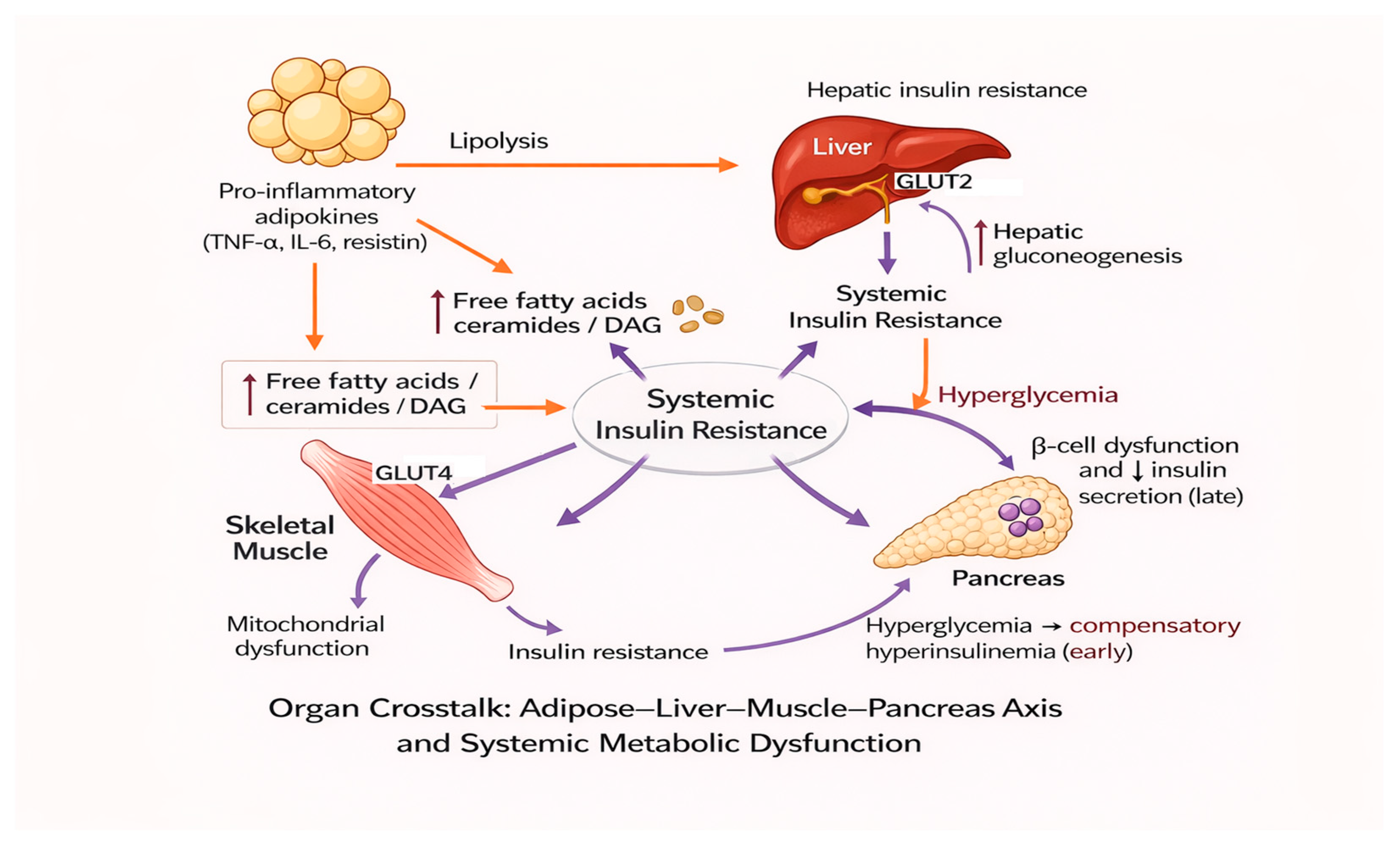
The development of insulin resistance is a central event in the progression of T2D and is closely linked to pathophysiological disturbances in lipid metabolism. Chronic nutrient excess, particularly of saturated fatty acids and refined carbohydrates, leads to aberrant lipid influx into skeletal muscle, liver, adipose tissue, and even pancreatic β-cells (Figure 3). This surplus results in ectopic lipid accumulation, mitochondrial overload, oxidative stress, and the establishment of a state termed “metabolic inflexibility,” in which tissues fail to appropriately shift between lipid and glucose oxidation in response to changing energy demands [106,107,108,109].

4.2. Role of Ceramides, Diacylglycerols (DAGs), and Lipid Droplets

Ceramides and DAGs are pivotal bioactive lipids implicated in the molecular pathogenesis of insulin resistance. Elevated intracellular ceramide levels inhibit protein kinase B (PKB/Akt) signaling via activation of protein phosphatase 2A (PP2A) and atypical protein kinase C (PKC) isoforms, directly impairing insulin signal transduction in skeletal muscle and adipocytes [110,111]. Ceramides also promote mitochondrial fragmentation, activate inflammatory cascades, and trigger β-cell apoptosis, thereby contributing to diminished insulin secretion [112].
Similarly, DAGs accumulate in muscle and hepatic tissues under chronic lipid exposure. DAGs activate novel PKC isoforms (PKCθ in muscle, PKCε in liver), resulting in inhibitory serine phosphorylation of IRS-1/2 and attenuation of downstream insulin signaling [109,113,114]. Hepatic DAG accumulation is strongly associated with non-alcoholic fatty liver disease (NAFLD) and worsened hepatic insulin resistance, and may predict T2D progression even before overt hyperglycemia [115].
Lipid droplets (LDs) act as intracellular storage structures for triglycerides, buffering lipotoxic intermediates. However, excessive LD accumulation in non-adipose tissues (e.g., liver, β-cells, and myocardium) is associated with impaired organ function. Emerging evidence suggests that LD-associated proteins, such as perilipins (PLINs) and patatin-like phospholipase domain-containing (PNPLA) family members, regulate lipid release and β-oxidation capacity; their dysregulation contributes to lipotoxicity and mitochondrial stress [108,110,116].
In pancreatic β-cells, prolonged exposure to excess fatty acids results in triglyceride accumulation, ER stress, mitochondrial fragmentation, and cell death. Although short-term LD formation may be cytoprotective, chronic overload disrupts insulin gene expression and impairs exocytotic machinery [112,116].
Thus, ceramides, DAGs, and dysfunctional LD metabolism collectively define a lipotoxic profile that drives insulin resistance and β-cell dysfunction.

4.3. Metabolic Inflexibility and Impaired β-Oxidation

Metabolic inflexibility refers to a reduced ability of tissues—especially skeletal muscle—to switch between lipid oxidation in the fasting state and glucose oxidation postprandially. This phenomenon is a hallmark of insulin resistance and strongly correlates with mitochondrial dysfunction [117,118].
Multiple studies demonstrate that insulin-resistant muscle exhibits impaired mitochondrial oxidative phosphorylation, reduced mitochondrial density, and dysregulated dynamics (fission/fusion imbalance) [118,119,120]. Lipid overload inhibits carnitine palmitoyltransferase-1, a critical gatekeeper of β-oxidation, resulting in incomplete fatty acid processing and the accumulation of toxic lipid intermediates, including acylcarnitines and ceramides [111,121].
This β-oxidation bottleneck results in excessive electron flux into the mitochondrial electron transport chain, leading to the overproduction of ROS and oxidative damage to mitochondrial proteins, membranes, and mtDNA [119,120,121,122]. ROS generation activates stress kinases (JNK, p38 mitogen-activated protein kinase (p38 MAPK)) and inflammatory mediators (including NF-κB), perpetuating insulin resistance and further impairing β-cell function.
In summary, chronic lipid excess promotes metabolic inflexibility, mitochondrial overload, and ROS-driven cellular injury, resulting in progressive insulin resistance and β-cell failure. Interventions that enhance mitochondrial β-oxidation, reduce ceramide and DAG accumulation, or improve metabolic switching (e.g., AMPK activators, exercise, caloric restriction, and GLP-1 analogs) are thus promising therapeutic strategies targeting fundamental disease mechanisms [118,121,122,123,124].

4.4. Adipose Tissue–Liver–Muscle Axis in Metabolic Dysregulation

Insulin resistance and metabolic dysfunction in diabetes emerge from coordinated disturbances across adipose tissue, the liver, and skeletal muscle, rather than from isolated organ defects. This adipose–liver–muscle axis is orchestrated by a complex network of endocrine mediators—adipokines, hepatokines, and myokines—that couple nutrient status, inflammation, and energy balance to whole-body glucose and lipid homeostasis. Recent multi-organ and multi-omics studies highlight that altered inter-organ signaling is a major driver of obesity-related insulin resistance, metabolic dysfunction-associated steatotic liver disease (MASLD), and T2D [125,126].

4.4.1. Adipokines: Adiponectin, Leptin, and Resistin

White adipose tissue is a highly active endocrine organ that secretes adipokines—including adiponectin, leptin, and resistin—which regulate appetite, insulin sensitivity, inflammation, and vascular function. Dysregulated adipokine profiles in obesity and T2D (termed adipose tissue dysregulation) promote systemic insulin resistance and metabolic disease [127,128,129,130].
Adiponectin is generally insulin-sensitizing and anti-inflammatory. Large observational and mechanistic studies have shown that adiponectin levels are inversely associated with insulin resistance, T2D, and cardiovascular risk, and positively associated with fatty acid oxidation and enhanced AMPK activation in the liver and muscle [129,130,131,132,133]. Low adiponectin is a consistent feature of visceral obesity, MASLD, and T2D, and predicts adverse outcomes [129,134]. Recent work emphasizes the adiponectin/leptin ratio as a more reliable index of adipose tissue function and metabolic health than either hormone alone, with lower ratios strongly linked to insulin resistance and cardiometabolic risk [135,136,137].
Leptin, secreted proportionally to fat mass, signals satiety and increases energy expenditure via hypothalamic pathways. In obesity, chronically elevated leptin leads to central and peripheral leptin resistance, blunting its anorexigenic and metabolic actions [133,134]. Leptin also exerts direct effects on immune cells, promoting the production of pro-inflammatory cytokines (TNF-α, IL-6) and contributing to adipose tissue inflammation and systemic insulin resistance [127,133].
Resistin—originally characterized as a link between obesity and insulin resistance in rodents—has a more complex role in humans, but multiple clinical studies and meta-analyses show that higher resistin levels correlate with insulin resistance, T2D, and inflammatory states [129,130,131,132]. Resistin promotes endothelial dysfunction, NF-κB activation, and hepatic gluconeogenesis, thereby aggravating hyperglycemia and vascular risk [129,130,132].
Overall, the adipokine profile in obesity and T2D is shifted towards low adiponectin and elevated leptin and resistin, reflecting dysfunctional, inflamed adipose tissue that drives insulin resistance in the liver and muscle and contributes to β-cell stress.

4.4.2. Hepatokines: FGF21 and Fetuin-A

The liver also acts as an endocrine organ by secreting hepatokines that signal to adipose tissue and muscle. Among these, fibroblast growth factor 21 (FGF21) and fetuin-A are particularly important in metabolic regulation [134,135,136,137].
FGF21 is a stress-induced hepatokine that enhances glucose uptake and fatty-acid oxidation in adipose tissue and muscle, promotes browning of white fat, and improves insulin sensitivity, largely through fibroblast growth factor receptor (FGFR)–β-Klotho signaling and downstream PI3K–Akt and AMPK pathways [135,136,137,138]. Circulating FGF21 levels are paradoxically elevated in obesity and T2D, suggesting FGF21 resistance at target tissues, analogous to leptin resistance, but FGF21 analogs show promising insulin-sensitizing and lipid-lowering effects in clinical trials [136,139].
Fetuin-A (α2-HS-glycoprotein) is a hepatokine that inhibits insulin receptor tyrosine kinase activity and acts as a soluble cofactor for TLR4, enhancing inflammatory responses to free fatty acids [137,138,139,140]. Elevated fetuin-A levels are strongly associated with hepatic steatosis, insulin resistance, incident T2D, and cardiovascular disease [137,138,139]. Animal models show that fetuin-A overexpression promotes hepatic fat accumulation and insulin resistance, whereas fetuin-A deficiency protects against diet-induced metabolic dysfunction. New interventional data indicate that exercise combined with nutraceutical strategies can reduce fetuin-A levels and improve insulin sensitivity, highlighting its potential as both a mechanistic mediator and therapeutic target [138,139,140].
Together, FGF21 and fetuin-A exemplify how the liver senses nutrient overload and steatosis and relays signals to adipose tissue and muscle that either restore metabolic balance (FGF21) or exacerbate insulin resistance and inflammation (fetuin-A), particularly in MASLD-associated T2D [136,137,138,139,140].

4.4.3. Myokines: IL-6, Irisin, and Muscle–Adipose–Liver Crosstalk

Skeletal muscle is not only a major site of glucose disposal but also an endocrine organ that secretes myokines—such as interleukin-6 (IL-6), irisin, myostatin, and others—that influence adipose tissue, liver, vasculature, and the immune system [141,142,143]. Exercise-induced myokine release is now viewed as a key mediator of the beneficial effects of physical activity on insulin sensitivity and cardiometabolic risk [141,142,143].
Interleukin-6 (IL-6) plays a dual, context-dependent role. Chronic low-grade elevation of IL-6 derived from inflamed adipose tissue is associated with insulin resistance and T2D, whereas acute IL-6 spikes induced by exercise function as a beneficial myokine, enhancing glucose uptake, fatty-acid oxidation, and GLP-1 secretion while promoting anti-inflammatory IL-10 responses [141,142,143]. This illustrates how the source, temporal pattern, and duration of IL-6 signaling determine its metabolic impact.
Irisin, a cleaved fragment of fibronectin type III domain-containing protein 5 (FNDC5) induced by exercise and PGC-1α activation, promotes browning of white adipose tissue, increases energy expenditure, and improves insulin sensitivity in experimental models [144,145,146,147,148]. Clinical data, however, are complex: circulating irisin levels show heterogeneous associations with insulin resistance, obesity, and T2D—some studies reporting positive, others inverse correlations—suggesting context-dependent “irisin resistance” and compensatory upregulation [145,146]. Beyond metabolism, irisin exerts potent anti-inflammatory effects, reducing pro-inflammatory cytokine production and modulating macrophage polarization, thereby potentially mitigating diabetic vascular and renal complications [145,147].
Broader analyses of myokine-mediated inter-organ crosstalk show that myokines can enhance insulin signaling in remote tissues, improve hepatic lipid handling, and counteract adipose tissue inflammation, providing a mechanistic explanation for the systemic benefits of resistance and endurance training in obesity and T2D [146,147,148]. Recent experimental work even identifies muscle-derived hormonal axes that directly modulate adipose tissue insulin sensitivity and β-cell function via GPCR- and bone morphogenetic protein (BMP)-dependent pathways [149].
In summary, the adipose–liver–muscle axis represents a tightly interconnected endocrine network in which adipokines, hepatokines, and myokines jointly determine insulin sensitivity, lipid handling, and inflammatory tone. In obesity and T2D, this network is skewed toward a pro-inflammatory, insulin-resistant state—low adiponectin and FGF21 responsiveness; high leptin, resistin, and fetuin-A; and altered myokine patterns—driving systemic metabolic dysregulation. Targeting this axis (e.g., restoring adipokine balance, modulating FGF21/fetuin-A signaling, and leveraging exercise-induced myokines) offers powerful avenues for systems-level therapy beyond glucose-centric approaches.

4.5. Role of Circadian Rhythms and Clock Genes in Glucose Homeostasis

Glucose homeostasis is not only regulated by nutrients and hormones but also strongly constrained by time. The circadian system—comprising a central pacemaker in the suprachiasmatic nucleus (SCN) and peripheral clocks in metabolic organs—coordinates daily rhythms in feeding, energy expenditure, insulin secretion, and tissue-specific glucose handling [150,151,152,153]. Disruption of this temporal organization, through shift work, irregular sleep, light at night, or genetic variants in clock genes, is consistently associated with increased risk of insulin resistance and T2D [154,155,156,157,158,159,160].
At the molecular level, circadian clocks are built from transcription–translation feedback loops. The core activators, brain and muscle ARNT-like 1 (BMAL1) and circadian locomotor output cycles kaput (CLOCK), form a heterodimer that drives rhythmic expression of clock-controlled genes (including period (Per) and cryptochrome (Cry)), which in turn feedback to repress BMAL1/CLOCK activity and generate ~24 h cycles [150,151]. Importantly, many clock-controlled genes in the liver, muscle, adipose tissue, and pancreas are directly involved in glucose and lipid metabolism, such as glucose transporters, glycolytic and gluconeogenic enzymes, and components of the insulin secretory machinery [151,152,153,154,155].

4.5.1. Central and Peripheral Clocks in Glucose Homeostasis

The SCN synchronizes behavioral cycles of sleep–wake and feeding–fasting cycles through neural and hormonal outputs; however, glucose metabolism is largely governed by peripheral clocks. The liver, skeletal muscle, adipose tissue, gut, and pancreatic islets all harbor autonomous circadian oscillators that are entrained by the SCN and by local cues, including feeding time, hormones, and metabolites [141,153,156].
Classic genetic studies show that global disruption of BMAL1 or CLOCK abolishes normal diurnal variation in blood glucose and triglycerides, and leads to fasting hyperglycemia and impaired glucose tolerance, establishing these transcription factors as key regulators of systemic glucose homeostasis [150]. More recent work using tissue-specific models has refined this view: liver-specific Bmal1 deletion impairs rhythmic gluconeogenesis and glycogen metabolism, disturbing fasting–feeding transitions, whereas muscle-specific Bmal1 deletion alters insulin-stimulated glucose uptake and substrate switching [151,153]. These findings support a model in which peripheral clocks coordinate temporal partitioning of metabolic pathways (e.g., fasting-phase gluconeogenesis vs. feeding-phase glycolysis) to maintain stable glycemia across the day–night cycle.
Multi-omics and systems-biology analyses are now revealing that circadian misalignment in humans with obesity or prediabetes is accompanied by coordinated changes in transcriptomic, metabolomic, and proteomic rhythms, especially in pathways related to insulin signaling, oxidative phosphorylation, and amino acid and lipid metabolism [154,160,161,162]. These data suggest that metabolic disease both perturbs and is reinforced by disrupted circadian networks.

4.5.2. Pancreatic β-Cell Clock: BMAL1/CLOCK and Insulin Secretion

Pancreatic islets harbor robust intrinsic circadian oscillators that shape β-cell electrical activity, Ca2+ dynamics, and insulin secretion [154,155]. In mouse models, pancreas- or β-cell-specific deletion of Bmal1 results in blunted glucose-stimulated insulin secretion, loss of daily variation in insulin output, and persistent hyperglycemia despite intact peripheral insulin sensitivity, demonstrating that β-cell clocks are essential for normal glucose tolerance [153,155].
Mechanistically, BMAL1/CLOCK regulates oscillatory expression of genes involved in insulin biosynthesis, granule trafficking, exocytosis, and ion-channel function, thereby tuning β-cell responsiveness to fluctuating glucose levels across the day [154,155]. Enhanced BMAL1 activity in β-cells increases circadian amplitude and improves glucose-stimulated insulin secretion, while BMAL1 loss or desynchrony reduces β-cell proliferation and impairs compensatory expansion during metabolic stress or injury [156].
Recent studies extend these insights to human systems. Single-cell and organoid models show that circadian maturation of stem-cell-derived or primary human β-cells is necessary for stable insulin secretory rhythms, and that transcription factors such as deleted in esophageal cancer 1 (DEC1; also known as basic helix–loop–helix family member e40, BHLHE40) coordinate clock gene expression with β-cell functional maturation and inflammatory resilience [156,157,158]. In inflammatory environments resembling T1D/T2D islets, intact β-cell clocks (BMAL1/CLOCK) appear to facilitate recovery from cytokine-induced injury, suggesting an important role in β-cell resilience and regeneration [156].

4.5.3. Circadian Misalignment, Insulin Resistance, and Diabetes Risk

Epidemiological data strongly support a link between circadian disruption and T2D. Large cohort and meta-analytic studies show that night shift work and rotating schedules are associated with substantially higher T2D incidence, even after adjustment for body mass index (BMI), diet, and sleep duration [159,162,163,164]. Recent work further demonstrates that late bedtimes, irregular sleep timing, and higher nocturnal light exposure predict increased risk for diabetes and poorer glycemic control, highlighting misalignment between behavioral timing and endogenous clocks as a key mediator [165,166].
Mechanistic explanations for these observations are beginning to emerge. Experimental circadian misalignment in humans—through forced desynchrony or mistimed feeding—reduces insulin sensitivity, blunts β-cell compensation, alters cortisol and melatonin rhythms, and disrupts the normal day–night pattern of fasting glucose [150,159,164,167]. Multi-omics studies support this, showing that individuals with higher insulin resistance exhibit altered rhythmicity of circulating metabolites and clock-related gene expression, which can be captured by circadian “fingerprints” in peripheral blood cells [160,161,168].
Genetic studies add another layer: polymorphisms in clock genes (including CLOCK, brain and muscle BMAL1/ARNTL, cryptochrome 2, and others) have been associated with fasting glucose, T2D risk, and chronotype. A recent multi-omics Mendelian randomization analysis identified circadian rhythm-related genes as being causally linked to T2D, underscoring that circadian disruption is not merely correlative but contributes to disease susceptibility [169,170].

4.5.4. Translational Perspectives

Recognizing the role of BMAL1, CLOCK, and circadian organization in glucose homeostasis opens the door to chrono-metabolic interventions. Time-restricted feeding and alignment of meals with the endogenous circadian phase improve insulin sensitivity and β-cell function in early human trials [154,159]. Pharmacologic strategies that stabilize clock components or target downstream rhythmic pathways (e.g., timed glucocorticoid modulation, melatonin, or molecules acting on REV-ERB nuclear receptors (REV-ERBs) and retinoic acid receptor-related orphan receptors (RORs)) are under exploration for metabolic diseases [151,154,167].
Taken together, current evidence supports the view that circadian clocks and core clock genes are integral components of metabolic homeostasis, rather than peripheral modifiers. BMAL1 and CLOCK coordinate β-cell insulin secretion, hepatic glucose production, and peripheral insulin sensitivity in a time-of-day-dependent manner. Disruption of these rhythms—due to genetic variation, altered environmental light–dark cycles, sleep disturbances, or metabolic stress—impairs glucose homeostasis and increases the risk of insulin resistance, T2D, and associated cardiometabolic complications.

5. Emerging Molecular Biomarkers and Predictive Indicators

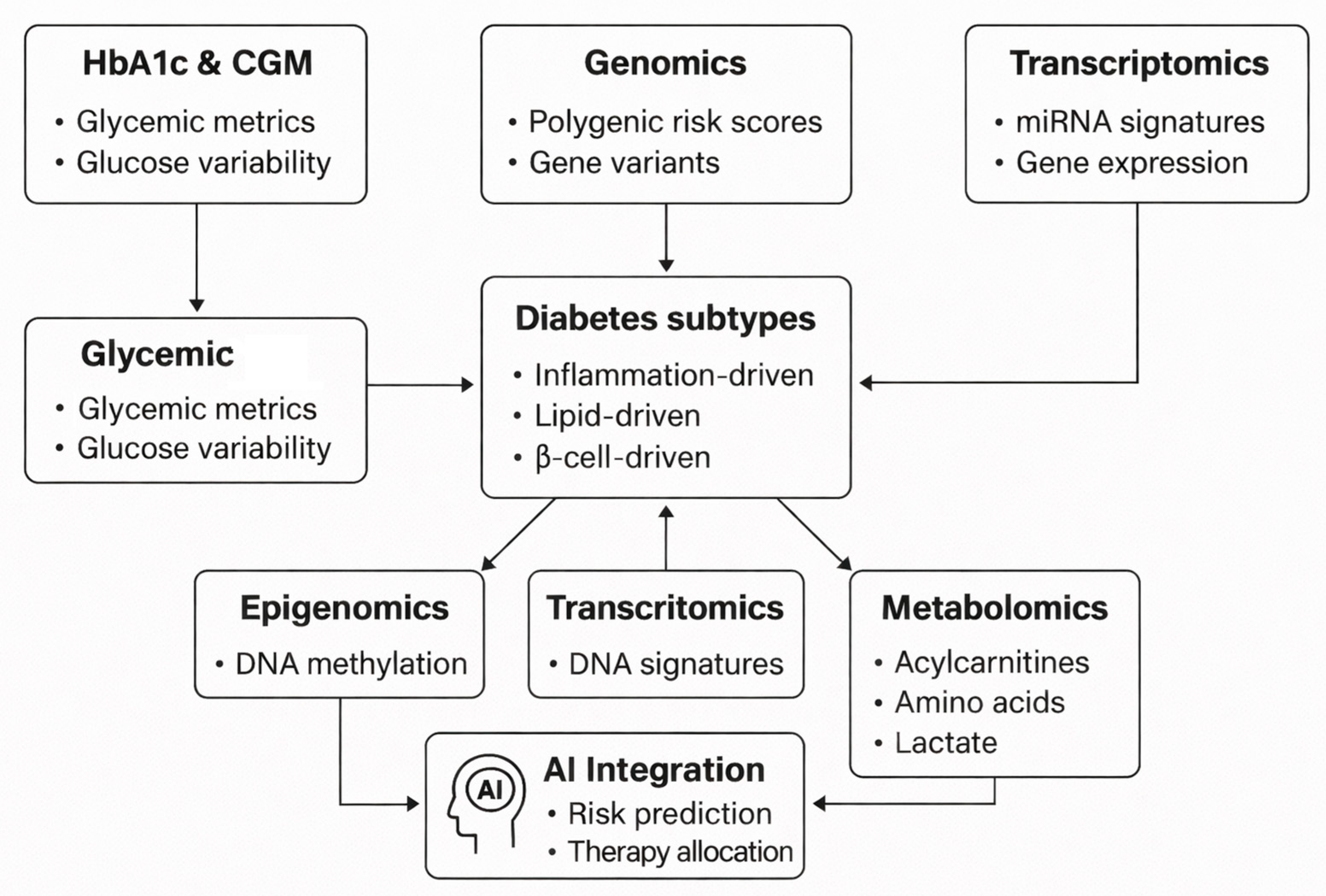
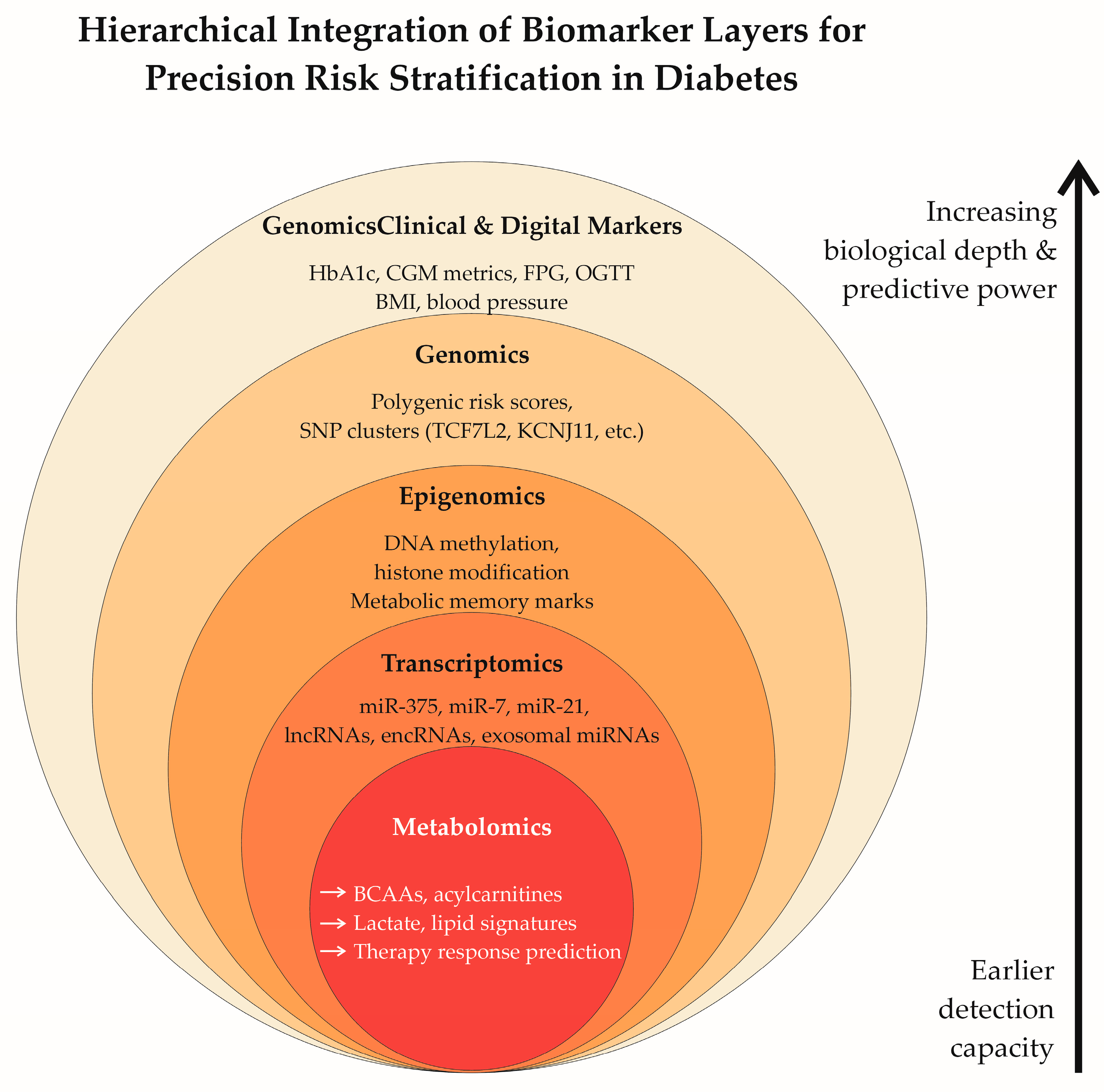
The transition from traditional glucose-centric monitoring (e.g., glycated hemoglobin (HbA1c)) to multi-omics-based risk prediction and precision diabetes stratification marks one of the most transformative developments in modern diabetology. Advanced profiling technologies now enable the detection of early molecular perturbations that precede clinical onset, provide insight into disease heterogeneity, and predict individual therapeutic response. Integrating genomics, epigenomics, transcriptomics, metabolomics, and AI-driven analytics is progressively shifting diabetes diagnostics from retrospective assessment to prospective risk prediction and individualized prognosis (Figure 4) [26,27,28,29].
Importantly, multi-omics and AI-based biomarker models are increasingly being evaluated in real-world clinical contexts. Integrated genomic, transcriptomic, and metabolomic signatures have been used to stratify patients into mechanistically distinct diabetes subtypes characterized by predominant β-cell dysfunction, insulin resistance, or inflammatory pathways, enabling more precise therapeutic selection and risk prediction for complications [171,172]. In clinical research settings, such stratification frameworks are beginning to guide personalized therapy allocation, for example, identifying individuals more likely to respond to incretin-based therapies or SGLT2 inhibitors based on molecular signatures of insulin resistance or renal vulnerability. As precision-medicine approaches mature, combining multi-omics biomarkers with clinical and digital health data may enable earlier identification of high-risk individuals and more targeted prevention strategies.

5.1. Evaluation Considerations for AI-Driven Biomarker Models

While AI-enabled integration of genomics, epigenomics, transcriptomics, and metabolomics holds considerable promise for early detection and mechanistic stratification of diabetes, the translational reliability of these models depends on rigorous evaluation. Current methodological recommendations highlight several core elements:
  • external validation in independent cohorts to assess generalizability;
  • calibration analysis, ensuring that predicted probabilities correspond to observed event rates;
  • clinical utility assessment, often performed using decision-curve analysis or net-benefit frameworks to determine whether model-guided interventions improve outcomes;
  • subgroup fairness evaluation, examining performance consistency across sex, age, ethnicity, and socioeconomic groups to minimize algorithmic bias [31,32].
Studies applying machine-learning methods to large electronic health record and population datasets have demonstrated that when such validation procedures are implemented, predictive algorithms can meaningfully enhance diabetes risk prediction beyond traditional clinical markers [173,174]. These considerations are particularly important for multi-omics models, where the complexity of high-dimensional data increases the risk of overfitting and limits generalizability if validation is insufficient.

5.2. Genomic Signatures and Epigenetic Biomarkers (SNP Clusters, Methylation Patterns)

Genome-wide association studies (GWASs) have identified more than 400 susceptibility loci for T2D, many within genes involved in β-cell function (e.g., transcription factor 7-like 2 (TCF7L2), potassium inwardly rectifying channel subfamily J member 11 (KCNJ11)), mitochondrial metabolism, or immunometabolic regulation (Figure 5) [6,160]. Recent polygenic risk scores (PRSs) combining rare and common variants demonstrate enhanced predictive power when coupled with lifestyle and metabolic traits (Table 1) [175]. Importantly, PRS may identify high-risk individuals years before metabolic abnormalities manifest.

5.2.1. Ancestry Transferability and Calibration of Polygenic Risk Scores

Although polygenic risk scores (PRSs) have shown promise for identifying individuals at elevated genetic risk for T2D, an important translational challenge is ancestry transferability. Many PRS models have been developed primarily using cohorts of European ancestry, and their predictive performance often declines when applied to populations with different genetic architectures, allele frequencies, and linkage disequilibrium patterns [176,177]. Consequently, implementation of PRS in diverse clinical settings requires local recalibration and ancestry-aware model development, including the use of multi-ethnic reference panels and population-specific weighting strategies. Recent large-scale genomic initiatives have demonstrated that incorporating diverse ancestry data substantially improves PRS performance and reduces potential disparities in predictive accuracy [178]. These considerations highlight that genomic prediction models should be evaluated not only by their statistical performance but also by their portability and equity across global populations.

5.2.2. Incremental Predictive Value over Traditional Clinical Risk Factors

Another critical requirement for clinical translation of PRS models is the demonstration of incremental predictive value beyond established clinical predictors, such as age, body mass index, family history, and fasting glucose levels (Figure 5). Several studies evaluating PRS-based diabetes prediction models have shown that while genetic risk scores can modestly improve discrimination metrics when added to conventional risk models, their greatest utility may lie in identifying individuals at elevated lifetime risk before metabolic abnormalities become apparent [179,180]. Importantly, integrated models combining genetic risk scores with lifestyle and metabolic markers often show greater predictive performance than either approach alone, supporting the concept that genomic information should complement, rather than replace traditional clinical risk stratification frameworks.

5.2.3. Examples of PRS Pipelines for Diabetes Risk Prediction

Translational PRS frameworks typically follow a multistep analytical pipeline that integrates genomic discovery with predictive modeling and clinical validation. For example, large genome-wide association studies identify risk variants associated with T2D, which are subsequently combined into weighted genetic scores using statistical approaches such as pruning-and-thresholding or Bayesian shrinkage methods. These scores are then integrated with clinical covariates and evaluated in independent validation cohorts to assess discrimination, calibration, and population transferability. One illustrative example is the polygenic risk model developed by Khera et al., which aggregated millions of genetic variants and demonstrated substantial stratification of lifetime diabetes risk in population-scale biobank datasets [179]. Similarly, studies leveraging electronic health record-linked genomic datasets have implemented PRS pipelines that combine genetic risk scores with clinical variables to improve the prediction of incident diabetes in real-world populations [180]. Such pipelines highlight how genomic discovery, algorithmic modeling, and independent validation can be integrated to produce clinically interpretable risk scores suitable for population screening or targeted prevention strategies.

5.3. Transcriptomic Biomarkers: Regulatory miRNAs and Network Modelling

Multiple miRNAs orchestrate β-cell adaptation, apoptosis, and insulin secretion dynamics, with miR-375, miR-7, and the miR-200 family now established as central regulators of β-cell integrity and resilience [181,182]. Circulating signatures, including miR-375, miR-21, and miR-192, have been proposed as plasma-accessible markers of early β-cell stress, insulin resistance, and risk of complications (Table 1) [182].
Recent network-based transcriptomic analyses reveal tissue-specific miRNA–mRNA regulatory loops, which are often context-dependent. For instance, miR-375 downregulation promotes compensatory β-cell proliferation under insulin resistance, but persistent suppression accelerates ER stress-induced apoptosis [183]. Likewise, miR-7 modulates β-cell dedifferentiation, while miR-21 is associated with inflammatory transitions and fibrosis [184,185].
Future perspectives: Multi-miRNA panels, rather than single species, are expected to outperform classical biomarkers when embedded within predictive, AI-based transcriptomic models [186].

5.4. Metabolomic Biomarker Panels (BCAAs, Acylcarnitines, Lactate)

Artificial intelligence and machine-learning approaches are increasingly used to integrate heterogeneous biomedical datasets, including genomic, epigenomic, transcriptomic, metabolomic, and clinical information, enabling high-dimensional pattern recognition and improved disease endotyping. In diabetes research, AI models have been applied to predict disease onset, identify molecular subtypes, and estimate risk of complications using large-scale electronic health records and multi-omics datasets [174,187]. However, despite promising predictive performance in exploratory studies, successful clinical translation requires adherence to robust evaluation standards. Contemporary methodological frameworks emphasize the need for external validation across independent populations, calibration analysis to assess prediction accuracy, and evaluation of clinical utility through decision-analytic approaches to determine whether model-guided decisions improve patient outcomes [31,32]. In addition, assessment of algorithmic fairness is increasingly recognized as essential to ensure that predictive performance remains consistent across demographic and socioeconomic subgroups, thereby avoiding unintended amplification of health disparities [188]. Collectively, these principles underscore that AI-based multi-omics models should be evaluated not only by traditional performance metrics such as discrimination (e.g., AUC) but also by their generalizability, calibration, and real-world clinical impact.
Metabolomic profiling has highlighted branched-chain amino acids (BCAAs: leucine, valine, and isoleucine) and acylcarnitine derivatives as early biomarkers reflecting mitochondrial overload and impaired β-oxidation (Figure 4) [189]. Elevated BCAAs predict incident T2D 5 to 10 years before diagnosis and correlate with insulin resistance [190]. Increased short-chain acylcarnitines (C3–C5) indicate incomplete mitochondrial fatty acid oxidation, whereas long-chain species suggest impaired carnitine shuttle function [191].
Lactate has re-emerged as a systemic marker of metabolic stress, particularly under hyperglycemia-driven anaerobic glycolysis [192]. Notably, integrated modeling linking lactate dynamics to cytokine profiles has demonstrated predictive ability for preclinical deterioration in insulin sensitivity [193].
Metabolomic markers detect dysfunction before clinical dysglycemia, represent mechanistically interpretable metabolic disturbances, and may serve as pharmacodynamic indicators of metabolic reprogramming interventions (Table 1) [194,195].

5.5. Artificial Intelligence in Biomarker Pattern Recognition

Machine learning (ML) and deep learning (DL) models enable integration of high-dimensional multi-omics datasets with clinical features to predict disease onset, trajectory, and drug responsiveness (Figure 4) [196].
Leading AI models based on multi-omics fusion algorithms have been shown to:
  • Identify novel diabetes endotypes (e.g., inflammation-driven vs. lipid-driven vs. β-cell-failure clusters) [171];
  • Predict responsiveness to GLP-1 agonists, SGLT2 inhibitors, or metformin based on combined transcriptomic and metabolomic signatures [171,195];
  • Enhance cardiovascular risk stratification using retinal fundus imaging combined with plasma miRNA patterns [197].
Additionally, explainable AI (XAI) provides mechanistic insight into model outputs, facilitating regulatory approval and clinical implementation [198].

5.6. From HbA1c to Multi-Omics Risk Stratification: A Paradigm Shift

While HbA1c remains the cornerstone for diabetes diagnosis and monitoring, it neither reflects underlying molecular alterations nor predicts drug responsiveness or risk of complications [199]. Modern strategies advocate for multi-dimensional stratification, combining:
  • HbA1c and continuous glucose monitoring (CGM)-derived variability metrics;
  • polygenic risk scores (PRSs) and epigenetic panels for predictive risk modelling;
  • miRNA/exosomal signatures for β-cell integrity;
  • metabolomic fingerprinting for mitochondrial resilience;
  • AI-based integrative platforms for personalized therapeutic allocation [200,201].
Emerging molecular biomarkers lay the groundwork for precision-oriented, preemptive, and predictive diabetes care, moving beyond glycemic thresholds toward molecular phenotype-guided classification and intervention (Table 1).

6. Advanced Experimental Models and Technologies

Recent technological developments have enabled highly accurate modeling of human metabolic states, offering powerful tools to investigate diabetes pathophysiology. These platforms include patient-derived cellular systems, genome-editing techniques, multimodal metabolic imaging, and ion channel electrophysiology, supporting biomarker validation (Section 4), therapeutic screening, and precision-guided translational strategies [202,203,204,205].

6.1. iPSC-Derived β-Cells, Organoids, and 3D Bioprinting

Induced pluripotent stem cell (iPSC)-derived β-cells allow patient-specific modeling, retaining genetic and metabolic backgrounds while conserving circadian and stress-response mechanisms (Table 2) [202,203]. Use of 3D pancreatic organoids enhances cell–cell communication and secretory dynamics [204], while bioprinted, ECM-enriched islet constructs restore structural and vascular microarchitecture, improving relevance under glucolipotoxic exposure [205,206]. These platforms are essential for modeling mechanisms of β-cell failure, facilitating drug discovery, evaluating regenerative therapies, and enabling personalized metabolic optimization.
Although stem-cell-derived β-cell replacement represents a promising regenerative strategy, substantial challenges remain before widespread clinical translation is feasible. Key obstacles include immune rejection, the requirement for long-term immunosuppression or immune-evasive cell engineering, limited graft survival, risks of teratoma formation, and the need for scalable manufacturing under GMP conditions. At present, most stem-cell-derived islet replacement strategies remain in early-phase clinical trials, and long-term efficacy and safety data are still limited.

6.2. CRISPR/Cas9 Editing in Modeling Monogenic and Polygenic Diabetes

CRISPR/Cas9 has enabled strategic editing of diabetes-related genes (e.g., hepatocyte nuclear factor 1 alpha (HNF1A), PDX1, KCNJ11, and GATA binding protein 6 (GATA6)) to facilitate causal mechanistic interrogation (Table 2) [207]. Emerging epigenetic CRISPR systems (CRISPR activation/interference (CRISPRa/i)) modulate gene expression without altering DNA sequences, allowing investigation of metabolic memory and transcriptional dysregulation in hyperglycemia [208]. High-throughput CRISPR platforms now model gene–environment interactions, including glucotoxicity and circadian disruption [209], while AI-enhanced gene-editing approaches accelerate target selection [210].
While CRISPR-based genome editing offers theoretical potential for correcting genetic defects or engineering immune-evasive β-cells, most applications remain confined to preclinical models. Significant translational hurdles include delivery efficiency, off-target effects, long-term genomic stability, and regulatory considerations.

6.3. In Vivo Metabolic Imaging (Fluorodeoxyglucose Positron Emission Tomography (FDG-PET), Hyperpolarized Magnetic Resonance Imaging (MRI), Indocyanine Green (ICG)-Based Tracing)

Fluorodeoxyglucose positron emission tomography (18F-FDG-PET) imaging enables noninvasive mapping of organ-specific glucose uptake (pancreas, myocardium, liver, adipose tissue) [211], while hyperpolarized carbon-13 magnetic resonance imaging (13C MRI) reveals real-time mitochondrial substrate flux and redox imbalances [212]. ICG-based metabolic tracing, particularly in nanoparticle-delivered formats, enables quantification of hepatocellular clearance and vascular metabolic adaptation [213], with enhanced precision via AI-driven image analysis [214]. These imaging modalities are well-suited for therapeutic monitoring, tracking metabolic plasticity, and analyzing interorgan crosstalk (Table 2).

6.4. Patch-Clamp Electrophysiology of Metabolic Ion Channels

Electrophysiological profiling using patch-clamp techniques offers a granular assessment of channel-level responses to metabolic stress (Table 2) [215]. In β-cells, KATP channels respond to ATP/ADP ratios, modulating insulin secretion [76], while mechanosensitive Piezo1 channels transduce glucose-mediated membrane tension into secretory signals [70]. Combined optical patch-clamp and PET/MRI flow imaging allows simultaneous evaluation of bioelectrical activity and metabolic flux [216,217].

6.5. Translational Relevance and Integration with AI-Based Predictive Modeling

Coupling advanced experimental platforms with AI-driven analytics supports computational prediction of therapeutic response, disease progression modeling, and optimization of personalized treatment strategies (Table 2) [218]. Multidimensional integration of genomic, imaging, transcriptomic, electrophysiological, and metabolomic datasets allows precise identification of metabolic breakpoints and optimal intervention timing [219].
Recent large-scale randomized clinical trials have provided important validation of molecular pathways implicated in diabetes pathophysiology. The SELECT trial demonstrated that semaglutide, a glucagon-like peptide-1 receptor agonist, reduced major cardiovascular events in individuals with overweight or obesity, supporting the concept that incretin signaling exerts systemic anti-inflammatory and cardiometabolic effects beyond glucose lowering [35]. Similarly, the FLOW trial confirmed that finerenone—a selective mineralocorticoid receptor antagonist—significantly slows the progression of diabetic kidney disease, reinforcing the central role of mineralocorticoid receptor-mediated inflammation and fibrosis in renal complications of diabetes [36]. In addition to pharmacologic therapies, regenerative medicine approaches are advancing rapidly. Early clinical studies of stem-cell-derived pancreatic islet transplantation developed by Vertex Pharmaceuticals have demonstrated restoration of endogenous insulin secretion and substantial reductions in exogenous insulin requirements in individuals with T1D, representing a potential paradigm shift toward β-cell replacement therapies [37]. Together, these clinical advances illustrate how mechanistic insights into incretin signaling, renal inflammatory pathways, and β-cell biology are translating into disease-modifying therapeutic strategies.

7. Modulation of Molecular Pathways: Therapeutic Approaches

The integration of molecular profiling and advanced experimental platforms (Section 4 and Section 5) has paved the way for precision-guided pharmacological interventions aimed at correcting core biological dysfunctions in diabetes. Current therapeutic strategies are evolving from symptom control (hyperglycemia) toward molecular reprogramming, targeting cellular energetics, signal integration, stress resolution, and β-cell regeneration. This section synthesizes key therapeutic modalities, emphasizing mechanistic specificity, translational potential, and integration within multi-omics and AI-driven decision pipelines.

7.1. Metabolic Regulators

Metformin remains the cornerstone of T2D management due to its ability to activate AMPK and inhibit mitochondrial Complex I, improving insulin sensitivity and reducing hepatic gluconeogenesis (Table 3). Recent data further extend its effects to epigenetic reprogramming and microbiota modulation, suggesting a potential metabolic recalibration rather than simple glycemic correction [219].
GLP-1 receptor agonists induce β-cell proliferation, enhance insulin secretion, modulate appetite through hypothalamic signaling, and exert anti-inflammatory and cardioprotective actions [220]. New-generation dual and triple incretin agonists (GLP-1/glucose-dependent insulinotropic polypeptide (GIP)/glucagon) show enhanced metabolic durability and weight reduction, supporting their use in complex metabolic endotypes.
SGLT2 inhibitors, beyond glycemic control, promote cardio-renal metabolic adaptation, restore fatty acid oxidation, reduce oxidative stress, and trigger protective metabolic switching in cardiac and renal tissues—features relevant to diabetes-related organ dysfunction [221].
Emerging metabolic activators targeting 6-phosphofructo-2-kinase/fructose-2,6-bisphosphatase 3 (PFKFB), NAD+ modulation, and mitochondrial biogenesis (e.g., PGC-1α activation) demonstrate early promise in experimental models [18], supporting their evaluation in regenerative therapy protocols.

7.2. Targeted Endogenous Pathways

AMPK–PGC-1α–SIRT1 axis activation promotes mitochondrial health, shifts substrate utilization, and enhances insulin sensitivity. Pharmacological activators (e.g., 5-aminoimidazole-4-carboxamide ribonucleotide (AICAR), resveratrol analogs) and time-restricted feeding interventions demonstrate synergistic effects (Table 3) [19].
Nuclear factor erythroid 2-related factor 2 (Nrf2)-mediated antioxidant pathway modulation attenuates oxidative stress, improves ER protein-folding capacity, and supports β-cell survival [222]. Nrf2 activators show potential combined benefits with SGLT2 inhibitors and nutraceutical compounds.
mTOR/autophagy rebalancing is essential for β-cell health. Hyper-activation of mTORC1 contributes to premature β-cell exhaustion, while controlled autophagy promotes cellular repair under metabolic stress [223]. Therapeutic fine-tuning, rather than whole inhibition, is crucial to avoid sarcopenia or impaired regenerative capacity.
Synergistic modulation of these pathways aligns with the mechanistic model proposed in Section 2 and Section 3, supporting multi-target therapy combinations guided by molecular phenotyping.

7.3. Nutraceutical and Bioactive Compounds

Polyphenolic nutraceutical compounds such as curcumin, resveratrol, and berberine have been widely investigated for their potential metabolic and anti-inflammatory effects in experimental models of diabetes. These compounds modulate signaling pathways implicated in insulin sensitivity, oxidative stress, and mitochondrial function, including AMPK activation, NF-κB suppression, and improved mitochondrial bioenergetics. However, despite promising mechanistic findings in cell and animal studies, clinical evidence in humans remains heterogeneous and often inconsistent. Recent randomized controlled trials evaluating these compounds in individuals with T2D or metabolic syndrome have reported modest, variable, or sometimes null effects on glycemic control, particularly when assessed using standardized endpoints such as HbA1c, fasting glucose, or insulin sensitivity indices. Consequently, the translational potential of these nutraceuticals should be interpreted cautiously and viewed primarily as adjunctive or investigational interventions rather than established therapeutic agents [224,225,236].
Curcumin, a polyphenolic compound derived from Curcuma longa, has been widely studied for its anti-inflammatory and antioxidant properties. Experimental studies indicate that curcumin can inhibit NF-κB signaling, attenuate oxidative stress, and improve insulin signaling through activation of AMPK and modulation of inflammatory cytokine networks [226,227,228,229,230,231]. However, clinical evidence remains mixed. Several randomized controlled trials investigating curcumin supplementation in patients with T2D (typically 500–1500 mg/day for 8–16 weeks) have reported modest improvements in inflammatory markers or lipid profiles but inconsistent or statistically nonsignificant effects on HbA1c or fasting glucose levels [224,225]. Differences in formulation, bioavailability, dosage, and study populations contribute to substantial heterogeneity across trials. Therefore, although curcumin remains of mechanistic interest, current evidence does not support strong translational claims regarding glycemic control.
Berberine, an isoquinoline alkaloid derived from several medicinal plants, has demonstrated glucose-lowering effects in experimental and early clinical studies. Mechanistically, berberine activates AMPK signaling, enhances glucose uptake, and modulates gut microbiota composition. Some early randomized trials suggested reductions in fasting glucose and HbA1c comparable to metformin; however, these studies were generally small and heterogeneous in design. More recent systematic reviews emphasize that study quality, sample size, and methodological variability limit definitive conclusions regarding clinical efficacy [232,233]. Furthermore, gastrointestinal adverse events—including diarrhea, constipation, and abdominal discomfort—are relatively common. As such, while berberine remains a promising candidate for adjunctive metabolic modulation, stronger evidence from large, well-controlled clinical trials is required before its therapeutic role can be established.
Resveratrol, a polyphenolic compound found in grapes and berries, has attracted considerable interest due to its reported ability to activate SIRT1 signaling and mimic aspects of caloric restriction. Preclinical studies demonstrate improved mitochondrial function, enhanced insulin sensitivity, and reduced oxidative stress following resveratrol administration. Nevertheless, randomized clinical trials have produced heterogeneous results. While some studies reported modest improvements in insulin sensitivity or inflammatory markers, several recent RCTs have failed to demonstrate clinically meaningful improvements in glycemic control in patients with established T2D [234,235]. Variability in dose (typically 150–1000 mg/day) and intervention duration likely contributes to inconsistent outcomes. Consequently, resveratrol should currently be regarded as an experimental metabolic modulator rather than a validated antidiabetic therapy.
Potential drug–nutraceutical interactions also warrant consideration, particularly in patients receiving antidiabetic pharmacotherapy. Several commonly used nutraceutical compounds influence cytochrome P450 enzymes or transporter systems involved in drug metabolism, which may alter the pharmacokinetics of medications such as metformin, sulfonylureas, or anticoagulants. For example, polyphenols including resveratrol and curcumin may affect CYP3A4 and CYP2C9 activity, whereas berberine has been shown to inhibit CYP2D6 and P-glycoprotein transporters. Although clinically significant interactions remain relatively uncommon, clinicians should consider these possibilities when nutraceutical supplements are used concomitantly with prescription medications [237,238].
An additional consideration is the regulatory framework governing nutraceutical products, which differs substantially from that of pharmaceutical agents. In most jurisdictions, including the European Union and the United States, nutraceuticals are regulated as dietary supplements rather than drugs and therefore are not required to demonstrate therapeutic efficacy through large randomized clinical trials before market approval. Consequently, health claims are restricted and must comply with regulatory standards set by agencies such as the European Food Safety Authority (EFSA) and the U.S. Food and Drug Administration (FDA). This regulatory distinction underscores the importance of interpreting nutraceutical evidence cautiously and highlights the need for well-designed clinical trials to support clinically meaningful claims [239,240].
Overall, although nutraceutical compounds such as curcumin, resveratrol, and berberine provide valuable mechanistic insights into metabolic signaling pathways relevant to diabetes, their clinical efficacy remains incompletely established. Current evidence from randomized controlled trials is heterogeneous, with several studies reporting neutral or modest metabolic effects. Future investigations should prioritize well-powered randomized trials with standardized formulations, clearly defined metabolic endpoints, and longer follow-up periods to clarify their potential role as adjunct therapies in metabolic disease management.

8. Organ Crosstalk in Diabetes: Beyond the Pancreas

Diabetes is increasingly recognized as a multi-organ network disorder, not merely pancreatic β-cell dysfunction. Inter-organ interactions mediated by metabolic flux, oxidative stress, inflammatory signaling, and mechanobiological feedback significantly affect disease progression and treatment response [241]. Understanding this complexity is critical for transitioning to systems-level precision medicine (Figure 6).

8.1. Diabetic Heart–Brain–Liver–Gut Axis

8.1.1. Hyperglycemia-Induced Oxidative Damage

Chronic hyperglycemia induces excessive mitochondrial ROS generation and advanced glycation end-product (AGE) accumulation, triggering NADPH oxidase activation and maladaptive Nrf2 signaling across tissues [242]. Liver-derived lipotoxic mediators, particularly ceramides, impair metabolic flexibility and insulin signaling [243], whereas gut microbiota dysbiosis enhances metabolic endotoxemia, thereby aggravating systemic insulin resistance [244].

8.1.2. Cardiac Mechano-Electrical Feedback Under Diabetic State

Diabetic cardiomyopathy features impairment of mechanosensitive ion channels (transient receptor potential melastatin 7 (TRPM7), Piezo1), sarcomere stiffness, and disturbed Ca2+ handling [245]. Altered metabolic substrate utilization—from flexible glucose/lipid switching to fixed fatty acid dependence—exacerbates mitochondrial stress and electrophysiological instability [246].

8.1.3. Blood–Brain Barrier Integrity and Neuroinflammation via Receptor for Advanced Glycation End-Products (RAGE)/Toll-like Receptor (TLR) Activation

AGEs activate RAGE and TLR4/2 signaling at endothelial and glial surfaces, disrupting tight junction proteins (claudin-5, occludin) and enhancing caveolar transcytosis [247]. Resultant microglial activation, astrocytic stress, and cytokine release (IL-6, TNF-α) contribute to neuronal degeneration and cognitive decline [248]. Cardiac cytokines and exosomal miRNAs have been shown to accelerate central nervous system (CNS) neuroinflammation in diabetic conditions [249].

8.2. Skeletal Muscle Plasticity and Metabolic Reprogramming

Skeletal muscle contributes up to 80% of postprandial glucose disposal and serves as a critical regulator of systemic insulin sensitivity [250]. Diabetic conditions drive a shift toward glycolytic metabolic signatures, reduced mitochondrial biogenesis, and diminished oxidative fiber proportion [251]. Mechanotransduction via focal adhesion kinase (FAK), YAP/TAZ, and AMPK pathways modulates substrate preference and energy efficiency [252].
Persistent metabolic overload leads to:
  • Impaired satellite cell activation, limiting muscle repair [253]
  • Circadian misalignment of metabolic gene expression [254]
  • Enhanced lactate and IL-6 signaling, reinforcing hepatic gluconeogenesis and cardiac oxidative burden [255]
Mechanotherapy—including precision-timed exercise regimens targeting Piezo1, AMPK, and Ca2+ flux pathways—may restore mitochondrial adaptability and improve insulin responsiveness [256].
Organ crosstalk confirms that diabetes intervention must be systemic rather than pancreas-centered. A precision strategy should address:
  • Cardiac mechano-electrical dysregulation
  • CNS permeability and neuroinflammatory feedback
  • Hepatic lipotoxic contributions
  • Muscle metabolic adaptability and mechanotransduction
Future therapeutic algorithm design must incorporate multi-organ biomarker tracking and AI-driven modeling to enable dynamic metabolic reprogramming before irreversible dysfunction occurs [257].

9. Emerging Frontiers & Future Perspectives

The mechanistic and translational advances discussed throughout this review collectively point toward a new systems-level paradigm of diabetes care. Rather than focusing on single nodes such as hyperglycemia, insulin secretion, or isolated organ dysfunction, future strategies will emphasize multi-target molecular modulation, personalized metabolic therapy guided by AI, β-cell replacement with gene-edited grafts, and early interception via adaptive metabolic reprogramming algorithms. Together, these approaches aim not only to slow disease progression but also to reshape metabolic trajectories and restore resilience.
To improve clarity regarding translational readiness, therapeutic strategies discussed in this section are categorized according to the strength of available evidence using a simplified evidence hierarchy adapted from the GRADE framework (Table 4). Established therapies supported by large randomized clinical trials and guideline recommendations (e.g., metformin, GLP-1 receptor agonists, SGLT2 inhibitors) are distinguished from investigational strategies currently evaluated in early-phase clinical studies or preclinical models (e.g., stem-cell-derived β-cells, CRISPR-based editing approaches, and experimental nutraceuticals) (Table 4). This distinction is intended to prevent over-interpretation of emerging technologies and to highlight key translational barriers that remain to be addressed before clinical implementation.

9.1. Multi-Target Molecular Modulation

Diabetes arises from the intersection of mitochondrial dysfunction, ER stress, oxidative and reductive imbalance, lipotoxicity, aberrant mechanotransduction, and immune activation. Consequently, monotherapies that affect only one pathway often yield incomplete or transient benefits.
Currently approved therapies—including metformin, GLP-1 receptor agonists, SGLT2 inhibitors, insulin therapy, and lifestyle interventions—remain the cornerstone of diabetes management and are supported by extensive randomized clinical trial evidence and international guideline recommendations.
Future pharmacology will increasingly adopt multi-target molecular modulation, including:
  • Rational drug combinations (e.g., GLP-1 agonists + SGLT2 inhibitors + AMPK activators) designed based on patient-specific omics signatures rather than empirical escalation.
  • Single molecules with pleiotropic actions, such as compounds simultaneously modulating AMPK/PGC-1α, Nrf2, and NF-κB, offering coordinated control of energy metabolism, antioxidant defense, and inflammation.
  • Poly-pharmacology-informed nutraceutical strategies, where curcumin analogs, berberine, resveratrol, and related bioactive compounds are used in carefully adjusted, nano-formulated combinations for synergistically recalibrating metabolic pathways.
Leveraging network pharmacology and systems modeling, these multi-target interventions can be optimized to achieve maximal pathway coverage with minimal off-target toxicity, tailored to the dominant drivers in each patient’s molecular profile.

9.2. Personalized Metabolic Therapy and AI-Integrated Decision Systems

As multi-omics profiling becomes increasingly accessible, therapy personalization will move from theory to routine practice. AI-driven engines—embedded into clinical decision support platforms—will integrate:
  • Genomic and polygenic risk scores
  • Epigenetic and transcriptomic panels (e.g., miRNA signatures, methylation marks)
  • Metabolomic and proteomic fingerprints
  • Continuous glucose monitoring (CGM), digital phenotyping, and lifestyle data
Based on these inputs, AI systems will construct dynamic risk and response maps, recommending:
  • The most suitable drug class or combination (e.g., incretin-focused vs. insulin-sensitizer-dominant regimens)
  • Optimal dosing schedules and chronotherapeutic timing
  • Specific lifestyle, exercise, and nutraceutical modules matched to the patient’s circadian and metabolic phenotype
As these platforms are continuously updated with real-world outcomes, they will support learning health systems that refine therapeutic algorithms at both the individual and population levels. Importantly, explainable AI approaches will be essential to maintain clinical transparency and regulatory acceptability.

9.3. Potential of Gene-Edited β-Cell Replacement

β-cell replacement therapy—via islet transplantation or stem cell-derived β-like cells—has long been limited by donor scarcity, immune rejection, and recurrent autoimmunity. The convergence of iPSC technologies, 3D bioprinting, and gene editing now offers a realistic path toward durable β-cell replacement in both T1D and advanced T2D.
Potential advances include:
  • Gene-edited iPSC-derived β-cells engineered for immune stealth (e.g., human leukocyte antigen (HLA) engineering, overexpression of immune checkpoint regulators) and enhanced stress resistance (e.g., upregulated antioxidant defenses, fortified ER stress response).
  • Incorporation of mechanosensitive channel tuning (e.g., Piezo1, TRPM7, KATP) to maintain optimal mechano-electrical coupling and insulin secretory dynamics in vivo.
  • Bioengineered islet organoids or vascularized constructs, designed for implantation in mechanically favorable niches (omentum, subcutaneous scaffolds) with controlled exposure to systemic inflammatory insults.
In the long term, off-the-shelf gene-edited β-cell products could allow standardized replacement in well-defined molecular endotypes, especially when combined with immune-modulatory and metabolic-reprogramming therapies to stabilize the surrounding organ network.

9.4. Early Intervention via Metabolic Reprogramming Algorithms

Perhaps the most transformative frontier is the shift from managing established diabetes to preemptive metabolic reprogramming. Using the biomarkers and models outlined in Section 4, Section 5, Section 6 and Section 7, algorithm-guided early intervention will aim to:
  • Identify pre-diabetic individuals with adverse molecular trajectories (e.g., high-risk PRS, unfavorable methylation patterns, rising (BCAA)/acylcarnitine signatures) long before clinical onset.
  • Deploy personalized metabolic training programs—combining tailored diet, exercise mechanotherapy, sleep and circadian optimization, and targeted nutraceuticals—to restore adaptive flexibility.
  • Continuously update recommendations based on real-time feedback from CGM, metabolomic snapshots, wearable-derived activity and sleep metrics, and organ-specific imaging when needed.

10. Conclusions

Diabetes should no longer be viewed as merely a disorder of hyperglycemia, but rather as the clinical manifestation of complex, progressively dysregulated molecular networks involving mitochondrial stress, impaired metabolic sensing, redox imbalance, mechanotransduction defects, and maladaptive immune–endocrine interactions. These disturbances disrupt the dynamic capacity of multiple organs—most notably the pancreas, heart, liver, brain, adipose tissue, and skeletal muscles—to maintain metabolic resilience. Hyperglycemia is therefore a consequence, not the root, of systemic molecular dysregulation.
The modern trajectory in diabetology moves beyond glycemic normalization toward restoring metabolic adaptability, targeting upstream mechanistic drivers, and preventing irreversible β-cell decline and multi-organ cross-complications. Reactive treatment strategies are being replaced by prospective disease interception, supported by molecular risk mapping, real-time metabolic monitoring, and phenotype-specific interventions. Early identification of high-risk individuals—based on genomic, epigenomic, transcriptomic, and metabolomic footprints—will enable intervention before structural dysfunction or β-cell exhaustion develops.
Future therapeutic approaches will combine:
  • Integrative molecular profiling (multi-omics biomarkers + digital phenotyping) to define disease endotypes;
  • Mechanosensitive and metabolic modulatory interventions, aimed at recalibrating energy flow, mitochondrial capacity, and insulin signal responsiveness;
  • AI-driven adaptive decision systems to continuously refine pharmacological, lifestyle, nutraceutical, and chronobiological strategies;
  • Early metabolic reprogramming and advanced regenerative technologies, including gene-edited β-cell therapy and precision organ-level modulation.
Across these diverse mechanisms—from mitochondrial dysfunction and mechanotransduction to circadian regulation and therapeutic modulation—the AMPK–SIRT1–PGC-1α axis emerges as a recurring integrative node linking energy sensing, mitochondrial quality control, and metabolic adaptation in diabetes.
The next era of diabetes management will transition from chronic disease suppression to metabolic state redefinition, shifting from static glycemic targets to dynamic restoration of resilience across interconnected organs. With the integration of multi-target molecular therapy, mechanobiology, systems biology, and predictive computational intelligence, diabetes could evolve from an irreversible, progressive disorder into a preventable and potentially reprogrammable condition. The translation of molecular insights into clinical practice is increasingly evident, as illustrated by recent landmark trials targeting incretin signaling, mineralocorticoid receptor pathways, and β-cell replacement strategies. Integrating mechanistic knowledge with multi-omics biomarkers and AI-enabled stratification may allow future diabetes care to move toward truly personalized prevention and treatment strategies.

Author Contributions

Conceptualization, M.M. and H.G.; methodology, M.M.; validation, M.M., I.S., H.G. and R.K.; formal analysis, M.M., I.S. and H.G.; investigation, I.S. and M.M.; resources, H.G.; data curation, M.M., I.S. and H.G.; writing—original draft preparation, M.M., I.S. and H.G.; writing—review and editing, M.M., R.K., I.S., M.K., N.H.-P. and H.G.; visualization, I.S. and M.M.; supervision, M.M.; project administration, M.M. and H.G. All authors have read and agreed to the published version of the manuscript.

Funding

This research was funded by the Ministry of Education and Science of Bulgaria, Grant DO-1 277/2025, “INFRAACT” of NRRI 2020–2027.

Institutional Review Board Statement

Not applicable.

Informed Consent Statement

Not applicable.

Data Availability Statement

No new data were created or analyzed in this study. Data sharing does not apply to this article.

Acknowledgments

We greatly appreciate the contribution and support of EATRIS—ERIC (European Infrastructure for Translational Medicine) to our research in translational medicine.

Conflicts of Interest

The authors declare no conflicts of interest.

Abbreviations

AGEsAdvanced glycation end-products
AIArtificial intelligence
AMPKAMP-activated protein kinase
ASCApoptosis-associated speck-like protein containing a CARD
ATF4Activating transcription factor 4
ATF6Activating transcription factor 6
ATPAdenosine triphosphate
BABile acid
BCAAsBranched-chain amino acids
BiP/GRP78Binding Immunoglobulin Protein/Glucose-Regulated Protein 78
BMAL1Brain and muscle ARNT-like 1
CARDCaspase Recruitment Domain
CGMContinuous glucose monitoring
CHOPC/EBP homologous protein
CLOCKCircadian locomotor output cycles kaput
CRISPRClustered regularly interspaced short palindromic repeats
DAGsDiacylglycerols
DEC1Differentiated embryonic chondrocyte 1
DLDeep learning
ECMExtracellular matrix
EREndoplasmic reticulum
ERADER-associated degradation
EWASEpigenome-wide association study
FAKFocal adhesion kinase
FDG-PETFluorodeoxyglucose positron emission tomography
FGF21Fibroblast growth factor 21
FFAR2Free fatty acid receptor 2
FFAR3Free fatty acid receptor 3
FLOWEvaluate renal function with semaglutide once weekly (trial)
FNDC5Fibronectin type III domain-containing protein 5
FOXOForkhead box O
FXRFarnesoid X receptor
GLP-1Glucagon-like peptide-1
GLP-1RAGLP-1 receptor agonist
GLUT2Glucose transporter type 2
GLUT4Glucose transporter type 4
GPCRG-protein-coupled receptor
GRP78Glucose-regulated protein 78
GWASGenome-wide association study
HbA1cGlycated hemoglobin
HDACHistone deacetylase
HOMA-BHomeostatic model assessment of β-cell function
HOMA-IRHomeostatic model assessment of insulin resistance
ICGIndocyanine green
ILInterleukin
iPSCInduced pluripotent stem cell
IRE1αInositol-requiring enzyme-1 alpha
IRSInsulin receptor substrate
JAK/STATJanus kinase/signal transducer and activator of transcription
JNKc-Jun N-terminal kinase
KATPATP-sensitive potassium channel
KCNJ11Potassium inwardly rectifying channel subfamily J member 11
LADALatent autoimmune diabetes in adults
LDLipid droplet
lncRNALong noncoding RNA
MASLDMetabolic dysfunction-associated steatotic liver disease
MeSHMedical subject headings
miRNAMicroRNA
MLMachine learning
MODYMaturity-onset diabetes of the young
mTORMechanistic target of rapamycin
mTORC1mTOR complex 1
MRIMagnetic resonance imaging
NAFLDNon-alcoholic fatty liver disease
NAD+Nicotinamide adenine dinucleotide
NADPHNicotinamide adenine dinucleotide phosphate
ncRNANoncoding RNA
NFATNuclear factor of activated T cells
NF-κBNuclear factor kappa-light-chain-enhancer of activated B cells
NLRP3NOD-like receptor family pyrin domain containing 3
OGTTOral glucose tolerance Test
PAMPPathogen-associated molecular pattern
PDX1Pancreatic and duodenal homeobox 1
PERKPKR-like endoplasmic reticulum kinase
PGC-1αPeroxisome Proliferator-Activated Receptor Gamma Coactivator 1 Alpha
PI3K–AktPhosphoinositide 3-kinase/Protein kinase B
PKBProtein kinase B
PKCProtein kinase C
PLINPerilipin
PNPLAPatatin-like phospholipase domain-containing protein
PPARPeroxisome proliferator-activated receptor
PPARγPeroxisome proliferator-activated receptor gamma
PP2AProtein phosphatase 2A
PRSPolygenic risk score
PYYPeptide YY
REV-ERBNuclear receptor subfamily 1 group D
ROSReactive Oxygen Species
RORRetinoic acid receptor-related orphan receptor
SCFAShort-chain fatty acid
SCNSuprachiasmatic nucleus
SGLT2Sodium–glucose cotransporter-2
SIRT1Sirtuin 1
SNPSingle-nucleotide polymorphism
TCF7L2Transcription factor 7-like 2
TGR5G-Protein-Coupled Bile Acid Receptor 1
TLRToll-Like Receptor
TNF-αTumor Necrosis Factor Alpha
TRPTransient Receptor Potential
TRPM7Transient Receptor Potential Melastatin 7
UPRUnfolded Protein Response
WHOWorld Health Organization
XBP1sSpliced X-Box Binding Protein 1

References

  1. Duncan, B.B.; Magliano, D.J.; Boyko, E.J. IDF Diabetes Atlas 11th Edition 2025: Global Prevalence and Projections for 2050. Nephrol. Dial. Transplant. 2025, 41, gfaf177. [Google Scholar] [CrossRef] [PubMed]
  2. GBD 2021 Diabetes Collaborators. Global, Regional, and National Burden of Diabetes from 1990 to 2021, with Projections of Prevalence to 2050: A Systematic Analysis for the Global Burden of Disease Study 2021. Lancet 2023, 402, 203–234. [Google Scholar] [CrossRef] [PubMed]
  3. World Health Organization. Urgent Action Needed as Global Diabetes Cases Increase Four-Fold over Past Decades; WHO News Release: Geneva, Switzerland, 2024. [Google Scholar]
  4. Zhang, N.; Qu, X.; Kang, L. Global, Regional and National Burden of Diabetes Mellitus Type 2 Attributable to Low Physical Activity from 1990 to 2021 and Projections to 2050: A Finding from the Global Burden of Disease Study 2021. Front. Clin. Diabetes Healthc. 2025, 6, 1606330. [Google Scholar] [CrossRef] [PubMed]
  5. Lu, X.; Xie, Q.; Pan, X.; Zhang, R.; Zhang, X.; Peng, G.; Zhang, Y.; Shen, S.; Tong, N. Type 2 Diabetes Mellitus in Adults: Pathogenesis, Prevention and Therapy. Signal Transduct. Target Ther. 2024, 9, 262. [Google Scholar] [CrossRef]
  6. Yau, B.; Ghislain, J.; Kebede, M.A.; Hughes, J.; Poitout, V. The Role of the Beta Cell in Type 2 Diabetes: New Findings from the Last 5 Years. Diabetologia 2025, 68, 2092–2103. [Google Scholar] [CrossRef]
  7. Ravikumar, V.; Ahmed, A.; Anjankar, A. A Review on Latent Autoimmune Diabetes in Adults. Cureus 2023, 15, e47915. [Google Scholar] [CrossRef]
  8. Maddaloni, E.; Moretti, C.; Mignogna, C.; Buzzetti, R. Adult-Onset Autoimmune Diabetes in 2020: An Update. Maturitas 2020, 137, 37–44. [Google Scholar] [CrossRef]
  9. Fajans, S.S.; Bell, G.I.; Bowden, D.W.; Halter, J.B.; Polonsky, K.S. Maturity Onset Diabetes of the Young (MODY). Diabet. Med. 1996, 13, S90–S95. [Google Scholar] [CrossRef]
  10. Laver, T.W.; Patel, K.A. Maturity Onset Diabetes of the Young and Beyond: The Changing Face of Single-Gene Diabetes. Eur. J. Endocrinol. 2025, 193, R25–R29. [Google Scholar] [CrossRef]
  11. Chaudhary, R.K.; Ali, O.; Kumar, A.; Kumar, A.; Pervez, A. Double Diabetes: A Converging Metabolic and Autoimmune Disorder Redefining the Classification and Management of Diabetes. Cureus 2025, 17, e80495. [Google Scholar] [CrossRef]
  12. Bielka, W.; Przezak, A.; Molęda, P.; Pius-Sadowska, E.; Machaliński, B. Double Diabetes—When Type 1 Diabetes Meets Type 2 Diabetes: Definition, Pathogenesis and Recognition. Cardiovasc. Diabetol. 2024, 23, 62. [Google Scholar] [CrossRef]
  13. Mazzotta, F.A.; Lucaccini Paoli, L.; Rizzi, A.; Tartaglione, L.; Leo, M.L.; Popolla, V.; Barberio, A.; Viti, L.; Di Leo, M.; Pontecorvi, A.; et al. Unmet Needs in the Treatment of Type 1 Diabetes: Why Is It So Difficult to Achieve an Improvement in Metabolic Control? Nutr. Diabetes 2024, 14, 58. [Google Scholar] [CrossRef]
  14. Li, Y.; Miao, Y.; Feng, Q.; Zhu, W.; Chen, Y.; Kang, Q.; Wang, Z.; Lu, F.; Zhang, Q. Mitochondrial Dysfunction and Onset of Type 2 Diabetes: A Multi-Omics Mendelian Randomization and Colocalization Study. Front. Endocrinol. 2024, 15, 1401531. [Google Scholar] [CrossRef]
  15. Chen, Y.; Liu, X.; Liu, Y.; Li, Y.; Li, D.; Mei, Z.; Deng, Y. Mitochondrial Quality Control in Diabetes Mellitus and Complications: Molecular Mechanisms and Therapeutic Strategies. Cell Death Dis. 2025, 16, 652. [Google Scholar] [CrossRef]
  16. Shafiee, A.; Akhlaghi, A.A.; Ellstrom, A.; Mohammadi, S.O.; Shafiee, A.; Sathyamoorthy, M. Molecular Aspects of Mitochondrial Dysfunction in Diabetes, Pearson and Kearns–Sayre Syndromes, and Neurodegenerative Disorders. Int. J. Gen. Med. 2025, 18, 5355–5366. [Google Scholar] [CrossRef] [PubMed]
  17. Iheagwam, F.N.; Joseph, A.J.; Adedoyin, E.D.; Iheagwam, O.T.; Ejoh, S.A. Mitochondrial Dysfunction in Diabetes: Shedding Light on a Widespread Oversight. Pathophysiology 2025, 32, 9. [Google Scholar] [CrossRef] [PubMed]
  18. Rius-Pérez, S.; Torres-Cuevas, I.; Millán, I.; Ortega, Á.L.; Pérez, S. PGC-1α, Inflammation, and Oxidative Stress: An Integrative View in Metabolism. Oxid. Med. Cell. Longev. 2020, 2020, 1452696. [Google Scholar] [CrossRef]
  19. Chen, J.; Liu, B.; Yao, X.; Yang, X.; Sun, J.; Yi, J.; Xue, F.; Zhang, J.; Shen, Y.; Chen, B.; et al. AMPK/SIRT1/PGC-1α Signaling Pathway: Molecular Mechanisms and Targeted Strategies from Energy Homeostasis Regulation to Disease Therapy. CNS Neurosci. Ther. 2025, 31, e70657. [Google Scholar] [CrossRef]
  20. Liu, H.; Wang, S.; Wang, J.; Guo, X.; Song, Y.; Fu, K.; Gao, Z.; Liu, D.; He, W.; Yang, L.-L. Energy Metabolism in Health and Diseases. Signal Transduct. Target Ther. 2025, 10, 69. [Google Scholar] [CrossRef]
  21. Shrestha, N.; De Franco, E.; Arvan, P.; Cnop, M. Pathological β-Cell Endoplasmic Reticulum Stress in Type 2 Diabetes: Current Evidence. Front. Endocrinol. 2021, 12, 650158. [Google Scholar] [CrossRef]
  22. He, Z.; Liu, Q.; Wang, Y.; Zhao, B.; Zhang, L.; Yang, X.; Wang, Z. The Role of Endoplasmic Reticulum Stress in Type 2 Diabetes Mellitus Mechanisms and Impact on Islet Function. PeerJ 2025, 13, e19192. [Google Scholar] [CrossRef] [PubMed]
  23. Vilas-Boas, E.A.; Almeida, D.C.; Roma, L.P.; Ortis, F.; Carpinelli, A.R. Lipotoxicity and β-Cell Failure in Type 2 Diabetes: Oxidative Stress Linked to NADPH Oxidase and ER Stress. Cells 2021, 10, 3328. [Google Scholar] [CrossRef] [PubMed]
  24. Thomas, P.; Gallagher, M.T.; Xavier, G.D.S. Beta Cell Lipotoxicity in the Development of Type 2 Diabetes: The Need for Species-Specific Understanding. Front. Endocrinol. 2023, 14, 1275835. [Google Scholar] [CrossRef] [PubMed]
  25. Roy, A.; Hoff, A.; Her, T.K.; Ariyaratne, G.; Gutiérrez, R.-L.; Tahawi, M.H.D.N.; Rajagopalan, K.S.; Brown, M.R.; Omori, K.; Lewis-Brinkman, S.; et al. Lipotoxicity Induces β-Cell Small Extracellular Vesicle-Mediated β-Cell Dysfunction in Male Mice. Endocrinology 2025, 166, bqaf067. [Google Scholar] [CrossRef]
  26. Dhieb, D.; Mustafa, D.; Hassiba, M.; Alasmar, M.; Elsayed, M.H.; Musa, A.; Zirie, M.; Bastaki, K. Harnessing Pharmacomultiomics for Precision Medicine in Diabetes: A Comprehensive Review. Biomedicines 2025, 13, 447. [Google Scholar] [CrossRef]
  27. Anwardeen, N.R.; Naja, K.; Elrayess, M.A. Advancements in Precision Medicine: Multi-Omics Approach for Tailored Metformin Treatment in Type 2 Diabetes. Front. Pharmacol. 2024, 15, 1506767. [Google Scholar] [CrossRef]
  28. Mani, S.; Lalani, S.R.; Pammi, M. Genomics and Multiomics in the Age of Precision Medicine. Pediatr. Res. 2025, 97, 1399–1410. [Google Scholar] [CrossRef]
  29. Zack, M.; Stupichev, D.N.; Moore, A.J.; Slobodchikov, I.D.; Sokolov, D.G.; Trifonov, I.F.; Gobbs, A. Artificial Intelligence and Multi-Omics in Pharmacogenomics: A New Era of Precision Medicine. Mayo Clin. Proc. Digit. Health 2025, 3, 100246. [Google Scholar] [CrossRef]
  30. Song, C.-M.; Lin, T.-H.; Huang, H.-T.; Yao, J.-Y. Illuminating Diabetes via Multi-Omics: Unraveling Disease Mechanisms and Advancing Personalized Therapy. World J. Diabetes 2025, 16, 106218. [Google Scholar] [CrossRef]
  31. Collins, G.S.; Reitsma, J.B.; Altman, D.G.; Moons, K.G.M. Transparent reporting of a multivariable prediction model for individual prognosis or diagnosis (TRIPOD). Circulation 2015, 131, 211–219. [Google Scholar] [CrossRef]
  32. Moons, K.G.M.; Damen, J.A.A.; Kaul, T.; Hooft, L.; Andaur Navarro, C.; Dhiman, P.; Beam, A.L.; Van Calster, B.; Celi, L.A.; Denaxas, S.; et al. PROBAST+AI: An updated quality, risk of bias, and applicability assessment tool for prediction models using regression or artificial intelligence methods. BMJ 2025, 388, e082505. [Google Scholar] [CrossRef]
  33. Beam, A.L.; Kohane, I.S. Big data and machine learning in health care. JAMA 2018, 319, 1317–1318. [Google Scholar] [CrossRef] [PubMed]
  34. Crossnohere, N.L.; Elsaid, M.; Paskett, J.; Bose-Brill, S.; Bridges, J.F.P. Guidelines for artificial intelligence in medicine: Literature review and content analysis of frameworks. J. Med. Internet Res. 2022, 24, e36823. [Google Scholar] [CrossRef] [PubMed]
  35. Lincoff, A.M.; Brown-Frandsen, K.; Colhoun, H.M.; Deanfield, J.; Emerson, S.S.; Esbjerg, S.; Hardt-Lindberg, S.; Hovingh, G.K.; Kahn, S.E.; Kushner, R.F.; et al. Semaglutide and cardiovascular outcomes in obesity without diabetes. N. Engl. J. Med. 2023, 389, 2221–2232. [Google Scholar] [CrossRef] [PubMed]
  36. Bakris, G.L.; Agarwal, R.; Anker, S.D.; Pitt, B.; Ruilope, L.M.; Rossing, P.; Kolkhof, P.; Nowack, C.; Schloemer, P.; Joseph, A.; et al. Effect of finerenone on chronic kidney disease outcomes in type 2 diabetes. N. Engl. J. Med. 2020, 383, 2219–2229. [Google Scholar] [CrossRef]
  37. Hogrebe, N.J.; Ishahak, M.; Millman, J.R. Developments in stem cell-derived islet replacement therapy for treating type 1 diabetes. Cell Stem Cell 2023, 30, 530–548. [Google Scholar] [CrossRef]
  38. Vertex Pharmaceuticals Incorporated. A Safety, Tolerability, and Efficacy Study of VX-880 in Participants with Type 1 Diabetes. ClinicalTrials.gov. Identifier: NCT04786262. Available online: https://clinicaltrials.gov/study/NCT04786262 (accessed on 1 August 2025).
  39. Arksey, H.; O’Malley, L. Scoping studies: Towards a methodological framework. Int. J. Soc. Res. Methodol. 2005, 8, 19–32. [Google Scholar] [CrossRef]
  40. Peters, M.D.J.; Godfrey, C.; Khalil, H.; McInerney, P.; Parker, D.; Soares, C.B. Guidance for conducting systematic scoping reviews. Int. J. Evid. Based Healthc. 2015, 13, 141–146. [Google Scholar] [CrossRef]
  41. Page, M.J.; McKenzie, J.E.; Bossuyt, P.M.; Boutron, I.; Hoffmann, T.C.; Mulrow, C.D.; Shamseer, L.; Tetzlaff, J.M.; Akl, E.A.; Brennan, S.E.; et al. The PRISMA 2020 statement: An updated guideline for reporting systematic reviews. BMJ 2021, 372, n71. [Google Scholar] [CrossRef]
  42. Grant, M.J.; Booth, A. A typology of reviews: An analysis of 14 review types and associated methodologies. Health Inf. Libr. J. 2009, 26, 91–108. [Google Scholar] [CrossRef]
  43. Dludla, P.V.; Mabhida, S.E.; Ziqubu, K.; Nkambule, B.B.; Mazibuko-Mbeje, S.E.; Hanser, S.; Basson, A.K.; Pheiffer, C.; Kengne, A.P. Pancreatic β-cell dysfunction in type 2 diabetes: Implications of inflammation and oxidative stress. World J. Diabetes 2023, 14, 130–146. [Google Scholar] [CrossRef]
  44. Rostron, C.R.; Evans-Molina, C. Molecular and inflammatory etiologies of β-cell dysfunction in type 1 diabetes. Physiology 2025, 40, 538–550. [Google Scholar] [CrossRef] [PubMed]
  45. Sahin, G.S.; Lee, H.; Engin, F. An accomplice more than a mere victim: The impact of β-cell ER stress on type 1 diabetes pathogenesis. Mol. Metab. 2021, 54, 101365. [Google Scholar] [CrossRef] [PubMed]
  46. Engin, F.; Nguyen, T.; Yermalovich, A.; Hotamisligil, G.S. Aberrant islet unfolded protein response in type 2 diabetes. Sci. Rep. 2014, 4, 4054. [Google Scholar] [CrossRef] [PubMed]
  47. Moon, S.; Jung, H.S. Endoplasmic reticulum stress and dysregulated autophagy in human pancreatic beta cells. Diabetes Metab. J. 2022, 46, 533–542. [Google Scholar] [CrossRef]
  48. Yong, J.; Johnson, J.D.; Arvan, P.; Han, J.; Kaufman, R.J. Therapeutic opportunities for pancreatic β-cell ER stress in diabetes mellitus. Nat. Rev. Endocrinol. 2021, 17, 455–467. [Google Scholar] [CrossRef]
  49. Dobson, J.R.; Jacobson, D.A. Disrupted endoplasmic reticulum Ca2+ handling: A harbinger of β-cell failure. Biology 2024, 13, 379. [Google Scholar] [CrossRef]
  50. Zaher, A.; Stephens, S.B. Breaking the feedback loop of β-cell failure: Insight into the pancreatic β-cell’s ER–mitochondria redox balance. Cells 2025, 14, 399. [Google Scholar] [CrossRef]
  51. Kulkarni, A.; Muralidharan, C.; May, S.C.; Tersey, S.A.; Mirmira, R.G. Inside the β cell: Molecular stress response pathways in diabetes pathogenesis. Endocrinology 2022, 164, bqac184. [Google Scholar] [CrossRef]
  52. Yang, Y.; Cheng, H. Emerging roles of ncRNAs in type 2 diabetes mellitus: From mechanisms to drug discovery. Biomolecules 2024, 14, 1364. [Google Scholar] [CrossRef]
  53. Auddino, S.; Aiello, E.; Grieco, G.E.; Dotta, F.; Sebastiani, G. A three-layer perspective on miRNA regulation in β-cell inflammation. Trends Endocrinol. Metab. 2025, 36, 623–637. [Google Scholar] [CrossRef] [PubMed]
  54. Chi, T.; Lin, J.; Wang, M.; Zhao, Y.; Liao, Z.; Wei, P. Non-coding RNA as biomarkers for type 2 diabetes development and clinical management. Front. Endocrinol. 2021, 12, 630032. [Google Scholar] [CrossRef] [PubMed]
  55. Kraczkowska, W.; Stachowiak, L.; Pławski, A.; Jagodziński, P.P. Circulating miRNA as potential biomarkers for diabetes mellitus type 2: Should we focus on searching for sex differences? J. Appl. Genet. 2022, 63, 293–303. [Google Scholar] [CrossRef] [PubMed]
  56. Li, L.; Wu, Y.-Q.; Yang, J.-E. Stress-related lncRNAs and their roles in diabetes and diabetic complications. Int. J. Mol. Sci. 2025, 26, 2194. [Google Scholar] [CrossRef]
  57. Ke, L.; Cao, Y.; Lu, Z.; Hallajzadeh, J. Advances in different adult stem cell-derived exosomal non-coding RNAs for the treatment of neurological disorders: A narrative review. Front. Cell Dev. Biol. 2024, 12, 1459246. [Google Scholar] [CrossRef]
  58. Jiao, Y.-R.; Chen, K.-X.; Tang, X.; Tang, Y.-L.; Yang, H.-L.; Yin, Y.-L.; Li, C.-J. Exosomes derived from mesenchymal stem cells in diabetes and diabetic complications. Cell Death Dis. 2024, 15, 271. [Google Scholar] [CrossRef]
  59. Ajonijebu, T.E.; Mazibuko-Mbeje, S.E. The miR-200 family in type 2 diabetes: Therapeutic and biomarker perspectives. J. Diabetes Complicat. 2025, 40, 109211. [Google Scholar] [CrossRef]
  60. Dinić, S.; Arambašić Jovanović, J.; Uskoković, A.; Mihailović, M.; Grdović, N.; Tolić, A.; Rajić, J.; Đorđević, M.; Vidaković, M. Oxidative stress-mediated beta cell death and dysfunction as a target for diabetes management. Front. Endocrinol. 2022, 13, 1006376. [Google Scholar] [CrossRef]
  61. Yesupatham, A.; Saraswathy, R. Role of oxidative stress in prediabetes development. Biochem. Biophys. Rep. 2025, 43, 102069. [Google Scholar] [CrossRef]
  62. Chen, X.; Xie, N.; Feng, L.; Huang, Y.; Wu, Y.; Zhu, H.; Tang, J.; Zhang, Y. Oxidative stress in diabetes mellitus and its complications: From pathophysiology to therapeutic strategies. Chin. Med. J. 2025, 138, 15–27. [Google Scholar] [CrossRef]
  63. Park, I.R.; Chung, Y.G.; Won, K.C. Overcoming β-cell dysfunction in type 2 diabetes mellitus: CD36 inhibition and antioxidant system. Diabetes Metab. J. 2025, 49, 1–12. [Google Scholar] [CrossRef] [PubMed]
  64. Casas-Martinez, J.C.; Samali, A.; McDonagh, B. Redox regulation of UPR signaling and mitochondrial ER contact sites. Cell. Mol. Life Sci. 2024, 81, 250. [Google Scholar] [CrossRef] [PubMed]
  65. Son, J.; Accili, D. Reversing pancreatic β-cell dedifferentiation in the treatment of type 2 diabetes. Exp. Mol. Med. 2023, 55, 1652–1658. [Google Scholar] [CrossRef] [PubMed]
  66. Philippaert, K.; Vennekens, R. The role of TRP channels in the pancreatic beta-cell. In Neurobiology of TRP Channels; Rosenbaum Emir, T.L., Ed.; CRC Press: Boca Raton, FL, USA; Taylor & Francis: Boca Raton, FL, USA, 2017; Chapter 12. [Google Scholar] [CrossRef]
  67. Liu, Y.; Lyu, Y.; Wang, H. TRP channels as molecular targets to relieve endocrine-related diseases. Front. Mol. Biosci. 2022, 9, 895814. [Google Scholar] [CrossRef]
  68. Altman, M.K.; Schaub, C.M.; Dadi, P.K.; Dickerson, M.T.; Zaborska, K.E.; Nakhe, A.Y.; Graff, S.M.; Galletta, T.J.; Amarnath, G.; Thorson, A.S.; et al. TRPM7 is a crucial regulator of pancreatic endocrine development and high-fat-diet-induced β-cell proliferation. Development 2021, 148, dev194928. [Google Scholar] [CrossRef]
  69. Khajavi, N.; Beck, A.; Riçku, K.; Beyerle, P.; Jacob, K.; Syamsul, S.F.; Belkacemi, A.; Reinach, P.S.; Schreier, P.C.; Salah, H.; et al. TRPM7 kinase is required for insulin production and compensatory islet responses during obesity. JCI Insight 2023, 8, e163397. [Google Scholar] [CrossRef]
  70. Ye, Y.; Barghouth, M.; Dou, H.; Luan, C.; Wang, Y.; Karagiannopoulos, A.; Jiang, X.; Krus, U.; Fex, M.; Zhang, Q.; et al. A critical role of the mechanosensor PIEZO1 in glucose-induced insulin secretion in pancreatic β-cells. Nat. Commun. 2022, 13, 4237. [Google Scholar] [CrossRef]
  71. Deivasikamani, V.; Dhayalan, S.; Abudushalamu, Y.; Mughal, R.; Visnagri, A.; Cuthbertson, K.; Scragg, J.L.; Munsey, T.S.; Viswambharan, H.; Muraki, K.; et al. Piezo1 channel activation mimics high glucose as a stimulator of insulin release. Sci. Rep. 2019, 9, 16876. [Google Scholar] [CrossRef]
  72. Johansen, C.G.; Holcomb, K.; Sela, A.; Morrall, S.; Park, D.; Farnsworth, N.L. Extracellular matrix stiffness mediates insulin secretion in pancreatic islets via mechanosensitive Piezo1 channel regulated Ca2+ dynamics. Matrix Biol. Plus 2024, 22, 100148. [Google Scholar] [CrossRef]
  73. Galli, A.; Algerta, M.; Marciani, P.; Schulte, C.; Lenardi, C.; Milani, P.; Maffioli, E.; Tedeschi, G.; Perego, C. Shaping pancreatic β-cell differentiation and functioning: The influence of mechanotransduction. Cells 2020, 9, 413. [Google Scholar] [CrossRef]
  74. Zhang, W.; Zhang, S.; Zhang, W.; Yue, Y.; Qian, W.; Wang, Z. Matrix stiffness and its influence on pancreatic diseases. Biochim. Biophys. Acta Rev. Cancer 2021, 1876, 188583. [Google Scholar] [CrossRef]
  75. Zha, B.; Zhang, C.; Wu, C. The stiffness of extracellular matrix in regulating cellular metabolism. Am. J. Physiol. Cell Physiol. 2025, 329, C298–C306. [Google Scholar] [CrossRef] [PubMed]
  76. Ashcroft, F.M. KATP channels and the metabolic regulation of insulin secretion in health and disease: The 2022 Banting Medal for Scientific Achievement Award Lecture. Diabetes 2023, 72, 693–702. [Google Scholar] [CrossRef] [PubMed]
  77. Rodríguez-Rivera, N.S.; Barrera-Oviedo, D. Exploring the pathophysiology of ATP-dependent potassium channels in insulin resistance. Int. J. Mol. Sci. 2024, 25, 4079. [Google Scholar] [CrossRef] [PubMed]
  78. Quan, Y.; Barszczyk, A.; Feng, Z.; Sun, H. Current understanding of KATP channels in neonatal diseases: Focus on insulin secretion disorders. Acta Pharmacol. Sin. 2011, 32, 765–780. [Google Scholar] [CrossRef]
  79. Ho, T.; Potapenko, E.; Davis, D.B.; Merrins, M.J. A plasma membrane-associated glycolytic metabolon is functionally coupled to KATP channels in pancreatic α and β cells from humans and mice. Cell Rep. 2023, 42, 112394. [Google Scholar] [CrossRef]
  80. Kemelo, M.; Moseki, P. The AMPK–SIRT1 axis: Redefining type 2 diabetes mellitus management. Results Chem. 2025, 14, 102139. [Google Scholar] [CrossRef]
  81. Guan, G.; Chen, Y.; Dong, Y. Unraveling the AMPK–SIRT1–FOXO pathway: The in-depth analysis and breakthrough prospects of oxidative stress-induced diseases. Antioxidants 2025, 14, 70. [Google Scholar] [CrossRef]
  82. Ou, Y.; Zhao, Y.-L.; Su, H. Pancreatic β-cells, diabetes and autophagy. Endocr. Res. 2025, 50, 12–27. [Google Scholar] [CrossRef]
  83. Smiles, W.J.; Ovens, A.J.; Kemp, B.E.; Galic, S.; Petersen, J.; Oakhill, J.S. New developments in AMPK and mTORC1 cross-talk. Essays Biochem. 2024, 68, 321–336. [Google Scholar] [CrossRef]
  84. O’Sullivan, S.; Qi, L.; Zalloua, P. From omics to AI—Mapping the pathogenic pathways in type 2 diabetes. FEBS Lett. 2025, 599, 3244–3280. [Google Scholar] [CrossRef] [PubMed]
  85. Kosgei, V.J.; Coelho, D.; Guéant-Rodriguez, R.M.; Guéant, J.-L. Sirt1-PPARS cross-talk in complex metabolic diseases and inherited disorders of the one carbon metabolism. Cells 2020, 9, 1882. [Google Scholar] [CrossRef] [PubMed]
  86. Kiełbowski, K.; Bakinowska, E.; Pawlik, A. Epigenetics plays a role in the pathogenesis and treatment of diabetes. Genes 2025, 16, 769. [Google Scholar] [CrossRef] [PubMed]
  87. Odimegwu, C.L.; Uwaezuoke, S.N.; Chikani, U.N.; Mbanefo, N.R.; Adiele, K.D.; Nwolisa, C.E.; Eneh, C.I.; Ndiokwelu, C.O.; Okpala, S.C.; Ogbuka, F.N.; et al. Targeting the epigenetic marks in type 2 diabetes mellitus: Will epigenetic therapy be a valuable adjunct to pharmacotherapy? Diabetes Metab. Syndr. Obes. 2024, 17, 3557–3576. [Google Scholar] [CrossRef]
  88. Mukherjee, A.; Debbarman, T.; Banerjee, B.D.; Siddiqi, S.S. The impact of epigenetics on the pathophysiology of type 2 diabetes and associated nephropathic complications. Indian J. Endocrinol. Metab. 2024, 28, 569–578. [Google Scholar] [CrossRef]
  89. Li, W.; Cheng, Y.; Cui, A.; Huang, M.; Huang, Q.; Wang, Q.; Xia, M.; Qiu, J.; Peng, Q.; Li, J.; et al. Multiomics integration of epigenetics, proteomics, and metabolomics identifies putative drug targets and improves early prediction for diabetes. Diabetes 2025, 74, 2418–2431. [Google Scholar] [CrossRef]
  90. Liu, Y.; Lei, Y.; Dai, Z.; Luo, C.; Gong, Q.; Li, Y.; Xu, Y.; Huang, W. Trained immunity: Novel perspectives in diabetes and associated complications. Front. Immunol. 2025, 16, 1613602. [Google Scholar] [CrossRef]
  91. Nițulescu, I.M.; Ciulei, G.; Cozma, A.; Procopciuc, L.M.; Orășan, O.H. From innate immunity to metabolic disorder: A review of the NLRP3 inflammasome in diabetes mellitus. J. Clin. Med. 2023, 12, 6022. [Google Scholar] [CrossRef]
  92. Karamitsos, K.; Oikonomou, E.; Theofilis, P.; Ikonomidis, I.; Kassi, E.; Lambadiari, V.; Gialafos, E.; Tsatsaragkou, A.; Mystakidi, V.-C.; Zisimos, K.; et al. The role of NLRP3 inflammasome in type 2 diabetes mellitus and its macrovascular complications. J. Clin. Med. 2025, 14, 4606. [Google Scholar] [CrossRef]
  93. Meier, D.T.; Souza, J.P.; Donath, M.Y. Targeting the NLRP3 inflammasome–IL-1β pathway in type 2 diabetes and obesity. Diabetologia 2025, 68, 3–16. [Google Scholar] [CrossRef]
  94. Chong, S.; Lin, M.; Chong, D.; Jensen, S.; Lau, N.S. A systematic review on gut microbiota in type 2 diabetes mellitus. Front. Endocrinol. 2025, 15, 1486793. [Google Scholar] [CrossRef] [PubMed]
  95. Byndloss, M.; Devkota, S.; Duca, F.; Niess, J.H.; Nieuwdorp, M.; Orho-Melander, M.; Sanz, Y.; Tremaroli, V.; Zhao, L. The gut microbiota and diabetes: Research, translation, and clinical applications—2023 Expert Forum. Diabetes Care 2024, 47, 1491–1508. [Google Scholar] [CrossRef] [PubMed]
  96. Bajinka, O.; Tan, Y.; Darboe, A.; Ighaede-Edwards, I.G.; Abdelhalim, K.A. The gut microbiota pathway mechanisms of diabetes. AMB Express 2023, 13, 16. [Google Scholar] [CrossRef] [PubMed]
  97. Mukhopadhya, I.; Louis, P. Gut microbiota-derived short-chain fatty acids and their role in human health and disease. Nat. Rev. Microbiol. 2025, 23, 635–651. [Google Scholar] [CrossRef]
  98. Abdalla, M.M.I. Gut-liver axis in diabetes: Mechanisms and therapeutic opportunities. World J. Gastroenterol. 2025, 31, 109090. [Google Scholar] [CrossRef]
  99. Seo, H.; Park, J.-H.; Hwang, J.-T.; Choi, H.-K.; Park, S.-H.; Lee, J. Epigenetic profiling of type 2 diabetes mellitus: An epigenome-wide association study. Genes 2023, 14, 2207. [Google Scholar] [CrossRef]
  100. Lai, L.; Juntilla, D.L.; Gomez-Alonso, M.D.C.; Grallert, H.; Thorand, B.; Farzeen, A.; Rathmann, W.; Winkelmann, J.; Prokisch, H.; Gieger, C.; et al. Longitudinal association between DNA methylation and type 2 diabetes: Findings from the KORA F4/FF4 study. Cardiovasc. Diabetol. 2025, 24, 19. [Google Scholar] [CrossRef]
  101. Hong, X.; Wu, Z.; Cao, W.; Lv, J.; Yu, C.; Huang, T.; Sun, D.; Liao, C.; Pang, Y.; Pang, Z.; et al. Longitudinal association of DNA methylation with type 2 diabetes and glycemic traits: A 5-year cross-lagged twin study. Diabetes 2022, 71, 2804–2817. [Google Scholar] [CrossRef]
  102. Nadiger, N.; Veed, J.K.; Nataraj, P.C.; Mukhopadhyay, A. DNA methylation and type 2 diabetes: A systematic review. Clin. Epigenetics 2024, 16, 67. [Google Scholar] [CrossRef]
  103. Jiao, X.; Tian, G. Role of the NLRP3 inflammasome in diabetes and its complications. Mol. Med. Rep. 2025, 32, 292. [Google Scholar] [CrossRef]
  104. Chou, W.-C.; Rampanelli, E.; Li, X.; Ting, J.P.-Y. Impact of intracellular innate immune receptors on immunometabolism. Cell. Mol. Immunol. 2022, 19, 337–351. [Google Scholar] [CrossRef]
  105. Mendis, B.I.L.M.; Sarvananda, L.; Jayasinghe, T.N.; Rajapakse, I.H.; Dissanayake, A.S. Mechanisms and key mediators of gut microbiota and type 2 diabetes mellitus: A comprehensive overview. Med. Microecol. 2025, 26, 100144. [Google Scholar] [CrossRef]
  106. Mir, M.M.; Jeelani, M.; Alharthi, M.H.; Rizvi, S.F.; Sohail, S.K.; Wani, J.I.; Ul Sabah, Z.; BinAfif, W.F.; Nandi, P.; Alshahrani, A.M.; et al. Unraveling the mystery of insulin resistance: From mechanistic insights and consequences to therapeutic interventions. Int. J. Mol. Sci. 2025, 26, 2770. [Google Scholar] [CrossRef] [PubMed]
  107. Salinari, S.; Bertuzzi, A.; Gandolfi, A.; Greco, A.V.; Scarfone, A.; Manco, M.; Mingrone, G. Dodecanedioic acid overcomes metabolic inflexibility in type 2 diabetic subjects. Am. J. Physiol. Endocrinol. Metab. 2006, 291, E1051–E1058. [Google Scholar] [CrossRef] [PubMed]
  108. Xu, S.; Zhang, X.; Liu, P. Lipid droplet proteins and metabolic diseases. Biochim. Biophys. Acta Mol. Basis Dis. 2018, 1864, 1968–1983. [Google Scholar] [CrossRef]
  109. Petersen, K.F.; Shulman, G.I. Etiology of insulin resistance. Am. J. Med. 2006, 119, S10–S16. [Google Scholar] [CrossRef]
  110. Pan, Y.; Li, J.; Lin, P.; Wan, L.; Qu, Y.; Cao, L.; Wang, L. Mechanisms of abnormal ceramide metabolism in type 2 diabetes mellitus, Alzheimer’s disease, and their comorbidities. Front. Pharmacol. 2024, 15, 1348410. [Google Scholar] [CrossRef]
  111. Sokolowska, E.; Blachnio-Zabielska, A. The role of ceramides in insulin resistance. Front. Endocrinol. 2019, 10, 577. [Google Scholar] [CrossRef]
  112. Samuel, V.T.; Shulman, G.I. Mechanisms for insulin resistance: Common threads and missing links. Cell 2012, 148, 852–871. [Google Scholar] [CrossRef]
  113. Perry, R.J.; Samuel, V.T.; Petersen, K.F.; Shulman, G.I. The role of hepatic lipids in hepatic insulin resistance and type 2 diabetes. Nature 2014, 510, 84–91. [Google Scholar] [CrossRef]
  114. Ng, C.H.; Chan, K.E.; Chin, Y.H.; Zeng, R.W.; Tsai, P.C.; Lim, W.H.; Tan, D.J.H.; Khoo, C.M.; Goh, L.H.; Ling, Z.J.; et al. The effect of diabetes and prediabetes on nonalcoholic fatty liver disease. Clin. Mol. Hepatol. 2022, 28, 565–574. [Google Scholar] [CrossRef]
  115. Tong, X.; Liu, S.; Stein, R.; Imai, Y. Lipid droplets’ role in the regulation of β-cell function and β-cell demise in type 2 diabetes. Endocrinology 2022, 163, bqac007. [Google Scholar] [CrossRef] [PubMed]
  116. Rudwill, F.; O’Gorman, D.; Lefai, E.; Chery, I.; Zahariev, A.; Normand, S.; Pagano, A.F.; Chopard, A.; Damiot, A.; Laurens, C.; et al. Metabolic inflexibility is an early marker of bed-rest-induced glucose intolerance. J. Clin. Endocrinol. Metab. 2018, 103, 1910–1920. [Google Scholar] [CrossRef] [PubMed]
  117. Goodpaster, B.H. Mitochondrial deficiency is associated with insulin resistance. Diabetes 2013, 62, 1032–1035. [Google Scholar] [CrossRef]
  118. Cojocaru, K.-A.; Luchian, I.; Goriuc, A.; Antoci, L.-M.; Ciobanu, C.-G.; Popescu, R.; Vlad, C.-E.; Blaj, M.; Foia, L.G. Mitochondrial dysfunction, oxidative stress, and therapeutic strategies in diabetes, obesity, and cardiovascular disease. Antioxidants 2023, 12, 658. [Google Scholar] [CrossRef] [PubMed]
  119. Bruce, C.R.; Hoy, A.J.; Turner, N.; Watt, M.J.; Allen, T.L.; Carpenter, K.; Cooney, G.J.; Febbraio, M.A.; Kraegen, E.W. CPT-1 overexpression improves fatty acid oxidation and insulin resistance. Diabetes 2009, 58, 550–558. [Google Scholar] [CrossRef]
  120. Khoi, C.-S.; Lin, T.-Y.; Chiang, C.-K. Targeting insulin resistance, ROS, inflammation, cell death, ER stress, and mitochondrial dysfunction in vascular lipotoxicity. Antioxidants 2024, 13, 1486. [Google Scholar] [CrossRef]
  121. Malin, S.K.; Haus, J.M.; Solomon, T.P.J.; Blaszczak, A.; Kashyap, S.R.; Kirwan, J.P. Exercise training, insulin sensitivity, and metabolic flexibility in obesity. Am. J. Physiol. Endocrinol. Metab. 2013, 305, E1292–E1298. [Google Scholar] [CrossRef]
  122. Luna-Marco, C.; de Marañon, A.M.; Hermo-Argibay, A.; Rodriguez-Hernandez, Y.; Hermenejildo, J.; Fernandez-Reyes, M.; Apostolova, N.; Vila, J.; Sola, E.; Morillas, C.; et al. GLP-1 agonists improve mitochondrial and inflammatory signaling in type 2 diabetes. Redox Biol. 2023, 66, 102849. [Google Scholar] [CrossRef]
  123. Jia, Z.; Wang, Z.; Pan, H.; Zhang, J.; Wang, Q.; Zhou, C.; Liu, J. Crosstalk between fat and major metabolic organs in obesity. Eur. J. Med. Res. 2024, 29, 637. [Google Scholar] [CrossRef]
  124. Rausch, J.; Horne, K.E.; Marquez, L. The effects of adipose tissue dysregulation on type 2 diabetes. Biomedicines 2025, 13, 1770. [Google Scholar] [CrossRef]
  125. Kumari, M.; Heeren, J.; Scheja, L. Regulation of immunometabolism in adipose tissue. Semin. Immunopathol. 2018, 40, 189–202. [Google Scholar] [CrossRef]
  126. Castells-Nobau, A.; Moreno-Navarrete, J.M.; de la Vega-Correa, L.; Puig, I.; Federici, M.; Sun, J.; Burcelin, R.; Guzylack-Piriou, L.; Gourdy, P.; Cazals, L.; et al. Multiomics of the intestine–liver–adipose axis links microbiota and glucose metabolism. Gut 2025, 74, 229–245. [Google Scholar] [CrossRef]
  127. Fajkić, A.; Jahić, R.; Ejubović, M.; Đešević, M.; Ejubović, A.J.; Lepara, O. Adiponectin–resistin index changes in type 2 diabetes with metabolic syndrome. Medicina 2024, 60, 1795. [Google Scholar] [CrossRef] [PubMed]
  128. Habib, S.S.; Al-Khlaiwi, T.; Butt, M.A.; Habib, S.M.; Al-Khliwi, H.; Al-Regaiey, K. Adiponectin–resistin ratios predict cardiovascular risk in type 2 diabetes. J. Saudi Heart Assoc. 2023, 35, 59–65. [Google Scholar] [CrossRef] [PubMed]
  129. Tiwari, R.; Singh, N.; Singh, S.; Bajpai, M.; Verma, S. Adiponectin and metabolic risk metrics in diabetes. Cureus 2024, 16, e70543. [Google Scholar] [CrossRef] [PubMed]
  130. Gupta, A.; Gupta, P.; Singh, A.K.; Gupta, V. Adipokines and insulin resistance in metabolic syndrome. GHM Open 2023, 3, 7–19. [Google Scholar] [CrossRef]
  131. Clemente-Suárez, V.J.; Redondo-Flórez, L.; Beltrán-Velasco, A.I.; Martín-Rodríguez, A.; Martínez-Guardado, I.; Navarro-Jiménez, E.; Laborde-Cárdenas, C.C.; Tornero-Aguilera, J.F. The role of adipokines in health and disease. Biomedicines 2023, 11, 1290. [Google Scholar] [CrossRef]
  132. Saeed, W.M.; Binjawhar, D.N. Serum leptin and adiponectin in Saudi women with type 2 diabetes. Diabetes Metab. Syndr. Obes. 2023, 16, 2129–2140. [Google Scholar] [CrossRef]
  133. Castela, I.; Morais, J.; Barreiros-Mota, I.; Silvestre, M.P.; Marques, C.; Rodrigues, C.; Ismael, S.; Araújo, J.R.; Ângelo-Dias, M.; Martins, C.; et al. Decreased adiponectin/leptin ratio relates to insulin resistance in obesity. Am. J. Physiol. Endocrinol. Metab. 2023, 324, E115–E119. [Google Scholar] [CrossRef]
  134. Iglesias, P. The endocrine role of hepatokines: Implications for human health and disease. Front. Endocrinol. 2025, 16, 1663353. [Google Scholar] [CrossRef] [PubMed]
  135. Milani, I.; Codini, M.; Guarisco, G.; Chinucci, M.; Gaita, C.; Leonetti, F.; Capoccia, D. Hepatokines and MASLD: The GLP1–Ras–FGF21–fetuin-A crosstalk as a therapeutic target. Int. J. Mol. Sci. 2024, 25, 10795. [Google Scholar] [CrossRef] [PubMed]
  136. Ahmed, S.; Ahmed, M.; Abbas, F.; Wahab, A.; Pathan, S.; Singla, B.; Ismail, S.; Khaliq, M.; Shah, M.H. Evaluating hepatokines in the progression of non-alcoholic fatty liver disease. Cureus 2025, 17, e84258. [Google Scholar] [CrossRef] [PubMed]
  137. Reinehr, T.; Karges, B.; Meissner, T.; Wiegand, S.; Fritsch, M.; Holl, R.W.; Woelfle, J. Fibroblast growth factor 21 and fetuin-A in obese adolescents with and without type 2 diabetes. J. Clin. Endocrinol. Metab. 2015, 100, 3004–3010. [Google Scholar] [CrossRef]
  138. Lanthier, N.; Lebrun, V.; Molendi-Coste, O.; van Rooijen, N.; Leclercq, I.A. Liver fetuin-A at initiation of insulin resistance. Metabolites 2022, 12, 1023. [Google Scholar] [CrossRef]
  139. Abebe, E.C.; Muche, Z.T.; Behaile T/Mariam, A.; Ayele, T.M.; Agidew, M.M.; Azezew, M.T.; Zewde, E.A.; Dejenie, T.A.; Mengstie, M.A. The structure, biosynthesis, and biological roles of fetuin-A: A review. Front. Cell Dev. Biol. 2022, 10, 945287. [Google Scholar] [CrossRef]
  140. Farsani, Z.H.; Faramarzi, M.; Karaji, Z.G.; Akbarzadeh, H.; Hossein Zadeh, M. Resistance training and ursolic acid consumption affect hepatokines in aged diabetic rat liver. Sci. Rep. 2025, 15, 24326. [Google Scholar] [CrossRef]
  141. Iglesias, P. Muscle in endocrinology: From skeletal muscle hormone regulation to myokine secretion and its implications in endocrine–metabolic diseases. J. Clin. Med. 2025, 14, 4490. [Google Scholar] [CrossRef]
  142. Chen, Z.T.; Weng, Z.X.; Lin, J.D.; Meng, Z.-X. Myokines: Metabolic regulation in obesity and type 2 diabetes. Life Metab. 2024, 3, loae006. [Google Scholar] [CrossRef]
  143. Yang, M.; Luo, S.; Yang, J.; Chen, W.; He, L.; Liu, D.; Zhao, L.; Wang, X. Myokines: Novel therapeutic targets for diabetic nephropathy. Front. Endocrinol. 2022, 13, 1014581. [Google Scholar] [CrossRef]
  144. Aminov, E.; Folan, P.; Pisconti, A. Linking circulating irisin and type 2 diabetes: A systematic review and meta-analysis. JCSM Commun. 2025, 5, 70000. [Google Scholar] [CrossRef]
  145. Paoletti, I.; Coccurello, R. Irisin: A multifaceted hormone bridging exercise and disease pathophysiology. Int. J. Mol. Sci. 2024, 25, 13480. [Google Scholar] [CrossRef] [PubMed]
  146. Khalil, R.G.; Atia, T.; Yousef, A.I.; Sakr, H.I.; Ahmed, O.M. Role of irisin in metabolic and cardiovascular disorders and its therapeutic potential. Beni-Suef Univ. J. Basic Appl. Sci. 2025, 14, 55. [Google Scholar] [CrossRef]
  147. Slate-Romano, J.J.; Yano, N.; Zhao, T.C. Irisin reduces inflammatory signaling pathways in metabolic syndrome. Mol. Cell. Endocrinol. 2022, 552, 111676. [Google Scholar] [CrossRef] [PubMed]
  148. Akbulut, M.C.; Erbaş, O. Possible therapeutics: Myokines. Nightingale J. Transplant. 2022, 7, 32–39. [Google Scholar] [CrossRef]
  149. Kubrak, O.; Jørgensen, A.F.; Koyama, T.; Lassen, M.; Nagy, S.; Hald, J.; Mazzoni, G.; Madsen, D.; Hansen, J.B.; Larsen, M.R.; et al. LGR signaling mediates muscle–adipose tissue crosstalk and protects against diet-induced insulin resistance. Nat. Commun. 2024, 15, 6126. [Google Scholar] [CrossRef]
  150. Rudic, R.D.; McNamara, P.; Curtis, A.-M.; Boston, R.C.; Panda, S.; Hogenesch, J.B.; Fitzgerald, G.A. BMAL1 and CLOCK are essential for glucose homeostasis. PLoS Biol. 2004, 2, e377. [Google Scholar] [CrossRef]
  151. Taleb, Z.; Karpowicz, P. Circadian regulation of digestive and metabolic tissues. Am. J. Physiol. Cell Physiol. 2022, 323, C306–C321. [Google Scholar] [CrossRef]
  152. Hunter, A.L.; Bechtold, D.A. The metabolic significance of peripheral tissue clocks. Commun. Biol. 2025, 8, 497. [Google Scholar] [CrossRef]
  153. Wang, J.; Cao, M.; Li, S.; Pei, W.; Li, J.; Wang, Z. Circadian clock genes: Their influence on liver metabolism, disease development and treatment. Mol. Med. Rep. 2026, 33, 3. [Google Scholar] [CrossRef]
  154. Chan, K.; Wong, F.S.; Pearson, J.A. Circadian rhythms and pancreas physiology: A review. Front. Endocrinol. 2022, 13, 920261. [Google Scholar] [CrossRef] [PubMed]
  155. Seshadri, N.; Doucette, C.A. Circadian regulation of the pancreatic beta cell. Endocrinology 2021, 162, bqab089. [Google Scholar] [CrossRef] [PubMed]
  156. Rakshit, K.; Brown, M.R.; Javeed, N.; Lee, J.-H.; Ordog, T.; Matveyenko, A.V. BMAL1 mediates β-cell response and recovery from pro-inflammatory injury. iScience 2024, 27, 111179. [Google Scholar] [CrossRef] [PubMed]
  157. Preza, S.; Zheng, B.; Gao, Z.; Liu, M.; Biju, A.; Alvarez-Dominguez, J.R. DEC1 regulates human β-cell functional maturation and circadian rhythm. bioRxiv 2025. [Google Scholar] [CrossRef]
  158. Zheng, T.; Wang, K.; Shi, Q.; Zhang, L.; Yan, Q.; Jiang, W.; Chen, C.; Zhao, K.; Feng, J.; Wang, W. Clock genes in pancreatic disease progression. Ann. Med. 2025, 57, 2528449. [Google Scholar] [CrossRef]
  159. Tran, H.T.; Kondo, T.; Ashry, A.; Fu, Y.; Okawa, H.; Sawangmake, C.; Egusa, H. Effect of circadian clock disruption on type 2 diabetes. Front. Physiol. 2024, 15, 1435848. [Google Scholar] [CrossRef]
  160. Tiwari, A.; Rathor, P.; Trivedi, P.K.; Ratnasekhar, C. Multi-Omics Reveal Interplay between Circadian Dysfunction and Type 2 Diabetes. Biology 2023, 12, 301. [Google Scholar] [CrossRef]
  161. Du, N.-H.; Sinturel, F.; Nowak, N.; Gosselin, P.; Saini, C.; Guessous, I.; Jornayvaz, F.R.; Philippe, J.; Rey, G.; Dermitzakis, E.T.; et al. Multi-Omics Correlates of Insulin Resistance and Circadian Parameters Mapped Directly from Human Serum. Eur. J. Neurosci. 2024, 60, 5487–5504. [Google Scholar] [CrossRef]
  162. Zhu, Y.; Mi, J. Unraveling the Complex Relationship between Night Shift Work and Diabetes: Exploring Mechanisms and Potential Interventions. Front. Public Health 2025, 13, 1539679. [Google Scholar] [CrossRef]
  163. Xie, F.; Hu, K.; Fu, R.; Zhang, Y.; Xiao, K.; Tu, J. Association between Night Shift Work and the Risk of Type 2 Diabetes Mellitus: A Cohort-Based Meta-Analysis. BMC Endocr. Disord. 2024, 24, 268. [Google Scholar] [CrossRef]
  164. Speksnijder, E.M.; Bisschop, P.H.; Siegelaar, S.E.; Stenvers, D.J.; Kalsbeek, A. Circadian Desynchrony and Glucose Metabolism. J. Pineal Res. 2024, 76, e12956. [Google Scholar] [CrossRef]
  165. Windred, D.P.; Burns, A.C.; Rutter, M.K.; Yeung, C.H.C.; Lane, J.M.; Xiao, Q.; Saxena, R.; Cain, S.W.; Phillips, A.J.K. Personal Light Exposure Patterns and Incidence of Type 2 Diabetes: Analysis of 13 Million Hours of Light Sensor Data and 670,000 Person-Years of Prospective Observation. Lancet Reg. Health Eur. 2024, 42, 100943. [Google Scholar] [CrossRef]
  166. Huang, T. Sleep Irregularity, Circadian Disruption, and Cardiometabolic Disease Risk. Circ. Res. 2025, 137, 709–726. [Google Scholar] [CrossRef]
  167. Konakchieva, R.; Mladenov, M.; Konaktchieva, M.; Sazdova, I.; Gagov, H.; Nikolaev, G. Circadian Clock Deregulation and Metabolic Reprogramming: A System Biology Approach to Tissue-Specific Redox Signaling and Disease Development. Int. J. Mol. Sci. 2025, 26, 6267. [Google Scholar] [CrossRef] [PubMed]
  168. Ratnasekhar, C.H.; Tiwari, A.; Verma, T. Metabolomics Applications in Type 2 Diabetes Mellitus. In Comprehensive Analytical Chemistry; Elsevier: Amsterdam, The Netherlands, 2024; Volume 104, pp. 109–128. [Google Scholar] [CrossRef]
  169. Lee, J.; Moulik, M.; Fang, Z.; Saha, P.; Zou, F.; Xu, Y.; Nelson, D.L.; Ma, K.; Moore, D.D.; Yechoor, V.K. Bmal1 and β-Cell Clock Are Required for Adaptation to Circadian Disruption, and Their Loss of Function Leads to Oxidative Stress-Induced β-Cell Failure in Mice. Mol. Cell. Biol. 2013, 33, 2327–2338. [Google Scholar] [CrossRef] [PubMed]
  170. Xie, L.; Huang, D.; Zha, X.; Wei, C.; Dong, J.; Zheng, H.; Xu, Z.; Wu, J.; Lai, P. The Role of Circadian Rhythm-Related Genes in Type 2 Diabetes from a Multi-Omics Perspective. J. Glob. Health 2025, 15, 04227. [Google Scholar] [CrossRef] [PubMed]
  171. Ahlqvist, E.; Storm, P.; Käräjämäki, A.; Martinell, M.; Dorkhan, M.; Carlsson, A.; Vikman, P.; Prasad, R.B.; Aly, D.M.; Almgren, P.; et al. Novel subgroups of adult-onset diabetes and their association with outcomes: A data-driven cluster analysis of six variables. Lancet Diabetes Endocrinol. 2018, 6, 361–369. [Google Scholar] [CrossRef]
  172. Udler, M.S.; McCarthy, M.I.; Florez, J.C.; Mahajan, A. Genetic risk scores for diabetes diagnosis and precision medicine. Endocr. Rev. 2019, 40, 1500–1520. [Google Scholar] [CrossRef]
  173. Razavian, N.; Blecker, S.; Schmidt, A.M.; Smith-McLallen, A.; Nigam, S.; Sontag, D. Population-level prediction of type 2 diabetes from claims data and analysis of risk factors. Big Data 2015, 3, 277–287. [Google Scholar] [CrossRef]
  174. Yang, H.; Li, J.; Liu, S.; Yang, X.; Liu, J.; Liu, J. Predicting risk of hypoglycemia in patients with type 2 diabetes by electronic health record–based machine learning: Development and validation. JMIR Med. Inform. 2022, 10, e36958. [Google Scholar] [CrossRef]
  175. Singh, O.; Verma, M.; Dahiya, N.; Senapati, S.; Kakkar, R.; Kalra, S. Integrating Polygenic Risk Scores (PRS) for Personalized Diabetes Care: Advancing Clinical Practice with Tailored Pharmacological Approaches. Diabetes Ther. 2025, 16, 149–168. [Google Scholar] [CrossRef] [PubMed]
  176. Martin, A.R.; Kanai, M.; Kamatani, Y.; Okada, Y.; Neale, B.M.; Daly, M.J. Clinical use of current polygenic risk scores may exacerbate health disparities. Nat. Genet. 2019, 51, 584–591. [Google Scholar] [CrossRef] [PubMed]
  177. Duncan, L.; Shen, H.; Gelaye, B.; Meijsen, J.; Ressler, K.; Feldman, M.; Peterson, R.; Domingue, B. Analysis of polygenic risk score usage and performance in diverse human populations. Nat. Commun. 2019, 10, 3328. [Google Scholar] [CrossRef] [PubMed]
  178. Sirugo, G.; Williams, S.M.; Tishkoff, S.A. The missing diversity in human genetic studies. Cell 2019, 177, 26–31. [Google Scholar] [CrossRef]
  179. Khera, A.V.; Chaffin, M.; Aragam, K.G.; Haas, M.E.; Roselli, C.; Choi, S.H.; Natarajan, P.; Lander, E.S.; Lubitz, S.A.; Ellinor, P.T.; et al. Genome-wide polygenic scores for common diseases identify individuals with risk equivalent to monogenic mutations. Nat. Genet. 2018, 50, 1219–1224. [Google Scholar] [CrossRef]
  180. Vassy, J.L.; Hivert, M.F.; Porneala, B.; Dauriz, M.; Florez, J.C.; Dupuis, J.; Siscovick, D.S.; Fornage, M.; Rasmussen-Torvik, L.J.; Bouchard, C.; et al. Polygenic type 2 diabetes prediction at the limit of common variant detection. Diabetes 2014, 63, 2172–2182. [Google Scholar] [CrossRef]
  181. Zhu, Y.; You, W.; Wang, H.; Li, Y.; Qiao, N.; Shi, Y.; Zhang, C.; Bleich, D.; Han, X. MicroRNA-24/MODY gene regulatory pathway mediates pancreatic β-cell dysfunction. Diabetes 2013, 62, 3194–3206. [Google Scholar] [CrossRef]
  182. Grieco, F.A.; Schiavo, A.A.; Brozzi, F.; Juan-Mateu, J.; Bugliani, M.; Marchetti, P.; Eizirik, D.L. The miRNAs miR-211-5p and miR-204-5p modulate ER stress in human beta cells. J. Mol. Endocrinol. 2019, 63, 139–149. [Google Scholar] [CrossRef]
  183. Poy, M.N.; Hausser, J.; Trajkovski, M.; Braun, M.; Collins, S.; Rorsman, P.; Zavolan, M.; Stoffel, M. miR-375 maintains normal pancreatic alpha- and beta-cell mass. Proc. Natl. Acad. Sci. USA 2009, 106, 5813–5818. [Google Scholar] [CrossRef]
  184. Tattikota, S.G.; Rathjen, T.; Hausser, J.; Khedkar, A.; Kabra, U.D.; Pandey, V.; Sury, M.; Wessels, H.-H.; Mollet, I.G.; Eliasson, L.; et al. miR-184 regulates pancreatic β-cell function according to glucose metabolism. J. Biol. Chem. 2015, 290, 20284–20294. [Google Scholar] [CrossRef]
  185. Ruan, Q.; Wang, T.; Kameswaran, V.; Wei, Q.; Johnson, D.S.; Matschinsky, F.; Shi, W.; Chen, Y.H. The microRNA-21–PDCD4 axis prevents type 1 diabetes by blocking pancreatic beta cell death. Proc. Natl. Acad. Sci. USA 2011, 108, 12030–12035. [Google Scholar] [CrossRef]
  186. Giorgini, F.; Di Dalmazi, G.; Diciotti, S. Artificial intelligence in endocrinology: A comprehensive review. J. Endocrinol. Investig. 2024, 47, 1067–1082. [Google Scholar] [CrossRef]
  187. Kavakiotis, I.; Tsave, O.; Salifoglou, A.; Maglaveras, N.; Vlahavas, I.; Chouvarda, I. Machine learning and data mining methods in diabetes research. Comput. Struct. Biotechnol. J. 2017, 15, 104–116. [Google Scholar] [CrossRef] [PubMed]
  188. Vasey, B.; Nagendran, M.; Campbell, B.; Clifton, D.A.; Collins, G.S.; Denaxas, S.; Denniston, A.K.; Faes, L.; Geerts, B.; Ibrahim, M.; et al. Reporting guideline for the early-stage clinical evaluation of decision support systems driven by artificial intelligence: DECIDE-AI. BMJ 2022, 377, e070904. [Google Scholar] [CrossRef] [PubMed]
  189. Newgard, C.B.; An, J.; Bain, J.R.; Muehlbauer, M.J.; Stevens, R.D.; Lien, L.F.; Haqq, A.M.; Shah, S.H.; Arlotto, M.; Slentz, C.A.; et al. A branched-chain amino acid–related metabolic signature that differentiates obese and lean humans and contributes to insulin resistance. Cell Metab. 2009, 9, 311–326. [Google Scholar] [CrossRef]
  190. Wang, T.J.; Larson, M.G.; Vasan, R.S.; Cheng, S.; Rhee, E.P.; McCabe, E.; Lewis, G.D.; Fox, C.S.; Jacques, P.F.; Fernandez, C.; et al. Metabolite profiles and the risk of developing diabetes. Nat. Med. 2011, 17, 448–453. [Google Scholar] [CrossRef]
  191. Koves, T.R.; Ussher, J.R.; Noland, R.C.; Slentz, D.; Mosedale, M.; Ilkayeva, O.; Bain, J.; Stevens, R.; Dyck, J.R.B.; Newgard, C.B.; et al. Mitochondrial overload and incomplete fatty acid oxidation contribute to skeletal muscle insulin resistance. Cell Metab. 2008, 7, 45–56. [Google Scholar] [CrossRef]
  192. Brooks, G.A. The science and translation of lactate shuttle theory. Cell Metab. 2018, 27, 757–785. [Google Scholar] [CrossRef]
  193. Wang, Q.; Holmes, M.V.; Davey Smith, G.; Ala-Korpela, M. Genetic support for a causal role of insulin resistance on circulating branched-chain amino acids and inflammation. Diabetes Care 2017, 40, 1779–1786. [Google Scholar] [CrossRef]
  194. Rhee, E.P.; Gerszten, R.E. Metabolomics and cardiovascular biomarker discovery. Clin. Chem. 2012, 58, 139–147. [Google Scholar] [CrossRef]
  195. Kim, K.-B.; Lee, B.M. Metabolomics, a new promising technology for toxicological research. Toxicol. Res. 2009, 25, 59–69. [Google Scholar] [CrossRef] [PubMed]
  196. Topol, E.J. High-performance medicine: The convergence of human and artificial intelligence. Nat. Med. 2019, 25, 44–56. [Google Scholar] [CrossRef] [PubMed]
  197. Basit, S.A.; Al-Absi, H.R.H.; Musleh, S.; Alam, T. Cardiometabolic biomarker prediction based on retinal fundus image. Eng. Appl. Artif. Intell. 2025, 160, 111734. [Google Scholar] [CrossRef]
  198. Samek, W.; Wiegand, T.; Müller, K.-R. Explainable artificial intelligence: Understanding, visualizing and interpreting deep learning models. arXiv 2017, arXiv:1708.08296. [Google Scholar] [CrossRef]
  199. Bloomgarden, Z. Beyond HbA1c. J. Diabetes 2017, 9, 1052–1053. [Google Scholar] [CrossRef]
  200. Delshad, M.; Sanaei, M.-J.; Mohammadi, M.H.; Sadeghi, A.; Bashash, D. Exosomal biomarkers: A comprehensive overview of diagnostic and prognostic applications in malignant and non-malignant disorders. Biomolecules 2025, 15, 587. [Google Scholar] [CrossRef]
  201. Nicholson, J.K.; Holmes, E.; Kinross, J.M.; Darzi, A.W.; Takats, Z.; Lindon, J.C. Metabolic phenotyping in clinical and surgical environments. Nature 2012, 491, 384–392. [Google Scholar] [CrossRef]
  202. Pagliuca, F.W.; Millman, J.R.; Gürtler, M.; Segel, M.; Van Dervort, A.; Ryu, J.H.; Peterson, Q.P.; Greiner, D.; Melton, D.A. Generation of functional human pancreatic β cells in vitro. Cell 2014, 159, 428–439. [Google Scholar] [CrossRef]
  203. Balboa, D.; Saarimäki-Vire, J.; Borshagovski, D.; Survila, M.; Lindholm, P.; Galli, E.; Eurola, S.; Ustinov, J.; Grym, H.; Huopio, H.; et al. Insulin mutations impair beta-cell development in a patient-derived iPSC model of neonatal diabetes. eLife 2018, 7, e38519. [Google Scholar] [CrossRef]
  204. Huch, M.; Knoblich, J.A.; Lutolf, M.P.; Martinez-Arias, A. The hope and the hype of organoid research. Development 2017, 144, 938–941. [Google Scholar] [CrossRef]
  205. Marchioli, G.; van Gurp, L.; van Krieken, P.P.; Stamatialis, D.; Engelse, M.; van Blitterswijk, C.A.; Karperien, M.B.J.; de Koning, E.; Alblas, J.; Moroni, L.; et al. Fabrication of three-dimensional bioplotted hydrogel scaffolds for islets of Langerhans transplantation. Biofabrication 2015, 7, 025009. [Google Scholar] [CrossRef]
  206. Duin, S.; Schütz, K.; Ahlfeld, T.; Lehmann, S.; Lode, A.; Ludwig, B.; Gelinsky, M. 3D bioprinting of functional islets of Langerhans in an alginate/methylcellulose hydrogel blend. Adv. Healthc. Mater. 2019, 8, 1801631. [Google Scholar] [CrossRef]
  207. Lotfi, M.; Butler, A.E.; Sukhorukov, V.N.; Sahebkar, A. Application of CRISPR-Cas9 technology in diabetes research. Diabet. Med. 2024, 41, e15240. [Google Scholar] [CrossRef] [PubMed]
  208. Pickar-Oliver, A.; Gersbach, C.A. The next generation of CRISPR-Cas technologies and applications. Nat. Rev. Mol. Cell Biol. 2019, 20, 490–507. [Google Scholar] [CrossRef] [PubMed]
  209. Shalem, O.; Sanjana, N.E.; Hartenian, E.; Shi, X.; Scott, D.A.; Mikkelson, T.; Heckl, D.; Ebert, B.L.; Root, D.E.; Doench, J.G.; et al. Genome-scale CRISPR-Cas9 knockout screening in human cells. Science 2014, 343, 84–87. [Google Scholar] [CrossRef] [PubMed]
  210. Chuai, G.; Ma, H.; Yan, J.; Chen, M.; Hong, N.; Xue, D.; Zhou, C.; Zhu, C.; Chen, K.; Duan, B.; et al. Deep CRISPR: Optimized CRISPR guide RNA design by deep learning. Genome Biol. 2018, 19, 80. [Google Scholar] [CrossRef]
  211. Sowton, A.P.; Griffin, J.L.; Murray, A.J. Metabolic profiling of the diabetic heart: Toward a richer picture. Front. Physiol. 2019, 10, 639. [Google Scholar] [CrossRef]
  212. Kurhanewicz, J.; Vigneron, D.B.; Brindle, K.; Chekmenev, E.Y.; Comment, A.; Cunningham, C.H.; DeBerardinis, R.J.; Green, G.G.; Leach, M.O.; Rajan, S.S.; et al. Analysis of cancer metabolism by imaging hyperpolarized nuclei: Prospects for translation to clinical research. Neoplasia 2011, 13, 81–97. [Google Scholar] [CrossRef]
  213. Leevy, C.M.; Smith, F.; Longueville, J.; Paumgartner, G.; Howard, M.M. Indocyanine green clearance as a test for hepatic function. JAMA 1967, 200, 236–240. [Google Scholar] [CrossRef]
  214. Litjens, G.; Kooi, T.; Bejnordi, B.E.; Setio, A.A.A.; Ciompi, F.; Ghafoorian, M.; van der Laak, J.A.W.M.; van Ginneken, B.; Sánchez, C.I. A survey on deep learning in medical image analysis. Med. Image Anal. 2017, 42, 60–88. [Google Scholar] [CrossRef]
  215. Hamill, O.P.; Marty, A.; Neher, E.; Sakmann, B.; Sigworth, F.J. Improved patch-clamp techniques for high-resolution current recording from cells and cell-free membrane patches. Pflügers Arch. 1981, 391, 85–100. [Google Scholar] [CrossRef]
  216. Bullen, A.; Patel, S.S.; Saggau, P. High-speed, random-access fluorescence microscopy. Biophys. J. 1997, 73, 477–491. [Google Scholar] [CrossRef]
  217. Catana, C.; Drzezga, A.; Heiss, W.-D.; Rosen, B.R. PET/MRI for neurologic applications. J. Nucl. Med. 2012, 53, 1916–1925. [Google Scholar] [CrossRef] [PubMed]
  218. Webb-Robertson, B.-J.M. Explainable artificial intelligence in endocrinological medical research. J. Clin. Endocrinol. Metab. 2021, 106, e2809–e2810. [Google Scholar] [CrossRef] [PubMed]
  219. Foretz, M.; Guigas, B.; Viollet, B. Understanding the glucoregulatory mechanisms of metformin in type 2 diabetes mellitus. Nat. Rev. Endocrinol. 2019, 15, 569–589. [Google Scholar] [CrossRef] [PubMed]
  220. Müller, T.D.; Finan, B.; Bloom, S.R.; D’Alessio, D.; Drucker, D.J.; Flatt, P.R.; Gribble, F.; Grill, H.J.; Habener, J.F.; Holst, J.J.; et al. Glucagon-like peptide 1 (GLP-1). Mol. Metab. 2019, 30, 72–130. [Google Scholar] [CrossRef]
  221. Verma, S.; McMurray, J.J.V. SGLT2 inhibitors and mechanisms of cardiovascular benefit. Diabetologia 2018, 61, 2108–2117. [Google Scholar] [CrossRef]
  222. Kuga, A.; Tsuchida, K.; Panda, H.; Horiuchi, M.; Otsuki, A.; Taguchi, K.; Katsuoka, F.; Suzuki, M.; Yamamoto, M. The β-TrCP-mediated pathway cooperates with the Keap1-mediated pathway in Nrf2 degradation in vivo. Mol. Cell Biol. 2022, 42, e00563-21. [Google Scholar] [CrossRef]
  223. Saxton, R.A.; Sabatini, D.M. mTOR signaling in growth, metabolism, and disease. Cell 2017, 168, 960–976. [Google Scholar] [CrossRef]
  224. Mahdavi, A.; Moradi, S.; Askari, G.; Iraj, B.; Sathyapalan, T.; Guest, P.C.; Bagherniya, M.; Sahebkar, A. Effect of curcumin on glycemic control in patients with type 2 diabetes: A systematic review of randomized clinical trials. Adv. Exp. Med. Biol. 2021, 1291, 139–149. [Google Scholar] [CrossRef]
  225. Zeng, Y.; Luo, Y.; Wang, L.; Zhang, K.; Peng, J.; Fan, G. Therapeutic effect of curcumin on metabolic diseases: Evidence from clinical studies. Int. J. Mol. Sci. 2023, 24, 3323. [Google Scholar] [CrossRef]
  226. Hewlings, S.J.; Kalman, D.S. Curcumin: A review of its effects on human health. Foods 2017, 6, 92. [Google Scholar] [CrossRef]
  227. Mladenov, M.; Bogdanov, J.; Bogdanov, B.; Hadzi-Petrushev, N.; Kamkin, A.; Stojchevski, R.; Avtanski, D. Efficacy of the monocarbonyl curcumin analog C66 in the reduction of diabetes-associated cardiovascular and kidney complications. Mol. Med. 2022, 28, 129. [Google Scholar] [CrossRef] [PubMed]
  228. Stojchevski, R.; Velichkovikj, S.; Bogdanov, J.; Hadzi-Petrushev, N.; Mladenov, M.; Poretsky, L.; Avtanski, D. Monocarbonyl analogs of curcumin C66 and B2BrBC modulate oxidative stress, JNK activity, and pancreatic gene expression in rats with streptozotocin-induced diabetes. Biochem. Pharmacol. 2024, 229, 116491. [Google Scholar] [CrossRef] [PubMed]
  229. Stojchevski, R.; Velichkovikj, S.; Bogdanov, J.; Hadzi-Petrushev, N.; Mladenov, M.; Avtanski, D. Impact of monocarbonyl analogs of curcumin (MACs) C66 and B2BrBC on the expression of diabetes-associated genes in streptozotocin-treated rat pancreatic RIN-m cells—Quantitative RT-PCR array data. Data Brief 2024, 57, 110952. [Google Scholar] [CrossRef] [PubMed]
  230. Zhang, L.; Li, C.; Wang, S.; Avtanski, D.; Hadzi-Petrushev, N.; Mitrokhin, V.; Mladenov, M.; Wang, F. Tetrahydrocurcumin-Related Vascular Protection: An Overview of the Findings from Animal Disease Models. Molecules 2022, 27, 5100. [Google Scholar] [CrossRef]
  231. Josifovska, S.; Panov, S.; Hadzi-Petrushev, N.; Mitrokhin, V.; Kamkin, A.; Stojchevski, R.; Avtanski, D.; Mladenov, M. Positive tetrahydrocurcumin-associated brain-related metabolomic implications. Molecules 2023, 28, 3734. [Google Scholar] [CrossRef]
  232. Yin, J.; Xing, H.; Ye, J. Efficacy of berberine in patients with type 2 diabetes mellitus. Metabolism 2008, 57, 712–717. [Google Scholar] [CrossRef]
  233. Guo, J.; Chen, H.; Zhang, X.; Lou, W.; Zhang, P.; Qiu, Y.; Zhang, C.; Wang, Y.; Liu, W.J. The effect of berberine on metabolic profiles in type 2 diabetic patients: A systematic review and meta-analysis of randomized controlled trials. Oxid. Med. Cell. Longev. 2021, 2021, 2074610. [Google Scholar] [CrossRef]
  234. Timmers, S.; Konings, E.; Bilet, L.; Houtkooper, R.H.; van de Weijer, T.; Goossens, G.H.; Hoeks, J.; van der Krieken, S.; Ryu, D.; Kersten, S.; et al. Calorie restriction-like effects of 30 days of resveratrol supplementation on energy metabolism and metabolic profile in obese humans. Cell Metab. 2011, 14, 612–622. [Google Scholar] [CrossRef]
  235. Barber, T.M.; Kabisch, S.; Randeva, H.S.; Pfeiffer, A.F.H.; Weickert, M.O. Implications of resveratrol in obesity and insulin resistance: A state-of-the-art review. Nutrients 2022, 14, 2870. [Google Scholar] [CrossRef] [PubMed]
  236. Trogkanis, E.; Karalexi, M.A.; Sergentanis, T.N.; Kornarou, E.; Vassilakou, T. Safety and efficacy of the consumption of the nutraceutical “red yeast rice extract” for the reduction of hypercholesterolemia in humans: A systematic review and meta-analysis. Nutrients 2024, 16, 1453. [Google Scholar] [CrossRef] [PubMed]
  237. Izzo, A.A.; Ernst, E. Interactions between herbal medicines and prescribed drugs: An updated systematic review. Drugs 2009, 69, 1777–1798. [Google Scholar] [CrossRef] [PubMed]
  238. Chen, X.-W.; Sneed, K.B.; Pan, S.-Y.; Cao, C.; Kanwar, J.R.; Chew, H.; Zhou, S.-F. Herb–drug interactions and mechanistic and clinical considerations. Curr. Drug Metab. 2012, 13, 640–651. [Google Scholar] [CrossRef]
  239. EFSA NDA Panel (EFSA Panel on Dietetic Products, Nutrition and Allergies); Turck, D.; Bresson, J.-L.; Burlingame, B.; Dean, T.; Fairweather-Tait, S.; Heinonen, M.; Hirsch-Ernst, K.I.; Mangelsdorf, I.; McArdle, H.J.; et al. Guidance for the scientific requirements for health claims related to antioxidants, oxidative damage and cardiovascular health. EFSA J. 2018, 16, e05136. [Google Scholar] [CrossRef]
  240. Food and Drug Administration (FDA). Dietary Supplements Guidance Documents & Regulatory Information. Available online: https://www.fda.gov/food/guidance-documents-regulatory-information-topic-food-and-dietary-supplements/dietary-supplements-guidance-documents-regulatory-information (accessed on 6 March 2026).
  241. Zhang, X.; Zhao, Y.; Zhang, M.; Pang, X.; Xu, J.; Kang, C.; Li, M.; Zhang, C.; Zhang, Z.; Zhang, Y.; et al. Structural changes of gut microbiota during berberine-mediated prevention of obesity and insulin resistance. PLoS ONE 2012, 7, e42529. [Google Scholar] [CrossRef]
  242. DeFronzo, R.A.; Ferrannini, E.; Groop, L.; Henry, R.R.; Herman, W.H.; Holst, J.J.; Hu, F.B.; Kahn, C.R.; Raz, I.; Shulman, G.I.; et al. Type 2 diabetes mellitus. Nat. Rev. Dis. Primers 2015, 1, 15019. [Google Scholar] [CrossRef]
  243. Brownlee, M. The pathobiology of diabetic complications: A unifying mechanism. Diabetes 2005, 54, 1615–1625. [Google Scholar] [CrossRef]
  244. Cani, P.D.; Amar, J.; Iglesias, M.A.; Poggi, M.; Knauf, C.; Bastelica, D.; Neyrinck, A.M.; Fava, F.; Tuohy, K.M.; Chabo, C.; et al. Metabolic endotoxemia initiates obesity and insulin resistance. Diabetes 2007, 56, 1761–1772. [Google Scholar] [CrossRef]
  245. Ninio, D.M.; Saint, D.A. The role of stretch-activated channels in atrial fibrillation and the impact of intracellular acidosis. Prog. Biophys. Mol. Biol. 2008, 97, 401–416. [Google Scholar] [CrossRef]
  246. Fillmore, N.; Mori, J.; Lopaschuk, G.D. Mitochondrial fatty acid oxidation alterations in heart failure, ischaemic heart disease and diabetic cardiomyopathy. Br. J. Pharmacol. 2014, 171, 2080–2090. [Google Scholar] [CrossRef]
  247. Banks, W.A.; Rhea, E.M. The blood–brain barrier, oxidative stress, and diabetes. Antioxidants 2019, 8, 451. [Google Scholar] [CrossRef]
  248. Chen, J.; Yin, W.; Tu, Y.; Wang, S.; Yang, X.; Chen, Q.; Zhang, X.; Han, Y.; Pi, R. L-carnitine attenuates diabetes-induced cognitive deficits by regulating microglial polarization through the NF-κB pathway. Brain Behav. Immun. 2017, 61, 232–245. [Google Scholar] [CrossRef]
  249. Ridder, K.; Keller, S.; Dams, M.; Rupp, A.K.; Schlaudraff, J.; Del Turco, D.; Starmann, J.; Macas, J.; Karpova, D.; Devraj, K.; et al. Extracellular vesicle-mediated transfer of functional RNA in the brain microvasculature. Nat. Commun. 2014, 5, 4916. [Google Scholar] [CrossRef]
  250. DeFronzo, R.A.; Tripathy, D. Skeletal muscle insulin resistance is the primary defect in type 2 diabetes. Diabetes Care 2009, 32, S157–S163. [Google Scholar] [CrossRef] [PubMed]
  251. Kelley, D.E.; He, J.; Menshikova, E.V.; Ritov, V.B. Dysfunction of mitochondria in human skeletal muscle in type 2 diabetes. Diabetes 2002, 51, 2944–2950. [Google Scholar] [CrossRef] [PubMed]
  252. Watt, K.I.; Turner, B.J.; Hagg, A.; Zhang, X.; Davey, J.R.; Qian, H.; Beyer, C.; Winbanks, C.E.; Harvey, K.F.; Gregorevic, P. The Hippo pathway effector YAP is a critical regulator of skeletal muscle fibre size. Nat. Commun. 2015, 6, 6048. [Google Scholar] [CrossRef]
  253. Brack, A.S.; Rando, T.A. Intrinsic changes and extrinsic influences of myogenic stem cell function during aging. Stem Cell Rev. 2007, 3, 226–237. [Google Scholar] [CrossRef]
  254. Dyar, K.A.; Ciciliot, S.; Wright, L.E.; Biensø, R.S.; Tagliazucchi, G.M.; Patel, V.R.; Forcato, M.; Paz, M.I.; Gudiksen, A.; Solagna, F.; et al. Muscle insulin sensitivity and glucose metabolism are controlled by the intrinsic muscle clock. Mol. Metab. 2014, 3, 29–41. [Google Scholar] [CrossRef]
  255. Pedersen, B.K.; Febbraio, M.A. Muscles, exercise and obesity: Skeletal muscle as a secretory organ. Nat. Rev. Endocrinol. 2012, 8, 457–465. [Google Scholar] [CrossRef]
  256. Rode, B.; Shi, J.; Endesh, N.; Drinkhill, M.J.; Webster, P.J.; Lotteau, S.J.; Bailey, M.A.; Yuldasheva, N.Y.; Ludlow, M.J.; Cubbon, R.M.; et al. Piezo1 channels sense whole body physical activity to reset cardiovascular homeostasis and enhance performance. Nat. Commun. 2017, 8, 350. [Google Scholar] [CrossRef]
  257. Price, N.D.; Magis, A.T.; Earls, J.C.; Glusman, G.; Levy, R.; Lausted, C.; McDonald, D.T.; Kusebauch, U.; Moss, C.L.; Zhou, Y.; et al. A wellness study of 108 individuals using personal, dense, dynamic data clouds. Nat. Biotechnol. 2017, 35, 747–756. [Google Scholar] [CrossRef]
Figure 1. Integrated systems framework of diabetes pathogenesis. Environmental and lifestyle factors, circadian disruption, mechanical and metabolic stress, and genetic susceptibility converge on interconnected cellular signaling networks regulating insulin signaling, inflammatory pathways, stress responses, nutrient sensing, and circadian clock mechanisms. These pathways interact with mitochondrial quality-control systems that maintain cellular energy homeostasis, including oxidative phosphorylation, mitochondrial dynamics (fusion and fission), reactive oxygen species (ROS) regulation, and mitophagy. Dysregulation of these processes contributes to mitochondrial dysfunction and impaired metabolic adaptation. Consequent alterations in key metabolic organs—including pancreatic β-cells, liver, skeletal muscle, and adipose tissue—promote β-cell dysfunction, insulin resistance, impaired glucose uptake, lipid accumulation, and chronic inflammation. These organ-level disturbances collectively lead to systemic metabolic dysfunction and the development and progression of diabetes. The spectrum of diabetes phenotypes—including T1D, T2D, LADA, MODY, and double diabetes—reflects the underlying heterogeneity of pathogenic mechanisms. Integration of multi-omics data (genomics, proteomics, metabolomics) with artificial intelligence-based analytical approaches supports biomarker discovery, patient stratification, and the development of precision medicine strategies for diabetes prevention and treatment.
Applsci 16 03027 g001
Figure 2. PRISMA-style flow diagram of the literature search, screening, eligibility assessment, and final study inclusion process.
Applsci 16 03027 g002
Figure 3. Metabolic crosstalk along the adipose–liver–muscle–pancreas axis driving systemic insulin resistance. Schematic representation of the core metabolic axis linking adipose tissue, liver, skeletal muscle, and pancreas, illustrating how reciprocal interactions among these organs contribute to the development and progression of systemic insulin resistance and metabolic dysregulation. In adipose tissue, increased lipolysis and secretion of pro-inflammatory adipokines (e.g., TNF-α, IL-6, and resistin) elevate circulating free fatty acids and lipid intermediates, including ceramides and diacylglycerols, which impair insulin signaling in peripheral tissues. In skeletal muscle, insulin resistance is characterized by reduced insulin signaling and impaired glucose transporter 4 (GLUT4)-mediated glucose uptake, with mitochondrial dysfunction further exacerbating metabolic impairment. In the liver, hepatic insulin resistance promotes increased gluconeogenesis and hepatic glucose output, contributing to systemic hyperglycemia; glucose transporter 2 (GLUT2) is shown as the principal glucose transporter facilitating bidirectional glucose flux in hepatocytes. Elevated blood glucose initially induces compensatory hyperinsulinemia, whereas chronic glucolipotoxic stress ultimately leads to β-cell dysfunction and reduced insulin secretion. Together, these interconnected mechanisms form a self-reinforcing metabolic network centered on the adipose–liver–muscle–pancreas axis, sustaining systemic insulin resistance and metabolic imbalance. Purple arrows: systemic interactions; Orange arrows: metabolic outputs (e.g., lipolysis, glucose production); Red text/arrows: pathological effects (e.g., hyperglycemia).
Applsci 16 03027 g003
Figure 4. Multi-omics-based biomarker algorithm for diabetes stratification. Schematic representation of an integrated multi-omics workflow used to classify diabetes into mechanistically distinct subtypes. Glycemic metrics (HbA1c and continuous glucose monitoring (CGM)-derived variability), genomic risk scores, epigenetic modifications, transcriptomic signatures, and metabolomic profiles converge to generate comprehensive molecular phenotypes. These multi-layered datasets inform clustering of diabetes into inflammation-driven, lipid-driven, or β-cell failure-driven subtypes. Artificial intelligence (AI) integrates the multi-omics inputs to enable individualized risk prediction, optimized therapy allocation, and precision-guided metabolic intervention. This systems-level framework supports early detection, improved disease stratification, and personalized treatment strategies.
Applsci 16 03027 g004
Figure 5. Hierarchical integration of biomarker layers for precision risk stratification in diabetes. The figure illustrates the progressive biological depth and predictive capacity achieved by integrating multi-layered biomarker information. Outer layers represent conventional clinical and digital markers (HbA1c, CGM-derived metrics, fasting plasma glucose, OGTT, BMI, and blood pressure), which offer limited mechanistic resolution. Deeper layers reflect increasing molecular specificity, encompassing genomics (polygenic risk scores and SNP clusters), epigenomics (DNA methylation, histone modifications, metabolic memory marks), transcriptomics (regulatory miRNAs, lncRNAs, exosomal ncRNAs), and metabolomics (branched-chain amino acids (BCAAs), acylcarnitines, lactate, lipid signatures). At its core, AI-based multi-omics integration enables precision risk stratification, disease endotype classification, and prediction of therapeutic response. Together, this framework highlights a paradigm shift from glucose-centric diagnostics toward predictive, mechanism-informed, and personalized diabetes medicine, with enhanced early-detection capacity.
Applsci 16 03027 g005
Figure 6. Oxidative stress-driven organ crosstalk linking metabolic dysregulation to systemic diabetic complications. Schematic illustration of multi-organ interactions underlying systemic complications of diabetes, emphasizing the interconnected roles of the brain, liver, skeletal muscle, and heart in a network driven by oxidative stress and chronic metabolic injury. Persistent hyperglycemia promotes central neuroinflammation through activation of RAGE/TLR signaling pathways and disruption of the blood–brain barrier, contributing to neurological dysfunction. Peripheral organs simultaneously participate in a self-amplifying cycle of oxidative stress and metabolic damage. In the liver, mitochondrial dysfunction, lipotoxicity, and gut dysbiosis contribute to systemic inflammation and metabolic imbalance. Skeletal muscle exhibits alterations in mechanotransduction, metabolic inflexibility, and inflammatory signaling that further exacerbate insulin resistance. In the heart, oxidative stress promotes mechano-electrical dysfunction, fibrosis, and cardiometabolic remodeling. Acting as a central integrator, oxidative stress links these organ systems into a pathogenic network that amplifies systemic inflammation, accelerates tissue injury, and drives the progression of diabetic complications. In this figure, the different arrow colors (e.g., orange vs. gray) likely represent distinct types of interactions or pathways (such as systemic effects vs. secondary/mechanistic links).
Applsci 16 03027 g006
Table 1. Classical versus multi-omics biomarkers in precision diabetes medicine.
Biomarker LayerRepresentative ExamplesPredictive ValueDetection WindowKey LimitationsAdvantages for Precision MedicineRepresentative References
Classical clinical markersHbA1c, fasting plasma glucose (FPG), OGTT, insulin, C-peptideLowLate (after dysglycemia)Reflect downstream effects only; poor prediction of heterogeneity or progressionWidely available; standardized; diagnostic cornerstone[26,27,28,29]
Biochemical/hormonal markersLipid panel, hs-CRP, adiponectin, leptin, IL-6ModerateEarly–midInfluenced by age, obesity, infection, lifestyleAdds cardiometabolic risk stratification[127,128,129,130,131,132,133,134,135,136,137,138,139,140,141,142,143]
Genomic markersPolygenic risk scores (PRS); SNPs (TCF7L2, KCNJ11, etc.)HighPre-symptomaticStatic; does not capture environmental modulationIdentifies lifelong risk; enables early prevention[6,160,175,176,177,178,179,180]
Epigenomic markersDNA methylation (PDX1, PPARγ), histone marks, CpG signaturesVery highEarly–midTissue specificity; limited accessibilityCaptures metabolic memory; potentially reversible[86,87,88,89,99,100,101,102]
Transcriptomic (ncRNA) markersmiR-375, miR-7, miR-21, miR-192, lncRNAs, exosomal miRNAsVery highEarlyStandardization and normalization challengesSensitive indicators of β-cell stress and inflammation[52,53,54,55,56,57,58,59,60]
Metabolomic markersBCAAs, acylcarnitines, lactate, lipid signaturesVery highEarly (years before diagnosis)Dietary and circadian variabilityReflects real-time metabolic flux and mitochondrial dysfunction[26,27,28,29,30,160,161,162,163,164,165,166,167,168,169,170,171,172]
Proteomic markersExosomal proteins, cytokines, fibrosis markersModerate–highEarly–midHigh analytical complexity; costlyPredicts complications and organ-specific damage[26,27,28,29,30,57,58,171,172]
AI-integrated multi-omicsML/DL fusion of genomics, epigenomics, transcriptomics, metabolomics, clinical dataHighestPreclinicalRequires computational infrastructure and validationEnables endotyping, individualized prediction, therapy optimization[31,32,33,34,171,172,173,174]
Table 2. Comparison of experimental models and technologies in translational diabetes research.
Experimental ModelKey AdvantagesMain LimitationsTranslational ValueApplications in Precision MedicineRepresentative References
iPSC-derived β-cells and pancreatic organoidsPatient-specific modeling; preserves genetic background; recapitulates developmental and stress responses; suitable for drug screeningHigh cost; inter-line variability; incomplete long-term maturationHighModeling β-cell failure, validating patient-specific drug responses, regenerative medicine strategies[37,38,156,157,158]
3D bioprinting and bioengineered islet constructs/ECM-based modelsRestores 3D architecture; improves cell–cell and ECM interactions; allows mechanobiological studies and vascularizationTechnical complexity; scalability and reproducibility challengesHighAdvanced disease modeling; β-cell replacement research; mechanotransduction studies[72,73,74,75]
CRISPR/Cas9 gene editingPrecise interrogation of diabetes susceptibility genes; enables causal inference; MODY and gene–environment interactionsOff-target effects; regulatory and ethical considerationsVery highFunctional genomics, target discovery, modeling disease mechanisms[8,9,10]
In vivo metabolic imaging (FDG-PET, hyperpolarized MRI, tracer-based metabolic imaging)Non-invasive organ-specific metabolic mapping; longitudinal monitoring of metabolic fluxHigh cost; limited availability; technical expertise requiredHighMonitoring therapeutic responses and metabolic plasticity[26,27,28,29,30]
Patch-clamp electrophysiology and ion-channel profilingDirect functional analysis of β-cell ion channels (KATP, TRPM7, Piezo1) and insulin secretion dynamicsLow throughput; technically demandingHighStudying β-cell excitability, mechanosensing, and Ca2+-dependent insulin secretion[66,67,68,69,70,71]
AI-integrated multi-omics modelingIntegrates genomics, transcriptomics, metabolomics, imaging, and clinical datasets for predictive modelingRequires large datasets and computational infrastructureVery highPrecision stratification, prediction of therapy response, risk prediction models[31,32,33,34,171,172,173,174]
Table 3. Therapeutic classes, target pathways, and translational strength in precision diabetes medicine.
Therapeutic ClassPrimary Target PathwaysKey Mechanistic FeaturesTranslational StrengthRelevance for Precision MedicineReferences
MetforminAMPK activation; mitochondrial complex I inhibitionImproves insulin sensitivity; suppresses hepatic gluconeogenesis; induces epigenetic remodeling; modulates gut microbiotaVery highFirst-line therapy; effective across multiple molecular endotypes[219]
GLP-1/GIP/Glucagon receptor agonistsIncretin signaling; β-cell survival; anti-inflammatory pathwaysEnhances glucose-dependent insulin secretion; reduces appetite and body weight; provides cardiovascular protectionVery highParticularly effective in obesity-driven and β-cell-preserved endotypes[220]
SGLT2 inhibitorsRenal glucose reabsorption; systemic metabolic switchingInduces mild ketogenesis; improves mitochondrial efficiency; reduces oxidative stress; cardio-renal protectionHighStrong benefit in cardio-renal risk phenotypes[221]
AMPK activators/NAD+ modulatorsAMPK–PGC-1α–SIRT1 axisEnhances mitochondrial biogenesis; restores metabolic flexibility; improves autophagyHighPromising for early intervention and metabolic reprogramming[18,19]
Nrf2 activatorsAntioxidant defense; redox and ER stress modulationRestores cellular redox balance; protects β-cells from oxidative damageModerate–highParticularly relevant in oxidative stress-dominant phenotypes[222]
mTOR/autophagy modulatorsmTORC1 inhibition; autophagic flux regulationPrevents β-cell exhaustion; enhances cellular repair mechanisms (requires careful dosing)ModeratePotential benefit in β-cell failure-driven endotypes[223]
CurcuminAMPK activation; NF-κB inhibition; Nrf2 activationAnti-inflammatory; improves lipid metabolism; enhances insulin sensitivity; improves bioavailability via nanocarriersLow–Moderate (preclinical + small RCTs with inconsistent glycemic outcomes)Multi-target nutraceutical suitable for adjunct personalized strategies[224,225,226,227,228,229,230,231]
BerberineAMPK activation; gut microbiota modulationMetformin-like effects; improves glucose uptake; modulates lipid metabolismLow–Moderate (preclinical + heterogeneous RCT results)Particularly effective in insulin resistance-dominant phenotypes[232,233]
ResveratrolSIRT1 activation; mitochondrial functionImproves mitochondrial efficiency; reduces metabolic aging; supports β-cell survivalModerate (investigational adjunct; small clinical trials + meta-analyses with heterogeneity)Potential adjunct in aging-related metabolic dysregulation[234,235]
Footnote: Translational strength classification reflects the level and consistency of evidence from randomized clinical trials and systematic reviews, rather than mechanistic or preclinical data alone.
Table 4. Evidence levels for therapeutic strategies discussed in this review.
CategoryEvidence LevelExamples
Established clinical therapiesPhase III trials, guideline-supportedMetformin, GLP-1 RAs, SGLT2 inhibitors
Advanced clinical developmentPhase II–III trialsDual incretin agonists, FGF21 analogs
Early clinical/experimentalPhase I or proof-of-conceptStem-cell β-cell transplantation
Preclinical/exploratoryanimal or in vitroCRISPR β-cell engineering, microbiome editing
Nutraceuticalsheterogeneous clinical evidencepolyphenols, berberine, curcumin
Disclaimer/Publisher’s Note: The statements, opinions and data contained in all publications are solely those of the individual author(s) and contributor(s) and not of MDPI and/or the editor(s). MDPI and/or the editor(s) disclaim responsibility for any injury to people or property resulting from any ideas, methods, instructions or products referred to in the content.