1. Introduction
Since China first adopted modern construction techniques to build concrete-faced rockfill dams (CFRDs) in 1985, CFRDs have undergone four decades of development within the country. Owing to their excellent deformation compatibility, reliable impermeability, high economic efficiency, and relatively short construction periods [
1,
2,
3], CFRDs have become one of the primary dam types in modern water conservancy projects. They play a vital role in China’s clean energy development and the implementation of the “dual carbon” strategy [
4].
Due to the exploitation of hydropower resources, most favorable rock foundations have already been utilized, leading to a growing necessity to construct CFRDs on deep overburdens [
5]. Such overburdens are characterized by geological complexities, including a loose structure, stratigraphic discontinuity, and heterogeneous genesis [
6]. The structural safety and long-term reliability of CFRDs built on such complex foundations have garnered attention within the engineering community. According to statistics, China has over 30 CFRDs on deep overburdens that are built, under construction, or planned.
Table 1 lists basic information for several representative projects.
The integrity of impermeable structures (cutoff walls, connecting plates, toe plates, face plates, and waterproof joints) is important to guarantee the stable operation of the CFRD. A modulus difference of approximately two orders of magnitude between the overburden and the concrete impermeable structures induces considerable deformation in the waterproof joints. Specifically, differential settlement between the connecting plate and the top of the cutoff wall can cause the deformation of the waterproof joint between them to exceed the allowable deformation threshold [
12]. Studies indicate that conventional waterproof joints can accommodate open deformation of 10 cm and shear deformation of 8 cm [
13].
Currently, research on cutoff walls primarily focuses on stress–strain response characteristics. For example, Liu Sihong et al. [
14] investigated the effects of overburden material properties and the interaction between clay core walls and cutoff walls on the cutoff walls’ mechanical behavior. Pan Ying et al. [
15] noted that in narrow valleys, uneven deformation between the cutoff wall and overburden is lower than in wide and deep valleys. Yu Xiang et al. [
16] employed both elastic and plastic damage constitutive models to simulate the mechanical behavior of cutoff walls during various construction phases. Additionally, Zou Degao et al. [
17] systematically elucidated the overall deformation patterns of the impermeable structures in CFRDs with overburden thicknesses exceeding 500 m. Research by Wu Gang [
18] indicated that flexible connections between cutoff walls and toe plates accommodate long-term foundation deformation more effectively than rigid connections.
Sedimentation in China’s reservoirs is a prominent problem that needs attention. The national average sedimentation rate has reached 11.27%, with rates as high as 36.76% in the Yellow River basin and 4.25% in the Yangtze River basin, both substantially exceeding the global average [
19]. Constant sedimentation increases the dam’s upstream soil load, which could endanger the long-term safety of CFRDs built on deep overburden [
20].
Nevertheless, current research lacks systematic analysis in three critical aspects: (1) the deformation mechanisms and key influencing factors (such as structural design, construction sequence, water load, upper soil load, and overburden geological conditions) for the waterproof joint between the connection plates and the cutoff walls; (2) the long-term deformation patterns of the joints between the connecting plate and the cutoff wall during the sedimentation period, particularly under coupled effects of upper soil loads; (3) quantitative comparisons between different cutoff wall types (closed vs. suspended) and their influence on joint deformation. These shortfalls hinder the development of reliable design guidelines for CFRDs on deep overburdens.
To address current research shortfalls, this paper employs a coupled numerical simulation method combining the finite element method with the scaled boundary finite element method. It systematically analyzes the deformation characteristics of the waterproof joints within CFRDs during construction, impoundment, and the sedimentation period, thereby identifying vulnerable locations. The study focuses on investigating the influence of upper soil load and cutoff wall types on the deformation characteristics of the waterproof joint between the connecting plate and the cutoff wall (J1). Two optimization schemes for the impermeable structures are suggested from the standpoint of mechanical performance based on this analysis. Their effectiveness in controlling deformation is quantitatively evaluated, providing a reference for enhancing the reliability of impermeable structures and expanding the use of CFRDs to increasingly difficult site conditions.
2. Principles of the Scaled Boundary Finite Element Method
The finite element method (FEM) is widely recognized for its robust versatility and flexibility in converting complex continuum mechanics problems involving intricate geometries, materials, and loads into discrete numerical models suitable for efficient computational solution. As such, it stands as one of the most extensively employed numerical tools for structural safety analysis in geotechnical engineering [
21]. However, traditional FEMs face practical limitations. In engineering scenarios characterized by complex geometrical boundaries and large spatial scales, constraints on element types frequently necessitate laborious preprocessing efforts, which impede the efficiency of numerical simulations [
22].
In recent years, the scaled boundary finite element method (SBFEM), pioneered by Wolf and Song et al. [
23,
24,
25], has emerged by integrating the principal advantages of the boundary element method (BEM) and the finite element method (FEM). This method facilitates the use of polygonal elements, features a simple data structure, and allows for relatively convenient numerical implementation. Consequently, the SBFEM has been applied in multiple fields, such as crack propagation analysis [
26,
27,
28], wave propagation analysis [
29,
30], soil-structure interaction analysis [
31,
32], and unbounded foundations [
33].
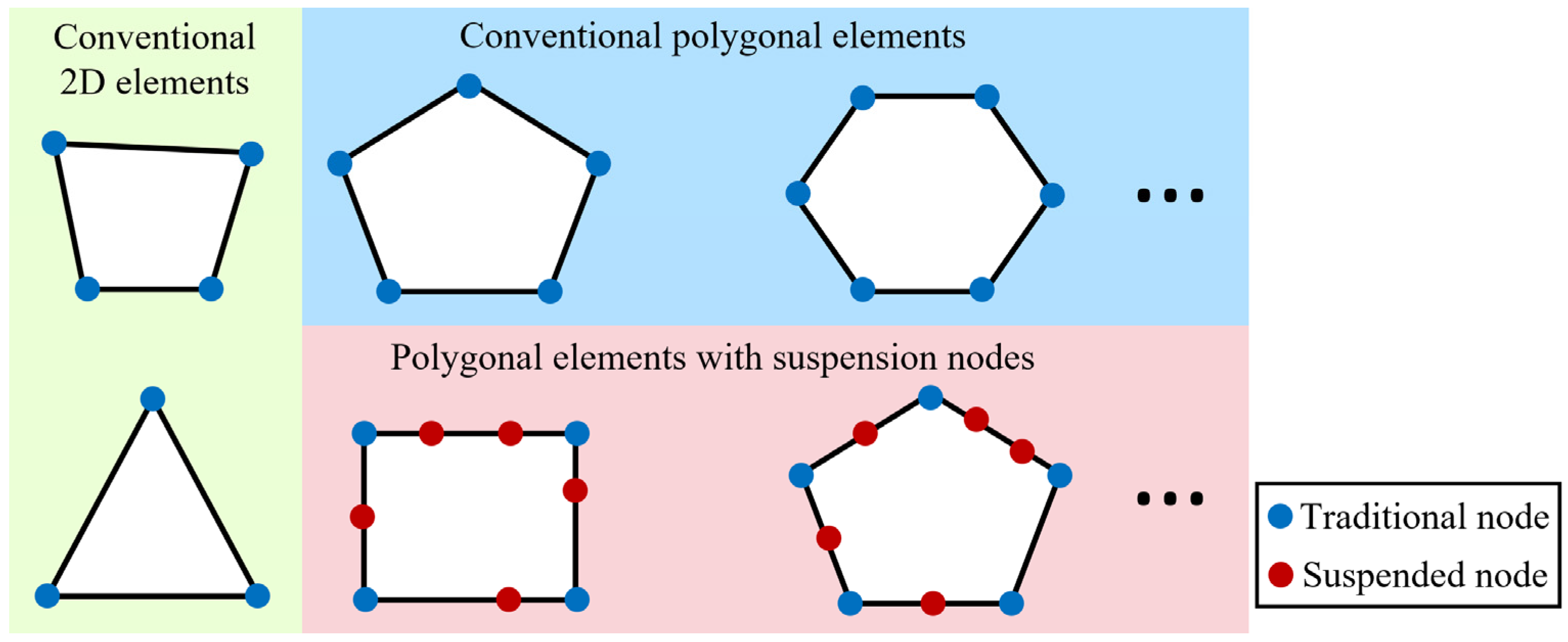
Building upon the foundational principles of the SBFEM, the authors developed the nonlinear scaled boundary polygon finite element method (NSBPFEM). The NSBPFEM retains boundary Gauss integration points while introducing additional internal Gauss integration points. The boundary Gauss integration points are used to compute correlation coefficient matrices and semi-analytical elastic shape functions. The internal Gauss integration points are employed to evaluate, through numerical integration, the element stiffness matrix that accounts for material nonlinearity. These element matrices are then assembled into the global stiffness matrix of the computational domain. Nonlinear equilibrium equations are solved using the Newton–Raphson iterative algorithm, thereby enabling a nonlinear analysis for polygonal elements. The NSBPFEM can solve conventional 2D elements, conventional polygonal elements, and polygonal elements with suspension nodes, as shown in
Figure 1.
It should be particularly noted that the coupled FEM-NSBPFEM was developed by the authors’ team in earlier work and is not a novel contribution of this paper. This method has been integrated into GEODYNA 8.0, a high-performance software system dedicated to geotechnical engineering analysis. The present study investigates the deformation behavior of waterproof joints in a CFRD founded on a deep overburden. In this project, the impermeable structures and stone columns have thicknesses on the order of only 1 m, and due to the critical nature of components such as the cutoff wall and connecting plates, mesh refinement is required. In contrast, the dam and overburden extend hundreds of meters. Discretizing the entire domain with a uniformly fine mesh would lead to prohibitive computational costs and severely compromise efficiency. Therefore, the coupled FEM-NSBPFEM model is adopted in this study. By enabling the solution of polygonal elements with hanging nodes, the NSBPFEM facilitates local mesh refinement around critical structures, thereby alleviating the conflict between computational accuracy and efficiency.
To facilitate readers’ understanding of the work in this paper, a brief introduction to the NSBPFEM is provided below. Detailed theoretical derivations and accuracy verification can be found in references [
23,
34].
2.1. Scaled Boundary Polygon Finite Element Method
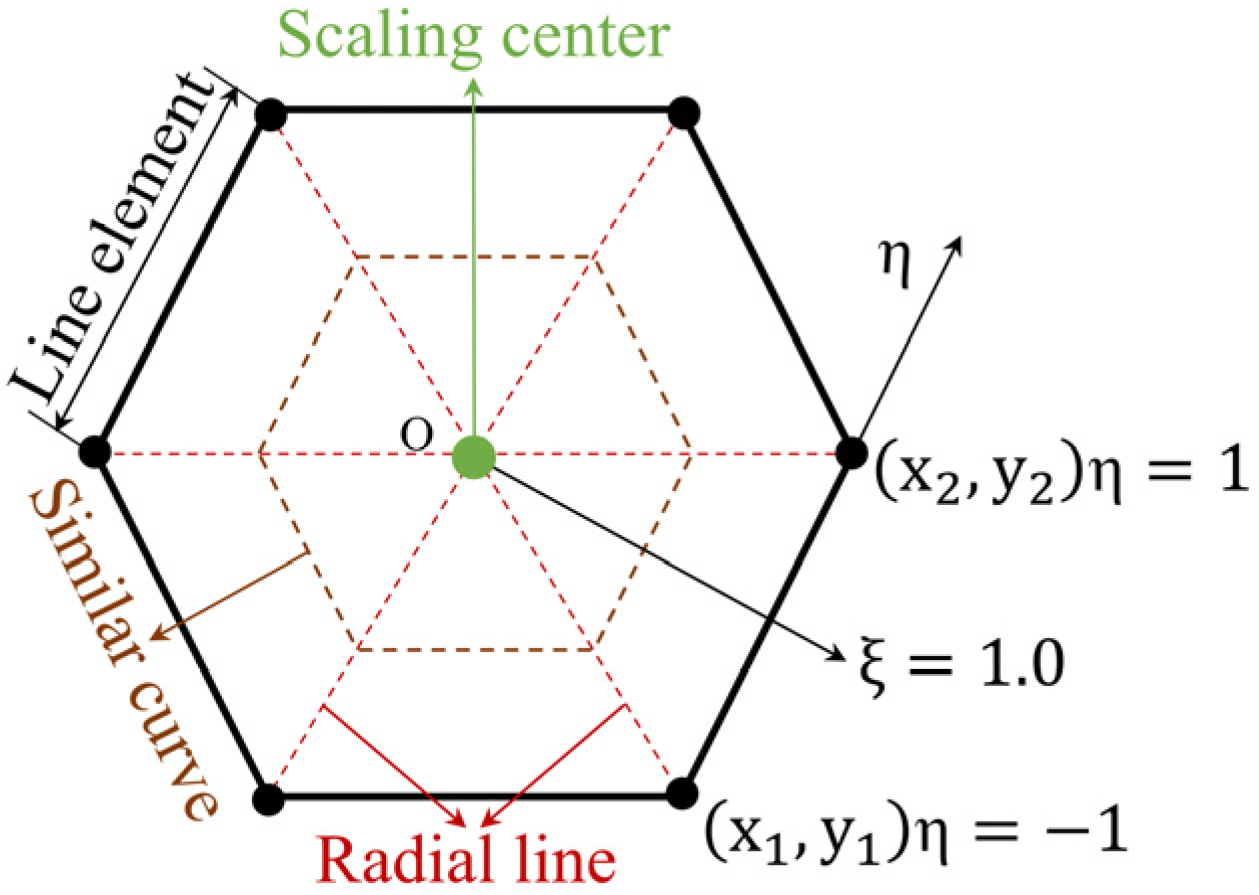
As shown in
Figure 2, a scaled boundary coordinate system
is established, with the geometric center
of the polygonal element as the scaling center. Here,
represents the radial coordinate (
, where
at the scaling center
and
on the boundary line);
represents the circumferential coordinate (
). To simplify coordinate transformation, the origin of the global coordinate system is placed at the scaling center
. After discretization, the coordinates (
,
of nodes on boundary line elements in the scaled boundary coordinate system can be expressed via one-dimensional shape function interpolation as:
In these equations, (, denote the coordinates of boundary nodes in the Cartesian coordinate system; is the linear element shape function, where is the number of linear element nodes. The order can be arbitrarily selected (using the standard one-dimensional GLL shape function). Since the element is only discretized at the boundary, increasing the shape function order does not complicate the mesh partitioning.
Through radial scaling, the coordinates (
,
) of any point within a triangular subdomain of the polygonal element in the scaled coordinate system can be expressed as:
For each triangular subdomain formed by the boundary line element and the line connecting the scaling center, the displacement field at any point can be expressed as:
In this equation,
is the radial displacement function connecting the scaling center to the boundary nodes, and
is the interpolation shape function for boundary line elements.
satisfies a second-order non-homogeneous partial differential equation:
In this equation, is a coefficient matrix related to material parameters and geometric shape; is the load vector; is the first derivative of ; and is the second derivative of .
The displacement function
of the polygonal element and the inter-node displacement transformation matrix
can be determined as follows:
In this equation,
denotes the diagonal matrix formed by the real parts of the negative eigenvalues of the Hamilton matrix
.
and
represent the transformation matrices corresponding to displacement and stress modes obtained through the eigenvalue decomposition of the Hamilton matrix
. The calculation formula is as follows:
2.2. Nonlinear Scaled Boundary Polygon Finite Element Method
The displacement field within the element is obtained through shape function interpolation, and the stiffness matrix for a single element is derived using the principle of virtual work. The extended equilibrium equation is:
In this equation, represents the stress increment, and denote the boundary tangential force and volumetric force, respectively, and corresponds to the virtual strain field associated with the virtual displacement field .
After obtaining the stiffness matrix for a single element, the stiffness matrix for the computational domain is assembled through degrees of freedom. The core of solving the stiffness matrix involves determining the elastoplastic constitutive matrix and the strain-displacement transformation matrix .
When solving nonlinear problems, the elastic–plastic constitutive matrix
is expressed in Cartesian coordinates as follows:
The coefficient matrix
is determined using least-squares curve fitting techniques [
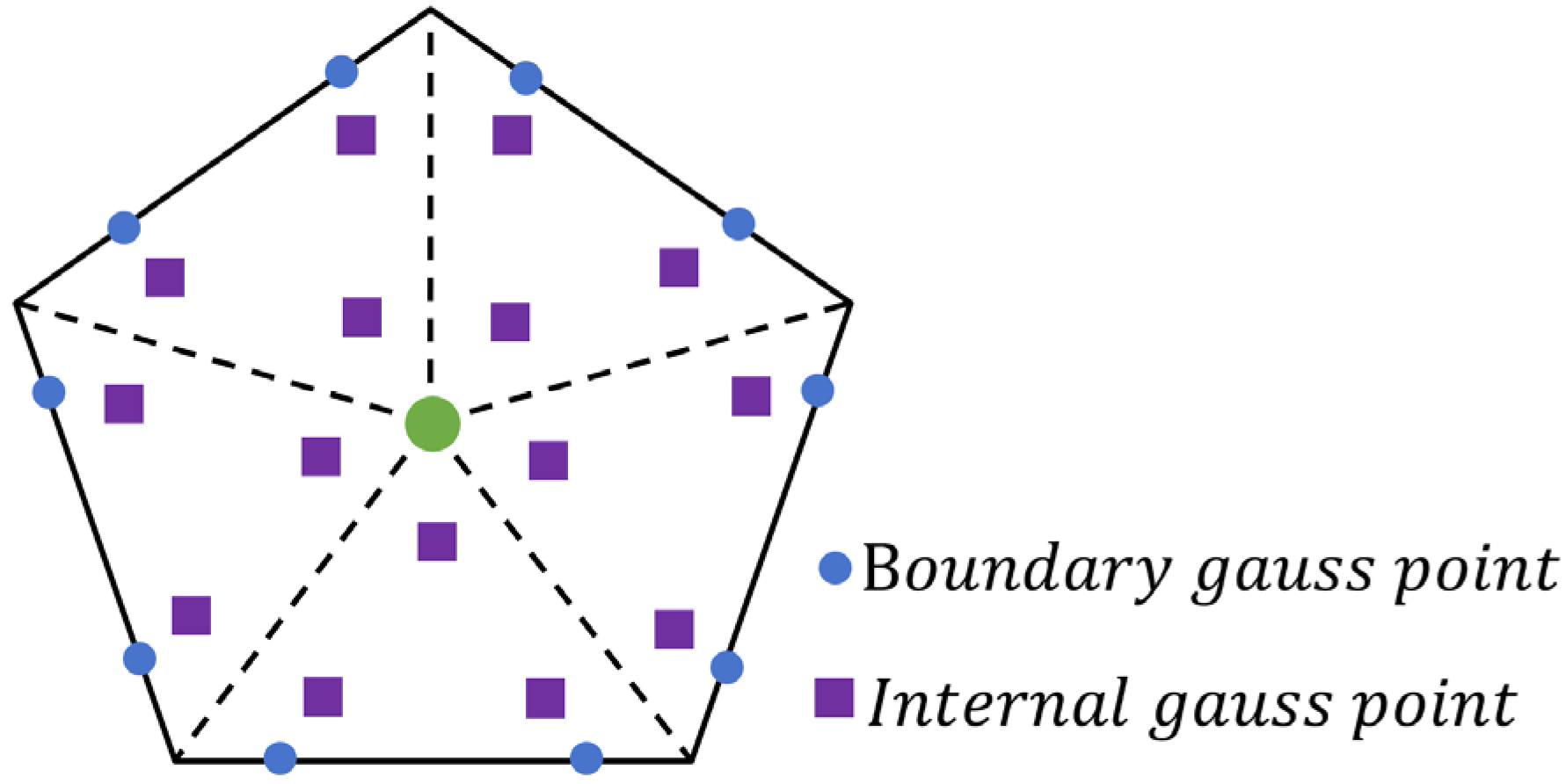
35]. To enhance accuracy, as shown in
Figure 3, three Gauss points are introduced within the triangular domain formed by the line element and the scaling center, enabling the application of the scaled boundary finite element method to nonlinear problems.
The expression for the integral of coordinates in a triangular region is:
In this equation,
denotes the coordinates of the triangle at the
-th Gauss point,
represents the area of triangle
,
is the number of Gauss points within each triangle, and
and
denote the weight and integration residual, respectively, as shown in
Table 2. The integration formula for the Gauss points in the triangular element of the NSBPFEM is:
For any n-sided polygon, the number of boundary Gauss points is 2
, and the number of internal Gauss points is 3
.
is obtained by calling the constitutive module of the finite element program; the element stiffness matrix
is solved by integrating over the internal Gauss points on each element as follows:
3. Numerical Analysis Model and Parameters of CFRD
3.1. Numerical Analysis Model of CFRD
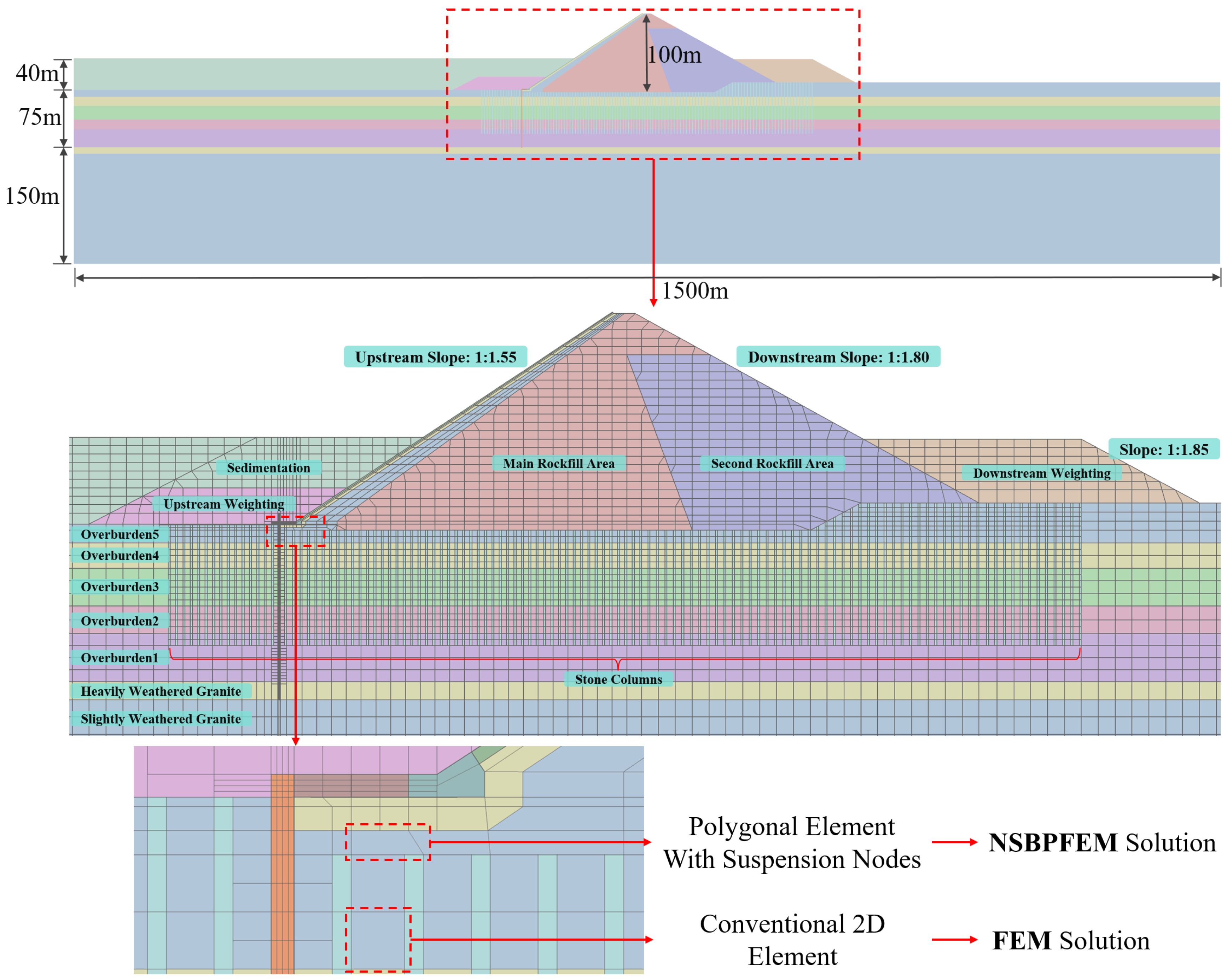
A numerical analysis model was established for a 100 m high concrete-faced rockfill dam (CFRD) founded on a deep overburden, as shown in
Figure 4. The model comprises 13,106 nodes and 12,690 elements, including 12,315 conventional 2D elements, 194 polyhedral elements with suspension nodes (1.53% of total elements), and 181 Goodman elements without thickness. In the numerical solution procedure, polyhedral elements with suspension nodes were solved using the NSBPFEM, while other element types employed the FEM.
The extent of the computational domain and the mesh size (
Figure 4) were determined in compliance with the specifications outlined in the “Guidelines for Finite Element Analysis of Hydropower Projects—Part 2: Embankment Dams” [
36]. The horizontal distance between upstream and downstream boundaries is 1500 m. Underlying the overburden is an 8.5 m thick layer of highly weathered granite, followed by 141.5 m of slightly weathered granite. The overburden is subdivided into five layers from top to bottom, with thicknesses of 9 m, 12 m, 18 m, 13 m, and 23 m, respectively. Stone columns are employed for ground improvement to a maximum reinforcement depth of 55 m, with a replacement ratio ranging from 0.25 to 0.29. The slopes of the dam’s upstream and downstream are 1:1.55 and 1:1.80, respectively. The slopes of both the upstream and downstream weighting zones are 1:1.85. The dam’s crest width is 10 m, and the normal reservoir water level is 7 m below the dam’s crest.
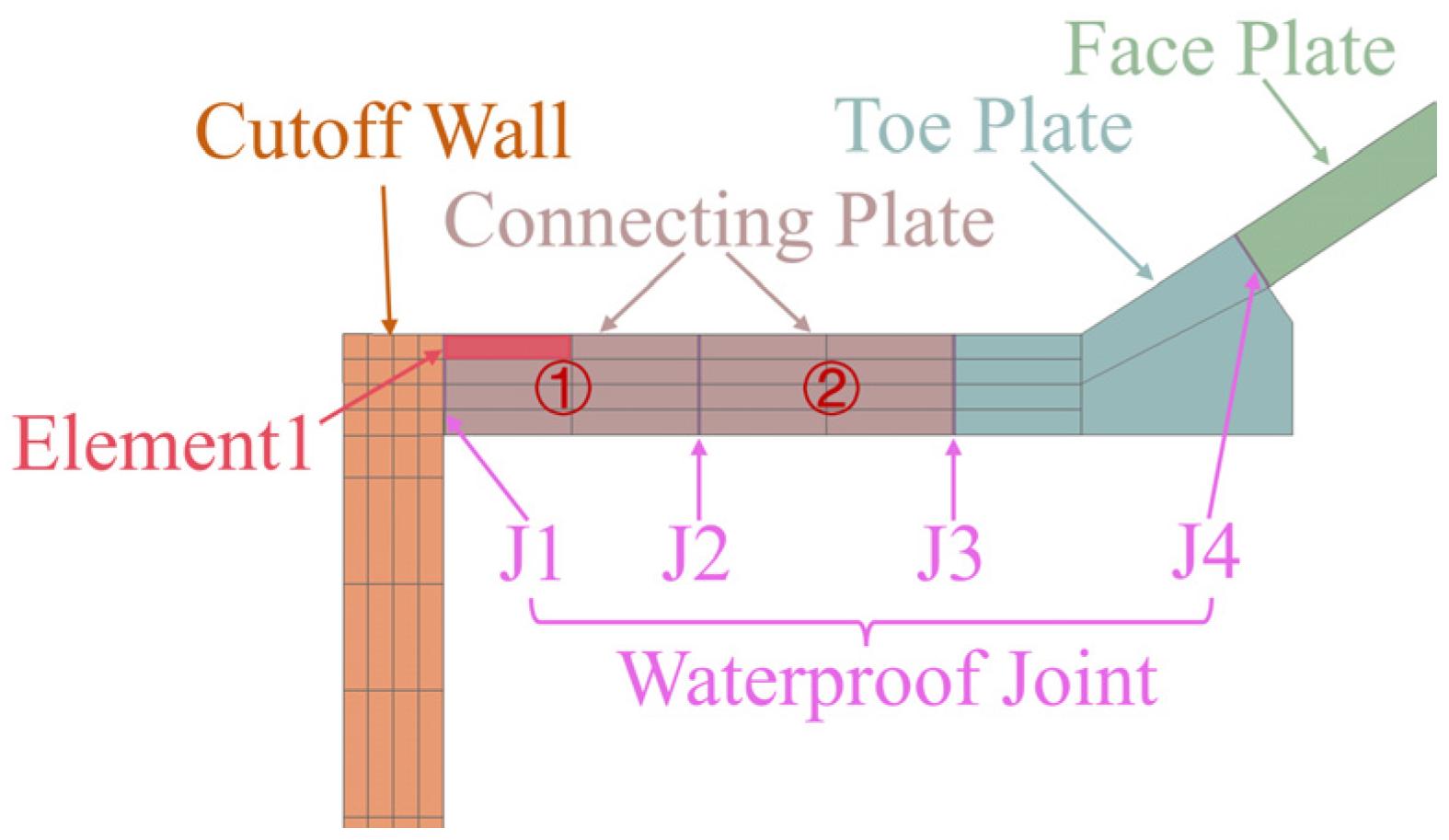
Details of the impermeable system are illustrated in
Figure 5. The thickness of the face plate follows the relationship
, where
is the vertical distance below the dam’s crest. The toe plate has a streamwise length of 4 m. Two connecting plates of identical dimensions, each 1.2 m thick and 3 m long in the streamwise direction, are placed between the toe plate and the cutoff wall. The cutoff wall itself is 1.2 m thick, with its base embedded 0.5 m into the highly weathered granite bedrock.
To more reasonably simulate the complex interfacial behavior, zero-thickness Goodman contact surface elements [
37] are implemented between the concrete impermeable structure and the soil mass. Additionally, zero-thickness Goodman joint elements are implemented at all construction joints within the concrete system (i.e., between the cutoff wall, connecting plates, toe plate, and face plate).
3.2. Material Parameters
The concrete impermeable structure (C35-grade concrete) and bedrock (heavily and slightly weathered granite) are modeled as linear elastic models in
Table 3. In the table,
denotes density;
represents the elastic modulus; and
indicates the Poisson ratio.
The soil materials, including overburden, rockfill, transition, bedding, weighting and stone columns, are characterized using an improved generalized plasticity model [
38,
39]. The model parameters, calibrated against relevant laboratory test data, are listed in
Table 4. In the table,
denotes the elastic shear modulus;
represents the elastic bulk modulus;
denotes the slope of the critical state line in the
plane;
represents the material constant;
is the plastic modulus coefficient;
is the initial unloading modulus; and
,
,
,
,
,
,
,
,
,
, and
are model parameters.
and
can be determined based on the initial slope of the stress–strain relationship curve under different confining pressures;
and
are determined by fitting the stress–strain relationship curves under different confining pressures; and
is determined based on cyclic loading tests. For the sedimentation, parameters were adopted from the literature [
40]: a saturated unit weight (
) of 7.8 kN/m
3 and an internal friction angle (
) of 12°.
The interaction between soil and concrete structures is simulated using the state-dependent generalized plastic contact model [
41]. The mechanical behavior of the waterproof joints between concrete components within the impermeable system is described by a hyperbolic model.
All the aforementioned constitutive models were implemented in GEODYNA 8.0. The validity and reliability of this software, integrating these models, have been demonstrated through analyses of several major high dams in China [
38,
39,
42,
43].
4. Results and Discussion
4.1. Research on the Deformation Patterns of Waterproof Joints
4.1.1. Upper Soil Load in Front of the Dam
Calculation Conditions
The primary soil loads on the upper section of CFRD impermeable structures consist of weighting and sedimentation. The weighting, constructed by the layered compaction of continuously graded soil material, serves auxiliary impermeability functions. Furthermore, its self-weight increases the initial stress within the dam foundation, thereby effectively suppressing potential liquefaction in the toe region and inhibiting plastic flow in the foundation soils. Engineering practice indicates that CFRDs over 100 m in height frequently incorporate such a weighting on the upstream side of the face plate [
44].
Meanwhile, reservoir sedimentation poses a challenge in China, with approximately 2% of reservoirs experiencing a capacity loss rate exceeding 60% [
19]. Typical cases include: the Haibowan Reservoir [
45], where sediment thickness in front of the dam reached 7–8 m after 30 years of operation; the Dashixia Reservoir [
46], with over 18 m of sediment accumulation upstream after 30 years of operation; and the Xinqiao Reservoir in Guizhou Province, which recorded a siltation rate of 80.0% [
47]. Sedimentation not only diminishes reservoir benefits, triggers ecological concerns, and reduces navigation capacity [
48,
49], but also directly threatens the safe operation of water conservancy projects through dam-front sedimentation [
50].
Upper soil loads increase vertical stress in the concrete impermeable structure, thereby adversely affecting the waterproof joints. To investigate this effect, five cases (
Table 5) were designed. These cases aim to elucidate the deformation characteristics of the waterproof joints, identify their vulnerable locations, and examine the influence of the magnitude of the upper soil load on joint deformation. For clarity of discussion, the simulation process is divided into three sequential periods: construction, impoundment, and sedimentation. Using Case 3 as a representative example, the load step configuration for each phase is outlined below:
(1) Construction Period (37 load steps): The dam body is placed layer by layer according to elevation. When the dam reaches half its height, the cutoff wall is cast [
51]. Following the completion of the dam crest, the face plate, connecting plates, and waterproof joints are constructed. Downstream weighting is placed concurrently with the dam body. Upstream weighting is placed layer by layer after the completion of the face plate, connecting plates, and waterproof joints.
(2) Impoundment Period (34 load steps): The reservoir water level is raised progressively from the foundation elevation to the normal reservoir water level. During this process, the presence and movement of pore water subject the upstream weighting to buoyant forces.
(3) Sedimentation Period (8 load steps): Sedimentation is simulated incrementally, with a uniform increase of 4 m per load step.
Deformation Analysis of Waterproof Joints
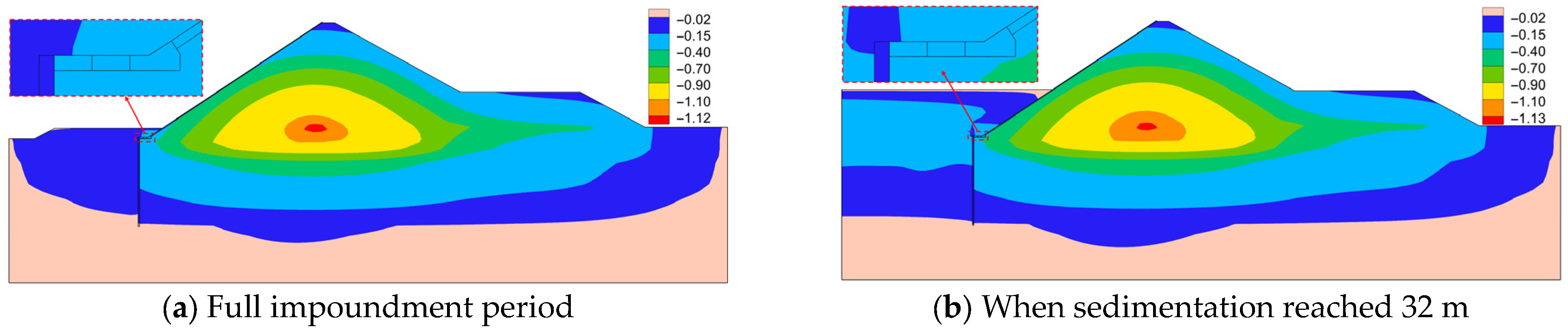
Figure 6a,b show the vertical settlement of the dam under Case 3 at the full impoundment period and when sedimentation reached 32 m, respectively. The results indicate that the maximum settlement during the full impoundment period occurred near the dam-foundation interface at the central dam axis, with a settlement of 1.12 m. This value corresponds to 0.64% of the total combined height of the dam (100 m) and the overburden (75 m).
The calculated settlement in this study is within a reasonable range when compared to field measurements from other CFRDs on deep overburdens. For instance, the recorded settlements for the Altash, Chahanwusu, and Hekou Village CFRDs are 0.78 m (0.36% of the combined height of the dam and overburden) [
52], 0.54 m (0.34%) [
53], and 1.10 m (0.67%) [
54], respectively.
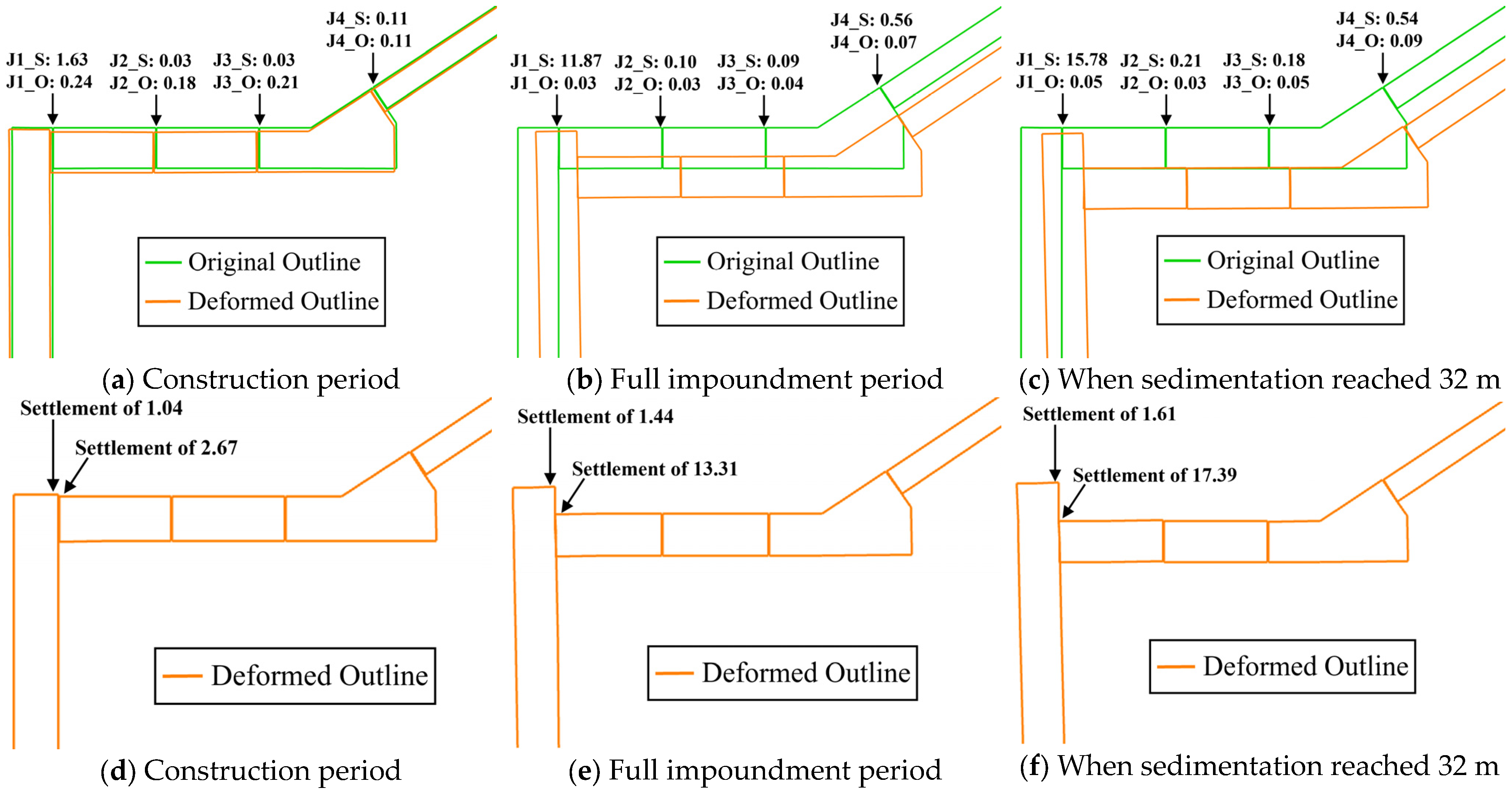
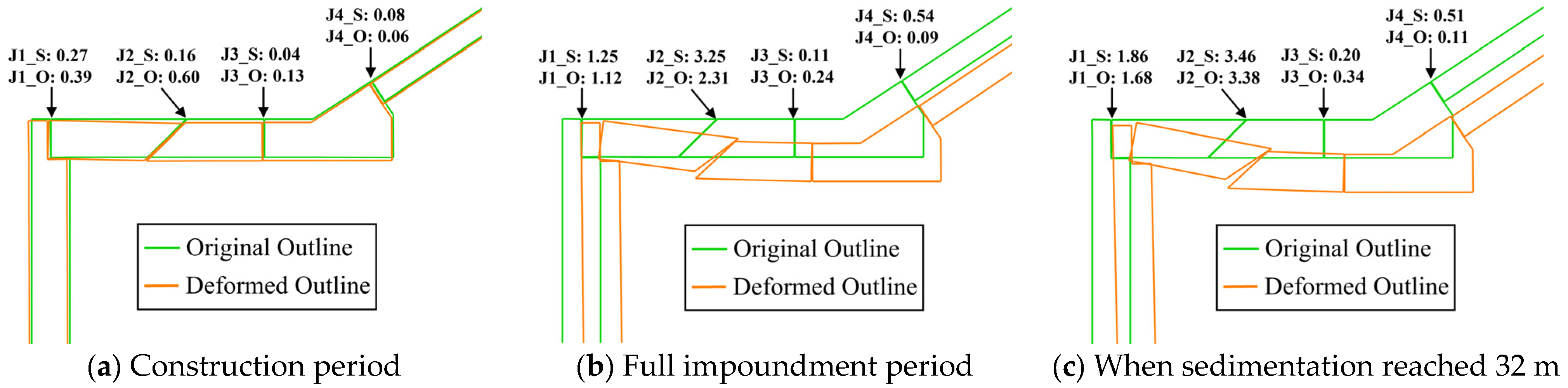
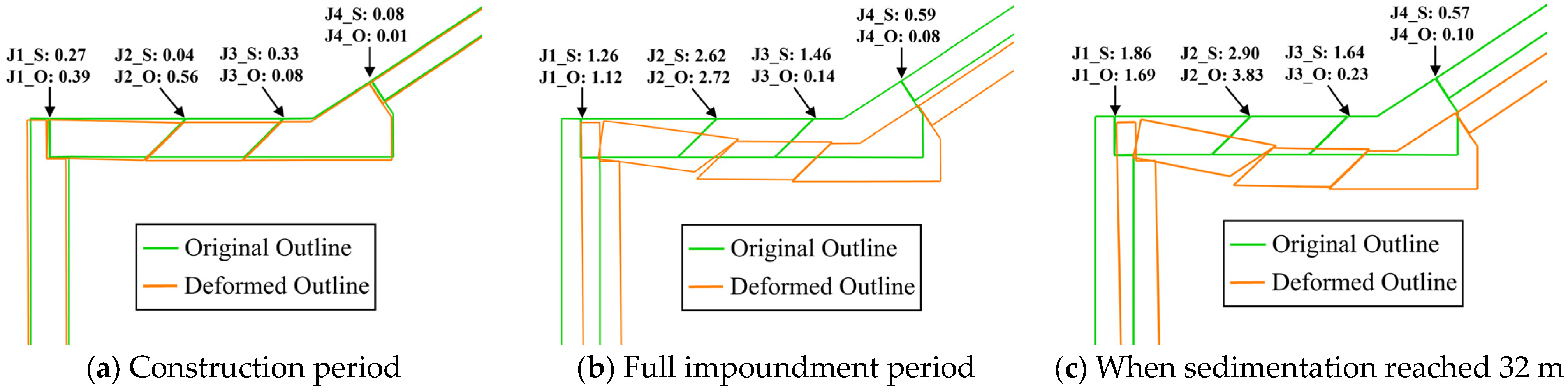
Figure 7a–c respectively illustrate the deformation characteristics of the concrete impermeable structure during the construction period, full impoundment period, and when sedimentation reaches 32 m under case 3. Analysis indicates that during all three periods, the open deformation of the impermeable structure remained minimal. The predominant response is vertical shear deformation, which is concentrated at the waterproof joint between the cutoff wall and the connecting plate ① (denoted as J1, see
Figure 5).
As shown in
Figure 6 and
Figure 7, the differential settlement is 11.87 cm at the full impoundment stage and increases to 15.78 cm when sedimentation reached 32 m. This deformation pattern originates from the differential settlement between the connecting plate and the cutoff wall.
The stiffness of the cutoff wall is hundreds of times greater than that of the overburden soil. Additionally, the closed cutoff wall is supported by the underlying bedrock. Prior to completion, influenced by dam body settlement and lateral soil friction, the settlement at the top of the cutoff wall reaches 1.04 cm. After impoundment, the restraint at the base of the cutoff wall and lateral soil friction mitigate its downward movement, resulting in a settlement increment of only 0.4 cm under a 93 m water head. In contrast, due to the low confining pressure and uniform distribution of the overburden beneath the connecting plate, the connecting plate undergoes significant uniform settlement together with the underlying overburden under hydrostatic pressure and upper soil loads. The settlement increment induced by water pressure reaches as high as 10.64 cm, which is 26.6 times that of the cutoff wall. Furthermore, during the sedimentation period, the settlement increment of the connecting plate reaches 4.08 cm, which is 24 times that of the cutoff wall. Given this mechanism, the subsequent analysis focuses on the shear deformation characteristics at joint J1.
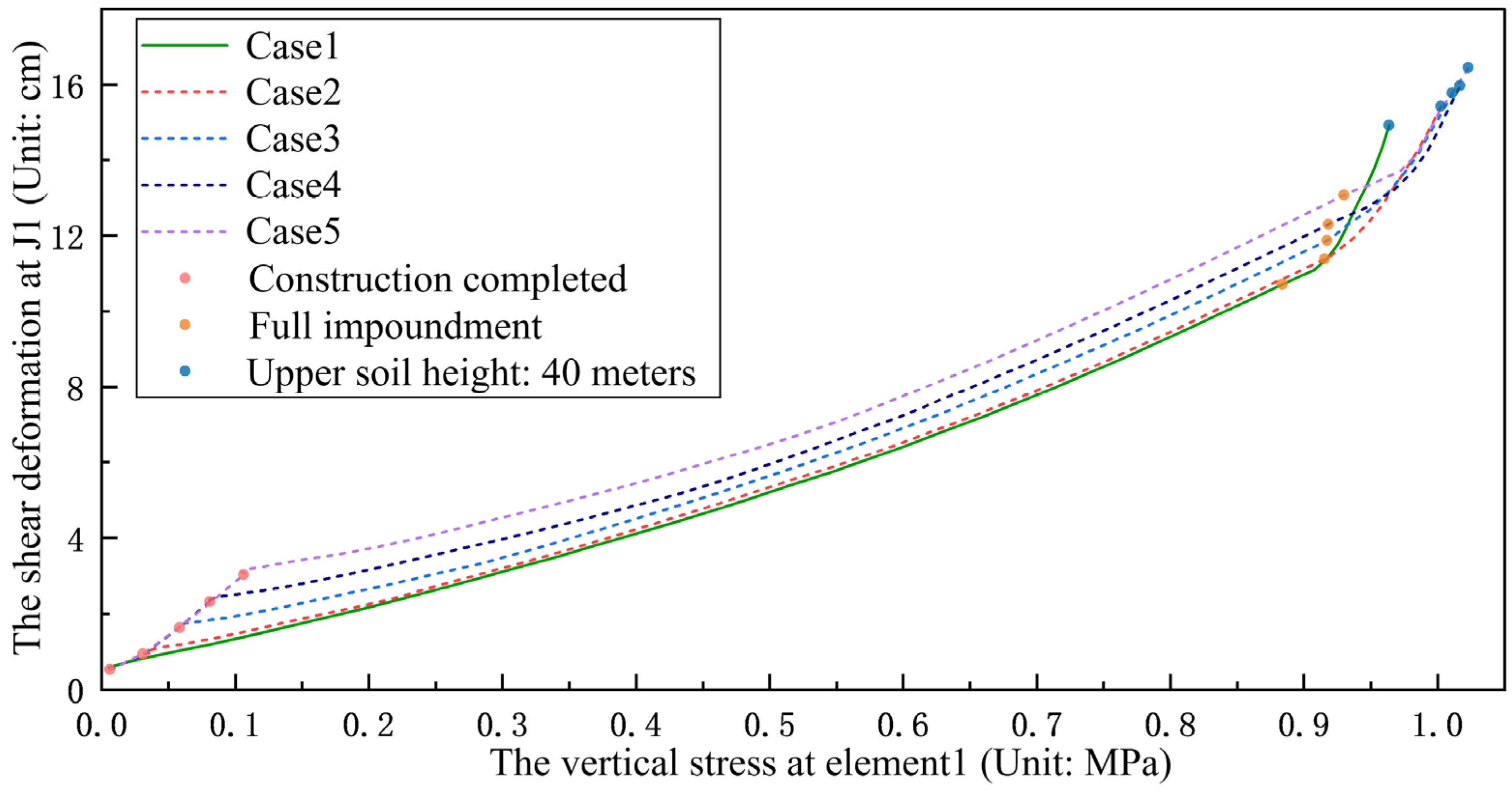
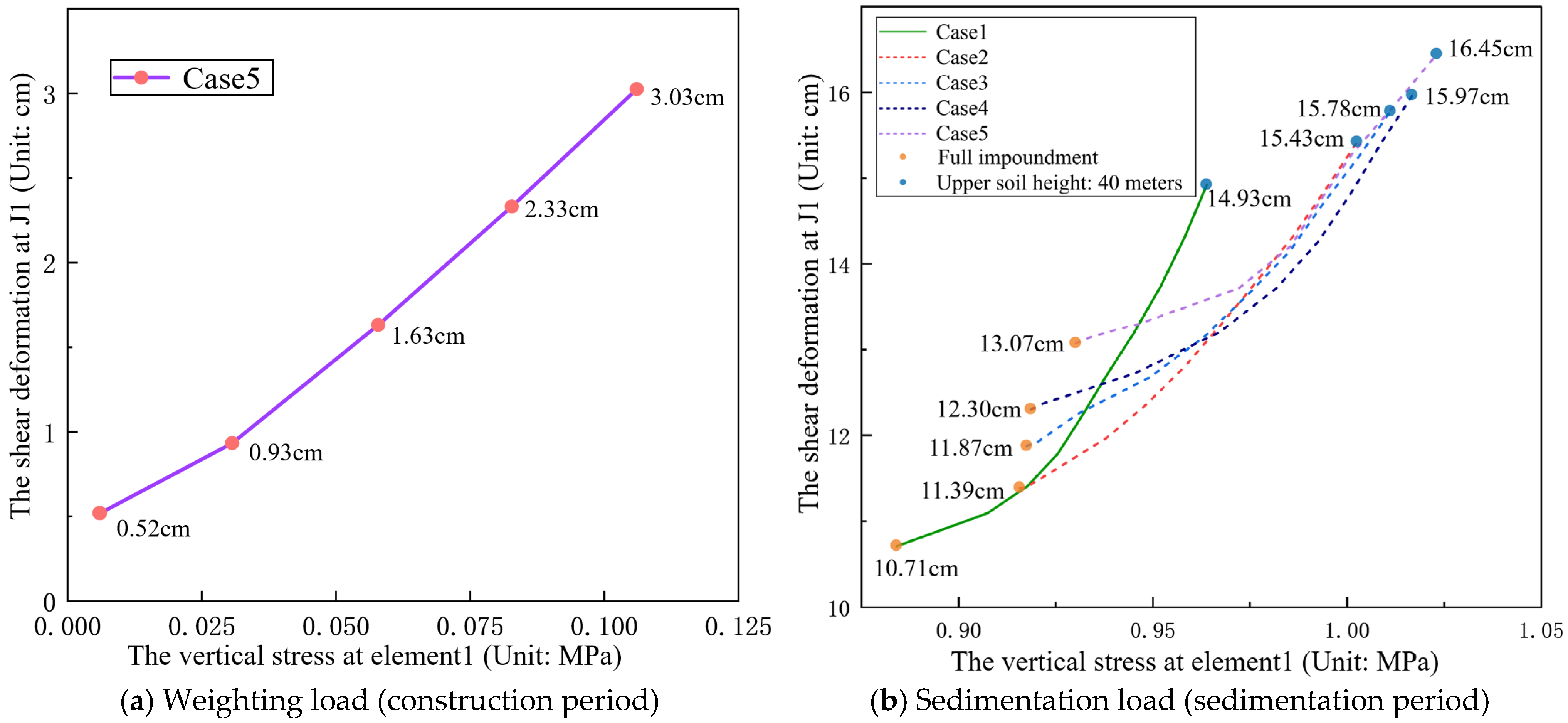
Figure 8 illustrates the development of shear deformation at J1 (J1_S) during the construction, impoundment, and sedimentation periods. The influences of the weighting load and the sedimentation load on J1_S are separately shown in
Figure 9a,b. The analysis of
Figure 8 and
Figure 9 yields the following observations:
(1) During the construction, impoundment, and sedimentation periods, the vertical stress at Element 1 (located at the top of the upstream side of connecting plate ①, see
Figure 5) shows an increasing trend with the J1_S curve (termed the E1_S&J1_S curve). The rate of increase in this curve induced by the upper soil loads (weighting load and sedimentation load) is greater than that caused by hydrostatic pressure.
(2) During the impoundment period, the slope of the E1_S&J1_S curve gradually increases with rising hydrostatic pressure, indicating a minor influence from hydrostatic pressure on this shear deformation.
(3) During the sedimentation period, as sediment load increases, the E1_S&J1_S curve initially follows the trend observed during impoundment. Subsequently, a distinct inflection point occurs where the curve slope increases sharply before eventually stabilizing. It is worth noting that the higher the initial weighting load, the greater the vertical stress at element 1 corresponding to the inflection point.
4.1.2. Design Plan for the Cutoff Wall
Calculation Cases
Concrete cutoff walls are a critical component of the impermeable structures for CFRDs on deep overburdens, characterized by low permeability and high strength [
55]. Cutoff walls are primarily designed in two types: closed and suspended. The closed cutoff wall is partially embedded in bedrock. Its base is thus constrained by the bedrock, while the wall body is subjected to earth pressure, hydrostatic pressure, and friction from the surrounding soil on both the upstream and downstream sides. In contrast, the suspended cutoff wall does not extend through the full thickness of the overburden and therefore lacks bedrock constraint at its base. An analysis by Zhu et al. [
56] of 26 CFRD projects worldwide incorporating cutoff walls revealed that 38.5% employed the suspended cutoff wall, often due to challenging geological conditions within the overburden.
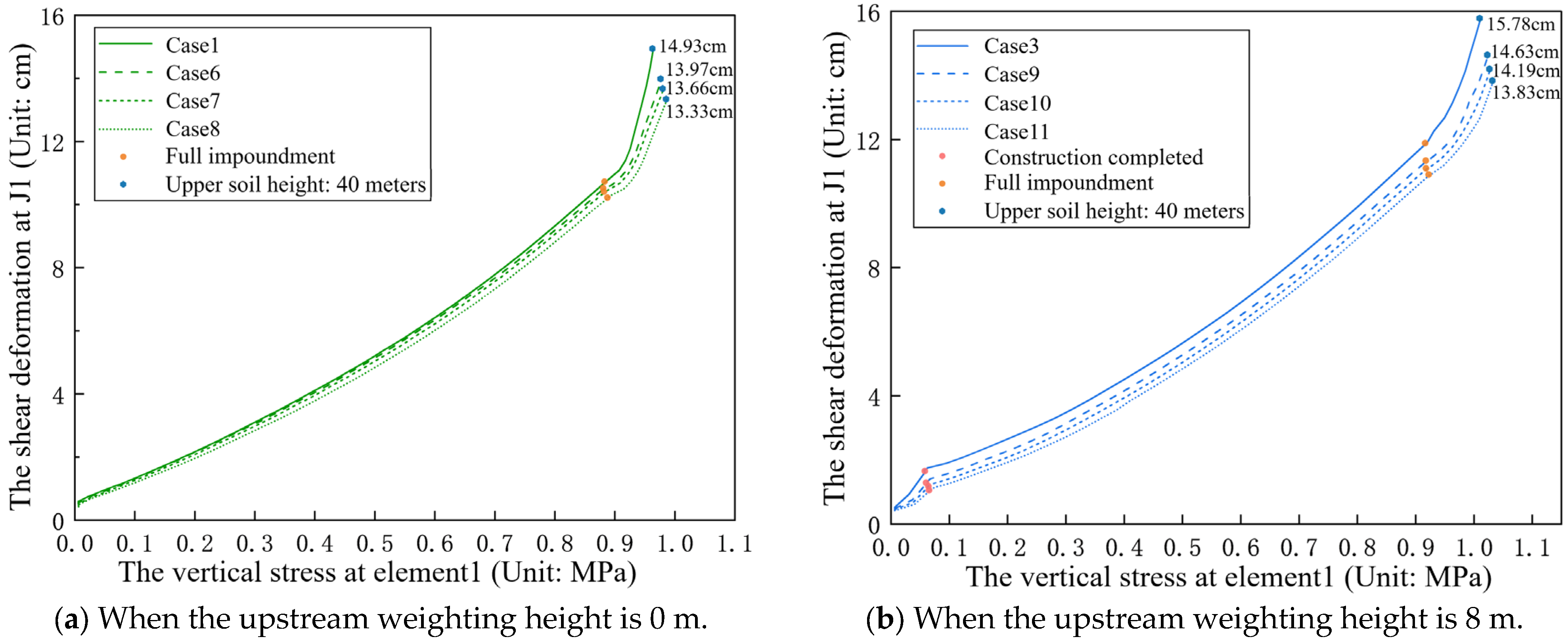
To systematically investigate the influence of the cutoff wall design on the shear deformation pattern at joint J1 (J1_S), six calculation cases were established (
Table 6). Cases 6–8 form the first comparison group, benchmarked against Case 1 (from
Table 5). Cases 9–11 constitute the second comparison group, benchmarked against Case 3 (from
Table 5).
4.2. Optimization of the Impermeable System Structure
4.2.1. Optimization Schemes
Numerical simulations from Cases 1 to 11 indicate that when the upper soil load from weighting and sedimentation reaches a height of 40 m, the shear deformation at joint J1 exceeds the allowable design limit of 8 cm for the waterproof joint [
13]. This critical deformation primarily originates from the differential vertical settlement between the connecting plate and the cutoff wall under these complex loading conditions. Consequently, to mitigate this differential settlement, this study proposes two optimization schemes for the impermeable system.
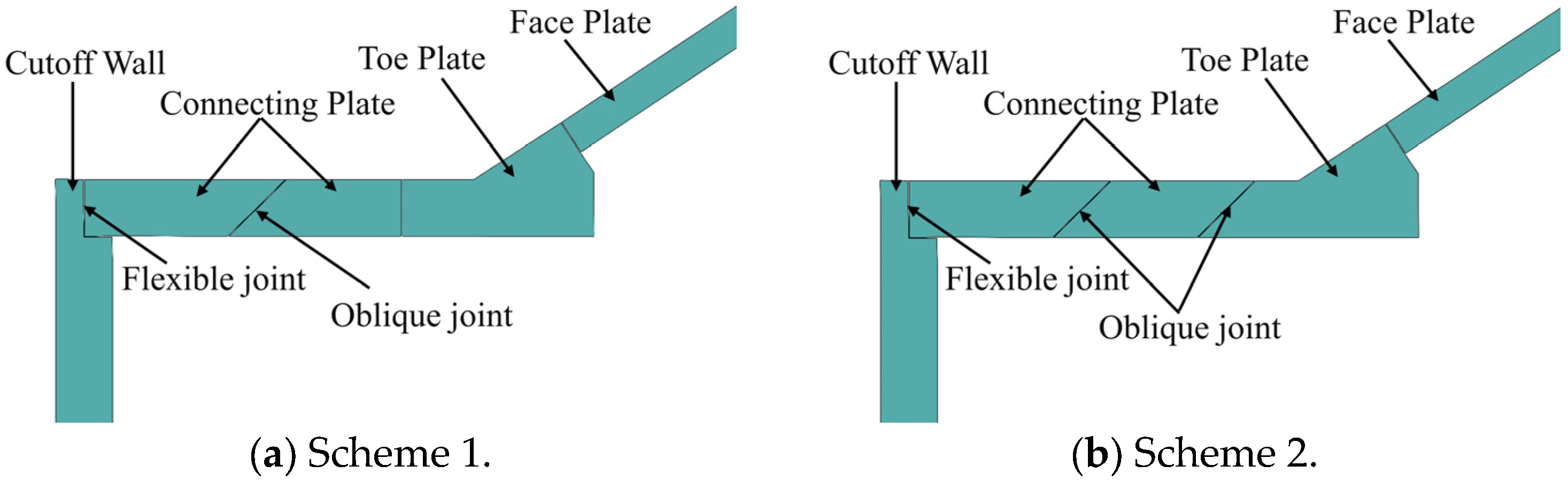
Scheme 1, illustrated in
Figure 11a, incorporates three modifications: (i) Extension of the connecting plate upstream to align with the centerline of the cutoff wall. This design allows the cutoff wall to provide direct support to the connecting plate, thereby converting a portion of the interfacial shear displacement into rotational displacement. (ii) Reconfiguration of the waterproof joint between the connecting plates from a vertical to a 45° oblique joint. This change enhances interfacial friction and improves deformation compatibility. (iii) Introduction of a flexible joint between the cutoff wall and the connecting plate to optimize the stress distribution within the cutoff wall.
Building upon Scheme 1, Scheme 2 (
Figure 11b) introduces an additional modification: the waterproof joint between the connecting plate and the toe plate is also redesigned as a 45° oblique joint. This further enhances the overall deformation coordination capability of the impermeable structures.
4.2.2. Comparative Analysis of the Optimization Schemes
Using Case 3 as the basis for comparison, the deformation characteristics of the waterproof joints in Schemes 1 and 2 are presented in
Figure 12 and
Figure 13, respectively. A comparison with
Figure 7 indicates that both optimized schemes reduce the shear deformation at joint J1 but lead to a concurrent increase in its opening deformation. Furthermore, these schemes induce greater shear and opening deformations in joints J2, J3, and J4. Despite these shifts, all deformation values remain within permissible limits.
Comparing the two schemes reveals that Scheme 2, which incorporates an oblique joint between the connecting plate and the toe plate, offers improved deformation coordination for the connecting plates. The modifications of the two schemes confine both the shear and opening deformations of the waterproof joints to within 4 cm.
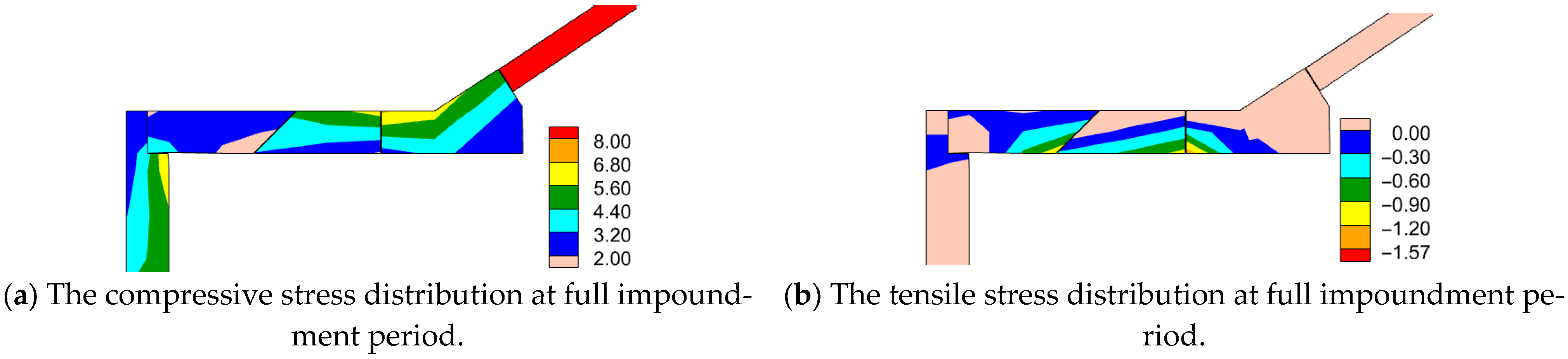
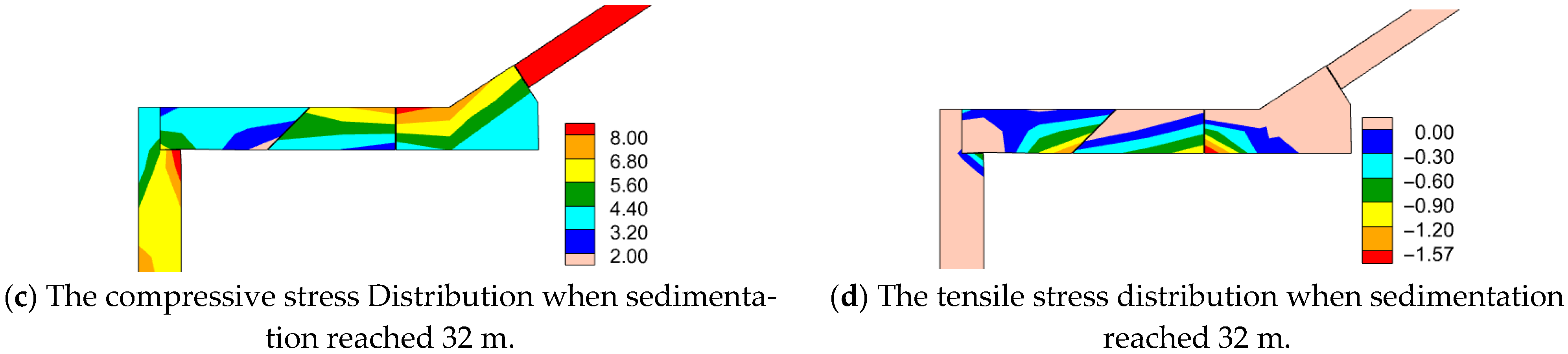
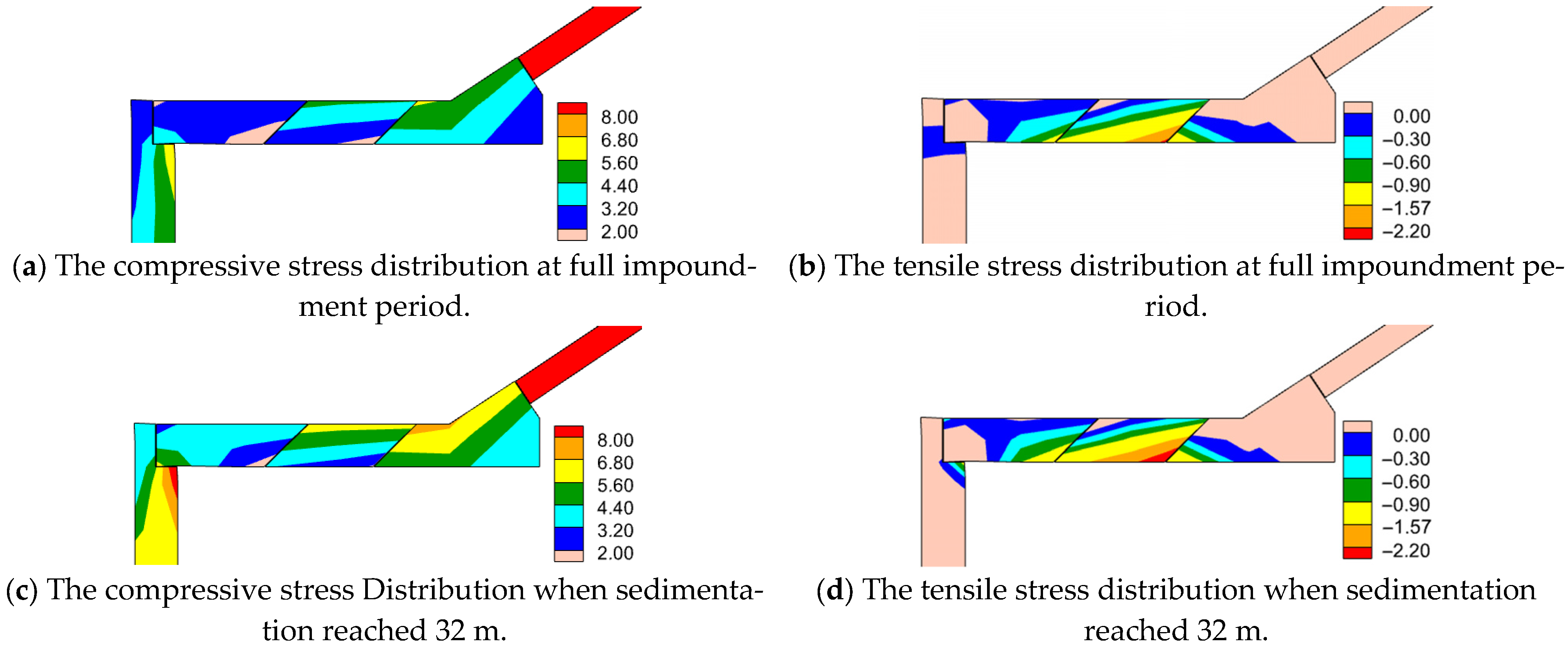
The stress distributions within the local impermeable structures for both schemes (
Figure 14 and
Figure 15) yield the following observations:
(1) During both the full impoundment phase and when sedimentation reached 32 m, the compressive stress at the local impermeable system remained below 16.7 MPa in both schemes. This 16.7 MPa represents the axial tensile design strength for C35 concrete.
(2) At full impoundment, tensile stresses in the connecting plates and toe plate of Scheme 1 are below 1.57 MPa (the axial tensile design strength for C35 concrete). In Scheme 2, however, the tensile stress in the downstream bottom region of the connecting plate, adjacent to the toe plate, exceeds this 1.57 MPa threshold.
(3) When sedimentation reached 32 m, the tensile stress at the upstream bottom of the toe plate in Scheme 1 exceeded 1.57 MPa. In Scheme 2, the tensile stress in the downstream bottom region of the connecting plate (near the toe plate) exceeds 1.57 MPa, with localized areas surpassing 2.20 MPa, which is the standard axial tensile strength of C35 concrete.
4.2.3. Comparison of Optimization Schemes
Based on the analysis of the joints’ deformation and structural stress, both optimized schemes successfully redistribute deformation. The concentrated shear at J1 is mitigated by sharing the deformation across multiple joints (J1, J2, J3, 4J). The schemes effectively control the magnitude of shear deformation at J1.
Schemes 1 and 2 each have their own advantages, with a quantitative comparison presented in
Table 7. Compared to Scheme 1, Scheme 2 provides superior control of shear deformation. However, this comes at the cost of inducing larger tensile stresses in the downstream bottom region of the connecting plate near the toe plate.
Therefore, Scheme 1 is recommended for projects where requirements for joint shear deformation control are moderate and construction simplicity is prioritized. Local tensile stresses in the toe plate can be managed by appropriately increasing longitudinal reinforcement. Scheme 2 is suitable for projects with stringent requirements for joint shear deformation control (e.g., very high sedimentation loads or seismic zones), where the additional cost and construction complexity are justified. However, the high tensile stresses at the bottom of the connecting plate near J3 necessitate substantial increases in longitudinal reinforcement, and may require a higher concrete grade or prestressing.
4.3. Discussion of Modeling Assumptions and Limitations
While the numerical analysis presented in this study provides valuable insights into the deformation behavior of waterproof joints in CFRDs founded on deep overburdens, it is necessary to critically discuss the key modeling assumptions and limitations.
(1) Two-dimensional plane-strain model: The current analysis is based on a two-dimensional plane-strain model, which assumes uniformity along the dam axis. This simplification is widely adopted in preliminary design and parametric analysis of CFRDs. However, three-dimensional effects—such as valley shape constraints, spatial variability of overburden properties, and abutment interactions—could influence the magnitude and distribution of joint deformations, particularly near the valley sides. Therefore, the joint deformations predicted in this study should be interpreted as representative of conditions near the maximum cross-section in wide valleys.
(2) Idealized joint constitutive laws: The hyperbolic model and Goodman interface elements used in this study to simulate the mechanical behavior of waterproof joints are widely applied in geotechnical engineering. However, these models idealize the complex mechanical behavior of real joints, which may involve progressive damage, material nonlinearity, and three-dimensional characteristics. Local effects such as joint rotation, material degradation, and eccentric loading could lead to deviations from the predicted deformation patterns. Nevertheless, the current modeling approach provides a consistent basis for comparative evaluation of the optimization schemes.
(3) Simplified loading history: The loading sequences considered in this study—construction, impoundment, and sedimentation—are simulated in staged increments with idealized step sizes. In reality, reservoir impoundment and sedimentation processes are gradual and may involve fluctuations. The static analysis presented herein provides guidance for identifying critical deformation patterns and comparing different design parameters. Dynamic effects or water level fluctuations are beyond the scope of this study and warrant separate investigation.
(4) Assumed sediment properties: Sediment properties are highly site-specific and time-dependent. The sediment parameters adopted in this study were calibrated based on the literature [
40]. While these values are reasonable for typical fine-grained sediments, actual sediment behavior—including consolidation, creep, and spatial heterogeneity—could affect the load transfer to the impermeable system.
(5) Time-dependent effects: Time-dependent material behavior is not fully considered in the current analysis. In reality, creep of rockfill and overburden, as well as consolidation of sediments, could induce additional long-term deformations that accumulate over time. Time-dependent effects may exacerbate joint displacements over the project lifespan.
5. Conclusions
Employing the coupled FEM-NSBPFEM framework within the GEODYNA 8.0 platform, this study conducts a nonlinear static analysis of concrete-faced rockfill dams (CFRDs) founded on deep overburden. The effects of upper soil loads (upstream weighting and sedimentation) and cutoff wall configurations on the deformation characteristics of J1 are systematically investigated across construction, impoundment, and sedimentation periods. Based on this analysis, two optimization schemes for the impermeable system are proposed. The principal findings are summarized as follows:
(1) Deformation Mechanism: Waterproof joint deformation is dominated by vertical shear, with minimal opening displacement. Significant differential settlement between the overburden beneath the connecting plate and the cutoff wall drives the concentration of shear deformation at J1.
(2) Impact of Upstream Soil Loads: Upper soil loads (upstream weighting and sedimentation) exert a significantly greater influence on J1 shear deformation than hydrostatic pressure. While the weighting load has a smaller effect on the shear pattern during impoundment, increasing sedimentation loads cause the shear deformation to initially mirror impoundment trends before undergoing a sharp surge. This abrupt amplification is exacerbated by higher initial upstream weighting loads.
(3) Sensitivity to Cutoff Wall Configuration: For a fixed embedment depth difference of 5 m, shear deformation at J1 varies markedly between closed and suspended cutoff wall designs (a difference of ~1.0 cm). In contrast, variations among different suspended wall configurations with the same depth difference are minor (~0.4 cm), indicating lower sensitivity to depth changes within the suspended cutoff wall.
(4) System Optimization: By extending the connecting plate to the cutoff wall centerline, reorienting vertical joints to 45° oblique angles, and incorporating flexible joint elements, interface friction and structural compatibility are significantly enhanced. These modifications effectively constrain both the shear and opening displacements at critical joints to within 4.0 cm, ensuring the safety and reliability of the impermeable system.
Future research will prioritize the dynamic response characteristics of waterproof joints within the impermeable system. Key investigations will focus on the effects of stone column area replacement ratios and their spatial configurations, alongside the influence of varying seismic intensity levels on joint deformation. Furthermore, by coupling Concrete Damage Plasticity (CDP) models with generalized soil plasticity frameworks, the progressive failure mechanisms of concrete impermeable structures under seismic loading will be unraveled. This work is expected to establish a robust theoretical foundation for the seismic safety assessment of such critical infrastructures. Additionally, a deeper interpretation of joint deformation mechanisms through the lens of advanced constitutive theory will be provided, bridging the gap between microscopic material behavior and macroscopic structural performance.
Author Contributions
Conceptualization, B.L., F.W. and K.C.; Data curation, B.L. and Z.Z.; Formal analysis, F.W. and T.W.; Funding acquisition, K.C.; Investigation, F.W. and T.W.; Methodology, K.C.; Project administration, K.C.; Resources, K.C.; Software, B.L., F.W. and K.C.; Supervision, K.C.; Validation, B.L. and F.W.; Visualization, T.W.; Writing—original draft, B.L.; Writing—review and editing, K.C. All authors have read and agreed to the published version of the manuscript.
Funding
This research was funded by the National Natural Science Foundation of China, grant number 52350393.
Data Availability Statement
The original contributions presented in this study are included in this article. Further enquiries can be directed to the corresponding author.
Conflicts of Interest
Author Feng Wang is employed by POWERCHINA Chengdu Engineering Corporation Limited. The remaining authors declare that the research was conducted in the absence of any commercial or financial relationships that could be construed as a potential conflict of interest.
Abbreviations
The following abbreviations are used in this manuscript:
| CFRD | Concrete-faced Rockfill Dam |
| FEM | Finite Element Method |
| SBFEM | Scaled Boundary Finite Element Method |
| NSBPFEM | Nonlinear Scaled Boundary Polygon Finite Element Method |
| J1 | Waterproof joint between the cutoff wall and connecting plate ① |
| J2 | Waterproof joint between connecting plate ① and connecting plate ② |
| J3 | Waterproof joint between connecting plate ② and the toe plate |
| J4 | Waterproof joint between the toe plate and the face plate |
| J1_S | The shear deformation at J1 |
| J1_O | The open deformation at J1 |
References
- Zheng, X.; Ren, T.; Lv, F.; Wang, Y.; Zheng, S. Settlement Prediction for Concrete Face Rockfill Dams Considering Major Factor Mining Based on the HHO-VMD-LSTM-SVR Model. Water 2024, 16, 1643. [Google Scholar] [CrossRef]
- Raggi, F.; Altarejos-García, L. A Visco-Elasto-Plastic Constitutive Law for Deformation Prediction of High Concrete Face Rockfill Dams. Appl. Sci. 2024, 14, 10535. [Google Scholar] [CrossRef]
- Khalid, M.I.; Park, D.; Fei, J.B.; Nguyen, V.; Nguyen, D.D.; Chen, X.S. Selection of efficient earthquake intensity measures for evaluating seismic fragility of concrete face rockfill dam. Comput. Geotech. 2023, 163, 105721. [Google Scholar] [CrossRef]
- Ma, B.; Zhang, W.; Shen, Z.; Zhou, D.; Yao, H.; Wang, R. Identification of Sensitive Parameters for Deformation of Asphalt Concrete Face Rockfill Dam of Pumped Storage Power Station. Water 2022, 14, 2634. [Google Scholar] [CrossRef]
- Yu, X.; Lai, Y.P.; Qu, Y.Q.; Wang, Y.K.; Li, M.H. Study on seismic wave propagation regularity and dam-foundation interaction characteristics of earth-rock dam on deep overburden. Comput. Geotech. 2023, 164, 105803. [Google Scholar] [CrossRef]
- Lin, M.L.; Chung, C.F.; Jeng, F.S.; Yao, T.C. The deformation of overburden soil induced by thrust faulting and its impact on underground tunnels. Eng. Geol. 2007, 92, 110–132. [Google Scholar] [CrossRef]
- Gan, L.; Shen, X.; Zhang, H. New deformation back analysis method for the creep model parameters using finite element nonlinear method. Clust. Comput. 2017, 20, 3225–3236. [Google Scholar] [CrossRef]
- Deng, M.J. Advances in key technology for concrete face dams with deep overburden layers under cold and seismic conditions. Chin. J. Geotech. Eng. 2012, 34, 985–996. (In Chinese) [Google Scholar]
- Xing, J.Y.; Guan, Z.C.; Lu, X.L. Overburden treatment for concrete face rockfill dams and its application in Hekoucun project. Chin. J. Geotech. Eng. 2020, 42, 1368–1376. (In Chinese) [Google Scholar]
- Chen, K.K.; Chen, Y.F.; Yu, H.; Hu, R.; Yang, Z.B. Optimized Control of Seepage and Deformation in a Dam Foundation on Thick Overburden Deposits Considering Coupled Hydromechanical Effects. Int. J. Geomech. 2025, 25, 04025158. [Google Scholar] [CrossRef]
- Wang, K.; Tang, H.J.; Wang, R.; Zhang, J.M. Development and evaluation of a practical nonlinear elastic constitutive model for rockfill dam deformation simulation based on monitoring results. Acta Geotech. 2024, 19, 3467–3485. [Google Scholar] [CrossRef]
- Wen, X.Y.; Xu, Z.P.; Shao, Y.; Lu, S.X. Study on seepage blocking structure in CFRD built on deep alluvium foundation. J. Hydraul. Eng. 2007, 38, 211–216. (In Chinese) [Google Scholar]
- Zou, D.G.; Liu, J.M.; Kong, X.J.; Chen, K.; Qu, Y.Q.; Ning, F.W.; Gong, J. Damage evolution mechanism and safety evaluation criterion of ultra-high rockfill dam system under strong earthquakes. Chin. J. Geotech. Eng. 2022, 44, 1329–1340. (In Chinese) [Google Scholar]
- Liu, S.H.; Wang, L.J.; Wang, Z.J.; Bauer, E. Numerical stress-deformation analysis of cut-off wall in clay-core rockfill dam on thick overburden. Water Sci. Eng. 2016, 9, 219–226. [Google Scholar] [CrossRef]
- Pan, Y.; He, Y.L.; Zhou, X.X.; Cao, X.X. Analysis of effect of canyon terrain on stress and displacement of cutoff wall in dam foundation with deep overburden. Rock Soil Mech. 2013, 34, 2023–2030. (In Chinese) [Google Scholar]
- Yu, X.; Kong, X.J.; Zou, D.G.; Zhou, Y.; Hu, Z.Q. Linear elastic and plastic-damage analyses of a concrete cut-off wall constructed in deep overburden. Comput. Geotech. 2015, 69, 462–473. [Google Scholar] [CrossRef]
- Zou, D.G.; Qu, Y.Q.; Kong, X.J.; Chang, Z.Y.; Liu, J.M.; Cheng, K. Deformation mechanism and optimization analysis on joints between cutoff wall and connection plates of CFRD on ultra-deep overburden layer. J. Southeast Univ. (Nat. Sci. Ed.) 2024, 54, 1089–1096. (In Chinese) [Google Scholar] [CrossRef]
- Wu, G. Study and application of anti -seepage technique in deep overburden foundation of CFRD. Yangtze River 2012, 43, 23–25. (In Chinese) [Google Scholar]
- Deng, A.J.; Chen, J.G.; Hu, H.H.; Zhang, G.S. Analysis of reservoir siltation in China. J. Hydraul. Eng. 2022, 53, 325–332. (In Chinese) [Google Scholar]
- Liu, H.X.; Guo, C.; Xiao, L.L.; Liu, P.; Du, J.Z.; Yi, Y.J. Estimating over Thousands of Reservoirs Sedimentation and Effects on Sediment Flux through a Newly Proposed Sediment Transport Model. Eng. Appl. Comp. Fluid Mech. 2025, 19, 2521825. [Google Scholar] [CrossRef]
- Lyu, Y.N.; Chen, X.; Tang, J.B.; Cui, L.S.; Liu, Z.Q. Application assessment of hybrid smoothed finite element method for geotechnical deformation and stability analysis. J. Cent. South Univ. 2023, 30, 919−933. [Google Scholar] [CrossRef]
- Soghrati, S.; Nagarajan, A.; Liang, B.W. Conforming to interface structured adaptive mesh refinement: New technique for the automated modeling of materials with complex microstructures. Finite Elem. Anal. Des. 2017, 125, 24–40. [Google Scholar] [CrossRef]
- Wolf, J.P.; Song, C.M. The scaled boundary finite-element method—A primer: Derivations. Comput. Struct. 2000, 78, 191–210. [Google Scholar] [CrossRef]
- Song, C.M. A matrix function solution for the scaled boundary finite-element equation in statics. Comput. Meth. Appl. Mech. Eng. 2004, 193, 2325–2326. [Google Scholar] [CrossRef]
- Song, C.M.; Ooi, E.T.; Pramod, A.L.N.; Natarajan, S. A novel error indicator and an adaptive refinement technique using the scaled boundary finite element method. Eng. Anal. Bound. Elem. 2018, 94, 10–24. [Google Scholar] [CrossRef]
- Du, C.B.; Huang, W.C.; Ghaemian, M.; Jiang, S.Y.; Zhao, Z.W. New nonlocal multiscale damage model for modelling damage and cracking in quasi-brittle materials. Eng. Fract. Mech. 2023, 277, 108927. [Google Scholar] [CrossRef]
- Zhuo, Y.; Zou, D.G.; Chen, K.; Qu, Y.Q.; Yi, G.Y.; Tian, S.L. Improved double-phase-field algorithm based on scaled boundary finite element method for rock-like materials. Theor. Appl. Fract. Mech. 2025, 138, 104916. [Google Scholar] [CrossRef]
- Zhang, P.; Du, C.B.; Zhao, W.H.; Jiang, S.Y.; Gong, N.; Bourahla, N.; Qi, Z.Y. An adaptive SBFEM based on a nonlocal macro/meso damage model for fracture simulation of quasibrittle materials. Eng. Fract. Mech. 2024, 312, 110601. [Google Scholar] [CrossRef]
- Lugovtsova, Y.; Bulling, J.; Boller, C.; Prager, J. Analysis of Guided Wave Propagation in a Multi-Layered Structure in View of Structural Health Monitoring. Appl. Sci. 2019, 9, 4600. [Google Scholar] [CrossRef]
- Ren, Y.F.; Zhang, G.L.; Zhang, J.Q.; Zhao, M.; Du, X.L. An open-source ABAQUS UEL implementation of SBPML for wave problems. Soil Dyn. Earthq. Eng. 2025, 190, 109211. [Google Scholar] [CrossRef]
- Zhang, J.Q.; Wang, P.G.; Zhao, M.; Liu, L.; Qu, Y.L.; Du, X.L. A scaled boundary finite element method for soil dynamic impedance of pile groups using hybrid quadtree mesh considering horizontal vibration. Eng. Anal. Bound. Elem. 2023, 153, 226–241. [Google Scholar] [CrossRef]
- Zhao, M.; Liu, P.C.; Zhang, J.Q.; Zhang, G.L.; Gao, Z.D.; Du, X.L. A direct time-domain FEM-SBFEM-SBPML method for soil-structure interaction analysis using quadtree mesh. Comput. Geotech. 2023, 161, 105597. [Google Scholar] [CrossRef]
- Chen, D.H.; Wang, M.; Dai, A.Q.; Peng, G. A high-order doubly asymptotic continued-fraction solution for frequency-domain analysis of vector wave propagation in unbounded domains. Soil Dyn. Earthq. Eng. 2018, 113, 230–240. [Google Scholar] [CrossRef]
- Chen, K.; Zou, D.G.; Kong, X.J.; Chan, A.; Hu, Z.Q. A novel nonlinear solution for the polygon scaled boundary finite element method and its application to geotechnical structures. Comput. Geotech. 2017, 82, 201–210. [Google Scholar] [CrossRef]
- Ooi, E.T.; Song, C.M.; Tin-Loi, F. A scaled boundary polygon formulation for elasto-plastic analyses. Comput. Meth. Appl. Mech. Eng. 2014, 268, 905–937. [Google Scholar] [CrossRef]
- NB/T 11559.2-2024; Guidelines for Finite Element Analysis of Hydropower projects—Part 2: Embankment Dams. National Energy Administration (NEA): Beijing, China, 2024.
- Goodman, R.E.; Taylor, R.L.; Brekke, T.L. A model for the mechanics of jointed rock. J. Soil Mech. Found. Div. 1968, 94, 637–659. [Google Scholar] [CrossRef]
- Xu, B.; Zou, D.G.; Liu, H.D. Three-dimensional simulation of the construction process of the Zipingpu concrete face rockfill dam based on a generalized plasticity model. Comput. Geotech. 2012, 43, 143–154. [Google Scholar] [CrossRef]
- Zou, D.G.; Xu, B.; Kong, X.J.; Liu, H.B.; Zhou, Y. Numerical simulation of the seismic response of the Zipingpu concrete face rockfill dam during the Wenchuan earthquake based on a generalized plasticity model. Comput. Geotech. 2013, 49, 111–122. [Google Scholar] [CrossRef]
- Pei, W.L.; Huang, Y.Q.; Liu, Y.R. Study on Anti-slide Effects of Gravity Dam Reinforcement Based on Strength Reduction FEM. Chin. J. Undergr. Space Eng. 2016, 12, 991–995. (In Chinese) [Google Scholar]
- Liu, J.M.; Zou, D.G.; Kong, X.J. A three-dimensional state-dependent model of soil–structure interface for monotonic and cyclic loadings. Comput. Geotech. 2014, 61, 166–177. [Google Scholar] [CrossRef]
- Yi, G.Y.; Zou, D.G.; Li, Y.H.; Chen, K.; Luo, X.; Gao, D.H. Application of high-accuracy cross-order algorithm in bending analysis of cutoff wall. Comput. Geotech. 2026, 190, 107744. [Google Scholar] [CrossRef]
- Yi, G.Y.; Zou, D.G.; Chen, K.; Zhang, M.L.; Pang, S.Y. A flexible solution for seepage problems integrating SBFEM and recursive polytree meshing. Eng. Anal. Bound. Elem. 2025, 179, 106389. [Google Scholar] [CrossRef]
- Fang, Z.Y.; He, J.Z.; Zhang, K.; Zhang, K.X. Stability analysis of upstream coverage zone of concrete face rockfill dam during sudden drawdown of reservoir level. Yellow River 2018, 40, 106–110. (In Chinese) [Google Scholar]
- Liu, X.; Wang, K.; Liu, T.; Wang, W. Operational Mode for Water–Sediment Regulation in Plain-Type Sand-Laden Reservoirs: A Case Study of the Haibowan Reservoir. Water 2024, 16, 747. [Google Scholar] [CrossRef]
- Xu, H.; Shang, Q.Q.; Wu, T. Study on Mathematical Model of Water and Sediment in front of the Dam under Multi-control Boundary Conditions. IOP Conf. Ser. Earth Environ. Sci. 2019, 304, 022008. [Google Scholar] [CrossRef]
- Deng, A.J.; Chen, J.G.; Hu, H.H.; Shi, H.L.; Liu, F. A Review of Reservoir Sedimentation Control and Storage Capacity Recovery. Yellow River 2019, 41, 1–5. (In Chinese) [Google Scholar]
- Li, Z.; Sun, Z.; Liu, J.; Dong, H.; Xiong, W.; Sun, L.; Zhou, H. Prediction of River Sediment Transport Based on Wavelet Transform and Neural Network Model. Appl. Sci. 2022, 12, 647. [Google Scholar] [CrossRef]
- Oladosu, S.O.; Ojigi, L.M.; Aturuocha, V.E.; Anekwe, C.O.; Tanko, R. An investigative study on the volume of Sedimentation in Tagwai dam reservoir using bathymetric and geostatistical analysis techniques. SN Appl. Sci. 2019, 1, 492. [Google Scholar] [CrossRef]
- Perera, D.; Williams, S.; Smakhtin, V. Present and Future Losses of Storage in Large Reservoirs Due to Sedimentation: A Country-Wise Global Assessment. Sustainability 2023, 15, 219. [Google Scholar] [CrossRef]
- Wen, L.F.; Cao, W.F.; Li, Y.L. Behavior of a concrete-face rockfill dam cutoff wall considering the foundation seepage–creep coupling effect. Int. J. Geomech. 2023, 23, 04023031. [Google Scholar] [CrossRef]
- Yuan, Y.; Yang, B.R.; He, S.X.; Guo, Y.Z. Safety monitoring scheme and initial impoundment analysis of Altashi Dam. Water Resour. Plan. Des. 2022, 12, 87–91. (In Chinese) [Google Scholar]
- Li, W.; Miao, Z. Stress and deformation analysis of Chahanwusu concrete face rockfill dam (CFRD)based on monitoring data. Hydro-Sci. Eng. 2012, 5, 30–35. (In Chinese) [Google Scholar]
- Xiong, C.L.; Deng, E.; Jiang, L. Analysis on the settlement deformation law of face rockfill dam based on deep overburden. J. China Inst. Water Resour. Hydropower Res. 2016, 14, 150–154. (In Chinese) [Google Scholar]
- Guo, C.; Lu, J.; Song, Z.; Li, H.; Zhang, W.; Li, Y. Durability Analysis of Concrete Cutoff Wall of Earth-Rock Dams Considering Seepage and Dissolution Coupling Effect. Water 2024, 16, 1590. [Google Scholar] [CrossRef]
- Zhu, L.S.; Sun, X.W.; Deng, J.C.; Wen, L.F.; Cao, W.F. Behavior of a concrete cutoff wall considering the foundation seepage-creep coupling effect. Hydro-Sci. Eng. 2025, 6, 162–174. (In Chinese) [Google Scholar] [CrossRef]
Figure 1.
Elements solvable by NSBPFEM.
Figure 1.
Elements solvable by NSBPFEM.
Figure 2.
Scaled boundary polygonal finite element.
Figure 2.
Scaled boundary polygonal finite element.
Figure 3.
The location of the Gauss points in NSBPFEM.
Figure 3.
The location of the Gauss points in NSBPFEM.
Figure 4.
Numerical analysis model of CFRD on deep overburden.
Figure 4.
Numerical analysis model of CFRD on deep overburden.
Figure 5.
The impermeable system.
Figure 5.
The impermeable system.
Figure 6.
Vertical settlement of dam body (unit: m; negative values indicate settlement).
Figure 6.
Vertical settlement of dam body (unit: m; negative values indicate settlement).
Figure 7.
Deformation pattern of the waterproof joints (magnified 5 times; unit: cm). J1_S denotes the shear deformation at J1; J1_O denotes the open deformation at J1. Same for J2, J3, and J4.
Figure 7.
Deformation pattern of the waterproof joints (magnified 5 times; unit: cm). J1_S denotes the shear deformation at J1; J1_O denotes the open deformation at J1. Same for J2, J3, and J4.
Figure 8.
J1 shear deformation (J1_S) patterns during the construction, impoundment, and sedimentation periods.
Figure 8.
J1 shear deformation (J1_S) patterns during the construction, impoundment, and sedimentation periods.
Figure 9.
The effect of upper soil load (weighting and sedimentation loads) on shear deformation at J1.
Figure 9.
The effect of upper soil load (weighting and sedimentation loads) on shear deformation at J1.
Figure 10.
The effect of cutoff wall design plans on shear deformation at J1.
Figure 10.
The effect of cutoff wall design plans on shear deformation at J1.
Figure 11.
Optimized schemes for the impermeable system.
Figure 11.
Optimized schemes for the impermeable system.
Figure 12.
Deformation pattern of the impermeable system for Scheme 1 (magnified 5 times; unit: cm).
Figure 12.
Deformation pattern of the impermeable system for Scheme 1 (magnified 5 times; unit: cm).
Figure 13.
Deformation pattern of the impermeable system for Scheme 2 (magnified 5 times; unit: cm).
Figure 13.
Deformation pattern of the impermeable system for Scheme 2 (magnified 5 times; unit: cm).
Figure 14.
Stress distribution in the local impermeable system of Scheme 1 (compression as positive; tension as negative. Unit: MPa).
Figure 14.
Stress distribution in the local impermeable system of Scheme 1 (compression as positive; tension as negative. Unit: MPa).
Figure 15.
Stress distribution in the local impermeable system of Scheme 2 (compression as positive; tension as negative. Unit: MPa).
Figure 15.
Stress distribution in the local impermeable system of Scheme 2 (compression as positive; tension as negative. Unit: MPa).
Table 1.
Basic information about CFRDs on deep overburdens in China [
7,
8,
9,
10,
11].
Table 1.
Basic information about CFRDs on deep overburdens in China [
7,
8,
9,
10,
11].
| Dam | Province | Completion Year | Maximum Dam
Height (m) | Overburden
Thickness (m) | Cutoff Wall Design Plan |
|---|
| Thickness (m) | The Depth of
Embedment
in Bedrock (m) 1 |
|---|
| Kekeya | Xinjiang | 1985 | 41.5 | 37.5 | 0.8 | 1.0 |
| Meixi | Zhejiang | 1998 | 40.0 | 30.0 | 0.8 | 0.5 |
| Hengshan | Zhejiang | 2003 | 70.2 | 72.3 | 0.8 | 0.5 |
| Hanpingzui | Gansu | 2005 | 57.0 | 45 | 0.8 | 1.0 |
| Naqu | Yunnan | 2005 | 109.0 | 24.3 | 0.8 | 0.5 |
| Chahanwusu | Xinjiang | 2008 | 110.0 | 46.70 | 1.2 | 1.0 |
| Jiudianxia | Gansu | 2008 | 133.0 | 56.0 | 1.2 | 0.8 |
| Laodukou | Hubei | 2009 | 96.6 | 30.0 | 0.8 | 1.0 |
| Miaojiaba | Gansu | 2011 | 111.0 | 50.0 | 1.2 | 0.5 |
| Dunuo | Sichuan | 2013 | 112.0 | 34.0 | 0.8 | 0.5 |
| Xieka | Sichuan | 2014 | 108.2 | 100.0 | 1.2 | 0.5 |
| Hekoucun | Henan | 2017 | 122.5 | 41.87 | 1.2 | 0.5 |
| Aertashi | Xinjiang | 2021 | 164.8 | 94.0 | 1.2 | 0.5 |
| Yingliangbao | Sichuan | 2024 | 39.0 | 120.0 | 1.0 | 0.0 |
| Jinchuan | Sichuan | Under construction | 112.0 | 65.0 | 1.2 | 1.0 |
| Gunhabuqilei | Xinjiang | Under construction | 160.0 | 50.0 | 1.2 | 0.5 |
Table 2.
Explanation of integration points within the triangular region.
Table 2.
Explanation of integration points within the triangular region.
| Location of the Gauss Points | Gauss Point | Coordinates of the Triangle | Weight |
|---|
 | a | | |
| b | | |
| c | | |
Table 3.
Parameters of the linear elasticity model.
Table 3.
Parameters of the linear elasticity model.
| Parameters | Granite | Concrete Impermeable Structures (C35) |
|---|
Heavily
Weathered | Slightly
Weathered | Cutoff Wall, Connecting Plate,
Toe Plate, Face Plate |
|---|
| 2400 | 2400 | 2400 |
| 10 | 5 | 31.5 |
| 0.19 | 0.23 | 0.167 |
Table 4.
Parameters of the improved generalized plasticity model.
Table 4.
Parameters of the improved generalized plasticity model.
| Parameters | Materials for Deep Overburden | Materials for Dam | Stone
Columns |
|---|
| 1 | 2 | 3 | 4 | 5 | Rockfill, Transition,
Bedding, Weighting |
|---|
| 1739 | 1667 | 1710 | 950 | 1742 | 2200 | 1684 |
| 800 | 500 | 800 | 500 | 800 | 2688 | 1389 |
| 700 | 450 | 700 | 450 | 700 | 3584 | 1230 |
| 1.68 | 1.45 | 1.68 | 1.45 | 1.68 | 1.75 | 1.62 |
| 1.3 | 1.2 | 1.3 | 1.2 | 1.3 | 1.38 | 1.30 |
| 0.3 | 0.3 | 0.3 | 0.3 | 0.3 | 0.40 | 0.12 |
| 0.3 | 0.3 | 0.3 | 0.3 | 0.3 | 0.45 | 0.12 |
| 800 | 750 | 800 | 350 | 800 | 1800 | 1250 |
| 800 | 750 | 800 | 350 | 800 | 1800 | 1250 |
| 0.50 | 0.50 | 0.50 | 0.50 | 0.50 | 0.50 | 0.43 |
| 0.50 | 0.50 | 0.50 | 0.50 | 0.50 | 0.50 | 0.43 |
| 0.50 | 0.50 | 0.50 | 0.50 | 0.50 | 0.20 | 0.43 |
| 0.50 | 0.50 | 0.50 | 0.50 | 0.50 | 0.20 | 0.40 |
| 10 | 10 | 10 | 10 | 10 | 5 | 10 |
| 15 | 15 | 15 | 15 | 15 | 7 | 20 |
| 5 | 5 | 5 | 5 | 5 | 2 | 5 |
| 40 | 30 | 40 | 30 | 40 | 15 | 20 |
| 0.025 | 0.02 | 0.025 | 0.02 | 0.025 | 0.015 | 0.015 |
Table 5.
Calculate cases 1–5.
Table 5.
Calculate cases 1–5.
| Cases | Upstream Weighting Height (m) | Sediment Height (m) | Cutoff Wall Design Plan |
|---|
| 1 | 0 | 0–40 | Closed 1 |
| 2 | 4 | 0–36 | Closed 1 |
| 3 | 8 | 0–32 | Closed 1 |
| 4 | 12 | 0–28 | Closed 1 |
| 5 | 16 | 0–24 | Closed 1 |
Table 6.
Calculation cases 6–11.
Table 6.
Calculation cases 6–11.
| Cases | Upstream Weighting
Height (m) | Sedimentation
Height (m) | Cutoff Wall
Height (m) | Cutoff Wall
Design Plan |
|---|
| 6 | 0 | 0–40 | 70 | Suspended |
| 7 | 0 | 0–40 | 65 | Suspended |
| 8 | 0 | 0–40 | 60 | Suspended |
| 9 | 8 | 0–32 | 70 | Suspended |
| 10 | 8 | 0–32 | 65 | Suspended |
| 11 | 8 | 0–32 | 60 | Suspended |
Table 7.
Quantitative comparison of optimization schemes against original design (when sedimentation reached 32 m).
Table 7.
Quantitative comparison of optimization schemes against original design (when sedimentation reached 32 m).
| Performance Indicator | Original Design
(Case 3) | Optimized Design
(Scheme 1) | Optimized Design
(Scheme 2) |
|---|
| J1 shear deformation (cm) | 15.78 | 1.86 | 1.86 |
| J1 opening deformation (cm) | 0.05 | 1.68 | 1.69 |
| Maximum shear deformation among waterproof joints (cm) | 15.78 (J1) | 3.46 (J2) | 2.90 (J2) |
| Maximum opening deformation among waterproof joints (cm) | 0.09 (J4) | 3.38 (J2) | 3.83 (J2) |
| Maximum tensile stress in connecting plate (MPa) | 0.00 | 1.20 | 2.20 |
| Maximum tensile stress in toe plate (MPa) | 0.30 | 1.57 | 1.00 |
| Reinforcement requirements for connecting plate and toe plate | Standard reinforcement | Moderate increase: additional longitudinal reinforcement at toe plate bottom | Substantial increase: significant additional longitudinal reinforcement at connecting plate bottom near J3 |
| Disclaimer/Publisher’s Note: The statements, opinions and data contained in all publications are solely those of the individual author(s) and contributor(s) and not of MDPI and/or the editor(s). MDPI and/or the editor(s) disclaim responsibility for any injury to people or property resulting from any ideas, methods, instructions or products referred to in the content. |