Next Article in Journal
Dual-Mode Adaptive AI Persona Recommendation for Blockchain Education: A Mixed-Method Evaluation of the PITL System Based on Dreyfus Competency Levels
Previous Article in Journal
Optimization Design and Experimental Testing of Sound Insulation Performance for Silent Cabins
 
 
Due to scheduled maintenance work on our servers, there may be short service disruptions on this website between 11:00 and 12:00 CEST on March 28th.
Article

Evaluation of Chemical and Mechanical Methods for the Control of Varroa destructor in Apis mellifera Colonies in a Semi-Arid Region of Mexico

by
María José Cárdenas Medrano
1,
Alexa Estefanía Gutiérrez Aréchiga
1,
Alvaro De la Mora
2 and
Carlos Aurelio Medina-Flores
1,*
1
Unidad Académica de Medicina Veterinaria y Zootecnia, Universidad Autónoma de Zacatecas, Zacatecas 98500, Mexico
2
Department of Veterinary Pathology, Western College of Veterinary Medicine, University of Saskatchewan, Saskatoon, SK S7N 5B4, Canada
*
Author to whom correspondence should be addressed.
Appl. Sci. 2026, 16(6), 2997; https://doi.org/10.3390/app16062997
Submission received: 5 February 2026 / Revised: 12 March 2026 / Accepted: 18 March 2026 / Published: 20 March 2026

Abstract

This study aimed to evaluate the efficacy of various control alternatives against Varroa destructor in Apis mellifera colonies in a semi-arid region of Mexico. One hundred and ten homogeneous colonies, with a uniform population and infestation level of V. destructor, were randomly distributed into the following 11 experimental groups (10 colonies/group): amitraz, oxalic acid in glycerin (OA-G), oxalic acid in sugar syrup (OA-SS), ethanolic extracts of Bursera penicillata, Larrea tridentata, and Lippia graveolens, powdered sugar dusting, three vehicle controls (vegetable oil, ethanol, glycerin), and one untreated control. Efficacy was determined by recording mite fall during the treatment period relative to a subsequent reference treatment. Significant differences were observed among treatments (p < 0.0001). Amitraz was the most effective (94.4%), followed by OA-G (85.1%). The OA-SS and plant extracts showed intermediate efficacy (62.1% to 73.7%), while sugar dusting showed lower values (55.8%) but still higher than the control (31.2%). These findings support the restricting of amitraz use to minimize resistance risk and suggest implementing OA-G as a high-efficacy alternative. Furthermore, ethanolic plant extracts and powdered sugar dusting combined with sticky bottom boards may serve as accessible, complementary tools within integrated pest management programs to reduce reliance on synthetic acaricides and mitigate the development of resistance.

1. Introduction

Honey bees (Apis mellifera) are substantial contributors to global crop production, honey production, and other hive products. However, their health is threatened by a range of pests and diseases, among which the mite Varroa destructor [1] stands out as the major health challenge for beekeeping worldwide [2]. This parasite feeds on the hemolymph and fat body tissue of both brood and adult bees [3], and thereby suppresses their immune system, making them more susceptible to pathogens and pesticides [4,5,6,7,8]. In addition, it vectors viruses [9,10,11], reduces worker longevity [12], and consequently negatively impacts colony population size and honey production [13,14]. For these reasons, varroosis is considered one of the main factors associated with high colony losses globally [15,16,17].
Beyond the direct damage the mite inflicts on colonies and the beekeeping industry, the use of synthetic acaricides for its control represents an additional challenge. Although these acaricides are recognized for their high efficacy, they can promote resistance, leave residues in honey and wax, and negative impact bee health [18,19,20,21]. Amitraz (a formamidine) is one of the most effective synthetic acaricides (≥95%) and is also considered among the least toxic to bees, due to its rapid degradation [22,23]. However, resistance documented in several regions, including Mexico [18,24], limits its long-term viability.
As an alternative, integrated pest management is promoted, combining cultural, mechanical, biological, and both natural and synthetic chemical methods to reduce mite populations while minimizing reliance on synthetic acaricides [25,26]. This approach can mitigate the adverse effects of acaricides, reduce environmental impacts, and help maintain selection pressure for mite-resistant colonies [27,28,29,30]. Mechanical methods include powdered sugar dusting, which stimulates grooming and mite drop, and bottom board traps, which prevent mites from returning to the colony, and can reduce infestations by up to 50% [31,32]. Natural acaricides such as organic acids and plant extracts are widely used by Mexican beekeepers [33]. Overall, they tend to have fewer adverse effects than synthetic acaricides, however, their efficacy is variable (66% to 98%) and depends on their formulation, method of application, and environmental conditions, yet they offer the advantage of not generating harmful residues or promoting resistance [34,35].
Although there are studies comparing the efficacy of different acaricides, few have comprehensively evaluated mechanical and chemical (organic and synthetic) methods in Africanized honey bee colonies in Mexico. Generating this information is crucial given the limited availability of registered commercial acaricides in the country [36]. Therefore, the aim of this study was to determine and compare the efficacy of amitraz, oxalic acid, ethanolic plant extracts of Bursera penicillata (mostoche), Larrea tridentata (gobernadora), Lippia graveolens (oregano), and powdered sugar dusting in honey bee colonies in a semi-arid region of Mexico, in order to provide alternatives to synthetic acaricides and contribute to the sustainable control of V. destructor.

2. Materials and Methods

2.1. Study Site

The study was conducted from 31 August to 14 October 2024 in commercial apiaries located in Jalpa, Zacatecas, Mexico (21°38′ N, 100°51′ W; 1380 m.a.s.l.). The region is characterized by a semi-arid, warm climate, with tropical dry forest vegetation, a mean annual temperature of 21.2 °C, and an average annual precipitation of 700 mm [37].

2.2. Experimental Colonies

From a total of 300 colonies managed in Langstroth hives, 110 were selected based on homogeneous conditions. Specifically, these selected colonies averaged eight comb frames covered with adult bees, five frames with capped brood, two with honey, and one with pollen. The initial V. destructor infestation level on adult bees was 5.5 ± 0.08% (mean ± SE). None of these colonies had receive any acaricide treatment during the year prior to the study. The colonies were distributed among four apiaries separated by 2 km.

2.3. Treatments

The 110 selected colonies were randomly assigned to 11 experimental groups using a random number generator. Each group consisted of ten colonies, and groups were distributed in a balanced manner across the four apiaries to ensure that all experimental treatments were represented in each apiary (Table 1).
The specific treatments were:
Group 1: amitraz. Colonies received 10 mL of a 1.25% (w/v) amitraz solution (Bovitraz® Bayer, Elanco, Animal Health, Guadalajara, Jalisco, Mexico) in vegetable oil per application. This solution was applied via an absorbent towel (Scott®, Kimberly-Clark, State of Mexico, Mexico, 28 × 6.5 cm) placed on top of the brood chamber frames. Treatments were applied weekly for three weeks [36,38], thereby mimicking the artisanal formulations widely used by local beekeepers given the limited availability of synthetic strips in the region.
Group 2: oxalic acid in glycerin (OA-G). An absorbent towel (Scott®, 28 × 6.5 cm) was impregnated with 20 g of a 1:1 (w/w) mixture of 99% dihydrated oxalic acid and glycerin, and then placed on top of the brood chamber frames. Treatments were applied weekly for three weeks [34].
Group 3: oxalic acid in sugar syrup (OA-SS). A total of 50 mL of a 2.1% (w/v) oxalic acid solution prepared in 1:1 (w/v) sucrose syrup was applied with syringe on top of the brood chamber frames. Treatments were applied weekly for three weeks [39].
Group 4: powdered sugar (P. sugar). A total of 120 g of powdered (confectioners’) sugar was dusted over the top bars of the brood chamber frames. Treatments were applied weekly for three weeks [40].
Groups 5, 6, and 7: ethanolic extracts of Bursera penicillata (mostoche), Larrea tridentata (gobernadora), and Lippia graveolens (oregano), respectively. For each group, colonies received 10 mL of a 12.5% (w/v) ethanolic extract of either B. penicillata, L. tridentata, or L. graveolens. These extracted were applied onto an absorbent towel (Scott®, 28 × 6.5 cm) placed on top of the brood chamber frames. Treatments were applied every 5 days, for a total of four applications. Extracts were obtained by macerating 25 g of leaves in 200 mL of 96% ethanol for 20 days [41]. This methodology and these plant species were chosen because they are readily accessible to beekeepers in semi-arid regions. Four applications at 5-day intervals were chosen in order to increase mite exposure to these products, considering their anticipated lower potency and shorter persistence expected compared to synthetic acaricides and oxalic acid formulations. This shorter persistence is related to the high volatility of ethanol and plant compounds, as well as to hive temperature and ventilation, which favor rapid evaporation.
Groups 8, 9, and 10: glycerin, vegetable oil, and ethanol, respectively. These vehicle control groups received 10 g of glycerin, 10 mL of vegetable oil, or 6 mL of 96% ethanol, respectively. These substances were applied on towel strips placed on top of the brood chamber frames. Treatments were applied every 5 days, for four applications.
Group 11: untreated control. In this absolute control group, only the bottom board trap was installed, and no treatment was applied.

2.4. Evaluation of Treatment Efficacy Against V. destructor

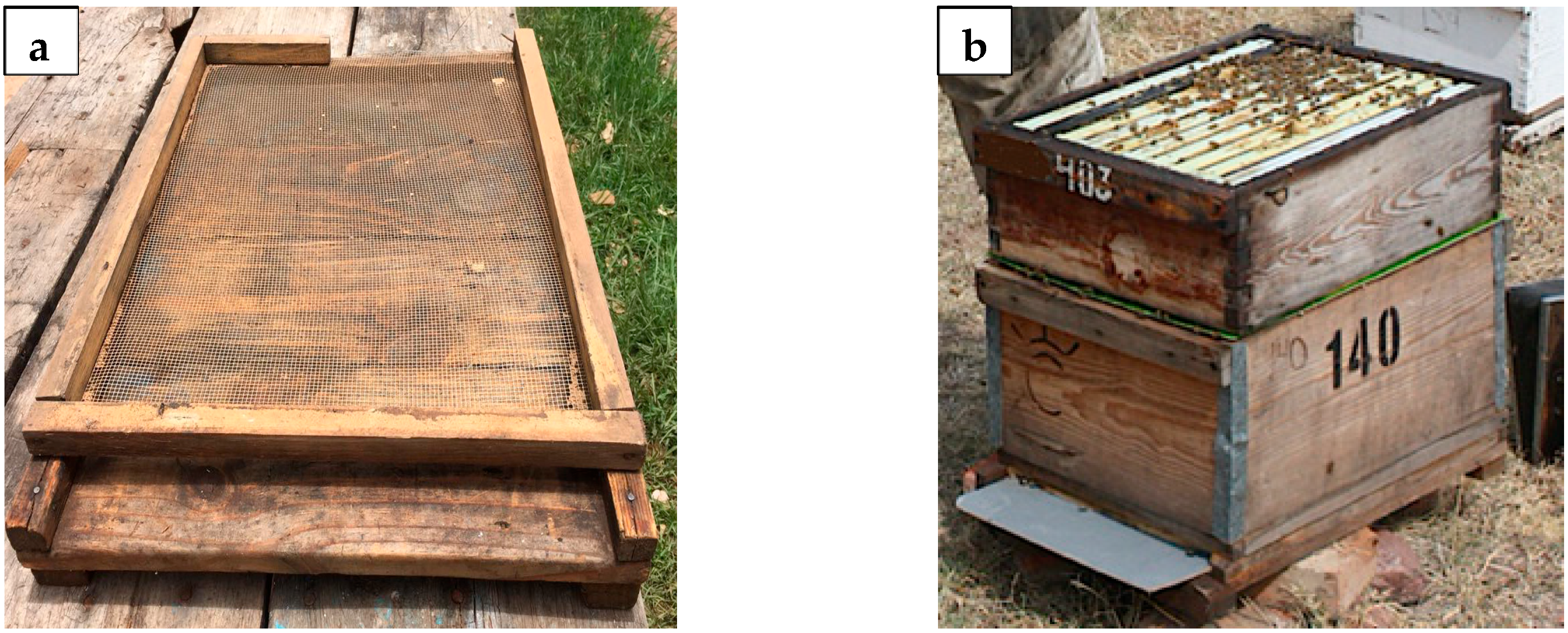
To quantify mite fall, a sticky bottom board trap was installed at the bottom of each colony of all experimental groups. The trap consisted of a plastic sheet (28 × 43.5 cm) coated with petrolatum and protected by a metal mesh (3 mm) (Figure 1). At each treatment application, the sticky sheets (petrolatum-coated boards) were replaced with new ones.
At the conclusion of the treatment applications, all experimental colonies received a reference treatment. This consisted of an absorbent towel strip (6.5 × 28 cm) impregnated with 10 mL of 2% (w/v) amitraz. This treatment was applied four times at 6-day intervals. Monitoring of mite fall during the reference treatment followed the same protocol as described above: a sticky bottom board was replaced with new ones after each application. This reference treatment was used to estimate the residual mite population in each colony and to ensure a homogeneous and efficient reduction of mite levels at the end of the study, in accordance with methodological recommendations for efficacy assessment in V. destructor control trials [42].
Efficacy (%) was calculated by dividing the number of mites that fell onto the sticky board during the experimental treatment by the sum of the mites that from both the experimental and reference treatment, and multiplying the result by 100 [42]. This calculation was based on assumption that the cumulative mite fall (from both experimental and reference treatments) represented the total V. destructor population in each colony [34].

2.5. Statistical Analysis

Percentage variables, including initial V. destructor infestation in adult bees and acaricidal efficacy for the experimental treatments, were arcsine square-root transformed prior to analysis to improve normality. For non-percentage initial variables (amount of brood, honey and pollen stores), normality was assessed using the Shapiro–Wilk test. Analysis of variance (ANOVA) was then employed to confirm the absence of significant differences among experimental groups in initial values of V. destructor infestation on adult bees, adult bee and brood populations, and honey and pollen stores. The main analysis of treatment performance was conducted using a linear mixed model, with treatment as a fixed effect and apiary as a random effect. The response variable in this model was treatment efficacy (%) at the colony level, calculated as described above. Means were compared using Tukey’s test (p < 0.05). All analyses were performed with SAS version 9.0 [43].

3. Results

The Shapiro–Wilk test indicated that the distributions of initial amount of brood (W = 0.35, p = 0.63), honey (W = 0.72, p = 0.54) and pollen (W = 0.18, p = 0.47) stores did not deviate significantly from normality. Additionally, colonies assigned to the treatments began the experiment with similar values for adult bee population (F10,99 = 0.78, p = 0.60), amount of brood (F10,99 = 0.74, p = 0.63), honey (F10,99 = 0.19, p = 0.34), pollen (F10,99 = 0.22, p = 0.41), and V. destructor infestation levels on adult bees (F10,99 = 0.86, p = 0.45).
Mite fall percentages recorded during experimental treatment applications revealed distinct patterns among groups. The colonies treated with amitraz exhibited the greatest and most consistent reduction in V. destructor population, characterized by a high initial mite drop in the first application followed by marked reductions in subsequent application. OA-G also resulted in high mite fall during the first two applications, both higher than in the third. Treatments with plant extracts, specifically B. penicillata (mostoche) and L. tridentata (gobernadora), OA-SS, and powdered sugar showed moderate mite fall without significant changes among applications, with the exception of the oregano extract (L. graveolens), which showed lower mite fall in the second and third applications compared to the first. The absolute control group and the vehicle control groups (vegetable oil, ethanol, and glycerin) maintained low and stable mite fall percentages, as expected in the absence of an acaricide (Table 2).
Significant differences in mite fall were observed among treatment during the first (F10,99 = 9.2, p < 0.0001) and second applications (F10,99 = 5.3, p < 0.0001), with amitraz and OA-G yielding the highest values (Table 2).
The reference treatment with 2% amitraz, applied to all colonies at the end of the experimental treatments, enabled quantification of the residual mite population and validation of the efficacy of the evaluated methods (Table 3). The colonies initially treated with amitraz and OA-G exhibited the lowest percentages of residual mite fall, indicating that the majority of the mite population had eliminated during the experimental phase. In contrast, the vehicle controls groups (vegetable oil, ethanol, glycerin) and the absolute control group showed high percentages of residual fall in the first application of the reference treatment, which is consistent with the absence of prior acaricide treatment.
The groups treated with plant extracts, OA-SS, and powdered sugar showed intermediate residual fall in the first application, reflecting their moderate efficacy (Table 3).
Residual mite fall, as measured by the reference treatment, significantly decreased between applications in most groups (p < 0.05), with the exception of colonies initially treated with amitraz. In these colonies, residual fall remained consistently low and without significant changes among applications (F2,27 = 2.3, p = 0.12), confirming that the majority of the mite population had been eliminated during the experimental phase (Table 3).
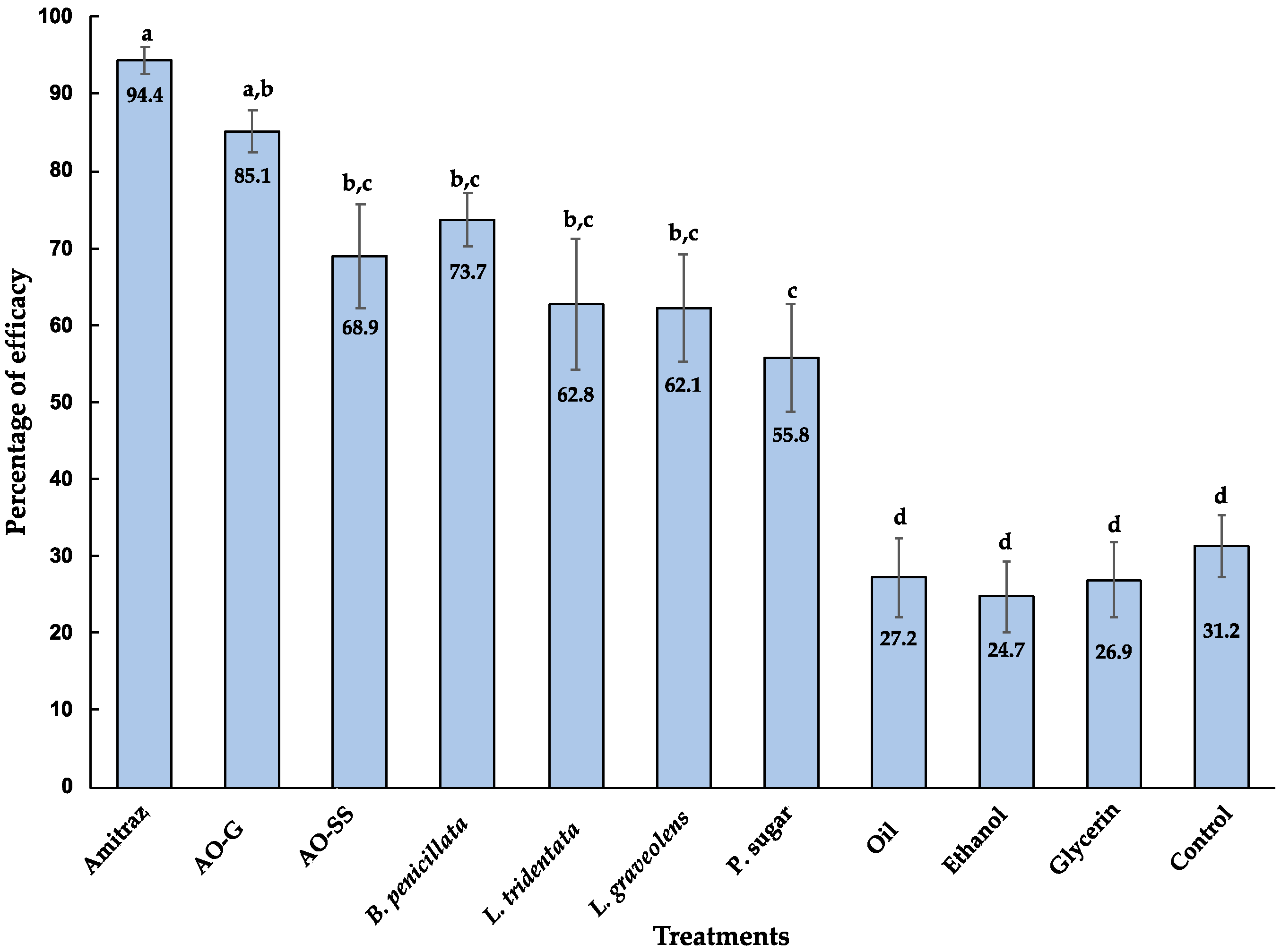
Total acaricidal efficacy (defined as the percentage of mites eliminated by the experimental treatment relative to the estimated total population) differed significantly among treatments (F10,99 = 17.16, p < 0.0001). Amitraz was the most effective treatment, followed by OA-G, with no statistical difference between them. The efficacy of OA-G, OA-SS, and the plant extracts (B. penicillata, L. tridentata, and L. graveolens) was statistically similar performance, ranging from 62.1% to 85.1%. Powdered sugar dusting showed low efficacy but was statistically comparable to the plant extracts and OA-SS. The vehicle control groups (vegetable oil, ethanol, and glycerin) were similar to the absolute control and had a lower percentage of mite fall than all treatments (Figure 2).
During the experiment, no clinical signs of acute toxicity such as adult bee mortality or queen loss were observed in any of the treatment groups compared with the control groups. Furthermore, normal brood development was maintained, and no evidence of reduced egg laying by queens was detected in colonies treated with plant extracts or organic acids.

4. Discussion

The results of this study showed significant differences in efficacy levels among the treatments evaluated. Amitraz was the most effective treatment, with 94.4% efficacy, similar to that reported in Canada (92%) [44] and in European countries such as Slovenia and France (93%) [45,46]. The high mite fall (89%) observed in the first two applications confirms its rapid and potent effect on the nervous system of V. destructor [22,47]. The high efficacy observed in this study likely stems from the fact that the experimental colonies had not been repeatedly exposed to the compound or to improper dosages, thereby reducing the probability of resistance development.
However, repeated or poorly dosed use of amitraz has favored the development of resistant populations in several regions of the world, reducing its efficacy to values ranging from 39% to 85% [48,49,50,51], including Mexico [18,52]. For this reason, its use should be restricted to a single annual treatment, preferably in winter or during periods of low brood [53], in order to reduce selection pressure on mite resistance and avoid adverse impacts on colony health and productivity [24].
The two oxalic acid formulations evaluated exhibited differing efficacies. The oxalic acid in glycerin (OA-G) treatment showed high efficacy (85.1%), comparable to amitraz, whereas oxalic acid in sugar syrup (OA-SS) exhibited moderate efficacy (68.9%). These differences may be attributed to glycerin acting as a slow-release vehicle, which favor sustained compound distribution within the hive and prolongs mite exposure to the acaricide [34]. In contrast, the syrup formulation can be quickly removed, consumed, or stored by the bees, thereby reducing mite contact time with the product [39]. Reported efficacy values for oxalic acid are variable and depend on the presence of capped brood and on technical aspects of application [26,34]. This variability is particularly marked when applied in sugar syrup, with reported efficacies ranging from 37% to 98% [54,55,56,57]. In contrast, controlled-release formulations, such as cellulose strips impregnated with oxalic acid and glycerin, demonstrate high and consistent efficacy (88% to 94%), even in the presence of brood [34]. In the present study, the 85.1% efficacy obtained with OA-G applied to colonies with brood via absorbent towels was similar to these values, thus confirming this formulation potential as an alternative to amitraz. Furthermore, oxalic acid is considered safe for apicultural production, as it does not leave detectable residues in honey after repeated applications [35].
Regarding the ethanolic extracts of B. penicillata, L. tridentata, and L. graveolens, these exhibited intermediate efficacies (62.1% to 73.7%), similar to each other and comparable to OA-SS (68.9%). Although these values are lower than those of amitraz and OA-G, their moderate efficacy, low cost, and simple preparation render them suitable as complementary tools, within an integrated management scheme against V. destructor. Unlike essential oils, whose production requires specialized equipment and higher investment for production, ethanolic extracts can be prepared with basic equipment, making them accessible, practical, and sustainable alternatives for beekeepers.
The moderate efficacy of the ethanolic extracts may be attributed, at least in part, to their lower potency and limited persistence within the hive. It is plausible that the colony’s internal temperature and bee ventilation promote the evaporation of ethanol and volatile plant components, potentially reducing their acaricidal effect. This possibility was considered during the design of a more frequent application scheme for the extracts; nevertheless, their efficacy remained moderate.
Most research on plant products against V. destructor has focused on essential oils, whereas studies using ethanolic extracts are limited and methodologically heterogeneous (regarding preparation, concentration, and application). Nevertheless, our results are consistent with the lower value of the acaricidal efficacy reported for ethanolic extracts of lemongrass (Cymbopogon citratus), thyme (Thymus linearus), basil (Ocimum basilicum), lemon (Citrus limon), and garlic (Allium sativum), applied weekly by direct spraying onto bees, which showed efficacies of 70% to 94% without adverse effects on bees or brood [58]. The acaricidal function of these extracts has been attributed to secondary metabolites such as terpenoids and phenolics [41]. However, it is likely that their action is not exclusively lethal, but may also induce disorientation, detachment, and increased mite fall, which warrants specific investigation.
Although the precise molecular profile of the active compounds was not characterized chromatographically, this field study specifically evaluated crude ethanolic extracts, thereby mirroring the practical preparations available to beekeepers. To ensure consistency and minimize methodological variability, the maceration process (including time, solvent, and plant-to-solvent ratio) was rigorously standardized. Nevertheless, natural fluctuations in the phytochemical composition of the plant material could still influence the observed efficacy results.
Powdered sugar dusting applied to the top bars of brood chamber frames exhibited an average efficacy of 55.8%, statistically similar to that of the plant extracts. Its mode of action is based on interference with the mite’s tarsal structures, reducing its ability to adhere to the bee’s cuticle, and on stimulating grooming behavior, which promotes mite removal and fall [31]. The efficacy of powdered sugar is contingent upon particle size (< 40 µm), dose and frequency of application, ambient humidity, and the expression of grooming behavior by bees [56,59]. However, the degree of exposure of bees and mites to the powder is a critical factor. In studies where bees are confined in boxes and sugar is applied directly to them, reported efficacies range from 77% to 92% [31,60], were higher than those observed in the present study. The lower efficacy recorded here may be attributed to the top-bars application method, which, despite being more practical, less invasive, and requiring no additional equipment, results in a less homogeneous distribution of the powder.
The sticky bottom board trap is a versatile tool, frequently employed for diagnosis, estimation of infestation levels, and acaricides evaluation, and to a lesser extent, as a control method. Its contribution to control lies in preventing the return of up to 50% of live fallen mites [32]. In the present study, traps were used to record mite fall, enabling the evaluation of treatment efficacy. However, they likely contributed to control, particularly in non-lethal methods such as powdered sugar dusting and potentially the plant extracts, whose effectiveness may be partly attributed to a repellent effect. We observed that the group treated with powdered sugar exhibited 24.6% greater mite fall than the absolute control, and the B. penicillata group showed 42.5% more fall, both differences being significant. This suggests that combining methods that promote mite drop with bottom board traps can enhance V. destructor control. Although their efficacy was lower than that observed for amitraz or OA-G, the local availability and low cost of the evaluated plants render these methods viable alternatives, particularly as complementary tools within integrated pests management.
The fall patterns recorded during the experimental applications (Table 2) and the reference treatment (Table 3) offer valuable insights into the number of applications required for each method. For amitraz and OA-G, the majority of the mite population was eliminated within the first two applications, as reflected by very high initial mite fall and significant declines in subsequent applications. This suggests that three consecutive applications are sufficient to achieve profound control, and that additional applications are unlikely to substantially enhance efficacy. In contrast, treatments with OA-SS, plant extracts, and powdered sugar showed more stable per-application mite fall percentages or less pronounced declines, without a clear pattern of parasitic population reduction. This implies that their effect, although cumulative, is more gradual, and particularly for the plant extracts (applied four times), several consecutive treatments may be insufficient to reach control levels comparable to those obtained with amitraz or OA-G.
This interpretation is consistent with the residual fall values from the reference treatment (Table 3). In the amitraz-treatment group, residual fall remained low and stable across applications, indicating that most of the mite population had been eliminated during the experimental phase. In contrast, in the groups treated with methods of moderate efficacy (OA-SS, powdered sugar, and plant extracts), the first application of the reference treatment still produced appreciable mite fall. Furthermore, in the absolute control and vehicle groups, initial fall was significantly higher than in the other experimental groups. This demonstrates that, following the experimental scheme, a significant fraction of the parasitic population remained under several treatments, although not always with clear statistical differences when compared with the amitraz group. Overall, these patterns suggest that amitraz and OA-G (high-efficacy, sustained-release formulations) require fewer applications for effective control, whereas moderate-efficacy methods may require more intensive schedules or a combination with other strategies within an integrated management framework.
It is important to consider that the reference treatment does not reach 100% efficacy under field conditions; thus, the reported efficacy values reported likely underestimate the absolute proportion of mites eliminated to some extent. Nevertheless, given that the same highly effective reference treatment was applied and the criterion that cumulative mite fall represents the total mite population was applied homogeneously to all colonies, this bias is systematic and similar among groups, therefore the relative efficacy comparisons between treatments remain valid.
We recommended further studies that integrate population and food reserve variables, behavioral observations, and molecular markers of immune response. Additionally, the evaluation of different application routes (e.g., fumigation or administration in sugar syrup), the potential effects of powdered sugar on colony microflora, and the design of more efficient acaricide application devices are warranted.
The results advocate for the implementation of integrated V. destructor management strategies that combine, in a planned manner, highly effective synthetic acaricides (with restricted use), organic formulations, and accessible mechanical methods. This approach aim of reducing selection pressure for mite resistance, minimizing residues in hive products, and promoting the sustainability of beekeeping in semiarid regions of Mexico.

5. Conclusions

This study, conducted under commercial beekeeping conditions in a semi-arid region of Mexico, demonstrated that amitraz was the most effective treatment (94.4%), followed by oxalic acid in glycerin (85.1%). Both treatments achieved rapid and intense control with a limited number of applications. In contrast, oxalic acid in sugar syrup and the ethanolic extracts of B. penicillata, L. tridentata and L. graveolens exhibited moderate efficacy (62.1% to 73.7%), which was characterized by slower reduction and less exhaustive control of the mite population. The application of powdered sugar in combination with sticky bottom board traps showed lower efficacy (55.8%), although it remained higher than the control. Therefore, these methods can be considered valuable complementary tools within integrated management programs for V. destructor. They are particularly suitable for periods of lower infestation or as part of rotation schemes, rather than as stand-alone treatments for colonies with high infestation levels. Overall, the implementation of integrated strategies that combine limited and strategic use of synthetic acaricides with organic formulations and mechanical methods is crucial. This approach can help reduce dependence on synthetic acaricides, mitigate future resistance development, and support the sustainability of beekeeping in the semi-arid regions of Mexico.

Author Contributions

Conceptualization, all authors; data curation, A.D.l.M. and C.A.M.-F.; methodology and formal analysis, C.A.M.-F. and A.D.l.M.; investigation, M.J.C.M. and A.E.G.A. visualization, C.A.M.-F.; writing—original draft preparation, M.J.C.M., A.E.G.A. and C.A.M.-F.; writing—review and editing, C.A.M.-F., M.J.C.M. and A.D.l.M. All authors have read and agreed to the published version of the manuscript.

Funding

This research received no external funding.

Institutional Review Board Statement

Not applicable.

Informed Consent Statement

Not applicable.

Data Availability Statement

The original contributions presented in this study are included in the article. Further inquiries can be directed to the corresponding author.

Conflicts of Interest

The authors declare no conflicts of interest.

References

  1. Anderson, D.L.; Trueman, J.W.H. Varroa jacobsoni (Acari: Varroidae) Is More than One Species. Exp. Appl. Acarol. 2000, 24, 165–189. [Google Scholar] [CrossRef]
  2. Nazzi, F.; Le Conte, Y. Ecology of Varroa destructor, the major ectoparasite of the western honey bee, Apis mellifera. Annu. Rev. Entomol. 2016, 61, 417–432. [Google Scholar] [CrossRef]
  3. Ramsey, S.D.; Ochoa, R.; Bauchan, G.; Gulbronson, C.; Mowery, J.D.; Cohen, A.; Lim, D.; Joklik, J.; Cicero, J.M.; Ellis, J.D.; et al. Varroa destructor feeds primarily on honey bee fat body tissue and not hemolymph. Proc. Natl. Acad. Sci. USA 2019, 116, 1792–1801. [Google Scholar] [CrossRef]
  4. Bowen-Walker, P.L.; Gunn, A. The effect of the ectoparasitic mite, Varroa destructor on adult worker honeybee (Apis mellifera) emergence weights, water, protein, carbohydrate, and lipid levels. Entomol. Exp. Appl. 2001, 101, 207–217. [Google Scholar] [CrossRef]
  5. vanEngelsdorp, D.; Meixner, M.D. A historical review of managed honey bee populations in europe and the United States and the factors that may affect them. J. Invertebr. Pathol. 2010, 103, S80–S95. [Google Scholar] [CrossRef]
  6. Koleoglu, G.; Goodwin, P.H.; Reyes-Quintana, M.; Hamiduzzaman, M.M.; Guzman-Novoa, E. Effect of Varroa destructor, wounding and Varroa homogenate on gene expression in brood and adult honey bees. PLoS ONE 2017, 12, e0169669. [Google Scholar] [CrossRef]
  7. Koleoglu, G.; Goodwin, P.H.; Reyes-Quintana, M.; Hamiduzzaman, M.M.; Guzman-Novoa, E. Varroa destructor parasitism reduces hemocyte concentrations and prophenol oxidase gene expression in bees from two populations. Parasitol. Res. 2018, 117, 1175–1183. [Google Scholar] [CrossRef]
  8. Morfin, N.; Anguiano-Baez, R.; Guzman-Novoa, E. Honey Bee (Apis mellifera) Immunity. Vet. Clin. N. Am. Food Anim. Pract. 2021, 37, 521–533. [Google Scholar] [CrossRef]
  9. Chen, Y.; Pettis, J.S.; Evans, J.D.; Kramer, M.; Feldlaufer, M.F. Transmission of kashmir bee virus by the ectoparasitic mite Varroa destructor. Apidologie 2004, 35, 441–448. [Google Scholar] [CrossRef]
  10. Martin, S.J.; Ball, B.V.; Carreck, N.L. Prevalence and persistence of Deformed wing virus (DWV) in untreated or acaricide-treated Varroa destructor infested honey bee (Apis mellifera) colonies. J. Apic. Res. 2010, 49, 72–79. [Google Scholar] [CrossRef]
  11. Ryabov, E.V.; Childers, A.K.; Chen, Y.; Madella, S.; Nessa, A.; vanEngelsdorp, D.; Evans, J.D. Recent spread of Varroa destructor virus-1, a honey bee pathogen, in the United States. Sci. Rep. 2017, 7, 17447. [Google Scholar] [CrossRef]
  12. Dainat, B.; Evans, J.D.; Chen, Y.P.; Gauthier, L.; Neumanna, P. Dead or alive: Deformed wing virus and Varroa destructor reduce the life span of winter honeybees. Appl. Environ. Microbiol. 2012, 78, 981–987. [Google Scholar] [CrossRef]
  13. Arechavaleta-Velasco, M.E.; Guzman-Novoa, E. Producción de miel de colonias de abejas (Apis mellifera L.) tratadas y no tratadas con fluvalinato contra Varroa jacobsoni Oudemans en Valle de Bravo, Estado de México. Vet. Méx. 2000, 31, 379–382. [Google Scholar]
  14. Medina-Flores, C.A.; Guzman-Novoa, E.; Aréchiga-Flores, C.; Aguilera-Soto, J.; Gutiérrez-Piña, F. Efecto del nivel de infestaci ón de Varroa destructor sobre la producción de miel de colonias de Apis mellifera en el altiplano semiárido de México. Rev. Mex. Cienc. Pecu. 2011, 2, 313–317. [Google Scholar]
  15. Chauzat, M.-P.; Martel, A.-C.; Zeggane, S.; Drajnudel, P.; Schurr, F.; Clément, M.-C.; Ribière-Chabert, M.; Aubert, M.; Faucon, J.-P. A case control study and a survey on mortalities of honey bee colonies (Apis mellifera) in France during the winter of 2005–2006. J. Apic. Res. 2010, 49, 40–51. [Google Scholar] [CrossRef]
  16. Guzman-Novoa, E.; Eccles, L.; Calvete, Y.; Mcgowan, J.; Kelly, P.G.; Correa-Benítez, A. Varroa destructor is the main culprit for the death and reduced populations of overwintered honey bee (Apis mellifera) colonies in Ontario, Canada. Apidologie 2010, 41, 443–450. [Google Scholar] [CrossRef]
  17. Medina-Flores, C.A.; López-Carlos, M.; Carrillo-Muro, O.; Gray, A. Honey Bee Colony Losses in Mexico’s Semi-Arid High Plateau for the Winters 2016–2017 to 2021–2022. Insects 2023, 14, 453. [Google Scholar] [CrossRef]
  18. Rodríguez-Dehaibes, S.R.; Otero-Colina, G.; Villanueva-Jiménez, J.A.; Corcuera, P. Susceptibility of Varroa destructor (Gamasida: Varroidae) to four pesticides used in three Mexican apicultural regions under two different management systems. Int. J. Acarol. 2011, 37, 441–447. [Google Scholar] [CrossRef]
  19. Martínez, P.J.F.; Medina, M.L.A. Evaluación de la resistencia del ácaro Varroa destructor al fluvalinato en colonias de abejas (Apis mellifera) en Yucatán, México. Rev. Mex. Cienc. Pecu. 2011, 2, 93–99. [Google Scholar]
  20. Gashout, H.A.; Goodwin, P.H.; Guzman-Novoa, E. Lethality of synthetic and natural acaricides to worker honey bees (Apis mellifera) and their impact in the expression of health and detoxification-related genes. Environ. Sci. Pollut. Res. 2018, 25, 34730–34739. [Google Scholar] [CrossRef]
  21. Medici, S.K.; Blando, M.; Sarlo, E.; Maggi, M.; Espinosa, J.P.; Ruffinengo, S. Pesticide residues used for pest control in honeybee colonies located in agroindustrial areas of Argentina. Int. J. Pest Manag. 2020, 66, 163–172. [Google Scholar] [CrossRef]
  22. Higes, M.; Martín-Hernández, R.; Hernández-Rodríguez, C.S.; González-Cabrera, J. Assessing the resistance to acaricides in Varroa destructor from several Spanish locations. Parasitol Res. 2020, 119, 3595–3601. [Google Scholar] [CrossRef]
  23. Rinkevich, F.D. Experimental parameters affecting the outcomes of amitraz resistance testing in Varroa destructor. J. Apic. Res. 2024, 63, 341–349. [Google Scholar] [CrossRef]
  24. Rosenkranz, P.; Aumeier, P.; Ziegelmann, B. Biology and control of Varroa destructor. J. Invertebr. Pathol. 2010, 103, S96–S119. [Google Scholar] [CrossRef]
  25. Roth, M.A.; Wilson, J.M.; Tignor, K.R.; Gross, A.D. Biology and management of Varroa destructor (Mesostigmata: Varroidae) in Apis mellifera (Hymenoptera: Apidae) colonies. J. Integr. Pest Manag. 2020, 11, 1. [Google Scholar] [CrossRef]
  26. Jack, C.J.; Ellis, J.D. Integrated pest management control of Varroa destructor (Acari: Varroidae), the most damaging pest of (Apis mellifera L. (Hymenoptera: Apidae)) colonies. J. Insect Sci. 2021, 21, 127. [Google Scholar] [CrossRef]
  27. Delaplane, K.S.; Hood, W.M. Effects of delayed acaricide treatment in honey bee colonies parasitized by Varroa jacobsoni and a late-season treatment threshold for the South-Eastern USA. J. Apic. Res. 1997, 36, 125–132. [Google Scholar] [CrossRef]
  28. Delaplane, K.S. Varroa control: Timing is everything. Am. Bee J. 1998, 138, 575–576. [Google Scholar]
  29. Caron, D. Delaware bee mites survey. Am. Bee J. 1999, 139, 631–633. [Google Scholar]
  30. González-Cabrera, J.; Rodríguez-Vargas, S.; Davies, T.G.E.; Field, L.M.; Schmehl, D.; Ellis, J.D.; Krieger, K.; Williamson, M.S. Novel Mutations in the Voltage-Gated Sodium Channel of Pyrethroid-Resistant Varroa destructor Populations from the Southeastern USA. PLoS ONE 2016, 11, e0155332. [Google Scholar] [CrossRef]
  31. Aliano, N.P.; Ellis, M.D.; Siegfried, B.D. Acute contact toxicity of oxalic acid to Varroa destructor (Acari: Varroidae) and their honey bee hosts (Apis mellifera). J. Apic. Res. 2006, 45, 203–206. [Google Scholar] [CrossRef]
  32. Juri, P.; Nogueira, E.; Anzola, J.; Rodríguez Batista, V.; Branchiccela, B.; Invernizzi, C. Evaluation of three different bottom boards in honeybee hives for the control of Varroa destructor. Front. Bee Sci. 2024, 2, 1384846. [Google Scholar] [CrossRef]
  33. Medina-Flores, C.A.; Esquivel-Marín, N.H.; López-Carlos, M.; Medina-Cuellar, S.E.; Aguilera-Soto, J.I. Estimación de la pérdida de colonias de abejas melíferas en el altiplano y el norte de México. Ecosist. Recur. Agropec. 2018, 5, 365–371. [Google Scholar] [CrossRef]
  34. Maggi, M.D.; Tourn, E.; Negri, P.; Szawarski, N.; Marconi, A.; Gallez, L.; Medici, S.K.; Ruffinengo, S.R.; Brasesco, C.; De Feudis, L.; et al. A new formulation of oxalic acid for Varroa destructor control applied in Apis mellifera colonies in the presence of brood. Apidologie 2016, 47, 596–605. [Google Scholar] [CrossRef]
  35. Bogdanov, S.; Charrière, J.D.; Imdorf, A.; Kilchenmann, V.; Fluri, P. Determination of residues in honey after treatments with formic and oxalic acid under field conditions. Apidologie 2002, 33, 399–409. [Google Scholar] [CrossRef]
  36. Maya-Martínez, O.; Medina-Flores, C.; Aquino-Pérez, G.; Olmos-Oropeza, G.; López-Carlos, M. Seasonal treatment with amitraz against Varroa destructor and its effects in honey bee colonies of Apis mellifera. Abanico Vet. 2020, 10, e-129. [Google Scholar] [CrossRef]
  37. INEGI. Instituto Nacional de Estadística Geografía e Informática. Aspectos Geográficos de Zacatecas. Available online: https://www.inegi.org.mx/contenidos/app/areasgeograficas/resumen/resumen_32.pdf (accessed on 8 June 2024).
  38. Jack, C.J.; Boncristiani, H.; Prouty, C.; Schmehl, D.R.; Ellis, J.D. Evaluating the seasonal efficacy of commonly used chemical treatments on Varroa destructor (Mesostigmata: Varroidae) population resurgence in honey bee (Apis mellifera) colonies. J. Insect Sci. 2024, 24, 11. [Google Scholar] [CrossRef]
  39. Prandin, L.; Dainese, N.; Girardi, B.; Damolin, O.; Piro, R.; Mutinelli, F. A scientific note on long-term stability of a home-made oxalic acid water sugar solution for controlling varroosis. Apidologie 2001, 32, 451–452. [Google Scholar] [CrossRef][Green Version]
  40. Berry, J.A.; Afik, O.; Nolan, M.P.; Delaplane, K.S. Revisiting powdered sugar for Varroa control on honey bees (Apis mellifera L.). J. Apic. Res. 2012, 51, 367–368. [Google Scholar] [CrossRef]
  41. Pesewu, G.A.; Cutler, R.R.; Humber, D.P. Antibacterial activity of plants used in traditional medicines of Ghana with particular reference to MRSA. J. Ethnopharmacol. 2008, 116, 102–111. [Google Scholar] [CrossRef]
  42. Dietemann, V.; Nazzi, F.; Martin, S.J.; Anderson, D.L.; Locke, B.; Delaplane, K.S.; Wauquiez, Q.; Tannahill, C.; Frey, E.; Ziegelmann, B.; et al. Standard methods for varroa research. J. Apic. Res. 2013, 52, 1–54. [Google Scholar] [CrossRef]
  43. SAS. Statistical Analysis Software, version 9.0; SAS Institute: Raleigh, NC, USA, 2002.
  44. Morfin, N.; Rawn, D.; Petukhova, T.; Kozak, P.; Eccles, L.; Chaput, J.; Pasma, T.; Guzman-Novoa, E. Surveillance of synthetic acaricide efficacy against Varroa destructor in Ontario, Canada. Can. Entomol. 2022, 154, e17. [Google Scholar] [CrossRef]
  45. Smodiš, M.; Nakrst, M.; Žvokelj, L.; Gregorc, A. The acaricidal effect of flumethrin, oxalic acid and amitraz against Varroa destructor in honey bee (Apis mellifera carnica) colonies. Acta Vet. Brno. 2011, 80, 51–56. [Google Scholar] [CrossRef]
  46. Marsky, U.; Rognon, B.; Douablin, A.; Viry, A.; Rodríguez Ramos, M.A.; Hammaidi, A. Amitraz Resistance in French Varroa Mite Populations—More Complex Than a Single-Nucleotide Polymorphism. Insects 2024, 15, 390. [Google Scholar] [CrossRef] [PubMed]
  47. Farooqui, T. A potential link among biogenic amines-based pesticides, learning and memory, and colony collapse disorder: A unique hypothesis. Neurochem. Int. 2012, 62, 122–132. [Google Scholar] [CrossRef] [PubMed]
  48. Maggi, M.D.; Ruffinengo, S.R.; Negri, P.; Eguaras, M.J. Resistance phenomena to amitraz from populations of the ectoparasitic mite Varroa destructor of Argentina. Parasitol. Res. 2010, 107, 1189–1192. [Google Scholar] [CrossRef] [PubMed]
  49. Kamler, M.; Nesvorna, M.; Stara, J.; Erban, T.; Hubert, J. Comparison of tau-fluvalinate, acrinathrin, and amitraz effects on susceptible and resistant populations of Varroa destructor in a vial test. Exp. Appl. Acarol. 2016, 69, 1–9. [Google Scholar] [CrossRef]
  50. Almecija, G.; Poirot, B.; Cochard, P.; Suppo, C. Inventory of Varroa destructor susceptibility to amitraz and tau-fluvalinate in France. Exp. Appl. Acarol. 2020, 82, 1–16. [Google Scholar] [CrossRef]
  51. Rinkevich, F.D. Detection of amitraz resistance and reduced treatment efficacy in the Varroa mite, Varroa destructor, within commercial beekeeping operations. PLoS ONE 2020, 15, e0227264. [Google Scholar] [CrossRef]
  52. Rodríguez-Dehaibes, S.R.; Otero-Colina, G.; Sedas, V.P.; Jiménez, J.A.V. Resistance to amitraz and flumethrin in Varroa destructor populations from Veracruz, Mexico. J. Apic. Res. 2005, 44, 124–125. [Google Scholar] [CrossRef]
  53. Medina-Flores, C.A.; Saucedo Rojas, A.; Guzman-Novoa, E.; Alaniz Gutiérrez, L. Population Dynamics of the Mite Varroa destructor in Honey Bee (Apis mellifera) Colonies in a Temperate Semi-Arid Climate. Insects 2024, 15, 696. [Google Scholar] [CrossRef]
  54. Gregorc, A.; Planinc, I. The control of Varroa destructor using oxalic acid. Vet. J. 2002, 163, 306–310. [Google Scholar] [CrossRef] [PubMed]
  55. Rasool, K.; Ahad, I.; Rasool, R. Efficacy of various botanicals and chemicals on ectoparasitic mite, Varroa destructor feeding on European honey bee, Apis mellifera. J. Entomol. Zool. Stud. 2017, 5, 589–595. [Google Scholar]
  56. Gregorc, A.; Knight, P.R.; Adamczyk, J. Powdered sugar shake to monitor and oxalic acid treatments to control Varroa destructor (Anderson & Trueman) in honey bee (Apis mellifera) colonies. J. Apic. Res. 2017, 56, 71–75. [Google Scholar] [CrossRef]
  57. Qadir, Z.A.; Idrees, A.; Mahmood, R.; Sarwar, G.; Bakar, M.A.; Ahmad, S.; Raza, M.M.; Li, J. Effectiveness of Different Soft Acaricides against Honey Bee Ectoparasitic Mite Varroa destructor (Acari: Varroidae). Insects 2021, 12, 1032. [Google Scholar] [CrossRef]
  58. Islam, N.; Amjad, M.; Ehsan-ul-Haq; Naz, F. Comparative field efficiency of the extracts of plant materials for controlling Varroa destructor in relation to brood development in honey bee (Apis mellifera) colonies. Int. J. Biosci. 2020, 16, 126–138. [Google Scholar] [CrossRef]
  59. Stanimirović, Z.; Aleksić, N.; Stevanović, J.; Ćirković, D.; Mirilović, M.; Đelić, N.; Stojić, V. The influence of pulverised sugar dusting on the degree of infestation of honey bee colonies with Varroa destructor. Acta Vet. 2011, 61, 309–325. [Google Scholar] [CrossRef]
  60. Carroll, M.J.; Brown, N.J. Varroa mite removal from whole honey bee colonies by powdered sugar dusting is enhanced by crowding and mechanical agitation of treated workers. J. Apic. Res. 2024, 63, 637–647. [Google Scholar] [CrossRef]
Figure 1. Sticky bottom board trap used to quantify V. destructor mite fall. (a) Hive base with metal mesh (structural component of the trap). (b) Experimental hive with the collection tray (plastic sheet coated with petrolatum) installed for mite collection.
Applsci 16 02997 g001
Figure 2. Acaricidal efficacy (mean ± SE) of the treatments evaluated: amitraz, oxalic acid in glycerin (OA-G), oxalic acid in sugar syrup (OA-SS), ethanolic extracts of Bursera penicillata, Larrea tridentata, and Lippia graveolens, powdered sugar (P. sugar), as well as the absolute control and the vehicle controls (oil, ethanol, and glycerin), in Apis mellifera colonies (n = 10 per treatment). Different letters indicate significant differences among treatments according to a linear mixed model (treatment as fixed effect, apiary as random effect) followed by Tukey’s test (p < 0.05), after arcsine square-root transformation of percentage data. The values illustrated correspond to untransformed means.
Applsci 16 02997 g002
Table 1. Number of colonies per treatment group in each apiary.
Treatment GroupApiary 1Apiary 2Apiary 3Apiary 4Total
Amitraz332210
OA-G223310
OA-SS332210
B. penicillata223310
L. tridentata332210
L. graveolens223310
P. sugar332210
Oil 223310
Ethanol332210
Glycerin 223310
Control 332210
Total 28282727110
Table 2. Percentage (mean ± SE) of V. destructor mite fall per application on sticky bottom boards under the different experimental treatments.
Treatment Group1st Application2nd Application3rd Application4th ApplicationF-Valuep-Value
Amitraz59.9 ± 2.9% a A29.5 ± 1.7% a B5.0 ± 0.8% a C--25.06<0.0001
OA-G40.0 ± 1.3% a,b A29.0 ± 0.8% a A13.5 ± 0.7% a B--13.29<0.0001
OA-SS28.1 ± 1.5% b,c A19.5 ± 1.1% a,b A21.3 ± 1.2% a A--0.910.41
B. penicillata23.4 ± 1.4% b,c A16.4 ± 0.7% a,b A18.9 ± 1.1% a A15.0 ± 0.5% a A1.520.22
L. tridentata20.3 ± 1.9% b,c,d A7.0 ± 0.5% b A19.3 ± 2.4% a A16.2 ± 1.2% a A1.570.21
L. graveolens28.3 ± 2.1% b,c A9.7 ± 1.1% b B15.0 ± 1.6% a B9.1 ± 1.0% a B4.320.01
P. sugar25.6 ± 1.5% b,c,d A14.1 ± 0.8% a,b A16.2 ± 1.0% a A--1.590.22
Oil 13.5 ± 2.0% c,d A6.9 ± 0.9% b A6.7 ± 0.9% a A--0.960.41
Ethanol3.8 ± 0.8% d A5.8 ± 1.5 b A7.8 ± 1.6% a A7.2 ± 2.1% a A2.980.12
Glycerin 9.2 ± 1.2% c,d A10.7 ± 0.9 a,b A7.0 ± 0.5% a A--0.700.51
Control 10.5 ± 0.5% c,d A9.0 ± 0.5% b A7.1 ± 0.4% a A4.7 ± 0.3% a A0.760.52
F and p values9.2, <0.00015.3, <0.00011.6, 0.082.6, 0.06
Different lowercase letters within a column indicate significant differences among treatments for each application (Tukey’s test, p < 0.05). Different uppercase letters within a row indicate significant differences among applications within a treatment (Tukey’s test, p < 0.05), after arcsine square-root transformation of percentage data. The values presented in the table are untransformed.
Table 3. Percentage (mean ± SE) of residual mites after the experimental control methods, recorded on sticky bottom boards during the reference treatment in three or four applications.
Treatment Group1st Application2nd Application3rd Application4th ApplicationF-Valuep-Value
Amitraz2.8 ± 0.3% d,e A2.1 ± 0.3% b A0.7 ± 0.2% b A--2.30.12
OA-G9.1 ± 0.5% c,d,e A6.4 ± 0.4% a,b B2.0 ± 0.2% a,b B--8.60.0007
OA-SS18.7 ± 1.2% b,c,d A6.5 ± 0.6% a,b B5.9 ± 0.6% a,b B--6.20.004
B. penicillata7.6 ± 0.9% d,e A,B10.3 ± 1.0% a,b A7.7 ± 0.9% a,b A,B0.7 ± 0.5% a B3.40.028
L. tridentata1.5 ± 0.3% e B20.8 ± 2.2% a A13.9 ± 1.9% a A0.9 ± 1.2% a B10.5<0.0001
L. graveolens3.2 ± 0.6% d,e B25.7 ± 2.2% a A8.0 ± 0.9% a,b B1.1 ± 1.0% a B13.5<0.0001
P. sugar29.4 ± 1.2% a,b,c A8.4 ± 0.7% a,b B6.3 ± 0.7% a,b B--15.3<0.0001
Oil 42 ± 4.8% a,b A25 ± 4.6% a A,B5 ± 1.5% a,b B--5.40.02
Ethanol50.8 ± 3.9% a A21.9 ± 5.6 a B1.2 ± 0.3% a,b C1.4 ± 0.7% a C14.40.005
Glycerin 54.6 ± 2.9% a A15 ± 1.4 a,b B3.5 ± 0.3% a,b C--49.3<0.0001
Control 31.4 ± 1.4% a,b,c A26.6 ± 1.1% a A9.6 ± 0.8% a,b B1.2 ± 0.3% a C15.4<0.0001
F and p values13.8, <0.00014.7, <0.00015.0, <0.01871.3, 0.279
Different lowercase letters within a column indicate significant differences among treatments for each application (Tukey’s test, p < 0.05). Different uppercase letters within a row indicate significant differences among applications within a treatment (Tukey’s test, p < 0.05), after arcsine square-root transformation of percentage data. The values presented in the table are untransformed.
Disclaimer/Publisher’s Note: The statements, opinions and data contained in all publications are solely those of the individual author(s) and contributor(s) and not of MDPI and/or the editor(s). MDPI and/or the editor(s) disclaim responsibility for any injury to people or property resulting from any ideas, methods, instructions or products referred to in the content.