New 2D-Variational Mode Decomposition-Based Techniques for Seismic Attribute Enhancement



Featured Application
Abstract
1. Introduction
2. Theory of Variational Mode Decomposition (1D and 2D)
2.1. Introduction to VMD
2.2. One-Dimensional VMD Formulation
2.3. Extension to 2D VMD
3. Theoretical Basis of the 2D-VMD-Based Seismic Attribute
3.1. Mode-Weighted Spectral Discontinuity (MWSD)
- Apply 2D-VMD: Decompose a seismic slice (inline, crossline, or time slice) into intrinsic mode functions (IMFs), each capturing distinct frequency bands.
- Compute Local Gradient of Each Mode: For each IMF, compute the magnitude of the spatial gradient:
- Compute Frequency-Weighted Combination: Assign higher weights to higher-frequency modes (since they are more sensitive to small-scale discontinuities):
3.2. VMD-Directionality Coherence (VDC)
- Compute Local Gradient Orientation: For each mode, compute:
- Calculate Angular Consistency Across Modes: Measure the circular variance of orientations across the modes:
3.3. Instantaneous Frequency Concentration (IFC-VMD)
- Compute Local Energy Contribution
- Compute Weighted Instantaneous Frequency Map
3.4. Instantaneous Bandwidth Dispersion (IBD-VMD)
- Compute Normalized Local Energy of Each Mode
- Compute Local Bandwidth Dispersion
4. Theoretical Background of the Traditional Seismic Attributes Used
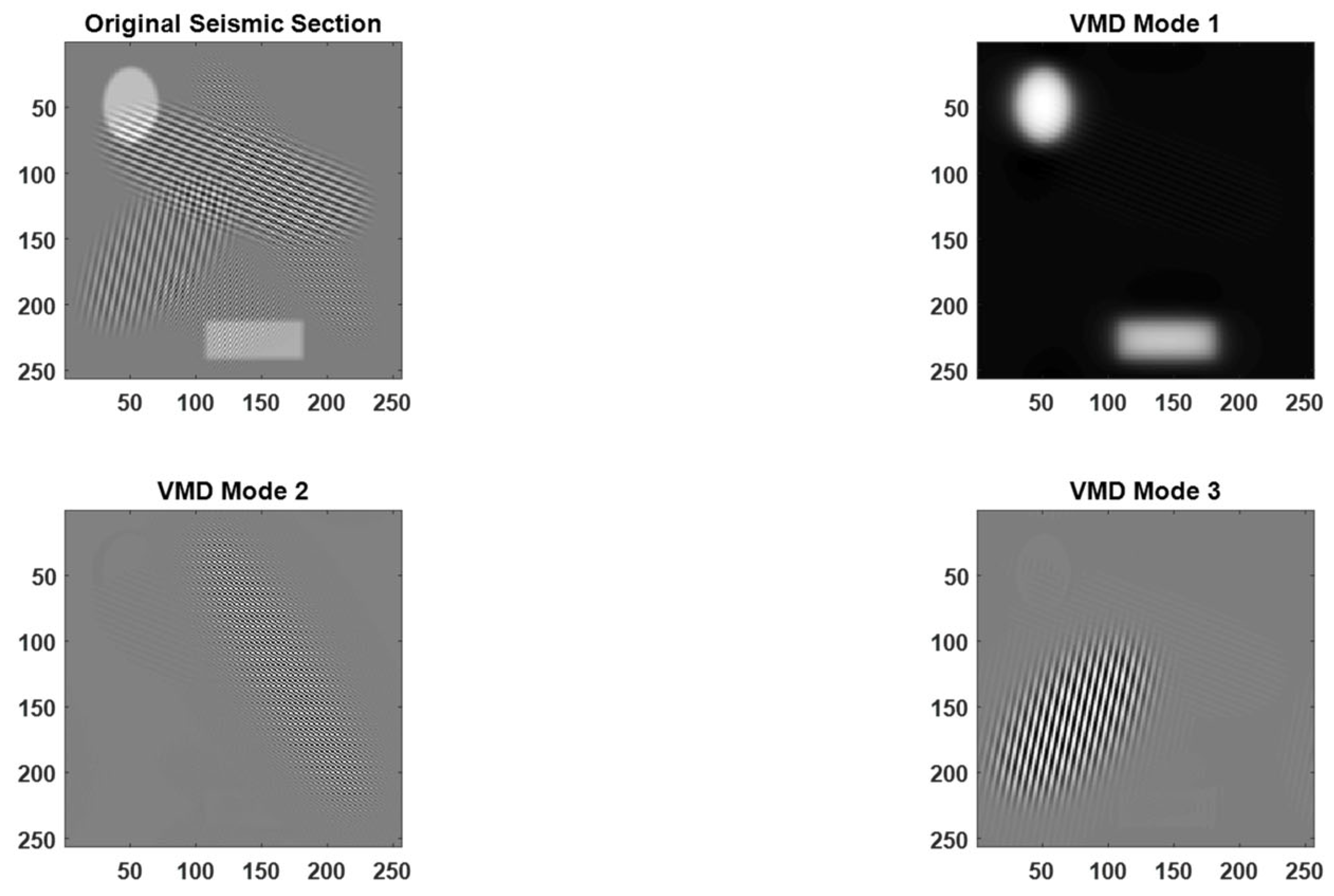
5. Application to Simulated Data
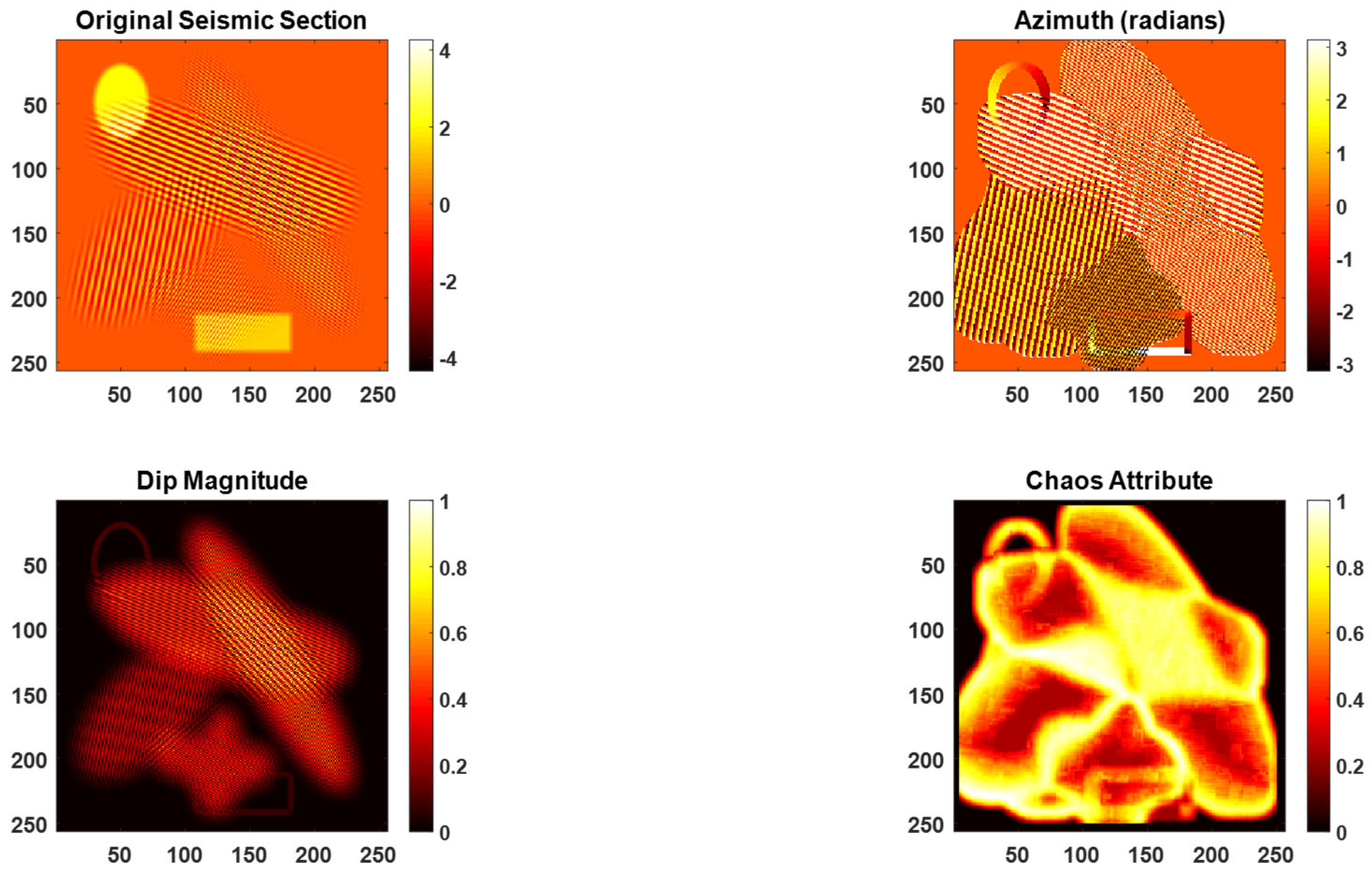
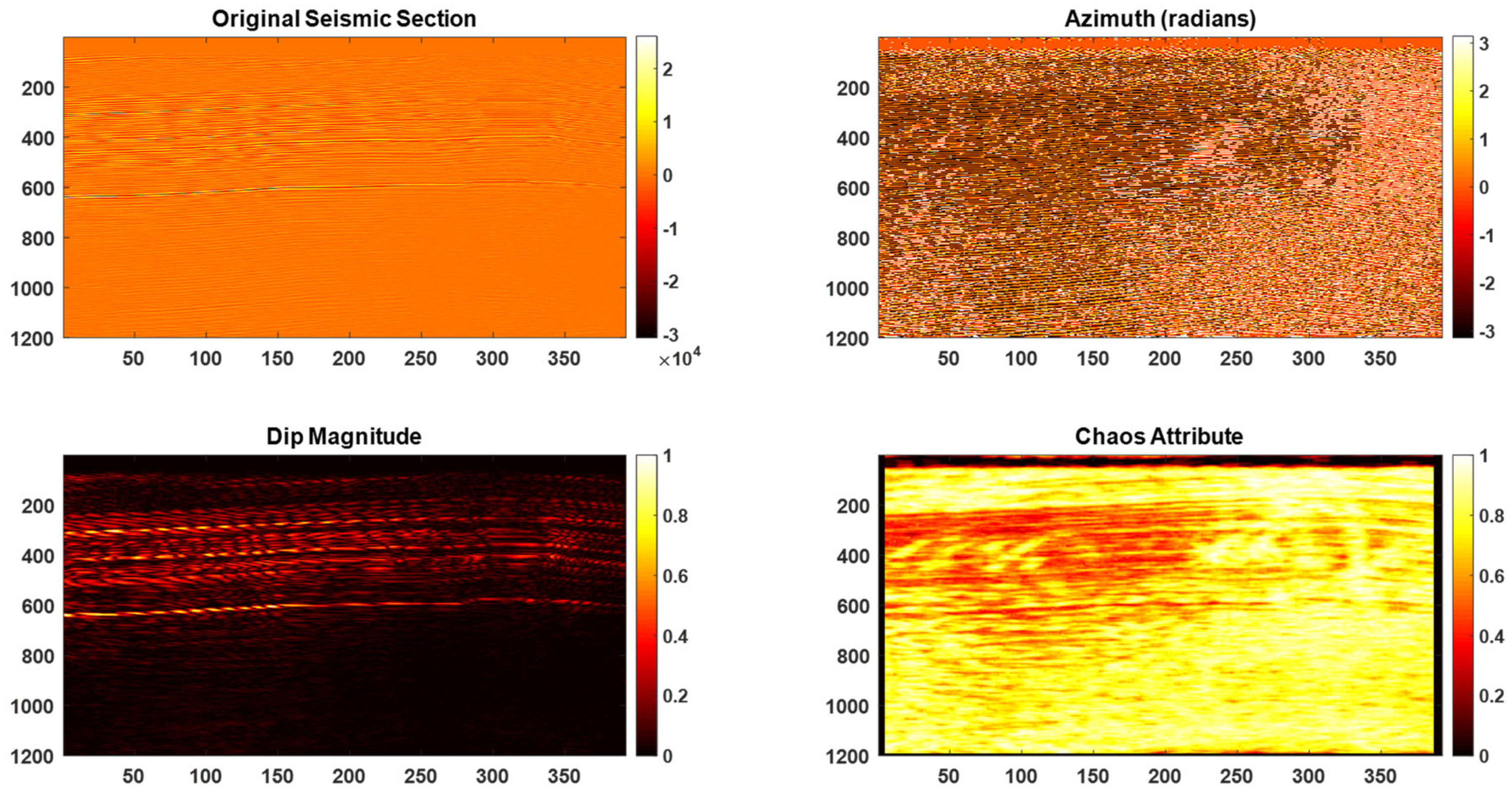
5.1. Azimuth Attribute (In Radians)
5.2. Dip Magnitude Attribute
5.3. Chaos Attribute
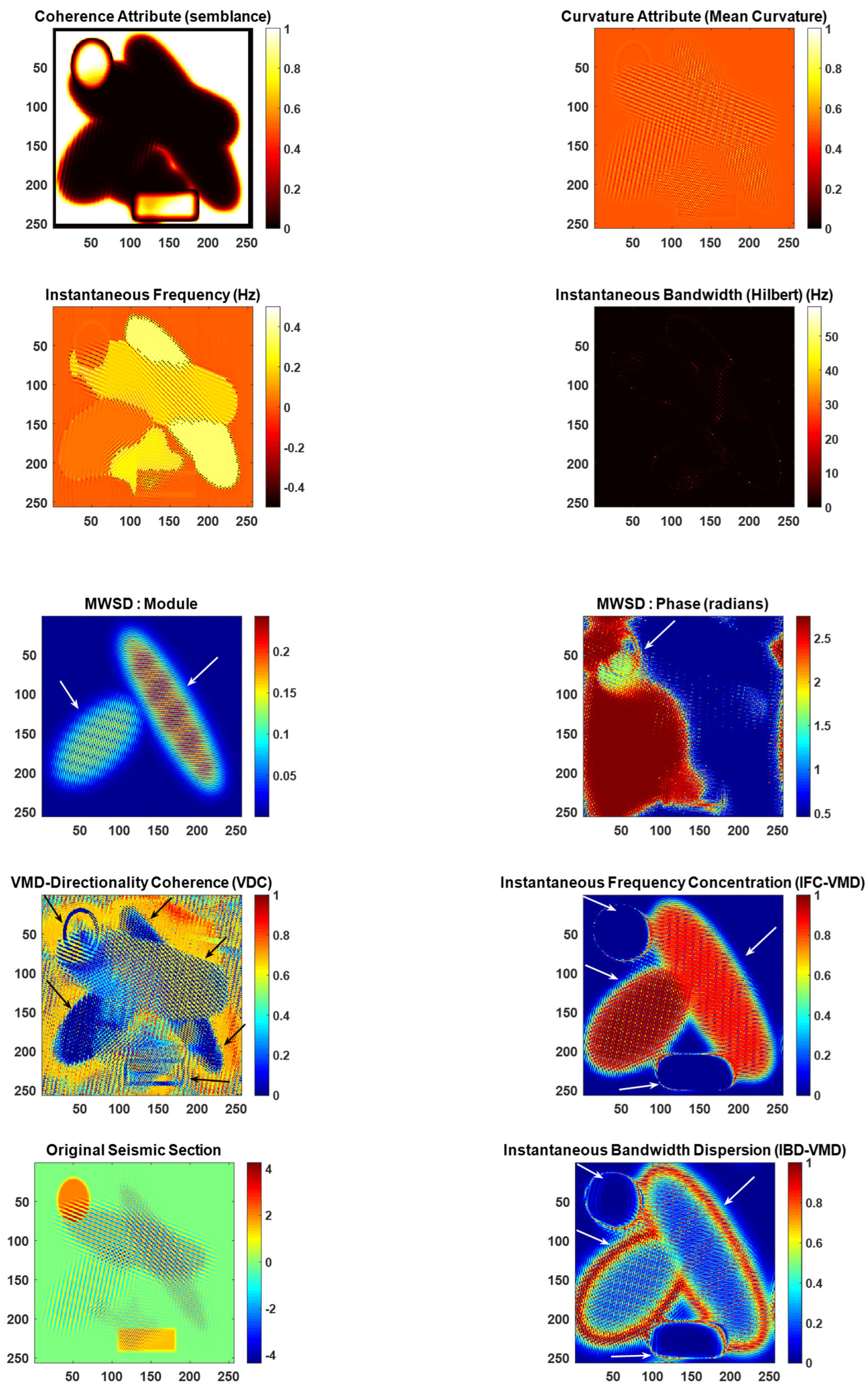
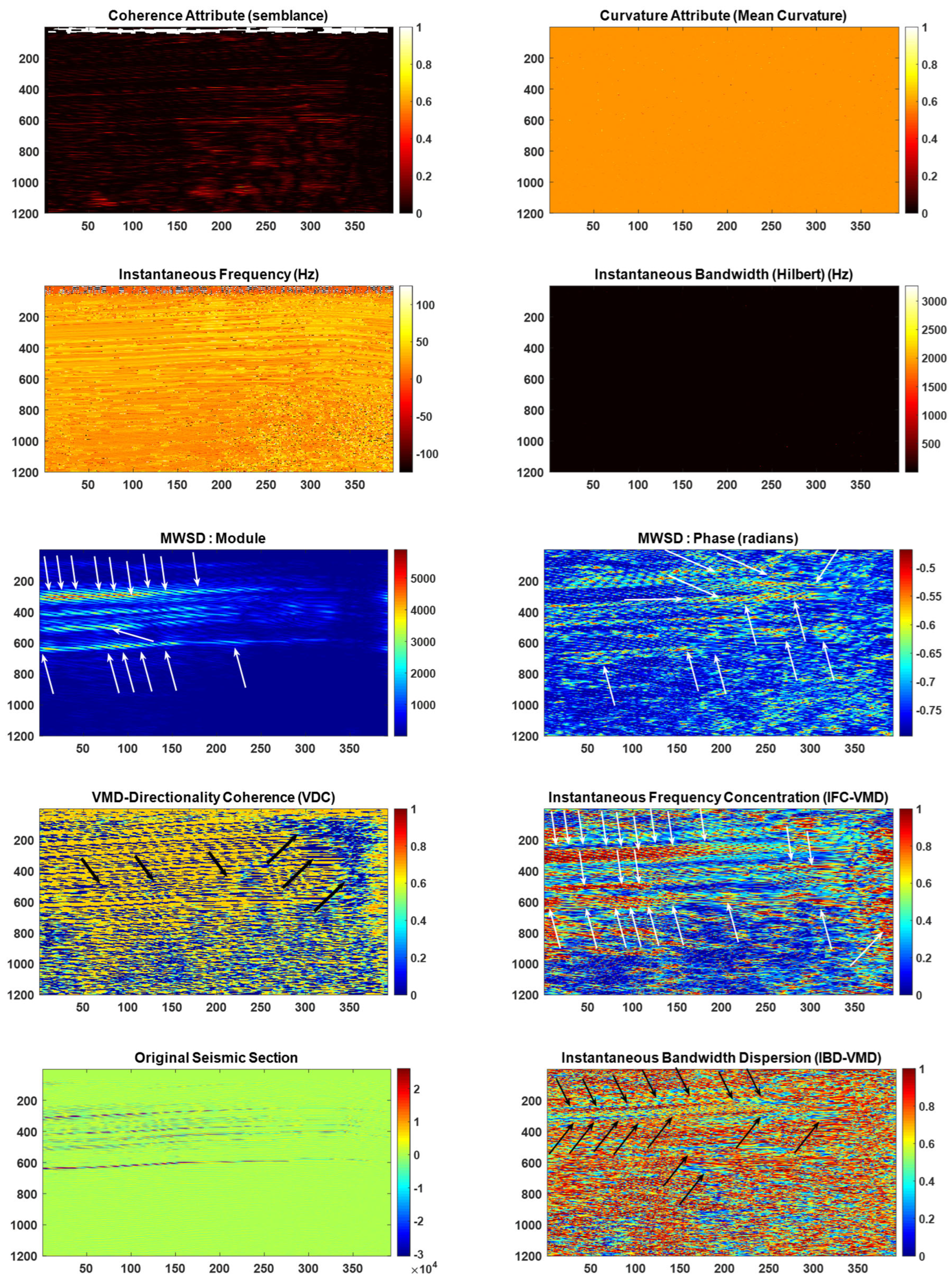
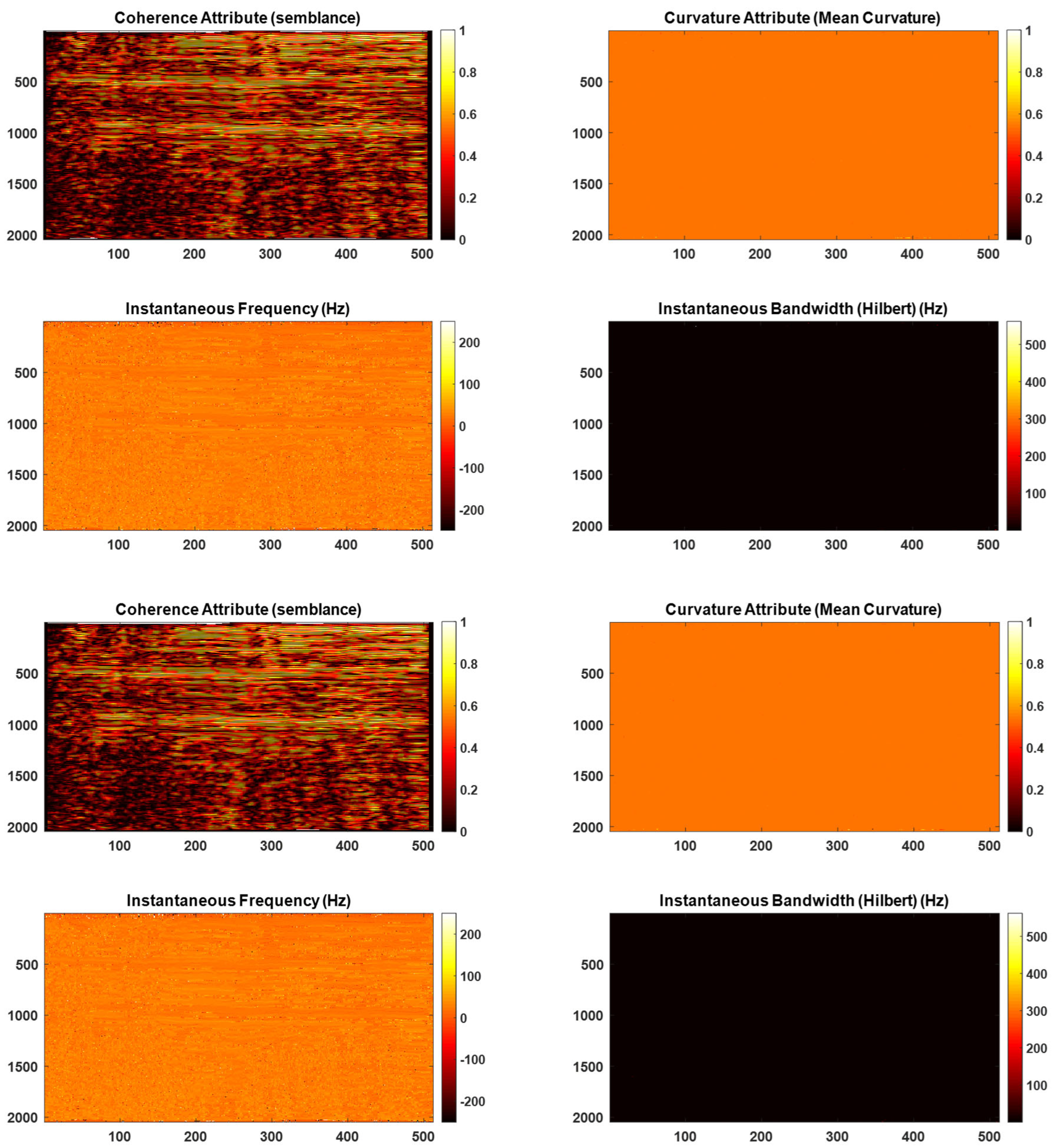
5.4. Coherence Attribute (Semblance)
5.5. Curvature Attribute (Mean Curvature)
5.6. Instantaneous Frequency Attribute (Hz)
5.7. Instantaneous Bandwidth (Hilbert) Attribute
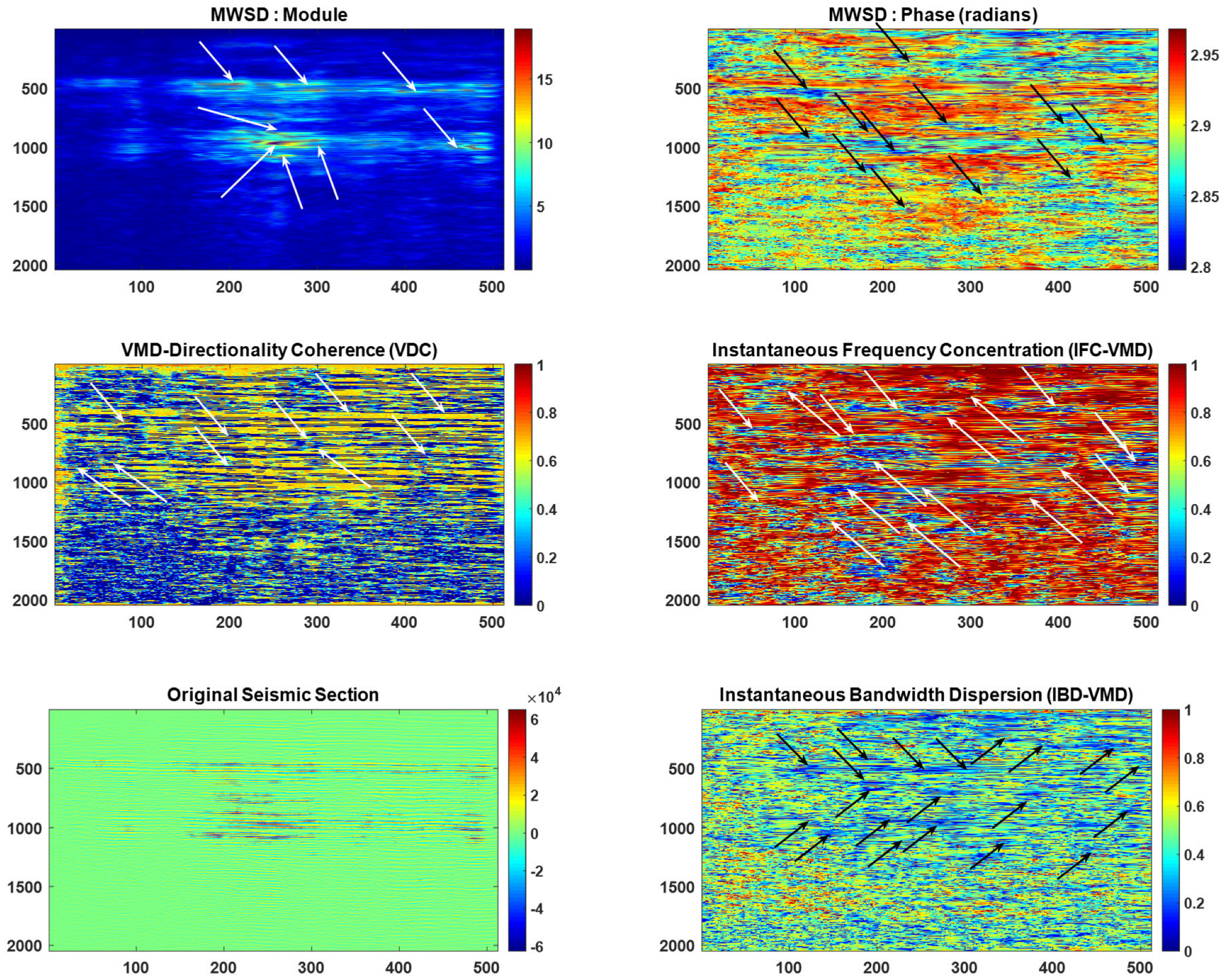
5.8. MWSD (Module) Attribute
5.9. MWSD (Phase) Attribute
5.10. Instantaneous Frequency Concentration (IFC-VMD) Attribute
5.11. VMD-Directionality Coherence (VDC) Attribute
5.12. Instantaneous Bandwidth Dispersion (IBD-VMD) Attribute
6. Application to Real Seismic Data
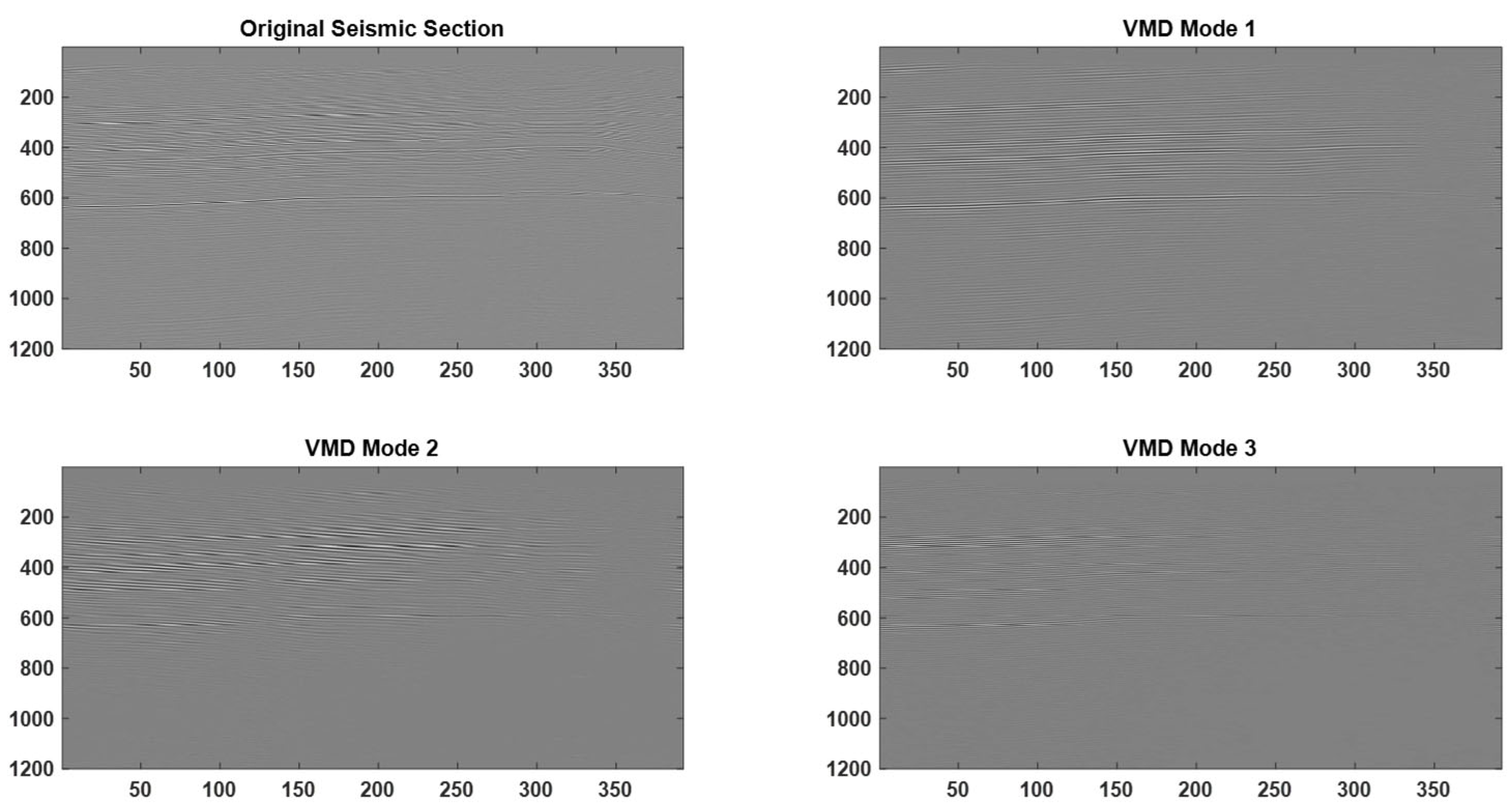
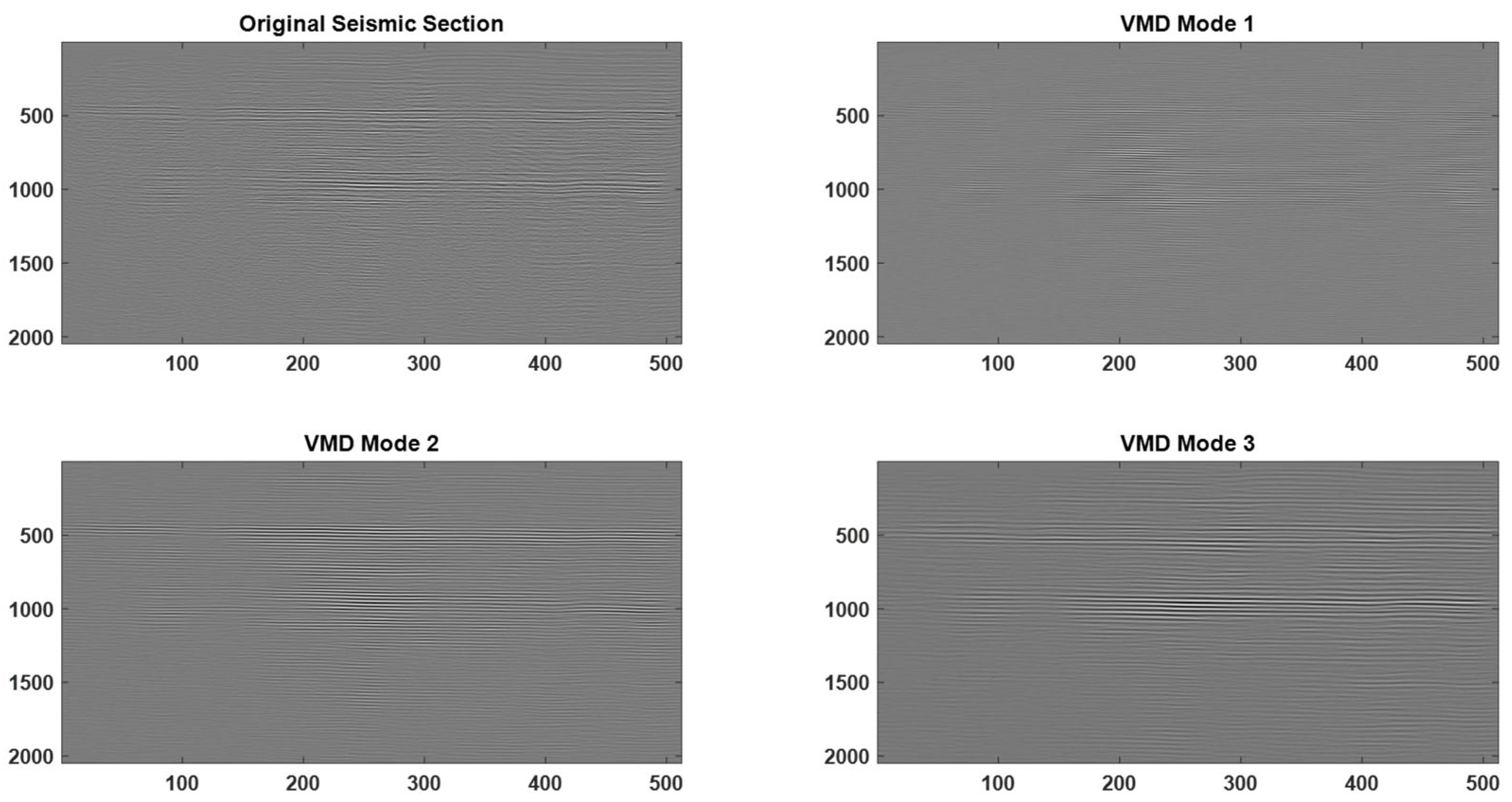
6.1. Application to Seismic Section 1
6.1.1. Azimuth Attribute (In Radians)
6.1.2. Dip Magnitude Attribute
6.1.3. Chaos Attribute
6.1.4. Coherence Attribute (Semblance)
6.1.5. Curvature Attribute (Mean Curvature)
6.1.6. Instantaneous Frequency Attribute (Hz)
6.1.7. Instantaneous Bandwidth (Hilbert) (Hz)
6.1.8. MWSD Attribute (Module)
6.1.9. MWSD Attribute (Phase)
6.1.10. VMD-Directionality Coherence (VDC)
6.1.11. Instantaneous Frequency Concentration (IFC-VMD)
6.1.12. Instantaneous Bandwidth Dispersion (IBD-VMD)
6.2. Application to Seismic Section 2
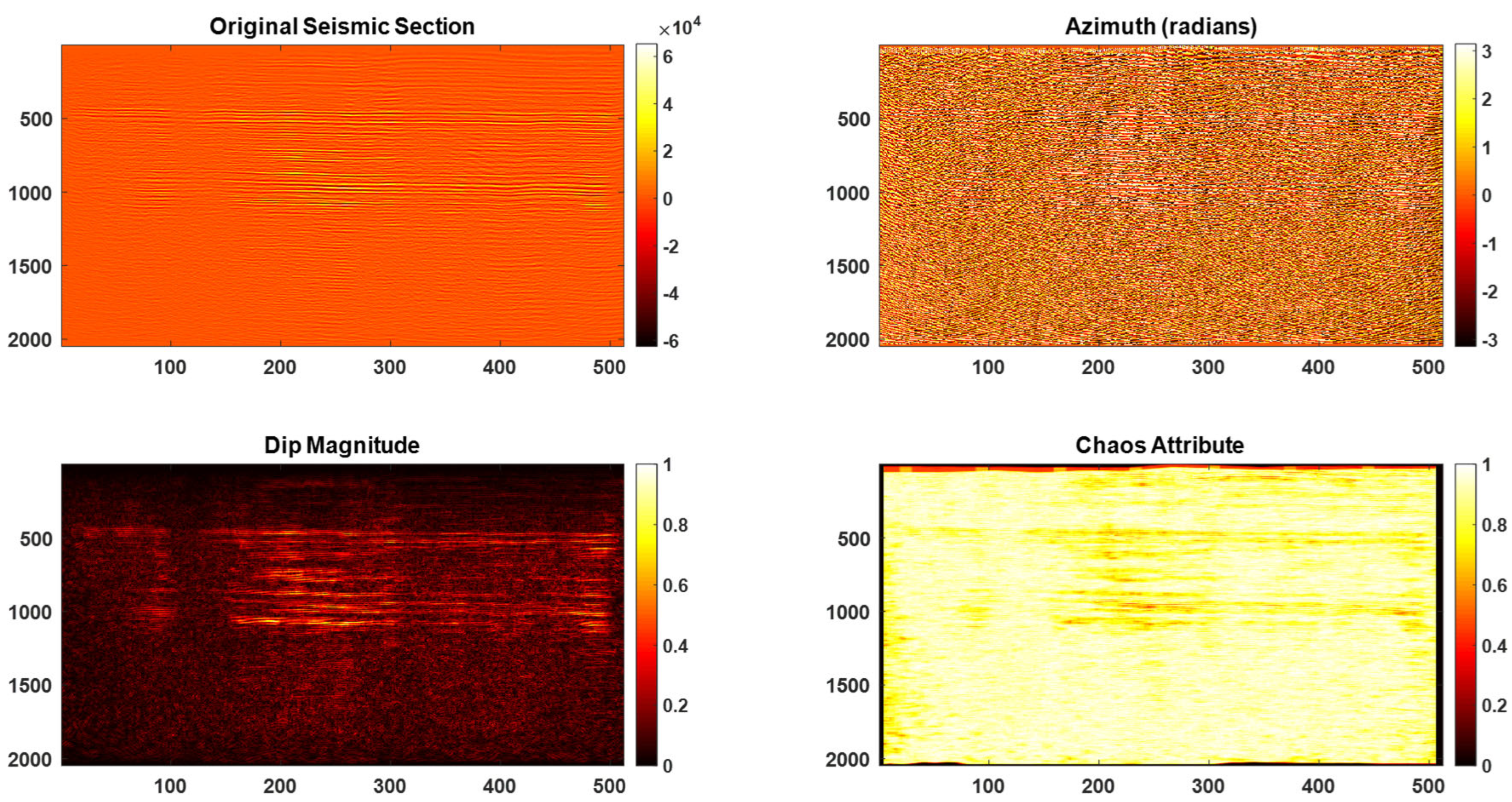
6.2.1. Azimuth Attribute (In Radians)
6.2.2. Dip Magnitude Attribute
6.2.3. Chaos Attribute
6.2.4. Coherence Attribute (Semblance)
6.2.5. Curvature Attribute (Mean Curvature)
6.2.6. Instantaneous Frequency Attribute (Hz)
6.2.7. Instantaneous Bandwidth (Hilbert) Attribute (Hz)
6.2.8. MWSD (Module) Attribute
6.2.9. MWSD (Phase) Attribute
6.2.10. VMD-Directionality Coherence (VDC) Attribute
6.2.11. Instantaneous Frequency Concentration (IFC-VMD) Attribute
6.2.12. Instantaneous Bandwidth Dispersion (IBD-VMD) Attribute
7. Discussion
7.1. Structural Attributes
7.2. Discontinuity and Similarity Attributes
7.3. Geometric Attributes
7.4. Spectral Attributes
7.5. Overall Assessment
8. Conclusions
Author Contributions
Funding
Institutional Review Board Statement
Informed Consent Statement
Data Availability Statement
Acknowledgments
Conflicts of Interest
References
- Farfour, M.; Yoon, W.J. Ultra-thin bed reservoir interpretation using seismic attributes. Arabian Eng. 2014, 39, 379–386. [Google Scholar] [CrossRef]
- Farfour, M.; Yoon, W.J.; Jo, Y. Spectral decomposition in illuminating thin sand channel reservoir Canada Can. J. Pure Appl. Sci. 2012, 6, 1981–1990. [Google Scholar]
- Farfour, M.; Yoon, W.J.; Kim, J. Seismic attributes acoustic impedance inversion in interpretation of complex hydrocarbon reservoirs. J. Appl. Geoph. 2015, 114, 68–80. [Google Scholar] [CrossRef]
- Gaci, S. Geophysical Exploration for Hydrocarbon Reservoirs, Geothermal Energy, and Carbon Storage: New Technologies and AI-Based Approaches. Wiley: Hoboken, NJ, USA; 496p, ISBN 978-1-394-26153-6.
- Gaci, S.; Hachay, O.; Nicolis, O. Methods and Applications in Petroleum and Mineral Exploration and Engineering Geology; Elsevier: Oxford, UK, 2021; 410p, ISBN 978-1-119-22742-7. eBook ISBN 9780323856188; Paperback ISBN 9780323856171. [Google Scholar]
- Gaci, S.; Hachay, O. Advances in Data, Methods, Models and Their Applications in Oil/Gas Exploration; Science Publishing Group: New York, NY, USA; 382p, ISBN 978-1-940366-20-3. Available online: https://www.sciencepublishinggroup.com/ISBN/978-1-940366-20-3 (accessed on 4 September 2025).
- Yu, S.; Ma, J. Complex Variational Mode Decomposition for Slop-Preserving Denoising. IEEE Trans. Geosci. Remote Sens. 2018, 56, 586–597. [Google Scholar] [CrossRef]
- Naveed, K.; Madsen, L.M.; Grombacher, D.; Larsen, J.J. Processing time-domain induced polarization data using variational mode decomposition. IEEE Trans. Geosci. Remote Sens. 2024, 62, 1–13. [Google Scholar] [CrossRef]
- Naveed, K.; Madsen, L.M.; Grombacher, D.; Larsen, J.J. Variational Mode Decomposition-Based Processing of Time-Domain Induced Polarization Data. NSG2023 29th Eur. Meet. Environ. Eng. Geophys. 2023, 1–5. [Google Scholar] [CrossRef]
- Xue, Y.J.; Cao, J.X.; Wang, D.X.; Du, H.K.; Yao, Y. Application of the variational-mode decomposition for seismic time–frequency analysis. IEEE J. Sel. Top. Appl. Earth Obs. Remote Sens. 2016, 9, 3821–3831. [Google Scholar] [CrossRef]
- Liu, N.; Li, F.; Wang, D.; Gao, J. Ground Roll Attenuation Using Variational Mode Decomposition. In 77th EAGE Conference and Exhibition 2015; European Association of Geoscientists & Engineers: Madrid, Spain, 2015. [Google Scholar] [CrossRef]
- Liu, W.; Cao, S.; Chen, Y.; Zhang, D. Application of variational mode decomposition in random noise attenuation and time-frequency analysis seismic data. In Proceedings of the 78th EAGE Conference and Exhibition 2016, Online, 30 May–2 June 2016; European Association of Geoscientists & Engineers: Bunnik, The Netherlands, 2016. [Google Scholar] [CrossRef]
- Zhang, X.; Nilot, E.; Feng, X.; Ren, Q.; Zhang, Z. IMF-Slices for GPR Data Processing Using Variational Mode Decomposition Method. Remote Sens. 2018, 10, 476. [Google Scholar] [CrossRef]
- Zhou, Y.; Chi, Y. Seismic noise attenuation using an improved variational mode decomposition method. J. Seism. Explor. 2020, 29, 29–47. [Google Scholar]
- Wang, X.J.; Xue, Y.J.; Zhou, W.; Luo, J.S. Spectral decomposition of seismic data with variational mode decomposition-based Wigner–Ville distribution. IEEE J. Sel. Top. Appl. Earth Obs. Remote Sens. 2019, 12, 4672–4683. [Google Scholar] [CrossRef]
- Proaño, E.; Benítez, D.S.; Lara-Cueva, R.; Ruiz, M. On the Use of Variational Mode Decomposition for Seismic Event Detection. In Proceedings of the 2018 IEEE International Autumn Meeting on Power 2018, Electronics and Computing (ROPEC), Ixtapa, Mexico, 14–16 November 2018; pp. 1–6. [Google Scholar] [CrossRef]
- Schmitt, J.; Horne, E.; Pustelnik, N.; Joubaud, S.; Odier, P. An improved variational mode decomposition method for internal waves separation. In Proceedings of the 2015 23rd European Signal Processing Conference (EUSIPCO), Nice, France, 31 August–4 September 2015; pp. 1935–1939. [Google Scholar] [CrossRef]
- Horne, E.; Schmitt, J.; Pustelnik, N.; Joubaud, S.; Odier, P. Variational mode decomposition for estimating critical reflected internal wave in stratified fluid. Exp Fluids 2021, 62, 110. [Google Scholar] [CrossRef]
- Liu, C.; Wang, Z.; Huang, Y.; Zeng, A.; Fan, H. Application of 2D Variational Mode Decomposition Method in Seismic Signal Denoising. Elektron. Ir Elektrotechnika 2024, 30, 46–53. [Google Scholar] [CrossRef]
- Dragomiretskiy, K.; Zosso, D. Variational mode decomposition. IEEE Trans. Signal Process. 2014, 62, 531–544. [Google Scholar] [CrossRef]
- Taner, M.T.; Koehler, F.; Sheriff, R.E. Complex seismic trace analysis. Geophysics 1979, 44, 1041–1063. [Google Scholar] [CrossRef]
- White, R.E. Properties of instantaneous seismic attributes. Lead. Edge 1991, 10, 26–32. [Google Scholar] [CrossRef]
- Barnes, A.E. Properties of spectral decomposition and instantaneous bandwidth. Geophysics 1992, 57, 387–395. [Google Scholar]
- Partyka, G.; Gridley, J.; Lopez, J. Interpretational applications of spectral decomposition in reservoir characterization. Lead. Edge 1999, 18, 353–360. [Google Scholar] [CrossRef]
- Barnes, A.E. Instantaneous spectral bandwidth and dominant frequency with applications to seismic reflection data. Geophysics 1993, 58, 419–428. [Google Scholar] [CrossRef]
- Castagna, J.P.; Backus, M.M. Offset-Dependent Reflectivity—Theory and Practice of AVO Analysis; SEG Investigations in Geophysics No. 8; Society of Exploration Geophysicists: Houston, TX, USA, 1993. [Google Scholar] [CrossRef]
- Marfurt, K.J.; Kirlin, R.L.; Farmer, S.L.; Bahorich, M.S. 3-D seismic attributes using a semblance-based coherency algorithm. Geophysics 1998, 63, 1150–1165. [Google Scholar] [CrossRef]
- Chopra, S.; Marfurt, K.J. Seismic Attributes for Prospect Identification and Reservoir Characterization SEG; Geophysical Developments Series; SEG: Tulsa, OK, USA, 2007. [Google Scholar] [CrossRef]
- Bahorich, M.; Farmer, S. 3-D seismic discontinuity for faults and stratigraphic features: The coherence cube. Lead. Edge 1995, 14, 1053–1058. [Google Scholar] [CrossRef]
- Gersztenkorn, A.; Marfurt, K.J. Eigenstructure-based coherence computations as an aid to 3-D structural and stratigraphic mapping. Geophysics 1999, 64, 1468–1479. [Google Scholar] [CrossRef]
- Roberts, A. Curvature attributes and their application to 3D interpreted horizons. First Break. 2001, 19, 85–99. [Google Scholar] [CrossRef]
- Gaci, S.; Farfour, M. Chapter 12: New Bidimensional Empirical Mode Decomposition-Based Seismic Attributes. In Methods and Applications in Petroleum and Mineral Exploration and Engineering Geology; Gaci, S., Farfour, M., Eds.; Elsevier: Oxford, UK, 2021; pp. 203–211. [Google Scholar]
- Gaci, S. Complete Ensemble Empirical mode decomposition based time-frequency attributes. Lead. Edge 2018, 37, 208–212. [Google Scholar] [CrossRef]
- Pique, A.; Michard, A. Moroccan Hercynides: A synopsis. The Paleozoic sedimentary and tectonic evolution at the northern margin of West Africa. Am. J. Sci. 1989, 289, 286–330. [Google Scholar] [CrossRef]
- Klett, T.R. Total Petroleum Systems of the Grand Erg/Ahnet Province Algeria Morocco—The Tanezzuft-Timimoun Tanezzuft-Ahnet Tanezzuft-Sbaa Tanezzuft-Mouydir Tanezzuft-Benoud Tanezzuft-Béchar/Abadla. U.S. Geological Survey Bulletin 2202-B. Available online: https://pubs.usgs.gov/bul/b2202-b (accessed on 4 September 2025).
- Haddoum, H.; Guiraud, R.; Moussine-Pouchkine, M.A. Hercynian compressional deformations of the Ahnet-Mouydir Basin, Algerian Saharan platform: Far-field stress effects of the late Palaezoic orogeny. Terra Nova 2021, 13, 220–226. [Google Scholar] [CrossRef]
- Well Evaluation Conference (WEC). Well Evaluation Conference; internal report: Joint documents of Sonatrach and Schlumberger, Algeria; Lynx Consulting, Inc.: Houston, TX, USA, 2007; 489p. [Google Scholar]
- Wendt, J.; Kaufmann, B.; Belka, Z.; Klug, C.; Lubeseder, S. Sedimentary evolution of a Palaeozoic basin and ridge system: The Middle and Upper Devonian of the Ahnet and Mouydir (Algerian Sahara). Geol. Mag. 2006, 143, 269–299. [Google Scholar] [CrossRef]
- Vecoli, M.; Videt, B.; Paris, F. First biostratigraphic (palynological) dating of Middle and Late Cambrian strata in the subsurface of northwestern Algeria, North Africa: Implications for regional stratigraphy. Rev. Palaeobot. Palynol. 2008, 149, 57–62. [Google Scholar] [CrossRef]
- Zazoun, R. La tectogenèse hercynienne dans la partie occidentale du bassin de I’Ahnet et la région de Bled El-Mass, Sahara Algérien: Un continuum de déformation. J. Afr. Earth Sci. 2001, 32, 869–887. [Google Scholar] [CrossRef]
- Zieliński, M. Reconstruction of Thermal History of the Ahnet and Mouydir Basins (Southern Algeria). Ph.D. Thesis, Institute of Geology, Faculty of Geographical and Geological Sciences, Adam Mickiewicz University, Poznan, Poland, 2011. [Google Scholar]
- Djezzar, S. Fracture Detection and Prediction in Unconventional Reservoirs for Finding Sweet Spot. Ph.D. Thesis, Univeristy of North Dakota, Grand Forks, NA, USA, 2019. Available online: https://commons.und.edu/theses/2551 (accessed on 4 September 2025).
- Djezzar, S.; Boualam, A. Fractures Characterization Their Impact on the Productivity of Hamra Quartzite Reservoir (Haoud-Berkaoui field Oued-Mya basin Algeria); In Proceedings of 54th US Rock Mechanics/Geomechanics Symposium 2020, Golden, CO, USA, 28 June–1 July 2020.
- Djezzar, S.; Boualam, A.; Laalam, A.; Ouadi, H.; Merzoug, A.; Chemmakh, A. Structural Analysis and Fractures Kinematics Using Seismic 2D and Geological Maps. In Proceedings of the 56th US Rock Mechanics/Geomechanics Symposium 2022, Santa Fe, NM, USA, 26–29 June 2022. [Google Scholar] [CrossRef]
- Klett, T.R. Total Petroleum Systems of the Illizi Province, Algeria and Libya—Tanezzuft-Illizi; U.S. Geological Survey Bulletin 2202-A. Available online: https://pubs.usgs.gov/bul/b2202-a (accessed on 4 September 2025).
- Klett, T.R. Total Petroleum Systems of the Trias/Ghadames Province Algeria Tunisia, and Libya—The Tanezzuft-Oued Mya Tanezzuft-Melrhir Tanezzuft-Ghadames; U.S. Geological Survey Bulletin 2202-B. Available online: https://pubs.usgs.gov/bul/b2202-c (accessed on 4 September 2025).
- Galeazzi, S.; Point, O.; Haddadi, N.; Mather, J.; Druesne, D. Regional geology and petroleum systems of the Illizi–Berkine area of the Algerian Saharan Platform: An overview. Mar. Pet. Geol. 2010, 27, 143–178. [Google Scholar] [CrossRef]
- Galeazzi, S.; Point, O.; Haddadi, N.; Mather, J.; Druesne, D. The Illizi Berkine Basins in Southern Algeria. In Regional Geology and Tectonics: Phanerozoic Passive Margins, Cratonic Basins and Global Tectonic Maps; Roberts, D.G., Bally, A.W., Eds.; Elsevier: Amsterdam, The Netherlands; pp. 662–729. [CrossRef]
- Wu, X.L.; Zheng, W.B.; Deng, H.W. Stratigraphy and Distribution of Gravity Flow Deposition, Lower Devonian F4 Unit, Zarzaitine Oilfield, Illizi Basin, Algeria. Pet. Sci. Technol. 2012, 30, 1151–1162. [Google Scholar] [CrossRef]
- English, K.L.; Redfern, J.; Corcoran, D.V.; English, J.M.; Cherif, R.Y. Constraining burial history and petroleum charge in exhumed basins: New insights from the Illizi Basin, Algeria. AAPG Bull. 2016, 100, 623–655. [Google Scholar] [CrossRef]
- Djouder, H.; Lüning, S.; Da Silva, A.-C.; Abdallah, H.; Boulvain, F. Silurian Deltaic Progradation, Tassili n’Ajjer Plateau, South-Eastern Algeria: Sedimentology, Ichnology and Sequence Stratigraphy. J. Afr. Earth Sci. 2018, 142, 170–192. [Google Scholar] [CrossRef]
- Chehili, D.; Bacetti, A.; Bendali, M.; Rahmani, B.E.; Sadek, K.; Bennour, M.A. Geological/petrophysical characterisation and permeability mapping using ANN in the Algerian tight gas reservoir, Illizi Basin. J. Afr. Earth Sci. 2025, 224, 105561. [Google Scholar] [CrossRef]
- Li, C.; Li, W.; Ye, H.; Zhu, Q.; Shan, X.; Wang, S.; Wang, D.; Zhang, Z.; Wang, H.; Zhou, X.; et al. Reservoir Architecture of Turbidite Lobes and Remaining Oil Distribution: A Study on the B Formation for Z Oilfield of the Illizi Basin, Algeria. Processes 2025, 13, 805. [Google Scholar] [CrossRef]



| Attribute (References) | Description | Formula |
|---|---|---|
| Azimuth [27,28] | Measures the orientation (angle) of seismic reflectors in the horizontal plane. | , where is the two-way travel time surface. |
| Dip Magnitude [27] | Measures the steepness of seismic reflectors in the vertical direction. | |
| Chaos Attribute [29,30] | Quantifies local discontinuity or randomness in seismic amplitudes; highlights structural complexity | Formula (variance-based): where are eigenvalues of the covariance matrix of local seismic gradients. |
| Coherence (Semblance) [22,23] | Measures trace-to-trace similarity; detects discontinuities like faults and channels. | where are seismic samples across traces. |
| Curvature (Mean Curvature) [28,31] | Measures bending of reflectors; sensitive to folds and fractures. | where are the maximum and minimum curvatures from the reflector surface geometry. |
| Instantaneous Frequency [21] | Derivative of the instantaneous phase; indicates local frequency content of the signal. | where and is the Hilbert transform. |
| Instantaneous Bandwidth (Hilbert) [21,22,23,24,25,26] | Measures spectral spread around the instantaneous frequency; relates to absorption and heterogeneity. | where is the instantaneous amplitude. |
| Attribute | Primary Function | Limitation | MWSD (Module) Advantage | MWSD (Phase) Advantage | VDC Advantage | IFC-VMD Advantage | IBD-VMD Advantage |
|---|---|---|---|---|---|---|---|
| Dip | Estimates reflector slopes | Sensitive to noise in steep dips | Good lateral continuity detection | Improved phase stability | High-resolution structure delineation | Better noise suppression in complex geology | Handles abrupt dip changes well |
| Azimuth | Measures reflector orientation | Affected by poor signal-to-noise ratio | Stable azimuth estimation in noisy data | Better orientation continuity | Enhanced azimuth resolution | Accurate under varying illumination | Good for small-scale azimuthal variations |
| Chaos | Detects structural discontinuities | Prone to highlight noise as features | Suppresses random noise while preserving faults | Improved phase for discontinuity mapping | Good edge preservation | Enhanced chaotic zone definition | Accurate in small chaotic zones |
| Coherence (semblance) | Measures similarity between traces | Resolution decreases with increasing window size | Improved similarity detection | Phase-insensitive similarity mapping | High vertical resolution | Better detection in noisy areas | Sensitive to subtle stratigraphic features |
| Curvature (Mean Curvature) | Measures reflector curvature | Sensitive to noise; may produce artifacts | Good noise suppression while keeping curvature detail | Better curvature continuity | Highlights subtle features | Improved detection of small-scale folds | Handles mixed curvature types well |
| instantaneous frequency | Estimates temporal frequency variation | Affected by attenuation and tuning | Stable frequency estimation | Better phase consistency | Enhanced thin-bed detection | Accurate under complex wavelets | Good in low SNR environments |
| instantaneous bandwidth (Hilbert) | Estimates bandwidth variations | Sensitive to noise | Better bandwidth stability | Improved phase estimation for bandwidth | Good for lithology changes | Enhanced detection of attenuation zones | Handles abrupt bandwidth changes |
Disclaimer/Publisher’s Note: The statements, opinions and data contained in all publications are solely those of the individual author(s) and contributor(s) and not of MDPI and/or the editor(s). MDPI and/or the editor(s) disclaim responsibility for any injury to people or property resulting from any ideas, methods, instructions or products referred to in the content. |
© 2026 by the authors. Licensee MDPI, Basel, Switzerland. This article is an open access article distributed under the terms and conditions of the Creative Commons Attribution (CC BY) license.
Share and Cite
Gaci, S.; Farfour, M. New 2D-Variational Mode Decomposition-Based Techniques for Seismic Attribute Enhancement. Appl. Sci. 2026, 16, 2984. https://doi.org/10.3390/app16062984
Gaci S, Farfour M. New 2D-Variational Mode Decomposition-Based Techniques for Seismic Attribute Enhancement. Applied Sciences. 2026; 16(6):2984. https://doi.org/10.3390/app16062984
Chicago/Turabian StyleGaci, Said, and Mohammed Farfour. 2026. "New 2D-Variational Mode Decomposition-Based Techniques for Seismic Attribute Enhancement" Applied Sciences 16, no. 6: 2984. https://doi.org/10.3390/app16062984
APA StyleGaci, S., & Farfour, M. (2026). New 2D-Variational Mode Decomposition-Based Techniques for Seismic Attribute Enhancement. Applied Sciences, 16(6), 2984. https://doi.org/10.3390/app16062984