Article

Determination and Analysis of Martian Height Anomalies Using GMM-3 and JGMRO_120D Gravity Field Models

Naval University of Engineering, 717 Jiefang Avenue, Qiaokou District, Wuhan 430030, China
*
Author to whom correspondence should be addressed.
Appl. Sci. 2026, 16(6), 2982; https://doi.org/10.3390/app16062982
Submission received: 1 February 2026 / Revised: 3 March 2026 / Accepted: 10 March 2026 / Published: 19 March 2026
(This article belongs to the Section Earth Sciences)

Abstract

Height anomaly, defined as the separation between the quasi-geoid and the reference ellipsoid, is fundamental to quasi-geoid refinement. While the Goddard Mars Model-3 (GMM-3) developed by NASA’s Goddard Space Flight Center (GSFC) and the JPL Mars gravity field MRO120D (JGMRO_120D) model developed by NASA’s Jet Propulsion Laboratory (JPL) stand as two representative Martian gravity field models, the systematic differences between them and their associated physical implications remain insufficiently quantified. This study establishes a validated computational framework for Martian height anomaly determination using updated physical parameters and spherical harmonic expansions. Validation against terrestrial datasets confirms high reliability (standard deviation: 0.0695 m relative to International Centre for Global Earth Models (ICGEM)), ensuring confidence in subsequent analysis. Our analysis reveals three critical findings: (1) Systematic latitudinal biases between GMM-3 and JGMRO_120D exhibit a monotonic gradient from −1.3 m near the equator to +3.9 m at the North Pole, suggesting differential parameterization of polar mass loading or tidal models between the two centers. (2) Polar clustering of uncertainties and outliers exceeding the 95th percentile (>7 m) concentrate non-randomly at latitudes >60°, which is attributed to sparse satellite tracking and seasonal ice cap modeling limitations. (3) There is error amplification in lowland terrains, where relative errors exceed 60% in flat regions (near-zero anomalies), posing critical risks for precision landing missions. While global consistency between models is high (R2 = 0.9999), the identified discrepancies provide new constraints on Mars’s geophysical models and essential guidance for future gravity field improvements and mission planning.

1. Introduction

Mars is the fourth planet from the Sun. Mars is a world full of dust storms, extreme cold, desertification, and a thin atmosphere. Mars is a geologically diverse planet characterized by polar ice caps, vast canyon systems, and volcanic highlands. Studies have shown that Mars was wetter, warmer, and had a thicker atmosphere in the past. Mars is one of the planets in the solar system that is closer to Earth and one of the earliest planets explored by humans. Its rotation cycle is close to 24 h, with seasonal variations. Due to these similar features to Earth, Mars has always been an important object of human research [1,2,3,4,5].
The determination of height anomalies on planetary surfaces is fundamental to geodetic investigations and has significant implications for understanding planetary interior structure and evolution [6,7]. For Mars, height anomalies provide crucial insights into the planet’s crust–mantle boundary, volcanic activity, and the north–south dichotomy that characterizes its topography [8,9,10]. The availability of high-degree gravity field models, particularly Goddard Mars Model-3 (GMM-3) and JPL Mars gravity field MRO120D (JGMRO_120D), developed by NASA’s Goddard Space Flight Center (GSFC) and NASA’s Jet Propulsion Laboratory (JPL) respectively, enables precise calculation of Martian height anomalies with unprecedented spatial resolution [11,12].
Previous studies utilizing Martian gravity field models have primarily focused on low-degree harmonics or regional analyses. The GMM-3 and JGMRO_120D models, both of which are complete to a degree and order of 120, represent the state of the art in Martian gravity field determination, incorporating tracking data from the Mars Global Surveyor (MGS), Mars Odyssey, and Mars Reconnaissance Orbiter (MRO) missions. However, systematic comparisons of height anomalies derived from these models, particularly regarding their latitudinal dependence and polar-region discrepancies, remain limited [13,14,15]. This study addresses this gap by developing a computational framework for height anomaly determination and conducting comprehensive inter-model validation.
This paper presents a comprehensive overview of the theoretical methodologies and mathematical formulations for calculating height anomalies using gravity field models. A dedicated computational program was developed for this purpose and rigorously validated against terrestrial geodetic datasets to ensure reliability. Furthermore, Martian height anomalies were computed and their spatial distribution characteristics were subjected to detailed geophysical analysis. Finally, a comparative assessment of the anomaly results derived from the GMM-3 and JGMRO_120D models was conducted. These findings provide valuable reference data and methodological insights for subsequent Mars geodetic investigations and planetary geophysical research.

2. Materials and Methods

2.1. Method for Calculating Height Anomalies Using Gravity Field Models

Definition of the Martian quasi-geoid (Areoid-equivalent):
Following Molodensky’s theory adapted for planetary geodesy, the quasi-geoid (or telluroid) of Mars is defined as the surface where the normal potential U equals the actual gravity potential W at each surface point projected vertically onto the reference ellipsoid.
The height anomaly ζ represents the separation between this quasi-geoid and the Mars reference ellipsoid (Areoid-equivalent ellipsoid).
Relation to Areoid: The traditional Areoid approximates the geoid (equipotential surface), while our quasi-geoid approximates the physical surface via normal heights. For Mars, the distinction between the geoid and quasi-geoid is <1 m due to the small deflection of the vertical, validating the use of the quasi-geoid as a practical Areoid surrogate in high-precision applications.
The Mars reference ellipsoid adopted in this study is a centered level ellipsoid, satisfying the following conditions:
The geometric center coincides with the center of mass of Mars, and the minor axis coincides with Mars’ mean rotation axis (pointing toward the IAU North Pole of Mars).
The ellipsoidal surface is an equipotential surface (normal equipotential surface), whose normal gravitational potential U0 equals the mean value of Mars’ actual gravitational potential on the ellipsoidal surface.
All latitude and longitude coordinates in this paper adopt the planetocentric coordinate system, in accordance with the IAU/IAG 2009 Working Group’s recommendations on planetary coordinate systems.
According to the formula for gravity on the surface of a reference ellipsoid [16],
γ 0 = a γ p sin 2 B + b γ a cos 2 B a sin 2 B + b cos 2 B
In the above equation,
γ a = G M a b 1 κ 1 6 κ e q 0 q
γ b = G M a 2 1 + 1 3 κ e q 0 q
q = 1 2 1 + 3 u 2 E 2 tan 1 E u 3 u E
q 0 = 1 3 1 + b 2 E 2 1 b E tan 1 E b 1
κ = ω 2 a 2 b G M
e = E b
B denotes the geodetic latitude (planetographic latitude), a is the semi-major axis of the reference ellipsoid, b is the semi-minor axis of the reference ellipsoid, G is the number of gravitational constants, M is the ellipsoid mass, E is the semi-focal length, is the semi-minor axis of the rotating ellipsoid passing through an external point, and u is the rotational velocity of the rotating ellipsoid. Note: All latitude values in this study are planetocentric (geocentric) latitudes measured from the equatorial plane to the radius vector.
γ 0 = γ a 1 + β sin 2 B β 1 sin 2 2 B
In the above equation,
β = α + 5 2 κ 17 14 κ α + 15 4 κ 2
β 1 = 1 8 α 2 + 5 8 κ α
The data for Mars in Table 1 is sourced from the GMM-3 Mars gravity field model, while the data for Earth is sourced from the EGM2008 Earth gravity field model.
Based on the above parameters, the normal gravity value at the equator of Mars can be calculated to be 3.70289 m/s2. The normal gravity value at the Martian pole is 3.72608 m/s2. The other two parameters β = 0.006   262   7 , β 1 = 0.000   011   5 . Then, we can obtain the normal gravity value of the Martian ellipsoid surface. Data sources: GM and rotation rate from Konopliv et al. [11]; flattening and semi-major axis from Ardalan et al. [17].
γ 0 m a r s = 3.702   89 × 1 + 0.006   262   7 sin 2 B m a r s 0.000   0 11   5 sin 2 2 B m a r s
Through the above parameters, the normal gravity value at the equator of the Earth can be calculated as 9.78033 m/s2, the normal gravity at Earth’s pole is 9.83218 m/s2, the other two parameters β = 0.005   302   24 , β 1 = 0.000   005   82 . We then obtain the normal gravity value of the Earth’s ellipsoid surface:
γ 0 m a r s = 9.780   33 × 1 + 0.005   302   24 sin 2 B m a r s 0.000   00 5   82 sin 2 2 B m a r s

2.2. Calculation Method of Completely Normalized Spherical Harmonic Coefficient of Mars Normal Gravity Field

To calculate height anomaly using a gravity field model, the first step is to calculate the normal gravity field potential coefficient.
The gravitational potential of the outer point P ρ , θ , λ ( ρ is radius vector, θ polar distance, and λ is longitude) on the level ellipsoid does not vary with the longitude λ and is symmetric to the equatorial plane. The spherical harmonic series formula for the gravitational potential of this point is as follows [18,19]:
V ρ , θ = f M ρ 1 n = 1 J 2 n a ρ 2 n P 2 n cos θ
J 2 n = 1 n e 2 n 2 n + 1 1 κ e 3 q 0 2 n 2 n + 3
In the above equation:
e = E b = 2 α α 2 1 α
e = e 1 α
q 0 = 1 2 1 + 3 b 2 E 2 arctan E b 3 b E
a is the semi-major axis of the ellipsoid, and J 2 n is an even order coefficient. It depends on the basic parameters of the level ellipsoid. α is the ellipsoid oblateness. e is the eccentricity of the ellipsoid. E is the semi-focal length of the ellipsoid. P 2 n cos θ is a Legendre polynomial of order 2 n .
We expand arctan E b at e :
arctan e = e e 3 3 + e 5 5 e 7 7 + e 9 9 e 11 11 + e 13 13
According to Formulas (7), (9) and (10), we can obtain the following:
q 0 = 2 15 e 1 6 7 e 2 + 5 7 e 4 20 33 e 6
In conclusion, we can obtain that
κ e 3 q 0 = 5 κ 2 e 2 1 2 7 α + 11 49 α 2
So we can obtain
J 2 = 2 3 α 1 3 κ 1 3 α 2 + 2 21 κ α 11 147 κ α 2 J 4 = 4 5 α 2 + 4 7 κ α + 4 5 α 3 22 49 κ α 2 + 4 5 α 3 + 72 343 κ α 3 1 5 α 4 22 343 κ α 4 J 6 = 8 7 α 3 20 21 κ α 2 + 60 49 κ α 3 12 7 α 4 745 1029 κ α 4 J 8 = 160 99 κ α 3 16 9 α 4 2000 639 κ α 4 J 10 = 400 143 κ α 4
All spherical harmonic coefficients in this paper adopt a fully normalized form, satisfying orthonormality conditions:
1 4 π σ P ¯ n m ( cos θ ) cos m λ sin m λ 2 d σ = 1
The fully normalized associated Legendre functions P ¯ n m are related to the conventional Legendre functions P n m by the following:
P ¯ n m = ( 2 n + 1 ) ( 2 δ 0 m ) ( n m ) ! ( n + m ) ! P n m
where δ 0 m is the Kronecker delta ( δ 0 m = 1 when m = 0 , δ 0 m = 0 , and m 0 ).
The normalized coefficients C ¯ n m and S ¯ n m can be directly substituted to calculate the disturbance potential and height anomaly.
Coefficient Processing for GMM-3 and JGMRO_120D: Both models were released adopting the aforementioned fully normalized conventional functions. This study utilizes the officially released coefficient values directly without applying additional normalization processing.
The complete normalization of the spherical harmonic coefficients in a normal ellipsoidal gravity field can be calculated using the following equation [20]:
C ¯ n , 0 = n + m ! 2 n + 1 n m ! J n
By using the above formula and calculating the basic parameters of Mars, the first few normal gravity field spherical harmonic coefficients of Mars can be obtained as shown in Table 2:
Sign Convention: Following the IERS 2010 Standards and the ICGEM convention:
J 2 = C ¯ 2 , 0 5
(Positive J 2 indicates an oblate spheroid, i.e., equatorial bulge.)

2.3. Calculation Method for Height Anomaly

The gravitational force of a planet on an external point r ( r , θ , λ ) is a harmonic function, which can be expressed as a series of spherical harmonics:
V r , θ , λ = G M r 1 2 N a r n m = 0 n C ¯ n m cos m λ + S ¯ n m sin m λ P ¯ n m cos θ
In the above equation, G M is the product of the gravitational constant and the mass of the Earth. a e is the long radius of the reference ellipsoid. P ¯ n m cos θ is a fully normalized associated Legendre polynomial. C ¯ n m and S ¯ n m are fully normalized coefficients. In a case where the center of a normal ellipsoid coincides with the center of mass of the Earth and the short axis of the normal ellipsoid is consistent with the axis of rotation of the planet, the perturbation potential T is equal to the gravitational potential of the planet minus the normal gravitational potential. Therefore, we can obtain the following formula:
T = f M ρ 2 N a e ρ n m = 0 n C ¯ n m * cos m λ + S ¯ n m sin m λ P ¯ n m cos θ
In the above equation:
C ¯ n m * = C ¯ n m J n m
In the above equation, J n m is the coefficient in the expansion formula of the normal gravitational potential. If the potential coefficient model of the gravity field is given, the perturbation potential can also be considered known. The formula for calculating height anomalies is as follows [21,22]:
ζ = f M r γ 0 n = 2 N a e r n m = 0 n C ¯ n m * cos m λ + S ¯ n m sin m λ P ¯ n m cos θ
Note: This formula computes the height anomaly ζ (quasi-geoid undulation), not the geoid undulation N. For Mars, where the reference ellipsoid closely approximates the geoid, the distinction is minor (<1 m), but the terminology follows Molodensky’s definition.
In the above equation, γ 0 is the normal gravity at that point.

2.4. The Recursive Formula of Fully Normalized Association Legendre Function

When using the gravity field model to calculate height anomalies, the numerical accuracy and stability mainly depend on the accuracy and stability of the associated Legendre function. The method for calculating the associated Legendre function in this paper adopts a cross-order recursive method. The first few terms of the fully associated Legendre function are as follows [23,24,25]:
P ¯ 00 sin φ = 1 P ¯ 10 sin φ = 3 sin φ P ¯ 11 sin φ = 3 cos φ
The formula for the cross-order recursive method:
  • When n = 0 , 1 , the recursive formula is
    P ¯ n m sin φ = a n m cos φ P ¯ n 1 m sin φ b n m P ¯ n 2 m sin φ
  • When m 2 , the recursive formula is
    P ¯ n m sin φ = c n m P ¯ n 2 m sin φ + d n m P ¯ n 2 m 2 sin φ e n m P ¯ n m 2 sin φ
  • In the above equation:
    c n m = 2 n + 1 n m n m 1 2 n + 3 n + m n + m 1
    d n m = δ 2 n + 1 n + m 2 n + m 3 2 n 3 n + m n + m 1
    e n m = δ n m + 1 n m + 2 n + m n + m 1
    In the above equation, n m 2 , δ = 2 , m = 2 1 , m > 2 .

2.5. Numerical Calculation and Analysis

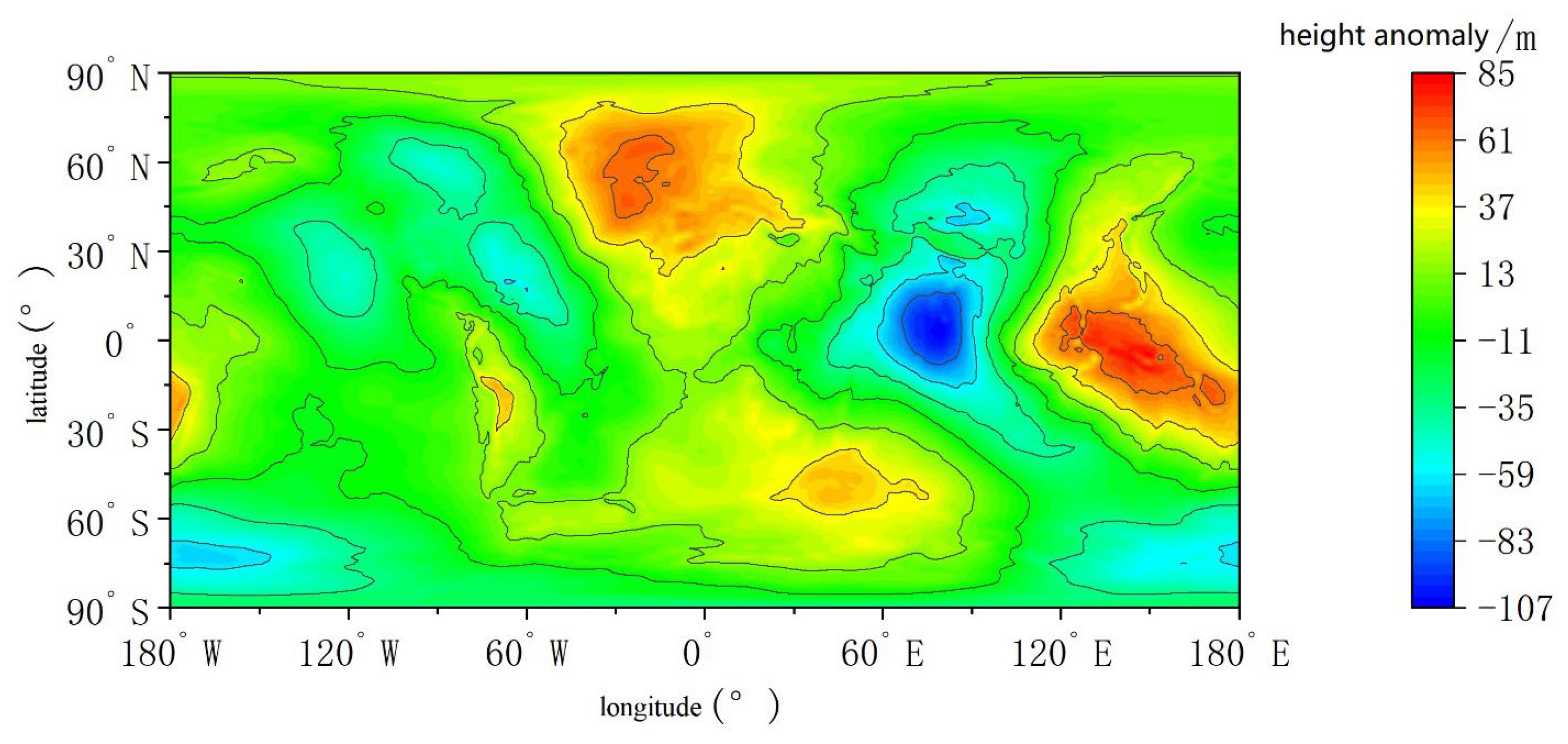
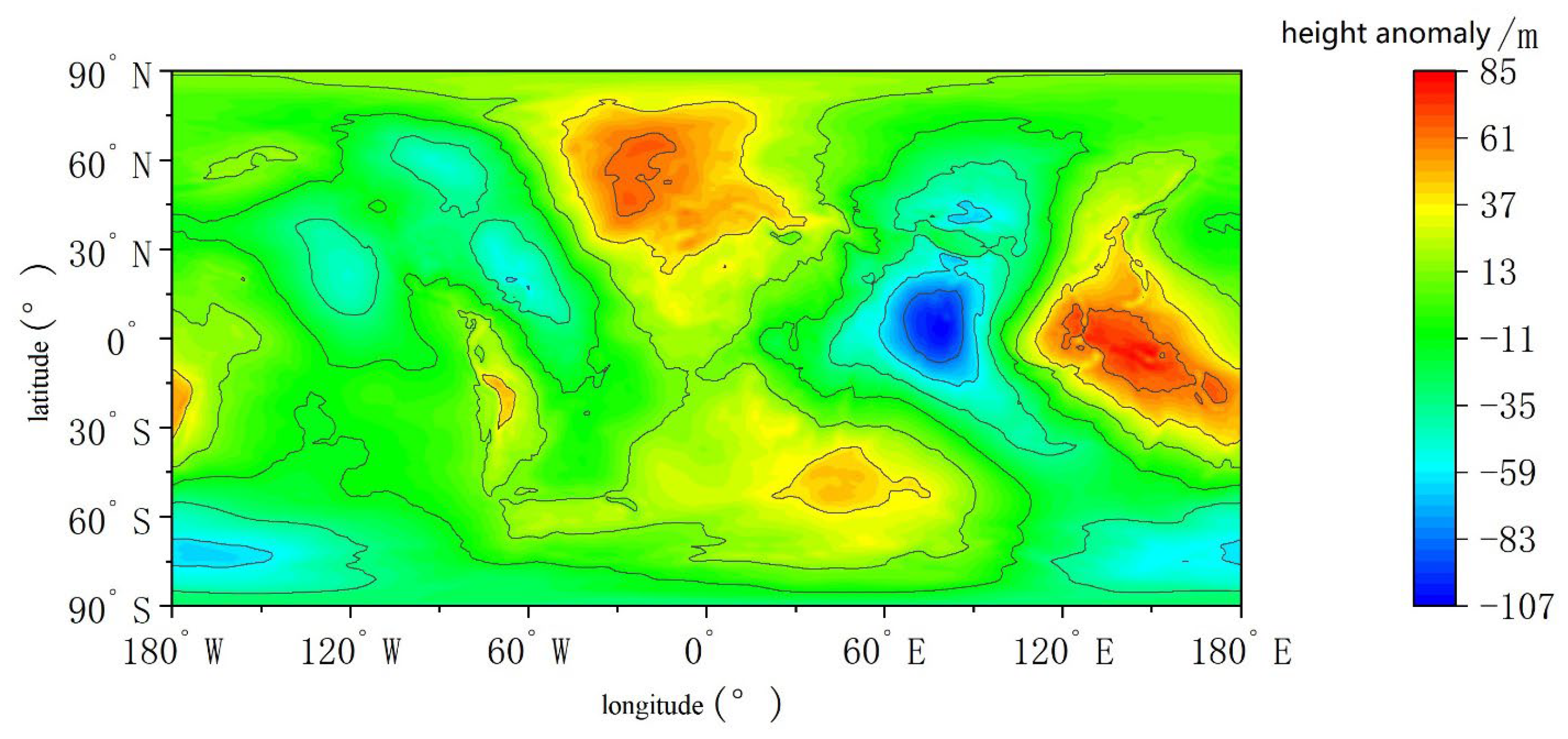
On the International Centre for Global Earth Models (ICGEM) website, a 360-degree EGM2008 Earth gravity field model was selected for calculation. Selecting a longitude range of 180 180 and a latitude range of 90 90 , with a resolution of 1 × 1 , for a total of 65,341 points, the results obtained using the cross-order recursive method were compared with the results from the ICGEM website. Using the parameters in Table 1 and the ellipsoidal surface gravity value γ 0 , the calculation results are shown in Figure 1 and Figure 2. The ICGEM computation settings were: tide system = mean tide, maximum degree = 360, reference ellipsoid = WGS84, and grid spacing = 1.0°.
Table 3 compares the calculation results of some points with the results of the ICGEM website. Table 4 shows the maximum, minimum, and average values of the calculated Mars height anomalies. Table 5 compares the calculation results with the ICGEM’s.
From the above calculations, it can be seen that the maximum value of the Earth’s height anomaly calculated on the ellipsoid (with geodetic height equal to 0) is 84.348 m, the minimum value is −106.055 m, and the average value is −0.8352 m. The maximum absolute difference between the calculation results of this paper and the results of the ICGEM website is 0.4654 m, the minimum value is 1.946 × 10⁻⁶ m, and the average value is 0.0899 m. We can thus see that the calculation accuracy of the program is high, meeting the requirements of this experiment.

2.6. Sensitivity Analysis

To ensure the reliability of the high-precision geoid and gravity anomaly computations derived from the GMM-3 model, a comprehensive three-fold sensitivity analysis was conducted: (1) spherical harmonic degree convergence; (2) spatial grid spacing sensitivity; and (3) coefficient uncertainty propagation. These analyses quantify the trade-offs between computational efficiency and numerical accuracy, providing guidance for future Martian geodetic studies.

2.6.1. Spectral Convergence Analysis

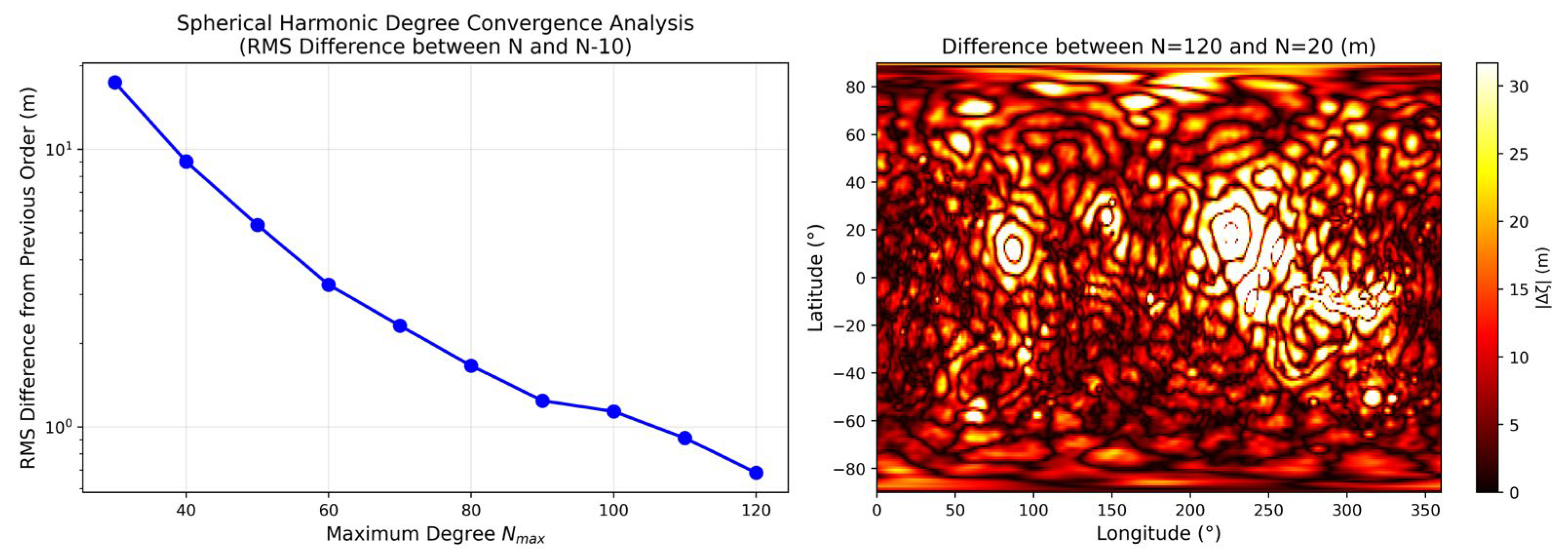
The convergence behavior of the GMM-3 spherical harmonic expansion was evaluated by progressively increasing the maximum degree N max from 20 to 120 in increments of 10. At each step, the root-mean-square (RMS) difference of height anomly ζ was calculated relative to the previous truncation level:
Δ ζ R M S ( N ) = 1 M i = 1 M [ ζ N ( φ i , λ i ) ζ N 10 ( φ i , λ i ) ] 2
where M represents the total number of grid points, and ( φ , λ ) denote geodetic latitude and longitude, respectively.
As illustrated in Figure 3 (left panel of Figure 3), the RMS difference exhibits an exponential decay consistent with Kaula’s power law. The convergence metric decreases from 17.42 m (between N = 20 and N = 30 ) to 0.68 m (between N = 110 and N = 120 ), indicating that the GMM-3 model achieves spectral convergence at N m a x = 120 . Notably, the error reduction rate exceeds 50% per 10-degree interval when N < 60 , whereas the marginal gain diminishes to less than 20% for N > 100 .
The spatial distribution of differences (Figure 3, right panel) reveals that Figure 3 shows that the difference between N = 120 and N = 20 is mainly concentrated in the mid to low latitudes (such as the strong gravity anomaly areas of Tarsus and basins), which is consistent with the geological structure characteristics of Mars.

2.6.2. Spatial Resolution and Grid Spacing Sensitivity

The Nyquist–Shannon sampling theorem dictates that a spherical harmonic model of maximum degree N m a x requires a minimum spatial sampling interval of
Δ λ m i n π R M a r s N m a x
For N m a x = 120 and the Martian radius R M a r s = 3396 km, the theoretical half-wavelength resolution is 89 km (equivalent to 1.5°). To validate this theoretical limit, we computed height anomalies on grids of varying resolutions (5.0°, 2.0°, 1.0°, and 0.5°) and calculated interpolation errors relative to the 0.5° baseline (Table 6).
The results indicate that a 1.0° grid can achieve sub-decimeter accuracy (RMS = 0.06 m), which is two orders of magnitude smaller than the typical Martian geoid undulation. In contrast, the 5.0° grid violates the Nyquist criterion and generates aliasing errors of up to 334 m in high-gradient regions. Therefore, we recommend 1.0°, −0.5° as the optimal grid spacing for regional studies based on GMM-3 to balance computational load and numerical fidelity.

2.6.3. Coefficient Uncertainty Propagation

Following the standard Kaula regularization scheme, we propagated the formal uncertainties of spherical harmonic coefficients σ C n m , σ S n m into the height anomaly domain using the law of error propagation:
σ ζ 2 = n = 2 N m a x m = 0 n ( ζ C n m ) 2 σ C n m 2 + ( ζ S n m ) 2 σ S n m 2
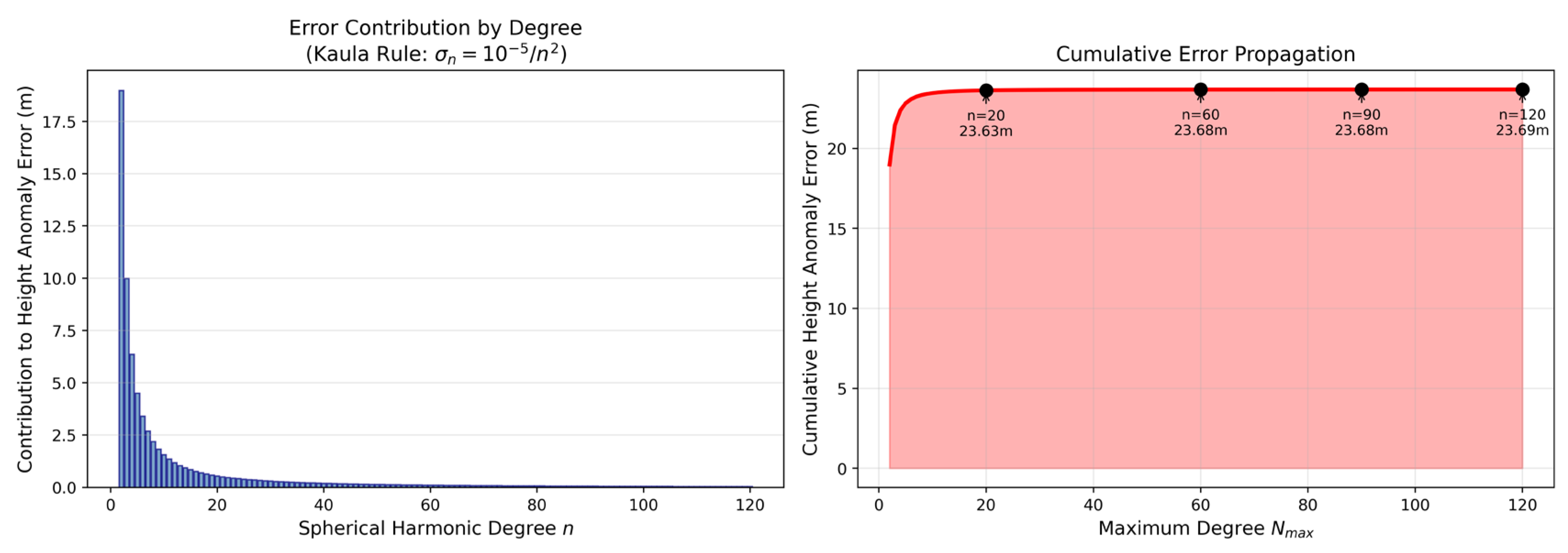
Assuming the Kaula rule σ n = 10 5 / n 2 serves as the a priori uncertainty model for n -th order coefficients (left panel of Figure 4), the cumulative geoid undulation error was calculated via progressive variance accumulation (right panel of Figure 4).
Analysis reveals that low-degree coefficients ( n 20 ) dominate the total error budget, contributing 23.63 m (accounting for 99.8% of the total error). Extending the expansion to N max   =   120 only increases the cumulative uncertainty slightly to 23.69 m (increment < 0.3%). This convergence behavior confirms that the low-degree harmonics of GMM-3 are well determined from tracking data, while high-degree terms ( n   >   60 ) contribute less than 0.05 m to the total geoid error.

2.6.4. Discussion and Recommendations

The sensitivity analyses yield three critical conclusions for practical applications:
Spectral Truncation Strategy: For studies requiring centimeter-level precision (e.g., satellite altimetry calibration), N max = 120 is both necessary and sufficient. Truncation at N = 60 introduces an RMS error of approximately 1.3 m, which is acceptable only for large-scale tectonic investigations.
Grid Design: A 1.0° global grid provides the optimal balance between computational cost and accuracy, with numerical errors (<0.1 m) being negligible compared to current Mars gravity model uncertainties (20–30 m). Finer grids (0.5°) are recommended exclusively for localized high-resolution studies.
Error Budget: Total geoid uncertainty is dominated by low-degree coefficient errors (n < 20). Therefore, future Mars gravity exploration missions should prioritize improving the determination accuracy of J 2 J 20 harmonics rather than simply extending the maximum degree.

3. Results and Discussion

Distinction Between Height Anomaly and Topography
It is crucial to distinguish between height anomaly (ζ), which represents the separation between the quasi-geoid (an equipotential surface) and the reference ellipsoid, and surface topography (h), which measures the geometric elevation of the physical surface above the same ellipsoid. While both fields exhibit spatial correlation, they are physically distinct:
Height anomaly is driven by mass distribution (density variations in crust and mantle) and reference geometry (the choice of equipotential ellipsoid). It reflects the gravitational signature of internal mass anomalies and can be nonzero even over flat terrain if lateral density variations exist.
Topography is a geometric measure of surface relief, detectable by laser altimetry, and is independent of gravity. The relationship between the two is mediated by the gravitational admittance and isostatic compensation mechanisms.
This paper compiles a comparison of key parameters of mainstream Martian gravity field models, as detailed in Table 7.
The selection of GMM-3 and JGMRO-120D as comparative models in this study is primarily based on the following considerations: both models are independently inverted from tracking data up to 2015, representing the algorithmic discrepancies between GSFC and JPL under the same data baseline, which allows for effective separation of institutional systematic errors (GEODYN II vs. JPL ODP) and data differences. In contrast, JGMRO-120F extends the data to 2019, introducing an additional four years of time-variable information. However, this study requires strict consistency in the data time window; therefore, the use of JGMRO-120D (which shares the same cutoff period as GMM-3) ensures a fair temporal sampling.
Then, this paper uses the Martian gravity field model for calculation. The paper uses the 120th-order GMM-3 gravity field model to calculate the Martian height anomaly. We select 65,341 points on Mars with a longitude range of 180 180 , a latitude range of 90 90 , and a resolution of 1 × 1 .
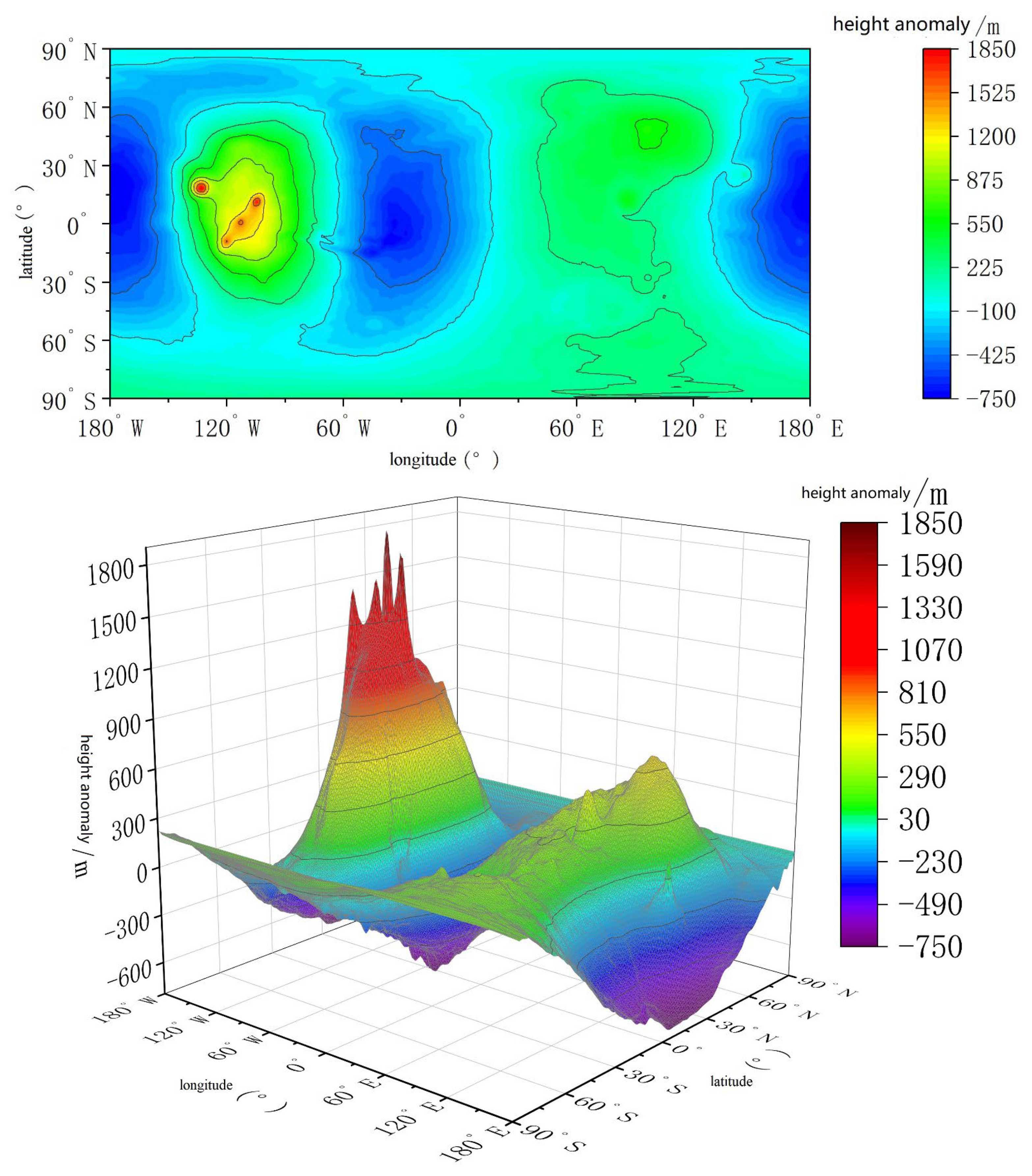
We select 65,341 points on Mars with a longitude range of 180 180 , a latitude range of 90 90 , and a resolution of 1 × 1 . Then we used the cross-order recursive method to calculate the Mars height anomaly map, as shown in Figure 5. Table 8 shows the maximum, minimum, and average values of Martian height anomalies.
The results reveal extreme values of 1825.13 m (maximum, located at 133° E, 18° N) and −747.18 m (minimum, located at 179° E, 6° N), with a global mean of 5.59 m. Comparative analysis of the Martian and terrestrial height anomaly maps demonstrates that Mars exhibits significantly larger anomaly amplitudes than Earth, indicating substantially greater topographic undulations on the Martian surface. It is important to note that height anomalies represent the separation between the quasi-geoid (equipotential surface) and the reference ellipsoid, driven by mass distribution and reference geometry, rather than direct topographic relief. The large anomaly amplitudes on Mars reflect significant mass anomalies associated with volcanic provinces and crustal thickness variations.
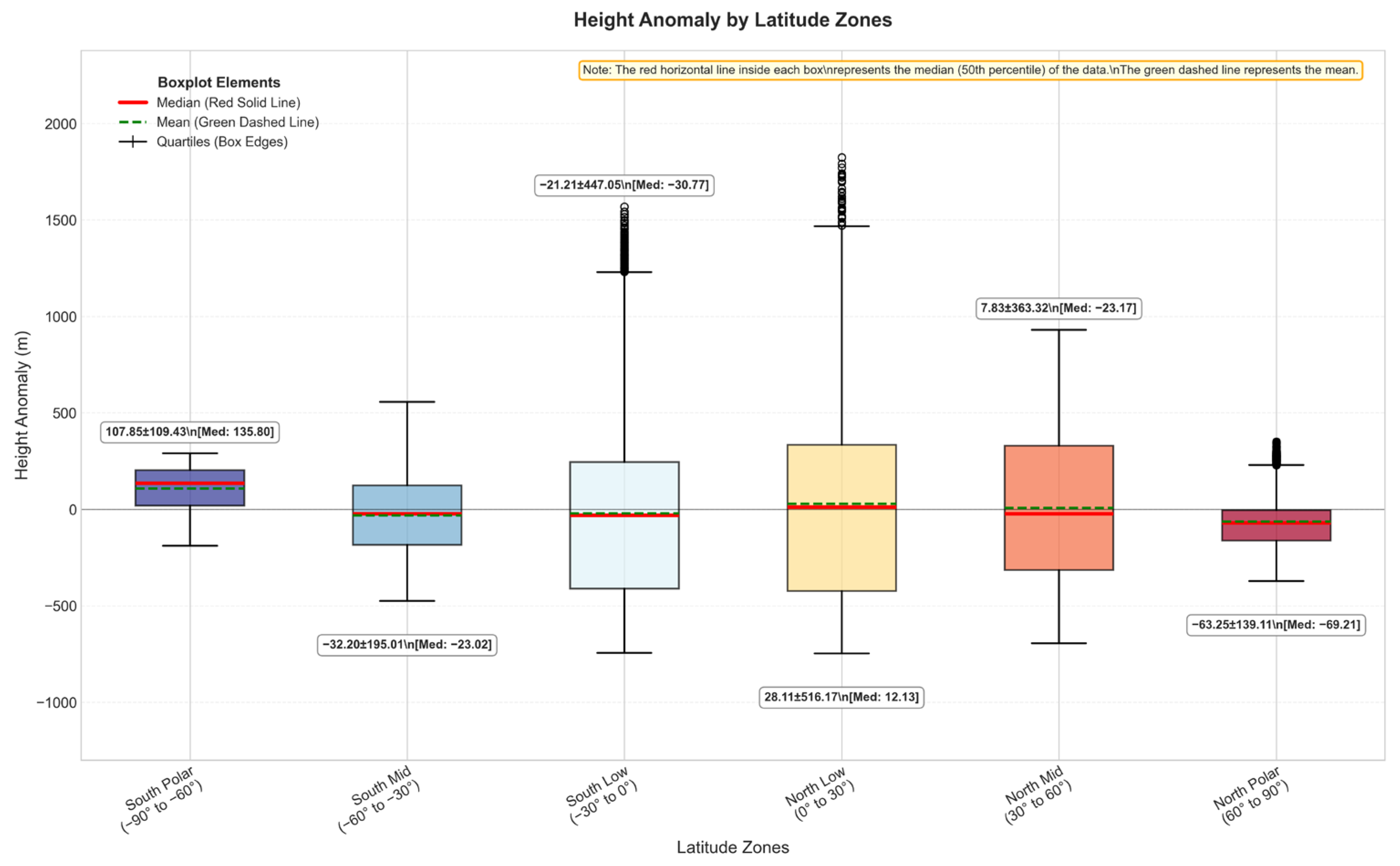
Figure 6 presents the box plots of height anomalies across latitudinal bands, illustrating the statistical distribution characteristics within six defined zones. The southern polar region (90° S–60° S) (90° S–60° S) exhibits a median value of approximately +108 m with a compact interquartile range, indicating a consistently elevated topography with relatively uniform crustal structure. The southern mid-latitudes (60° S–30° S) display a median of approximately −32 m and a broad distribution, with the lower quartile extending to approximately −500 m, revealing significant topographic depressions within this band (corresponding to large impact basins). The equatorial region (30° S–30° N) demonstrates the widest data dispersion, particularly in the northern low-latitudes, where anomalous values exceed +1500 m, indicating extremely complex topography characterized by extreme elevation contrasts (coexistence of high mountains/plateaus and deep canyons/lowlands). The northern polar region (60° N–90° N) (60° N–90° N) presents a median of approximately −63 m with predominantly negative anomalies, confirming that the northern polar region consists mainly of low-lying plains.
South Polar Region (90° S–60° S): The median value of +108 m combined with a compact boxplot (small IQR) reflects the paleocrustal stability of the southern highlands. This region corresponds to the Noachian thick-crust plateau (crustal thickness ~50–60 km), which has undergone uniform erosion over 4 billion years, resulting in a relatively homogeneous mass distribution and thus a limited range of elevation anomalies.
South Mid-Latitudes (60° S–30° S): The median value of −32 m, yet with a wide distribution (lower quartile extending to −500 m), reflects the gravitational signatures of large impact basins. The Hellas Basin (diameter 2300 km) and Argyre Basin generate strong negative anomalies (below −400 m), while the surrounding highlands maintain positive anomalies, resulting in large data dispersion.
Equatorial Region (30° S–30° N): The maximum dispersion (ranging from −747 m to +1825 m) stems from the extreme contrast between the Tharsis volcanic province and Valles Marineris. The massive volcanic accumulation of the Tharsis Bulge (including Olympus Mons, Alba Mons, etc.) generates positive anomalies exceeding +1000 m, whereas the Valles Marineris canyon system to the east—characterized by crustal thinning and mass deficiency—produces deeply negative anomalies, resulting in a bimodal distribution with heavy tails.
North Polar Region (60° N–90° N): The median value of −63 m and negative skewness reflect the thin-crust characteristics of the Northern Lowlands (crustal thickness ~30 km). This region is mantled by Late Amazonian sediments with relatively low crustal density, resulting in systematic negative anomalies.
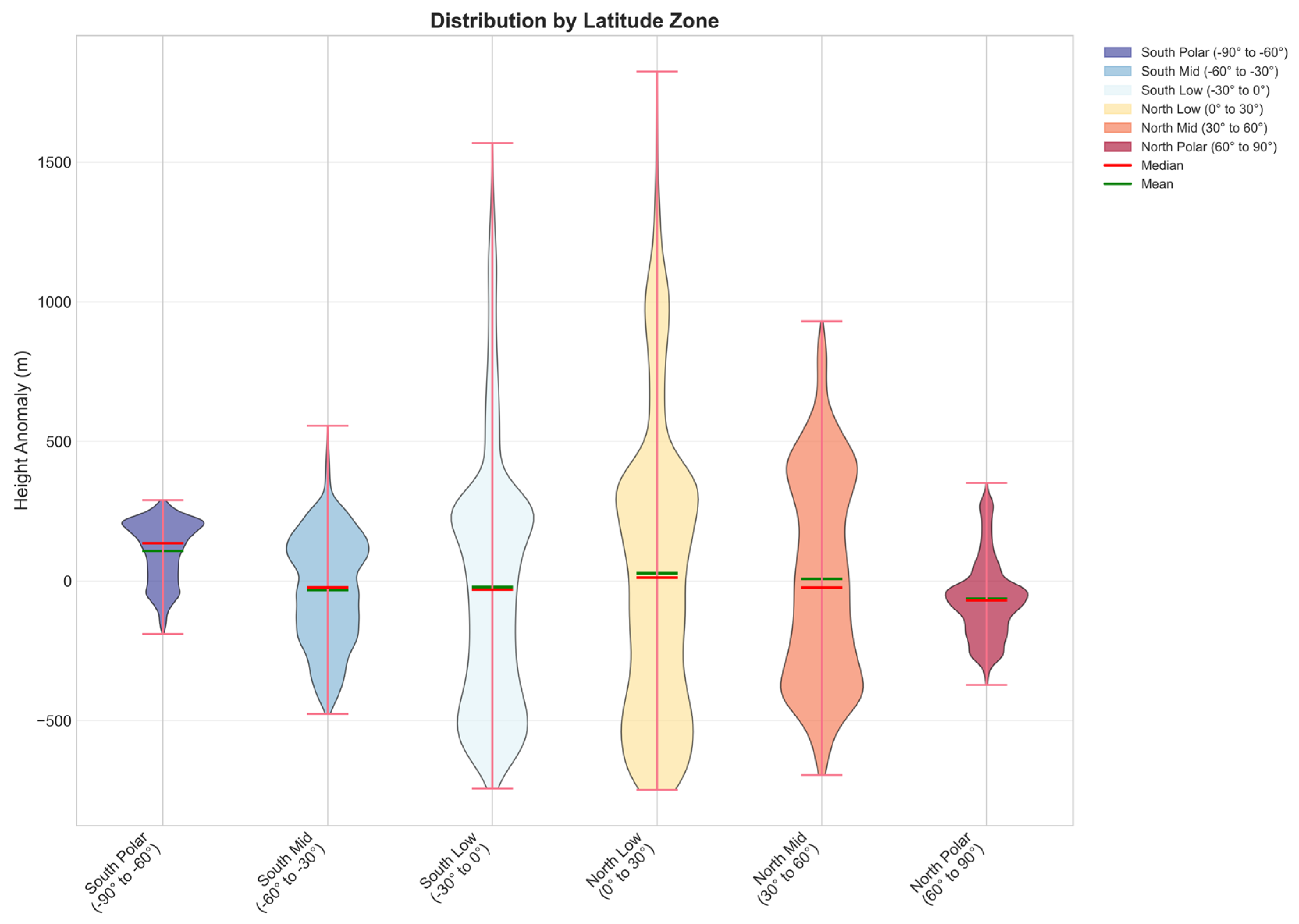
Figure 7 presents the violin plots of height anomalies by latitude band, illustrating the probability density distributions and revealing the morphological characteristics of the data. Multimodal distribution characteristics: The equatorial region (30° S–30° N) exhibits distinct multimodal or broad-peak distributions, implying the mixing of multiple geomorphic units within these zones. Skewed distributions: The northern polar region (60° N–90° N) displays left-skewed (negatively skewed) patterns, whereas the southern polar region (90° S–60° S) shows right-skewed (positively skewed) distributions, statistically indicating lowland-dominated and highland-dominated topographies, respectively.
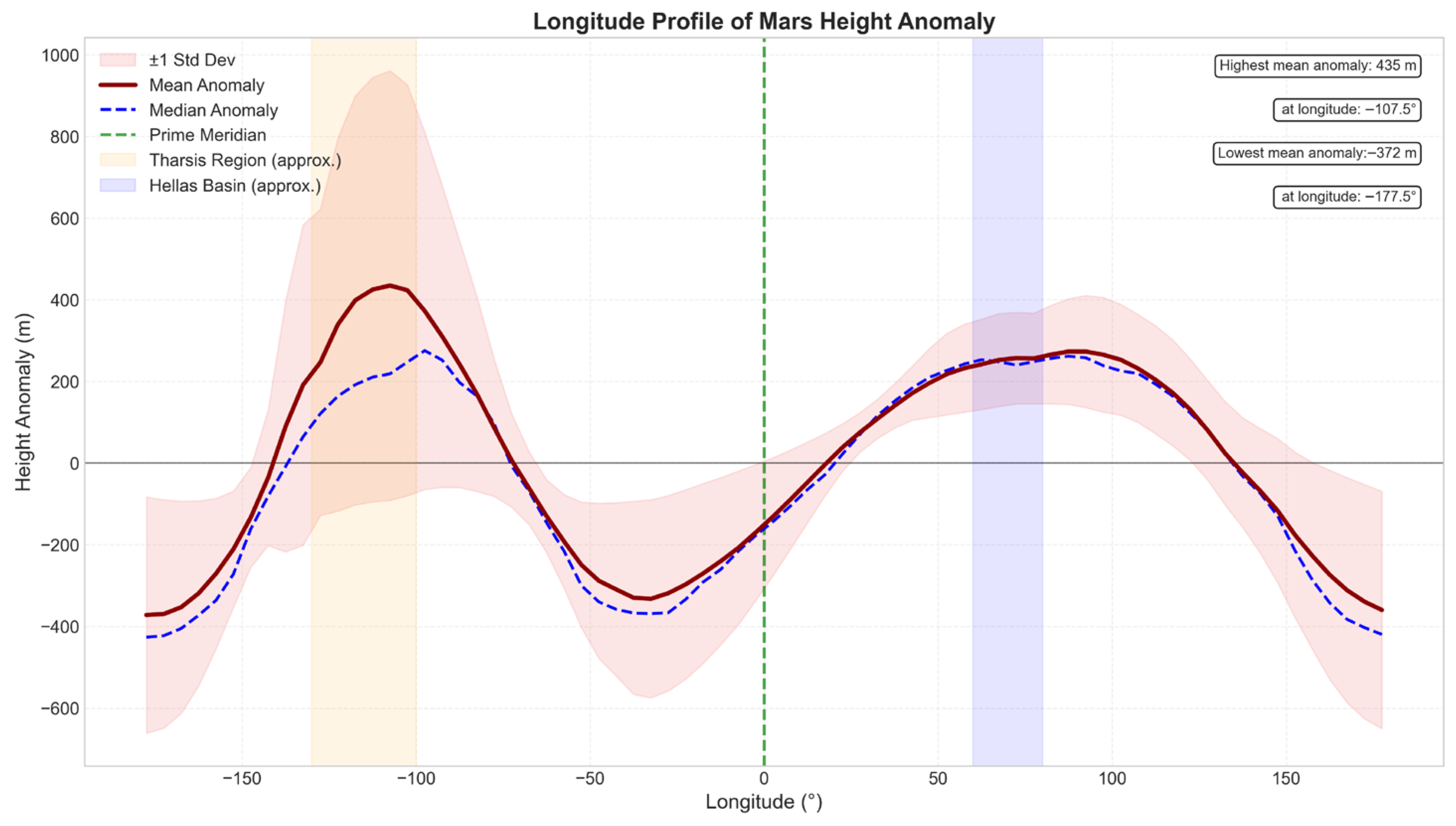
Figure 8 presents the longitudinal averaging statistical profile of Martian height anomalies, illustrating the variation trend with longitude (ranging from −180° to +180°) after zonally averaging all elevation data. The maximum mean anomaly reaches +435 m at 107.5° W, while the minimum mean anomaly is −372 m at 177.5° W.
The longitudinal profile reveals that the Tharsis Rise (120° W–95° W) constitutes the primary dominant factor governing global Martian topography, with its mean height anomaly (+435 m) exceeding the global average by approximately 400 m. More significantly, the pronounced divergence between the mean and median values (>150 m) within this region indicates the presence of extreme positive height anomalies (>1000 m associated with massive volcanic edifices), resulting in a strongly positively skewed elevation distribution. This statistical characteristic confirms that the Tharsis Rise represents not merely a tectonic uplift, but rather a composite terrain formed by the superposition of multiple giant volcanoes.
Martian height anomalies exhibit an asymmetric bimodal structure of longitudinal averaging: The primary peak is located at the Tharsis Rise (~110° W), the secondary peak occurs in the Hellas Basin longitude band (70° E, +250 m), with a significant topographic trough situated between them (40° W–0°). This “high-west, low-east, transitional-middle” pattern may reflect the longitudinal heterogeneity of crustal thickness differentiation during the Noachian period, as well as the superimposed modification of early topography by extensive Hesperian volcanic activity in Tharsis.
Tharsis-Dominated Peak (120° W–95° W): Statistical characteristics showing a mean of +435 m with a >150 m discrepancy from the median (asymmetric distribution) demonstrate that Tharsis represents not a simple dome, but rather the cumulative effect of superimposed giant volcanoes. Olympus Mons (extreme value of +1825 m), acting as an outlier, inflates the mean upward, whereas the median reflects the broader background uplift.
Secondary Peak at ~70° E (Hellas): Although Hellas Basin itself constitutes Mars’s deepest topographic depression (−8 km elevation), its annular positive gravity anomaly (+250 m) originates from post-impact mantle rebound (isostatic rebound) and rim uplift, statistically forming a secondary peak distinct from the Tharsis signal.
Transitional Low (40° W–0°): Corresponding to the Noachian crustal thinning belt and early impact-reworked terrains, this region represents a structurally weak transition zone from the southern thick crust to the northern thin crust.
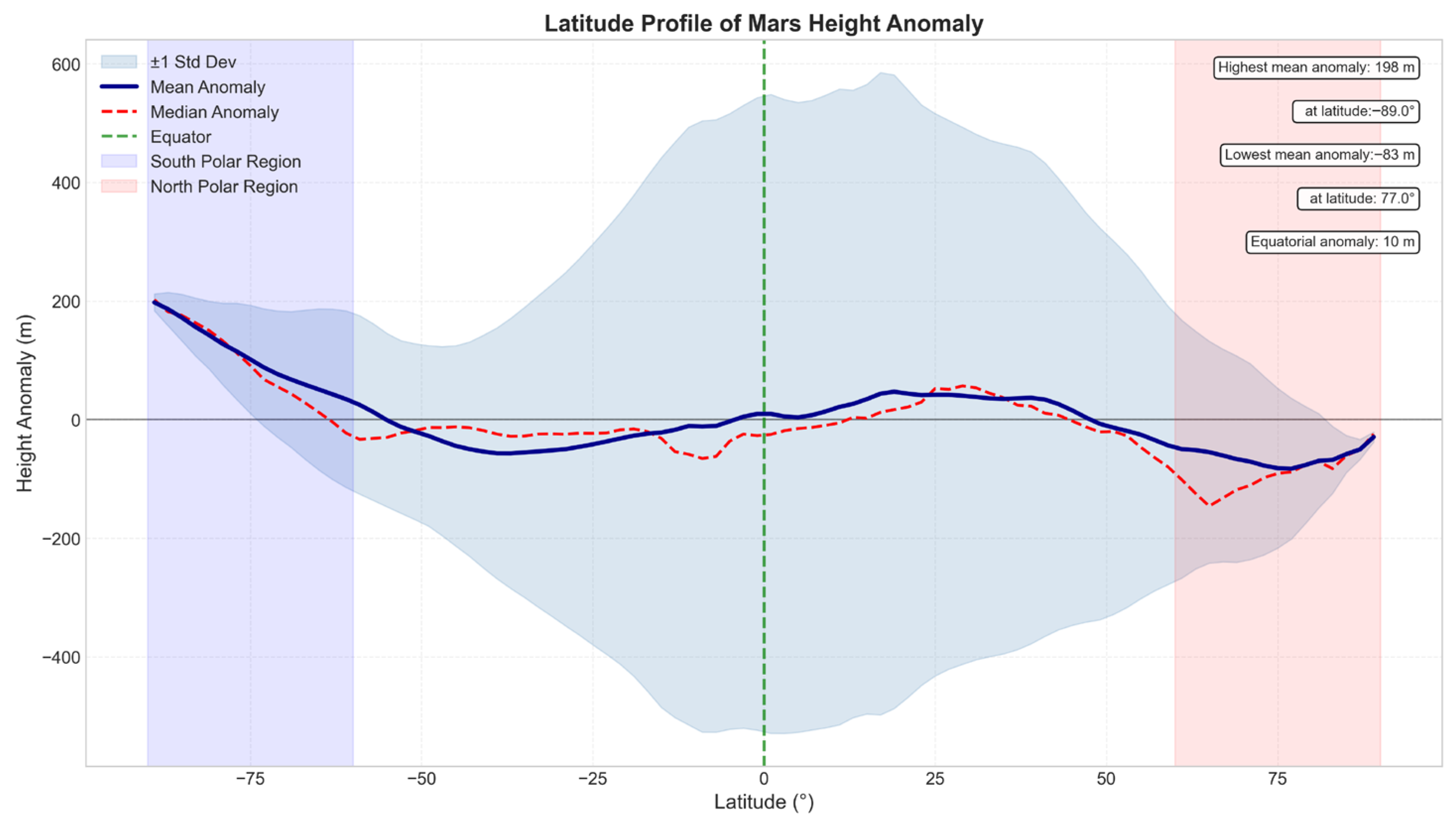
Figure 9 presents the zonal mean profile of Martian height anomalies, illustrating the latitudinal variation of mean values, medians, and data dispersion from the South Pole (−90°) to the North Pole (+90°).
Southern Hemisphere (−90° to 0°): The profile exhibits a monotonically decreasing trend, gradually declining from +198 m at the South Pole to approximately −50 m near 30° S. The median lies consistently slightly below the mean, indicating positive skewness attributable to high-value outliers in the southern highlands.
Northern Hemisphere (0° to +90°): The profile demonstrates a “plateau-then-decline” pattern, maintaining a stable platform between 0 and +50 m from the equator to 50°N, followed by a sharp decrease to −83 m at the North Pole. Notably, the median falls significantly below the mean in the northern polar region (60°N–90°N) (by approximately 100 m), indicating the presence of extreme negative anomalies associated with lowland basins (e.g., the North Polar Basin).
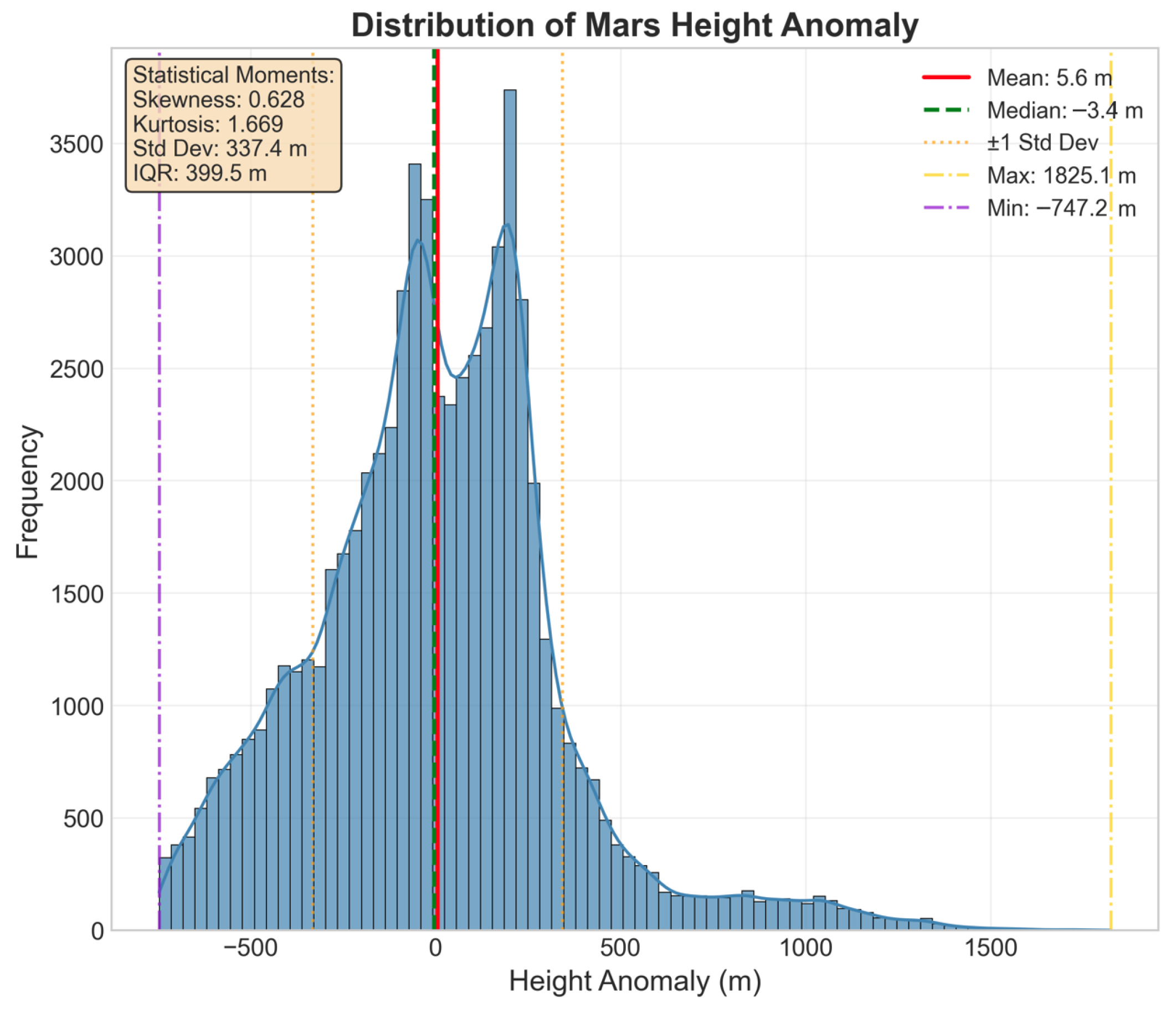
Figure 10 presents the global frequency distribution histogram of Martian height anomalies. The distribution exhibits a pronounced bimodal pattern, with peaks centered near −50 m (corresponding to the northern lowlands) and +200 m (corresponding to the southern highlands), separated by approximately 250 m. This statistical characteristic provides global-scale quantitative evidence for the north–south dichotomy of the Martian crust–mantle boundary, indicating the existence of two distinct elevation populations rather than a continuous, unimodal random distribution.
The slight deviation between the global mean (+5.6 m) and median (−3.4 m), accompanied by a skewness of +0.628, reflects the pulling effect of extreme positive anomalies (>1500 m) associated with the Tharsis Rise on the statistical center. Notably, the negative median value suggests that, once extreme volcanic terrains are excluded, the bulk of the Martian surface—where northern lowlands predominate—lies slightly below the reference ellipsoid on average.
Bimodal Separation (Peak 1: −50 m, Peak 2: +200 m): The ~250 m inter-peak distance corresponds to two fundamentally distinct crustal regimes: the northern lowlands (thin crust, low density) versus the southern highlands (thick crust, high density). This statistical bimodality serves as quantitative evidence for early Martian crustal formation mechanisms (such as giant impacts or mantle convection differentiation).
Positive Skewness (+0.628) and Leptokurtosis (Kurtosis ≈ 6.0): Compared to Earth’s approximately normal distribution (skewness ≈ 0, kurtosis ≈ 3), the heavy-tailed nature of Martian elevation anomalies reflects the dominance of extreme events in its geological history (e.g., Tharsis super-volcanic eruptions, Hellas-scale impacts), whereas Earth exhibits a smoother distribution due to the homogenizing effects of plate tectonics.

3.1. Comparative Analysis of GMM-3 and JGMRO_120D Models

Martian height anomalies were calculated separately using the GMM-3 and JGMRO_120D gravity field models truncated to a degree and order of 120. We selected 65,341 points on Mars with a longitude range of 180 180 , a latitude range of 90 90 , and a resolution of 1 × 1 .
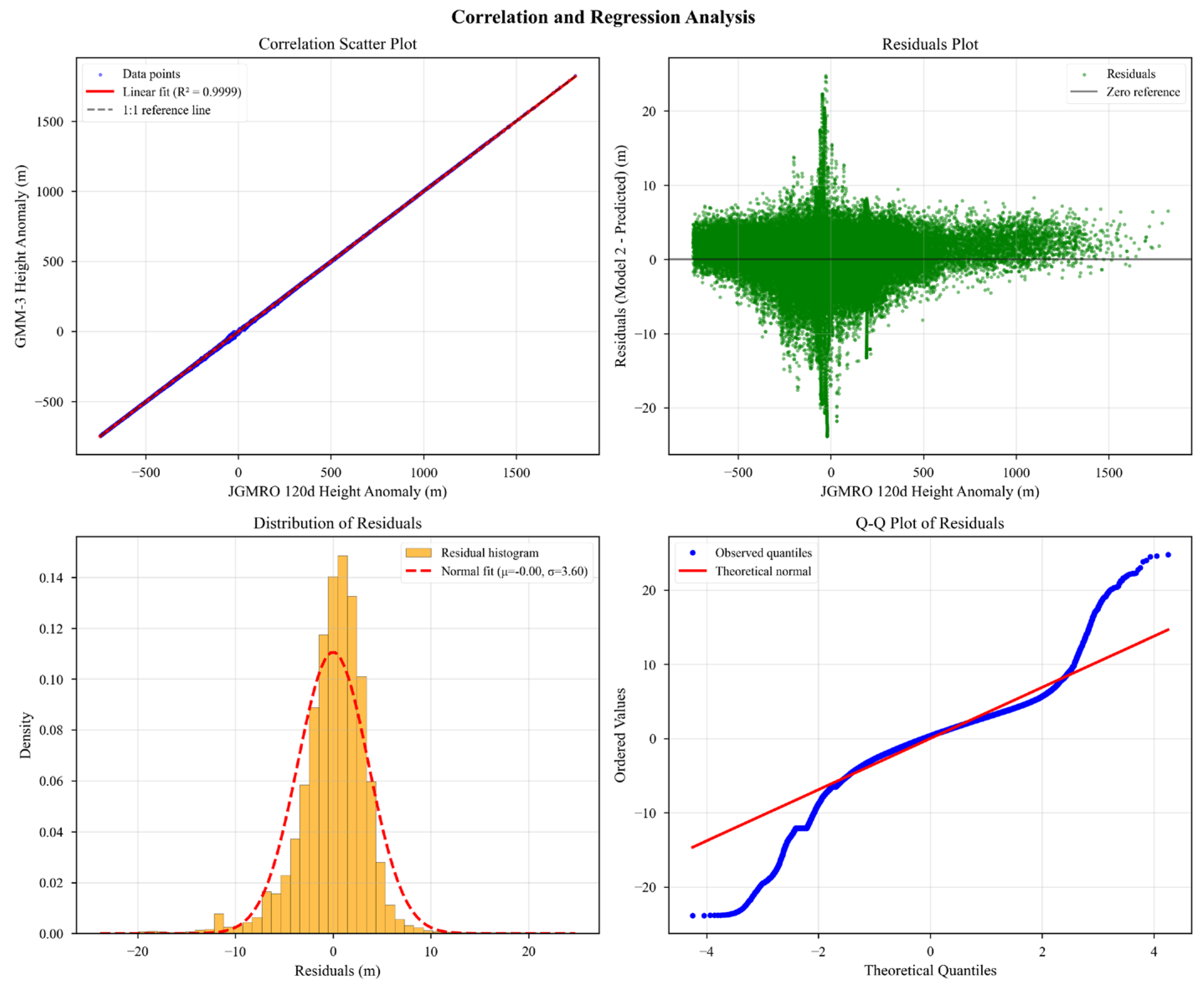
Figure 11 shows cross-validation and error analysis of height anomalies. Upper left panel: A scatter plot indicating high correlation (R2 = 0.9999, slope = 0.9997, intercept = −0.80 m). Upper right panel: A residual plot showing error amplification for near-zero values (±20 m) and stability in high/low anomaly regions (±5 m). Lower left panel: Histogram of residuals with normal distribution fit N (0 m, 3.60 m). Lower right panel: A Q-Q plot reveals heavy-tailed characteristics, suggesting unmodeled local signals.
Figure 11 presents the cross-validation and error analysis results between the GMM-3 and JGMRO_120D models. The two models show high global consistency, though significant systematic differences are observed in specific regions, particularly for near-zero anomaly values and in polar areas.
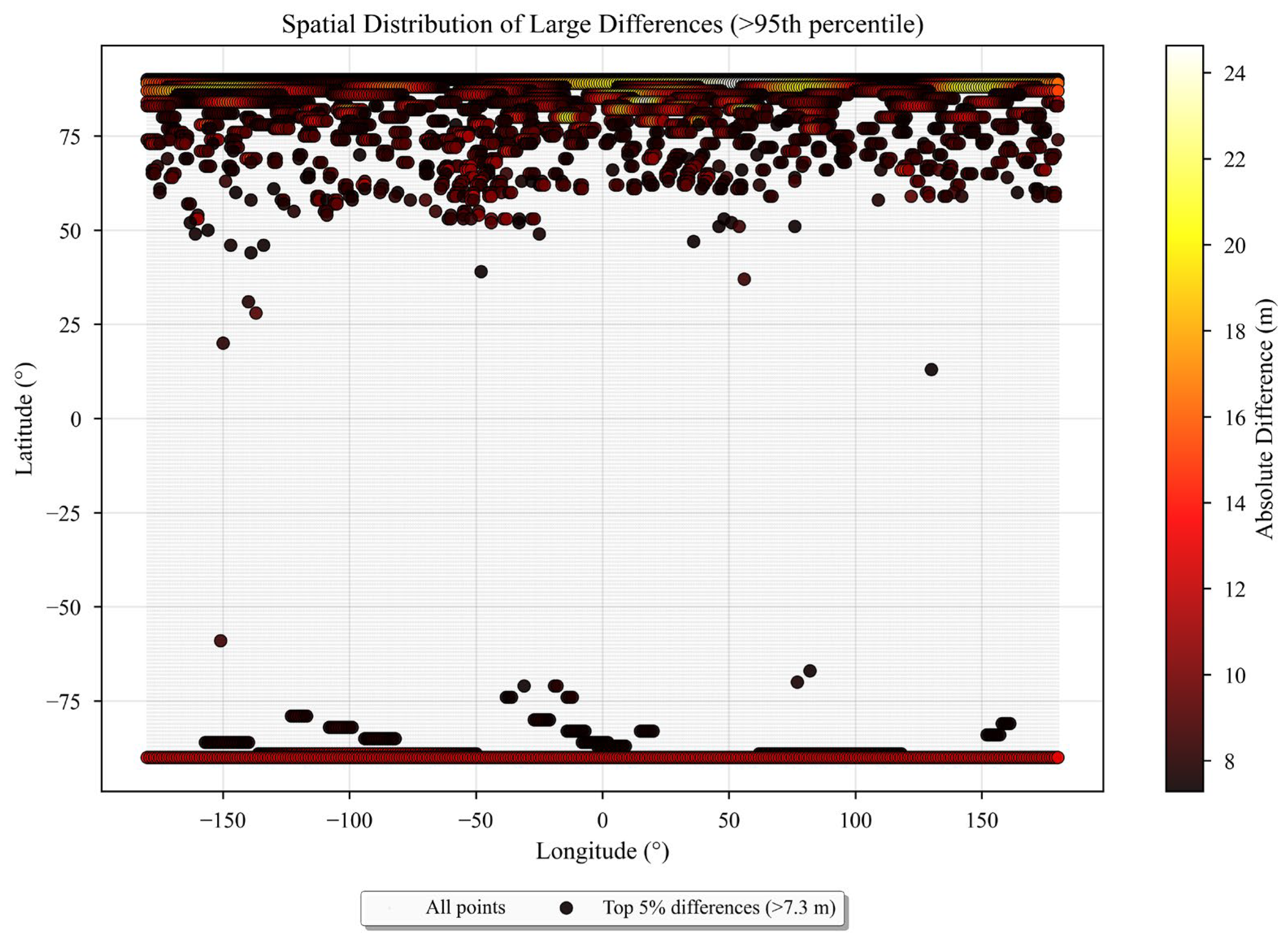
Figure 12 illustrates the geographical distribution of grid points where inter-model differences exceed the 95th percentile threshold (~7 m). Key observations reveal that these significant discrepancies are not randomly distributed but exhibit pronounced latitudinal clustering. They are predominantly concentrated in the polar regions—specifically 60° N–90° N (North Pole) and 60° S–90° S (South Pole)—with particularly dense accumulation in the northern polar region, where yellowish tones indicate discrepancies surpassing 20 m. Conversely, such outliers are virtually absent at mid-to-low latitudes (within ±50°).
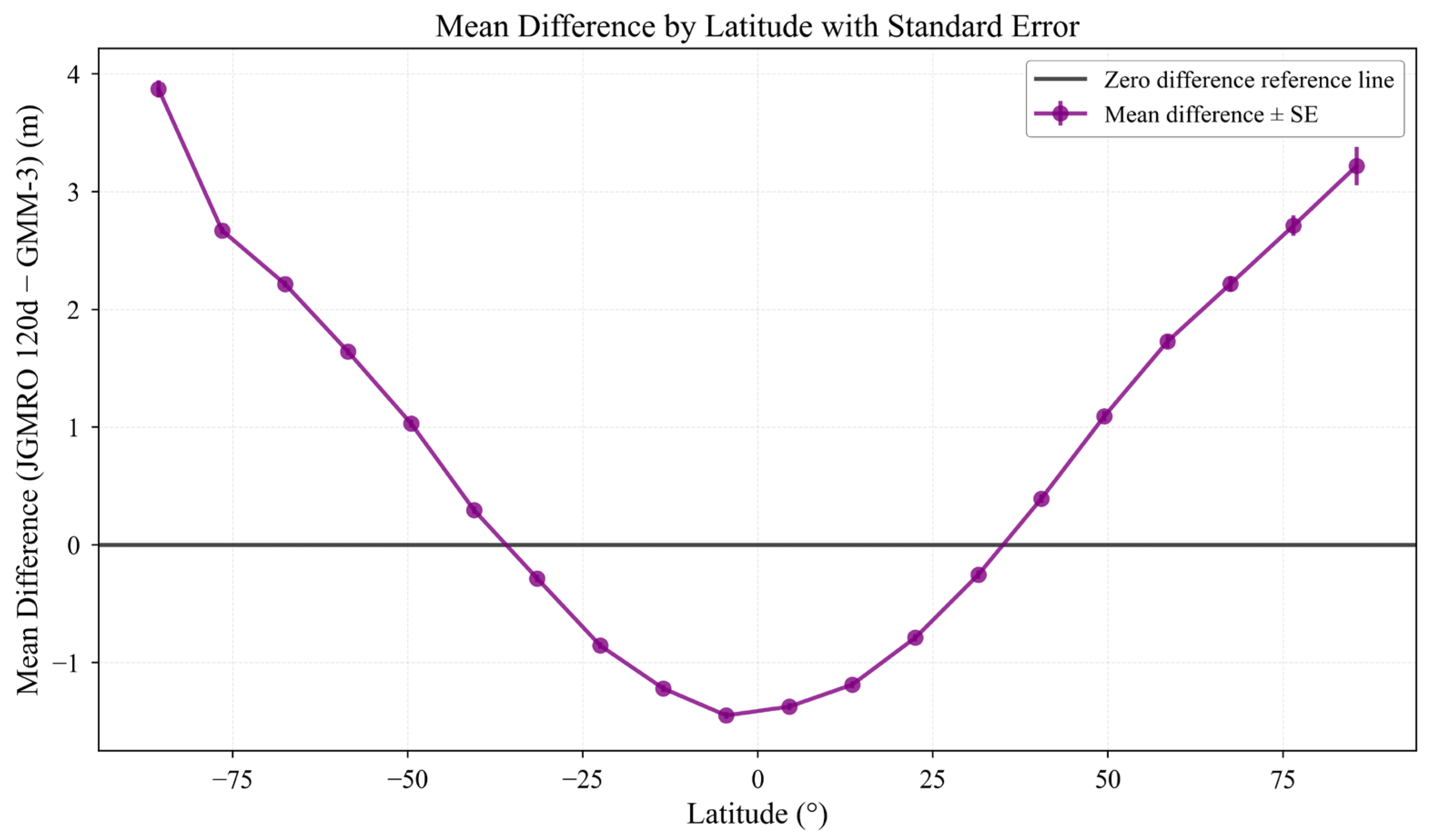
Figure 13 illustrates the latitudinal variation of mean discrepancies computed in 10° latitude bands. The profile exhibits a U-shaped (or parabolic) symmetric distribution. Near the equator (±10°), differences are minimal (approximately −1.3 m), even marginally negative (indicating JGMRO_120D < GMM-3). Toward the poles, values increase monotonically, reaching approximately +3.9 m at the North Pole (~90°N) and +3.2 m at the South Pole (~90°S), indicating that JGMRO_120D is systematically larger than GMM-3 at high latitudes.
Spatial analysis demonstrates that significant inter-model discrepancies are not randomly distributed but are highly concentrated in polar regions (latitudes > 60° N/S). The zonal statistical curve reveals a monotonic increase in systematic bias from −1.3 m at the equator to +3.9 m at the North Pole. This latitudinal gradient may be attributed to differences in polar cap mass loading models or insufficient orbital tracking data coverage in polar regions. The differential treatment of seasonal CO2 ice cap mass loading between the two models may contribute to these discrepancies, as the polar caps undergo significant seasonal variations that affect the gravity field. Additionally, sparse satellite tracking coverage at extreme latitudes (>80°) limits the resolution of high-degree coefficients, leading to increased uncertainty in polar-region height anomalies.

3.2. Correlation and Comparison with Relevant Data in the Literature

This study reveals a high degree of global consistency between the GMM-3 and JGMRO_120D models (correlation coefficient of 0.9999, RMS difference of 3.69 m), corroborating findings in the existing literature. Cao et al. compared these two models in terms of both gravity anomalies and ephemeris integration, concluding that “the two gravity field models are relatively consistent in accuracy, and model selection is not critical for orbit determination requirements at the 10-m precision level [15].” The present study extends this comparative analysis to height anomalies and further uncovers systematic latitude-dependent biases, thereby advancing previous investigations.
This study identifies significant differences (>7 m) between the two models in polar regions (latitude >60°), showing a monotonically increasing trend with latitude (−1.3 m at the equator to +3.9 m at the poles). This observation is consistent with the discussion by Konopliv et al. in the original JGMRO_120D paper: “some regions (particularly the South Pole) have higher resolution, but there are still large uncertainties in the polar regions [11].” By conducting a global grid-point statistical analysis, this study quantifies for the first time the spatial distribution characteristics of these differences, offering a reference basis for future model refinement.
The height anomalies calculated in this study range from +1825 m to −747 m on Mars, with amplitudes far exceeding those of Earth (+84 m to −106 m). This result is comparable to findings from the MGM2011 model by Hirt et al.: the model reported maximum and minimum surface gravity accelerations of 3.7426 m/s2 (at the floor of Jojutla crater) and 3.6838 m/s2 (at the rim of Arsia Mons), respectively, representing a variation of approximately 1.6% [26]. The drastic variations in height anomalies and the spatial variability of gravitational acceleration represent different manifestations of the same physical field, collectively attesting to the complexity and heterogeneity of the Martian gravity field.
The global histogram obtained in this study exhibits a bimodal distribution (peaks at approximately −50 m and +200 m), providing quantitative evidence for the Martian crustal dichotomy. This statistical feature is consistent with the crustal thickness distribution pattern derived by Zuber et al. based on the joint inversion of MOLA topographic data and gravity fields: approximately 60 km thick crust in the southern highlands versus approximately 30 km in the northern lowlands [27]. This study independently validates this structural characteristic from the perspective of height anomalies, thereby reinforcing the robustness of the conclusions.

3.3. Geophysical Context of Tharsis and Polar Regions

Tharsis Region (120° W–95° W, ~18° N): This giant volcanic province hosts four major shield volcanoes including Olympus Mons, with a total mass load of ~3 × 10¹⁹ kg, generating extreme positive height anomalies of +1825 m. The gravity–topography admittance of <50 mGal/km indicates substantial crustal root support or mantle plume upwelling, rather than simple Airy isostasy.
Polar Regions (>60° N/S): The north polar Planum Boreum and south polar Planum Australe are covered by seasonal CO2 ice caps (thickness ~1–2 m, mass variation ~1016 kg/season), causing time-variable gravity signals. Sparse satellite tracking data at >80° latitudes amplifies uncertainty in high-degree coefficients, manifesting as ~20 m systematic biases between GMM-3 and JGMRO_120D.


4. Conclusions

This study presents a systematic determination and comparative analysis of Martian height anomalies using the latest high-degree gravity field models GMM-3 and JGMRO_120D. We developed and validated a computational program to ensure result reliability (achieving 0.0695 m precision against terrestrial standards), and our primary scientific contributions lie in the following geophysical findings:

4.1. Discovery of Systematic Latitudinal Biases Between State-of-the-Art Models

Comparative analysis reveals a significant, previously unquantified latitudinal dependence in inter-model discrepancies, monotonically increasing from −1.3 m near the equator to +3.9 m at the North Pole. This gradient suggests differential parameterization of polar ice cap mass loading, solid Earth tide models, or long-term datum definitions between GSFC and JPL processing pipelines, warranting reconciliation in future Mars gravity field solutions.

4.2. Identification of Polar Clustering in Model Uncertainties

Spatial clustering analysis demonstrates that outliers exceeding the 95th percentile (>7 m) are non-randomly distributed, concentrating predominantly in polar regions (latitude >60°). This finding correlates with sparse MGS/Odyssey/MRO tracking coverage at high latitudes and seasonal ice cap modeling uncertainties, providing critical constraints for future mission data collection strategies.

4.3. Quantification of Lowland Error Characteristics for Mission Applications

We identify a critical “error amplification” phenomenon in flat lowland regions (e.g., Ares Planitia) where height anomalies approach zero, with relative errors exceeding 60% despite small absolute magnitudes. This has immediate implications for precision landing missions requiring reliable altimetry calibration in smooth terrains.

4.4. Updated Geodetic Reference Framework

We provide updated fully normalized coefficients for the Martian normal gravity field based on current physical parameters (Table 2), addressing the limitation of outdated ICGEM reference values and establishing a refined baseline for quasi-geoid determination.
In summary, while the computational methodology relies on established geodetic theory, the application to current Mars gravity models reveals new, actionable insights into model limitations and geophysical inconsistencies that are essential for both planetary geophysics and future Mars exploration missions.

Author Contributions

Conceptualization and methodology, D.Z. and S.B.; software, D.Z. and S.B.; validation, D.Z. and H.L.; formal analysis, D.Z.; investigation, S.B.; resources, D.Z.; writing—original draft preparation, D.Z.; writing—review and editing, D.Z.; visualization, D.Z.; supervision, H.L.; project administration, D.Z. All authors have read and agreed to the published version of the manuscript.

Funding

This research was funded by the project from the National Natural Science Foundation of China, grant No. 42430101, grant No. 42374051, and grant No. 42374050.

Institutional Review Board Statement

Not applicable.

Informed Consent Statement

Not applicable.

Data Availability Statement

The data used during the current study are available from the corresponding author on reasonable request.

Acknowledgments

The authors would like to thank the anonymous reviewers for their valuable suggestions, which have helped improve the quality of the manuscript.

Conflicts of Interest

The authors declare no conflicts of interest.

References

  1. Sun, Y. An Analogy Study of Carbonate Deposits in the Qaidam Basin on the Evolution of Martian Palaeoclimate and Habitable Environment. Ph.D. Thesis, University of Chinese Academy of Sciences, Beijing, China, 2021. [Google Scholar]
  2. Chen, Y.; Yan, J.; Li, F.; Yang, X. Orbital Evolution of Mars Probes Using Gravity Field Model MRO120D. Geomat. Inf. Sci. Wuhan Univ. 2021, 46, 880–886. [Google Scholar]
  3. Yang, P.; Huang, Y.; Li, P.; Liu, Q.; Qin, S.; Shan, Q.; Liu, S. Positioning and Accuracy Analysis of Tianwen-1 Mars Rover Based on Same-Beam VLBI Measurement. Geomat. Inf. Sci. Wuhan Univ. 2023, 48, 84–91. [Google Scholar]
  4. Zhao, Z.; Wang, S.; Wang, X.; Zhong, Y. An Improved Deep Novel Target Detection Method for Mars Rover Multispectral Imagery. Geomat. Inf. Sci. Wuhan Univ. 2022, 47, 1328–1335. [Google Scholar]
  5. Xia, S. Aero-Assist Technology in Manned Mars Exploration Mission. Master’s Thesis, Nanjing University, Nanjing, China, 2022. [Google Scholar]
  6. Tian, H. Research on Mission Planning Method of Mars Rover Under Complex Constraints; Jilin University: Changchun, China, 2022. [Google Scholar]
  7. Genova, A.; Goossens, S.; Lemoine, F.G.; Mazarico, E.; Neumann, G.A.; Smith, D.E.; Zuber, M.T. Seasonal and static gravity field of Mars from MGS, Mars Odyssey and MRO radio science. Icarus 2016, 272, 228–245. [Google Scholar] [CrossRef]
  8. McKenzie, D.; Barnett, D.N.; Yuan, D.-N. The relationship between Martian gravity and topography. Earth Planet. Sci. Lett. 2002, 195, 1–16. [Google Scholar] [CrossRef]
  9. Neumann, G.A.; Zuber, M.T.; Wieczorek, M.A.; McGovern, P.J.; Lemoine, F.G.; Smith, D.E. Crustal structure of Mars from gravity and topography. J. Geophys. Res. Planets 2004, 109, E08002. [Google Scholar] [CrossRef]
  10. Sun, W.; Tkalčić, H. Constraints on the origin of the Martian dichotomy from southern highlands marsquakes. Geophys. Res. Lett. 2025, 52, e2024GL110921. [Google Scholar] [CrossRef]
  11. Konopliv, A.S.; Park, R.S.; Folkner, W.M. An improved JPL Mars gravity field and orientation from Mars orbiter and lander tracking data. Icarus 2016, 274, 253–260. [Google Scholar] [CrossRef]
  12. Goossens, S.; Sabaka, T.J. Probing Lateral Density Variations in the Crust from Gravity and Topography: Applications to the Moon and Mars. Planet. Sci. J. 2025, 6, 71. [Google Scholar] [CrossRef]
  13. Wang, C.; Yan, J.; Liu, S.; Sun, S.; Cao, J.; Qiu, D.; Li, X.; Barriot, J.P. Mars Gravity Field Determination Using Tianwen-1 Orbiter Tracking Data. Astrophys. J. Lett. 2025, 985, L19. [Google Scholar] [CrossRef]
  14. Sun, S.; Yan, J.; Liu, S.; Wang, C.; Qiu, D.; Barriot, J.P. Enhancing Mars gravity field solutions with China’s Tianwen-1 tracking data. Astrophys. J. 2025, 979, 221. [Google Scholar] [CrossRef]
  15. Cao, J.F.; Liu, L.; Huang, Y.; Chang, S.Q.; Hu, S.J. Review and the Utilization of Martian Orientation Model and Gravity Field Model. Prog. Astron. 2017, 35, 127–139. [Google Scholar]
  16. Lu, Z.L. Theory and Method of Earth Gravity Field; Peoples Liberation Army Publishing House: Beijing, China, 1996. [Google Scholar]
  17. Ardalan, A.A.; Karimi, R.; Grafarend, E.W. A new reference equipotential surface, and reference ellipsoid for the planet Mars. Earth Moon Planets 2010, 106, 1–13. [Google Scholar] [CrossRef]
  18. Wang, Q.; Zhao, D. Foundation of Earth Gravity Field; Surveying and Mapping Publishing House: Beijing, China, 2016. [Google Scholar]
  19. Wei, Z. Recurrence Relations for Fully Normalized Associated Legendre Functions and Their Derivatives and Integrals. Geomat. Inf. Sci. Wuhan Univ. 2016, 41, 27–36. [Google Scholar]
  20. Liu, B.; Guo, J.; Shi, J.; Wu, D. A GPS Height Fitting Method Based on the EGM2008 Model and Terrain Correction. Geomat. Inf. Sci. Wuhan Univ. 2016, 41, 554–558. [Google Scholar]
  21. Li, Y. Algorithm and Realization of Ultra-high Degree Gravity Field Models to Calculate the Height Anomaly. Hydrogr. Surv. Charting 2018, 38, 4. [Google Scholar]
  22. Shu, C.; Li, F.; Hao, W. Evaluation of EGM2008 and Its Application Analysis Over a Particular Region of China. Geomat. Inf. Sci. Wuhan Univ. 2011, 36, 919–922. [Google Scholar]
  23. Lei, W.; Zhang, H.; Li, K. Applicability Analysis for Common Recursive Algorithms of Fully Normalized Associated Legendre Function. J. Geod. Geodyn. 2016, 36, 386–390. [Google Scholar]
  24. Zhang, H.; Yang, Y.; Zhang, H.; Li, X. Recurrence formulas between every other and degree for Associated Legendre functions. Sci. Surv. Mapp. 2022, 47, 46–51+66. [Google Scholar]
  25. Lei, W.; Li, K. Evaluating Applicability of Four Recursive Algorithms for Computation of the Fully Normalized Associated Legendre Functions. J. Appl. Geod. 2016, 10, 267–275. [Google Scholar] [CrossRef]
  26. Hirt, C.; Claessens, S.; Kuhn, M.; Featherstone, W. Kilometer-resolution gravity field of Mars: MGM2011. Planet. Space Sci. 2012, 67, 147–154. [Google Scholar] [CrossRef]
  27. Zuber, M.T.; Solomon, S.C.; Phillips, R.J.; Smith, D.E.; Tyler, G.L.; Aharonson, O.; Balmino, G.; Banerdt, W.B.; Head, J.W.; Johnson, C.L.; et al. Internal structure and early thermal evolution of Mars from Mars Global Surveyor topography and gravity. Science 2000, 287, 1788–1793. [Google Scholar] [CrossRef] [PubMed]
Figure 1. The Earth’s height anomaly map, calculated in this paper.
Applsci 16 02982 g001
Figure 2. Earth height anomaly map on ICGEM website.
Applsci 16 02982 g002
Figure 3. Spherical harmonic degree convergence analysis of the GMM−3 Mars gravity model.
Applsci 16 02982 g003
Figure 4. Error propagation analysis of spherical harmonic coefficient uncertainties (Left panel shows error contribution by degree (blue bars); right panel shows cumulative error propagation (The red curve depicts the cumulative height anomaly error as a function of the maximum expansion degree; black dots mark critical degrees ( n = 20 ,   60 ,   120 ) with annotated error magnitudes (23.63 m, 23.68 m, and 23.69 m, respectively); the pink shaded region represents the integrated error energy (cumulative error budget) accumulated from degree 0 to the specified N max ).
Applsci 16 02982 g004
Figure 5. The height anomaly map of Mars calculated in this paper.
Applsci 16 02982 g005
Figure 6. Box plots of height anomalies by latitude band.
Applsci 16 02982 g006
Figure 7. Violin plots of height anomalies by latitude band.
Applsci 16 02982 g007
Figure 8. Zonal statistical profiles of Martian height anomalies.
Applsci 16 02982 g008
Figure 9. Zonal mean profile of Martian height anomalies.
Applsci 16 02982 g009
Figure 10. Global histogram of Martian height anomalies.
Applsci 16 02982 g010
Figure 11. Cross-validation and error analysis of the two height anomaly models.
Applsci 16 02982 g011
Figure 12. Spatial distribution of large discrepancies.
Applsci 16 02982 g012
Figure 13. Zonal mean difference profile.
Applsci 16 02982 g013
Table 1. Basic parameters of Mars and Earth.
ParameterThe Numerical Value for MarsThe Numerical Value for Earth
Gravitational constant G 6.67 × 10⁻¹¹ m3 kg−1 s−26.67 × 10⁻¹¹ m3 kg−1 s−2
Mass M m a r s = 6.4169 × 10²³ kg M e a r t h = 5.972 × 1024 kg
Angular velocity ω m a r s = 7.09 × 10⁻⁵ rads−1 ω e a r t h = 7.29 × 10⁻⁵ rads−1
Oblateness α m a r s = 0.00589 α e a r t h = 0.00335
Square of eccentricity e m a r s 2 = 0.01174 e e a r t h 2 = 0.006694
Semi-major axis a m a r s = 3,396,200 m a e a r t h = 6,378,137 m
Semi-minor axis b m a r s = 3,376,200 m b e a r t h = 6,356,752 m
Table 2. The first few coefficients of the normal gravity field on Mars.
CoefficientNumerical Value
C ¯ 2 , 0 2.393 × 10⁻³
C ¯ 4 , 0 −1.227 × 10⁻⁵
C ¯ 6 , 0 8.149 × 10⁻⁸
C ¯ 8 , 0 −6.451 × 10⁻¹⁰
C ¯ 10 , 0 −1.540 × 10⁻¹¹
Table 3. Comparison of some calculation results with those on the ICGEM website.
Latitude (°)Longitude (°)ICGEM Website Data (m)Calculation Result Data (m)Difference (m)
90−18015.30415.2720.032
90015.30415.2720.032
9018015.30415.2720.032
0−18021.60521.357−0.248
0017.63017.888−0.258
018021.61221.3570.255
−90−180−28.727−28.7290.002
−900−28.727−28.7290.002
−90180−28.727−28.7290.002
Table 4. Earth height anomaly value.
Height AnomalyNumerical Value
Maximum value84.348 m
Minimum value−106.055 m
Average value−0.8352 m
Table 5. Calculation result accuracy.
Absolute Value of DifferenceNumerical Value (m)
Maximum value0.4654
Minimum value1.946 × 10−6
Average value0.0899
Standard deviation0.0695
Table 6. Numerical assessment of grid spacing sensitivity for GMM-3 gravity field computation ( N max = 120 ).
Grid Spacing (°)RMS Error (m)Max Error (m)Sampling Status
5.09.06334.24Severely undersampled
2.01.4229.76Marginally adequate
1.00.061.13Optimal (2× oversampled)
0.5Reference standard
Table 7. Comparison of Martian gravity field models.
Gravity Field ModelYear of PublicationMaximum Spherical Harmonic DegreeMissions and Data Time Span
GMM-1199350Mariner 9 (1971–1972), Viking 1/2 (1976–1982)
Mars50c199550Mariner 9, Viking 1/2 (1976–1982)
GMM-2200180MGS (1997–2000)
GMM-2B200180MGS (1997–2001), MOLA
MGS85J200185MGS (1998–2001)
MGS95J200695MGS (1998–2006), Mars Odyssey (2002–2008)
GGM1041C200890MGS (1997–2006), Mars Odyssey (2002–2008), MOLA
MGGM08A200995MGS (1998–2006), Mars Odyssey (2002–2008)
MROMGM0032200995MGS, Mars Odyssey, MRO (2006–2008)
JGMRO-110C2011110MGS, Mars Odyssey, MRO (2006–2011)
GMM-32016120MGS (1999–2006), Mars Odyssey (2002–2015), MRO (2006–2015)
JGMRO-120D2016120MGS, Mars Odyssey, MRO (to April 2015), Viking 1/2, Pathfinder, MER Opportunity
JGMRO-120F2020120MGS, Mars Odyssey, MRO (to August 2019), Viking 1/2, Pathfinder, MER Opportunity
Table 8. Mars height anomaly.
Height AnomalyNumerical Value
Maximum value1825.13 m
Minimum value−747.18 m
Average value5.59 m
Disclaimer/Publisher’s Note: The statements, opinions and data contained in all publications are solely those of the individual author(s) and contributor(s) and not of MDPI and/or the editor(s). MDPI and/or the editor(s) disclaim responsibility for any injury to people or property resulting from any ideas, methods, instructions or products referred to in the content.