Damage Characteristics of Rock Mass Under Cutting Blasting in Sharp Inclined Narrow Vein Mines



Abstract
1. Introduction
2. Engineering Background
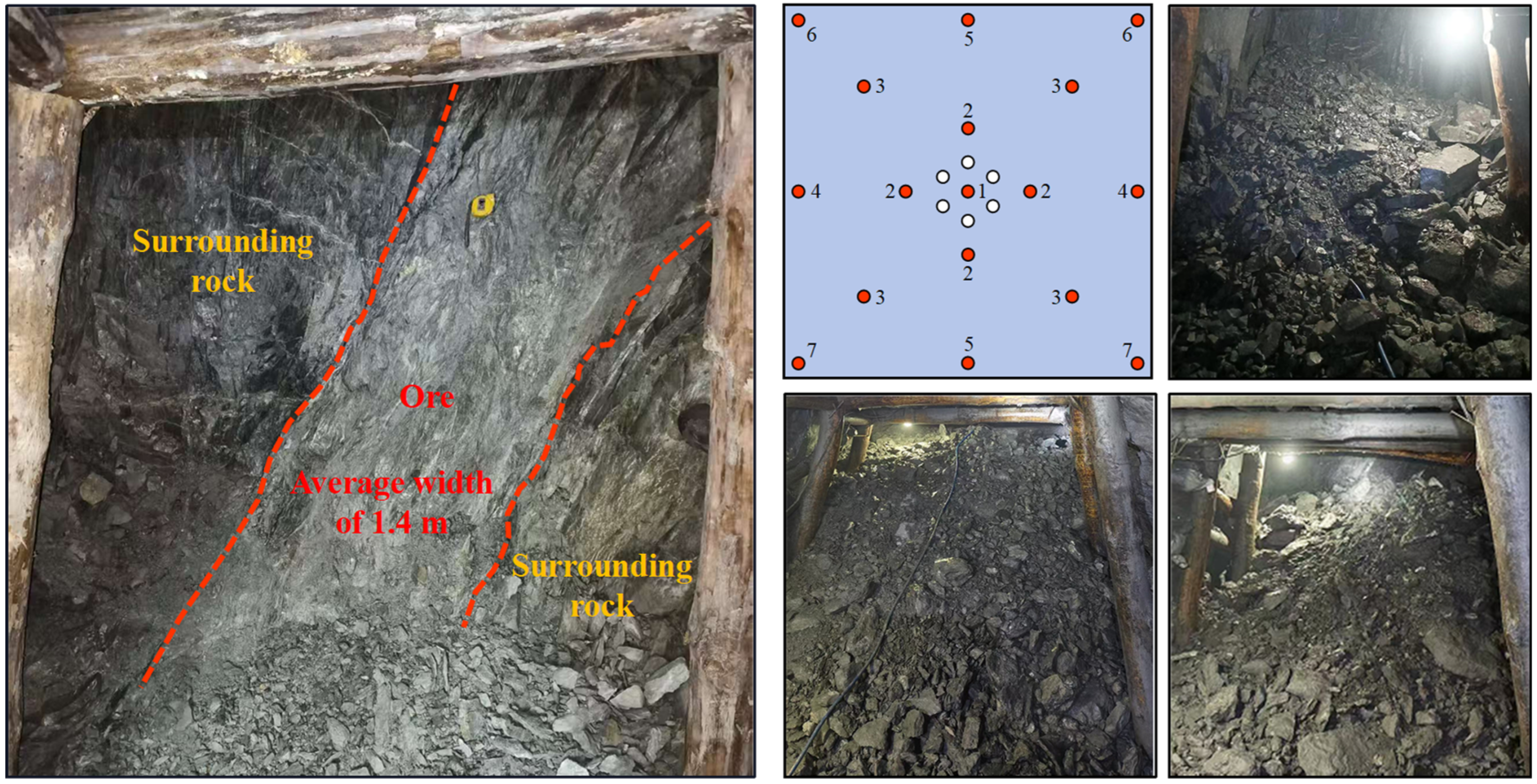
2.1. Overview
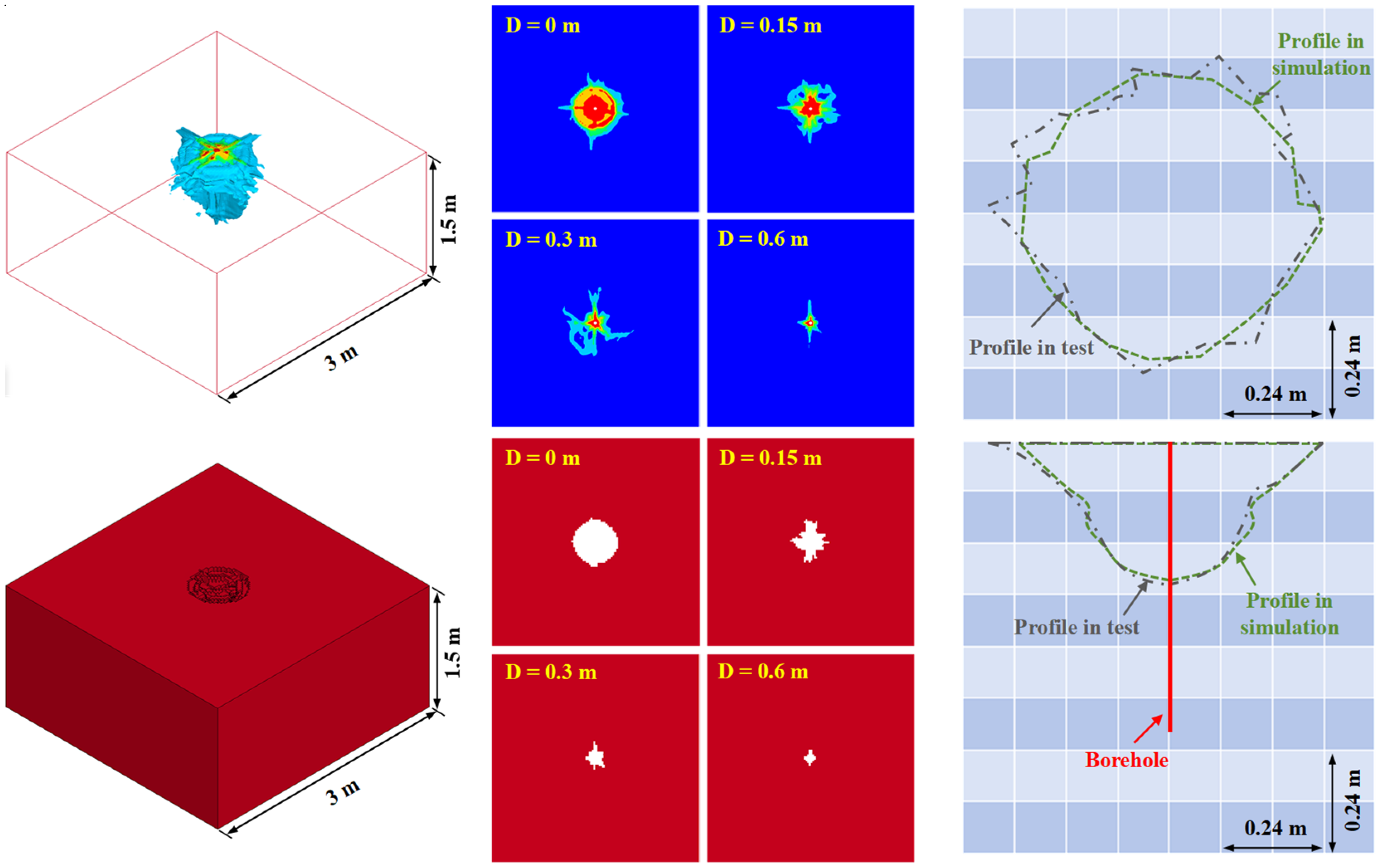
2.2. Single-Hole Blasting Test
3. Numerical Model
3.1. Numerical Modeling
3.2. Material Models and Parameters
3.3. Model Calibration
4. Results and Discussion
4.1. Rock Damage Induced by Cutting Blasting in Sharp, Inclined, Narrow Vein Mines
4.2. Effect of Vein Thickness on Rock Damage Induced by Cutting Blasting in Sharply Inclined Narrow Vein Mines
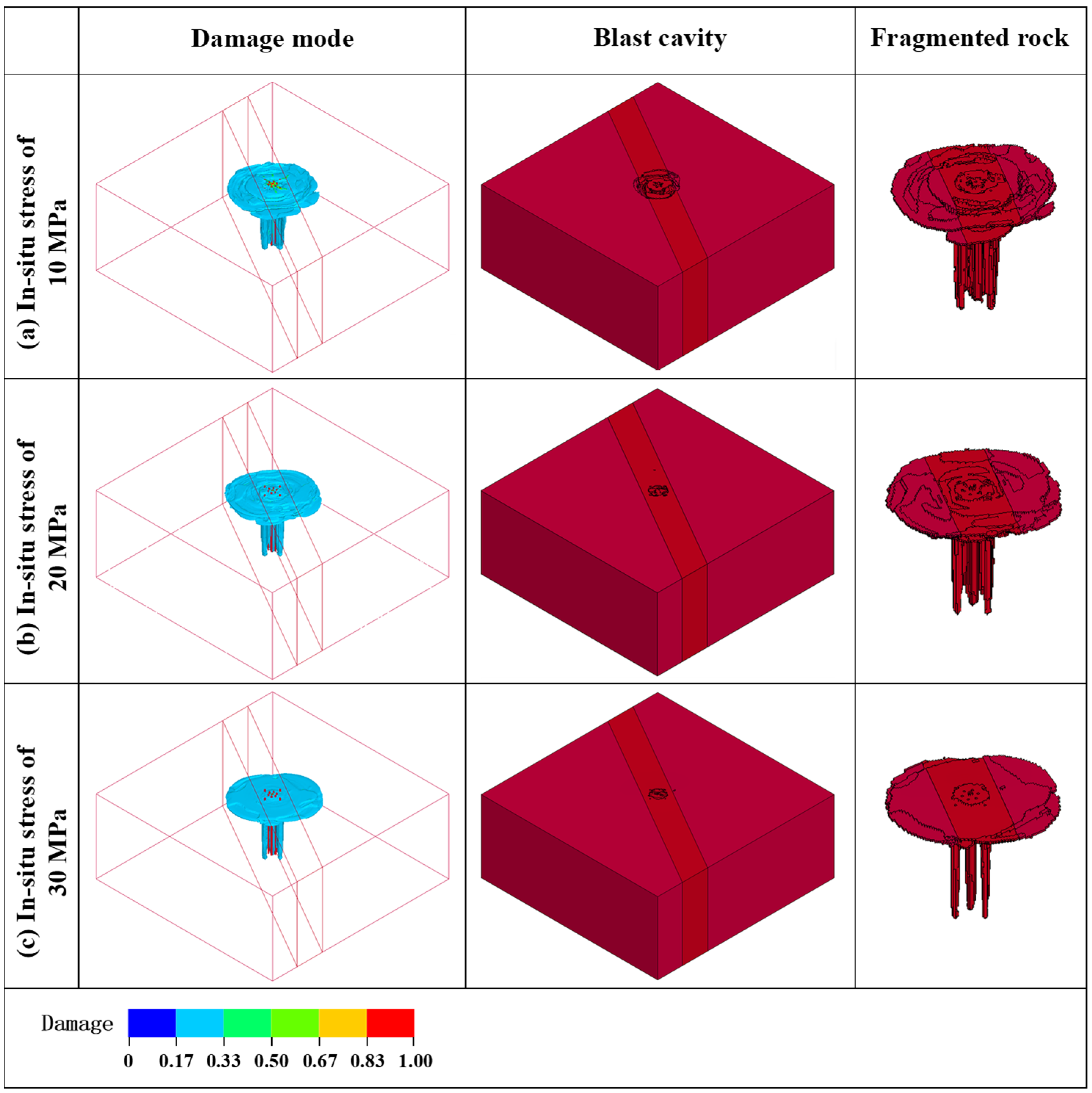
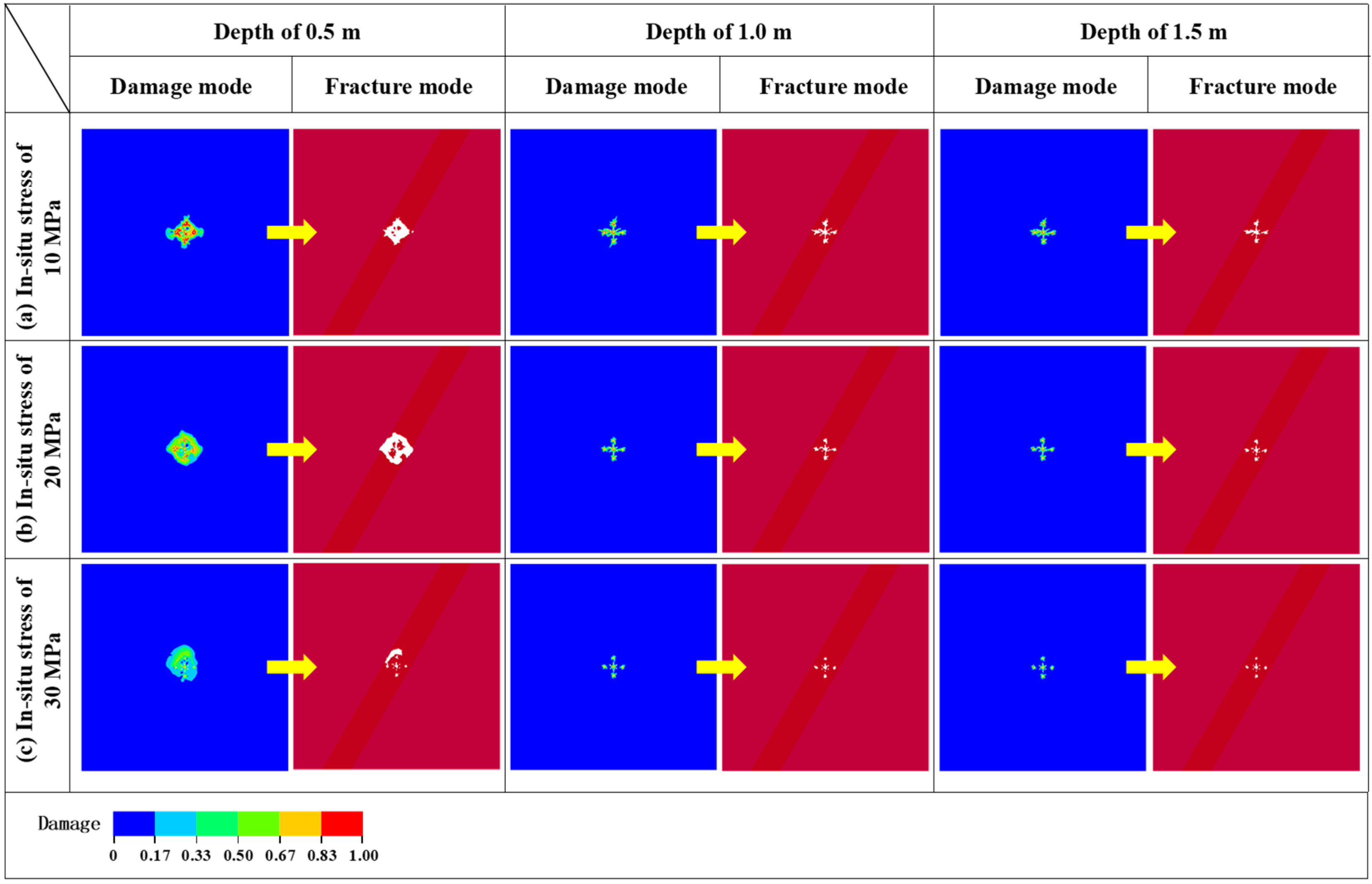
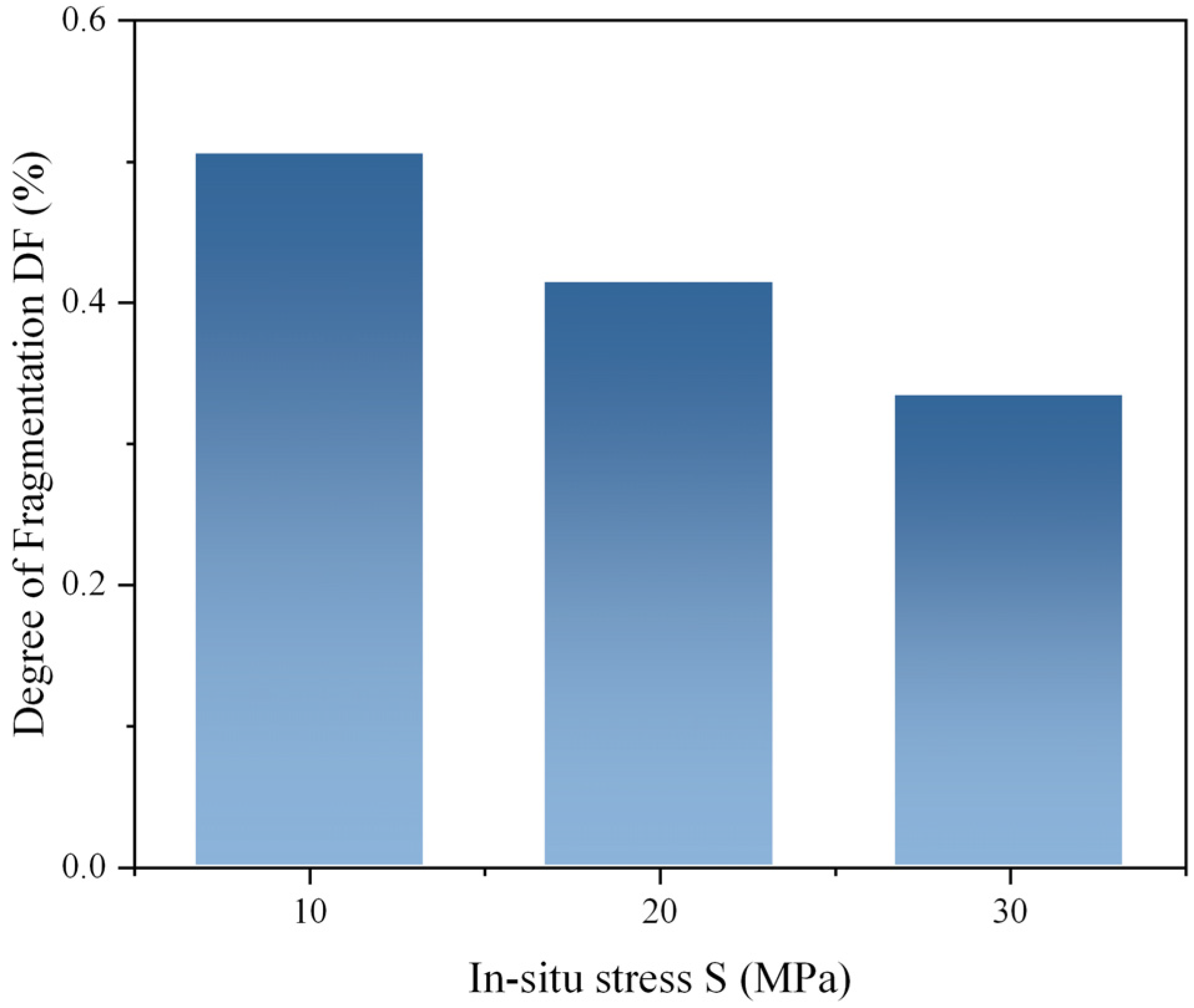
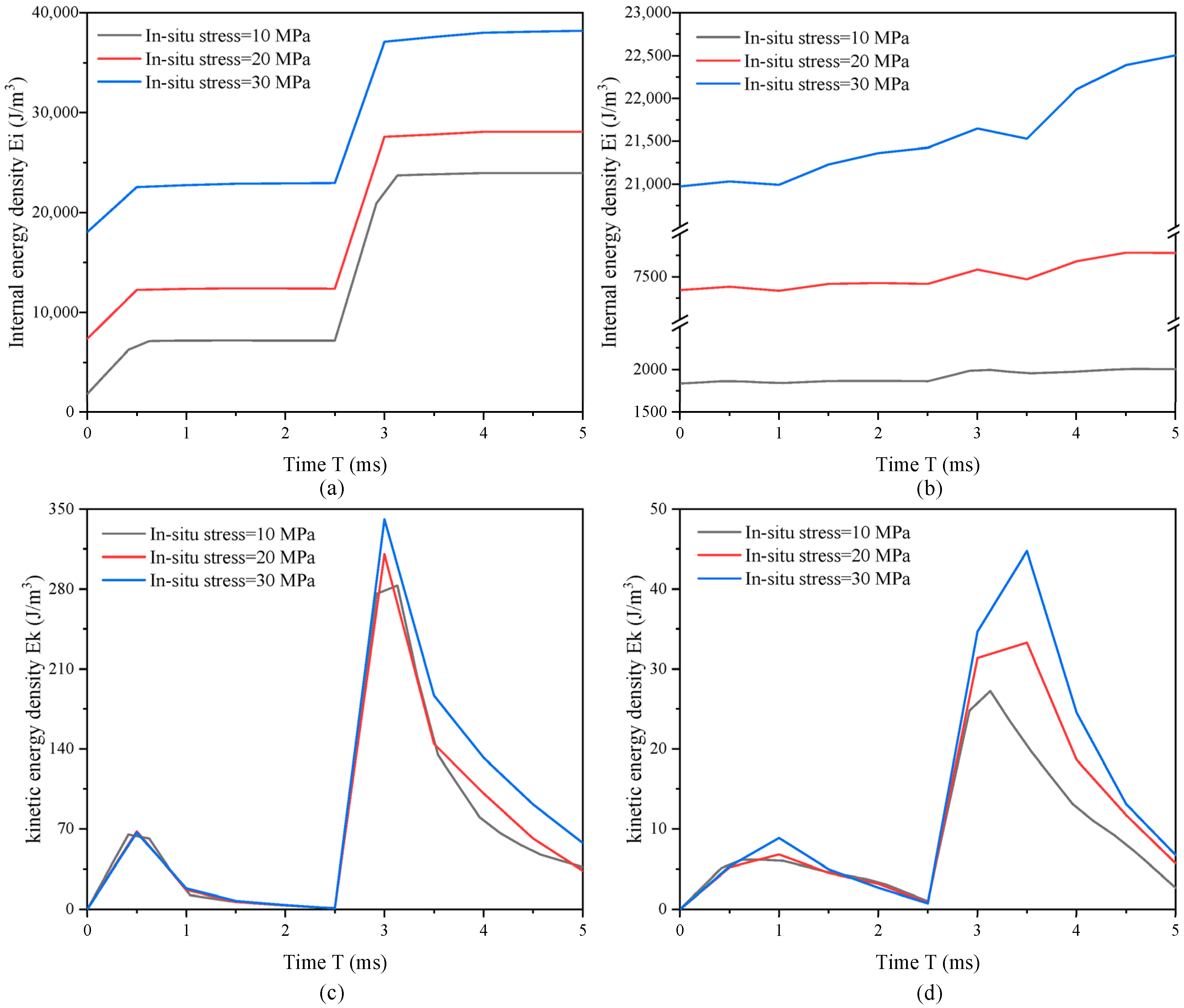
4.3. Effect of In Situ Stress on Rock Damage Induced by Cutting Blasting in Sharp Inclined Narrow Vein Mines
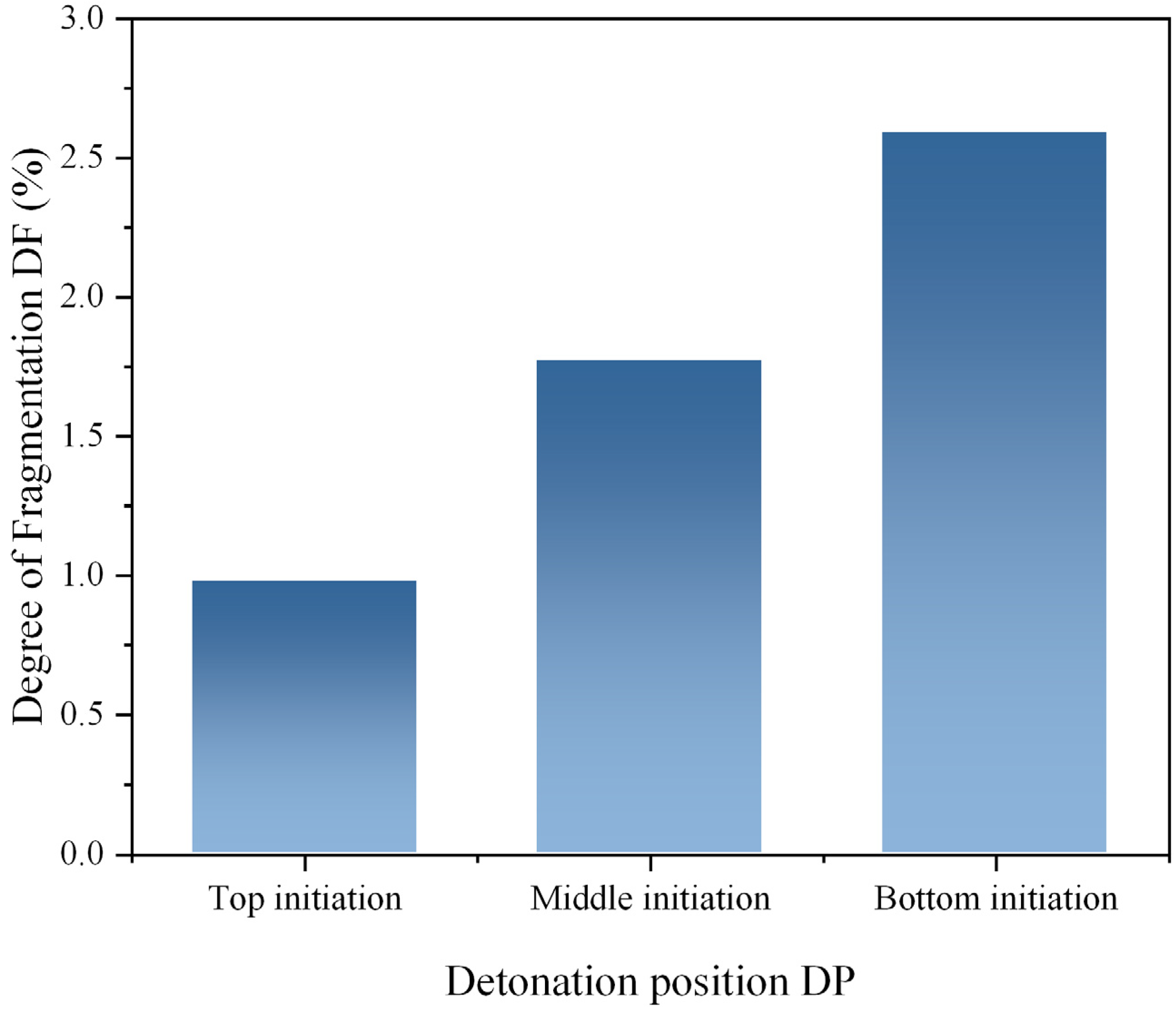
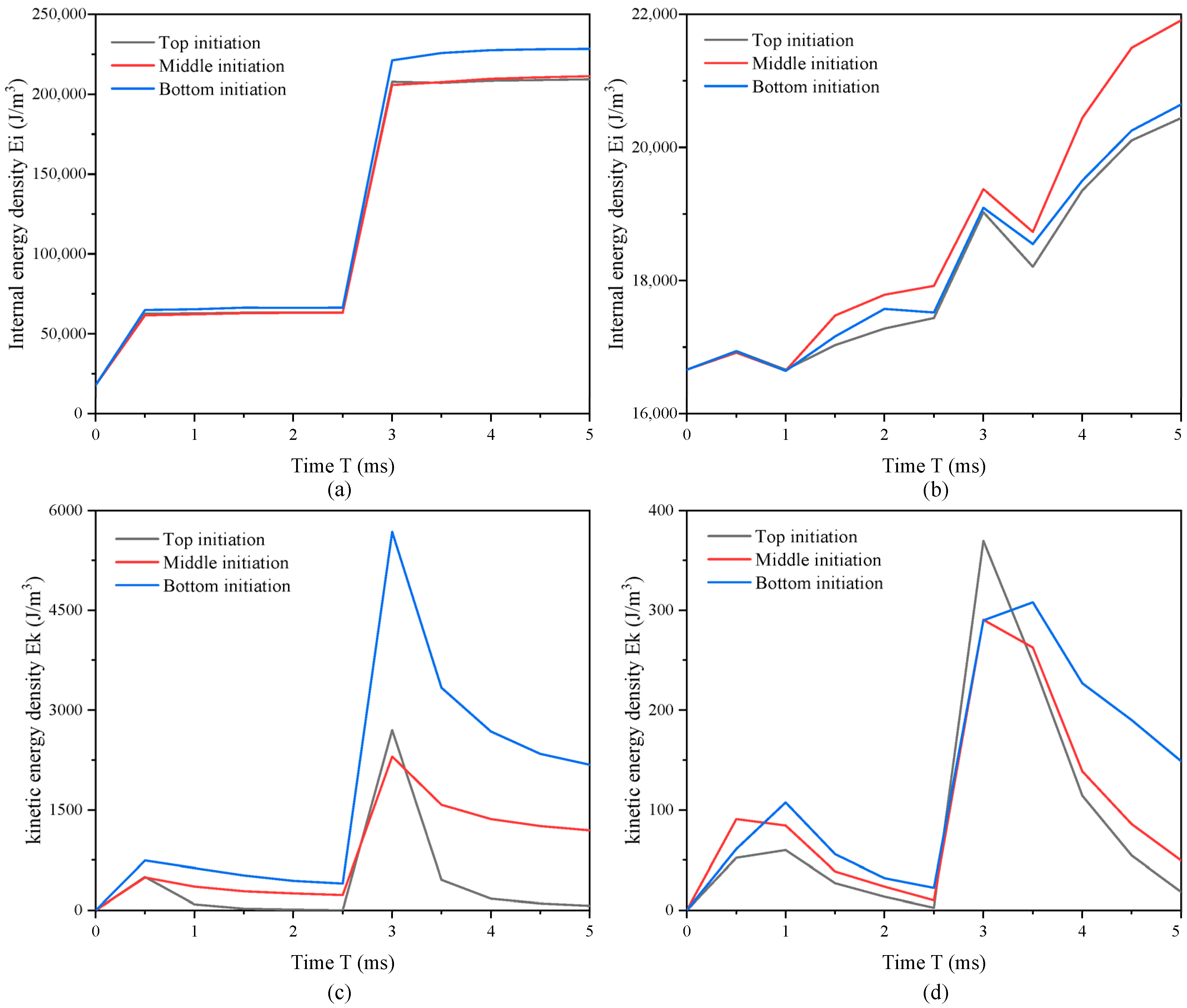
4.4. Effect of Detonation Position on Rock Damage Induced by Cutting Blasting in Sharply Inclined Narrow Vein Mines Under 30 MPa In Situ Stress
5. Engineering Application
6. Conclusions and Limitations
6.1. Conclusions
- (1)
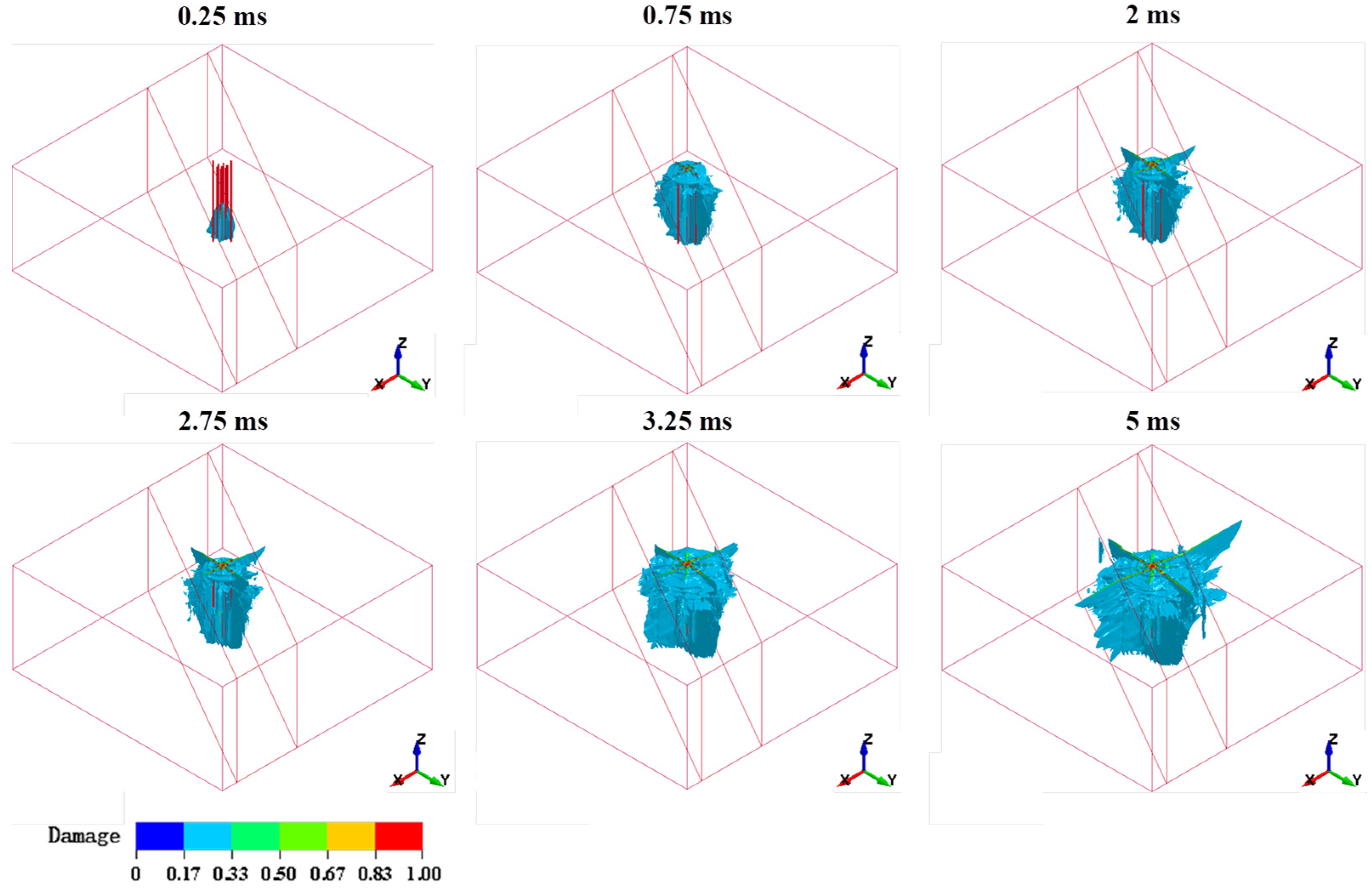
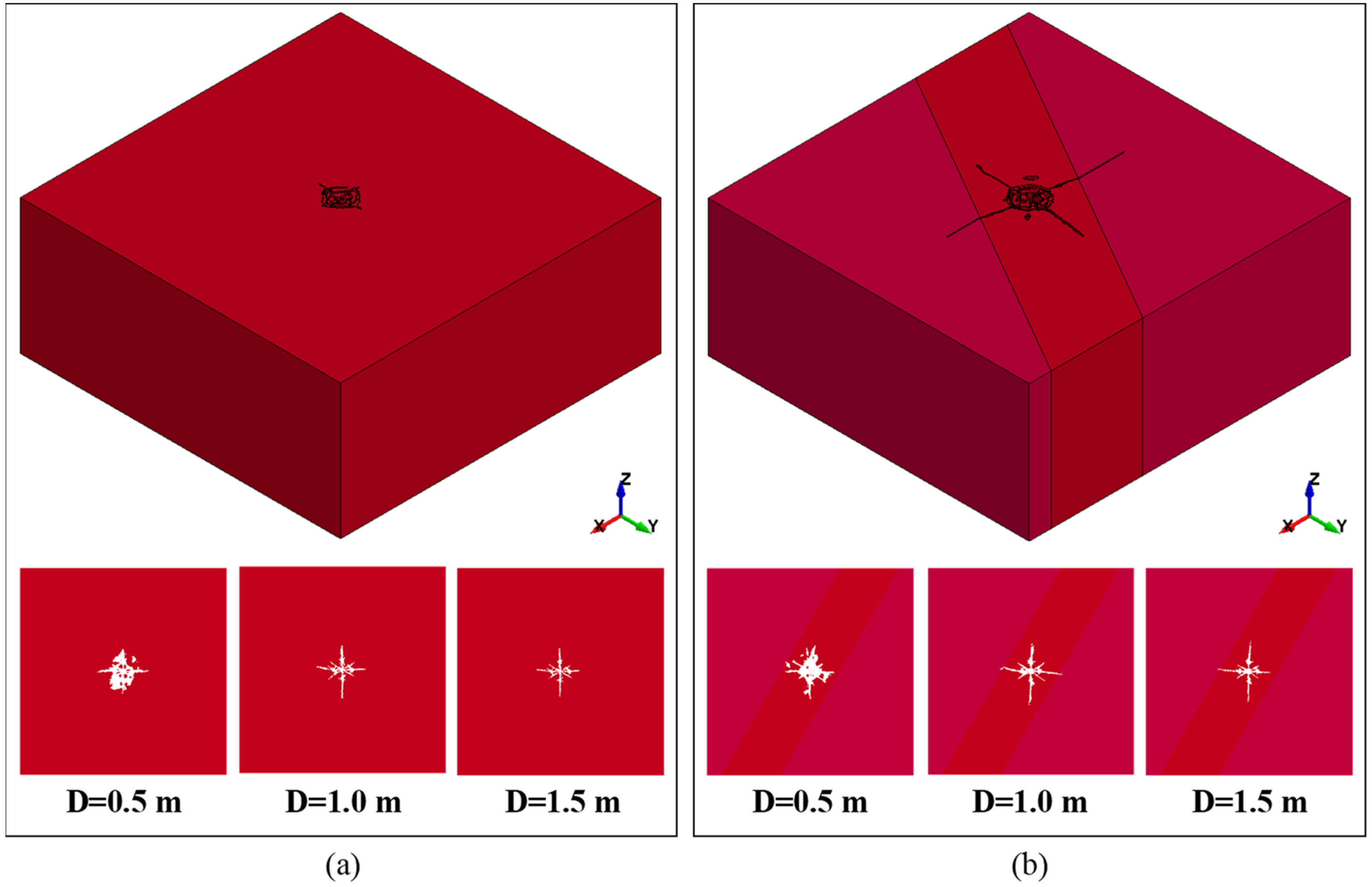
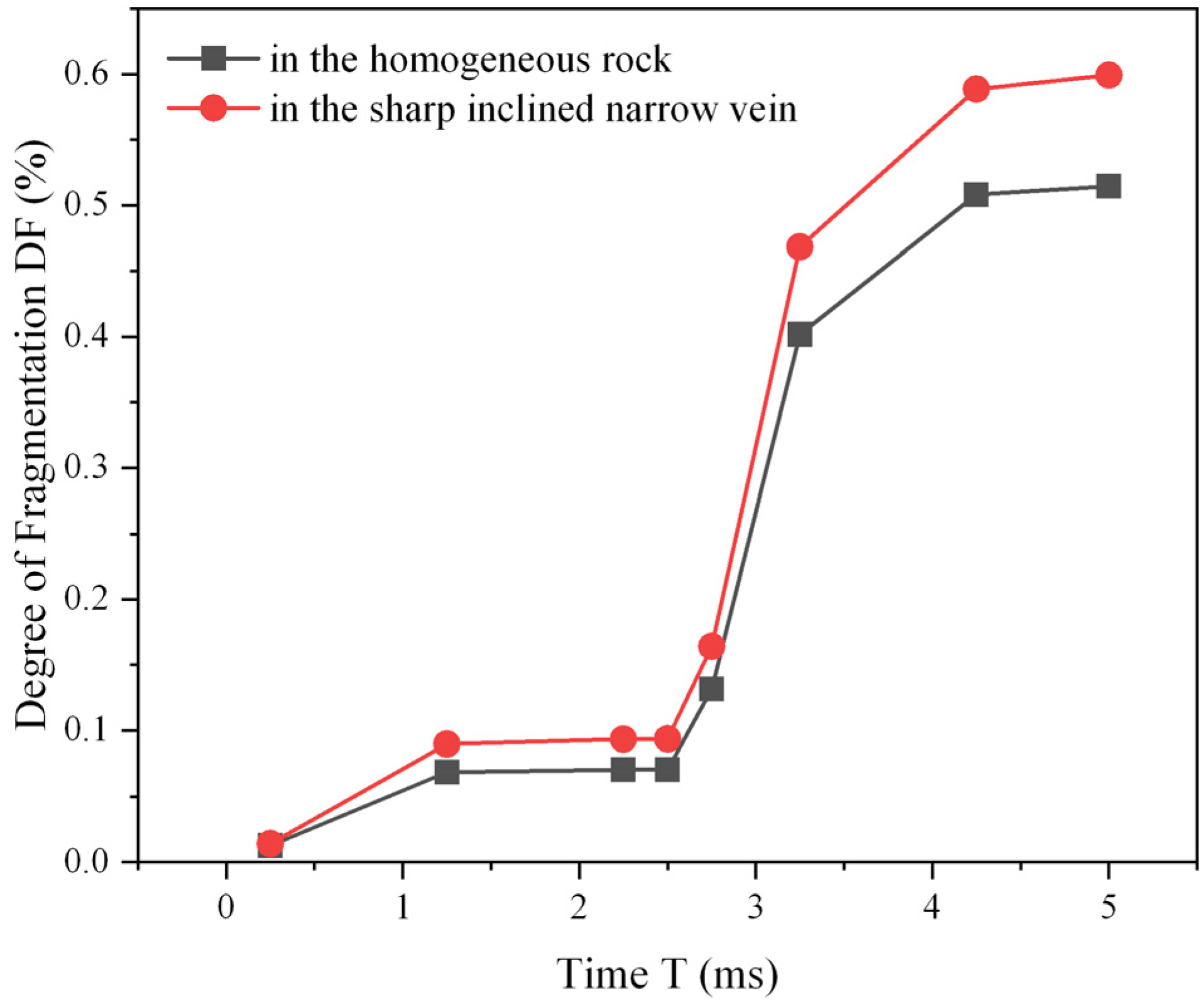
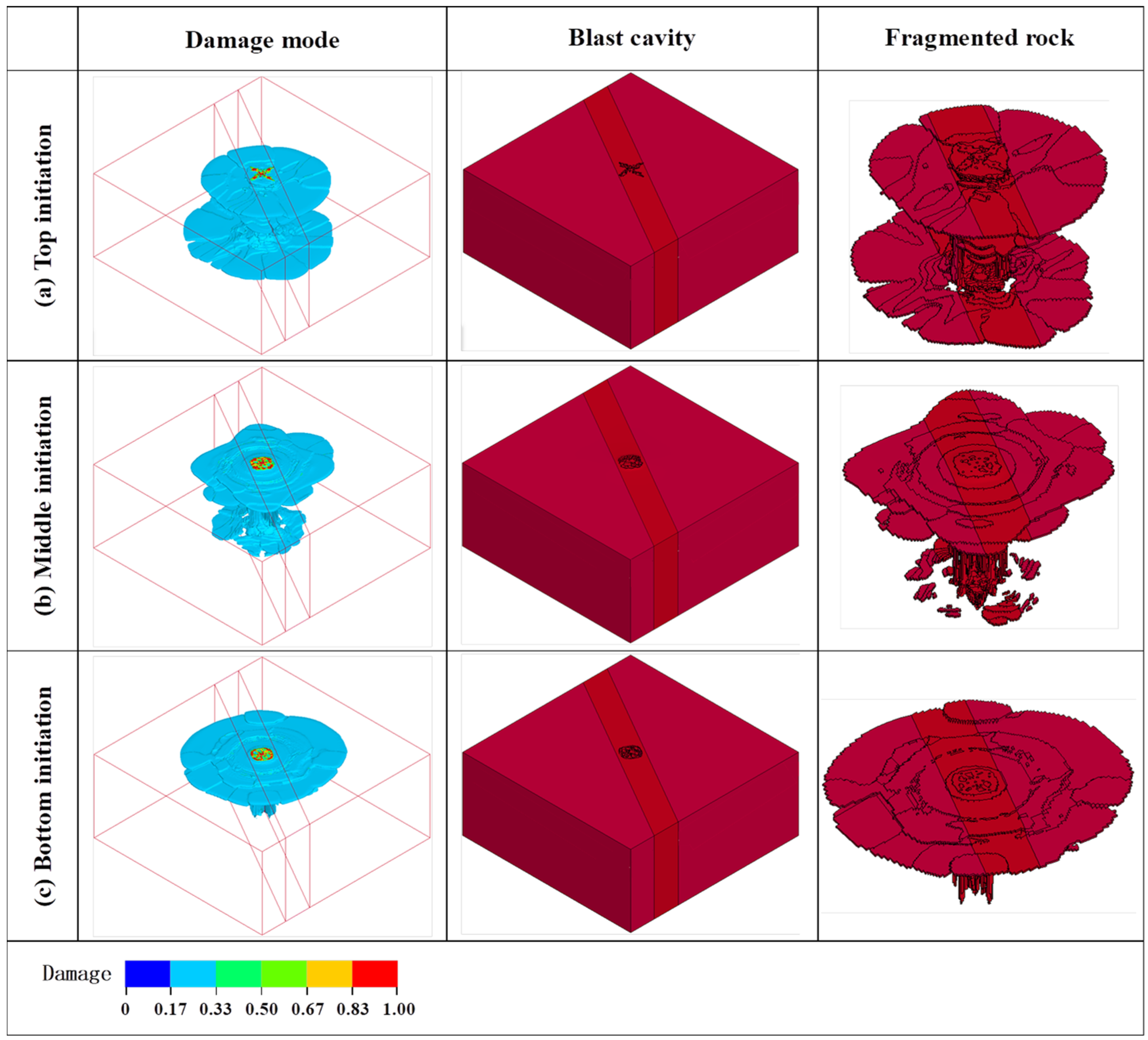
- Cutting blasting in sharp inclined narrow vein mines produces distinctly asymmetric damage distributions, contrasting sharply with the relatively uniform damage patterns observed in homogeneous rock masses. Four dominant fractures develop outside the blasting cavity in sharp, inclined, narrow vein mines.
- (2)
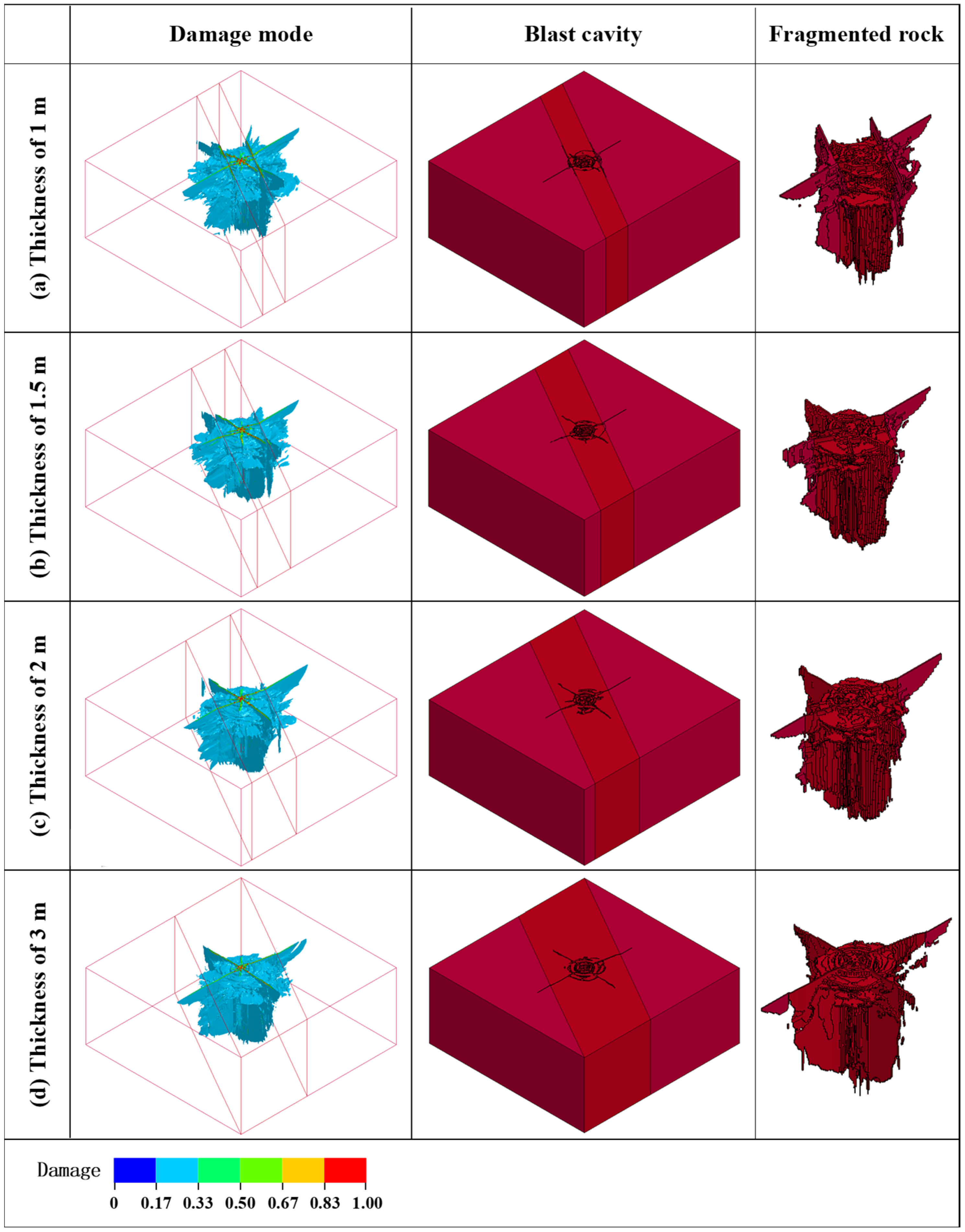
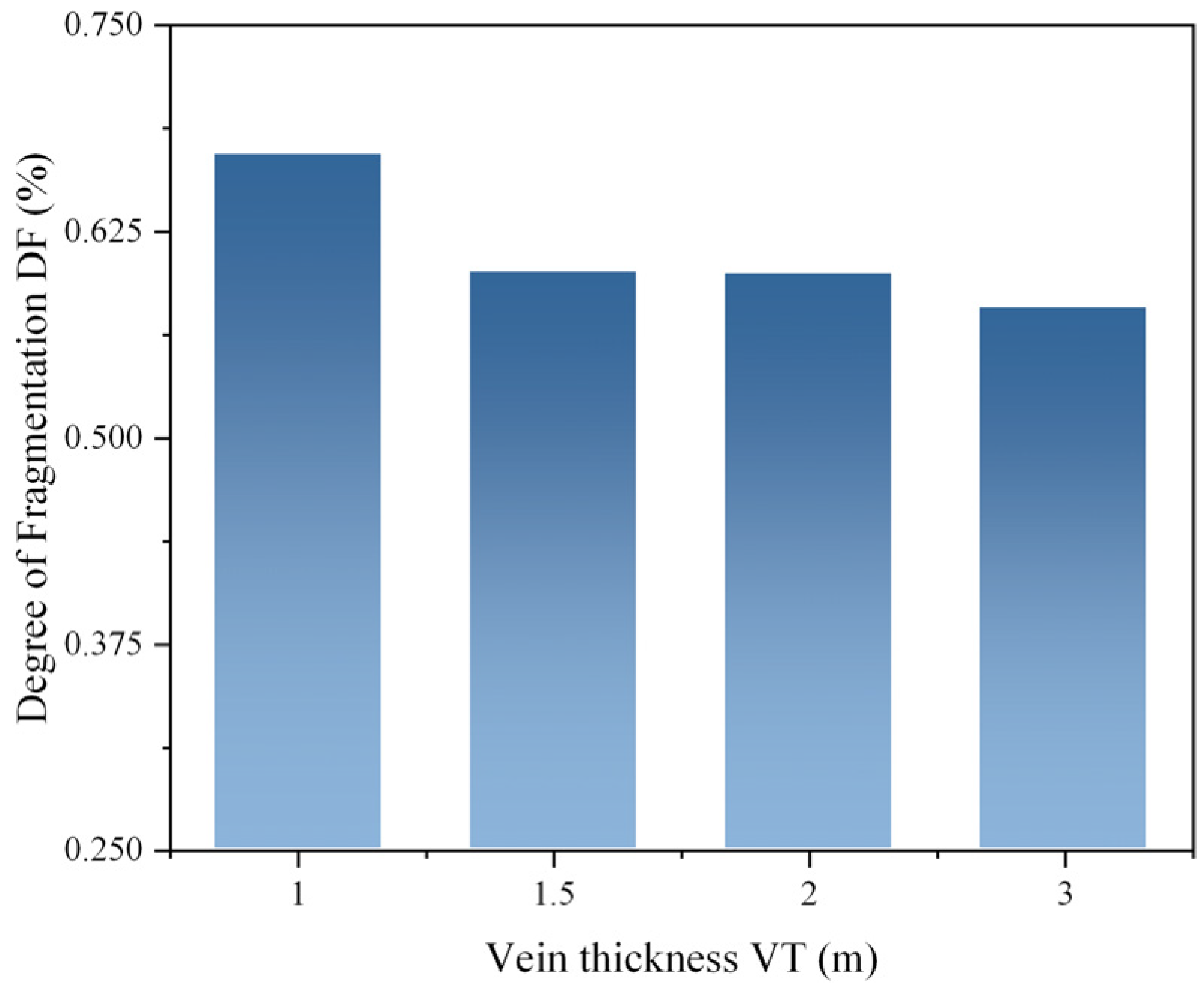
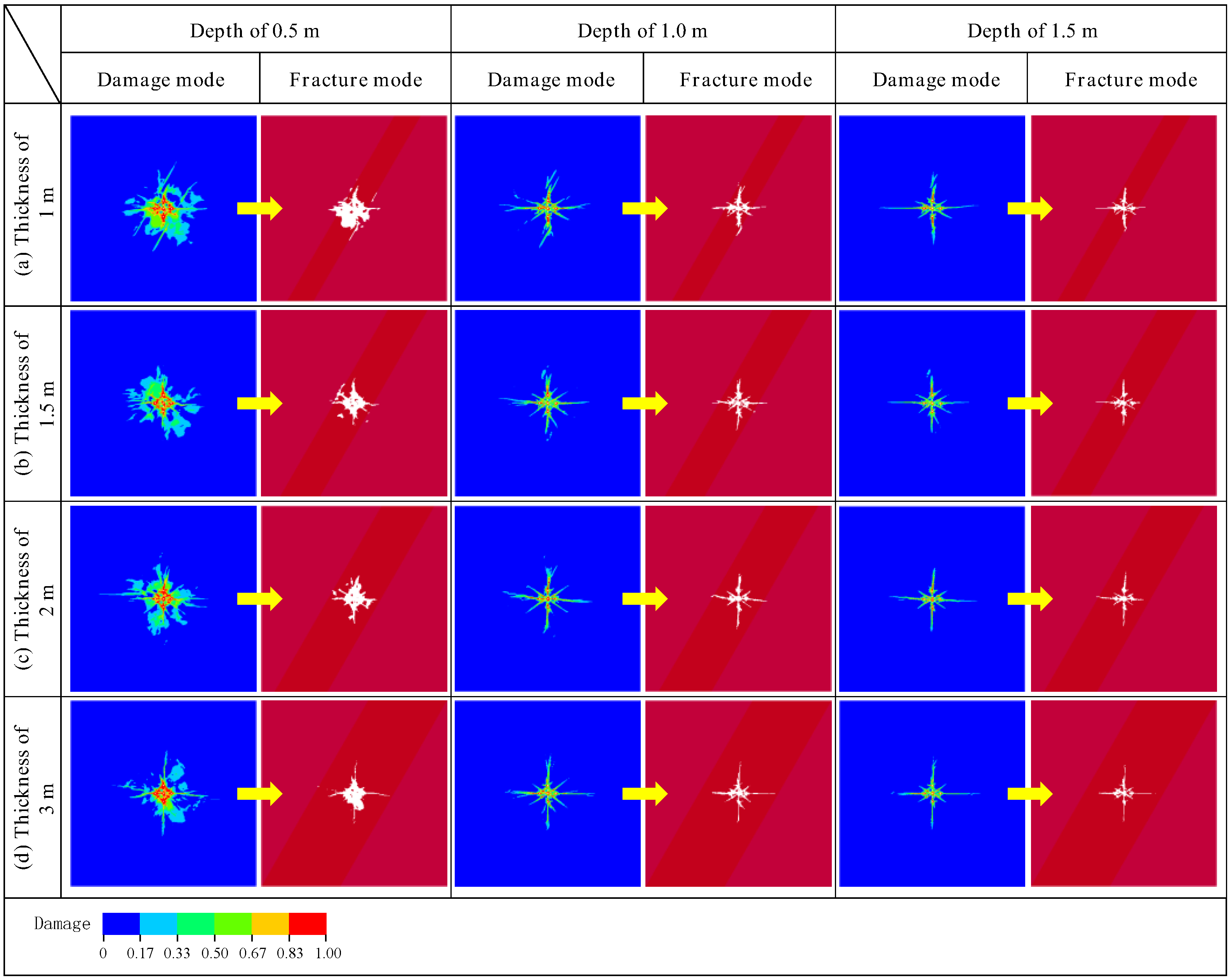
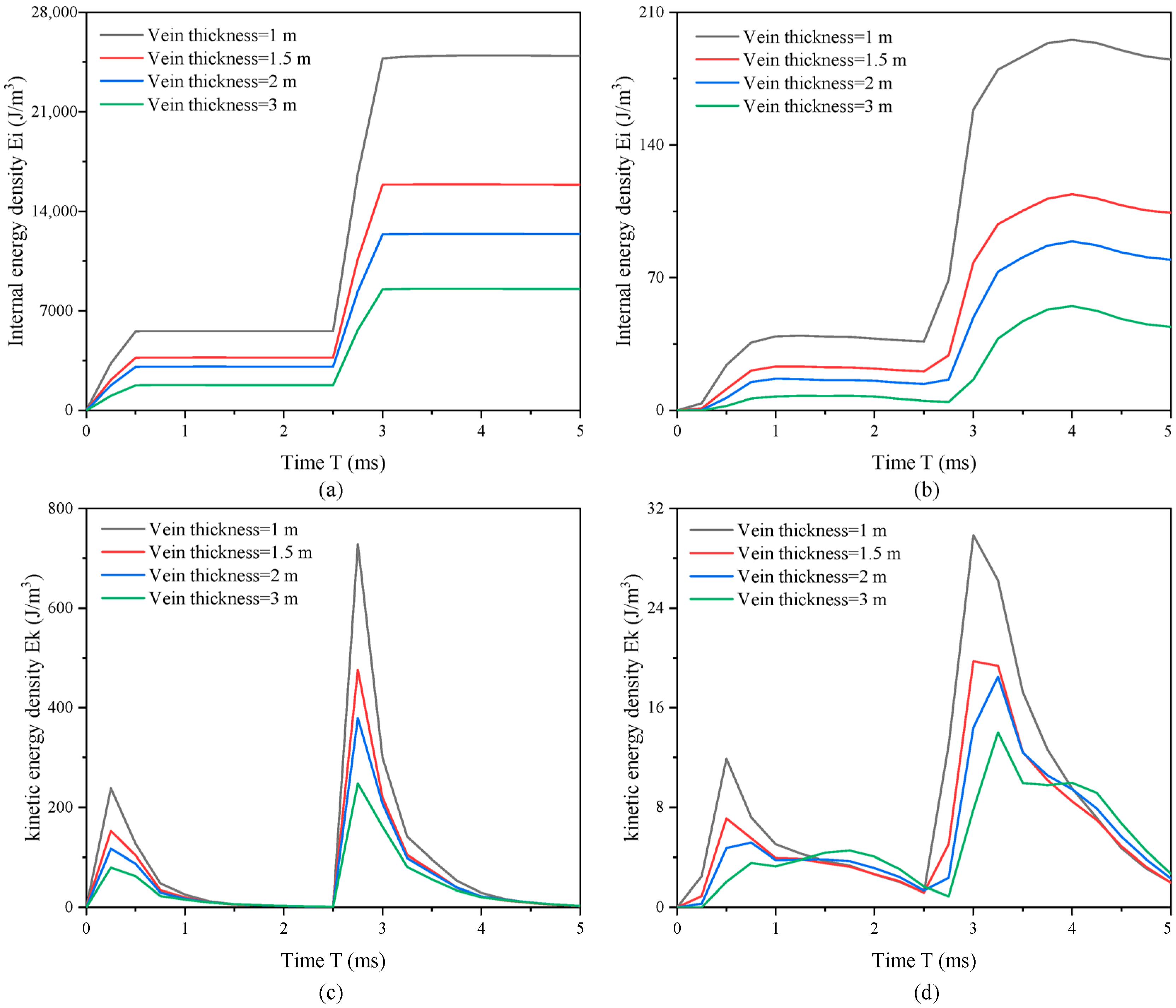
- Vein width significantly regulates blast-induced damage and fracture effects by controlling energy transmission. As vein thickness decreases from 3 m to 1 m, damage development outside the blasting cavity becomes increasingly oriented along the vein–rock interface. However, considering the simplified parameterization adopted for the ore rock, this finding should be interpreted primarily as a qualitative indication of the interface effect rather than a fully quantitative prediction.
- (3)
- The bidirectional equal in situ stress substantially inhibits damage development and fracture propagation of rock mass under cutting blasting in sharp inclined narrow vein mines. With increasing bidirectional equal in situ stress, the suppression of fracture propagation and coalescence intensifies, leading to progressive deterioration of cutting blasting performance.
6.2. Limitations
- (1)
- Dynamic properties of the ore rock are not independently measured in the present study. In particular, the dynamic impedance contrast between the vein and surrounding rock, which plays a key role in stress wave reflection and transmission, is not quantitatively characterized. Future work should incorporate laboratory dynamic testing methods such as Split Hopkinson Pressure Bar experiments to more accurately determine the dynamic mechanical properties of the ore rock and further validate the numerical findings.
- (2)
- Although the numerical model is calibrated using field blast results, the explicit representation of discontinuities is not incorporated in the parametric study. The numerical model primarily captures the influence of vein thickness and in situ stress under simplified geological conditions. Future studies should incorporate discrete fracture networks to better represent the geology of narrow veins and further improve the applicability of the results to field conditions.
Author Contributions
Funding
Institutional Review Board Statement
Informed Consent Statement
Data Availability Statement
Conflicts of Interest
References
- An, L.; Suorineni, F.T.; Xu, S.; Li, Y.-H.; Wang, Z.-C. A Feasibility Study on Confinement Effect on Blasting Performance in Narrow Vein Mining through Numerical Modelling. Int. J. Rock Mech. Min. Sci. 2018, 112, 84–94. [Google Scholar] [CrossRef] [Scilit]
- Zhang, S.; Shi, X.; Qiu, X.; Zong, C.; Yu, Z. Influence of Free Surface Width on Blasting Damage in Open Stope Mining in Narrow Vein Orebodies. Int. J. Rock Mech. Min. Sci. 2025, 194, 106194. [Google Scholar] [CrossRef] [Scilit]
- Drake, B.; Koroznikova, L.; Tuck, M.; Durkin, S. Application of Thermal Fragmentation in Australian Hard Rock Underground Narrow-Vein Mining. Min. Metall. Explor. 2020, 37, 219–229. [Google Scholar] [CrossRef] [Scilit]
- Cai, X.; Wang, C.; Zhou, Z.; Cheng, R.; Gao, J.; Liu, B. Dynamic Optimization of Powder Factor in Extreme-Cold Region Bench Blasting Considering Temperature Effects on Single-Hole Blasting. Rock Mech. Rock Eng. 2025, 1–26. [Google Scholar] [CrossRef] [Scilit]
- Li, C.; Yang, R.; Wang, Y.; Kang, Y.; Zhang, Y. Theory and Numerical Simulation of Deep Hole Cut Blasting Based on Dispersed Charge and Staged Detonation. Int. J. Rock Mech. Min. Sci. 2023, 169, 105453. [Google Scholar] [CrossRef] [Scilit]
- Zhang, H.; Li, T.; Du, Y.; Zhu, Q.; Zhang, X. Theoretical and Numerical Investigation of Deep-Hole Cut Blasting Based on Cavity Cutting and Fragment Throwing. Tunn. Undergr. Space Technol. 2021, 111, 103854. [Google Scholar] [CrossRef] [Scilit]
- Zhou, Z.; Wang, P.; Cheng, R.; Cai, X.; Chen, C. Blast-Induced Damage and Fracture of Rock Mass in Cutting Blasting with a Large Empty Hole under High in-Situ Stress. Tunn. Undergr. Space Technol. 2025, 166, 106942. [Google Scholar] [CrossRef] [Scilit]
- Li, C.; Yang, R.; Wang, Y.; Kang, Y.; Zhang, Y.; Xie, P. Theoretical and Numerical Simulation Investigation of Deep Hole Dispersed Charge Cut Blasting. Int. J. Coal Sci. Technol. 2023, 10, 15. [Google Scholar] [CrossRef] [Scilit]
- Xie, L.X.; Lu, W.B.; Zhang, Q.B.; Jiang, Q.H.; Chen, M.; Zhao, J. Analysis of Damage Mechanisms and Optimization of Cut Blasting Design under High In-Situ Stresses. Tunn. Undergr. Space Technol. 2017, 66, 19–33. [Google Scholar] [CrossRef] [Scilit]
- Li, C.; Yang, R.; Zuo, J.; Xie, P. Theory and Field Tests of Innovative Cut Blasting Method for Rock Roadway Excavation. Tunn. Undergr. Space Technol. 2025, 155, 106180. [Google Scholar] [CrossRef] [Scilit]
- Wang, P.; Zhou, Z.; Liu, Y.; Cai, X.; Chen, C. Investigation of Rock Fracturing During Cut Blasting with a Large Empty Hole Under Non-Hydrostatic Confining Stress: Insights for Optimizing Blast Parameters. Rock Mech. Rock Eng. 2026. [Google Scholar] [CrossRef] [Scilit]
- Hefni, M.A.; Abdellah, W.R.E.; Ahmed, H.M. Factors Influencing Stope Hanging Wall Stability and Ore Dilution in Narrow-Vein Deposits: Part II. Geotech. Geol. Eng. 2020, 38, 3795–3813. [Google Scholar] [CrossRef] [Scilit]
- Vishwakarma, A.K.; Himanshu, V.K.; Dey, K. Evaluation of Optimum Burden for the Excavation of Narrow Vein Ore Deposits Using Numerical Simulation. Rock Mech. Rock Eng. 2024, 57, 945–960. [Google Scholar] [CrossRef] [Scilit]
- Li, J.; Liu, S.; Ren, W.; Liu, H.; Li, S.; Yan, K.; Li, J.; Liu, S.; Ren, W.; Liu, H.; et al. Research on Engineering Practice and Effect Evaluation Method of Pressure Relief in Deep Rock Burst Danger Area of Coal Mine. Minerals 2023, 13, 570. [Google Scholar] [CrossRef] [Scilit]
- Zhou, Z.; Wang, P.; Cai, X.; Cao, W. Influence of Water Content on Energy Partition and Release in Rock Failure: Implications for Water-Weakening on Rock-Burst Proneness. Rock Mech. Rock Eng. 2023, 56, 6189–6205. [Google Scholar] [CrossRef] [Scilit]
- Zhang, H.; Li, T.; Gao, X.; Zhu, Q.; Zhang, S.; Ran, J. Numerical Study on Evolution Mechanism of Cut Blasting and Cavity Formation Under Confining Pressure. Rock Mech. Rock Eng. 2023, 56, 8571–8590. [Google Scholar] [CrossRef] [Scilit]
- Zhao, X.; Zhou, X.; Zhao, X.; Zhou, X. Design Method and Application of Stope Structure Parameters in Deep Metal Mines Based on an Improved Stability Graph. Minerals 2022, 13, 2. [Google Scholar] [CrossRef] [Scilit]
- Cai, X.; Wang, P.; Zhou, Z.; Wang, Y.; Zhang, J. Dynamic Mechanical Response and Multiscale Fracturing of Pre-Stressed Rock: Implications for Pillar Burst Mechanism and Prevention. Tunn. Undergr. Space Technol. 2026, 168, 107116. [Google Scholar] [CrossRef] [Scilit]
- Yan, G.; Zhang, F.; Ku, T.; Hao, Q.; Peng, J. Experimental Study and Mechanism Analysis on the Effects of Biaxial In-Situ Stress on Hard Rock Blasting. Rock Mech. Rock Eng. 2023, 56, 3709–3723. [Google Scholar] [CrossRef] [Scilit]
- Ding, J.; Yang, J.; Ye, Z.; Leng, Z.; Zhou, C. Numerical Study on Rock Blasting Assisted by In-Situ Stress Redistribution. Tunn. Undergr. Space Technol. 2024, 153, 106022. [Google Scholar] [CrossRef] [Scilit]
- Li, Q.; Li, H.; He, L.; Li, X. Effect of Empty-Hole on the Rock Blasting under in-Situ Stress. Comput. Geotech. 2025, 185, 107290. [Google Scholar] [CrossRef] [Scilit]
- Tu, M.; Zhao, G.; Zhang, X.; Bu, Q.; Dang, J. Fracture Evolution between Blasting Roof Cutting Holes in a Mining Stress Environment. Minerals 2022, 12, 418. [Google Scholar] [CrossRef] [Scilit]
- Wang, H.; Wang, Z.; Wang, J.; Wang, S.; Wang, H.; Yin, Y.; Li, F. Effect of Confining Pressure on Damage Accumulation of Rock under Repeated Blast Loading. Int. J. Impact Eng. 2021, 156, 103961. [Google Scholar] [CrossRef] [Scilit]
- Zhang, F.; Yan, G.; Peng, J.; Qiu, Z.; Dai, X. Experimental Study on Crack Formation in Sandstone during Crater Blasting under High Geological Stress. Bull. Eng. Geol. Environ. 2020, 79, 1323–1332. [Google Scholar] [CrossRef] [Scilit]
- Liu, K.; Li, X.; Huang, L.; Sha, Y.; Yang, J.; Zhao, X.; Ma, S.; Hong, Z. Investigation on Rock Fracturing in Presplit Blasting Under Various Initial Stresses. Rock Mech. Rock Eng. 2024, 57, 6927–6950. [Google Scholar] [CrossRef] [Scilit]
- Li, X.; Liu, K.; Sha, Y.; Yang, J.; Ma, S.; Hong, Z. Investigation on Radial Fracturing around Borehole under Combined Static Stress and Blasting. Theor. Appl. Fract. Mech. 2023, 127, 104038. [Google Scholar] [CrossRef] [Scilit]
- Li, X.; Liu, K.; Yang, J.; Qiu, T.; Sha, Y. Effects of In-Situ Stress on Rock Cracking in Presplit Blasting. Comput. Geotech. 2024, 168, 106124. [Google Scholar] [CrossRef] [Scilit]
- Wu, Y.; Zhang, X.; Li, Z.; Gao, W.; Xu, Z.; Zhang, Y.; Zhou, J. Effects of In-Situ Stress on Damage and Fractal during Cutting Blasting Excavation. Fractal Fract. 2024, 8, 450. [Google Scholar] [CrossRef] [Scilit]
- Li, X.; Liu, K.; Yang, J.; Song, R. Numerical Study on Blast-Induced Fragmentation in Deep Rock Mass. Int. J. Impact Eng. 2022, 170, 104367. [Google Scholar] [CrossRef] [Scilit]
- Hong, Z.; Tao, M.; Cui, X.; Wu, C.; Zhao, M. Experimental and Numerical Studies of the Blast-Induced Overbreak and Underbreak in Underground Roadways. Undergr. Space 2023, 8, 61–79. [Google Scholar] [CrossRef] [Scilit]
- Rossmanith, H.P.; Knasmillner, R.E.; Daehnke, A.; Mishnaevsky, L. Wave Propagation, Damage Evolution, and Dynamic Fracture Extension. Part II. Blasting. Mater. Sci. 1996, 32, 403–410. [Google Scholar] [CrossRef] [Scilit]
- Yang, L.; Ding, C. Fracture Mechanism Due to Blast-Imposed Loading under High Static Stress Conditions. Int. J. Rock Mech. Min. Sci. 2018, 107, 150–158. [Google Scholar] [CrossRef] [Scilit]
- Yang, L.; Yang, A.; Chen, S.; Fang, S.; Huang, C.; Xie, H. Model Experimental Study on the Effects of in Situ Stresses on Pre-Splitting Blasting Damage and Strain Development. Int. J. Rock Mech. Min. Sci. 2021, 138, 104587. [Google Scholar] [CrossRef] [Scilit]
- Yi, C.; Johansson, D.; Greberg, J. Effects of In-Situ Stresses on the Fracturing of Rock by Blasting. Comput. Geotech. 2018, 104, 321–330. [Google Scholar] [CrossRef] [Scilit]
- Liu, H.; Huang, L.; Wang, Z.; Wu, Y.; Li, X. Experimental Study on Dynamic Response of Hard Rock Blasting under In-Situ Stress. Int. J. Rock Mech. Min. Sci. 2024, 182, 105860. [Google Scholar] [CrossRef] [Scilit]
- Liu, H.; Huang, L.; Chen, J.; Wang, Z.; Wu, Y.; Li, M.; Li, X. Research on Fracturing Behavior and Mechanism of Multi-Empty-Hole Directional Blasting in Deep Hard Rock. Tunn. Undergr. Space Technol. 2025, 165, 106925. [Google Scholar] [CrossRef] [Scilit]
- Pan, R.; Wang, P.; Zhou, Z.; Lan, R.; Chen, L.; Yang, H.; Chen, C.; Zhang, J.; Liu, Y.; Ma, J. Effects of Confining Stress on Blast-Induced Damage Distribution of Rock with Discontinuity. Sustainability 2023, 15, 13278. [Google Scholar] [CrossRef] [Scilit]
- Li, X.; Chen, J.; Ma, C.; Huang, L.; Li, C.; Zhang, J.; Zhao, Y. A Novel In-Situ Stress Measurement Method Incorporating Non-Oriented Core Ground Re-Orientation and Acoustic Emission: A Case Study of a Deep Borehole. Int. J. Rock Mech. Min. Sci. 2022, 152, 105079. [Google Scholar] [CrossRef] [Scilit]
- Qiu, X.; Shi, X.; Gou, Y.; Zhou, J.; Chen, H.; Huo, X. Short-Delay Blasting with Single Free Surface: Results of Experimental Tests. Tunn. Undergr. Space Technol. 2018, 74, 119–130. [Google Scholar] [CrossRef] [Scilit]
- Livermore Software Technology Corporation. LS-DYNA® Keyword User’s Manual; Volume II Material Models, LS-DYNA R7.1, May 19, 2014 (Revision: 5442); Livermore Software Technology Corporation: Livermore, CA, USA, 2014. [Google Scholar]
- Liu, K.; Yang, J.; Li, X.; Hao, H.; Li, Q.; Liu, Z.; Wang, C. Study on the Long-Hole Raising Technique Using One Blast Based on Vertical Crater Retreat Multiple Deck Shots. Int. J. Rock Mech. Min. Sci. 2018, 109, 52–67. [Google Scholar] [CrossRef] [Scilit]
- Wang, Z.; Wang, H.; Wang, J.; Tian, N. Finite Element Analyses of Constitutive Models Performance in the Simulation of Blast-Induced Rock Cracks. Comput. Geotech. 2021, 135, 104172. [Google Scholar] [CrossRef] [Scilit]
- Yang, X.; Wang, C.; Chu, H.; Yan, S.; Wei, H.; Yu, M. Study on the Stress Field and Crack Propagation of Coal Mass Induced by High-Pressure Air Blasting. Minerals 2022, 12, 300. [Google Scholar] [CrossRef] [Scilit]
- Duc-Kien, T.; Duy-Liem, N.; Duy-Duan, N. A Calibration of the Material Model for FRC. Constr. Build. Mater. 2020, 254, 119293. [Google Scholar] [CrossRef] [Scilit]
- Li, X.; Zhu, Z.; Wang, M.; Wan, D.; Zhou, L.; Liu, R. Numerical Study on the Behavior of Blasting in Deep Rock Masses. Tunn. Undergr. Space Technol. 2021, 113, 103968. [Google Scholar] [CrossRef] [Scilit]
- Li, X.; Liu, K.; Sha, Y.; Yang, J.; Hong, Z. Numerical Investigation on Blast-Induced Rock Fragmentation with Different Stemming Structures. Geomech. Geophys. Geo-Energy Geo-Resour. 2023, 9, 112. [Google Scholar] [CrossRef] [Scilit]
- Yang, J.H.; Lu, W.B.; Jiang, Q.H.; Yao, C.; Zhou, C.B. Frequency Comparison of Blast-Induced Vibration per Delay for the Full-Face Millisecond Delay Blasting in Underground Opening Excavation. Tunn. Undergr. Space Technol. 2016, 51, 189–201. [Google Scholar] [CrossRef] [Scilit]
- Liu, K.; Li, X.; Yang, J.; Zhou, Z.; Sha, Y.; Hong, Z. Experimental and Numerical Investigation on Rock Fracturing and Fragmentation under Coupled Static Pressure and Blasting. Eng. Fract. Mech. 2024, 311, 110593. [Google Scholar] [CrossRef] [Scilit]
- Xiao, C.; Yang, R.; Ma, X.; Wang, Y.; Ding, C. Damage Evaluation of Rock Blasting Based on Multi-Fractal Study. Int. J. Impact Eng. 2024, 188, 104953. [Google Scholar] [CrossRef] [Scilit]
- Lei, M.; He, R.; Liu, L.; Sun, N.; Qin, G.; Zhang, Y. Mechanical Mechanism and Shaping Effect of Tunnel Blasting Construction in Rock with Weak Interlayer. Sustainability 2022, 14, 13278. [Google Scholar] [CrossRef] [Scilit]
- Hong, Z.; Tao, M.; Zhao, R.; Zhou, J.; Zhao, M. Investigation on Overbreak and Underbreak of Pre-Stressed Tunnels under the Impact of Decoupled Charge Blasting. Int. J. Impact Eng. 2023, 182, 104784. [Google Scholar] [CrossRef] [Scilit]
- Zhao, J.; Li, D.; Ranjith, P.G.; Su, X.; Li, Y.; Lyu, X. Innovative Cut Blasting Method for Rock Excavation at Depth Based on Numerical Simulation and Field Tests. Tunn. Undergr. Space Technol. 2025, 155, 106211. [Google Scholar] [CrossRef] [Scilit]










| Parameter | Surrounding Rock | Ore Rock |
|---|---|---|
| Compressive strength fc (MPa) | 77.56 | 35.68 |
| Elastic shear modulus G (GPa) | 12.95 | 5.96 |
| Crush pressure Pcrush (MPa) | 51.71 | 23.79 |
| Hugoniot polynomial coefficient A1 (GPa) | 40.42 | 22.18 |
| Hugoniot polynomial coefficient A2 (GPa) | 49.21 | 27.06 |
| Hugoniot polynomial coefficient A3 (GPa) | 10.36 | 5.68 |
| Parameter for polynomial EOS T1 (GPa) | 40.42 | 22.18 |
| Compressive strain rate dependence exponent βc | 0.016 | 0.031 |
| Tensile strain rate dependence exponent βt | 0.021 | 0.036 |
| Parameter | Value | Parameter | Value |
|---|---|---|---|
| Mass density ρ (kg·m−3) | 2552 | Break compressive strain rate Ec | 3 × 1025 |
| Reference tensile strain rate Rt | 3 × 10⁻⁶ | Break tensile strain rate Et | 3 × 1025 |
| Parameter for polynomial EOS T2 (GPa) | 0 | Lode angle dependence factor Q0 | 0.68 |
| Relative tensile strength ft | 0.05 | Lode angle dependence factor B | 0.01 |
| Relative shear strength fs | 0.16 | Compressive yield surface parameter Gc | 0.53 |
| Parameter for polynomial EOS B0 | 1.22 | Tensile yield surface parameter Gt | 0.70 |
| Parameter for polynomial EOS B1 | 1.22 | Compaction pressure Pco (GPa) | 6 |
| Residual surface parameter AF | 1.60 | Residual surface parameter NF | 0.61 |
| Damage parameter D1 | 0.04 | Shear modulus reduction factor Xi | 0.5 |
| Damage parameter D2 | 1.0 | Eroding plastic strain Epsf | 2.0 |
| Gruneisen gamma γ | 0 | Minimum damaged residual strain Epm | 0.008 |
| Failure surface parameter A | 2.61 | Porosity exponent Np | 3.0 |
| Failure surface parameter N | 0.68 | Initial porosity α | 1.0 |
| Pressure influence on plastic flow in tension Ptf | 0.001 | Reference compressive strain rate Rc | 3 × 10⁻⁵ |
Disclaimer/Publisher’s Note: The statements, opinions and data contained in all publications are solely those of the individual author(s) and contributor(s) and not of MDPI and/or the editor(s). MDPI and/or the editor(s) disclaim responsibility for any injury to people or property resulting from any ideas, methods, instructions or products referred to in the content. |
© 2026 by the authors. Licensee MDPI, Basel, Switzerland. This article is an open access article distributed under the terms and conditions of the Creative Commons Attribution (CC BY) license.
Share and Cite
Wu, S.; Liu, Z.; Zhou, Z.; He, C.; Zeng, G.; Cai, X. Damage Characteristics of Rock Mass Under Cutting Blasting in Sharp Inclined Narrow Vein Mines. Appl. Sci. 2026, 16, 2980. https://doi.org/10.3390/app16062980
Wu S, Liu Z, Zhou Z, He C, Zeng G, Cai X. Damage Characteristics of Rock Mass Under Cutting Blasting in Sharp Inclined Narrow Vein Mines. Applied Sciences. 2026; 16(6):2980. https://doi.org/10.3390/app16062980
Chicago/Turabian StyleWu, Shenggang, Zhixiang Liu, Zilong Zhou, Cheng He, Guihua Zeng, and Xin Cai. 2026. "Damage Characteristics of Rock Mass Under Cutting Blasting in Sharp Inclined Narrow Vein Mines" Applied Sciences 16, no. 6: 2980. https://doi.org/10.3390/app16062980
APA StyleWu, S., Liu, Z., Zhou, Z., He, C., Zeng, G., & Cai, X. (2026). Damage Characteristics of Rock Mass Under Cutting Blasting in Sharp Inclined Narrow Vein Mines. Applied Sciences, 16(6), 2980. https://doi.org/10.3390/app16062980