Article

Manipulator Trajectory Planning Based on Multi-Strategy Improved Chicken Swarm Optimization Algorithm


School of Mechanical Engineering, Jiangnan University, Wuxi 214122, China
*
Author to whom correspondence should be addressed.
Appl. Sci. 2026, 16(6), 2944; https://doi.org/10.3390/app16062944
Submission received: 13 February 2026 / Revised: 13 March 2026 / Accepted: 17 March 2026 / Published: 18 March 2026
(This article belongs to the Section Robotics and Automation)

Abstract

Trajectory optimization of manipulators is crucial for achieving efficient, low-energy-consumption, and stable operation. The standard Chicken Swarm Optimization (CSO) algorithm and its variants tend to fall into local optima during optimization, making it difficult to obtain the optimal trajectory. Therefore, this paper employs multiple strategies to collaboratively improve the chicken swarm optimization algorithm: Tent chaotic mapping is used for population initialization, the position update strategies of the three populations are respectively reconstructed to expand the search scope of the population, and a genetic evolution strategy is introduced to escape from local optimal solutions. Simulation outcomes based on the CEC2022 benchmark functions show that the Multi-strategy Improved Chicken Swarm Optimization (MICSO) algorithm outperforms commonly used optimization algorithms at present in both convergence speed and solution accuracy. The MICSO is applied to the 3-5-3 polynomial interpolation trajectory planning of manipulators, and a comprehensive optimal objective function is constructed by combining time, energy consumption, and jerk. Simulation and experimental results demonstrate that the MICSO algorithm can flexibly adjust the optimization tendency according to practical requirements. The optimized trajectory effectively reduces running time, energy consumption, and joint impact.

1. Introduction

Over the past few years, robotic arms have been extensively applied in industrial manufacturing to perform material handling, machining, assembly and other key operations, which impose strict requirements on the motion speed, positioning accuracy and energy consumption of robotic arms. Accordingly, in-depth research has been carried out on robotic arm trajectory planning across the globe, which optimizes the joint motion parameters to achieve typical objectives including time optimality, energy consumption optimality and jerk optimality [1]. At present, the commonly used trajectory interpolation methods include polynomial interpolation, spline interpolation, Bezier curve, etc. [2]. In addition, a composite interpolation method can be formed by combining polynomial interpolation with Bezier curve [3].
However, traditional trajectory planning methods, which rely excessively on manual experience or oversimplified mathematical models, can hardly adapt to complex and changeable production environments [4]. For this reason, scholars have introduced intelligent optimization algorithms into trajectory planning, in an effort to obtain the optimal solutions to the above problems. At present, research on intelligent optimization mainly focuses on algorithm application and algorithm improvement, and considerable progress has been made.
In terms of algorithm application, scholars have combined various swarm intelligence algorithms with trajectory interpolation methods to optimize the trajectory of manipulators. Ekrem et al. [5] adopted the particle swarm optimization (PSO) algorithm to optimize the fifth-order polynomial trajectory of robotic arms, so as to minimize the traversal time between the start and end points and avoid jerky motion during operation. Liu et al. [6] adopted the dynamically adaptive PSO algorithm to optimize the 3-5-3 polynomial trajectory, which significantly shortened the trajectory planning time and enhanced the overall efficiency. Zhang et al. [7] employed fifth-order B-spline curves for interpolation in joint space, and optimized the trajectory using the constrained multi-objective PSO algorithm. The final manipulator motion trajectory satisfies the requirements of obstacle avoidance, time optimality, and jerk optimality. Cheng et al. [8] employed the non-dominated sorting genetic algorithm-II to optimize the 5th-order B-spline fitted trajectory of the manipulator, achieving time-optimal optimization of the trajectory under collision-avoidance constraints. Chen et al. [9] planned the manipulator motion trajectory in the joint space using 3-5-3 piecewise polynomials, and then optimized the trajectory with the shortest time as the objective by adopting the adaptive golden search algorithm. Lu et al. [10] adopted 5-7-5 polynomial interpolation to generate the trajectory, and then optimized it using the multi-strategy improved sand cat swarm optimization algorithm, which significantly reduced the trajectory time. Mu et al. [11] applied the CSO algorithm to optimize robotic grinding trajectories, obtained the time-optimal grinding trajectory, and carried out corresponding polishing experiments on the robotic arm. Among intelligent optimization algorithms, CSO has been widely used in engineering optimization problems owing to its high stability in solving optimization tasks [12].
In terms of algorithm improvement, the core research direction of intelligent optimization algorithms has always focused on addressing the common drawbacks of original algorithms, such as premature convergence, slow convergence speed, unbalanced exploration and exploitation capabilities, and poor performance in solving high-dimensional problems. Ma et al. [13] employed the Latin hypercube sampling method to initialize the population in the sparrow search algorithm, introduced an adaptive weight mechanism to dynamically adjust the search step size of the sparrow swarm, and combined cat mapping perturbation with Cauchy mutation. These measures effectively improve the problems existing in the original algorithm. Omran et al. [14] optimized the PSO-sono algorithm using a ring topology, nonlinear proportional reduction, and opposition-based learning strategy. The proposed IPSO-sono algorithm outperforms the original algorithm in solving most problems. Liu et al. [15] improved the ACO algorithm using the ε-greedy strategy and Levy flight, which effectively alleviates the conflict between exploration and exploitation in the original algorithm. Liang et al. [16] incorporated chaotic sequence initialization into the WOA, introduced an adaptive weight mechanism, and adopted a collaborative optimization strategy combining differential evolution and genetic operations. The proposed IWOA algorithm has improved robustness and convergence stability. In recent years, the improvement of intelligent optimization algorithms is no longer limited to a single strategy, but has begun to adopt multiple strategies for algorithm optimization.
Inspired by the hierarchy and cooperation-competition rules of chicken flocks, Meng et al. [17] put forward the CSO algorithm. By means of subgroup division and role assignment, the algorithm exhibits excellent performance in solving optimization problems. Numerous scholars have made improvements to the CSO algorithm. Specifically, Wu et al. [18] proposed an improved CSO algorithm by introducing a rooster-learning strategy, inertia weight, and learning factor into the position update equation of chicks, these improvements help the algorithm escape from local optima. Wang et al. [19] proposed the CSO with exploration-exploitation tradeoff algorithm, which achieved a balance between global and local search during solution by transforming the population search strategy. Verma et al. [20] proposed a modified CSO algorithm by utilizing the Levy flight strategy to guide the exploration of the chicken swarm, these improvements can prevent the search process from premature stagnation. Wang et al. [21] proposed an adaptive fuzzy CSO algorithm by adaptively adjusting the population size and random factor of the chicken swarm through a fuzzy system, which improved the search performance of the algorithm. However, CSO algorithm exhibits inherent drawbacks, including uneven initial population distribution and slow convergence rate; when dealing with complex optimization problems, it easily converges prematurely to local optima and lacks effective means to escape from them [22].
To overcome the shortcomings of the traditional CSO algorithm, such as uneven initial population distribution, unbalanced exploration and exploitation abilities, and insufficient mechanisms for breaking away from local optimum stagnation, an MICSO algorithm is proposed. Using the original CSO algorithm as a foundation, the following improvements are made: the tent chaotic mapping is employed to realize population initialization and promote population diversity, the position updating strategy of the original chicken swarm is optimized to coordinate its exploration and exploitation abilities, and a genetic mutation strategy is introduced to enable the algorithm to escape from local optimal solutions. Simulation results show that the MICSO algorithm successfully enhances the solving performance and can escape from local optimal solutions. In addition, ablation experiments verify the effectiveness of the collaborative improvement of multiple strategies. To verify the feasibility of applying the MICSO algorithm to manipulator trajectory planning, this paper adopts the 3-5-3 polynomial interpolation for manipulator trajectories, constructs an objective function with comprehensive optimization of time, energy consumption, and jerk, obtains the weight vector using the analytic hierarchy process, optimizes the motion trajectory of the manipulator via the MICSO algorithm, and conducts simulations and experiments on the UR5 manipulator platform. The results show that the MICSO algorithm can optimize the manipulator trajectory in a targeted manner according to the weights of the objective function.

2. Multi-Strategy Improved Chicken Swarm Optimization Algorithm

2.1. CSO Algorithm

In the CSO, the N individuals are ranked in ascending order based on their fitness values and partitioned into three groups: the RN individuals with the best fitness values are selected as roosters, hens are the subsequent HN individuals, and the remaining CN individuals are chicks. Meanwhile, MN hens are stochastically chosen to serve as mother hens.
Subsequently, the population is divided into RN sub-groups. Hens are stochastically allocated to each sub-group to follow the corresponding rooster, and chicks are randomly distributed around their mother hens. In this way, a complete social structure of the chicken swarm is established.
Roosters have the largest foraging range, as expressed in Equations (1) and (2):
x i , j t + 1 = x i , j t + ( 1 + r a n d n ( 0 , σ 2 ) )
σ 2 = exp ( ( f k f i ) / ( abs ( f i ) + ε ) ) ,   f i > f k 1 ,   f i f k
where x i , j t refers to the position of the i-th chicken in the j-th dimension at the t-th iteration, and f i is its fitness; r a n d n ( 0 , σ 2 ) represents a Gaussian random number with mean 0 and variance σ2; k is another rooster different from the rooster, and exp() denotes the natural exponential function, and abs() denotes the absolute value function; ε is a minimal constant in numerical computation.
Hens search for food by following the roosters in their subgroup, and their position updates are given in Equations (3) to (5):
x i , j t + 1 = x i , j t + c 1 × r a n d × ( x r 1 , j t x i , j t ) + c 2 × r a n d × ( x r 2 , j t x i , j t )
c 1 = exp ( ( f i f r 1 ) / ( abs ( f i ) + ε ) )
c 2 = exp ( f r 2 f i )
where rand stands for a random number within the interval [0, 1]; r1 stands for the corresponding rooster of the i-th hen, and r2 is a random rooster or hen other than r1.
Chicks follow their mother hens and forage in their neighborhood, with their positions updated according to Equation (6):
x i , j t + 1 = x i , j t + F L × ( x m , j t x i , j t )
In these equations, x m , j t represents the location of the mother hen of the i-th chick; FL takes values in the interval [0, 2].

2.2. MICSO Algorithm

Within the framework of the CSO, the positions of hens and chicks depend on those of roosters. As a result, once roosters become trapped in local optima, the hens and chicks in the same subgroup will also fall into local optima. To tackle this issue, this paper proposes the following strategies to improve the CSO algorithm.
Strategy 1: The population is initialized by the Tent chaotic mapping. In the conventional CSO algorithm, the initial population generated by random sampling may weaken the global search ability due to uneven distribution. Using the tent chaos mapping for population initialization can lead to a more uniform population distribution [23], thus effectively reducing the probability of being trapped in local optima. Its mathematical expression is given in Equation (7).
x i + 1 = x i α ,   x i [ 0 , α ] 1 x i 1 α ,   x i [ α , 1 ]
where xi is the initial position of the individual i; and α is an arbitrary constant within the interval [0, 1].
Figure 1 shows an intuitive comparison of the distributions between the randomly initialized population and the population initialized by the tent chaos mapping in a certain experiment. It can be clearly observed that the population initialized by the tent chaotic mapping exhibits a more uniform distribution.
Strategy 2: Optimization of the rooster position update strategy. In the conventional CSO, the rooster position update strategy tends to converge toward the origin, which prevents the entire chicken swarm from fully exploring the search space. Therefore, this study proposes an improved method based on the simulation of territorial behavior, which expands the search range and avoids premature convergence by introducing mutual repulsion between individual roosters. The improved update formulas incorporate adaptive weight coefficients and embed the dynamic influence mechanism of the global optimum, which are given in Equations (8) and (9):
x i , j t + 1 = x i , j t + w × 1 N k x i , j t x k , j t | | x i , j t x k , j t | | + ε × ( 0.3 + 0.7 r a n d ) + 0.05 r a n d
w = w 0.1 ,   f best t f best w + 0.05 ,   f best t < f best
where w represents the variable weight coefficient, which can be any value within the range of [0, 1]; Nk represents the set of other roosters except for the i-th rooster; f best is the global optimal fitness value; f best t is the optimal fitness value in iteration t.
Strategy 3: Optimization of the hen position update strategy. In the conventional hen position update strategy, hens are affected by randomly selected roosters, and this mechanism has shortcomings in terms of search efficiency and convergence stability. To address this issue, this paper adjusts the random rooster influence mechanism to a global optimum-guided mechanism, enabling hens to be influenced by the optimal individual and thus enhancing their tendency to converge toward the optimal region. Furthermore, the Levy flight is introduced to prevent premature convergence of hens [24]. Therefore, the formulas are given in Equations (10) to (12), and c1 is still calculated according to Equation (4):
x i , j t + 1 = x i , j t + c 1 × r a n d × ( x r 1 , j t x i , j t ) + c 2 × r a n d × ( x best t x i , j t ) + L
c 2 = exp ( f b e s t f i )
L = 0.1 × ( u b l b ) × L e v y ( β ) ,   u < 0.3 0 ,   u 0.3
where x best t denotes the global optimal solution at the t-th iteration; ub and lb are the upper and lower bounds of the search domain; Levy(β) denotes the Levy flight function with exponential parameter β, where β lies in the interval (0, 2].
Strategy 4: Optimize the position update strategy for chicks. Based on the guidance of the hens, a mechanism was introduced to simulate the behavior of the roosters in driving the chicks during their foraging process, which prompts the chicks to maintain a certain spatial distance from the neighboring roosters, thus expanding the search range. In addition, Levy flight is introduced to prevent chicks from premature convergence. Finally, the following Equation (13) is obtained:
x i , j t + 1 = x i , j t + F L × ( x h , j t x i , j t ) + x i , j t x n r , j t | | x i , j t x n r , j t | | + ε + L
where h represents the randomly selected index of the hen, and nr indicates the rooster closest to the i-th chick.
Strategy 5: Improvement based on genetic evolution. To enable the algorithm to escape from local optima, improvement measures based on genetic evolution were added to the original algorithm, as shown in Equations (14) to (16):
x i , j t + 1 = x r , j t , u 1 < 0.5 x m , j t , u 1 0.5 + P , u 2 < 0.6 L e v y ( β ) , u 2 0.6
P = 0.5 × trnd ( 1 ) , u 3 < P e 0 , u 3 P e
P e = 1.2 × P e , f best t f best 0.8 × P e , f best t < f best
where x r , j t represents the genetically crossed rooster; x m , j t represents the genetically crossed hen; u1, u2, u3 represent a random number within [0, 1] and are mutually independent; trnd(1) represents generating a random number following the Cauchy distribution; Pe is the mutation probability, with a range of [0, 1].

2.3. Algorithm Solution Process

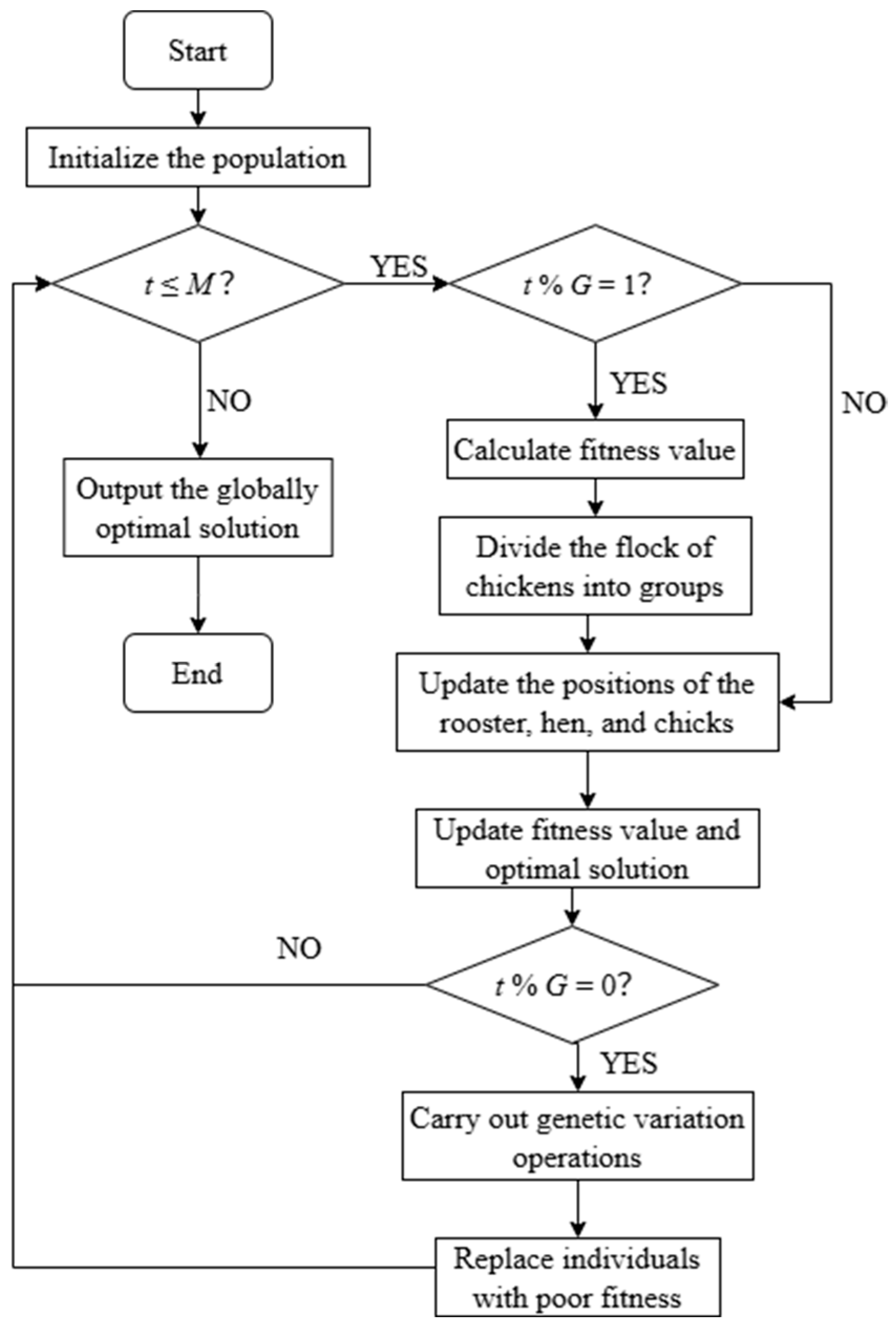
The solution process of the MICSO algorithm is shown in Figure 2, the steps of the algorithm are as follows:
Step 1: Set the algorithm parameters, initialize the chicken swarm, and set the current iteration t = 1;
Step 2: Check if t is greater than the maximum iterations M; if yes, go to Step 7; if not, go to Step 3;
Step 3: Check if the remainder of t divided by the update frequency G equals 1; if yes, sort the chicken swarm by fitness values, determine roosters, hens and chicks, and divide into sub-swarms; if not, directly skip to Step 4;
Step 4: Roosters, hens, and chicks update their positions respectively in accordance with the improved update strategies, calculate the fitness values after update, and determine whether to dynamically adjust the weight coefficients and mutation coefficients based on the global optimal solution;
Step 5: Check if the remainder of t divided by G is 0; if yes, proceed to Step 6; if not, increase t by 1 and jump back to Step 2;
Step 6: Replace the worst individuals with the CN individuals generated by genetic variation operations, increase t by 1, and jump back to Step 2;
Step 7: Terminate the operation and output the optimal solution.

2.4. Verification of Algorithm Validity

The performance of MICSO was verified by comparing its solution results with those of CSO [17], GWO [25], WOA [26], ICSO [18] and CSO_EET [19] on the CEC2022 benchmark functions. It is one of the mainstream benchmarks in the field of optimization algorithms, where the function information is shown in Table 1. The experiments were conducted on the MATLAB R2022a platform, the test equipment is a Lenovo Legion Y9000P laptop manufactured in Hefei, Anhui, China, configured with an Intel® Core™ i9-13900HX CPU and 16 GB of RAM.
Algorithm search dimension D = 10, all the test algorithms have the same parameter settings: N = 100, M = 500, and the parameters of each algorithm are selected according to Table 2. Each algorithm runs independently 30 times on each benchmark function to comprehensively evaluate its optimization performance and stability.
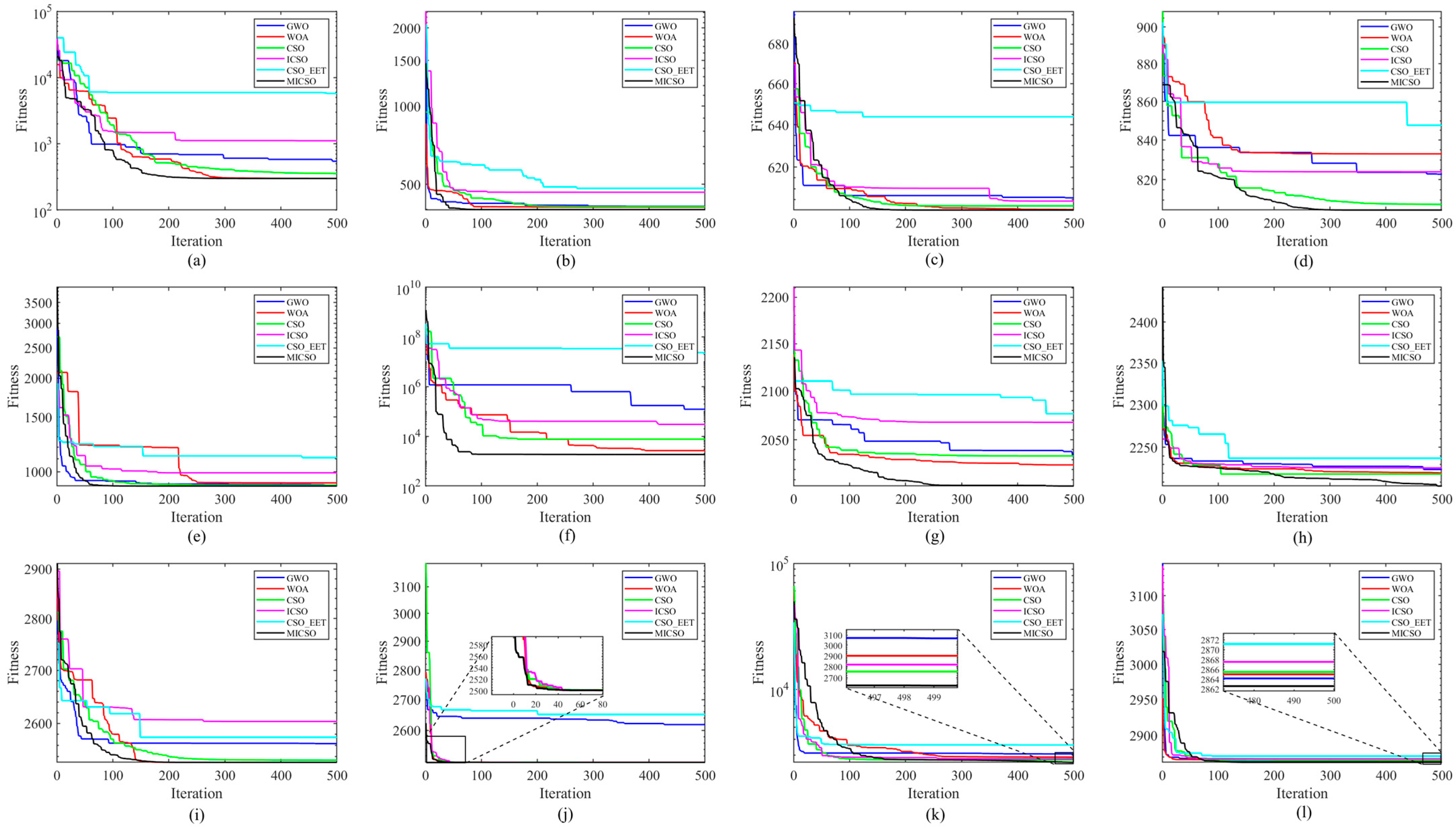
The experimental outcomes are presented in Table 3. Figure 3 depicts the convergence curves of the six algorithms.
From the optimal value indicators in Table 3, it is clear that MICSO attains the lowest optimal values among all algorithms on all benchmark functions. The results on F1, F2, F4, F6 and F11 are significantly better than the standard CSO and its variants, which demonstrates that MICSO has the strongest global search ability and can stably find the optimal solution. Comparing the worst-value indicators of each algorithm, the worst values of MICSO on most functions are superior to those of other algorithms. Especially on F6, the worst values of the comparison algorithms are much worse than MICSO, which indicates that MICSO has strong robustness and hardly falls into local optima. In terms of the mean indicators, MICSO performs best on most functions but is slightly inferior to the comparison algorithms on F9, F11 and F12. This demonstrates that MICSO can effectively solve most optimization problems, but there is still room for improvement on specific composite functions such as F11. The standard deviation reflects the stability and robustness of the algorithm. The standard deviations of MICSO on most test functions are the smallest or close to the smallest, showing strong robustness. However, on F7, F8 and F9, the standard deviations of WOA are slightly lower than those of MICSO, indicating better stability. It is worth noting that the standard deviations of MICSO on these functions are also extremely low, meaning its stability is still at a top level. Overall, the comprehensive optimization performance of MICSO is significantly better than that of the comparison algorithms. It can converge stably to the optimal value on most functions, with small fluctuation and strong robustness. Although there are slight gaps with WOA and CSO on individual functions, MICSO effectively balances exploration and exploitation, showing stronger adaptability in solution optimization.
It can be observed from the iteration curves of the algorithms that MICSO achieves the fastest convergence speed and the highest precision on most functions, and can converge stably to the lowest fitness value. However, on F8, F11 and F12, MICSO has no obvious advantage in the early iteration stage compared with some comparison algorithms, but it can continue deep exploitation in the middle and late stages and finally converge stably to the optimal solution. Although part of the convergence speed is sacrificed in the early stage to fully explore the solution space, it can accurately locate the optimal solution in the later stage, avoiding the premature convergence problem common in comparison algorithms. In the iteration curve of F8, the optimal function value of MICSO decreases suddenly at 400 iterations and a better solution is found, which shows that the introduced genetic mutation strategy effectively plays a role in jumping out of local optima in the late iterations.
Combined with Table 3 and Figure 3, it can be seen that the multiple improvement strategies successfully enhance the solution capability of the algorithm. The mutation strategy introduced based on genetic evolution endows the algorithm with the ability to jump out of local optimal solutions in the later iteration stage. The combination of the above multiple improved strategies significantly improves the optimization accuracy, stability and searching performance of MICSO, and finally results in more excellent solution performance.
To verify the effectiveness of the multi-strategy collaborative improvement for the standard CSO algorithm, this paper conducts ablation comparison experiments. The algorithms obtained by removing Strategy 1, Strategy 2, Strategy 3, Strategy 4, and Strategy 5 from MICSO are named CSO1, CSO2, CSO3, CSO4, and CSO5, respectively. These algorithms are compared with the standard CSO and MICSO to quantify the performance improvement brought by each strategy. It is proved that the multi-strategy combination is not a random stacking, but an innovative design with synergistic gains. The ablation experiments are still performed on CEC2022. We set N = 100 and M = 500, the parameters of CSO and MICSO are set according to Table 2, while the parameters of CSO1–CSO5 are set with reference to those of MICSO. Each algorithm runs independently 30 times. Table 4 summarizes the results.
By analyzing the ablation experiment results in Table 4, the performance of the standard CSO on multiple functions is significantly inferior to that of CSO1~CSO5 and MICSO, especially on F1 and F6, with low accuracy and large fluctuations. This indicates that the improved strategies can compensate for the shortcomings of the original algorithm in exploration ability, exploitation accuracy and stability. CSO1~CSO5 can achieve satisfactory performance on most functions, showing that each strategy plays a positive role. However, by comparing the results on functions such as F1, F2, F5, F6 and F10, removing any strategy leads to varying degrees of degradation in the optimal value, mean value or stability compared with MICSO, which means that the contribution of each strategy to the overall performance is irreplaceable. MICSO can achieve the best statistical indicators on most functions and maintain a relatively high performance on F3, F4, F8 and F11 without obvious shortcomings. This demonstrates that the multiple strategies are not simply superimposed but form complementarity and synergy, enabling MICSO to achieve comprehensive improvements in convergence accuracy, stability and robustness.
The ablation experiment results fully demonstrate that the various improved strategies proposed in this paper play a positive role in enhancing the CSO algorithm. However, the absence of any single strategy will weaken the overall optimization ability of the algorithm. Through the collaborative work of multiple strategies, MICSO overcomes the intrinsic limitations of CSO, and finally obtains superior comprehensive solution performance compared with the original CSO and each ablation variant, which verifies the rationality and effectiveness of the improved scheme in this paper.

3. Polynomial Interpolation Trajectory Planning

3.1. 3-5-3 Polynomial Interpolation Function

In the field of trajectory planning for robotic arm joint spaces, polynomial curves are widely used due to their simple analytical form and efficient calculation. However, although low-order polynomials can ensure continuous displacement and velocity of the trajectory, they can hardly guarantee continuous acceleration, which may cause sudden jumps in the angular acceleration during manipulator operation. High-order polynomials, by virtue of the continuity of high-order derivatives, can ensure the continuity of both acceleration and jerk of the trajectory, but may lead to numerical instability or trajectory oscillation [27]. The main reasons are that the Runge phenomenon causes severe oscillation at both ends of the interval, and the ill-conditioned coefficient matrix for solving will amplify the error. Therefore, in trajectory planning, the order of polynomials used in polynomial interpolation generally does not exceed 5.
Although conventional cubic spline interpolation can meet the basic trajectory fitting accuracy requirements, it is essentially a piecewise cubic polynomial. For a trajectory with n nodes, only 2 boundary degrees of freedom remain after satisfying the position, velocity, and acceleration constraints, which cannot simultaneously meet the four constraints of zero velocity and zero acceleration at the start and end points. If the start and end velocities are fixed at zero, the acceleration becomes uncontrollable and tends to cause impact; if the start and end accelerations are fixed at zero, the velocity becomes uncontrollable and static start-stop cannot be achieved. Therefore, the use of cubic splines may lead to mechanical vibration [28]. In contrast, the 3-5-3 piecewise polynomial provides more undetermined coefficients through the middle fifth-order polynomial segment, which can simultaneously satisfy the double-zero constraints of velocity and acceleration at the start and end points.
Aiming at balancing trajectory smoothness and computational efficiency, the 3-5-3 segmented polynomial interpolation method [9] was adopted, as shown in Equation (17): The first and last segments are cubic polynomials, and a quintic polynomial is inserted in the middle segment to ensure the smooth transition of the overall acceleration curve. This construction method splits the global trajectory into three segments for concatenation. Each segment independently satisfies the constraints of position, velocity, and acceleration, and at the connection points, the continuous conditions of joint position, angular velocity, and angular acceleration are used to eliminate jumps, as shown in Equation (18). Thanks to this, the joint trajectory obtained through planning remains continuous in terms of angle, velocity, and acceleration, effectively suppressing the impact of the joints; at the same time, since the highest order is only five, the scale of parameter solution is much smaller than that of a single high-order polynomial, significantly reducing the computational load.
θ k 1 ( t 1 ) = a k 10 + a k 11 t 1 + a k 12 t 1 2 + a k 13 t 1 3 θ k 2 ( t 2 ) = a k 20 + a k 21 t 2 + a k 22 t 2 2 + a k 23 t 2 3 + a k 24 t 2 4 + a k 25 t 2 5 θ k 3 ( t 3 ) = a k 30 + a k 31 t 3 + a k 32 t 3 2 + a k 33 t 3 3
where θk1, θk2, and θk3 respectively represent the angular displacements of the k-th manipulator joint in the three trajectory segments, while t1, t2, and t3 represent the times of the three segments of the trajectory.
θ k 1 ( 0 ) = x k 0 , θ k 1 ( 0 ) = 0 , θ k 1 ( 0 ) = 0 θ k 1 ( t 1 ) = θ k 2 ( 0 ) = x k 1 , θ k 1 ( t 1 ) = θ k 2 ( 0 ) , θ k 1 ( t 1 ) = θ k 2 ( 0 ) θ k 2 ( t 2 ) = θ k 3 ( 0 ) = x k 2 , θ k 2 ( t 2 ) = θ k 3 ( 0 ) , θ k 2 ( t 2 ) = θ k 3 ( 0 ) θ k 3 ( t 3 ) = x k 3 , θ k 3 ( t 3 ) = 0 , θ k 3 ( t 3 ) = 0
where θ k 1 , θ k 2 , θ k 3 represent the angular velocities of the k-th manipulator joint in the three trajectory segments respectively. θ k 1 , θ k 2 , θ k 3 represent the angular accelerations of the k-th manipulator joint in the three trajectory segments respectively. xk0, xk1, xk2, xk3 represent the four positions that the k-th manipulator joint passes through. By combining the constraint condition (18), the values of the coefficients in the polynomial Equation (17) can be solved.

3.2. Multi-Indicator Comprehensive Objective Function

As the operational tasks become increasingly complex and the working conditions are constantly changing, the trajectory planning based solely on a single metric is no longer able to meet the combined performance requirements of modern industrial robots for high precision, low energy consumption, and minimal impact. Therefore, by establishing a multi-index comprehensive objective function, optimization objectives such as time, energy consumption and impact are integrated into a single objective function. The unified multi-index fitness function is shown in Equation (19), and each sub-objective is integrated through the weighted normalization method:
F = k = 1 6 ( w 1 × f 1 k + w 2 × f 2 k + w 3 × f 3 k )
where w1, w2 and w3 denote the weight coefficients of the time-optimal function, energy-optimal function, and jerk-optimal function, respectively, f1k represents the time-optimal function for the k-th manipulator joint, f2k represents the energy-optimal function for the k-th manipulator joint, and f3k represents the impact-optimal function for the k-th manipulator joint.
The time-optimal function can be arbitrarily expressed as Equation (20):
f 1 k = i = 1 3 t i k
where tik represents the running time of the i-th segment of the trajectory of the k-th joint of the robotic arm.
The energy consumed by the manipulator during operation can be defined as the energy consumed by each joint motor during operation, i.e., the time integral of the power of each joint, as shown in Equation (21):
E = 0 t i k k = 1 N P k t d t = 0 t i k k = 1 N τ k t θ k t d t
where N denotes the number of joints, Pk(t) represents the instantaneous power of the k-th joint, and τk(t) denotes the driving torque of the k-th joint.
However, if Equation (21) is used as the energy consumption function in manipulator trajectory planning, it will significantly increase the computational complexity and require accurate joint torques of the manipulator, which are difficult to obtain at each moment in practical applications. Therefore, the energy consumption function is simplified in this paper.
The dynamic equation of the manipulator is shown in Equation (22):
τ k ( t ) = M k ( θ ) θ k ( t ) + C k ( θ , θ k ( t ) ) + G k ( θ )
where M k ( θ ) represents the inertia matrix of the k-th joint, C k ( θ , θ k ( t ) ) denotes the torque term of centrifugal and Coriolis forces for the k-th joint, and G k ( θ ) is the gravity torque term of the k-th joint.
Under light load, medium speed, and the condition that the manipulator operates within its acceleration constraints, the inertia term in the dynamic equation of the manipulator dominates the driving torque, while the other terms account for a small proportion. Thus, Equation (22) can be approximated as Equation (23):
τ k ( t ) M k ( θ ) θ k ( t )
The approximated result shows that joint acceleration is significantly positively correlated with joint torque, which provides a basis for simplifying the energy-optimal function. Therefore, this paper adopts the average acceleration as an approximate substitute index, and the simplified energy-optimal function can be expressed by Equation (24):
f 2 k = i = 1 3 1 t i k 0 t i k a i k ( t ) 2 d t
where aik is the angular acceleration during the operation of the i-th segment of the trajectory of the k-th joint of the robotic arm.
However, it should be noted that the energy consumption index based on angular acceleration is not equal to the actual energy consumption required by the manipulator during operation [29]. The simplified formula can only be used as a simplified indicator of energy consumption for qualitative analysis, not for quantitative analysis.
The impact received by the robotic arm is closely related to the smoothness of its movement, so the optimal function for impact can be defined by the degree of suddenness [30]. The detailed definition is given in Equation (25).
f 3 k = i = 1 3 1 t i k 0 t i k j i k ( t ) 2 d t
where jik is the jerk of the i-th segment of the trajectory of the k-th joint of the robotic arm, which is the derivative of the angular acceleration with respect to time.
Similarly, the impact index based on jerk does not represent the actual impact exerted on the manipulator during operation. The simplified formula can only be used as a simplified indicator of impact for qualitative analysis, not for quantitative analysis.

3.3. Determination of Weight Coefficients Based on Analytic Hierarchy Process

To reasonably determine the weight coefficients of each index in the multi-objective comprehensive function, this paper adopts the Analytic Hierarchy Process (AHP) for weight distribution [31]. AHP can transform qualitative preferences in engineering practice into quantitative weights, ensuring that the weight setting has methodological basis and avoids subjective arbitrariness.
The hierarchical structure constructed in this paper is divided into two layers: the goal layer and the criterion layer. In the criterion layer, the weights of time-optimal, energy-optimal, and jerk-optimal objectives are w1, w2 and w3, respectively. According to the actual operation requirements of the manipulator, three typical operation scenarios are set in this paper, corresponding to different performance preferences. The 1–9 scale method is used to construct the judgment matrix. The 1–9 scale method is shown in Table 5.
The three operation scenarios are as follows: Scene one, work efficiency is the most important, energy consumption is the second, and operation stability is slightly less important than energy consumption; Scene two, energy consumption is the most important, operation stability is the second, and work efficiency is slightly less important than operation stability. Scene three, operation stability is the most important, and energy consumption is as important as operation efficiency. The judgment matrices of the three scenarios are given below:
A 1 = 1 2 3 1 / 2 1 2 1 / 3 1 / 2 1 , A 2 = 1 1 / 3 1 / 2 3 1 2 2 1 / 2 1 , A 3 = 1 1 1 / 3 1 1 1 / 3 3 3 1
A1, A2 and A3 are the judgment matrices of Scene 1, Scene 2 and Scene 3, respectively.
Then, the relative weights of each index are calculated by the sum product method. The judgment matrix is normalized by columns, as shown in Equation (26):
b i j = a i j k = 1 n a k j
where bij denotes the element in the normalized matrix, aij denotes the element in the original matrix, akj the element in the k-th row, and n denotes the order of the matrix.
The arithmetic mean of the normalized matrix is calculated row by row to obtain the weight vector, as shown in Equation (27):
w i = 1 n j = 1 n b i j
Therefore, the weight vectors of Scene 1, 2, and 3 are shown in Table 6:
Since the judgment matrix is constructed based on subjective judgments, logical inconsistencies may exist. To evaluate the consistency of the judgment matrix, the AHP method introduces a consistency check mechanism, with the procedure as follows:
Step 1: Calculate the consistency index CI according to Equations (28) and (29):
C I = λ m a x n n 1
λ max = 1 n i = 1 n ( A w ) i w i
where λmax is the maximum eigenvalue of the judgment matrix.
Step 2: Look up the random consistency index RI in Table 7.
Step 3: Calculate the consistency ratio CR according to Equation (30). The judgment matrix is considered to have consistency when CR < 0.1; otherwise, the judgment matrix needs to be adjusted.
C R = C I R I
Through consistency analysis of the judgment matrices of the three scenes, Scene 1: consistency ratio CR = 0.008 < 0.1; Scene 2: consistency ratio CR = 0.008 < 0.1; Scene 3: consistency ratio CR = 0 < 0.1. Therefore, all three scenes pass the consistency check.

4. Simulation and Experimental Verification

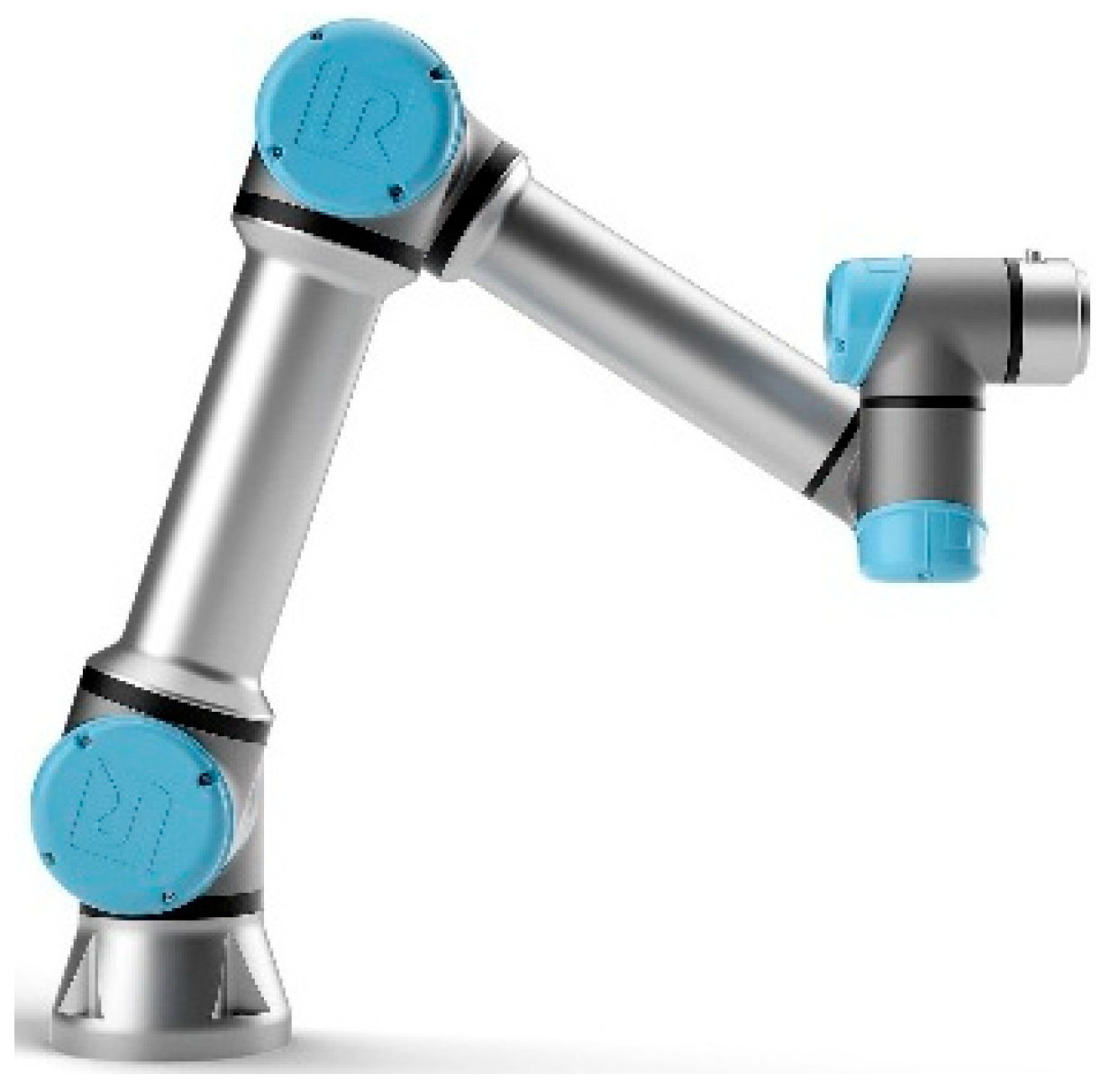
Both the simulation and experimental platforms are built based on the UR5 manipulator, as shown in Figure 4. Its DH parameters are listed in Table 8. UR5 is a 6-DOF collaborative manipulator with a rated load of 5 kg and a working radius of 850 mm. The supporting controller of UR5 is the CB3 controller.
To ensure the feasibility of the trajectories in the physical system, Table 9 provides the rated constraint values for the maximum angles, maximum allowable angular velocities, and maximum allowable angular accelerations of each joint of the UR5.
The kinematic modeling of the manipulator mainly focuses on the joint space and Cartesian space. The former describes the relationship between joint variables and link posture, while the latter focuses on the position and orientation of the end-effector in the absolute coordinate system. In the kinematic analysis of manipulators, joint space and Cartesian space are two interrelated but perspective-distinct core coordinate systems. They establish a mapping relationship through forward and inverse kinematics [32], which together form the basic framework of manipulator motion control.

4.1. Path Planning

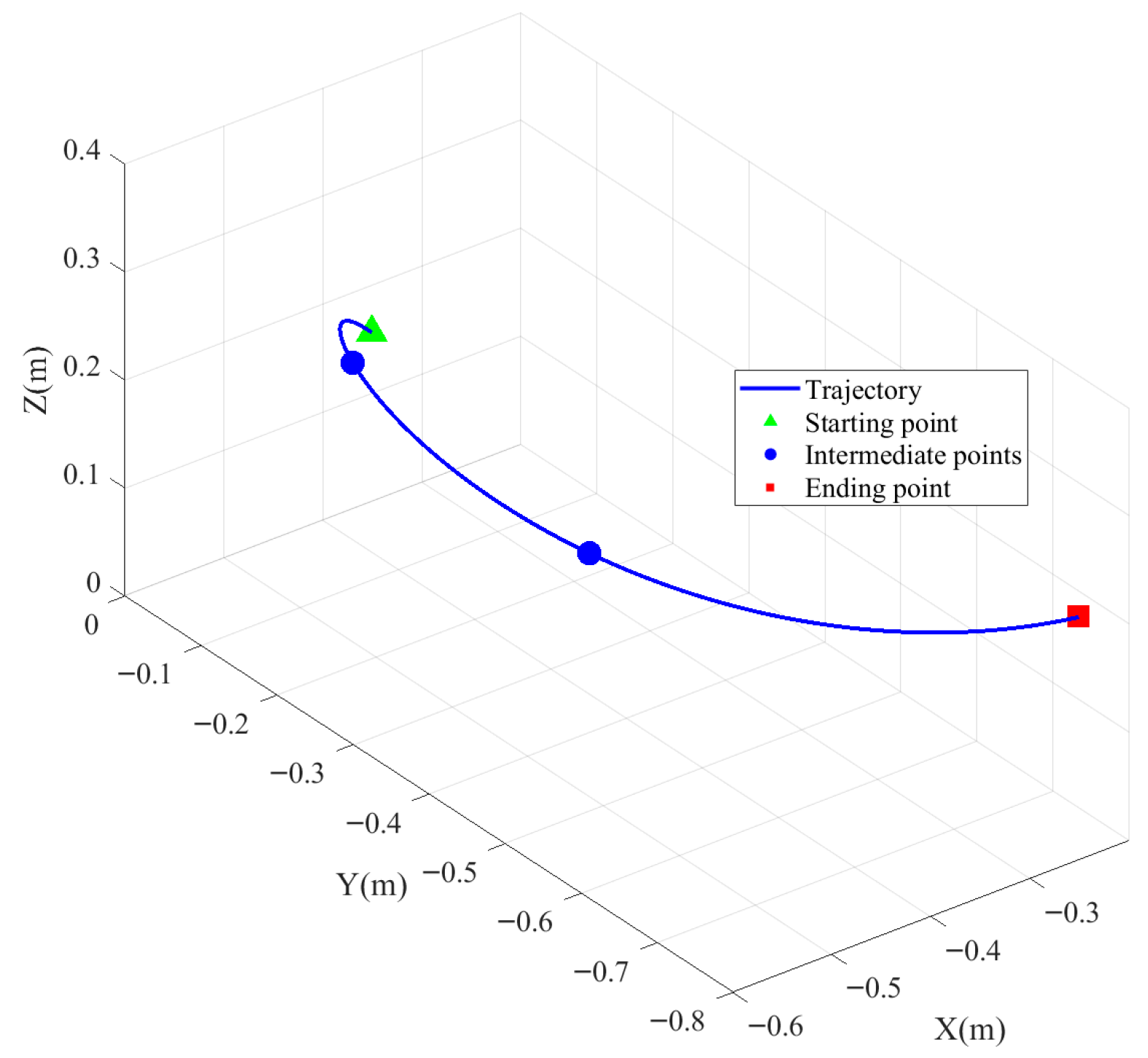
With the initial and terminal points given in the workspace of the manipulator, the trajectory of the robotic arm is generated via a path planning algorithm, as illustrated in Figure 5.
Four points are selected along this path, and their joint space coordinates are listed in Table 10. The subsequent 3-5-3 piecewise polynomial trajectory planning is carried out based on these four points.

4.2. Verification Through Simulation Experiments

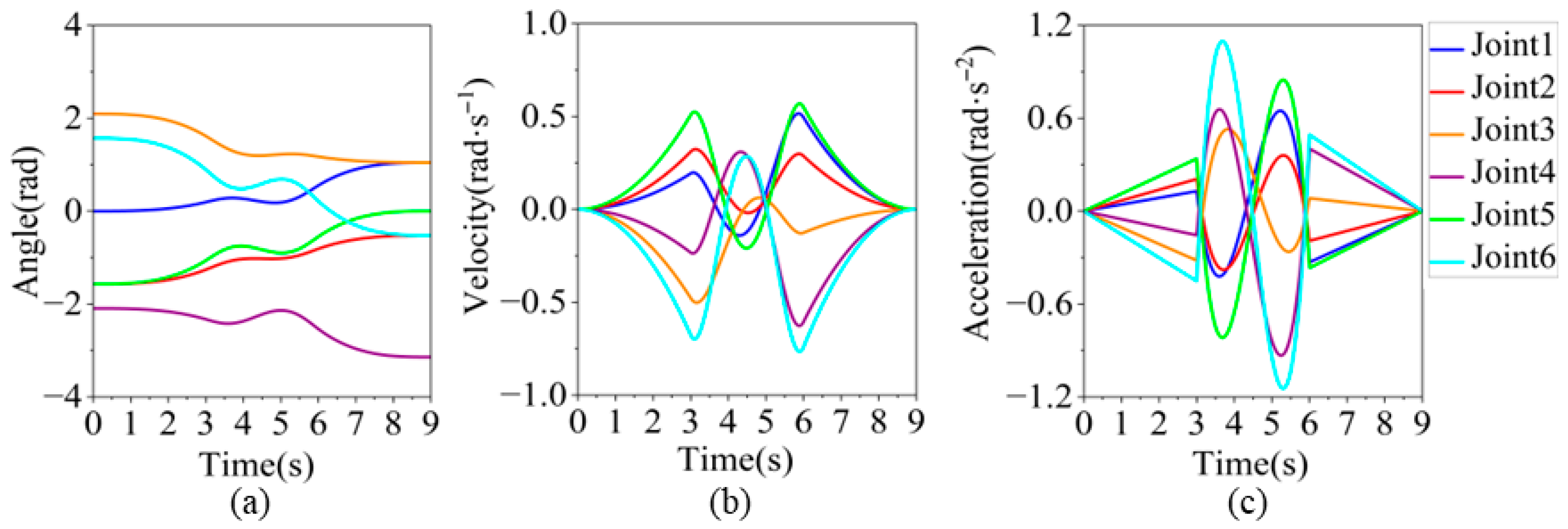
Before trajectory optimization, the feasibility of using 3-5-3 segmented polynomials for the trajectory planning of the robotic arm was verified. By setting the running time of each of the six joints within each interval to 3 s, the trajectory of the robotic arm was calculated. The result is shown in Figure 6. The curves of the trajectory did not exhibit any abrupt changes. However, drastic variations in velocity and acceleration can be observed for the manipulator in certain intervals, which might cause significant vibrations during the movement. Therefore, an optimization algorithm needs to be employed to further refine the trajectory.
Since the three indices of time, energy consumption, and jerk differ greatly in dimension and order of magnitude during trajectory optimization, direct weighting will lead to an imbalance of the optimization objectives and fail to reflect the real effect of the weights. Therefore, dimensionless processing is carried out on each index to eliminate the influence of dimension and magnitude differences.
In this paper, the reference trajectory is constructed by the 3-5-3 polynomial with a duration of 3 s for each segment. The reference values for each joint are shown in the Table 11.
Each optimization index is divided by its corresponding reference value to unify the magnitudes, as shown in Equation (31):
f ¯ i k = f i k f i k b a s e , i = 1 , 2 , 3
where f ¯ i k is the dimensionless result, f i k is the original value, and f i k b a s e is the reference value.
After the processing, each index becomes a dimensionless relative value, which can be reasonably weighted in the comprehensive objective function to ensure a stable and reliable optimization process. Thus, the final objective function is given by Equation (32):
F = k = 1 6 ( w 1 × f ¯ 1 k + w 2 × f ¯ 2 k + w 3 × f ¯ 3 k )
To access the performance of the MICSO algorithm in multi-objective trajectory planning for robotic arms and its advantages over existing methods, five algorithms, namely GWO, WOA, CSO, ICSO, and CSO_EET, were selected as the comparison algorithms for the comparative study.
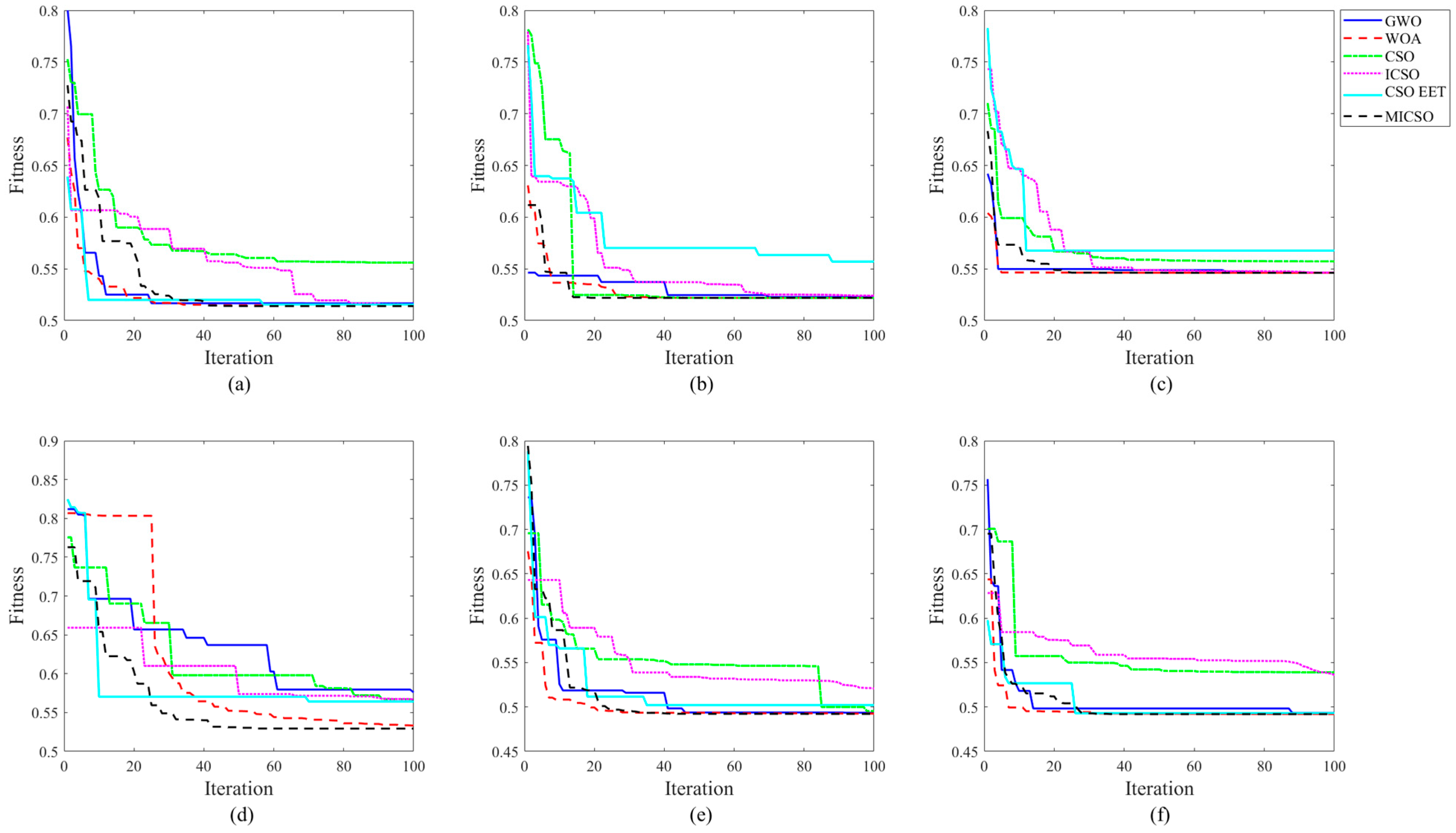
All algorithm parameters were initialized according to Table 2. What’s more, in the trajectory planning simulation, the algorithm other parameters were set as N = 100, and M = 100. Each algorithm is run 10 times independently, and the corresponding results are recorded statistically. The results are shown in Table 12. A random experiment was selected, and the iterative curves of each algorithm were given, as shown in Figure 7.
MICSO achieves the smallest optimal solutions among all algorithms in Scenes 1, 2, and 3, which is significantly better than WOA and other algorithms, indicating that it can obtain better trajectory parameters. The mean values of MICSO in the three scenes are the lowest among all algorithms and almost coincide with the optimal values, showing that it can stably obtain high-precision solutions in each run. In contrast, the mean values of CSO, ICSO, and CSO_EET are obviously higher, with insufficient optimization accuracy. The standard deviations of MICSO in the three scenes are much smaller than those of other algorithms, meaning its optimization results have extremely small fluctuations and strong robustness.
It can be seen from the iteration curves that MICSO exhibits a fast convergence speed in all subfigures. It decreases rapidly and approaches the optimal fitness value in the early stage of iteration, then keeps optimizing in the subsequent process, and finally converges to the minimum fitness.
The time results optimized by the MICSO algorithm were randomly selected once from each of the three different scenarios, as shown in Table 13.
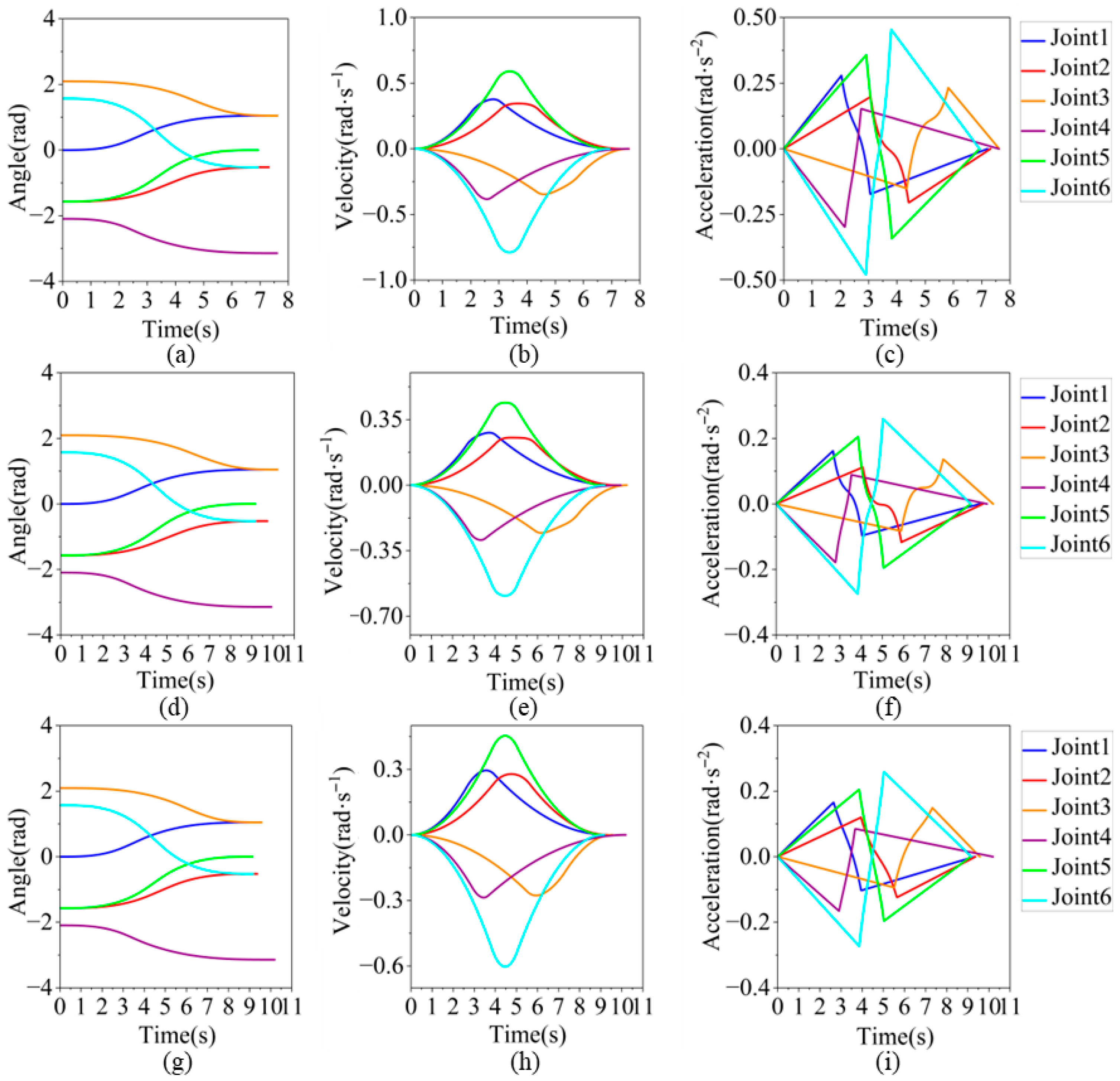
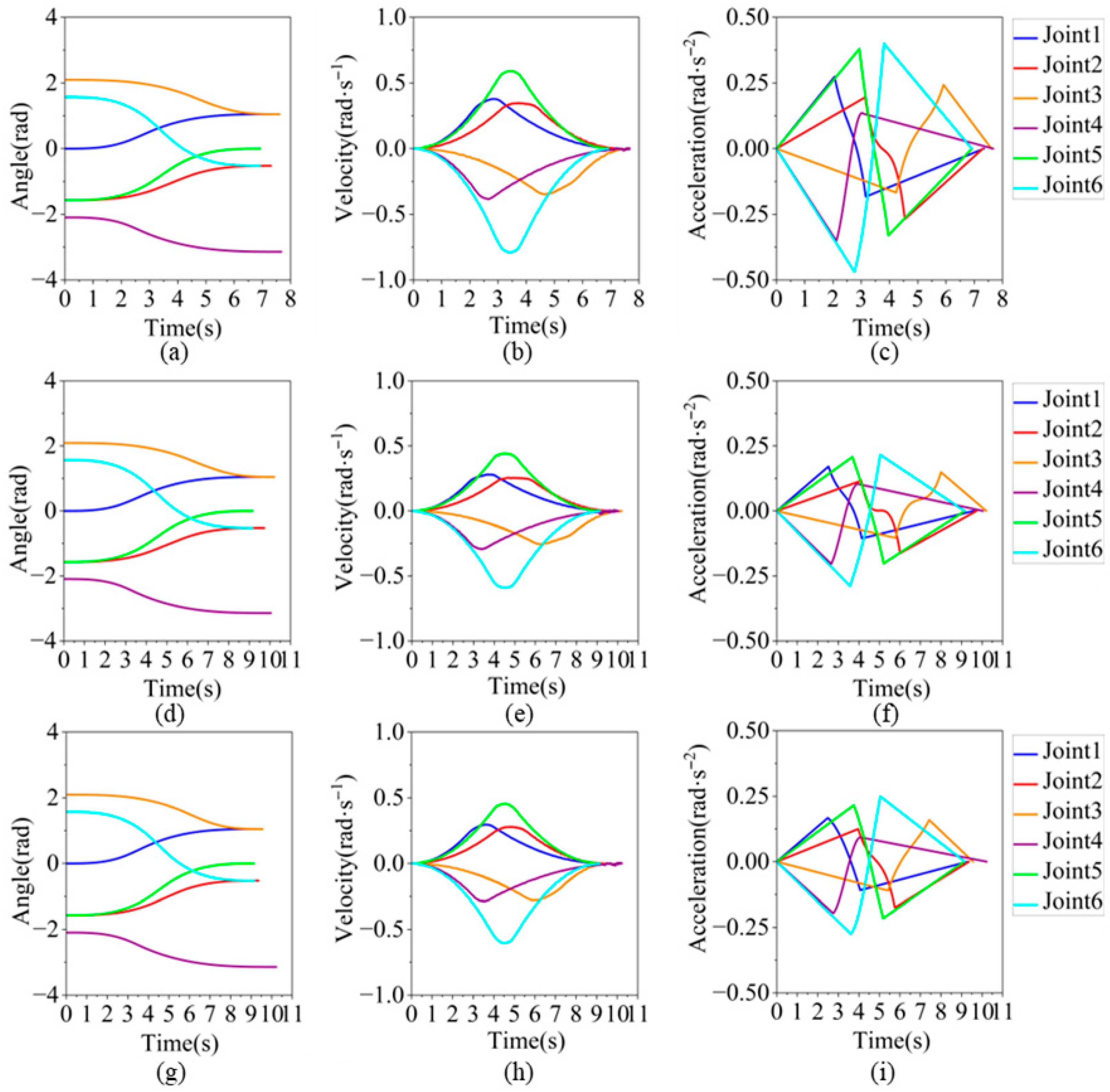
The optimization results for the three different scenarios are shown in Figure 8, and the corresponding objective function results are presented in Table 14.
By comparing the baseline trajectory and the optimized trajectory, it can be found that: In Scene 1, the time index is improved by approximately 19%, the energy consumption index by 86%, and the jerk index by 75%. In Scene 2, the time index is reduced by about 7%, while energy consumption is improved by 97% and jerk by 95%. In Scene 3, the time index is reduced by about 5%, energy consumption by 95%, and jerk by 96%.
The optimized trajectories differ due to different weight coefficients in the objective function. Compared with Scene 1, Scenes 2 and 3 show a decrease in the time index but a greater improvement in energy consumption and jerk. Between Scenes 2 and 3, Scene 3 achieves further improvement in the jerk index and a corresponding improvement in the time index, accompanied by a slight drop in energy consumption. This corresponds to the variation of weight coefficients between Scene 2 and Scene 3.
The optimization results of different scenes have verified the feasibility and effectiveness of optimizing trajectories through the MICSO optimization algorithm. At the same time, due to the different weight coefficients, the optimization focus of the trajectories is also different, which has verified the effectiveness of the multi-index comprehensive objective function.

4.3. Weight Sensitivity Analysis

To verify the influence of weight variation on each index, this paper additionally sets 6 groups of different weights using the AHP method, as shown in Table 15, to carry out weight sensitivity verification.
Weight 1 takes time as the highest priority, and energy consumption and jerk are of equal importance. Weight 2 takes energy consumption as the highest priority, and time and jerk are of equal importance. Weight 3 takes jerk as the highest priority, and time and energy consumption are of equal importance. Weight 4 is based on Scene 1, in which the importance relationship between energy consumption and jerk is maintained while the weight of time is increased. Weight 5 is based on Scene 2, in which the importance relationship between time and jerk is maintained while the weight of energy consumption is increased. Weight 6 is based on Scene 3, in which the importance relationship between time and energy consumption is maintained while the weight of jerk is increased.
Then, the MICSO algorithm is used for optimization according to the weights. The results of the three optimized indices are shown in Table 16.
Based on a comprehensive analysis of the optimization results in Table 14 and Table 16, when the time index is set as the highest priority in Weight 1, the optimized time index is greatly improved compared with other scenarios. Similarly, when energy consumption or jerk is set as the highest priority, the corresponding index is also significantly improved.
By comparing Scene 1 and Weight 4, it can be seen that a small increase in the weight of time leads to a corresponding improvement in the time index. Likewise, a small increase in the weight of energy consumption or jerk results in an enhancement of the respective index.
However, by comparing Scene 3 and Weight 6, although the weight of energy consumption decreases, the energy consumption index does not decline. This is because the jerk in the jerk index function is derived from the acceleration in the energy consumption index function. Therefore, optimizing the jerk index suppresses abrupt changes in angular acceleration, which in turn improves the energy consumption index.

4.4. Physical Experiment Verification

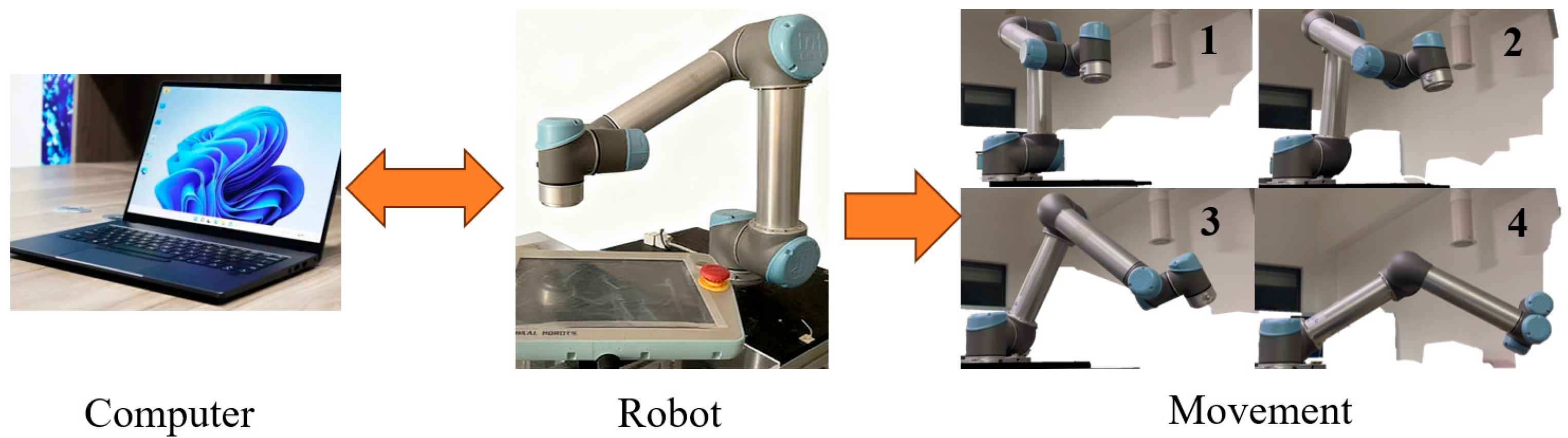
To further verify the validity of the optimized results of MICSO, the optimized trajectories of the three scenarios were input into the UR5 experimental platform for verification. The experimental verification method is shown in Figure 9.
The experimental process involves obtaining the sampled trajectory curve, obtaining discrete data of angle, velocity and acceleration that change with time, and then sending motion control instructions to the robotic arm through the computer. The robotic arm controller receives the instructions and completes the movement according to the instructions. During the movement, it also sends motion information to the computer.
After obtaining the motion information, the speed data is first processed by the Savitzky-Golay filter to smooth it; then, the acceleration data is filtered via a band-pass filter to eliminate high-frequency noise and low-frequency interference; finally, the discrete data points are fitted with a curve to obtain the final motion curve, as shown in Figure 10.
Through comparison of experimental and simulation results, it can be observed that the angles and speeds of the motion trajectories in the experimental results and the simulation results are basically consistent. Although there are some fluctuations in acceleration, the overall trend has not changed significantly, and the manipulator trajectory is continuous without any sudden changes.
Align the simulation trajectories with the experimental fitting trajectories in chronological order, then calculate the relative errors of the angles, velocities and accelerations between the simulation and the experiment point by point, calculate the average error of each joint trajectory, and finally calculate the average value of the errors of the six joint trajectories. The error analysis results of the three scenarios are listed in Table 17. The data analysis showed that the angle errors of the robotic arm’s movement trajectory are all within 1%, and the speed errors are all within 2%. The overall tracking accuracy of the trajectory is relatively high. The acceleration error is approximately 5% to 7%. This might be affected by factors such as the response of the joint motor, joint flexibility, and transmission clearance. In engineering practice, this falls within the acceptable range. In conclusion, it can be concluded that the trajectory results optimized by MICSO have been successfully applied to the physical robotic arm, verifying the feasibility of the MICSO trajectory planning method.

5. Discussion

From the results of benchmark function tests and manipulator trajectory optimization experiments, the MICSO algorithm overcomes the inherent drawbacks of the standard CSO algorithm, such as uneven population distribution, unbalanced global exploration and local exploitation, and a tendency to fall into local optima, through multi-strategy collaborative improvements including Tent chaotic mapping initialization, modified position-updating mechanisms for three types of chickens, and embedded genetic evolutionary strategies. It exhibits superior optimization accuracy and stability over GWO, WOA, CSO and their variants. In particular, with the help of the genetic evolutionary strategy, the algorithm achieves a stronger ability to escape from local optima in the iteration. Experiments on the UR5 manipulator further verify the engineering practicability and reliability of the optimized trajectory. However, it should be objectively recognized that although the collaborative integration of multiple strategies improves performance, it also makes the structure of MICSO more complex than that of single-improvement algorithms, which increases the computational cost to a certain extent.
At the level of trajectory optimization objective design, robotic arm trajectory planning is generally categorized into two types: single-objective optimization and multi-objective optimization. For multi-objective optimization scenarios, most current related studies adopt multi-objective optimization methods, with the core focus on solving the Pareto optimal solution set. By making trade-offs between different objectives, a set of non-dominated solutions is output for decision-making selection, rather than a uniquely determined optimal solution. The comprehensive optimal multi-index proposed in this paper forms a differentiation from this approach: by quantifying the preference of practical engineering requirements and assigning weights to each index through the AHP, the multi-objective problem is reformulated as a single-objective one with definite preferences. On the premise of meeting specific operation priorities, it can directly output the unique solution with the optimal comprehensive performance, which is more in line with the requirements of industrial sites for decision-making efficiency and execution certainty.
However, the current method still has certain limitations: first, the energy consumption and impact indicators in the comprehensive multi-index objective function are essentially indirect characterizations based on the kinematic model. They cannot fully and truly reflect the actual energy consumption and real impact intensity during the movement of the robotic arm, and can only serve as reference bases for qualitative analysis; second, the adopted 3-5-3 polynomial interpolation method is more suitable for point-to-point trajectory planning scenarios such as grasping, loading/unloading, and handling. It has insufficient adaptability for operations that require continuous and smooth path constraints, such as spraying and welding.
To address the aforementioned limitations, future work can expand the application scope of the algorithm from the following directions: first, regarding the simplified energy consumption and impact indicators, physical quantity data such as joint torque and actual current can be integrated with the manipulator’s dynamic model to construct energy consumption and impact quantification models that are more consistent with real working conditions, thereby improving the accuracy of the optimization objectives; second, to overcome the adaptability limitation of the trajectory generation method, MICSO can be combined with trajectory generation methods more suitable for continuous path constraints, such as B-splines and NURBS curves, to meet the requirements of continuous operation scenarios like spraying and welding; third, the MICSO algorithm can be integrated with technologies such as obstacle avoidance planning and visual servoing to enhance its trajectory planning capability in complex constraint scenarios and expand the applicable scope of the algorithm in engineering applications.

6. Conclusions

In this paper, an MICSO algorithm is proposed by introducing tent chaotic mapping for population initialization, improving the position updating mechanism of the chicken swarm algorithm, and embedding a genetic evolution strategy. The cooperation of these improved strategies effectively solves the shortcomings of the traditional CSO algorithm, including non-uniform initial population, unbalanced global exploration and local exploitation, and premature convergence. The ablation experimental results further verify the necessity of each improved strategy. On the CEC2022 benchmark functions, compared with the comparison algorithms, MICSO exhibits faster convergence speed and higher convergence accuracy.
To verify the engineering practicability of the MICSO algorithm in manipulator trajectory optimization, this paper takes the 3-5-3 polynomial interpolation trajectory of the UR5 manipulator as the research object. A multi-index comprehensive objective function with time, energy consumption and jerk as the core is constructed, and the weight of each index is reasonably determined via the AHP method combined with practical engineering requirements. The optimization results show that the trajectory planned by MICSO is continuous, smooth and free of sudden changes. The algorithm can focus on optimizing the index with a higher weight during the optimization process according to different weight coefficients. Weight sensitivity analysis further confirms that weight adjustment can accurately guide the optimization direction, and the algorithm has good robustness to weight changes. Final physical experiments demonstrate that the optimization results of the MICSO algorithm can be successfully deployed on a physical manipulator, which verifies its engineering practicability.
Future research will be carried out in the following directions: First, optimize the objective function design and introduce energy consumption and impact quantification models more suitable for actual working conditions. Second, expand the trajectory adaptability of the algorithm by combining it with spline interpolation and other methods to meet the requirements of continuous path operations. Third, promote the practical application of the algorithm in real industrial scenarios.

Author Contributions

Conceptualization, J.L., D.L., F.D. and Y.L.; methodology, J.L. and D.L.; software, J.L.; validation, J.L., D.L. and F.D.; formal analysis, J.L., D.L., F.D. and Y.L.; investigation, J.L. and D.L.; resources, Y.L.; data curation, D.L.; writing—original draft preparation, J.L.; writing—review and editing, J.L., D.L., F.D. and Y.L.; visualization, J.L.; supervision, D.L. and Y.L.; project administration, D.L. and Y.L.; funding acquisition, D.L. and Y.L. All authors have read and agreed to the published version of the manuscript.

Funding

This research was funded by the Natural Science Foundation of Jiangsu Province Youth Fund Project (NO. BK20231052) and Jiangsu Provincial Key Research and Development Program (NO. BE2022069-2).

Institutional Review Board Statement

Not applicable.

Informed Consent Statement

Not applicable.

Data Availability Statement

The original contributions presented in this study are included in the article material. Further inquiries can be directed to the corresponding author.

Conflicts of Interest

The authors declare no conflicts of interest.

References

  1. Dai, C.; Lefebvre, S.; Yu, K.-M.; Geraedts, J.M.P.; Wang, C.C.L. Planning Jerk-Optimized Trajectory with Discrete Time Constraints for Redundant Robots. IEEE Trans. Autom. Sci. Eng. 2020, 17, 1711–1724. [Google Scholar] [CrossRef]
  2. Dai, Y.; Xiang, C.; Zhang, Y.; Jiang, Y.; Qu, W.; Zhang, Q. A Review of Spatial Robotic Arm Trajectory Planning. Aerospace 2022, 9, 361. [Google Scholar] [CrossRef]
  3. Dinçer, Ü.; Çevik, M. Improved trajectory planning of an industrial parallel mechanism by a composite polynomial consisting of Bézier curves and cubic polynomials. Mech. Mach. Theory 2019, 132, 248–263. [Google Scholar] [CrossRef]
  4. Zerrouki, N.; Goléa, N.; Benoudjit, N. Particle Swarm Optimization of Non Uniform Rational B-Splines for Robot Manipulators Path Planning. Period. Polytech. Electr. Eng. Comput. Sci. 2017, 61, 337–349. [Google Scholar] [CrossRef]
  5. Ekrem, Ö.; Aksoy, B. Trajectory planning for a 6-axis robotic arm with particle swarm optimization algorithm. Eng. Appl. Artif. Intell. 2023, 122, 106099. [Google Scholar] [CrossRef]
  6. Liu, J.; Liu, S.; Song, M.; Ren, H.; Ji, H. Time-Optimal Robotic Arm Trajectory Planning for Coating Machinery Based on a Dynamic Adaptive PSO Algorithm. Coatings 2024, 15, 2. [Google Scholar] [CrossRef]
  7. Zhang, X.; Shi, G. Multi-objective optimal trajectory planning for manipulators in the presence of obstacles. Robotica 2021, 40, 888–906. [Google Scholar] [CrossRef]
  8. Cheng, Q.; Hao, X.; Wang, Y.; Xu, W.; Li, S. Trajectory planning of transcranial magnetic stimulation manipulator based on time-safety collision optimization. Robot. Auton. Syst. 2022, 152, 104039. [Google Scholar] [CrossRef]
  9. Chen, L.; Mao, J.; Xiao, Z.; Tao, J.; Ren, X.; Zhao, Y. Robotic arm time-optimal trajectory planning using the Adaptive Gold Search algorithm. Adv. Mech. Eng. 2025, 17, 9. [Google Scholar] [CrossRef]
  10. Lu, Z.; You, Z.; Xia, B. Time optimal trajectory planning of robotic arm based on improved sand cat swarm optimization algorithm. Appl. Intell. 2025, 55, 323. [Google Scholar] [CrossRef]
  11. Mu, Y.; Zhang, L.; Chen, X.; Gao, X. Optimal Trajectory Planning for Robotic Manipulators Using Chicken Swarm Optimization. In Proceedings of the 2016 8th International Conference on Intelligent Human-Machine Systems and Cybernetics (IHMSC), Hangzhou, China, 27–28 August 2016; pp. 369–373. [Google Scholar]
  12. Chen, B.; Cao, L.; Chen, C.; Chen, Y.; Yue, Y. A comprehensive survey on the chicken swarm optimization algorithm and its applications: State-of-the-art and research challenges. Artif. Intell. Rev. 2024, 57, 170. [Google Scholar] [CrossRef]
  13. Ma, Y.; Meng, W.; Wang, X.; Gu, P.; Zhang, X. Modified Sparrow Search Algorithm by Incorporating Multi-Strategy for Solving Mathematical Optimization Problems. Biomimetics 2025, 10, 299. [Google Scholar] [CrossRef]
  14. Omran, M.G.H.; Wang, H.; Alaskandarani, M. Empirical analysis and improvement of the PSO-sono optimization algorithm. RAIRO - Oper. Res. 2025, 59, 1099–1119. [Google Scholar] [CrossRef]
  15. Liu, Y.; Cao, B.; Li, H. Improving ant colony optimization algorithm with epsilon greedy and Levy flight. Complex Intell. Syst. 2020, 7, 1711–1722. [Google Scholar] [CrossRef]
  16. Liang, C.; Yuan, H.; Wang, C.; Niu, W.; Zhang, Y. Trajectory Planning of Shipbuilding Welding Manipulator Based on Improved Whale Optimization Algorithm. Int. J. Adv. Comput. Sci. Appl. 2025, 16, 1300–1313. [Google Scholar] [CrossRef]
  17. Meng, X.; Liu, Y.; Gao, X.; Zhang, H. A new bio-inspired algorithm: Chicken swarm optimization. In Proceedings of the International Conference in Swarm Intelligence, Hefei, China, 17–20 October 2014; pp. 86–94. [Google Scholar]
  18. Wu, D.; Kong, F.; Gao, W.; Shen, Y.; Ji, Z. Improved chicken swarm optimization. In Proceedings of the 2015 IEEE International Conference on Cyber Technology in Automation, Control, and Intelligent Systems, Shenyang, China, 8–12 June 2015; pp. 681–686. [Google Scholar]
  19. Wang, Y.; Sui, C.; Liu, C.; Sun, J.; Wang, Y. Chicken swarm optimization with an enhanced exploration–exploitation tradeoff and its application. Soft Comput. 2023, 27, 8013–8028. [Google Scholar] [CrossRef]
  20. Verma, S.; Sahu, S.P.; Sahu, T.P. MCSO: Levy’s Flight Guided Modified Chicken Swarm Optimization. IETE J. Res. 2023, 70, 3780–3794. [Google Scholar] [CrossRef]
  21. Wang, Z.; Qin, C.; Wan, B.; Song, W.W.; Yang, G.; Vázquez, C.-R. An Adaptive Fuzzy Chicken Swarm Optimization Algorithm. Math. Probl. Eng. 2021, 2021, 8896794. [Google Scholar] [CrossRef]
  22. Deb, S.; Gao, X.-Z.; Tammi, K.; Kalita, K.; Mahanta, P. Recent Studies on Chicken Swarm Optimization algorithm: A review (2014–2018). Artif. Intell. Rev. 2019, 53, 1737–1765. [Google Scholar] [CrossRef]
  23. Zhang, C.; Ding, S. A stochastic configuration network based on chaotic sparrow search algorithm. Knowl.-Based Syst. 2021, 220, 106924. [Google Scholar] [CrossRef]
  24. Li, Y.; Lu, Y.; Li, D.; Zhou, M.; Xu, C.; Gao, X.; Liu, Y. Trajectory Optimization of High-Speed Robotic Positioning with Suppressed Motion Jerk via Improved Chicken Swarm Algorithm. Appl. Sci. 2023, 13, 4439. [Google Scholar] [CrossRef]
  25. Mirjalili, S.; Mirjalili, S.M.; Lewis, A. Grey Wolf Optimizer. Adv. Eng. Softw. 2014, 69, 46–61. [Google Scholar] [CrossRef]
  26. Mirjalili, S.; Lewis, A. The Whale Optimization Algorithm. Adv. Eng. Softw. 2016, 95, 51–67. [Google Scholar] [CrossRef]
  27. Romero, S.; Valero, J.; García, A.V.; Rodríguez, C.F.; Montes, A.M.; Marín, C.; Bolaños, R.; Álvarez-Martínez, D. Trajectory Planning for Robotic Manipulators in Automated Palletizing: A Comprehensive Review. Robotics 2025, 14, 55. [Google Scholar] [CrossRef]
  28. Wang, W.; Tao, Q.; Cao, Y.; Wang, X.; Zhang, X. Robot Time-Optimal Trajectory Planning Based on Improved Cuckoo Search Algorithm. IEEE Access 2020, 8, 86923–86933. [Google Scholar] [CrossRef]
  29. Xu, Z.; Liu, T.; Ding, J.; Xu, W.; Xu, M.; Yi, H.; Wu, Y.; Tan, P. Multi-Objective Optimization of Grasping Trajectories for Manipulator with Improved OMOPSO. Symmetry 2026, 18, 392. [Google Scholar] [CrossRef]
  30. Fan, Y.; Peng, Y.; Liu, J. Advanced multi-objective trajectory planning for robotic arms using a multi-strategy enhanced NSGA-II algorithm. PLoS ONE 2025, 20, e0324567. [Google Scholar] [CrossRef]
  31. Cheng, J.; Liu, W. Dynamic Path Optimization Based on Improved Ant Colony Algorithm. J. Adv. Transp. 2023, 2023, 7651100. [Google Scholar] [CrossRef]
  32. Villalobos, J.; Sanchez, I.Y.; Martell, F. Singularity Analysis and Complete Methods to Compute the Inverse Kinematics for a 6-DOF UR/TM-Type Robot. Robotics 2022, 11, 137. [Google Scholar] [CrossRef]
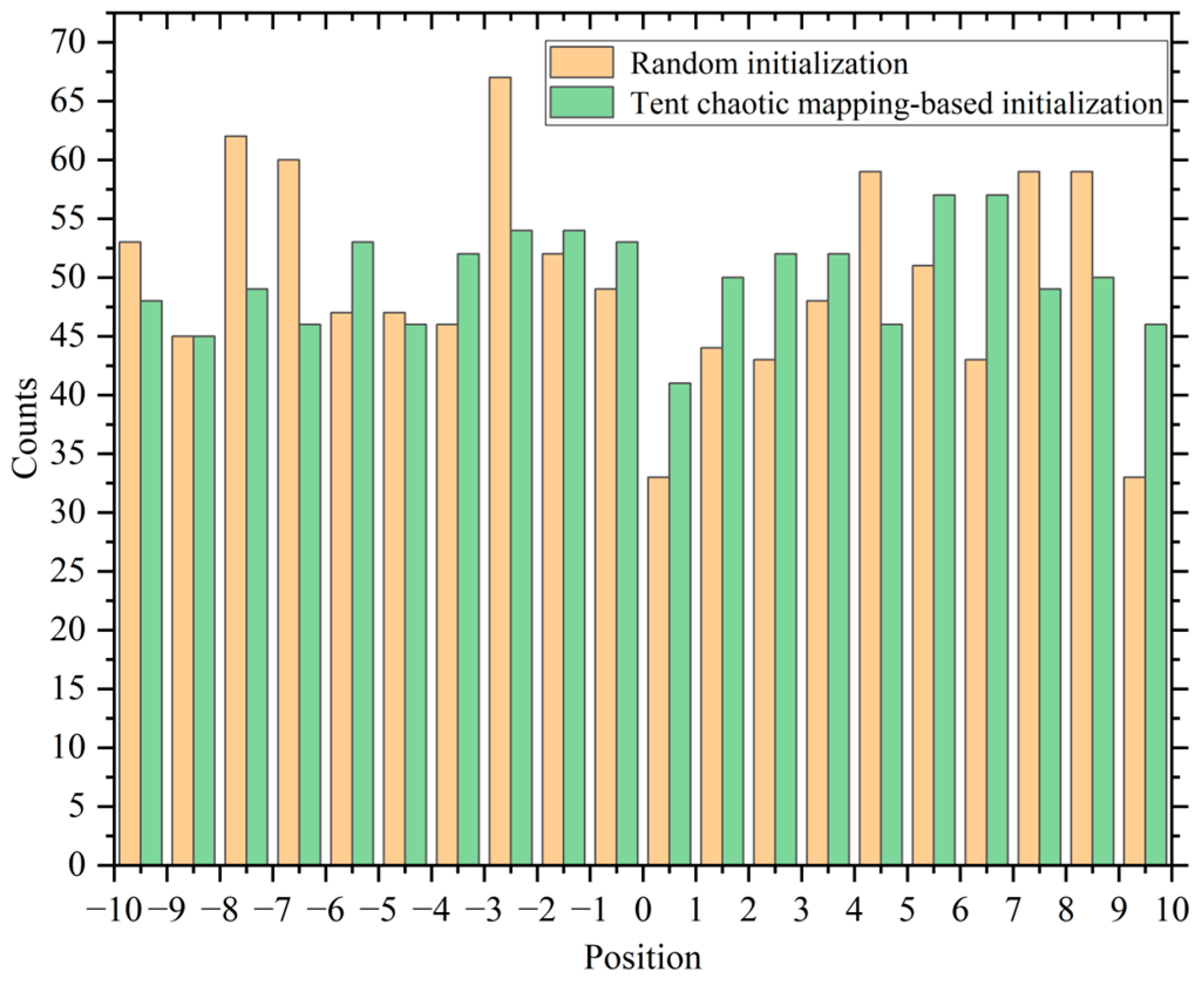
Figure 1. Comparison of population initialization results.
Applsci 16 02944 g001
Figure 2. Algorithm flowchart.
Applsci 16 02944 g002
Figure 3. Optimization algorithm convergence curve: (a) F1; (b) F2; (c) F3; (d) F4; (e) F5; (f) F6; (g) F7; (h) F8; (i) F9; (j) F10; (k) F11; (l) F12.
Applsci 16 02944 g003
Figure 4. UR5 manipulator.
Applsci 16 02944 g004
Figure 5. Path planning result.
Applsci 16 02944 g005
Figure 6. 3-5-3 polynomial trajectory planning results: (a) angle curves; (b) velocity curves; (c) acceleration curves.
Applsci 16 02944 g006
Figure 7. Algorithm iteration curve: (a) Joint 1; (b) Joint 2; (c) Joint 3; (d) Joint 4; (e) Joint 5; (f) Joint 6.
Applsci 16 02944 g007
Figure 8. Optimization results of MICSO: (ai) depict the angle, velocity, and acceleration curves in Scene 1, 2, and 3, respectively.
Applsci 16 02944 g008
Figure 9. Experimental validation method: 1, 2, 3, and 4 represent the sequence of the manipulator during trajectory execution.
Applsci 16 02944 g009
Figure 10. Actual trajectory of the manipulator: (ai) depict the angle, velocity, and acceleration curves in Scene 1, 2, and 3, respectively.
Applsci 16 02944 g010
Table 1. Optimal solution information for CEC2022 test functions.
No.FunctionsFi* 1
Unimodal Function1Shifted and full Rotated Zakharov Function300
Basic Functions2Shifted and full Rotated Rosenbrock’s Function400
3Shifted and full Rotated Expanded Schaffer’s f6 Function600
4Shifted and full Rotated Non-Continuous Rastrigin’s Function800
5Shifted and full Rotated Levy Function900
Hybrid Functions6Hybrid Function 1 (N = 3)1800
7Hybrid Function 2 (N = 6)2000
8Hybrid Function 3 (N = 5)2200
Composition Functions9Composition Function 1 (N = 5)2300
10Composition Function 2 (N = 4)2400
11Composition Function 3 (N = 5)2600
12Composition Function 4 (N = 6)2700
Search range: [−100, 100]D 2
1 Fi* denotes the globally optimal function value of the function. 2 Search range: [−100, 100]D, where D denotes the dimension of the search space.
Table 2. Algorithm parameter settings.
AlgorithmParameter Settings
GWOr1 and r2 are random numbers, a = 2 (decreases linearly during the iteration)
WOAp is a random number, a = 2 (decreases linearly during the iteration), b = 1
CSORN = 0.2N, HN = 0.6N, CN = 0.2N, MN = 0.1N, G = 10, 0 ≤ FL ≤ 2
ICSORN = 0.2N, HN = 0.6N, CN = 0.2N, MN = 0.1N, G = 10, 0 ≤ FL ≤ 2, C = 0.4
CSO_EETRN = 0.2N, HN = 0.6N, CN = 0.2N, MN = 0.1N, G = 10, 0 ≤ FL ≤ 2, wmax = 0.9, wmin = 0.4
MICSORN = 0.2N, HN = 0.6N, CN = 0.2N, MN = 0.1N, G = 10, 0 ≤ FL ≤ 2, w = 0.5, Pe = 0.1, β = 1.5
Table 3. Benchmark function test results.
Functions GWOWOACSOICSOCSO_EETMICSO
F1Best3.46 × 1023.00 × 1023.02 × 1024.34 × 1021.04 × 1033.00 × 102 *
Worst4.35 × 1033.48 × 1027.37 × 1024.07 × 1031.20 × 1043.00 × 102
Ave1.23 × 1033.08 × 1023.69 × 1021.46 × 1034.81 × 1033.00 × 102
Std1.30 × 1031.45 × 1018.67 × 1018.63 × 1022.94 × 1031.67 × 10−2
F2Best4.03 × 1024.00 × 1024.01 × 1024.21 × 1024.40 × 1024.00 × 102
Worst4.71 × 1024.79 × 1024.77 × 1024.97 × 1027.31 × 1024.09 × 102
Ave4.17 × 1024.10 × 1024.18 × 1024.52 × 1025.10 × 1024.02 × 102
Std1.71 × 1011.32 × 1011.79 × 1012.10 × 1016.19 × 1012.88 × 100
F3Best6.00 × 1026.00 × 1026.00 × 1026.04 × 1026.21 × 1026.00 × 102
Worst6.05 × 1026.06 × 1026.03 × 1026.16 × 1026.49 × 1026.02 × 102
Ave6.01 × 1026.01 × 1026.01 × 1026.11 × 1026.33 × 1026.01 × 102
Std1.06 × 1001.58 × 1007.30 × 10−12.95 × 1006.55 × 1005.17 × 10−1
F4Best8.06 × 1028.13 × 1028.03 × 1028.12 × 1028.34 × 1028.02 × 102
Worst8.30 × 1028.52 × 1028.12 × 1028.41 × 1028.57 × 1028.12 × 102
Ave8.16 × 1028.30 × 1028.07 × 1028.26 × 1028.44 × 1028.06 × 102
Std5.56 × 1001.07 × 1012.76 × 1006.84 × 1006.09 × 1002.38 × 100
F5Best9.00 × 1029.00 × 1029.00 × 1029.12 × 1021.00 × 1039.00 × 102
Worst9.35 × 1029.37 × 1029.23 × 1021.01 × 1031.72 × 1039.03 × 102
Ave9.03 × 1029.08 × 1029.07 × 1029.43 × 1021.24 × 1039.01 × 102
Std7.56 × 1001.02 × 1016.20 × 1002.16 × 1011.88 × 1027.44 × 10−1
F6Best2.05 × 1031.95 × 1031.89 × 1031.86 × 1033.41 × 1041.82 × 103
Worst8.32 × 1038.26 × 1038.14 × 1031.11 × 1043.17 × 1073.65 × 103
Ave5.72 × 1035.50 × 1035.00 × 1033.80 × 1034.55 × 1062.07 × 103
Std2.39 × 1032.19 × 1032.08 × 1032.25 × 1036.85 × 1063.78 × 102
F7Best2.01 × 1032.01 × 1032.00 × 1032.01 × 1032.06 × 1032.00 × 103
Worst2.04 × 1032.03 × 1032.03 × 1032.06 × 1032.13 × 1032.03 × 103
Ave2.03 × 1032.02 × 1032.02 × 1032.04 × 1032.08 × 1032.02 × 103
Std6.53 × 1004.50 × 1001.00 × 1011.03 × 1011.87 × 1019.35 × 100
F8Best2.20 × 1032.21 × 1032.20 × 1032.21 × 1032.23 × 1032.20 × 103
Worst2.23 × 1032.23 × 1032.23 × 1032.23 × 1032.25 × 1032.22 × 103
Ave2.22 × 1032.22 × 1032.22 × 1032.22 × 1032.24 × 1032.22 × 103
Std6.65 × 1004.24 × 1004.62 × 1004.70 × 1004.87 × 1007.03 × 100
F9Best2.53 × 1032.53 × 1032.53 × 1032.54 × 1032.54 × 1032.53 × 103
Worst2.60 × 1032.53 × 1032.57 × 1032.68 × 1032.70 × 1032.53 × 103
Ave2.55 × 1032.53 × 1032.54 × 1032.60 × 1032.63 × 1032.53 × 103
Std2.21 × 1011.98 × 10−68.41 × 1003.62 × 1014.22 × 1017.78 × 10−5
F10Best2.50 × 1032.50 × 1032.50 × 1032.50 × 1032.50 × 1032.50 × 103
Worst2.63 × 1032.50 × 1032.50 × 1032.63 × 1032.67 × 1032.50 × 103
Ave2.55 × 1032.50 × 1032.50 × 1032.51 × 1032.57 × 1032.50 × 103
Std5.83 × 1011.13 × 10−11.12 × 10−12.38 × 1017.39 × 1011.11 × 10−1
F11Best2.60 × 1032.60 × 1032.62 × 1032.76 × 1032.81 × 1032.60 × 103
Worst3.21 × 1034.18 × 1032.95 × 1033.30 × 1034.22 × 1032.94 × 103
Ave2.91 × 1032.92 × 1032.76 × 1032.87 × 1033.34 × 1032.87 × 103
Std1.23 × 1022.57 × 1028.84 × 1011.53 × 1024.00 × 1028.26 × 101
F12Best2.86 × 1032.86 × 1032.86 × 1032.86 × 1032.87 × 1032.86 × 103
Worst2.87 × 1032.87 × 1032.87 × 1032.87 × 1032.91 × 1032.86 × 103
Ave2.86 × 1032.86 × 1032.86 × 1032.87 × 1032.87 × 1032.86 × 103
Std1.64 × 1001.39 × 1001.47 × 1001.43 × 1009.50 × 1001.06 × 100
* Bold values indicate the optimal values in each row.
Table 4. Ablation experiment results.
Functions CSOCSO1CSO2CSO3CSO4CSO5MICSO
F1Best3.02 × 1023.00 × 1023.00 × 1023.00 × 1023.00 × 1023.00 × 1023.00 × 102 *
Worst6.89 × 1023.00 × 1023.31 × 1023.17 × 1023.04 × 1023.00 × 1023.00 × 102
Ave3.64 × 1023.00 × 1023.05 × 1023.01 × 1023.00 × 1023.00 × 1023.00 × 102
Std8.26 × 1017.73 × 10−36.21 × 1003.34 × 1007.21 × 10−11.97 × 10−24.30 × 10−3
F2Best4.01 × 1024.00 × 1024.00 × 1024.00 × 1024.00 × 1024.00 × 1024.00 × 102
Worst4.72 × 1024.73 × 1024.09 × 1024.63 × 1024.72 × 1024.72 × 1024.09 × 102
Ave4.24 × 1024.05 × 1024.03 × 1024.04 × 1024.09 × 1024.05 × 1024.03 × 102
Std2.16 × 1011.31 × 1013.99 × 1001.19 × 1011.84 × 1011.31 × 1013.57 × 100
F3Best6.00 × 1026.00 × 1026.00 × 1026.00 × 1026.00 × 1026.00 × 1026.00 × 102
Worst6.06 × 1026.03 × 1026.02 × 1026.03 × 1026.04 × 1026.04 × 1026.02 × 102
Ave6.01 × 1026.01 × 1026.01 × 1026.00 × 1026.01 × 1026.01 × 1026.01 × 102
Std1.13 × 1008.07 × 10−15.57 × 10−17.33 × 10−19.09 × 10−19.96 × 10−15.34 × 10⁻¹
F4Best8.04 × 1028.02 × 1028.03 × 1028.03 × 1028.03 × 1028.03 × 1028.02 × 102
Worst8.19 × 1028.17 × 1028.12 × 1028.13 × 1028.20 × 1028.13 × 1028.12 × 102
Ave8.09 × 1028.07 × 1028.07 × 1028.06 × 1028.09 × 1028.07 × 1028.06 × 102
Std3.47 × 1003.50 × 1002.70 × 1002.64 × 1004.66 × 1002.90 × 1002.30 × 100
F5Best9.00 × 1029.00 × 1029.00 × 1029.00 × 1029.00 × 1029.00 × 1029.00 × 102
Worst9.50 × 1029.05 × 1029.05 × 1029.10 × 1029.09 × 1029.09 × 1029.04 × 102
Ave9.07 × 1029.01 × 1029.02 × 1029.01 × 1029.03 × 1029.02 × 1029.01 × 102
Std1.05 × 1011.20 × 1001.24 × 1002.13 × 1002.69 × 1002.14 × 1001.17 × 100
F6Best1.92 × 1031.84 × 1032.25 × 1031.84 × 1031.90 × 1031.85 × 1031.84 × 103
Worst7.99 × 1034.22 × 1036.43 × 1034.03 × 1034.85 × 1035.37 × 1033.56 × 103
Ave4.20 × 1032.12 × 1033.72 × 1032.15 × 1032.26 × 1032.20 × 1032.09 × 103
Std1.83 × 1035.44 × 1021.14 × 1034.86 × 1026.73 × 1026.75 × 1024.38 × 102
F7Best2.01 × 1032.00 × 1032.00 × 1032.00 × 1032.00 × 1032.00 × 1032.00 × 103
Worst2.03 × 1032.04 × 1032.03 × 1032.03 × 1032.03 × 1032.03 × 1032.03 × 103
Ave2.02 × 1032.02 × 1032.02 × 1032.02 × 1032.02 × 1032.02 × 1032.02 × 103
Std8.82 × 1001.05 × 1018.88 × 1008.95 × 1009.27 × 1009.17 × 1008.64 × 100
F8Best2.20 × 1032.20 × 1032.20 × 1032.20 × 1032.20 × 1032.20 × 1032.20 × 103
Worst2.23 × 1032.22 × 1032.23 × 1032.23 × 1032.23 × 1032.22 × 1032.22 × 103
Ave2.22 × 1032.22 × 1032.22 × 1032.22 × 1032.22 × 1032.22 × 1032.22 × 103
Std7.04 × 1006.35 × 1007.39 × 1007.80 × 1008.04 × 1008.08 × 1007.34 × 100
F9Best2.53 × 1032.53 × 1032.53 × 1032.53 × 1032.53 × 1032.53 × 1032.53 × 103
Worst2.57 × 1032.53 × 1032.53 × 1032.53 × 1032.53 × 1032.53 × 1032.53 × 103
Ave2.54 × 1032.53 × 1032.53 × 1032.53 × 1032.53 × 1032.53 × 1032.53 × 103
Std1.30 × 1011.02 × 10−41.18 × 10−36.95 × 10−36.66 × 10−32.40 × 10−45.77 × 10⁻⁵
F10Best2.50 × 1032.50 × 1032.50 × 1032.50 × 1032.50 × 1032.50 × 1032.50 × 103
Worst2.61 × 1032.63 × 1032.61 × 1032.61 × 1032.61 × 1032.62 × 1032.50 × 103
Ave2.50 × 1032.50 × 1032.50 × 1032.50 × 1032.50 × 1032.50 × 1032.50 × 103
Std2.06 × 1012.33 × 1011.91 × 1012.04 × 1011.95 × 1012.18 × 1017.28 × 10−2
F11Best2.61 × 1032.63 × 1032.60 × 1032.63 × 1032.75 × 1032.75 × 1032.60 × 103
Worst2.92 × 1032.93 × 1032.91 × 1033.00 × 1032.92 × 1033.01 × 1032.91 × 103
Ave2.75 × 1032.89 × 1032.69 × 1032.90 × 1032.90 × 1032.91 × 1032.88 × 103
Std6.81 × 1015.11 × 1019.20 × 1017.50 × 1012.83 × 1015.04 × 1016.96 × 101
F12Best2.86 × 1032.86 × 1032.86 × 1032.86 × 1032.86 × 1032.86 × 1032.86 × 103
Worst2.87 × 1032.87 × 1032.87 × 1032.87 × 1032.89 × 1032.87 × 1032.86 × 103
Ave2.86 × 1032.87 × 1032.86 × 1032.86 × 1032.87 × 1032.87 × 1032.86 × 103
Std1.36 × 1001.97 × 1001.38 × 1001.22 × 1004.48 × 1001.17 × 1001.06 × 100
* Bold values indicate the optimal values in each row.
Table 5. 1–9 scale method.
ScaleMeaning
1The two factors are equally important
3The former is slightly more important than the latter
5The former is more important than the latter
7The former is obviously important than the latter
9The former is extremely important than the latter
2, 4, 6, 8Intermediate value of two adjacent judgments
ReciprocalIf factor i compared with factor j yields aij, then factor j compared with factor i yields 1/aij
Table 6. Weight vectors of the objective function in the three scenes.
SceneWeight Vector
1[0.539, 0.297, 0.164]
2[0.164, 0.539, 0.297]
3[0.2, 0.2, 0.6]
Table 7. Random consistency index.
n12345678910
RI000.580.91.121.241.321.411.451.49
Table 8. DH parameter table of UR5.
iai/(mm)αi/(rad)di/(mm)θi/(rad)
10π/289.15θ1
2−42500θ2
3−392.2500θ3
40π/2109.15θ4
50−π/294.65θ5
60082.30θ6
Table 9. Kinematic constraints of robotic arm joints.
JointRange of Angles/(°)Maximum Angular Velocity/(°/s)Maximum Angular Acceleration/(°/s2)
1−360~36018090
2−360~36018090
3−360~360180180
4−360~360180180
5−360~360180180
6−360~360180180
Table 10. Joint-space coordinates.
JointStarting Point/(°)Intermediate Point 1/(°)Intermediate Point 2/(°)Ending Point/(°)
1011.0931.6460
2−90−72.18−46.46−30
312092.6267.2160
4−120−133.36−145.33−180
5−90−60.87−31.510
69051.2112.44−30
Table 11. Optimization index baseline values.
JointTime Index ReferenceEnergy Consumption Index ReferenceJerk Index Reference
190.15601.1154
290.06840.5789
390.09750.6798
490.33422.2647
590.34422.6258
690.62474.7538
Table 12. Algorithm results.
Scene GWOWOACSOICSOCSO_EETMICSO
1Best3.10243.09603.17633.10013.17023.0957 *
Ave3.10873.09673.30913.19293.24163.0958
Std0.00880.00080.09570.06100.04850.0002
2Best1.25851.25631.28751.27271.27931.2560
Ave1.26021.25681.31711.29821.30111.2561
Std0.00130.00030.01920.02120.01210.0001
3Best1.48941.48391.51061.49511.52871.4837
Ave1.50811.48431.60391.56631.55651.4838
Std0.02870.00040.04940.03670.02980.0001
* Bold values indicate the optimal values in each row.
Table 13. Movement time for each joint.
SceneJointTime of the First Trajectory Segment/(s)Time of the Second Trajectory Segment/(s)Time of the Third Trajectory Segment/(s)
112.03851.01654.1482
23.06921.34602.8970
34.35301.46341.8008
42.16180.56884.8767
52.91980.89803.1097
62.90770.88643.1249
212.67731.35985.5514
24.08141.81113.8439
35.88531.97732.3506
42.79570.74136.3897
53.85801.19484.1136
63.84291.17974.1364
312.64621.30335.3658
23.94341.69713.7240
35.51701.80192.2479
42.90410.76006.5273
53.85631.17644.1043
63.85811.16674.1413
Table 14. Comparison of metrics before and after optimization.
SceneTime MetricEnergy Consumption MetricJerk Metric
prior to optimization666
14.84290.82051.4764
26.42110.20590.3100
36.30460.30880.2686
Table 15. Weight vectors of the six groups of comparative weights.
Contrast WeightWeight Vector
1[0.8182, 0.0909, 0.0909]
2[0.0909, 0.8182, 0.0909]
3[0.0909, 0.0909, 0.8182]
4[0.6232, 0.2395, 0.1373]
5[0.1373, 0.6232, 0.2395]
6[0.1429, 0.1429, 0.7143]
Table 16. Optimization results of six groups of comparative weights.
Contrast WeightTime MetricEnergy Consumption MetricJerk Metric
13.99572.26514.2070
26.84140.11340.3669
37.23090.18580.1159
44.60251.06361.9547
56.57780.16870.3028
66.72510.24450.1807
Table 17. Comparison of errors between simulation and experiment.
SceneAngle Error/(%)Angular Velocity Error/(%)Angular Acceleration Error/(%)
10.721.575.42
20.771.876.62
30.721.696.33
Disclaimer/Publisher’s Note: The statements, opinions and data contained in all publications are solely those of the individual author(s) and contributor(s) and not of MDPI and/or the editor(s). MDPI and/or the editor(s) disclaim responsibility for any injury to people or property resulting from any ideas, methods, instructions or products referred to in the content.