


Abstract
The problem of power system oscillation stability has become more and more prominent in the context of a high proportion of new energy sources and the gradual increase in power electronic devices. Broadband oscillations pose new challenges to the security and stability of power systems. In recent years, the frequency of power system oscillations around the world, especially those triggered by wind, solar, and power electronic devices such as flexible direct current (DC) transmission, has shown that the geographic and system scale of their impacts continue to expand. Failure to properly control these broadband oscillations can lead to serious consequences such as equipment damage, off-grid renewable energy generation systems, and large-scale blackouts. Two strategies, data-driven and model-driven, have been used for monitoring and controlling broadband oscillations, but each has its limitations. The data-driven approach relies on data quality, while the model-driven approach requires high accuracy of the system model. For this reason, hybrid data-model-driven strategies have emerged. They combine the advantages of both to improve the accuracy and robustness of system analysis. In this paper, we will discuss the principle of hybrid data-model driving and its application to broadband oscillations, classify different frequency oscillations, and introduce risk warning methods, and finally summarize future research challenges such as quantitative analysis, propagation mechanisms and suppression measures of broadband oscillations.
1. Introduction
The issue of power system oscillation stability has long been a concern. Against the backdrop of the current power system transition toward large-scale renewable energy generation and high-penetration power electronics, the unpredictability and low inertia characteristics of renewable energy generation, coupled with their complex interactions with conventional grids, pose increasingly severe challenges to power system oscillation stability [1,2,3].
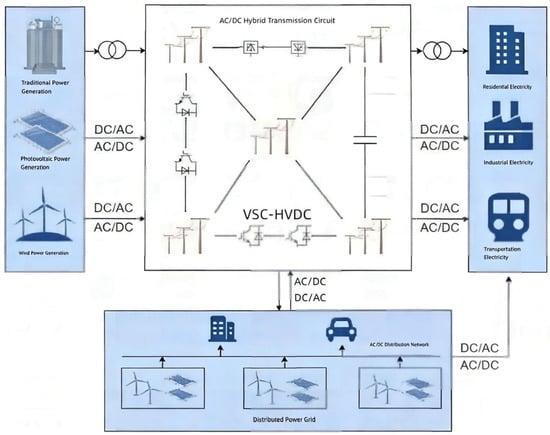
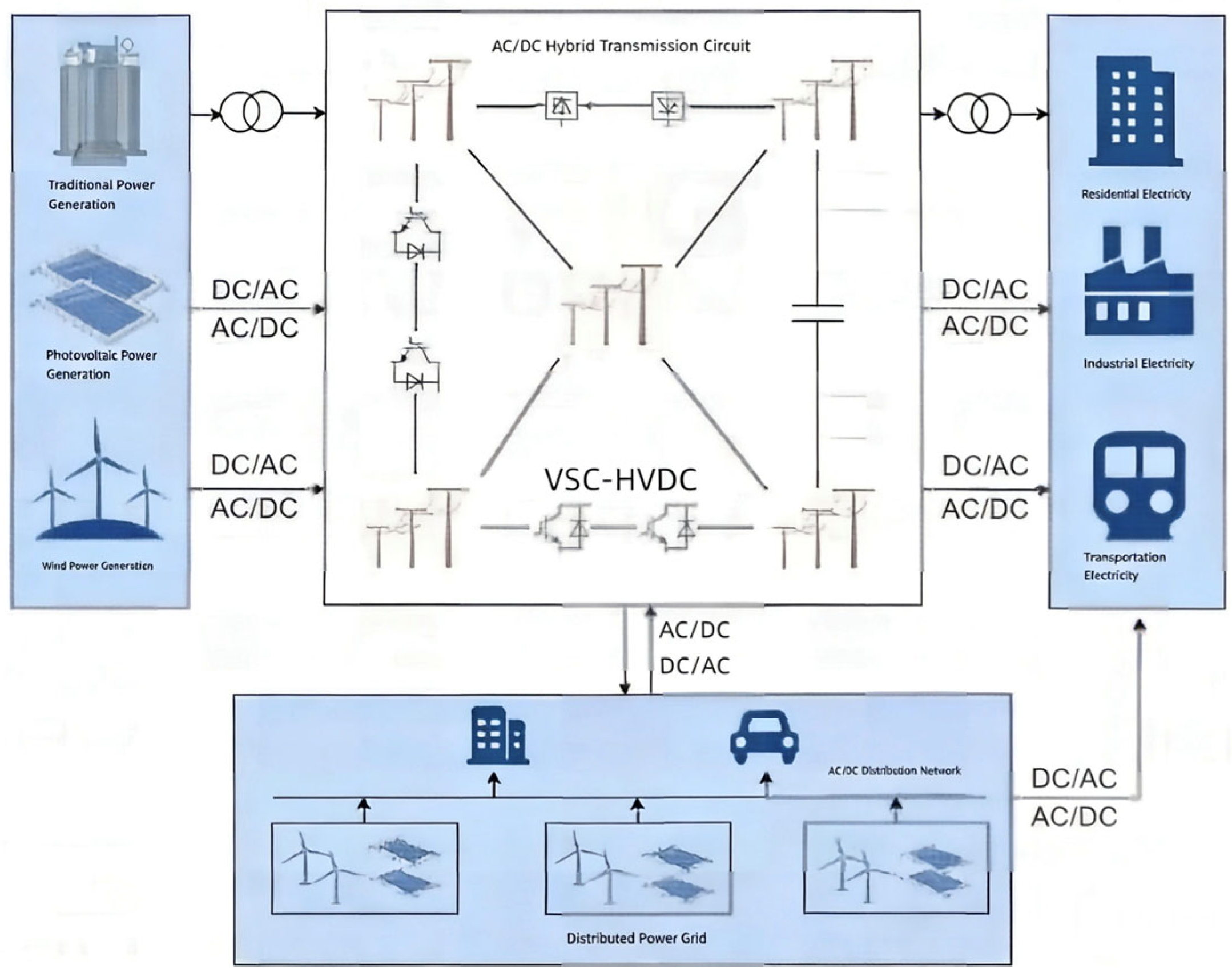
Modern power systems exhibit typical characteristics such as the interweaving of dynamic processes across multiple timescales and complex electromagnetic coupling between heterogeneous equipment, leading to wideband dynamic response issues [4]. These properties significantly expand the system’s oscillation spectrum range, extending from the traditional sub-/supersynchronous frequency bands into the high-frequency range, resulting in wideband electromagnetic oscillations [5]. Broadband oscillations differ fundamentally from traditional oscillations in their generation mechanisms, dynamic behavior, and scope of impact. Traditional oscillations primarily originate from the rotor dynamics of synchronous generators, manifesting as localized, single-mode low-frequency or subsynchronous oscillations. In contrast, wideband oscillations in “dual-high” systems are dominated by the complex interaction between the fast control loops of numerous power electronic devices and grid impedance. They exhibit new characteristics such as multi-mode coupling, wideband distribution, time-varying properties, and wide-area propagation. Figure 1 shows the schematic structure of the “double-high” power system. Their oscillation sources are dispersed and difficult to accurately locate. These broadband oscillation characteristics alter the scope of traditional power system stability issues, introducing new challenges to system secure operation. These challenges primarily manifest as the mutual coupling of oscillation modes across different frequency bands and their complex effects on system dynamic behavior [6].
Figure 1.
Schematic structure of the “double-high” power system.
In recent years, with the rapid development of new power systems centered on power electronic equipment, frequent power system oscillation events worldwide have drawn widespread attention. These events span frequencies from subsynchronous to supersynchronous and even high-frequency bands, forming wideband oscillation phenomena [7]. As evident from the representative wideband oscillation cases listed in Table 1, wideband oscillations triggered by the grid integration of power electronic equipment—such as wind and solar power generation, flexible DC transmission, and railway electrification—are becoming increasingly common. The geographic scope and system scale affected by these oscillations continue to expand [8].
Table 1.
Typical wideband oscillation accidents at home and abroad in recent years.
If such wideband oscillations caused by power electronic devices are not properly controlled, they may trigger a series of severe consequences: equipment damage, forced disconnection of renewable energy generation systems, threats to power system operational stability, and even cascading failures propagating to end users, leading to large-scale blackouts [9,10,11]. Wideband oscillations can cause grid-connected converter currents to exceed limits within milliseconds, jeopardizing equipment safety; simultaneously, the resulting power fluctuations impose cumulative impacts on system frequency stability and power quality, significantly increasing operational unpredictability and risks. As power electronic devices become increasingly prevalent in power systems, these risks continue to escalate, underscoring the urgent need for effective management and control of broadband oscillations [12].
It is evident that wideband oscillations induced by power electronic devices have become a significant factor threatening the safe and stable operation of power systems. Compared to traditional equipment such as generators, power electronic devices exhibit distinct differences in physical structure, control methods, dynamic response characteristics, and inter-device interactions. Their prominent rapid control and flexibility profoundly alter the dynamic properties of power systems, presenting unprecedented challenges and tests for system safety and efficient operation [13]. The dynamic response of power electronic devices far exceeds that of traditional mechanical equipment. Their widespread adoption has not only restructured the dynamic characteristics of power systems but also imposed stricter requirements on dynamic response and coordinated control for regulation technologies, thereby giving rise to new oscillation issues [14].
Furthermore, the complex interactions between power electronic devices and other components within the system may also trigger chain reactions, affecting the overall stability and reliability of the system [15,16,17].
While the existing body of literature has provided valuable foundations for understanding wideband oscillations, several critical gaps remain unaddressed, particularly concerning the specific challenge of risk early warning. No existing review has systematically focused on the risk early warning problem for wideband oscillations through the lens of data-model hybrid-driven approaches. This gap is significant because early warning represents a distinct technical challenge that differs fundamentally from post-event analysis or offline suppression design—it requires real-time operation, predictive capability, and robustness under diverse operating conditions.
This paper makes the following contributions: first, we establish a novel conceptual framework that systematically maps the three hybrid-driven operational modes—series, parallel, and embedded—to the specific requirements of wideband oscillation early warning. This framework moves beyond simple methodological classification to reveal the intrinsic relationships between oscillation frequency bands and optimal hybrid architecture selection. Second, we provide the first dedicated synthesis of early warning-specific challenges and solutions in the context of wideband oscillations. Unlike previous reviews that treat oscillation analysis, monitoring, and control as separate topics, we integrate these dimensions within a unified “perception-assessment-decision” early warning paradigm, demonstrating how hybrid-driven approaches can support each stage of this closed-loop process. Third, we identify and articulate the critical open challenges that must be addressed to advance hybrid-driven early warning from conceptual promise to practical deployment. These include the need for quantitative performance benchmarks, deeper understanding of wide-area propagation mechanisms, and development of coordinated suppression strategies that can operate within early warning timeframes.
Currently, monitoring issues for wideband oscillations primarily employ either data-driven or model-driven single strategies. Data-driven strategies have emerged as efficient, flexible, and adaptable analytical and control tools due to their advantages in handling complex nonlinear dynamics, adapting to parameter variations, enabling real-time monitoring and analysis, reducing model assumptions, and enhancing prediction accuracy [18,19,20]. Model-driven strategies, when applied to wideband oscillations, offer physical insights into the system, enable detailed analysis of system dynamics, handle complex nonlinear behavior, and maintain robustness under parameter variations [21,22,23].
However, both data-driven control strategies and model-driven control strategies have certain limitations. For data-driven methods, first, they heavily rely on the quality and representativeness of the data. If the dataset is incomplete or contains noise, the accuracy and reliability of the model may be compromised. Second, data models have limited generalization capabilities and offer weak interpretability. Finally, data models struggle to handle complex dynamic behaviors [24]. For model-driven approaches, key limitations include strong dependence on system models, which may complicate analysis when models are imperfectly accurate or system dynamics are complex and variable. Furthermore, model-driven methods lack flexibility in handling nonlinear and time-varying characteristics, particularly when confronting emerging, complex power electronic devices and renewable energy integration scenarios, where existing models may struggle to capture all critical dynamic behaviors [25].
Data-model hybrid-driven strategy integrates the strengths of both data-driven and model-driven approaches, creating complementarity and enhancing overall performance. By combining the learning capabilities of data-driven methods with the mechanism analysis of model-driven methods, it constructs models that more closely resemble actual systems. This reduces errors caused by model simplification, overcomes the limitations of single approaches, and improves the accuracy and robustness of system analysis [26,27,28,29].
Against this backdrop, this paper focuses on the “risk warning” issue of wideband oscillations, aiming to outline a data-model hybrid-driven solution pathway. First, we introduce the principles and current research status of data-model hybrid approaches, alongside applications of broadband oscillations under both data-driven and model-driven frameworks. Subsequently, we classify broadband oscillations by frequency and present corresponding risk warning methodologies. Finally, we summarize and outline potential challenges in future research, including quantitative analysis of broadband oscillations, their wide-area propagation mechanisms, and mitigation strategies.
2. Data-Model Hybrid-Driven Principle and Its Research Status
2.1. Data-Model Hybrid-Driven Principle
In wide-frequency oscillations within power systems, data-driven approaches leverage machine learning algorithms to extract key feature information from historical operational data and real-time monitoring data, thereby accomplishing pattern recognition, trend prediction, and decision optimization tasks. Model-driven approaches, conversely, are grounded in rigorous physical mechanism models and mathematical equations, employing optimization algorithms to determine the system’s optimal operating state. Data-model hybrid-driven approaches achieve synergistic enhancement by deeply integrating these two technical pathways. Data-driven methods demonstrate significant advantages in handling system uncertainties and complex nonlinear characteristics, while model-driven methods play an irreplaceable role in ensuring computational accuracy and preserving physical properties.
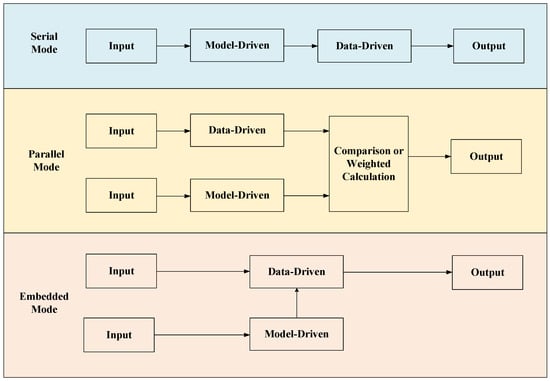
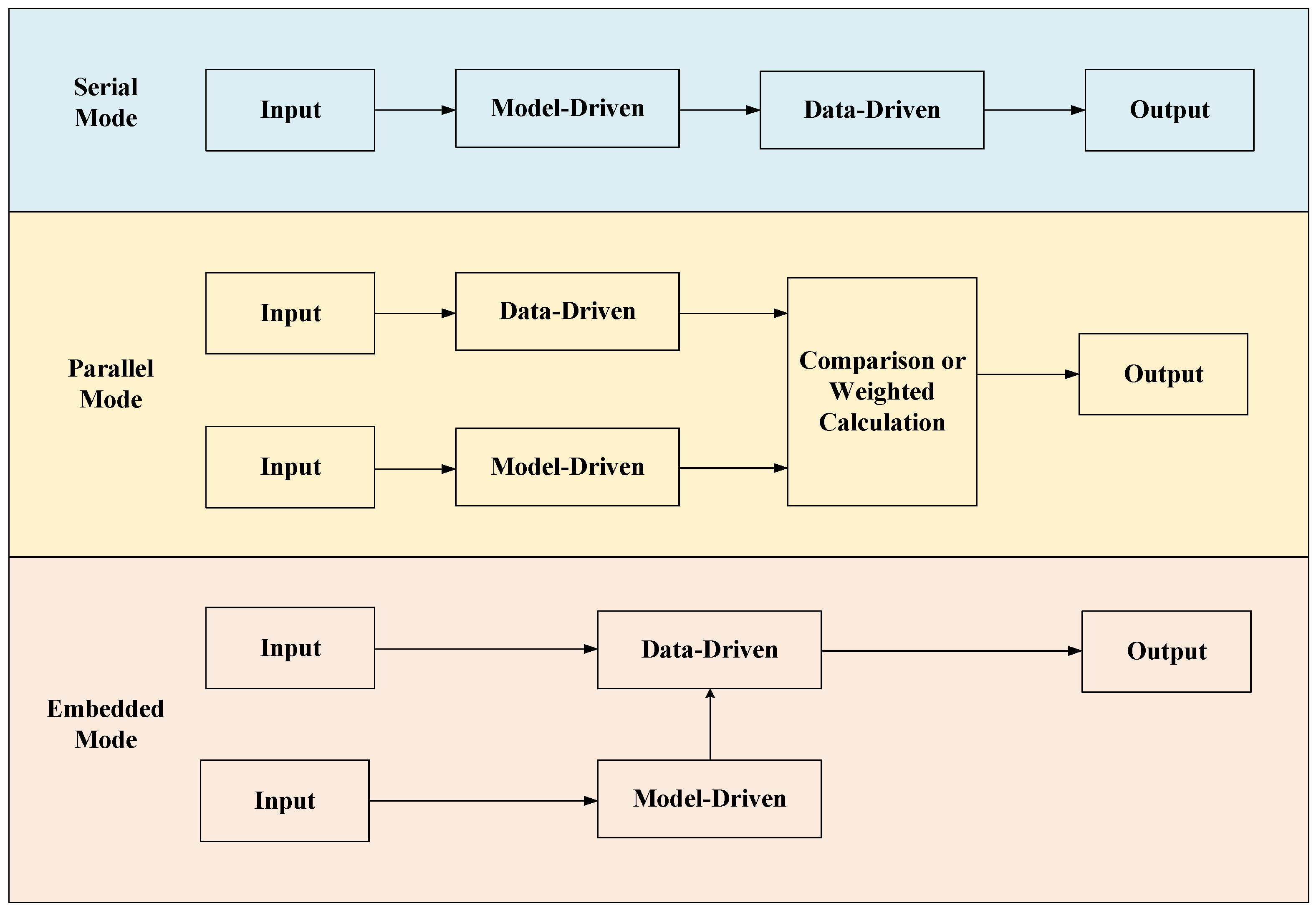
The key to hybrid driving lies in combining the physical prior knowledge of mechanism models with the learning capabilities of data-driven models through specific architectures, thereby constructing analytical models that possess both physical consistency and data adaptability. Data-model hybrid driving operates in three modes: serial, parallel, and embedded [30], as illustrated in Figure 2. Due to structural characteristics and computational workflow differences, each hybrid mode exhibits distinct applicability and engineering advantages when addressing broadband oscillations across different frequency bands.
Figure 2.
Hybrid data-model driven operation structure.
In the serial mode, a model-driven approach is first employed to perform dimensionality reduction on the input features from the data-driven method, thereby reducing the complexity of the parameter space. Subsequently, the data-driven algorithm performs post-processing optimization to enhance the model’s output accuracy. This collaborative strategy optimizes model selection, not only improving computational efficiency but also enhancing the adaptability of the operation and the reliability of the results. This approach is suitable for oscillatory scenarios with relatively well-defined mechanisms but uncertain parameters, demonstrating particular effectiveness in the low-frequency (0.1–2.5 Hz) and subsynchronous (2.5–50 Hz) bands. In Reference [31], a tandem architecture combining data-driven algorithms with traditional time-domain simulation significantly accelerated the transient stability analysis of subsynchronous oscillations induced by the interaction between wind farms and tandem compensation lines. By employing data-driven models to fit the dynamic differential equations of power electronic devices and performing parallel calculations with physical models, overall simulation efficiency is effectively optimized while maintaining analytical accuracy. However, this approach suffers from relatively delayed response to high-frequency dynamics.
In parallel mode, model-driven and data-driven approaches achieve interactive optimization of output results through a collaborative fusion mechanism. This mode employs real-time data alignment and feature space mapping, enabling dynamic weighted fusion of predictions generated by both approaches. This significantly enhances analytical accuracy while maintaining computational efficiency. Due to its excellent real-time performance and fault tolerance, the parallel mode is suitable for full-frequency oscillation analysis, particularly adept at handling complex nonlinear dynamics caused by multi-inverter coupling and rapid switching processes in medium-to-high-frequency (100–1000 Hz) oscillations. The hybrid digital twin modeling approach proposed in [32] employs a parallel driving principle. It integrates the analytical outputs of the physical model with the feature representations of the data-driven model into a unified collaborative system through a deep encoding network, utilizing attention mechanisms to achieve adaptive fusion between the two. This approach not only overcomes the limitations of single modeling methods but also significantly enhances overall system performance through cross-domain feature complementarity. It maintains the real-time requirements essential for engineering applications while markedly improving prediction accuracy and operational efficiency. However, this model imposes high demands on data synchronization and the complexity of fusion algorithms.
In embedded mode, data-driven components are integrated as functional modules into the core computational workflow of physical models, achieving deep coupling between data-driven and model-driven approaches. This fusion method significantly enhances simulation speed while ensuring numerical accuracy through parameter adaptation mechanisms and model structure optimization, simultaneously improving the model’s environmental adaptability. The embedded approach is particularly suited for modeling and analyzing supersynchronous and high-frequency oscillations, effectively capturing rapid dynamic processes—such as converter switching characteristics and high-frequency resonances—that are challenging to precisely describe in physical models. While it may introduce acceptable accuracy losses, it demonstrates significant efficiency and flexibility advantages when handling large-scale systems. Reference [33] established a digital twin framework for power systems. By adopting embedded hybrid-driven modeling, it integrates data-driven feature extraction with differential equation solvers for mechanism models, constructing a novel power system characterization system featuring multi-physics and multiscale capabilities. This architecture employs a bidirectional knowledge transfer mechanism that preserves the interpretability of physical models while incorporating data-driven adaptability. It provides solutions for system state awareness and operational decision-making, achieving innovations in power system situational awareness and intelligent decision-making. This embedded strategy, through data-driven integration, not only enhances the system’s adaptability and responsiveness to complex environments but also enables more precise decision-making and control through multidimensional system descriptions [34]. The primary challenge of this model lies in the limited interpretability of the embedded modules, with performance highly dependent on the quality and completeness of training data. As shown above, Table 2 compares the applicable scenarios for the data-model hybrid-driven models.
Table 2.
Comparison of applicable scenarios for data-model hybrid-driven models.
2.2. Review of the Current State of Research
Currently, data-model hybrid-driven approaches in the study of wide-frequency oscillations in power systems remain at an exploratory stage, still facing numerous critical issues that require urgent resolution.
The application of data-driven methods in power systems typically involves utilizing historical data and real-time monitoring data to identify system behavior, predict future states, or optimize control strategies. These methods do not rely on physical models but instead extract the system’s dynamic characteristics and underlying patterns through data analysis. The application of data-driven methods in wideband oscillation research primarily focuses on oscillation monitoring, analysis, and root cause identification. By analyzing measured data within the power grid, oscillation components can be extracted, oscillation sources localized, and the time-frequency characteristics of oscillations analyzed. For example, Reference [35] proposes a forced oscillation component extraction method based on adaptive time-frequency domain energy, as well as a multi-channel time-frequency domain localization method for forced oscillation sources using multiscale singular spectrum transform (MSST) and variational modal decomposition (VMD). These approaches enhance the accuracy and efficiency of oscillation source localization. Furthermore, Reference [36] indicates that data-driven technical approaches can be effectively applied to real-time wideband impedance monitoring and dynamic stability analysis of new energy power generation systems. By integrating data-driven methods with physical models, the wideband oscillation stability of wind power grid-connected systems can be assessed with greater accuracy. These applications demonstrate the significant role of data-driven methods in enhancing stability analysis for power systems.
In terms of model-driven approaches, current research methods addressing wide-frequency oscillations in power systems can be categorized into analytical calculation methods and numerical simulation methods. Analytical calculation methods establish rigorous mathematical models to determine precise mapping relationships between system parameters and oscillation characteristics, providing mathematical foundations for revealing oscillation mechanisms. However, their applicability is constrained in complex nonlinear systems. Numerical simulation methods reproduce system dynamics by solving sets of component differential equations, enabling global response analysis. Yet, they remain limited in elucidating the deep physical essence of oscillations.
Analytical calculation methods primarily employ typical approaches such as the complex torque coefficient method, state-space method, and impedance analysis method. Among these, the complex torque coefficient method possesses clear physical concepts but has limited applicability in systems with a high proportion of power electronic equipment. The state-space method evaluates oscillation stability by calculating system eigenvalues and damping ratio characteristics, with the reliability of its results directly dependent on the precision of system modeling. The impedance analysis method employs grid and converter impedance decoupling strategies, achieving local updates by constructing independent impedance models, thereby significantly improving computational efficiency [37]. Although analytical methods are suitable for oscillation analysis in simple systems and small-scale grids, they face significant computational bottlenecks when studying the stability of grids with high penetration of renewable energy sources. Table 3 presents a comparison of research methods for broadband oscillations.
Table 3.
Comparison of research methods for broadband oscillations.
Current analytical and computational studies on power system oscillations still exhibit significant limitations. These limitations primarily manifest in analytical methods that are often confined to specific operational scenarios, failing to systematically account for the coupling effects of interactions among multiple power electronic devices and multi-timescale dynamic processes. This constrains the fundamental physical understanding of oscillation mechanisms. Reference [38] compares the mechanism differences between oscillations in new power systems and traditional oscillations. Based on the principles of the Wheatstone bridge oscillation circuit, it elucidates the generation mechanism of new oscillations, laying the foundation for establishing a universal oscillation theory. Reference [39] proposed an improved frequency-domain analysis method that employs eigenvector decomposition to achieve precise identification of oscillation characteristics across the entire frequency range in new energy power systems, opening new avenues for studying wideband oscillation mechanisms. References [40,41] conducted in-depth investigations into subsynchronous oscillations by establishing impedance analysis models in synchronous rotating coordinate systems, proposing quantitative evaluation methods for system stability. Reference [42] extended the application of open-loop mode resonance theory from low-frequency oscillation studies to full-band stability analysis, proposing stability criteria for wideband oscillations in wind power systems. While these approaches effectively mitigate the “curse of dimensionality,” the coupling issues between oscillation frequencies remain to be thoroughly investigated.
Numerical analysis methods focus on solving power system models using computational programs, encompassing both electromechanical and electromagnetic transient programs, though they address distinct physical processes and time scales [43].
Power electronic components demand high-precision simulation characteristics to accurately reflect their dynamics. To address this challenge, electromagnetic–mechatronic hybrid simulation technology has emerged in recent years. By rationally dividing simulation steps and modeling accuracy, it significantly enhances simulation computational efficiency. Advances in modern communication and computing technologies have supported the development of real-time simulation platforms, enabling hybrid numerical-physical simulation of large-scale AC/DC hybrid systems and achieving actual connections with physical equipment [44,45]. However, current hybrid analog–digital simulation technology still has significant limitations, with its applicability primarily confined to subtransient process analysis. Addressing the specific demands of “dual-high” power systems, there is an urgent need to develop novel simulation methods to comprehensively test the dynamic response characteristics of various power electronic devices and provide effective means for in-depth analysis of their physical mechanisms [46].
Currently, dynamic oscillation issues in high-voltage, high-frequency power systems have become a research hotspot in academic circles worldwide. Given the pronounced multi-timescale characteristics of power electronic devices, researchers commonly employ electromagnetic transient simulation methods based on refined modeling to analyze wide-frequency oscillation phenomena. To balance computational efficiency and simulation accuracy, hybrid electromechanical–electromagnetic transient simulation technology can effectively address this challenge [47]. Reference [48] developed a real-time digital simulation platform for AC/DC hybrid grids by integrating a high-performance parallel computing platform with the HYPERSIM electromagnetic transient simulation tool. However, existing simulation methods still have room for improvement in computational stability, result accuracy, and computational efficiency. Reference [49] proposes a parallel computing method based on spatio-temporal decoupling. By analyzing the spatio-temporal distribution characteristics of system dynamics, this approach partitions the system for modeling according to temporal scales and coupling strengths, thereby significantly enhancing simulation efficiency.
As data-driven and model-driven approaches transition from independent application to deep integration, they must not only overcome their inherent limitations but also address a new set of challenges arising from their synergy and interaction. The core challenge lies in constructing a fusion paradigm that is both theoretically rigorous and engineering-feasible. First, the scientific basis for designing integration mechanisms and architectures remains insufficient. There is a lack of universal guiding principles and quantitative evaluation systems for adaptively selecting hybrid modes—such as series, parallel, or embedded configurations—tailored to different oscillation scenarios (e.g., specific frequency bands, dominant mechanisms). Second, mechanism models and data-driven models exhibit heterogeneity in mathematical essence and spatio-temporal scales. Information conversion and collaborative computation at their interfaces may introduce new errors, while uncertainties inherent in individual methods can propagate and amplify within hybrid frameworks, threatening the reliability of overall analysis. A deeper challenge lies in establishing a closed-loop where “physical knowledge guides data learning, and data insights feed back into mechanism understanding.” Current research predominantly focuses on the unidirectional process of enhancing model performance through data. However, the challenge of extracting new, interpretable patterns from data and formally embedding or refining existing physical models remains an open problem. Furthermore, for the specific goal of risk early warning, hybrid-driven frameworks must simultaneously enhance analytical precision while ensuring real-time capabilities for online applications and maintaining system robustness under extreme conditions such as data anomalies or model mismatches. This imposes higher demands on algorithm design and engineering implementation. While current research provides crucial methodological foundations for risk early warning, deep exploration remains necessary to systematically integrate the potential of hybrid-driven approaches, overcome their collaborative challenges, and elevate them to the level of dynamic early warning and intelligent decision-making.
3. Application of Model-Driven and Data-Driven Approaches in Wideband Oscillation
Risk early warning relies on deep perception of system status and precise assessment of stability. Data-driven and model-driven approaches each emphasize different aspects in this process, and their combined application aims to provide more reliable input for early warning decisions. Regarding data-driven methods, Reference [50] establishes a system model by integrating multi-source information based on modal impedance analysis, focusing on rapid localization of oscillation sources to provide risk source information for early warning. Reference [36] proposes a wideband impedance/admittance real-time identification technique for renewable power plants. For renewable generation units with random fluctuation characteristics, it employs data-driven modeling to construct wideband impedance/admittance characteristic models covering the entire steady-state operating range. However, this method is currently primarily applicable to small disturbance stability online monitoring and analysis in grid-connected systems, with limitations in handling large disturbance stability assessments. Reference [51] discusses the application of data-driven methods in the collaborative analysis of power system oscillation characteristics, potentially covering aspects such as oscillation behavioral features, mechanism exploration, and suppression implementation. Reference [52] proposes a wide-area monitoring and early warning system framework for wideband oscillations in “dual-high” power systems to eliminate or suppress wideband oscillations while enabling their monitoring and analysis. Reference [25] explores the potential and challenges of artificial intelligence technologies—particularly machine learning and deep learning methods—in addressing wideband oscillations in power systems. It analyzes the current application status of AI technologies in wideband oscillation identification, source localization, and suppression methods. Reference [53] proposes an online monitoring system for grid wideband oscillations. By collecting real-time wideband dynamic signals from the grid, this system offers a novel solution for oscillation monitoring in grids with high penetration of power electronic devices.
In terms of model-driven approaches, Reference [54] proposes a broadband oscillation analysis method based on an electromechanical transient mechanism model. By establishing an analytical multiscale model of power electronic devices, this method accurately identifies oscillation modes and achieves their suppression. Reference [55] proposes a novel modeling and analysis method for wideband disturbances in power systems based on the harmonic state-space concept. By introducing the harmonic state-space as a model-driven framework, it enables more accurate simulation and analysis of wideband oscillation phenomena within power systems.
In summary, data-driven approaches demonstrate flexibility in oscillation tracing and online monitoring, while model-driven methods remain irreplaceable for mechanism analysis and controller design. Both face trade-offs between accuracy and efficiency when addressing complex scenarios such as multi-modal coupling and strong nonlinearity.
4. Classification and Monitoring of Broadband Oscillations
4.1. Classification of Broadband Oscillators
Power system oscillations can be categorized into five major types based on frequency range, each exhibiting distinct causes and monitoring techniques. Table 4 presents a unified taxonomy with frequency boundaries, typical causes, and monitoring methods for each type.
Table 4.
Classification of power system oscillations by frequency range.
Ultra-low-frequency oscillations specifically refer to power fluctuations below 0.1 Hz, commonly observed during dynamic response processes in large-scale interconnected grids. These oscillations are primarily triggered by mechanical dynamic imbalance, interactions among multi-level control strategies, or abnormal grid operating conditions. Monitoring requires the integrated use of hardware devices such as low-frequency sensors, accelerometers, and displacement sensors. These capture long-period waveform data through high-speed data acquisition systems, while Wide Area Measurement Systems (WAMS) enable comprehensive dynamic monitoring across the entire grid. Combined spectral and time-domain analysis effectively identifies the propagation paths and excitation sources of ultra-low-frequency oscillations.
The frequency range of low-frequency oscillations is concentrated between 0.1 and 2.5 Hz. Their physical essence stems from the dynamic instability of synchronous generator rotors under external disturbances, which can easily form sustained oscillations when system damping is insufficient. Such phenomena pose a direct threat to power system transient stability. Monitoring technology centers on synchronous phasor measurement units (PMU), leveraging the WAMS platform to achieve millisecond-level synchronous acquisition of multi-node phase data. Combined with dynamic feature extraction methods such as the Prony algorithm and modal decomposition, it enables real-time identification of oscillation dominant modes and damping characteristics.
Subsynchronous oscillations and supersynchronous oscillations refer to abnormal fluctuations with frequencies below the power frequency (50/60 Hz) and above the power frequency but not exceeding 100 Hz, respectively. Subsynchronous oscillations readily induce torsional vibrations in the turbine generator shaft system, while supersynchronous oscillations may cause transformer core saturation or overstressing of power electronic devices. Both phenomena stem from the dynamic coupling between electrical equipment and mechanical systems, necessitating upgraded monitoring systems for mitigation: on one hand, dedicated sub/supersynchronous Wide-Area Monitoring Systems (SWAMS) can be deployed; on the other, existing PMUs can be retrofitted with wide-frequency measurement capabilities. This involves enhancing signal resolution by adding high-frequency sampling modules (sampling rate ≥ 5 kHz), while simultaneously employing impedance scanning technology to pinpoint resonance risk points.
Mid-to-high frequency oscillations span the frequency band from tens of hertz to thousands of hertz, typically triggered by the nonlinear switching characteristics of power electronic converters, control parameter mismatches, or grid structure resonances. Such high-frequency disturbances may cause electromagnetic compatibility issues and accelerate equipment insulation aging. Monitoring technology is evolving in multiple dimensions: at the hardware level, wideband monitoring devices supporting MHz-level signal acquisition must be developed, with sampling rates primarily based on the Nyquist–Shannon sampling theorem. To ensure distortion-free capture of oscillation components up to several thousand hertz and their high-frequency harmonics while reserving sufficient frequency resolution to suppress aliasing effects, the sampling frequency must significantly exceed twice the signal’s highest frequency. Consequently, MHz-level sampling rates become essential for accurately capturing and analyzing mid-to-high-frequency oscillation dynamics. At the algorithmic level, time-frequency analysis tools such as wavelet transforms and short time Fourier transforms (STFT) are employed to achieve oscillatory mode decoupling. At the verification level, a hybrid digital–physical simulation platform must be constructed, integrating real time digital simulation (RTDS) with physical testing to validate the dynamic response performance of the monitoring system.
4.2. Broadband Oscillation Monitoring and Early Warning
Risk early warning for wideband oscillations is a proactive defense process integrating monitoring, analysis, and decision-making. Its core lies in combining data-driven and model-driven analytical methods with real-time monitoring data to form a closed-loop system of “perception-assessment-alert-response.” Monitoring methods for wide-frequency oscillations typically involve the application of Wide-Area Monitoring Systems (WAMS), which possess capabilities for real-time online monitoring of power system operational status, dynamic characteristic analysis, and closed-loop control. Current WAMS primarily rely on information collected by PMUs to achieve real-time monitoring, evaluation, and control of the dynamic characteristics of large-span power networks [56]. However, existing PMU devices can only capture phasor characteristics near the power frequency, failing to cover the spectral range of wideband oscillations [57]. Consequently, traditional WAMS primarily focus on key areas such as grid operational characteristic analysis [58], subsynchronous oscillation analysis [59], and transient stability control [60], leaving blind spots in the observation and analysis of wideband oscillations.
For high-voltage and high-frequency power systems, the Wide-Area Monitoring and WAMWS have been proposed to achieve precise monitoring and intelligent analysis of wideband oscillation dynamics in power grids. WAMWS primarily consists of two components: wideband phasor monitoring substations and a wideband oscillation monitoring master station. The wideband phasor monitoring device (substation) continuously detects voltage, current, and digital signals within the power system, enabling monitoring and early warning for multi-mode oscillations. The main station collects data from substations, employing data-driven feature extraction and model-driven mechanism analysis to construct a dynamic risk assessment model. This facilitates intelligent transformation from raw data to warning decisions, achieving comprehensive analysis and control of wideband oscillations.
Risk warning for wideband oscillations is achieved through analysis of real-time monitoring data. Within WAMWS, advanced applications such as wideband phasor processing and wideband state estimation enable real-time monitoring and analysis of oscillations within power systems. Broadband oscillation risk assessment identifies broadband oscillation damping and equipment broadband dynamic impedance based on actual measured voltage and current data, enabling judgment and early warning of the overall broadband oscillation stability of the system.
The application of WAMWS assists power system operators in promptly detecting and responding to wide-frequency oscillation events, enabling measures to prevent or mitigate their impact on system stability. The system’s early warning capabilities not only trigger alerts when oscillations exceed preset thresholds but also achieve early risk identification and dynamic assessment through a data-model hybrid approach. This provides intelligent decision support for emergency system control, ensuring secure and stable grid operation. Recent research and application data indicate that WAMWS has been deployed across multiple wind farms, substations, and grid dispatch centers, offering effective solutions for addressing novel oscillations caused by renewable energy integration. However, integrating the hybrid-driven approach deeply into early warning decision logic—achieving dynamic adaptive risk thresholds and synergistic optimization of early warning and suppression strategies—remains a significant challenge.
To clarify the functional outputs of such early warning systems, it is essential to define their key elements. The primary warning targets include instability margins (e.g., damping ratio thresholds), oscillation risk levels (categorical indicators such as green/yellow/red), source location identification, and resonance risk detection. The required warning horizon varies with oscillation frequency: milliseconds for high-frequency oscillations that can cause rapid equipment damage, seconds for subsynchronous and low-frequency oscillations requiring operator intervention, and minutes for emerging risk trends enabling preventive actions. Key performance indicators for evaluating these systems include accuracy, lead time, false alarm rate, and missed detection rate. Practical online implementation must respect constraints such as latency, PMU bandwidth, synchronization accuracy, and communication reliability. Furthermore, robustness challenges—including bad data, communication loss, model mismatch, and cyberattack scenarios—must be addressed to ensure reliable operation. These elements collectively define the scope and requirements for effective wideband oscillation early warning, providing a foundation for the challenges discussed in the following section.
5. Challenges Faced
Regarding oscillation phenomena in traditional power systems, in-depth investigations into their mechanisms, detailed analyses of their characteristics, and effective suppression strategies have been established, forming a relatively comprehensive theoretical framework and engineering application methodology. However, in systems characterized by high penetration of power electronic devices, novel broadband oscillations introduce unprecedented complexity, manifested in diverse forms, broad spectral ranges, temporal variability, and wide-area propagation. Given this context, the research and analysis of wideband oscillations now confronts a series of novel challenges and tests. To systematically address these challenges, future research urgently requires breakthroughs at three key levels: quantitative analysis, propagation mechanisms, and suppression measures. This will drive a shift in the research paradigm from localized precise modeling toward system-wide collaborative cognition and intelligent defense.
5.1. Quantitative Analysis of Broadband Oscillations
The fundamental challenge in broadband oscillation research lies in establishing precise mathematical models for power equipment, including wind turbines, converters, and their control systems. This modeling faces dual difficulties: on one hand, the diversity of power electronic devices and their nonlinear characteristics lead to complex and variable frequency-dependent dynamic properties; on the other hand, it is often challenging to accurately obtain the internal structure and operating parameters of equipment in actual engineering applications. Particularly in high-penetration renewable energy grid-connected systems, the coexistence of numerous power electronic devices with multi-timescale characteristics makes constructing an equivalent electromagnetic transient model for the system exceptionally difficult. To address the challenge of obtaining equipment parameters, current research is actively exploring the optimization of parameter identification algorithms based on wideband measurement data. This involves combining global optimization algorithms to perform high-precision inversion of key parameters in equipment impedance models or control loops. Simultaneously, leveraging the complex nonlinear mapping relationship between sequence generation models in deep learning and parameters provides a new technical pathway for constructing high-precision equivalent models under conditions of limited prior knowledge.
From the perspective of analytical methods, existing techniques such as time-domain numerical simulation, modal analysis, and impedance characteristic studies exhibit significant limitations when addressing broadband oscillation problems with strong nonlinear characteristics. Analyzing the same oscillation phenomenon using different theoretical frameworks may yield contradictory conclusions. This not only obscures the mechanism of power electronic devices in wideband oscillation but also increases the complexity of problem research. Therefore, developing systematic modeling methods suitable for wideband oscillation research, establishing universal quantitative evaluation criteria, and thereby revealing the physical essence of wideband oscillation have become critical scientific issues requiring urgent breakthroughs in the current research field.
5.2. Wide-Area Propagation Mechanism of Broadband Oscillations
With the deepening electrification of power systems, wideband oscillations exhibit new characteristics, evolving from localized single-mode phenomena to complex dynamic patterns across entire grids. However, current theoretical research on the global properties of wideband oscillations remains significantly inadequate, particularly in the exploration of oscillation energy propagation mechanisms. The nonlinear and time-varying characteristics of power electronic devices result in wideband oscillations exhibiting dynamic spectral changes and multi-source coupling, leading to highly complex energy transmission networks. Existing numerical simulation-based research methods can simulate the spatio-temporal distribution characteristics of wideband oscillations within power grids but fall short in revealing their dynamic evolution mechanisms and fundamental principles. The dynamic changes in grid operating conditions coupled with real-time adjustments to the topological structure of power electronic equipment form a multidimensional energy propagation network. Compounded by numerous influencing factors, accurately identifying oscillation sources and energy transmission paths presents significant technical challenges.
Therefore, establishing a theoretical framework for broadband oscillation analysis tailored to new power systems, revealing the correlation mechanisms between the wide-area propagation and spatio-temporal distribution characteristics of oscillation energy, and developing precise oscillation source localization methods based on distributed broadband measurement and joint parameter estimation have become critical scientific issues requiring urgent resolution in the field of power system stability research. As the importance of wideband measurement data in early warning systems grows, the cybersecurity threats it faces—such as data tampering and interference—cannot be overlooked. Building an inherently resilient early warning system will become a crucial direction. Research is needed on how hybrid-driven frameworks can leverage the prior knowledge of mechanism models to perform data validation, fault-tolerant reasoning, and even self-recovery under conditions of data anomalies or attacks, ensuring the continuous reliability of early warning functions.
5.3. Suppression Measures for Broadband Oscillations
Current suppression strategies for wideband oscillations exhibit significant limitations. Existing methods are primarily designed for single-generator units and specific oscillation modes, whereas actual wideband oscillations often manifest as complex dynamic processes involving multi-unit coupling and multi-mode superposition. Furthermore, traditional controller designs rely on linear system theory. However, power electronic devices exhibit significant nonlinear time-varying characteristics during actual operation. Their operating states frequently switch under the influence of multiple factors—generators, grid, and loads—resulting in complex and variable system dynamics. This makes it difficult for conventional suppression methods to effectively address the time-varying characteristics and multi-mode coupling features of wideband oscillations.
At the technical implementation level, wideband oscillation suppression faces two core challenges: first, existing phasor measurement units are primarily designed for power frequency applications and lack the capability for precise measurement of wideband phasor data, necessitating the development of novel wideband phasor extraction algorithms. Second, while wideband oscillations exhibit wide-area propagation characteristics, the corresponding wide-area cooperative control theoretical framework remains underdeveloped, resulting in a lack of effective collaborative suppression methods. Therefore, developing wideband oscillation suppression theories and technologies adapted to the characteristics of new power systems has become a critical research focus in the field of modern power system stability control.
6. Conclusions
The large-scale grid integration of new energy sources and the significant increase in the proportion of power electronic equipment are progressively shaping the trajectory of modern grid development. This transformation has fostered multidimensional, multiscale dynamic coupling relationships among power electronic devices, transmission and distribution networks, and conventional power generation equipment. Consequently, system oscillations now exhibit new characteristics of broad frequency domains and time-varying behavior. Addressing this emerging challenge, this study systematically explores solutions to wideband oscillation issues across multiple dimensions, including modeling methods, mechanism analysis, propagation characteristics, and control strategies. It conducts foundational research by integrating the unique attributes of “dual-high” systems, thereby initiating preliminary investigations into wideband oscillations.
Gaining a deep understanding of the generation mechanisms and dynamic characteristics of wideband oscillations is crucial for ensuring the safe and stable operation of power grids. Current research on wideband oscillations in “dual-high” power systems still exhibits significant shortcomings in data-model synergistic analysis methods. Relying solely on either data-driven or model-driven approaches makes it difficult to comprehensively reveal the physical essence of oscillatory phenomena. A hybrid data-model approach offers an effective solution to this challenge. By integrating mechanisms such as series connection, parallel connection, and embedding, it combines the physical interpretability of mechanism models with the adaptability of data-driven methods to complex uncertainties. This establishes a closed-loop framework spanning wideband signal perception, oscillation mode identification, dynamic risk assessment, and early warning decision generation, providing a systematic solution to overcome the limitations of single methodologies. By drawing insights from other physical disciplines, constructing hybrid analytical frameworks that integrate data and models, and adopting interdisciplinary theories and methods—such as merging control theory with reinforcement learning, incorporating complex network theory, and applying signal processing and physics methodologies—new research pathways for addressing broadband oscillation problems can be pioneered. Through the deep integration and synergistic innovation of these interdisciplinary techniques, more precise and efficient analysis and control systems are expected to be developed, offering innovative solutions for breakthroughs in this field.
Author Contributions
Conceptualization, H.F. and M.S.; methodology, H.F.; formal analysis, H.F.; investigation, M.S.; resources, H.F. and M.S.; writing—original draft preparation, H.F. and M.S.; writing—review and editing, H.F. and M.S.; visualization, H.F. and M.S.; supervision, H.F. and M.S. All authors have read and agreed to the published version of the manuscript.
Funding
This research received no external funding.
Institutional Review Board Statement
Not applicable.
Informed Consent Statement
Not applicable.
Data Availability Statement
No new data were created or analyzed in this study.
Acknowledgments
Thank you to the editor, associate editor, and all reviewers for your valuable comments and detailed reviews. Additionally, we would like to express our gratitude to all the MDPI staff who contributed to this article.
Conflicts of Interest
The authors declare no conflicts of interest.
Abbreviations
The following abbreviations are used in this manuscript:
| DC | Direct Current |
| MSST | Multiscale Singular Spectral Transform |
| MVMD | Variational Modal Decomposition |
| ELM | Extreme Learning Machine |
| WAMS | Wide Area Measurement System |
| PMU | Phasor Measurement Unit |
| SWAMS | Sub/Supersynchronous Wide Area Monitoring System |
| STFT | Short Time Fourier Transform |
| RTDS | Real Time Digital Simulation |
| WAMWS | Wide Area Monitoring and Warning System |
References
- Zeng, R.; Lei, M.; Wang, Y.; He, J. Stability analysis and oscillation suppression of direct-driven wind electric field via MMC-HVDC grid-connected feeder system. J. Power Syst. Autom. 2024, 36, 26–35. [Google Scholar] [CrossRef]
- Yu, M.; Hu, J.; Zhang, S.; Wei, J.; Sun, J.; Wu, Y. Novel Fast Stability of Power System Based on PMU Gradient Dynamic Deviation. J. Shanghai Jiao Tong Univ. 2024, 58, 40–49. [Google Scholar] [CrossRef]
- Ji, Y.; Wang, H. Stability criterion and stability analysis of direct-drive wind farm grid-connected system with broadband oscillation and small disturbance. J. North China Electr. Power Univ. (Nat. Sci. Ed.) 2024, 51, 30–39. [Google Scholar]
- Cheng, J.; Su, L.; Yue, L. Identification and Suppression of Broadband Oscillation Risk in New Energy Access Power Systems. J. Sol. Energy 2023, 44, 565–574. [Google Scholar] [CrossRef]
- Gao, Z.; Zhang, J.; Zhang, W. Reflections on Some Characteristics of New Power Systems. Power Autom. Equip. 2023, 43, 137–143+151. [Google Scholar] [CrossRef]
- Gao, J.; Xu, H.; Yang, Y.; Niu, H.; Liang, J.; Dong, H. A Multi-Mode Recognition Method for Broadband Oscillation Based on Compressed Sensing and EEMD. Appl. Sci. 2024, 14, 11484. [Google Scholar] [CrossRef] [Scilit]
- Jin, B.; Yu, Y.; Fan, C.; Yi, W.; Ju, P. Traceability method of sub/supersynchronous oscillations based on the calculation of harmonic currents between wide-frequency measurements. Power Autom. Equip. 2022, 42, 221–228. [Google Scholar] [CrossRef]
- Chen, Z.; Xu, J.; Li, G.; Wang, K. A Broadband Oscillation Monitoring Method for Power Systems Based on Variational Modal Decomposition and Compressed Sensing. Power Syst. Prot. Control 2022, 50, 63–74. [Google Scholar] [CrossRef]
- Duan, X.; Chen, Y.; Xu, Y.; Cao, S.; Wu, W.; Xie, Z.; Wang, Z. A Study on a Wide-band Oscillation Suppression Method with Improved Linear Expansion State Observer and Self-disturbance Control. Power Syst. Prot. Control 2023, 51, 12–24. [Google Scholar] [CrossRef]
- Sun, K. Analysis and Control of Wide-Band Oscillations and Transient Synchronous Stability of Wind Power Grid-Connected Systems; IOP Publishing: Bristol, UK, 2022. [Google Scholar]
- Song, Y. Research on Wide-Band Oscillating Impedance Analysis and Stability Control of Wind Power Grid-Connected Systems; IOP Publishing: Bristol, UK, 2020. [Google Scholar]
- Gao, L.; Zhang, H.; Xu, J.; Yao, S.; Wu, Q. Study on the non-simultaneity of wide-band oscillation in offshore flexible DC transmission systems. Electr. Meas. Instrum. 2024, 61, 50–56. [Google Scholar] [CrossRef]
- He, W.; Lv, P. A Review of Analysis Methods and Suppression Methods for Power System Subsynchronous Oscillations. Electron. Softw. Eng. 2022, 10, 79–82. [Google Scholar] [CrossRef]
- Wang, M.; Guo, J.; Ma, S. A review of transient frequency stability analysis and frequency control methods for new energy power systems. Chin. J. Electr. Eng. 2023, 43, 1672–1694. [Google Scholar] [CrossRef]
- Huang, M.; Shu, S.; Li, X. A review of synchronization stability-oriented analysis and control of power electronic grid-connected converters. J. Electrotechnol. 2024, 39, 5978–5994. [Google Scholar] [CrossRef]
- Tang, W.; Huang, W.; Guo, C. Theoretical Development and Technical System of Distributed Smart Grid. Grid Technol. 2024, 49, 855–867. [Google Scholar] [CrossRef]
- Yang, T.; Zhou, H.; Wei, F. Research on Grid Security Challenges and Countermeasures under New Power Systems. Power Inf. Commun. Technol. 2024, 22, 18–26. [Google Scholar] [CrossRef]
- Jiao, H.; Zhao, J.; Wei, L. Power System Transient State Estimation Based on Deep Migration Learning. Power Constr. 2025, 46, 97–106. [Google Scholar]
- Du, W.; Chen, X.; Xue, D. Data-driven and deep neural network-based topology identification for smart distribution networks. J. East China Univ. Sci. Technol. (Nat. Sci. Ed.) 2025, 51, 353–362. [Google Scholar] [CrossRef]
- Wang, P.; Zhang, D.; Zhang, Y. Research and Prospect on the Application of Key Technologies of New Power System Digital Intelligence. Power Syst. Prot. Control 2025, 53, 175–187. [Google Scholar] [CrossRef]
- Sun, J.; Zhu, D.; Lu, Y. Research on an Automated Load Control Method for Power Systems. Comput. Meas. Control 2024, 32, 159–165+171. [Google Scholar] [CrossRef]
- Han, M.; Zhao, Z.; Zheng, J. Development Dynamics of Transient Voltage Support Technology for New Energy Field Station Grid. Grid Technol. 2023, 47, 1309–1327. [Google Scholar] [CrossRef]
- Wang, Y.; Wang, X.; Liao, J. A Review on the Generation, Identification and Suppression of Broadband Oscillations in AC and DC Power Grids. High Volt. Technol. 2023, 49, 3148–3162. [Google Scholar] [CrossRef]
- Liu, Z.; Wang, Q.; Xue, T. Research on Security Threat Analysis and Response Method of Data-Driven Algorithm in Power System. Chin. J. Electr. Eng. 2023, 43, 4538–4554. [Google Scholar] [CrossRef]
- Feng, S.; Cui, H.; Chen, J. Application and challenges of artificial intelligence in power system broadband oscillations. Chin. J. Electr. Eng. 2021, 41, 7889–7905. [Google Scholar] [CrossRef]
- Liu, C.; Liu, L.; Wang, F. Power quality analysis of distributed generation based on big data technology. Integr. Intell. Energy 2025, 48, 78–84. [Google Scholar]
- Zhang, Y.; Cai, G.; Liu, C. Transient stability assessment of new energy power systems based on network energy trajectory feature learning. Power Syst. Autom. 2025, 49, 20–28. [Google Scholar]
- Yuan, T.; Zhang, W. A Review of Research on Source-Storage-Load Cooperative Planning for Novel Power Systems. Chin. J. Electr. Eng. 2025, 47, 6664–6683. [Google Scholar] [CrossRef]
- Zheng, L.; Liang, Y. A Review of Power System Oscillation Analysis Methods from a Port Perspective. Zhejiang Electr. Power 2025, 44, 1–14. [Google Scholar] [CrossRef]
- Wang, Q.; Li, F.; Tang, Y. Integrating model-driven and data-driven methods for power system frequency stability assessment and control. IEEE Trans. Power Syst. 2019, 34, 4557–4568. [Google Scholar] [CrossRef] [Scilit]
- Li, Y.; Liu, B.; Hu, J. Rapid assessment of power system transient stability based on data-driven and time-domain simulation fusion. Grid Technol. 2023, 47, 4386–4396. [Google Scholar] [CrossRef]
- Zhang, X.; Li, L.; Li, Z. A Method and Device for Constructing Digital Twin Hybrid Model of Power System Main Equipment: China. International Patent Application No. CN115659838A, 31 January 2023. [Google Scholar]
- Li, Y.; Wang, Z.; Yang, J. Dynamic equivalence modeling for microgrid cluster by using physical-data-driven method. IEEE Trans. Appl. Supercond. 2021, 31, 5401004. [Google Scholar] [CrossRef] [Scilit]
- Wang, L.; Yang, H.; Li, J. Design and analysis of new power operation and maintenance system for wind, light and storage. Electrotechnology 2024, 24, 147–150+165. [Google Scholar] [CrossRef]
- Gao, H. Data-Driven Localization of Forced Oscillation Sources in Power Systems. Master’s Thesis, Northeast Electric Power University, Jilin, China, 2023. [Google Scholar]
- Rao, Y.; Lv, J.; Wang, Z. Online identification and stability assessment of broadband impedance for new energy field stations based on data-model fusion drive. Chin. J. Electr. Eng. 2024, 44, 2670–2685. [Google Scholar] [CrossRef]
- Zhang, H.; Zhang, Z. A review of sub-synchronous oscillations in large-scale wind farm grid-connected systems. Commun. Power Technol. 2020, 37, 267–269. [Google Scholar] [CrossRef]
- Xie, X.; Liu, H.; He, J. A Brief Analysis of New Oscillation Problems in Power Systems. Chin. J. Electr. Eng. 2018, 38, 2821–2828+3133. [Google Scholar] [CrossRef]
- Liu, H.; Xie, X.; Gao, X.; Liu, H.; Li, Y. Stability Analysis of SSR in Multiple Wind Farms Connected to Series-Compensated Systems Using Impedance Network Model. IEEE Trans. Power Syst. 2018, 33, 3118–3128. [Google Scholar] [CrossRef] [Scilit]
- Sun, D.; Meng, F.; Shen, W. Study on Suppression Strategy for Broadband Sub-Synchronous Oscillation in Doubly-Fed Wind Power Generation System. Appl. Sci. 2022, 12, 8344. [Google Scholar] [CrossRef] [Scilit]
- Zhan, Y.; Xie, X.; Liu, H.; Liu, H.; Li, Y. Frequency-Domain Modal Analysis of the Oscillatory Stability of Power Systems with High-Penetration Renewables. IEEE Trans. Sustain. Energy 2019, 10, 1534–1543. [Google Scholar] [CrossRef] [Scilit]
- Chen, X.; Du, W.; Wang, H. Study on Broadband Oscillation of Power System Triggered by Direct-Drive Wind Turbine Access Under Open-Loop Mode Resonance Condition. Chin. J. Electr. Eng. 2019, 39, 2625–2636. [Google Scholar] [CrossRef]
- Guo, Q.; Lu, Y. Key Technologies and Outlook for Modeling and Simulation of New Power Systems. Power Syst. Autom. 2022, 46, 18–32. [Google Scholar]
- Zeng, J.; Leng, F.; Chen, X.; Chen, X.; Li, J.; Mao, C. Implementation of High Power Digital-Analog Hybrid Real-time Simulation for Modern Power Systems. Autom. Electr. Power Syst. 2017, 41, 166–171+178. [Google Scholar]
- Wang, P.; Li, Y.; Chen, X.; Zhang, X.; Mu, Q.; Zhang, Y.; Wang, X. Digital-Analog Hybrid Simulation of Large-Scale AC-DC Power Grids Based on ADPSS Next-Generation Simulation Platform. Power Syst. Technol. 2021, 45, 227–234. [Google Scholar]
- Ma, N.; Xie, X.; He, J. A Review of Broadband Oscillations in Power Systems with High Proportion of New Energy and Power Electronic Devices. Chin. J. Electr. Eng. 2020, 40, 4720–4732. [Google Scholar] [CrossRef]
- Xu, D.; Zhang, X.; He, F. Research on Boundary Decoupling Algorithm for Electromechanical-Electromagnetic Hybrid Simulation of Power Systems. Power Syst. Technol. 2019, 43, 1130–1137. [Google Scholar] [CrossRef]
- Zhu, Y.; Yu, Z.; Li, B. Construction and Validation of Electromagnetic Transient Digital-Model Hybrid Simulation Platform for Large-Scale AC and DC Grids (I) Overall Framework and Simulation Validation for Large-Scale AC and DC Grids. Autom. Electr. Power Syst. 2018, 42, 164–170. [Google Scholar]
- Wang, X.; Dou, J.; Liu, Z. Review and Outlook on the Application of Interpretable Artificial Intelligence in Power Systems. Power Syst. Autom. 2024, 48, 169–191. [Google Scholar]
- Cui, H. Research on Data-Driven Analysis Method of Power System Broadband Oscillation. Master’s Thesis, Southeast University, Nanjing, China, 2023. [Google Scholar]
- Lin, S. Research on Broadband Oscillation Mode Identification and Oscillation Localization Method. Master’s Thesis, Central South University, Changsha, China, 2022. [Google Scholar]
- Ma, N.; Xie, X.; Tang, J. Wide-area monitoring and early warning system for broadband oscillations in “double-high” power systems. J. Tsinghua Univ. (Nat. Sci. Ed.) 2021, 61, 457–464. [Google Scholar] [CrossRef]
- Fan, C.; Yao, J.; Chang, N. Technical solution for real-time monitoring of broadband oscillations in power grids. Power Syst. Autom. 2021, 45, 152–159. [Google Scholar]
- Li, G. A Study on High-Frequency Oscillations and Transient Stability in Wind Power Grid-Connection Systems Using Flexible DC Transmission. Master’s Thesis, Shandong University, Jinan, China, 2023. [Google Scholar]
- Wang, Y.; Chen, J.; Wang, H. Analysis of resonant overvoltage in offshore wind power system with combined air-to-air variation based on harmonic state space. Power Syst. Technol. 2025, 49, 2283–2292. [Google Scholar] [CrossRef]
- Huang, D.; Chen, S.; Zhang, Y. Online Discrimination of Power System Transient Stability Based on Wide-Area Measurement System Response Time Series. Grid Technol. 2019, 43, 1016–1025. [Google Scholar] [CrossRef]
- Liu, H.; Ren, X.; Tian, J. A Fast Broadband Measurement Method Based on K-ESPRIT. Power Syst. Autom. 2020, 44, 186–192. [Google Scholar]
- Kawabe, K.; Masuda, M.; Nanahara, T. Excitation control method based on wide-area measurement system for improvement of transient stability in power systems. Electr. Power Syst. Res. 2020, 188, 106568. [Google Scholar] [CrossRef] [Scilit]
- Song, D.; Wen, B.; Yang, X. Characterization and Application Strategy of Big Data Characterization of Wide-area Measurement Information. Grid Technol. 2017, 41, 157–163. [Google Scholar] [CrossRef]
- Arpanahi, K.M.; Alhelou, H.H.; Siano, P. A Novel Multiobjective OPP for Power System Small Signal Stability Assessment Considering WAMS Uncertainties. IEEE Trans. Ind. Inform. 2020, 16, 3039–3050. [Google Scholar] [CrossRef] [Scilit]

Disclaimer/Publisher’s Note: The statements, opinions and data contained in all publications are solely those of the individual author(s) and contributor(s) and not of MDPI and/or the editor(s). MDPI and/or the editor(s) disclaim responsibility for any injury to people or property resulting from any ideas, methods, instructions or products referred to in the content. |
© 2026 by the authors. Licensee MDPI, Basel, Switzerland. This article is an open access article distributed under the terms and conditions of the Creative Commons Attribution (CC BY) license.