Article

The Effects of Different Intraoral Scanners, Scan Levels and Splinting Techniques on the Accuracy of Digital Impressions: An In Vitro Study


Department of Prosthodontics, Faculty of Dentistry, Trakya University, 22030 Edirne, Türkiye
*
Author to whom correspondence should be addressed.
Appl. Sci. 2026, 16(6), 2872; https://doi.org/10.3390/app16062872
Submission received: 10 February 2026 / Revised: 5 March 2026 / Accepted: 13 March 2026 / Published: 17 March 2026
(This article belongs to the Special Issue Recent Advances in Digital Dentistry and Oral Implantology)

Featured Application

This study investigates the effects of different intraoral scanners, scanning levels, and splinting methods on the trueness and precision of digital impressions in All-on-Four implant treatments. The findings contribute to a more comprehensive technical understanding of digital impression workflows and support the development of better-fitting implant-supported restorations, thereby providing a scientific basis for future clinical applications.

Abstract

The accuracy of digital impressions in fully edentulous cases is limited by the lack of anatomical reference structures, potentially affecting passive fit. The effects of scanner type, impression level, and scan body splinting on accuracy remain insufficiently elucidated. This in vitro study aimed to evaluate the effects of different intraoral scanners, scanning levels, and scan body splinting methods on digital impression accuracy. A fully edentulous mandibular model with four implants (All-on-4) was fabricated, and scan bodies were connected at either the implant or multi-unit abutment level. Five splinting methods (nonsplinted, floss, orthodontic elastomeric, chain attachments, and single attachments) were applied, creating 10 experimental groups. Each group was scanned using three intraoral scanners: iTero Lumina (Align Technology, Tempe, AZ, USA), TRIOS 3 (3Shape A/S, Copenhagen, Denmark), and Medit i700 (Medit Corp, Seoul, Republic of Korea), with four repeated scans per scanner (120 scans total). Trueness and precision were assessed based on linear and angular deviations using Geomagic Control X (3D Systems, Rock Hill, SC, USA). Scanner type and scanning level significantly affected accuracy (p < 0.05), with TRIOS 3 showing higher deviations, while multi-unit abutments reduced deviations. Splinting methods showed no significant effect on accuracy, and precision did not differ among groups. Scanner type and scanning level significantly influenced digital impression accuracy; however, splinting methods yielded no significant effect. Precision remained comparable among groups.

1. Introduction

Medical devices, including dental implants, are acknowledged as effective and indispensable treatment options for replacing missing tissues and restoring patients’ oral function and quality of life. Every year, millions of individuals require tooth replacement therapies, highlighting the growing clinical importance of implant-supported rehabilitation. Achieving predictable functional and prosthetic outcomes in implant-supported rehabilitations largely depends on the accuracy of the clinical and laboratory procedures involved in treatment planning and prosthesis fabrication [1]. The adoption of CAD/CAM (Computer-Aided Design/Computer-Aided Manufacturing) technology in prosthodontics has eliminated many challenges associated with conventional impression techniques in recent years, thereby improving patient comfort and streamlining clinical workflows. Intraoral scanners (IOSs) enable the digital fabrication of master models for implant-supported restorations [2,3]. Achieving a successful restoration depends on the trueness and precision of the impression and the master model. Passive fit is defined as the proper adaptation of the restoration to implants and surrounding tissues, determining the long-term stability and functional success of a prosthesis [4]. Inadequate passive fit may lead to screw loosening, implant failure, and biological complications [5]. Therefore, an accurate master model is crucial to the success of implant therapy. As technological innovations continue to advance medical devices toward higher precision and minimally invasive approaches, the accuracy and reliability of digital acquisition systems have become critical factors influencing treatment success [6].
The concepts of trueness and precision are vital in evaluating digital impressions. As defined by the International Organization for Standardization (ISO 5725) [7], trueness refers to the closeness of a measurement to the reference model. In contrast, precision denotes the consistency among repeated measurements using the same method [8,9,10]. These two parameters together determine the reliability of digital workflows. However, the trueness and precision of digital impressions may vary depending on various factors, including scanner type, scanning strategy, operator experience, environmental conditions, patient-related variables, and anatomical and surface characteristics of the scanned area [11,12,13,14].
IOSs capture impressions using different light sources, projection methods, and image processing algorithms [15,16]; thus, accurately digitizing the three-dimensional (3D) surface of the scanned area [15]. The working principles of scanners are based on various technologies such as optical triangulation, confocal microscopy, active wave sampling, stereophotogrammetry, structured light, laser, and video-based systems [11,17,18]. Currently, these technologies are used either individually or in combination. Several studies have investigated the effect of scanner technology on impression accuracy [19,20].
Multi-unit abutments (MUAs) are essential in implant-supported restorations by correcting angulation discrepancies and enabling a unified path of insertion, thereby enhancing passive-fit, implant treatments [21]. The positioning of scan bodies (SBs) on implants or MUAs influences both trueness and precision. Few studies have evaluated the impact of MUAs on the trueness and precision of digital impressions; however, some have compared impression accuracy at the implant and abutment levels [22,23,24].
The lack of anatomical landmarks leads to image stitching errors and data loss in fully edentulous cases. Different studies have modified soft tissue surfaces and SBs and used methods for splinting SBs to enhance accuracy. These approaches include using markers on the mucosa, [25,26,27,28] connecting SBs using various materials, [26,27,28,29] designing SBs with extended features, [30] and placing geometric devices between SBs [31,32,33,34,35,36,37,38,39]. However, consensus on the effectiveness of these methods is lacking. Iturrate et al. reported a significant improvement in trueness and precision using an auxiliary device [38]. Similarly, Pozzi et al. demonstrated that splinting with modular chain structures reduced deviations [32]. On the contrary, Mizumoto et al. suggested a negative impact on trueness of splinting with dental floss [26]. Azevedo et al. emphasized that various splinting methods had no significant influence on impression accuracy, and the type of scanner was the main determinant [27]. Overall, the findings suggested variations in outcomes depending on the splinting material and technique used.
This study was performed to comparatively evaluate the effects of different intraoral scanners (IOSs), scanning levels, and splinting techniques on the trueness and precision of digital impressions. A fully edentulous mandibular model with four implants was used following the All-on-4 protocol. Several commonly reported splinting approaches were explored. Moreover, previously unexplored materials such as orthodontic elastics were included in the test groups considering their use in clinical practice by some clinicians [26,32,38]. The null hypotheses tested in this study were: (1) different IOSs have no effect on the trueness and precision of digital impressions; (2) scanning at the implant or MUA level has no effect on trueness and precision; (3) splinting SBs using different methods has no effect on the trueness and precision of digital impressions.

2. Materials and Methods

Prior to implant placement, a fully dentate virtual mandibular model was created, and implant positions were determined based on this reference. Implants were planned in the canine and second premolar regions to reflect average inter-tooth distances in natural dentition; following the All-on-Four protocol, inter-implant distances representative of typical fully edentulous clinical conditions were established. Based on this virtual planning, a resin-based model representing a fully edentulous mandible was digitally designed and fabricated using a dental model resin (MASK 3D, Istanbul, Türkiye) with a 3D printer (FreeShape 120; Ackuretta Technologies, Taipei, Taiwan). Subsequently, in accordance with the All-on-4 protocol, two anterior parallel implants and two posterior implants angled at 17° were placed using a surgical guide (Straumann Bone Level RC, 4.1 × 10 mm; Institut Straumann AG, Basel, Switzerland).
Two different scanning scenarios were defined (implant and MUA levels), and two corresponding gingival masks were fabricated (Mask 3D Gingiva Resin; Mask 3D, Istanbul, Turkey). In the implant-level scanning scenario, a 2 mm gingival depth was employed for direct attachment of the SBs to the implants. In the MUA-level scenario, GH 2 mm MUAs (tightened to 30 N·cm) were connected to the implants, and the gingival structure was reshaped according to the cervical contours. To standardize the soft-tissue conditions between the two scanning scenarios, both gingival masks were designed using the same digital workflow and fabricated with identical printing parameters and material. In the implant-level scenario, a uniform 2 mm gingival depth was digitally defined to permit direct attachment of scan bodies to the implants. In the MUA-level scenario, the gingival mask was digitally reshaped according to the cervical emergence profile of the 2 mm gingival height multi-unit abutments, while maintaining the same overall anatomical contours and reference landmarks as the implant-level model. Both masks were printed using the same 3D printer and gingival resin to minimize variability related to manufacturing and material properties.
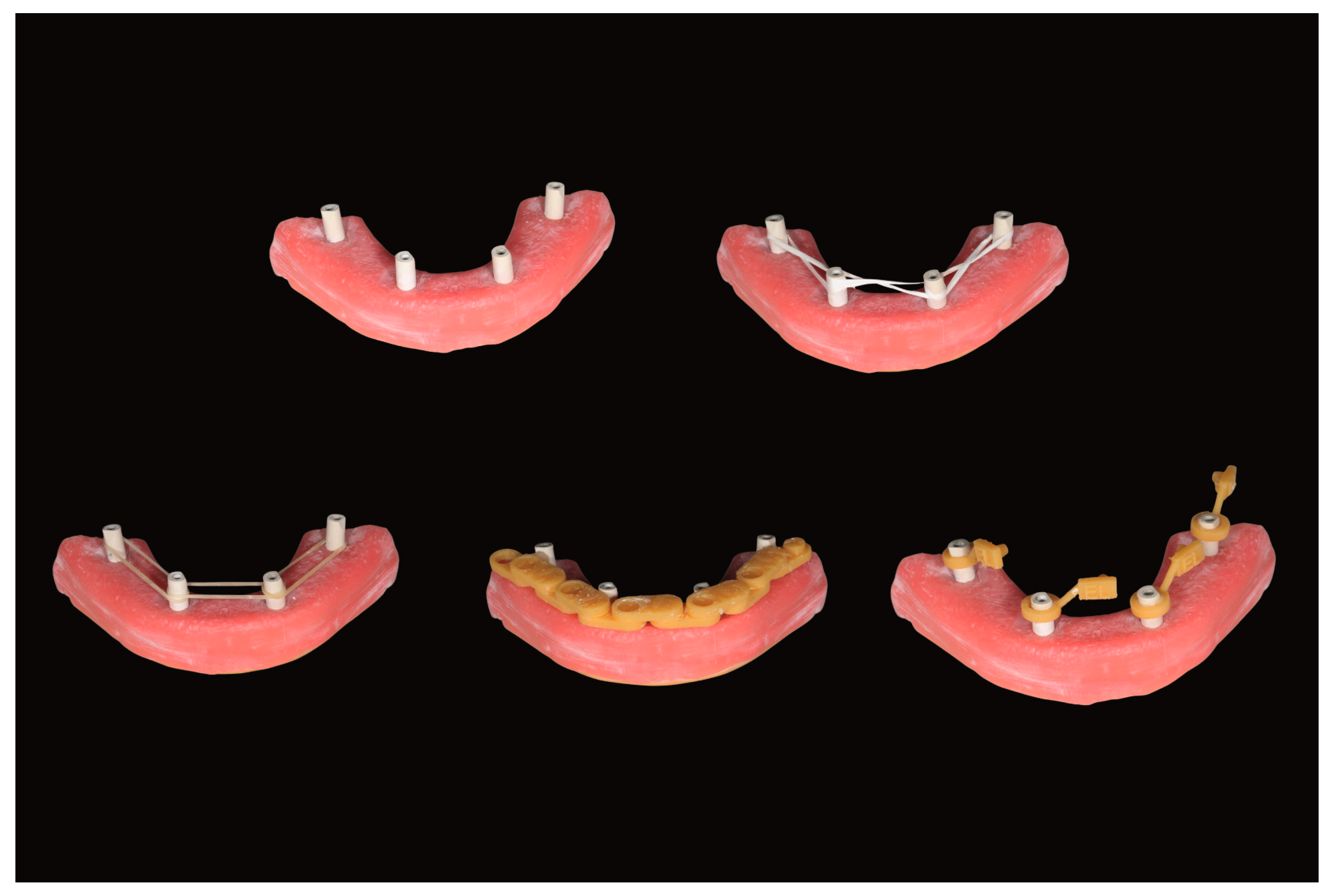
Five different SB splinting methods were applied for both scanning scenarios, nonsplinted (NS), splinted with dental floss (FL) (Oral-B Pro-Expert dental floss; Procter & Gamble, Cincinnati, OH, USA), splinted with orthodontic elastomerics (OE) (Ormco Corporation, Glendora, California, USA), splinted using a 3D-printed chain attachment (CA), and splinted using a 3D-printed single attachment (SA), with the final two fabricated using a dental model resin (MASK 3D, Istanbul, Türkiye) (Figure 1).
The reference scans for all configurations were obtained using a laboratory scanner (QScan laboratory scanner, Cedu Dental, Hangzhou, China). The experimental scans were obtained using three intraoral scanners: iTero Lumina (Align Technology, Tempe, AZ, USA), TRIOS 3 (3Shape A/S, Copenhagen, Denmark), and Medit i700 (Medit Corp, Seoul, Republic of Korea).
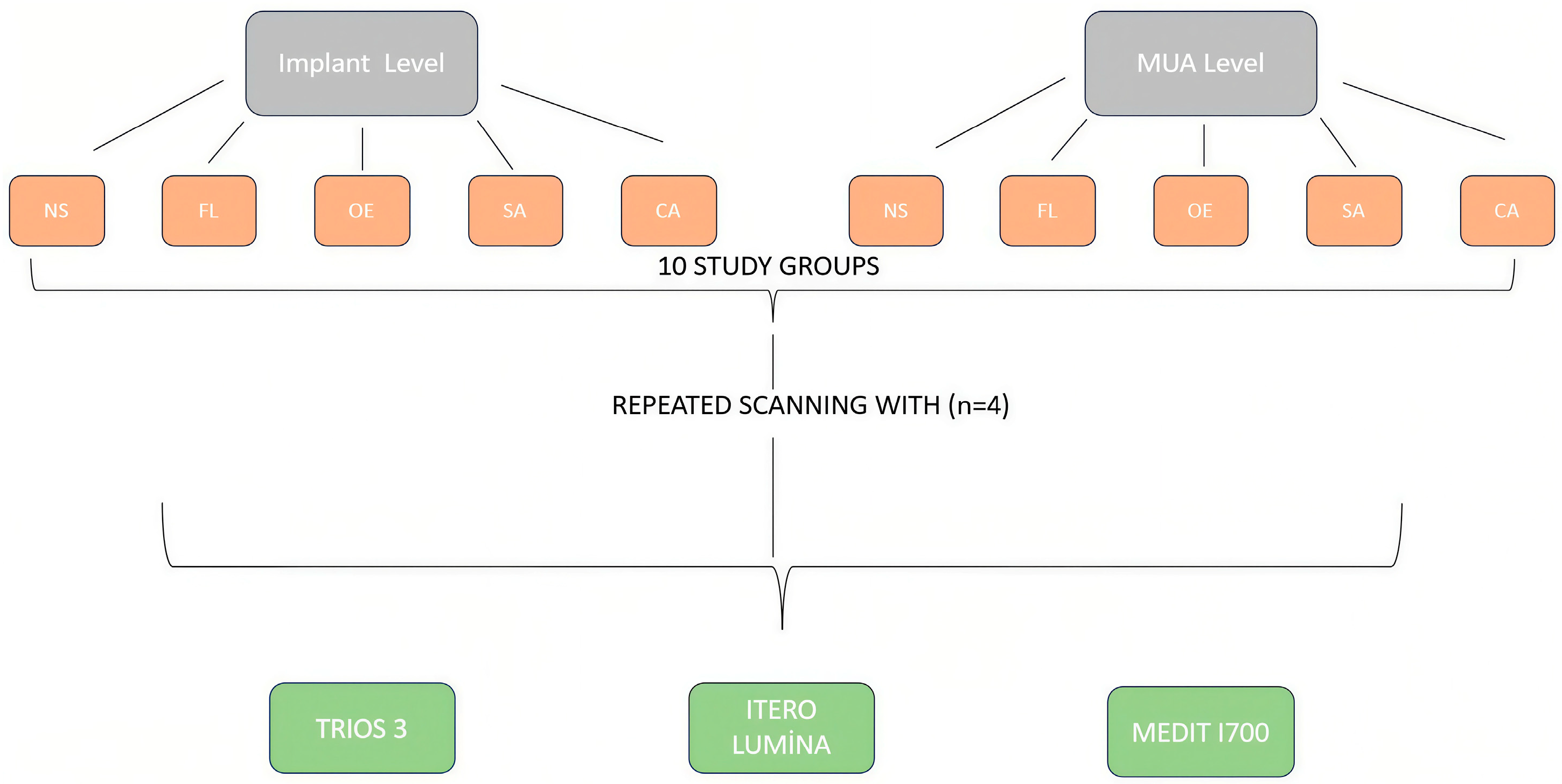
Two separate scenarios were created in which SBs were connected to either implants or MUAs. Five splinting methods (NS, FL, OE, CA, and SA) were applied in each scenario resulting in a total of 10 experimental groups. Each group was scanned using three different intraoral scanners (iTero Lumina, TRIOS 3, and Medit i700), with four repeated scans performed per scanner, resulting in a total of 120 digital scans. Each intraoral scanner was used according to the manufacturer-recommended scanning strategy rather than applying a single standardized scanning pattern across devices. This approach was intentionally chosen to simulate real clinical conditions and to evaluate the performance of each system under its optimal operating protocol. All scans were performed by the same experienced operator who was familiar with each device. For each experimental configuration, scans were obtained consecutively using the three scanners before proceeding to the next group. During this process, the scan bodies, splinting materials, and attachments were not removed or repositioned, and tightening torque values were preserved to prevent positional changes. All scanners were used under identical environmental conditions to minimize external influences. The required sample size was calculated using G*Power software (version 3.1.9.6), based on a repeated-measures analysis of variance with within–between interactions, assuming an effect size of f = 0.466, a statistical power of 95%, a type I error probability of α = 0.05, a correlation of 0.5 among repeated measurements, and sphericity (ε = 1). Under these conditions, four repeated scans per group were considered sufficient, yielding an actual power of 0.99. All scans were performed under controlled environmental conditions, with consistent lighting, and by the same operator, following the manufacturer-recommended scanning protocols. The acquired data were exported in standard tessellation language (STL) format (Figure 2).
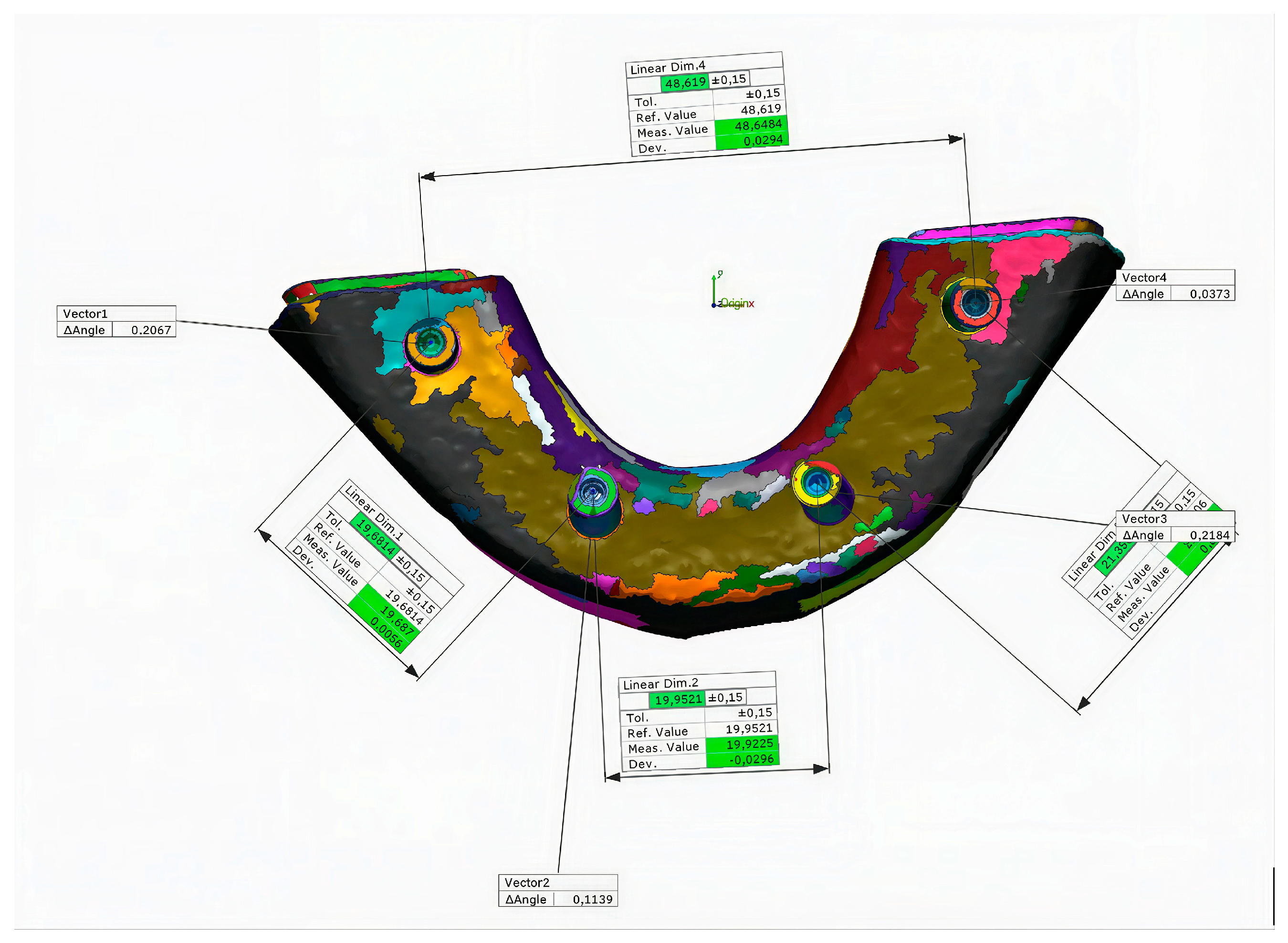
All STL files were analyzed using metrology software (Geomagic Control X, 3D Systems, Rock Hill, SC, USA). The reference and experimental STL datasets were superimposed using a best-fit alignment algorithm based on the entire model surface. Following alignment, comparisons were limited to the scan body (SB) regions, and each SB was analyzed individually.
The SB axis was defined using a cylinder-fitting method applied to the visible cylindrical surfaces free of any additional material. Angular deviations (°) were calculated by measuring the angle between the nominal (reference) and actual (experimental) central axes of the corresponding SB cylinders.
For linear deviation analysis, a reference point was defined for each SB as the intersection point between the SB axis and a plane generated on the SB top surface using a best-fit method. Linear deviations (mm) were calculated by measuring the differences in distances between these reference points for SB pairs numbered 1–2, 2–3, 3–4, and 1–4 in the reference and experimental datasets.
These linear and angular deviation values were used to compare the trueness of the different scanning protocols (Figure 3). Precision was assessed using the coefficient of variation (CV), which represented the variability among four repeated scans within each group. CV values calculated from both linear and angular deviations were grouped according to scanner type, scan level, and splinting method, and statistically compared.
Scan data were superimposed onto the reference model using the best-fit alignment, and deviations were measured at the center of each scan body.
Statistical analyses were performed using Jamovi (v2.3.28) and Minitab (v14) software. The distribution characteristics of angular deviation (°) and linear deviation (mm) data were evaluated using the Shapiro–Wilk test. When the assumption of normality was not met, the main effects and possible interactions of scanner type, scan level, and splinting method on angular and linear deviations were analyzed using Robust ANOVA based on trimmed means calculated with a 5% trimming level. When statistically significant differences were identified, multiple comparisons were performed using the Bonferroni correction. Effect sizes were reported together with the corresponding test statistics. To evaluate scan precision, the coefficient of variation (CV, %) derived from repeated scans was calculated and compared among scanners, scanning levels, and splinting methods. Depending on data distribution, Repeated Measures Analysis of Variance or the Friedman test was used for comparisons among scanners, independent samples t-tests were used for comparisons between scanning levels, and One-Way Analysis of Variance or the Mann–Whitney U test was applied for comparisons among splinting methods. In addition, the repeat-scan reliability (absolute agreement) within scanner/abutment/material groups was evaluated using the intraclass correlation coefficient (ICC) with 95% confidence intervals. ICC values were interpreted as poor (<0.50), moderate (0.50–0.75), good (0.75–0.90), and excellent (≥0.90) agreement. Quantitative data were presented as mean ± standard error, mean ± standard deviation, or median (minimum–maximum). The level of statistical significance was set at p < 0.05.

3. Results

The trueness and precision were evaluated based on angular and linear deviations. Additionally, the effects of scanner type, scanning level, and splinting method on digital impressions were statistically compared.
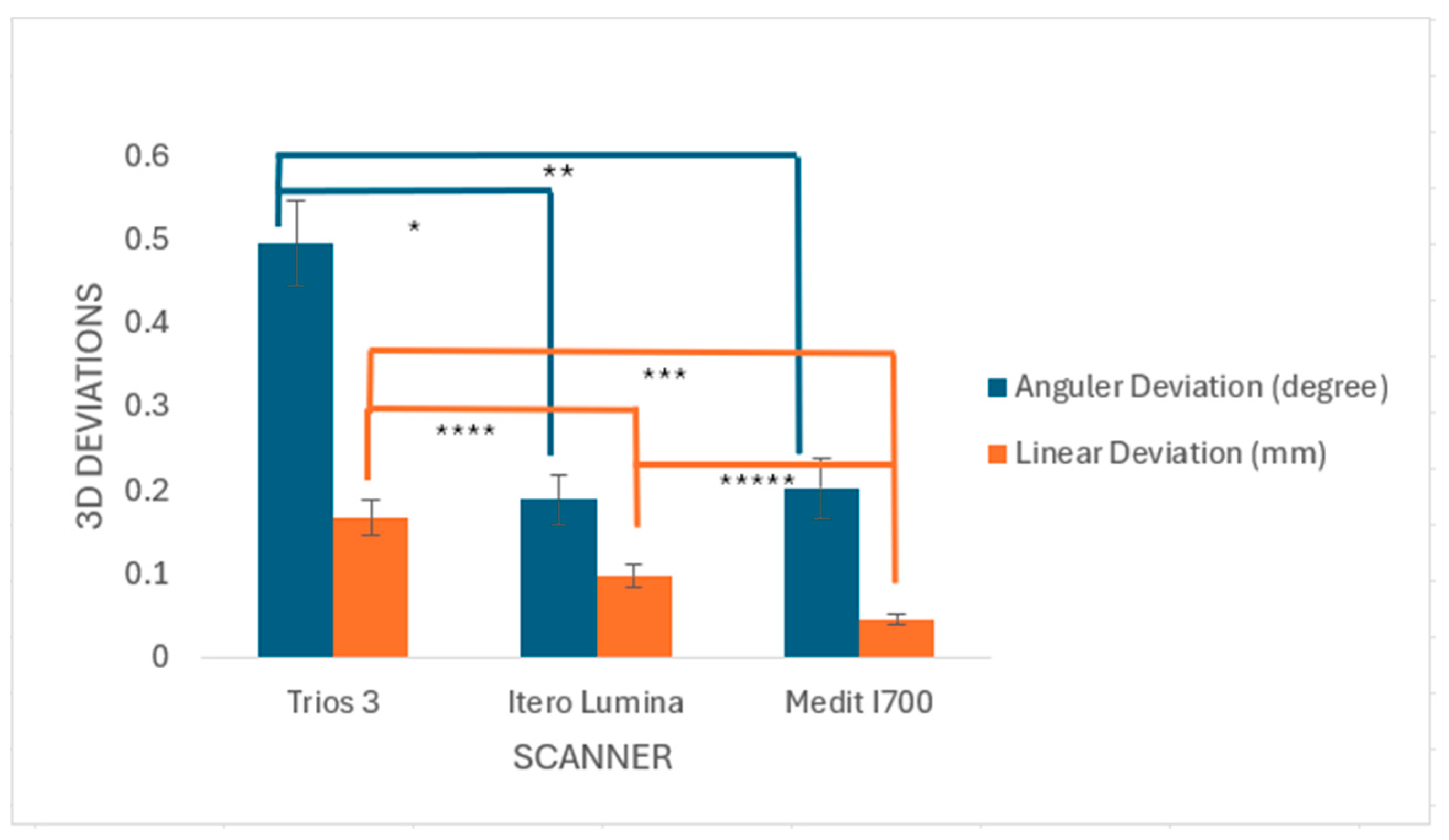
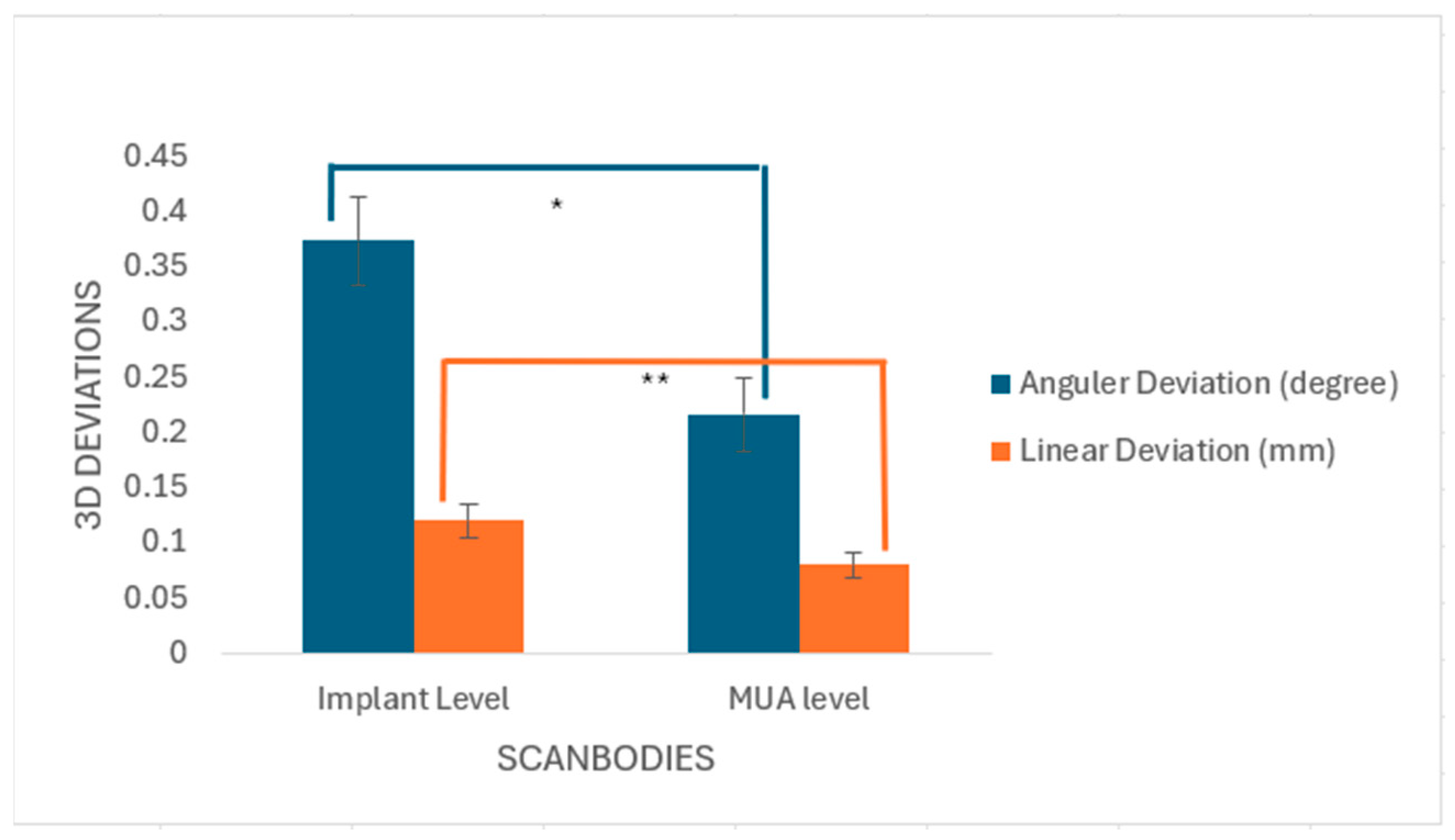
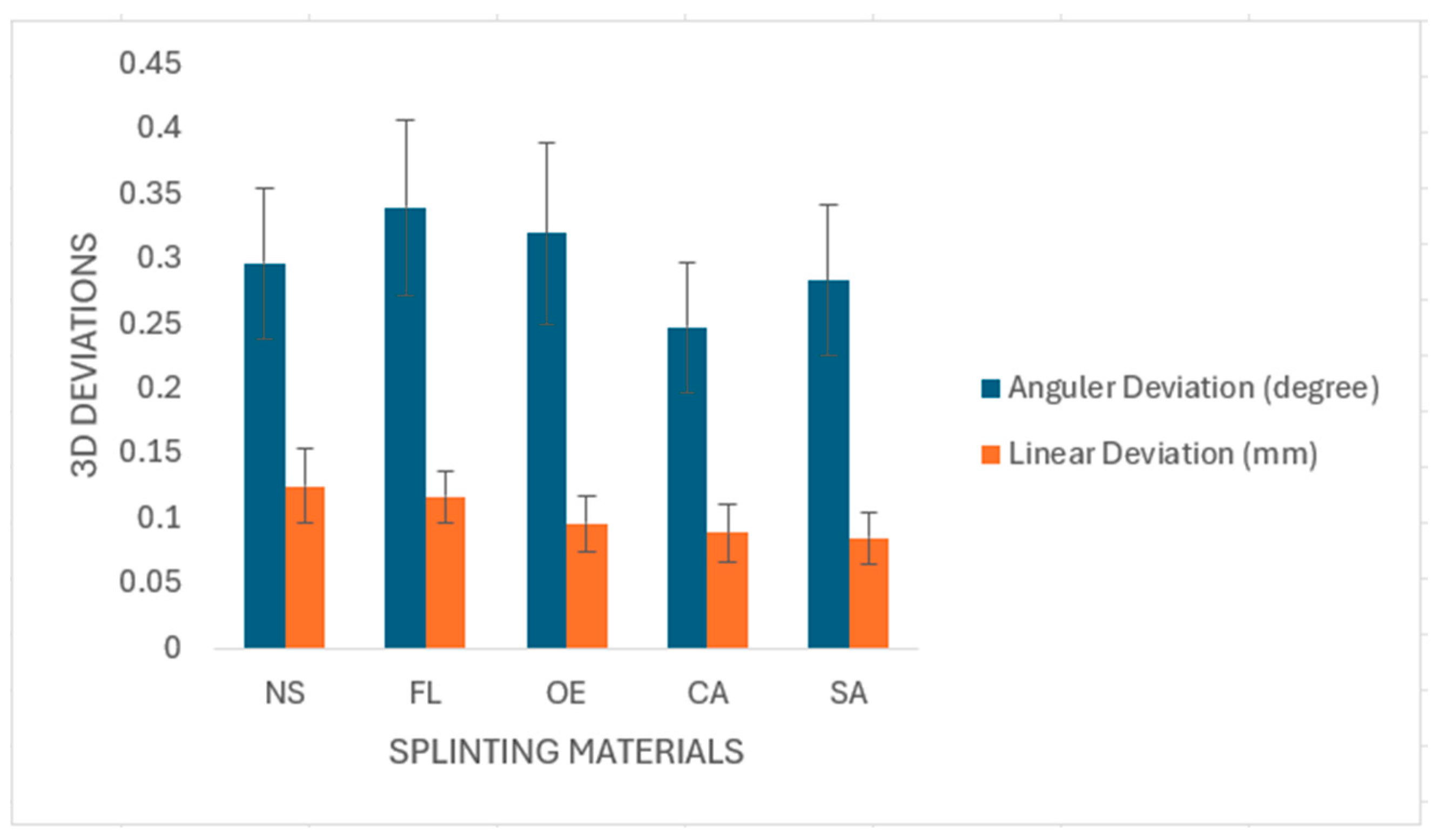
Regarding trueness, statistically significant differences in both angular and linear deviations were noted among the scanners (p < 0.001). The highest deviation values were recorded using the TRIOS 3 scanner. No significant difference in angular deviation was found between the iTero Lumina and Medit i700 scanners (p = 0.553). However, a significant difference in linear deviation was noted among all scanners (p < 0.05) (Figure 4). MUA usage had a statistically significant impact on trueness. Both angular (p = 0.003) and linear (p = 0.036) deviations were significantly lower in scans performed at the abutment level compared with those at the implant level (Figure 5). The type of splinting method had no statistically significant impact on trueness. The angular (p = 0.505) and linear (p = 0.763) deviations did not differ significantly among various splinting groups (Figure 6). No statistically significant differences in angular or linear deviation were observed in the two- or three-way interactions between the tested factors (p > 0.05) (Table 1). Comprehensive statistical data for all scanner × scan level × splinting method combinations and their interaction effects are presented in the Supplementary Material to enable detailed comparison among groups.
Three-way robust ANOVA (trimmed mean 5%) was used to evaluate the effects of scanner type, scan level, and splinting method on angular and linear deviations. Q represents the test statistic obtained from the robust ANOVA. A p value <0.05 indicated a statistically significant difference.
The coefficient of variation (CV, %) values derived from repeated scans were calculated to assess the precision of the scanning procedures. These values were compared according to scanner type, scanning level, and splinting material for both angular and linear deviations (Table 2). For angular deviation, no statistically significant differences were observed among the scanners, scanning levels, or splinting materials (p > 0.05). Similarly, for linear deviation, comparisons among scanners, scanning levels, and splinting materials revealed no statistically significant differences (p > 0.05). Detailed descriptive statistics and test results are presented in Table 2.
The repeat-scan reliability within scanner, scanning level, and splinting material groups was evaluated using the intraclass correlation coefficient (ICC) (Table 3). For angular deviation, all scanners demonstrated good agreement, with ICC values ranging from 0.793 to 0.857 (p ≤ 0.001). Regarding the scanning level, the MUA level showed very good agreement (ICC = 0.921), whereas the implant level demonstrated good agreement (ICC = 0.854) (p < 0.001). For the splinting materials, single 3D attachment (SA), chain 3D attachment (CA), non-splinted (NS), and orthodontic elastic (OE) groups exhibited very good agreement, whereas the dental floss (FL) group showed moderate agreement for angular deviation. For linear deviation, ICC values for the scanners indicated low agreement and were not statistically significant (p > 0.05). At the scanning level, the implant level demonstrated good agreement (ICC = 0.806), whereas the MUA level showed low agreement (ICC = 0.483). Among the splinting materials, CA and OE groups showed very good agreement, SA showed good agreement, and FL showed moderate agreement, while the NS group demonstrated low and non-significant agreement. Overall, the findings indicate that repeatability was generally higher for angular deviation, whereas linear deviation showed lower reliability, particularly at the scanner level.

4. Discussion

This in vitro study evaluated the effects of different IOSs, scanning levels, and splinting techniques on the trueness and precision of digital impressions in a fully edentulous mandibular model with four implants. The scanner type significantly impacted trueness but did not affect precision. Therefore, the first null hypothesis was partially rejected. The use of MUAs caused a statistically significant difference in trueness but did not affect precision, leading to partial rejection of the second null hypothesis. Splinting methods had no significant influence on either trueness or precision, and thus the third null hypothesis was accepted.
The biomechanical stability and long-term success of prostheses rely on achieving passive fit and obtaining an accurate master model. Stress accumulation can lead to mechanical and biological complications [4,5]. Despite no clear consensus on the acceptable level of misfit, distance deviations ranging from 47 to 226 µm in full-arch implant scans have been reported as reference values in the literature [11,26,40]. Jemt et al. demonstrated no impact of a misfit of approximately 150 µm on bone levels and showed that MUA-supported prostheses could function within biological tolerance for several years [5]. Several studies have also suggested that misfits up to 150 µm may fall within tolerable ranges [41,42]. Further, Kim et al. reported no significant effect of angular deviations below 1 degree in an edentulous maxilla model [43]. In the present study, the observed deviations were generally within the ranges reported in the literature. However, these findings should be interpreted with caution considering the in vitro nature of the study and methodological factors such as the alignment approach and experimental conditions. Therefore, the results should be regarded as being consistent with previously reported ranges rather than as definitive evidence of acceptability under clinical conditions.
This study included intraoral scanners based on different optical systems and data acquisition technologies. The Medit i700 operates using structured light technology with a phase-shift scanning principle, whereas the iTero Lumina employs Multi-Direct Capture technology with parallel light projection. The TRIOS 3 acquires data through a confocal laser scanning system. Differences in these technological infrastructures may influence impression trueness. In the literature, no statistically significant differences in accuracy have been reported between TRIOS 3 and newer models within the same scanner family for both edentulous and dentate scanning conditions, and it has been shown that older-generation scanners used with updated software can achieve accuracy levels comparable to newer devices [44,45]. Additionally, similar accuracy outcomes have been reported among different models of the TRIOS family, highlighting the contribution of software improvements to scanning performance [46]. Based on these findings, the present study selected Medit i700, iTero Lumina, and TRIOS 3 to evaluate the effect of different optical and data acquisition principles on scanning accuracy. Differences in trueness observed among the scanners in the present study may be related to variations in data acquisition technologies and reconstruction algorithms. Confocal systems acquire depth information sequentially from multiple focal planes and reconstruct three-dimensional geometry by assembling numerous two-dimensional images [18], which may increase the potential for cumulative alignment errors during full-arch scanning. In contrast, structured light systems project predefined light patterns and calculate spatial coordinates from pattern deformation, and active light projection techniques are considered less dependent on tissue texture and color [11,47]. The Multi-Direct Capture (MDC) technology used in the iTero system employs multiple cameras and projectors to capture data from different angles with a wider field of view, which may reduce the number of images required and decrease dependence on stitching procedures [48]. Accordingly, the higher deviation values observed with TRIOS 3 compared with Medit and iTero may be partly associated with these technological differences; however, this interpretation should be made cautiously, as scanner performance is influenced by multiple factors. Available data suggest significant differences in the trueness and precision of various scanning systems. Mutwalli et al. reported the lowest trueness and repeatability for TRIOS 3 compared with iTero Element and TRIOS 3 [49]. El-Refay et al. reported comparable trueness of TRIOS 3 and Medit i700 [50]. Baresel et al. found the lowest linear deviation for iTero Lumina compared with Medit i700, AS260, CS3800, and TRIOS 5 [48]. Drancourt et al. reported the lowest angular deviation and the highest precision for Medit i500 compared with TRIOS 4 and Primescan [51]. The present study demonstrated significantly lower angular deviation for Medit i700 and iTero Lumina compared with TRIOS 3. Medit i700 displayed the lowest linear deviation, followed by iTero Lumina and then TRIOS 3. These findings were consistent with the results of Drancourt, Baresel, and Mutwalli [48,49,51]. On the contrary, the differences observed in the study by El-Refay et al. might be attributed to factors such as surface characteristics of the model, light reflectivity, or operator experience [50].
MUAs facilitate prosthetic fit by compensating for angular and vertical discrepancies and reducing anatomical limitations. Only a few studies have investigated the effect of MUAs on the trueness of digital impressions. Mahmoud et al. compared the accuracy of digital and conventional impressions at the MUA level [23]. Almalki et al. evaluated the accuracy of MUA SBs versus dual-purpose scan jigs [24]. Chinwongs and Serichetapongse compared digital and conventional impressions at the MUA and implant levels [52]. However, these studies did not directly compare digital impressions at the MUA level versus the implant level. Therefore, the present study comparatively evaluated digital impression trueness at both levels.
In this study, groups with MUAs demonstrated lower mean linear deviations, whereas groups without MUAs exhibited higher deviations, with statistically significant differences. Similarly, the angular deviations were lower at the MUA level and higher at the implant level. The positive impact of MUAs on impression trueness might be attributed to factors such as improved visibility of SBs [53,54,55] and enhanced parallelism between implants [56]. The comparison between implant-level and MUA-level scanning should be interpreted cautiously, as differences in scan body exposure and peri-implant geometry may also have influenced the results. Although the gingival masks were produced using the same digital workflow and the same design principles, the peri-implant soft tissue heights differed between the two scenarios due to the study design. While the overall geometry of the edentulous areas remained unchanged, these local variations may have contributed to the measurement outcomes.
Pozzi et al. [32], Ke et al. [34], Pan et al. [35], Iturrate et al. [38] and Farah et al. [39] reported that the auxiliary devices placed between SBs in fully edentulous arches improved both linear and angular trueness. However, Azevedo et al. found that splinting SBs with an orthodontic wire or using artificial markers caused no statistically significant differences in impression trueness, emphasizing the type of scanner as the primary influencing factor [27]. Mizumoto et al. reported that splinting with dental floss resulted in greater linear and angular deviations compared with other methods, thus negatively impacting trueness [26]. In the present study, the ranking from the lowest to the highest in terms of angular deviation was CA, SA, NS, OE, and FL. The ranking from the lowest to the highest in terms of linear deviation was SA, CA, OE, FL, and NS. However, no statistically significant differences in linear or angular deviation were found among splinting methods. These findings partially differed from the results of Iturrate et al. [38], Pozzi et al. [32], Farah et al. [39] and Ke et al. [34] reporting improvements in linear trueness using 3D-printed auxiliary devices. These differences might be attributed to factors such as the spatial arrangement of SBs, geometric and material characteristics of the splinting methods, or specific scanner systems used. Wu et al. reported that prefabricated auxiliary devices generally improved scan accuracy but negatively impacted angular trueness when combined with certain scanning strategies [31]. Mizumoto et al. reported that splinting with dental floss interfered with light reflection on contacting the SB surface, potentially causing stitching errors [26]. Kernen et al. emphasized that the surface morphology and color contrast in 3D-printed devices directly influenced scanning precision [36]. Azevedo et al. concluded that splinting SBs did not improve trueness and suggested that practitioners should question the clinical applicability of these techniques [27]. These studies indicated that splinting methods might not always yield favorable outcomes. Similarly, lower deviation values were observed in the CA and SA groups in the present study, but with no statistically significant differences. This suggests that, although such attachments may provide rigid reference structures facilitating image alignment for the scanner, their effect may be limited.
The precision performance of the TRIOS, iTero, and Medit scanners was evaluated based on the CV values of angular and linear deviations, revealing no statistically significant differences among them. This finding aligned with the results of Ciocan et al., who compared four scanners and reported no clinically significant differences in precision [57]. Similarly, El-Refay et al. discovered comparable repeatability of TRIOS 3 and Medit i700 on a fully edentulous model [50]. Nulty et al. also reported no difference in precision between Primescan and Medit i900 using the Scan Ladder technique [58]. Consistent with these findings, the present study suggests that next-generation IOSs, equipped with advanced scanning algorithms, can achieve similar levels of precision in full-arch impressions. In addition to CV-based precision analysis, repeat-scan reliability was also evaluated using ICC. The ICC analysis demonstrated generally good to excellent agreement for angular deviation measurements across scanners, supporting the high repeatability of the digital scanning systems. Notably, this high agreement was mainly observed in angular deviation measurements, whereas linear deviation measurements showed lower reliability across scanners. In the present study, both the coefficient of variation (CV) and the intraclass correlation coefficient (ICC) were used to evaluate repeatability, as CV quantifies the relative variability of repeated measurements and reflects precision, whereas ICC assesses the degree of agreement and reliability among repeated scans. The combined use of these metrics therefore provides a more comprehensive evaluation of scan repeatability.
At the implant and MUA levels, no statistically significant difference in precision was observed. Chinwongs and Serichetapongse reported that the digital impressions at the implant and abutment levels remained within acceptable limits of precision and showed no significant differences compared with conventional impressions [52]. These findings were consistent with the results of the present study. Similarly, the ICC analysis demonstrated good to very good agreement for angular deviation at both scanning levels, indicating stable repeatability of repeated scans under these conditions.
No statistically significant differences in precision were observed among the different splinting materials. Wu et al. reported positive impacts of prefabricated auxiliary devices on trueness but not on precision [31]. In the present study, all splinting materials demonstrated precision levels within clinically acceptable limits and none of the splinting strategies provided a clear advantage in terms of measurement repeatability. However, ICC analysis showed variation in agreement levels among splinting materials, with some splinting conditions demonstrating higher repeatability; these differences did not translate into statistically significant differences in CV-based precision comparisons, indicating that the relative variability of repeated measurements remained comparable across splinting methods.
The lack of significant differences in precision among the groups might be attributed to the advanced algorithms and optical systems of the new-generation IOSs used in this study, which probably enhanced measurement repeatability [58]. Moreover, the controlled environment of the in vitro setting might have minimized differences between groups [50]. Therefore, none of the scanner types, splinting methods, or scanning levels demonstrated a clear superiority in terms of precision in the present study. Consistent with this interpretation, the ICC analysis indicated that repeatability was generally higher for angular deviation measurements, whereas linear deviation measurements showed lower reliability, particularly comparisons among scanners.
Factors such as scanner type, scanning level, and splinting material must be individually optimized for each clinical scenario to achieve high trueness and repeatability in digital impression workflows. This is particularly important in fully edentulous cases, where the absence of anatomical reference structures may compromise impression accuracy. Despite no significant differences observed in precision, the scanner type and MUA usage influenced trueness in this study. These findings highlight the need for careful selection of digital workflows in fully edentulous cases, while also emphasizing the limited overall impact of individual variables under controlled in vitro conditions. When the study findings were evaluated, the Trios 3 scanner demonstrated higher deviation values compared with the other systems, whereas Medit and iTero showed better performance in both angular and linear accuracy. However, in terms of measurement repeatability, all scanners were found to be comparable and clinically reliable. These results suggest that all systems can be used depending on the clinical scenario, although certain scanners may offer advantages in accuracy in long-span or complex implant configurations. In addition, scans performed at the MUA level were observed to significantly improve digital impression accuracy; therefore, the use of MUAs may be preferred in full-arch applications to compensate for angular and vertical discrepancies between implants. Splinting methods, on the other hand, demonstrated similar results in terms of both accuracy and precision within the scope of this study. Although the present findings suggest that splinting may not provide a clear clinical advantage, previous studies have reported improved accuracy with different splinting materials; therefore, further clinical investigations on this topic are warranted.
This study had certain limitations, including the in vitro nature of the experimental setup, use of static models, and exclusion of biological factors such as soft tissue movement, saliva, and patient cooperation. In addition, a global best-fit alignment based on the entire model surface was used for dataset superimposition. Although this approach methodologically reflects full-arch scanning conditions and is widely adopted in the literature [30,56,59,60], it should be acknowledged that, in fully edentulous models, global alignment may redistribute discrepancies and potentially influence deviations at the implant level. Nevertheless, the systematic application of the same alignment protocol across all datasets preserves the methodological consistency of the intergroup comparisons. Therefore, future studies should involve patient-based clinical trials, assess the impact of implant angulation and jaw morphology on outcomes, and further validate the findings using alternative measurement and registration protocols.

5. Conclusions

1. The Medit i700 and iTero Lumina scanners demonstrated significantly higher trueness compared with the TRIOS 3 scanner.
2. Impressions taken at the MUA level yielded more accurate outcomes compared with those taken at the implant level.
3. No statistically significant differences in trueness were found among the different splinting materials.
4. The scanner type, scanning level, and splinting method had no statistically significant impact on measurement precision.

Supplementary Materials

The following supporting information can be downloaded at: https://www.mdpi.com/article/10.3390/app16062872/s1, Table S1: Comparison of angular deviation values according to scanner type, scan level, and splinting method; Table S2: Multiple comparison results for angular deviation values according to scanner type, scan level, and splinting method; Table S3: Comparison of linear deviation values according to scanner type, scan level, and splinting method; Table S4: Multiple comparison results for linear deviation values according to scanner type, scan level, and splinting method.

Author Contributions

Conceptualization, S.A. and A.K.; Methodology, S.A.; Validation, S.A.; Formal analysis, S.A. and A.K.; Investigation, S.A.; Resources, S.A. and A.K.; Data curation, S.A.; Writing—original draft preparation, S.A.; Writing—review and editing, A.K.; Visualization, S.A.; Supervision, A.K.; Project administration, A.K.; Funding acquisition, A.K. All authors have read and agreed to the published version of the manuscript.

Funding

This study was supported by the Scientific Research Projects Unit of Trakya University (Project No. 2024/105).

Institutional Review Board Statement

Not applicable.

Informed Consent Statement

Not applicable.

Data Availability Statement

The datasets used and/or analyzed during the current study are available from the corresponding author upon reasonable request.

Acknowledgments

This study was derived from the thesis of Selin Atay conducted at Trakya University, Faculty of Dentistry, Department of Prosthodontics.

Conflicts of Interest

The authors declare no conflicts of interest.

Abbreviations

The following abbreviations are used in this manuscript:
CAD/CAMComputer-Aided Design/Computer-Aided Manufacturing
3Dthree-dimensional
MUAsMulti-unit abutments
SBScan body
GhGingival height
NSnonsplinted
FLsplinted with dental floss
OEsplinted with orthodontic elastomerics
CAsplinted using a 3D-printed chain attachment
SAsplinted using a 3D-printed single attachment
STLstandard tessellation language
Mmmillimeter
CVcoefficient of variation
ICCIntraclass Correlation Coefficient

References

  1. Xu, M.; Liu, Y.; Yang, K.; Li, S.; Wang, M.; Wang, J.; Yang, D.; Shkunov, M.; Silva, S.R.P.; Castro, F.A.; et al. Minimally invasive power sources for implantable electronics. Exploration 2024, 4, 20220106. [Google Scholar] [CrossRef]
  2. Christensen, G.J. Impressions are changing: Deciding on conventional, digital or digital plus in-office milling. J. Am. Dent. Assoc. 2009, 140, 1301–1304. [Google Scholar] [CrossRef] [PubMed]
  3. Nedelcu, R.; Olsson, P.; Nyström, I.; Rydén, J.; Thor, A. Accuracy and precision of 3 intraoral scanners and accuracy of conventional impressions: A novel in vivo analysis method. J. Dent. 2018, 69, 110–118. [Google Scholar] [CrossRef]
  4. Lee, H.; So, J.S.; Hochstedler, J.; Ercoli, C. The accuracy of implant impressions: A systematic review. J. Prosthet. Dent. 2008, 100, 285–291. [Google Scholar] [CrossRef] [PubMed]
  5. Jemt, T.; Book, K. Prosthesis misfit and marginal bone loss in edentulous implant patients. Int. J. Oral Maxillofac. Implant. 1996, 11, 620. [Google Scholar]
  6. Wang, Z.; Zeng, Y.; Ahmed, Z.; Qin, H.; Bhatti, I.A.; Cao, H. Calcium-dependent antimicrobials: Nature-inspired materials and designs. Exploration 2024, 4, 20230099. [Google Scholar] [CrossRef]
  7. ISO 5725:1994; Accuracy (Trueness and Precision) of Measurement. International Organization for Standardization: Geneva, Switzerland, 1994.
  8. Ender, A.; Mehl, A. Accuracy of complete-arch dental impressions: A new method of measuring trueness and precision. J. Prosthet. Dent. 2013, 109, 121–128. [Google Scholar] [CrossRef]
  9. Ender, A.; Attin, T.; Mehl, A. In vivo precision of conventional and digital methods of obtaining complete-arch dental impressions. J. Prosthet. Dent. 2016, 115, 313–320. [Google Scholar] [CrossRef]
  10. Ziegler, M. Digital impression taking with reproducibly high precision. Int. J. Comput. Dent. 2009, 12, 159–163. [Google Scholar] [PubMed]
  11. Imburgia, M.; Logozzo, S.; Hauschild, U.; Veronesi, G.; Mangano, C.; Mangano, F.G. Accuracy of four intraoral scanners in oral implantology: A comparative in vitro study. BMC Oral Health 2017, 17, 92. [Google Scholar] [CrossRef]
  12. Rehmann, P.; Sichwardt, V.; Wöstmann, B. Intraoral Scanning Systems: Need for Maintenance. Int. J. Prosthodont. 2017, 30, 27–29. [Google Scholar] [CrossRef]
  13. Giménez, B.; Özcan, M.; Martínez-Rus, F.; Pradíes, G. Accuracy of a digital impression system based on active wavefront sampling technology for implants considering operator experience, implant angulation, and depth. Clin. Implant Dent. Relat. Res. 2015, 17, e54–e64. [Google Scholar] [CrossRef]
  14. Zhang, Y.-J.; Shi, J.-Y.; Qian, S.-J.; Qiao, S.-C.; Lai, H.-C. Accuracy of full-arch digital implant impressions taken using intraoral scanners and related variables: A systematic review. Int. J. Oral. Maxillofac. Implant. 2021, 14, 157–179. [Google Scholar]
  15. Persson, A.S.; Odén, A.; Andersson, M.; Sandborgh-Englund, G. Digitization of simulated clinical dental impressions: Virtual three-dimensional analysis of exactness. Dent. Mater. 2009, 25, 929–936. [Google Scholar] [CrossRef] [PubMed]
  16. Kachhara, S.; Nallaswamy, D.; Ganapathy, D.M.; Sivaswamy, V.; Rajaraman, V. Assessment of intraoral scanning technology for multiple implant impressions–A systematic review and meta-analysis. J. Indian Prosthodont. Soc. 2020, 20, 141–152. [Google Scholar] [CrossRef] [PubMed]
  17. Mizumoto, R.M.; Yilmaz, B. Intraoral scan bodies in implant dentistry: A systematic review. J. Prosthet. Dent. 2018, 120, 343–352. [Google Scholar] [CrossRef] [PubMed]
  18. Logozzo, S.; Zanetti, E.M.; Franceschini, G.; Kilpelä, A.; Mäkynen, A. Recent advances in dental optics–Part I: 3D intraoral scanners for restorative dentistry. Opt. Lasers Eng. 2014, 54, 203–221. [Google Scholar] [CrossRef]
  19. Hack, G.D.; Patzelt, S. Evaluation of the accuracy of six intraoral scanning devices: An in-vitro investigation. ADA Prof. Prod. Rev. 2015, 10, 1–5. [Google Scholar]
  20. Patzelt, S.B.; Emmanouilidi, A.; Stampf, S.; Strub, J.R.; Att, W. Accuracy of full-arch scans using intraoral scanners. Clin. Oral Investig. 2014, 18, 1687–1694. [Google Scholar] [CrossRef]
  21. Heller, H.; Arieli, A.; Beitlitum, I.; Pilo, R.; Levartovsky, S. Load-bearing capacity of zirconia crowns screwed to multi-unit abutments with and without a titanium base: An in vitro pilot study. Materials 2019, 12, 3056. [Google Scholar] [CrossRef]
  22. Rutkūnas, V.; Bilius, V.; Dirsė, J.; Revilla-León, M.; Rimašauskas, M.; Zadrożny, Ł.; Trumpaitė-Vanagienė, R. Repositioning accuracy of the implant-and abutment-level prosthetic components used in conventional and digital workflows. J. Dent. 2024, 143, 104835. [Google Scholar] [CrossRef]
  23. Mahmoud, R.A.; Hakim, A.A.A.; Rady, N.A. Effect of different impression techniques on marginal integrity of CAD-CAM milled all-on-four mandibular frameworks: An in vitro study. BMC Oral Health 2025, 25, 497. [Google Scholar] [CrossRef]
  24. Almalki, A.; Akl, M.A.; Robaian, A.; Althubaitiy, R.; Alnasser, A.; Anadioti, E. Comparative accuracy of digital impressions using universal dual-purpose scan jigs for maxillary implant full arch impressions: An in vitro study. J. Prosthodont. 2024, 143, 104835. [Google Scholar] [CrossRef]
  25. Papaspyridakos, P.; Chochlidakis, K.; Kang, K.; Chen, Y.W.; Alghfeli, A.; Kudara, Y.; Weber, H.P. Digital workflow for implant rehabilitation with double full-arch monolithic zirconia prostheses. J. Prosthodont. 2020, 29, 460–465. [Google Scholar] [CrossRef]
  26. Mizumoto, R.M.; Yilmaz, B.; McGlumphy, E.A., Jr.; Seidt, J.; Johnston, W.M. Accuracy of different digital scanning techniques and scan bodies for complete-arch implant-supported prostheses. J. Prosthet. Dent. 2020, 123, 96–104. [Google Scholar] [CrossRef]
  27. Azevedo, L.; Marques, T.; Karasan, D.; Fehmer, V.; Sailer, I.; Correia, A.; Gómez-Polo, M. Effect of splinting scan bodies on the trueness of complete arch digital implant scans with 5 different intraoral scanners. J. Prosthet. Dent. 2024, 132, 204–210. [Google Scholar] [CrossRef]
  28. Ali, K.M. Effect of Splinting Implant Scan Bodies Intraorally on The Trueness of Complete Arch Digital Impressions: A Clinical Study. Master’s Thesis, Loma Linda University, Linda, CA, USA, 2022. [Google Scholar]
  29. Nedelcu, R.; Olsson, P.; Thulin, M.; Nyström, I.; Thor, A. In vivo trueness and precision of full-arch implant scans using intraoral scanners with three different acquisition protocols. J. Dent. 2023, 128, 104308. [Google Scholar] [CrossRef]
  30. Huang, R.; Liu, Y.; Huang, B.; Zhang, C.; Chen, Z.; Li, Z. Improved scanning accuracy with newly designed scan bodies: An in vitro study comparing digital versus conventional impression techniques for complete-arch implant rehabilitation. Clin. Oral. Implant. Res. 2020, 31, 625–633. [Google Scholar] [CrossRef]
  31. Wu, H.K.; Chen, G.; Wang, J.; Zhang, Z.; Huang, X.; Lin, X.; Deng, F.; Li, Y. Effect of prefabricated auxiliary devices and scanning patterns on the accuracy of complete-arch implant digital impressions. J. Dent. 2024, 140, 104788. [Google Scholar] [CrossRef]
  32. Pozzi, A.; Arcuri, L.; Lio, F.; Papa, A.; Nardi, A.; Londono, J. Accuracy of complete-arch digital implant impression with or without scanbody splinting: An in vitro study. J. Dent. 2022, 119, 104072. [Google Scholar] [CrossRef]
  33. Denneulin, T.; Rignon-Bret, C.; Ravalec, G.; Tapie, L.; Bouter, D.; Wulfman, C. Accuracy of complete-arch implant digital scans: Effect of scanning protocol, number of implants, and scan body splinting. Int. J. Prosthodont. 2023, 36, 219–227. [Google Scholar] [CrossRef]
  34. Ke, Y.; Zhang, Y.; Wang, Y.; Chen, H.; Sun, Y. Comparing the accuracy of full-arch implant impressions using the conventional technique and digital scans with and without prefabricated landmarks in the mandible: An in vitro study. J. Dent. 2023, 135, 104561. [Google Scholar] [CrossRef]
  35. Pan, Y.; Tsoi, J.K.H.; Lam, W.Y.; Zhao, K.; Pow, E.H. Improving intraoral implant scanning with a novel auxiliary device: An in-vitro study. Clin. Oral. Implant. Res. 2021, 32, 1466–1473. [Google Scholar] [CrossRef]
  36. Kernen, F.R.; Recca, M.; Vach, K.; Nahles, S.; Nelson, K.; Flügge, T.V. In vitro scanning accuracy using different aids for multiple implants in the edentulous arch. Clin. Oral. Implant. Res. 2022, 33, 1010–1020. [Google Scholar] [CrossRef]
  37. Fadl, B.T.; El-Attar, M.S.I.; Mesquita, A.M.M.; Elhadary, A.; Soliman, I.S. Improving full-arch implant scanning accuracy with a Meccano-like device for scan bodies splinting: A dental technique. J. Prosthodont. 2025. [Google Scholar] [CrossRef]
  38. Iturrate, M.; Eguiraun, H.; Etxaniz, O.; Solaberrieta, E. Accuracy analysis of complete-arch digital scans in edentulous arches when using an auxiliary geometric device. J. Prosthet. Dent. 2019, 121, 447–454. [Google Scholar] [CrossRef]
  39. Farah, R.F.I.; Alresheedi, B.; Alazmi, S.; Al-Haj Ali, S.N. Evaluating the impact of scan body angulation and geometric attachments on the accuracy of complete-arch digital implant impressions: A comparison of two intraoral scanners. J. Prosthodont. 2025, 34, 174–181. [Google Scholar] [CrossRef]
  40. Mangano, F.G.; Veronesi, G.; Hauschild, U.; Mijiritsky, E.; Mangano, C. Trueness and precision of four intraoral scanners in oral implantology: A comparative in vitro study. PLoS ONE 2016, 11, e0163107. [Google Scholar] [CrossRef]
  41. Jemt, T. Failures and complications in 391 consecutively inserted fixed prostheses supported by Brånemark implants in edentulous jaws: A study of treatment from the time of prosthesis placement to the first annual checkup. Int. J. Oral Maxillofac. Implant. 1991, 6, 89. [Google Scholar]
  42. Rutkunas, V.; Dirse, J.; Kules, D.; Mischitz, I.; Larsson, C.; Janda, M. Misfit simulation on implant prostheses with different combinations of engaging and nonengaging titanium bases. Part 2: Screw resistance test. J. Prosthet. Dent. 2024, 131, 262–271. [Google Scholar] [CrossRef]
  43. Kim, K.R.; Seo, K.-Y.; Kim, S. Conventional open-tray impression versus intraoral digital scan for implant-level complete-arch impression. J. Prosthet. Dent. 2019, 122, 543–549. [Google Scholar] [CrossRef]
  44. Schmalzl, J.; Róth, I.; Borbély, J.; Hermann, P.; Vecsei, B. The impact of software updates on accuracy of intraoral scanners. BMC Oral Health 2023, 23, 219. [Google Scholar] [CrossRef]
  45. Nulty, A.B. A comparison of full arch trueness and precision of nine intra-oral digital scanners and four lab digital scanners. Dent. J. 2021, 9, 75. [Google Scholar] [CrossRef]
  46. Amornvit, P.; Rokaya, D.; Peampring, C.; Sanohkan, S. Confocal 3D Optical Intraoral Scanners and Comparison of Image Capturing Accuracy. Comput. Mater. Contin. 2021, 66, 303–314. [Google Scholar] [CrossRef]
  47. Richert, R.; Goujat, A.; Venet, L.; Viguie, G.; Viennot, S.; Robinson, P.; Farges, J.C.; Fages, M.; Ducret, M. Intraoral scanner technologies: A review to make a successful impression. J. Healthc. Eng. 2017, 2017, 8427595. [Google Scholar] [CrossRef]
  48. Baresel, I.; Baresel, J. Full arch accuracy of intraoral scanners with different acquisition technologies: An in vitro study. J. Dent. 2025, 156, 105703. [Google Scholar] [CrossRef]
  49. Mutwalli, H.; Braian, M.; Mahmood, D.; Larsson, C. Trueness and precision of three-dimensional digitizing intraoral devices. Int. J. Dent. 2018, 2018, 5189761. [Google Scholar] [CrossRef]
  50. El-Refay, H.M.; Abdelaziz, M.S.; Cheta, N.M.; Abdallah, M.F. The accuracy of digital impression with different intraoral scanners on maxillary all on four implants: An in vitro study. BMC Res. Notes 2025, 18, 186. [Google Scholar] [CrossRef]
  51. Drancourt, N.; Auduc, C.; Mouget, A.; Mouminoux, J.; Auroy, P.; Veyrune, J.-L.; El Osta, N.; Nicolas, E. Accuracy of Conventional and Digital Impressions for Full-Arch Implant-Supported Prostheses: An In Vitro Study. J. Pers. Med. 2023, 13, 832. [Google Scholar] [CrossRef]
  52. Chinwongs, A.; Serichetapongse, P. Comparison of the 3D Accuracy between Digital and Conventional Impressions in Full Arch Multi-unit Implants at Implant and Abutment Levels: An in-vitro Study. J. Dent. Assoc. Thai 2022, 72, 467–477. [Google Scholar]
  53. Gimenez-Gonzalez, B.; Hassan, B.; Özcan, M.; Pradíes, G. An in vitro study of factors influencing the performance of digital intraoral impressions operating on active wavefront sampling technology with multiple implants in the edentulous maxilla. J. Prosthodont. 2017, 26, 650–655. [Google Scholar] [CrossRef]
  54. Nam, N.-E.; Shin, S.-H.; Lim, J.-H.; Lee, B.; Shim, J.-S.; Kim, J.-E. Accuracy of implant position reproduction according to exposed length of the scan body during optical scanning: An in vitro study. Appl. Sci. 2021, 11, 1689. [Google Scholar] [CrossRef]
  55. Sequeira, V.; Harper, M.T.; Lilly, C.L.; Bryington, M.S. Accuracy of digital impressions at varying implant depths: An in vitro study. J. Prosthodont. 2023, 32, 54–61. [Google Scholar] [CrossRef]
  56. Arcuri, L.; Pozzi, A.; Lio, F.; Rompen, E.; Zechner, W.; Nardi, A. Influence of implant scanbody material, position and operator on the accuracy of digital impression for complete-arch: A randomized in vitro trial. J. Prosthodont. Res. 2020, 64, 128–136. [Google Scholar] [CrossRef]
  57. Ciocan, L.T.; Vasilescu, V.G.; Răuță, S.-A.; Pantea, M.; Pițuru, S.-M.; Imre, M. Comparative analysis of four different intraoral scanners: An in vitro study. Diagnostics 2024, 14, 1453. [Google Scholar] [CrossRef]
  58. Nulty, A.B. An In Vivo Comparison of Trueness and Precision of Two Novel Methods for Improving Edentulous Full Arch Implant Scanning Accuracy: A Pilot Study. Dent. J. 2024, 12, 367. [Google Scholar] [CrossRef]
  59. Arcuri, L.; Pozzi, A.; Londono, J.; Nardi, A.; Testarelli, L.; Galli, M. Complete arch digital implant scan accuracy with screw-retained or snap-on scan bodies: A comparative in vitro study. J. Prosthet. Dent. 2025, 134, 774–781. [Google Scholar] [CrossRef]
  60. Pinto, R.J.; Casado, S.A.; Chmielewski, K.; Caramês, J.M.; Marques, D.S. Accuracy of different digital acquisition methods in complete arch implant-supported prostheses: An in vitro study. J. Prosthet. Dent. 2024, 132, 172–177. [Google Scholar] [CrossRef]
Figure 1. Scan body splinting techniques used in the study. From left to right (top to bottom): No splinting, floss splinting, orthodontic elastic splinting, 3D-printed chain attachment, and 3D-printed single-unit attachment.
Applsci 16 02872 g001
Figure 2. Experimental design of the study. CA, Splinting with 3D-printed chain attachments; FL, splinting with dental floss; NS, nonsplinted scan bodies; OE, splinting with orthodontic elastomerics; SA, splinting with 3D-printed single attachments.
Applsci 16 02872 g002
Figure 3. Linear and angular deviation analysis performed in Geomagic Control X.
Applsci 16 02872 g003
Figure 4. Mean and standard deviation of angular and linear deviations among scanners. * indicates Bonferroni-adjusted significance (* p = 0.012, ** p = 0.004, *** p < 0.001, **** p < 0.001, ***** p < 0.001).
Applsci 16 02872 g004
Figure 5. Mean and standard deviation of angular and linear deviations for scan bodies and multi-unit scan bodies. MUA, Multi-unit abutment. * indicates Bonferroni-adjusted significance (* p < 0.03, ** p < 0.036).
Applsci 16 02872 g005
Figure 6. Mean 3D deviations and standard errors for different splinting materials. Despite no statistically significant differences between groups (p > 0.05), descriptive values are presented for visualization. CA, 3D-printed chain attachment; FL, dental floss; NS, non-splinted; OE, orthodontic elastic; SA, 3D-printed single attachment.
Applsci 16 02872 g006
Table 1. Effects of scanner, abutment, and material on angular and linear deviations.
FactorAngular Deviation Linear Deviation
Qp ValueQp Value
Scanner25.77<0.00136.51<0.001
Scan level11.820.0034.720.036
Splinting method3.750.5052.010.763
Scanner × scan level0.090.9594.250.145
Scanner × splinting method6.850.6766.190.736
Scan level × splinting method6.990.2073.210.577
Scanner × scan level × splinting method15.360.1683.300.941
Table 2. Comparison of coefficients of variation (%).
Angular Deviation
(CV, %) Mean ± SD
Test StatisticdfpLinear Deviation (CV, %) Median (Min–Max)/
Mean ± SD
Test Statisticdfp
Scanner
iTero Lumina31.46 ± 10.33* F = 1.55320.23921.68 (6.12–137.65)χ2 = 4.220.122
Medit I70032.47 ± 17.85 38.64 (8.27–92.43)
TRIOS 322.76 ± 12.68 14.40 (7.88–66.46)
Scanning level
MUA level30.31 ± 15.90t = 0.540280.59324.55 (7.88–137.65)U = 107.0000.838
Implant level27.48 ± 12.67 23.30 (6.12–66.46)
Splinting Method
SA30.84 ± 16.25** F = 1.02940.41232.04 ± 20.28** F = 1.32940.316
CA32.35 ± 15.79 29.84 ± 15.57
NS25.04 ± 12.86 53.09 ± 51.58
FL35.41 ± 16.02 27.79 ± 23.38
OE20.85 ± 8.31 18.14 ± 9.31
CA, 3D-printed chain attachment; FL, dental floss; MUA, Multi-unit abutment; NS, non-splinted; OE, orthodontic elastic; SA, 3D-printed single attachment; Test Statics: * F Repeated-measures ANOVA; ** F One-way ANOVA; t: independent samples t-test; U: Mann–Whitney U test; χ2: Friedman test.
Table 3. Evaluation of repeat-scan reliability using the intraclass correlation coefficient (ICC).
Angular DeviationLinear Deviation
ICC (%95 CI)pICC (%95 CI)p
Scanner
   iTero Lumina0.798 (0.494: 0.942)<0.0010.22 (−1.089: 0.784)0.294
   Medit I7000.857 (0.636: 0.959)<0.0010.406 (−0.452: 0.829)0.131
   Trios 30.793 (0.469: 0.942)0.0010.456 (−0.46: 0.85)0.113
Scan Level
   MUA level0.921 (0.829: 0.97)<0.0010.483 (−0.069: 0.8)0.040
   Implant Level0.854 (0.684: 0.945)<0.0010.806 (0.573: 0.928)<0.001
Splinting Method
   SA0.945 (0.811: 0.991)<0.0010.779 (0.23: 0.966)0.012
   CA0.915 (0.716: 0.987)<0.0010.927 (0.742: 0.989)<0.001
   NS0.937 (0.787: 0.99)<0.0010.131 (−1.213: 0.845)0.363
   FL0.676 (−0.005: 0.947)0.0310.74 (−0.015: 0.961)0.028
   OE0.952 (0.837: 0.992)<0.0010.946 (0.814: 0.991)<0.001
ICC (95% CI): Intraclass correlation coefficient (95% confidence interval). CA, 3D-printed chain attachment; FL, dental floss; MUA, Multi-unit abutment; NS, non-splinted; OE, orthodontic elastic; SA, 3D-printed single attachment.
Disclaimer/Publisher’s Note: The statements, opinions and data contained in all publications are solely those of the individual author(s) and contributor(s) and not of MDPI and/or the editor(s). MDPI and/or the editor(s) disclaim responsibility for any injury to people or property resulting from any ideas, methods, instructions or products referred to in the content.