Article

Development of Deployable Reflector Antenna for SAR-Satellite, Part 5: Experimental Verification of Qualification Model of Space-Grade 5 m-Class Deployable Reflector Antenna


Satellite Mechanical Team, Hanwha Systems, 491-23, Gyeonggidong-ro, Namsa-myeon, Cheoin-gu, Yongin-si 17121, Republic of Korea
*
Author to whom correspondence should be addressed.
Appl. Sci. 2026, 16(6), 2869; https://doi.org/10.3390/app16062869
Submission received: 12 January 2026 / Revised: 4 March 2026 / Accepted: 5 March 2026 / Published: 17 March 2026
(This article belongs to the Section Aerospace Science and Engineering)

Abstract

Synthetic aperture radar (SAR), which appeared in the early 1990s, refers to a technology that creates a virtual large aperture by receiving/combining signals from various locations while moving with a fixed antenna. Using SAR-based image acquisition technology, a reconnaissance satellite can obtain high-quality images regardless of the weather and day/night conditions. In this study, the qualification tests of a space-grade 5m-class deployable reflector antenna for satellites, which is the primary payload of a SAR-based satellite, were conducted. In order to ensure the electrical performance of the reflector antenna, an alignment verification test was performed using a laser tracker system during the assembly and integration process. Generally, the satellite experiences a considerable amount of structural load under the launch condition and is exposed to extremely low- and high-temperature thermal environments under the orbital condition. For the space mission, environmental tests should be conducted to verify the structural/thermal stability for the launch and orbital conditions. A deployment repeatability test was conducted to ensure that the deployment mechanism operated properly before/after each test. The qualification process and philosophy proposed in this work could be applied to the development of the space-grade deployable reflector antenna.

1. Introduction

To achieve a high-resolution image, which improves the quality of satellite-acquired photos and videos, a wide aperture is a necessary requirement. However, because the physical size of satellite antennas cannot be increased indefinitely, image acquisition technology using synthetic aperture radar (SAR) antennas is widely used as an excellent alternative for optical satellite. SAR-based image acquisition technology utilizes the distance and time delay between satellite movements to create a virtual aperture larger than the actual antenna aperture [1,2]. SAR-based reconnaissance satellites use radar-based antennas, which can acquire high-quality satellite images regardless of the weather and day/night conditions comparing to the optical sensor. SAR-based image acquisition technology has several operating modes, including Stripmap, VideoSAR, and Spotlight, depending on the mission purpose [3], and it allows the installation of large antennas with relatively small antennas. However, the physical size of the antenna is also crucial for optimizing satellite antenna performance. To accommodate a satellite within the limited volume of a launch vehicle fairing, the satellite antenna, a large structure, should be equipped with a deployment mechanism to increase storage efficiency [4,5,6]. Furthermore, since the deployment mechanism of the satellite antenna must operate stably upon reaching the mission orbit, its reliability must be sufficiently verified in advance by ground testing.
Satellites are generally subject to various dynamic disturbances during the launch process, including lift-off, pyro-cutting, external air flow, ground-reflected sound pressure, and air-flow-induced vibration [7]. As a launch vehicle carrying a satellite ascends to its mission orbit, friction with the air generates aerodynamic noise on the launch vehicle’s surface. This aerodynamic noise exhibits jet noise characteristics, which uniformly excite a specific frequency band. Jet noise excites the launch vehicle, generating random vibrations that simultaneously excite a wide frequency band. During the launch process, the launch vehicle is subjected to the broadband excitation induced by the combustion noise and external air flow. As the external acoustic pressure excites the fairing structure, it generates a reverberant acoustic field inside the fairing space. This reverberant acoustic field inside the fairing space acts as a major excitation source, resulting in substantial vibro-acoustic loads. Furthermore, the frequency requirements are generally imposed on the payloads to avoid vibrational resonance interference with the satellite body. Therefore, the frequency requirements should be experimentally verified as top priority before any other test specifications of the acoustic loads, quasi-static loads, and sinusoidal vibration [4,6,7]. The alignment measurement test should be conducted to evaluate the shape error between QM assembly and the CAD model. If the shape error is too much smaller than the test specification, this well-assembled reflector antenna has electrical performance consistent with the numerically predicted result.
From a structural perspective, the development process for satellites and payloads processes through the following stages: a Development Model (DM), which verifies the assemblability and operational performance of several components; a structural-thermal model (STM), which designs and experimentally verify a structure with mass characteristics identical to actual components and performs the environmental testing with test specification of the qualification level; and a Qualification Model (QM), which has the same function/performance and mass characteristics as the flight model (FM). In the DM stage, vibro-acoustic analysis is performed to verify the structural and thermal stability of the reflector antenna, and processing/manufacturing/assembly of each component is performed, followed by component-level functional/performance verification. In the STM stage, a thermal structural model with mass characteristics identical to that of the ANSI antenna is constructed, and certification-level environmental testing is performed. Furthermore, temperature information, which serves as reference data for reliable orbital thermal analysis, is secured by thermal balance testing the reflector antenna thermal structural model. The development phase of the space-grade 5m-class deployable reflector antenna then reaches the QM phase. In this study, structural/thermal environmental tests, deployment shock tests, deployment repeatability tests, and alignment verification tests were performed on the certified model of the reflector antenna.
First of all, to ensure the electrical performance of the reflector antenna, an alignment verification test was performed by measuring the difference between the reflector antenna assembly and the CAD geometry. Before the vibration test, a mode search was performed to verify the frequency requirements of the reflector antenna for each direction. The vibration test evaluates the structural stability under quasi-static and sinusoidal vibration loads. Acoustic load tests evaluate the structural stability under acoustic loads generated by the reverberant sound field within the launch vehicle fairing. Finally, a thermal vacuum test confirmed the thermal stability of the reflector antenna and verified the operation of the deployment mechanism under both high- and low-temperature conditions. Repeated deployment tests were performed before and after each test to verify the potential failure of the deployment mechanism under the structural and thermal loads applied to the reflector antenna in each environmental test.
Section 2 shows the overview and qualification procedure of the deployable reflector antenna. Section 3 describes the procedures and results for each environment test. Section 4 presents the conclusions and summary of this work.

2. Overview: Space-Grade 5m-Class Deployable Reflector Antenna

In this section, we describe the geometrical characteristics and test philosophy of a 5m-class space-grade deployable reflector antenna. As mentioned above, to accommodate a satellite within the limited volume of a launch vehicle fairing, the satellite’s large antenna must be designed with a deployable structure to maximize storage efficiency.
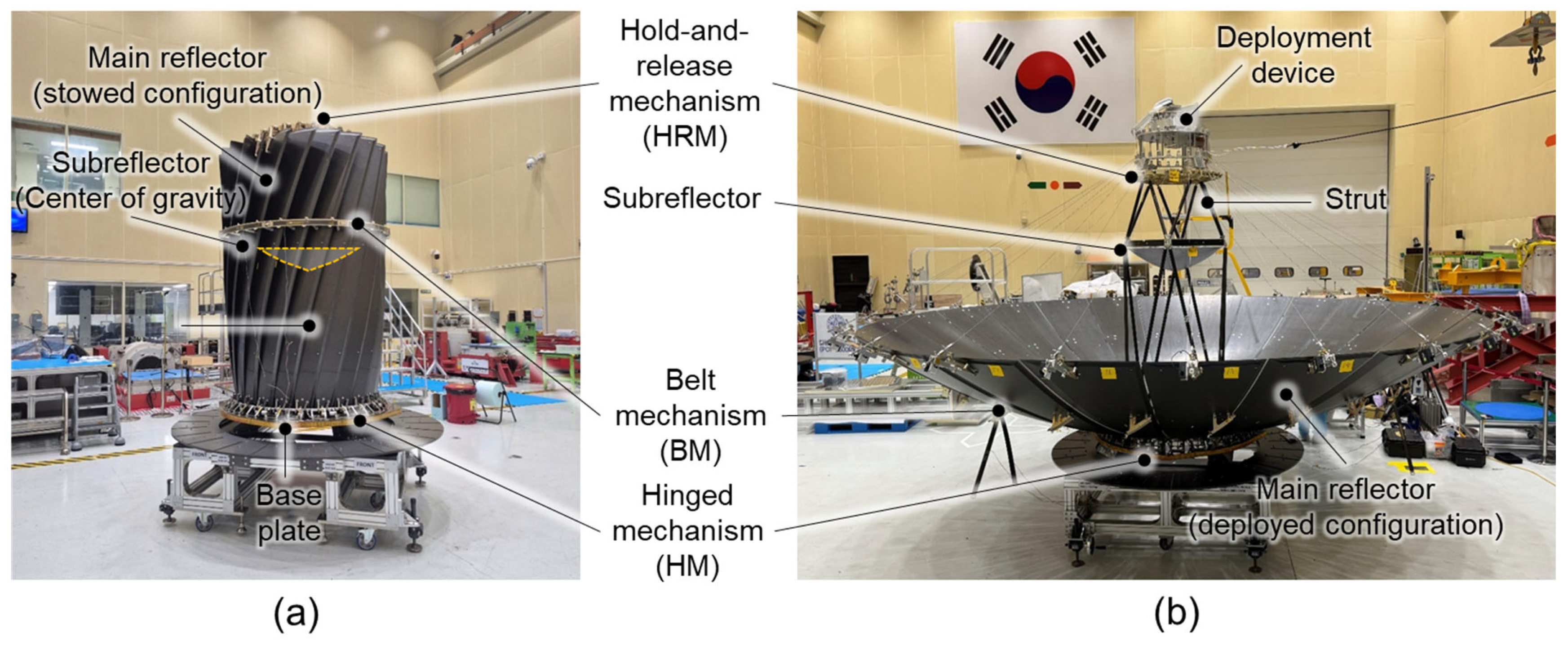
Figure 1 shows the stowed and deployed configurations of a deployable reflector antenna for a 5m-class satellite. As shown in Figure 1a, the reflector antenna was equipped with a hold-and-release mechanism (HRM), a belt mechanism (BM), and a hinged mechanism (HM) at the top, middle, and bottom, respectively, to ensure structural integrity during the launch environment. The HM employs a constant-force spring, allowing it to deploy around the hinged portion where each unit’s main reflector is attached when the restraining forces at the top and middle sections are released. The BM maintains the central part of the main reflector in stowed configuration during the launch process. The HRM restrains the ends of the reflector antenna and maintains its stowed configuration. When the satellite enters orbit, the restraints of the BM and HRM are released and the reflector antenna deploys with the spring force acting on the hinge. As shown in Figure 1b, the deployable reflector antenna forms a double-axis-symmetric Cassegrain-shaped reflector together with the subreflector.
The reflector antenna should be designed considering the dynamic loading conditions of the launch environment and the thermal condition on the mission orbit. Furthermore, the antenna must be experimentally verified to meet the requirements for these loads after fabrication, assembly, and integration. As mentioned in the previous section, to ensure the electrical performance of the deployable reflector antenna, shimming was performed using peelable washers during the assembly process to ensure the same model as the CAD model. The alignment between the CAD model and the actual shape was evaluated by the difference in position between reference points in the CAD and the mirror cube, which is the measurement point. In the stowed condition, the reflector antenna has a configuration similar to that of a hollow cylinder, the center of mass is an empty void with no accessible structural surface. Therefore, the accelerometer is impossible to mount at the center of mass. Therefore, the accelerometer designated as the reference point was attached to the subreflector frame, which constitutes the nearest accessible structural member to the center of mass. The alignment of the reflector antenna was measured in the six directions of translational x, y, and z and rotational x, y, and z. The requirements for the alignment verification test for the reflector antenna are shown in Table 1.
Since the reflector antenna is mounted on the satellite platform with a stowed condition, the vibration mode of the reflector antenna under the stowed condition should be designed to avoid interference with the resonance of the satellite platform. The vibrating mode of the stowed configuration of the reflector antenna should be numerically verified using structural analysis. Also, it should be experimentally verified by the mode search using the low-level sine sweep test with the integrated structure. Table 2 shows the directional frequency requirements of the deployable reflector antenna with the stowed configuration.
Table 3 shows the test specifications for verifying the structural margin of safety of the deployable reflector antenna mounted on a satellite for various loads caused by the dynamic disturbance during the launch stage. The test specification for the quasi-static acceleration is larger than 9 g and 12 g in the out-of-plane and inplane directions, respectively. The sine vibration tests are performed with a frequency range of 5–110 Hz and the maximum accelerations larger than 4 g and 9 g in the out-of-plane and inplane directions, respectively. Acoustic load tests were conducted with a 1/1 octave band with the central frequency from 31.5 to 8000 Hz and an overall sound pressure level larger than 140 dB. Typically, these test specifications for the payload are defined by the satellite analysis results with respect to the launch vehicle requirements. Furthermore, the low-level sine sweep tests were performed before and after each test of the full level to evaluate the frequency and acceleration magnitude of the fundamental mode with the effective modal mass (>10%) in each direction. Deployment of the reflector antenna on a mission orbit began with triggering the HRM in the BM. The BM and SM generate a strong shock, which is transmitted to the satellite platform through the baseplate interface of the lower stage and to the X-band antenna (XBA) through the SM interface of the upper stage. If the deployment mechanism of the reflector antenna generates an excessive shock load, the transient load is transmitted into XBA of satellite bus structure. If the shock response transmitted through the reflector antenna interface surpasses the specified qualification or acceptance thresholds, the resulting impulsive loading may cause irreversible structural damage—such as joint failure, fastener loosening, or waveguide misalignment—as well as functional anomalies or malfunctions in co-located payloads, including the XBA assembly and the satellite bus structure. Therefore, there are also test specifications for the allowable shock force to prevent the deployment-induced shock level. Due to security regulations, the values presented in Table 3 are provided in relative terms with respect to their maximum and minimum bounds, rather than as real values.
Environment tests of the deployable reflector antennas for sinusoidal vibrational load and quasi-static load were conducted sequentially in the order of 1/3, 2/3, and full level. The results of the reduced-level tests of the original specifications defined in Table 3 are used to evaluate the results of the full-level test and determine the allowable load of the specimen. Also, by comparing the results of the reduced-level test with the results of the numerical analysis, the possibility of damage to the prototype when subjected to a full-level load can be assessed in advance and the test equipment and prototype can be protected during the environmental tests. The low-level sine sweep tests were performed before and after the reduced-level test to evaluate the frequency and amplitude of the fundamental vibration mode. By comparing the responses of two low-level sine sweep tests measured before and after each structural test, the structural defects in the satellite payload can be detected based on changes in the modal characteristics. If any fasteners loosen or any satellite components are damaged, the reduction in structural stiffness leads to shifts in natural frequencies and a significant decrease in vibration response levels. Therefore, deviations in the FRF, such as frequency drops or amplitude reductions in fundamental modes, were used as the key factor to evaluate the structural integrity in the fasteners and payload components. Equations (1) and (2) show the mathematical expression of the rate of change in the frequency and amplitude of the fundamental mode, respectively, as follows:
f = | f n , p o s t f n , p r e f n , p o s t | × 100
a = | a n , p o s t a n , p r e a n , p o s t | × 100
where f and a are the shift in the frequency and amplitude measured by the low-level sine sweep test. The variables f n ,   p r e , f n , p o s t are the fundamental mode frequencies and a n , p r e , a n , p o s t are the amplitude of the accelerance, which is the frequency response function for the acceleration, at the fundamental mode measured before and after test.

3. Qualification Test of the Deployable Reflector Antenna in EQM Phase

In this Section, the systematic qualification of the 5m-class deployable reflector antenna was performed. The qualification tests in the EQM phase consisted of structural environment tests for the launch environment defined in Table 3, thermal environment tests for the mission orbit, as well as the alignment measurements to verify the consistency of the reflector antenna assembly with the design results, a deployment-induced shock test to measure the impact caused by the reflector antenna deployment, and a deployment test to measure the reproducibility of the deployment by deploying the reflector antenna before and after each test.

3.1. Alignment Verification Test for the Deployable Reflector Antenna

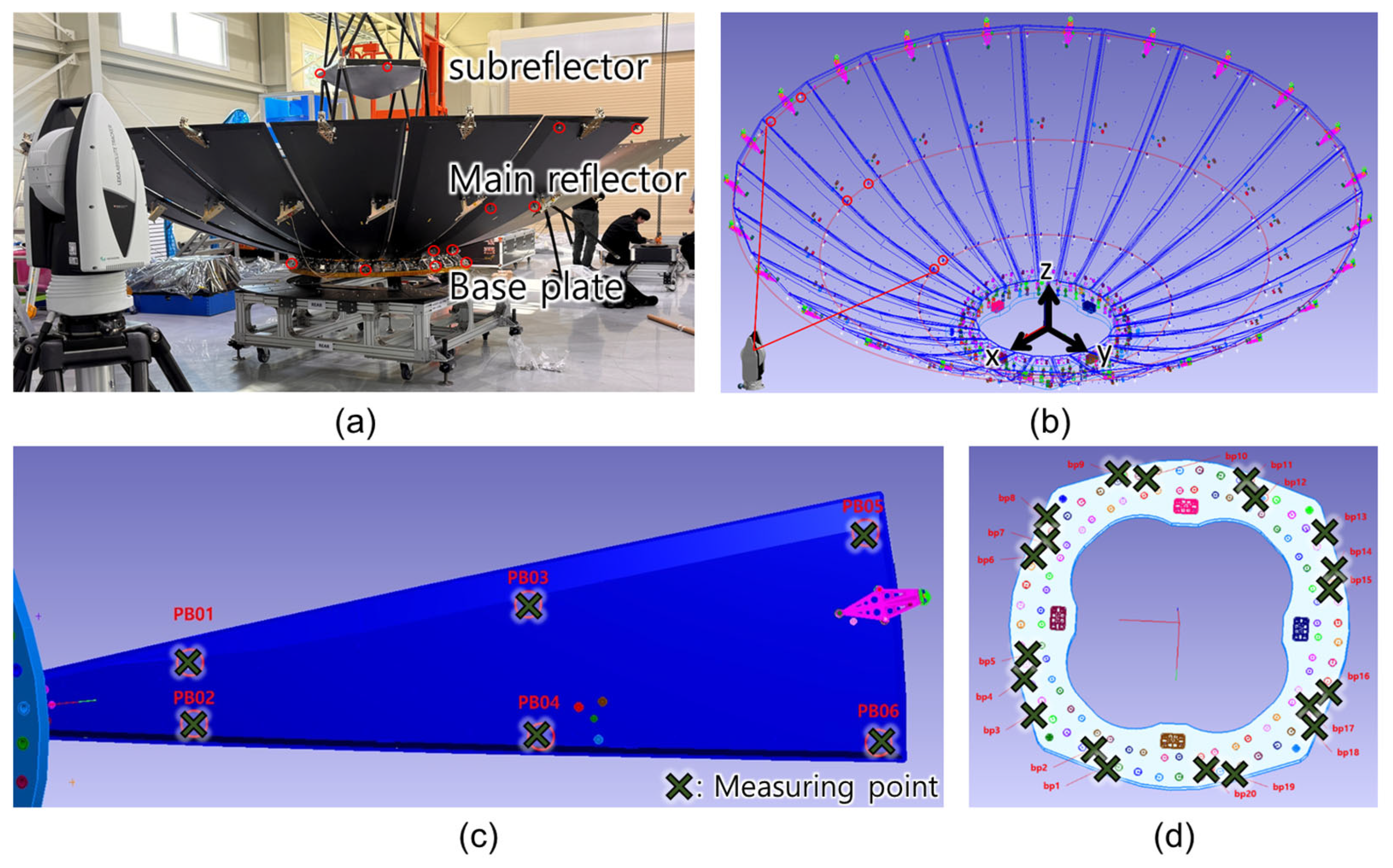
Figure 2 shows the configuration and results of the alignment verification test for the reflector antenna. As shown in Figure 2a, the 24 main reflectors that constituted the reflective surface of the reflector antenna were assembled and aligned in the deployed configuration using a laser tracker (Leica AT960-MR made by Hexagon Metrology in Heerbrugg, Switzerland) and a 0.5-inch optical cube. The alignment measurement results show the error rate between the CAD model and the actual shape. If there was an alignment difference between the deployed reflector antenna and the CAD model, peelable washers were applied to the main reflector joints to adjust the assembly of the main reflector through shimming. A total of 168 optical cubes were used for the alignment measurement of the deployable reflector antenna. As shown in Figure 2a, optical cubes were applied to the main reflector, subreflector, and base plate, which allowed us to confirm whether the shapes and relative positions of the satellite interface, main reflector, and subreflector were manufactured/assembled according to the designer’s intention. Figure 2b,c shows that the main reflector was composed of 24-unit structures, and each unit structure has 6 optical cubes applied. For each main reflector panel unit, six points were selected as the minimum configuration, which enabled both the position determination and the detection of local deformation inherent to the curved composite panel structure. Specifically, four points were placed near the panel corners to capture diagonal twist components and two additional points were positioned along the mid-span edges to detect out-of-plane bending. For the susubreflectorfour points were placed at 90° equal intervals to evaluate the relative location of the subreflector with respect to the main reflector and realize the configuration of the double-axis-symmetric Cassegrain-shaped reflector. As shown in Figure 2d, by applying 20 optical cubes to the base plate of the deployable reflector antenna, we could confirm the flatness of the mounting plate. The alignment of the reflector antenna was continuously measured during the assembly process, and the alignment results measured in the deployed configuration after assembly met the requirements defined in Table 1. The RMS values of the alignment measurement of the 168 optical cubes are 0.26 × a 1 , 0.33 × a 1 , and 0.1 × a 1 mm for the translational direction with respect to the x, y, and z axes. For the rotational direction along three directions, all RMS values were lower than 10% of a 2 °.

3.2. Environment Test for the Sinusoidal Vibrational and Quasi-Static Load

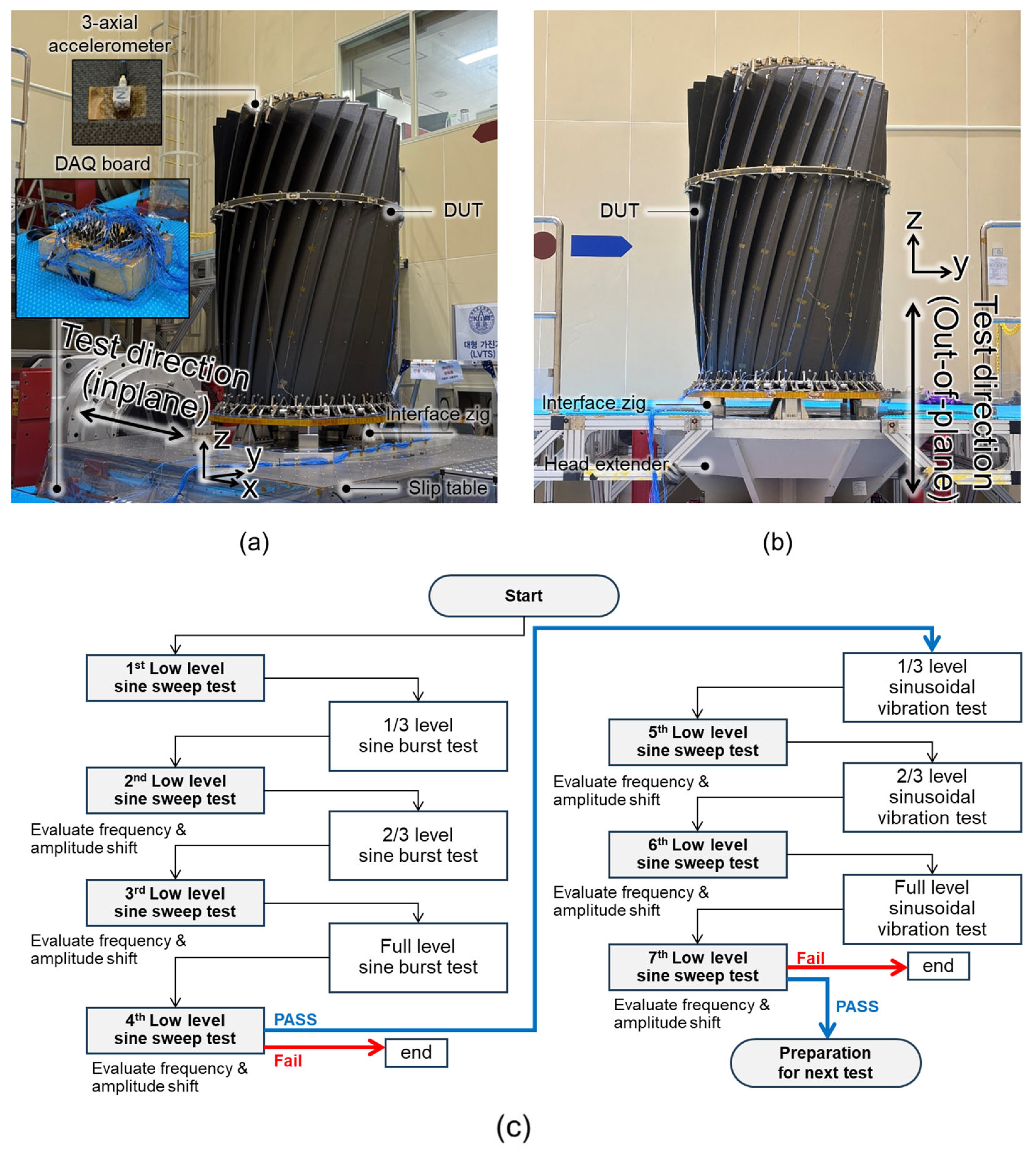
In this subsection, the qualification for sinusoidal vibrational load and quasi-static load was performed. Herein, the experimental verification for the quasi-static load was conducted by the sine burst test. The sine vibration test and the sine burst test were performed using the same test configuration. Figure 3 shows the test procedures and configurations for the sine burst test and the sine vibration test of the reflector antenna. As mentioned in Section 2, the two environment tests were performed in the order of 1/3 → 2/3 → full-level. The reduced-level tests with 1/3- and 2/3-level were used to predict the structural safety margin of the device on test (DUT) for the full-level test and to determine whether performing the full level test was possible. If an excessive response was measured and predicted at the reduced-level test, the test is stopped to protect the DUT and test equipment [6]. Figure 3a shows the configuration of the sine burst test and sinusoidal vibration test along the inplane direction, while the configuration for the out-of-plane test is shown in Figure 3b. Since sine burst/vibration tests were performed with the same experimental setup in a direction, the out-of-plane test was performed after all inplane test was passed, as shown in Figure 3c. The mode characteristics before and after the full-level sine burst/vibration tests were compared to confirm that there was no structural change due to the quasi-static and sinusoidal vibrational loads. The low-level sine sweep test to evaluate the mode characteristics of DUT was implemented using the test specification of Table 3.
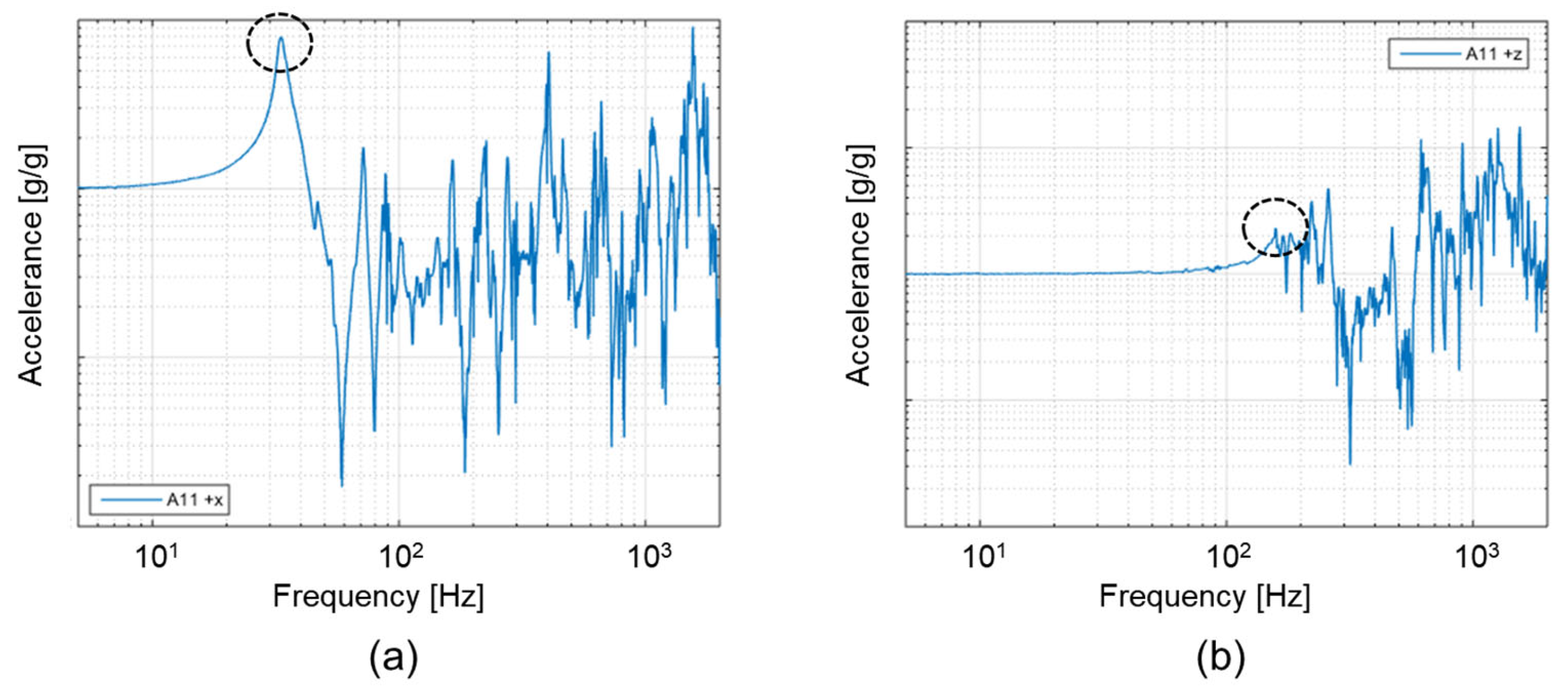
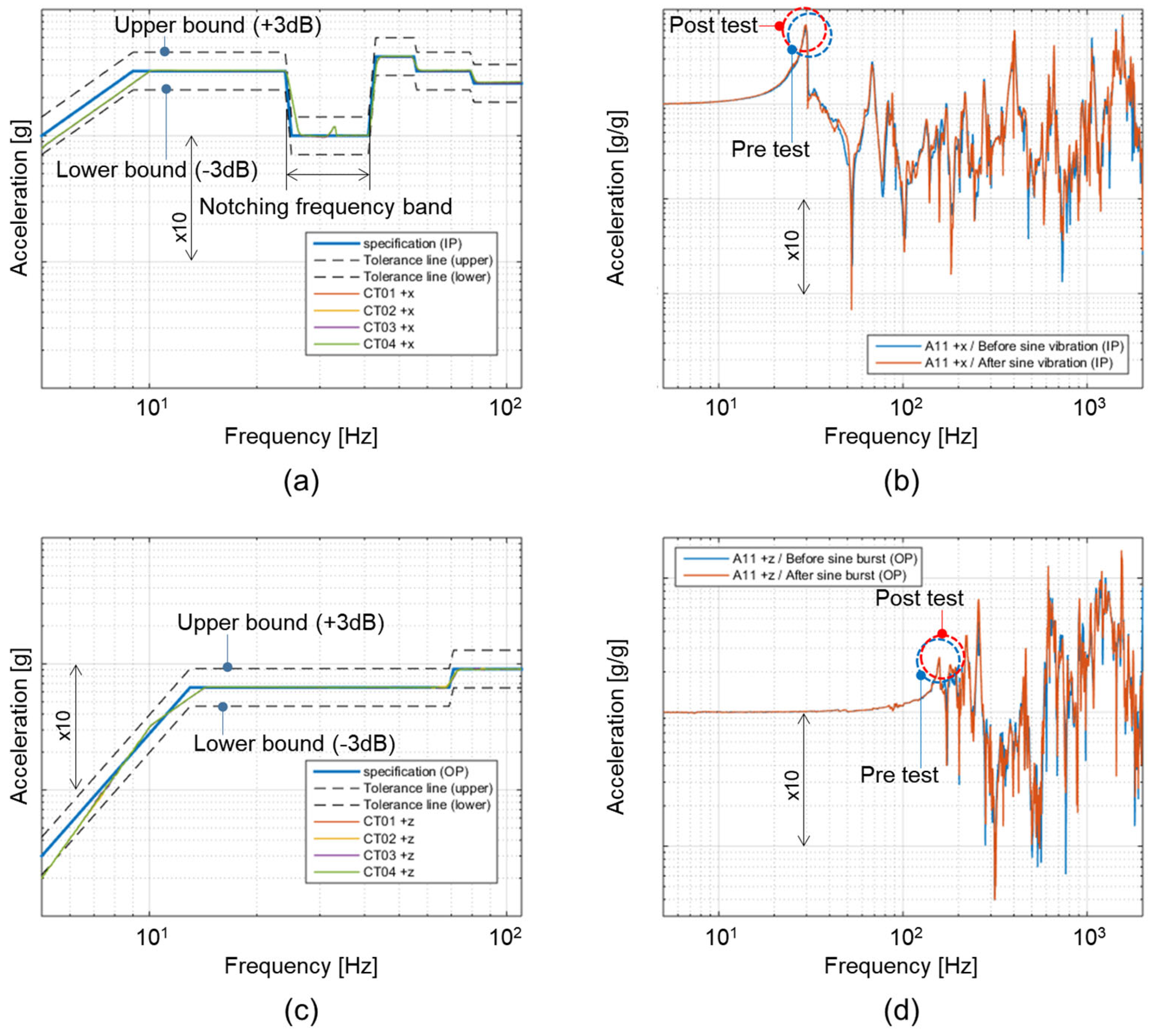
As shown in Figure 3c, the sine burst/vibration tests for each direction began with a low-level sine sweep test. The inplane and out-of-plane vibration mode frequencies identified in the first low-level sine sweep test were used to evaluate the pass/fail criteria of the stiffness requirement. Figure 4 shows the results of the low-level sine vibration tests for each direction. Figure 4a,b shows the transfer function of the acceleration measured at the subreflector in the vicinity of the center of gravity with respect to the input acceleration profile, referred to as the acceleration. As shown in Table 4, the fundamental mode frequencies of the reflector antenna were 33.42 and 158.30 Hz, which satisfied the stiffness requirement in the inplane and out-of-plane directions.
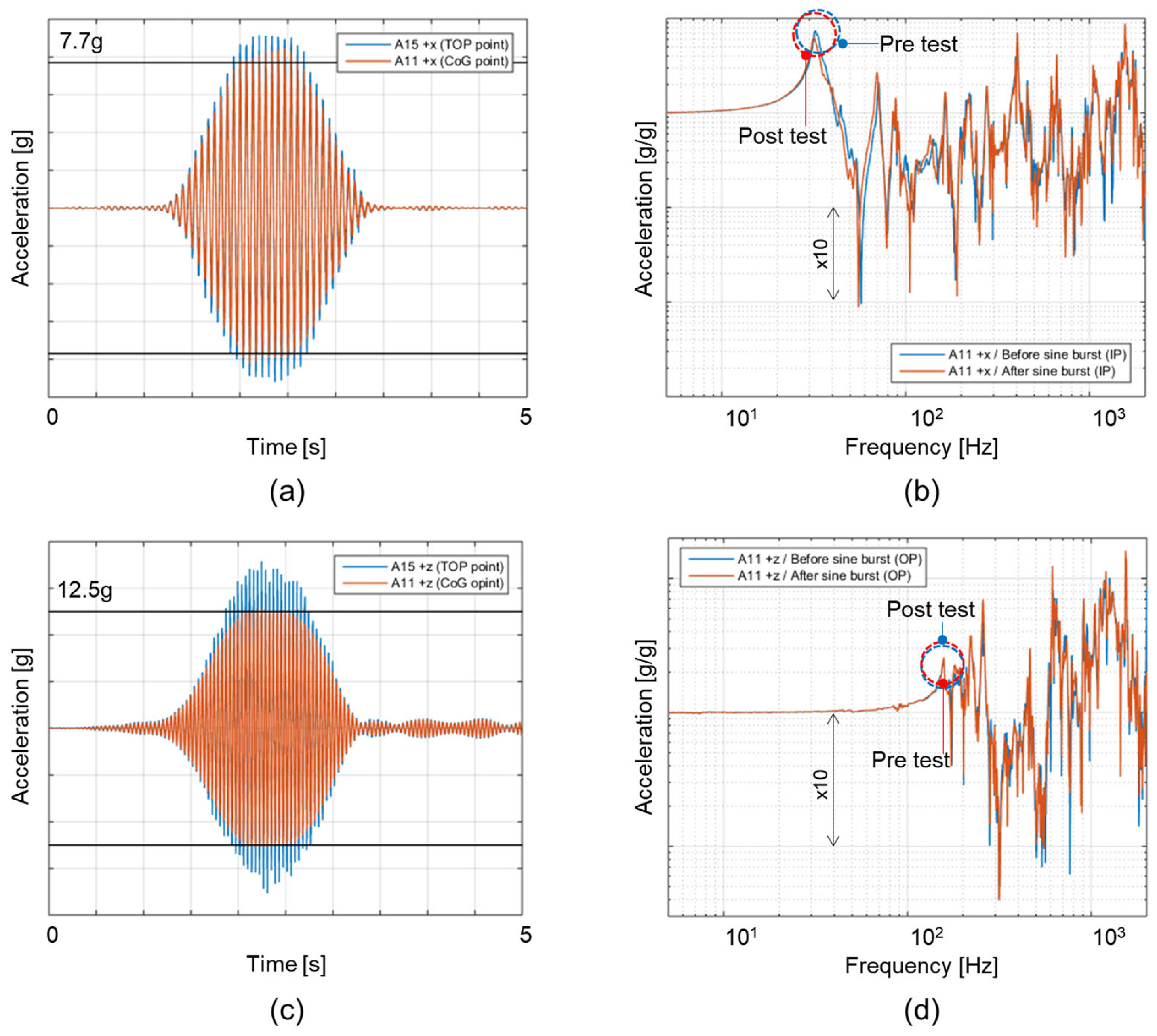
The sine burst test was implemented to verify the quasi-static acceleration during the launch process. It was conducted by applying a vibration load of 5–10 times with magnitudes greater than the test specification and a single frequency less than 1/3 of the first resonance frequency of the DUT [8]. Figure 5 shows the results of the sine burst test of the reflector antenna. Figure 5a,c shows that the sine burst tests for the inplane and out-of-plane directions were performed in accordance with the quasi-static test specifications in Table 3. As mentioned before, the frequency and amplitude shift were determined based on the fundamental mode frequency and its FRF values measured by the low-level sine sweep test to evaluate the structural changes/defects before and after the test. According to the pass/fail criteria of the ESA standard document, if the frequency and amplitude shifts were less than 5% and 20%, respectively, it was considered that there was no structural change before and after the test [6,9]. Figure 5b,d shows that the frequency and amplitude shift for each direction satisfy the pass/fail criteria. Table 5 shows the frequency and amplitude shift before and after the sine burst test with full level along each direction.
The sine vibration test was implemented for the verification test for sinusoidal vibrational load defined in Table 3. The sine vibration test was conducted with the test configuration of Figure 3a,b. Figure 6 shows the results of the sine vibration test for each direction. In order to apply a sinusoidal vibrational load corresponding with the test specifications to the DUT, a control sensor was attached to the fixture and generate the excitation load by the feedback control. In order to determine whether the sine vibration test was conducted in compliance with the test specifications, the response of the control sensor should have been within the tolerance line of +3 dB/−3 dB for the test specifications [9]. Figure 6a,c shows that the sine vibration test for each direction was conducted in compliance with the sinusoidal vibration specifications defined in Table 3. Figure 6b,d shows that the frequency and amplitude shift for each direction were both less than 5% and 20%, respectively. Table 6 shows the frequency and amplitude shift before and after the full-level sine vibration test along each direction.

3.3. Acoustic Load Test

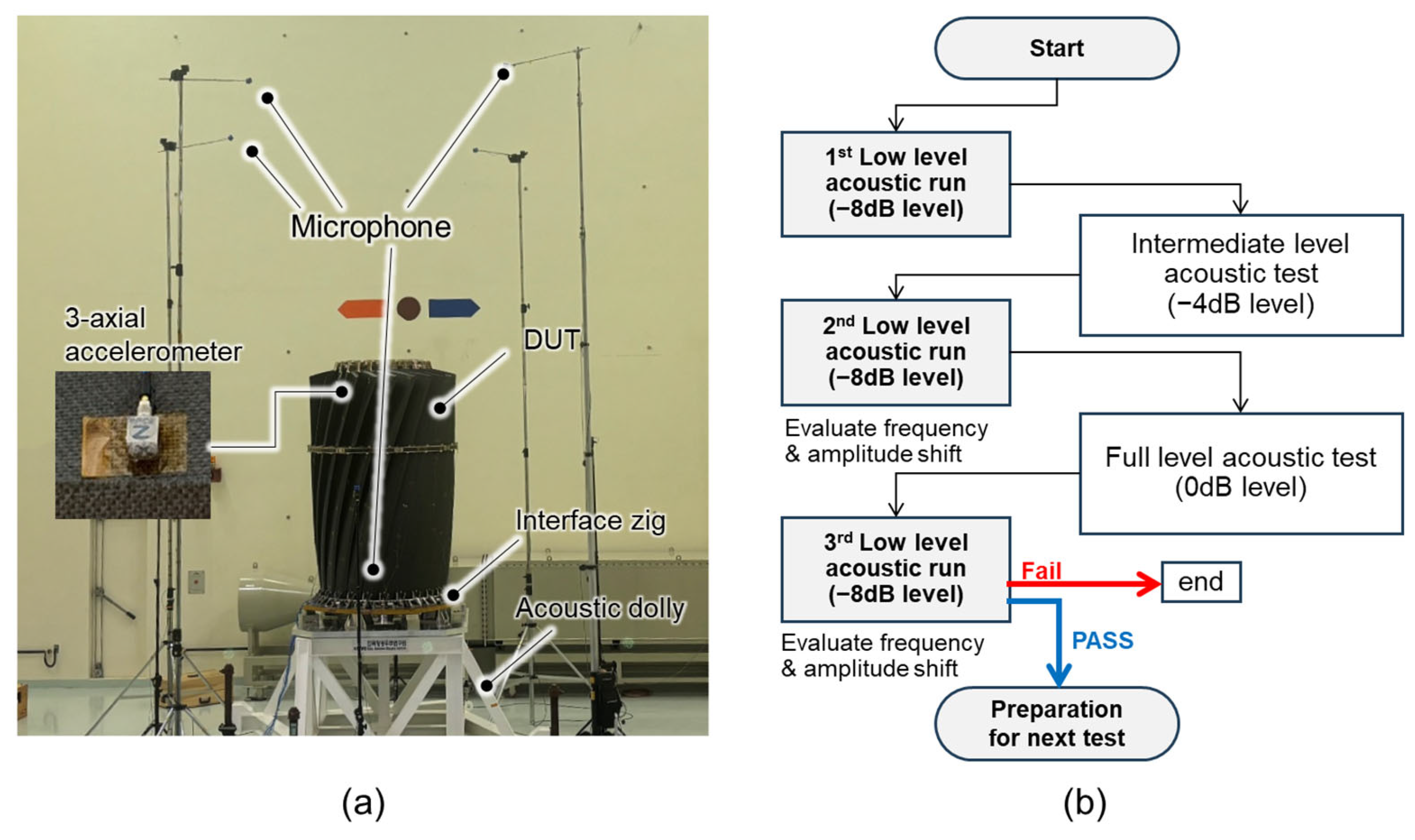
In this subsection, the qualification for the acoustic load was performed according to the test specifications defined in Table 3. Figure 7 shows the qualification procedure and experimental setup for the acoustic load test of the deployable reflector antenna. Similarly to the structural environment test, the acoustic load test was also conducted in the reverberant acoustic chamber at the Korea Aerospace Research Institute (KARI), which has an internal volume bigger than 1200 m3 and is capable of generating OASPL up to 152 dB over the frequency range from 25 to 10,000 Hz. Acoustic energy was produced using electro-pneumatic modulators that controlled high-pressure nitrogen gas flow. The additional horn spread the broadband acoustic noise generated using the modulator into the acoustic chamber. The sound pressure level inside the chamber was monitored and controlled in real time using multiple microphones distributed across the chamber walls to mimic the spatially uniform diffuse acoustic field [10,11]. Similarly to the sine burst/vibration test, the acoustic load test was conducted in the order of −8 dB → −4 dB → full level. The reduced level tests of −8 dB and −4 dB level were used to predict the structural safety margin of the DUT with respect to the full-level test and to determine whether the full-level test was possible. If an excessive response was measured or predicted in the reduced-level test, the acoustic load test is discontinued to protect the DUT and test equipment [6]. The modal characteristics before and after the full-level acoustic load test were compared to confirm that there was no structural change induced by the acoustic load. The modal survey for the acoustic load test was performed as the low-level acoustic run with a level of −8 dB compared to the full level [6,12,13].
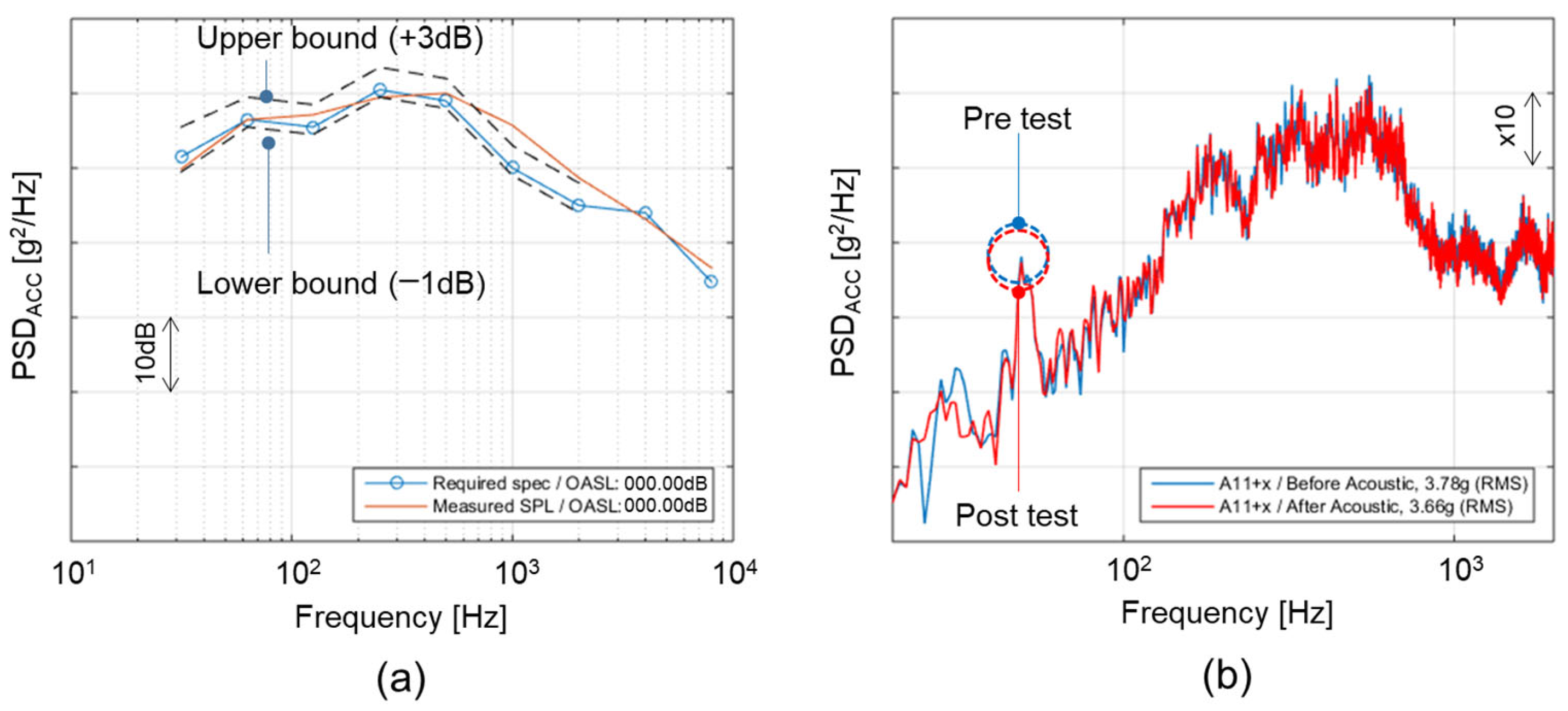
The acoustic load test was conducted to verify the structural margin of the reflector antenna due to the reverberant sound field created inside the launch vehicle fairing in the launch environment, and it was performed in accordance with the test specifications defined in Table 3. The acoustic load test of the reflector antenna was performed using the experimental setup in Figure 7a, and Figure 8 shows the results of the acoustic load test. As shown in Figure 7a, several control microphones were installed in the reverberation chamber. The feedback control system was used to create a reverberant sound field, and the virtual environment identical to the launch environment was built in the reverberant chamber [10,11]. During the acoustic load test, the sound pressure level measured at the reference microphone should have been within the tolerance line of the original test specification. If the acoustic response fell below the lower tolerance line, it was considered an under-test that did not meet the test standard and was judged to have not satisfied the test specifications. On the other hand, if it exceeded the upper tolerance line, was considered an over-test, and the test was considered to have been performed in compliance with the test specifications. Figure 8a shows the acoustic response measured from the reference microphone. The measured sound pressure level shows that the over-test was performed within the high-frequency range of the center frequency of 1000 Hz and 2000 Hz [6,12]. As shown in Figure 8a, the overall sound pressure level fell within the range of −1/+3 dB in Table 3 in the frequency range of 31.5 to 8000 Hz. Figure 8b shows the acceleration response of the deployable reflector antenna measured in the acoustic load test. The power spectral density of the inplane acceleration response measured at the top of the reflector antenna shows that the fundamental mode frequency and the overall response shift were less than 5% and 20%, respectively. Table 7 shows the fundamental mode frequency and RMS values of the reflector antenna identified in a low-level acoustic load test at the −8 dB level performed before and after the full-level acoustic load test.

3.4. Thermal Vacuum Test

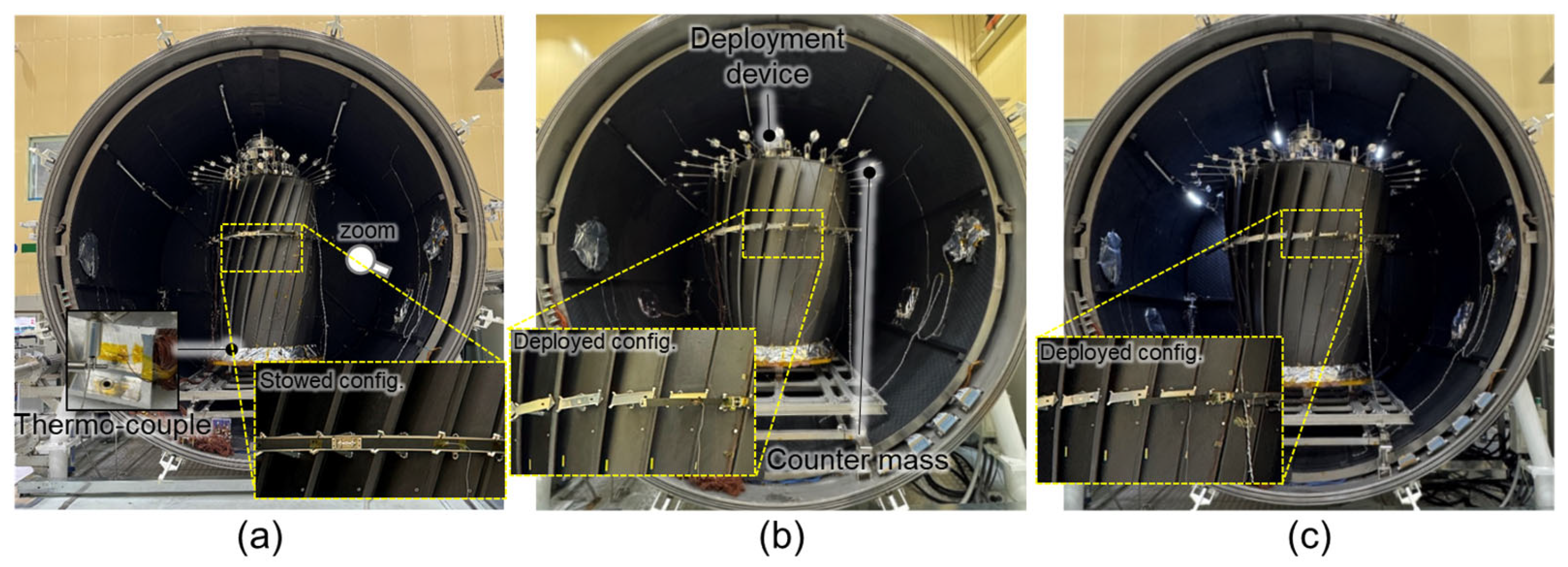
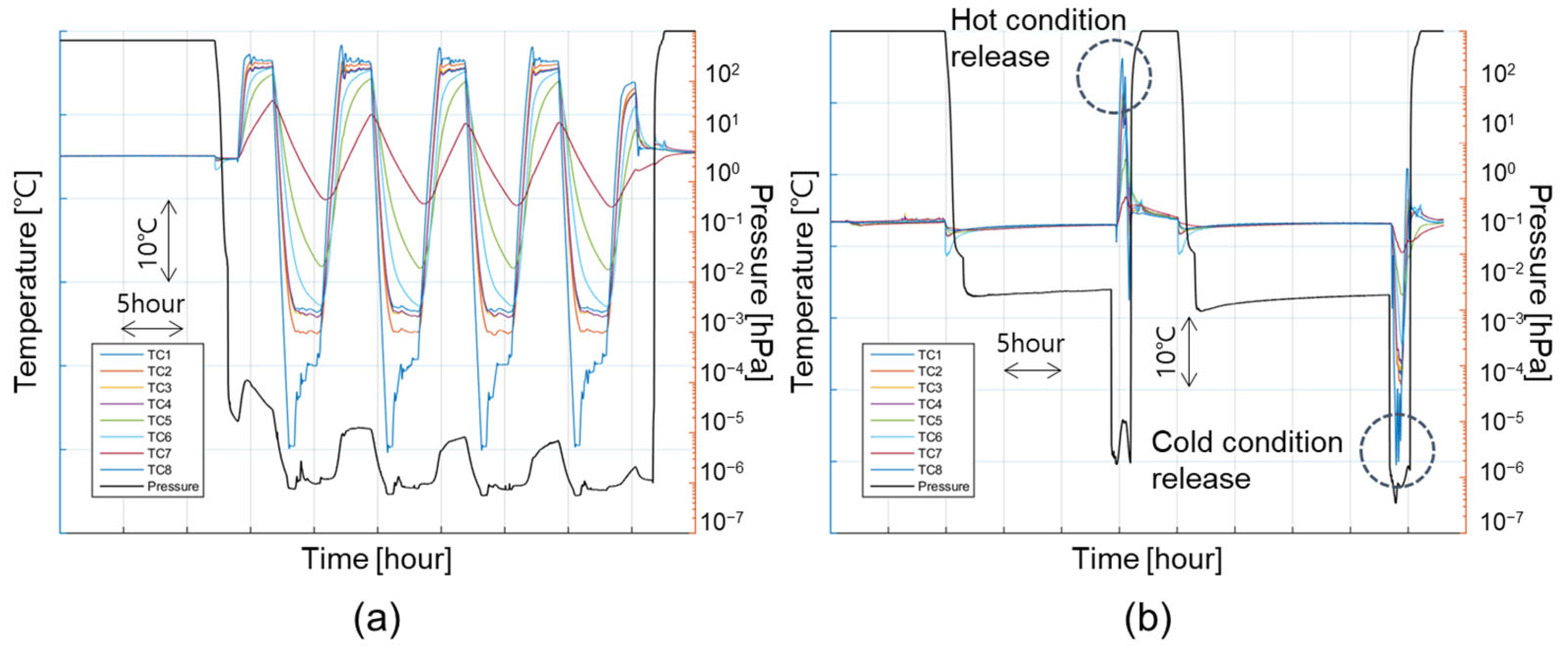
In this subsection, the thermal vacuum test was performed to verify the thermal stability of a deployable reflector antenna in an orbital environment. In a previous study, a well-correlated thermal analysis model was developed by using a thermal balance test and ground test simulations during the STM phase, and an orbital thermal analysis of the deployed configuration was performed based on this model [6,14]. The temperature range of the deployable reflector antenna, derived from this orbital thermal analysis, was then applied to the uncertainty margin, acceptance margin, and qualification margin to determine the temperature range of the thermal vacuum test. The thermal vacuum test of the deployable reflector antenna during the EQM phase was performed over four cycles within the qualification temperature range. After the fourth cycle, the deployment mechanism was operated under both hot and cold conditions to verify the reproducibility of the reflector antenna deployment [15,16]. Figure 9 shows the thermal vacuum test configuration of the deployable reflector antenna. As can be seen in Figure 9a, the thermal vacuum test of the reflector antenna was conducted in the stowed configuration, and Figure 9b,c shows that the deployment mechanism operated normally after the 4-cycle thermal vacuum test, resulting in the release of the HRM [17,18,19]. The thermal vacuum (TVac) test was conducted in accordance with the specifications summarized in Table 8. The test comprised four thermal cycles over a temperature range of a 8  °C to + a 8  °C, with a temperature sweep rate of 3 °C/min. At the hot condition ( + a 8   °C), the antenna deployment was performed at a soak temperature of + 0.75 × a 8  °C to evaluate the deployment mechanism under elevated thermal loading. For the cold condition ( a 8  °C), the antenna deployment test was carried out at 0.19 × a 8  °C, representing a thermally conservative boundary for low-temperature operation. Following each deployment actuation, the thermal vacuum chamber was vented and opened to allow for direct visual inspection of the antenna deployment mechanism, confirming its nominal operation prior to the subsequent thermal cycle.
Figure 10 shows the temperature history of a deployable reflector antenna during the thermal vacuum test. Figure 10a shows the temperature history measured by the temperature sensor attached to the deployable reflector antenna during four thermal vacuum test cycles. Figure 10b shows the temperature history of an additional thermal vacuum test conducted after the four-cycle thermal vacuum test to verify the deployable performance of the reflector antenna in both hot and cold conditions. After each release, the thermal vacuum chamber was opened and a visual inspection was performed.

3.5. Deployment-Induced Shock Test

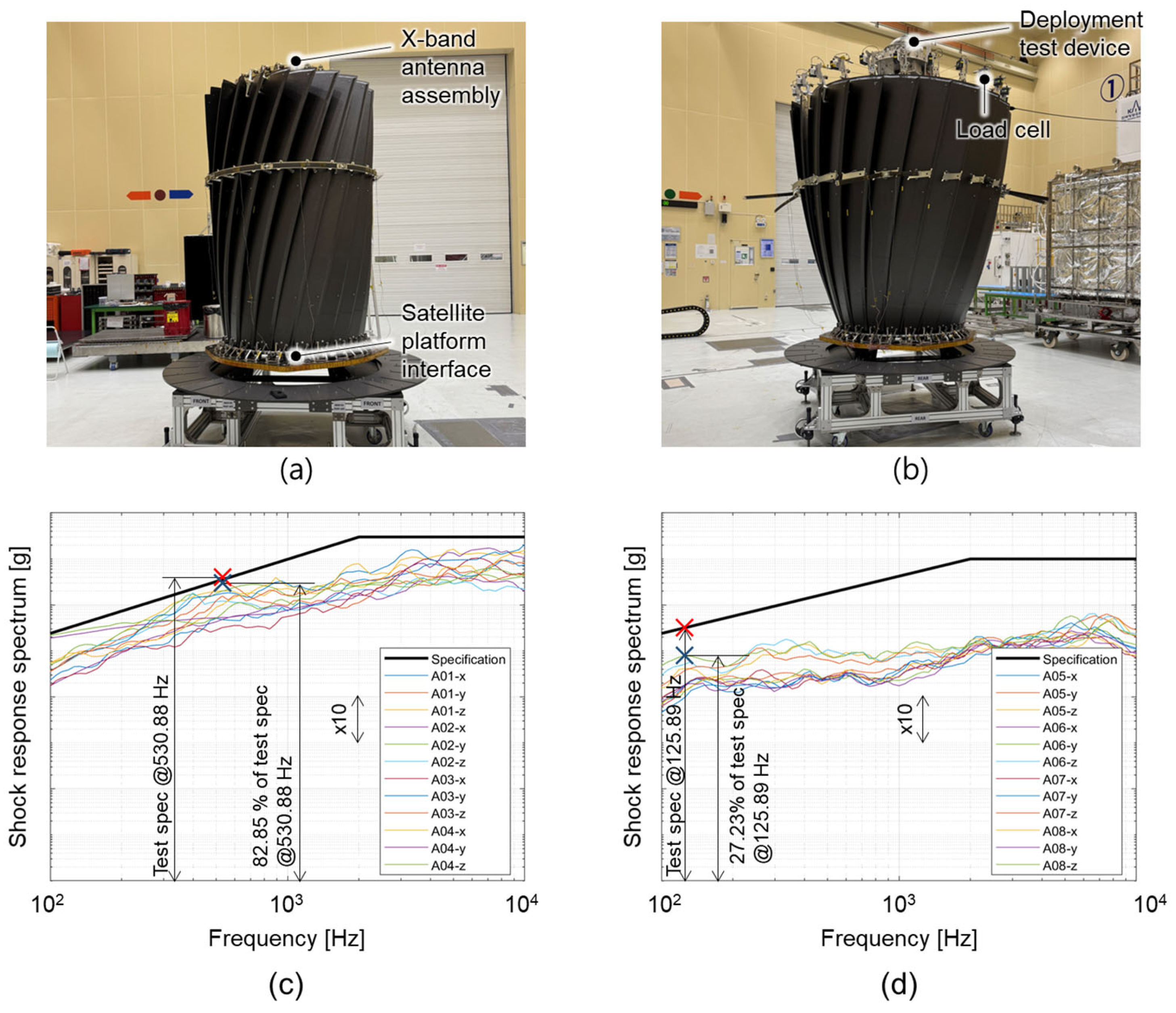
This subsection describes the shock test that was conducted to measure the impact force generated during deployment. During deployment, the reflector antenna experiences shock due to the release of the HRM and the rotation of the synchronization mechanism. The impact load generated during deployment propagates through each component of the reflector antenna and is transmitted to the satellite body and the XBA assembly on top of the satellite. In the deployment-induced shock test, four accelerometers were attached to the satellite body interface and the XBA assembly to measure the acceleration response. The time data of the impact force generated during the reflector antenna deployment was converted to SRS values to determine whether it exceeded the shock test specifications defined in Table 3 [20].
Figure 11 shows the results of the deployment-induced shock test of a deployable reflector antenna. As shown in Figure 11a, the test was conducted in a stowed configuration, with four accelerometers attached to the top and bottom of the prototype to measure the impact force during deployment. After deployment, it took the form of Figure 11b, and the impact loads measured at the satellite body interface and the XBA interface during this process are shown in Figure 11c,d, respectively. As can be seen in Figure 11c,d, it can be confirmed that the deployment-induced shock does not transmit excessive loads to the body and the XBA assembly.

3.6. Deployment Repeatability Test

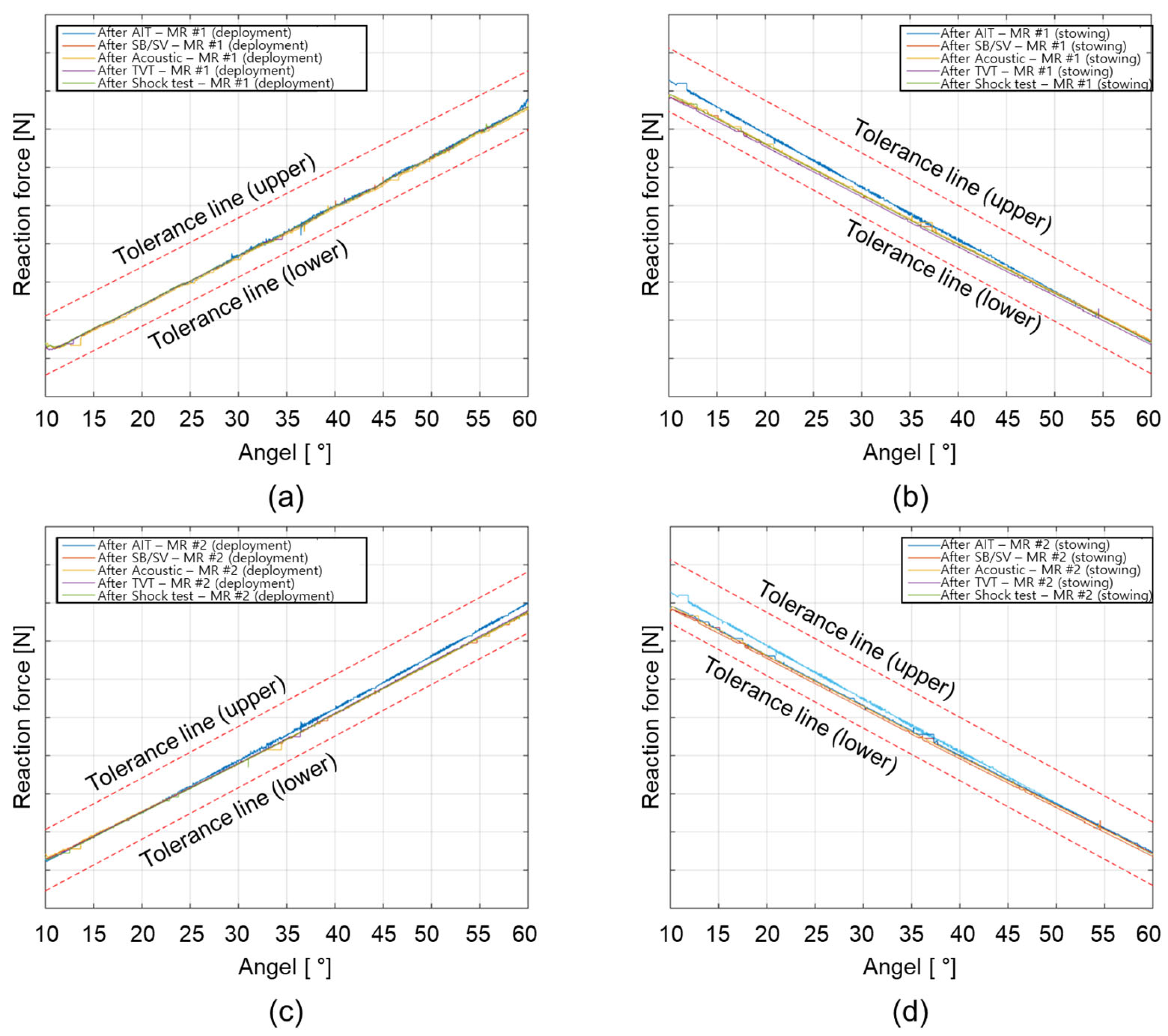
This subsection presents the test results to verify the deployment performance of the reflector antenna during qualification for each load. The test to verify deployment repeatability was conducted using the experimental setup shown in Figure 11a,b [21,22]. As shown in this figure, load cells were installed at each end of the 24 main reflectors of the reflector antenna, and the load cells were connected to the deployment test device attached to the top of the reflector antenna. Comparing the magnitude of the reaction force measured by the load cells during the deployment repeatability test allows us to verify whether the deployment performance of the reflector antenna was maintained for each load. Figure 12 shows the change in the magnitude of the reaction force of the reflector antenna during the deployment/stowage process of the two main reflectors. Table 9 shows the time-averaged value of the difference between the results measured after each qualification test and the initial test right after the assemblage and integration of the deployable reflector antenna. All values in Table 3 are lower than 10%. After assembling the reflector antenna, after the sine burst and sine vibration tests, acoustic test, thermal vacuum test, and the deployment-induced shock test, the magnitude of the reaction force was shown to be within the tolerance line of +10%/−10% based on the previously measured value, and it is shown that each load defined in Table 3 did not affect the deployment performance of the reflector antenna.

4. Conclusions

In this study, qualification testing of the EQM model for a deployable reflector antenna was performed. The alignment test results of the deployable reflector antenna show values of approximately 35% and 10% of the reference value in the translational and rotational directions, respectively. For qualification, verification tests were conducted for quasi-static, sinusoidal vibration, and acoustic loads. The first low-level sine sweep test of the reflector antenna verified the stiffness requirements in the horizontal and vertical directions. The structural integrity of the antenna under each load was confirmed by the changes in vibration mode characteristics evaluated in the low-level tests before and after the full-level test. The results of the low-level vibration test before and after the acoustic load test and vibration test of the reflector antenna show that the frequency change rate and response change rate for the fundamental mode were less than 5% and 20%, respectively, ensuring the structural integrity for the launch environment. The main modes in each direction were measured using the low-level vibration meter, and the main modes for the vertical and horizontal directions were 33.42 and 158.30 Hz, respectively, satisfying the system requirements. To ensure the reliability of the deployment mechanism in orbital condition, the deployment sequences were conducted under hot and cold conditions during the thermal vacuum test. This confirmed the normal operation of the reflector antenna during both the eclipse and daylight phases after launch from orbit. A deployment-induced shock test confirmed that the shock caused by the deployment of the reflector antenna did not impose excessive loads on the satellite platform beneath the reflector antenna and the XBA assembly above the reflector antenna and did not affect the satellite’s mission performance. Furthermore, deployment reproducibility tests were performed before and after each test to confirm that each load did not degrade the deployability of the reflector antenna. The deployable reflector antenna developed in this study can be applied to the future development of SAR-based observation satellites, and the qualification process proposed in this study can serve as a valuable reference for establishing development procedures for other reflector antennas. The qualification process and philosophy proposed in this work could be applied to the development of a space-grade deployable reflector antenna.

Author Contributions

Conceptualization, K.-R.K.; methodology, H.-G.K.; software, H.-G.K. and D.-G.K.; validation, H.-G.K. and D.-G.K.; formal analysis, D.-G.K., D.-Y.K. and S.-M.L.; investigation, H.-G.K., Y.K. and G.B.; resources, M.-J.K. and S.-M.L.; data curation, S.-M.L., M.-J.K., S.O., C.-H.L., R.-H.D., Y.-B.K., Y.K., G.B. and D.-G.K.; writing—original draft preparation, H.-G.K.; writing—review and editing, D.-G.K., K.-R.K., S.O., R.-H.D., Y.K., G.B., C.-H.L. and J.-O.C.; visualization, H.-G.K. and D.-Y.K.; supervision, K.-R.K.; project administration K.-R.K.; funding acquisition, K.-R.K. All authors have read and agreed to the published version of the manuscript.

Funding

This study was conducted with support from the Korea Research Institute for defense Technology planning and advancement and the Defense Acquisition Program Administration in 2021 (20-207-B00-011-001).

Institutional Review Board Statement

Not applicable.

Informed Consent Statement

Not applicable.

Data Availability Statement

All data are in the paper; there is no additional data.

Conflicts of Interest

All authors were employed by the company Hanwha Systems. The authors declare that the research was conducted in the absence of any commercial or financial relationships that could be construed as a potential conflict of interest.

Abbreviations

The following abbreviations are used in this manuscript:
DR-ADeployable reflector antenna
BMBelt mechanism
HRMHold-and-release mechanism
HMHinged Mechanism
CFRPCarbon fiber reinforced polymer
FRFFrequency response function
TVThermal vacuum test
TCThermal cycling test
DUTDevice on test
SARSynthetic aperture radar

References

  1. Zhang, C.; Gao, G.; Zhang, X.; Li, H.-C.; Liu, T.; Zhang, Z.; Li, G. An Overview of Polarized Synthetic Aperture Radar Ship Detection: From Traditional Methods to Artificial Intelligence. IEEE Geosci. Remote Sens. Mag. 2025, 13, 174–209. [Google Scholar] [CrossRef]
  2. di Toma, A.; Brunetti, G.; Armenise, M.N.; Ciminelli, C. Synthetic Aperture Radar Payloads: Migration towards Photonic Approach. Proc. SPIE 2019, 11180, 1118007. [Google Scholar] [CrossRef]
  3. Moreira, A.; Prats-Iraola, P.; Younis, M.; Krieger, G.; Hajnsek, I.; Papathanassiou, K.P. A Tutorial on Synthetic Aperture Radar. IEEE Geosci. Remote Sens. Mag. 2013, 1, 6–43. [Google Scholar] [CrossRef]
  4. Kim, H.-G.; Kim, D.-G.; Do, R.-H.; Koo, K.-R.; Yu, Y.-J. Development of Deployable Reflector Antenna for the SAR-Satellite: Part 1. Design and Analysis of the Main Reflector Using Honeycomb Sandwich Composite Structure. Appl. Sci. 2024, 14, 1590. [Google Scholar] [CrossRef]
  5. Kim, D.-G.; Kim, H.-G.; Kim, D.-Y.; Do, R.-H.; Koo, K.-R.; Yu, Y.-J. Development of a Deployable Reflector Antenna for the Synthetic Aperture Radar Satellite, Part 2: Manufacturing and Qualification of the Main Reflector Using a Honeycomb Sandwich Composite Structure. Appl. Sci. 2024, 14, 11273. [Google Scholar] [CrossRef]
  6. Kim, H.-G.; Kim, D.-G.; Do, R.-H.; Kwak, M.-J.; Koo, K.-R.; Yu, Y. Development of Deployable Reflector Antenna for the SAR-Satellite, Part 3: Environmental Test of Structural-Thermal Model. Appl. Sci. 2025, 15, 1436. [Google Scholar] [CrossRef]
  7. Prahlad, T.S. Some aerospace problems of satellite launch vehicle. Sadhana 1987, 10, 459–495. [Google Scholar] [CrossRef]
  8. NASA Engineering and Safety Center. NASA Engineering and Safety Center Technical Bulletin No. 15-02: Best Practices for Use of Sine Burst Testing; NASA: Washington, DC, USA, 2015. [Google Scholar]
  9. ECSS-E-ST-10-03C; Space Engineering—Testing. European Cooperation for Space Standardization: Noordwijk, The Netherlands, 2022.
  10. Eun, H.; Im, J.; Moon, S.; Schoi, S. Upgrading Acoustic Chamber and Verification Test. Aerosp. Eng. Technol. 2007, 6, 60–65. [Google Scholar]
  11. Im, J.; Eun, H.; Jun, J.; Moon, G. Status of Acoustic Testing Methods on Satellite. Curr. Ind. Technol. Trends Aerosp. 2013, 11, 93–101. [Google Scholar]
  12. Kim, H.-G.; Kwon, S.-C.; Koo, K.-R.; Song, S.-C.; Yu, Y.; Song, Y.; Park, Y.-H.; Oh, H.-U. Performance Investigation of Superplastic Shape Memory Alloy-Based Vibration Isolator for X-Band Active Small SAR Satellite of S-STEP under Acoustic and Random Vibration Environments. Aerospace 2022, 9, 642. [Google Scholar] [CrossRef]
  13. Shakir, A.B.; Ez-Deen, S.Y. Effect of Acoustic Vibration on the Satellite Structure at Launch Stage. In Proceedings of the International Conference on Modeling and Simulation (MS09), Trivandrum, India, 1–3 December 2009. [Google Scholar]
  14. Kim, H.-G.; Kim, D.-G.; Do, R.-H.; Kwak, M.-J.; Koo, K.-R.; Yu, Y.-J. Development of Deployable Reflector Antenna for the SAR Satellite: Part 4—Thermal Analysis-Assumed Orbital Environment Using Well-Correlated Antenna Assembly Model Based on Thermal Balance Test. Appl. Sci. 2025, 15, 1437. [Google Scholar] [CrossRef]
  15. Lee, K. Solar Array Deployment Qualification for the LMX of Buses. In Proceedings of the 11th European Space Mechanisms and Tribology Symposium (ESMATS 2005); ESA: Lucerne, Switzerland, 2005; Volume 591. [Google Scholar]
  16. Chen, G.; Hua, Y.; Wang, B.; Zheng, S.; Xiao, Y.; Ma, X.; Zhang, A.; Chen, L. Design and Verification for Umbrella-Type Deployable Antenna of Chang’e-4 Lunar Relay Satellite. J. Deep Space Explor. 2018, 5, 524–530. [Google Scholar] [CrossRef]
  17. Seefeldt, P. Development and Qualification of Deployable Membranes for Space Applications. Ph.D. Thesis, Universität Bremen, Bremen, Germany, 2018. [Google Scholar]
  18. Bui, T.D.V.; Tran, Q.V.; Lew, J.M.; Selvadurai, S.; Tan, B.; Wong, A.L.; Lim, S.Y.; Lim, W.S.; Cheng, T.H.; Cordova Alarcon, J.R.; et al. Design and Development of AOBA VELOX-IV Nanosatellite for Future Lunar Horizon Glow Mission. In Proceedings of the 32nd Annual AIAA/USU Conference on Small Satellites (SSC18-WKIX-02), Logan, UT, USA, 4–9 August 2018. [Google Scholar]
  19. Jeon, J.; Kim, J.; Lee, S.; Yoon, S.; Seon, J.; Jin, H.; Lee, D.; Lin, R.P. Construction of a Thermal Vacuum Chamber for Environment Test of Triple CubeSat Mission TRIO-CINEMA. J. Astron. Space Sci. 2013, 30, 335–344. [Google Scholar] [CrossRef]
  20. Adebolu, I.O.; Masui, H.; Cho, M. Quantitative Evaluation of SRS Similarity for Aerospace Testing Applications. Shock Vib. 2021, 2021, 6655878. [Google Scholar] [CrossRef]
  21. Liu, T.; Hao, G. Design of Deployable Structures by Using Bistable Compliant Mechanisms. Micromachines 2022, 13, 651. [Google Scholar] [CrossRef] [PubMed]
  22. Mao, H.; Wang, Y.; Xu, D.; Liu, Y.; Chen, H. Deployment of Bistable Self-Deployable Tape Spring Booms Using a Gravity Offloading System. J. Aerosp. Eng. 2017, 30, 04017007. [Google Scholar] [CrossRef]
Figure 1. Configuration of deployable reflector antenna with (a) stowed and (b) deployed conditions and the reference point for the mode search.
Applsci 16 02869 g001
Figure 2. Alignment verification test during assembly and integration phase; (a) test configuration using the deployable reflector antenna, laser tracker and mirror cube; (b) measurement of alignment in laser tracker software; measuring point in (c) unit structure of main reflector and (d) base plate; the symbol (x) mean the position of optical cubes.
Applsci 16 02869 g002
Figure 3. Configuration and qualification procedure of the deployable reflector antenna of the sine bust and sinusoidal vibration test; test configuration along (a) inplane and (b) out-of-plane directions; (c) qualification procedure for horizontal and axial directions; Following the sine-burst and sinusoidal vibration test conducted in the horizontal direction, the identical test procedure is subsequently repeated for the axial direction.
Applsci 16 02869 g003
Figure 4. Results of the low-level sine sweep test to evaluate the fundamental mode frequency, which corresponds to the first peak with effective modal mass > 10% for the (a) inplane and (b) out-of-plane directions. The reference point is located at the subreflector in the vicinity of the center of gravity; the circles in this figure show the frequency of the fundamental mode along the inplane and out-of-plane directions.
Applsci 16 02869 g004
Figure 5. Results of sine burst test to evaluate the structural stability for quasi-static load; time history of input signal along (a) inplane and (b) out-of-plane directions; comparisons of frequency response functions measured by low-level sine sweep between before/after sine burst test (main level) along (c) inplane and (d) out-of-plane directions. The reference point for mode search is located at the subreflector in the vicinity of the center of gravity.
Applsci 16 02869 g005
Figure 6. Results of the sine vibration test to evaluate the structural stability for sinusoidal vibration; frequency spectrum of input signal along the (a) inplane and (b) out-of-plane directions. Comparisons of frequency response functions measured by low-level sine sweep between before/after sine vibration test (main level) along (c) inplane and (d) out-of-plane directions. The reference point for the mode search is located at the subreflector in the vicinity of the center of gravity; CT1, CT2, CT3, and CT4 mean the control accelerometer of the reflector antenna used to tailor the test specification; A11 is the accelerometer attached on the subreflector frame in the vicinity of the center of gravity.
Applsci 16 02869 g006
Figure 7. Experimental setup and qualification procedure of the acoustic load test of the deployable reflector antenna; (a) Test configuration of the acoustic load test of the deployable reflector antenna and (b) its test procedure.
Applsci 16 02869 g007
Figure 8. Results of the acoustic load test to evaluate the structural stability for reverberant acoustic load; (a) sound pressure level measured by the reference microphone; (b) comparisons of the acceleration response measured by the low-level acoustic test (−8 dB level) before/after the acoustic load test (main level). The reference point for mode search is located at the subreflector in vicinity of the center of gravity.
Applsci 16 02869 g008
Figure 9. Thermal vacuum test of the deployable reflector antenna to evaluate the performance of the deployment mechanism; (a) test article with the count masses and deployment device; the test article after deployment mechanism release during (b) hot and (c) cold conditions.
Applsci 16 02869 g009
Figure 10. Result of the thermal vacuum test of the deployable reflector antenna; time history during (a) the regular four cycles and (b) deployment test for hot and cold conditions.
Applsci 16 02869 g010
Figure 11. Results of the deployment-induced shock test; configuration of the deployment antenna (a) before and (b) after deployment; shock response spectrum (SRS) response for each direction measured at (c) hold-and-release (HRM) interface connected with X-band antenna (XBA) assembly and (d) base plate interface connected with the satellite platform. The x-mark is to illustrate the response value and the difference at the frequency where the difference between the SRS response and the test specification is minimal.
Applsci 16 02869 g011
Figure 12. Time history of reaction force measured at the tip of the two-unit structures of the main reflector with the largest difference in respect to the result measured by the initial test; (a) deployment and (b) stowing phase of the first main reflector; (c) deployment and (d) stowing phase of the second main reflector.
Applsci 16 02869 g012
Table 1. Alignment requirement of the space-grade 5m-class deployable antenna during the assembly and integration.
TypeDirectionRequirement
Translationx a 1 mm
y a 1 mm
z a 1 mm
Rotationx a 2 °
y a 2 °
z a 2 °
Table 2. Stiffness requirement of the space-grade 5m-class deployable antenna with stowed condition to avoid the structural resonance due to the vibrating mode.
DirectionRequirement
Inplane≥33 Hz
Out-of-plane≥50 Hz
Table 3. Test specification of the space-grade 5m-class deployable reflector antenna.
DirectionDirectionFrequency [Hz]ValueTolerance
Quasi-static loadInplane- a 3 g (>9 g)Over the quasi-static
specification
out-of-plane- 3.4   × a 3 g (>12 g)
Sine vibrational loadInplane5–8±8 mm+/−3 dB
8–29 0.76 × a 4 g+/−3 dB
29–42 0.24 × a 4 g+/−3 dB
42–55 a 4 g+/−3 dB
55–80 0.78 × a 4 g+/−3 dB
80–110 0.62 × a 4 g+/−3 dB
Max .   ( a 4 )>4.00 g
out-of-plane5–12±8 mm+/−3 dB
12–70 0.71 × a 5 g+/−3 dB
70–110 a 5 g+/−3 dB
Max .   ( a 5 )>9.00 g
Acoustic load-31.5 0.92 × a 6 dB−2 dB/+4 dB
63 0.94 × a 6 dB−1 dB/+3 dB
125 0.95 × a 6 dB−1 dB/+3 dB
250 1.19 × a 6 dB−1 dB/+3 dB
500 0.97 × a 6 dB−1 dB/+3 dB
1000 0.91 × a 6 dB−1 dB/+3 dB
2000 0.87 × a 6 dB−1 dB/+3 dB
4000 0.86 × a 6 dBN/A
8000 0.80 × a 6 dB N/A
OASPL ( a 6 )>140.0 dB−1 dB/+3 dB
Low-level sine sweep testAll directions5~20000.1 gN/A
Deployment-induced shock
(SRS level)
Z-direction
@Baseplate I/F
100 a 7 N/A
2000~10,000 41.67 × a 7 N/A
Z-direction
@SM I/F
100 a 7 N/A
2000~10,000 125 × a 7 N/A
N/A: Not a number.
Table 4. The fundamental mode frequency, which corresponds to the first peak with effective modal mass > 10% measured by the low-level sine sweep test and pass/fail evaluation of the stiffness requirement.
DirectionValueRequirementResult
Inplane33.42≥33PASS
Out-of-plane158.30≥50PASS
Table 5. Results of low-level sine sweep tests and pass/fail evaluation of sine-bust test of the deployable reflector antennas in the inplane/out-of-plane directions.
DirectionItemValueResult
InplanePre-testFrequency [Hz]32.24-
Amplitude [g/g]7.43-
Post-testFrequency [Hz]31.17-
Amplitude [g/g]6.32-
Frequency shift [%]1.67PASS
Amplitude shift [%]17.56PASS
Out-of-planePre-testFrequency [Hz]157.5-
Amplitude [g/g]2.47-
Post-testFrequency [Hz]157.5-
Amplitude [g/g]2.58-
Frequency shift [%]0.00PASS
Amplitude shift [%]3.89PASS
Table 6. Results of low-level sine sweep tests, and the pass/fail evaluation of sine vibration test of the deployable reflector antennas in the inplane/out-of-plane directions.
DirectionItemValueResult
InplanePre-testFrequency [Hz]29.76-
Amplitude [g/g]6.56-
Post-testFrequency [Hz]29.51-
Amplitude [g/g]6.91-
Frequency shift [%]0.85PASS
Amplitude shift [%]5.07PASS
Out-of-planePre-testFrequency [Hz]156.60-
Amplitude [g/g]2.38-
Post-testFrequency [Hz]157.00-
Amplitude [g/g]2.42-
Frequency shift [%]0.25PASS
Amplitude shift [%]1.65PASS
Table 7. Results of low-level acoustic load tests, and pass/fail evaluation of the acoustic load test of the deployable reflector antenna.
DirectionItemValueResult
InplanePre-testFrequency [Hz]49.00-
Response [grms]3.78-
Post-testFrequency [Hz]49.00-
Response [grms]5.23-
Frequency shift [%]3.66PASS
Response shift [%]1.15PASS
Table 8. Test parameter used in the thermal vacuum test of the deployable reflector antenna.
ParameterValue
Number of cycles4 cycles
Temperature range a 8 ~ + a 8
Dwell time2 h
Sweep rate of temperature 3   ° C / m i n
Vacuum pressure 1 × 10 5   h P a
Deployment
temperature
Hot condition + 0.75 × a 8
Cold condition 0.19 × a 8
Table 9. Relative values of reaction force measured after the sine burst (SB), sine vibration (SV), acoustic load, thermal vacuum (TVac), and deployment-induced shock test in the stowage (S) and deployment (D) sequence with respect to the result measured by the initial test right after the assemblage and integration of the deployable reflector antenna.
NumberAfter SB/SVAfter AcousticTVacShock
D [%]S [%]D [%]S [%]D [%]S [%]D [%]S [%]
10.374.512.054.821.655.554.678.78
20.264.511.814.811.075.174.317.96
30.093.911.424.161.214.042.556.21
40.475.101.174.891.625.273.168.43
50.534.392.154.632.444.533.964.59
60.154.511.764.781.195.473.457.25
70.234.441.834.772.235.143.526.77
80.054.491.814.791.104.753.623.18
90.284.391.844.661.705.523.956.47
100.544.492.134.793.416.124.436.45
110.064.441.654.690.514.812.815.53
125.894.407.524.661.694.132.716.84
131.774.500.034.880.536.064.517.71
140.444.410.874.700.033.632.446.02
150.154.421.494.642.353.463.795.65
160.314.462.014.762.443.553.655.55
170.294.481.874.761.165.822.326.77
180.284.401.914.682.136.054.547.45
190.144.631.904.951.245.043.155.32
200.594.452.034.781.684.333.847.32
210.184.301.734.570.534.622.685.30
220.254.451.754.701.114.432.476.26
230.094.481.724.741.064.881.087.03
240.624.340.914.620.384.852.987.11
Max5.895.107.524.953.416.120.008.78
Disclaimer/Publisher’s Note: The statements, opinions and data contained in all publications are solely those of the individual author(s) and contributor(s) and not of MDPI and/or the editor(s). MDPI and/or the editor(s) disclaim responsibility for any injury to people or property resulting from any ideas, methods, instructions or products referred to in the content.