Multiscale Framework for Bioclimatic Adaptation: Quantifying the Passive Performance of High-Mass Vernacular Heritage




Abstract
1. Introduction
- Geological Scale: Statistical dependencies between village location and lithological availability, interpreted through a lens of thermal persistence.
- Envelope & Material Scale: Typological classification of wall and roof systems, interpreted through passive performance criteria and functional stratification.
- Settlement Scale: Morphological patterns, including clustering and slope-responsive layouts, read as adaptive spatial strategies.
2. Theoretical Framework: The Multiscale Deficit
3. Materials and Methods
3.1. Research Strategy
- (a)
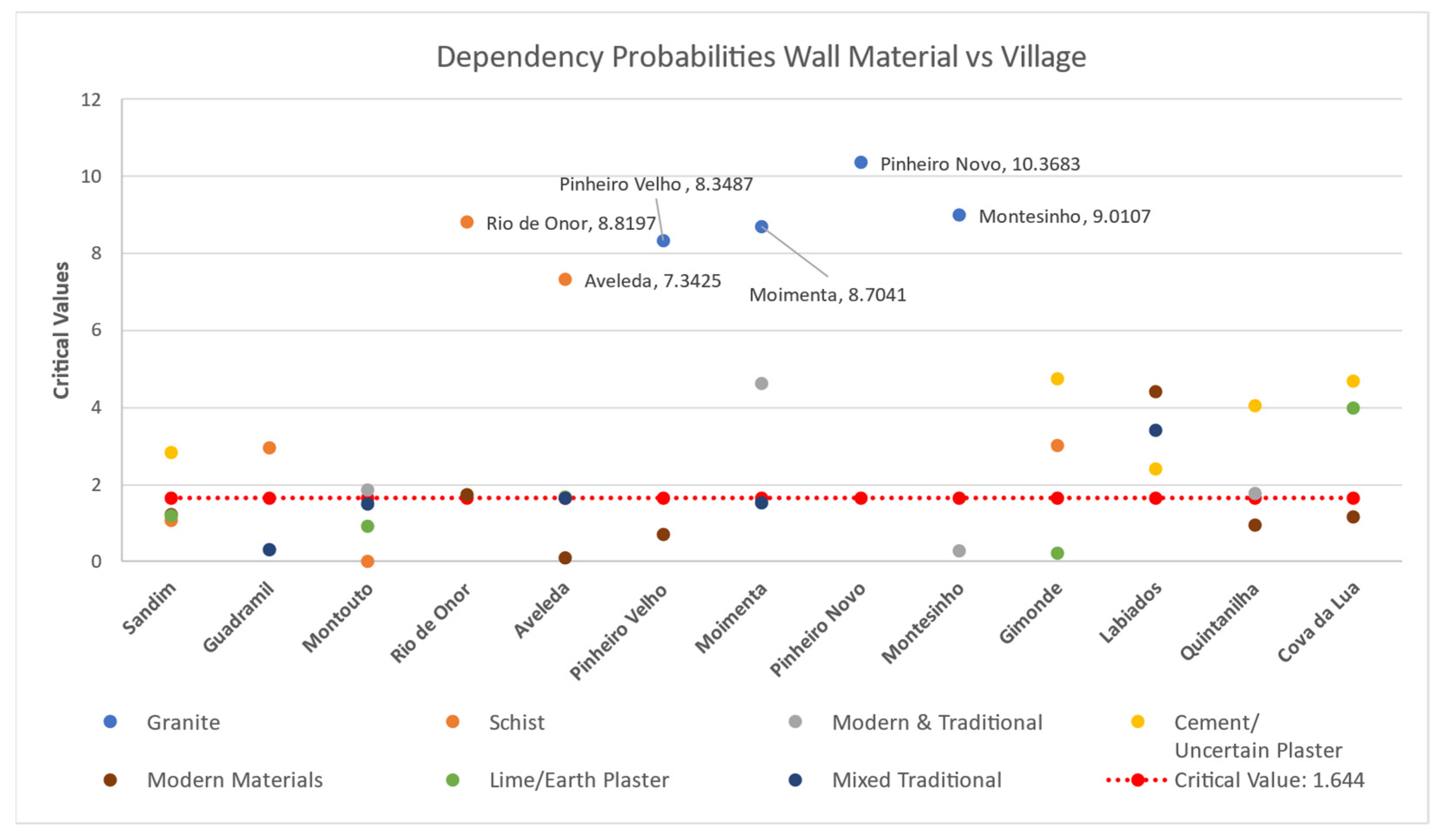
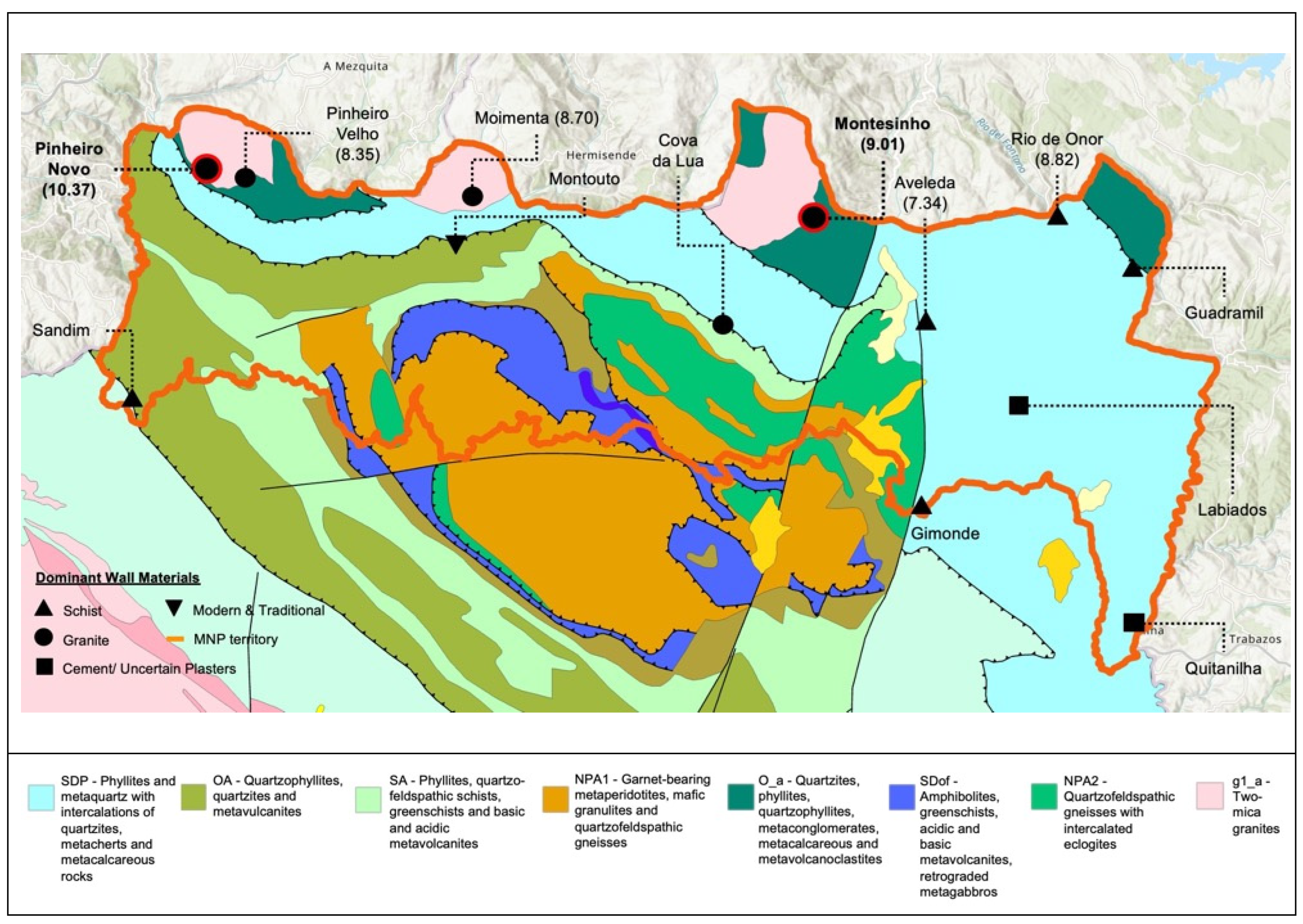
- Geological Scale (Regional Survey): A preliminary inspection of 1620 buildings across 13 villages was conducted to map the dominance of granite and schist in wall, roof, and opening materials.
- (b)
- Envelope & Material Scale (Typology): Typological analysis focused on a subset of buildings with intact vernacular characteristics, specifically examining building external composition.
- (c)
- Settlement Scale (Bioclimatic Configuration): Spatial analysis utilised aerial imagery, topographic data, and detailed 3D photogrammetric models to evaluate the village clusters’ responses to environmental exposure. From this analysis, the village of Pinheiro Novo was purposefully selected for its atypical West-facing slope to challenge standard assumptions about passive solar orientation and topographical shielding, serving as a strategic counterpoint to the conventional South-facing clusters.
3.2. Geomorphological Context (Geological Scale) and Case Study Selection
3.2.1. Lithological Domains
- (a)
- Type 1: Dry Masonry
- (b)
- Type 2: Ashlar Masonry
- (c)
- Type 3: Mortared Masonry
- (d)
- Type 4: Tabique
3.2.2. Lithological and Typological Verification
3.2.3. Case Study Selection and Characterisation
- (a)
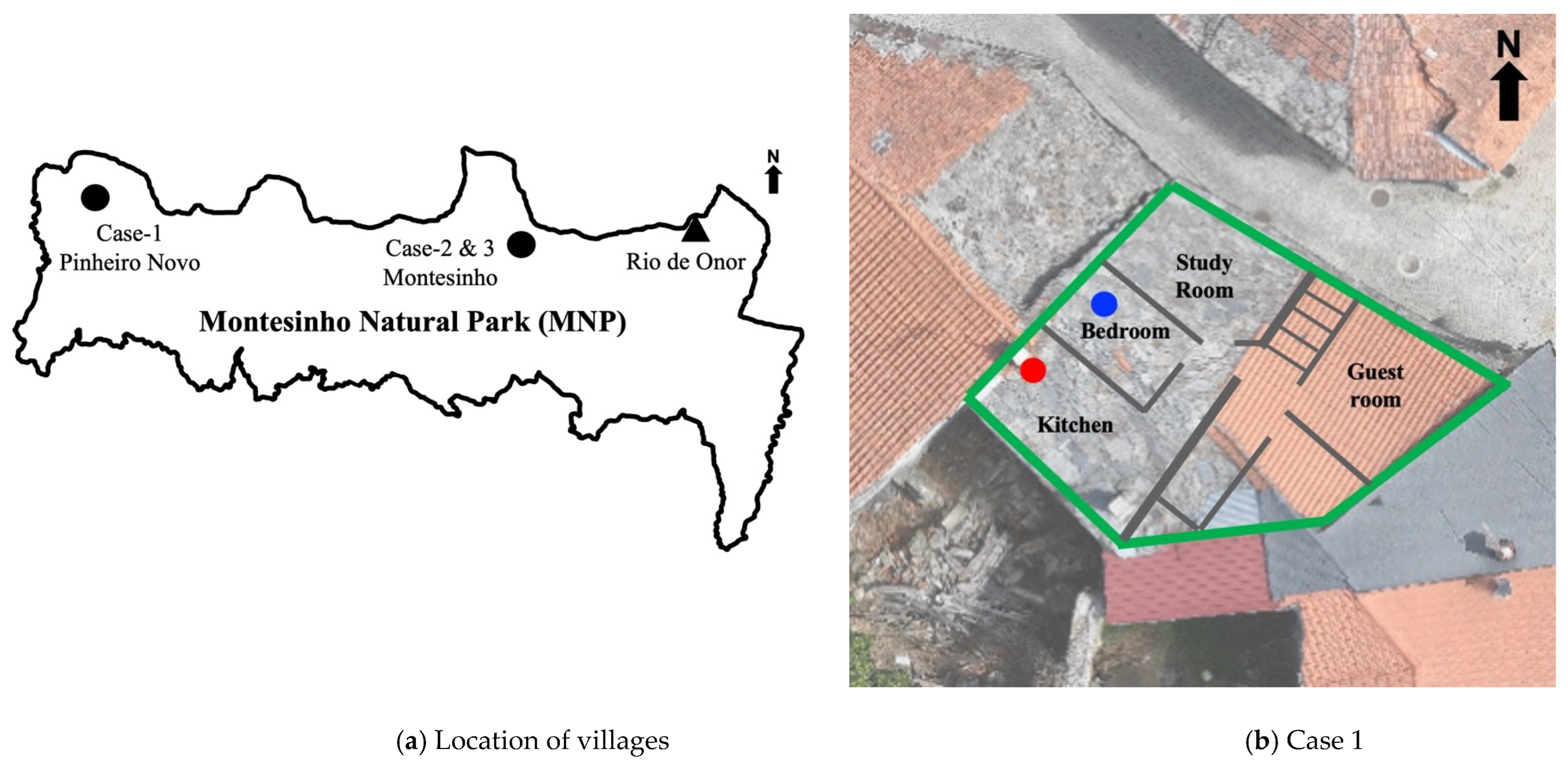
- Case 1 (The Traditional Baseline): Located in Pinheiro Novo with a Northeast primary orientation, this building represents the original “Stone-on-Earth” typology. It features 60–80 cm uninsulated dry-stone granite walls and single-glazed wood frames, occupied full-time by an elderly resident. The monitoring analysis focuses on the bedroom (13.51 m3), which functions as a “sandwiched” thermal zone: it is structurally separated from the primary heat source (kitchen firewood stove at the back) by a 12 cm brick partition and buffered by a study room at the front.
- (b)
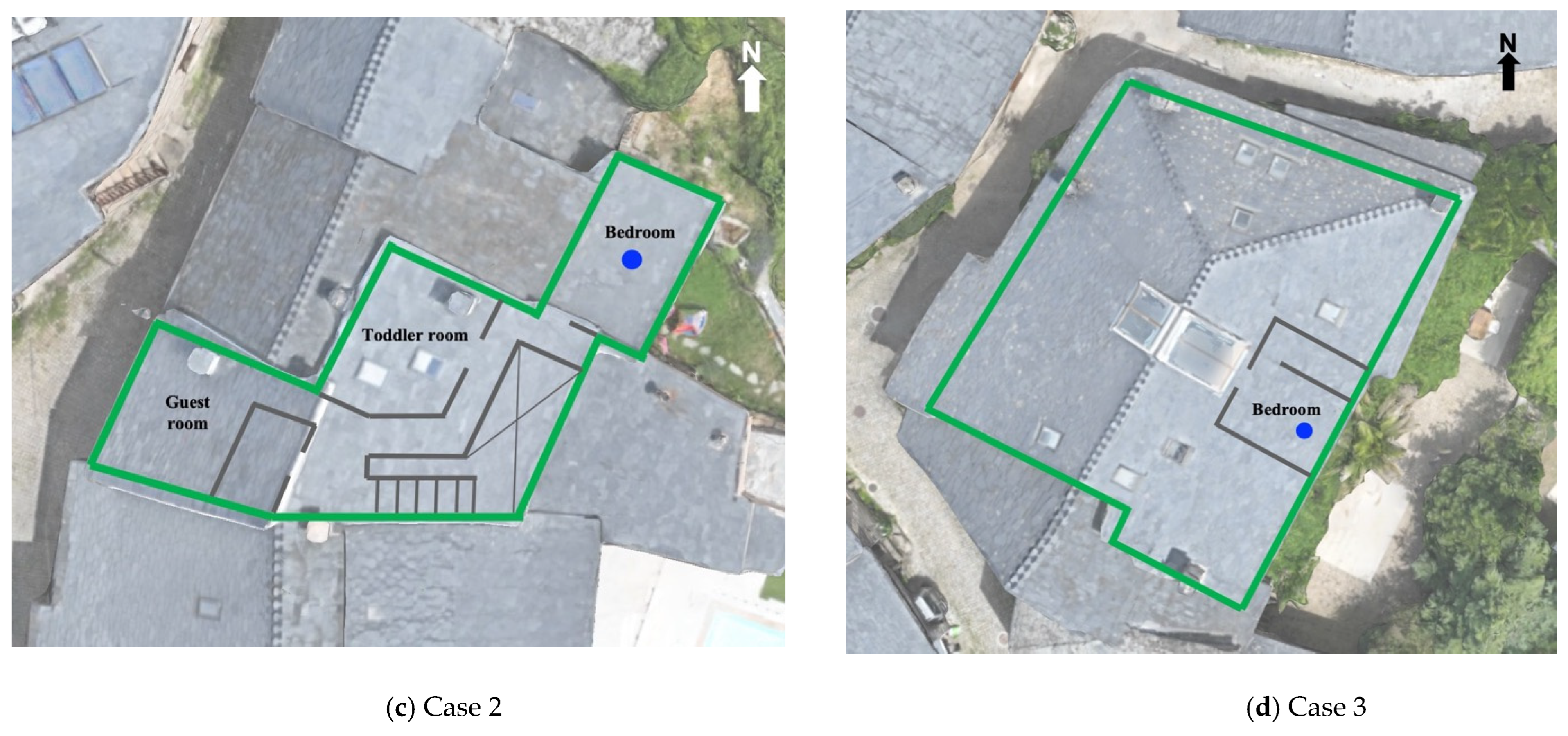
- Case 2 (The Modern Reconstruction): Situated in Montesinho village, this case employs a hybrid structure of reinforced concrete, incorporating internal insulation and double glazing. While the building has a general Northwest orientation, the analysis focuses on a rear bedroom (38.45 m3) with a Southeast-oriented façade. This specific zone features a high façade window-to-wall ratio (WWR) of 0.42, serving as a proxy for analysing high solar gain admission and night-time ventilation potential in a thermally tight yet structurally heterogeneous system heated by a mobile electric unit.
- (c)
- Case 3 (The Rehabilitated Secondary Dwelling): Also located in Montesinho (Northwest orientation), this case represents an internally insulated rehabilitation, retaining the granite appearance but integrating a continuous layer of internal insulation and high-performance frames. It is the only case equipped with a centralised hydronic heating system. The assessment explicitly monitors a specific vaulted 1st-floor bedroom (50.70 m3) with an external wall facing Southeast. This zone functions without proper cross-ventilation, isolating the interaction between internal insulation and solar gain to represent the modern standard for intermittently occupied rural renovations.
3.3. Data Acquisition and Monitoring
- (a)
- Envelope & Material Scale: Internal sensors were installed in the central bedrooms of all three cases (as defined in Section 3.2.3). This single dataset serves a dual analytical purpose:
- Inertia Metrics: To derive the Dynamic Thermal Lag (τ) and amplitude damping metrics by isolating strictly ‘passive windows’ (periods where active heating is entirely inactive).
- Long-Term Habitability: To generate the annual Adaptive Comfort profiles (discussed in Section 4.3) by recording continuous temperatures across all seasons.
- (b)
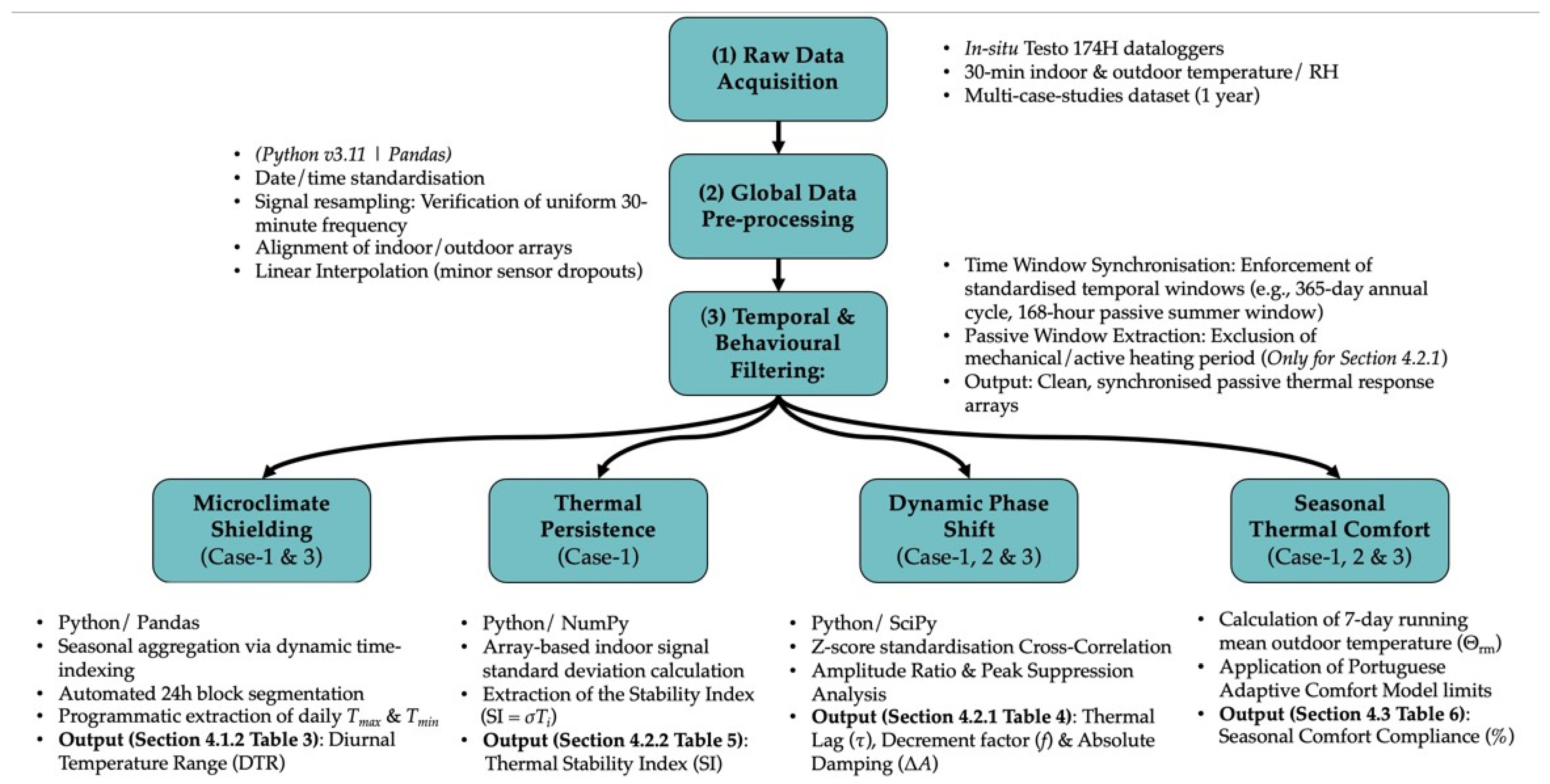
- Settlement Scale: To quantify microclimatic moderation, the external ambient sensors of Pinheiro Novo (Case 1) and Montesinho (Case 3) were cross-referenced. This comparison isolates the Diurnal Temperature Range (DTR) suppression resulting from the specific topographical shielding and morphological clustering of each village, independent of the building envelope.
3.4. Data Processing and Performance Assessment
3.4.1. Passive Metrics (Inertia Analysis)
- (a)
- Thermal Stability Index (SI): The standard deviation of indoor temperatures (σTi), quantifying the passive persistence and resistance to external volatility.
- (b)
- Diurnal Temperature Range (DTR) Moderation: A comparison of daily external temperature amplitudes within village clusters to quantify the microclimatic “shielding” effect of the morphology. The daily DTR is calculated as:DTRdaily = Tmax,daily−Tmin,daily
- (a)
- Thermal Amplitude Damping: The capacity of the envelope to mitigate external thermal loads, quantified via two complementary indices:
- Decrement Factor (f): A dimensionless ratio of the indoor to outdoor temperature amplitudes during the 168 h reference week.
- Absolute Damping (ΔA): The absolute temperature suppression achieved at the peak environmental load, providing an intuitive metric for passive cooling efficacy.
- (b)
- Dynamic Thermal Lag (τ): The temporal offset (phase shift) between standardised outdoor and indoor thermal signals. This is determined by calculating the cross-correlation of the Z-score standardised arrays to identify the time delay that yields the maximum correlation coefficient.
3.4.2. Adaptive Thermal Comfort Assessment
- (a)
- The Operative Temperature Proxy: Following established field monitoring practices in vernacular contexts [42], indoor air temperature (Θa) serves as a robust proxy for operative temperature (Θop) across all three typologies. While the use of globe thermometers would provide higher precision regarding radiant asymmetry, this approximation is physically justified for the specific typologies analysed:
- Case 1 (Passive/Indirect): The absence of direct heating emitters (warmth relies on indirect transfer from the adjacent kitchen) combined with high envelope inertia ensures uniform surface temperatures.
- Case 2 (Convective/Decoupled): The use of mobile electric heaters provides primarily convective heat, directly conditioning the air volume. Crucially, while the building utilises a reinforced concrete structural frame, its envelope system—composed of thermal clay blocks, XPS insulation, and an internal drywall lining (plasterboard)—completely decouples the indoor space from any structural thermal mass. This creates a low-inertia inner surface that equilibrates rapidly with the air temperature, preventing the significant radiant asymmetry that would otherwise occur with high-intensity spot heating.
- Case 3 (Intermittent/Insulated): Although occupancy is seasonal, the internal insulating plaster similarly decouples the indoor space from the cold granite mass. This creates a responsive inner lining that tracks air temperature fluctuations during heating cycles, validating the proxy even under intermittent conditions.
- (b)
- The Adaptive Limits: The model applies distinct algorithms to account for the differing thermal expectations of occupants:
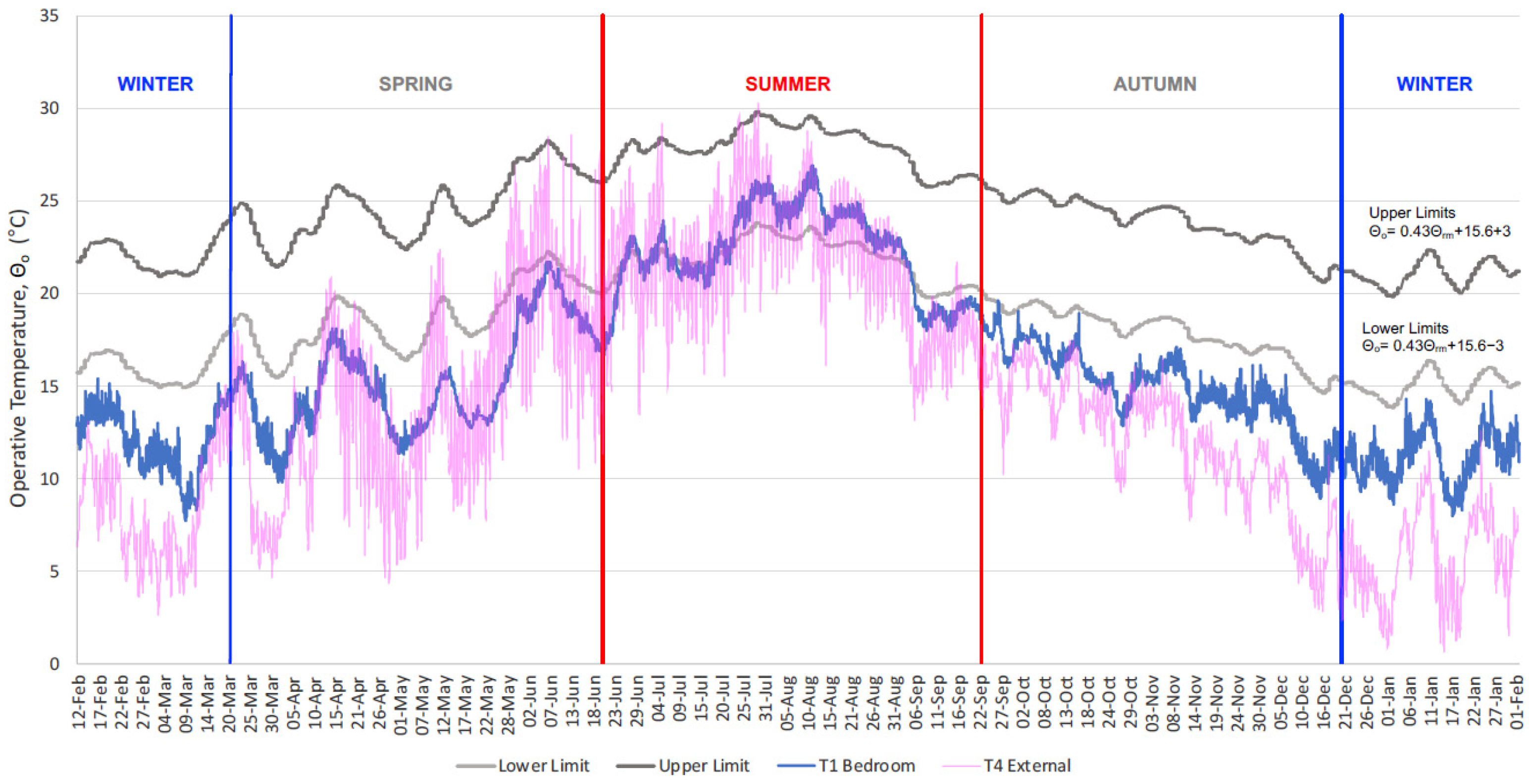
- Case 1 (Naturally Ventilated): Reflecting the specific adaptation to free-running vernacular conditions, the comfort temperature (Θc) follows Matias’s calibrated algorithm (slope 0.43). The applied ±3.0 °C bandwidth corresponds to Category II (Normal Expectation) as defined in EN 15251 [41] (90% acceptability):Θc = 0.43⋅Θrm + 15.6 (±3.0 °C)
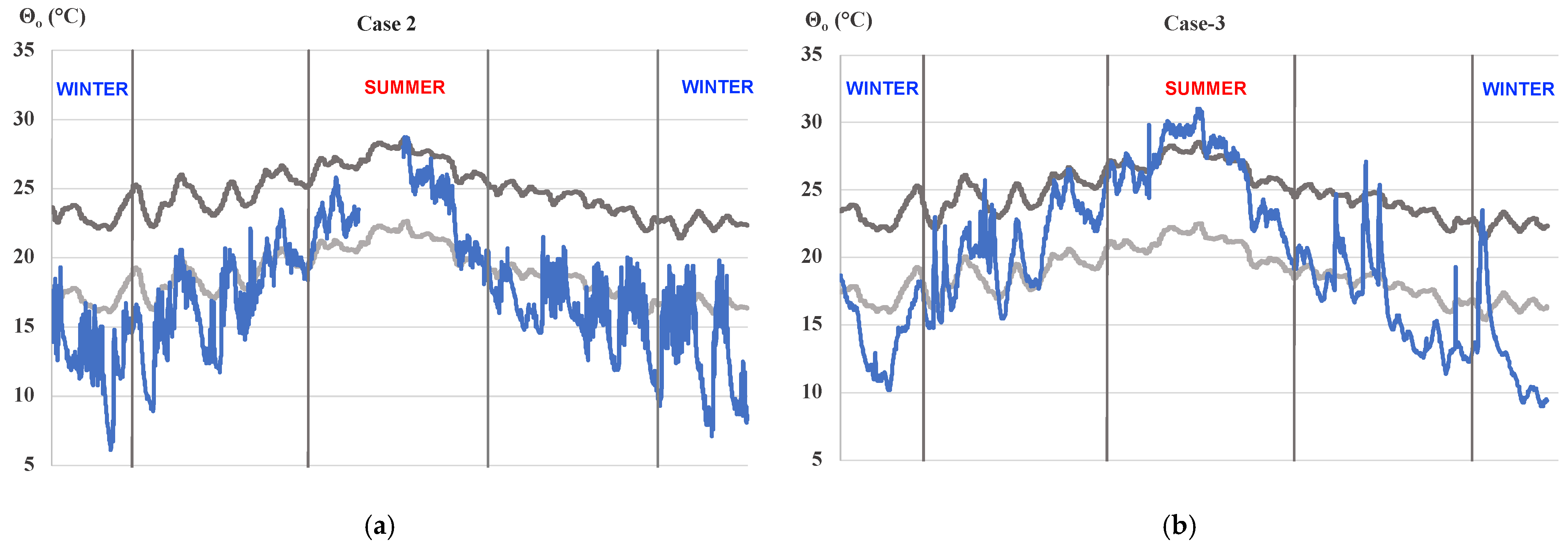
- Cases 2 and 3 (Intermittently Heated): To account for the “modern expectation” of occupants relying on intermittent active heating, the model adopts the standard ASHRAE 55 adaptive coefficient [40,43] which has been validated for the Portuguese context in the TP165 guidelines [39]. A wider ±3.5 °C bandwidth is applied (80% acceptability):
4. Results
- (a)
- Settlement Scale (Section 4.1): Examining how morphological clustering and orientation create a “microclimatic shield” that tempers external exposure and suppresses the Diurnal Temperature Range (DTR).
- (b)
- Envelope & Material Scale (Section 4.2): Quantifying the thermal inertia, phase shift, and amplitude damping of the traditional granite construction system.
- (c)
- Human Scale (Section 4.3): Assessing the final impact on seasonal habitability using the Portuguese Adaptive Comfort Model.
4.1. Settlement Scale: Spatial Organisation and Climatic Strategies
4.1.1. Aerodynamic Strategies: Shielding (Compact) vs. Channelling (Linear)
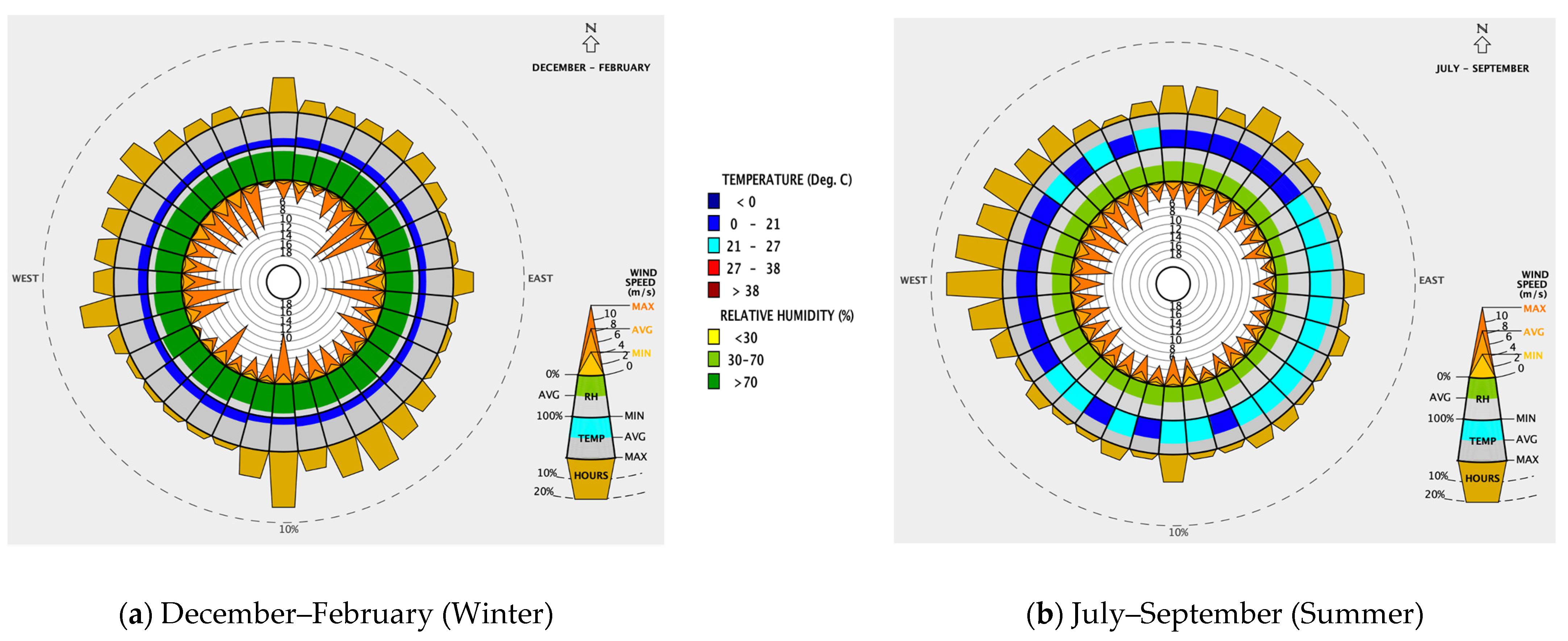
Wind Exposure as a Critical Challenge
- (a)
- The Compact Shielding Strategy (Pinheiro Novo):
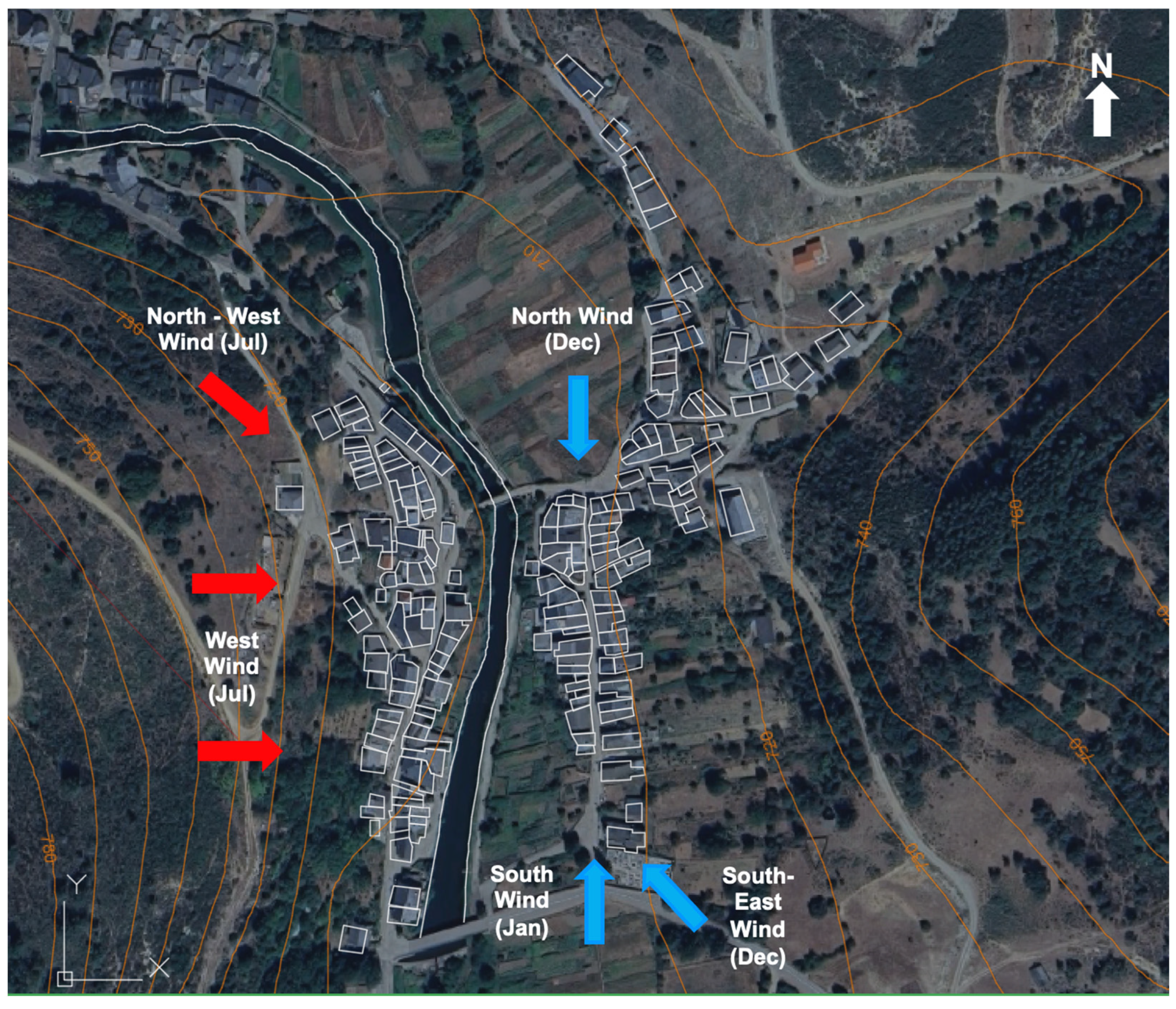
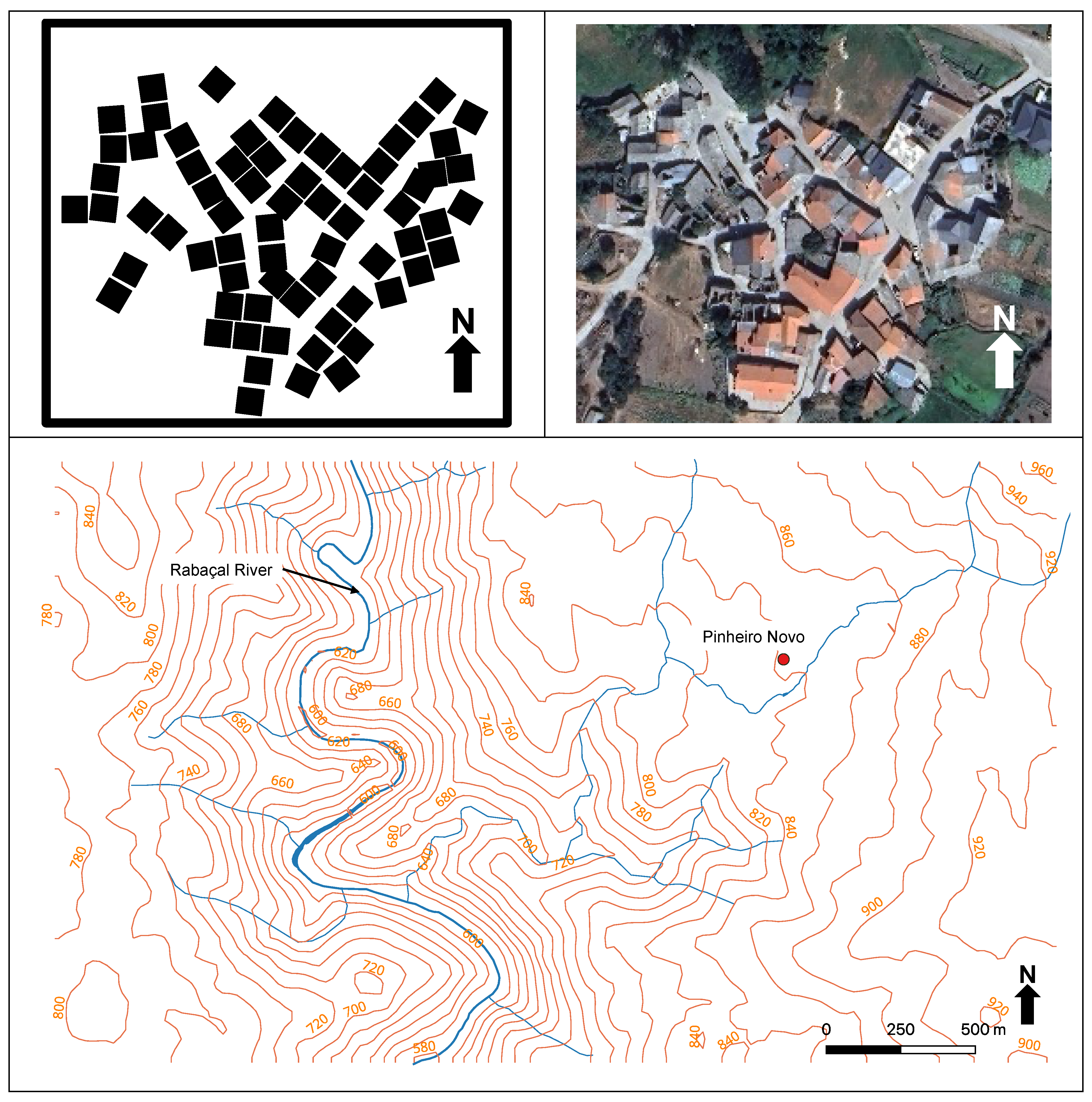
- Siting Logic (Water vs. Sun): Pinheiro Novo is sited on a West-facing slope (830–850 m) to maintain proximity to the Rabaçal river tributaries and fertile agricultural terraces. This socio-economic priority forces a critical trade-off: the location naturally lacks optimal South-facing solar exposure.
- Aerodynamic Defence and Building Adjacency: To survive this exposed positioning, the settlement adopts a dense, irregular morphology heavily dictated by local geology and geomorphology. As shown in Figure 7, the village is strategically sited on a relatively gentle geological terrace nestled between higher protective mountain ridges to the Northeast and a steep river valley descent to the West. Because such moderate terrain is scarce within this rugged geological landscape and historically preserved for agricultural use, the buildable footprint is tightly constrained. This, in part, forces a high-density agglomeration where individual dwellings are rarely isolated. Instead, buildings share multiple party walls. This adjacency is a fundamental passive strategy: by clustering together, the structures drastically reduce their exposed external envelope area (lowering the surface-area-to-volume ratio), which directly minimises winter convective heat loss and provides collective thermal mass buffering. This compact shielding compensates for the lack of solar gain by minimising the envelope’s exposure to the severe North/Southeast winter winds, prioritising heat retention over passive solar potential. While this aerodynamic interpretation is based on qualitative spatial and topographical analysis, its physical efficacy is quantitatively corroborated by the microclimatic sensor data (DTR suppression) presented in Section 4.1.2.
- The Road Network as a Climatic Filter: Furthermore, the circulation patterns are not merely logistical; they act as an extension of the climatic shield. The road network organically traces the geological contour lines of the terraces, resulting in narrow, tortuous pathways. This irregular street geometry deliberately breaks laminar airflow, preventing the cold winter winds from “tunnelling” through the village, while the narrow street profiles ensure mutual shading between adjacent structures during peak summer afternoons.
- (b)
- The Linear Channelling Strategy (Rio de Onor):
- Winter Alignment and Circulation: The village aligns North–South along river banks. Unlike the compact clusters that clump together on steep terrain for warmth, this linear form strictly follows the valley’s geological contours to preserve the fertile agricultural land on the river margin. The road network functions as a central circulation spine. While this orientation exposes the settlement to the cold N/S/SE winds, the linear street grid allows winds to pass through the settlement corridor rather than accumulating static pressure against the building facades. Adjacent buildings are attached sequentially along this road, protecting their lateral walls while leaving the primary front and rear facades exposed for interaction with the street and river.
- Summer Ventilation (NW/W Dominance): During the cooling season, the prevailing Northwest and West winds strike the linear cluster transversely (almost perpendicular to the long facades). Unlike the compact clusters, which block wind, this exposure creates a pressure differential across the shallow building depth, facilitating effective cross-ventilation when occupants open fenestration on opposing front and rear facades.
- Solar Exposure (East–West): Consequently, the primary facades are oriented East and West, deviating from the theoretical South-facing ideal. Instead of steady Southern gain, the buildings accept dynamic solar exposure: receiving direct morning (East) and afternoon (West) sunlight. This morphological outcome parallels the historic Solskifte (“solar village”) typologies of Northern Europe, identified by Rapoport [1] and further documented in medieval settlement studies [48] as a vernacular strategy to ensure equitable solar distribution along a North–South street axis. In Rio de Onor, this linear East–West exposure ensures that, even in deep winter, the facades capture solar access during the limited hours when the sun clears the steep valley ridges. Recent computational simulations [49] indicate that such longitudinal street orientations in mountainous terrain are highly effective at balancing this dynamic insolation with the need for longitudinal ventilation.
4.1.2. Quantitative Validation: Microclimatic Stability and Topographical Calibration
- (a)
- Geomorphological Shielding
- (b)
- Solar Harvesting and Volatility
4.2. Envelope & Material Scale: Envelope Performance and Spatial Layering
4.2.1. Thermal Inertia: Absolute Damping and Time Lag
- (a)
- Traditional Case 1: The superior performance of the Case 1 bedroom is a result of spatial-material synergy. The sensor data reveal that the centrally located bedroom achieves exceptional stability, exhibiting a 16.5 h thermal lag and an Absolute Damping (ΔA) of 3.80 °C. By placing the sleeping quarters in the middle of the building, decoupled from the external granite walls, the traditional typology uses the surrounding rooms as an architectural buffer. This spatial zoning works in tandem with the massive 60–80 cm granite envelope, ensuring the core remains completely immune to daytime peaks by shifting the thermal load entirely into the following nocturnal cycle.
- (b)
- Rehabilitation Case 3: Case 3 fundamentally fails to replicate the passive persistence of the vernacular envelope, exhibiting a near-instantaneous 0.0 h thermal lag and a negative Absolute Damping (−3.10 °C). While the addition of modern internal insulation successfully ‘stops’ external heat conduction, it concurrently triggers a ‘Thermos Effect’. The internal insulation critically decouples the indoor air volume from the high-mass granite walls, preventing the stone from acting as a natural heat sink. Consequently, any admitted solar or internal heat gains become trapped within the heavily insulated and airtight volume, leading to severe summer overheating.
- (c)
- Modern Case 2: The concrete-based reconstruction exhibits total thermal transparency with an immediate thermal response (0.0 h lag). This volatility is driven not only by the comparatively lower thermal mass of the concrete frame but primarily by the high window-to-wall ratio (WWR = 0.42). The large Southeast-facing glazing acts as a ‘Solar Trap’, admitting direct radiant heat that entirely bypasses the envelope’s limited inertia. This indicates that, in modern typologies, aperture geometry (window size and orientation) overrides material mass as the dominant thermal regulator, resulting in immediate temperature spikes in response to solar availability.
4.2.2. Internal Zoning and Hygrothermal Stabilisation
- (a)
- Compositional Ground Coupling: The ground floor’s stone-on-earth construction establishes a direct thermal link with the ground. This geothermal coupling provides a near-constant baseline temperature, allowing the floor to act as a thermal anchor for the entire structure.
- (b)
- Lithological Inertia: The 60–80 cm thick granite masonry provides high-density thermal mass. This composition functions as a “low-pass filter”, blocking high-frequency external temperature spikes and contributing to the 16.5 h thermal lag identified in the material-scale analysis.
- (c)
- Vertical Functional Stratification: The building operates through spatial hierarchy. The unheated ground floor serves as a volumetric buffer, protecting the upper living quarters from ground-level moisture and cold air infiltration. Simultaneously, the horizontal zoning places the bedroom between the kitchen and study, further isolating it from direct envelope interaction. Conversely, the upper floor acts as a “thermal cap”, shielding the storage area from direct atmospheric exposure and solar radiation through the roof. The efficacy of this stratification is evidenced by the suppressed Annual Range (ΔT) of the T3 storage zone (15.8 °C), which is nearly 47% lower than the outdoor environment (29.7 °C), demonstrating the protection provided by the upper-floor ‘thermal cap’.
- (d)
- Hygroscopic Stabilisation: The high-mass envelope and ground coupling also provide significant moisture regulation. While the outdoor relative humidity fluctuates across a violent 78.8% span (21.1% to 99.9%), the ground floor remains anchored around a mean of 72.1% with a significantly narrowed range. This shows the “breathability” and moisture-buffering capacity of the uninsulated stone assembly, which prevents the internal environment from reaching the saturation extremes seen outdoors.
4.3. Seasonal Thermal Comfort Analysis
- (a)
- Winter Disconnect: All typologies struggle to maintain habitability without active heating. Case 1 (Vernacular) records 0% compliance, thermally anchored to the ground temperature (~8–11 °C). Case 2 (Modern) achieves only marginal improvement (13.9%) despite insulation, while Case 3 (Renovated) remains low at 7.8%, indicating that envelope improvements alone are insufficient to overcome the winter thermal deficit.
- (b)
- Summer Inversion: In the cooling season, the performance hierarchy reverses. Case 2 achieves the highest compliance (94.3%), leveraging high permeability for night cooling. In contrast, Case 3 (Renovated) drops to 53.0%, exhibiting frequent overheating peaks as shown in Figure 10b where temperatures exceed the upper limits. Case 1 maintains a moderate 59.5%, primarily through passive damping.
- (c)
- Transitional Delay: A critical divergence appears in spring (May/June). While Case 2 quickly adapts to rising outdoor temperatures (21.9% compliance), Case 1 remains at 0%, denoting a significant thermal lag in the high-mass envelope.
5. Discussion: The Multiscale Logic of Vernacular Bioclimatic Strategies
5.1. Geological and Envelope Logic: The Inertial Filter
- (a)
- Case 1 (Traditional): Relies on “Inertial Delay”, prioritising long-term stability.
- (b)
- Case 2 (Modern): Exhibits aperture-driven volatility. The instantaneous thermal response (0.0 h lag) is driven by the synergy between the high WWR (0.42) and the corner exposure. With two external reinforced concrete walls and large glazing, the room suffers from multidirectional transmissivity. It gains heat rapidly through the glass during the day but loses it equally fast through the uninsulated corner and glazing at night, indicating that aperture geometry overrides material mass in this typology.
5.2. The Paradox of Stability and Habitability
5.2.1. Summer: The Inversion (Ventilation vs. Insulation)
- (a)
- Case 1 (The Passive Base): The traditional dwelling achieves stability (59.5% compliance) through Inertial Resistance. Relying on the 16.5 h thermal lag of the granite envelope, it delays heat penetration. However, the monitoring reveals a limitation: the “sandwiched” internal zoning prevents effective cross-ventilation. Consequently, the building exhibits “Inertial Drag”: while the massive envelope suppresses peak temperatures during a heatwave, its sandwiched zoning prevents it from flushing accumulated heat at night, creating a slow but persistent warming effect during prolonged extreme thermal events.
- (b)
- Case 2 (The Ventilated Success): Surprisingly, the modern concrete building offers the most manageable summer conditions (94.3% compliance). This underscores the critical importance of Active Adaptive Behaviour. While the owners utilise the space on an intermittent basis (approximately fortnightly), their active management of the high WWR (0.42) during occupied periods becomes the primary asset. Occupants open the windows to induce cross-ventilation, flushing warm air instantly. This strongly indicates that, in this climate, the operational ability to ‘dump’ heat (high permeability) is often more valuable than the envelope’s ability to resist it (insulation).
- (c)
- Case 3 (The “Heat Trap” Risk): Crucially, the retrofitted building reveals the danger of combining internal insulation with restricted ventilation. The internal thermal plaster reduces the granite’s ability to act as a heat sink. This is severely exacerbated by the building’s intermittent occupancy profile; operational protocols dictate that doors remain sealed during vacant periods. Consequently, any admitted solar gains become permanently trapped inside the airtight volume. Combined with a tighter envelope and a severely restricted Window-to-Wall Ratio (WWR = 3.98%), the solar and internal gains are trapped inside. Empirically evidenced by the negative Absolute Damping (−3.10 °C), the room becomes a stagnant “thermos”, forcing indoor temperatures significantly above external extremes due to a complete absence of cross-ventilation.
5.2.2. Winter: The Three Modes of Failure
- (a)
- Case 1 (The Zoning Failure): The 0% winter compliance indicates a compound failure. The issue is not just the uninsulated stone but the Morphological Disconnect:
- Lateral Disconnect: The 12 cm brick partition acts as a thermal break, decoupling the sleeper from the kitchen heat source.
- Vertical Loss: The uninsulated timber ceiling and slate roof facilitate a “Stack Effect”, allowing heat to escape vertically before it can warm the volume. Thus, the vernacular Thermal Crypt is created by the inability of the layout to distribute heat laterally and the inability of the roof to retain it vertically. Consequently, the sleeping quarters remain thermally anchored to the ground’s geothermal baseline (~8–11 °C).
- (b)
- Case 2 (The Solar Trap Vulnerability): Despite internal insulation and double glazing, Case 2 remains cold (13.9% compliance). The culprit is the high WWR (0.42) combined with an intermittent occupancy profile. While large windows admit solar gain during the day, they act as rapid heat-loss bridges at night. Because the owners occupy the dwelling intermittently and rely only on a mobile electric heater, the space lacks continuous thermal input. The heater lacks the radiative capacity to counter the overnight geometric heat loss, meaning the architecture works against the occupant.
- (c)
- Case 3 (The Geometric and Inertial Liability): The low compliance (7.8%) reveals a fundamental failure in the renovation strategy, where aesthetic spatial changes compromised thermal performance. This is driven by three converging factors:
- Loss of Buffer Zone: Unlike Case 1, which utilises an unconditioned attic space as a thermal buffer, the high sloped ceiling couples the conditioned volume directly to the external roof envelope. Even with insulation, the elimination of the “attic air gap” increases the rate of heat flux compared to the buffered vernacular section.
- Uncharged Thermal Mass: The unit lacks a continuous heat source (cooking/occupancy) to “charge” the granite inertia. Consequently, the massive walls act as a “heat sink”. During vacancy, the granite cools to the ambient baseline, and the internal insulation—insulating thermal plaster, a premixed mortar with expanded polystyrene (EPS) beads)—is insufficient to stop the walls from draining heat from the air.
- Volumetric Dilution: These losses are compounded by the expanded air volume (50.70 m3) of the extended height space, which dilutes the heating system’s output and encourages stratification. The result is a system-dependent typology. Without the passive protection of a buffer zone or charged mass, the building relies entirely on active energy. When that system is intermittent (vacancy), the indoor temperature collapses immediately.
5.2.3. Shoulder Seasons (Spring and Autumn): The Inertial Drag
- (a)
- Case 1 (The Seasonal Flywheel): The massive envelope, saturated with winter cold, resists the outdoor warming trend well into June. As noted in the monitoring analysis, this creates a “Cold Lag”: the building remains cool during peaks but fails to warm up quickly enough during the transition. This is driven by a convergence of morphological and meteorological factors:
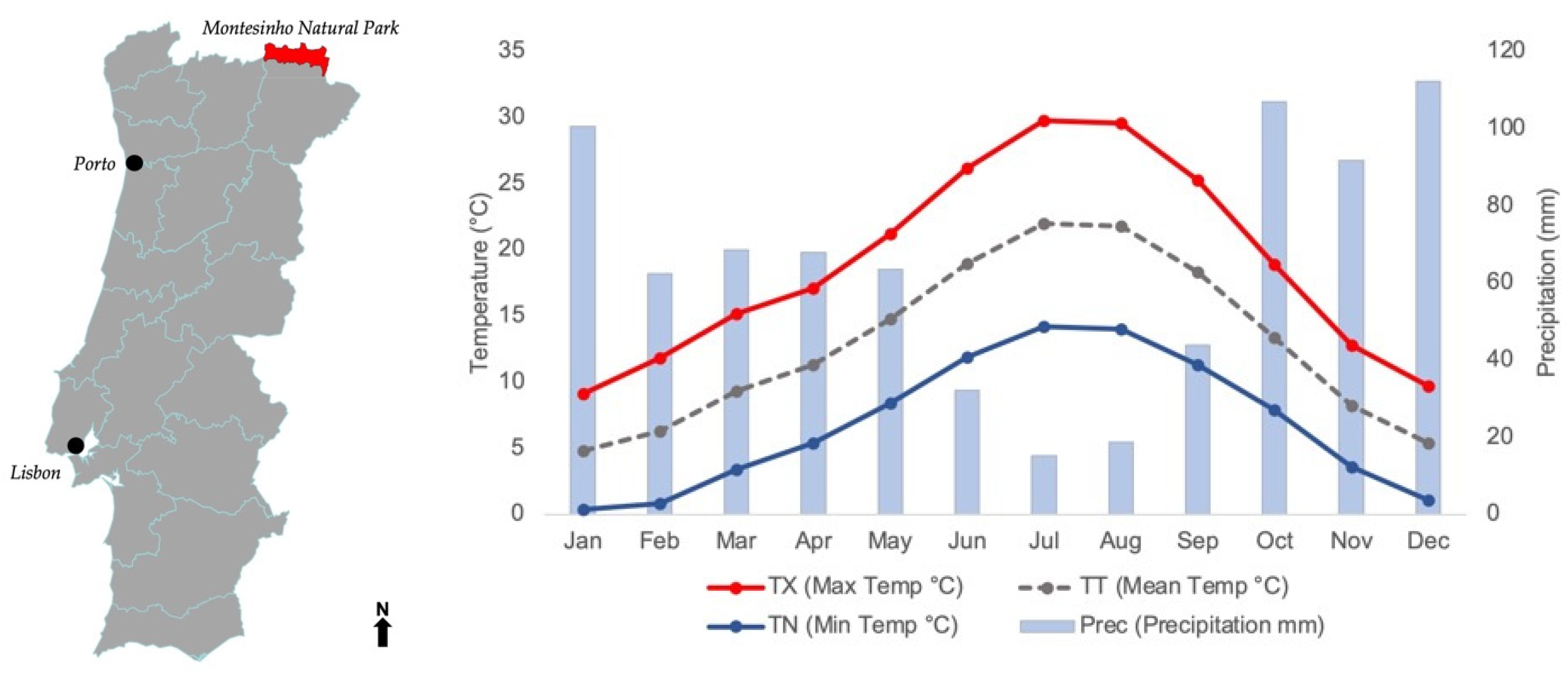
- Meteorological Obstruction: Climatological data [26] indicate that May is characterised by significant precipitation (63.4 mm) and cloud cover, reducing the direct solar radiation available to charge the thermal mass.
- Solar Access Deficit: Even when solar gain occurs, the unfavourable orientation (NE) and the internalised zoning prevent effective heat transfer. Consequently, the dwelling acts as a “heat sink”, thermally anchoring the occupant to the cold granite baseline rather than the warming ambient air. This illustrates that Vernacular Inertia is a “Non-Selective Filter”: without active management (apertures/vents), it indiscriminately dampens thermal change, delaying beneficial warming just as effectively as it blocks detrimental peaks.
- (b)
- Case 2 (The Diurnal Collector): Unlike the vernacular, the modern typology does not exhibit this specific inertia lag and undercooling phenomenon during the transition period (spring/May) despite being exposed to the same meteorological conditions. This divergence is driven by Responsivity:
- Solar Capture: Case 2’s high WWR (0.42) allows it to harvest diffuse solar radiation even during cloudy May days (“Greenhouse Effect”), breaking the thermal inertia lock.
- Volumetric Heat Capacity: The reduced wall thickness of the modern envelope requires significantly less thermal energy to elevate its internal temperature compared to the deep lithological mass of Case 1. Thus, while Case 1 acts as a “Seasonal Flywheel” (carrying winter cold into summer), Case 2 acts as a “Diurnal Collector”, resetting its thermal state much faster.
- (c)
- Case 3 (The Assisted Thermos Advantage): While the combination of internal insulation and restricted aperture (WWR 3.98%) creates severe overheating in summer, Table 6 reveals a striking anomaly: Case 3 achieves a remarkable 72.97% compliance during the spring transition. Unlike the deep winter, where intermittent heating fails to overcome the extreme cold of the uncharged mass (7.8% compliance), the milder spring baseline completely changes the operational dynamic. When guests are present, the centralised hydronic system requires significantly less energy to bridge the thermal gap. Once warmed, the internal insulation effectively traps this active heat generation, along with mild daytime solar gains. During spring, the “Thermos Effect” acts as a distinct advantage, maintaining the comfortable conditions established by the active system long into the vacant periods.
5.3. Implications for Retrofitting: Balancing Inertia and Connectivity
- (a)
- Preserve the Lag: The success of Case 1 in summer strongly indicates that the 16.5 h thermal lag is a valuable asset. Retrofits must avoid interventions that decouple the internal space from this thermal mass, as seen in the reduced summer compliance of Case 3 (53.0%), where internal insulation created a “Heat Trap”.
- (b)
- Manage Aperture: The success of Case 2 in summer (through cross-ventilation) challenges the notion that thermal transparency is purely negative. Retrofits should integrate “Adaptive Apertures”—large openings for summer night-purging that can be thermally shuttered (insulated) during winter nights to prevent the heat loss observed in the modern typology.
- (c)
- Passive Connectivity and Volume Management: Energy efficiency in the MNP cannot be solved by envelope insulation alone. The “Zoning Failure” suggests that retrofits must establish Passive Thermal Connectivity. However, simply removing partitions risks expanding the heated volume beyond the capacity of the wood stove. Therefore, a sustainable strategy requires:
- Horizontal Insulation: Insulating the roof/ceiling plane to stop vertical heat loss.
- Indirect Convective Loops: Introducing high-level passive vents (transoms) above internal doors. This facilitates a natural thermosiphon, allowing buoyant clean warm air to circulate from the kitchen ceiling into the sleeping quarters, while keeping the combustion source structurally separate.
6. Conclusions
- (a)
- Geological Scale (The Resource): The statistical analysis revealed a direct dependency between settlement location and lithological availability. The analysis indicates that the vernacular construction is strictly “site-specific”, utilising the locally available high-density granite not just for economic reasons, but for its thermal persistence. This massive lithological resource provides the foundational inertia required to counteract the region’s climatic volatility.
- (b)
- Envelope & Material Scale (The Inertial Filter): Translating this material resource into a typological system, the “Stone-on-Earth” envelope functions as a low-pass filter. The monitoring data revealed that this specific assembly (Case 1), integrating massive walls with buffer zones, generates a 16.5 h thermal lag, a peak Absolute Damping of 3.80 °C, and a high stability index (SI = 4.11). This configuration successfully suppresses the annual temperature range by nearly 47%, ensuring internal stability during the critical summer months.
- (c)
- Settlement Scale (The Shielding Strategy): Critically, the study establishes that building performance is further amplified by the settlement scale. Topographical analysis revealed that the sheltered positioning of Pinheiro Novo acts as a primary buffer, suppressing the Diurnal Temperature Range (DTR) by 20.5% compared to exposed high-altitude clusters. This suggests that the vernacular system “pre-conditions” the microclimate before it interacts with the building fabric.
Author Contributions
Funding
Institutional Review Board Statement
Informed Consent Statement
Data Availability Statement
Conflicts of Interest
Abbreviations
| ASHRAE | American Society of Heating, Refrigerating and Air-Conditioning Engineers |
| DTR | Diurnal Temperature Range |
| EPS | Expanded Polystyrene |
| IPMA | Portuguese Institute of the Sea and the Atmosphere |
| LNEC | National Laboratory of Civil Engineering |
| MNP | Montesinho Natural Park |
| RH | Relative Humidity |
| SI | Stability Index |
| WWR | Window-to-Wall Ratio |
References
- Rapoport, A. House Form and Culture; Prentice Hall: Englewood Cliffs, NJ, USA, 1969. [Google Scholar]
- Ben-Alon, L.; Rempel, A.R. Thermal comfort and passive survivability in earthen buildings. Build. Environ. 2023, 238, 110339. [Google Scholar] [CrossRef]
- Baniassadi, A.; Sailor, D.J.; Scott Krayenhoff, E.; Broadbent, A.M.; Georgescu, M. Passive survivability of buildings under changing urban climates across eight US cities. Environ. Res. Lett. 2019, 14, 074028. [Google Scholar] [CrossRef]
- Khei, S.; Mateus, R.; Ortega, J.; Briones-Llorente, R. Quantitative Analysis of Vernacular Residential Building Typologies and Bioclimatic Strategies in the Warm-Summer Mediterranean Climate: The Montesinho Natural Park as a Case Study. Buildings 2024, 14, 2321. [Google Scholar] [CrossRef]
- Vellinga, M. The noble vernacular. J. Archit. 2013, 18, 570–590. [Google Scholar] [CrossRef]
- Oliver, P. Built to Meet Needs, 1st ed.; Elsevier Ltd.: Amsterdam, The Netherlands, 2006. [Google Scholar]
- Vellinga, M.; Oliver, P.; Bridge, A. Atlas of Vernacular Architecture of the World; Routledge: Abingdon, UK, 2008. [Google Scholar]
- Fathy, H. Natural Energy and Vernacular Architecture; University of Chicago Press: Chicago, IL, USA, 1986. [Google Scholar]
- Olgyay, V. Design with Climate: Bioclimatic Approach to Architectural Regionalism; Reprinted 2015 with New Foreword by Kenneth Frampton; Princeton University Press: Princeton, NJ, USA, 1963. [Google Scholar]
- Watson, D.; Labs, K. Climatic Design: Energy-Efficient Building Principles and Practices; McGraw-Hill Book Company: New York, NY, USA, 1983. [Google Scholar]
- Genovese, P.V.; Zoure, A.N. Architecture trends and challenges in sub-Saharan Africa’s construction industry: A theoretical guideline of a bioclimatic architecture evolution based on the multi-scale approach and circular economy. Renew. Sustain. Energy Rev. 2023, 184, 113593. [Google Scholar] [CrossRef]
- Thravalou, S.; Michael, A.; Neophytou, M.; Philokyprou, M. The Ventilation Capacity of Earthen Vernacular Buildings with Timber Projections (Sachnisi) in Dense Urban Canyons—Findings from a Field Study in the Mediterranean. IOP Conf. Ser. Earth Environ. Sci. 2023, 1196, 012089. [Google Scholar] [CrossRef]
- Rijal, H.B. Thermal adaptation of buildings and people for energy saving in extreme cold climate of Nepal. Energy Build. 2021, 230, 110551. [Google Scholar] [CrossRef]
- Correia, M.; Dipasquale, L.; Mecca, S. VERSUS: Heritage for Tomorrow Vernacular Knowledge for Sustainable Architecture; Repositório Institucional UPT; Firenze University Press: Florence, Italy, 2014. [Google Scholar]
- Herrle, P.; Wozniak, A. Documenting Heritage at Risk: Vernacular Farm Houses in the Eastern Tibetan Cultural Region. Built Herit. 2018, 2, 85–107. [Google Scholar] [CrossRef]
- Ferrari, E.P. High Altitude Houses Vernacular Architecture of Ladakh; DIDA Press; Florence University Press: Florence, Italy, 2018. [Google Scholar]
- Chandel, S.S.; Sharma, V.; Marwah, B.M. Review of energy efficient features in vernacular architecture for improving indoor thermal comfort conditions. Renew. Sustain. Energy Rev. 2016, 65, 459–477. [Google Scholar] [CrossRef]
- Philokyprou, M.; Michael, A.; Malaktou, E.; Savvides, A. Environmentally responsive design in Eastern Mediterranean. The case of vernacular architecture in the coastal, lowland and mountainous regions of Cyprus. Build. Environ. 2017, 111, 91–109. [Google Scholar] [CrossRef]
- Rijal, H.B.; Yoshida, H. Comparison of summer and winter thermal environment in traditional vernacular houses in several areas of Nepal. In Advances in Building Technology; Elsevier: Amsterdam, The Netherlands, 2002; pp. 1359–1366. [Google Scholar] [CrossRef]
- Rijal, H.B. Passive Cooling of the Traditional Houses of Nepal. In Sustainable Houses and Living in the Hot-Humid Climates of Asia; Springer: Singapore, 2018; pp. 397–406. [Google Scholar] [CrossRef]
- Al-Sallal, K.A. Learning Sustainability from Arab Gulf Vernacular Architecture. In Mediterranean Green Buildings and Renewable Energy: Selected Papers from the World Renewable Energy Network’s Med Green Forum; Springer: Cham, Switzerland, 2017; pp. 885–897. [Google Scholar] [CrossRef]
- Martins, N.; Nóvoa, T. Técnicas de Construção de Alvenarias Tradicionais em Pedra do Nordeste Transmontano. In Perpetuar Memórias da Construção; Esmeralda, P., Xavier, R., António, A., Eds.; Instituto da Construção: Porto, Portugal, 2015; pp. 103–115. [Google Scholar]
- Gonçalves, J.; Mateus, R.; Fernandes, J.; Ferreira, T. Tradition in Continuity: Thermal monitoring in vernacular architecture of farmsteads from northeast Portuguese region of Trás-os-Montes. In Portugal SB13 Contribution of Sustainable Building to Meet EU 20-20-20 Targets; Bragança, L., Pinheiro, M., Mateus, R., Eds.; Universidade do Minho/Instituto Superior Técnico: Guimarães, Portugal, 2013; pp. 259–267. [Google Scholar]
- Oliveira, E.V.; de Galhano, F. Arquitectura Tradicional Portuguesa, 5th ed.; Publicações Dom Quixote: Lisboa, Portugal, 2003. [Google Scholar]
- Arias Tapiero, J.C.; Graus, S.; Khei, S.; Silva, D.; Conde, O.; Ferreira, T.M.; Ortega, J.; Luso, E.; Rodrigues, H.; Vasconcelos, G. An ICT-Enhanced Methodology for the Characterization of Vernacular Built Heritage at a Regional Scale. Int. J. Archit. Herit. 2024, 19, 966–984. [Google Scholar] [CrossRef]
- IPMA. Normais Climatológicas 1991–2020: Bragança (Estação 575); IPMA: Lisboa, Portugal, 2024. [Google Scholar]
- AAVV. Atlas Climático Ibérico: Temperatura do Ar e Precipitação (1971–2000); Agencia Estatal de Meteorología; Instituto de Meteorologia de Portugal: Madrid, Spain, 2011. [Google Scholar]
- Instituto de Conservação da Natureza (ICN). Plano de Ordenamento do Parque Natural de Montesinho (POPNM); Estudos de Caracterização: Bragança, Portugal, 2007. [Google Scholar]
- Peel, M.C.; Finlayson, B.L.; McMahon, T.A. Updated world map of the Köppen-Geiger climate classification. Hydrol. Earth Syst. Sci. 2007, 11, 1633–1644. [Google Scholar] [CrossRef]
- Pereira, M.L.F. Caraterização Térmica de Soluções Construtivas em Xisto e Em Granito. Master’s Thesis, Universidade de Trás-os-Montes e Alto Douro, Vila Real, Portugal, 2016. [Google Scholar]
- Barroso, C.E.; Oliveira, D.V.; Ramos, L.F. Physical and mechanical characterization of vernacular dry stone heritage materials: Schist and granite from Northwest Portugal. Constr. Build. Mater. 2020, 259, 119705. [Google Scholar] [CrossRef]
- Antunes Ada, M.; Gomes, A.A.; Menéres, A.; de Freitas, A.P.; Araújo, A.; Martins, A.P.; Dias, C.C.; de Castro, C.; Távora, F.; Torres, F.; et al. Arquitectura Popular em Portugal, 3rd ed.; Associação dos Arquitectos Portugueses: Lisboa, Portugal, 1988; Volume 1. [Google Scholar]
- Azevedo, T. Arquitetura Vernácula em Guadramil. Master’s Thesis, Escola Superior Gallaecia, Vila Nova de Cerveira, Portugal, 2012. [Google Scholar]
- Dos Santos, C.A.P.; Rodrigues, R. Coeficientes de Transmissão Térmica de Elementos Opacos da Envolvente dos Edifícios. In Soluções Construtivas de Edifícios Antigos. Soluções Construtivas das Regiões Autónomas—ITE 54, 1st ed.; Laboratório Nacional de Engenharia Civil (LNEC): Lisboa, Portugal, 2009. [Google Scholar]
- BIOURB. Diversidade Bioconstrutiva Transfronteiriça, Edificação Bioclimática ea sua Adaptação Pela Arquitetura eo Urbanismo Modernos—Soluções Singulares Bioclimáticas; BIOURB: León, Spain, 2013. [Google Scholar]
- Fernandes Anjo, A. Sustentabilidade Arquitetónica a Partir de Uma Perspetiva Termodinâmica: Aprender Com a Arquitetura Vernacular em Trás-os-Montes. Master’s Thesis, Universidade do Coimbra, Coimbra, Portugal, 2020. [Google Scholar]
- Pinho, F.F.S. Paredes de Edifícios Antigos em Portugal. Coleção Edifícios. No 8; Laboratório Nacional de Engenharia Civil (LNEC): Lisboa, Portugal, 2000. [Google Scholar]
- BS EN ISO 7726; Ergonomics of the Thermal Environment-Instruments for Measuring Physical Quantities. British Standards (BSi): London, UK, 2001.
- Matias, L. TPI65—Desenvolvimento de um Modelo Adaptativo para Definicão das Condições de Conforto Térmico em Portugal; Laboratório Nacional de Engenharia Civil/National Laboratory of Civil Engineering: Lisboa, Portugal, 2010. [Google Scholar]
- ANSI/ASHRAE Standard 55-2017; Thermal Environmental Conditions for Human Occupancy. American Society of Heating, Refrigerating and Air-Conditioning Engineers: Atlanta, GA, USA, 2017.
- CEN.EN 15251:2007; Indoor Environmental Input Parameters for Design and Assessment of Energy Performance of Buildings Addressing Indoor Air Quality, Thermal Environment, Lighting and Acoustics. European Committee for Standardization (CEN): Brussels, Belgium, 2007.
- Foruzanmehr, A.; Vellinga, M. Vernacular architecture: Questions of comfort and practicability. Build. Res. Inf. 2011, 39, 274–285. [Google Scholar] [CrossRef]
- Brager, G.S.; De Dear, R. Climate, Comfort & Natural Ventilation: A new adaptive comfort standard for ASHRAE Standard 55. In Proceedings of the Moving Thermal Comfort Standards into the 21st Century, Windsor, UK, 5–8 April 2001; Oxford Centre for Sustainable Development: Oxford, UK, 2001. [Google Scholar]
- IPMA. Normais Climatológicas (1971–2000). Portuguese Institute of the Sea and the Atmosphere 2000. Available online: https://www.ipma.pt/bin/file.data/climate-normal/cn_71-00_BRAGANCA.pdf (accessed on 21 April 2023).
- Barua, D.K. Beaufort Wind Scale. In Encyclopedia of Coastal Science; Finkl, C.W., Makowski, C., Eds.; Encyclopedia of Earth Sciences Series; Springer: Cham, Switzerland, 2019; pp. 315–317. [Google Scholar] [CrossRef]
- Auliciems, A.; Szokolay, S.V. Thermal Comfort, 2nd ed.; Vol. PLEA Notes, Note 3; PLEA in Association with Department of Architecture, University of Queensland: Brisbane, Australia, 2007. [Google Scholar]
- Hernández, A.; Fariña, J.; Fernandez, V.; Gálvez, M.A.; Gonçalves, A.; Ribeiro, A.C.; Feliciano, M. Manual de Desenho Bioclimático Urbano; Manual de Orientações Para a Elaboração de Normas Urbanísticas; Instituto Politécnico de Bragança: Bragança, Portugal, 2013. [Google Scholar]
- Dohnal, M. Village and landscape arrangement in medieval and early modern northern Europe [Regulace vesnického osídlení a krajiny ve středověké a novověké severní Evropě]. Cesky Lid 2009, 96, 279–308. [Google Scholar]
- Lei, Y.; Zhou, H.; Li, Q.; Liu, Y.; Li, J.; Wang, C. Investigation and Evaluation of Insolation and Ventilation Conditions of Streetscapes of Traditional Settlements in Subtropical China. Buildings 2023, 13, 1611. [Google Scholar] [CrossRef]
- Fernandes, J.; Malheiro, R.; De Fátima Castro, M.; Gervásio, H.; Silva, S.M.; Mateus, R. Thermal performance and comfort condition analysis in a vernacular building with a glazed balcony. Energies 2020, 13, 624. [Google Scholar] [CrossRef]
- Fernandes, J.; Mateus, R.; Gervásio, H.; Silva, S.M.; Branco, J.; Almeida, M. Thermal performance and comfort conditions analysis of a vernacular palafitic timber building in portuguese coastline context. Sustainability 2020, 12, 10484. [Google Scholar] [CrossRef]
- Fernandes, J.; Mateus, R.; Gervásio, H.; Silva, S.M.; Bragança, L. Passive strategies used in Southern Portugal vernacular rammed earth buildings and their influence in thermal performance. Renew. Energy 2019, 142, 345–363. [Google Scholar] [CrossRef]
- Fabbri, K.; Tronchin, L. The relationship between climate and energy in vernacular architecture in central Italy. In Proceedings of the PLEA 2006—23rd International Conference on Passive and Low Energy Architecture, Conference Proceedings, Geneva, Switzerland, 6–8 September 2006; pp. I95–I99. [Google Scholar]





| Example | Masonry Category | Description |
|---|---|---|
 Rio de Onor | Simple Ordinary Masonry walls (Schist/Granite) |
|
 Pinheiro Novo | Simple Dry Masonry walls (Schist/Granite) |
|
 Pinheiro Novo | Simple ashlar stonework(Exterior) |
|
| Feature Category | Case 1 (The Vernacular Baseline) | Case 2 (The Modern Reconstruction) | Case 3 (The Sensitive Rehabilitation) |
|---|---|---|---|
| Intervention Logic | Non-Intervention/Original structure | Modern “Linear” Reconstruction | Adaptive reuse/Residential conversion |
| Building Adjacency | Terraced (Clustered morphology sharing lateral stone party walls) | Terraced (Inserted between existing granite party walls) | Semi-detached (High exposure: 3 external facades, sharing only the SW party wall) |
| Monitored Zone Volume | 13.5 m3 (1st-floor bedroom) | 38.5 m3 (1st-floor rear bedroom) | 50.7 m3 (1st-floor rear bedroom with vaulted sloped ceiling) |
| Spatial Zoning & Exposure of Monitored Zone | “Sandwiched”: Primarily buffered by adjacent internal rooms | Corner Exposure: Two external walls (Highly glazed SE façade + completely opaque NE façade) | Roof & Façade Exposure: Volume extends directly to the pitched roof (lacking the attic buffer present in the building’s centre), alongside an exposed Southeast external wall |
| Façade Window-to-Wall Ratio (WWR) | ~0% (Internal/indirect light only) | High (42%) glazed façade facing SE | Low (4%) façade facing SE |
| Glazing & Frame Specification | N/A (No external window in monitored zone) | Double-glazed clear glass with timber frame | Double-glazed clear glass with timber frame |
| External Wall Structure | Variable thickness: 60–80 cm double-leaf dry granite masonry | Facades: Reinforced concrete frame infilled with thermal clay blocks. Party Walls: Retained original granite masonry (structurally integrated with new concrete frame). | Original granite masonry (Retained shell) |
| Roof Assembly | Traditional slate and ceramic tiles on uninsulated timber frame (Highly permeable). Includes a naturally ventilated, non-habitable attic buffer | Slate tiles over insulated (XPS) concrete slab with standard ceiling finish. No attic buffer (unventilated structure directly coupled to monitored bedroom) | Slate tiles over insulated (EPS) concrete slab with recreated wooden ceiling. No attic buffer over the monitored zone (unventilated vaulted ceiling) |
| Insulation Strategy | None (Relies entirely on “lithological inertia”) | Internal lining: XPS insulation + laminated plasterboard | Internal lining: Thermal plaster with EPS aggregate |
| Heating System | Indirect Radiant (Borrowed heat from adjacent kitchen wood stove) | Mobile Convective (Electric unit—on/off demand) | Centralised Hydronic (Radiators—intermittent use) |
| Occupancy Profile | Continuous (Full-time elderly resident) | Intermittent (approx. 2 weeks per month) | Intermittent (Secondary dwelling/Short stay) |
| Material Circularity Logic | Indigenous (100% Circular/Zero embodied carbon) | Material Discontinuity (Linear substitution/Industrial concrete logic) | Structural Circularity (Retains heavy shell; compromised by synthetic layer) |
| Thermal Goal | Passive Thermal Resilience | Instant Convective Comfort (Low Inertia) | Normative Habitability |
| Settlement Cluster | Altitude | Orientation/Cluster | Avg. Annual DTR [°C] | Peak Daily Range [°C] |
|---|---|---|---|---|
| Pinheiro Novo (Case 1) | ~840 m | West-Facing, Compact | 4.68 | 15.90 |
| Montesinho (Case 3) * | ~1010 m | South-Facing, Compact | 5.89 | 17.60 |
| Case Study | Typology | Wall Envelope | Thermal Time Lag (τ) [h] | Decrement Factor (f) | Absolute Damping ΔA [°C] |
|---|---|---|---|---|---|
| Case 1 | Traditional | Granite Masonry (Not insulated) | 16.5 | 0.259 | 3.80 |
| Case 2 | Modern | Reinforced concrete frame infilled with thermal clay blocks (Internal insulation) | 0.0 | 0.076 | 2.10 |
| Case 3 | Rehabilitation | Granite Masonry (Internal insulation) | 0.0 | 0.36 | −3.10 * |
| Functional Zone | Mean Temp. [°C] | Stability Index [SI] | Min/Max [°C] | Annual Range [ΔT] [°C] | Mean RH [%] (Min/Max) |
|---|---|---|---|---|---|
| 1st-Floor Bedroom (T1) | 16.02 | 4.54 | 7.7/26.9 | 19.2 | 71.7 (44.8/91.5) |
| Ground Floor Storage (T3) | 14.83 | 4.11 | 7.9/23.7 | 15.8 | 72.1 (48.0/86.1) |
| Outdoor ambient (T4) | 13.90 | 6.55 | 0.6/30.3 | 29.7 | 68.9 (21.1/99.9) |
| Case 1: Pinheiro Novo | Case 2: Montesinho 2 | Case 3: Montesinho | ||||
|---|---|---|---|---|---|---|
| Adaptive Comfort Limits Compliance (%) | ||||||
| Compliant | Non-Compliant | Compliant | Non-Compliant | Compliant | Non-Compliant | |
| Winter | 0.00 | 100.00 | 13.93 | 86.07 | 7.81 | 92.19 |
| Spring | 0.00 | 100.00 | 21.88 | 78.12 | 72.97 | 27.03 |
| Summer | 59.49 | 40.51 | 94.30 1 | 5.70 1 | 52.97 | 47.03 |
| Autumn | 0.14 | 99.86 | 14.32 | 85.68 | 35.21 | 64.79 |
| Scale | Vernacular Logic (Architectural Strategy) | Empirical Validation (Monitoring Results) | Bioclimatic Function (Mechanism) |
|---|---|---|---|
| Settlement | Topographical Siting: Locating settlements in “valley-folds” or mid-slopes rather than exposed peaks. | DTR Suppression: Pinheiro Novo maintained a DTR 20.5% lower (4.68 °C) than the exposed Montesinho cluster (5.89 °C). | Shielding: The settlement morphology acts as a “First Filter”, pre-conditioning the external microclimate. |
| Envelope & Material | Functional Stratification: The Stone-on-Earth typology; unheated ground floor coupled to the soil. | Stability Index (SI): The ground floor achieved an SI of 4.11, significantly damping external volatility. | Buffering: The earth coupling acts as a “Geothermal Anchor”, stabilising the base of the dwelling. |
| Envelope & Material (Inertia) | Lithological Inertia vs. Aperture Geometry: Case 1 relies on massive granite; Case 2 relies on glazing. | Thermal Lag (τ) Divergence: Case 1 (16.5 h) relies on mass; Case 2 (0.0 h) is driven by the Solar Trap (High WWR). | Filtering: The mass acts as a “Low-Pass Filter”, damping 47% of external volatility. |
| Envelope & Material (Zoning) | Functional Stratification: The “Sandwiched” layout; living core buffered by attic and cattle shed. | Winter Disconnect: While effective in summer, the internal partitioning leads to 0% comfort compliance in the bedroom during winter. | Spatial lag/Impedance: The zoning creates a buffer in summer but acts as a “Thermal Barrier” in winter, isolating the user from the heat source. |
| Building-to-Building Morphology | Compact Agglomeration & Shared Party Walls: Maximising structural adjacency within the cluster. | Microclimatic Stability: The 20.5% suppression of the external DTR (Section 4.1) quantitatively proves the cluster’s collective shielding effect. | S/V Ratio Reduction & Mutual Shading: Physically minimises the exposed envelope area to convective winter heat loss and provides aerodynamic buffering. |
Disclaimer/Publisher’s Note: The statements, opinions and data contained in all publications are solely those of the individual author(s) and contributor(s) and not of MDPI and/or the editor(s). MDPI and/or the editor(s) disclaim responsibility for any injury to people or property resulting from any ideas, methods, instructions or products referred to in the content. |
© 2026 by the authors. Licensee MDPI, Basel, Switzerland. This article is an open access article distributed under the terms and conditions of the Creative Commons Attribution (CC BY) license.
Share and Cite
Khei, S.; Mateus, R.; Ortega, J.; Briones-Llorente, R. Multiscale Framework for Bioclimatic Adaptation: Quantifying the Passive Performance of High-Mass Vernacular Heritage. Appl. Sci. 2026, 16, 2839. https://doi.org/10.3390/app16062839
Khei S, Mateus R, Ortega J, Briones-Llorente R. Multiscale Framework for Bioclimatic Adaptation: Quantifying the Passive Performance of High-Mass Vernacular Heritage. Applied Sciences. 2026; 16(6):2839. https://doi.org/10.3390/app16062839
Chicago/Turabian StyleKhei, Soon, Ricardo Mateus, Javier Ortega, and Raúl Briones-Llorente. 2026. "Multiscale Framework for Bioclimatic Adaptation: Quantifying the Passive Performance of High-Mass Vernacular Heritage" Applied Sciences 16, no. 6: 2839. https://doi.org/10.3390/app16062839
APA StyleKhei, S., Mateus, R., Ortega, J., & Briones-Llorente, R. (2026). Multiscale Framework for Bioclimatic Adaptation: Quantifying the Passive Performance of High-Mass Vernacular Heritage. Applied Sciences, 16(6), 2839. https://doi.org/10.3390/app16062839