Reducing Information Asymmetry in Software Product Management: An LLM-Based Reverse Engineering Framework



Abstract
1. Introduction
- Documentation Debt and Mistrust: [13] stated that in most projects, documentation cannot keep up with the speed of code changes. Outdated documentation causes PMs to perform incorrect analyses.
- The Happy Path Fallacy and Cost of Quality: PMs usually design only ideal scenarios. Ref. [14] emphasizes that failure to identify edge cases during the analysis phase logarithmically increases the post-development Cost of Fix.
- Code Avoidance and Deferred Features: In complex projects, the inability to foresee the regression risk a change will create instills a “Fear of Touching Code” in developers. Ref. [15] reported that developers avoid changing modules whose side effects they cannot predict; therefore, critical features are constantly deferred or canceled on the grounds of technical risk.
- Communication Costs and Estimation Deviation: Ambiguity in Jira tickets drags teams into inefficient clarification meetings. Ref. [16] states that incomplete requirements waste 30% of teams’ time. Even more critically, ref. [17] proved that work items lacking details cause up to 400% deviations in effort estimates (Estimation Error), which was later conceptualized by [18] as the ‘Cone of Uncertainty’. Today, the widespread adoption of iterative approaches like Agile and Scrum has not eliminated this uncertainty; however, it has made it manageable by revising estimation intervals through short cycles (sprints) [19].
- Cognitive Load and Developer Burnout: Struggling with tasks whose technical boundaries have not been defined by the PM and constantly fighting with the “unknown” creates serious psychological pressure on developers. Ref. [20] revealed that technical uncertainty and poorly defined tasks are among the primary causes of stress, anxiety, and burnout in software developers.
- Detect ambiguous or incomplete requirement formulations,
- Identify hidden dependencies and potential cascading (“domino”) effects of modifications,
- Highlight edge cases and security-sensitive components, and
- Provide structured technical insights that assist stakeholders in decision-making.
2. Related Work
2.1. LLM-Based Code Understanding and Summarization
- Current Focus: However, as stated by [25], these tools (e.g., GitHub Copilot) are designed predominantly to assist the “person writing the code” (the developer). Studies that translate the business rules contained in the code (Business Logic) into a “business language” understandable by non-technical stakeholders (Product Managers) are limited.
2.2. Requirements Engineering and Reverse Traceability
- Documentation Problem: Ref. [7] reported that in 60% of software projects, documents cannot keep up with the speed of code changes (outdated) and become unreliable.
- Traceability: Ref. [26] argues that the imbalance between the cost of creating traceability and the benefit it provides (Benefit Problem) causes the links between requirements and code to break over time. Ref. [27] proposed approaches generating texts in “User Story” format from source code to fill this gap. However, these studies generally remained limited to static document generation and did not offer a dynamic decision support system integrated into the development process.
2.3. The Human Factor and Economics of Software Development
- Effort Estimation Deviation: Ref. [17] proved that the main cause of cost overruns in software projects is not “technical incompetence,” but effort estimation deviations (Estimation Error) of up to 400% stemming from requirement uncertainty.
- Developer Stress (Burnout): Ref. [20] showed that struggling with poorly defined tasks and technical debt is the primary factor creating burnout syndrome and anxiety in developers.
- Code Avoidance: Ref. [15] reported that developers avoid touching modules whose side effects (regression) they cannot foresee, and this situation hinders innovation and increases technical debt.
3. Materials and Methods
3.1. Overview of System Architecture
- Context Preparation and Optimization Layer: Scanning the source code and purifying it from noise.
- Cognitive Analysis Engine (Gemini 1.5 Pro [28]): LLM with a 2-million token capacity and Context Caching.
- Output and Integration Layer: Converting analysis results into Jira format.
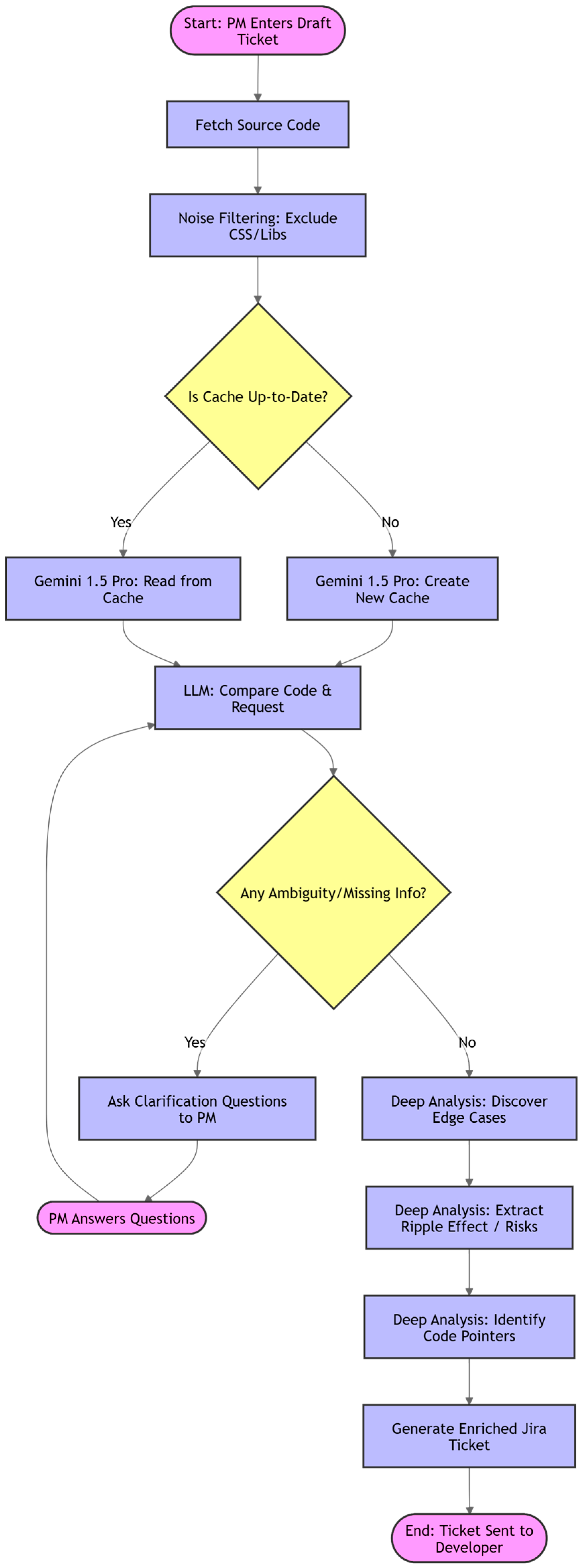
Algorithmic Workflow and Source Code Availability
- Draft Ticket InputThe process begins when a Product Manager submits a draft Jira ticket describing the feature or requirement.
- Source Code Retrieval and Noise FilteringRelevant source code files are retrieved, and non-functional artifacts (e.g., CSS, third-party libraries) are excluded to reduce analytical noise.
- Context Caching CheckThe system verifies whether a previously generated semantic cache is up-to-date:
- If the cache is outdated, Gemini 1.5 Pro generates a new context representation of the source code.
- If the cache is current, the cached context is reused to minimize computation overhead.
- LLM-Based Comparative AnalysisThe LLM compares the draft requirement with the codebase’s semantic context. Ambiguities or missing information trigger an interactive clarification loop with the Product Manager, ensuring requirement completeness prior to deep analysis.
- Deep Structural AnalysisAfter clarifying requirements, the framework performs:
- Edge-case discovery, identifying potential exception scenarios not captured in the original draft.
- Ripple effect and dependency analysis, highlighting modules potentially impacted by the proposed changes.
- Code pointer identification, mapping relevant files or modules for developer guidance.
- Enriched Ticket GenerationThe final output is a technically enriched Jira ticket containing clarified requirements, identified risks, potential impact areas, and actionable code pointers.
3.2. Data Preparation and Noise Filtering (Context Optimization)
- Structural Elimination: File types containing no Business Logic (images, library dependencies like node_modules, .lock files, build outputs) are removed from the directory tree.
- Syntactic Dilution: Unnecessary whitespace and non-functional log records that do not affect code readability are cleaned.
3.3. Long Context and Context Caching
- The optimized code base is caught once on the Gemini API (Cache Creation).
- Every new Jira request coming from the Product Manager is queried directly against this “ready information” in the cache. In this way, the analysis of a project containing thousands of files is performed in the order of seconds and at low cost.
3.4. Prompt Engineering and Analysis Flow
- Detection of Missing Information and Querying (Clarification Phase): “Compare the text entered by the user with the existing database schema and similar modules. If there are undefined critical parameters (e.g., there is an expire_date field in the database, but the PM has not specified it), generate clarifying questions to be directed to the user instead of making assumptions.”
- Requirement Matching: “With which classes and functions (Code Pointers) of the project is the request in this Jira ticket (e.g., Installment sales) directly related?”
- Reverse Engineering and Edge Case Discovery: “Analyze the try-catch, if-else, and validation blocks in the relevant code. List error scenarios (Unhappy Paths) defined in the code but not specified in the PM’s request.”
- Domino Effect Analysis: “Will a change to be made in these codes break other modules or mobile API endpoints that call (Reference) these functions in the project? Determine the risk level.”
3.5. Integration (Jira Automation)
- Pre-Analysis: When the PM saves the draft, the AI first detects ambiguous points.
- Querying: It directs critical questions to the PM via the Jira comment area (e.g., “The ‘expiration date’ field appears mandatory for gift vouchers in the database. Will we set a validity period for this feature?”).
- Final Generation: After the PM’s answers, the system creates the final technical specification containing technical details, edge cases, and impact analysis.
3.6. Data Privacy and Security
4. Case Study and Findings
4.1. Experimental Setup and Data Preparation
4.2. Interactive Clarification Phase
- Database Structure: “A comment_karma field was detected in the wp_comments table in the database, but it is unused. Should we use this existing structure, or create an independent wp_ratings table?” (System detected “Legacy” code).
- Scope: “There are post, page, attachment types in the code. Which ones will be rated?”
- Security: “There is IP-based control in the existing comment system. Will anonymous users be able to give ratings?”
- Scale: “There is no similar example in the code. Will the rating be 1–5 stars or on a 1–10 scale?”
4.3. Analysis of Generated Technical Specification
- A.
- Code Pointers:
- wp-includes/post.php (Lines 6800–6900): For meta operations.
- wp-admin/includes/schema.php: For new table definitions.
- wp-includes/class-wp-query.php: For sorting algorithms.
- B.
- Edge Cases:
- “An author should be prevented from rating their own post.”
- “When a post is deleted (delete_post hook), ratings must also be deleted.”
- “Double voting (Race Condition) must be prevented via database UNIQUE KEY constraint.”
- C.
- Domino Effect and Risks:
- Cache: Object Cache must be cleared whenever the average rating changes.
- REST API: A rating field must be added to the /wp-json/wp/v2/posts endpoint (for mobile app compatibility).
| Listing 1. The AI-generated Jira ticket comprising requirements, code pointers, and database definitions. |
 |
 |
 |
4.4. Cost and Performance Evaluation
4.5. Evaluation on Multiple Codebases
Case Studies
4.6. Quantitative Comparison of Issue Tickets
5. Discussion
6. Conclusions
Author Contributions
Funding
Institutional Review Board Statement
Informed Consent Statement
Data Availability Statement
Acknowledgments
Conflicts of Interest
Appendix A. Case Study Tickets
Appendix A.1. Project1: ERPNext
Appendix A.2. Project2: Ghost
Appendix A.3. Project3: ODOO
References
- Hohl, P.; Klünder, J.; van Bennekum, A.; Lockard, R.; Gifford, J.; Münch, J.; Stupperich, M.; Schneider, K. Back to the future: Origins and directions of the “Agile Manifesto”—Views of the originators. J. Softw. Eng. Res. Dev. 2018, 6, 15. [Google Scholar] [CrossRef]
- Forsgren, N.; Humble, J.; Kim, G. Accelerate: The Science of Lean Software and DevOps: Building and Scaling High Performing Technology Organizations; IT Revolution: Portland, OR, USA, 2018. [Google Scholar]
- Wiegers, K.; Beatty, J. Software Requirements, 3rd ed.; Microsoft Press: Redmond, WA, USA, 2013. [Google Scholar]
- Cagan, M. Inspired: How to Create Products Customers Love; SVPG Press: Sunnyvale, CA, USA, 2008. [Google Scholar]
- Perri, M. Escaping the Build Trap: How Effective Product Management Creates Real Value, 1st ed.; O’Reilly Media: Sebastopol, CA, USA, 2018. [Google Scholar]
- Stettina, C.J.; Heijstek, W. Necessary and Neglected? An Empirical Study of Internal Documentation in Agile Software Development Teams. In Proceedings of the 2011 International Conference on Software and System Process; IEEE: New York, NY, USA, 2011; pp. 119–128. [Google Scholar]
- Lethbridge, T.C.; Singer, J.; Forward, A. How software engineers use documentation: The state of the practice. IEEE Softw. 2003, 20, 35–39. [Google Scholar] [CrossRef]
- Di Francesco, P.; Lago, P.; Malavolta, I. Architecting with Microservices: A Systematic Mapping Study. J. Syst. Softw. 2019, 150, 77–97. [Google Scholar] [CrossRef]
- Dragoni, N.; Giallorenzo, S.; Lafuente, A.L.; Mazzara, M.; Montesi, F.; Mustafin, R.; Safina, L. Microservices: Yesterday, Today, and Tomorrow. In Present and Ulterior Software Engineering; Manuel, M., Bertrand, M., Eds.; Springer: Cham, Switzerland, 2017; pp. 195–216. [Google Scholar]
- Hou, X.; Zhao, Y.; Liu, Y.; Yang, Z. Large Language Models for Software Engineering: A Systematic Literature Review. arXiv 2023, arXiv:2308.10620. [Google Scholar] [CrossRef]
- Peng, S.; Kalliamvakou, E.; Cihon, P.; Demirer, M. The Impact of AI on Developer Productivity: Evidence from GitHub Copilot. arXiv 2023, arXiv:2302.06590. [Google Scholar] [CrossRef]
- Wachnik, B.; Pryciński, P.; Murawski, J.; Nader, M. An analysis of the causes and consequences of the information gap in IT projects. The client’s and the supplier’s perspective in Poland. Arch. Transp. 2021, 60, 105–119. [Google Scholar] [CrossRef]
- Tan, W.S.; Wagner, M.; Treude, C. Detecting outdated code element references in software repository documentation. Empir. Softw. Eng. 2024, 29, 5. [Google Scholar] [CrossRef]
- Berry, D.M.; Kamsties, E.; Ribeiro, C.; Tjong, S.F. Detecting Defects in Natural Language Requirements Specifications. In Handbook on Natural Language Processing for Requirements Engineering; Ferrari, A., Spagnolo, G.O., Eds.; Springer: Cham, Switzerland, 2019; pp. 113–162. [Google Scholar]
- Besker, T.; Martini, A.; Bosch, J. Software developer productivity loss due to technical debt—A replication and extension study examining developers’ development work. J. Syst. Softw. 2019, 156, 41–61. [Google Scholar] [CrossRef]
- Fernández, D.M.; Wagner, S.; Kalinowski, M.; Felderer, M.; Mafra, P.; Vetrò, A.; Conte, T.; Christiansson, M.-T.; Greer, D.; Lassenius, C.; et al. Naming the pain in requirements engineering: Contemporary problems, causes, and effects in practice. Empir. Softw. Eng. 2017, 22, 2298–2338. [Google Scholar] [CrossRef]
- Boehm, B.W. Software Engineering Economics; Prentice-Hall: Englewood Cliffs, NJ, USA, 1981. [Google Scholar]
- McConnell, S. Software Estimation: Demystifying the Black Art; Microsoft Press: Redmond, WA, USA, 2006. [Google Scholar]
- Cohn, M. Agile Estimating and Planning; Prentice Hall: Upper Saddle River, NJ, USA, 2005. [Google Scholar]
- Graziotin, D.; Fagerholm, F.; Wang, X.; Abrahamsson, P. Consequences of unhappiness while developing software. In Proceedings of the 2nd International Workshop on Emotion Awareness in Software Engineering (SEmotion 17), Buenos Aires, Argentina, 21 May 2017; pp. 42–47. [Google Scholar]
- Chikofsky, E.J.; Cross, J.H. Reverse Engineering and Design Recovery: A Taxonomy. IEEE Softw. 1990, 7, 13–17. [Google Scholar] [CrossRef]
- Wason, P.C. On the failure to eliminate hypotheses in a conceptual task. Q. J. Exp. Psychol. 1960, 12, 129–140. [Google Scholar] [CrossRef]
- Stacy, W.; MacMillan, J. Cognitive bias in software engineering. Commun. ACM 1995, 38, 57–63. [Google Scholar] [CrossRef]
- Virk, Y.; Devanbu, P.; Ahmed, T. Calibration of Large Language Models on Code Summarization. Proc. ACM Softw. Eng. 2025, 2, 2944–2964. [Google Scholar] [CrossRef]
- Fan, A.; Gokkaya, B.; Harman, M.; Lyubarskiy, M.; Sengupta, S.; Yoo, S.; Zhang, J.M. Large language models for software engineering: Survey and open problems. In Proceedings of the 2023 IEEE/ACM International Conference on Software Engineering: Future of Software Engineering (ICSE-FoSE), Melbourne, Australia, 14–20 May 2023; pp. 31–53. [Google Scholar]
- Jiang, J.; Wang, F.; Shen, J.; Kim, S.; Kim, S. A survey on large language models for code generation. Proc. ACM Softw. Eng. 2024, 1, FSE-00515. [Google Scholar] [CrossRef]
- Arkley, P.; Riddle, S. Overcoming the traceability benefit problem. In Proceedings of the 13th IEEE International Requirements Engineering Conference (RE’05), Paris, France, 29 August–2 September 2005; pp. 385–393. [Google Scholar]
- Ouf, M.; Li, H.; Zhang, M.; Guizani, M. Reverse Engineering User Stories from Code using Large Language Models. arXiv 2025, arXiv:2509.19587. [Google Scholar] [CrossRef]
- Gemini Team Google; Georgiev, P.; Lei, V.I.; Burnell, R.; Bai, L.; Gulati, A.; Tanzer, G.; Vincent, D.; Pan, Z.; Wang, S.; et al. Gemini 1.5: Unlocking Multimodal Understanding Across Millions of Tokens of Context. arXiv 2024, arXiv:2403.05530. [Google Scholar] [CrossRef]
- Li, Z.; Li, C.; Zhang, M.; Mei, Q.; Bendersky, M. Retrieval Augmented Generation or Long-Context LLMs? A Comprehensive Study and Hybrid Approach. arXiv 2024, arXiv:2407.16833. [Google Scholar] [CrossRef]
- Gim, I.; Chen, Y.; Lee, S.; Suh, Y.; Ahn, S.; Kim, M. Prompt Cache: Modular Attention Reuse for Low-Latency Inference. arXiv 2023, arXiv:2311.04934. [Google Scholar]
- Kojima, T.; Gu, S.S.; Reid, M.; Matsuo, Y.; Iwasawa, Y. Large Language Models are Zero-Shot Reasoners. Adv. Neural Inf. Process. Syst. 2022, 35, 22199–22213. [Google Scholar]
- Wei, J.; Wang, X.; Schuurmans, D.; Bosma, M.; Ichter, B.; Xia, F.; Chi, E.; Le, Q.V.; Zhou, D. Chain-of-Thought Prompting Elicits Reasoning in Large Language Models. Adv. Neural Inf. Process. Syst. 2022, 35, 24824–24837. [Google Scholar]


| Metric | Original Code | Processed Code | Change (Difference) |
|---|---|---|---|
| Number of Processed Files | 1791 | 1635 | −156 Files (Redundant) |
| Line Count | 628,982 | 426,817 | −32.1% |
| Character Count | 21,251,426 | 13,771,388 | −7,480,038 |
| Data Size | 20.26 MB | 13.13 MB | −35.2% |
| Token Cost (Input) | ~$13.28 | ~$8.61 | −$4.67/Query |
| Method | Initial Query Cost | Subsequent Queries | 10-Query Total Cost | Savings Rate |
|---|---|---|---|---|
| Raw Code (No Cache) | $6.63 | $6.63 | $66.30 | - |
| Optimized (No Cache) | $4.25 | $4.25 | $42.50 | 35% |
| Optimized + Cache | $4.25 | $1.06 | $13.79 | 79% |
| Project | Ticket ID | Version | Informational Categories 1 | Acceptance Criteria | Code Pointers Identified |
|---|---|---|---|---|---|
| ERPNext | #52915 | Original | 2 | 0 | 0 |
| Revised | 7 | 5 | 2 | ||
| #52958 | Original | 2 | 0 | 0 | |
| Revised | 7 | 5 | 3 | ||
| Ghost | #26439 | Original | 3 | 0 | 0 |
| Revised | 7 | 5 | 2 | ||
| #26315 | Original | 2 | 0 | 0 | |
| Revised | 7 | 5 | 3 | ||
| Odoo | #251358 | Original | 2 | 0 | 0 |
| Revised | 7 | 5 | 5 | ||
| #249140 | Original | 2 | 0 | 0 | |
| Revised | 7 | 4 | 3 |
Disclaimer/Publisher’s Note: The statements, opinions and data contained in all publications are solely those of the individual author(s) and contributor(s) and not of MDPI and/or the editor(s). MDPI and/or the editor(s) disclaim responsibility for any injury to people or property resulting from any ideas, methods, instructions or products referred to in the content. |
© 2026 by the authors. Licensee MDPI, Basel, Switzerland. This article is an open access article distributed under the terms and conditions of the Creative Commons Attribution (CC BY) license.
Share and Cite
Surk, E.; Menekse Dalveren, G.G.; Derawi, M. Reducing Information Asymmetry in Software Product Management: An LLM-Based Reverse Engineering Framework. Appl. Sci. 2026, 16, 2801. https://doi.org/10.3390/app16062801
Surk E, Menekse Dalveren GG, Derawi M. Reducing Information Asymmetry in Software Product Management: An LLM-Based Reverse Engineering Framework. Applied Sciences. 2026; 16(6):2801. https://doi.org/10.3390/app16062801
Chicago/Turabian StyleSurk, Emre, Gonca Gokce Menekse Dalveren, and Mohammad Derawi. 2026. "Reducing Information Asymmetry in Software Product Management: An LLM-Based Reverse Engineering Framework" Applied Sciences 16, no. 6: 2801. https://doi.org/10.3390/app16062801
APA StyleSurk, E., Menekse Dalveren, G. G., & Derawi, M. (2026). Reducing Information Asymmetry in Software Product Management: An LLM-Based Reverse Engineering Framework. Applied Sciences, 16(6), 2801. https://doi.org/10.3390/app16062801