Article

Determining Color of Dental Restoration by a Digital Solution: A Preliminary Study for NCS Color System


1
Svea Tandklinik, 11350 Stockholm, Sweden
2
Department of Material Science and Engineering, Uppsala University, 75105 Uppsala, Sweden
3
Department of Materials and Environmental Chemistry, Stockholm University, 10691 Stockholm, Sweden
*
Author to whom correspondence should be addressed.
Appl. Sci. 2026, 16(6), 2792; https://doi.org/10.3390/app16062792
Submission received: 28 January 2026 / Revised: 11 March 2026 / Accepted: 12 March 2026 / Published: 14 March 2026

Featured Application

This paper presents a simple and affordable color scanning system to determine the tooth color to improve the communication between the dentist and technician in the new digital era in dentistry.

Abstract

Achieving natural esthetics has become essential for successful dental restorations and supports the use of modern non-metal materials. However, complexity in esthetic features of natural teeth, determined by both inherent color factors and hierarchical and gradient microstructures, makes recording, determination, and reproduction difficult. This often leads to misunderstanding during manufacturing and dissatisfaction with the final outcome, even when using advanced digital tools. The aim of this study was to investigate a new, easy-to-handle digital tool for determining the color of restorative materials. An industrial-level handheld color identifier, the NCS Colourpin SE, together with the corresponding NCS color system, was tested on three materials: dental resin nanocomposite, self-glazed zirconia (SGZ), and Decore zirconia pellets. The repeatability and impacts of geometrical contributions such as surface roughness and thickness on different colors were measured. The Colourpin SE offered promising repeatability. Decore zirconia showed more than 90% repeatability for most of the colors, independent of thickness. The NCS scanner showed slightly better repeatability than earlier in clinical trials with an intraoral scanner. The shades A3.5 and A3 had lower repeatability, varying from 50 to 90%. It identified effects of material thickness and surface roughness, where the thicker samples were identified with higher blackness levels, and surface roughness seemed to be coupled with a lower blackness level in color identification codes. Small but consistent differences between materials were detected, suggesting that material and manufacturing methods affect the final shade. The NCS Colourpin SE shows potential to be developed into an affordable and easy-to-handle scanner for the identification of a patient’s tooth color, enabling synchronization with digital workflows and improving the match between restoration and the patient’s natural teeth. Nevertheless, further research and development in customized applications for color identification in esthetic dentistry is still required through multidisciplinary collaboration.

1. Introduction

Recording, determining, and describing esthetic features of patients’ natural teeth is a vital step in dental restoration practice to achieve a satisfying appearance and a suitable match between natural teeth and prostheses. Traditionally, this step is known as shade matching and is performed using a shade guide as a reference. The VITA Shade guide is one of the several series of “standard” samples called shade tabs, labeled with codes such as “A2” or “1M2”, representing a specific combination of hue (color tone), value (lightness), and chroma (color intensity). The shades can also be described numerically, for example, with the CIELab coordinates L*a*b, where L* stands for lightness, and a* and b* represent the four unique colors of human vision: red, green, blue, and yellow [1,2].
In clinical practice, a dentist or technician will select the shade tabs that most closely match the patient’s natural teeth, place them near the tooth to be restored, and determine the best match visually, often followed by photographic documentation [3,4]. This empirical workflow inevitably has limitations in accuracy, precision, and reliability. Consequently, novel digital solutions, such as spectrophotometers, that acquire quantitative color parameters and can capture local color variations on teeth [5], intraoral scanners, cross-section-polarized digital photography (CP photography), and even mobile phone cameras, have been introduced and tested [6,7]. The accuracy and the reproducibility of the color identification with digital techniques such as those above are close to or slightly better than human determination with the shade guides. Nevertheless, most of the authors still recommend verifying the color visually [6,8,9,10].
These measurements do not always translate meaningfully into materials science, as color matching results do not necessarily reflect the underlying material properties. Furthermore, spectrophotometers are costly, require proper lighting conditions and positioning, and must be operated by trained personnel. Similar limitations apply to modern intraoral scanners, which, nowadays, offer shade determination functions primarily based on colorimetry, and thus, the lighting conditions are even more important [10,11]. Although digital techniques provide rapid color determination, they do not consistently account for tooth transparency, translucency, or surface quality [12].
The esthetic features of any three-dimensional objects, including teeth, are the combined results of both color and geometrical attributes. While color can be quantified using systems such as the internationally accepted CIELab* system [2,13], geometrical attributes, such as translucency and transparency, are closely linked to the intrinsic physical properties and microstructure of the material. In natural teeth, translucency and transparency vary gradually, making them nearly impossible to measure separately from color attributes [13,14,15,16]. This limitation prevents manufacturers from fully understanding clinical findings and converting them into precise manufacturing processes and material selections.
The challenge is particularly evident in monolithic restorations, including 3D-printed restorations, where technicians have limited opportunities for post-adjustment compared with traditional laminated structures. As a result, dissatisfaction with esthetic appearance has become one of the major causes of restoration failure and rework, where dissatisfaction due to only color can occur in up to 50% of patients [17].
A simple handheld scanner that provides an absolute value influenced by the tooth’s surface characteristics and translucency would be beneficial. In this study, a new type of color scanner and color system is evaluated, namely the Natural Color System® (NCS) and the NCS Colourpin II SE, developed by NCS Colour AB, Sweden. The NCS is based on visual color perception by colorimetry, using a full-spectrum LED illumination, and detecting the energy using tristimulus color measurement paired with algorithmic matching against the NCS color library, making it suitable as a standard for defining, assuring the quality of, and communicating color.
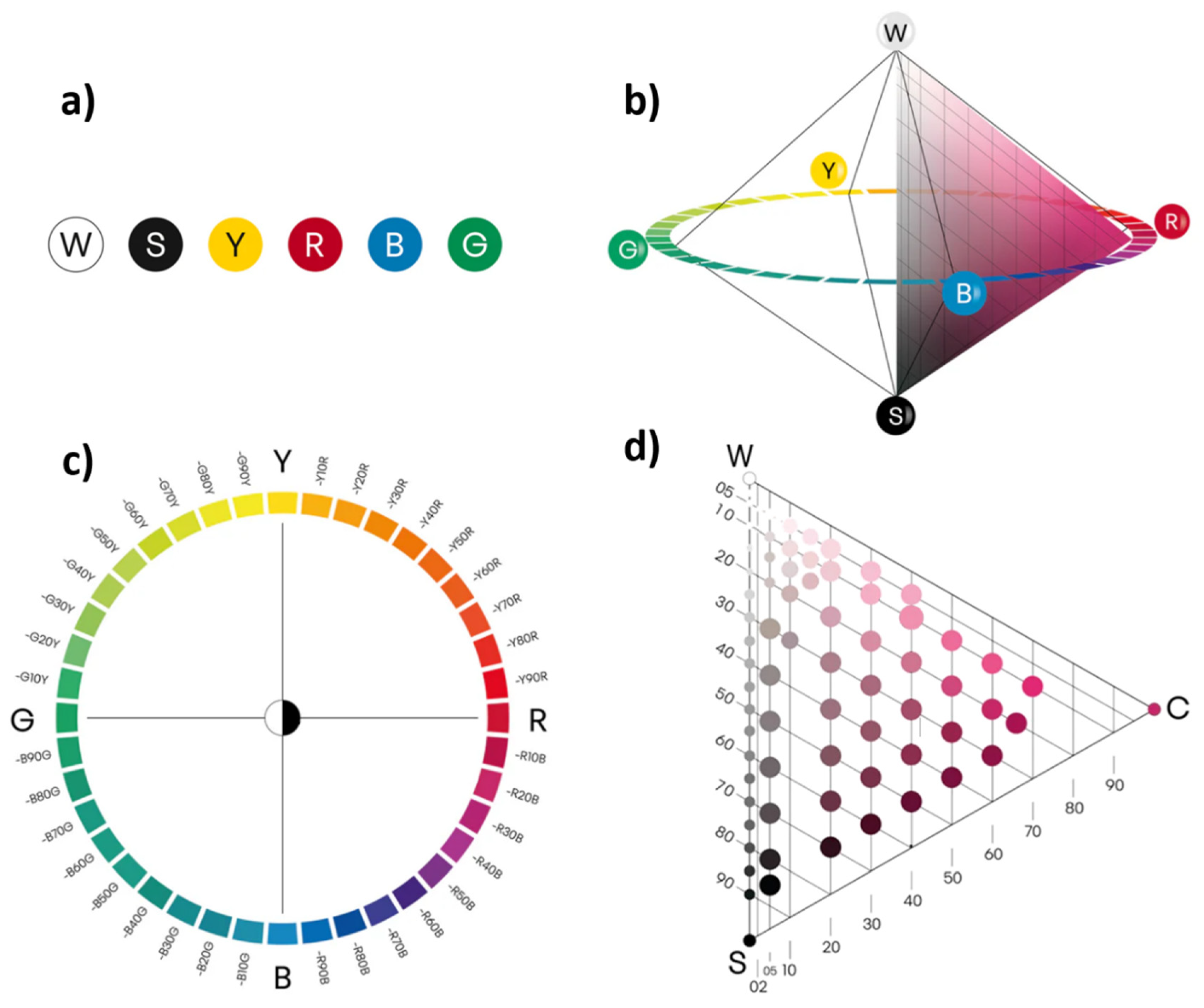
The system is structured around six elemental colors perceived as “pure” (Figure 1a). These form a three-dimensional color space in which the relationships between colors can be described, allowing any conceivable color to be defined with an NCS designation (Figure 1b). A horizontal section through the center of the color space forms the NCS Color Circle, which indicates hue as the ratio between one or two of the four elemental colors in the circle (Figure 1c). A vertical section through the color space forms the NCS Color Triangle, which defines the proportions of blackness (s) and chromaticness (c) (Figure 1d).
For example, in the designation “NCS S 4030-R20B”, the “S” refers to the second edition of the system, “40” represents 40% blackness, “30” represents 30% chromaticness (together forming the nuance, Figure 1d), and “R20B” describes the hue as 20% blue and 80% red (Figure 1c). [18]
The aim was to test a new digital color solution for common restorative materials in order to provide a practical reference that would help interpret measurements and guide material selection during manufacturing. A series of commonly used resins and two different zirconia, namely self-glazed zirconia (SGZ) and Decore zirconia pellets, with defined thicknesses and surface characteristics, were analyzed. By fixing these geometrical variables, the results could serve as reference values for selecting the same material–thickness combinations in future use.

2. Materials and Methods

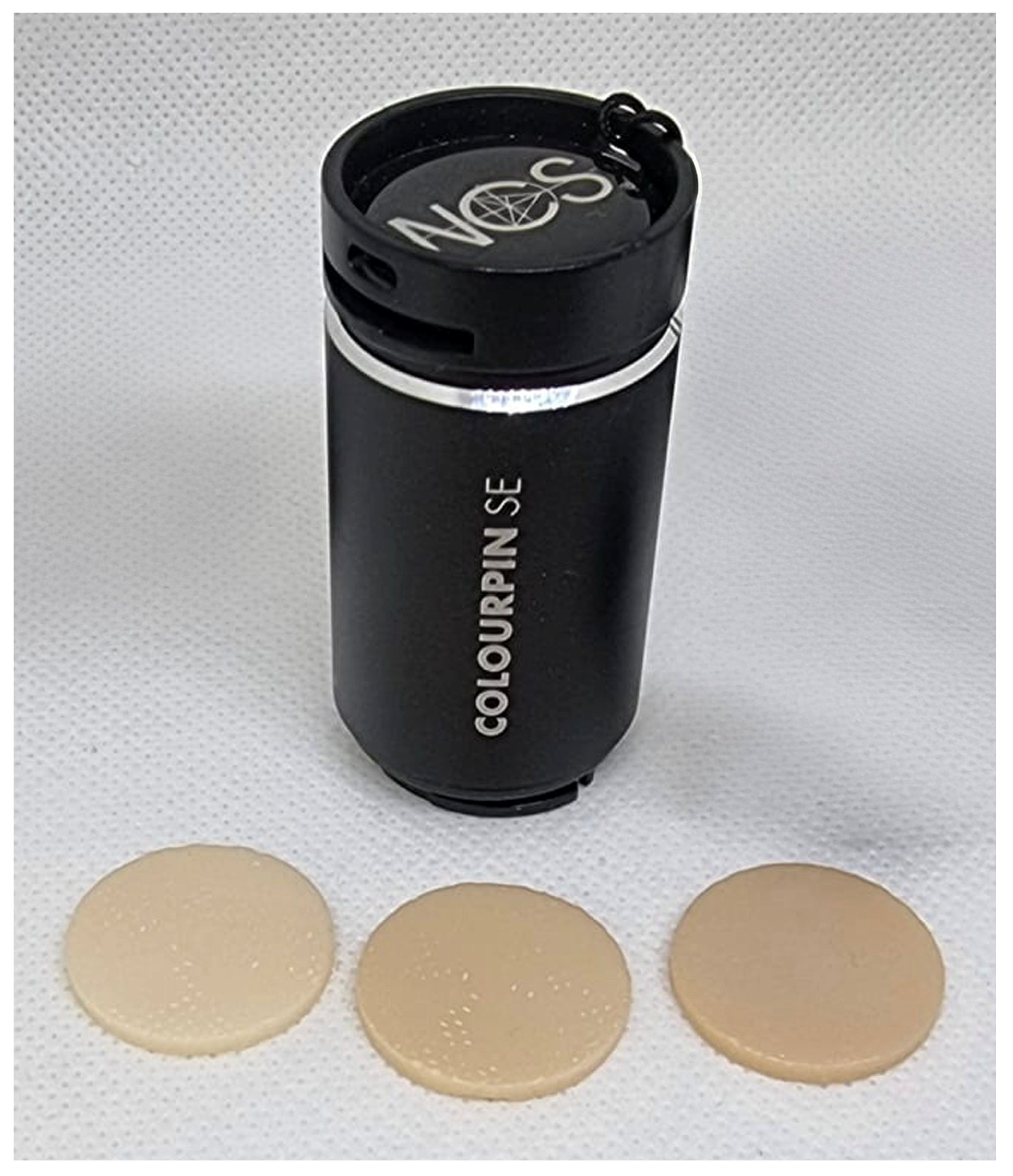
The color of an object can be easily identified and recorded using the NCS Colourpin SE (NCS Color AB, Stockholm, Sweden) handheld scanner (Figure 2). When the portable device is placed against the surface to be measured, the results are instantly transmitted via Bluetooth to the Colourpin app installed on a smartphone. The app displays closest matches within the NCS Color Space, with the quality of each match indicated by a five-star rating system. The NCS designation could also be converted into other widely used color systems, such as the VITA shade guide or CIELab coordinates, which are standard in esthetic dentistry.
Three different materials commonly used in prosthodontic dentistry were selected: a commercially available resin nanocomposite and two zirconia materials currently under development for clinical use. The zirconia samples were produced using intrinsic coloration during the fabrication of the green bodies, rather than by applying colored layers to already sintered crown surfaces. This approach allows more uniform color distribution and represents recent trends in zirconia technology [19,20]. The selection of these materials aimed to evaluate the Colourpin SE’s ability to distinguish and identify identical or closely related color shades among materials with different optical properties and manufacturing techniques. The samples included resin nanocomposite (Filtek Universal Restorative, 3M, Solventum, St.Paul, MN, USA) and two types of zirconia, namely Self-glazed zirconia (SGZ) (Errantech, Hangzhou, China) and Decore zirconia (Zircosol, Stockholm, Sweden).
To test the repeatability of the Colourpin measurements, the Decore zirconia pellets were chosen. Five different Vita color shades (A1, A2, A3, A3.5, and B1) were tested at three different thicknesses (0.5, 1, and 2 mm). All surfaces were polished with the standard surface treatment for dental restorations (RD3414) prior to testing. For each color/thickness combination, ten (10) measurements were taken on the exact same pellet to avoid inherited variations in the manufactured pellets.
For the resin nanocomposite, tests were performed at three different thicknesses (0.5, 1, and 2 mm), and with three repeated measurements for the 2 mm thickness. The purpose of these measurements was to provide a comparative baseline against the zirconia materials by evaluating how differences in material composition affect color determination using the Colourpin SE. Although only one repetition was performed for each thickness, the resulting data supports a qualitative comparison across materials rather than statistical analysis. A detailed list of the measurements and materials is provided in the Supplementary Information in Table S1.
The effect of surface roughness on color identification was evaluated using SGZ pellets with three surface finishes, “shiny,” “medium,” and “rough”, where medium is the standard polishing quality in clinics. All samples were in the A2 shade and had a thickness of 2 mm. For each surface type, five measurements were taken.
Measurements were performed with a reference sheet (S0500-N) placed beneath each pellet, and the calibration of the scanner was done according to the manufacturer’s instructions. The NCS code measurement quality was evaluated from the five-star rating system, and the mean and standard deviations were calculated for the stars. The Colourpin SE’s five-star rating system has been validated for industrial color quality control, where it quantifies the degree of color match accuracy based on standardized optical measurements.
Statistical analyses were conducted using IBM SPSS Statistics version 31.0.2.0. Non-parametric comparisons were performed using the Kruskal–Wallis test, followed by Dunn–Bonferroni post hoc pairwise analyses.

3. Results

The repeatability of color identification with the Colourpin was first evaluated using Decore pellets in five VITA shades at thicknesses of 0.5, 1, and 2 mm. The two most frequently identified NCS color codes for each shade–thickness combination are summarized in Table 1, along with the mean star ratings indicating measurement accuracy. In the NCS notation, the initial “S” indicates the second edition of the system and is not relevant to the shade comparison.
To compare materials, the reliability of color identification was assessed for the resin nanocomposite. Three measurements were taken for different VITA shades using 2 mm thick pellets. The summarized results are presented in Table 2.
The effect of thickness on color identification for the resin nanocomposite was evaluated by measuring samples of different VITA shades at varying thicknesses. Only one measurement was performed for each shade–thickness combination, yielding two NCS matchups and corresponding star ratings. The results are summarized in Table 3. One measurement was considered sufficient as the repeatability test shown in Table 2 gave the same identification in most measurements for the different shades, and an additional test with 0.5 mm and 2 mm thicknesses with the shade A2 gave the same color identification for each thickness in five and ten measurements, respectively, for resin.
The effect of surface roughness on color identification was evaluated using SGZ zirconia pellets (A2 shade, 2 mm thickness) with three surface finishes: shiny, medium (polished), and rough (as-sintered). Roughness was measured (SJ-210, Mitutoyo) on the surfaces, where Ra values were 0.13 (0.01), 0.35 (0.07), and 0.40 (0.08), respectively. Five measurements were performed for each surface quality. The two most frequently identified NCS color codes for each surface type are summarized in Table 4.
The detailed measurement data for each material and surface condition are presented in the Supplementary Information (Tables S2–S4). To improve clarity and facilitate comparison, the most relevant findings are summarized in Supplementary Information (Table S5). The table provides an overview of the observed color identification trends and mean accuracy values for each material as measured with the NCS Colourpin SE.

4. Discussion

In this study, an industrial-level Colourpin device was evaluated by identifying the color of three dental restorative materials: a resin nanocomposite and two zirconia types (self-glazed zirconia and Decore). The repeatability of measurements and the effects of material thickness and surface roughness on the results were investigated. Using the NCS color system, differences related to thickness and surface quality were identified.
The experiments demonstrate that both material thickness and surface structure influence color identification results (Table 1, Table 2 and Table 3). For Decore zirconia and resin, blackness in the NCS nuance seemed to increase with greater thickness, which is expected, as thicker materials absorb more light and thus appear darker in the NCS Color Triangle. This influence of thickness may have been underestimated previously and should be considered more carefully in restorative planning. Processing should account for potential color shifts with varying thickness, and shade selection should be adjusted accordingly. In clinical practice, the exact thickness of crowns or bridges often varies due to patient-specific conditions and operator technique, which means that the final esthetic result will be determined by a combination of intrinsic material color, thickness, surface structure, the cement used, and the underlying tooth [19,21].
Comparable trends have been reported in previous studies evaluating digital color-matching systems in dentistry. One study [10] demonstrated that both intraoral scanners and spectrophotometers required visual confirmation for shade determination, emphasizing the limitations of purely digital methods. Similar to our findings, they observed that differences in material type, surface quality, and shade guide system affected the consistency of color matching. Other studies have also reported that the influence of translucency, surface gloss, cement used, and sample thickness can significantly alter perceived color and measured CIELab parameters [12,13,14,19]. In contrast to these earlier investigations, the present work focuses on linking such effects directly to the NCS color space, offering a new approach for correlating material properties with clinically relevant shade information.
As expected, the surface quality influenced the color identification but in the opposite direction to thickness (Table 2). Rough surfaces showed lower blackness values in the nuance compared with polished surfaces, likely due to increased diffuse reflection, making the surface appear lighter and less vivid. For SGZ zirconia, the hue shifted by one unit; however, similar single-unit hue shifts were observed in the thickness and repeatability tests, without a consistent pattern, thus indicating that the small number of measurements and seemingly lower repeatability for measurements with SGZ may not be enough to reveal the trend. Additionally, an earlier study on resin composites showed no effect on the color attributes and only slightly increased L*-lightness values with finer surface finish until the finest polishing quality, 4000 grit, which showed decreasing lightness [22].
The used Colourpin device reported measurement accuracy using a 1–5 star rating, with 5 indicating the best match. The results suggest that both surface roughness and defects influence the rating (Table 4), explaining the slightly lower number of stars for the resin samples compared with the Decore zirconia. This difference may be attributed to variations in surface quality: the resin samples were measured in their as-manufactured state, whereas the Decore pellets were polished using a standardized method; additionally, possible color inconsistencies on the surface may have influenced the results. The thickness of the pellets also impacted the star ratings for Decore zirconia, with ratings decreasing as thickness increased, whereas this effect was not observed for the resin samples, suggesting surface uniformity differences (Table 1 and Table 3).
Decore zirconia showed more than 90% repeatability for most of the colors, independently of the thickness. The NCS scanner showed slightly better repeatability than earlier studies in clinical trials with an intraoral scanner (78–86% repeatability) [8,9]. The shades A3.5 and A3 had lower repeatability, varying from 50 to 90% (Table 1), and A3.5 for resin had only 33% repeatability. The identification of this shade seems more problematic and would need further investigation. For dental applications, the acceptable threshold for color is often calculated from the CIELab values indicated by ΔE*, where the accepted threshold for dentistry is defined according to Paravina et al. to ΔEab < 3.3 [23]. Even though the color codes can be expressed with CIELab coordinates, it would be more practical to use the reliability and accuracy given by the Colourpin system, and thus, the acceptable accuracy level for dental applications in this code system remains to be defined.
When comparing the same shade (A2) between Decore and SGZ zirconia under identical surface and thickness conditions, slight differences in NCS color ID were observed, indicating that manufacturing processes can influence the final shade—an effect already recognized with the VITA shade guide across different manufacturers [24,25], caused by the different zirconia quality with different traces of metals or other impurities, together with different processing conditions, etc. Similar variation between manufacturers has also been seen for resins [26].
Currently, the Colourpin II does not fully align with the requirements of esthetic dentistry. For example, the difference between nuances such as “2020” and “2030” is not directly interpretable in clinical terms. While nuance is closely related to thickness, hue is not necessarily affected in the same way. This means that color identification in relation to thickness is not straightforward, and small differences in nuance may not be consistently reproducible in manufacturing without a deeper understanding of structure–performance relationships.
Regarding the Colourpin system, further evaluation under realistic crown–abutment conditions and analyses of the color identification in dental clinics, together with the comparison with intraoral scanners and preferably with spectrophotometers, along with software refinement, are needed.
In this study, Colourpin reliability was evaluated using standard samples, and nearly a single NCS color ID could be assigned for each material and defined thickness. A discussion with NCS Colour AB has been initiated to develop a Colourpin Dental Database, containing precise data for standard VITA shade guide values. However, some variation in measured IDs was observed, making exact one-to-one matching with shade guide values inaccurate. For clinical use, we suggest defining a “shade domain” rather than a single value—e.g., a match to “A1” would represent a small range of NCS codes, where differences are visually indistinguishable or fall within an acceptable threshold. Therefore, when identifying the color of natural teeth by Colourpin, the readout would instead be the best matchup in the “shade domain”, possibly including the CIELab coordinates and matching the domain calculated with ∆Eab* against the exact L*a*b* of the corresponding shade as reference [12,27]. Future development should also include materials from multiple manufacturers for all material types, with different thicknesses and surface qualities.
The NCS Colourpin system shows promise as a simple and affordable color identification tool in esthetic dentistry, but further development is necessary for clinical application. The scanner should be adapted for intraoral use, and the database should incorporate a complete range of shades and manufacturers’ products. If achieved, this would provide clinics with an affordable, easy-to-use shade determination method, improving dentist–technician communication and ultimately enhancing patient satisfaction.

5. Conclusions

The Colourpin SE measurements identified trends across tested materials. For Decore zirconia, increasing thickness resulted in higher blackness values (NCS nuance), indicating a darker appearance. In contrast, rough surfaces appeared lighter and less vivid compared to polished ones. The color data for the resin nanocomposite were used as a reference to qualitatively compare material-dependent variations. In particular, the resin showed slightly higher NCS blackness and lower star ratings compared to zirconia materials, indicating that surface uniformity and translucency influenced the digital color identification. These results demonstrate that both material type and geometry (thickness and surface finish) influence the Colourpin SE readings.
These preliminary results indicate that the Colourpin has sufficient repeatability and ability to recognize the differences in colors and thicknesses, and it could possibly serve as a convenient and practical tool for color identification in esthetic dentistry, offering a simpler alternative to advanced digital spectrometers. Further development of both the Colourpin device and the NCS color system, towards a professional, customized application for intraoral recording of esthetic features and reconstruction of a manufacturing reference database, is necessary.

Supplementary Materials

The following supporting information can be downloaded at: https://www.mdpi.com/article/10.3390/app16062792/s1. The file includes following information: number of measurements for each material, thickness, and color shades, all the measurements done for each material and conditions, and summary of the findings.

Author Contributions

N.D.B. (Noran De Basso): conceptualization, methodology, investigation, and writing—review and editing. N.D.B. (Ninve De Basso): investigation and writing—review and editing. M.E.: investigation, data curation, methodology, formal analysis, writing—original draft, and writing—review and editing. All authors have read and agreed to the published version of the manuscript.

Funding

The authors acknowledge Stockholm Material Hub, supported by the European Regional Development Fund (TVV ID No. 20204027), for their support.

Institutional Review Board Statement

Not applicable.

Informed Consent Statement

Not applicable.

Data Availability Statement

The datasets generated during and/or analyzed during the current study are available in the Supplementary Information.

Acknowledgments

We thank Wei Xi and Lu Song for their valuable discussions and comments during the course of this work and manuscript preparation. We would also like to acknowledge Suvi Häkkinen for the help with the statistical analyses. We also wish to express our appreciation to late Zhijian James Shen for his significant contributions to dental ceramics and for the insightful discussions at the outset of this project.

Conflicts of Interest

The authors have no competing interests to declare that are relevant to the content of this article.

References

  1. Paravina, R.D. Dental color matcher: An online educational and training program for esthetic dentistry. Dental Color Matcher v.1.2.2. Available online: http://ec2-52-53-129-133.us-west-1.compute.amazonaws.com/ (accessed on 26 July 2020).
  2. ISO 11664-4:2008; Colorimetry—Part 4: CIE 1976 L*a*b* Colour Space. International Organization for Standardization: Geneva, Switzerland, 2008. Available online: https://www.iso.org/obp/ui/#iso:std:iso:11664:-4:ed-1:v1:en (accessed on 23 October 2025).
  3. Jarad, F.D.; Russell, M.D.; Moss, B.W. The use of digital imaging for colour matching and communication in restorative dentistry. Br. Dent. J. 2005, 199, 43–49. [Google Scholar] [CrossRef] [PubMed]
  4. Wee, A.G.; Lindsey, D.T.; Kuo, S.; Johnston, W.M. Color accuracy of commercial digital cameras for use in dentistry. Dent. Mater. 2006, 22, 553–559. [Google Scholar] [CrossRef]
  5. Ramiro, G.P.; Hassan, B.; Navarro, A.F.; Coronel, C.A.; Cortes, A.R.G.; Baptista, O.H.P.; Zambrana, N.R.M. Digitalization in Restorative Dentistry. In Digital Restorative Dentistry: A Guide to Materials, Equipment, and Clinical Procedures; Tamimi, F., Hirayama, H., Eds.; Springer International Publishing: Cham, Switzerland, 2019; pp. 7–39. [Google Scholar]
  6. Gonzalez-Chavez, J.A.; Soto-Barreras, U.; Perez-Aguirre, B.; Nevarez-Rascon, M.; Villegas-Mercado, C.E.; Dominguez-Perez, R.A. Reliability of Dental Shade Selection Methods: Agreement Among Spectrophotometer, Intraoral Scanner, and Cross-Polarization Photography. J. Esthet. Restor. Dent. 2025, 37, 1784–1790. [Google Scholar] [CrossRef]
  7. Chew, S.T.; Soo, S.Y.; Kassim, M.Z.; Lim, K.Y.; Tew, I.M. Accuracy and Reliability of Smartphone Versus Mirrorless Camera Images-Assisted Digital Shade Guides: An In Vitro Study. Appl. Sci. 2025, 15, 8070. [Google Scholar] [CrossRef]
  8. Brandt, J.; Nelson, S.; Lauer, H.-C.; von Hehn, U.; Brandt, S. In vivo study for tooth colour determination—Visual versus digital. Clin. Oral Investig. 2017, 21, 2863–2871. [Google Scholar] [CrossRef]
  9. Reyes, J.; Acosta, P.; Ventura, D. Repeatability of the human eye compared to an intraoral scanner in dental shade matching. Heliyon 2019, 5, e02100. [Google Scholar] [CrossRef]
  10. Lee, J.-H.; Kim, H.-K. A comparative study of shade-matching performance using intraoral scanner, spectrophotometer, and visual assessment. Sci. Rep. 2024, 14, 23640. [Google Scholar] [CrossRef]
  11. Guo, Y.; Ma, Y.; Wang, Z.; Yu, H. Effects of ambient lighting conditions on the scanning accuracy and shade matching capability of intraoral scanners: An in vitro study. BMC Oral Health 2025, 25, 1088. [Google Scholar] [CrossRef]
  12. Karaagaclioglu, L.; Terzioglu, H.; Yilmaz, B.; Yurdukoru, B. In Vivo and In Vitro Assessment of an Intraoral Dental Colorimeter. J. Prosthodont. 2010, 19, 279–285. [Google Scholar] [CrossRef]
  13. Ly, B.C.K.; Dyer, E.B.; Feig, J.L.; Chien, A.L.; Del Bino, S. Research Techniques Made Simple: Cutaneous Colorimetry: A Reliable Technique for Objective Skin Color Measurement. J. Investig. Dermatol. 2020, 140, 3–12.e1. [Google Scholar] [CrossRef] [PubMed]
  14. Vichi, A.; Louca, C.; Corciolani, G.; Ferrari, M. Color related to ceramic and zirconia restorations: A review. Dent. Mater. 2011, 27, 97–108. [Google Scholar] [CrossRef]
  15. Zhang, Y. Making yttria-stabilized tetragonal zirconia translucent. Dent. Mater. 2014, 30, 1195–1203. [Google Scholar] [CrossRef]
  16. Ghinea, R.; Pérez, M.M.; Herrera, L.J.; Rivas, M.J.; Yebra, A.; Paravina, R.D. Color difference thresholds in dental ceramics. J. Dent. 2010, 38, e57–e64. [Google Scholar] [CrossRef]
  17. de Freitas, B.N.; da Silva, P.O.; Pintado-Palomino, K.; de Almeida, C.V.V.B.; Souza-Gabriel, A.E.; Corona, S.A.M.; Geraldeli, S.; Grosgogeat, B.; Roulet, J.-F.; Tirapelli, C. Patients’ satisfaction concerning direct anterior dental restoration. Braz. Dent. J. 2023, 34, 82–93. [Google Scholar] [CrossRef] [PubMed]
  18. NCS Colour. Colour Codes, Premium Digital & Physical Colour Design Solutions. Available online: https://ncscolour.com/ (accessed on 18 August 2025).
  19. Aygün, E.B.; Öztürk, E.K.; Tülü, A.B.; Bal, B.T.; Nemli, S.K.; Güngör, M.B. Factors Affecting the Color Change of Monolithic Zirconia Ceramics: A Narrative Review. J. Funct. Biomater. 2025, 16, 58. [Google Scholar] [CrossRef] [PubMed]
  20. Gali, S.; Arjun, A.; Gururaja, S. Impact of ceria-yttria pigmentation on the mechanical performance and esthetics of zirconia dental restorations. Dent. Mater. 2025, 42, 145–156. [Google Scholar] [CrossRef]
  21. Tsukada, S.; Miura, S.; Fujita, T.; Saito-Murakami, K.; Imamura, Y.; Asami, K.; Fujisawa, M. Effect of transparency and abutment tooth color on the final color of shade-gradient zirconia crowns. Asian Pac. J. Dent. 2024, 24, 18–23. [Google Scholar] [CrossRef]
  22. Ghinea, R.; Ugarte-Alvan, L.; Yebra, A.; Pecho, O.E.; Paravina, R.D.; Perez, M.d.M. Influence of surface roughness on the color of dental-resin composites. J. Zhejiang Univ. B 2011, 12, 552–562. [Google Scholar] [CrossRef]
  23. Paravina, R.D.; Ghinea, R.; Herrera, L.J.; Bona, A.D.; Igiel, C.; Linninger, M.; Sakai, M.; Takahashi, H.; Tashkandi, E.; Perez, M.d.M. Color Difference Thresholds in Dentistry. J. Esthet. Restor. Dent. 2015, 27, S1–S9. [Google Scholar] [CrossRef]
  24. Prabu, P.S.; Prabu, N.M.; Kumar, M.; Abhirami, M. Shade variance in ceramic restoration and shade tab: An in vitro study. J. Pharm. Bioallied Sci. 2012, 4, S139–S141. [Google Scholar] [CrossRef] [PubMed]
  25. Aljamhan, A.S.; Habib, S.R.; Khan, A.S.; Javed, M.Q.; Bhatti, U.A.; Zafar, M.S. Color Analysis of Metal Ceramic Restorations Fabricated from Different Dental Laboratories. Coatings 2022, 12, 297. [Google Scholar] [CrossRef]
  26. Ikeda, T.; Nakanishi, A.; Yamamoto, T.; Sano, H. Color differences and color changes in Vita Shade tooth-colored restorative materials. Am. J. Dent. 2003, 16, 381–384. [Google Scholar] [PubMed]
  27. Carney, M.N.; Johnston, W.M. The development of a novel shade selection program for fixed shade translucent dental materials. J. Dent. 2017, 62, 81–84. [Google Scholar] [CrossRef] [PubMed]
Figure 1. Natural Color System® [18] (a) Six elementary colors perceived as pure by the human eye. (b) Three-dimensional NCS Color Space, including all elementary colors. (c) NCS Color Circle showing hue, as the relationship between the chromatic elementary colors. (d) NCS Color Triangle showing nuance, as the relationship between blackness (S), whiteness (W), and chromaticness (C). Image reproduced with permission from NCS Colour AB.
Applsci 16 02792 g001
Figure 2. The NCS Colourpin SE device, together with the resin nanocomposite pellets with three different VITA shades: A1, A2, and A3, accordingly.
Applsci 16 02792 g002
Table 1. Two most frequent NCS color identifications, number of occurrences, and mean star ratings and their standard deviation (SD) from the repeatability test for Decore pellets from 10 measurements. Results are shown for each VITA shade for the three thicknesses (0.5, 1, and 2 mm), with medium surface quality across different VITA shades. Matchup 1 is the first choice of the color identification in the scanner reading, and Matchup 2 is the second suggested choice.
Matchup 1 Matchup 2
DecoreNCS Color
Code
Nr
Identification
Average
Nr of Stars
SD of the
Stars
NCS Color
Code
Nr
Identification
Average
Nr of Stars
SD of the
Stars
Shade A1 *
0.5S1005-Y20R93.21.2S1005-Y10R52.80.7
1S1510-Y20R83.41.3S1510-Y10R83.41.3
2S2010-Y20R94.10.3S2010-Y10R102.91.0
Shade A2
0.5S1010-Y10R93.21.2S1510-Y10R52.31.2
1S1510-Y20R63.70.5S1510-Y30R52.80.4
2S2010-Y20R92.80.8S2010-Y10R51.60.5
Shade A3 *
0.5S1515-Y10R84.00.7S1510-Y20R42.01.1
1S1510-Y30R44.00.7S1510-Y2024.00.0
2S2010-Y40R51.20.4S2010-Y20R41.41.0
Shade A3.5 **
0.5S1515-Y10R64.00.8S1510-Y20R33.00.8
1S2020-Y20R54.00.0S2020-Y20R43.01.0
2S3010-Y30R92.10.3S3010-Y20R102.10.3
Shade B1 ***
0.5S1005-Y105.00.0S1005-G90Y104.30.5
1S1505-Y104.30.5S1505-Y10R104.20.6
2S2005-Y10R103.60.5S2005-Y20R52.31.1
Asterisks indicate statistically significant differences in color shade between thicknesses (* p < 0.05, ** p < 0.01, *** p < 0.001).
Table 2. Best match from three measurements for each resin nanocomposite sample (2 mm thickness) across different VITA shades. Data include the number of occurrences, mean star rating, and standard deviation (SD) of the star rating.
ResinMatchup1Matchup 2
Vita ShadeNCS Color
Code
Nr
Identifications
Average
Nr of Stars
SDNCS Color
Code
Nr
Identifications
Average
Nr of Stars
SD
A13030-Y20R32.30.53040-Y10R210.0
A23040-Y20R24.00.83050-Y20R240.0
A33050-Y20R35.00.03040-Y20R320.0
A3.53050-Y30R1-0.03060-Y30R220.0
A43560-Y20R32.30.53050-Y30R220.0
B13040-Y20R34.00.03050-Y10R240.0
D3.14040-Y20R32.70.93560-Y20R310.0
XW4020-Y20R25.00.04020-Y10R230.0
PO7010-Y90R33.00.07010-Y70R320.0
Table 3. Color identification results for resin nanocomposite samples with thicknesses of 0.5, 1, and 2 mm. Only one measurement was performed for each thickness.
ResinMatchup1 Matchup2
VITA ShadeNCS Color
Code
Nr of StarsNCS Color
Code
Nr of Stars
A1
0.5S1010-Y20R4LIGHT IVORY3
1S1515-Y10R4S1515Y3
2S3030-Y20R2S3040-Y10R2
A2
0.5S1020-Y10R5S1020-Y2
1S1020-Y30R2S1020-Y20R2
2S3050-Y20R3S3040-Y20R2
A3
0.5S1020-Y20R4S0520-Y30R2
1S1030-Y20R4S1030-Y10R2
2S3050-Y20R5S3060-Y20R1
A3.5
0.5S1030-Y20R1S2030-Y10R2
1S2030-Y20R1S2030-Y10R1
2S3060-Y30R2S3050-Y30R1
A4
0.5S1030-Y20R1S1030-Y30R1
1S2030-Y20R2SAND YHLOW1
2S3560-Y20R3S4050-Y20R2
B1
0.5S0510-Y20R4S0510-Y10R3
1S1020-Y1OR5S1020-X2
2S3030-Y20R5S3040-Y10R1
D3
0.5S1030-Y10R2S1020-Y20R2
1SAND YHLOW3S2030-Y10R2
2S4040-Y20R2S3560-Y201
XW
0.5LIGHT IVORY5S1010-Y20R4
1S1510-Y20R S1510-Y10R
2S4020-Y20R2S4020-Y30R1
PO
0.5S2010-Y70R3S1515-Y80R3
1S2020-Y80R1S3010-Y70R1
2S7010-Y90R3S7010-Y70R3
Table 4. Two most frequent NCS color identifications out of five measurements for SGZ zirconia pellets (A2 VITA shade, 2 mm thickness) with different surface roughness (shiny, medium, rough).
SGZMatchup 1Matchup 2
Shade A2NCS Color CodeNr of
Identifications
Average Nr of StarsNCS Color CodeNr of
Identifications
Average Nr of Stars
ShinyS2020-Y10R33.0S2030-Y10R22.5
MediumS2020-Y22.0S2020-Y10R32.0
RoughS1515-Y20R22.01020-Y20R22.0
Disclaimer/Publisher’s Note: The statements, opinions and data contained in all publications are solely those of the individual author(s) and contributor(s) and not of MDPI and/or the editor(s). MDPI and/or the editor(s) disclaim responsibility for any injury to people or property resulting from any ideas, methods, instructions or products referred to in the content.