Article

RBD-YOLOv10: A Lightweight Small-Object Detector for Laser-Tracking Cooperative Targets

School of Automation, University of Science and Technology Beijing, 30 Xueyuan Road, Haidian District, Beijing 100083, China
*
Author to whom correspondence should be addressed.
Appl. Sci. 2026, 16(6), 2734; https://doi.org/10.3390/app16062734
Submission received: 19 January 2026 / Revised: 3 March 2026 / Accepted: 7 March 2026 / Published: 12 March 2026
(This article belongs to the Special Issue Artificial Intelligence and Its Application in Robotics, 2nd Edition)

Abstract

Laser trackers (LTs) are essential instruments for large-scale equipment assembly and in situ measurement. However, their cooperative targets, Spherically Mounted Retroreflectors (SMRs), are often small, highly reflective, and prone to interference in complex industrial environments, making accurate detection difficult. Compared with generic small-object detection, SMR detection during LT beam reacquisition is further challenged by specular highlights, halo-like blooming, and reflective background clutter, where SMRs may appear as minute bright spots with ambiguous boundaries. In this paper, we propose RBD-YOLOv10n, a lightweight detector tailored for SMRs based on the YOLOv10 framework. To improve robustness while keeping deployment efficient, we introduce three lightweight enhancements across the backbone, neck, and head, including RepNMSC, W-BiFPN, and DEHead. Validated on a custom SMR dataset, our method achieves an mAP@0.5 of 93.24% and an mAP@0.5:0.95 of 78.45%. Notably, the model is extremely lightweight, with 1.98M parameters and a 4.30 MB weight file (stored in FP16). These results show that the proposed method outperforms representative baseline detectors in balancing accuracy and efficiency, supporting practical high-precision LT vision-based SMR reacquisition under industrial conditions.

1. Introduction

As a key metrological instrument for large-scale equipment assembly and in situ measurement, the laser tracker (LT) achieves high-precision three-dimensional positioning of targets. It combines angular encoding technologies with radial ranging, utilizing laser interferometry (IFM) for high-precision relative displacement and Absolute Distance Measurement (ADM) to establish the true distance from the instrument center [1]. The Spherically Mounted Retroreflector (SMR), featuring automatic beam return and strong reflectivity, is widely employed as a cooperative target in precision measurement tasks. In typical LT workflows, precise tracking is performed by a position-sensitive detector (PSD) when the return beam is available, whereas during beam interruption the system switches to camera-based imaging for coarse target localization, which is then used to guide the laser back onto the SMR and recover PSD tracking. The proposed detector targets only the camera-based SMR reacquisition stage (beam recovery) and does not replace the tracker’s metrological ranging/angle-encoding functions. However, in complex industrial environments, SMRs typically exhibit small pixel scales and are easily affected by highlights, vibrations, occlusions, dust, and lighting variations. Following the MS COCO evaluation protocol, objects with area smaller than 32 2 pixels are categorized as small [2]. These disturbances make accurate detection highly challenging. Traditional thresholding and geometric-prior-based methods often fail to maintain robustness, while general-purpose detectors tend to suffer from decreased recall and localization bias in small-object scenarios. Therefore, developing detection algorithms specifically tailored for SMR targets is essential to enhance the reliability and practical value of laser tracker measurements.
In commercially available laser trackers, built-in automatic target location and beam recovery are used to lock onto a reflector and restore tracking after interruptions. In practice, such modules often rely on an auxiliary vision channel and near-infrared illumination for fast reacquisition, yet prolonged occlusion, limited sensor field-of-view, or dense specular clutter can still degrade robustness. To obtain reliable coarse-to-fine localization for SMR-like retroreflective targets in camera-assisted measurement setups, Zhang et al. employed a CNN-based two-stage framework (Mask R-CNN) to localize retroreflectors under cluttered backgrounds and further estimated target centers via ellipse-based refinement [3]. However, while two-stage pipelines can be stable when local evidence is weak or corrupted, their higher complexity may be less favorable for lightweight real-time SMR reacquisition. To address multi-type cooperative-target detection under real-time constraints, Wang et al. improved YOLOv2 and reported effective performance on a cooperative-target dataset [4]. Building upon this one-stage paradigm, Gong and Ouyang refined Tiny-YOLOv3 to reduce computation while maintaining practical detection quality [5]. More recently, Morsi and El-Meligy trained YOLOv8n to detect retroreflective circular prisms in image-assisted total-station views, demonstrating the feasibility of YOLO-style perception for metrology-oriented retroreflective targets [6]. Beyond metrology-oriented targets, lightweight YOLO variants have also been explored for spherical or tiny objects and related industrial scenarios. Luo et al. proposed a YOLOv8-based method for ball-type small-object detection [7]. Hu et al. presented EAD-YOLOv10, aiming to balance computational efficiency and accuracy for surface-defect detection [8]. Nguyen and Huynh-The enhanced YOLOv10 for small-object detection under scale variation in RS-YOLOv10 [9]. Finally, Chung et al. proposed YOLO-LSD to improve long-distance small-target detection with a compact model [10].
Although recent YOLO-style detectors have achieved solid performance in various industrial scenarios, reliable SMR detection in laser-tracking scenes still faces several practical bottlenecks. First, SMRs often occupy only a small pixel footprint and may have weak or halo-blurred boundaries, so edge and texture cues can attenuate during backbone feature extraction and downsampling, which may reduce localization stability and recall for tiny targets [11]. Second, multi-scale fusion can be limited by scale mismatch and suboptimal information allocation, especially when high-resolution details need to be delivered to deeper pyramid levels to support small targets under real-time constraints [12]. Third, specular highlights and reflective background structures may produce responses similar to SMR highlights; without sufficiently emphasizing boundary-consistent evidence, detectors can yield extra false alarms and less stable confidence in cluttered scenes [13]. Overall, these issues indicate that an SMR-oriented detector benefits from preserving fine-grained cues, strengthening cross-scale detail propagation, and improving robustness to specular interference while remaining lightweight for deployment.
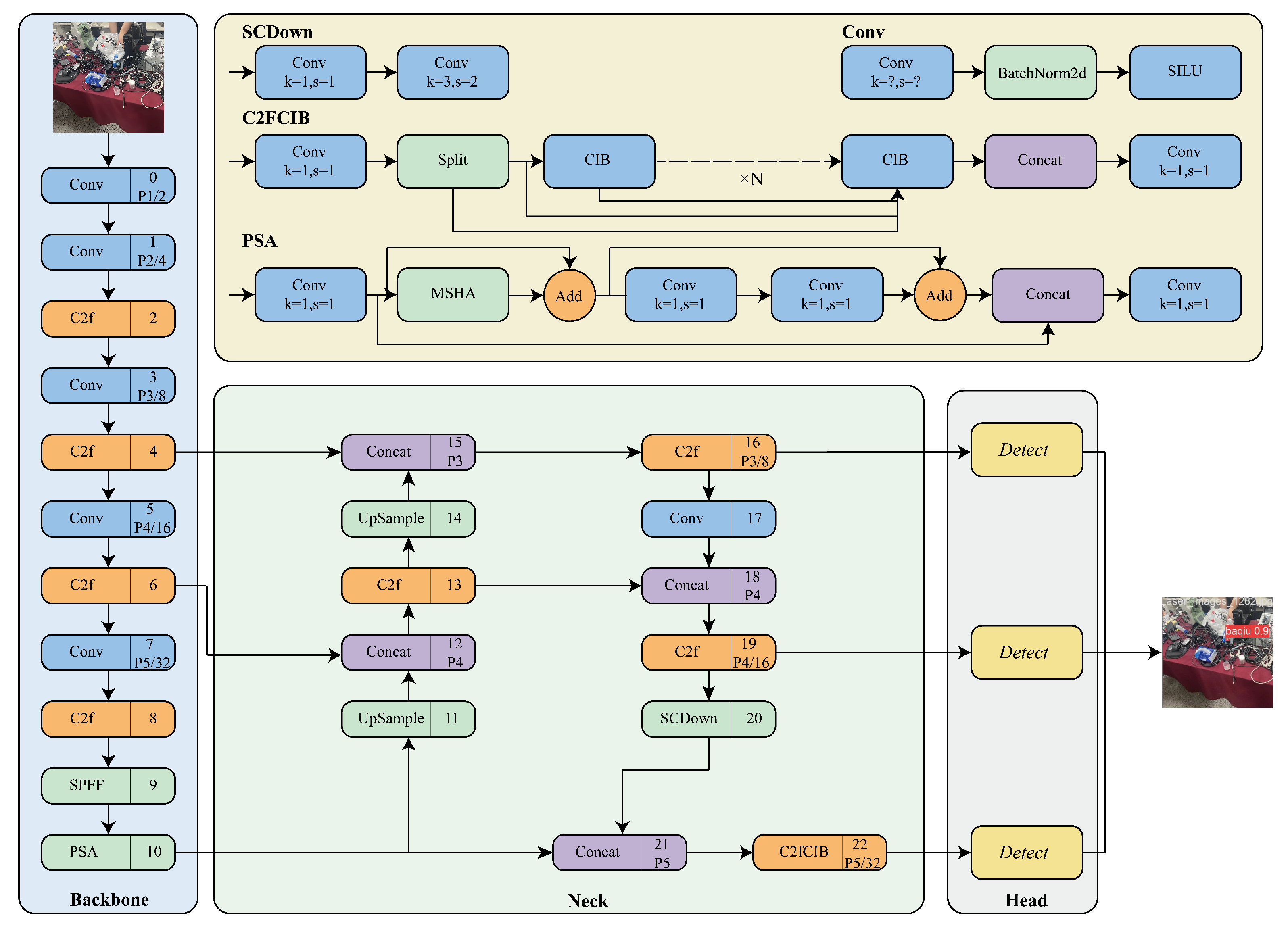
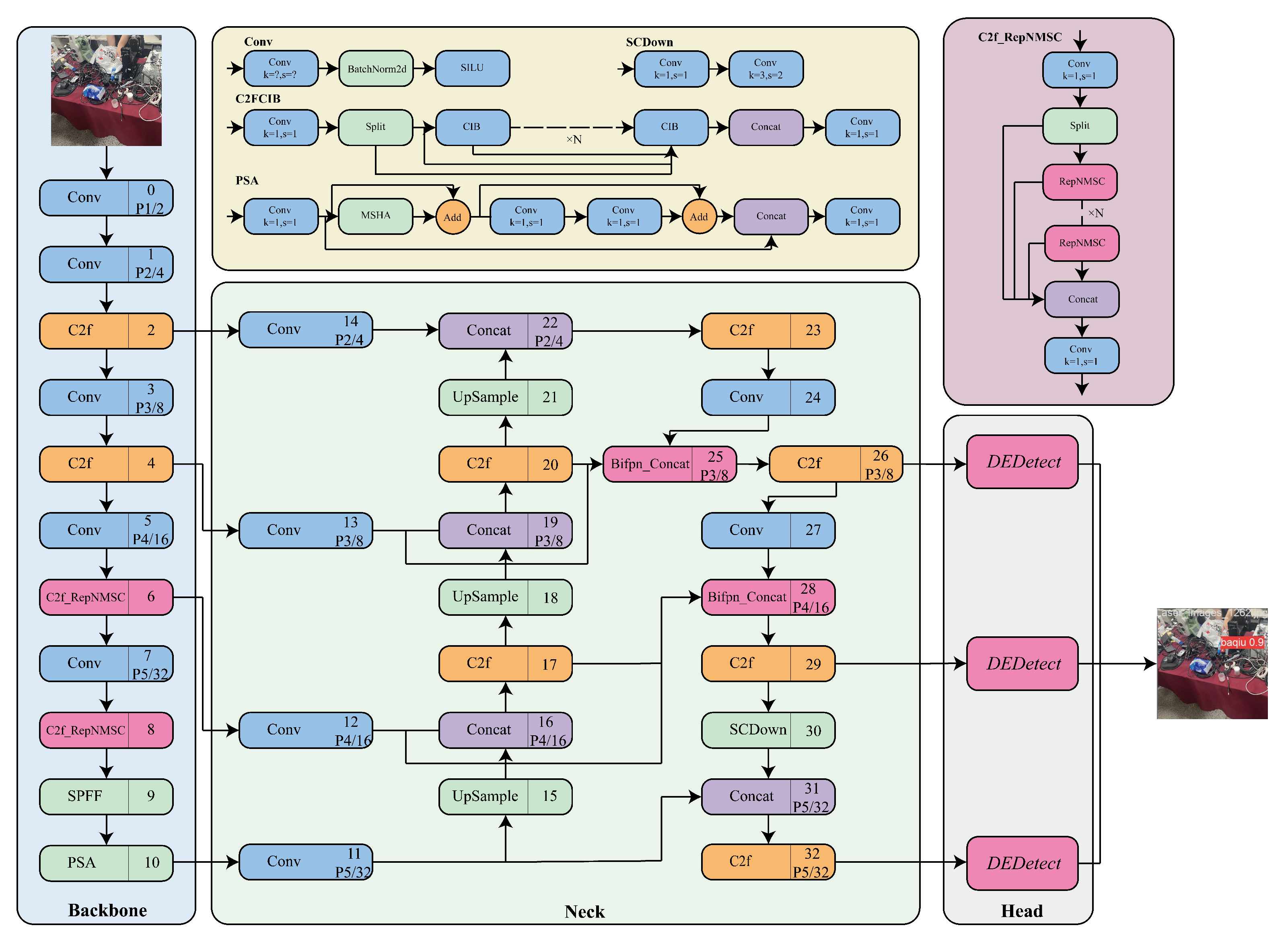
To address the above bottlenecks, we propose an SMR-oriented lightweight detector, termed RBD-YOLOv10n, by introducing targeted modifications across the backbone, neck, and head. The network architectures of the baseline YOLOv10n and the improved RBD-YOLOv10n are shown in Figure 1 and Figure 2, respectively. (1) To reduce the attenuation of fine-grained cues during feature extraction and downsampling, we design a Re-parameterized Multi-Scale Convolution module (RepNMSC) for backbone bottlenecks, which introduces multi-branch training and a fused single-branch form for deployment. (2) To ease scale/channel mismatch and improve small-target detail propagation in multi-scale fusion, we construct a Weighted Bi-directional Feature Pyramid Network (W-BiFPN) with an explicit high-resolution P2 feedback path and lightweight lateral projections to control the channel budget. (3) To reduce confusions caused by specular clutter, we propose a Detail-Enhanced Head (DEHead) with learnable difference-convolution priors to encourage boundary-consistent cues rather than relying mainly on raw brightness peaks. Together, these components form a lightweight backbone–neck–head pipeline intended to improve SMR reacquisition robustness under reflective clutter.
The principal contributions of this work are as follows:
1.
RepNMSC for backbone bottlenecks. Based on structural re-parameterization (multi-branch during training and single-branch after fusion for deployment), we propose RepNMSC to provide two receptive-field scales in a deployment-friendly form. Compared with a standard C2f bottleneck, RepNMSC combines (i) a re-parameterized input block for richer features during training while keeping inference compact, and (ii) a lightweight two-branch multi-scale stage with dilation rates d { 1 , 2 } to strengthen small-target cues.
2.
W-BiFPN with P2 feedback and weighted concatenation. We design a single-stage W-BiFPN that explicitly injects the high-resolution P2 feature and reinforces its feedback to deeper levels for small targets. To handle heterogeneous feature widths without heavy per-branch alignment, we introduce a learnable weighted-concatenation fusion that reweights inputs before concatenation and uses a lightweight 1 × 1 mixing layer for channel interaction.
3.
DEHead with learnable difference priors and deploy-time fusion. We propose DEHead by integrating a Difference Bank initialized with gradient priors (HDC/VDC/ CDC/ADC) and keeping these kernels learnable to adapt to optical blur and highlights. We further use convolution linearity to merge the vanilla-convolution branch and the Difference Bank into an equivalent single convolution for deployment, keeping the inference graph compact while improving robustness to specular clutter.

2. Materials and Methods

2.1. RepNMSC Backbone: Re-Parameterized Multi-Scale Convolution

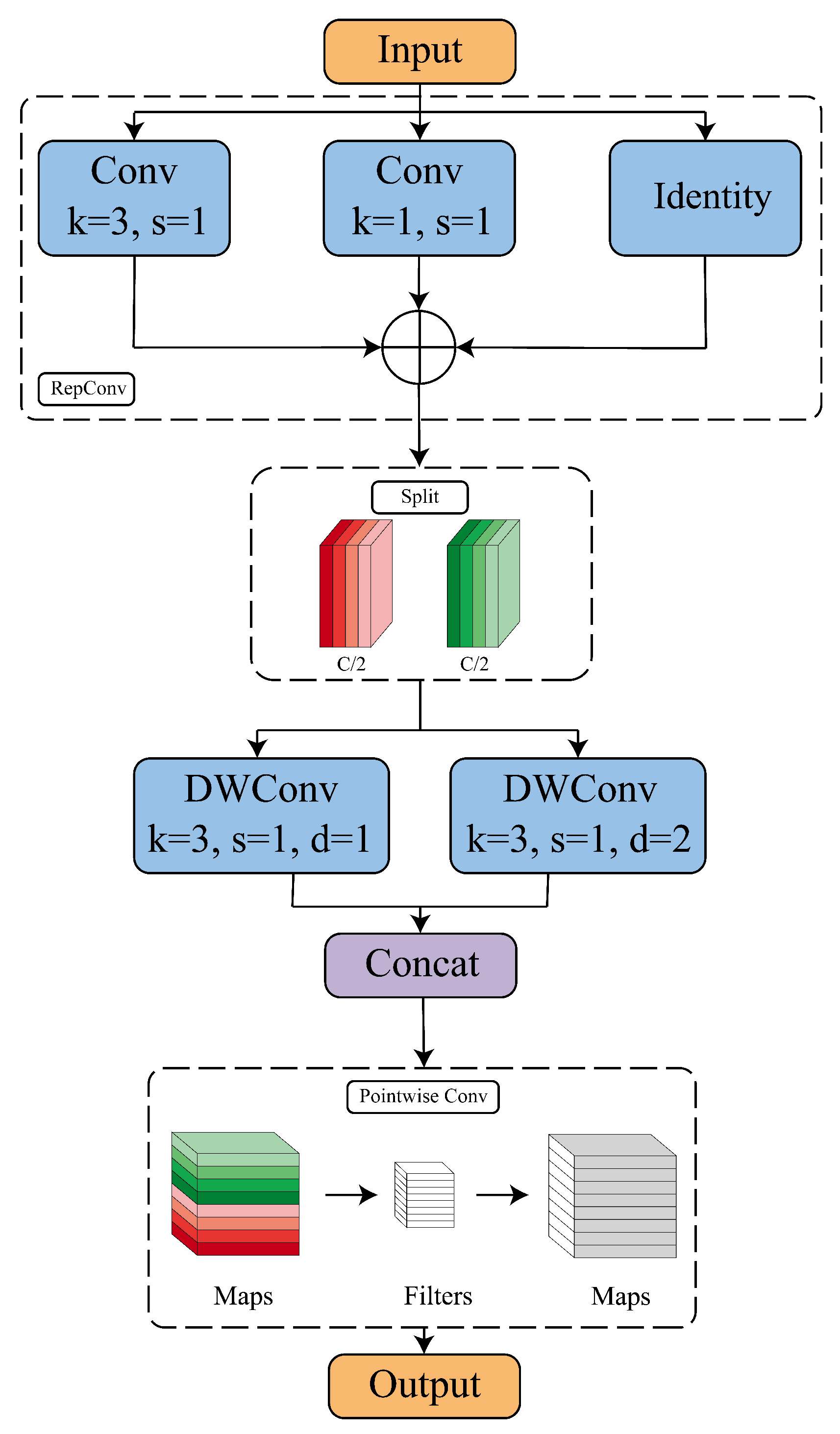
To address the challenge of representing small targets with significant scale variations, we propose the Re-parameterized Multi-Scale Convolution (RepNMSC) module, which is integrated into the final two C2f stages of the backbone network. The structural design of this module is illustrated in Figure 3. This architecture aims to balance the trade-off between computational latency and the preservation of high-frequency spatial information. The module follows a split–transform–merge paradigm combined with structural re-parameterization. Specifically, the input tensor X R C × H × W is processed by a multi-branch RepConv block during training, consisting of a 3 × 3 convolution branch, a 1 × 1 convolution branch, and an identity branch [14]. For training stability and re-parameterization, each branch is followed by Batch Normalization (BN). During deployment, we collapse these branches into a single 3 × 3 convolution with fused kernel W fused and bias b fused .
Following common practice in structural re-parameterization, we fuse the training-time Conv–BN branches into a single deploy-time convolution. Let k { 3 , 1 , id } index the 3 × 3 conv branch, the 1 × 1 conv branch, and the identity branch, respectively. For branch k, W ( k ) and b ( k ) denote the convolution kernel and bias (set b ( k ) = 0 for bias-free Conv). The subsequent BN has running mean μ ( k ) , running variance v ( k ) , affine scale γ ( k ) , affine shift β ( k ) , and a small constant ϵ bn for numerical stability. Define the channel-wise folding factor
s ( k ) = γ ( k ) v ( k ) + ϵ bn ,
where the division and square root are applied element-wise over channels. The folded branch-wise equivalent parameters are
W ˜ ( k ) = s ( k ) W ( k ) , b ˜ ( k ) = β ( k ) + s ( k ) b ( k ) μ ( k ) ,
where ⊙ denotes channel-wise multiplication (broadcast over spatial kernel dimensions). The deploy-time fused parameters are then obtained by padding the 1 × 1 kernel to 3 × 3 and summing kernels and biases:
W fused = W ˜ ( 3 ) + Pad W ˜ ( 1 ) + W ˜ ( id ) , b fused = b ˜ ( 3 ) + b ˜ ( 1 ) + b ˜ ( id ) .
Here, Pad ( · ) zero-pads a 1 × 1 kernel to the center of a 3 × 3 kernel. The identity branch is used only when stride = 1 and C in = C out ; it can be represented by a channel-diagonal 3 × 3 kernel with a unit impulse at the kernel center (and 0 otherwise), and b ( id ) = 0 .
Following re-parameterization, the feature map undergoes multi-scale context extraction [15]. Let X R C × H × W denote the output of RepConv (multi-branch during training or fused at deployment). As depicted in Figure 3, X is split along the channel dimension into N = 2 subspaces, ( X 1 , X 2 ) = Split ( X ) with X 1 , X 2 R C 2 × H × W . Each subspace is processed by a depthwise 3 × 3 convolution (DWConv) with a different dilation rate:
Y 1 = DWConv 3 × 3 , s = 1 , d = 1 ( X 1 ) , Y 2 = DWConv 3 × 3 , s = 1 , d = 2 ( X 2 ) .
We adopt a two-branch setting ( N = 2 ) to balance multi-scale representation and deployment efficiency: two complementary receptive-field scales (local detail and larger context) are typically sufficient in our SMR scenario, while increasing N would introduce extra branch-wise memory access and fusion overhead with limited marginal gain for a lightweight real-time detector. For the dilation rates, we use a mild pair d { 1 , 2 } to obtain two receptive-field scales with minimal complexity. The d = 1 branch preserves fine local spatial cues that are critical for tiny targets, whereas the d = 2 branch enlarges the effective receptive field (approximately 5 × 5 [16]) using the same 3 × 3 kernel parameters. We intentionally avoid larger dilation factors because overly sparse sampling may introduce gridding artifacts and amplify background interference, which is undesirable for small reflective targets.
The two outputs are concatenated and fused by a lightweight 1 × 1 pointwise convolution (PWConv) followed by BN and SiLU (Sigmoid Linear Unit) activation:
Y out = SiLU BN PWConv 1 × 1 Concat ( Y 1 , Y 2 ) .
We compare with a dense 3 × 3 convolution because it is the dominant spatial operator in common C2f-style bottlenecks and is also the deploy-time equivalent of RepConv after re-parameterization. For a feature map of size H × W and channel width C, a dense 3 × 3 conv ( C C ) has P 3 × 3 = 9 C 2 parameters and M 3 × 3 = 9 H W C 2 MACs (multiply–accumulate operations).
In RepNMSC, the additional multi-scale stage consists of two depthwise 3 × 3 branches on C 2 channels plus a 1 × 1 pointwise fusion, whose added cost is
Δ P ms = 9 C + C 2 , Δ M ms = 9 H W C + H W C 2 .
Compared with adding another dense 3 × 3 layer (which would add 9 C 2 parameters and 9 H W C 2 MACs), RepNMSC introduces an extra receptive-field scale with lightweight depthwise spatial cost (linear in C).
This hierarchical architecture enables the network to simultaneously encode local textural information and enlarged-context cues helpful for discriminating SMRs from complex backgrounds.

2.2. Neck Optimization: Weighted Bi-Directional Feature Pyramid

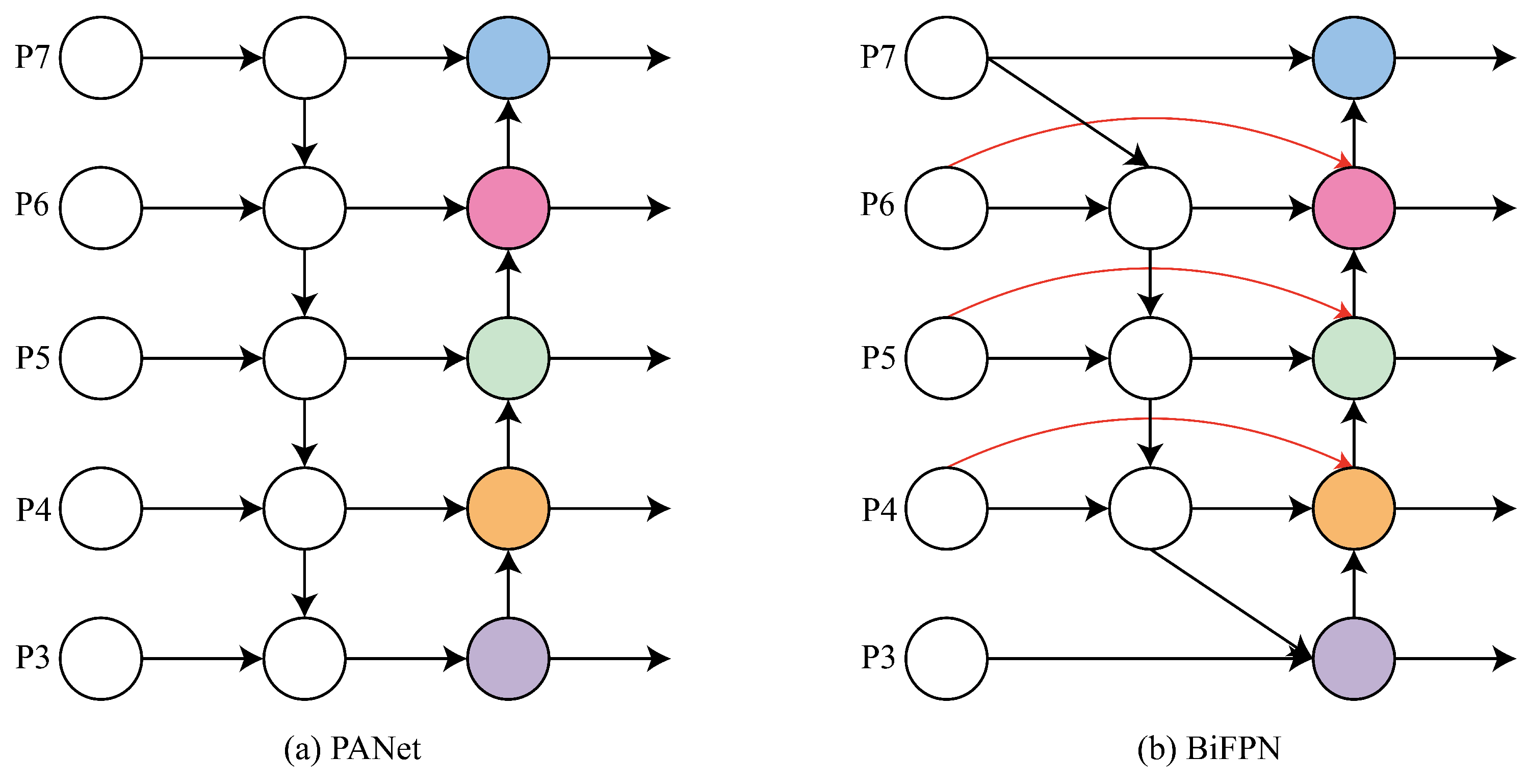
To mitigate the attenuation of small target features in deep network layers, we replace the standard Path Aggregation Network (PANet) used in YOLOv10 with a single-stage Weighted Bi-directional Feature Pyramid Network (W-BiFPN). The structural evolution is illustrated in Figure 4. As shown in Figure 4a, the standard PANet relies on sequential Top-Down and Bottom-Up pathways, which may dilute the geometric details required for SMR localization. In contrast, our approach adopts the cross-scale connection topology shown in Figure 4b, which is explicitly implemented in the overall architecture (see Figure 2) via the Bifpn_Concat modules.
A critical modification in our design is the explicit injection of the P2 feature map ( 160 × 160 resolution) extracted from the second stage of the backbone (corresponding to Layer 2 in Figure 2). For simplicity, Figure 4b illustrates the P3–P7 topology; the explicit P2 injection is implemented as shown in Figure 2. This high-resolution layer serves as a “detail donor,” utilizing the cross-scale feedback connections (indicated by the red curves in Figure 4b) to fuse shallow spatial information directly with deep semantic features at the P3 and P4 scales. In addition, our BiFPN implementation introduces lightweight 1 × 1 lateral projection layers before fusion (see Figure 2) to compress incoming pyramid features to a smaller channel budget, so that subsequent fusion and refinement operate on narrower feature widths, which further reduces the overall parameter count. In our W-BiFPN implementation, lateral 1 × 1 projections compress P 5 / P 4 / P 3 / P 2 to 256 / 256 / 192 / 96 channels.
Unlike standard BiFPN implementations that utilize weighted summation [17], which mandates identical channel dimensions across inputs, we propose a Learnable Weighted Concatenation mechanism. We choose weighted concatenation over weighted summation for two practical reasons. First, weighted summation enforces identical channel widths at each fusion node and would introduce additional alignment constraints (and potentially extra projection layers) beyond our lightweight compression projections to match heterogeneous YOLOv10 features across pyramid levels, increasing computational latency and parameters. Second, element-wise summation may overly couple features from different levels and limit representational flexibility when shallow detail features and deep semantic features exhibit different activation statistics. In contrast, weighted concatenation preserves each reweighted input as a dedicated channel group, and the subsequent lightweight 1 × 1 convolution in our Bifpn_Concat blocks performs learnable cross-branch mixing while controlling the output channel dimension. This design enables fusing heterogeneous channel depths while avoiding extra per-branch alignment projections solely for channel matching at each fusion node.
Let I = { I 1 , I 2 , , I n } represent the input features at a specific fusion node. We assign a learnable scalar weight w i to each input feature map I i (one weight per input), and each fusion node maintains its own set of weights { w i } (not shared across nodes). All w i are initialized to 1 to start from equal contribution. During training, we enforce non-negativity and normalize the weights across inputs for numerical stability, and each input is rescaled by its normalized weight before concatenation. The normalization makes the fusion depend on relative importance among inputs, preventing uncontrolled gain changes and improving numerical stability. Equation (7) defines the weighted concatenation output; in our Bifpn_Concat blocks, a lightweight 1 × 1 convolution is applied after concatenation to enable cross-branch channel interaction and to control the output channel dimension. The weighted concatenation is formulated as:
w i + = max ( w i , 0 ) , w ˜ i = w i + ϵ wc + j = 1 n w j + , O = Concat w ˜ 1 I 1 , w ˜ 2 I 2 , , w ˜ n I n ,
where ϵ wc = 10 4 is a small constant to prevent division by zero. The final fused feature is obtained by applying a lightweight 1 × 1 convolution to O in Bifpn_Concat. Through backpropagation, the network adaptively adjusts these weights to prioritize informative branches (e.g., the injected P2 detail path), thereby improving feature fusion for small targets under channel misalignment.

2.3. Head Enhancement: Detail-Enhanced Head (DEHead)

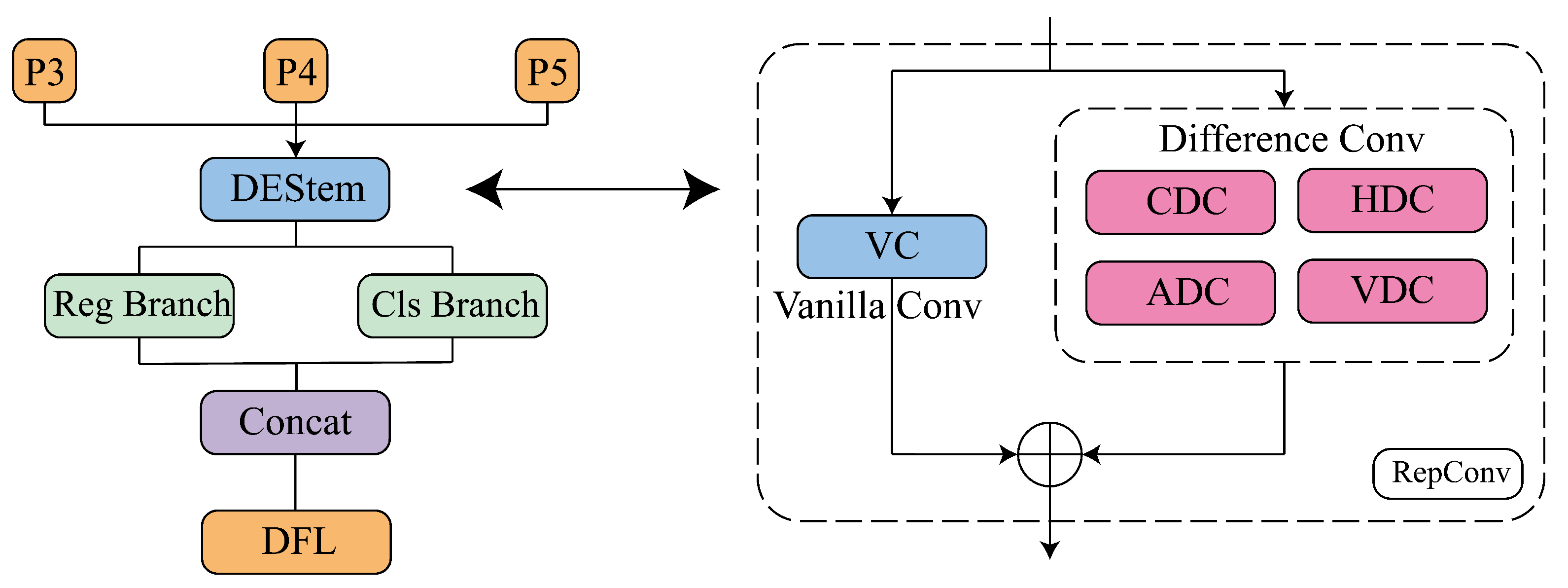
The detection head is responsible for final localization. To improve the capture of high-frequency boundary signals and rotationally consistent characteristics of SMR targets, we introduce the Detail-Enhanced Stem (DEStem), applied to both the one-to-one and one-to-many branches. The specific topology of this module is presented in Figure 5. Although gradient extraction can be expressed by unfolding local patches and applying difference operators [18], Unfold explicitly materializes all sliding-window patches into an expanded tensor, which increases memory traffic and is inefficient for lightweight inference. Therefore, we implement the Difference Bank using efficient 3 × 3 convolution primitives initialized with gradient priors, achieving the same local-difference effect with standard convolution operators. This introduces inductive bias via discrete gradient priors [19].
We define four categories of difference convolutions, each initialized with a specific 3 × 3 template kernel. To capture axial gradients, the Horizontal Difference Convolution (HDC) and Vertical Difference Convolution (VDC) are initialized with Sobel operators [20]:
K H D C i n i t = 1 0 1 2 0 2 1 0 1 , K V D C i n i t = 1 2 1 0 0 0 1 2 1 .
To highlight local intensity discontinuities, the Central Difference Convolution (CDC) is initialized with the Laplacian operator [20]:
K C D C i n i t = 0 1 0 1 4 1 0 1 0 .
SMR targets often appear as approximately circular bright spots with radially symmetric intensity transitions, and their boundary cues can rotate slightly with viewpoint changes, minor target rotations, or glare-induced shape deformation. While HDC and VDC emphasize axial gradients and CDC highlights local intensity discontinuities, they do not explicitly encourage diagonally symmetric responses. Therefore, we introduce an Angular Difference Convolution (ADC) to emphasize diagonally consistent gradient patterns, complementing axial and central difference cues for more stable boundary modeling of SMR-like spots. The Angular Difference Convolution (ADC) is initialized with a diagonal difference kernel:
K A D C i n i t = 2 1 1 1 2 1 1 1 2 .
All difference kernels are learnable ( requires _ grad = True ): we denote the trainable kernels as K i with i { H , V , C , A } , initialized by K H D C i n i t , K V D C i n i t , K C D C i n i t , and K A D C i n i t , respectively. Here, H , V , C , A correspond to HDC, VDC, CDC, and ADC, respectively. This allows the model to adapt to domain-specific optical blur and glare patterns. HDC and VDC emphasize axial edge transitions, CDC highlights center-surround intensity discontinuities, and ADC emphasizes diagonally consistent differences to encourage more stable boundary cues for approximately spherical SMR spots.
As shown in the fusion block of Figure 5, the outputs from the Vanilla Conv (VC) branch and the four difference branches are fused via element-wise summation. We denote the VC-branch output as F V C , i.e., the standard learnable convolution response without difference priors.Let X R C × H × W denote the input feature map to the head at a given pyramid level, and let Conv ( X , K ) denote applying a convolution operator with kernel K to X . The fusion is written as:
F o u t = F V C + i { H , V , C , A } Conv ( X , K i ) .
where Conv ( X , K i ) denotes the ith Difference Bank convolution. In our lightweight setting, the VC branch and all difference branches are implemented as depthwise 3 × 3 convolutions with the same channel grouping, so the multi-branch summation can be exactly merged into a single depthwise convolution at deployment [21].
We exploit the linearity of convolution to merge the multi-branch structure during inference. Let K V C denote the kernel of the VC branch (corresponding to F V C ), and let K i be the kernels from the Difference Bank. These are collapsed into a single equivalent kernel K e q via structural re-parameterization:
K e q = K V C + i { H , V , C , A } K i .
This formulation ensures that the gradient extraction logic is integrated into a single 3 × 3 convolution during deployment, avoiding additional inference latency.

2.4. Dataset and Experimental Setup

To support training and evaluation under industrial laser-tracking conditions, we constructed a specialized SMR dataset using a professional machine vision system. The image acquisition module utilized a Hikvision MV-CE060-10UC camera with a 1 / 1 . 8 Sony IMX178 CMOS sensor, providing a high resolution of 3072 × 2048 pixels. This sensor employs a rolling shutter mechanism optimized for low-noise imaging. The camera was paired with a Hikvision MVL-HF1624M-10MP FA industrial lens (16 mm focal length), featuring an ultra-low distortion rate of 0.02 % to ensure precise centroid localization.
A total of 3249 images were collected under representative industrial laser-tracking scenarios. To accommodate the network architecture while preserving the original aspect ratio, all images were resized to 640 × 640 using letterbox scaling, and all area-based grouping for dataset splitting was computed under this resized scale. Each image contained exactly one annotated SMR instance; therefore, the dataset contained 3249 targets in total. The dataset was divided into training/validation/test subsets using a 7:2:1 split (2275/650/324 images, i.e., approximately 70%/20%/10%). To ensure a fair evaluation under scale variation, we first stratified images by target area into three groups, small (<322 pixels), medium ( 32 2 96 2 pixels), and large (>962 pixels), and then applied the same split within each group before merging them into the final subsets. In addition, to prevent scene-level redundancy from biasing evaluation, we defined a scene batch by the same site and setup configuration and enforced a batch-disjoint split, ensuring that each batch appeared in only one subset. Therefore, images from the same scene batch did not appear across different splits, avoiding scene leakage between training and evaluation. Finally, because SMRs are highly reflective and may exhibit blooming or glare halos that make boundaries ambiguous, we adopted a unified labeling guideline for bounding-box placement and performed cross-review by two annotators to improve annotation consistency, thereby reducing acquisition-related annotation bias. Specifically, annotations were first produced by one annotator and then independently checked by another; disagreements were discussed and corrected to produce a final consensus label set, and we further conducted spot-checks to verify the overall annotation quality.
To improve representativeness for deployment-oriented laser-tracking applications, the dataset was collected to span a wide range of practical industrial conditions, including different measurement distances (1–5 m), illumination regimes (e.g., specular highlights, shadows, and non-uniform lighting), and varying degrees of background complexity and reflective interference. Typical disturbances that affect SMR visibility, such as partial occlusion and dust, were also included, resulting in substantial variations in target scale and signal-to-noise characteristics. To reduce overfitting to dataset-specific appearance patterns, we applied standard online augmentation strategies during training, including HSV jitter, Mosaic, and Mixup. The validation set was used to select the best checkpoint, and the test set was used only for final performance reporting.
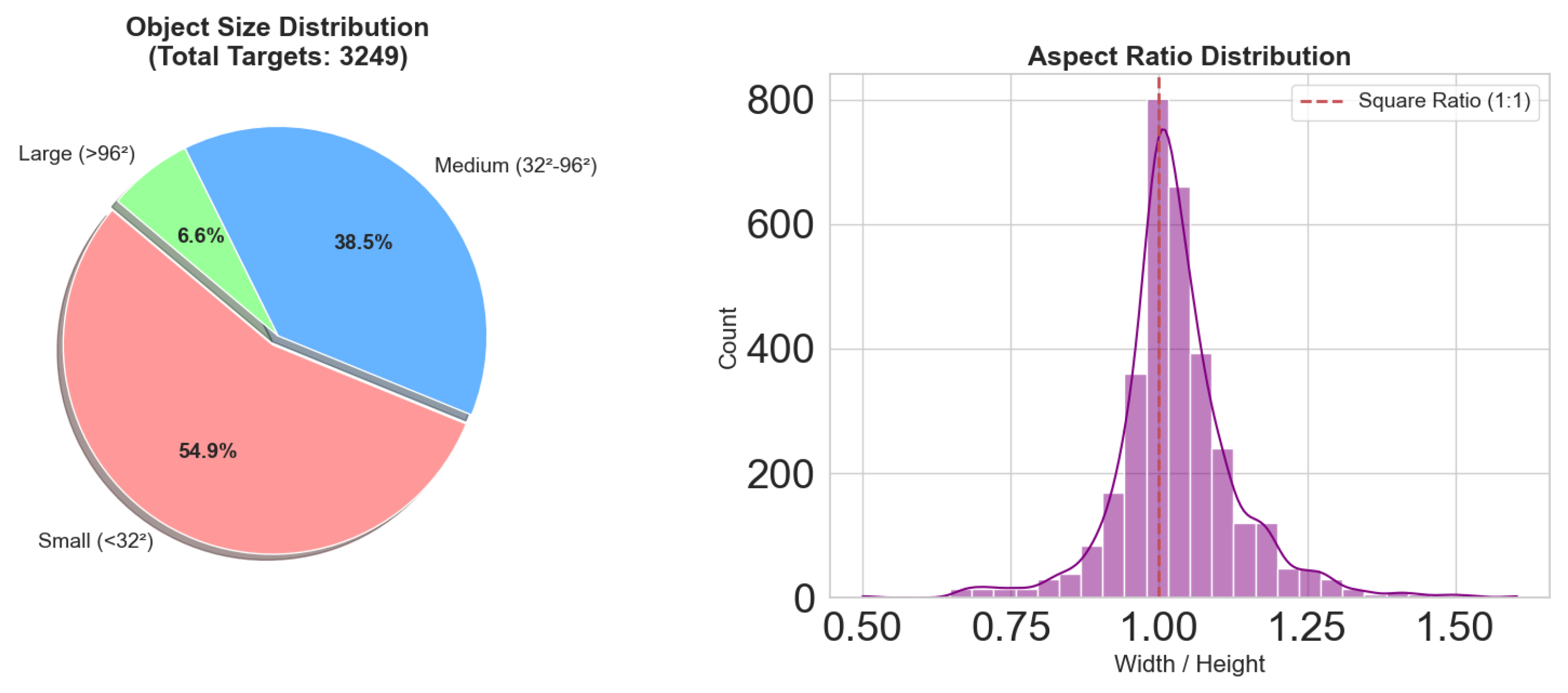
Statistical analysis (see Figure 6) revealed that under the 640 × 640 input scale, 54.9 % of targets were categorized as small, as defined in the Introduction. This high prevalence of small targets highlights the difficulty of SMR detection and motivates the proposed optimization strategies. Additionally, the aspect ratio distribution centered at 1.03 with a standard deviation of 0.10, consistently reflecting the spherical geometry of SMR targets.

2.5. Experimental Environment and Evaluation Metrics

The experiments were performed on a Windows 11 (64-bit) operating system using the PyTorch 1.13.0 framework and Python 3.8. The hardware configuration included a 12th Gen Intel(R) Core(TM) i7-12700K CPU, an NVIDIA GeForce RTX 3070Ti GPU (16 GB), and 16 GB of RAM. Model training and testing were carried out in the PyCharm development environment. The training hyperparameters are summarized in Table 1.
Model performance was evaluated using mean Average Precision (mAP), while model complexity was assessed via the number of parameters (Params), floating-point operations per image (GFLOPs), and frames per second (FPS). The mAP represents the mean of Average Precisions (APs) across all categories, ranging from 0 to 1, where higher values indicate better detection accuracy. The mAP metric is calculated as:
mAP = 1 n i = 1 n 0 1 P ( R ) i d R ,
where P ( R ) denotes the precision–recall curve, n is the number of classes, and A P i is the average precision of the ith class. mAP @ 0.5 represents the mean AP when the Intersection over Union (IoU) threshold is set to 0.5.
FPS was measured with a batch size of 1 at an input resolution of 640 × 640 . Following a deployment-oriented protocol, we ran 100 warm-up iterations and report the average FPS over 1000 timed iterations. The timing included pre-processing (letterbox resize and normalization), model forward inference, and post-processing to obtain final detections. For all baselines, we included their default post-processing (e.g., confidence filtering and non-maximum suppression (NMS)) in the end-to-end timing for a fair comparison. Since YOLOv10 adopts an NMS-free design, its post-processing does not involve an NMS step.

3. Results

3.1. Ablation Experiments

To rigorously verify the individual and combined contributions of the proposed RepNMSC, BiFPN, and DEHead modules, comprehensive ablation experiments were conducted on the test set, with quantitative results summarized in Table 2. A, B, and C indicate whether RepNMSC, BiFPN, and DEHead were enabled, respectively.
Starting from the baseline YOLOv10n, Table 2 shows that each proposed module contributes complementary improvements. RepNMSC mainly strengthens backbone feature extraction, BiFPN enhances cross-scale feature utilization (especially for small targets), and DEHead improves boundary-sensitive prediction while keeping the computation lightweight. When modules are combined, the full model (Model 7) achieves the best overall accuracy. Relative to YOLOv10n, Model 7 improved mAP@0.5 by +2.92 and mAP@0.5:0.95 by +2.74, while reducing model size by 27% (Params: 2.70 M → 1.98 M) and computation by 24% (8.4 → 6.4 GFLOPs).
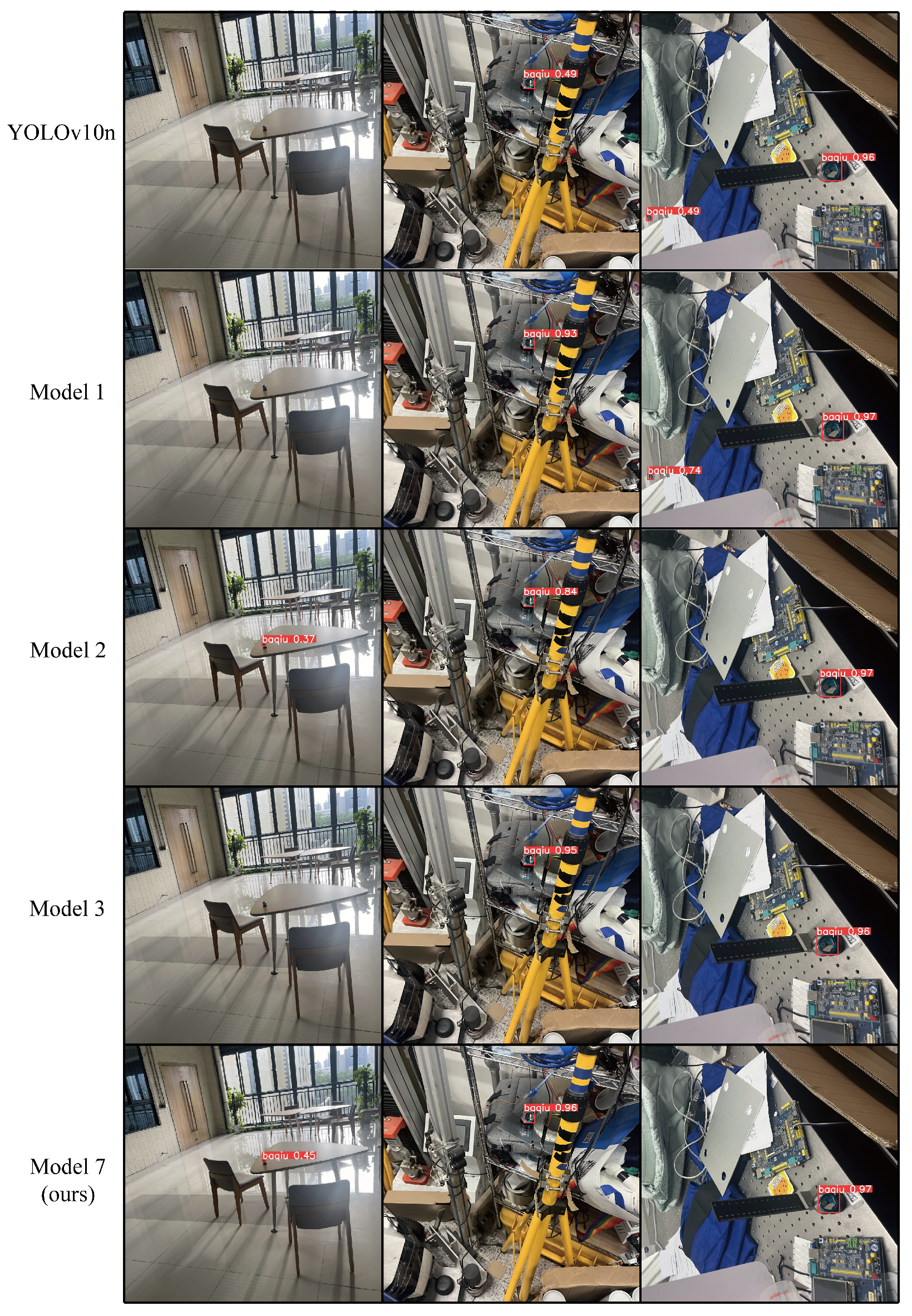
The quantitative improvements are visually corroborated by the inference comparisons in Figure 7, where the three columns correspond to representative scenarios (reflective floor, cluttered laboratory equipment, and close-range electronics), and the rows compare YOLOv10n with key ablation variants. The models displayed were chosen following the ablation protocol to make the qualitative comparison diagnostically meaningful rather than purely illustrative. YOLOv10n is included as the baseline reference, whereas Model 1 (RepNMSC), Model 2 (BiFPN), and Model 3 (DEHead) are representative single-module variants that disentangle the contributions of (i) multi-scale backbone feature extraction, (ii) bidirectional cross-scale feature aggregation, and (iii) detail-enhanced, boundary-sensitive prediction, respectively. The final Model 7 (ours) combines all proposed modules and is shown to verify whether these improvements are complementary and consistent across the three columns, and to reveal potential failure modes (e.g., missed detections versus false positives) in a controlled, side-by-side manner.
In the first column (indoor reflective floor), strong specular highlights lead to missed detections for the baseline and some single-module variants, whereas the BiFPN-based variant (Model 2) recovers the target, and Model 7 further improves the detection confidence and localization accuracy. In the second column (cluttered laboratory equipment with severe background clutter/occlusion), the baseline yields a low-confidence prediction, while Model 1 and Model 3 substantially increase confidence, indicating that RepNMSC enhances feature extraction under clutter and DEHead strengthens boundary cues for small targets. Model 7 achieves the most stable and accurate localization, benefiting from the complementary effects of stronger backbone features, cross-scale fusion, and detail-enhanced head design. Finally, in the third column (close-range electronics), while all models detect the SMR, an additional detection appears in YOLOv10n and Model 1, which corresponds to a false positive likely triggered by reflective background structures; this false positive is suppressed in Model 2/Model 3 and remains suppressed in Model 7. Overall, these qualitative results align with the quantitative gains in Table 2, confirming that the proposed modules jointly improve robustness to specular highlights and clutter while enhancing localization accuracy for small SMR targets.

3.2. Comparison Experiments

To further evaluate RBD-YOLOv10n under laser-tracking scenarios, comparison experiments were performed using the same environment and dataset. Competing detectors included YOLOv10n, YOLOv3-tiny, YOLOv5n, YOLOv6n, YOLOv8n, and Faster R-CNN. All models in Table 3 were trained on our SMR dataset under an identical protocol, including the same data split, input resolution ( 640 × 640 ), augmentation pipeline, and the unified hyperparameter setting in Table 1. All models were trained from scratch (no pretrained weights), and no baseline-specific hyperparameter tuning was performed. These baselines were chosen to enable a reproducible accuracy–efficiency comparison (mAP/GFLOPs/FPS) under identical training and inference settings on our SMR dataset. We did not include recent domain-specific YOLO variants (e.g., EAD-YOLOv10 [8], RS-YOLOv10 [9], YOLO-LSD [10]) because they are typically reported on different datasets/tasks and often lack a unified public pipeline for controlled re-training and fair FPS measurement under the same hardware and preprocessing. Therefore, we focused on widely adopted YOLO baselines (YOLOv5/6/8/10) and a two-stage reference (Faster R-CNN), while the effectiveness of our plug-and-play modules was isolated by the ablation study in Table 2.
As shown in Table 3, RBD-YOLOv10n achieves the highest detection accuracy with low computational complexity. It yields mAP@0.5 = 93.24% and mAP@0.5:0.95 = 78.45%, outperforming YOLOv3-tiny, YOLOv5n, YOLOv6n, YOLOv8n, and Faster R-CNN. Moreover, RBD-YOLOv10n maintains lightweight efficiency, with only 1.98 M parameters, 6.4 GFLOPs, and a 4.3 MB weight file, demonstrating better accuracy under compact model size and lower GFLOPs.

4. Discussion

The experimental results in Table 3 suggest that the proposed RBD-YOLOv10n achieves a favorable accuracy–efficiency trade-off for SMR detection under our experimental setting. Notably, compared with the two-stage Faster R-CNN baseline, our model attains higher detection accuracy with lower computational cost, suggesting that a compact one-stage design can be a viable option for this task.
We attribute the improvement mainly to more reliable small-target evidence under strong reflections and clutter, where SMRs often have a limited pixel footprint and their boundaries can be weakened by blooming, motion blur, or partial occlusion. In such cases, detectors may fail in two typical ways: (i) false negatives when the target cue is diluted by downsampling or overwhelmed by strong illumination variation, and (ii) false positives when bright specular structures form intensity peaks similar to SMR highlights. The proposed design is intended to alleviate these issues by jointly strengthening multi-scale feature formation and cross-scale detail propagation, while encouraging boundary-consistent cues in the head. Specifically, the backbone enhancement promotes complementary receptive-field responses that help retain discriminative cues for tiny reflective targets, and the neck fusion reinforces the interaction between shallow spatial details and deeper semantic context so that weak boundary evidence can be recovered under clutter. Meanwhile, DEHead introduces learnable difference-convolution priors that emphasize structured gradient transitions around SMR-like spots, which may encourage the model to rely less on raw brightness peaks that frequently occur on metallic surfaces. This is qualitatively consistent with Figure 7, where the proposed variants tend to show fewer false negatives under strong highlights and fewer false positives on reflective background structures. In particular, CDC encourages center-surround boundary cues, and ADC encourages diagonally consistent gradient responses that complement axial gradients from HDC/VDC, which can help improve robustness under minor viewpoint changes and glare-induced shape perturbations.
Although this study focused on SMRs, the proposed architecture may also be applicable to other small, approximately spherical or highly reflective industrial targets with similar imaging challenges (minute size, specular highlights, and background clutter), such as polished-bearing-ball surface inspection and aircraft rivet localization. This is because our design emphasizes multi-scale feature extraction, high-resolution feature propagation, and boundary-sensitive prediction, which are generally beneficial for such targets. In practice, transferring to a new target type would typically require modest task-specific fine-tuning to accommodate domain shifts.
Despite these improvements, limitations remain. First, the current evaluation was mainly conducted on offline images and a lab-level setup, and we have not yet performed in-field, on-tracker validation using commercially available laser trackers in a closed-loop beam recovery workflow. Such on-device validation is important to quantify end-to-end reacquisition success rate and time under different optics, sensors, and firmware recovery strategies. As future work, we will conduct on-tracker experiments to report task-level metrics (e.g., reacquisition success rate within a fixed time budget, reacquisition time, and false recovery attempts) under representative industrial conditions.
Second, detection performance at long distances (e.g., beyond 5 m) is still constrained by the limited pixel footprint of SMRs (in some long-range cases, on the order of 10 × 10 pixels or less), which reduces the available boundary information for stable localization. Third, the current implementation performs frame-wise detection without leveraging cross-frame stability. In practical laser-tracking videos, short-lived specular flashes or brief occlusions may cause occasional false positives or false negatives in individual frames. As future work, to further improve deployment efficiency, we plan to explore INT8 quantization with a conservative scaling strategy: per-channel symmetric scaling for weights and calibration-based per-tensor scaling for activations, with mild clipping during calibration to reduce the impact of highlight-induced outliers.

5. Conclusions

This study presented RBD-YOLOv10n, a lightweight detector for SMR targets in laser-tracking measurement scenarios. Evaluated on our self-constructed industrial dataset, the proposed method achieved improved detection accuracy while remaining compact and computationally efficient compared with the baselines considered. These results indicate that RBD-YOLOv10n provides a practical accuracy–efficiency trade-off for SMR detection under the studied settings.
For realistic deployment, RBD-YOLOv10n can serve as the perception module in an LT vision pipeline for online SMR acquisition during large-scale equipment assembly and in situ alignment, where illumination conditions and background reflections vary across work sites. Future work will focus on validating robustness across additional scenes/devices and improving deployment efficiency via INT8 quantization and lightweight cross-frame stabilization to reduce occasional errors caused by transient glare or short-term occlusion.

Author Contributions

Conceptualization, D.L. and T.C.; methodology, D.L.; software, T.C.; validation, D.L., T.C. and X.W.; formal analysis, X.W.; investigation, D.L.; resources, D.L.; data curation, T.C.; writing—original draft preparation, D.L.; writing—review and editing, T.C. and X.W.; visualization, D.L.; supervision, D.L.; project administration, D.L.; funding acquisition, D.L. All authors have read and agreed to the published version of the manuscript.

Funding

This research was funded by Project Type: National Key R&D Program of China Grant Number: 2024YFF0617802.

Institutional Review Board Statement

Not applicable.

Informed Consent Statement

Not applicable.

Data Availability Statement

Data available on request due to restrictions/privacy.

Acknowledgments

The authors would like to thank the University of Science and Technology Beijing for providing the research facilities.

Conflicts of Interest

The authors declare no conflicts of interest.

References

  1. Muralikrishnan, B.; Czapla, B.; Lee, V.; Shakarji, C.; Sawyer, D.; Saure, M. Laser Tracker and Terrestrial Laser Scanner Range Error Evaluation by Stitching. Sensors 2024, 24, 2960. [Google Scholar] [CrossRef] [Scilit] [PubMed]
  2. Aldubaikhi, A.; Patel, S. Advancements in Small-Object Detection (2023–2025): Approaches, Datasets, Benchmarks, Applications, and Practical Guidance. Appl. Sci. 2025, 15, 11882. [Google Scholar] [CrossRef] [Scilit]
  3. Zhang, B.; Zhang, F.; Qu, X. A Method of Locating the 3D Centers of Retroreflectors Based on Deep Learning. Ind. Robot. Int. J. Robot. Res. Appl. 2021, 48, 352–358. [Google Scholar] [CrossRef] [Scilit]
  4. Wang, J.L.; Fu, X.S.; Huang, Z.C.; Guo, Y.Q.; Wang, R.T.; Zhao, L.Q. Multi-type Cooperative Targets Detection Using Improved YOLOv2 Convolutional Neural Network. Opt. Precis. Eng. 2020, 28, 251–260. [Google Scholar] [CrossRef] [Scilit]
  5. Ma, L.; Gong, X.T.; Ouyang, H.K. Improvement of Tiny YOLOv3 Target Detection. Opt. Precis. Eng. 2020, 28, 988–995. [Google Scholar] [CrossRef]
  6. Morsi, I.; El-Meligy, A. Object Detection for Total Station Using Deep Learning. In Proceedings of the 2025 International Conference on Future Telecommunications and Artificial Intelligence (IC-FTAI); IEEE: New York, NY, USA, 2025; pp. 1–7. [Google Scholar] [CrossRef] [Scilit]
  7. Luo, X.; Quan, K.; Liu, Y. Ball-Type Small Objection Algorithm Based on YOLOv8. In Proceedings of the 2024 IEEE/ACIS 24th International Conference on Computer and Information Science (ICIS); IEEE: New York, NY, USA, 2024; pp. 139–144. [Google Scholar] [CrossRef] [Scilit]
  8. Hu, H.; Tong, J.; Wang, H.; Lu, X. EAD-YOLOv10: Lightweight Steel Surface Defect Detection Algorithm Research Based on YOLOv10 Improvement. IEEE Access 2025, 13, 55382–55397. [Google Scholar] [CrossRef] [Scilit]
  9. Nguyen, D.M.-T.; Huynh-The, T. RS-YOLOv10: Enhancing YOLOv10 for Accurate Small-Object Detection. In Proceedings of the 2025 19th International Conference on Ubiquitous Information Management and Communication (IMCOM); IEEE: New York, NY, USA, 2025; pp. 1–8. [Google Scholar] [CrossRef] [Scilit]
  10. Chung, M.-A.; Chai, S.-Y.; Hsieh, M.-C.; Lin, C.-W.; Chen, K.-X.; Huang, S.-J.; Zhang, J.-H. YOLO-LSD: A Lightweight Object Detection Model for Small Targets at Long Distances to Secure Pedestrian Safety. IEEE Access 2025, 13, 83061–83070. [Google Scholar] [CrossRef] [Scilit]
  11. Guo, C.; Luo, P.; Ma, Z.; Zhao, T.; Shen, X. An Efficient Reparameterized Small Object Detection Transformer for Thermal Infrared Images. Sci. Rep. 2025, 15, 44599. [Google Scholar] [CrossRef] [Scilit] [PubMed]
  12. Qiu, Y.; Zheng, X.; Hao, X.; Zhang, G.; Lei, T.; Jiang, P. ARSOD-YOLO: Enhancing Small Target Detection for Remote Sensing Images. Sensors 2024, 24, 7472. [Google Scholar] [CrossRef] [Scilit] [PubMed]
  13. Mou, H.; Zhang, M. A Lightweight Detection Network for Vehicle Paint Defects in Specular Reflection Scenes Based on Stage-wise Attention Guidance. Digit. Signal Process. 2026, 168, 105704. [Google Scholar] [CrossRef] [Scilit]
  14. Ding, X.; Zhang, X.; Ma, N.; Han, J.; Ding, G.; Sun, J. RepVGG: Making VGG-style ConvNets Great Again. In Proceedings of the IEEE/CVF Conference on Computer Vision and Pattern Recognition (CVPR), Virtual, 19–25 June 2021; pp. 13733–13742. [Google Scholar] [CrossRef] [Scilit]
  15. Gao, S.-H.; Cheng, M.-M.; Zhao, K.; Zhang, X.-Y.; Yang, M.-H.; Torr, P. Res2Net: A New Multi-scale Backbone Architecture. IEEE Trans. Pattern Anal. Mach. Intell. 2021, 43, 652–662. [Google Scholar] [CrossRef] [Scilit] [PubMed]
  16. Yu, F.; Koltun, V. Multi-Scale Context Aggregation by Dilated Convolutions. arXiv 2015, arXiv:1511.07122. [Google Scholar] [CrossRef] [Scilit]
  17. Tan, M.; Pang, R.; Le, Q.V. EfficientDet: Scalable and Efficient Object Detection. In Proceedings of the IEEE/CVF Conference on Computer Vision and Pattern Recognition (CVPR), Seattle, WA, USA, 13–19 June 2020; pp. 10781–10790. [Google Scholar] [CrossRef] [Scilit]
  18. Su, Z.; Liu, W.; Yu, Z.; Hu, D.; Liao, Q.; Tian, Q.; Pietikäinen, M.; Liu, L. Pixel Difference Networks for Efficient Edge Detection. In Proceedings of the IEEE/CVF International Conference on Computer Vision (ICCV), Montreal, QC, Canada, 11–17 October 2021; pp. 5097–5107. [Google Scholar] [CrossRef] [Scilit]
  19. Zhang, X.; Zeng, H.; Zhang, L. Edge-oriented Convolution Block for Real-time Super Resolution on Mobile Devices. In Proceedings of the 29th ACM International Conference on Multimedia (ACM MM), Chengdu, China, 20–24 October 2021; pp. 4034–4043. [Google Scholar] [CrossRef] [Scilit]
  20. Gonzalez, R.C.; Woods, R.E. Digital Image Processing, 4th ed.; Pearson Education: London, UK, 2018; ISBN 978-1292223070. [Google Scholar]
  21. Vasu, P.K.A.; Gabriel, J.; Zhu, J.; Tuzel, O.; Ranjan, A. MobileOne: An Improved One millisecond Mobile Backbone. arXiv 2022, arXiv:2206.04040. [Google Scholar] [CrossRef] [Scilit]
Figure 1. YOLOv10n network model structure.
Applsci 16 02734 g001
Figure 2. RBD-YOLOv10n network model structure.
Applsci 16 02734 g002
Figure 3. Structure of theRepNMSC module. In the RepConv block, “Identity” denotes the skip branch (used only when stride = 1 and C in = C out ), which is folded into the fused convolution at deployment.
Applsci 16 02734 g003
Figure 4. Structural comparison of feature fusion networks. (a) The standard PANet used in the baseline YOLOv10 relies on adjacent layer fusion. (b) The proposed BiFPN, implemented in our neck (refer to Figure 2), introduces cross-scale connections (red arrows) to reinforce feature interaction.
Applsci 16 02734 g004
Figure 5. Structure of the proposed DEHead.
Applsci 16 02734 g005
Figure 6. Statistical analysis of the SMR dataset showing object size and aspect ratio distributions.
Applsci 16 02734 g006
Figure 7. Comparison of inference results among different models.
Applsci 16 02734 g007
Table 1. Training parameters.
ParameterValue
Input image size640 × 640
Epochs300
Batch size16
OptimizerSGD
Initial learning rate0.01
Final learning rate0.0001
Momentum0.937
Weight decay0.0005
Number of workers4
Table 2. Ablation experiment results.
ABCPRmAP@0.5mAP@0.5:0.95Params (M)GFLOPsFPSWeights (MB)
YOLOv10n×××93.9183.8190.3275.712.708.4132.115.51
Model 1××95.1684.8391.6376.312.738.6127.315.58
Model 2××95.1486.0491.7275.922.158.3113.924.54
Model 3××93.9285.5291.4076.622.516.3131.555.34
Model 4×96.3485.4192.6177.922.188.4108.294.59
Model 5×95.1185.1392.0677.022.556.4116.495.32
Model 6×95.1285.8292.5378.211.956.2110.014.27
Model 7 (Ours)96.4386.0793.2478.451.986.4103.324.30
Table 3. Comparison of detection performance among different models.
ModelmAP@0.5mAP@0.5:0.95Params (M)Weights (MB) GFLOPs FPS
Faster R-CNN77.2860.3141.21521.3 204.1 30.41
YOLOv3-tiny86.4772.6212.1323.2 19.0 100.21
YOLOv5n89.6475.112.505.04 7.2 121.12
YOLOv6n90.8676.264.238.30 11.9 116.3
YOLOv8n91.4376.923.015.97 8.2 111.82
YOLOv10n90.3275.712.705.51 8.4 132.11
RBD-YOLOv10n (Ours)93.2478.451.984.306.4 103.32
Disclaimer/Publisher’s Note: The statements, opinions and data contained in all publications are solely those of the individual author(s) and contributor(s) and not of MDPI and/or the editor(s). MDPI and/or the editor(s) disclaim responsibility for any injury to people or property resulting from any ideas, methods, instructions or products referred to in the content.