1. Introduction
Bolted connections are extensively employed in mechanical and civil engineering systems due to their economic efficiency, standardized design, and ease of installation and maintenance. Their preloads play a critical role in maintaining joint stability and ensuring long-term service reliability. Maintaining an appropriate preload level is essential; however, bolted connections frequently experience preload degradation when exposed to complex service environments, especially those involving continuous or cyclic vibration. Field investigations have shown that fastener loosening is a prevalent issue in industrial applications. The reduction in preload caused by loosening can significantly compromise structural integrity, leading to secondary failures such as fluid leakage in vehicles and machinery. More critically, insufficient preload may accelerate fatigue damage of bolts under vibrational loading, potentially resulting in severe accidents. Thus, numerous anti-loosening concepts and fastening designs have been proposed, including step-lock bolt configurations [
1] and super lock nuts [
2]. Although these approaches can effectively delay loosening, they are generally incapable of fully preventing preload loss in real engineering conditions. Additional factors such as embedding deformation, fretting wear, contact stress redistribution, material creep, stress relaxation, and cyclic plasticity further contribute to the gradual loosening of bolted connections.
Given these limitations, multiple detection and monitoring approaches for bolted connections have emerged as practical and effective solutions for ensuring joint reliability. Once loosening is identified, corrective measures such as retightening or replacing the fastener can be implemented to restore the designed preload. In recent years, the rapid development of sensing technologies and signal-processing techniques has led to the emergence of a wide range of bolt looseness detection strategies. Compared to traditional detection methods based on transducers such as strain gauges [
3,
4], several advanced techniques utilizing piezoelectric transducers have attracted even greater attention from scholars worldwide [
5,
6,
7]. The active sensing method [
8,
9,
10,
11] employs an actuator (Lead Zirconate Titanate, PZT) to excite stress waves on one side of a bolted connection and a sensor (PZT) on the opposite side to receive the transmitted signal. Since the real contact area at the joint interface increases with preload (thereby reducing wave attenuation), the measured attenuation magnitude can be directly used to characterize the loosening state of the bolted connection. The vibro-acoustic modulation (VAM) method [
12,
13,
14] detects bolt loosening by exploiting contact acoustic nonlinearity at the joint interface. A low-frequency excitation induces periodic opening–closing (breathing) behavior in the rough interface, which modulates a simultaneously applied high-frequency ultrasonic wave and generates nonlinear sidebands in the response spectrum. As the preload decreases, contact nonlinearity increases, leading to higher sideband amplitudes that can be used to quantify loosening severity. The electromechanical impedance (EMI) approach [
15,
16,
17] employs a PZT patch bonded to the bolted joint and exploits the inherent electromechanical coupling of the material. Changes in bolt preload alter the mechanical impedance of the joint, which is reflected in the variations in the measured electrical impedance of the PZT. By comparing the measured impedance with a baseline reference, the loosening state of the bolt can be identified. The ultrasonic preload measurement [
18,
19,
20] relies on the acoustoelastic effect, whereby axial stress changes both bolt length and wave velocity, causing slight variations in pulse-echo time of flight (TOF) that can be used to quantify preload. Existing approaches are generally classified into single-wave and dual-wave methods based on the number and type of ultrasonic waves employed.
It is worth noting that the aforementioned PZT-enabled approaches have several drawbacks [
21]. Active sensing, EMI, and VAM methods typically rely on piezoelectric transducers that must be permanently bonded to the bolted structure, which introduces challenges related to installation, durability, and long-term reliability, especially in harsh service environments. Moreover, EMI and VAM approaches generally require sophisticated hardware, such as signal generators, power amplifiers, and impedance analyzers, leading to increased system cost and complexity. The ultrasonic methods can accurately measure fastener elongation by measuring the time-of-flight of ultrasound pulses, and some commercial products, such as Dakota Non-Destructive Testing (BT1-DL) and the Advanced Torque Products (Delta Sigma), have been widely used. However, the ultrasonic method is costly and requires high expertise from operators. Therefore, some scholars proposed another approach for bolt looseness detection, i.e., the percussion-based method, whose underlying principle is that bolt loosening alters the local dynamic characteristics of the joint, which in turn modifies the audio response produced by an impact [
22]. The recorded acoustic signals are subsequently analyzed to extract informative features that capture the structural dynamic response, including power spectrum density (PSD) [
23], Mel-frequency cepstral coefficients (MFCC) [
24,
25], intrinsic multiscale entropy (IMSE) [
26], Fast Fourier Transform (FFT) [
27], all-pole group delay function (APGDF) [
28], and cumulative energy entropy (CEE) [
29]. These features are provided to supervised machine learning (ML) models to detect departures from the normal state. Recently, with the rapid development of deep learning (DL) techniques, some researchers have proposed percussion-based detection methods [
30,
31,
32,
33,
34] that leverage DL, in which raw acoustic signals are directly fed into deep learning models to automatically perform feature extraction and pattern recognition, i.e., discrimination among different tightening conditions, enabling the evaluation of bolt looseness under varying torque levels.
Based on the preceding discussion, it can be observed that the percussion-based approach has great potential for practical engineering applications due to its low cost, ease of deployment, and independence from permanently installed sensors. Moreover, it is particularly advantageous for rapid, periodic inspections where continuous monitoring is not required. However, existing studies on percussion-based bolt assessment mainly focus on feature extraction and the recognition of audio signals rather than real-time detection. Although a smartphone-enabled percussion method [
35] that can record audio signals and implement bolt looseness detection has been reported, there is still a lack of research focusing on exploring low-cost hardware that enables the portable implementation of percussion-based bolt looseness detection. Additionally, an investigation [
36] indicated that the percussion force is an essential issue that affects the performance of the percussion-based method, while no previous investigations have attempted to solve this issue. Though an automatic hammer has been used to implement the percussion [
37], the apparatus is ponderous, meaning that it cannot used in a portable manner in practical engineering applications. Finally, current percussion-based approaches based on ML and DL algorithms lack awareness of data scarcity and face difficulties handling new cases (e.g., the recognition of categories that are not seen during the model training) [
38]. Therefore, in this paper, a new force-controllable percussion system for portable bolt looseness detection was developed, and the main contributions and innovations are listed as follows:
A new portable percussion system that integrates audio signal acquisition, data-processing algorithms, automatic percussion based on a solenoid hammer, and a display of the detection results is developed. This system can be employed to portably detect bolt looseness in real time with low costs, and the percussion force can be controlled by adjusting the solenoid’s current.
In terms of data-processing algorithms, a new audio-processing strategy based on Siamese CapsNet is proposed for bolt looseness detection. Compared to current percussion-based approaches, this strategy has better classification performance, particularly in the recognition of categories that are not seen during the training.
The remaining sections of this paper are as follows. The proposed system and methodology are introduced in
Section 2, and the experimental setup is discussed in
Section 3. The results and discussion are given in
Section 4, and the conclusions, as well as recommendations for future work, are summarized in
Section 5.
2. The Proposed System and Methodology
As illustrated in
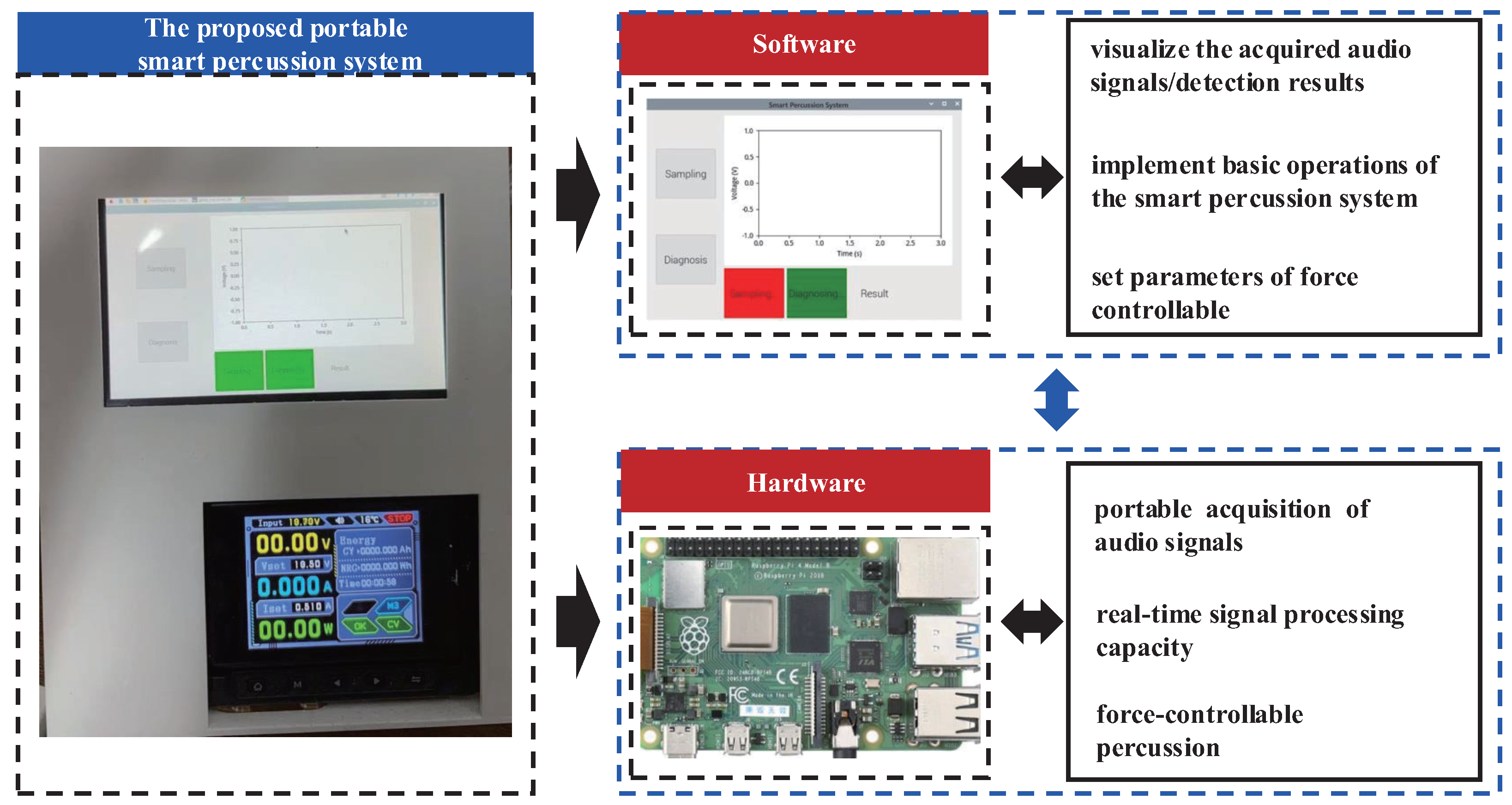
Figure 1, the proposed portable smart percussion system is centered on the percussion-based detection principle and is developed through the integration of both hardware and software components. The system is designed to address key limitations of existing percussion approaches, including the lack of portable audio acquisition with sufficient accuracy and the absence of real-time processing capabilities for feature extraction and looseness classification. In addition, the system supports essential operational functions, such as automatic percussion with controllable force, initiating and terminating data acquisition, real-time processing, and local data storage for subsequent analysis. A theoretical analysis was conducted to provide a solid basis to determine the influence of percussion force on audio response. Finally, a graphical user interface (GUI) was also implemented to enable the visualization of acquired acoustic signals and detection results, as well as to facilitate user interaction and system control.
2.1. Theoretical Analysis
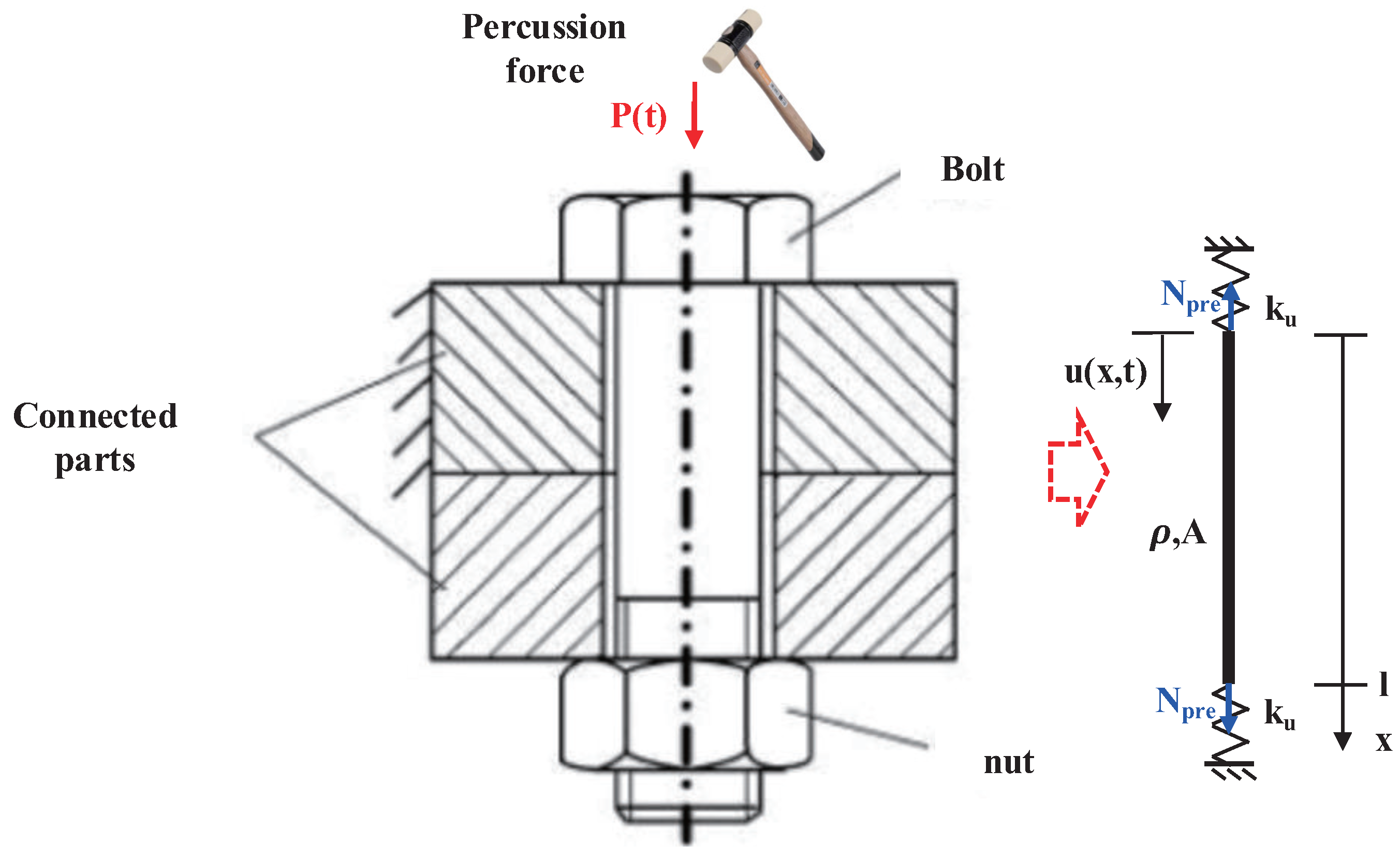
Percussion-based techniques infer the structural condition of bolted joints by analyzing the characteristics of the sound generated by impact. From a physical standpoint, acoustic radiation originates from structural vibrations; therefore, a detailed analysis of bolt vibrations induced by percussion is essential and provides a solid basis to determine the influence of percussion force on audio response. As illustrated in
Figure 2, the bolt is idealized as a straight, homogeneous beam subjected to symmetric boundary conditions, with the excitation applied along its longitudinal direction. The bolt is subjected to an axial preload
, while the contact interfaces at both ends are represented by normal stiffness
. When
, the system corresponds to a free–free boundary condition, whereas
represents a fixed–fixed constraint. Previous studies have shown that this normal contact stiffness is dependent on the preload magnitude
[
39]. According to the Bernoulli–Euler beam theory, the governing equation for the longitudinal vibration displacement
of the bolt can be expressed as
where
is the distributed force loaded on the beam,
A and
are the cross-sectional area and density of the beam, and
E is the Young modulus.
Then, we assume that the percussion force
applies to a point
on the beam, and the distributed force
can be presented as follows:
where
indicates that the percussion force acts on the top end of the beam, and
is Dirac’s delta function. Moreover, we can obtain the boundary conditions at the ends of the beam as follows:
By using modal superposition, we can further express
as
where
is the static displacement caused by the axial preload
,
is the time response of the
n-th order mode, and
is the
n-th order modal shape. Furthermore, we can derive the following expression by inserting Equation (
4) into Equation (
1), multiplying by
, and integrating along the beam,
where
is the
r-th order modal mass, and
is the
r-th order vibrational frequency. Subsequently, since the percussion force is an impact excitation (i.e.,
), we can rewrite Equation (
5) as
with the solution expressed as,
Finally, the governing motion equation of the tightened beam under a percussion force can be expressed as
It can be seen that the impact excitation primarily influences the characteristics of the structural vibration. The vibrating bolt subsequently induces pressure fluctuations in the surrounding air, generating radiated sound that depends on the vibration characteristics, medium properties, and acoustic boundary conditions. Under an ideal vibro-acoustic assumption, the amplitude of the radiated sound is proportional to the vibration amplitude, implying that the sound intensity is sensitive to the applied percussion force. Theoretical studies in this subsection indicate that variations in percussion force alter the sound amplitude, which may degrade the accuracy of bolt preload identification using percussion-based methods. Therefore, introducing a force-controlled excitation strategy is expected to enhance the robustness and effectiveness of the percussion approach.
2.2. Hardware
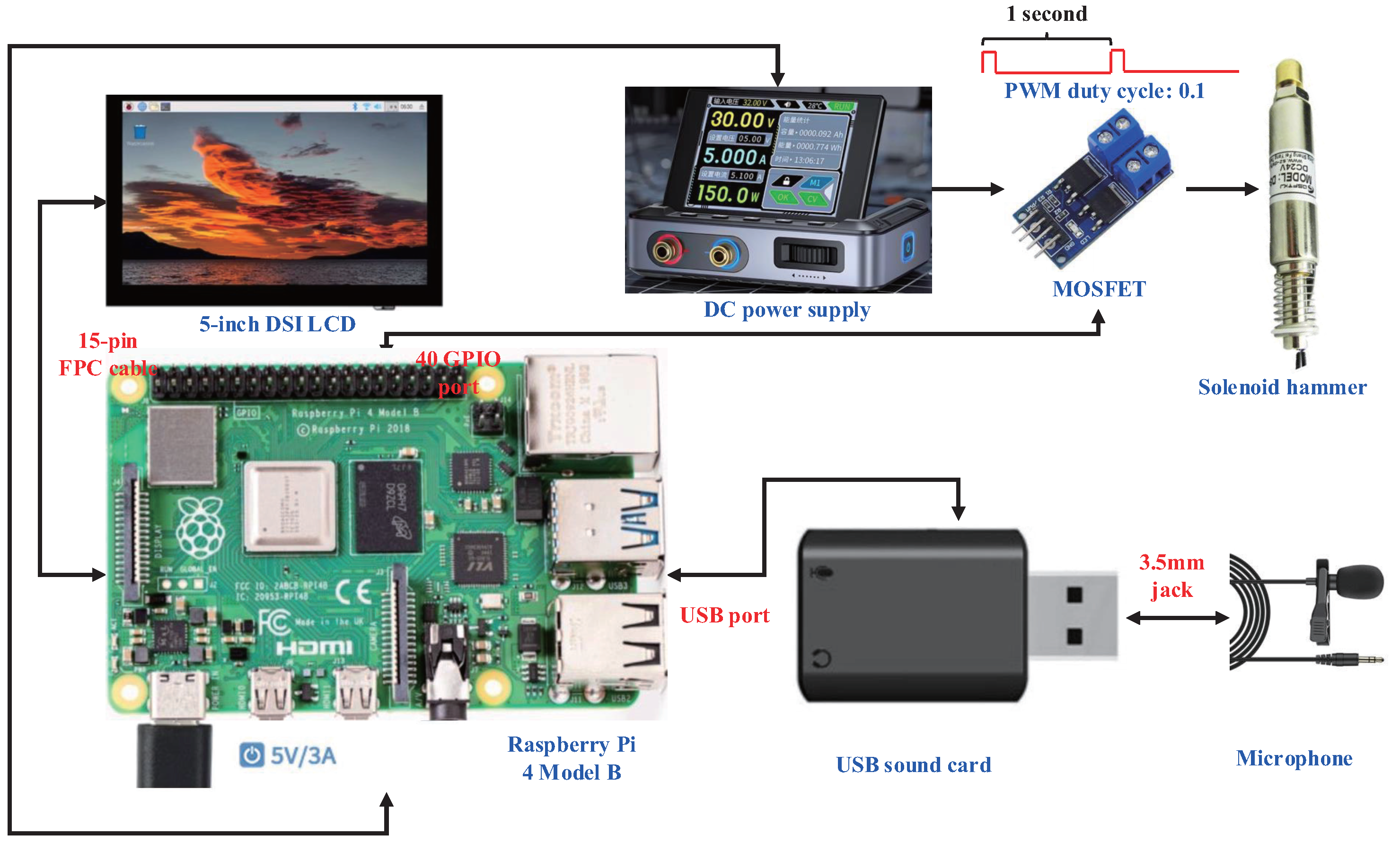
As illustrated in
Figure 3, this section describes the hardware configuration of the proposed smart percussion system. A Raspberry Pi 4 Model B was selected as the central processing unit owing to its relatively high computing capability, compact form factor, and cost-effectiveness, which together make it suitable for portable applications. The platform provides a versatile hardware environment with 40 programmable general-purpose input/output (GPIO) pins and multiple USB ports, allowing for the coordinated acquisition of data from different sensors. In this work, an external microphone (TAKSTAR, Huizhou, China, TCM-400) is connected to the Raspberry Pi via a USB audio interface (BOYA, Shenzhen, China, BY-EA2), enabling real-time audio acquisition at a sampling rate of 48 kHz using the onboard CPU and memory resources. This integrated setup supports efficient signal storage and processing, ensuring the stable operation of the smart percussion system. In addition, a 5-inch DSI capacitive touchscreen (Waveshare, Shenzhen, China) is linked to the Raspberry Pi through a 15-pin flexible printed circuit (FPC) cable to display the GUI. Power is supplied by a direct current (DC) electric source (Fnirsi, Shenzhen, China, DPS-150), which works for the Raspberry Pi and the solenoid hammer. All components besides the solenoid hammer are enclosed within a custom-designed plastic housing fabricated using three-dimensional (3D) printing technology.
The force-controllable percussion in this paper is realized by using a solenoid hammer, which is controlled through the Raspberry Pi and a MOSFET (WAAAX). The Raspberry Pi outputs a Pulse-Width Modulation (PWM) signal through its GPIO pin to drive the gate of a MOSFET, which acts as a power switch to control the on–off state of the electromagnet. The PWM duty cycle is set to 0.1, meaning that the MOSFET conducts for only 10% of each cycle (the cycle in this paper was set to 1 s). When the MOSFET is turned on, the external power supply energizes the solenoid hammer, generating a magnetic force to produce the tapping action; when it is turned off, the solenoid is rapidly de-energized. With the protection of a flyback diode, this configuration enables a safe, repeatable, and force-controllable (by adjusting the supply current) percussion process.
2.3. Software
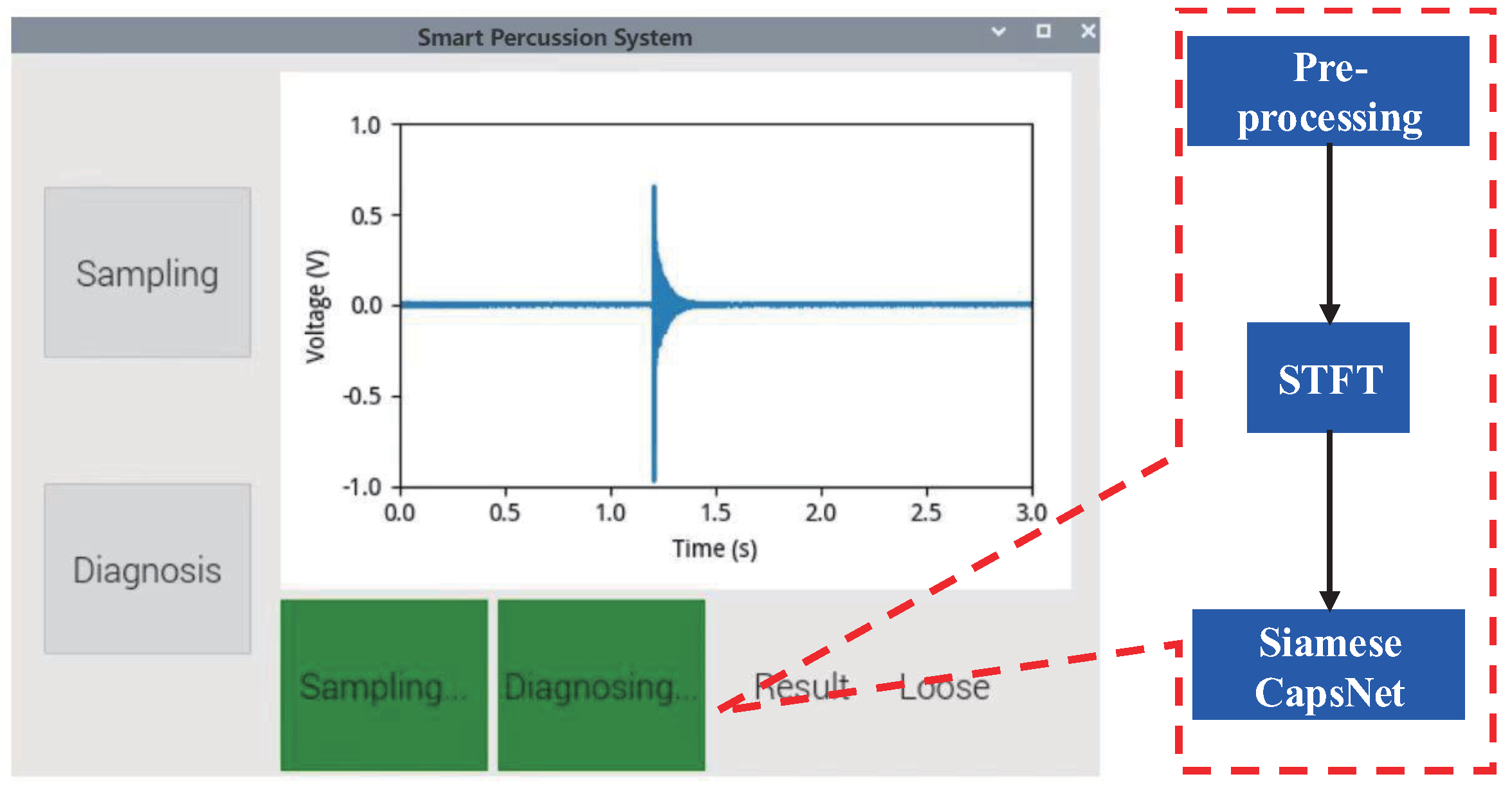
This section describes the software realization of the proposed smart percussion system. The system is implemented in an open-source Python 3.9.0 environment, enabling force-controllable percussion, and the real-time acquisition, processing, and storage of audio data. The GUI, shown in
Figure 4, was developed using the Python PyQt framework to support system operation and visualization of measured signals and diagnostic outcomes. Through the GUI, users can perform essential functions of the smart percussion system. Force-controllable percussion and audio acquisition are initiated by clicking the “Sampling” button. The diagnostic process is then triggered by selecting the “Diagnosis” button, and the detection result is presented in the result column once the diagnostic procedure is completed. In addition, all recorded audio signals are stored locally in comma-separated values (CSV) format within the 64 GB flash memory of the Raspberry Pi, providing reliable data storage and convenient access for subsequent analysis.
Benefiting from the adequate computational ability of the Raspberry Pi 4, the audio-processing strategy (i.e., the diagnostic process) based on the Siamese CapsNet in this paper is executed directly on the device. Generally, the inference time (here, inference means the time between the proposed system capturing the audio signal and providing the final diagnosis) of the proposed system on the Raspberry Pi is about 200 ms, i.e., it is capable of real-time operation. The Siamese CapsNet integrates the Capsule Network with the Siamese Neural Network to implement feature extractions and classifications of audio signals, and more details will be presented in the following subsections.
2.3.1. Two-Dimensional Convolutional Neural Networks
Two-dimensional convolutional neural networks (2D CNNs) are a class of deep learning architectures designed to process data arranged in a two-dimensional grid. 2D CNNs have been increasingly adopted in vibration and acoustic signal processing by transforming one-dimensional (1D) signals into 2D time–frequency representations, such as spectrograms or Mel-based features. This representation enables the network to exploit both temporal and spectral structures, thereby improving its ability to capture complex dynamic patterns.
The fundamental building block of a 2D CNN is the convolutional layer, which performs localized filtering on the input feature map. Let the input be denoted as
where
H and
W are the spatial dimensions. A convolutional layer consists of multiple learnable filters,
each responsible for extracting a specific type of local pattern. The output feature map
at the position
corresponding to the
n-th filter is obtained through
where
is the bias term. By sliding the filters across the input, the convolution operation enables parameter sharing and significantly reduces the number of trainable parameters.
To enhance the expressive power of the model, a nonlinear activation function is applied to the convolution output. Among various choices, the rectified linear unit (ReLU) is widely adopted due to its simplicity and effectiveness:
This nonlinearity allows the network to approximate complex, nonlinear mappings between inputs and outputs.
Downsampling is commonly performed using pooling layers, which summarize local neighborhoods of the activated feature maps. For instance, max pooling selects the maximum value within a predefined window:
where
denotes the pooling region associated with position. Pooling reduces the spatial resolution of the feature maps, alleviates sensitivity to minor local variations, and improves computational efficiency.
After several stages of convolution and pooling, the extracted high-level representations are passed to decision layers, such as fully connected layers or global pooling operations. In classification tasks, the network output is often normalized using the softmax function to produce probabilistic predictions:
where
y is the predicted label, and
denotes the output score for class
c.
2.3.2. Siamese CapsNet
Although 2D CNNs are widely used, several inherent limitations cannot be ignored. Pooling operations in CNNs introduce translation invariance that can lead to the loss of spatial feature relationships, while effective training typically requires large labeled datasets that are costly to obtain in engineering applications. Moreover, CNNs generally exhibit limited adaptability to new fault categories, often necessitating extensive retraining. To overcome these issues, CapsNets [
31] were proposed to replace pooling with dynamic routing mechanisms, enabling vector-based feature representations that preserve spatial hierarchies and improve data efficiency. In parallel, one-shot learning frameworks, particularly Siamese neural networks, have demonstrated a strong ability to recognize novel classes with minimal supervision. Recent efforts combining CapsNets with Siamese architectures [
40,
41] further enhance generalization performance, providing a promising direction for scenarios involving limited labeled data and evolving fault conditions.
The proposed Siamese CapsNet framework utilized in the proposed system follows three main stages: data preprocessing, network training, and performance evaluation. During preprocessing, the measured audio signals are transformed into two-dimensional representations of size
using the short-time Fourier transform (STFT), defined as
where
represents the input audio signals,
t and
f denote the time and frequency, respectively,
denotes the window function, and ∗ indicates the conjugate implementation.
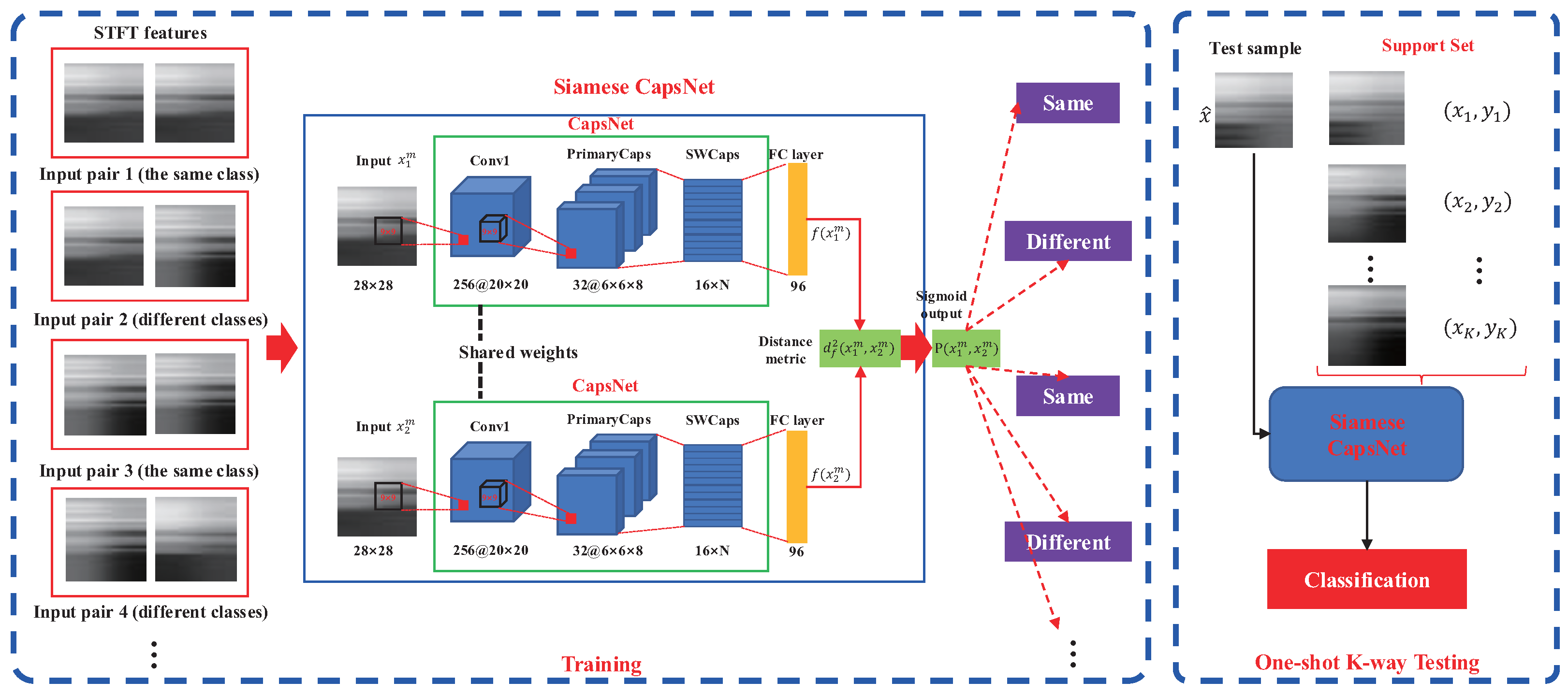
Then, as illustrated in
Figure 5, pairs of samples
(here,
m indicates the
m-th minibatch) belonging to either the same or different classes are constructed and provided as inputs to the proposed Siamese CapsNet. The network comprises two parallel CapsNet branches with identical structures (as shown in
Table 1) and shared parameters. It can be seen that the CapsNet consists of two convolutional layers, a PrimaryCaps layer, a SWCaps layer, and a fully connected (FC) layer. The output of the SWCaps layer
can be expressed as
where
is the output of the PrimaryCaps layer, and
is the coupling coefficient determined via the dynamic routing process.
The output of the SWCaps layer was passed to an FC layer to further obtain the output of the CapsNet, with
and
denoting the pair of samples
, respectively. The probability
, when the input pair is the same, can be expressed as
where
denotes the sigmoid function and
is the dense FC layer. Using the regularized cross-entropy, we can construct the following loss function:
where
= 0 (
are in the same class) or 1 (
are in different classes), is the label vector, and
denotes the coefficient of weight decay. The Adam optimizer was employed to train the proposed Siamese CapsNet via the following iteration:
where
are parameters at epoch
t,
denotes the learning rate,
is a constant,
are hyper-parameters at epoch
t, and
and
are the moving averages of the gradient and squared gradient at epoch
t, respectively; their iterative process can be expressed as
Finally, the one-shot
K-way strategy was used in the testing procedure. Here,
K denotes that we employ
K samples with distinct labels to construct a support set
S as follows:
and the classification can be implemented by assigning the test sample
to the class of the most similar sample in the support set as follows:
3. Experimental Setup
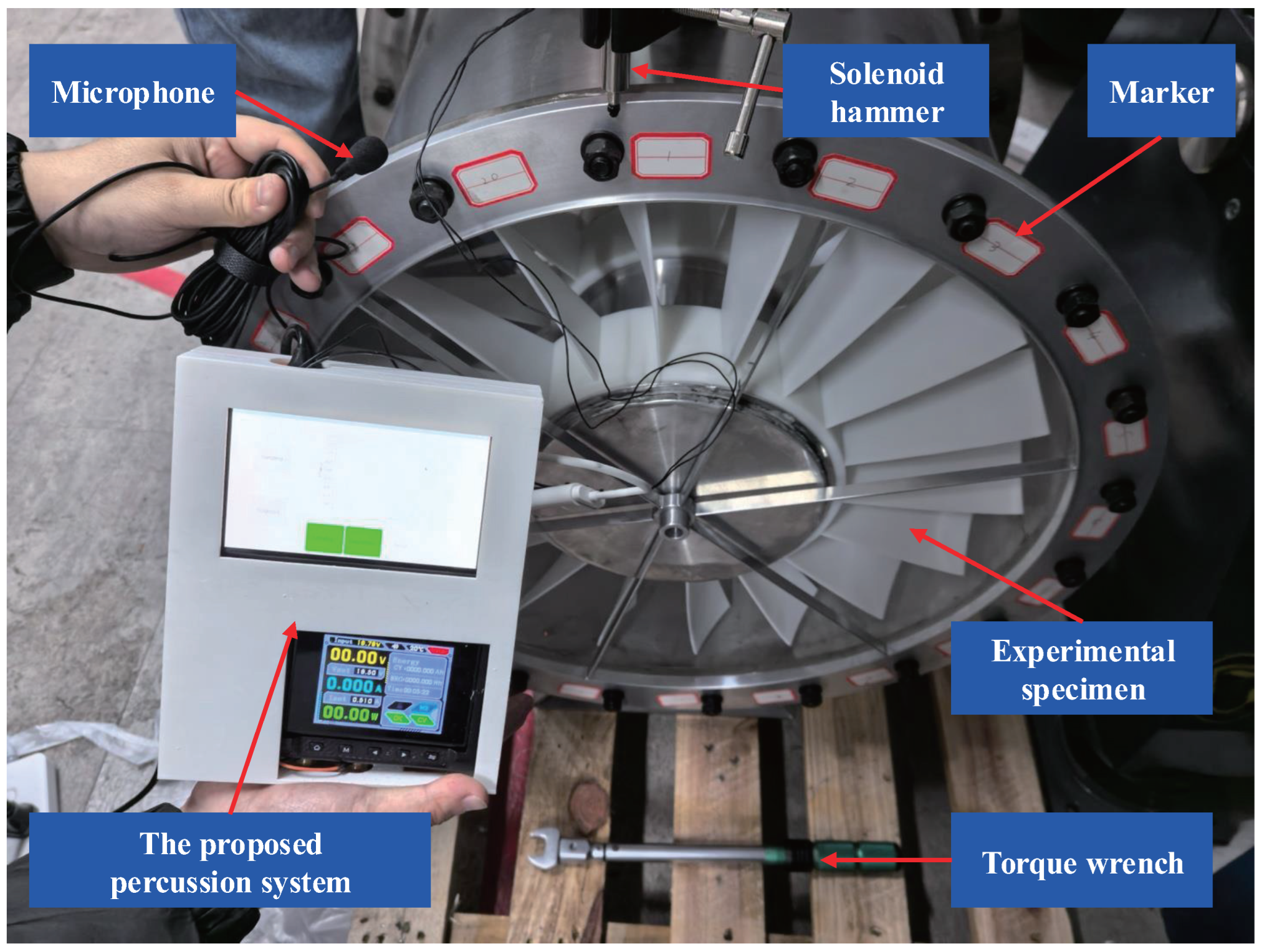
To train the Siamese CapsNet model and evaluate its classification performance for bolt looseness detection, an extensive dataset was collected and divided into training, testing 1, and testing 2 subsets using an experimental specimen. The experimental specimen is a bolted flange with a diameter of 500 mm, on which M10 bolts were mounted. To clearly identify individual fasteners, markers are used to indicate the arrangement of 20 bolts on the test specimen. These markers are employed throughout the subsequent experiments to denote bolt indices. Each bolt was excited individually using the proposed percussion system to generate force-controllable percussive responses. The resulting audio signals were also captured via the proposed percussion system. A detailed description of the experimental apparatus, instrumentation, and relevant parameters is provided in
Table 2 and depicted in
Figure 6.
The compositions of the training, testing 1, and testing 2 under a certain percussion force are summarized in
Table 3. For the training phase, four bolts (no. 1, 2, 19, 20) were selected, and their tightening torques were adjusted to six discrete levels ranging from 0 Nm to 50 Nm. Under each preload condition, 300 percussion measurements were conducted for each bolt. The testing 1 and testing 2 datasets employed the same bolt locations; however, while the testing 1 set shared the same torque levels as the training data, the testing 2 set was constructed using torque values not included in the training process, thereby enabling an assessment of the Siamese CapsNet model’s capacity.
Finally, to investigate the influence of percussion forces on the bolt looseness detection, we designed four scenarios, as listed in
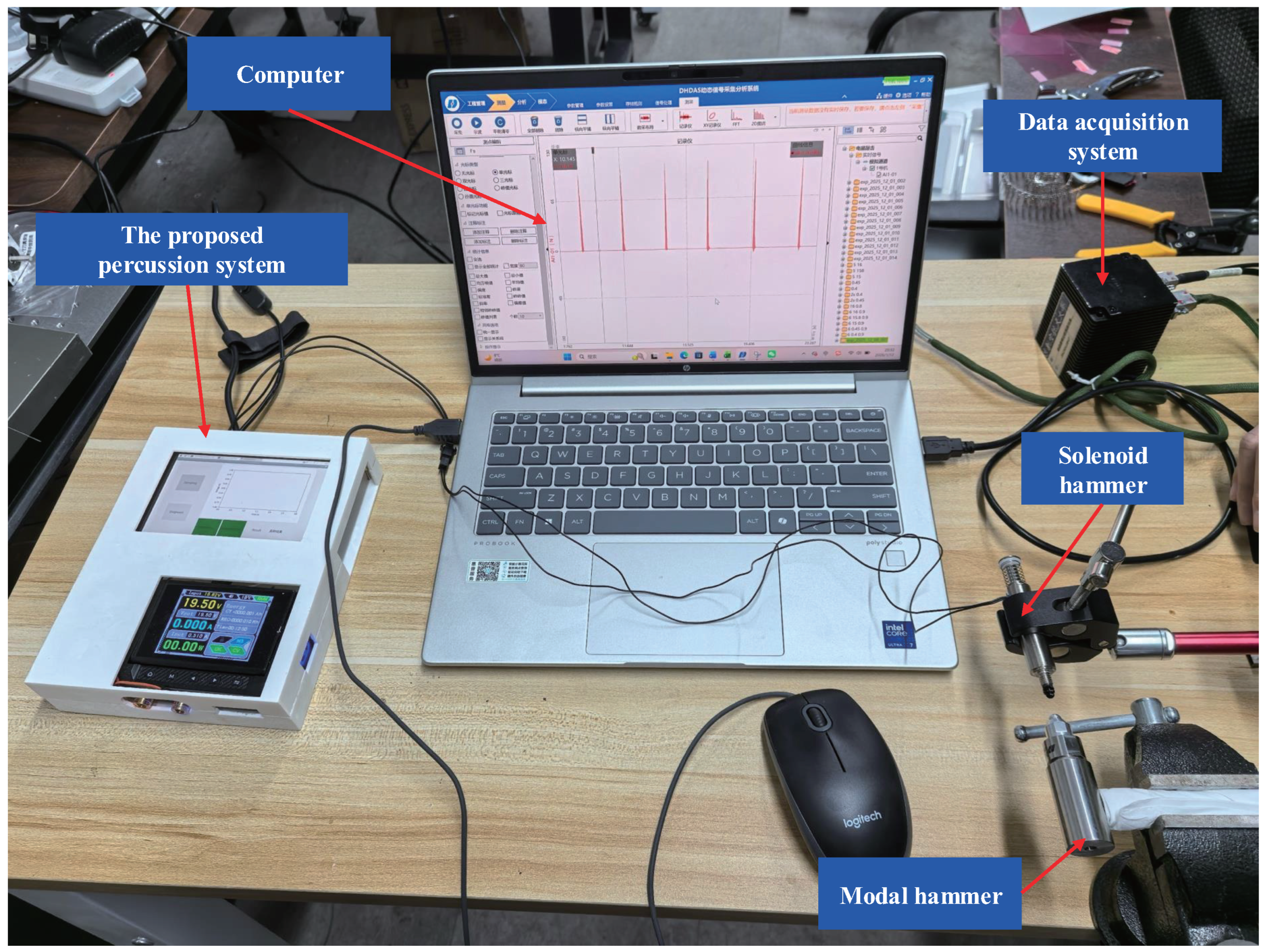
Table 4. It can be seen that four different percussion forces were used to construct the training, testing 1, and testing 2 datasets. Here, the different percussion forces were realized by adjusting the current of the solenoid hammer, and the calibration process was implemented through a modal hammer (DONGHUA Testing, LC02 with a force sensor of 3A105). As illustrated in
Figure 7, we applied the solenoid hammer to tap the modal hammer, and the force signals can be captured and transmitted to a computer via a data acquisition system (DONGHUA Testing, DH5916). The percussion forces measured under different current values are summarized in
Table 4.
4. Results and Discussion
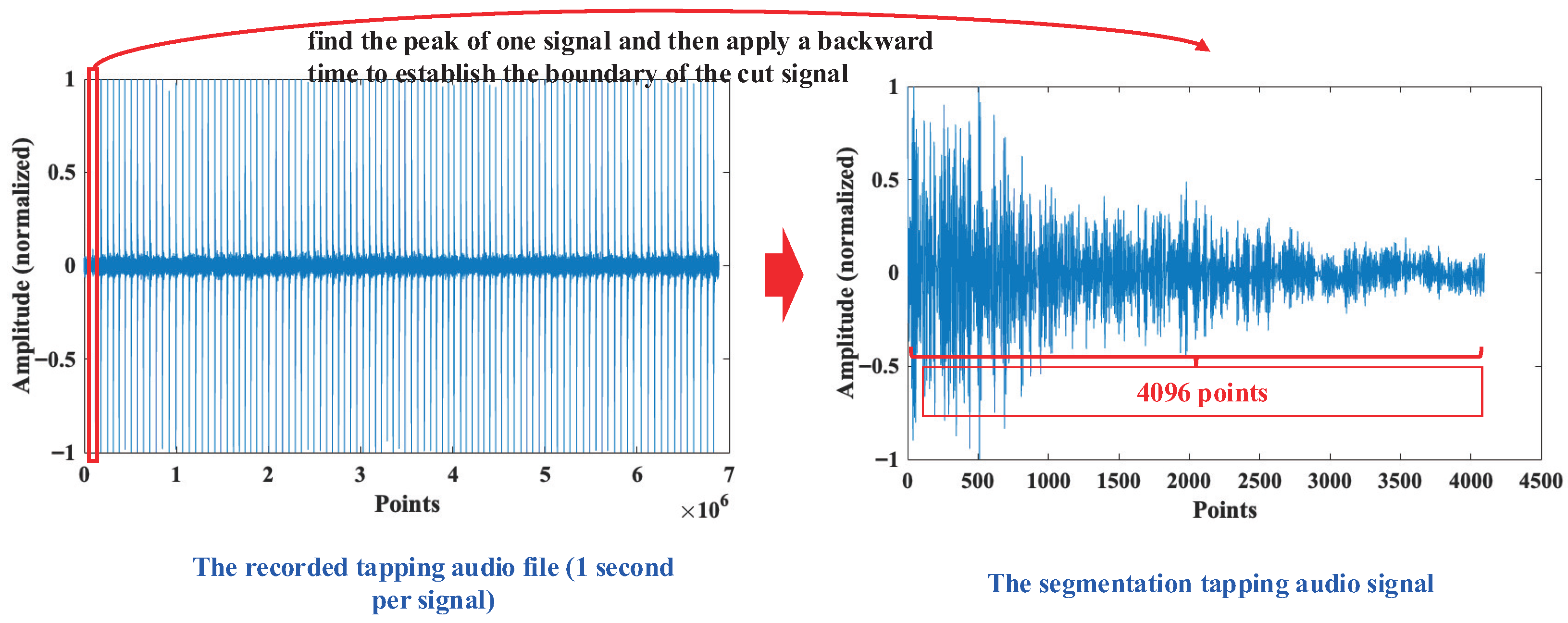
As introduced in
Table 2, the duration of the acquisition audio signals is 1 s (48,000 points); we identified a prominent peak corresponding to a single impact and then traced it backward in time to determine the starting point of the segment. Using this approach, a fixed-length window of 4096 points (corresponding to a duration of approximately 0.085 s) was selected for each audio signal, and this segmentation procedure is depicted in
Figure 8.
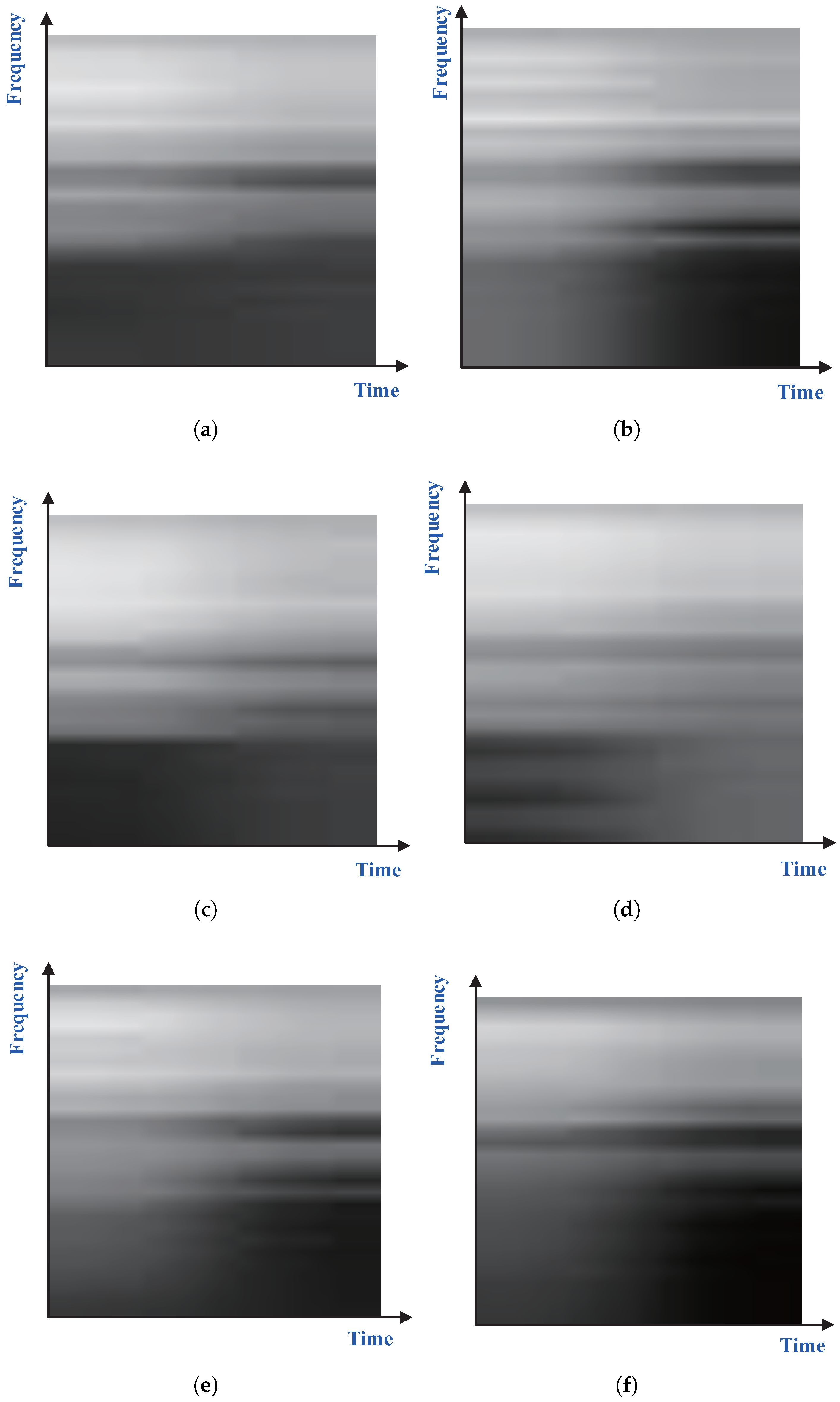
Then, all audio signals of the training, testing 1, and testing 2 datasets under different percussion forces (i.e., scenarios) were transformed into 2D representations using the STFT (window length = 512, overlap = 384, window type = Hanning window). Then, each 2D representation was resized to 28 × 28, to meet the input shape requirements of the proposed Siamese CapsNet. For instance, for bolt 1 from the training dataset, STFT features of audio signals under six discrete torque levels are illustrated in
Figure 9. It is worth noting that the purpose of STFT in this research is to extend the 1D (time domain) audio signal into a 2D (time and frequency domains) signal. As a typical deep learning (DL)-based method, the proposed Siamese CapsNet can fuse automatic feature extraction and pattern recognition into one block. Therefore, it is not necessary for us to know differences between STFT features or the relationship between features and torque level.
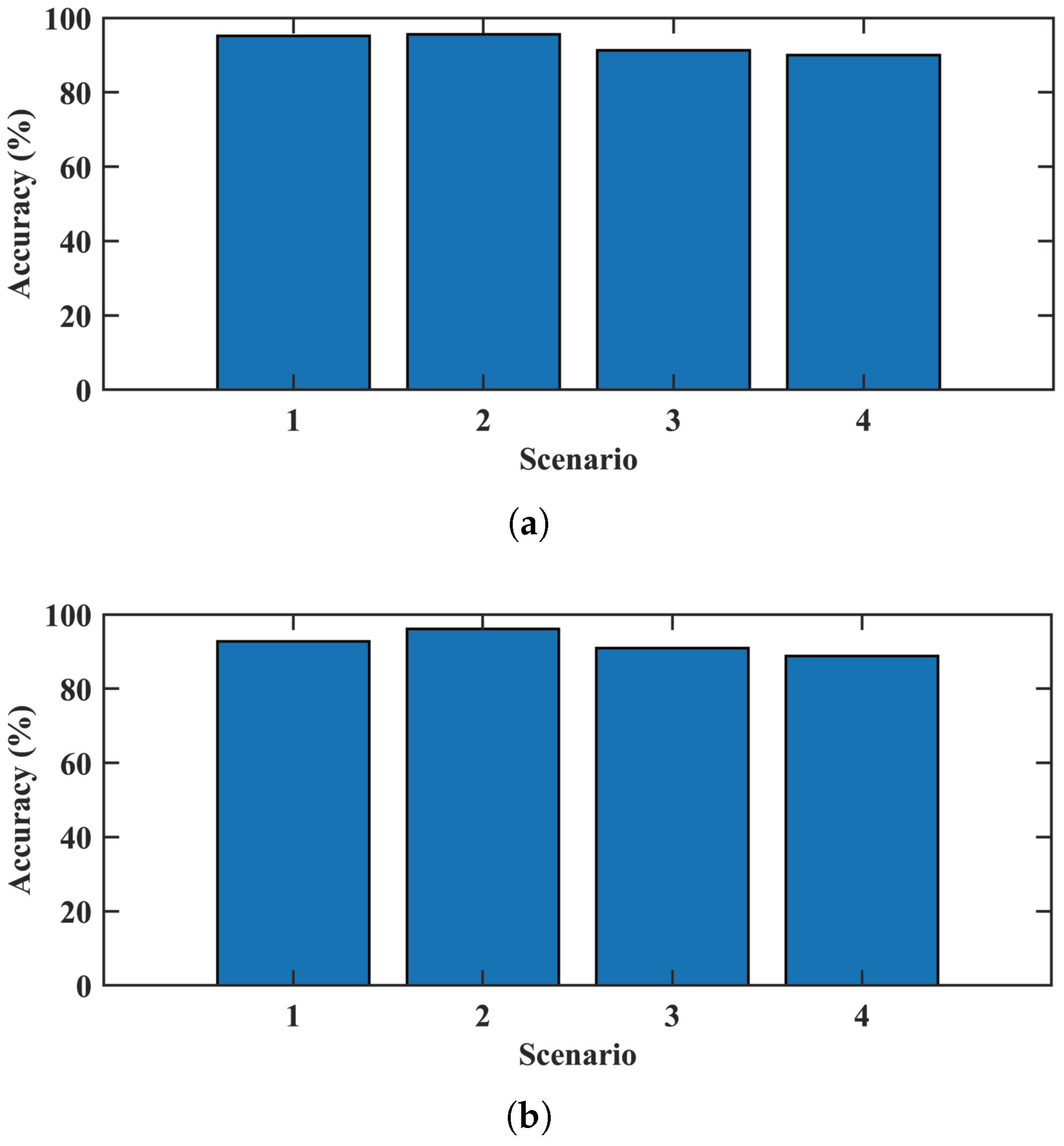
We first investigated the influence of percussion forces on the bolt looseness detection performance. Under different scenarios (given in
Table 4), we trained the Siamese CapsNet model using the extracted STFT features from the training dataset and performed validation on the testing 1 dataset. The results are presented in
Figure 10, which shows that a larger impact force leads to degraded performance. This phenomenon may be attributed to several reasons:
A strong excitation can introduce nonlinear vibration and contact effects in the bolted joint, leading to variations in dynamic responses that are not directly related to bolt preload;
Large-amplitude impacts increase the risk of signal saturation or distortion in the acoustic sensing chain, thereby altering the spectral characteristics of the measured signals;
Strong impacts may also excite global structural modes and environmental responses, which can mask preload-sensitive features;
According to the result, i.e., the classification differences between PWM duty cycle = 0.1 s and PWM duty cycle = 0.2 s, we can see that the PWM duty cycle is not a significant influence factor.
Then, we looked at several previous works, including PSD + decision tree (DT) [
23], IMSE + back propagation neural network (BPNN) [
26], and MFCC + support vector machine (SVM) [
24]. The performance of these methods and the proposed method for one run on the testing 1 dataset is compared in
Table 5, including accuracy and macro-F1 score. It can be seen that the proposed Siamese CapsNet has the best performance, verifying the advantages of the proposed portable percussion system. Furthermore, five repeated runs were conducted for each method, and the performance, including mean accuracy and variation coefficient, is given in
Table 6.
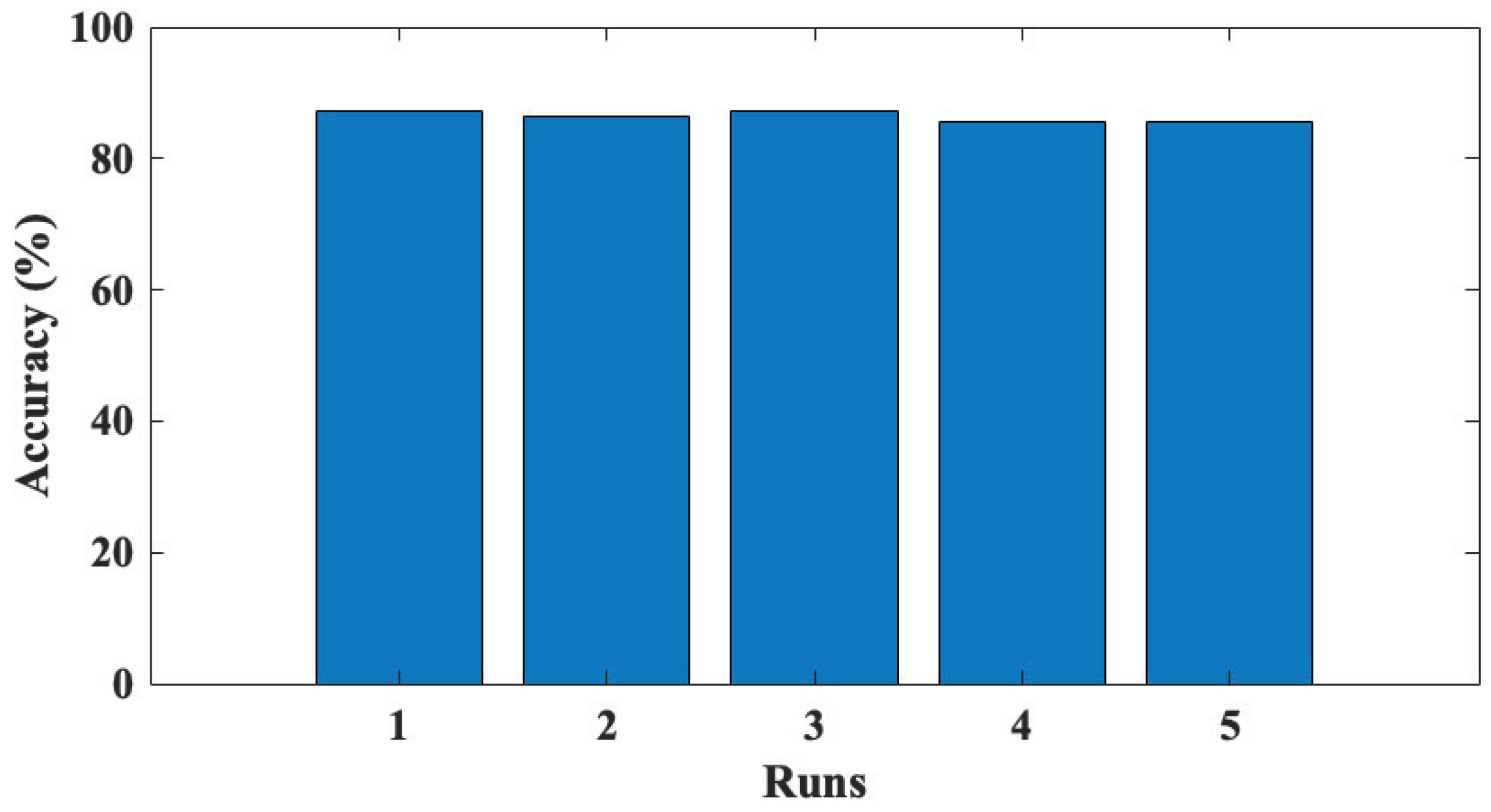
Finally, we conducted a case study to demonstrate the effectiveness of the proposed Siamese CapsNet in recognizing previously unseen categories originating from unknown data distributions, a task that is particularly challenging for conventional ML- and DL-based classifiers. Following the one-shot learning paradigm, a support set was constructed by selecting one sample from each class (i.e., torque levels) in the testing 2 dataset, and the remaining samples were used for testing. Notably, these testing classes were not included during the training stage. The results of five repeated runs are given in
Figure 11, which indicates that the proposed Siamese CapsNet maintains favorable classification performance for unseen categories (here, the categories do not indicate a different type of threaded connection, and refer to different torque levels). It is worth noting that the proposed system has a strong generalization ability and potential for practical applications, i.e., in different types of threaded connections. However, the training should definitely be implemented on data acquired from various connections in the future, such as industrial applications, to enhance and ensure its generalization capability.
5. Conclusions
In this paper, a new portable percussion system that integrates audio signal acquisition, data-processing algorithms, automatic percussion based on a solenoid hammer, and the display of detection results is developed. This system can be employed to portably detect bolt looseness in real-time with low costs; specifically, the percussion force can be controlled by adjusting the solenoid’s current. Notably, in terms of data-processing algorithms, a new audio-processing strategy based on Siamese CapsNet is proposed for bolt looseness detection. Compared to current percussion-based approaches, this strategy has better classification performance, particularly in the recognition of categories that are not seen during the training.
Despite the remarkable benefits of the proposed portable smart percussion system, some drawbacks exist in this investigation, which require further exploration:
Only the amplitude of percussion force was considered in this study, while several issues with significant influences were ignored. For instance, the position of the percussion (e.g., tapping on the bolt or on the connected parts) and percussion strategy (e.g., two or three impacts along mutually perpendicular axes) should be investigated to examine their effects. Moreover, the ambient temperature, the scale effects (bolts dimensions and their positioning), and material properties of the bolted structures to be inspected should all be taken into consideration in future work.
It is worth noting that the purpose of the STFT used in this research is to extend the one-dimensional (time domain) audio signal into a two-dimensional (time and frequency domains) signal, which meets the input shape requirements of the proposed Siamese Network. According to the introduction section, we should notice the importance of increasing the number of features for the percussion-based methods. Thus, in future work, we should explore some more advanced preprocessing techniques, such as wavelet transformation.
Since this research is an exploratory study, the computation efficiency was not considered. Considering that one of the key advantages of the proposed system is its portability, the embedded diagnostic algorithm should minimize computational cost while maintaining sufficient accuracy. Therefore, future work will focus on optimizing the proposed Siamese CapsNet to further improve its efficiency and suitability for portable applications.
The purpose of the theoretical analysis of bolt vibrations based on the Bernoulli–Euler beam theory is to provide a solid basis to determine the influence of percussion force on audio response. However, several issues are ignored, such as the damping effect and preload modeling via static displacement and boundary stiffness. Moreover, another limitation is that the experimental results showed that excessive force degraded classification performance due to nonlinearities and global mode excitation, while this critical point was not captured by the theory. It is worth noting that parametric finite element models are more convenient for analyzing various types of connections with high performance and therefore should be further investigated in future work.
Recently, some advanced damage-sensitive features have been studied, such as the Teager–Kaiser energy cepstral coefficients [
42], which is an effective structural health monitoring tool. We may look forward to further applications of this powerful tool in the future development of percussion-based methods.