Comparison of Accelerated Mortar Bar Tests for Evaluating Alkali–Silica Reactivity of Reactive vs Non-Reactive Siltstone Aggregates: Case Study from the Qinghai–Tibet Plateau

Abstract
1. Introduction
2. Materials and Methods
2.1. Cement
2.2. Siltstone
2.3. Petrographic Method
2.4. Accelerated Mortar Bar Test (AMBT)
2.5. Chinese Universal Accelerated Mortar Bar Test (CAMBT)
3. Results
3.1. Petrographic Characteristics of Siltstones
3.2. Expansion of Siltstones in AMBT and CAMBT
4. Petrographic Structures and Applicability of Test Methods
5. Conclusions
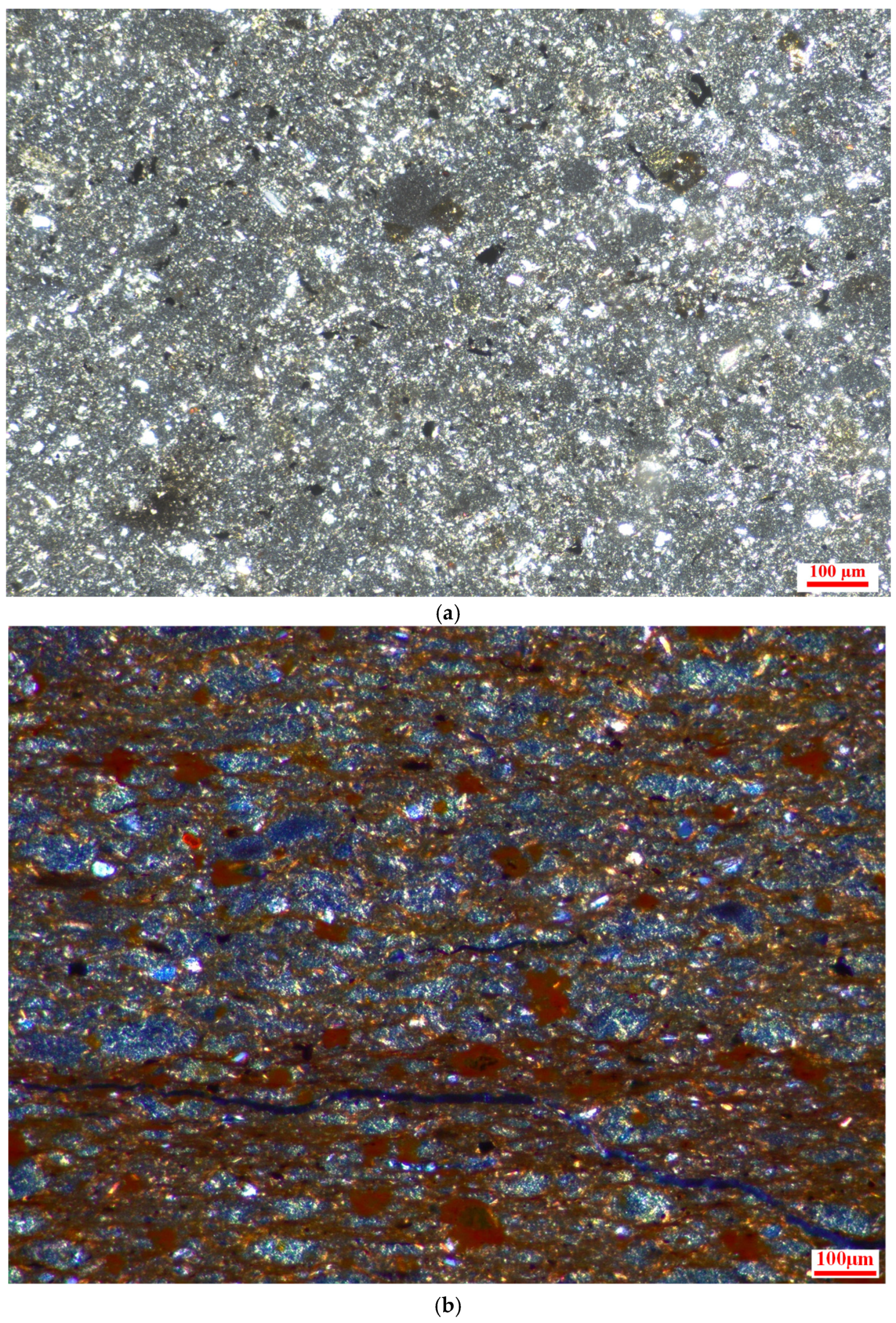
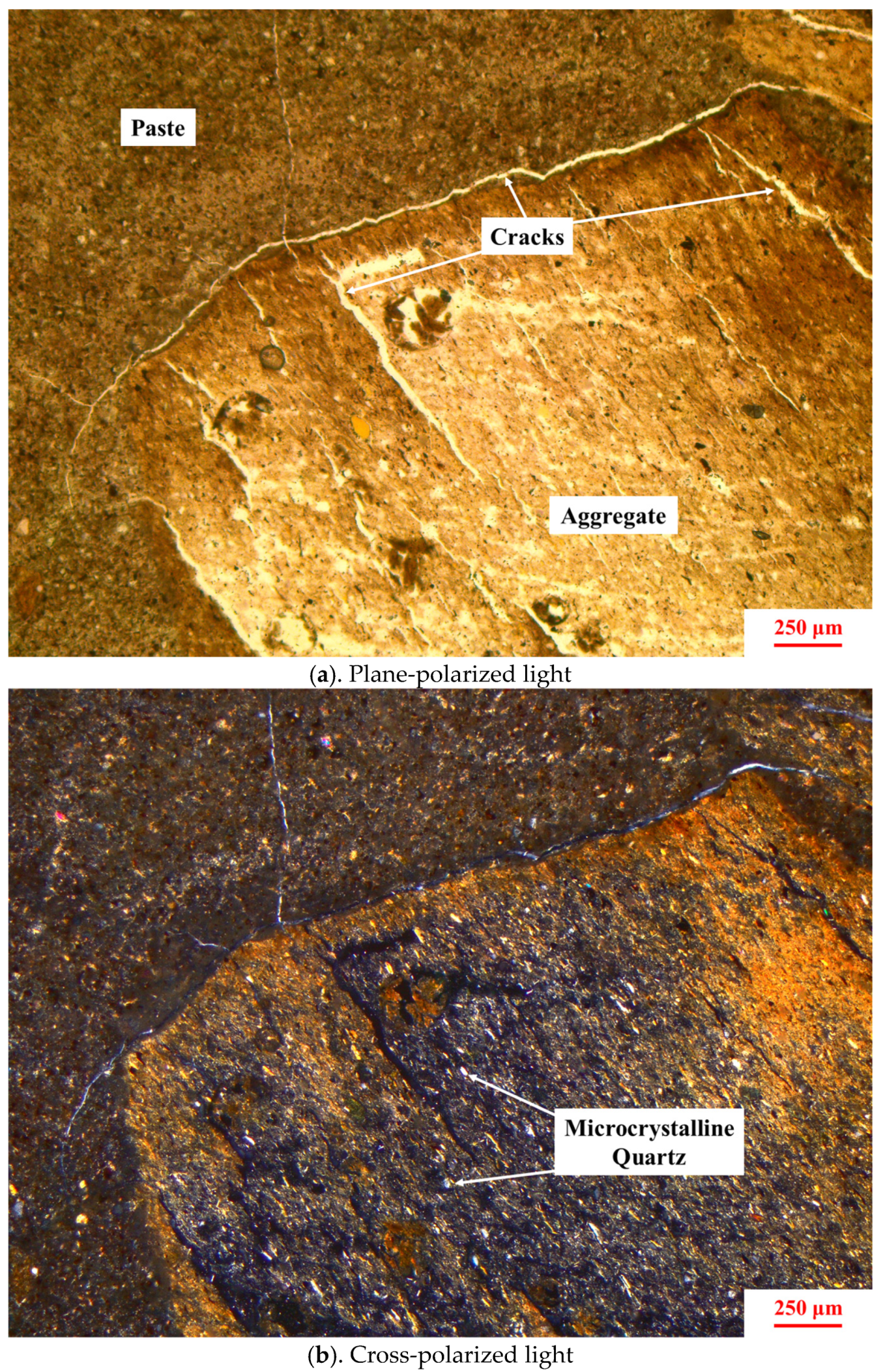
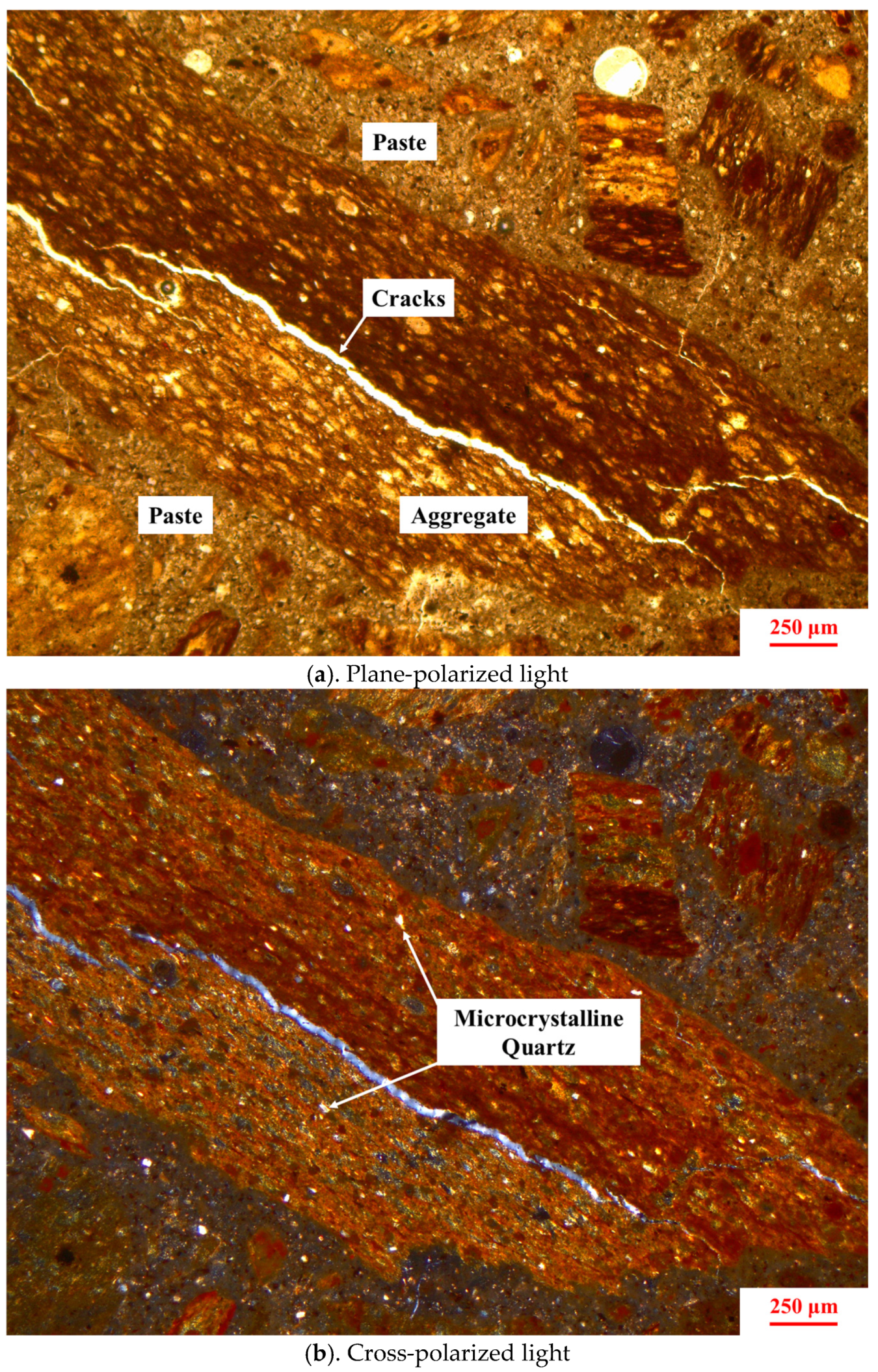
- The siltstone samples are blocky in structure. Both contain typical alkali-reactive quartz components, with significant differences in crystallinity, grain size, content, and distribution. In the two siltstones, the alkali-reactive quartz components are mainly diffusely distributed cryptocrystalline–microcrystalline quartzes, accounting for approximately 10% and 20%.
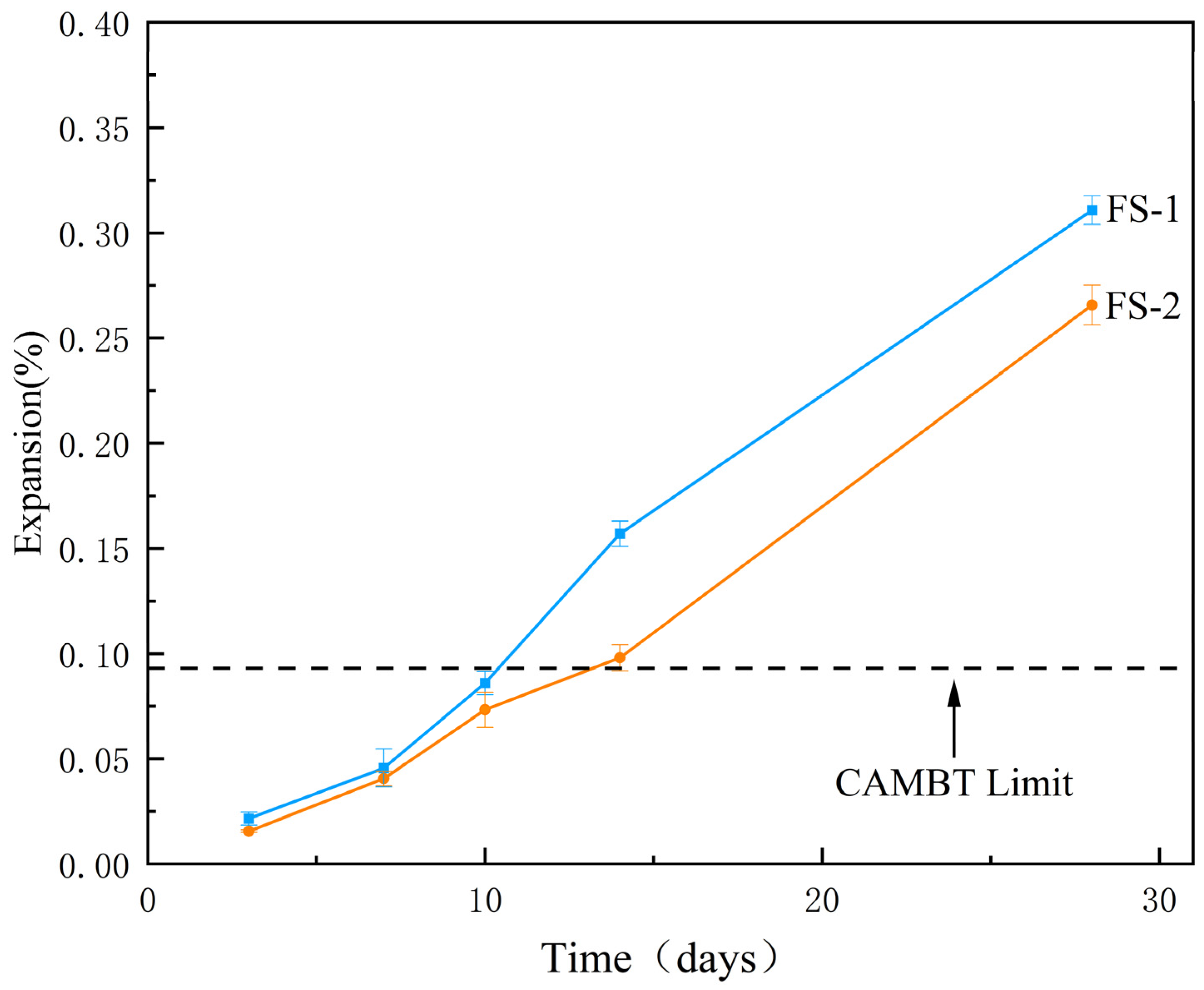
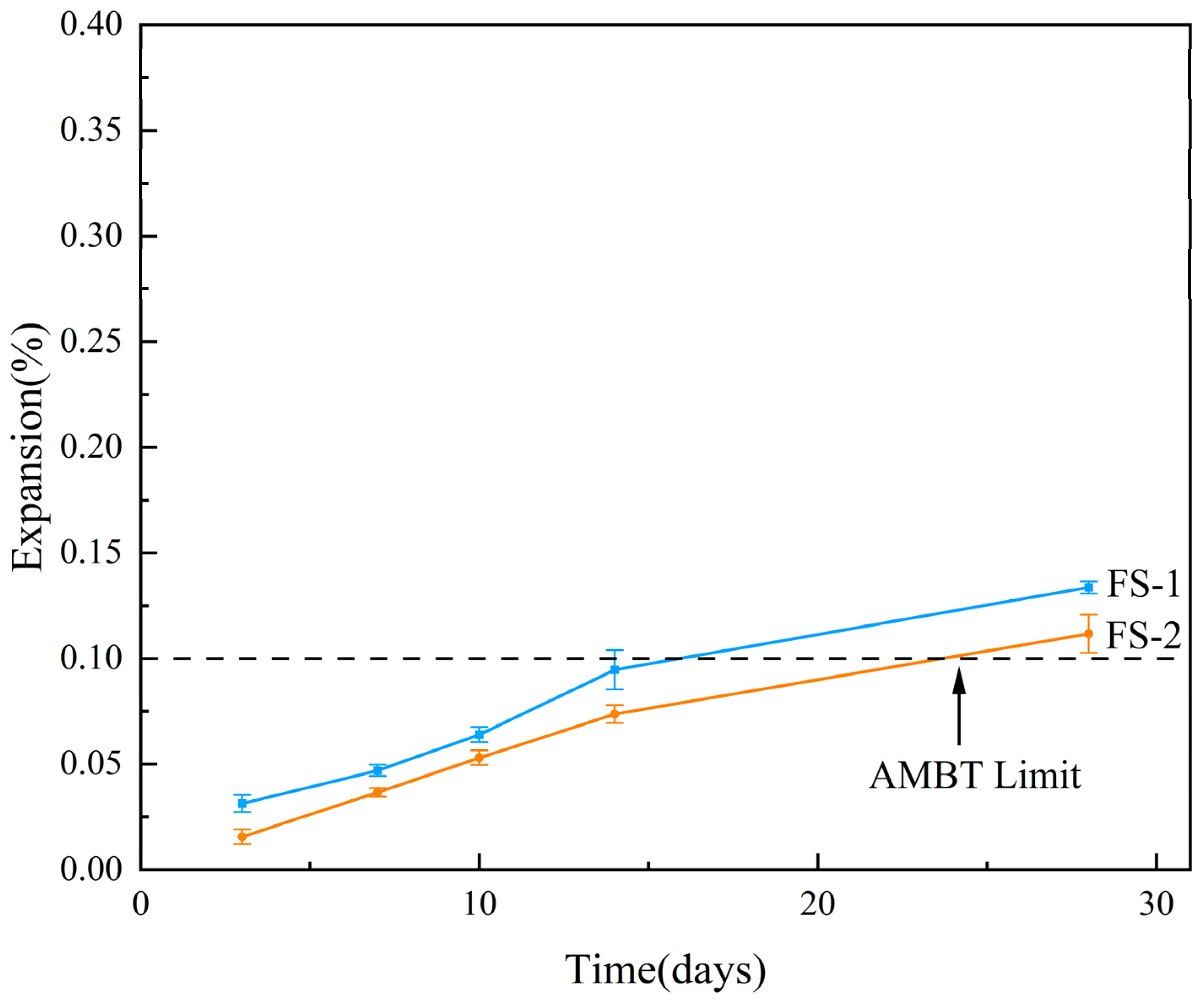
- The alkali-reactive quartz with a different distribution pattern (uniform or clustered) showed significant differences in expansion development and activity/non-reactive results in the AMBT and CAMBT. The two siltstones were non-reactive in the AMBT but reactive in the CAMBT.
- The smaller expansions of siltstones in the AMBT compared with the CAMBT were due to the differences in the aggregate gradation used and the effects of crushing and sieving on the microstructure and reactive components. The CAMBT uses particle sizes that preserve rock structural features, reducing the damage to the original structure and the enrichment or loss of alkali-reactive components caused by crushing, grinding, and sieving, thus improving the reliability of the detection of the alkali reactivity of aggregates, including siltstone.
- The findings of this study are primarily based on macroscopic expansion and optical microscopy. Future research should employ advanced microanalytical techniques, such as SEM-EDS and XRD, to characterize the composition and morphology of ASR gels, thereby providing a deeper understanding of the underlying reaction mechanisms.
- To further validate the predictive capability of the CAMBT for siltstone aggregates, future studies will include a quantitative analysis and concrete prism tests (ASTM C1293). Furthermore, the applicability of the CAMBT will be explored for a wider range of sedimentary rocks, such as greywacke and shale, to establish its general reliability for complex lithologies.
Author Contributions
Funding
Data Availability Statement
Conflicts of Interest
References
- Tang, M. Collected Works of Academician Tang Mingshu; Metallurgical Industry Press: Beijing, China, 2014. [Google Scholar]
- Sims, I.; Poole, A. (Eds.) Alkali–Aggregate Reaction in Concrete: A World Review, 1st ed.; CRC Press: London, UK, 2017. [Google Scholar] [CrossRef]
- Saha, A.K.; Khan, M.N.N.; Sarker, P.K.; Shaikh, F.A.; Pramanik, A. The ASR Mechanism of Reactive Aggregates in Concrete and Its Mitigation by Fly Ash: A Critical Review. Constr. Build. Mater. 2018, 171, 743–758. [Google Scholar] [CrossRef]
- Santos, M.B.; De Brito, J.; Silva, A.S. A review on alkali–silica reaction evolution in recycled aggregate concrete. Materials 2020, 13, 2625. [Google Scholar] [CrossRef]
- Leemann, A. Alkali-silica reaction—The mechanism leading to concrete deterioration. Can. J. Civ. Eng. 2025, 52, 1615–1629. [Google Scholar] [CrossRef]
- Blatt, H.; Middleton, G.; Murray, R. Petrology of Sedimentary Rocks, 2nd ed.; Prentice Hall: Englewood Cliffs, NJ, USA, 1988. [Google Scholar]
- Pettijohn, F.J.; Potter, P.E.; Siever, R. Sand and Sandstone, 2nd ed.; Springer: New York, NY, USA, 1987. [Google Scholar] [CrossRef]
- Marzouk, H.; Langdon, S. The Effect of Alkali–Aggregate Reactivity on the Mechanical Properties of High and Normal Strength Concrete. Cem. Concr. Compos. 2003, 25, 549–556. [Google Scholar] [CrossRef]
- Cole, W.F.; Lancucki, C.J. Products Formed in an Aged Concrete: The Occurrence of Okenite. Cem. Concr. Res. 1983, 13, 611–618. [Google Scholar] [CrossRef]
- Albert, P.R.S.; Raphael, S. Alkali–Silica Reactivity in the Beauharnois Powerhouses. In 7th International Conference on Alkali–Aggregate Reaction in Concrete; Grattan-Bellew, P.E., Ed.; National Research Council of Canada: Ottawa, ON, Canada, 1986; pp. 10–16. [Google Scholar]
- Lu, D.; Fournier, B.; Grattan-Bellew, P.E. Effect of Aggregate Particle Size on Determining Alkali–Silica Reactivity by Accelerated Tests. J. ASTM Int. 2006, 3, JAI100432. [Google Scholar] [CrossRef]
- Lu, D.; Fournier, B.; Grattan-Bellew, P.E. Development of a Universal Accelerated Test for Alkali–Silica and Alkali–Carbonate Reactivity of Concrete Aggregates. Mater. Struct. 2008, 41, 235–246. [Google Scholar] [CrossRef]
- Zhu, D.; Hu, X.; Zhong, S. Field Excursion Guide of the 4th Cross-Strait Symposium on Tethys–Tibetan Plateau Geological Evolution; Geological Publishing House: Beijing, China, 2015. [Google Scholar]
- ASTM C295-19; Standard Guide for Petrographic Examination of Aggregates for Concrete. ASTM International: West Conshohocken, PA, USA, 2019.
- ASTM C1260-23; Standard Test Method for Potential Alkali Reactivity of Aggregates (Mortar-Bar Method). ASTM International: West Conshohocken, PA, USA, 2023.
- Sommer, H.; Nixon, P.J.; Sims, I. AAR-5: Rapid Preliminary Screening Test for Carbonate Aggregates. Mater. Struct. 2005, 38, 787–792. [Google Scholar] [CrossRef]
- Rajabipour, F.; Giannini, E.; Dunant, C.; Ideker, J.; Thomas, M.D.A. Alkali–Silica Reaction: Current Understanding of the Reaction Mechanisms and the Knowledge Gaps. Cem. Concr. Res. 2015, 76, 130–146. [Google Scholar] [CrossRef]
- Lu, D.; Fournier, B.; Grattan-Bellew, P.E. Evaluation of Accelerated Test Methods for Determining Alkali–Silica Reactivity of Concrete Aggregates. Cem. Concr. Compos. 2006, 28, 546–554. [Google Scholar] [CrossRef]
- Werner, D.; Meng, B.; Weise, F. Influence of Aggregate Size on the Damage Potential of Alkali–Silica Reaction. In Proceedings of the 15th International Conference on Alkali–Aggregate Reaction in Concrete, São Paulo, Brazil, 3–7 July 2016. [Google Scholar]
- Pedersen, B.M.; Wigum, B.J.; Lindgård, J. Influence of Aggregate Particle Size on the Alkali–Silica Reaction—A Literature Review. In 15th International Conference on Alkali–Aggregate Reaction in Concrete; International Conference on Alkali-Aggregate Reaction (ICAAR): Ottawa, ON, Canada, 2016; pp. 1–20. [Google Scholar]
- Shakoorioskooi, M.; Griffa, M.; Leemann, A.; Zboray, R.; Lura, P. Alkali–Silica Reaction Products and Cracks: X-Ray Micro-Tomography-Based Analysis of Their Spatial–Temporal Evolution at a Mesoscale. Cem. Concr. Res. 2021, 150, 106604. [Google Scholar] [CrossRef]
- Rivard, P.; Ollivier, J.-P.; Ballivy, G. Characterization of the ASR Rim—Application to the Potsdam Sandstone. Cem. Concr. Res. 2002, 32, 1259–1267. [Google Scholar] [CrossRef]
- Ichikawa, T. Alkali–silica reaction, pessimum effects and pozzolanic effect. Cem. Concr. Res. 2009, 39, 716–726. [Google Scholar] [CrossRef]




| SiO2 | Fe2O3 | Al2O3 | CaO | MgO | K2O | Na2O | SO3 | Loss |
|---|---|---|---|---|---|---|---|---|
| 18.55 | 3.41 | 3.95 | 65.32 | 1.01 | 0.72 | 0.18 | 0.78 | 2.88 |
| Sample | Aggregate | Latitude/° | Longitude/° | Elevation/m | Location |
|---|---|---|---|---|---|
| FS-1 | Black siltstone | 29.4577 | 84.4212 | 4728 | Main stream |
| FS-2 | Ferruginous siliceous lithic siltstone | 29.0724 | 88.0061 | 4341 | Tributary |
| Sample | Aggregate | Textural and Structural Characteristics and Mineral Composition of Siltstones |
|---|---|---|
| FS-1 | Black siltstone | The siltstone exhibits sub-angular to sub-rounded rounding, is well sorted, and has a silt texture with a blocky structure. The main mineral constituents are quartz, feldspar, carbonaceous fragments, and limonite. The cryptocrystalline–microcrystalline quartz below 40 μm is uniformly and diffusely distributed, and its total content is approximately 20%. |
| FS-2 | Ferruginous siliceous lithic siltstone | The siltstone has an argillaceous silt texture with a blocky structure. The main mineral constituents are quartz, accompanied by clay, opaque limonite, and organic matter. Cryptocrystalline–microcrystalline quartz below 40 μm is uniformly distributed with a clustered texture, and its total content is approximately 10%. |
| Aggregate | Specimen/ Parameter | Expansion | ||||
|---|---|---|---|---|---|---|
| 3 Days | 7 Days | 10 Days | 14 Days | 28 Days | ||
| FS-1 (AMBT) | 1-1 | 0.035 | 0.049 | 0.068 | 0.101 | 0.132 |
| 1-2 | 0.027 | 0.044 | 0.061 | 0.099 | 0.137 | |
| 1-3 | 0.032 | 0.048 | 0.063 | 0.084 | 0.132 | |
| Average | 0.031 | 0.047 | 0.064 | 0.095 | 0.134 | |
| FS-2 (AMBT) | 2-1 | 0.019 | 0.036 | 0.051 | 0.077 | 0.111 |
| 2-2 | 0.012 | 0.037 | 0.057 | 0.075 | 0.121 | |
| 2-2 | 0.016 | 0.037 | 0.051 | 0.069 | 0.103 | |
| Average | 0.016 | 0.037 | 0.053 | 0.074 | 0.112 | |
| FS-1 (CAMBT) | 3-1 | 0.025 | 0.056 | 0.087 | 0.151 | 0.303 |
| 3-2 | 0.021 | 0.041 | 0.080 | 0.163 | 0.313 | |
| 3-3 | 0.019 | 0.040 | 0.091 | 0.157 | 0.316 | |
| Average | 0.022 | 0.046 | 0.086 | 0.157 | 0.311 | |
| FS-2 (CAMBT) | 4-1 | 0.015 | 0.041 | 0.080 | 0.105 | 0.273 |
| 4-2 | 0.016 | 0.044 | 0.076 | 0.096 | 0.269 | |
| 4-3 | 0.016 | 0.037 | 0.064 | 0.093 | 0.255 | |
| Average | 0.016 | 0.041 | 0.073 | 0.098 | 0.266 | |
| FS-1 | Ratio of CAMBT to AMBT | 0.700 | 0.972 | 1.340 | 1.657 | 2.322 |
| FS-2 | Ratio of CAMBT to AMBT | 1.000 | 1.108 | 1.387 | 1.331 | 2.382 |
Disclaimer/Publisher’s Note: The statements, opinions and data contained in all publications are solely those of the individual author(s) and contributor(s) and not of MDPI and/or the editor(s). MDPI and/or the editor(s) disclaim responsibility for any injury to people or property resulting from any ideas, methods, instructions or products referred to in the content. |
© 2026 by the authors. Licensee MDPI, Basel, Switzerland. This article is an open access article distributed under the terms and conditions of the Creative Commons Attribution (CC BY) license.
Share and Cite
Tang, C.; Zhang, J.; Lai, W.; Xu, J.; Hu, X.; Deng, M.; Lu, D. Comparison of Accelerated Mortar Bar Tests for Evaluating Alkali–Silica Reactivity of Reactive vs Non-Reactive Siltstone Aggregates: Case Study from the Qinghai–Tibet Plateau. Appl. Sci. 2026, 16, 2706. https://doi.org/10.3390/app16062706
Tang C, Zhang J, Lai W, Xu J, Hu X, Deng M, Lu D. Comparison of Accelerated Mortar Bar Tests for Evaluating Alkali–Silica Reactivity of Reactive vs Non-Reactive Siltstone Aggregates: Case Study from the Qinghai–Tibet Plateau. Applied Sciences. 2026; 16(6):2706. https://doi.org/10.3390/app16062706
Chicago/Turabian StyleTang, Chengwei, Jinkang Zhang, Wen Lai, Jiangtao Xu, Xiumian Hu, Min Deng, and Duyou Lu. 2026. "Comparison of Accelerated Mortar Bar Tests for Evaluating Alkali–Silica Reactivity of Reactive vs Non-Reactive Siltstone Aggregates: Case Study from the Qinghai–Tibet Plateau" Applied Sciences 16, no. 6: 2706. https://doi.org/10.3390/app16062706
APA StyleTang, C., Zhang, J., Lai, W., Xu, J., Hu, X., Deng, M., & Lu, D. (2026). Comparison of Accelerated Mortar Bar Tests for Evaluating Alkali–Silica Reactivity of Reactive vs Non-Reactive Siltstone Aggregates: Case Study from the Qinghai–Tibet Plateau. Applied Sciences, 16(6), 2706. https://doi.org/10.3390/app16062706