1. Introduction
Marbling plays a decisive role in the sensory quality of meat, contributing to perceived juiciness, tenderness, flavor release, and visual appeal [
1,
2]. In conventional muscle foods, marbling arises from the spatial distribution of intramuscular fat embedded within aligned fibrous protein matrices, where lipid domains interact dynamically with muscle microstructure during cooking and mastication [
3]. This hierarchical organization governs moisture retention, lubrication, and flavor transport, ultimately defining consumer acceptance and product value [
4]. Replicating this complex microstructural architecture remains one of the most critical challenges in developing high-fidelity plant-based meat analogs.
Plant-based meat systems typically rely on structured plant proteins, such as soy protein concentrate (SPC), soy protein isolate (SPI), wheat gluten, or pea protein, combined with dispersed lipid phases to emulate the appearance and mouthfeel of animal fat [
5]. Among these, SPC offers a favorable balance of functionality, cost, and nutritional profile, and readily undergoes heat-induced gelation and network formation during extrusion processing. However, unlike biological muscle tissue, where fat deposition occurs gradually during growth, oil distribution in plant-based systems must be engineered dynamically during high-temperature and high-shear processing [
6]. Achieving stable marbling patterns, therefore, requires precise control over protein gelation kinetics, rheological evolution, and lipid transport mechanisms within the flowing matrix.
Co-extrusion and layered structuring have emerged as dominant manufacturing strategies for producing marbled or fat-embedded plant-based meat analogs. These approaches typically involve the simultaneous extrusion of a protein-rich continuous phase and an oil-rich dispersed phase through concentric or multi-channel dies, followed by thermal setting and cooling to lock in the structure [
4]. While successful in generating visually appealing products, most reported studies emphasize formulation optimization, die design, or macroscopic texture outcomes, rather than the underlying transport phenomena governing oil migration, entrapment, and pattern stabilization. Consequently, the mechanistic relationship between protein gelation, temperature-dependent viscosity evolution, and lipid diffusion during co-extrusion remains insufficiently understood.
The gelation of SPC under thermal and shear fields involves protein unfolding, exposure of hydrophobic domains, aggregation, and the formation of a three-dimensional network stabilized by hydrophobic interactions, hydrogen bonding, and disulfide crosslinks. As temperature increases, the protein matrix transitions from a viscous sol to a viscoelastic gel, accompanied by rapid changes in modulus, permeability, and molecular mobility [
7]. These transformations strongly influence the diffusion pathways available to lipid droplets or molten oil domains. During the early sol stage, relatively low viscosity and high mobility allow oil to migrate, coalesce, or deform under shear. As gelation proceeds, the developing network progressively restricts mass transfer, immobilizing the lipid phase and fixing the spatial marbling pattern.
Diffusion in polymeric and protein gels is governed by a combination of molecular mobility, hydrodynamic drag, and steric hindrance imposed by the evolving network structure [
8]. In protein-rich food systems, transport is further influenced by gelation state, matrix density, water availability, and free-volume restriction, all of which change dynamically during heating and cooling. Similar transport limitations have also been reported in emulsion-filled gels, where droplet–matrix interactions, interfacial protein layers, and filler effects can reduce phase mobility and alter bulk network development [
9]. In viscoelastic matrices, oil migration is therefore controlled not only by intrinsic diffusivity but also by the progressive increase in viscosity and structural setting, which together define a narrow processing window in which marbling can develop without excessive spreading, coalescence, or phase separation [
4].
Several studies have examined the behavior of fat or oil in structured protein matrices, including emulsion-filled gels, oleogels, and extruded protein systems [
9,
10]. These studies generally show that lipid transport and retention depend strongly on the rheological state of the continuous phase, the extent of interfacial stabilization, and the degree of matrix confinement. However, many of these investigations were conducted under static or low-shear conditions and therefore do not fully capture the coupled thermal, shear, and flow fields characteristic of extrusion processing. High-moisture extrusion, in particular, introduces complex non-Newtonian flow behavior, strong temperature gradients, and anisotropic fiber formation that directly influence transport behavior and microstructure development [
11,
12]. As a result, diffusion and oil-migration behavior observed in simplified gel systems cannot be directly extrapolated to industrial co-extrusion environments without a process-relevant modeling framework.
Computational fluid dynamics (CFD) has increasingly been applied to model heat transfer, shear distribution, residence time, and phase flow in extrusion and food processing systems [
13,
14]. CFD enables the prediction of local temperature fields, velocity gradients, and viscosity evolution, providing a quantitative framework for linking processing conditions to microstructural outcomes. When coupled with experimentally derived rheological models and diffusion coefficients, CFD can offer predictive insights into oil migration behavior during co-extrusion [
13]. Nevertheless, validation of such models requires robust experimental quantification of oil transport and spatial distribution under realistic processing conditions.
Recent advances in image analysis and digital microscopy have enabled quantitative tracking of phase migration, domain growth, and spatial heterogeneity in complex food matrices [
15]. Image-based diffusion analysis allows direct extraction of oil front displacement, concentration gradients, and pattern evolution over time, providing experimentally grounded metrics that can be integrated with numerical simulations [
16]. When combined with temperature-controlled processing and synchronized imaging, these techniques offer a powerful pathway for elucidating the coupling between gelation kinetics and lipid transport dynamics.
Coconut oil is particularly relevant for plant-based meat formulations because of its sharp melting transition near body temperature, relatively high saturated fat content, and ability to contribute characteristic mouthfeel and flavor release; under extrusion conditions, it becomes molten and behaves as a mobile lipid phase whose redistribution is highly sensitive to temperature, matrix viscosity, and interfacial interactions [
17]. Understanding how coconut oil migrates and becomes retained within a thermally gelling SPC matrix is therefore essential for achieving reproducible marbling patterns and desirable product structure. Despite growing industrial interest in marbled plant-based products, a critical knowledge gap remains in quantitatively linking thermal history, protein gelation, effective oil transport, and final marbling morphology under realistic co-extrusion conditions. Existing studies rarely integrate rheology, transport modeling, and spatial image analysis within a unified framework for process-level prediction and design.
Therefore, the present study addresses this challenge by combining CFD modeling with image-based diffusion analysis to investigate the diffusion mechanism of coconut oil in high-temperature SPC during co-extrusion. Specifically, the study seeks to: (i) quantify the gelation kinetics and rheological evolution of SPC under controlled thermal and shear conditions; (ii) characterize oil diffusion behavior and marbling formation at different gelation stages using image analysis and a CFD model under static and co-extrusion conditions; (iii) integrate rheological data with CFD simulations to predict temperature-dependent diffusion dynamics during co-extrusion; and (iv) establish correlations between effective diffusion coefficient and visual marbling uniformity to support predictive process control and scalable manufacturing strategies for next-generation plant-based meat analogs.
2. Materials and Methods
2.1. Sample Preparation
Soy protein concentrate (SPC) was used as the primary structural matrix for investigating oil diffusion during thermal processing. The SPC was supplied as a spray-dried powder produced from defatted soybean flakes through aqueous extraction and protein recovery, yielding a protein-rich ingredient with reduced soluble carbohydrates and anti-nutritional components. According to the supplier’s specification, the SPC contained approximately 69% protein (dry basis) and less than 8% residual moisture, providing favorable water-holding capacity and heat-induced gelation functionality for high-moisture extrusion applications (Shandong Wonderful Biotech Co., Ltd., Dongying, China).
For sample preparation, all material quantities were normalized to 100 g of SPC melt. SPC powder (19.01 g) was dispersed in distilled water (78.45 mL) to achieve a final moisture content of 80% (wet basis), corresponding to an effective protein concentration of approximately 13% (w/w). To enhance optical contrast for image-based analysis of oil migration, a trace amount (<0.01%, w/w) of a food-grade lipophilic red colorant (FD&C Red No. 40 aluminum lake) was added. The formulation was mechanically homogenized using a high-shear Stephan cutter mixer (UMC-5 Electronic, Stephan Machinery GmbH, Hameln, Germany) until a uniform paste was obtained. Entrapped air was removed under mild vacuum, and the slurry was equilibrated at ambient temperature prior to loading into the extrusion cylinder.
2.2. Co-Extrusion Process
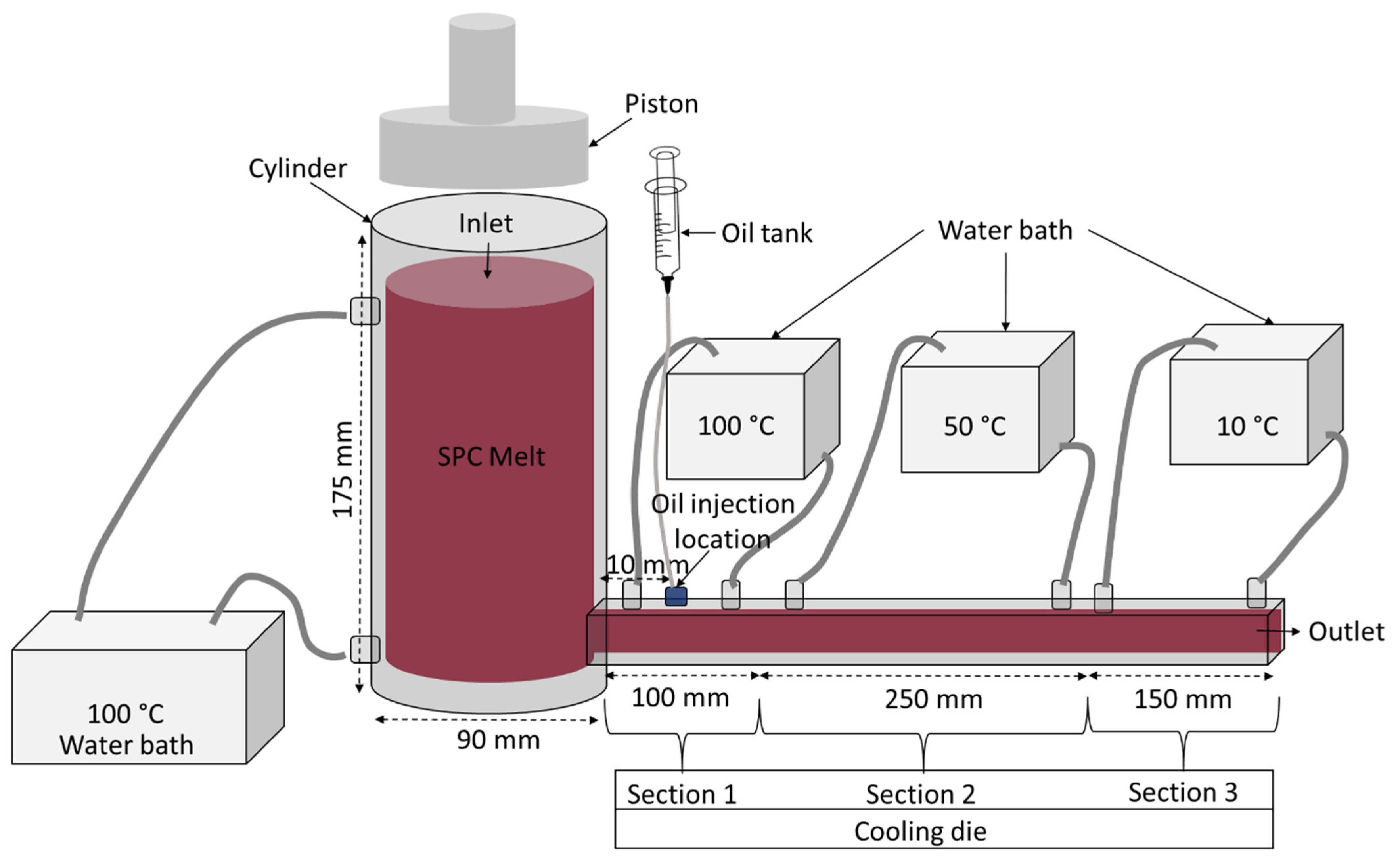
Co-extrusions were carried out using a laboratory-scale piston-driven extrusion assembly that enabled independent control of melt compression, thermal history, and oil injection (
Figure 1). The SPC mixture was loaded into a cylindrical stainless-steel barrel (inner diameter 90 mm, height 175 mm) and compressed using a texture analyzer (TA.XT Plus, Stable Micro Systems, Surrey, UK) fitted with a matching piston. The piston displacement rate was maintained at a constant speed (1 mm/s) throughout extrusion to ensure steady volumetric flow of the protein melt and reproducible residence time within the barrel and die [
14].
Thermal conditioning of the melt inside the barrel was achieved using integrated heating channels surrounding the barrel wall, allowing precise temperature regulation over the range of 25–100 °C. After thermal equilibration, the pressurized melt was extruded into a rectangular cooling die (20 × 10 mm cross-section). The die was divided into three independently controlled thermal zones to impose a defined axial temperature gradient. The upstream zone preserved melt fluidity and oil injection, the intermediate zone promoted gradual network development, and the downstream zone induced structural stabilization. A Peltier-based thermal control module regulated the exit temperature between 70 and 75 °C to ensure consistent gelation behavior at the die outlet.
Coconut oil was selected as the model lipid phase because its relatively high saturated-fat content produces a clear melt–solid transition near processing temperatures, which supports the formation and stabilization of discrete fat domains during cooling and facilitates marbling-like structure development. Molten coconut oil was delivered using a syringe mounted on a texture analyzer platform and driven at a constant displacement rate (1 mm/s) to provide continuous and reproducible oil injection. The oil reservoir was maintained at 50 °C to ensure complete melting and stable viscosity during injection. The injection port was positioned approximately 10 mm downstream from the entrance of the cooling die, enabling controlled interaction between the flowing protein melt and the injected oil stream. The extrudate exiting the die was collected immediately and prepared for sectioning and image-based characterization of oil distribution and marbling structure.
2.3. Rheological Characterization and Gelation Kinetics of SPC
2.3.1. Rheological Measurement
Rheological characterization was performed to quantify temperature-dependent viscosity, linear viscoelastic limits, and dynamic mechanical behavior of the SPC formulation using a Discovery Hybrid Rheometer HR-3 (TA Instruments, New Castle, DE, USA) equipped with a Peltier temperature control system and solvent trap to minimize moisture loss. Measurements were conducted using a parallel-plate geometry (40 mm diameter) with a fixed gap of 1.0 mm. Samples were carefully loaded to avoid pre-shearing and equilibrated at the initial test temperature for 3 min prior to measurement.
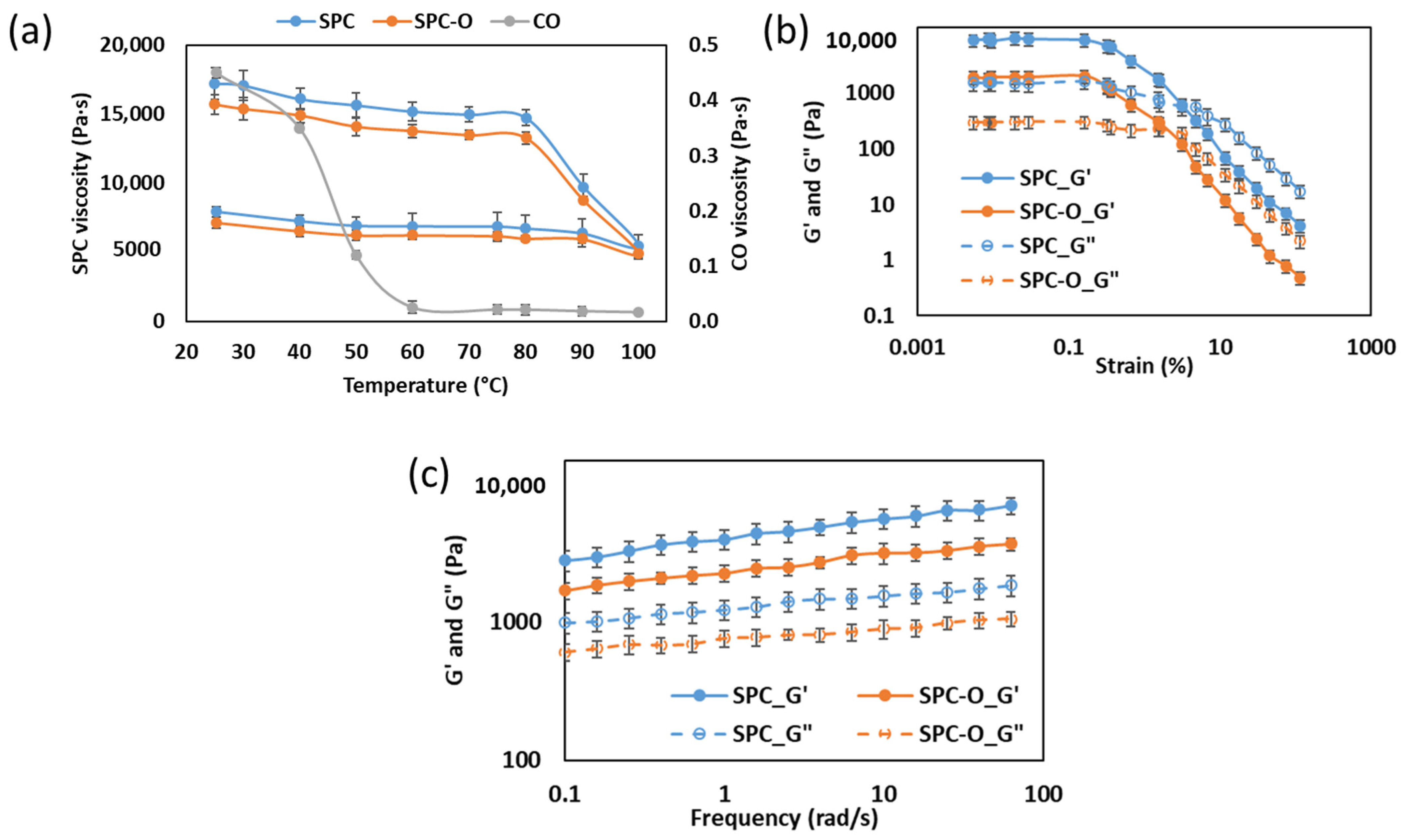
Apparent viscosity was measured during a continuous heating ramp from 25 to 100 °C at 5 °C/min under a constant low shear rate within the linear viscoelastic region (LVR), followed by cooling back to 25 °C at the same rate to assess thermal hysteresis and structural reversibility. Viscosity–temperature profiles were used to identify sol–gel transition behavior and to parameterize temperature-dependent viscosity functions for computational modeling [
18].
Strain sweep tests were performed at an angular frequency of 1 rad/s with strain amplitude logarithmically increased from 0.01% to 100%. The LVR was defined as the strain range over which storage modulus (G′) and loss modulus (G″) remained within ±5% of their plateau values. Dynamic frequency sweeps were subsequently conducted within the LVR over 0.1–100 rad/s to characterize viscoelastic behavior, network stability, and relaxation dynamics relevant to oil transport and structural development. For each rheological condition, measurements were performed using independently prepared sample batches, and the reported values represent the mean ± standard deviation of these batch-based replicates.
2.3.2. Thermal Gelation Transition Characteristics by Differential Scanning Calorimetry
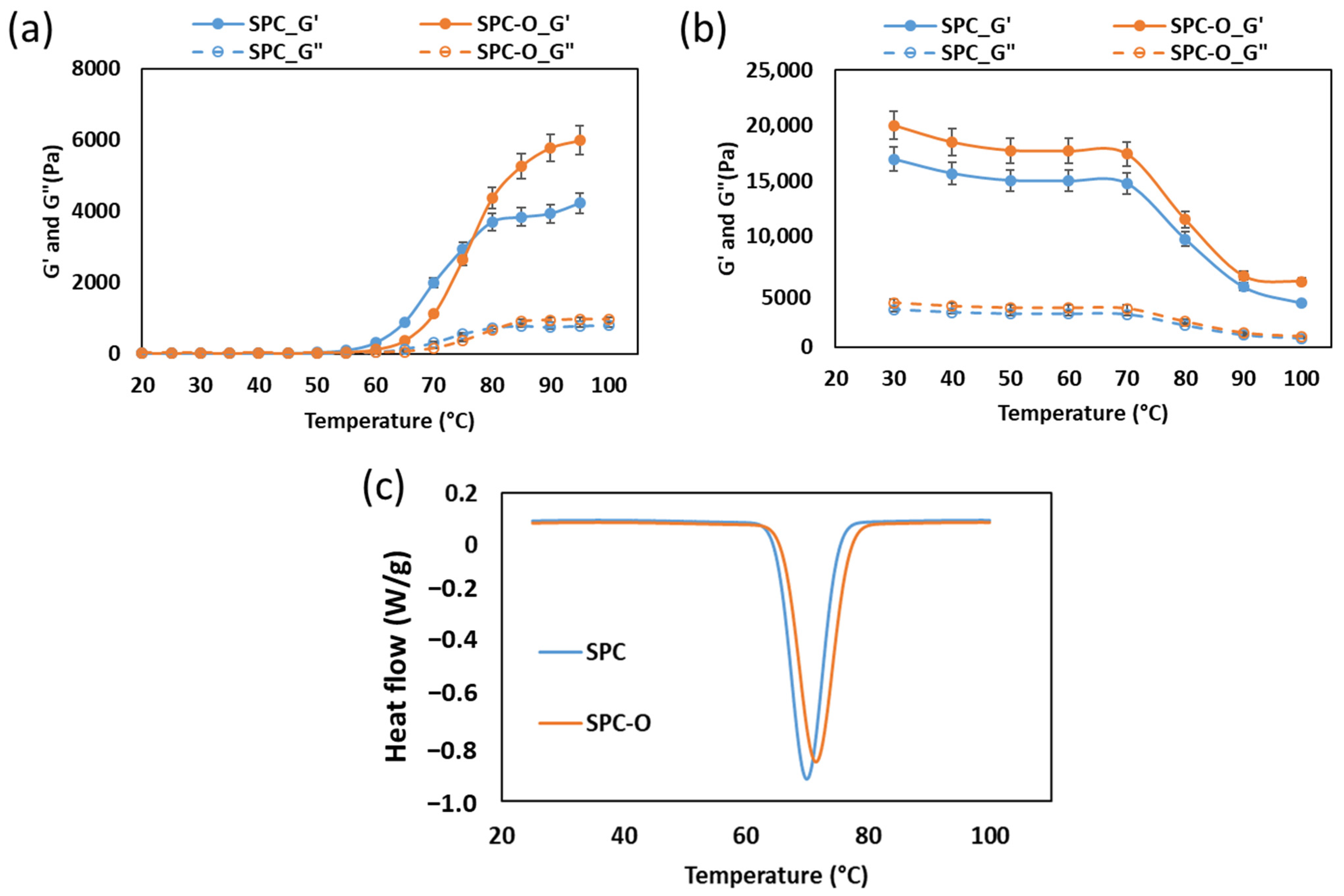
Thermal transitions associated with protein unfolding and gelation were evaluated using a Discovery Series DSC (TA Instruments, New Castle, DE, USA). Approximately 15 mg of the homogenized sample was weighed (±0.01 mg) and hermetically sealed in stainless-steel pans, with an empty sealed pan used as a reference. Samples were heated from 20 to 100 °C at 5 °C/min under a nitrogen purge (50 mL·min
−1) to minimize oxidative effects and moisture loss during scanning [
19]. The temperature range was selected to cover the relevant thermal window from the initial ungelled state of the SPC mixture to the upper processing temperature used in the extrusion system, while the heating rate of 5 °C/min was chosen to provide sufficient thermal resolution of the transition peak without excessively prolonging the scan. Heat flow thermograms were analyzed to determine onset (T
0), peak (T
p), and end-set (T
e) transition temperatures. The apparent enthalpy change (ΔH) was obtained by integrating the endothermic peak area using TRIOS software (version 5.10, TA Instruments, New Castle, DE, USA) and is reported per unit wet sample mass (J/g) based on the sample mass entered for each pan.
Because a single heating rate was applied, these DSC outputs were interpreted as thermal transition descriptors. Specifically, T0, Tp, and Te were used to compare the temperature domain of unfolding/aggregation and gel-network formation, where shifts to higher temperatures indicate increased thermal stability and delayed structural setting of the SPC matrix. ΔH was used as an index of the overall extent of thermally driven structural change (e.g., unfolding/association) contributing to gel formation. Collectively, these parameters quantified the thermal sensitivity and gelation-related transition behavior of SPC and were used to support interpretation of temperature-dependent rheological changes and oil migration dynamics.
2.4. Oil Diffusion and Image Analysis Protocol
2.4.1. Static Diffusion Analysis Design
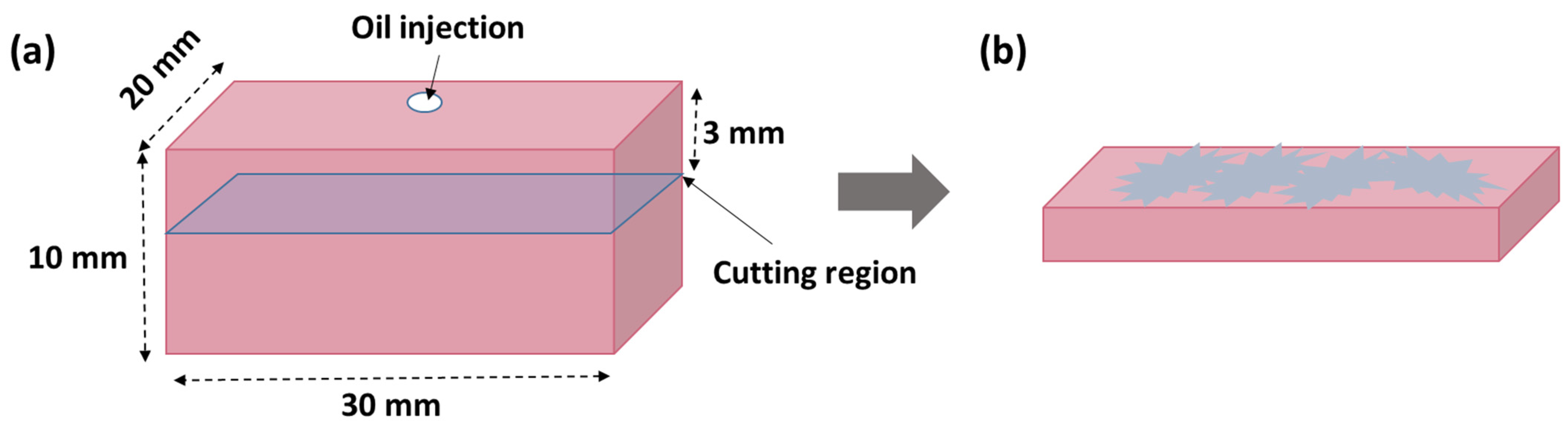
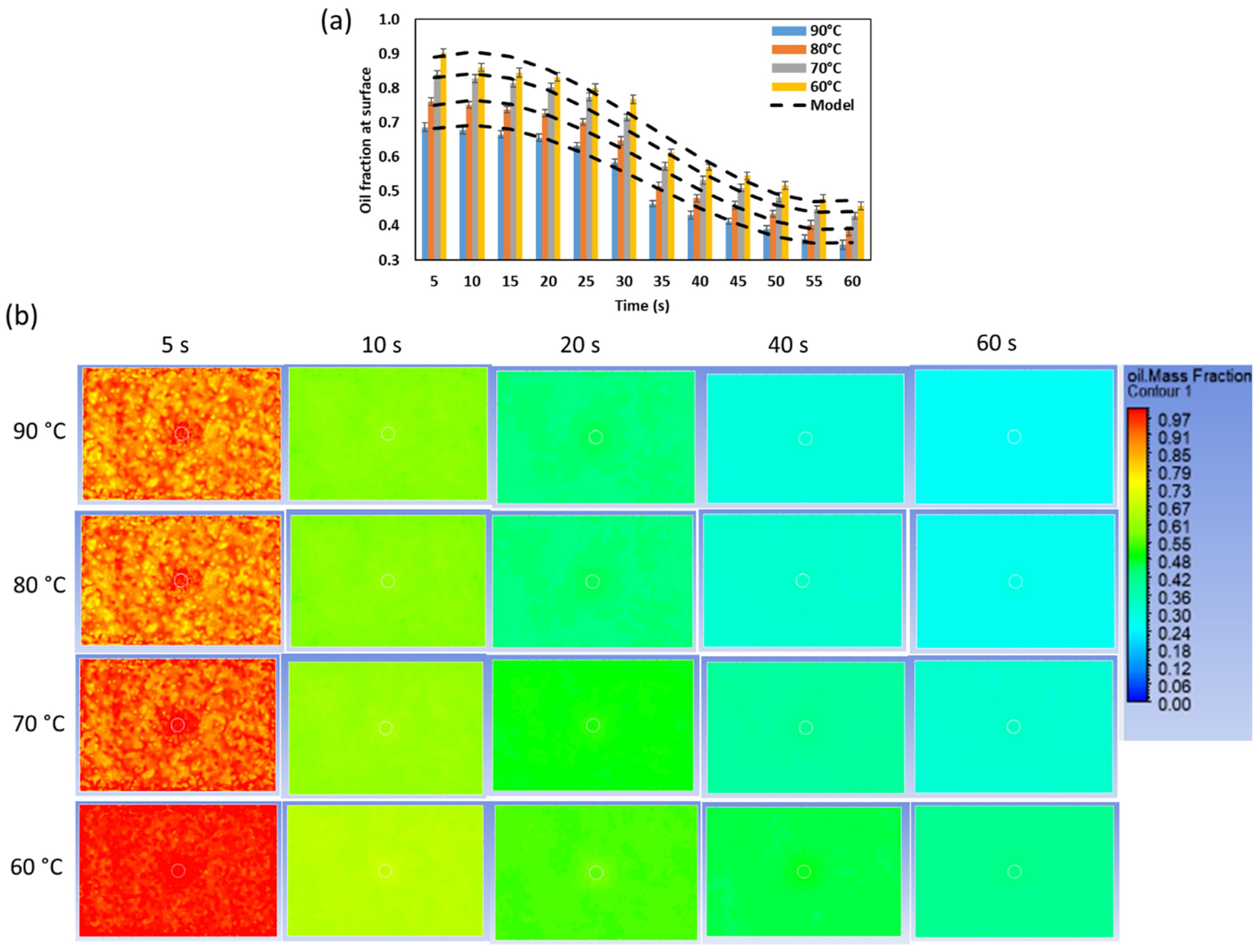
To isolate intrinsic oil diffusion behavior from flow-induced effects, static diffusion analysis was conducted using thermally conditioned SPC melts. The melt was extruded at controlled temperatures of 90, 80, 70, and 60 °C into a rectangular mold (30 × 10 × 20 mm). Immediately after shaping, 0.5 mL of molten coconut oil, which corresponds to approximately 2.5% (
w/
w), was injected at the geometric center of the sample at a depth of 1 mm below the surface (
Figure 2). The injection time was defined as t = 0, and samples were allowed to undergo diffusion for predefined durations (5–60 s) under isothermal conditions. At the target time point, samples were rapidly cooled to 25 °C to arrest further molecular transport and induce oil solidification before sectioning and analysis.
Spatial diffusion profiles were quantified using orthogonal sectioning planes (
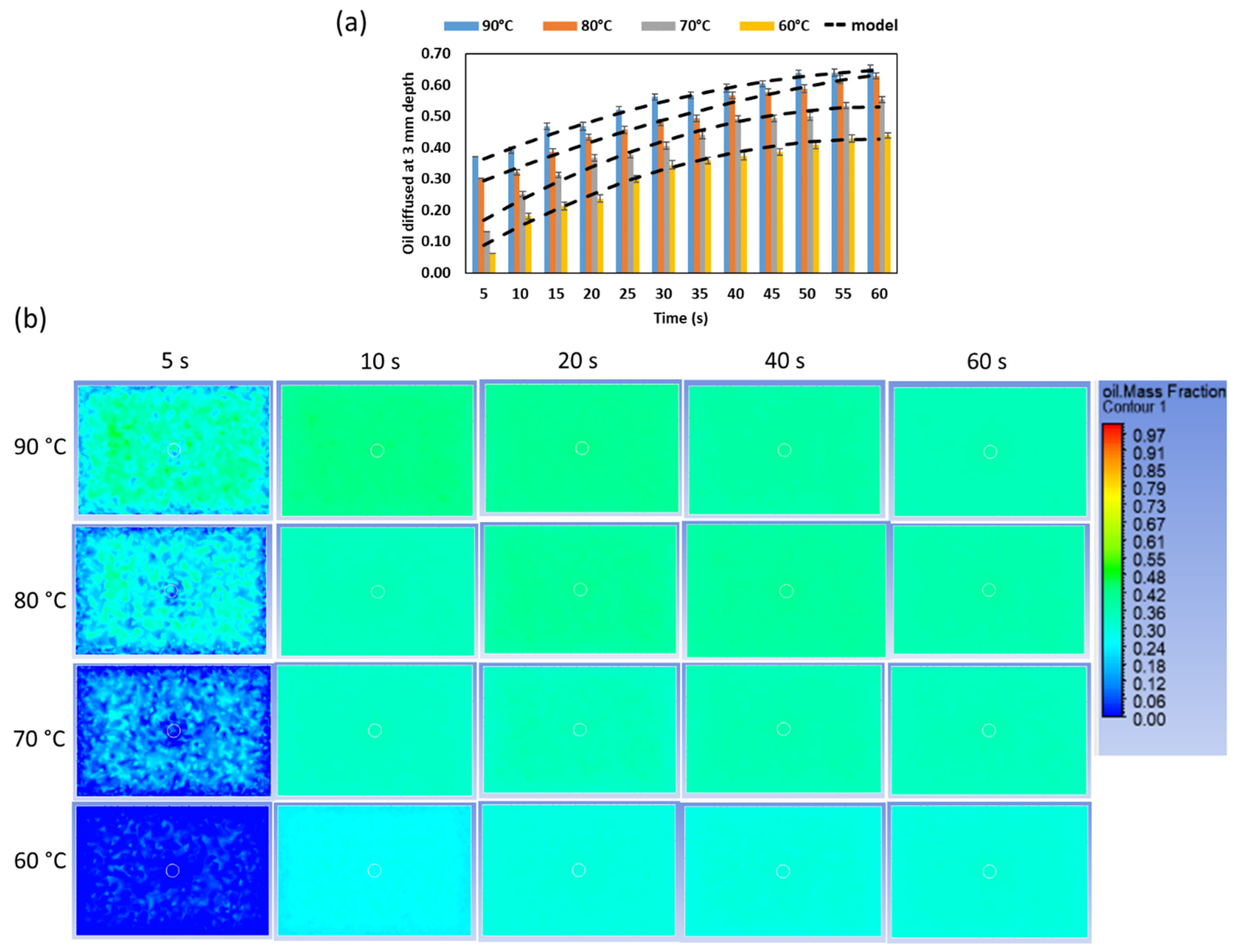
Figure 2). Cross-sectional images were collected at the surface and at depths of 3 mm from the top surface to evaluate lateral spreading within the matrix. All slicing was performed after complete cooling to prevent oil redistribution during cutting. The exposed surfaces were immediately imaged for subsequent quantitative analysis.
2.4.2. Image Acquisition and Image-Based Quantification
Digital images of each sectioned surface were captured using a digital camera (Lumix DC-GX9, Panasonic Corporation, Osaka, Japan) mounted at a fixed height of 300 mm above the sample. Illumination was provided by uniform white LED lighting, and samples were placed on a matte black background to maximize contrast between the oil phase and the protein matrix. Camera positioning, focal length, and exposure settings were kept constant for all measurements to ensure consistency across datasets.
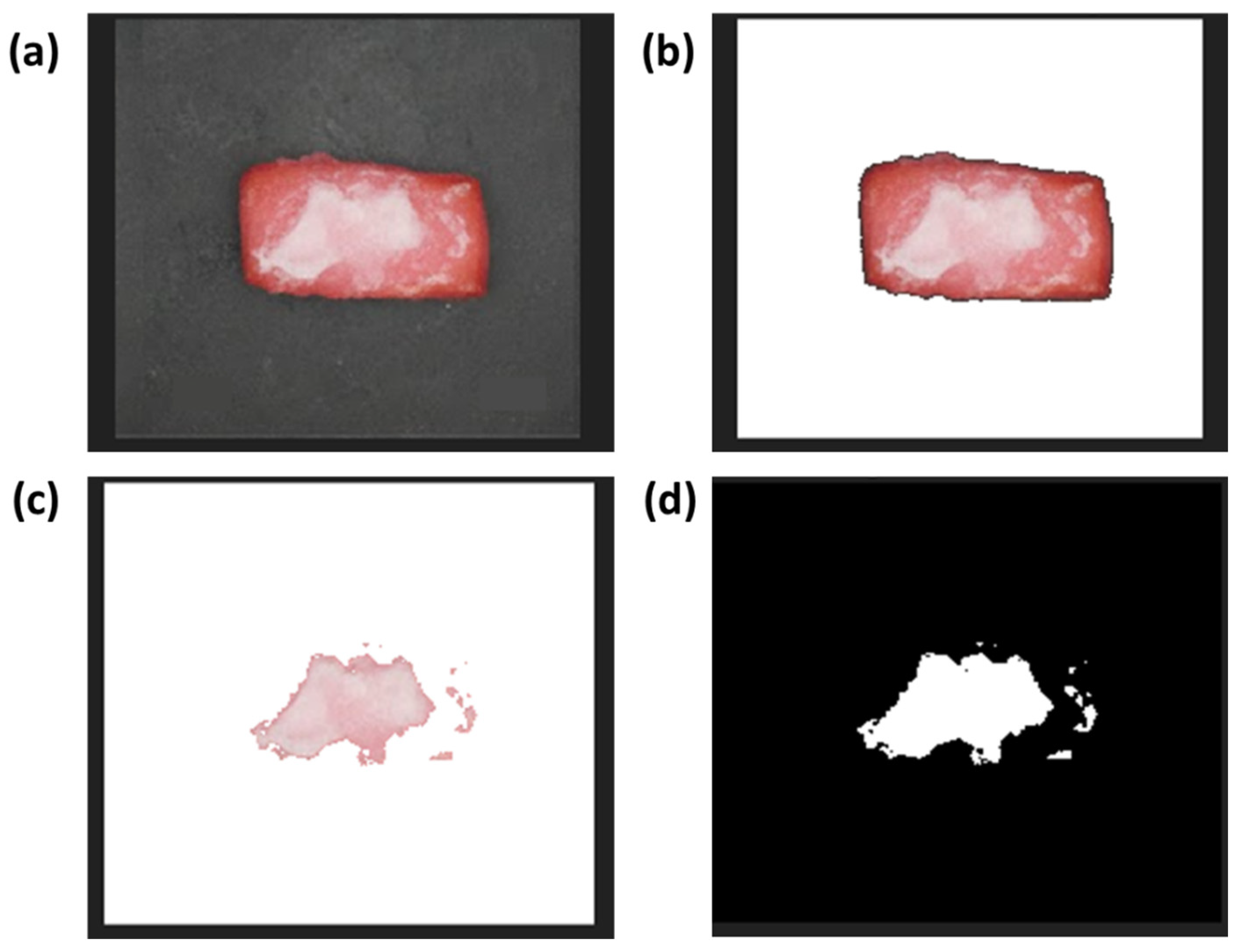
Image processing and quantitative analysis were performed using MATLAB (R2025a, MathWorks Inc., Natick, MA, USA). The analysis workflow consisted of color-channel separation, adaptive thresholding and binarization, background removal, and segmentation of oil-rich regions [
20] (
Figure 3). The projected oil area was extracted and normalized to the total cross-sectional area to obtain an apparent diffusion index, which was used as a two-dimensional proxy for the extent of oil redistribution visible on a given section. All measurements were performed on at least 10 samples and reported as mean ± standard deviation. Temperature-dependent diffusion trends obtained from the static analysis were used to identify optimal thermal windows for controlled oil migration, which was employed for the co-extrusion process.
2.5. Estimation of the Effective Diffusion Coefficient (Deff)
The diffusion of coconut oil within the SPC matrix was modeled using a multi-scale approach that links molecular theory with experimentally calibrated process-scale behavior. Because the SPC melt was treated as a non-porous, fully compressed continuum, oil movement was modeled as transport through a highly viscous protein matrix subject to macromolecular obstruction and free-volume limitation, rather than hydraulic flow through pores [
21]. In this context, the fitted diffusion coefficient should be interpreted as an effective transport parameter, rather than as a strict molecular diffusivity, because it may also reflect unresolved matrix–oil and interfacial effects.
First, a theoretical “ideal” diffusion coefficient (D
0) was calculated to estimate the upper bound of coconut-oil mobility in the molten state. The hydrodynamic radius (R
h) of the primary coconut oil triglycerides (trilaurin) was derived using the molecular volume approach [
22,
23]:
where M
w is the molecular weight of trilaurin (639.5 g/mol), ρ is the density of the oil (915 kg/m
3), and N
A is Avogadro’s number (6.022 × 10
23 mol
−1). From this, the hydrodynamic radius (R
h) was derived based on the Stokes-sphere assumption [
21]:
The calculated R
h of 0.65 nm was then utilized in the Stokes-Einstein relation to define the baseline diffusion coefficient (D
0) at a specific temperature (T):
where kB is the Boltzmann constant (1.3806 × 10
−23 JK
−1) [
21]. The variable T represents the absolute temperature (K), and μ(T) is the temperature-dependent apparent viscosity of the SPC melt, obtained from rheological measurements (
Section 2.3.1). The resulting D
0 value at 100 °C was 7.696 × 10
−17 m
2/s and was used as a theoretical upper-bound reference to confirm that the experimentally calibrated value remained physically realistic.
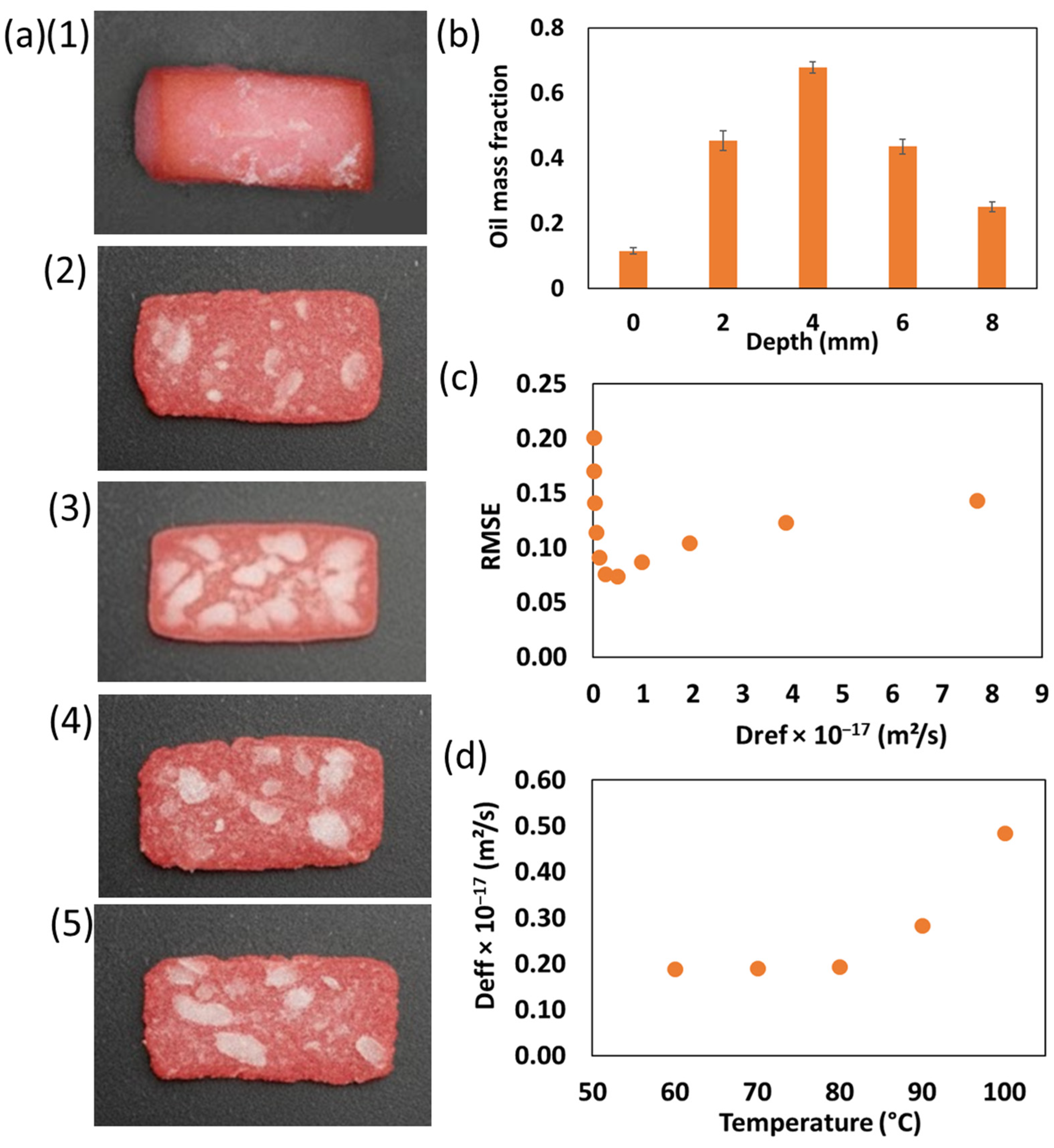
Secondly, to account for matrix-specific resistance under the peak processing condition (100 °C), a reference diffusion coefficient (Dref) was estimated by inverse calibration. In this procedure, static drop tests were conducted in which molten coconut oil was applied to the SPC matrix and held at 100 °C for 60 s, followed by rapid cooling to preserve the oil-penetration profile. Depth-resolved oil fractions were then measured from digital images at 2 mm intervals over five depth points (0–8 mm). A range of candidate diffusion coefficients was subsequently tested in the CFD model, and the simulated depth profile for each candidate value was compared with the corresponding experimental profile. The final Dref was selected as the value that minimized the root mean square error (RMSE) between simulated and measured depth-resolved oil fractions. This inverse calibration yielded a best-fit value of Dref = 4.86 × 10⁻¹⁸ m2/s. At this selected value, the CFD-predicted depth-resolved oil profile agreed with the experimental profile within 5% across the fitted depth range. Based on the five measured depth points used in the fitting, an approximate 95% confidence range for Dref was estimated from the RMSE profile as 6.11 × 10⁻¹⁹ to 3.86 × 10⁻¹⁷ m2/s. This calibrated parameter therefore represents a processing-relevant effective diffusion coefficient that captures obstruction effects within the SPC matrix beyond those predicted by the ideal Stokes–Einstein relation.
Finally, to simulate the co-extrusion process under changing thermal conditions, the fractional Stokes–Einstein (FSE) relationship was used to define the effective diffusion coefficient (D
eff) as a function of viscosity evolution during cooling [
24]:
where μ
ref is the melt viscosity at the calibration temperature, and n is a coupling exponent set to 0.92 to represent the viscosity-dependent restriction of transport in highly viscous food systems [
24,
25]. This framework allows diffusion to decrease dynamically as the melt cools and viscosity rises in the die, thereby describing the progressive immobilization of oil domains as the protein matrix transitions from a viscous melt to a structured gel. In this way, the model provides a process-level framework for predicting marbling stabilization trends during co-extrusion.
2.6. CFD Numerical Model for Oil Diffusion
2.6.1. Computational Domain and Boundary Conditions
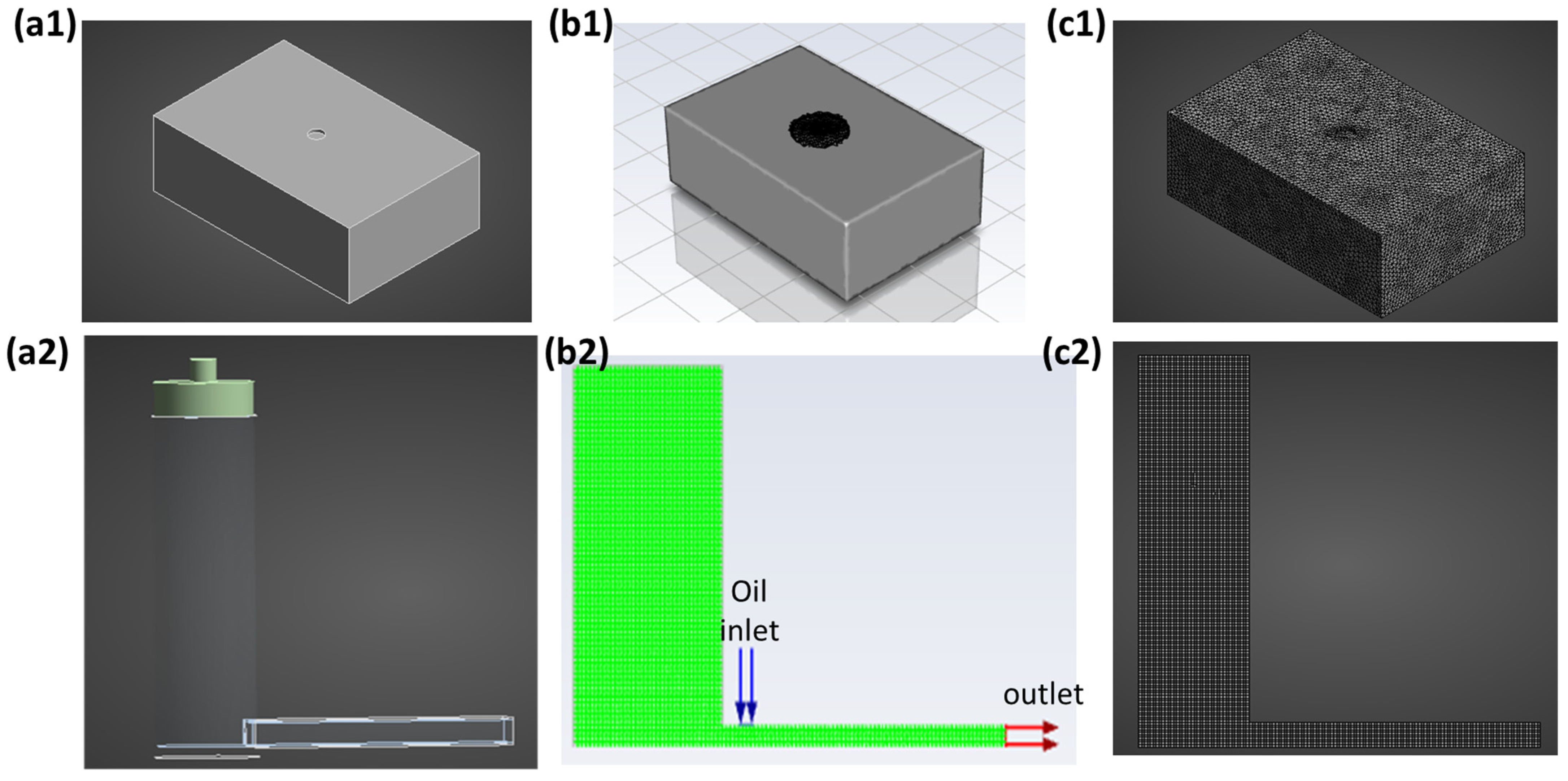
The CFD domains were developed for two configurations: a static transport model used for parameter calibration and validation, and a co-extrusion transport model used to simulate oil redistribution under processing-relevant flow and thermal conditions (
Figure 4).
For the static model (
Figure 4(a1–c1)), the SPC melt was represented as a 3D rectangular block (30 × 20 × 10 mm). Coconut oil was initialized as a localized cylindrical region (“oil patch”) on the top surface to replicate the drop-test condition (
Figure 4(b1)). Using the Region Register tool in ANSYS Fluent 2025R2 (ANSYS Inc., Canonsburg, PA, USA), the oil region was positioned at the center of the top face and defined to match the experimental oil volume (0.5 mL). All boundaries were treated as stationary no-slip walls, and the top surface was assigned a zero-mass-flux boundary for the oil species to represent a closed system. This static framework was first used to calibrate the reference diffusion coefficient (D
ref) from the 100 °C, 60 s depth-resolved oil profile. After calibration, the same model was applied to independent static holding conditions at different temperatures and times to evaluate predictive performance against experimental surface and subsurface oil-fraction data.
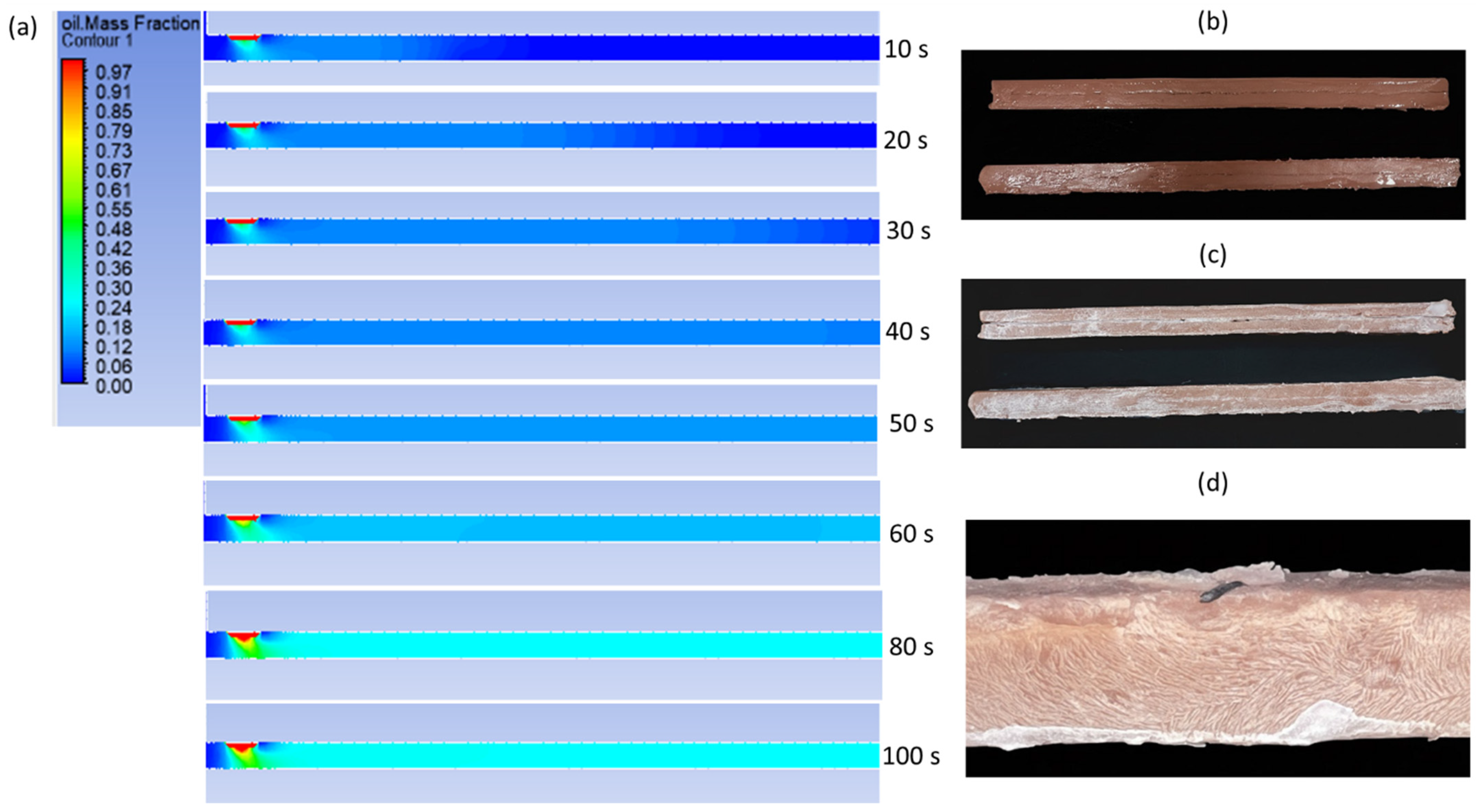
For the co-extrusion model (
Figure 4(a2–c2)), the domain included the barrel-to-die flow path to capture oil transport under processing-relevant advection–diffusion conditions. The inlet boundary was prescribed as a velocity inlet derived from the piston displacement rate (1 mm/s), and the outlet was set as a pressure-outlet (0 Pa gauge). All solid surfaces (barrel and die walls) were treated as stationary, no-slip walls. To reproduce the thermal management strategy of the fabricated cooling die, fixed wall temperatures were imposed: the barrel wall was maintained at 100 °C, and the cooling die was divided into three axial temperature zones to achieve controlled cooling of the extrudate. Specifically,
Section 1 (0–100 mm) was set to 100 °C,
Section 2 (>100–350 mm) to 50 °C, and
Section 3 (>350–500 mm) to 10 °C. Coconut oil was introduced through an injection boundary located 10 mm downstream of the cooling-die inlet, specified as an oil inlet (species mass fraction = 1 for oil) with the corresponding injection flowrate used experimentally. This zoned thermal boundary condition ensured that, upon exiting the die, the strand reached an average temperature in the target range of 70–75 °C, thereby coupling oil mobility to the viscosity increase and progressive setting of the SPC matrix.
2.6.2. Governing Equations
Transport in the SPC–oil system was modeled in ANSYS Fluent as a three-dimensional, transient, incompressible flow in a single-phase continuum, in which coconut oil was represented as a transported species within the SPC melt (continuous phase). This approximation was adopted because the objective of the model was to describe bulk oil redistribution and depth-resolved transport at the process scale, rather than to resolve individual droplet-scale interfacial events. Under the highly viscous conditions of the SPC matrix and the short redistribution distances considered in this study, the experimentally observed oil migration profile was treated as an effective transport phenomenon. Accordingly, unresolved microscale effects such as interfacial retention, local droplet deformation, coalescence, and phase separation were incorporated implicitly into the calibrated effective diffusion coefficient, D
eff (
Section 2.5), rather than being solved explicitly through a multiphase model.
Under this formulation, the model combines the conservation equations for mass, momentum, and energy with a species convection–diffusion equation for the coconut-oil mass fraction. The governing continuity and momentum equation are as follows [
26]:
where
u is velocity, p is pressure, and
ρ the effective mixture density of the SPC-oil continuum.
Because the rheological behavior of the SPC matrix was strongly temperature-dependent, viscosity was introduced as a temperature-dependent property using an Arrhenius-type relationship:
where E
a is the apparent activation energy for flow, R is the universal gas constant, and μ
ref is the apparent viscosity at a reference temperature T
ref. The parameters in Equation (7) were obtained by fitting the experimentally measured viscosity–temperature data (
Section 2.3.1) and implemented in Fluent as a temperature-dependent material property.
Energy conservation:
where
cp is specific heat (4 × 10
−13 T
2 + 0.362T + 3606) and
k is thermal conductivity (−9 × 10
−19T
2 − 0.0003T + 0.5265) measured using the KS-1 single-needle sensor (60 mm long, 1.3 mm diameter) of KD2 Pro thermal properties analyzer (METER Group, Inc., Pullman, WA, USA) at respective temperature and implemented via polynomial function to ensure energy conservation accuracy during the sol-to-gel transition [
27,
28].
Species transport (oil mass fraction): The evolution of the oil mass fraction (Y
0) is governed by the convection-diffusion equation:
where Y
0 is the local mass fraction of coconut oil in the SPC continuum (0 ≤
Y0 ≤ 1), ρ is the continuum density used consistently across all equations, and D
eff(T) is the temperature-dependent effective diffusion coefficient defined in
Section 2.5 (Equation (4)). For the static drop-test validation, the velocity field was set to
u = 0, such that the convective term vanishes and Equation (9) reduces to diffusion-driven transport governed by concentration gradients and D
eff(T). In contrast, during co-extrusion, both convection and diffusion contribute to oil redistribution. Therefore, D
eff should be interpreted as an effective process-scale transport coefficient rather than as a purely molecular diffusion constant.
2.6.3. Numerical Strategy and Solution Control
A structured hexahedral mesh was generated using ANSYS Meshing (version 2025R2, ANSYS Inc., Canonsburg, PA, USA), with local refinement applied to the oil-melt interface to resolve high concentration gradients (
Figure 4(c1,c2)). Mesh independence was confirmed when further refinement yielded < 1.5% change in the predicted oil penetration depth at t = 60 s.
Spatial discretization utilized second-order upwind schemes for momentum, energy, and species equations to minimize numerical diffusion. Pressure-velocity coupling was handled via the SIMPLE algorithm. Time integration was performed using a first-order implicit scheme with a time step of 0.05 s, ensuring a Courant number < 1. Convergence was monitored through normalized residuals, with target criteria of 10−5 for continuity and momentum, and 10−6 for energy and species transport.
2.7. Statistical Analysis
All experimental measurements were reported as the mean ± standard deviation of at least triplicate independent replicates. The influence of coconut oil concentration and temperature on the measured physical properties was evaluated using a One-Way Analysis of Variance (ANOVA) after confirming homogeneity of variance. When the ANOVA indicated significant effects, Tukey’s Honest Significant Difference (HSD) post-hoc test was used to identify differences between group means. For CFD model validation, agreement between simulated and experimentally measured oil-depth profiles was quantified using the root mean square error (RMSE). All statistical analyses were performed at a significance level of p < 0.05 using IBM SPSS Statistics (version 27, IBM Corporation, Armonk, NY, USA).