1. Introduction
Surface mining is a set of technological operations influenced by a wide range of factors, including geological, technical, economic, environmental, and social conditions. Such a complex environment makes the planning process difficult and challenging. The primary objectives in surface mining systems include maximizing net present value (NPV) and reserve utilization while simultaneously minimizing operating cost.
Quality management planning in open-pit mines represents the first and critical stage of the grade control process [
1]. This process goes beyond optimization of the excavation sequence and it also refers to a series of homogenization procedures implemented in three stages: selective mining at the open pit, quality control during the transport of material (ore) and blending at stockpiles or crushers prior to entering the processing plant [
2,
3]. Effective implementation of these procedures at the early planning stage can significantly reduce, or even eliminate, the need for later material handling, which reduces costs. Shovel-truck mining systems are particularly well-suited for selective mining and blending, as they facilitate the efficient separation of materials with varying quality characteristics. Consequently, they are widely considered the preferred approach for deposits featuring complex geological structures [
4]. In mines where ore quality is highly variable, this type of system remains the primary solution [
3,
4,
5,
6].
In this way, the mining technology can be significantly simplified, the probability of operational disruptions can be reduced, and consequently the total operating costs can be minimized. By blending high-grade ore with parcels below the cut-off grade (which would be otherwise be classified as waste), the total mineable reserves can be increased [
7]. The literature on open-pit mine planning emphasizes that quality management is complex because an operational mining plan must simultaneously satisfy production, capacity, technological constraints, and stable quality for the processing plant. The complexity of mining operations requires a sequence of discrete decisions, where each decision changes the remaining reserves and the future flexibility of the system. Since ore quality can significantly affect production schedules, the need for stochastic models in mine planning is highlighted [
1]. Furthermore, this combination of spatial dependence, temporal dynamics, and discreteness motivates the use of metaheuristic approaches [
8].
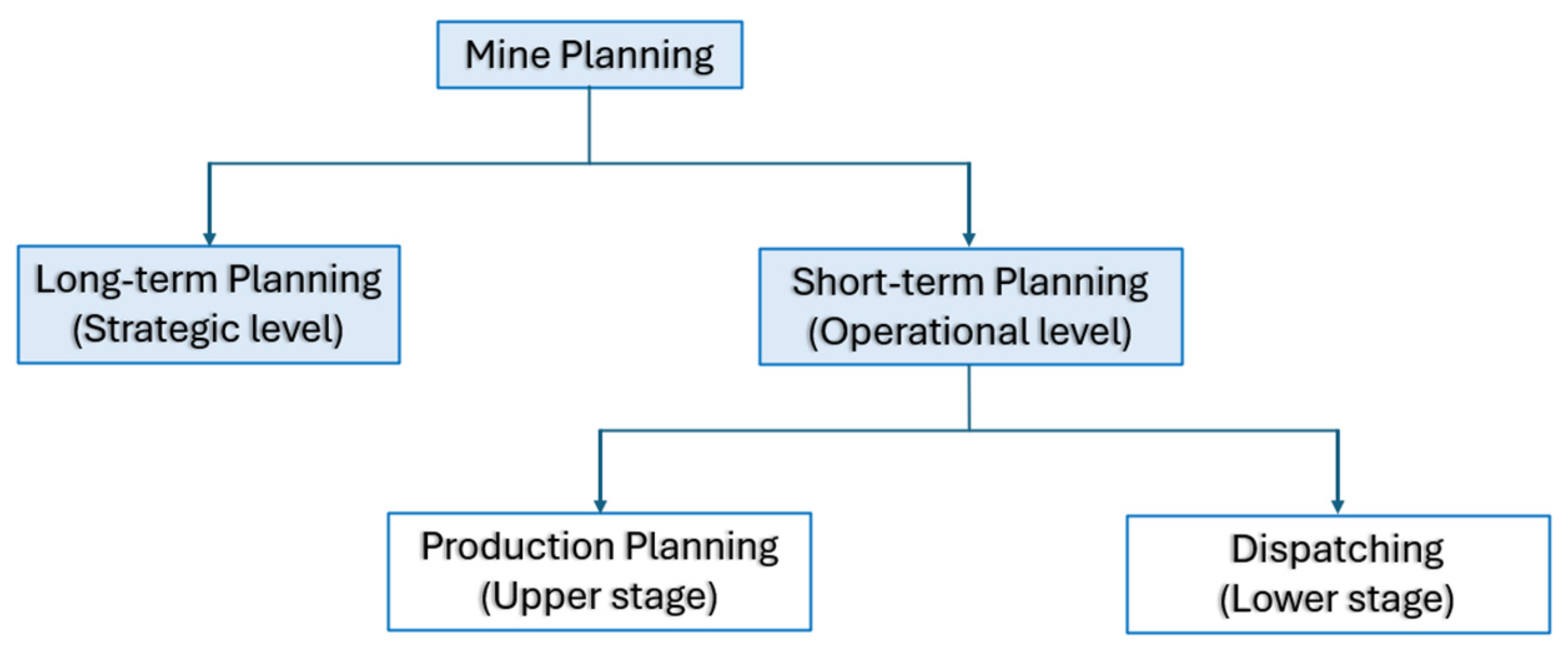
Long-term planning defines the overall direction of mining operations (pit limits, annual ore and waste quantities, mining methods, and the investment schedule). But only at the operational level does it become clear whether these plans can actually be executed with the available equipment and within the quality constraints [
1,
9,
10,
11]. In practice, a long-term plan that appears financially attractive often becomes challenging once it is decomposed into monthly, weekly, and shift-based schedules. Typical limitations include restricted access to mining locations and constraints related to the amount and deployment of loading equipment, as well as variations in ore quality [
10,
12,
13,
14].
Rather than treating production planning as a standalone issue, it must be approached as an integrated challenge that synchronizes equipment deployment with workforce scheduling [
15]. Furthermore, recent integrated optimization models have demonstrated that combining production scheduling with detailed haulage route planning can further reduce operational variability and significantly decrease unit mining costs [
16].
Even when a long-term open-pit mining plan is optimal at a strategic level, short-term (shift/day/week) planning requires independent optimization because it operates under a different decision granularity, constraint set, and information regime. As emphasized, the short-term horizon is dominated by operational feasibility decisions—selecting a limited set of simultaneously active mining areas, allocating discrete tonnage in truck-scale units, and satisfying equipment and production constraints that are typically aggregated or relaxed in long-term models—so a simple disaggregation of long-term targets can be infeasible or sub-optimal in practice [
17]. Also, short-term planning is where grade control is actually enforced: quality specifications must be met at a high frequency with limited blending flexibility and under material uncertainty, meaning the problem becomes one of managing variability rather than only meeting average targets. In this context, the short-term outcomes depend critically on the coupling between the extraction schedule and fleet behavior, and joint optimization of production scheduling and fleet management is necessary to achieve reliable capacity and quality performance when uncertainty is explicitly considered [
12]. Together, these findings justify short-term planning as a standalone optimization layer—a rolling-horizon control problem that complements long-term planning by translating strategic targets into feasible, quality-compliant operational decisions.
Despite its importance, operational planning is often relegated to a subordinate role in the current literature, treated merely as an adjustment to long-term decisions rather than an independent research focus. There is an increasing need to treat operational planning as an equally important research problem and as a process through which the long-term plan is continuously validated and, when necessary, adjusted. This can be done by using optimization and stochastic models capable of generating multiple production and quality scenarios [
1,
8,
12,
13,
14].
More recent approaches to surface mine planning indicate that a substantial increase in productivity is achieved only when short-term planning is implemented through a detailed plan that is transparent and accessible to all involved in the process. This type of planning combined with regular progress monitoring (daily, weekly, etc.) reduces operational variability, improves equipment utilization, and increases haulage system productivity, while simultaneously reducing unit mining costs [
18]. A study has formulated mixed-integer models for short-term planning at the level of blasted blocks, simultaneously enforcing geometric constraints, equipment capacities, and the required sequence of operations. This study demonstrates that long-term planning can be effectively connected with operational equipment dispatching and scheduling [
19], as demonstrated in
Figure 1 [
20].
Ore quality management is a cornerstone of modern open-pit mine planning, as fluctuations in the concentrations of beneficial components and deleterious impurities directly influence recovery rates, energy efficiency, and the overall stability of the technological process. Contemporary approaches do not treat quality as a single attribute but rather as a multidimensional set of parameters that collectively define ore behavior during processing [
21,
22]. In operational planning, quality management is especially demanding due to the simultaneous extraction of blocks from multiple parts of deposits with heterogeneous grades. The resulting production schedules must not only satisfy processing requirements but also remain consistent with long-term strategic reserve management goals [
11]. Flexible heuristic approaches are preferred, as operational planning is often modeled as a multi-objective optimization task [
1,
8]. It acts as a vital link between long-term strategic goals and shift-by-shift operations, where specific details must be refined to concurrently meet production targets and quality constraints [
9].
In this study, a model for short-term planning is developed and its impact on the quality management in open-pit mining is investigated, i.e., achieving the required grade ranges through operational planning of the mining of individual blocks. For the development of the model, a genetic algorithm is used.
Genetic algorithms (GAs) belong to the class of evolutionary algorithms and represent a modern optimization approach inspired by the biological principles of natural selection and genetics [
23,
24]. Their fundamental mechanism is based on the evolution of a population of candidate solutions over successive generations by applying genetic operators such as selection, crossover, and mutation. Selection favors higher-quality individuals, crossover combines characteristics of parent solutions, and mutation introduces random changes in genetic representation. Through this iterative process, the algorithm progressively improves the fitness function value [
25,
26].
Unlike classical optimization models, genetic algorithms can handle discrete, combinatorial, and multi-criteria solution structures, which makes them very suitable for complex systems such as mining operations. The problems of the operational scheduling of block mining are widely recognized as NP-hard. In practice, metaheuristic approaches, including genetic algorithms, are increasingly used instead of classical mathematical methods [
2].
Genetic algorithms have demonstrated high efficiency in scenarios where ore quality and economic performance are intrinsically linked throughout the mine planning process. Initial research in this field established that block mining sequences can be directly encoded within the chromosome, while the objective function integrates economic impacts, capacity constraints, and quality criteria [
27]. Subsequent studies expanded this approach to cut-off grade optimization, utilizing GAs to determine optimal cut-off value sequences over the life of a mine to maximize net present value (NPV) while ensuring plant quality requirements [
28,
29].
Several authors emphasize that heuristic algorithms, including GAs, are essential because classical optimization methods often fail to respond rapidly enough to the dynamic nature of mining operations. It has been noted that the precise allocation of truck and shovel capacities, combined with the strategic selection of active open pits, significantly influences the stability of ore quality and overall operational efficiency [
30,
31]. These findings suggest that GAs can effectively manage the complexities of simultaneous extraction and processing, identifying schedules that best satisfy target quality requirements.
Recent advancements in the industry highlight the growing role of machine learning (ML) in enhancing the precision of ore grade estimation and the efficiency of blending operations [
32].
Also, recent research shows the effectiveness of multi-objective evolutionary algorithms, such as NSGA-II, in addressing the dynamic coordination of grade control and production quantity in complex open-pit environments [
33].
While optimization models like genetic algorithms address operational efficiency, ensuring safety through advanced understanding of rock mass behavior and support mechanisms remains equally critical for the overall success of the project [
34,
35].
Machine learning-based grade estimation now significantly outperforms conventional geostatistical methods from exploration through to the mining phase [
36].
The shift toward collaborative optimization is further evidenced by recent implementations, where machine learning algorithms are integrated with real-time sensor data from mining equipment to synchronize ore grade estimation with resource allocation [
37]. These approaches focus on the data-driven predictability of ore grades, and a critical gap remains in translating these real-time insights into long-term, shift-level production schedules. This research addresses this necessity by providing a stochastic genetic algorithm that functions as an optimization engine, capable of balancing the dynamic inputs of grade variability and equipment capacity over a comprehensive 1000-shift time.
This paper develops a stochastic genetic algorithm for multi-shift excavation planning in a shovel-truck mining system where operational demands (per-shift capacity and the number of active mining locations) are integrated with ore quality requirements (grade range and an upper limit of bad component content). The proposed model is demonstrated using a case study of eight limonite ore deposits over an annual production plan, corresponding to 1000 operational shifts.
Recent advancements in integrated mine planning have introduced optimization frameworks to synchronize production scheduling with logistics, such as haulage route planning under road capacity constraints [
16]. While these large-scale models focus on minimizing transportation costs for massive deposits, there remains a critical research gap in addressing the collaborative optimization of shift-level grade control and production capacity for small-scale, multi-pit operations. This study fills this gap by focusing on the chemical compliance of marginal limonite deposits, where the genetic algorithm (GA) acts as a decision-support tool to balance strict Fe and SiO
2 targets with a fixed 2000 t shift capacity.
As noted in a recent review, the industry is shifting toward closed-loop systems that integrate high-resolution sensor data with adaptive optimization techniques [
38]. While RTM focuses on the broader technological infrastructure, this GA model provides a specific, accessible framework for collaborative optimization at the shift level, ensuring that production capacity and grade stability are synchronized in the presence of high geological uncertainty. To address the inherent variability in mineral deposits, recent studies have proposed hybrid intelligent control systems that integrate predictive modeling with process adaptation; however, the upstream synchronization of shift-level extraction sequences through genetic algorithms remains a critical, yet under-explored, component of this integrated mining-to-processing value chain [
39].
While recent studies focus on the collaborative optimization of production scheduling and transport systems using Monte-Carlo simulations to manage haulage capacity, this GA model extends this collaborative logic to the shift-level grade control of multiple marginal pits [
40]. This approach simultaneously manages Fe and SiO
2 levels and quality stability while meeting strict shift-level production capacity.
The results of the stochastic genetic algorithm are compared with a manual mining plan based on engineering judgment and experience. The comparison clearly highlights the contribution of the stochastic approach in terms of grade stability, reserve utilization, and operational scheduling performance.
2. Materials and Methods
Genetic algorithms (GAs) are a metaheuristic optimization method inspired by the principles of natural selection and evolutionary biology. The foundations of GAs were established by John H. Holland, who introduced the fundamental concepts of chromosomes, selection, crossover and mutation into the context of mathematical optimization [
23]. David E. Goldberg further advanced the field by systematizing these methods, transforming GAs into a standard tool for engineering and industrial optimization [
24]. Due to their ability to integrate multiple criteria into a single objective function and effectively handle complex constraints through penalty functions or repair procedures, GAs are particularly well-suited for problems where classical approaches become computationally intractable [
41].
The implementation of a stochastic genetic algorithm (GA) in this study is necessitated by the vast combinatorial complexity of the 1000-shift operational plan, which presents a solution space that is functionally infinite. Under such conditions, stochastic metaheuristics offer significant advantages over deterministic methods by enabling a more efficient exploration of potential excavation sequences. The inherent stochasticity of the GA—driven by probabilistic selection mechanisms—ensures that while independent runs consistently converge toward similar optimal results due to identical objective functions, the specific generated plans are virtually never identical. This fundamental characteristic of the optimization process justifies the metaheuristic approach and serves as the primary basis for the methodology employed in this research.
Factors such as stochastically generated geological models [
42,
43] and the probabilistic analysis of equipment reliability and availability [
44] represent significant and independent research domains. While these elements are crucial, the focus of this study is on optimizing shift sequences.
The optimization model was implemented using Microsoft Excel and VBA. Although high-performance environments like educational version MATLAB software are frequently used in academic research for similar stochastic optimizations [
45], Excel/VBA was selected for this study to prioritize industrial accessibility. Given that Excel is the standard tool for data management, providing a VBA-based solution ensures that the tool can be used by mining engineers without additional licensing costs or the need for advanced programming expertise. This approach bridges the gap between sophisticated metaheuristic optimization and the practical, daily needs of mine planning in the field.
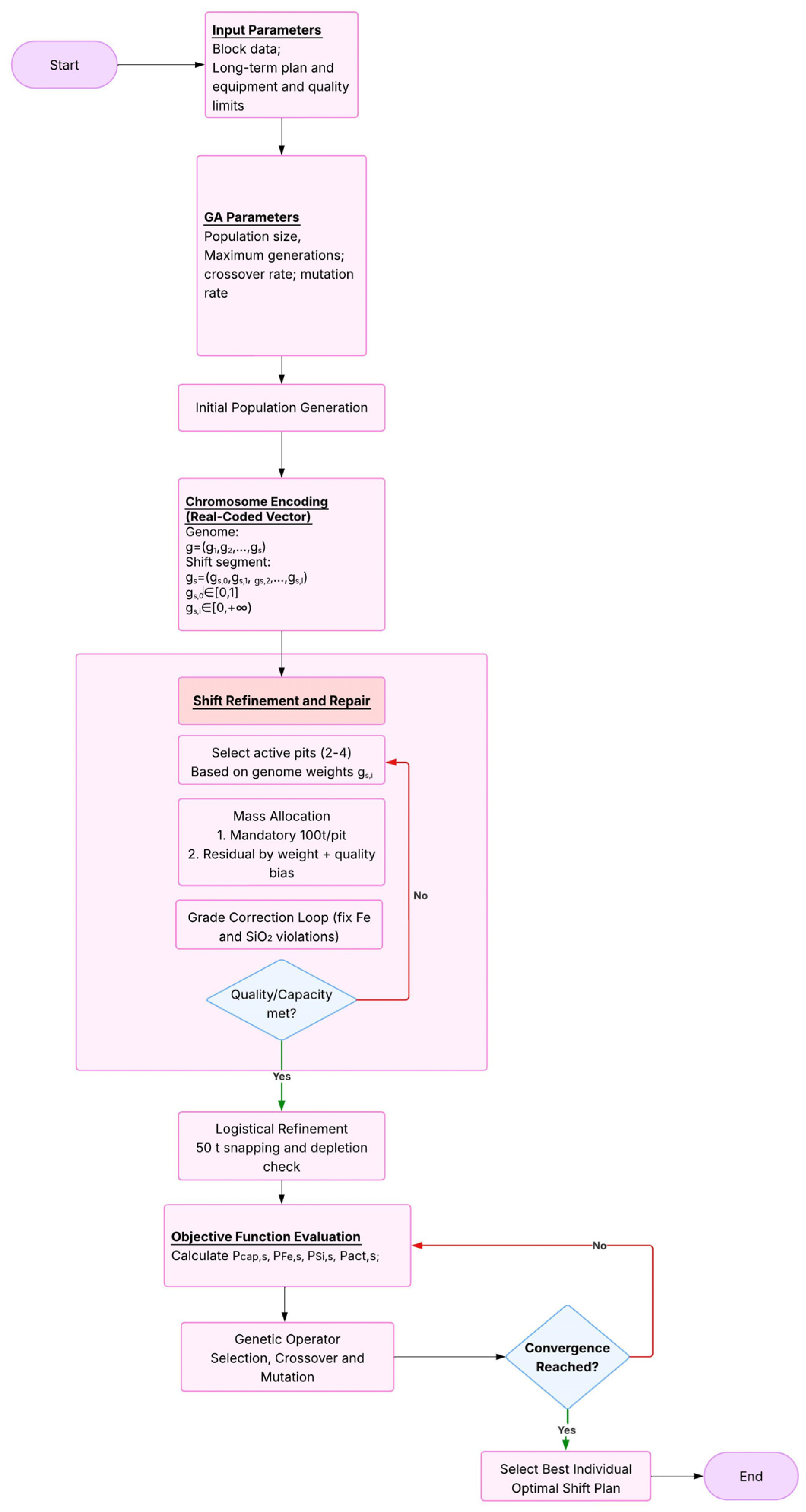
In this research, to effectively solve scheduling problems in shovel-truck systems and generate an optimized short-term plan, the GA follows a structured evolutionary process consisting of several key stages (
Figure 2):
Initial Population: The algorithm begins by generating a set of candidate solutions, known as individuals or chromosomes. In this model, each individual represents a potential production plan for the entire duration of the scheduling period. The diversity of the initial population is crucial, as it ensures a broad exploration of the search space.
Chromosome: This is a real-coded vector representing a complete multi-shift production schedule, where each shift segment gs manages pit selection and mass distribution through desirability weights.
Fitness function (Objective function): Each individual is evaluated on a fitness function, which, in this paper, is defined as the minimization of the total penalty, i.e., goal deviation. The fitness value determines the “quality” of the solution in the sense that lower penalty values indicate better alignment with production targets, such as ore grade requirements, shift capacity and operational constraints of the shovel-truck system.
Selection: This operator selects the best-performing individuals to act as parents for the next generations. By favoring solutions with higher fitness values, the algorithm ensures that beneficial “genetic” traits are preserved and passed on.
Crossover: This is the primary operator for exploration. It combines segments of two parent solutions to create offspring that inherit characteristics from both, potentially leading to the discovery of superior solutions.
Mutation: To prevent the algorithm from converging prematurely into local optima, mutation introduces random changes to an individual’s genome. This maintains genetic diversity and allows the algorithm to explore new regions of the solution space.
The optimization process is executed through several interconnected stages:
Input and Parameterization: The algorithm initiates by loading primary block data, including tonnage and expected grades for Fe and SiO2. It simultaneously incorporates operational constraints. The GA parameters, including population size, maximum generations, and crossover/mutation rates, are defined at this stage to control the evolutionary search.
Initial Population Generation: A set of candidate solutions (chromosomes) is randomly generated to represent the initial production plans. Each individual undergoes a decoding process where the real-coded genes are translated into specific production assignments
Shift Refinement and Repair: This sub-process ensures the operational feasibility of each generated plan. The extracted tonnage is subsequently discretized during the logistical refinement stage to maintain operational consistency. The model then enforces the active mining location constraint, ensuring the number of active mining locations (but not necessarily pushbacks) remains within an operationally feasible range (between 2 and 4 within one year in most mining projects in order to minimize operational complexity, i.e., ensure feasibility). Furthermore, a grade correction loop is executed to fix potential Fe and SiO2 violations before the final check, which ensures that the mining locations with less than the minimum truck payload (i.e., locations where practically the entire ore was mined) are removed from the active set.
Objective Function Evaluation: Each refined plan is evaluated through a multi-component objective function. The fitness value is determined by calculating cumulative penalties for deviations in shift capacity, ore quality, and the number of active mining locations.
Genetic Operators and Evolution: The algorithm utilizes tournament selection to choose the most fit individuals for reproduction. These parents undergo crossover and mutation to produce offspring for the subsequent generation, facilitating both the exploration of the search space and the exploitation of high-quality solutions.
Convergence and Output: The loop continues until the convergence criteria are reached or the maximum number of generations is exhausted. The algorithm finally selects the best individual, providing the optimal shift-by-shift production plan as the output.
The overall computational procedure and the logical sequence of the developed GA model are illustrated in the flowchart presented in
Figure 2.
Figure 2.
Flowchart of the genetic algorithm for shift-by-shift production scheduling in a shovel-truck system.
Figure 2.
Flowchart of the genetic algorithm for shift-by-shift production scheduling in a shovel-truck system.
3. Case Study
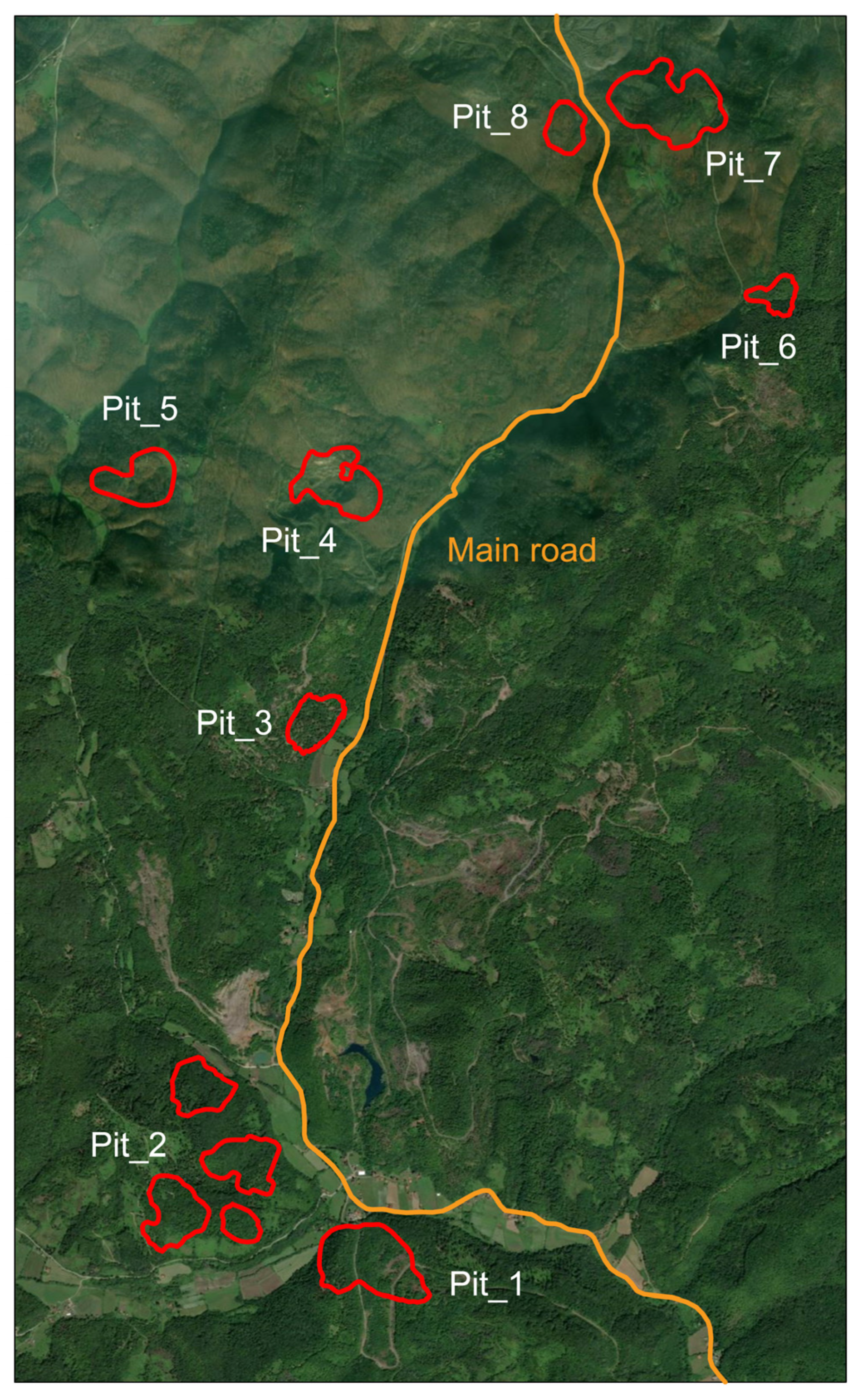
This study examines an operational planning scenario performed shift-by-shift with a fixed capacity of 2000 t per shift. The research focuses on eight small-scale limonite ore pits. The limonite ore open pits are located in Bosnia and Herzegovina, south of the settlement of Ljubija. Within each shift, it is possible to activate between two and four open pits simultaneously.
The development of this optimization model was initiated during a formal Feasibility Study for the limonite deposits in the Ljubija region (Bosnia and Herzegovina). Analysis of the site operations revealed that the creation of short-term plans was conducted manually by site engineers, based on years of empirical experience. This manual process, while grounded in expertise, proved to be time-consuming and limited in its ability to evaluate the vast solution space of a 1000-shift schedule (annual production). Consequently, this study adopts the manual plan as its primary benchmark. By comparing the GA-generated sequences against the real-world operational baseline, we aim to demonstrate the practical utility and efficiency of the proposed decision-support tool in a real-world industrial environment.
Given the limited reserves, relatively low ore quality, and the required investment in machinery and infrastructure, mining any single open pit individually would not be economically viable. However, since the pits are located within a relatively small area (approximately 3 × 5 km), their simultaneous mining has demonstrated significant economic potential.
Figure 3 shows the locations of the limonite ore open pits.
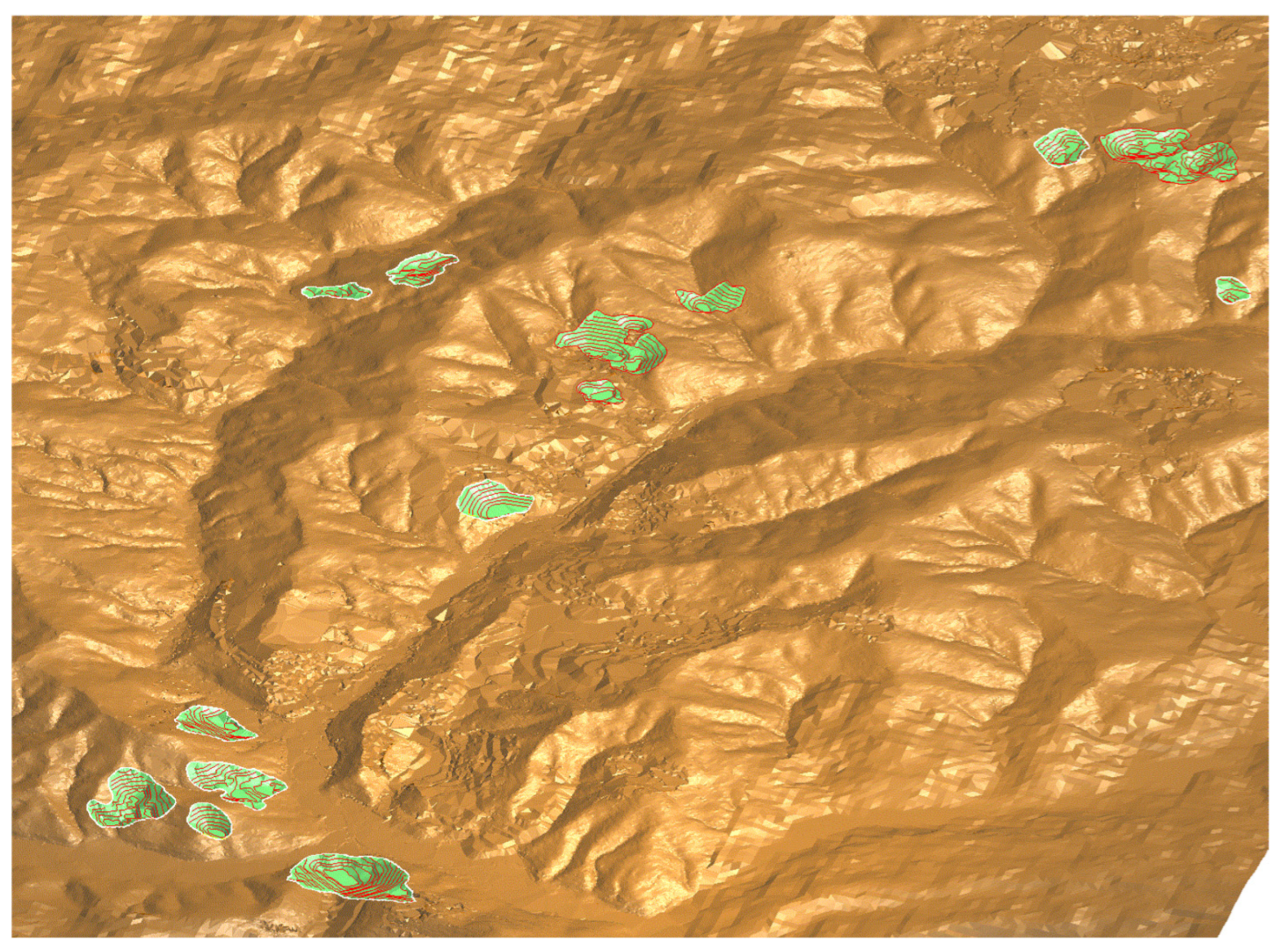
A 3D model of the limonite ore open pits is shown in
Figure 4.
These pits are characterized by their limited spatial extent, pronounced local discontinuity, and high ore grade variability, as well as complex lithological contacts frequently featuring internal waste partings. Consequently, eight individual pits were designed, and a long-term annual production plan was established to meet strict quality and capacity requirements. The generated annual plans barely satisfy the qualitative criteria; specifically, the iron (Fe) grade fluctuates near the minimum required threshold, while the silica (SiO2) content remains close to the maximum allowable limits. While these results indicate the feasibility of mining based on annual targets, they also highlight that achieving the required quality standards at the shift and daily operational levels will be exceptionally challenging.
The conventional solution to this problem would be the implementation of a stockpile for blending and quality management. However, several factors make this approach unfavorable:
The lack of a suitable location required for the calculated stockpile volume.
Additional costs associated with material re-handling (stacking and reclaiming).
Increased technological complexity of the overall process.
Therefore, the objective was to:
Create a feasible operational plan of production on a shift level that ensures the given constraints and confirms the settings of the long-term plan;
Minimize volume or entirely eliminate the stockpile from the technological process.
This necessitates rigorous optimization of operational plans to meet quality standards at the shift level, thereby reducing reliance on stockpiling or bypassing it altogether during specific production periods.
The processing plant requires the delivered ore to maintain an iron (Fe) grade within the range of 47–50%, with a silica (SiO2) content below 11%. Mining operations aim to satisfy these requirements for every individual shift; in cases where this is not feasible, the number of non-compliant shifts must be minimized to reduce the required stockpile capacity. The objective of the developed model is to generate an operational mining schedule for the observed open pits over a period of 1000 shifts (one-year production), while simultaneously optimizing multiple criteria: adhering to target production capacity, maintaining ore quality within specified limits for the maximum number of shifts, ensuring rational reserve utilization for each open pit, and providing stable operational dynamics consistent with the constraints of the shovel-truck system.
Table 1 shows the distribution of ore grades per pit.
The genetic algorithm model is designed to strictly adhere to the long-term strategic plan, which mandates a total production capacity of 2,000,000 t for the first year. The long-term plan schedules the extraction of the following tonnages per open pit:
Pit_2-658,700 t;
Pit_3-449,400 t;
Pit_4-163,500 t;
Pit_7-529,650 t;
Pit_8-198,750 t.
Mining operations are scheduled across these five active locations, primarily driven by the strategic requirement to fully deplete the reserves in Pit_8.
The developed model incorporates the following operational conditions and constraints to ensure the feasibility and efficiency of the production plan:
Temporal Quality Control: The quality of the delivered ore must remain within the predefined limits set by the processing plant for the maximum possible number of shifts. Instead of merely targeting long-term average grades, the model penalizes individual shifts that deviate from the specified range, thereby establishing rigorous quality control over time.
Production Capacity: A mandatory excavation and transport capacity of 2000 t per shift is established. This constraint reflects contractual obligations and the processing plant’s requirements, while also accounting for the inherent physical limits of the shovel-truck system. Any deviation from this target capacity results in a penalty within the objective function.
Operational Complexity: To maximize equipment utilization and ensure stable ore quality, a minimum of two and a maximum of four pits must be active simultaneously during any given shift. Maintaining a limited number of active mining locations is preferred in practice to streamline organizational logistics. The lower limit prevents dependency on a single ore source, while the upper limit constrains the operational complexity of the plan.
Logistical Discretization: Given a truck load capacity of 50 t, the potential mass extracted from a pit is treated as an integer multiple of the truck capacity (i.e., n × 50 t). The value of n is constrained between 2 and 40, effectively capped by the maximum capacity of 2000 t.
Minimum Extraction Threshold: A minimum of 100 t must be extracted from each active pit per shift to avoid negligible volumes that utilize equipment capacity without contributing significantly to the final ore blend. This rule is based on operational experience, ensuring that every active open pit justifies the deployment of the shovel-truck system.
The values of parameters used are shown in
Table 2.
The production scheduling model is constrained by the technical and physical limitations of the mining system. The shift production capacity is set at 2000 t, reflecting the maximum of the primary crushing unit, while the truck payload capacity of 50 t defines the hauling unit’s capability. The planning horizon encompasses 1000 shifts, which is the period of time of one production year. To ensure operational stability and efficient equipment allocation, the number of simultaneously active open pits is restricted to a minimum of two and a maximum of four. Regarding ore quality, the blending process must maintain an iron (Fe) content between 47% and 50%, with silica (SiO2) levels kept below 11% to meet plant requirements.
The GA control parameters were selected based on established heuristics and observed convergence patterns. Specifically, the population size (36) and maximum generations (100) were chosen as they consistently provided stable solutions within the Excel/VBA computational framework. To ensure that the best solutions were not lost, the elitism of four individuals was maintained. The crossover rate (0.9) and mutation rate (0.06) were adopted to maintain a balance between the rapid exploitation of promising areas and the necessary exploration of the search space to avoid premature convergence.
The analysis was performed by varying the number of generations while maintaining a constant population size (36). Results demonstrate that the number of non-compliant shifts reached a stable plateau at 100 generations. Beyond this point, increasing the number of generations resulted in a none or negligible improvement in shift compliance while significantly increasing the computational overhead.
The model utilizes several fundamental variables and equations to represent the operational mining process. For each pit i, the total reserves are defined as the total ore mass, representing the sum of the masses of all blocks encompassed within the optimal pit contour.
The total reserves at the commencement of the planning period (
) (
s = 1) are defined as
where
i—index of the open pit, where i = 1, …, I;
b—index of the block within the open pit;
Tonb—tonnage of block b;
blocks (i)—the set of all blocks belonging to open pit i;
RemTotali,s—the total remaining mass of open pit i (which is equal to the sum of all Tonb at the start of the planning period).
Throughout the scheduling process, the reserve status is dynamically updated at the conclusion of each shift
s by subtracting the actual mass excavated during that interval:
where
represents the actual mass excavated in shift s, discretized into truck-load units (50 t);
denotes the remaining ore mass in pit i, at the start of the subsequent shift.
Genome Structure
The genome is designed as a real-coded sequence that governs the selection and distribution of ore extraction across shifts. For each shift
and each pit
, a specific genome segment is defined:
represents a global gene that influences the overall mining intensity for a given shift.
represents the “desirability” of pit i in shift s (a higher value of increases the probability that the genetic algorithm will include the pit in the active set, whereas a lower value indicates that the pit is considered less beneficial for achieving the target objectives in that specific shift).
For each shift
s, a set of active open pits
is established. This selection is subject to the following constraint:
or
This restriction is implemented to manage operational complexity; while some theoretical approaches might allow for a higher number of simultaneous active mining locations (e.g., seven to eight), practical shovel-truck system logistics typically favor a concentrated focus on two to four active pits to streamline management and organizational requirements.
Pit i is automatically excluded from the active set As if it meets the following “depletion check” criteria:
This “truckload threshold” rule ensures that a pit is considered exhausted if it cannot support at least one full truck unit (50 t). By implementing this threshold, the model prevents the genetic algorithm from extracting negligible ore volumes (micro-quantities) that would otherwise disrupt the logistical integrity and the integer-based logic of the operational plan.
The addition of a new open pit to the active set is performed based on the genomic weights gs,i through a two-step heuristic process:
Mandatory Minimum Expansion: if , the algorithm automatically adds the pit with the highest gs,i value until the minimum operational requirement is met.
Qualitative Expansion: Further pits are added to the active set only if the GA evaluates that their inclusion improves either the total shift capacity or the overall ore grade quality.
For each active pit
in shift
s, the maximum available mass (
) is defined as
where
This specific constraint is introduced to strictly control the high SiO2 content characteristic of Pit_5 and Pit_6, preventing grade degradation of the final blend.
The specific constraint of a 350 t per shift production limit for Pit_5 and Pit_6 is based on the geochemical characterization of these two pits. Geological block modeling revealed that Pit_5 and Pit_6 are situated in zones with a concentration of SiO2 levels that is significantly higher than the quality maximum requirement of 11%. From an engineering perspective, this 350 t cap (representing approximately 17.5% of the total 2000 t shift capacity) acts as a qualitative buffer. By limiting the contribution of high-silica ore, the model ensures that the remaining 82.5% of the production volume—sourced from pits with lower silica content—provides a sufficient dilution effect to maintain the final blend within the required chemical specifications.
To ensure that every active mining location justifies equipment deployment, a starting mandatory mass (
) is assigned:
where
This ensures that each active pit contributes sufficiently to the shift capacity to maintain operational sense.
The residual shift capacity (
) representing the mass available for further distribution among active open pits is calculated as
The individual spare capacity (
) for each pit
i, which prevents the exceedance of pit-specific limits, is defined as
To align extraction with the target iron grade, a qualitative desirability factor (
) is introduced:
where
The target value of 48.5% is defined as the arithmetic midpoint of the required iron range (47–50%). By centering the bias factor on this value, the model creates a “quality attractor” that prioritizes pits closest to the ideal grade, thereby providing a safety buffer against the inherent geological variability of the limonite ore.
The final effective weight (
), which modifies the genomic weight based on the current ore quality, is calculated as
The weighting coefficients 0.6 and 0.4 were established through iterative sensitivity analysis and preliminary testing of the algorithm. The 0.6 constant (60%) ensures that the genetic algorithm maintains its exploratory nature and global search capability based on the evolved genome, while the 0.4 multiplier (40%) provides sufficient heuristic pressure to favor pits that contribute to the immediate target chemical composition.
This formula integrates two effects:
Genomic Desirability: Represented by , which evolves the GA to improve overall fitness.
Qualitative Utility: Adjusted by the multiplier, which “skews” the genetic weight in favor of pits that currently contribute to the target chemical composition.
The total mass assigned to pit
i in shift
s (
) is determined by combining the mandatory minimum mass and the proportionally distributed residual capacity:
This allocation is subject to the following capacity constraint:
This ensures that the assigned tonnage neither exceeds the available ore in the pit nor violates the maximum shift capacity limits.
To ensure the final blend meets the processing plant’s strict requirements, the model implements a heuristic grade correction loop. If the simulated quality of the shift blend deviates from the target thresholds, the algorithm redistributes the mass between active pits as follows:
Silica (SiO2) Violation: If the SiO2 content exceeds the maximum limit (Si > SiMax), the model shifts from the pit with the highest SiO2 content to the one with the lowest SiO2 content within the active set.
Iron (Fe) Surplus: If the iron grade exceeds the upper target (Fe > FeMax), mining is redistributed from the pit with the highest Fe grade to the one with the lowest Fe grade.
Iron (Fe) Deficiency: If the iron grade falls below the minimum required threshold (Fe < FeMin), mining is shifted from the pit with the lowest Fe grade to the one with the highest Fe grade.
Consistent with the 50 t truck payload, the final tonnage is discretized to ensure logistical feasibility:
The “Snap” procedure rounds the theoretical tonnage to the nearest 50-tonne increment. Following this, the total shift sum is iteratively adjusted in 50-tonne steps to align as closely as possible with the target capacity (2000 t).
Finally, a depletion rule is applied: if the remaining ore mass in a pit falls below the 50-tonne threshold, the pit is considered fully exhausted (depleted) and is removed from the planning sequence for all subsequent shifts.
For each shift s, the ore extraction process is executed by excavate blocks from the active pits in a sequential manner. This process continues until the actual extracted tonnage matches the planned mass , which has been discretized into truck-load units.
The total mass excavated during shift s (
) is calculated as the sum of all individual pit extractions:
The quality of the generated production schedule is evaluated using a multi-component objective function, which the genetic algorithm (GA) seeks to minimize. This function quantifies the deviation of the simulated results from the target operational and qualitative goals.
The total objective function (
) is defined as
where
g is the complete solution genome, g = (g1, g2, …, gs).
is the total penalty for shift s, calculated as the sum of individual quality and capacity penalties.
is the global coverage penalty, ensuring that the maximum number of available pits is integrated into the long-term mining plan.
The capacity penalty (
) is calculated for each shift to penalize any deviation from the target ore mass:
where
is the total mass excavated in shift s (t).
is the target shift capacity (2000 t).
is the assigned weight for capacity deviation.
The iron (Fe) quality is activated if the average shift grade (
Fes) falls outside the permitted range:
If
Fes >
FeMax, then
where
represents a “hard” fixed penalty applied immediately upon boundary violation.
is a quadratic “soft” penalty that increases as the deviation grows.
To further refine the quality, an Iron Centering Penalty (
) is introduced to encourage results near the ideal target (
= 48.5%):
Similarly, for the silica (SiO
2) component, a penalty (
) is applied if the content exceeds the maximum threshold (
Sis >
SiMax):
To prevent solutions from over-relying on a single pit and to maintain operational stability, the active set penalty (
) is applied:
where
is the number of active pits in shift
s.
The total penalty per shift (
) is defined as the aggregate sum of all individual penalty components mentioned above:
The global pit coverage penalty (
) enforces the utilization of the maximum possible number of available pits throughout the entire planning horizon:
where
The penalty weights were determined by ranking priorities. The penalties used in the model are shown in
Table 4.
In summary:
The total fitness function (
) is calculated as
where
g—the complete solution genome; g = (g1, g2, …, gs).
—total penalty for shift s, calculated as the sum of individual quality and capacity penalties.
4. Results
This chapter presents the results of applying the developed stochastic genetic algorithm to the observed eight limonite ore open pits over a 1000-shift planning period. The primary objective of this analysis is to evaluate the extent to which the proposed model successfully ensures:
Stable ore quality: maintaining Fe and SiO2 content within the specified target limits.
Capacity utilization: achieving full utilization of the designated shift capacity.
Reserve management: ensuring rational utilization of reserves across multiple open pits under the real operational conditions of a shovel-truck system.
To provide a more comprehensive evaluation of the proposed model’s performance, it is essential to compare it with alternative planning approaches that would be realistically employed in practice. To this end, two distinct mining plans were analyzed for the same set of open pits and timeframe: a manual plan based on engineering judgment and a plan generated by the developed genetic algorithm. Both the manual and the GA-generated production schedules were developed in strict alignment with the established long-term strategic plan. By comparing the results, the contribution of the proposed model can be quantitatively assessed.
The manual planning process was analyzed from the perspective of a mining engineer.
Based on this overview and on a long-term plan, a selection strategy was implemented which resulted in a total of 2000 t per shift, utilizing all five pits over the period of one year.
The manual planning process was analyzed as a basis for comparison with the case of using the developed model and especially to quantify the required time and effort of the mining engineer.
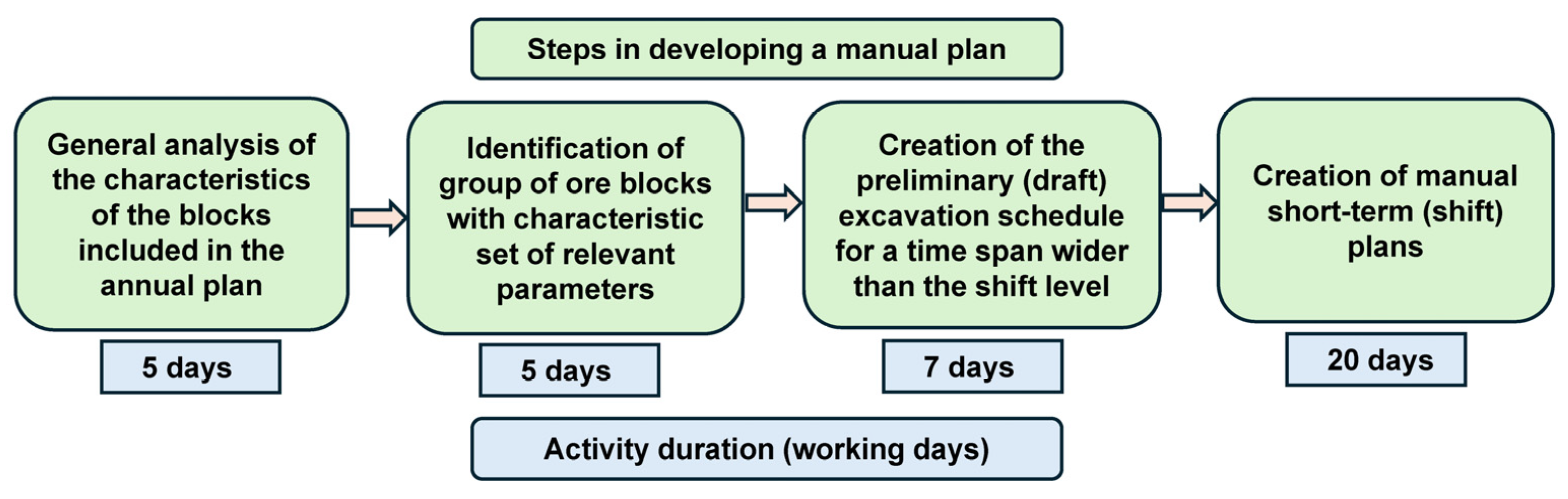
The manual plan development is essentially a heuristic process, largely based on the engineering experience currently applied in practice at the case study location. This manual shift planning procedure can be roughly divided into four steps (
Figure 5).
To develop a short-term, shift-level plan in this manner, the planning engineer must obtain a thorough understanding of the specific characteristics of each deposit section scheduled for mining within the annual production plan. This entails knowledge not only of the average qualitative parameters (in this case, Fe grade and SiO2 content) for the targeted zones but also the identification of discrete units—such as individual clusters of ore blocks—with distinct geological attributes that could potentially impact the model’s performance. This activity is highly dependent on the complexity of the deposit and the engineer’s experience; in the presented case study, this process required a duration of five working days.
Beyond qualitative parameters, a detailed analysis of the ore block structure is required, specifically identifying the spatial distribution of block clusters whose unique properties may significantly influence shift-level constraints (e.g., clusters with exceptionally high or low grades). This familiarization with relevant geological properties depends on both the deposit’s complexity and the engineer’s expertise, requiring an additional five working days in the context of this example.
Following the analysis of the qualitative and structural characteristics of specific block clusters, a preliminary mining schedule is developed for a time horizon broader than the shift level. For instance, this may involve a plan where high-grade block segments are scheduled for mining alongside two segments with less favorable attributes over a three-month period. By aggregating various blocks across broader timeframes (months), a draft annual production plan is established. These schedules are verified and iteratively refined until they meet general quality requirements. The development of these plans is contingent upon the deposit’s complexity and the engineer’s expertise, requiring a duration of seven working days in this case study.
Through the further discretization of the existing draft plans, daily schedules are generated, which in turn form the basis for shift-level planning. Maintaining the target blend while manually tracking the depletion of individual blocks across 1000 shifts requires significant operational effort; it is estimated that an engineer spends approximately 7 min per shift on manual data entry and recalculation. This results in a cumulative labor requirement of 20 working days for a single annual scenario. Such high labor intensity frequently compels planners to adopt simplified, static schedules that lack the precision necessary for effective, complex grade control.
Consequently, in the analyzed example, 154 shifts out of 1000 deviated from the target grade requirements, representing a non-compliance rate of 15.4%.
It is important to note that this estimated workload represents a best-case scenario, predicated on the assumption of static operational conditions—specifically, that there are no unexpected fluctuations in ore grades within the deposits or disruptions in work organization. In a realistic mining environment, any significant deviation in geological characteristics or operational constraints would necessitate a complete re-evaluation of the planning parameters and manual recalculation of the schedule. Consequently, the actual time required would likely exceed this estimate significantly, further highlighting the inefficiency of the manual approach compared to the dynamic adaptability of the genetic algorithm.
The manual approach is not a transparent or reproducible optimization solution; it essentially depends on the experience of a specific planner.
The production schedule generated by the genetic algorithm (GA) provides a shift-by-shift allocation for the same 1000-shift planning horizon and a target capacity of 2000 t/shift, adhering to the operational constraint of two to four simultaneously active mining locations. A new deposit is introduced by the algorithm only when an existing one is depleted and the required ore quality can no longer be maintained with the remaining active sources. In the optimized plan, the target shift capacity is consistently met across all shifts, while the number of active open pits varied dynamically. The GA generated a plan that utilizes only two active pits (Pit_2 and Pit_3) during the first 28 shifts. Subsequently, a third active location (Pit_7) is introduced. In the 73rd shift, Pit_8 is added to the active set and remains mined until its depletion in shift 494. Since stable quality can be ensured with the current configuration, the algorithm continues mining across the three remaining active pits until shift 624, when Pit_4 is introduced. From that point until the end of the production year, mining operations are carried out simultaneously across these four active locations. The GA-based operational plan for the 1000-shift period managed to strictly follow the requirements of the long-term strategy.
The distribution of the total 2,000,000 t production capacity among the five utilized open pits is as follows:
Pit_2 ≈ 32.94%;
Pit_3 ≈ 22.47%;
Pit_4 ≈ 8.17%;
Pit_7 ≈ 26.48%;
Pit_8 ≈ 9.94%.
The results indicate that the genetic algorithm successfully maintains the iron and silica content within the required limits for the vast majority of shifts, minimizing the need for subsequent homogenization.
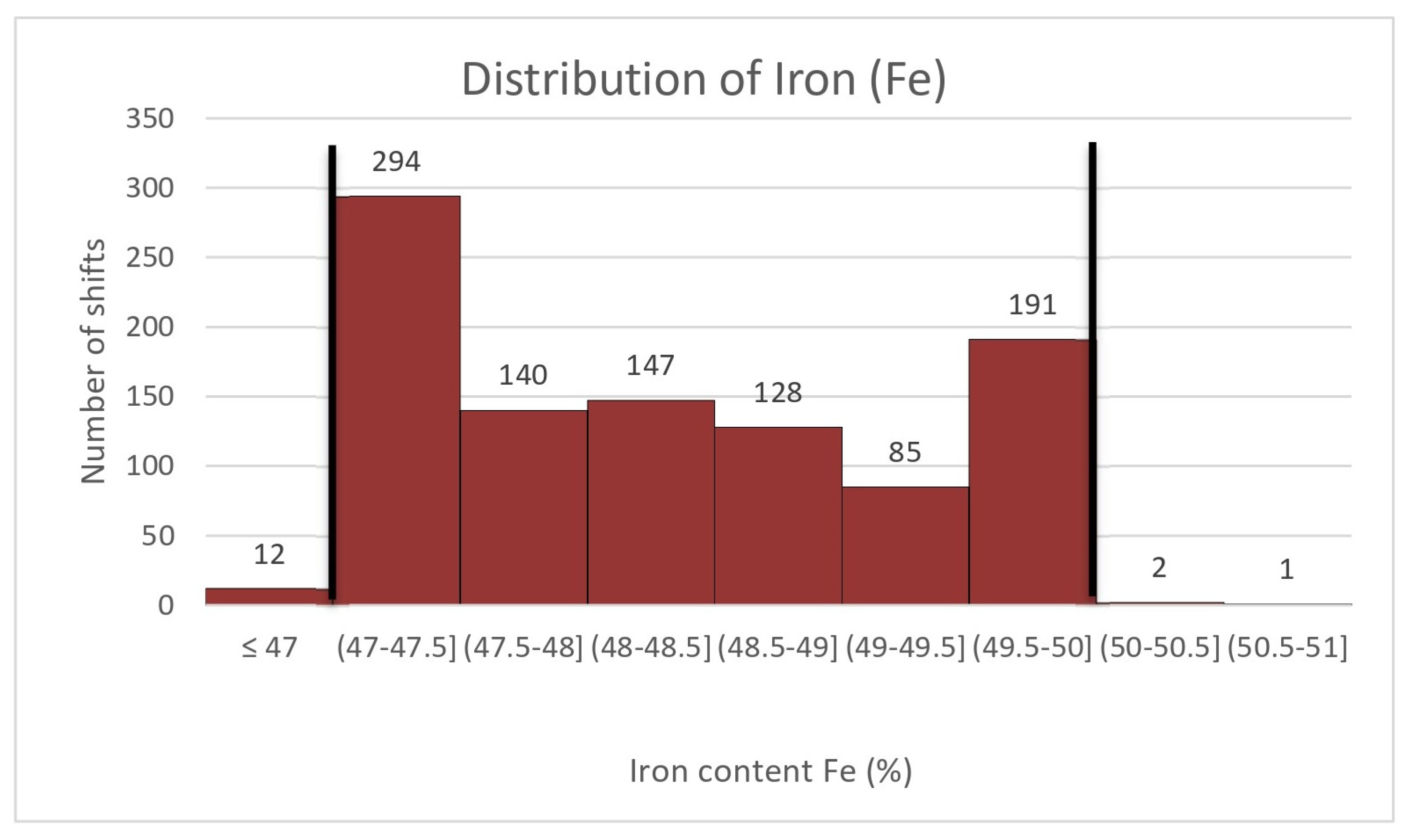
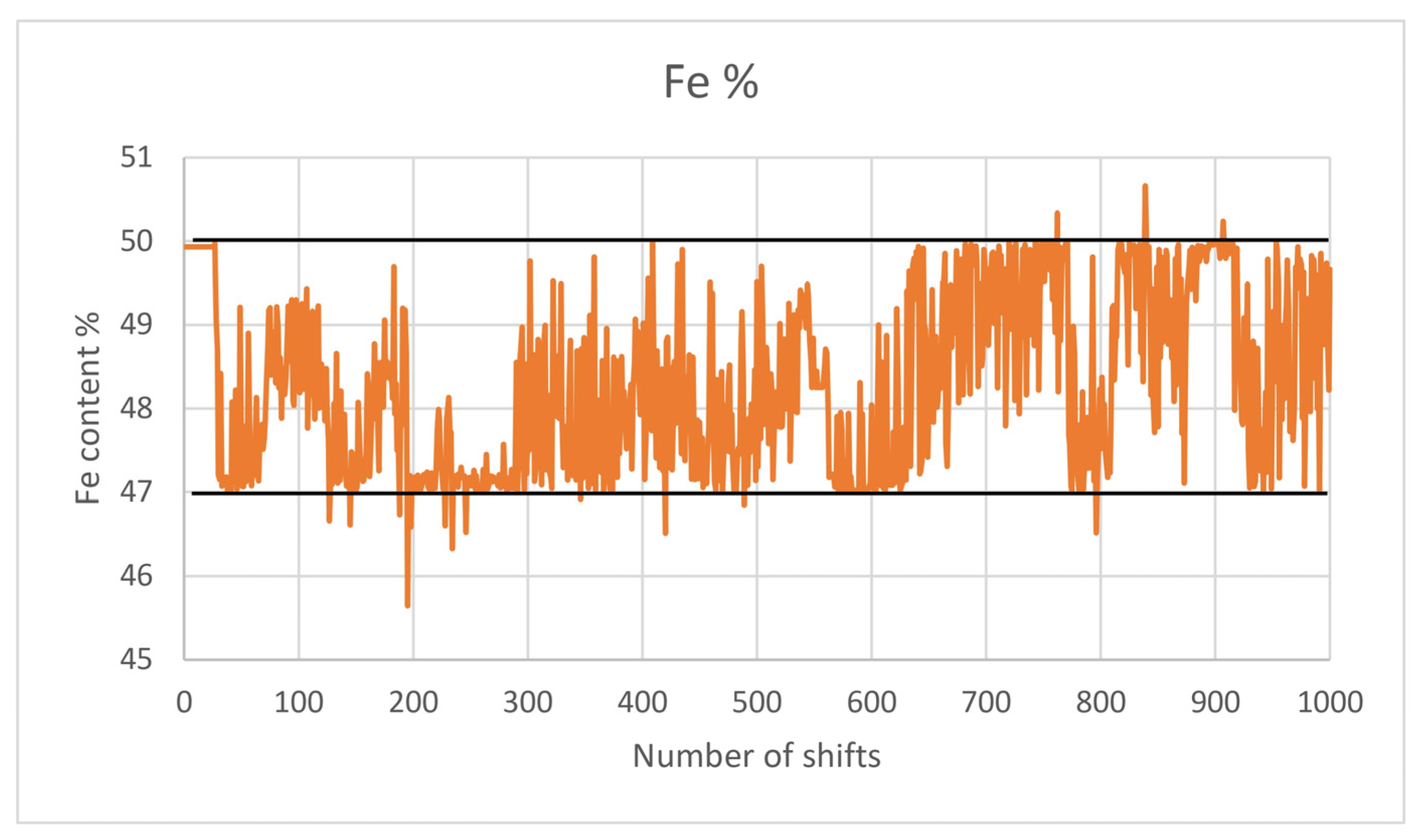
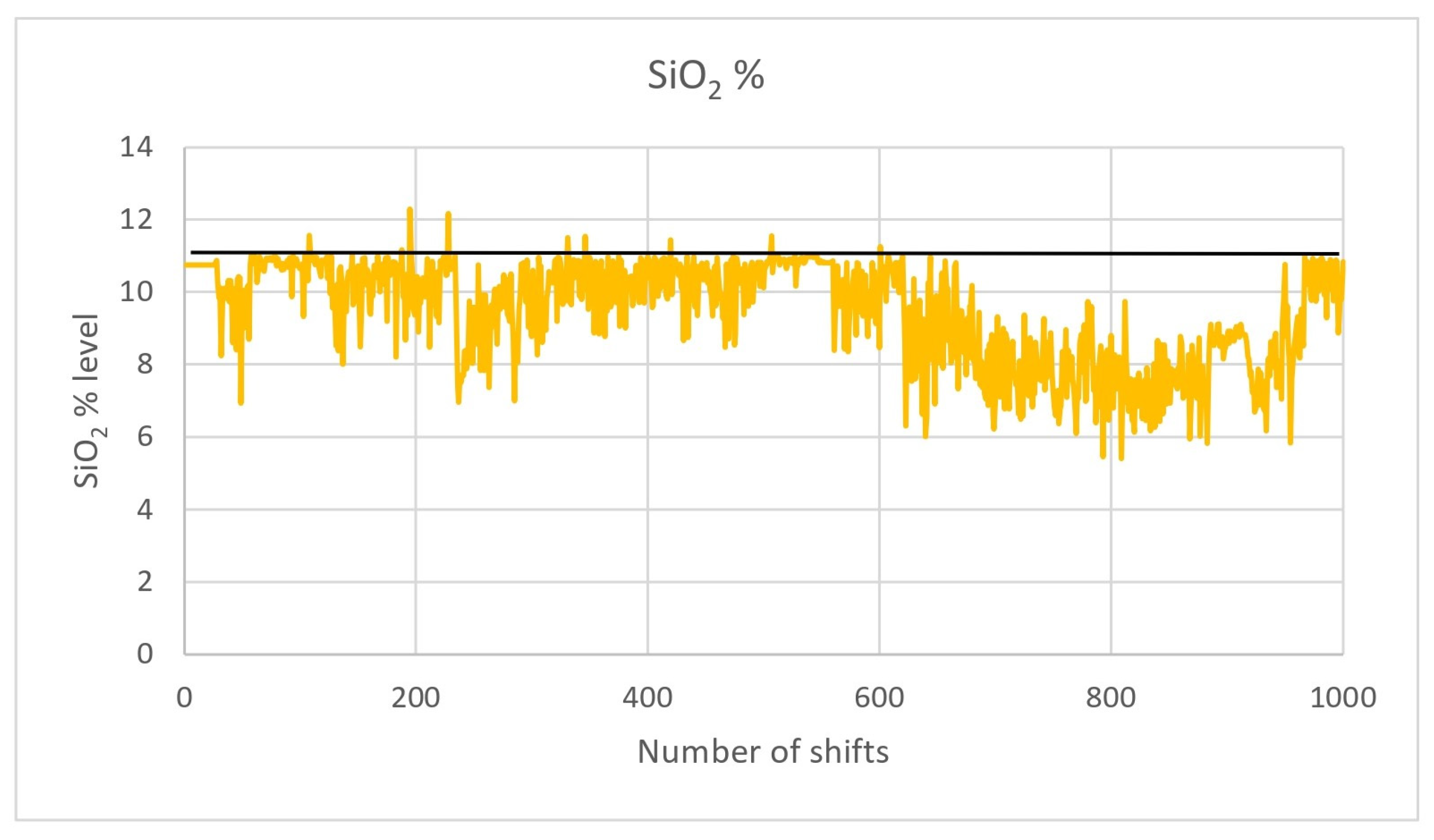
Figure 6 and
Figure 7 illustrate the distribution of iron (Fe) content across 1000 simulated shifts.
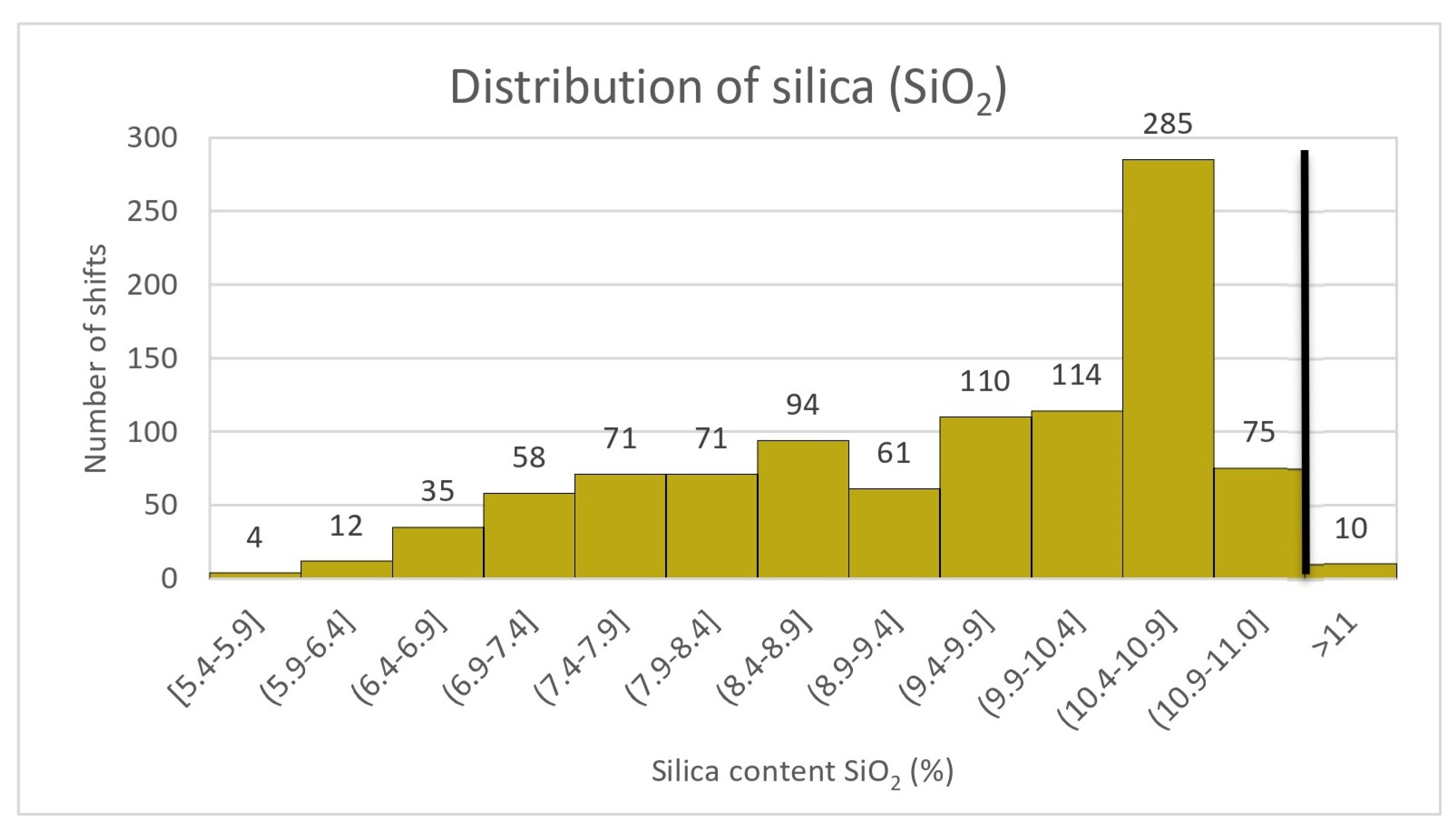
Figure 8 and
Figure 9 illustrate the frequency distribution of silica (SiO
2) content across 1000 simulated shifts.
A detailed analysis of the distribution reveals that a total of 19 out of 1000 shifts deviated from the required quality parameters. Although individual deviations were recorded for iron content (15 shifts) and silica content (10 shifts), the overlap in certain instances indicates a simultaneous violation of both criteria, resulting in a consolidated total of 19 non-compliant shifts.
Table 5 present the distribution and reserve utilization of each individual pit within the GA plan.
5. Discussion
The schedule generated by the genetic algorithm represents a significant advancement over manual planning. In the GA-based model, the target capacity is precisely met for every shift, the constraint of two to four active mining locations is consistently satisfied, tonnages are quantized to logistical truck units, and the distribution across pits is optimized according to the defined objective function.
In the observed case, a clear distinction can be made between the two approaches:
The manual plan: This is based on the planner’s experience. The manual plan provides a feasible baseline, but more than 15% of the total shifts would deviate from the target grade requirements. The manual planning process is highly time-consuming. Any operational change requires a complete recalculation, which significantly increases the overall workload, requires greater time resources and potentially jeopardizes the making of timely decisions.
The genetic algorithm plan: This model further enhances the allocation strategy. Capacity and operational constraints (two to four active pits) are strictly observed in every shift. Most importantly, quality violations are minimized to an exceptionally low rate of 1.9%.
The operational shift plans are executed within the constraints of a predefined long-term strategic plan. Although the annual plan maintains compliance with target Fe and SiO2 grades, achieving the same level of stability at a discrete shift-based level is subject to geological and spatial feasibility. In certain operational windows, satisfying all constraints simultaneously is functionally impossible.
In the analyzed scenario, the 1.9% non-compliance rate (19 shifts) stems from the mandatory excavation of low-grade blocks whose spatial location dictated their removal during specific periods to maintain the mining sequence. The primary objective of the proposed GA model is to minimize these occurrences. However, as is characteristic of metaheuristic approaches, the algorithm identifies high-quality sub-optimal solutions rather than guaranteed global optima.
Based on the experimental results, it can be concluded that the genetic algorithm provides a more adequate approach to operational mine planning under the considered conditions. Given the same set of pits, identical capacities, and the same operational constraints (2000 t/shift, truck-load discretization, and minimum face tonnage), the GA model ensures significantly higher stability in ore quality and a more robust long-term extraction strategy.
Table 6 shows the comparison between the manual and GA-generated plan.
The research value of this model lies in its ability to function as a feasibility validation tool for long-term plans at the level of individual shifts. The analysis of the 1.9% deviation rate (19 out of 1000 shifts) provides critical insight into the inherent limitations of the deposit; these failures are the result of localized geological “infeasibility,” where the ore available in active blocks mathematically precluded achieving the target quality. The fact that the model achieved a significantly better result than the manual plan, which exhibited 15.4% non-compliant shifts, confirms that the GA-based metaheuristic approach is superior in solving complex constraint spaces that an engineer cannot process in real time.
To verify the robustness and generalization potential of the proposed stochastic GA model under different operational settings, an additional scenario-based sensitivity test by changing the production capacity scale was conducted while keeping the same geological (block) model and the same grade constraints. The planning horizon was fixed at 1000 shifts, and two capacity levels were evaluated: 3000 t/shift (base scenario) and 2500 t/shift (reduced-capacity scenario).
In the base 3000 t/shift scenario, the results were
In the reduced-capacity 2500 t/shift scenario, the results were
Overall, these scenario runs demonstrate that the same chromosome encoding and constraint-handling mechanism remains effective under capacity scaling, supporting the model’s applicability across different production regimes without altering the optimization core.
While the proposed model was specifically developed to address the operational challenges of the described case study, its architecture is designed with the premise of universal application across diverse geological environments. From a conceptual standpoint, the algorithm is mineralization-agnostic; it interacts with standard block-model parameters—such as grade, bulk density, and deleterious components (e.g., SiO2)—without being restricted to a specific commodity type like iron, copper, or gold. However, it must be acknowledged that in deposits characterized by extreme geological complexity or highly unfavorable qualitative variability, formulating an operational plan that satisfies all constraints for every individual shift may be physically unattainable. Furthermore, as the model utilizes a metaheuristic approach, it generates solutions that are characteristically sub-optimal rather than mathematically absolute. Consequently, while the model remains a robust decision-support tool, its performance and the resulting convergence stability are inherently linked to the spatial and qualitative complexity of the deposit being analyzed.
The developed model, while effective for shift-by-shift quality management, has several limitations that provide opportunities for future research:
Equipment Reliability: The current model assumes 100% availability of the shovel-truck fleet. It does not account for stochastic equipment failures or Mean Time Between Failures (MTBF), which can disrupt the execution of the 1000-shift plan in a real-world environment.
Haulage Economics: The fitness function focuses primarily on production capacity and grade stability for Fe and SiO2. However, it does not currently calculate or optimize for variable haulage distances or fuel consumption as the pits deepen over time.
Geological Sensitivity: The optimization is highly dependent on the accuracy of the initial geological block model.
To address these limitations, the following targeted improvements are proposed:
Multi-objective Optimization: Future versions of the model should expand the fitness function into a multi-objective optimization task. This would allow for the simultaneous minimization of quality deviations and the minimization of operational costs related to transport distances.
Integration of MTBF: Incorporating equipment reliability data into the scheduling process would enable the model to generate more robust plans that account for potential maintenance-related disruptions.
Dynamic Constraint Adaptation: A feature could be implemented that allows the model to dynamically adjust the number of active mining locations or shift capacities based on real-time market demands or fleet changes.
6. Conclusions
The developed model represents a functional and consistent framework for the optimization of mining operations and ore quality management under real-world technical, logistical, and geological constraints. By integrating a genetic algorithm with 50-tonne truckload discretization, the model simultaneously manages the number of active locations, grade stability, and resource utilization efficiency.
The core combination of this research is the realization of two primary objectives:
The creation of a detailed operational plan that validates the feasibility of the existing long-term strategic plan, ensuring that theoretical goals are attainable within shift-per-shift operational limits.
The significant reduction or complete elimination of the need for homogenization stockpiles by optimizing the blend directly during the excavation, which reduces re-handling costs and simplifies the technological process.
The constraint limiting operations to a maximum of four active pits per shift, coupled with the dynamic inclusion of new active locations as existing ones are depleted, directly reflects field-side operational logic. This approach ensures that all open pits are gradually engaged over a large number of shifts without inducing abrupt fluctuations in ore quality.
The model favors a plan that achieves a stable blend within a narrow quality range, effectively utilizes available capacity, and distributes mining requirements evenly across open pits, aligning with the demands of long-term strategic planning.
Furthermore, it is essential to emphasize that the algorithm’s structure is inherently flexible, allowing for the inclusion of additional local or instantaneous constraints as required. For instance, the model can adapt to the temporary inability to excavate certain blocks due to technological obstacles or organizational factors. This adaptability provides the model with significant universality and the capacity to define robust operational plans for a wide range of production scenarios
The implementation within an Excel/VBA environment—featuring automated shift-by-shift scheduling, remaining tonnage tracking, and RunLog optimization monitoring—renders the model transparent, verifiable, and easily deployable in engineering practice without the need for specialized, high-cost software. This provides mining engineers with a decision-support tool to assess the consequences of their choices on total production, grade stability, and reserve depletion over time.
The primary value of this developed approach lies in its ability to bridge two levels of the planning process that are often treated in isolation. Rather than managing quality solely through annual averages, the model defines the specifics of every shift and determines how combinations of active locations impact Fe and SiO2 levels while adhering to real-world operational rules. The results demonstrate that the proposed model is a practically applicable procedure ready for direct implementation in a real-world environment with minimal adjustments.
Furthermore, in addition to better results (less shift deviation), the practical significance of the developed GA model is reflected in its ability to drastically reduce engineering efforts. While a manual approach to shift-by-shift planning for 1000 shifts would require over 20 working days of calculation and database tracking, the proposed model automates these processes within minutes, ensuring the precise execution of the long-term mining strategy. The contribution of this work is also reflected in the development of a transparent and easily applicable environment within Excel/VBA, which enables on-site engineers to optimize grade control without the need for expensive specialized software.
While the genetic algorithm demonstrated significant improvements over the manual operational baseline, future research should explore the comparative efficiency of other optimization techniques. Specifically, benchmarking the current model against standard Linear Programming (LP) solvers or other metaheuristics, such as Simulated Annealing (SA) and Particle Swarm Optimization (PSO), would provide deeper insights into the algorithm’s performance.
As mentioned, despite its operational advantages, the proposed model has certain limitations that should be acknowledged. First, the reliability of the GA-generated plan is heavily dependent on the accuracy of the underlying geological block models; any significant discrepancy between estimated and actual grades can lead to operational non-compliance. Second, the current version of the model assumes constant equipment availability and does not account for stochastic events such as mechanical failures or unplanned maintenance, which could temporarily reduce shift capacity. Furthermore, the model focuses primarily on quality blending and mass balance, without explicitly incorporating dynamic changes in transportation distances or hauling costs as the mining front progresses. Future iterations of the model should aim to integrate these logistical variables to provide an even more comprehensive decision-support tool.
The model can also be expanded to optimize economic criteria, account for equipment downtime, and adapt to market fluctuations alongside quality control and operational constraints.
Also, the functionality of the developed model (rapid optimization according to specified criteria) can, in certain cases, enable the introduction of more rigorous requirements regarding grade (primarily in the cut-off domain), thereby leading to an increase in total reserves.