Article

Assessment of Functional Movement Competency in National-Level Foot Orienteers

by
Piotr Cych
1,
Weronika Machowska-Krupa
1,
Aneta Demidas
1,
Héctor Esteve-Ibáñez
2,
Eraci Drehmer-Rieger
2 and
Pablo Vidal-González
2,*
1
Faculty of Physical Education and Sport, Wroclaw University of Health and Sport Sciences, al. I. J. Paderewskiego 35, 51-612 Wroclaw, Poland
2
Faculty of Physical Education and Sport Sciences, Catholic University of Valencia “San Vicente Mártir”, C. Ramiro de Maeztu, 19, 46900 Torrent, Spain
*
Author to whom correspondence should be addressed.
Appl. Sci. 2026, 16(6), 2639; https://doi.org/10.3390/app16062639
Submission received: 22 January 2026 / Revised: 4 March 2026 / Accepted: 7 March 2026 / Published: 10 March 2026
(This article belongs to the Special Issue Biomechanics and Human Movement Analysis in Sport)

Abstract

Foot orienteering is an endurance sport that requires high musculoskeletal efficiency to maintain performance while running across varied and uneven terrain. This study aimed to assess functional movement competency in national-level foot orienteers (FO) using the Functional Movement Screen™ (FMS™). Fifty-one athletes (21 females and 30 males) from Spain, Italy, and Poland were evaluated to analyze fundamental movement patterns. Participants were grouped according to sex, age category (junior vs. senior), and body mass index (BMI). The median FMS™ score for the entire cohort was 17.0, with no significant differences observed between males and females, juniors and seniors, or BMI categories. Junior female athletes achieved significantly higher scores than junior males in the Hurdle Step test (r = 0.37, p = 0.048), and a positive correlation was identified between age and Hurdle Step performance (r = 0.319, p = 0.02), indicating lower scores in younger athletes. Athletes with lower BMI demonstrated superior performance in the Shoulder Mobility test (r = 0.38, p = 0.01), supported by a moderate negative correlation between BMI and shoulder mobility (r = −0.37, p = 0.01). Across all subgroups, the lowest scores were recorded in the Deep Squat test. These findings suggest that age, sex, and BMI may influence specific components of functional movement competency in FO and should be considered when designing training and injury-prevention programs. Further research involving national teams from additional countries is recommended to confirm and extend these results.

1. Introduction

Foot orienteering is an endurance sport where the final performance depends on several factors, including the efficiency of the musculoskeletal system [1,2,3]. Efficient musculoskeletal function is crucial for smooth and safe movement across varied terrain, which can place substantial demands on muscles, ligaments, tendons, joints, and bones. Competitors run both on flat asphalt roads and across areas with rocks, stones, fallen trees, cut branches, waterlogged swamps, and tall berry bushes and ferns. The high variability of the surface and the often extreme loads imposed on all elements of the musculoskeletal system require a very efficient and flexible system [2,3]. Hence, it seems important to maintain their high flexibility while strengthening individual elements of this apparatus (e.g., muscles). In foot orienteering, not only the lower limbs but also other body parts such as the arms, trunk, and back play a critical role, more so than in traditional running. This is due to the biomechanics of running, which differ from those used on a treadmill. During orienteering, the knee and thigh are elevated to overcome the resistance posed by vegetation, which makes maintaining a low foot position above the ground difficult or impossible. Moreover, there is greater knee extension at foot strike, smaller peak hip flexion and dorsiflexion during stance, and increased ranges of vertical pelvis motion compared with those observed on the road [3,4]. Moreover, the biomechanics of running also change when the athlete reads the map [5] and does some uphill and downhill running [6]. During steep ascents, the back muscles—and occasionally the arm muscles—are heavily recruited to support movement, highlighting the significant musculoskeletal demands imposed by challenging terrain, such as pulling on branches or grasping rocks. In turn, on steep descents, some muscles (e.g., the quadriceps femoris) must perform eccentric work, which is observed to a much lesser extent in athletic runs [3,6]. A good dynamic balance of the body is also very important during the race [7]. An effective musculoskeletal system can prevent foot orienteers (FO) from common injuries in this sport [8]. Therefore, monitoring its efficiency (e.g., by using the FMSTM test) is highly recommended [9].
The FMS™ is a screening tool designed to assess movement competency [10]. Functional movement competency refers to an individual’s ability to perform basic, fundamental movement patterns (squatting, lunging, pushing, pulling) with proper form, balance, and stability, without pain. Commonly assessed using the FMS™, this competency helps identify physical limitations, neuromuscular imbalances, and potential injury risks [10]. It is important to understand that the FMS™ is a screening tool, not a diagnostic one. It does not aim to pinpoint a specific injury. Instead, it assesses and ranks the quality of movement to establish a clear baseline of an individual’s movement competency, which is how Functional Movement Competency is applied in this paper.
The FMS™ evaluates individuals’ movement patterns through seven functional tasks that require balance, mobility, and stability. Bennett et al. [11] used the FMSTM to determine “Movement Quality”. In turn, Pfeifer [12] used the term functional motor competency. Fitton Davies et al. [13], in their work, differentiated between the concepts of functional movement skills and the Functional Movement Screen, referred to as FMS™. These authors were the first to explore the relationship between the FMSTM test scores and youth flexibility and fitness test outcomes. Their systematic review indicates that children and adolescents with high FMS™ scores generally exhibit superior performance in agility, running speed, muscular strength, and cardiovascular endurance. This supports using the FMSTM test results to diagnose athletes in endurance sports, in which running speed significantly affects performance (also in foot orienteering). Based on the sources cited above, it can be concluded that the current most common use of the FMSTM test, which is the diagnosis of the probability of injury, should not obscure other possible uses of the results obtained in the FMSTM test. Three studies investigated normative values of FMSTM scores for runners [9,14,15]. Adamczyk et al. [15] concluded that the FMSTM can serve as an effective screening tool in sports (p. 563). Loudon et al. [9] stated that the FMSTM is a reliable baseline functional screen for long-distance runners and can be used by strength and conditioning professionals. Agresta et al. [14] expressed a similar view and established normative values for runners based on individual test results, offering separate standards by sex (female/male), experience level (novice/advanced), and history of injury. In this work, Cook’s principle “first move well, then often” was adopted as a paradigm [16]. This principle applies well to foot orienteering, in which locomotor movements are repeated cyclically and, depending on the distance, the runner performs from several to several thousand repeated cycles (steps). However, unlike athletic events held on a track or on the streets, orienteering typically takes place in a forest, where no one can see the athlete to analyze their movement patterns. This way of moving over terrain is often imperfect and can both limit the performance of highly capable athletes and increase the risk of injury after prolonged use. All of this could be predicted and prevented by directly or indirectly monitoring the movement patterns used by each athlete individually. Therefore, the FMS™ test could be used as an indirect way to assess movement competence. It could be possible to identify the strong and weak links (muscles, ligaments, fascia, tendons, etc.) in the biomechanical chain involved in the individual’s movement during foot orienteering. The movements in these tests involve many joints at the same time, similar to foot orienteering, where not only the lower limbs work but also the torso and arms. In foot orienteering, there were some attempts to control balance and coordination [7,17,18], and authors of these studies found balance important for FO, but no study has analyzed the FMS™ test scores. Only Leandersson et al. [19] used the modified version of 9TSB for predicting injuries among Swedish junior orienteers. The authors did not find any studies that would indicate the possibility of using the FMSTM test results for diagnosing functional movement competency in foot orienteering. However, the authors propose that the test scores may be used for this type of diagnosis, particularly in international-level athletes, who often develop compensatory mechanisms over years of training that are frequently not apparent at first glance. In this way, the authors would like to fill the existing gap in the literature and, at the same time, based on the obtained results, indicate practical implications for coaching practice in foot orienteering. The lack of FMS™ data is significant in orienteering training practice, as there are no reference values for elite athletes, who are primarily the focus of national team coaches. Furthermore, it seems desirable to create a profile of movement limitations specific to this sport, based on FMS™, relevant for training and injury prevention. This profile will likely reflect the nature of training in this sport and the accompanying threats to the flexibility and functionality of the musculoskeletal system. The authors were also interested in whether FMS™ scores—both the total score and the scores of individual tests—differ significantly between females and males, and whether participants’ age and BMI are associated with FMS™ performance. Observations from other sports suggest certain differences and trends related to age, sex, and BMI [20,21,22].
The primary aim of this study was to evaluate functional movement competency in a cohort of national-level FO using the FMS™. Specifically, we aimed to determine the central tendency of FMS™ scores and to examine whether performance differed according to sex, age category (junior vs. senior), and body mass index (BMI). To get the answers to these questions, the following hypotheses based on the observations and assumptions were stated:
-
The cumulative score of the FMSTM test of FO is similar to that of track and field long-distance runners.
-
There is a relationship between the age of the participants and the FMSTM test results. The older (more experienced) the athletes, the better their test scores.
-
There are differences between females and males in FMSTM test scores. Females perform better than males.
-
There is a correlation between BMI and FMSTM test results. The lower the BMI, the better the test score.
The research results were compared to standards for long-distance runners.

2. Materials and Methods

2.1. Participants

Participants were included if they were members of the national senior or junior foot orienteering teams of Spain, Italy, or Poland. The study was conducted during orienteering competitions in 2023: Spanish athletes were tested before the “35 Trofeo Internacional Murcia Costa Cálida” (24 February, Cehegín, Spain) and Italian and Polish athletes before the “Velikonoce ve skalách/Prague Easter 2023” (8 April, Kozly, Czechia). The participants were tested under nearly identical conditions in both Spain and the Czech Republic. The study was preceded by a rest day, during which the athletes performed only a morning warm-up. No participants reported experiencing pain or injury. The two tests were conducted at a consistent time of day, in the afternoon. The athletes were not experiencing pre-race stress, as these were not championship or qualifying events but rather regular competitions used as part of their spring training preparation. The study complied with the Declaration of Helsinki and was approved by the Senate Committee on Ethics of Scientific Research. All participants provided informed consent, and the study was approved by the national orienteering federations of Spain, Italy, and Poland.
Fifty-one athletes (21 females, 30 males) participated from the following countries: Spain (9 females, 12 males), Italy (6 females, 10 males), and Poland (6 females, 8 males). Demographic and anthropometric data are presented in Table 1. Participants were divided into subgroups by sex, age, and BMI (each into two categories: female/male, junior/senior, and lower/higher BMI). According to the International Orienteering Federation (IOF) classification, participants were categorized as juniors (≤20 years) or seniors (≥21 years). The junior and senior groups had similar sex proportions (59% males, 41% females). Participants’ ages ranged from 17 to 39 years. The division into two subgroups (lower and higher BMI) was based on the median value. Due to the odd number of participants, one subgroup comprised 26 individuals (higher BMI), whereas the other comprised 25 individuals (lower BMI).

2.2. Methods

The FMSTM tool was used in the study. The FMS™ is a screening tool used to analyze fundamental movement patterns [16,23]. It consists of seven basic movements that require balance, mobility, and stability: the Deep Squat Test, the Hurdle Step Test, the In-line Lunge Test, the Shoulder Mobility Test, the Active Straight Leg Raise Test, the Trunk Stability Push-up Test, and the Rotatory Stability Test [16]. The assessment was conducted following the order described by the method’s authors, with each movement scored according to their criteria. Standard FMS™ kit (Functional Movement Systems, Chatham, VA, USA) was used, demonstration trials were provided, and verbal instructions were standardized according to FMS™ guidelines. Each activity could be attempted up to three times and was graded from 0 to 3: a score of 0 indicated pain during execution; 1 indicated inability to perform the movement; 2 indicated performance with compensation; and 3 indicated full, uncompensated performance. For bilateral tests, the lower of the two limb scores was used. Scores for each of the 7 movements were summed to obtain the composite score, with a maximum possible score of 21 [16], reflecting better functional movement. Each exercise was assessed independently by three trained judges (researchers); when scores differed, the lowest of the three was recorded according to the FMSTM instruction [16]. An inter-rater reliability measure, Fleiss’ kappa [24], was used to assess agreement among more than two judges for categorical (nominal) data. Interrater agreement among the three independent raters was κ = 0.904, SE = 0.039, 95% CI [0.828, 0.980], Z = 23.366, p < 0.001. According to the benchmarks proposed by Landis and Koch [25], this value indicates almost perfect agreement beyond chance. Moreover, Cohen’s kappa for judges 1 and 2 was κ = 0.939; for judges 1 and 3, κ = 0.907; and for judges 2 and 3, κ = 0.866.
The Tanita MC 780MA segmental multifrequency body composition analyzer (Tanita Corporation, Tokyo, Japan) was used to measure body weight, and height was measured using a SECA 220 stadiometer (SECA GmbH & Co. KG, Hamburg, Germany) with 0.1 cm precision, after aligning the Frankfort plane. The reliability of this device is considered excellent, with intraclass correlation coefficients (ICCs) exceeding 0.90 for both within-day and between-day measurements. Its validity is supported by strong correlations with dual-energy X-ray absorptiometry (DXA) outcomes, particularly for the assessment of fat mass percentage (FM%) and fat-free mass (FFM) in healthy adults [26].

2.3. Statistical Analysis

The level of significance was set a priori at p = 0.05. Statistical analysis was performed using Statistica 13.3 (TIBCO Software Inc., Palo Alto, CA, USA) (www.statsoft.pl, accessed on 22 January 2026).
Due to the non-normally distributed data of composite scores, as assessed by the Shapiro–Wilk test (p < 0.05), non-parametric statistics were used. To verify the correlation between the FMS™ test scores and age, the Spearman rank correlation coefficient was used. The Mann–Whitney U test was applied to detect differences in the FMS™ test scores between different subgroups of foot orienteers (males vs. females and seniors vs. juniors, subjects with lower BMI vs. subjects with higher BMI). For the Mann–Whitney U test, the presented results include statistical significance, continuity-corrected Z-value (Yates correction), and effect size. Effect size analysis using the r value was applied to strengthen the Mann–Whitney U test results (r = ׀Z׀/√N), where ׀Z׀ is the absolute value of the standardized statistic test, and N is the number of participants.

3. Results

3.1. Statistics for the Entire Group of Participants

The median score for the entire group was nearly identical to the mean, at 17 points [IQR = 2.0], with the most frequent score being 18 points. Two participants (out of 51) scored below 14 points, and two scored exactly 14 points. No participant achieved the maximum score of 21 points, although two participants obtained 20 points.
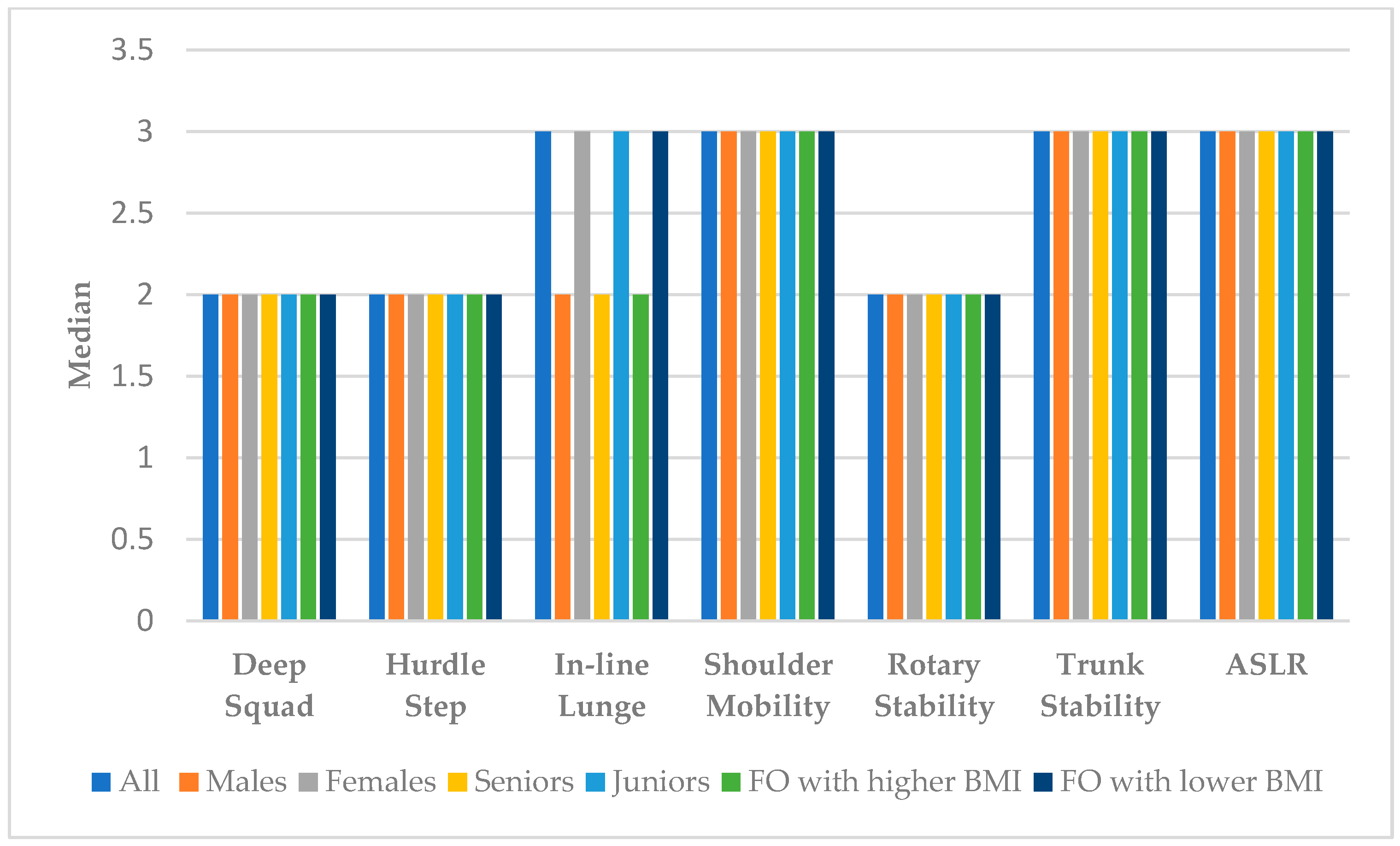
The FO scored highest in the Active Straight Leg Raise Test and the Shoulder Mobility Test and lowest in the Deep Squat Test (Figure 1 and Table 2).

3.2. Males Versus Females

Females and males scored similarly, with a median of 17 points and mean values of 17.3 ± 1.8 and 16.8 ± 1.7 points, respectively. A greater spread of results was observed among females [IQR = 3.0] than males [IQR = 2.25]. When sex was used as the grouping variable, no significant differences were observed in the total FMS™ score (Z = −0.362, p = 0.72). Females scored highest in the Active Straight Leg Raise Test and lowest in the Deep Squat Test. Males scored highest in the Shoulder Mobility Test and lowest in the Deep Squat Test, similar to females (Table 2). A statistically significant difference was observed between females and males in the junior group on the Hurdle Step Test (Z = −1.979, p = 0.048; medium effect size, r = 0.37), with junior females scoring higher than junior males.

3.3. Seniors Versus Juniors

Analysis by age indicated no significant difference in the total composite score between junior and senior participants (Z = 1.100, p = 0.271). Juniors and seniors scored similarly (median of 17 points) with mean values of 17.3 ± 1.1 points and 16.6 ± 1.1 points, respectively. A greater spread of results was observed among seniors, based on SD, although the IQR was identical [3.0] for both groups [3]. Both juniors and seniors scored highest in the Active Straight Leg Raise Test and the Shoulder Mobility Test and lowest in the Deep Squat Test (Table 2). A significant positive correlation was found between age and Hurdle Step Test performance (r = 0.319, p = 0.02), with juniors scoring lower than seniors.

3.4. Participants with a Lower BMI vs. Those with a Higher BMI

Using BMI as the criterion, participants did not differ in total FMS™ score (Z = 1.874, p = 0.06). However, when analyzing the individual fundamental movements included in the test, a statistically significant difference was observed in the Shoulder Mobility Test (Z = 2.746, p = 0.01 with medium effect size r = 0.38). The Spearman rank correlation between BMI and the Shoulder Mobility Test was also statistically significant (r = −0.37, p = 0.01). FO with a lower BMI received higher scores on this test, and it was characterized by a stronger relationship in the junior group (r = −0.38, p = 0.04) than in the entire group.

4. Discussion

The study aimed to test hypotheses regarding the relationship between FMSTM scores and certain variables characterizing the studied group of national foot orienteering athletes from Italy, Spain, and Poland. These variables included sex, age, and BMI. The following results were obtained:
-
The median score for females and males was 17 points [IQR = 2.0]. The mean value of the composite FMSTM test for the entire study group equals 17.0 ± 1.8 points.
-
No statistical difference for males and females was found.
-
The analysis of the FMSTM test scores according to the age criterion showed that the composite score did not differ between junior and senior FO.
-
Taking BMI as the criterion, the participants did not differ from each other in the composite FMS™ score.
-
Some deeper analyses showed that there were significant differences between subgroups of FO (males vs. females, juniors vs. seniors, participants with higher and lower BMI) for specific tests. Only the Hurdle Step Test and the Shoulder Mobility Test demonstrated correlations with age, sex, or BMI.
The average score in the FMSTM test for the entire study group was much higher than the average score obtained by treadmill runners tested by Agresta et al. [14] (17.0 points vs. 13.2 points respectively) and 1.6 points higher than the average value (15.4 ± 2.4 points) for the entire group of distance runners reported by Loudon et al. [9]. However, when comparing the scores of FO to those of sprinters (16.5 ± 1.4 points) [27], the scores are only slightly better. Kiesel et al. [28] reported slightly lower scores (16.6 ± 1.7) in their study on adult professional football players. The middle-distance runners tested by Adamczyk et al. [15] scored similarly (17.0 ± 1.5) for FO. Multiple factors may contribute to the high average FMS™ scores observed among FO. One likely explanation is that the study involved high-level athletes—members of national teams. The selected group included medalists from the World and European Junior Championships. The second reason may be the specificity of the sport, which requires athletes to have high overall fitness and mobility necessary to overcome various terrain obstacles [3]. The third reason may be the relatively large number of juniors (people up to and including 20 years of age) in the entire study group (57%). As observed by Loudon et al. [9], younger runners achieved significantly better results than older runners (p < 0.00). Another possible reason may be the influence of subjective judgment by the evaluators during individual tests. Moreover, these comparisons involve different populations and may reflect differences in training exposure, sample selection, and study context.
The Deep Squat Test yielded the lowest scores for FO. This may be attributed to the specific demands of the sport, including frequent uphill segments that place significant strain on the calf muscles [27,29]. Chronic use of the lower leg musculature in endurance training may lead to adaptive shortening, particularly when adequate stretching and recovery strategies are neglected. If muscles (primarily the gastrocnemius and soleus) are primarily engaged in shortened positions or are not stretched to their full length, adaptive shortening of the connective tissue structures (fascia) occurs, and the muscle’s resting length changes. The muscle adapts to the position in which it is most frequently held. Ankle sprains are also common in FO [30,31]. Recurrent injuries affecting the ankle joint are associated with lower scores in the Deep Squat Test [32]. Also, an insufficient number of exercises or improperly conducted stretching could be a reason for low flexibility of the muscles, tendons, and ligaments involved in the Deep Squat Test. In some cases, it can lead to inflammation of the Achilles tendon [30]. These explanations are more speculation than certainty, as neither the history of injuries nor the range of motion in the ankle joint was examined.
In our study, there were no significant differences between males and females in the total FMS™ score (Z = −0.362, p = 0.72). Females achieved 17.3 points vs. 16.8 points for males, with a slightly greater spread of results among males. In studies that examined sex differences, females consistently scored higher than males [9,12,19,33]. Notably, studies consistently reporting lower FMS™ composite scores for males than for females have included populations of runners (with or without navigation). Males who typically cover longer distances and accumulate higher training volumes [1,34] are more likely to perform repetitive, single-plane movements. Lower scores on the FMS™ may reflect the repetitive, single-plane movement training (i.e., straight-plane running) undertaken by most distance runners because the FMS™ tests more multi-planar functional movements [14]. In the junior group, a significant difference in Hurdle Step Test performance was observed between females and males. Junior females scored better than junior males. This difference in scores may be attributable to sex-related differences in pelvic anatomy, which are mechanically advantageous for females in this test. A significant difference was observed only in the junior subgroup, which was the larger of the two age categories; a similar pattern might emerge in seniors with a larger sample size.
The FMS™ scores of juniors and seniors who were members of their countries’ national teams were also compared. No significant difference was found for the total composite score; however, a significant difference was observed for the Hurdle Step test. Seniors scored significantly better than juniors. This difference may be attributable to the fact that the Hurdle Step test assesses neuromuscular coordination and proper energy transfer through the trunk from one body segment to another [23]. Such an exercise requires practice and a sense of one’s own body. Therefore, perhaps adult athletes, who generally have more experience, can perform this exercise better than younger ones.
No statistically significant correlation was observed between BMI and the FMS™ composite score, although other authors have reported such a relationship [35,36]. This may be because, in the group of competitive-level FO, BMI scores were generally similar and fell within a narrow range (20.71 ± 1.84). A significant correlation between BMI and the Shoulder Mobility Test was observed. Participants with lower BMI scored higher on this test compared to those with higher BMI. This difference may be attributed to the observation that, among male athletes, higher BMI often reflects greater muscularity, which can affect upper-body function [37]. In the lower-BMI group, 44% of the participants were female, compared to 38% in the higher-BMI group. Since women typically have less upper-body muscle mass, they are less likely to experience limited shoulder mobility, which may have influenced the results. BMI does not differentiate fat-free mass from fat mass, which further complicates the interpretation of these results.

5. Conclusions

The overall FMS™ score in FO was usually higher than that reported for distance runners. This may be due to many of the reasons outlined above. Without further research in this area, it is not possible to clearly identify the main causes of this finding, which is based on a single study of a small population. The highest results were obtained in the Active Straight Leg Raise and Shoulder Mobility tests, while the lowest scores were noted in the Deep Squat test, indicating the need for greater emphasis on lower limb mobility and strength. The observed differences in individual test scores between athletes of different sexes, ages, and BMI scores suggest that training programs and loads should be planned with greater individualization, as these factors may affect functional movement competency. Associations with injury outcomes require prospective studies and direct outcome measures. Further studies involving larger samples of international-level FO are recommended to confirm the present findings and establish reference FMS™ values for this population.

5.1. Practical Implications

The tests conducted among senior and junior national team FO from Spain, Italy, and Poland may serve as a starting point for further research on the structure of functional movement competency and its testing in FO. The results support continuous monitoring and provide coaches and athletes with feedback on strengths and weaknesses in functional movement. They also enable the timely implementation of corrective strategies to improve the flexibility and strength of specific muscle groups, tendons, and ligaments, potentially enhancing long-term performance. The low Deep Squat Test scores highlight the need for greater focus on lower limb mobility.

5.2. The Limitations

This study has several limitations. The sample size was limited to athletes from three European countries, which may restrict the generalizability of the findings to other national teams or competitive levels. The cross-sectional design does not allow for causal interpretation of relationships between FMS™ performance and training characteristics or injury history. Additionally, the FMS™ provides a general assessment of movement competency but does not capture sport-specific demands or asymmetries relevant to foot orienteering. Some other potential confounders were not controlled for, such as sex-related differences in body composition when using BMI, training background and load, prior injuries, event specialization (sprint/middle/long), and seasonal timing of testing. Subtest-level results should be interpreted with caution due to the small number of foot orienteers within the subgroups. Future research should include larger and more diverse samples, as well as longitudinal designs, to better understand the impact of functional movement competency on performance and injury risk in this sport.

Author Contributions

Conceptualization, W.M.-K. and P.C.; Data curation, P.C. and A.D.; Formal analysis, P.C. and W.M.-K.; Investigation, P.C., W.M.-K., A.D., H.E.-I., E.D.-R. and P.V.-G.; Methodology, P.C. and W.M.-K.; Supervision, P.V.-G.; Writing—original draft, P.C., W.M.-K., A.D., H.E.-I., E.D.-R. and P.V.-G.; Writing—review and editing, P.C., W.M.-K., A.D., H.E.-I., E.D.-R. and P.V.-G. All authors have read and agreed to the published version of the manuscript.

Funding

This research received no external funding.

Institutional Review Board Statement

The study was conducted in accordance with the Declaration of Helsinki and approved by the Senate Committee on Ethics of Scientific Research of the Wroclaw University of Health and Sport Sciences (study number 19/2021, 31 December 2021).

Informed Consent Statement

Informed consent was obtained from all subjects involved in the study.

Data Availability Statement

The raw data supporting the conclusions of this article will be made available by the authors on request.

Acknowledgments

The authors would like to thank all the FO and their coaches for participating in this study. The authors also wish to thank the Spanish, Italian, and Polish Orienteering Federations for granting permission to conduct this research and for facilitating contact with their coaches and athletes.

Conflicts of Interest

The authors declare no conflicts of interest.

Abbreviations

The following abbreviations are used in this manuscript:
BMIbody mass index
DXAdual-energy X-ray absorptiometry
FFMfat-free mass
FM%fat mass percentage
FMS™Functional Movement Screen™
FOfoot orienteers
ICCsintraclass correlation coefficients

References

  1. Batista, M.M.; Paludo, A.C.; Gula, J.N.; Pauli, P.H.; Tartaruga, M.P. Physiological and Cognitive Demands of Orienteering: A Systematic Review. Sport Sci. Health 2020, 16, 591–600. [Google Scholar] [CrossRef]
  2. Creagh, U.; Reilly, T. Physiological and Biomechanical Aspects of Orienteering. Sports Med. 1997, 24, 409–418. [Google Scholar] [CrossRef]
  3. Hébert-Losier, K.; Mourot, L.; Holmberg, H.-C. Elite and Amateur Orienteers’ Running Biomechanics on Three Surfaces at Three Speeds. Med. Sci. Sports Exerc. 2015, 47, 381–389. [Google Scholar] [CrossRef]
  4. Jensen, K.; Johansen, L.; Karkkainen, O.-P. Economy in Track Runners and Orienteers during Path and Terrain Running. J. Sports Sci. 1999, 17, 945–950. [Google Scholar] [CrossRef]
  5. Millet, G.Y.; Divert, C.; Banizette, M.; Morin, J.-B. Changes in Running Pattern Due to Fatigue and Cognitive Load in Orienteering. J. Sports Sci. 2010, 28, 153–160. [Google Scholar] [CrossRef]
  6. Larsson, P.; Burlin, L.; Jakobsson, E.; Henriksson-Larsen, K. Analysis of Performance in Orienteering with Treadmill Tests and Physiological Field Tests Using a Differential Global Positioning System. J. Sports Sci. 2002, 20, 529–535. [Google Scholar] [CrossRef]
  7. Cherepov, E.; Epishev, V.; Bykov, E.; Stoliarova, N.; Stovba, I. Assessment of the Stability of Body Functional Systems in Orienteers. J. Phys. Educ. Sport 2019, 19, 1686–1689. [Google Scholar] [CrossRef]
  8. Von Rosen, P.; Heijne, A.I.-L.M.; Frohm, A. Injuries and Associated Risk Factors Among Adolescent Elite Orienteerers: A 26-Week Prospective Registration Study. J. Athl. Train. 2016, 51, 321–328. [Google Scholar] [CrossRef] [PubMed]
  9. Loudon, J.K.; Parkerson-Mitchell, A.J.; Hildebrand, L.D.; Teague, C. Functional Movement Screen Scores in a Group of Running Athletes. J. Strength Cond. Res. 2014, 28, 909–913. [Google Scholar] [CrossRef] [PubMed]
  10. de Oliveira, R.R.; Chaves, S.F.; Lima, Y.L.; Bezerra, M.A.; Leão Almeida, G.P.; de Paula Lima, P.O. There Are No Biomechanical Differences between Runners Classified by the Functional Movement Screen. Int. J. Sports Phys. Ther. 2017, 12, 625–633. [Google Scholar]
  11. Bennett, H.; Fuller, J.; Milanese, S.; Jones, S.; Moore, E.; Chalmers, S. Relationship Between Movement Quality and Physical Performance in Elite Adolescent Australian Football Players. J. Strength Cond. Res. 2022, 36, 2824–2829. [Google Scholar] [CrossRef]
  12. Pfeifer, C.E. Functional Motor Competence, Health-Related Fitness, and Injury in Youth Sport. Doctoral Dissertation, University of South Carolina, Fullerton, CA, USA, 2017. [Google Scholar]
  13. Fitton Davies, K.; Sacko, R.S.; Lyons, M.A.; Duncan, M.J. Association between Functional Movement Screen Scores and Athletic Performance in Adolescents: A Systematic Review. Sports 2022, 10, 28. [Google Scholar] [CrossRef]
  14. Agresta, C.; Slobodinsky, M.; Tucker, C. Functional Movement ScreenTM—Normative Values in Healthy Distance Runners. Int. J. Sports Med. 2014, 35, 1203–1207. [Google Scholar] [CrossRef]
  15. Adamczyk, J.G.; Boguszewski, D.; Białoszewski, D. Functional Assessment of Male Track and Field Runners through Functional Movement Screen Test. Med. Sport 2015, 68, 563–575. [Google Scholar]
  16. Cook, G.; Burton, L.; Hoogenboom, B. Pre-Participation Screening: The Use of Fundamental Movements as an Assessment of Function—Part 1. N. Am. J. Sports Phys. Ther. NAJSPT 2006, 1, 62–72. Available online: https://pmc.ncbi.nlm.nih.gov/articles/PMC2953313/ (accessed on 6 March 2026).
  17. Machowska-Krupa, W.; Cych, P. Differences in Coordination Motor Abilities between Orienteers and Athletics Runners. Int. J. Environ. Res. Public Health 2023, 20, 2643. [Google Scholar] [CrossRef] [PubMed]
  18. ÖrsçeliK, A.; Apaydin, A.H.; Yildiz, Y. Can We Predict Success of Orienteering Athletes? Turk. Klin. J. Sports Sci. 2017, 9, 124–132. [Google Scholar] [CrossRef]
  19. Leandersson, J.; Heijne, A.; Flodström, F.; Frohm, A.; Von Rosen, P. Can Movement Tests Predict Injury in Elite Orienteerers? An 1-Year Prospective Cohort Study. Physiother. Theory Pract. 2020, 36, 956–964. [Google Scholar] [CrossRef] [PubMed]
  20. Martín-Moya, R.; Rodríguez-García, L.; Moreno-Vecino, B.; Clemente, F.M.; Liñán González, A.; González-Fernández, F.T. Differences and Relationship in Functional Movement Screen (FMSTM) Scores and Physical Fitness in Males and Female Semi-Professional Soccer Players. PeerJ 2023, 11, e16649. [Google Scholar] [CrossRef]
  21. Huotari, P.; Heikinaro-Johansson, P.; Watt, A.; Jaakkola, T. Fundamental Movement Skills in Adolescents: Secular Trends from 2003 to 2010 and Associations with Physical Activity and BMI. Scand. J. Med. Sci. Sports 2018, 28, 1121–1129. [Google Scholar] [CrossRef] [PubMed]
  22. Waite, S. Relationship of BMI and FMS Scores in College Athletes. J. Rehabil. Pract. Res. 2024, 5, 153. [Google Scholar] [CrossRef]
  23. Cook, G.; Burton, L.; Hoogenboom, B. Pre-Participation Screening: The Use of Fundamental Movements as an Assessment of Function—Part 2. N. Am. J. Sports Phys. Ther. NAJSPT 2006, 1, 132–139. Available online: https://pmc.ncbi.nlm.nih.gov/articles/PMC2953359/ (accessed on 6 March 2026). [PubMed]
  24. Fleiss, J.L. Measuring nominal scale agreement among many raters. Psychol. Bull. 1971, 76, 378–382. [Google Scholar] [CrossRef]
  25. Landis, J.R.; Koch, G.G. The measurement of observer agreement for categorical data. Biometrics 1977, 33, 159–174. [Google Scholar] [CrossRef] [PubMed]
  26. Verney, J.; Metz, L.; Chaplais, E.; Cardenoux, C.; Pereira, B.; Thivel, D. Bioelectrical Impedance Is an Accurate Method to Assess Body Composition in Obese but Not Severely Obese Adolescents. Nutr. Res. 2016, 36, 663–670. [Google Scholar] [CrossRef]
  27. Gärderud, I.; Hammarberg, J.; Larsson, Å. The Effects of a Branch-Specific Strength-Training for Orienteers. Sci. J. Orienteer. 1985, 1, 51–52. [Google Scholar]
  28. Kiesel, K.; Plisky, P.J.; Voight, M.L. Can Serious Injury in Professional Football Be Predicted by a Preseason Functional Movement Screen? N. Am. J. Sports Phys. Ther. NAJSPT 2007, 2, 147–158. [Google Scholar]
  29. Lusa, S.; Lonka, H. The Effects of Systematic Strength Training on the Physical Performance of Orienteers. Sci. J. Orienteer. 1988, 4, 56–57. [Google Scholar]
  30. Linde, F. Injuries in Orienteering. Br. J. Sports Med. 1986, 20, 125–127. [Google Scholar] [CrossRef]
  31. Folan, J. Orienteering Injuries. Br. J. Sports Med. 1982, 16, 236–240. [Google Scholar] [CrossRef][Green Version]
  32. Yuan, F.; Wu, X.; Song, M. Statistical Analysis and Study between Ankle Mobility and Basic Movements in FMS Test. In Proceedings of the Second International Conference on Statistics, Applied Mathematics, and Computing Science (CSAMCS 2022), Nanjing, China, 25–27 November 2022; Jin, S., Dai, W., Eds.; SPIE: Nanjing, China, 2023; p. 21. [Google Scholar]
  33. Gunay, E.; Oğuz, Ü.; İsmet, T.; Bediz, C.F. The Relationship between Functional Movement Screen and Swimming Performance. Sci. Mov. Health 2017, 17, 566–570. [Google Scholar]
  34. Tønnessen, E.; Svendsen, I.S.; Rønnestad, B.R.; Hisdal, J.; Haugen, T.A.; Seiler, S. The Annual Training Periodization of 8 World Champions in Orienteering. Int. J. Sports Physiol. Perform. 2015, 10, 29–38. [Google Scholar] [CrossRef] [PubMed]
  35. Duncan, M.J.; Stanley, M.; Leddington Wright, S. The Association between Functional Movement and Overweight and Obesity in British Primary School Children. Sports Med. Arthrosc. Rehabil. Ther. Technol. 2013, 5, 11. [Google Scholar] [CrossRef] [PubMed]
  36. Okely, A.D.; Booth, M.L.; Chey, T. Relationships between Body Composition and Fundamental Movement Skills among Children and Adolescents. Res. Q. Exerc. Sport 2004, 75, 238–247. [Google Scholar] [CrossRef] [PubMed]
  37. Falkel, J.E.; Sawka, M.N.; Levine, L.; Pimental, N.A.; Pandolf, K.B. Upper-Body Exercise Performance: Comparison between Women and Men. Ergonomics 1986, 29, 145–154. [Google Scholar] [CrossRef] [PubMed]
Figure 1. FO scores in separate tests of FMSTM. Trunk stability = Trunk Stability Push-up, ASLR = Active Straight Leg Raise.
Applsci 16 02639 g001
Table 1. Demographic and anthropometric data of the study group.
Age
[Years]
Body Height
[m]
Body Mass
[kg]
BMI
[kg/m2]
All (N = 51)21.86 ± 4.951.73 ± 0.0962.07 ± 7.4320.71 ± 1.84
Males (N = 30)21.33 ± 4.151.79 ± 0.0666.18 ± 4.8520.76 ± 2.02
Females (N = 21)22.62 ± 5.941.65 ± 0.0756.21 ± 6.5220.63 ± 1.58
Seniors (N = 22)26.23 ± 4.681.72 ± 0.0863.28 ± 7.7521.45 ± 2.08
Juniors (N = 29)18.55 ± 0.991.74 ± 0.1061.16 ± 7.1820.15 ± 1.42
FO with lower BMI21.00 ± 4.721.73 ± 0.1158.63 ± 6.8919.37 ± 0.92
FO with higher BMI22.69 ± 5.111.72 ± 0.0865.39 ± 6.4421.99 ± 1.57
N = number, ± = standard deviation, m = meters, kg = kilograms, FO = foot orienteers.
Table 2. FMS™ test scores for FO (each test counted separately).
Deep SquatHurdle StepIn-Line LungeShoulder MobilityRotary
Stability
Trunk Stability
Push-up
Active Straight Leg RaiseTotal
All participants
(N = 51)
Median, (IQR)2 (0)2 (1)3 (1)3 (0)2 (1)3 (1)3 (0)17 (2)
M ± SD1.88 ± 0.52.24 ± 0.52.53 ± 0.52.82 ± 0.52.24 ± 0.52.51 ± 0.72.80 ± 0.417.02 ± 1.8
Males
(N = 30)
Median, (IQR)2 (0)2 (0)2 (1)3 (0)2 (0)3 (1)3 (0)17 (2.25)
M ± SD1.87 ± 0.52.13 ± 0.42.47 ± 0.52.87 ± 0.32.17 ± 0.52.53 ± 0.82.77 ± 0.516.80 ± 1.7
Females
(N = 21)
Median, (IQR)2 (0)2 (1)3 (1)3 (0)2 (1)3 (1)3 (0)17 (3)
M ± SD1.90 ± 0.52.38 ± 0.52.62 ± 0.52.76 ± 0.72.33 ± 0.52.48 ± 0.72.86 ± 0.417.33 ± 1.8
Seniors
(N = 22)
Median, (IQR)2 (0)2 (1)2 (1)3 (0)2 (0)3 (1)3 (0.25)17 (3)
M ± SD1.86 ± 0.52.36 ± 0.52.41 ± 0.52.73 ± 0.72.18 ± 0.42.36 ± 0.82.73 ± 0.616.64 ± 1.9
Juniors
(N = 29)
Median, (IQR)2 (0)2 (0)3 (1)3 (0)2 (1)3 (1)3 (0)17 (3)
M ± SD1.90 ± 0.62.14 ± 0.42.62 ± 0.52.90 ± 0.32.28 ± 0.62.62 ± 0.62.86 ± 0.417.31 ± 1.6
BMI higher value
(N = 26)
Median, (IQR)2 (1)2 (1)3 (1)3 (1)2 (0)3 (1)3 (0)17 (3)
M ± SD1.77 ± 0.52.23 ± 0.52.38 ± 0.52.65 ± 0.72.19 ± 0.42.50 ± 0.82.81 ± 0.516.54 ± 1.8
BMI lower value
(N = 25)
Median, (IQR)2 (0)2 (0.5)3 (1)3 (0)2 (1)3 (1)3 (0)17 (3)
M ± SD2.00 ± 0.52.24 ± 0.42.68 ± 0.53.00 ± 0.02.28 ± 0.62.52 ± 0.72.80 ± 0.417.52 ± 1.6
N = number, IQR = interquartile range, M = mean, SD = standard deviation.
Disclaimer/Publisher’s Note: The statements, opinions and data contained in all publications are solely those of the individual author(s) and contributor(s) and not of MDPI and/or the editor(s). MDPI and/or the editor(s) disclaim responsibility for any injury to people or property resulting from any ideas, methods, instructions or products referred to in the content.