Article

3D Assessment of Mandibular Buccal Shelf Geometry for Optimal Micro-Implant Placement Site in Portuguese Individuals: A Retrospective Cone-Beam Computed Tomography Study


by
Joana Borga
1,*,
Iman Bugaighis
1,2,3,
Luis Proença
2,4,
François Durand Pereira
1,
Helder Nunes Costa
1,2 and
Pedro Mariano Pereira
1,2
1
Department of Orthodontics, Instituto Universitário Egas Moniz, Egas Moniz School of Health and Science, 2829-511 Caparica, Almada, Portugal
2
Egas Moniz Center for Interdisciplinary Research (CiiEM), Egas Moniz School of Health and Science, 2829-511 Caparica, Almada, Portugal
3
The Libyan Authority for Scientific Research, Tripoli P. O. Box 80045, Libya
4
Quantitative Methods for Health Research Unit, Egas Moniz School of Health and Science, 2829-511 Caparica, Almada, Portugal
*
Author to whom correspondence should be addressed.
Appl. Sci. 2026, 16(6), 2631; https://doi.org/10.3390/app16062631
Submission received: 25 January 2026 / Revised: 1 March 2026 / Accepted: 4 March 2026 / Published: 10 March 2026

Abstract

Objectives: To determine the most favourable Micro-Implant (MI) insertion site along the mandibular buccal shelf (MBS), using Cone Beam Computed Tomography (CBCT). Methods: This retrospective study assessed CBCT scans from 90 Portuguese patients (32 males and 58 females, aged 14 to 40 years). Paired MBS sites were determined. Comparative and correlation analyses were performed at p < 0.05. Results: A significant increase in MBS width was observed from the mesial to the distal direction (p < 0.001). Conversely, both the MBS steepness and cortical bone thickness significantly decreased from mesial to distal (p < 0.001). Significant negative correlation was also found between age and cortical bone thickness adjacent to the distobuccal cusp and distal tangent of both mandibular second molars (r ≤ −0.373, p ≤ 0.007). Furthermore, significant asymmetric differences were identified between the right and left MBS steepness as well as in the paired cortical bone thickness at the mesiobuccal cusp, buccal groove, and distobuccal cusp of the mandibular second molar (p ≤ 0.016). Conclusions: The results indicate that although there are sufficient MBS width and cortical bone thickness, vestibular to the mandibular second molar for MI insertion, the sites towards the distal root of the mandibular second molar are more favourable when considering MBS steepness. These findings are consistent for both sexes and apply to young and old individuals.

1. Introduction

Effective anchorage is crucial for a successful orthodontic treatment [1,2,3,4]. Incorporating micro-implants (MI) in orthodontic appliances has revolutionised the management of complex orthodontic cases [1,4,5,6]. MI is an excellent auxiliary device that offers versatile placement options intraorally, facilitating predictable biomechanically planned tooth movement. However, the use of inter-radicular MI for en-masse dental arch distalisation/mesialisation can be impractical. Alternatively, positioning MI in extra-alveolar areas, such as the infra-zygomatic crest in the maxilla and the Mandibular Buccal Shelf (MBS), allows continuous arch distalisation and intrusion without moving the anchoring unit [2,5,6,7].
The MBS is a dense osseous platform located bilaterally in the posterior mandibular body. Anchoring in this region offers excellent primary mechanical stability, greater versatility and a lower failure rate (7.2%) [8] compared to the overall MI failure ratio (13.5%) [9]. Typically, MBS MIs are inserted 5–7 mm inferior to the alveolar crest, parallel to the axial molar inclination and perpendicular to the occlusal plane. A critical consideration for MBS MI insertion is the variability in platform steepness, which may make the procedure challenging. Clinically, it is advisable to avoid MI insertion in the steepest area to reduce the risk of slippage during the initial insertion stage [8].
Anatomical variations in the MBS have been documented, influenced by craniofacial skeletal pattern and ethnicity [2,10,11]. Research examining MBS characteristics pertinent to MI insertion has been performed across diverse populations, including Caucasians [7], Colombians [4], Brazilians [1], and Indians [10]. Despite these investigations, a consensus regarding the precise MBS MI insertion site and angulation remains inconclusive due to inherent anatomical variability [5,7].
Consequently, the following null hypotheses were tested:
  • There is no significant difference in the mean MBS lateral steepness, width, or cortical bone thickness along the MBS configuration.
  • There are no significant differences between paired MBS lateral steepness, width and cortical bone thickness measurements.
  • There are no significant differences or significant correlations between MBS lateral steepness, width and cortical bone thickness measurements and age.
  • There is no significant sexual dimorphism in the MBS lateral steepness, width and cortical bone thickness measurements.

2. Materials and Methods

This retrospective, observational, quantitative investigation received ethical approval from the Ethics Committee of the Egas Moniz School of Health and Science (Decision No. 1298). The research protocol adhered to the European Good Practice Guidelines and the World Medical Association’s Declaration of Helsinki, as well as the Strengthening the Reporting of Observational Studies in Epidemiology (STROBE) guidelines for observational studies [12]. Informed consent was secured from patients prior to the processing of the CBCT scans.
A total of 1431 CBCT scans, from male and female Portuguese patients across different age groups who visited the Egas Moniz University Clinic between January 2023 and March 2024, were selected. The CBCT images were undertaken as a part of the diagnostic requirements, and none were performed for research purposes. Patients with cleft lip and palate, craniofacial deformities, systemic diseases that might affect bone density, impacted teeth or cysts, hypodontia, and supernumerary teeth were excluded from the study. Only CBCT scans of good quality showing full mandibular dentition and fully erupted lower second molars, with or without third molar teeth, visible right and left MBS anatomy, with no history of orthodontic treatment and no evidence of advanced alveolar bone loss, were included.
A significance level of 5% (α = 0.05) and an 80% power to detect a Cohen’s d effect size of 0.3, based on the measurements of the paired MBS sites determined a minimum sample size of 90 patients.
The CBCT images were captured in natural head position using Planmeca Viso® G7 device (387 mGy·cm2, 100 kv; 50 mAs Planmeca, Helsinki, Finland). The standard settings used for image capturing were: 120 kVp, 5 mA, large field of view (20 cm × 17 cm), with an exposure time of 30 s and slice thickness of 0.45 mm. The images were constructed using the Planmeca Romex Viewer, version 6.0 software (Helsinki, Finland).
Personal data for each participant was anonymised. The primary researcher underwent comprehensive training in the use of Planmeca Romexis Viewer V6 software (Helsinki, Finland).
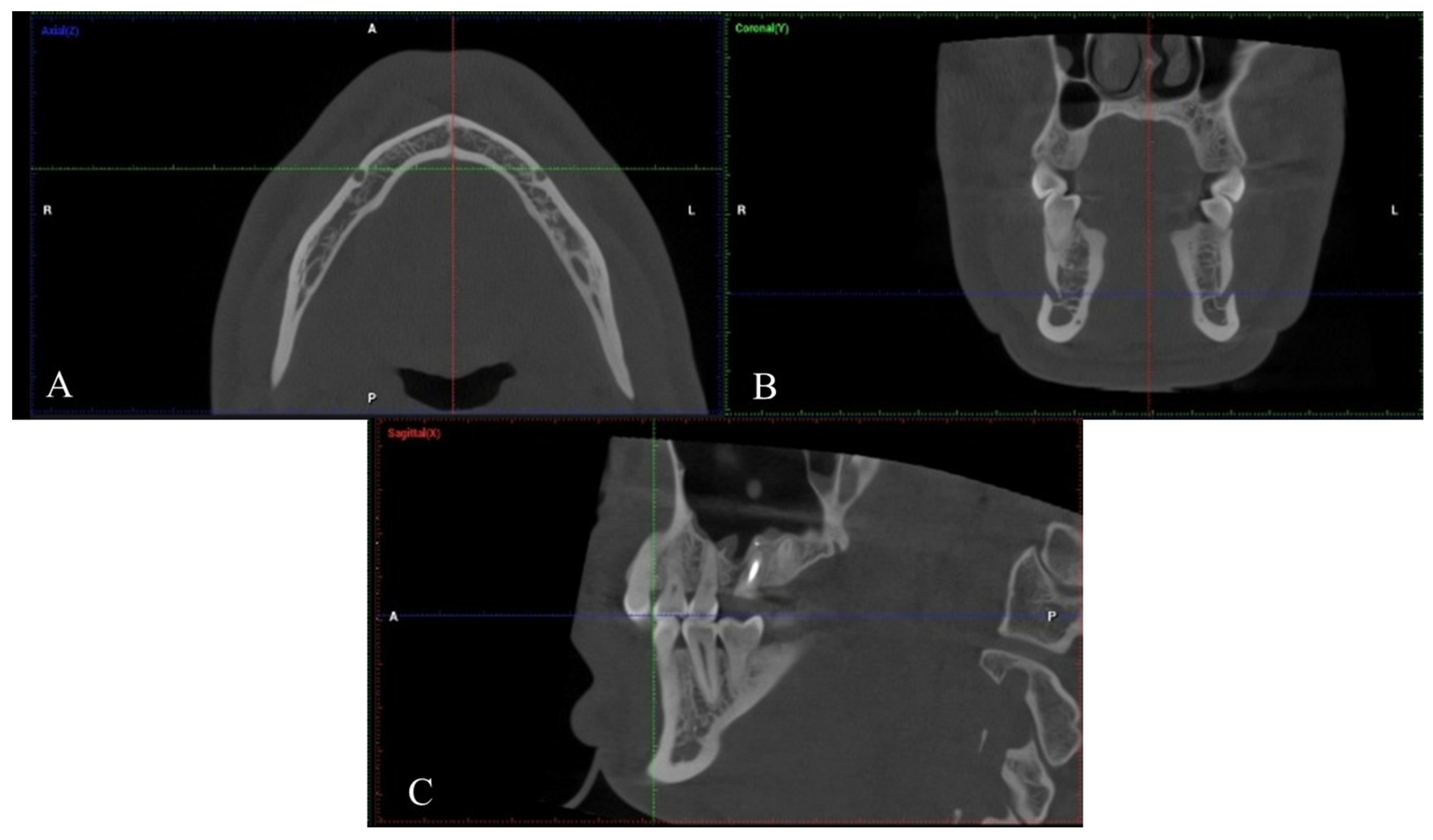
Each CBCT scan was oriented to a standardised position in all three planes as follows: in the coronal view, a reference plane was established, joining the inferior margin of the right and left mental foramina. For the axial view, the anterior limits of the paired mental foramens served as reference. In the sagittal view, the occlusal plane was used as a reference by levelling the vestibular cusp of the left mandibular first premolar and the mesiovestibular cusp of the left mandibular first molar (Figure 1).
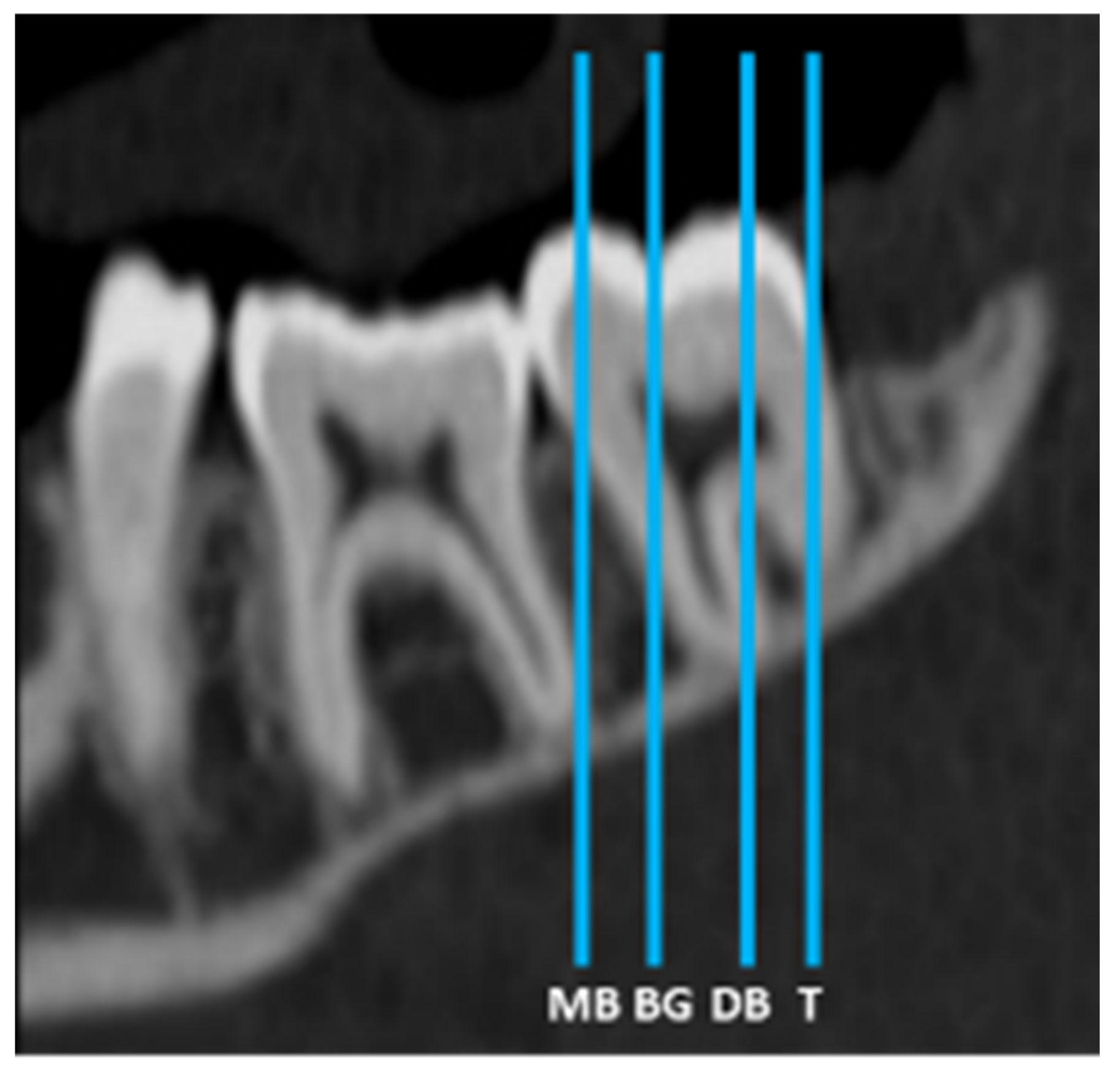
Within each mandibular hemi-arch, four specific reference sections were selected for measurement relative to the second mandibular molar: the mesiobuccal cusp, the buccal groove, the distobuccal cusp, and a tangent to the distal surface (Figure 2).
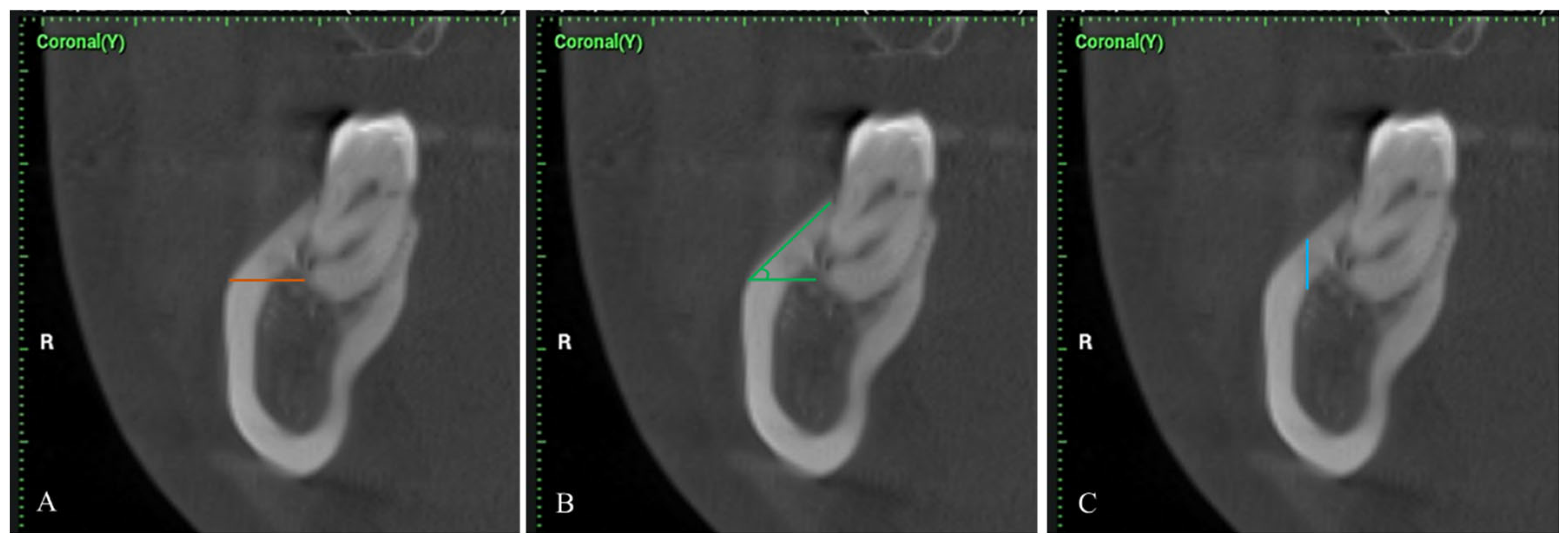
The following parameters were measured (Figure 3):
MBS lateral steepness: the angle formed between the horizontal plane and a line joining the innermost and outermost limits of the MBS.
MBS width: the horizontal distance from a vertical tangent aligned with the cemento-enamel junction (CEJ) to the outermost point of the MBS.
Cortical bone thickness: the vertical thickness of the cortical bone at the central point along the buccolingual dimension of the MBS.
Consequently, a total of 2160 measurements (24 measurements per patient) were entered into an Excel file for further statistical analysis.

2.1. Statistical Analysis

The analysis was performed utilising the IBM SPSS Statistics software (Armonk, NY, USA), version 29, using descriptive and inferential statistical methodologies. Data adequacy, including normality and homoscedasticity, was validated prior to conducting inferential comparative procedures (Student’s t-tests). Bivariate correlation analysis was performed by using Spearman’s correlation coefficient (rho). The significance level was established at 5% in all inferential analyses (p < 0.05).

2.2. Reproducibility Study

A total of 13% of the cohort (14 cases) were re-examined by the same operator in two-week intervals. The Intraclass Correlation Coefficient (ICC) demonstrated excellent intra-examiner reproducibility between the repeated corresponding measurements, with ICC values ranging from 0.93 to 0.97.

3. Results

A total of 94 participants fulfilled the inclusion criteria. Four cases were excluded due to their older age than the sample’s average age. The final sample consisted of 90 individuals, 33 males and 57 females aged 14 to 40 years; 16 males and 28 females aged ≤22 years adolescents and young adults, and 17 male and 29 female adults aged >22 years. In certain areas, the presence of impacted third molars limited the sample size, as it was not possible to perform MBS buccal shelf measurements in those regions.
The mean MBS platform steepness significantly decreased along the four examined sites from mesial to distal on both sides, with the right side measuring 47.9° ± 11 > 39.1° ± 11.9 > 28.4° ± 16.4 > 16.2° ± 21.5° and the corresponding left side gauging 44.6° ± 12.9 > 35.6° ± 15 > 23.5° ± 17.5 > 14.9° ± 20.5 at p < 0.001. The maximum steepness site was 79.9°, vestibular to the mesiobuccal cusp of the lower left second molar, while the minimum value was −42.3°, localised at the distal tangent of the same tooth (Table 1).
Conversely, the MBS width significantly increased from mesial to distal on both the right (5.1 ± 1.2 mm < 5.6 ±1.2 mm < 6.5 ± 2.6 mm < 6.9 ± 1.2 mm) and the left (5.1 ± 2.3 mm < 5.4 ± 1.3 mm < 6.1 ± 1.1 < 6.7 ± 1.3 mm) sides (p < 0.001). The maximum recorded width was 10.5 mm, corresponding to the distal tangent of the lower right second molar, while the minimum width observed was 1.8 mm, corresponding to the mesiobuccal cusp of both the right and left lower second molars.
Furthermore, the mean cortical bone thickness (7.1 ± 3.3 mm > 6.4 ± 2.8 mm > 5.6 ± 2.4 mm > 5.3 ± 2.4 mm on the right and 6.1 ± 2.3 mm > 5.8 ± 2.2 mm > 5.2 ± 1.8 mm > 5.1 ± 2.2 mm on the left side) significantly decreased from mesial to distal (p < 0.001), ranging between 14.8 mm, adjacent to the mesiobuccal cusp of the lower right second molar and 1.8 mm adjacent to the distal tangent of both the left and right lower second molars.
Significant asymmetry between the right and left sides was observed for both MBS steepness (p ≤ 0.016) and cortical bone thickness (p ≤ 0.012) at the mesiobuccal cusp, buccal groove, and distobuccal cusp locations, with measurements consistently higher on the right side (Table 2). However, no significant differences were found at the distal tangent site for these parameters. Additionally, MBS width showed no significant side-related differences at any of the evaluated locations (p ≥ 0.155).
Among the three parameters evaluated, MBS steepness did not show statistically significant differences between age groups at any of the analysed sites (p ≥ 0.051), nor were there significant correlations with age. MBS width remained comparable between groups, with the exception of a significant increase at the distal tangent of the left second mandibular molar in the older group (p = 0.014), where a weak positive Spearman correlation was also observed (r = 0.279, p = 0.023). Cortical bone thickness demonstrated the most pronounced age-related variation, with significantly greater values in the younger group at the left and right distobuccal cusp and distal tangent sites (p ≤ 0.007), accompanied by weak negative Spearman correlation with age at three of the same sites (r = −0.243, −0.281 and −0.373), indicating a tendency towards cortical thinning with increasing age (Table 3 and Table 4).
MBS steepness and cortical bone thickness were consistently higher in males, with statistically significant differences observed at the mesiobuccal cusp and buccal groove of the left mandibular second molar for steepness (p ≤ 0.042) and at the mesiobuccal cusp, buccal groove, and distobuccal cusp for cortical thickness (p ≤ 0.005). No significant sex-related differences were found for MBS width at any site (p ≥ 0.075) (Table 5).

4. Discussion

This retrospective cross-sectional investigation aimed to determine the safest MBS sites that provides adequate MI stability while minimising the risk of iatrogenic damage to adjacent anatomical structures, including the lower molar roots. This investigation might contribute to a more predictable and safer MI MBS insertion path in the Portuguese population.
The orientation process was performed along the sagittal, coronal, and axial planes, utilising stable anatomical structures whenever possible. The bilateral mandibular foramens were employed to orient the coronal and axial planes. Selected dental landmarks (the cusp tip of the first premolar and the mesiobuccal cusp of the first mandibular molars) were used to standardise the CBCT in the sagittal plane. More mesial landmarks such as the incisal edge, were avoided due to their greater vertical variability associated with open and deep bite malocclusions. The restricted field of view of the CBCT in this study, adhering to the “As Low as Diagnostically Acceptable being Indication-oriented and Patient-Specific (ALADAIP) guidelines” [13], precluded the use of additional skeletal landmarks for sagittal orientation, and limited the assessment of the patient’s skeletal growth pattern and its correlation with the MBS geometry.
There is agreement across various populations, including Americans [2,7], Brazilians [1], Colombians [4], and Dravidians [6], that the MBS vestibular to the mandibular first molar is unsuitable for MI placement. Moreover, the MBS vestibular to the third molar can be obscured in cases where the third molars are impacted or unerupted. Consequently, the focus of analysis shifted to the MBS adjacent to the second mandibular molar. Nevertheless, the obscured MBS at the distobuccal cusp and tangent to the lower second molar resulted in reduced sample sizes in those sites, reaching 84 and 66, respectively.
Recent studies have suggested that lateral steepness of the MBS may also impact the MI success rates [4,14]. A steeper platform increases the risk of MI slippage during placement, with this difficulty rising proportionally to the platform steepness [14]. During insertion, the MI is aligned as perpendicular as possible to the occlusal plane; however, the magnitude of MBS steepness influences the path of MI insertion. Analysis revealed that the average MBS steepness relative to the horizontal plane decreases from mesial to distal, with mean values dropping from 47.9° to 16.2° on the right side and from 44.6° to 14.9° on the left. The steepness reached a maximum of 79.9° at the mesiobuccal cusp of the mandibular left second molar, indicating an almost vertical platform. In contrast negative values of −42.3° indicated a more planar MBS at the tangent of the same molar. It is essential to note that MBS steepness is measured relative to the occlusal plane and is influenced by dental landmarks.
To date, only one prior study has analysed the steepness of the MBS [4], utilising different reference planes than those employed in our research. Their methodology involved constructing an axial axis of the molar and a tangent to the outermost surface of the MBS. In contrast, the current study minimized the influence of individual tooth inclinations by utilizing an axial reference plane rather than relying on the axis of an individual molar. Nonetheless, both studies observed a progressive decrease in the MBS lateral steepness as it moved distally in both age groups.
Significant asymmetries were observed in three out of the four paired MBS sites: the mesiobuccal cusp, buccal groove, and distobuccal cusp, with consistently higher steepness values on the right side. Similarly, an asymmetric MBS cortical bone thickness was observed across the investigated sites. These asymmetries may be partially attributed to functional factors, such as unilateral masticatory patterns and subsequent bone remodelling, which could influence MBS inclination. Fluctuating asymmetry, defined as a random alteration from bilateral symmetry, is a common phenomenon in living creatures and has been reported in craniofacial structures, including the MBS. The mean magnitude of fluctuating asymmetry serves as an indicator of an individual’s adaptability and genomic coadaptation, reflecting both anatomical and developmental stressors, as well as stochastic variations [15,16]. Therefore, it is reasonable to consider that genetic predisposition may contribute to the observed asymmetry, which could be further intensified by enhanced masticatory muscle strength related to dominant masticatory activity. This, in turn, may stimulate an increase in bone volume at the affected site [17]. Nevertheless, the results indicate that all sites meet the necessary criteria for MI placement.
Regarding sexual dimorphism, males exhibited greater MBS steepness across all locations; however, statistically significant differences were observed only at the mesiobuccal cusp and buccal groove of the lower left second molar, with a mean difference of nearly seven degrees. It is important to note that these sites are less favourable for MI insertion. Also, no significant differences in MBS steepness were observed among age groups, leading to the conclusion that there is no evidence of sexual dimorphism at the MI insertion sites. Therefore, the recommended insertion location is towards the distal side of the mandibular second molars, applicable to both sexes across younger and older age groups
A gradual increase in MBS width from the mesial to the distal direction was observed, consistent with findings from similar studies [1,2,4,6,7]. Age and sex did not significantly influence MBS width, except for a notable 0.7 mm increase observed at the tangent of the mandibular left second molar in the older age group. This increase may have implications for MI insertion site, particularly as it represents the most favourable site for MI placement.
Similarly, Escobar-Correa [4] and Elshebiny et al. [7], reported symmetric paired MBS dimensions within their cohorts, with comparable measurements between male and female participants. Other studies [1,2] utilized different reference points, which may limit the reliability of comparisons with our findings.
The minimum required MBS transversal width for a successful MI insertion is 5 mm: 1.7 mm apart from the root, 1.6 mm diameter of the MI, and 1.7 mm away from the cortical bone [3,14]. It is noteworthy that the linear width measurements recorded in our study were taken from the alveolar crest, whereas the molar roots are positioned more vestibular. Our study observed a mean MBS width ranging from 5.1 to 6.9 mm in the eight assessed locations. However, the minimum width observed was 1.8 mm, vestibular to the mesiobuccal cusp of both the right and left mandibular second molars. The maximum width was found at the distal tangent of the mandibular second molars; 10.5 mm on the right side and 10.2 mm on the left side. Thus, we could conclude that, generally, the more distal sites related to the lower second molars are more favourable insertion sites. Nevertheless, it is advisable to assess each case separately. Additionally, obtaining a CBCT prior to MI insertion may be advisable. Patients should be informed about the associated radiation risks and costs of CBCT and be actively involved in the decision-making process for MI insertion, which typically relies on a 2D panoramic radiograph and carries a minor risk of iatrogenic effects.
While cortical bone thickness was consistently greater in males than in females across all analysed regions, statistically significant differences were detected only at the three most anterior sites relative to the lower left second molar. This might be partially attributed, in addition to previously mentioned factors, to higher average masticatory forces observed in men, which may lead to more intense mechanical stimulation of the mandibular bone, fostering greater remodelling and cortical thickening over time [18].
Cortical bone thickness is considered a critical factor in the primary stability of MIs [1,2,7], enabling the screw to withstand the intermittent forces encountered during orthodontic treatment. A minimum cortical bone thickness of 1 mm is proposed for the successful placement of MIs [14,19]. Our findings align with those of Baumgaertel and Hans [20] and Elshebiny et al. [7], demonstrating a progressive reduction in MBS cortical bone thickness from mesial to distal. Despite this variation, the cortical bone thickness at all our examined sites was adequate for the primary stability of MIs.
Consistent with our findings, Elshebiny et al. [7], indicated that in cases featuring a flat MBS with adequately attached gingiva, direct insertion of an MI could be successfully performed without the need for predrilling [14], and that torque levels reached through a drill-free protocol using titanium MI mostly fall within the physiological ranges and remain well below the MI breaking point. Conversely, Nucera et al. advocated for predrilling in all cases to avoid high insertion torque. However, considerable variations exist among populations, suggesting that excessively high torque levels may occur, necessitating the adoption of a predrilling protocol [21].
Multiple studies indicate that while cortical bone thickness exceeds 2 mm in both older and younger age groups, the MI failure rate is significantly lower in adults, suggesting that bone maturity contributes to MI success beyond just cortical bone [14,22]. Deguchi et al. [23] found no correlation between MBS cortical bone thickness and age, whereas Fang et al. [14] reported a thicker MBS cortical bone in younger participants compared. Our analysis revealed that MBS cortical bone thickness decreased with age only at the distobuccal cusp of the lower left second molar and its distal tangent, which are the most favourable MI insertion sites in our cohort. However, the results revealed that even with the existence of reduced cortical bone thickness in older individuals, the available amount remains adequate for MI insertion. Additionally, males exhibited cortical bone thickness exceeding 1 mm at the mandibular second molar, which may have clinical significance.
Our findings suggest the following conclusions regarding the null hypotheses:
  • The first null hypothesis was rejected due to significant differences in mean lateral steepness, width, and cortical bone thickness were observed across the MBS parameters.
  • The second null hypothesis was rejected for the steepness and cortical bone thickness parameters, as significant differences were found between the right and left sides at the mesiobuccal cusp, buccal groove, and distobuccal cusp. However, it could not be rejected for MBS width, as no significant side-related differences were observed.
  • Significant differences were noted between age groups specifically an increase in cortical bone thickness in the older group and a weak negative correlation at the distobuccal cusp and distal tangent of the mandibular second molars. However, these findings were site-specific and did not demonstrate a consistent pattern across all locations and parameters. Therefore, the third null hypothesis was partially rejected.
  • The fourth null hypothesis was accepted for the MBS width, as no consistent sex-related differences were found. However, it was rejected for the MBS steepness and cortical bone thickness, which showed a trend toward higher values in males.
Recent developments in artificial intelligence (AI), computer graphics, and non-invasive magnetic resonance imaging (MRI) in dentistry [24] are poised to enhance MI insertion, providing greater efficiency and reliability [25]. This ultimately lead to more effective treatment planning and better patient care.

Limitations

The retrospective design of this study imposed limitations over imaging procedures, potentially introducing bias by excluding patients with incomplete clinical data or unclear CBCT scans. Furthermore, the cohort consisted of individuals from a single university clinic. Future studies should adopt a prospective multi-center approach that includes participants matched for sex and age from various dental clinics across Portugal, which would improve the generalizability of the results.

5. Conclusions

Within the limitations of this retrospective investigation, the results indicate that while sufficient MBS width and cortical bone thickness exist along the mesiodistal length, vestibular to the mandibular second molar for MI insertion, the sites toward the distal root of the mandibular second molar are more favourable when considering MBS steepness. These findings are consistent across both sexes and to both younger and older individuals.

Author Contributions

J.B.: The principal investigator: data curation, investigation, software, validation visualisation, writing original draft, reviewing manuscript; I.B.: Conceptualisation, Investigation, methodology, supervision, writing original draft, reviewing manuscript and editing; L.P.: Formal analysis, investigation, methodology, reviewing and editing; F.D.P.: Supervision, visualisation, methodology, reviewing; H.N.C.: Supervision, visualisation, methodology, reviewing; P.M.P.: Conceptualisation, Methodology, Investigation, Supervision, writing original draft, reviewing manuscript and editing. All authors have read and agreed to the published version of the manuscript.

Funding

This research received no external funding.

Institutional Review Board Statement

The study was conducted in accordance with the Declaration of Helsinki, and approved by Ethics Committee of the Egas Moniz School of Health and Sciences (Decision no 1298, 30 November 2023).

Informed Consent Statement

Informed written consent was obtained from all subjects involved in the study.

Data Availability Statement

The investigators confirm the availability of research data on request.

Conflicts of Interest

The authors declare no conflicts of interest.

Abbreviations

Micro-Implant (MI); Mandibular Buccal Shelf (MBS); Cone Beam Computed Tomography (CBCT); Artificial Intelligence (AI); mesiobuccal cusp (MB), buccal groove (BG); distobuccal cusp (DB); tangent (T).

References

  1. Aleluia, R.B.; Duplat, C.B.; Crusoé-Rebello, I.; Neves, F.S. Assessment of the mandibular buccal shelf for orthodontic anchorage: Influence of side, gender and skeletal patterns. Orthod. Craniofac. Res. 2021, 24, 83–91. [Google Scholar] [CrossRef] [PubMed]
  2. Gandhi, V.; Upadhyay, M.; Tadinada, A.; Yadav, S. Variability associated with mandibular buccal shelf area width and height in subjects with different growth pattern, sex, and growth status. Am. J. Orthod. Dentofac. Orthop. 2021, 159, 59–70. [Google Scholar] [CrossRef] [PubMed]
  3. Nucera, R.; Giudice, A.L.; Bellocchio, A.M.; Spinuzza, P.; Caprioglio, A.; Perillo, L.; Matarese, G.; Cordasco, G. Bone and cortical bone thickness of mandibular buccal shelf for mini-screw insertion in adults. Angle Orthod. 2017, 87, 745–751. [Google Scholar] [CrossRef]
  4. Escobar-Correa, N.; Ramírez-Bustamante, M.A.; Sánchez-Uribe, L.A.; Upegui-Zea, J.C.; Vergara-Villarreal, P.; Ramírez-Ossa, D.M. Evaluation of mandibular buccal shelf characteristics in the colombian population: A cone-beam computed tomography study. Korean J. Orthod. 2021, 51, 23–31. [Google Scholar] [CrossRef]
  5. Liu, H.; Wu, X.; Tan, J.; Li, X. Safe regions of miniscrew implantation for distalization of mandibular dentition with CBCT. Prog. Orthod. 2019, 20, 45. [Google Scholar] [CrossRef]
  6. Sreenivasagan, S.; Sivakumar, A. CBCT comparison of buccal shelf bone thickness in adult Dravidian population at various sites, depths and angulation—A retrospective study. Int. Orthod. 2021, 19, 471–479. [Google Scholar] [CrossRef]
  7. Elshebiny, T.; Palomo, J.M.; Baumgaertel, S. Anatomic assessment of the mandibular buccal shelf for miniscrew insertion in white patients. Am. J. Orthod. Dentofac. Orthop. 2018, 153, 505–511. [Google Scholar] [CrossRef]
  8. Chang, C.; Liu, S.S.Y.; Roberts, W.E. Primary failure rate for 1680 extra-alveolar mandibular buccal shelf mini-screws placed in movable mucosa or attached gingiva. Angle Orthod. 2015, 85, 905–910. [Google Scholar] [CrossRef] [PubMed]
  9. Alharbi, F.; Almuzian, M.; Bearn, D. Miniscrews failure rate in orthodontics: Systematic review and meta-analysis. Eur. J. Orthod. 2018, 40, 519–530. [Google Scholar] [CrossRef]
  10. Nookala, H.; Sreenivasagan, S.; Sivakumar, A.; Kumar, A. Computed Tomographic Evaluation of Buccal Shelf Dimensions in South Indian Patients With Sagittal Skeletal Class III Malocclusion: A Retrospective Study. Cureus 2023, 15, e43883. [Google Scholar] [CrossRef]
  11. Matias, M.; Flores-Mir, C.; de Almeida, M.R.; da Silva Vieira, B.; de Freitas, K.M.S.; Nunes, D.C.; Ferreira, M.C.; Ursi, W. Miniscrew insertion sites of infrazygomatic crest and mandibular buccal shelf in different vertical craniofacial patterns: A cone-beam computed tomography study. Korean J. Orthod. 2021, 51, 387–396. [Google Scholar] [CrossRef]
  12. Bruggesser, S.; Stöckli, S.; Seehra, J.; Pandis, N. The reporting adherence of observational studies published in orthodontic journals in relation to STROBE guidelines: A meta-epidemiological assessment. Eur. J. Orthod. 2023, 45, 39–44. [Google Scholar]
  13. Oenning, A.C.; Jacobs, R.; Pauwels, R.; Stratis, A.; Hedesiu, M.; Salmon, B. Cone-beam CT in paediatric dentistry: DIMITRA project position statement. Pediatr. Radiol. 2018, 48, 308–316. [Google Scholar] [CrossRef]
  14. Fang, X.; Ding, H.; Fan, C.; Pang, L.; Xu, T.; Liu, J.; Jiang, C. Comparison of mandibular buccal shelf morphology between adolescents and adults with different vertical patterns using CBCT. Oral Radiol. 2024, 40, 58–68. [Google Scholar]
  15. Graham, J.; Özener, B. Fluctuating Asymmetry of Human Populations: A Review. Symmetry 2016, 8, 154. [Google Scholar] [CrossRef]
  16. Wang, Y.; Metoki, A.; Smith, D.V.; Medaglia, J.D.; Zang, Y.; Benear, S.; Popal, H.; Lin, Y.; Olson, I.R. Multimodal mapping of the face connectome. Nat. Hum. Behav. 2020, 4, 397–411. [Google Scholar] [CrossRef]
  17. Farnsworth, D.; Rossouw, P.E.; Ceen, R.F.; Buschang, P.H. Cortical bone thickness at common miniscrew implant placement sites. Am. J. Orthod Dentofac. Orthop. 2011, 139, 495–503. [Google Scholar]
  18. Koç, N.; Çağırankaya, L.B. Investigation of the determinants of the mandibular cortical morphology. Dent. Med. Probl. 2019, 56, 21–25. [Google Scholar] [CrossRef]
  19. Motoyoshi, M.; Yoshida, T.; Ono, A.; Shimizu, N. Effect of cortical bone thickness and implant placement torque on stability of orthodontic mini-implants. Int. J. Oral Maxillofac. Implants 2007, 22, 779–784. [Google Scholar]
  20. Baumgaertel, S.; Hans, M.G. Buccal cortical bone thickness for mini-implant placement. Am. J. Orthod. Dentofacial. Orthop. 2009, 136, 230–235. [Google Scholar]
  21. Baumgaertel, S. Predrilling of the implant site: Is it necessary for orthodontic mini-implants? Am. J. Orthod. Dentofac. Orthop. 2010, 137, 825–829. [Google Scholar] [CrossRef]
  22. Rossi, M.; Bruno, G.; De Stefani, A.; Perri, A.; Gracco, A. Quantitative CBCT evaluation of maxillary and mandibular cortical bone thickness and density variability for orthodontic miniplate placement. Int. Orthod. 2017, 15, 610–624. [Google Scholar] [CrossRef]
  23. Deguchi, T.; Nasu, M.; Murakami, K.; Yabuuchi, T.; Kamioka, H.; Takano-Yamamoto, T. Quantitative evaluation of cortical bone thickness with computed tomographic scanning for orthodontic implants. Am. J. Orthod. Dentofac. Orthop. 2006, 129, 721.e7–721.e12. [Google Scholar] [CrossRef]
  24. Greiser, A.; Christensen, J.; Fuglsig, J.M.; Johannsen, K.M.; Nixdorf, D.R.; Burzan, K.; Lauer, L.; Krueger, G.; Hayes, C.; Kettless, K.; et al. Dental-dedicated MRI, a novel approach for dentomaxillofacial diagnostic imaging: Technical specifications and feasibility. Dentomaxillofac. Radiol. 2024, 53, 74–85. [Google Scholar] [CrossRef] [PubMed]
  25. Ingle, N.A.; Alabsi, N.F.; Al-Hashimi, H.; Albuolayan, N.A.; Alburidy, F.; Alanazi, F.; Alhammad, A.T. The Use of Artificial Intelligence in Orthodontic Treatment Planning: A Systematic Review and Meta-analysis. Adv. Hum. Biol. 2025, 15, 158–166. [Google Scholar] [CrossRef]
Figure 1. A CBCT scan orientation in three planes: (A) axial, (B) coronal, and (C) sagittal. (A): the anterior borders of the mental foramina were aligned. (B): the inferior borders of the left and right mental foramina were aligned. (C): the occlusal plane was used as a reference, aligning the buccal cusp of the left first mandibular premolar and the mesiobuccal cusp of the left first mandibular molar. Red line represents the sagittal axis; green line represents the coronal axis; blue line represents the axial axis.
Applsci 16 02631 g001
Figure 2. The four measurement sections corresponding to the mandibular second molar: at the mesiobuccal cusp (MB), the buccal groove (BG), the distobuccal cusp (DB), and a tangent to the distal surface of the mandibular second molar (T).
Applsci 16 02631 g002
Figure 3. Measured parameters: measurements were undertaken at the coronal segment corresponding to the (A) width (red line), (B) steepness (green line), and (C) cortical bone thickness (blue line).
Applsci 16 02631 g003
Table 1. The mean, standard deviation, and the minimum and maximum values of the of the steepness (°), width (mm) and cortical bone thickness (mm) of the mandibular buccal shelf (MBS) vestibular to the mesiobuccal cusp (MB), buccal groove (BG), distobuccal cusp (DB), and the tangent (DT) to the distal surface of the left and right mandibular second molar (37 and 47). The second column include the number of included cases in each variable (N).
ToothNSteepness (°)NWidth (mm)NCortical Bone Thickness (mm)
Mean (SD)MaxMinMean (SD)MaxMinMean (SD)MaxMin
37MB9044.6 (12.9)79.911.3905.1 (2.3)2.41.8906.1 (2.3)12.22.7
37BG9035.6 (15.5)76.2−9.1905.4 (1.3)8.72.4905.8 (2.2)13.12.6
37DB8423.5 (17.5)59.5−32.5846.1 (1.1)8.73.5845.2 (1.8)10.82.4
37DT6614.9 (20.5)58−42.3666.7 (1.3)10.24.1665.1 (2.2)10.81.8
47MB9047.9 (11)69.120905.1 (1.2)7.71.8907.1 (3.3)14.82.6
47BG9039.1 (11.9)68.69.9905.6 (1.2)8.12.7906.4 (2.8)11.52.7
47DB8528.4 (16.4)67.4−19856.5 (2.6)9.33.6855.6 (2.4)11.82.2
47DT7016.2 (21.5)59.4−32.5706.9 (1.2)10.54.2705.3 (2.4)10.51.8
Table 2. The mean (M), standard deviation (SD) of the steepness (°), width (mm) and cortical bone thickness (mm) of the paired the mandibular buccal shelf (MBS) vestibular to the mesiobuccal cusp (MB), buccal groove (BG), distobuccal cusp (DB), and the tangent (DT) to the distal surface of the left and right mandibular second molar (37 and 47). The symmetry was assessed at p < 0.05.
SiteSteepness (°)Width (mm)Cortical Bone Thickness (mm)
Mean (SD)pMean (SD)pMean (SD)p
37MB44.6 (12.9)0.0165.1 (2.3)0.9186.1 (2.3)0.001
47MB46.9 (11.0)5.1 (1.0)7.1 (3.3)
37BG35.6 (15.5)<0.0015.4 (1.3)0.1555.8 (2.2)0.012
47BG39.1 (11.9)5.6 (1.2)6.4 (2.8)
37DB23.1 (17.6)<0.0016.1 (1.1)0.1955.2 (1.7)0.004
47DB28.6 (16.7)6.5 (2.7)5.7 (2.4)
37DT13.9 (20.5)0.0526.8 (1.3)0.4405.1 (2.3)0.261
47DT17.5 (21.3)6.9 (1.2)5.3 (2.5)
Table 3. Comparison of the mean (M), standard deviation (SD) of the steepness (°), width (mm) and cortical bone thickness (mm) of the mandibular buccal shelf (MBS) sites vestibular to the mesiobuccal cusp (MB), buccal groove (BG), distobuccal cusp (DB), and the tangent (DT) to the distal surface of the left and right mandibular second molar (37 and 47) between the young and old age groups (p < 0.05).
ToothAge GroupSteepness (°)Width (mm)Cortical Bone Thickness (mm)
Mean (SD)pMean (SD)pMean (SD)p
37MB≤2242.3 (13.2)0.1024.8 (1.1)0.0866.1 (2.0)0.643
>2248.2 (12.7)4.7 (1.2)6.2 (2.3)
37BG≤2236.7 (15.0)0.1905.0 (1.0)0.6906.3 (2.3)0.375
>2240.0 (15.1)5.3 (1.3)5.7 (2.0)
37DB≤2225.1 (16.9)0.5685.8 (1.1)0.1666.0 (1.8)0.002
>2224.6 (18.1)6.1 (1.2)4.7 (1.7)
37DT≤2216.2 (18.3)0.3346.3 (1.1)0.0146.0 (2.6)0.003
>2213.1 (21.6)7.0 (1.4)4.4 (1.8)
47MB≤2246.2 (10.2)0.0515.1 (1.1)0.4447.8 (2.9)0.777
>2250.5 (11.4)4.9 (1.3)7.3 (3.8)
47BG≤2239.3 (11.4)0.2865.4 (1.1)0.9277.5 (3.1)0.246
>2242.5 (13.2)5.4 (1.3)6.2 (2.8)
47DB≤2229.5 (16.0)0.8586.0 (0.9)0.2866.9 (3.0)0.007
>2230.3 (17.6)6.7 (3.7)5.0 (1.8)
47DT≤2219.2 (19.5)0.3266.8 (1.0)0.6656.3 (3.1)0.007
>2216.9 (22.4)6.8 (1.3)4.6 (1.6)
Table 4. The correlation between of the steepness (°), width (mm) and cortical bone thickness (mm) of the mandibular buccal shelf (MBS) sites vestibular to the mesiobuccal cusp (MB), buccal groove (BG), distobuccal cusp (DB), and the tangent (DT) to the distal surface of the left and right mandibular second molar (37 and 47) using the Spearman correlation coefficient test at a significance level of p < 0.05.
ToothSteepness (°)Width (mm)Cortical Bone Thickness (mm)
RhopRhopRhop
37MB0.0470.662−0.1090.305−0.720.503
37BG0.0530.6180.0780.468−0.1010.343
37DB−0.1310.2340.1780.104−0.2810.009
37DT−0.1520.2230.2790.023−0.3730.002
47MB0.1290.224−0.0440.680−0.0970.364
47BG0.0750.4840.0620.564−0.1290.226
47DB−0.0520.6350.0340.758−0.2430.025
47DT−0.1590.186−0.0100.9340.2190.066
Table 5. Comparison of the mean (M) and standard deviation (SD) of the steepness (°), width (mm) and cortical bone thickness (mm) of the mandibular buccal shelf (MBS) sites vestibular to the mesiobuccal cusp (MB), buccal groove (CB), distobuccal cusp (DB), and the tangent (DT) to the distal surface of the left and right mandibular second molar (37 and 47) between males and females (p < 0.05).
ToothSexSteepness (°)Width (mm)Cortical Thickness (mm)
Mean (SD)pMean (SD)pMean (SD)p
37MBF42.1 (12.9)0.0125.3 (2.7)0.3025.5 (2.0)<0.001
M49.1 (11.7)4.7 (1.3)7.2 (2.4)
37BGF33.2 (15.7)0.0425.5 (1.2)0.7245.3 (2.0)0.005
M40.1 (13.8)5.4 (1.4)6.6 (2.2)
37DBF21.0 (18.9)0.0806.0 (1.2)0.4174.9 (1.7)0.004
M28.0 (13.7)6.2 (1.1)6.0 (1.6)
37DTF13.6 (20.4)0.6486.6 (1.0)0.2504.8 (2.2)0.079
M16.1 (21.3)7.0 (1.7)5.8 (2.1)
47MBF45.6 (11.1)0.1205.0 (1.1)0.1806.7 (3.4)0.090
M49.3 (10.6)5.3 (1.3)7.9 (2.9)
47BGF37.7 (12.4)0.1305.4 (1.2)0.0616.1 (2.9)0.201
M41.7 (10.5)5.9 (1.2)6.9 (2.5)
47DBF26.1 (16.8)0.3916.5 (3.1)0.6315.3 (2.5)0.477
M33.0 (14.7)6.5 (1.3)6.3 (2.0)
47DTF14.8 (21.5)0.3916.9 (1.2)0.6315.1 (2.6)0.477
M29.5 (21.4)7.0 (1.4)5.76 (2.0)
Disclaimer/Publisher’s Note: The statements, opinions and data contained in all publications are solely those of the individual author(s) and contributor(s) and not of MDPI and/or the editor(s). MDPI and/or the editor(s) disclaim responsibility for any injury to people or property resulting from any ideas, methods, instructions or products referred to in the content.