Review

Recovery of Antimony from Secondary Sources: Extraction Strategies and Analytical Approaches

by
Neli Mintcheva
1,*,
Marinela Panayotova
2 and
Gospodinka Gicheva
2
1
Department of Engineering Geoecology, University of Mining and Geology, 1700 Sofia, Bulgaria
2
Department of Mineral Processing and Recycling, University of Mining and Geology, 1700 Sofia, Bulgaria
*
Author to whom correspondence should be addressed.
Appl. Sci. 2026, 16(6), 2628; https://doi.org/10.3390/app16062628
Submission received: 7 February 2026 / Revised: 1 March 2026 / Accepted: 3 March 2026 / Published: 10 March 2026
(This article belongs to the Special Issue Sustainable Strategies in Waste Recycling and Metal Recovery)

Abstract

Antimony (Sb) is a key element used in flame retardants, lead–acid batteries, and polymer catalysis, and it is classified as a critical raw material. Its quantity for the worldwide economy is limited due to restricted natural resources and partial recycling of by-products. This is why recovering Sb from secondary sources is becoming increasingly important in terms of technological and economic aspects for ensuring its sustainable and safety supply. In this paper, we review the possibilities for extraction of antimony from various waste sources, such as ore processing and metal recovery residues, electronic and plastic waste, lead-antimony-containing waste, spent catalysts, fluorescent lamps, incinerated municipal waste, and the applied methods of waste processing (pyrometallurgy, hydrometallurgy, solvometallurgy) used to achieve recovery in high yield and purity. The methods for antimony quantification and speciation are also discussed and described in terms of principle of the technique, linear concentration range, limit of detection, and coupling with other techniques. As the concentration of Sb in environmental and biological samples is usually very low and requires good selectivity and sensitivity of the analytical method, suitable techniques for sample preparation and subsequent instrumental measurement are also included.

1. Introduction

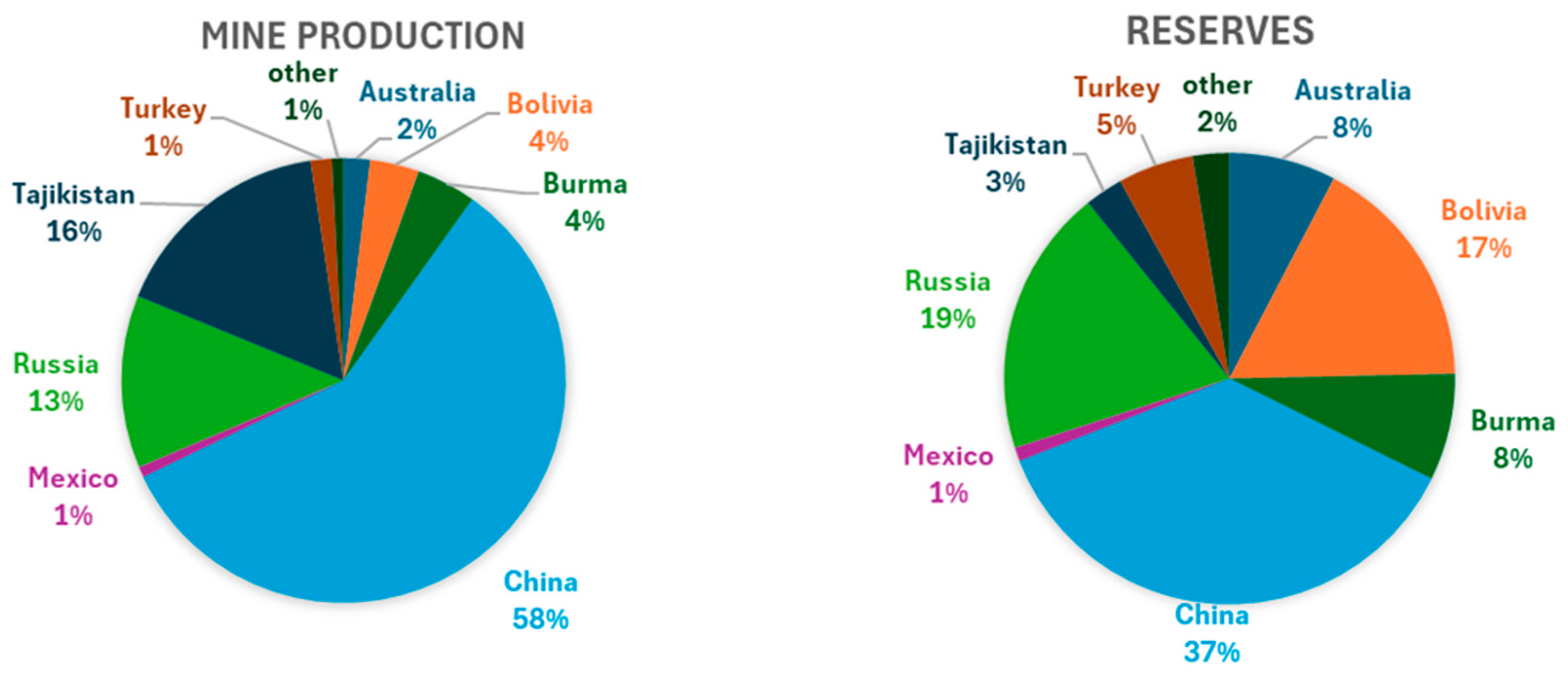
Antimony (Sb) is considered a critical raw material by the European Commission and the U.S. Geological Survey due to its strategic industrial uses, such as flame retardants, lead–acid batteries, alloys, infrared detectors and diodes, and catalysts in plastic production [1,2,3]. At the same time, the antimony supply is at high risk because of geographical concentration of the natural ore deposits and global production which makes the market vulnerable to geopolitical policy changes (Figure 1). As can be seen in Figure 1, the leading country of antimony production is China, providing 58% of the world’s total production for 2024, while the reserves are concentrated in China (37%), Russia (19%), and Bolivia (17%). Moreover, the Sb supply vulnerability increases when antimony is often not produced directly from natural ore, but is instead recovered as a by-product from lead, copper, silver, and gold minerals. From the other side, very little amounts of Sb are recycled industrially from end-of-life products and residues from mine production [1,4]. Recent data showed that in the USA, antimony is only produced from secondary sources, especially from spent lead–acid batteries, and the recovered Sb is consumed by the lead–acid battery industry. Antimony from recycling is about 15% of the total domestic consumption of the USA, and the remaining came from imports. The total use of Sb into various materials in 2024 was around 40% for Pb-Sb alloys, 39% for flame retardants, and the rest 21% for ceramics, glass, and rubber products [1]. According to the EU’s critical raw materials act from 2024, the target by 2030 is for 25% of the Sb placed on the market to be recycled [2,5]. In respect to the toxicity of antimony, mining and refining processes can produce toxic waste causing environmental and regulatory challenges that require strict environmental control during the production and implementation of new production methods [6,7,8]. That is why the development of technologies for recovering Sb from secondary sources is increasingly important for maintaining a reliable and sustainable supply of this critical metal [8,9,10,11].
Secondary sources of antimony include waste end-up materials, industrial residues, and by-products from which Sb can be recycled or reprocessed, rather than the primary extraction from ores [4,12]. The utilization of secondary sources aligns with the aim for developing a circular economy through the recovery of valuable elements [13]. The analysis of Xu et al. showed that the recycling rate of Sb would reduce dependance of primary mining, especially for countries with missing reserves, and would mitigate resource depletion and ensure long-term supply stability [14]. Vinardell et al. analyzed the economic impact of implementation of Sb recovery from copper electrorefining residue and highlighted the potential of recovery methods [15]. The recycling approach minimizes the environmental impact of primary mining and reduces the EU’s dependence on imports from countries like China and Russia, as reported by Panayotova et al. [16].
According to the natural abundance in ores and distribution in engineered materials, antimony can be extracted from various waste streams, including electronic waste (e-waste), waste plastics, lead–acid battery scrap, industrial slags (lead, zinc, copper, gold residues), and even waste from burning municipal or industrial leftovers [4,16]. Common methods for extracting antimony from these sources include hydrometallurgical and pyrometallurgical processes, as well as newer approaches like solvometallurgy [16,17,18,19]. These methods often involve leaching the antimony-containing material with specific solvents (aqueous or non-aqueous), followed by further purification and recovery of the metalloid.
In this paper, we review the applications of different methods for extraction of antimony from various secondary sources, including industrial waste and emphasizing end-of-life products, that provide effective and sustainable approaches to achieve recovery of antimony from waste. The general methods (pyrometallurgy, hydrometallurgy, and solvometallurgy) for current industrial Sb production and their implementation for processing of waste sources have been discussed. New and modified routes for antimony recovery developed at the laboratory scale that demonstrate promising results are also presented. The available analytical methods for Sb quantification are highlighted with respect to instrumentation and methodology, sample preparation, limit of detection, and concentration range.

2. Methods for Processing Antimony-Containing Materials

2.1. Pyrometallurgy

The choice of appropriate pyrometallurgical methods depends on the Sb content, and different conditions are applied in practice. The raw materials containing 5–25% antimony are roasted at approximately 1000 °C to form antimony oxide, with Sb2O3 as flue dust, and it is then reduced to Sb metal by reducing agents such as carbon. For higher Sb content of 25–40%, smelting in a blast furnace at 1300–1400 °C is applied to produce Sb metal. Raw Sb2S3 materials with 45–60% Sb are converted into non-volatile antimony tetraoxide, Sb2O4, by heating at 400–500 °C and reducing to metallic Sb. The resulting crude antimony is refined from impurities to a metal with a higher purity [10,17,20]. Pyrometallurgy is mainly used for primary antimony sources and it is the predominant production method in China [12]. Pyrometallurgical separation of precious metals and Sb from lead anode slime is a widely applied method for recycling Sb by redox smelting, followed by oxidative blowing and Sb electrorefining [21]. Secondary sources such as spent lead–acid batteries, lead smelting, and slime (Sb 0.5–6%) rely on the oxidation of antimony to Sb2O3 and its removal by evaporation [22,23,24]. A few examples of vacuum separation and volatilization of Pb-Sb sources are summarized in Table 1.

2.2. Hydrometallurgy

Hydrometallurgical methods are suitable for processing sources with lower Sb content, such as Cu, Pb, Au, and Ag concentrates, industrial slag from pyrometallurgical processes, and other secondary antimony-containing sources (Table 1). Generally, it consists of the dissolution of antimony compounds in solvents, followed by separation and purification of the metalloid. The antimony leaching is carried out by solutions of alkaline or earth-alkaline sulfides (Na2S, CaS), sodium hydroxide, hydrochloric acid, and iron (III) chloride that form soluble antimony salts. The two predominate methods used are alkaline sulfide and acidic chloride. In the first one, the antimony is dissolved in a mixture of Na2S and NaOH to sodium antimony (III) sulfide (NaSbS2). Another commonly used solvent is hydrochloric acid with addition of iron (III) chloride, FeCl3, to produce antimony (III) chloride, SbCl3 [20]. Separation of the antimony or antimony compounds from the pregnant leach solutions is carried out by hydrolysis, precipitation, and electrolysis deposition of antimony on the cathode [43]. The Sb metal, a product of electrolytic separation, has the benefit of a higher purity than that of crude pyrometallurgically obtained antimony [8]. Further refining of antimony to a high-grade product is possible by a fire refining process, where impurities such as Pb, Fe, As, Cu, and Sn undergo oxidation or sulfurization and are removed in the slag [44]. Recent modifications of hydrometallurgical methods at different experimental parameters for Sb recovery from industrial residues have been summarized elsewhere [16,45].

2.3. Solvometallurgy

In solvometallurgy, non-aqueous solvents are used to dissolve, separate, and recover metals from ores, concentrates, or wastes (Table 1). The processing steps are similar to that of hydrometallurgy, namely: leaching by solvent, separation of the residue, purification of the leachate by extraction or ion-exchange, and metal recovery by precipitation or electrolysis [19]. The solvents employed, such as organic solvents, ionic liquids, and supercritical fluids, alter the solubility of the materials that are poorly soluble in water (used in hydrometallurgy), offering better selectivity and improved recovery of the metal. In many cases, reagents can be recycled and reused in the extraction process. For example, antimony has been extracted from plastics by complexation with sodium hydrogen tartrate in DMSO as a solvent, and both reagents were recovered and reused [43]. Selective extraction of Sb from lamp phosphors with ionic liquid has also been carried out and Sb was recovered in high yield [42]. Spooren demonstrated enhanced dissolution of Sb from PVC waste with ethanolic hydrochloric acid, achieving selective leaching and lower acid consumption in a simplified process [18]. Some authors have highlighted solvometallurgy using ionic liquids and deep eutectic solvents as an emerging and environmentally friendly alternative to the traditional hydrometallurgy [16,19]. Thus, solvometallurgy represents a sustainable approach and promising alternative to conventional hydrometallurgical methods for recovering antimony from secondary waste streams. It allows for selective dissolution of Sb under mild, non-aqueous conditions, reducing waste generation and water consumption.

3. Secondary Sources

Secondary antimony sources include process residues from the production of lead, copper, gold, and antimony, as well as end-of-life products, such as lead–acid batteries, plastics and electronics, spent catalysts from production of PET polymers and catalytic cracking, phosphor powders from spent fluorescent lamps, landfills, and incineration ashes. Different forms of antimony are applied in various industrial products that might be sources for Sb recovery (Table 2) [4,46,47,48,49].
Among potential sources of Sb, the residues generated during ore processing and metal recovery represent considerable technological potential and economic importance, as they may contain significant amounts of the critical metal.

3.1. Ore Processing and Metal Recovery Residues

Besides stibnite, Sb2S3, which is the most abundant antimony mineral and the primary source of Sb mining, complex antimony-containing minerals are also used as primary sources. Although their processing is adjusted according to the composition of the minerals and the optimized working conditions in the plants are applied, large amounts of antimony end up in the mine and metallurgy process residues [29,55]. Most of these residues are currently discarded, causing environmental challenges, rather than being utilized as valuable resources for antimony recovery.
Pyrometallurgy is one of the technologies often used for Sb recovery and many pyrometallurgical methods have been comprehensively reviewed previously [12,17].
Recently, Kai Fan et al. reported a convenient approach for the recovery of antimony from lead anode slime by oxidation to Sb2O3, following by vacuum distillation and formation of high-quality nanoscale antimony oxide powder [25]. A green method of vacuum gasification was reported for “antimony noble” purification and the separation of gold and silver. The treatment at temperature 1123 K led to the isolation of Sb in volatiles with a purity of 99.41% and the recovery of Au (99.62%) and Ag (66.56%) in the residue [56]. Effective separation of arsenic and antimony from lead smelter flue dust by controlled roasting in the presence of carbon and sulfuric acid as additives was proposed. At a low temperature (400 °C), arsenic was volatilized, while antimony remained in the solid residue. This method provides the safe disposal of arsenic and the essential recovery of antimony [26].
Hydrometallurgy is most often studied and used as a method to recover Sb from ore processing and metal recovery residues. Vinardell et al. studied the recovery of Sb and Bi from copper electrorefining waste by their selective precipitation from concentrated hydrochloric acid [15]. Dembele et al. demonstrated the effectiveness of Sb leaching with a mixture of HCl and NaNO3 (in different concentrations) from stibnite tailings, reaching high Sb yield (98.30–99.88%) at laboratory and semi-pilot scales [27]. Selective acidic and alkaline leaching followed by antimony electrowinning was developed as an effective route for the production of Sb from low-grade ore, resulting in 87% Sb extraction from the electrolyte solution [28]. A valuable by-product was the anode slime, precipitated at the bottom of the electrolytic cell from copper electrorefining. It contained hydrolyzed species of Sb, As, Sn, and Bi depending on the type of ore used and extraction method of the copper. A combination of Na2S and NaOH was used to leach the antimony from such residues and Sb was then electrodeposited [30]. Thanu et al. proposed and optimized experimental conditions of a direct electrowinning method for antimony recovery from spent chloride-containing electrolytes produced by the copper extraction process [31]. Benabdallah et al. presented a method for the selective separation and recovery of Sb and Bi from As-containing hydrochloric acid solution, using alkylphosphine oxides in kerosene for extraction, then HNO3 as a stripping agent, and NaOH/NaCl or NaOH for the precipitation of SbOCl or Sb2O3 [32].
A selective Sb recovery from lead slag was reported by Ling et al. [33]. First, the slag was roasted with NaOH at 400 °C, then leached with water at room temperature. After that the As-free slag was reduced with carbon, followed by leaching Pb with HNO3 and thus the remaining material is enriched in Sb [33]. Along with the extraction of precious metals (Au, Ag) and Te from lead anode slime, antimony was also recovered as reported by Gao et al. [21].
A new processing route of Sb recovery from antimony-containing copper concentrate, based on microwave-assisted leaching of Sb in alkaline sulfide solution to yield Sb in 95.7%, was reported by Luo et al. [34]. Effective and environmentally friendly extraction with deep eutectic solvents (containing choline chloride with malonic acid, thiourea, and ethylene glycol in different molar ratios) was suggested as a sustainable method for antimony extraction from mining waste. The highest Sb recovery (100%) was obtained by a mixture choline chloride–ethylene glycol in the presence of iodine [41]. Therefore, depending on the residue type, Sb content, and ratio with other metals, different hydrometallurgical methods could be applied as reported in the literature [16,45].
To summarize, the most common method for antimony extraction from ore processing and metal recovery residues is hydrometallurgy and includes leaching with different solutions (acidic, alkaline and alkaline sulfide), among which the use of deep eutectic solvents provides a green approach for Sb production. The recovery of Sb from leachate is carried out by hydrolysis and conversion, precipitation and crystallization, cementation and replacement, and electrowinning. Several papers [4,12,13,16,17,43,45] have provided analyses that may not have been entirely comprehensive, but they can still deliver sufficiently detailed and up-to-date insights into the topic.

3.2. Electronic and Plastic Waste

End-of-life products, such as electronic waste and certain plastics, represent valuable secondary sources of antimony, as they often contain this element in significant amounts [35]. Moreover, the growing accumulation of such waste streams, driven by rapid technological evolution and developing recycling initiatives in many countries, present an opportunity for valorization of the waste [57,58]. As a result, there is increasing scientific and industrial interest in the recovery of antimony from these residues, which would improve resource efficiency and support a sustainable materials cycle.
Antimony trioxide (Sb2O3) is widely used as a fire retardant, which is combined with brominated organic compounds to enhance their properties. The presence of bromine atoms effectively slows down the combustion processes. Both types of compounds are incorporated into plastics, textiles, and electronics to reduce the flammability of materials used to make plastic parts in cars, furniture, laptops, phone cases, cables, insulation foam, etc. According to the literature, 43% of the world production of Sb is consumed by flame retardants, but recycling methods are still limited [18,36]. To achieve sufficient flame resistance of electronic equipment, plastics are commonly formulated with 5–10 wt% of Sb2O3 as a flame retardant [36]. Given this relatively high antimony content, recycling such plastics becomes particularly important, because it may reduce the need for the primary production of antimony and lower the environmental impact of e-waste accumulation.
Alassali et al. analyzed antimony from numerous PET bottles and electronic plastic waste directly by X-ray fluorescence spectroscopy (XRF). They extracted antimony by applying three approaches: (i) microwave treatment in different acids (aqua regia, 18 mol L−1 H2SO4, 12 mol L−1 HCl and 6 mol L−1 HCl); (ii) conversion into ash at 600 °C, followed by microwave digestion with aqua regia; and (iii) extraction with 12 mol L−1 HCl for 2 h or 24 h. A higher yield of Sb was achieved from PET-waste (57–92%), while digestion of poly(acrylonitrile butadiene styrene) was more difficult and the extraction of Sb from e-waste was found to be lower (20–50%) [36].
Polyvinyl chloride plastic waste was treated with an ethanolic solution of HCl (4 mol L−1 HCl) at a moderate temperature of 80 °C for 4 h and antimony was extracted at a high yield (95%). In ethanol, chloride ions effectively act as ligands and form antimony chloride complexes, SbCln+1(2−n), which are well soluble in mixed solvents. Finally, antimony was precipitated and isolated as Sb4Cl2O5 with a purity of 99.8% [18].
A common method for antimony- and bromine-containing plastic treatment is pyrolysis, during which antimony remains in the residues (bottom ashes or fly ashes) [36,59]. During the thermal treatment (at 850 and 1100 °C) of Sb-rich halogenated waste, approximately 64% of antimony is volatilized, while 36% Sb remain in the bottom ashes, being in the form of Sb2O3 and SbCl3. At higher temperatures, Sb (III) is converted to the less toxic Sb (V) in the gas phase, which reduces environmental and health risks. This result shows that the treatment of Sb waste in incineration plants at high temperatures would ensure effective detoxification and minimize the contamination with Sb [60]. For development of sustainable methods for e-waste recycling into valuable fuels like pyrolysis oil, bromine and antimony contents should be reduced. For this purpose, some authors used additives such as red mud, limestone, and natural zeolite to remove bromine and antimony as compounds that remained in the residue [57]. Other researchers treated high-impact polystyrene flame retarded with decabromodiphenyl ether (DDE) and Sb2O3 in supercritical water and NaOH to produce bromine- and antimony-free oil, as well as char containing antimony in the form of antimony trioxide, antimony hydroxide, and sodium antimonate [61,62].
Poly(acrylonitrile butadiene styrene) and polystyrene (poly(vinylbenzene)) are common plastics used in electronic equipment [50]. When recycling e-waste, these polymers should be digested properly in order to extract the antimony incorporated inside the material and minimize secondary pollution by brominated persistent organic compounds [58]. A study determined the antimony concentration in different types of polymers used for the plastic components of mobile phones, laptops, desktop computers, microwave ovens, monitors, etc. Prior to the analysis of Sb, plastic digestion was performed by three procedures: (i) dissolution with aqua regia; (ii) conversion into ash at 600 °C and digestion of ash with aqua regia; and (iii) leaching of shredded plastics with deionized water. The analysis of Sb concentrations in different plastic eluates was performed by ICP-OES spectroscopy. Significant amounts of Sb were found in the plastic used in desktop computer parts (25–1900 mg kg−1) and microwave ovens (830 mg kg−1), while mobile phones contained only 1–6 mg kg−1 [35]. A recent study confirmed that e-waste could be a valuable source of Sb along with many other critical and strategic elements. This research highlighted the potential of recovering 255.13 kg year−1 Sb from waste printed circuit boards (desktop computers (monitors, CPU), notebooks, tablets, printers, cellphones, TVs) in a Brazilian city, and estimated the financial gains through the recovery of critical metals present in e-waste [63].
At laboratory scale, Tostar et al. proposed a method for antimony leaching from e-waste by using different acids containing sodium hydrogen tartrate dissolved in either dimethyl sulfoxide (DMSO) or water [38]. The most effective method, which achieved around 50% recovery of Sb from plastics, was found to be a solution of sodium hydrogen tartrate in DMSO under heating at 105 °C. The plastic residue could be recycled, for example, by mixing with fresh plastic material, and the DMSO could be recovered and reused as a solvent again. As the leaching in water or in DMSO was not effective, one could propose that the sodium hydrogen tartrate was a crucial reagent that bound the antimony and extracted it from the dissolved plastic. The Sb content was determined by inductively coupled plasma optical emission spectroscopy (ICP-OES) [18,38]. In another study, electronic waste (printed circuit boards) was leached by ferric chloride (0.074 mol L−1) in a hydrochloric acid (0.5 mol L−1) solution to extract copper and antimony. Antimony was recovered from the electrolytes by changing the pH through the addition of 99.99 wt% pure NaOH crystals and precipitation as Sb2O3 (81%), while copper was deposited on the cathode (96%). The quantitative results were obtained by ICP-OES analysis [37].
Recently, Gaudin et al. have reported a novel method for the recovery of antimony from electronic waste by simultaneous liquid–liquid extraction and leaching. The waste plastics were treated in a dichloromethane and tartaric acid solution to dissolve the antimony and transform it into antimony tartrate, which is a molecule with no affinity to the organic phase, facilitating the liquid–liquid extraction. Thus, antimony was isolated in 98% recovery by mass. Moreover, the brominated organic compounds were further removed; thus, the method ensured the reuse of the remaining plastics [39].
To summarize, regarding the utilization of Sb from stand-alone plastic waste or from plastic components in e-waste, the development of sustainable approaches is needed that can combine limiting brominated pollutants in the recycled products with a high recovery yield of the critical antimony.

3.3. Lead-Containing Waste (Lead–Acid Batteries, Lead Smelting Residues)

The lifespan of lead–acid batteries used in cars is about two years, which causes a huge generation of waste. These batteries contain Pb-Sb alloy grids, and separation of both metals is difficult due to similar physical and chemical properties of lead and antimony. Thus, efficient methods for the separation and purification of both metals are of great importance. Nowadays, among various secondary antimony sources, only lead–acid batteries are being recycled on a large scale [51,64]. First, the acid is removed from the batteries, then plastic is separated from the metal, and the lead metal and lead oxide are separated by mechanical processes. Lead oxide is reduced, and the lead is smelted. Most plants use rotary furnaces when smelting lead-waste, while some modern plants apply the highly efficient Isasmelt process or electrothermal smelting technologies for the production of secondary lead, while antimony is recovered from the residue [52].
A new method, called vacuum displacement, was proposed for removing antimony from waste lead–acid batteries. PbO is added to Pb-Sb melt, where Pb (II) oxidizes Sb to Sb2O3, which can then be easily evaporated under a vacuum at 840 °C and removed from the lead melts. This technology has many advantages in comparison with conventional pyrometallurgical methods, such as shorter processing time, effective Sb removal, and less pollution [22]. The same authors reported the separation of Pb-Sb alloy from lead paste and the isolation of Sb2O3 as a by-product by the vacuum reduction–separation method [23].
By using pyrometallurgical method, antimony dust from lead smelting can be processed in three steps: reduction smelting of the dust to enrich the crude alloy in antimony and lead, alkaline refining for removal of arsenic, and selectively oxidizing antimony to produce a high purity antimony white (99.8%) [24].
Electrolysis in molten state has been used by Gao et al., who proposed the separation of Sb from Pb-Sb alloy by molten salt (NaCl-CaCl2) electrolysis, as solid Ca-Sb alloy can form at the top of the liquid Pb-Sb cathode. The Sb content in the residue can be reduced up to 0.01% Sb, so this method is promising for pure Pb recovery as well [65].
Several hydrometallurgical methods have also been proposed for the recovery of Sb from lead-containing waste. The selective leaching of antimony (usually accompanied by arsenic) from lead smelting residues can be performed by the formation of soluble sodium thioantimonite, Na3SbS3, obtained by using a mixture of aqueous Na2S and NaOH solutions [8]. Leaching of antimony from a dross, which was generated by lead smelters, with HCl, followed by hydrolysis that leads to the precipitation of Sb2O3 has also been proposed [66]. In other paper, dross is treated with hydrochloric acid dissolved in alcohol (ethanol, octanol, ethylene glycol) to selectively extract antimony, which is then precipitated as antimony oxide chloride (Sb4O5Cl2) [40]. A classical approach is for antimony to be recovered from the acidic electrolytes from spent batteries leaching by the electrochemical deposition of antimony on copper and graphite cathodes [67].

3.4. Spent Catalysts

Antimony and its compounds are used as catalysts in various reactions, such as organic synthesis, photocatalytic reactions, preparation of new materials, etc. [53]. One widely used polymer for textile fibers and food containers, polyethylene terephthalate (PET), is produced by a polycondensation reaction in the presence of an Sb (III)-containing catalyst (Sb2O3, Sb2(OCH2CH2O)3, Sb(CH3COO)3) [54].
A patent described the recovery of Sb catalysts using chlorination, followed by fluorination of antimony, distillation of the organic compounds which have lower boiling temperatures than the SbClxFy compounds, and converting the remaining SbClxFy compounds with carbon tetrachloride to form antimony pentachloride SbCl5, which is thereafter separated from the remaining organic compounds and inorganic residue by distillation [68].
Hyatt patented a method for Sb recovery by the reduction in SbCl5 to SbCl3 and extraction of the latter in an acidic solution, preferably 10% HCl. Then, Sb metal may be produced by electrowinning or cementation with aluminum, zinc, or magnesium [69]. Anderson also described the leaching of Sb from a spent Sb catalyst by hydrochloric acid at temperature 100 °C, where very high recovery yield (99.5%) in leachate is achieved [8].
Antimony can be recovered from spent ethylene glycol residues generated from PET polymer production by combusting the waste, contacting the produced material with water, and concentrating the antimony in a solid residue (in the form of sodium antimonate) which can be converted to pure antimony in a reducing furnace. The antimony content in the water-insoluble fraction of the ash may be increased by pretreating the spent glycol residues with a strong acid prior to combustion or oxidation [70].
During the Sb-catalyzed reaction of PET production, antimony metal can be formed and deposited in the polymer (in concentrations 100–300 ppm) as a side product. Due to this fact, its content is monitored in food and drug packages following strict regulations [71]. Although the content of Sb in PET is low, the recycling of PET in large scale can be a source of Sb and is considered as an opportunity for Sb recovery. The total Sb content in PET bottles has been determined to be in the range of 231–257 mg kg−1. After acid extraction from different types of PET bottles, the Sb yield varies between 78 and 92.5% [36]. Interestingly, studying the specific migration of Sb, some authors investigated the antimony release from PET bottles to mineral water at different temperature and time durations, finding Sb concentrations between 1.59 and 4.42 μgL−1, which is within legislative limits [72]. The release of antimony from polyester textiles in contact with artificial sweat has also been evaluated. It was found that about 0.05–2% of total antimony can migrate into the solution, prompting the question about dermal contact with fabrics and environmental issues, such as the dissolution of antimony during laundering and the release of wastewater and microplastic fibers into the environment [73].

3.5. Lamp Phosphor Waste

Phosphors are powders with luminescent properties coated on the inside of glass tubes. When electricity passes through the lamp, mercury vapor emits UV light which is absorbed by the phosphor and re-emitted as visible light. Fluorescent lamps are considered hazardous waste because of their mercury content and are collected separately in some countries to facilitate their recycling. Some older types of fluorescent lamps contain antimony as a dopant (Sb3+) in halophosphate phosphors [74], while in other classes of phosphors, rare-earth elements are dopants. The halophosphates are well soluble in diluted acids that allow antimony to enter the solution and be extracted by ionic liquid Aliquat® 336 ([A336][Cl]) [42]. An ionic liquid is used as an organic phase to selectively extract Sb3+ ions from leachate in mild conditions. [A336][Cl], which consists mainly of trioctyl(methyl)ammonium chloride, is a basic extractant and binds the Sb (III) ions as the anionic complex [SbCl4]:
[A336]Cl(IL) + [SbCl4](aq) → [A336][SbCl4](IL) + Cl(aq)
In the next step, the Sb3+ ions are removed from the ionic liquid by contacting with an aqueous alkaline solution (NH3 and NaOH) to transfer the Sb3+ ions into the aqueous phase, while the ionic liquid is regenerated. Depending on the pH of solution, the Sb3+ ions can hydrolyze and precipitate as SbOCl(s) or Sb2O3(s).
[A336][SbCl4](IL) + 2 NaOH(aq) → [A336]Cl(IL) + SbOCl(s) + 2 NaCl(aq) + H2O
2 [A336][SbCl4](IL) + 6 NaOH(aq) → 2 [A336]Cl(IL) + Sb2O3(s) + 6 NaCl(aq) + 3 H2O
Antimony oxide is formed at pH > 4.5, with a stripping rate of more than 99.99% at pH 7. The final Sb2O3 product has a high purity > 99.99 wt%.
One key advantage of ionic liquids is their potential to replace volatile and flammable organic solvents, thus reducing the environmental impact of the process. Moreover, the remaining leachate is converted into apatite and used as fertilizer, thus offering a zero-waste approach for lamp phosphor recycling and the recovery of antimony.

3.6. Municipal Waste

Many Sb-containing products eventually reach the end of their life cycle and are disposed of in municipal waste landfills. A study of municipal waste samples from Osaka city waste revealed an average antimony content of 40–50 g per ton of raw waste, corresponding to approximately 20% of Japan’s annual Sb production being discarded as municipal solid waste. Samples such as “textile”, “plastic, rubber and leather”, and “small tips” showed higher Sb concentrations due to the presence of antimony fire-retardant compounds [75]. Intrakamhaeng et al. evaluated antimony mobility from plastic e-waste in simulated municipal solid waste landfills and pointed out that, among electronic plastics in a municipal waste, the plastic case from cathode ray tube television sets had the highest Sb concentrations of 12,793 ± 3081 mg kg−1 (0.97–1.60% by weight) determined by XRF, which is in accordance with the range of other reported values [76].
Incineration at 800–1000 °C of municipal waste generates solid ash and flue gas, which upon cooling produce boiler ash, fly ash, and residual solids. Antimony in different concentrations can be found in all fractions, but the highest amount (260–1100 mg.kg−1) has been estimated in fly ash due to the volatility of antimony [4,77]. A recent study showed even higher Sb concentrations in fly ashes from the Dutch municipal solid waste incineration, with an Sb mean value of 1435.82 mg kg−1 in fly ash. Among numerous oxides in the chemical composition of fly ashes, Sb2O3 amounts are 0.24–0.59 wt% (mean 0.32 wt%) while Sb in the residue, produced during neutralization of acid and flue gases, is in the range of 0.00–0.21 wt% [78].
As it was mentioned above, the content of antimony in incinerator waste originated from its presence in plastics, glasses, and textiles [79,80]. Its removal is important not only as a source of this critical metal, but also because of its toxicity and the environmental risk associated with the utilization or deposition of incineration residues. A common method of Sb extraction from fly ash is leaching with acidic solutions (citrate, HNO3, HCl) and chelating reagents (EDTA) which can reduce the Sb content in the residue [81,82]. Leaching with citric acid and ammonium citrate solution of solid incinerator waste targets the dissolution of many metals, including Sb due to complexation process [83].
The mentioned methods not only allow leaching of antimony but also many other metals that can enter the leachate, resulting in complex mixtures and low selectivity of Sb removal. That is why the development of selective approaches for Sb recovery could be promising for both reducing Sb content in waste residues and the valorization of ashes containing significant amounts of this critical element.

4. Analytical Methods for Antimony Quantification

Several studies represent valuable contributions to the development of antimony determination methods and Sb speciation analysis in different matrices over time [84,85,86,87]. The following section outlines the principal analytical approaches employed for antimony determination and speciation.

4.1. Inductively Coupled Plasma Optical Emission Spectrometry

Inductively coupled plasma optical emission spectrometry (ICP-OES) is the most often used technique for analysis of antimony from both liquid fractions (after dissolution, leaching, extraction, etc.) and digested residues for the determination of initial concentrations and Sb levels after treatment [18,23,27,28,35,37,38,40,65,88]. The low limit of quantification of these methods permits reliable determination of very low Sb concentrations. For example, the concentration of migrated Sb species from PET bottles into water was found to be between 1.59 and 4.42 μg L−1 analyzed by ICP-OES [72]. Evaluation of analytical results for analysis of Sb in waters by various methods was reported by Filella [89].
Furthermore, liquid chromatography inductively coupled plasma optical emission spectrometry (LC-ICP-OES) is a powerful tool for antimony speciation analysis, as the individual Sb species are separated by liquid chromatography prior to detection, while ICP-OES provides element-specific and matrix-tolerant quantification of Sb species in complex samples from environmental and waste sources. The limit of detection of this method ranged from 24.9 to 32.3 μg L−1 for Sb (III) and from 36.2 to 46.0 μg L−1 for Sb (V), depending on the wavelengths used [90]. This coupled technique is usually used for the analysis of the metalloid in wastewater treatment plants. One advantage of LC-ICP-OES is their lower instrumental and operational cost compared with more advanced hyphenated techniques such as LC-ICP-MS.
Some Sb determinations previewed herein were performed by using inductively coupled plasma atomic emission spectrometry (ICP–AES) [22,30] or inductively coupled plasma mass spectrometer (ICP-MS) [34]. In order to achieve a high accuracy of determination in complex matrices, ICP-MS can be coupled with high-performance liquid chromatography (HPLC-ICP-MS) [91,92,93].

4.2. Fluorescence Spectroscopy

X-ray fluorescence spectroscopy (XRF) is another method that could provide a fast screening of total concentration of antimony. It has been applied in analysis of PET bottles and e-waste [36] and in fly ash [88]. The Sb concentrations (125–471 μg g−1) in polyester textile samples are analyzed by energy-dispersive FP-XRF, while its concentrations in solutions (in sweat extracts), ranging from 0.402 to 2.58 μg g−1, are determined by voltammetry [73].
Another technique used is atomic fluorescence spectrometry (AFS) which is usually coupled with hydride generation (HG) or high-performance liquid chromatography (HPLC) to enhance the method capability to analyze antimony speciation in complicated environmental matrices [86]. Wu et al. applied liquid chromatography-atomic fluorescence spectrometry (LC-AFS) to determine the concentrations of Sb (III) and Sb (V) species in microplastics [94].

4.3. Atomic Absorption Spectrometry

Atomic absorption spectrometry (AAS), which is based on the characteristic absorption spectrum of the determined elements, can be divided into flame (FAAS) and graphite furnace (GF-AAS) according to the atomizers used. Both methods are used for antimony analysis in different samples [95,96]. Bellara et al. developed a method for direct determination of antimony in solid PVC samples by GF-AAS [97].
Hydride generation (HG) is a method often used for determination of antimony traces. It includes production of stibine (SbH3), usually by reacting antimony compounds with tetrahydroborate in acidic media. In acidic to neutral solutions, antimony (III) is easily reduced, while antimony (V) is reduced at slower rate. The generated vapors of SbH3 are transported by an inert carrier gas (argon, helium) to the atomizer. Thus, the HG-AAS has a higher sensitivity for antimony, arsenic, and other metalloids [98,99]. AAS and AFS coupled with hydride generation are widely used detection techniques for antimony speciation. HG-AFS generally provides a higher sensitivity than HG-AAS due to the low background of fluorescence signal. The reported limits of detection for antimony are often comparable to those achieved by ICP-MS, while benefiting from lower instrumental costs [85].
In addition to AAS, the HG technique can readily be coupled with other detection systems, including electrothermal AAS (ETAAS), ICP-OES, AFS, and ICP-MS, for the determination of antimony species, yielding detection limits lower than those obtained with conventional liquid nebulization [85,100,101].

4.4. Electrochemical Methods

The electrochemical methods for antimony determination include polarography and voltammetry [37,87,102,103,104,105,106]. Voltametric methods are appropriate for detection of metal ions in low concentrations, especially by stripping techniques, due to their detection limits, sensitivity, capability to multielement determination, and simple and portable instruments [106]. Antimony in microgram concentrations is separated by coprecipitation from zinc sulfate matrix, and subsequently determined by differential pulse anodic stripping voltammetry in 3 mol L−1 HCl [102]. Antimony (III) and antimony (V) are determined in natural water by cathodic stripping voltammetry with bismuth electrode. The linearity of calibration curve is up to 12.0 μg L−1 and 7.0 μg L−1 for Sb (III) and Sb (V), respectively, and the limit of detection is as low as 2 ng L−1. The method has been tested for river water and sea water [103]. Electrochemical sensors have been reported for the sensing of Sb (III) in acetate buffer (pH 3.5) by anodic stripping voltammetry in the range of 1–910 μg L−1, with a limit of detection of 0.58 μg L−1 [104]. Lu et al. analyzed nanomolar concentrations of Sb in 0.25 mol L−1 HCl with a detection limit of 3.9 nmol L−1 by anodic striping voltammetry at unmodified carbon electrodes. The interferences of Sb with copper, bismuth, and arsenic have also been investigated [105]. The total antimony released from polyester textile by artificial sweat solutions is determined by differential pulse anodic stripping voltammetry. The limit of detection of this method is 11 ng L−1. The concentration of Sb in sweat extracts can range from 0.402 to 2.58 μg g−1 [73].

4.5. Spectrophotometric Methods

Direct spectrophotometric methods for antimony determination rely on the formation of colored complexes with reagents, such as pyrocatechol violet, crystal violet, mandelic acid, and malachite green, and have been widely applied over time [107,108,109]. Abbaspour and Baramakeh used complexes of ligand pyrogallol red to simultaneously determine trace amounts of antimony and bismuth in various matrices (tap, river, and industrial wastewater) by β-correction spectrophotometry [110]. Antimony in its different oxidation states can be determined from the differences between spectrophotometric results before and after reducing Sb (V) to Sb (III), which can be analyzed through its reaction with Cr (VI) and diphenylcarbazide [111]. Optical sensors coupled with UV-vis spectrophotometry are applied to determine Sb3+ in biological and environmental samples at very low concentrations (10−5–10−8 mol L−1) without requiring extraction or preconcentration procedure [112].
Recently, Sun et al. developed a green method based on UV/O3 synergistic oxidation, malachite green complexation, dispersive liquid–liquid microextraction with chlorobenzene, followed by spectrophotometric measurement to determine trace amounts of total Sb, Sb (III), and Sb (V) species (in the range of 1–30 mg L−1) in water with both high precision (1.63%) and high accuracy (0.64%) [113]. The primary challenge in inorganic antimony speciation analysis lies in sample preparation, particularly in the extraction of antimony species due to their volatile nature and the limited applicability of oxidizing acids, which can alter species distribution [114].

4.6. Preconcentration and Separation Techniques

Sample preparation is a crucial step in analytical analysis of components in very low concentrations (range ng L−1–μg L−1), different element speciation, and complex matrices such as environmental (water, soil, sediments) and biological samples. This involves separation of different species using selective chemical reactions and extraction procedures such as solid-phase extraction, liquid–liquid extraction, etc. The sample preparation not only improves the selectivity and detection limits of the analytical methods (ICP-MS, ICP-OES, FAAS, HGAAS) but also guarantees chemical stability of the analytes and the instrumental conditions. Presented here are the most often used extraction techniques for metalloid speciation.

4.6.1. Solid-Phase Extraction

Solid-phase extraction (SPE) is a separation technique that concentrates analytes from solutions by sorption on different systems, followed by an elution step of the analyte with an appropriate solvent. This method eliminates matrix interferences, enables high preconcentration factors, avoids organic solvent use, lowers the risk of contamination, and is readily automated. Saracoglu et al. developed selective retention of the Sb (III) chelate with ammonium pyrrolidine dithiocarbamate on a column of Chromosorb 102 resin. Antimony (III) was determined in eluate (0.25 mol L−1 HNO3) by applying GF-AAS [115].
Ozdemir et al. also used ammonium pyrollidine dithiocarbamate as a complexation reagent. The antimony (III) complex is retained on Amberlite XAD-8 minicolumn and then eluted with acetone. In order to determine the total antimony, sodium iodide is added to another sample portion (in sulfuric acid medium) to promote the reduction of antimony (V) to antimony (III) and the procedure is repeated. The complexes obtained were analyzed using FAAS [116].
Ojeda et al. used a microcolumn packed with 1,5-bis(di-2-pyridyl) methylene thiocarbohydrazide immobilized on silica gel for the separation and preconcentration of antimony (III). The sorbed antimony was eluted with HNO3 directly into the graphite furnace and determined by FAAS [117].
A chelating resin [1,5-bis(2-pyridyl)-3-sulfophenyl methylene] thiocarbonohydrazide immobilized on aminopropyl-controlled pore glass (550 Å, PSTH-cpg) can be employed for the preconcentration of antimony (III), while an anion exchanger resin, Amberlite IRA-910, is used for separation of antimony (V). In this way, the inorganic speciation of antimony (Sb (III) and Sb (V)) in aqueous environmental samples can be determined [118].
Solid-phase microextraction (SPME) is a non-exhaustive preconcentration and extraction technique that does not require solvents. Extraction is performed on a thin polymeric coating immobilized on a silica fiber, which is directly immersed in the sample. After equilibrium is established between the sample and the coated fiber, the analytes are desorbed and subsequently determined [119]. Using a carboxyl-functionalized hybrid monolithic column for SPME, Zhao et al. extracted Sb (III) in the presence of Cr (III) from natural water. Subsequently, the fibers were eluted with 10% HNO3 and the eluate was analyzed by ICP-MS [120].
In magnetic solid-phase extraction (MSPE), magnetic nanoparticles (NPs) are dispersed into aqueous matrices, where analytes are adsorbed onto their suitably functionalized surfaces. The nanoparticles are then isolated from the sample using an external magnetic field, after which the analytes are eluted with an appropriate solvent and analyzed by a suitable analytical technique. Peng et al. prepared Fe3O4 nanoparticles coated with silica and functionalized with octyl group by the hydrolysis and condensation of TEOS and C8-TEOS. The resulting nanocomposites (C8-Fe3O4@SiO2) were used as adsorbents for the hydrophobic Sb (III) complex formed with ammonium pyrrolidine dithiocarbamate (APDC) at pH 5, while Sb (V) ions remained in the aqueous solution. At pH 2, both Sb (III) and Sb (V) form APDC complexes and are adsorbed by the NPs. After elution with 2 mol L−1 HNO3, the adsorbent was removed through an external magnet and antimony was determined by ICP-MS. Thus, sensitive and selective solid-phase extraction combined with ICP-MS for trace antimony in environmental waters, was achieved with a limit of detection of 0.001 μg L−1 and 0.004 μg L−1 for Sb (III) and Sb (V), respectively [121].

4.6.2. Liquid–Liquid Extraction

Conventional liquid–liquid extraction (LLE), based on the distribution of analytes between two immiscible liquid phases, generally consumes large amounts of organic solvents and may suffer from emulsion formation, leading to poor phase separation and analyte losses. These drawbacks are overcome by miniaturized extraction versions. Liquid-phase microextraction (LPME) uses a small volume of organic solvent compared to the sample volume and typically provides high extraction efficiency. LPME techniques are classified according to the mode of physical contact between the extraction solvent and the analyte present in the sample matrix [122]. Dispersive liquid–liquid microextraction (DLLME) is based on a ternary solvent system, in which a mixture of extraction and disperser solvents is rapidly injected into an aqueous sample, forming a cloudy solution composed of fine extractor microdroplets that efficiently concentrate the analyte [123].
The combination of a liquid–liquid micro-extraction and pH control permits preconcentration and speciation of inorganic antimony. Initially, Sb (III) is selectively extracted as dithiocarbamate complexes from the aqueous phase at a pH range from 5 to 8, using a microvolume of xylene. Further total antimony is extracted at a pH from 0 to 1.2 without the need to reduce antimony (V) to antimony (III). This method can be employed for determination of dissolved antimony species in natural waters using ETAAS as an analytical technique [124].
A single-drop microextraction (SDME) using N-benzoyl-N-phenylhydroxylamine (BPHA) as a chelating agent in chloroform can permit the determination of Sb (III) and total antimony in natural water samples by ETAAS. Initially, Sb (III) is determined in a sample aliquot, and then total antimony is determined in another sample aliquot after the reduction of antimony (V) to antimony (III) by L-cysteine [125].
In the headspace single-drop microextraction (HS-SDME), a drop containing suitable ion is hanging at the sample headspace. The analyte is volatized and transferred to the extraction drop. After reaching equilibrium, the drop is withdrawn and analyzed. Fragueiro et al. applied this method to preconcentrate Sb (III) onto a single drop (3 μL) containing Pd(NO3)2 solution to quantify Sb using ETAAS, with an achieved limit of detection for Sb of 0.2 ng ml−1 [126].
In hollow fiber-based liquid-phase microextraction (HF-LPME), a porous hollow fiber is impregnated with a suitable organic solvent, which fills the fiber pores and forms a liquid membrane. The fiber lumen is then filled with a few microliters of the extractant phase, which may be used the same organic solvent to impregnate the pores (two-phase HF-LPME) or an aqueous solution (three-phase HF-LPME). The prepared fiber is subsequently immersed in the sample solution, allowing analytes to diffuse from the sample through the fiber liquid membrane into the extractant phase. When equilibrium is reached, the extractant phase is withdrawn using a micro syringe and analyzed directly or after appropriate dilution [123]. This microextraction method, coupled with thermospray flame furnace atomic absorption spectrometry (TS-FFAAS) is proposed for the determination of Sb (III) and Sb (V) in environmental and biological samples. The procedure is based on the formation of a hydrophobic complex of Sb (III) with sodium diethyldithiocarbamate (DDTC) as a complexation agent. The resulting complex is extracted into the lumen of the hollow fiber, while Sb (V) remains in the aqueous solution. The organic extract is subsequently injected into TS-FF-AAS for Sb (III) determination. Total Sb concentration is determined by using the same extraction protocol following the reduction of Sb (V) to Sb (III) using of L-cysteine. In this procedure, 1-Octanol is used both to impregnate the pores of the polypropylene hollow fiber, forming the liquid membrane, and as the extractant phase [127].

4.6.3. Cloud Point Extraction

Cloud point extraction (CPE) is a technique that enables species separation and/or preconcentration in aqueous samples using non-ionic or zwitterionic surfactants. It is based on the separation of two isotropic phases (with uniform properties in all directions) resulting from micelle formation when the critical micelle concentration (CMC) is reached under the appropriate conditions. This phase separation occurs within a narrow temperature range, known as the cloud point [128].
At the cloud point, the micellar solution separates into a small-volume surfactant-rich phase and a dilute aqueous phase, in which the surfactant concentration falls below the CMC. Hydrophobic species, such as metal chelates, preferentially partition into the surfactant-rich phase, resulting in their extraction and/or preconcentration. Phase separation can also be induced by the addition of salt or by changes in pressure [129]. The application of chelating agents, controlled pH conditions, and selective reducing reagents has allowed the development of various analytical methods for antimony speciation analysis. Fan et al. [130] developed a method for speciation analysis of Sb (III) and Sb (V) by FAAS using cloud point extraction. It consists of two steps: initially, Sb (III) is determined as N-benzoyl-N-phenylhydroxylamine complex in the surfactant-rich phase; then, in another sample portion, L-cysteine is added to reduce Sb (V) to Sb (III) so that the total amount of antimony is determined after the extraction of the Sb (III)-N-benzoyl-N-phenylhydroxylamine complex. The method can be applied to quantify the antimony species in artificial seawater and wastewater [130]. Souza et al. also used CPE for speciation analysis of antimony in water and blood serum by ETAAS. They extracted Sb (III) as an ammonium O,O-diethyl dithiophosphate (DDTP) complex in acidic medium in the presence of Triton X-114. Then, Sb (V) was reduced to Sb (III) using L-cysteine and the total antimony concentration was determined by the same CPE procedure [131]. Samadi-Maybodi and Rezaei developed a method for the determination of Sb (III) in seawater, human serum, and anti-leishmania drug (glucantime) employing CPE as the separation technique and spectrophotometry for detection. It was based on the formation of colored tetraiodoantimonate by reaction of (III) with iodide in sulfuric acid medium. The colored complex was extracted using Triton X-114 as surfactant in the absence of chelating agents. The reported limit of detection of Sb was 0.23 ng mL−1 [132]. Altunay and Gürkan proposed the use of Victoria Pure Blue BO (VPB+), which formed an ion-pairing complex of Sb (III) and Sb (V) at pH 10, for the separation and preconcentration of antimony from complex matrices. Triton X-114 was applied as the extracting agent. Low levels of Sb (III), Sb (V), and total Sb were subsequently determined using FAAS after cloud point extraction [95].
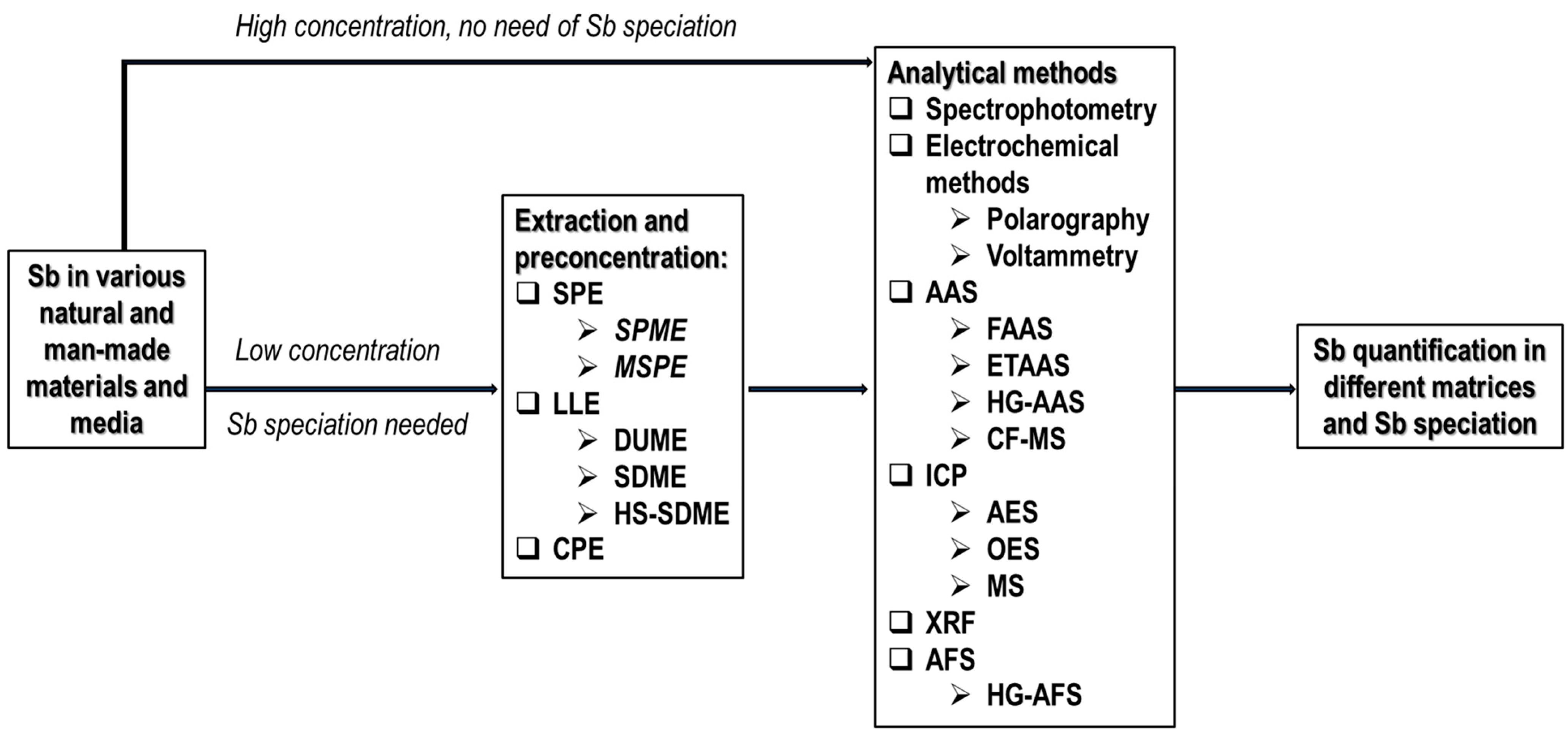
A scheme of analytical methods and preliminary sample preparation for extraction and preconcentration of Sb are presented in Figure 2.
Selected examples for the application of analytical methods used for the determination of total Sb, Sb (III), and Sb (V) speciation in different samples, as well as parameters like linear calibration range, limit of detection, and limit of quantification, are summarized in Table 3.

5. Conclusions

This study has provided a comprehensive overview of secondary antimony sources, including processing residues and end-of-life products, which could be treated to extract additional quantities of this critical element. Lead–acid batteries are currently recycled on an industrial scale to recover both lead and antimony from Pb-Sb alloys. Vacuum reduction and separation have been successfully applied to decrease the antimony concentration in lead paste to ppm levels, facilitating metal refining. With respect to antimony recovery, hydrometallurgical methods based on alkaline-sulfide or strong acids solutions have demonstrated superior results for leaching antimony from secondary sources. When combined with precipitation or electrowinning, these processes can allow for the production of Sb2O3 and metallic Sb with a high yield and purity. Significant progress has been achieved at laboratory scale in the recycling of plastics, including e-waste and PET bottles. In addition to conventional hydrometallurgical techniques, emerging approaches employing organic solvents, complexation agents, ionic liquids, and deep eutectic solvents have shown high selectivity in antimony extraction from complex matrices, followed by its recovery as antimony oxides or antimony oxychlorides with yields of up to 100%, as summarized in Table 1.
Among the available analytical techniques for antimony quantification, ICP-OES and ICP-MS have been the most preferred methods for the analysis of leachates, extracts, and digested samples, followed by AAS. Total Sb concentrations in plastics can be directly determined by XRF or GF-AAS. Speciation analysis of antimony in waste, environmental, and biological samples can typically require the separation of Sb (III) and Sb (V), commonly achieved by liquid chromatography or by extraction and preconcentration techniques such as solid-phase extraction, liquid–liquid extraction, or cloud point extraction, prior to detection using advanced hyphenated techniques. Hydride generation has been particularly effective for trace antimony determination and can be readily coupled with detection systems such as AAS, ICP, or AFS; for example, HG-AAS shows a reported limit of quantification as low as 0.9 ng m−3 (Table 3). Spectrophotometric and voltametric methods have also demonstrated excellent sensitivity, achieving detection limits at the nanomolar level (Table 3). Overall, various reliable instrumental methods have been established for accurate quantification of antimony in wide concentration ranges.
From a future perspective, further efforts and extensive research, particularly at pilot and industrial scales, are essential to improve the valorization of secondary Sb sources and to aid the efficient and sustainable recovery of critical elements such as antimony.

Author Contributions

Conceptualization, N.M. and G.G.; methodology, N.M.; resources, N.M.; data curation, G.G.; writing—original draft preparation, N.M.; writing—review and editing, M.P.; supervision, M.P.; project administration, M.P. All authors have read and agreed to the published version of the manuscript.

Funding

This research was carried out in the framework of the National Science Program “Critical and strategic raw materials for a green transition and sustainable development”, approved by the Resolution of the Council of Ministers No. 508/18.07.2024 and funded by the Ministry of Education and Science (MES) of Bulgaria.

Institutional Review Board Statement

Not applicable.

Informed Consent Statement

Not applicable.

Data Availability Statement

Not applicable.

Conflicts of Interest

The authors declare no conflicts of interest.

References

  1. Mineral Commodity Summaries 2025; Reston, VA, USA, 2025. Available online: https://pubs.usgs.gov/publication/mcs2025 (accessed on 27 November 2025).
  2. Regulation (EU) 2024/1252 of the European Parliament and of the Council of 11 April 2024 Establishing a Framework for Ensuring a Secure and Sustainable Supply of Critical Raw Materials and Amending Regulations (EU) No 168/2013, (EU) 2018/858, (EU) 2018/1724 and (EU) 2019/1020 (OJ L, 2024/1252, 3.5.2024). Available online: http://data.europa.eu/eli/reg/2024/1252/oj (accessed on 27 November 2025).
  3. About the 2025 List of Critical Minerals. Available online: https://www.usgs.gov/programs/mineral-resources-program/science/about-2025-list-critical-minerals (accessed on 5 February 2026).
  4. Dupont, D.; Arnout, S.; Jones, P.T.; Binnemans, K. Antimony Recovery from End-of-Life Products and Industrial Process Residues: A Critical Review. J. Sustain. Metall. 2016, 2, 79–103. [Google Scholar] [CrossRef]
  5. Critical Raw Materials Act. Available online: https://single-market-economy.ec.europa.eu/sectors/raw-materials/areas-specific-interest/critical-raw-materials/critical-raw-materials-act_en (accessed on 27 November 2025).
  6. Sundar, S.; Chakravarty, J. Antimony Toxicity. Int. J. Environ. Res. Public Health 2010, 7, 4267–4277. [Google Scholar] [CrossRef]
  7. Bolan, N.; Kumar, M.; Singh, E.; Kumar, A.; Singh, L.; Kumar, S.; Keerthanan, S.; Hoang, S.A.; El-Naggar, A.; Vithanage, M.; et al. Antimony contamination and its risk management in complex environmental settings: A review. Environ. Int. 2022, 158, 106908. [Google Scholar] [CrossRef]
  8. Anderson, C.G. Hydrometallurgically treating antimony-bearing industrial wastes. JOM 2001, 53, 18–20. [Google Scholar] [CrossRef]
  9. Fröhlich, P.; Lorenz, T.; Martin, G.; Brett, B.; Bertau, M. Valuable Metals—Recovery Processes, Current Trends, and Recycling Strategies. Angew. Chem. Int. Ed. 2017, 56, 2544–2580. [Google Scholar] [CrossRef]
  10. Multani, R.S.; Feldmann, T.; Demopoulos, G.P. Antimony in the metallurgical industry: A review of its chemistry and environmental stabilization options. Hydrometallurgy 2016, 164, 141–153. [Google Scholar] [CrossRef]
  11. Zhou, Y.; Ren, B.; Hursthouse, A.S.; Zhou, S. Antimony Ore Tailings: Heavy Metals, Chemical Speciation, and Leaching Characteristics. Pol. J. Environ. Stud. 2019, 28, 485–495. [Google Scholar] [CrossRef] [PubMed]
  12. Moosavi-Khoonsari, E.; Mostaghel, S.; Siegmund, A.; Cloutier, J.-P. A Review on Pyrometallurgical Extraction of Antimony from Primary Resources: Current Practices and Evolving Processes. Processes 2022, 10, 1590. [Google Scholar] [CrossRef]
  13. Kong, L.; Hu, X.; Peng, X.; He, M. Securing the global antimony supply chain. Science 2024, 386, 281. [Google Scholar] [CrossRef]
  14. Xu, L.; Zhang, Z.; Isah, M.E.; Matsubae, K. Exploring antimony material flow in the context of energy transition: A scenario-based analysis. Resour. Conserv. Recycl. 2025, 222, 108432. [Google Scholar] [CrossRef]
  15. Vinardell, S.; Luo, D.-S.; López, J.; Cortina, J.L. Techno-economic evaluation of antimony and bismuth upcycling from pyrometallurgical copper wastes. Sep. Purif. Technol. 2024, 345, 127447. [Google Scholar] [CrossRef]
  16. Panayotova, M.; Pysmennyi, S.; Panayotov, V. Antimony Recovery from Industrial Residues—Emphasis on Leaching: A Review. Separations 2025, 12, 156. [Google Scholar] [CrossRef]
  17. Bussurmanova, A.; Tabylganov, M.; Serikbayeva, A.; Baimukasheva, S.; Kizdarbekova, M.; Agaidarova, K. Methods for processing of antimony-containing materials. J. Chem. Technol. Metall. 2023, 58, 988–998. [Google Scholar] [CrossRef]
  18. Spooren, J. Solvometallurgical recovery of antimony from waste polyvinyl chloride plastic and co-extraction of organic additives. RSC Adv. 2025, 15, 531–540. [Google Scholar] [CrossRef] [PubMed]
  19. Binnemans, K.; Jones, P.T. Solvometallurgy: An emerging branch of extractive metallurgy. J. Sustain. Metall. 2017, 3, 570–600. [Google Scholar] [CrossRef]
  20. Anderson, C.G. Antimony production and commodities. In SME Mineral Processing and Extractive Metallurgy Handbook; Society of Mining, Metallurgy and Exploration: Dove Valley, CO, USA, 2019. [Google Scholar]
  21. Gao, Z.; Kong, X.; Yang, B.; Yi, J.; Fan, K.; San, T.; Cheng, K.; Li, S.; Liu, D.; Xu, B.; et al. Extraction of scattered and precious metals from lead anode slime: A short review. Hydrometallurgy 2023, 220, 106085. [Google Scholar] [CrossRef]
  22. Liu, T.; Qiu, K. Removing antimony from waste lead storage batteries alloy by vacuum displacement reaction technology. J. Hazard. Mater. 2018, 347, 334–340. [Google Scholar] [CrossRef]
  23. Liu, T.; Bao, Z.; Qiu, K. Recycling of lead from spent lead-acid battery by vacuum reduction-separation of Pb-Sb alloy coupling technology. Waste Manag. 2020, 103, 45–51. [Google Scholar] [CrossRef]
  24. Liu, W.; Yang, T.; Zhang, D.; Chen, L.; Liu, Y. A New Pyrometallurgical Process for Producing Antimony White from By-Product of Lead Smelting. JOM 2014, 66, 1694–1700. [Google Scholar] [CrossRef]
  25. Fan, K.; Wang, X.; Kong, X.; Li, B.; Yi, J.; Yang, B.; Liu, D. Oxidation transformation and vacuum separation for direct preparation of antimony trioxide products from lead anode slime. Sep. Purif. Technol. 2024, 338, 126519. [Google Scholar] [CrossRef]
  26. Che, J.; Zhang, W.; Chen, Y.; Feng, S.; Zuo, Y.; Wang, C. Progressive low-temperature volatilization control: Efficient separation of arsenic and antimony from smelter dust. Sci. Total Environ. 2024, 912, 169366. [Google Scholar] [CrossRef]
  27. Dembele, S.; Akcil, A.; Panda, S. Investigation of the characteristics of stibnite (Sb2S3) flotation tailings and extraction of critical metals (Sb and As): Optimization and scale-up. Miner. Eng. 2024, 216, 108883. [Google Scholar] [CrossRef]
  28. Sajadi, S.A.A.; Khorablou, Z.; Naeini, M.S. Recovery of antimony from acidic and alkaline leaching solution of low-grade antimony ore by electrowinning process. Heliyon 2024, 10, e35300. [Google Scholar] [CrossRef] [PubMed]
  29. Yang, T.; Rao, S.; Liu, W.; Zhang, D.; Chen, L. A selective process for extracting antimony from refractory gold ore. Hydrometallurgy 2017, 169, 571–575. [Google Scholar] [CrossRef]
  30. Awe, S.A.; Sundkvist, J.-E.; Bolin, N.-J.; Sandström, Å. Process flowsheet development for recovering antimony from Sb-bearing copper concentrates. Miner. Eng. 2013, 49, 45–53. [Google Scholar] [CrossRef]
  31. Thanu, V.R.C.; Jayakumar, M. Electrochemical recovery of antimony and bismuth from spent electrolytes. Sep. Purif. Technol. 2020, 235, 116169. [Google Scholar] [CrossRef]
  32. Benabdallah, N.; Luo, D.; Hadj Youcef, M.; Lopez, J.; Fernández de Labastida, M.; Sastre, A.M.; Valderrama, C.A.; Cortina, J.L. Increasing the circularity of the copper metallurgical industry: Recovery of Sb(III) and Bi(III) from hydrochloric solutions by integration of solvating organophosphorous extractants and selective precipitation. Chem. Eng. J. 2023, 453, 139811. [Google Scholar] [CrossRef]
  33. Ling, H.; Perin, M.; Blanpain, B.; Guo, M.; Malfliet, A. Process flowsheet development for selective arsenic removal, lead and antimony recovery from lead softening slag. Miner. Process. Extr. Metall. Rev. 2024, 45, 343–355. [Google Scholar] [CrossRef]
  34. Luo, D.; Wu, X.; Vázquez, B.; Maestre, M.; Davoise, D.; Lopez, J.; Cortina, J.L. Selective recovery of antimony from Sb-bearing copper concentrates by integration of alkaline sulphide leaching solutions and microwave-assisted heating: A new sustainable processing route. Sci. Total Environ. 2024, 951, 175576. [Google Scholar] [CrossRef] [PubMed]
  35. Alassali, A.; Abis, M.; Fiore, S.; Kuchta, K. Classification of plastic waste originated from waste electric and electronic equipment based on the concentration of antimony. J. Hazard. Mater. 2019, 380, 120874. [Google Scholar] [CrossRef]
  36. Alassali, A.; Picuno, C.; Samara, H.; Diedler, S.; Fiore, S.; Kuchta, K. Antimony Mining from PET Bottles and E-Waste Plastic Fractions. Sustainability 2019, 11, 4021. [Google Scholar] [CrossRef]
  37. Barragan, J.A.; Ponce de León, C.; Alemán Castro, J.R.; Peregrina-Lucano, A.; Gómez-Zamudio, F.; Larios-Durán, E.R. Copper and Antimony Recovery from Electronic Waste by Hydrometallurgical and Electrochemical Techniques. ACS Omega 2020, 5, 12355–12363. [Google Scholar] [CrossRef]
  38. Tostar, S.; Stenvall, E.; Boldizar, A.; Foreman, M.R.S.J. Antimony leaching in plastics from waste electrical and electronic equipment (WEEE) with various acids and gamma irradiation. Waste Manag. 2013, 33, 1478–1482. [Google Scholar] [CrossRef]
  39. Gaudin, M.; Semetey, V.; Rousseau, F.; Lefevre, G. Antimony Trioxide Extraction from E-Waste Brominated Flame-Retardant Laden Plastics by Simultaneous Liquid–Liquid Extraction and Leaching. ACS Sustain. Resour. Manag. 2025, 2, 473–480. [Google Scholar] [CrossRef]
  40. Palden, T.; Machiels, L.; Regadío, M.; Binnemans, K. Antimony Recovery from Lead-Rich Dross of Lead Smelter and Conversion into Antimony Oxide Chloride (Sb4O5Cl2). ACS Sustain. Chem. Eng. 2021, 9, 5074–5084. [Google Scholar] [CrossRef]
  41. Sudová, M.; Sisol, M.; Kanuchova, M.; Marcin, M.; Kurty, J. Environmentally Friendly Leaching of Antimony from Mining Residues Using Deep Eutectic Solvents: Optimization and Sustainable Extraction Strategies. Processes 2024, 12, 555. [Google Scholar] [CrossRef]
  42. Dupont, D.; Binnemans, K. Antimony recovery from the halophosphate fraction in lamp phosphor waste: A zero-waste approach. Green Chem. 2016, 18, 176–185. [Google Scholar] [CrossRef]
  43. Alguacil, F.J. Recent Hydrometallurgical Investigations to Recover Antimony from Wastes. Metals 2025, 15, 276. [Google Scholar] [CrossRef]
  44. Sydykov, A.O.; Zharmenov, A.A.; Mazulevsky, E.A.; Seidakhmetova, N.M.; Mnadzharova, A. Fire Refining of Rough Antimony from Impurities for Obtaining High-Grade Antimony. Metallurgist 2022, 65, 1187–1195. [Google Scholar] [CrossRef]
  45. Panayotova, M.I.; Panayotov, V.T. Antimony obtaining by hydrometallurgy—Emphasis on recovery from leach solutions. J. Min. Metall. Sect. B Metall. 2025, 61, 251–268. [Google Scholar] [CrossRef]
  46. Turner, A.; Filella, M. Antimony in paints and enamels of everyday items. Sci. Total Environ. 2020, 713, 136588. [Google Scholar] [CrossRef] [PubMed]
  47. Nalin, M.; Poulain, M.; Poulain, M.; Ribeiro, S.J.L.; Messaddeq, Y. Antimony oxide based glasses. J. Non-Cryst. Solids 2001, 284, 110–116. [Google Scholar] [CrossRef]
  48. Rezgui, S.; Soltani, M.T. Structural and optical properties of europium-doped sodium-lead-antimony glasses. Mater. Today Commun. 2023, 37, 106916. [Google Scholar] [CrossRef]
  49. Yeh, N.-T.; Chiu, P.-C.; Chyi, J.-I.; Ren, F.; Pearton, S.J. Sb-based semiconductors for low power electronics. J. Mater. Chem. C 2013, 1, 4616–4627. [Google Scholar] [CrossRef]
  50. Buekens, A.; Yang, J. Recycling of WEEE plastics: A review. J. Mater. Cycles Waste Manag. 2014, 16, 415–434. [Google Scholar] [CrossRef]
  51. Besser, A.D.; Sorokina, V.S.; Sokolov, O.K.; Paretskii, V.M. Processing of utilized lead-acid storage batteries—The basis of lead recycling. Russ. Metall. (Met.) 2009, 2009, 781–787. [Google Scholar] [CrossRef]
  52. Ramus, K.; Hawkins, P. Lead/acid battery recycling and the new Isasmelt process. J. Power Sources 1993, 42, 299–313. [Google Scholar] [CrossRef]
  53. Wu, L.; Tan, C.-H.; Ye, X. Applications of Antimony in Catalysis. ACS Org. Inorg. Au 2025, 5, 13–25. [Google Scholar] [CrossRef] [PubMed]
  54. Thiele, U.K. The current status of catalysis and catalyst development for the industrial process of poly (ethylene terephthalate) polycondensation. Int. J. Polym. Mater. 2001, 50, 387–394. [Google Scholar] [CrossRef]
  55. Zhang, Y.; Wang, C.; Ma, B.; Jie, X.; Xing, P. Extracting antimony from high arsenic and gold-containing stibnite ore using slurry electrolysis. Hydrometallurgy 2019, 186, 284–291. [Google Scholar] [CrossRef]
  56. Meng, C.; Yang, H.; Wei, X.; Xu, C.; Zeng, Y.; Xiong, H.; Yang, B.; Xu, B. Green and Effective Purification of Antimony and Recovery of Precious Metals from Noble Antimony by a New Vacuum Gasification Process. Metall. Mater. Trans. B 2024, 55, 612–625. [Google Scholar] [CrossRef]
  57. Wu, H.; Shen, Y.; Harada, N.; An, Q.; Yoshikawa, K. Production of pyrolysis oil with low bromine and antimony contents from plastic material containing brominated flame retardants and antimony trioxide. Energy Environ. Res. 2014, 4, 105–118. [Google Scholar] [CrossRef]
  58. Yang, X.; Sun, L.; Xiang, J.; Hu, S.; Su, S. Pyrolysis and dehalogenation of plastics from waste electrical and electronic equipment (WEEE): A review. Waste Manag. 2013, 33, 462–473. [Google Scholar] [CrossRef]
  59. Jakab, E.; Uddin, M.A.; Bhaskar, T.; Sakata, Y. Thermal decomposition of flame-retarded high-impact polystyrene. J. Anal. Appl. Pyrolysis 2003, 68–69, 83–99. [Google Scholar] [CrossRef]
  60. Klein, J.; Dorge, S.; Trouvé, G.; Venditti, D.; Durécu, S. Behaviour of antimony during thermal treatment of Sb-rich halogenated waste. J. Hazard. Mater. 2009, 166, 585–593. [Google Scholar] [CrossRef] [PubMed]
  61. Onwudili, J.A.; Williams, P.T. Alkaline reforming of brominated fire-retardant plastics: Fate of bromine and antimony. Chemosphere 2009, 74, 787–796. [Google Scholar] [CrossRef] [PubMed]
  62. Onwudili, J.A.; Williams, P.T. Degradation of brominated flame-retarded plastics (Br-ABS and Br-HIPS) in supercritical water. J. Supercrit. Fluids 2009, 49, 356–368. [Google Scholar] [CrossRef]
  63. de Carvalho, M.C.N.; de Souza, A.P.S.; de Oliveira Neto, J.F.; Silva, M.M.; Florencio, L.; Santos, S.M. Management and recovery of critical and strategic raw materials from E-Waste: A case study in Brazil with a focus on printed circuit boards. J. Hazard. Mater. Adv. 2025, 17, 100544. [Google Scholar] [CrossRef]
  64. Carlin, J.F., Jr. Antimony Recycling in the United States in 2000. 2000. Available online: https://pubs.usgs.gov/circ/c1196q/c1196q.pdf (accessed on 1 March 2026).
  65. Gao, Y.; Zhao, Z.; Wu, Y.; Chen, X.; Xie, H.; Wang, D.; Yin, H. Separation of antimony from lead-antimony alloy by molten salt electrolysis. Sep. Purif. Technol. 2022, 299, 121700. [Google Scholar] [CrossRef]
  66. Singh, L.N. Synthesis of potassium antimony tartrate from the antimony dross of lead smelters. Hydrometallurgy 1990, 25, 19–25. [Google Scholar] [CrossRef]
  67. Bergmann, M.E.H.; Koparal, A.S. Electrochemical antimony removal from accumulator acid: Results from removal trials in laboratory cells. J. Hazard. Mater. 2011, 196, 59–65. [Google Scholar] [CrossRef]
  68. Fernschild, G.; Rudolph, W.; Massonne, J. Process for the Recovery of Antimony Pentachloride from Used Catalyst Solutions. U.S. Patent US4005176A, 25 January 1977. [Google Scholar]
  69. Hyatt, D.E. Recovery or Arsenic and Antimony from Spent Antimony Catalyst. U.S. Patent US4722774A, 2 February 1988. [Google Scholar]
  70. Dougherty, S.J.; Garska, K.J. Recovery of Sodium and Antimony Values from Spent Ethylene Glycol Residues. U.S. Patent US4100253A, 11 July 1978. [Google Scholar]
  71. Quality Guidelines: Packaging. Available online: https://www.ema.europa.eu/en/human-regulatory-overview/research-and-development/scientific-guidelines/quality-guidelines/quality-packaging (accessed on 28 August 2025).
  72. Kiyataka, P.H.M.; Marangoni Júnior, L.; Brito, A.C.A.; Pallone, J.A.L. Migration of antimony from polyethylene terephthalate bottles to mineral water: Comparison between test conditions proposed by Brazil and the European Union. J. Food Compos. Anal. 2024, 126, 105859. [Google Scholar] [CrossRef]
  73. Biver, M.; Turner, A.; Filella, M. Antimony release from polyester textiles by artificial sweat solutions: A call for a standardized procedure. Regul. Toxicol. Pharmacol. 2021, 119, 104824. [Google Scholar] [CrossRef]
  74. Srivastava, A.M.; Sommerer, T.J. Fluorescent Lamp Phosphors. Electrochem. Soc. Interface 1998, 7, 28. [Google Scholar] [CrossRef]
  75. Watanabe, N.; Inoue, S.; Ito, H. Antimony in municipal waste. Chemosphere 1999, 39, 1689–1698. [Google Scholar] [CrossRef]
  76. Intrakamhaeng, V.; Clavier, K.A.; Liu, Y.; Townsend, T.G. Antimony mobility from E-waste plastic in simulated municipal solid waste landfills. Chemosphere 2020, 241, 125042. [Google Scholar] [CrossRef] [PubMed]
  77. Filella, M.; Hennebert, P.; Okkenhaug, G.; Turner, A. Occurrence and fate of antimony in plastics. J. Hazard. Mater. 2020, 390, 121764. [Google Scholar] [CrossRef] [PubMed]
  78. Aghabeyk, F.; Chen, B.; Brito van Zijl, M.; Ye, G. Physicochemical characterization and resource recovery potential of hazardous municipal solid waste incineration (MSWI) fly ash and air pollution control (APC) residues in the Netherlands. J. Environ. Manag. 2025, 384, 125579. [Google Scholar] [CrossRef]
  79. Nakamura, K.; Kinoshita, S.; Takatsuki, H. The origin and behavior of lead, cadmium and antimony in MSW incinerator. Waste Manag. 1996, 16, 509–517. [Google Scholar] [CrossRef]
  80. van Velzen, D.; Langenkamp, H. Antimony (Sb) in Urban and Industrial Waste and in Waste Inceneration; European Commission: Brussels, Belgium, 1996. [Google Scholar]
  81. Miravet, R.; López-Sánchez, J.F.; Rubio, R. Leachability and analytical speciation of antimony in coal fly ash. Anal. Chim. Acta 2006, 576, 200–206. [Google Scholar] [CrossRef]
  82. Trang, L.T.T.; Ngan, N.T.; Minh, N.Q.; Ha, N.M.; Lien, N.T.H.; Viet, N.M.; Phuong, N.M. Study on the Accumulation and Leaching of Heavy Metals in the Bottom Ash Samples from Municipal Solid Waste Incinerators. VNU J. Sci. Nat. Sci. Technol. 2025, 41, 48–56. [Google Scholar] [CrossRef]
  83. Van Gerven, T.; Cooreman, H.; Imbrechts, K.; Hindrix, K.; Vandecasteele, C. Extraction of heavy metals from municipal solid waste incinerator (MSWI) bottom ash with organic solutions. J. Hazard. Mater. 2007, 140, 376–381. [Google Scholar] [CrossRef]
  84. Smichowski, P. Antimony in the environment as a global pollutant: A review on analytical methodologies for its determination in atmospheric aerosols. Talanta 2008, 75, 2–14. [Google Scholar] [CrossRef]
  85. Ferreira, S.L.; dos Santos, W.N.; dos Santos, I.F.; Junior, M.M.; Silva, L.O.; Barbosa, U.A.; de Santana, F.A.; Queiroz, A.F.D.S. Strategies of sample preparation for speciation analysis of inorganic antimony using hydride generation atomic spectrometry. Microchem. J. 2014, 114, 22–31. [Google Scholar] [CrossRef]
  86. Costa Ferreira, S.L.; dos Anjos, J.P.; Assis Felix, C.S.; da Silva Junior, M.M.; Palacio, E.; Cerda, V. Speciation analysis of antimony in environmental samples employing atomic fluorescence spectrometry—Review. TrAC Trends Anal. Chem. 2019, 110, 335–343. [Google Scholar] [CrossRef]
  87. Zhang, Y.; Ding, C.; Gong, D.; Deng, Y.; Huang, Y.; Zheng, J.; Xiong, S.; Tang, R.; Wang, Y.; Su, L. A review of the environmental chemical behavior, detection and treatment of antimony. Environ. Technol. Innov. 2021, 24, 102026. [Google Scholar] [CrossRef]
  88. Wang, H.; Lv, Z.; Wang, B.; Wang, Y.-n.; Sun, Y.; Tsang, Y.F.; Zhao, J.; Zhan, M. Effective stabilization of antimony in Waste-to-Energy fly ash with recycled laboratory iron-rich residuals. J. Clean. Prod. 2019, 230, 685–693. [Google Scholar] [CrossRef]
  89. Filella, M. Antimony and PET bottles: Checking facts. Chemosphere 2020, 261, 127732. [Google Scholar] [CrossRef]
  90. Moreno-Andrade, I.; Regidor-Alfageme, E.; Durazo, A.; Field, J.A.; Umlauf, K.; Sierra-Alvarez, R. LC-ICP-OES method for antimony speciation analysis in liquid samples. J. Environ. Sci. Health Part A 2020, 55, 457–463. [Google Scholar] [CrossRef] [PubMed]
  91. Jabłońska-Czapla, M.; Szopa, S. Arsenic, antimony and chromium speciation using HPLC-ICP-MS in selected river ecosystems of Upper Silesia, Poland—A preliminary study and validation of methodology. Water Supply 2015, 16, 354–361. [Google Scholar] [CrossRef]
  92. Michalski, R.; Szopa, S.; Jabłońska, M.; Łyko, A. Application of Hyphenated Techniques in Speciation Analysis of Arsenic, Antimony, and Thallium. Sci. World J. 2012, 2012, 902464. [Google Scholar] [CrossRef]
  93. Maher, W.; Krikowa, F.; Ellwood, M.; Foster, S.; Jagtap, R.; Raber, G. Overview of hyphenated techniques using an ICP-MS detector with an emphasis on extraction techniques for measurement of metalloids by HPLC–ICPMS. Microchem. J. 2012, 105, 15–31. [Google Scholar] [CrossRef]
  94. Wu, L.; Zhong, Z.; Wang, Z.; Du, X.; Tao, X.; Zhou, J.; Dang, Z.; Lu, G. Antimony release from e-waste-derived microplastics in aqueous environments: Effect of plastic properties and environmental factors. Environ. Pollut. 2025, 368, 125774. [Google Scholar] [CrossRef] [PubMed]
  95. Altunay, N.; Gürkan, R. A new cloud point extraction procedure for determination of inorganic antimony species in beverages and biological samples by flame atomic absorption spectrometry. Food Chem. 2015, 175, 507–515. [Google Scholar] [CrossRef] [PubMed]
  96. Mendil, D.; Bardak, H.; Tuzen, M.; Soylak, M. Selective speciation of inorganic antimony on tetraethylenepentamine bonded silica gel column and its determination by graphite furnace atomic absorption spectrometry. Talanta 2013, 107, 162–166. [Google Scholar] [CrossRef]
  97. Belarra, M.A.; Belategui, I.; Lavilla, I.; Anzano, J.M.; Castillo, J.R. Screening of antimony in PVC by solid sampling-graphite furnace atomic absorption spectrometry. Talanta 1998, 46, 1265–1272. [Google Scholar] [CrossRef]
  98. Feng, X.J.; Fu, B. Determination of arsenic, antimony, selenium, tellurium and bismuth in nickel metal by hydride generation atomic fluorescence spectrometry. Anal. Chim. Acta 1998, 371, 109–113. [Google Scholar] [CrossRef]
  99. Correia, F.O.; Almeida, T.S.; Garcia, R.L.; Queiroz, A.F.S.; Smichowski, P.; da Rocha, G.O.; Araujo, R.G.O. Sequential determination and chemical speciation analysis of inorganic As and Sb in airborne particulate matter collected in outdoor and indoor environments using slurry sampling and detection by HG AAS. Environ. Sci. Pollut. Res. 2019, 26, 21416–21424. [Google Scholar] [CrossRef]
  100. Welna, M.; Zyrnicki, W. Investigation of Simultaneous Generation of Arsenic, Bismuth and Antimony Hydrides Using Inductively Coupled Plasma Optical Emission Spectrometry. Anal. Lett. 2011, 44, 942–953. [Google Scholar] [CrossRef]
  101. Crispino, C.C.; Lemos, S.; Kamogawa, M.; Nogueira, A.R. Simultaneous determination of arsenic, antimony and selenium in agronomic samples by hydride generation and optical emission spectrometry. Braz. J. Anal. Chem. 2013, 3, 460–467. [Google Scholar]
  102. Dhana Sekharan, R.; Raghavan, R.; Agarwal, L.K. Determination of antimony in impure zinc sulphate solution by coprecipitation followed by differential pulse anodic stripping voltammetry. Talanta 1996, 43, 1069–1073. [Google Scholar] [CrossRef]
  103. Zong, P.; Nagaosa, Y. Determination of Antimony (III) and (V) in Natural Water by Cathodic Stripping Voltammetry with in-situ Plated Bismuth Film Electrode. Microchim. Acta 2009, 166, 139–144. [Google Scholar] [CrossRef]
  104. Kolliopoulos, A.V.; Metters, J.P.; Banks, C.E. Screen printed graphite electrochemical sensors for the voltammetric determination of antimony(iii). Anal. Methods 2013, 5, 3490–3496. [Google Scholar] [CrossRef]
  105. Lu, M.; Toghill, K.E.; Phillips, M.A.; Compton, R.G. Anodic stripping voltammetry of antimony at unmodified carbon electrodes. Int. J. Environ. Anal. Chem. 2013, 93, 213–227. [Google Scholar] [CrossRef]
  106. Ariño, C.; Serrano, N.; Díaz-Cruz, J.M.; Esteban, M. Voltammetric determination of metal ions beyond mercury electrodes. A review. Anal. Chim. Acta 2017, 990, 11–53. [Google Scholar] [CrossRef]
  107. Tsukahara, I.; Sakakibara, M.; Tanaka, M. Extraction-spectrophotometric determination of traces of antimony in copper and lead metals and in lead-base alloy with pyrocatechol violet and tri-n-octylamine. Anal. Chim. Acta 1977, 92, 379–386. [Google Scholar] [CrossRef]
  108. Abu-Hilal, A.H.; Riley, J.P. The spectrophotometric determination of antimony in water, effluents, marine plants and silicates. Anal. Chim. Acta 1981, 131, 175–186. [Google Scholar] [CrossRef]
  109. Sato, S. Differential determination of antimony(III) and antimony(V) by solvent extraction-spectrophotometry with mandelic acid and Malachite Green, based on the difference in reaction rates. Talanta 1985, 32, 341–344. [Google Scholar] [CrossRef]
  110. Abbaspour, A.; Baramakeh, L. Simultaneous determination of antimony and bismuth by beta-correction spectrophotometry and an artificial neural network algorithm. Talanta 2005, 65, 692–699. [Google Scholar] [CrossRef]
  111. Yonehara, N.; Fuji, T.; Sakamoto, H.; Kamada, M. Differential determination of antimony(III) and antimony(V) by indirect spectrophotometry with chromium(VI) and diphenylcarbazide, after reduction of antimony(V). Anal. Chim. Acta 1987, 199, 129–135. [Google Scholar] [CrossRef]
  112. Moustafa, I.M.I.; Amin, A.S.; Darwish, E. A novel bulk optode for ultra-trace detection of antimony coupled with spectrophotometry in food and environmental samples. Talanta Open 2023, 7, 100197. [Google Scholar] [CrossRef]
  113. Sun, X.; Zhang, C.; Pan, Y.; Mei, H.; Song, J.; Zhou, M. Coupling ozone-based AOPs with DLLME for simultaneous determination of trace free antimony and total antimony in surface water. RSC Adv. 2025, 15, 16734–16741. [Google Scholar] [CrossRef]
  114. Ferreira, S.L.C.; Silva, L.O.B.; de Santana, F.A.; Junior, M.M.S.; Matos, G.D.; dos Santos, W.N.L. A review of reflux systems using cold finger for sample preparation in the determination of volatile elements. Microchem. J. 2013, 106, 307–310. [Google Scholar] [CrossRef]
  115. Saracoglu, S.; Soylak, M.; Dogan, M.; Elci, L. Speciation of Antimony Using Chromosorb 102 Resin as a Retention Medium. Anal. Sci. 2003, 19, 259–264. [Google Scholar] [CrossRef]
  116. Ozdemir, N.; Soylak, M.; Elci, L.; Dogan, M. Speciation analysis of inorganic Sb(III) and Sb(V) ions by using mini column filled with Amberlite XAD-8 resin. Anal. Chim. Acta 2004, 505, 37–41. [Google Scholar] [CrossRef]
  117. Bosch Ojeda, C.; Sánchez Rojas, F.; Cano Pavón, J.M.; Terrer Martín, L. Use of 1,5-bis(di-2-pyridyl)methylene thiocarbohydrazide immobilized on silica gel for automated preconcentration and selective determination of antimony(III) by flow-injection electrothermal atomic absorption spectrometry. Anal. Bioanal. Chem. 2005, 382, 513–518. [Google Scholar] [CrossRef] [PubMed]
  118. Calvo Fornieles, A.; García de Torres, A.; Vereda Alonso, E.; Siles Cordero, M.T.; Cano Pavón, J.M. Speciation of antimony(iii) and antimony(v) in seawater by flow injection solid phase extraction coupled with online hydride generation inductively coupled plasma mass spectrometry. J. Anal. At. Spectrom. 2011, 26, 1619–1626. [Google Scholar] [CrossRef]
  119. Mester, Z.; Sturgeon, R. Trace element speciation using solid phase microextraction. Spectrochim. Acta Part B At. Spectrosc. 2005, 60, 1243–1269. [Google Scholar] [CrossRef]
  120. Zhao, L.-y.; Fei, J.-j.; Lian, H.-z.; Mao, L.; Cui, X.-b. Simultaneous speciation analysis of chromium and antimony by novel carboxyl-functionalized hybrid monolithic column solid phase microextraction coupled with ICP-MS. J. Anal. At. Spectrom. 2019, 34, 1693–1700. [Google Scholar] [CrossRef]
  121. Li, P.; Chen, Y.-j.; Hu, X.; Lian, H.-z. Magnetic solid phase extraction for the determination of trace antimony species in water by inductively coupled plasma mass spectrometry. Talanta 2015, 134, 292–297. [Google Scholar] [CrossRef] [PubMed]
  122. Carabajal, M.; Teglia, C.M.; Cerutti, S.; Culzoni, M.J.; Goicoechea, H.C. Applications of liquid-phase microextraction procedures to complex samples assisted by response surface methodology for optimization. Microchem. J. 2020, 152, 104436. [Google Scholar] [CrossRef]
  123. Viana, J.L.M.; Menegário, A.A.; Fostier, A.H. Preparation of environmental samples for chemical speciation of metal/metalloids: A review of extraction techniques. Talanta 2021, 226, 122119. [Google Scholar] [CrossRef]
  124. Serafimovska, J.M.; Arpadjan, S.; Stafilov, T. Speciation of dissolved inorganic antimony in natural waters using liquid phase semi-microextraction combined with electrothermal atomic absorption spectrometry. Microchem. J. 2011, 99, 46–50. [Google Scholar] [CrossRef]
  125. Fan, Z. Determination of antimony(III) and total antimony by single-drop microextraction combined with electrothermal atomic absorption spectrometry. Anal. Chim. Acta 2007, 585, 300–304. [Google Scholar] [CrossRef]
  126. Fragueiro, S.; Lavilla, I.; Bendicho, C. Headspace sequestration of arsine onto a Pd(II)-containing aqueous drop as a preconcentration method for electrothermal atomic absorption spectrometry. Spectrochim. Acta Part B At. Spectrosc. 2004, 59, 851–855. [Google Scholar] [CrossRef]
  127. Zeng, C.; Yang, F.; Zhou, N. Hollow fiber supported liquid membrane extraction coupled with thermospray flame furnace atomic absorption spectrometry for the speciation of Sb(III) and Sb(V) in environmental and biological samples. Microchem. J. 2011, 98, 307–311. [Google Scholar] [CrossRef]
  128. Ojeda, C.B.; Rojas, F.S. Separation and preconcentration by cloud point extraction procedures for determination of ions: Recent trends and applications. Microchim. Acta 2012, 177, 1–21. [Google Scholar] [CrossRef]
  129. Bezerra, M.d.A.; Arruda, M.A.Z.; Ferreira, S.L.C. Cloud Point Extraction as a Procedure of Separation and Pre-Concentration for Metal Determination Using Spectroanalytical Techniques: A Review. Appl. Spectrosc. Rev. 2005, 40, 269–299. [Google Scholar] [CrossRef]
  130. Fan, Z. Speciation Analysis of Antimony (III) and Antimony (V) by Flame Atomic Absorption Spectrometry After Separation/Preconcentration with Cloud Point Extraction. Microchim. Acta 2005, 152, 29–33. [Google Scholar] [CrossRef]
  131. Oliveira Souza, J.M.; Tarley, C.R.T. Preconcentration and Speciation of Sb(III) and Sb(V) in Water Samples and Blood Serum after Cloud Point Extraction Using Chemometric Tools for Optimization. Anal. Lett. 2008, 41, 2465–2486. [Google Scholar] [CrossRef]
  132. Samadi-Maybodi, A.; Rezaei, V. A cloud point extraction for spectrophotometric determination of ultra- trace antimony without chelating agent in environmental and biological samples. Microchim. Acta 2012, 178, 399–404. [Google Scholar] [CrossRef]
Figure 1. Estimated world mine production and reserves for 2024 (data from [1]).
Applsci 16 02628 g001
Figure 2. Roadmap of antimony analysis.
Applsci 16 02628 g002
Table 1. Methods of processing of secondary sources for Sb recovery.
Method of ProcessingSourceReagents/
Conditions
Sb Recovery
Form
Recovery, %Purity, %Ref.
Vacuum evaporationSpent lead–acid batteryPbO, 30 Pa,
840 °C, 60 min
Sb2O3Reduced Sb content from
2.5% to 23 ppm
not given[22]
Vacuum reduction–separationSpent lead–acid batteryPbO2, PbCO3, Pb(OH)2, 30 Pa,
810 °C, 50 min
Sb2O3Reduced Sb content from
46% to 0.98%
not given[23]
Oxidation and vacuum separationLead anode
slime
O2, 450 °C, 5 PaSb2O39999.9[25]
Roasting and volatilization Flue dustC and H2SO4
400 °C
Sb2O3,
Sb2O5
90.57not given[26]
HydrometallurgyStibnite
tailings
HCl/HNO3/H2SO4 and FeCl3/NaNO3/KNO3soluble
Sb species
66–99
leaching
[27]
Electrowinning from acidic and alkaline solutionsLow-grade
Sb ore
5M NaOH
5M HCl/5M H2SO4
Sb metal85
87
89
97
[28]
HydrometallurgyRefractory
Au ore
Na2SNaSb(OH)696.6459[29]
Hydrometallurgy/
electrodeposition
Cu
concentrate
Na2S,
NaOH
Sb metal7499.8[30]
ElectrowinningSpent
electrolytes
Potential −0.5 V
current density 5 A/dm2
Sb metal81.7not given[31]
Selective separation by ion-exchange and solvent extractionElectrorefining electrolyteAminophosphonic resins, 6M HCl, CaOSbOCl, Sb2O3>90not given[32]
Pyro-,
hydrometallurgy
Lead softening slagNaOH, 400 °C
C reduction and HNO3 leaching
Sb2O397.8
in residue
64.7[33]
HydrometallurgyCu concentrateNa2S, NaOH, microwave assistedSb or Sb2O395.7not given[34]
Hydrometallurgye-waste(i) Aqua regia
(ii) Aqua regia, 600 °C
soluble
Sb species
[35]
HydrometallurgyPET bottles
e-waste
(i) aqua regia
(ii) 18 M H2SO4
(iii) 12 M HCl
(iv) 6 M HCl
soluble
Sb species
57–92%
20–21%
[36]
Hydrometallurgye-wasteFeCl3/HCl
Precipitation of Sb with NaOH
Sb2O381high purity[37]
SolvometallurgyPVC4M HCl/ethanol,
80 °C
Sb4Cl2O59599.8[18]
Solvometallurgye-wasteSodium hydrogen tartrate in dimethyl sulfoxidesoluble
Sb species
50[38]
Solvometallurgy
Liquid–liquid extraction
e-wasteTartaric acid
CH2Cl2
Sb2O398 [39]
SolvometallurgyPb-Sb residueHCl in organic solvents (ethanol,
1-octanol, ethylene glucol, Aliquat 336)
Sb4O5Cl290high purity[40]
SolvometallurgyMining residueEutectic solvents
choline chloride, ethylene glycol,
iodine
Sb2O3100high purity[41]
Selective extraction
by ionic liquid
Sb-containing phosphorHCl, ionic liquid (Aliquat 336)SbOCl, Sb2O399.9999.99[42]
Table 2. End-of-life products as antimony sources.
Industrial ProductsFlame RetardantPb-Sb AlloysCatalystsDopant in LuminophoresOthers
Forms of
antimony
Sb2O3Sb metalSb2O3
Sb2(OCH2CH2O)3
Sb(CH3COO)3
Sb3+Sb2O3
Sb2S3
Sb2S3
Sb2O3-basedAsSb
GaSb
InSb
ApplicationPlastics, electronicsElectrodes for lead–acid batteriesCatalysts for production of PET, fluorination of chlorinated hydrocarbonsPhosphors for fluorescent lampPaint
pigments
In optical glass for cameras, binocularsSemi
conductors
Reference[35,50][51,52][53,54][42][46][47,48][49]
Table 3. Analytical techniques for determination of Sb.
Analytical
Techniques
SpeciationSampleCalibration
Range
LOD *LOQ **Ref.
ICP-OESSbPET bottles digested in HNO3/H2SO41–15 μg L0.5 μg L−11.0 μg L−1[72]
LC-ICP-OESSb (III)Aqueous12.5–5000 μg L−124.9–32.3 μg L−180.7 μg L−1[90]
Sb (V) 36.2–46.0 μg L−149.9 μg L−1
FAASSb (III)Biological0.175–3.25 mg L−1154.3 μg L−1227.7 μg L−1[95]
Sb (V)Beverages0.25–4.75 mg L−1245.2 μg L−1360.7 μg L−1
CPE/FAASSb (III)Biological10–400 μg L−15.15 μg L−111.60 μg L−1[95]
Sb (V)Beverages1–250 μg L−10.25 μg L−11.12 μg L−1
SFE/GF-AASSb (III)Water, food 0.020 μg L-10.067 μg L−1[96]
HG-AASSbAirborne particulate matter1.0–10.0 μg L−10.3 ng mg−30.9 ng m−3[99]
VoltammetrySb (III) 10–40 nmol L−13.9 nmol L−1 [105]
Spectro
photometry
Sb (III),
total Sb
Biological, Environmental2.5 × 10−8
4.0 × 10⁻⁵ mol L−1
7.0 × 10⁻⁹ mol L−12.4 × 10⁻⁸ mol L−1[112]
Liquid–liquid extraction/spectrophotometrySb (III),
total Sb
Surface water1–30 μg L−10.3208 μg L−1 [113]
* LOD (limit of detection); ** LOQ (limit of quantification).
Disclaimer/Publisher’s Note: The statements, opinions and data contained in all publications are solely those of the individual author(s) and contributor(s) and not of MDPI and/or the editor(s). MDPI and/or the editor(s) disclaim responsibility for any injury to people or property resulting from any ideas, methods, instructions or products referred to in the content.