Review

The Convergence of Federated Learning, Knowledge Graphs, and Large Language Models for Language Learning: A Scoping Review

by
Michael Kenteris
* and
Konstantinos Kotis
Department of Cultural Technology and Communication, University of the Aegean, 81100 Mytilene, Greece
*
Author to whom correspondence should be addressed.
Appl. Sci. 2026, 16(5), 2611; https://doi.org/10.3390/app16052611
Submission received: 18 January 2026 / Revised: 2 March 2026 / Accepted: 3 March 2026 / Published: 9 March 2026
(This article belongs to the Special Issue Enhancing User Experience in Automation and Control Systems)

Abstract

Large Language Models (LLMs) in Intelligent Computer-Assisted Language Learning enable highly personalized learning, yet raise significant challenges related to pedagogical grounding, data privacy, and instructional validity. Although Knowledge Graphs (KGs) and Federated Learning (FL) can mitigate these issues in isolation, evidence on systematic FL–KG–LLM integration for educational language learning remains limited. This scoping review maps the FL–KG–LLM convergence landscape. Following PRISMA-ScR guidelines, we searched six databases and screened 51 papers (2019–2025) using automated extraction. Our findings indicate limited convergence: no papers integrate all three domains, and 58.8% of approaches remain confined to isolated technological silos. Reporting is also uneven across the corpus, with an average “Not Reported” (NR) rate of 84.5%, most notably for privacy mechanisms (92.2%), validation metrics (90.2%), and Common European Framework of Reference for Languages (CEFR) alignment (88.2%). Domain-specific analysis reveals two distinct patterns: inter-domain gaps (disciplinary silos resulting in expected CEFR absence in single-domain papers) and intra-domain gaps (failure to report domain-critical variables, including 100% parameter NR in FL studies, 86.7% validation NR in KG studies, and 100% CEFR NR in convergence papers). Taken together, these gaps suggest that pedagogical grounding is treated as optional rather than structural. We therefore identify two pillars of pedagogical grounding: a Grounding Pillar, which constrains LLM outputs via Knowledge Graph rules, and a Validation Pillar, which concerns how authoritative frameworks (e.g., CEFR) are mapped onto Knowledge Graph schemas and evaluated. The near-universal absence of CEFR alignment and validation reporting suggests that this second pillar is currently missing, which we term the Integrity Gap—a systematic disconnection between technological innovation and pedagogical grounding inin Intelligent Computer-Assisted Language Learning. By reframing the problem as upstream control and validation, this review informs the design of user-facing automated systems where trust, transparency, and human oversight are critical.

1. Introduction

1.1. Problem Framing and Definitions

Intelligent Computer-Assisted Language Learning (iCALL) refers to interactive language-learning systems that provide automated support (e.g., tutoring, feedback, and content generation) to learners. In current practice and emerging research, such systems may incorporate large language models to enable conversational practice and highly personalized instruction at scale.
As LLM-enabled iCALL moves closer to instructional decision-making, three interconnected challenges are central for trustworthy educational use: (i) pedagogical grounding (alignment with established educational frameworks such as the Common European Framework of Reference for Languages, CEFR), (ii) data privacy and governance (sensitive learner interaction data and institutional constraints), and (iii) instructional validity and reliability (stochastic outputs, hallucinations, and misalignment with proficiency targets). These challenges motivate the need to understand how current research operationalizes and reports integrated solutions rather than treating them as independent concerns.

1.2. Technological Foundations: Federated Learning, Knowledge Graphs, and Large Language Models

We briefly summarize the three technological families most often proposed to address these challenges. Federated Learning (FL) enables multiple distributed sites to train a shared model without sharing raw data. Each site trains locally and sends model updates to a central server that aggregates them. FL is commonly used when centralized data sharing is constrained by privacy, governance, or ownership considerations. In practice, FL systems must also address real-world constraints such as unreliable clients, limited communication bandwidth, and heterogeneity across local datasets. A common baseline approach is FedAvg, which averages participant updates [1,2,3,4].
Knowledge Graphs (KGs) represent structured knowledge as entities and relations, enabling explicit semantics, querying, and—when formally defined—reasoning. In educational and language-learning contexts, KGs can encode pedagogical structures in an inspectable form. This explicit structure is frequently positioned as a means to support interpretability and provide constraint surfaces for downstream models, particularly when instructional systems must align with recognized educational standards such as CEFR [5,6].
Large Language Models (LLMs) are generative neural models capable of producing fluent text and supporting interactive instructional experiences. In education, LLMs offer opportunities for scalable personalization and new forms of learner support, but are also associated with documented risks—most notably unreliability, hallucination-like behavior, and broader concerns around training and deployment. These benefits and risks are especially salient in language learning, where generated outputs must remain instructionally appropriate and aligned with proficiency targets rather than merely fluent [7,8,9].
Together, FL, KGs, and LLMs are frequently presented as complementary building blocks for privacy-preserving personalization (FL), explicit pedagogical representation and constraint surfaces (KGs), and interactive generation (LLMs). At the same time, their combination introduces practical requirements for governance, validation, and transparent reporting—so that claims about privacy preservation, pedagogical alignment, and reliability can be audited and replicated. However, it remains unclear to what extent current educational language-learning research operationalizes and reports FL–KG–LLM integration in a unified, auditable way. This motivates the present scoping review of FL–KG–LLM convergence in iCALL.

1.3. The Paradox of Personalization in iCALL

The growing use of LLMs in iCALL intensifies a paradox: systems can provide unprecedented personalization and interactivity, yet privacy risks, pedagogical misa-lignment, and output unreliability become more consequential as these systems in-creasingly shape learners’ practice and feedback.
LLMs have accelerated AI-enabled language learning by enabling interactive tutoring and personalized content generation [7,8,10,11]. However, as LLM-enabled systems move closer to instructional decision-making, they intensify a triad of challenges: pedagogical grounding, data privacy, and instructional validity [9]. Pedagogical grounding concerns whether outputs align with established frameworks such as CEFR [5], and whether generated content is appropriate for learners’ developmental level (e.g., ZPD) [12]. Instructional validity is challenged by unreliable outputs, including hallucinations and inconsistent alignment with instructional objectives [13]. These pressures motivate increasing interest in complementary components such as KGs for explicit constraints [6] and FL for privacy-preserving personalization [2,4], alongside LLM adaptation approaches (e.g., fine-tuning) [14,15,16].
To date, these issues are often addressed in isolation—KGs for structure and constraints, FL for privacy-preserving personalization, and LLM adaptation (e.g., fine-tuning) for improved relevance—without a consistent, auditable approach that integrates all three dimensions simultaneously.
Accordingly, the core question is not whether any single technology can help, but whether integrated FL–KG–LLM approaches are being operationalized and reported in a way that enables replication, evaluation, and pedagogy-aligned deployment. Because the extent and transparency of such integration remain unclear, we map the current convergence landscape and examine methodological reporting practices and peda-gogical operationalization choices that determine whether proposed systems can translate into deployable instructional settings.

1.4. The Dual-Pillar Grounding Problem

A central barrier to trustworthy iCALL is that grounding is often treated as a downstream control problem (constraining model outputs) without equal attention to the upstream representational validity of the pedagogical knowledge being used. To make this challenge actionable, we distinguish two complementary pillars of grounding: a Grounding Pillar, which constrains LLM outputs via KG-based retrieval and rules, and a Validation Pillar, which specifies how authoritative frameworks (e.g., CEFR) are translated into KG schemas and how the fidelity of that translation is verified.
While retrieval-augmented and neurosymbolic approaches can support the Grounding Pillar by constraining generation through structured knowledge [17,18], the Validation Pillar raises a distinct question: how studies justify and document the source-framework-to-schema transformation, including mapping decisions and evaluation of representational fidelity. In language education, CEFR descriptors provide an external specification of pedagogical intent against which alignment claims can, in principle, be audited.
Consequently, this review asks: To what extent are FL, KGs, and LLMs integrated in educational language-learning contexts, and what gaps in validation, governance, and reporting prevent auditable, pedagogy-aligned deployment?

1.5. Research Questions and Scope

Primary research questions (RQs):
RQ1: What is the convergence landscape of FL, KGs, and LLMs in iCALL research (2019–2025)?
RQ2: What methodological and reporting information is provided for hybrid FL–KG–LLM systems, and how consistent is that reporting across studies?
RQ3: How do papers operationalize the Validation Pillar—i.e., how are authoritative frameworks (e.g., CEFR) translated into KG schemas, and how is representational fidelity verified?
Secondary research questions:
RQ4: What pedagogical validation metrics are used in iCALL-related studies?
RQ5: What barriers prevent convergence despite the maturity of each individual domain?
The remainder of this paper is organized as follows: Section 2 presents the research methodology, including the research protocol and search strategy following PRISMA-ScR guidelines. Section 3 reports the results, including the selection process and characteristics of included studies. Section 4 discusses the findings, highlighting key gaps and future research directions. Section 5 concludes with implications for practice and research.

2. Materials and Methods

2.1. Methodological Overview

Automated tooling supported screening and extraction (structured prompts, batch extraction, and relevance filtering); for methodological context on such relevance filtering, we draw on document-ranking work in information retrieval [19]. This scoping review follows established scoping-review methodology [20,21,22] and is reported in accordance with PRISMA-ScR [23], informed by PRISMA 2020 guidance [24]. We conducted post hoc registration on the Open Science Framework (OSF; see Data Availability Statement) on 23 December 2025, positioning registration before the critical data extraction and synthesis stages to reduce bias while acknowledging that the search and initial screening phases were retrospective. Several phases were iterative and partially overlapping (e.g., search refinement occurred alongside early screening); however, the extraction codebook, analytical thresholds, and synthesis procedures were preregistered prior to running automated extraction and corpus-level analyses. The compressed timeline was feasible because screening and extraction were supported by automated tooling (structured prompts and batch extraction), complemented by manual verification on sampled subsets. Time-stamped workflow artifacts (search logs, screening decisions, extraction outputs, and protocol versions) are archived on OSF to provide an auditable record of the workflow. The research phases and their retrospective/prospective status are summarized in Table 1.
Rationale for scoping review design: A scoping review is appropriate for mapping convergence in emerging interdisciplinary fields [25] where integration is nascent, variation in study designs are extreme, and synthesis questions focus on landscape characterization rather than intervention effectiveness.
Study selection timeline documenting research phases, approximate dates, methodological status (retrospective vs. prospective), and key procedures. Note: Phases 1–4 were conducted retrospectively prior to OSF registration (23 December 2025), whereas Phases 5–8 were conducted prospectively after registration, reducing bias in extraction and synthesis decisions. Several phases were iterative and partially overlapping (e.g., search refinement continued alongside early screening; extraction proceeded in batches as full texts became available). Time-stamped logs, protocol versions, screening decisions, and extraction outputs are archived on OSF (see Data Availability Statement) to support auditability.
Scope Note on Foundational References: While the primary study corpus comprises 51 papers meeting full inclusion criteria (educational context, 2019–2025 publication, explicit FL/KG/LLM focus), select foundational works in federated learning privacy are cited in the Results section for technical specifications and methodological context. These references (e.g., [26,27]) were excluded from primary studies due to non-educational application or publication date but remain relevant for informing future educational implementations.

2.2. Search Strategy and Information Sources

We searched six databases spanning computer science, information systems, and education. The initial hit distribution across the six databases is shown in Table 2.
The largest yields were obtained from IEEE Xplore and Scopus. To manage scope, only the first ten pages of Google Scholar results were screened. arXiv was included due to the high proportion of relevant preprints (approximately 40–50%) in emerging fields. Targeted snowballing from reference lists supplemented the database searches. Records were identified via database searches and supplemented by targeted snowballing (Supplementary citation searching) from reference lists. Inclusion was determined exclusively by the predefined eligibility criteria applied during screening, and all synthesis and statistical summaries were computed only on the final screened included set.
Search strategy evolution: The search strategy was operationalized through three iterative query phases to capture convergence without false positives. Initial broad queries yielded unmanageable results with low relevance; relevance was operationalized at title/abstract screening as meeting the predefined inclusion criteria (educational language-learning/iCALL context, 2019–2025, and explicit FL/KG/LLM coverage—at least two components or an integrated architecture). We therefore constrained the search to the FL–KG–LLM intersection to ensure papers addressed all three technologies rather than general AI-in-education contexts.
  • Phase 1 (Broad): (LLM OR “large language model” OR GPT * / “Generative Pre-trained Transformer”) AND (iCALL OR “language learning” OR “language instruction”)
  • Phase 2 (Convergence-focused): (Federated Learning OR FL) AND (Knowledge Graph OR KG) AND (LLM OR “language model”)
  • Phase 3 (Integration): (FL-KG-LLM OR “federated knowledge graphs” OR “privacy-preserving language learning”)
Database-specific Boolean operators, wildcard conventions, and phrase-search syntax varied across platforms and required query adaptation; full technical search syntax details are provided in the Supplementary Materials (S1), (Database Search Syntax).
Temporal scope: 2019–2025, capturing the emergence of modern transformer-based LLMs (GPT-2+) coinciding with federated learning [1] maturity.
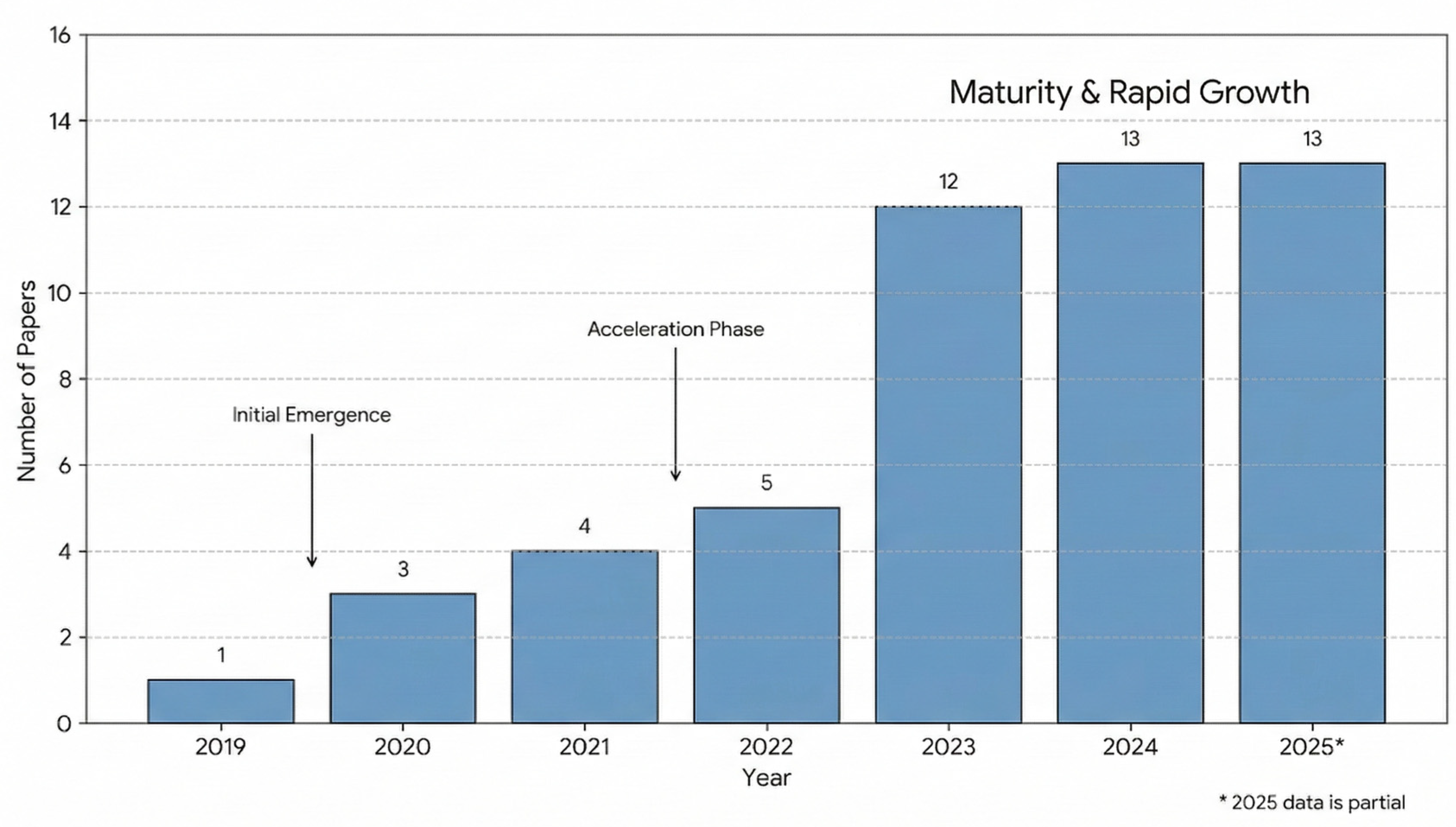
The temporal distribution of included papers is shown in Figure 1. Publication activity accelerates sharply after 2022, with 74.5% of included studies (n = 38) published between 2023 and 2025. This temporal distribution reflects the nascent maturity of the field, which emerged only after several foundational technologies reached sufficient maturity, including the revision of the CEFR through the CV (2020), the emergence of transformer-based large language models (2018), and the standardization of federated learning approaches (2019). Early publications (2019–2020, n = 4) primarily reflect foundational explorations, followed by a transitional phase (2021–2022, n = 9) showing early convergence, and a recent period (2023–2025, n = 38) characterized by rapidly increasing research interest.

Search Strategy Evolution Rationale

Our three-phase search strategy evolved from exploratory to targeted as we learned the convergence landscape. This iterative approach reflects the scoping review methodology’s exploratory nature, where the research phenomenon (FL-KG-LLM convergence) may be poorly characterized initially.
Phase 1 (Broad Discovery—November 2025): Initial searches established the upper bound of AI-in-education literature addressing language learning, regardless of convergence. Queries targeted LLM applications broadly ((LLM OR “large language model”) AND (iCALL OR “language learning”)). This phase revealed dominance of single-domain LLM applications (prompt engineering, fine-tuning) without FL or KG integration. From ~660 initial hits, 78.9% were excluded at title/abstract screening—a high rejection rate justified by the intentionally overinclusive design.
Phase 2 (Convergence-Focused—November 2025): After Phase 1 screening revealed 0/80 candidates were convergent, we refined queries to directly target FL-KG-LLM intersection ((Federated Learning) AND (Knowledge Graph) AND (LLM)). This phase tested whether the convergence deficit was real or a search artifact. Minimal new hits confirmed convergence deficit.
Phase 3 (Integration-Specific—December 2025): Final searches targeted specialized terminology (‘federated knowledge graphs,’ ‘privacy-preserving language learning’) that might not use FL/KG/LLM keywords explicitly. Zero new papers suggested convergence deficit is not merely terminological.
Rationale for Iterative Approach: In emerging interdisciplinary fields, optimal search terms may be unknown a priori. Our phased strategy balances breadth (avoiding missing relevant papers) with precision (reducing false positives). While retrospective, this evolution is documented transparently to enable replication and assessment of potential bias.
Limitations: This approach may miss (1) foundational work published before 2019 (temporal scope), and (2) papers using alternative terminology not captured in our three phases (e.g., distributed knowledge graphs’ instead of ‘federated learning’).

2.3. Screening and Selection Process

Inclusion criteria:
  • Research papers explicitly addressing at least two of the following technologies: Federated Learning, Knowledge Graphs, and Large Language Models, or proposing integrated architectures combining these technologies for language learning applications.
  • Educational context: language learning, iCALL, or natural language instruction.
  • Published between 2019 and 2025.
  • Available in English.
Exclusion criteria:
  • Non-educational applications (healthcare, finance, general NLP) unless pedagogically transferable.
  • Insufficient technical transparency (black-box prompting without architecture details).
  • Duplicate studies (different venues, same architecture).
Phase 1 exclusion reasons (temporal and domain scope) are detailed in Table 3. Phase 2 exclusion reasons (methodological and access) are presented in Table 4.
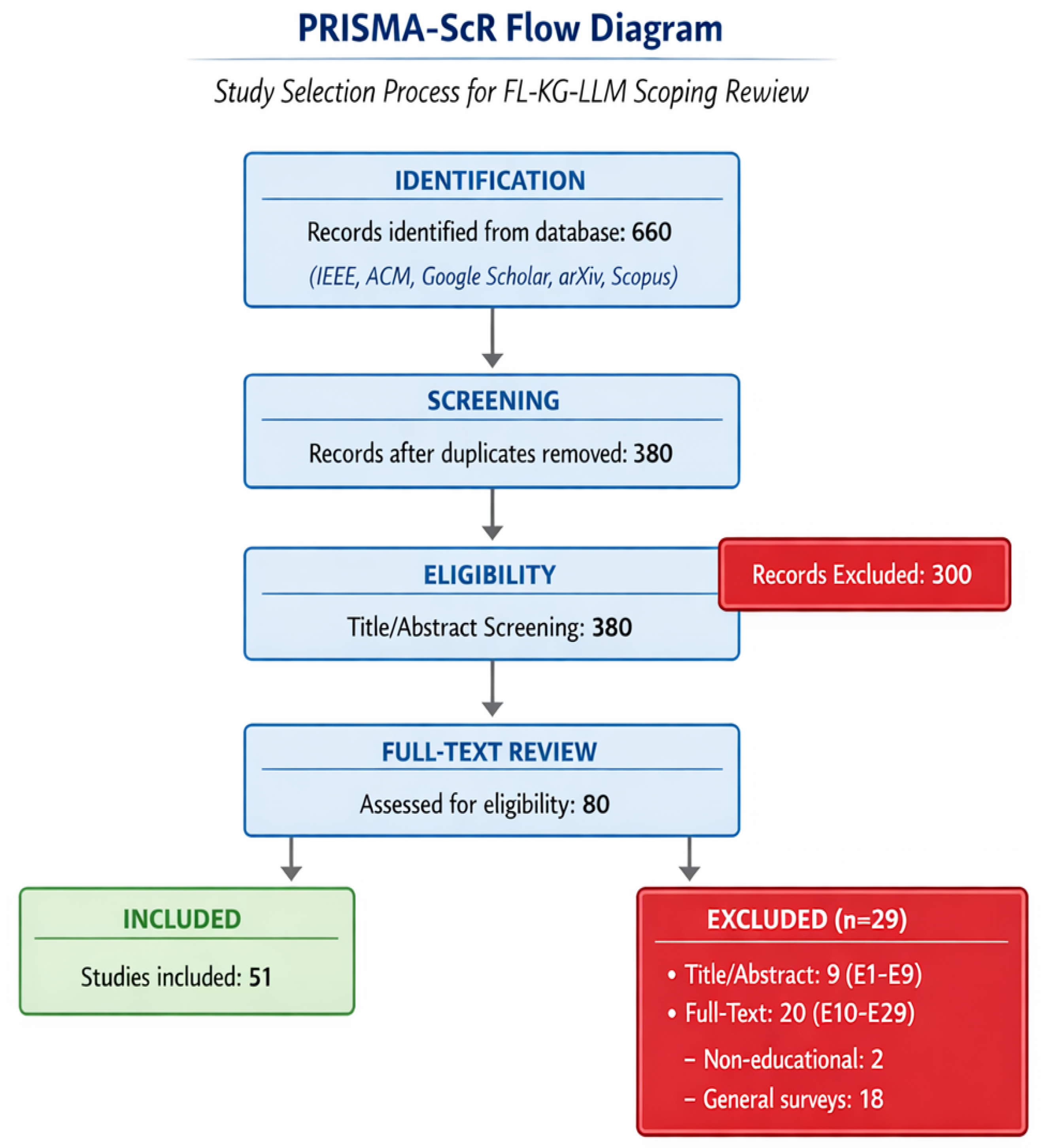
Initially approximately 660 hits were deduplicated to 380 unique papers via Zotero v7.0. Title/abstract screening reduced the pool to ~80 candidates. Full-text review applied inclusion/exclusion criteria, yielding the final 51 papers. The screening workflow is documented on the Open Science Framework (OSF), including the complete list of 51 included papers and 29 excluded papers with rationales. For traceability, the ID-to-citation mapping for the 51 included studies is provided in Supplementary Material S2. Database-specific query syntax conventions are provided in Supplementary Material S1, and the screening database (including extraction forms and exclusion rationales) is available on OSF.
Single-Reviewer Screening: Title/abstract screening (Phase 2) was conducted by a single reviewer without formal inter-rater reliability assessment. Borderline cases (e.g., papers with ambiguous titles like “Dialogue Systems for Language Learning”) were discussed with co-authors, and inclusion required explicit educational context (iCALL, language learning, language instruction) in title or abstract. While this approach introduces potential subjective bias, the high rejection rate (78.9%) reflects appropriate filtering of general NLP/AI papers outside language learning contexts. Future replications should employ dual coding at screening stage with Cohen’s kappa reporting.
The PRISMA-ScR flow diagram illustrating the complete screening process is shown in Figure 2.

2.4. Critical Appraisal

Quality Assessment: We employed a reporting-transparency (extractability) rubric to support critical appraisal and to quantify how completely each study reports the minimum information needed to audit and reproduce FL–KG–LLM language-learning systems. The rubric was designed deductively from the review’s analytical framework and research questions, which emphasize three system dimensions that must be operationalized (not merely mentioned) for convergence claims to be assessable: (i) architectural transparency (sufficient system detail for reproducibility), (ii) empirical rigor (clear metrics and statistical reporting to support validity claims), and (iii) pedagogical alignment (explicit operationalization of CEFR/pedagogical constructs as constraints or formal definitions rather than narrative references). These criteria reflect established principles of reproducible ML reporting and educational measurement transparency, adapted here as a lightweight, domain-specific checklist for this scoping review. Table 5 defines the three criteria and the high/medium/low thresholds used.
Quality Scoring and Confidence Scoring (reporting transparency): Confidence scores (0–1) reflected reporting completeness across the three rubric criteria (Table 5) and were used to support confidence assessment for automated extraction validation. To support consistency at scale, scoring was produced via an AI-assisted extraction workflow (Qwen 2.5 7B), with the rubric thresholds applied to the extracted evidence. Studies scoring < 0.2 were classified as low reporting transparency (70.6% of the corpus). We emphasize that this score captures reporting transparency rather than intrinsic methodological quality; a study may be methodologically sound yet insufficiently reported for extraction and audit. The average confidence score was 0.17 (SD = 0.23), and the distribution across confidence tiers is reported in Table 6.

2.5. Data Extraction and Analysis

Extraction Methodology: Automated AI-assisted extraction via Qwen 2.5 7B with Pydantic schema validation ensured consistent structured output format. For each included paper, we extracted sixteen variables spanning (i) technology presence and convergence configuration (how FL/KG/LLM components were instantiated and combined), (ii) technical characteristics (e.g., model and system descriptors, privacy mechanisms, and validation metrics), and (iii) pedagogical characteristics (e.g., CEFR alignment and which grounding/control gaps were addressed). The full variable list, definitions, and coding rules are provided in the OSF Data Extraction Codebook v1.1 (DOC_Data_Extraction_Codebook_v1.1; see the Data Availability Statement for repository access).
Manual/Human-performed Verification: 20% of papers (n = 10) underwent manual audit by second human reviewer (supervisor) to validate automated extraction, achieving inter-rater agreement (Cohen’s κ = 0.92 across the audited categorical fields).
Post Hoc Domain-Specific Analysis: Domain-specific NR rates by paper type (FL-only, KG-only, LLM-only, hybrid) were calculated post hoc from extracted data (Data_Extraction_Results_v1.csv) to distinguish expected gaps (domain-appropriate NR) from crisis gaps (domain-inappropriate NR). This represents retrospective cross-tabulation of preregistered extraction variables, not protocol modification. The OSF protocol documented extraction variables and methods; domain-specific analysis is an additional analytical layer applied to existing data, analogous to subgroup analysis in clinical trials.
Taxonomy Development and Coding. We conducted a taxonomy-based synthesis of the 51 included studies across five dimensions: (i) convergence pattern (FL/KG/LLM integration), (ii) knowledge graph type, (iii) pedagogical alignment, (iv) privacy mechanism, and (v) evaluation/outcome type. Each included study was assigned to exactly one category per taxonomy dimension based on explicit methodological details reported by the authors. When reporting was insufficient for confident classification, studies were coded as Unclear (convergence) or Not specified/Custom (KG type). Category assignment followed predefined inclusion/exclusion criteria and evidence thresholds (Supplementary Material S3: Appendix_Taxonomy_Coding_Rules_S3). The resulting coded dataset was then used to structure the taxonomy-based thematic synthesis (Section 3.2)

2.6. Pre-Specified Analytical Thresholds (T1–T5)

To address the research questions with auditable, pre-specified expectations, we formulated five analytical thresholds (T1–T5). To avoid confusion with inferential hypotheses, these are not hypotheses about causal effects; rather, they are benchmarks for interpreting corpus-level descriptive proportions and assessing whether observed patterns align with the review’s motivating premise of limited convergence and reporting deficits. Studies were grouped by (i) convergence type (single-domain, dual-domain, triple-domain) and (ii) pedagogical engagement level. We then computed descriptive frequencies for all extracted variables. T1–T5 correspond to RQ1–RQ5, respectively.
T1 (Convergence rate): <15%. The proportion of studies exhibiting full FL–KG–LLM convergence will be <15%. This threshold reflects our preliminary screening observation that no fully convergent studies were identified in the initial full-text candidate set (n ≈ 80), while allowing for the possibility of false negatives and borderline classifications.
T2 (Reporting completeness): >60% NR. The corpus will exhibit substantial reporting gaps, operationalized as a >60% “Not Reported” (NR) rate across key technical and pedagogical descriptors. This threshold reflects an expectation of substantial under-reporting in an emerging, interdisciplinary corpus where implementation, privacy, and pedagogical details are often incompletely specified.
T3 (Scale/architecture bias): >70% centralized (among FL studies). Among studies that implement FL, >70% will use centralized coordination (e.g., server-orchestrated aggregation) rather than decentralized alternatives. This reflects the practical tendency for educational deployments to prioritize implementability and orchestration simplicity over fully decentralized coordination.
T4 (Pedagogical framework operationalization): <20% CEFR-aligned operationalization (corpus-level). Across the full corpus, <20% of studies will operationalize CEFR (or an equivalent framework) as explicit constraints, labels, or formal mappings, rather than referencing it only narratively.
T5 (Pedagogical validation): <10% pedagogical metrics (corpus-level). Across the full corpus, <10% of studies will report pedagogical validation metrics. This threshold reflects the dominance of technical evaluations (e.g., model performance scores, accuracy-like metrics, and efficiency measures such as runtime/latency) in ML-oriented studies, even when the application domain is educational.

3. Results of the Scoping Review

Study selection and exclusions are summarized in Table 7, and results are then organized using the five-dimension taxonomy in Table 8 as the synthesis scaffold. Each subsequent subsection highlights one dimension’s key patterns, with compact visual summaries in Figure 3. Additional visual summaries and extended breakdowns are provided in Supplementary Material S4 (Figures S4(1) and (2)). Supporting resources and inventories are provided in Supplementary Material S4 [29,30,31,32,33,34,35,36,37,38,39,40,41].

3.1. Study Selection and Characteristics

The study selection process is summarized in the PRISMA-ScR flow diagram (Figure 2). From approximately 660 initial database records, deduplication yielded ~380 unique papers. Title/abstract screening reduced this set to 80 candidates for full-text review. After full-text screening against the inclusion and exclusion criteria, 51 papers were retained for synthesis and 29 papers were excluded.
For clarity and to avoid conflating illustrative examples with aggregate counts, exclusions are additionally summarized in Table 7, which reports excluded papers by screening stage and exclusion category with counts. Detailed paper-level exclusion rationales (including representative examples) are provided in Supplementary Material S1 (Sections S2–S3(1)).

3.2. Taxonomy-Based Synthesis Overview

To structure analysis beyond study selection, we mapped the 51 included studies using a five-dimension taxonomy: (i) convergence pattern (FL/KG/LLM integration), (ii) knowledge graph type, (iii) pedagogical alignment, (iv) privacy mechanism, and (v) evaluation/outcome type. Table 8 reports the distribution across taxonomy categories and serves as the organizing scaffold for the thematic synthesis presented in the following subsections.
For traceability between the study IDs used in tables/figures and the reference list, a complete ID → citation mapping for all 51 included studies is provided in Supplementary Material S2. Table 8 also highlights structural gaps (e.g., the scarcity of full convergence), reporting limitations (a high proportion coded as “Unclear”), and validation limitations (the predominance of conceptual or non-empirical contributions).
Taxonomy-based synthesis: Table 8 summarizes study classifications across five taxonomy dimensions and quantifies reporting gaps using the “Unclear” and “Not specified/Custom” categories.
Convergence Pattern: Most included studies are single-domain (30/51; 58.8%), indicating a fragmented landscape in which FL, KGs, and LLMs are typically developed in isolation rather than as integrated educational systems. No study operationalizes full convergence (FL + KG + LLM). Notably, almost one-third of studies are coded as Unclear (16/51; 31.4%) due to insufficient methodological detail to determine whether FL, KG, or LLM components are implemented or merely discussed, limiting reproducibility and cross-study comparison.
Knowledge Graph Type: When KG type is explicitly specified, ontology-based KGs (10/51; 19.6%) and ConceptNet (6/51; 11.8%) are the most common, with minimal use of retrieval-augmented paradigms (RAG: 1/51; 2.0%). However, most studies refer to “knowledge graphs” without specifying construction method, data source, or formalism (Not specified/Custom: 34/51; 66.7%), materially constraining interpretability and replication.
Pedagogical Alignment: Explicit pedagogical alignment is rare: only 5/51 studies (9.8%) reference CEFR explicitly, and 1/51 (2.0%) indicates implicit proficiency alignment. The overwhelming majority report No Pedagogical Focus (45/51; 88.2%), suggesting a pronounced pedagogical gap despite the language-learning context.
Privacy Mechanism: Privacy is rarely operationalized. While privacy is often cited as a motivation for federated learning, only 4/51 studies (7.8%) report differential privacy, and none report secure aggregation or other privacy protections (0%). Most studies include no privacy discussion (47/51; 92.2%), indicating that deployment-relevant safeguards are not consistently translated into implementable system choices.
Evaluation/Outcome Type: The literature is predominantly conceptual, with 37/51 studies (72.5%) reporting no empirical validation (None/Conceptual). Only 9/51 (17.6%) report learning-outcome evaluation, and 5/51 (9.8%) report both learning-outcome and other evaluation. This pattern indicates a substantial validation gap: many proposed architectures and conceptual discussions exist, but comparatively fewer demonstrations of pedagogical effectiveness.
These patterns motivate the design requirements and research directions synthesized in Section 4.

3.3. Convergence Landscape: The Triple-Domain Deficit

Across the 51 included studies, no paper operationalizes full triple-domain integration (FL + KG + LLM; 0/51; 0.0%), highlighting a persistent convergence deficit. The majority of studies remain single-domain (30/51; 58.8%), led by KG-only implementations (15/51; 29.4%), followed by FL-only (11/51; 21.6%) and LLM-only (4/51; 7.8%). Dual-domain hybrids are uncommon (5/51; 9.8%), appearing only as FL + LLM (3/51; 5.9%) and KG + LLM (2/51; 3.9%); no study combines FL + KG (0/51; 0.0%)), reinforcing the broader convergence deficit observed in the educational corpus. Importantly, nearly one-third of the corpus is coded as Unclear (16/51; 31.4%), indicating that methodological reporting is frequently insufficient to determine which components are implemented versus discussed. This distribution is summarized in Figure S4-1, and the domain overlap among classifiable studies is illustrated in Figure S4-2 (Supplementary Material S4).
Each single-domain group specializes in its own area, without focusing on overall summary statistics. Studies that only use FL typically concentrate on distributed training and personalized learning, especially when data is limited. KG-only studies, on the other hand, tend to explore structured ways of representing knowledge and use constraint-based reasoning. A limited body of research focuses exclusively on the use of LLMs. When such studies are present, they predominantly address content generation or learner assessment, rather than the development of integrated educational systems. Taken together, this shows that bringing these domains together is challenging—not just because the technology is complex, but also because researchers from different fields use different evaluation methods and have different design goals.
This distribution suggests that the three technology streams mature largely in parallel rather than as integrated educational systems. From a deployment perspective, the absence of FL + KG is especially consequential: FL provides a privacy-preserving training paradigm, while KGs provide structured grounding and interpretability—together forming a natural foundation for trustworthy educational systems. Their separation implies that privacy-preserving learning and transparent knowledge grounding are rarely co-designed.
Because Unclear studies reflect reporting constraints rather than a substantive absence of technology, we retain them in the primary distribution to avoid overstating maturity. For reference, even when restricted to classifiable studies only (N = 35), full convergence remains absent (0/35), and dual-domain integration remains a minority pattern.

Partial Integration Exemplars: Dual-Domain Hybrid Approaches (n = 5)

Five studies provide the closest approximations to convergence by integrating LLMs with either FL (n = 3) or KGs (n = 2) (STUDY_022 [42], STUDY_023 [42], STUDY_015 [43]; STUDY_024 [44], STUDY_029 [45]; see Supplementary S2). These hybrids remain technically asymmetric: FL + LLM work emphasizes privacy-preserving personalization and distributed fine-tuning, whereas KG + LLM work emphasizes grounding and reliability constraints on generation. Below we briefly summarize representative hybrids; extended study-level details are provided in Supplementary Material S4 (Table S4(6)). Additional extended tables and relocated figures are provided in Supplementary Material S4 (Sections S4(1) and (2)).
Across these hybrids, the integration point is usually narrow (e.g., federated adapter updates or KG-grounded prompting) rather than end-to-end co-design. This supports the interpretation that dual-domain work represents early-stage proof-of-concept rather than mature instructional systems, reinforcing the need for shared reporting standards and learning-outcome evaluation to accelerate convergence (see Supplementary S4, Table S4(1)–(6)).
FL + LLM hybrids: Three studies integrate FL with LLMs using parameter-efficient fine-tuning strategies (e.g., low-rank adapters) to reduce communication cost and avoid sharing raw learner data (STUDY_015 [43], STUDY_022 [42], STUDY_023 [42]). Typical contributions include federated update aggregation over adapter parameters and client-side adaptation for personalization, but they generally omit explicit pedagogical alignment (e.g., CEFR) and rarely specify privacy mechanisms beyond the FL setting itself (e.g., no DP budgets [46] or secure aggregation [26]).
KG + LLM hybrids: Two studies integrate KGs with LLMs using knowledge-grounded generation (ConceptNet-based GraphRAG or trust frameworks) to constrain or verify LLM outputs (STUDY_024 [44], STUDY_029 [45]). These papers commonly report KG-centric metrics (e.g., KG reliability/consistency) and sometimes discuss hallucination mitigation, but they typically centralize data and do not operationalize privacy safeguards. Pedagogical validation remains limited, with few links to proficiency levels or learning outcomes.
Across all five hybrids, the missing third component is not incidental: adding FL requires distributed training and privacy accounting; adding KGs requires explicit formalization and construction transparency; adding LLMs requires controllability and evaluation beyond generic performance metrics. The combined engineering and evaluation burden likely contributes to the observed scarcity of integrated systems.

3.4. Reporting Gaps: Systematic Transparency Deficits

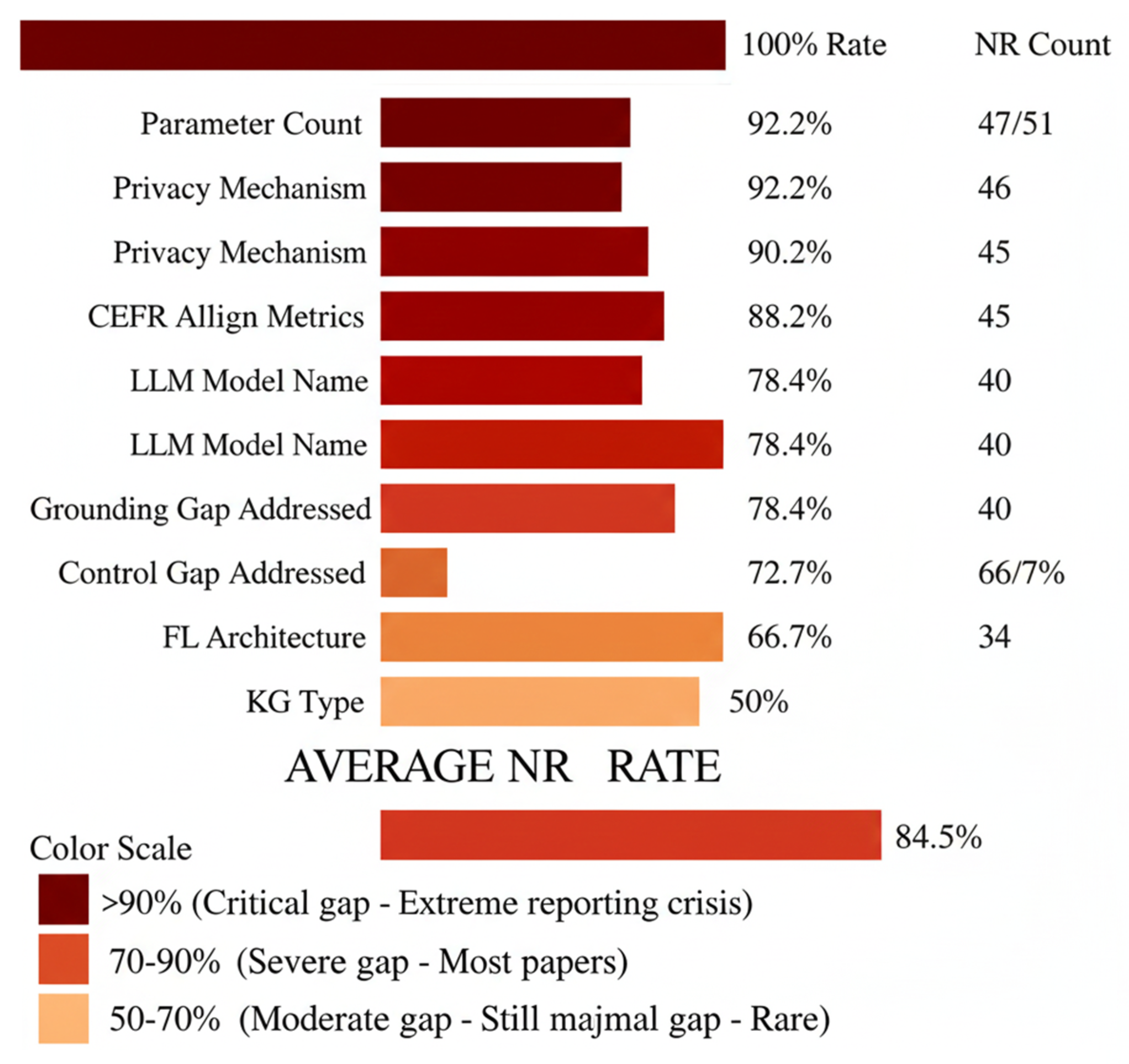
Reporting limitations are a defining feature of the corpus and directly constrain synthesis. Across nine key extraction variables, the average Not Reported (NR) rate is 84.5%, indicating that many studies do not provide the technical and pedagogical details needed for replication or comparative analysis. The most severe omissions include parameter counts (49/51; 96.1% NR), privacy mechanisms (47/51; 92.2% NR), validation metrics (46/51; 90.2% NR), and CEFR alignment (45/51; 88.2% NR).
Notably, the NR pattern is not limited to “nice-to-have” implementation parameters: high NR rates also occur for variables that determine whether a study’s claims can be interpreted in an educational context (e.g., proficiency targeting, learning outcomes, and privacy mechanisms). This suggests that improved synthesis in this field requires not only more studies, but also stronger reporting norms tailored to iCALL deployments.
These omissions introduce two practical consequences. First, reproducibility is limited because implementation choices (model scale, training configuration, data handling) cannot be reconstructed. Second, claims of privacy or pedagogical effectiveness are difficult to verify when mechanisms and outcome measures are not specified. The full variable-by-variable NR breakdown is provided in Supplementary Material S4 (Table S4(8)) to reduce table density in the main manuscript. Figure 3 visualizes the Not Reported (NR) rates across extraction variables.

3.5. Privacy in Peripheral Literature: Contextual Insights

Explicit privacy mechanisms are rarely reported in the included corpus; therefore, we provide brief contextual pointers to foundational FL privacy work outside the inclusion set [2,26,46] (e.g., differential privacy accounting and secure aggregation protocols) to highlight the gap between privacy as motivation and privacy as an implementable, auditable system property. Extended context and references are provided in Supplementary Material S4 (Section S4.1.3).
In practice, deployable privacy typically requires auditable choices (e.g., privacy budgets for differential privacy, aggregation security under client dropout, and communication-cost accounting). The near absence of such details in the included corpus indicates that privacy remains largely motivational rather than operational, which may discourage attempts to integrate FL with other components such as KGs that would require additional governance and provenance documentation.

3.6. Pedagogical Framework Variability: Sparse CEFR Integration

Pedagogical grounding is uncommon. Only 6/51 papers (11.8%) reference CEFR or an equivalent proficiency framework (Explicit CEFR: 5/51; 9.8%; Implicit proficiency: 1/51; 2.0%), whereas 45/51 (88.2%) show no pedagogical focus. This pattern suggests that language-learning claims are frequently not anchored to proficiency levels, instructional objectives, or assessment design, which in turn limits interpretability of evaluation claims and hinders translation to real educational settings.
This scarcity also limits comparability: without shared proficiency anchors, two systems evaluated on different learner populations or tasks cannot be meaningfully compared, even when their technical components are similar. As a result, convergence research may be discouraged since the establishment of instructional validity relies on a uniform pedagogical framework.
When proficiency frameworks are absent, systems cannot systematically align content difficulty (e.g., vocabulary and grammar progression) or connect outputs to measurable learning outcomes. This raises the likelihood of mismatched teaching methods and may help account for the reliance on conceptual validation over classroom or learner-focused assessment.

3.7. Validation Pillar Risk: Source Verification Absent

A minority of studies address output constraints via grounding mechanisms (11/51; 21.6%), but none report systematic verification that the underlying knowledge representation faithfully encodes an authoritative pedagogical source (Validation pillar: 0/51; 0.0%). Consequently, even grounded generation may inherit unexamined representational choices or ambiguities from source-to-graph translation. A longer, two-tier discussion of discipline-bound versus domain-critical non-reporting is provided in Supplementary Material S4 (Section S4.1.4).
The risk is amplified when KG construction is under-specified (Not specified/Custom: 34/51; 66.7%), because schema choices and source selection can shift what the system treats as “correct” knowledge. Without source verification and schema transparency, grounded generation may still be systematically misaligned with intended pedagogical standards.

3.8. Validation Immaturity: Predominance of Conceptual Work

Most studies provide no empirical validation (None/Conceptual: 37/51; 72.5%). Only 9/51 (17.6%) report learning-outcome evaluation and 5/51 (9.8%) report both learning and other evaluation. This validation gap limits claims of educational effectiveness and constrains comparison across approaches. A detailed inventory of reported metrics (where available) is provided in Supplementary Material S4 (Table S4(13)).
Where empirical evaluation exists, it is often limited in scope (small samples, narrow tasks, or short-term user studies), and outcome measures are frequently not tied to established proficiency progression. This reinforces the conclusion that evidence for instructional effectiveness remains preliminary, even when architectures appear promising.

3.9. Technology-Specific Characteristics (Reported Subset)

Within the subset of studies that report sufficient technical detail, decentralized FL architectures dominate (13/14; 92.9%), consistent with FL’s intent to distribute training across clients. For KG implementations that report type (n = 18), ontology-based approaches are most common, reflecting a preference for formal semantics suitable for rule-based constraints. Complete breakdown tables and study-level mappings are provided in Supplementary Material S4 (Tables S4(14) and (15)).
To keep the main manuscript concise, we report only the headline patterns here; the full per-study technical characterization (including model families, aggregation strategies where reported, and KG construction notes) is provided in Supplementary S4 to support replication and secondary analysis.

3.10. Analytical Threshold Results

Across the predefined analytical thresholds (T1–T5), results support systematic convergence, reporting, pedagogical, and validation gaps. Full convergence is absent (T1 met), average NR exceeds the threshold (T2 met), CEFR mention remains below the threshold (T4 met), and validation reporting remains below the threshold (T5 met). The scale-bias thresholds (T3) remain untestable due to extreme underreporting of model scale and architecture details. Full threshold tables and visualizations are provided in Supplementary Material S4 (Tables S4(16)–(17); Figure S4(4)).
We emphasize that these thresholds are intended to support transparent synthesis rather than to over-interpret sparse reporting. Accordingly, threshold-level conclusions are stated conservatively and are accompanied by full supporting tables in Supplementary S4.
Supplementary Material S4 provides compact per-dimension distribution tables (Tables S4(1)–(6)) and extended study-level evidence (Sections S4.1 and S4.2)) to support traceability while keeping the main Results narrative concise.

4. Discussion

4.1. Threshold Testing and Key Findings Summary

Four of five analytical thresholds were met, with T1 and T2 showing the strongest effects (0% convergence, 84.5% NR far exceed thresholds). T3 (Scale Bias) proved untestable due to 96.1% parameter count underreporting, representing a meta-finding about reproducibility gaps rather than evidence about FL centralization patterns. This pattern indicates that the analytical thresholds capture field-level characteristics, while T3’s untestable status highlights severe reporting deficiencies that prevent basic assessment of FL implementation patterns.

4.2. The Integrity Gap: Unifying Framework

The five major findings—Convergence Deficit, Reporting Gaps, Pedagogical Disconnection, Validation Pillar Risk, and Validation Immaturity—are not independent phenomena but interconnected manifestations of a deeper structural problem: the Integrity Gap, defined as a systematic misalignment between technological capability and pedagogical grounding in iCALL In practice, this gap emerges when system architectures advance faster than the pedagogical constraints, privacy safeguards, and evaluation evidence needed for instructional validity.
A particularly salient manifestation of the Integrity Gap is that technological convergence does not, by itself, imply pedagogical grounding. CEFR alignment is not a universal requirement for iCALL; however, in this review it serves as a concrete, auditable proxy for whether a system makes its pedagogical targets explicit (CEFR or an equivalent authoritative framework). In the included corpus, none of the dual-domain hybrid papers (FL + LLM, KG + LLM; n = 5) reported CEFR-aligned operationalization (0/5; 100% Not Reported), despite explicitly targeting language-instruction contexts. This does not imply that pedagogical intent was absent; rather, it indicates that explicit, verifiable framework-to-system mapping was rarely reported. In contrast, the absence of CEFR reporting in single-domain studies (e.g., FL-only and KG-only) may be more attributable to disciplinary specialization, where pedagogical framework alignment may fall outside the paper’s design scope. Taken together, this pattern suggests that even when researchers bridge technological domains, pedagogical grounding may remain under-specified.
These gaps also appear to reinforce one another. The absence of mature FL–KG–LLM exemplars may contributes to inconsistent reporting norms across communities, which in turn limits reproducibility and makes integration strategies difficult to compare. Limited pedagogical alignment reporting (e.g., CEFR: 45/51; 88.2% Not Reported) further reduces incentives to validate whether structured representations (e.g., knowledge graphs) faithfully encode authoritative pedagogical sources, increasing the risk that representational choices propagate unexamined. Finally, the predominance of conceptual work and generic technical evaluation can mask these issues, as systems may perform well on technical metrics while remaining misaligned with learning objectives or proficiency progression.

Why Dual-Domain and Full Convergence Remain Limited

A key reason dual-domain integration (e.g., FL + LLM: 3/51; 5.9%, KG + LLM: 2/51; 3.9%) and full convergence (FL + KG + LLM: 0/51) remain rare is that the field is still dominated by work that is not positioned—or evidenced—at the level required to justify complex, end-to-end systems. First, the validation gap is substantial: most papers are conceptual only (37/51; 72.5%), which reduces incentives to engineers and test tightly coupled pipelines (e.g., federated training + structured knowledge modeling + LLM inference) under realistic constraints. Second, there is a pronounced pedagogical gap: 45/51 (88.2%) exhibit no pedagogical focus, meaning system design is often not anchored to proficiency frameworks, learning objectives, or instructional decisions that would otherwise demand integrated architectures and outcome-driven evaluation. Third, a persistent reporting gap limits cumulative progress: 16/51 (31.4%) are coded as Unclear for convergence due to insufficient methodological detail, making it difficult to reproduce implementations, compare integration strategies, or identify which components were actually operationalized versus discussed. Taken together, these gaps suggest that limited convergence is not simply a matter of research interest, but reflects a pipeline bottleneck: weak empirical validation, weak pedagogical grounding, and incomplete technical reporting collectively constrain the emergence of robust, deployable FL–KG–LLM educational systems.
Importantly, the absence of FL + KG integration should not be interpreted as incompatibility between federated learning and knowledge graphs. Rather, it is more consistent with practical implementation and reporting barriers visible in the corpus: KG construction is frequently under-specified (Not specified/Custom: 34/51; 66.7%), and privacy protections are rarely operationalized beyond high-level motivation (No privacy discussion: 47/51; 92.2%). Together with the predominance of conceptual work (None/Conceptual: 37/51; 72.5%) and limited pedagogical anchoring (No pedagogical focus: 45/51; 88.2%), these constraints increase the engineering and evaluation burden for FL–KG systems (e.g., provenance-aware KG construction, auditable privacy accounting, and learning-outcome validation), which likely contributes to the observed gap.

4.3. Implications for Future Research

  • We highlight five implications for future research and practice.
  • Cross-domain community building. FL, KG, and LLM research communities operate independently with distinct publication venues, conferences, and professional networks. Bridge-building is needed. Establishing joint workshops or special sessions (e.g., at AIED or ACL), cross-community review panels, and collaborative research programs could surface mutual dependencies.
  • Standardized reporting frameworks. The field needs a reporting checklist inspired by CONSORT for RCTs or PRISMA for systematic reviews [47]. This checklist should specify essential metadata: (a) FL: aggregation algorithm [3], privacy mechanism, data heterogeneity, communication rounds; (b) KG: construction methodology, size statistics, validation approach, ontology design choices; (c) LLM: base model, fine-tuning data, computational requirements, inference time; (d) Integration: how components interact, constraint application, system architecture.
  • Pedagogical metric standardization. Beyond learning gains (requiring extensive validation), intermediate metrics should be standardized: (a) CEFR (or equivalent) alignment verification (expert rating or empirical frequency analysis), (b) vocabulary appropriateness (automated analysis), (c) ZPD calibration (cognitive modeling or pre-post testing), (d) teacher satisfaction and utility (surveys and usage logs).
  • Validation Pillar verification protocols. Systems incorporating authoritative frameworks could verify representational fidelity through (a) round-trip validation (does the Knowledge Graph return information consistent with the original source?), (b) ambiguity documentation (explicitly document and justify schema design decisions), (c) independent audit (third-party experts verify mapping accuracy), and (d) version control (tracking Knowledge Graph versions to identify schema changes).
  • Reproducibility mandates. Journals require the reporting of (a) Model parameters sufficient for reproduction, (b) Training data metadata, (c) Computational requirements, (d) Code and KG versions via repositories, (e) Privacy guarantees (differential privacy budgets if applicable).

4.4. Preliminary Validation Evidence: CEFR Mapping Complexities

Our manual inspection of CV Sociolinguistic Competence identified mapping complexities relevant to the Validation Pillar:
(1)
Multidimensional competence: The descriptor “Can discuss familiar topics in informal conversation” is classified as B1, yet its difficulty depends on topic scope and context; operationalizing it as a single level may be insufficient.
(2)
Language variation: Register and language-variety differences can shift the linguistic demands of the same communicative task, affecting level assignment.
(3)
Temporal evolution: Descriptors validated in earlier editions may require re-interpretation as usage norms and communicative practices change over time.
(4)
Domain specificity: Proficiency expectations can differ across contexts (e.g., business vs. academic language), even at the same nominal level.
(5)
Individual profiles: Learners may develop unevenly across skills (e.g., speaking vs. writing), complicating a single-level encoding.
These ambiguities are not errors in CEFR but reflect genuine language acquisition complexity. They necessitate explicit schema design decisions during KG mapping, including level assignment and the representation of contextual conditions. Our operational choice (B1+) with contextual annotations was reasonable, but alternative encodings are also plausible. Papers claiming CEFR alignment without documenting these mapping decisions make such claims difficult to verify.
Limitation: While this analysis focuses on CEFR, similar representational challenges likely affect other pedagogical frameworks (e.g., ACTFL, Lexile levels, learner-corpus proficiency scales). In our corpus of 51 papers, none reported procedures for verifying source-framework-to-schema mappings for any pedagogical framework. Future work should examine whether these Validation Pillar gaps extend beyond CEFR and evaluate verification protocols across frameworks.

4.5. Integration with Existing Literature: Beyond RAG

Retrieval-Augmented Generation (RAG) is a common baseline for grounding LLM outputs by retrieving relevant passages (typically via semantic similarity search) and conditioning generation on the retrieved context, which can reduce hallucinations and improve factuality [18]. However, standard RAG pipelines do not, by themselves, guarantee several properties that are central to auditable, pedagogy-aligned iCALL deployment: (1) structural constraints, i.e., enforceable rule- or schema-based restrictions beyond providing text snippets as context (as would be supported by Knowledge Graph representations) [6]; (2) multi-layered grounding, where semantic retrieval is complemented by explicit constraints and alignment checks; (3) systematic validation, including explicit assessment of KG quality and (when applicable) verification that the KG encodes an authoritative pedagogical framework as intended [6,45]; and (4) privacy-preserving deployment, since typical RAG implementations rely on centralized storage of documents or embeddings (e.g., vector databases), which may conflict with institutional data governance requirements in educational settings.
In contrast, an integrated FL–KG–LLM approach would extend beyond retrieval alone by: (1) adding KG-based rule retrieval and constraints (not only semantic similarity) [6,45], (2) supporting multi-layered grounding (e.g., constraints + semantic evidence + alignment checks), (3) enabling federated deployment to preserve institutional data sovereignty while training or adapting models across sites [1,2,3,4], and (4) adopting explicit validation protocols for both the grounding mechanism and the underlying pedagogical representation. While existing studies address these components in isolation, our scoping review indicates that their joint integration remains largely absent, motivating future work to test whether combined approaches yield advantages—particularly in transparency, auditability, and privacy—that are difficult to obtain with isolated techniques [2,4,6,18,26,45,46].

4.6. Research Maturity Assessment

Across the reviewed corpus, FL–KG–LLM research exhibits characteristics of an early-stage field. First, full convergence is absent (0% triple-domain studies), suggesting that synthesis across the three domains has not yet been realized in published iCALL work. Second, reporting practices remain highly heterogeneous, with a mean NR rate of 84.5%, indicating limited consensus on what constitutes “minimum necessary” metadata for auditable system descriptions. Third, cumulative progress appears fragmented: studies tend to build on prior work within their own technology stream (FL, KG, or LLM) but rarely connect methods, evaluation practices, or standards across streams. Fourth, while recent publication activity (2024–2025) indicates growing interest, this increase has not yet translated into shared frameworks or standardized reporting norms. Finally, reproducibility remains constrained by missing implementation detail (e.g., model parameters and computational requirements are rarely reported), limiting meaningful replication and comparative evaluation.
Similar patterns have been documented in other domains prior to the widespread adoption of structured reporting guidance (e.g., CONSORT/PRISMA), suggesting that the FL–KG–LLM iCALL literature remains in a pre-standardization phase for essential metadata and audit-ready reporting [48,49].
Importantly, maturity in this domain is not only a reproducibility concern; it also affects instructional validity and safe deployment. Beyond hallucinations, educational LLM systems can exhibit misalignment behaviors such as sycophancy (prioritizing agreement over correctness) and may be susceptible to jailbreak-style or dis-ethical tuning, which can undermine pedagogical standards and institutional trust in classroom-facing tools [27,50]. This increases the value of auditable constraints and validation, particularly when pedagogical frameworks are invoked as grounding references.
While ontology engineering and evaluation methodologies exist for technical knowledge representations [51], and neural-symbolic approaches provide more interpretable reasoning via logical rule integration [52], these verification practices are rarely applied to framework-to-schema fidelity for pedagogical standards in iCALL. We refer to this as the Validation Pillar Risk: the risk that systems claim alignment to an authoritative pedagogical framework without documenting—let alone verifying—the mapping decisions that operationalize that framework.
To illustrate why the Validation Pillar is not merely theoretical, we summarize five CEFR mapping ambiguities that can silently propagate into KG constraints when verification is absent:
Case 1: Context-dependent appropriateness. “Can discuss family topics” (B1) varies with context: informal familiar settings may demand lower competence, while professional contexts (e.g., social work) may demand higher competence. Without explicit context annotation, any single-level encoding risks misalignment with intended use cases.
Case 2: Multidimensional competence. “Can participate in informal discussion” (B1) can mask uneven skill demands across components (speaking, listening, interaction strategies). Encoding it at a monolithic level collapses pedagogically meaningful distinctions.
Case 3: Temporal evolution. Descriptors such as “send and receive emails” have shifted in practical difficulty as technology use has become ubiquitous; static encodings without temporal/context notes can drift from current instructional realities.
Case 4: Domain-specific variation. “Follow technical instructions” spans domains of very different complexity (e.g., consumer software vs. academic protocols vs. medical equipment). Without domain specification, level assignment becomes underspecified.
Case 5: Individual skill asymmetry. Tasks like “participate in meetings” can demand different levels across productive, receptive, and socio-pragmatic components; single-level labeling obscures learner-profile differences relevant to instruction.
Together, these cases show how authoritative frameworks can contain inherent, meaningful ambiguity that must be resolved through explicit design choices during KG mapping. When such choices are not documented and audited, they can become “silent defaults,” weakening pedagogical grounding at the representational level and amplifying downstream risks for instructional validity.

4.7. Limitations and Strengths

Limitations. Screening at Stage 2 was conducted by a single reviewer. We mitigated this via a 20% supervisor audit (10/51 papers; inter-rater κ = 0.92), but dual-reviewer screening would be preferable; nevertheless, automated screening with manual audit yielded reliable classification for the primary constructs. The corpus may also reflect gray-literature bias, as arXiv accounts for a substantial share of recent work (2024–2025), potentially over-representing methods that are not yet peer reviewed; conversely, journal publication timelines can lag emerging developments by 1–2 years. The automated extraction confidence score (0.17) was initially a concern; however, manual audit suggested this largely reflected genuine under-reporting in source papers rather than extraction failures. Our search strategy evolved across three phases, indicating that initial scoping may have been incomplete; broader queries could retrieve additional papers using non-standard terminology. Relatedly, terminology remains ambiguous in this area (e.g., “Knowledge Graph” and “Federated Learning” are sometimes used loosely), which may have led to missed studies. We operationalized “educational” as papers that explicitly addressed language learning; this may have excluded dialog or NLP systems with latent pedagogical applications. Finally, a small number of records had incomplete bibliographic metadata in the archived export; these were retained for coding but flagged as metadata-incomplete (Supplementary Material S2).
Strengths. We followed PRISMA-ScR guidance and reported the checklist items to support methodological transparency. Coverage across six databases spanning computer science and education venues reduced the risk of single-discipline publication bias. Records were deduplicated using reference-management software and manual checks. Reproducibility is supported by public documentation of the full included set (51 papers) with complete citations, along with the extraction codebook, validation materials, and OSF preregistration. We also emphasize that the analytical thresholds used in this review are not inferential statistical hypotheses, but pre-specified interpretive benchmarks aligned with scoping-review aims; all research questions and analysis criteria were documented in the OSF protocol (registered 23 December 2025) prior to data extraction to reduce post hoc narrative bias. Finally, the review offers a novel conceptual contribution by synthesizing FL–KG–LLM convergence in language education and articulating the Validation Pillar Risk as a distinct gap in auditable pedagogical grounding.


5. Conclusions

5.1. Summary of Findings

This scoping review systematically mapped the convergence landscape of Federated Learning, Knowledge Graphs, and Large Language Models in Intelligent Computer-Assisted Language Learning (2019–2025), revealing five critical gaps.
A pronounced Convergence Deficit shows FL, KG, and LLM research operating largely in isolated silos, with zero papers integrating all three technologies. Severe Reporting Gaps demonstrate that technical and pedagogical metadata are frequently unreported, with an average “Not Reported” rate of 84.5% across methodological variables. The Validation Pillar Risk reveals that mapping authoritative pedagogical frameworks (e.g., CEFR Companion Volume) onto KG schemas surfaces inherent ambiguities requiring systematic verification protocols. A Pedagogical Disconnection indicates that 88.2% of papers ignore CEFR or pedagogical frameworks entirely, suggesting educational standards are not treated as design criteria. A Validation Immaturity Gap shows that pedagogical outcome validation is largely absent, with 90.2% of papers reporting no validation metrics whatsoever. These interconnected gaps characterize what we term the Integrity Gap—a systematic disconnection between technological innovation and pedagogical grounding in iCALL.

5.2. Recommendations and Future Work

Our results point to five practical directions. First, progress will likely depend on cross-domain coordination—for example, joint workshops or special sessions and reviewer expertise spanning FL, KGs, and LLMs—so that integration trade-offs become visible (e.g., privacy-preserving choices can constrain grounding, while grounding choices can introduce new privacy risks). Second, the field would benefit from a lightweight reporting checklist that specifies minimum metadata across components: FL (aggregation algorithm, privacy mechanism, data heterogeneity, communication rounds), KG (construction methodology, size statistics, validation approach, ontology design choices), LLM (base model, fine-tuning data, computational requirements), and integration (component interactions, constraint application, system architecture). Third, researchers could converge on a small set of intermediate pedagogical indicators that are feasible to report alongside technical metrics, such as CEFR (or equivalent) alignment verification, vocabulary appropriateness, ZPD calibration, and teacher-facing utility measures. Fourth, claims of alignment to authoritative pedagogical frameworks warrant explicit verification protocols (e.g., round-trip checks against the source framework, documented ambiguity-resolution decisions, independent review of mappings, and version control). Fifth, cumulative progress would improve if studies more consistently reported reproducibility-critical details, including model parameters sufficient for reproduction, training-data metadata, computational requirements, code and KG versions, and privacy guarantees where applicable.

5.3. Conceptual Implications: Directions for Future Framework Development

Our findings motivate the development of future frameworks that address the identified gaps at the system level, rather than treating FL, KGs, and LLMs as independent components. In particular, an integrated FL–KG–LLM framework could be designed to support the following properties:
Pedagogical grounding via explicit constraints. Frameworks could operationalize pedagogical intent by using KGs to represent level-appropriate constraints (e.g., CEFR- or equivalent-aligned targets, vocabulary appropriateness, and sequencing considerations) and by incorporating these constraints into the generation process. The key requirement is that constraints are explicit and inspectable, and that their influence on outputs is traceable.
Data sovereignty through federated deployment. Frameworks could support collaboration across institutions without centralizing sensitive learner data by adopting federated architectures for model adaptation and, where relevant, distributed knowledge resources. Where privacy-preserving aggregation is used, frameworks should encourage reporting of the privacy mechanism and its guarantees (e.g., differential privacy parameters or secure aggregation assumptions).
Representational fidelity through Validation Pillar verification. When authoritative pedagogical frameworks are mapped into KGs, frameworks should include procedures to document mapping decisions and to verify framework-to-schema fidelity (e.g., consistency checks, ambiguity-resolution documentation, and expert review). This would make “alignment” claims auditable rather than assumed.
Transparent reporting to enable auditability and reuse. Framework development should be accompanied by lightweight reporting protocols that specify minimum metadata across FL, KG, LLM, and integration layers, so that systems can be understood, compared, and replicated.
Pedagogical validation as an integral design dimension. Finally, frameworks should treat pedagogical evaluation as part of the development cycle rather than a post hoc add-on. This can include feasible intermediate indicators (e.g., alignment checks and teacher-facing utility measures) alongside longer-horizon learning outcomes when available.
To date, such end-to-end integration has not been demonstrated in the published literature mapped in this review. By identifying recurrent gaps—limited convergence, under-reporting, and Validation Pillar risks—this scoping review provides a foundation for subsequent proof-of-concept frameworks. Future proposals would benefit from explicitly stating which gaps they address, what verification and reporting mechanisms they adopt, and what trade-offs arise among privacy, pedagogical grounding, and system complexity.

Supplementary Materials

The following supporting information can be downloaded at: https://www.mdpi.com/article/10.3390/app16052611/s1, Supplementary Material S1: Excluded-studies list with rationales. Supplementary Material S2: ID-to-citation mapping for included studies. Supplementary Material S3: Taxonomy/coding rules (Appendix_Taxonomy_Coding_Rules_S3). Supplementary Material S4: Extended results and analyses, including Figure S4(1) (Convergence Type Distribution), Figure S4(2) (FL–KG–LLM overlap Venn), Figure S4(3) (Heatmap of reporting by convergence type), and Figure S4(4) (Analytical Threshold Summary: T1–T5), plus extended tables and study-level detail.

Author Contributions

M.K.: conceptualization, methodology, software, data curation, writing—original draft, visualization. K.K.: supervision, validation, writing—review and editing. All authors have read and agreed to the published version of the manuscript.

Funding

This research received no external funding.

Institutional Review Board Statement

Not applicable.

Informed Consent Statement

Not applicable.

Data Availability Statement

All data supporting the findings of this study are available on the Open Science Framework (OSF) at (view-only access): https://osf.io/ds74h/overview?view_only=d8be61e73da8453f9d83c4784d0f860c (accessed on 17 January 2026). This includes: (i) the complete list of 51 included papers with extraction data; (ii) the automated extraction codebook and validation protocols; (iii) search strategies across all six databases; (iv) the reporting-transparency (extractability) rubric and results; and (v) the threshold-testing framework and results.

Acknowledgments

We acknowledge the use of AI as a tool assisting the authors in the collection and analysis of research papers, as well as for editorial refinement of selected passages (e.g., improving clarity and readability). Specifically, we acknowledge the use of Qwen 2.5 7B (Alibaba Cloud). All methodological decisions, interpretations, and conclusions are the authors’ own, and the authors take full responsibility for the content of this manuscript. Furthermore, we acknowledge the use of other tools/frameworks such as Neo4j, and the support from open-source communities maintaining CEFR-J, WordNet, ConceptNet, and EFLLex.

Conflicts of Interest

The authors declare no conflicts of interest.

Abbreviations

iCALLIntelligent Computer-Assisted Language Learning
LLMLarge Language Model
KGKnowledge Graph
FLFederated Learning
CEFRCommon European Framework of Reference for Languages
CEFR-JCEFR for Japan
EGPEnglish Grammar Profile
CVCEFR Companion Volume
ZPDZone of Proximal Development
MKOMore Knowledgeable Other
NLPNatural Language Processing
RAGRetrieval-Augmented Generation
PEFTParameter-Efficient Fine-Tuning
LoRALow-Rank Adaptation
FedAvgFederated Averaging
DPDifferential Privacy
non-IIDNon-independent and non-identically distributed
HITLHuman-in-the-Loop
NRNot Reported
RQResearch Question
PRISMA-ScRPRISMA Extension for Scoping Reviews
OSFOpen Science Framework
MeSHMedical Subject Headings
SPIDERSample, Phenomenon, Design, Evaluation, Research type

References

  1. Bonawitz, K.; Eichner, H.; Grieskamp, W.; Huba, D.; Ingerman, A.; Ivanov, V.; Kiddon, C.; Konečný, J.; Mazzocchi, S.; McMahan, H.B.; et al. Towards federated learning at scale: System design. In Proceedings of the 2nd SysML Conference, Palo Alto, CA, USA, 31 March–2 April 2019; pp. 1–15. Available online: https://proceedings.mlsys.org/paper_files/paper/2019/hash/7b770da633baf74895be22a8807f1a8f-Abstract.html (accessed on 23 February 2026).
  2. Kairouz, P.; McMahan, H.B.; Avent, B.; Bellet, A.; Bennis, M.; Bhagoji, A.N.; Bonawitz, K.; Charles, Z.; Cormode, G.; Cummings, R.; et al. Advances and open problems in federated learning. Found. Trends Mach. Learn. 2021, 14, 1–210. [Google Scholar] [CrossRef]
  3. McMahan, H.B.; Moore, E.; Ramage, D.; Hampson, S.; Arcas, B.A.Y. Communication-efficient learning of deep networks from decentralized data. In Proceedings of the 20th International Conference on Artificial Intelligence and Statistics (AISTATS 2017), Fort Lauderdale, FL, USA, 20–22 April 2017; pp. 1273–1282. Available online: https://proceedings.mlr.press/v54/mcmahan17a.html (accessed on 23 February 2026).
  4. Li, T.; Sahu, A.K.; Talwalkar, A.; Smith, V. Federated learning: Challenges, methods, and future directions. IEEE Signal Process. Mag. 2020, 37, 50–60. [Google Scholar] [CrossRef]
  5. Council of Europe. Common European Framework of Reference for Languages: Learning, Teaching, Assessment—Companion Volume; Council of Europe Publishing: Strasbourg, France, 2020; Available online: https://www.coe.int/en/web/common-european-framework-reference-languages (accessed on 20 February 2026).
  6. Hogan, A.; Blomqvist, E.; Cochez, M.; d’Amato, C.; de Melo, G.; Gutierrez, C.; Kirrane, S.; Gayo, J.E.L.; Navigli, R.; Neumaier, S.; et al. Knowledge graphs. ACM Comput. Surv. 2021, 54, 1–37. [Google Scholar] [CrossRef]
  7. Bahroun, Z.; Anane, C.; Ahmed, V.; Zacca, A. Transforming education: A comprehensive review of generative artificial intelligence in educational settings through bibliometric and content analysis. Sustainability 2023, 15, 12983. [Google Scholar] [CrossRef]
  8. Kasneci, E.; Sessler, K.; Küchemann, S.; Bannert, M.; Dementieva, D.; Fischer, F.; Gasser, U.; Groh, G.; Günnemann, S.; Hüllermeier, E.; et al. ChatGPT for good? On opportunities and challenges of large language models for education. Learn. Individ. Differ. 2023, 103, 102274. [Google Scholar] [CrossRef]
  9. Bender, E.M.; Gebru, T.; McMillan-Major, A.; Shmitchell, S. On the Dangers of Stochastic Parrots: Can Language Models Be Too Big? In Proceedings of the 2021 ACM Conference on Fairness, Accountability, and Transparency (FAccT ’21), Virtual Event, 3–10 March 2021; pp. 610–623. [Google Scholar] [CrossRef]
  10. Brown, T.B.; Mann, B.; Ryder, N.; Subbiah, M.; Kaplan, J.; Dhariwal, P.; Neelakantan, A.; Shyam, P.; Sastry, G.; Askell, A.; et al. Language models are few-shot learners. In Proceedings of the Advances in Neural Information Processing Systems 33 (NeurIPS 2020), Virtual, 6–12 December 2020; pp. 1877–1901. Available online: https://proceedings.neurips.cc/paper/2020/hash/1457c0d6bfcb4967418bfb8ac142f64a-Abstract.html (accessed on 20 February 2026).
  11. Wei, J.; Tay, Y.; Bommasani, R.; Raffel, C.; Zoph, B.; Borgeaud, S.; Yogatama, D.; Bosma, M.; Zhou, D.; Metzler, D.; et al. Emergent abilities of large language models. arXiv 2022, arXiv:2206.07682. [Google Scholar] [CrossRef]
  12. Vygotsky, L.S. Mind in Society: The Development of Higher Psychological Processes; Harvard University Press: Cambridge, MA, USA, 1978; ISBN 9780674576292. Available online: https://www.hup.harvard.edu/books/9780674576292 (accessed on 20 February 2026).
  13. Kung, T.H.; Cheatham, M.; Medenilla, A.; Sillos, C.; De Leon, L.; Elepaño, C.; Madriaga, M.; Aggabao, R.; Diaz-Candido, G.; Maningo, J.; et al. Performance of ChatGPT on USMLE: Potential for AI-assisted medical education using large language models. PLoS Digit. Health 2023, 2, e0000198. [Google Scholar] [CrossRef]
  14. Hao, Y.; Cao, Y.; Mou, L. Flora: Low-Rank Adapters Are Secretly Gradient Compressors. In Proceedings of the 41st International Conference on Machine Learning (ICML 2024); Proceedings of Machine Learning Research: Cambridge, MA, USA, 2024; Volume 235, pp. 17554–17571. Available online: https://proceedings.mlr.press/v235/hao24a.html (accessed on 22 February 2026).
  15. Hu, E.J.; Shen, Y.; Wallis, P.; Allen-Zhu, Z.; Li, Y.; Wang, S.; Wang, L.; Chen, W. LoRA: Low-rank adaptation of large language models. In Proceedings of the 10th International Conference on Learning Representations (ICLR 2022), Virtual Event, 25–29 April 2022; Available online: https://openreview.net/forum?id=nZeVKeeFYf9 (accessed on 22 February 2026).
  16. Ouyang, L.; Wu, J.; Jiang, X.; Almeida, D.; Wainwright, C.L.; Mishkin, P.; Zhang, C.; Agarwal, S.; Slama, K.; Ray, A.; et al. Training language models to follow instructions with human feedback. In Proceedings of the Advances in Neural Information Processing Systems 35 (NeurIPS 2022), New Orleans, LA, USA, 28 November–9 December 2022; pp. 27730–27744. Available online: https://proceedings.neurips.cc/paper_files/paper/2022/hash/b1efde53be364a73914f58805a001731-Abstract.html (accessed on 28 February 2026).
  17. Schick, T.; Dwivedi-Yu, J.; Dessì, R.; Raileanu, R.; Lomeli, M.; Zettlemoyer, L.; Cancedda, N.; Scialom, T. Toolformer: Language models can teach themselves to use tools. arXiv 2023, arXiv:2302.04761. [Google Scholar] [CrossRef]
  18. Lewis, P.; Perez, E.; Piktus, A.; Petroni, F.; Karpukhin, V.; Goyal, N.; Küttler, H.; Lewis, M.; Yih, W.-T.; Rocktäschel, T.; et al. Retrieval-augmented generation for knowledge-intensive NLP tasks. In Proceedings of the Advances in Neural Information Processing Systems 33 (NeurIPS 2020), Virtual, 6–12 December 2020; pp. 9459–9474. Available online: https://proceedings.neurips.cc/paper/2020/hash/6b493230205f780e1bc26945df7481e5-Abstract.html (accessed on 28 February 2026).
  19. Nogueira, R.; Jiang, Z.; Pradeep, R.; Lin, J. Document ranking with a pretrained sequence-to-sequence model. In Proceedings of the Findings of the Association for Computational Linguistics: EMNLP 2020, Online, 16–19 November 2020; pp. 708–718. [Google Scholar] [CrossRef]
  20. Arksey, H.; O’Malley, L. Scoping studies: Towards a methodological framework. Int. J. Soc. Res. Methodol. 2005, 8, 19–32. [Google Scholar] [CrossRef]
  21. Levac, D.; Colquhoun, H.; O’Brien, K.K. Scoping studies: Advancing the methodology. Implement. Sci. 2010, 5, 69. [Google Scholar] [CrossRef]
  22. Peters, M.D.J.; Marnie, C.; Tricco, A.C.; Pollock, D.; Munn, Z.; Alexander, L.; McInerney, P.; Godfrey, C.M.; Khalil, H. Updated methodological guidance for the conduct of scoping reviews. JBI Evid. Synth. 2020, 18, 2119–2126. [Google Scholar] [CrossRef] [PubMed]
  23. Tricco, A.C.; Lillie, E.; Zarin, W.; O’Brien, K.K.; Colquhoun, H.; Levac, D.; Moher, D.; Peters, M.D.J.; Horsley, T.; Weeks, L.; et al. PRISMA Extension for Scoping Reviews (PRISMA-ScR): Checklist and Explanation. Ann. Intern. Med. 2018, 169, 467–473. [Google Scholar] [CrossRef] [PubMed]
  24. Page, M.J.; McKenzie, J.E.; Bossuyt, P.M.; Boutron, I.; Hoffmann, T.C.; Mulrow, C.D.; Shamseer, L.; Tetzlaff, J.M.; Akl, E.A.; Brennan, S.E.; et al. The PRISMA 2020 statement: An updated guideline for reporting systematic reviews. bmj 2021, 372, n71. [Google Scholar] [CrossRef] [PubMed]
  25. Yang, Q.; Liu, Y.; Chen, T.; Tong, Y. Federated machine learning: Concept and applications. ACM Trans. Intell. Syst. Technol. 2019, 10, 1–19. [Google Scholar] [CrossRef]
  26. Bonawitz, K.; Ivanov, V.; Kreuter, B.; Marcedone, A.; McMahan, H.B.; Patel, S.; Ramage, D.; Sadin, A.; Smith, N. Practical Secure Aggregation for Privacy-Preserving Machine Learning. In Proceedings of the 2017 ACM SIGSAC Conference on Computer and Communications Security (CCS), Dallas, TX, USA, 30 October–3 November 2017; pp. 1175–1191. [Google Scholar] [CrossRef]
  27. Buscemi, A.; Proverbio, D. RogueGPT: Dis-ethical tuning transforms ChatGPT-4 into a Rogue AI in 158 Words. arXiv 2024, arXiv:2407.15009. [Google Scholar]
  28. Meurers, D. Natural language processing and language learning. In The Encyclopedia of Applied Linguistics; Blackwell Publishing: Oxford, UK, 2012; Available online: https://onlinelibrary.wiley.com/doi/10.1002/9781405198431.wbeal0858.pub2 (accessed on 17 January 2026).
  29. Bosselut, A.; Rashkin, H.; Sap, M.; Malaviya, C.; Celikyilmaz, A.; Choi, Y. COMET: Commonsense transformers for automatic knowledge graph construction. In Proceedings of the 57th Annual Meeting of the Association for Computational Linguistics (ACL 2019), Florence, Italy, 28 July–2 August 2019; pp. 4762–4779. [Google Scholar] [CrossRef]
  30. Speer, R.; Chin, J.; Havasi, C. ConceptNet 5.5: An open multilingual graph of general knowledge. In Proceedings of the AAAI Conference on Artificial Intelligence, San Francisco, CA, USA, 4–9 February 2017; Volume 31, pp. 4444–4451. Available online: https://conceptnet.io/ (accessed on 18 February 2026).
  31. Wang, X.; He, X.; Cao, Y.; Liu, M.; Chua, T.-S. KGAT: Knowledge graph attention network for recommendation. In Proceedings of the 25th ACM SIGKDD International Conference on Knowledge Discovery & Data Mining, Anchorage, AK, USA, 4–8 August 2019; pp. 950–958. [Google Scholar] [CrossRef]
  32. Kautz, H. The third AI summer: AAAI Robert S. Engelmore memorial lecture. AI Mag. 2022, 43, 105–125. [Google Scholar] [CrossRef]
  33. Rethlefsen, M.L.; Kirtley, S.; Waffenschmidt, S.; Ayala, A.P.; Moher, D.; Page, M.J.; Koffel, J.B.; PRISMA-S Group. PRISMA-S: An extension to the PRISMA statement for reporting literature searches in systematic reviews. Syst. Rev. 2021, 10, 39. [Google Scholar] [CrossRef]
  34. Tono, Y.; Negishi, M. The CEFR-J: A New Platform for Constructing a Standardized Framework for English Language Education in Japan. 2012. Available online: https://www.cefr-j.org/research_eng.html (accessed on 23 February 2026).
  35. McCrae, J.P.; Rademaker, A.; Rudnicka, E.; Bond, F. English WordNet 2020: Improving and extending a WordNet for English using an open-source methodology. In Proceedings of the LREC 2020 Workshop on Multiword Expressions, Marseille, France, 11–16 May 2020; Available online: https://github.com/globalwordnet/english-wordnet (accessed on 18 February 2026).
  36. Dürlich, L.; François, T. EFLLex: A graded lexicon of general English for foreign language learners. In Proceedings of the 11th International Conference on Language Resources and Evaluation (LREC 2018), Miyazaki, Japan, 7–12 May 2018; pp. 3826–3833. Available online: https://cental.uclouvain.be/cefrlex/efllex/ (accessed on 18 February 2026).
  37. Babakniya, S.; Elkordy, A.R.; Ezzeldin, Y.H.; Liu, Q.; Kim, S.; Avestimehr, S.; Dhillon, S. SLORA: Federated parameter efficient fine-tuning of language models. arXiv 2023, arXiv:2308.06522. [Google Scholar]
  38. O’Keeffe, A.; Mark, G. The English Grammar Profile of learner competence: Methodology and key findings. Int. J. Corpus Linguist. 2017, 22, 457–489. [Google Scholar] [CrossRef]
  39. Kenton, Z.; Everitt, T.; Weidinger, L.; Gabriel, I.; Mikulik, V.; Irving, G. Alignment of language agents. arXiv 2021, arXiv:2103.14659. [Google Scholar] [CrossRef]
  40. Burrows, S.; Potthast, M.; Stein, B. Paraphrase acquisition via crowdsourcing and machine learning. ACM Trans. Intell. Syst. Technol. 2013, 4, 1–21. [Google Scholar] [CrossRef]
  41. Tayyeh, M.; AL-Jumaili, H.K. Balancing Privacy and Performance: A Differential Privacy Approach in Federated Learning. Computers 2024, 13, 277. [Google Scholar] [CrossRef]
  42. Wang, Z.; Shen, Z.; He, Y.; Sun, G.; Wang, H.; Lyu, L.; Li, A. FLoRA: Federated Fine-Tuning Large Language Models with Heterogeneous Low-Rank Adaptations. In Proceedings of the Advances in Neural Information Processing Systems 37 (NeurIPS 2024), Vancouver, BC, Canada, 10–15 December 2024. [Google Scholar] [CrossRef]
  43. Song, J.; Wang, S.; Shun, J.; Zhu, Y. Efficient and Transferable Agentic Knowledge Graph RAG via Reinforcement Learning. arXiv 2025, arXiv:2509.26383. [Google Scholar] [CrossRef]
  44. Edge, D.; Trinh, H.; Cheng, N.; Bradley, J.; Chao, A.; Mody, A.; Truitt, S.; Metropolitansky, D.; Ness, R.O.; Larson, J. From Local to Global: A Graph RAG Approach to Query-Focused Summarization. arXiv 2024, arXiv:2404.16130. [Google Scholar] [CrossRef]
  45. Sequeda, J.; Allemang, D.; Jacob, B. Knowledge Graphs as a Source of Trust for LLM-Powered Enterprise Question Answering. J. Web Semant. 2025, 85, 100858. [Google Scholar] [CrossRef]
  46. Dwork, C.; Roth, A. The algorithmic foundations of differential privacy. Found. Trends Theor. Comput. Sci. 2014, 9, 211–407. [Google Scholar] [CrossRef]
  47. Munn, Z.; Peters, M.D.J.; Stern, C.; Tufanaru, C.; McArthur, A.; Aromataris, E. Systematic review or scoping review? Guidance for authors when choosing between a systematic or scoping review approach. BMC Med. Res. Methodol. 2018, 18, 143. [Google Scholar] [CrossRef]
  48. Srinivasan, A.; Berkowitz, J.; Kivelson, S.; Friedrich, N.; Tatonetti, N. Large-scale Evaluation of Reporting Quality in 21,041 Randomized Trials (1966–2024). medRxiv 2025. preprint. [Google Scholar] [CrossRef]
  49. Jumah, F.; Chotai, S.; Ashraf, O.; Rallo, M.S.; Raju, B.; Gadhiya, A.; Sun, H.; Narayan, V.; Gupta, G.; Nanda, A. Compliance with Preferred Reporting Items for Systematic Review and Meta-Analysis Individual Participant Data Statement for Meta-Analyses Published for Stroke Studies. Stroke 2021, 52, 2817–2826. [Google Scholar] [CrossRef]
  50. Fanous, A.; Goldberg, J.; Agarwal, A.A.; Lin, J.; Zhou, A.; Daneshjou, R.; Koyejo, S. SycEval: Evaluating LLM Sycophancy. In Proceedings of the AAAI/ACM Conference on AI, Ethics, and Society (AIES 2025), Madrid, Spain, 20–22 October 2025; Available online: https://ojs.aaai.org/index.php/AIES/article/view/36598 (accessed on 18 February 2026).
  51. Kotis, K.; Vouros, G.A. Human-centered ontology engineering: The HCOME methodology. Knowl. Inf. Syst. 2006, 10, 109–131. [Google Scholar] [CrossRef]
  52. Cheng, K.; Ahmed, N.K.; Rossi, R.A.; Willke, T.L.; Sun, Y. Neural-Symbolic Methods for Knowledge Graph Reasoning: A Survey. ACM Trans. Knowl. Discov. Data 2024, 18, 225. [Google Scholar] [CrossRef]
Figure 1. Temporal Distribution of 51 Included Papers (2019–2025).
Applsci 16 02611 g001
Figure 2. PRISMA-ScR Flow Diagram showing systematic progression from 660 initial database hits to 51 final included papers. After deduplication (n = 380 unique), title/abstract screening (n = 80 candidates), and full-text review, 51 papers met inclusion criteria. Twenty-nine papers were excluded for reasons detailed in exclusion analysis.
Applsci 16 02611 g002
Figure 3. Heatmap of Not Reported (NR) rates by extraction variable across the 51 included studies.
Applsci 16 02611 g003
Table 1. Study Selection Timeline: Research Phases and Status (Retrospective vs. Prospective).
StageTimeline (Approx.)StatusKey Activities/Outputs
  • Preparation
Early–mid Nov 2025RetrospectiveResearch questions; eligibility criteria; initial variable planning
2.
Search
Mid–late Nov 2025RetrospectiveIterative searches across IEEE, ACM, Google Scholar, arXiv, Scopus, WoS; query refinement
3.
Deduplication & screening
Late Nov–mid Dec 2025RetrospectiveDeduplication and title/abstract screening; full-text retrieval; inclusion/exclusion decisions (~660 → 51)
4.
Critical appraisal setup
Mid–late Dec 2025RetrospectiveFinalization of reporting-transparency (extractability) rubric; pilot application/calibration
5.
OSF registration
23 Dec 2025Prospective startProtocol/version freeze for extraction variables, thresholds, and synthesis plan (see Data Availability Statement)
6.
Data extraction
Late Dec 2025ProspectiveAutomated, AI-assisted batch extraction using a structured codebook; manual verification on sampled subsets; exported extraction dataset
7.
Synthesis & analyses
Late Dec 2025–Jan 2026ProspectiveDescriptive synthesis, gap mapping, domain-specific cross-tabulation, and framework development
8.
Reporting
Jan 2026ProspectiveManuscript drafting; PRISMA-ScR reporting; assembly of Supplementary Materials and OSF artifacts
Table 2. Database Search Results: Initial Hit Distribution.
DatabaseApproximate HitsNotes
IEEE Xplore~120FL architecture papers
ACM Digital Library~85HCI/iCALL systems
Google Scholar~200First 10 pages reviewed
arXiv~75High proportion of pre-prints (40–50%)
Scopus~150Overlaps with IEEE/ACM
Targeted Snowballing~30From reference lists
TOTAL INITIAL HITS~660Pre-deduplication
Initial database search results across six information sources, yielding approximately 660 records before deduplication.
Table 3. Exclusion Reasons: Temporal and Domain Scope (Phase 1).
Exclusion ReasonPapers Excluded
Out of temporal scope (pre-2019)~50
Lack of LLM/GenAI focus (legacy NLP)~80
Non-educational context~120
Incomplete technological coverage (domain-specific concerns)~100
Phase 1 exclusion reasons showing papers removed for temporal (pre-2019), technological (legacy NLP without modern LLM/GenAI focus), contextual (non-educational applications), or incomplete coverage (single-domain focus without language education [28] relevance).
Table 4. Exclusion Reasons: Methodological and Access (Phase 2).
Exclusion ReasonPapers Excluded
Insufficient technical transparency (no architecture details)~8
Lack of pedagogical grounding (black-box prompting only)~6
Duplicate studies (same architecture, different venues)~3
Full-text not accessible~2
Phase 2 exclusion reasons showing papers removed for methodological (insufficient transparency, black-box approaches), publication (duplicate studies), or accessibility (full-text not available) criteria.
Table 5. Quality Assessment Criteria: Standards for Transparency and Rigor.
CriterionHigh QualityMedium QualityLow Quality
Architectural TransparencyCode + hyperparameters publicArchitecture described, no codeVague/missing details
Empirical RigorStatistical significance reportedMetrics reported, no significanceAnecdotal/qualitative only
Pedagogical AlignmentCEFR explicitly defined via constraintsCEFR mentioned, no formalizationNo pedagogical framework
Reporting-transparency rubric defining high/medium/low thresholds for architectural transparency, empirical rigor, and pedagogical alignment; rubric-based scores support confidence assessment for automated extraction validation.
Table 6. Distribution Across Reporting-Transparency Confidence Tiers.
CharacteristicCountPercentage
Total papers51100%
High reporting transparency (conf > 0.4)59.8%
Medium reporting transparency (conf 0.2–0.4)1019.6%
Low reporting transparency (conf < 0.2)3670.6%
Average confidence score0.17
Distribution of studies across reporting-transparency confidence tiers (0–1). Only 9.8% achieved high reporting transparency (>0.4), while 70.6% fell below 0.2, indicating that most papers omit key architectural, empirical, and/or pedagogical reporting elements.
Table 7. Screening and Exclusion Summary by Stage and Reason.
Screening StageExcluded (n)Exclusion Categories (n)Excluded IDs
Title/abstract screening9Out of temporal scope (pre-2019) (9)E1–E9
Full-text screening20Non-educational domain (2); General survey/methodology without educational focus (18)E10–E11; E12–E29
Total excluded29
Included51
Summary of exclusions at the title/abstract and full-text screening stages, reporting exclusion categories with counts and excluded paper IDs; detailed paper-level rationales are provided in Supplementary Material S1.
Table 8. Distribution of 51 included studies across five analytical dimensions highlighting convergence, reporting, and validation gaps.
DimensionCategoryn%
Convergence PatternFL-only1121.6%
Convergence PatternKG-only1529.4%
Convergence PatternLLM-only47.8%
Convergence PatternKG + LLM23.9%
Convergence PatternFL + LLM35.9%
Convergence PatternUnclear1631.4%
Knowledge Graph TypeOntology1019.6%
Knowledge Graph TypeConceptNet611.8%
Knowledge Graph TypeRAG12.0%
Knowledge Graph TypeNot specified/Custom3466.7%
Pedagogical AlignmentExplicit CEFR59.8%
Pedagogical AlignmentImplicit Proficiency12.0%
Pedagogical AlignmentNo Pedagogical Focus4588.2%
Privacy MechanismDifferential Privacy47.8%
Privacy MechanismSecure Aggregation00.0%
Privacy MechanismOther Privacy00.0%
Privacy MechanismNo Privacy Discussion4792.2%
Evaluation/Outcome TypeLearning outcome917.6%
Evaluation/Outcome TypeTechnical evaluation00.0%
Evaluation/Outcome TypeBoth59.8%
Evaluation/Outcome TypeNone/Conceptual3772.5%
Categories are mutually exclusive within each dimension. Percentages are computed against the total sample (N = 51). “Unclear” indicates insufficient methodological detail to determine category membership. “Not specified/Custom” indicates generic reference to knowledge graphs without explicit formalism or construction method.
Disclaimer/Publisher’s Note: The statements, opinions and data contained in all publications are solely those of the individual author(s) and contributor(s) and not of MDPI and/or the editor(s). MDPI and/or the editor(s) disclaim responsibility for any injury to people or property resulting from any ideas, methods, instructions or products referred to in the content.