1. Introduction
Bee pollen is a natural product obtained from beekeeping that represents the plant biodiversity of the environment surrounding apiaries. It is composed of microscopic pollen grains collected by honeybees (
Apis mellifera) from flowering plants, agglutinated with nectar and modified by adding salivary secretions. The colour, morphology, and chemical composition of the different pollen balls are primarily determined by its botanical and geographical origin [
1,
2]. Due to its complex composition and biological properties, bee pollen has gained interest as a functional food and nutraceutical ingredient.
Palynological analysis is the reference method for determining the botanical origin of bee pollen through the identification under an optical microscope, allowing classification into monofloral when a particular plant type predominates (>70% of pollen diversity) or conversely into polyfloral type [
3]. However, even in samples classified as monofloral, the presence of secondary pollen taxa can significantly influence chemical composition and functional properties. Minor botanical contributors may provide specific phenolic compounds, flavonoids, or other bioactive metabolites that modulate antioxidant capacity and nutritional value, demonstrating that botanical influence is not exclusively determined by the dominant taxon.
From an ecological perspective, each bee pollen sample represents a functional microecosystem integrating floral diversity, seasonal plant availability, and adaptive honeybee foraging strategies. Rather than collecting pollen from a single botanical source, honeybees optimize pollen gathering to ensure nutritional balance and biochemical diversity. Consequently, pollen assemblages reflect not only dominant floral resources but also complementary botanical inputs that contribute to functional complexity. This view aligns with the concept of ecological resilience of pollination, in which functional diversity and resource redundancy support system stability under environmental disturbances [
4,
5].
In this context, biodiversity indices provide a quantitative and objective description of pollen botanical structure by simultaneously accounting for richness, evenness, and dominance. These indices offer a more realistic interpretation of pollen composition than simple percentage thresholds and improve the understanding of functional variability among samples. Therefore, incorporating biodiversity indices is essential for characterizing bee pollen as a biologically integrated and ecologically driven matrix. Their use supports the interpretation of chemical and functional variability in relation to floral diversity and justifies their integration with phenolic and antioxidant indices to achieve a holistic evaluation of bee pollen quality.
Bee pollen is widely recognized for its high nutritional value and diverse health-promoting properties. These properties include antioxidant, anti-inflammatory, antimicrobial, antidiabetic, anticarcinogenic, and anticancer effects [
6,
7,
8]. These activities are attributed to its high protein, carbohydrate, lipid, mineral, and vitamin content [
9,
10], as well as its high polyphenol and flavonoid content, which are some of the most relevant bioactive constituents.
Recent studies have reported the presence of a wide variety of phenolic acids and flavonoids in bee pollen [
11,
12,
13]. This remarkable chemical diversity underscores the importance of considering the botanical origin of bee pollen when evaluating its functional value. The biological activity of these compounds is primarily associated with their antioxidant mechanisms, including free radical scavenging, chelation of redox-active metal ions, modulation of gene expression, and interaction with cellular signaling pathways [
14].
Numerous studies have demonstrated strong relationships between total phenolic and flavonoid content and antioxidant activity in bee pollen [
15,
16,
17,
18].
Antioxidant capacity is typically assessed using in vitro assays, such as FRAP, ABTS
+•, and DPPH, that reflect various electron transfer and radical scavenging mechanisms [
19,
20]. However, the chemical composition and biological properties of bee pollen are strongly influenced by its botanical and geographical origin [
17,
20]. Consequently, identifying pollen origin is critical for understanding its functional variability.
Spain is currently the leading producer of bee pollen within the European Union, and this product represents an increasingly important economic resource for the beekeeping sector [
13]. Several studies have characterized Spanish bee pollen, focusing on botanical origin and its influence on phenolic composition and antioxidant activity [
13,
17,
21,
22]. Nevertheless, despite these advances, comprehensive studies integrating botanical origin, phenolic profile, antioxidant activity and multivariate functional interpretation remain limited. Moreover, most studies still rely on individual antioxidant assays or isolated chemical parameters, which may provide partial or fragmented interpretations of functional quality. The development of composite functional and antioxidant indices represents a promising strategy to integrate multidimensional information into simplified, objective and comparable descriptors of functional quality. Such indices may facilitate quality classification, botanical discrimination and industrial decision-making.
This study establishes a comprehensive strategy for the functional characterization of bee pollen by integrating palynological identification, phenolic profiling, antioxidant assessment, and multivariate statistical analysis. Spanish bee pollen samples from different botanical and geographical origins were investigated to determine their phenolic composition and antioxidant potential using complementary in vitro assays. Composite functional indices were further developed to synthesize chemical and bioactivity data into integrated indicators of functional quality. Multivariate approaches were applied to elucidate the influence of botanical origin on phenolic composition, antioxidant performance, and the derived functional indices, highlighting the potential of bee pollen as a high-value functional food and nutraceutical ingredient.
2. Materials and Methods
2.1. Geographical Origin of Pollen Samples
A total of 24 bee pollen samples were analysed. These samples were collected during the 2023–2024 foraging seasons from various locations across Spain. These sites were in municipalities from the provinces of León, Palencia, Badajoz, Salamanca, A Coruña, Lugo, Zamora, Pontevedra, Málaga, Cádiz and Ourense. This spatial distribution enabled the inclusion of diverse landscapes and floral resources representative of Atlantic, Mediterranean and transitional environments.
2.2. Palynological Analysis
The botanical characterization of the bee pollen samples was performed using a colourimetric–palynological approach combined with optical microscopy. Each sample was first homogenized, and two g of pollen were weighed accurately as the analytical unit [
23]. The homogenized material was manually separated into visually distinct colour-based subunits under white light and a dark background, since differences in pollen colour indicate different botanical origins.
Each colour subunit was weighed individually, and its relative contribution was calculated as a percentage (%) of the total sample mass (2 g). For palynological identification, subsamples from each colour fraction were ground and suspended in distilled water up to a final volume of 10 mL (or 5 mL when fewer than five pollen pellets were available), followed by vortex homogenization. After homogenisation using a vortex mixer, an aliquot of 100 µL was taken from the suspension and deposited onto a microscope slide. These preparations were then dried on a hot plate at 45 °C, stained with fuchsine glycerin gelatin.
Pollen grains were identified using an optical microscope (Nikon Optiphot II, Nikon UK Ltd., London, UK) at 400× magnification and 1000× magnification where necessary, in accordance with palynological reference collections. Pollen types were identified at the lowest possible taxonomic level (species, genus, family or pollen type). The botanical composition of each sample was determined by integrating the gravimetric proportion of each colour fraction with its corresponding botanical identification. Results were expressed as relative percentages.
2.3. Calculation of Diversity Indices
Diversity indices were calculated using the software BioDiversity Pro (version 2.0) (Natural History Museum, London, UK). Relative abundance data derived from palynological analysis were used to compute Shannon diversity (H′, log10), Shannon maximum diversity (Hmax), and Pielou’s evenness index (J′). Shannon diversity (H′) was used to quantify the effective diversity of pollen types within each sample, while Shannon maximum diversity (Hmax) was calculated as log10(S), where S represents the number of identified pollen types. Pielou’s evenness index (J′ = H′/Hmax) was used to evaluate the relative equitability of pollen type abundances. These indices provide complementary information to K-dominance by characterizing overall botanical heterogeneity and dominance structure within pollen loads.
The K-dominance index was calculated as the percentage contribution of the most abundant pollen type relative to the total sample mass. K-dominance therefore reflects the structural dominance of a single botanical source within a pollen load and serves as an indicator of foraging specialization. Samples were ranked according to their K-dominance values to visualize dominance gradients across the dataset. This rank-based representation allows comparison of structural homogeneity among samples and dominant taxa, highlighting transitions between monofloral, bifloral, oligofloral, and polyfloral assemblages.
2.4. Classification of Pollen Samples According to Dominance Categories
Pollen samples were classified according to their palynological structure using a dominance-based approach commonly applied in palynological studies of bee pollen. Classification was based on K-dominance thresholds, defined as the relative contribution of the dominant pollen type to the total pollen spectrum, reflecting increasing levels of botanical heterogeneity and foraging generalism.
Samples were classified as monofloral when a single pollen type accounted for ≥70% of the total pollen content. Bifloral samples were defined by a dominant taxon contributing between 50% and 70% of the pollen spectrum. Oligofloral samples corresponded to dominance values between 30% and 50%, indicating the presence of several relevant taxa. Finally, samples were classified as polyfloral when the dominant pollen type represented <30% of the total, reflecting a highly heterogeneous botanical structure.
This classification framework acknowledges that many bee pollen samples contain multiple ecologically and functionally relevant taxa, even when one pollen type is dominant. It is consistent with criteria widely used in pollen quality assessment and ecological studies of bee foraging behaviour and provides a robust basis for evaluating both botanical complexity and functional variability.
2.5. Preparation of Bee Pollen Extracts
Bee pollen extracts were prepared following the method described by [
24], with minor modifications. Briefly, 0.5 g of each pollen sample was extracted with 80% ethanol to obtain a final concentration of 0.01 g/mL. The mixtures were gently shaken in the dark for 5 h and subsequently macerated for 24 h. After extraction, samples were centrifuged at 4500 rpm for 10 min, and the supernatants were collected and stored in amber glass containers at 4 °C until analysis.
2.6. Water Content
Water content was determined gravimetrically by drying approximately 2 g of pollen at 100 °C until constant weight was reached. Results were expressed as a percentage of water.
2.7. Protein Determination
Protein concentration was determined using the Bradford method [
25] with a commercial Coomassie Brilliant Blue G-250 reagent (Sigma-Aldrich, St. Louis, MO, USA). Pollen extracts were prepared by dissolving 0.1 mg of the sample in 25 mL of NaOH 0.1 M (4.0 mg/mL) (Sigma-Aldrich, St. Louis, MO, USA), followed by centrifugation and recovery of the supernatant. The absorbance of the reaction mixture was measured at 595 nm using bovine serum albumin (BSA; Merck KGaA, Darmstadt, Germany) as a standard. A calibration curve (y = 0.6884x + 0.0268; R
2 = 0.987) was used to calculate protein concentrations. Results were expressed as g equivalent protein/100 g dry pollen (g eq/100 g dw).
2.8. Determination of Total Phenolic Content (TPC) and Total Flavonoid Content (TFC)
Total phenolic content was determined using the Folin–Ciocalteu method as described by Singleton and Rossi [
26], adapted for bee pollen. A 1 mL aliquot of the ethanolic extract was mixed with 10 mL of distilled water, 1 mL of Folin–Ciocalteu reagent (Sigma-Aldrich, St. Louis, MO, USA), and 4 mL of 7% sodium carbonate (Na
2CO
3) solution (Sigma-Aldrich, St. Louis, MO, USA). The mixture was brought to a final volume of 25 mL with distilled water and incubated for 1 h at room temperature in the dark. Absorbance was measured at 765 nm using a UV–Vis spectrophotometer (Jenway 6305, Fisher Scientific, Loughborough, UK), employing semi-micro low-form polystyrene cuvettes (Kartell S.p.A., Noviglio, Italy; optical path length 10 mm). Distilled water containing all reagents except the pollen extract was used as the blank. Gallic acid (Sigma-Aldrich, St. Louis, MO, USA) was used as a standard for calibration. The standard curve was constructed using concentrations ranging from 0.01 to 0.50 mg/mL, following the equation Abs = 84.641C + 0.0152 (R
2 = 0.998). Results were expressed as mg gallic acid equivalent (GAE)/100 g of pollen.
Total flavonoid content was measured according to the method of Arvouet-Grand et al. [
27]. Two mL of bee pollen extract (0.01 g/mL) were mixed with 0.5 mL of 5% aluminum chloride (AlCl
3) solution (Sigma-Aldrich, St. Louis, MO, USA) in methanol and diluted to 25 mL with distilled water. The mixture was incubated for 30 min in darkness, and absorbance was measured at 425 nm using the same UV–Vis spectrophotometer and cuvettes. A reagent blank containing all components except the pollen extract was used for baseline correction. Quercetin (Sigma-Aldrich, St. Louis, MO, USA) was used as the reference standard to construct the calibration curve (0.002–0.010 mg/mL), following the equation Abs = 78.232C + 0.00461 (R
2 = 0.998). Results were expressed as mg quercetin equivalents per 100 g of bee pollen (mg QE/100 g).
2.9. Antioxidant Activity Assays (DPPH, ABTS+• and FRAP)
The antioxidant activity of bee pollen extracts was evaluated using three complementary spectrophotometric assays: DPPH radical scavenging activity, ABTS+• radical cation decolorization, and ferric reducing antioxidant power (FRAP).
DPPH radical scavenging activity was determined following the method of Brand-Williams et al. [
28], as adapted for bee pollen. Briefly, 0.3 mL of bee pollen extract (0.01 g/mL) was mixed with 2.7 mL of a freshly prepared DPPH solution (2,2-diphenyl-1-picrylhydrazyl; Sigma-Aldrich, St. Louis, MO, USA) (6 × 10
−5 M in methanol). The reaction mixture was incubated for 30 min in the dark at room temperature, and absorbance was measured at 517 nm. Results were expressed as radical scavenging activity (RSA, %) according to the following equation:
where
AbsB corresponds to the absorbance of the radical solution without sample and
AbsS to the absorbance in the presence of the pollen extract.
ABTS
+• radical scavenging activity was evaluated using the method described by Re et al. [
29]. The ABTS
+• radical cation was generated by reacting 7 mM ABTS (2,2′-azino-bis(3-ethylbenzothiazoline-6-sulfonic acid); Thermo Scientific, Waltham, MA, USA) with 2.45 mM potassium persulfate (Carlo Erba Reagents, Val de Reuil, France) and incubating the mixture in the dark at room temperature for 12–16 h. Prior to analysis, the ABTS
+• solution was diluted with ethanol to obtain an absorbance of 0.70 ± 0.02 at 734 nm. Subsequently, 20 µL of bee pollen extract were added to 980 µL of ABTS
+• solution, and absorbance was recorded at 734 nm after reaction. Antioxidant activity was expressed as percentage inhibition using the same equation described for the DPPH assay.
Ferric reducing antioxidant power (FRAP) was determined according to the method of Benzie and Strain [
30], with minor adaptations for bee pollen. The FRAP reagent was freshly prepared by mixing 300 mM acetate buffer (pH 3.6), 10 mM TPTZ (2,4,6-tripyridyl-s-triazine; Sigma-Aldrich, St. Louis, MO, USA) solution in 40 mM HCl (Sigma-Aldrich, St. Louis, MO, USA), and 20 mM FeCl
3·6H
2O in a ratio of 10:1:1 (
v/
v/
v) (Carlo Erba Reagents, Val de Reuil, France). An aliquot of 100 µL of bee pollen extract was mixed with 4.0 mL of FRAP reagent and incubated at 37 °C for 4 min in a water bath. Absorbance was measured at 593 nm. A calibration curve was constructed using Trolox (6-hydroxy-2,5,7,8-tetramethylchroman-2-carboxylic acid; Thermo Scientific, Waltham, MA, USA) as the reference standard (100–1000 µM), showing excellent linearity (R
2 > 0.99). Results were expressed as µmol Trolox equivalents per gram of bee pollen (µmol TE/g).
All absorbance measurements were performed using 1 cm path-length semi-micro quartz cuvettes (Kartell S.p.A., Noviglio, Italy). The corresponding reagent solutions prepared under identical conditions but without pollen extract were used as blanks for each assay.
2.10. Determination of Phenolic Profile by HPLC–MS/MS
The phenolic profile of bee pollen samples was determined by high-performance liquid chromatography coupled to tandem mass spectrometry (HPLC–MS/MS). All LC–MS/MS analyses were performed at the CACTI Analytical Service (University of Vigo, Spain), an accredited centralized facility, using a validated targeted analytical protocol routinely applied for phenolic profiling in complex food matrices. Chromatographic separation was performed using an Agilent 1260 Infinity HPLC system (Agilent Technologies, Palo Alto, CA, USA) equipped with an AB SCIEX Triple Quad 3500 mass spectrometer (AB Sciex, Foster City, CA, USA) fitted with an electrospray ionization (ESI) source. Separation was achieved on a Phenomenex Luna C18 column (150 mm × 2.0 mm, 3 µm particle size) (Phenomenex, Torrance, CA, USA). The mobile phase consisted of solvent A (water with 0.1% formic acid) and solvent B (acetonitrile with 0.1% formic acid). Both solvents were previously filtered and degassed. The flow rate was set at 300 µL/min, and the injection volume was 5 µL. The mass spectrometer was operated in both positive and negative ionization modes using a Turbo V™ ESI source (AB Sciex, Foster City, CA, USA). Nitrogen was used as both nebulizing and collision gas. Data acquisition was performed in Multiple Reaction Monitoring (MRM) mode to ensure high selectivity and sensitivity. For each analyte, two MRM transitions were monitored, which were experimentally optimized using authentic standards by the analytical service following established protocols for triple quadrupole instruments. Analyses were conducted in separate runs for positive and negative ionization modes, grouping compounds according to their ionization behaviour and avoiding fast polarity switching in order to maintain adequate sensitivity and peak quality. Instrument control and data processing were carried out using Analyst software version 1.6.2 (AB Sciex, Foster City, CA, USA). Identification of phenolic compounds was based on retention time matching and confirmation using two MRM transitions per analyte, compared with those of authentic standards. Quantification was performed using external calibration curves constructed with commercial phenolic standards over concentration ranges covering the expected levels in pollen samples, with linear responses routinely achieving R
2 > 0.99. Solvent blanks were included in the analytical sequences to monitor background signals and potential contamination. The limit of detection (LOD) was defined as the lowest concentration producing a signal-to-noise ratio ≥ 3 and was set at 0.01 mg/kg, following the criteria applied by Seraglio et al. [
31]. For statistical purposes, values below the limit of detection (LOD) were imputed as LOD/√2 (0.0071 mg/kg), following the approach proposed by Hornung and Reed [
32] for the treatment of left-censored data. Less than 5% of individual compound measurements required imputation. This substitution method has been shown to provide reliable estimates of central tendency when the proportion of non-detects is low and is widely applied in environmental and analytical chemistry studies. Results were expressed as mg/kg of dry pollen.
2.11. Calculation of Functional, Phenolic and Antioxidant Indices
To integrate the information provided by the different chemical and antioxidant assays, a set of composite indices was developed in order to obtain a holistic functional characterization of bee pollen samples. The construction of composite antioxidant indices has been previously proposed for honey, beverages and plant-derived foods as an effective strategy to summarize complex antioxidant datasets into a single comparable parameter [
33,
34,
35,
36]. The use of index construction from heterogeneous variables is supported by composite indicator methodology, which requires normalization of variables with different units prior to aggregation in order to avoid dimensional bias [
37]. Because the evaluated parameters were expressed in different units, we applied min-max normalization as follows:
This transformation scaled all variables between 0 and 1, avoiding dimensional bias and allowing their combination into composite indices, as recommended in multivariate food quality assessment studies [
34,
36].
The Phenolic Index (PI) was calculated as the arithmetic mean of three normalized variables: total phenolic content (TPC_norm), total flavonoid content (TFC_norm), and the sum of individually identified phenolic compounds (∑ Identified Phenolic Compounds):
This index represents the overall phenolic abundance of the samples, independently of their antioxidant response.
The Antioxidant Index (AI) was calculated as the arithmetic mean of the normalized antioxidant activity assays:
This index summarizes the global antioxidant performance of each pollen sample based on radical scavenging capacity and reducing power, following the concept of antioxidant composite indices previously proposed for honey and plant foods [
33,
35].
Finally, a Global Functional Index (GFI) was calculated by combining both indices:
This composite index integrates chemical composition and antioxidant functionality into a single descriptor of overall functional quality.
All indices were expressed as dimensionless values ranging between 0 and 1.
2.12. Statistical Analysis and Data Processing
Data preprocessing, organization and exploratory analyses were performed using Orange Data Mining software (version 3.40.0) [
38]. This platform was used for data management, exploratory visualization and preparation of datasets for multivariate analyses. Non-parametric Spearman rank correlation coefficients were calculated to evaluate the relationships between individual physicochemical parameters, antioxidant assays, phenolic compounds, botanical composition and the proposed functional indices (PI, AI and GFI).
To explore the multivariate structure of the dataset and identify latent relationships among chemical composition, antioxidant activity and functional indices, principal component analysis (PCA) was applied to the standardized correlation matrix. Component selection was based on explained variance and inspection of the scree plot. Score and loading plots were used to interpret sample distribution, variable contributions and discrimination according to dominant botanical origin. PCA was employed as an exploratory and validation tool to assess the multivariate coherence of the functional indices and to identify dominant antioxidant–phenolic gradients. All PCA graphical outputs were generated using Orange visualization modules. Multicollinearity was assessed using Spearman correlations, and PCA results were consistent when composite indices were included or excluded, confirming that the main gradients reflect intrinsic chemical and antioxidant variability.
Additionally, a one-way analysis of variance (ANOVA) was conducted to evaluate the effect of dominant pollen type (Castanea, Cistaceae, Genista t., and Rubus) on physicochemical properties, antioxidant activity, phenolic composition, and functional indices. Statistical analyses were performed using IBM SPSS Statistics (version 29.0.1.1; IBM Corp., Armonk, NY, USA). Group sizes were unequal among botanical categories (Castanea, n = 6; Cistaceae, n = 7; Genista t., n = 6; Rubus, n = 5). Therefore, ANOVA was conducted using harmonic mean correction, and Scheffé’s post hoc test was applied due to its conservative nature and robustness under unequal sample sizes. Prior to ANOVA, homogeneity of variances was assessed using Levene’s test. While slight heteroscedasticity was detected for a limited number of variables, the majority satisfied variance homogeneity assumptions. Considering the robustness of ANOVA to moderate deviations from homoscedasticity, the relatively balanced group sizes, and the application of the conservative Scheffé post hoc test, ANOVA was deemed appropriate for detecting differences among dominant pollen types. Effect sizes were estimated using eta squared (η2) to complement p-values and support the interpretation of group effects. All results are expressed as mean ± standard deviation.
3. Results
3.1. Botanical Origin of Bee Pollen Samples
Palynological analysis of the 24 bee pollen samples revealed a broad botanical spectrum, reflecting the wide geographical range and ecological heterogeneity of the sampling sites. A total of 58 pollen types belonging to 20 plant families were identified, where Asteraceae, Fabaceae, Cistaceae, Ericaceae, Rosaceae, and Fagaceae accounted for a substantial proportion of the identified pollen types.
Clear geographical patterns were observed in the botanical composition of pollen loads. Bee pollen samples from Mediterranean regions were often dominated by Cistaceae, particularly Cistus ladanifer and C. salviifolius, which are characteristic of the shrubland and open habitats typical of these areas. By contrast, samples collected in Atlantic and northwestern regions showed a higher representation of Rubus and Castanea, which are commonly associated with humid climates, forest edges and mixed woodland systems. Alongside these dominant pollen types, a variety of secondary pollen types were detected, including pollen from Genista type, other Cistaceae representatives such as Helianthemum, as well as Echium, Quercus, Brassica, Trifolium and Daucus carota.
The frequent occurrence of secondary and tertiary pollen types suggests that pollen loads rarely originate from a single botanical source. Instead, they integrate multiple floral resources within the foraging landscape, which highlights the adaptive foraging strategies of honeybees. Despite the overall botanical richness, most pollen assemblages were centred on a small number of dominant taxa. This suggests that pollen collection was driven primarily by landscape-level floral availability and profitability, rather than random foraging.
3.2. Shannon Index, K-Dominance Values and Botanical Dominance Structure of Bee Samples
The palynological structure of the bee pollen samples revealed a broad spectrum of botanical dominance and internal diversity, as demonstrated by the combined analysis of Shannon diversity indices, evenness and cumulative K-dominance values. The values of the Shannon diversity index (H′, log10) ranged from 0.224 to 0.933, indicating generally low to moderate botanical diversity across the studied samples. Pielou’s evenness index (J′) showed marked variability, reflecting substantial differences in internal dominance structure.
K-dominance values for the primary pollen taxon ranged from low (less than 30%) to very high (87.4%) dominance. Samples with high K-dominance values were strongly influenced by one or two pollen types. In contrast, samples with lower dominance values exhibited more heterogeneous pollen assemblages and higher evenness. Notably, when considering cumulative K-dominance, most samples required more than one pollen type to reach 70% of the pollen spectrum.
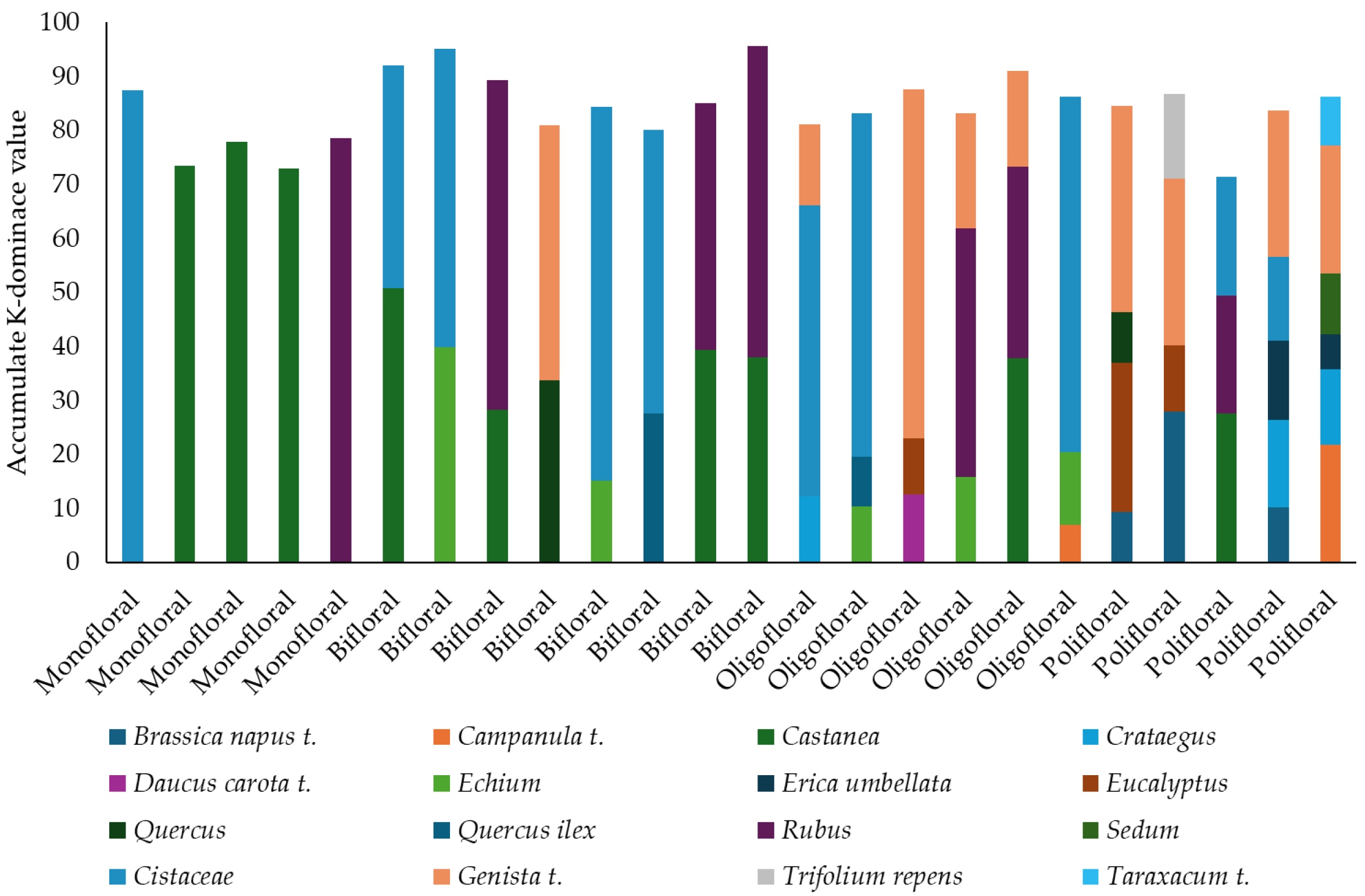
Figure 1 shows that classification based on the minimum number of pollen types needed to reach cumulative K-dominance of at least 70% revealed that bifloral assemblages were the most frequent, followed by oligofloral and polyfloral samples.
A palynological analysis based on dominance revealed that most of the bee pollen samples exhibited a complex botanical structure, with more than one pollen type contributing substantially to the total pollen load (
Figure 1). When the samples were classified according to the minimum number of pollen types required to reach a cumulative K-dominance of at least 70%, bifloral assemblages emerged as the most frequent category (n = 8), followed by oligofloral (n = 6), monofloral (n = 5) and polyfloral (n = 5) samples.
One of the samples was unequivocally classified as monofloral from Cistaceae, reaching a K-dominance value of 87.4%. Four additional samples showed consistently high dominance values for Castanea, exceeding the 70% threshold of the pollen spectrum, although accompanied by a secondary taxon, generally Rubus, at low relative abundance. Given the clearly dominant quantitative contribution of Castanea (mean ≈ 75%) and the residual presence of secondary pollen type, these samples were considered monofloral in the present study. This decision was supported by their chemical composition and functional indices, which closely matched those of strictly monofloral samples, as confirmed by PCA, Spearman correlations and ANOVA. This classification remains consistent with established palynological dominance criteria while improving the coherence between botanical dominance and functional performance.
In typical bifloral samples, the second dominant taxon contributed between 20 and 40% of the pollen load, indicating codominance. This pattern was particularly evident in combinations such as Cistaceae–Echium, Castanea–Rubus, and Genista t. with other pollen types. Oligofloral samples were characterised by three dominant pollen types reaching the accumulative threshold (>70%), whereas polyfloral samples required four to six taxa, each generally presenting individual K-dominance values below 30%. These assemblages reflect higher floral diversity.
3.3. Physicochemical Composition and Antioxidant Activity of Bee Pollen According to Botanical Category of Bee Pollen Samples
The physicochemical composition and antioxidant activity of bee pollen varied significantly according to botanical dominance (
Table 1). Samples were classified as monofloral, bifloral, oligofloral or polyfloral. Each group was characterised by the classification given above (the main pollen types that give cumulative k-dominance: >70%).
3.4. Water and Protein Content
The water content of the bee pollen samples varied widely, ranging from 8.1% to 29.8% with an average of 16.7%. No consistent pattern that could be directly attributed to botanical composition was observed when samples were grouped according to botanical category (monofloral, bifloral, oligofloral and polyfloral). Instead, water values were primarily associated with the samples’ processing state and, secondarily, their geographical origin. The highest average water content was exhibited by bifloral samples (18.2%), followed by polyfloral samples (19.0%), whereas oligofloral samples showed lower mean values (12.9%). The single monofloral sample (Cistaceae) had a low water content of 9.0%. However, within each dominance category, the minimum and maximum values substantially overlapped, indicating that botanical category alone does not explain the observed variability in water content.
Considering sample processing, those collected and analysed as fresh pollen consistently showed higher water levels, frequently exceeding 20% and reaching maximum values close to 30% (bifloral Rubus–Castanea samples from Lugo and polyfloral samples from A Coruña and Pontevedra). In contrast, dried samples exhibited lower water content values, generally below 12%, regardless of their botanical composition. This distinction accounts for the low minimum values recorded across all dominance categories and confirms that drying treatment is the main determinant of water content.
Protein content ranged from 5.7 to 25.6 g eq protein/100 g dw pollen, with an overall mean of 16.2 g/100 g dw. In contrast to water, protein levels showed clearer associations with botanical origin. Bifloral samples presented moderate protein contents on average (14.8 g/100 g dw), but with strong internal variability depending on the pollen type involved. Combinations dominated by Genista t. + Quercus, exhibited the highest protein values (25.6 g/100 g dw), whereas samples combining Castanea + Cistaceae showed lower protein content (5.7 g/100 g dw).
Oligofloral samples showed slightly higher mean protein content (17.4 g/100 g dw) and included some of the protein-richest combinations, such as Castanea + Rubus + Genista t. (22.1 g/100 g dw) and Genista t. + D. carota t. (24.0 g/100 g dw). Polyfloral samples also exhibited high protein values on average (19.6 g/100 g dw), with maximum values reaching 25.1 g/100 g dw, suggesting that increased botanical diversity can enhance nutritional balance. The monofloral Cistaceae sample showed a relatively low protein content (8.6 g/100 g dw).
3.5. Total Phenolic and Flavonoid Contents
Total phenolic content (TPC) showed wide variability among bee pollen samples, ranging from 829.4 to 2594.2 mg GAE/100 g. This reflects the strong influence of botanical composition on phenolic accumulation. When the samples were categorised by botanical origin, those predominantly consisting of Castanea exhibited high average TPC values (1663.4 mg GAE/100 g), with maximum values reaching 2594.2 mg GAE/100 g. Bifloral samples, particularly those containing higher Castanea content (50.7%) exhibited some of the highest observed TPC values (2360.9 mg GAE/100 g).
Oligofloral samples showed a broad TPC range (829.4–2298.8 mg GAE/100 g), suggesting that increasing botanical complexity generates highly variable profiles depending on the taxa involved. Polyfloral samples containing ≥4 pollen types, each accounting for <30%, presented relatively high and more homogeneous TPC values (mean 1762.4 mg GAE/100 g). This suggests that floral diversity can sustain elevated phenolic levels through complementary botanical contributions. By contrast, the strictly monofloral Cistaceae sample exhibited intermediate TPC values (1138.0 mg GAE/100 g).
Total flavonoid content (TFC) ranged from 90.1 to 711.6 mg QE/100 g. The highest TFC values were recorded in polyfloral samples (mean 462.2 mg QE/100 g; maximum 711.6 mg QE/100 g), as well as in selected oligofloral combinations such as Castanea + Rubus + Genista t. (416.1 mg QE/100 g) and Genista t. + D. carota (413.7 mg QE/100 g). Bifloral and monofloral samples showed intermediate TFC values, whereas some Cistaceae-dominated assemblages displayed comparatively lower flavonoid levels.
These results confirm that both TPC and TFC are strongly dependent on botanical category. The variability of TPC and TFC across botanical groups highlights the importance of evaluating phenolic composition using integrated functional indices rather than relying on single global parameters.
3.6. Antioxidant Activity (DPPH, ABT+ and FRAP Assays)
All bee pollen extracts exhibited high antioxidant activity, although substantial differences were observed among botanical classifications and dominant pollen compositions. Radical scavenging activity measured by the DPPH assay (%RSA) ranged from 70.2% to 84.6%, with most samples showing values above 78%. The highest mean %RSA values were associated with Castanea–Rubus combinations and bee pollen samples dominated by Castanea, whereas samples dominated by Cistaceae and some oligofloral samples exhibited comparatively lower scavenging activity.
The ABTS+• inhibition assay revealed a wider variability of antioxidant results, with inhibition values ranging from 36.7% to 98.8%. Monofloral samples dominated by Castanea and Castanea–Rubus combinations consistently showed very high ABTS+ inhibition, frequently exceeding 95%, indicating strong electron- or radical-quenching capacity. In contrast, Cistaceae-dominated samples, particularly those combined with Echium or Campanula t., displayed moderate ABTS+• inhibition values, reflecting a more heterogeneous antioxidant profile.
Ferric reducing antioxidant power (FRAP) values ranged from 10.2 to 21.2 μmol TE/g, confirming notable variability in reducing capacity among samples. The highest FRAP values were observed in Genista t. dominated combinations and Castanea-containing samples, while Cistaceae-rich and some oligofloral assemblages showed lower reducing power. Polyfloral samples exhibited intermediate FRAP values.
Antioxidant activity was strongly influenced by botanical composition and mirrored trends observed for phenolic and flavonoid contents, reinforcing the central role of botanical origin in determining the functional antioxidant properties of bee pollen.
3.7. Phenolic Profile of Bee Pollen Samples
The phenolic profile of 24 bee pollen samples was subsequently analyzed by high-performance liquid chromatography (HPLC) coupled with tandem mass spectrometry (MS/MS) instrumentation, enabling the comprehensive characterization of phenolic compounds. The results obtained were expressed in mg/kg of dry pollen, as illustrated in
Table 2. The chromatographic profile identified 30 compounds in all bee pollen samples, which were classified into four distinct groups. The flavonoid group was the most abundant, with 17 compounds. This was followed by phenolic acids, which included 10 compounds, phenolic aldehydes with 2 compounds, and finally, alkaloids, which contained only one compound.
The average flavonoid content (∑ flavonoids) reached 208.3 mg/kg, compared to 25.7 mg/kg of total phenolic acids, indicating that flavonoids represented the majority fraction of the phenolic profile of the bee pollen samples. This trend was also reflected in the total phenolic profile, with an average of 234.8 mg/kg and high compositional heterogeneity between samples, mainly attributable to botanical origin. Among the individual flavonoids, rutin was the predominant compound overall (average 128.0 mg/kg; maximum 341.8 mg/kg), confirming its role as a key marker of bee pollen. Other flavonoids with significant contributions were isorhamnetin (24.2 mg/kg), luteolin (17.5 mg/kg), naringenin (12.1 mg/kg), kaempferol (7.9 mg/kg) and myricetin (8.4 mg/kg). The high standard deviation observed in compounds such as luteolin, isorhamnetin and rutin indicates that their accumulation strongly depends on the dominant plant taxon and the floral combinations present in each sample.
As for phenolic acids, the most abundant compounds were gallic acid (10.3 mg/kg), p-coumaric acid (8.0 mg/kg) and ellagic acid (3.6 mg/kg). These compounds showed wide ranges (p-coumaric acid up to 50.5 mg/kg and ellagic acid up to 20.4 mg/kg), suggesting an important role in the functional and antioxidant variability of pollen. Other phenolic acids (ferulic, vanillic, 4-hydroxybenzoic, syringic and rosmarinic) were present at low levels and may act as secondary components of the antioxidant profile.
Phenolic aldehydes (p-hydroxybenzaldehyde and syringaldehyde) and the alkaloid caffeine were detected in low concentrations, although with high maximum values in some samples (caffeine up to 12.7 mg/kg), reinforcing the idea that botanical origin may contribute to the overall chemical profile.
3.8. Phenolic Index, Antioxidant Index and Global Functional Indices of Bee Pollen Samples
The composite indices highlighted clear differences in functional quality among bee pollen samples (
Table 3), largely influenced by botanical dominance rather than by the degree of floral complexity alone.
Across the complete dataset (n = 24), the Phenolic Index (PI) showed a moderate mean value (0.4) with marked variability, indicating a heterogeneous distribution of phenolic compounds among botanical origins. In contrast, the Antioxidant Index (AI) displayed a higher mean value (0.6), suggesting that antioxidant activity was generally preserved across samples, although strongly modulated by the dominant pollen taxon. The Global Functional Index (GFI), which integrates both phenolic content and antioxidant performance, exhibited an intermediate mean value (0.5) and comparatively lower dispersion, supporting its suitability as a stable descriptor of overall functional quality.
Among monofloral samples, functional performance varied markedly depending on botanical origin. Samples dominated by Castanea, either alone or in combination with Rubus, consistently exhibited high AI values (0.7–0.9) and elevated GFI scores (=0.6), highlighting the strong contribution of this taxon to antioxidant capacity. Notably, bifloral samples combining Castanea and Cistaceae reached the highest individual PI, AI and GFI values (0.7), suggesting potential additive or synergistic effects between these dominant pollen types.
Bifloral and oligofloral groups showed comparable mean GFI values (0.5 and 0.4, respectively), indicating that increased botanical diversity does not necessarily translate into higher functional indices unless associated with pollen types rich in phenolic compounds and antioxidant activity. In contrast, combinations dominated by Cistaceae and Echium generally exhibited lower AI and GFI values (=0.3), despite moderate PI scores, reflecting taxon-specific limitations in antioxidant expression. Polyfloral samples displayed relatively high mean GFI values (0.6), further supporting the notion that functional quality depends on the identity of contributing taxa.
These results show that the Phenolic Index (PI) and Antioxidant Index (AI) describe related but not redundant functional dimensions. A higher PI mainly reflects a higher relative load or diversity of phenolic compounds, especially flavonoids and phenolic acids, but does not necessarily guarantee higher antioxidant activity. In contrast, the AI is more directly conditioned by the redox efficacy and specific bioactivity of certain compounds, as well as by possible synergistic effects between them. This dissociation between the Phenolic Index (PI) and the Antioxidant Index (AI) shows that the total amount of phenolic compounds alone does not determine the antioxidant response of pollen. The PI fundamentally reflects the relative richness and abundance of phenolic compounds and flavonoids, while the AI integrates the functional efficacy of these compounds in terms of their reducing and radical-scavenging capacity. For example, samples dominated by Cistaceae (87.4%) have a relatively moderate PI (0.5), but show lower AI values (0.4), indicating lower overall antioxidant efficiency. In contrast, samples dominated by Castanea (74.7%) exhibit a more moderate PI (0.3) but achieve very high AI values (0.9), reflecting the presence of phenolic compounds that are highly active from an antioxidant point of view. Similarly, bifloral combinations such as Rubus (54.8%) + Castanea (35.1%) show low PI (0.2), but high AI (0.7), confirming that a lower total phenolic load can be compensated with compounds with high antioxidant potency. In contrast, samples dominated by Cistaceae + Echium had intermediate PI (≈0.4) but low AI and GFI values (≈0.3), evidencing specific functional limitations of the phenolic profile. These examples reinforce that PI is more related to the composition and diversity of phenols and flavonoids, while AI depends on their effective bioactivity, justifying the need to integrate both parameters into the Global Functional Index (GFI) for a more realistic assessment of pollen functional quality.
3.9. Multivariate Validation of Functional Indices and Influence of Dominant Pollen Type
This section evaluated the multivariate consistency of the proposed functional indices and their ability to integrate chemical, antioxidant, and botanical information from bee pollen. Following the descriptive characterisation of the samples according to their botanical category (monofloral, bifloral, oligofloral and polyfloral), a high overlap of functional values was observed between these categories, suggesting that the number of pollen types present alone does not explain the functional variability observed, but rather the dominant pollen type.
3.9.1. Spearman Correlation Analysis of Functional Indices
Spearman’s rank correlation was applied to explore monotonic relationships among functional indices, physicochemical parameters, antioxidant assays, botanical composition and individual phenolic compounds.
The Spearman correlation analysis revealed a coherent and biologically meaningful relationship between the proposed functional indices, phenolic composition, antioxidant activity and dominant pollen origin (
Table 4), supporting the integrative approach adopted in this study.
The PI showed strong and significant positive correlations with total flavonoid content (ρ = 0.818, p < 0.001), total phenolic content (ρ = 0.561, p < 0.01) and the summed phenolic profile (ρ = 0.665, p < 0.01), confirming that this index accurately reflects phenolic abundance and diversity. At the compound level, PI was positively associated with several flavonoids, including quercetin, rutin, quercetin-3-galactoside, myricetin, kaempferol and taxifolin (p < 0.05), indicating that it integrates multiple phenolic contributors rather than being driven by a single compound. A significant negative correlation with Rubus pollen (ρ = −0.512, p < 0.05) suggests that samples dominated by this taxon tend to present lower relative phenolic values within the studied dataset.
In contrast, the AI was strongly correlated with the GFI (ρ = 0.840, p < 0.001), confirming that antioxidant performance is the main driver of global functional quality. AI showed highly significant positive correlations with ABTS+• and FRAP assays (ρ = 0.782 and ρ = 0.732, respectively; p < 0.001), validating its capacity to summarize antioxidant activity across complementary mechanisms. AI was also positively associated with Castanea pollen (ρ = 0.768, p < 0.001) and negatively correlated with Cistaceae and Q. ilex, highlighting the strong influence of dominant botanical origin on antioxidant potential.
The GFI exhibited a correlation pattern similar to AI, with strong positive associations with TPC (ρ = 0.691, p < 0.001), ABTS+• (ρ = 0.597, p < 0.01) and FRAP (ρ = 0.640, p < 0.01). GFI also correlated positively with Castanea pollen (ρ = 0.596, p < 0.01) and with several phenolic compounds, including vanillic acid, galangin, isorhamnetin and pinocembrin (p < 0.05). These relationships indicate that GFI effectively integrates phenolic composition and antioxidant response into a stable descriptor of functional quality.
The correlation structure demonstrates that functional variability in bee pollen is more strongly explained by dominant pollen origin than by palynological category (mono-, bi-, oligo- or polyfloral). The proposed indices are not only statistically consistent but also ecologically coherent, capturing the biochemical fingerprints associated with dominant botanical sources. This multivariate validation supports the use of composite functional indices as robust tools for comparing bee pollen quality and confirms the central role of dominant pollen taxa in shaping phenolic and antioxidant functionality.
3.9.2. Principal Component Analysis of Functional, Chemical and Botanical Variables
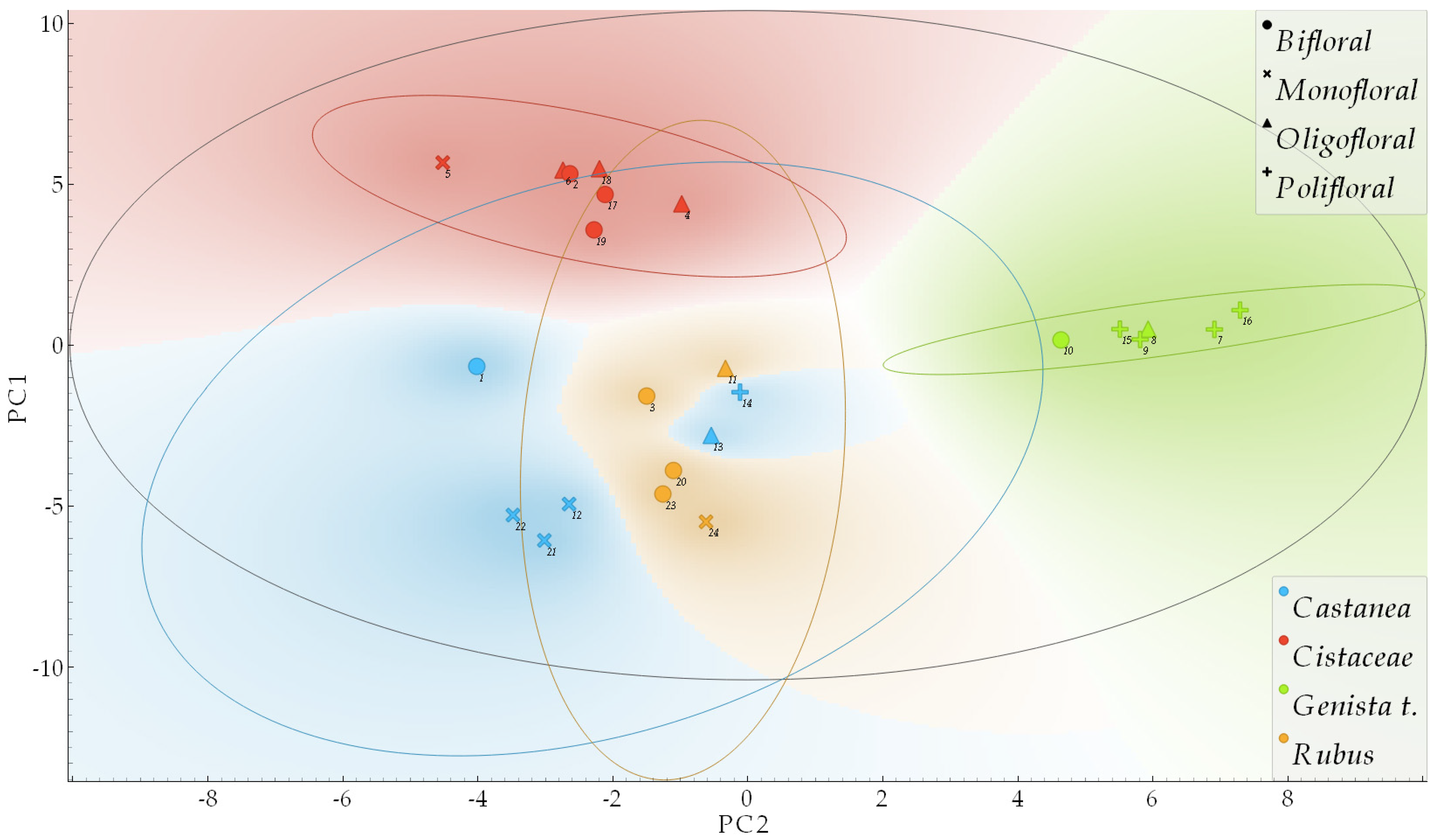
Principal Component Analysis (PCA) was applied to the complete dataset in order to explore the multivariate relationships among functional indices (PI, AI and GFI), antioxidant assays, physicochemical parameters, botanical composition and phenolic profiles of bee pollen samples. The first two principal components explained a substantial proportion of the total variance, with PC1 accounting for 46.7% and PC2 for 11.5%, together explaining approximately 58.2% of the overall variability (
Figure 2). The scree plot showed a clear inflection after the second component, supporting the suitability of a two-dimensional representation for data interpretation.
The PCA score plot revealed a clear organization of samples primarily according to dominant pollen origin, rather than according to palynological category (monofloral, bifloral, oligofloral or polyfloral). Samples dominated by Castanea were mainly located on the negative side of PC1, whereas samples dominated by Cistaceae clustered on the positive side of PC1. In contrast, Genista t. samples were clearly separated along the positive side of PC2, forming a compact and well-defined group, while Rubus-dominated samples occupied intermediate positions between Castanea and Cistaceae. This pattern indicates that the botanical identity of the dominant pollen source exerts a stronger structuring effect on the multivariate space than the number of pollen taxa present in each sample.
PC1 was strongly associated with a functional–antioxidant gradient, as samples with negative PC1 scores (mainly Castanea and Rubus) showed higher values of the AI and GFI, in agreement with their elevated ABTS+• and FRAP responses. In contrast, samples dominated by Cistaceae, located at positive PC1 values, were associated with lower antioxidant performance and lower functional scores. This pattern is fully consistent with the Spearman correlation analysis, confirming that PC1 integrates phenolic composition and antioxidant capacity as the principal sources of variance. PC2 contributed to a secondary differentiation, separating samples dominated by Genista t. along with its positive axis. This separation reflects specific phenolic fingerprints characterized by flavonoid rich profiles, particularly luteolin and related compounds, typical of Genista t. pollen. The dispersion within groups along PC2 indicates moderate intra-botanical variability, particularly for Rubus and Castanea, without obscuring the dominant botanical signal.
It is important to note that samples belonging to different botanical categories showed substantial overlap in PCA space, while samples sharing the same dominant botanical origin clustered independently close together. This demonstrates that functional quality is primarily governed by the dominant pollen taxon rather than by the number of pollen types present.
The PCA confirms that the proposed composite indices (PI, AI and FI) reflect the intrinsic multivariate structure of the dataset and are biologically and chemically coherent. The alignment between botanical origin, phenolic composition, antioxidant activity and functional indices provides robust multivariate validation of these indices as reliable descriptors of bee pollen functional quality.
3.9.3. ANOVA for the Influence of Botanical Variables
The results of the analysis of variance (ANOVA) demonstrated that the dominant pollen type exerted a significant effect on most of the physicochemical, antioxidant and functional variables evaluated. In contrast, palynological diversity indices (Shannon index, evenness and dominance) did not show significant differences among groups (
p > 0.05). This finding indicates that palynological richness alone does not explain the functional variability observed, highlighting the dominant pollen taxon as the main driver of bee pollen functional quality.
Table 5 summarizes the significant differences among dominant botanical origins for physicochemical parameters, antioxidant activity, functional indices and major phenolic compounds.
Samples dominated by Genista t. showed significantly higher protein content, total flavonoid content (TFC) and Phenolic Index (PI), indicating a functional strategy characterized by flavonoid-rich and chemically specialized profiles. This pattern suggests that Genista pollen contributes primarily through the accumulation of specific flavonoids rather than through overall antioxidant potency.
In contrast, samples dominated by Castanea exhibited the highest values of total phenolic content (TPC), antioxidant activity (ABTS+• and FRAP), as well as the Antioxidant Index (AI) and Functional Index (FI). These results confirm that Castanea pollen provides a strong contribution to global antioxidant functionality, effectively integrating both phenolic abundance and antioxidant performance.
Samples dominated by Cistaceae consistently showed the lowest values of antioxidant activity and functional indices, positioning this botanical group at the lower end of the functional gradients. Conversely, Rubus occupied an intermediate functional position, characterized by relatively high antioxidant capacity, particularly in the ABTS+• assay, but associated with a lower total phenolic load compared to Castanea and Genista t.
The phenolic profile exhibited a clear botanical-dependent structure. ANOVA revealed significant differences for several individual phenolic compounds as well as for grouped phenolic classes, indicating that each dominant taxon is associated with a characteristic phenolic fingerprint. Among flavonoids, rutin was the predominant compound across all botanical groups, with significantly higher concentrations in Cistaceae-dominated pollen, followed by Genista t. and Castanea. This distribution explains the strong contribution of flavonoids to the total phenolic profile of these samples.
Bee pollen samples dominated by Genista t. were further distinguished by exceptionally high luteolin concentrations, whereas Rubus-dominated samples showed significantly higher levels of isorhamnetin. Phenolic acids also displayed marked botanical specificity: Genista t. samples presented the highest total phenolic acid content, mainly driven by p-coumaric, ellagic and ferulic acids, while Cistaceae pollen was characterized by elevated gallic acid concentrations. In contrast, Rubus-dominated pollen exhibited lower total phenolic acid contents but relatively higher proportions of specific flavonoids such as chrysin and pinocembrin.
When compounds were grouped into functional classes, ANOVA confirmed significant differences in the sum of flavonoids, total phenolic acids and overall phenolic profile among dominant botanical origins. Cistaceae pollen showed the highest total and normalized phenolic profiles, whereas Genista t. pollen displayed a more balanced allocation between phenolic acids and flavonoids, reflecting a distinct compositional strategy.
These results demonstrate that the proposed functional indices effectively integrate the chemical and antioxidant variability associated with dominant botanical origin, providing a robust and functionally meaningful discrimination that surpasses traditional palynological classifications based solely on pollen richness or botanical categories. This evidence reinforces the usefulness of the functional index-based approach for the comprehensive characterization of bee pollen quality.
4. Discussion
Bee pollen is a highly complex biological matrix in which the botanical origin, phenolic composition, antioxidant activity, and processing factors interact synergistically to determine its functional quality. This study integrated chemical, botanical, and functional parameters using composite indices and multivariate analysis to provide a comprehensive characterization of bee pollen, overcoming the limitations of approaches based on isolated variables.
Palynological analysis confirmed that bee pollen collected by
A. mellifera directly reflects the surrounding floral diversity, with a high botanical richness dominated by Asteraceae, Fabaceae, Cistaceae, Ericaceae, Rosaceae and Fagaceae, which are widely recognized as priority pollen resources due to their broad distribution and high productivity [
39,
40,
41]. The geographical patterns identified between Mediterranean and Atlantic regions can be interpreted as the outcome of contrasting climatic constraints and landscape configurations that shape floral availability. In Mediterranean areas, the prevalence of Cistaceae reflects the ecological dominance of xerophytic shrub communities adapted to dry conditions [
41,
42], whereas the humid north-western Iberian Peninsula favours the predominance of
Rubus and
Castanea as major pollen sources [
39,
43].
The coexistence of dominant pollen types with a broad diversity of secondary pollen types confirms that bee pollen cannot be considered a strictly monospecific product. This pattern is consistent with the generalist foraging strategies of bees, which integrate multiple floral resources to ensure nutritional balance at the colony level [
43,
44,
45].
The moderate to low Shannon index values and high variability in evenness indicate that most samples have structures dominated by one or a few taxa (k-dominance), regardless of their formal classification as monofloral, oligofloral, or polyfloral. This pattern, widely described in previous palynological studies, supports the idea that pollen structure responds to a continuous gradient of dominance rather than discrete categories [
39,
41,
46]. However, the ANOVA results show that these structural differences do not translate into significant functional variability, suggesting that palynological diversity alone does not explain the functional quality of pollen.
The marked dependence on the dominant taxon observed for Cistaceae,
Rubus, and
Castanea confirms that botanical identity is the factor that most strongly influences the chemical composition and antioxidant activity of pollen, above and beyond the total richness of pollen types. This result is consistent with studies showing that a small number of species can contribute most of the functionally relevant pollen resources in an ecosystem [
47,
48]. In this context, although
Genista t. is associated with more heterogeneous structures, its functional relevance derives from a highly specialised flavonoid profile rather than high palynological diversity.
Taken together, these results indicate that, although pollen diversity reflects floral availability and the adaptive foraging response of bees to the landscape [
49,
50,
51], its explanatory power is limited when assessing the functional quality of pollen. In contrast, the dominance of taxa with specific phenolic profiles emerges as a key factor in understanding antioxidant and functional variability between samples. Thus, the integration of classical palynology with functional indices provides a more accurate and biologically meaningful interpretation of pollen quality, reinforcing its usefulness as a functional indicator of the landscape and as a tool for assessing the nutritional and nutraceutical value of bee products [
4,
5,
43,
45,
52,
53]. Botanical origin is one of the main determinants of chemical composition and functional potential of bee pollen. Numerous studies have demonstrated that phenolic, flavonoid and carotenoid profiles differ significantly among plant species even within the same geographical region [
13,
54,
55]. Similar trends have been reported for pollen from Turkey, Algeria, Spain, Morocco, Poland and Brazil [
13,
18,
54,
56,
57].
In the present study, this botanical control was clearly supported by multivariate and univariate analyses. Spearman correlation analysis revealed strong and consistent associations between dominant pollen taxa and functional indices, while PCA showed a clear segregation of samples primarily according to dominant botanical origin rather than palynological categories. This pattern was further confirmed by ANOVA, which demonstrated significant differences among dominant pollen types for most physicochemical, antioxidant and functional variables, whereas palynological diversity indices did not differ significantly between groups.
The samples dominated by
Castanea were characterised by higher total phenolic content (TPC), antioxidant activity (ABTS
+• and FRAP) and composite functional indices (AI and GFI), confirming their strong contribution to overall antioxidant functionality. These findings are consistent with previous reports describing
Castanea pollen as one of the richest sources of phenolic compounds and antioxidant activity [
58]. In contrast, samples dominated by Cistaceae taxa showed consistently lower functional indices, placing Cistaceae at the lower end of the functional-antioxidant gradient identified by PCA. These results demonstrate that botanical origin acts not only as an authenticity marker, but also as a robust predictor of functional quality. From an ecological perspective, pollen composition reflects floral availability and foraging behaviour, which directly condition chemical heterogeneity [
59,
60]. Therefore, botanical origin should be considered a primary criterion in the functional evaluation of bee pollen.
The strong correlations observed between total phenolic content, antioxidant assays and functional indices confirm that phenolic compounds are the main contributors to the antioxidant activity of bee pollen, as consistently reported in previous studies [
57,
58,
61]. However, the incomplete correlation between the Phenolic Index (PI) and the Antioxidant Index (AI) indicates that antioxidant performance cannot be explained solely by total phenolic concentration. This supports metabolomic evidence showing that antioxidant capacity depends not only on phenolic quantity, but also on qualitative composition and synergistic interactions among compounds [
16,
62]. Differences among antioxidant assays further reflect this chemical complexity. Previous studies have shown that methods such as DPPH, ABTS
+• and CUPRAC respond differently to the diverse pool of hydrophilic and lipophilic antioxidants present in bee pollen, with CUPRAC often exhibiting higher sensitivity to a broader range of compounds [
63]. In this context, the use of complementary assays in the present study captures distinct antioxidant mechanisms and supports the robustness of the composite functional indices.
Several individual flavonoids, including quercetin, rutin, myricetin, kaempferol, and isorhamnetin, showed significant correlations with functional indices, reinforcing their central role in determining pollen bioactivity [
58,
61,
64]. Rutin, one of the most abundant flavonoids in bee pollen [
11,
56,
65], showed marked botanical specificity, with significantly higher concentrations in samples dominated by Cistaceae, contributing substantially to flavonoid-rich phenolic profiles.
Pollen dominated by
Genista t. presented particularly high concentrations of luteolin, which explains its separation along PC2 in the PCA. This result indicates that PC2 reflects secondary variability associated with specific flavonoid profiles, rather than overall antioxidant capacity. Similarly, the predominance of phenolic polyamides described in
Castanea pollen [
13], along with the high levels of hyperoside and rutin described in monofloral and polyfloral bee pollen [
55], highlights the effectiveness of detailed chemical profiles in distinguishing botanical origins and supporting pollen authentication.
Phenolic acids, although present at lower concentrations than flavonoids, also displayed clear botanical specificity. Compounds such as gallic,
p-coumaric, syringic and ellagic acids have been identified as relevant contributors to antioxidant activity in pollen from different geographical regions [
18,
66], supporting their secondary but functionally relevant role.
ANOVA confirmed significant differences among dominant botanical origins not only for individual phenolic compounds, but also for grouped phenolic classes, reinforcing the concept of taxon-specific phenolic fingerprints. These results demonstrate that qualitative phenolic composition, rather than total phenolic content alone, is a key driver of antioxidant functionality in bee pollen.
The strong correlation between the Antioxidant Index (AI) and the Global Functional Index (GFI) confirms that integrating multiple antioxidant assays into composite indices provides a more robust functional characterization than single-method approaches, addressing a well-known limitation of antioxidant evaluation [
67,
68]. Similar integrative strategies applied to medicinal plants, wildflowers and aromatic herbs have demonstrated enhanced discrimination power, particularly when combined with multivariate analysis [
69,
70,
71,
72].
In this study, AI and GFI showed consistent correlations with antioxidant assays, TPC, and dominant botanical taxa. PCA further demonstrated that these indices align with the intrinsic multivariate structure of the dataset, reinforcing their validation. The main functional-antioxidant gradient identified along PC1 was clearly driven by botanical origin, in full agreement with Spearman correlations and ANOVA results.
Although composite indices are often criticized for acting as proxies of TPC [
67,
70], the present results show that combining chemical profiling, multivariate analysis and botanical information improve functional interpretation and robustness. Advanced fingerprinting approaches, including LC-HRMS-based metabolomics, have reported similar discriminative patterns [
73,
74].
Despite the robustness of the proposed approach, the relatively limited sample size remains a limitation, and future studies should incorporate larger datasets and broader botanical coverage to strengthen generalization. Nevertheless, the consistency between Spearman correlations, PCA and ANOVA provides strong evidence supporting composite functional indices as reliable tools for the functional classification and quality assessment of bee pollen.




 ,
,