1. Introduction
The production of commercial sulfur and hydrogen from harmful sulfur-containing gases occurring in the Claus and Cold Bed Absorption (CBA) reactors of sulfur recovery units (SRU) at oil refineries is influenced by numerous input and operating reactor parameters. The quality of sulfur is assessed by its purity, i.e., the content of impurities, mass fractions of sulfur, ash, organic substances and water in the obtained sulfur, as well as its physical properties such as color and density. Sulfur quality also depends on its chemical activity, which determines its applicability across various industrial sectors. High-quality sulfur produced in SRUs is used in the medical, chemical, agricultural and other industries, while hydrogen is used in hydrogen energy.
The main input and operating parameters affecting sulfur and hydrogen production, and their volume and quality, include reactor temperature and pressure, catalyst activity, and other factors [
1,
2]. The influence of these technological parameters on the sulfur and hydrogen extraction processes and their quality is nonlinear, stochastic, and fuzzy qualitative in nature, which complicates mathematical modeling and traditional methods for determining sulfur quality. Therefore, the study and solution of problems related to the modeling, optimization, and control of high-quality sulfur and hydrogen production processes in SRUs using artificial intelligence methods is currently a highly relevant scientific and practical task.
The operating modes of SRUs are characterized by numerous interacting parameters and by the fuzziness of sulfur quality indicators, determined by the sulfur purity, color, and mass fractions of sulfur, ash, organic substances, and water in the produced sulfur [
3,
4]. In practice, these sulfur quality indicators are evaluated with the participation of experienced SRU process operators and refinery laboratory experts based on their knowledge, experience, and intuition. When assessing sulfur quality, the
Standard for the Determination of Sulfur SRUAN 4 is used to analyze the chemical composition of sulfur using spectroscopy and chromatography methods, as well as to evaluate its physicochemical properties. Enterprise-specific standards are also applied, where requirements for sulfur quality are formulated as fuzzy instructions (constraints), such as “not lower than—
” or “not greater than—
” than a specified value
b.
The integrated sulfur quality based on these qualitative parameters is evaluated in a fuzzy manner using the experience, knowledge, and intuition of SRU process operators and refinery laboratory experts [
5,
6]. Sulfur quality directly affects the efficiency of downstream production processes and the quality of the final products.
High-quality sulfur is used for the production of medical materials, paints, and various chemical industry products, as well as in military applications, agriculture, and other industries. Currently, the global market demand for high-quality sulfur shows intensive growth trends. Furthermore, SRUs convert environmentally harmful sulfur-containing gases released from various oil refining processes into valuable products, improving refinery economic performance and enhancing environmental safety [
7].
Recently, the share of sour and high-sulfur crude oils produced in Kazakhstan and other oil-producing countries has been increasing. This trend leads to higher emissions of environmentally harmful sulfur-containing gases during the refining of such crudes and worsens environmental conditions. Therefore, enhancing the performance of sulfur recovery units (SRUs) through modern scientific methods and information technologies has become an important and relevant task for oil refineries. Compared to conventional technological approaches, these methods are more efficient and enable prompt decision-making for the optimal control of sulfur and hydrogen production processes under uncertainty and fuzziness. The relevance of optimization and the effective control of SRU operating modes is further strengthened by the tightening of environmental regulations and industrial standards.
The Claus and Cold Bed Absorption (CBA) processes occurring in Claus and CBA reactors are among the most efficient technological processes, enabling the conversion of harmful hydrogen sulfide into sulfur and hydrogen—valuable products demanded by the hydrogen energy, oil refining, and petrochemical industries [
8,
9]. The optimization of sulfur production processes in the Claus and CBA reactors of SRUs is inherently multi-criteria, since system performance is evaluated by a vector of criteria and numerous fuzzy constraints on sulfur quality indicators. Depending on market requirements, the criteria may correspond to product volumes with required production volumes or product quality with required quality specifications. Since these criteria are contradictory within the space of efficient solutions, the decision-making problem must be solved in a fuzzy environment to select the best solution that allows for the optimization and effective control of sulfur production processes [
10,
11,
12,
13].
All these factors motivated the present study, aimed at investigating and solving the problems of modeling sulfur volume and quality assessment and optimizing sulfur production processes in SRUs under stochastic and fuzzy uncertainty. Therefore, the objective of this work is to develop neuro-fuzzy models for assessing sulfur volume and quality at the output of the Claus and CBA reactors of SRUs under uncertainty for the optimization of sulfur production processes. Given the importance of improving the economic performance and environmental sustainability of oil refineries, research efforts aimed at enhancing SRU efficiency have intensified in recent years. Below, we present a review and analysis of works relevant to the subject of this study.
Ibrahim et al., in work [
6,
14], investigated the evaluation of sulfur productivity, efficiency, and quality, as well as the optimization of sulfur extraction processes based on descriptive models. Kadyrov [
15] explored and compared technologies and methods for extracting and producing high-purity sulfur based on mathematical modeling. In [
16,
17,
18,
19], computational fluid dynamics (CFD) models for simulating the catalytic reactors of the Claus process in sulfur recovery plants were proposed. Bogomolova et al. [
20] studied the problems of the mathematical modeling and optimization of sulfur production processes. These studies considered the modeling problems of sulfur production with required quality indicators under deterministic conditions.
The authors of [
21,
22,
23] investigated the optimization problems of the Claus process based on mathematical models to obtain high-quality sulfur under stochastic uncertainty. In [
24,
25], sulfur production optimization problems were studied using process modeling methods through the integration of Aspen HYSYS and MATLAB. Kazempour et al. [
26] examined the development of mathematical models and their use in optimizing the thermal and catalytic sections of the Claus process for sulfur production based on a vector of criteria. In [
27] the structural and chemical diversity and complexity of sulfur minerals influencing sulfur quality were analyzed. The authors of [
28,
29,
30] investigated the prediction and optimization problems of sulfur extraction processes with required quality specifications using SRU models and machine learning methods and proposed intelligent approaches to their solution.
In the analyzed studies and other works related to this topic, the approaches to the modeling and optimization of sulfur production processes were mostly developed under deterministic and stochastic uncertainty. Stochastic uncertainty was addressed mainly using probability theory and mathematical statistics [
31,
32,
33]. The authors of [
34] proposed a fuzzy logic-based decision support approach, closely related to our study, for selecting operating parameters under uncertainty and trade-offs. In this paper, a method is proposed to enable laboratory operators to select the correct equipment parameters for a milling press during calibration. They first propose to apply a design-of-experiments method to identify the calibration parameter that influences the final content determination result. Then, a decision support system for adjusting the equipment parameters is developed based on the fuzzy logic approach.
It has been found that in existing works, multi-criteria optimization does not consider the contradictory nature of criteria within the space of efficient solutions, nor the preferences of the decision-maker (DM), who is responsible for the effective control of sulfur production processes. In practice, the DM chooses the best solution in a fuzzy environment based on experience, knowledge, and intuition, taking into account the operational conditions and market requirements for sulfur volume and quality. It should be noted that in the analyzed works, the problems of model development, multi-criteria optimization of SRU operating modes, and multi-criteria optimization in a fuzzy environment for controlling SRUs in industrial conditions are insufficiently studied and remain unresolved. In this work, the problems of developing effective sulfur quality assessment models for the multi-criteria optimization of sulfur production processes under uncertainty are investigated, and artificial intelligence-based approaches for their solution are proposed.
The specific contribution of fuzzy Pareto methods over standard multi-objective optimization in the context of SRUs lies not simply in finding a compromise solution, but in taking into account the uncertainty, fuzzy requirements, and linguistic criteria characteristics of real industrial operations. Fuzzy Pareto methods allow for uncertainties and ambiguities in the process parameters, describing them with membership functions rather than exact numbers. In the fuzzy Pareto optimization method, fuzzy constraints are described using their membership functions, and the solution is evaluated by its “degree of acceptability.”
The fuzzy Pareto optimization method allows for expert knowledge to be incorporated into the evaluation of poorly formalized process parameters and provides a solution domain with varying degrees of preference, enabling solutions to be ranked based on their level of satisfaction of all objectives. This is especially important for process solutions, where the decision is made by the DM or process operator, not by an algorithm. Standard multi-objective optimization allows for the identification of mathematically non-dominated solutions. Fuzzy Pareto optimization determines the most efficient operating modes of an object under conditions of uncertainty and unclear requirements, which is very important for real production.
Thus, in the analyzed studies, the problems of model development and multi-criteria optimization in the high-quality sulfur production process in oil refineries under conditions of uncertainty and fuzzy available information have not yet been sufficiently addressed. This justifies the need to develop and apply an effective methodology to address these issues.
In this regard, in this paper, we propose a methodology for solving the problems of modeling and multi-criteria optimization of the high-quality sulfur production process under conditions of uncertainty and fuzzy information, based on a hybrid approach and fuzzy Pareto optimization. The hybrid approach enables the synthesis of neuro-fuzzy models of the high-quality sulfur production process, described by fuzzy quality indicators, using artificial intelligence methods. The fuzzy Pareto optimization method allows, based on a neuro-fuzzy model, first the generation of a set of non-dominated (Pareto-front) solutions and then, using the Bellman–Zadeh principle, the selection of one.
2. Object, Materials and Methods
The object of study in this work is the interconnected Claus and CBA reactors of the sulfur recovery unit (SRU) of the Atyrau refinery (Atyrau, Kazakhstan), where the processes of liquid sulfur extraction with required quality specifications and hydrogen release occur. In practice, when controlling the operating modes of these SRU reactors, the main control criteria are the maximization of sulfur production volume with the best possible quality and the release of a specified hydrogen volume. Since the main sulfur quality indicators are not directly measured under industrial conditions, they are evaluated fuzzily by the decision-maker (DM) and refinery laboratory experts based on their experience, knowledge, and laboratory analysis. The volume of sulfur extracted from sulfur-containing gases and its quality depend nonlinearly on the input and operating parameters of the SRU reactors. The sulfur quality is considered higher when the sulfur fraction increases and the fractions of ash, organic substances, acids (in terms of sulfuric acid), and moisture in the produced sulfur decrease. In addition, an increase production volume generally leads to a deterioration of product quality. Therefore, the problems of multi-criteria optimization and control of SRU reactor operating modes based on models of sulfur production volume and sulfur quality assessment reduce to a decision-making problem under fuzzy conditions.
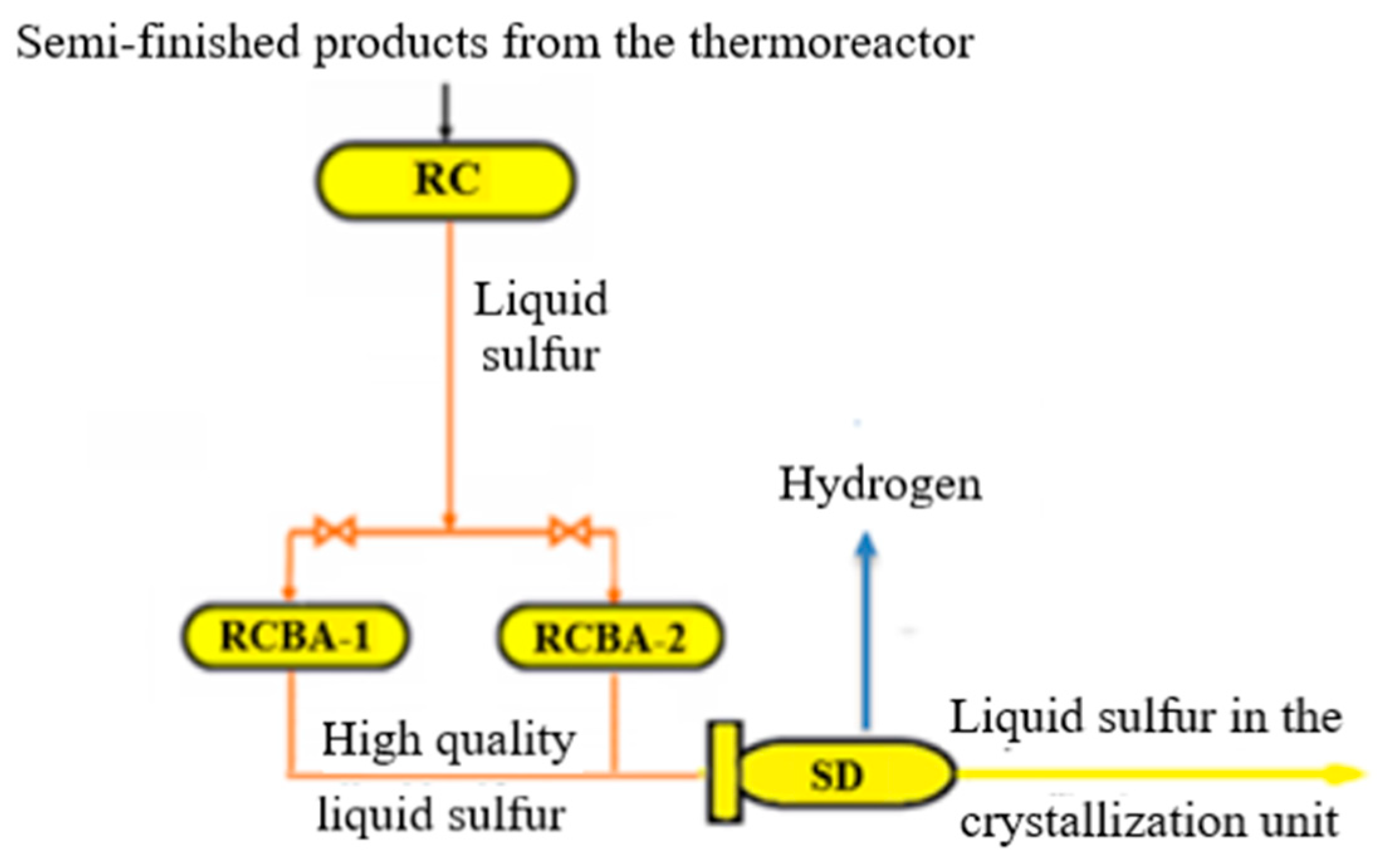
The technological scheme of the studied object—the interconnected Claus reactor (RC) and the two parallel CBA reactors (RCBA-1, RCBA-2) of the SRU at the Atyrau refinery (Atyrau, Kazakhstan)—is shown in
Figure 1.
Intermediate products from the thermal reactor of the SRU are directed to the Claus reactor (RC), where the catalytic conversion process takes place. In the interconnected Claus and CBA reactors, the technological processes of liquid sulfur extraction and hydrogen release occur. Liquid sulfur from the outlet of the Claus reactor (RC) is fed into the two parallel CBA reactors (RCBA-1 and RCBA-2), where the Cold Bed Absorption process takes place, hydrogen is released, and sulfur quality increases. From the outlets of the CBA reactors, high-quality liquid sulfur is sent to the sulfur pit (SD), and from there to the sulfur crystallization unit to produce granulated sulfur. The hydrogen released during these processes is also removed from the SD outlet.
For the synthesis of neuro-fuzzy models for sulfur quality assessment and sulfur production optimization, a set of technological, analytical, and operational data and expert information from the decision-maker (DM) and refinery laboratory specialists is used. Additionally, the technological scheme, operating regulations of the SRU at the Atyrau refinery, and completed operating sheets are utilized [
4]. To determine the composition of the sulfur-containing gases—the concentrations of hydrogen sulfide (H
2S), carbon dioxide (CO
2), sulfur dioxide (SO
2), water (H
2O), carbonyl sulfide (COS), carbon disulfide (CS
2), ammonia (NH
3), and hydrocarbons (C
1–C
6)—gas chromatography and analyzers are used. For training the neuro-fuzzy model, an array of 250–300 real measurement values of technological parameters and sulfur production indicators obtained through passive and active experimental methods [
35,
36] and chemical analysis methods [
37] is employed. The purity, composition, and color of the sulfur, which determine sulfur quality, are assessed through chemical analysis using chromatographs, visual inspection, and spectrophotometers by refinery laboratory experts.
To create the fuzzy rule base used in neuro-fuzzy models, heuristic knowledge of the SRU process operators (DMs) and refinery laboratory experts of the Atyrau refinery are used. Expert knowledge is also utilized for specifying the linguistic variables, term sets, and membership functions of the fuzzy parameters, and for initializing the adaptive neuro-fuzzy inference system (ANFIS), which combines the advantages of neural networks and fuzzy logic. Expert knowledge collection is performed using expert evaluation methods [
38,
39], while fuzzy set theory methods are used to process expert evaluation results [
40,
41,
42].
We propose the following method for synthesizing neuro-fuzzy models for sulfur quality (purity) and sulfur volume assessment for the multi-criteria optimization of sulfur production under uncertainty. The proposed method is intended for the development of neuro-fuzzy models of the sulfur production process that enable: (i) evaluation of the integrated sulfur quality indicator and sulfur production volume; (ii) consideration of uncertainties in SRU measurements and operating modes; and (iii) multi-criteria optimization and control of sulfur production in a fuzzy environment. Sources of uncertainty include fluctuations in the composition of sulfur-containing gases, noise and measurement errors, incomplete and fuzzy expert knowledge, and non-stationarity of the technological process.
Sulfur quality is assessed by a criteria vector for evaluating the integrated sulfur quality: where are the mass fractions of sulfur and ash, organic matter, and water in the produced sulfur. The choice of these specific local sulfur quality indicators is based on the requirements of the current enterprise standard (Atyrau refinery) ST TOO 40319154-65-2020 for the quality indicators of commercial sulfur. Here and further, denotes the vector of the input and operating parameters of the CBA reactors that affect the sulfur quality indicators, where denotes the feed rate and and denote the temperature and pressure of the CBA reactors.
For fuzzy linguistic evaluation of each local criterion , the linguistic terms “low”, “medium”, and “high”, are used, which are formalized through Gaussian-type membership functions. As the architecture of the neuro-fuzzy model, an ANFIS (Takagi–Sugeno) system is used, which enables the efficient modeling of complex nonlinear dependencies through the stages of: fuzzification of the input variables; rule formation; condition aggregation; normalization; and defuzzification, i.e., numerical assessment of sulfur quality.
The main stages of the proposed method for synthesizing neuro-fuzzy models, illustrated by the sulfur volume and quality assessment model, are as follows:
(1) Data collection based on passive and active experiments and the formation of the vector of the input and operating parameters affecting sulfur volume and quality:
where
represent the aforementioned input and operating parameters of the CBA reactors affecting sulfur volume and quality. Normalization of the input and operating parameters is as follows:
where
denote the maximum and minimum values of parameter
respectively.
Each input and operating parameter
and each fuzzy output parameter
of the CBA reactors of the SRU is described by the fuzzy terms
and
where
is the term index of the term set, and
T is the total number of terms.
(2) Fuzzification consists of constructing membership functions for the input and operating parameters that influence the fuzzy output parameters of the SRU (sulfur quality (purity) and sulfur volume). Each normalized input and operating parameter is fuzzified using Gaussian membership functions:
where
denote fuzzy sets describing the linguistic terms “low”, “medium”, and “high” for the input and output model parameters;
denote the centers of the membership functions;
denote the widths of the Gaussian membership functions.
(3) The fuzzy rule base
is generated using a production-based knowledge representation model and expert evaluation methods, with the general structure:
where
and
are the fuzzified input/operating and output parameters of the CBA reactors;
and
are fuzzy sets representing the
t-th term of the term set linguistically evaluating
and
of the
r-th rule;
is the serial number of the rule;
R is the total number of rules
, where
n is the number of input and operating parameters of the CBA reactors influencing sulfur quality, and
T is the number of terms fuzzily describing the input and operating parameters of the CBA reactors of the SRU.
(4) Aggregation of conditions: The activation degree of the
r-th rule is determined on the basis of the
t- norm of multiplication:
(5) Normalization of rule weights: Normalization of the aggregated conditions
obtained in the previous stage is performed according to the following formula:
(6) Formation of the integrated criterion
evaluating the sulfur quality taking into account the weight coefficients of the local sulfur quality criteria
:
where
is the weight coefficient of the local sulfur quality criteria, satisfying the condition
and determined by the DM, domain experts, or by the Fuzzy Analytic Hierarchy Process (AHP);
is the normalized value of the local criteria, determined by the formula:
(7) Defuzzification, i.e., determination of the numerical value of the
j-th output parameter of the CBA reactors of the SRU—the ANFIS output—occurs as follows:
where
are the output parameters
and
—the integrated sulfur quality (purity) and sulfur volume at the output of the CBA reactors of the SRU, respectively.
(8) Training of the neuro-fuzzy model: At this stage, for the training of the neuro-fuzzy model, use of the hybrid ANFIS algorithm is proposed based on the least squares method, minimizing the square difference between the real sulfur quality values
obtained experimentally and by laboratory methods on the research object, and the neuro-fuzzy model values
The ANFIS learning function measuring the difference between the expected and predicted values uses a gradient descent algorithm to minimize the error function
:
where
l is the experiment (example number);
N is the total number of examples in the training data set.
The parameter updating of the model is carried out using gradient descent:
where
is the new parameter after updating;
is the current parameter before updating;
is the learning rate determining how strongly the parameters will change during each update;
is the gradient of the error function with respect to the parameters
.
For the ANFIS model, which assesses the quality and volume of sulfur from the CBA SRU reactor outlet, the strategy for dividing the data into the training, validation, and test sets is implemented taking into account the following: the pronounced autocorrelation of the process parameters; the inertia of the sulfur recovery process in the CBA reactors; and the delay in laboratory analysis. The main principle is that only time-based partitioning is acceptable for time-based process data. Random partitioning is unacceptable, as it leads to time leakage, places nearly identical observations in the training, validation, and test sets, and, as a result, creates an inflated standard error and poor performance in real-world operation.
Since the ANFIS model is sensitive to mode changes, step-by-step splitting by chronology is recommended as the preferred strategy for splitting the data into the training, validation, and test groups. The total number of observations N = 1803; lag: 3; therefore, the first 3 observations are used only to form the lags and the actual sample size. = 1803 − 3 = 1800 is chronologically split into training (70%): 0.70 × 1800 = 1260, validation (15%): 0.15 × 1800 = 270, and test (15%): 0.15 × 1800 = 270 sets. When splitting by time, observations 1–1260 → training, 1261–1530 → validation, and 1531–1800 → test. The stability of the ANFIS configuration was tested with 1260 training samples, 3 inputs, 3 membership functions for each input, and a first-order Sugeno model. The model parameters were as follows: number of rules R = 3^3 = 27; number of linear parameters: each rule has 3 coefficients + a constant = 4, 4 × 27 = 108; and number of nonlinear parameters (Gaussian membership functions (MF): MF = 3 × 3 = 9, 2 parameters for each: 9 × 2 = 18. Therefore, the total number of parameters . The robustness check is determined by the ratio of the training set/parameters: 1260/126 = 10.
Conclusions: The ANFIS configuration is robust, overfitting is unlikely (with correct validation), the training data volume is sufficient, and the model is in the stable statistical zone and is suitable for reliable training. The dataset consists of 1803 observations. After constructing input–output pairs using a 3-step delay structure, the effective sample size was 1803 − 3 = 1800. The data was chronologically divided into a training subset of 1260 samples (70%), a validation subset of 270 samples (15%), and a test subset of 270 samples (15%). The model performance was evaluated on unseen test set.
Let us consider a more precise connection between specific SRU process issues and the nature of the time series, autocorrelation, and the chosen ANFIS configuration and validation strategy. In SRU, the sulfur quality output indicators (mass fraction of sulfur, ash, etc.) exhibit pronounced autocorrelation, i.e., the current sulfur quality depends on the previous states , etc. This means that the time series is not independent. In this case, it is necessary to analyze the autocorrelation function (ACF), which shows how much the value correlates with and add lags to the ANFIS configuration. If the ACF shows significant autocorrelation up to lag 3, then at least 2–3 lags should be included. Autocorrelated data increases the risk of overfitting; to address this issue, subtractive clustering should be used for training. This allows for the automatic reduction of the number of rules in the event of redundancy. Gaussian-type functions (gaussmf) are selected and constructed, allowing for better performance with smooth dynamics.
The process of high-quality sulfur extraction is also nonlinear. To account for the nonlinearity of the high-quality sulfur production process, the SRU analyzes the scatterplot, and in the ANFIS configuration, the number of membership functions per input is set to ≥3. ANFIS is sensitive to noise and outliers, which are addressed by pre-filtering, for example, with a median filter. For the sulfur production process, ANFIS is configured based on the following principles:
Time series analysis—autocorrelation;
Selection of input structure—lags and dimensionality reduction;
Selection of rule generation method—subtractive clustering for small data sets and clustering for precise modes;
Strictly time-based validation—without shuffling and with residual checking.
In sulfur production, the absolute deviation of sulfur purity is very important (MAE) and is used as the target metric for sulfur quality. The threshold exceedances and forecast robustness are also monitored. Therefore, during validation, MAE is used, as it is less sensitive to outliers. The residuals should be checked for autocorrelation and the absence of systematic bias.
If the residuals are autocorrelated, the model does not account for dynamics and lags must be added.
To evaluate the confirmation of the ANFIS model forecast, the following quantitative indicators were defined: the Root Mean Square Error
where
N is the number of observations,
is the actual value, and
is the forecast; and the coefficient of determination
where
is the sum of squares of the residuals;
is the total sum of squares;
is the actual value;
is the predicted value;
is the average of the actual values.
The obtained results confirm the ANFIS model’s predictions regarding sulfur quality and volume compared to the simpler baseline regression model, which, for the same values, has an RMSE = 0.017 and an .
The forecast results of the resulting ANFIS model, trained using the gradient descent algorithm, were also compared with other advanced machine learning models, XGBoost and LSTM, used for complex nonlinear dependencies. XGBoost (Extreme Gradient Boosting) is based on building multiple decision trees sequentially, where each new tree corrects the errors of the previous ones, captures nonlinear dependencies, automatically accounts for feature interactions, and employs regularization, thereby combating overfitting. LSTM (Long Short-Term Memory) is a type of recurrent neural network designed for working with sequences, which allows for the “remembering” of long-term dependencies in data and is well suited for sequential data.
The RMSE and performance of these advanced machine learning models are no worse than those of the ANFIS model, which is based on the gradient descent algorithm. For example, ; However, these methods require more data than gradient descent. Furthermore, by adapting the ANFIS model, forecasts are improved. Future research plans include exploring and applying these advanced machine learning methods to solve optimization and process control problems in high-quality sulfur production.
(9) Multi-criteria optimization based on the neuro-fuzzy model: The problem of multi-criteria optimization of the sulfur production process with maximization of the integrated sulfur quality and sulfur volume at the output of the CBA reactors of the SRU and minimization of energy consumption obtained based on the neuro-fuzzy model is formulated as follows:
In the multi-criteria optimization problem in Equations (11) and (12), the criteria are: = —the integrated sulfur quality indicator; = —sulfur volume at the output of the CBA reactors; —energy consumption; X—the set of feasible solutions; , —the minimum and maximum values of the input and operating parameters of the CBA reactors of the SRU determined by the technological regulations of its operation; —the volume of hydrogen released in the SRU; —the specified boundary value for the hydrogen volume; other notations are described above.
Thus, the solution of the multi-criteria optimization–decision-making problem in Equations (11) and (12) is , the optimal values of the input and operating parameters of the CBA reactors, which are the control actions for effective control of the sulfur production process. To account for uncertainty in the proposed method, the following mechanisms are used: fuzzy intervals of input and operating parameters; membership functions formalizing fuzzy parameters and indicators; and adaptive rule updating.
To solve the multi-criteria optimization problem in Equations (11) and (12), the method of fuzzy Pareto optimization [
43,
44] is used, in which the criteria, constraints, and preferences are formulated in a fuzzy form, and optimality is determined based on the degree of membership of a solution to the set of “Pareto-preferable” solutions. The advantages of the fuzzy Pareto optimization method include: operation under uncertainty; accounting for expert preferences; and good integration with ANFIS and neural networks.
The proposed method used in this work is that of fuzzy Pareto optimization, which consists of the following main stages:
(1) Selection of criteria wherein criterion is replaced by its membership function evaluating its satisfaction: .
(2) Assignment of boundaries—the minimum and maximum values of the selected criteria: .
(3) Taking into account the boundary values of the criteria, the membership functions of the maximized and minimized criteria are constructed and determined:
For the maximized criteria
For the minimized criteria
The parameters are determined on the basis of expert data, statistical data and/or technological regimes and constraints.
(4) Formation of the aggregated membership function: For aggregation of the membership functions of the criteria, weighted aggregation is used according to the formula
(5) First, a set of Pareto-optimal solutions is generated, and then the Bellman–Zadeh principle is applied to select one best compromise solution from the Pareto set using the formula
where
and
—the optimal values of the temperature, pressure of the CBA reactors, and the feed volume to the CBA reactors, which are the control parameters in the control of the sulfur production process.
The Pareto-optimal solution makes it possible to ensure a balance between the sulfur output and its integrated quality indicators and energy costs, and corresponds to the most stable operating mode of the SRU.
(6) Analysis of the fuzzy Pareto front, which represents a set of compromise solutions that are not dominated by other solutions, have a degree of preferability, and take into account the fuzzy goals and constraints of the technological process of sulfur production.
3. Results
Using the proposed method for synthesizing neuro-fuzzy models in the previous section, the models for evaluating the sulfur volume and sulfur quality were developed as follows.
(1) Based on the results of passive experiments obtained from the operating sheets of the SRU of the Atyrau refinery and active experiments, the vector of the input and operating parameters of the CBA reactors that affect sulfur volume and sulfur quality was formed: where is the feed volume and and are the temperature and pressure of the CBA reactors.
The minimum and maximum values of according to the technological operating regime of the SRU of the Atyrau refinery are: Normalization of the collected input and operating parameters was carried out according to Formula (1) of the proposed method.
For the fuzzy description of each input and operating parameter and the output parameter , j = 1,2 of the CBA reactors of the SRU, the fuzzy terms of the fuzzy term sets and were selected, where is the term index.
The input variables in the ANFIS model were selected based on their causal relationship with sulfur quality and their availability at the forecast time. The following input variables were selected for the ANFIS model: —feedstock volume, —temperature, and —pressure of the CBA reactors, which have the greatest impact on the volume and quality of sulfur from their outlets. Their selection as input variables was justified based on the results of an expert assessment using the automated Delphi method, taking into account causality, online availability, and the absence of information leakage from future studies. Online availability and the elimination of information leakage from future studies are ensured by the fact that the selected input variables are known at time t, where t is the time of sulfur outlet from the CBA reactors. SCADA data is used, and the data sources are: the flow meters and temperature and pressure sensors. Online gas analyzers can be used as a target variable during the training process.
When assessing sulfur quality (mass fractions of target components), sensor data often requires pre-processing and data cleaning. Missing values can be caused by: sensor communication loss, analyzer calibration, or sensor failure. Spline interpolation was used to process missing values, as the discontinuities in the sample are short. The sensitivity of the obtained results to this method is small (<1–2%) for average daily sulfur quality, and <5% for missing values.
Outliers can arise from signal jumps during valve switching and electromagnetic interference, as well as during startup and shutdown. The 3σ rule statistical method was used to process outliers. The sensitivity of the results to this method is low for rare outliers, as the mean value remains virtually constant, while the variance is highly sensitive.
Sensor drift occurs due to wear, aging, contamination, and calibration changes. To detect sensor drift, comparisons are made with laboratory analyses and monitoring is performed using a reference channel. Periodic recalibration is performed to eliminate sensor drift. The results are significantly sensitive to sensor drift, as even 1–2% drift can create the illusion of quality degradation and alter the conclusion about specification compliance. If drift is not accounted for, the quality assessment bias will be systematic, and the ML model will quickly degrade.
A change in the operating mode of a sulfur production unit can be caused by changes in load, feedstock composition, and operating parameters of its main units. ANFIS-type models are used to account for operating mode changes in the sulfur production process. This model is very sensitive to operating mode changes.
(2) Fuzzification, i.e., construction of Gaussian-type membership functions of the input and operating parameters
and output parameters
,
j = 1,2 of the CBA reactors was implemented according to Formula (2) using the MATLAB version R2024b Fuzzy Logic Toolbox system tools. For this purpose, abbreviated designations of the terms describing the fuzzy parameters were introduced, which are given in
Table 1.
The universal sets of the fuzzy variables
and output parameters
,
j = 1,2 necessary for constructing the membership functions are given in
Table 2.
Next, we present the results of the implementation of the fuzzification procedure and other procedures of fuzzy inference using the MATLAB Fuzzy Logic Toolbox tools.
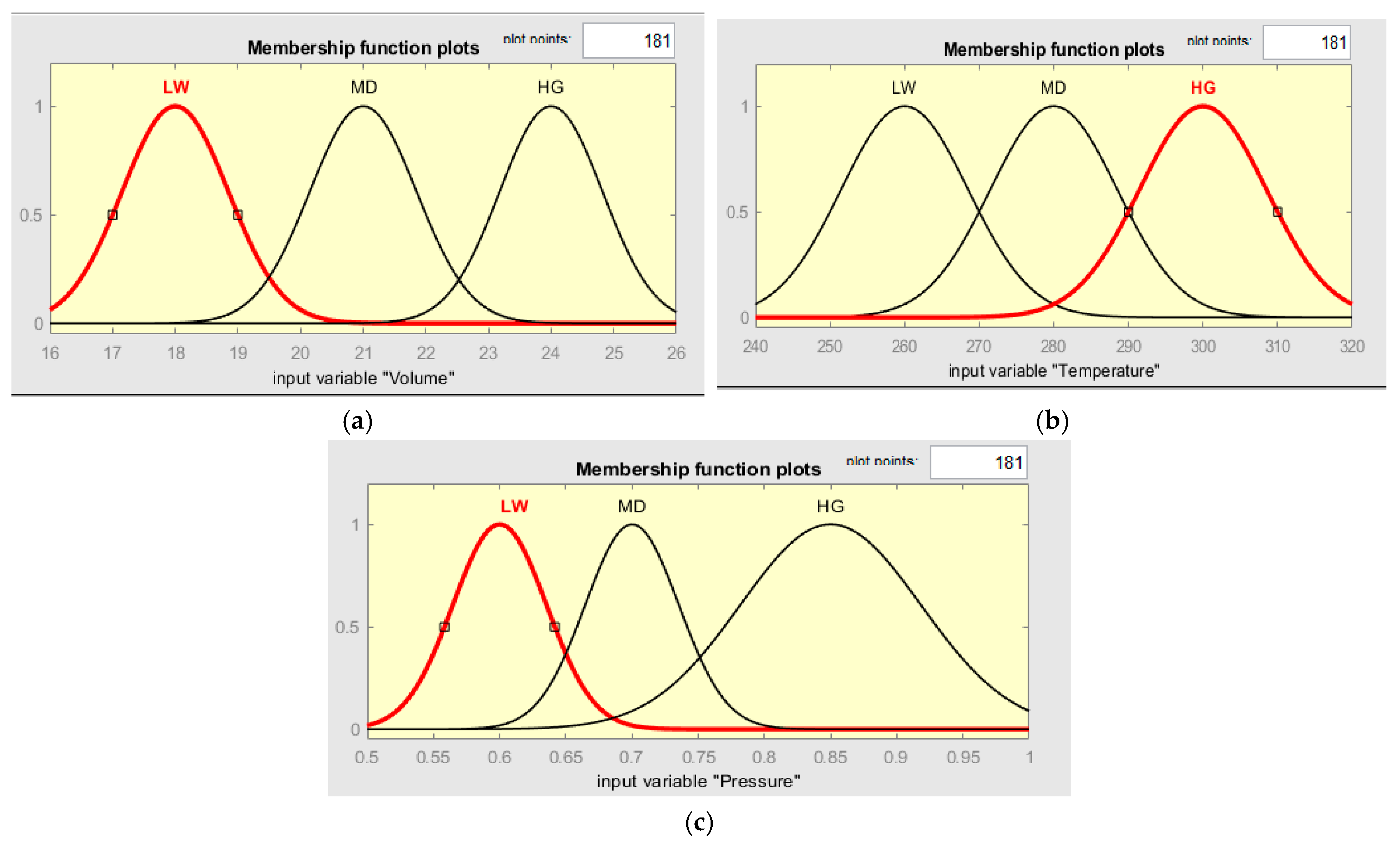
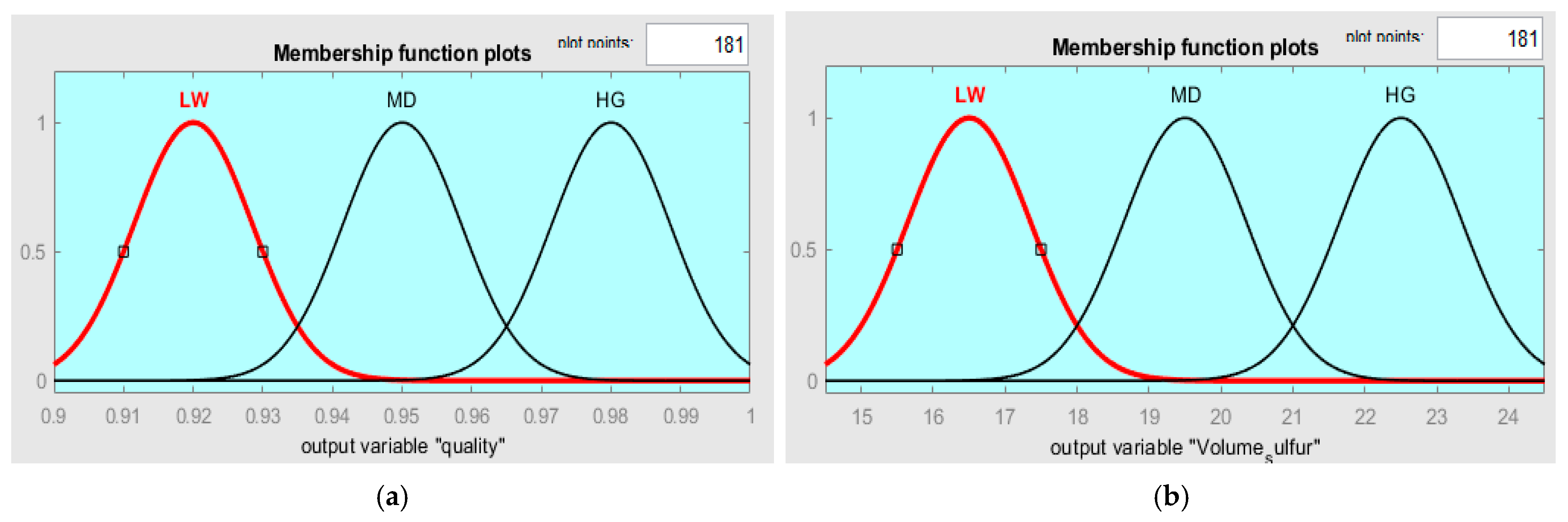
Below, in
Figure 2a–c, the Gaussian-type membership functions for the fuzzy input parameters
, are shown, and in
Figure 3a,b the membership functions are shown for the output parameters
, constructed using the Fuzzy Logic Toolbox.
(3) The fuzzy rule base
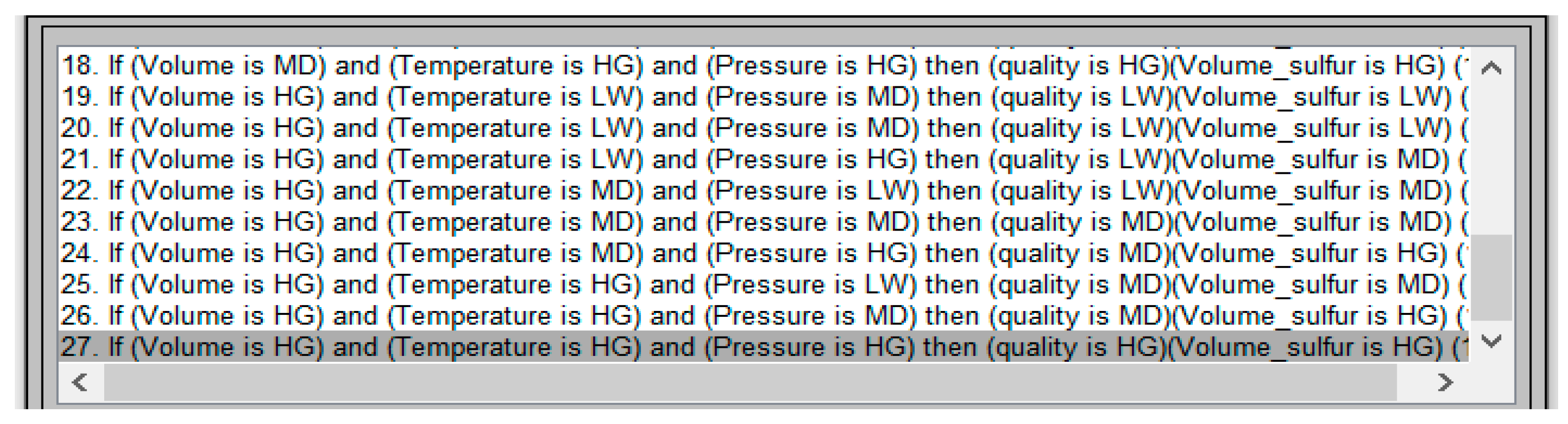
c was created on the basis of the production model of knowledge representation and expert evaluation methods. The rule base for the fuzzy inference system, allowing evaluation of the integrated quality and volume of sulfur at the output of the CBA reactors of the SRU of the Atyrau refinery, created on the basis of expert evaluation methods, is presented below in the form of fuzzy production rules.
A fragment of the results of the implementation of the rule base created above using the Fuzzy Logic Toolbox is shown in
Figure 4.
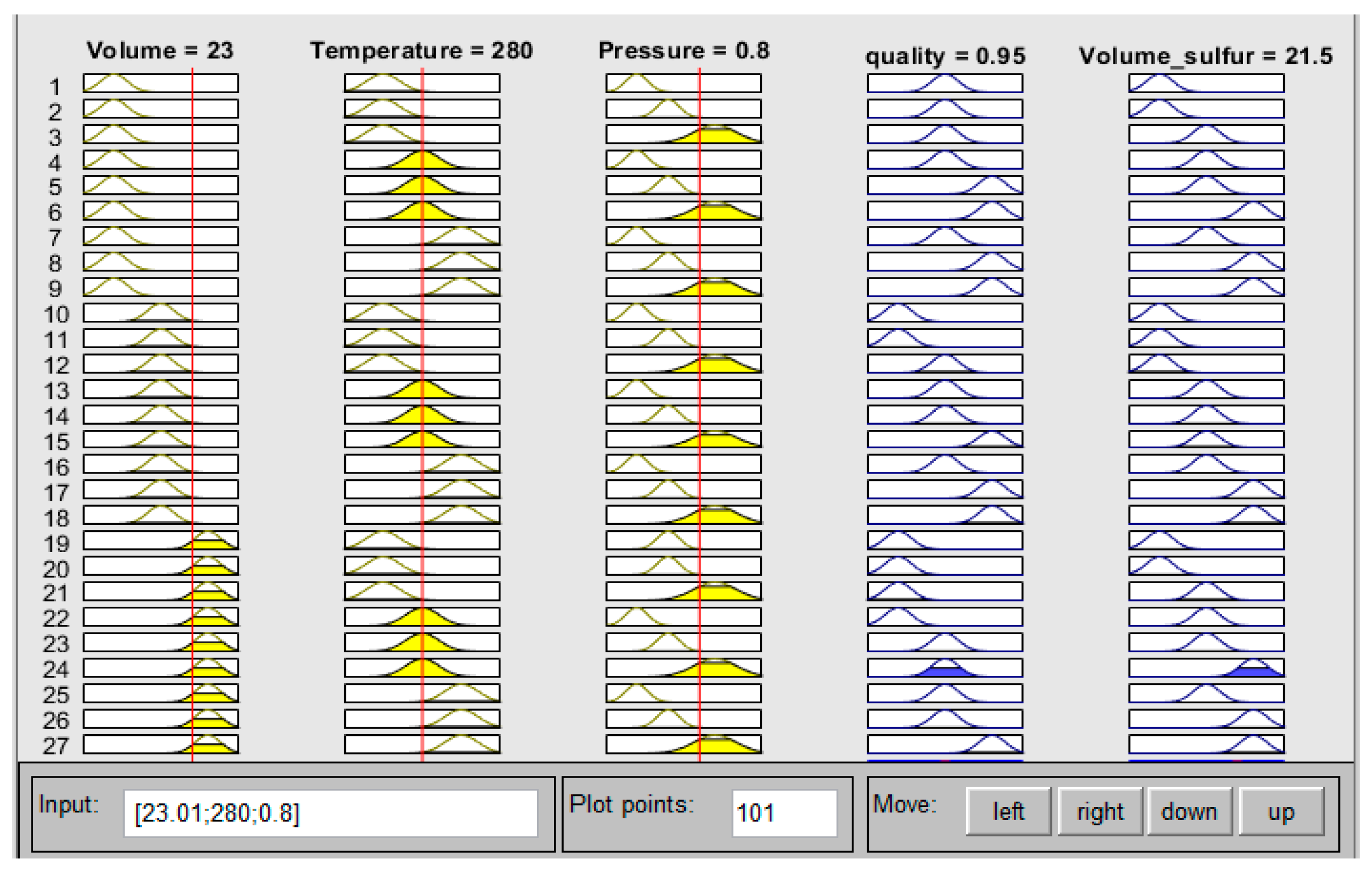
The visualization results of fuzzy logical inference in the RuleViewer window for
integrated sulfur quality and
sulfur volume at the output of the CBA reactors are shown in
Figure 5.
In the Input field of this figure, the values of the feed volume, temperature and pressure of the CBA reactors are indicated, for which the logical inference is performed.
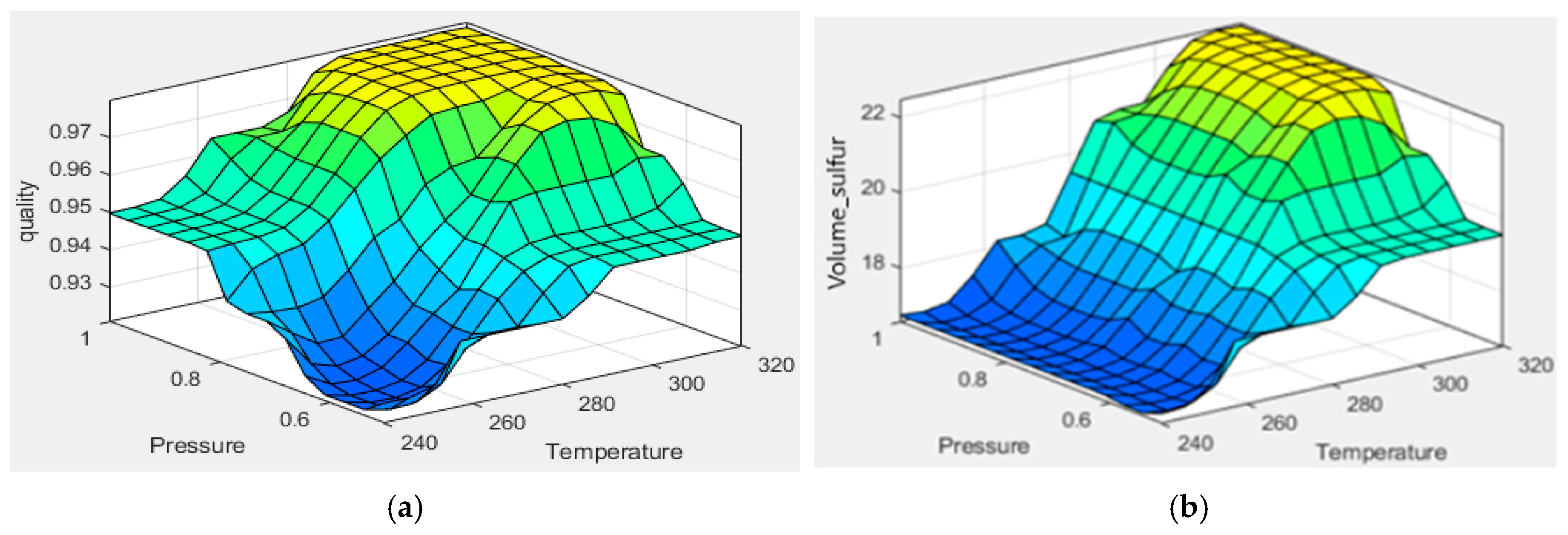
The “input–output” surfaces corresponding to the obtained fuzzy system, which allow visual viewing of the results of fuzzy modeling and determination of the integrated sulfur quality and sulfur volume at the output of the CBA reactors of the SRU depending on the temperature and pressure values of these reactors, are shown in
Figure 6a,b.
(4) Aggregation of the conditions of the created rule base was performed, and the activation degree of the r-th rule was determined on the basis of the t-norm of product according to Formula (4) of the proposed method in the previous section.
(5) Normalization of the rule weights was performed according to Formula (5) by dividing the activation degree of the r-th rule by the sum of the activation degrees of all rules
(6) The integrated criterion evaluating the integrated sulfur quality (purity), was determined by summing the products of the weight coefficients of the local sulfur quality criteria and the normalized values of the local criteria according to the formula according to Formula (6). In this case, the weighting coefficients of the local criteria that evaluate the importance of the mass fractions of sulfur = 0.45, ash = 0.30, organic matter = 0.15 and water = 0.10 were determined on the basis of expert knowledge using the Delphi method. The normalized values of the local criteria are , according to Formula (7).
In this case, the Delphi method allows experts to assign weighting coefficients to the local criteria based on their importance. In each round of expert evaluation, the concordance coefficient is calculated, which assesses the agreement of expert opinions. If the concordance coefficient 0, the round is repeated until the agreement of expert opinions reaches . The above weighting coefficients were obtained in the fifth round of expert evaluation, when the required level of agreement of expert opinions was reached.
Experts assigned weighting coefficients to the local criteria , taking into account their importance in the integrated criterion For example, the mass fraction of sulfur in the obtained sulfur is the most important indicator assessing sulfur quality, therefore its weight in the final round of expert evaluation was determined to be 0.45, i.e., the maximum among other weights. The next most important indicators influencing sulfur quality are the proportion of ash and organic matter in the composition of the obtained sulfur, which in the final round of expert evaluation were assigned weights of 0.30 and 0.15, respectively. Since, according to the requirement, the sum of the weighting coefficients the water weight will be 1 − (0.45 + 0.30 + 0.15) = 0.10.
For the local (differential) sensitivity analysis of the weights, the partial derivative of the integral criterion with respect to weight was used: showing that the sensitivity of the integral indicator to weight is equal to the normalized value of the corresponding local criterion. Accordingly, the larger the value of , the greater the impact of changing the weight .
The relative sensitivity of the scales was analyzed using the dimensionless sensitivity coefficient , which shows the percentage change in the integral criterion for a 1% change in weight.
Sensitivity analysis results: For the sulfur batch under consideration, the normalized local indicators are: = 0.90, = 0.80, = 0.70, and = 0.60. The base value of the integral criterion = 0.45⋅0.90 + 0.30⋅0.80 + 0.15⋅0.70 + 0.10⋅0.60 = 0.810.
Sensitivity analysis of weight : Let us increase by 10%: . Since the sum of the weights must remain equal to 1, the remaining weights are reduced proportionally. The sum of the remaining weights is The new sum they should occupy is , and the conversion factor . Then, the new weights are as follows: Check: . The new value of the integral criterion .
Sensitivity assessment: The absolute change , and the relative change . The weight change was 10%; the integral indicator changed by 0.99%. The elasticity coefficient Thus, the integral indicator is weakly sensitive to changes in the weight w_1, despite having the largest weight (0.45); the influence is limited by the linear structure of the model.
The remaining weights were calculated similarly using the described method (±10% with proportional renormalization of the remaining coefficients). As a result, a new value of was determined for , and . The change = −0.002, = −0.003, and = −0.002, and the relative changes for and , respectively, are: −0.25%, −0.37%, and −0.25%. The elasticity values of and , are −0.025, −0.037, and −0.025. Thus, the integral indicator demonstrates the greatest sensitivity to the weight , which is explained by its largest value (0.45) and the high value of the normalized indicator . The remaining weights have a significantly smaller influence.
(7) The ANFIS output, i.e., the numerical values of the output parameters:
—integrated sulfur quality;
—sulfur volume at the output of the CBA reactors of the SRU, were defuzzified using the center of gravity method according to Formula (8):
(8) The neuro-fuzzy model was trained by the hybrid ANFIS algorithm, minimizing the squared difference between the real values of the output parameters
obtained experimentally and in laboratory conditions, and the values obtained using the neuro-fuzzy model
The ANFIS training function, measuring the difference between the expected and predicted output values, uses the gradient descent algorithm to minimize the error function
according to Formula (9):
The parameters of the neuro-fuzzy model were updated using the gradient descent method according to Formula (10) proposed in the previous section of the neuro-fuzzy model synthesis method.
During the training process of the neuro-fuzzy model, a linear output was used for each rule of the created rule base:
where
are coefficients adjusted during training.
The rule template for ANFIS, using the example rule
r = 1 is as follows:
During hybrid training, the membership function parameters and coefficients are optimized based on the data.
(9) The problem of multi-criteria optimization of the sulfur production process, based on the use of the synthesized neuro-fuzzy model, is formulated as follows:
In the multi-criteria optimization problem in Equations (17) and (18): —integrated sulfur quality indicator; —sulfur volume at the output of the CBA reactors; —energy consumption; X—feasible region of solutions; and —minimum and maximum values of the input/operating parameters of the CBA reactors of the SRU, defined in item 1; —hydrogen volume released in the SRU; —specified boundary value for hydrogen volume; and other notations were described above.
The presented multi-criteria optimization problem of sulfur production in Equations (17) and (18) maximizes —the integrated sulfur quality—and —the sulfur volume at the output of the CBA reactors of the SRU—and minimizes the energy consumption in the feasible region (18).
Thus, the solution of the multi-criteria optimization problem in Equations (17) and (18) for efficient control of the sulfur production process is a value of the vector of the input/operating parameters of the CBA reactors: This solution ensures a maximum of integrated sulfur quality and sulfur volume at the output of the CBA reactors , and a minimum energy consumption in the feasible region and a hydrogen volume not lower than the specified boundary value .
In the multi-criteria optimization problem in Equations (17) and (18), the specific local criteria are respectively, which evaluate the integrated sulfur quality, sulfur volume, and energy consumption. The range of admissible solution values is determined by constraints on the minimum and maximum values of the input and operating parameters () of the CBA reactors and , which is a specified boundary value for the hydrogen volume at the sulfur production unit outlet. This problem is solved in accordance with steps 3–5 of the proposed fuzzy Pareto optimization method. The best compromise solution from the Pareto set is determined based on the Bellman–Zadeh minimax principle using Formula (16). To process inadmissible solutions, a penalty for constraint violation is added to the objective functions.
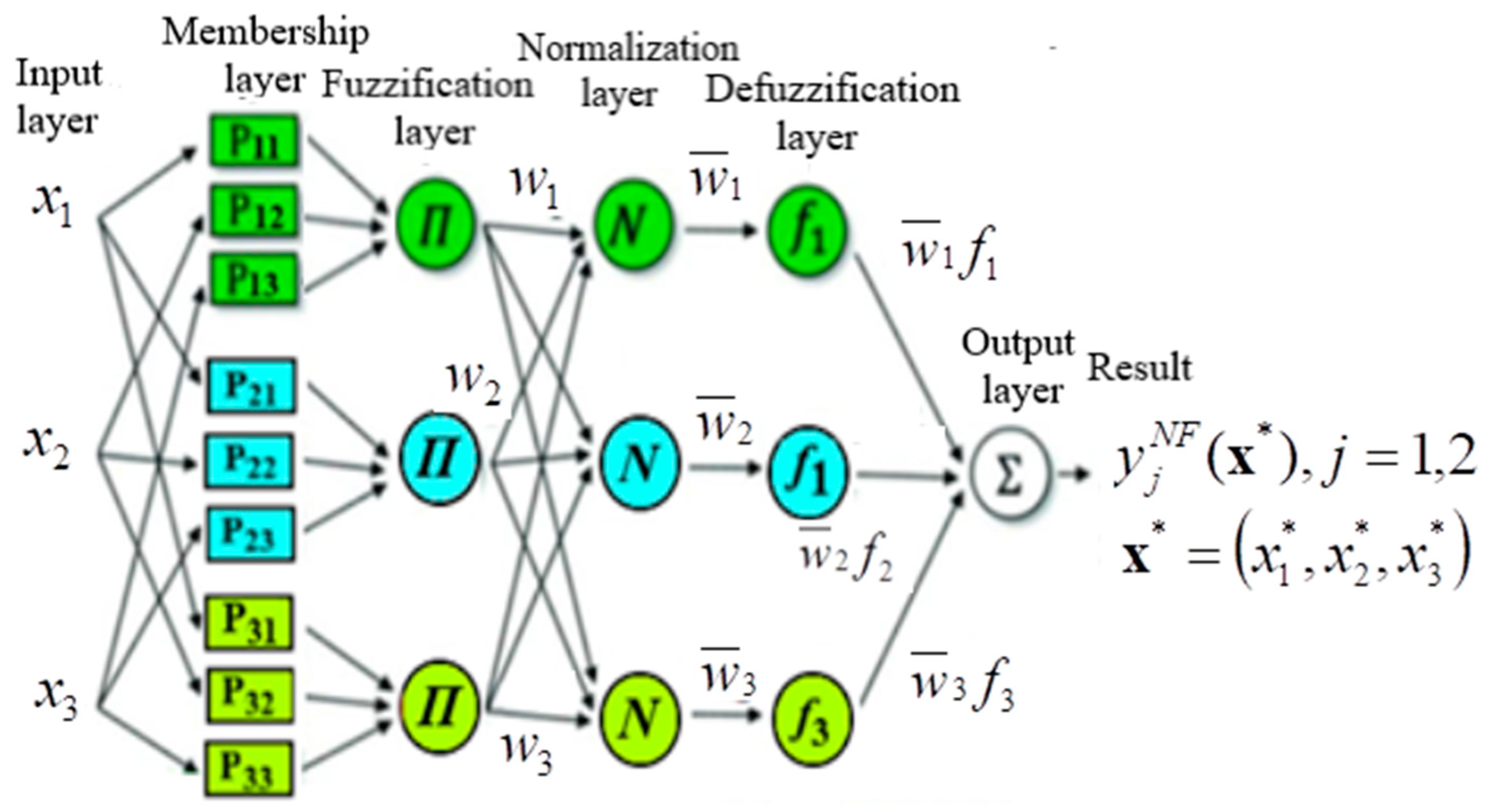
The ANFIS architecture of the synthesized neuro-fuzzy model for evaluating the integrated sulfur quality and sulfur volume at the output of the CBA reactors of the Atyrau refinery is shown in
Figure 7.
The input parameters of the ANFIS structure are
—feedstock volume,
—temperature and
—pressure of the CBA reactors, i.e., their input and operating parameters that affect the volume and quality of sulfur. The final output is
which evaluates the integrated quality (purity) and volume of sulfur, where
are the optimal values of the input and operating parameters of the SVA reactors that provide the best values of
Fuzzified, i.e., Gaussian-type membership functions were constructed using the MATLAB Fuzzy Logic Toolbox for fuzzy values of input and output parameters (see point 2 of
Section 3, “Results”).
The number of rules R is determined in accordance with paragraph 3 of the proposed method for synthesizing neuro-fuzzy models, i.e., based on the formula , where n = 3 is the number of input and operating parameters of the CBA reactors that influence their output parameters, and T = 3 is the number of terms fuzzy describing the CBA UPS reactor parameters. The number of epochs is determined based on the main practical method for selecting the number of epochs for ANFIS early stopping. In this case, the data is divided into a training set and a validation set, and training is terminated when the training error decreases and the validation error increases. In practice, this approach typically sets the number of epochs in the range of 100–150.
The stopping criterion is criterion (9), described in paragraph 9 of the proposed method for synthesizing neuro-fuzzy models. This criterion minimizes the squared difference between the actual sulfur quality values , obtained from the studied object, and , obtained based on the neuro-fuzzy model. This criterion is stopped when one or more of the following conditions are met: the specified accuracy is achieved; the error change is small; or the validation error increases for N consecutive epochs.
To prove the absence of overfitting in ANFIS, the k-fold cross-validation method is used. For this, the data is divided into k blocks, the models are then trained k times, and the errors are averaged. If the resulting scatter is small, the model is considered stable and does not overfit.
The presented multi-criteria optimization problem in Equations (17) and (18) for effective control of the sulfur production process was solved using the fuzzy Pareto optimization method described in
Section 2. In this case, the criteria and preferences are formalized in fuzzy form, and the optimal solution is determined on the basis of the membership degree of the solution to the set of “Pareto-optimal” solutions. We present the results of solving problems Equations (17) and (18) using the given fuzzy Pareto optimization method.
(1) The selected criteria were are follows: —integrated sulfur quality; —sulfur volume at the output of the CBA reactors; —energy consumption in the sulfur production process. The selected criteria were represented through their membership functions, which evaluate their satisfaction: .
(2) The boundary (minimum, maximum) values of the selected criteria were specified: .
(3) Taking into account the minimum and maximum values of the criteria specified in the previous item, the membership functions of the maximized and minimized criteria were constructed in accordance with Formulas (13) and (14) of the fuzzy Pareto optimization method described in
Section 2. The membership functions of the criteria were constructed using MATLAB graphical system tools—the Fuzzy Logic Toolbox.
(4) The membership functions of the criteria were aggregated using weighted aggregation according to Formula (16) , where is the weight coefficient determining the relative importance of the criteria, assigned by the DM and subject-matter expert specialists.
(5) The Pareto-optimal solution to the multi-criteria optimization problem of sulfur production in Equations (17) and (18) using the synthesized neuro-fuzzy model and fuzzy Pareto optimization method was determined on the basis of the Bellman–Zadeh minimax principle (16):
where
is the vector of optimal values, corresponding to the feed volume, temperature and pressure of the CBA reactors, which are the control parameters of the sulfur production process.
When solving this problem to determine the volume of hydrogen released in the sulfur production process from hydrogen sulfide, a model determining the hydrogen volume depending on the values
, developed and published by us in [
45], was used. The energy consumed by the SRU in the sulfur production process was determined based on regulatory data from technological regulations of the SRU and empirical dependencies of energy consumption on the values of temperature and pressure. The Pareto-optimal solution selected by the DM from the set of efficient solutions allows us to ensure the balance between sulfur output, hydrogen output, the integrated sulfur quality indicator, and energy consumption, and corresponds to the most stable operation mode of the SRU.
Let us consider a fuzzy Pareto decision-making mechanism for solving the decision-making problem in a fuzzy environment, as in Equations (17) and (18). This mechanism allows us to narrow the set of Pareto-optimal solutions to a single operating point, taking into account the DM’s preferences expressed through membership functions and weights.
The result of solving a multi-criteria problem, taking into account the weights of local criteria based on the Pareto optimality principle, is a set of non-dominated (efficient) solutions . However, the DM must select a single best solution. To achieve this, each criterion in the correspondence of stage one of the proposed fuzzy Pareto optimization method is replaced by its membership function, which evaluates the degree of satisfaction with the DM: .
Then, in accordance with stages two and three of the proposed fuzzy Pareto optimization method, the minimum and maximum values of the criteria are determined and, taking them into account, the membership functions of the maximized and minimized criteria are constructed, respectively, using Formulas (13) and (14).
According to stage four of the proposed method, the membership functions of the criteria are aggregated using weighted aggregation according to Formula (15). Then, in stage five, the unique best solution on the Pareto frontier is determined based on the Bellman–Zadeh minimax principle using Formula (16): . In this way, the Pareto frontier is mapped into the satisfaction space of the DM. The selected DM is the best solution in the current situation, with the highest minimum level of DM satisfaction. It ensures a balanced compromise and protects against severe degradation of one criterion.
Let us evaluate the robustness of the choice. The choice is sensitive to the weighting coefficients With a convex frontier, changes in the weights cause a smooth shift in the solution, while with a non-convex frontier, abrupt transitions are possible.
Sensitivity to membership functions. Changing the minimum and maximum criterion values in Formulas (13) and (14), or the structure of the membership function, for example, to a Gaussian one, alters the scale of trade-offs. Small changes in , and cause small changes in the solution, while changes in the structure of the membership function can lead to a change in the operating point. Sensitivity to DM preferences: If the DM preferences are vaguely defined: , then stability can be analyzed using interval analysis.
Let us consider an approach to the formal stability analysis of a solution. Let us assume that the solution is defined as: , where are parameters (weights, bounds). Then stability is verified using: . If the change is small for a small , then the decision-making mechanism will be stable.
The results of the DM’s selection of the best solution from the Pareto set, taking into account their preference, the actual production situation, and the consumer requirements for sulfur production volume and sulfur quality, are entered in the 2nd column of
Table 1 below.
The optimization and best solution selection results for problems Equations (17) and (18) in a fuzzy environment based on the proposed fuzzy Pareto optimization method using the synthesized neuro-fuzzy model, presented in
Table 1, show the advantages of the proposed method compared to known methods. The advantage of the proposed multi-criteria optimization method in a fuzzy environment lies in the increase in the sulfur and hydrogen volumes and the improvement of sulfur quality, as well as high agreement with the real data obtained by experienced DMs when controlling the operation modes of the studied SRU. The proposed approach allows the achievement of better results at lower temperature (
) and pressure (
), values, which lowers the SRU energy consumption for their generation by 80 kW/hour. In addition, the proposed fuzzy approach to selecting the best solution in a fuzzy environment makes it possible to evaluate the integrated sulfur quality under uncertainty, which cannot be determined by known methods.
The well-known methods used in [
46] for optimizing the sulfur production process compared utilize a gradient descent algorithm. This algorithm selects a random point, calculates the antigradient (the direction of the function’s fastest decay), and then stepwise calculates new function values, moving in the chosen direction. However, this algorithm does not allow for the determination of the integrated sulfur quality, which is characterized by fuzziness.
The synthesized neuro-fuzzy models for assessing the integrated sulfur quality and volume in a fuzzy environment and the fuzzy Pareto method for optimizing the high-quality sulfur production process can be exported to other SRUs with the necessary adaptations.
In this table, the actual energy consumption value is determined by processing and summing the measured electrical and thermal energy consumption. The model energy consumption values are determined based on the optimization models used, using empirical formulas that utilize electrical and thermal energy cost data.
The empirical formula for determining energy costs is
where
is the consumed electrical energy, in kWh; Nom in
is the nominal power of the k-th equipment consuming electrical energy;
is the load factor of the
k-th equipment;
is the nominal operating time of the
k-th equipment consuming electrical energy.
The empirical formula for determining heat energy consumption is
where
is the consumed heat energy, in kJ;
is the nominal mass of the
k-th piece of equipment (kg) that consumes heat energy;
is the specific heat capacity of the
k-th piece of equipment; ΔT is the change in temperature;
is the efficiency of the
k-th piece of equipment consuming heat energy (0.6–0.95).
The total energy consumption of electrical and thermal energy is determined by summing the total costs of electrical and thermal energy: + .
(6) The fuzzy Pareto front was analyzed, i.e., the set of compromise solutions, in which the improvement of one criterion is possible only at the expense of the deterioration of the others, and which takes into account the fuzziness of the parameters of the sulfur production process.
The fuzzy Pareto front illustrates the trade-off between sulfur and hydrogen production efficiency and energy consumption under uncertainty.
The optimal solution was selected on the basis of the maximin principle, which ensures a balanced compromise among all criteria under the imposed constraints:
where
is the vector of the optimal values of the input and operating parameters, respectively: the feed volume
the temperature
, and the pressure
of the CBA reactors, which are the control parameters of the sulfur production process;
, the integrated sulfur quality;
, the sulfur volume at the output of the CBA reactors;
= −
, the energy consumption;
X, the feasible region of solutions;
and
, the minimum and maximum values of
;
, the hydrogen volume released in the sulfur production process from hydrogen sulfide;
, the specified boundary value for hydrogen volume; other designations were described above.
Thus, the fuzzy Pareto front demonstrates a continuous compromise surface between the integrated sulfur quality (purity), the sulfur volume at the SRU output, and the energy consumption.
The maximum total value of the intersection of the membership functions determines the optimal operating point, which corresponds to a stable technological mode with balanced performance indicators.
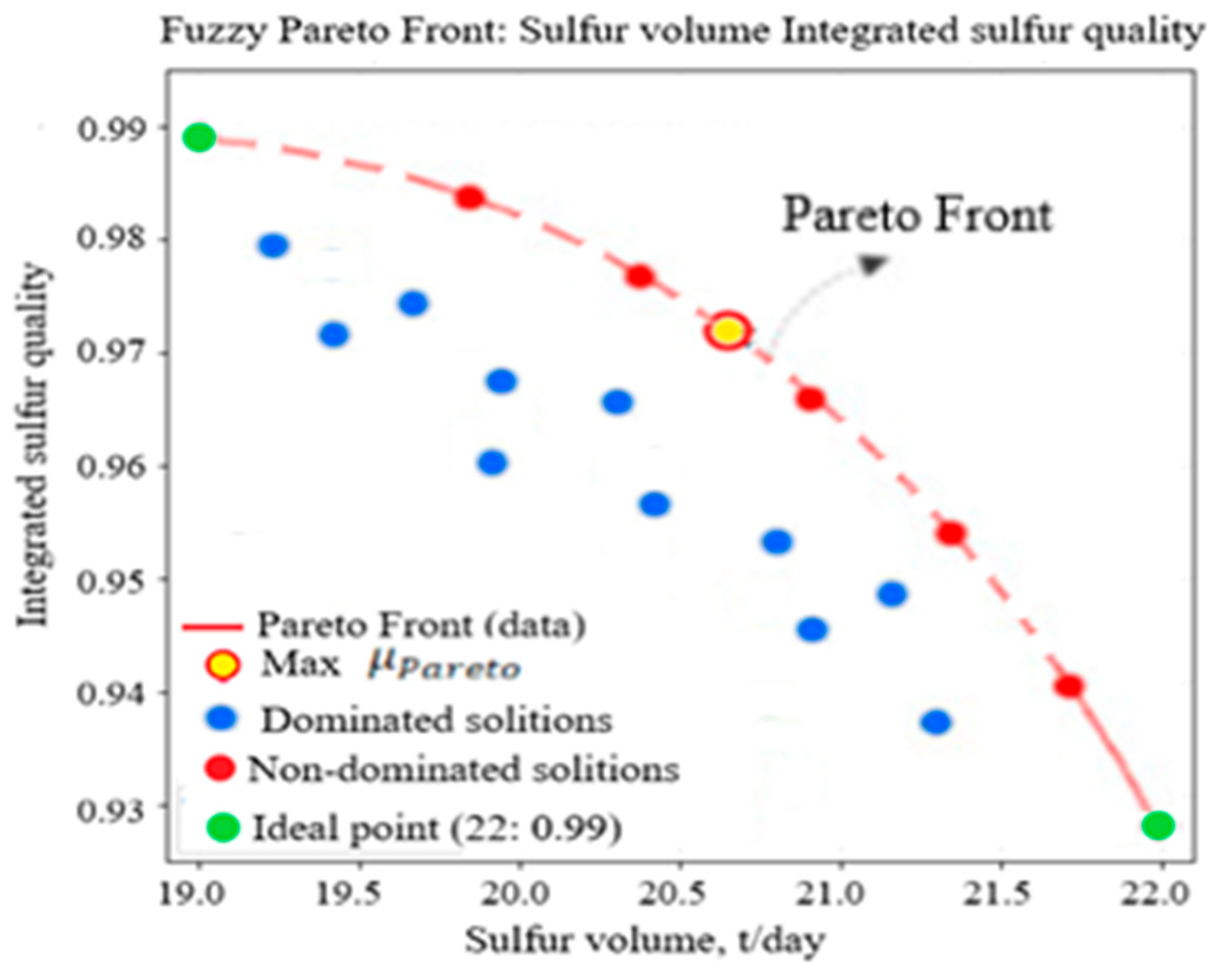
Figure 8 shows the results of visualization of the Pareto front between the criteria for assessing the volume of sulfur and the integrated quality of the sulfur.
4. Discussion
The developed neuro-fuzzy model based on the proposed synthesis method provides: an evaluation of the integrated sulfur quality and volume; consideration of measurement and technological regime uncertainty; and multi-criteria optimization of the sulfur production process. Solving the multi-criteria optimization problem of sulfur production based on the proposed methods makes it possible to maximize the integrated sulfur quality and sulfur volume at the output of the CBA reactors of the SRU, ensure the required volume of hydrogen, and minimize the energy consumption.
The rule base for the fuzzy inference system compiled on the basis of expert knowledge using the Delphi method has the following logic:
- (1)
At a high feed volume, residence time decreases, and accordingly, the conversion of hydrogen sulfide to sulfur and the integrated sulfur quality (purity) deteriorate.
- (2)
Increasing temperature often leads to an increase in reaction rate and accordingly an increase in —the sulfur output from the CBA reactors—and up to a certain limit improves —the sulfur quality (purity).
- (3)
Increasing pressure can increase the contact and conversion of hydrogen sulfide to sulfur. Therefore, at high pressure values, the sulfur yield () increases and the quality (purity) of sulfur () improves.
Hybrid models that evaluate the integrated sulfur quality and sulfur volume at the output of the CBA reactors, developed on the basis of the proposed neuro-fuzzy model synthesis method, make it possible to fuzzily model the sulfur production process in Fuzzy Logic Toolbox and select the optimal operating mode of the CBA reactors. As can be seen from the results of fuzzy modeling, from the “input–output” surfaces in the SurfaceViewer window (
Figure 6a,b), with an increase in temperature and pressure of the CBA reactors, the integrated quality of sulfur at the reactor output improves. From the “input–output” surface (
Figure 6), it is noticeable that the best value of integrated sulfur quality and sulfur volume at the output of the CBA reactors, with minimal energy consumption, is achieved at a temperature of about 280 °C and a pressure of about 0.8 kg/cm
2 in the CBA reactors. This corresponds to the created fuzzy rule base and to the optimization results based on the proposed fuzzy Pareto optimization method presented in
Table 1.
The visualization results of the fuzzy inference system in the RuleViewer window (
Figure 5) make it possible to review the rules for the fuzzy inference of each rule, the resulting fuzzy set, and the implementation of the defuzzification procedure.
Figure 5 shows the modeling results in the case when the following input/operating parameters of the CBA reactors are entered: a feed volume of 23 t/day; a temperature of 280 °C; and a pressure of 0.8 kg/cm
2. Then, the integrated sulfur quality equals 0.95, which means that the quality of the obtained sulfur is very high, since at an integrated sulfur quality above 0.85, according to SRUAN 4 standard, the sulfur quality is considered very high. By increasing the temperature and pressure, the sulfur quality can be further improved, but at the same time the sulfur volume does not change much and the energy consumption increases.
Thus, by changing the fuzzified values of the input and operating parameters of the CBA reactors, i.e., by modeling their operating regimes in this window, one can determine the best sulfur quality and volume values with minimal energy consumption.
A fuzzy Pareto front between sulfur volume and its quality is constructed by the maximizing sulfur volume and integrated sulfur quality. The fuzzy Pareto front shown in
Figure 8 identifies the region of non-dominated solutions. The degree of Pareto optimality is calculated using
where
is the integrated quality (purity) of sulfur, and
is the volume of sulfur. Thus, the fuzzy Pareto front between sulfur volume and quality shows the compromise region described through membership functions and reflects the balance: “the greater the volume of sulfur, the more difficult it is to maintain its quality.” The practical significance of the fuzzy Pareto frontier in defining a set of feasible solutions and their degree of preference, which is closer to reality, allows decision-makers to make informed choices between competing objectives in a fuzzy environment. The practical significance of the fuzzy Pareto frontier is evident in real-world problems where criteria conflict with each other, are measured inaccurately, depend on expert assessments, and contain uncertainty. The fuzzy frontier allows one to determine the acceptable range of SRU operations, identify where a sharp deterioration in sulfur quality begins, and select a mode consistent with the market strategy. For example, for sulfur exports, quality is the priority, while for the domestic market, a compromise between sulfur quality and maximizing its volume is acceptable.
The practical value of the observed trade-offs is that they provide insight into the structure of the problem. One can see where solutions deteriorate sharply, and where a slight deterioration in one criterion leads to a significant improvement in another. Trade-off analysis allows one to determine: the zone of rational balance; the inflection points (where quality deterioration becomes abrupt); the economically infeasible modes; and the range of technological stability of SRU operations. Thus, the fuzzy Pareto frontier for sulfur volume and quality and the observed trade-offs allow for the following: a shift from intuitive to analytical management; the formalization of subjectivity; the consideration of the uncertainty of requirements; the quantitative evaluation of volume–quality trade-offs; the selection of a mode consistent with the market strategy; and informed decision-making in complex systems.
Analyzing the comparisons of the sulfur and hydrogen production optimization results based on the proposed methods, known methods, and real production data, as presented in
Table 3, the following main advantages of the proposed artificial intelligence-based methods can be noted:
- −
The proposed neuro-fuzzy model synthesis methods and fuzzy Pareto optimization for controlling sulfur and hydrogen production processes, compared to known optimization methods, allow an increase in product volume, an improvement of sulfur quality, and a reduction of SRU energy consumption. At the same time, the proposed methods improved the integrated sulfur quality (purity) to the desired level (0.95), increased the volume of high-quality sulfur by 1.7 tons/day or by 7.39% per day, and that of hydrogen by 0.15 t/day or by 10.71%.
- −
The fuzzy Pareto optimization method based on neuro-fuzzy models makes it possible to fuzzily evaluate the best values of integrated sulfur quality (purity) and high-quality product volume at the output of the CBA reactors of the SRU, which are not determined by known methods.
- −
The multi-criteria optimization results obtained using fuzzy Pareto optimization show that the proposed neuro-fuzzy approach compared with the known method provides better results for the criteria and constraints at lower values of temperature and pressure. This means that the proposed neuro-fuzzy approach makes it possible to minimize the energy consumption of the sulfur and hydrogen production processes, since it provides better results with a lower energy consumption for creating the required temperature and pressure compared to known methods.
The potential practical limitations that complicate the application of the proposed approaches may include:
- -
The need to collect and process large volumes of data for training and improving integrated sulfur quality and volume assessment models under conditions of uncertainty and ambiguity;
- -
Significant costs associated with organizing and conducting expert assessments and the subjectivity of the resulting expert information;
At the Atyrau refinery, the problem of collecting and processing the data for training and improving neuro-fuzzy models is solved using historical data from SRU operation logs. To minimize the costs of expert assessments and processing their results, an automated version of the Delphi method is used, providing a concordance coefficient close to 1, which reduces the subjectivity of the obtained expert information.
The essence of the automated Delphi method lies in the implementation of survey processes, expert assessments, expert adjustments to their previous assessments, and the automated processing of each round in a computer network using digital platforms. The effectiveness of the automated Delphi method is achieved through online questionnaires; automated survey processes; automatic processing of expert data; instant calculation of statistical indicators and the Kendall concordance coefficient, which assesses the consistency of expert opinions; visualization of opinion discrepancies; and consensus-level monitoring. This significantly increases the speed and scalability of expert assessments.
If the concordance coefficient is less than 0.9 in each round, all experts are provided with the assessments of all of the other experts via computer networks and are given the opportunity to analyze and adjust, if necessary, their previous assessments, or justify the accuracy of their previous assessments. With each round, the concordance coefficient approached 1, and by the 5th round, it reached 0.95, demonstrating a high level of consistency among expert opinions. This minimizes the subjectivity of the obtained expert information. Thus, the automated Delphi method, based on internet and digital platforms, enables the automation of expert evaluation processes, the processing and aggregation of responses, providing experts with generalized feedback, the repetition of rounds until a consensus is reached, ensuring the consistency of expert opinions, and the finalization of the results and decision-making. This approach utilizes the principles of expert anonymity, eliminating the problem of conformity, iterativeness, statistical processing, and controlled feedback.
The effectiveness and advantages of the automated Delphi method in this study are ensured by:
- -
High speed, as rounds were significantly faster, ensuring near-instantaneous data processing and reducing organizational costs;
- -
Objectivity, due to the elimination of moderator influence and minimization of peer pressure;
- -
Scalability, as the number of experts involved in the evaluation could be changed, and the experts’ locations were geographically independent.
Analysis accuracy, automatic calculation of agreement indices, the concordance coefficient threshold, and the ability to apply advanced analytics have been achieved.
To integrate the proposed ANFIS model into the real-time sulfur production process control system, it is necessary to ensure continuous and reliable operation of the input parameter measurement sensors and prevent actuator overloads. The following sequential steps of the action plan for integrating the model into the real-time control system are proposed:
Formalization of the management objectives. This requires defining key performance indicators for the high-quality sulfur production process (sulfur yield, sulfur purity, energy consumption, etc.) and the task type for ANFIS: predicting the volume and integrated sulfur quality, and managing the process.
Analysis of the sulfur recovery process based on the SRU flow chart. Determination of the input (raw material consumption, temperature and pressure of the main SRUs, etc.) and output (volume, sulfur purity, conversion, etc.) model parameters.
Data collection and preparation. SCADA, distributed control systems (DCSs), laboratory analysis results, and online gas analyzers are used as data sources. The data requirements (sampling frequency, historical period, exclusion of outliers and gaps) are determined. Preliminary data processing is implemented through filtering, normalization, and time series synchronization.
Development of the ANFIS model. This involves selecting its structure and type of membership function and determining the number of rules. Divide the samples as follows: 70%—training; 15%—validation; 15%—testing. RMSE and R2 are used as quality metrics; the permissible forecast error should be ≤1–2%. To avoid overfitting problems, it is necessary to optimize the number of rules and use cross-validation.
Verification and industrial validation. To do this, conduct offline testing, which involves verifying historical data, simulating emergency conditions, and analyzing process stability. In shadow mode, the model operates in parallel with the DCS, does not affect control, and is compared with actual values. The duration of this stage is 2–4 weeks.
Define the architecture for integrating the ANFIS model into the real-time control system. The following integration options are proposed:
- (1)
Soft sensor, in which the ANFIS model predicts sulfur volume and quality, and the process operator (DM) adjusts the mode;
- (2)
Advisory mode, in which ANFIS issues recommendations based on the forecast, and the DCS confirms;
- (3)
Closed loop, in which ANFIS implements automatic control based on the MPC model and control systems.
Integration with DCS/SCADA. At this stage, the connection technology is determined, for example, based on the Open Platform Communications Unified Architecture (OPC UA) standard or Modbus TCP—an open industrial application-layer protocol that uses Ethernet and TCP for data exchange between devices. The system requirements are defined: response time ≤ 1–5 s; a reliability of 99.9%; a fault-tolerant mode.
Thus, the algorithm for a real-time control system based on the ANFIS model consists of the following sequential steps:
- (1)
Receive the data from the sensors;
- (2)
Pre-process the received data;
- (3)
Data normalization;
- (4)
Submit the processed and normalized data to ANFIS;
- (5)
Generate the ANFIS-based forecast;
- (6)
Generate the control action;
- (7)
Check the constraints;
- (8)
Transfer control action to the DCS;
- (9)
Log.
Implementation cycle: every 1–30 s.
When integrating the ANFIS model into a real-time sulfur production process control system, it is necessary to ensure stability and safety, consider the control action constraints, monitor the ranges, and detect anomalies. An economic assessment should also be performed. The expected effect is achieved by increasing the volume of high-quality sulfur by 1–3%, reducing the energy consumption by −5–10%, reducing harmful emissions, stabilizing sulfur quality, and achieving process stability. The proposed ANFIS model and fuzzy Pareto optimization method in this study can be used as an add-on to the existing PID/MPC as a forecasting module and optimizer for SRU operating modes.



 ,
,