Article

Functional Evaluation of Sweet Potato Processing Residues for Antioxidant- and Skin-Related Activities in Human Dermal Fibroblasts

1
Department of Food Science and Nutrition, Kyungpook National University, 80 Daehak-ro, Buk-gu, Daegu 41566, Republic of Korea
2
Department of Culinary Arts and Hotel Food Service, Yeonsung University, 34 Yanghwa-ro 37beon-gil, Manan-gu, Anyang 14011, Republic of Korea
*
Author to whom correspondence should be addressed.
Appl. Sci. 2026, 16(5), 2491; https://doi.org/10.3390/app16052491
Submission received: 19 February 2026 / Revised: 28 February 2026 / Accepted: 3 March 2026 / Published: 5 March 2026
(This article belongs to the Section Applied Biosciences and Bioengineering)

Abstract

Sweet potato (Ipomoea batatas L.) is cultivated globally and generates a large quantity of plant-derived residues, including leaves, stems, and non-commercial cull roots, which remain insufficiently utilized despite their potential functional value. Although the antioxidant properties of sweet potato leaves have been reported, comparative investigations of different plant parts evaluated under the same experimental conditions, particularly in relation to skin-associated biological functions, are still limited. In this study, aqueous extracts prepared from sweet potato leaves, stems, and cull roots were obtained using a food-grade extraction process suitable for practical application. The phenolic composition and biological properties of the extracts were comparatively analyzed. Antioxidant capacity was examined using the 2,2-diphenyl-1-picrylhydrazyl (DPPH) assay, the 2,2′-azino-bis(3-ethylbenzothiazoline-6-sulfonic acid) (ABTS) assay, ferric reducing antioxidant power (FRAP), as well as assays associated with superoxide dismutase (SOD)-like and catalase-related activities. Skin-related biological responses were further evaluated by measuring elastase and collagenase inhibition, type I procollagen synthesis, and matrix metalloproteinase-1 (MMP-1) secretion in CCD-986Sk human dermal fibroblasts. Among the tested samples, the leaf-derived aqueous extract exhibited a higher total phenolic content, greater accumulation of chlorogenic acid, and stronger antioxidant responses compared with stem and cull root extracts. In addition, the leaf extract showed more pronounced effects on collagen metabolism, including enhanced procollagen synthesis and reduced MMP-1 secretion, while maintaining acceptable cell viability within the tested concentration range. Overall, these results demonstrate clear tissue-dependent functional differences among sweet potato residues and indicate that leaf-derived extracts represent a promising functional material for skin-related and cosmetic applications.

1. Introduction

Sweet potato (Ipomoea batatas L.) is cultivated worldwide and is primarily valued for its storage roots, which are widely consumed as a staple food. In addition to the edible roots, substantial amounts of aerial tissues, including leaves and stems, as well as non-commercial cull roots, are generated during cultivation and processing. These plant parts are increasingly recognized as reservoirs of phenolic compounds and other bioactive constituents with potential functional relevance [1,2,3]. Although the antioxidant capacity of sweet potato leaves has been described in previous studies, direct comparative evaluations of different underutilized sweet potato tissues conducted under identical experimental conditions remain limited.
During harvesting and postharvest handling, large quantities of non-commercial sweet potato tissues are discarded or used inefficiently, despite their potential value as functional raw materials [4,5]. In recent years, agricultural residues have attracted attention as alternative sources of health-promoting compounds, such as polyphenols and carotenoids, which are of interest for value-added applications in food and cosmetic products. However, the relative functional potential of individual sweet potato by-products has not been sufficiently clarified through systematic parallel assessment.
Oxidative stress plays a central role in skin aging by accelerating the degradation of the dermal extracellular matrix through excessive production of reactive oxygen species (ROS) and activation of matrix metalloproteinases (MMPs), particularly matrix metalloproteinase-1 (MMP-1), a key enzyme involved in collagen breakdown [6]. Phenolic compounds derived from plant materials have been widely investigated for their ability to attenuate oxidative stress-related cellular responses through antioxidant and redox-modulating mechanisms. These properties suggest that phenolic-rich plant extracts may contribute to the development of functional ingredients for skin-related applications.
In this context, the present study examined aqueous extracts prepared from sweet potato leaves, stems, and non-commercial cull roots, focusing on differences in phenolic composition and antioxidant-related activities. Aqueous extraction was employed to ensure compatibility with food-grade processing and potential industrial use. Furthermore, the effects of the extracts on type I procollagen synthesis and MMP-1 secretion were evaluated in human dermal fibroblasts. Through this comparative approach, the study aims to clarify tissue-dependent functional characteristics and to explore the potential utilization of sweet potato by-products as functional ingredients.

2. Materials and Methods

2.1. Plant Materials

Leaves, stems, and non-commercial cull roots of sweet potato (Ipomoea batatas L.) were obtained from an agricultural field located in Andong, Gyeongsangbuk-do, Republic of Korea, in September 2024. After harvest, all plant materials were rinsed thoroughly with tap water to eliminate adhering soil and surface impurities before subsequent processing.

2.2. Chemicals and Reagents

Analytical-grade reagents, including 2,2-diphenyl-1-picrylhydrazyl (DPPH), 2,2′-azino-bis(3-ethylbenzothiazoline-6-sulfonic acid) (ABTS), 2,4,6-tripyridyl-s-triazine (TPTZ), Folin–Ciocalteu reagent, gallic acid, rutin, and ferrous sulfate heptahydrate (FeSO4·7H2O), were purchased from Sigma-Aldrich (St. Louis, MO, USA). Solvents employed for extraction procedures and HPLC analysis were of HPLC-grade purity.

2.3. Preparation of Extracts

Washed samples were initially frozen at −40 °C and subsequently freeze-dried for 7 days using a laboratory freeze dryer (VD-400F, TAITEC Co., Saitama, Japan) to ensure complete dehydration of the samples prior to extraction. The dried materials were milled into fine powders and stored at −40 °C prior to extraction. Hot-water extraction was conducted by suspending each powdered sample in distilled water at a ratio of 1:10 (w/v), followed by incubation at 95 °C for 3 h in a thermostatic water bath. This extraction procedure was repeated three times, and the resulting extracts were pooled prior to further processing. The pooled extracts were filtered through Whatman No. 2 filter paper and subsequently freeze-dried. Extraction yields were calculated based on the dry extract mass relative to the initial dry sample weight. The dried extracts were designated as IBL-WE (I. batatas leaf water extract), IBS-WE (I. batatas stem water extract), and IBCR-WE (I. batatas cull root water extract) and stored at −40 °C until further analysis. Based on the dry weight of the obtained extracts, the extraction yields were 16.73% for IBL-WE, 13.53% for IBS-WE, and 9.11% for IBCR-WE.

2.4. Determination of Total Polyphenol and Flavonoid Contents

Total polyphenol content was quantified using the Folin–Ciocalteu assay following the method of Singleton and Rossi [7]. Absorbance was recorded at 765 nm with a microplate reader (Infinite M200 Pro, Tecan, Männedorf, Switzerland), and concentrations were calculated using a gallic acid calibration curve. Results were expressed as mg gallic acid equivalents (GAE)/g extract.
Total flavonoid content was measured by the aluminum chloride colorimetric method [8], with absorbance determined at 510 nm. Quantification was performed using rutin as a reference standard, and values were expressed as mg rutin equivalents (RE)/g extract.

2.5. HPLC Analysis of Phenolic Acids

Phenolic acid profiles were determined using an HPLC system (Prominence LC-20A, Shimadzu, Kyoto, Japan) equipped with a photodiode array (PDA) detector. Separation was achieved on a reversed-phase C18 column (250 × 4.6 mm, 5 μm) using a mobile phase consisting of 2% (v/v) acetic acid in water (solvent A) and methanol (solvent B) at a constant flow rate of 1.0 mL/min. The injection volume was set to 20 μL, and detection wavelengths were 280 and 325 nm. Gallic acid, protocatechuic acid, p-hydroxybenzoic acid, caffeic acid, and chlorogenic acid were employed as external standards. Calibration curves were generated from serial dilutions, and results were expressed as mg/g extract.

2.6. Antioxidant Activity Assays

2.6.1. Radical Scavenging and Reducing Power Assays

DPPH radical scavenging activity was assessed according to the method described by Blois [9]. Sample solutions (50–500 μg/mL) were reacted with 0.2 mM DPPH solution and incubated at 37 °C for 30 min under dark conditions. Absorbance was measured at 517 nm, and scavenging activity was calculated as a percentage relative to the control. L-Ascorbic acid served as a reference antioxidant.
ABTS radical scavenging activity was evaluated following Re et al. [10]. ABTS+ radicals were generated by reacting ABTS with potassium persulfate and incubating the mixture in the dark for 12–14 h. The radical solution was diluted to an absorbance of 0.70 ± 0.02 at 734 nm before use. After mixing with sample solutions, absorbance was recorded at 734 nm after 1 min, and results were expressed as percentage inhibition.
Ferric reducing antioxidant power (FRAP) was determined according to Benzie and Strain [11]. The FRAP reagent was freshly prepared and reacted with the sample at 37 °C for 5 min. Absorbance was measured at 593 nm, and FRAP values were expressed as μM FeSO4 equivalents.

2.6.2. Antioxidant Enzyme-Related Activities

SOD-like activity was determined based on the inhibition of pyrogallol autoxidation as described by Marklund and Marklund [12], with absorbance monitored at 420 nm. Catalase activity was evaluated by measuring the decomposition rate of hydrogen peroxide according to Aebi [13], using absorbance changes at 240 nm. Results were expressed as percentage values relative to the control.

2.7. Anti-Wrinkle Enzyme Inhibitory Assays

2.7.1. Elastase Inhibitory Activity

Elastase inhibitory activity was measured using N-succinyl-(Ala)3-p-nitroanilide as a substrate following the protocol of Bieth et al. [14]. Absorbance was recorded at 410 nm, and inhibition was expressed as a percentage relative to the control.

2.7.2. Collagenase Inhibitory Activity

Collagenase inhibition was evaluated using 4-phenylazobenzyloxycarbonyl-Pro-Leu-Gly-Pro-D-Arg as a substrate according to the method of Wunsch and Heidrich [15]. Absorbance was measured at 320 nm, and inhibitory activity was calculated relative to the control.

2.8. Cell Culture and Biological Assays

2.8.1. Cell Viability Assay

The CCD-986Sk human dermal fibroblast cell line was obtained from the Korean Cell Line Bank (KCLB, Seoul, Republic of Korea). Cells were cultured in Dulbecco’s modified Eagle’s medium (DMEM) supplemented with 10% fetal bovine serum (FBS) and 1% penicillin–streptomycin under standard conditions (37 °C, 5% CO2). Cells were seeded at a density of 1 × 10⁴ cells/well in 96-well plates and incubated for 24 h. The culture medium was then replaced with fresh medium containing IBL-WE, IBS-WE, or IBCR-WE at concentrations ranging from 50 to 500 μg/mL, followed by incubation for an additional 24 h. After treatment, MTT solution (0.5 mg/mL) was added to each well and the cells were further incubated for 3 h at 37 °C. The resulting formazan crystals were dissolved in dimethyl sulfoxide (DMSO), and absorbance was measured at 570 nm using a microplate reader. Cell viability was expressed as a percentage relative to the untreated control.

2.8.2. Procollagen Synthesis and MMP-1 Secretion

Type I procollagen synthesis and matrix metalloproteinase-1 (MMP-1) secretion were quantified using commercial ELISA kits (Takara Bio Inc., Otsu, Japan) according to the manufacturer’s protocols. Absorbance was measured at 450 nm, and concentrations were calculated from standard calibration curves. Extract concentrations up to 400 μg/mL, which did not induce marked cytotoxicity in the cell viability assay, were used for procollagen synthesis and MMP-1 secretion analyses. The results are expressed as absolute concentrations (ng/mL).

2.9. Statistical Analysis

All experiments were conducted in triplicate (n = 3). Data are presented as mean ± standard deviation. Statistical significance was assessed by one-way analysis of variance (ANOVA), followed by Duncan’s multiple range test using IBM SPSS Statistics (version 25.0; IBM Corp., Armonk, NY, USA). Differences were considered significant at p < 0.05.

3. Results

3.1. Total Polyphenol and Flavonoid Contents

The levels of total polyphenols and flavonoids in aqueous extracts derived from different parts of Ipomoea batatas are summarized in Table 1. The leaf-derived extract (IBL-WE) exhibited the highest total polyphenol content, reaching 71.23 mg GAE/g, whereas lower values were detected in the stem extract (IBS-WE, 51.92 mg GAE/g) and the cull root extract (IBCR-WE, 42.39 mg GAE/g). These differences among plant parts were statistically significant.
A comparable distribution pattern was also noted for total flavonoid content. IBL-WE contained 26.76 mg RE/g, while IBS-WE and IBCR-WE showed reduced flavonoid levels of 17.59 and 16.88 mg RE/g, respectively. Collectively, these results indicate that the leaf-derived extract is characterized by a substantially higher accumulation of phenolic constituents compared with extracts obtained from stems and cull roots.

3.2. Phenolic Acid Contents

The individual phenolic acid profiles of aqueous extracts obtained from different Ipomoea batatas tissues are summarized in Table 2. Among the quantified compounds, chlorogenic acid was the most abundant phenolic acid in all extracts. The highest concentration was detected in the leaf-derived extract (IBL-WE, 21.63 mg/g), followed by the stem extract (IBS-WE, 11.54 mg/g) and the cull root extract (IBCR-WE, 4.52 mg/g). Caffeic acid and protocatechuic acid showed the same tissue-dependent distribution pattern, with progressively lower levels observed from leaf to stem and cull root. Gallic acid was present in all extracts, although its contribution was relatively minor compared with chlorogenic acid. p-Hydroxybenzoic acid was detected in the leaf and stem extracts but was not detected in the cull root extract. When the total quantified phenolic acids were considered, IBL-WE exhibited substantially higher values (29.51 mg/g) than IBS-WE (17.69 mg/g) and IBCR-WE (8.09 mg/g), confirming that phenolic acid accumulation was most pronounced in leaf-derived extracts.

3.3. Antioxidant Activities

3.3.1. Radical Scavenging and Reducing Power Activities

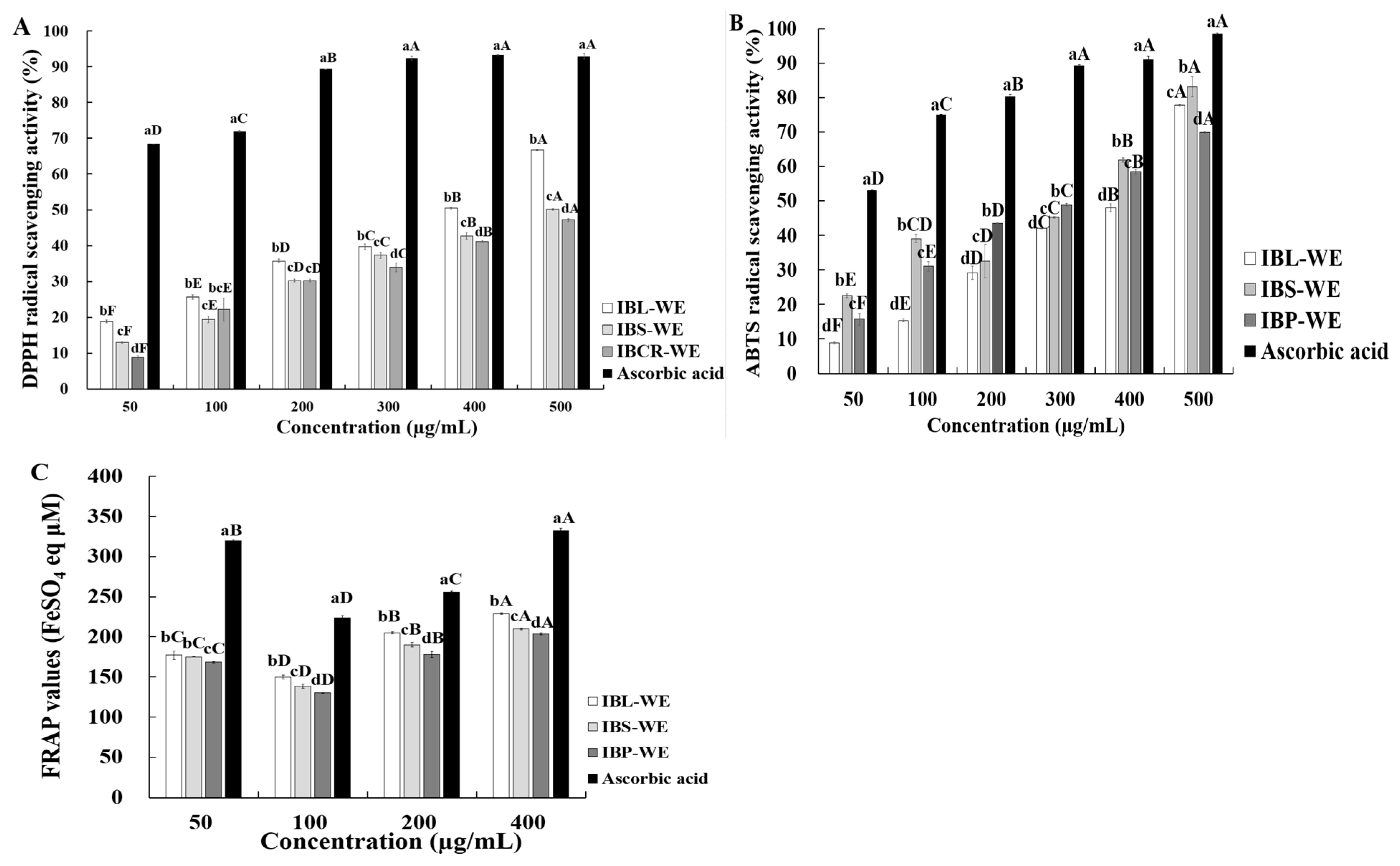
All aqueous extracts from different parts of I. batatas demonstrated progressively enhanced DPPH radical scavenging activity as the concentration increased (Figure 1A, p < 0.05). At equivalent concentrations, IBL-WE showed greater scavenging capacity than IBS-WE and IBCR-WE. Statistically significant differences between IBS-WE and IBCR-WE were observed only at selected concentrations.
ABTS radical quenching activity also rose proportionally with increasing extract concentration in all samples (Figure 1B, p < 0.05). Within the evaluated range of 50–500 μg/mL, IBL-WE exhibited activities from 8.86% to 77.72%, IBS-WE from 22.53% to 83.10%, and IBCR-WE from 15.76% to 69.84%. Notably, at concentrations ≥300 μg/mL, IBS-WE displayed significantly stronger ABTS scavenging activity compared with the other extracts.
Similarly, ferric reducing antioxidant power increased as the extract concentration rose (Figure 1C). Across the examined concentrations, IBL-WE maintained greater reducing capacity relative to IBS-WE and IBCR-WE.

3.3.2. Antioxidant Enzyme–Related Activities

The SOD-like and catalase activity of aqueous extracts from different parts of I. batatas are summarized in Table 3. For SOD-like activity, all extracts exhibited concentration-dependent increases across the tested range. Among the samples, IBL-WE consistently showed the highest SOD-like activity at all concentrations, whereas IBS-WE and IBCR-WE also displayed increasing trends but at lower levels than those observed for the leaf extract. Similarly, catalase-related activity increased with increasing concentration in all samples. IBL-WE exhibited a gradual and consistent enhancement in catalase-related activity across the tested concentrations, while IBS-WE and IBCR-WE showed comparatively modest increases. These results indicate distinct, tissue-dependent differences in antioxidant enzyme-related responses among sweet potato by-product extracts.

3.4. Anti-Wrinkle Enzyme Inhibitory Activities

3.4.1. Elastase Inhibitory Activity

The inhibitory effects against elastase of aqueous extracts from different parts of I. batatas are summarized in Table 4. All samples exhibited statistically significant, concentration-dependent increases in elastase inhibition (p < 0.05). The leaf water extract (IBL-WE) showed inhibition rates of 43.10%, 48.78%, and 67.51% when tested at 100, 250, and 500 μg/mL, respectively, which were consistently higher than those observed for the stem (IBS-WE) and cull root (IBCR-WE) extracts under identical conditions. Although IBS-WE and IBCR-WE also demonstrated concentration-dependent inhibitory effects, their elastase inhibition levels remained lower than those of IBL-WE across the tested concentration range.

3.4.2. Collagenase Inhibitory Activity

Inhibition of collagenase activity by aqueous extracts from different parts of I. batatas increased significantly with increasing extract concentration (Table 4, p < 0.05). IBL-WE exhibited inhibition values ranging from 37.32% to 66.98% across concentrations between 100 and 500 μg/mL, and demonstrated significantly stronger inhibitory effects than IBS-WE and IBCR-WE at 250 and 500 μg/mL. Although IBS-WE and IBCR-WE also demonstrated concentration-dependent increases, their inhibitory activities were consistently lower than those of IBL-WE.

3.5. Biological Activities in Human Dermal Fibroblasts

3.5.1. Cell Viability Analysis

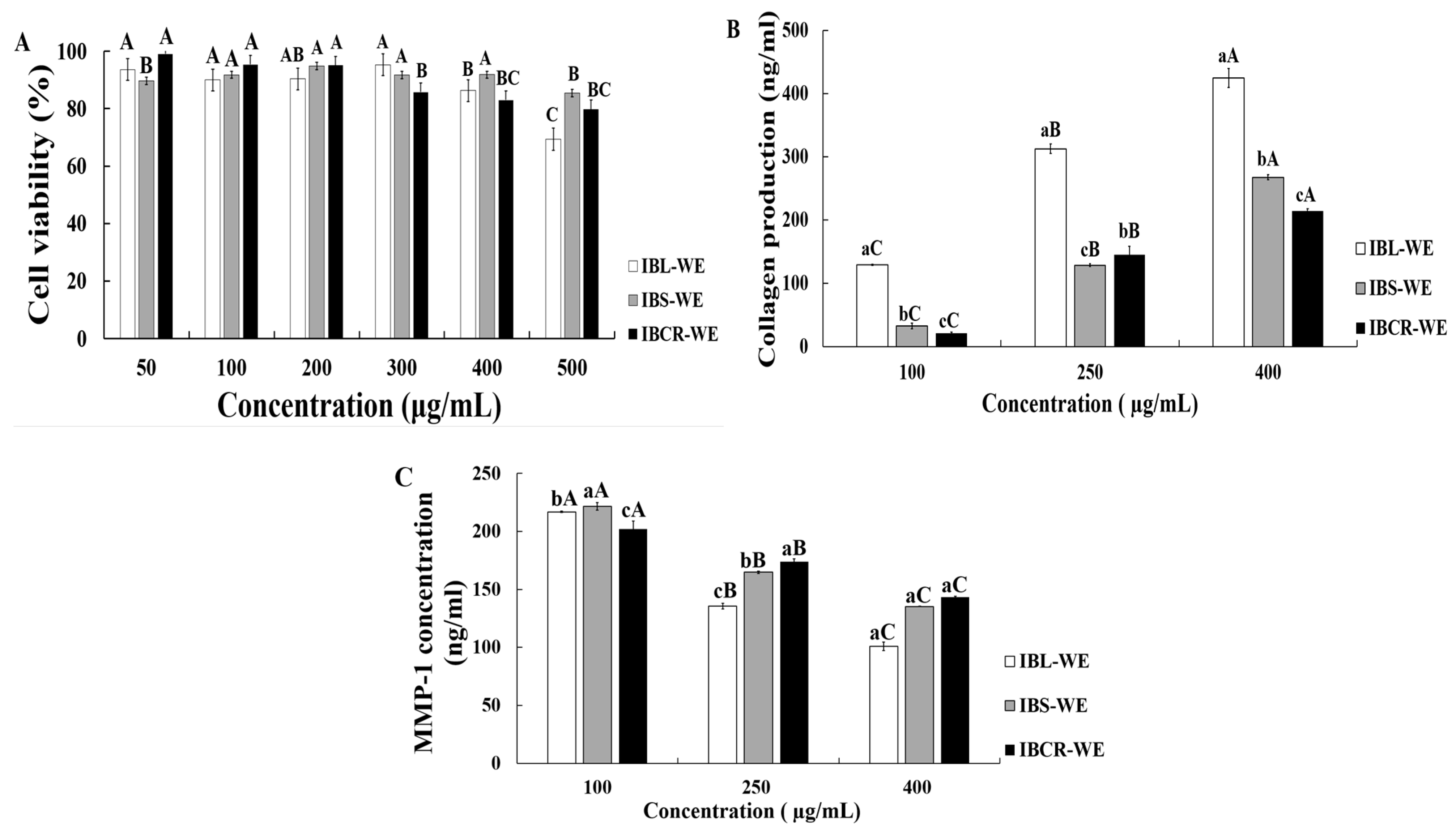
The effects of aqueous extracts from different parts of I. batatas (IBL-WE, IBS-WE, and IBCR-WE) on cell viability were evaluated in CCD-986Sk human dermal fibroblasts (Figure 2A). All extracts exhibited concentration-dependent effects. IBL-WE maintained cell viability between 89.98% and 95.30% at concentrations of 50–300 μg/mL, whereas viability decreased to 69.39% at 500 μg/mL. Similarly, IBS-WE and IBCR-WE showed cell viabilities above 85% at low and medium concentrations, followed by a reduction at 500 μg/mL. Based on these results, concentrations up to 400 μg/mL were used for subsequent collagen synthesis assays.

3.5.2. Collagen Synthesis Assay

The effects of aqueous extracts on collagen synthesis were evaluated in CCD-986Sk human dermal fibroblasts (Figure 2B). All extracts induced significant, concentration-dependent increases in collagen production (p < 0.05). Among the tested samples, IBL-WE exhibited the strongest stimulatory effect across the tested concentration range. At medium and high concentrations, collagen production in cells treated with IBL-WE exceeded that observed in the IBS-WE and IBCR-WE treatment groups to a statistically significant extent. Although IBS-WE and IBCR-WE also promoted collagen synthesis in a concentration-dependent manner, their effects remained lower than those of IBL-WE.

3.5.3. Regulation of MMP-1 Secretion in CCD-986Sk Fibroblasts

The effects of aqueous extracts from different parts of I. batatas (IBL-WE, IBS-WE, and IBCR-WE) on MMP-1 secretion were examined in CCD-986Sk human dermal fibroblasts (Figure 2C). All extracts led to a significant, concentration-dependent reduction in MMP-1 secretion relative to untreated cells (p < 0.05). IBL-WE produced the greatest decrease in MMP-1 levels across the tested concentrations. IBS-WE and IBCR-WE also significantly suppressed MMP-1 secretion; however, their inhibitory effects were less pronounced than those observed for IBL-WE at corresponding concentrations. Overall, the magnitude of inhibition varied by plant part, with the leaf-derived extract showing the strongest effect.

4. Discussion

The antioxidant activities of aqueous extracts derived from distinct parts of I. batatas varied depending on plant tissue and assay type. The leaf-derived extract (IBL-WE) consistently exhibited higher DPPH radical scavenging activity and FRAP values compared with stem and cull root extracts, which was in agreement with its elevated total polyphenol, flavonoid, and quantified phenolic acid contents. Phenolic compounds exert antioxidant effects through radical scavenging and electron-donating mechanisms, thereby contributing to redox regulation [11,16]. Given that chlorogenic acid and caffeic acid are well-recognized contributors to reducing power, their higher abundance in IBL-WE likely underlies the elevated FRAP values observed in the present study. In particular, HPLC analysis confirmed that chlorogenic acid and other phenolic acids were present at higher levels in the leaf extract, supporting the observed antioxidant performance.
Leaves, as photosynthetically active tissues, are continuously exposed to reactive oxygen species generated during metabolic processes and environmental stress. Consequently, leaf tissues tend to accumulate greater amounts of antioxidant-related secondary metabolites as protective defense mechanisms [17,18]. The higher phenolic accumulation observed in IBL-WE in the present study is consistent with this physiological characteristic. Previous comparisons among plant organs have similarly reported higher polyphenol contents and antioxidant activities in leaf-derived extracts than in stem or root tissues [19].
Interestingly, IBS-WE exhibited relatively higher ABTS radical scavenging activity at concentrations exceeding 300 μg/mL. Because the ABTS assay reflects both hydrogen atom donation and electron transfer pathways, whereas DPPH and FRAP assays emphasize different redox behaviors, these assay-dependent differences suggest that antioxidant responses are influenced not only by the overall phenolic level but also by the molecular composition and structural features of phenolic constituents. In particular, ABTS radical scavenging activity is known to be sensitive to a broader range of antioxidant molecules, including both hydrophilic and moderately lipophilic compounds [10], which may explain the relatively higher ABTS activity observed for IBS-WE at higher concentrations. Collectively, these observations demonstrate that antioxidant characteristics of sweet potato extracts differ markedly according to plant tissue. From a practical perspective, this tissue-dependent antioxidant behavior suggests that stem-derived extracts may serve as supplementary antioxidant resources, particularly in applications requiring broad-spectrum radical scavenging, while leaf-derived extracts remain the primary functional material. Such differentiation supports a tissue-specific valorization strategy for sweet potato by-products.
SOD and catalase are central components of the antioxidant defense system. SOD catalyzes the dismutation of superoxide radicals into hydrogen peroxide, which is subsequently decomposed by catalase into water and oxygen, thereby contributing to the maintenance of redox homeostasis [20]. Unlike chemical radical scavenging assays, SOD-like and catalase-related activities are commonly used as indirect indicators of antioxidant defense–related responses, providing complementary information on redox-related behavior beyond direct radical quenching [20]. The relatively higher SOD-like and catalase-related activities observed in IBL-WE may be associated with the antioxidant-related characteristics of leaf tissues, which are known to experience continuous oxidative stress during photosynthesis [17,18]. Taken together, these findings suggest that the leaf-derived extract exhibits a stronger capacity to influence antioxidant defense–related reactions at the assay level, rather than direct enzyme-specific activity.
Elastase and collagenase play key roles in the breakdown of elastin and collagen within the dermal extracellular matrix, and their overactivation is closely associated with wrinkle formation and loss of skin elasticity [21,22]. In the present investigation, the leaf-derived extract exhibited comparatively stronger inhibitory activity against both enzymes. Phenolic compounds have been reported to inhibit proteolytic enzymes through direct interactions with enzyme active sites or substrate-binding regions via hydrogen bonding and hydrophobic interactions, thereby reducing enzymatic degradation of extracellular matrix components [22]. However, the observed inhibitory effects are more plausibly attributed to the synergistic action of multiple bioactive constituents rather than to a single compound.
The cell-based assays further supported these findings. All extracts maintained cell viability above 70% within the tested concentration range up to 400 μg/mL, indicating low cytotoxicity under experimental conditions. The leaf extract promoted type I procollagen synthesis and suppressed MMP-1 secretion more effectively than stem and cull root extracts. Because MMP-1 is responsible for collagen degradation and is upregulated under oxidative stress conditions [21], the suppression of MMP-1 secretion observed in this study may be linked to the regulation of oxidative stress-associated signaling pathways, as excessive ROS generation is known to activate MMP expression and accelerate collagen breakdown [23]. Although intracellular ROS levels were not directly measured in the present study, the combined antioxidant activities, enzyme inhibitory effects, and fibroblast-based outcomes suggest that regulation of oxidative stress–related pathways may underlie the observed suppression of MMP-1 secretion and enhancement of collagen synthesis [6].
Overall, the functional differences observed among plant parts appear to be closely associated with variations in phenolic composition and antioxidant-related secondary metabolites. In particular, the leaf-derived aqueous extract exhibited superior antioxidant and anti-wrinkle-related activities, indicating its potential as a value-added functional resource among underutilized sweet potato by-products. From a tissue-specific perspective, leaf-derived extracts may be considered suitable for use as high-value functional or cosmetic ingredients, whereas stem-derived extracts may serve as supplementary antioxidant resources.

5. Conclusions

This study investigated aqueous extracts obtained from sweet potato (Ipomoea batatas L.) by-products, including leaves, stems, and non-commercial cull roots, and compared their phenolic composition, antioxidant activity, and anti-wrinkle-related biological effects. The results showed that the leaf-derived water extract contained the highest levels of total polyphenols and flavonoids, with chlorogenic acid identified as the predominant phenolic acid, and exhibited superior antioxidant activity across multiple chemical and enzyme-related assays. In addition, the leaf extract demonstrated relatively stronger inhibitory effects against elastase and collagenase, promoted type I procollagen synthesis, and effectively suppressed MMP-1 secretion in human dermal fibroblasts while maintaining acceptable cell viability within the tested concentration range. These findings indicate clear tissue-dependent functional differences among sweet potato by-products and suggest that leaf-derived extracts possess greater functional potential than stem and cull root extracts. Overall, the present findings suggest that sweet potato leaf by-products have potential as functional ingredients for skin-related and cosmetic applications. Although further studies, including mechanistic investigations and in vivo validation, are required, this study highlights the technological applicability and utilization potential of sweet potato leaf by-products as a value-added functional resource.

Author Contributions

Conceptualization, M.P.; methodology, M.P.; formal analysis, M.P.; investigation, M.P.; data curation, M.P.; writing—original draft preparation, M.P.; writing—review and editing, J.-S.K.; interpretation of data, J.-S.K. All authors have read and agreed to the published version of the manuscript.

Funding

This research received no external funding.

Institutional Review Board Statement

Not applicable.

Informed Consent Statement

Not applicable.

Data Availability Statement

The original contributions presented in this study are included in the article. Further inquiries can be directed to the corresponding author.

Acknowledgments

The authors would like to thank the laboratory staff for their technical support during the experiments. During the preparation of this manuscript, AI-assisted language editing was used to improve clarity and readability. The authors have reviewed and edited the content and take full responsibility for the final version of the manuscript.

Conflicts of Interest

The authors declare no conflicts of interest.

Abbreviations

ABTS2,2′-azino-bis(3-ethylbenzothiazoline-6-sulfonic acid);
DPPH2,2-diphenyl-1-picrylhydrazyl;
FRAPferric reducing antioxidant power;
GAEgallic acid equivalents;
RErutin equivalents;
HPLChigh-performance liquid chromatography;
IBL-WEIpomoea batatas leaf water extract;
IBS-WEIpomoea batatas stem water extract;
IBCR-WEIpomoea batatas cull root water extract;
MMP-1matrix metalloproteinase-1;
PDAphotodiode array;
ROSreactive oxygen species;
SODsuperoxide dismutase.

References

  1. Laveriano-Santos, E.P.; López-Yerena, A.; Jaime-Rodríguez, C.; González-Coria, J.; Lamuela-Raventós, R.M.; Vallverdú-Queralt, A.; Romanyà, J.; Pérez, M. Sweet potato is not simply an abundant food crop: A comprehensive review of its phytochemical constituents, biological activities, and the effects of processing. Antioxidants 2022, 11, 1648. [Google Scholar] [CrossRef] [PubMed]
  2. Zhang, C.; Liu, D.; Wu, L.; Zhang, J.; Li, X.; Wu, W. Chemical characterization and antioxidant properties of ethanolic extract and its fractions from sweet potato (Ipomoea batatas L.) leaves. Foods 2020, 9, 15. [Google Scholar] [CrossRef] [PubMed]
  3. Schieber, A.; Stintzing, F.C.; Carle, R. By-products of plant food processing as a source of functional compounds—Recent developments. Trends Food Sci. Technol. 2001, 12, 401–413. [Google Scholar] [CrossRef]
  4. Routray, W.; Orsat, V. Agricultural and food industry by-products: Source of bioactive components for functional beverages. In The Science of Beverages; Volume 12: Nutrients in Beverages; Academic Press: Oxford, UK, 2019; pp. 543–589. [Google Scholar] [CrossRef]
  5. Rinnerthaler, M.; Bischof, J.; Streubel, M.K.; Trost, A.; Richter, K. Oxidative stress in aging human skin. Biomolecules 2015, 5, 545–589. [Google Scholar] [CrossRef] [PubMed]
  6. Pillai, S.; Oresajo, C.; Hayward, J. Ultraviolet radiation and skin aging: Roles of reactive oxygen species, inflammation and protease activation, and strategies for prevention of inflammation-induced matrix degradation—A review. International Journal of Cosmetic Science 2005, 27, 17–34. [Google Scholar] [CrossRef] [PubMed]
  7. Singleton, V.L.; Rossi, J.A. Colorimetry of total phenolics with phosphomolybdic-phosphotungstic acid reagents. Am. J. Enol. Vitic. 1965, 16, 144–158. [Google Scholar] [CrossRef]
  8. Zhishen, J.; Mengcheng, T.; Jianming, W. The determination of flavonoid contents in mulberry and their scavenging effects on superoxide radicals. Food Chem. 1999, 64, 555–559. [Google Scholar] [CrossRef]
  9. Blois, M.S. Antioxidant determinations by the use of a stable free radical. Nature 1958, 181, 1199–1200. [Google Scholar] [CrossRef]
  10. Re, R.; Pellegrini, N.; Proteggente, A.; Pannala, A.; Yang, M.; Rice-Evans, C. Antioxidant activity applying an improved ABTS radical cation decolorization assay. Free. Radic. Biol. Med. 1999, 26, 1231–1237. [Google Scholar] [CrossRef] [PubMed]
  11. Benzie, I.F.F.; Strain, J.J. The ferric reducing ability of plasma (FRAP) as a measure of antioxidant power: The FRAP assay. Anal. Biochem. 1996, 239, 70–76. [Google Scholar] [CrossRef] [PubMed]
  12. Marklund, S.; Marklund, G. Involvement of the superoxide anion radical in the autoxidation of pyrogallol and a convenient assay for superoxide dismutase. Eur. J. Biochem. 1974, 47, 469–474. [Google Scholar] [CrossRef] [PubMed]
  13. Aebi, H. Catalase in vitro. In Methods in Enzymology; Isolation, Purification, Characterization, and Assay of Antioxygenic Enzymes; Academic Press: New York, NY, USA, 1984; Volume 105, pp. 121–126. [Google Scholar] [CrossRef]
  14. Bieth, J.; Spiess, B.; Wermuth, C.G. The synthesis and analytical use of a highly sensitive and convenient substrate of elastase. Comp. Biochem. Physiol. Part B Comp. Biochem. 1974, 11, 350–357. [Google Scholar] [CrossRef] [PubMed]
  15. Wuensch, E.; Heidrich, H.G. On the quantitative determination of collagenase. Hoppe-Seyler’s Z. Für Physiol. Chem. 1963, 333, 149–151. [Google Scholar] [CrossRef]
  16. Bjørklund, G.; Shanaida, M.; Lysiuk, R.; Butnariu, M.; Peana, M.; Sarac, I.; Strus, O.; Smetanina, K.; Chirumbolo, S. Natural compounds and products from an anti-aging perspective. Molecules 2022, 27, 7084. [Google Scholar] [CrossRef] [PubMed]
  17. Close, D.C.; McArthur, C. Rethinking the role of many plant phenolics—Protection from photodamage not herbivores? Oikos 2002, 99, 166–172. [Google Scholar] [CrossRef]
  18. Agati, G.; Azzarello, E.; Pollastri, S.; Tattini, M. Flavonoids as antioxidants in plants: Location and functional significance. Plant Sci. 2012, 196, 67–76. [Google Scholar] [CrossRef] [PubMed]
  19. Teow, C.C.; Truong, V.-D.; McFeeters, R.F.; Thompson, R.L.; Pecota, K.V.; Yencho, G.C. Antioxidant activities, phenolic and β-carotene contents of sweet potato genotypes with varying flesh colours. Food Chem. 2007, 103, 829–838. [Google Scholar] [CrossRef]
  20. Halliwell, B.; Gutteridge, J.M.C. Free Radicals in Biology and Medicine, 5th ed.; Oxford University Press: Oxford, UK, 2015. [Google Scholar] [CrossRef]
  21. Quan, T.; Qin, Z.; Xia, W.; Shao, Y.; Voorhees, J.J.; Fisher, G.J. Matrix-degrading metalloproteinases in photoaging. J. Investig. Dermatol. Symp. Proc. 2009, 14, 20–24. [Google Scholar] [CrossRef] [PubMed]
  22. Thring, T.S.A.; Hili, P.; Naughton, D.P. Anti-collagenase, anti-elastase and anti-oxidant activities of extracts from 21 plants. BMC Complement. Altern. Med. 2009, 9, 27. [Google Scholar] [CrossRef] [PubMed]
  23. Fisher, G.J.; Wang, Z.Q.; Datta, S.C.; Varani, J.; Kang, S.; Voorhees, J.J. Pathophysiology of premature skin aging induced by ultraviolet light. N. Engl. J. Med. 1997, 337, 1419–1428. [Google Scholar] [CrossRef] [PubMed]
Figure 1. Antioxidant activities of Ipomoea batatas water extracts obtained from different plant parts. (A) DPPH radical scavenging activity, (B) ABTS radical scavenging activity, and (C) ferric reducing antioxidant power (FRAP). IBL-WE, I. batatas leaf water extract; IBS-WE, I. batatas stem water extract; IBCR-WE, I. batatas cull root water extract. Results are expressed as mean ± SD (n = 3). Different lowercase letters (a–d) denote statistically significant differences among extracts at the same concentration, whereas different uppercase letters (A–F) indicate significant differences among concentrations within the same extract, as determined by Duncan’s multiple range test (p < 0.05).
Applsci 16 02491 g001
Figure 2. Effects of aqueous extracts from different parts of Ipomoea batatas on. (A) cell viability, (B) type I procollagen production, and (C) MMP-1 secretion in CCD-986Sk human dermal fibroblasts. IBL-WE, Ipomoea batatas leaf water extract; IBS-WE, I. batatas stem water extract; IBCR-WE, I. batatas cull root water extract. Results are expressed as mean ± SD (n = 3). Different lowercase letters (a–c) denote statistically significant differences among extracts at the same concentration, whereas different uppercase letters (A–C) indicate significant differences among concentrations within the same extract, as determined by Duncan’s multiple range test (p < 0.05).
Applsci 16 02491 g002
Table 1. Contents of total polyphenols and flavonoids of Ipomoea batatas extracts.
SampleTotal Polyphenols
(mg GAE/g)
Total Flavonoids
(mg RE/g)
IBL-WE71.23 ± 1.34 a26.76 ± 0.40 a
IBS-WE51.92 ± 0.93 b17.59 ± 0.32 b
IBCR-WE42.39 ± 3.24 c16.88 ± 1.14 b
Data are shown as mean values with standard deviations (n = 3). IBL-WE, Ipomoea batatas leaf water extract; IBS-WE, I. batatas stem water extract; IBCR-WE, I. batatas cull root water extract. Means with different lowercase letters (a–c) within the same column are significantly different at p < 0.05 by Duncan’s multiple range test.
Table 2. Phenolic acid composition of aqueous extracts from different parts of Ipomoea batatas (mg/g dry extract).
SampleChlorogenic AcidCaffeic AcidProtocatechuic AcidGallic Acidp-Hydroxybenzoic AcidΣ Quantified Phenolics
IBL-WE21.63 ± 0.55 a4.54 ± 0.25 a1.68 ± 0.18 a0.80 ± 0.06 a0.86 ± 0.04 a29.51 ± 0.83 a
IBS-WE11.54 ± 0.34 b3.89 ± 0.33 b0.94 ± 0.02 b1.05 ± 0.43 b0.27 ± 0.09 b17.69 ± 0.36 b
IBCR-WE4.52 ± 0.22 c2.60 ± 0.12 c0.41 ± 0.24 c0.56 ± 0.17 cN.D. 8.09 ± 0.75 c
Data are shown as mean values with standard deviations (n = 3). IBL-WE denotes Ipomoea batatas leaf water extract; IBS-WE, I. batatas stem water extract; and IBCR-WE, I. batatas cull root water extract. Different lowercase letters (a–c) indicate statistically significant differences within the same column (p < 0.05), as determined by Duncan’s multiple range test. N.D. indicates not detected.
Table 3. Catalase activity.
SampleSOD-Like Activity (%)Catalase Activity (%)
100 μg/mL300 μg/mL500 μg/mL100 μg/mL300 μg/mL500 μg/mL
IBL-WE41.81 ± 2.26 bC47.68 ± 0.43 cB67.39 ± 0.33 bA45.52 ± 0.11 bC65.36 ± 1.22 bB77.87 ± 0.76 bA
IBS-WE34.02 ± 0.36 cC55.42 ± 0.06 bB62.99 ± 1.65 cA27.96 ± 1.81 cC44.42 ± 0.42 cB58.68 ± 0.77 cA
IBCR-WE31.10 ± 0.21 dC47.84 ± 0.06 cB55.10 ± 0.11 dA14.04 ± 0.11 dC21.41 ± 0.06 dB41.34 ± 0.13 dA
Trolox83.09 ± 0.99 aC91.25 ± 0.55 aB96.30 ± 0.15 aA 80.70 ± 3.28 aC87.40 ± 0.42 aB90.16 ± 0.77 aA
Data represent the mean ± SD of three independent experiments. IBL-WE, Ipomoea batatas leaf water extract; IBS-WE, I. batatas stem water extract; IBCR-WE, I. batatas cull root water extract. Trolox was included as a reference antioxidant to verify the responsiveness of the assay system, rather than as an enzyme-specific positive control. Within each assay, values marked with different lowercase letters (a–d) in the same column indicate significant differences among samples, while values marked with different uppercase letters (A–C) in the same row indicate significant differences among concentrations (p < 0.05, Duncan’s multiple range test).
Table 4. Elastase and collagenase inhibitory activities of Ipomoea batatas water extracts.
SampleElastase Inhibition (%)Collagenase Inhibition (%)
100 μg/mL250 μg/mL500 μg/mL100 μg/mL250 μg/mL500 μg/mL
IBL-WE43.10 ± 0.79 aC48.78 ± 0.32 aB67.51 ± 0.53 aA37.32 ± 0.74 aC49.59 ± 0.24 bB66.98 ± 0.36 aA
IBS-WE43.42 ± 0.71 aC48.53 ± 0.25 aB61.21 ± 0.04 bA30.69 ± 0.31 bC53.84 ± 0.14 aB62.23 ± 0.67 bA
IBCR-WE29.05 ± 1.79 bC46.79 ± 0.89 bB53.69 ± 0.49 cA27.32 ± 0.29 cC46.98 ± 0.20 cB52.09 ± 0.11 cA
Data represent the mean ± SD of three independent experiments. IBL-WE, Ipomoea batatas leaf water extract; IBS-WE, I. batatas stem water extract; IBCR-WE, I. batatas cull root water extract. Within each assay, values marked with different lowercase letters (a–c) in the same column indicate significant differences among samples, while values marked with different uppercase letters (A–C) in the same row indicate significant differences among concentrations (p < 0.05, Duncan’s multiple range test).
Disclaimer/Publisher’s Note: The statements, opinions and data contained in all publications are solely those of the individual author(s) and contributor(s) and not of MDPI and/or the editor(s). MDPI and/or the editor(s) disclaim responsibility for any injury to people or property resulting from any ideas, methods, instructions or products referred to in the content.