Article

Parameter Optimization and Engineering Effect of Cut-and-Fill Mining Technology

1
State Grid Energy Hami Coal Power Co., Ltd., Dananhu No. 1 Mine, Hami 839000, China
2
School of Civil Engineering and Architecture, Shandong University of Science and Technology, Qingdao 266590, China
3
School of Safety Science and Engineering, Anhui University of Science and Technology, Huainan 232000, China
*
Author to whom correspondence should be addressed.
Appl. Sci. 2026, 16(5), 2391; https://doi.org/10.3390/app16052391
Submission received: 18 January 2026 / Revised: 24 February 2026 / Accepted: 26 February 2026 / Published: 28 February 2026
(This article belongs to the Special Issue Advanced Technologies in Intelligent and Sustainable Coal Mining)

Abstract

To address the limitations of existing subsidence control technologies in coal mining, this study systematically investigates the fundamental principles of cut-and-fill mining, the stability mechanism of the filling body, and the influence law of key parameters on mining engineering effects, through a comprehensive research framework integrating theoretical analysis, similar material simulation and numerical simulation. Firstly, the mechanical characteristics of horizontal and diagonal shear failure of gangue pillars are revealed via theoretical derivation. It is clarified that the diagonal stability of the gangue pillar can be guaranteed when its aspect ratio is ≤0.5, and the lateral constraint of metal mesh can effectively enhance its horizontal stability. Secondly, based on a physical model with a size similarity ratio of 1:100, the overburden failure characteristics are obtained: only local cracks appear in the immediate roof and the basic roof presents gentle subsidence after cut-and-fill mining, which directly verifies the effective control effect of this technology on mining-induced overburden movement and surface subsidence. On this basis, multiple sets of orthogonal tests are designed using FLAC3D software (5.0) to analyze the effects of roof cutting width, filling width and coal seam thickness on roof displacement and filling area stress. Combined with grey correlation analysis, it is determined that coal seam thickness is the most critical factor affecting the mining effect, with the correlation coefficients for roof displacement and filling area stress reaching 0.79 and 0.93, respectively. The research shows that the parameter combination of 10 m roof cutting width + 10 m filling width (Group 10-10-X) can achieve the optimal balance between subsidence control efficiency and filling engineering benefit; for working faces with higher requirements for surface subsidence control, the combination of 5 m roof cutting width + 10 m filling width is recommended. The research results clarify the action mechanism of cut-and-fill mining, optimize the key engineering parameters, and provide a solid theoretical basis and technical support for the engineering popularization of this technology and high-precision surface subsidence control.

1. Introduction

Coal remains one of the most important primary energy sources worldwide. This status is particularly evident in China’s energy structure. Meanwhile, it also serves as a core energy pillar for major coal-producing countries. However, large-scale underground coal mining inevitably induces overburden movement and surface subsidence. These phenomena lead to a range of detrimental consequences, including geological hazards (such as ground fissures and sinkholes), damage to critical surface infrastructure (like buildings, roads, and railways), and long-term ecological degradation [1,2]. On the other hand, the interconnected overburden fissures induced by mining are dominant migration pathways for harmful and radioactive gases. These gases can migrate from deep coal seams to the surface, posing a long-term health threat to populations above the mine. Such hazards have been widely reported in typical coal basins globally, and their impact scope far exceeds the area of engineering subsidence [3].
In response to increasingly stringent global and national requirements for environmental protection and land-use safety, developing effective strategies to control mining-induced strata movement and surface subsidence has emerged as a paramount challenge in modern, sustainable coal mining engineering [4,5]. To address this challenge, several subsidence control techniques have been developed and deployed. The current mainstream approaches primarily include partial mining methods (notably room-and-pillar and strip mining), paste backfill mining, overburden bed separation grouting, and fully mechanized solid waste (gangue) filling mining [6,7,8]. Each of these methods employs a distinct mechanism to mitigate subsidence, yet each also presents specific limitations in terms of resource recovery, operational cost, material logistics, or geological adaptability, underscoring the need for continued innovation in this critical field. Notably, backfill-based subsidence control technologies can effectively inhibit the development and propagation of overburden fissures while controlling surface subsidence, thus blocking the migration channels of harmful and radioactive gases, and have dual benefits for engineering safety control and geological environment protection [9].
Room-and-pillar and strip mining have been widely adopted for subsidence control in flat-lying coal seams across various mining regions. However, their fundamental reliance on leaving permanent, non-recoverable coal pillars to support the overburden imposes a significant and inherent limitation: it drastically reduces the overall resource recovery rate, resulting in substantial in situ resource wastage [10,11]. Paste backfill mining addresses this by replacing the coal pillars with engineered, cementitious backfill mixtures. While proven effective in controlling strata movement and surface deformation, this method is frequently constrained by high material costs associated with binders like cement, the need for complex surface preparation plants, and the logistical and economic challenges of transporting large volumes of filling material over long distances [12,13,14]. Overburden bed separation grouting presents an alternative with relative operational simplicity and minimal interference with mining activities. Its major drawback, however, is the unpredictable and often variable effectiveness, as its success is critically dependent on favorable and well-developed geological separation zones within the overburden, conditions that are not universally present [15,16,17]. Fully mechanized solid filling mining, a notable advancement from China, integrates longwall mining with in situ filling; however, its widespread application is constrained by frequent shortages of filling materials and the logistical challenge of synchronizing mining and filling operations, especially at high production rates [18,19,20,21].
To address the above technical bottlenecks, the concept of cut-and-fill mining, which innovatively combines directional roof cutting pressure relief and in situ goaf filling with broken roof rock mass, has been proposed and gradually developed in domestic and international research and engineering practice [22,23,24,25]. This method combines roof cutting with in situ filling, allowing the roof to be pre-weakened and the broken roof rock to be directly used as filling material in the goaf. Existing studies have verified the feasibility of this technology in controlling overburden movement and surface subsidence through field engineering tests, and preliminarily analyzed the influence of single engineering parameters such as roof cutting height on mining stress evolution [26]. However, the stability of the filling body, the evolution characteristics of overburden movement, and the interaction between mining thickness, cutting width, and filling width have not yet been systematically clarified. This lack of quantitative understanding limits the optimization of engineering parameters and restricts the broader application of cut-and-fill mining, especially in areas with strict surface subsidence control requirements. Therefore, this study systematically investigates the principles and engineering effects of cut-and-fill mining through an integrated approach combining theoretical analysis, similar material simulation experiments, and numerical simulations. The research focuses on the stability of the filling body, the movement law of the overburden, and the influence mechanisms of key geometric parameters, including mining thickness, roof cutting width, and filling width. The results reveal the parameter combinations that are most effective in controlling roof displacement and enhancing filling support performance, and provide a theoretical basis for engineering parameter optimization and surface subsidence control in cut-and-fill mining.

2. Theoretical Analysis

2.1. Basic Principles of Cut-and-Fill Mining

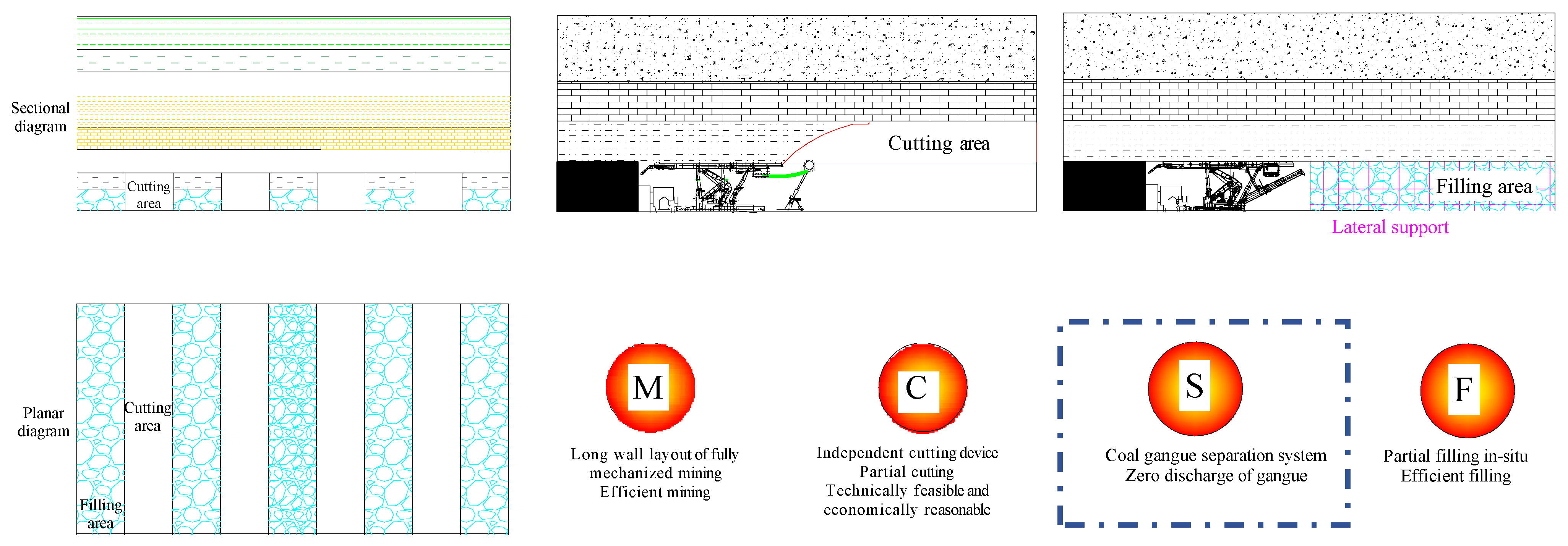
To achieve self-sufficiency in filling materials, the cut-and-fill mining method employs the resource processing section (cutting area) of the goaf roof as in situ (filling area) filling materials. Based on factors such as the distribution of coal seams and the properties of surrounding rocks, the cutting area, filling area location and size are scientifically arranged. Relying on a complete set of independently developed integrated coal mining equipment designed specifically for cutting and filling operations, partial filling of the goaf is realized, thereby achieving the goal of controlling surface subsidence.
Figure 1 illustrates a three-dimensional schematic diagram of the cut-and-fill mining working face. This working face comprises the coal mining face located in front of the hydraulic support and the roof cutting-filling face situated behind the hydraulic support. The rear roof cut-and-fill working face is divided into a roof cutting area and a filling area, which are arranged in a sequential manner. The cutting device installed in the roof cutting area cuts part of the immediate roof and conveys it to the adjacent filling area for concentrated and dense filling.
Under the lateral restraint of the metal mesh, a load-bearing structure composed of gangue pillars and the immediate roof is formed in the filling area. This structure fulfills the function of partial filling and attains the effect of reducing surface subsidence. As shown in Figure 1, the cut-and-fill mining process encompasses the coal mining process, roof cutting process and filling process, forming a continuous workflow of mining, cutting and filling. When underground coal gangue separation and filling are taken into consideration, another operational mode of the coal mining–cutting–separation–filling process can be established.

2.2. Support Analysis of Cut-and-Fill Mining

In general, the cohesion between solid particles in gangue filling is much smaller than the strength of the particles themselves. Under external loads, the primary form of damage to gangue columns is shear and slip between the solid particles, rather than direct compression of the particles themselves. The two most likely directions for shear failure of gangue columns are horizontal and diagonal.
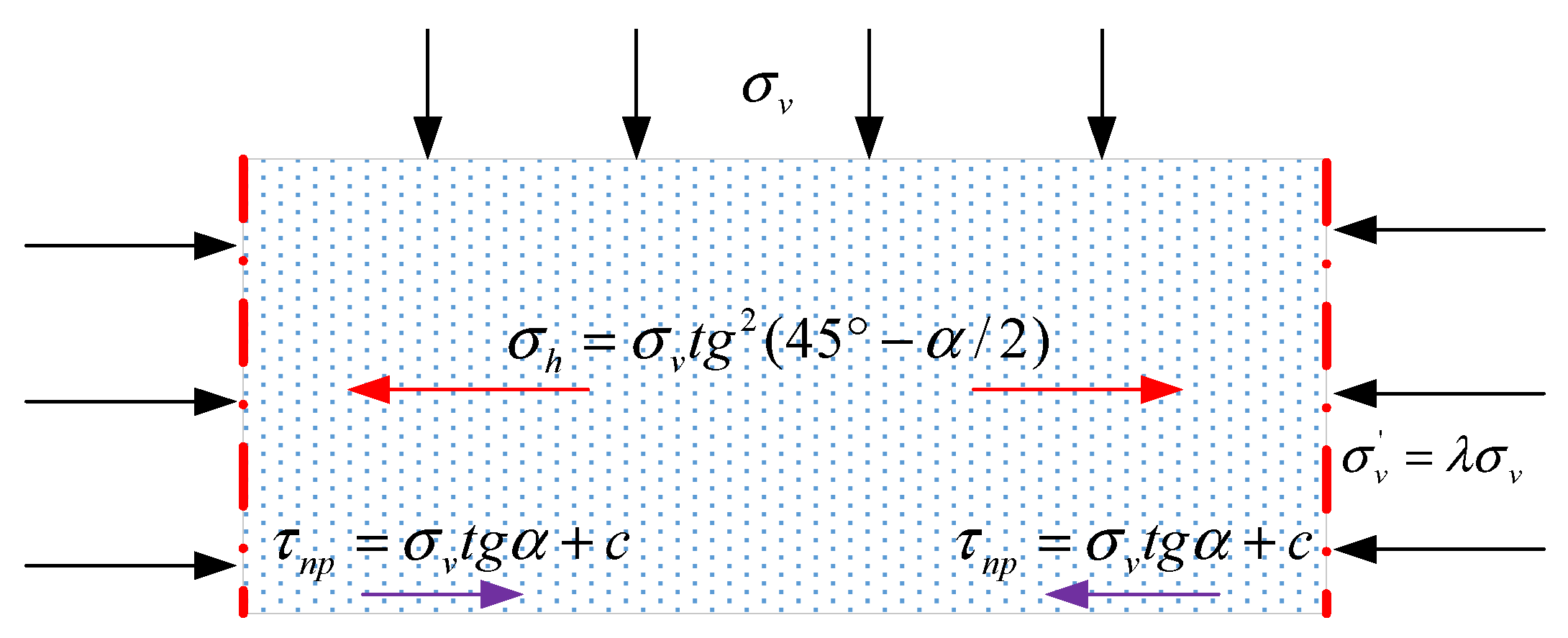
As shown in Figure 2, under the combined effects of the gravity of the overlying rock strata and the lateral support of the metal mesh, the gangue columns in the filling area are approximately in a state of lateral confinement with given deformation. Under the action of lateral support from the metal mesh, as the gangue column expands horizontally, the lateral pressure along the horizontal direction increases. Once the deformation stabilizes, the horizontal lateral pressure remains basically unchanged but still maintains a tendency to expand outward. At this point, the situation is similar to active earth pressure. The horizontal lateral pressure can be calculated approximately [27,28]:
σ h = σ v t g 2 ( 45 ° α / 2 )
where σ h represents the horizontal lateral pressure, σ v represents the vertical pressure, and α represents the internal friction angle.
The internal friction angle of the filling gangue can be assumed to be 30°. Upon substitution into the formula, it is found that the lateral stress applied to the filling gangue is one-third of the vertical stress.
The shear strength of the filling gangue, equal to the sum of cohesion and internal friction, is expressed by the following equation:
T n p = N f + c S
where N represents the vertical force, f denotes cohesion, is the coefficient of internal friction, equal to the tangent of the internal friction angle, c signifies the unit vertical stress, and S is the shear area.
The corresponding shear strength calculation formula is:
τ n p = T n p S = σ v t g α + c
Generally, filling gangue is considered to be non-cohesive granular material, hence c = 0. However, in reality, due to compaction during the filling of the gangue column, and the presence of a significant amount of fine particles and adhesive materials in the filling gangue, it does possess some cohesion. Comparing the horizontal stress on the gangue column with the shear force it needs to overcome during horizontal movement, it is easy to see that the horizontal shear strength exceeds the horizontal stress, ensuring the stability of the gangue column. With the consideration of the lateral support of the metal mesh, the stability of the gangue column is further guaranteed.
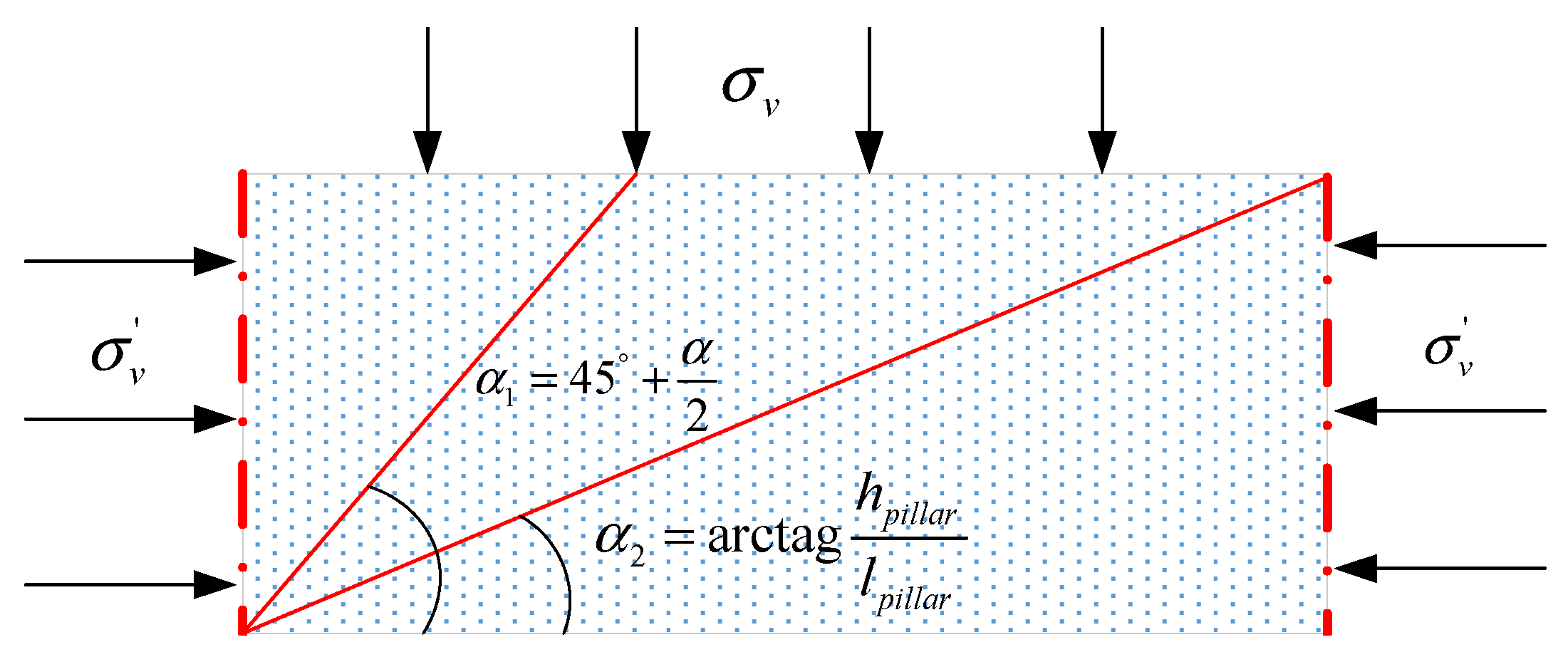
As shown in Figure 3, under the combined effects of the gravity of the overlying rock strata and the lateral support of the metal mesh, shear failure of the gangue column along the diagonal occurs in the filling area. The geometric condition that needs to be satisfied for this shear failure is:
α 1 = 45 ° + α 2
where α 1 is the limiting angle of shear failure along the diagonal.
The maximum angle α 2 of shear failure along the diagonal of the gangue column can be calculated using the following formula:
α 2 = arctag h p i l l a r l p i l l a r
where α 2 is the maximum angle along the diagonal of the gangue column, h p i l l a r is the height of the gangue column, and l p i l l a r is the width of the gangue column.
To ensure the stability of the gangue column, its dimensions, especially the height-to-width ratio, are subject to certain limitations. It is initially set that the height-to-width ratio should not exceed 0.5. At this point, the maximum angle of shear failure along the diagonal is 27°, which is far from the limiting angle when shear failure occurs along the diagonal of the gangue column. Therefore, the stability of the gangue column along the diagonal can be guaranteed.

3. Similarity Simulation

3.1. Engineering Background

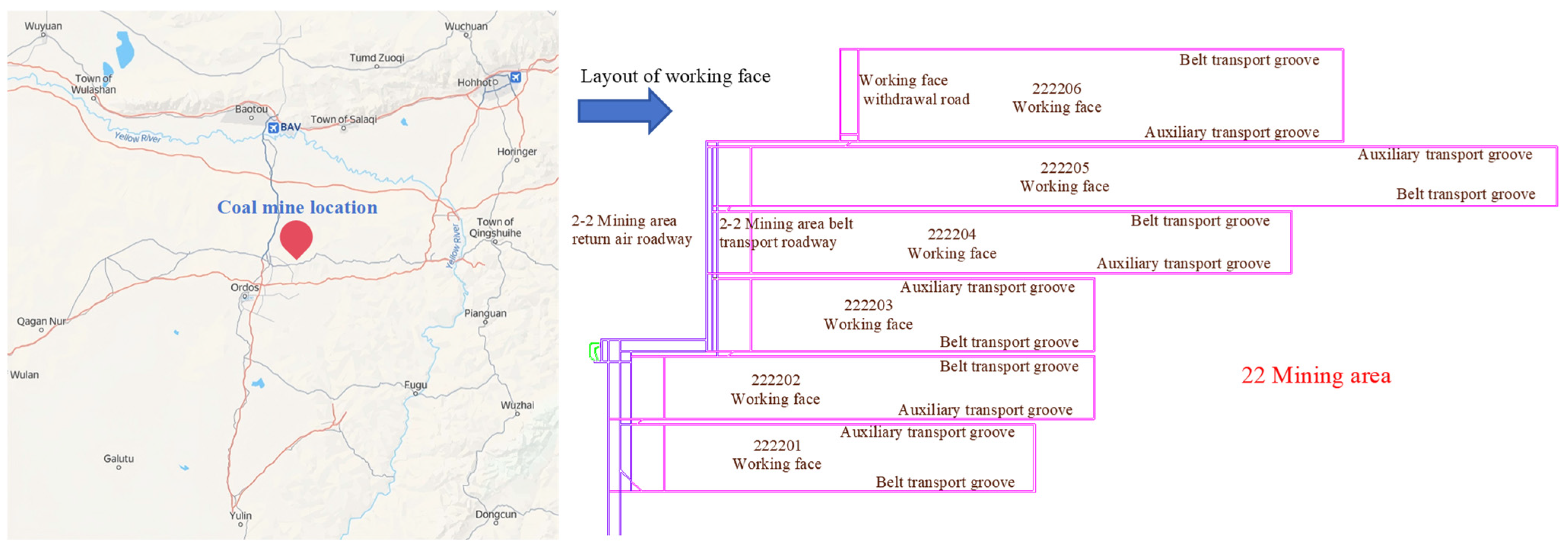
The study area is in Tongchuan Town, Dongsheng District, Ordos City, Inner Mongolia. The target coal seam has a strike length of 1629.5 m, dip length of 4132.3 m, average thickness of ~4 m, and average burial depth of ~100 m. Its dip angle ranges from to 5°, averaging 3°, with a simple structure, no water inrush or gas risks, and stable mining conditions. The coal mine location and working face layout are shown in Figure 4.
The working face uses comprehensive mechanized full-height mining via inclined longwall retreating, with roof managed by full caving. Geological exploration shows roof and floor lithology as fine-grained sandstone and sandy mudstone. Physical and mechanical parameters from coring data were compiled and analyzed. Mine formation details are shown in Table 1.
The No. 22 mining area is mined via the 2-2 upper coal seam roadway. The working face groove is vertically arranged with the roadway, and the cut hole is parallel to it. Six fully mechanized mining faces are arranged in the area, with 25 m coal pillars left between two faces. Each face has two grooves: belt transport and auxiliary transport, both driven along the coal seam floor. The belt transport groove crosses the 2-2 upper coal seam auxiliary, connects with the return air roadway, and links to the belt transport roadway through the coal chute, mainly for coal transportation and return air. The auxiliary transport groove directly connects with the auxiliary transport roadway, mainly for material transportation and air intake. To identify the key bearing stratum of the overlying rock layers, the interlayer load of each rock layer in the study area was calculated and analyzed. The results show that the R6 medium-grained sandstone is the main key stratum controlling the movement of the entire overlying rock layers and the load transfer [29,30,31].

3.2. Experimental Design

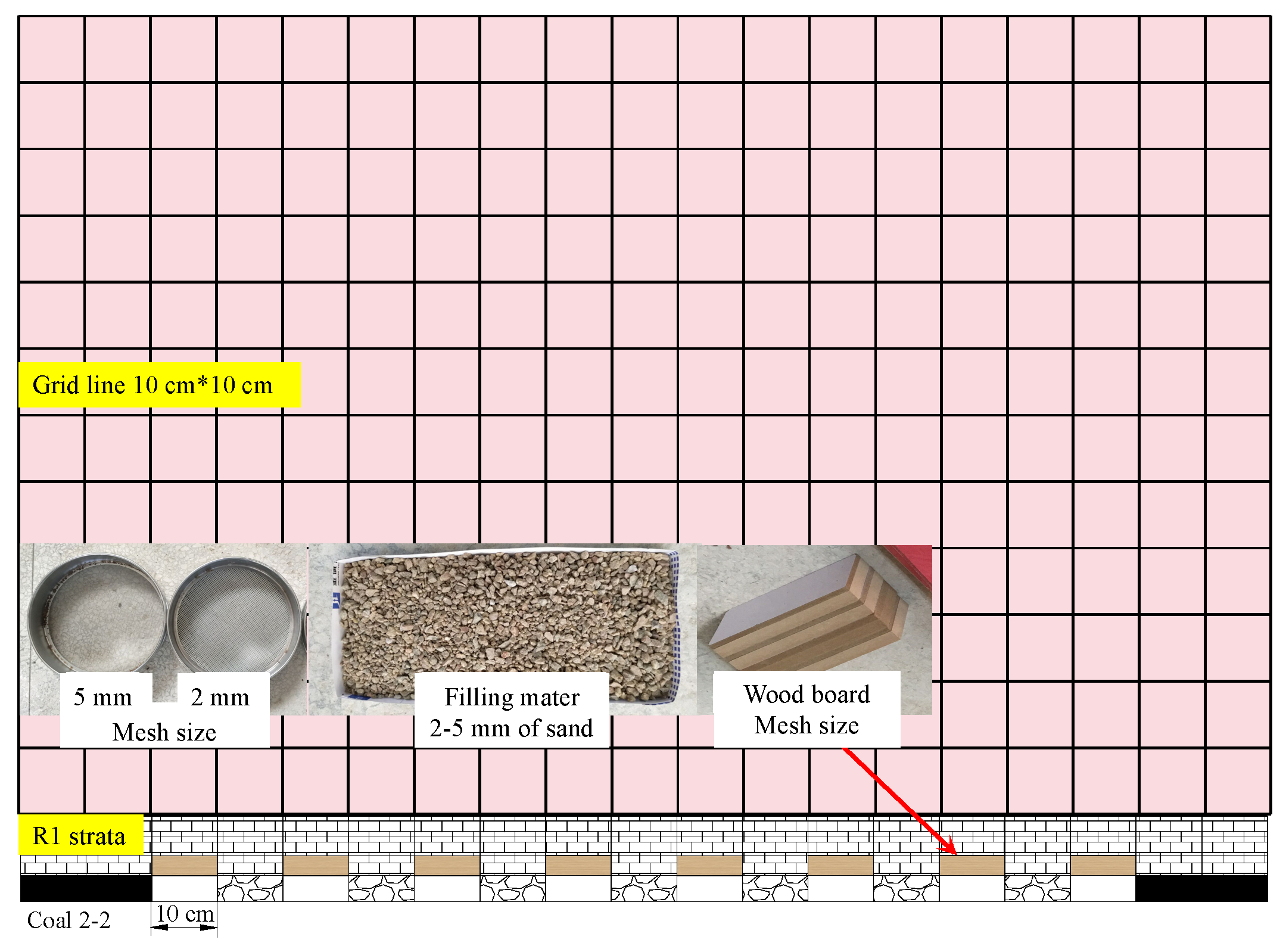
In this simulation experiment using similar materials, in accordance with the similar material theory and similarity criteria, similar materials were adopted to construct a physical model consistent with the on-site engineering conditions. The dimension similarity ratio is 1:100, the unit weight similarity ratio is 1:1.5, and the strength similarity ratio is 1:150. As presented in Figure 5, the model has geometric dimensions of 190 cm in length, 22 cm in width, and 134 cm in height. Corresponding similar material ratio schemes were selected based on the compressive strength parameters of each stratum [32,33,34]. Latitude and longitude grids with a size of 10 cm × 10 cm were marked on the front of the model using ink lines, and drawing pins were fixed at the grid intersections to serve as displacement observation points. Displacement monitoring was conducted by means of a total station. The broken rock samples used in the test were collected from the goaf parting and roof caving rock blocks, with sandstone as the lithology.
As illustrated in Figure 5, to facilitate the simulation of roof cutting, roof cutting wood boards were pre-embedded at the bottom of the R1 sandy mudstone stratum to simulate the roof cutting layer. The roof cutting wood boards have dimensions of 22 cm × 10 cm × 3 cm, corresponding to the simulation of an on-site roof cutting range with a thickness of 3 m and a width of 10 m. Taking into account material consistency and size similarity ratio (the coal fragmentation by the shearer is generally concentrated between approximately 0.2 and 0.5 m, which is similar to that of cut-and-fill mining), the filling material selected was sand particles with a particle size of 2–5 mm. These sand particles were placed into paper boxes of 22 cm × 10 cm × 4 cm to make filling strips, which were used to simulate the on-site filling strips with a height of 4 m and a width of 10 m. The mining range designed in the experiment is 150 m, and a total of 8 roof cutting wood boards were pre-embedded. After the completion of roof cutting, the cutting wood boards were taken out and did not participate in the bearing of the stope; therefore, only the geometric dimension similarity was considered, and the mechanical properties of the material were not taken into account.

3.3. Experimental Results

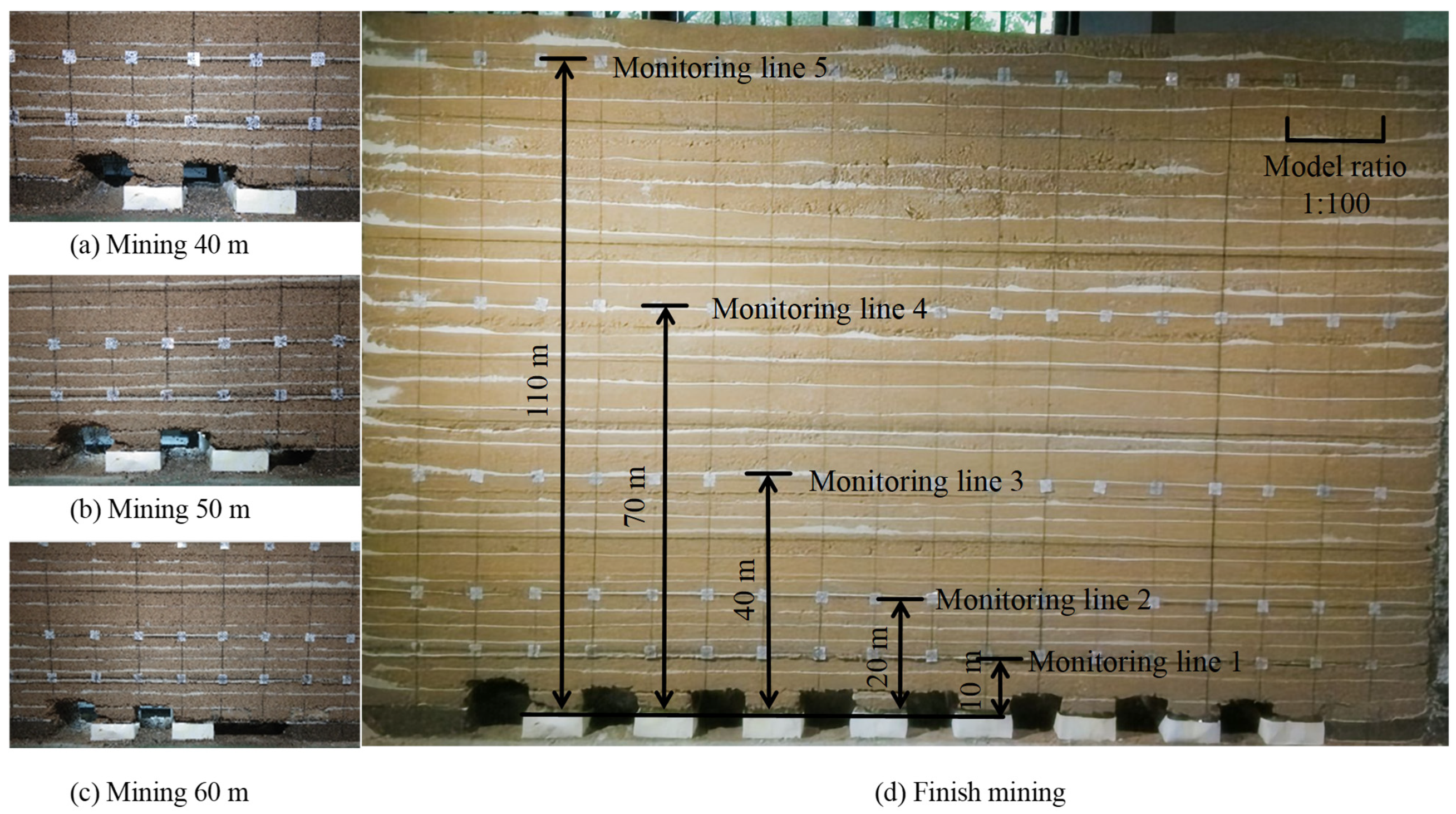
It can be seen from Figure 6 that when cut-and-fill mining advances to 60 m, except for the separation phenomenon of the immediate roof above the filling strip, the overlying strata have no obvious deformation and no periodic fracture cracks. After the completion of cut-and-fill mining operations, obvious cracks only appear in the immediate roof stratum of the roof cutting area. No cracks are generated in other strata, but the basic roof stratum close to the goaf undergoes gentle subsidence.
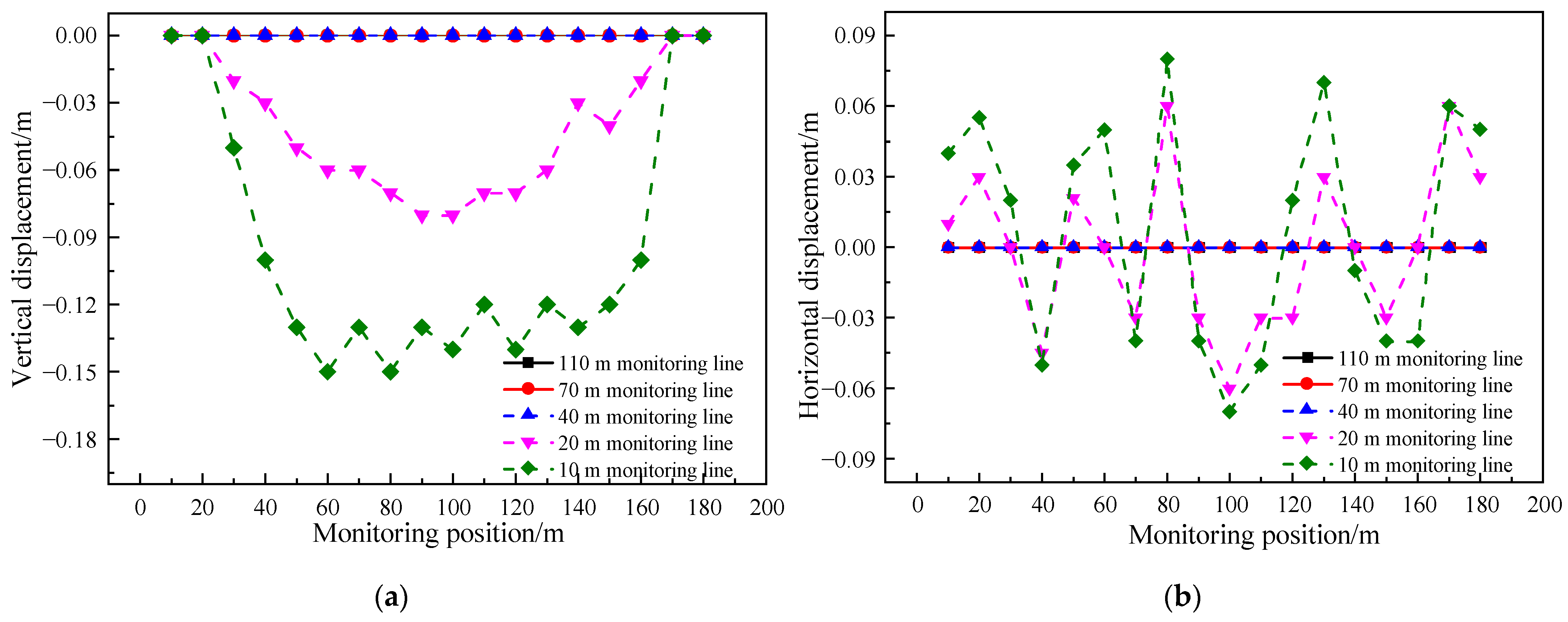
It can be seen from Figure 7 that after the completion of cut-and-fill mining, due to the filling effect, no deformation occurs in the 110 m, 70 m, and 40 m monitoring lines close to the surface. The strata close to the goaf in the vertical direction show slight deformation. For the monitoring line 10 m away from the coal seam, the maximum vertical displacement is 0.15 m; for the monitoring line 20 m away from the coal seam, the maximum vertical displacement is 0.08 m. The vertical displacement curve roughly presents a symmetrical dish shape. Due to the effect of the filling strip, the 10 cm monitoring line shows fluctuation, while the 20 cm monitoring line has almost no fluctuation.
Owing to the friction and obstruction effect of the filling strip on the horizontal movement of the overlying strata, the horizontal displacement is small, showing a distribution where positive and negative horizontal displacements alternate. In addition, due to the edge effect, the horizontal displacement of the observation points close to the coal pillar is relatively large. The absolute value of the maximum horizontal displacement of the 10 cm monitoring line is 0.08 m, and that of the 20 cm monitoring line is 0.06 m. The horizontal displacement curves of the two monitoring lines show obvious consistency.

4. Numerical Simulation

4.1. Simulation Scheme

In order to analyze the influence of different mining parameters, including filling thickness, filling width, and roof cutting width, on the effect of cut-and-fill mining, numerical simulation of multiple sets of variable parameters was carried out. FLAC3D (5.0) has the advantages of simple operation and high efficiency in simulating the effect of cut-and-fill mining, so FLAC3D (5.0) is selected to simulate the trend of displacement and stress when the relevant size changes.
There are cutting areas and filling areas in cut-and-fill mining. The width and height of cutting areas, the width and height of filling areas affect the performance of cut-and-fill mining. Considering the field operation, two gradients are set for the width of cut-and-fill mining, 5 m and 10 m, and the thickness of the coal seam is 1 m, 2 m, 3 m, and 4 m, respectively. Following the principle of equal volume of cutting and filling and filling the roof, and without considering the filling gangue for coal gangue separation, the corresponding roof thickness can be calculated, and the relevant size design is shown in Table 2.
For analyzing the influence of different parameter combinations on simulation results, a multi-factor orthogonal test design was employed to systematically evaluate the interactive effects of filling thickness, width, and roof cutting width on displacement and stress distribution.
The symbolic notation ‘X-X-X’ succinctly encodes three critical parameter sets. Each ‘X’ corresponds to specific numerical values for three key parameters, namely cutting top width (in meters), filling width (in meters), and thickness of the coal seam (in meters). The character ‘X’ signifies an unknown value for each parameter. The value ranges for each parameter are defined as follows: the first ‘X’ (cutting top width) can only take a value of either 5 or 10; the second ‘X’ (filling width) can also only take a value of either 5 or 10; and the third ‘X’ (thickness of the coal seam) has a value range of 1 to 4. This parameter-encoding method can generate 16 unique parameter combination schemes and provides a framework for representing all possible configurations of these key parameters.

4.2. Model Construction

During the actual process of establishing the model, to enhance computational feasibility and accuracy, the simulated rock strata undergo simplification by reducing minor geological variations and are reasonably assigned based on empirical data and standardized criteria, as detailed in Table 3.
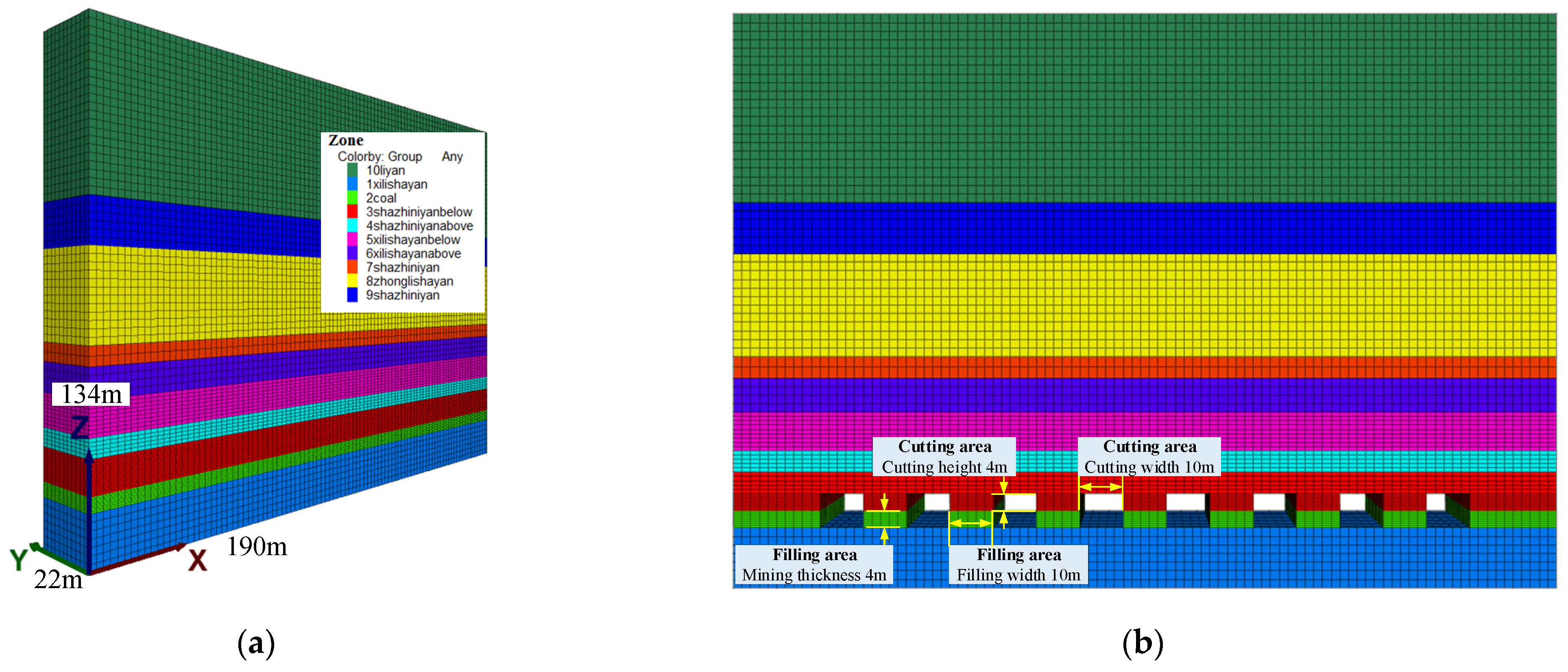
As illustrated in Figure 8a, the three-dimensional computational model constructed for the present simulation is characterized by dimensions of 190 m in length, 22 m in width, and 134 m in height, which is in line with the scale range adopted in analogous simulations for such geotechnical investigations. The lateral boundaries of the model are restricted from horizontal displacement, which simulates the conditions of fixed sidewalls. The basal boundary is fully restrained against vertical displacement, representing a fixed foundation. Conversely, the upper boundary remains entirely unconstrained, representing the ground surface. Findings derived from analogous simulation tests of cut-and-fill mining indicate that upon completion of mining operations, significant rock stratum displacement is confined within a vertical zone extending 40 m above the mined coal seam. Consequently, to accurately capture this critical behavior within the numerical simulation, a vertical displacement monitoring line spanning this 40 m zone directly above the coal seam is established. Additionally, a vertical stress monitoring line is positioned within the floor strata at a depth of Z = 11 m below the coal seam datum. This configuration yields a total of three distinct measurement lines. To ensure consistency and facilitate analysis of a representative cross-section, all measurement lines are positioned along the Y = 11 m plane. Measurement points along these lines are spaced at regular 10 m intervals to ensure adequate spatial resolution of the monitored parameters.
Taking a mining thickness of 4 m as a specific case study, the panel configuration along the working face tendency is detailed in Figure 8b. Along this orientation, eight distinct cutting areas and seven intervening filling areas are configured. Each designated roof cutting section features a standardized width of 10 m and a cutting height equivalent to the mining thickness of 4 m. Similarly, each filling area is designed with a width of 10 m and a filling height precisely set to 4 m to ensure complete volume backfilling. The specific dimensions governing the final (remaining) cutting area and the precise sizing for all filling areas are rigorously defined according to the specifications provided in Table 3.

4.3. Results and Analysis

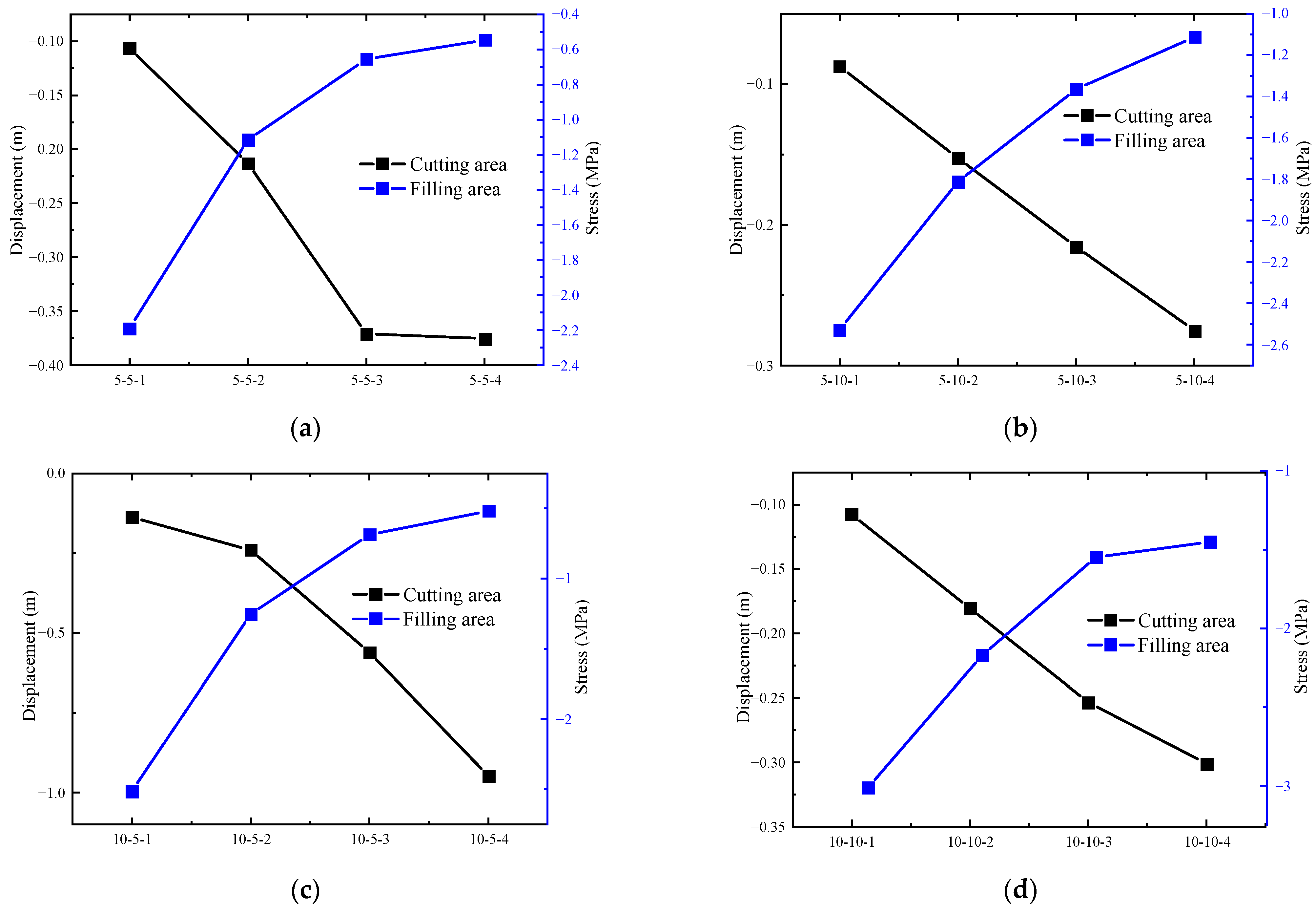
After completing the corresponding numerical simulation according to the parameters listed in Table 3, the vertical displacement extreme value of the 40 m monitoring line above the coal seam and the stress extreme value of the filling area after the stable mining of different simulation groups are counted, as shown in Table 4. The corresponding displacement and stress monitoring results are obtained according to different simulation groups. The mining thickness effect of cut-and-fill mining effect and the width effect of cutting area and filling area are analyzed using the control variable method.
Increasing mining thickness significantly increases both the vertical displacement of the cutting area and the filling area stress. Conversely, increasing the width of the cutting and filling areas results in an increase in the displacement of the cutting area but a reduction in the filling area stress, indicating a trade-off between surface subsidence control and the load-bearing performance of the filling body under different mining parameters.

4.3.1. Thickness Effect on Cut-and-Fill Mining Performance

As shown in Figure 9a–d, under the condition that the remaining dimensions are equal, the extreme value of the displacement of the entire cutting area in different groups increases with the increase in mining thickness, and the filling area stress decreases with the increase in mining thickness. The greater the mining thickness in cut-and-fill mining. the more pronounced the surface subsidence, the smaller the stress recovery in the filling area, and the weaker the filling effect. In theory, the smaller the thickness of coal seam, the better the effect of cut-and-fill mining.

4.3.2. Width Effect of Cut-and-Fill Mining Effect

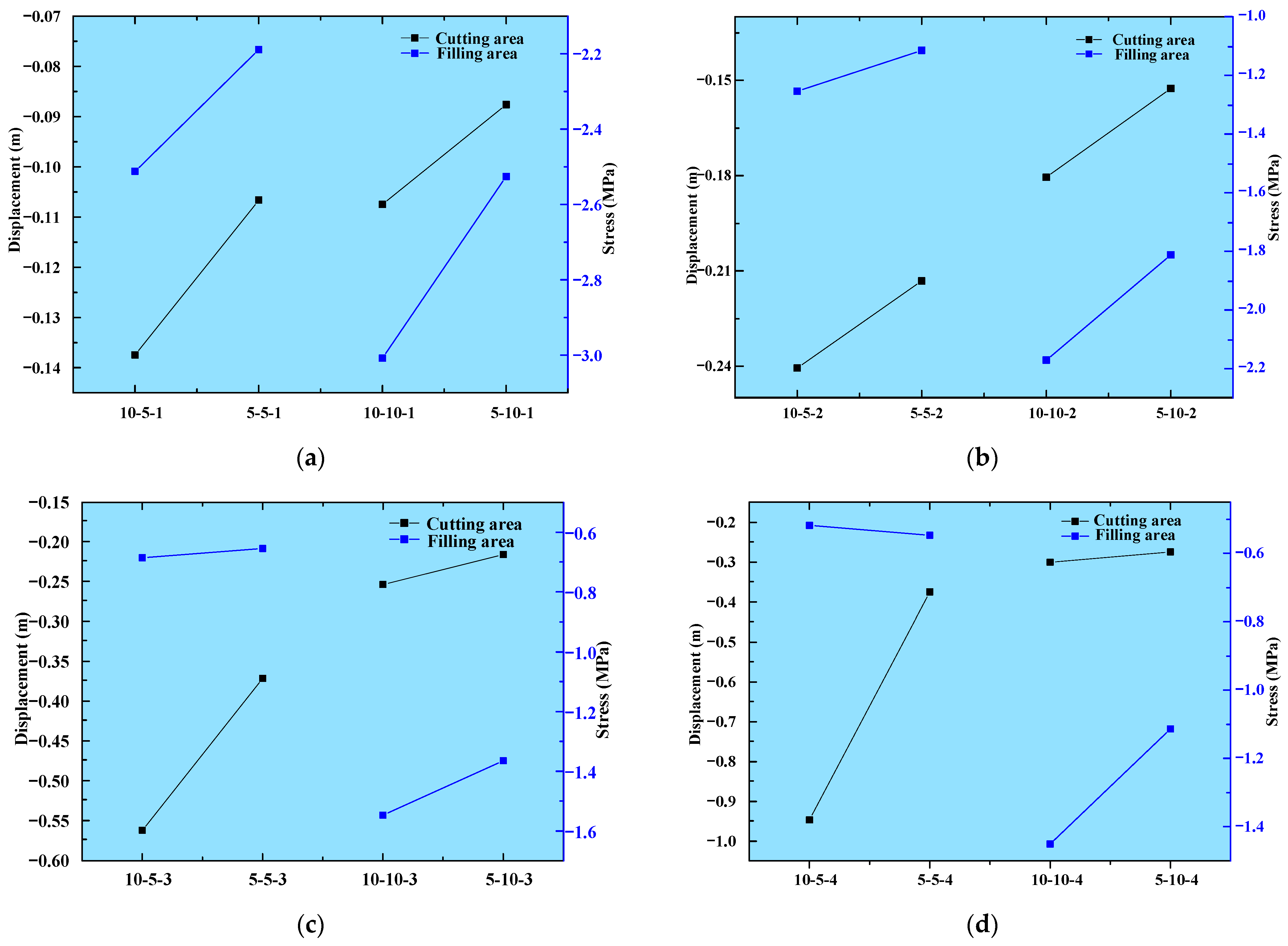
As shown in Figure 10a–d, under the condition of equal mining thickness, when the filling width is 10 m, both the 5-10-X group and the 10-10-X group exhibit small roof displacement and high filling area stress. Compared with the 5-10-X and 10-10-X groups, the roof displacement of the 5-10-X group is relatively small, but the filling area stress is relatively small. The roof displacement of the 10-10-X group is relatively large, but the filling area stress is closer to the original rock stress. Under the condition of equal mining thickness, when the filling width is 5 m, the roof displacement of the 5-5-X group is small, but the filling area stress is also small. In 10-5-X group, the roof displacement is the largest, and the stress recovery of floor filling area is small, which is the most unfavorable situation. This situation should be avoided in practical production.
In summary, in order to control surface subsidence, enhance the filling effect, and take into account the difficulty of the roof cutting operation, the author recommends the 10-10-X group. If the surface subsidence control requirements are relatively high, the 5-10-X group can be considered as increasing the cutting height and reducing the cutting width. Alternatively, implement underground coal gangue separation, increase the source of filling gangue, and increase the plane filling rate without increasing the volume of roof cutting.

4.3.3. Grey Correlation Degree of Different Mining Sizes

From the analysis of the above simulation results, it can be seen that the effect of cut-and-fill mining is related to many factors, such as the width of cutting area, the width of the filling area, the thickness of coal seam, and so on. The correlation between these influencing factors and the effects of cut-and-fill mining is uncertain. In this section, through the grey correlation method, the width of the cutting area, the width of the filling area and the thickness of the coal seam are determined as three influencing factors (the thickness of the roof cutting can be calculated according to the other three parameters). The roof displacement and the filling area stress in the cut-and-fill mining are analyzed.
The sign of the correlation degree indicates the correlation between the reference sequence (roof displacement and filling area stress) and the comparison sequence (width of cutting area, width of filling area, and coal seam thickness). A positive correlation degree denotes a positive correlation: an increase or decrease in the comparison sequence directly causes a corresponding increase or decrease in the reference sequence. A negative correlation degree represents a negative correlation: an increase or decrease in the comparison sequence results in an opposite change in the reference sequence.
In this paper, according to the improved correlation analysis method [35], the correlation degree between the width of the cutting area, the width of the filling area, the thickness of the coal seam, and the displacement of the goaf and the filling area stress is obtained by MATLAB (R2022b). The calculation results are shown in Table 5.
From the correlation analysis results between different influencing factors and roof displacement, it can be seen that all three factors have a positive correlation with roof displacement. Among them, the correlation degrees of cutting area width (0.50) and filling area width (0.49) are relatively small and close to each other, while the correlation degree of coal seam thickness (0.79) is significantly higher. The order of correlation degree with roof displacement is coal seam thickness > cutting area width > filling area width.
For the correlation with filling area stress, the correlation degrees of cutting area width and filling area width are both 0.65, while the correlation degree of coal seam thickness reaches 0.93, showing the strongest positive correlation. Sensitivity analysis confirms that these correlation values are robust, with a variation of less than 5% when input parameters are perturbed within a reasonable range, which validates the reliability of the quantitative interpretation.
Based on the above analysis, the correlation between coal seam thickness and both roof displacement and filling area stress is the largest, indicating that coal seam thickness has the most significant influence on the mining effect of cut-and-fill mining.

5. Discussion

5.1. Advantages and Technical Positioning

The proposed cut-and-fill mining method represents a significant advancement by synergistically integrating roof cutting and in situ backfilling. This integrated approach provides distinct advantages over conventional subsidence control techniques. Unlike pillar-based methods (e.g., room-and-pillar mining), this technique replaces permanent coal pillars with an engineered “gangue pillar + immediate roof” support structure [36,37,38]. This shift significantly enhances resource recovery while providing effective overburden control. Compared to external filling methods (e.g., paste backfilling), its primary innovation lies in achieving material self-sufficiency by utilizing fractured immediate roof strata as the filling material, thereby eliminating dependence on complex surface infrastructure and external material supply chains.
Numerical simulations and physical model tests consistently confirm that the systematic optimization of the core geometric parameter set—mining height, roof-cutting width, and filling width—serves as the principal control mechanism. This optimization directly governs the deformation characteristics of the key stratum and, consequently, enables precise, predictable control over the resultant surface subsidence. It represents a shift from passive mitigation to active, design-based control. However, translating this theoretical precision into reliable field implementation presents significant engineering challenges. It fundamentally depends on two critical prerequisites: the deployment of highly precise and controllable roof-cutting technology to create the designed geometry, and the provision of robust initial support (e.g., rapid temporary reinforcement systems) to ensure the stability of the unconsolidated filling body before it gains inherent strength through compaction [39,40].

5.2. Applicability and Prospects

The successful implementation of the cut-and-fill mining method requires specific geological and technical conditions. Geologically, optimal application occurs in gently dipping seams (<15°) with a low-to-medium strength immediate roof (e.g., sandy mudstone or siltstone) capable of forming competent granular fill upon fracturing. While our model uses a ~100 m burial depth, deeper high-stress environments necessitate further study of the fill’s long-term rheological behavior under three-dimensional confinement. Technically, deployment requires high-precision roof-cutting equipment, efficient filling/compaction machinery, and capacity for rapid temporary support at the working face to ensure fill stability prior to compaction.
Future development prospects are significant. The method can integrate with intelligent mining systems through real-time microseismic and stress monitoring, enabling adaptive parameter control. Synergy with underground waste processing (e.g., the “mining-cutting-separation-filling” mode) could enhance filling rates and subsidence control while advancing toward near-zero waste emissions. Furthermore, the core principle of constructing artificial support using in situ materials shows transfer potential to non-coal sectors such as potash or gypsum mining, offering a versatile technical pathway for sustainable goaf management across the extractive industries.
This study systematically reveals the overburden control mechanism of cut-and-fill mining and optimizes key engineering parameters through theoretical analysis, similar material experiments, and numerical simulations. However, this study has limitations that should be addressed in future research. First, the numerical and physical models do not consider the influence of mining advance rate on the dynamic evolution of overburden stress and subsidence. The mining rate affects the loading rate on the gangue pillar and filling body, influencing the support system’s deformation and failure characteristics, which will be explored in follow-up dynamic simulation research. Second, this study does not include the hydrogeological conditions of the mining area, such as aquifer distribution, groundwater seepage, and the water-induced weakening effect on the mechanical strength of the gangue filling body and surrounding rock. Water–rock interaction alters the filling body’s stability and overburden fracture development, a non-negligible factor for engineering applications in water-rich mining areas. These key parameters will be systematically investigated in follow-up work to improve the engineering applicability of the research results.

6. Conclusions

(1)
The similar simulation results show that cut-and-fill mining technology effectively controls the deformation and fracture of overlying strata, with limited vertical and horizontal displacements, and no obvious periodic fractures in the basic roof, demonstrating good strata control and engineering effects.
(2)
By means of numerical simulation of variable parameters, the mining thickness effect on the cut-and-fill mining effect was obtained: the greater the mining thickness, the larger the roof displacement, and the smaller the stress in the filling area. With regard to the width effect of the cutting area and filling area, when the mining thickness is equal to the filling width, the smaller the roof cutting width, the smaller the roof displacement and the lower the stress in the filling area. The correlation degree of each influencing factor with roof displacement and filling area stress is as follows: coal seam thickness > cutting area width = filling area width.
(3)
To control surface subsidence, improve the filling effect, and take into account the difficulty of roof cutting operation, the author proposes the 10-10-X group as the recommended scheme. If the surface subsidence control requirements are relatively high, the 5-10-X group can be considered to increase the cutting height and reduce the cutting width. In the 10-5-X group, the roof displacement is the largest, and the filling area stress is small. This is the most unfavorable situation, which should be avoided in practical production.

Author Contributions

All the authors contributed to publishing this paper. X.L. conceived the main idea of the paper; Z.W. designed the research framework; B.M. contributed to theoretical analysis; W.S. conducted formal analysis and provided resources; Y.Y. curated the data; C.W. supervised the work and finalized the manuscript. All authors have read and agreed to the published version of the manuscript.

Funding

This study was supported by the National Natural Science Foundation of China (Nos. 52104136, 52304198, 52304074).

Data Availability Statement

The data that support the findings of this study are available from the corresponding author upon reasonable request.

Conflicts of Interest

Authors Xiaolei Lv, Baowei Meng and Yaohua Yv were employed by the company State Grid Energy Hami Coal Power Co., Ltd. The remaining authors declare that the research was conducted in the absence of any commercial or financial relationships that could be construed as a potential conflict of interest.

References

  1. Dong, F.; Yin, H.; Ren, H.; Cheng, W.; Tai, S.; Miao, T.; Zhang, Y.; Wu, B. Trapezoidal Failure Behavior and Fracture Evolution Mechanism of Overburden in Extra-thick Coal Mining in Weakly Cemented Strata. Rock Mech. Rock Eng. 2024, 57, 11239–11260. [Google Scholar] [CrossRef]
  2. Xu, J.; Zhu, W.; Xu, J.; Wu, J.; Li, Y. High-intensity longwall mining-induced ground subsidence in Shendong coalfield, China. Int. J. Rock Mech. Min. Sci. 2021, 141, 104730. [Google Scholar] [CrossRef]
  3. Feng, G.; Du, X.; Guo, Y.; Qi, T.; Wang, Z.; Li, Q.; Li, H.; Kang, L. Basic theory of constructional backfill mining and the underground space utilization concept. J. China Coal Soc. 2019, 44, 74–84. [Google Scholar]
  4. Shen, B.; Barton, N. Rock fracturing mechanisms around underground openings. Geomech. Eng. 2018, 16, 35–47. [Google Scholar]
  5. Shen, B.; Poulsen, B.; Luo, X.; Qin, J.; Thiruvenkatachari, R.; Duan, Y. Remediation and monitoring of abandoned mines. Int. J. Min. Sci. Technol. 2017, 27, 803–811. [Google Scholar] [CrossRef]
  6. Lin, H.; Yang, Y.; Chen, C.; Ding, C. Influence of Mining Sequence of Branch on Stope Pressure Behaviour on Continuous Mining and Continuous Backfilling. Processes 2024, 12, 442. [Google Scholar] [CrossRef]
  7. Zhang, T.; Wang, H.; Zheng, X.; Gao, S. Axial Compressive Behaviours of Coal Gangue Concrete-Filled Circular Steel Tubular Stub Columns after Chloride Salt Corrosion. Materials 2024, 17, 2782. [Google Scholar] [CrossRef]
  8. Huang, W.; Song, T.; Li, H.; Liu, Y.; Hou, T.; Gao, M.; Zheng, Y. Design of Key Parameters for Strip-Filling Structures Using Cemented Gangue in Goaf-A Case Study. Sustainability 2023, 15, 4698. [Google Scholar] [CrossRef]
  9. He, H.; Sun, C.; Tang, Y.; Zhang, Z.; Ye, B.; Li, J. Methane and radon anomaly characteristics derived based on the microleakage mechanism and their implications for the exploration of hidden disaster-causing factors in coal mines. Geophys. Geochem. Explor. 2024, 48, 1409–1423. [Google Scholar]
  10. Guo, L.; Tao, Z.; He, M.; Coli, M. Impact of Micro-NPR bolt on the mining of deep-buried phosphate via the room-and-pillar method. Tunn. Undergr. Space Technol. 2023, 140, 105326. [Google Scholar] [CrossRef]
  11. Andre, Z.; Anderson, W. Subsidence over room and pillar retreat mining in a low coal seam. Int. J. Min. Sci. Technol. 2019, 29, 51–57. [Google Scholar] [CrossRef]
  12. Zhang, J.W.; Wang, H.L.; Chen, S.J. Bearing Capacity of Backfill Body and Roof Stability During Strip Coal Pillar Extracted with Paste Backfill. Geotech. Geol. Eng. 2018, 36, 235–245. [Google Scholar] [CrossRef]
  13. Wang, Z.; Jiang, H.; Zhang, J.; Xi, Z.; Fu, Y.; Lin, J. Enhancing the mechanical performance of slag-based cemented paste backfill with alunite: Effects of calcination temperature and dosage. Powder Technol. 2025, 469, 14. [Google Scholar] [CrossRef]
  14. Wang, C.; Dong, P.; Wang, Z.; Kong, P.; Yang, Y.; Zhou, Y.; Jiang, N. Case study on coal-based solid waste utilization in backfill paste: Hydration mechanism and performance analysis. Case Stud. Constr. Mater. 2025, 22, e04427. [Google Scholar] [CrossRef]
  15. Xuan, D.; Xu, J. Longwall surface subsidence control by technology of isolated overburden grout injection. Int. J. Min. Sci. Technol. 2017, 27, 813–818. [Google Scholar] [CrossRef]
  16. Xuan, D.; Xu, J.; Wang, B.; Teng, H. Borehole Investigation of the Effectiveness of Grout Injection Technology on Coal Mine Subsidence Control. Rock Mech. Rock Eng. 2015, 48, 2435–2445. [Google Scholar] [CrossRef]
  17. Shen, B.; Poulsen, B. Investigation of overburden behaviour for grout injection to control mine subsidence. Int. J. Min. Sci. Technol. 2014, 24, 317–323. [Google Scholar] [CrossRef]
  18. Wang, C.; Shen, B.T.; Chen, J.T.; Tong, W.X.; Jiang, Z.; Liu, Y.; Li, Y.Y. Compression characteristics of filling gangue and simulation of mining with gangue backfilling: An experimental investigation. Geomech. Eng. 2020, 20, 485–495. [Google Scholar]
  19. Wang, C.; Cao, W.; Kong, P.; Li, Q.; Mu, W.; Yang, Y.; Jiang, N. Compaction behavior and residual height ratio of crushed coal gangue under varying support conditions: Experimental analysis and model comparison. Powder Technol. 2025, 458, 15. [Google Scholar] [CrossRef]
  20. Zhang, Q.; Wang, Z.; Zhang, J.; Jiang, H.; Wang, Y.; Yang, K.; Tian, X.; Yuan, L. Integrated green mining technology of coal mining-gangue washing-backfilling-strata control-system monitoring-taking Tangshan Mine as a case study. Environ. Sci. Pollut. Res. 2022, 29, 5798–5811. [Google Scholar] [CrossRef]
  21. Zhang, Q.; Yang, K.; Zhang, J.; Wang, Q.; Yuan, L.; Shi, Z.; Xu, X. A Theoretical Model of Roof Self-Stability in Solid Backfilling Mining and Its Engineering Verification. Appl. Sci. 2022, 12, 12114. [Google Scholar] [CrossRef]
  22. Hu, J.; Meng, Z.; Gao, T.; Dong, S.; Ni, P.; Li, Z.; Yang, W.; Wang, K. Optimization of Proportions of Alkali-Activated Slag–Fly Ash-Based Cemented Tailings Backfill and Its Strength Characteristics and Microstructure under Combined Action of Dry–Wet and Freeze–Thaw Cycles. Materials 2024, 17, 4945. [Google Scholar] [CrossRef] [PubMed]
  23. Lu, H.; Qi, S. Preparation and Strength Formation Mechanism of Calcined Oyster Shell, Red Mud, Slag, and Iron Tailing Composite Cemented Paste Backfill. Materials 2022, 15, 2199. [Google Scholar] [CrossRef]
  24. Zhao, Y.; Yang, Y.; Wang, Z.; Gu, Q.; Wei, S.; Li, X.; Wang, C. Innovative Cut-and-fill Mining Method for Controlled Surface Subsidence and Resourceful Utilization of Coal Gangue. Minerals 2025, 15, 146. [Google Scholar] [CrossRef]
  25. Zhou, Y.; Wang, C.; Liao, C.; Wang, J.; Zhang, B. Study on the Mining Effect and Optimal Design of Longwall Full Mining with Paste Partial Filling. Minerals 2024, 14, 264. [Google Scholar] [CrossRef]
  26. Wang, G.J.; Zheng, M.Z.; Ou, J.C. Study on filling mining technology analysis and optimization measures in Jiangjiadun Mine. Min. Technol. 2024, 24, 58–62. [Google Scholar]
  27. Wang, F.; Zhang, C.; Zhang, X.; Song, Q. Overlying strata movement rules and safety mining technology for the shallow depth seam proximity beneath a room mining goaf. Int. J. Min. Sci. Technol. 2015, 25, 139–143. [Google Scholar] [CrossRef]
  28. Chen, S.; Guo, W.-J.; Zhou, H.; Shen, B.; Liu, J.-B. Field investigation of long-term bearing capacity of strip coal pillars. Int. J. Rock Mech. Min. Sci. 2014, 70, 109–114. [Google Scholar] [CrossRef]
  29. Zhang, N.; Cao, A.; Zhao, W.; Hao, Q.; Lv, G.; Wu, B. Layout Pattern of Small Panel and Large Coal Pillar for Rockburst Prevention and Water Control under Extra-Thick Water-Bearing Key Strata. Appl. Sci. 2024, 14, 2195. [Google Scholar] [CrossRef]
  30. Li, L.; Gang, H.; Kan, W.; Ru, L. New Viewpoint of Foundation Stability of Newly Building upon Goaf. Energy Procedia 2012, 17, 1717–1723. [Google Scholar] [CrossRef]
  31. Miao, X.; Cui, X.; Wang, J.A.; Xu, J. The height of fractured water-conducting zone in undermined rock strata. Eng. Geol. 2011, 120, 32–39. [Google Scholar] [CrossRef]
  32. Wang, C.; Zhang, B.; Lu, Y.; Liao, C.; Lu, W. Failure law of floor during strip mining backfill with paste-tailings over confined aquifer: A case study in China mine. Case Stud. Constr. Mater. 2023, 20, e02806. [Google Scholar] [CrossRef]
  33. Wu, P.; Zhao, J.; Jin, J. Similar simulation of overburden movement characteristics under paste filling mining conditions. Sci. Rep. 2023, 13, 12550. [Google Scholar] [CrossRef]
  34. Wu, Q.; Wu, Q.; Xue, Y.; Kong, P.; Gong, B. Analysis of Overlying Strata Movement and Disaster-Causing Effects of Coal Mining Face under the Action of Hard Thick Magmatic Rock. Processes 2018, 6, 150. [Google Scholar] [CrossRef]
  35. Su, X. Research on the Concrete Durability Due to Salinized Soilin the Western Region of Jilin Province. Ph.D. Thesis, Jilin University, Changchun, China, 2013. [Google Scholar]
  36. Xu, J.; Luo, Q.; Tang, Y.; Zeng, Z.; Liao, J. Experimental Study and Application of Controlled Low-Strength Materials in Trench Backfilling in Suqian City, China. Materials 2024, 17, 775. [Google Scholar] [CrossRef]
  37. Guo, M.; Guo, W.; Tan, Y.; Zhang, H.; Zheng, Q.; Zhao, G.; Bai, E. Ground control by L-shaped cemented paste backfilling technology in underground coal seam mining: A case study. Geomech. Geophys. Geo-Energy Geo-Resour. 2024, 10, 31. [Google Scholar] [CrossRef]
  38. Zhao, X.; Yang, K.; Dino, G.A.; He, X.; Wei, Z.; Zhang, J. Feasibility and challenges of multi-source coal-based solid waste (CSW) for underground backfilling—A case study. Process. Saf. Environ. Prot. 2023, 181, 8–25. [Google Scholar] [CrossRef]
  39. Du, X.; Feng, G.; Zhang, M.; Wang, Z.; Liu, W. Influence of backfilling rate on the stability of the backfilling body-immediate roof cooperative bearing structure. Int. J. Min. Sci. Technol. 2022, 32, 1197–1206. [Google Scholar] [CrossRef]
  40. Bruwer, F.J.N.; Stacy, T.R. A proposed method for optimizing coal pillar design using coalfield-specific uniaxial compressive strength. J. South. Afr. Inst. Min. Metall. 2023, 123, 275–286. [Google Scholar] [CrossRef]
Figure 1. Integrated schematic diagram of cut-and-fill mining.
Applsci 16 02391 g001
Figure 2. Horizontal shear failure stress analysis of the gangue pillar in cut-and-fill mining.
Applsci 16 02391 g002
Figure 3. Diagonal shear failure stress analysis of the gangue pillar in cut-and-fill mining.
Applsci 16 02391 g003
Figure 4. Coal mine location and working face layout.
Applsci 16 02391 g004
Figure 5. Similar simulation experiment scheme of cut-and-fill mining.
Applsci 16 02391 g005
Figure 6. Overlying strata failure characteristics of cut-and-fill mining.
Applsci 16 02391 g006
Figure 7. Displacement after completion of cut-and-fill mining. (a) Vertical displacement and (b) horizontal displacement.
Applsci 16 02391 g007
Figure 8. The numerical simulation model. (a) Schematic diagram of 3D model; (b) Working face tends towards details.
Applsci 16 02391 g008
Figure 9. Effect of mining thickness of cut-and-fill mining. (a) Thickness effect of the 5-5-X group; (b) thickness effect of the 5-10-X group; (c) thickness effect of the 10-5-X group, and (d) thickness effect of the 10-10-X group.
Applsci 16 02391 g009
Figure 10. Effect of mining width of cut-and-fill mining. (a) Effect of width on the X-X-1 group, (b) Width effect of X-X-2 group, (c) Width effect of X-X-3 group, (d) Width effect of X-X-4 group.
Applsci 16 02391 g010
Table 1. Formation parameters of the study area.
NumberingLithologyThickness
/m
Body
Force
/kN·m3
Elastic
Modulus
/GPa
Compressive Strength
/MPa
Tensile Strength
/MPa
Angle of Internal Friction/°Force of Cohesion/MPa
R8Conglomerate44221.3011.901.13311.11
R7Sandy mudstone12221.6716.231.31281.24
R6Medium-grained sandstone24242.8321.231.90331.93
R5Sandy mudstone5201.6716.231.33281.21
R4Sandstone8263.3528.432.10332.14
R3Sandstone9263.3528.432.14332.12
R2Sandy mudstone5221.6716.231.61281.23
R1Sandy mudstone9221.6716.231.63281.24
C2-2 Upper coal4141.4410.211.21301.02
Fsandstone14263.3528.432.14332.12
Table 2. Design of numerical simulation parameters for cut-and-fill mining.
Width of Cutting Area/mFill Area Width/mThickness of Coal Seam/mThickness of Cutting Area/mTop Notch Width/mFill Area Width/mThickness of Coal Seam/mThickness of Cutting Area/m
5511101011
2222
3333
4444
5101210510.5
2421
3631.5
4842
Table 3. Mechanical parameters of rock formation.
LithologyBulk Modulus
/GPa
Shear
Modulus
/GPa
Density
/kg·m3
Angle of Internal Friction/°Force of Cohesion
/MPa
Tensile
Strength
/MPa
Conglomerate0.800.642400311.101.10
Sandstone2.272.052760332.102.10
Medium grained sandstone2.101.962680321.901.90
Sandy mudstone2.061.862000281.201.54
2-2 coal seam0.600.541400300.500.50
Crushing gangue0.020.011280300.100.05
Table 4. Statistics of displacement and stress in cut-and-fill mining numerical simulations.
Simulation GroupingCutting Area Displacement/mFilling Area Stress/MPaSimulation GroupingCutting Area Displacement/mFilling Area Stress/MPa
5-5-1−0.11−2.195-10-1−0.09−2.53
5-5-2−0.21−1.125-10-2−0.15−1.81
5-5-3−0.37−0.665-10-3−0.22−1.37
5-5-4−0.38−0.555-10-4−0.28−1.11
10-5-1−0.14−2.5110-10-1−0.11−3.01
10-5-2−0.24−1.2510-10-2−0.18−2.17
10-5-3−0.56−0.6910-10-3−0.25−1.55
10-5-4−0.95−0.5210-10-4−0.30−1.45
Table 5. Grey correlation analysis results.
Influencing FactorWidth of Cutting AreaWidth of Filling AreaCoal Seam Thickness
Displacement correlation degree0.500.490.79
Stress correlation degree0.650.650.93
Disclaimer/Publisher’s Note: The statements, opinions and data contained in all publications are solely those of the individual author(s) and contributor(s) and not of MDPI and/or the editor(s). MDPI and/or the editor(s) disclaim responsibility for any injury to people or property resulting from any ideas, methods, instructions or products referred to in the content.