1. Introduction
Horizontal well staged fracturing is a crucial technological approach for the development of deep unconventional oil and gas resources [
1,
2]. Within the existing technological framework, the straddle packer hydraulic fracturing technology has been extensively applied in on-site operations due to its adaptability to complex well conditions and the ability to transform specific target intervals [
3,
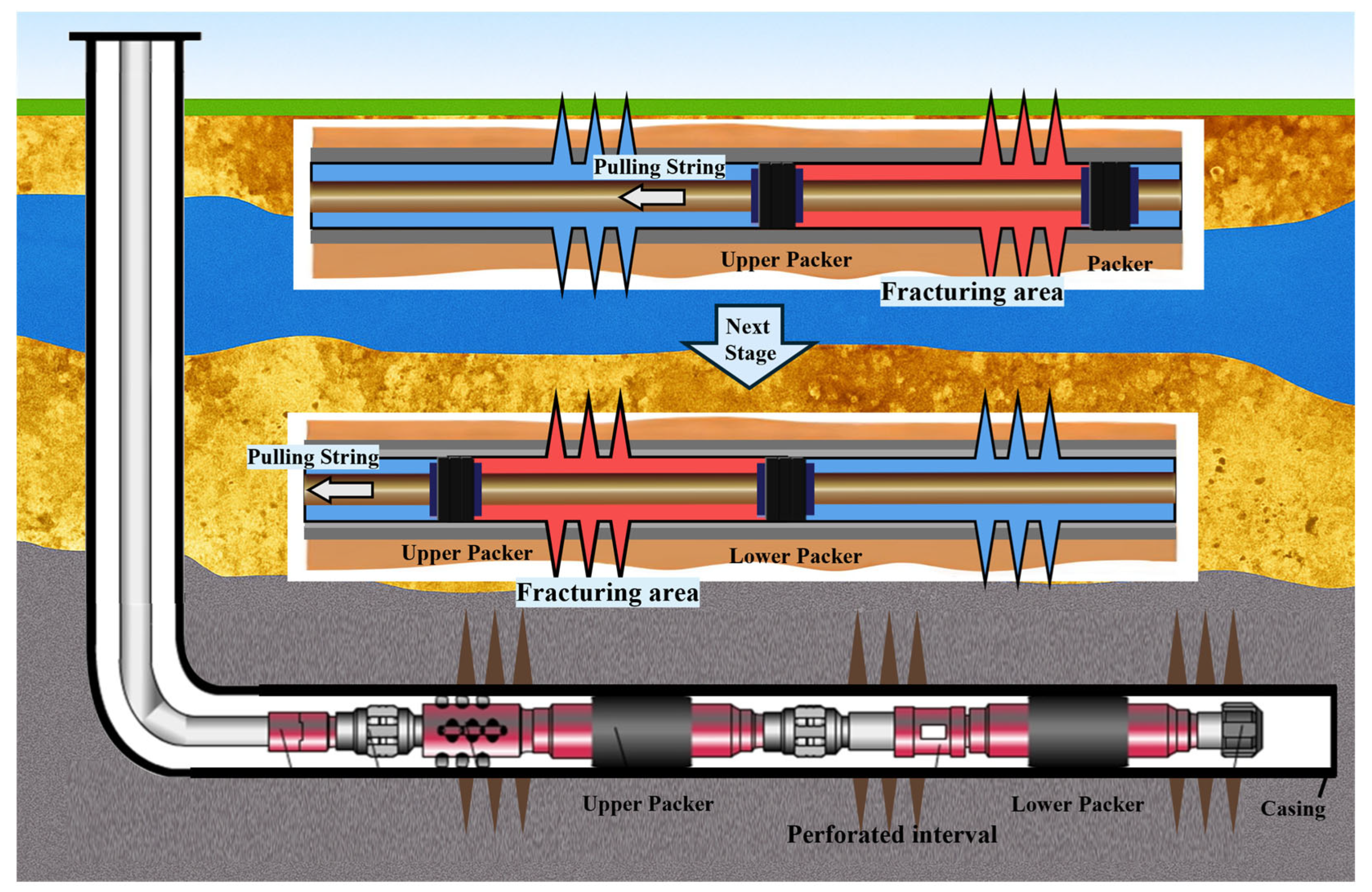
4]. As shown in
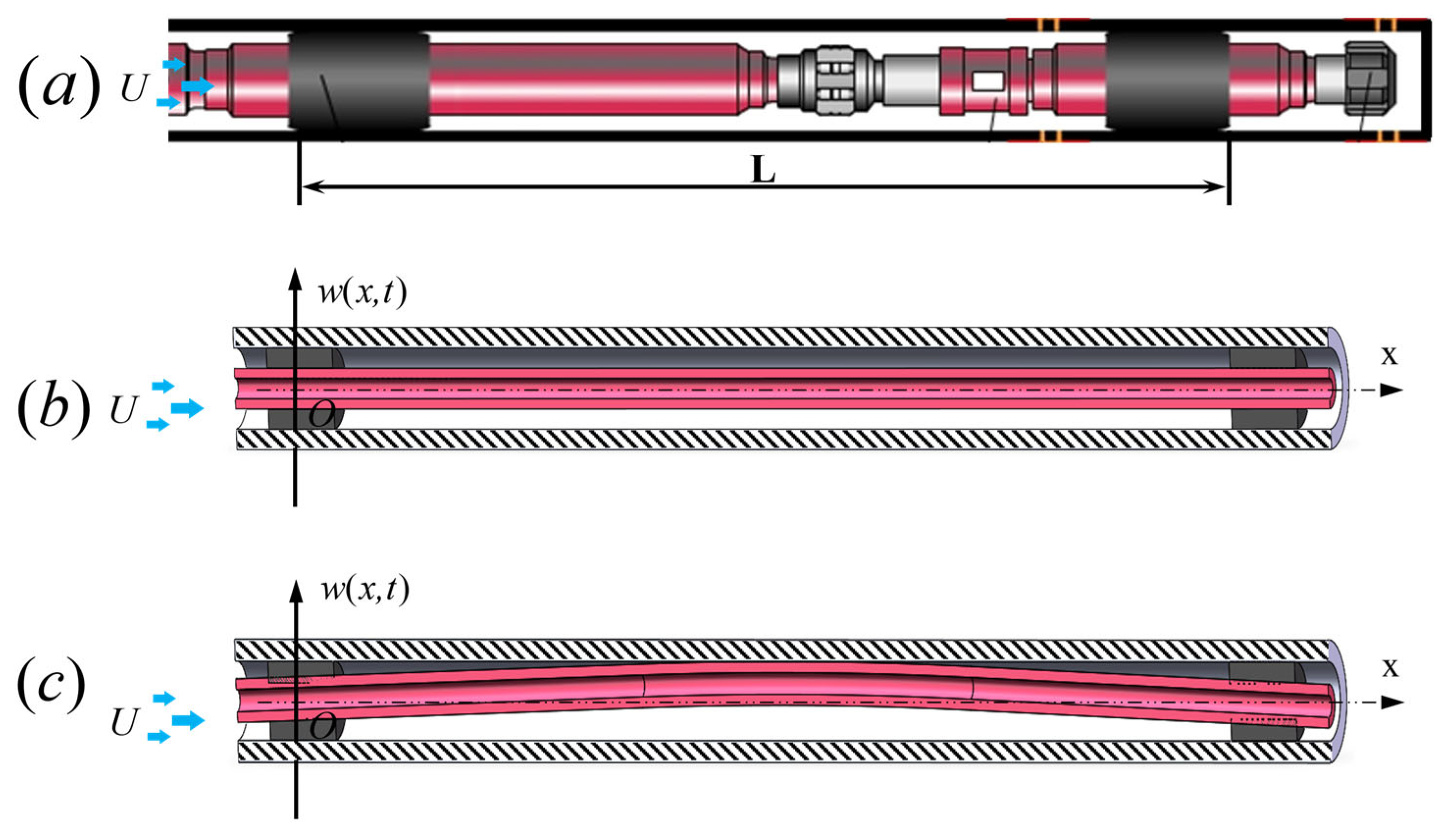
Figure 1, the system anchors the fracturing string to the inner wall of the casing through the upper packer and the lower packer, forming an elongated string structure [
5]. However, under the high-volume liquid injection conditions in deep wells, the structural safety of this tool string system faces severe challenges. On-site failure analysis confirms that, restricted by the narrow annular geometric boundary of the wellbore, the lateral flow-induced instability of the fracturing tool string will inevitably evolve into severe contact collisions with the inner wall of the casing [
6]. This non-linear impact dynamic behavior has been identified as the primary cause of fatigue fracture in the main body of the fracturing string and the loss of sealing integrity of the packer due to severe vibration [
7].
The packer spacing, a crucial parameter influencing the slenderness ratio of the fracturing string system, directly governs the stiffness matrix and eigenvalue distribution of the fluid–structure interaction system [
8]. From the perspective of continuum dynamics, increasing the fracturing interval length under high-rate injection significantly weakens the effective stiffness of the string due to internal flow effects. Consequently, the critical flow velocity for dynamic instability is reduced. During the underground construction process, changes in the spacing of the packers may trigger coupling between different vibration modes and even lead to frequency locking phenomena. When the packer spacing is inappropriately selected, the linear instability of the tool string in the confined annulus often rapidly evolves into strongly nonlinear string-casing contact and collision behaviors. The continuous high-frequency impacts ultimately lead to aggravated contact wear of the tool string and accelerate the accumulation of fatigue damage [
9].
Due to its extensive engineering applications and complex dynamic behavior, the flow-conveying pipeline system has long been a central topic in fluid–structure interaction research. In the context of hydraulic fracturing, the tool string or tubing behaves as a slender fluid-conveying structure, where internal high-pressure fluid induces significant vibrations and interacts with structural constraints. Understanding this fluid–structure coupling is essential, as it directly affects the stability and operational safety of the fracturing string while influencing fracture propagation and reservoir stimulation efficiency. Early studies primarily focused on fracture initiation and propagation mechanisms, but recent research increasingly emphasizes the coupled dynamics of the fracturing string under high-rate injection conditions. The development of its theory has undergone a deep process from linear stability determination to the evolution of nonlinear complex dynamics. Hydraulic fracturing has been widely applied to enhance reservoir permeability and improve hydrocarbon recovery, particularly in unconventional reservoirs. Early investigations mainly focused on fracture initiation and propagation mechanisms. Economides and Nolte [
10] systematically summarized the theoretical foundation and engineering applications of reservoir stimulation, while Detournay [
11] established a rigorous mechanical framework for hydraulic fracture growth and fluid-driven crack propagation. With the rapid development of high-rate and multi-stage fracturing technologies, attention has gradually shifted toward the mechanical behavior and dynamic safety of fracturing strings. As early as the 1950s, Païdoussis [
12] established the linear motion equation for the pipeline flow. He successfully predicted the flutter instability phenomenon of the cantilever pipeline at the critical flow velocity and established the basic theoretical framework for this field. To account for the experimentally observed phenomenon of “supercritical” vibration amplitude limitation, Holmes et al. [
13] introduced a nonlinear term and applied the center manifold theorem to demonstrate that the system undergoes a bifurcation into stable limit-cycle oscillations following instability.
Semler et al. [
14] conducted a comparative analysis of the governing equations derived from Hamilton’s principle and Newton’s method, and refined the formulation of higher-order nonlinear terms, thereby establishing a more accurate mathematical model for the analysis of large-deformation dynamics. As research advances, scholars have increasingly directed their attention toward the complex effects of boundary constraints on pipeline stability. Paidoussis, Li, and other scholars [
15] conducted a systematic investigation into the dynamics of pipes with loose supports and identified clearance-induced impacts as the primary factor responsible for strong nonlinear behaviors, such as chaotic responses, in the system. Wang et al. [
16] further elaborated on the influence of support stiffness and gap size on bifurcation characteristics based on this foundation, and through numerical simulations, revealed the period doubling bifurcation route by which the system transitions into chaos.
From the perspective of structural dynamics, the fracturing string can be regarded as a slender fluid-conveying structure operating under multiple boundary constraints. The instability and vibration behaviors of the fracturing string, induced by the combined effects of internal flow excitation, axial loading, and lateral contact forces, are highly consistent with those of classical fluid-conveying pipeline systems in terms of mechanical essence [
8]. However, in the relevant research within the field of petroleum engineering, existing literature predominantly emphasizes macroscopic engineering safety assessments. To simplify the analytical process, flow-induced vibrations and the associated nonlinear dynamic effects are frequently neglected [
17]. Early scholars, represented by Lubinski [
18], established the helical buckling theory of pipes, focusing on analyzing the effects of axial loads and fluid pressures on pipe configuration. However, this approach is restricted to the static domain and cannot capture the progressive damage to pipes induced by flow-induced vibrations. On this basis, Mitchell [
19] conducted a systematic investigation into the stress state and buckling safety of the tubing string under packer constraints. The analysis is primarily based on the theories of lateral and longitudinal bending, with a focus on static and quasi-static responses. Since the fluid inertial force under the action of internal flow is not explicitly accounted for, this model struggles to characterize the dynamic instability behavior dominated by the Coriolis force. To overcome the difficulties associated with analytical methods, a substantial number of scholars have turned to numerical simulations. Song et al. [
20] analyzed the lateral vibration stability of the tool string under fluid—conveying production conditions based on the finite element method and the fluid—structure interaction model. They investigated the influence of the internal flow velocity, the annular liquid cushion, and the reservoir pressure on the vibration response. Zhang et al. [
21] established a fluid–structure interaction theoretical model to characterize the water hammer effect and the vibration behavior of the tool string. The influence of transient flow induced by rapid valve closure on the dynamic response of the tool string was verified through a similarity-based experimental study. Yin et al. [
22] established a double-nonlinear flow-induced vibration model that accounts for longitudinal-transverse coupling and the contact interaction between the pipe string and the casing, based on the Hamiltonian principle and incorporating the energy method and finite element discretization. Subsequently, the validity of the model was verified through similarity experiments. Zhang et al. [
23] developed a dynamic model for ultra-deep well tubing strings that incorporates the fluid–structure interaction effect. The influence of transient operating conditions, such as wellbore start-up and shut-down, on the vibration response and instability behavior of the tool strings was systematically investigated. In conclusion, although the fundamental theory of fluid transportation pipelines is relatively well-established, research on the fracturing string system that accounts for the contact interaction between the string and the casing remains insufficient. The investigation into the influence mechanisms governing the nonlinear stability of the fracturing string is still incomplete, leading to a lack of precise theoretical guidance for current engineering designs.
In view of this, the present study employs a semi-analytical method that integrates Galerkin discretization with fourth-order Runge–Kutta numerical integration. In response to the simplified treatment of contact boundaries in existing research, this paper develops a dynamic model that incorporates the fluid centrifugal effect and proposes an improved trilinear contact model. By integrating the analytical expression of the annular dead zone with the cubic contact hardening stiffness, the model effectively resolves the issues of stiffness discontinuity and numerical oscillation at critical contact points in traditional non-smooth models, thereby enabling a continuous representation of the complex interaction between the tool string and the casing. On this basis, this paper innovatively adopts packer spacing as the key bifurcation control parameter and systematically investigates the modulation mechanism of tool string length variation on nonlinear dynamic behavior. By identifying the evolution boundary of chaotic impacts, the safe fracturing spacing is determined to ensure the stable operation of the fracturing string system. This establishes a quantitative theoretical criterion for structural optimization and failure prevention in the straddle packer hydraulic fracturing process.
2. Mathematical Model
2.1. Physical Model
As shown in
Figure 2a, it presents a typical schematic of a downhole straddle-packer hydraulic fracturing tool string system in the staged fracturing process of deep shale gas horizontal wells. This system is primarily composed of an upper packer, a lower packer, tubing, and the external casing. During the fracturing operation, high-pressure fracturing fluid is injected into the formation through the fracturing tool string.
As shown in
Figure 2b, in order to facilitate the dynamic modeling and theoretical analysis, based on the actual structural characteristics and operating conditions of the system, we simplify the straddle-packer hydraulic fracturing tool string system into a distributed collision constraint model with both ends being simply supported. The specific physical description and basic assumptions are as follows:
- (1)
Given that the pressure fracturing tool has a relatively high slenderness ratio and primarily exhibits lateral vibration, the effects of shear deformation and rotational inertia are neglected, and the system is modeled as an Euler–Bernoulli beam.
- (2)
Assume that the fracturing string is a tool string with a uniform cross section, and ignore the possible cross—sectional dimension changes in actual engineering.
- (3)
The tool string material is assumed to be an isotropic linear elastic material, and the Kelvin-Voigt viscoelastic internal damping is taken into account.
- (4)
The internal fluid is assumed to follow a plug flow model, with the proppant-laden slurry treated as a homogeneous continuum. The plug flow assumption captures the dominant excitation under high-Reynolds-number conditions [
24], while the effective density of the mixture accounts for the inertial contribution of the proppants in the mass parameter M.
- (5)
The effect of gravity on the axial dynamic response of the string is neglected [
25]. For horizontal well fracturing operations, the axial component of gravity is relatively small and can be ignored in comparison with the inertia effects induced by fluid pulsations.
- (6)
Assume that the tool string undergoes planar vibration within the horizontal plane, and neglect the influence of the initial sag caused by gravity.
As shown in
Figure 2b,c, respectively, represent several possible contact forms that may occur between the fracturing string and the distributed constraints. Establish a Cartesian coordinate system
O-XY, where the
X-axis is along the axial direction of the tool string. The physical and geometric parameters are defined as follows: The distance between packers is denoted by
L. The flexural stiffness of the fracturing string is represented as
EI, and the material density is ρ. The cross-sectional area is
A, and the mass per unit length of the string is denoted as
mp. Structural damping during vibration is characterized by the Kelvin–Voigt viscoelastic coefficient. The fluid inside the string is an incompressible fracturing fluid with density. The mass per unit length of the internal fluid is denoted as
mf and the fluid flow velocity is denoted as
U.
Based on assumption (4) and considering the periodic displacement fluctuations induced by the field-operated fracturing pump unit, the fluid velocity in the tool string is modeled as the superposition of the mean flow velocity and a simple harmonic pulsation component [
26,
27]. The corresponding mathematical expression is given as follows:
Among them, represents the average dimensionless velocity of the pulsating flow, and represent the amplitude and excitation frequency of the pulsating flow, respectively.
2.2. Equation Establishment
Based on the boundary conditions constrained by two-end packers, the nonlinear governing equations proposed by Holmes [
13] describe the large-deformation dynamics of the fracturing tool string. Based on the aforementioned research, this paper modifies the governing equations and introduces distributed collision constraints to investigate the nonlinear vibration response of the fracturing tool string. Thus, the motion equation of the simply supported ends of the fracturing tool string, considering collision constraints, is obtained as follows:
In the formula,
represents the lateral displacement of the fracturing string at time
t, and
represents the nonlinear collision constraint force distributed along the string axis acting on the string. A modified trilinear constraint model is adopted, which is closer to the experimental results. The calculation form of its collision force is as follows [
28]:
In the formula, represents the interval between the outer wall of the tool string and the edge of the collision constraint, and K denotes the stiffness coefficient for calculating the collision force in the modified trilinear constraint model.
The following dimensionless parameters are introduced:
Substituting Equation (4) into Equation (2) and applying the aforementioned dimensionless parameters, the dimensionless nonlinear governing equations for the fracturing string subject to distributed collision constraints can be expressed as follows:
Among them, the dimensionless collision constraint force
is:
Based on the principle of modal superposition, the Galerkin method is applied to discretize Equation (5). The transverse displacement of the fracturing string is expanded into a series of basis functions that satisfy the boundary conditions, namely:
Among them, N represents the number of truncated modes used for the discrete approximation of the model. Substituting Equations (1), (6), and (7) into Equation (5), multiplying the entire equation by the basic function
, and integrating the equation over the interval [0, 1], we obtain the following system of nonlinear differential equations in matrix form:
In the formula:
,
represent the displacement, velocity, and acceleration of the fracturing string, respectively.
In the equation, M denotes the mass matrix of the system, C represents the damping matrix, K stands for the stiffness matrix, is the nonlinear collision force vector, and signifies the nonlinear vector resulting from axial deformation.
To facilitate numerical computations, a state vector
is introduced to transform Equation (8) into a first-order ordinary differential equation form.
2.3. Numerical Calculation Methods and Parameter Settings
In addressing the practical operational conditions of fracturing operations in which the tool string is anchored to the inner wall of the casing through a packer, this study adopts simplified boundary conditions modeled as simply supported constraints at both ends of the tool string. This simplification is justified on the basis that the packer primarily restricts radial displacement while providing limited resistance to rotational deformation. The corresponding dimensionless boundary conditions are thus formulated as follows:
Considering the aforementioned boundary conditions, sinusoidal functions that satisfy the orthogonality condition are chosen as the basis functions for the Galerkin discretization process.
In the equation, i represents the modal order. This basis function formulation rigorously satisfies both displacement and force boundary conditions of the system, rendering it suitable for the discretized solution of such fluid–structure interaction systems.
In the process of reducing partial differential equations to ordinary differential equations using the Galerkin method, the choice of the modal truncation number
N plays a critical role in determining the accuracy and convergence of the numerical computations. For the strongly nonlinear vibro-impact system with clearance investigated in this study, the vibrational energy is primarily concentrated in the lower-frequency modes. Convergence analysis indicates that setting the truncation order to
N = 4 results in a stabilized primary resonance interval, period-doubling bifurcation points, and topological structure of chaotic attractors. This configuration ensures accurate representation of complex dynamic phenomena, including period-doubling bifurcations and intermittent chaos arising from pulsating flow and clearance constraints. Therefore, comprehensively evaluating computational accuracy and temporal cost, this paper consistently adopts
N = 4 in all subsequent numerical simulations [
29].
To accurately characterize the nonlinear fluid–structure interaction effects of packer spacing and high-velocity fluid excitation on string stability, and to establish a unified dynamic criterion applicable to various well conditions, a dimensionless length ratio
is introduced as the key control parameter based on continuum dynamics theory and dimensional analysis, which is defined as:
The discretized governing equations are numerically integrated using a fourth-order Runge–Kutta method. To balance computational accuracy and efficiency, a fixed dimensionless time step of
is selected. The initial conditions are specified as
and
, and the following parameters for the fracturing string system are adopted in the calculation [
30]:
In the construction of bifurcation diagrams, a parameter continuation strategy is employed, in which the steady-state solution corresponding to the previous control parameter value serves as the initial condition for the current computational step. This approach preserves the continuity of the dynamical solution and improves convergence efficiency. By employing analytical methods such as Poincaré sections, phase plane trajectories, and power spectral density analysis, the nonlinear dynamic evolution characteristics of the fracturing string system are systematically investigated and comprehensively characterized from multiple perspectives.
2.4. Model Validation
To ensure the reliability of the proposed numerical framework, a comparative study was conducted between the current model and the established results reported in Reference [
30]. The validation was performed using identical physical parameters:
N = 2,
α = 0.005,
β = 0.64,
κ = 5000,
u0 = 4.5,
σ = 0.4.
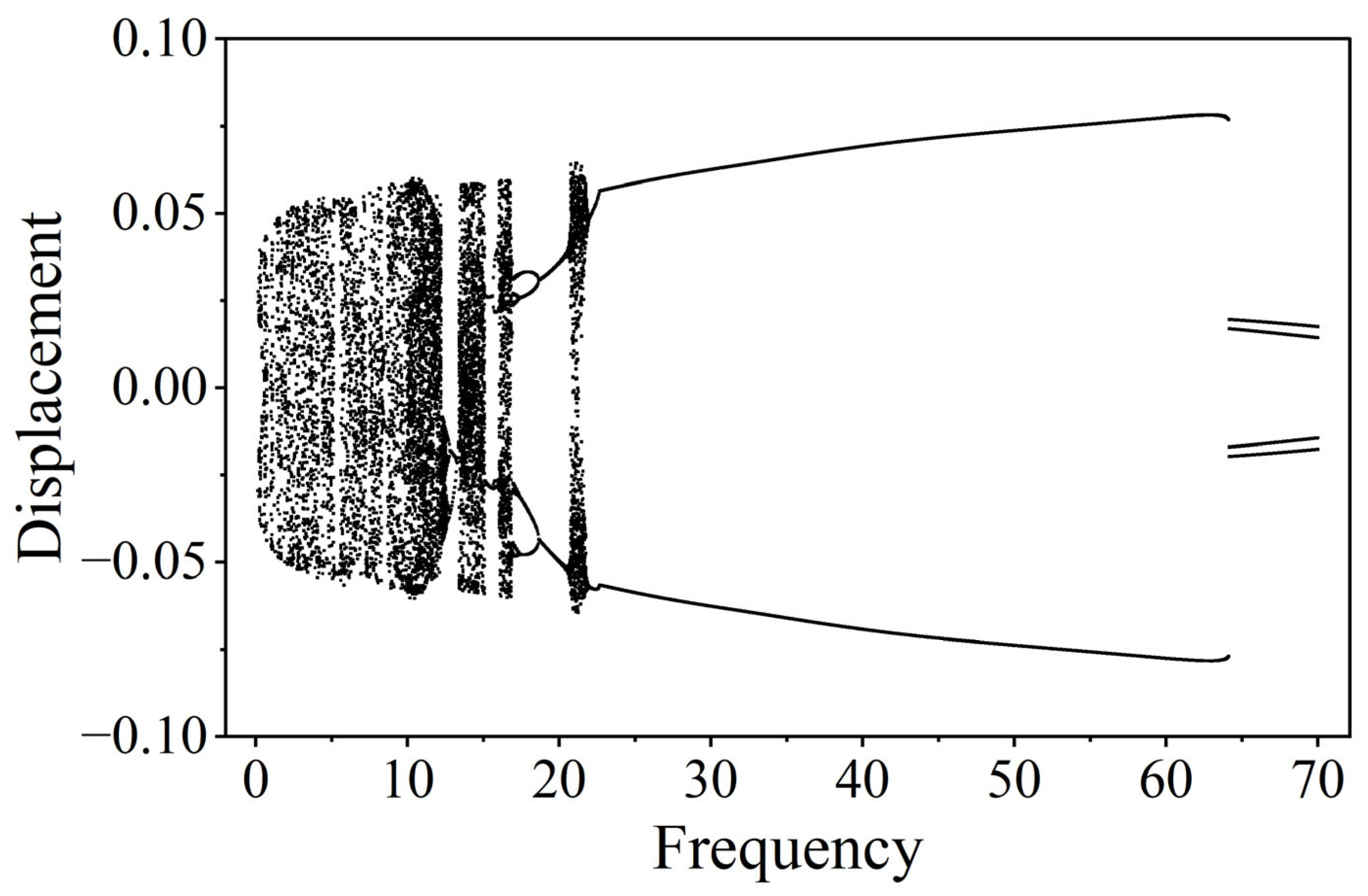
Figure 3 compares the bifurcation diagram of the dimensionless midpoint displacement obtained in this study with established benchmarks in the literature [
16,
31]. The comparative analysis demonstrates that the present model accurately captures the essential nonlinear “fingerprints” of the pipe-conveying-fluid system under pulsating excitation and motion constraints. Specifically, both models exhibit a highly consistent topological evolution sequence as the excitation frequency increases: transitioning from an initial impact-induced chaotic region to a wide stable periodic window via inverse bifurcation, followed by the re-emergence of instability through a period-doubling cascade. This dynamic transition path aligns well with the bifurcation phenomena reported by Wang and Ni [
16], confirming that the current model correctly reproduces the parametric resonance mechanisms induced by pulsating flow.
It should be noted that strong nonlinear systems of this nature are characterized by an extreme sensitivity to damping ratios, clearance thresholds, and numerical discretization precision. Such sensitivity naturally leads to quantitative shifts in specific bifurcation points and peak amplitudes between the present study and the references [
31]. However, the qualitative agreement in the dynamic transition paths and the overall structure of the stability windows is excellent. This topological consistency justifies the correctness of the Galerkin-based discretization, the mathematical treatment of the non-smooth impact forces, and the reliability of the Runge-Kutta integration scheme. Consequently, the proposed numerical procedure is proven to be valid and robust for the subsequent parametric sensitivity analysis of the fracturing string.
3. Results and Discussions
3.1. The Influence of Excitation Frequency on Vibration
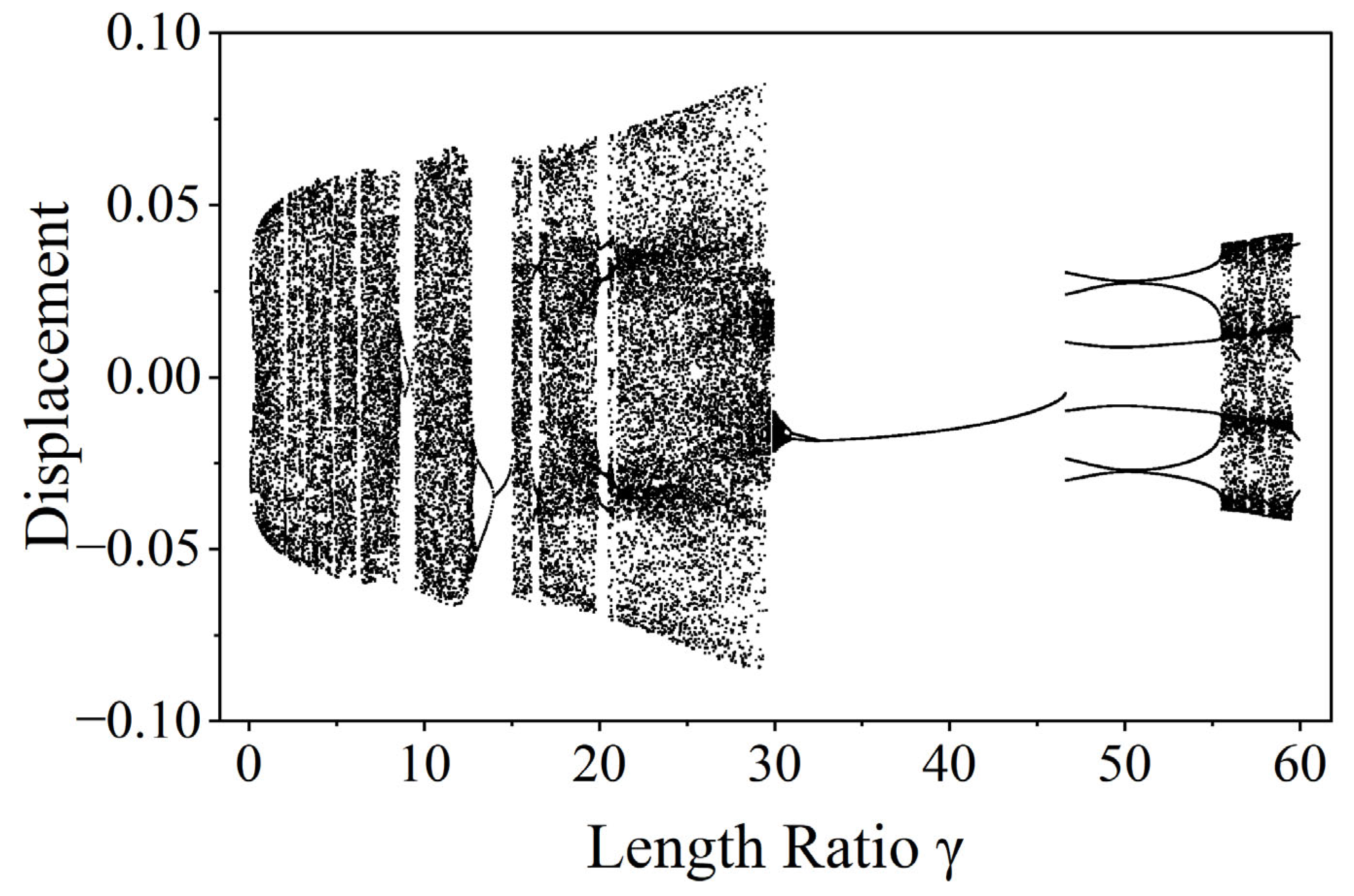
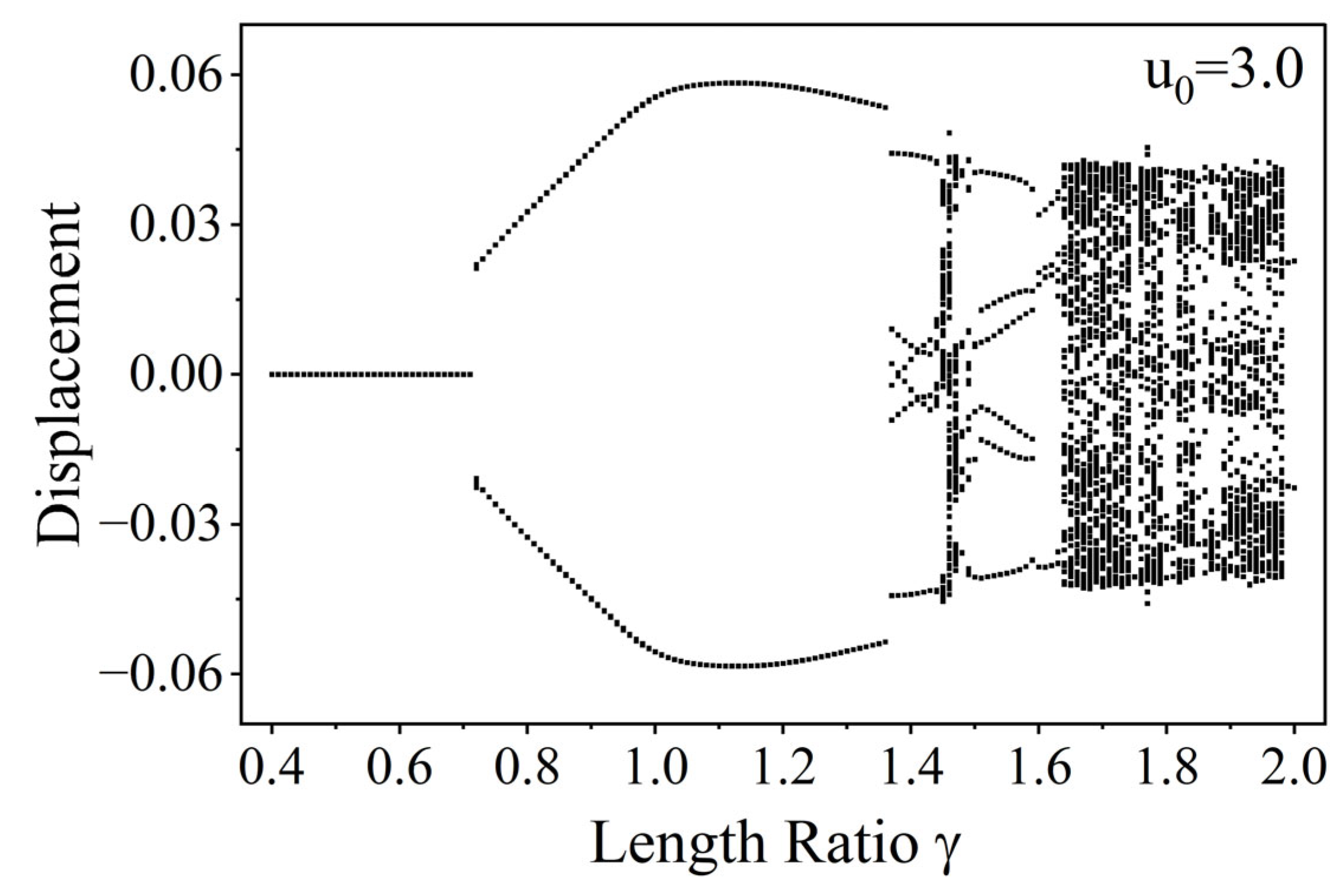
As illustrated in
Figure 4, when
, the fracturing string predominantly exhibits strongly nonlinear chaotic motion. At this stage, due to the elevated vibrational energy induced by fluid pulsation, the vibration amplitude of the string significantly exceeds the constraint clearance, leading to the formation of a pronounced nonlinear contact interaction between the string and the confinement boundary. The frequent and irregular impact collisions result in a system response that manifests as a strange attractor in phase space. With a further increase in the excitation frequency within the range
, the system transitions out of the chaotic regime and evolves into a stable period-doubling limit cycle motion through an inverse bifurcation. At this stage, the Poincaré section clearly appears as two distinct and smooth branches located above and below, indicating that although the tool string remains in contact with the boundary, its dynamic behavior has evolved into a highly regular periodic impact pattern.
When , the tool string exhibits dynamic instability once again, where the original period-doubling bifurcation point undergoes splitting, manifesting as a period-doubling bifurcation. Specifically, the system’s motion transitions progressively from period-2 to period-4 behavior. This phenomenon typically indicates that, with further increase in frequency, the fracturing string system will re-enter a high-frequency chaotic state via a period-doubling cascade pathway. At this flow velocity, the presence of a stable motion window in the intermediate frequency region compared to the chaotic response observed in the low-frequency range provides a theoretical foundation for mitigating severe collisions in engineering practice by adjusting the pump injection frequency.
The above instability characteristics further highlight that the system dynamic state is strongly governed by the coupling between excitation frequency and packer spacing. According to the definition of the dimensionless frequency, the relationship between the physical pulsation frequency and the packer spacing follows the scaling law . As indicated by the bifurcation results, stable system responses can be maintained only when remains below a critical threshold. An increase in the pump pulsation frequency directly elevates the dimensionless excitation frequency, thereby driving the system toward the high-frequency chaotic regime identified above. To offset this destabilizing effect, the packer spacing must be reduced accordingly. Therefore, higher fluid pulsation frequencies require shorter packer spacing designs to maintain dynamic stability and reduce the risk of severe vibration or collision.
3.2. The Influence of Packer Spacing on Vibration
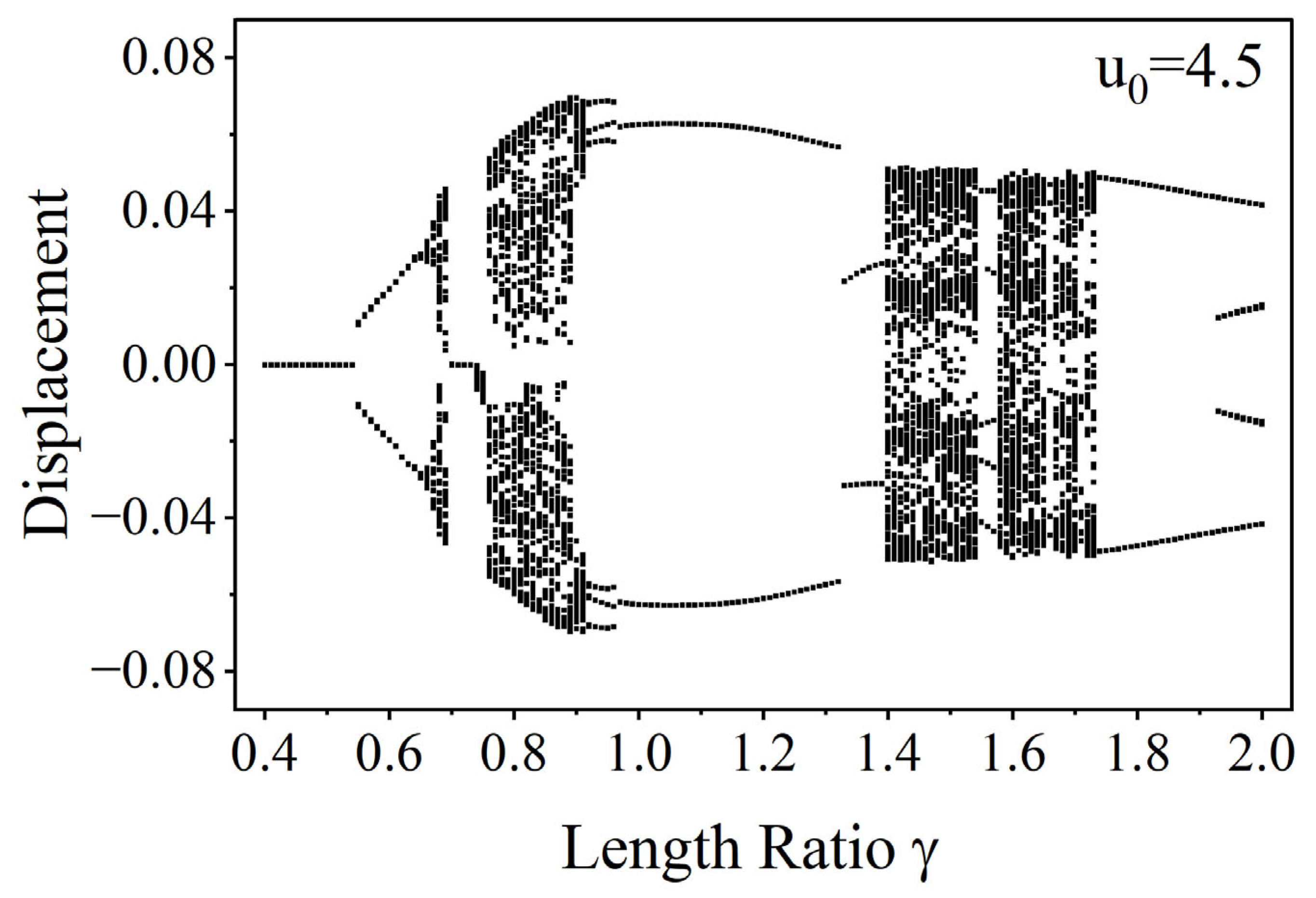
The nonlinear dynamic behavior of the fracturing string system is not only directly influenced by the excitation frequency but also closely dependent on the spacing between packers. Variations in packer spacing induce shifts in the natural frequencies of the string through scaling laws, thereby driving transitions among different dynamic regimes, as identified in
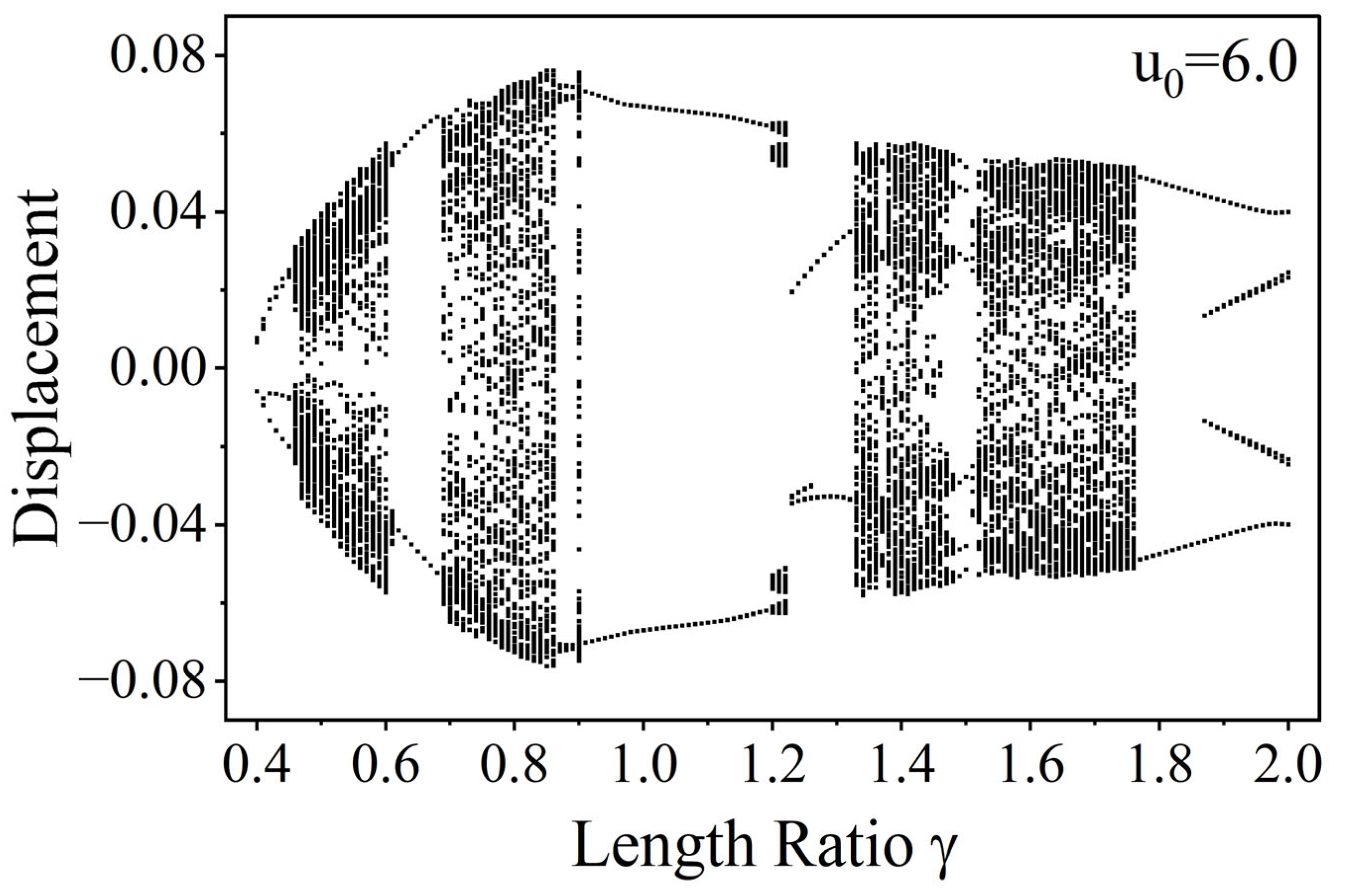
Section 3.1. To further investigate the nonlinear dynamic mechanisms within the different stability regions identified in the global bifurcation diagram, four representative length ratios
are selected for detailed analysis.
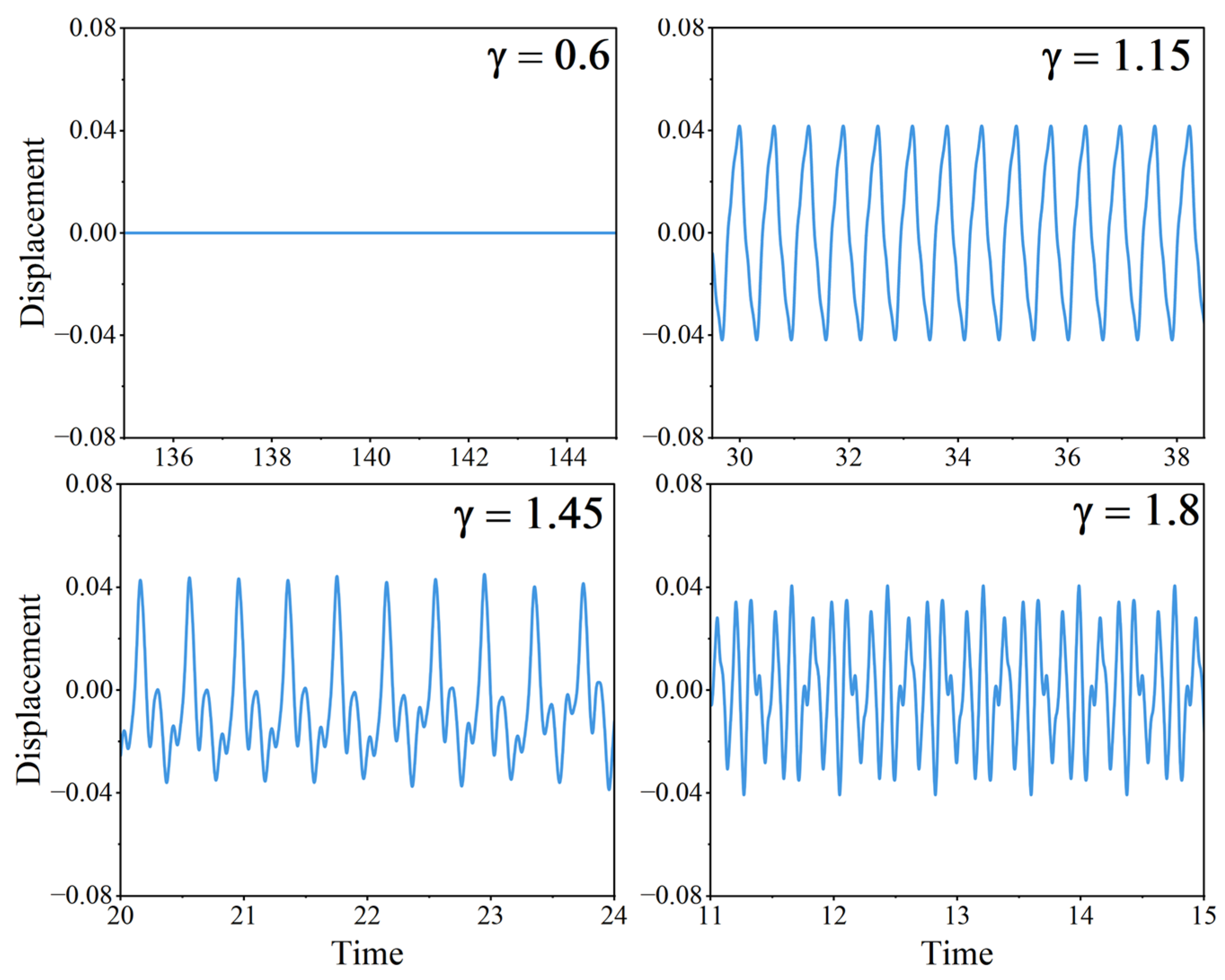
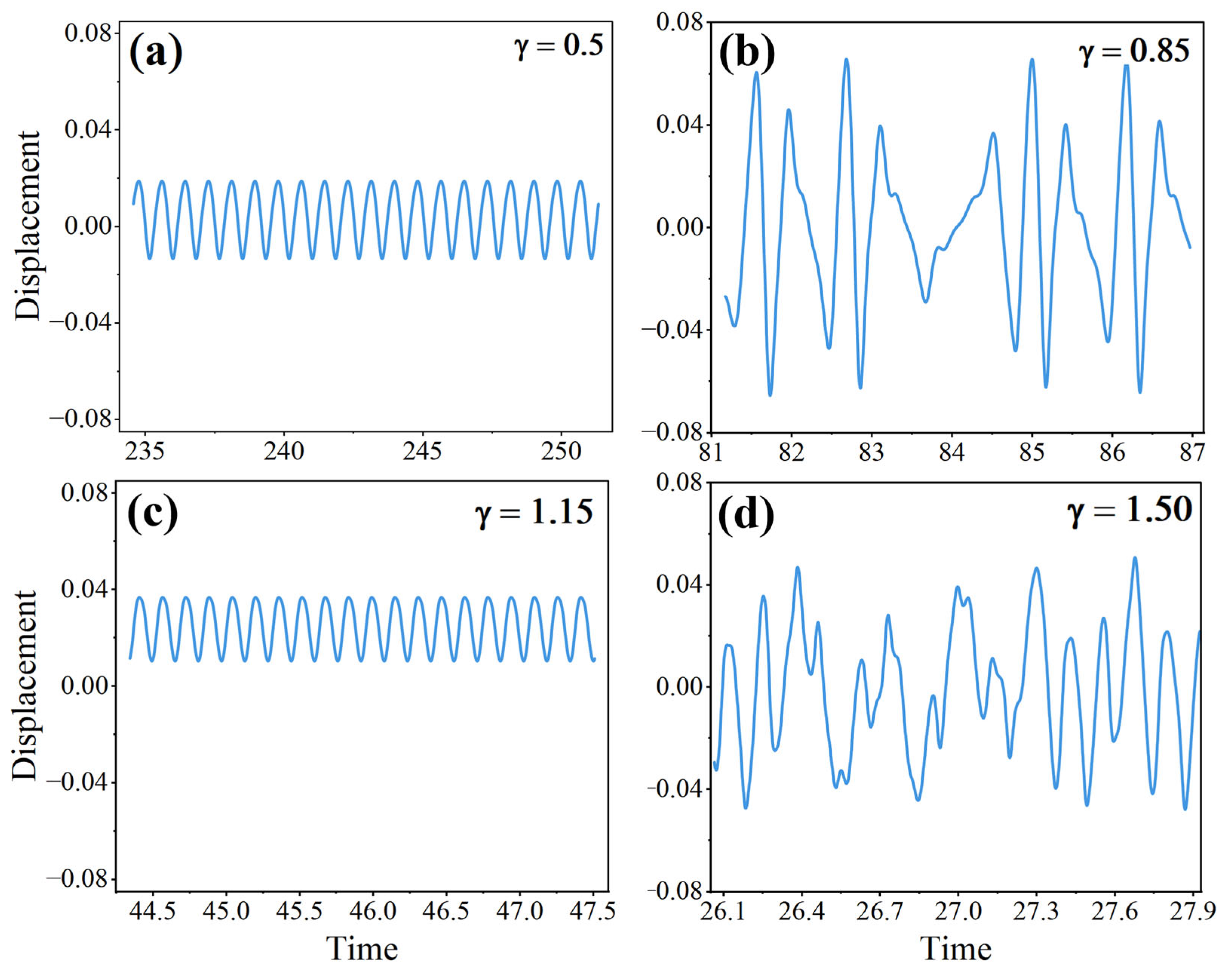
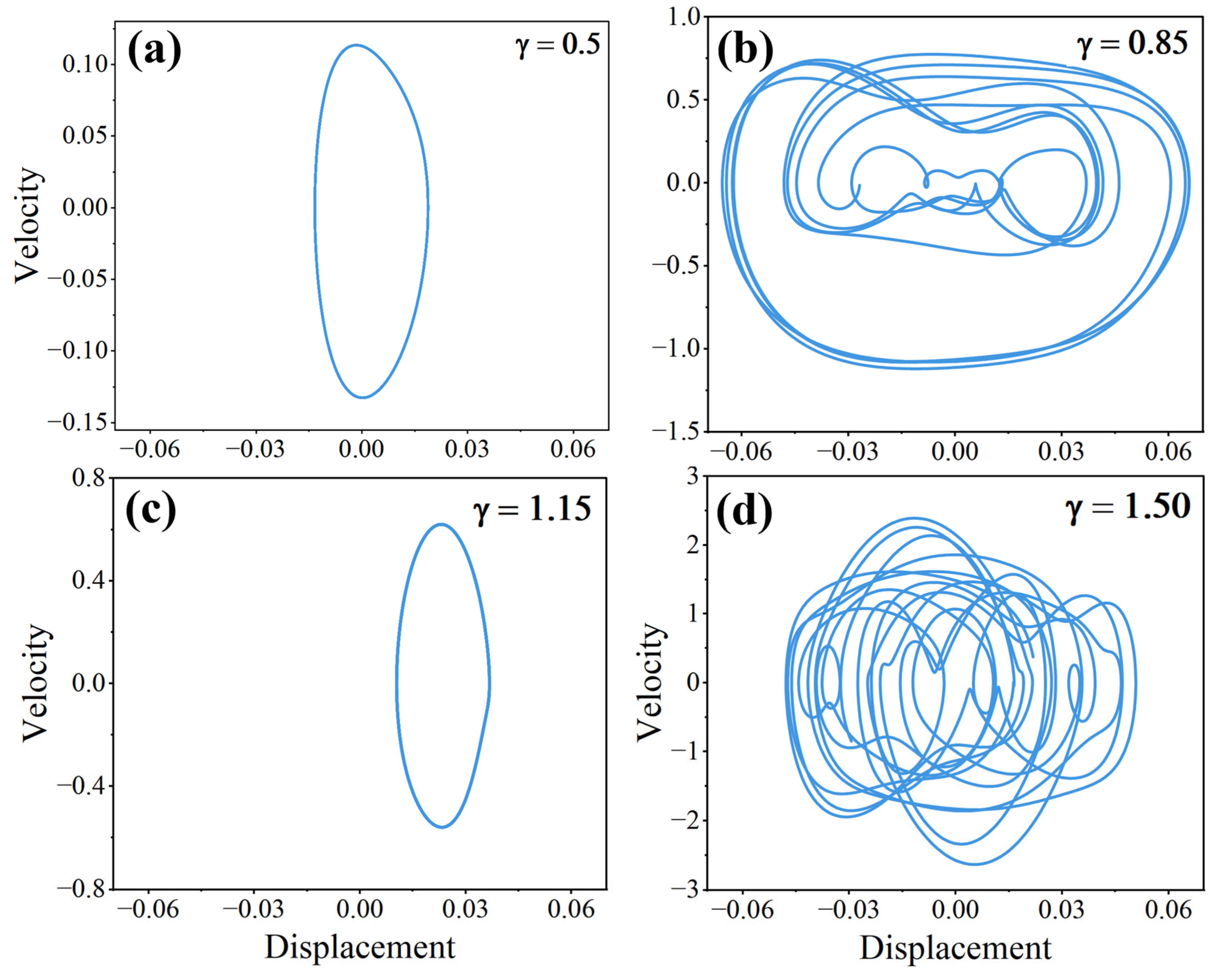
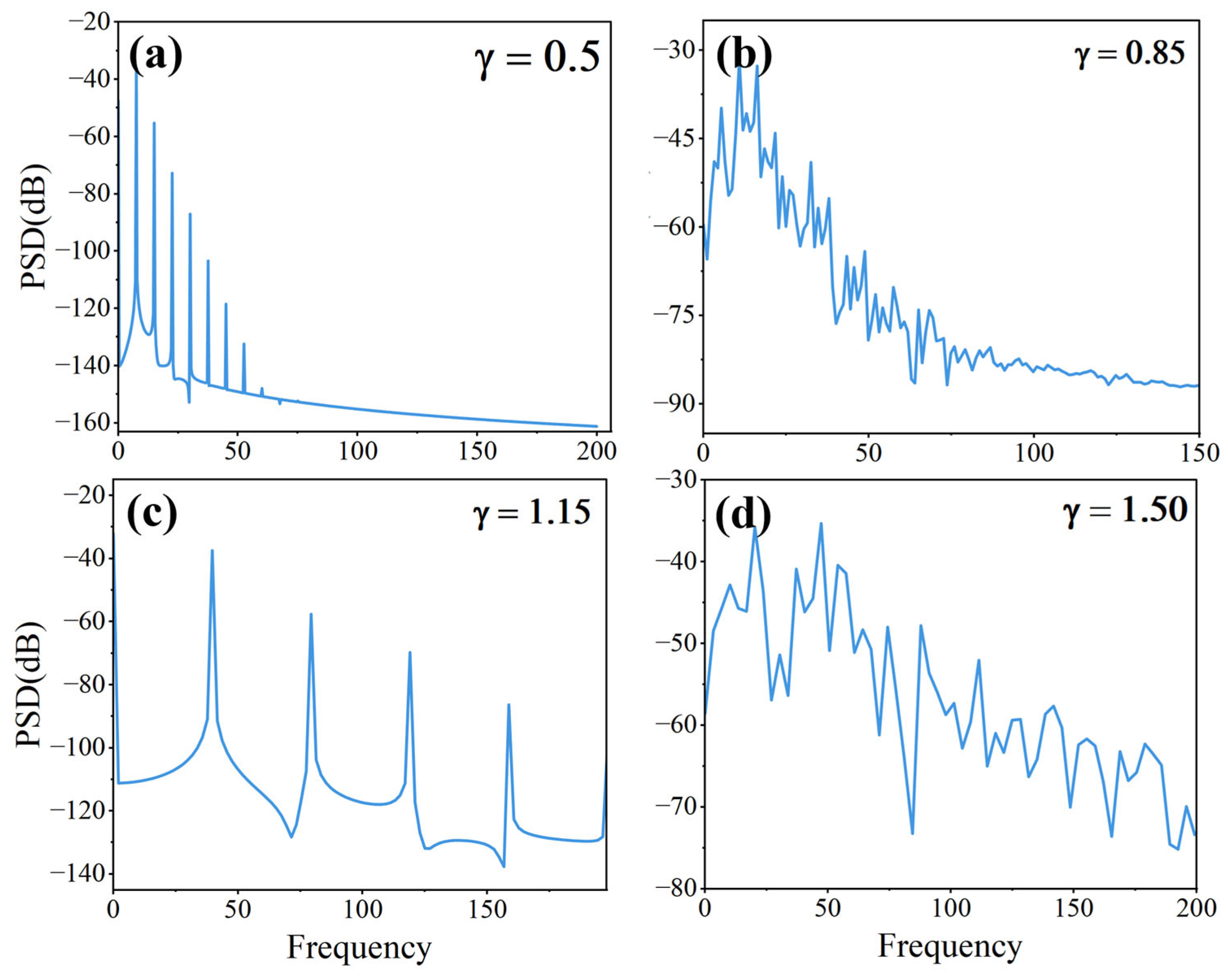
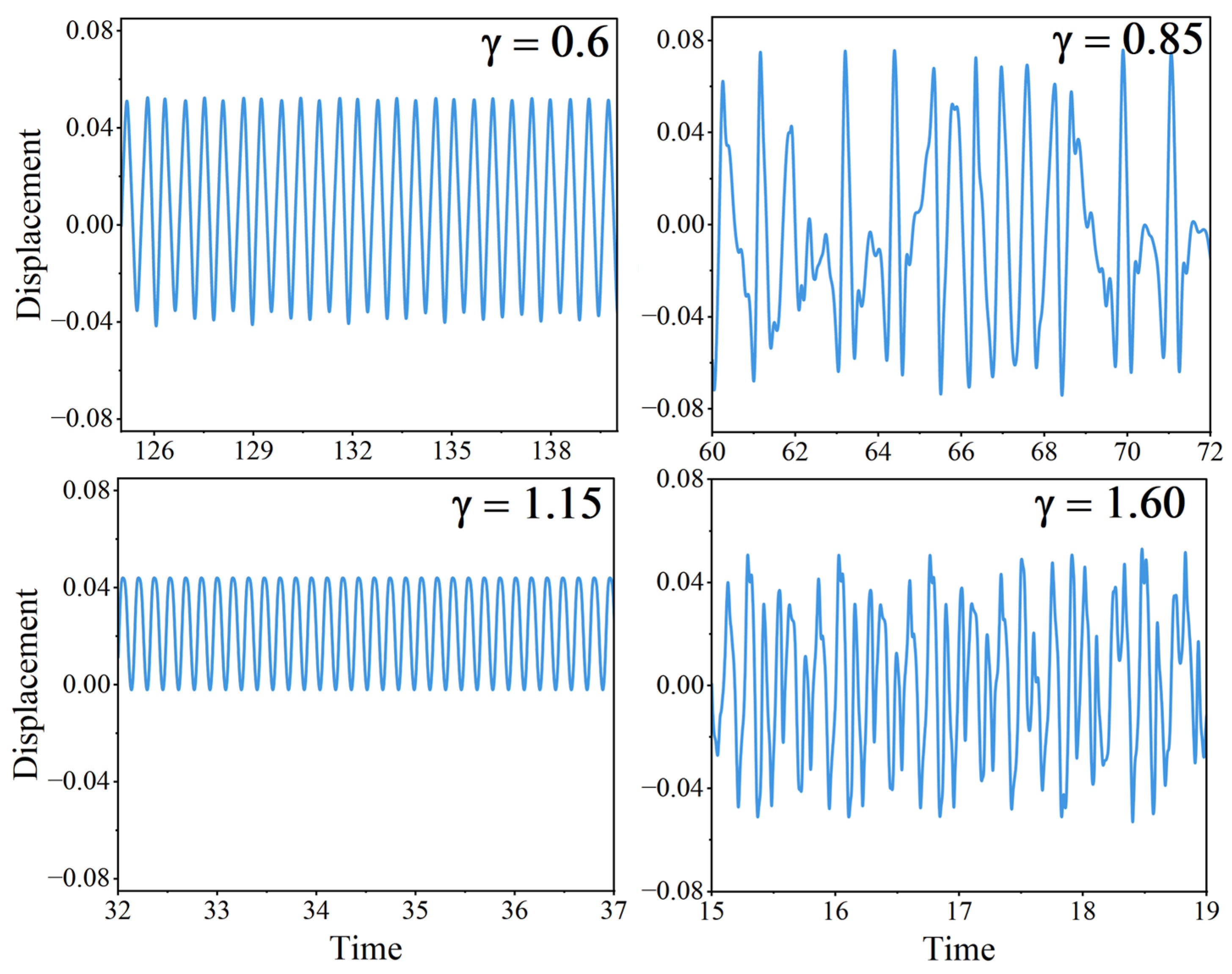
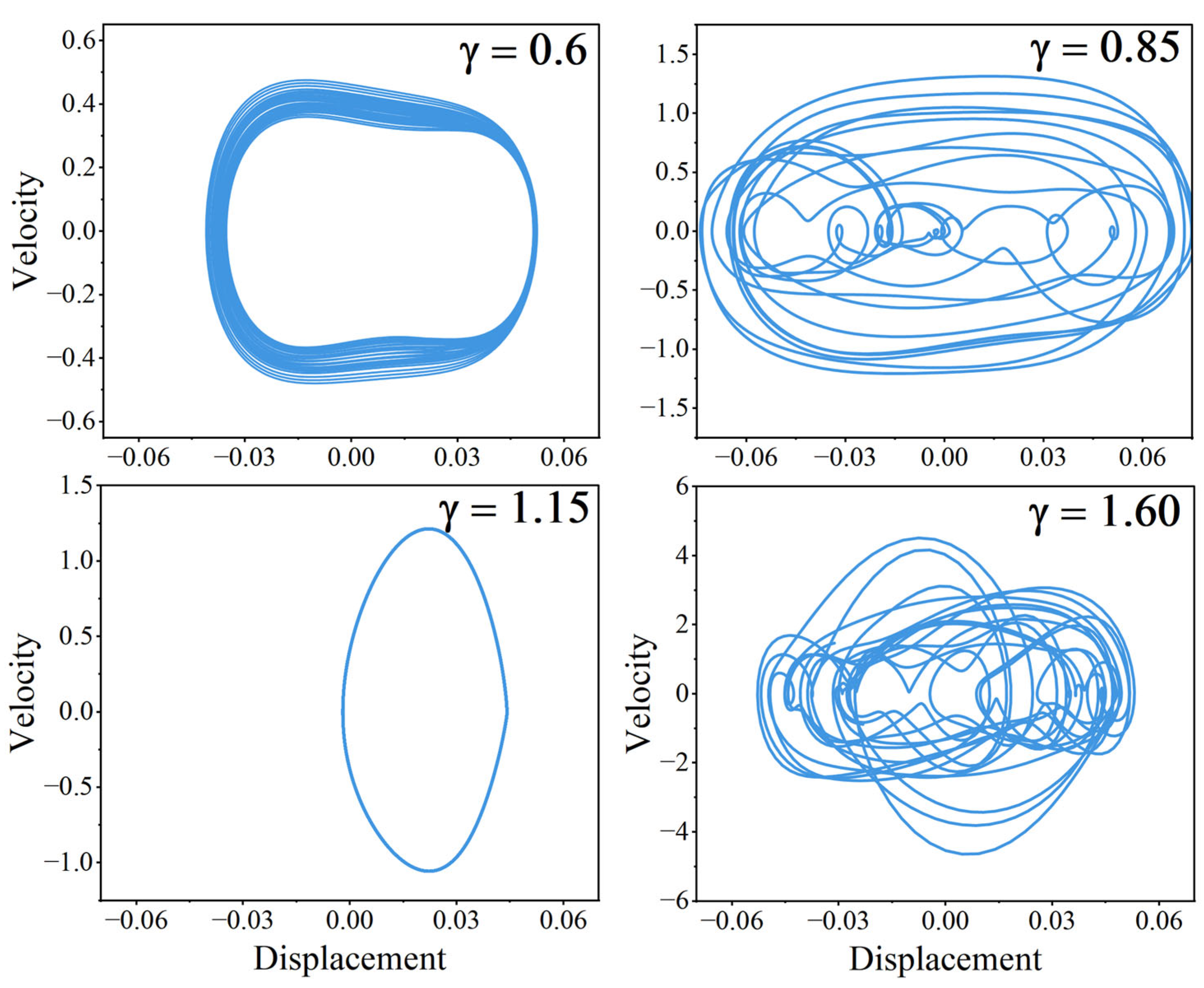
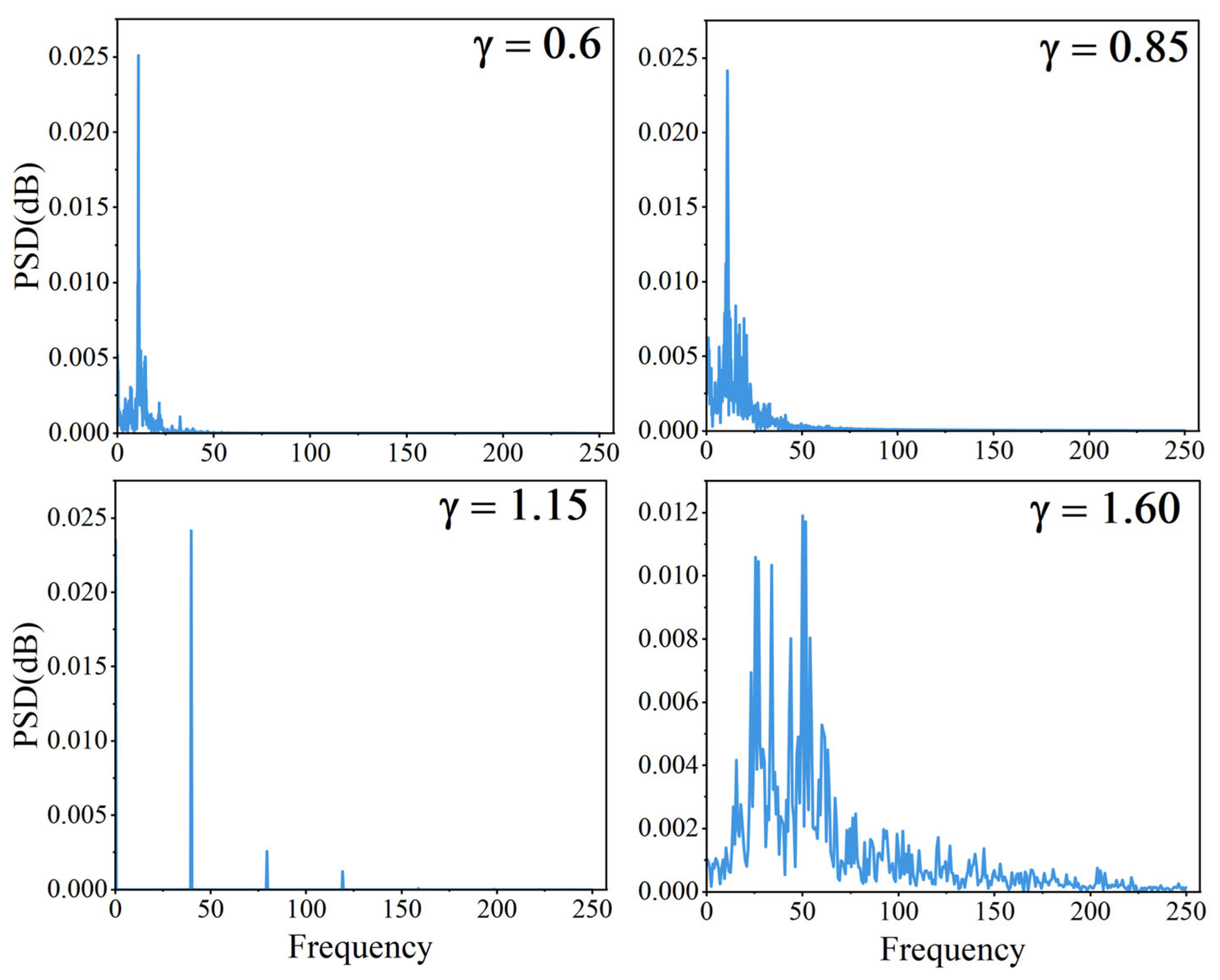
As illustrated in
Figure 5,
Figure 6,
Figure 7 and
Figure 8, when
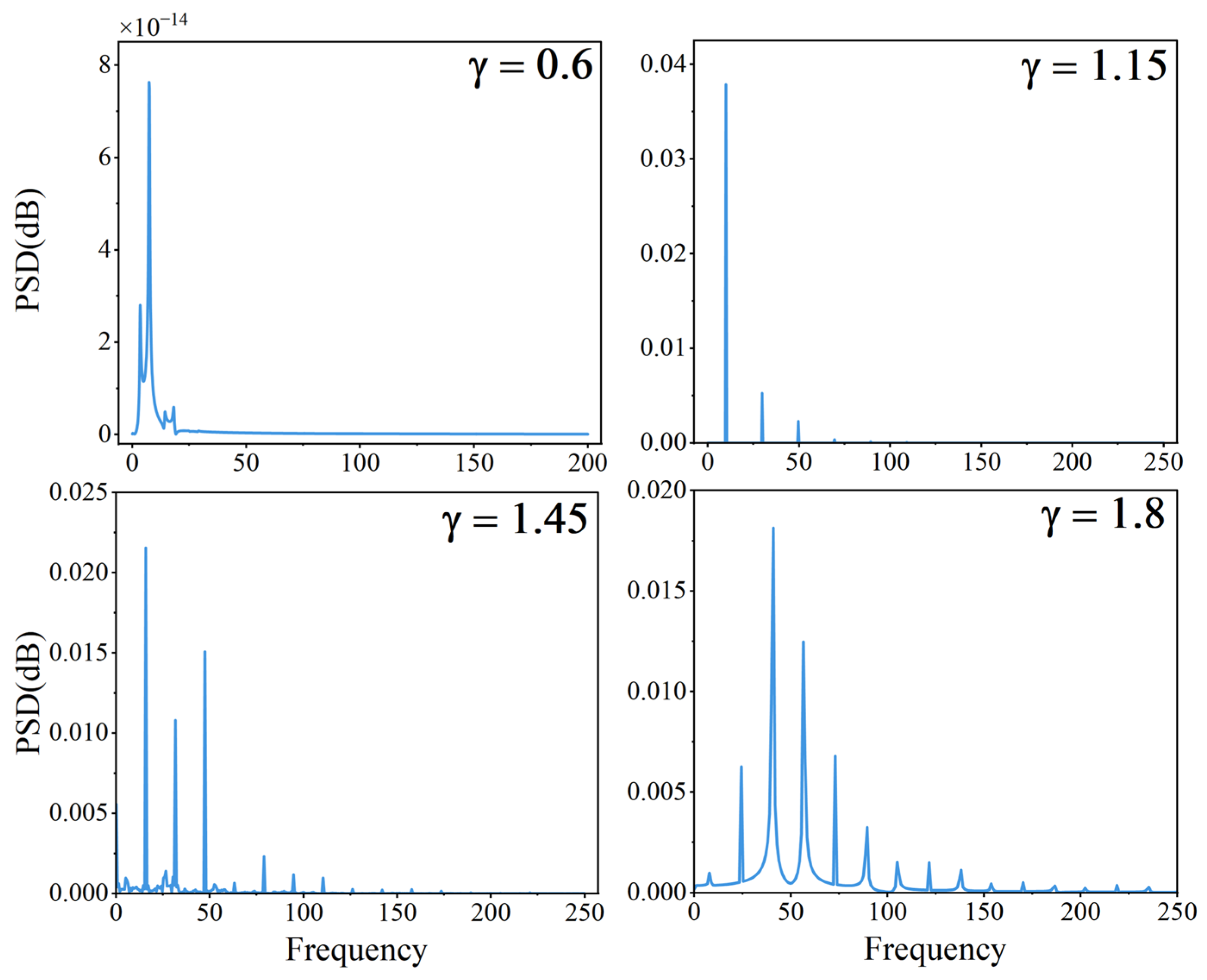
, the fracturing string operates within a linear micro-amplitude vibration regime, in which the dimensionless displacement remains close to zero. In this range, the bending stiffness of the string dominates the system response, while the influence of internal fluid flow remains weak. The vibration exhibits a regular sinusoidal pattern with an amplitude well below the casing clearance, indicating free vibration without string-casing contact. The phase trajectory forms a smooth closed elliptical orbit, and the frequency response is characterized by a single dominant fundamental frequency without noticeable broadband components, confirming a stable linear single-period motion state.
As the packer spacing increases, the system undergoes an initial Hopf bifurcation. In the interval , the system enters a chaotic vibration regime dominated by irregular collision-induced dynamics. The vibration amplitude increases sharply and frequently exceeds the annular clearance, leading to intense and intermittent impacts between the string and the casing wall. The time-domain response becomes strongly aperiodic, while the phase-space structure loses its closed-loop topology and evolves into a disordered strange attractor. Meanwhile, broadband noise emerges in the frequency spectrum, indicating that impact-induced nonlinearity disrupts the system’s periodicity and drives it into a chaotic state.
When further increases to the range , the chaotic motion abruptly disappears, and the system transitions into a stable periodic response through an inverse bifurcation mechanism. Within this interval, the vibration amplitude remains relatively large and intermittent grazing contact persists; however, the system exhibits highly repeatable and deterministic motion. The time-domain response recovers a regular pattern, the phase trajectory re-forms a closed asymmetric limit cycle, and the frequency spectrum consists of discrete spectral lines. These features indicate that the casing effectively acts as a displacement limiter, suppressing flow-induced divergence and stabilizing the system. This interval therefore represents an optimal engineering window, with providing a balance between extended packer spacing and dynamic stability.
As the length ratio further increases to , the system becomes unstable again and enters a high-frequency chaotic regime. The increase in dimensionless flow velocity intensifies fluid-induced centrifugal and Coriolis effects, leading to the re-emergence of instability. The vibration response becomes highly irregular, the phase-space trajectories expand significantly, and the frequency spectrum exhibits a wider energy distribution and elevated noise floor. These features indicate the participation of higher-order modes and strong multimodal coupling, resulting in a more complex chaotic state than that observed in the earlier instability region.
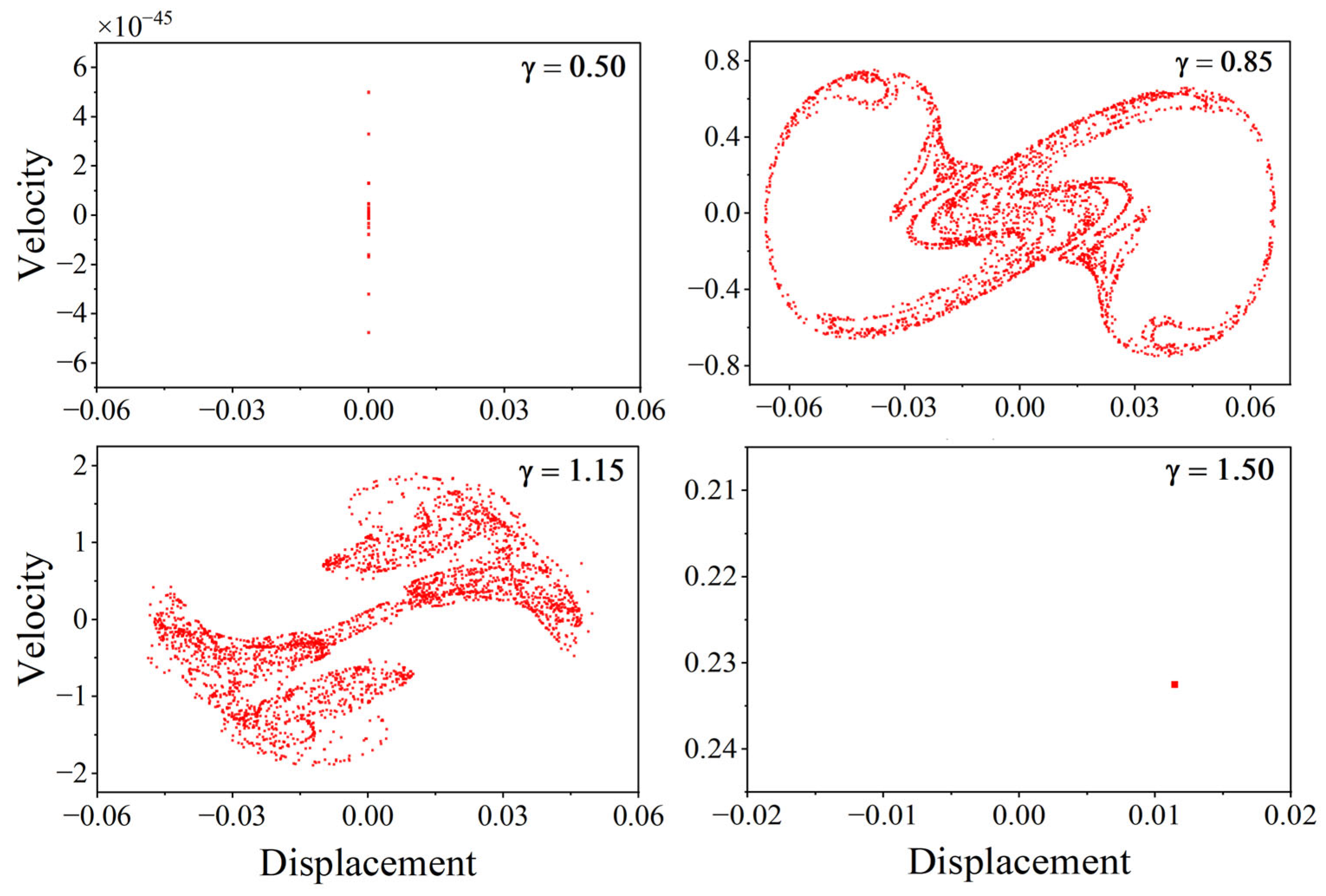
As illustrated in
Figure 9, when
, the mapping points on the Poincaré section are densely clustered near the coordinate origin, with both displacement and velocity exhibiting extremely small magnitudes. This indicates that the tool string is minimally affected by fluid-induced excitation, and the system remains in a stable static equilibrium state. When the length ratio is
and
, the Poincaré section manifests as a complex lamellar structure composed of a series of discrete points. Instead of converging to a finite number of positions, these points exhibit a fractal structure characterized by self-similarity. This corresponds to a strange attractor in nonlinear dynamics, confirming that the system is in a state of chaotic motion. In stark contrast, when
, the previously complex attractor vanishes and a clearly delineated isolated fixed point emerges on the cross-section. This phenomenon indicates that the fracturing tool string system has transitioned from chaotic dynamics to stable single-cycle motion through its evolutionary process.
In summary, the variation in packer spacing exerts a non-monotonic influence on the stability of the string. Bifurcation diagram analysis reveals that selecting parameter ranges near enables effective avoidance of the resonant chaotic region, thereby maintaining the fracturing string system in a stable periodic motion state characterized by controllable dynamic behavior. Overall, as the length ratio increases, the system does not follow a monotonic trend toward instability; rather, stable periodic motions and chaotic motions alternately emerge across multiple parameter intervals.
3.3. The Influence of Flow Velocity on the Stability Boundary
During actual fracturing operations, pumping rates are frequently adjusted in real time to meet process requirements; hence, the design of packer spacing must exhibit robustness against flow-rate fluctuations. At a reduced average flow velocity of
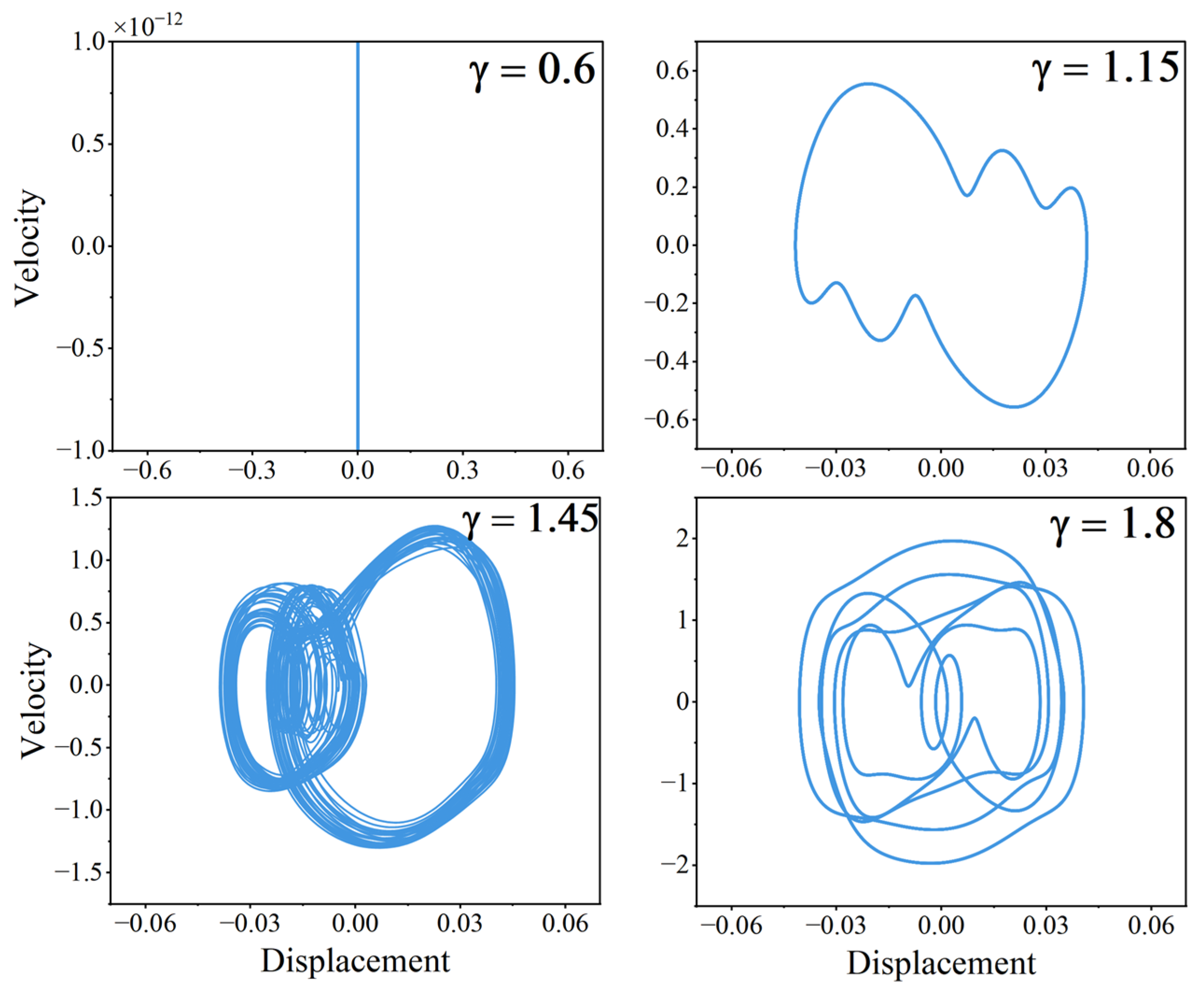
, the overall dynamic response of the fracturing string shows a clear tendency toward simplified nonlinear behavior over the investigated length ratios, as illustrated by the global bifurcation diagram. To further examine the associated dynamic characteristics, four representative cases are analyzed using time-domain responses, phase-space trajectories, and frequency spectra, as shown in
Figure 10,
Figure 11,
Figure 12 and
Figure 13.
For the case with a small length ratio of , the fluid-induced excitation remains weak, and the tool string response is confined to a linear vibration regime with extremely small amplitudes. The displacement response rapidly decays toward a near-zero steady state, while the corresponding phase trajectory converges to a fixed point at the origin, indicating stable equilibrium behavior. In addition, no pronounced peaks are observed in the power spectrum, suggesting that self-excited oscillations are not activated under this condition.
As the length ratio increases to , the system departs from the equilibrium state and evolves into a periodic vibration regime. The time-domain response exhibits a regular oscillatory waveform with increased amplitude, and the phase portrait forms a closed elliptical loop, which is characteristic of a stable limit cycle. In the frequency domain, the spectral energy is primarily concentrated at the fundamental frequency and its harmonics, indicating that the system response remains well organized despite the emergence of nonlinear effects. This response suggests that, although contact interactions may begin to occur, the vibration is still effectively regulated by the combined effects of structural stiffness and damping.
Further increasing the length ratio to does not result in a transition to chaotic motion, unlike the behavior observed at higher flow velocities. Instead, the system exhibits a more complex yet bounded oscillatory response. The time-domain signal shows clear amplitude modulation, while the phase trajectories consist of multiple nested closed loops or torus-like structures, which are typical features of multi-periodic or quasi-periodic motion. Although the dynamic patterns become more intricate, no irregular divergence associated with chaotic attractors is observed.
A similar dynamic response is observed at the largest investigated length ratio of . The corresponding power spectrum remains dominated by discrete spectral lines, with a clear separation between the fundamental frequency and subharmonic components and without the appearance of a broadband continuous spectrum. This indicates that, at , the fluid-induced centrifugal and Coriolis effects remain relatively weak and do not govern the system dynamics. Consequently, even at large length ratios, the fracturing string tends to evolve toward stable multi-frequency oscillatory states rather than developing strongly irregular or chaotic vibrations.
At a flow velocity of
, the global bifurcation behavior of the system is summarized in
Figure 10. Compared with lower flow velocity conditions, the stability boundary becomes narrower, and irregular responses extend toward intermediate values of the length ratio. This change is associated with the enhanced flow-induced negative stiffness effect, which scales with the square of the flow velocity. As a result, nonperiodic motion may occur even at relatively small length ratios.
As illustrated in
Figure 14,
Figure 15,
Figure 16 and
Figure 17, when
, the static equilibrium state is no longer maintained. The phase plane trajectory forms a banded annular structure rather than a closed curve, and multiple low-frequency components appear in the spectrum, indicating a transition to quasi-periodic or weakly irregular motion.
When the length ratio increases to , the response becomes fully chaotic. The displacement signal shows abrupt amplitude variations, implying frequent interactions between the tool string and the casing. In phase space, the trajectory evolves into a complex attractor with folded structures, while the frequency spectrum develops a broadband distribution without dominant discrete peaks.
Within the interval , a limited region of regular motion is observed. At , the system response reorganizes into a single-period oscillation. The phase trajectory returns to a smooth closed loop, and the spectral energy is concentrated mainly at the fundamental frequency, indicating a bounded and repeatable dynamic state under this spacing.
When the length ratio further increases beyond , the regular motion regime disappears. For , the response is characterized by rapid fluctuations and a broad occupation of the phase space. The frequency spectrum becomes widely distributed, with enhanced high-frequency components. Under combined conditions of long string length and high flow velocity, higher-order modal responses are increasingly involved, leading to a more complex vibration pattern.
3.4. Discussion
The reliability of the proposed model is validated by its adherence to universal non-smooth dynamical principles. The simulated bifurcation sequence, which transitions from impact-induced chaos back to stable windows, aligns with the theoretical frameworks of Païdoussis [
15] and Modarres-Sadeghi et al. [
32]. Their research on constrained pipe flows confirms that while motion constraints can trigger chaos, specific parametric combinations allow the impact forces to achieve phase synchronization with fluid excitation, thereby restoring the system to stable periodic orbits.
While the proposed packer spacing optimization and dynamic analysis are primarily demonstrated for shale gas reservoirs, the underlying framework and dimensionless design criterion γ are in principle applicable to multistage hydraulic fracturing in conventional reservoirs. Appropriate adjustments of operational parameters, such as wellbore inclination, fluid properties, and packer configuration, are required to account for differences in reservoir and completion conditions [
33]. The methodology can be extended to other reservoir types with proper parameter adaptation.
Furthermore, the identification of the stable-contact window at
is supported by the fundamental theory of impact oscillators established by Shaw and Holmes [
34] and Wagg [
35]. They rigorously proved that in non-smooth systems, the addition of constraints does not inevitably lead to disorder; instead, at specific structural ratios, the nonlinear stiffness generated by impacts can effectively “capture” otherwise unstable trajectories, transforming them into deterministic limit cycles. This “attractor self-organization” provides a robust theoretical basis for the rhythmic, predictable contact behavior observed at
. By capturing these universal “nonlinear fingerprints,” the present results are cross-validated against established literature, confirming the model’s accuracy in predicting the stability of fracturing strings under complex boundary constraints.
A comprehensive comparison of the bifurcation diagrams under the three flow rates shows that increasing flow velocity generally compresses the stable regions and promotes earlier transition to irregular motion. However, at
, the system repeatedly exhibits stable periodic responses across all flow conditions, indicating that this spacing corresponds to a locally optimal dynamic configuration. Mechanistically, this behavior suggests a balance between fluid-induced negative stiffness and the geometric constraint introduced by casing contact, where the interaction limits further vibration growth instead of triggering instability [
30]. As a result, the system dynamics reorganize into a bounded periodic state, characterized by closed phase trajectories or only weak period-doubling. This finding implies that system stability is governed by the combined effects of flow intensity and spacing configuration, and that properly selected packer spacing can maintain predictable motion even under elevated flow rates.
4. Conclusions
This study establishes a fluid–structure interaction dynamic model for fracturing tool string operations, and numerically simulates the influence of packer spacing and flow rate on the vibrational characteristics of the string. The principal conclusions are as follows:
Revealed the evolution laws of the fracturing string’s vibration states under varying packer spacing.
(1) The computational results reveal that the tool string exhibits distinctly different vibration modes as packer spacing varies. At a length ratio of , the tool string undergoes severe chaotic collisions due to resonance. When , the string re-enters an intensive vibrational state as a result of excessive flow velocity effects. This indicates that the design of packer spacing must avoid these two critical regions, which lead to system instability.
(2) Elucidated the impact of flow velocity variations on the distribution and width of the stability windows.
A comparative analysis of bifurcation diagrams under varying flow rates reveals that increased flow velocity significantly reduces the length range within which the string structure maintains stability. At a low flow rate of , the string remains stable across a broad range of lengths. In contrast, at a high flow rate of , the length interval capable of sustaining stable vibrations is markedly narrowed. This indicates that in high-displacement fracturing operations, the permissible range for packer spacing becomes constrained, necessitating more precise design considerations.
(3) Proposed an optimization criterion for packer spacing based on the maintenance of stable periodic motion.
Based on the dynamic analysis results, the dimensionless string length ratio has been identified as the optimal design parameter. At this spacing configuration, the tool string maintains regular and stable motion with periodic contact against the casing, while avoiding destructive chaotic impacts. In comparison with the linear instability threshold length ratio of predicted by the model, this optimized solution increases the packer spacing by approximately 90%, significantly enhancing the efficiency of fracturing operations while ensuring operational safety.