1. Introduction
Wi-Fi networks have become a critical component of today’s digital infrastructure, supporting a growing variety of applications, devices, and user profiles. The increasing reliance on wireless connectivity, combined with rising user expectations, has placed significant demands on Wi-Fi performance, reliability, and user satisfaction. These challenges are especially pertinent in complex environments such as university campuses, where high-density usage and fluctuating traffic patterns are common [
1]. In such contexts, Wi-Fi has evolved from a mere access technology into a vital infrastructure service that underpins teaching, research, and campus operations. University networks must support thousands of simultaneous users with different performance requirements across a variety of devices and applications [
2].
Ensuring satisfactory service quality in such heterogeneous and demanding scenarios requires comprehensive quality management approaches. Traditional quality of service (QoS) metrics, such as throughput, delay, jitter, and packet loss, capture technical network performance (NP). However, these metrics fail to reflect the user experience (quality of experience—QoE) [
3] and satisfaction or the institutional operational and business objectives (quality of business—QoBiz) [
4]. To address these shortcomings, the holistic concept of global quality of service (quality of X—QoX) has been proposed, integrating QoS, QoE, and QoBiz into a unified framework [
5,
6]. Nevertheless, bridging the gap between these different QoS dimensions remains a major challenge in network management, as many solutions still prioritize operational performance without fully considering its impact on user satisfaction and organizational outcomes.
Recent advances in machine learning (ML) demonstrate significant potential in enabling dynamic QoX management by identifying the influencing factors and correlations between network performance, user perception, and business objectives. This allows more proactive decision-making processes by detecting anomalies and predicting user satisfaction degradations, thereby supporting the achievement of business objectives.
Building on our previous work on the QoXphere model [
6] and the proposed methodology for real-world implementation [
7], this paper validates a vendor-agnostic, QoX-based framework that applies machine learning techniques to holistically manage global quality of service. The methodology is evaluated through the real-world migration of the University of the Basque Country (EHU) Wi-Fi network from Wi-Fi 5 (802.11ac) to Wi-Fi 6 (802.11ax). This transition offers a unique opportunity to assess network performance, traffic handling efficiency, and QoE/QoBiz outcomes in a live campus environment. A detailed comparison of the network conditions before and after migration, considering improvements in QoS, QoE, and QoBiz, demonstrates the applicability and effectiveness of the proposed approach in complex academic settings.
It is important to emphasize that the primary objective of this work is not to perform a protocol-level performance analysis of specific Wi-Fi 6 physical or MAC-layer mechanisms (e.g., OFDMA resource scheduling efficiency, uplink MU-MIMO spatial multiplexing gains, or Target Wake Time energy optimization behavior). Instead, Wi-Fi 6 is considered an enabling technological evolution that introduces advanced efficiency, capacity, and latency-related capabilities whose combined impact can be captured through multidimensional QoX indicators. From this perspective, the migration scenario is used as a real operational validation environment to demonstrate that next-generation wireless features, including those introduced in Wi-Fi 6 and expected in Wi-Fi 7 and beyond, require management strategies that move beyond purely network performance-oriented metrics toward user-aware and business-aligned quality management approaches. Consequently, this work focuses on validating a vendor-agnostic QoX-driven methodology and does not aim to provide a tutorial-level review of QoS/QoE or WLAN technologies. In this sense, the study provides evidence that the increasing complexity of modern networks reinforces the need for holistic, ML-assisted, multidimensional quality management frameworks.
The remainder of this paper is organized as follows.
Section 2 reviews the background and related work, covering the evolution from traditional QoS-centric approaches to QoE, QoBiz, and QoX frameworks, and discusses the role of machine learning in multidimensional quality management.
Section 3 presents the proposed QoX-based methodological framework.
Section 4 describes the real-world case study corresponding to the migration of the EHU Eduroam network from Wi-Fi 5 to Wi-Fi 6 and details the data collection and analysis procedures.
Section 5 presents and discusses the main results obtained from the multidimensional QoX analysis. Finally,
Section 6 summarizes the main conclusions and discusses study limitations and transferable lessons derived from the real-world deployment experience, with relevance for future large-scale wireless network deployment.
2. Background and Related Work
The management of Wi-Fi networks has evolved from infrastructure-centric optimization to multidimensional strategies that consider user and business needs. This change has been prompted by the growing complexity of wireless environments and the increasing diversity of end users’ needs and expectations.
In this context, universities and large campuses emerge as representative testbeds, since they integrate heterogeneous users, services, and performance expectations within a shared infrastructure. This scenario evidences the transition toward user-driven quality metrics and the need for adaptive management models that jointly address technical, experiential, and business dimensions, as pursued by QoX frameworks.
This section provides an overview of the key conceptual and technological foundations underpinning the proposed QoX methodological approach to holistic Wi-Fi management.
2.1. Traditional QoS-Centric Approaches
Classical quality of service (QoS) models have long formed the basis of network performance management in IP-based and wireless networks. These models rely on quantifiable network-layer metrics, such as packet loss, delay, jitter, and bandwidth utilization, to assess and optimize service delivery. These metrics are well established in standardization bodies such as ITU-T and are widely adopted. However, their limitations in capturing user-perceived service quality are well-documented in the literature [
3,
8].
2.2. The Emergence of QoE as a User-Centric Metric
In order to address the limitations, quality assessment has gradually evolved towards a more user-centric perspective. The ITU-T G.1000 recommendation [
9] introduced a user-oriented view of QoS, later reinforced by updates to the ITU-T E.800 [
3], which formalized the notion of user-centered quality assessment.
Building on these foundations, ITU-T P.10/G.100 [
10] provided the first formal definition of quality of experience (QoE), reflecting a shift from purely technical performance metrics towards a human-centric framework. In this way, service quality is assessed not only by network efficiency but also by user satisfaction, perceived utility, and contextual relevance. This shift has also been reflected in scientific and academic research, where numerous studies have highlighted the limitations of network-centric QoS metrics and proposed user-centric methodologies for QoE assessment [
11,
12,
13], particularly in wireless and high-density environments [
14,
15].
However, even QoE-centric models often neglect the business dimension of network management, particularly how service quality and user satisfaction translate into operational efficiency, cost optimization, and strategic value. To address this limitation, the concept of quality of business (QoBiz) was introduced [
4,
16], emphasizing the alignment of technical and experiential quality indicators with business objectives such as cost reduction, resource optimization, and customer retention. Within this broader vision, the integration of QoS, QoE, and QoBiz into a global QoS framework enables a truly holistic evaluation of network performance, bridging the gap between infrastructure, user perception, and business value.
2.3. Evolution Toward QoX Frameworks
Following the integration of QoS, QoE, and QoBiz introduced in the previous section, the notion of Quality of X (QoX) [
5,
17] has emerged as a comprehensive framework to operationalize this multidimensional perspective. QoX recognizes that modern network management must simultaneously address technical robustness, user perception, and organizational objectives, thus moving beyond isolated quality dimensions.
Several studies [
5,
7,
18] have proposed multi-layer architectures and evaluation models that enable QoX to be applied in real-world scenarios. Most of these approaches converge on the integration of influencing factors (IFs) as the measurable elements that shape user experience. In fact, the concept of influencing factors has been widely explored in the literature [
19,
20] as the cornerstone for understanding and managing quality of experience (QoE) and, by extension, the broader QoX paradigm.
This growing conceptual maturity in the research community has been mirrored by the latest ITU-T standardization efforts, which have explicitly adopted the IF-based perspective as a foundation for QoS frameworks, as emphasized in the ITU-T Technical Report “
Roadmap for QoS and QoE in the ITU-T Study Group 12 context” [
21]. This document is also guiding the ongoing revisions of key ITU-T Recommendations E.800, G.1000, and P.10/G.100 [
22], which increasingly emphasize the role of IFs as a bridge between technical metrics, user perception, and business-oriented quality dimensions.
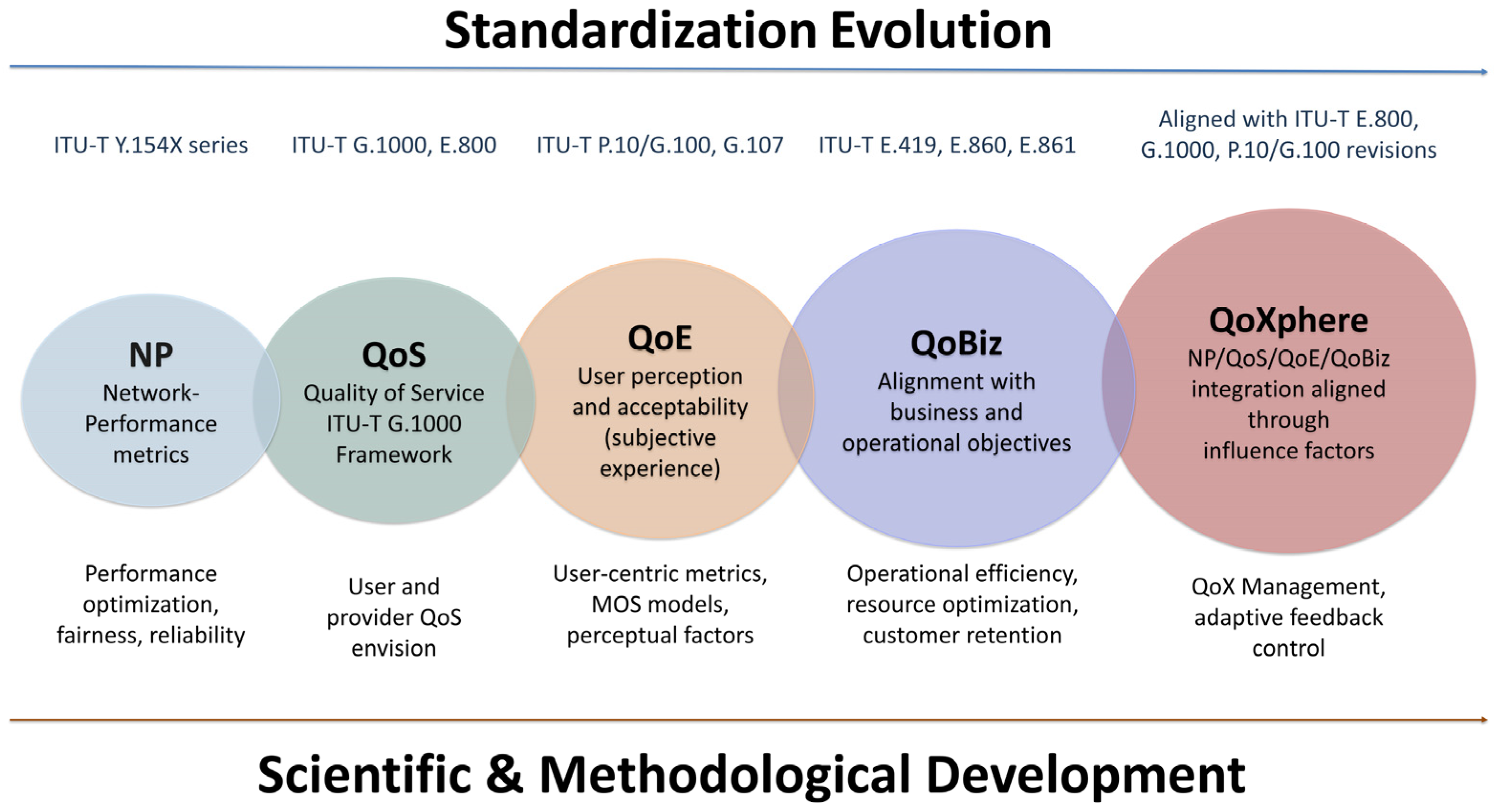
In parallel with these standardization efforts and the broader scientific evolution of QoX concepts, the QoXphere model [
6,
7,
23,
24,
25,
26,
27] has progressively evolved to integrate the ITU-T perspective on multidimensional quality with empirical methodologies for measuring and managing QoS, QoE, and QoBiz in operational environments, as conceptually summarized in
Figure 1 in relation to the standardization-driven evolution of multidimensional quality frameworks.
However, managing such a wide range of factors in dynamic environments requires advanced analytical capabilities.
2.4. Role of Machine Learning in QoX Management
Parallel to the evolution of QoX concepts, machine learning (ML) has emerged as a key enabler of intelligent and adaptive QoX management [
28,
29,
30]. ML techniques are increasingly applied to complex tasks such as context classification, anomaly detection, load balancing, and dynamic resource allocation [
31]. Their ability to model complex, nonlinear relationships and to continuously learn from contextual data makes them particularly suitable for environments where static rules and traditional optimization approaches are insufficient. In the Wi-Fi network domain, ML has also been successfully used [
32] to optimize handovers [
31], predict congestion [
33], and personalize user experiences [
34] through real-time analysis of both historical and live data.
Beyond these technical optimizations, ML plays a strategic role in advancing QoX frameworks within next-generation network environments [
17,
35] by enabling the operational integration of QoS, QoE, and QoBiz dimensions, particularly in implementing models such as the QoXphere.
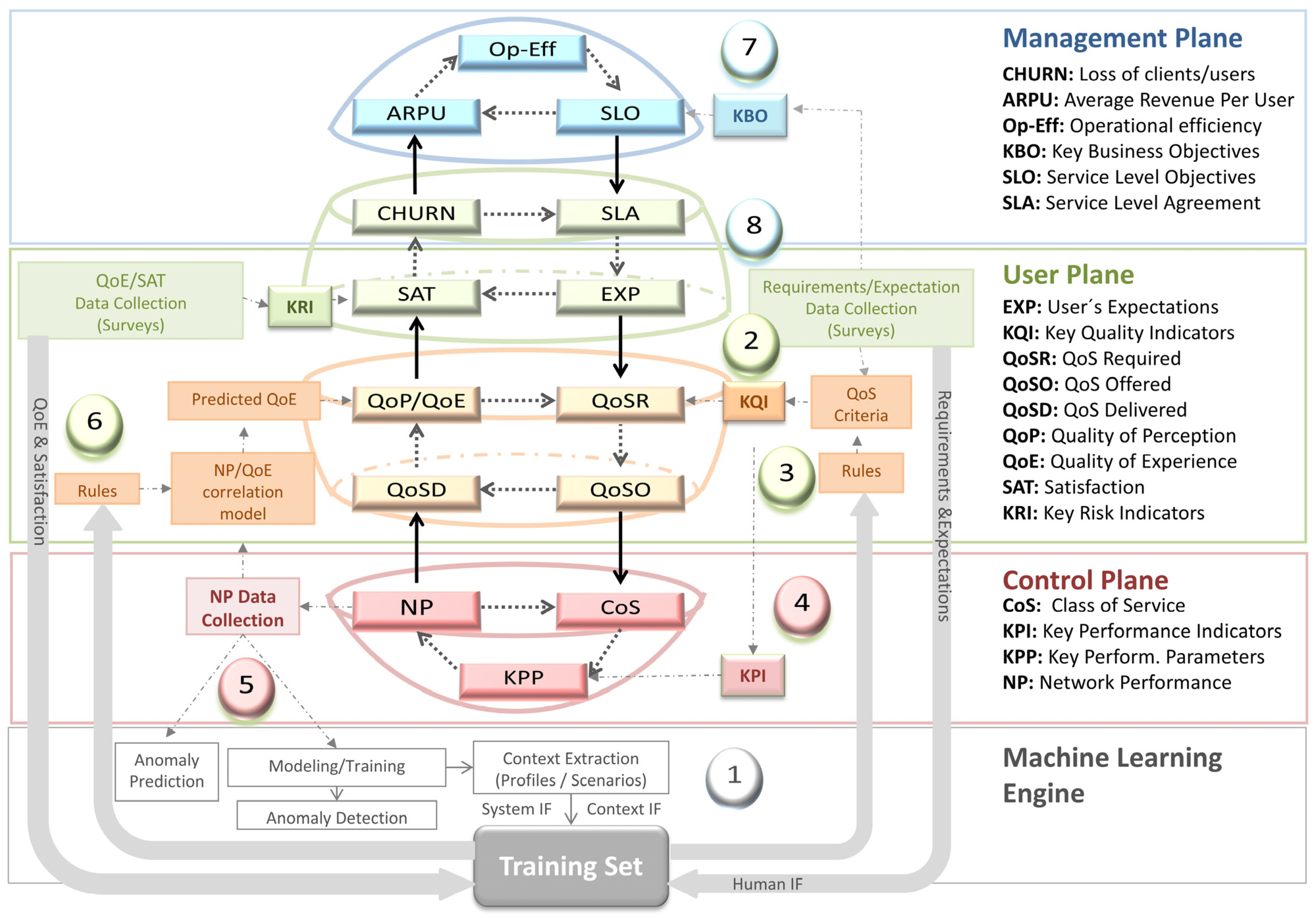
In line with this perspective, and to operationalize the QoXphere framework in real environments, our research group has developed a methodology, as introduced in previous works [
7,
25,
26]. This methodology establishes a structured process for collecting, analyzing, and orchestrating QoS, QoE, and QoBiz indicators based on machine learning techniques, thereby enabling proactive and adaptive management of multidimensional quality. This methodology is illustrated in
Figure 2 and described in [
7].
The QoX methodology explicitly incorporates influencing factors (see point 1 in
Figure 2) as active elements within the methodology (system/context/human IFs). These factors enable operational actions to directly impact organizational outcomes while simultaneously optimizing user experience and service performance.
To achieve this, the approach integrates machine learning techniques within a functional model inspired by ITU-T’s Recommendation Y.3170 [
36] for ML-based QoS assurance, and in line with the most recent ITU-T recommendations on machine learning for future networks [
37].
In direct continuity with these efforts, our recent contribution to ITU-T Study Group 12 [
38], “
Proposal to consider Artificial Intelligence methodologies in the updated base text for the revision of Recommendation G.1000”, reinforces this methodological and conceptual vision. The proposal advocates the inclusion of AI and ML methodologies as core mechanisms for quality assurance in the upcoming revision of G.1000, aligning with the QoXphere philosophy of multidimensional, AI-driven quality governance. This contribution underscores the growing consensus in international standardization that machine learning constitutes not only an operational tool but also a conceptual bridge connecting technical performance, user perception, and business outcomes in a unified framework.
Nevertheless, despite these significant advances, several challenges remain unresolved. Open issues related to the validation of ML-based QoX models across heterogeneous environments still hinder their widespread adoption. These challenges, together with the specific research contributions addressed in this work, are analyzed in detail in the following section.
2.5. Identified Research Gaps and Contribution of This Study
Despite significant progress in the conceptualization of QoS/QoE/QoBiz, and their integration into broader QoX frameworks, several gaps remain in both research and practice. First, most existing approaches are either network-centric or user-centric, but rarely achieve a balanced integration that simultaneously addresses technical, human, contextual, and business dimensions. Second, while influencing factors (IFs) have been identified and incorporated into ITU-T recommendations, their operationalization in real-world deployments is still limited, particularly in complex environments such as campus-wide or high-density Wi-Fi networks. Third, although ML techniques have been increasingly recognized as key enablers, their application to QoX management remains fragmented and task-specific.
This study addresses these gaps by validating a QoX-based methodology [
7], demonstrating ML-enabled multidimensional quality management, and providing empirical evidence from a real-world campus Wi-Fi migration scenario.
3. Methodological Framework
This section presents the methodological framework designed to validate the proposed QoX-based management strategy during the migration of the Eduroam Wi-Fi infrastructure from Wi-Fi 5 to Wi-Fi 6 at the University of the Basque Country (EHU). It describes the materials and methods used to implement and evaluate this approach in a campus Wi-Fi deployment.
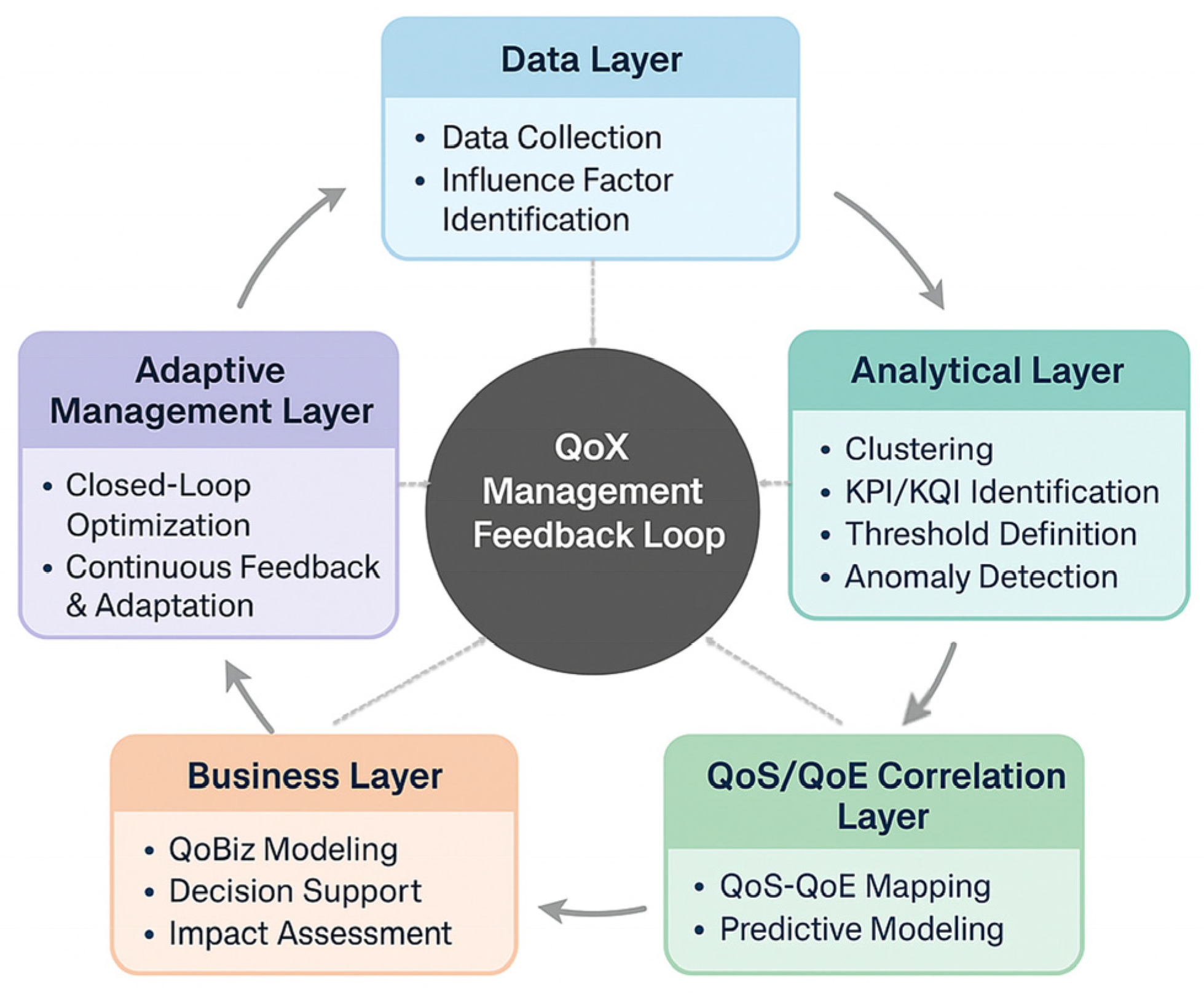
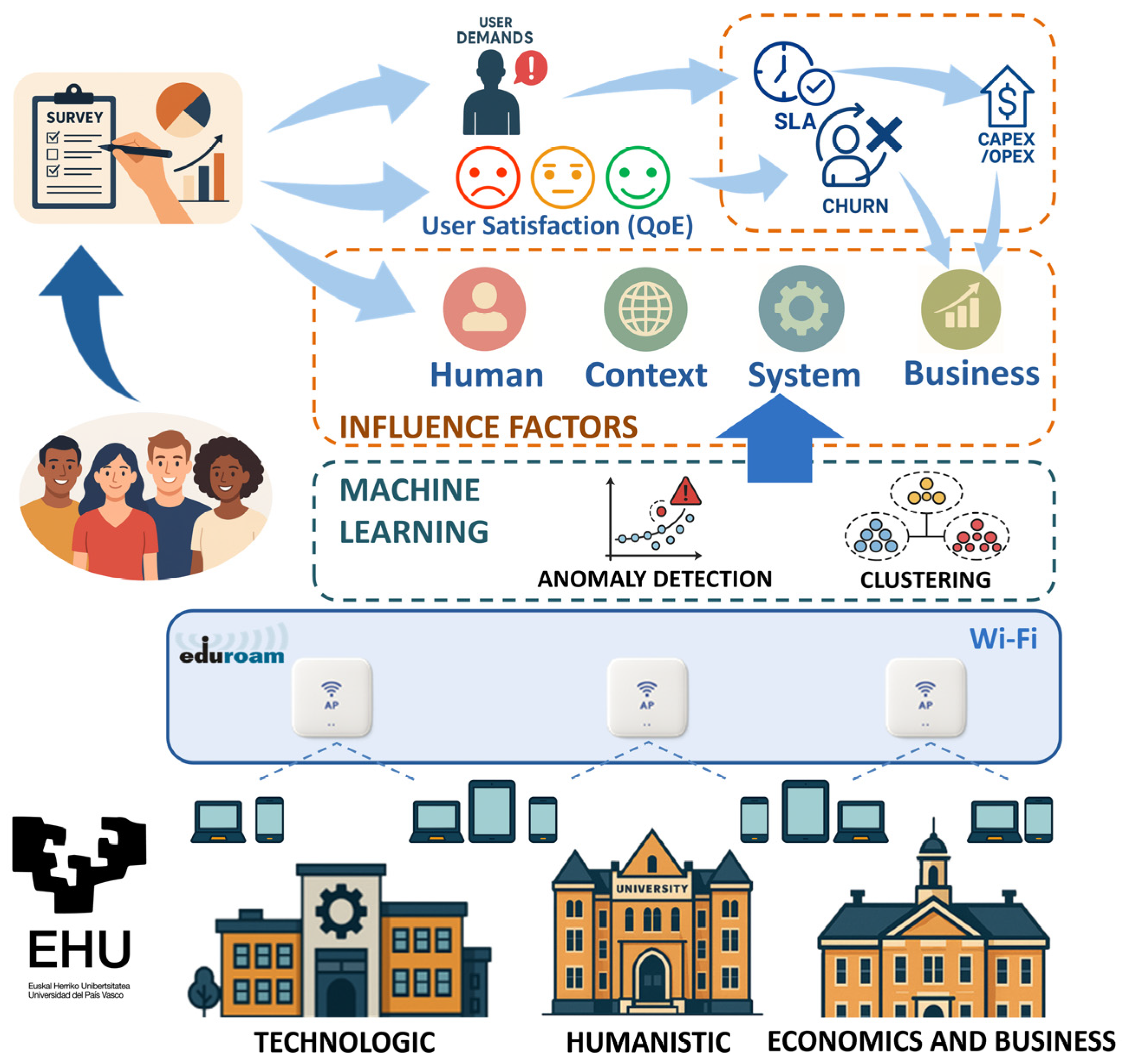
The framework follows a multi-layered, iterative, and feedback-driven structure, inspired by the realimented QoX management methodology of
Figure 2 [
7]. Based on this conceptual model,
Figure 3 represents the methodological instantiation of this model, explicitly mapping each conceptual layer of
Figure 2 into concrete functional components and processes tailored to the Eduroam Wi-Fi migration scenario. Through this correspondence,
Figure 3 translates the conceptual QoX management loop of
Figure 2 into an executable, end-to-end methodological framework suitable for experimental validation in a real campus network.
3.1. Data Layer
This layer focuses on the systematic collection of both network data and user feedback, aiming to identify the factors that influence user experience. This stage is crucial, as it provides the foundation for determining the key quality indicators (KQIs) and key performance indicators (KPIs) to be considered in subsequent analytical processes.
As mentioned in
Section 2.3, the identification of influencing factors (IFs) must account for their variability depending on the underlying technology (e.g., Wi-Fi, 5G), the scenario (e.g., residential, campus, airport), and the user profile. Even within the same environment, such as a university campus, these factors can differ significantly. For instance, influencing factors may vary between humanistic and technological campuses, or according to whether the user is a student or faculty member, as well as depending on the specific location, such as a classroom, laboratory, or library. For this reason, this first phase integrates data collected from both network devices (NP) and user surveys, enabling the extraction of influence factor values across the system, human, context, and business dimensions. This comprehensive dataset provides a multidimensional understanding of the variables that impact user experience and serves as the basis for the analytical layer, where these influencing factors are processed to identify different contexts or profiles, such us specific locations or user groups, and to establish KQIs, KPIs and KPPs of interest for each profile, or even required class of service (CoS), supporting a more precise and adaptive QoX-oriented management. Furthermore, the collected data can be analyzed using unsupervised learning techniques to enable anomaly detection, allowing the system to proactively identify atypical patterns in user experience or network performance. These anomalies may indicate areas of potential degradation and the need for corrective or improvement actions, thereby reinforcing a closed-loop, proactive management approach that continuously adapts to evolving conditions.
In order to support effective decision-making for these corrective and improvement actions, it will also be necessary to collect business-oriented indicators that can measure operational efficiency, enabling the definition and continuous assessment of key business objectives (KBOs) [
39] and service level objectives (SLOs) [
40]. To ensure consistency across all inputs, the relevant data sources should be integrated into a unified repository before the analytical workflow begins.
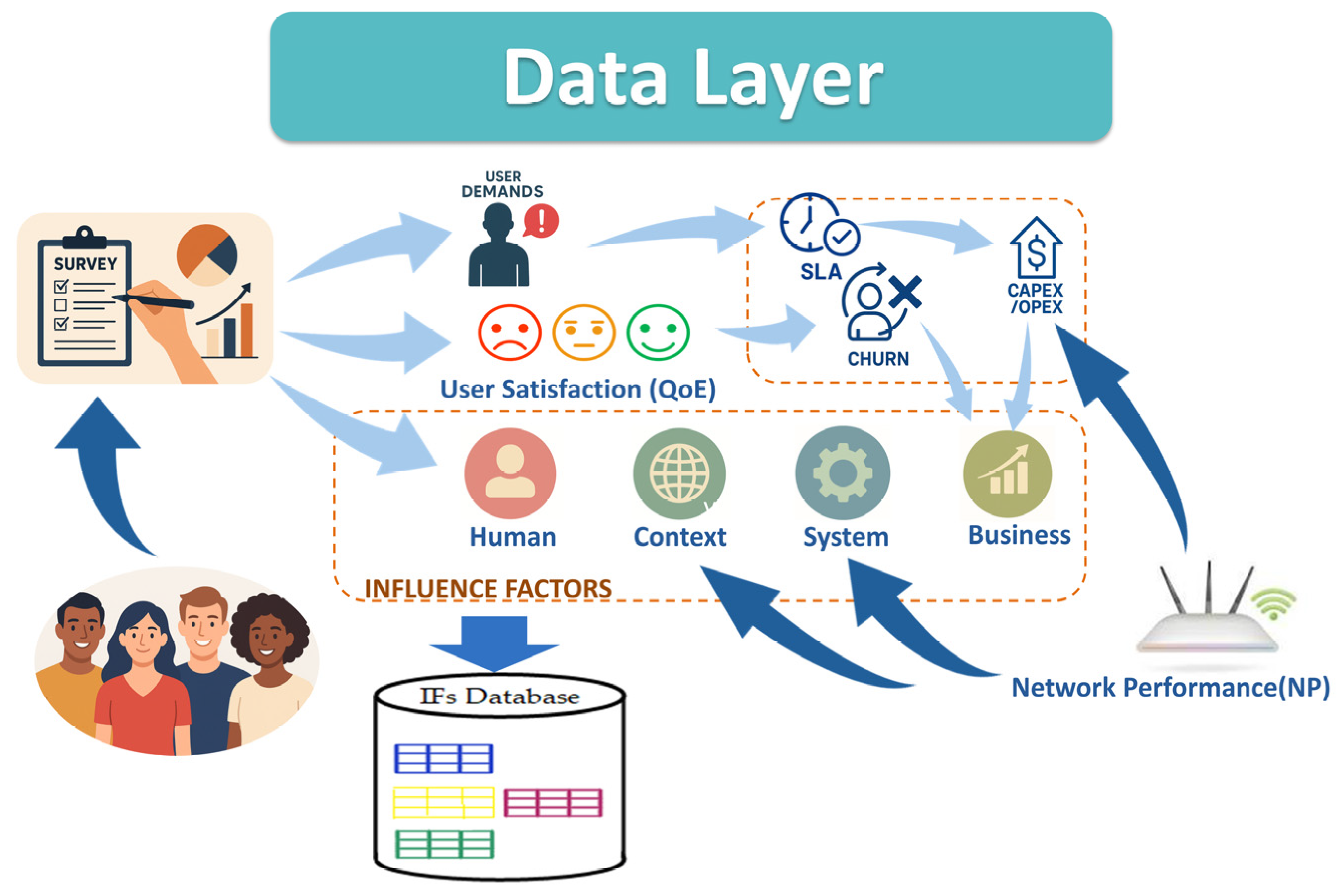
In summary, the goal is to combine heterogeneous data sources, including network devices, user surveys, and business indicators, into a unified dataset that enables both technical and strategic insights, as illustrated in
Figure 4.
To do so, a systematic data processing workflow is recommended, comprising several key steps designed to ensure data consistency, reliability, and interoperability across all input sources:
Steps:
Temporal and spatial alignment: Match network device measurements and user feedback with corresponding timeframes and locations.
Data cleaning: Handle missing values and remove outliers, such as abnormal network performance indicators (e.g., unrealistic throughput, session duration, or traffic volume values) and inconsistent or incomplete survey responses.
Standardization: Normalize units, formats, and scales (kbps, bytes, dBm, satisfaction scores, revenue metrics, etc.) to guarantee comparability.
Anonymization: Ensure compliance with privacy and data-protection regulations if any personally identifiable information is included.
Output:
A structured, interoperable, and analysis-ready dataset, organized across four complementary dimensions:
- ○
System: Objective technical performance metrics obtained from monitoring systems (throughput, bytes sent/received, session duration, SNR, RSSI, etc.).
- ○
Human: User-feedback metrics collected through surveys (age, gender, expectation, experience, satisfaction, etc.).
- ○
Context: Environmental and situational variables (location, device type, time of day, session-time, access technology, etc.).
- ○
Business: Operational and commercial indicators (cost efficiency, CAPEX/OPEX, ARPU, service reliability, operational performance, churn probability, efficiency ratios, etc.).
3.2. Analytical Layer
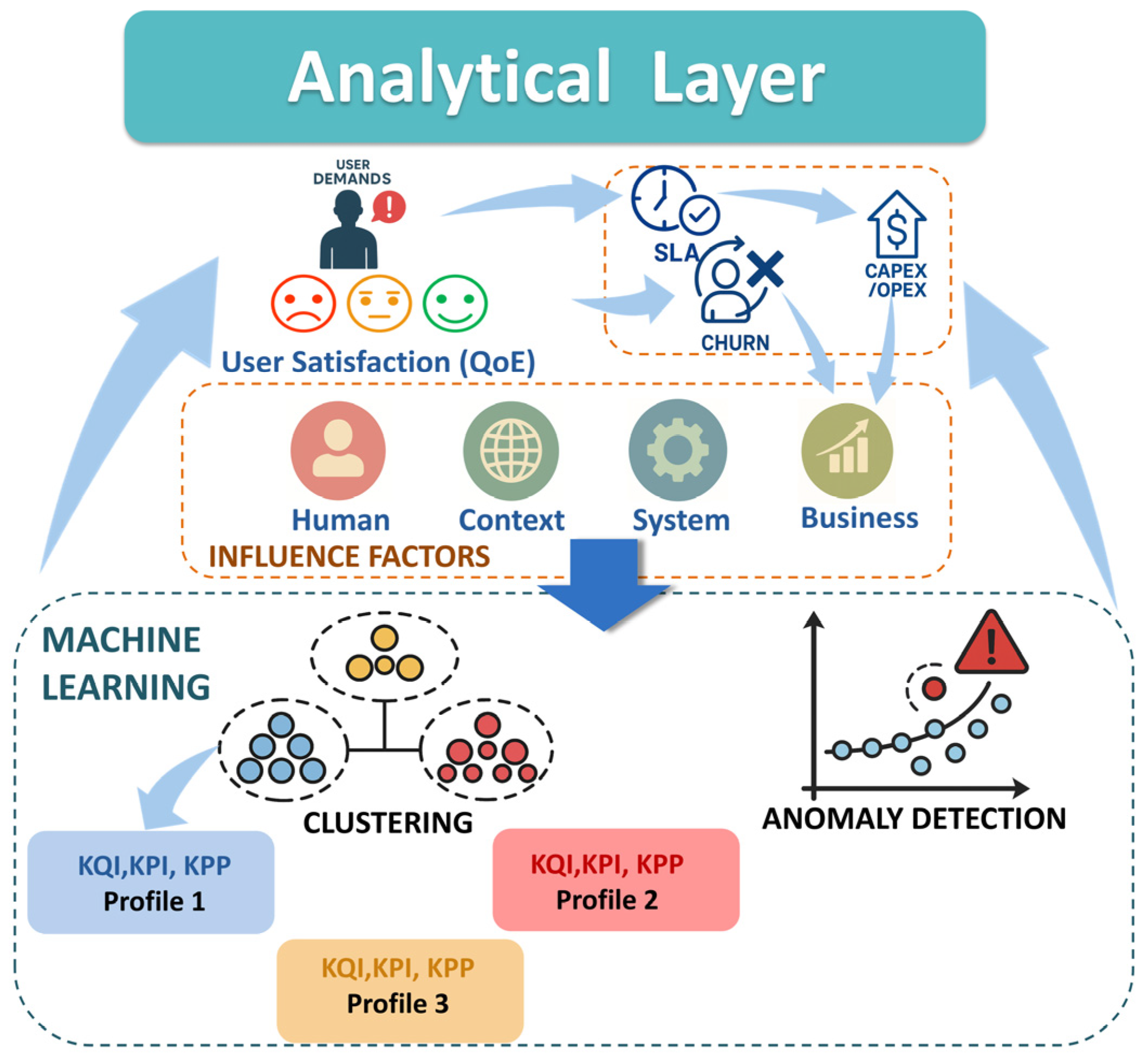
The analytical layer builds upon the dataset generated in the data layer, applying data processing and ML analytical techniques to transform raw information into actionable knowledge. Its primary goal is to extract insights that enable proactive and adaptive management of the network and user experience, in line with business objectives as defined in the QoX-based strategy, as illustrated in
Figure 5.
In this layer, the previously collected influencing factors (system, human, context, and business) are analyzed using a combination of descriptive, diagnostic, and predictive analytics. Through unsupervised learning methods such as clustering or dimensionality reduction, the system identifies distinct clusters or profiles (e.g., groups of users, locations, or usage contexts) with similar behavior or experience patterns. These clusters allow the definition of context-aware influencing factors specifically tailored to each profile, ensuring that performance evaluation and optimization are aligned with the actual diversity of user experiences and scenarios.
Once the relevant influencing factors are established for each cluster, supervised learning and correlation analysis techniques are applied to identify the key quality indicators (KQIs) that are most relevant within each operational context. Based on these KQIs and following standardized frameworks, the corresponding key performance indicators (KPIs) and key performance parameters (KPPs) to be considered for the quality of experience (QoE) assessment within that cluster are determined. This relationship modeling allows the system to understand how network parameters affect user-perceived quality and to determine thresholds or optimal ranges for key parameters. These thresholds are also used to establish appropriate quality of service requested (QoSR) and quality of service offered (QoSO) values, which in turn serve as the foundation for specifying well-aligned key performance objectives (KPOs) based on the service level objectives (SLOs) and service level agreements (SLAs) in the subsequent phase of the management cycle.
Additionally, anomaly detection algorithms are employed to recognize deviations from normal operational or satisfaction patterns. These anomalies serve as early warnings for potential degradations in satisfaction or performance bottlenecks, triggering alerts and suggesting corrective or optimization actions to maintain the desired QoX levels.
In the case study, key indicator relevance is assessed at the cluster level through non-parametric correlation analysis and supervised machine learning, with model performance evaluated using stratified cross-validation and balanced accuracy.
The output of the analytical layer feeds directly into the experience and decision layers, providing them with data-driven insights and adaptive policies that support closed-loop QoX management. In this sense, the analytical layer acts as the intelligence core of the framework, continuously refining its models as new data are collected and user behavior evolves.
Following the methodological structure presented in
Section 3, the ML-based analysis was organized into three sequential stages:
Steps:
- 5.
Segmentation of the operational environment into context clusters: Apply unsupervised ML techniques to the multidimensional dataset (output of data layer) to segment the operational environment into context clusters. This process provides an empirical data-driven foundation for defining relevant contextual and human IFs, which guide the subsequent supervised analysis.
- 6.
Key indicator identification via supervised learning: The IFs identified in the previous step are cross-referenced with user feedback datasets to validate the internal consistency of each context. This enables the identification of the most relevant features (KQIs, KPIs, and KPP) that characterize variations in user experience across contexts.
- 7.
Anomalies Detection: ML mechanisms are applied to KQI/KPI/KPP-derived NP parameters to identify performance deviations, anticipate QoE degradation, and guide proactive QoX management. Both clustering [
41], and outlier-based techniques reported in the literature, such as SVM [
42], Isolation Forest [
43], AutoEncoders [
44], LSTM + CNN [
45], and HDBSCAN [
46], can be applied depending on the nature of the anomalies of interest.
Output:
Extraction of operational contexts and user profiles through data-driven clustering, identification of dominant KQIs and their technical counterparts (KPIs/KPPs) shaping QoE outcomes, and detection of anomalies linked to operational and business indicators.
- ○
Operational contexts/profiles: Identification of distinct usage patterns and their associated key indicators.
- ○
QoS/QoE insights: Determination of the most influential KQIs and their corresponding technical parameters for each cluster, and assessment of their impact on QoE outcomes.
- ○
Anomalies: Detection of operational or commercial irregularities requiring corrective actions, represented through key risk indicators (KRIs).
3.3. QoS/QoE Correlation Layer
This layer addresses the relationship between relevant key parameters or indicators (KPPs/KPIs/KQIs) and user-perceived experience indicators (QoE), enabling the translation of IF measurements into experiential quality metrics (e.g., Mean Opinion Score- MOS). Building on the profiles and clusters identified in the analytical layer, the QoS/QoE correlation layer quantifies how variations in QoS indicators (quality of service delivered—QoSD) are associated with changes in perceived quality (QoE) for each user or context profile.
Cluster-labeled datasets, integrating QoS indicators and subjective values obtained through surveys, are used as the reference for the modeling phase. Prior to model training, these datasets are prepared through basic cleaning and robustness-oriented preprocessing to ensure stable and interpretable QoE modeling results.
In this layer, different modeling approaches may be employed to represent the relationship between QoS parameters and QoE metrics within each operational cluster. These approaches include correlation-based analysis, regression models, and supervised machine-learning techniques, in order to capture both linear and nonlinear dependencies in the data.
Algorithm comparison is performed at the cluster level to assess their suitability for modeling QoE in different usage contexts. Model performance is evaluated using standard error-based metrics and goodness-of-fit indicators, allowing the identification of modeling strategies that provide stable and interpretable representations of QoE behavior across different clusters.
The resulting models provide a robust mapping between QoS indicators and user-perceived performance at the cluster level. This mapping enables the estimation of QoE metrics from objective network data or other influencing factors, reducing the need for continuous, labor-intensive surveys. By leveraging the fitted models, the framework can infer experiential quality metrics across diverse contexts, thereby facilitating scalable, adaptive, and user-centered network management. In addition, this modeling stage enables the definition of QoX-based reference ranges or thresholds for each cluster or operational profile, aligning network performance objectives with experiential and business outcomes. Overall, this multidimensional QoS/QoE mapping supports proactive QoX management by enabling early anomaly detection and facilitating timely corrective actions.
Steps:
- 8.
Input integration: Import KPPs/KPIs/KQIs and QoE metrics from the analytical layer, along with identified user/context profiles.
- 9.
Correlation modeling: Apply supervised ML techniques (regression, neural networks, etc.) trained on user satisfaction data to quantify the impact of QoSD indicators (e.g., throughput, jitter, etc.) on QoE dimensions (e.g., MOS, satisfaction).
- 10.
Mapping generation: Build predictive models translating network-level measurements into user-perceived quality indicators for each profile or scenario.
- 11.
QoX alignment: Define cluster-specific thresholds linking QoS, QoE, and QoBiz objectives to guide adaptive management and optimization policies.
Output:
- ○
Mapping between technical and experiential quality metrics, enabling accurate QoE prediction, proactive QoX management, and the definition of adaptive, user-centered network policies aligned with institutional performance goals.
3.4. Business Layer
The business layer integrates the outputs of the previous layers into a decision-support framework that aligns technical and experiential insights with organizational objectives. This layer ensures that network management actions not only improve QoX but also contribute to the broader strategic and operational goals of the institution.
By incorporating business-oriented key business objectives (KBOs), such as service adoption, cost efficiency, resource utilization, and sustainability metrics, this layer contextualizes technical and experiential outcomes within institutional priorities. The integration of QoX-aware analytics allows decision-makers to evaluate trade-offs between performance, user satisfaction, and cost, promoting evidence-based investment and planning decisions.
In addition, the business layer plays a key role in anomaly management: deviations detected in the analytical and correlation layers. Anomalies, triggered through key risk indicators (KRIs), are escalated to this level, where they are assessed in terms of their business impact. Depending on their criticality, the system triggers corrective action plans or business-level response strategies, ensuring that operational disruptions are promptly mitigated and aligned with institutional priorities.
Moreover, this layer facilitates policy definition and prioritization, ensuring that optimization actions recommended by the analytical and correlation layers are consistent with the university’s (or corporation’s) strategic framework. For instance, improvement efforts might prioritize high-impact areas such as student learning spaces, research laboratories, or high-density lecture halls, where perceived quality directly affects academic performance and user satisfaction.
Steps:
- 12.
Integration: Integrate QoS/QoE correlation results with business indicators (cost, ARPU, churn, efficiency).
- 13.
Impact assessment: Quantify how variations in network and experiential metrics influence operational and economic performance.
- 14.
QoBiz modeling: Define and compute key business objectives, key performance objectives [
39] and service level objectives [
40] (KBOs, KPOs, SLOs) reflecting institutional objectives and trade-offs.
- 15.
Decision support: Generate recommendations for resource allocation, investment, and adaptive policy tuning aligned with QoX targets.
Comprehensive QoX-based business intelligence layer linking technical, experiential, and economic dimensions, enabling data-driven decision-making and sustainable optimization of network performance and institutional outcomes (SLA, CPEX/OPEX…).
3.5. Adaptive Management Layer
The adaptive management layer represents the final stage of the QoX-based framework, closing the loop between monitoring, analysis, and action. It operationalizes the insights derived from the previous layers to enable real-time, proactive, and continuous network optimization. This layer integrates closed-loop control mechanisms capable of dynamically adjusting network parameters, resource allocation, or service configurations based on the observed QoX conditions. By leveraging the QoS/QoE correlation models and the decision rules defined in the Business Layer, it ensures that each adjustment targets measurable improvements in both technical performance and user experience.
The adaptive management process follows an iterative cycle of Monitor → Analyze → Decide → Act, supported by machine learning algorithms and policy-based automation. Anomalies detected in the analytical layer or deviations from QoX thresholds automatically trigger corrective or preventive actions, such as bandwidth reallocation, access point tuning, or service prioritization.
Over time, this continuous feedback process enables self-learning network behavior, where the system refines its models and decision logic according to evolving user needs, environmental conditions, and business goals. This layer thus embodies the proactive, adaptive, and closed-loop nature of the proposed QoX management framework.
4. Case Study: Wi-Fi Migration at University of the Basque Country (EHU)
The proposed QoXphere methodological framework was validated through a real-world case study involving the migration of the Eduroam Wi-Fi infrastructure at the University of the Basque Country (EHU) from Cisco-based Wi-Fi 5 infrastructure (Cisco Systems, San Jose, CA, USA) to Aruba-based Wi-Fi 6 infrastructure (Aruba Networks, Santa Clara, CA, USA) between 2023 and 2025. The deployment comprises multiple faculties and buildings, including areas with heterogeneous network demands such as engineering, humanities, and economics.
Key technological changes introduced by Wi-Fi 6, such as OFDMA, MU-MIMO, and Target Wake Time, were expected to improve throughput, latency, and energy efficiency. However, the coexistence of legacy devices, heterogeneous AP configurations, and varying user densities created a challenging testbed for adaptive QoX management.
As clarified in the Introduction, the objective of this work is not to perform a feature-level or protocol-layer performance evaluation of individual Wi-Fi 6 mechanisms. Instead, this case study aims to validate that a user- and context-aware QoX management methodology is required to properly capture service quality in modern wireless environments characterized by rapidly evolving and cooperating technologies, increasingly demanding services, and continuously rising user expectations. In this sense, the Wi-Fi 6 migration is used as a real operational validation scenario where the combined effect of next-generation wireless capabilities is reflected through multidimensional QoX indicators rather than isolated PHY/MAC metrics.
4.1. Evolution of Wi-Fi Technologies and Implications for QoX Management
Wi-Fi 6 (IEEE 802.11ax) introduces efficiency-oriented mechanisms designed for high-density and heterogeneous wireless environments, including OFDMA, bidirectional MU-MIMO, and Target Wake Time (TWT). These mechanisms improve spectral efficiency, reduce contention, and enhance energy efficiency, particularly in scenarios with large numbers of simultaneously connected devices. Recent surveys [
47,
48] highlight that Wi-Fi 6 introduces multiple MAC and PHY enhancements aimed at improving throughput, reliability, and efficiency in dense deployments.
The evolution continues with Wi-Fi 7 (IEEE 802.11be), which introduces multi-link operation [
49], wider channel bandwidths [
50], and enhanced coordination mechanisms [
51] to support lower latency and higher reliability. In particular, multi-link operation enables simultaneous transmission across multiple bands or channels, allowing more flexible spectrum utilization and improving throughput, reducing latency, and increasing robustness.
In addition, coordinated multi-AP transmission and joint resource scheduling mechanisms are designed to improve spatial reuse and reduce contention in dense, overlapping-cell environments, enhancing airtime efficiency [
52]. Wider channel bandwidths and higher-order modulation schemes further increase the achievable per-user throughput in high-density scenarios [
53], supporting higher capacity and improved spectrum utilization during demand peak conditions.
Looking beyond Wi-Fi 7, early research directions toward Wi-Fi 8 [
54] are focusing on ultra-reliable wireless operation, deterministic latency behavior, and the deeper integration of artificial intelligence for adaptive radio resource management and network optimization. Such features are particularly relevant in heterogeneous scenarios requiring alignment between technical performance indicators and service-level objectives. Deterministic wireless operation enables predictable performance for demanding applications, while AI-native radio resource management enables real-time adaptation to device capabilities, traffic dynamics, and environmental conditions. This capability is especially important in heterogeneous environments with a high proportion of legacy devices, where dynamic configuration strategies are required to adapt to changing traffic conditions and service requirements. This behavior aligns with the closed-loop QoX approach, in which network control actions are driven by multidimensional quality targets rather than by static radio configurations, facilitating a tighter mapping between Service Level Agreements (SLA), KBO objectives, and radio-level operation [
55,
56].
As a result of the continuous improvements in radio-level performance enabled by recent Wi-Fi evolutions and AI-driven optimization, QoE is increasingly determined by context-dependent interactions between network behavior, device capabilities, applications, and user expectations. In this scenario, QoX-based methodologies become essential to ensure that these technological advances effectively translate into measurable user-centric, service-level, and business-oriented quality improvements. Rather than reducing the need for multidimensional management, the additional degrees of freedom introduced by Wi-Fi 7 and future Wi-Fi 8 systems reinforce the role of closed-loop, ML-assisted QoX frameworks as the operational layer required to convert advanced PHY/MAC capabilities into consistent QoE and QoBiz gains across heterogeneous deployment scenarios.
In order to evaluate how these technological capabilities and multidimensional quality relationships materialize under real operational conditions, the following subsection describes the deployment scenario used for the empirical validation of the proposed QoX methodology.
4.2. Scenario Description
The case study focuses on the Eduroam Wi-Fi network at the University of the Basque Country (EHU). Eduroam (Education Roaming) is a federated authentication-based wireless service widely adopted across the academic and research community.
The initial Wi-Fi 5 deployment exhibited diverse traffic patterns profiles, providing a representative environment for evaluating the QoXphere methodology, as detailed in [
7]. Notably, the anomalies identified prior to migration [
23], together with the QoX-based analysis conducted using the proposed methodology [
7], supported the rationale for upgrading the network to Wi-Fi 6, in alignment with the strategic roadmap defined by the EHU ICT Vice-Management Office. Following the migration, the improved network capacity created a favorable scenario to validate the proposed QoX framework.
Nevertheless, the EHU Eduroam infrastructure spans three university campuses (Bizkaia, Gipuzkoa, and Álava), operates in three languages (Basque, Spanish, and English), and comprises approximately 20 faculties and schools distributed across 68 buildings, including 13 libraries, serving around 45,000 students and 5600 lecturers and researchers. Given the large scale and heterogeneity of this environment (including diverse architectural layouts, user densities, academic activities, and mobility behaviors), a full-campus empirical validation was deemed impractical for a preliminary study. Therefore, the analysis was delimited to three faculties with contrasting academic and infrastructural profiles (summarized in
Table 1).
Focusing on these three representative faculties allowed the study to acquire a cross-section of user usage profiles (students, professors, and researchers), device heterogeneity, and diverse space typologies (lecture halls, libraries, labs, and offices). This selection provided a manageable yet rich observational platform for applying the QoXphere framework, allowing identification of anomalies prior to migration and the extraction of critical influencing factors and key indicators under real operational conditions.
Additionally, the three selected faculties exhibit distinct temporal usage patterns that further contribute to the heterogeneity of the operational environment. In the Faculty of Education, teaching activity is predominantly concentrated in the morning, a pattern that becomes clearly reflected in the exploratory analysis of session and traffic data.
In contrast, both the Faculty of Economics and Business and the Bilbao School of Engineering sustain high levels of academic activity throughout the entire day due to the large number of degree programs, laboratory sessions, and extended timetables.
As expected in university environments, traffic is predominantly concentrated from Monday to Friday; however, occasional activity is also observed on Saturday mornings, particularly in faculties located in Bilbao, driven by seminars, scheduled academic events, the use of study rooms, and access to research laboratories.
As stated before, the network migration to Wi-Fi 6 was undertaken to improve overall performance, reliability, and the user experience while addressing the limitations of the previous Wi-Fi 5 deployment, which our previous studies [
7,
23,
25,
26] had identified. This deployment relied on heterogeneous and partly unsupported hardware, lacked compatibility with modern client devices, and could no longer provide adequate coverage for increasing service demands. As the case study demonstrates, this migration was necessary, and Wi-Fi 6 provides a modernization path by offering higher capacity, improved efficiency, and better long-term sustainability across diverse usage contexts.
Table 2 provides a summary of the key differences between the former Wi-Fi 5 network and the upgraded Wi-Fi 6 implementation.
To evaluate these improvements under real operational conditions, a data-driven monitoring and assessment process was implemented. This process integrated network performance metrics, user feedback, and organizational indicators, providing a multidimensional view of service quality and management efficiency, as illustrated in
Figure 6.
Due to the non-commercial nature of the Eduroam deployment, some elements of the generic QoXphere implementation methodology (
Figure 2) were simplified. For instance, class of service (CoS) differentiation was not applied since the Eduroam service provides uniform access for all academic users.
Regarding the QoBiz dimension, a comprehensive assessment has not yet been performed because the Wi-Fi 6 deployment was only recently completed, and the post-migration operational dataset is still being consolidated, limiting the availability of stable evidence for longitudinal business-oriented analysis.
Moreover, the evaluated scenario corresponds to a publicly funded university ecosystem, where business-related indicators such as average revenue per user (ARPU) or CHURN metrics are not applicable. Therefore, QoBiz is currently approximated using operational proxies, including the number of deployed access points, the evolution of connected clients, and qualitative feedback from technical staff.
These adaptations demonstrate the methodological flexibility of the QoXphere framework and its applicability to heterogeneous academic environments where institutional efficiency, sustainability, and service continuity prevail over profit-oriented business metrics.
4.3. Data Collection and Instrumentation (Data Layer)
Data collection was conducted in parallel with the Wi-Fi migration process in three different types of faculties: technological, humanistic, and economics-oriented, selected to capture heterogeneous usage profiles in terms of user behavior, spatial design, and device diversity.
The monitoring campaign spanned both the pre-migration scenario, based on a Cisco Wi-Fi 5 infrastructure, and the post-migration deployment, relying on an Aruba Wi-Fi 6, enabling comparative analysis under real operational conditions.
Three main data categories were collected to build the validation datasets:
Network Performance Metrics: Client, Access Point (AP), traffic, and radio performance metrics (e.g., bytes sent and received, RSSI (dBm), average throughput …), collected from the network management and monitoring platforms deployed in each scenario.
User Feedback: Subjective data were collected through surveys capturing user satisfaction, expectations, authentication experience, and perceived service effectiveness.
Business Indicators: In this public university context, only operational (non-financial) indicators were considered.
The network objective data collected for both the Wi-Fi 5 and Wi-Fi 6 scenarios were carried out under a formal collaboration agreement between the university and the NQaS research group, which ensured secure handling of the information and the pseudo-anonymization of all user-related fields.
The subjective user feedback and operational network data collection processes (for Wi-Fi 5 and Wi-Fi6 scenarios) received formal approval from UPV/EHU Ethics Committee for Research Involving Human Subjects (CEISH), under Approval Report M10_2023_184 issued on 24 July 2023.
4.3.1. Network Performance Dataset Description
Network performance data were collected during two representative academic periods: from September to October 2023 and from February to March 2025. This covered both Wi-Fi 5 and Wi-Fi 6 operation and coincided with periods of teaching activity at the university to ensure realistic traffic conditions.
Table 3 summarizes the evolution of the access point infrastructure distribution before and after migration. The deployment aimed to increase the number of APs in areas with previously identified coverage limitations, as demonstrated in previous case studies [
7,
23,
25], and optimizing spatial distribution, to better support high-density usage scenarios.
Network performance data were collected from wireless controllers and network management platforms through aggregated daily reports to ensure scalability and operational viability, given the volume of telemetry generated by the Aruba AirWave system and the Cisco Prime system in the pre-migration scenario. These reports provide session- and access point-level summaries of traffic, client activity, and radio performance indicators during the study period.
In the post-migration scenario, there was a clear increase in daily traffic volume, the number of concurrently connected clients, and the variety of devices observed. These trends reflect the greater capacity of the Wi-Fi 6 network and the progressive adoption of newer wireless protocols. In particular, the data indicate sustained growth in the number of concurrent users per access point and higher aggregate throughput levels during peak usage periods, compared to the pre-migration situation.
Exploratory analysis highlights the relevance of aggregated usage indicators, specifically, the maximum number of concurrent clients and the average aggregated throughput over the study period, as effective descriptors of network load and utilization. The analysis also reveals heterogeneous usage patterns across faculties, including temporal differences and unequal post-migration growth.
In particular, the Faculty of Education shows traffic mainly concentrated during morning periods and no significant increase in the number of users and connections, compared to the pre-migration scenario, in contrast to the high increase observed in other buildings.
Additionally, several network performance variables, such as average throughput, display heavy-tailed distributions, motivating the adoption of robust preprocessing and clustering techniques in subsequent analytical phases.
Based on the network performance data collected from the Wi-Fi 6 monitoring infrastructure, a set of system- and context-level indicators was identified to support subsequent analysis.
Table 4 summarizes some of the KPPs and the KPIs derived, including new parameters and metrics calculated during the analysis, which will be relevant in the next layers. These indicators characterize traffic volume, radio conditions, session dynamics, and access context, and constitute the set of candidate system-level variables used in the subsequent analytical stages.
4.3.2. User Feedback Data Collection
The collection of user-related data was carried out following the guidelines approved by the ethics committee, and both the participant’s identity and the device used were pseudonymized via a unique code, linking survey data to corresponding network sessions, ensuring GDPR compliance and privacy protection.
The feedback campaign aimed to capture both human and contextual factors, including expectations and subjective perceptions. Two survey campaigns were conducted, one before and one after the network migration, following the same general approach described in the pre-migration study [
7]. Each campaign consisted of two phases: (1) a set of connection tests performed by participants, and (2) an online experience survey designed to collect demographic information, usage behavior, expectations, and perceived experience. This structure allowed the comparison of user feedback before and after the migration, linking objective network data with subjective perceptions. Participants were first asked to connect to the institutional Wi-Fi network and generate traffic collected by the network controllers, simulating typical academic activities such as video calls and access to web-based university services (e.g., Moodle, digital library, Microsoft Teams). In a second step, participants completed an online questionnaire implemented in Microsoft Forms, consisting of approximately 30 questions covering: (i) basic demographic information (e.g., age group, role), (ii) Wi-Fi usage behavior (frequency of use, services accessed, typical location), and (iii) user expectations and perceived experience, including priorities and the perceived importance of different service attributes (e.g., security, coverage).
The participant pool included undergraduate and postgraduate students, faculty members, researchers, and administrative staff from the three faculties involved in the case study. Surveys were distributed through institutional mailing lists across the different faculties, with periodic reminder messages sent to encourage participation, particularly among teaching and research staff whose schedules are less compatible with in-person data collection. The main objective of this dissemination strategy was to obtain a heterogeneous user sample, ensuring representation of the main university profiles (students, faculty, and administrative staff) and a wide range of ages and experience levels. This approach aimed to capture the diversity of usage patterns and perceptions present within the university community.
Although the survey-based QoE assessment yielded fewer responses than initially expected, it exceeded the sample size obtained during the Wi-Fi 5 phase. This reflects a limitation of in situ data collection in operational environments, where user participation cannot be controlled as in laboratory or simulated conditions. Nevertheless, this trade-off is acceptable in real-world validation studies, where the authenticity of user feedback prevails over sample size optimization achievable in controlled experimental settings.
Despite this limitation, the resulting dataset provides a balanced and diverse sample, reflecting differences in population size and Wi-Fi usage context across faculties.
Table 5 summarizes the distribution of valid survey responses by faculty/campus and user role. The respondent sample covers a wide range of age groups and includes participants of different genders, reflecting the demographic diversity of the university community.
Survey responses also provide insight into the relative importance users assign to different service aspects. Coverage emerges as the most critical key quality indicator, rated as important by approximately 95% of participants, followed by network speed and the ease of connecting to the Wi-Fi service. It is noteworthy that connection procedures were also identified as one of the main difficulties experienced by users, a finding that is consistent with the analysis of Wi-Fi–related incidents reported at the institutional level.
4.3.3. Business Indicators
In the analyzed academic environment, the QoBiz dimension was approximated using operational indicators instead of traditional commercial metrics. Since the evaluated scenario corresponds to a publicly funded university ecosystem, business indicators such as ARPU or customer churn are not applicable.
Instead, the QoBiz dimension was approximated through operational and institutional key business indicators (KBIs) focused on efficiency, service reliability, and support workload. These indicators provide a complementary third perspective within the QoX analysis, linking network-level improvements to observable organizational outcomes in real operational conditions.
To conclude this phase, the data layer analysis provides a consolidated and analysis-ready dataset integrating technical network measurements, user feedback, and operational indicators collected under real campus conditions. The chosen faculties served as the operational clusters for validation, capturing the diversity of academic activities and network usage patterns while keeping the study manageable within a live campus environment. The resulting dataset constitutes the input for the analytical layer, where influencing factors and QoS/QoE relationships are examined in detail.
4.4. ML-Driven Data Analysis (Analytical Layer)
The integrated dataset, including network performance, user feedback, and operational session indicators, was analyzed using the multilayered structure defined in
Section 3.2 (analytical layer). The purpose of this phase was to extract representative operational contexts and usage profiles that could serve as a structural basis for subsequent key indicator analysis and anomaly detection after the Eduroam network migration from Wi-Fi 5 to Wi-Fi 6.
Data preprocessing comprised temporal–spatial alignment, removal of non-informative or invalid sessions, unit normalization, and user-data anonymization in accordance with the ethical approval (CEISH Ref. M10_2023_184), as described in the data layer. Once cleaned, the dataset was processed through three sequential analytical stages: (1) context extraction and influence-factor identification, (2) derivation of key indicators (KQIs, KPIs, KPPs), and (3) anomaly detection.
In general, the operational dataset can be represented as a set of multidimensional observations, as shown in Equation (1):
where each observation
groups heterogeneous influencing factors associated with the system, human, contextual, and business dimensions. Each feature vector is composed of numerical and categorical variables:
with
. This structure reflects the mixed nature of the data from network monitoring systems and contextual and user information.
In real-world Wi-Fi environments, this data exhibits asymmetric distributions, heavy tails, and non-stationary behavior, which invalidates classic parametric assumptions and motivates the use of robust, data-oriented approaches. This highlights the need for similarity measures and learning strategies capable of handling heterogeneous feature types and non-Euclidean data spaces, as instantiated in the case study. Therefore, each analytical stage is associated with a specific machine learning technique, selected according to the analytical objective addressed at that stage.
Table 6 provides a structured overview of the machine learning techniques used in each analytical stage. This analytical layer focuses on structuring the dataset through exploratory and unsupervised machine learning techniques, while supervised modeling of the QoS/QoE relationship is addressed separately in the subsequent correlation layer.
4.4.1. Context Extraction and Influencing Factors (IFs) Identification
The identification of operational contexts is formulated as an unsupervised partitioning problem of the set D into disjoint subsets, as shown in Equation (3):
Since clusters can exhibit non-convex shapes, unbalanced cardinalities, and significant overlap, clustering is conceived as a mechanism for discovering latent patterns that are robust against noise and outliers, rather than as an idealized geometric segmentation. These latent contexts constitute the structural basis for subsequent QoS/QoE modeling and anomaly interpretation within the QoX framework.
Based on this, in the first analytical stage, the cleaned dataset was analyzed using unsupervised learning techniques to extract operational contexts and usage profiles from session-level data. A two-stage clustering procedure was applied to identify intrinsic behavioral structures that reflect actual usage patterns and serve as the contextual basis for subsequent indicator analysis and anomaly detection.
Given the mixed, numerical, and categorical nature of the session-level dataset, the similarity between observations was calculated using Gower’s similarity coefficient (Equation (4)),
where
denotes the partial similarity associated with the
k-th feature and
is a binary weight accounting for missing or non-comparable values. The corresponding dissimilarity matrix (
) was subsequently used as input for the clustering stage.
To ensure analytical robustness, the comparative analysis of unsupervised clustering approaches prioritized structural consistency and stability over metric optimization. Primary emphasis was placed on each method’s ability to (i) capture dense behavioral regions, (ii) represent continuous usage gradients, and (iii) isolate residual or extreme sessions without imposing artificial partitions, as required for real-world session-level Wi-Fi data. As a second-order criterion, interpretability from an operational and QoE-oriented perspective was considered, ensuring that the extracted profiles could be meaningfully analyzed and linked to higher-level quality indicators.
Across the evaluated buildings and temporal windows, centroid-based and model-based approaches generated acceptable internal validation metrics only when limited to a small number of clusters, with silhouette values generally remaining below 0.45 and Davies–Bouldin indices exceeding 1.2 in most configurations. This behavior is consistent with the heavy-tailed and heterogeneous nature of Wi-Fi session data and was accompanied by reduced stability under complete data partitioning, as reflected by variability in the Adjusted Rand Index (ARI) across repeated executions.
In contrast, density-based and hierarchical approaches showed greater structural coherence and resilience to noise. In particular, HDBSCAN consistently achieved higher silhouette values (typically 0.60–0.67), Davies–Bouldin indices in the range of 1.3–1.6, and a limited proportion of residual sessions (noise ratio below 10%, and often below 5%). These characteristics indicate their suitability for operational contexts extraction without imposing predefined cluster boundaries.
A two-stage clustering strategy was selected based on its ability to consistently capture heterogeneous usage behaviors while preserving structural coherence and operational interpretability. The exploratory stage relied on density-based clustering using HDBSCAN with Gower similarity to account for mixed feature types and variable-density behavioral regions. This was followed by hierarchical agglomerative clustering with Ward linkage on a reduced set of numerical features to consolidate the exploratory structure into compact and interpretable operational profiles.
The resulting profiles were analyzed to characterize their behavioral properties and to identify the dominant influencing factors (IFs) governing Wi-Fi usage in each building. Across the three campus locations, a common set of representative operational indicators: average throughput, downlink traffic ratio, downlink traffic volume, SNR, and RSSI, was considered to capture the key aspects of network behavior, while allowing location-specific differences in its discriminative relevance.
Table 7 provides an overview of the clustering models evaluated in this stage, including the feature space, main configuration parameters, validation metrics, and their analytical role within the proposed framework.
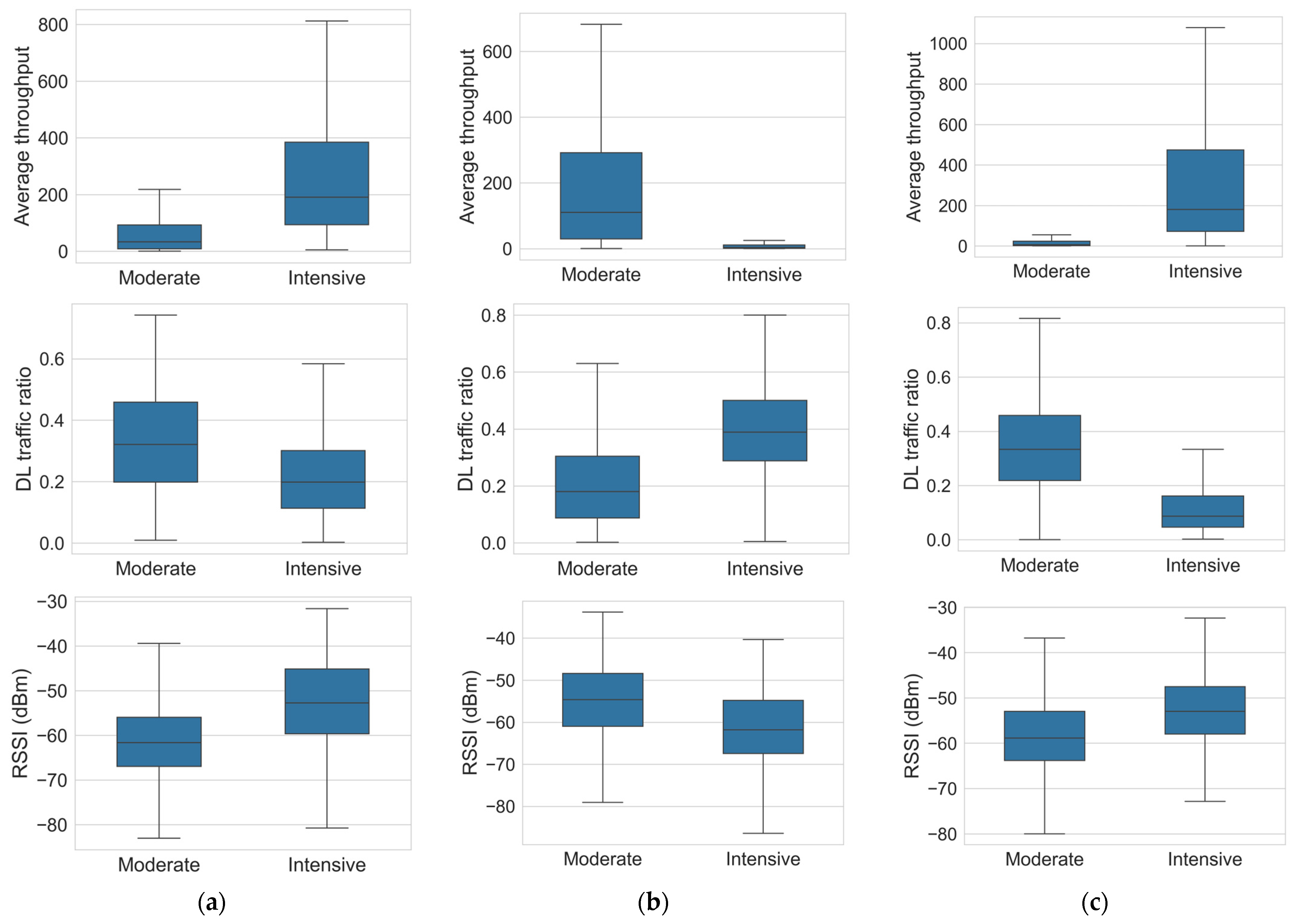
To complement the statistical validation,
Figure 7 illustrates the distribution of selected representative operational indicators across the extracted operational profiles. Based on the Kruskal–Wallis analysis, average throughput, downloaded data volume, and downlink traffic ratio consistently exhibit the highest H statistics across all analyzed buildings, confirming their dominant role in distinguishing between moderate and intensive usage profiles. While the same indicators are considered across locations, their relative discriminative relevance varies depending on the operational context.
Although partial overlap between profiles is observed for all variables, reflecting the intrinsic variability of real-world Wi-Fi usage, the median values and interquartile ranges exhibit consistent and statistically significant differences across profiles. These differences are corroborated by the non-parametric Kruskal–Wallis test, which confirms that all selected features significantly discriminate between operational profiles across the three buildings (p ≪ 0.001).
While
Figure 7 focuses on a reduced subset of representative behavioral indicators for visualization purposes, the identification of dominant influencing factors is based on the full set of statistically significant variables obtained from the clustering results and subsequent non-parametric analysis.
Table 8 summarizes the operational profiles identified in each building, together with their dominant influencing factors reported in decreasing order of discriminative relevance.
Overall, the extracted operational profiles reflect context-specific usage behaviors that are used as input for the subsequent derivation and analysis of key indicators.
4.4.2. Key-Indicator Derivation (KQIs, KPIs, KPP)
Building on the operational contexts extracted in the previous step, the next analytical stage focuses on identifying the key indicators that best characterize variations in performance and quality within each operational profile. The underlying premise is that identical network-level metrics may have different implications for QoE depending on the operational context. Consequently, indicator relevance is assessed at the cluster level, ensuring that subsequent QoE analyses are grounded on the dominant influencing factors governing each usage profile.
The candidate indicator set includes session-level technical metrics and derived usage parameters, which are analyzed in conjunction with subjective QoE variables obtained from the survey campaign. Indicator relevance was assessed using a two-step procedure applied independently within each operational cluster.
First, correlation-based screening was conducted between candidate technical metrics and the available QoE variable (MOS) using non-parametric association measures. Spearman’s rank correlation was adopted as the primary statistic to capture monotonic relationships under non-Gaussian distributions and limited sample sizes, while Pearson correlation was computed as a complementary linear reference. This step enabled the identification of candidate indicators exhibiting consistent associations with perceived quality.
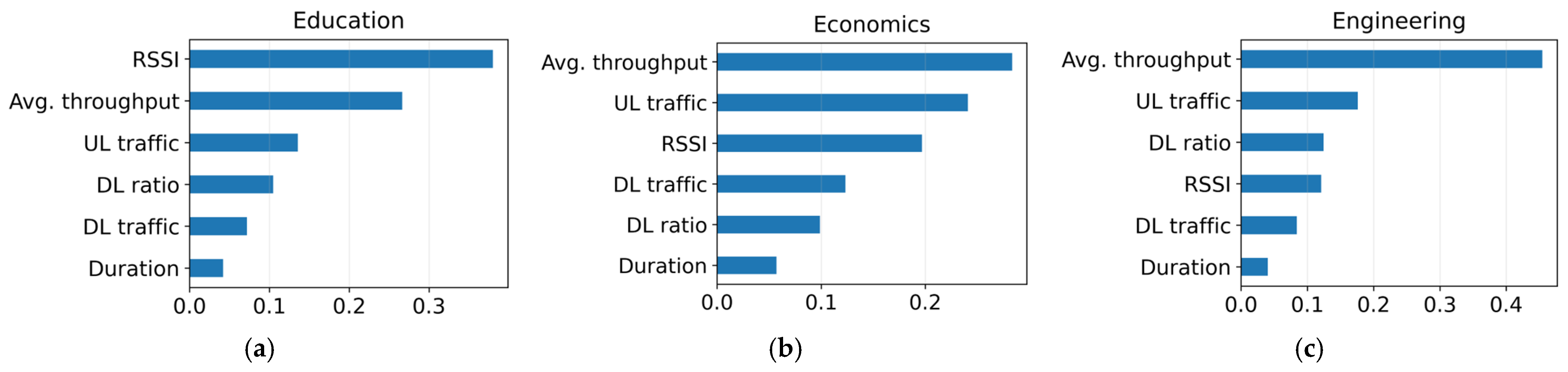
Second, to capture multivariate effects and context-dependent relevance patterns beyond pairwise associations, a cluster-wise discriminative analysis was performed using a Random Forest Classifier (RFC) trained to separate MOS ranges (low/medium/high) from technical metrics. Model performance was evaluated using stratified k-fold cross-validation and reported in terms of balanced accuracy, ensuring robustness under class imbalance. Feature relevance within each operational profile was derived from the resulting feature-importance rankings.
Figure 8a–c illustrates the comparative feature-importance distributions obtained for the three analyzed buildings under the intensive usage profile.
To complement this visual analysis,
Table 9 summarizes the results of the context-dependent QoS/QoE relevance analysis across intensive operational clusters, together with the corresponding cross-validated balanced accuracy.
The relevance analysis focuses on intensive or heterogeneous usage clusters, where sufficient variability in both objective performance and perceived quality is observed and where subjective QoE samples are predominantly concentrated. Clusters characterized by sporadic or low-demand usage exhibit limited QoE variability and were therefore excluded from the comparative summary.
4.4.3. Anomaly Detection and Impact Assessment
Within the proposed framework, anomaly detection is interpreted as the identification of observations that deviate significantly from expected operational behavior within a given context. Formally, an observation
is considered anomalous if it does not belong to the operational manifold learned for its associated cluster:
where
represents the region of the feature space that concentrates the normal behavior of context
.
According to this formulation, anomalies correspond to deviations from expected behavior within each context, rather than isolated extreme observations. These deviations may be associated with increased operational risk or reduced service consistency and are analyzed within the QoX management process.
This context-dependent interpretation directly guides the anomaly detection strategy, which is designed to preserve the natural variability of large-scale campus Wi-Fi environments while isolating behavior that is inconsistent with stable operational conditions.
In practical terms, anomaly detection was implemented to identify a small number of sessions associated with potential operational issues, while avoiding the overdetection of normal variability inherent to large campus Wi-Fi environments. The analysis followed a hierarchical, context-aware approach.
First, the HDBSCAN algorithm identified the overall data structure, distinguishing two dominant operational profiles in each building, along with residual low-density clusters and a small subset of sessions labeled as noise. These residual patterns represent non-dominant and heterogeneous usage behaviors and were used to define normal operation rather than being interpreted as operational failures.
Based on this definition of normality, anomaly detection was performed using the Local Outlier Factor (LOF) algorithm, applied exclusively to sessions belonging to the dominant operational clusters. This strategy enables the identification of anomalous behavior in contexts that would otherwise be stable.
Across the three analyzed buildings, the proportion of LOF-detected anomalies remained limited (around 2–3%), indicating overall stable performance after the migration. Although the rate of anomalies was comparable across locations, the operational interpretation of these anomalies differed between buildings, reflecting context-dependent conditions.
Alternative cluster-aware anomaly detection approaches based on one-class Support Vector Machines (SVM) were also evaluated. However, due to their sensitivity to heterogeneous usage patterns, these methods generated a substantially higher number of operationally irrelevant anomaly detections and were therefore not retained for the operational analysis.
Overall, this anomaly detection stage provides a complementary operational perspective by isolating context-dependent deviations that may require targeted intervention, while preserving the integrity of subsequent indicator analysis and QoS/QoE correlation stages.
Based on the contextualized dataset produced by the analytical layer (including operational profiles, dominant indicators, and filtered anomalous sessions), the next stage focuses on modeling the relationship between the network performance and the user’s perceived experience.
4.5. QoS/QoE Correlation
Within this layer, the relationship between the objective network and the subjective quality indicators is expressed as a context-dependent functional mapping:
where
represents a potentially nonlinear function that describes how variations in quality of service (QoS) indicators translate into changes in quality of experience (QoE) within a specific operational context
. This formulation explicitly captures the dependence of perceived quality on the operational context, avoiding global oversimplifications associated with global, context-agnostic models.
Building on the operational profiles identified in the analytical layer, QoE modeling is performed at the cluster level, allowing both the learning algorithm and the set of explanatory indicators to be optimized for each usage context.
Rather than searching for a single global model, this layer evaluates alternative modeling approaches to capture linear and nonlinear QoS/QoE relationships, obtaining reliable and operationally interpretable mappings from real network data.
4.5.1. Data Integration and Feature Alignment
The QoS/QoE analysis was conducted on the dataset obtained from the analytical layer, combining objective QoS indicators (KPPs/KPIs), perceived QoE metrics (KQIs/MOS), and contextual information (e.g., timestamp, access point, and location. Prior to modeling, standard preprocessing steps were applied to ensure comparability across metrics and to reduce redundancy among predictors.
As detected in the feature relevance analysis conducted in the analytical layer (step 6), the influence of QoS indicators on QoE is context-dependent, with different technical and contextual factors playing a dominant role across operational profiles.
4.5.2. Correlation Modeling and QoE Prediction
To characterize the relationship between QoS indicators and perceived quality, QoE modeling was performed independently for each operational cluster. This cluster-aware approach is motivated by the context-dependent relevance of QoS indicators, as aggregated analyses are unable to capture such heterogeneity.
The modeling process focused on intensive usage clusters, where variations in network performance are expected to have a measurable impact on user experience. Given the limited number of real user-feedback samples, model robustness was prioritized over model complexity.
QoE modeling is performed separately for each building, allowing the selection of different feature combinations according to the dominant QoS/QoE relationship identified in each context.
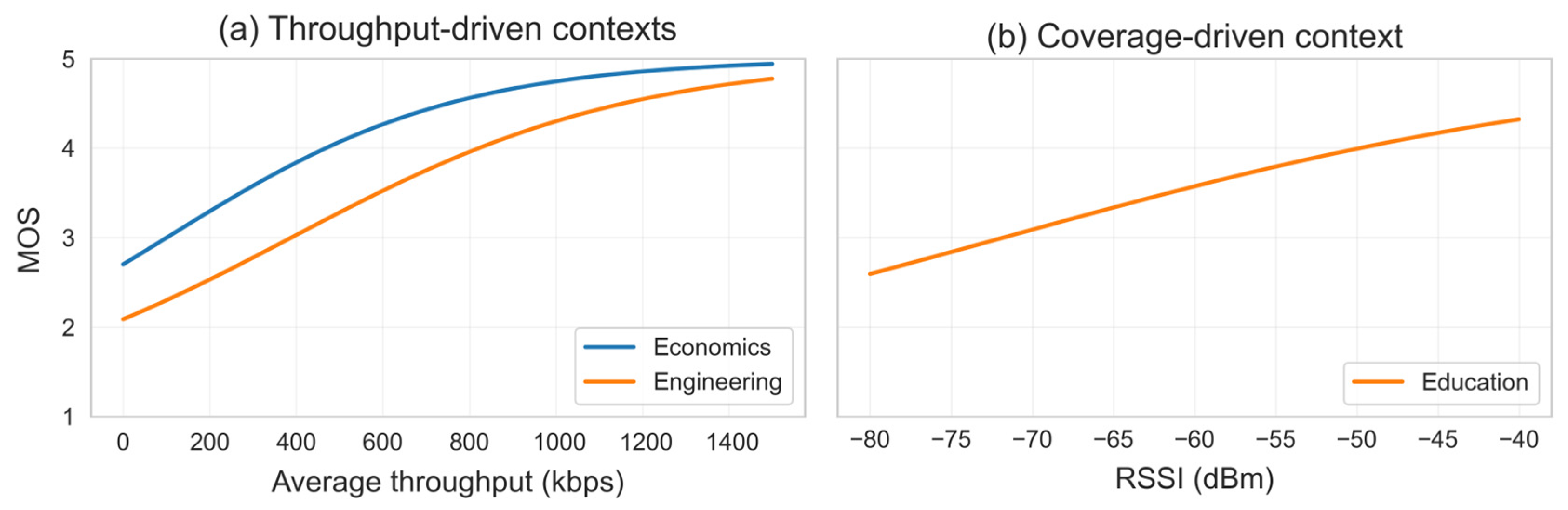
Initially, univariable baseline models were considered to establish interpretable reference relationships. Average session throughput was used as the primary explanatory variable for the Bilbao School of Engineering and the Faculty of Economics and Business, where capacity-related constraints dominate intensive usage profiles. Meanwhile, for the Faculty of Education, radio signal quality (RSSI) was identified as the primary indicator, reflecting a greater influence of coverage-related conditions. Subsequently, additional indicators were incorporated in scenarios where a single parameter does not sufficiently capture the variability of QoE.
Table 10 reports the cross-validated performance of the baseline models for each operational context, with all metrics expressed as mean ± standard deviation across k-fold cross-validation. The stability of the results across folds indicates robust model behavior.
As a first step, the relationship between the dominant QoS indicator and perceived quality was explored using simple regression models (linear and logarithmic) to establish an interpretable baseline for QoE modeling. This also ensures comparability with previous analyses performed on Cisco-based datasets in the pre-migration scenario [
7].
The results in
Table 10 show that the reference parametric models capture a clear overall trend between the dominant QoS indicator and perceived quality across all analyzed contexts. While Spearman’s rank correlation coefficient remains stable within each building, error-based metrics (MAE and RMSE) and low R
2 values indicate limitations in terms of predictive accuracy. This indicates that a significant fraction of the observed MOS variability cannot be explained by univariable formulations.
These limitations highlight the need for more flexible modeling approaches capable of representing saturation effects and context-dependent QoE responses.
To partially address these limitations, a sigmoid regression was employed as a nonlinear extension of the baseline models to explicitly represent saturation effects in the QoS/QoE relationship. This provides a reference for QoE behavior under improved network performance, facilitating the identification of deviations from the expected QoE trend before moving on to more complex multivariable correlation models.
Figure 9 shows the sigmoid QoE curves for the analyzed buildings, revealing a monotonic QoS/QoE relationship, with a context-dependent saturation behavior, reinforcing the limitations of purely linear formulations.
The analyzed baseline models establish interpretable reference relationships and confirm the suitability of the chosen indicators characterizing the overall QoS/QoE trend. However, they do not allow for an accurate estimation of QoE/MOS under real operating conditions, motivating the use of more flexible multivariable and nonlinear models.
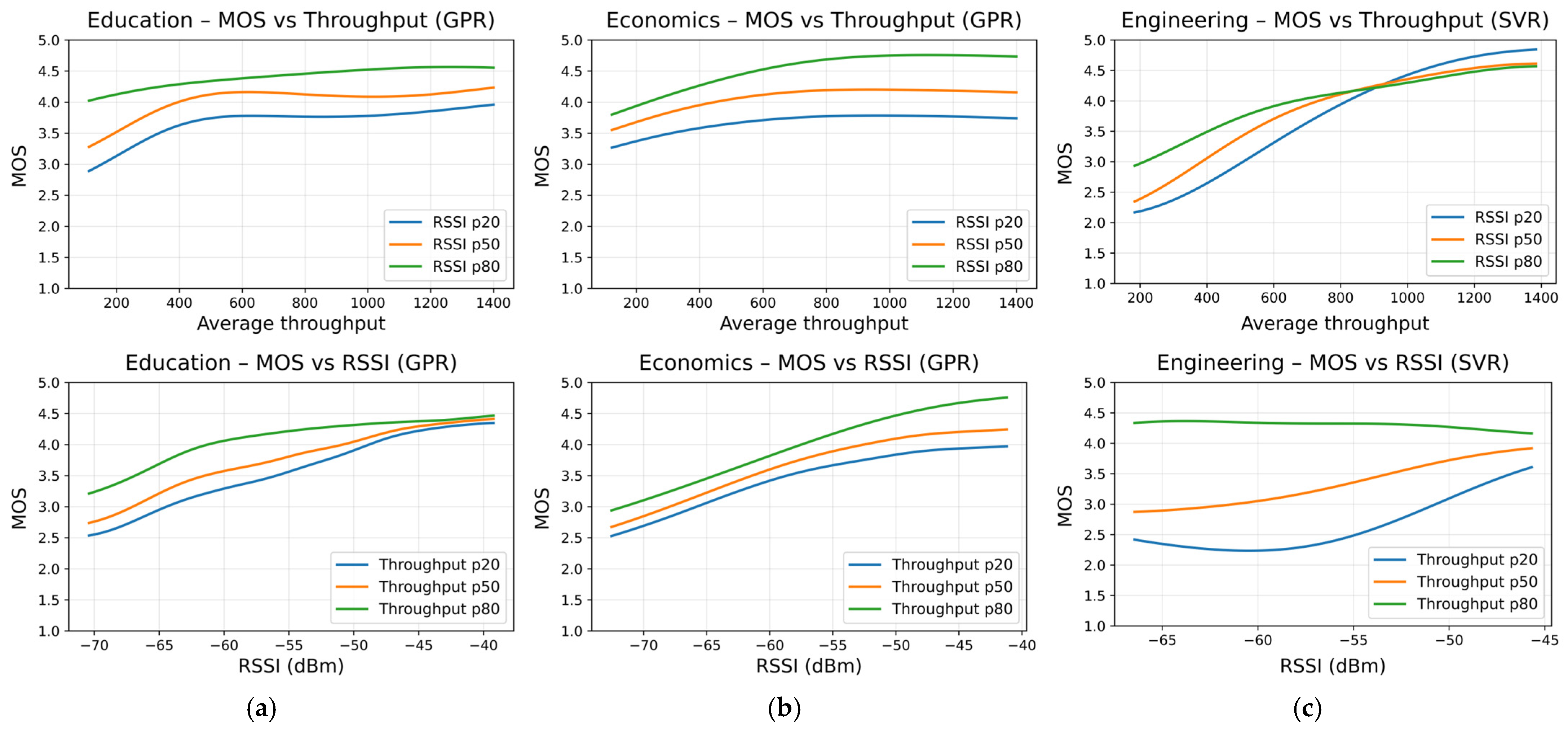
Based on the limitations observed in univariable models and nonlinear formulations, a model selection phase was undertaken to improve QoE prediction using multivariable approaches. A comparative evaluation of different regression paradigms was performed using k-fold cross-validation to identify robust and consistent configurations under different operational contexts.
In this phase, different regression techniques were evaluated, including Gaussian Process Regression (GPR), Support Vector Regression (SVR), and Feed-Forward Neural Networks (FF-NN), considering different kernel and hyperparameter configurations, as well as different combinations of capacity, radio quality, technology, and usage indicators. In all cases, variable selection was based on the importance ranking obtained in step 6 of the analytical layer, avoiding the inclusion of indicators with marginal or redundant contributions.
While GPR models achieved the lowest prediction errors in Education and Economics, differences compared to other approaches were not always significant. In the Engineering building, RSSI showed very low relevance for QoE (Spearman ρ = 0.16), while traffic-related metrics dominated, favoring the use of SVR models based on throughput and traffic volume. In the case of GPR, both Radial Basis Function (RBF) and Matern kernel were considered during model selection.
Table 11 summarizes the final models retained for each building, along with their predictive performance under cross-validation.
For reasons of visual consistency and comparability between buildings, this same percentile representation strategy is also applied to the Engineering Building (EIB). Although in this case the RSSI does not emerge as a dominant indicator of QoE and has not been incorporated into the final multivariable model, its inclusion in the visualization allows maintaining a homogeneous criterion in the presentation of the curves and facilitates the qualitative comparison of the QoS/QoE patterns between the different contexts analyzed.
Figure 10 presents the QoS-QoE estimation curves obtained from the selected regression models reported in
Table 11, using percentile-based visualization (p20, p50, p80) for each building, enabling a comparative assessment of context-dependent sensitivity and saturation effects.
4.5.3. Validation and Interpretation
The QoS/QoE correlation analysis developed in this section provides a consistent validation of the context-aware modeling approach adopted within the QoXphere framework. Across the three buildings analyzed, the results confirm that similar network performance conditions can lead to significantly different levels of perceived quality, depending on the operational context, usage patterns, and dominant influencing factors. For example, in the Engineering building, equivalent throughput values are associated with high MOS dispersion, reflecting application heterogeneity and traffic intensity, while in the Education building, perceived quality is primarily determined by radio coverage conditions.
Cross-validation results demonstrate that the proposed models can consistently infer QoE from network telemetry within each operational context, capturing stable relationships between dominant QoS indicators and perceived quality, without requiring continuous collection of subjective feedback. Although the models are trained and evaluated on the same dataset using k-fold cross-validation, the stability observed across different folds supports the robustness of the identified QoS/QoE relationships and their suitability for comparative and interpretive analysis. From a methodological standpoint, this layer produces a set of clusters and context-specific QoS/QoE mappings, which allow the translation of delivered network performance into expected ranges of perceived quality.
Far from proposing a single global model, the results highlight the need to define context-dependent thresholds and sensitivities, reinforcing the limitations of aggregated approaches in highly heterogeneous campus environments.
Therefore, the QoS/QoE correlation process constitutes a fundamental quantitative pillar in the validation of the QoXphere framework and the proposed methodology. The results establish a solid analytical foundation for higher-level interpretation and decision support, without requiring the collection of additional data beyond available network telemetry and MOS samples obtained through surveys.
4.5.4. QoX Alignment
Building on the validated QoS/QoE mappings, the final stage focuses on the alignment of technical performance with perceptual and operational objectives.
To conclude this part of the analysis, it is important to note that, within the framework of QoX alignment (step 11 of the methodology), the results of the QoS/QoE correlation layer enable the objective and context-dependent definition of operational thresholds, without resorting to arbitrary values. Specifically, these thresholds can be derived from adjusted QoS/QoE mappings, identifying regions of high sensitivity and regions of perceived quality saturation. For example, inflection points or “knee points” can be determined from the QoS/QoE curves in dominant indicators (such as throughput or RSSI), which define the range beyond which further QoS increases produce marginal benefits in terms of MOS.
Additionally, the percentile-based representation allows for the establishment of specific thresholds for different context levels, such as poor, moderate, or favorable coverage scenarios. Furthermore, classifying MOS into quality ranges facilitates the identification of QoS boundaries associated with perceptual transitions relevant from the user’s perspective. These criteria provide a quantitative basis for linking technical objectives (QoS), perceived experience (QoE), and institutional management criteria (QoBiz), supporting the definition of adaptive policies and resource prioritization at higher levels, even though their operational implementation is beyond the scope of this case study.
4.6. Business Considerations (QoBiz)
Although the QoXphere framework includes a dedicated business-related dimension (QoBiz), a full QoBiz assessment has not been addressed in this work. This decision is mainly motivated by two factors. First, the Wi-Fi 6 deployment in the EHU’s Eduroam network has been completed only recently, and therefore, the post-migration dataset is still in the process of being consolidated. As a result, the available evidence does not yet allow for robust longitudinal conclusions regarding institutional business impact. Second, the evaluated environment corresponds to a non-commercial and publicly funded university ecosystem, where traditional business indicators (e.g., ARPU, churn, or commercial revenue metrics) are not applicable. Instead, business considerations in this context must be interpreted through operational and institutional efficiency indicators.
Despite these constraints, preliminary evidence already suggests a positive institutional impact resulting from the migration. Specifically, a reduction in Wi-Fi–related incidents and helpdesk requests was observed after the transition to Wi-Fi 6. A summary of this evolution is provided in
Table 12, which supports the hypothesis that service stability and operational efficiency improved as a direct consequence of the network upgrade. This reduction is especially relevant considering that the number of connected users and devices increased during the same period, which would normally imply higher demand and, therefore, more support workload.
Qualitative analysis of the requests and incidents recorded by the support team indicates that a significant portion of cases are related to user device configuration issues, especially during initial connection or reconfiguration processes after changing credentials, rather than structural deficiencies in the Wi-Fi network. Incidents directly associated with coverage or capacity problems are infrequent and have decreased significantly compared to the pre-migration period.
In the Faculty of Education, the observed QoE limitations are not primarily attributable to network capacity, but to a combination of structural, behavioral, and environmental factors. Several classrooms have been acoustically insulated in recent years, increasing wall attenuation and limiting radio propagation from corridor-located access points. As a result, Wi-Fi 6 performance gains are partially constrained by building characteristics rather than by protocol or hardware limitations.
Additionally, persistent negative user perception originating in the pre-migration period has affected Eduroam adoption in this building, promoting alternative connectivity practices such as personal mobile hotspots and unmanaged wireless devices. These behaviors contribute to increased interference and a higher prevalence of 2.4 GHz usage under constrained coverage conditions, as observed in degraded sessions.
This behavior is consistent with both the results of user surveys and the identification of dominant QoS/KQI indicators in the previous analysis, where parameters associated with radio quality emerge as the main explanatory factors for the perceived experience in this context. These findings indicate that, in this context, technical upgrades alone are insufficient and that specific actions (such as relocation of access points, coverage-oriented redesign, and user awareness campaigns) are required to fully realize the benefits of migrating to Wi-Fi 6.
Finally, beyond technical performance improvements, migration results also highlight the importance of user adoption strategies. Although Eduroam provides secure and standardized connectivity for academic users, its potential is not always fully exploited in all campus scenarios. In particular, certain environments, such as classrooms and teaching areas, could benefit from targeted awareness campaigns to promote the proper use of Eduroam and reduce reliance on alternative or less optimal connectivity solutions. These actions may further enhance user experience and reduce support demand, reinforcing the long-term institutional benefits of the migration.
Overall, the integration of operational proxies and institutional indicators constitutes a first step toward QoBiz-oriented evaluation. Future work will extend this analysis once Wi-Fi 6 operation becomes fully established, enabling a deeper QoBiz characterization supported by longer-term datasets and more stable operational trends.
4.7. Integration into the QoXphere Operational Cycle
The results obtained in previous subsections operationalize the adaptive management layer introduced in
Section 3.5, demonstrating how the insights extracted from multidimensional analysis can be translated into concrete, QoX-driven management actions.
Based on the identified influencing factors and the ML-derived operational profiles, the adaptive management process enables context-aware decision-making, where optimization strategies are dynamically adjusted according to the dominant quality drivers of each cluster. In clusters where throughput and traffic volume are the primary QoE determinants (e.g., intensive usage profiles), optimization actions may prioritize capacity-oriented measures such as access point densification, channel reallocation, or load-balancing policies. Conversely, in coverage-sensitive contexts, such as the Bilbao Faculty of Education, radio-level adaptations (AP relocation, transmit power tuning, cell overlap optimization, or band-steering policies) become the primary effective levers for improving perceived quality.
The cluster-aware approach also supports selective monitoring and proactive management, allowing network operators to focus on the most relevant indicators for each operational context instead of relying on static, one-size-fits-all KPIs. This capability is particularly valuable in large-scale academic networks, where heterogeneity in usage patterns, device types, and spatial distribution is intrinsic. By continuously updating cluster definitions and indicator relevance, the framework’s adaptive management layer facilitates an iterative optimization loop aligned with evolving demand and environmental conditions.
Overall, the case study demonstrates that technology upgrades alone are not sufficient to guarantee consistent quality improvements. The QoXphere operational cycle provides a structured mechanism to translate multidimensional analysis into context-aware optimization actions, closing the loop between measurement, modeling, and corrective action in a scalable and data-driven manner.
5. Results and Analysis
This section consolidates the results obtained across analytical and correlation layers to provide a QoX-oriented interpretation of the Wi-Fi 6 migration. The objective is to assess how improvements observed across the different layers contribute to service quality under real operational conditions, and why these improvements vary across operational contexts.
5.1. Network Performance Improvement
From a technical perspective, the migration to Wi-Fi 6 improved robustness, capacity, and stability across the evaluated buildings. The network supported more concurrent clients per access point, higher aggregated throughput, and more homogeneous radio coverage. These improvements were particularly evident in high-density environments such as the Faculty of Economics and Business and the Bilbao School of Engineering. OFDMA and MU-MIMO mechanisms contributed to improved spectrum efficiency and reduced contention, resulting in more homogeneous performance across intensive usage profiles.
These enhancements occurred despite a growth in device density and more demanding applications, confirming that the Wi-Fi 6 infrastructure effectively addresses the main limitations of the previous Wi-Fi 5 deployment. However, these improvements were not uniform across operational contexts, as detailed below.
5.2. Operational Profiles and KPI→KQI Mapping (From the Analytical Layer)
Unsupervised analysis shows that the same behavioral feature set characterizes usage across buildings, but dominant influencing factors are context-dependent. In the Bilbao School of Engineering, profiles are differentiated by instantaneous usage intensity, with average throughput and downloaded volume as the most discriminative features, consistent with a technically demanding and heterogeneous environment.
In contrast, the Faculties of Education and Economics exhibit more stable, sustained connectivity patterns, where cumulative traffic and session persistence are more relevant.
These empirical profiles underpin indicator selection and supervised modeling.
Table 13 translates the dominant technical KPIs into KQIs that are directly related to user-perceived quality, emphasizing capacity, radio conditions, and traffic profile as the convergent dimensions whose relative weight varies by context. It is important to note that average throughput is an Aruba-reported session metric derived from the aggregated traffic and reflects the effective capacity and performance for each one.
These results consolidate three convergent KQI dimensions: service capacity, radio conditions, and traffic profile, whose relative influence is context-specific.
5.3. Context-Dependent QoS/QoE Relationships and Context-Dependent Saturation
Supervised modeling confirms that these technical gains translate into measurable improvements in user perception, in a strongly context-dependent manner. Baseline univariable models (
Table 10) capture a clear monotonic QoS/QoE trend in all buildings, with stable Spearman rank correlation (ρ ≈ 0.53–0.68). However, the relatively low coefficients of determination (R
2) indicate that univariable formulations explain only a limited fraction of MOS variability, particularly in heterogeneous environments.
Multivariable models (
Table 11 and
Figure 10) significantly improve predictive performance and reveal context-dependent drivers, consistent with the profiles above.
Education and Economics: GPR models with radio features achieve the lowest prediction errors. However, MOS values are highly concentrated (≈50% between 3.3 and 4.2), leading to saturated average behavior when variables are fixed at mean levels. Percentile-based visualizations (RSSI p20/p50/p80) are therefore used to condition throughput–MOS relationships.
Engineering: RSSI shows very low relevance (Spearman ρ = 0.16), while throughput and Bytes_DL dominate. Consequently, RSSI was excluded from models, and the SVR model was selected, aligning with intensive usage patterns.
Building specific QoS/QoE curves captures sensitivity and saturation:
Education: Strong RSSI dependence, with early saturation around −50 dBm, indicating a coverage-driven QoE regime.
Economics: Intermediate behavior; both RSSI and throughput contribute significantly, with gradual saturation without a clear threshold.
Engineering: MOS depends primarily on throughput, saturating progressively at high capacity.
These differences confirm that QoS/QoE relationships must be interpreted at the cluster level rather than globally.
5.4. Anomaly Detection and Operational Impact
Anomaly detection based on the Local Outlier Factor (LOF) algorithm further corroborates the overall post-migration improvement while highlighting context-dependent limitations across buildings.
In Engineering and Economics buildings, low anomaly rates are consistent with the resolution of pre-migration coverage deficiencies, achieved through increased access point density and refined radio planning, indicating predominantly sporadic degradations.
In contrast, the Faculty of Education exhibits persistent anomalies linked to classroom coverage constraints. Acoustic insulation and increased wall attenuation, combined with corridor-based access point placement, significantly constrain effective radio propagation within classrooms. Anomalies are disproportionately associated with 2.4 GHz connections, even among Wi-Fi 6-capable clients, indicating that the remaining performance issues are primarily propagation-driven rather than protocol-driven. Moreover, anomalous sessions in this building exhibit durations more than twice as long as normal sessions, suggesting sustained performance degradation rather than transient connectivity instability. These anomalies are concentrated in low-radio-quality contexts, reinforcing the coverage-sensitive nature of QoE variability in this environment.
Operationally, migration combined with targeted optimization aligns with a 34% reduction in Wi-Fi-related helpdesk incidents, demonstrating measurable improvements in service stability and support workload, despite increased demand.
5.5. Persistent QoE Variability in the Faculty of Education
The Bilbao Faculty of Education represents the most illustrative case of non-uniform post-migration improvement.
Despite the migration to Wi-Fi 6, variability in this building remains strongly associated with radio conditions rather than capacity limitations. Regression modeling results and percentile curves confirm early saturation behavior and high sensitivity to RSSI, evidencing a coverage-driven regime.
As previously noted, structural characteristics of the building, particularly acoustic insulation and increased wall attenuation, limit effective radio propagation from corridor-based access points. Consequently, improvements in protocol efficiency and capacity do not translate uniformly into perceptual gains.
User behavior further amplifies this effect. Persistent negative perception originating in the pre-migration period has reduced Eduroam adoption, encouraging the use of personal hotspots and unmanaged wireless devices. These practices increase interference and are associated with higher 2.4 GHz usage under constrained coverage conditions, reinforcing degraded radio environments.
This combination of structural attenuation, behavioral factors, and band selection explains why technical upgrades alone do not guarantee homogeneous QoE improvements.
From a technological perspective, these findings highlight the relevance of the emerging mechanisms defined in Wi-Fi 7 and Wi-Fi 8. In environments with limited coverage, such as the Faculty of Education, Wi-Fi 7 mechanisms (e.g., 320 MHz channels and 4096-QAM) are primarily aimed at increasing maximum capacity and spectral efficiency. However, their impact may be limited when performance variability is dominated by structural propagation constraints. In this context, the coordinated multi-AP operation and the ultra-high reliability features planned for Wi-Fi 8, together with AI-native radio resource management capabilities, are oriented toward enhancing reliability and coordinated operation in dense, interference-prone scenarios, which are conceptually aligned with the type of variability observed in this study.
Taken together, these results demonstrate that the QoXphere framework captures the multidimensional impact of Wi-Fi 6 migration, linking infrastructure improvements to context-dependent QoE behavior and measurable operational gains. The findings confirm that technology upgrades alone do not ensure homogeneous experiential outcomes and highlight the importance of context-aware modeling and radio planning in large-scale academic environments.
6. Conclusions
This paper presented a comprehensive validation of an ML-driven QoX management framework applied to the real-world migration of a large university Wi-Fi network from Wi-Fi 5 to Wi-Fi 6. By integrating QoS, QoE, and operationally oriented QoBiz indicators within the QoXphere framework, the study demonstrates that multidimensional quality management is both feasible and operationally valuable in complex, heterogeneous academic environments. In this context, machine learning emerges as a key enabler of QoX governance, providing the analytical capability to model context-dependent influencing factors and to move beyond isolated performance metrics toward structured, data-driven decision support.
The results show that the Wi-Fi 6 migration led to consistent and measurable improvements in network capacity, performance stability, and user-perceived quality, even under increasing demand and device heterogeneity. More importantly, the proposed methodology provides the analytical means to explain these improvements through context-aware influencing factors and ML-based correlations, rather than relying solely on isolated performance metrics.
The persistent coverage-driven QoE variability observed in the Faculty of Education suggests that coordinated multi-AP operation and AI-native mechanisms envisaged in Wi-Fi 7 and Wi-Fi 8 are conceptually aligned with the type of heterogeneous deployment conditions analyzed in this study.
From a methodological standpoint, the study confirms the scalability and flexibility of the QoXphere framework. Its ability to adapt to non-commercial scenarios, by replacing traditional revenue-driven metrics with operational and institutional indicators, demonstrates its applicability beyond classical enterprise or service-provider environments. The reduction in support workload and the improved perception of service stability further underline the institutional value of QoX-driven management.
While this study establishes a solid baseline for multidimensional QoX assessment, it is important to acknowledge the current scope of the work and to identify opportunities for further development. Accordingly, the following subsections outline the main limitations of the study, distill transferable lessons learned from the case study, and suggest future research directions aimed at extending the applicability, generalizability, and robustness of the proposed framework.
6.1. Limitations of the Study
Although the results are encouraging, some limitations should be considered when interpreting the findings and assessing their generalizability.
First, the QoE survey sample size (267 responses) is limited compared to the total user population. Although this reflects the intrinsic difficulty of collecting in situ feedback in real operational environments, it may limit statistical representativeness and the granularity of user-segment analysis. Future work will aim to increase participation through continuous survey mechanisms and passive QoE estimation techniques.
Second, although the study evaluates the impact of Wi-Fi 6 migration, it does not perform feature-level utilization analysis of specific IEEE 802.11ax mechanisms (e.g., OFDMA efficiency, MU-MIMO utilization, or TWT behavior). The current work focuses on service-level impact rather than protocol-level performance, but deeper radio-feature analysis would strengthen the understanding of technology-specific contributions.
Third, the QoBiz dimension is only partially addressed due to the recent completion of the migration and the limited availability of longitudinal operational data. Additionally, the non-commercial nature of the environment restricts the applicability of traditional business indicators.
Finally, some persistent performance issues observed in specific buildings (e.g., the Faculty of Education) are influenced by structural and radio propagation constraints that were not fully isolated from configuration, deployment density, or client-behavior effects. A more detailed root-cause analysis would require extended radio surveys and client telemetry correlation.
6.2. Transferable Lessons for Campus Network Deployments
In addition to the specific findings of this deployment, the case study provides several insights that may be valuable for similar campus-scale network modernization initiatives. The Faculty of Education case illustrates that physical propagation constraints, AP placement strategies, and user adoption dynamics must be jointly considered when evaluating post-migration outcomes.
First, technology upgrades alone do not guarantee homogeneous quality improvements. The persistent issues observed in the Education building highlight the importance of combining infrastructure upgrades with detailed radio planning, spectrum management, and environment-specific tuning. In this particular case, part of the degradation was also associated with interference generated by user-operated mobile hotspots, which increase spectrum contention and negatively affect overall Wi-Fi performance. This behavior is partly linked to limited Eduroam adoption in some areas, often due to perceived authentication complexity. These findings highlight the importance of complementing technical upgrades with user-awareness and onboarding strategies to promote correct use of institutional connectivity services and reduce reliance on unmanaged access points.
Second, QoS improvements do not necessarily translate linearly into QoE gains. Context-aware modeling is required to identify which indicators dominate perceived quality under specific operational conditions.
Third, real-world network optimization requires integrating technical metrics, user perception, and operational indicators. Relying exclusively on throughput or radio metrics may lead to incomplete quality assessment.
Fourth, gradual adoption strategies and user education can significantly influence the perceived success of network upgrades, particularly in heterogeneous academic environments.
Finally, multidimensional quality frameworks provide greater long-term value than isolated performance monitoring by enabling predictive and context-aware service management.
6.3. Future Research
Based on the results obtained in this study, several research directions can be identified to further enhance the QoXphere framework and extend its applicability across technologies and deployment contexts.
A first priority is extending the current analysis to a full campus-wide deployment, enabling the validation of the framework across a broader diversity of buildings, usage patterns, and radio environments.
In parallel, future work will expand the methodology to other wireless technologies, including next-generation Wi-Fi standards and cellular systems such as 5G and beyond, enabling unified QoX-based quality assessment across heterogeneous access technologies.
Additional research will focus on expanding QoE data collection through continuous feedback mechanisms, passive QoE inference models, and larger-scale user participation to improve statistical representativeness.
Finally, future work will further extend the QoXphere framework toward predictive and prescriptive quality management, enabling automated optimization and anticipatory network control using machine learning techniques.