Atmospheric Aerial Optical Links: Assessing Channel Constraints for Stable Long-Range Communications—A Historical Perspective


Abstract
1. Introduction
2. Paper Organization and Methodology
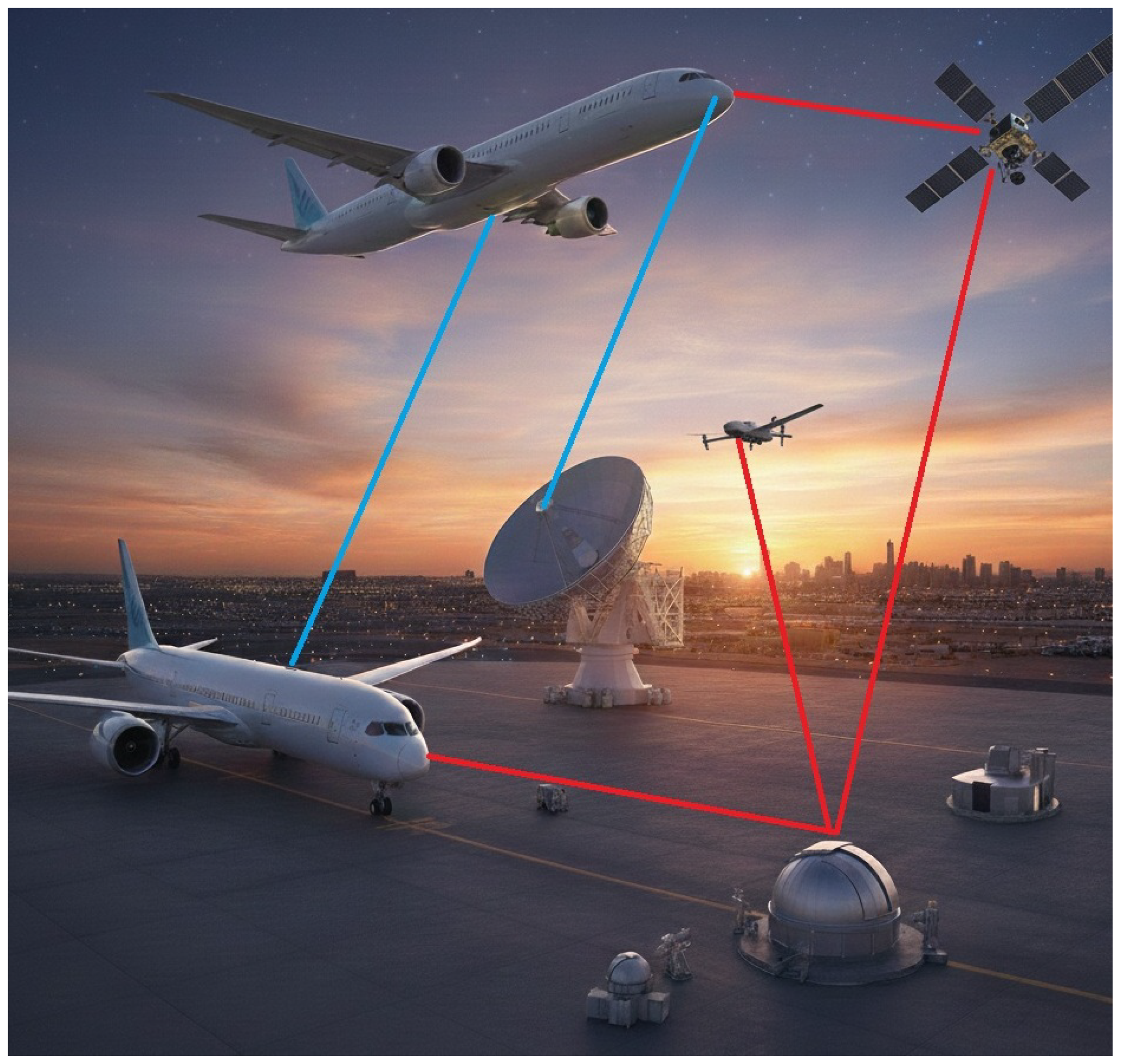
3. Aerial Link Experimented

| Reference | Range [km] | [dBm] | [dBm] | [nm] | Format | [km] | Hours | [] | |
|---|---|---|---|---|---|---|---|---|---|
| [25] | 8 | 21 | - | 405/637 | - | 2.1 | G2G/A2G | Morning | |
| [26] | 10–17 | 17 | −5.1/−6.4 | 1550 | - | 0.6/∼1 | G2G | Various | |
| [27] | 20–30 | 21.5 | - | 852 | - | ∼11.6 | A2G | - | - |
| [28] | 50 | - | - | 1550 | IM/DD OOK | 3 | A2G | Various | - |
| [29] | 15/60 | - | - | 1550 | BB84 decoy-state QKD | 10 | A2G (Q) | - | - |
| [30] | 36/65 | 37 | −25/−20 | 1550 | IM/DD NRZ-OOK | - | G2G (S)/A2A | Day | |
| [31] | 113 | 30/25 | −42/−45 | 1600/800 | IM/DD OOK | - | G2G (S) | - | - |
| [32] | 143 | 30 | - | 1553 | IM/DD OOK | 2.4 | G2G (S) | Day/Night | - |
| [33] | 144 | - | - | 850 | BB84 decoy-state QKD | 2.4 | G2G (Q) | - | - |
| [34] | 147 | 35 | −36 | 1550 | - | 3 | A2A | Various | ∼ |
| [35] | 149 | - | - | 850 | - | 3 | G2G | Day | |
| [36] | 200 | 14/35 | −20.5/−7.8 | 1550 | - | - | G2G (S)/A2A | Day | ∼ |
| [37] | 20/250 | 20/30 | −24.5/−26.2 | 1542/1562 | QPSK | 5.3 | A2A (S)/A2G | Day/Night | - |
4. Atmospheric Physics: Overview
4.1. Theoretical Approach
4.2. Altitude Profile
4.3. Optical Turbulence
4.4. Link Geometry and Atmospheric Profiles
4.5. Scintillation
4.6. Beam Shape and Aero-Optics Effects
4.7. Atmospheric Path Loss and Sky Conditions in FSO
5. Engineering Parameters/Systems for Aerial FSO
5.1. Geometrical Loss and Pointing Error


5.2. Turbulence Mitigation
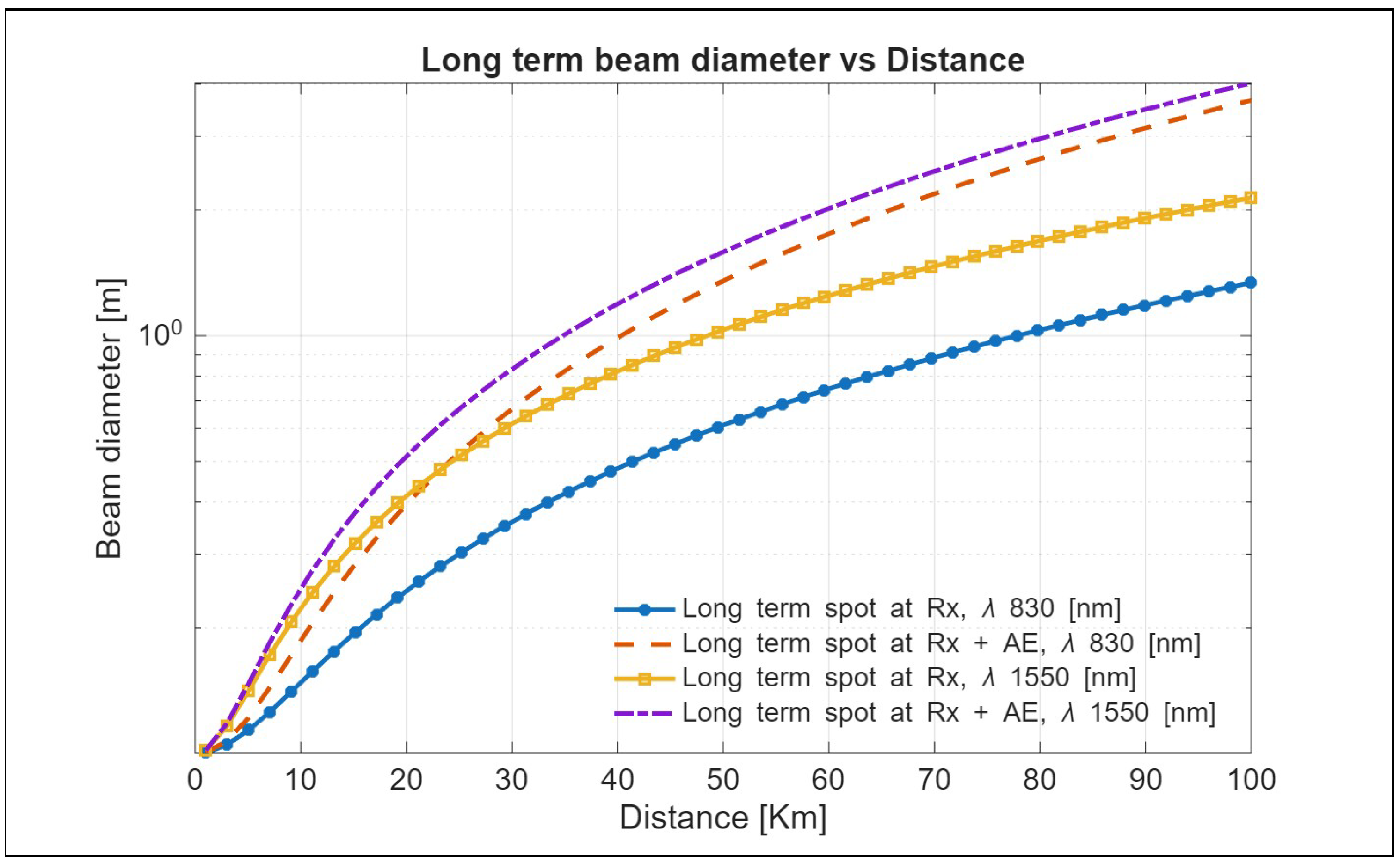
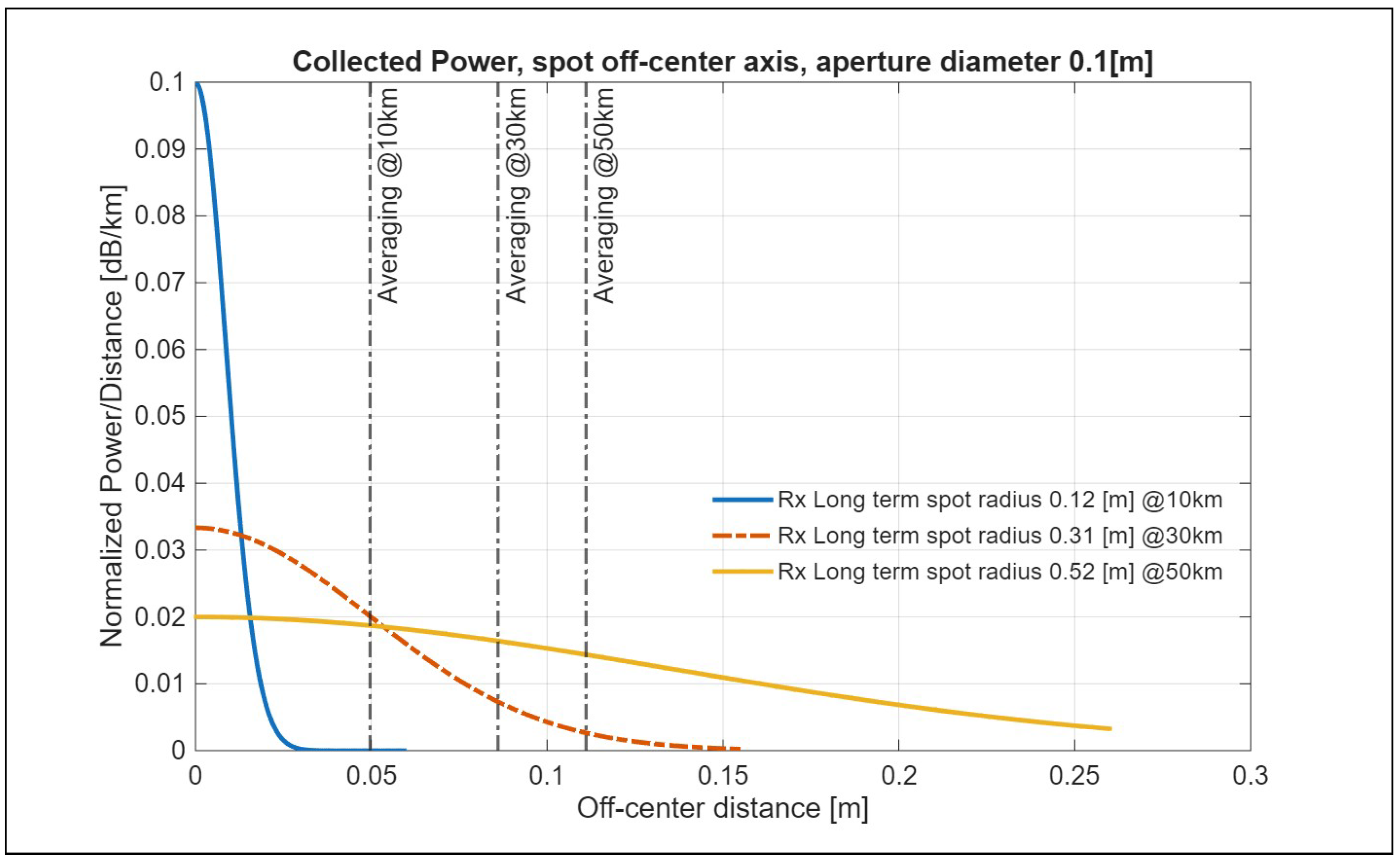
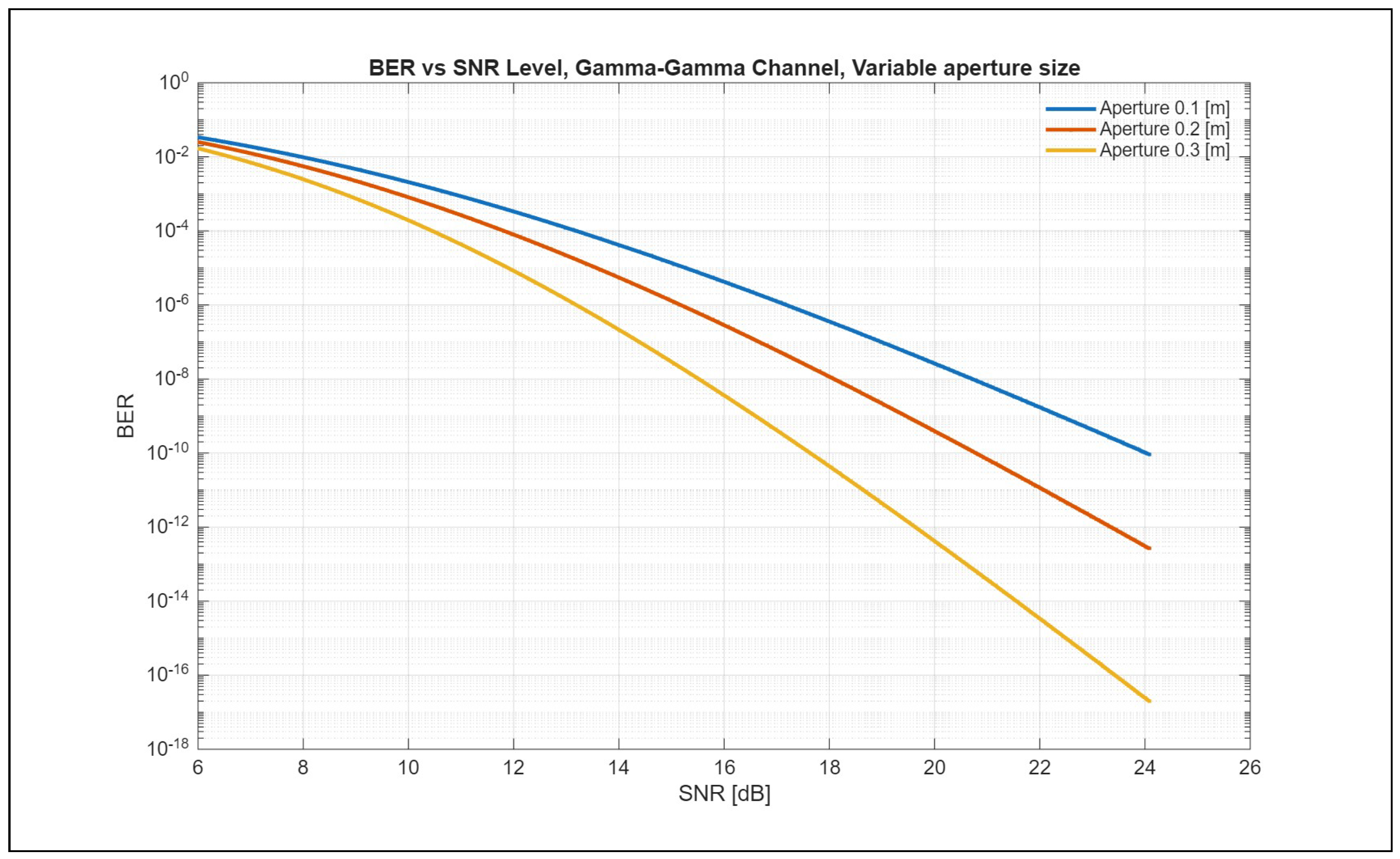
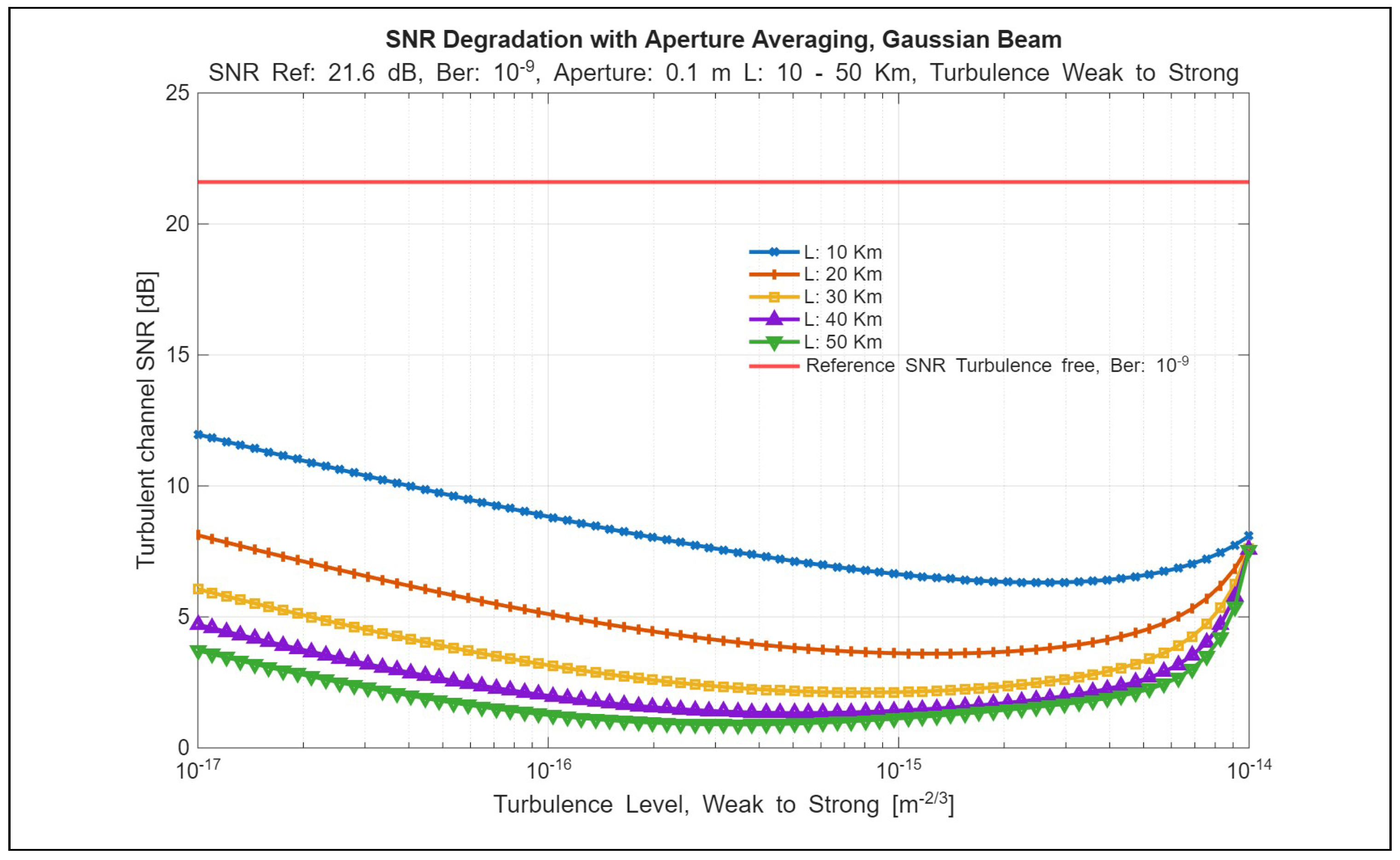
- Aperture averaging reduces the scintillation index and fading effects, which can be achieved by increasing the receiver optical aperture diameter beyond the correlation width of the irradiance fluctuation, given by the Fresnel relation [110], to have good heterodyne efficiency. This technique has been studied on horizontal and satellite downlinks [111]. Figure 6 shows the average threshold radius for a Gaussian spot considered at that distance from the launch optic.
- Adaptive optics (AO) is used to correct the front phase distortion caused by turbulence. A common system acts on sensing and is based on a fast steering beam, a deformable mirror, and the Shack–Hartman wavefront sensor. They have proven useful in weak turbulence conditions and in a near-field short-range link within a practical range defined by the Rayleigh range and generally below 10 km in front of the transceiver lens. Their performances were investigated in Refs. [19,112,113,114,115]. Stotts and Andrews showed that the optimal Zernike order yields closer agreement between the Strehl ratios from theoretical and field measurements.
- Optical automatic gain control (OAGC) was introduced by the industry during the 2000s after long-range tests reported for the ORCA/FOENEX projects in the first Section 3. Those systems needed to cope with large signal dynamics at the output of the AO system to avoid front-end saturation and maintain the power level within a 1 dB for the following stages of the communication receiver chain.
- Wavelength and spatial diversity are alternative solutions when the line of sight is mainly affected or obstructed by atmospherics, e.g., clouds, fog, or rain. An experimental demonstration of an improvement of the Q factor (30) is in [116]. Additionally, in the aerial scenario, the platform can use multiple apertures on the transmitter or receiver side for diversity, and this technique has also been shown to allow path loss mitigation, increasing the SNR at the receiver. The use of N apertures reduces the scintillation index by a factor .
- Channel coding and interleaving have proved useful. Reed–Solomon forward error correction (FEC) code and layered coding schemes have been applied, and an analysis of turbulence coding is in [117]. Although turbulent channel coding is still under study, a format comparison is made in [118,119], where the performance is discussed under different channel conditions [120].
- Power can be increased up to a limit point where the system’s thermal load is tolerable or channel propagation states change, leading to channel saturation or surges in physical phenomena, e.g., thermal blooming due to the ionization of the atmosphere by absorption of high-fluence laser light. Attention should be paid to the eye safety of the operator exposed to the optical beam.
- Increasing the FOV involves a tradeoff, balancing it against the increase in background noise. Those solutions have to face the feasibility of the SWAP-C requirements for the systems under development.
- Ref. [121] presented interesting work on programmable metasurfaces that has demonstrated beam steering and the feasibility of tailoring non-diffracting Bessel beams with reduced deformation in a long-range path with respect to Gaussian beams. This approach may offer enhanced robustness against turbulence-induced beam spreading in long-range aerial FSO links.
5.3. Modulation Formats for FSO
5.4. Photoelectric Section: Metrics
Metrics
6. Conclusions
Author Contributions
Funding
Institutional Review Board Statement
Informed Consent Statement
Data Availability Statement
Acknowledgments
Conflicts of Interest
Abbreviations
| A2A | Air-to-Air |
| A2G | Air-to-Ground |
| ABL | Atmospheric Boundary Layer |
| AFRL | Air Force Research Labs |
| APD | Avalanche Photo Diode |
| AO | Adaptive Optics |
| AOT | Aerosol Optical Thickness |
| BER | Bit Error Rate |
| DARPA | Defense Advanced Research Projects Agency |
| DDTV | Difference of Differential Tilt Variances |
| DWDM | Dense Wavelength Division Multiplexing |
| DLR | Deutsches Zentrum für Luft- und Raumfahrt |
| EDFA | Erbium Doped Fiber Amplification |
| EDRS | European Data Relay Satellite System |
| EM | Electromagnetic |
| FSL | Fraunhofer Spreading Loss |
| FSO | Free-Space Optics |
| G2G | Ground-to-Ground |
| HAPs | High-Altitude Platforms |
| HAP | Hufnagel–Andrews–Phillips |
| H-V | Hufnagel Valley |
| ICT | Internet and Communication Technologies |
| IM/DD | Intensity Modulation/Direct Detection |
| NRZ | Non-return to Zero |
| OAGC | Optical Automatic Gain Controller |
| OOK | On–Off Keying |
| PAT | Pointing Alignment and Tracking |
| PRBS | Pseudo-Random Bit Sequence |
| QKD | Quantum Key Distribution |
| RF | Radio Frequency |
| RR | Rayleigh range |
| SWAP | Size, Weight, and Power |
| UDP | User Datagram Protocol |
| UWSNs | Underwater Wireless Sensor Networks |
| Transceiver optical area | |
| Spherical wavefront | |
| Refractive Index Structure function | |
| Aperture diameter | |
| Transmitter or Received Power | |
| Rytov variance | |
| Effective Rytov variance | |
| Transceiver transmittance | |
| Zenith angle |
References
- Rinaldi, L.; Camponeschi, F.; Bogoni, A. Space-Grade Analogue and Digital Photonics for Satellite Communications in Europe. J. Light. Technol. 2024, 42, 1004–1015. [Google Scholar]
- Ghassemlooy, Z.; Arnon, S.; Uysal, M.; Xu, Z.; Cheng, J. Emerging Optical Wireless Communications-Advances and Challenges. IEEE J. Sel. Areas Commun. 2015, 33, 1738–1749. [Google Scholar] [CrossRef] [Scilit]
- Nguyen, D.C.; Ding, M.; Pathirana, P.N.; Seneviratne, A.; Li, J.; Niyato, D.; Dobre, O.; Poor, H.V. 6G Internet of Things: A comprehensive survey. IEEE Internet Things J. 2021, 9, 359–383. [Google Scholar] [CrossRef] [Scilit]
- Hamza, A.S.; Deogun, J.S.; Alexander, D.R. Classification Framework for Free Space Optical Communication Links and Systems. IEEE Commun. Surv. Tutor. 2019, 21, 1346–1382. [Google Scholar] [CrossRef] [Scilit]
- Nzekwu, N.J.; Fernandes, M.A.; Fernandes, G.M.; Monteiro, P.P.; Guiomar, F.P. A Comprehensive Review of UAV-Assisted FSO Relay Systems. Photonics 2024, 11, 274. [Google Scholar] [CrossRef] [Scilit]
- Zeng, Z.; Fu, S.; Zhang, H.; Dong, Y.; Cheng, J. A survey of underwater optical wireless communications. IEEE Commun. Surv. Tutor. 2016, 19, 204–238. [Google Scholar]
- Kaushal, H.; Kaddoum, G. Underwater optical wireless communication. IEEE Access 2016, 4, 1518–1547. [Google Scholar] [CrossRef] [Scilit]
- Moriconi, C.; Cupertino, G.; Betti, S.; Tabacchiera, M. Hybrid acoustic/optic communications in underwater swarms. In Proceedings of the OCEANS 2015—Genova, Genova, Italy, 18–21 May 2015; pp. 1–9. [Google Scholar] [CrossRef] [Scilit]
- Elamassie, M.; Uysal, M. FSO-based Multi-Layer Airborne Backhaul Networks. IEEE Trans. Veh. Technol. 2024, 73, 15004–15019. [Google Scholar] [CrossRef] [Scilit]
- Henniger, H.; Giggenbach, D. Avionic Optical Links for High Data-Rate Communications. In Proceedings of the ICAS—25th Congress of the International Council of the Aeronautical Sciences, Hamburg, Germany, 3–8 September 2006. [Google Scholar]
- Cossu, G.; Gilli, L.; Vincenti, N.; Pifferi, E.; Schena, V.; Ciaramella, E. Demonstrating Intra-Spacecraft Optical Wireless Links. IEEE Access 2023, 11, 30920–30928. [Google Scholar] [CrossRef] [Scilit]
- Cossu, G.; Gilli, L.; Vincenti, N.; Ertunc, E.; Massa, M.; Dell’Orso, R.; Moggi, A.; Palla, F.; Ciaramella, E. High-Speed Optical Wireless System for Extreme Space Conditions. IEEE J. Radio Freq. Identif. 2024, 8, 601–608. [Google Scholar] [CrossRef] [Scilit]
- Cossu, G.; Ertunc, E.; Gilli, L.; Mestice, E.; Vincenti, N.; Bresciani, F.; Ciaramella, E. Optical Wireless Links for Extra-Spacecraft Communication. IEEE Aerosp. Electron. Syst. Mag. 2024, 39, 42–48. [Google Scholar] [CrossRef] [Scilit]
- Chan, V.W. Optical satellite network architecture [Invited Tutorial]. J. Opt. Commun. Netw. 2024, 16, A53–A67. [Google Scholar] [CrossRef] [Scilit]
- Kaushal, H.; Kaddoum, G. Optical communication in space: Challenges and mitigation techniques. IEEE Commun. Surv. Tutor. 2016, 19, 57–96. [Google Scholar] [CrossRef] [Scilit]
- Giordani, M.; Zorzi, M. Non-terrestrial networks in the 6G era: Challenges and opportunities. IEEE Netw. 2020, 35, 244–251. [Google Scholar] [CrossRef] [Scilit]
- Fidler, F.; Knapek, M.; Horwath, J.; Leeb, W.R. Optical Communications for High-Altitude Platforms. IEEE J. Sel. Top. Quantum Electron. 2010, 16, 1058–1070. [Google Scholar] [CrossRef] [Scilit]
- Stotts, L.B.; Andrews, L.C. Communication performance in the focusing and saturation regimes inherent to the turbulent channel: A tutorial. Opt. Eng. 2024, 63, 120801. [Google Scholar] [CrossRef] [Scilit]
- Stotts, L.B.; Andrews, L.C. Optical communications in turbulence: A tutorial. Opt. Eng. 2023, 63, 041207. [Google Scholar] [CrossRef] [Scilit]
- Karp, S.; Stotts, L.B. Fundamentals of Electro-Optic Systems Design: Communications, Lidar, and Imaging; Cambridge University Press: Cambridge, UK, 2012. [Google Scholar]
- Raj, A.A.B.; Krishnan, P.; Darusalam, U.; Kaddoum, G.; Ghassemlooy, Z.; Abadi, M.M.; Majumdar, A.K.; Ijaz, M. A review–unguided optical communications: Developments, technology evolution, and challenges. Electronics 2023, 12, 1922. [Google Scholar] [CrossRef] [Scilit]
- Stotts, L.B.; Andrews, L.C.; Cherry, P.C.; Foshee, J.J.; Kolodzy, P.J.; McIntire, W.K.; Northcott, M.; Phillips, R.L.; Pike, H.A.; Stadler, B.; et al. Hybrid Optical RF Airborne Communications. Proc. IEEE 2009, 97, 1109–1127. [Google Scholar] [CrossRef] [Scilit]
- Bagley, Z.C.; Hughes, D.H.; Juarez, J.C.; Young, D.W.; Kolodzy, P.J.; Martin, T.; Northcott, M.J.; Pike, H.A.; Plasson, N.D.; Stadler, B.K.; et al. Hybrid optical radio frequency airborne communications. Opt. Eng. 2012, 51, 055006. [Google Scholar] [CrossRef] [Scilit]
- Andrews, L.C.; Phillips, R.L.; Bagley, Z.; Plasson, N.; Stotts, L.B. Hybrid Optical/Radio Frequency (RF) Communications. In Advanced Free Space Optics (FSO): A Systems Approach; Springer: New York, NY, USA, 2015; pp. 295–342. [Google Scholar] [CrossRef] [Scilit]
- Diskin, Y.; Whiteley, M.; Grose, M.; Jackovitz, K.; Drye, R.; Hampshire, B.; Owens, M.; Smith, E.; Magee, E.; Kalensky, M.; et al. Aircraft to Ground Profiling: Turbulence Measurements and Optical System Performance Modeling. AIAA J. 2021, 59, 4610–4625. [Google Scholar] [CrossRef] [Scilit]
- Juarez, J.C.; Young, D.W.; Venkat, R.A.; Brown, D.M.; Brown, A.M.; Oberc, R.L.; Sluz, J.E.; Pike, H.A.; Stotts, L.B. Analysis of link performance for the FOENEX laser communications system. In Atmospheric Propagation IX, Proceedings of the SPIE Defense, Security, and Sensing, Baltimore, MD, USA, 23–27 April 2012; Thomas, L.M.W., Spillar, E.J., Eds.; International Society for Optics and Photonics, SPIE: Bellingham, WA, USA, 2012; Volume 8380, p. 838007. [Google Scholar] [CrossRef] [Scilit]
- Chan, V.J.; Arnold, R.L. Results of one GBPS aircraft-to-ground lasercom validation demonstration. In Free-Space Laser Communication Technologies IX, Proceedings of the Photonics West ’97, San Jose, CA, USA, 8–14 February 1997; Mecherle, G.S., Ed.; International Society for Optics and Photonics, SPIE: Bellingham, WA, USA, 1997; Volume 2990, pp. 52–59. [Google Scholar] [CrossRef] [Scilit]
- Moll, F.; Horwath, J.; Shrestha, A.; Brechtelsbauer, M.; Fuchs, C.; Martín Navajas, L.A.; Lozano Souto, A.M.; Díaz González, D. Demonstration of High-Rate Laser Communications From a Fast Airborne Platform. IEEE J. Sel. Areas Commun. 2015, 33, 1985–1995. [Google Scholar] [CrossRef] [Scilit]
- Yu, H.-C.; Tang, B.-Y.; Chen, H.; Xue, Y.; Tang, J.; Yu, W.-R.; Liu, B.; Shi, L. Airborne quantum key distribution with boundary layer effects. EPJ Quantum Technol. 2021, 8, 26. [Google Scholar] [CrossRef] [Scilit]
- Cunningham, J.; Foulke, D.; Goode, T.; Baber, D.; Gaughan, B.; Fletcher, M.; Young, D.W.; Juarez, J.C.; Sluz, J.E.; Riggins, J.L. Long range field testing of free space optical communications terminals on mobile platforms. In Proceedings of the MILCOM 2009—2009 IEEE Military Communications Conference, Boston, MA, USA, 18–21 October 2009; pp. 1–7. [Google Scholar] [CrossRef] [Scilit]
- Cheng, Y.X.; Yang, M.; Lu, Z.J.; Tang, W.S.; Guan, J.Y.; Shen, Q.; Yin, J.; Liao, S.K.; Peng, C.Z. Time transfer over 113 km free space laser communication channel. Opt. Express 2024, 32, 12645–12655. [Google Scholar] [CrossRef] [Scilit] [PubMed]
- Nonay, J.R.; Rüddenklau, R.; Sinn, A.; Jakobs, J.P.; Berlitz, J.; Rödiger, B.; Schitter, G. Horizontal free-space optical link with CubeISL over 143 Km. J. Opt. Commun. Netw. 2024, 16, 593–601. [Google Scholar] [CrossRef] [Scilit]
- Schmitt-Manderbach, T.; Weier, H.; Fürst, M.; Ursin, R.; Tiefenbacher, F.; Scheidl, T.; Perdigues, J.; Sodnik, Z.; Kurtsiefer, C.; Rarity, J.G.; et al. Experimental Demonstration of Free-Space Decoy-State Quantum Key Distribution over 144 km. Phys. Rev. Lett. 2007, 98, 010504. [Google Scholar] [CrossRef] [Scilit]
- Northcott, M.J.; McClaren, A.; Graves, J.E.; Phillips, J.; Driver, D.; Abelson, D.; Young, D.W.; Sluz, J.E.; Juarez, J.C.; Airola, M.B.; et al. Long distance laser communications demonstration. In Defense Transformation and Net-Centric Systems 2007, Proceedings of the Defense and Security Symposium, Orlando, FL, USA, 9–13 April 2007; Suresh, R., Ed.; International Society for Optics and Photonics, SPIE: Bellingham, WA, USA, 2007; Volume 6578, p. 65780S. [Google Scholar] [CrossRef] [Scilit]
- McCrae, J.E.; Bose-Pillai, S.R.; Fiorino, S.T.; Archibald, A.J.; Meoak, J.; Elmore, B.J.; Kesler, T.; Rice, C.A. Measurements of optical turbulence over 149-km path. Opt. Eng. 2020, 59, 081806. [Google Scholar] [CrossRef] [Scilit]
- Stotts, L.B.; Kolodzy, P.; Pike, A.; Graves, B.; Dougherty, D.; Douglass, J. Free-space optical communications link budget estimation. Appl. Opt. 2010, 49, 5333–5343. [Google Scholar] [CrossRef] [Scilit] [PubMed]
- Chen, C.; Grier, A.; Malfa, M.; Booen, E.; Harding, H.; Xia, C.; Hunwardsen, M.; Demers, J.; Kudinov, K.; Mak, G.; et al. Demonstration of a bidirectional coherent air-to-ground optical link. In Free-Space Laser Communication and Atmospheric Propagation XXX, Proceedings of the SPIE Lase, San Francisco, CA, USA, 27 January–1 February 2018; Hemmati, H., Boroson, D.M., Eds.; International Society for Optics and Photonics, SPIE: Bellingham, WA, USA, 2018; Volume 10524, p. 105240G. [Google Scholar] [CrossRef] [Scilit]
- Churnside, J.H.; Shaik, K.S. Atmospheric Propagation Issues Relevant to Optical Communications; National Technical Information Service: Alexandria, VA, USA, 1988. [Google Scholar]
- Fiedler, S.; Naik, V.; O’Connor, F.M.; Smith, C.J.; Griffiths, P.; Kramer, R.J.; Takemura, T.; Allen, R.J.; Im, U.; Kasoar, M.; et al. Interactions between atmospheric composition and climate change—Progress in understanding and future opportunities from AerChemMIP, PDRMIP, and RFMIP. Geosci. Model Dev. 2024, 17, 2387–2417. [Google Scholar] [CrossRef] [Scilit]
- Houghton, J.T. The Physics of Atmospheres; Cambridge University Press: Cambridge, UK, 2002. [Google Scholar]
- Larry, C.; Andrews, R.L.P. Laser Beam Propagation Through Random Media, 2nd ed.; SPIE Press: Bellingham, WA, USA, 2005. [Google Scholar]
- Fahey, T.; Islam, M.; Gardi, A.; Sabatini, R. Laser Beam Atmospheric Propagation Modelling for Aerospace LIDAR Applications. Atmosphere 2021, 12, 918. [Google Scholar] [CrossRef] [Scilit]
- Friis, H. A Note on a Simple Transmission Formula. Proc. IRE 1946, 34, 254–256. [Google Scholar] [CrossRef] [Scilit]
- Shaw, J.A. Radiometry and the Friis transmission equation. Am. J. Phys. 2013, 81, 33–37. [Google Scholar] [CrossRef] [Scilit]
- Henniger, H.; Wilfert, O. An Introduction to Free-space Optical Communications. Radioeng. J. 2010, 19, 203–212. [Google Scholar]
- Andrews, L.C. Field Guide to Atmospheric Optics; SPIE Press: Bellingham, WA, USA, 2019. [Google Scholar]
- Andrews, L.C.; Phillips, R.L.; Hopen, C.Y. Laser Beam Scintillation with Applications; SPIE Press: Bellingham, WA, USA, 2001; Volume 99. [Google Scholar]
- Timofeyev, Y.M.; Vasil’ev, A.V. Theoretical Fundamentals of Atmospheric Optics; Cambridge International Science Publishing: Cambridge, UK, 2008. [Google Scholar]
- Andrews, L.C.; Beason, M.K. Laser Beam Propagation in Random Media: New and Advanced Topics; SPIE Press: Bellingham, WA, USA, 2023. [Google Scholar]
- Majumdar, A.K. Laser-Based Satellite and Inter-satellite Communication Systems: Advanced Technologies and Performance Analysis. In Laser Communication with Constellation Satellites, UAVs, HAPs and Balloons: Fundamentals and Systems Analysis for Global Connectivity; Springer: Cham, Switzerland, 2022; pp. 199–229. [Google Scholar]
- Korotkova, O.; Toselli, I. Non-Classic Atmospheric Optical Turbulence: Review. Appl. Sci. 2021, 11, 8487. [Google Scholar] [CrossRef] [Scilit]
- Cheng, M.; Guo, L.; Zhang, Y. Scintillation and aperture averaging for Gaussian beams through non-Kolmogorov maritime atmospheric turbulence channels. Opt. Express 2015, 23, 32606–32621. [Google Scholar] [CrossRef] [Scilit] [PubMed]
- Toselli, I.; Andrews, L.C.; Phillips, R.L.; Ferrero, V. Free space optical system performance for laser beam propagation through non-Kolmogorov turbulence. In Free-Space Laser Communication Technologies XIX and Atmospheric Propagation of Electromagnetic Waves, Proceedings of the Lasers and Applications in Science and Engineering, San Jose, CA, USA, 20–25 January 2007; Mecherle, S., Korotkova, O., Eds.; International Society for Optics and Photonics, SPIE: Bellingham, WA, USA, 2007; Volume 6457, p. 64570T. [Google Scholar] [CrossRef] [Scilit]
- Toselli, I.; Andrews, L.C.; Phillips, R.L.; Ferrero, V. Free-space optical system performance for laser beam propagation through non-Kolmogorov turbulence. Opt. Eng. 2008, 47, 026003. [Google Scholar] [CrossRef] [Scilit]
- Abouelez, A.E.; Eldiwany, E.A. The analysis of the non-Kolmogorov turbulence effect on the performance of uplink coherent DPSK laser satellite communication system in the presence of tilt-corrected beam wander. Opt. Quantum Electron. 2024, 56, 1427. [Google Scholar] [CrossRef] [Scilit]
- Wang, F.; Korotkova, O. Random optical beam propagation in anisotropic turbulence along horizontal links. Opt. Express 2016, 24, 24422–24434. [Google Scholar] [CrossRef] [Scilit] [PubMed]
- Xiao, X.; Voelz, D.G.; Toselli, I.; Korotkova, O. Gaussian beam propagation in anisotropic turbulence along horizontal links: Theory, simulation, and laboratory implementation. Appl. Opt. 2016, 55, 4079–4084. [Google Scholar] [CrossRef] [Scilit]
- Toselli, I.; Korotkova, O. Spread and wander of a laser beam propagating through anisotropic turbulence. In Laser Communication and Propagation through the Atmosphere and Oceans IV, Proceedings of the SPIE Optical Engineering + Applications, San Diego, CA, USA, 9–13 August 2015; van Eijk, A.M.J., Davis, C.C., Hammel, S.M., Eds.; International Society for Optics and Photonics, SPIE: Bellingham, WA, USA, 2015; Volume 9614, p. 96140B. [Google Scholar] [CrossRef] [Scilit]
- Birch, P.; Ituen, I.; Young, R.; Chatwin, C. Long-distance Bessel beam propagation through Kolmogorov turbulence. J. Opt. Soc. Am. A 2015, 32, 2066–2073. [Google Scholar] [CrossRef] [Scilit]
- Quatresooz, F.; de Xivry, G.O.; Absil, O.; Vanhoenacker-Janvier, D.; Oestges, C. Challenges for optical turbulence characterization and prediction at optical communication sites. In Proceedings of the International Conference on Space Optics—ICSO 2022; Minoglou, K., Karafolas, N., Cugny, B., Eds.; International Society for Optics and Photonics, SPIE: Bellingham, WA, USA, 2023; Volume 12777, p. 127775O. [Google Scholar] [CrossRef] [Scilit]
- Li, L.; Ji, N.; Wu, Z.; Wu, J. Design and Experimental Demonstration of an Atmospheric Turbulence Simulation System for Free-Space Optical Communication. Photonics 2024, 11, 334. [Google Scholar] [CrossRef] [Scilit]
- Geisler, D.J.; Wong, K.S.Y.; Schulein, R.T.; Wang, J.P.; Bedrosian, P.S.; Hakimi, F.Q.; Schieler, C.M.; Spellmeyer, N.W.; Caplan, D.O.; Robinson, B.S.; et al. Atmospheric Emulation and Testing Methodology for Laboratory Verification of FSO Communications Transceivers. In Proceedings of the 2019 IEEE International Conference on Space Optical Systems and Applications (ICSOS), Portland, OR, USA, 14–16 October 2019; pp. 1–5. [Google Scholar] [CrossRef] [Scilit]
- Alameri, J.; Ameri, R.A.; Ahmadi, A.A.; Alteneiji, A.; Matras, G.; Bouchalkha, A.; Alhosni, S.; Kasmi, C.; Elayoubi, K.; Coronel, J. Atmospheric propagation emulator for free space optical applications: Design and performances. In Laser Communication and Propagation Through the Atmosphere and Oceans XII, Proceedings of the SPIE Optical Engineering + Applications, San Diego, CA, USA, 20–25 August 2023; Anguita, J.A., Bos, J.P., Wayne, D.T., Eds.; International Society for Optics and Photonics, SPIE: Bellingham, WA, USA, 2023; Volume 12691, p. 126910Q. [Google Scholar] [CrossRef] [Scilit]
- Sasiela, R.J. Electromagnetic Wave Propagation in Turbulence: Evaluation and Application of Mellin Transforms; Springer Science & Business Media: Berlin/Heidelberg, Germany, 2012; Volume 18. [Google Scholar]
- Quatresooz, F.; Oestges, C. Cn2 Modeling for Free-Space Optical Communications: A Review. IEEE Access 2025, 13, 21279–21305. [Google Scholar] [CrossRef] [Scilit]
- Walters, D.L.; Kunkel, K.E.; Hoidale, G.B. Diurnal And Seasonal Variations In The Atmospheric Structure Parameter (Cn2) That Affect The Atmospheric Modulation Transfer Function (MTF). In Atmospheric Transmission, Proceedings of the 1981 Technical Symposium East, Washington, DC, USA, 21–22 April 1981; Fan, R.W., Ed.; International Society for Optics and Photonics, SPIE: Bellingham, WA, USA, 1981; Volume 0277, pp. 6–9. [Google Scholar] [CrossRef] [Scilit]
- Mahmood, D.A.; Naif, S.S.; Al-Jiboori, M.H.; Al-Rbayee, T. Improving Hufnagel-Andrews-Phillips model for prediction Cn2 using empirical wind speed profiles. J. Atmos. Sol.-Terr. Phys. 2022, 240, 105952. [Google Scholar] [CrossRef] [Scilit]
- Stotts, L.B.; Andrews, L.C. Improving the Hufnagel-Andrews-Phillips refractive index structure parameter model using turbulent intensity. Opt. Express 2023, 31, 14265–14277. [Google Scholar] [CrossRef] [Scilit] [PubMed]
- Phillips, R.L.; Andrews, L.C. FSO communications: Atmospheric effects for an airborne backbone. In Atmospheric Propagation V, Proceedings of the SPIE Defense and Security Symposium, Orlando, FL, USA, 18–20 March 2008; Gilbreath, G.C., Wasiczko, L.M., Eds.; International Society for Optics and Photonics, SPIE: Bellingham, WA, USA, 2008; Volume 6951, p. 695102. [Google Scholar] [CrossRef] [Scilit]
- Beason, M.; Gladysz, S.; Andrews, L.C. Impact of probability density function model choice in intensity-modulation direct-detection free-space optical communication analyses. Opt. Eng. 2020, 59, 081809. [Google Scholar] [CrossRef] [Scilit]
- Beason, M.; Andrews, L.; Gladysz, S. Statistical comparison of probability models of intensity fluctuation. In Environmental Effects on Light Propagation and Adaptive Systems II, Proceedings of the SPIE Remote Sensing, Strasbourg, France, 9–12 September 2019; Stein, K.U., Gladysz, S., Eds.; International Society for Optics and Photonics, SPIE: Bellingham, WA, USA, 2019; Volume 11153, p. 111530D. [Google Scholar] [CrossRef] [Scilit]
- Al-Habash, M.A.; Andrews, L.C.; Phillips, R.L. Mathematical model for the irradiance probability density function of a laser beam propagating through turbulent media. Opt. Eng. 2001, 40, 1554–1562. [Google Scholar] [CrossRef] [Scilit]
- Ghassemlooy, Z.; Popoola, W.; Rajbhandari, S. Optical Wireless Communications: System and Channel Modelling with MATLAB®; CRC Press: Boca Raton, FL, USA, 2019. [Google Scholar]
- Korotkova, O.; Wolf, E. Beam criterion for atmospheric propagation. Opt. Lett. 2007, 32, 2137–2139. [Google Scholar] [CrossRef] [Scilit]
- Jumper, E.J.; Zenk, M.; Gordeyev, S.; Cavalieri, D.; Whiteley, M.R. The Airborne Aero-Optics Laboratory, AAOL. In Acquisition, Tracking, Pointing, and Laser Systems Technologies XXVI, Proceedings of the SPIE Defense, Security, and Sensing, Baltimore, MD, USA, 23–27 April 2012; Thompson, W.E., McManamon, P.F., Eds.; International Society for Optics and Photonics, SPIE: Bellingham, WA, USA, 2012; Volume 8395, p. 839507. [Google Scholar] [CrossRef] [Scilit]
- Lucca, N.D.; Gordeyev, S.; Jumper, E. The Airborne Aero-Optics Laboratory, recent data. In Acquisition, Tracking, Pointing, and Laser Systems Technologies XXVI, Proceedings of the SPIE Defense, Security, and Sensing, Baltimore, MD, USA, 23–27 April 2012; Thompson, W.E., McManamon, P.F., Eds.; International Society for Optics and Photonics, SPIE: Bellingham, WA, USA, 2012; Volume 8395, p. 839508. [Google Scholar] [CrossRef] [Scilit]
- Smith, E.W. Optical effects of aircraft boundary layer turbulence. Appl. Opt. 1987, 26, 529–532. [Google Scholar] [CrossRef] [Scilit]
- Gordeyev, S.; Jumper, E.; Whiteley, M. Fundamentals. In Aero-Optical Effects; John Wiley & Sons, Ltd.: Hoboken, NJ, USA, 2022; Chapter 2; pp. 7–30. [Google Scholar] [CrossRef] [Scilit]
- Kalensky, M.; Spencer, M.F.; Jumper, E.J.; Gordeyev, S. Estimation of atmospheric optical turbulence strength in realistic airborne environments. Appl. Opt. 2022, 61, 6268–6279. [Google Scholar] [CrossRef] [Scilit]
- Cicchiello, J.M.; Harris, S.; Prudden, C.A.; Neiswender, J.; Bope, D.W.; Harkrider, C.J.; Moore, T.G.; Stadler, B.; Stotts, L. Visualizing aero-optic interactions about a nose-mounted turret. In Atmospheric Propagation VII, Proceedings of the SPIE Defense, Security, and Sensing, Orlando, FL, USA, 5–9 April 2010; Thomas, L.M.W., Spillar, E.J., Eds.; International Society for Optics and Photonics, SPIE: Bellingham, WA, USA, 2010; Volume 7685, p. 76850C. [Google Scholar] [CrossRef] [Scilit]
- Normanshire, C.; Cava, S.L.; Miller, C.; Schwarz, W.; Mercado, F.; Carbajal, E.; Vega, D.; Lopes, J.M.; Kamel, M.; Viti, V.; et al. Simulation of the impact of propagation through optical fluids and turbulent flow on optical system performance. In Optical Design and Engineering IX, Proceedings of the SPIE Optical Systems Design, Strasbourg, France, 7–12 April 2024; Lépine, T., Babington, J., Gross, H., Eds.; International Society for Optics and Photonics, SPIE: Bellingham, WA, USA, 2024; Volume 13019, p. 130190P. [Google Scholar] [CrossRef] [Scilit]
- Stotts, L.B.; Stadler, B.; Hughes, D.; Kolodzy, P.; Pike, A.; Young, D.W.; Sluz, J.; Juarez, J.; Graves, B.; Dougherty, D.; et al. Optical communications in atmospheric turbulence. In Free-Space Laser Communications IX, Proceedings of the SPIE Optical Engineering + Applications, San Diego, CA, USA, 2–6 August 2009; Majumdar, A.K., Davis, C.C., Eds.; International Society for Optics and Photonics, SPIE: Bellingham, WA, USA, 2009; Volume 7464, p. 746403. [Google Scholar] [CrossRef] [Scilit]
- Deng, Z.; Yu, H.; Tang, J.; Li, J.; Cao, Y.; Hu, H.; Liu, Y.; Wu, D.; Wei, J.; Liu, B.; et al. Air-to-air quantum key distribution with boundary layer effects. Results Phys. 2023, 54, 107020. [Google Scholar] [CrossRef] [Scilit]
- ITU-R. Propagation Data Required for the Design of Terrestrial Free-Space Optical Links; Technical Report P.1817-1; ITU-R: Geneva, Switzerland, 2012. [Google Scholar]
- Giggenbach, D.; Henniger, H.; Horwath, J.; Perlot, N.; Birnbacher, U.; Chlestil, C.; Gebhart, M.; Leitgeb, E.; Muhammad, S.; Betti, S.; et al. Clear Sky Optics. In Influence of the Variability of the Propagation Channel on Mobile, Fixed Multimedia and Optical Satellite Communications; Shaker Verlag: Düren, Germany, 2008; pp. 3-1–3-96. [Google Scholar]
- Giggenbach, D.; Shrestha, A. Atmospheric absorption and scattering impact on optical satellite-ground links. Int. J. Satell. Commun. Netw. 2022, 40, 157–176. [Google Scholar] [CrossRef] [Scilit]
- International Telecommunication Union. Propagation Data and Prediction Methods Required for the Design of Earth-Space Telecommunication Systems; International Telecommunication Union: Geneva, Switzerland, 2023. [Google Scholar]
- Giggenbach, D.; Knopp, M.T.; Fuchs, C. Link budget calculation in optical LEO satellite downlinks with on/off-keying and large signal divergence: A simplified methodology. Int. J. Satell. Commun. Netw. 2023, 41, 460–476. [Google Scholar] [CrossRef] [Scilit]
- Ata, Y.; Korotkova, O. Integrating optical turbulence into Beer’s law. Laser Phys. Lett. 2022, 19, 046201. [Google Scholar] [CrossRef] [Scilit]
- Wolfe, W.L.; Zissis, G. The Infrared Handbook, Revised Edition; General Dynamics: Reston, VA, USA, 1985. [Google Scholar]
- Douglas, C.A. Visual Range: Concepts, Instrumental Determination, and Aviation Applications; U.S. Government Printing Office: Washington, DC, USA, 1977.
- Kim, I.I.; McArthur, B.; Korevaar, E.J. Comparison of laser beam propagation at 785 nm and 1550 nm in fog and haze for optical wireless communications. In Optical Wireless Communications III, Proceedings of the Information Technologies 2000, Boston, MA, USA, 5–8 November 2000; Korevaar, E.J., Ed.; International Society for Optics and Photonics, SPIE: Bellingham, WA, USA, 2001; Volume 4214, pp. 26–37. [Google Scholar] [CrossRef] [Scilit]
- Kruse, P.W.; McGlauchlin, L.D.; McQuistan, R.B. Elements of Infrared Technology: Generation, Transmission and Detection; Wiley: New York, NY, USA, 1962. [Google Scholar]
- Naboulsi, M.C.A.; Sizun, H.; de Fornel, F. Fog attenuation prediction for optical and infrared waves. Opt. Eng. 2004, 43, 319–329. [Google Scholar] [CrossRef] [Scilit]
- El-Wakeel, A.S.; Mohammed, N.A.; Aly, M.H. Free space optical communications system performance under atmospheric scattering and turbulence for 850 and 1550 nm operation. Appl. Opt. 2016, 55, 7276–7286. [Google Scholar] [CrossRef] [Scilit]
- Wilson, R.T.; Milton, E.J.; Nield, J.M. Are visibility-derived AOT estimates suitable for parameterizing satellite data atmospheric correction algorithms? Int. J. Remote Sens. 2015, 36, 1675–1688. [Google Scholar] [CrossRef] [Scilit]
- Cairo, F.; Di Liberto, L.; Dionisi, D.; Snels, M. Understanding Aerosol–Cloud Interactions through Lidar Techniques: A Review. Remote Sens. 2024, 16, 2788. [Google Scholar] [CrossRef] [Scilit]
- Ito, S.; Furutsu, K. Theory of light pulse propagation through thick clouds. J. Opt. Soc. Am. 1980, 70, 366–374. [Google Scholar] [CrossRef] [Scilit]
- Liu, C.H.; Yeh, K.C. Propagation of pulsed beam waves through turbulence, cloud, rain, or fog. J. Opt. Soc. Am. 1977, 67, 1261–1266. [Google Scholar] [CrossRef] [Scilit]
- Bertin, C.; Cros, S.; Saint-Antonin, L.; Schmutz, N. Prediction of optical communication link availability: Real-time observation of cloud patterns using a ground-based thermal infrared camera. In Optics in Atmospheric Propagation and Adaptive Systems XVIII, Proceedings of the SPIE Remote Sensing, Toulouse, France, 21–24 September 2015; SPIE: Bellingham, WA, USA, 2015; Volume 9641, pp. 66–73. [Google Scholar]
- Ijaz, M.; Ghassemlooy, Z.; Pesek, J.; Fiser, O.; Le Minh, H.; Bentley, E. Modeling of Fog and Smoke Attenuation in Free Space Optical Communications Link Under Controlled Laboratory Conditions. J. Light. Technol. 2013, 31, 1720–1726. [Google Scholar] [CrossRef] [Scilit]
- Kalashnikova, O.V.; Willebrand, H.A.; Mayhew, L.M. Wavelength and altitude dependence of laser beam propagation in dense fog. In Free-Space Laser Communication Technologies XIV, Proceedings of the High-Power Lasers and Applications, San Jose, CA, USA, 20–25 January 2002; Mecherle, G.S., Ed.; International Society for Optics and Photonics, SPIE: Bellingham, WA, USA, 2002; Volume 4635, pp. 278–287. [Google Scholar] [CrossRef] [Scilit]
- Peckhaus, A.; Becker, P.; Pargmann, C.; Hall, T.; Duschek, F. Extinction of high-power laser radiation under adverse weather conditions. Appl. Opt. 2023, 62, 7127–7138. [Google Scholar] [CrossRef] [Scilit]
- Mai, V.V.; Kim, H. Adaptive beam control techniques for airborne free-space optical communication systems. Appl. Opt. 2018, 57, 7462–7471. [Google Scholar] [CrossRef] [Scilit]
- Park, S.; Yeo, C.I.; Heo, Y.S.; Ryu, J.H.; Kang, H.S.; Kim, S.C.; Jang, J.H. Common path-based mobile free-space optical terminal with adaptive beamforming function for Gbps out-of-band full-duplex connectivity to UAVs. Opt. Commun. 2021, 494, 127041. [Google Scholar] [CrossRef] [Scilit]
- Hemmati, H. Near-Earth Laser Communications; CRC Press: Boca Raton, FL, USA, 2020. [Google Scholar]
- Kaymak, Y.; Rojas-Cessa, R.; Feng, J.; Ansari, N.; Zhou, M.; Zhang, T. A Survey on Acquisition, Tracking, and Pointing Mechanisms for Mobile Free-Space Optical Communications. IEEE Commun. Surv. Tutor. 2018, 20, 1104–1123. [Google Scholar] [CrossRef] [Scilit]
- Yang, F.; Cheng, J.; Tsiftsis, T.A. Free-Space Optical Communication with Nonzero Boresight Pointing Errors. IEEE Trans. Commun. 2014, 62, 713–725. [Google Scholar] [CrossRef] [Scilit]
- Touati, A.; Abdaoui, A.; Touati, F.; Uysal, M.; Bouallegue, A. On the Effects of Combined Atmospheric Fading and Misalignment on the Hybrid FSO/RF Transmission. J. Opt. Commun. Netw. 2016, 8, 715–725. [Google Scholar] [CrossRef] [Scilit]
- Vetelino, F.S.; Young, C.Y.; Andrews, L.C.; Recolons, J. Aperture averaging effects on the probability density of irradiance fluctuations in moderate-to-strong turbulence. Appl. Opt. 2007, 46 11, 2099–2108. [Google Scholar] [CrossRef] [Scilit]
- Cole, W.P.; Marciniak, M.A.; Haeri, M.B. Atmospheric-turbulence-effects correction factors for the laser range equation. Opt. Eng. 2008, 47, 126001. [Google Scholar] [CrossRef] [Scilit]
- Stotts, L.B.; Andrews, L.C. Probability density function models for adaptive optical systems operating in turbulence. Opt. Eng. 2024, 63, 088101. [Google Scholar] [CrossRef] [Scilit]
- Stotts, L.B.; Andrews, L.C. Adaptive optics model characterizing turbulence mitigation for free space optical communications link budgets. Opt. Express 2021, 29, 20307–20321. [Google Scholar] [CrossRef] [Scilit]
- Lukin, V.; Antoshkin, L.; Bolbasova, L.; Botygina, N.; Emaleev, O.; Kanev, F.Y.; Konyaev, P.; Kopylov, E.; Lavrinov, V.; Lavrinova, L.; et al. The history of the development and genesis of works on adaptive optics at the Institute of atmospheric optics. Atmos. Ocean. Opt. 2020, 33, 85–103. [Google Scholar]
- Bolbasova, L.A.; Lukin, V. Atmospheric research for adaptive optics. Atmos. Ocean. Opt. 2022, 35, 288–302. [Google Scholar] [CrossRef] [Scilit]
- Aldaihan, A.; Ijaz, M.; Ekpo, S.; Gibson, A.; Ghassemlooy, Z.; Rabie, K.; Adebisi, B. Experimental Results on the Mitigation of Turbulence in Free Space Optics using Spatial Diversity. In Proceedings of the 2020 12th International Symposium on Communication Systems, Networks and Digital Signal Processing (CSNDSP), Porto, Portugal, 20–22 July 2020; pp. 1–5. [Google Scholar] [CrossRef] [Scilit]
- Zhu, X.; Kahn, J.M. Communication techniques and coding for atmospheric turbulence channels. In Free-Space Laser Communications: Principles and Advances; Springer: New York, NY, USA, 2008; pp. 303–345. [Google Scholar] [CrossRef] [Scilit]
- Barua, B.; Majumder, S.P. Free Space Optical Communication with OOK and BPSK modulation under different turbulent condition. In Proceedings of the 2013 International Conference on Informatics, Electronics and Vision (ICIEV), Dhaka, Bangladesh, 17–18 May 2013; pp. 1–5. [Google Scholar] [CrossRef] [Scilit]
- Choyon, A.K.M.S.J.; Chowdhury, R. Performance Comparison of Free-Space Optical (FSO) Communication Link Under OOK, BPSK, DPSK, QPSK and 8-PSK Modulation Formats in the Presence of Strong Atmospheric Turbulence. J. Opt. Commun. 2023, 44, s763–s769. [Google Scholar] [CrossRef] [Scilit]
- Giggenbach, D.; Henniger, H. Fading-loss assessment in atmospheric free-space optical communication links with on-off keying. Opt. Eng. 2008, 47, 046001. [Google Scholar] [CrossRef] [Scilit]
- Feng, R.; Yu, Y.; Wu, L.; Wang, J.; Tan, Q.; Burokur, S.N. Full-space programmable metasurface for Bessel beam tailoring. Opt. Lett. 2025, 50, 5161–5164. [Google Scholar] [CrossRef] [Scilit] [PubMed]
- Popoola, W.; Ghassemlooy, Z.; Lee, C.; Boucouvalas, A. Scintillation effect on intensity modulated laser communication systems—A laboratory demonstration. Opt. Laser Technol. 2010, 42, 682–692. [Google Scholar] [CrossRef] [Scilit]
- Elsayed, E.E. Atmospheric turbulence mitigation of MIMO-RF/FSO DWDM communication systems using advanced diversity multiplexing with hybrid N-SM/OMI M-ary spatial pulse-position modulation schemes. Opt. Commun. 2024, 562, 130558. [Google Scholar] [CrossRef] [Scilit]
- Yang, X.; Zhuang, Y.; Shi, M.; Sun, X.; Cao, X.; Zhou, B. RatioVLP: Ambient Light Noise Evaluation and Suppression in the Visible Light Positioning System. IEEE Trans. Mob. Comput. 2024, 23, 5755–5769. [Google Scholar] [CrossRef] [Scilit]
- Agrawal, G.P. Fiber-Optic Communication Systems; Wiley: Hoboken, NJ, USA, 2021. [Google Scholar]
- Toselli, I. Focal plane analysis of optical power-related metrics for atmospheric turbulence-affected laser beams. Opt. Eng. 2024, 63, 041208. [Google Scholar] [CrossRef] [Scilit]
- Vetelino, F.S.; Young, C.; Andrews, L. Fade statistics and aperture averaging for Gaussian beam waves in moderate-to-strong turbulence. Appl. Opt. 2007, 46, 3780–3789. [Google Scholar] [CrossRef] [Scilit]




| Distance | Visibility [km] | Path Loss [dB] |
|---|---|---|
| 20 | 23 | 3.8 |
| 20 | 50 | 4.8 |
| 40 | 23 | 7.4 |
| 40 | 50 | 9.2 |
| Parameter | Expression | Reference | Note |
|---|---|---|---|
| Gaussian beam profile | [41] | L = 0 | |
| Tx propagation parameters | [41] | - | |
| Rx propagation parameters | [41] | - | |
| Spot size radius | [41] | - |
| Weak | Strong |
|---|---|
| or lower | or higher |
| Weak | Moderate | Strong | Saturation |
|---|---|---|---|
| Weak | ||
| Strong |
| Model | Expression | Reference |
|---|---|---|
| Log-normal | [73] | |
| Gamma-Gamma | [72] | |
| Negative exponential | [73] |
| Diode Technology | Relation | Reference |
|---|---|---|
| PIN | [125] | |
| APD | [125] |
| BER | ||
| SNR [dB] |
Disclaimer/Publisher’s Note: The statements, opinions and data contained in all publications are solely those of the individual author(s) and contributor(s) and not of MDPI and/or the editor(s). MDPI and/or the editor(s) disclaim responsibility for any injury to people or property resulting from any ideas, methods, instructions or products referred to in the content. |
© 2026 by the authors. Licensee MDPI, Basel, Switzerland. This article is an open access article distributed under the terms and conditions of the Creative Commons Attribution (CC BY) license.
Share and Cite
Gerardi, F.; Betti, S. Atmospheric Aerial Optical Links: Assessing Channel Constraints for Stable Long-Range Communications—A Historical Perspective. Appl. Sci. 2026, 16, 1054. https://doi.org/10.3390/app16021054
Gerardi F, Betti S. Atmospheric Aerial Optical Links: Assessing Channel Constraints for Stable Long-Range Communications—A Historical Perspective. Applied Sciences. 2026; 16(2):1054. https://doi.org/10.3390/app16021054
Chicago/Turabian StyleGerardi, Fabrizio, and Silvello Betti. 2026. "Atmospheric Aerial Optical Links: Assessing Channel Constraints for Stable Long-Range Communications—A Historical Perspective" Applied Sciences 16, no. 2: 1054. https://doi.org/10.3390/app16021054
APA StyleGerardi, F., & Betti, S. (2026). Atmospheric Aerial Optical Links: Assessing Channel Constraints for Stable Long-Range Communications—A Historical Perspective. Applied Sciences, 16(2), 1054. https://doi.org/10.3390/app16021054