Article

Evaluation of Mechanical Properties of Horticultural Galvanized Steel Pipes Based on Service Life

1
Protected Horticulture Research Institute, National Institute of Horticultural and Herbal Science, Rural Development Administration, Haman 52054, Republic of Korea
2
Vegetable Research Division, National Institute of Horticultural and Herbal Science, Rural Development Administration, Wanju 55365, Republic of Korea
*
Author to whom correspondence should be addressed.
Appl. Sci. 2026, 16(5), 2262; https://doi.org/10.3390/app16052262
Submission received: 23 January 2026 / Revised: 20 February 2026 / Accepted: 24 February 2026 / Published: 26 February 2026

Abstract

Mechanical properties of agricultural galvanized steel pipes with service life provide fundamental data for evaluating the structural performance and stability of aging greenhouse structures. Tensile tests (tensile strength, yield strength, elongation) were conducted in accordance with ASTM E8/E8M-16a. Soil pH and EC, in which the pipes were buried, were analyzed. Results were compared with the strength standards requirements for vinyl-house steel pipes specified in the Industrial Standard (KS D 3760). Yield strength met the standard for the 6- and 7-year samples, whereas tensile strength met the standard for the 6-, 7-, 11-, and 13-year samples. Elongation satisfied the requirements for the 7- and 21-year samples. Significant differences in the tensile strength and yield strength were observed with increasing service life, with noticeable reductions occurring after 11 years with an average reduction of about 20%. Elongation showed significant differences in all service years except the 7- and 21-year samples. The average soil pH was 5.8, indicating acidic conditions, and the EC ranged from 0.02 to 0.04 dS∙m−1. Based on these results, a service durability of 7 years is considered reasonable for greenhouses using galvanized steel pipes as structural members.

1. Introduction

As of 2022, horticultural facilities in the Republic of Korea covered a total area of 52,808 ha, of which plastic greenhouses (vinyl houses) accounted for 52,404 ha, rigid panel greenhouses for 69 ha, and glass greenhouses for 335 ha [1]. Vinyl houses, which account for 99.2% of the total greenhouse area in Republic of Korea, constitute the majority of domestic greenhouse facilities and primarily use galvanized steel pipes as their main structural members. Compared with other types of greenhouses, vinyl greenhouses offer several advantages, including lower installation costs, excellent thermal insulation and ventilation performance, relatively robust structural systems, and ease of construction [2,3]. However, vinyl greenhouses are lightweight structures, the wind and snow loads act as the major loads that most significantly affect their structural safety among greenhouse design loads [4,5]. These wind and snow loads are determined by first establishing the return period based on the standard service life and required safety level of the facility, and then applying the corresponding design wind speed and design snow depth to define the design criteria [6,7,8].
The standard service life of a greenhouse refers to the assumed period during which its materials or structures can be used without reinforcement or major maintenance. The safety factor reflects the probability that wind speeds or snow loads exceeding the design criteria will not occur over the service life, and is used as an indicator of structural safety [9]. According to the design and construction code on horticultural and herbal facilities for disaster resistance issued by the Ministry of Agriculture, Food and Rural Affairs, and the design standard for greenhouse structures from the National Academy of Agricultural Sciences of the Rural Development Administration, the standard service life for vinyl greenhouses without concrete foundations is set at 10 years, with a safety factor of 70% and the design wind speed and snow depth based on a 30-year return period are suggested [9,10]. The EU standard classifies greenhouses into Class A and B according to the limit states considered in design and specifies the design durable years for each class [11]. Designs that consider service life and safety factors can help reduce long-term maintenance costs and contribute to crop protection under strong wind and heavy snow conditions.
The service life of the main structural components determines the overall lifespan of the greenhouses. Galvanized steel pipe, a commonly used piping material, is protected by a zinc coating that mitigates corrosion [12]. Accordingly, galvanized steel pipes are widely used as structural component materials in greenhouses, including columns, rafters, cross beams, roof windows, and side windows. Rafters or strip foundations of a single-span greenhouse are directly embedded in the ground, exposing them to water, groundwater for membranes, and nutrient solutions. This exposure can cause the materials to corrode due to moisture and stress, which may lead to increased greenhouse management costs for maintenance and replacement [13].
Previous domestic field studies indicate that galvanized steel pipes in vinyl greenhouses typically last 7–8 years in movable small-scale houses and 14–15 years in fixed large-scale houses [14]. A field survey showed that corrosion begins at ground level (~50% of the pipe surface after ~7 years) and then spreads to connections (~8 years), bent sections (~10 years), and columns/rafters (~13 years) [15]. Although overseas studies have addressed durability and corrosion in other agricultural and civil structures (e.g., livestock barns and concrete/steel structures) [16,17,18], evidence of the service life of greenhouse structural components for crop production remains limited.
Thus, the service life of major structural components constituting a greenhouse directly affects its structural safety and economic efficiency, indicating that design approaches considering service life is necessary to reduce long-term maintenance costs. However, research on the service life of major structural components of greenhouses is still lacking both domestically and internationally. Therefore, this study aims to provide fundamental information for estimating the service life by analyzing mechanical properties of galvanized steel pipes, the main structural members, extracted from the buried sections of field-installed greenhouses. This approach links service life-dependent degradation to standard compliance, supporting performance assessment and maintenance/replacement decisions for aging greenhouses.

2. Materials and Methods

2.1. Collecting Samples

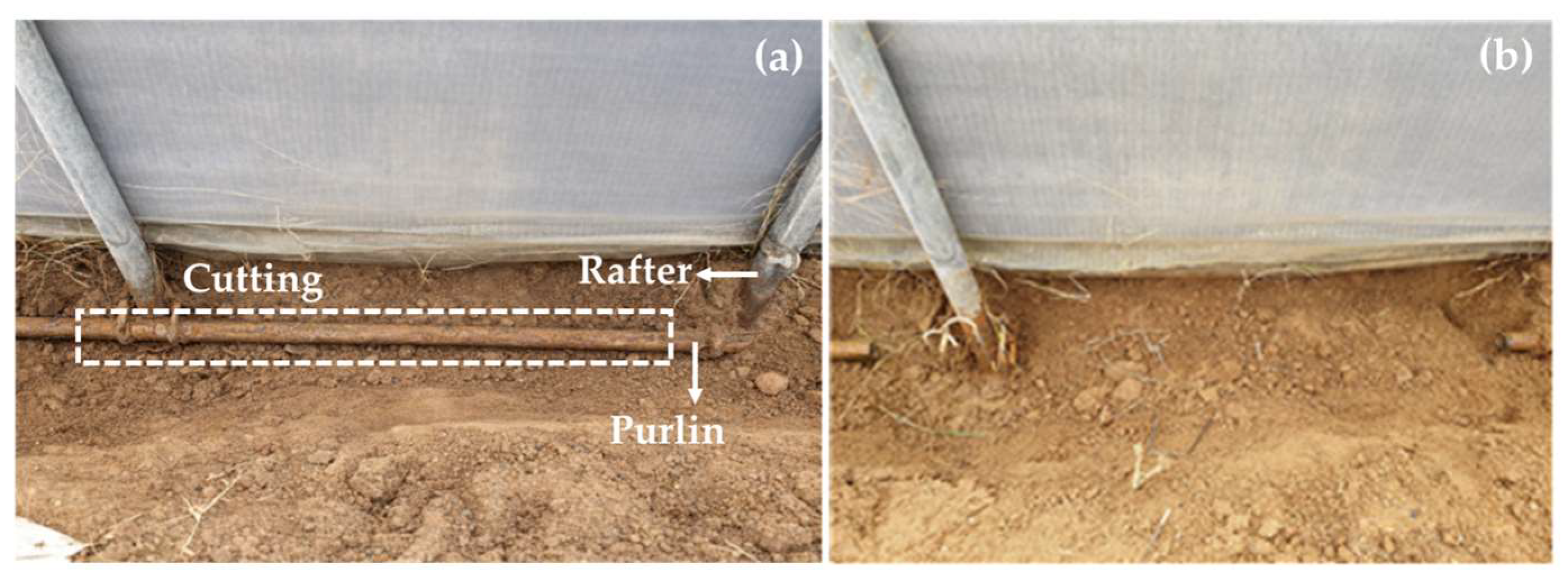
The material used for the test was galvanized steel pipe installed in the cultivation area of an old facility horticultural test site located in Gangseo-gu (Busan Metropolitan City, Republic of Korea; 35°13′16″ N, 128°56′27″ E). The method for extracting steel pipes from buried sections of a greenhouse is depicted in Figure 1. Galvanized steel pipes were sampled to cover a range of possible service lives. However, the service lives of the samples were found to be discontinuous, owing to the fact that they were collected from greenhouses which had already been installed. The outer diameter and thickness of the collected pipe were measured using a vernier caliper. Table 1 shows the mean outer diameter and thickness of the pipe and the component type (purlin or rafter), by service year.

2.2. Soil Chemical Properties

After the steel pipes were sampled, soil was collected for analysis of the chemical properties, including the potential of hydrogen (pH) and electrical conductivity (EC). The soil samples were air-dried and passed through a 2 mm sieve. The sieved soil was mixed with distilled water at a ratio of 1:5 and stirred at 180 per minute for 60 min. After stirring, pH and EC were measured.

2.3. Fabrication of Tensile Tests Specimens

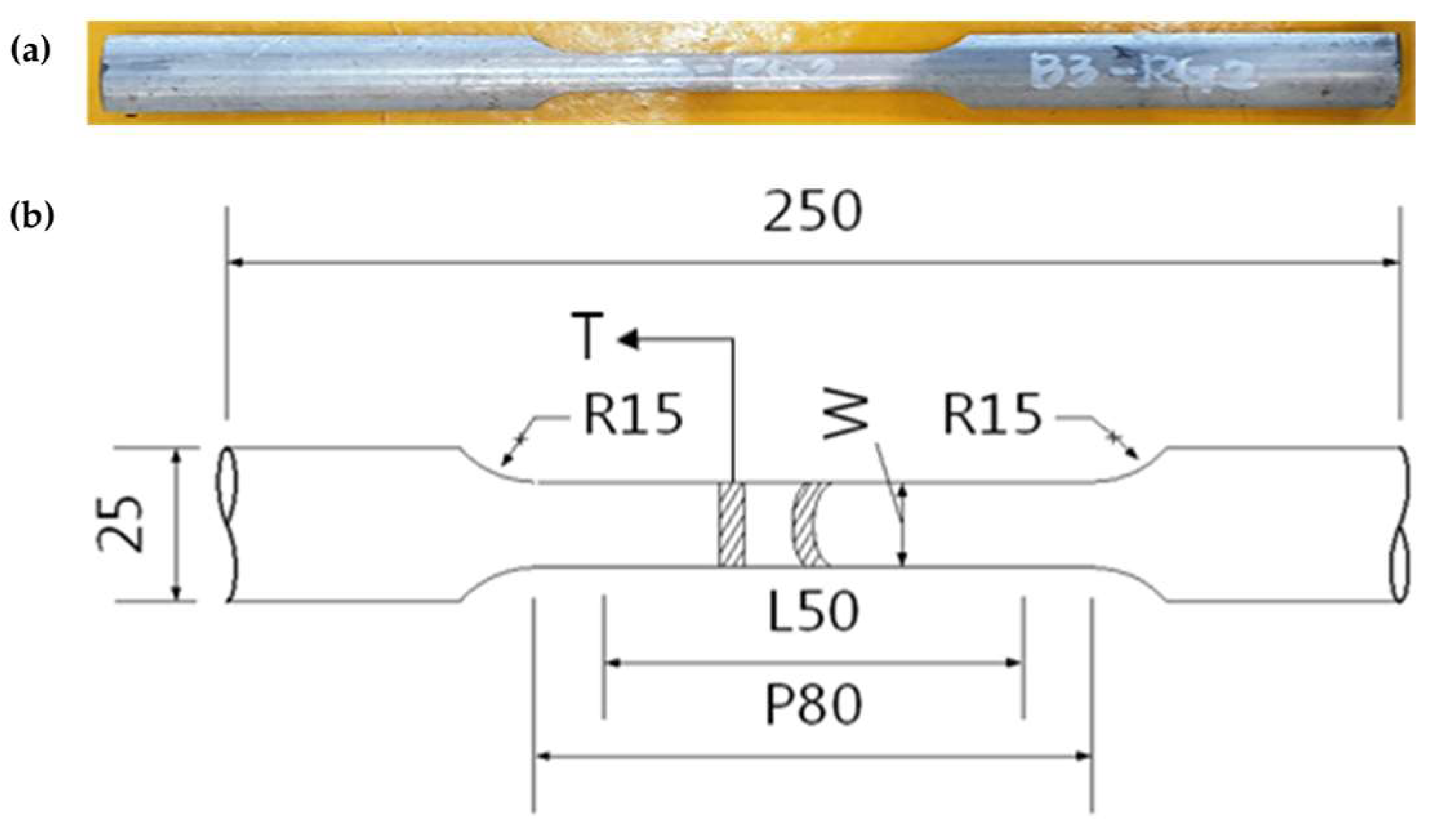
Tensile specimens were prepared in accordance with KS B 0801. For specimen fabrication, galvanized steel pipes (300 mm in length) were cut and machined into KS B 0801 No. 14 standard tensile specimens using a laser cutting machine (Figure 2) [19]. The total length of the specimen was 250 mm, with a width (W) of 12.5 mm. The thickness (T) ranged from 1.1 to 1.6 mm depending on the pipes. The gauge length (L) was 50 mm, the length of the parallel section (P) was 80 mm, and the radius (R) was 15 mm.
The L was used as the reference for elongation measurements and the P represented the load-bearing region during tensile testing. A total of 54 specimens were used for testing and analysis, consisting of 6 specimens for pipes with different service lives.
The tensile tests were performed using a universal material testing machine (SHIMADZU, Kyoto, Japan, UH-X, 1000 kN) at the Korea Testing and Research Institute. The testing method followed the American Society for Testing and Materials (ASTM) E8/E8M-16a standard [20]. According to ASTM standards, the testing speed for yield strength ranges from 1.15 to 11 MPa·s−1, while the speed after yield strength ranges from 4 to 40 mm·min−1. In this test, the testing speed was set at 10 MPa·s−1 up to the yield strength range and the speed after yield strength was 12 mm·min−1.

2.4. Tensile Tests

The testing procedure and calculation of tensile strength, yield strength, and elongation were performed in accordance with ASTM E8/E8M-16a.

2.4.1. Tensile Strength

Tensile strength is the maximum tensile force that a material can withstand until it is destroyed. The tensile strength is calculated by dividing the maximum tensile load ( W m a x ) at which the specimen fractures by the cross-sectional area ( A o ) of the specimen before testing, as follows:
σ = W m a x A o
where σ denotes the tensile strength (N∙mm−2), W m a x denotes the maximum tensile load (N), and A o refers to the cross-sectional area of the specimen (mm2) (Supplementary Figure S1).

2.4.2. Yield Strength

Yield strength refers to the stress at which permanent deformation (plastic deformation) occurs without returning to its original state (elastic deformation). Therefore, when designing structures, the stress caused by the load is designed to be lower than the yield strength. In cases where the yield point of the material is not clearly defined, the accurate maximum stress is determined through the intersection corresponding to a strain of 0.2% (Supplementary Figure S1).

2.4.3. Elongation

Elongation is the ratio of the change in length due to material deformation. Elongation is a crucial factor in structural design because it indicates the ease of processing and deformation of materials, as well as the delay in material failure caused by external forces. The elongation was calculated using the following formula:
δ = L L o L O × 100
where δ symbolizes the elongation (%), L O denotes the initial gauge length (mm) of the specimen, and L denotes the gauge length (mm) after fracture.

2.5. Statistical Analysis

Six specimens for each service life (6, 7, 11, 12, 13, 16, 17, 21, and 23) were used for tensile tests (tensile strength, yield strength, and elongation). Statistical analyses were performed using SAS (version 9.4; SAS Institute Inc., Cary, NC, USA), and one-way of analysis of variance (ANOVA) was conducted. Significant differences in tensile tests values were confirmed using least significant difference (LSD) test. Figures (mean ± standard error) and simple linear regression were produced in Python (version 3.14.2; Python Software Foundation, Wilmington, DE, USA) using Numpy (version 2.4.0) and Matplotlib (version 3.10.8), with the regression equation and coefficient of determination (R2) displayed on the plots.

3. Results and Discussion

Although the service life of pipe was not collected continuously on a year-by-year basis, this study is meaningful because it evaluates the mechanical properties of galvanized steel pipes that were used as structural members in commercial horticultural greenhouses located in the same region under comparable soil conditions. Over time, the mechanical properties of greenhouse galvanized steel pipes can vary with service life due to combined exposure to aboveground natural factors (e.g., wind and snow loads) and belowground soil-related factors (e.g., salinity, gas composition, and microbial activity) [21]. Therefore, to ensure safe greenhouse operation, fundamental data on time-dependent mechanical characteristics are required to assess structural safety, durability, and allowable service life as a function of pipe age. Such fundamental information is also essential for establishing safety criteria and developing standards for insurance assessment. Although annual, age-by-age data would be ideal, it is practically difficult to obtain greenhouse pipe specimens representing every service life from the same region with similar soil conditions. Accordingly, in this study, we selected the best available set of specimens that could be obtained from in-service horticultural greenhouses within the target region, spanning 6 to 23 years of service (6, 7, 11, 13, 16, 17, 21, and 23 years), and investigated age-related changes in mechanical properties.

3.1. Domestic Standards (KS) and Characteristics

Although no international standard exclusively addresses galvanized steel pipes for greenhouse structures, the performance and durability of such pipes are generally evaluated based on internationally recognized steel pipe and galvanizing standards (e.g., ASTM A53 (USA), JIS G 3442 (Japan), and ISO 1461 (International)) [22,23,24]. In the Republic of Korea, however, galvanized steel pipes used as frame members for agricultural vinyl (plastic) houses are specified under the Korean Industrial Standard, KS D 3760 (Galvanized steel pipes for agricultural vinyl houses).
Prior to the 2004 revision, KS D 3760 included only a single specification, known as steel pipe for vinyl house (SPVH), which specified the zinc coating mass, dimensions, weight, and allowable dimensional tolerances of pipes [25]. However, since the 2006 revision, the standard has been divided into SPVH and SPVHS based on their intended use. The difference from the previous version is an increase in the zinc coating mass, and regulations regarding the minimum coating thickness and mechanical properties of the steel pipe has been added.
The plating coverage for SPVH and SPVHS is equivalent at 150 g·m−2 or greater, and the minimum coating thickness is 12 μm or more. However, the mechanical properties of SPVH and SPVHS are different (Table 2). For SPVH, a tensile strength is 270 N∙mm−2, a yield strength is 205 N∙mm−2, and an elongation of 20% or more. While, SPVHS has a tensile strength 48% higher and a yield strength 44% higher than SPVH, while its elongation is 10% lower [26]. This is because SPVHS is used as a primary structural member in vinyl houses, requiring higher strength and enhanced structural safety. For this reason, the disaster-resistant facility standards for horticultural crop facilities require the use of SPVHS or materials with equivalent or higher quality in the installation of disaster-resistant structures [27].
To evaluate the service life of pipe frame structures, it is necessary to assess the corrosion rate and assessing the reduction in cross-sectional area or to evaluate the load-bearing capacity through load tests. However, under field conditions, load testing is impractical, and accurately measuring cross-sectional area loss is also highly challenging. Therefore, this study is meaningful in that it utilized agricultural galvanized steel pipes collected directly from the field to compare tensile test results—including changes in tensile strength, yield strength, and elongation according to service life—based on the standard for SPVHS.

3.2. Soil Chemical Properties at the Sampling Sites

Soil chemical properties (pH and EC) were analyzed in soils collected from locations where galvanized steel pipes were sampled, as corrosion of steel pipes over service life may affect the surrounding soil (Table 3). Although seasonal variability was not assessed through repeated soil sampling, all samples were collected within the same region under comparable soil types and climatic conditions; therefore, seasonal effects are unlikely to be a major driver of the between-sample differences observed in this study, even though the absolute values of some soil parameters may vary across seasons.
According to service life, soil pH ranged from 5.1 to 6.2 (mean ± standard deviation, 5.8 ± 0.3), indicating weakly acidic soil conditions. Among the samples, soil from sites with 6-year-old pipes showed the highest pH value, 6.2, whereas lower pH values of 5.6 and 5.1 were observed in soils from sites with 21- and 23-year-old pipes, respectively.
EC is the reciprocal of electric resistivity and indicates the concentration of dissolved ions in soil, with higher EC values reflecting higher ionic content (salinity) and electrical conductance [28]. The EC of soils collected from sites where galvanized steel pipes were sampled ranged from 0.01 to 0.04 dS·m−1 (mean ± standard deviation, 0.02 ± 0.01 dS·m−1) (Table 3). Oh et al. (2010) [29] reported that the average EC of agricultural domestic soils is below 1 dS·m−1, while Yun et al. (2015) [13] reported EC values of 0.13 and 0.22 dS·m−1 for paddy and filed soils without salinity, respectively. Accordingly, the soils sampled in this study can be considered to have negligible salinity levels.
Based on these results, soil pH and EC in the study sites are unlikely to be primary factors directly influencing the corrosion of galvanized steel pipes. Chung et al. (2001) [30] reported that soil resistivity is a major factor governing steel pipe corrosion and is influenced by multiple soil properties, including pH, EC, moisture content, aeration, and microbial activity. In particular, significant corrosion was observed in strongly acidic soils with low pH values. Therefore, the differences in corrosion level observed in the pipes used for tensile tests in this study are more likely attributable to service life and other combined environmental factors rather than to soil salinity or acidity alone.

3.3. Tensile Strength, Yield Strength, and Elongation of Specimens

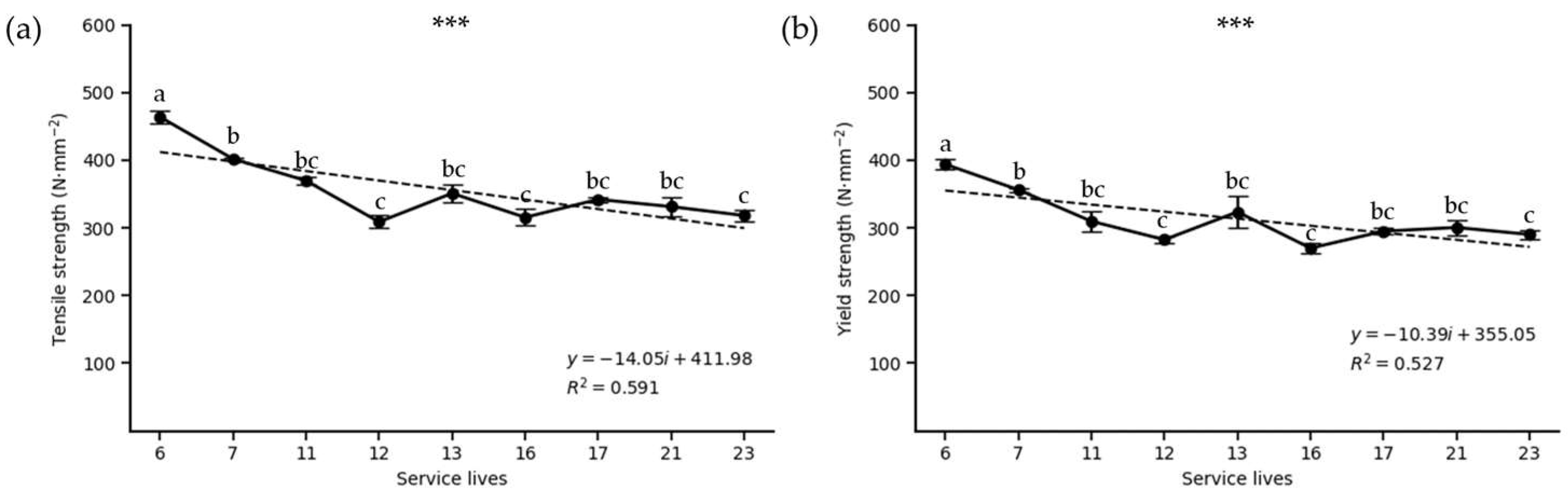
Tensile strength, yield strength, and elongation were evaluated across service-life groups using tensile tests (Figure 3 and Figure 4). Both tensile and yield strength decreased with increasing service life (Figure 3). Notably, the 6-year specimens exhibited the highest values at 464 and 393 N·mm−2, respectively. In contrast, the 12-, 16-, and 23-year specimens showed significantly lower tensile and yield strength than the 6- and 7-year specimens. The oldest (23-year) specimens recorded tensile and yield strength of 318 and 290 N·mm−2, corresponding to reductions of approximately 31% and 26% relative to the 6-year specimens. This strength decline is likely attributable to accumulated corrosion and material aging due to increased service life. However, the pH and EC of the soil from the buried pipe were measured in this study did not show significant differences according to service life, so it is difficult to explain the strength decline solely by changes in soil chemical conditions (Table 3). Therefore, it is possible that the strength decline was caused by a combination of various environmental factors such as rainwater, groundwater, nutrient solution exposure, moisture content, and microorganisms in addition to the aging of the material due to service life, which accelerated corrosion and aging [12,31,32].
As a result of evaluating the KS standard for SPVHS, the tensile strength satisfied the standard of 6- and 7-year specimens, whereas yield strength satisfied the standard of 6-, 7-, 11-, 13-, and 21-year specimens. Nam [14] proposed a standard service life of 7–8 years for small greenhouses. Consistent with this, specimens with a shorter service life (6–7 years) in this study generally satisfied the KS standard.
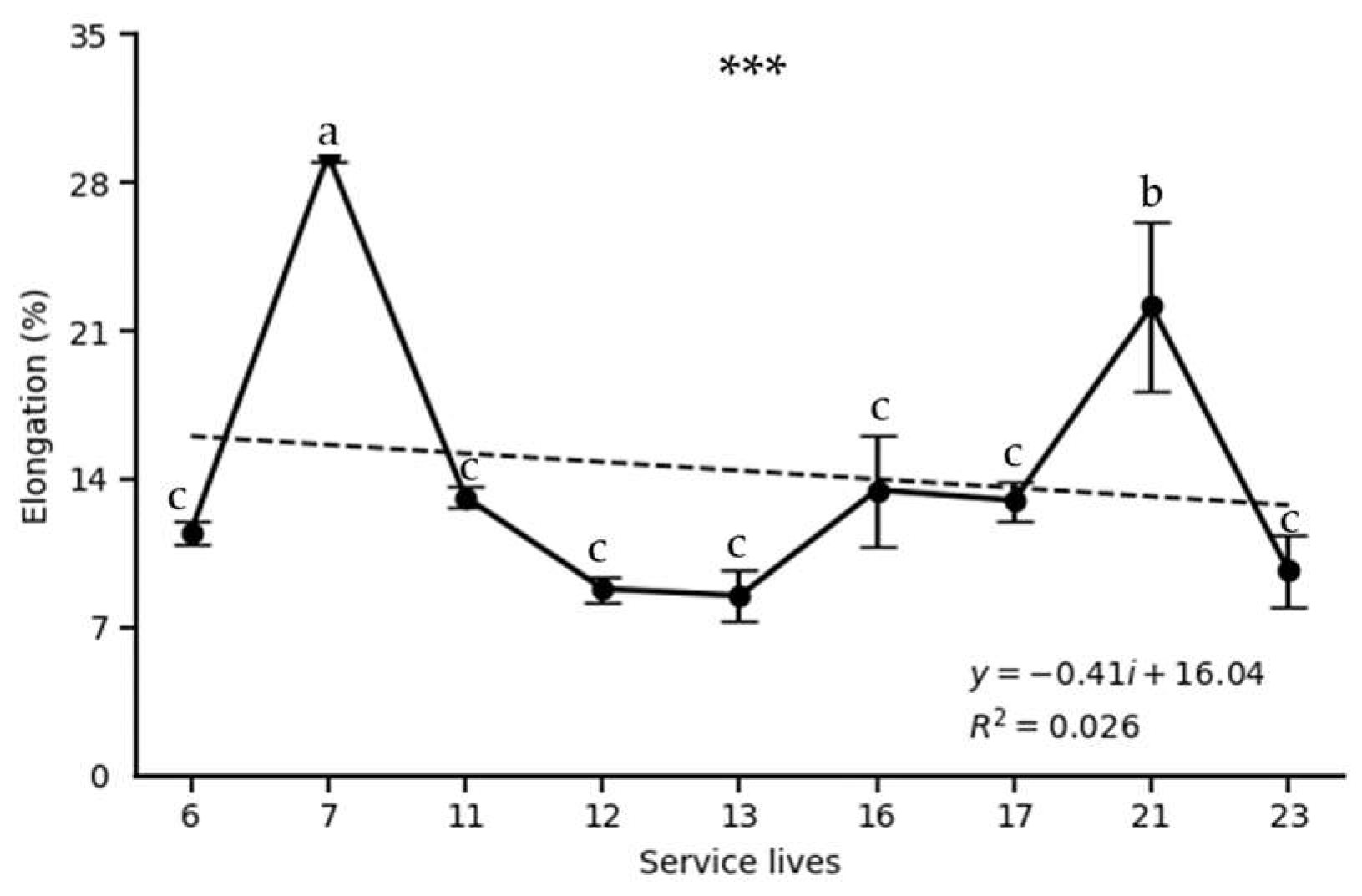
Although significant differences in elongation was observed across service-life groups, the pattern did not show similar trend with the tensile strength and yield strength (Figure 3 and Figure 4). Elongation satisfied the SPVHS standard only for the 7- and 21 years specimens, whereas other groups (6, 11, 12, 13, 16, 17, and 23 years) did not (Figure 4 and Table 2). Elongation is an indicator related to the ductility of a material, and it has been confirmed that it generally tends to decrease as a material ages. However, in this study, elongation values were relatively high for the 7- and 21 years specimens, resulting in a statistically significant difference among service-life groups. The 21 years specimens showed a mean elongation of 22.2% with a relatively large standard deviation of 9.8%, indicating substantial variability in elongation among specimens. Meanwhile, the 7 years specimens showed the highest elongation. However, the average diameter and thickness of the 7 years specimens did not differ significantly from those of the groups, and no notable abnormalities were observed in their visual characteristics that could explain the increased elongation.
Elongation is not determined solely by service life; it can also be influenced by microstructural characteristics (e.g., grain size), manufacturing history, and specimen sampling conditions [33,34,35]. Therefore, even among specimens with the same service life, elongation may be unevenly distributed. Future work could further examine the sources of this variability by considering additional analyses (e.g., manufacturing related factors and microstructure characterization) in conjunction with service-life evaluation, provided that specimens can be secured.
Many studies estimating the durability of galvanized steel rely on controlled or accelerated corrosion tests and then extrapolate the resulting mechanical-property changes to service conditions; for example, recent work has linked corrosion morphology with tensile-property degradation to support service life prediction under atmospheric exposure [36]. In contrast, our analysis is based on specimens retrieved directly from operating greenhouse structures with known service histories, thereby capturing the combined effects of actual in-field exposure variability that are difficult to reproduce in laboratory protocols. This field-based evidence complements accelerated-test approaches and provides a practically relevant benchmark for maintenance and replacement planning in greenhouse facilities.
Broader international discussions of agricultural structure durability emphasize high humidity, soil contact, and agrochemical exposure as key corrosion drivers in farm environments [18,36,37]. In the present study, we did not observe statistically significant differences in soil properties (pH and EC) across pipe service life groups, suggesting that soil-related exposure conditions were broadly comparable across the investigated sites within our sampling sites. Nevertheless, soil contact remains a critical exposure for greenhouse structures, and the protective performance of galvanized coatings can vary substantially with soil environment; for example, Denison and Romanoff (1952) reported that galvanized steel pipes exhibited relatively high resistance in alkaline soils and low resistance in organic soils [37]. Therefore, our result should be interpreted as an evidence-based threshold for greenhouse structures operating under the local soil and climatic conditions represented in this study, rather than a universal value across all soil environments.
In practice, horticultural greenhouse structures are often used for longer than the maximum service life evaluated in this study (23 years). Importantly, the service life thresholds discussed here (e.g., around 7 years) should not be interpreted as definitive end-of-life values; rather, they indicate the onset of measurable degradation in material mechanical properties and a period when risk may increase and safety should be more carefully considered. By presenting service life-dependent changes in mechanical performance as a reference allowable service period, this study underscores the need to recognize the risks associated with operation beyond that period and to systematically consider inspection, reinforcement, and replacement strategies to improve structural safety against natural hazards and to enhance durability. Accordingly, these findings provide empirical evidence that can support the establishment of safety criteria and inform maintenance and strengthening decisions for greenhouse structures.

4. Conclusions

In this study, SPVHS were collected to evaluate how their mechanical properties changed with service lives. The pH of the soil surrounding the buried pipes ranged from 5.14 to 6.17, indicating predominantly slightly acidic conditions, while EC ranged from 0.01 to 0.04 dS m−1. Because neither pH nor EC differed significantly among the soil samples, the corrosion observed with increasing service life could not be explained by soil acidity or salinity status.
When tensile test results were compared with the KS standard requirements for SPVHS, yield strength met the standard for the 6- and 7 years specimens, whereas tensile strength met the standard for the 6-, 7-, 11-, and 13 years specimens. Elongation met the standard for the 7- and 21 years specimens. Significant differences in tensile strength, yield strength, and elongation were observed among specimens with different service lives. Tensile strength and yield strength showed significant differences from 7 years onward; however, elongation showed no significant differences except for the 7- and 21 years specimens.
Importantly, the ‘7 years’ value should not be interpreted as an end-of-life criterion; rather, it indicates a point at which the risk of mechanical deterioration may increase and structural safety may become more sensitive to corrosion-related conditions. Therefore, for greenhouses operated beyond 7 years under conditions similar to our study site, we recommend prioritizing (i) additional evaluation of corrosion severity and contributing factors (e.g., soil moisture, drainage/oxygen availability, salinity/chloride, pH, and microbial activity) and (ii) assessment of structural safety, including inspection of critical joints/bent sections and timely reinforcement or replacement as needed. Multi-site monitoring data will be required to develop quantitative, environment-adjusted decision criteria.

Supplementary Materials

The following supporting information can be downloaded at: https://www.mdpi.com/article/10.3390/app16052262/s1, Figure S1: Example of tensile test result.

Author Contributions

Data curation, writing—original draft, review and editing, M.-S.Y.; Data curation, writing—original draft, H.-H.S.; project administration, H.-R.R.; formal analysis, conceptualization, methodology, and writing—review and editing, I.-H.Y. and M.-K.C. All authors have read and agreed to the published version of the manuscript.

Funding

This work was supported by Korea Institute of Planning and Evaluation for Technology in Food, Agriculture and Forestry (IPET) through Smart Plant Farming Industry Technology Development Program, funded by Ministry of Agriculture, Food and Rural Affairs (MAFRA) (319064011SB010).

Data Availability Statement

No new data were created or analyzed in this study. Data sharing is not applicable to this article.

Conflicts of Interest

The authors declare no conflicts of interest.

References

  1. Ministry of Agriculture, Food and Rural Affairs (MAFRA). The Status of the Greenhouse and Production Records for Vegetable Crops in 2022; Ministry of Agriculture, Food and Rural Affairs: Sejong, Republic of Korea, 2023; pp. 107–108.
  2. Jung, J.-E.; Kim, D.-J.; Kim, H.-J.; Shin, S.-H.; Kim, J.-W. Structural analysis modeling of disaster resilient greenhouse structures. J. Comput. Struct. Eng. Inst. Korea 2017, 30, 7–15. (In Korean) [Google Scholar] [CrossRef]
  3. Nam, S.-W. Experimental analysis on yield strength of pipe connectors and joints for pipe framed greenhouses. J. Korean Soc. Agric. Eng. 2001, 43, 113–119. [Google Scholar]
  4. Kim, R.-W.; Lee, I.-B.; Yeo, U.-H.; Lee, S.-Y. Evaluation of various national greenhouse design standards for wind loading. Biosyst. Eng. 2019, 188, 136–154. [Google Scholar] [CrossRef]
  5. Choi, Y.-B.; Kim, R.-W.; Lee, I.-B. Numerical analysis of snow distribution on greenhouse roofs using CFD-DEM coupling method. Biosyst. Eng. 2024, 237, 196–213. [Google Scholar] [CrossRef]
  6. Lee, S.-G.; Lee, J.-W.; Lee, H.-W. Analysis of structural characteristic of small scale vinyl house by region. Prot. Hortic. Plant. 2002, 11, 306–315. [Google Scholar]
  7. Nam, S.-W.; Ryu, H.-R.; Choi, M.-K.; Shin, H.-H. Corrosion and strength changes of agricultural steel pipes elapsed 20 years under the greenhouse environment. Prot. Hortic. Plant. Forças Armadas Cabinda 2020, 29, 196–201. [Google Scholar] [CrossRef]
  8. Xu, J.; Ren, X.; He, G.; Di, S.; Shi, Z.; Liang, Z. The influence of mountain height and distance on shape factor of wind load of plastic tunnel. Appl. Sci. 2023, 13, 13081. [Google Scholar] [CrossRef]
  9. National Academy of Agricultural Science (NAAS). Design Standard for Greenhouse Structures; National Academy of Agricultural Science: Wanju, Republic of Korea, 2015; pp. 16–17. [Google Scholar]
  10. Ministry of Agriculture, Food and Rural Affairs (MAFRA). Design and Construction Code on Horticultural and Herbal Facilities for Disaster Resistance; Ministry of Agriculture, Food and Rural Affairs (MAFRA): Sejong, Republic of Korea; Rural Development Administration (RDA): Jeonju, Republic of Korea, 2014.
  11. CEN. Greenhouses: Design and Construction: Part 1: Commercial Production Greenhouses; European Committee for Standardization; CEN: Brussels, Belgium, 2001. [Google Scholar]
  12. Arifin, M.D.; Dariansyah, M.R. Lifespan estimation of galvanized steel and stainless steel pipe. Int. J. Mar. Eng. Innov. Res. 2023, 8, 468–476. [Google Scholar] [CrossRef]
  13. Yun, S.-W.; Choi, M.K.; Lee, S.Y.; Moon, S.D.; Yoon, Y.C. Corrosion rate of structural pipes for greenhouse. Prot. Hortic. Plant Fact. 2015, 24, 333–340. [Google Scholar] [CrossRef]
  14. Nam, S.-W. A study on the standard durable years of pipe framed greenhouses. J. Korean Soc. Agric. Eng. 2001, 43, 96–101. [Google Scholar]
  15. Nam, S.-W.; Yu, I.-H. A field survey on the Structures and maintenance status of pipe framed greenhouses. J. Korean Soc. Agric. Eng. 2000, 42, 106–114. [Google Scholar]
  16. De Belie, N.; Richardson, M.; Braam, C.R.; Svennerstedt, B.; Lenehan, J.J.; Sonck, B. Durability of building materials and components in the agricultural environment: Part I: The agricultural environment and timber structures. J. Agric. Eng. Res. 2000, 75, 225–241. [Google Scholar] [CrossRef]
  17. De Belie, N.; Sonck, B.; Braam, C.R.; Lenehan, J.J.; Svennerstedt, B.; Richardson, M. Durability of building materials and components in the agricultural environment, Part II: Metal structures. J. Agric. Eng. Res. 2000, 75, 333–347. [Google Scholar] [CrossRef]
  18. Maraveas, C. Durability issues and corrosion of structural materials and systems in farm environment. Appl. Sci. 2020, 10, 990. [Google Scholar] [CrossRef]
  19. KS B 0801:2007; Korean Standards and Certification. Test Pieces for Tensile Test for Metallic Materials. Korean Standards Association (KSA), Korea Agency for Technology and Standards: Eumseong-gun, Republic of Korea, 2007. Available online: https://www.standard.go.kr/streamdocs/view/sd;streamdocsId=72059366105697106 (accessed on 5 February 2026).
  20. ASTM E8/E8M-16a; Standard Test Methods for Tension Testing of Metallic Materials. ASTM International: Conshohocken, PA, USA, 2020.
  21. Chukhin, V.; Makisha, N.; Gulshin, I. Evolution of Galvanized Steel Pipe Corrosion in Hot Water Supply Systems. Corros. Mater. Degrad. 2025, 6, 55. [Google Scholar] [CrossRef]
  22. Vera, R.; Vinciguerra, F.; Bagnara, M. Comparative study of the behavior of API 5L-X65 grade steel and ASTM A53-B grade steel against corrosion in seawater. Int. J. Electrochem Sci. 2015, 10, 6187–6198. [Google Scholar] [CrossRef]
  23. Nam, J.-S.; Lee, Y.-S.; Kim, Y.-H.; Won, S.-Y. A Characteristic Comparison of Copper Pipe and Strain less Pipe used in Fire Protection System. In Proceedings of the Korea Institute of Fire Science and Engineering Conference; Korean Institute of Fire Science and Engineering: Yongin, Republic of Korea, 2010; pp. 200–206. [Google Scholar]
  24. Oktavina, R. Optimizing the Hot-dip Galvanizing Process of Angle Bar Steel Product According To ISO 1461 Standard Using The Taguchi Method. In Proceedings of the International Conference on Industrial Engineering and Operations Management, Manila, Philippines, 7–9 March 2023; pp. 679–689. [Google Scholar]
  25. KS D 3760:2004; Korean Standards and Certification. Galvanized Steel Pipes for Plastic Housing. Korean Standards Association (KSA): Seoul, Republic of Korea, 2004. Available online: https://www.standard.go.kr/streamdocs/view/sd;streamdocsId=72340841081147562 (accessed on 5 February 2026).
  26. KS D 3760:2006; Korean Standards and Certification. Coated Steel Pipes for Plastic Housing. Korean Standards Association (KSA): Seoul, Republic of Korea, 2006. Available online: https://www.standard.go.kr/streamdocs/view/sd;streamdocsId=72340841081145105 (accessed on 5 February 2026).
  27. Ministry of Agriculture, Food and Rural Affairs (MAFRA). Disaster-Resistant Standards for Horticultural Facilities; Ministry of Agriculture, Food and Rural Affairs (MAFRA): Sejong, Republic of Korea; Rural Development Administration (RDA): Jeonju, Republic of Korea, 2024; pp. 6–7.
  28. Husson, O.; Brunet, A.; Babre, D.; Charpentier, H.; Durand, M.; Sarthou, J.P. Conservation agriculture systems alter the electrical characteristics (Eh, pH and EC) of four soil types in France. Soil Tillage Res. 2018, 176, 57–68. [Google Scholar] [CrossRef]
  29. Oh, S.-E.; Son, J.-S.; Ok, Y.-S.; Joo, J.-H. A modified methodology of salt removal through flooding and drainage in a plastic film house soil. Korean J. Soil Sci. Fert. 2010, 43, 565–571. [Google Scholar]
  30. Chung, W.-S.; Lee, H.-D.; Yu, M.-J.; Kwak, P.-J. Evaluation of external corrosion on the drinking water pipelines using soil corrosive parameters. J. Korean Environ. Eng. 2001, 23, 1611–1619. [Google Scholar]
  31. Liu, H.; Dai, Y.; Cheng, Y.F. Corrosion of underground pipelines in clay soil with varied soil layer thicknesses and aerations. Arab. J. Chem. 2020, 13, 3601–3614. [Google Scholar] [CrossRef]
  32. El-Shamy, A.M.; Shehata, M.F.; Ismail, A.I. Effect of moisture contents of bentonitic clay on the corrosion behavior of steel pipelines. Appl. Clay Sci. 2015, 114, 461–466. [Google Scholar] [CrossRef]
  33. Ko, B.-C.; Kim, J.-H.; Yoo, Y.-C. The effects of temperature and strain rate on flow stress and strain of AA5083 alloy during high temperature deformation. J. Korean Soc. Technol. Plast. 1998, 7, 168–176. [Google Scholar]
  34. Li, S.X.; Cui, G.R. Dependence of strength, elongation, and toughness on grain size in metallic structural materials. J. Appl. Phys. 2007, 101, 083525. [Google Scholar] [CrossRef]
  35. Figueiredo, R.B.; Kawasaki, M.; Langdon, T.G. The role of grain size in achieving excellent properties in structural materials. J. Mater. Res. Technol. 2024, 30, 3448–3462. [Google Scholar] [CrossRef]
  36. Dong, J.; Zhang, Z.; Yang, T.; Wang, J.; Ma, M.; Chen, W.; Wang, H.; Qian, H.; Fan, F. Comparative study on surface morphology evolution and mechanical property degradation of galvanized steel under different corrosion tests and its service life prediction. Case Stud. Constr. Mater. 2025, 23, e05242. [Google Scholar] [CrossRef]
  37. Denison, I.A.; Romanoff, M. Corrosion of galvanized steel in soils. J. Res. Nat. Bur. Stand. 1952, 49, 299–316. [Google Scholar] [CrossRef]
Figure 1. Example of collecting buried rafters or purlins in a greenhouse: (a) rafter and purlin before cutting; (b) section of a purlin after cutting and harvesting from the buried installation.
Applsci 16 02262 g001
Figure 2. Specimen for tensile test used in this study. (a) Specimen; (b) specimen size (W: width, T: thickness, L: gauge length, P: length of the parallel section, R: radius).
Applsci 16 02262 g002
Figure 3. Tensile strength (a) and yield strength (b) of buried specimens by pipe service life. Vertical bars represent the standard errors. Different letters indicate significant differences among groups (one-way ANOVA followed by LSD test; n = 6). Significance level: *** p < 0.001.
Applsci 16 02262 g003
Figure 4. Elongation of buried specimens by pipe service life. Vertical bars represent the standard errors. Different letters indicate significant differences among groups (one-way ANOVA followed by LSD test; n = 6). Significance level: *** p < 0.001.
Applsci 16 02262 g004
Table 1. Average outer diameter, thickness, and member type (purlin or rafter) of steel pipes by elapsed service lives.
Service Life of Pipe (Year)Average Outer
Diameter (mm)
Average Thickness (mm)Member Type
625.51.5Purlin
725.71.5Purlin
1132.01.5Rafter
1236.41.6Rafter
1325.81.5Rafter
1625.61.3Purlin
1725.51.2Rafter
2125.61.3Purlin
2325.41.4Purlin
Table 2. Mechanical properties of galvanized steel pipes for vinyl houses.
Pipe TypeTensile Strength (N∙mm−2)Yield Strength (N∙mm−2)Elongation (%)
SPVH z≥270≥205≥20
SPVHS y≥400≥295≥18
z galvanized steel pipe for agricultural vinyl house. y galvanized steel pipe for agricultural vinyl house structure.
Table 3. Soil pH and EC around buried galvanized steel pipes.
Service Life of Pipe (Year)pHEC (dS·m−1)
66.20.02
75.70.03
115.90.01
1260.04
1360.01
165.80.02
176.20.02
215.60.03
235.10.02
Disclaimer/Publisher’s Note: The statements, opinions and data contained in all publications are solely those of the individual author(s) and contributor(s) and not of MDPI and/or the editor(s). MDPI and/or the editor(s) disclaim responsibility for any injury to people or property resulting from any ideas, methods, instructions or products referred to in the content.