1. Introduction
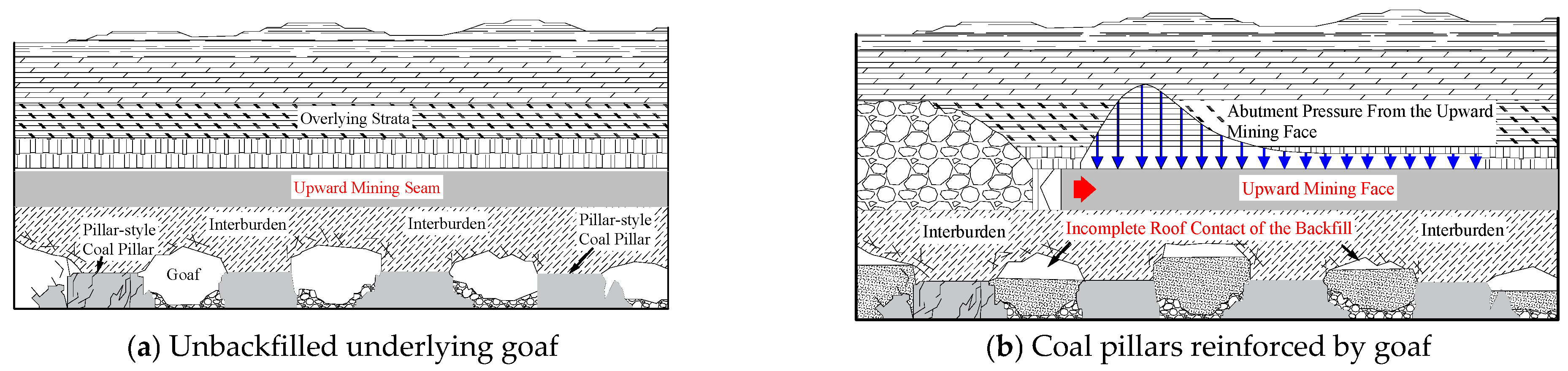
Extensive pillar-style coal pillars remain in certain coal mines across Central and Western China due to historically unregulated mining practices in small-scale coal pits. When underlying coal seams are extracted using the pillar mining method, these coal pillars transition from a triaxial stress state to a uniaxial or biaxial stress state. This shift induces failure in the coal mass within a certain range on the exposed side of the pillars, as depicted in
Figure 1a. Moreover, such mines commonly employed wasteful mining practices—extracting thicker seams while ignoring thinner ones, prioritizing richer sections and abandoning leaner ones, and opting for easily accessible coal while bypassing more challenging areas. These extensive mining methods have led to the abandonment of recoverable coal seams above the pillar-type goaf [
1,
2]. When upward mining is to be conducted above such goafs supported by existing pillar-style coal pillars, reinforcement of the pillars becomes necessary. The current technical approach typically involves grouting and backfilling the underlying goaf through boreholes drilled from the surface or from the upward mining seam. The cemented backfill slurry injected into the goaf hardens under the confinement of the surrounding rock, forming a cemented backfill mass with load-bearing capacity. This backfill comes into intimate contact with the coal pillars, restricting their lateral deformation and thereby inhibiting plastic failure. Under the combined effect of overlying strata pressure and the lateral confinement provided by the backfill, the coal pillars gradually revert from a uniaxial compression state to a triaxial compression state. This enhances both the strength of the pillar-style coal pillars and the overall stability of the goaf [
3], as illustrated in
Figure 1b.
Serving as the core supporting system in upward mining, the stability of the “backfill–pillar” load-bearing structure is directly critical to the safety and stability of the entire stope structure. Technical measures such as full goaf backfilling, partial goaf backfilling, full bilateral backfilling alongside key pillars [
4], and partial bilateral backfilling alongside key pillars [
5] have been implemented to form a synergistic “backfill–pillar” bearing system. Researchers domestically and internationally have conducted systematic, multi-faceted studies on the intrinsic load-bearing mechanisms and characteristics of this structure. From the perspective of mechanical analysis, theories such as the Mohr–Coulomb criterion [
6], Rankine’s earth pressure theory [
7] and limit equilibrium theory [
8] have been employed to reveal the core mechanisms through which backfill enhances the composite strength, namely stress transfer, energy absorption, and lateral confinement [
9]. These studies have clarified the mechanical response characteristics of both coal pillars and backfill [
10], the propagation patterns of plastic zones [
8], and the synergistic load-bearing mechanisms [
11,
12]. Furthermore, various mechanical models, including elastic and viscoelastic models, have been developed to quantify key influencing factors [
13,
14].
In the realm of numerical simulation, using software such as PFC (version 5.0), FLAC3D (version 7.0), and 3DEC (version 7.0), analyses have been performed under various mining conditions to assess the influence of backfill parameters (strength, width, backfill ratio), pillar dimensions, and mining methods on overburden stability [
15,
16], stress distribution [
17,
18,
19,
20], and deformation evolution [
21,
22]. These simulations have validated the effectiveness of the synergistic bearing structure in controlling the roof [
23,
24,
25]. Through rock mechanics experiments, including uniaxial/triaxial compression, shear testing, and acoustic emission monitoring, investigations have been conducted into the composite strength of the backfill and pillar [
26,
27], their failure modes [
28,
29], and crack evolution patterns [
30]. Experimentally based constitutive models [
31] and constraint analysis models [
32] have been established, elucidating the influence of the backfill hardening stage and interface characteristics on the structural load-bearing performance [
33,
34]. The aforementioned research has systematically clarified the interaction mechanism between the backfill and pillar, deepened the understanding of the stability of synergistic bearing systems, and provided theoretical support and practical guidance for optimizing coal pillar reinforcement and overburden control technology in backfill mining [
6,
9,
10,
11,
12,
35,
36,
37]. It also lays a solid foundation for the expansion of subsequent related research. The aforementioned experts and scholars have conducted comprehensive analyses of the interaction mechanism between backfill and coal pillars under ideal roof-contact conditions, providing crucial support for ensuring the stability of underlying room-and-pillar systems during upward mining. However, due to constraints such as high backfilling costs, insufficient backfill materials, and imperfect roof-contact technology, the backfill injected into goafs often encounters issues including incomplete roof contact and inadequate backfill strength. While backfill strength is a key factor determining backfill quality, the backfill ratio is particularly critical for stope safety and subsidence control. In current practical backfilling operations, existing roof-contact techniques can achieve complete backfill–roof contact [
38]. Nevertheless, considering factors such as construction convenience and backfilling costs, there typically exists an optimal balance between the backfill ratio and the actual backfilling effectiveness. This optimization aims to enhance the load-bearing capacity of coal pillars while simultaneously reducing backfilling costs to some extent. As the “backfill–pillar” system serves as the primary load-bearing structure during upward mining over underlying goafs, the synergistic load-bearing mechanisms between coal pillars and backfills with varying strengths and backfill ratios still require further investigation.
Therefore, this study focuses on the “backfill–pillar system with varying backfill ratios,” considering coal pillar width, backfill strength, and backfill ratio as key parameters. Using the Particle Flow Code (PFC) numerical simulation software, a numerical model of the load-bearing structure with different backfill ratios is established. The crack propagation characteristics and failure mechanisms of the load-bearing structure are analyzed. By examining the coordination mechanism and optimal matching relationship between backfill strength and backfill ratio, this research determines the critical stable backfill ratios for different pillar widths under the coordinated influence of backfill ratio and strength and establishes the corresponding stability criteria.
2. Mechanical Tests and Result Analysis of Backfill–Coal Pillars with Different Backfill Ratios
2.1. Test Design of Backfill–Coal Pillars with Different Backfill Ratios (Simplification of Model Experiments)
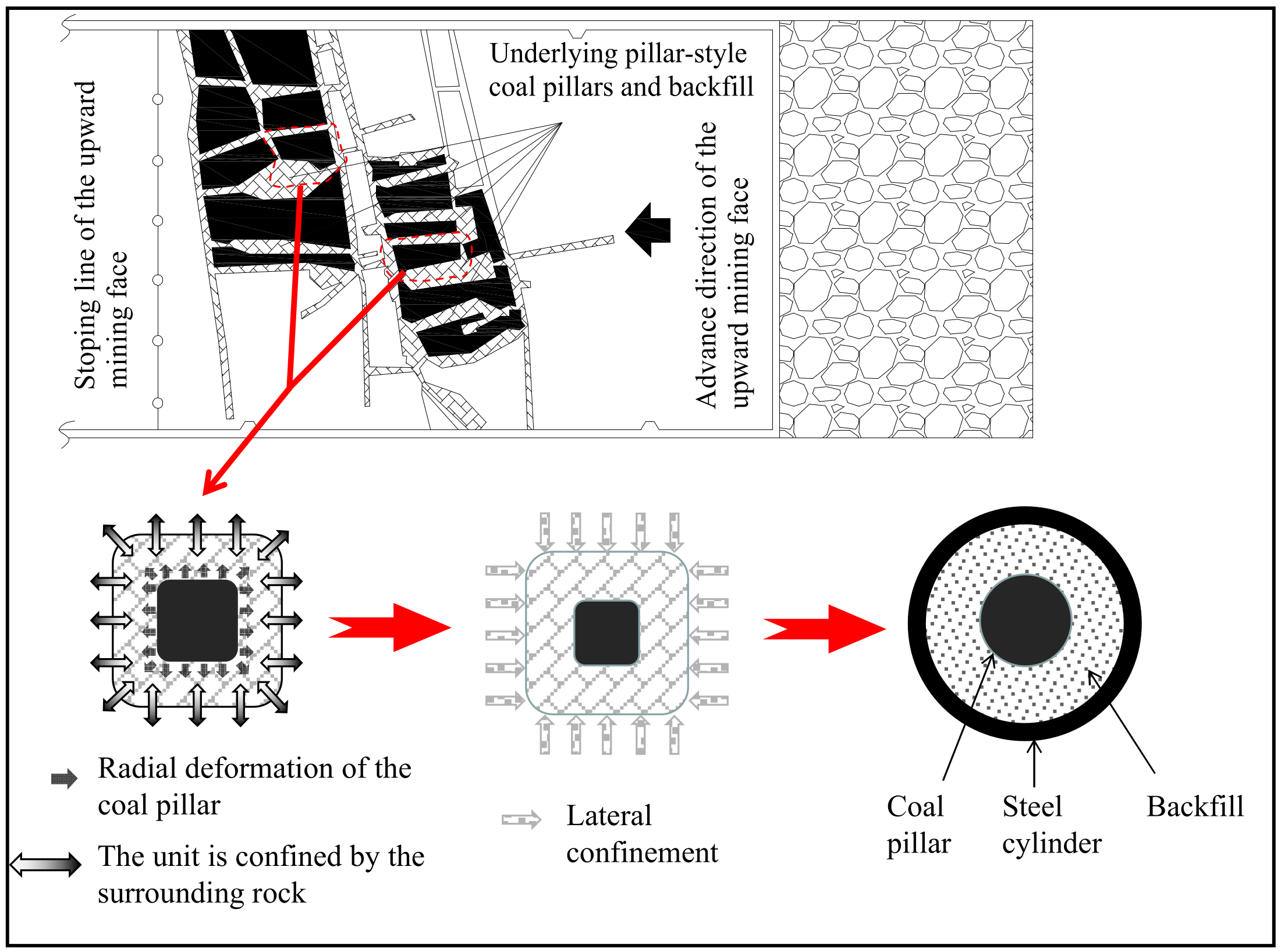
After being backfilled into the goaf, the backfill is in close contact with the coal pillar. It restricts the lateral deformation of the coal pillar and inhibits its plastic deformation. Under the combined action of overlying strata pressure and lateral confinement from the backfill, the coal pillar gradually transitions from a uniaxial compression state to a triaxial compression state, thereby enhancing its bearing capacity.
Considering that the thickness of the backfill is much smaller than that of the overlying strata, the backfill for reinforcing the coal pillar is constrained by the surrounding rock, forming a confined compression condition [
39,
40,
41,
42]. Therefore, the coupled bearing and synergistic effect between the coal pillar and backfill in the goaf can be abstracted as a confined compression test of the backfill–coal pillar [
11].
Figure 2 depicts the simplification process of the confined condition for the backfill–coal pillar unit cell.
2.2. Preparation of Backfill–Coal Pillar Composite Samples
Based on the test model for the interaction between backfill and rock pillars, and the test model for CFRP-reinforced coal pillars under axial compression [
43,
44,
45], a coupled bearing test model of backfill–coal pillars was designed to analyze the coupled bearing mechanism of backfill–coal pillars under different backfill strength and height conditions. The experiment was divided into three working conditions according to different backfill strengths (cement contents of 5%, 10%, and 15%), and each working condition was further divided into three groups based on backfill ratios of 50%, 70%, and 90%.
The sample numbering method consists of letters and numbers: letters A, B, and C represent backfill strengths of 3.11 MPa, 6.44 MPa, and 7.83 MPa, respectively; numbers 90, 70, and 50 correspond to backfill ratios of 50%, 70%, and 90%, respectively.
Cylindrical coal pillars with a size of Φ50 × 100 mm were selected as the coal pillar samples. First, the coal pillar samples were placed at the center of circular molds of Φ100 × 100 mm. Backfill slurries with cement contents of 5%, 10%, and 15% (mass concentration of 78%) were prepared. The material ratios and uniaxial compressive strengths of the backfills are shown in
Table 1. Then, the slurry was slowly poured into the molds to the required height, ensuring the coal pillar samples were uniformly wrapped by the backfill. The filled backfill–coal pillar samples were placed in a curing box for curing at a temperature of 20 ± 5 °C and a relative humidity of 95% ± 5%. After curing for 3 days, the samples were demolded and continuously cured until 28 days for subsequent use.
2.3. Test Equipment and Measuring Point Arrangement
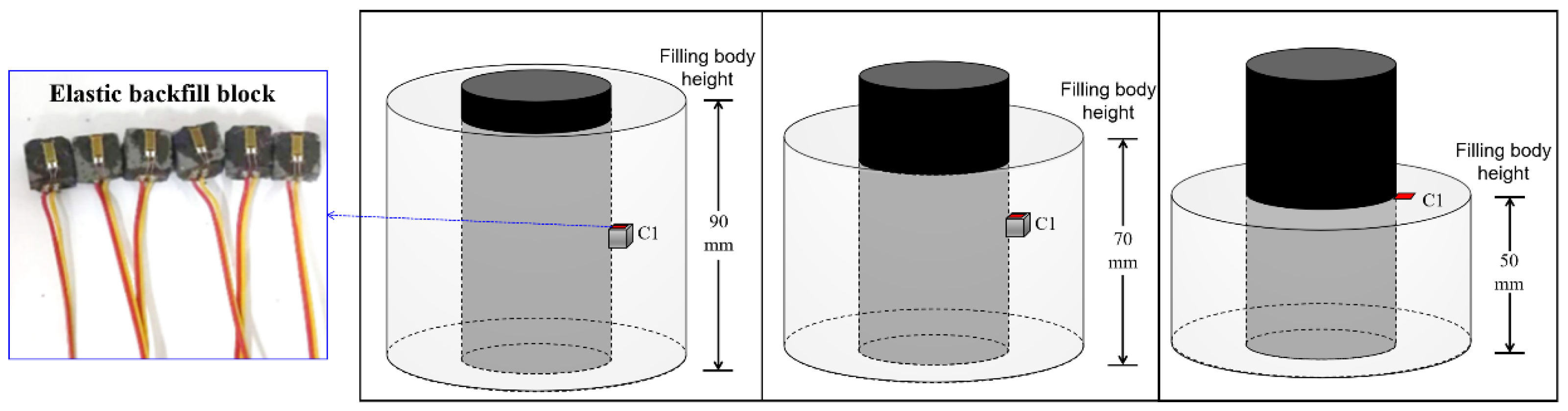
To obtain the strain characteristics of the lateral confinement of coal pillars under different backfill ratios and strengths, conventional resistance strain gauges were used to measure the strains on the coal pillar surface and inside the backfill. Elastic modules (C1) with bonded strain gauges were arranged inside the backfill at a height of 50 mm, aiming to monitor the radial strain of the backfill induced by the coal pillar. The bonding positions of the strain gauges are shown in
Figure 3.
The aforementioned elastic modules are small test blocks with the same mix ratio as the backfill. Strain gauges for monitoring the radial strain of the backfill were bonded to the prefabricated elastic modules, which were then embedded into the backfill slurry at a preset height during pouring.
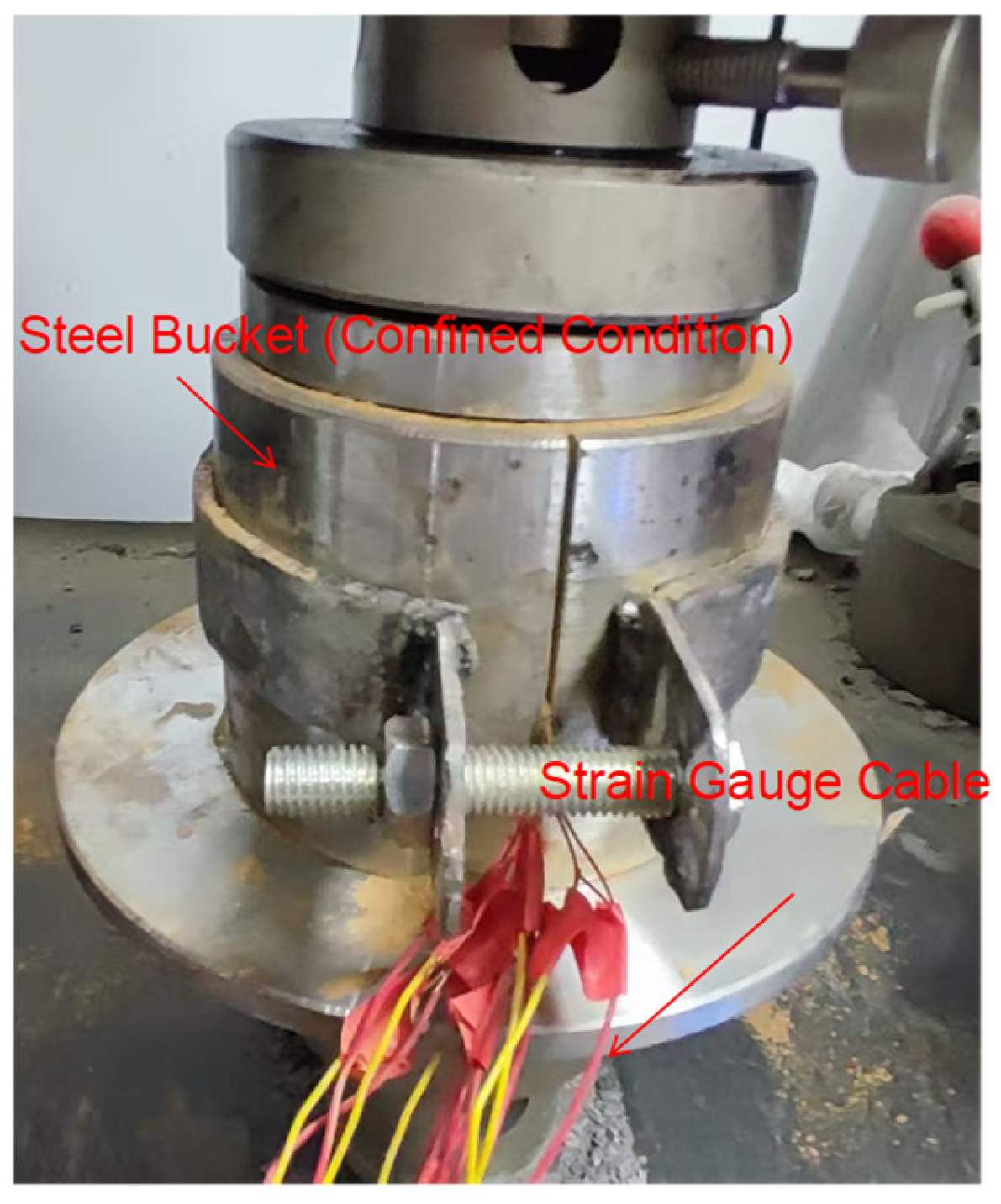
In the test, a high-strength circular steel barrel was adopted to restrict the lateral deformation of the composite structure. Since the elastic modulus of high-strength steel is much larger than that of the composite structure, the test error caused by radial deformation can be neglected. To monitor the stress–strain characteristics of the composite structure during the test, wires connected to the strain gauges needed to be led out from the interior. Therefore, grooves were cut into the circular steel mold. After placing the sample and strain monitoring wires into the steel mold, they were locked using self-made annular clamps. The steel barrel and annular clamps used in the test are shown in
Figure 4.
Although the size of the composite structure under the non-roof-contacted backfill condition is Φ100 × 100 mm, the upper indenter of the press machine (Xi’an, Shaanxi, China) only applies load to the Φ50 × 100 mm coal pillar during the compression test, and the backfill merely provides lateral confinement to the coal pillar. Therefore, for the composite structure samples under the non-roof-contacted backfill condition, only the coal pillar bears the axial load in the composite model, and the size effect caused by the backfill can be neglected.
2.4. Failure Morphologies and Stress–Strain Curves of Backfill–Coal Pillars with Different Backfill Ratios
Table 2 presents the final failure morphologies of representative coal pillars under different working conditions. It can be observed that, under the same backfill height, as the backfill strength increases, the failure mode of coal pillars gradually transitions from shear failure to splitting failure, with the damage degree gradually alleviated and integrity significantly improved. Under confined compression conditions, the constraint effect of the backfill on the lateral deformation of coal pillars mainly depends on the radial compressible deformation of the backfill. Compared with low-strength backfill, high-strength backfill has a higher elastic modulus and smaller radial compressive deformation, thus exerting a stronger restraining effect on the circumferential deformation of coal pillars. High-strength backfill limits the radial deformation of coal pillars during loading, leaving insufficient space for the expansion and penetration of internal cracks. Consequently, high-strength backfill can significantly enhance the integrity of coal pillars at failure.
Notably, in terms of final failure morphology, coal pillars with a backfill height of 50 mm exhibit better integrity and less severe damage than those with 70 mm. The underlying reason, as indicated by the stress–strain curves, is that the 70 mm high backfill enables the coal pillar to undergo repeated failure and reloading during the loading process. In contrast, the 50 mm high backfill provides limited lateral confinement. The unconstrained upper part of the coal pillar undergoes excessive circumferential deformation, leading to debris splashing. Cracks in the coal pillar develop and penetrate to the bottom, forming a single-slope shear failure. Restricted by its height, the backfill cannot achieve repeated bearing with the failed coal pillar, and the test terminates immediately after the coal pillar experiences single-slope shear failure. This explains why coal pillars with a 70 mm high backfill show more severe damage than those with 50 mm.
The stress–strain curves of composite structures with backfill ratios of 90%, 70%, and 50% exhibit essentially consistent characteristics in the OA stage, where the coal pillar transitions from the elastic stage to the plastic stage. After the composite structure enters the AB stage, microcracks inside the coal pillar continuously expand and coalesce. Under axial compression, the coal pillar gradually undergoes radial dilation and extrudes the backfill outward, inducing passive lateral confinement from the backfill. The coal pillar then undergoes repeated bearing and failure under this passive lateral confinement. Beyond point B, significant differences emerge in the stress–strain curves of composite structures with different backfill ratios. The curve for the 90% backfill ratio shows a “stepwise” variation after point B, indicating that the coal pillar undergoes repeated failure and reloading under the lateral confinement of the backfill. In contrast, the curves for the 70% and 50% backfill ratios exhibit a “steep drop” after point B.
2.5. Analysis of Radial Compressive Deformation of Non-Roof-Contacted Backfills
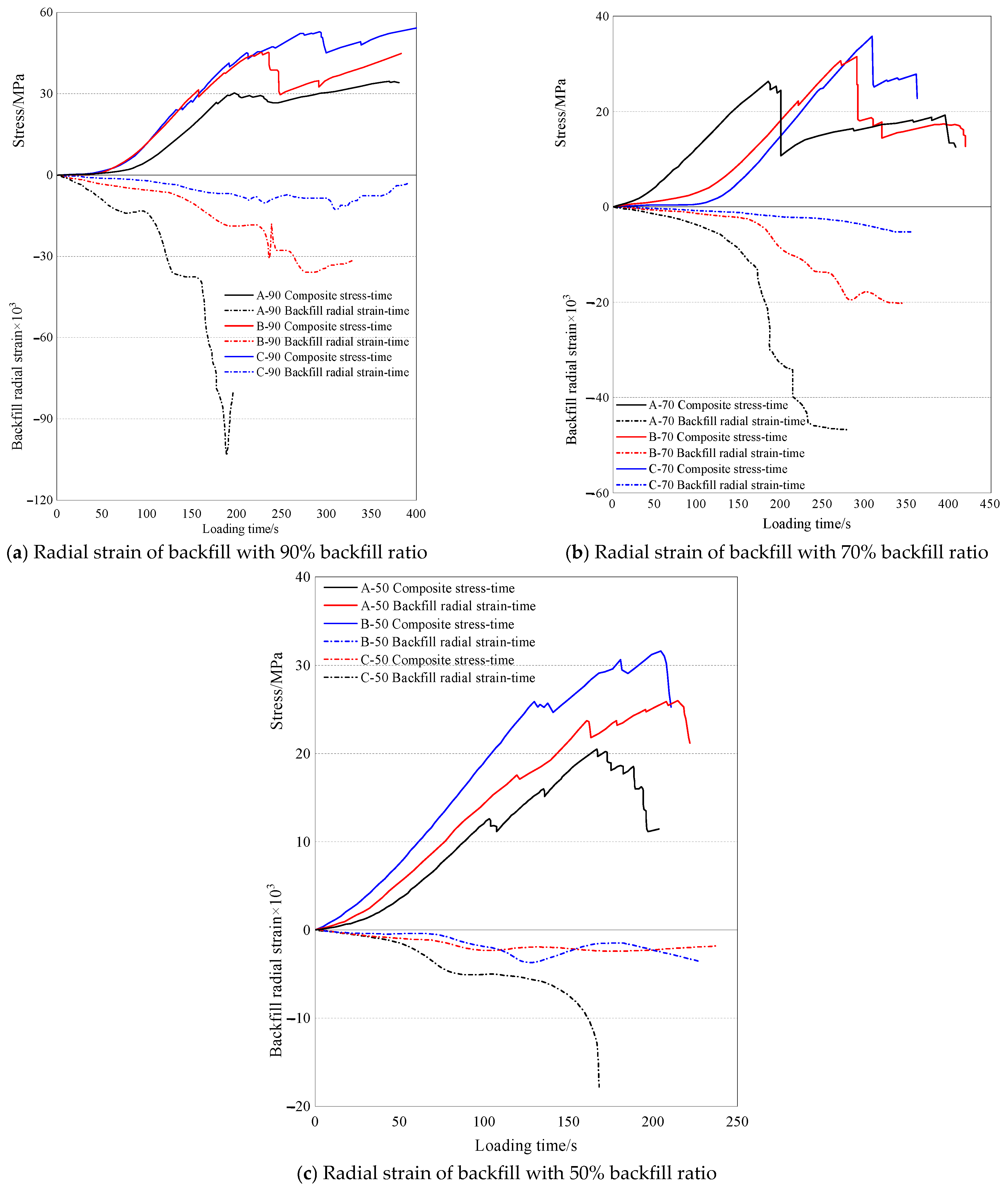
Figure 5 presents the relationship between radial strain and axial stress of backfills with backfill ratios of 90%, 70%, and 50%. When the backfill is not in contact with the roof, the backfill and coal pillar interact only in the radial direction, and the backfill provides only passive confinement to the coal pillar.
It can be observed from the radial strain curves of backfills with backfill ratios of 90% and 70% that the radial strain curve of the high-strength backfill shows an overall relatively gentle variation, while that of the low-strength backfill exhibits significant fluctuations. In particular, the radial strain of the backfill with a 90% backfill ratio shows a “sharp increase followed by a sudden drop” before and after coal pillar failure. The radial strain curve of the backfill with a 50% backfill ratio exhibits a small overall deformation amplitude, and the difference in radial strain values decreases with the increase in backfill strength. This is mainly because the backfill with a 50% backfill ratio cannot achieve repeated bearing and failure with the coal pillar, and the passive confinement effect of the backfill on the coal pillar immediately fails after the coal pillar collapses.
From the above analysis, it can be concluded that, when the backfill is not in contact with the roof, there is a negative correlation between backfill strength and radial strain. High-strength backfill provides a large lateral confinement force to the coal pillar by virtue of its high deformation resistance, thereby restricting the circumferential strain of the coal pillar during axial compressive deformation and further improving the failure strength of the coal pillar. As the backfill strength decreases, the effective monitoring duration of the strain gauges on the elastic modules also decreases correspondingly. This is primarily due to the low elastic modulus of the low-strength backfill, which results in poor ability to resist the radial compressive deformation of the coal pillar. The early failure of the low-strength backfill leads to the premature failure of the elastic modules.
3. Numerical Modeling and Result Analysis of Backfill–Pillar Systems with Different Backfill Ratios
3.1. Numerical Model and Parameter Calibration for Backfill–Pillar Systems with Different Backfill Ratios
The Particle Flow Code (PFC) numerical simulation software was utilized to analyze the load-bearing behavior of the “backfill–pillar” structure. The PFC2D numerical model constructs a discontinuous medium system comprising particles (balls), contacts, and wall boundaries. Within the model, particles (balls) are connected using the parallel bond model, their mechanical behavior is governed by the contact model, and walls serve as boundaries for applying loads and constraints. The numerical model is based on the engineering context of backfill reinforcement for coal pillars in an underlying pillar-type goaf subjected to upward mining in a Shanxi mine [
46,
47]. The width of the pillar-style coal pillars in this mine ranges from 8 to 14 m, with an average width of 11 m. The average height of the coal pillars is 8.3 m, and the width of the pillar-type goaf ranges from 25 to 50 m, with an average width of 30 m. The numerical model was established considering these mining parameters from the aforementioned engineering background.
3.1.1. Numerical Model Parameter Calibration
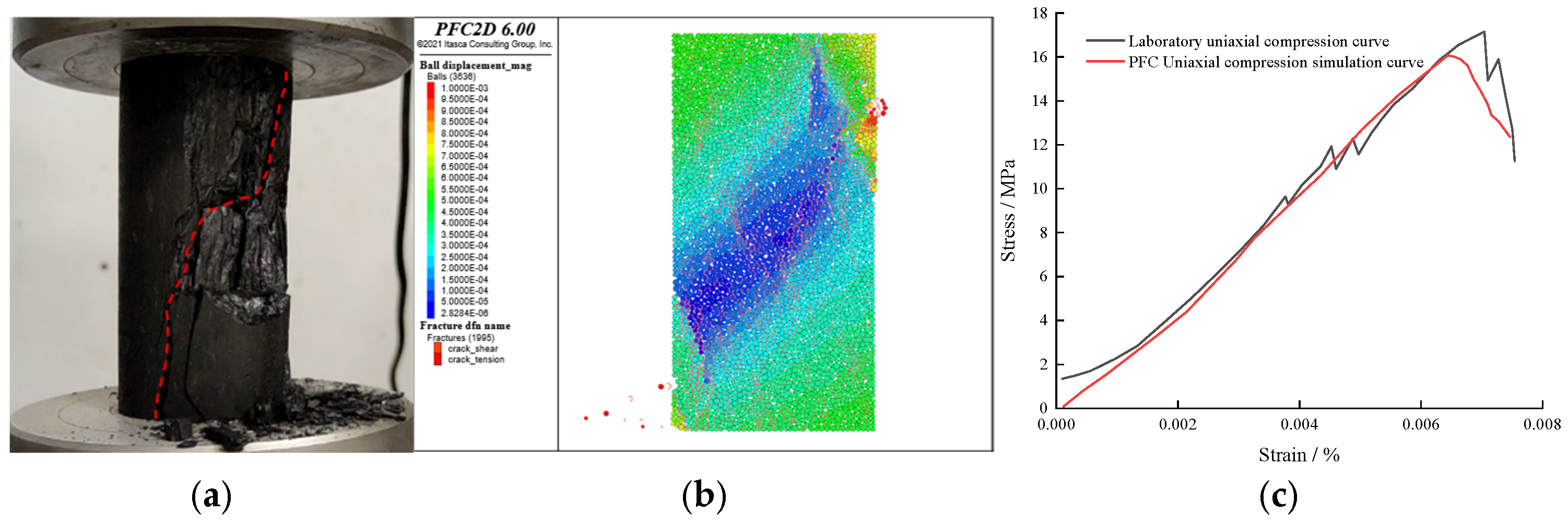
Parameter calibration in the simulation is fundamental for accurately representing the load-bearing capacity, crack propagation, and failure characteristics of the “backfill–pillar” structure. Therefore, based on the actual engineering geological conditions and the mechanical parameters of the coal rock mass, the uniaxial compressive strength of the core coal samples from the No. 9 coal seam in this mine was determined to be 17 MPa, with an elastic modulus of 2.125 GPa. Building upon this, PFC uniaxial compression experiments were conducted to obtain simulation parameters that closely match the crack propagation characteristics and strength test results of the laboratory core coal samples [
48].
Figure 6a shows the failure morphology of the coal pillar specimen from the No. 9 coal seam under uniaxial compression in the laboratory (The red dotted line in the figure represents the fracture of the coal pillar).
Figure 6b presents the fracture distribution of the PFC model specimen under uniaxial compression. In
Figure 6c, the black curve represents the uniaxial compression results of the cored coal sample from the pillar-type coal pillar in the No. 9 coal seam, while the red curve displays the outcomes of the PFC parameter calibration. It can be observed that the elastic modulus, peak strength, and post-peak residual strength between the experimental and simulation results are closely aligned. The mesoscopic parameters for the coal pillar and backfill used in the numerical simulation are provided in
Table 3 [
48].
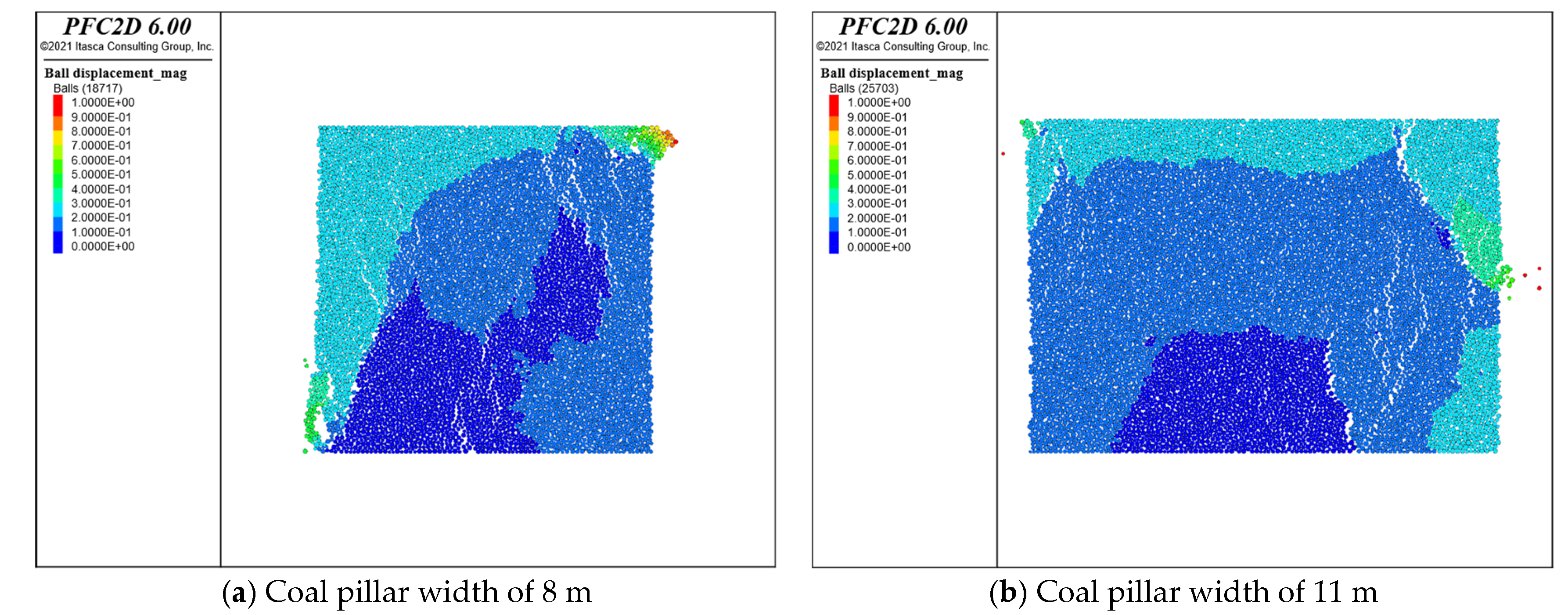
Based on the aforementioned parameters, a 1:1 computational model of the pillar-type goaf in the No. 9 coal seam was established, and compression tests were conducted.
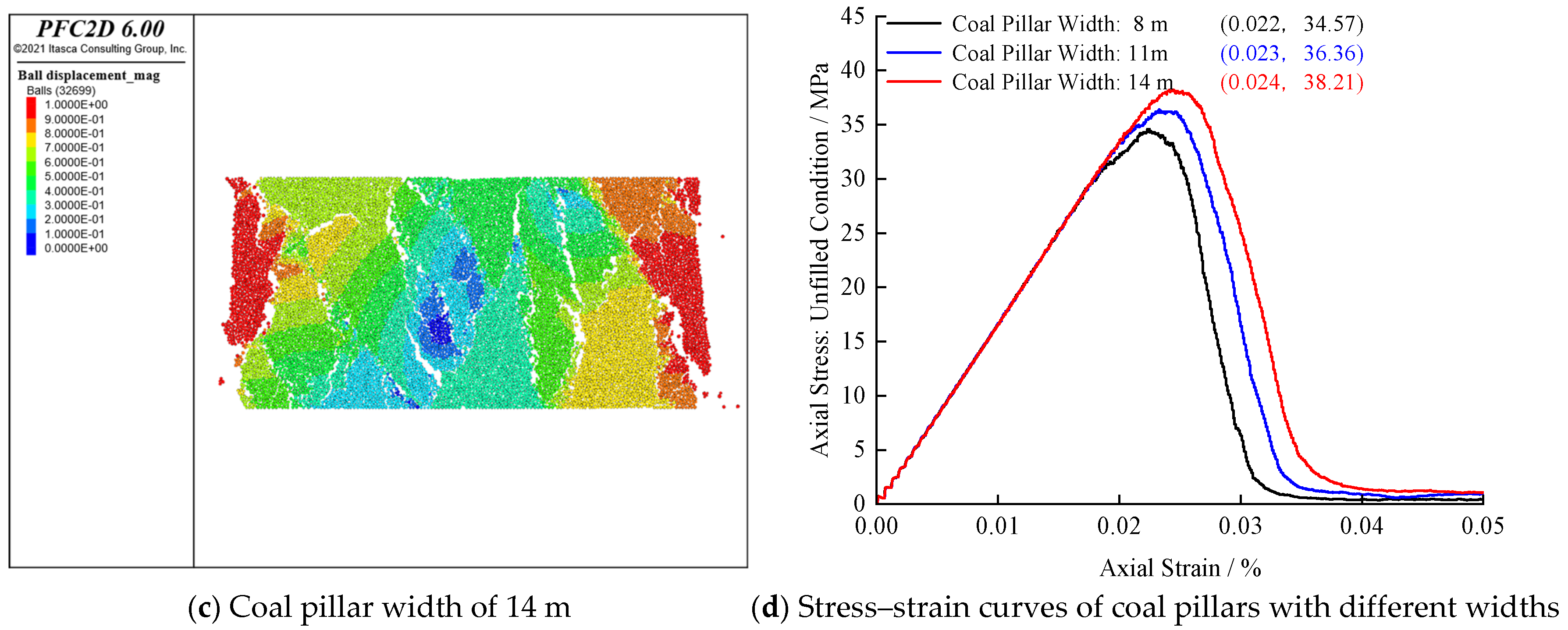
Figure 7a,
Figure 7b, and
Figure 7c, respectively, show the failure characteristics and fracture distributions of pillar-type coal pillars with widths of 8 m, 11 m, and 14 m.
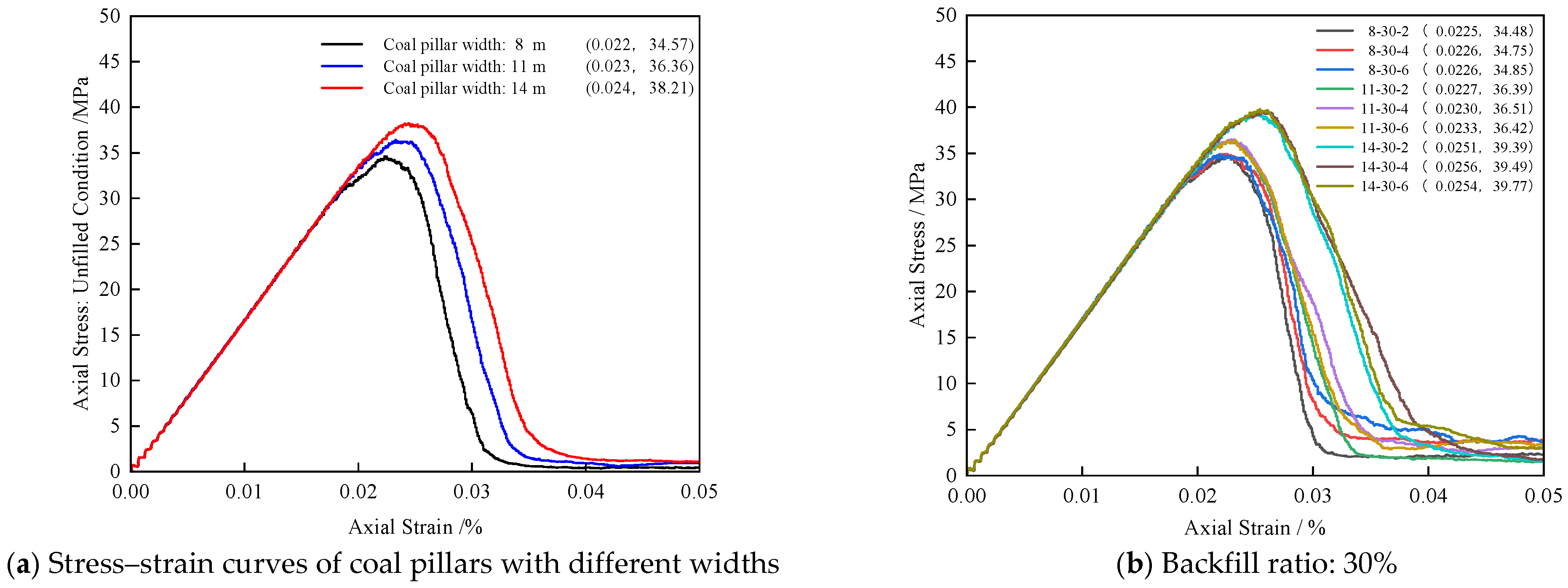
Figure 7d presents the compressive stress–strain curves of the actual-sized coal pillars with widths of 8 m, 11 m, and 14 m. The results indicate that the ultimate bearing stresses of the pillar-type coal pillars in the No. 9 coal seam with widths of 8 m, 11 m, and 14 m are 34.57 MPa, 36.36 MPa, and 38.21 MPa, respectively. If the stress transferred downward to the underlying coal pillars from the front abutment pressure of the upward mining face exceeds these ultimate bearing stress values, instability failure will occur in the pillar-type coal pillars of the No. 9 coal seam. This would consequently prevent the normal operation of the upward mining face.
3.1.2. Numerical Experiment Scheme
Based on the engineering context, the parameters adopted in the numerical simulations are summarized in
Table 4.
Based on the simulation parameters described above, a total of 63 numerical models were constructed. The model numbering system comprises three sets of digits: the first digit (8, 11, 14) represents the coal pillar width in meters; the second digit (30, 40…90) indicates the backfill ratio in percentage; and the third digit (2, 4, 6) denotes the backfill strength in MPa. The parameters for the numerical simulation are listed in
Table 5.
3.1.3. Numerical Model Setup
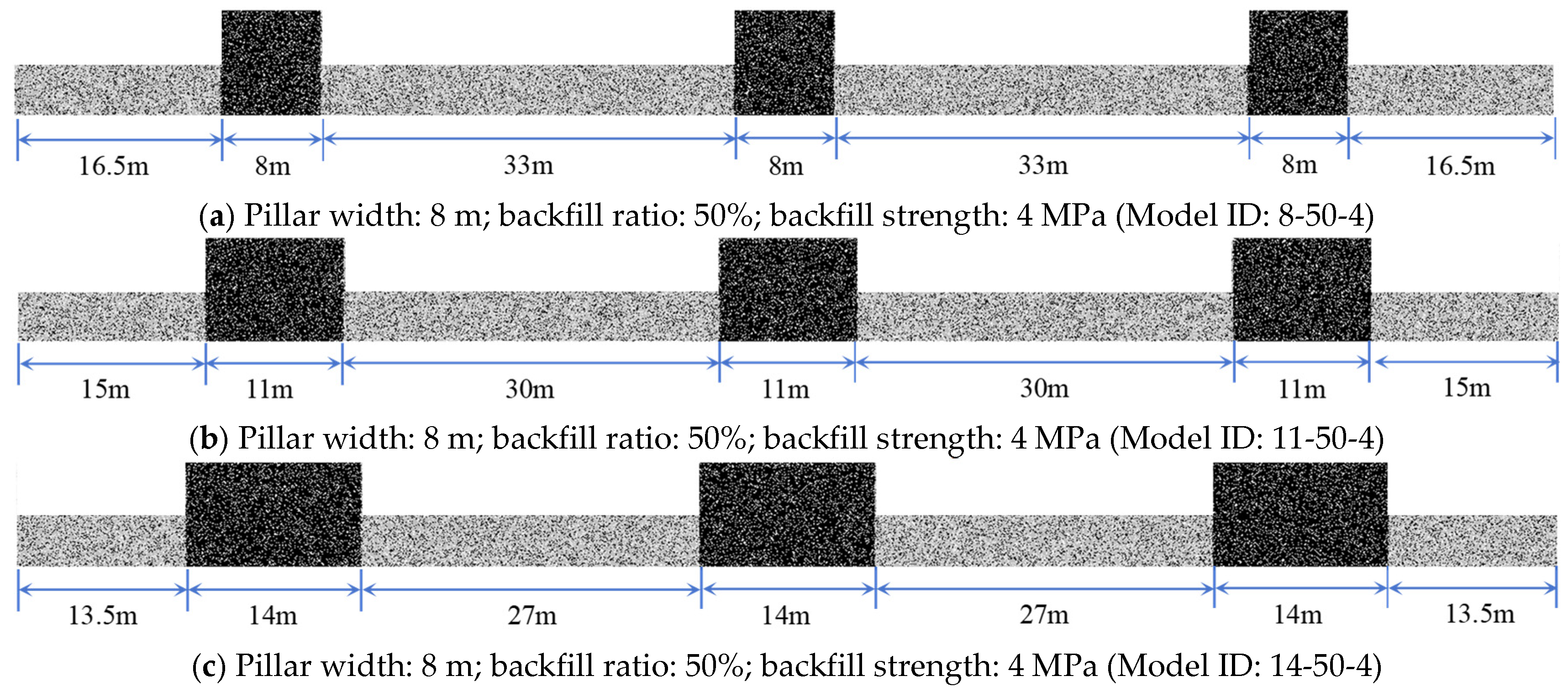
Fixed constraints (wall) are applied to the bottom and both sides of the model to simulate the boundary conditions under actual working conditions. Due to space limitations, only the numerical models with a backfill ratio of 50% and a backfill strength of 2 MPa are presented here as an example to illustrate the configurations for different coal pillar widths, as shown in
Figure 8. The overall model dimensions are 123 m in length and 8.3 m in height. The coal pillar widths are 8 m, 11 m, and 14 m, corresponding to backfill widths of 36 m, 30 m, and 24 m, respectively. The height of the backfill is 4.15 m.
Investigation of the progressive failure characteristics of the backfill–pillar system with varying backfill ratios requires analysis focusing on the following aspects: (1) the influence of backfill on the peak strength of the coal pillar, and (2) its effect on the residual strength of the coal pillar after failure. Consequently, the load-bearing structure was loaded beyond its residual strength stage. The termination criterion for all models was set at an axial strain of 0.05. Additionally, the model state was configured to save at every 0.001 increment of total strain, thereby facilitating the subsequent analysis of the failure morphology, stress distribution, and crack evolution patterns of the coal pillar at various stages.
3.2. Stress–Strain Curves of Backfill–Pillar Systems with Different Backfill Ratios
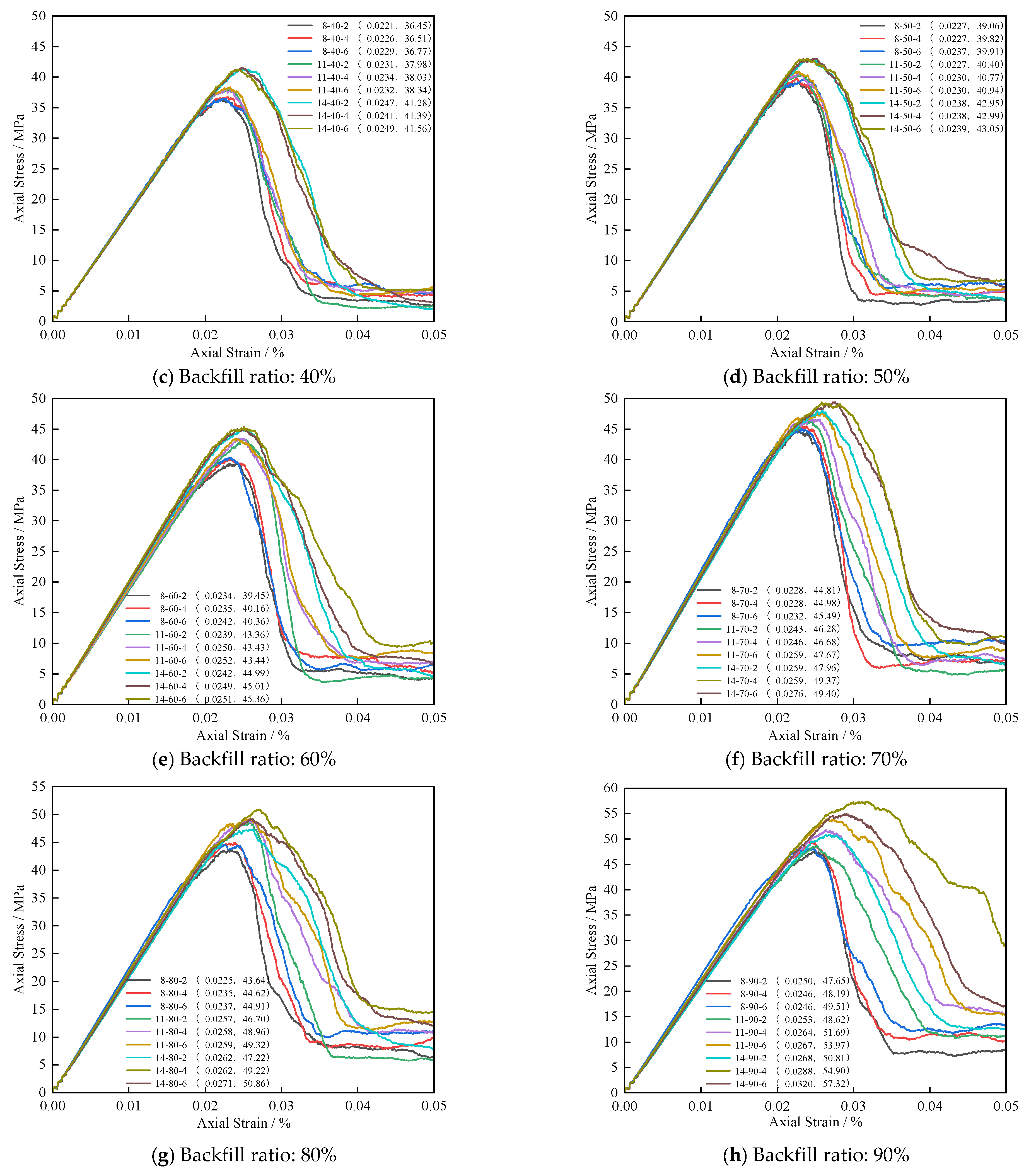
Figure 9 presents the stress–strain curves for the unfilled condition (no backfill on both sides of the pillar) and for backfill ratios ranging from 30% to 90%. The peak stress and corresponding strain values for each model are also summarized based on the respective curves.
The analysis of the stress–strain curve for the unfilled condition on both sides of the coal pillar reveals that, when the width of the pillar-type coal pillar increases from 8 m to 14 m, its ultimate bearing stress increases from 34.57 MPa to 38.21 MPa, and the strain corresponding to the ultimate bearing stress increases from 0.0156 to 0.0165. Although the post-peak residual stress of the coal pillar increases with its width after failure, the residual stress value remains relatively low. This indicates that pillar-type coal pillars without backfill confinement completely lose their load-bearing capacity after failure and instability.
Although the residual strength of coal pillars with backfill ratios ranging from 30% to 50% is generally 2 to 3 times higher than that of unfilled coal pillars, the residual strength does not show significant variation with increasing backfill strength. When the backfill ratio reaches 60%, a higher backfill strength enables the load-bearing structure to continue carrying load during the post-peak residual deformation stage. This is evident from the stress–strain curves at strain values greater than 0.037, where the residual stress increases with higher backfill strength. The residual strength for backfill strengths of 4 MPa and 6 MPa is approximately twice that of the 2 MPa backfill. When the backfill ratio exceeds 70% and the strength is 6 MPa, the residual strength exceeds 15 MPa. This demonstrates that, after the coal pillar reaches its peak strength, internal fractures develop rapidly, intersect, and coalesce to form macroscopic fracture planes. Nevertheless, the coal pillar can continue to bear load under the lateral confinement provided by the backfill.
After comparing and analyzing the stress–strain curves of the numerical simulation experiment and laboratory mechanical experiment, it can be observed that, when the backfill ratio is 50%, the bearing structure basically loses its bearing capacity after reaching the peak stress, showing obvious strain softening; when the backfill ratio is 70%, the stress–strain curve of the bearing structure transitions from strain softening to significant strain hardening; when the backfill ratio is 90%, the bearing structure can still maintain a high residual stress after the peak stress, which can ensure the continuous stability of the bearing structure. The stress–strain curves obtained from the numerical simulation experiment are basically consistent in mechanical behavior with those from the laboratory mechanical experiment, which can to a certain extent illustrate the bearing characteristics of the bearing structure.
3.3. Stress Growth Patterns in Backfill–Pillar Systems with Different Backfill Ratios
Based on the peak stresses obtained for different coal pillar widths (8 m, 11 m, 14 m) and backfill strengths (2 MPa, 4 MPa, 6 MPa), the growth patterns of the peak stress were analyzed at 10% increments of the backfill ratio.
3.3.1. Stress Growth Rate for 8 m Wide Coal Pillar
Table 6 presents the peak stress values and the peak stress growth rates for an 8 m wide coal pillar under different backfill strengths and backfill ratios. The growth rate is calculated for each 10% increase in the backfill ratio. Analysis shows that, for the 8 m wide pillar, the period from 30% to 50% backfill ratio constitutes a phase of rapid stress increase. The interval showing the highest increase in peak stress is between 60% and 70% backfill ratio (where the increase rises from 10.6% to 12.7% as the backfill strength increases from 2 MPa to 6 MPa). The period from 70% to 80% backfill ratio represents a phase of steady stress growth, followed by a phase of decelerating growth rate from 80% to 90%, although the increase remains significant. For the 8 m wide coal pillar, increasing the backfill ratio beyond 50% rapidly enhances its load-bearing capacity.
Overall analysis reveals that, for the 8 m wide coal pillar, with each 10% increment in backfill ratio, the average stress increase is 2.86% for 2 MPa backfill strength, 2.90% for 4 MPa, and 2.95% for 6 MPa. When the backfill ratio increases from 30% to 90%, the total peak stress growth rate is 38.2% for 2 MPa backfill strength, 38.7% for 4 MPa, and 42.0% for 6 MPa.
3.3.2. Stress Growth Rate for 11 m Wide Coal Pillar
Table 7 presents the peak stress values and the corresponding growth rates for an 11 m wide coal pillar under different backfill strengths and backfill ratios. Analysis indicates that the interval of the highest stress increase for 2 MPa backfill strength occurs between 50 and 60% backfill ratio (7.3% increase), for 4 MPa backfill between 60 and 70% (7.5% increase), and for 6 MPa backfill between 60 and 70% (9.7% increase). The period from 30% to 60% backfill ratio constitutes a phase of steady increase in peak stress growth rate, where higher backfill strengths demonstrate more pronounced increases.
Overall analysis indicates that, for the 11 m wide coal pillar, with each 10% increment in backfill ratio, the average stress increase is 3.03% for 2 MPa backfill strength, 3.31% for 4 MPa, and 3.74% for 6 MPa. When the backfill ratio increases from 30% to 90%, the total peak stress growth rate is 33.6% for 2 MPa backfill, 41.6% for 4 MPa, and 48.1% for 6 MPa.
3.3.3. Stress Growth Rate for 14 m Wide Coal Pillar
Table 8 presents the peak stress values and the corresponding growth rates for a 14 m wide coal pillar under different backfill strengths and backfill ratios. The analysis shows that the highest stress increase for 2 MPa backfill occurs between 60 and 70% backfill ratio (5.0% increase). The highest increase for 4 MPa backfill occurs between 80 and 90% (11.2% increase). The highest increase for 6 MPa backfill occurs between 80 and 90% (12.7% increase). The period from 30% to 60% backfill ratio represents a phase of moderate increase (3.6% to 5.4% growth). This is followed by a phase of rapid ascent from 60% to 70% (8.9% to 9.7% growth). The period from 80% to 90% is characterized by significant growth rates (4.1% to 9.4% increase). For the 14 m wide pillar, the stress growth rate peaks (12.7%) under high backfill ratios (>80%).
Overall analysis indicates that, for the 14 m wide coal pillar, with each 10% increment in backfill ratio, the average stress increase is 3.3% for 2 MPa backfill strength, 3.8% for 4 MPa, and 4.2% for 6 MPa. When the backfill ratio increases from 30% to 90%, the total peak stress growth rate is 29.0% for 2 MPa backfill, 39.0% for 4 MPa, and 44.1% for 6 MPa.
3.4. Regression Equations for Peak Stress of Backfill–Pillar Systems with Different Backfill Ratios
Based on coal pillar width, backfill strength, backfill ratio, and peak stress, a multiple regression equation was developed, as shown in Equation (1).
where
η is the backfill ratio. The coefficient of 0.29 for
η indicates that, for every 1% increase in the backfill ratio, the peak stress increases by an average of 0.29 MPa.
σf is the backfill strength, in MPa. The coefficient of 1.82 for
σf indicates that, for every 1 MPa increase in backfill strength, the peak stress increases by an average of 1.82 MPa.
wc is the coal pillar width, in m. The coefficient of 0.98 for
wc indicates that, for every 1 m increase in coal pillar width, the peak stress increases by an average of 0.98 MPa.
The coefficient for the interaction term between the backfill ratio and strength (η·σf) is 0.007. This indicates that, when both the backfill ratio and strength increase, the peak stress receives an additional increase of 0.007 times the product (η·σf). For example, if the backfill ratio increases from 70% to 90% (Δη = 20%) and the backfill strength increases from 4 MPa to 5 MPa (Δσf = 1 MPa), the additional increase in peak stress contributed by this interaction term is 0.007 × (90 × 5 − 70 × 4) = 1.19 MPa.
The coefficient for the interaction term between backfill strength and coal pillar width (σf·wc) is 0.019. This represents the additional increase in peak stress when the backfill strength increases by 1 MPa and the coal pillar width increases by 1 m. For example, if the coal pillar width increases from 11 m to 12 m (Δwc = 1 m) and the backfill strength increases from 4 MPa to 5 MPa (Δσf = 1 MPa), the additional increase in peak stress contributed by this interaction term is 0.019 × (12 × 5 − 11 × 4) = 0.304 MPa.
4. Failure Characteristics of the Load-Bearing Structure Under the Synergistic Effect of Backfill Ratio and Strength
Given the large number of models, this section focuses on structures with backfill ratios of 30%, 50%, 70%, and 90%, combined with backfill strengths of 2 MPa, 4 MPa, and 6 MPa. It analyzes the force chain distribution and fracture development within both the coal pillars and the backfill under these specified conditions, thereby elucidating the failure characteristics of the load-bearing structure under the coordinated influence of backfill strength and ratio.
4.1. Force Chain Transmission Characteristics Under the Influence of Backfill Strength and Ratio
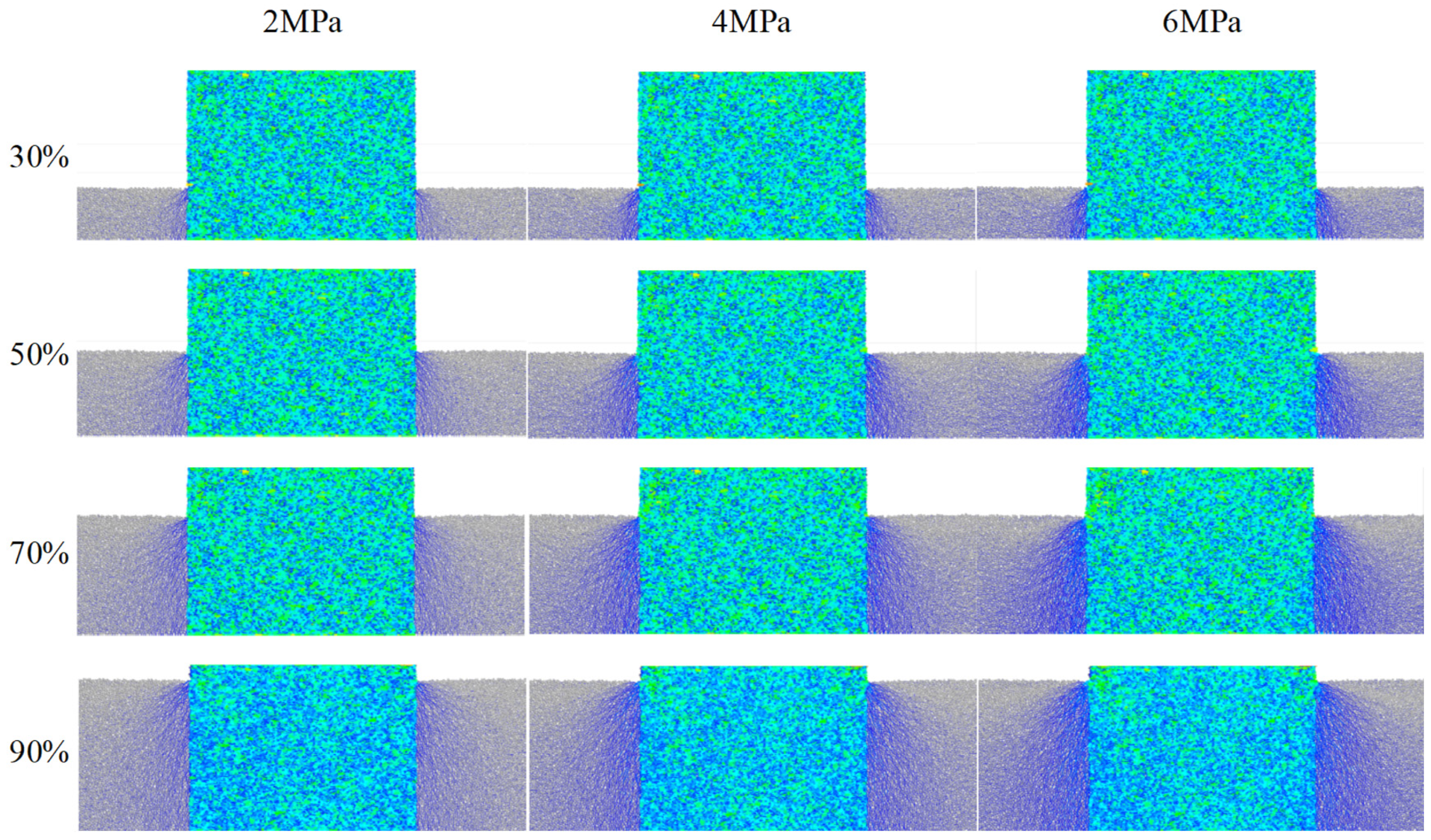
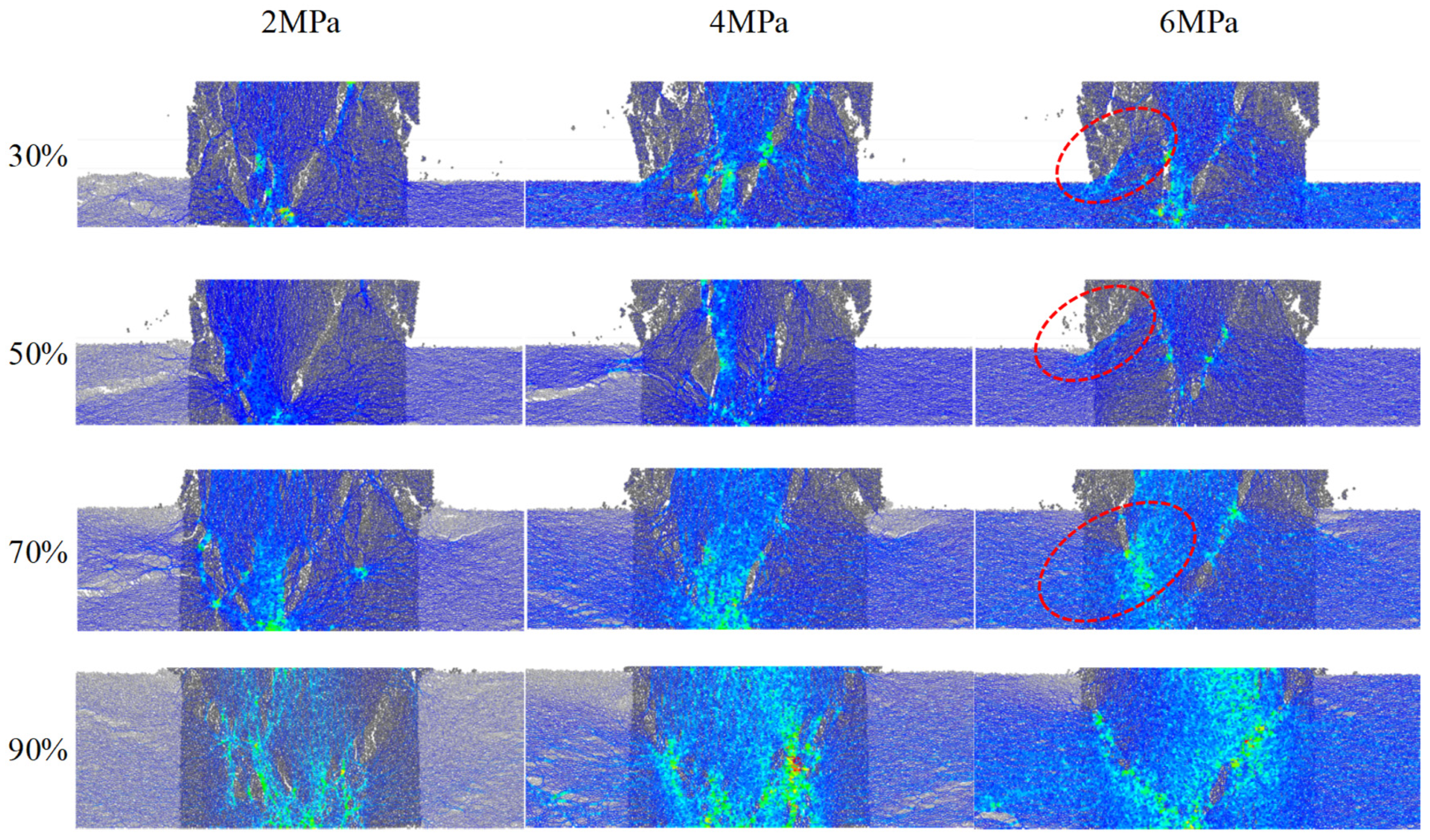
Considering the substantial length of the models,
Figure 10 and
Figure 11 present the force chain distributions within the central coal pillar and the adjacent backfill at strain values of 0.02, 0.04, 0.06, and 0.08. These figures facilitate the analysis of the distribution and transmission patterns of force chains across the different models.
Here, a force chain refers to the network of contact forces generated between particles upon application of an external load. Continuous contacts between particles form relatively stable structures. Force chains can form, break, and re-form under external loads and mutual interactions. In the figures, the blue lines represent these force chains. The orientation of a line indicates the direction of the contact force between particles, while its thickness is proportional to the magnitude of the contact force. Force chains can thus be used to qualitatively analyze the bulk stress field distribution.
To avoid excessive elaboration on force chain transmission characteristics, the analysis focuses on models with a coal pillar width of 11 m, backfill strengths of 2 MPa, 4 MPa, and 6 MPa, and backfill ratios of 30%, 50%, 70%, and 90%. The force chain distributions at both the peak stress and residual stress stages are provided for these selected cases.
Figure 10 shows the force chain diagrams of the load-bearing structure at its peak stress. It can be observed that, when the structure is at peak stress, the force chains within the backfill (adjacent to the coal pillar) are oriented diagonally towards the floor. This indicates that, during load bearing, the coal pillar transfers the overlying load to the backfill through their interface. The backfill provides an “inclined buttressing” constraint to the coal pillar. Furthermore, the force chains within the backfill are thicker and closer to the coal pillar, suggesting that the reactive force provided by the backfill to the pillar is gradational—meaning primarily the backfill immediately surrounding the pillar contributes significantly to this reactive support.
It is important to note that the inclined force chains directed towards the floor provided by the backfill can be resolved into horizontal and vertical components. This signifies that the coal pillar at the peak stress stage undergoes axial deformation under the roof load. Consequently, the backfill must simultaneously provide a horizontal force for lateral confinement and an upward supporting force utilizing the interfacial bond with the coal pillar. Although the backfill does not directly bear the roof load, it resists the axial load on the coal pillar through this interfacial bond strength.
Figure 11 shows the force chain diagrams of the load-bearing structure during its residual stress stage. Observing the orientation of force chains within the backfill reveals a shift from the diagonally downward direction seen in the peak stress stage to a predominantly horizontal direction. This indicates that, at this stage, the backfill primarily provides lateral confinement to the coal pillar in the horizontal direction.
Under the same backfill strength condition, an increase in the backfill ratio leads to a greater number of thicker and more densely distributed force chains within the coal pillar, correlating with the improved overall integrity of the pillar. When the backfill ratio exceeds 70%, the force chains within the backfill itself display a pattern of being sparser in the upper part and denser in the lower part. For a given backfill ratio, an increase in backfill strength results in the higher integrity of the backfill mass and consequently thicker force chains within it. The backfill with a strength of 2 MPa has already undergone failure; its internal force chains are sparse and discontinuous. As a result, it neither forms a continuous force chain network with the coal pillar nor provides sufficient lateral confinement capacity. In contrast, the backfill with a strength of 6 MPa can form a continuous force chain network with the coal pillar. Even at a backfill ratio as low as 30%, this high-strength backfill maintains its own integrity and establishes continuous and dense force chains with the coal pillar.
4.2. Characteristics of Fracture Quantity Under the Influence of Backfill Strength and Ratio
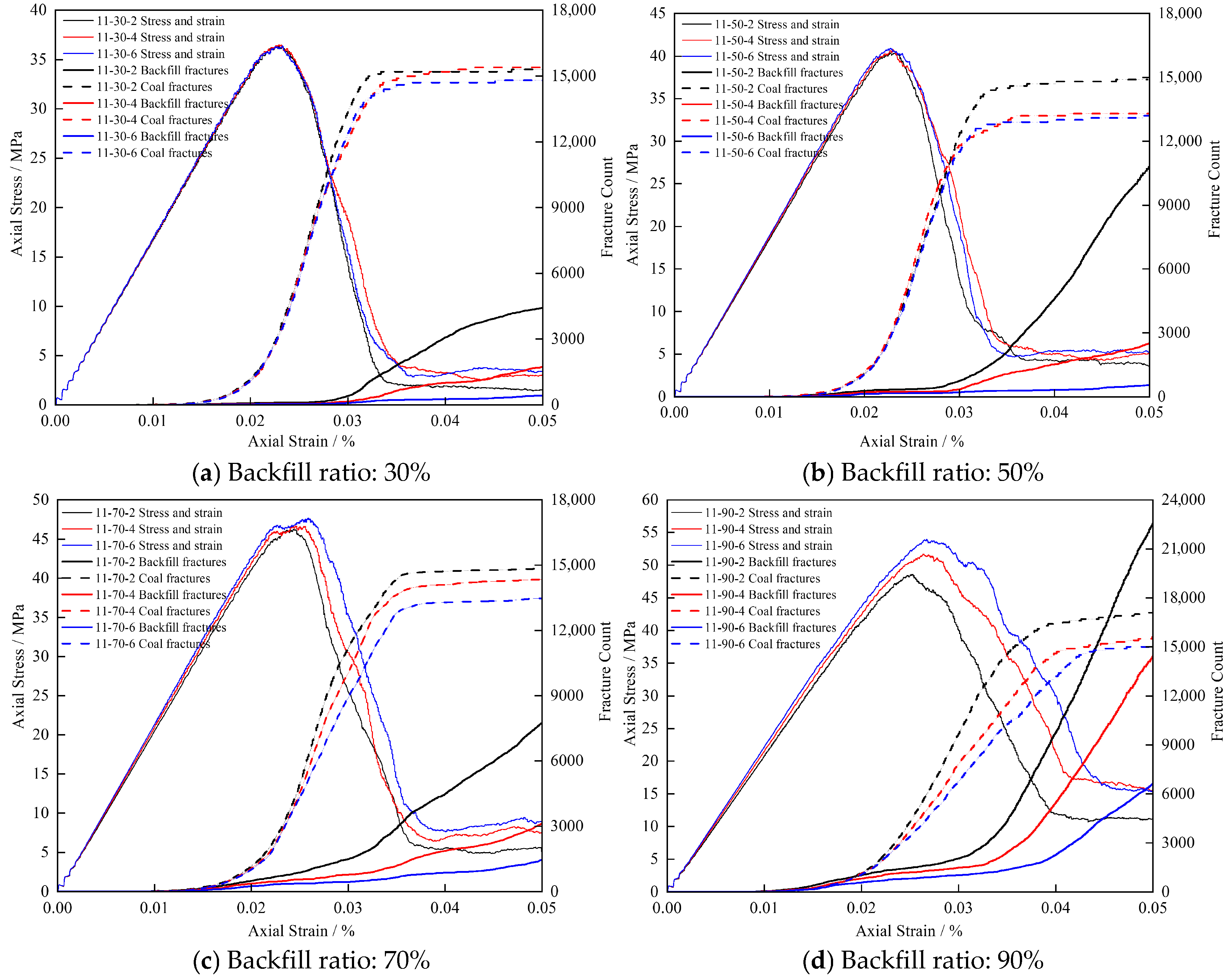
When analyzing the number of fractures within the load-bearing structure, the internal fractures of the backfill and the coal pillar were monitored separately and correlated with the stress–strain curves. The fracture distribution patterns for the various models are illustrated in
Figure 12.
Figure 12 presents the curves of stress–strain, internal fractures in coal pillars versus strain, and internal fractures in backfill versus strain under conditions of backfill ratios of 30%, 50%, 70%, and 90% with backfill strengths of 2 MPa, 4 MPa, and 6 MPa. Analysis reveals that the fracture development patterns in coal pillars and backfill under these varying conditions are primarily manifested in the following four aspects:
(1) The number of fractures in the coal pillar decreases with increasing backfill strength. Under the same backfill ratio, increasing the backfill strength reduces the number of internal fractures in the coal pillar. This indicates that high-strength backfill can utilize its own deformation resistance to provide a higher lateral constraint force to the coal pillar, thereby enhancing the peak stress of the pillar. Conversely, the number of fractures in the coal pillar increases with the backfill ratio. Under the same backfill strength condition, increasing the backfill ratio raises the number of internal fractures in the coal pillar. This suggests that a higher backfill ratio can induce a triaxial stress state within the height range of the coal pillar surrounded by backfill, leading to an increase in the peak stress of the pillar and consequently generating more fractures.
(2) The initial strain value for the development of internal fractures in the coal pillar is 0.02. As the backfill ratio increases, the strain value corresponding to the stable development stage of internal fractures in the coal pillar rises from 0.03 to 0.04, and the slope of the coal pillar’s fracture curve gradually decreases. This demonstrates that increasing the backfill ratio can reduce the propagation rate of internal fractures within the coal pillar, slow the deformation time of the pillar, and prevent the occurrence of sudden, violent failure (rockburst).
(3) Given that backfills with different ratios have different heights, a direct comparison of the absolute number of internal fractures is not feasible. Therefore, the analysis of the developmental pattern of internal fractures in the backfill focuses on conditions with the same backfill ratio. Using a 50% backfill ratio as an example, when the backfill strength increases from 2 MPa to 6 MPa, the number of internal fractures decreases by approximately 90%.
(4) The appearance time of internal fractures in the backfill decreases with increasing backfill ratio. As the backfill ratio increases from 30% to 90%, the strain value marking the onset of fracture development in the backfill decreases from 0.03 to 0.015. This indicates that higher backfill ratios lead to earlier formation of fractures within the backfill, allowing the backfill to provide a lateral constraint to the coal pillar at an earlier stage.
4.3. Fracture Distribution Patterns Under the Influence of Backfill Strength and Ratio
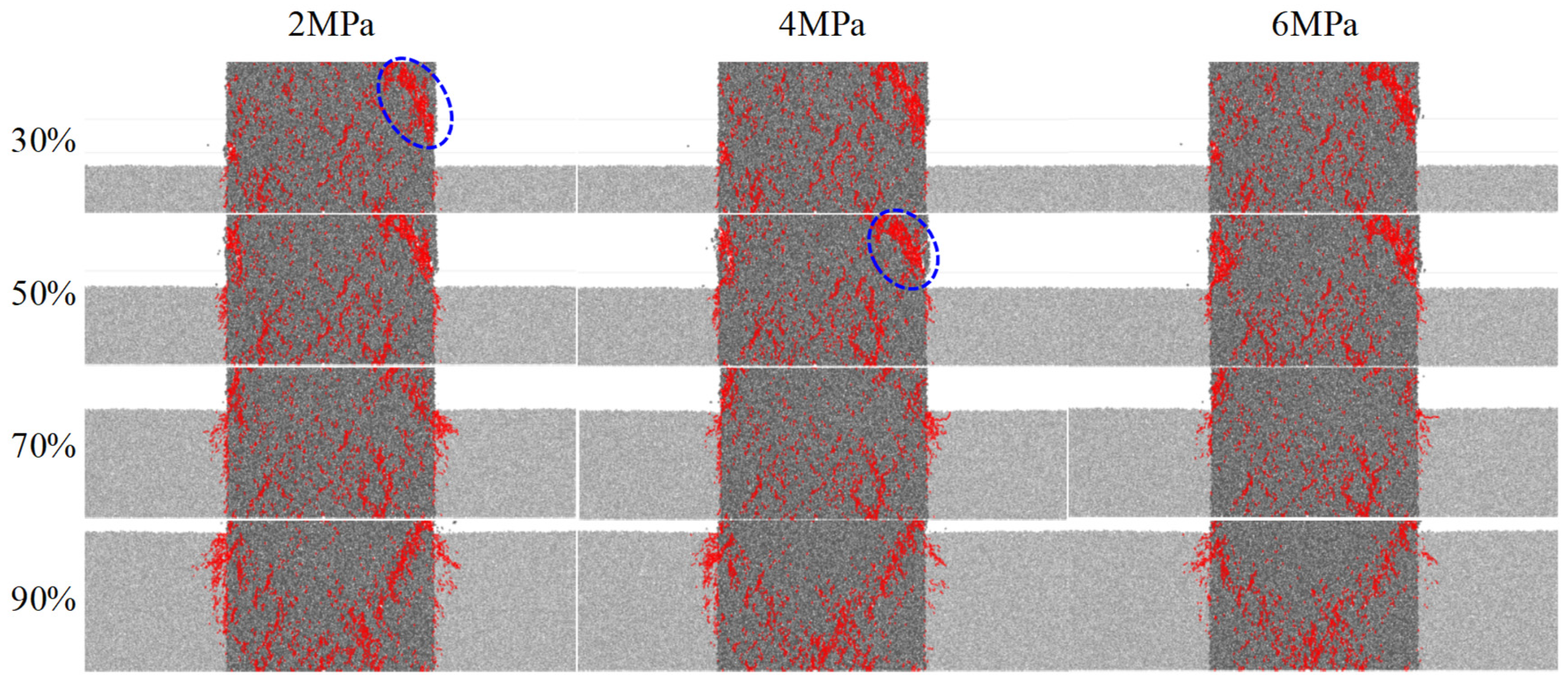
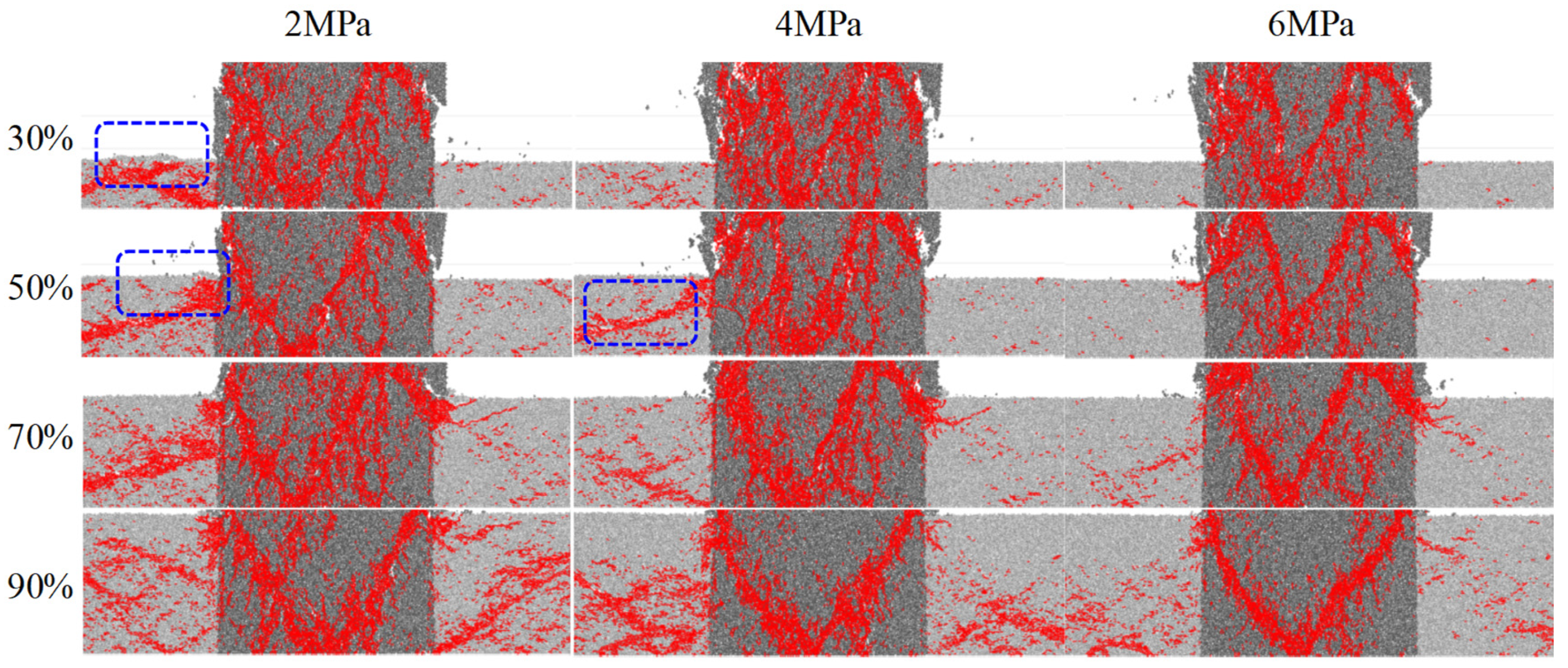
As shown in
Figure 13 and
Figure 14, the red lines in the diagrams indicate the locations of fractures within the load-bearing structure. The analysis focuses on the central coal pillar and the adjacent backfill on both sides.
Figure 13 and
Figure 14 presents the fracture distribution patterns at both the peak stress stage and the residual stress stage for backfill ratios of 30%, 50%, 70%, and 90%, combined with backfill strengths of 2 MPa, 4 MPa, and 6 MPa.
Figure 13 reveals that, when the backfill ratio ranges from 30% to 50%, fractures concentrate predominantly near the interface between the backfill and the coal pillar, with no significant fractures observed in other parts of the backfill. The fracture distribution pattern within the coal pillar can be analyzed by distinguishing between the confined portion (in contact with backfill) and the unconfined portion.
In the confined portion of the coal pillar, fractures are distributed relatively uniformly, and their density decreases with increasing backfill strength. In contrast, in the unconfined portion, fractures on both sides have already propagated through, forming macrocracks. This leads to the failure of the pillar edges and a loss of localized support capacity, consequently accelerating further fracture propagation.
When the backfill ratio increases to 70–90%, the number of fractures near the interface increases significantly and they are primarily concentrated in the middle-upper section of the backfill. This trend diminishes with increasing backfill strength. Meanwhile, within the coal pillar, fractures become more concentrated as the backfill strength increases, while boundary fractures are significantly reduced.
The analysis of
Figure 14 reveals that coal pillars with a backfill ratio of 30–50% exhibit a combined shear–tensile failure mode. For backfill strengths of 2 MPa and 4 MPa, internal fractures within the backfill have coalesced, leading to its failure. This results in a loss of confinement effectiveness at the coal pillar edges, subsequently triggering shear slip failure along these edges. When the backfill strength reaches 6 MPa, the internal fracture distribution within the backfill becomes sparser and less numerous. The associated shear slip failure in the coal pillar is relatively minor. This indicates that when the backfill ratio is below 50%, the low ratio cannot provide effective lateral confinement to the coal pillar. Even with a backfill strength of 6 MPa, the coal pillar remains in an approximately uniaxial stress state.
When the backfill ratio increases to 70%, fractures in the coal pillar extend from the interior towards the edges, with some propagating to the backfill–pillar interface. The coal pillar confined by 2 MPa backfill exhibits dense and highly interconnected fractures, while the unconfined portion of the pillar still shows signs of shear failure. In contrast, the 6 MPa backfill suppresses the propagation of internal fractures within the coal pillar, leaving only a small number of closed fractures, and the pillar experiences only localized failure.
When the backfill ratio reaches 90%, fractures within the coal pillar are distributed in localized areas. Due to the lateral constraint provided by the backfill, the edges of the coal pillar show almost no fracture development. The interface between the backfill and the coal pillar remains intact without detachment, indicating that the system still possesses a high load-bearing capacity.
5. Stability Analysis of Coal Pillars Under the Coordinated Effect of Backfill Strength and Ratio
The analysis of the stress–strain curves of the backfill–pillar system with different backfill ratios shows that the peak stress of the coal pillar exhibits nonlinear growth characteristics with increasing backfill ratio and strength. The strengthening effect of backfill strength and ratio on the ultimate bearing capacity of the coal pillar is the result of their synergistic interplay. To determine the stability of coal pillars during upward mining, the critical stable backfill ratios under different backfill strength conditions were analyzed separately for coal pillar widths of 8 m, 11 m, and 14 m.
5.1. Critical Backfill Strength and Ratio for 8 m Wide Coal Pillar
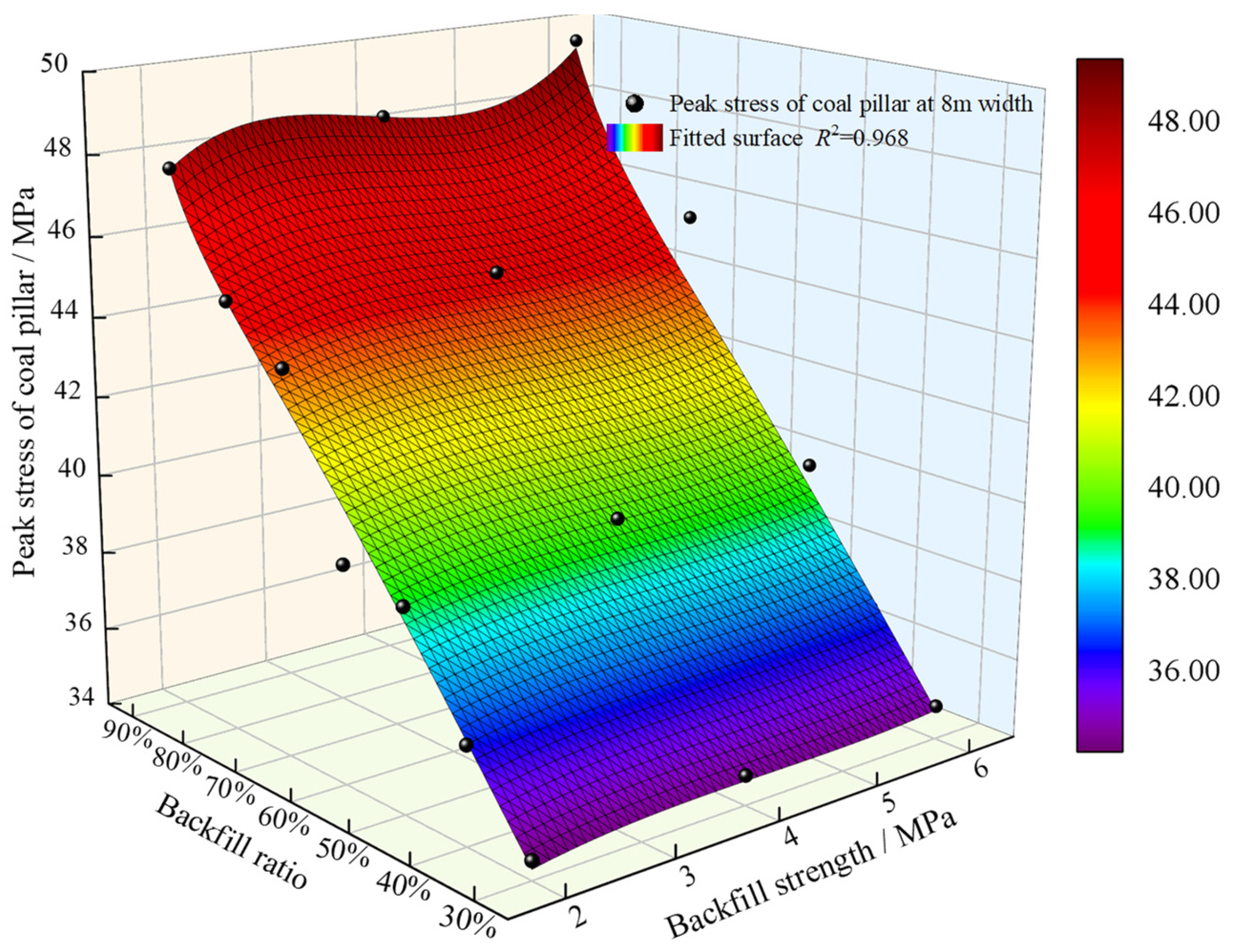
A nonlinear surface fitting was performed on the ultimate bearing capacity of the 8 m wide coal pillar under different combinations of backfill strength and ratio. The resulting fitted surface is shown in
Figure 15, and the fitting formula is given by Equation (2).
where
σmax is the peak stress of the backfill–pillar system with different backfill ratios, in MPa;
σf is the backfill strength, in MPa;
η is the backfill ratio.
The analysis of the surface within the red dashed box in
Figure 15 shows that, when the coal pillar width is 8 m and the backfill ratio is less than 50%, the surface remains relatively flat. As backfill strength increases within this range, the increase in the coal pillar’s peak stress is minimal. This indicates that, at lower backfill ratios, the strength of the backfill has limited influence on the peak stress of the 8 m wide coal pillar.
When the backfill ratio exceeds 60%, as seen from the surface within the blue dashed box, the surface exhibits significant undulation. In this region, backfill strength substantially influences the peak stress of the 8 m wide pillar. This demonstrates that only when the backfill ratio surpasses 60% does an increase in backfill strength produce a notable strengthening effect on the ultimate bearing capacity of the 8 m wide coal pillar.
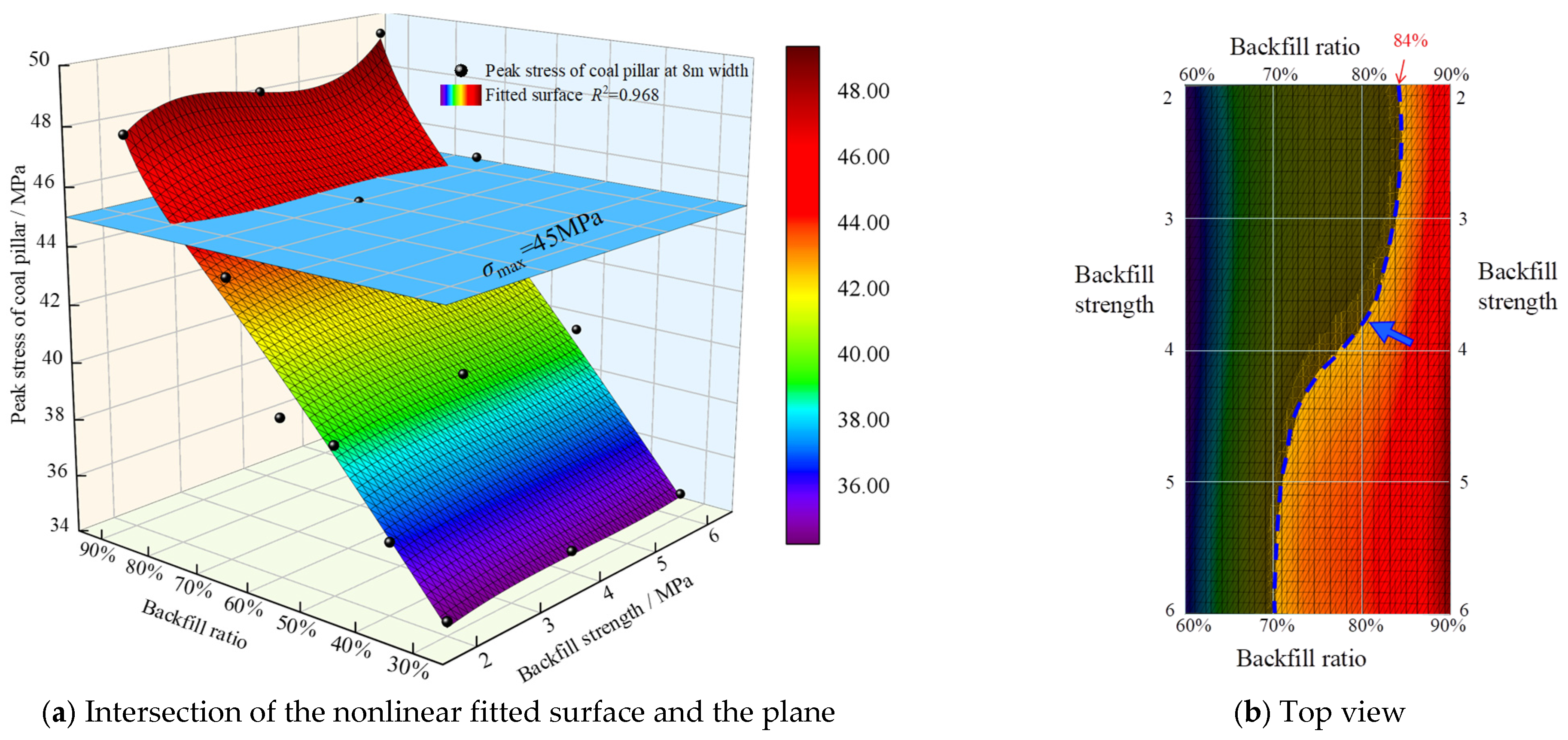
To ensure the safe passage of the upward mining face through the pillar-type goaf in the No. 9 coal seam, the ultimate bearing capacity of the pillar-type coal pillars must reach at least 45 MPa. This minimum required ultimate bearing strength of 45 MPa for the pillar-type coal pillars is visualized in the diagram as the blue plane shown in
Figure 16a.
As shown in
Figure 16a, the nonlinear fitted surface intersects the plane along a curve. This curve represents the minimum required combination of backfill strength and ratio to ensure safe upward mining above the underlying coal pillars. A top view of the 3D surface in
Figure 16a is presented in
Figure 16b. It can be observed that the darker area on the left represents the instability zone of the coal pillar, while the brighter area on the right corresponds to the stable zone.
From the two boundary points, it is determined that, for an 8 m wide coal pillar, the critical stable backfill ratio is 84% when the backfill strength is 2 MPa, and it decreases to 70% when the backfill strength increases to 6 MPa. However, these two vertices only represent two specific critical scenarios. By substituting
σmax = 45 MPa into Equation (2), the equation for the intersection curve between the nonlinear surface and the minimum safety strength plane for the 8 m wide coal pillar is obtained:
When the backfill strength and ratio satisfy Equation (3), this specific combination of strength and ratio exactly meets the minimum ultimate bearing capacity requirement for safe upward mining above an 8 m wide coal pillar. Therefore, Equation (3) can be established as the critical stability criterion for an 8 m wide coal pillar under the coordinated effect of backfill strength and ratio. Based on this, the stability criterion for an 8 m wide coal pillar under the coordinated influence of backfill strength and ratio for upward mining conditions is given by Equation (4).
5.2. Critical Backfill Strength and Ratio for 11 m Wide Coal Pillar
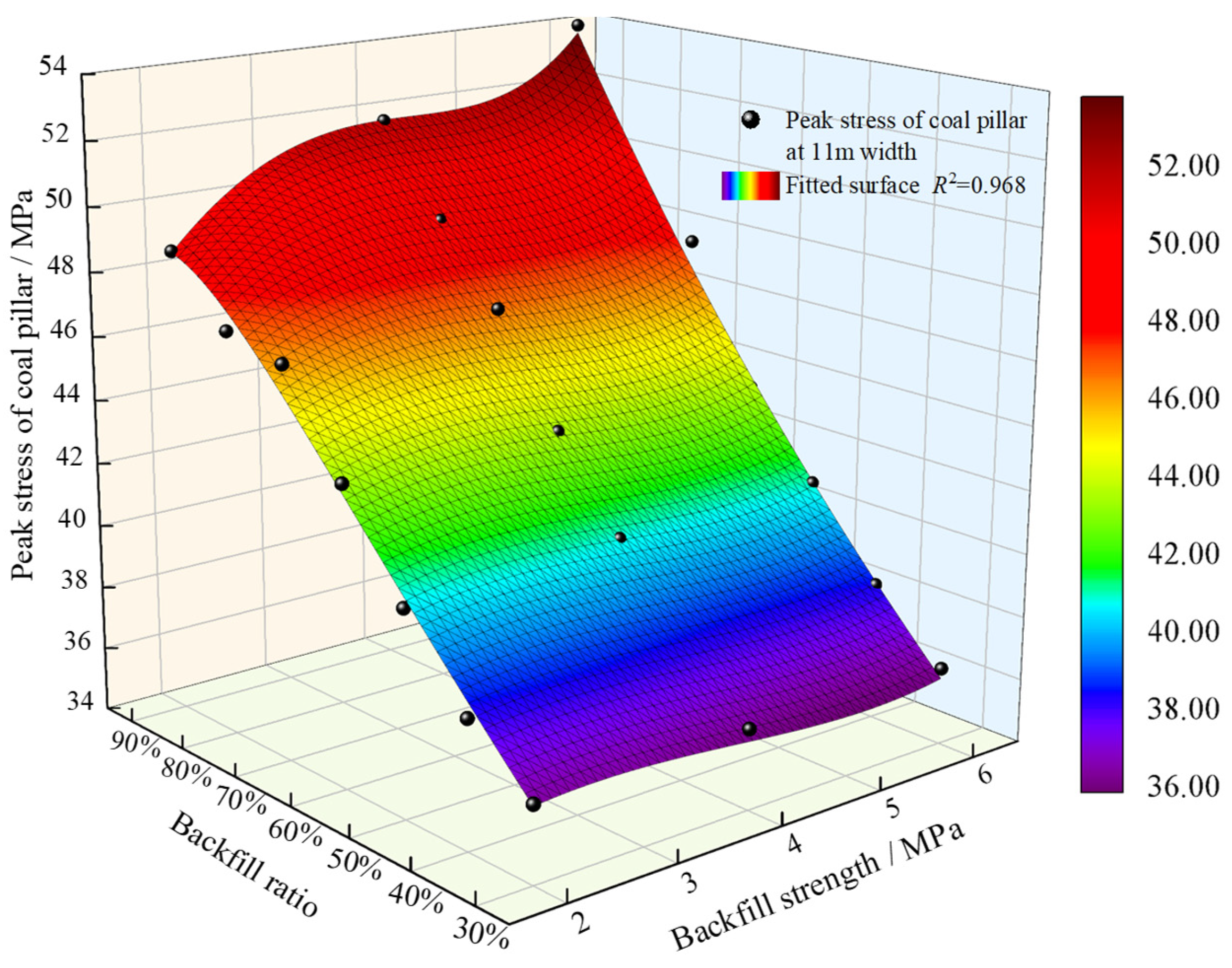
Similarly, a nonlinear surface fitting was performed on the ultimate bearing capacity of the 11 m wide coal pillar under different combinations of backfill strength and ratio. The resulting fitted surface is shown in
Figure 17, and the fitting formula is given by Equation (5).
Figure 17 indicates that, for an 11 m wide coal pillar, the variation pattern of peak stress with backfill ratio and strength is consistent with that observed for the 8 m wide pillar. It remains evident that only when the backfill ratio exceeds 60% can high backfill strength fully utilize its deformation resistance capacity.
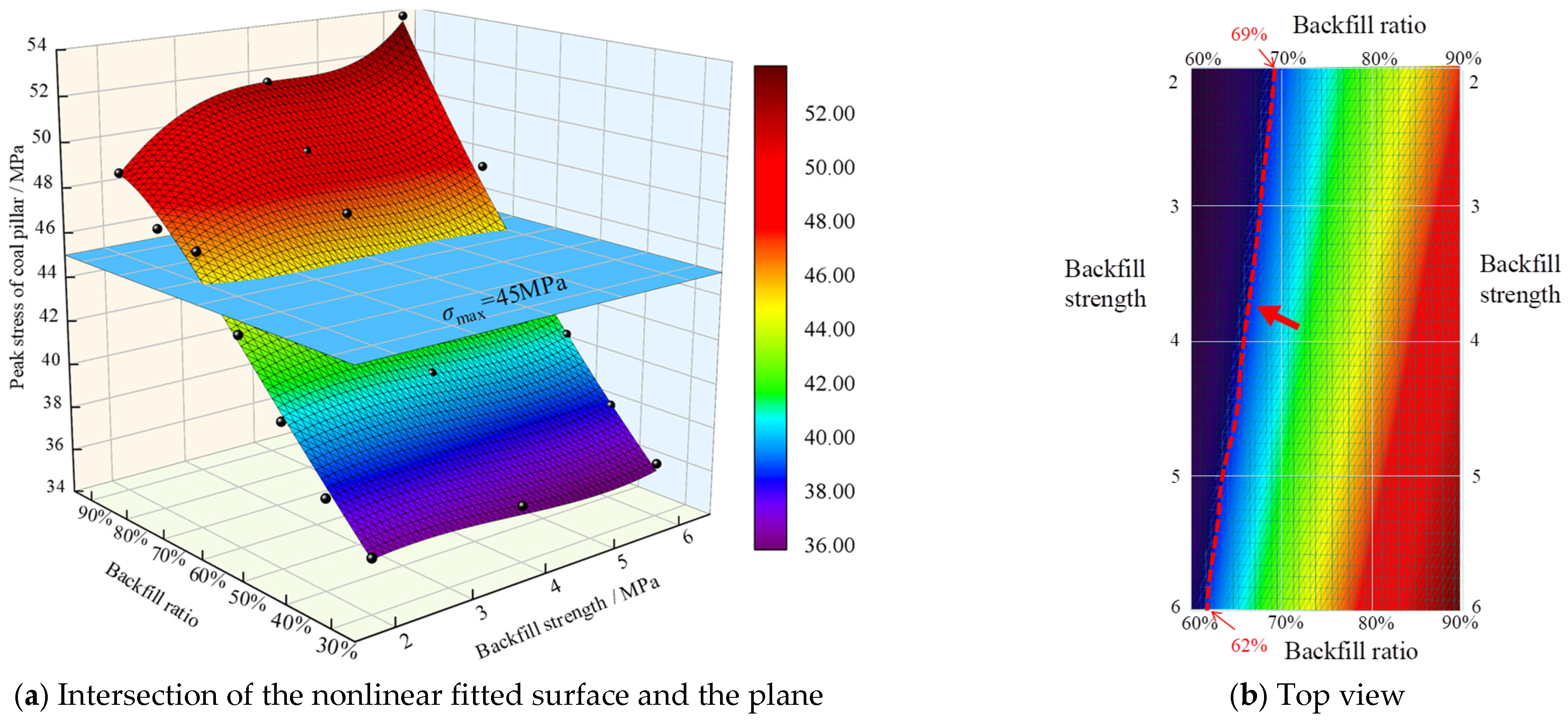
Similarly, the minimum required ultimate bearing strength of 45 MPa for the pillar-type coal pillars is visualized in the diagram as the blue plane shown in
Figure 18a.
From
Figure 18b, it can be observed that, for an 11 m wide coal pillar, the critical stable backfill ratio is 69% when the backfill strength is 2 MPa and decreases to 62% when the backfill strength is 6 MPa. Substituting
σmax = 45 MPa into Equation (5) yields the equation for the intersection curve between the nonlinear surface and the minimum safety strength plane:
When the backfill strength and ratio satisfy Equation (6), this specific combination provides the exact minimum ultimate bearing capacity required for safe upward mining above an 11 m wide coal pillar. Consequently, Equation (6) is established as the critical stability criterion for an 11 m wide coal pillar under the coordinated effect of backfill strength and ratio. Based on this, the stability criterion for upward mining conditions with an 11 m wide pillar under this coordinated effect is given by Equation (7).
5.3. Critical Backfill Strength and Ratio for 14 m Wide Coal Pillar
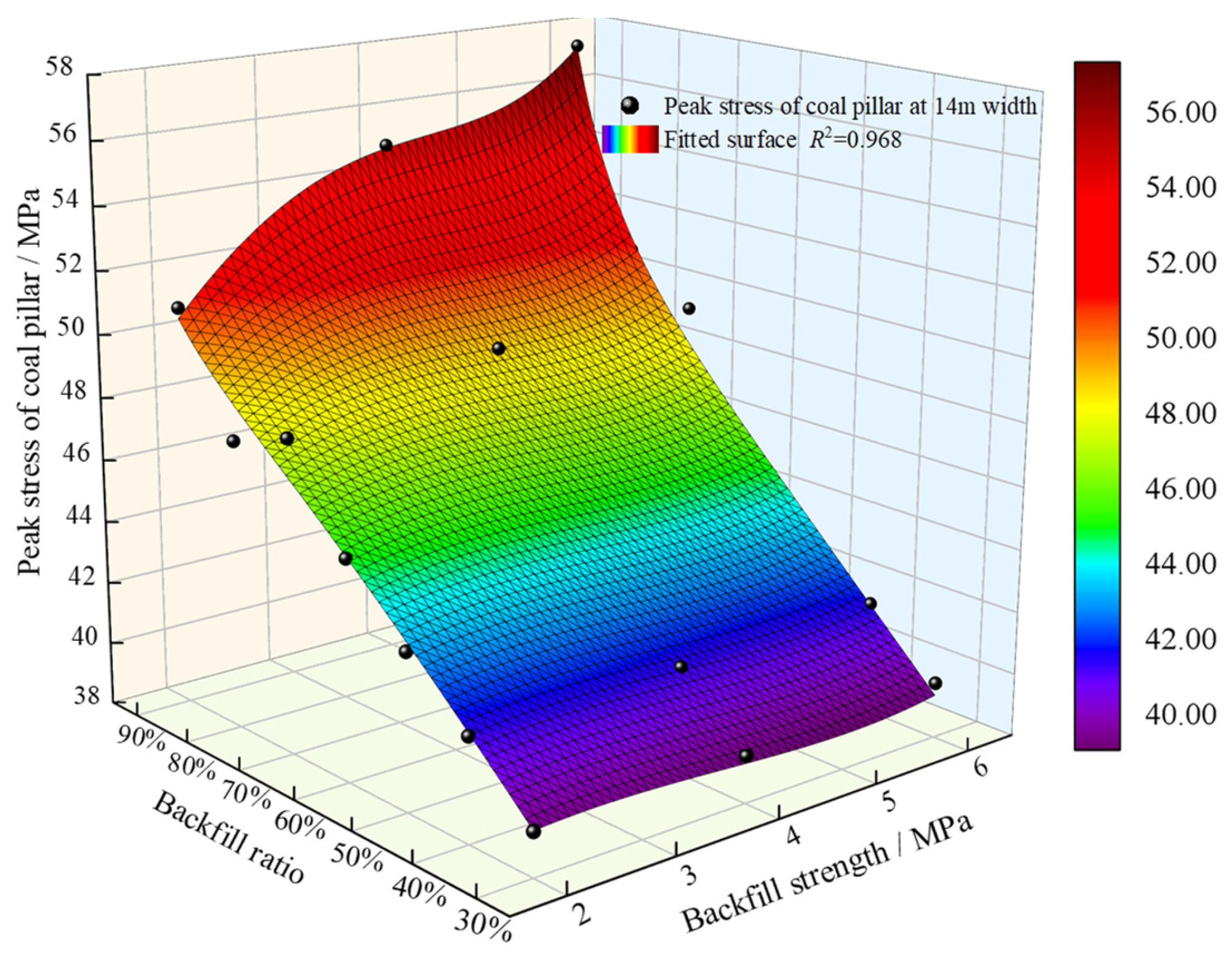
Similarly, a nonlinear surface fitting was performed on the ultimate bearing capacity of the 14 m wide coal pillar under different combinations of backfill strength and ratio. The resulting fitted surface is shown in
Figure 19, and the fitting formula is given by Equation (8).
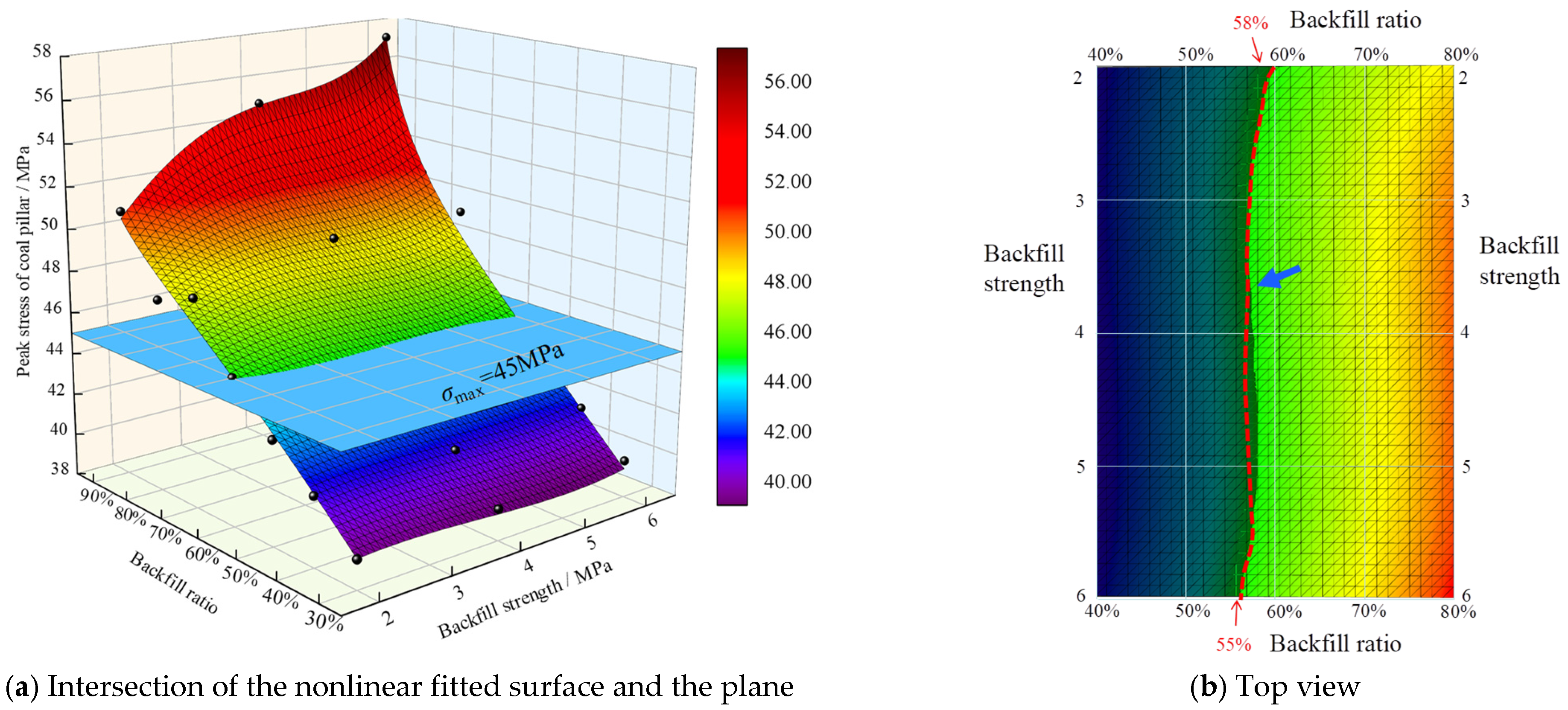
The minimum required ultimate bearing strength of 45 MPa for the pillar-type coal pillars is visualized as the blue plane shown in
Figure 20a.
From
Figure 20b, it can be observed that, for a 14 m wide coal pillar, the critical stable backfill ratio is 58% when the backfill strength is 2 MPa, and it decreases to 55% when the backfill strength increases to 6 MPa. Substituting
σmax = 45 MPa into Equation (8) yields the equation for the intersection curve between the nonlinear surface and the minimum safety strength plane:
When the backfill strength and ratio satisfy Equation (9), this specific combination provides the exact minimum ultimate bearing capacity required for safe upward mining above a 14 m wide coal pillar. Therefore, Equation (9) is established as the critical stability criterion for a 14 m wide coal pillar under the coordinated effect of backfill strength and ratio. Based on this, the stability criterion for upward mining conditions with a 14 m wide pillar under this coordinated effect is given by Equation (10).
In summary, as the coal pillar width increases from 8 m to 14 m, the critical stable backfill ratio decreases from 84% to 55% for 2 MPa backfill, and from 70% to 58% for 6 MPa backfill. This analysis demonstrates that increasing the backfill strength has a more pronounced effect on reducing the critical stable backfill ratio for narrower coal pillars. In contrast, the influence of backfill strength on the critical ratio diminishes for wider pillars.
According to field backfilling data and borehole television observations [
46,
48], when the backfill strength in the underlying pillar-type goaf ranges from 1.5 MPa to 2.4 MPa (average 2 MPa) and the backfill height exceeds 6 m (corresponding to a backfill ratio of 72.3%), the goaf is densely filled. No strata dislocation or borehole wall failure was observed, indicating that both the underlying coal pillars and backfill maintain mining-induced stability. The findings in this section show that, with a 2 MPa backfill strength, the critical stable backfill ratio ranges from 55% to 84% as the pillar width increases from 8 m to 14 m. The actual field backfill ratio falls within this stable critical range, thereby validating the accuracy of the simulation results and the rationality of the numerical model in this section. The research results have revealed the synergistic bearing mechanism and instability mechanism of the “backfill–coal pillar” composite structure, providing strong technical support for the safe re-mining of coal seams and hazard prevention and control in upward mining above room-and-pillar goafs.
6. Conclusions
(1) The composite structure with a backfill ratio of 90% exhibits a “stepwise” variation after coal pillar failure, while those with backfill ratios of 70% and 50% show a “steep drop” post-failure. Specifically, the composite structure with a 50% backfill ratio completely loses its bearing capacity after coal pillar failure. Restricted by its height, the backfill cannot achieve repeated bearing with the failed coal pillar, resulting in the absence of a joint bearing stage where the backfill wraps and supports the failed coal pillar.
(2) In terms of coal pillar failure morphology, coal pillars with a 50% backfill ratio exhibit better integrity and less severe damage than those with 70%. As indicated by the stress–strain curves, the main reason is that the backfill with a 70% backfill ratio enables the coal pillar to undergo repeated failure and reloading during the loading process. In contrast, the 50% backfill ratio backfill provides limited lateral confinement to the coal pillar, and its insufficient height prevents repeated bearing with the failed coal pillar.
(3) When the bearing structure is at peak stress, the force chain direction in the backfill (adjacent to the coal pillar) develops obliquely towards the base plate, with the backfill providing “diagonal bracing” confinement to the coal pillar. This indicates that, although the backfill does not directly bear the roof load at this stage, it resists the axial load of the coal pillar through the interface adhesion force between the backfill and the coal pillar. When the bearing structure is at residual stress, the force chain direction in the backfill shifts from the obliquely downward direction (at peak stress) to the horizontal direction, demonstrating that the backfill provides horizontal lateral confinement to the coal pillar at this stage.
(4) The number of cracks in the coal pillar decreases with the increase in backfill strength. High-strength backfill can provide a higher lateral confinement to the coal pillar by virtue of its own deformation resistance. Conversely, the number of cracks in the coal pillar increases with the increase in backfill ratio. Enhancing the backfill ratio places the coal pillar within the backfill height under a triaxial stress state, leading to an increase in the peak stress of the coal pillar and thereby generating more cracks.
(5) Based on the intersection line between the nonlinear fitted surface and the σmax = 45 MPa plane, the stability criteria for coal pillars with widths of 8 m, 11 m, and 14 m under the coordinated effect of backfill strength and ratio were established. The critical stable backfill ratios for different pillar widths were determined based on backfill strength. For an 8 m wide coal pillar, as the backfill strength increases from 2 MPa to 6 MPa, the critical backfill ratio decreases from 84% to 70%. For an 11 m wide coal pillar, the critical backfill ratio decreases from 69% to 62%. For a 14 m wide coal pillar, the critical backfill ratio decreases from 58% to 55%.