Article

Differences in Stabilometric Parameters During Static-Balance Maintenance in Female Wrestlers of Different Weight Categories


1
Faculty of Physical Education, Józef Piłsudski University of Physical Education in Warsaw, 00-968 Warsaw, Poland
2
WSB Merito University in Poznań, 61-895 Poznań, Poland
*
Author to whom correspondence should be addressed.
Appl. Sci. 2026, 16(5), 2245; https://doi.org/10.3390/app16052245
Submission received: 30 January 2026 / Revised: 18 February 2026 / Accepted: 24 February 2026 / Published: 26 February 2026
(This article belongs to the Special Issue Biomechanics and Kinesiology in Sports and Physical Activities)

Abstract

Background: The aim of the study was to examine the relationship between body weight (weight category groups) and the ability to maintain balance in conditions of restricted field of vision and support area in female wrestlers. Methods: The study involved female wrestlers (n = 34), who were divided into three weight categories. The Romberg test was performer using a freeSTEP STANDARD stabilometric platform. The analysed stabilometric parameters measuring the range of centre-of-pressure (CoP) deviation included total path length (PL) of foot pressure on the ground. Results: The postural stability of female wrestlers was determined by their position, the quality of visual information, the limitation of the support base, and their weight category. As visual information and the support base were limited (when standing on one leg), the deviation of the centre of gravity increased (right leg: f2 = 0.293, p < 0.005). Lightweight competitors showed the biggest body deviations in the ‘standing with both feet and eyes open’ position compared to the middleweight and heavyweight categories (eyes open EO f2 = 0.233, p < 0.05; eyes closed EC f2 = 0.217, p < 0.05). The differences between the tests with eyes open and closed were statistically significant only in the lightweight category. Conclusions: Balance training on the right leg with eyes open can be a sensitive diagnostic test, highlighting differences in stability levels between weight groups. It indicates the need to develop stability while eliminating visual compensation in order to compensate for these differences in competitive sports.

1. Introduction

Balance is one of the most important aspects in combat sports, including wrestling, where a competitor’s effectiveness depends largely on their ability to precisely control their own body, both in a standing position and during dynamic changes in position [1,2]. The ability to maintain stability requires not only adequate physical condition but also effective cooperation between the nervous and muscular systems [3,4].
Maintaining balance is a complex sensory–motor process involving the cooperation of three main systems: the nervous, muscular and skeletal systems. Each of these systems performs specific functions, which together enable effective maintenance of body posture and counteract external forces that may disrupt its stability. In the context of the sensory process, information received from the visual, vestibular and somatosensory systems is of key importance. From the point of view of motor processes, the nervous system is responsible for integrating information from sensory receptors and generating appropriate movement patterns that ensure posture stability and balance. The muscles and skeletal system, as effectors, carry out the commands of the nervous system, correcting body posture, muscle tension and weight distribution [5].
At the same time, the muscular and skeletal systems provide the strength and mechanical stability necessary to perform dynamic and precise movements. This is not only the ability to maintain stability in a standing position, but also a series of processes such as predicting disturbances (feedforward), responding to sudden changes in conditions (feedback) and adapting to changing circumstances. This adaptation is possible thanks to the plasticity of the nervous system and the ability to learn from experience [6,7].
The proprioceptive system plays a key role in maintaining balance by providing information about the position and movements of the body. Proprioceptive receptors located in muscles, tendons, joints and skin enable precise monitoring of body position and the forces acting on it. Muscle spindles respond to muscle stretching and tension, providing information about muscle length and the rate of change, which is crucial for movement coordination. Proper functioning of the proprioceptive system is essential for both daily activities and sports training. Dysfunctions in proprioceptive receptors, afferent pathways, or signal processing in the brain can lead to balance disorders, increasing the risk of falls and injuries. For this reason, training and rehabilitation programmes focus on developing proprioception and strengthening the musculoskeletal system [8]. As demonstrated by Steinberg et al. [9], fatigue affects vestibular function, which has been confirmed in tests by a deterioration in stability scores as fatigue increases.
Therefore, static balance plays an important role in contact sports. It is not only the basis for maintaining body stability during competition, but also affects the effectiveness and efficiency of the techniques and tactics used by athletes. It improves athletic ability by supporting the development of other physical skills such as strength, speed, endurance, agility, and coordination [10,11,12]. Through comprehensive and balanced balance training, athletes are able to use their abilities more effectively while reducing fatigue levels [13].
The ability to maintain a stable body position in combat sports is crucial, especially during moments of anticipation, when the competitor tries to control their opponent, as well as in situations requiring precise body positioning at a single point. In wrestling, an example of this is the moment of pause in a standing position, when the competitor tries to prepare to perform a throwing that requires uninterrupted stability. Thanks to the meticulous positioning of the body axis, the competitor does not lose control over their opponent [14]. Dynamic balance, i.e., the ability to maintain stability during movement, plays a key role in transitional moments and in techniques requiring smooth and rapid changes in body position. In wrestling, techniques such as takedowns, dodges and counterattacks require the competitor not only to react quickly to their opponent’s movements, but also to maintain body stability when transitioning from one action to another. For example, when performing a leg takedown, the wrestler must constantly modify their body position to maintain balance, even when the opponent is trying to throw them off balance [15].
Postural stability plays a key role in generating force when performing techniques, ensuring precise reactions to an opponent’s movements and effective weight transfer. In sports that require dynamic changes in position, such as wrestling, judo or taekwondo, even a momentary loss of balance can significantly weaken the effectiveness of an attack or counterattack. It is emphasised that a stable posture in standing combat is fundamental to the effectiveness of all actions taken [16,17]. This effectiveness may also be influenced by other factors occurring during combat, related to the limitation of the field of vision and the base of support, whose possible relationship with body weight is still poorly understood. This observation prompts attempts to explain this dilemma, especially in the context of women who practise wrestling.
The aim of this study was to verify or disprove the relationship between body weight (weight categories) and the ability to maintain balance in conditions of restricted field of vision and support area in female wrestlers.

2. Materials and Methods

2.1. Participant

Thirty-four female wrestlers from Poland, Ukraine, Germany, Latvia, and Tunisia participated in the study (n = 34). All participants were recruited voluntarily and were informed about the nature of the experiment, with a clear explanation of the purpose of the study and possible risks. They could withdraw from the study at any time. Written consent was obtained from all participants prior to the start of the study, which was conducted in accordance with the guidelines of the Helsinki Declaration and approved by the Scientific Research Ethics Committee.
The female wrestlers were divided into three weight categories according to the criteria proposed by Jagiełło and Kruszewski [18]: lightweight n = 12 (weight categories up to 50 kg, 53 kg and 55 kg), middleweight n = 12 (weight categories up to 57 kg, 59 kg and 62 kg) and heavyweight n = 10 (weight categories up to 65 kg, 68 kg, 72 kg and 76 kg) (Table 1).

2.2. Experimental Procedures

The study of the balance abilities of elite female wrestlers using the Romberg test on the freeSTEP STANDARD stabilometric platform (FreeMED BASE, Radom, Poland) was planned and conducted in accordance with applicable ethical standards. The measurements were taken in the period immediately preceding the competition, under controlled conditions, before the official weigh-in and start.

2.3. Test of Balance Ability

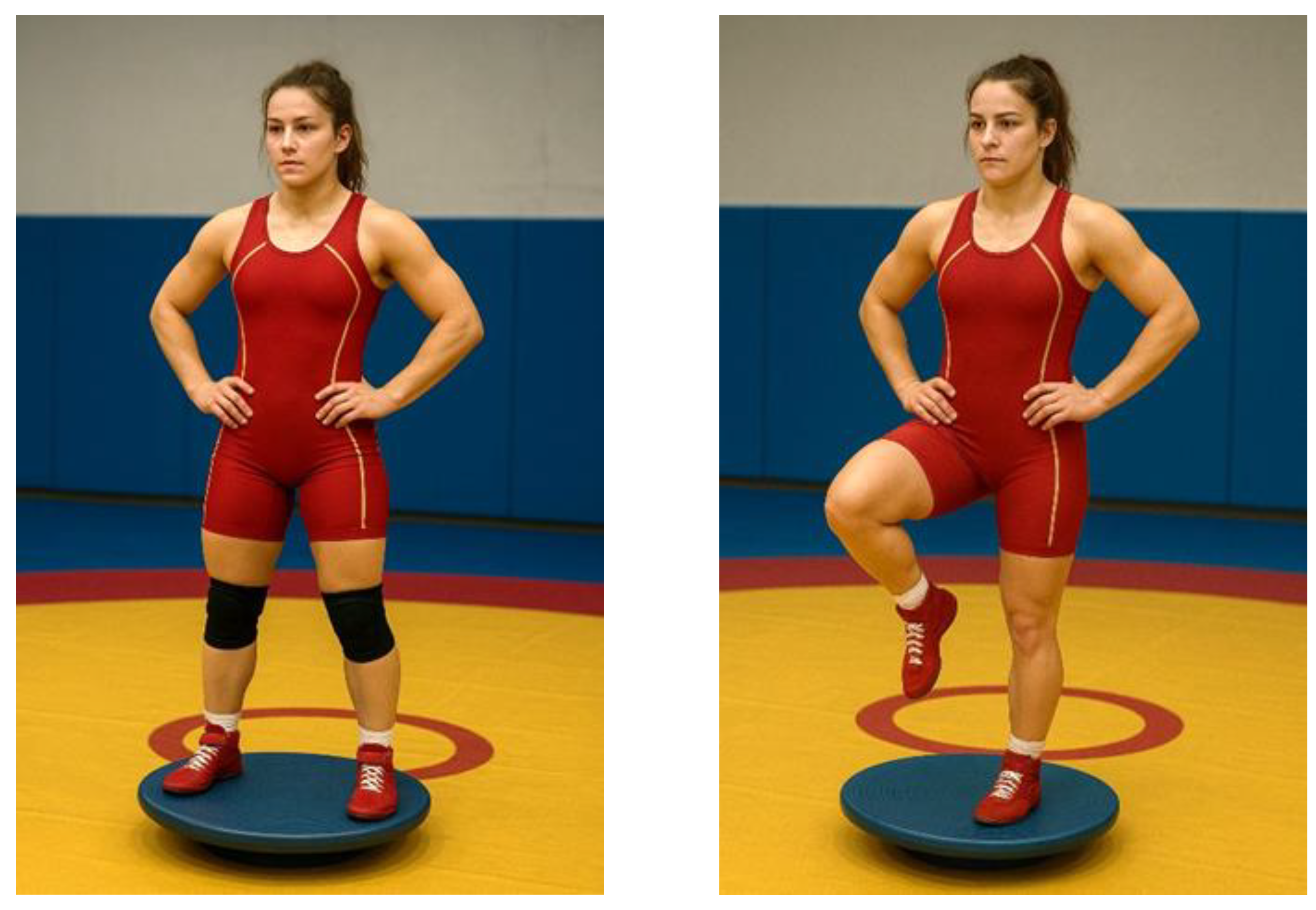
Postural stabilography was used to assess balance ability [19]. Posturography tests are categorised as methods for objective assessment of balance, based on the measurement of a signal representing the displacement of the point of application of the resultant ground reaction forces. The measurement of body oscillation indices is used to assess the functioning of the postural control system and to detect imbalances and risk of falls. Postural stability was measured in static on a stationary substrate on a FreeMED BASE stabilometric mat (Ita.) with FreeSTEP 2.0 software. The device used allows the analysis of the distribution of foot pressure forces on the ground, with a sampling frequency of 250 Hz in real time. Two measurements were conducted based on the standard Romberg test procedure: the first measurement involved a 30 s test of standing still barefoot with eyes open (EO), and the second was a 30 s test of standing still barefoot with eyes closed (EC). In the case of a balance error, the trial was repeated after a short 10–15 s rest period. If the situation repeated itself three times, the participant was excluded from the analysis for a given variable (or, if it concerned all conditions, from the study). During the testing procedure, the subjects were belayed to prevent falls. Measurements were taken before the start of an international wrestling tournament (Figure 1).
The analysed stabilometric parameters measuring the range of centre-of-pressure (CoP) deviation were: total path length (PL) of foot pressure on the ground; confidence ellipse area (CEA), defined as the smallest ellipse that covers 95% of the points of the CoP diagram; mean velocity (MV), defined as the total length travelled by the CoP in 30 s; root mean square (RMS) amplitude of the pivot range in the medial-lateral direction (X-RMS); and amplitude of the root mean square of the pivot range in the anteroposterior direction (Y-RMS).

2.4. Statistical Analysis

Using the Shapiro–Wilk W-test (α = 0.05), it was found that the values obtained for the CoP displacement range did not have a normal distribution, so the data were logarithmised (recommended for small samples). A Mann–Whitney U test (Wilcoxon rank-sum) for repeated measures was used to assess the significance of differences in the analysed parameters between eyes open and closed. Comparisons between groups were done using a nonparametric alternative to the one-way repeated-measures ANOVA—the Friedman test. Detailed post hoc comparisons between pairs of means were made using the Tukey test. The strength of effect was expressed as: insignificant 0 < ƞ2 ≤ 0.01; small 0.01 < ƞ2 ≤ 0.06; average 0.06 < ƞ2 ≤ 0.14; and large ƞ2 > 0.14.
All analyses were performed using STATISTICA (data analysis software system), TIBCO Software Inc. (California, CA, USA, 2017), version 13. A level of p < 0.05 was used to assess the significance of effects.

3. Results

The length of body sway in the standing position with both feet together and full field of vision was greatest and significant in heavyweight competitors. In lightweight competitors, the length of sway was smallest with a restricted field of vision (PL), and the smallest changes in sway length were recorded between EO and EC trials.
In the remaining tests, no significant differences were found in either the weight category groups or in the restricted field of vision (Table 2).
In the one-leg standing test on the right leg with full visual control, no significant differences were found between the weight categories. The shortest sway length was found in the lightweight group and the longest in the heavyweight group.
With visual control (EC) restricted, the shortest length of sway was found in the heavyweight group, while the longest was found in the middleweight group. The observed difference was significant.
The difference in swing speed values (MV) between weight category groups was significant (Table 3).
In the remaining X-RMS and Y-RMS tests, no significant differences were found in either the weight category groups or in the limitation of the field of vision (Table 3 and Table 4).

4. Discussion

Postural control, defined as the ability to maintain the body in a desired configuration relative to the environment, determines the effectiveness of movement, prevents injuries during dynamic interactions, and is an important prognostic factor in the sports training process [1,20]. In female wrestling, where physical contact with opponents, changes in force vectors and a constant struggle for biomechanical dominance place high demands on the vestibular system and proprioception, the issue of postural stability plays a significant role [21,22]. Awareness of the functioning of balance maintenance mechanisms allows for precise adjustment of the training programme, which can directly translate into sporting results [23,24,25].
In the two-foot standing test, individuals with lower body weight (light categories) were able to generate minimal corrections in deep-muscle tension, which translates into a smaller trajectory of centre-of-gravity oscillation. Wrestlers in the middleweight group had higher PL values, suggesting that their postural system required more frequent compensation. However, only in the light category was the difference between the open-eye and closed-eye positions minimal, indicating greater adaptation of their proprioceptive system to eliminate visual stimuli. Patti et al. [26] and Sozzi and Schieppati [27] indicate that human balance develops until the age of 20 and remains stable until around the age of 50, so our research may indicate a stabilised level of balance ability in the female wrestlers studied.
Our research revealed differences between light- and middleweight female wrestlers in terms of the average speed of centre-of-gravity shift (MV) (mm/s). When standing on the right leg with eyes open, the athletes’ body weight played a significant role, as indicated by the statistically significant difference between the weight categories. With visual perception intact, lighter athletes showed a significantly lower centre-of-gravity swing speed, which may reflect greater stabilisation precision in lateral and anterior–posterior movements. In the left-leg standing tests, body mass had a significant effect, suggesting that only the monopodial position on the right limb in combination with visual information created the conditions for the full manifestation of differences related to body mass. It should be noted that high variability may reflect individual postural control strategies in lightweight athletes, and not solely measurement error.
Analyses of X-RMS and Y-RMS indicators indicate a significant impact of visual stimulus availability on lateral and anterior–posterior balance control, with simultaneous modulation of this response in the area of weight categories. Separate interpretation of each of these variables allows for better targeting of training programmes: athletes from the lightweight category should strengthen lateral and anterior–posterior compensation in conditions of no visualisation, those from the middleweight category should focus on monopodial stabilisation of the anterior–posterior axis, and those from the heavyweight category should improve proprioception of the lateral axis, using body weight to strengthen deep-muscle mechanisms. It is believed that CoP displacement in the anterior–posterior plane is mainly controlled by the ankle joint muscles, while CoP displacement in the lateral plane is mainly controlled by the hip muscles [28,29]. It has also been noted that older sensory stimuli provide a basis for better learning of tasks requiring a high level of proprioception, which means that the development of this parameter will promote greater training effectiveness in the future. Thanks to this segmentation of exercises, it is possible to optimise motor preparation in terms of posture for each weight category group, which will translate into greater resistance to destabilisation during intense contact with an opponent [28,29].
Martins et al. [30], studying judo athletes, point out that the length of lateral sway in the X-RMS and Y-RMS planes depends on improved muscle tone, which reduces muscle fatigue during activity in a shorter time. In addition, all central stabilising muscles are deep, single-joint and have segmental attachments that are involuntarily activated 30–50 ms before voluntary limb movement. This allows for the regulation of the torso posture and maintenance of the lumbar spine in a neutral position, regardless of the load and direction of movement, ensuring more harmonious limb movement with minimal energy expenditure.

4.1. Recommendations for Sports

Coaches should therefore base their training on a diagnosis of specific needs: light competitors should focus on lateral control without the use of vision, medium competitors on unilateral balance in the front-back plane, and heavy competitors on general proprioception in conditions of impaired vision. Thanks to this differentiated approach, it is possible to optimally support the development of postural abilities in each weight category, which will ultimately contribute to improving effectiveness in combat on the mat. It is indicated that an 8-week training programme is sufficient to effectively improve the balance of competitors, with two sessions per week, lasting approximately 45 min [31]. In the future, it would be reasonable to conduct studies differentiating the parameters examined depending on the presented level of athleticism, as was done by Morán-Navarro et al. [32]. Such studies may shed new light on the understanding of how the level of athleticism, also depending on the weight category in which the subjects compete, affects the management of individual parameters of balance.

4.2. Limitations of the Study

The training phase of the athletes may have influenced the results obtained. To avoid the influence of fatigue and other stress factors that occur during the competition season, a similar study should be conducted before and/or after the season to compare the results.
In addition, due to the fact that the study was conducted with such a specialised group of athletes, the sample size was relatively small. A good alternative would be a multicentre study involving a larger group of athletes. It should be noted that the high variability may reflect individual postural control strategies in the lightweight athletes, and not solely measurement error.

5. Conclusions

The limitation of visual information weakens the ability of middleweight and lightweight competitors to maintain balance in relation to heavyweight wrestlers.
The lower speed of sways developed with limited support and full visual control by lighter-weight-category competitors, compared to heavier ones, seems to indicate the key role of body weight in maintaining stability.
From a sports perspective, balance training on the right leg with eyes open can be a sensitive diagnostic test, highlighting differences in stability levels between weight groups. At the same time, it points to the need to develop stability while eliminating visual compensation in order to even out these differences in competitive sports.

Author Contributions

Conceptualisation, A.K., R.T., M.K. (Michał Kruszewski), A.T. and M.K. (Marek Kruszewski); methodology, M.K. (Marek Kruszewski), R.T. and A.K.; software, M.K. (Marek Kruszewski) and A.K.; validation, M.K. (Marek Kruszewski) and A.K.; formal analysis, M.K. (Marek Kruszewski) and A.T.; investigation, M.K. (Michał Kruszewski) and A.K.; resources, M.K. (Marek Kruszewski) and A.K.; data curation, M.K. (Marek Kruszewski) and R.T.; writing—original draft preparation, M.K. (Michał Kruszewski), A.K. and M.K. (Marek Kruszewski); writing—review and editing, M.K. (Michał Kruszewski), A.K. and R.T.; visualisation, M.K. (Michał Kruszewski), M.K. (Marek Kruszewski) and A.K.; supervision, M.K. (Marek Kruszewski), A.T. and A.K.; project administration, A.K. All authors have read and agreed to the published version of the manuscript.

Funding

This research received no external funding.

Institutional Review Board Statement

The study was conducted in accordance with the Declaration of Helsinki and approved by the Ethics Committee of SKE-37-2024.

Informed Consent Statement

Written informed consent was obtained from the patients to publish this paper.

Data Availability Statement

The raw data supporting the conclusions of this article will be made available by the authors on request.

Acknowledgments

Authors would like to thank all the athletes who participated in the study.

Conflicts of Interest

The authors declare no conflicts of interest.

References

  1. Kruszewski, A.; Kruszewski, M.; Tabecki, R.; Kruszewski, M.; Kuzmicki, S. Assessment of Balance Asymmetry in Elite Polish Greco-Roman Style Wrestlers Using the Y-Balance Test. Ido Mov. Cult. J. Martial Arts Anthropol. 2025, 25, 40–47. [Google Scholar] [CrossRef]
  2. Kruszewski, M.; Kruszewski, A. Changes in the static balance of primary school students after six months of wrestling training. Pedagog. Phys. Cult. Sports 2025, 29, 555–564. [Google Scholar] [CrossRef]
  3. Modi, A.D.; Parekh, A.; Patel, Z.H. Methods for evaluating gait associated dynamic balance and coordination in rodents. Behav. Brain Res. 2024, 456, 114695. [Google Scholar] [CrossRef]
  4. Kruszewski, M. Testing fights in a vertical posture of 11-year-old schoolgirls in round robin system as an example of complementary health and survival education in a modern school. Arch. Budo J. Innov. Agon. 2025; accepted. [Google Scholar]
  5. Clemson, L.; Fiatarone Singh, M.A.; Cumming, R.G.; Manollaras, K.; O’Loughlin, P.; Black, D. Integration of balance and strength training into daily life activity to reduce rate of falls in older people (the LiFE study): Randomised parallel trial. BMJ 2012, 345, e4547. [Google Scholar] [CrossRef]
  6. Shumway-Cook, A.; Woollacott, M.H. Motor Control: Translating Research into Clinical Practice; Wolters Kluwer: Philadelphia, PA, USA, 2016. [Google Scholar]
  7. Raffi, M.; Trofè, A.; Meoni, A.; Piras, A. The Speed of Optic Flow Stimuli Influences Body Sway. Int. J. Environ. Res. Public Health 2022, 19, 10796. [Google Scholar] [CrossRef] [PubMed]
  8. Aman, J.E.; Elangovan, N.; Yeh, I.-L.; Konczak, J. The effectiveness of proprioceptive training for improving motor function: A systematic review. Front. Hum. Neurosci. 2014, 8, 1075. [Google Scholar] [CrossRef]
  9. Steinberg, N.; Elias, G.; Zeev, A.; Witchalls, J.; Waddington, G. The function of the proprioceptive, vestibular and visual systems following fatigue in individuals with and without chronic ankle instability. Percept. Mot. Ski. 2023, 130, 239–259. [Google Scholar] [CrossRef]
  10. Litwiniuk, A.; Gąsienica Walczak, B.; Jagiełło, W.; Kruszewski, A. Body balance disturbation tolerance skills combat sports athletes and people with other motor experiences in dynamically changing circumstances in own research—A perspective for predicting personal safety during real-life performance in extreme situations. Arch. Budo 2023, 19, 41–49. [Google Scholar]
  11. Sadowski, J.; Cieśliński, I.; Gierczuk, D. Response time of athletes with different sports specializations. Arch. Budo J. Innov. Agon. 2024, 20, 162–173. [Google Scholar]
  12. Xu, A.; Cherkashina, E.; Cherkashin, I.; Kruszewski, A.; Wang, R.; Shao, W.; He, Z.; Hou, X.; Kruszewski, M.; Molik, B. Effectiveness of exercise interventions for postural correction in upper crossed syndrome—Meta-analysis. Arch. Budo J. Innov. Agon. 2025, 21, 15–34. [Google Scholar]
  13. Gebel, A.; Prieske, O.; Behm, D.G.; Granacher, U. Effects of balance training on physical fitness in youth and young athletes: A narrative review. Strength Cond. J. 2020, 42, 35–44. [Google Scholar] [CrossRef]
  14. Başar, S.; Düzgün, İ.; Atalay Güzel, N.; Cicioğlu, I.; Çelik, B. Differences in strength, flexibility and stability in freestyle and Greco-Roman wrestlers. J. Back Musculoskelet. Rehabil. 2014, 27, 321–330. [Google Scholar] [CrossRef] [PubMed]
  15. Kruszewski, M.; Kruszewski, A.; Niedomagała, W. Innovative method for predicting the chances of effective self-defence against physical aggression among children and adolescents based on the results of testing fights in a vertical posture. Arch. Budo J. Innov. Agon. 2024, 20, 270–286. [Google Scholar]
  16. Pion, J.; Fransen, J.; Lenoir, M.; Segers, V. The value of non-sport-specific characteristics for talent orientation in young male judo, karate and taekwondo athletes. Arch. Budo 2014, 10, 147–154. [Google Scholar]
  17. Kalina, A.; Kruszewski, A.; Gąsienica-Walczak, B. Motor modifications versus movement habits in measuring the SFI phenomenon. Arch. Budo J. Innov. Agon. 2024, 20, 250–269. [Google Scholar]
  18. Jagiełło, W.; Kruszewski, A. Morphological Diversification of Competitors Training Greco-Roman Style of Wrestling. Arch. Budo 2009, 5, 147–153. [Google Scholar]
  19. Kamieniarz, A.; Michalska, J.; Brachman, A.; Pawłowski, M.; Słomka, K.J.; Juras, G. A Posturographic Procedure Assessing Balance Disorders in Parkinson’s Disease: A Systematic Review. Clin. Interv. Aging 2018, 13, 2301–2316. [Google Scholar] [CrossRef]
  20. Hrysomallis, C. Balance abilities and athletic performances. Sports Med. 2011, 41, 221–232. [Google Scholar] [CrossRef]
  21. Murray, N.; Salvatore, A.; Powell, D.; Reed-Jones, R. Reliability and validity evidence of multiple balance assessments in athletes with a concussion. J. Athl. Train. 2014, 49, 540–549. [Google Scholar] [CrossRef]
  22. Alpay, C.B.; Işık, Ö. Comparison of body components and balance levels among hearing-impaired wrestlers and healthy wrestlers. Acta Kinesiol. 2017, 11, 79–84. [Google Scholar]
  23. Lauenroth, A.; Schulze, S.; Rein, L. Comparison of postural stability and regulation among male athletes from different sports. Appl. Sci. 2022, 12, 5457. [Google Scholar] [CrossRef]
  24. Forbes, J.; Munakomi, S.; Cronovich, H.A. Romberg test. In StatPearls; StatPearls Publishing: Treasure Island, FL, USA, 2025. [Google Scholar]
  25. Chiyohara, S.; Furukawa, J.I.; Noda, T.; Morimoto, J.; Imamizu, H. Proprioceptive short-term memory in passive motor learning. Sci. Rep. 2023, 13, 20826. [Google Scholar] [CrossRef] [PubMed]
  26. Patti, A.; Bianco, A.; Şahin, N.; Sekulic, D.; Paoli, A.; Iovane, A.; Messina, G.; Gagey, P.M.; Palma, A. Postural control and balance in a cohort of healthy people living in Europe: An observational study. Medicine 2018, 97, e13835. [Google Scholar] [CrossRef]
  27. Sozzi, S.; Schieppati, M. Balance adaptation while standing on a compliant base depends on the current sensory condition in healthy young adults. Front. Hum. Neurosci. 2022, 16, 839799. [Google Scholar] [CrossRef] [PubMed]
  28. Gage, W.H.; Winter, D.A.; Frank, J.S.; Adkin, A.L. Kinematic and kinetic validity of the inverted pendulum model in quiet standing. Gait Posture 2004, 19, 124–132. [Google Scholar] [CrossRef]
  29. Vieira Tde, M.; de Oliveira, L.F.; Nadal, J. An overview of age-related changes in postural control during quiet standing tasks using classical and modern stabilometric descriptors. J. Electromyogr. Kinesiol. 2009, 19, e513–e519. [Google Scholar] [CrossRef] [PubMed]
  30. Martins, H.S.; Lüdtke, D.D.; César de Oliveira Araújo, J.; Cidral-Filho, F.J.; Salgado, A.S.I.; Viseux, F.; Martins, D.F. Effects of core strengthening on balance in university judo athletes. J. Bodyw. Mov. Ther. 2019, 23, 758–765. [Google Scholar] [CrossRef]
  31. Brachman, A.; Kamieniarz, A.; Michalska, J.; Pawłowski, M.; Słomka, K.J.; Juras, G. Balance training programs in athletes—A systematic review. J. Hum. Kinet. 2017, 58, 45–64. [Google Scholar] [CrossRef]
  32. Morán-Navarro, R.; López-Gullón, J.M. Can balance skills predict Olympic wrestling performance? J. Sport Health Res. 2015, 7, 19–30. [Google Scholar]
Figure 1. Performing the Romberg test—standing on both legs, standing on one leg. AI example image.
Applsci 16 02245 g001
Table 1. Somatic characteristics of the female wrestlers studied (mean values ± SD).
Lightweight
Categories
(n = 12)
Middleweight
Categories
(n = 12)
Heavyweight
Categories
(n = 10)
Body height (cm)160 ± 4.31168 ± 5.64170 ± 6.75
Minimum 154158158
Maximum165176180
Body weight (kg)55 ± 2.1161 ± 1.6371 ± 4.24
Minimum 525965
Maximum576376
Table 2. Results values, p-values and effect sizes in weight categories while standing on both feet, with eyes open and eyes closed.
Stabilometric VariablesLightweight Category (n = 12)Middleweight Category (n = 12)Heavyweight Category (n = 10)Effect Size f2p-Value
PL (mm)
EO96.97 ± 202.5953.06 ± 24.1446.03 ± 32.530.2330.009 *
EC96.96 ± 202.59117.36 ± 64.31139.73 ± 237.230.2170.013 **
Effect size η20.0030.1990.041
p-value0.9580.2080.840
CEA (mm2)
EO191.04 ± 27.91204.48 ± 37.85195.73 ± 34.190.1080.116
EC254.42 ± 65.43225.36 ± 45.85217.92 ± 60.530.0570.321
Effect size η20.2020.0500.041
p-value0.2600.7570.840
MV (mm/s)
EO6.64 ± 0.927.01 ± 1.216.91 ± 1.190.1170.097
EC8.59 ± 2.117.70 ± 1.617.46 ± 1.920.1030.128
Effect size η20.2140.1460.024
p-value0.2330.3560.907
X-RMS (mm)
EO0.25 ± 0.040.28 ± 0.050.26 ± 0.040.0960.146
EC0.41 ± 0.130.29 ± 0.050.32 ± 0.080.0070.876
Effect size η20.1110.0230.120
p-value0.5320.8850.567
Y-RMS (mm)
EO0.18 ± 0.040.19 ± 0.080.18 ± 0.040.0010.981
EC0.35 ± 0.230.26 ± 0.090.33 ± 0.190.0180.699
Effect size η20.1070.0480.107
p-value0.5450.7610.599
NOTE: EO—eyes open; EC—eyes closed; PL—total path length; CEA—confidence ellipse area; MV—mean velocity; X-RMS—amplitude of the pivot range in the medial-lateral direction; Y-RMS—amplitude of the root mean square of the pivot range in the anteroposterior direction; *p < 0.005; ** p < 0.05.
Table 3. Results, p-values, and effect sizes in weight categories while standing on the right leg with eyes open and eyes closed.
Stabilometric VariablesLightweight Category
(n = 12)
Middleweight Category (n = 12)Heavyweight Category (n = 10)Effect Size f2p-Value
PL (mm)
EO178.11 ± 131.06182.60 ± 61.02215.02 ± 144.720.0680.259
EC3349.01 ± 38188898.11 ± 1527.142609.75 ± 1827.760.2930.003 *
Effect size η20.2630.2870.171
p-value0.1380.0690.041
CEA (mm2)
EO205.49 ± 32.48261.71 ± 75.99245.42 ± 58.760.1430.050 *
EC715.67 ± 215.751108.97 ± 845.44626.31 ± 107.130.1320.074
Effect size η20.2930.2110.253
p-value0.0970.1850.214
MV (mm/s)
EO15.02 ± 2.4220.48 ± 5.7817.33 ± 4.650.1520.049 *
EC58.59 ± 20.11101.38 ± 83.2050.25 ± 11.740.0780.212
Effect size η20.2700.3810.254
p-value0.1270.0180.214
X-RMS (mm)
EO3.18 ± 1.753.11 ± 2.004.36 ± 1.470.1250.082
EC8.31 ± 2.626.45 ± 3.447.85 ± 2.430.1090.127
Effect size η20.2700.2340.418
p-value0.1260.1430.045
Y-RMS (mm)
EO1.21 ± 0.631.74 ± 1.081.45 ± 0.530.1170.097
EC3.23 ± 1.735.57 ± 5.482.66 ± 0.280.1130.104
Effect size η20.1440.0240.251
p-value0.4160.8810.219
NOTE: EO—eyes open; EC—eyes closed; PL—total path length; CEA—confidence ellipse area; MV—mean velocity; X-RMS—amplitude of the pivot range in the medial-lateral direction; Y-RMS—amplitude of the root mean square of the pivot range in the anteroposterior direction; *p < 0.005.
Table 4. Results, p-values, and effect sizes in weight categories while standing on the left leg with eyes open and eyes closed.
Stabilometric VariablesLightweight Category (n = 12)Middleweight Category (n = 12)Heavyweight Category (n = 10)Effect Size f2p-Value
PL (mm)
EO224.27 ± 123.59262.79 ± 198.57315.57 ± 206.720.0830.191
EC2392.01 ± 1507.113666.03 ± 4421.613237.95 ± 3553.910.1160.099
Effect size η20.2270.1820.271
p-value0.2010.2550.184
CEA (mm2)
EO298.54 ± 97.34294.07 ± 61.31323.53 ± 76.440.0080.848
EC702.52 ± 321.27928.17 ± 744.61628.87 ± 302.910.4180.001 **
Effect size η20.1110.0250.053
p-value0.5340.1440.799
MV (mm/s)
EO17.38 ± 5.2119.61 ± 3.1618.51 ± 5.320.1730.032 *
EC58.77 ± 30.8182.98 ± 70.4957.91 ± 29.010.2030.017 *
Effect size η20.3020.5130.289
p-value0.0930.001**0.169
X-RMS (mm)
EO7.78 ± 3.526.08 ± 3.588.69 ± 1.960.0460.397
EC7.33 ± 3.416.27 ± 3.586.52 ± 2.670.2770.011 *
Effect size η20.0430.2080.231
p-value0.8050.1890.259
Y-RMS (mm)
EO1.57 ± 0.541.51 ± 0.661.26 ± 0.580.0070.265
EC3.22 ± 1.815.04 ± 5.073.64 ± 1.980.1730.031 *
Effect size η20.2640.1630.414
p-value0.1420.3090.042
NOTE: EO—eyes open; EC—eyes closed; PL—total path length; CEA—confidence ellipse area; MV—mean velocity; X-RMS—amplitude of the pivot range in the medial-lateral direction; Y-RMS—amplitude of the root mean square of the pivot range in the anteroposterior direction; *p < 0.005; ** p < 0.05.
Disclaimer/Publisher’s Note: The statements, opinions and data contained in all publications are solely those of the individual author(s) and contributor(s) and not of MDPI and/or the editor(s). MDPI and/or the editor(s) disclaim responsibility for any injury to people or property resulting from any ideas, methods, instructions or products referred to in the content.