1. Introduction
Recent advances in knowledge-graph-based retrieval-augmented generation (RAG) have expanded toward combining knowledge graph information more closely with large language models (LLMs) [
1]. While pure LLM-based approaches (e.g., Llama2 [
2], Llama3 [
3], and ChatGPT [
4]) possess powerful generative capabilities, they suffer from fundamental limitations such as a lack of domain-specific knowledge, rapid information obsolescence, and hallucinations [
5]. To mitigate these issues, naive RAG methods have been proposed; however, they primarily rely on semantic information from text chunks, failing to capture relational dependencies and struggling with multi-hop reasoning [
6,
7].
To address these limitations, graph-retrieval-augmented generation (GraphRAG) has emerged, using the structural information of knowledge graphs (KGs) to model complex entity relationships [
7,
8,
9]. GraphRAG enables the simultaneous use of semantic and structural information by retrieving subgraphs and paths, facilitating robust multi-hop reasoning through the integration of graph neural networks (GNNs) or LLM reasoning capabilities [
10]. This is particularly critical in knowledge graph question answering (KGQA), where models must interpret natural language queries within a structural context to derive accurate answers, balancing semantic intent with structural validity [
11,
12].
Existing GraphRAG research generally follows two paths: (1)
LLM-centric semantic approaches and (2)
GNN-centric structural approaches. The former often fail to fully utilize structural cues, leading to under-reasoning of complex relations [
13,
14], while the latter tend to ignore semantic nuances, resulting in over-constraint in reasoning [
15,
16]. This gap originates from the misalignment between semantic and structural representation spaces [
17,
18]. As candidate paths grow exponentially, semantic retrievers struggle with structural constraints, and structural retrievers fail to capture semantic intent, making stable multi-hop reasoning inherently challenging [
12,
19].
To bridge this gap, we propose hybrid retrieval-augmented generation (HybRAG), a unified framework that synergistically integrates semantic a node-level retriever and structural path-level retriever. In this context, node-level semantics refers to textual relevance, while path-level structural reasoning represents explicit multi-hop connectivity. We further analyze how its design choices—using only node retrieval, only path retrieval, or both together—affect LLM-based KGQA performance. Our primary contributions are as follows:
- 1.
Multi-Hop Reasoning over KG: We extract explicit multi-hop relational paths via a structural path-level retriever, enabling the LLM to follow a logical structural trajectory.
- 2.
Hybrid Retrieval (Node-Semantic + Path-Structural): By organically combining node-semantic and path-structural retrieval, we mitigate the issues of under-reasoning and over-constraint, ensuring a balance between semantic relevance and structural validity.
- 3.
KG-Grounded LLM Generation: We transform retrieved KG contexts into natural language prompts to reduce hallucinations and address information obsolescence, while employing a retrieval-augmented fine-tuning (RAFT) strategy to enhance robustness against retrieval noise.
The results demonstrate the effectiveness of HybRAG and consistently highlight the advantages of a hybrid approach that bridges the gap between semantic understanding and explicit reasoning, leading to more accurate and robust KGQA performance.
2. Related Work
2.1. Structural Limitations of Naive RAG
RAG is an effective approach for mitigating the hallucination issues and information obsolescence inherent in LLMs by retrieving external knowledge [
20,
21]. Standard RAG frameworks typically retrieve documents from a text corpus and use them as context to enhance the accuracy and domain relevance of LLM-generated responses [
20,
22].
However, conventional naive RAG exhibits clear limitations when handling structured data such as KG. Because it treats documents as unstructured text chunks [
23], critical relational information—including hierarchical structures, explicit relations, and multi-hop paths—is often lost, leading to failures in structural reasoning [
5,
6,
22]. Such structural deficiencies have been repeatedly identified as primary causes of multi-hop reasoning failures in KGQA research [
7,
10,
14]. The specific limitations include:
Absence of Structural Relations: The inability to explicitly represent hierarchical and relational links between entities leads to inconsistent reasoning in complex relational queries.
Redundancy and Noise: Long-form text containing information irrelevant to the query introduces excessive noise, hindering the LLM’s ability to identify core evidence and form valid reasoning paths.
Lack of Global Context: Naive RAG struggles with global reasoning because it cannot leverage the interconnectedness between disparate documents.
Therefore, for environments like KGQA, where both semantic and structural information are paramount, the GraphRAG paradigm is essential to overcome the constraints of conventional RAG.
2.2. The GraphRAG Paradigm and the Semantic–Structural Dichotomy
GraphRAG was introduced to address the structural limitations of naive RAG by utilizing KG structural information—such as entity relationships, paths, and subgraphs—to enable global structural reasoning [
5,
17,
23]. While GraphRAG offers deeper reasoning paths than naive RAG through structural connectivity, it faces a new challenge: the semantic–structural dichotomy regarding how to best integrate these two signals [
17,
24].
Current GraphRAG research is primarily divided into: (1)
LLM-centric semantic approaches and (2)
GNN-centric structural approaches [
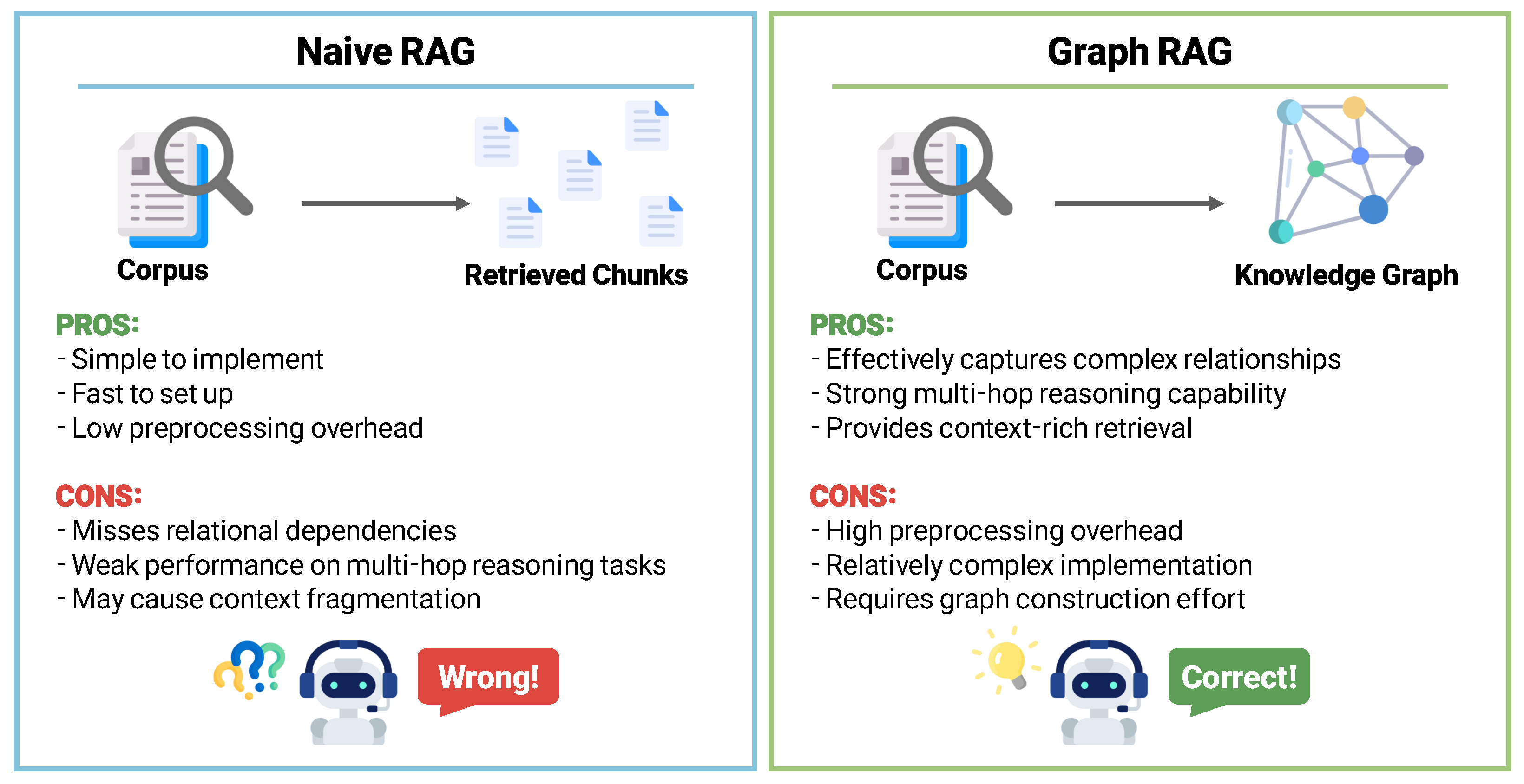
16]. This division is a result of technical choices on how to extract and combine structural information with LLMs. As illustrated in
Figure 1, while naive RAG excels at semantic-similarity-based retrieval, GraphRAG provides more robust reasoning via structural associations. However, semantic approaches often show under-reasoning of complex relations due to a lack of explicit structural constraints, whereas structural approaches suffer from over-constraint in reasoning where rigid graph representations conflict with the flexible semantic interpretation of the LLM. This contrast underscores the necessity of a unified framework that complementarily integrates semantic and structural information [
17].
2.3. Comparative Analysis of GraphRAG Methodologies for KGQA
Existing GraphRAG methodologies for KGQA can be categorized based on whether structural reasoning is driven by the LLM or an auxiliary GNN.
2.3.1. LLM-Centric Semantic Approaches
These models treat the LLM as the primary reasoning engine. They retrieve triples or subgraphs from the KG and convert them into natural language prompts to be injected directly into the LLM [
7,
14]. Although this allows the LLM to utilize factual evidence, the burden of structural analysis is shifted entirely to the LLM without pre-analyzing the KG’s topology [
7,
25]. This often results in under-reasoning, where the model fails to construct complete multi-hop paths. Representative models include:
KD-CoT [13]: Uses knowledge-based cues to guide the generation of chain-of-thought (CoT), ensuring that reasoning remains factually grounded.
EWEK-QA [11]: A hybrid approach that combines textual evidence from web searches with efficient KG retrieval for quote-based KGQA.
ToG [14]: A framework in which the LLM iteratively explores the KG, expanding potential paths and selecting valid reasoning paths.
2.3.2. GNN-Centric Structural Approaches
These models employ GNNs as powerful pre-reasoners. Before passing knowledge to the LLM, the GNN encodes subgraphs and paths into graph prompts or embeddings [
15,
16]. While this enhances logical consistency and structural integrity, the resulting rigid representations can create a modality gap with the LLM’s flexible natural language processing [
24]. This leads to an over-constraint problem where the model overlooks subtle semantic clues outside the GNN-identified paths.
G-Retriever [15]: Constructs a tree-centric structure using a prize-collecting Steiner tree (PCST)-based technique, which is then encoded by a GNN to serve as a soft prompt for fine-tuning the LLM.
3. Methodology
This section describes the detailed design and overall system configuration of HybRAG, proposed to mitigate the limitations of the two structural reasoning approaches—LLM-centric semantic and GNN-centric structural—discussed in
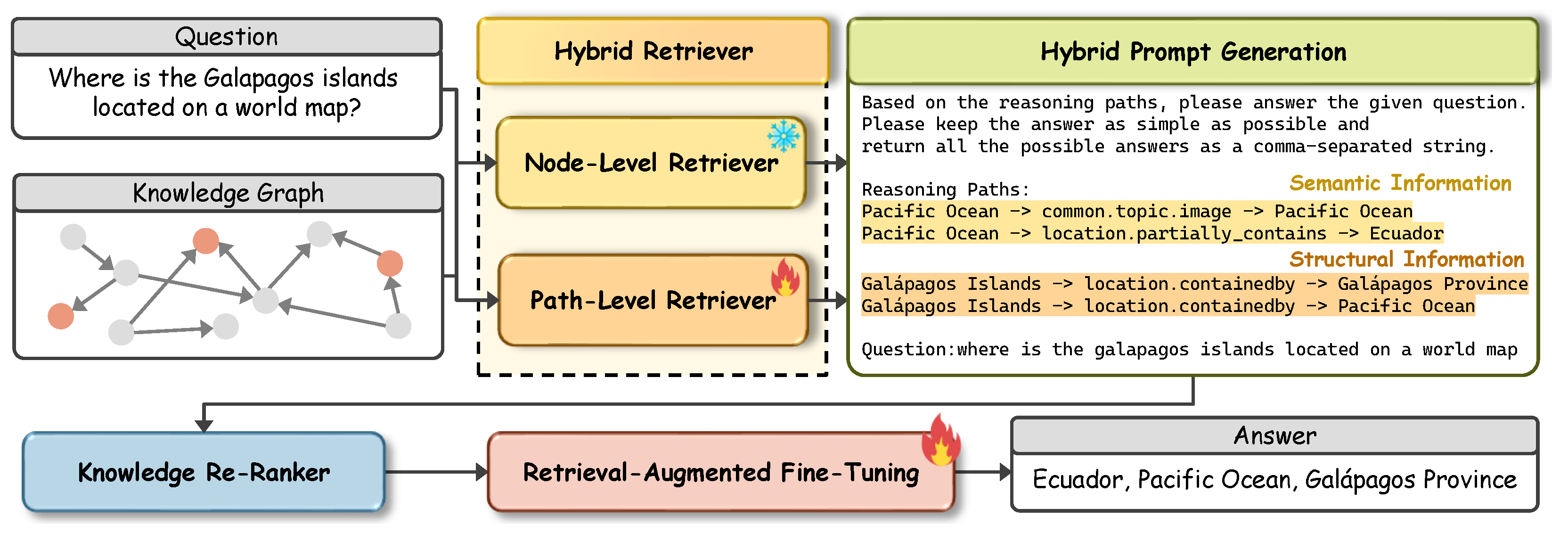
Section 2. Specifically, HybRAG is engineered to simultaneously address the under-reasoning issue prevalent in LLM-centric methods and the over-constraint problem in GNN-centric approaches by complementarily integrating (1) a semantic node-level retriever and (2) a structural path-level retriever.
The core architecture of our framework is inspired by the retrieval integration strategy of G-Refer [
26], a recent advancement in recommendation systems. G-Refer demonstrates that a dual-stream approach—processing text-based semantic signals and graph-based structural signals independently before integration—minimizes information loss and maximizes complementarity. We extend this insight from the recommendation domain to the KGQA domain, where more complex knowledge graph reasoning is required. By comparing this dual-retrieval strategy, HybRAG constructs hybrid subgraphs that are semantically rich and structurally robust.
These subgraphs provide an improved context for fine-tuning LLMs in GraphRAG. Consequently, the LLM learns from two distinct information sources simultaneously, allowing for more accurate and robust reasoning. The entire process is illustrated in
Figure 2.
3.1. Node-Level Retriever
The goal of the semantic node-level retriever (NR) is to generate a semantic subgraph
composed of triplets semantically relevant to the query
q and the knowledge graph
. This process is formulated as:
The NR selects entities that are semantically related to the input query, thereby facilitating entity-centric reasoning. We employ Sentence-BERT (S-BERT) [
27]—a BERT [
28]-based architecture optimized for sentence-level semantic representations—as the core embedding model, which is optimized for sentence-level semantic representations. It allows for a direct comparison between the query
q and the textual representations of KG nodes (e.g., labels, aliases, and descriptions) in a shared embedding space.
Let
be the textual representation of node
. The semantic embeddings for nodes and the query are generated via the S-BERT encoder as follows:
where
. The retriever then computes the cosine similarity between the query and node embeddings:
Based on this similarity, the top-
most relevant entities are selected. To capture the proximal structural context that simple textual similarity might overlook, these entities are expanded to their
h-hop neighbors, and all connected triplets
are collected. For each triplet, an importance score is computed to prioritize the most informative context:
where
denotes the normalized node degree, and
represent the similarity of nodes
u and
v to the query. The parameter
serves as a trade-off coefficient balancing the contributions of the source and target nodes.
Let
be the set of triplets collected through the
h-hop expansion of the top-
entities. The final node-level retrieval is defined as:
where
represents a candidate triplet. The semantic subgraph
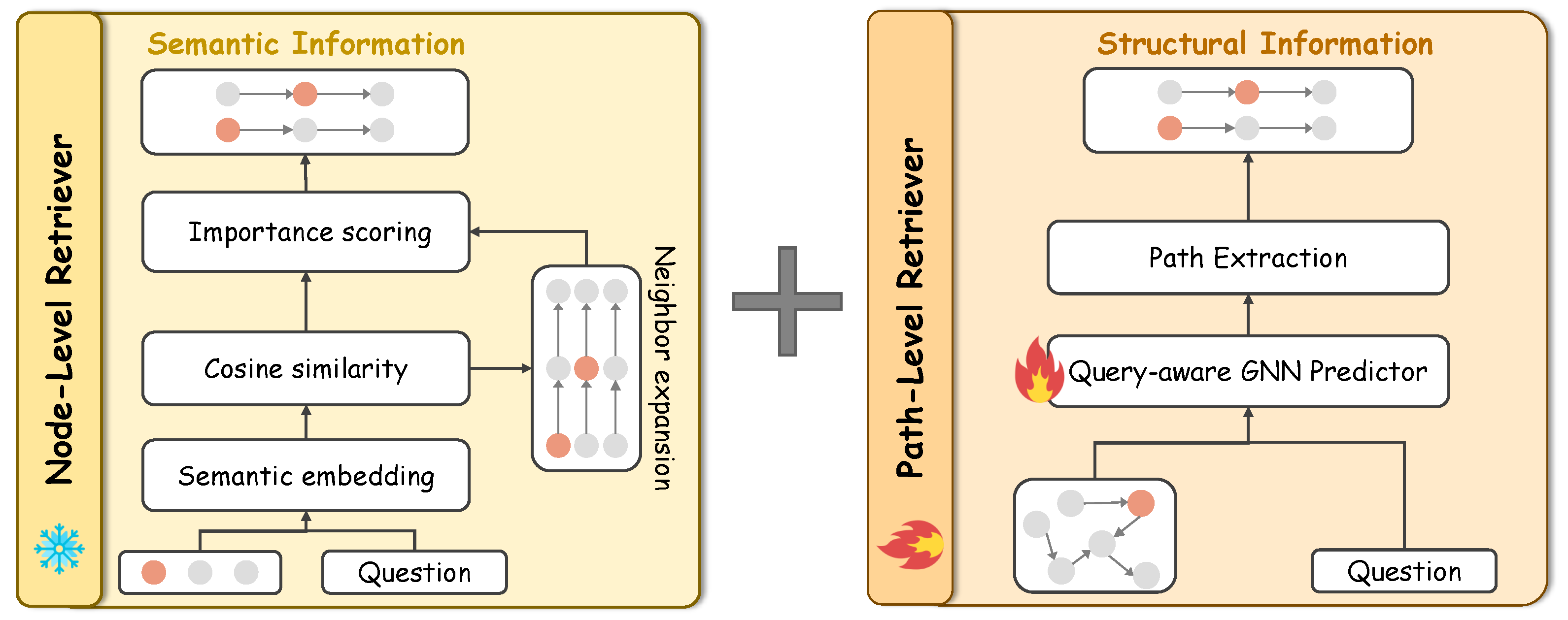
offers rich context that mitigates the over-constraint issue of structural methods by offering flexible semantic cues to the LLM. This process is illustrated in detail in
Figure 3(left).
3.2. Path-Level Retriever
The structural path-level retriever (PR) in our framework is based on ReaRev [
29], a GNN-based KGQA model that performs reasoning conditioned on the query
q. Unlike conventional GCNs [
30] that aggregate neighbor messages with uniform weights, ReaRev explicitly models the semantic correlation between the query and relations to dynamically modulate message contributions. This query-conditioned message-passing mechanism allows the model to prioritize relevant relational paths while suppressing noise, effectively navigating complex multi-hop structures.
The primary goal of the PR is to extract a path-based subgraph
that connects the query entity and a target answer
a, given the learned GNN parameters
. This is formulated as:
3.2.1. Query-Aware GNN Predictor
Query–Relation Conditioned Messaging
The core of the predictor is determining the query-conditioned importance
of a message passed from neighbor
to node
u through relation
r:
where ⊙ denotes element-wise multiplication and
is the ReLU activation. To incorporate structural search signals, we utilize the node probability distribution
from the previous layer to assign exploration priorities. Consequently, this allows the model to internalize the BFS-based search distribution directly into the GNN’s internal message-passing process, enabling a more structured and strategic exploration of the knowledge graph.
Aggregation and Node Update
The message
is then defined as:
The query-conditioned aggregate representation
and the updated node state
are computed as follows:
Finally, the node representation is projected to a scalar score to generate the probability distribution
for the next hop:
3.2.2. Path Extraction
Candidate Identification and Top-K Search
The candidate answer is identified as the node with the highest probability in the final distribution . To ensure reasoning diversity and reliability, we adopt a top-K multi-path search strategy () within a three-hop radius between the query entity and the candidate . This approach addresses the limitation of single shortest-path methods, which may lose critical information or select arbitrary paths in tie-break scenarios.
Our emphasis on shortest paths is grounded in the need for reasoning efficiency and faithfulness. Concise paths serve as interpretable evidence while suppressing semantic noise that often leads to LLM hallucinations [
7,
31,
32]. Excessive search depth can exponentially increase spurious correlations, hindering the derivation of correct answers [
14].
3.3. Hybrid Prompt Generation
For each query–answer pair
, the final hybrid subgraph
is constructed by merging the semantic node-level retrieval results
from
Section 3.1 and the structural path-level results
from
Section 3.2 based on the query ID. Since the two retrievers provide information at different granularities—node-centric semantic contexts and path-centric structural reasoning paths—the final integrated subgraph is formally defined as:
where
denotes the set of ground-truth answers for query
q. During the merging process, redundant triplets are removed and basic normalization is performed to prevent prompt contamination from information overload. Furthermore, since a single query can have multiple answers, the structural contexts for all corresponding answers are aggregated, leading to the definition of the final subgraph as
rather than
.
This hybrid subgraph is then inserted, together with the original query
q, into a predefined template to generate data samples:
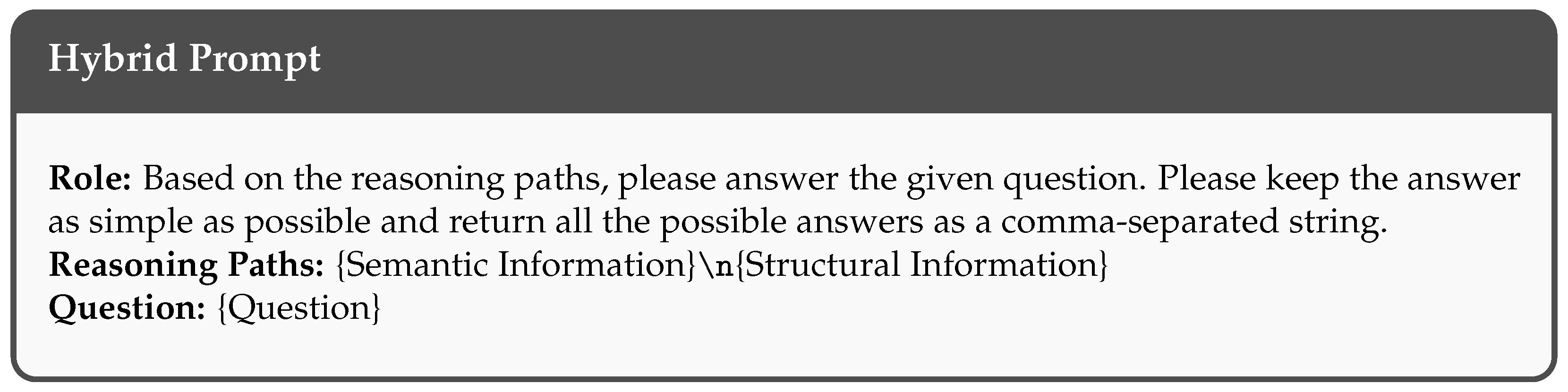
As illustrated in
Figure 4, this process integrates semantic and structural information into a unified input format. In practice, multiple hybrid subgraph candidates
are generated for a query
q, and a corresponding hybrid prompt
is constructed for each candidate. As shown in the prompt template, the system instruction explicitly guides the model to synthesize a response based on the provided context rather than assuming the context itself contains the direct answer. This representation concatenates sequences of entities and relations (e.g.,
Barcelona Cathedral → religion.place_of_worship.religion → Catholicism), ensuring that the hybrid context is presented as reasoning evidence rather than a direct answer source. By prioritizing structural transitions over surface-level term matching, we encourage the model to synthesize the provided information to generate responses, thereby mitigating the risk of surface-form answer leakage.
3.4. Knowledge Re-Ranker
In this section, we refine the candidate set
to obtain the most relevant hybrid context
. For a given query
q, let the set of all generated candidate hybrid subgraphs be denoted as
, where
represents the number of candidates. The knowledge re-ranker measures the semantic alignment between query
q and each context
by mapping them into a vector space using a sentence encoder
:
The relevance score
is then computed using cosine similarity:
This score quantitatively evaluates the proximity of the
i-th context to the query. To ensure the integrity of the evaluation, the knowledge re-ranker focuses on the semantic correspondence between the query and its structural context, without incorporating external information (e.g., task-specific instructions) or introducing surface-form answer leakage during the similarity computation. The re-ranker sorts the candidate contexts in descending order based on
. Since the actual input for RAFT is the text-based prompt, we utilize the same score to prioritize the hybrid prompt set:
where
is the hybrid prompt constructed from
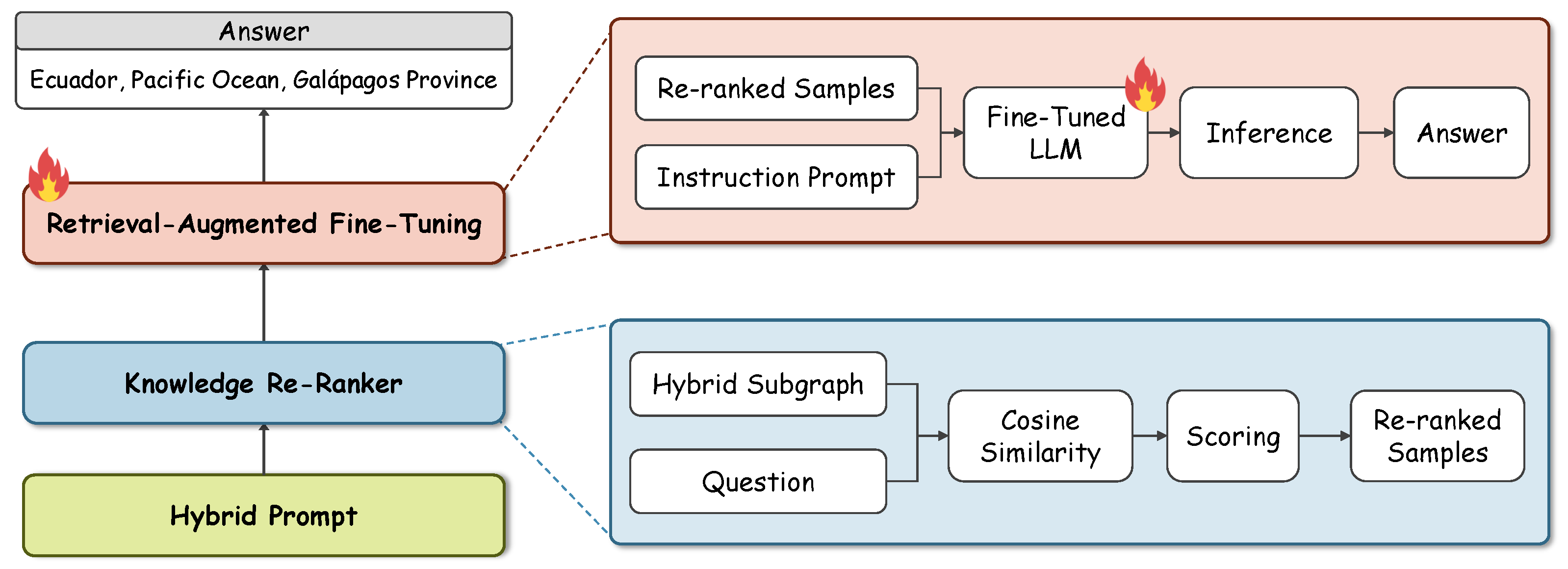
. This procedure minimizes the noise that may arise during the integration of disparate retrieval results and ensures that only high-quality contexts with the highest query alignment are used for training. Consequently, this process enables more robust and accurate KGQA reasoning by leveraging both the semantic and structural facets of the knowledge graph. The overall re-ranking workflow is summarized in the lower right of
Figure 5.
3.5. Retrieval-Augmented Fine-Tuning
Retrieval-augmented fine-tuning (RAFT) [
33] is a parameter-efficient paradigm that enables LLMs to effectively exploit retrieved knowledge for question answering. While conventional fine-tuning often focuses on domain adaptation by injecting domain-specific knowledge into the model’s internal parameters, our implementation of RAFT emphasizes format and context adaptation [
34]. This approach cultivates the model’s ability to interpret externally retrieved information and utilize it as a grounding for deriving answers. By explicitly conditioning the model on retrieved knowledge, RAFT bridges the gap between graph-based reasoning and natural language generation. Each training instance
is constructed as an instruction-style prompt that concatenates the input query
q, the re-ranked hybrid prompt
, and the corresponding answer
a.
We employ low-rank adaptation (LoRA) [
35] for efficient parameter tuning, updating only a small set of low-rank adapter parameters. This strategy selectively enhances the model’s capacity to utilize external context while preserving the vast general commonsense knowledge already embedded within the LLM. The model is trained with a cross-entropy objective to maximize the conditional likelihood of the correct answer, defined as:
Crucially, this objective function guides the model to learn the conditional probability
rather than relying on its internal knowledge
. By compelling the model to seek evidence within the provided hybrid context
instead of its uncertain internal memory, this mechanism serves as a primary defense against hallucinations. The RAFT training process is visually summarized in
Figure 5, and the entire pipeline is outlined in Algorithm 1.
3.6. Overall Training and Inference Pipeline
By integrating the previously introduced semantic node-level retriever, structural path-level retriever, hybrid prompt generation, knowledge re-ranker, and retrieval-augmented fine-tuning into a unified framework, we obtain Algorithm 1. The proposed pipeline is explicitly designed to clearly distinguish between the training and inference phases. During training, the model is fine-tuned using ground-truth paths along with re-ranked hybrid prompts. In contrast, during inference, the hybrid prompt is used as input to generate the final answer. This design presents an end-to-end processing flow in which retrieval, structural reasoning, and language generation are sequentially and tightly integrated.
4. Experiments
4.1. Experimental Design
4.1.1. Datasets
To comprehensively evaluate the reasoning capabilities of HybRAG, we employ two representative KGQA benchmarks: WebQSP [
36] and ComplexWebQuestions (CWQ) [
37], both grounded in Freebase [
38]. These datasets offer complementary evaluation environments: WebQSP primarily consists of simpler queries (up to two-hop) with diverse answer sets, making it suitable for evaluating the recall and precision of generated answer sets. In contrast, CWQ contains a high proportion of complex multi-hop queries (three-hop or more), serving as a benchmark for structural reasoning and multi-hop navigation performance. The statistical summaries are provided in
Table 1 and
Table 2.
We adhere to the data split and preprocessing pipeline established by RoG [
7] to ensure fair comparison and reproducibility. By adopting the same entity linking and graph normalization procedures as this state-of-the-art framework, we maintain consistency in evaluating reasoning paths across various models.
4.1.2. Evaluation Metrics
Model performance is evaluated using token-level F1 and Hit@1. Since KGQA tasks often involve a multi-answer set , we apply set-based metrics for precise matching:
Precision/Recall/F1
Calculated between the predicted answer set
and the ground-truth
:
F1 serves as the primary metric, balancing the ability to suppress incorrect answers (precision) and retrieve all correct answers (recall).
Hit@1
This measures whether the top-ranked prediction is included in the ground-truth set:
It reflects the accuracy of the model’s primary prediction.
4.1.3. Experimental Setup
To ensure a fair and reproducible evaluation, all components of HybRAG are implemented within a consistent internal framework. All entities and relations are encoded using Sentence-BERT [
27]. For the generation module, we utilize Llama3-8B-Instruct [
3], optimized for KGQA via RAFT-based fine-tuning using LoRA [
35] with a rank
and scaling factor
(learning rate
, epochs = 2, batch size = 4). To ensure the reproducibility of our results, we report the following inference parameters: we employed a sampling-based decoding strategy with a temperature of 0.7, a top-
p of 0.9, and a top-
k of 40. To prevent degenerate repetitions, a 3-g penalty (no_repeat_ngram_size = 3) was applied, and the maximum generation length was limited to 32 tokens.
The hyperparameters for the NR are fixed at
for both datasets. The PR is configured to select the top
reasoning paths. All experiments are conducted with a strict input token limit of 1080 tokens to control for context length. For comparative analysis, baseline performances (KD-CoT [
13], EWEK-QA [
11], ToG [
14], G-Retriever [
15]) are reported either from their original publications or reproduced using officially released code when available. Specifically, KD-CoT was evaluated using its officially released code. G-Retriever was evaluated on the WebQSP [
36] dataset using its officially released code. However, CWQ [
37] evaluation for G-Retriever was not conducted due to substantial storage requirements associated with large-scale KG indexing. Similarly, ToG was not re-implemented for WebQSP or CWQ, as its experimental setup requires large-scale storage resources beyond our available capacity. Therefore, its reported results are cited directly from the original paper. Additionally, EWEK-QA was not re-implemented due to the absence of officially released code, and its results are reported as originally published. To enable a more controlled comparison, the reproduced baselines were evaluated under identical dataset splits and metric definitions. However, we acknowledge that minor performance variations may arise from differences in internal preprocessing and retrieval infrastructures. Consequently, our comparative discussion focuses on relative performance trends rather than asserting strict superiority under fully matched implementation conditions.
4.1.4. Implementation Environment
All experiments are conducted in a Python 3.11 environment on a single NVIDIA H100 GPU (80GB VRAM). Hardware and software configurations are summarized in
Table 3.
4.2. Main Results and Discussion
The main experimental results are summarized in
Table 4. HybRAG achieves competitive performance across the evaluated methods on both WebQSP [
36] and CWQ [
37] datasets. We systematically analyze these results across three axes: (1) LLM-only baselines, (2) LLM-centric semantic approaches, and (3) GNN-centric structural approaches.
(1) Comparison with LLM-only Baselines. Compared to pure LLM approaches (Llama2-7B [
2], Llama3-8B [
3], and ChatGPT [
4]), HybRAG demonstrates notable performance improvements, with gains of up to 23.4%p in Hit@1 and 12.8%p in F1. While vanilla LLMs rely on internal parameters and suffer from hallucinations or knowledge obsolescence, HybRAG mitigates these issues by grounding its reasoning in external knowledge. Particularly on CWQ, where multi-hop reasoning is critical, pure LLMs struggle with low Hit@1 scores (20–30%), whereas the RAFT-based approach encourages the model to prioritize provided hybrid contexts over uncertain internal memory, contributing to more accurate answer derivation for complex queries.
(2) Comparison with LLM-centric Semantic Approaches. HybRAG demonstrates consistent improvements over representative semantic models such as KD-CoT [
13] and EWEK-QA [
11] using officially released code where available. A notable observation is found in the CWQ results: while ToG [
14] achieves a high Hit@1 of 57.6% through an exhaustive search space exploration, HybRAG demonstrates comparable performance at 57.0% while requiring fewer LLM calls in our implementation. Unlike ToG, which requires heavy computational overhead and multiple LLM calls, HybRAG achieves competitive accuracy through a streamlined process of parallel retrieval followed by a single integrated LLM inference, suggesting the effectiveness of our shortest-path-centric retrieval strategy.
(3) Comparison with GNN-centric Structural Approaches. HybRAG shows consistent improvements over structural models such as G-Retriever [
15]. This improvement may be attributed to the node-level retriever, which captures semantic cues that purely structural methods may overlook. While structural approaches lack semantic scalability and semantic approaches fail to respect structural constraints, HybRAG addresses this limitation by integrating both semantic and structural signals. Our RAFT-based fine-tuning encourages the LLM to align disparate semantic and structural signals into a unified context, thereby enhancing the integration of semantic and structural information.
Qualitative Analysis and Insights. Beyond numerical gains, our results provide several observations. First, HybRAG achieves high performance even on small-scale datasets like WebQSP (3000 instances), suggesting that our hybrid architecture can capture useful structural patterns even with relatively limited training data. Second, the convergence of performance on complex benchmarks indicates improved interpretability compared to purely semantic approaches. By providing explicit structural paths, HybRAG improves reliability and robustness without the prohibitive pre-processing or search costs required by previous methods, suggesting that aligning semantic and structural cues can contribute to more robust reasoning, even under limited computational resources.
4.3. Ablation Study
4.3.1. Impact of Retriever Components
Table 5 presents the performance changes when the semantic node-level retriever (NR) and the structural path-level retriever (PR) are selectively removed to analyze their respective contributions. The ablation study suggests that integrating the semantic and structural retrievers provides complementary benefits, with the full HybRAG configuration demonstrating consistent overall improvements across both benchmarks. Notably, the contribution of each module varies depending on the reasoning complexity of the dataset.
On the WebQSP dataset, which primarily involves single-hop or straightforward entity relationships, the performance drops resulting from the removal of NR or PR are relatively balanced. Both HybRAG w/o NR and w/o PR show only marginal decreases compared to the full model. This suggests that for standard reasoning tasks, either semantic cues or structural paths can independently lead to the correct answer, with the two modules acting complementarily.
In contrast, the importance of PR becomes more evident in the CWQ dataset, where complex multi-hop reasoning (two-hop or more) is essential. When the semantic node-level retriever is removed (HybRAG w/o NR, path-only), the Hit@1 score decreases by only 0.3%p. However, removing the structural path-level retriever (HybRAG w/o PR, node-only) leads to a significant drop of 2.3%p (from 57.0% to 54.7%) in Hit@1. This demonstrates that in environments with distant entity relations like CWQ, simple node information is insufficient to establish a reliable logical connection to the answer. Nevertheless, it is important to note that the node-only variant still achieves a robust Hit@1 of 54.7% through query-based semantic retrieval. This observation reduces the likelihood that the performance gains arise solely from answer-conditioned structural supervision. Consequently, the explicit path information provided by PR provides structural guidance for multi-hop reasoning, and its absence significantly undermines the model’s reasoning precision.
Overall, while NR enhances contextual clues by providing entities with high semantic similarity to the query, PR forms the logical backbone for reaching the correct answer. The performance gap observed in CWQ suggests that incorporating PR contributes to improved reasoning over complex knowledge graph structures, indicating that structural information plays a meaningful role in the observed performance gains.
4.3.2. Mitigating Train–Test Mismatch and Supervision Bias
To assess whether the performance of HybRAG depends on answer-conditioned structural supervision during training, we perform a controlled study on the WebQSP dataset using three structural seeding strategies. The analysis isolates the contribution of supervision-based structural construction from that of retrieval-driven context utilization.
Table 6 reports the results.
The GT-PR configuration follows the original training setup described in
Section 3, where structural paths are seeded using ground-truth answer entities. This configuration provides a reference point.
To remove answer-conditioned supervision, we introduce IC-PR (inference-consistent path retrieval). In this setting, structural subgraphs are constructed solely from predicted candidate nodes without access to the ground-truth answer set during training. Paths derived from the learning-free NR module are used, and the availability of structural signals matches that of inference time.
As a control, we further evaluate a Random-PR configuration, in which structural paths are replaced with randomly sampled graph edges. This setting tests whether arbitrary graph connectivity alone can account for the observed performance differences.
Removing answer-conditioned structural supervision (IC-PR) results in a decrease of 2.7 F1 and 2.3%p Hit@1 relative to GT-PR. In contrast, the Random-PR configuration produces a decrease of 16.8 F1 and 7.2%p Hit@1. The IC-PR variant maintains substantially higher performance than the noise-controlled baseline.
These results indicate that performance differences cannot be explained solely by answer-conditioned structural supervision. The remaining performance under IC-PR suggests that structurally coherent retrieval contributes independently of ground-truth-based path seeding.
4.3.3. Synergistic Effects of Hybrid Retrieval, Re-Ranking, and RAFT
The results summarized in
Table 7 illustrate how the hybrid retriever, the knowledge re-ranker, and retrieval-augmented fine-tuning (RAFT) collectively contribute to the performance of HybRAG. First, comparing the “Query only (Zero-shot)” baseline with “Query + Retrieval (Zero-shot)” reveals that adding retrieved knowledge improves Hit@1 by 3.0%p on WebQSP and a significant 11.1%p on CWQ. This indicates that the information retrieved from the external KG effectively enhances the model’s access to correct answers, especially for complex multi-hop queries in CWQ.
Interestingly, the “Query only (RAFT)” configuration—where the model is fine-tuned via RAFT but evaluated without external context—shows improved performance compared to the zero-shot baseline, reaching 59.6% on WebQSP and 48.2% on CWQ. This suggests that the RAFT process allows the model to accumulate a certain degree of domain-specific knowledge. However, the performance gap between “Query only (RAFT)” and the full HybRAG model remains substantial. This disparity indicates that the core strength of RAFT lies not in simple knowledge memorization, but in its ability to effectively interpret and utilize provided contexts during the reasoning process.
Furthermore, we analyzed the impact of the knowledge re-ranker, which prioritizes the most relevant hybrid subgraphs. As shown in
Table 7, excluding the re-ranking process (“HybRAG w/o Re-ranker”) results in a noticeable performance drop. This indicates that selecting the most informative context from the initially retrieved subgraphs is essential for maintaining reasoning precision and preventing the LLM from being distracted by irrelevant or noisy information.
The full configuration, “Query + Retrieval (RAFT; HybRAG)”, consistently achieves the highest performance, with a Hit@1 of 75.2% on WebQSP and 57.0% on CWQ. These results suggest that HybRAG is able to leverage the structural and semantic cues provided by the hybrid retriever. In particular, the improvements are reflected in the F1 scores, where the full framework shows competitive performance relative to the evaluated variants among the evaluated variants.
In summary, our findings highlight a complementary relationship where the hybrid retriever provides the necessary evidential grounding, the re-ranker filters noise, and RAFT optimizes the LLM’s strategy to utilize that evidence. The experimental results validate that HybRAG successfully transitions from a knowledge-memorization paradigm to a retrieval-utilization reasoning paradigm.
4.3.4. Sensitivity Analysis of Hyperparameter
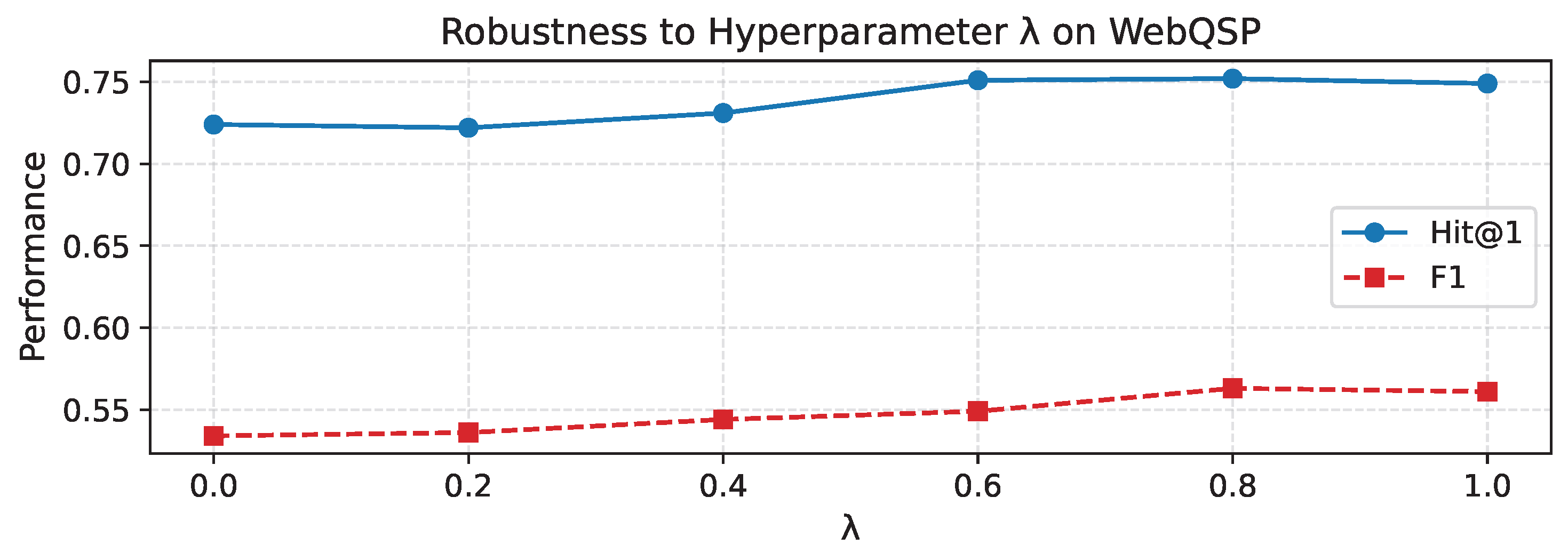
The semantic node-level retriever in HybRAG incorporates a hyperparameter
to balance the node degree signal and semantic similarity during triplet importance calculation (Equation (
4)). To address concerns regarding the model’s dependency on specific graph topologies (e.g., Freebase), we analyzed the performance variance across
on the WebQSP dataset.
As illustrated in
Figure 6, both Hit@1 and F1 scores remain stable within the
range, with the peak performance observed at
. This indicates that the retrieval quality is optimized when both semantic similarity and normalized structural signals are integrated. Notably, even at the extremes (
or
), the performance degradation is marginal. This demonstrates the robustness of our framework, showing that HybRAG does not excessively rely on the topological bias of a specific knowledge graph but maintains stable reasoning performance across varying signal weights.
4.4. Mitigation of Hallucination
To address concerns regarding unsupported generation and evaluate how hybrid reasoning paths improve evidence attribution, we measure the faithfulness of model outputs to the injected reasoning paths. This quantitative analysis demonstrates reduced hallucination and stronger grounding in retrieved evidence [
39].
4.4.1. Evaluation Metrics
We report two path-attribution metrics to assess the reliability of the system:
Avg. Path Faithfulness: For each sample, we extract the predicted answer entities and compute the fraction that matches any entity or relation appearing in the injected reasoning paths (after normalization).
Fully Faithful Rate: The proportion of samples where 100% of the predicted answer entities are strictly grounded in the provided reasoning paths.
4.4.2. Results and Analysis
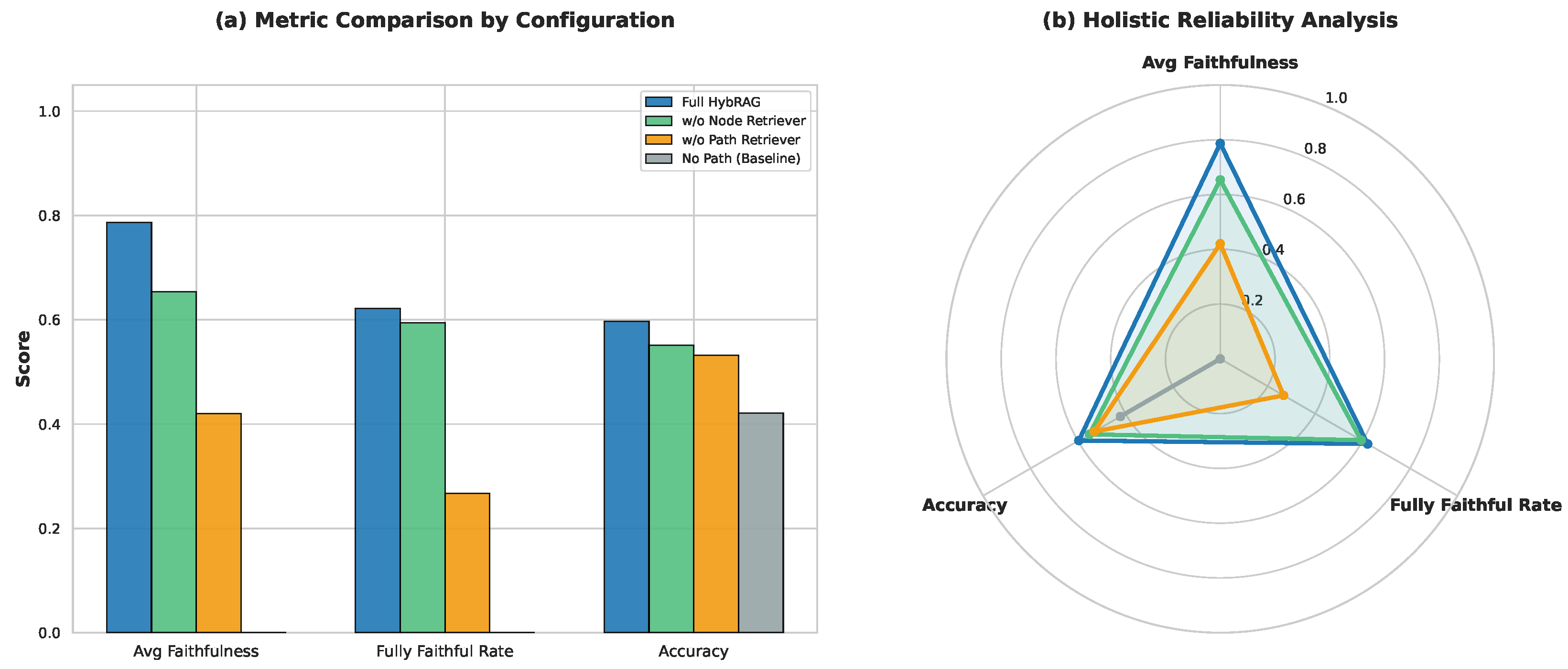
As illustrated in
Figure 7a, the injection of evidence paths leads to higher path faithfulness compared to the no-path baseline. For the no-path baseline, while it achieves an accuracy of 0.4210, its avg. path faithfulness and fully faithful rate are zero by definition, as the model lacks any external reasoning paths for attribution and relies solely on internal parametric knowledge.
The proposed Full HybRAG configuration attains the best scores on both metrics (avg. faithfulness: 0.7864), indicating the complementary benefits of semantic and structural evidence for grounding generation to the provided graph context [
40]. Notably, the removal of the path retriever (“w/o Path Retriever”) leads to a a substantial decrease in avg. path faithfulness to 0.4204. This ∼46.5% decrease suggests that in our setting, explicit relational connectivity (structural paths) provides significantly stronger grounding signals than semantic similarity alone [
7,
41].
Furthermore,
Figure 7b presents a comprehensive reliability analysis. The radar chart demonstrates that our hybrid approach achieves the most balanced performance across accuracy and faithfulness. While the “w/o Node Retriever” variant shows a slight increase in the fully faithful rate (0.6241) due to the simplified context, its overall accuracy and avg. faithfulness remain lower than those of the full model. These results indicate that combining semantic and structural evidence is associated with improved grounding and greater consistency with retrieved context.
4.5. Computational Complexity and Efficiency
We analyze the computational cost of HybRAG from both theoretical complexity and empirical runtime perspectives.
Table 8 summarizes the step-by-step computational costs of our pipeline defined in Algorithm 1. In the theoretical complexity analysis,
and
denote the number of nodes and edges in the subgraph, respectively;
d is the hidden dimension;
is the number of layers in the path-based retriever; and
S represents the LLM input sequence length.
End-to-end inference for a single query averaged 8.6 s on an NVIDIA H100 (80 GB) GPU. As shown in
Table 8, a substantial portion of the total inference time is spent during the retrieval phases (phases 1 and 2). This suggests that exploring semantically and structurally meaningful subgraph candidates from a large KG constitutes a major computational cost. Subsequent phases show relatively moderate costs as they operate on constrained subgraphs.
Empirically, the retrieval phases exhibit a relatively low GPU utilization (≈20%), whereas the final LLM inference (Phase 6) shows consistently high utilization (≈90%) due to the quadratic complexity () inherent in Transformer-based architectures. It is important to note that the knowledge re-ranker and RAFT training are excluded from the inference latency as they belong to the offline training stage. These results suggest that the additional overhead introduced by hybrid retrieval reflects a trade-off between computational cost and improved reasoning performance.
Based on our stepwise latency analysis, HybRAG’s retrieval phase is theoretically amenable to further optimization through asynchronous parallel processing.
Since phase 1 and phase 2 are functionally independent, they can be executed in parallel, which may reduce the overall retrieval latency by overlapping their execution time. Furthermore, while this evaluation was conducted on a high-end H100 GPU, the relatively low GPU utilization (20%) during retrieval indicates that further evaluation on lower-tier hardware may be warranted to assess deployment feasibility in resource-constrained scenarios. Overall, this analysis characterizes the computational profile of HybRAG and highlights the trade-offs between computational cost and reasoning performance.
5. Case Study
In this section, we analyze how the semantic node-level retriever (NR) and the structural path-level retriever (PR) function during query processing through success and failure cases. Specifically, we examine instances where semantic and structural information are combined and contribute to improve accuracy, and cases where structural paths drive complex multi-hop reasoning. For all comparative analyses, the model’s predictions are evaluated against the ground truth (GT) answer sets provided by the benchmarks.
5.1. Success Case Analysis
5.1.1. Complementarity of Semantic and Structural Information
A representative case illustrating the benefits of combining semantic and structural retrieval is the query:
“What languages are used in the country with national anthem There is a Lovely Country?” (
Table 9). Here, the PR identifies the core entity by providing an explicit path:
There is a Lovely Country → music.composition.language → Danish Language. Simultaneously, the NR enriches this with contextual knowledge, linking “Danish Language” to “Denmark” and providing statistical associations regarding regional language usage. By integrating these disparate cues, HybRAG generated the correct answer set, including
Faroese and
Danish Language, whereas single-source models did not consistently bridge the gap between the anthem and its regional languages.
5.1.2. Multi-Hop Structural Reasoning
Another success case illustrates the utility of the PR in multi-hop reasoning when semantic coverage is weak, such as the query:
“What does the religion who worships in Barcelona Cathedral call their God?” (
Table 10). While the NR mainly returns general facts about Catholicism (e.g., rituals or figures) without directly linking the specific location to its deity, the PR explores an explicit multi-hop trajectory:
Barcelona Cathedral → religion → Catholicism → deities. Consequently, HybRAG derives the precise answers:
God, The Father, Holy Spirit, and
Jesus Christ, showing how structural paths guide multi-hop reasoning.
5.2. Failure Case Analysis
Recall Limitations Due to Topological Bias
The query
“If I were to visit the governmental jurisdiction where Ricardo Lagos holds an office…” (
Table 11) highlights both the structural search capability and the recall limitations caused by graph topological characteristics. This query requires a one-to-many reasoning process to identify the country (Chile) where Ricardo Lagos served and all languages used therein.
The NR struggled to map the abstract term “jurisdiction” to a specific country entity, merely listing geographical containment like Santiago → Chile. In contrast, the PR successfully extracted the core path: Ricardo Lagos → nationality → Chile → official_language → Spanish Language. However, the model failed to capture minority languages such as Aymara, Mapudungun, and Rapa Nui. This behavior may be related to node degree imbalance and relation sparsity within the KG. As a hub node strongly connected to Chile, “Spanish” dominated the top-k paths, while minority languages—residing as long-tail nodes—were likely pruned during the beam search process.
Consequently, the LLM generated only the dominant cue, “Spanish,” as the answer. This failure case highlights the impact of structural bias on retrieval diversity and suggests directions for future work on bias correction or iterative retrieval strategies to capture sparse, long-tail information.
6. Conclusions
We presented HybRAG, a hybrid retriever-based framework that integrates semantic node-level and structural path-level retrieval for KGQA. By constructing hybrid subgraphs, HybRAG effectively combines broad semantic understanding with explicit relational reasoning, improving accuracy and consistently outperforming single-retriever baselines on WebQSP and CWQ. Overall, our findings suggest that integrating semantic and relational retrieval strategies provides a promising pathway for linking LLMs with graph-based reasoning. Furthermore, our framework contributes to the interpretability of reasoning evidence, providing a practical foundation for addressing the reliability and hallucination issues inherent in LLM-based KGQA.
Nevertheless, our study reveals several key limitations. First, the semantic node-level retriever occasionally fails to capture answer-bearing triples due to limited semantic coverage, while excessive information injection can overwhelm the model. Second, the current integration remains relatively static, relying on a re-ranker to merge results; this may lead to diminished stability when faced with conflicting evidence or information overload. Third, while we have confirmed the effectiveness of HybRAG against representative GraphRAG baselines, a broader comparison with the rapidly evolving field of general RAG models remains outside the current scope.
To overcome these limitations, we propose several directions for future work:
Dynamic and Structural Optimization: We plan to develop a dynamic adjustment mechanism that automatically weights semantic and PRs based on query types. Additionally, we intend to quantitatively analyze how graph topology—such as node degree and relation sparsity—affects retrieval to establish more systematic tuning strategies. This direction is informed by our faithfulness analysis, indicating that improvements in path coverage and evidence alignment through topology-aware and query-adaptive weighting may further reduce unsupported generations.
Enhanced Representation and Generalization: To resolve specific recall failures (e.g., population-related queries), we will explore explicitly incorporating attribute-value nodes into the semantic embedding space to bridge the gap between entities and literal properties. Although our current focus is on Freebase, the low sensitivity of our parameter indicates robust generalization potential, which we plan to validate in diverse domains like biomedicine and finance.
Scalability and Practical Deployment: Our computational complexity analysis suggests that HybRAG provides a scalable foundation by balancing retrieval overhead with reasoning precision. While retrieval is the primary bottleneck, our results indicate that its moderate GPU utilization supports deployment in resource-constrained environments. Future efforts will focus on exploring asynchronous parallel retrieval and dynamic graph pruning to further optimize end-to-end latency. Ultimately, we aim to transition from our decoupled pipeline to an end-to-end joint optimization framework to more tightly integrate retrieval signals with linguistic reasoning.
In conclusion, HybRAG enhances KGQA by integrating graph-based knowledge with the linguistic reasoning of LLMs. Our hybrid paradigm provides a scalable foundation for next-generation GraphRAG systems and domain-specific RAG applications capable of navigating large-scale, real-world knowledge environments.
Author Contributions
Conceptualization, H.L. and S.L.; methodology, H.L. and S.L.; software, H.L.; validation, H.L. and S.L.; formal analysis, H.L. and S.L.; investigation, H.L.; resources, H.L.; data curation, H.L.; writing—original draft preparation, H.L.; writing—review and editing, H.L. and S.L.; visualization, H.L.; supervision, S.L.; project administration, S.L.; funding acquisition, S.L. All authors have read and agreed to the published version of the manuscript.
Funding
This work was supported by Chungnam National University.
Institutional Review Board Statement
Not applicable.
Informed Consent Statement
Not applicable.
Data Availability Statement
The data presented in this study are available upon request from the corresponding author. The data are not publicly available due to the need for subsequent scientific work.
Acknowledgments
The authors used ChatGPT (GPT-4) for refining phrasing and grammar during manuscript preparation. All AI-assisted outputs were carefully reviewed and edited by the authors, who take full responsibility for the submitted content.
Conflicts of Interest
The authors declare no conflicts of interest.
References
- Fan, W.; Ding, Y.; Ning, L.; Wang, S.; Li, H.; Yin, D.; Chua, T.S.; Li, Q. A survey on rag meeting llms: Towards retrieval-augmented large language models. In KDD ’24: The 30th ACM SIGKDD Conference on Knowledge Discovery and Data Mining; Association for Computing Machinery: New York, NY, USA, 2024; pp. 6491–6501. [Google Scholar]
- Touvron, H.; Martin, L.; Stone, K.; Albert, P.; Almahairi, A.; Babaei, Y.; Bashlykov, N.; Batra, S.; Bhargava, P.; Bhosale, S.; et al. Llama 2: Open foundation and fine-tuned chat models. arXiv 2023, arXiv:2307.09288. [Google Scholar] [CrossRef]
- Grattafiori, A.; Dubey, A.; Jauhri, A.; Pandey, A.; Kadian, A.; Al-Dahle, A.; Letman, A.; Mathur, A.; Schelten, A.; Vaughan, A.; et al. The llama 3 herd of models. arXiv 2024, arXiv:2407.21783. [Google Scholar] [CrossRef]
- OpenAI. Introducing ChatGPT. 2022. Available online: https://openai.com/index/chatgpt/ (accessed on 24 February 2026).
- Peng, B.; Zhu, Y.; Liu, Y.; Bo, X.; Shi, H.; Hong, C.; Zhang, Y.; Tang, S. Graph retrieval-augmented generation: A survey. arXiv 2024, arXiv:2408.08921. [Google Scholar] [CrossRef]
- Karpukhin, V.; Oguz, B.; Min, S.; Lewis, P.S.; Wu, L.; Edunov, S.; Chen, D.; Yih, W.T. Dense Passage Retrieval for Open-Domain Question Answering. In 2020 Conference on Empirical Methods in Natural Language Processing (EMNLP); Association for Computational Linguistics: Stroudsburg, PA, USA, 2020; pp. 6769–6781. [Google Scholar]
- Luo, L.; Li, Y.; Haffari, G.; Pan, S. Reasoning on Graphs: Faithful and Interpretable Large language Model Reasoning. In Proceedings of the International Conference on Learning Representations ICLR, Vienna, Austria, 7–11 May 2024. [Google Scholar]
- Li, S.; Gao, Y.; Jiang, H.; Yin, Q.; Li, Z.; Yan, X.; Zhang, C.; Yin, B. Graph reasoning for question answering with triplet retrieval. In Findings of the Association for Computational Linguistics: ACL 2023; Association for Computational Linguistics: Stroudsburg, PA, USA, 2023; pp. 3366–3375. [Google Scholar]
- Panda, P.; Agarwal, A.; Devaguptapu, C.; Kaul, M.; Ap, P. HOLMES: Hyper-relational knowledge graphs for multi-hop question answering using LLMs. In 62nd Annual Meeting of the Association for Computational Linguistics (Volume 1: Long Papers); Association for Computational Linguistics: Stroudsburg, PA, USA, 2024; pp. 13263–13282. [Google Scholar]
- Yasunaga, M.; Ren, H.; Bosselut, A.; Liang, P.; Leskovec, J. QA-GNN: Reasoning with language models and knowledge graphs for question answering. In 2021 Conference of the North American Chapter of the Association for Computational Linguistics: Human Language Technologies; Association for Computational Linguistics: Stroudsburg, PA, USA, 2021; pp. 535–546. [Google Scholar]
- Dehghan, M.; Alomrani, M.; Bagga, S.; Alfonso-Hermelo, D.; Bibi, K.; Ghaddar, A.; Zhang, Y.; Li, X.; Hao, J.; Liu, Q.; et al. EWEK-QA: Enhanced Web and Efficient Knowledge Graph Retrieval for Citation-based Question Answering Systems. In 62nd Annual Meeting of the Association for Computational Linguistics (Volume 1: Long Papers); Association for Computational Linguistics: Stroudsburg, PA, USA, 2024; pp. 14169–14187. [Google Scholar]
- Saxena, A.; Tripathi, A.; Talukdar, P. Improving multi-hop question answering over knowledge graphs using knowledge base embeddings. In 58th Annual Meeting of the Association for Computational Linguistics; Association for Computational Linguistics: Stroudsburg, PA, USA, 2020; pp. 4498–4507. [Google Scholar]
- Wang, K.; Duan, F.; Wang, S.; Li, P.; Xian, Y.; Yin, C.; Rong, W.; Xiong, Z. Knowledge-driven cot: Exploring faithful reasoning in llms for knowledge-intensive question answering. arXiv 2023, arXiv:2308.13259. [Google Scholar]
- Sun, J.; Xu, C.; Tang, L.; Wang, S.; Lin, C.; Gong, Y.; Ni, L.M.; Shum, H.; Guo, J. Think-on-Graph: Deep and Responsible Reasoning of Large Language Model on Knowledge Graph. In Proceedings of the International Conference on Learning Representations ICLR, Vienna, Austria, 7–11 May 2024. [Google Scholar]
- He, X.; Tian, Y.; Sun, Y.; Chawla, N.; Laurent, T.; LeCun, Y.; Bresson, X.; Hooi, B. G-retriever: Retrieval-augmented generation for textual graph understanding and question answering. Adv. Neural Inf. Process. Syst. 2024, 37, 132876–132907. [Google Scholar]
- Mavromatis, C.; Karypis, G. GNN-RAG: Graph Neural Retrieval for Efficient Large Language Model Reasoning on Knowledge Graphs. In Findings of the Association for Computational Linguistics: ACL 2025; Association for Computational Linguistics: Stroudsburg, PA, USA, 2025; pp. 16682–16699. [Google Scholar]
- Zhang, Q.; Chen, S.; Bei, Y.; Yuan, Z.; Zhou, H.; Hong, Z.; Dong, J.; Chen, H.; Chang, Y.; Huang, X. A survey of graph retrieval-augmented generation for customized large language models. arXiv 2025, arXiv:2501.13958. [Google Scholar]
- Jeong, S.; Choi, M.; Kim, J.Y.; Yoon, S.; Lim, S. Metadata Meets LLMs: Constructing Knowledge-Rich Citation Networks with CoT-Enhanced Representations. In WSDM ’26:The Nineteenth ACM International Conference on Web Search and Data Mining; Association for Computing Machinery: New York, NY, USA, 2026. [Google Scholar]
- Steinmetz, N.; Sattler, K.U. What is in the KGQA benchmark datasets? Survey on challenges in datasets for question answering on knowledge graphs. J. Data Semant. 2021, 10, 241–265. [Google Scholar] [CrossRef]
- Lewis, P.; Perez, E.; Piktus, A.; Petroni, F.; Karpukhin, V.; Goyal, N.; Küttler, H.; Lewis, M.; Yih, W.T.; Rocktäschel, T.; et al. Retrieval-augmented generation for knowledge-intensive nlp tasks. Adv. Neural Inf. Process. Syst. 2020, 33, 9459–9474. [Google Scholar]
- Guu, K.; Lee, K.; Tung, Z.; Pasupat, P.; Chang, M. Retrieval augmented language model pre-training. In 37th International Conference on Machine Learning; MLR Press: Philadelphia, PA, USA, 2020; pp. 3929–3938. [Google Scholar]
- Gao, Y.; Xiong, Y.; Gao, X.; Jia, K.; Pan, J.; Bi, Y.; Dai, Y.; Sun, J.; Wang, H.; Wang, H. Retrieval-augmented generation for large language models: A survey. arXiv 2023, arXiv:2312.10997. [Google Scholar]
- Han, H.; Ma, L.; Shomer, H.; Wang, Y.; Lei, Y.; Guo, K.; Hua, Z.; Long, B.; Liu, H.; Aggarwal, C.C.; et al. Rag vs. graphrag: A systematic evaluation and key insights. arXiv 2025, arXiv:2502.11371. [Google Scholar] [CrossRef]
- Ren, X.; Tang, J.; Yin, D.; Chawla, N.; Huang, C. A survey of large language models for graphs. In KDD ’24: The 30th ACM SIGKDD Conference on Knowledge Discovery and Data Mining; Association for Computing Machinery: New York, NY, USA, 2024; pp. 6616–6626. [Google Scholar]
- Edge, D.; Trinh, H.; Cheng, N.; Bradley, J.; Chao, A.; Mody, A.; Truitt, S.; Metropolitansky, D.; Ness, R.O.; Larson, J. From local to global: A graph rag approach to query-focused summarization. arXiv 2024, arXiv:2404.16130. [Google Scholar] [CrossRef]
- Li, Y.; Zhang, X.; Luo, L.; Chang, H.; Ren, Y.; King, I.; Li, J. G-refer: Graph retrieval-augmented large language model for explainable recommendation. In WWW ’25: The ACM Web Conference 2025; Association for Computing Machinery: New York, NY, USA, 2025; pp. 240–251. [Google Scholar]
- Reimers, N.; Gurevych, I. Sentence-BERT: Sentence Embeddings using Siamese BERT-Networks. In 2019 Conference on Empirical Methods in Natural Language Processing and the 9th International Joint Conference on Natural Language Processing (EMNLP-IJCNLP); Association for Computational Linguistics: Stroudsburg, PA, USA, 2019; pp. 3982–3992. [Google Scholar]
- Devlin, J.; Chang, M.W.; Lee, K.; Toutanova, K. Bert: Pre-training of deep bidirectional transformers for language understanding. In 2019 Conference of the North American Chapter of the Association for Computational Linguistics: Human Language Technologies; Association for Computational Linguistics: Stroudsburg, PA, USA, 2019; pp. 4171–4186. [Google Scholar]
- Mavromatis, C.; Karypis, G. ReaRev: Adaptive Reasoning for Question Answering over Knowledge Graphs. In Findings of the Association for Computational Linguistics: EMNLP 2022; Association for Computational Linguistics: Stroudsburg, PA, USA, 2022; pp. 2447–2458. [Google Scholar]
- Kipf, T.N.; Welling, M. Semi-supervised classification with graph convolutional networks. In Proceedings of the International Conference on Learning Representations, Toulon, France, 24–26 April 2017. [Google Scholar]
- Jiang, J.; Zhou, K.; Dong, Z.; Ye, K.; Zhao, W.X.; Wen, J.R. StructGPT: A General Framework for Large Language Model to Reason over Structured Data. In 2023 Conference on Empirical Methods in Natural Language Processing; Association for Computational Linguistics: Stroudsburg, PA, USA, 2023; pp. 9237–9251. [Google Scholar]
- Sui, Y.; He, Y.; Liu, N.; He, X.; Wang, K.; Hooi, B. FiDeLiS: Faithful Reasoning in Large Language Models for Knowledge Graph Question Answering. In Findings of the Association for Computational Linguistics: ACL 2025; Association for Computational Linguistics: Stroudsburg, PA, USA, 2025; pp. 8315–8330. [Google Scholar]
- Zhang, T.; Patil, S.G.; Jain, N.; Shen, S.; Zaharia, M.; Stoica, I.; Gonzalez, J.E. Raft: Adapting language model to domain specific rag. In Proceedings of the First Conference on Language Modeling, Pennsylvania, PA, USA, 7–9 October 2024. [Google Scholar]
- Ovadia, O.; Brief, M.; Mishaeli, M.; Elisha, O. Fine-tuning or retrieval? comparing knowledge injection in llms. In 2024 Conference on Empirical Methods in Natural Language Processing; Association for Computational Linguistics: Stroudsburg, PA, USA, 2024; pp. 237–250. [Google Scholar]
- Hu, E.J.; Shen, Y.; Wallis, P.; Allen-Zhu, Z.; Li, Y.; Wang, S.; Wang, L.; Chen, W. LoRA: Low-Rank Adaptation of Large Language Models. In Proceedings of the 2022 International Conference on Learning Representations, Virtual, 25–29 April 2022. [Google Scholar]
- Yih, W.t.; Richardson, M.; Meek, C.; Chang, M.W.; Suh, J. The value of semantic parse labeling for knowledge base question answering. In 54th Annual Meeting of the Association for Computational Linguistics; Association for Computational Linguistics: Stroudsburg, PA, USA, 2016; pp. 201–206. [Google Scholar]
- Talmor, A.; Berant, J. The Web as a Knowledge-Base for Answering Complex Questions. In 2018 Conference of the North American Chapter of the Association for Computational Linguistics: Human Language Technologies; Association for Computational Linguistics: Stroudsburg, PA, USA, 2018; pp. 641–651. [Google Scholar]
- Bollacker, K.; Evans, C.; Paritosh, P.; Sturge, T.; Taylor, J. Freebase: A collaboratively created graph database for structuring human knowledge. In SIGMOD/PODS ’08: SIGMOD/PODS ’08—International Conference on Management of Data; Association for Computing Machinery: New York, NY, USA, 2008; pp. 1247–1250. [Google Scholar]
- Es, S.; James, J.; Anke, L.E.; Schockaert, S. Ragas: Automated evaluation of retrieval augmented generation. In Proceedings of the 18th Conference of the European Chapter of the Association for Computational Linguistics: System Demonstrations; Association for Computational Linguistics: Stroudsburg, PA, USA, 2024; pp. 150–158. [Google Scholar]
- Pan, S.; Luo, L.; Wang, Y.; Chen, C.; Wang, J.; Wu, X. Unifying large language models and knowledge graphs: A roadmap. IEEE Trans. Knowl. Data Eng. 2024, 36, 3580–3599. [Google Scholar] [CrossRef]
- Ji, Z.; Lee, N.; Frieske, R.; Yu, T.; Su, D.; Xu, Y.; Ishii, E.; Bang, Y.J.; Madotto, A.; Fung, P. Survey of hallucination in natural language generation. ACM Comput. Surv. 2023, 55, 248. [Google Scholar] [CrossRef]
Figure 1.
Comparison of naïve RAG and GraphRAG.
Figure 1.
Comparison of naïve RAG and GraphRAG.
Figure 2.
Framework of HybRAG integrating semantic and structural retrievers for hybrid subgraph construction in LLM reasoning.
Figure 2.
Framework of HybRAG integrating semantic and structural retrievers for hybrid subgraph construction in LLM reasoning.
Figure 3.
Hybrid retriever architecture of HybRAG. (left) Node-level retriever and (right) path-level retriever.
Figure 3.
Hybrid retriever architecture of HybRAG. (left) Node-level retriever and (right) path-level retriever.
Figure 4.
Example of the hybrid prompt template combining semantic and structural reasoning paths, designed to guide the large language model in synthesizing evidence-based answers.
Figure 4.
Example of the hybrid prompt template combining semantic and structural reasoning paths, designed to guide the large language model in synthesizing evidence-based answers.
Figure 5.
Overall training process with re-ranking and RAFT.
Figure 5.
Overall training process with re-ranking and RAFT.
Figure 6.
Sensitivity analysis of the node-level retriever across varying on WebQSP. The stable performance across the entire range demonstrates the robustness of HybRAG against topological biases of the knowledge graph.
Figure 6.
Sensitivity analysis of the node-level retriever across varying on WebQSP. The stable performance across the entire range demonstrates the robustness of HybRAG against topological biases of the knowledge graph.
Figure 7.
Performance and faithfulness analysis of HybRAG. (a) Metric comparison highlighting the impact of reasoning paths and the baseline comparison; (b) comprehensive reliability analysis demonstrating the balanced performance of the hybrid model across multiple dimensions.
Figure 7.
Performance and faithfulness analysis of HybRAG. (a) Metric comparison highlighting the impact of reasoning paths and the baseline comparison; (b) comprehensive reliability analysis demonstrating the balanced performance of the hybrid model across multiple dimensions.
Table 1.
Dataset scale and query structure statistics.
Table 1.
Dataset scale and query structure statistics.
| Dataset | Data Size | Hop Distribution (%) | Max Hop |
|---|
| Train | Valid | Test | 1-Hop | 2-Hop | ≥3-Hop |
|---|
| WebQSP | 2848 | 250 | 1639 | 65.49 | 34.51 | 0.00 | 2 |
| CWQ | 27,639 | 3519 | 3531 | 40.91 | 38.34 | 20.75 | 4 |
Table 2.
Distribution of answer counts.
Table 2.
Distribution of answer counts.
| Dataset | Distribution of Answer Counts (%) |
|---|
| 1 | 2~4 | 5~9 | ≥10 |
|---|
| WebQSP | 51.2 | 27.4 | 8.3 | 12.1 |
| CWQ | 70.6 | 19.4 | 6.0 | 4.0 |
Table 3.
Experimental setup.
Table 3.
Experimental setup.
| Component | Specification |
|---|
| Operating System | Linux |
| Python | 3.11 |
| PyTorch | 2.7.1 |
| Transformers | 4.44.0 |
| GPU | NVIDIA H100 PCIe (80GB VRAM) |
| CUDA/Driver | CUDA 12.4/Driver 550.54.14 |
Table 4.
Comparison of KGQA performance on WebQSP and CWQ. Note: † indicates results cited directly from the original papers, while ‡ indicates results reproduced using the authors’ officially released code. Results without marks correspond to models evaluated directly under our experimental setup.
Table 4.
Comparison of KGQA performance on WebQSP and CWQ. Note: † indicates results cited directly from the original papers, while ‡ indicates results reproduced using the authors’ officially released code. Results without marks correspond to models evaluated directly under our experimental setup.
| Method | Model | WebQSP | CWQ |
|---|
| Hit@1 | F1 | Hit@1 | F1 |
|---|
| LLM-only | Llama2-7B-chat [2] | 51.8 | 36.5 | 27.4 | 21.4 |
| Llama3-8B-Instruct [3] | 55.5 | 34.8 | 28.1 | 22.4 |
| ChatGPT [4] | 59.3 | 43.5 | 34.7 | 30.2 |
LLM-centric
Semantic Approaches | KD-CoT [13] | 68.6 ‡ | 52.5‡ | 55.7 ‡ | 35.7‡ |
| EWEK-QA [11] | 71.3† | – | 52.5 † | – |
| ToG [14] | 68.9 † | – | 57.6 † | – |
GNN-centric
Structural Approaches | G-Retriever [15] | 70.1 ‡ | 46.7 ‡ | – | – |
| HybRAG (Ours) | 75.2 | 56.3 | 57.0 | 51.1 |
Table 5.
Ablation study on retriever components.
Table 5.
Ablation study on retriever components.
| Variant | WebQSP | CWQ |
|---|
| Hit@1 | F1 | Hit@1 | F1 |
|---|
| HybRAG w/o NR (Path-only) | 74.3 | 55.8 | 56.7 | 50.6 |
| HybRAG w/o PR (Node-only) | 75.0 | 55.0 | 54.7 | 48.9 |
| HybRAG (All Components) | 75.2 | 56.3 | 57.0 | 51.1 |
Table 6.
Impact of training-time structural context construction on WebQSP.
Table 6.
Impact of training-time structural context construction on WebQSP.
| Configuration | Training Structural Seed | F1 | F1 | Hit@1 | Hit@1 |
|---|
| GT-PR (Upper Bound) | Ground-truth answer entities | 75.2 | – | 56.3 | – |
| IC-PR (Supervision-Free) | Predicted candidates only | 72.5 | −2.7 | 54.0 | −2.3 |
| Random-PR (Noise Control) | Random graph edges | 58.4 | −16.8 | 49.1 | −7.2 |
Table 7.
Ablation study on retrieval and training strategies (RAFT and re-ranker).
Table 7.
Ablation study on retrieval and training strategies (RAFT and re-ranker).
| Variants | Retriever | RAFT | WebQSP | CWQ |
|---|
| Hit@1 | F1 | Hit@1 | F1 |
|---|
| Query only (Zero-shot) | × | × | 55.5 | 34.8 | 28.1 | 22.4 |
| Query + Retrieval (Zero-shot) | ✓ | × | 58.5 | 34.7 | 39.2 | 26.9 |
| Query only (RAFT) | × | ✓ | 59.6 | 41.5 | 48.2 | 42.6 |
| HybRAG w/o Re-ranker | ✓ | ✓ | 72.8 | 53.4 | 55.2 | 49.5 |
| HybRAG (Full) | ✓ | ✓ | 75.2 | 56.3 | 57.0 | 51.1 |
Table 8.
Step-wise inference complexity and latency analysis.
Table 8.
Step-wise inference complexity and latency analysis.
| Algorithm Step | Component | Theoretical Complexity | Execution Time (s) | GPU Utilization |
|---|
| Phase 1 | Node Retrieval | | 3.10 | 20% |
| Phase 2 | Path Retrieval | | 4.90 | 20% |
| Phase 3 | Hybrid Prompt Generation | | <0.01 | – |
| Phase 6 | Test Inference | | 0.60 | 90% |
| End-to-End Inference | – | 8.60 | – |
Table 9.
Successful reasoning through combined semantic and structural information.
Table 9.
Successful reasoning through combined semantic and structural information.
| Category | Content |
|---|
| Question | What languages are used in the country with national anthem There is a Lovely Country? |
| Reasoning Path | Semantic Info:
Danish Language → language.human_language.countries_spoken_in → Denmark
Danish Language → language.human_language.main_country → Denmark
Denmark → location.country.official_language → Danish Language
Structural Info:
There is a Lovely Country → music.composition.language → Danish Language |
| Answer | Faroese, Danish Language, Greenlandic Language, German Language |
| GT | Faroese, Danish Language, Greenlandic Language, German Language |
Table 10.
Successful multi-hop reasoning via structure-based path retrieval in HybRAG.
Table 10.
Successful multi-hop reasoning via structure-based path retrieval in HybRAG.
| Category | Content |
|---|
| Question | What does the religion who worships in Barcelona Cathedral call their God? |
| Reasoning Path | Semantic Info:
Catholicism → religion.religion.types_of_places_of_worship → Cathedral
Catholicism → religion.religion.is_part_of → Christianity
Catholicism → religion.religion.deities → Jesus Christ
Structural Info:
Barcelona Cathedral → religion.place_of_worship.religion → Catholicism → religion.religion.deities → Holy Spirit
Barcelona Cathedral → religion.place_of_worship.religion → Catholicism → religion.religion.deities → Jesus Christ
Barcelona Cathedral → religion.place_of_worship.religion → Catholicism → religion.religion.deities → The Father
Barcelona Cathedral → religion.place_of_worship.religion → Catholicism → religion.religion.deities → God |
| Answer | God, The Father, Holy Spirit, Jesus Christ |
| GT | God, The Father, Holy Spirit, Jesus Christ |
Table 11.
Case study on multi-answer failure due to graph structural bias.
Table 11.
Case study on multi-answer failure due to graph structural bias.
| Category | Content |
|---|
| Question | If I were to visit the governmental jurisdiction where Ricardo Lagos holds an office, what languages do I need to learn to speak? |
| Reasoning Path | Semantic Info:
Santiago → location.location.containedby → Chile
Santiago → base.biblioness.bibs_location.country → Chile
Santiago → location.location.containedby → Santiago Metropolitan Region
Structural Info:
Ricardo Lagos → people.person.nationality → Chile → location.country.official_language → Spanish Language
Ricardo Lagos → people.person.nationality → Chile → location.country.languages_spoken → Spanish Language |
| Answer | Spanish Language |
| GT | Aymara language, Puquina Language, Rapa Nui Language, Spanish Language, Mapudungun Language |
| Disclaimer/Publisher’s Note: The statements, opinions and data contained in all publications are solely those of the individual author(s) and contributor(s) and not of MDPI and/or the editor(s). MDPI and/or the editor(s) disclaim responsibility for any injury to people or property resulting from any ideas, methods, instructions or products referred to in the content. |