Author Contributions
Conceptualization, J.F.S.-J.; methodology, J.F.S.-J., R.L., and I.P.; software, E.S., I.P., and J.F.S.-J.; validation, E.S., R.L., and J.F.S.-J.; formal analysis, J.F.S.-J., E.S., R.L., and I.P.; investigation, J.F.S.-J., E.S., R.L., and I.P.; resources, J.F.S.-J. and M.L.; data curation, E.S.; writing—original draft preparation, J.F.S.-J. and E.S.; writing—review and editing, J.F.S.-J., M.L., E.S., R.L., and I.P.; supervision, J.F.S.-J.; funding acquisition, J.F.S.-J. and M.L. All authors have read and agreed to the published version of the manuscript.
Figure 1.
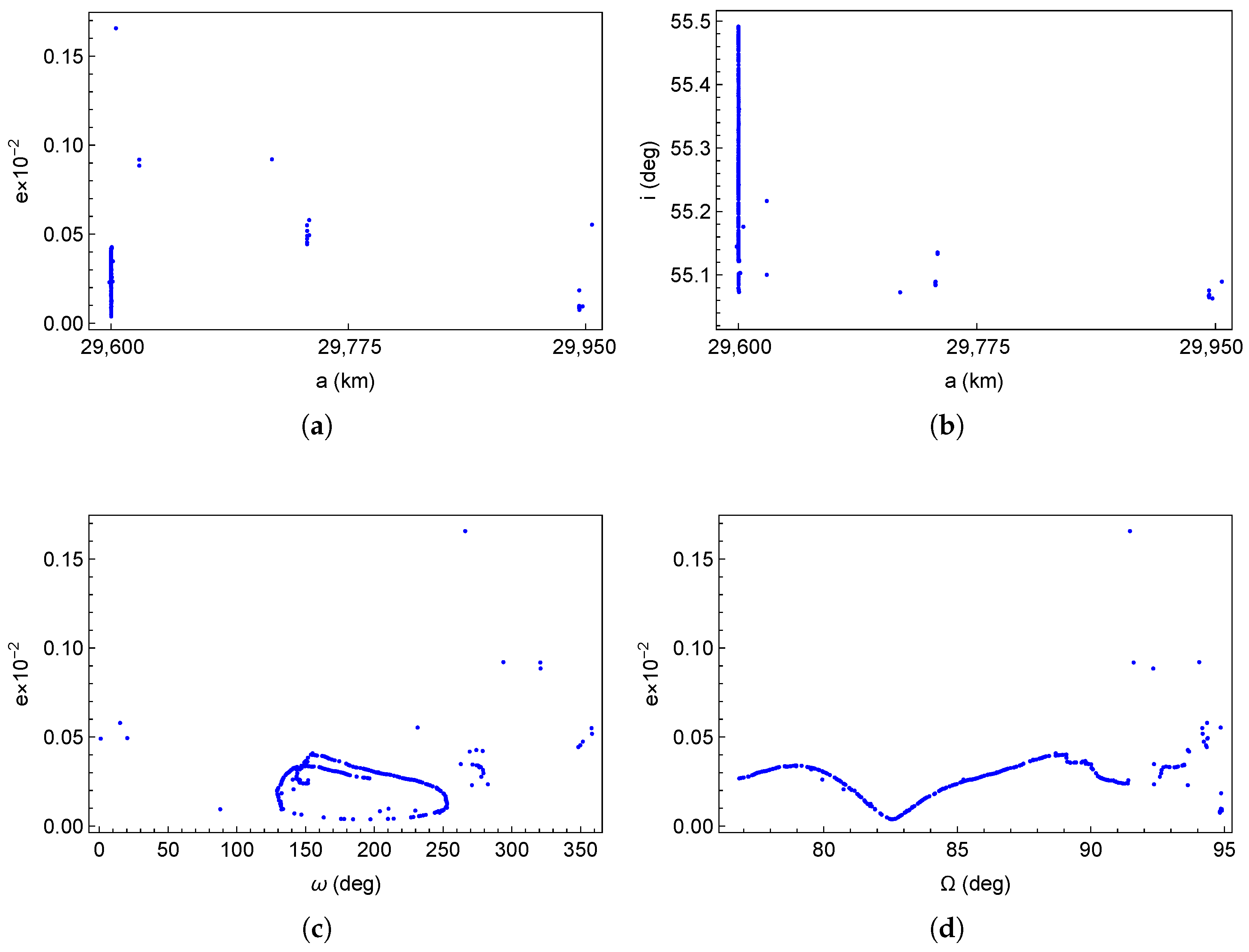
Scatter diagrams for the Galileo TLEs in two-dimensional parameter planes: (a) -Plane. (b) -Plane. (c) -Plane. (d) -Plane.
Figure 1.
Scatter diagrams for the Galileo TLEs in two-dimensional parameter planes: (a) -Plane. (b) -Plane. (c) -Plane. (d) -Plane.
Figure 2.
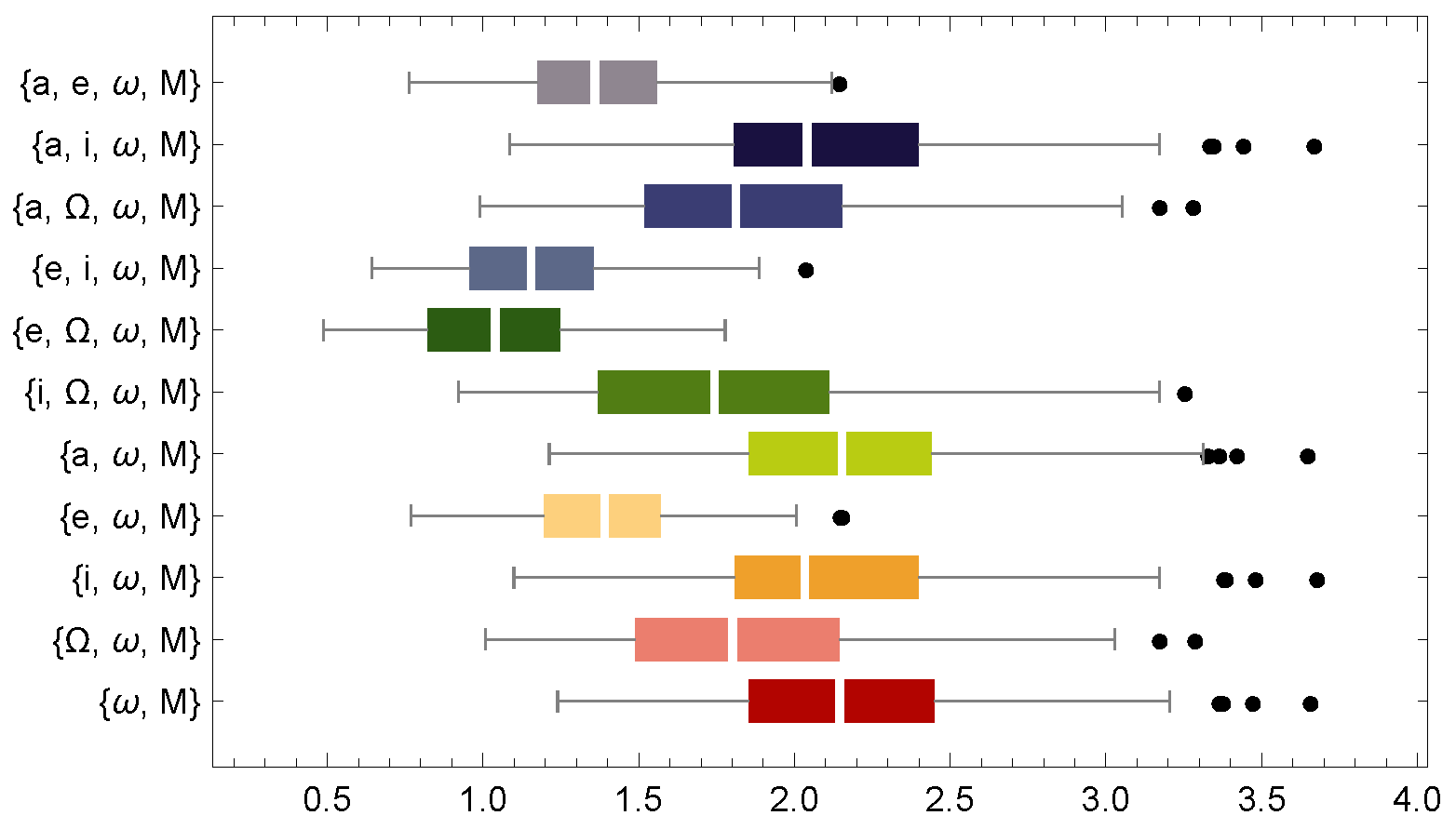
Box-and-whisker plots showing the distance errors (km) of the best combinations of orbital variables for a 30-day propagation span.
Figure 2.
Box-and-whisker plots showing the distance errors (km) of the best combinations of orbital variables for a 30-day propagation span.
Figure 3.
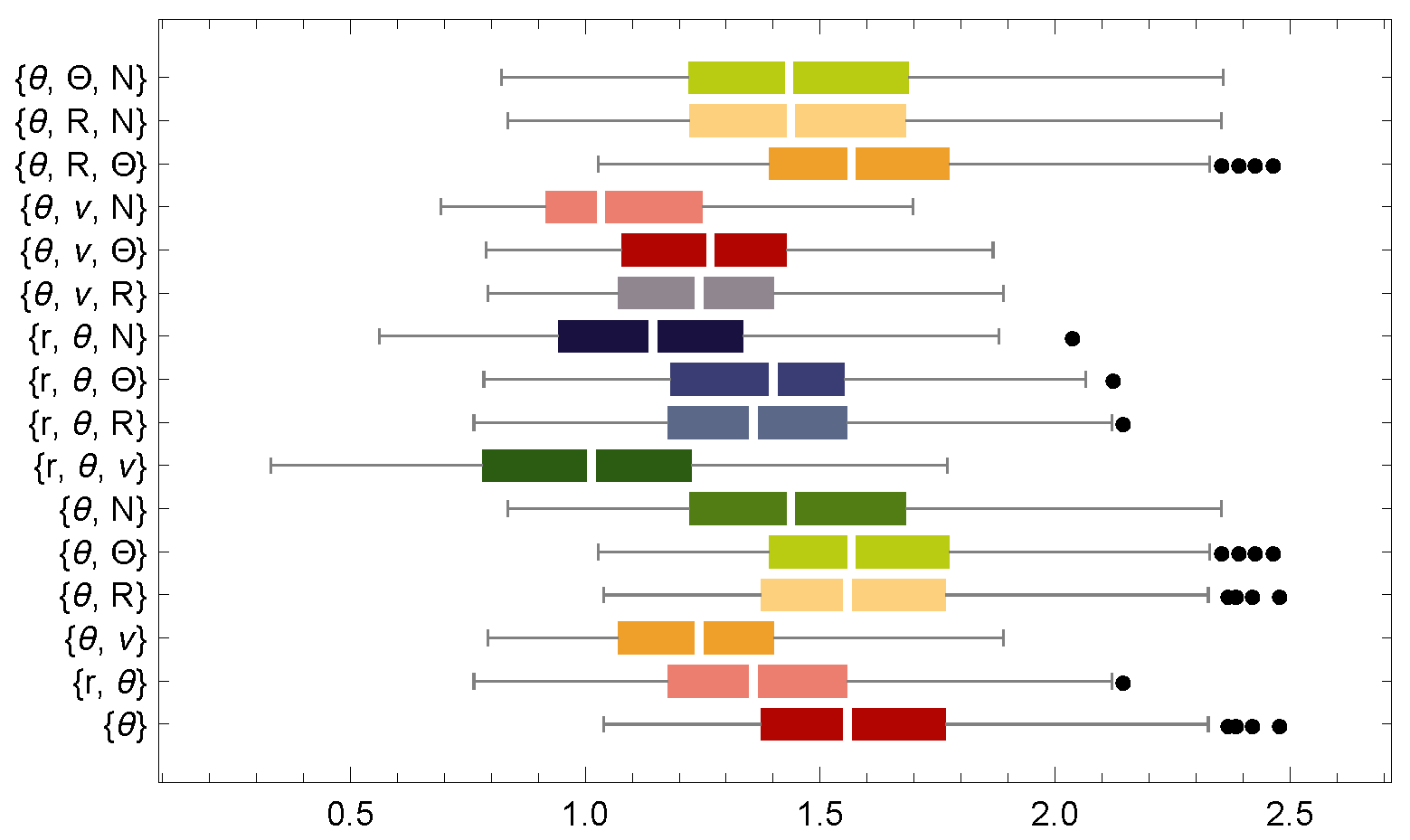
Box-and-whisker plots showing the distance errors (km) of the best combinations of polar-nodal variables for 30-day propagation spam.
Figure 3.
Box-and-whisker plots showing the distance errors (km) of the best combinations of polar-nodal variables for 30-day propagation spam.
Figure 4.
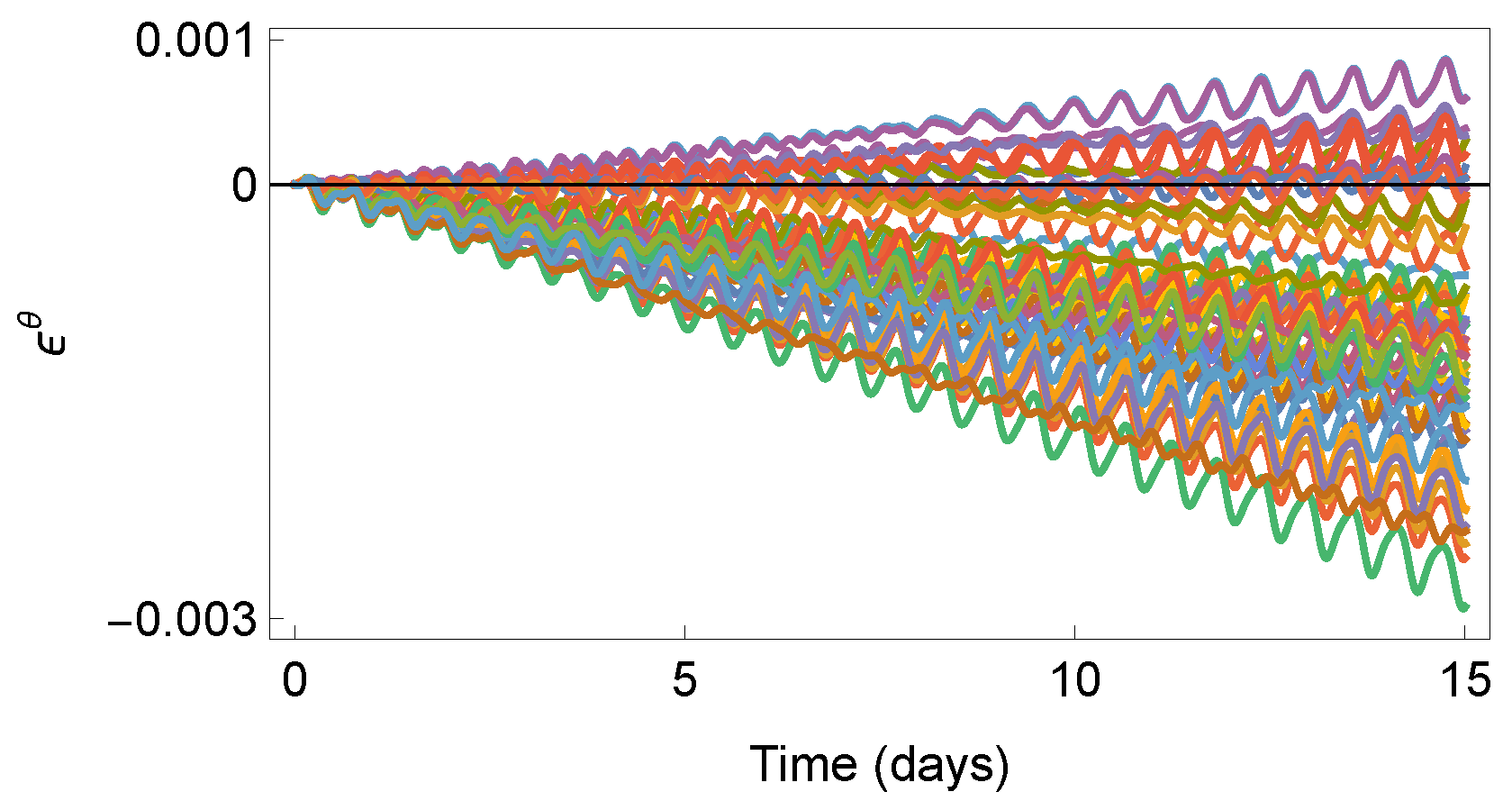
Plot of the 50-representative sample of the 313 time series.
Figure 4.
Plot of the 50-representative sample of the 313 time series.
Figure 5.
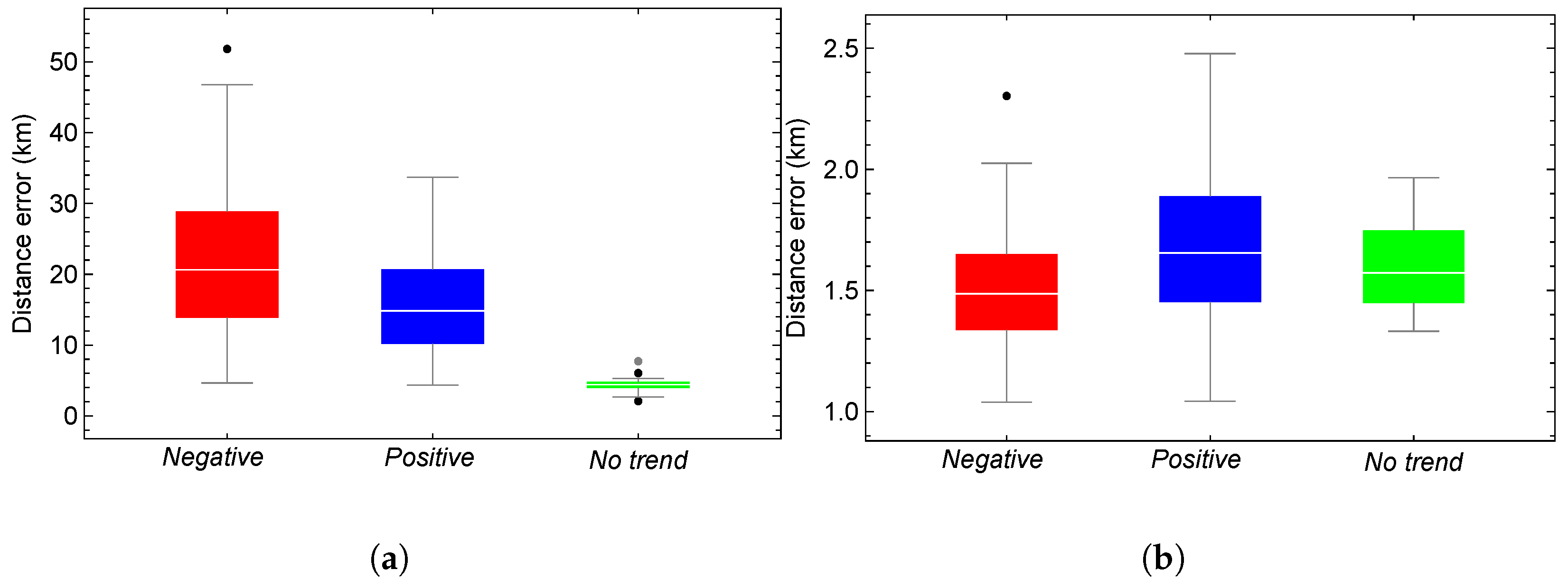
Box-and-whisker plots showing distance errors (km) classified according to their trend over a 30-day propagation span. (a) SGP4 distance error. (b) Optimal SGP4 distance error obtained by substituting the time series with .
Figure 5.
Box-and-whisker plots showing distance errors (km) classified according to their trend over a 30-day propagation span. (a) SGP4 distance error. (b) Optimal SGP4 distance error obtained by substituting the time series with .
Figure 6.
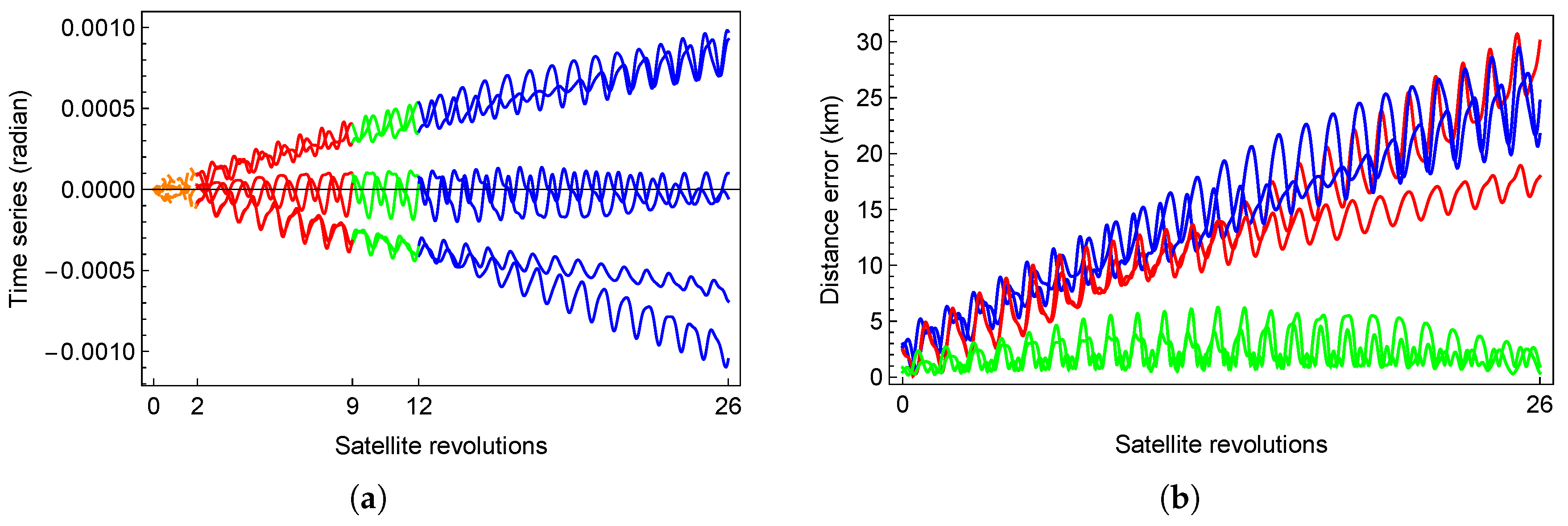
(a) Random series utilized for selecting neural network architectures. Orange dots indicate the input vector, red denotes the training set, green represents the validation set, and blue indicates the test set. (b) Distance error between AIDA and SGP4 (in km) for the same TLEs. Time series with a positive trend are shown in blue, a negative trend in red, and no discernible trend in green.
Figure 6.
(a) Random series utilized for selecting neural network architectures. Orange dots indicate the input vector, red denotes the training set, green represents the validation set, and blue indicates the test set. (b) Distance error between AIDA and SGP4 (in km) for the same TLEs. Time series with a positive trend are shown in blue, a negative trend in red, and no discernible trend in green.
Figure 7.
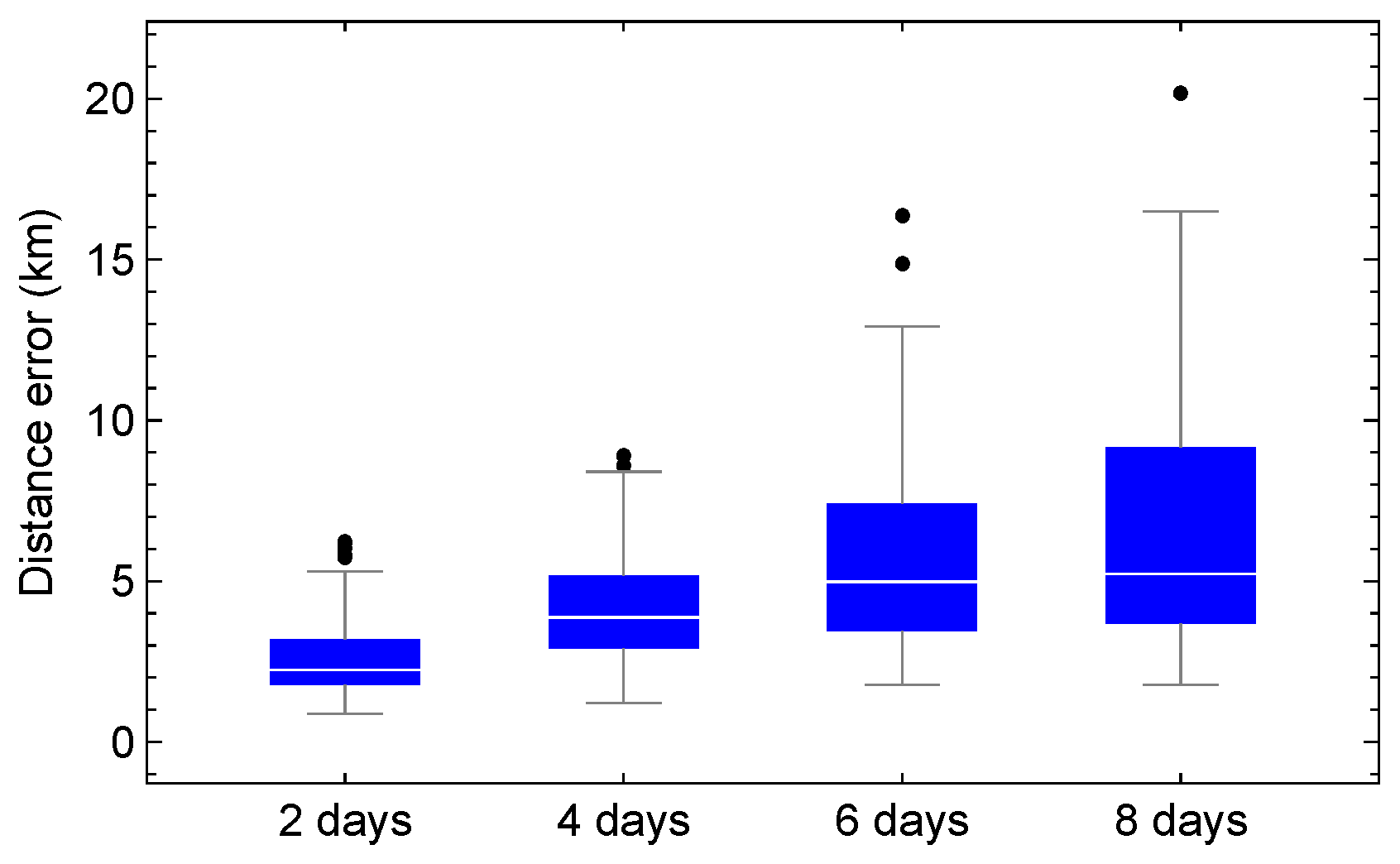
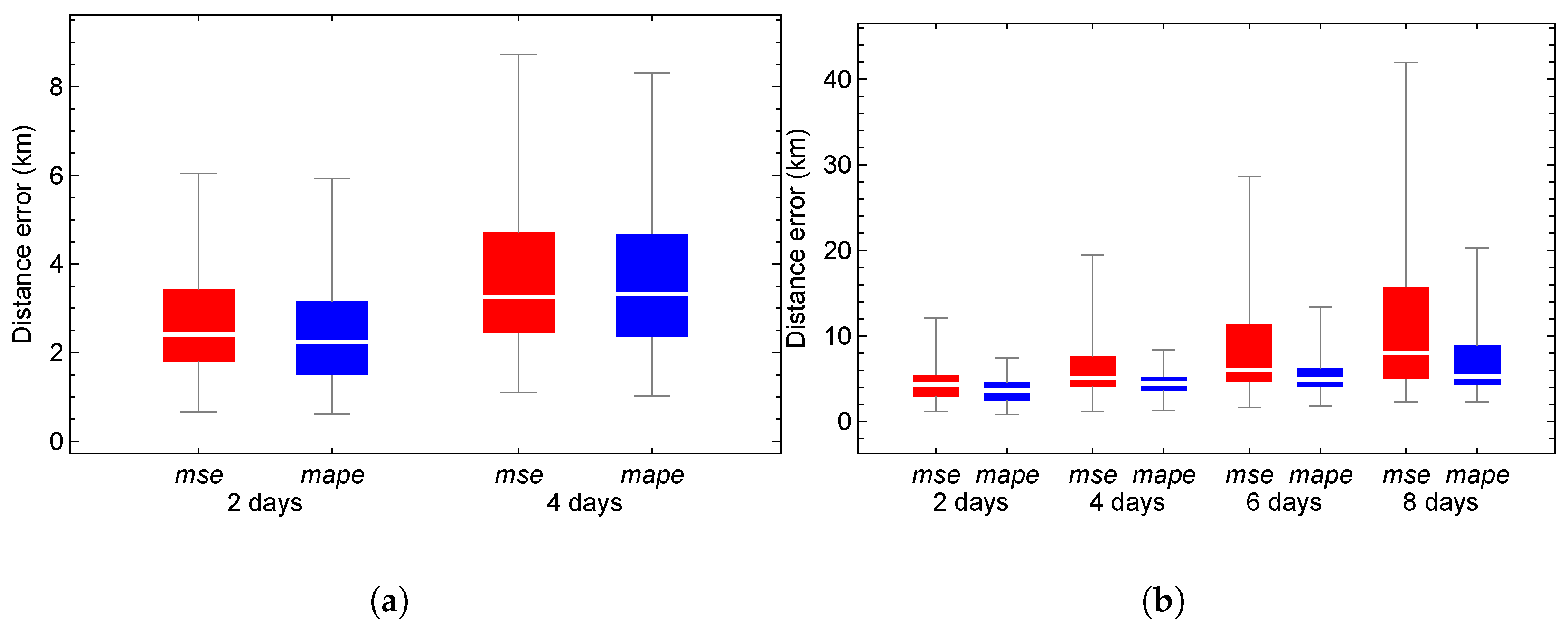
Box-and-whisker plots of the distance error of HSGP propagators using the mse (in red) and mape (in blue) loss functions at 2 and 4 days in the training period and at 2, 4, 6, and 8 days in the testing period.
Figure 7.
Box-and-whisker plots of the distance error of HSGP propagators using the mse (in red) and mape (in blue) loss functions at 2 and 4 days in the training period and at 2, 4, 6, and 8 days in the testing period.
Figure 8.
Box-and-whisker plots of the HSGP4 distance error for the top 5 architectures training with the six selected time series.
Figure 8.
Box-and-whisker plots of the HSGP4 distance error for the top 5 architectures training with the six selected time series.
Figure 9.
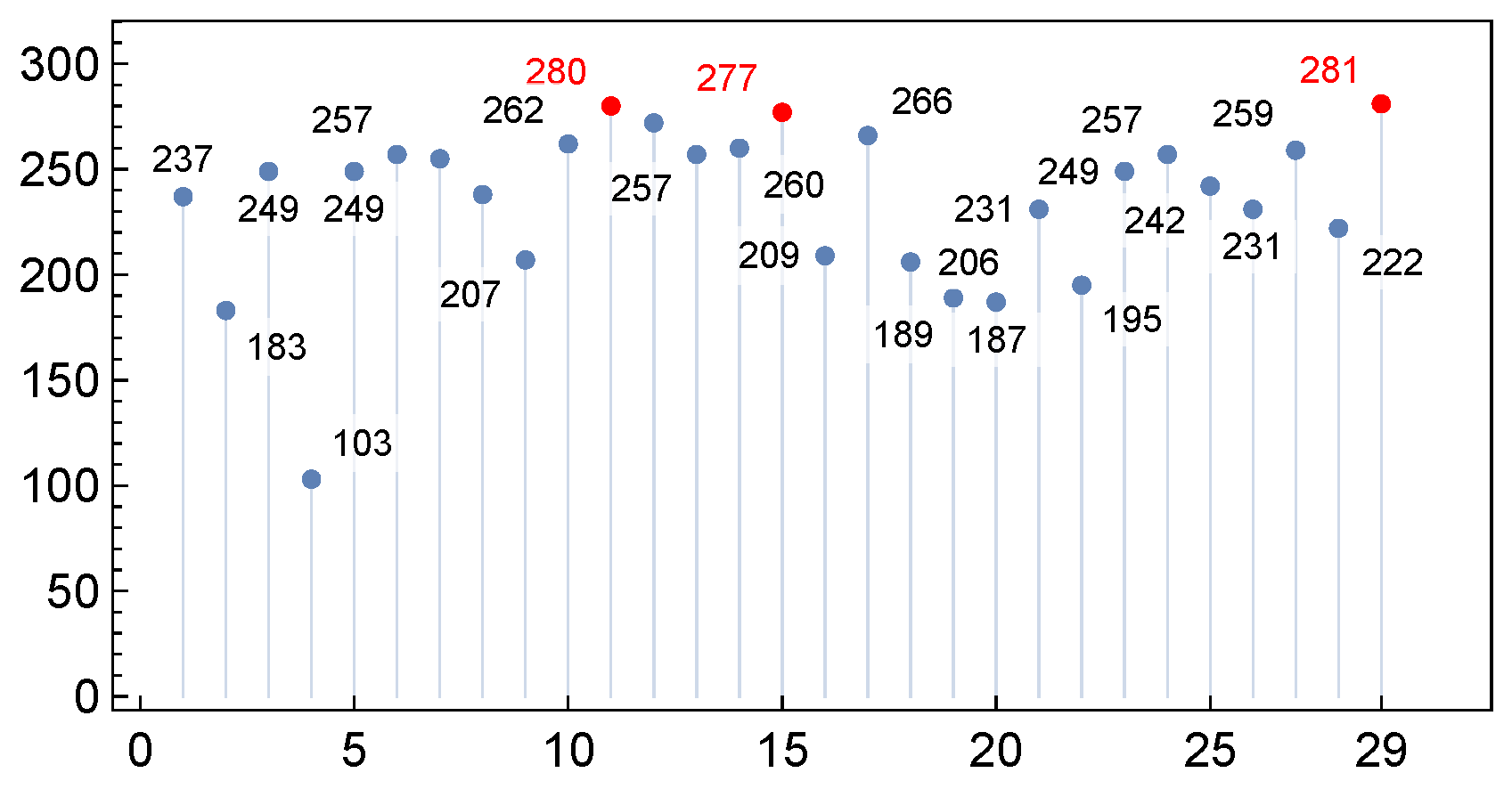
Number of models by architecture for which the HSGP4 distance error is lower than that of SGP4 after 8 days of propagation, in red the selected architectures.
Figure 9.
Number of models by architecture for which the HSGP4 distance error is lower than that of SGP4 after 8 days of propagation, in red the selected architectures.
Figure 10.
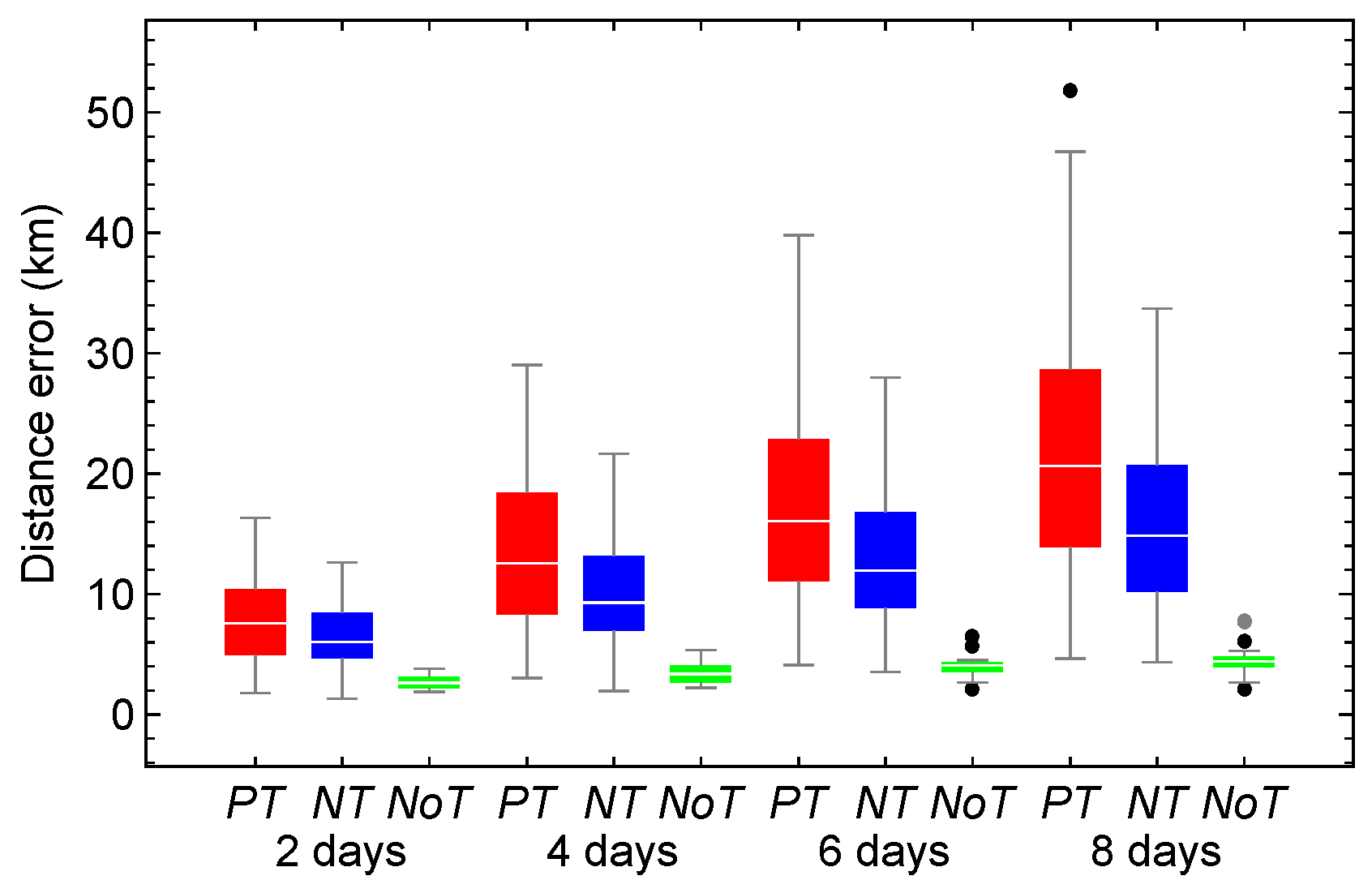
Box-and-whisker plots of the SGP4 distance error for 169 time series positive (PT, in red), 118 negative (NT, in blue), and 26 no trend (NoT, in green), respectively.
Figure 10.
Box-and-whisker plots of the SGP4 distance error for 169 time series positive (PT, in red), 118 negative (NT, in blue), and 26 no trend (NoT, in green), respectively.
Figure 11.
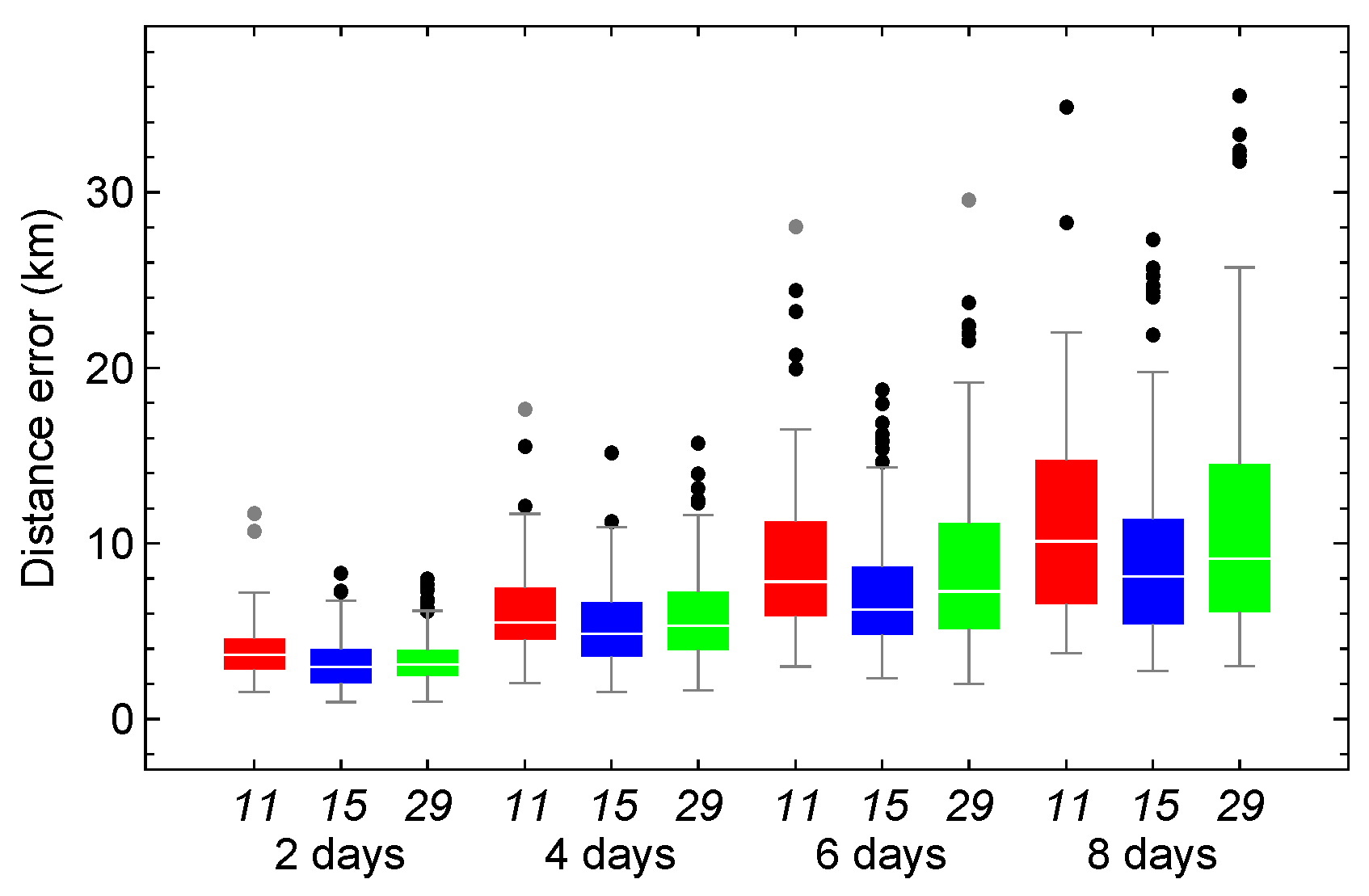
Box-and-whisker plots of the HSGP4 distance error, using models trained with architectures 11 (in red), 15 (in blue), and 29 (in green) under a positive trend.
Figure 11.
Box-and-whisker plots of the HSGP4 distance error, using models trained with architectures 11 (in red), 15 (in blue), and 29 (in green) under a positive trend.
Figure 12.
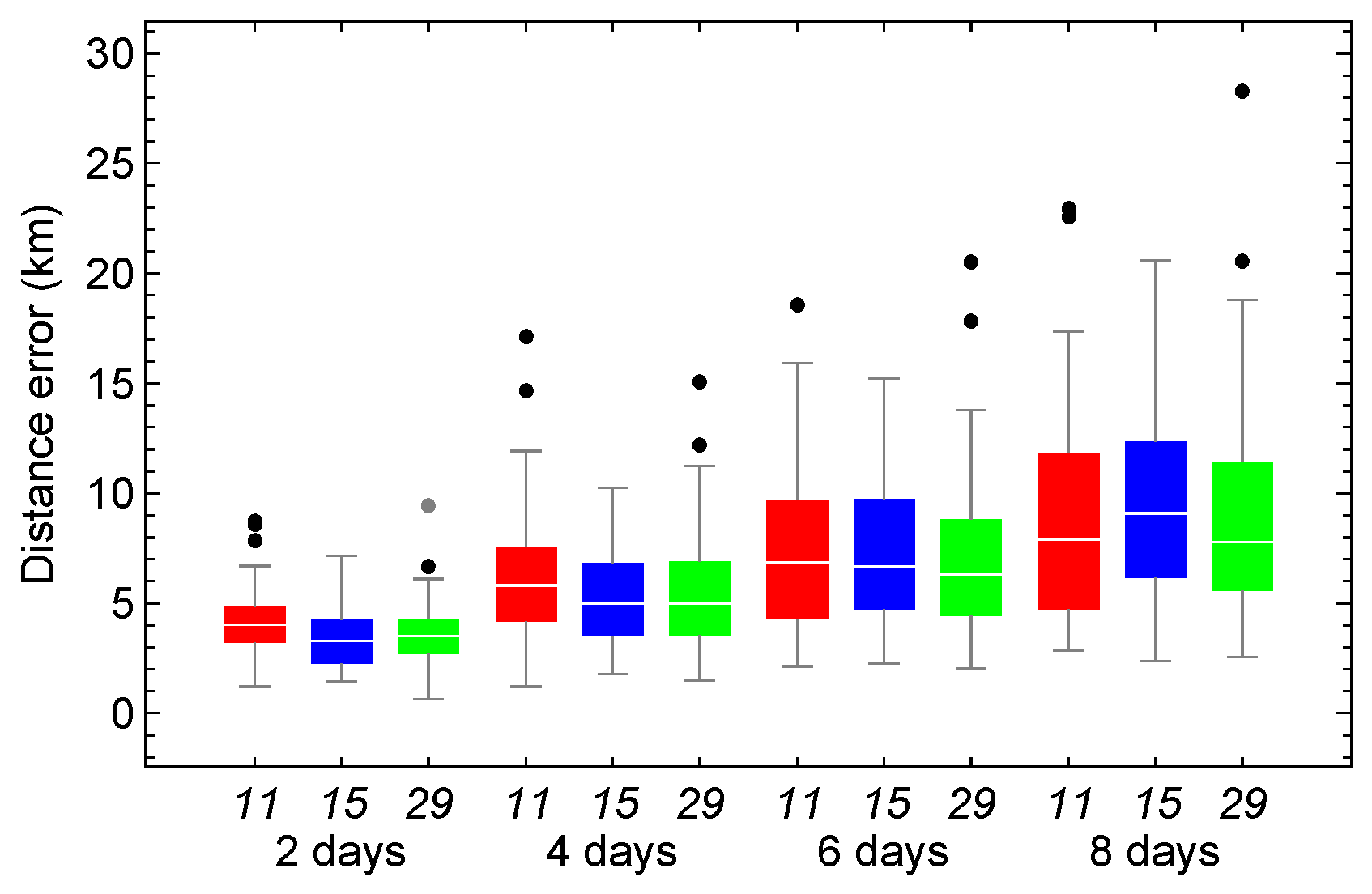
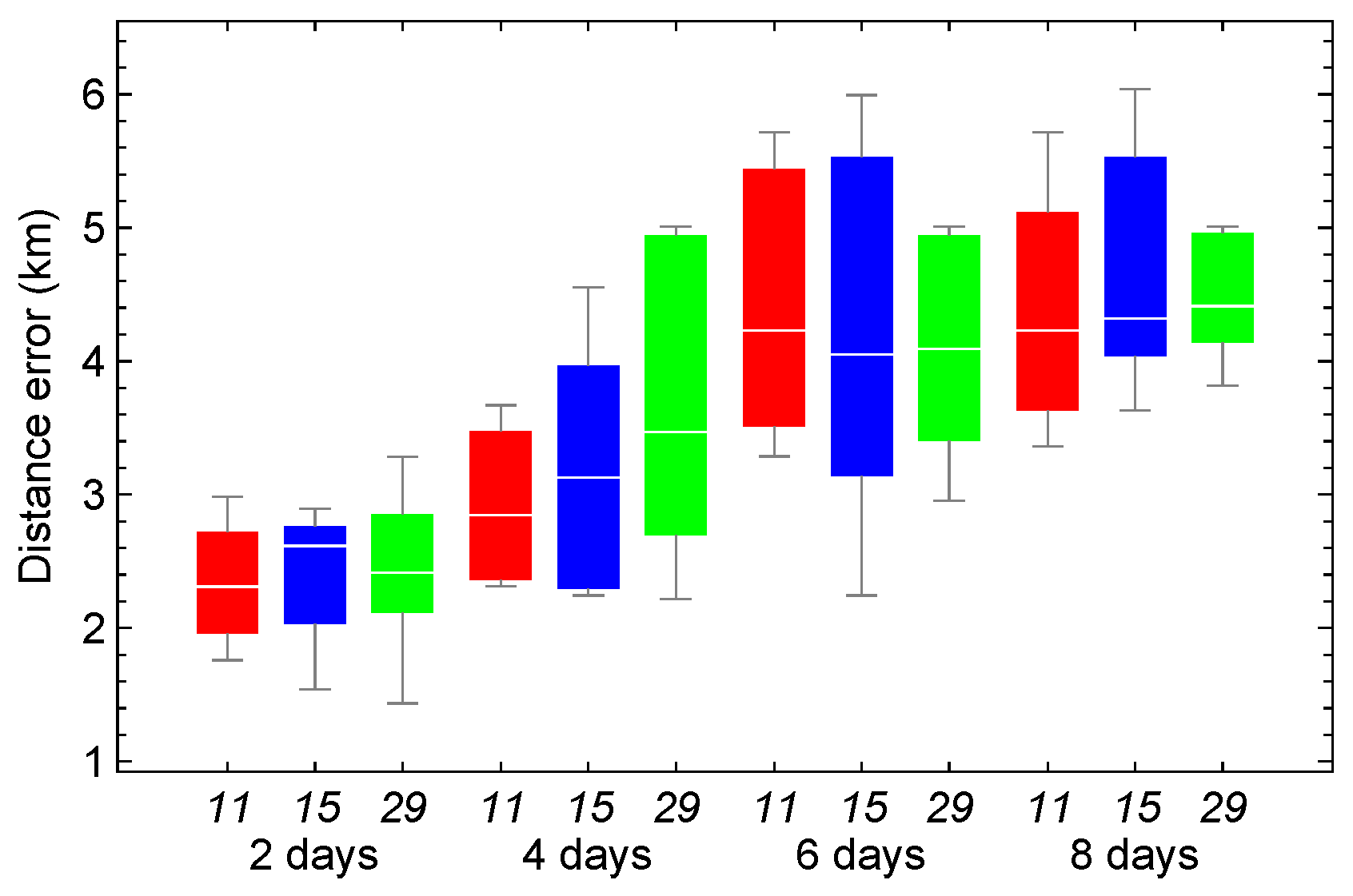
Box-and-whisker plots of HSGP4 distance error, using models trained with architectures 11 (in red), 15 (in blue), and 29 (in green) under a negative trend.
Figure 12.
Box-and-whisker plots of HSGP4 distance error, using models trained with architectures 11 (in red), 15 (in blue), and 29 (in green) under a negative trend.
Figure 13.
Box-and-whisker plots of the HSGP4 distance error, using models trained with architectures 11 (in red), 15 (in blue), and 29 (in green) under a positive non-trend.
Figure 13.
Box-and-whisker plots of the HSGP4 distance error, using models trained with architectures 11 (in red), 15 (in blue), and 29 (in green) under a positive non-trend.
Figure 14.
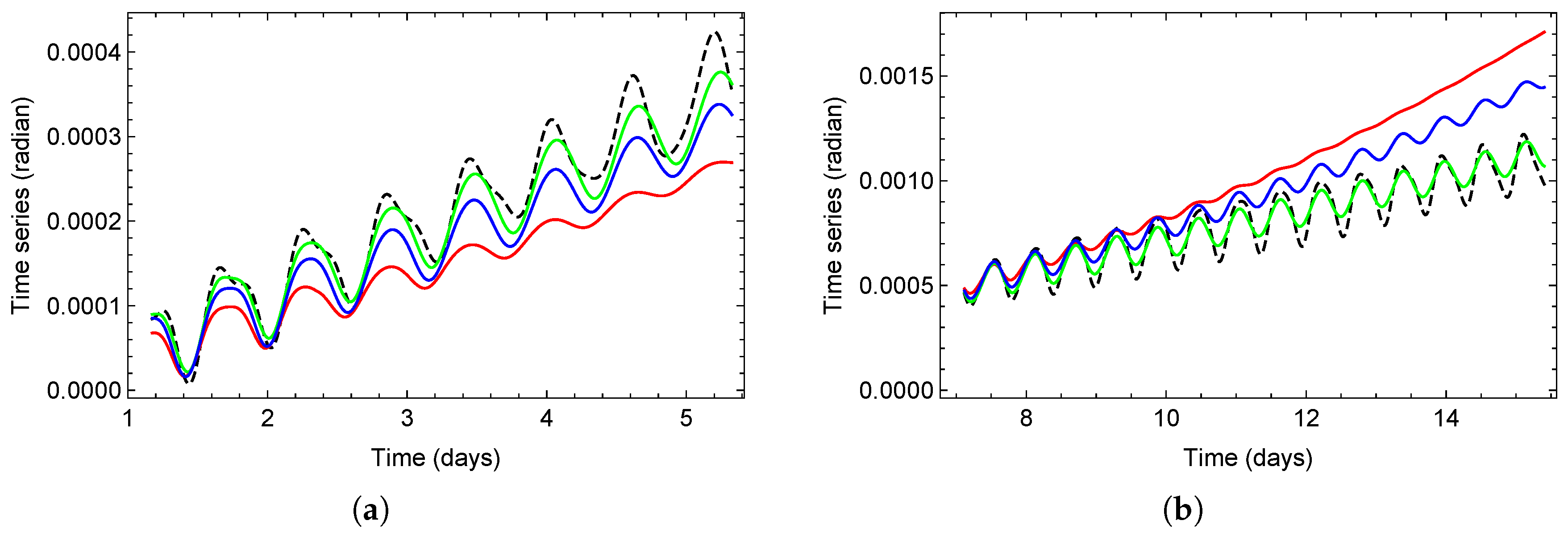
The real values are shown in black with dots. Predicted values are generated by models using architectures 11 (in blue), 15 (in green), and 29 (in red). (a) Training set. (b) Test set.
Figure 14.
The real values are shown in black with dots. Predicted values are generated by models using architectures 11 (in blue), 15 (in green), and 29 (in red). (a) Training set. (b) Test set.
Figure 15.
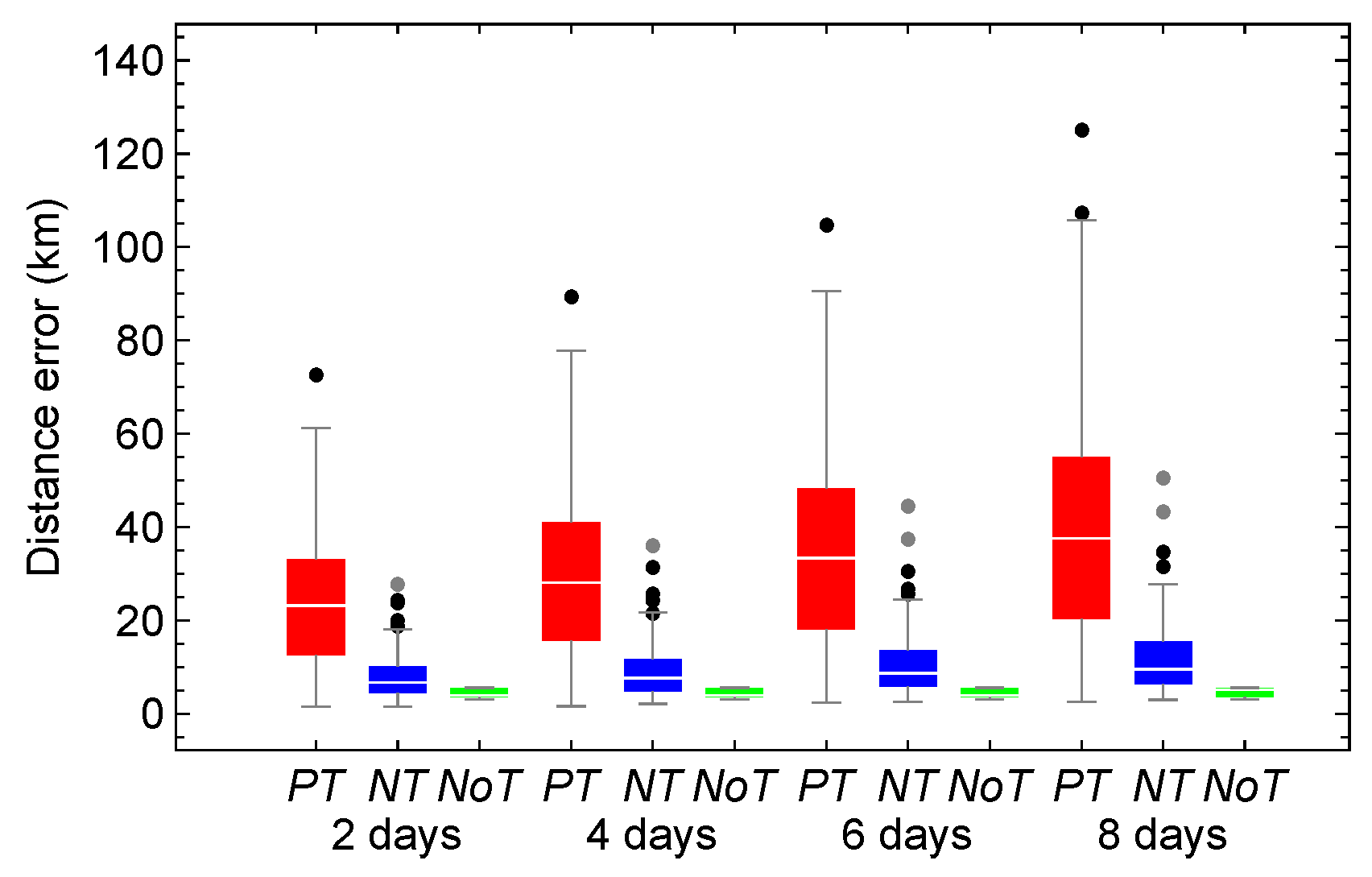
Box-and-whisker plots of the SGP4 distance error for 1447 time series positive (PT, in red), 227 negative (NT, in blue), and 9 no trend (NoT, in green), respectively.
Figure 15.
Box-and-whisker plots of the SGP4 distance error for 1447 time series positive (PT, in red), 227 negative (NT, in blue), and 9 no trend (NoT, in green), respectively.
Figure 16.
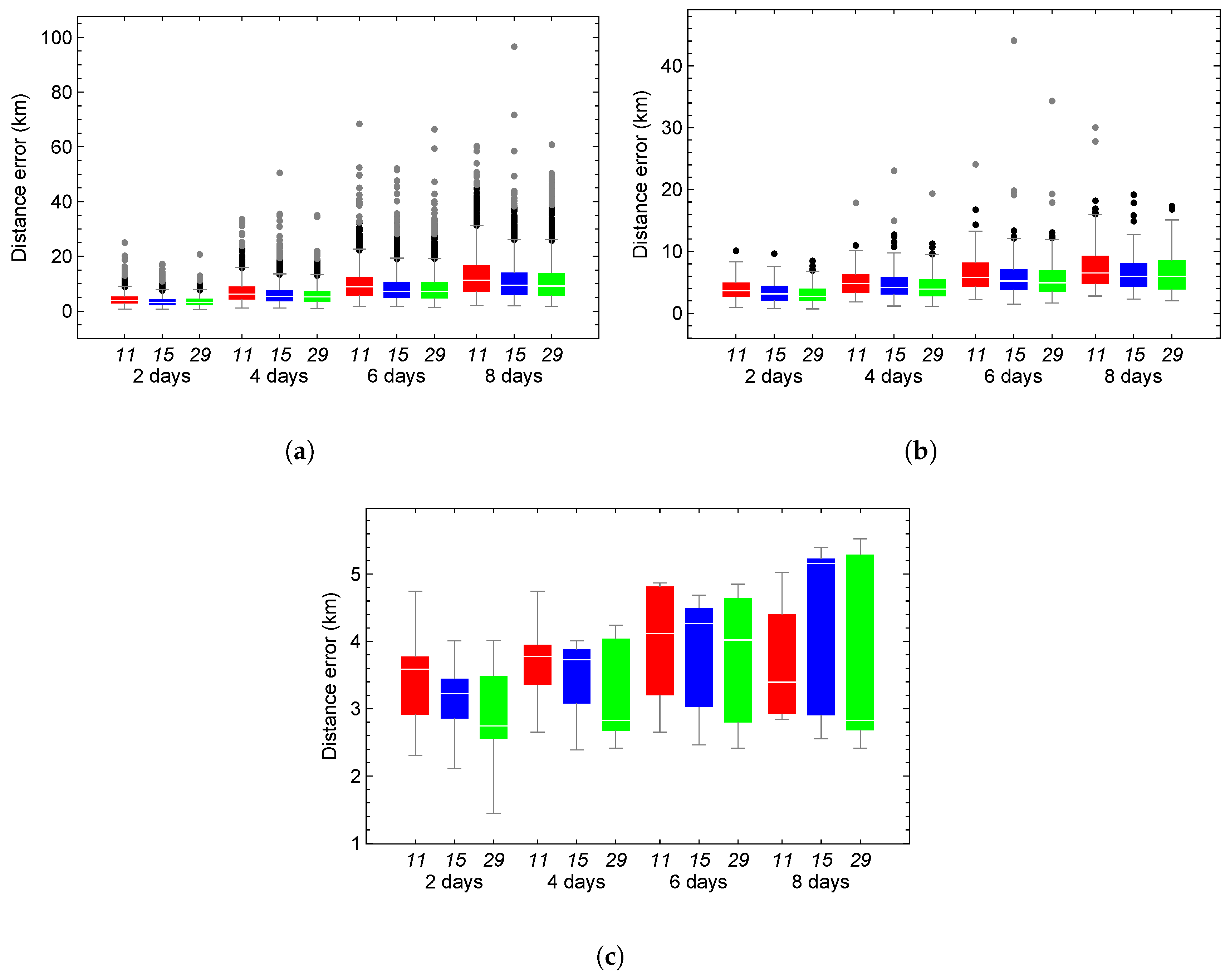
Box-and-whisker plots of the distance error between the numerical and HSGP4 propagators, using models trained with architectures 11 (in red), 15 (in blue), and 29 (in green). (a) Positive trend. (b) Negative trend. (c) No trend.
Figure 16.
Box-and-whisker plots of the distance error between the numerical and HSGP4 propagators, using models trained with architectures 11 (in red), 15 (in blue), and 29 (in green). (a) Positive trend. (b) Negative trend. (c) No trend.
Table 1.
7D hyperparameter space () with their considered values. The activation functions considered are linear, hyperbolic tangent (tanh), rectified linear unit (relu), and exponential linear unit (elu). The optimizers considered are root mean square prop (rmsprop), adaptive delta (adadelta), adaptive moment estimation (adam), and nesterov-accelerated adaptive moment estimation (nadam). The loss functions considered are the mean squared error (mse), mean absolute error (mae), mean absolute percentage error (mape), and mean square logarithmic error (msle).
Table 1.
7D hyperparameter space () with their considered values. The activation functions considered are linear, hyperbolic tangent (tanh), rectified linear unit (relu), and exponential linear unit (elu). The optimizers considered are root mean square prop (rmsprop), adaptive delta (adadelta), adaptive moment estimation (adam), and nesterov-accelerated adaptive moment estimation (nadam). The loss functions considered are the mean squared error (mse), mean absolute error (mae), mean absolute percentage error (mape), and mean square logarithmic error (msle).
| Hyperparameters | Range of Values |
|---|
| Batch size | 64, 128, 256, 512 |
| Hidden layers | 1, 2, 3 |
| Number of neurons in the first hidden layer | 8, 16, 32, 64, 128, 256 |
| Activation Functions | linear, tanh, elu, relu |
| Optimizers | rmsprop, adadelta, adam, nadam |
| Loss function | mse, mae, mape, msle |
| Learning rate | 0.001, 0.0001, 0.00001 |
Table 2.
SGP4 distance error (in km) at 2 and 4 propagation days during the training period, and at 2, 4, 6, and 8 propagation days during the test period.
Table 2.
SGP4 distance error (in km) at 2 and 4 propagation days during the training period, and at 2, 4, 6, and 8 propagation days during the test period.
| | Train | Test |
|---|
| Trend | 2d | 4d | 2d | 4d | 6d | 8d |
|---|
| Positive | 7.012 | 10.885 | 20.641 | 23.548 | 26.651 | 29.515 |
| Positive | 7.576 | 12.566 | 17.081 | 18.793 | 23.321 | 27.189 |
| Negative | 6.870 | 9.338 | 15.685 | 21.860 | 26.885 | 30.712 |
| Negative | 7.529 | 10.945 | 14.322 | 15.787 | 17.056 | 18.930 |
| No trend | 2.473 | 3.366 | 4.229 | 4.619 | 4.619 | 4.619 |
| No trend | 3.066 | 5.187 | 6.250 | 6.250 | 6.250 | 6.250 |
Table 3.
Number of models with the lowest rmse during training and testing.
Table 3.
Number of models with the lowest rmse during training and testing.
| Architectures | Training | Testing |
|---|
| mae | 403 (18.35%) | 510 (23.22%) |
| mape | 780 (35.52%) | 880 (40.07%) |
| mse | 837 (38.12%) | 581 (26.46%) |
| msle | 176 (8.01%) | 225 (10.25%) |
Table 4.
Number of models out of the total for each number of hidden layers where the HSGP4 distance error is lower than the SGP4 error after a 4-day propagation span in the training set. The last column shows the average training time for each model.
Table 4.
Number of models out of the total for each number of hidden layers where the HSGP4 distance error is lower than the SGP4 error after a 4-day propagation span in the training set. The last column shows the average training time for each model.
| Hidden Layers | Training | Time (min) |
|---|
| 1 | 36/102 (35.29%) | 2.83 |
| 2 | 247/420 (58.81%) | 3.18 |
| 3 | 1122/1674 (67.03%) | 3.60 |
Table 5.
Distribution of models with HSGP4 distance error lower than that of SGP4, classified by the learning rate. The final column gives the average training time for each model.
Table 5.
Distribution of models with HSGP4 distance error lower than that of SGP4, classified by the learning rate. The final column gives the average training time for each model.
| LR | Train | Test | Time (min) |
|---|
| 817 (44.21%) | 290(15.69%) | 4.92 |
| 647 (35.01%) | 794 (42.97%) | 4.46 |
| 384 (20.78%) | 764 (41.34%) | 4.44 |
Table 6.
Configuration of architectures of the top five models for each time series that minimize the distance error with respect to SGP4 at an 8-day propagation span. Columns: batch-size (bs), number of neurons in the first hidden layer (nnfl), optimizer (o), activation function in the first layer (af1), activation function in the second layer (af2), and frequency of architecture appearance as a best model.
Table 6.
Configuration of architectures of the top five models for each time series that minimize the distance error with respect to SGP4 at an 8-day propagation span. Columns: batch-size (bs), number of neurons in the first hidden layer (nnfl), optimizer (o), activation function in the first layer (af1), activation function in the second layer (af2), and frequency of architecture appearance as a best model.
| id | bs | nnfl | o | af1 | af2 | freq |
|---|
| 1 | 512 | 8 | nadam | tanh | elu | 2/6 |
| 2 | 256 | 8 | adam | tanh | elu | 1/6 |
| 3 | 64 | 256 | adam | tanh | tanh | 1/6 |
| 4 | 64 | 16 | adadelta | relu | elu | 1/6 |
| 5 | 128 | 256 | nadam | relu | elu | 1/6 |
| 6 | 256 | 64 | adam | tanh | tanh | 1/6 |
| 7 | 128 | 32 | nadam | tanh | elu | 1/6 |
| 8 | 128 | 16 | adam | linear | linear | 1/6 |
| 9 | 512 | 128 | nadam | linear | relu | 1/6 |
| 10 | 128 | 64 | adam | elu | tanh | 1/6 |
| 11 | 64 | 16 | rmsprop | tanh | elu | 1/6 |
| 12 | 256 | 128 | adam | linear | linear | 1/6 |
| 13 | 128 | 128 | adam | tanh | tanh | 1/6 |
| 14 | 256 | 128 | nadam | linear | elu | 1/6 |
| 15 | 256 | 64 | nadam | linear | tanh | 1/6 |
| 16 | 256 | 16 | adam | elu | elu | 1/6 |
| 17 | 512 | 128 | adam | elu | elu | 1/6 |
| 18 | 256 | 16 | adam | linear | linear | 1/6 |
| 19 | 512 | 16 | adam | relu | elu | 1/6 |
| 20 | 256 | 16 | adam | tanh | elu | 1/6 |
| 21 | 64 | 128 | nadam | relu | elu | 1/6 |
| 22 | 256 | 16 | nadam | relu | tanh | 1/6 |
| 23 | 64 | 16 | nadam | linear | elu | 1/6 |
| 24 | 256 | 256 | nadam | linear | linear | 1/6 |
| 25 | 64 | 256 | adam | relu | linear | 1/6 |
| 26 | 256 | 32 | adam | elu | elu | 1/6 |
| 27 | 64 | 64 | adam | linear | tanh | 1/6 |
| 28 | 256 | 32 | adam | tanh | linear | 1/6 |
| 29 | 256 | 32 | nadam | linear | tanh | 1/6 |
Table 7.
Number of methods reducing SGP4 error, grouped by time series trend.
Table 7.
Number of methods reducing SGP4 error, grouped by time series trend.
| Trend | 2 Days | 4 Days | 6 Days | 8 Days |
|---|
| Positive | 58 | 58 | 54 | 51 |
| Negative | 54 | 54 | 53 | 46 |
| No trend | 56 | 51 | 50 | 44 |
Table 8.
Number of cases for each architecture, grouped by trend category, where the error associated with HSGP4 is greater than that of SGP4 for the 313 TLE of the Galileo satellite (NORA ID 40545) at 2-, 4-, 6-, and 8-day propagation spans. The numbers of positive, negative, and no-trend time series are 169, 118, and 26, respectively.
Table 8.
Number of cases for each architecture, grouped by trend category, where the error associated with HSGP4 is greater than that of SGP4 for the 313 TLE of the Galileo satellite (NORA ID 40545) at 2-, 4-, 6-, and 8-day propagation spans. The numbers of positive, negative, and no-trend time series are 169, 118, and 26, respectively.
| Trend | Architecture | 2 Days | 4 Days | 6 Days | 8 Days |
|---|
| Positive | 11 | 33 | 33 | 33 | 36 |
| | 15 | 20 | 24 | 30 | 31 |
| | 29 | 19 | 24 | 28 | 36 |
| Negative | 11 | 45 | 40 | 46 | 51 |
| | 15 | 20 | 22 | 27 | 30 |
| | 29 | 28 | 28 | 33 | 37 |
| No trend | 11 | 22 | 22 | 21 | 19 |
| | 15 | 17 | 20 | 19 | 19 |
| | 29 | 19 | 20 | 20 | 21 |
Table 9.
Each selected architecture contains two hidden layers, a learning rate of , a linear activation function in the output layer, and uses mape as the loss function.
Table 9.
Each selected architecture contains two hidden layers, a learning rate of , a linear activation function in the output layer, and uses mape as the loss function.
| Id | BatchSize | N° Neu 1° HL | Optimizer | ActFun1 | AtFun2 |
|---|
| 11 | 64 | 16 | rmsprop | tanh | elu |
| 15 | 256 | 64 | nadam | linear | tanh |
| 29 | 256 | 32 | nadam | linear | tanh |
Table 10.
Number of cases for each architecture where the distance error associated with HSGP4 is greater than that of SGP4 for the Galileo satellite (NORA ID 38857). The numbers of positive, negative, and no trend time series are 1447, 227, and 9, respectively.
Table 10.
Number of cases for each architecture where the distance error associated with HSGP4 is greater than that of SGP4 for the Galileo satellite (NORA ID 38857). The numbers of positive, negative, and no trend time series are 1447, 227, and 9, respectively.
| Trend | Architecture | 2 days | 4 days | 6 days | 8 days |
|---|
| Positive | 11 | 15 | 40 | 60 | 90 |
| | 15 | 11 | 32 | 79 | 129 |
| | 29 | 14 | 32 | 68 | 138 |
| Negative | 11 | 19 | 27 | 34 | 41 |
| | 15 | 12 | 38 | 51 | 64 |
| | 29 | 16 | 38 | 53 | 65 |
| No trend | 11 | 0 | 1 | 2 | 5 |
| | 15 | 0 | 2 | 3 | 4 |
| | 29 | 0 | 0 | 1 | 4 |