Review

Nano-Chitosan Formulations and Essential Oil Encapsulation for Sustainable Wood Protection: A Comprehensive Review


by
Nauman Ahmed
,
Gwendolyn Davon Boyd-Shields
,
C. Elizabeth Stokes
and
El Barbary Hassan
*
Department of Sustainable Bioproducts, Mississippi State University, P.O. Box 9820, Starkville, MS 39762, USA
*
Author to whom correspondence should be addressed.
Appl. Sci. 2026, 16(5), 2207; https://doi.org/10.3390/app16052207
Submission received: 1 February 2026 / Revised: 22 February 2026 / Accepted: 23 February 2026 / Published: 25 February 2026
(This article belongs to the Special Issue Applications of Nanoparticles in the Environmental Sciences)

Featured Application

Chitosan nanoparticle-encapsulated essential oils offer a low-hazard, bio-based alternative to conventional wood preservatives, enabling durable antifungal and termite protection with reduced leaching and improved sustainability for exterior wood products and building materials.

Abstract

Wood remains a cornerstone material in construction and outdoor applications, yet its durability is continually compromised by fungal decay and insect infestation. Increasing regulatory restrictions on conventional wood preservatives and growing sustainability demands have intensified interest in bio-based alternatives. Among these, essential oils exhibit strong antifungal and insect-repellent activity but suffer from high volatility, leaching, and limited durability under moisture exposure. This review examines recent advances in chitosan nanoparticle-based encapsulation of essential oils as a strategy to overcome these limitations and enable more sustainable and environmentally responsible wood protection systems. The review synthesizes current knowledge on nanoparticle synthesis routes, physicochemical properties, bioactive delivery mechanisms, antifungal and anti-termite performance, and behavior under moisture and weathering conditions, alongside sustainability and regulatory considerations. The reviewed literature demonstrates that chitosan nanoparticles enhance essential oil retention, stability, and controlled release, leading to improved resistance against biological deterioration compared with unencapsulated formulations. In addition to performance benefits, these nano-enabled systems align with circular bioeconomy principles by utilizing renewable and waste-derived feedstocks while avoiding heavy metals and persistent synthetic biocides. Despite promising laboratory results, challenges remain related to long-term field performance, scalability, and environmental fate. Overall, chitosan–essential oil nano-formulations represent a versatile platform for next-generation, low-hazard wood protection, offering a promising pathway toward sustainable and durable wood preservation technologies.

1. Introduction

Wood remains one of the most widely used structural and functional materials due to its renewability, favorable strength-to-weight ratio, and low embodied energy relative to mineral -and metal-based alternatives. Its extensive application in construction, outdoor infrastructure, furniture, and utility products is central to contemporary bioeconomy and carbon-storage strategies. However, the inherent susceptibility of wood to biological deterioration, particularly fungal decay and insect infestation, continues to limit its service life in environments exposed to moisture. Brown-rot, white-rot, and soft-rot fungi degrade cellulose and lignin through enzymatic and oxidative pathways. At the same time, subterranean termites exploit wood as both a food source and a structural habitat, collectively causing substantial economic losses worldwide. Termites alone are estimated to cause global economic losses of approximately USD 40 billion annually, with subterranean species responsible for nearly 80% of the total damage [1,2,3].
Historically, long-term durability has been achieved with synthetic and metal-based preservatives, including creosote, pentachlorophenol, and chromated copper arsenate (CCA). These systems have provided exceptional resistance under severe exposure conditions and set performance benchmarks that continue to guide modern preservation standards. Field data from utility poles and railroad ties show that creosote- and CCA-treated wood can remain serviceable for several decades under underground contact conditions, often exceeding 30 years of service life, and significantly outperform untreated wood in comparable environments [4,5]. Nevertheless, extensive evidence shows that these preservatives introduce persistent environmental burdens, including soil and groundwater contamination, ecotoxicity, occupational exposure risks, and end-of-life disposal challenges [6,7]. Regulatory responses across North America and Europe have progressively restricted or phased out the most hazardous formulations, while imposing stricter retention limits and lifecycle controls on remaining copper-based systems [8,9].
In parallel with regulatory pressure, research has increasingly focused on renewable, performance-driven wood protection systems. Bio-based preservatives, including plant extracts, natural oils, and polysaccharide-based coatings, have been investigated as alternatives to conventional systems [10,11]. Among these, essential oils have been widely studied as bioactive agents. Rich in terpenoids, phenolics, and aldehydes, essential oils exhibit broad-spectrum antifungal and insect-repellent activity through membrane disruption, enzyme inhibition, and neurotoxic interference in insects [12,13,14]. Numerous laboratory studies using standardized soil-block decay tests demonstrate that essential oils such as thyme, clove, cinnamon, and lemongrass can reduce fungal mass loss by approximately 40–70%, while also significantly inhibiting termite feeding when applied to wood substrates [12,15].
Despite their biological potency, the direct use of essential oils in wood protection remains limited by intrinsic physicochemical constraints. High volatility, hydrophobicity, and sensitivity to light, oxygen, and temperature result in rapid depletion under moisture cycling and outdoor exposure, often leading to a sharp decline in protective efficacy within short timeframes. Experimental leaching studies report that more than 70–80% of essential oil constituents can be lost within days of water immersion, resulting in dramatic reductions in antifungal and insect-repellent performance [10,16]. These limitations highlight a central challenge: while essential oils are effective bioactives, they lack the retention, stability, and controlled delivery required for durable wood protection.
Nanotechnology has been explored as a strategy to improve the stability and delivery of bioactive compounds in wood. Nano-enabled systems can improve penetration into cell walls, enhance surface adhesion, and regulate the release of active compounds in response to environmental stimuli such as moisture and temperature [17,18]. Within this context, chitosan has been extensively investigated as a carrier material. Derived from the deacetylation of chitin obtained from crustacean shell waste, chitosan is biodegradable, low-toxicity, and compatible with green-chemistry principles [19]. Its cationic nature enables strong electrostatic interactions with negatively charged microbial membranes and hydroxyl-rich lignocellulosic surfaces, imparting inherent antimicrobial activity and favorable adhesion to wood substrates [20,21].
When processed into nanoscale particles, chitosan’s functional versatility is significantly amplified. When processed into nanoscale particles, chitosan’s functional versatility is significantly amplified. Chitosan nanoparticles produced via ionic gelation and related methods exhibit physicochemical characteristics that enhance colloidal stability, promote strong adhesion to lignocellulosic surfaces, and improve resistance to leaching [22,23]. In wood protection applications, these characteristics translate into deeper penetration, improved distribution, and reduced loss of active compounds relative to conventional treatments [24,25]. Importantly, chitosan itself contributes barrier properties by forming semi-permeable films that moderate moisture ingress and oxygen diffusion, thereby indirectly suppressing biological colonization [26].
Encapsulating essential oils within chitosan nanoparticles represents a convergence of these advantages. Encapsulation has been reported to reduce volatility and photodegradation, increase apparent thermal stability, and enable diffusion-controlled or stimuli-responsive release profiles that align with biological risk windows in wood service environments [27,28,29]. Across various delivery platforms, encapsulation has been reported to mitigate premature volatilization and thermal degradation of essential oils, thereby enhancing their physicochemical stability and prolonging functional efficacy relative to unencapsulated oils [30,31]. While direct wood-focused studies remain limited, emerging evidence suggests that similar mechanisms operate in lignocellulosic systems, which may contribute to improved retention and more sustained biological activity under moisture exposure [17,32].
Beyond performance, chitosan–essential oil nano-formulations align closely with sustainability and circular bioeconomy frameworks. Both components originate from renewable biological feedstocks, seafood processing residues, and plant biomass [19,33]. The metal-free composition reduces long-term ecotoxicity and may facilitate more favorable end-of-life options, including reuse, recycling, or controlled biodegradation, compared with conventional preservative-treated wood [34,35,36]. Despite this promise, the integration of chitosan nanoparticles and encapsulated essential oils into wood protection systems remains fragmented across disciplines. Existing reviews often focus narrowly on either natural wood preservatives, nanotechnology-based treatments, or chitosan applications in unrelated sectors, without synthesizing mechanistic understanding, formulation strategies, environmental behavior, and regulatory considerations into a coherent framework specific to wood materials. Critical questions persist regarding long-term durability, release kinetics under realistic exposure conditions, species-dependent performance, scalability, and environmental fate of nano-enabled bio-preservatives [16,37].
Accordingly, this review provides a comprehensive and integrative assessment of chitosan nanoparticle systems and essential oil encapsulation strategies for sustainable wood protection. By synthesizing advances in nanoparticle synthesis, bioactive delivery, antifungal and termite resistance mechanisms, moisture and weathering performance, and environmental and regulatory considerations, this work aims to clarify current capabilities, identify knowledge gaps, and outline rational design pathways for next-generation bio-based wood preservatives. In doing so, it evaluates chitosan–essential oil nano-formulations as potential alternatives to conventional treatments and as adaptable platforms for sustainable wood protection.

2. Literature Search Strategy

This article provides a narrative and critical synthesis of the available literature on chitosan nanoparticles (CSNPs) and essential oil-based wood protection systems. Relevant publications were gathered through searches in major scientific databases, including Web of Science, Scopus, PubMed, and Google Scholar. Search terms consisted of combinations such as “chitosan nanoparticles,” “chitosan nanoparticles for wood protection,” “essential oils in wood preservation,” “biobased wood preservatives,” and “ecotoxicity of chitosan nanoparticles,” among related expressions. The primary focus was on studies published between 2000 and 2025. The identified records were evaluated based on their relevance to wood protection efficacy, environmental implications, toxicological aspects, and regulatory considerations. Preference was given to peer-reviewed journal articles. Conference abstracts, duplicate entries, and studies not directly associated with wood applications were excluded.
To ensure broader coverage, additional sources, including regulatory documents (e.g., EPA materials and EU Biocidal Products Regulation reports) and seminal or highly cited studies, were identified through backward and forward citation tracking. The literature organization and thematic grouping were managed using a structured database to facilitate systematic screening and categorization.

3. Traditional Wood Preservation Techniques and Conventional Chemicals

Before the advent of industrial wood preservatives, ancient societies employed various natural and mechanical methods to extend the durability of wood exposed to environmental and biological threats. Prior to industrial preservatives, natural methods such as drying, charring, oiling, and tar application were used to reduce moisture and biological attack [38,39]. The use of borate salts, known for their biocidal properties since the 1800s, represented an early scientific step in natural wood preservation. Most of these techniques aimed to prevent, instead of cure, wood deterioration by altering environmental factors that promote decay. While these methods were not highly effective in persistently damp conditions or when wood was in contact with soil, they served as groundwork for later developments in chemical wood preservation [2,40].
With the development of railway infrastructure and industrial expansion, more durable wood material was required for marine structures and telegraph posts. This need brought the use of chemical preservatives, which are still used as a reference point for modern wood protection research [7]. Creosote emerged as one of the first commercial preservatives in the mid-19th century. It is a distillate of coal tar, rich in polycyclic aromatic hydrocarbons, and offers exceptional resistance to fungi, termites, and marine borers. Creosote-treated railroad ties and utility poles could remain functional for several decades [41]; however, their distinct oily odor, dark staining, and toxicity restricted their use in residential and interior applications [42]. Pentachlorophenol (PCP) emerged in the 1930s as an effective broad-spectrum biocide. It penetrated deeply into the wood structure, protecting against both decay fungi and insects. However, PCP was later found to persist in the environment and bioaccumulate in wildlife, leading to severe regulatory restrictions [43,44].
The breakthrough came with the introduction of CCA formulations. Developed in the 1930s and commercialized worldwide, CCA became the dominant preservative for structural and outdoor applications. The trivalent chromium acted as a fixative, binding copper and arsenic into the wood matrix and improving leach resistance. CCA-treated wood exhibited durability, but the toxicity of arsenic and chromium (VI) compounds eventually prompted a global reassessment of its safety [6,7]. By the late 20th century, alternative waterborne systems such as alkaline copper quaternary (ACQ) and copper azole (CA) were introduced [4,45]. Both retained copper as the primary fungicide but replaced arsenic and chromium with amine or azole co-biocides that offered lower human and ecological toxicity. These systems remain widely used today in structural lumber, decking, and outdoor furniture [46].
Conventional wood preservatives act primarily by inhibiting decay fungi and insects, with their effectiveness governed by the efficiency with which active compounds penetrate, distribute, and remain fixed within the wood structure. In systems such as CCA, fixation occurs through chromium-mediated reactions with lignin and cellulose hydroxyl groups, forming insoluble complexes that limit leaching but contribute to long-term environmental persistence [47,48]. Waterborne preservatives, including borates, rely on diffusion-controlled transport to disperse biocidal ions through cell walls and lumina, a process strongly influenced by wood anatomy, pit structure, and species-specific porosity. While this mobility enables effective protection in dry, indoor environments, high water solubility leads to substantial losses under exterior exposure or ground contact, where moisture cycling accelerates leaching [49]. Oil-based preservatives such as creosote and pentachlorophenol exhibit high resistance to leaching due to their hydrophobic character; however, their large molecular size restricts penetration into dense hardwoods and leaves oily residues that interfere with painting, gluing, and aesthetic finishes [50]. Although these systems provide durable, broad-spectrum protection across demanding service conditions, their reliance on heavy metals and toxic organic compounds has raised increasing environmental and regulatory concerns, motivating the search for safer, performance-driven alternatives.
Over time, the widespread use of industrial wood preservatives revealed significant environmental and public health concerns that extended beyond their protective benefits. Creosote-based formulations contain polycyclic aromatic hydrocarbons (PAHs) and phenolic compounds that are recognized for their carcinogenic and ecotoxic properties [51]. Pentachlorophenol treatments historically contained trace levels of dioxins and furans, which are among the most persistent and bio-accumulative organic pollutants identified in environmental systems [44]. Although chromated copper arsenate demonstrated excellent long-term efficacy, its use led to the accumulation of arsenic, chromium, and copper in soils and groundwater surrounding treated structures and manufacturing sites. Leaching from outdoor installations such as decks, fences, and playground equipment raised concerns regarding human exposure through dermal contact and runoff transport. Disposal of treated wood further amplifies these risks, as combustion can release toxic metals to the atmosphere, while landfill disposal poses a threat to groundwater quality. In occupational settings, workers in treatment facilities experienced chronic exposure to volatile organic compounds and metal-containing dusts, increasing the risk of respiratory and skin disorders. These cumulative impacts prompted extensive toxicological investigations and reassessment of conventional preservation systems [8].
In response to mounting scientific evidence and public concern, regulatory agencies progressively restricted the use of the most hazardous wood preservatives beginning in the early 2000s. Authorities such as the U.S. Environmental Protection Agency and the European Chemicals Agency, operating under the REACH framework, introduced risk-based controls that accounted for toxicity, environmental persistence, and exposure pathways. Pentachlorophenol was banned in the European Union and severely restricted in the United States due to its long-term environmental and health risks [52]. Creosote use was similarly limited to industrial and marine applications under strict occupational controls, reflecting the carcinogenic nature of its PAH constituents. Chromated copper arsenate was voluntarily withdrawn from residential markets in North America in 2003 following agreements with regulators, driven by concerns over arsenic and chromium leaching [47]. Although copper-based systems such as alkaline copper quaternary and copper azole remain permitted, their application is now regulated through defined retention levels, service categories, and lifecycle management requirements. International coordination through Organization for Economic Co-operation and Development (OECD) chemical safety programs and FAO guidelines has further harmonized testing and labeling practices, while simultaneously encouraging innovation in lower-toxicity alternatives such as heat treatment, acetylation, and furfurylation [53,54].
Regulatory restrictions have accelerated research into lower-toxicity and bio-based wood protection systems. While traditional preservatives have delivered long-term durability, their ecological and toxicological limitations have accelerated interest in bio-based and nano-engineered alternatives [17]. Chitosan, a natural polysaccharide derived from the deacetylation of crustacean-shell chitin, has emerged as a promising candidate due to its inherent antimicrobial activity, metal-chelating capability, and strong film-forming behavior on lignocellulosic substrates [55]. Through ionic gelation and related synthesis routes, chitosan can be transformed into nanoparticles capable of encapsulating essential oils, plant extracts, or inorganic additives [56,57]. In wood systems, their role is primarily linked to enhanced retention and moisture-responsive release behavior.
Chitosan-based nanocomposites are derived from renewable biopolymer sources, including chitin obtained from seafood-processing residues, providing an alternative to petroleum-derived synthetic carriers [19]. This approach supports waste reduction while addressing modern regulatory and consumer expectations for low-VOC, environmentally labeled materials [58]. Historically, wood protection technologies evolved from natural oils and tars to highly effective synthetic preservatives such as CCA, PCP, and creosote, which substantially improved service life but introduced significant environmental and health concerns [10]. Table 1 summarizes the major classes of traditional wood preservation systems, highlighting their active components, dominant mechanisms, performance advantages, limitations, and current regulatory status.
The subsequent tightening of international regulations created both the necessity and opportunity for innovation in sustainable treatments. In this context, green, nano-enabled bio-preservatives, particularly chitosan systems incorporating essential oil nanoencapsulation, represent a potential pathway to combine functional performance with reduced environmental impact, positioning them as candidates for next-generation wood protection technologies [17].

4. Chitosan Nanoparticles (CSNPs): Properties and Synthesis Relevant to Wood

Chitosan, a chitin-derived polysaccharide, offers several functional advantages for wood protection systems. Chitin is a compound present in the exoskeletons of crustaceans, insects, and in the cell walls of fungi [21,62]. Industrially, chitosan is primarily produced from seafood industry by-products such as shrimp and crab shells, making it an exemplary case of waste valorization [63]. For wood science applications, this sustainable origin is particularly important because it mirrors the forestry sector’s drive toward renewable, eco-friendly materials [64]. The sustainability narrative extends beyond sourcing. Chitosan is biodegradable, non-toxic to mammals at practical doses, and derived from a resource that would otherwise be discarded or incinerated [21]. Its biocompatibility, film-forming capacity, and inherent antimicrobial activity make it a promising substitute for petroleum-derived polymers traditionally used in coatings and adhesives [24]. In wood protection, the adoption of a marine-derived, biodegradable polymer complements the use of renewable wood itself and creates opportunities for fully bio-based protective systems [25].
A key factor influencing the performance of chitosan nanoparticles is the polymer’s degree of deacetylation (DD) and molecular weight (MW) [65]. High-DD chitosan provides more free amino groups for protonation, which increases its cationic nature and thus its ability to interact with negatively charged microbial cell membranes or the hydroxyl-rich surfaces of lignocellulosic substrates. Molecular weight affects solubility, viscosity, and particle formation. By carefully selecting DD and MW, researchers can tailor chitosan nanoparticles for optimal performance in wood protection systems [65,66].
Chitosan nanoparticles possess several intrinsic properties that make them attractive for wood applications, such as the cationic amino groups of chitosan interacting with negatively charged microbial cell walls [20]. This broad-spectrum activity against fungi and bacteria is highly desirable for preventing biological degradation of wood. Interestingly, chitosan’s amino and hydroxyl groups can chelate metal ions, which can immobilize toxic components or facilitate the binding of functional additives [67]. In wood coatings or preservatives, this chelation can improve adhesion to lignocellulosic surfaces and stabilize active ingredients.
Furthermore, chitosan readily forms thin, semi-permeable films that act as moisture and oxygen barriers, thereby reducing the susceptibility of wood to weathering, dimensional instability, and microbial colonization [68]. Its strong compatibility with lignocellulosic substrates through hydrogen bonding and electrostatic interactions improves adherence to cellulose, hemicellulose, and lignin, which enhances performance as a surface modifier or as part of composite materials [69]. By leveraging these interactions, chitosan nanoparticles can serve simultaneously as carriers of bioactive agents and as structural enhancers, offering a versatile and sustainable approach to wood protection.
The production of chitosan nanoparticles is best viewed not as a single standardized procedure, but as a set of distinct formation routes, each governed by different physicochemical mechanisms that directly influence particle size, stability, and functional performance in wood protection systems. These major formation routes and their defining characteristics are summarized in Table 2. Among these routes, ionic gelation remains the most widely used and experimentally accessible method. In this approach, protonated chitosan chains interact electrostatically with multivalent counterions, most commonly sodium tripolyphosphate, leading to rapid formation of crosslinked nanoparticles in aqueous media [22,23]. Because the process occurs under mild conditions, parameters such as solution pH, polymer-to-crosslinker ratio, and mixing or sonication intensity can be readily adjusted to control particle size and surface charge [70,71]. This tunability is particularly important for wood protection, where nanoparticle dimensions influence penetration into cell walls and the retention of encapsulated bioactive compounds.
Beyond ionic gelation, several complementary nanoparticle formation pathways have been developed to address specific formulation challenges. Emulsion-based crosslinking methods exploit oil–water interfaces to organize chitosan chains around hydrophobic cores before crosslinking, making them well suited for the encapsulation of essential oils and other nonpolar actives [56,57]. In contrast, polyelectrolyte complexation relies on spontaneous self-assembly between chitosan and oppositely charged biopolymers such as alginate or carrageenan, forming nanoparticles without synthetic crosslinkers and aligning closely with green-chemistry principles [55]. While these complexes may exhibit lower mechanical rigidity, their fully bio-based composition makes them attractive for sustainable wood treatments. More advanced formation routes have emerged in response to demands for greater precision and environmental compatibility. Reverse micelle techniques use nanoscale aqueous domains within organic phases as confined nanoreactors, enabling the formation of very small and relatively uniform particles, albeit with limitations related to solvent use and scalability [72]. Finally, enzymatic or bio-based crosslinking strategies replace conventional chemical agents with enzymes or naturally derived crosslinkers, reducing toxicity while maintaining functional performance and sustainability [73].
Once the basic chitosan nanoparticle scaffold is established, a wide range of functionalization strategies becomes available, tailoring performance to meet the specific demands of wood protection. Crosslinking, for example, is often employed to stabilize particles and modulate release behavior: using chemical agents such as glutaraldehyde or more biocompatible natural crosslinkers like genipin, one can stiffen the network, slow down diffusion of encapsulated actives, and enhance water resistance of nanoparticle-based coatings [74]. Indeed, dual crosslinking approaches (covalent plus ionic) have been explored to marry mechanical robustness with controlled release capacity in chitosan systems [75]. Parallel to crosslinking is grafting, where chitosan chains are chemically modified with pendant moieties such as quaternary ammonium groups, phenolic units, or silane functionalities, all designed to strengthen antimicrobial activity, increase hydrophobicity, or improve UV stability (e.g., N-(2-hydroxy) propyl-3-trimethyl ammonium chitosan chloride) [76]. To further integrate the hybrid systems with the wood matrix, lignin or cellulose nanoparticles can be incorporated into the chitosan nanoparticle formulation. Embedding lignin nanoparticles not only contributes to mechanical stiffness and lowers permeability but also brings phenolic bioactivity that can synergize with chitosan’s antimicrobial function [77]. In a related vein, composites of chitosan, lignin, and even ZnO have been used to yield high-strength, antibacterial films [78]. Finally, surface engineering for controlled release offers an elegant route to smarter protective systems: by designing pH-responsive or thermo-responsive coatings around CSNPs, one can make them trigger release only under defined environmental stress (e.g., wet conditions or fungal attack), thereby extending lifetime and reducing waste. In fact, chitosan-based composite systems have already shown promising pH-responsive release behavior in biomedical and environmental settings [79]. Altogether, presenting these strategies as a design matrix, where functional methods (crosslinking, grafting, hybridization, responsive coating) run across one axis, and performance goals (enhanced stability, controlled release, water resistance, mechanical reinforcement, bioactivity) lie on the other, can reveal underexplored combinations and chart clear paths for future experiments.
Chitosan nanoparticles offer a versatile, sustainable platform for enhancing wood protection. Their marine-derived origin, inherent antimicrobial properties, tunable synthesis methods, and wide range of functionalization options make them ideally suited to address the challenges facing the modern wood industry.

5. Essential Oils as Bioactive for Wood Protection

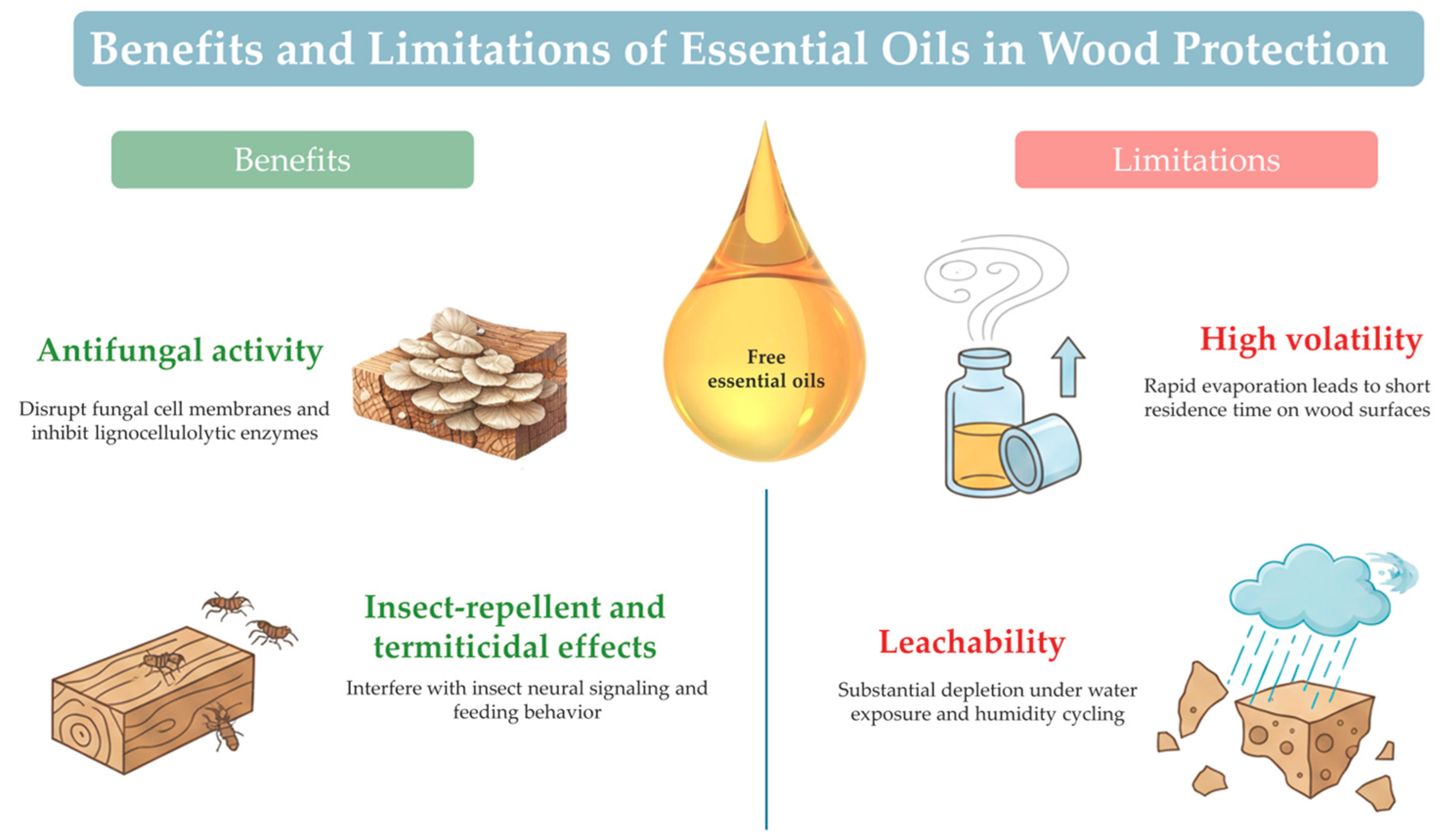
Wood has served as a foundational material throughout human history, yet its structural value is continually challenged by biological deterioration. Fungi, termites, beetles, and bacteria readily exploit its lignocellulosic matrix, accelerating decay and reducing service life. Conventional preservatives, particularly heavy metal systems such as CCA and synthetic organic biocides like pentachlorophenol and creosote, have historically provided effective protection, but their environmental persistence and toxicity have led to increasing regulatory restrictions [80]. This shift has intensified global interest in sustainable, bio-based alternatives. Essential oils (EOs), complex mixtures of volatile secondary metabolites, have emerged as promising candidates due to their broad-spectrum antimicrobial and insect repellent properties, biodegradability, and alignment with circular economy principles [10]. Their activity is largely attributed to monoterpenes, sesquiterpenes, phenolics, and aldehydes, which interact with microbial membranes and metabolic pathways. EOs represent a compelling natural strategy for integrated wood protection systems. The key biological benefits and inherent physicochemical constraints of free (non-formulated) essential oils in wood protection applications are summarized in Figure 1, highlighting the need for formulation strategies to improve durability.
The antifungal efficacy of essential oils against wood decay fungi is well documented across multiple species, including white rot, brown rot, and soft rot organisms. Reported fungal mass-loss reductions of approximately 40–70% place essential oils within a moderate efficacy range compared to conventional preservative benchmarks [80]. Mechanistically, phenolic monoterpenes like thymol and carvacrol disrupt fungal plasma membranes by integrating into lipid bilayers, increasing permeability, and causing leakage of ions and metabolites [14]. Aldehyde-rich oils further inhibit lignocellulolytic enzymes, reducing the ability of fungi to depolymerize cellulose and lignin. Unlike synthetic fungicides that often target single biochemical pathways, EOs exert multi-target effects, reducing the likelihood of resistance development [81]. These mechanistic advantages make essential oils particularly attractive for sustainable wood protection, especially in regions where fungal decay is the primary mode of biodeterioration.
Termites pose another major threat to wood durability, particularly in tropical and subtropical regions where subterranean species such as Coptotermes formosanus and Reticulitermes flavipes cause extensive structural damage. Several essential oils exhibit strong termiticidal or repellent activity. Kartal et al. (2006) demonstrated that cedarwood, vetiver, clove, and thyme oils significantly reduce termite feeding and survival, with some oils achieving more than 60% feeding inhibition in laboratory assays [12]. The mechanisms of action include interference with octopamine receptors, key components of insect neural signaling, leading to neurotoxicity, paralysis, and mortality. Volatile EO constituents also act as behavioral repellents, deterring termites from approaching treated substrates. Compared to synthetic insecticides, essential oils generally exhibit lower non-target toxicity and shorter environmental persistence, making them suitable for integrated pest management strategies [13]. Their dual roles as toxicants and repellents provide a versatile approach to termite control, although their volatility limits long-term performance without formulation enhancements.
Despite their strong bioactivity, the practical use of essential oils in wood protection is constrained by their high volatility, hydrophobicity, and susceptibility to leaching. Unmodified oils exhibit poor affinity for wood polymers, leading to rapid depletion under moisture exposure. Broda (2020) reported that EO-treated wood can lose more than 80% of its active compounds within days of water immersion, resulting in dramatic reductions in antifungal and termite resistance [10]. To address this, encapsulation technologies have become central to improving EO stability. Nanoemulsions, polymeric nanoparticles, liposomes, and cyclodextrin complexes reduce volatilization and enhance retention. Gao et al. (2020) [82] demonstrated that EO-loaded nanoemulsions extend antifungal efficacy by up to 300% compared to free oils. Polymer-based microcapsules further reduce volatilization rates, enabling sustained release over several weeks [82]. These formulation approaches directly address the constraints summarized in Figure 1, transforming essential oils from short-lived bioactives into controlled-release protection systems.
In wood science, however, the integration of encapsulated essential oils remains relatively underdeveloped. Most studies rely on direct oil application or simple emulsions, often evaluated under short-term laboratory conditions that do not reflect real-world weathering. Yet wood’s porous, hygroscopic structure makes it an ideal substrate for controlled release systems, provided the carrier can penetrate cell walls, adhere to lignocellulosic polymers, and withstand moisture cycling. Biopolymer-based nanoparticles, particularly those derived from chitosan, offer a compelling platform for this purpose. Chitosan is a biodegradable, cationic polysaccharide with intrinsic antimicrobial properties and strong affinity for wood’s hydroxyl-rich surfaces. Research shows that chitosan treatments alone can reduce brown rot mass loss by 20–40%, and when combined with natural bioactives, the effect is synergistic [10]. Chitosan nanoparticles also provide moisture-responsive release mechanisms, allowing active compounds to be deployed precisely when fungal or insect pressure is highest.
Recent advances in nanotechnology further strengthen the case for encapsulated essential oils in wood protection. Studies from 2022–2024 report that biopolymer-based nanoparticles penetrate deeper into wood microstructures than traditional preservatives, improving distribution and retention. Some formulations demonstrate leaching resistance improvements of up to 50%, while others show enhanced UV stability or reduced photodegradation of active compounds. These developments suggest that integrating essential oils into nanostructured carriers could bridge the gap between natural bioactives and the performance demands of modern wood products. Despite these promising developments, significant knowledge gaps remain. Most studies still focus on short-term antifungal or termite assays, with limited attention to long-term durability, weathering resistance, or field performance. Few investigations explore how encapsulated essential oils interact with different wood species or how factors such as pH, moisture content, and temperature influence release kinetics. Addressing these gaps will require interdisciplinary collaboration across materials science, microbiology, forestry, and chemical engineering. While recent advances directly address the intrinsic limitations of free essential oils highlighted earlier in this section (Figure 1), their translation into long-term field performance remains insufficiently explored.

6. Nano-Encapsulation of Essential Oils in CSNPs: Principles and Methods

EOs degrade or dissipate rapidly when applied directly because of their volatility, hydrophobicity, and sensitivity to light, heat, oxygen, and pH; embedding them in CSNPs can mitigate these issues by isolating the actives from the external environment and improving dispersion in aqueous systems [83]. As a cationic, film-forming biopolymer, chitosan provides electrostatic affinity for many surfaces (including lignocellulosic), inherent antimicrobial activity, and a versatile platform for tailoring release kinetics via crosslinking density, particle size, and matrix composition. It enables controlled or stimuli-responsive delivery, outcomes that translate well to wood protection, where retention and slow release are critical. Representative reviews and studies document these advantages across nano-emulsions, polymeric nanoparticles, and hybrid carriers, and specifically highlight chitosan as a robust encapsulant for EO’s [84].

6.1. Encapsulation Techniques for EOs in CSNPs

6.1.1. Emulsification–Ionic Gelation (CS–TPP Route)

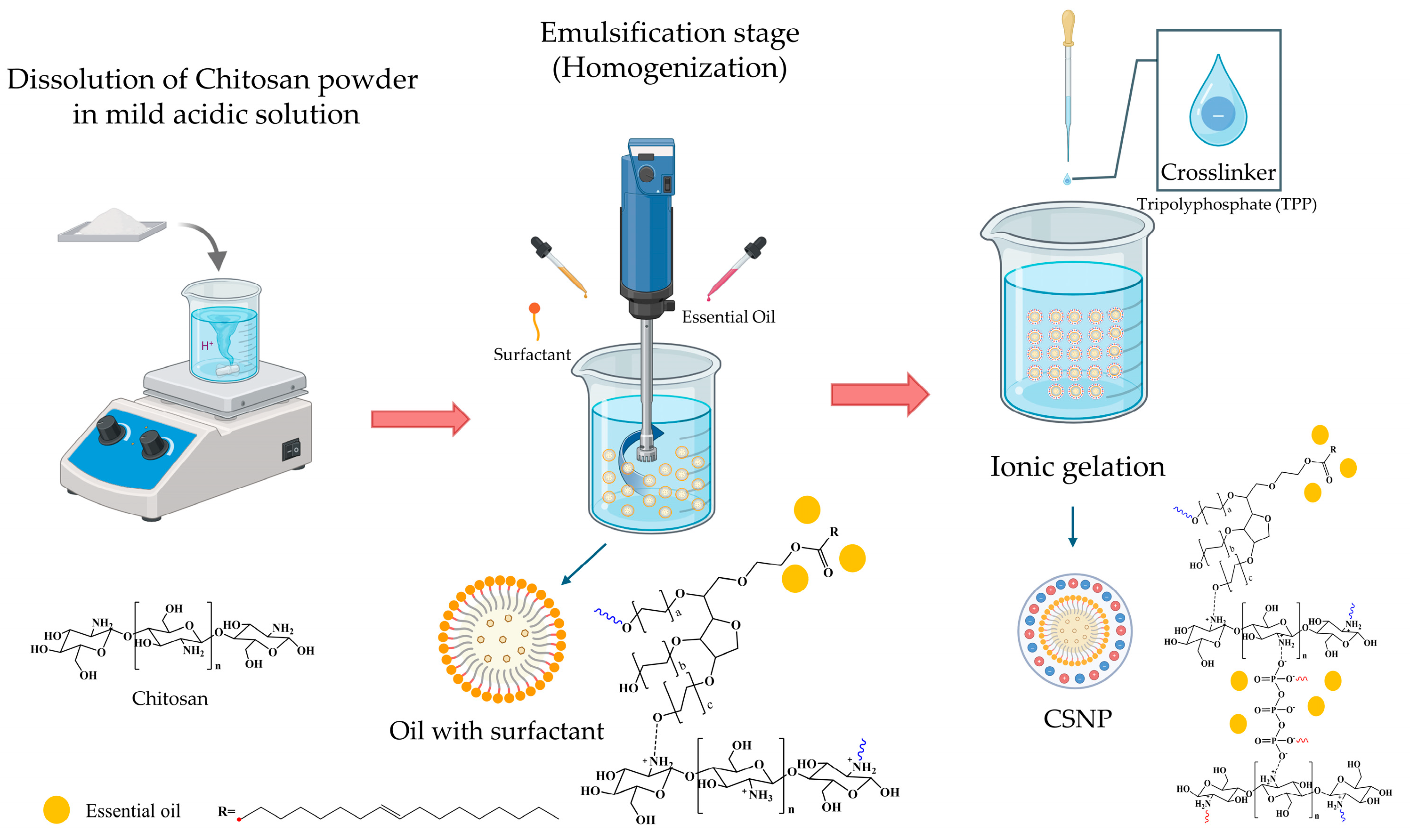
A widely used route for EO-loaded CSNPs begins by dispersing the oil in an aqueous chitosan phase (with or without a low-level surfactant/emulsifier), followed by ionic gelation with multivalent anions, such as sodium tripolyphosphate (TPP). Rapid complexation between protonated chitosan (–NH3+) and TPP yields nanoscale networks that entrap EO droplets/solubilized actives. By adjusting pH (affecting chitosan protonation), chitosan:TPP ratio, and mixing/sonication intensity, researchers routinely achieve particles from ~100–400 nm with positive zeta potentials (≈+20 to +45 mV) and encapsulation efficiencies typically ranging from approximately 24–67%, depending on chitosan molecular weight, CS:TPP mass ratio, pH, and formulation conditions, as reported for CS–TPP systems loaded with bioactive compounds [22]. These physicochemical ranges underpin the balance between colloidal stability and interfacial adhesion to wood. Ionic gelation is aqueous, mild, and solvent-lean; the positive surface charge promotes attraction to hydroxyl-rich wood cell walls, aiding retention and coating uniformity while the crosslinked matrix slows volatilization/leaching of the oil. Compared to covalent crosslinking or solvent-based nanoprecipitation, ionic gelation offers superior compatibility with volatile essential oils due to its aqueous, low-temperature processing. The overall emulsification–ionic gelation pathway is schematically illustrated in Figure 2, which highlights the sequential transition from emulsification to electrostatic crosslinking and nanoparticle formation, ultimately governing encapsulation efficiency and release behavior.

6.1.2. Nano-Emulsions as Feed or Final System

Oil-in-water nano-emulsions (NEs) are kinetically stable dispersions formed by high-energy (e.g., probe sonication, high-pressure homogenization) or low-energy (phase-inversion) methods using biocompatible surfactants. NEs can be (i) used directly as delivery vehicles to wood or (ii) converted into CSNPs by adding chitosan/TPP to lock the droplets in a polysaccharide matrix (“emulsion-templated” ionic gelation). Reviews consistently report that nano-emulsification expands aqueous dispersibility, protects actives, and can be tuned for controlled delivery, which attributes are transferable to wood impregnation/coatings workflows [85]. For the wood, the small droplet size aids penetration into near-surface porosity and cell wall regions; converting the NE to a chitosan crosslinked structure improves leach resistance and handling (e.g., spray or dip-coat stability). However, nano-emulsions alone may suffer from limited fixation within wood cell walls, making their conversion into chitosan-crosslinked matrices particularly attractive for improving leach resistance under exterior exposure.

6.1.3. Liposome-Like or Hybrid Shells

Although classical phospholipid liposomes are less common in wood technology due to cost and moisture sensitivity, lipid vesicles or hybrid shells (e.g., chitosan-coated nano-emulsions or chitosan-decorated inorganic cores) can deliver desirable traits such as UV screening, humidity-responsive release, or enhanced mechanical integrity. For instance, chitosan decoration on UV-active shells (e.g., TiO2) has been used to achieve light-triggered release behaviors, and humidity can further modulate diffusion pathways [86]. These principles are directly relevant to exterior wood exposure.
Protonation/deprotonation of chitosan’s primary amines controls matrix swelling and permeability: in acidic environments (more –NH3+), CSNPs tend to swell and increase diffusivity, accelerating EO release; at neutral/alkaline pH, reduced charge lowers swelling and slows transport. Design of pH-responsive CSNPs is well established in food/biomedical delivery and can be translated to wood contexts (e.g., micro-pH environments at decay fronts) [87]. Moisture plasticizes polysaccharide matrices, increasing free volume and diffusion coefficients. Packaging and smart-release studies show that moisture-responsive chitosan systems that accelerate payload release at elevated relative humidity are useful for rain-wetting or condensation events on wood, where a boost of antifungal/repellent activity is valuable [88]. Elevated temperature increases chain mobility and partitioning of volatiles, while UV-active shells can be engineered to open diffusion pathways under sunlight. Chitosan-decorated, UV-responsive microcapsules demonstrate that both UV and humidity can be leveraged to program release, suggesting practical multi-trigger logic under outdoor exposure [86]. Combining triggers (e.g., humidity and temperature) can synchronize release with the highest biological risk windows (wet/warm conditions that favor fungal growth or termite foraging), thereby conserving actives during dry periods.
Encapsulation routinely increases with reported shifts in EO volatilization or degradation onset temperatures by ~10–40 °C, depending on matrix composition. Comparative studies with EO-loaded CSNPs report improved storage stability (weeks to months) and maintained bioactivity relative to free oils; for example, chitosan–thyme nanocapsules stored at 4–25 °C retained favorable size/zeta potential and antioxidant capacity over five weeks, linking colloidal stability to preserved functionality. Broader analyses indicate that embedding EOs in chitosan matrices can raise the apparent thermal tolerance of volatile constituents (thermogravimetric profiles shift to higher onset), while the positive surface charge provides electrostatic adhesion that mitigates leaching from porous substrates [38].
From a wood-specific angle, nano-enabled systems (including EO-CSNP or polymer-bound actives) have already shown long-term antifungal protection in impregnation/coating studies, underscoring the durability gains when actives are immobilized or retained within a carrier rather than simply applied neat [32].

6.2. “Controlled Release Models” for Wood-Contact Environments

To rationally design essential oil-loaded chitosan nanoparticle (EO-CSNP) systems for wood, kinetic models help connect formulation variables to release profiles under realistic exposure (wet–dry cycling, seasonal temperature swings, UV). These models, used for polymer-based delivery systems, including chitosan matrices and essential oil carriers, are well documented across the literature. Much of the fundamental understanding of diffusion behavior, matrix swelling, and carrier–substrate interactions has been developed in food and biomedical applications. Nevertheless, these same physical processes are highly relevant to wood protection systems. In both cases, transport is largely controlled by diffusion through a polymer network, moisture-driven swelling of the carrier, and interactions between the delivery matrix and a porous solid surface. Despite this conceptual overlap, relatively few studies have rigorously evaluated whether these models accurately predict release behavior under realistic wood exposure conditions, such as repeated wetting–drying cycles, soil contact, or long-term outdoor weathering. Addressing this gap remains an important priority for advancing bio-based nano-enabled wood preservatives.

7. Applications of Chitosan Nanoparticles in Wood Protection

Wood protection has long relied on heavy-metal preservatives and synthetic organic biocides, but growing regulatory pressures, paired with a wider push for sustainable materials, have encouraged researchers to explore safer and more versatile alternatives [2]. Even more compelling is their role as nanocarriers for EOs: encapsulation stabilizes these highly volatile bioactive compounds and enables a controlled, moisture-responsive release profile [25,56,64]. Taken together, CSNPs and CSNP–EO hybrids represent a multifunctional platform capable of addressing multiple degradation pathways, fungal attack, termite damage, moisture stress, UV exposure, and even adhesive performance within a single treatment framework [18,56]. The sections that follow synthesize current findings across these domains, emphasizing not only what is known but also the technical challenges and research gaps that still need attention.

7.1. Antifungal Protection

7.1.1. Mechanistic Basis and Relevance to Wood Decay

Fungal degradation, particularly by white-rot (Trametes versicolor), brown-rot (Gloeophyllum trabeum), and soft-rot fungi, remains one of the most persistent biodeterioration challenges in unprotected wood. These organisms initiate decay by penetrating earlywood microvoids and deploying oxidative or hydrolytic enzyme systems capable of breaking down lignin and carbohydrate polymers [89]. Chitosan provides an inherent line of defense because its protonated amino groups interact electrostatically with the negatively charged fungal cell wall, destabilizing membrane structure, altering permeability, and interfering with key metabolic and enzymatic pathways. When chitosan is transformed into nanoparticles, these effects become more pronounced: the increased surface area and nanoscale dimensions promote closer contact with emerging hyphae, deeper diffusion into the wood surface layers, and more uniform distribution across heterogeneous lignocellulosic regions.
Essential oils contribute an additional antifungal mechanism through membrane disruption, mitochondrial dysfunction, oxidative stress induction, and inhibition of ligninolytic enzymes [90]. Yet their high volatility and susceptibility to leaching limit practical persistence on wood [91]. Encapsulation within CSNPs overcomes these limitations by protecting reactive EO constituents from rapid evaporation, slowing diffusion, and enabling humidity-responsive release [28,92], an especially relevant behavior for wood exposed to intermittent wetting and fluctuating microclimates. As a result, CSNP–EO hybrid systems combine the structural antimicrobial activity of chitosan with the sustained biochemical potency of essential oils, forming a coordinated antifungal strategy that can respond adaptively to environmental moisture cycles.

7.1.2. Performance of Chitosan-Based Systems on Wood

Several studies confirm the capacity of chitosan coatings and nanoparticles to suppress fungal colonization on wood. In one early demonstration, Silva-Castro et al. applied chitosan films to Populus wood and observed reduced mycelial spread and less intense white-rot discoloration by T. versicolor [64]. Using a different approach, Khademibami et al. tested chitosan oligomers and nanosized formulations on southern pine and reported significantly lower mass loss following exposure to brown-rot fungi, suggesting that nanoscale chitosan can approximate the performance of some low-retention preservative systems [25]. Hydrophobically modified CSNP coatings produced through ultra-pressurized deposition have also shown enhanced resistance to fungal attack while simultaneously decreasing water uptake, demonstrating synergistic interactions between hydrophobicity and antifungal defense [24].

7.1.3. Performance of EO-Loaded CSNP Systems

In comparative antimicrobial and release studies, EO-loaded CSNP systems demonstrate enhanced thermal stability (e.g., degradation temperature increases from ~126 °C to ~252 °C) and sustained release profiles compared to the rapid volatilization typically observed for free oils, which typically volatilize rapidly under environmental exposure [30]. While direct wood mass-loss comparisons remain limited, controlled-release nanoformulations consistently show improved functional persistence and prolonged antimicrobial activity compared to unencapsulated essential oils [30,31,93]. Sustained release is critical on wood surfaces, where early-stage colonization is strongly influenced by local microenvironmental moisture [94].
Direct wood-specific research remains limited, yet the cross-disciplinary evidence consistently supports the underlying principles: (i) EO encapsulation mitigates volatilization [28,92], (ii) CSNPs maintain high surface coverage on lignin-rich substrates [24,25], and (iii) controlled EO release aligns with fungal ecological triggers such as humidity and temperature [95].

7.2. Termite Resistance

Subterranean termites are among the most destructive wood pests because they live in large underground colonies and will attack any wood in contact with soil or moisture sources. Their biology, strong moisture dependence, cryptic nest and tunnel systems, and continuous foraging behavior enable them to exploit wood resources efficiently and often undetected [96,97]. These insects rely on complex chemical communication networks and symbiotic gut microbiota for lignocellulose digestion [3]. Essential oils have long been recognized as natural deterrents or toxicants against termites, as demonstrated in studies by Kartal and colleagues, who showed that lemongrass, clove, and thyme oils can markedly reduce feeding and increase mortality in species such as Reticulitermes and Coptotermes [12]. These effects are generally attributed to neurotoxic interference, as many EO constituents disrupt octopaminergic signaling pathways, as well as direct impacts on the termite gut symbionts responsible for cellulose digestion [98,99]. Their strong volatile profiles also create powerful repellency cues, limiting termite tunneling and contact with treated surfaces [100]. However, essential oils in their free form suffer from rapid volatilization, oxidation, and leaching, causing their repellency or toxicity to decline sharply under field-relevant temperature and humidity conditions [10].
Chitosan itself contributes a secondary, often overlooked mode of protection. Although its direct toxicity to termites is relatively mild compared to essential oils, chitosan’s polycationic structure can interfere with digestive enzyme activity and may destabilize the microbial communities in the termite hindgut [101,102]. Termites rely heavily on protozoa and bacteria to break down cellulose and hemicellulose, and disruptions to this symbiotic balance can reduce nutrient acquisition, feeding efficiency, and survival [3]. In addition, chitosan forms strong interactions with lignocellulosic surfaces, creating a thin film on wood that alters surface chemistry, decreases moisture availability, and can make the substrate less favorable for termite mandible penetration [24,103]. These subtle but cumulative influences position chitosan as more than a passive carrier; it actively contributes to an inhospitable feeding interface.
Encapsulating essential oils within CSNPs addresses the weaknesses of both components and creates a hybrid system with enhanced persistence [104]. CSNPs adhere strongly to wood due to electrostatic affinity for lignin-rich cell walls, maintaining uniform surface coverage that resists wash-off during wet–dry cycles [25]. The encapsulated oils diffuse slowly through the nanoparticle matrix, often following Fickian diffusion kinetics, resulting in a sustained, low-level release of repellent volatiles at the wood–soil interface [28,30,95]. In moist soil microenvironments, chitosan swells slightly, increasing free volume and accelerating EO diffusion. When conditions dry, release slows [29,105]. This environmentally responsive behavior ensures that EO concentrations remain deterrent precisely when termite pressure is highest.
Slow-release EO volatiles can influence termites through multiple, complementary mechanisms. At the behavioral level, the formation of an odor plume discourages tunneling activity and reduces direct contact with treated wood surfaces, a response that has been widely reported for plant-derived oils and their major constituents [100,106]. Termites that nevertheless penetrate this repellent boundary are then exposed to both vapor-phase EOs and chitosan residues bound to the wood surface. Such exposure can disrupt neural transmission, interfere with spiracle regulation, and alter cuticular hydrocarbon composition, collectively impairing mobility, orientation, and foraging efficiency [12,99]. In parallel, ingestion of EO-CSNP residues may negatively affect gut protozoa and bacterial symbionts essential for lignocellulose digestion, leading to reduced nutrient acquisition and digestive stress. This dual mode of action, combining proactive repellency with reactive physiological and intake effects, is characteristic of many natural product-based pest control strategies [3,107]. Although direct empirical evaluations of CSNP–EO formulations against termites in wood systems remain limited, this gap represents a critical limitation in assessing their practical applicability for structural protection. Most available evidence derives from agricultural nano-pesticide studies or laboratory-scale bioassays rather than standardized wood durability protocols. As a result, the transferability of controlled-release principles from crop protection to long-term wood–soil interfaces cannot be assumed without validation. Future research should prioritize standardized termite resistance testing (e.g., laboratory and field soil-block assays), long-term exposure under wet–dry cycles, leaching–feeding interaction studies, and species-specific performance evaluations. Only through such targeted wood-focused investigations can the true durability and reliability of CSNP–EO systems against subterranean termites be established.

7.3. Moisture, UV, and Fire-Related Performance

Moisture exposure remains the most critical environmental factor influencing wood durability, and addressing this challenge is essential for long-term performance. Among emerging solutions, chitosan nanoparticles have shown remarkable potential in reducing moisture-driven degradation. Research on Greek pine treated with chitosan revealed significant improvements: total water sorption decreased by 23.8%, polymolecule sorption by 20.6%, and monomolecular sorption by 35.3%. These reductions are largely attributed to chitosan’s ability to penetrate the wood cell wall microstructure and form semi-continuous barriers that limit hygroscopic interactions [26]. Advanced techniques such as small-angle neutron scattering further confirm that nanoscale infiltration into cellulose microfibril bundles restricts swelling at critical structural levels. This means that chitosan nanoparticle coatings do not simply seal the surface; instead, they act as adaptive regulators, allowing controlled vapor movement while preventing excessive moisture uptake, a balance that is vital for maintaining dimensional stability and durability.
Beyond moisture control, UV radiation poses another major threat to wood surfaces, accelerating photodegradation and coating failure. Chitosan nanoparticles offer an indirect yet highly effective strategy for improving UV resistance. When combined with lignin nanoparticles, tannins, or other aromatic bio-fillers, chitosan nanoparticle systems consistently demonstrate slower photobleaching, reduced color change, and improved surface stability during artificial weathering tests. These benefits arise because chitosan acts as a dispersive carrier, ensuring uniform distribution of UV-absorbing components and minimizing phase separation or leaching under outdoor exposure. At the nanoscale, this architecture enhances light scattering and radical-quenching mechanisms, while the chitosan matrix itself limits oxygen diffusion to photoreactive sites. Together, these effects significantly extend the functional lifetime of coatings and slow down weathering-induced deterioration [108]. Furthermore, encapsulating sensitive additives within chitosan nanoparticles adds another layer of protection. This dense polymer network shields photolabile and volatile compounds from direct exposure to UV radiation and atmospheric oxygen, moderating diffusion and stabilizing reactive groups [25].
Although fire resistance is not the primary goal of chitosan nanoparticle applications, their chemical structure contributes meaningfully to thermal performance. Chitosan’s nitrogen-rich backbone promotes dehydration and char formation during heating, creating a protective layer that slows heat transfer and volatile release. Experimental studies on chitosan-modified panels and coatings combining chitosan with lignin-derived or phosphorus-containing additives report increased char yield and delayed thermal degradation. In some cases, formulations incorporating chitosan with mineral fillers exhibit intumescent behavior and achieve high Limiting Oxygen Index values, indicating improved flame retardancy without relying on toxic flame-retardant chemicals [109,110]. This multifunctional approach, integrating moisture moderation, UV stability, additive encapsulation, and incremental fire resistance, positions chitosan nanoparticles as a sustainable and versatile solution for wood protection. By leveraging natural biopolymers and nanoscale engineering, these systems offer an environmentally friendly pathway to extend the service life of wood products in demanding outdoor environments.

7.4. Synthesis and Outlook

CSNP-based treatments represent one of the most promising directions in sustainable wood preservation. Across antifungal protection, termite deterrence, moisture and UV stabilization, and composite integration, several consistent themes emerge:
  • CSNPs provide both biocidal and barrier functions, enabling multifunctional protection within a single treatment platform.
  • Encapsulation resolves major limitations of essential oils, improving their retention, stability, and controlled release.
  • Performance characteristics can be tuned through nanoparticle size, surface charge, and hybrid composition, allowing targeted responses to specific degradation pathways.
  • Integration into existing treatment and manufacturing processes is feasible, offering an incremental rather than disruptive path toward adoption.
  • Significant research gaps persist, particularly regarding long-term field performance, environmental fate, and industrial-scale formulation strategies.
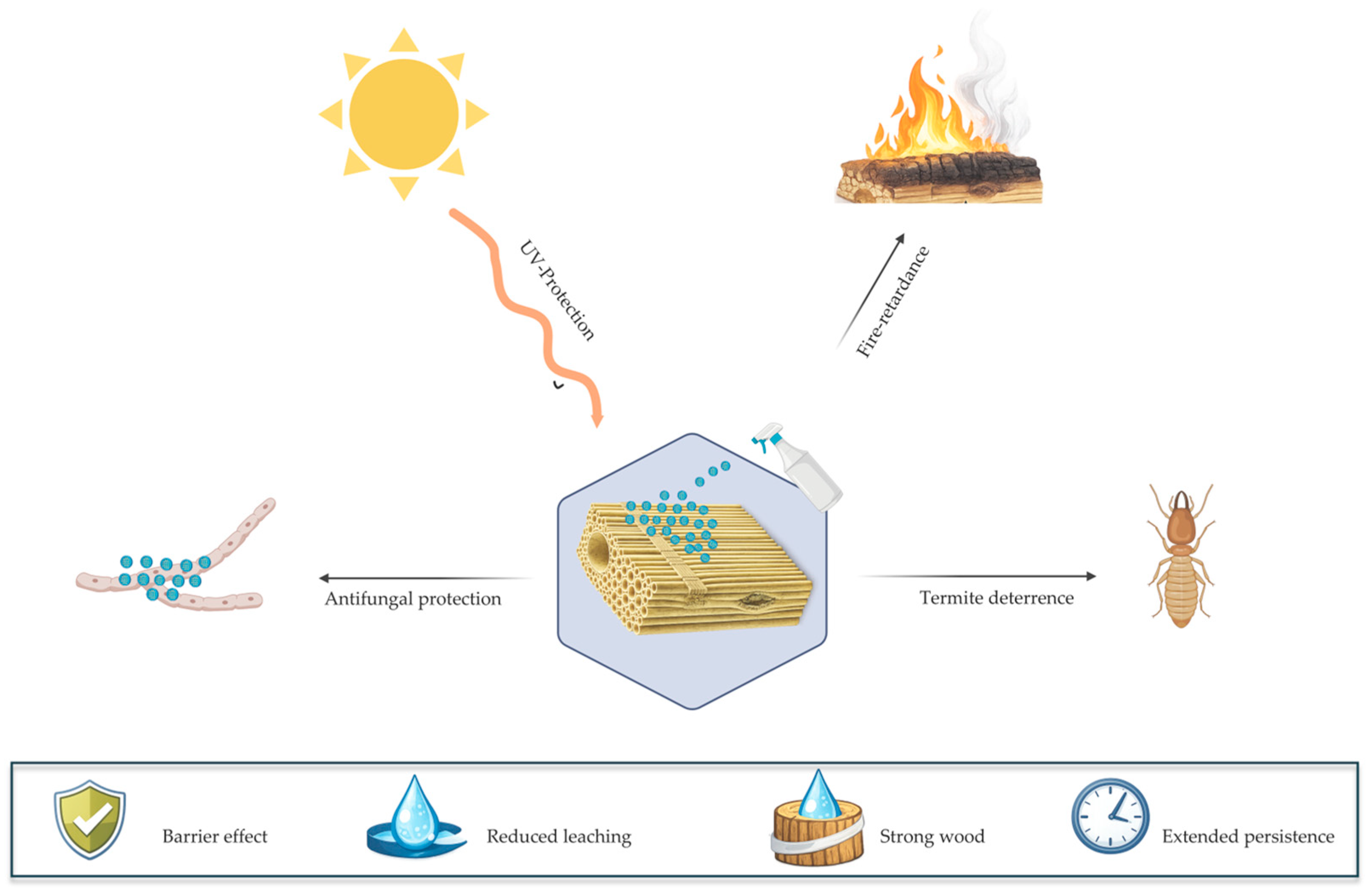
The multifunctional protective mechanisms and durability-related benefits of EO-loaded chitosan nanoparticle systems on wood are summarized schematically in Figure 3. As illustrated in Figure 3, EO-loaded CSNP systems function through multiple, interconnected mechanisms, including surface barrier formation, controlled bioactive release, and stress-responsive performance under moisture and thermal exposure. The schematic emphasizes how antifungal, anti-termite, UV-protective, and thermal-stabilizing effects operate synergistically rather than independently, reinforcing the multifunctional nature of this platform.
As interest in circular bioeconomy approaches grows, CSNP–EO systems offer a compelling intersection of renewable feedstocks, low toxicity, and high functional potential. Continued refinement of formulation stability, environmental safety assessment, and long-term field validation will determine whether CSNP–EO systems transition from promising laboratory innovations to scalable, regulatory-accepted wood preservation technologies.

8. Toward Sustainable Wood Protection via Biopolymer Nanocarriers

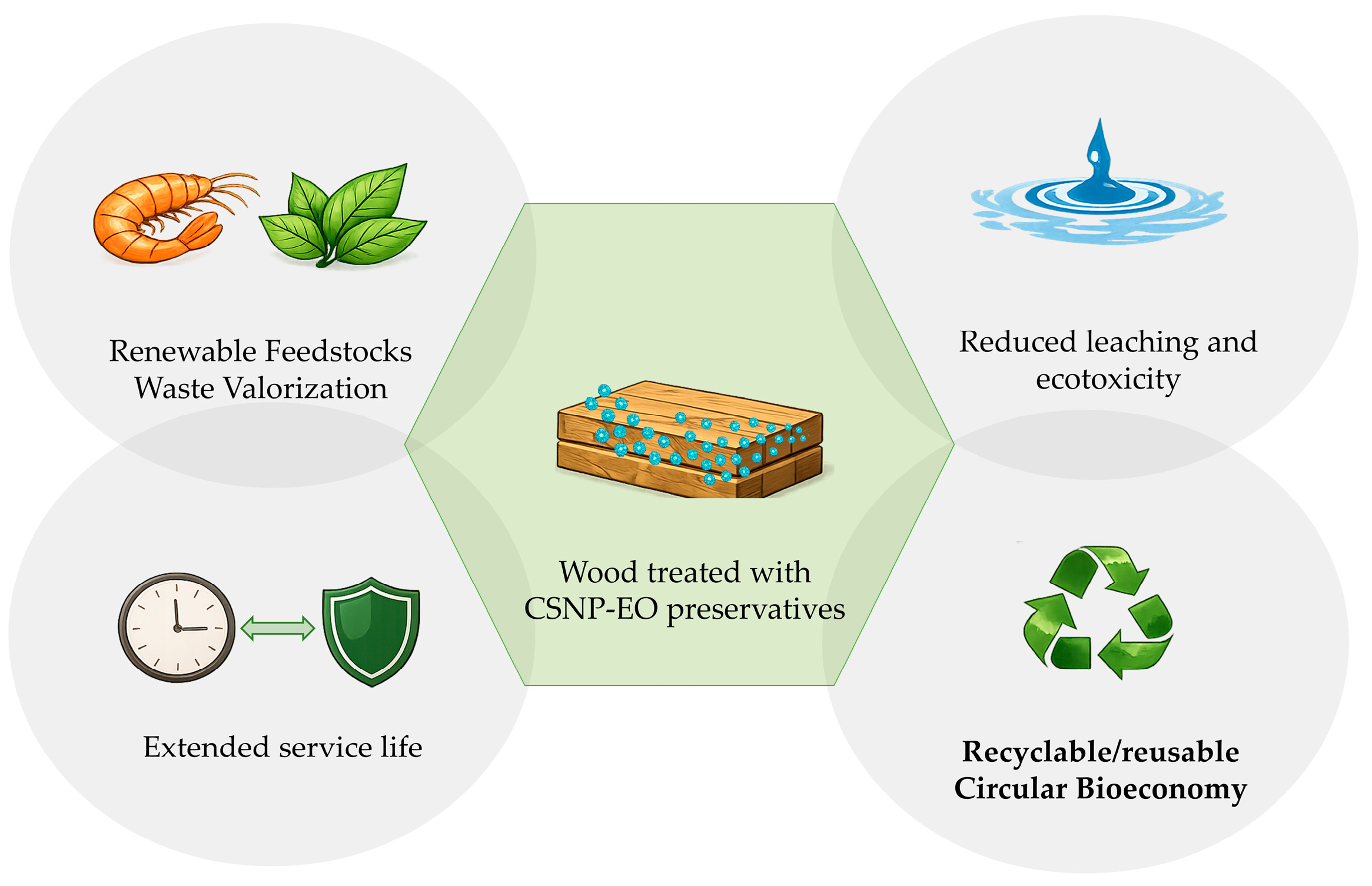
Heavy metals (such as copper, chromium, and arsenic) or synthetic biocide systems have long been used in the conventional wood preservation industry. These systems offer great durability, but they also pose issues with toxicity, leaching into soil and groundwater, and end-of-life disposal limitations [6]. On the other hand, wood preservation techniques that minimize environmental impacts, valorize waste streams, and provide safer end-of-life options are needed in response to the global push toward sustainable materials and the circular bioeconomy [36]. Recent reviews highlight chitosan-based systems as promising tools for sustainable material protection. As a biopolymer made from chitin, a by-product of seafood processing, chitosan offers low toxicity, intrinsic biodegradability, and a way to transform biological waste into useful materials, a fundamental circular-bioeconomy narrative [111,112]. Additionally, sophisticated formulations (nano-sized chitosan particles) contribute to enhanced performance while preserving the eco-credentials of the biopolymer. For instance, Green synthesis studies demonstrate that chitosan nanoparticles retain antifungal efficacy while reducing solvent use and environmental burden [112]. To put it briefly, there is a chance to develop wood protectants that (1) make use of biopolymers obtained from waste; (2) permit high efficacy through nanoscale engineering; and (3) lessen reliance on persistent toxicants, so aligning the approach with sustainability and circular economy objectives. Figure 4 summarizes the key sustainability outcomes of chitosan–essential oil nano-preservatives for wood protection, spanning renewable sourcing, reduced environmental burden, improved use-phase efficiency, and enhanced end-of-life circularity.
Chitin, which is found in large quantities in the biological residual stream of crustacean shell wastes, is the source of chitosan. By transforming this residue into a functional nanocarrier, low-value waste can be transformed into high-value protective materials [113]. In their discussion of the application of chitosan-based agro-nano-chemicals in agriculture, for instance, Maluin & Hussein (2020) highlight how the procedure increases functional performance (e.g., higher bioavailability, lower leaching) and converts crustacean waste in comparison to conventional agrochemicals [114].
The active ingredient, essential oil from plants, is also generated from renewable botanical material rather than synthetic toxicants or mined metals [115]; the nanoparticle carrier, chitosan, is biodegradable and comes from biological feedstock. The “bio-side” of the circular economy butterfly diagram, biological feedstocks, safe chemistry, and possible regeneration/reuse align well with this composition [33]. For instance, it has been demonstrated in other sectors (e.g., packaging), where biopolymer-based nanocomposites improved performance (antimicrobial packaging) with enhanced environmental characteristics because of the biopolymer foundation [55].
Overuse or early failure necessitating reapplication, more upkeep, or early scrap is one factor contributing to the unsustainability of traditional preservatives [116]. Better penetration, higher retention, and controlled release of actives are made possible by nanoengineering, which means that less material, fewer re-treatments, and less input of hazardous materials may be needed for the same volume of wood and service life [17]. The mechanistic benefits (smaller size, increased surface area, improved adhesion/uptake) of chitosan nanoparticles are still applicable to wood materials, even though the agricultural literature predominates in this field [17]. According to the agro-nano-chemicals review, for instance, “the controlled release properties and high bioavailability of the nano-formulations help in minimizing the wastage and leaching of the agrochemicals’ active ingredients” [114,117]. Converting to wood yields improved use-phase sustainability, reduced environmental losses, and increased target-site efficacy.
Because the protective system is metal-free (or at least free of heavy-metal fixatives) and employs biodegradable carriers, the end-of-life options for wood elements treated in this way become more advantageous [11]. Although there are fewer restrictions imposed by residual toxicants, treated wood may be easier to recycle, remanufacture, or reuse [118]. This relieves the strain on disposal and landfill systems, promotes material circularity, and decreases lock-in [119].
Architects, builders, and material specifiers who prioritize biobased content, material transparency, and reduced toxicity increasingly seek alternatives to conventional preservatives, and wood products treated with biopolymer-based nano-preservatives have the potential to meet this emerging demand. Such formulations align closely with sustainability-oriented building frameworks, particularly LEED (Leadership in Energy and Environmental Design) and WELL Building standards, which emphasize ingredient disclosure, low-hazard chemistries, and reduced environmental impact [34,35,120]. This alignment not only strengthens the environmental profile of treated wood but may also open new specification pathways and market segments that require more stringent sustainability credentials [34]. However, the shift toward these innovative systems must be accompanied by rigorous performance validation. Conventional copper- and azole-based preservatives have decades of field data supporting their efficacy, setting a high benchmark for durability, termite resistance, weathering performance, leaching behavior, and cost competitiveness [4]. Demonstrating that chitosan–essential oil nano-formulations can meet or exceed these thresholds in real-world wood environments is therefore essential for the credibility of the circular bioeconomy narrative [10].
Transforming fungal exoskeletons and crustacean shell waste into valuable protective systems, chitosan-essential oil nano-preservatives offer a bio-based, circular alternative to traditional wood treatments. Their biodegradable, metal-free makeup removes worker exposure risks, reduces regulatory and disposal challenges, and enhances recycling or reuse possibilities. Their nanoscale design boosts delivery efficiency, minimizes leaching, and may lessen the need for repeated applications [25,27,121]. These formulations enhance regional bio-economies and reduce supply chains because chitosan and essential oils can be sourced from local agricultural and marine leftovers. Taken together, they provide a promising path for the next generation of sustainable wood protection—if they can demonstrate that they are as durable, effective, and affordable as established preservative systems.

9. Environmental Safety, Toxicity, and Regulatory Considerations

The shift from heavy-metal wood preservatives to bio-based nanomaterials, particularly CSNPs encapsulated with essential oils, creates a more sustainable technological pathway; however, it also raises critical questions about environmental fate, ecotoxicity, and regulatory oversight. Unlike traditional biocides, these nano-bioformulations are biodegradable and derived from renewable feedstocks, yet their behavior in soils, aquatic systems, and long-term wood exposure environments is not fully understood [37,122,123]. Biocompatibility at the macroscopic scale does not guarantee ecological neutrality at the nanoscale [124,125].

9.1. Toxicological Profile of CSNPs

Most evidence suggests CSNPs are relatively safe in terrestrial ecosystems. Their biodegradability stems from microbial chitinases that rapidly depolymerize chitosan into glucosamine, a benign metabolite assimilated by microbes and plants [126,127]. Studies simulating agricultural soils reported that CSNPs at realistic doses (<500 mg/kg) did not significantly impair soil respiration or nitrification, although temporary shifts in bacterial/fungal ratios did occur, likely reflecting the mild antimicrobial nature of chitosan [128,129].
Aquatic systems show slightly higher sensitivity. While low concentrations of CSNPs induce minimal toxicity in invertebrates, higher levels can cause oxidative stress or restricted mobility due to nanoparticle aggregation on exoskeletons [130]. Nonetheless, CSNPs degrade relatively quickly in freshwater via enzymatic hydrolysis and exhibit far lower persistence than synthetic polymer nanoparticles. Importantly, ecotoxicity increases when CSNPs carry entrapped bioactives such as essential oils: although encapsulation slows release and reduces volatilization, it may also prolong low-level antimicrobial pressure on soil fungi or aquatic biofilms [114].
Although available short-term studies suggest relatively low acute toxicity at environmentally relevant concentrations, chronic exposure data for CSNPs in forest soils remain limited. In particular, the long-term effects of repeated wet–dry cycling, UV-induced transformation, and nanoparticle degradation products on soil invertebrates, mycorrhizal fungi, and microbial networks are insufficiently characterized. Defining environmentally realistic dose thresholds for prolonged leaching scenarios from treated wood remains an important research priority.

9.2. Toxicological Profile of Essential Oils

EOs often receive Generally Recognized as Safe (GRAS) status in food applications, but environmental exposure differs dramatically from dietary exposure [131]. Lemongrass essential oil (LGEO), rich in citral, is a potent antimicrobial and insect-repellent compound. At elevated concentrations, citral can inhibit aquatic invertebrates, nematodes, and non-target soil fungi [132]. Although LGEO biodegrades rapidly via oxidation into short-lived aldehydes and fatty-acid analogues [133], transient toxicity still matters when wood structures continuously leach small quantities into surrounding ecosystems. Industrial use alters the exposure pathway. When LGEO is applied directly to wood, rapid volatilization reduces residual toxicity; however, nano-encapsulation slows diffusion, allowing the oil to stay longer at the wood interface [134]. This enhances durability but also changes its environmental impact. “Food grade” designation does not automatically imply environmental safety, especially when oils are stabilized, protected from photodegradation, or delivered through engineered nanocarriers [135].

9.3. Toxicological Considerations of Combined CSNP–EO Systems

The toxicological behavior of combined CSNP–EO systems cannot be inferred directly from the individual components. Encapsulation modifies bioavailability, environmental persistence, and release kinetics, potentially reducing acute peak exposure while prolonging low-level release into surrounding ecosystems. While this controlled-release behavior enhances durability, it may also result in sustained sublethal antimicrobial pressure on soil microbial communities or aquatic biofilms. Systematic ecotoxicological evaluations of intact nanoformulations under realistic field exposure conditions remain scarce.
The regulatory status of CSNP-EO systems is evolving. Under U.S. FIFRA, many essential oil actives (e.g., citral, geraniol) qualify for minimum-risk pesticide exemptions, but this exemption does not extend to nano-formulations. The EPA treats nano-forms as distinct entities requiring toxicological characterization of the whole system, including the carrier [136]. Europe’s Biocidal Products Regulation (BPR) is even stricter; the European Chemical Agency (ECHA) requires separate dossiers for “nanoforms” even when the bulk chemical is approved. Chitosan itself was recently approved as a basic substance biocide in the EU, but chitosan nanoparticles with embedded actives fall outside this simplified category [137,138].
Registration, Evaluation, Authorization, and Restriction of Chemicals (REACH) further mandates disclosure of particle size distribution, surface chemistry, dissolution rates, and release behavior. This reflects a central regulatory principle: nano-scale innovations must undergo nano-scale risk assessment. Bio-based origin does not exempt materials from these obligations [139].

9.4. Knowledge Gaps and Future Research Needs

Despite encouraging short-term safety data, several gaps must be addressed.
Long-term fate: Wood structures persist outdoors for decades. UV radiation, moisture cycles, and microbial colonization gradually break down CSNPs, but the transformation pathways and environmental concentrations remain poorly quantified [140]. There is minimal long-term, field-scale monitoring of CSNP degradation products in forest soils [141].
Off-gassing and slow release: Encapsulation reduces EO volatility but does not eliminate it. As treated wood cycles through wet summers and dry winters, micro-scale vapor release continues. No robust exposure models exist for EO vapor emissions from EO-CSNP-treated wood, especially in enclosed environments [142].
Interactions with wood extractives: Hardwood extractives, especially phenolics, can form covalent or hydrogen-bonded complexes with chitosan. These interactions may slow biodegradation or modify EO release profiles [143,144,145]. Variability across species (pine vs. poplar vs. oak) further complicates the prediction of environmental behavior.
Microbial adaptation: Although essential oils act through multi-target mechanisms, long-term sublethal exposure may select for microbial communities with enhanced tolerance or specialized EO-degrading pathways [146,147].
Available short-term evidence suggests that CSNP–EO systems may exhibit lower acute toxicity and reduced environmental persistence compared with conventional preservatives such as chromated copper arsenate or pentachlorophenol. Their biopolymer origin and biodegradability indicate potential advantages within sustainable material frameworks. However, definitive conclusions regarding long-term ecological safety cannot yet be drawn. Comprehensive chronic toxicity studies, realistic leaching simulations, transformation pathway analyses, and field-scale monitoring are still required. As with all nano-enabled materials, safety should be established through rigorous, exposure-based risk assessment rather than inferred from bio-based origin alone. Addressing these knowledge gaps will be essential for regulatory acceptance and responsible implementation of CSNP–EO preservatives.

10. Challenges and Research Gaps

The rapid expansion of biobased wood protection technologies, particularly those involving chitosan nanoparticles and essential oils, has generated considerable optimism, yet the field continues to face a series of conceptual and practical challenges that limit widespread adoption. One of the most persistent issues concerns the inconsistency of performance across different wood species and environmental conditions. While laboratory studies frequently report strong antifungal or insecticidal activity, these outcomes often diminish under fluctuating moisture, ultraviolet exposure, or soil contact, revealing a gap between controlled experiments and real-world service environments [10,16]. Essential oils, despite their potent bioactivity, remain highly volatile and prone to rapid depletion, even when encapsulated, which complicates predictions of long-term efficacy [10,148]. Similarly, chitosan-based systems exhibit variable penetration and retention depending on molecular weight, degree of deacetylation, and the anatomical structure of the wood substrate [65,66]. These inconsistencies underscore the need for more rigorous, standardized testing protocols that reflect realistic exposure scenarios and account for the inherent heterogeneity of wood as a biological material.
Another major challenge lies in the limited understanding of the mechanistic interactions between nano-enabled preservatives and wood microstructure. Although chitosan nanoparticles demonstrate promising adhesion to lignocellulosic surfaces, the precise nature of their bonding, diffusion pathways, and long-term stability remains insufficiently characterized [68,69]. Many studies rely on surface-level observations or short-term assays, leaving unanswered questions regarding nanoparticle migration, aggregation, or transformation within the wood matrix over extended periods. The complexity increases when essential oils are incorporated, as their release kinetics depend not only on nanoparticle architecture but also on environmental triggers such as pH, humidity, or microbial activity [79,149]. Without a deeper mechanistic framework, it is difficult to optimize formulations for predictable, sustained performance. This gap is particularly evident when comparing biomedical or food-packaging applications, where chitosan systems are more thoroughly studied, to wood protection, where far fewer investigations have explored nanoscale interactions in situ [150,151].
Further limitations concern the durability and leaching resistance of biobased preservatives. Even when encapsulated, essential oils and plant-derived compounds often exhibit significant mass loss during water immersion or soil exposure, reducing their protective lifespan [10,152]. Chitosan itself, though less prone to leaching than unbound oils, remains susceptible to gradual dissolution or depolymerization under acidic or highly humid conditions [21]. Studies on pH-responsive or dual-stimuli systems demonstrate potential for controlled release, yet these technologies have rarely been validated under long-term outdoor weathering or field trials [153]. The absence of comprehensive durability data limits regulatory acceptance and industrial confidence. Moreover, the interaction between biobased preservatives and natural wood extractives, some of which may inhibit bonding or accelerate degradation, remains poorly understood, further complicating predictions of service life [24,40].
Scalability and manufacturing constraints also present significant barriers to commercialization. Many nanoparticle synthesis routes, such as reverse micelle formation, microfluidic processing, or enzymatic crosslinking, are technically sophisticated and difficult to scale, without compromising particle uniformity or stability [72,73]. Even ionic gelation, the most widely used method, can produce variable particle sizes when scaled beyond laboratory volumes, affecting penetration and release behavior in wood [70,71]. Industrial wood treatment facilities require formulations that are stable during storage, compatible with existing pressure or vacuum systems, and cost-effective relative to conventional preservatives. However, few studies have evaluated the rheology, shelf stability, or large-scale production economics of chitosan–essential oil nanocomposites [154,155]. Without addressing these practical constraints, even highly effective laboratory formulations may struggle to transition into commercial practice.
Environmental and toxicological uncertainties represent another critical research gap. Although chitosan is generally regarded as safe and biodegradable, nanoparticle behavior in soil, aquatic systems, and on non-target organisms remains insufficiently documented [127,156]. Some studies indicate that chitosan-metal nanocomposites or chitosan-stabilized inorganic nanoparticles may introduce ecotoxicological risks, depending on their degradation products or interactions with soil microbiota [156,157]. Essential oils, while natural, can also exhibit phytotoxicity or disrupt beneficial microbial communities when applied at high concentrations [158]. Regulatory frameworks for nano-enabled wood preservatives differ across jurisdictions and remain under active development. In the European Union, wood preservatives fall under the Biocidal Products Regulation (Regulation (EU) No 528/2012, Product Type 8), with additional substance-level restrictions implemented under REACH. In the United States, wood preservatives are regulated as pesticides under the Federal Insecticide, Fungicide, and Rodenticide Act (FIFRA) by the U.S. Environmental Protection Agency (EPA), where approvals are typically based on registration review and use-specific labeling rather than blanket prohibitions. International agreements also influence national regulatory decisions. Certain historically used wood preservatives are addressed under multilateral environmental agreements such as the Stockholm Convention on Persistent Organic Pollutants (POPs) and the Rotterdam Convention on Prior Informed Consent, which guide restrictions and phase-outs at the global level. As a result, what may be described as a “ban” in one region often reflects use-specific restrictions or conditional approvals that differ between the EU, North America, and other jurisdictions. Long-term fate studies, including nanoparticle transformation, bioaccumulation potential, and interactions with soil enzymes under region-specific climatic conditions, are urgently needed to ensure that bio-based alternatives comply with both EU and US nano-specific risk assessment requirements, consistent with OECD guidance on the safety evaluation of manufactured nanomaterials [159,160,161].
Finally, the field lacks integrative, interdisciplinary approaches that combine materials science, wood biology, nanotechnology, and environmental chemistry. Most studies focus on isolated performance metrics, such as antifungal activity or release kinetics, without consistently connecting these findings to broader system-level considerations such as life cycle impacts, carbon footprint, or compatibility with circular bioeconomy principles [19,162]. There is also limited collaboration between academic researchers and industrial stakeholders, resulting in a disconnect between laboratory innovation and practical implementation. Emerging technologies such as machine learning-assisted formulation design, in situ nanoscale imaging, and multiscale modeling of wood–nanoparticle interactions remain underutilized, despite their potential to accelerate optimization and reduce experimental uncertainty [163]. Addressing these gaps will require coordinated research efforts, standardized methodologies, and long-term field validation to establish bio-based nano-preservatives as credible, high-performance alternatives to conventional wood protection systems. Harmonization of testing standards and clearer regulatory guidance for nano-enabled biocides will be essential to ensure consistent global adoption while maintaining environmental and human health protections.

11. Future Directions and Emerging Innovations

The future of sustainable wood protection increasingly points toward multifunctional systems capable of adapting to changing environmental conditions rather than relying on passive and continuous protection. Recent studies on chitosan-based microcapsules indicate that release behavior can be tailored to moisture and pH variations. This suggests new opportunities for smart wood coatings that activate preferentially when decay-promoting conditions arise [164]. Such moisture-responsive systems, along with those seen in advanced wood wax coating microcapsules, open pathways toward self-repairing and condition-triggered antifungal action without unnecessary leaching in dry conditions. Extension of this concept to essential oil carriers and hybrid matrix networks could significantly extend service life while reducing unnecessary bioactive loss. Smart polymers from other fields, where responsiveness to temperature, moisture, and other stimuli is widely studied, can offer valuable design insights [165]. Integrating these capabilities into wood preservation systems will require careful control of release kinetics and structural performance under environmental stress.
Another forward-looking approach involves the development of bio-based hybrid composites, in which chitosan and related biopolymers are integrated with selected nano-scale additives to expand functional performance. Recent nanotechnology-focused studies suggest that incorporating materials such as metal oxide nanoparticles, cellulose nanocrystals, or graphene-based fillers into coating matrices can simultaneously enhance durability, ultraviolet stability, moisture resistance, and antimicrobial efficacy [166,167]. For example, nanocoatings utilizing zinc oxide and reduced graphene oxide have shown improved mold resistance and dimensional stability in wood products by leveraging a synergy of structural and antimicrobial functions. Integrating such nano-additives with chitosan matrices could produce composite systems that offer mechanical reinforcement and biological protection in a single formulation, reducing layering complexity and treatment cycles.
In the realm of nanotechnology-enhanced wood protection, comprehensive reviews indicate that ongoing advancements in polymer nanocomposites and nanoscale delivery systems are rapidly expanding the functional toolbox for preservative design [168]. Future investigations are likely to concentrate on refining nanostructured carrier systems so that active compounds can be delivered more precisely within wood, with diffusion behavior adapted to anatomical features of the substrate. A key challenge will be shifting from trial-based formulation toward predictive performance, supported by well-controlled synthesis strategies that are scalable, reproducible, and capable of delivering consistent results across different wood species and treatment environments.
Data-driven materials design and artificial intelligence (AI) represent another frontier for wood preservative formulation. Recent discussions in the broader materials science community emphasize how generative AI and machine learning can derive structure–property relationships, optimize composite designs, and generate hypotheses for experimental validation [169]. Biomimetic and bio-inspired material design using AI, for example, extracting humidity-responsive structural motifs from plants, suggests a path toward coatings that intrinsically adapt to environmental cues [170]. Applying such approaches in wood science could accelerate discovery, reduce experimental load, and identify non-intuitive combinations of matrix materials, nanoparticles, and bioactive agents that maximize durability while minimizing environmental impact.
Sustainability and circular bioeconomy principles will increasingly shape the future of wood protection research. Reviews of the wood coatings industry reveal a strong movement toward bio-based resources, eco-friendly additives, and circular strategies that valorize waste streams while enhancing protective performance [171]. Integrating bio-derived pigments, natural fillers, and renewable polymer backbones into coatings presents opportunities to reduce ecological burden and align wood protection with broader sustainability goals. Life-cycle assessment tools should be incorporated early in development to quantitatively balance performance benefits against environmental costs, avoiding solutions that trade one impact for another.
Translating laboratory innovations into industrial applications remains a non-trivial challenge but is critical for impact. The comprehensive wood protection landscape shows that nanotechnology and bio-based strategies are evolving toward commercial viability, yet few studies assess scalability, cost effectiveness, or compatibility with existing pressure-treatment infrastructure. Collaborative pilot projects involving material scientists, wood product industries, and equipment manufacturers are essential to evaluate real-world feasibility and inform regulatory frameworks that are currently underdeveloped for nano-enabled preservative systems [167,171]. This translational emphasis will also help identify cost–benefit thresholds, retrofit pathways for existing facilities, and potential market segments most receptive to sustainable wood protection products.
Finally, holistic, interdisciplinary frameworks that encompass materials design, environmental behavior, and regulatory compliance will be crucial in advancing the field. Inspired by concepts from bio design, which unite biological systems with engineering practices to create sustainable materials, wood protection research can benefit from systems thinking that considers ecological, material, and human health outcomes together (Bio-design principles). By drawing on lessons from adjacent domains such as heritage conservation, responsive polymers, and smart composites, researchers can craft more robust, adaptable preservative systems. Ultimately, merging materials innovation with ecological insight and practical implementation strategies will be key to realizing bio-based, high-performance wood protection solutions for the built environment.

12. Conclusions

This review examines chitosan nanoparticle-based encapsulation of essential oils as an emerging strategy for sustainable wood protection. By integrating advances in nanotechnology and bio-based materials, such systems aim to address key limitations of essential oils, including volatility, leaching, and limited durability under moisture exposure, while maintaining reported antifungal and insect-repellent activity. Chitosan nanoparticles contribute not only as delivery vehicles, but also through inherent antimicrobial effects, strong interactions with lignocellulosic substrates, and barrier properties that enhance retention and controlled release of bioactives.
Beyond performance benefits, chitosan–essential oil nano-formulations align with circular bioeconomy and green chemistry principles by utilizing renewable and waste-derived feedstocks and avoiding heavy metals and persistent synthetic biocides. However, challenges remain related to long-term field performance, release behavior under realistic service conditions, scalability, and environmental fate. Addressing these gaps through standardized testing and interdisciplinary research will be essential to advancing practical implementation. Overall, chitosan-based encapsulation of essential oils represents a flexible platform with potential for the development of next-generation, lower-hazard wood protection systems that meet both technical and sustainability demands.

Author Contributions

Conceptualization, N.A. and G.D.B.-S.; methodology, N.A.; writing original draft preparation, N.A.; writing—review and editing, E.B.H.; visualization, N.A.; supervision, G.D.B.-S., E.B.H. and C.E.S. All authors have read and agreed to the published version of the manuscript.

Funding

This material is based upon work that was supported by the National Institute of Food and Agriculture, U.S. Department of Agriculture, McIntire Stennis project under accession number 7004895.

Institutional Review Board Statement

Not applicable.

Informed Consent Statement

Not applicable.

Data Availability Statement

No new data were created or analyzed in this study. Data sharing is not applicable to this article.

Acknowledgments

This manuscript is publication #SB1185 of the Sustainable Bioproducts, Mississippi State University. This publication is a contribution of the Forest and Wildlife Research Center, Mississippi State University.

Conflicts of Interest

The authors declare no conflicts of interest.

Abbreviations

ACQAlkaline copper quaternary
ACQ-DAlkaline copper quaternary type D (carbonate)
CACopper azole
CCAChromated copper arsenate
CSNPChitosan nanoparticle
CSNPsChitosan nanoparticles
CSNP–EOChitosan nanoparticle–essential oil (system/formulation)
DDDegree of deacetylation
ECHAEuropean Chemicals Agency
EOEssential oil
EO–CSNPEssential oil-loaded chitosan nanoparticle (system/formulation)
EOsEssential oils
EPAU.S. Environmental Protection Agency
EUEuropean Union
FAOFood and Agriculture Organization (United Nations)
GRASGenerally Recognized as Safe
LGEOLemongrass essential oil
MWMolecular weight
OECDOrganization for Economic Co-operation and Development
PAHsPolycyclic aromatic hydrocarbons
PCPPentachlorophenol
REACHRegistration, Evaluation, Authorization, and Restriction of Chemicals
UVUltraviolet
VOCVolatile organic compounds
WELLWELL Building Standard

References

  1. Oi, F. A Review of the Evolution of Termite Control: A Continuum of Alternatives to Termiticides in the United States with Emphasis on Efficacy Testing Requirements for Product Registration. Insects 2022, 13, 50. [Google Scholar] [CrossRef]
  2. Schultz, T.P.; Nicholas, D.D.; Preston, A.F. A brief review of the past, present and future of wood preservation. Pest Manag. Sci. 2007, 63, 784–788. [Google Scholar] [CrossRef]
  3. Peterson, B.F.; Scharf, M.E. Lower Termite Associations with Microbes: Synergy, Protection, and Interplay. Front. Microbiol. 2016, 7, 422. [Google Scholar] [CrossRef] [PubMed]
  4. Freeman, M.H.; McIntyre, C. A comprehensive review of copper-based wood preservatives with a focus on new micronized or dispersed copper systems. For. Prod. J. 2008, 58, 6–27. [Google Scholar]
  5. Lebow, S.T.; Cooper, P.; Lebow, P.K. Variability in Evaluating Environmental Impacts of Treated Wood; US Forest Service Research and Development: Portland, OR, USA, 2004.
  6. Morais, S.; Fonseca, H.M.A.C.; Oliveira, S.M.R.; Oliveira, H.; Gupta, V.K.; Sharma, B.; de Lourdes Pereira, M. Environmental and Health Hazards of Chromated Copper Arsenate-Treated Wood: A Review. Int. J. Environ. Res. Public Health 2021, 18, 5518. [Google Scholar] [CrossRef]
  7. Changotra, R.; Rajput, H.; Liu, B.; Murray, G.; He, Q. Occurrence, fate, and potential impacts of wood preservatives in the environment: Challenges and environmentally friendly solutions. Chemosphere 2024, 352, 141291. [Google Scholar] [CrossRef] [PubMed]
  8. Lebow, S.; Brooks, K.; Simonsen, J. Environmental Impact of Treated Wood in Service; USDA Forest Service: Washington, DC, USA, 2002.
  9. Brinch, A.; Hansen, S.F.; Hartmann, N.B.; Baun, A. EU Regulation of Nanobiocides: Challenges in Implementing the Biocidal Product Regulation (BPR). Nanomaterials 2016, 6, 33. [Google Scholar] [CrossRef]
  10. Broda, M. Natural Compounds for Wood Protection against Fungi—A Review. Molecules 2020, 25, 3538. [Google Scholar] [CrossRef]
  11. Teacă, C.A.; Roşu, D.; Mustaţă, F.; Rusu, T.; Roşu, L.; Roşca, I.; Varganici, C.D. Natural bio-based products for wood coating and protection against degradation: A review. BioResources 2019, 14, 4873–4901. [Google Scholar] [CrossRef]
  12. Kartal, S.; Hwang, W.-J.; Imamura, Y.; Sekine, Y. Effect of essential oil compounds and plant extracts on decay and termite resistance of wood. Holz Als Roh-Und Werkst. 2006, 64, 455–461. [Google Scholar] [CrossRef]
  13. Isman, M.B. Bioinsecticides based on plant essential oils: A short overview. Z. Für Naturforschung C 2020, 75, 179–182. [Google Scholar] [CrossRef]
  14. Burt, S. Essential oils: Their antibacterial properties and potential applications in foods—A review. Int. J. Food Microbiol. 2004, 94, 223–253. [Google Scholar] [CrossRef]
  15. Tascioglu, C.; Yalcin, M.; Sen, S.; Akcay, C. Antifungal properties of some plant extracts used as wood preservatives. Int. Biodeterior. Biodegrad. 2013, 85, 23–28. [Google Scholar] [CrossRef]
  16. Barbero-Lopez, A.; Akkanen, J.; Lappalainen, R.; Peraniemi, S.; Haapala, A. Bio-based wood preservatives: Their efficiency, leaching and ecotoxicity compared to a commercial wood preservative. Sci. Total Environ. 2021, 753, 142013. [Google Scholar] [CrossRef] [PubMed]
  17. Ong, Z.; Mat Arip, M.N.; Lipeh, S.; Besserer, A.; Brosse, N.; Fredon, E.; Singham, G.V.; Yuen, K.H.; Lee, H.L. Advances in wood preservation technology: A review of conventional and nanotechnology preservation approaches. BioResources 2025, 20, 8209–8255. [Google Scholar] [CrossRef]
  18. Papadopoulos, A.N.; Taghiyari, H.R. Innovative Wood Surface Treatments Based on Nanotechnology. Coatings 2019, 9, 866. [Google Scholar] [CrossRef]
  19. Amiri, H.; Aghbashlo, M.; Sharma, M.; Gaffey, J.; Manning, L.; Moosavi Basri, S.M.; Kennedy, J.F.; Gupta, V.K.; Tabatabaei, M. Chitin and chitosan derived from crustacean waste valorization streams can support food systems and the UN Sustainable Development Goals. Nat. Food 2022, 3, 822–828. [Google Scholar] [CrossRef]
  20. Ke, C.-L.; Deng, F.-S.; Chuang, C.-Y.; Lin, C.-H. Antimicrobial Actions and Applications of Chitosan. Polymers 2021, 13, 904. [Google Scholar] [CrossRef]
  21. Raafat, D.; Sahl, H.G. Chitosan and its antimicrobial potential—A critical literature survey. Microb. Biotechnol. 2009, 2, 186–201. [Google Scholar] [CrossRef]
  22. Hu, B.; Pan, C.; Sun, Y.; Hou, Z.; Ye, H.; Hu, B.; Zeng, X. Optimization of Fabrication Parameters To Produce Chitosan−Tripolyphosphate Nanoparticles for Delivery of Tea Catechins. J. Agric. Food Chem. 2008, 56, 7451–7458. [Google Scholar] [CrossRef]
  23. Vaezifar, S.; Razavi, S.; Golozar, M.A.; Karbasi, S.; Morshed, M.; Kamali, M. Effects of Some Parameters on Particle Size Distribution of Chitosan Nanoparticles Prepared by Ionic Gelation Method. J. Clust. Sci. 2013, 24, 891–903. [Google Scholar] [CrossRef]
  24. Facchi, S.P.; de Almeida, D.A.; Abrantes, K.K.B.; Rodrigues, P.C.d.S.; Tessmann, D.J.; Bonafé, E.G.; da Silva, M.F.; Gashti, M.P.; Martins, A.F.; Cardozo-Filho, L. Ultra-Pressurized Deposition of Hydrophobic Chitosan Surface Coating on Wood for Fungal Resistance. Int. J. Mol. Sci. 2024, 25, 10899. [Google Scholar] [CrossRef] [PubMed]
  25. Khademibami, L.; Jeremic, D.; Shmulsky, R.; Barnes, H.M. Chitosan oligomers and related nanoparticles as environmentally friendly wood preservatives. BioResources 2020, 15, 2800–2817. [Google Scholar] [CrossRef]
  26. Papadopoulos, A.N.; Foti, D.; Kyzas, G.Z. Sorption behavior of water vapor of wood treated by chitosan polymer. Eur. J. Wood Wood Prod. 2020, 78, 483–491. [Google Scholar] [CrossRef]
  27. Yang, Y.; Aghbashlo, M.; Gupta, V.K.; Amiri, H.; Pan, J.; Tabatabaei, M.; Rajaei, A. Chitosan nanocarriers containing essential oils as a green strategy to improve the functional properties of chitosan: A review. Int. J. Biol. Macromol. 2023, 236, 123954. [Google Scholar] [CrossRef]
  28. Hosseini, S.F.; Zandi, M.; Rezaei, M.; Farahmandghavi, F. Two-step method for encapsulation of oregano essential oil in chitosan nanoparticles: Preparation, characterization and in vitro release study. Carbohydr. Polym. 2013, 95, 50–56. [Google Scholar] [CrossRef] [PubMed]
  29. Maes, C.; Bouquillon, S.; Fauconnier, M.-L. Encapsulation of Essential Oils for the Development of Biosourced Pesticides with Controlled Release: A Review. Molecules 2019, 24, 2539. [Google Scholar] [CrossRef]
  30. Soltanzadeh, M.; Peighambardoust, S.H.; Ghanbarzadeh, B.; Mohammadi, M.; Lorenzo, J.M. Chitosan nanoparticles encapsulating lemongrass (Cymbopogon commutatus) essential oil: Physicochemical, structural, antimicrobial and in-vitro release properties. Int. J. Biol. Macromol. 2021, 192, 1084–1097. [Google Scholar] [CrossRef] [PubMed]
  31. Granata, G.; Stracquadanio, S.; Leonardi, M.; Napoli, E.; Malandrino, G.; Cafiso, V.; Stefani, S.; Geraci, C. Oregano and Thyme Essential Oils Encapsulated in Chitosan Nanoparticles as Effective Antimicrobial Agents against Foodborne Pathogens. Molecules 2021, 26, 4055. [Google Scholar] [CrossRef]
  32. Lucia, A.; Murace, M.; Sartor, G.; Keil, G.; Cámera, R.; Rubio, R.G.; Guzmán, E. Oil in Water Nanoemulsions Loaded with Tebuconazole for Populus Wood Protection against White- and Brown-Rot Fungi. Forests 2021, 12, 1234. [Google Scholar] [CrossRef]
  33. Tan, E.C.D.; Lamers, P. Circular Bioeconomy Concepts—A Perspective. Front. Sustain. 2021, 2, 701509. [Google Scholar] [CrossRef]
  34. Goodwin Robbins, L.J.; Rodgers, K.M.; Walsh, B.; Ain, R.; Dodson, R.E. Pruning chemicals from the green building landscape. J. Expo. Sci. Environ. Epidemiol. 2020, 30, 236–246. [Google Scholar] [CrossRef]
  35. Ebbini, G.W. Transforming health: The WELL Building Standard’s role in sustainable development. Cell Rep. Sustain. 2024, 1, 100100. [Google Scholar] [CrossRef]
  36. Hassegawa, M.; Van Brusselen, J.; Cramm, M.; Verkerk, P.J. Wood-Based Products in the Circular Bioeconomy: Status and Opportunities towards Environmental Sustainability. Land 2022, 11, 2131. [Google Scholar] [CrossRef]
  37. Koumentakou, I.; Meretoudi, A.; Emmanouil, C.; Kyzas, G.Z. Environmental toxicity and biodegradation of chitosan derivatives: A comprehensive review. J. Ind. Eng. Chem. 2025, 146, 70–86. [Google Scholar] [CrossRef]
  38. González-Laredo, R.F.; Rosales-Castro, M.; Rocha-Guzmán, N.E.; Gallegos Infante, J.A.; Moreno-Jiménez, M.R.; Karchesy, J.J. Wood preservation using natural products. Madera Y Bosques 2015, 21, 63–76. [Google Scholar] [CrossRef]
  39. Kohli, K.; Kumar, S. Wood Preservation: Technologies for the Twenty first Century. Indian For. 1985, 111, 987–997. [Google Scholar]
  40. Gérardin, P. New alternatives for wood preservation based on thermal and chemical modification of wood—A review. Ann. For. Sci. 2016, 73, 559–570. [Google Scholar] [CrossRef]
  41. Smith, S.T. Water-Borne Wood Preservation and End-of-Life Removal History and Projection. Engineering 2020, 12, 117–139. [Google Scholar] [CrossRef][Green Version]
  42. Kang, S.M.; Morrell, J.J.; Simonsen, J.; Lebow, S. Creosote movement from treated wood immersed in fresh water. For. Prod. J. 2005, 55, 42–46. [Google Scholar]
  43. Khademibami, L.; Bobadilha, G.S. Recent Developments Studies on Wood Protection Research in Academia: A Review. Front. For. Glob. Change 2022, 5, 793177. [Google Scholar] [CrossRef]
  44. C.U., E.; Q, H.; K, K. Pentachlorophenol and its effect on different environmental matrices: The need for an alternative wood preservative. Sustain. Earth Rev. 2024, 7, 22. [Google Scholar] [CrossRef]
  45. Kulkarni, S.J. Investigation and Insight into Wood Preservation: A Summary. Int. J. Reserach Rev. 2017, 4, 14–18. [Google Scholar]
  46. Morris, P.I.; Stirling, R.; Ingram, J. Ten-year performance of stakes and decking treated with copper azole type B and alkaline copper Quat type D (carbonate). For. Prod. J. 2017, 67, 13–23. [Google Scholar] [CrossRef]
  47. Lebow, S.T. Alternatives to Chromated Copper Arsenate for Residential Construction; Forest Products Laboratory, Forest Service, U.S. Department of Agriculture: Madison, WI, USA, 2004; Volume 618.
  48. Lebow, S. Leaching of Wood Preservative Components and Their Mobility in the Environment: Summary of Pertinent Literature; US Forest Service Research and Development: Portland, OR, USA, 1996.
  49. Waldron, L.; Cooper, P.A.; Ung, T.Y. Prediction of long-term leaching potential of preservative-treated wood by diffusion modeling. Holzforschung 2005, 59, 581–588. [Google Scholar] [CrossRef]
  50. Liu, Z.; Wen, L.; Wang, X.; Zhang, Y.; Cai, L. Leachability of ACQ-D after Three Different Preservative Treatments. Wood Res. 2020, 65, 591–604. [Google Scholar] [CrossRef]
  51. Brooks, K.M. Assessment of the Environmental Effects Associated with Wooden Bridges Preserved with Creosote, Pentachlorophenol, or Chromated Copper Arsenate; US Forest Service Research and Development: Portland, OR, USA, 2000.
  52. United States Environmental Protection Agency. EPA Requires Cancellation of Pentachlorophenol to Protect Human Health; United States Environmental Protection Agency: Washington, DC, USA, 2022.
  53. Mantanis, G.I. Chemical Modification of Wood by Acetylation or Furfurylation: A Review of the Present Scaled-up Technologies. BioResources 2017, 12, 4478–4489. [Google Scholar] [CrossRef]
  54. Sahoo, K.; Bergman, R.; Alanya-Rosenbaum, S.; Gu, H.; Liang, S. Life cycle assessment of forest-based products: A review. Sustainability 2019, 11, 4722. [Google Scholar] [CrossRef]
  55. Kumar, S.; Mukherjee, A.; Dutta, J. Chitosan based nanocomposite films and coatings: Emerging antimicrobial food packaging alternatives. Trends Food Sci. Technol. 2020, 97, 196–209. [Google Scholar] [CrossRef]
  56. Alsalamah, S.A.; Alghonaim, M.I.; Al Abboud, M.A. Role of nanoparticles for wood protection from decaying microorganisms and their enzymes: A review study. BioResources 2025, 20, 8119–8134. [Google Scholar] [CrossRef]
  57. Sivanesan, I.; Gopal, J.; Muthu, M.; Shin, J.; Mari, S.; Oh, J. Green Synthesized Chitosan/Chitosan Nanoforms/Nanocomposites for Drug Delivery Applications. Polymers 2021, 13, 2256. [Google Scholar] [CrossRef] [PubMed]
  58. Hazarika, A.; Baishya, P.; Maji, T.K. Bio-based Wood Polymer Nanocomposites: A Sustainable High-Performance Material for Future. In Eco-Friendly Polymer Nanocomposites; Springer: Berlin/Heidelberg, Germany, 2015; pp. 233–257. [Google Scholar]
  59. Walker, K.; Rajput, H.; Murray, A.; Stratton, G.W.; Murray, G.; He, Q. Fungal Resistance and Leaching Behavior of Wood Treated with Creosote Diluted with a Mixture of Biodiesel and Diesel. Forests 2023, 14, 625. [Google Scholar] [CrossRef]
  60. Janezic, T.S.; Cooper, P.A.; Ung, Y.T. Chromated Copper Arsenate Preservative Treatment of North American Hardwoods. Part 1. CCA Fixation Performance. Holzforschung 2000, 54, 577–584. [Google Scholar] [CrossRef]
  61. Vargas, J.R.; Yermán, L.; Wood, K.C.; Singh, T. Chemical migration and redistribution of chromated copper arsenate (CCA) components in Eucalyptus nitens heartwood under accelerated weathering. Wood Mater. Sci. Eng. 2025, 1–8. [Google Scholar] [CrossRef]
  62. Aranaz, I.; Alcántara, A.R.; Civera, M.C.; Arias, C.; Elorza, B.; Heras Caballero, A.; Acosta, N. Chitosan: An Overview of Its Properties and Applications. Polymers 2021, 13, 3256. [Google Scholar] [CrossRef]
  63. Iñiguez-Moreno, M.; Santiesteban-Romero, B.; Melchor-Martínez, E.M.; Parra-Saldívar, R.; González-González, R.B. Valorization of fishery industry waste: Chitosan extraction and its application in the industry. MethodsX 2024, 13, 102892. [Google Scholar] [CrossRef]
  64. Silva-Castro, I.; Casados-Sanz, M.; Alonso-Cortés, A.L.; Martín-Ramos, P.; Martín-Gil, J.; Acuña-Rello, L. Chitosan-Based Coatings to Prevent the Decay of Populus spp. Wood Caused by Trametes Versicolor. Coatings 2018, 8, 415. [Google Scholar] [CrossRef]
  65. Wang, H.; Roman, M. Effects of Chitosan Molecular Weight and Degree of Deacetylation on Chitosan−Cellulose Nanocrystal Complexes and Their Formation. Molecules 2023, 28, 1361. [Google Scholar] [CrossRef]
  66. Nguyen, H.T.-T.; Tran, T.N.; Ha, A.C.; Huynh, P.D. Impact of Deacetylation Degree on Properties of Chitosan for Formation of Electrosprayed Nanoparticles. J. Nanotechnol. 2022, 2022, 2288892. [Google Scholar] [CrossRef]
  67. Liu, T.; Li, J.; Tang, Q.; Qiu, P.; Gou, D.; Zhao, J. Chitosan-Based Materials: An Overview of Potential Applications in Food Packaging. Foods 2022, 11, 1490. [Google Scholar] [CrossRef]
  68. Zou, Z.; Ismail, B.B.; Zhang, X.; Yang, Z.; Liu, D.; Guo, M. Improving barrier and antibacterial properties of chitosan composite films by incorporating lignin nanoparticles and acylated soy protein isolate nanogel. Food Hydrocoll. 2023, 134, 108091. [Google Scholar] [CrossRef]
  69. Silvestre, J.; Delattre, C.; Michaud, P.; de Baynast, H. Optimization of Chitosan Properties with the Aim of a Water Resistant Adhesive Development. Polymers 2021, 13, 4031. [Google Scholar] [CrossRef] [PubMed]
  70. Gutiérrez-Ruíz, S.C.; Cortes, H.; González-Torres, M.; Almarhoon, Z.M.; Gürer, E.S.; Sharifi-Rad, J.; Leyva-Gómez, G. Optimize the parameters for the synthesis by the ionic gelation technique, purification, and freeze-drying of chitosan-sodium tripolyphosphate nanoparticles for biomedical purposes. J. Biol. Eng. 2024, 18, 12. [Google Scholar] [CrossRef]
  71. Agarwal, M.; Agarwal, M.K.; Shrivastav, N.; Pandey, S.; Das, R.; Gaur, P. Preparation of Chitosan Nanoparticles and their In-vitro Characterization. Int. J. Life-Sci. Sci. Res. 2018, 4, 1713–1720. [Google Scholar] [CrossRef]
  72. Orellano, M.S.; Porporatto, C.; Silber, J.J.; Falcone, R.D.; Correa, N.M. AOT reverse micelles as versatile reaction media for chitosan nanoparticles synthesis. Carbohydr. Polym. 2017, 171, 85–93. [Google Scholar] [CrossRef]
  73. Silva, N.C.; Chevigny, C.; Domenek, S.; Almeida, G.; Assis, O.B.G.; Martelli-Tosi, M. Nanoencapsulation of active compounds in chitosan by ionic gelation: Physicochemical, active properties and application in packaging. Food Chem. 2025, 463, 141129. [Google Scholar] [CrossRef]
  74. Kildeeva, N.; Chalykh, A.; Belokon, M.; Petrova, T.; Matveev, V.; Svidchenko, E.; Surin, N.; Sazhnev, N. Influence of Genipin Crosslinking on the Properties of Chitosan-Based Films. Polymers 2020, 12, 1086. [Google Scholar] [CrossRef] [PubMed]
  75. Vila-Sanjurjo, C.; Hembach, L.; Netzer, J.; Remuñán-López, C.; Vila-Sanjurjo, A.; Goycoolea, F.M. Covalently and ionically, dually crosslinked chitosan nanoparticles block quorum sensing and affect bacterial cell growth on a cell-density dependent manner. J. Colloid Interface Sci. 2020, 578, 171–183. [Google Scholar] [CrossRef] [PubMed]
  76. Seong, H.-S.; Whang, H.S.; Ko, S.-W. Synthesis of a quaternary ammonium derivative of chito-oligosaccharide as antimicrobial agent for cellulosic fibers. J. Appl. Polym. Sci. 2000, 76, 2009–2015. [Google Scholar] [CrossRef]
  77. Ruwoldt, J.; Blindheim, F.H.; Chinga-Carrasco, G. Functional surfaces, films, and coatings with lignin—A critical review. RSC Adv. 2023, 13, 12529–12553. [Google Scholar] [CrossRef]
  78. Zhang, X.; Li, G.; Chen, C.; Fan, H.; Fang, J.; Wu, X.; Qi, J.; Li, H. Chitosan/PVA composite film enhanced by ZnO/lignin with high-strength and antibacterial properties for food packaging. Int. J. Biol. Macromol. 2025, 306, 141658. [Google Scholar] [CrossRef]
  79. Guo, Y.; Qiao, D.; Zhao, S.; Liu, P.; Xie, F.; Zhang, B. Biofunctional chitosan–biopolymer composites for biomedical applications. Mater. Sci. Eng. R Rep. 2024, 159, 100775. [Google Scholar] [CrossRef]
  80. Singh, T.; Singh, A.P. A review on natural products as wood protectant. Wood Sci. Technol. 2012, 46, 851–870. [Google Scholar] [CrossRef]
  81. Leiva-Mora, M.; Bustillos, D.; Arteaga, C.; Hidalgo, K.; Guevara-Freire, D.; López-Hernández, O.; Saa, L.R.; Padilla, P.S.; Bustillos, A. Antifungal Mechanisms of Plant Essential Oils: A Comprehensive Literature Review for Biofungicide Development. Agriculture 2025, 15, 2303. [Google Scholar] [CrossRef]
  82. Gao, S.; Liu, G.; Li, J.; Chen, J.; Li, L.; Li, Z.; Zhang, X.; Zhang, S.; Thorne, R.F.; Zhang, S. Antimicrobial Activity of Lemongrass Essential Oil (Cymbopogon flexuosus) and Its Active Component Citral Against Dual-Species Biofilms of Staphylococcus aureus and Candida Species. Front. Cell. Infect. Microbiol. 2020, 10, 603858. [Google Scholar] [CrossRef]
  83. Sharma, N.; Roy, P.S.D.; Majeed, A.; Salaria, K.H.; Chalotra, R.; Padekar, S.K.; Guleria, S. Nanoencapsulation- A Novel Strategy for Enhancing the Bioactivity of Essential Oils: A Review. Indian J. Agric. Res. 2022, 56, 241–248. [Google Scholar] [CrossRef]
  84. Tan, W.-N.; Samling, B.A.; Tong, W.-Y.; Chear, N.J.-Y.; Yusof, S.R.; Lim, J.-W.; Tchamgoue, J.; Leong, C.-R.; Ramanathan, S. Chitosan-Based Nanoencapsulated Essential Oils: Potential Leads against Breast Cancer Cells in Preclinical Studies. Polymers 2024, 16, 478. [Google Scholar] [CrossRef]
  85. Kumar, A.; Kanwar, R.; Mehta, S.K. Nanoemulsion as an effective delivery vehicle for essential oils: Properties, formulation methods, destabilizing mechanisms and applications in agri-food sector. Next Nanotechnol. 2025, 7, 100096. [Google Scholar] [CrossRef]
  86. Xu, L.; Xu, X.; Xu, Y.; Huang, M.; Li, Y. Release mechanism of UV responded chitosan-decorated TiO2 microcapsules: Regulation of humidity. Food Chem. 2024, 433, 137170. [Google Scholar] [CrossRef] [PubMed]
  87. Herdiana, Y.; Wathoni, N.; Shamsuddin, S.; Muchtaridi, M. Drug release study of the chitosan-based nanoparticles. Heliyon 2022, 8, e08674. [Google Scholar] [CrossRef] [PubMed]
  88. Hou, T.; Ma, S.; Wang, F.; Wang, L. A comprehensive review of intelligent controlled release antimicrobial packaging in food preservation. Food Sci. Biotechnol. 2023, 32, 1459–1478. [Google Scholar] [CrossRef]
  89. Miyauchi, S.; Hage, H.; Drula, E.; Lesage-Meessen, L.; Berrin, J.-G.; Navarro, D.; Favel, A.; Chaduli, D.; Grisel, S.; Haon, M.; et al. Conserved white-rot enzymatic mechanism for wood decay in the Basidiomycota genus Pycnoporus. DNA Res. 2020, 27, dsaa011. [Google Scholar] [CrossRef]
  90. Mani-López, E.; Cortés-Zavaleta, O.; López-Malo, A. A review of the methods used to determine the target site or the mechanism of action of essential oils and their components against fungi. SN Appl. Sci. 2021, 3, 44. [Google Scholar] [CrossRef]
  91. Bahmani, M.; Schmidt, O. Plant essential oils for environment-friendly protection of wood objects against fungi. Maderas. Cienc. Y Tecnol. 2018, 20, 325–332. [Google Scholar] [CrossRef]
  92. Vitali, A.; Stringaro, A.; Colone, M.; Muntiu, A.; Angiolella, L. Antifungal Carvacrol Loaded Chitosan Nanoparticles. Antibiotics 2021, 11, 11. [Google Scholar] [CrossRef]
  93. Sotelo-Boyás, M.; Correa-Pacheco, Z.; Bautista-Baños, S.; Gómez y Gómez, Y. Release study and inhibitory activity of thyme essential oil-loaded chitosan nanoparticles and nanocapsules against foodborne bacteria. Int. J. Biol. Macromol. 2017, 103, 409–414. [Google Scholar] [CrossRef] [PubMed]
  94. Roger, M.R. Handbook of Wood Chemistry and Wood Composites; CRC Press: Boca Raton, FL, USA, 2012. [Google Scholar]
  95. Keawchaoon, L.; Yoksan, R. Preparation, characterization and in vitro release study of carvacrol-loaded chitosan nanoparticles. Colloids Surf. B Biointerfaces 2011, 84, 163–171. [Google Scholar] [CrossRef]
  96. Chris, P.; Terence, L.W.; Joseph, E.M.; Thomas, G.S. Subterranean termites—Their prevention and control in buildings. In Home and Garden Bulletin; U.S. Department of Agriculture: Washington, DC, USA, 2006; pp. 38–64. [Google Scholar]
  97. Daniel, R.S.; Susan, C.J.; Brian, T.F. Biology of Subterranean Termites in the Eastern United States; University of Georgia: Athen, GA, USA, 2024. [Google Scholar]
  98. Bacci, L.; Lima, J.K.A.; Araújo, A.P.A.; Blank, A.F.; Silva, I.M.A.; Santos, A.A.; Ane, A.C.C.; Alves, P.B.; Picanço, M.C. Toxicity, behavior impairment, and repellence of essential oils from pepper-rosmarin and patchouli to termites. Entomol. Exp. Appl. 2015, 156, 66–76. [Google Scholar] [CrossRef]
  99. Enan, E. Insecticidal activity of essential oils: Octopaminergic sites of action. Comp. Biochem. Physiol. Part C Toxicol. Pharmacol. 2001, 130, 325–337. [Google Scholar] [CrossRef]
  100. Zhu, B.C.R.; Henderson, G.; Chen, F.; Fei, H.; Laine, R.A. Evaluation of Vetiver Oil and Seven Insect-Active Essential Oils Against the Formosan Subterranean Termite. J. Chem. Ecol. 2001, 27, 1617–1625. [Google Scholar] [CrossRef]
  101. Telmadarrehei, T.; Tang, J.D.; Raji, O.; Rezazadeh, A.; Narayanan, L.; Shmulsky, R.; Jeremic, D. A Study of the Gut Bacterial Community of Reticulitermes virginicus Exposed to Chitosan Treatment. Insects 2020, 11, 681. [Google Scholar] [CrossRef]
  102. Raji, O.; Tang, J.D.; Telmadarrehei, T.; Jeremic, D. Termiticidal activity of chitosan against the subterranean termites Reticulitermes flavipes and Reticulitermes virginicus. Pest Manag. Sci. 2018, 74, 1704–1710. [Google Scholar] [CrossRef]
  103. Basturk, M.A. Heat applied chitosan treatment on hardwood chips to improve physical and mechanical properties of particleboard. BioResources 2012, 7, 4858–4866. [Google Scholar] [CrossRef]
  104. Ma, Y.; Liu, P.; Ye, K.; He, Y.; Chen, S.; Yuan, A.; Chen, F.; Yang, W. Preparation, Characterization, In Vitro Release, and Antibacterial Activity of Oregano Essential Oil Chitosan Nanoparticles. Foods 2022, 11, 3756. [Google Scholar] [CrossRef]
  105. Ferdowsi, M.; Avalos Ramirez, A.; Jones, J.P.; Heitz, M. Elimination of mass transfer and kinetic limited organic pollutants in biofilters: A review. Int. Biodeterior. Biodegrad. 2017, 119, 336–348. [Google Scholar] [CrossRef]
  106. Lu, Y.-C.; Sanada, C.; Xavier-Ferrucio, J.; Wang, L.; Zhang, P.-X.; Grimes, H.L.; Venkatasubramanian, M.; Chetal, K.; Aronow, B.; Salomonis, N.; et al. The Molecular Signature of Megakaryocyte-Erythroid Progenitors Reveals a Role for the Cell Cycle in Fate Specification. Cell Rep. 2018, 25, 2083–2093.e4. [Google Scholar] [CrossRef]
  107. Isman, M.B. Botanical Insecticides, deterrents, and Repellents in Modern Agriculture and an Increasingly Regulated World. Annu. Rev. Entomol. 2006, 51, 45–66. [Google Scholar] [CrossRef] [PubMed]
  108. Kolibaba, T.J.; Stevens, D.L.; Pangburn, S.T.; Condassamy, O.; Camus, M.; Grau, E.; Grunlan, J.C. UV-protection from chitosan derivatized lignin multilayer thin film. RSC Adv. 2020, 10, 32959–32965. [Google Scholar] [CrossRef] [PubMed]
  109. Zhao, F.; Tang, T.; Hou, S.; Fu, Y. Preparation and Synergistic Effect of Chitosan/Sodium Phytate/MgO Nanoparticle Fire-Retardant Coatings on Wood Substrate through Layer-By-Layer Self-Assembly. Coatings 2020, 10, 848. [Google Scholar] [CrossRef]
  110. Li, H.; Wang, C.; Yang, T.; Wang, Z.; Xia, M.; Zhang, M.; Liu, D.; Yuan, G. Mineralizing wood with chitosan–silica to enhance the flame retardant and physical-mechanical properties. J. Sol-Gel Sci. Technol. 2022, 107, 57–69. [Google Scholar] [CrossRef]
  111. Teixeira-Costa, B.E.; Andrade, C.T. Chitosan as a Valuable Biomolecule from Seafood Industry Waste in the Design of Green Food Packaging. Biomolecules 2021, 11, 1599. [Google Scholar] [CrossRef]
  112. Santos, V.P.; Marques, N.S.S.; Maia, P.C.S.V.; Lima, M.A.B.d.; Franco, L.d.O.; Campos-Takaki, G.M.d. Seafood Waste as Attractive Source of Chitin and Chitosan Production and Their Applications. Int. J. Mol. Sci. 2020, 21, 4290. [Google Scholar] [CrossRef]
  113. Yadav, M.; Goswami, P.; Paritosh, K.; Kumar, M.; Pareek, N.; Vivekanand, V. Seafood waste: A source for preparation of commercially employable chitin/chitosan materials. Bioresour. Bioprocess. 2019, 6, 8. [Google Scholar] [CrossRef]
  114. Maluin, F.N.; Hussein, M.Z. Chitosan-Based Agronanochemicals as a Sustainable Alternative in Crop Protection. Molecules 2020, 25, 1611. [Google Scholar] [CrossRef]
  115. Woźniak, M.; Gromadzka, K.; Kwaśniewska-Sip, P.; Cofta, G.; Ratajczak, I. Chitosan–caffeine formulation as an ecological preservative in wood protection. Wood Sci. Technol. 2022, 56, 1851–1867. [Google Scholar] [CrossRef]
  116. Yang, V.W.; Clausen, C.A. Inhibitory Effect of Essential Oils on Decay Fungi and Mold Growth on Wood; American Wood Protection Association: Clermont, FL, USA, 2007. [Google Scholar]
  117. An, C.; Sun, C.; Li, N.; Huang, B.; Jiang, J.; Shen, Y.; Wang, C.; Zhao, X.; Cui, B.; Wang, C.; et al. Nanomaterials and nanotechnology for the delivery of agrochemicals: Strategies towards sustainable agriculture. J. Nanobiotechnol. 2022, 20, 11. [Google Scholar] [CrossRef] [PubMed]
  118. Lopes, D.J.V.; Stokes, C.E.; Bobadilha, G.d.S. The use of chemical and biological agents in the recovery of heavy metals from treated woods—A brief review. BioResources 2019, 14, 2287–2299. [Google Scholar] [CrossRef]
  119. Agyemang, E.; Ofori-Dua, K.; Dwumah, P.; Forkuor, J.B. Towards responsible resource utilization: A review of sustainable vs. unsustainable reuse of wood waste. PLoS ONE 2024, 19, e0312527. [Google Scholar] [CrossRef]
  120. Suttie, E.; Hill, C.; Sandin, G.; Kutnar, A.; Ganne-Chédeville, C.; Lowres, F.; Dias, A.C. Environmental assessment of bio-based building materials. In Performance of Bio-Based Building Materials; Elsevier: Amsterdam, The Netherlands, 2017; pp. 547–591. [Google Scholar]
  121. Spavento, E.; de Troya-Franco, M.T.; Acuña-Rello, L.; Murace, M.; Santos, S.M.; Casado-Sanz, M.; Martínez-López, R.D.; Martín-Gil, J.; Álvarez-Martínez, J.; Martín-Ramos, P. Silver Nanoparticles and Chitosan Oligomers Composites as Poplar Wood Protective Treatments against Wood-Decay Fungi and Termites. Forests 2023, 14, 2316. [Google Scholar] [CrossRef]
  122. Riofrio, A.; Alcivar, T.; Baykara, H. Environmental and Economic Viability of Chitosan Production in Guayas-Ecuador: A Robust Investment and Life Cycle Analysis. ACS Omega 2021, 6, 23038–23051. [Google Scholar] [CrossRef]
  123. Muñoz, I.; Rodríguez, C.; Gillet, D.; Moerschbacher, B.M. Life cycle assessment of chitosan production in India and Europe. Int. J. Life Cycle Assess. 2018, 23, 1151–1160. [Google Scholar] [CrossRef]
  124. Khan, S.T.; Adil, S.F.; Shaik, M.R.; Alkhathlan, H.Z.; Khan, M.; Khan, M. Engineered nanomaterials in soil: Their impact on soil microbiome and plant health. Plants 2022, 11, 109. [Google Scholar] [CrossRef] [PubMed]
  125. Gupta, R.; Xie, H. Nanoparticles in daily life: Applications, toxicity and regulations. J. Environ. Pathol. Toxicol. Oncol. 2018, 37, 209–230. [Google Scholar] [CrossRef] [PubMed]
  126. Qiu, S.; Zhou, S.; Tan, Y.; Feng, J.; Bai, Y.; He, J.; Cao, H.; Che, Q.; Guo, J.; Su, Z. Biodegradation and Prospect of Polysaccharide from Crustaceans. Mar. Drugs 2022, 20, 310. [Google Scholar] [CrossRef]
  127. Rizeq, B.R.; Younes, N.N.; Rasool, K.; Nasrallah, G.K. Synthesis, Bioapplications, and Toxicity Evaluation of Chitosan-Based Nanoparticles. Int. J. Mol. Sci. 2019, 20, 5776. [Google Scholar] [CrossRef] [PubMed]
  128. Nkoh, J.N.; Guan, P.; Li, J.-y.; Xu, R.-k. Effect of carbon and nitrogen mineralization of chitosan and its composites with hematite/gibbsite on soil acidification of an Ultisol induced by urea. Chemosphere 2024, 349, 140896. [Google Scholar] [CrossRef]
  129. Wang, X.; He, M.; Wang, X.; Liu, S.; Luo, L.; Zeng, Q.; Wu, Y.; Zeng, Y.; Yang, Z.; Sheng, G.; et al. Emerging Nanochitosan for Sustainable Agriculture. Int. J. Mol. Sci. 2024, 25, 12261. [Google Scholar] [CrossRef]
  130. Hu, Y.-L.; Qi, W.; Han, F.; Shao, J.-Z.; Gao, J.-Q. Toxicity evaluation of biodegradable chitosan nanoparticles using a zebrafish embryo model. Int. J. Nanomed. 2011, 2011, 3351. [Google Scholar] [CrossRef]
  131. Jackson-Davis, A.; White, S.; Kassama, L.S.; Coleman, S.; Shaw, A.; Mendonca, A.; Cooper, B.; Thomas-Popo, E.; Gordon, K.; London, L. A Review of Regulatory Standards and Advances in Essential Oils as Antimicrobials in Foods. J. Food Prot. 2023, 86, 100025. [Google Scholar] [CrossRef]
  132. de Araújo, G.A.; Morais Oliveira Tintino, C.D.d.; Pereira, R.L.S.; Araújo, I.M.; Paulo, C.L.R.; de Oliveira Borges, J.A.; de Sousa Rodrigues, E.Y.; da Silva, Â.E.; Bezerra da Cunha, F.A.; de Sousa Silveira, Z.; et al. Toxicological assessment of citral and geraniol: Efflux pump inhibition in Staphylococcus aureus and invertebrate toxicity. Toxicol. Rep. 2025, 14, 101917. [Google Scholar] [CrossRef]
  133. Li, Y.; Mei, J.; Xie, J. Citral: Bioactivity, Metabolism, Delivery Systems, and Food Preservation Applications. Compr. Rev. Food Sci. Food Saf. 2025, 24, e70168. [Google Scholar] [CrossRef] [PubMed]
  134. Fakhariha, M.; Rafati, A.A.; Garmakhany, A.D.; Asl, A.Z. Nanoencapsulation enhances stability, release behavior, and antimicrobial properties of Sage and Thyme essential oils. Sci. Rep. 2025, 15, 18373. [Google Scholar] [CrossRef]
  135. de Oliveira, J.L.; Campos, E.V.R.; Bakshi, M.; Abhilash, P.C.; Fraceto, L.F. Application of nanotechnology for the encapsulation of botanical insecticides for sustainable agriculture: Prospects and promises. Biotechnol. Adv. 2014, 32, 1550–1561. [Google Scholar] [CrossRef]
  136. Environmental Protection Agency. Proposed Rule Pesticides; Policies Concerning Products Containing Nanoscale Materials; Opportunity for Public Comment; 40 CFR Chapter 1; Environmental Protection Agency: Washington, DC, USA, 2011.
  137. European Chemicals Agency (ECHA). Nanomaterials Under Biocidal Products Regulation. Available online: https://echa.europa.eu/regulations/nanomaterials-under-bpr?utm_source=chatgpt.com (accessed on 22 February 2026).
  138. Mackevica, A.; Revilla, P.; Brinch, A.; Hansen, S.F. Current uses of nanomaterials in biocidal products and treated articles in the EU. Environ. Sci. Nano 2016, 3, 1195–1205. [Google Scholar] [CrossRef]
  139. European Chemicals Agency. Appendix for Nanoforms Applicable to the Guidance on Registration and Substance Identification; European Chemicals Agency (ECHA): Helsinki, Finland, 2022; ISBN 978-92-9468-030-3.
  140. Devasena, T.; Iffath, B.; Renjith Kumar, R.; Muninathan, N.; Baskaran, K.; Srinivasan, T.; John, S.T. Insights on the Dynamics and Toxicity of Nanoparticles in Environmental Matrices. Bioinorg. Chem. Appl. 2022, 2022, 4348149. [Google Scholar] [CrossRef] [PubMed]
  141. Alizadeh, M.; Musazade, E.; Qaderi, S.; Qarachal, J.F.; Siahpoush, S.; Abbod, M.; Siahpoush, S.; Ghasemi, H. The environmental and anthropogenic impacts of nanoparticles on forest trees. J. Nanoparticle Res. 2025, 27, 143. [Google Scholar] [CrossRef]
  142. Brunelli, A.; Calgaro, L.; Semenzin, E.; Cazzagon, V.; Giubilato, E.; Marcomini, A.; Badetti, E. Leaching of nanoparticles from nano-enabled products for the protection of cultural heritage surfaces: A review. Environ. Sci. Eur. 2021, 33, 48. [Google Scholar] [CrossRef]
  143. Qin, Z.; Huang, Y.; Xiao, S.; Zhang, H.; Lu, Y.; Xu, K. Preparation and Characterization of High Mechanical Strength Chitosan/Oxidized Tannic Acid Composite Film with Schiff Base and Hydrogen Bond Crosslinking. Int. J. Mol. Sci. 2022, 23, 9284. [Google Scholar] [CrossRef]
  144. Lee, S.J.; Gwak, M.A.; Chathuranga, K.; Lee, J.S.; Koo, J.; Park, W.H. Multifunctional chitosan/tannic acid composite films with improved anti-UV, antioxidant, and antimicrobial properties for active food packaging. Food Hydrocoll. 2023, 136, 108249. [Google Scholar] [CrossRef]
  145. Cano, A.; Contreras, C.; Chiralt, A.; González-Martínez, C. Using tannins as active compounds to develop antioxidant and antimicrobial chitosan and cellulose based films. Carbohydr. Polym. Technol. Appl. 2021, 2, 100156. [Google Scholar] [CrossRef]
  146. Gill, A.O.; Holley, R.A. Disruption of Escherichia coli, Listeria monocytogenes and Lactobacillus sakei cellular membranes by plant oil aromatics. Int. J. Food Microbiol. 2006, 108, 1–9. [Google Scholar] [CrossRef]
  147. Di Pasqua, R.; Betts, G.; Hoskins, N.; Edwards, M.; Ercolini, D.; Mauriello, G. Membrane Toxicity of Antimicrobial Compounds from Essential Oils. J. Agric. Food Chem. 2007, 55, 4863–4870. [Google Scholar] [CrossRef]
  148. Wang, Y.; Xu, J.; Lin, W.; Wang, J.; Yan, H.; Sun, P. Citral and cinnamaldehyde—Pickering emulsion stabilized by zein coupled with chitosan against Aspergillus. spp. and their application in food storage. Food Chem. 2023, 403, 134272. [Google Scholar] [CrossRef]
  149. Zhou, Y.; Wu, J.; Zhou, J.; Lin, S.; Cheng, D. pH-responsive release and washout resistance of chitosan-based nano-pesticides for sustainable control of plumeria rust. Int. J. Biol. Macromol. 2022, 222, 188–197. [Google Scholar] [CrossRef] [PubMed]
  150. Hu, L.; Qin, L.; Xie, J.; Xu, H.; Yang, Z. Application of Plant Essential Oils in Controlling Wood Mold and Stain Fungi. BioResources 2021, 16, 1325–1334. [Google Scholar] [CrossRef]
  151. Pathak, R.; Bhatt, S.; Punetha, V.D.; Punetha, M. Chitosan nanoparticles and based composites as a biocompatible vehicle for drug delivery: A review. Int. J. Biol. Macromol. 2023, 253, 127369. [Google Scholar] [CrossRef]
  152. Heras-Mozos, R.; Gavara, R.; Hernandez-Munoz, P. Chitosan films as pH-responsive sustained release systems of naturally occurring antifungal volatile compounds. Carbohydr. Polym. 2022, 283, 119137. [Google Scholar] [CrossRef] [PubMed]
  153. Lim, H.P.; Ng, S.D.; Dasa, D.B.; Adnan, S.A.; Tey, B.T.; Chan, E.S.; Ho, K.W.; Ooi, C.W. Dual (pH and thermal) stimuli-responsive Pickering emulsion stabilized by chitosan-carrageenan composite microgels. Int. J. Biol. Macromol. 2023, 232, 123461. [Google Scholar] [CrossRef]
  154. Meng, W.; Sun, H.; Mu, T.; Garcia-Vaquero, M. Chitosan-based Pickering emulsion: A comprehensive review on their stabilizers, bioavailability, applications and regulations. Carbohydr. Polym. 2023, 304, 120491. [Google Scholar] [CrossRef]
  155. Song, Y.R.; Han, A.R.; Park, S.G.; Cho, C.W.; Rhee, Y.K.; Hong, H.D. Effect of enzyme-assisted extraction on the physicochemical properties and bioactive potential of lotus leaf polysaccharides. Int. J. Biol. Macromol. 2020, 153, 169–179. [Google Scholar] [CrossRef]
  156. Poznanski, P.; Hameed, A.; Orczyk, W. Chitosan and Chitosan Nanoparticles: Parameters Enhancing Antifungal Activity. Molecules 2023, 28, 2996. [Google Scholar] [CrossRef]
  157. Armynah, B.; Anugrahwidya, R.; Tahir, D. Composite cassava starch/chitosan/Pineapple Leaf Fiber (PALF)/Zinc Oxide (ZnO): Bioplastics with high mechanical properties and faster degradation in soil and seawater. Int. J. Biol. Macromol. 2022, 213, 814–823. [Google Scholar] [CrossRef] [PubMed]
  158. Hameed, A.; Maqsood, W.; Hameed, A.; Qayyum, M.A.; Ahmed, T.; Farooq, T. Chitosan nanoparticles encapsulating curcumin counteract salt-mediated ionic toxicity in wheat seedlings: An ecofriendly and sustainable approach. Environ. Sci. Pollut. Res. Int. 2024, 31, 8917–8929. [Google Scholar] [CrossRef]
  159. OECD. Important Issues on Risk Assessment of Manufactured Nanomaterials; OECD Publishing: Paris, France, 2022; pp. 1–90. [Google Scholar]
  160. U.S. Environmental Protection Agency (EPA). Summary of the Federal Insecticide, Fungicide, and Rodenticide Act (FIFRA); U.S. Environmental Protection Agency (EPA): Washington, DC, USA, 2026.
  161. The European Parliament and the Council of the European Union. Regulation (EU) No 528/2012 of the European Parliament and of the Council of 22 May 2012 concerning the making available on the market and use of biocidal products. Off. J. Eur. Union 2012, L 167, 1–123. [Google Scholar]
  162. Wang, L.; Wang, T.; Hao, R.; Wang, Y. Construction Strategy and Mechanism of a Novel Wood Preservative with Excellent Antifungal Effects. Molecules 2024, 29, 1013. [Google Scholar] [CrossRef] [PubMed]
  163. Cao, G.; Teng, Y.; Zhao, W.; Nguyen, H.G.; Tam, K.C. Surfactants, cellulose nanocrystals, and chitosan: Their contributions to pesticide delivery systems. Adv. Colloid. Interface Sci. 2025, 345, 103642. [Google Scholar] [CrossRef] [PubMed]
  164. Chang, Y.; Liu, H.; Zhang, Q. Fabrication of chitosan-encapsulated microcapsules for smart multifunctional wood coatings. J. Mater. Sci. 2024, 222, 119438. [Google Scholar]
  165. Balcerak-Woźniak, A.; Dzwonkowska-Zarzycka, M.; Kabatc-Borcz, J. A Comprehensive Review of Stimuli-Responsive Smart Polymer Materials—Recent Advances and Future Perspectives. Materials 2024, 17, 4255. [Google Scholar] [CrossRef]
  166. Jasmani, L.; Rusli, R.; Khadiran, T.; Jalil, R.; Adnan, S. Application of Nanotechnology in Wood-Based Products Industry: A Review. Nanoscale Res. Lett. 2020, 15, 207. [Google Scholar] [CrossRef]
  167. He, Y. Research progress of nanotechnology on efficient wood protection. J. Mater. Res. Technol. 2025, 13, 699–718. [Google Scholar]
  168. Athulya, R.; Nandini, J.; Bhoi, T.K.; Sundararaj, R. Recent advances of nanotechnology in wood protection: A comprehensive review. Wood Mater. Sci. Eng. 2023, 19, 279–290. [Google Scholar] [CrossRef]
  169. Trzepieciński, T.; Kowalik, M.; Najm, S.M.; Laouini, S.E.; Mezher, M.T. Emerging trends in advanced biomimetic composite materials inspired by biological structures and functions in nature. AIMS Mater. Sci. 2025, 12, 775–812. [Google Scholar] [CrossRef]
  170. Luu, R.K.; Deng, J.; Shahrudin Ibrahim, M.; Cho, N.-J.; Dao, M.; Suresh, S.; Buehler, M.J. Generative Artificial Intelligence Extracts Structure-Function Relationships from Plants for New Materials. arXiv 2025, arXiv:2508.06591. [Google Scholar] [CrossRef]
  171. Calovi, M.; Zanardi, A.; Rossi, S. Recent Advances in Bio-Based Wood Protective Systems: A Comprehensive Review. Appl. Sci. 2024, 14, 736. [Google Scholar] [CrossRef]
Figure 1. Conceptual synthesis of the primary functional benefits and physicochemical limitations of free (non-formulated) essential oils in wood protection. While essential oils provide documented antifungal and insect-repellent activity, their practical durability is limited by rapid volatilization and leaching under moisture exposure. The schematic summarizes key performance trade-offs discussed in Section 5 and provides context for the need for formulation and encapsulation strategies.
Applsci 16 02207 g001
Figure 2. Schematic representation of the emulsification–ionic gelation route for the nano-encapsulation of essential oils in CSNPs. Chitosan is first dissolved in a mild acidic medium to protonate amino groups, followed by surfactant-assisted emulsification of the essential oil under homogenization. Subsequent dropwise addition of TPP induces ionic gelation through electrostatic interactions between protonated chitosan (–NH3+) and phosphate groups, resulting in the formation of crosslinked CSNPs with entrapped essential oil. The process enables aqueous, low-temperature fabrication and supports controlled release and enhanced retention of volatile actives.
Applsci 16 02207 g002
Figure 3. Schematic representation of the multifunctional roles of essential oil (EO)-loaded chitosan nanoparticles (CSNPs) in wood protection. Following surface application, EO-loaded CSNPs form a uniform coating on the wood surface. The system provides antifungal protection by inhibiting fungal colonization, while simultaneously acting as a termite deterrent. Exposure to environmental stressors is addressed through enhanced resistance to ultraviolet (UV) radiation and weathering, as well as improved thermal stability associated with char formation under heat. Key functional attributes of the CSNP system, including barrier formation, reduced leaching, strong affinity for wood, and extended persistence, are summarized.
Applsci 16 02207 g003
Figure 4. Integrated sustainability framework for CSNP–EO-treated wood, illustrating potential advantages related to renewable feedstock utilization, reduced heavy-metal dependency, improved durability through controlled release, and compatibility with circular bioeconomy principles. The schematic synthesizes environmental and material considerations discussed in Section 8 and highlights areas where further long-term validation is required.
Applsci 16 02207 g004
Table 1. Comparative overview of conventional wood preservation systems, mechanisms of action, and regulatory constraints.
Preservation SystemActive ComponentsPrimary MechanismKey AdvantagesMajor LimitationsRegulatory StatusReferences
Natural oils/tarsPlant oils, animal fats, tarMoisture exclusionRenewable, low toxicityPoor durability, leachingLargely obsolete[2,38,40]
CreosotePAHs, phenolicsToxicity, hydrophobic barrierLong service lifeCarcinogenic, odor, stainingIndustrial only[43,59]
PCPChlorinated phenolsBroad-spectrum toxicityDeep penetrationPersistent, bio accumulativeBanned/restricted[44]
CCACu–Cr–AsFixation to the cell wallExcellent durabilityHeavy metals, leachingResidential use withdrawn[60,61]
ACQ/CACopper + amines/azolesCopper toxicityLower toxicity than CCACopper runoff, corrosionRegulated use[4]
Table 2. Comparison of chitosan nanoparticle formation routes, governing mechanisms, controllable parameters, and implications for particle size and applicability in wood protection systems.
Formation RouteGoverning MechanismKey Controllable ParametersTypical Particle Size RangeAdvantagesLimitationsRepresentative References
Ionic gelationElectrostatic crosslinking between protonated chitosan and multivalent anions (e.g., TPP)pH, chitosan’s ratio, mixing/sonication, molecular weight~50–500 nmMild conditions, aqueous system, scalable, high encapsulation efficiencySensitive to ionic strength and pH[22,23]
Emulsion-based crosslinkingChitosan assembly at oil–water interfaces followed by crosslinkingEmulsifier type, oil phase fraction, stirring speed~100–800 nmEffective encapsulation of hydrophobic activesUse of surfactants/solvents[56,57]
Polyelectrolyte complexationSelf-assembly with oppositely charged biopolymers (e.g., alginate, carrageenan)Charge ratio, polymer concentration, pH~100–600 nmFully bio-based, no chemical crosslinkersLower structural rigidity[55]
Reverse micelle methodNanoreactor confinement within surfactant micellesSurfactant concentration, water-to-oil ratio~20–200 nmNarrow size distributionOrganic solvents, limited scalability[72]
Microfluidic-assisted synthesisControlled nucleation under laminar microscale flowFlow rate, channel geometry, mixing time~50–300 nmHigh uniformity and reproducibilityLow throughput, specialized equipment[73]
Enzymatic/bio-based crosslinkingEnzyme-mediated or natural crosslinker reactionsEnzyme type, reaction time, temperature~100–400 nmLow toxicity, sustainable chemistryEmerging, limited industrial validation[73]
Disclaimer/Publisher’s Note: The statements, opinions and data contained in all publications are solely those of the individual author(s) and contributor(s) and not of MDPI and/or the editor(s). MDPI and/or the editor(s) disclaim responsibility for any injury to people or property resulting from any ideas, methods, instructions or products referred to in the content.