Peak Strain Prediction and Fragility Assessment of Buried Pipelines Subjected to Normal-Slip and Reverse-Slip Faulting


Abstract
1. Introduction
2. Numerical Simulation Method and Verification
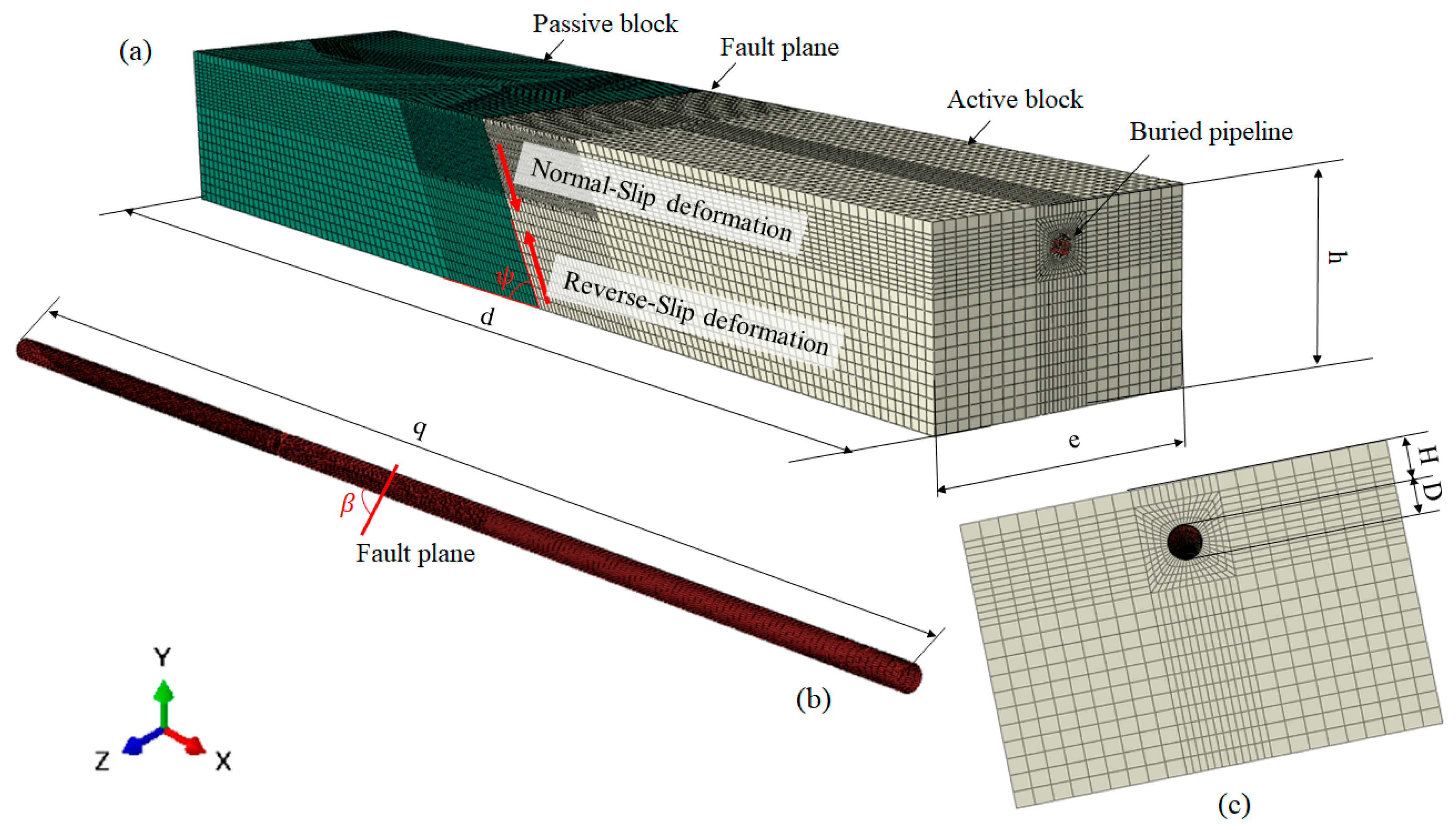
2.1. Finite Element Model
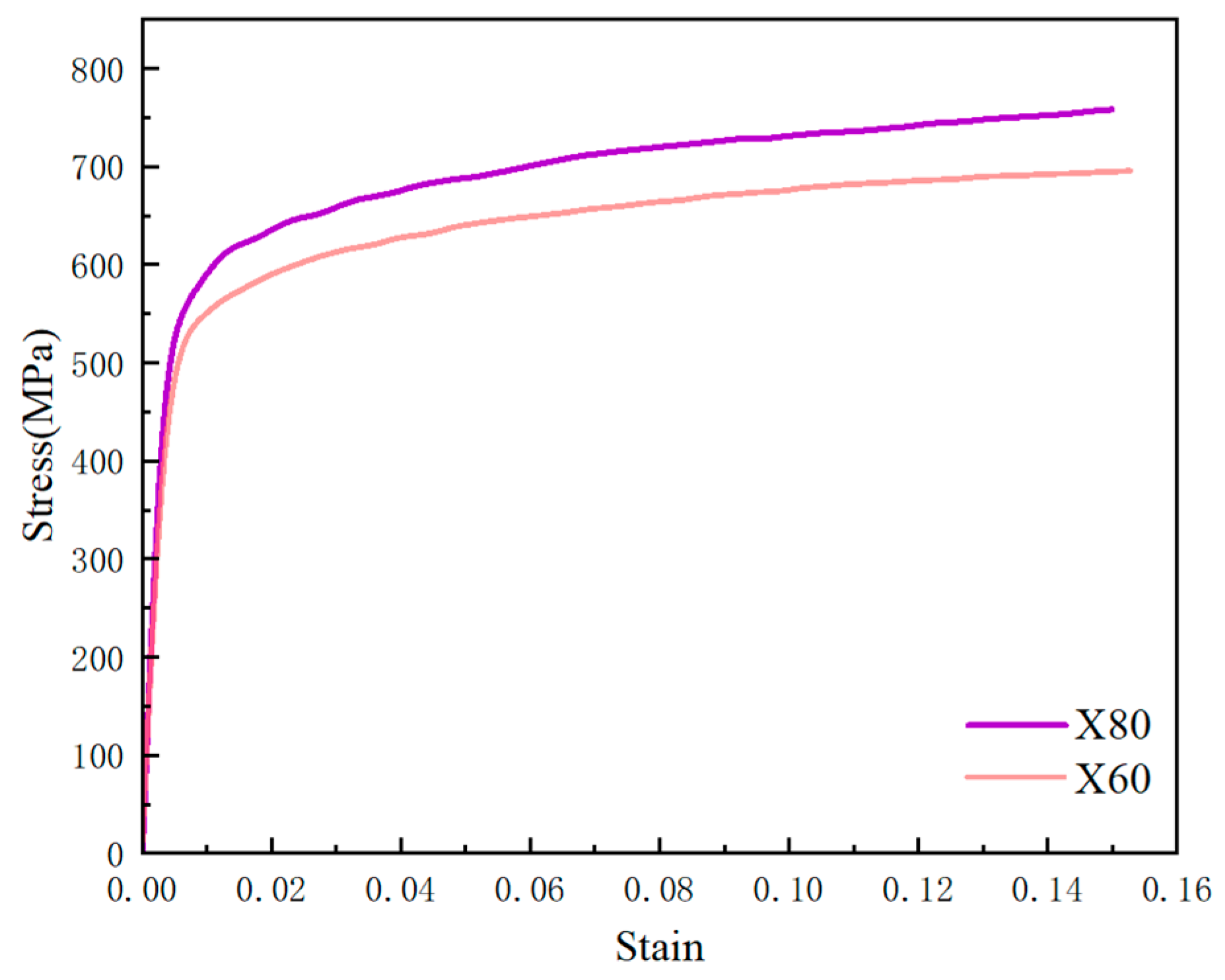
2.2. Constitutive Model
2.3. Boundary Conditions and Contact Settings
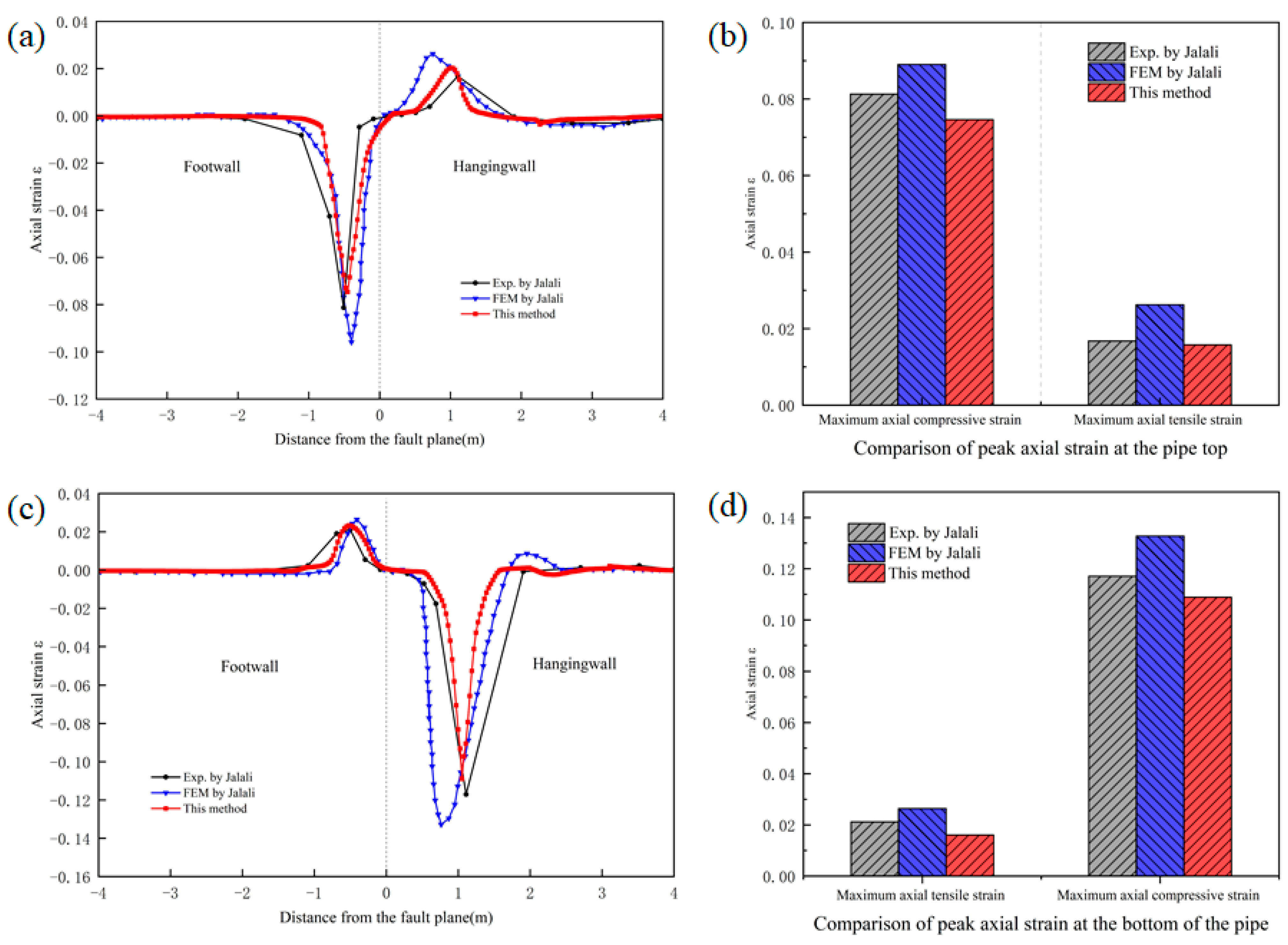
2.4. Model Verification
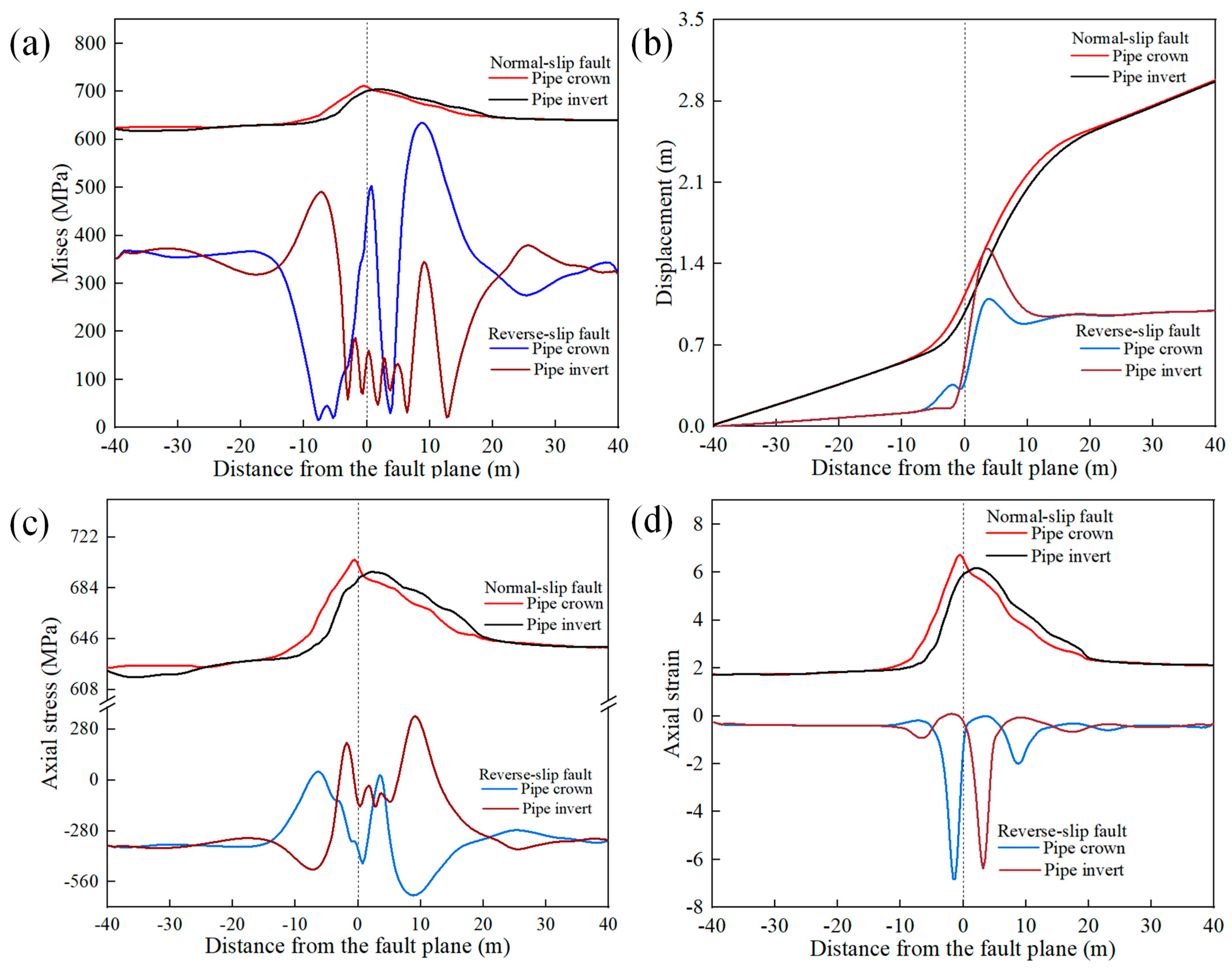
3. Mechanical Response Analysis of Buried Pipelines Under Faulting Modes
4. Prediction Model for Peak Axial Strain of Buried Pipelines Under Faulting Modes
4.1. Applicability of the Peak Strain Prediction Model
4.2. Prediction Model for Peak Axial Strain
4.3. Verification of the Peak Axial Strain Prediction Model
5. Fragility Analysis of Buried Pipelines Under Slip Faulting
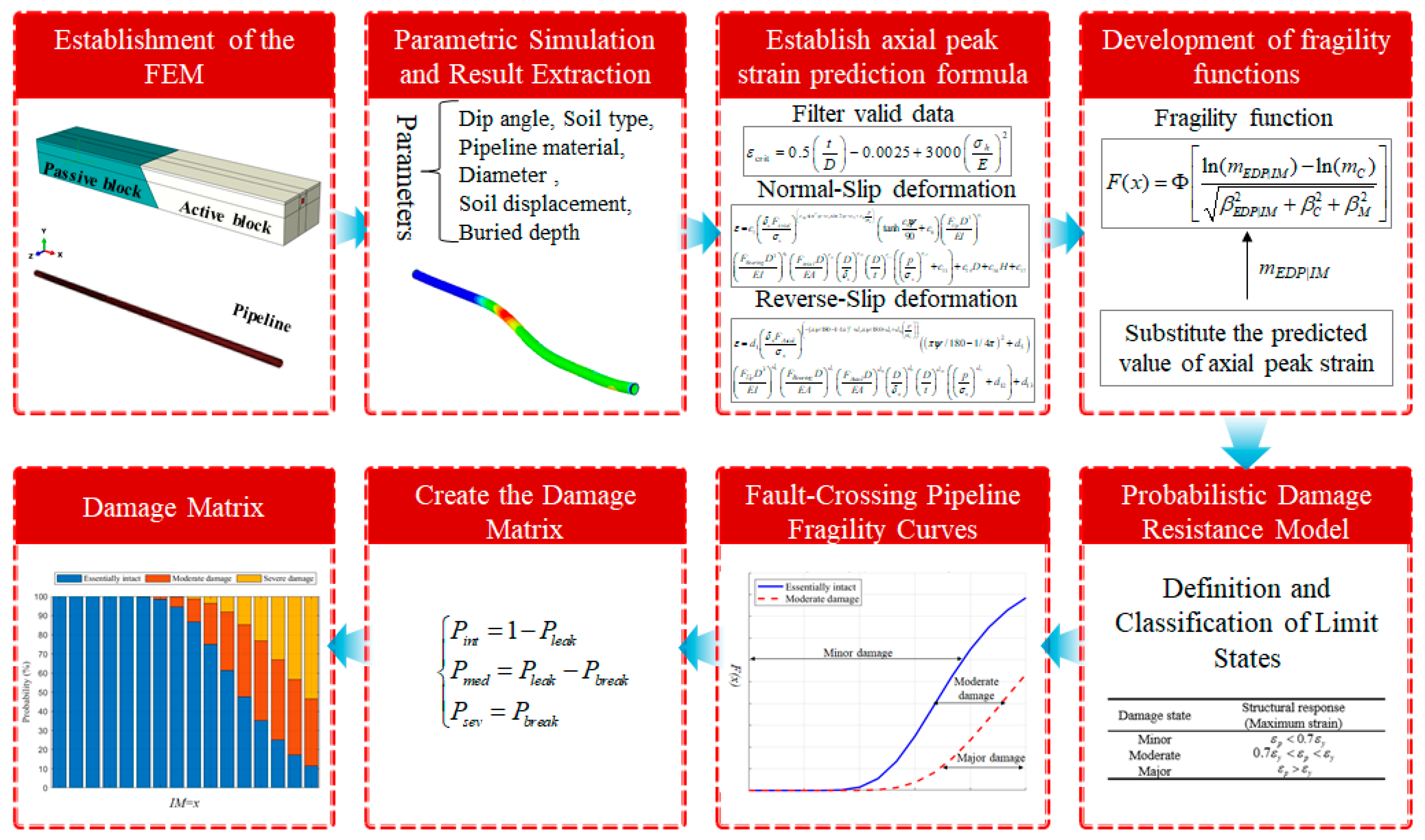
5.1. Fragility Assessment Methodology

| Damage State | Performance Description | Strain Criterion |
|---|---|---|
| Basic intact | Slight deformation without rupture or leakage. | |
| Moderate damage | Significant deformation or buckling, potential minor rupture or leakage; repairs are required for normal operation. | |
| Severe damage | Pipeline rupture or massive leakage; the pipeline must be replaced. |
5.2. Analysis of Fault-Pipeline Fragility Assessment Results
5.3. Influence of Key Parameters on Pipeline Fragility
6. Conclusions
- (1)
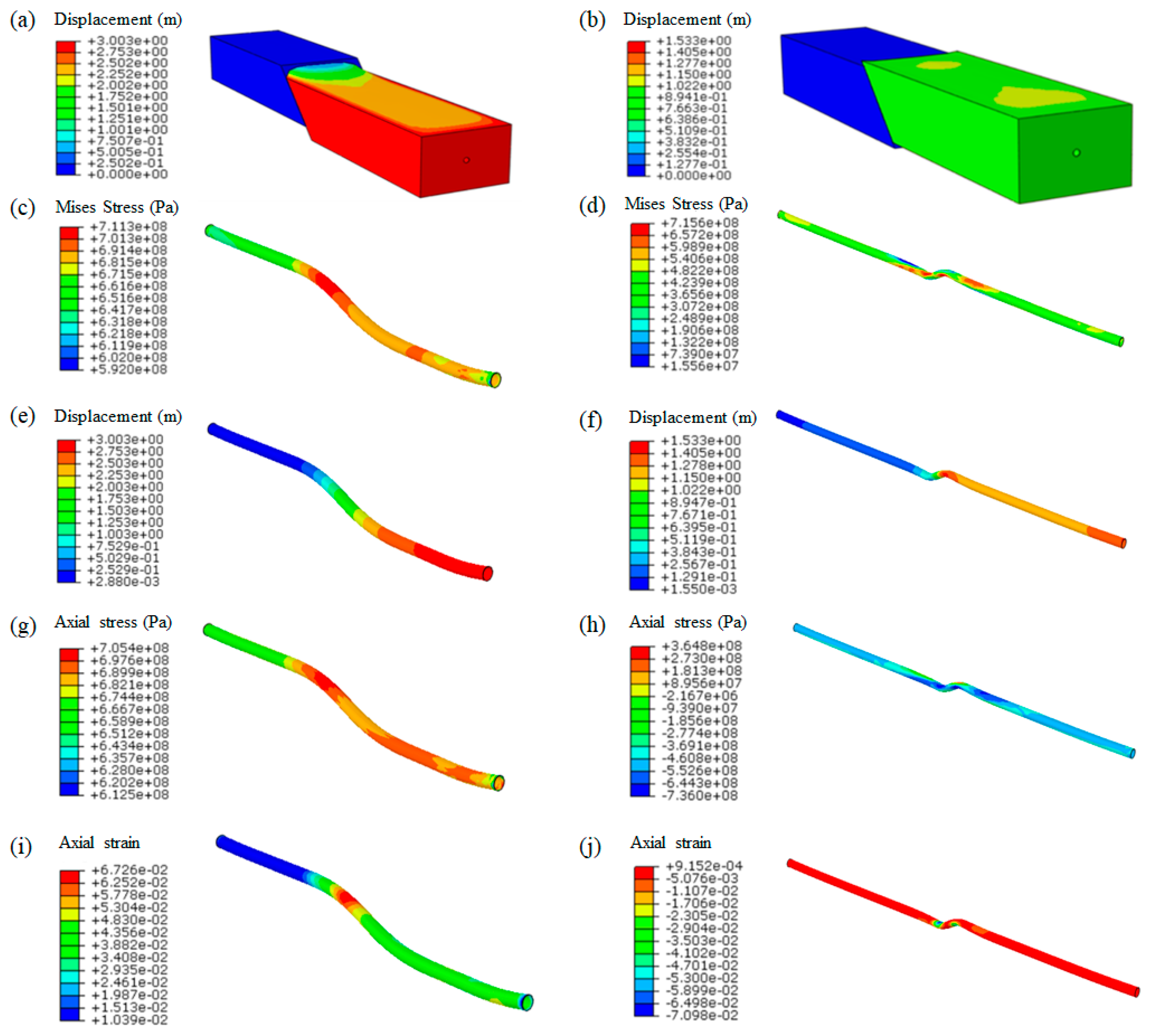
- The proposed nonlinear pipe–soil coupled finite element model agrees well with published experimental results, indicating that it can reliably simulate the mechanical response of buried pipelines under slip faulting. Faulting mode fundamentally controls deformation patterns and failure mechanisms. Under normal-slip faulting, axial tension combined with bending dominates, and high-strain zones extend to approximately ±10 m from the fault. Under reverse-slip faulting, localized axial compression with bending dominates, and high compressive strains are concentrated within approximately 3–5 m on either side of the fault.
- (2)
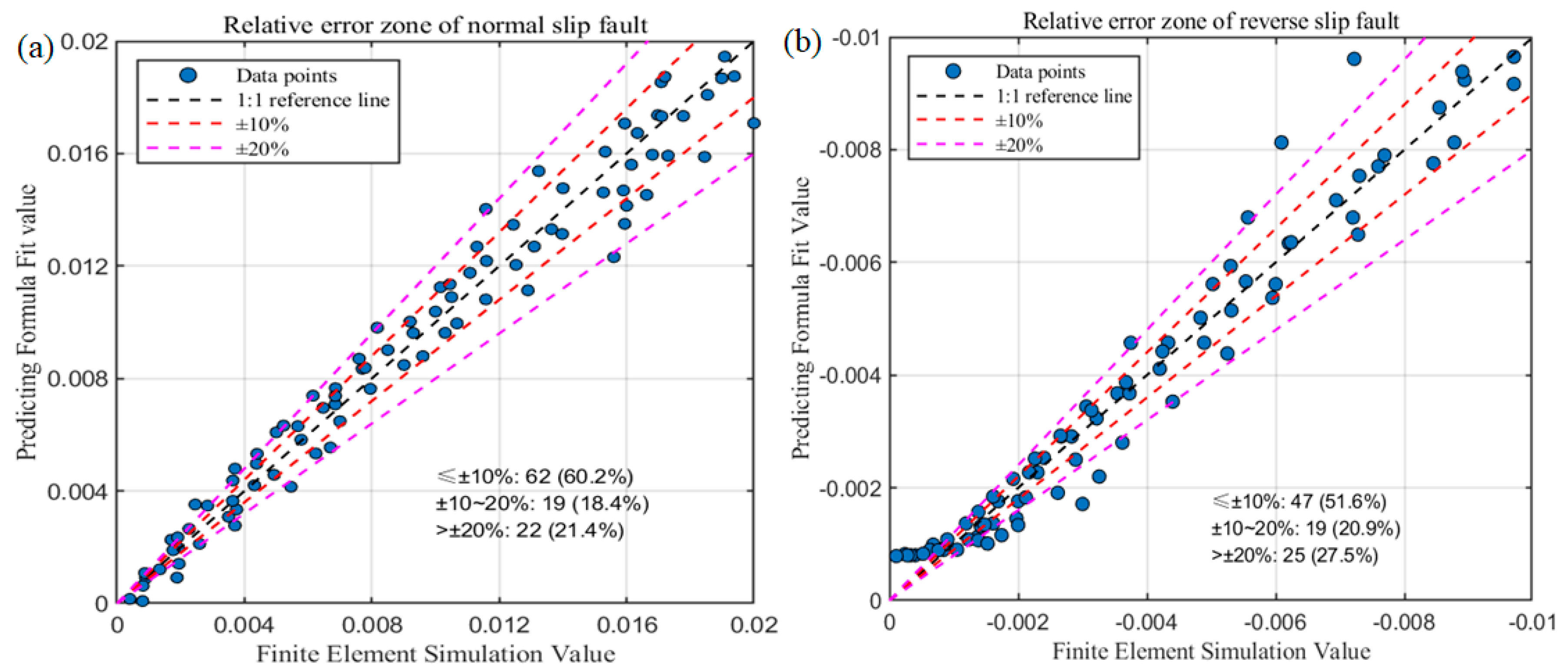
- The regression-based peak axial strain models demonstrated good agreement with the finite element results. For normal slip, 60.2% of the predictions have errors <10% and 78.6% have errors <20%; for reverse slip, 51.6% have errors <10% and 72.5% have errors <20%.
- (3)
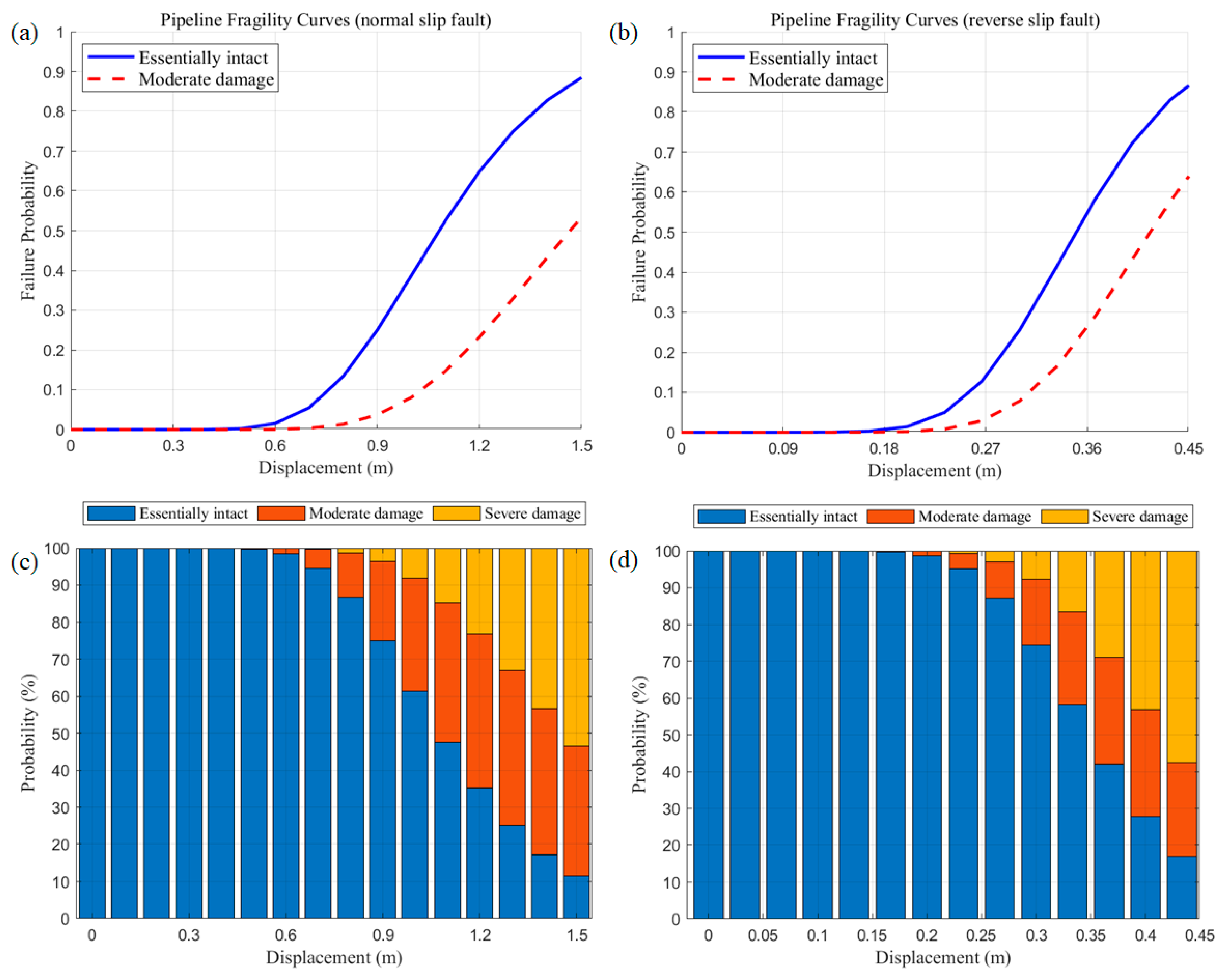
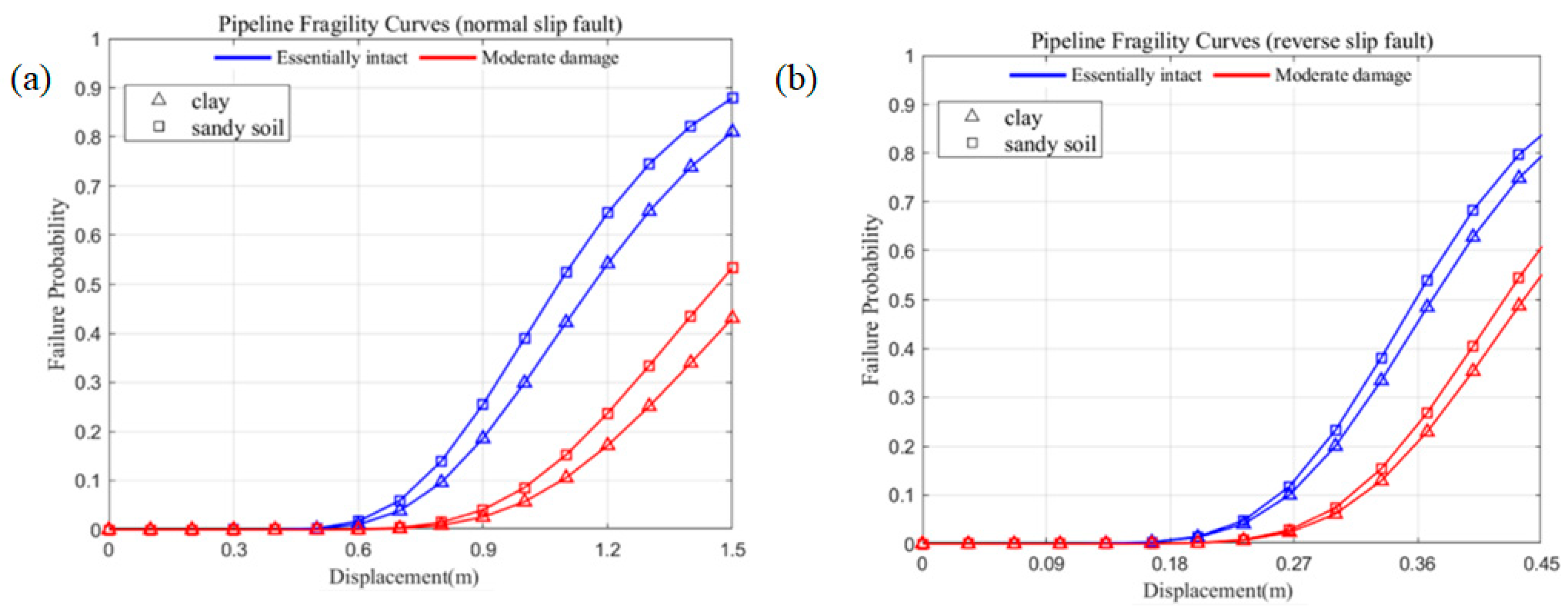
- Based on the peak axial strain prediction equations, a displacement-based fragility assessment method for buried pipelines was established, and an illustrative case study was conducted for an 864 mm (X80) pipeline buried at 4.5 m in sandy soil with a 45° fault dip angle. The resulting fragility curves quantitatively show that the fault-displacement threshold for the intact-to-damage transition is approximately 0.6 m for normal-slip faulting and approximately 0.2 m for reverse-slip faulting. Accordingly, the fragility results indicate that, for the same fault displacement level, reverse-slip faulting is associated with higher failure probabilities than normal-slip faulting for the investigated configurations.
- (4)
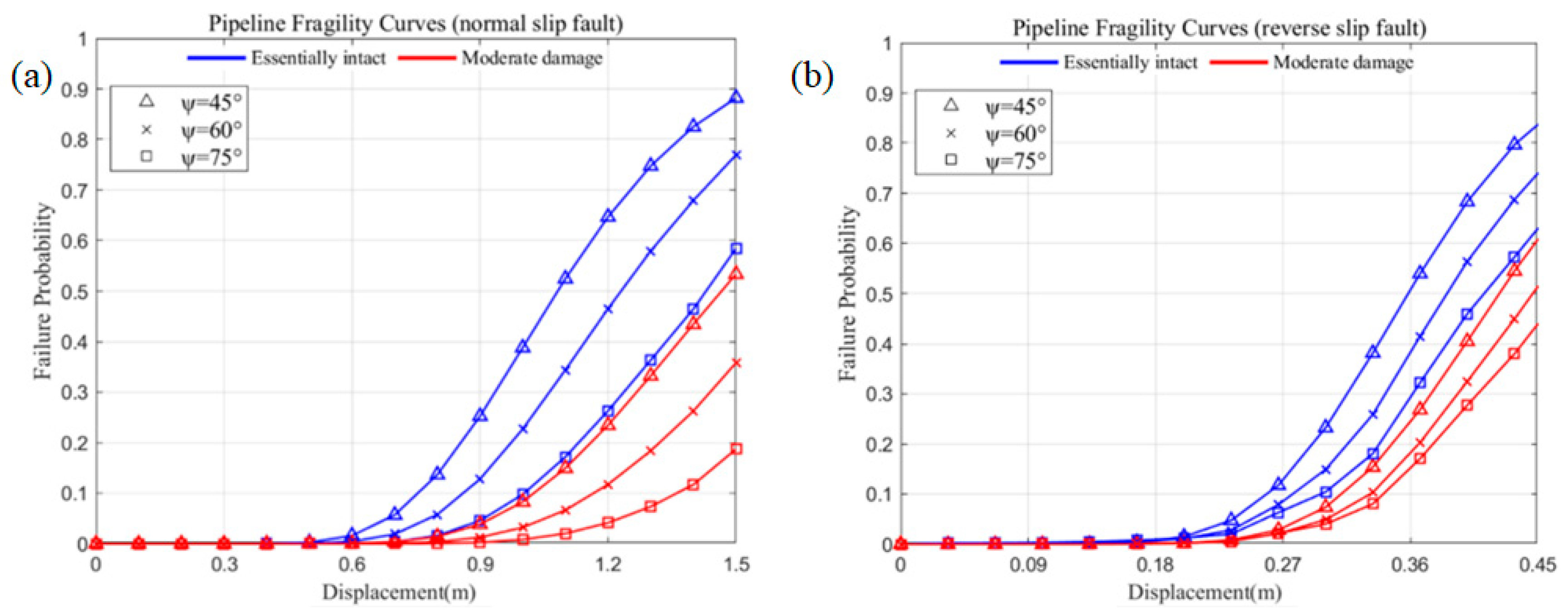
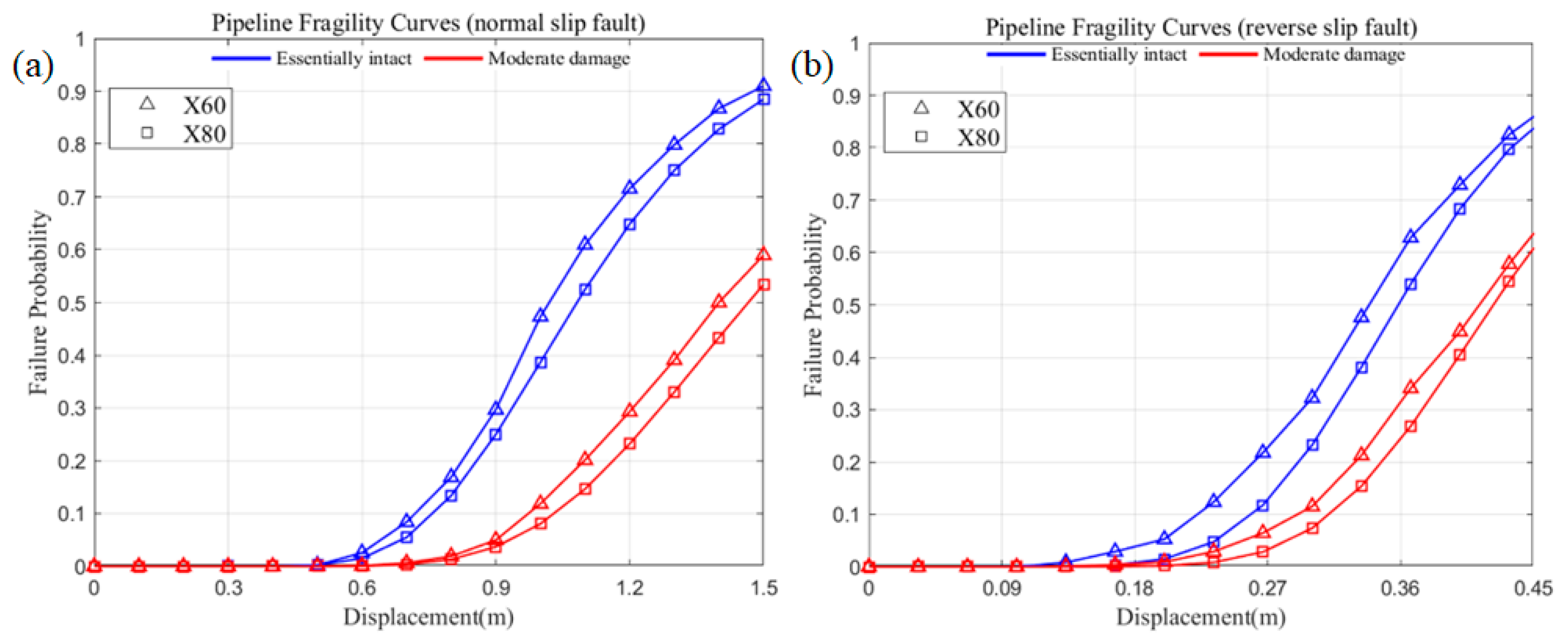
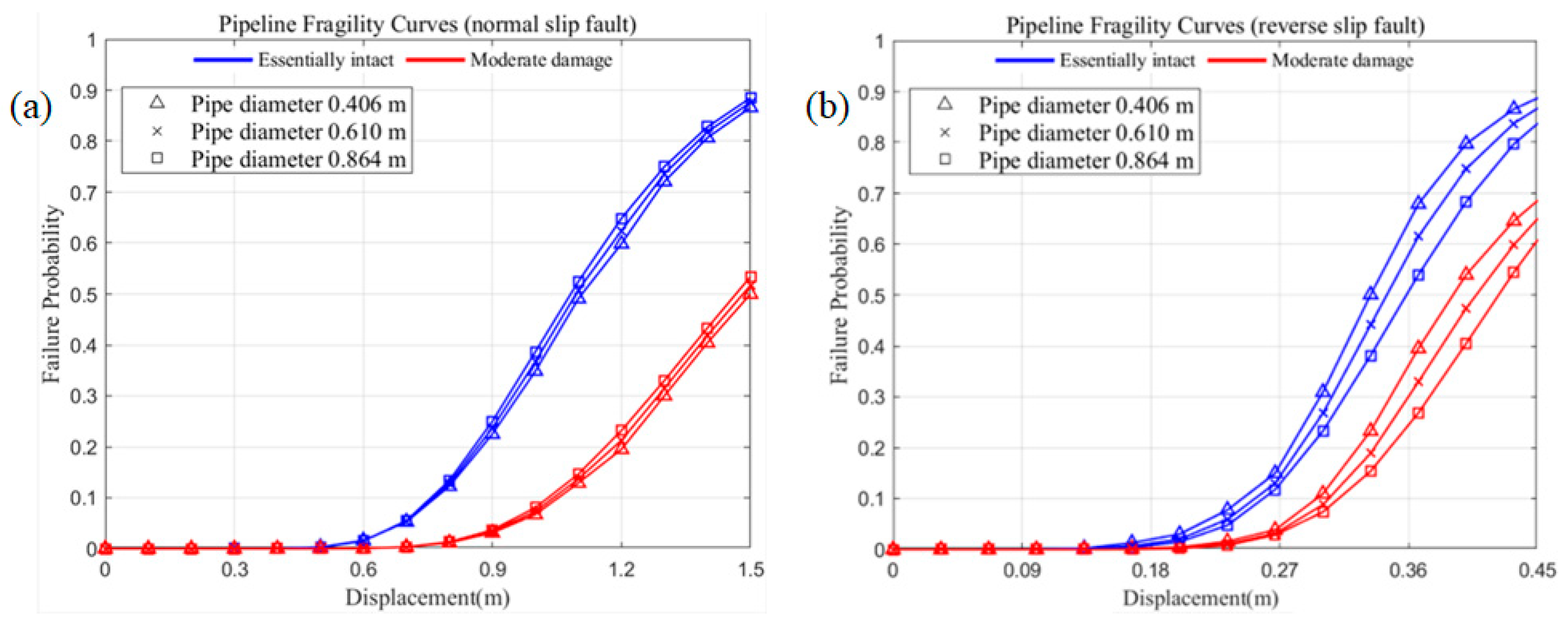
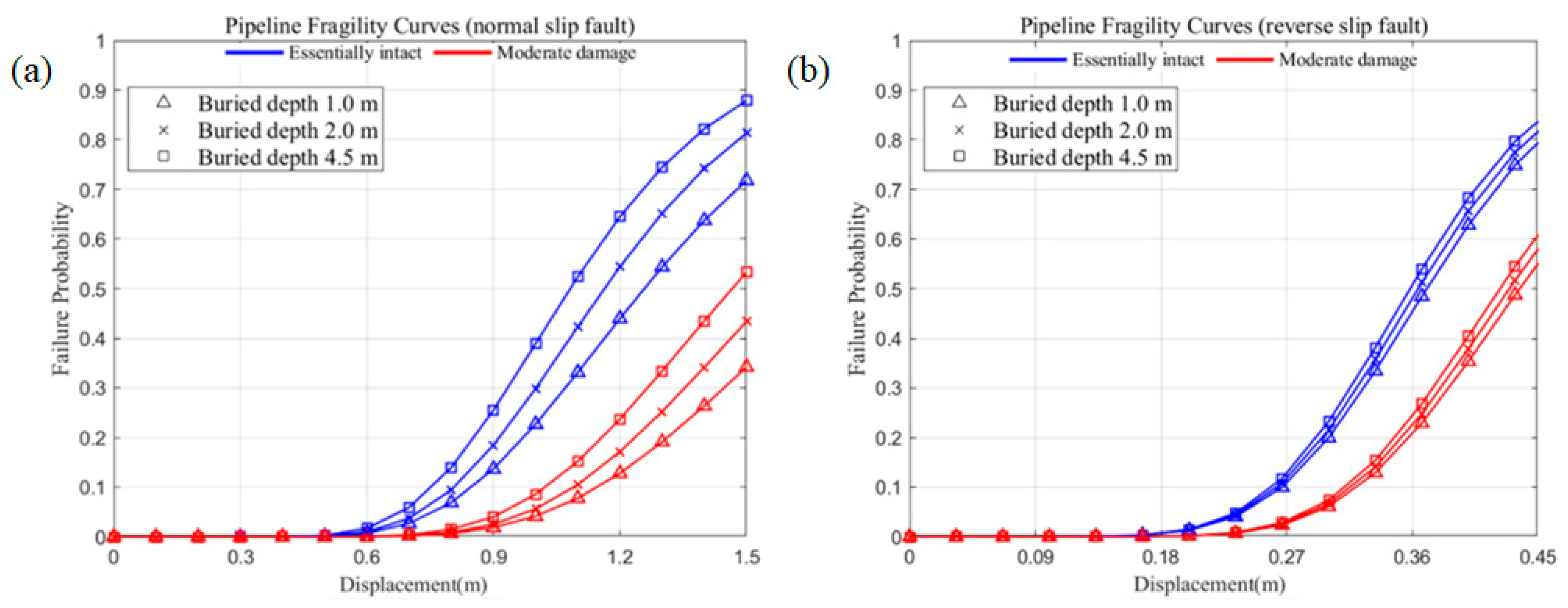
- As evidenced by the parametric fragility results, the investigated parameters systematically shift the fragility curves under both faulting modes. Within the studied parameter ranges, the dip angle produced the most pronounced shift of the fragility curves: failure probability increases as dip angle decreases from 75° to 45° at a given displacement. The parametric fragility curves further show that higher-grade pipelines (X80) provide a larger displacement margin and lower failure probability than X60, and that the probabilities of moderate and severe damage are higher in sandy soil than in clayey soil. The fragility comparisons also indicate that pipe diameter has a minor effect under normal slip, whereas under reverse slip, smaller diameters lead to higher failure probabilities. Moreover, the parametric results show that increasing burial depth from 1.0 m to 4.5 m increases the probability of moderate and severe damage under normal slip, while its effect is relatively minor under reverse slip.
Author Contributions
Funding
Data Availability Statement
Conflicts of Interest
References
- Wang, H.L.; Tian, X. Numerical Simulation of Diffusion Characteristics and Hazards in Multi-Hole Leakage from Hydrogen-Blended Natural Gas Pipelines. Energies 2025, 18, 4309. [Google Scholar] [CrossRef]
- Tsatsis, A.; Loli, M.; Gazetas, G. Pipeline in dense sand subjected to tectonic deformation from normal or reverse faulting. Soil Dyn. Earthq. Eng. 2019, 127, 105780. [Google Scholar] [CrossRef]
- Banushi, G. Analytical Fragility Surfaces and Global Sensitivity Analysis of Buried Operating Steel Pipeline Under Seismic Loading. Appl. Sci. 2024, 14, 10735. [Google Scholar] [CrossRef]
- Ni, P.P.; Mangalathu, S.; Yi, Y. Fragility analysis of continuous pipelines subjected to transverse permanent ground deformation. Soils Found. 2018, 58, 1400–1413. [Google Scholar] [CrossRef]
- Ni, P.P.; Mangalathu, S.; Liu, K.W. Enhanced fragility analysis of buried pipelines through Lasso regression. Acta Geotech. 2018, 15, 471–487. [Google Scholar] [CrossRef]
- Liu, W.; Guo, Q.; Qiao, C.F.; Hou, W.G. Strain design method of buried pipeline crossing fault. Eng. Fail. Anal. 2019, 105, 659–671. [Google Scholar] [CrossRef]
- Liu, X.B.; Zhang, H.; Gu, X.T.; Chen, Y.F.; Xia, M.Y.; Wu, K. Strain demand prediction method for buried X80 steel pipelines crossing oblique-reverse faults. Earthq. Struct. 2017, 12, 321–332. [Google Scholar] [CrossRef]
- Jalali, H.H.; Rofooei, F.R.; Attari, N.K.A. Performance of Buried Gas Distribution Pipelines Subjected to Reverse Fault Movement. J. Earthq. Eng. 2017, 22, 1068–1091. [Google Scholar] [CrossRef]
- Zheng, Q.; Allouche, I.; Qiu, W.C.; Li, Y.; Yoosef-Ghodsi, N.; Fowler, M.; Adeeb, S. Probabilistic Analysis of Pipelines in Geohazard Zones Using a Novel Approach for Strain Calculation. J. Pipeline Syst. Eng. Pract. 2023, 15, 04023054. [Google Scholar] [CrossRef]
- Taraghi, P.; Li, Y.; Adeeb, S. Prediction of ground movement-induced pipe responses considering variable PGD magnitudes using physics-informed neural networks and transfer learning. Eng. Struct. 2025, 332, 120018. [Google Scholar] [CrossRef]
- Taraghi, P.; Li, Y.; Adeeb, S. Physics-Informed Neural Network-based Reliability Analysis of Buried Pipelines. arXiv 2025, arXiv:2511.11613. [Google Scholar]
- Cheng, X.D.; Ma, C.; Huang, R.K.; Huang, S.N.; Yang, W.D. Failure mode analysis of X80 buried steel pipeline under oblique-reverse fault. Soil Dyn. Earthq. Eng. 2019, 125, 105723. [Google Scholar] [CrossRef]
- Liu, X.B.; Zhang, H.; Han, Y.S.; Xia, M.Y.; Zheng, W. A semi-empirical model for peak strain prediction of buried X80 steel pipelines under compression and bending at strike-slip fault crossings. J. Nat. Gas Sci. Eng. 2016, 32, 465–475. [Google Scholar] [CrossRef]
- Xie, X.J.; Symans, M.D.; O’Rourke, M.J.; Abdoun, T.H.; O’Rourke, T.D.; Palmer, M.C.; Stewart, H.E. Numerical modeling of buried HDPE pipelines subjected to normal faulting: A case study. Earthq. Spectra 2013, 29, 609–632. [Google Scholar] [CrossRef]
- Xie, X.J.; Symans, M.D.; O’Rourke, M.J.; Abdoun, T.H.; O’Rourke, T.D.; Palmer, M.C.; Stewart, H.E. Numerical modeling of buried HDPE pipelines subjected to strike-slip faulting. J. Earthq. Eng. 2011, 15, 1273–1296. [Google Scholar] [CrossRef]
- Vazouras, P.; Karamanos, S.A.; Dakoulas, P. Finite element analysis of buried steel pipelines under strike-slip fault displacements. Soil Dyn. Earthq. Eng. 2010, 30, 1361–1376. [Google Scholar] [CrossRef]
- Li, Z.C.; Zhang, S.Y.; Shen, M.L. Analytical and numerical study on the dynamic responses of the buried offshore oval lined-pipeline system under strike-slip fault. Ocean. Eng. 2024, 311, 119019. [Google Scholar] [CrossRef]
- Zhang, J.; Liang, Z.; Han, C.J. Buckling behavior analysis of buried gas pipeline under strike-slip fault displacement. J. Nat. Gas Sci. Eng. 2014, 21, 921–928. [Google Scholar] [CrossRef]
- Fang, Z.Y. Research on Safety and Reliability Assessment Technology of X60 Pipeline Based on Plastic Instability. Ph.D. Thesis, China University of Petroleum, Beijing, China, 2022. [Google Scholar]
- Helwany, S. Applied Soil Mechanics with Abaqus Applications; John Wiley & Sons: Hoboken, NJ, USA, 2007. [Google Scholar]
- Jalali, H.H.; Rofooei, F.R.; Attari, N.K.A.; Samadian, M. Experimental and finite element study of the reverse faulting effects on buried continuous steel gas pipelines. Soil Dyn. Earthq. Eng. 2016, 86, 1–14. [Google Scholar] [CrossRef]
- Huang, T.K.; Chen, W.F. Simple procedure for determining cap-plasticity-model parameters. J. Geotech. Eng. 1990, 116, 492–507. [Google Scholar] [CrossRef]
- Ma, C.; Cheng, X.D.; Xu, T.Z.; Xu, L.Y.; Wang, Y.; An, K.; Hu, W.J. Research on local buckling failure range of X80 buried steel pipeline under oblique-reverse fault. Soil Dyn. Earthq. Eng. 2023, 164, 107592. [Google Scholar] [CrossRef]
- Zheng, S.S.; Zuo, Y.; Zhang, X.H.; Shi, L.; Huang, W.Z.; Zheng, J. Seismic Vulnerability Analysis of Multi-age Steel Bent Frame Structures Based on IDA Method. China Earthq. Eng. J. 2018, 40, 698–704. [Google Scholar] [CrossRef]
- Yu, X.H.; Lu, D.G.; Wang, G.Y. Discussions on probabilistic seismic demand models. Eng. Mech. 2013, 30, 172–179. [Google Scholar]
- Liu, H.B.; Tong, Y.; Jiang, Y.J.; Ding, J.M.; Zhang, J. Recent development of seismic fragility analysis methods for RC frame structures. World Earthq. Eng. 2020, 36, 141–150. [Google Scholar] [CrossRef]
- Ellingwood, B.R.; Kinali, K. Quantifying and communicating uncertainty in seismic risk assessment. Struct. Saf. 2009, 31, 179–187. [Google Scholar] [CrossRef]
- Tsinidis, G.; Di, S.L.; Sextos, A.; Furtner, P. Seismic fragility of buried steel natural gas pipelines due to axial compression at geotechnical discontinuities. Bull. Earthq. Eng. 2020, 18, 837–906. [Google Scholar] [CrossRef]
- Shinozuka, M.; Takada, S.; Ishikawa, H. Some aspects of seismic risk analysis of underground lifeline systems. Technology 1979, 101, 31–43. [Google Scholar] [CrossRef]
- Karamitros, D.K.; Bouckovalas, G.D.; Kouretzis, G.P.; Gkesouli, V. An analytical method for strength verification of buried steel pipelines at normal fault crossings. Soil Dyn. Earthq. Eng. 2011, 31, 1452–1464. [Google Scholar] [CrossRef]
- Zhang, R.L.; Wang, C.; Li, S.; Zhang, J.X.; Liu, W.Z. Numerical Simulation Study on the Performance of Buried Pipelines under the Action of Faults. Appl. Sci. 2023, 13, 11266. [Google Scholar] [CrossRef]
- Demirci, H.E.; Bhattacharya, S.; Karamitros, D.; Karamitros, D.; Alexander, N. Experimental and numerical modelling of buried pipelines crossing reverse faults. Soil Dyn. Earthq. Eng. 2018, 114, 198–214. [Google Scholar] [CrossRef]
- Zhang, J.; Chen, Y.; Liang, B.F.; Pan, B. Damage evolution mechanism of buried pipeline crossing reverse fault. J. Mech. Sci. Technol. 2021, 35, 71–77. [Google Scholar] [CrossRef]
- Liao, P.; Guo, C.; Wang, F.; Sun, W. Investigating brittle damage of buried pipelines under dip-slip faulting with peridynamics. Acta Geotech. 2023, 18, 1945–1965. [Google Scholar] [CrossRef]
- Zhang, J.; Liang, Z.; Han, C.J.; Zhang, H. Numerical simulation of buckling behavior of the buried steel pipeline under reverse fault displacement. Mech. Solids 2015, 6, 203–210. [Google Scholar] [CrossRef]
- Han, J.Y.; Li, Y.F.; Zhong, Z.L.; Miao, H.Q.; Du, X.L. Seismic vulnerability assessment of buried corroded steel pipes under different site conditions. Chin. J. Geotech. Eng. 2024, 46, 774–783. [Google Scholar]
- Jahangiri, V.; Shakib, H. Reliability-based seismic evaluation of buried pipelines subjected to earthquake-induced transient ground motions. Bull. Earthq. Eng. 2020, 18, 3603–3627. [Google Scholar] [CrossRef]







| d/m | e/m | h/m | q/m | Crossing Angle β/° | Dip Angle ψ/° | Pipeline Material | Soil Type | Diameter D (Thickness t)/mm | Soil Displacement/m | Buried Depth H/m | |
|---|---|---|---|---|---|---|---|---|---|---|---|
| Normal-slip faulting | 80 | 15 | 10 | 80 | 90 | 45, 75 | X80, X60 | Sand, Clay | 406 (10), 864 (22) | 0–3 | 1 4.5 |
| Reverse-slip faulting | 80 | 15 | 10 | 80 | 90 | 45, 75 | X80, X60 | Sand, Clay | 406 (10), 864 (22) | 0–1 | 1 4.5 |
| Material | Density (kg/m3) | Elastic Modulus (MPa) | Poisson’s Ratio | Yield Strength (MPa) | N | |
|---|---|---|---|---|---|---|
| X60 | 7850 | 207,000 | 0.3 | 450 | 0.24 | 13 |
| X80 | 7850 | 207,000 | 0.3 | 555 | 0.86 | 28 |
| Soil Type | Density (kg/m3) | Elastic Modulus (MPa) | Poisson’s Ratio | Cohesion (kPa) | Friction Angle, φ (°) | Dilatancy Angle (°) | Void Ratio | Coefficient of Compressibility (MPa−1) | Stress Ratio |
|---|---|---|---|---|---|---|---|---|---|
| Sand | 1550 | 33 | 0.27 | 5 | 30 | 0 | --- | --- | --- |
| Clay | 1923 | 26 | 0.28 | 25 | 22 | 0 | 0.899 | 0.174 | 0.87 |
| Parameter | Range |
|---|---|
| Crossing angle β/° | 90° |
| Dip angle ψ/° | 45–90° |
| Pipeline material | X60, X80 |
| Soil type | Sand, Clay |
| Diameter D(thickness t)/mm | 406–864 mm |
| Buried depth H/m | 1 m−4.5 m |
| Displacement of the normal-slip fault | 0–1.5 m |
| Displacement of the reverse-slip fault | 0–0.45 m |
Disclaimer/Publisher’s Note: The statements, opinions and data contained in all publications are solely those of the individual author(s) and contributor(s) and not of MDPI and/or the editor(s). MDPI and/or the editor(s) disclaim responsibility for any injury to people or property resulting from any ideas, methods, instructions or products referred to in the content. |
© 2026 by the authors. Licensee MDPI, Basel, Switzerland. This article is an open access article distributed under the terms and conditions of the Creative Commons Attribution (CC BY) license.
Share and Cite
Jing, H.; Luo, P.; Zhang, S.; Deng, Q. Peak Strain Prediction and Fragility Assessment of Buried Pipelines Subjected to Normal-Slip and Reverse-Slip Faulting. Appl. Sci. 2026, 16, 2141. https://doi.org/10.3390/app16042141
Jing H, Luo P, Zhang S, Deng Q. Peak Strain Prediction and Fragility Assessment of Buried Pipelines Subjected to Normal-Slip and Reverse-Slip Faulting. Applied Sciences. 2026; 16(4):2141. https://doi.org/10.3390/app16042141
Chicago/Turabian StyleJing, Hongyuan, Peng Luo, Shuxin Zhang, and Qinglu Deng. 2026. "Peak Strain Prediction and Fragility Assessment of Buried Pipelines Subjected to Normal-Slip and Reverse-Slip Faulting" Applied Sciences 16, no. 4: 2141. https://doi.org/10.3390/app16042141
APA StyleJing, H., Luo, P., Zhang, S., & Deng, Q. (2026). Peak Strain Prediction and Fragility Assessment of Buried Pipelines Subjected to Normal-Slip and Reverse-Slip Faulting. Applied Sciences, 16(4), 2141. https://doi.org/10.3390/app16042141