Article

“How Many Minutes Does the Player Have in His Legs?” Answering One of Football’s Oldest Coaching Questions Through a Mathematical Model


1
Performance and Analytics Department, Parma Calcio 1913, 43121 Parma, Italy
2
Department of Movement, Human and Health Sciences, University of Rome “Foro Italico”, 00135 Rome, Italy
3
Sport Expertise and Performance Laboratory, French National Institute of Sports (INSEP), 75012 Paris, France
*
Author to whom correspondence should be addressed.
Appl. Sci. 2026, 16(4), 2139; https://doi.org/10.3390/app16042139
Submission received: 15 January 2026 / Revised: 11 February 2026 / Accepted: 19 February 2026 / Published: 23 February 2026

Abstract

Coaches in professional football need to estimate how many minutes a player can tolerate in a match before relevant fatigue occurs. This study aimed to develop a framework to translate monitoring information into individualised, minute-based fatigue thresholds. Over four seasons in an elite club, external load (total distance, high-speed running, mechanical work) and heart rate were collected in training. Machine-learning-derived fitness and fatigue indices were computed and combined with 7- and 28-day load variables in a Random Forest regression model predicting match minutes. The trained model was then used to simulate four fatigue conditions by fixing the match-day fatigue index (z-FAmatch = 0, −1, −2, −3). In an independent test season, the model showed a mean absolute error of 22.5 min and R2 = 0.17 for playing time prediction, with z-FAmatch as the most influential predictor. Simulated fatigue thresholds occurred in an ordered way (0 = 57.1, −1 = 64.9, −2 = 84.8, −3 = 84.4) and differed across season period, playing position, overall seasonal minutes, and return-to-play status. Integrating external load with fitness and fatigue indices via machine learning can provide individualised estimates of when players are likely to reach fatigue states, supporting decisions on selection, substitutions, and return-to-play management.

1. Introduction

Whether in elite or non-professional football, coaches and performance staff routinely face a deceptively simple but crucial question: “How many minutes does this player have in his legs today?” A player’s match playing time is not only a reflection of tactical choices but also of his (her) current fitness status, accumulated workload, residual fatigue, and medical constraints [1,2]. Anticipating how long a player can sustain an acceptable physiological and mechanical response before reaching relevant fatigue thresholds would significantly support decisions on starting line-ups, substitution timing, rotation strategies, and return-to-play management.
Over the last decade, the widespread implementation of microtechnology, including global positioning systems (GPS) and inertial measurement units (IMUs), has facilitated the systematic quantification of external load during training and matches in professional football [3,4]. These systems capture metrics such as total distance, distance covered at high and very high speeds, and indices of mechanical load associated with accelerations and decelerations. In applied practice, these metrics are frequently summarized into acute and chronic load indicators using rolling windows (e.g., 7- and 28-day sums) to inform training prescription, manage accumulated workloads, and, to some extent, estimate readiness or injury risk [5,6,7,8]. However, traditional load summaries applied alone provide limited insight into how an individual player will respond physiologically and mechanically to a specific match. More importantly, they seldom offer a direct answer to the critical question of how many minutes a player can maintain performance before experiencing meaningful fatigue.
Considering the limitations associated with external load alone, a complementary line of research has focused on internal load, particularly heart rate (HR) responses to standardised drills or submaximal running protocols, as indicators of cardiorespiratory fitness and training status [9,10,11]. On the other hand, changes in locomotor strategies during standardised running tests have been used to quantify neuromuscular fatigue [12,13,14,15]. Furthermore, machine learning (ML) models have recently been employed to integrate external load metrics, HR, and locomotor activity responses to derive individualised indices of fitness (FI) and fatigue (FA) in professional football [16,17]. In this framework, FI reflects the extent to which a player can maintain a lower-than-expected HR for a given external load, whereas FA captures the efficiency of locomotor activity by comparing predicted and actual PlayerLoadTM (PL) during training sessions [16,17]. These indices have demonstrated concurrent validity against submaximal fitness tests and sensitivity to variations in weekly load, day of the microcycle, and period of the season [14,16,17]. Nevertheless, their applications have largely remained descriptive, and they have not been directly linked to match minute predictions that could guide concrete coaching decisions. Indeed, to date, no studies have explored the possibility of integrating all this information to predict how many minutes a player can tolerate performance during a match before experiencing significant fatigue.
Also in this case, ML approaches can assist in managing the inherent complexity of match-related fatigue processes. In applied elite football settings, ensemble tree-based models such as Random Forests have been widely adopted for injury-risk estimation, performance classification, and prediction of match outcomes or physical demands [18,19,20,21,22]. While more recent advances in deep and representation learning offer powerful modelling capabilities, their application in high-performance sport is often constrained by limited sample sizes, heterogeneous data sources, and the need for model transparency in practitioner-led decision-making contexts. Alternative approaches such as linear models or generalised additive models (GAMs), although interpretable, may be limited in their ability to capture complex non-linear interactions without strong structural assumptions, whereas gradient boosting frameworks (e.g., XGBoost, LightGBM), despite their highly predictive performance, typically require extensive hyperparameter tuning and may reduce model stability and interpretability in small-to-moderate applied datasets. In this context, Random Forest models are particularly well suited, as they can accommodate non-linear relationships, higher-order interactions, and moderate multicollinearity among predictors while maintaining a degree of interpretability through feature importance metrics and partial dependence analyses [23,24]. This balance between predictive performance and explainability is especially relevant when models are intended to support applied decision-making rather than purely predictive optimization.
Within the present framework, the integration of training load, fitness indicators, and fatigue-related variables allows the model to simulate hypothetical fatigue trajectories across match play, providing estimates of the specific match periods at which players may transition toward low, moderate, or severe fatigue states. Although more advanced deep learning, causal inference, or explainable AI approaches may further enhance representation learning and causal interpretability, the current methodological choice reflects a deliberate trade-off between methodological robustness, data availability, and practical usability. Future research may extend this framework by integrating representation learning or causal modelling techniques to refine individual fatigue dynamics and mechanistic understanding.
Consequently, there is a clear gap between the extensive volume of monitoring data generated daily in professional football and the long-standing practical question of how many minutes a player can realistically maintain performance before approaching relevant fatigue thresholds under competitive conditions. For this reason, considering this background, the present study has three main aims. First, we sought to develop and evaluate a Random Forest regression model to predict match playing time at the individual level, using a set of features combining acute (7-day) and chronic (28-day) external load metrics (total distance, high-speed running, sprint distance, and mechanical work) with z-scored ML-derived indices of fitness (z-FI) and fatigue (z-FA). This step is essential to move to the second aim of the study; that is, to implement a simulation framework in which only the match-day fatigue index (z-FAmatch) was systematically manipulated to represent three fatigue thresholds (low, moderate, severe) while all other inputs were held constant, allowing us to estimate the specific match minute at which each player would be expected to reach these fatigue states. Third, we examined the ecological validity of this approach by testing whether the predicted minutes at low, moderate, and severe fatigue differed meaningfully across season periods, playing positions, overall seasonal match playing time, and return-to-play conditions.
We hypothesised that: (1) the integrated ML model would achieve an acceptable out-of-sample error in predicting match minutes; (2) the z-FAmatch would emerge as the key predictor of playing time; and (3) the simulated fatigue-minute estimates would show coherent and interpretable differences across season period, playing position, overall playing time, and return-to-play status, thereby supporting the ecological validity and practical usefulness of the proposed framework.

2. Materials and Methods

2.1. Participants

The study analysed four consecutive football seasons (2021/22, 2022/23, 2023/24, and 2024/25), including a total of sixty-eight elite male players (age: 25.3 ± 4.4 years, body mass: 79.7 ± 6.1 kg, height: 183.9 ± 5.7 cm) from the first team of an Italian professional football club. Players were part of the club’s main squad during at least one of the included seasons and were routinely monitored under the club’s standard performance and medical protocols. Data obtained from the own database of the club’s sport science department were analysed retrospectively. Since the data were collected for performance-monitoring purposes and subsequently anonymised before analysis, formal ethics committee approval was not required [25]. Nevertheless, all procedures complied with the Declaration of Helsinki, and confidentiality for both team and players was strictly preserved. All data were de-identified prior to analysis, and no information allowing identification of individual players is presented in this manuscript.

2.2. External and Internal Load Data Collection

Players’ external load was recorded during 766 training sessions and 160 official matches, yielding a total of 18681 individual player session observations. External load was assessed using the WIMU Pro system (WIMU, Hudl, Lincoln, NE, USA), which integrates multiple inertial sensors, including 3D gyroscopes with an 8000°/s full-scale output range, a three-dimensional magnetometer, a 10 Hz GPS unit, and a 20 Hz ultra-wideband system. The validity and reliability of this system for quantifying external load in team sports have been previously established [26,27]. Each player wore the device in a custom-fitted vest, with the unit positioned between the scapulae in a standardised manner. From these devices, the following metrics were extracted for each training session and match: total distance (TD, m); high-speed running distance (D19.8, m), which is the distance covered above 19.8 km/h; sprinting distance (D25.2, m), which is the distance covered above 25.2 km/h; mechanical work (MW, counts), defined as the sum of accelerations above 3.5 m/s2 and decelerations below −3.5 m/s2; and PlayerLoadTM (PL) which is a composite metric representing the resultant of tri-axial accelerations.
Instead, internal load was assessed via HR. HR data were collected at a sampling frequency of 4 Hz using a Garmin HR chest strap (Garmin Ltd., Olathe, KS, USA), synchronized with the WIMU Pro telemetry system [27]. Session intensity was expressed as a percentage of individual maximal HR (HRmax). HRmax was determined at the start of each season using an incremental treadmill protocol: the test started at 8 km/h and speed was increased by 2 km/h every 3 min until volitional exhaustion, with continuous HR monitoring [9]. Only sessions and match observations with complete and valid GPS and HR data were retained for analysis.

3. Data Analysis

3.1. Calculation of Acute and Chronic Load

For each player, acute and chronic external load metrics were computed using rolling windows. The acute load was defined as the sum of the relevant variable over the preceding 7 days (TD-7, D19.8-7, D25.2-7, MW-7). The chronic load was defined as the sum over the preceding 28 days (TD-28, D19.8-28, D25.2-28, MW-28). The rolling windows were calculated on a per-player basis, thereby capturing individualised histories of exposure. When data were missing within a rolling window (e.g., due to injury, illness, or squad rotation), only observed sessions were included in the cumulative load calculation, without imputation. As a result, acute and chronic load metrics reflect the player’s actual exposure during the relevant period rather than nominal calendar time.

3.2. Definition of the Fitness and Fatigue Indices

The fitness and fatigue indices were derived using a ML-based approach previously described [16,17]. Briefly, two separate Random Forest regression models were used: one to predict HR responses to specific training drills and one to predict PL during full training sessions.
To quantify fitness, we focused on HR responses during small-sided games routinely used in the training process, including game simulations (with two regular goals and goalkeepers) and possession games (possession-oriented drills without goals). For each drill, the external load was quantified, and a Random Forest regression model was trained to predict HR responses based on external and contextual features, following the procedures described by Mandorino et al. [17]. The fitness index (FI) for a given drill was then defined as the difference between the HR predicted by the model and the actual HR observed: FI > 0 was interpreted as a favourable fitness; FI < 0 indicated a worse-than-expected response, and it was interpreted as poorer fitness. In previous work, FI demonstrated concurrent validity, showing a large correlation (r ≈ 0.70) with a submaximal field-based fitness test [17].
To estimate fatigue, we used a second Random Forest regression model to predict PL at the session level based on external load and contextual features, as reported by Mandorino et al. [16]. For each training session, the model generated a predicted PL, which was compared with the observed PL. The fatigue index (FA) was defined as: FA > 0, the player experienced lower mechanical cost than expected, interpreted as efficient locomotion (favourable fatigue status); FA < 0, the player generated higher mechanical cost than anticipated, interpreted as reduced locomotor efficiency and a potential state of fatigue [28]. Previous studies have shown that FA is sensitive to the period of the season, day of the week and cumulative load from the prior week, typically decreasing following periods of higher weekly load [16].
To account for individual variability, both FI and FA values were standardised within each player across the season. Specifically, for each player, FI and FA were transformed into z-scores using that player’s mean and standard deviation. We calculated weekly fitness index (z-FI), fatigue index assessed on match-day minus 1 (z-FAtraining) and fatigue index assessed on the match-day (z-FAmatch).

3.3. ML Model Development

One of the primary objectives of this study was to develop an ML model capable of predicting the number of minutes a player would play in a match, based on their acute and chronic external loads and their fitness and fatigue indices. For each player–match observation, a feature vector was constructed, including:
  • Acute external load: TD-7, D19.8-7, D25.2-7, MW-7.
  • Chronic external load: TD-28, D19.8-28, D25.2-28, MW-28.
  • Fitness and fatigue indices: z-FI (MD–3), z-FAtraining (MD–1), z-FAmatch (MD).
The target variable was the actual number of minutes played by the player in that match (1–90 min).

3.4. Algorithm Selection

We selected Random Forest regression to model the relationship between the predictor variables and match minutes. Random Forest is an ensemble method that constructs a collection of decision trees and averages their predictions. In the context of this study, its key advantages include: the ability to model non-linear relationships and higher-order interactions between load metrics and FI/FA indices [21,29]; robustness of different feature scales and moderate multicollinearity, which are typical in monitoring data; and relative interpretability through feature importance estimates, which provide insight into the relative contribution of each predictor.

3.5. Hyperparameter Tuning and Cross-Validation

To avoid information leakage between seasons and to approximate real-world deployment, the complete dataset was partitioned by season as follows:
  • Training/validation set: seasons 2021/2022 and 2022/2023.
  • Independent test set: season 2023/2024.
Within the training/validation set, hyperparameter tuning was performed using GroupKFold cross-validation, with the season as the grouping factor. This ensured that, for any given fold, data from one season were used for validation while the remaining season formed the training set, preserving temporal and contextual structure. Consequently, no adjacent match-days from the same season were split across folds, preventing within-season information leakage. A grid search was conducted over a predefined range of Random Forest hyperparameters (e.g., number of trees, maximum tree depth, minimum samples per split, and minimum samples per leaf). The hyperparameter grid is reported in Table 1. Models were compared using the negative mean absolute error (MAE) as the scoring function, with the best configuration defined as the one achieving the lowest average MAE across cross-validation folds.

3.6. Model Evaluation

After hyperparameter tuning, the best Random Forest configuration was refitted on the full training/validation dataset (seasons 2021/2022 and 2022/2023). Performance was then assessed on the independent test season (2023/2024) to obtain an unbiased estimate of out-of-sample generalisation. Three standard regression metrics were computed on the test set:
  • Mean absolute error (MAE): average absolute error difference between predicted and actual minutes, expressed in minutes.
  • Root mean squared error (RMSE): square root of the mean squared prediction error, more sensitive to larger errors than MAE.
  • Coefficient of determination (R2): proportion of variance in the target variable explained by the model.
In addition, the final model was subjected to feature importance analysis to quantify the relative contribution of each predictor to the prediction of match minutes.

3.7. Simulation Framework

Beyond predicting actual match minutes, we sought to use the trained model to estimate the match minute at which different fatigue thresholds would be reached, under hypothetical variations in match-day fatigue. To this end, a simulation framework was constructed using data from the 2023/2024 and 2024/2025 seasons. For each player–match observation in these seasons, the feature vector was defined as before (acute and chronic load, z-FI, z-FAtraining, z-FAmatch). The key idea was to manipulate only one predictor, z-FAmatch, while holding all other variables constant at their observed values. Given that z-FAmatch was standardised within the player, we defined three values corresponding to a progressive increase in the fatigue status: z-FAmatch = 0: baseline, no fatigue; z-FAmatch = −1: low fatigue; z-FAmatch = −2: moderate fatigue; z-FAmatch = −3: severe fatigue. The selected z-FAmatch values (0, −1, −2, −3) correspond to standardized deviations from each player’s individual mean fatigue state. A value of 0 represents the player’s typical match-day fatigue level, whereas −1, −2, and −3 correspond to progressively larger deviations of one, two, and three standard deviations below the individual mean, respectively.
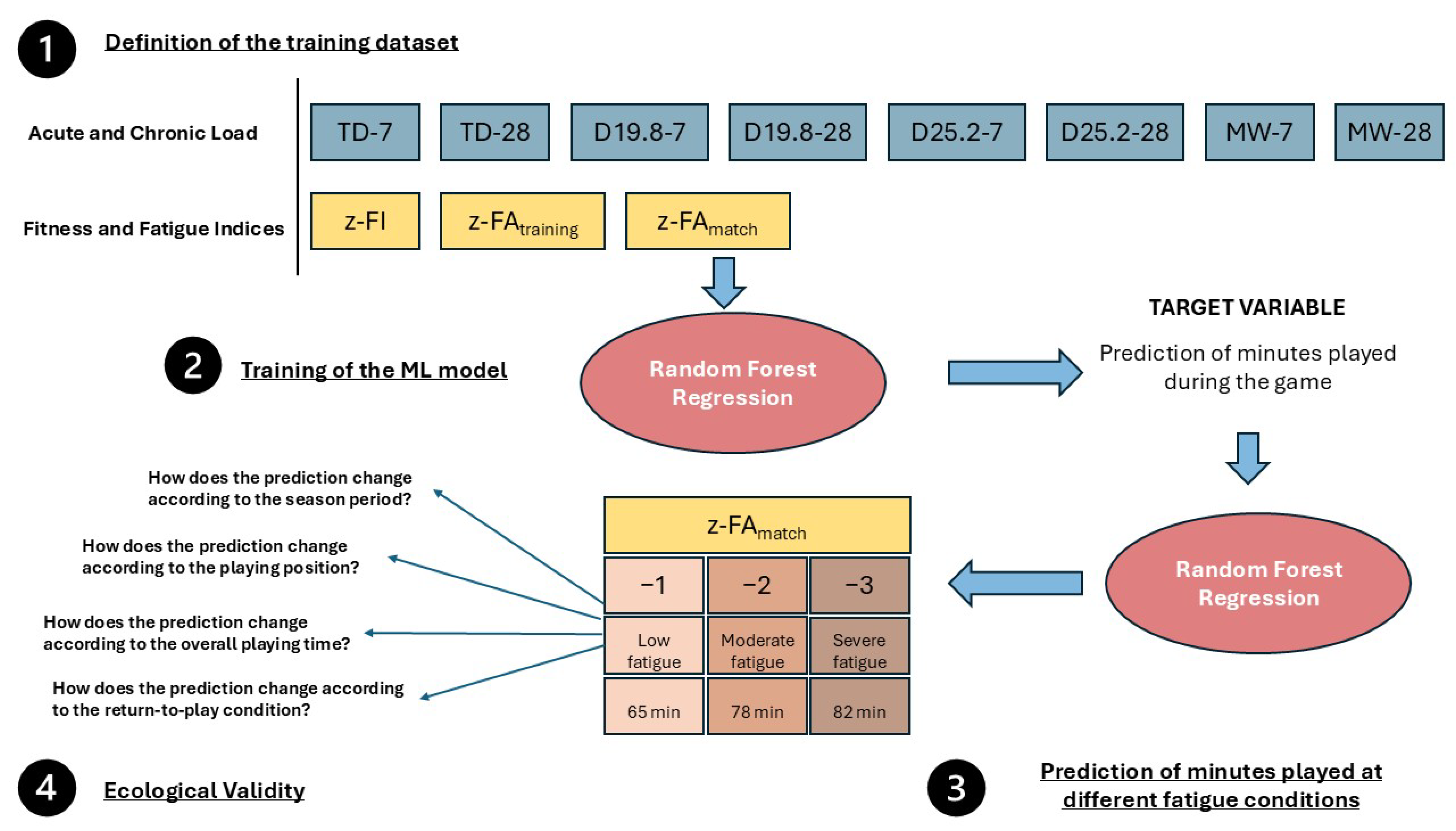
For each match, the trained Random Forest model was used to generate three predictions of playing time, corresponding to these three hypothetical fatigue conditions. This allowed us to estimate the specific match minute at which each player would be expected to reach low, moderate, or severe fatigue under the same load and context but with differing match-day fatigue profiles. In theoretical terms, higher predicted minutes at a given fatigue threshold indicate a greater capacity to delay fatigue during the game. All steps of the data-processing and modelling workflow, from raw data collection to the simulation of fatigue minutes, are summarised in Figure 1.

4. Statistical Analysis

The primary aim of the statistical analysis was to evaluate the ecological validity of the proposed framework; that is, to test whether the predicted minutes to low, moderate and severe fatigue were sensitive and coherent with respect to real-world contextual factors, such as period of the season, playing position, overall playing time during the season, and return-to-play status. Because each athlete contributed multiple observations across training sessions and matches, all analyses were conducted using linear mixed-effects models with random intercepts for player identity, accounting for within-player dependency.
To examine overall differences in predicted minutes across fatigue conditions (low, moderate, severe), a mixed-effects model was fitted with fatigue condition as a fixed effect and player as a random effect. All pairwise contrasts between fatigue conditions were evaluated using repeated-measures comparisons adjusted for the within-player structure. Pairwise tests were conducted using paired t-tests with Bonferroni-corrected p-values, and effect sizes were expressed as Hedges’ g.
To assess whether differences in predicted fatigue-related minutes were consistent across meaningful subgroups, we fitted additional mixed-effects models including fatigue condition (within-player) and one between-subject factor at a time: season period, playing position, overall playing time during the season, and return-to-play status.
For the season period, four subgroups were defined: pre-season—June and July; first part—August, September, October; second part—November, December, January, February; and third part—March, April, May.
For the playing position, players were categorised as: centre-backs, full-backs, midfielders, wingers, and forwards.
For overall playing time during the season, players were divided into: low playing time: <500 min; medium playing time: 500–1500 min; high playing time: >1500 min.
For return-to-play status, players were grouped based on the time elapsed since their return to full training after an injury: early return to play: ≤15 days since return; mid-term return to play: >15 and ≤30 days; long-term return to play: >30 days.
In each model, fatigue condition and the between-subject variable were entered as fixed effects, with player as a random intercept. Estimated marginal means (EMM) and 95% confidence intervals (CI) were computed for each level of the factors. Post hoc pairwise comparisons between levels of each between-subject factor were performed separately within each fatigue condition, using between-subject t-tests with Bonferroni adjustment and reporting Hedges’ g effect size. Values of 0.20, 0.50, and 0.80 were interpreted as indicative of small, medium, and large effects, respectively [30]. Across all analyses, statistical significance was set at p < 0.05. All statistical procedures were implemented in Anaconda (Version 3.9.12, Anaconda Inc., New York, NY, USA) using Python (version 3.13) libraries, as statsmodels and pingouin.

5. Results

5.1. Model Performance and Feature Importance

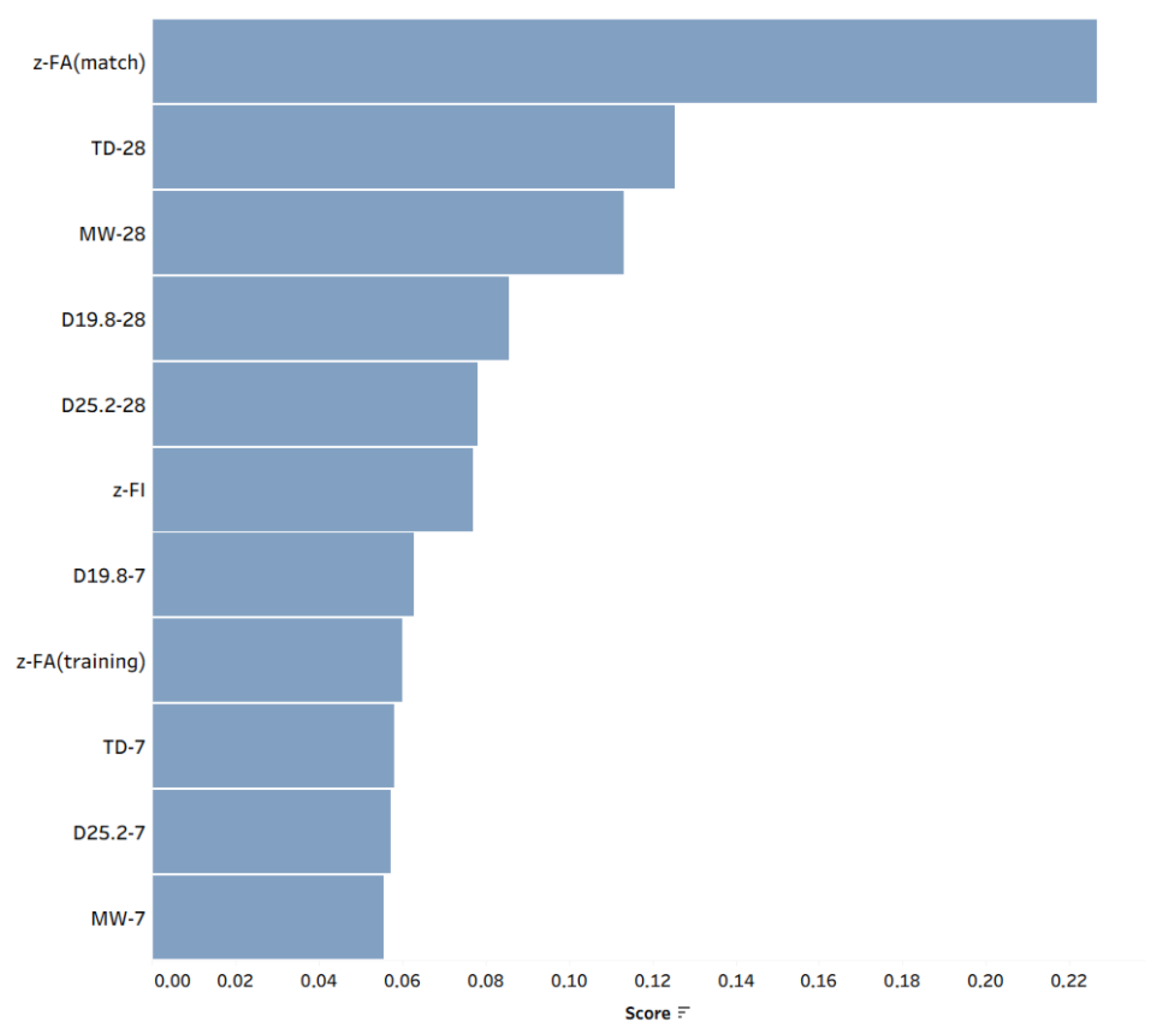
The Random Forest regression model (number of estimators: 100; max depth: 5; minimum samples split: 5; minimum samples leaf: 2; max features: square root) trained on seasons 2021/2022 and 2022/2023 and tested on season 2023/2024 achieved the following performance metrics in the independent test set: MAE = 22.53 min; RMSE = 27.43 min; R2 = 0.17. After feature importance analysis, the z-FAmatch was identified as the strongest predictor. The feature importance analysis was presented in Figure 2.

5.2. Difference Across Fatigue Conditions

The mixed-effects model examining differences across the fatigue conditions indicated that low (β = 7.82, p < 0.01), moderate (β = 27.74, p < 0.01), and severe (β = 27.26, p < 0.01) fatigue statuses were associated with significantly longer predicted playing time compared with the baseline condition. Estimated marginal means confirmed significant differences between low and both moderate and severe fatigue conditions: baseline (EMM = 57.12 [95% CI: 55.55–58.70]), low fatigue (EMM = 64.94 [95% CI: 63.37–66.52]), moderate fatigue (EMM = 84.86 [95% CI: 83.29–86.44]), severe fatigue (EMM = 84.39 [95% CI: 82.82–85.96]). All pairwise comparisons across fatigue conditions are reported in Table 2.

5.3. Influence of Season Period

Across all fatigue conditions, the predicted minutes at which players would reach the baseline, low, moderate, and severe fatigue differed meaningfully by season period. Compared with pre-season, the first, second, and third parts of the season were associated with progressively higher predicted minutes: baseline (first part: β = 9.54, p < 0.01; second part: β = 7.25, p < 0.01; third part: β = 9.79, p < 0.01), low fatigue (first part: β = 6.08, p < 0.01; second part: β = 6.59, p < 0.01; third part: β = 7.65, p < 0.01), moderate fatigue (first part: β = 7.59, p < 0.01; second part: β = 6.38, p < 0.01; third part: β = 8.85, p < 0.01), severe fatigue (first part: β = 7.23, p < 0.01; second part: β = 6.03, p < 0.01; third part: β = 8.33, p < 0.01). Estimated marginal means and 95% CIs for each season period and fatigue level are provided in Table 3, while detailed pairwise comparisons and effect sizes (Hedges’ g) between season periods are shown in Table 4.

5.4. Differences Between Playing Positions

The mixed-effects model including playing position demonstrated that wingers exhibited significantly lower predicted minutes to fatigue than centre-backs across all fatigue conditions: baseline (winger: β = −8.13, p = 0.02; midfielder: β = −1.55, p = 0.61; forward: β = −4.13, p = 0.24; full-back: β = −0.18, p = 0.96), low fatigue (winger: β = −7.39, p < 0.01; midfielder: β = −3.11, p = 0.12; forward: β = −5.24, p = 0.02; full-back: β = −2.99, p = 0.26), moderate fatigue (winger: β = −6.17, p < 0.01; midfielder: β = −3.19, p = 0.98; forward: β = −1.46, p = 0.44; full-back: β = 0.52, p = 0.81), severe fatigue (winger: β = −5.68, p > 0.01; midfielder: β = 0.18, p = 0.91; forward: β = −1.27, p = 0.47; full-back: β = 0.80, p = 0.70). Estimated marginal means for each position and fatigue condition are reported in Table 3, and all pairwise comparisons between positions (including effect sizes) are provided in Table 4.

5.5. Influence of Overall Playing Time

When players were categorised according to their overall playing time during the season, the mixed-effects model revealed significant differences compared with the low-playing-time group. Players with a medium and high playing time were predicted to reach fatigue thresholds later in the match: baseline (medium playing time: β = 3.09, p < 0.01; high playing time: β = 3.94, p < 0.01), low fatigue (medium playing time: β = 3.04, p < 0.01; high playing time: β = 3.16, p < 0.01), moderate fatigue (medium playing time: β = 2.85, p < 0.01; high playing time: β = 2.24, p < 0.01), severe fatigue (medium playing time: β = 2.60, p < 0.01; high playing time: β = 2.04, p < 0.01). EMM values and CIs are shown in Table 3, and pairwise comparisons with Hedges’ g are presented in Table 4.

5.6. Influence of Return-to-Play Status

Finally, when return-to-play status was included in the model, players classified as having a recent return to play (≤15 days) showed substantially lower predicted minutes for all fatigue levels compared with those with mid- and long-term return-to-play durations: baseline (mid-term return-to-play: β = 8.75, p < 0.01; long-term return-to-play: β = 13.63, p < 0.01), low fatigue (mid-term return-to-play: β = 5.89, p < 0.02; long-term return-to-play: β = 9.07, p < 0.01), moderate fatigue (mid-term return-to-play: β = 5.49, p < 0.01; long-term return-to-play: β = 9.13, p < 0.01), severe fatigue (mid-term return-to-play: β = 5.32, p < 0.01; long-term return-to-play: β = 8.87, p < 0.01). EMM values and CIs for each return-to-play group and fatigue condition are reported in Table 3 and detailed pairwise comparisons with Hedges’ g are presented in Table 4.

6. Discussion

The study aimed to answer a long-standing practical question in professional football, “how many minutes does this player have in his legs today?”, by developing an ML-based framework to (1) predict individual match playing time from routinely collected monitoring data; (2) simulate the match minute at which players are expected to reach low, moderate, or severe fatigue; and (3) to evaluate the ecological validity of this approach. Using four consecutive seasons of data from an elite Italian club, we integrated acute and chronic external load metrics with individualised fitness and fatigue indices. The principal findings were: (1) the predictive model achieved an out-of-sample MAE of 22.53 min, an RMSE of 27.43 min, and an R2 of 0.17; (2) z-FAmatch emerged as the most important predictor; and (3) the simulation framework, which systematically manipulated only z-FAmatch while keeping all other predictors constant, revealed coherent and practically meaningful differences in predicted fatigue-related minutes across fatigue conditions, season periods, playing positions, overall playing time, and return-to play status, with small-to-large effect sizes.
The Random Forest regression model explained 17% of the variance in match playing time, with an average absolute error of 22.53 min. Although this coefficient of determination may appear modest, playing time represents a highly multifactorial and partially exogenous outcome. Beyond players’ physical status, match participation is strongly influenced by tactical considerations, opponent characteristics, match location, scoreline and game state, squad rotation strategies, and coaching decisions, as well as by unpredictable events such as injuries or red cards [31,32,33]. Importantly, many of these determinants are not captured within the current predictor set and are not directly observable through physical or physiological monitoring alone. As a consequence, a substantial proportion of variance in playing time remains structurally unexplained, and low-to-moderate R2 values are expected when modelling such decision-driven outcomes. Within this context, achieving an average prediction error of approximately one quarter of a full match can be considered practically meaningful.
A key conceptual aspect of this study is that we did not only use the model to predict a single value of playing time per match, but also to generate four distinct “threshold-related” minutes: baseline condition (z-FAmatch = 0), which represents a neutral reference point on the fatigue index; and low, moderate, and severe conditions (z-FAmatch = −1, −2, −3), which represent progressively more extreme values on the same scale, moving one, two, and three standard deviations away from the neutral level. In practice, these four conditions can be interpreted as successive points along a fatigue continuum, with the baseline as the earliest “change point”, and low, moderate, and severe indicating progressively more demanding states that would be reached later in the match. Consistent with this interpretation, the pairwise comparisons in Table 2 show a clear and ordered pattern of predicted minutes: the low condition occurs on average ~7.8 min later than the baseline, while the moderate and severe conditions occur ~27.7 and ~27.3 min later than the baseline, respectively. Taken together, these results suggest that a first meaningful change point (baseline) is expected around the 57th minute of play, while advanced fatigue states are expected about 20 min later, with very little difference between moderate and severe conditions. From a physiological perspective, this is consistent with the idea that fatigue builds progressively: a relatively long transition from neutral to clearly fatigued states, followed by a plateau at a high fatigue where the distinction between “moderate” and “severe” becomes less meaningful [34,35]. Another important aspect to discuss is that the feature importance analysis revealed that z-FAmatch was the most influential predictor of playing time. Despite external load history (7- and 28-day windows) and fitness status remaining important, the model suggests that the acute, context-specific expression of fatigue captured by z-FAmatch is crucial in estimating the ability of the player to cope with the match from a mechanical point of view.
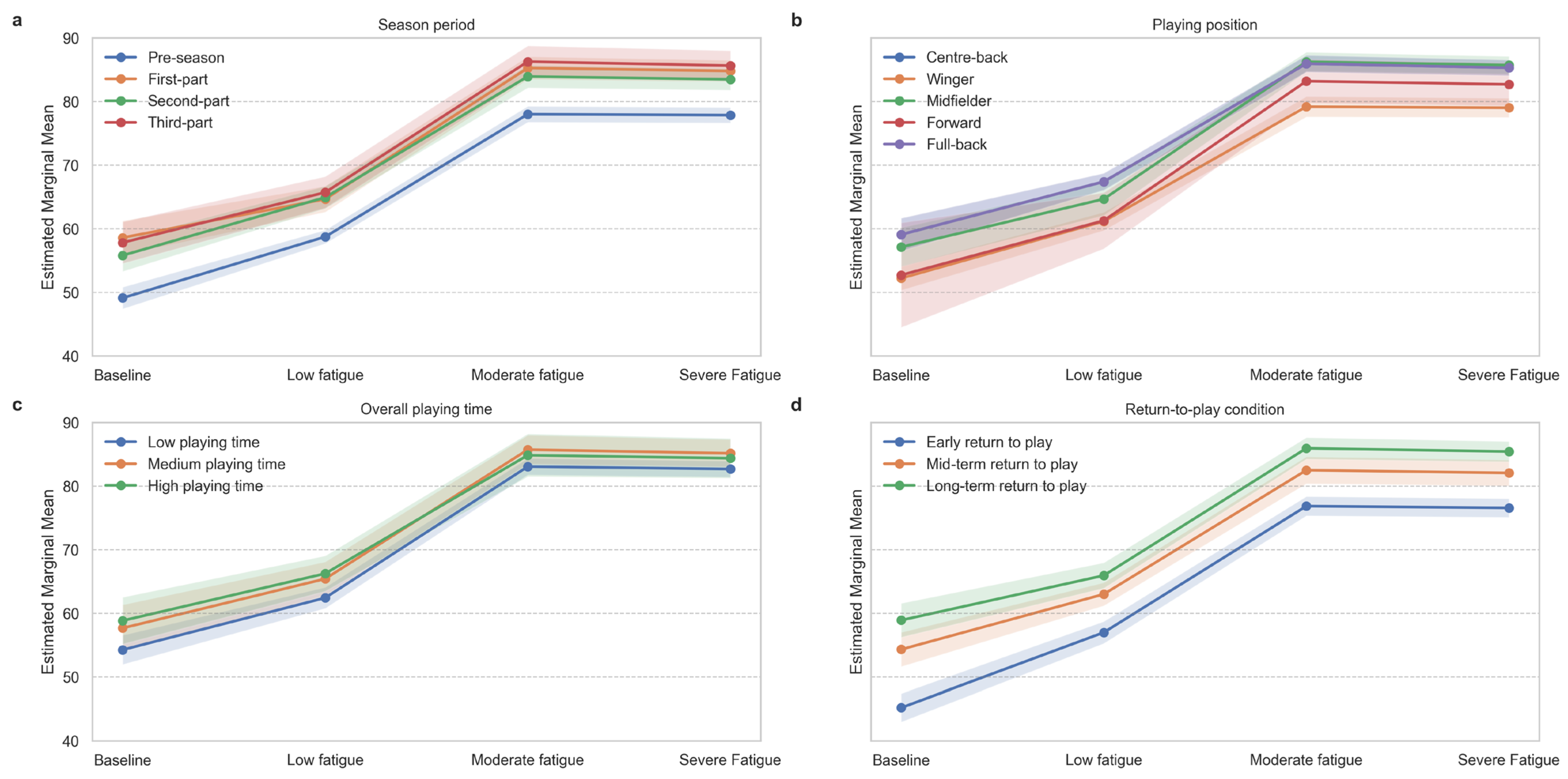
A central aim of the study was to test whether the four simulated conditions behaved in ways that are ecologically plausible across key contextual factors known to influence match fatigue: season period, playing position, overall playing time, and return-to-play status. When the season period was considered, baseline predicted minutes were lowest in pre-season and higher in all subsequent parts of the season. For example, baseline EMM increased from 49.5 min in pre-season to 59.1 min in the first part, 56.8 min in the second part, and 59.3 min in the third part of the season. This pattern was mirrored and amplified for the three fatigue thresholds (Table 3), and confirmed by the pairwise comparisons, which showed medium-to-large effects (g = −0.50 to −0.89; Table 4). Hence, as the season progresses, all four conditions (baseline, low, moderate, severe) shift to later minutes, indicating that players are expected to delay the onset of both early and advanced fatigue states. These changes align well with evidence that suggests that match-specific fitness improves during the competitive period: with more matches and training stimuli, players become better able to tolerate the physical demands of competition [14,32,36] and to “push fatigue further to the right” on the time axis.
Playing position also modulated the predicted minutes in a coherent way. At baseline, centre-backs recorded the highest predicted minutes (60.2 min), while the wingers showed the lowest values (52.1 min), with a medium effect size for their contrast (g = 0.59). Midfielders, forwards, and full-backs lie in between these extremes (Table 3). Across the low, moderate, and severe conditions, this hierarchy persisted, and the effect sizes between centre-backs and wingers were consistently medium across all four conditions (g = 0.59 to 0.72; Table 4). This is consistent with positional demands: wide players typically perform more high-speed running, repeated sprints, and sharp changes of direction which accelerate fatigue, whereas centre-backs often cover lower high-speed distances and spend more time in structured positional play [37,38,39]. This suggests that the model captures position-specific profiles of tolerance to fatigue and that the four simulated thresholds provide a consistent, position-sensitive description of how long players can be expected to sustain increasing levels of fatigue.
Grouping players by overall playing time during the season revealed a graded pattern in predicted minutes. At baseline, players with low seasonal exposure had the lowest predicted minutes (55.9 min), while medium- and high-playing-time groups showed slightly higher values (59.0 and 59.8 min). In this case, the difference between low and medium or high were statistically significant but small (g up to −0.35; Table 4). A similar pattern was observed across the different simulated thresholds. These findings suggest that accumulating greater match exposure—both in terms of total playing minutes and number of matches throughout the season—may confer an advantage in coping with match demands. Although starters and non-starters may be exposed to comparable weekly training load volumes through different training strategies, match play provides a level of specificity that cannot be fully replicated in training. Consequently, players who consistently participate in matches appear better able to tolerate match-specific demands and delay the onset of the critical fatigue threshold [40,41].
To further investigate the ecological validity of the approach, the influence of return-to-play status was considered. At baseline, players in the early RTP category (≤15 days since return) had markedly lower predicted minutes (46.4 min) than those in the mid-term (55.1 min) and long-term (60.0 min) categories. The contrasts were associated with large effects (g = −0.75 and −1.07). Effect size between early and long return-to-play remained medium-to-large across all fatigue conditions (g = −0.60 to −0.99), indicating that players soon after return are predicted to reach each fatigue level considerably earlier than those further advanced in the return-to-play process. Overall, these results suggest that the framework is sensitive to time since return-to-play: as weeks pass after the player’s return, the expected minutes to baseline, low, moderate, and severe fatigue all shift to later in the match. This is coherent with the idea that clearance to return is only the first step, and that full competitive tolerance develops gradually with increasing exposure to training and matches [42,43].

7. Practical Applications and Future Directions

From an applied perspective, the proposed framework offers several potential benefits: (1) by linking complex monitoring data to an intuitive metric (the estimated minute at which different fatigue thresholds are likely to be reached), the framework transforms abstract indices into a language that resonates with coaches; (2) the approach could be used to estimate how changes in cumulative load or progression through return-to-play might shift expected fatigue-onset minutes as presented in Figure 3; (3) finally, the framework encourages a cultural shift in monitoring practices, from retrospective description (“what happened last week?”) to forward-looking, scenario-based reasoning (“under the current load and fatigue context, what is likely to happen in the next match?”). This predictive mindset is more aligned with the strategic nature of high-performance decision-making. The current approach can be strengthened in the future by adopting advanced modelling approaches, integrating additional indicators (e.g., subjective wellness scores), and linking fatigue-related minutes with technical–tactical performance indicators.

8. Methodological Considerations and Limitations

Different limitations need to be addressed in the current study: the FI and FA indices are themselves outputs of underlying ML models built from HR and PL predictions. This layered architecture may give rise to concerns about error propagation and interpretability. However, the final Random Forest model was evaluated on a fully independent test season, meaning that all upstream uncertainties were inherently integrated into the out-of-sample performance metrics. Therefore, the reported MAE, RMSE and R2 already reflect the combined effects of prediction error from the FI/FA models and the match-minute model itself. In addition, the study was conducted in a single club and involved male professional players only. Therefore, the external validity of the model to other contexts cannot be assumed. Finally the model did not include contextual variables such as opponent quality, match location, and other events (e.g., red cards), all of which can strongly influence both substitution decisions and physical output, introducing exogenous sources of variability that may add uncontrollable noise to the model and limit the interpretability of playing time-related estimates.

9. Conclusions

This study proposed and evaluated a novel ML-based framework that combines acute and chronic external load metrics with individualized fitness and fatigue indices to address a very practical question in elite football: “how many minutes does the player have in his legs?” By systematically manipulating z-FAmatch in a simulation framework, we estimated the match minute at which players are expected to reach low, moderate or severe fatigue. These predicted fatigue-related minutes behaved in ecologically coherent ways across season period, playing position, overall playing time, and return-to-play status, with small-to-large effect sizes.

Author Contributions

M.M. (Mauro Mandorino), A.T., R.K. and M.L. were responsible for the design of the study. M.M. (Mauro Mandorino) and M.L. conducted the analyses. M.M. (Mauro Mandorino), M.M. (Manuel Morabito) and V.P. were responsible for data collection. All authors contributed to the interpretation of the findings and had full access to all data. M.M. (Mauro Mandorino), R.K. and M.L. produced the first draft of the paper, which was critically revised by V.P. and A.T. The final manuscript was approved by all authors. All authors have read and agreed to the published version of the manuscript.

Funding

This research received no external funding.

Institutional Review Board Statement

Approval for data collection was obtained from the club (as players’ data were routinely collected over the course of the season). The study was conducted in accordance with the Declaration of Helsinki (2013).

Informed Consent Statement

Informed consent was obtained from all subjects involved in the study.

Data Availability Statement

Data are available upon reasonable request.

Acknowledgments

The authors would like to thank the club Parma Calcio 1913 (medical staff, coaching staff, and all players) for their participation in the study.

Conflicts of Interest

The authors declare no conflict of interest.

References

  1. Carling, C. Interpreting physical performance in professional soccer match-play: Should we be more pragmatic in our approach? Sports Med. 2013, 43, 655–663. [Google Scholar] [CrossRef]
  2. Rebelo, A.; Brito, J.; Seabra, A.; Oliveira, J.; Krustrup, P. Physical match performance of youth football players in relation to physical capacity. Eur. J. Sport Sci. 2014, 14, S148–S156. [Google Scholar] [CrossRef]
  3. Cummins, C.; Orr, R.; O’Connor, H.; West, C. Global positioning systems (GPS) and microtechnology sensors in team sports: A systematic review. Sports Med. 2013, 43, 1025–1042. [Google Scholar] [CrossRef] [PubMed]
  4. Rago, V.; Brito, J.; Figueiredo, P.; Costa, J.; Barreira, D.; Krustrup, P.; Rebelo, A. Methods to collect and interpret external training load using microtechnology incorporating GPS in professional football: A systematic review. Res. Sports Med. 2020, 28, 437–458. [Google Scholar] [CrossRef]
  5. Murray, N.B.; Gabbett, T.J.; Townshend, A.D.; Blanch, P. Calculating acute:chronic workload ratios using exponentially weighted moving averages provides a more sensitive indicator of injury likelihood than rolling averages. Br. J. Sports Med. 2017, 51, 749–754. [Google Scholar] [CrossRef]
  6. Andrade, R.; Wik, E.H.; Rebelo-Marques, A.; Blanch, P.; Whiteley, R.; Espregueira-Mendes, J.; Gabbett, T.J. Is the acute:chronic workload ratio (ACWR) associated with risk of time-loss injury in professional team sports? A systematic review of methodology, variables and injury risk in practical situations. Sports Med. 2020, 50, 1613–1635. [Google Scholar] [CrossRef]
  7. Griffin, A.; Kenny, I.C.; Comyns, T.M.; Lyons, M. The association between the acute:chronic workload ratio and injury and its application in team sports: A systematic review. Sports Med. 2020, 50, 561–580. [Google Scholar] [CrossRef]
  8. Pinelli, S.; Mandorino, M.; Fantozzi, S.; Lacome, M. Exploring the Relationship Between the Acute:Chronic Workload Ratio and Running Parameters in Elite Football Athletes. Appl. Sci. 2025, 15, 1659. [Google Scholar] [CrossRef]
  9. Buchheit, M.; Simpson, B.M.; Lacome, M. Monitoring cardiorespiratory fitness in professional soccer players: Is it worth the prick? Int. J. Sports Physiol. Perform. 2020, 15, 1437–1441. [Google Scholar] [CrossRef] [PubMed]
  10. Buchheit, M.; Shushan, T.; Barrett, S.; Scott, T.J.; Altmann, S.; Rabbani, A.; Mandorino, M.; Lacome, M.; Lovell, R.; McLaren, S.J. Maximizing the submaximal: 20 years of monitoring cardiovascular adaptation through submaximal HR response in team sports. Sport Perform. Sci. Rep. 2025, 266, 1–36. [Google Scholar]
  11. Altmann, S.; Neumann, R.; Härtel, S.; Woll, A.; Buchheit, M. Using submaximal exercise heart rate for monitoring cardiorespiratory fitness changes in professional soccer players: A replication study. Int. J. Sports Physiol. Perform. 2021, 16, 1096–1102. [Google Scholar] [CrossRef] [PubMed]
  12. Leduc, C.; Tee, J.; Lacome, M.; Weakley, J.; Cheradame, J.; Ramirez, C.; Jones, B. Convergent validity, reliability, and sensitivity of a running test to monitor neuromuscular fatigue. Int. J. Sports Physiol. Perform. 2020, 15, 1067–1073. [Google Scholar] [CrossRef] [PubMed]
  13. Brown, M.; Lacome, M.; Leduc, C.; Hader, K.; Guilhem, G.; Buchheit, M. Acute locomotor, heart rate and neuromuscular responses to added wearable resistance during soccer-specific training. Sci. Med. Footb. 2024, 8, 269–277. [Google Scholar] [CrossRef] [PubMed]
  14. Mandorino, M.; Beato, M.; Lacome, M. Impact of Preseason Training Camps on Fitness, Fatigue, and Performance in Professional Football Players: Mildaltitude Camp Versus Sea-Level Camp. Int. J. Sports Physiol. Perform. 2025, 20, 1253–1264. [Google Scholar] [CrossRef] [PubMed]
  15. Leduc, C.; Lacome, M.; Buchheit, M. The use of standardised runs (and associated data analysis) to monitor neuromuscular status in team sports players: A call to action. Sport Perform. Sci. Rep. 2020, 117, 1–5. [Google Scholar]
  16. Mandorino, M.; Tessitore, A.; Leduc, C.; Persichetti, V.; Morabito, M.; Lacome, M. A new approach to quantify soccer players’ readiness through machine learning techniques. Appl. Sci. 2023, 13, 8808. [Google Scholar] [CrossRef]
  17. Mandorino, M.; Clubb, J.; Lacome, M. Predicting soccer players’ fitness status through a machine-learning approach. Int. J. Sports Physiol. Perform. 2024, 19, 443–453. [Google Scholar] [CrossRef]
  18. Rossi, A.; Pappalardo, L.; Cintia, P. A narrative review for a machine learning application in sports: An example based on injury forecasting in soccer. Sports 2021, 10, 5. [Google Scholar] [CrossRef]
  19. Ati, A.; Bouchet, P.; Jeddou, R.B. Using multi-criteria decision-making and machine learning for football player selection and performance prediction: A systematic review. Data Sci. Manag. 2024, 7, 79–88. [Google Scholar] [CrossRef]
  20. Mandorino, M.; Figueiredo, A.J.; Cima, G.; Tessitore, A. Analysis of relationship between training load and recovery status in adult soccer players: A machine learning approach. Int. J. Comput. Sci. Sport 2022, 21, 1–16. [Google Scholar] [CrossRef]
  21. Mandorino, M.; Figueiredo, A.J.; Cima, G.; Tessitore, A. Predictive analytic techniques to identify hidden relationships between training load, fatigue and muscle strains in young soccer players. Sports 2022, 10, 3. [Google Scholar] [CrossRef] [PubMed]
  22. Mandorino, M.; Figueiredo, A.J.; Cima, G.; Tessitore, A. A data mining approach to predict non-contact injuries in young soccer players. Int. J. Comput. Sci. Sport 2021, 20, 147–163. [Google Scholar] [CrossRef]
  23. Tamim, A.; Jahan, M.W.; Chowdhury, M.R.S.; Hossain, A.; Rahman, M.M.; Imon, A.R. Machine learning-driven market value prediction for European football players. J. Comput. Math. Data Sci. 2025, 15, 100118. [Google Scholar] [CrossRef]
  24. Yiğit, A.T.; Samak, B.; Kaya, T. Football player value assessment using machine learning techniques. In Proceedings of the International Conference on Intelligent and Fuzzy Systems, Istanbul, Turkey, 23–25 July 2019; pp. 289–297. [Google Scholar]
  25. Winter, E.M.; Maughan, R.J. Requirements for ethics approvals. J. Sports Sci. 2009, 27, 985. [Google Scholar] [CrossRef]
  26. Gómez-Carmona, C.D.; Bastida-Castillo, A.; García-Rubio, J.; Ibáñez, S.J.; Pino-Ortega, J. Static and dynamic reliability of WIMU PRO™ accelerometers according to anatomical placement. Proc. Inst. Mech. Eng. Part P J. Sports Eng. Technol. 2019, 233, 238–248. [Google Scholar] [CrossRef]
  27. Gómez-Carmona, C.D.; Bastida-Castillo, A.; González-Custodio, A.; Olcina, G.; Pino-Ortega, J. Using an inertial device (WIMU PRO) to quantify neuromuscular load in running: Reliability, convergent validity, and influence of type of surface and device location. J. Strength Cond. Res. 2020, 34, 365–373. [Google Scholar] [CrossRef]
  28. Barrett, S.; Midgley, A.; Reeves, M.; Joel, T.; Franklin, E.; Heyworth, R.; Garrett, A.; Lovell, R. The within-match patterns of locomotor efficiency during professional soccer match play: Implications for injury risk? J. Sci. Med. Sport 2016, 19, 810–815. [Google Scholar] [CrossRef] [PubMed]
  29. Kensert, A.; Alvarsson, J.; Norinder, U.; Spjuth, O. Evaluating parameters for ligand-based modeling with random forest on sparse data sets. J. Cheminformatics 2018, 10, 49. [Google Scholar] [CrossRef]
  30. Brydges, C.R. Effect size guidelines, sample size calculations, and statistical power in gerontology. Innov. Aging 2019, 3, igz036. [Google Scholar] [CrossRef]
  31. Shcherbak, T.; Popovych, I.; Kariyev, A.; Duisenbayeva, A.; Huzar, V.; Hoian, I.; Kyrychenko, K. Psychological causes of fatigue in football players. J. Phys. Educ. Sport 2023, 23, 2193–2202. [Google Scholar]
  32. Silva, J.R.; Rumpf, M.C.; Hertzog, M.; Castagna, C.; Farooq, A.; Girard, O.; Hader, K. Acute and residual soccer match-related fatigue: A systematic review and meta-analysis. Sports Med. 2018, 48, 539–583. [Google Scholar] [CrossRef]
  33. Clarke, N.; Noon, M. Editorial: Fatigue and recovery in football. Sports 2019, 7, 192. [Google Scholar] [CrossRef] [PubMed]
  34. Noakes, T.D. The central governor model and fatigue during exercise. In Regulation of Fatigue in Exercise; Nova Science Publishers: Hauppauge, NY, USA, 2011; pp. 1–26. [Google Scholar]
  35. Weir, J.P.; Beck, T.W.; Cramer, J.T.; Housh, T.J. Is fatigue all in your head? A critical review of the central governor model. Br. J. Sports Med. 2006, 40, 573–586. [Google Scholar] [CrossRef]
  36. Buchheit, M.; Racinais, S.; Bilsborough, J.C.; Bourdon, P.C.; Voss, S.C.; Hocking, J.; Cordy, J.; Mendez-Villanueva, A.; Coutts, A.J. Monitoring fitness, fatigue and running performance during a pre-season training camp in elite football players. J. Sci. Med. Sport 2013, 16, 550–555. [Google Scholar] [CrossRef]
  37. Morgans, R.; Mandorino, M.; Beato, M.; Ryan, B.; Zmijewski, P.; Moreira, A.; Ceylan, H.; Oliveira, R. Contextualized high-speed running and sprinting during English Premier League match-play with reference to possession, positional demands and opponent ranking. Biol. Sport 2025, 42, 119–127. [Google Scholar] [CrossRef]
  38. Morgans, R.; Mandorino, M.; Ryan, B.; Zmijewski, P.; Moreira, A.; Oliveira, R. Contextualized acceleration and deceleration profiles of elite soccer players during English Premier League match-play. The effect of possession, positional demands and opponent ranking. Biol. Sport 2025, 42, 67–75. [Google Scholar] [CrossRef] [PubMed]
  39. Mandorino, M.; Lacome, M. Defining worst-case-scenario thresholds in soccer: Intensity versus volume. Int. J. Sports Physiol. Perform. 2024, 19, 836–840. [Google Scholar] [CrossRef]
  40. Silva, J.R.; Magalhães, J.; Ascensão, A.; Seabra, A.F.; Rebelo, A.N. Training status and match activity of professional soccer players throughout a season. J. Strength Cond. Res. 2013, 27, 20–30. [Google Scholar] [CrossRef]
  41. Silva, J.R.; Magalhães, J.F.; Ascensão, A.A.; Oliveira, E.M.; Seabra, A.F.; Rebelo, A.N. Individual match playing time during the season affects fitness-related parameters of male professional soccer players. J. Strength Cond. Res. 2011, 25, 2729–2739. [Google Scholar] [CrossRef]
  42. Buchheit, M.; King, R.; Stokes, A.; Lemaire, B.; Grainger, A.; Brennan, D.; Norman, D.; Mükinen, A.; Ruggiero, H.; Shelton, A. Return to play following injuries in pro football: Insights into the real-life practices of 85 elite practitioners around diagnostics, progression strategies and reintegration processes. Sport Perform. Sci. Rep. 2023, 180, 1–20. [Google Scholar]
  43. Van Der Horst, N.; Backx, F.J.G.; Goedhart, E.A.; Huisstede, B.M. Return to play after hamstring injuries in football (soccer): A worldwide Delphi procedure regarding definition, medical criteria and decision-making. Br. J. Sports Med. 2017, 51, 1583–1591. [Google Scholar] [CrossRef] [PubMed]
Figure 1. Data analysis framework used to predict the specific match minute at which a player is expected to reach the baseline, low, moderate or severe levels of fatigue. TD-7: acute total distance calculated in the last 7 days. TD-28: chronic total distance calculated in the last 28 days. D19.8-7: acute distance above 19.8 km/h calculated in the last 7 days. D19.8-28: chronic distance above 19.8 km/h calculated in the last 28 days. D25.2-7: acute distance above 25.2 km/h calculated in the last 7 days. D25.2-28: chronic distance above 25.2 km/h calculated in the last 28 days. MW-7: acute mechanical work calculated in the last 7 days. MW-28: chronic mechanical work calculated in the last 28 days. z-FI: fitness index. z-FAtraining: fatigue index calculated on match-day minus 1. z-FAmatch: fatigue index calculated in the match. ML: machine learning.
Applsci 16 02139 g001
Figure 2. Feature importance analysis of the Random Forest regression model predicting match minutes. The y-axis reports the input variables included in the model, while the x-axis represents the normalized importance score derived from permutation-based feature importance. TD-7: acute total distance calculated in the last 7 days. TD-28: chronic total distance calculated in the last 28 days. D19.8-7: acute distance above 19.8 km/h calculated in the last 7 days. D19.8-28: chronic distance above 19.8 km/h calculated in the last 28 days. D25.2-7: acute distance above 25.2 km/h calculated in the last 7 days. D25.2-28: chronic distance above 25.2 km/h calculated in the last 28 days. MW-7: acute mechanical work calculated in the last 7 days. MW-28: chronic mechanical work calculated in the last 28 days. z-FI: fitness index. z-FAtraining: fatigue index calculated on match-day minus 1.
Applsci 16 02139 g002
Figure 3. Estimated marginal means (EMM) and 95% confidence intervals of the outcome variable across fatigue levels (baseline, low fatigue, moderate fatigue, severe fatigue) stratified by (a) season period, (b) playing position, (c) overall playing time, and (d) return-to-play condition.
Applsci 16 02139 g003
Table 1. Hyperparameter grid used for Random Forest tuning.
HyperparameterTested Values
Number of estimators50, 100, 300, 600, 1000, 1500
Maximum depth3, 5, 8, 12, 16, 20, 25
Minimum samples split2, 5, 10, 15
Minimum samples leaf2, 4, 6
Maximum featuressquare root, base-2 logarithm
Table 2. Pairwise comparisons across fatigue conditions (baseline, low, moderate, severe): differences in predicted minutes, Bonferroni-adjusted p-values, and Hedges’ g.
Pairwise ComparisonDifferencep-AdjustedHedges’ g
Baseline vs. low fatigue7.8200.001−1.207
Baseline vs. moderate fatigue27.7390.001−4.572
Baseline vs. severe fatigue27.2670.001−4.547
Low fatigue vs. moderate fatigue19.9190.001−4.128
Low fatigue vs. severe fatigue19.4470.001−4.107
Moderate fatigue vs. severe fatigue−0.4720.0010.117
Table 3. Estimated marginal means (EMM) and 95% confidence intervals (CI) for predicted minutes across season period, playing position, overall playing time, and return-to-play condition, shown separately for baseline, low, moderate and severe fatigue conditions.
FactorFatigueGroupEMMCI 95%
Season periodBaselinePre-season49.50446.685, 52.323
First part59.05356.720, 61.386
Second part56.75454.396, 59.112
Third part59.29656.810, 61.781
LowPre-season58.89456.893, 60.895
First part64.97963.361, 66.597
Second part65.48963.852, 67.126
Third part66.55264.813, 68.290
ModeratePre-season78.00276.217, 79.786
First part85.59884.262, 89.933
Second part84.38483.027, 85.741
Third part86.86085.382, 88.337
SeverePre-season77.86276.076, 79.648
First part85.09683.724, 86.468
Second part83.90082.508, 85.292
Third part86.19584.693, 87.698
Playing positionBaselineCentre-back60.19755.478, 64.916
Winger52.06447.117, 57.012
Midfielder58.64454.784, 62.504
Forward56.06850.970, 61.167
Full-back60.01653.467, 66.565
LowCentre-back68.46465.419, 71.509
Winger61.06957.897, 64.241
Midfielder65.35862.868, 67.847
Forward63.22459.920, 66.529
Full-back65.47161.262, 69.679
ModerateCentre-back86.08983.591, 88.587
Winger79.92177.349, 82.494
Midfielder86.12284.079, 88.164
Forward84.63081.904, 87.356
Full-back86.61283.194, 90.029
SevereCentre-back85.37483.009, 87.740
Winger79.68977.256, 82.121
Midfielder85.55283.618, 87.486
Forward84.10281.518, 86.687
Full-back86.17482.941, 89.407
Overall playing timeBaselineLow55.89353.583, 58.203
Medium58.98256.563, 61.402
High59.82957.275, 62.382
LowLow63.44961.846, 65.051
Medium66.49164.803, 68.180
High66.60764.816, 68.397
ModerateLow83.58781.940, 85.234
Medium86.44184.707, 88.174
High85.82783.989, 87.665
SevereLow83.10681.821, 84.391
Medium85.70784.328, 87.087
High85.14283.648, 86.635
Return-to-play conditionBaselineEarly46.37343.832, 48.914
Mid-term55.12552.507, 57.744
Long-term60.00357.795, 62.211
LowEarly57.46455.655, 59.273
Mid-term63.35961.488, 65.231
Long-term66.54265.001, 68.082
ModerateEarly77.35775.713, 79.000
Mid-term82.84481.130, 84.557
Long-term86.48385.148, 87.818
SevereEarly77.06575.416, 78.714
Mid-term82.38480.670, 84.097
Long-term85.94284.577, 87.307
Table 4. Pairwise comparisons across season period, playing position, overall playing time, and return-to-play condition.
FactorFatiguePairwise ComparisonDifferencep-AdjustedHedges’ g
Season periodBaselinePre-season vs. First part9.6330.001−0.765
Pre-season vs. Second part6.8400.001−0.503
Pre-season vs. Second part8.8560.001−0.723
First part vs. Second part−2.7940.0010.204
First part vs. Third part−0.7771.0000.060
Second part vs. Third part2.0160.104−0.146
LowPre-season vs. First part6.0680.001−0.674
Pre-season vs. Second part6.3430.001−0.642
Pre-season vs. Second part7.1300.001−0.766
First part vs. Second part0.2751.000−0.028
First part vs. Third part1.0620.510−0.110
Second part vs. Third part0.7871.000−0.076
ModeratePre-season vs. First part7.4770.001−0.803
Pre-season vs. Second part6.1360.001−0.669
Pre-season vs. Second part8.4760.001−0.894
First part vs. Second part−1.3410.0580.139
First part vs. Third part0.9990.665−0.101
Second part vs. Third part2.3400.001−0.239
SeverePre-season vs. First part7.1360.001−0.794
Pre-season vs. Second part5.8170.001−0.658
Pre-season vs. Second part7.9800.001−0.877
First part vs. Second part−1.3190.0510.142
First part vs. Third part0.8450.969−0.089
Second part vs. Third part2.1640.002−0.230
Playing positionBaselineCentre-back vs. Winger−6.8740.0010.588
Centre-back vs. Midfielder−1.9660.2340.142
Centre-back vs. Forward−6.3690.0010.458
Centre-back vs. Full-back4.5540.001−0.346
Winger vs. Midfielder4.9080.001−0.389
Winger vs. Forward0.5051.000−0.043
Winger vs. Full-back11.4280.001−1.045
Midfielder vs. Forward−4.4030.0010.308
Midfielder vs. Full-back6.5200.001−0.473
Forward vs. Full-back10.9230.001−0.789
LowCentre-back vs. Winger−6.2330.0010.702
Centre-back vs. Midfielder−2.7270.0010.259
Centre-back vs. Forward−6.1210.0010.598
Centre-back vs. Full-back1.0201.000−0.102
Winger vs. Midfielder3.5060.001−0.377
Winger vs. Forward0.1131.000−0.014
Winger vs. Full-back7.2530.001−0.942
Midfielder vs. Forward−3.3940.0010.329
Midfielder vs. Full-back3.7470.001−0.370
Forward vs. Full-back7.1410.001−0.766
ModerateCentre-back vs. Winger−6.7720.0010.720
Centre-back vs. Midfielder0.2861.000−0.031
Centre-back vs. Forward−2.7560.0070.285
Centre-back vs. Full-back1.5900.420−0.168
Winger vs. Midfielder7.0570.001−0.769
Winger vs. Forward4.0150.001−0.425
Winger vs. Full-back8.3620.001−0.905
Midfielder vs. Forward−3.0420.0010.326
Midfielder vs. Full-back1.3040.677−0.142
Forward vs. Full-back4.3470.001−0.455
SevereCentre-back vs. Winger−6.2920.0010.689
Centre-back vs. Midfielder0.4111.000−0.046
Centre-back vs. Forward−2.6120.0080.280
Centre-back vs. Full-back1.6730.265−0.184
Winger vs. Midfielder6.7040.001−0.756
Winger vs. Forward3.6800.001−0.399
Winger vs. Full-back7.9650.001−0.884
Midfielder vs. Forward−3.0240.0010.338
Midfielder vs. Full-back1.2610.665−0.143
Forward vs. Full-back4.2850.001−0.464
Overall playing timeBaselineLow vs. Medium3.4130.001−0.248
Low vs. High4.5860.001−0.353
Medium vs. High1.1730.403−0.087
LowLow vs. Medium2.9880.001−0.299
Low vs. High3.8160.001−0.404
Medium vs. High0.8270.457−0.083
ModerateLow vs. Medium2.6620.001−0.268
Low vs. High1.7860.002−0.186
Medium vs. High−0.8760.3620.090
SevereLow vs. Medium2.4790.001−0.258
Low vs. High1.6980.002−0.184
Medium vs. High−0.7810.4520.084
Return-to-play conditionBaselineEarly vs. Mid-term9.1240.001−0.752
Early vs. Long-term13.7130.001−1.074
Mid-term vs. Long-term4.5890.001−0.357
LowEarly vs. Mid-term6.0150.001−0.657
Early vs. Long-term8.9540.001−0.945
Mid-term vs. Long-term2.9390.001−0.308
ModerateEarly vs. Mid-term5.6450.001−0.599
Early vs. Long-term9.0900.001−0.985
Mid-term vs. Long-term3.4450.001−0.367
SevereEarly vs. Mid-term5.4960.001−0.604
Early vs. Long-term8.8620.001−0.999
Mid-term vs. Long-term3.3660.001−0.373
Disclaimer/Publisher’s Note: The statements, opinions and data contained in all publications are solely those of the individual author(s) and contributor(s) and not of MDPI and/or the editor(s). MDPI and/or the editor(s) disclaim responsibility for any injury to people or property resulting from any ideas, methods, instructions or products referred to in the content.