Study on Heat Generation Mechanisms and Circumferential Temperature Evolution Characteristics of Journal Bearings Under Different Whirl Motion

Abstract
1. Introduction
2. Governing Equations and Numerical Method
2.1. Governing Equations of Computational Fluid Dynamics
2.2. Journal Dynamic Equations
2.3. Journal Whirl Orbit Equation
3. Computational Model and Method
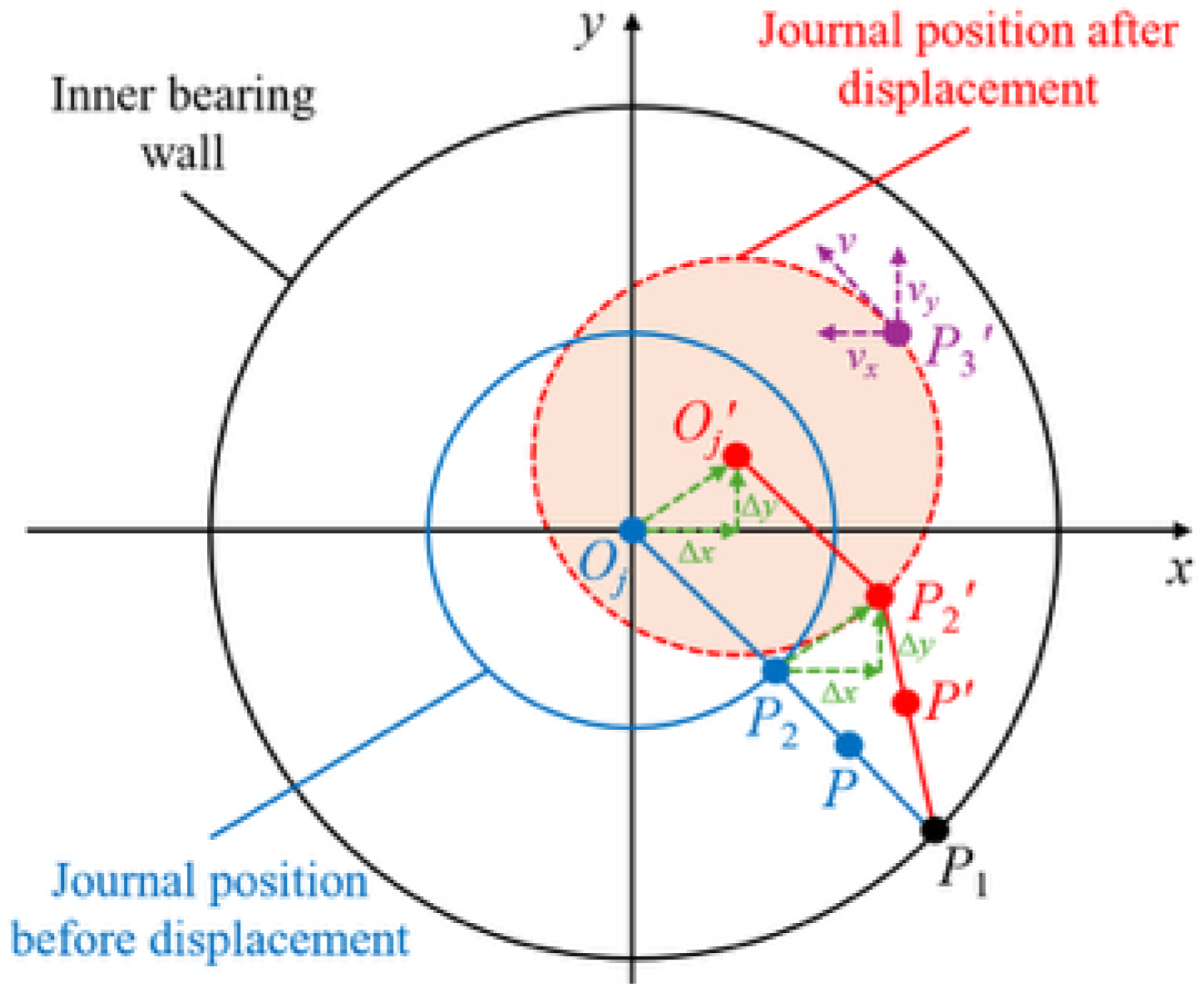
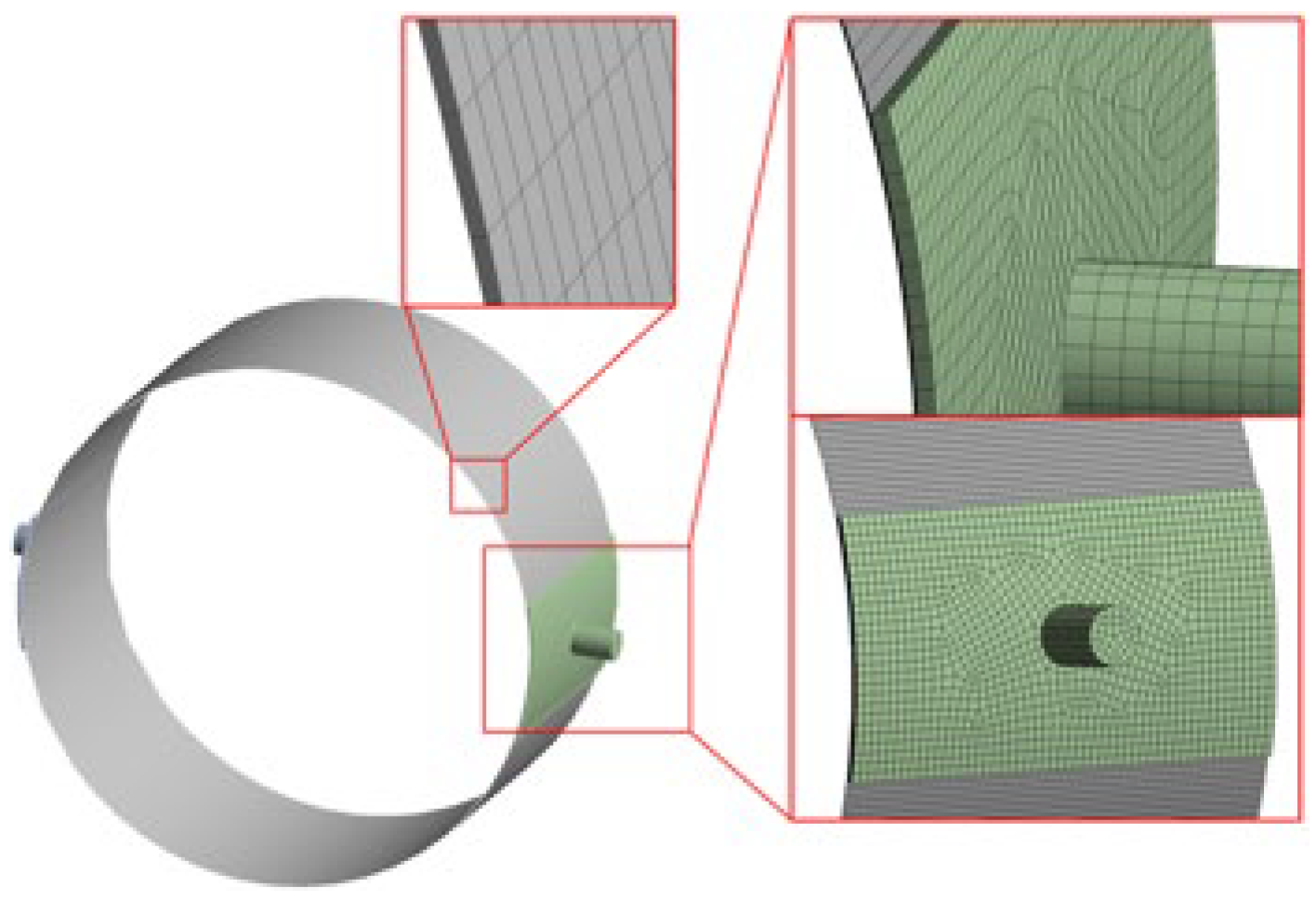
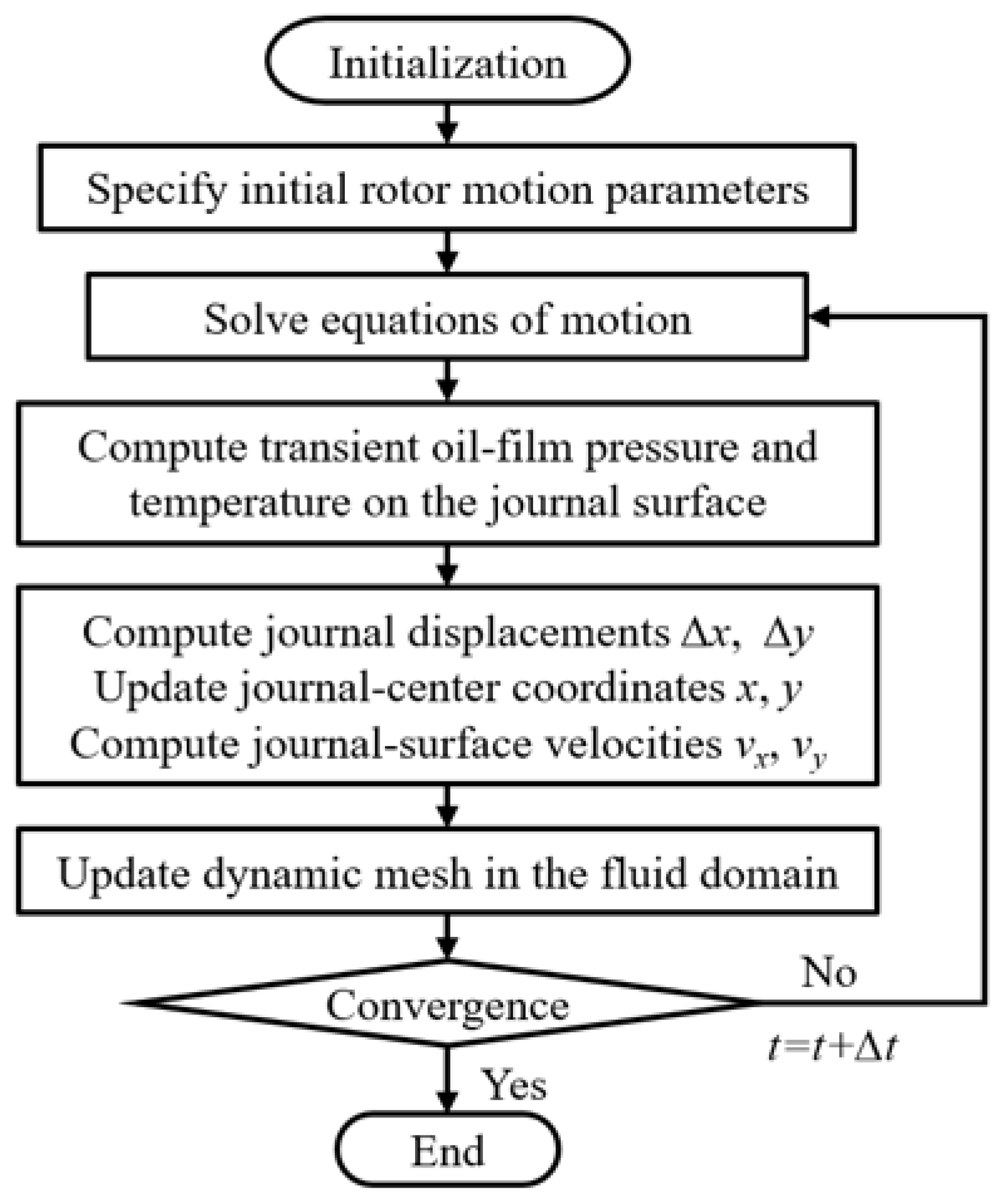
3.1. Physical Model and Dynamic Mesh Updating Method
- (1)
- Fluid compressibility and density variation: The lubricant was treated as an incompressible Newtonian fluid with constant density; pressure-induced volumetric elasticity effects were neglected.
- (2)
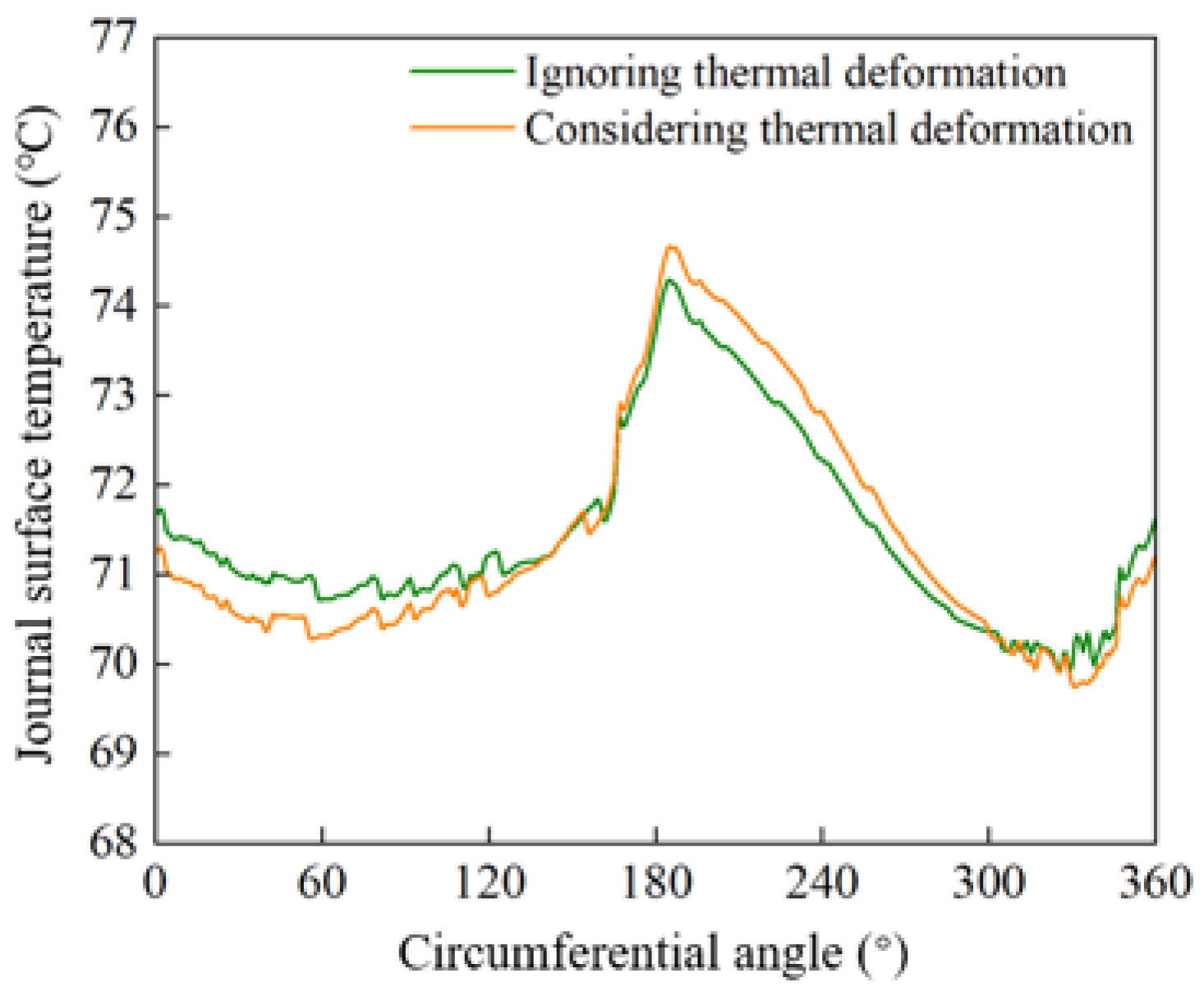
- Geometry and structural deformation: The journal and bearing were assumed to be rigid bodies. Elastic deformation of the journal and flexibility of the bearing shell were not considered, nor was thermal expansion of the journal or bearing.
- (3)
- Thermal boundaries and heat transfer model: Heat transfer on the solid side was represented by prescribed convective heat-transfer coefficients.
- (4)
- Turbulence modeling: The flow was modeled using the RANS SST k–ω turbulence model. Transitional flow and local relaminarization effects were only approximated by the model; high-fidelity approaches such as DNS or LES were not employed.
- (5)
- Material properties and temperature–viscosity relation: The temperature dependence of lubricant viscosity is described by the Reynolds temperature–viscosity relation. Shear-thinning behavior, pressure–viscosity effects, and non-Newtonian characteristics were neglected.
- (6)
- Lubricant supply boundaries and oil-supply details: The supply pressure and supply temperature were specified as constant boundary conditions.
3.2. Boundary Conditions
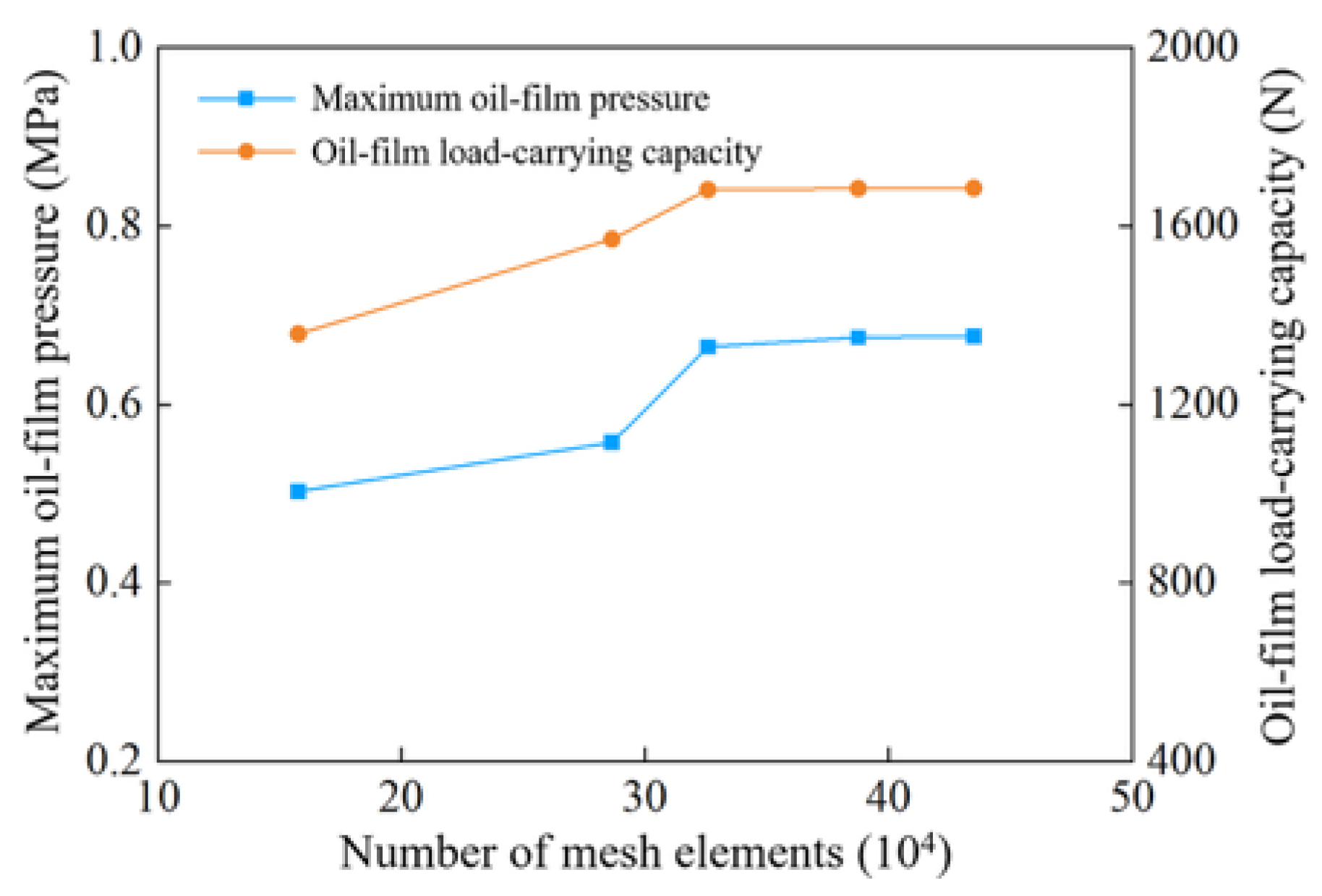
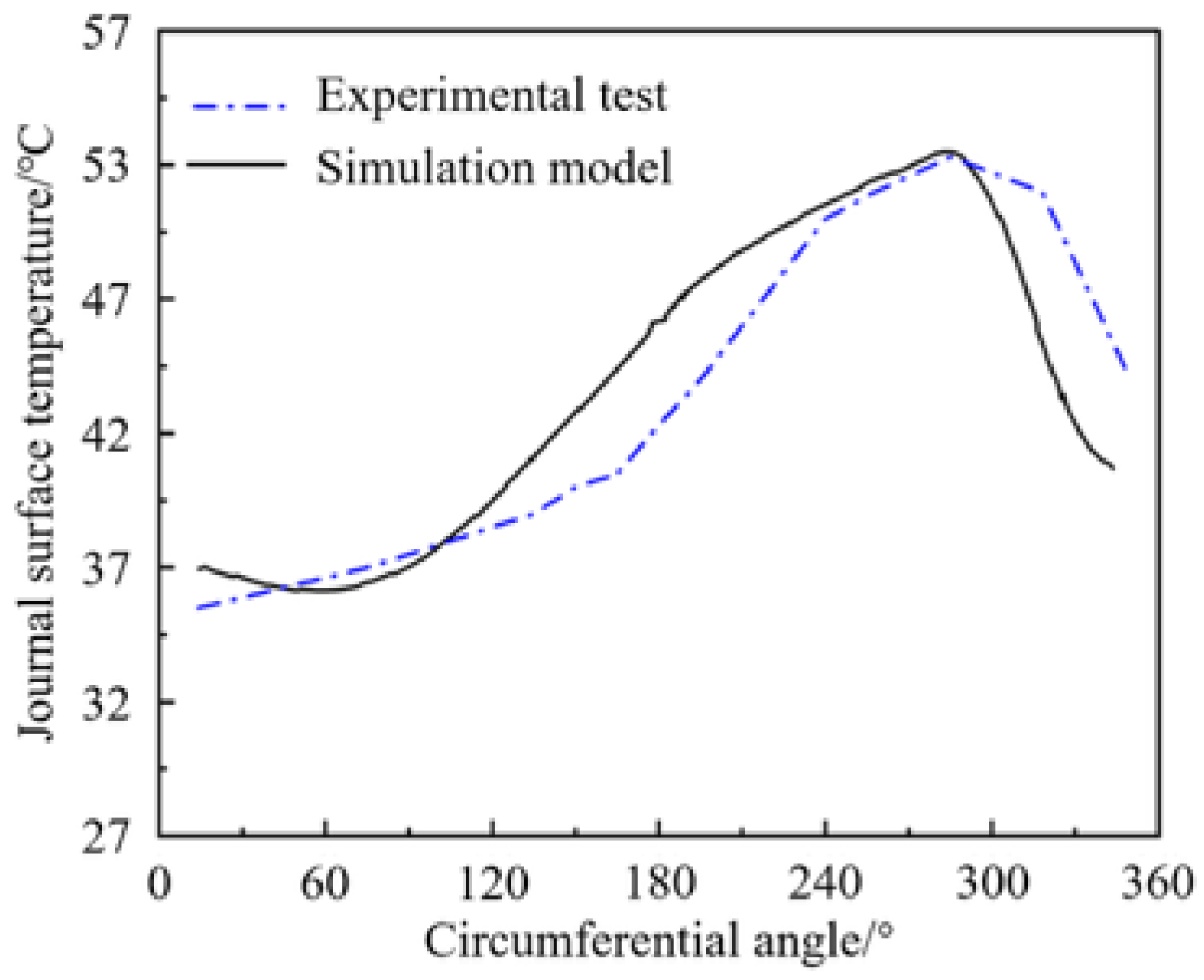
3.3. Validation of Computational Model Accuracy
4. Results and Discussion
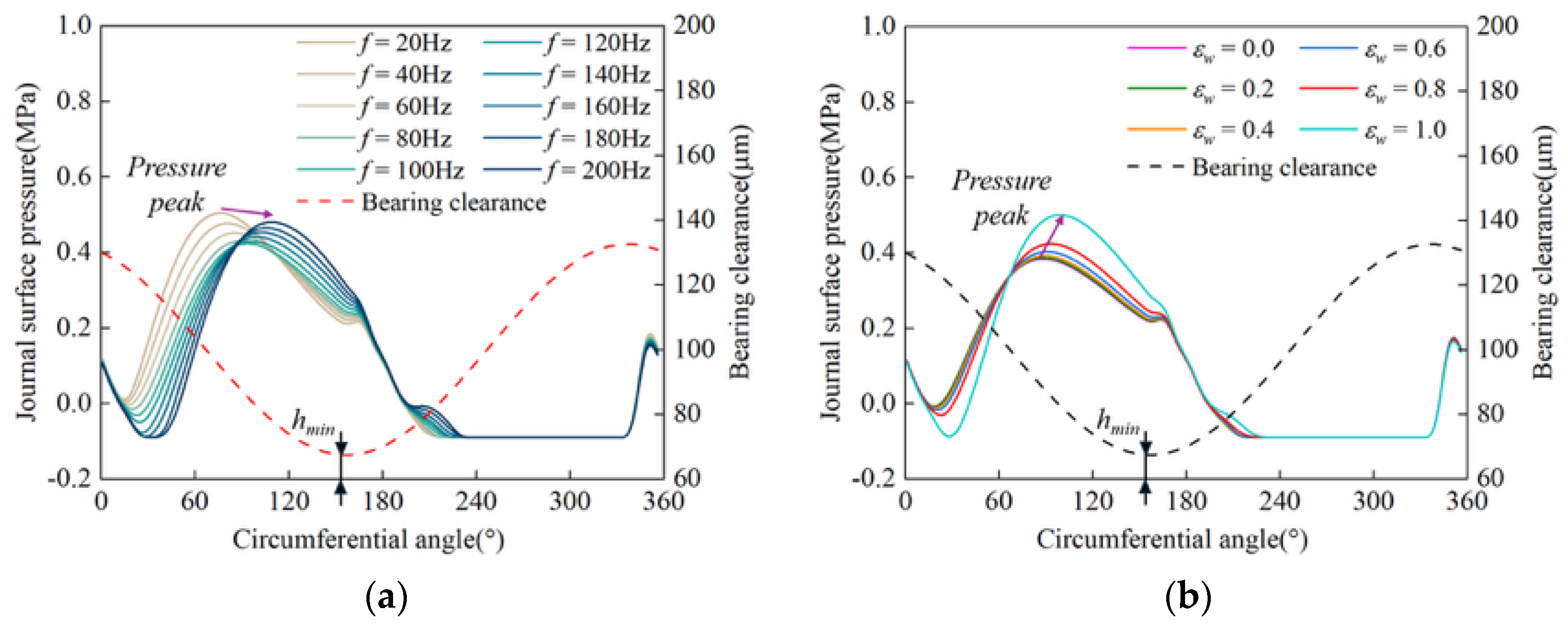
4.1. Influence of Different Whirl Orbits on Journal Pressure Distribution
4.2. Influence of Different Whirl Orbits on Journal Temperature Distribution
5. Conclusions
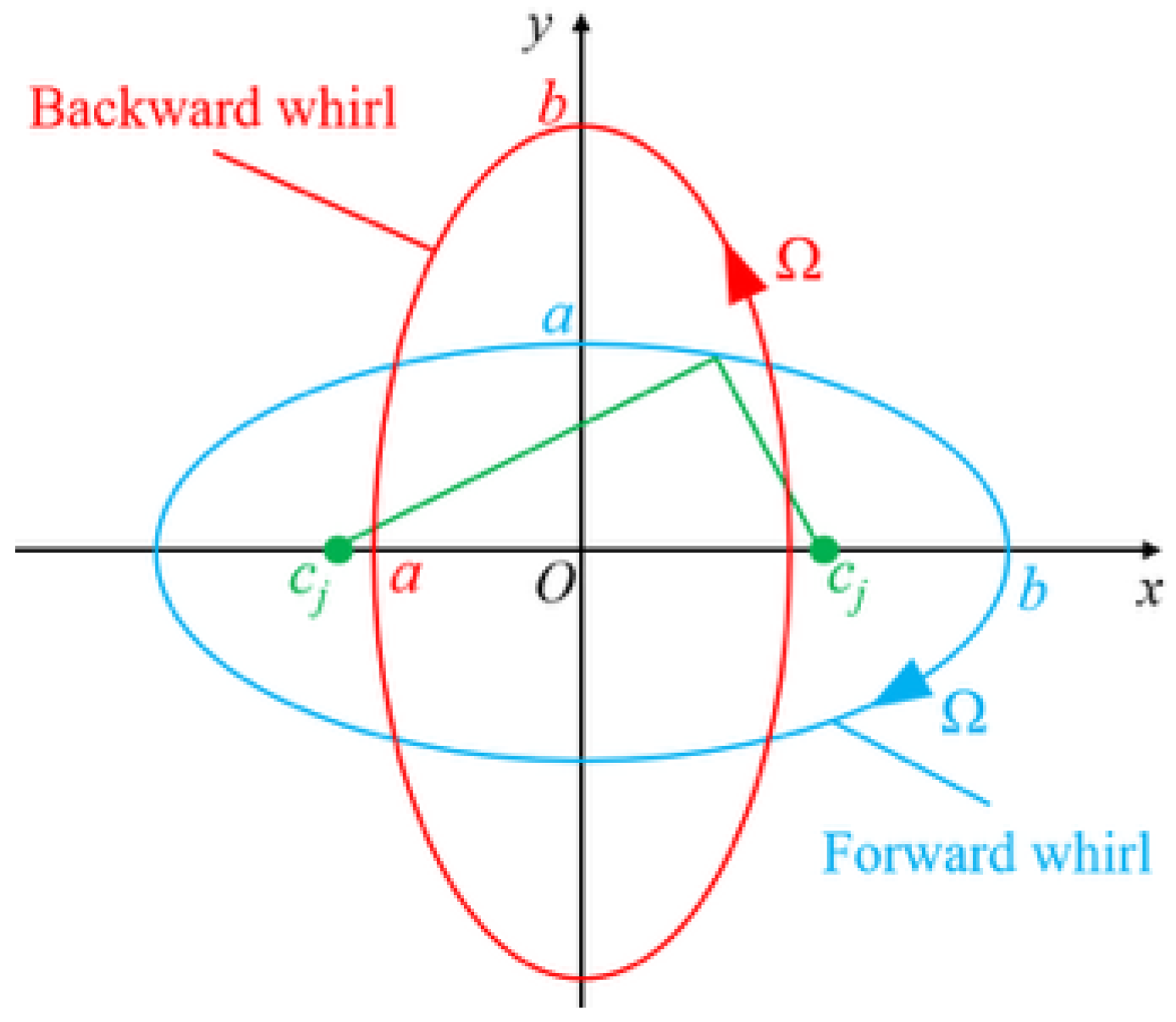
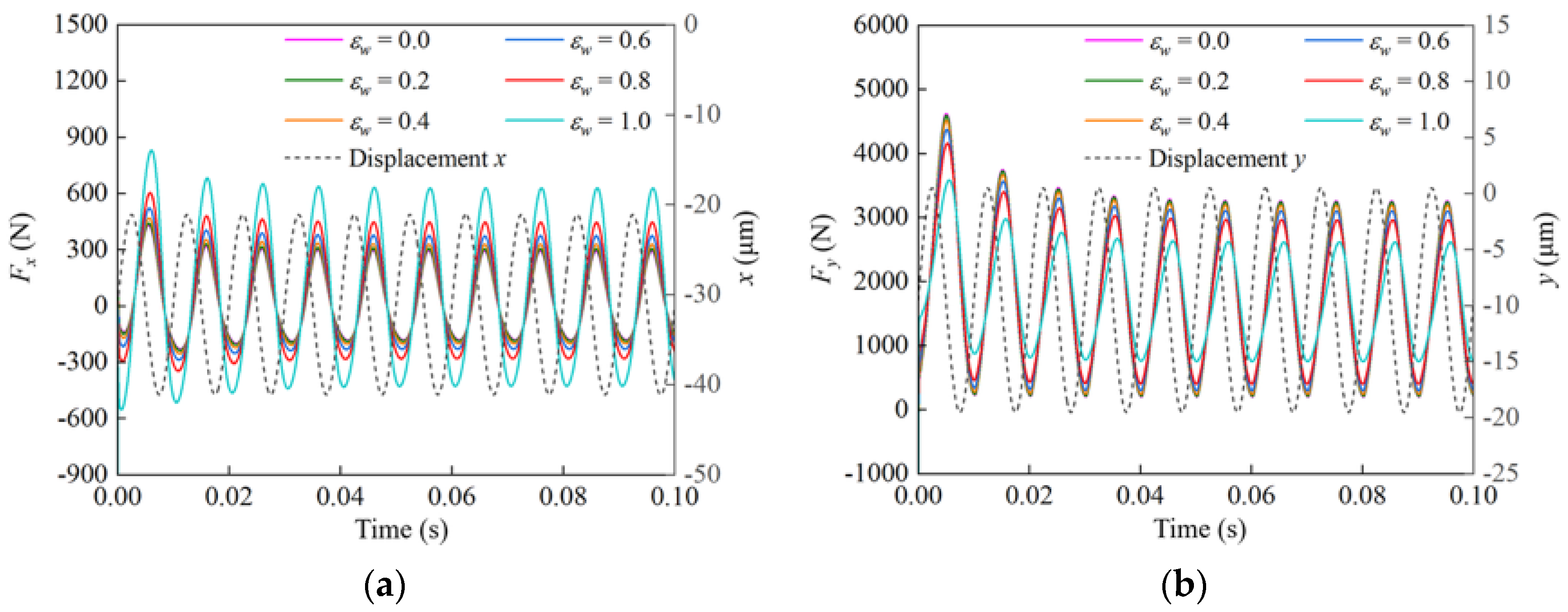
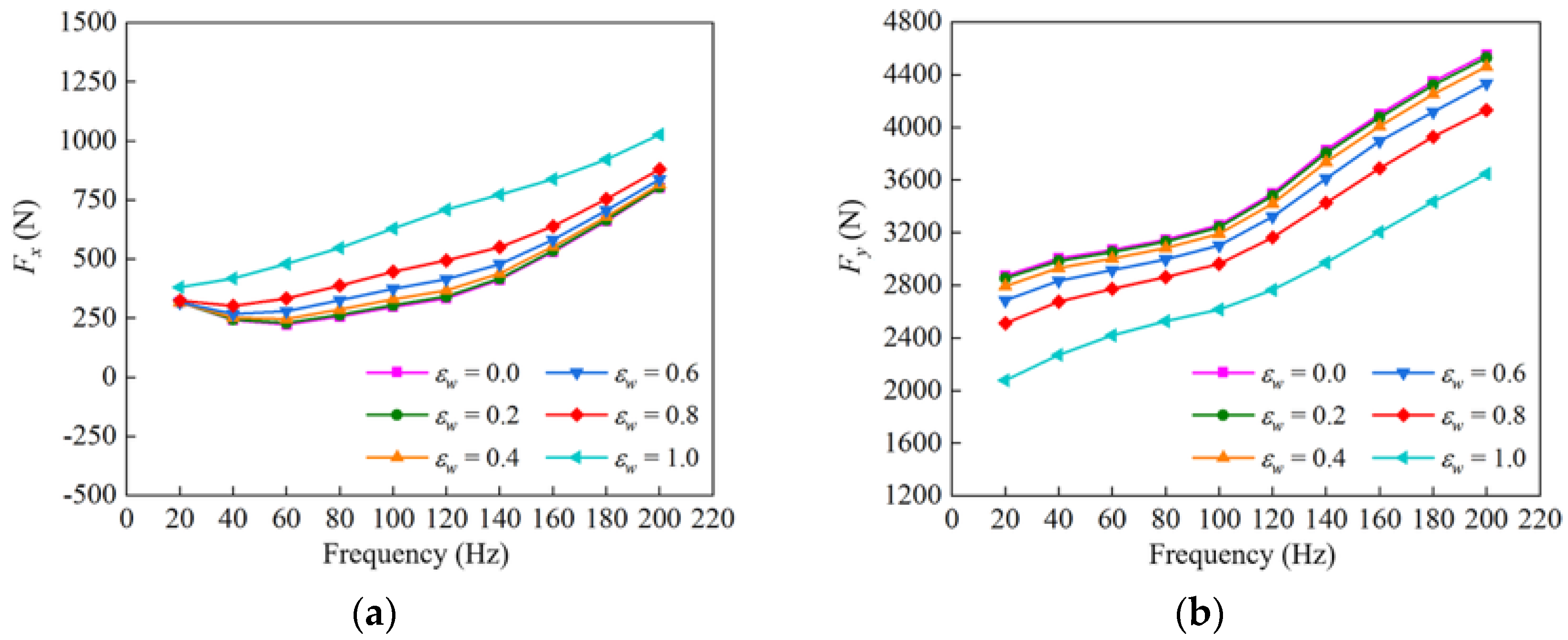
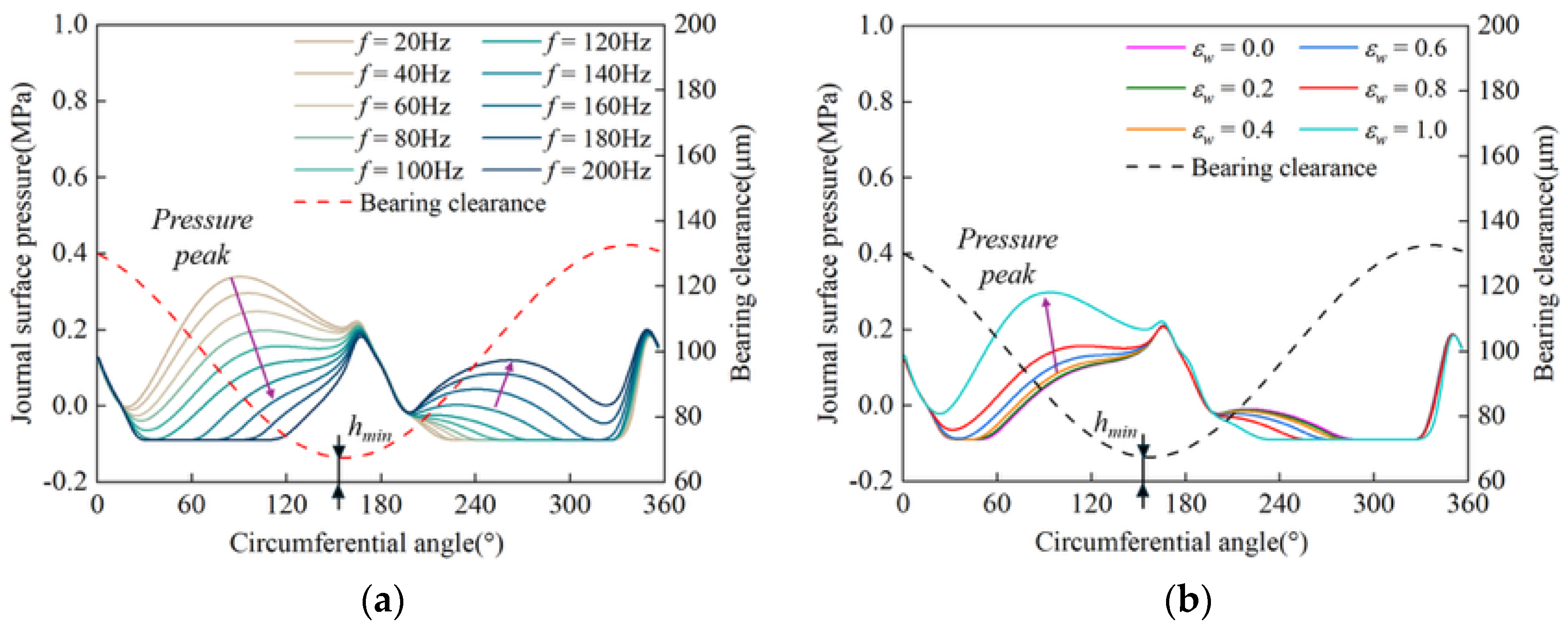
- At a whirl frequency of 100 Hz, the whirl amplitude of the oil-film force Fx under forward whirl increases with increasing elliptical eccentricity, whereas under backward whirl, the amplitude of Fy decreases with increasing elliptical eccentricity. As whirl frequency increases, both Fx in forward whirl and Fy in backward whirl increase progressively.
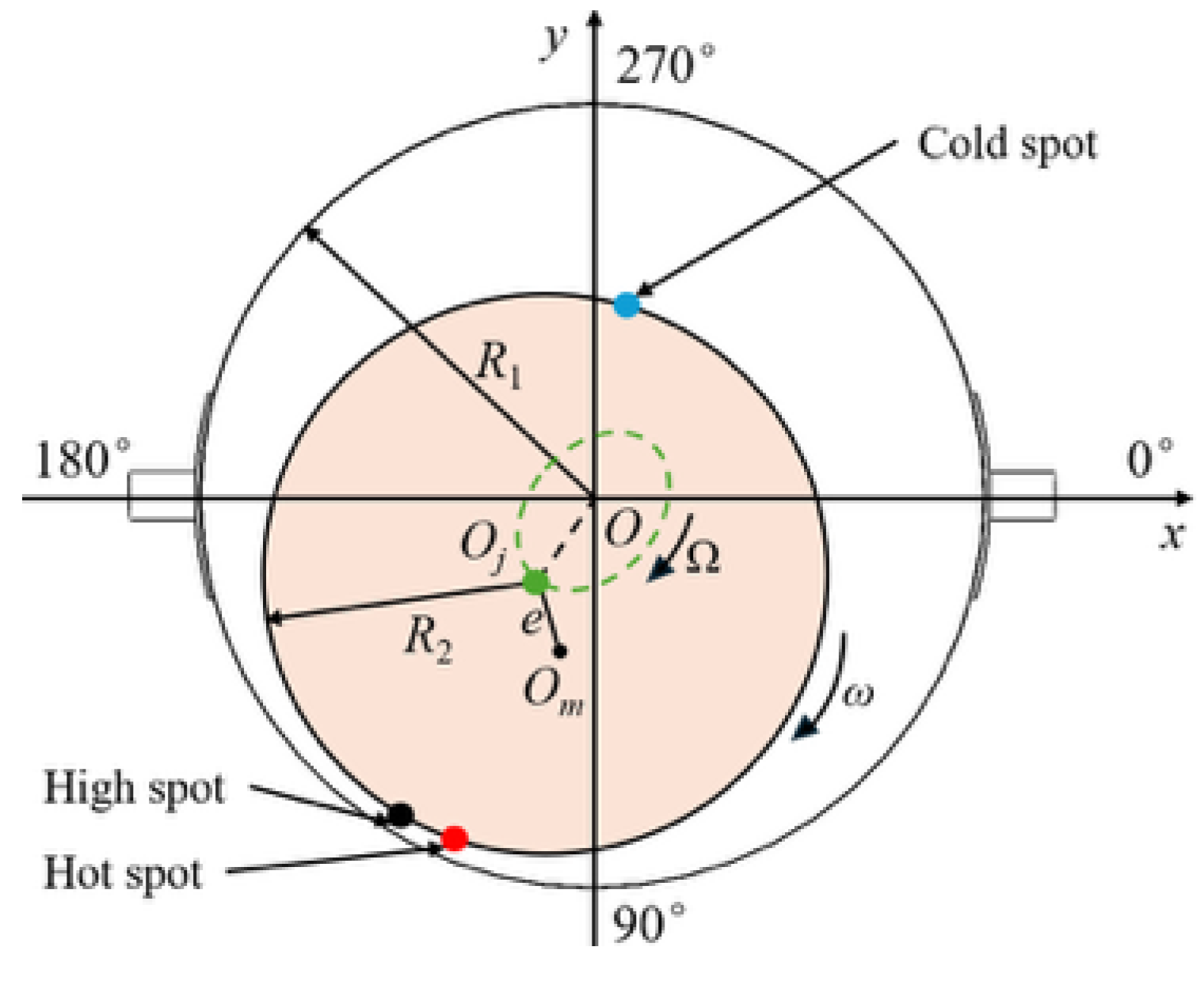
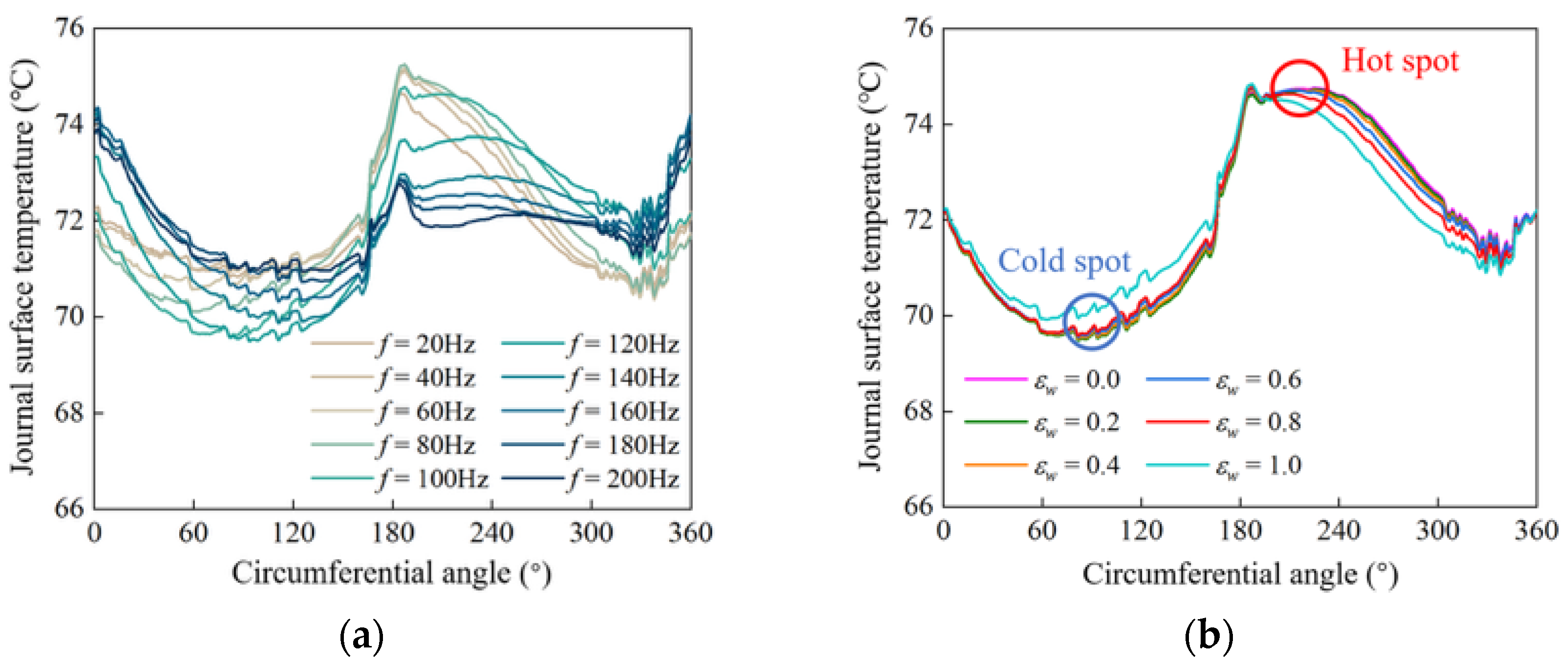
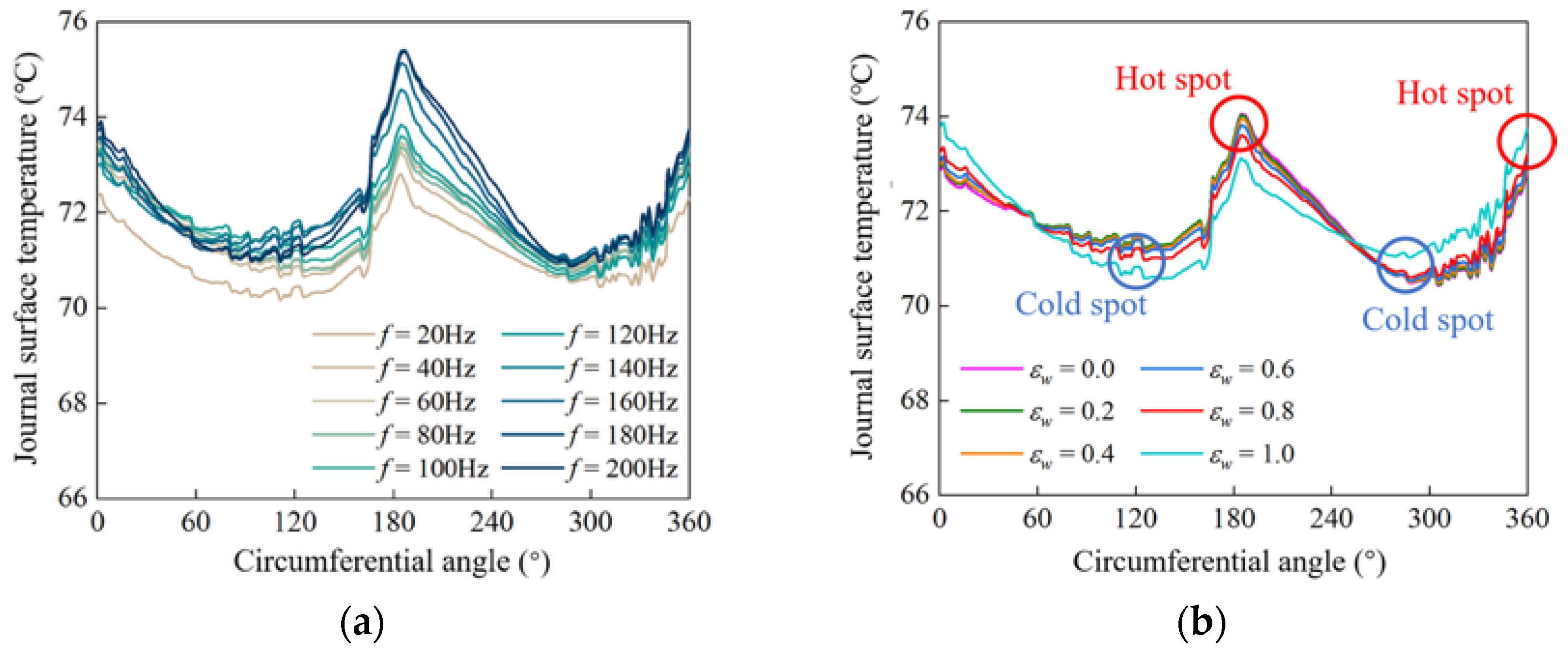
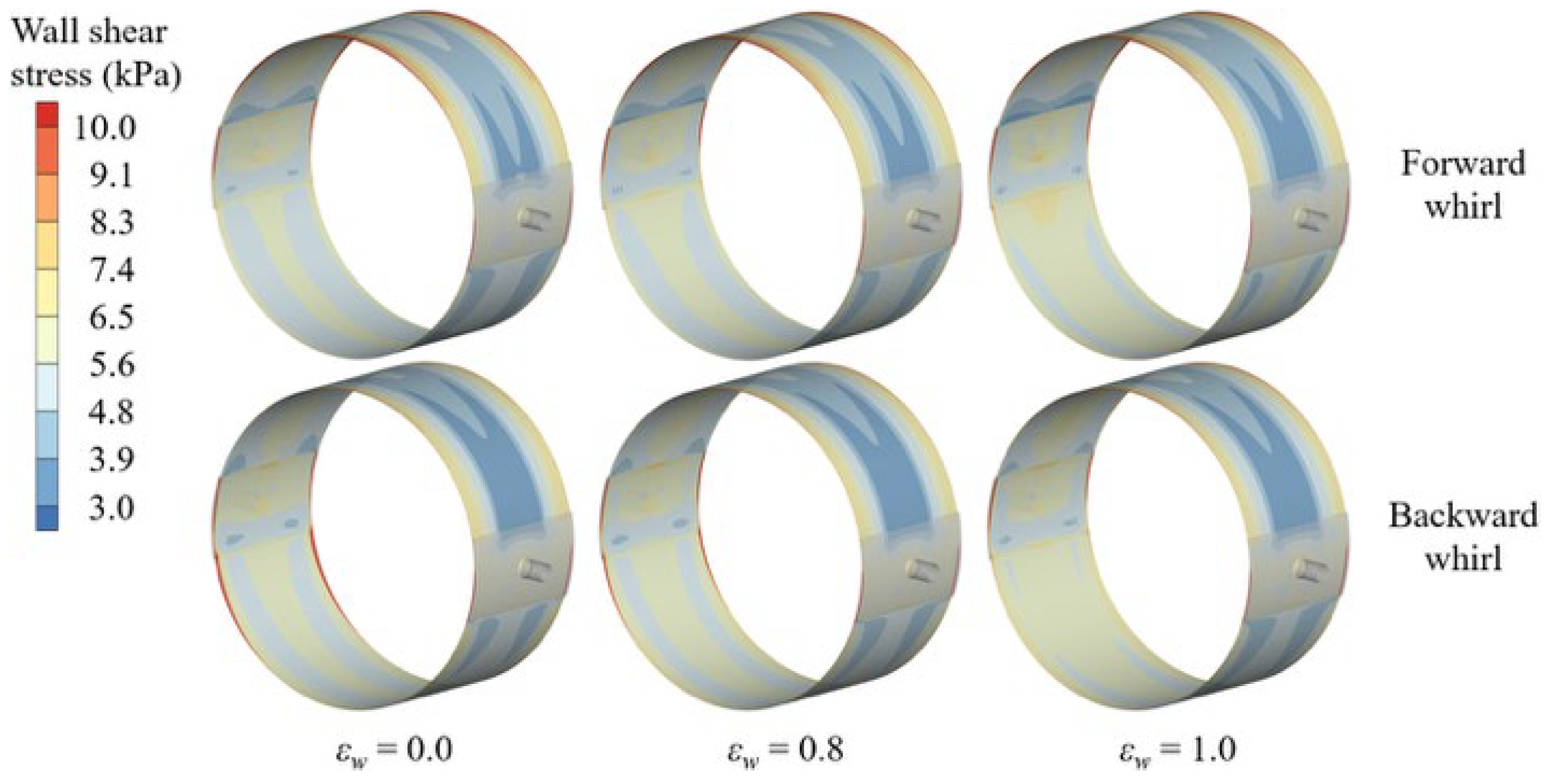
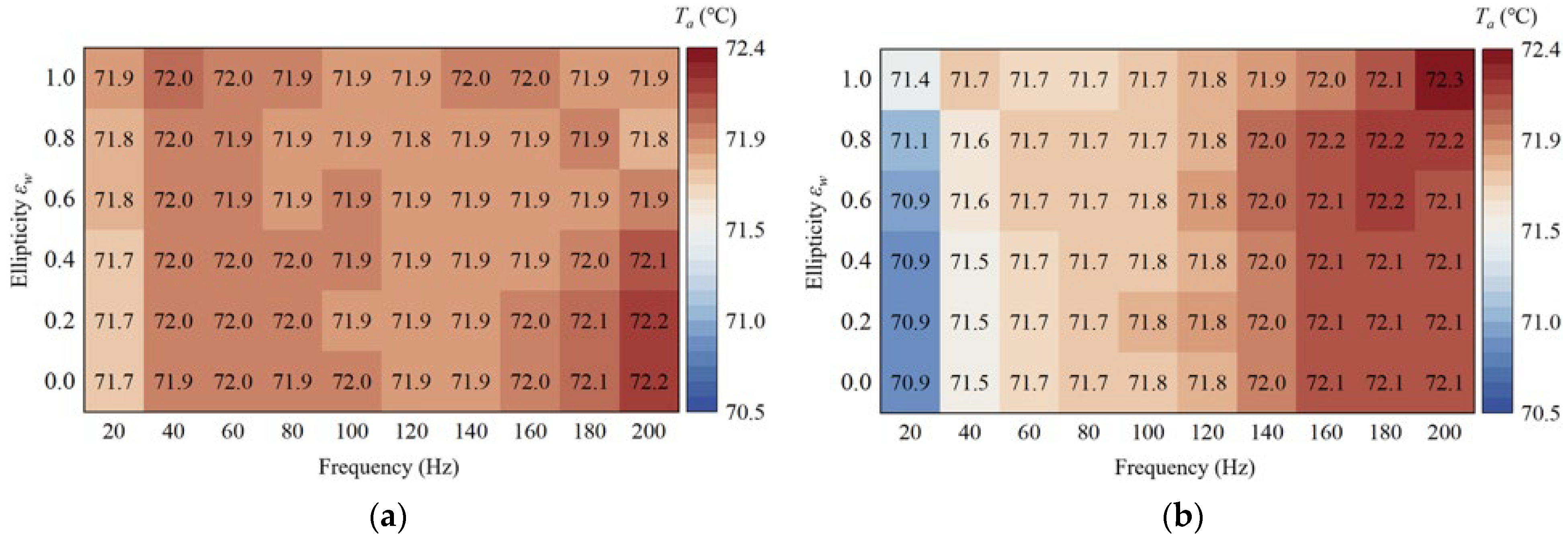
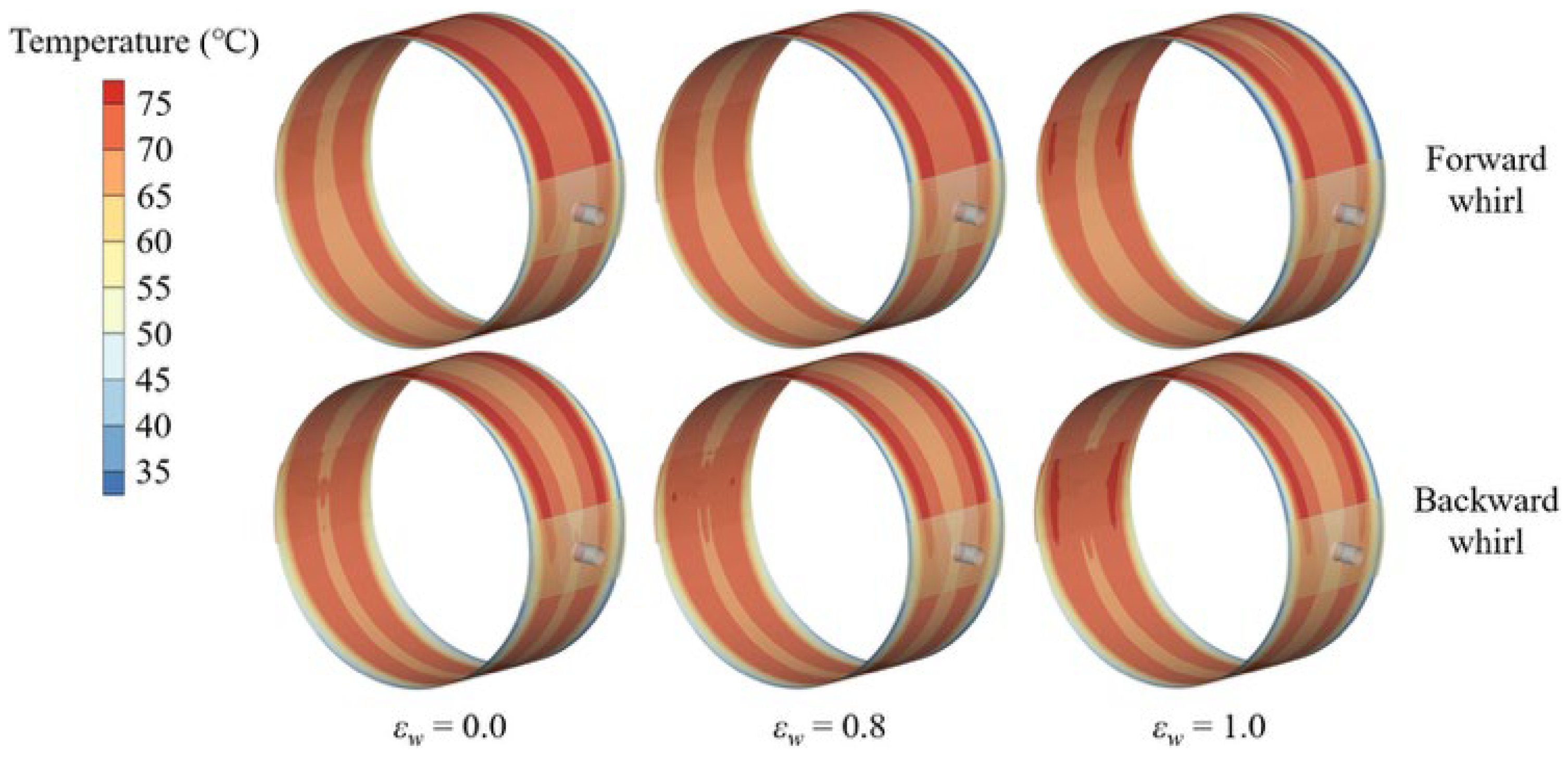
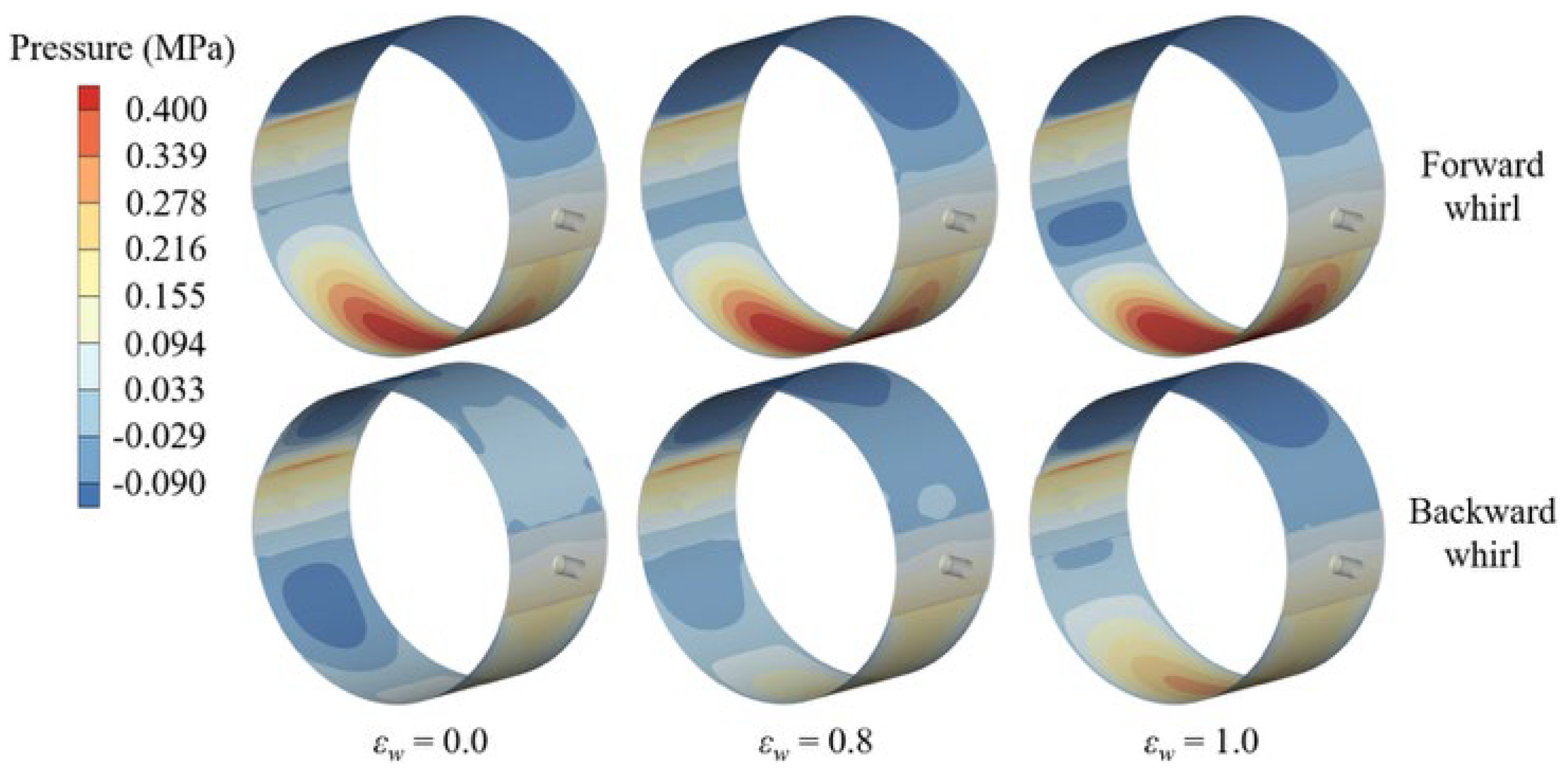
- Forward and backward whirl exhibit fundamentally different temperature-distribution characteristics. Under forward whirl, the journal motion is aligned with rotor rotation, significantly strengthening the convergent wedge effect of the oil film and forming localized regions of high pressure and high shear. This condition readily induces a first-order circumferential temperature pattern, characterized by a single hot spot and a single cold spot, with a strong potential to generate pronounced thermal bending of the journal. In contrast, under backward whirl, the journal motion opposes the main lubricant flow direction, markedly weakening hydrodynamic pressure buildup and producing a more diffuse pressure field. The resulting temperature distribution exhibits a second-order circumferential pattern with two hot spots in opposite phases, substantially reducing the capability to induce effective thermal bending.
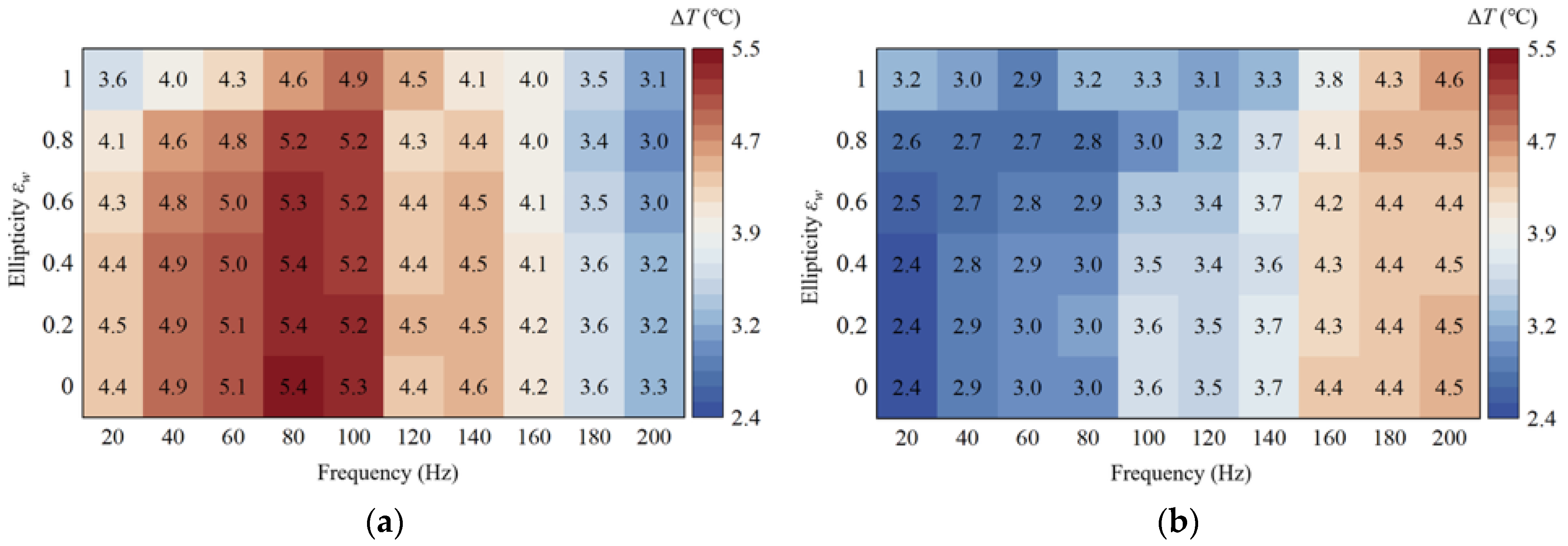
- The elliptical eccentricity plays a key role in modulating the journal temperature field by altering the whirl-orbit geometry. As elliptical eccentricity increases, the whirl trajectory evolves from a nearly circular shape toward an elongated form, significantly amplifying the periodic variation of oil-film thickness and enhancing convective heat transfer. This process mitigates local thermal accumulation. Under forward whirl, this effect is particularly pronounced, leading to a reduction in circumferential temperature difference with increasing elliptical eccentricity. Under backward whirl, however, where global shear heating dominates, variations in elliptical eccentricity exert only a limited influence on both circumferential temperature difference and average temperature.
- Whirl frequency is a critical parameter governing the intensity of thermal effects. Under forward whirl, increasing frequency enhances hydrodynamic pressure and localized viscous dissipation, leading to noticeable heat accumulation in an intermediate frequency range. Consequently, the circumferential temperature difference first increases and then decreases, reaching a peak value of 5.4 °C in the mid-frequency band (80~100 Hz). At higher frequencies, accelerated oil-film flow strengthens convective heat transfer and alleviates local thermal buildup. Under backward whirl, journal temperature is primarily controlled by the overall shear rate; as whirl frequency increases, the shear power density within the oil film rises continuously, resulting in monotonic increases in both circumferential temperature difference and average temperature.
- Installation eccentricity introduces a global offset of the bearing clearance, altering the location of the convergent wedge and the minimum film thickness, thereby causing the migration and intensification of pressure peaks and high shear-dissipation regions. An increase in eccentricity generally reduces the minimum film thickness and enhances local velocity gradients, leading to more concentrated hot spots and larger circumferential temperature differences, while changes in the eccentricity direction result in an overall shift of the hot-spot angular position together with the pressure peak. This effect is more pronounced under forward whirl, where the hydrodynamic wedge and the associated localization of thermal sources are stronger. Future work may jointly parameterize installation eccentricity and whirl trajectories to quantify the sensitivity of circumferential temperature difference and hot-spot phase to the magnitude and direction of eccentricity.
Author Contributions
Funding
Data Availability Statement
Conflicts of Interest
Abbreviations
| a | Semi-minor axis of whirl orbit |
| b | Semi-major axis of whirl orbit |
| c | Radial clearance |
| cj | Focal distance of elliptical journal orbit |
| CF,cond | Empirical condensation coefficient |
| CF,evap | Empirical evaporation coefficient |
| cp | Specific heat capacity at constant pressure |
| dc | Thickness of the supply groove |
| D | Bearing width |
| Din | Diameter of the supply hole |
| e | Mass eccentricity of journal |
| f | Journal whirl frequency |
| Fx | Oil-film force component in x-direction |
| Fy | Oil-film force component in y-direction |
| k | Thermal conductivity of lubricant |
| lin | Length of the supply hole |
| M | Effective journal mass supported by bearing |
| O | Bearing center |
| Oj | Journal-center location |
| Om | Journal mass center |
| pcav | Cavitation pressure |
| pin | Supply-oil pressure |
| R1 | Bearing radius |
| R2 | Journal radius |
| t | Time |
| T | Lubricant temperature |
| T0 | Supply-oil temperature |
| tn | Number of time steps per whirl period |
| Δt | Time-step size |
| αμ | Temperature–viscosity coefficient |
| ε | Eccentricity ratio |
| εω | Elliptical eccentricity of journal orbit |
| μ | Dynamic viscosity of lubricant |
| μ0 | Initial dynamic viscosity at supply temperature |
| ρ | Density of lubricating oil |
| θ | Attitude angle |
| θin | Circumferential angle of the supply groove |
| ω | Rotor rotational speed |
| Ω | Whirl angular velocity |
References
- Shin, D.; Suh, J.; Palazzolo, A. Parametric Study of Flexure Pivot Bearing Induced Thermal Bow-Rotor Instability (Morton Effect). J. Tribol. 2022, 144, 071801. [Google Scholar] [CrossRef]
- Shin, D.; Palazzolo, A.; Tong, X. Squeeze Film Damper Suppression of Thermal Bow-Morton Effect Instability. J. Eng. Gas Turbines Power 2020, 142, 121013. [Google Scholar] [CrossRef]
- Codrignani, A.; Savio, D.; Magagnato, F.; Frohnapfel, B. A Scaling Parameter for Pressure Losses and Thermal Effects in Lubricant Flows with Viscous Dissipation. Tribol. Int. 2017, 113, 238–244. [Google Scholar] [CrossRef]
- Gomiciaga, R.; Keogh, P.S. Orbit Induced Journal Temperature Variation in Hydrodynamic Bearings. J. Tribol. 1999, 121, 77–84. [Google Scholar] [CrossRef]
- Childs, D.W.; Saha, R. A New, Iterative, Synchronous-Response Algorithm for Analyzing the Morton Effect. J. Eng. Gas Turbines Power 2012, 134, 072501. [Google Scholar] [CrossRef]
- Dal, A.; Sahin, M.; Kilic, M. A Thermohydrodynamic Performance Analysis of a Fluid Film Bearing Considering with Geometrical Parameters. J. Therm. Eng. 2023, 9, 1604–1617. [Google Scholar] [CrossRef]
- Yu, X.; Shao, M.; Yang, X.; Lin, Y.; Lan, Z.; Li, L.; Li, E.; Dai, R.; Jia, W.; Wang, J.; et al. Advances in the Investigation of Thermal Characteristics of Hydrostatic Bearing Spindle: An Overview. J. Therm. Anal. Calorim. 2025, 150, 3139–3171. [Google Scholar] [CrossRef]
- Wang, L.; Geng, H.; Zhang, W.; Ge, X.; He, M. Effect of Ellipticity on Cavitation Mechanism and Thermal Effect of Elliptical Journal Bearings. Tribol. Online 2021, 16, 279–285. [Google Scholar] [CrossRef]
- Peixoto, T.F.; Alves, D.S.; da Silva Tuckmantel, F.W.; Daniel, G.B.; Machado, T.H.; Cavalca, K.L. Effect of Thermal Boundary Conditions on Dynamic Characteristics of Multi-Lobed Bearings. Mech. Mach. Theory 2022, 172, 104787. [Google Scholar] [CrossRef]
- Suh, J.; Palazzolo, A. Three-Dimensional Thermohydrodynamic Morton Effect Simulation—Part I: Theoretical Model. J. Tribol. 2014, 136, 031706. [Google Scholar] [CrossRef]
- Suh, J.; Palazzolo, A. Three-Dimensional Thermohydrodynamic Morton Effect Analysis—Part II: Parametric Studies. J. Tribol. 2014, 136, 031707. [Google Scholar] [CrossRef]
- Lu, D.; Zhu, Z.; Lu, J. Characteristic Analysis of Bump Foil Gas Bearing Under Multi-Physical Field Coupling. Appl. Sci. 2025, 15, 7584. [Google Scholar] [CrossRef]
- Skulic, A.; Milojevic, S.; Maric, D.; Ivanovic, L.; Krstic, B.; Radojkovic, M.; Stojanovic, B. The Impact of Lubricant Viscosity and Materials on Power Losses and Efficiency of Worm Gearbox. Teh. Vjesn. Tech. Gaz. 2022, 29, 1853–1860. [Google Scholar] [CrossRef]
- ISO-7902-1-2020; ISO Hydrodynamic Plain Journal Bearings Under Steady-State Conditions—Circular Cylindrical Bearings—Part 1: Calculation Procedure. International Organization for Standardization: Geneva, Switzerland, 2020.
- Taheripour, S.; Saffarian, M.R.; Daneh-Dezfuli, A. Heat Transfer Simulation in an Industrial Journal Bearing Using VOF Method. J. Braz. Soc. Mech. Sci. Eng. 2019, 41, 248. [Google Scholar] [CrossRef]
- Rezvanpour, A.; Miller, R.E. Scaling Analysis as a Tool to Validate CFD Simulation of a Lubricant Flow in the Bearing Housing of a Gas Turbine. Therm. Sci. Eng. Prog. 2022, 36, 101513. [Google Scholar] [CrossRef]
- Fan, B.; Liu, Y.; Liu, H. Static Characteristics Analysis of Offset-Halves Journal Bearings with CFD Method Considering Turbulence and Thermal Effects. Ind. Lubr. Tribol. 2026, 78, 123–133. [Google Scholar] [CrossRef]
- Li, S.; Lin, X.; Jiang, S. A Lubrication Model for Bubbly Oil Lubrication with Interfacial Effect and Thermal Effect Using the Theory of Multiphase Mixtures. Friction 2024, 12, 271–290. [Google Scholar] [CrossRef]
- Wei, C.; Wang, W.; Liao, G.; Zhao, H.; Xu, J. Research on Two-Phase Thermo-Hydrodynamic Lubrication Performance Considering Bubble Dynamics. Tribol. Int. 2023, 190, 109040. [Google Scholar] [CrossRef]
- Sun, D.; Li, S.; Fei, C.; Ai, Y.; Liem, R.P. Investigation of the Effect of Cavitation and Journal Whirl on Static and Dynamic Characteristics of Journal Bearing. J. Mech. Sci. Technol. 2019, 33, 77–86. [Google Scholar] [CrossRef]
- Bhat, J.A.; Harmain, G.A.; Najar, F.A. Alleviating Thermal Challenges in Hydrodynamic Bearings: A Novel Approach through Thrust Bearing Pads with Embedded Cooling Circuitry and Deep Recess. Tribol. Int. 2024, 194, 109438. [Google Scholar] [CrossRef]
- Bhat, J.A.; Harmain, G.A.; Wani, M.F.; Sehgal, R.; Najar, F.A. Performance Enhancement of Hydrodynamic Thrust Bearings: Investigating Cooling Strategies, Deep Recesses, and Textured Surfaces. Tribol. Int. 2025, 211, 110877. [Google Scholar] [CrossRef]
- Li, M.; Gu, C.; Pan, X.; Zheng, S.; Li, Q. A New Dynamic Mesh Algorithm for Studying the 3D Transient Flow Field of Tilting Pad Journal Bearings. Proc. Inst. Mech. Eng. Part J J. Eng. Tribol. 2016, 230, 1470–1482. [Google Scholar] [CrossRef]
- Hagemann, T.; Schwarze, H. Theoretical and Experimental Analyses of Directly Lubricated Tilting-Pad Journal Bearings with Leading Edge Groove. J. Eng. Gas Turbines Power 2019, 141, 051010. [Google Scholar] [CrossRef]
- Yang, J.; Palazzolo, A. Three-Dimensional Thermo-Elasto-Hydrodynamic Computational Fluid Dynamics Model of a Tilting Pad Journal Bearing—Part I: Static Response. J. Tribol. 2019, 141, 061702. [Google Scholar] [CrossRef]
- Yang, J.; Palazzolo, A. Three-Dimensional Thermo-Elasto-Hydrodynamic Computational Fluid Dynamics Model of a Tilting Pad Journal Bearing—Part II: Dynamic Response. J. Tribol. 2019, 141, 061703. [Google Scholar] [CrossRef]
- Yang, J.; Palazzolo, A. Deep Convolutional Autoencoder Augmented CFD Thermal Analysis of Bearings with Inter Pad Groove Mixing. Int. J. Heat Mass Transf. 2022, 188, 122639. [Google Scholar] [CrossRef]
- Yang, J.; Palazzolo, A. Morton Effect Prediction with Validation Using a CFD Based CNN for Pad Inlet Temperatures. Mech. Syst. Signal Process. 2023, 185, 109827. [Google Scholar] [CrossRef]
- Yang, J.; Palazzolo, A. Tilt Pad Bearing Distributed Pad Inlet Temperature with Machine Learning-Part I: Static and Dynamic Characteristics. J. Tribol. Trans. Asme 2022, 144, 061801. [Google Scholar] [CrossRef]
- Yang, J.; Palazzolo, A. Tilt Pad Bearing Distributed Pad Inlet Temperature with Machine Learning—Part II: Morton Effect. J. Tribol. 2022, 144, 061802. [Google Scholar] [CrossRef]
- Gheller, E.; Vardhan Reddy, V.; Koyyalamudi, S.; Chatterton, S.; Panara, D.; Pennacchi, P. Tilting Pad Journal Bearing Computational Fluid Dynamic Parametric Modeling for New Energy Transition Challenges. J. Eng. Gas Turbines Power 2024, 146, 041019. [Google Scholar] [CrossRef]
- Xia, P.; Jin, X.; Song, W.; Liang, Y.; Xu, S.; Liu, J.; Liu, Z.; Ma, W. A Novel Transient Computational Fluid Dynamics-Fluid–Structure Interaction Model for the Pad Adaptive Motion and Rotordynamic Coefficients of Hybrid Porous Tilting Pad Bearings. Proc. Inst. Mech. Eng. Part J J. Eng. Tribol. 2024, 238, 615–637. [Google Scholar] [CrossRef]
- Sakai, K.; Miyagawa, K.; Mariotti, A.; Pasini, A. Prediction of Static Characteristics of Cryogenic Hybrid Journal Bearing for Reusable Pump-Fed Liquid Rocket Engine by Computational Fluid Dynamics Simulation. Phys. Fluids 2025, 37, 035189. [Google Scholar] [CrossRef]
- Guo, C.; Li, P.; Li, X.; Chen, Y.; Zhang, H.; Gu, F. Thermo-Hydrodynamic Performance of Journal Bearings under Water Contamination of Lubricants Considering Rheological and Thermal Effects. Phys. Fluids 2025, 37, 093606. [Google Scholar] [CrossRef]
- Tong, X.; Palazzolo, A. Measurement and Prediction of the Journal Circumferential Temperature Distribution for the Rotordynamic Morton Effect. J. Tribol. 2018, 140, 031702. [Google Scholar] [CrossRef]
- Guo, Z.; Hirano, T.; Kirk, R.G. Application of CFD Analysis for Rotating Machinery—Part I: Hydrodynamic, Hydrostatic Bearings and Squeeze Film Damper. J. Eng. Gas Turbines Power 2005, 127, 445–451. [Google Scholar] [CrossRef]
- Kucinschi, B.; Fillon, M. An Experimental Study of Transient Thermal Effects in a Plain Journal Bearing. J. Tribol. 1999, 121, 327–332. [Google Scholar] [CrossRef]








| Elliptical Eccentricity εω | a (μm) | b (μm) |
|---|---|---|
| 0 | 10.0 | 10.0 |
| 0.2 | 9.8 | 10.0 |
| 0.4 | 9.2 | 10.0 |
| 0.6 | 8.0 | 10.0 |
| 0.8 | 6.0 | 10.0 |
| 1.0 | 0.0 | 10.0 |
| Parameter | Value |
|---|---|
| Bearing radius R1 (mm) | 50.9 |
| Journal radius R2 (mm) | 50.8 |
| Radial clearance c (mm) | 0.1 |
| Circumferential angle of the oil inlet groove θin (°) | 30 |
| Thickness of the oil inlet groove dc (mm) | 3 |
| Length of the oil inlet hole lin (mm) | 8.5 |
| Diameter of the oil inlet hole Din (mm) | 6 |
| Lubricant grade | VG32 [25] |
| Bearing width D (mm) | 50.8 |
| Dynamic viscosity μ (kg/m·s) | 0.0203 |
| Temperature–viscosity coefficient αμ | 0.031 |
| Supply-oil temperature T0 (℃) | 50 |
| Density ρ (kg/m3) | 860 |
| Specific heat capacity cp (J/kg·℃) | 2000 |
| Thermal conductivity k (W/m·℃) | 0.13 |
| Cavitation pressure pcav (Pa) | −9.00 × 10⁴ |
| Supply-oil pressure pin (Pa) | 1.32 × 10⁵ |
| tn | f (Hz) | Δt | Fx (N) | Fy (N) |
|---|---|---|---|---|
| 50 | 200 | 1.00 × 10⁻⁴ | −658 | 1407 |
| 250 | 200 | 2.00 × 10⁻⁵ | −655 | 1357 |
| 400 | 200 | 1.25 × 10⁻⁵ | −654 | 1351 |
| 800 | 200 | 6.25 × 10⁻⁶ | −654 | 1351 |
Disclaimer/Publisher’s Note: The statements, opinions and data contained in all publications are solely those of the individual author(s) and contributor(s) and not of MDPI and/or the editor(s). MDPI and/or the editor(s) disclaim responsibility for any injury to people or property resulting from any ideas, methods, instructions or products referred to in the content. |
© 2026 by the authors. Licensee MDPI, Basel, Switzerland. This article is an open access article distributed under the terms and conditions of the Creative Commons Attribution (CC BY) license.
Share and Cite
Liu, Y.; Liu, X.; Yang, T.; Yuan, Q. Study on Heat Generation Mechanisms and Circumferential Temperature Evolution Characteristics of Journal Bearings Under Different Whirl Motion. Appl. Sci. 2026, 16, 2069. https://doi.org/10.3390/app16042069
Liu Y, Liu X, Yang T, Yuan Q. Study on Heat Generation Mechanisms and Circumferential Temperature Evolution Characteristics of Journal Bearings Under Different Whirl Motion. Applied Sciences. 2026; 16(4):2069. https://doi.org/10.3390/app16042069
Chicago/Turabian StyleLiu, Yang, Xujiang Liu, Tingting Yang, and Qi Yuan. 2026. "Study on Heat Generation Mechanisms and Circumferential Temperature Evolution Characteristics of Journal Bearings Under Different Whirl Motion" Applied Sciences 16, no. 4: 2069. https://doi.org/10.3390/app16042069
APA StyleLiu, Y., Liu, X., Yang, T., & Yuan, Q. (2026). Study on Heat Generation Mechanisms and Circumferential Temperature Evolution Characteristics of Journal Bearings Under Different Whirl Motion. Applied Sciences, 16(4), 2069. https://doi.org/10.3390/app16042069