1. Introduction
The long-term stability of underground excavations, such as tunnels, mines, and caverns, is fundamentally threatened by time-dependent deformations and vibrations of surrounding rock masses. These dynamic responses, often manifested as rock creep and stress wave propagation, are exacerbated by frequent engineering activities (e.g., blasting and mechanical drilling) as well as by natural hazards such as rock bursts [
1,
2,
3,
4]. The Kelvin–Voigt model, a canonical viscoelastic constitutive representation, has been extensively validated for characterizing the delayed deformation and energy dissipation behavior of rock materials under sustained or cyclic loading [
5,
6].
In actual mining and tunneling environments, the control of rock mass vibrations is not merely an academic exercise but a pressing engineering imperative. Unchecked vibrations can lead to progressive damage of support systems, induce additional fracturing in the excavation damage zone, and in severe cases, trigger cascading failures that compromise the entire structure’s integrity [
7,
8]. However, actively stabilizing these vibrations faces three paramount challenges: (i) Impulsive mechanical shocks from blasting or sudden stress redistribution, which inject high-energy, transient disturbances into the system; (ii) time-varying delays inherent in sensor–actuator networks due to wave propagation through heterogeneous geological media, and data transmission lags; (iii) significant system uncertainties stemming from the anisotropic, inhomogeneous nature of rock masses, making accurate real-time modeling extremely difficult [
9,
10].
Traditional passive support systems and simple feedback controllers often fall short in such complex, uncertain, and delay-prone environments. This gap calls for robust control strategies that can guarantee stability and performance despite these adversities. Sliding mode control (SMC), renowned for its robustness against uncertainties and disturbances, presents a promising candidate [
11,
12,
13]. A significant advancement was made by Utkin et al. [
14] in 1997, who introduced integral sliding mode control (ISMC), a method that ensures system robustness throughout the entire response process, starting from the initial time instant. Subsequent studies have extended ISMC to various complex dynamical systems. For instance, Chen et al. [
15] applied ISMC to stabilize uncertain systems subject to impulsive effects, while Niu et al. [
16] further extended the approach to a class of uncertain impulsive systems involving time delays. More recently, Kao et al. [
17] employed ISMC to analyze the stability of uncertain reaction–diffusion systems under periodic impulses. However, despite these advances, there remains a notable scarcity of results concerning ISMC for hyperbolic partial differential equations (PDEs) that govern wave propagation in viscoelastic media—like the Kelvin–Voigt rock model.
Motivated by this critical engineering need and the theoretical gap, this paper pioneers the design and analysis of an ISMC scheme specifically for Kelvin–Voigt systems (KVSs) subject to time-varying delays and impulsive effects. To handle the impulsive dynamics, we introduce impulses into the sliding function design, thereby preserving its continuity [
15,
17]. The stability of the resulting sliding mode dynamics is rigorously analyzed using Lyapunov stability theory in conjunction with a comparison principle. We provide a mathematically rigorous yet practically motivated framework for stabilizing rock mass vibrations, directly addressing the operational challenges in underground excavation engineering.
Section 2 introduces the governing equations of the rock mass vibration system based on the Kelvin–Voigt constitutive model, incorporating time-varying delays, impulsive disturbances, and parameter uncertainties, along with essential notations and assumptions. In
Section 3, we design a novel impulsive-aware integral sliding surface and establish rigorous stability criteria for the resulting sliding mode dynamics. Two main theorems are presented to ensure asymptotic stability and reachability under the proposed control scheme. To validate the theoretical framework, a detailed numerical simulation with parameters reflecting realistic mining scenarios is provided in
Section 4. Finally,
Section 5 summarizes the key contributions and discusses potential engineering applications and future research directions.
2. Preliminaries
Consider a viscoelastic medium with the Kelvin–Voigt constitutive model:
where
are two constants with
,
is the unknown distributed state,
is the system input, and
is the external disturbance. Here,
and
are the stiffness coefficient of the spring and the viscous coefficient of the damper in the Kelvin–Voigt model, respectively;
are system matrices;
is the input matrix with full column rank;
represents the system matrix uncertainty, which satisfies
, where
and
are known constant matrices,
is unknown, and
. Consider system (1) associated with Dirichlet boundary conditions and the following initial conditions:
where
and
denote the Banach space of all continuous functions vanishing at boundary/at infinity from the interval
to the space
.
Equation (1) describes the dynamics of a rock column or a segment of an excavation boundary. The term represents the elastic restoring force, captures the viscous damping (rate-dependent energy dissipation) intrinsic to rock, and accounts for additional velocity-proportional damping (e.g., from surrounding material or artificial dampers). The uncertainties and the delayed term are used to model the unknown spatial variability of rock properties and the delayed effects of stress redistribution or remote seismic events, respectively.
To simplify the handling of the second-order time derivative
we introduce the following variable substitution:
where
. This substitution effectively reduces the order of the time derivative, making the system more tractable for analysis. Then, under impulsive effects, system (1) is transformed into:
subject to Dirichlet boundary conditions and initial conditions (2). Here,
(with
) is the impulsive sequence, and let
,
The parameters are given by
,
and
are real matrices satisfying
. Physically, the impulsive terms
and
model the instantaneous state changes induced by blasting shocks or local rock fracturing events.
To formally characterize the stability of the system, we introduce the definition and assumption.
Definition 1 [
18]
. System (1) is said to be exponentially stable if there exist scalars and such that Assumption 1. There exists a constant such that . Moreover, , is a vector with appropriate dimension.
Under Assumption 1 and the given conditions, system (4) admits a unique mild solution
[
19,
20].
Remark 1. The disturbance-bound reflects that external disturbances (e.g., blast-induced shocks, equipment vibrations) have finite energy in real mining environments. The uncertainty structure with models spatially varying and imperfectly known rock parameters—such as Young’s modulus or damping coefficients—while respecting physically feasible variation ranges. These representations are standard in robust geotechnical control and allow the design of a stabilizing controller without requiring exact real-time parameter identification, which is often impractical in underground excavations.
3. Main Results
This section presents the comprehensive design and analysis of an ISMC scheme for the KVSs with time-varying delays and impulsive effects. The main contributions are structured around three pivotal components. First, a novel continuous integral sliding surface is constructed by incorporating an auxiliary function related to impulsive instances, which rigorously guarantees the continuity of the sliding mode against impulsive disturbances and forms the foundation for subsequent stability analysis. Second, based on this surface, the sliding mode dynamics are derived. By employing a piecewise Lyapunov functional and the comparison principle, sufficient conditions are established to ensure the asymptotic stability of the resulting sliding mode dynamics. Finally, a robust sliding mode controller is synthesized to effectively compensate for system uncertainties, external disturbances, and time-varying delays. It is rigorously proven that the system trajectories are driven onto and maintained on the predefined sliding manifold from the initial time onward.
To construct a continuous sliding function for the impulsive system, we first introduce the following notations:
,
,
, and define a piecewise linear scaling function:
which satisfies
and
.
The integral sliding function is then designed for all
:
where
is a sliding surface gain matrix, selected to satisfy
. It essentially projects the system state onto the sliding manifold, playing a role similar to a weighting matrix that shapes how the tracking error is penalized in the sliding condition.
is a feedback gain matrix. Note that by construction,
.
We now demonstrate that the sliding function
is continuous with respect to
on
. Continuity at non-impulsive instants follows directly from its definition. At the impulsive instants
, a direct computation shows that the one-sided limits coincide:
Hence,
is continuous for all
. This property is crucial for the subsequent controller design.
By applying the transformed system dynamics (4), the time derivative of the sliding function is computed as follows:
where the indicator function
is defined as:
The equivalent control law, which describes the input required to maintain the system on the sliding surface
, is obtained by setting
; we obtain the equivalent control:
Substituting this equivalent control back into the system dynamics (4) yields the sliding mode dynamics, which govern the system’s behavior once constrained to the sliding manifold:
where
.
To facilitate the stability analysis, we perform a key transformation. Define
, which implies
. Consequently, the term
. Letting
the sliding mode dynamics (7) can be transformed as the following time-delay system:
To establish the main stability results, we first introduce the following notations and conventions used throughout the subsequent analysis. is the average impulsive interval. is called the maximum allowable fluctuation in the impulse count. , , , , , , and denotes the upper-right Dini derivative.
Theorem 1. Assume that Assumption 1 holds. Given the matrix where is chosen such that is Hurwitz, the sliding mode dynamics (7) is exponentially stable if there exist a positive definite and diagonal matrix , symmetric and positive-definite matrices ,
, and positive constants such that the following linear matrix inequality and inequality hold:where the block matrices are defined as:with entries Proof of Theorem 1. Introduce a piecewise continuous Lyapunov candidate:
for
, we compute the upper-right Dini derivative
. Substituting the dynamics from (8) into the derivative of (11) yields:
We now bound the terms in (12) using standard inequalities and system properties.
By Dirichlet’s boundary condition and Green’s formula, the term involving the spatial derivative is bounded using a Poincarè-type inequality:
For any positive constants
, we have
The terms originating from the projection via
are bounded as follows:
Substituting the estimates (13)–(15) into (12) and after considerable algebraic manipulation and grouping of terms, we obtain the following differential inequality for
:
where
. Crucially, by applying the Schur complement and Lemma 2.4 from [
21], the inequality (9) guarantees that the large matrix in (16) is negative definite. Consequently, we arrive at the key impulsive delay differential inequality:
At the impulsive instants
the state undergoes an instantaneous change. Evaluating the Lyapunov functional across an impulse using (11) and the reset conditions in (7) gives:
where
.
Next, the inequalities (17) and (18) describe the evolution of
. To analyze its asymptotic behavior, we employ a comparison principle. Consider the following scalar impulsive delay comparison system with an arbitrarily small positive constant
:
where
. By construction, we have
for
. Applying the comparison principle in [
22] to (17)–(19) yields:
Finally, following an analysis similar to Theorem 1 in [
23], condition (10) ensures that the comparison system (19) is exponentially stable. Specifically, its solution satisfies:
where
and
. Since
> 0 can be chosen to be arbitrarily small, (20) implies that
, and consequently
, converges to zero exponentially as
This proves the asymptotic (in fact, exponential) stability of the sliding mode dynamics (7). □
In this paper,
is a positive definite weighting matrix in the Lyapunov functional, which can be interpreted as an energy metric for the velocity-related state
. Its eigenvalues influence the decay rate of vibration energy in the stability analysis.
is an auxiliary symmetric positive definite matrix introduced in the Lyapunov-based inequality conditions (via the Schur complement). It helps bound the cross terms arising from uncertainties and delayed interactions and can be viewed as a tuning parameter that ensures robustness in the matrix inequality framework. Additionally, we briefly note that the feedback gain
is chosen to place the poles of
in the left-half plane, ensuring desirable closed-loop dynamics before sliding occurs. These clarifications have been integrated near the first appearance of each matrix in
Section 2 and
Section 3, helping bridge the theoretical formulation with its physical and control-theoretic implications.
Remark 2. While prior research has applied integral sliding mode control to impulsive systems [15], stochastic impulsive systems [24], and distributed parameter systems [17], these works predominantly address parabolic PDEs or ordinary differential systems. In contrast, the stabilization of hyperbolic PDE systems—such as the Kelvin–Voigt wave model governing rock mass vibrations—under simultaneous time-varying delays and non-periodic impulsive shocks remains largely unexplored. Our work directly addresses this gap. We propose an impulsive-aware integral sliding function that explicitly incorporates impulse information to maintain continuity across shock events, which has not been previously developed for hyperbolic viscoelastic systems. In addition, the stability analysis of system (8) presents a non-trivial challenge. Unlike many standard time-delay systems, the constructed delay satisfies . This violates the common assumption typically required for applying standard Lyapunov–Krasovskii functional methods [16], thereby increasing the complexity of the stability analysis for system (8). Furthermore, while prior work such as [17] deals with parabolic PDEs under periodic impulses, the stabilization of hyperbolic systems (like the Kelvin–Voigt model) under a general time-varying delay and non-periodic impulses remains an open problem. To address the difficulty of directly analyzing an impulsive system with discrete state jumps, a key step in our approach is the transformation of the discrete jump term into a continuous delayed state which allows the dynamics to be reformulated as the delay system (8) and facilitates the subsequent stability analysis.
Having established a continuous sliding surface and derived stability conditions for the resultant sliding mode dynamics, we now synthesize the actual control law. The objective is to ensure that the system trajectories not only reach the sliding manifold in finite time but also remain on it thereafter, despite the presence of parameter uncertainties, external disturbances, and time-varying delays.
The sliding mode controller is designed as follows:
where
is a design constant, and the saturation function sat(·) is defined to mitigate chattering:
Theorem 2. Let Assumption 1 hold. Consider the system (4) with the sliding function (5). Then, the reachability of the sliding manifold is guaranteed under the sliding mode control law (21).
Proof of Theorem 2. To prove reachability, we consider the following positive definite Lyapunov functional candidate:
where
is a symmetric and positive-definition matrix. Furthermore, from (6) and (21) we have
Utilizing the bounds from Assumption 1 (
) and the uncertainty structure (
), the derivative can be bounded as:
Since
by construction and
for any
, the Lyapunov condition guarantees that the sliding surface
is reached and maintained from the initial time onward. Consequently,
for all
, confirming the system operates in the sliding mode. □
Remark 3. The proposed integral sliding mode control framework offers a theoretically grounded and robust solution for the critical engineering challenge of rock mass vibration stabilization. By explicitly accounting for the viscoelastic dynamics (via the Kelvin–Voigt model), impulsive mechanical shocks from blasting or rock bursts, and time-varying delays inherent in geological environments, the designed controller is particularly suited for ensuring the long-term safety and stability of underground excavations. Compared with standard SMC, conventional SMC typically exhibits a reaching phase before sliding, during which robustness is not guaranteed. In contrast, ISMC eliminates this phase by enforcing sliding motion from the initial time, which is critical in rock engineering where impulsive shocks can occur at any moment. Our design further incorporates impulse information into the sliding surface, preserving continuity—a feature not addressed in standard SMC formulations. Compared with passive damping strategies, passive supports (e.g., rock bolts, shotcrete) provide limited adaptability under varying or extreme loading conditions. The proposed ISMC acts as an active compensator that dynamically counteracts time-varying delays, sudden impulses, and parameter uncertainties, offering a proactive means to maintain stability where purely passive measures may be insufficient.
To validate the theoretical findings and demonstrate the practical efficacy of the proposed method, a numerical simulation is conducted in this section. The following example illustrates the performance of the closed-loop system under the action of the sliding mode controller (21).
4. Simulation Example
Consider the rock mass vibration system (4) defined on
. The system parameters are listed:
. The initial conditions are set as
A non-uniformly impulsive sequence
for
modeling irregular shock events is defined by the impulsive intervals:
which yields an average impulsive interval
and a minimum separation
. Following the design procedure in
Section 3, we select the gain
and the constant
. Solving the linear matrix inequality condition (9) yields the following feasible matrices and parameters:
Furthermore, with
calculated from the matrices above, the inequality condition (10) is satisfied:
This verifies all conditions of Theorem 1, guaranteeing the asymptotic stability of the sliding mode dynamics. The sliding mode control law (21) is implemented with parameters
and
.
The numerical simulations validate the effectiveness of the proposed ISMC scheme for stabilizing rock mass vibrations modeled by the Kelvin–Voigt system with time-varying delays and impulsive effects.
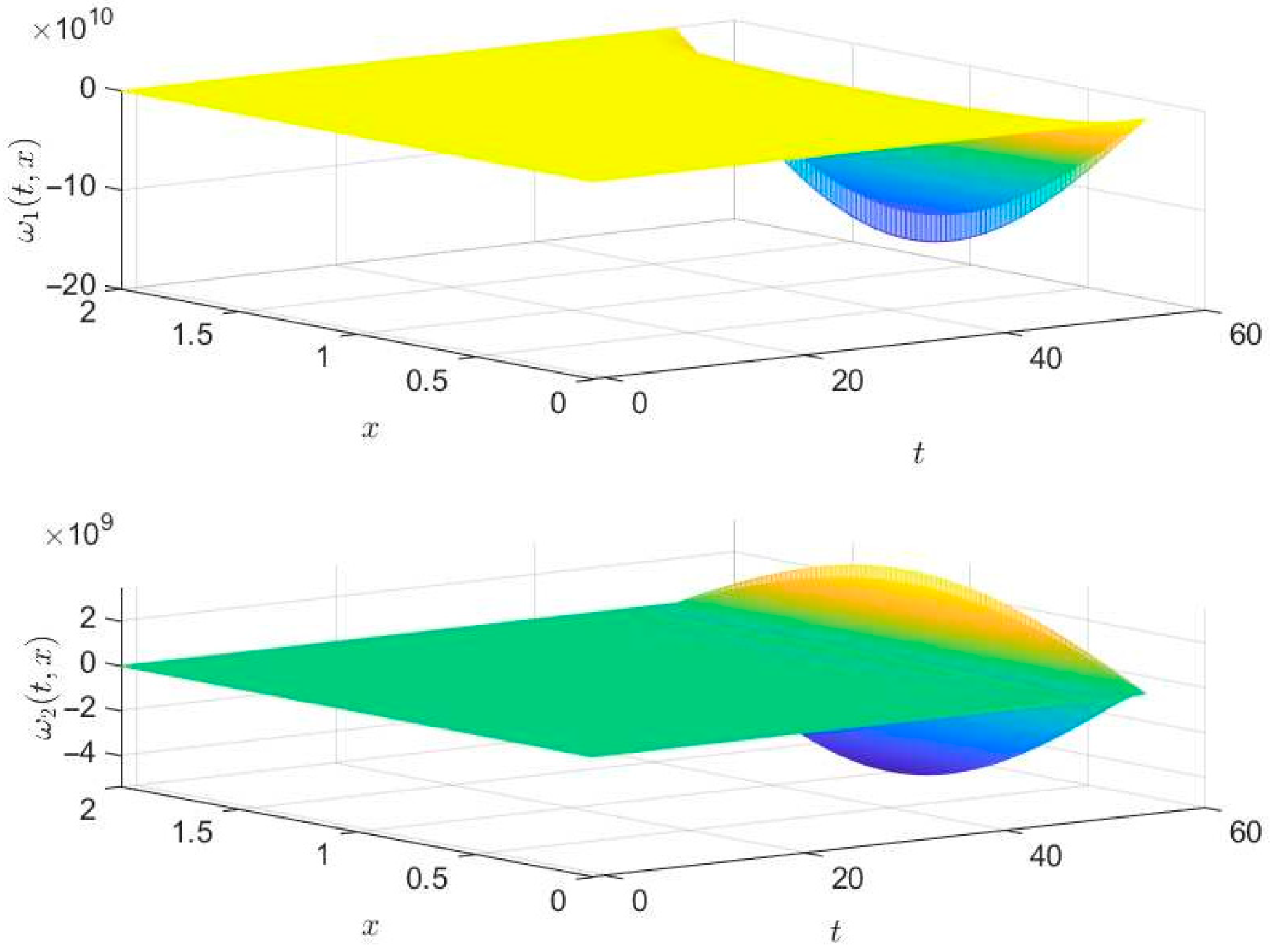
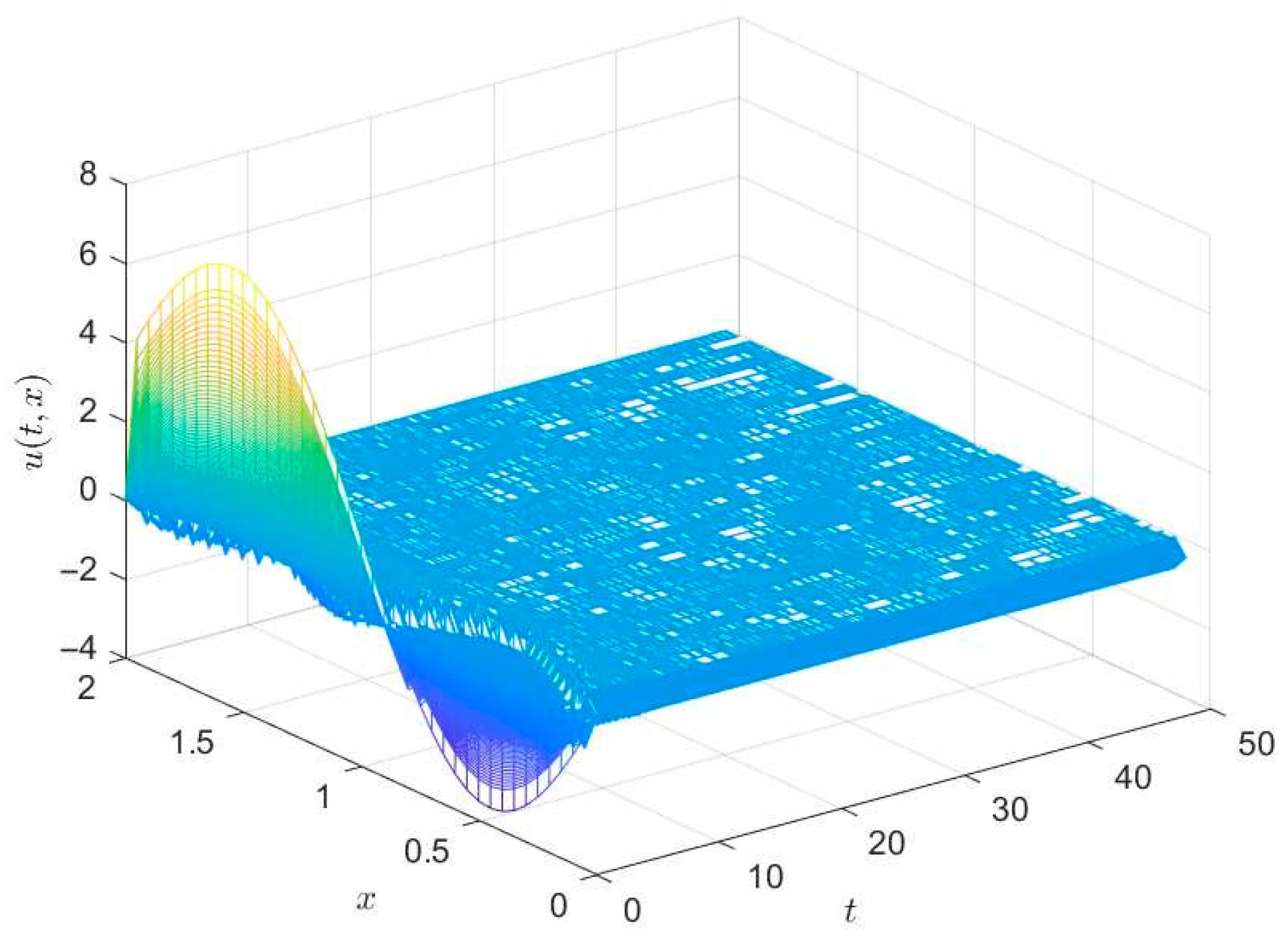
Figure 1 illustrates that in the absence of control, the system states
and
exhibit unbounded growth, confirming the inherent instability of the open-loop system under real mining conditions such as blasting-induced shocks and heterogeneous geological delays. In contrast,
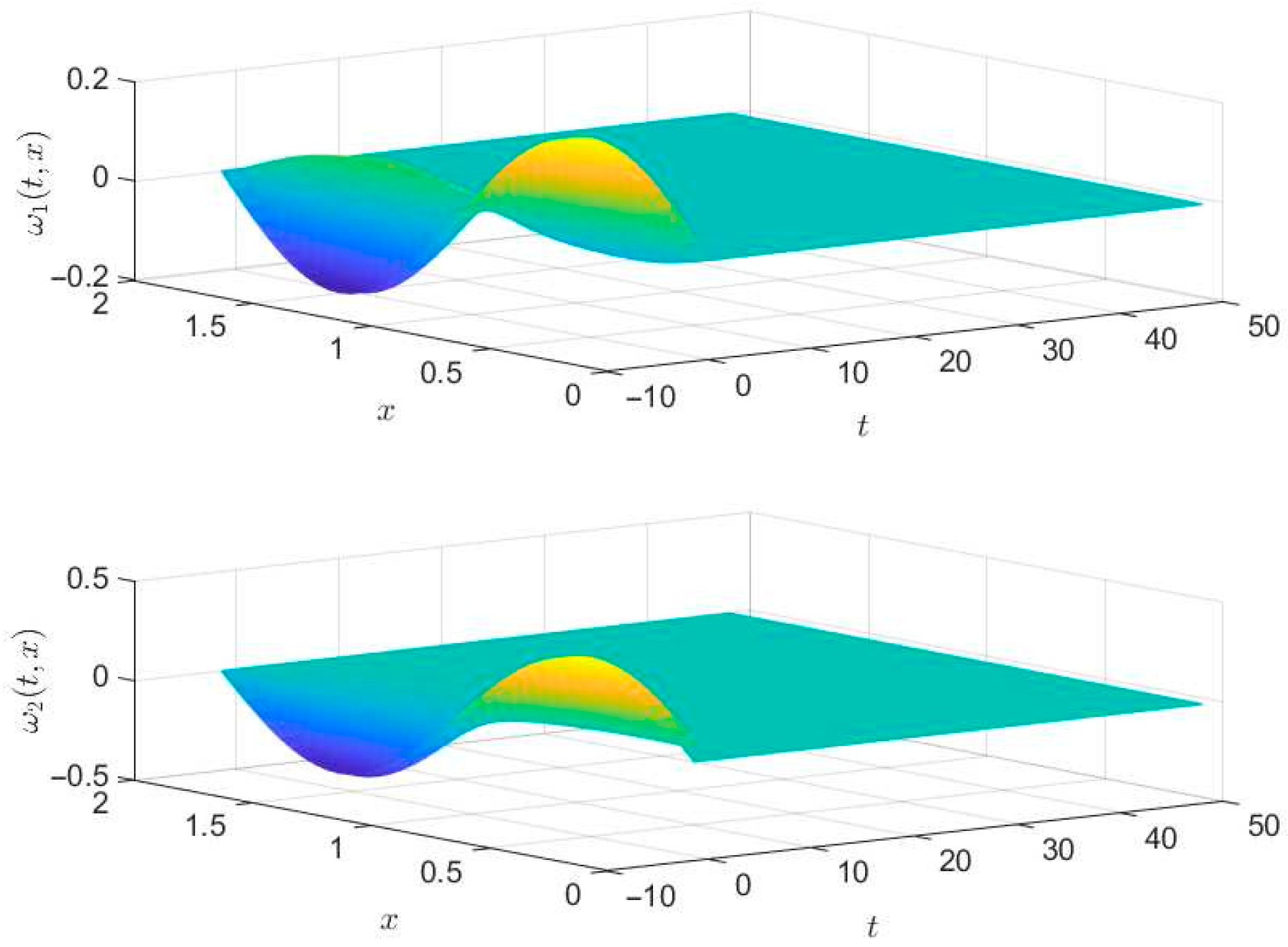
Figure 2 demonstrates that under the designed ISMC, the closed-loop system states converge asymptotically to zero, effectively suppressing vibration amplitudes despite uncertainties and disturbances. This stability is further corroborated by
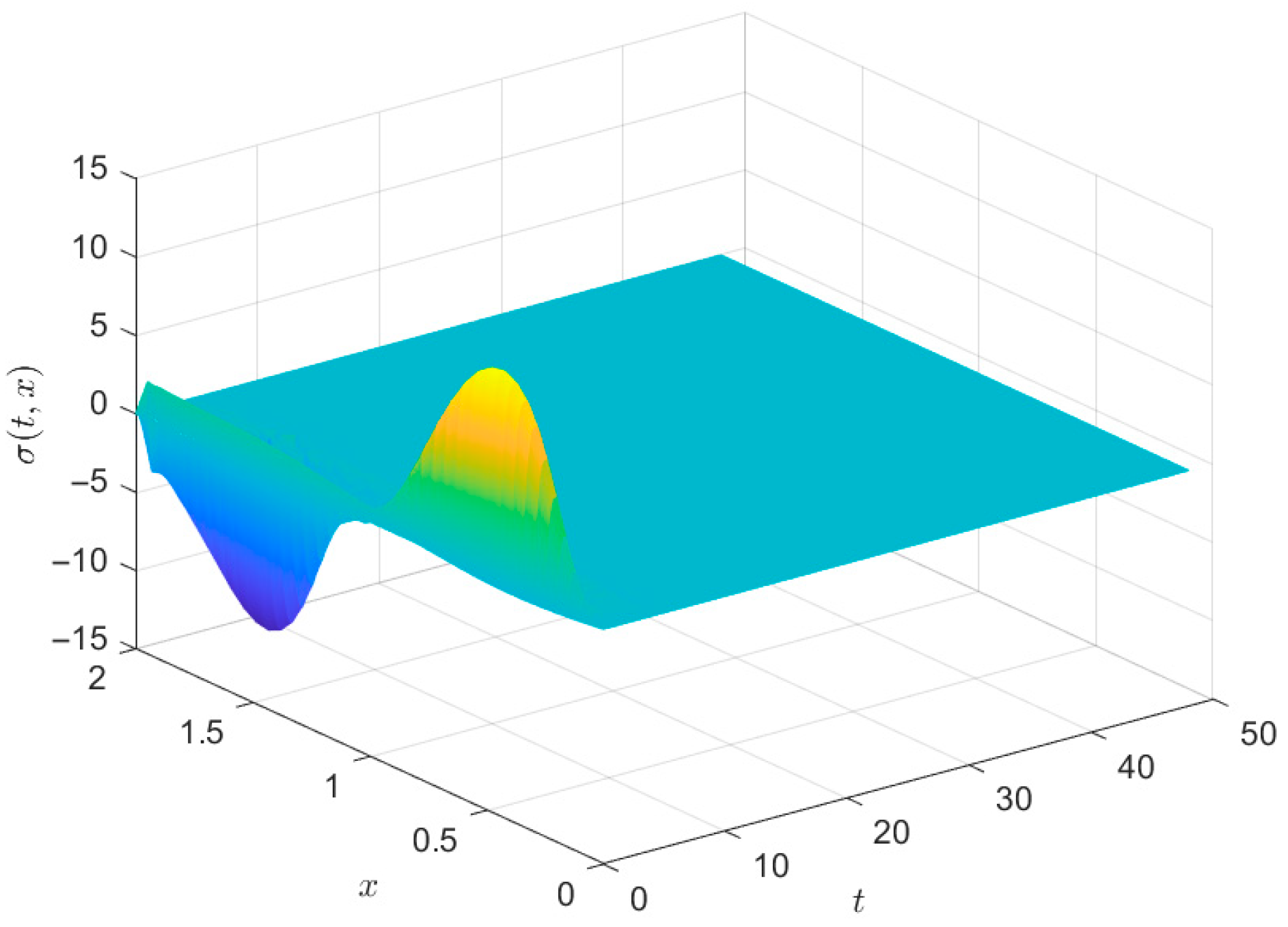
Figure 3, which shows that the sliding function
reaches and remains at zero from the initial time onward, ensuring exact reachability of the sliding manifold. The control performance is clearly depicted in
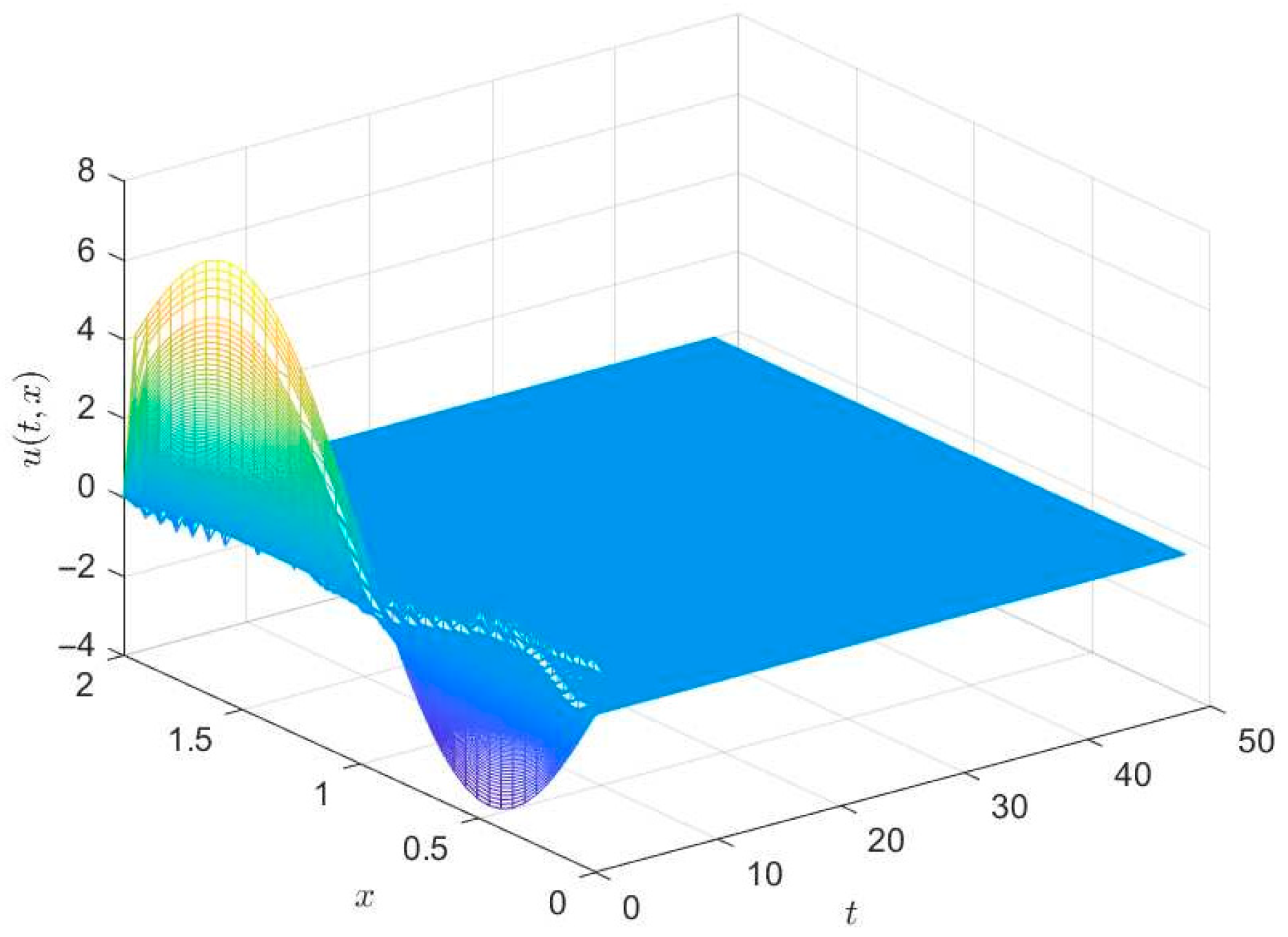
Figure 4 and
Figure 5, where the control input
exhibits the characteristic switching action of sliding mode control during the transient phase, actively compensating for system uncertainties and delays. Once the sliding surface is attained, the control effort diminishes significantly, indicating efficient stabilization with minimal ongoing actuation. Collectively, these results confirm that the proposed controller not only meets the theoretical stability criteria of Theorems 1 and 2 but also provides a robust and practical solution for real-time rock mass vibration stabilization in challenging underground excavation environments.
This subsection briefly investigates the closed-loop system response under the following parametric variations. For impulse frequency, we test a range of average impulsive intervals (both shorter and longer than the nominal ), showing that the system remains stable as long as condition (10) in Theorem 1 is satisfied. For delay magnitude, the time-varying delay is scaled to larger amplitudes, confirming that the controller maintains stabilization even under extended delay bounds, with a modest increase in settling time. Finally, for uncertainty level, the norm bound on is increased progressively, illustrating the gradual trade-off between control effort and vibration suppression.




 ,
,