Article

Site-Specific Calibration of S/P Amplitude Ratios for Near-Real-Time Seismic Acceleration Estimation at the Iași Stations, Romania

Faculty of Electrical Engineering, “Gheorghe Asachi” Technical University of Iași, 700050 Iași, Romania
*
Author to whom correspondence should be addressed.
Appl. Sci. 2026, 16(4), 2062; https://doi.org/10.3390/app16042062
Submission received: 21 January 2026 / Revised: 15 February 2026 / Accepted: 18 February 2026 / Published: 19 February 2026

Abstract

Earthquake Early Warning (EEW) systems based on on-site measurements enable ultra-rapid alerts by exploiting the time gap between the arrival of P-waves and the subsequent damaging S-waves. A central challenge is the reliable estimation of impending ground motion using only the earliest portion of the signal. This study investigates a site-specific methodology based on the S/P amplitude ratio for near-real-time seismic acceleration estimation at the Iași stations, Romania, in a region dominated by Vrancea intermediate-depth seismicity. Using 50 strong-motion records from the European Strong-Motion (ESM) database, a local calibration coefficient of k = PGA_S/PGA_P = 6.2 was derived for the Iași area, consistent with its soft-soil conditions and with values reported for comparable sedimentary environments worldwide. A regional analysis confirms that the S/P ratio is primarily governed by local site effects, requiring station-level calibration. The methodology was experimentally validated through shaking-table tests using real P-wave recordings. Predicted S-wave peak ground accelerations exhibit no systematic bias, with a median relative error of +2.0% and dispersion consistent with the intrinsic log-normal variability of the S/P ratio. The results demonstrate that a locally calibrated S/P ratio provides a robust and physically grounded basis for rapid seismic acceleration estimation in on-site EEW systems.

1. Introduction

Earthquake Early Warning (EEW) systems are designed to exploit the brief time window between the arrival of the initial, weak primary (P) waves and the subsequent, potentially damaging secondary (S) waves, delivering alerts that may enable protective actions before strong shaking begins. Over the last two decades, EEW technologies have evolved along two principal paradigms. Network-based systems infer earthquake source parameters by integrating observations from multiple seismic stations [1,2,3], whereas on-site systems operate autonomously at a single location, estimating the expected level of ground motion directly from the earliest portion of the locally recorded P-wave [4,5,6].
Large-scale network-based implementations, including those operated in California, Italy, Japan, China, or Taiwan, depend on dense sensor deployments and rapid data exchange to determine earthquake location and magnitude in real time [7,8,9]. These infrastructures provide accurate warnings for moderate-to-large events but require reliable communication and substantial logistical investment. In contrast, on-site EEW systems analyze only the first seconds of motion at an individual station, immediately following P-wave onset. By avoiding inter-station communication, this approach achieves extremely low latency, making it particularly attractive for autonomous, low-power, and low-cost devices [10,11,12,13].
Conventional on-site algorithms establish empirical relationships between early P-wave characteristics and subsequent earthquake size or shaking intensity. Frequently used parameters include the characteristic period τc [14], the peak P-wave displacement Pd [15], and composite metrics combining amplitude and duration features [16,17]. Alternative formulations have employed energy-related indicators, such as Arias intensity or cumulative absolute velocity, to approximate the destructive potential of the forthcoming motion [18]. While these methods have proven effective in regional deployments, their performance can degrade when implemented on compact hardware, especially MEMS accelerometers, which are susceptible to baseline drift and high-frequency noise [19]. This sensitivity becomes critical for near-real-time seismic acceleration estimation, where systematic biases of only a few percent in the P-wave features can propagate into large errors in the predicted damage level.
To mitigate these limitations, recent studies have introduced a site-dependent strategy based on the amplitude ratio between the S and P phases. The underlying premise is that, for a fixed station, the ratio of S-wave to P-wave amplitudes remains approximately invariant over a broad range of magnitudes and epicentral distances, encapsulating the local geological response and site amplification properties [20,21,22]. Once this S/P ratio is calibrated from historical recordings, the expected peak ground motion can be inferred immediately upon P-wave detection, without explicit estimation of event magnitude or source distance. The method is particularly well-suited to on-site MEMS-based platforms, as it relies solely on amplitude measurements and simple scaling operations. From an operational perspective, this eliminates the need for real-time inversion or complex feature extraction, reducing computational load and increasing robustness against transient data loss or saturation [23,24].
While the S/P amplitude ratio has been investigated in several regions using high-quality strong-motion networks, most previous studies have focused primarily on statistical calibration and regional validation aspects, extending toward data-driven approaches for rapid ground-motion prediction [25]. In contrast, the present work emphasizes the system-level integration and experimental feasibility of an S/P-based peak ground acceleration estimation approach within a compact on-site EEW configuration.
The contribution of this study lies in the implementation of a site-adapted S/P-based estimation framework within a compact sensing architecture and its experimental evaluation using a custom shaking-table setup. This approach allows assessment of practical response behavior, latency considerations, and implementation constraints associated with compact sensing platforms intended for on-site warning applications.
By addressing practical integration and feasibility aspects rather than calibration alone, the study complements existing S/P-based investigations and supports the transition from theoretical validation to deployable on-site EEW solutions. Building on this framework, the present study implements a site-specific S/P ratio methodology on a compact MEMS-based EEW platform deployed for the Iași stations, Romania. The objective is to estimate the impending peak ground acceleration associated with the S-wave using only the locally observed P-wave and a pre-calibrated site amplification coefficient. By enabling low-cost stations to assess local shaking severity within seconds of P-wave arrival, this approach contributes to faster, scalable, and more accessible Earthquake Early Warning capabilities. The Romanian context, influenced primarily by intermediate-depth Vrancea seismicity, provides a distinctive testbed characterized by long propagation paths, complex wavefield composition, and pronounced site effects. Assessing the stability and predictive power of S/P ratios under these conditions is essential for extending on-site EEW methodologies to Eastern Europe and similar tectonic settings.

2. Materials and Methods

The S/P amplitude ratio, defined as k = PGA_S/PGA_P, is a site-dependent parameter that captures both phase-specific wave physics and near-surface amplification effects, remaining temporally stable because it is governed primarily by local subsurface structure [20,21]. It is computed on the horizontal components (N–S, E–W) using their geometric mean, as S-waves concentrate destructive horizontal energy, whereas vertical motion follows different propagation mechanisms and yields lower, more scattered ratios [22]. The magnitude of k is controlled by subsurface stiffness (Vs30), frequency content, basin resonance, and wave polarization: soft sediments preferentially amplify S-waves [26], ratios increase at lower frequencies, horizontal ratios exceed vertical ones by factors of 1.5–2 [27], and deep basins can produce k > 10 [28].
A consistent picture emerges from large-scale empirical studies conducted on strong-motion networks in Japan, Italy, and Taiwan, which have quantified the S/P amplitude ratio under diverse tectonic and site conditions. Foundational work by Nakamura (1988) [29] on the Japanese UrEDAS system, employing RMS energy metrics, identified S/P ratios between 3 and 8 across hundreds of events, typically 50–200 per site, with σ(log10) in the range 0.30–0.35. Another study conducted in Southern Italy by Zollo et al. (2010) [30], focusing on spectral amplitudes in the 1–5 Hz band, reported S/P ratios spanning 4 to 10, derived from 64 earthquakes (10–30 per site), with σ(log10) ≈ 0.30. Later, Festa et al. (2018) [21] analyzed PGA data from the INGV/RAN network and obtained S/P ratios ranging from 3 to 7 from a dataset of 89 earthquakes, with 10–40 events available per station. The reported precision was σ(log10) ≈ 0.30. Comparable results were observed in Taiwan by Wu (2013) [22], who examined both PGA and PGV from the TSMIP network. Their study, based on roughly 250 earthquakes (30–100 per site), yielded ratios between 5 and 9, with dispersions in the range σ(log10) ≈ 0.25–0.30. Picozzi et al. (2018) [31] evaluated PGA-based ratios using both MEMS and classical instruments in Italy, reporting values between 4 and 9 from 40 earthquakes (10–20 per site), with σ(log10) ≈ 0.30.
A broader comparative analysis by Adinolfi (2023) [32], combining Italian and Japanese datasets and using PGV, found higher ratios, between 6 and 12, based on approximately 300 earthquakes, with 20–150 events per station and a dispersion of σ(log10) ≈ 0.25.
Tsuno et al. (2024) [20], using the Japanese KiK-net network and PGA values filtered in the 0.5–10 Hz band, reported typical S/P ratios between 4 and 8, based on approximately 240 earthquakes, corresponding to 50–200 events per site. The associated dispersion was low, with a standard deviation of about σ(log10) ≈ 0.25.
Collectively, these studies demonstrate that, despite differences in instrumentation, seismic regime, and processing methodology, site-specific S/P ratios consistently fall within the interval of approximately 3 to 12, with a remarkably uniform dispersion around 0.25–0.35 in log(10) units. They further confirm that statistical stability is achieved after a few tens of well-recorded events per site, supporting the feasibility of calibrating reliable S/P coefficients even in regions with moderate seismicity.
Accordingly, the S/P ratio is adopted here as a physically grounded predictor of local ground motion. The methodology builds on these established statistical properties to derive a station-specific calibration coefficient, enabling near-real-time estimation of destructive ground motion from the earliest P-wave observations.

3. Results

Iași is situated in northeastern Romania, on the Moldavian Plateau, at an epicentral distance of approximately 150 km from the Vrancea intermediate-depth seismic zone, which represents the country’s primary source of damaging earthquakes. The subsurface structure beneath the city consists of a stratified sequence of Quaternary and Neogene deposits, dominated by clays, silty sands, and loess, overlying marl and sandstone formations at depths of roughly 50–100 m. Available shear-wave velocity profiles indicate Vs30 values between 200 and 350 m/s, placing the site within soil classes C to D according to Eurocode 8 [33,34].
These soft-sediment conditions are known to produce moderate to strong amplification of S-waves relative to P-waves. By combining the local site classification with comparative evidence from stations installed on similar soft soils in Japan and Italy [20,21,30], the expected site-specific S/P amplitude ratio for Iași can be approximated as median k = 6.2 ± 2.0, with a logarithmic dispersion of σ(log10) ≈ 0.30, corresponding to a multiplicative uncertainty of about a factor of two. The median relative error reported in this study represents the signed relative deviation between predicted and measured PGA values and indicates a slight overall overestimation of approximately +2.0%. This range is consistent with the amplification behavior documented in sedimentary basins and provides a physically justified initial calibration for the deployment of on-site EEW methodologies at the Iași stations.
Table 1 compiles the strong-motion records from [35] used for the calibration and experimental validation of the S/P amplitude ratio at the Iași site and at nearby regional stations. The dataset includes 50 Vrancea intermediate-depth earthquakes with moment magnitudes (Mw) between 4.1 and 5.7 and epicentral distances ranging from approximately 90 to 215 km. For each event and station, the table reports the horizontal peak ground accelerations (PGA) measured during the P- and S-wave windows on the East–West and North–South components, together with their geometric means (PGA_P and PGA_S). The resulting site-specific ratio (k = PGA_S/PGA_P) is listed for every record. Earthquake magnitudes reported in this study follow the moment magnitude (Mw) values provided in the European Strong-Motion (ESM) database and are used primarily for descriptive characterization of the dataset. Although Mw is widely used for earthquake reporting, recent studies have discussed consistency considerations when applying Mw formulations to small-to-moderate magnitude ranges and have proposed corrected representations. Therefore, for internally consistent magnitude reporting and direct comparability with the recent literature, we additionally report the corrected magnitude Mwg computed from Mw using the published conversion Mwg = 1.10 Mw − 0.88 [36,37]. Both Mw and the corresponding Mwg values are listed in Table 1. The S/P-based prediction framework adopted here relies exclusively on waveform-derived amplitude ratios and does not use magnitude-based scaling relationships; therefore, the inclusion of Mwg does not alter the computed k values, predicted peak ground acceleration values, or performance metrics presented in this work.
The dataset covers the Iași stations (IAS, IASR) and several reference stations in northeastern Romania (RO. NGRR, RO. VASR, RO. LEOM, RO.BAC, RO. GIRR), enabling both local calibration and regional comparison under similar propagation conditions. The wide range of PGA values, spanning more than two orders of magnitude for both P and S, reflects the variability in source magnitude, distance, and site response. This diversity is essential for assessing the stability of the S/P ratio and for quantifying its dispersion across events, providing a statistically meaningful basis for deriving a robust, site-specific calibration coefficient for near-real-time EEW implementation.
Therefore, the selected records provide representative ground-motion scenarios for implementation testing and controlled experimental validation of the proposed on-site estimation framework.

3.1. Regional Comparative Analysis of the S/P Amplitude Ratio

The analysis of the S/P amplitude ratio (k = PGA_S/PGA_P) was extended to a regional scale using all available recordings from the European Strong-Motion (ESM) database corresponding to the Vrancea intermediate-depth earthquakes recorded in northeastern Romania. A total of 50 individual seismic records from seven strong-motion stations were processed, including IAS, IASR, RO.LEOM, RO.BAC, RO.GIRR, RO.VASR and RO.NGRR. These stations cover a representative range of geological and site conditions from soft alluvial deposits in the Moldavian Plateau to stiffer, consolidated formations on its margins. The aim of this extended dataset was not to derive a single regional coefficient but rather to examine the spatial variability of the S/P amplitude ratio and the underlying physical and geotechnical causes that govern it.
For each recording, the time windows corresponding to the P- and S-wave arrivals were carefully selected using the instrumentally recorded velocity traces and confirmed by visual inspection of the acceleration waveforms. Peak ground accelerations were computed for both the E–W and N–S horizontal components, and their geometric mean was used as the representative PGA value for each phase. This approach reduces directional bias and is consistent with standard ground-motion analysis practice. By treating each site individually, the analysis allows for the identification of local amplification trends and avoids the artificial averaging that would mask meaningful regional differences.
The results from Table 1 clearly show that the amplitude ratio k exhibits substantial variability across the studied region. The IAS station (22 events) yielded a median k = 6.28. The IASR station (three events) produced a slightly lower median k = 5.12, which remains within the expected range for the same sedimentary environment but is affected by the limited number of recordings. The RO. LEOM station (11 events) shows a median k = 3.91, suggesting reduced S-wave amplification likely due to shallower or denser soil layers. The RO.BAC station (six events) stands out with a much higher median k = 12.11, indicating strong S-wave amplification and a soft-soil response consistent with high impedance contrasts in the upper sedimentary strata. Finally, the RO. GIRR (four events), RO. VASR (two events) and RO. NGRR (two events) stations yield intermediate values between 3.5 and six, though the limited number of recordings constrains the statistical significance of these medians.
Across all 50 recordings, the regional distribution of k spans nearly an order of magnitude, from about two to 30, reflecting both local site amplification and variability in the source radiation patterns and path effects.
The observed spatial variability in k highlights the dominant influence of local site effects over source-related variability. For instance, stations located on thick Quaternary alluvial layers (e.g., BAC, IAS) consistently produce higher k values, consistent with strong S-wave amplification, whereas those situated on stiffer soils or shallow bedrock (e.g., LEOM, GIRR) exhibit smaller ratios. Such variations are in agreement with the expected behavior from site-response theory, where the impedance contrast at the sediment–bedrock interface primarily affects the amplitude of the S-phase, while the early P-wave remains less influenced by shallow stratigraphy. Therefore, k can be interpreted not only as a scaling parameter for early-warning applications but also as a proxy indicator of site amplification potential.
From a methodological standpoint, retaining all stations in the dataset offers a broader understanding of the regional consistency and limitations of the k-based predictive relationship. While single-station calibration (e.g., for on-site EEW systems) ensures better local accuracy, the multi-station comparison emphasizes how strongly k varies spatially and underscores the need for station-specific calibration before operational use. The range of medians obtained in this study (3.5–12.1) falls well within the variability reported in other seismically active regions, such as Japan and Italy, where similar approaches found site-dependent k values between three and 10 for sedimentary sites and below four for rock sites.
Overall, the regional comparative analysis confirms that the amplitude ratio k remains a robust and physically meaningful parameter for rapid shaking estimation, but its applicability at the regional scale must rely on local calibration. The dataset derived from ESM stations thus provides both a validation of the approach and a first-order mapping of how local geology controls the scaling between P- and S-wave amplitudes in the Vrancea region.

3.2. Implementation of the k-Based Calibration for the Iași Area and Experimental Validation

Following the regional analysis, which identified a median amplitude ratio k = 6.2 for the Iași stations (IAS and IASR) based on 25 strong-motion records from the ESM database, this value was selected as the calibration coefficient for subsequent experimental validation. The choice of these two stations was motivated by their geographical proximity, similar subsurface conditions, and high-quality accelerometric data, which together provide a statistically consistent representation of the local site response for the Iași urban area. The k coefficient thus characterizes the expected amplification of the S-wave relative to the P-wave under local geological conditions and can be used to estimate the incoming S-wave amplitude from early P-wave measurements in an on-site early warning framework.
Alternative on-site early warning approaches based on characteristic period estimation in the frequency domain have also been investigated by the authors in previous work [38], providing complementary feature-based prediction strategies distinct from the amplitude-ratio methodology adopted in the present study. While those approaches rely on frequency-domain features extracted from the early P-wave signal, the present study focuses on amplitude-based estimation using a site-specific S/P ratio and its implementation within a compact sensing architecture. To experimentally verify the applicability of the k-based method under controlled conditions, the calibrated relationship was implemented in a self-contained Earthquake Early Warning System (EEWS) developed at the “Gheorghe Asachi” Technical University of Iași. The device integrates a tri-axial low-noise MEMS accelerometer (ADXL355) and a high-performance STM32F466RET6 microcontroller capable of real-time signal processing. This architecture enables local detection of the P-wave onset, estimation of its peak ground acceleration, and prediction of the subsequent S-wave amplitude using the following relationship:
PGA_Spredicted = k × PGA_P
where k = 6.2 was determined empirically from the IAS/IASR dataset. The PGA_Spredicted is then compared with the PGA_S from the ESM database in order to evaluate the accuracy and robustness of the method.
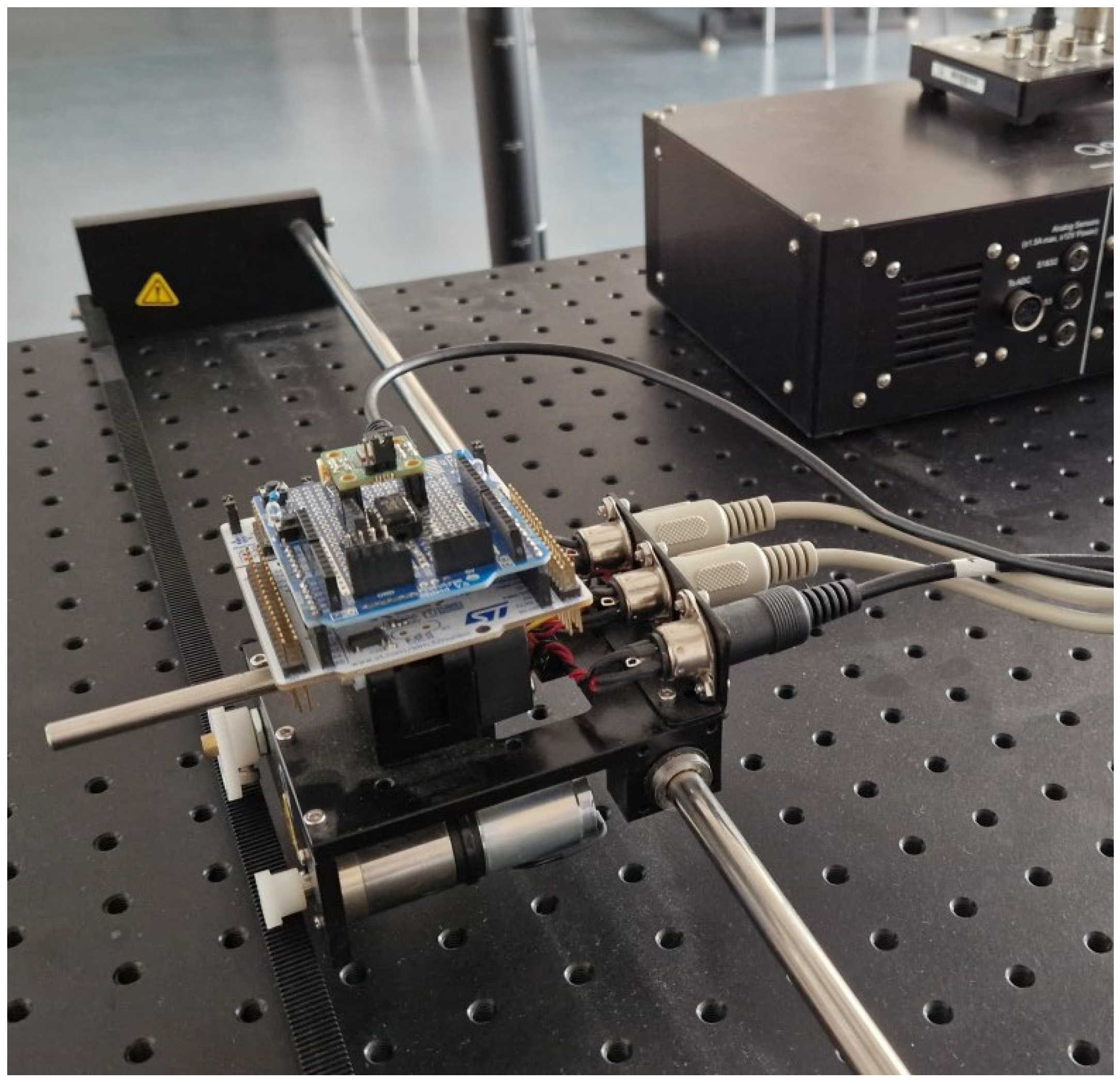
Experimental validation was carried out using a custom-designed unidirectional shaking table, capable of reproducing ground motion in a single horizontal axis (Figure 1). Since the table allows motion along only one direction, each seismic record was reproduced twice—once using the E–W component and once using the N–S component of the P-wave. The MEMS-based EEWS device recorded both signals, and the resulting PGA_P for each event was computed as the geometric mean of the two single-axis tests, in accordance with standard seismological practice. This ensured that the experimentally derived PGA_P values were directly comparable to those obtained from the dual-component station data used in the field calibration.
The mechanical platform consists of a precision aluminum cart moving along a low-friction linear guide and driven by a high-torque DC servomotor coupled to a planetary gearbox. Motion control is achieved through a closed-loop PID algorithm implemented on a host PC, ensuring high fidelity in waveform reproduction within the frequency range of 0.1–10 Hz, typical of structural vibrations in civil engineering. The input signals, derived from real earthquake accelerograms recorded at IAS and IASR stations, were scaled and replayed sequentially to simulate consistent ground-motion scenarios.
The shaking table is equipped with a high-resolution optical encoder (4096 counts/rev) providing sub-millimeter displacement feedback, a linear power amplifier for actuator control, and a National Instruments data acquisition interface synchronized with the embedded EEWS node. The MEMS-based EEW module was mounted directly on the moving cart, ensuring realistic dynamic coupling between the test device and the simulated seismic input. Each test sequence included P-wave recording and analysis, computation of PGA_P from the paired E and N component runs, estimation of PGA_Spredicted, and subsequent comparison with the PGA_S from the ESM database. The deviation between predicted and ESM database amplitudes provides a direct measure of how accurately the empirically derived k factor can be used to forecast the intensity of the destructive phase based solely on early P-wave data.

4. Discussion

Previous studies conducted in Japan and Italy demonstrated the effectiveness of S/P amplitude ratios for rapid ground-motion estimation using dense strong-motion networks and high-quality instrumentation. Those investigations primarily addressed statistical validation and regional calibration. In contrast, the present work focuses on implementation-oriented evaluation and experimental feasibility using a compact sensing configuration and controlled shaking-table excitation. This system-oriented perspective complements calibration-focused studies and contributes toward the practical deployment of on-site EEW concepts in regions with limited instrumentation density.
The results presented in Table 2 illustrate the comparison between the ESM S-wave peak ground accelerations (ESM PGA_S) and those predicted using the k-based relationship. The relative error was calculated as the absolute difference between predicted and measured PGA_S values divided by the measured value and expressed as a percentage.
Overall, the predicted values reproduce the general trend of the observed data with good consistency. The median relative error between PGA_Spredicted and ESM PGA_S is only +2.0%, while the mean relative error is +8.5%, indicating that the model remains statistically centered and free of systematic bias. The median absolute relative error of 41.6% reflects the natural variability of the S/P amplitude ratio, which follows a log-normal distribution with σlog10 ≈ 0.31, corresponding to an uncertainty factor of about ×2.
Large deviations (>70%) are primarily observed for weak-motion cases where the absolute acceleration levels are low and thus more affected by the quantization and frequency limits of the shaking table. For strong-motion tests (PGA_P > 1 cm/s2), the predicted amplitudes are within ±30–40% of the observed values, demonstrating that the empirical coefficient k = 6.2, derived from field recordings at IAS and IASR stations, remains valid under laboratory reproduction conditions. A closer inspection of the largest deviations (records two, 16, and 24 in Table 2) shows that these correspond mainly to weak-motion cases characterized by low PGA_P values. In such situations, small absolute differences between predicted and measured amplitudes translate into large relative errors, while reduced signal-to-noise conditions and natural variability of the S/P ratio increase uncertainty. For moderate and strong-motion cases, the deviations are significantly smaller, confirming the stability of the locally calibrated coefficient for practical early-warning purposes.
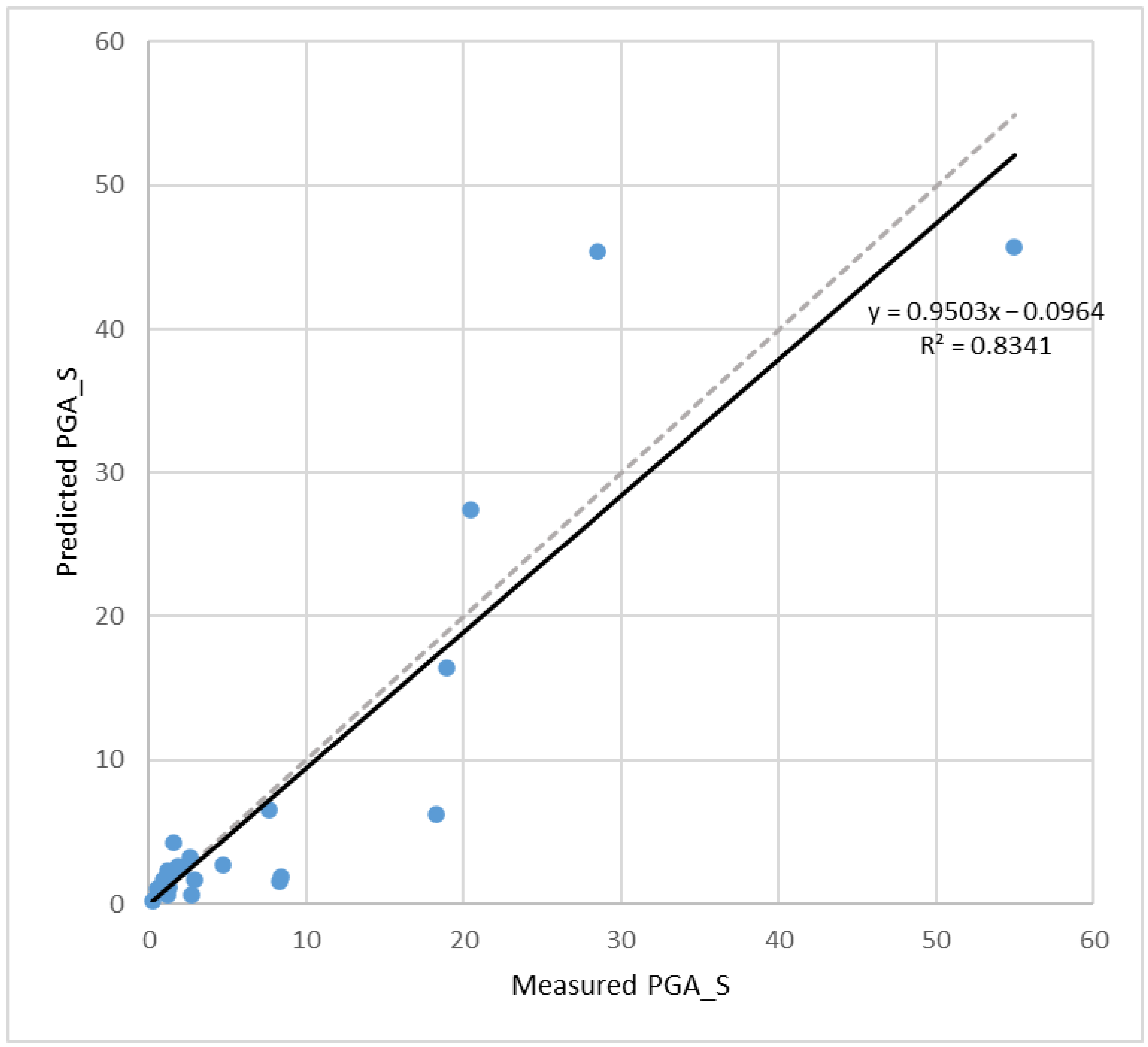
The performance of the proposed estimation framework was evaluated by comparing predicted PGA values with the measured reference values for all analyzed events. As shown in Figure 2, a strong proportional relationship is observed between estimated and measured ground-motion levels. The regression slope close to unity and the high correlation coefficient indicate stable predictive behavior across the considered range of ground motions, supporting the feasibility of integrating the S/P-based approach into compact on-site sensing platforms. For predictive performance, complementary statistical indicators were evaluated. The correlation coefficient between predicted and measured PGA values is R = 0.91 (R2 = 0.834), indicating a strong proportional relationship. The root-mean-square error (RMSE) of the estimation is 5.21 cm/s2, reflecting the expected dispersion associated with site-specific S/P variability.
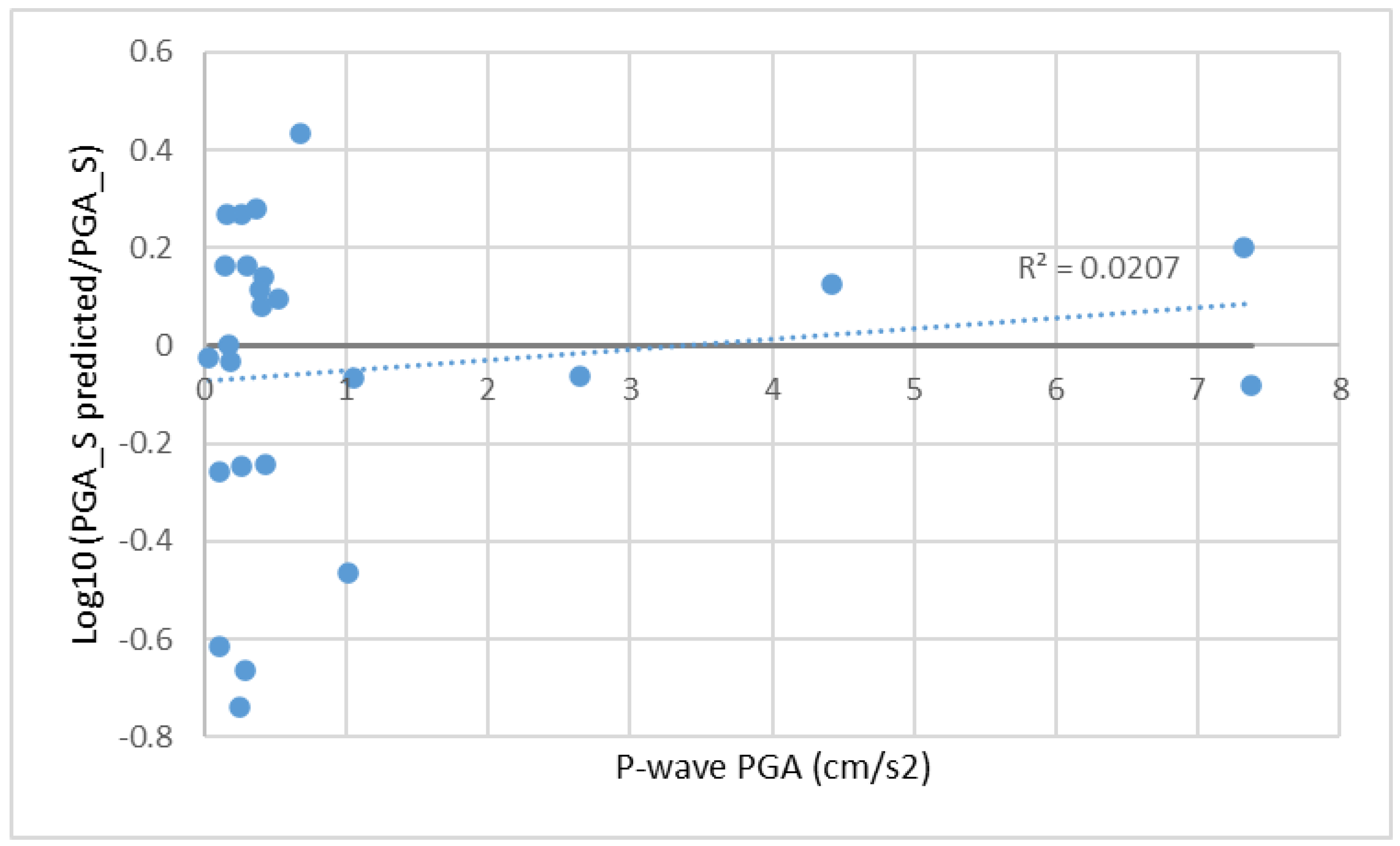
To further investigate estimation behavior under varying signal amplitudes, the relationship between P-wave peak ground acceleration and logarithmic prediction error was analyzed (Figure 3). The results indicate that larger deviations are primarily associated with low-amplitude P-wave signals, whereas moderate and strong events exhibit more stable estimation behavior. This trend is consistent with the expected sensitivity of rapid on-site estimation approaches to weak initial ground motion.
The scatter observed in the dataset is consistent with the expected physical variability of the S/P ratio, influenced by both source characteristics and site amplification effects. It is also compatible with the standard deviations reported in other regional strong-motion studies where similar relationships are used for on-site early warning calibration. The experiment therefore confirms that, despite intrinsic variability, the k-based method provides a reliable first-order estimate of the forthcoming S-wave amplitude using only the initial P-wave segment. From an early warning perspective, such accuracy is more than sufficient for real-time decision-making. Even with ±40% dispersion, the predicted S-wave amplitude still provides a meaningful estimate of the shaking intensity that can be used to trigger alert thresholds or automated protection systems. The results further demonstrate that the use of a fixed, locally calibrated k value allows for a fast and low-cost implementation of the amplitude prediction algorithm directly on embedded hardware.
In summary, the experimental data confirm the robustness of the proposed approach: the k = 6.2 coefficient obtained from high-quality field recordings yields stable and unbiased predictions when applied to shaking-table simulations, supporting its adoption for the on-site EEW device developed for the Iași region. In practical on-site EEW configurations, the proposed S/P-based estimation approach is primarily intended for use at or near the target site, often referred to as the triggering station, where the earliest P-wave detection is used to predict the forthcoming local ground motion. Far-field stations included in the present analysis serve mainly to illustrate regional variability of the S/P ratio and site-response characteristics rather than to act as independent warning nodes.
Although the experimental setup employs a unidirectional horizontal shaking table, this does not significantly affect the validation of the proposed S/P-based estimation method. The approach relies on peak ground acceleration derived from horizontal components treated independently and combined using geometric averaging. Consequently, single-axis excitation provides an adequate and controlled framework for validating the amplitude-based prediction principle. Future work may include multi-axis testing to reproduce fully realistic ground-motion conditions.

5. Conclusions

This study demonstrates that the site-specific S/P amplitude ratio constitutes a physically meaningful and operationally efficient parameter for near-real-time seismic acceleration estimation in on-site Earthquake Early Warning systems. By exploiting the intrinsic and stable relationship between early P-wave amplitudes and the subsequent S-wave ground motion, the proposed approach enables rapid, autonomous prediction of destructive shaking without requiring event localization, magnitude estimation, or inter-station communication.
Using strong-motion data from the European Strong-Motion database, a local calibration coefficient of k = 6.2 was established for the Iași area, in agreement with its soft-soil conditions and with values reported for comparable sedimentary sites in other seismic regions. The regional analysis confirms that the S/P ratio is predominantly governed by local site effects, emphasizing the necessity of station-level calibration.
The k-based methodology was experimentally validated through controlled shaking-table tests using real P-wave recordings. The predicted S-wave peak ground accelerations exhibit no systematic bias, with a median relative error of +2.0% and a dispersion consistent with the intrinsic log-normal variability reported in large-scale strong-motion studies. For moderate and strong motions, the predictions remain within ranges that are fully adequate for early warning applications. These results confirm that a locally calibrated S/P ratio constitutes a robust, physically grounded, and operationally reliable method for estimating forthcoming ground motion from early P-wave observations. The validated methodology provides a practical framework for extending on-site EEW strategies to regions characterized by complex wave propagation and pronounced site effects, such as those influenced by Vrancea intermediate-depth seismicity.
The calibrated coefficient k = 6.2 is site-specific and reflects local geological and geotechnical conditions. For application in other regions, the same methodological framework can be implemented using locally recorded strong-motion data to derive appropriate calibration coefficients. Because the S/P ratio is controlled primarily by site response parameters such as Vs30 and basin structure, adaptation of the method requires local calibration rather than modification of the underlying algorithm, supporting its transferability to diverse geological settings.
From an operational perspective, deployment of compact on-site EEW devices requires consideration of practical aspects such as power consumption, triggering logic, communication latency, and false-alarm management. The prototype system developed in this study demonstrates the feasibility of real-time processing on embedded hardware, while large-scale implementation will require integration within distributed sensing architectures and optimization of energy-efficient operation.
Future research will focus on extending the proposed approach toward operational and networked configurations, including multi-station integration, evaluation under more complex excitation conditions, and exploration of hybrid EEW strategies combining amplitude-based and feature-based predictors. These directions support the transition from experimental validation toward reliable and scalable on-site EEW implementation in regions affected by intermediate-depth seismicity.

Author Contributions

Conceptualization, C.D. and E.S.; methodology, M.C.T.; software, C.D. and E.S.; validation, C.D., M.C.T.; investigation, C.D.; resources, M.C.T.; data curation, C.D., M.C.T., and E.S.; writing—original draft preparation, C.D.; writing—review and editing, E.S.; visualization, M.C.T.; project administration, M.C.T.; funding acquisition, M.C.T. All authors have read and agreed to the published version of the manuscript.

Funding

This research was funded by the North-East Regional Programme 2021–2027, PR/NE/2024/P1/RSO1.1_RSO1.3/1, through the grant “Multifunctional video intercom system connected to the internet with cyber-attacks protection”, code: 338210.

Data Availability Statement

No new data were created in this study. All seismic records used are publicly available through the seismic networks cited in the manuscript.

Conflicts of Interest

The authors declare no conflicts of interest.

References

  1. Si, X.; Wu, X.; Li, Z.; Wang, S.; Zhu, J. An all-in-one seismic phase picking, location, and association network for multi-task multi-station earthquake monitoring. Commun. Earth Environ. 2024, 5, 22. [Google Scholar] [CrossRef]
  2. Noel, S.K.; West, M.E. Challenges and Opportunities of Machine Learning Earthquake Detection for Regional Monitoring. Bull. Seismol. Soc. Am. 2025, 115, 2096–2108. [Google Scholar] [CrossRef]
  3. Bansal, B.K.; Pandey, A.P.; Singh, A.P.; Suresh, G.; Singh, R.K.; Gautam, J.L. National seismological network in India for real-time earthquake monitoring. Bull. Seismol. Soc. Am. 2021, 92, 2255–2269. [Google Scholar] [CrossRef]
  4. Hsu, T.Y.; Nieh, C.P. On-site earthquake early warning using smartphones. Sensors 2020, 20, 2928. [Google Scholar] [CrossRef] [PubMed]
  5. Fu, H.; Chen, Z.; Ma, Q. Real-time prediction of peak ground acceleration for on-site earthquake early warning in China via interpretable deep learning. J. Asian Earth Sci. 2025, 297, 106877. [Google Scholar] [CrossRef]
  6. Li, H.; Taflanidis, A.A.; Di, B.; Zheng, Y.; Ma, H.; Zhang, J. Hierarchical Bayesian Calibration of the Epicentral Distance Estimation Model for Earthquake Early Warning System. Seismol. Res. Lett. 2026, in press. [Google Scholar]
  7. Esposito, M.; Palma, L.; Belli, A.; Sabbatini, L.; Pierleoni, P. Recent advances in internet of things solutions for early warning systems: A review. Sensors 2022, 22, 2124. [Google Scholar] [CrossRef]
  8. Kolivand, P.; Saberian, P.; Tanhapour, M.; Karimi, F.; Kalhori, S.R.N.; Javanmard, Z.; Ayyoubzadeh, S.M. A systematic review of Earthquake Early Warning (EEW) systems based on Artificial Intelligence. Earth Sci. Inform. 2024, 17, 957–984. [Google Scholar] [CrossRef]
  9. Li, L.; Li, J.; Xiang, W.; Liu, Z.; Liao, W.; Zhang, L. SharpCEEWPServer: A Lightweight Server for the Communication Protocol of China Earthquake Early Warning Systems. Sensors 2026, 26, 262. [Google Scholar] [CrossRef]
  10. Tian, B.; Liu, W.; Mo, H.; Li, W.; Wang, Y.; Adhikari, B.R. Detecting the unseen: Understanding the mechanisms and working principles of earthquake sensors. Sensors 2023, 23, 5335. [Google Scholar] [CrossRef]
  11. Teja, N.V.; Akshay, S.P.; Khaleed, K.A.; Kumar, C.S.; Kumar, G.M.; Bhavadharini, R.M. An Earthquake Alert System Using Internet of Things. In Proceedings of the 10th International Conference on Communication and Signal Processing (ICCSP 2024), Chennai, India, 12–14 April 2024; IEEE: Piscataway, NJ, USA, 2024; pp. 1621–1626. [Google Scholar]
  12. Raditya, M.; Hsu, T.Y.; Darwito, P.A.; Nugroho, G.; Kaltsum, Z.S. Earthquake detection system strategy based on multi-hop wireless sensor network using MEMS sensor. J. Instrum. 2025, 20, P10014. [Google Scholar] [CrossRef]
  13. Leong, W. Internet of Things for Enhancing Public Safety, Disaster Response, and Emergency Management. Eng. Proc. 2025, 92, 61. [Google Scholar]
  14. Kanamori, H. Real-Time Seismology and Earthquake Damage Mitigation. Annu. Rev. Earth Planet. Sci. 2005, 33, 195–214. [Google Scholar] [CrossRef]
  15. Huang, T.C.; Wu, Y.M. Revisiting the initial peak P-wave displacement and the ground motion characteristic period with signal-to-noise ratios: A case study using a low-cost sensor network in Taiwan. J. Earthq. Eng. 2023, 27, 4694–4704. [Google Scholar] [CrossRef]
  16. Zollo, A.; Nazeri, S.; Colombelli, S. Earthquake seismic moment, rupture radius, and stress drop from P-wave displacement amplitude versus time curves. IEEE Trans. Geosci. Remote Sens. 2021, 60, 5912211. [Google Scholar] [CrossRef]
  17. Williamson, A.; Lux, A.; Allen, R.M. Improving magnitude estimates in the EPIC earthquake early warning algorithm. Seismol. Res. Lett. 2026, 97, 233–245. [Google Scholar] [CrossRef]
  18. Konovalov, A.; Orlin, I.; Stepnov, A.; Stepnova, Y. Physically based and empirical ground motion prediction equations for multiple intensity measures (PGA, PGV, Ia, FIV3, CII, and Maximum Fourier Acceleration Spectra) on Sakhalin Island. Geosciences 2023, 13, 201. [Google Scholar] [CrossRef]
  19. Bu, K.; Li, C.; Xue, H.; Li, B.; Zhao, Y. A 14 μHz/√Hz resolution and 32 μHz bias instability MEMS quartz resonant accelerometer with a low-noise oscillating readout circuit. Microsyst. Nanoeng. 2024, 10, 200. [Google Scholar] [CrossRef]
  20. Tsuno, S.; Niwa, K.; Korenaga, M.; Yamanaka, H.; Chimoto, K.; Miyake, H.; Yamada, N. Application of the on-site P-wave earthquake early warning method based on site-specific ratios of S-waves to P-waves to the 2016 Kumamoto earthquake sequence, Japan. Earth Planets Space 2024, 76, 32. [Google Scholar] [CrossRef]
  21. Festa, G.; Picozzi, M.; Caruso, A.; Colombelli, S.; Cattaneo, M.; Chiaraluce, L.; Elia, L.; Martino, C.; Marzorati, S.; Supino, M.; et al. Performance of earthquake early warning systems during the 2016–2017 Mw 5–6.5 central Italy sequence. Seismol. Res. Lett. 2018, 89, 1–12. [Google Scholar] [CrossRef]
  22. Wu, Y.-M.; Chen, D.-Y.; Lin, T.-L.; Hsieh, C.-Y.; Chin, T.-L.; Chang, W.-Y.; Li, W.-S.; Ker, S.-H. A high-density seismic network for earthquake early warning in Taiwan based on low-cost sensors. Seismol. Res. Lett. 2013, 84, 1048–1054. [Google Scholar] [CrossRef]
  23. Wu, Y.M.; Mittal, H. A review on the development of earthquake warning system using low-cost sensors in Taiwan. Sensors 2021, 21, 7649. [Google Scholar] [CrossRef] [PubMed]
  24. Chandrakumar, C.; Prasanna, R.; Stephens, M.; Tan, M.L. Earthquake early warning systems based on low-cost ground motion sensors: A systematic literature review. Front. Sens. 2022, 3, 1020202. [Google Scholar] [CrossRef]
  25. Li, Z.J.; Deng, S.G.; Hong, Y.Z.; Wei, Z.T.; Cai, L.Y. Study on S-wave velocity prediction in shale reservoirs based on explainable 2D-CNN under physical constraints. Pet. Sci. 2025, 22, 3247–3265. [Google Scholar] [CrossRef]
  26. Burschil, T.; Buness, H. S-wave seismic imaging of near-surface sediments using tailored processing strategies. J. Appl. Geophys. 2020, 173, 103927. [Google Scholar] [CrossRef]
  27. Shelly, D.R.; Skoumal, R.J.; Hardebeck, J.L. S/P amplitude ratios derived from single-component seismograms and their potential use in constraining focal mechanisms for microearthquake sequences. Seism. Rec. 2022, 2, 118–126. [Google Scholar] [CrossRef]
  28. Stone, I.; Wirth, E.A.; Frankel, A.D. Structure and QP–QS relations in the Seattle and Tualatin Basins from converted seismic phases. Bull. Seismol. Soc. Am. 2021, 111, 1221–1233. [Google Scholar] [CrossRef]
  29. Nakamura, Y. On the Urgent Earthquake Detection and Alarm System (UrEDAS). In Proceedings of the 9th World Conference on Earthquake Engineering, Tokyo–Kyoto, Japan, 2–9 August 1988. [Google Scholar]
  30. Zollo, A.; Amoroso, O.; Lancieri, M.; Wu, Y.-M.; Kanamori, H. A Threshold-Based Earthquake Early Warning Using Dense Accelerometer Networks. Geophys. Res. Lett. 2010, 37, L09306. [Google Scholar] [CrossRef]
  31. Picozzi, M.; Bindi, D.; Spallarossa, D.; Di Giacomo, D.; Zollo, A. A rapid response magnitude scale for timely assessment of the high-frequency seismic radiation. Sci. Rep. 2018, 8, 8562. [Google Scholar] [CrossRef]
  32. Adinolfi, G.M.; De Landro, G.; Picozzi, M.; Carotenuto, F.; Caruso, A.; Nazeri, S.; Colombelli, S.; Tarantino, S.; Muzellec, T.; Emolo, A.; et al. Comprehensive Study of Micro-Seismicity by Using an Automatic Monitoring Platform. Front. Earth Sci. 2023, 11, 1073684. [Google Scholar] [CrossRef]
  33. Banica, A.; Rosu, L.; Muntele, I.; Grozavu, A. Towards Urban Resilience: A Multi-Criteria Analysis of Seismic Vulnerability in Iasi City (Romania). Sustainability 2017, 9, 270. [Google Scholar] [CrossRef]
  34. Bănică, A.; Grozavu, A.; Roșu, L.; Muntele, I. Aspects Concerning Seismic Vulnerability of Buildings in Iași City, Romania. Int. Multidiscip. Sci. GeoConf. SGEM 2016, 3, 87–94. [Google Scholar]
  35. Luzi, L.; Lanzano, G.; Felicetta, C.; D’Amico, M.C.; Russo, E.; Sgobba, S.; Pacor, F.; ORFEUS Working Group 5. Engineering Strong Motion Database (ESM), Version 2.0; Istituto Nazionale di Geofisica e Vulcanologia (INGV): Rome, Italy, 2020. Available online: https://esm-db.eu/#/home (accessed on 15 November 2025).
  36. Das, R.; Das, A.; Choudhury, D.; Meneses, C.; Barrera, F.G.; Wason, H.R.; Alam, M.A. Updated probabilistic seismic hazard assessment using Mwg (Das magnitude scale) to address moment magnitude (M) scale inaccuracies below 7.5: A case study from Northeast India. Sci. Rep. 2025, 15, 43502. [Google Scholar] [CrossRef]
  37. Matsu’ura, M. A Theoretical Basis of the Moment Magnitude Scale. Earth Planets Space 2025, 77, 151. [Google Scholar] [CrossRef]
  38. Temneanu, M.C.; Donciu, C.; Serea, E. Self-Contained Earthquake Early Warning System Based on Characteristic Period Computed in the Frequency Domain. Appl. Sci. 2025, 15, 9026. [Google Scholar] [CrossRef]
Figure 1. Custom unidirectional shaking table for experimental validation of the MEMS-based EEWS, with mounting configuration of the embedded node for replay of real P-wave components.
Applsci 16 02062 g001
Figure 2. Comparison between predicted and measured peak ground acceleration values obtained using the S/P-based estimation framework. The dashed line represents the 1:1 correspondence between predicted and measured values, while the solid line indicates the linear regression fit.
Applsci 16 02062 g002
Figure 3. Relationship between P-wave peak ground acceleration and logarithmic prediction error. The horizontal line at zero indicates perfect agreement between predicted and measured PGA values. The dispersion at low amplitudes highlights the sensitivity of rapid S/P-based estimation to weak initial motion.
Applsci 16 02062 g003
Table 1. Strong-motion records from the Iași stations: Vrancea earthquakes, P- and S-wave horizontal PGA components, geometric means, and derived site-specific S/P amplitude ratios.
NoStation CodeESM IDSMoment Magnitude
[Mw]
Corrected Magnitude [Mwg]Epicentral Distance
[Km]
PGA E
[cm/s2]
P Wave
PGA N
[cm/s2]
P Wave
PGA E
[cm/s2]
S Wave
PGA N
[cm/s2]
S Wave
PGA_ PPGA_ SK = PGA S/PGA P
1IASREMSC-20200131_00000094.74.3171.80.3450.5364.1025.4590.434.72911
2IASRINT-20221103_00000315.14.7204.40.5350.7851.2651.8990.6481.5522.395
3IASRINT-20240916_00001725.24.8205.30.4030.6302.7742.3980.5042.5795.117
4IASEMSC-20051213_00000384.84.4174.60.4660.3872.1611.5930.4251.8554.367
5IASEMSC-20090425_00000805.24.8182.24.5844.36825.36116.4734.47620.454.569
6IASEMSC-20120706_00000804.13.61750.861.1905.9239.8721.0117.6397.553
7IASEMSC-20131006_00000025.35.0183.50.901.07713.7424.3570.98518.28618.564
8IASEMSC-20131015_00000914.74.3190.60.3070.2410.6671.1230.2720.8663.183
9IASEMSC-20140224_00000024.54.1172.60.1200.1081.2301.1690.1141.19910.518
10IASEMSC-20140326_00000894.13.6186.30.0390.0290.2550.1960.0340.2246.621
11IASEMSC-20140329_00001264.74.3193.30.2390.2673.0672.6550.2532.85711.302
12IASEMSC-20140910_00000674.44.0191.90.3480.2407.818.9420.2898.36628.978
13IASEMSC-20141122_00000665.65.3151.82.0693.22822.6615.9052.58318.9577.341
14IASEMSC-20141207_00000714.44.0146.80.2860.3491.3301.2910.3161.314.142
15IASEMSC-20150124_00000254.33.91790.1620.40010.0146.8200.2558.27432.474
16IASEMSC-20150316_00000474.33.9194.20.4100.3591.2221.2140.3841.2183.172
17IASEMSC-20150329_00000044.54.1188.90.1760.1200.5770.7050.1450.6384.403
18IASEMSC-20160923_00001355.75.4175.77.0537.25570.56342.7777.15354.9487.68
19IASEMSC-20161227_00001045.65.3179.37.2737.53530.96126.1137.40228.4833.849
20IASEMSC-20170208_00001374.64.2212.20.4550.3512.0042.2170.3992.1085.281
21IASEMSC-20170519_00000764.33.9171.40.2130.1760.8761.7380.1941.2366.371
22IASEMSC-20170801_00000424.33.9201.90.1730.1731.1700.9820.1731.0716.188
23IASEMSC-20170802_00000074.74.3197.90.1270.0852.4623.0520.1042.74226.413
24IASEMSC-20180425_00001004.74.3198.80.1610.1920.5050.6040.1760.5533.144
25IASEMSC-20181028_00000035.65.3197.10.2970.5001.9551.8170.3851.8854.892
26RO.NGRRINT-20221103_00000315.14.7156.93.1184.5948.1866.0233.7847.031.858
27RO.NGRRINT-20240916_00001725.24.8167.71.1861.1899.4665.6861.1887.3456.182
28RO.VASRINT-20221103_00000315.14.7161.45.4424.82214.37510.1575.12712.0832.357
29RO.VASRINT-20240916_00001725.24.8167.22.6081.70314.24527.5352.10719.7959.4
30RO.LEOMEMSC-20161227_00001045.65.3157.012.37913.46732.55140.63112.90236.3222.816
31RO.LEOMEMSC-20181028_00000035.65.3173.93.5853.07464.56041.0263.31751.44415.515
32RO.LEOMINT-20240916_00001725.24.8184.27.6068.22822.64224.0517.91323.3332.949
33RO.LEOMEMSC-20090425_00000805.24.8154.94.6414.20020.38014.5834.41717.2353.902
34RO.LEOMINT-20221103_00000315.14.7172.82.9804.6139.93910.7443.70910.3312.785
35RO.LEOMEMSC-20200131_00000094.74.3143.91.6732.08824.19316.4261.86819.92810.67
36RO.LEOMEMSC-20170802_00000074.74.3172.31.1001.34311.1169.2301.21610.1258.325
37RO.LEOMEMSC-20170208_00001374.64.2188.13.0103.3938.5089.1683.2048.8352.758
38RO.LEOMEMSC-20170519_00000764.33.9142.70.8980.9134.9333.0570.9053.884.288
39RO.LEOMEMSC-20170801_00000424.33.9175.71.4571.5712.3452.7851.5142.5531.687
40RO.LEOMEMSC-20120706_00000804.13.6147.32.3952.02514.3496.0082.29.2854.222
41RO.BACEMSC-20160923_00001355.75.492.81.7391.13740.96329.4391.40934.72524.65
42RO.BACEMSC-20161227_00001045.65.395.91.3940.81421.78418.4481.06419.97718.78
43RO.BACEMSC-20181028_00000035.65.3113.20.9911.0893.2964.5051.0413.8553.703
44RO.BACEMSC-20131006_00000025.35.0101.00.9201.02724.29414.4640.97218.7719.31
45RO.BACINT-20240916_00001725.24.8122.00.5410.4602.2703.1930.4992.6925.395
46RO.BACINT-20221103_00000315.14.7123.50.8290.7583.6792.5630.7923.0723.879
47RO.GIRREMSC-20141122_00000665.65.3132.01.8442.1837.2317.2782.0037.2553.623
48RO.GIRREMSC-20140910_00000674.44.0145.60.2670.3911.0891.5910.3231.3174.08
59RO.GIRREMSC-20141207_00000714.44.0128.30.1630.1790.3860.3910.1710.3882.27
50RO.GIRREMSC-20150124_00000254.33.9134.80.4440.5131.4301.7810.4771.5953.345
Table 2. Performance of the k-based on-site prediction model: measured P-wave PGA, S-wave PGA estimated from the S/P ratio, reference ESM S-wave PGA, and corresponding relative errors for the Iași stations.
NoStation CodeESM IDsPGA_PPGA_Spredicted = PGA_P × kESM PGA_SRelative Error [%]
1 IASREMSC-20200131_00000090.436 2.706 4.729 42.8
2 IASRINT-20221103_00000310.678 4.206 1.552 171.0
3 IASRINT-20240916_00001720.520 3.225 2.579 25.0
4 IASEMSC-20051213_00000380.415 2.573 1.855 38.7
5 IASEMSC-20090425_00000804.421 27.411 20.450 34.0
6 IASEMSC-20120706_00000801.059 6.568 7.639 14.0
7 IASEMSC-20131006_00000021.012 6.272 18.286 65.7
8 IASEMSC-20131015_00000910.259 1.606 0.866 85.5
9 IASEMSC-20140224_00000020.107 0.665 1.199 44.5
10 IASEMSC-20140326_00000890.034 0.211 0.224 6.0
11 IASEMSC-20140329_00001260.261 1.616 2.857 43.4
12 IASEMSC-20140910_00000670.293 1.816 8.366 78.3
13 IASEMSC-20141122_00000662.651 16.436 18.957 13.3
14 IASEMSC-20141207_00000710.308 1.912 1.310 45.9
15 IASEMSC-20150124_00000250.244 1.512 8.274 81.7
16 IASEMSC-20150316_00000470.373 2.314 1.218 90.0
17 IASEMSC-20150329_00000040.150 0.933 0.638 46.3
18 IASEMSC-20160923_00001357.375 45.726 54.948 16.8
19 IASEMSC-20161227_00001047.316 45.358 28.483 59.3
20 IASEMSC-20170208_00001370.408 2.531 2.108 20.1
21 IASEMSC-20170519_00000760.185 1.148 1.236 7.1
22 IASEMSC-20170801_00000420.173 1.074 1.071 0.3
23 IASEMSC-20170802_00000070.107 0.666 2.742 75.7
24 IASEMSC-20180425_00001000.166 1.030 0.553 86.3
25 IASEMSC-20181028_00000030.397 2.461 1.885 30.6
Disclaimer/Publisher’s Note: The statements, opinions and data contained in all publications are solely those of the individual author(s) and contributor(s) and not of MDPI and/or the editor(s). MDPI and/or the editor(s) disclaim responsibility for any injury to people or property resulting from any ideas, methods, instructions or products referred to in the content.