Systematic Review

Artificial Intelligence in Aquaculture Risk Management: A Systematic Review by PRISMA

1
Department of Fisheries and Aquaculture, School of Agricultural Sciences, University of Patras, 26443 Patras, Greece
2
Department of Marketing and Management, School of Business, State University of New York at Oswego, Oswego, NY 13126, USA
3
Computer Engineering and Informatics Department, University of Patras, 26443 Patras, Greece
*
Authors to whom correspondence should be addressed.
Appl. Sci. 2026, 16(4), 2032; https://doi.org/10.3390/app16042032
Submission received: 16 January 2026 / Revised: 4 February 2026 / Accepted: 14 February 2026 / Published: 18 February 2026
(This article belongs to the Section Computing and Artificial Intelligence)

Abstract

The aquaculture industry is growing rapidly. It is the fastest growing food industry in the world, with production expanding 16-fold between 1985 and 2018, according to the Food and Agriculture Organization FAO. The industry operates in an environment of high uncertainty, as the management of biological and environmental risks is critical. The aim of this research is to identify machine learning (ML) algorithms applied to quantify risks, categorize applications by sector, and evaluate data linkage to the extent that they feed into formal risk management protocols. A systematic review was performed following the Preferred Reporting Items for Systematic Reviews and Meta-Analyses (PRISMA) 2020 guidelines. This search was conducted in Scopus and Science Direct for publications up to January 2026. Initially, 134 records were identified, of which 38 studies were ultimately included in the analysis. The results showed that artificial intelligence (AI) and ML offer new predictive capabilities. Integrating Internet of Things (IoT) sensors, AI methods and ML algorithms improve risk mitigation. However, there is a significant disconnection between algorithmic predictions and operational action. Only 3 of 38 studies demonstrated integration with standardized risk management frameworks (e.g., ISO31000). The study concludes that while AI tools provide predictive efficiency, interdisciplinary frameworks are required to filter predictions through economic and ethical criteria. Strengthening this connection will bring the use of AI as a tool for proactive and standardized risk mitigation.

1. Introduction

1.1. The Aquaculture Industry Context

The aquaculture industry has become a powerful and critical player in the global food supply chain. According to the Food and Agriculture Organization (FAO), aquaculture is the fastest growing food production sector in the world, having grown 16 times from 1985 to 2018. It surpassed wild capture fisheries in 2014 [1]. The aquaculture industry is a high-risk industry, since the heterogeneity of farmed organisms and practices create challenges. Disease outbreaks can cost the global sector billions annually, and environmental risks arise from climate change and water quality degradation [2].
As Aly and Fathi (2024) note, preventing the entry and spread of pathogens has become critical, requiring strict operational difficulties that manual monitoring often cannot guarantee [3]. The sustainability of the sector now depends on moving from reactive management to proactive risk management strategies.

1.2. Advanced Technologies and Smart Sensors

The recent emergence of the so-called “Aquaculture 4.0” (a term borrowed from “Industry 4.0” to describe the digital transformation of Aquaculture) [4] has brought to the spotlight advanced technologies such as the Internet of Things (IoT), artificial intelligence (AI) and machine learning (ML) that aim to transform aquaculture. Smart sensors can now monitor critical variables in real time (i.e., temperature, dissolved oxygen (DO), pH). ML models can accurately predict potential anomalies.
For example, an early warning of DO can prevent mass mortalities [5], while pattern recognition in living organisms can detect a potential disease outbreak [6]. Sheik et al. (2025) emphasize that Industry 4.0 technologies, especially the integration of IoT with digital twins (i.e., the creation of virtual copies of physical facilities) allowing operators to simulate environmental anomalies before they occur [7]. Hassan et al. (2025) reviewed recent progress in biosensors and bioelectronics [8]. They highlighted their ability to provide high accuracy, real-time data on pathogens and suspects, which they use as the main input for risk assessment models [8].

1.3. Predictive Algorithms and Data Sets

Data generated by sensors are increasingly processed by predictive algorithms. ML and deep learning (DL) techniques are used to detect complex nonlinear patterns in ecological data.
Alluhaidan et al. (2025) [5] demonstrated that Long Short-Term Memory (LSTM) networks can predict dissolved oxygen (DO) levels with an accuracy exceeding 92%. This offers the potential for early intervention before fish mortality occurs [5]. Wu et al. (2025) highlight that deep learning architectures, such as Convolutional Neural Networks (CNNs), have achieved state-of-the-art performance in visual recognition such as fish detection and behavior analysis, even in murky underwater environments [9]. However, challenges remain regarding data availability and quality. Naz et al. (2025) argue that the lack of standardized open-access datasets limits the generalizability of these models across species and geographic regions [10].

1.4. The Disconnection in Decision-Making Protocols

Despite the technological maturity of predictive algorithms, the integration between predictive algorithms and standardized decision making remains insufficient. The literature on the subject appears limited. Most technical researchers focus on the accuracy of ML models, while management scholars focus on risk management frameworks such as ISO 31000.
The research community has been slow to adopt quantitative risk management approaches; therefore, few examples of integrated implementation have emerged [11]. Saville et al. (2026) [12] recently proposed an AI-powered decision support system (DSS) for mariculture that explicitly links water quality sensors to mortality risk predictions, yet such integrated systems remain rare in commercial practice. A research void is created. AI tools provide predictive power, but their integration into standardized decision-making processes (e.g., in risk matrices, response plans) is limited [13].

1.5. Methodological Framework and the Decision-Making Disconnection

This review examines this disconnection by collecting and categorizing AI/ML applications in aquaculture risk assessment. It assesses to what extent the results of the algorithms are translated into action.
To systematically assess the disconnection between AI and risk management, this review adopts the Preferred Reporting Items for Systematic Reviews and Meta-Analyses (PRISMA) 2020 statement. The PRISMA analysis, unlike traditional bibliometric or narrative reviews that may suffer from selection bias and lack reproducibility, provides a transparent and standardized framework that requires authors to report why the review was conducted, what steps were carried out, and what was found [14]. By following the PRISMA 2020 checklist format (and aligning with extensions such as PRISMA-ScR), this paper ensures an accurate, unbiased selection process that can be replicated by other researchers [15].
The goal is to highlight the perspective of an integrated “predictive risk management” framework, where ML models function as an integral part of the risk identification, analysis and response process [16]. Currently, a significant issue in the field is that operational decisions, such as whether to abort feeding or harvest early during a risk event, are often driven by subjective experience or “gut feelings” rather than data-driven protocols [17]. Effective risk management requires that AI outputs be integrated into decision support systems (DSSs) or standardized frameworks (e.g., ISO 31000) [12]. This review does not only catalogue algorithms. It critically assesses the extent to which current literature bridges this disconnection between AI predictions and standardized decision-making protocols.

2. Materials and Methods

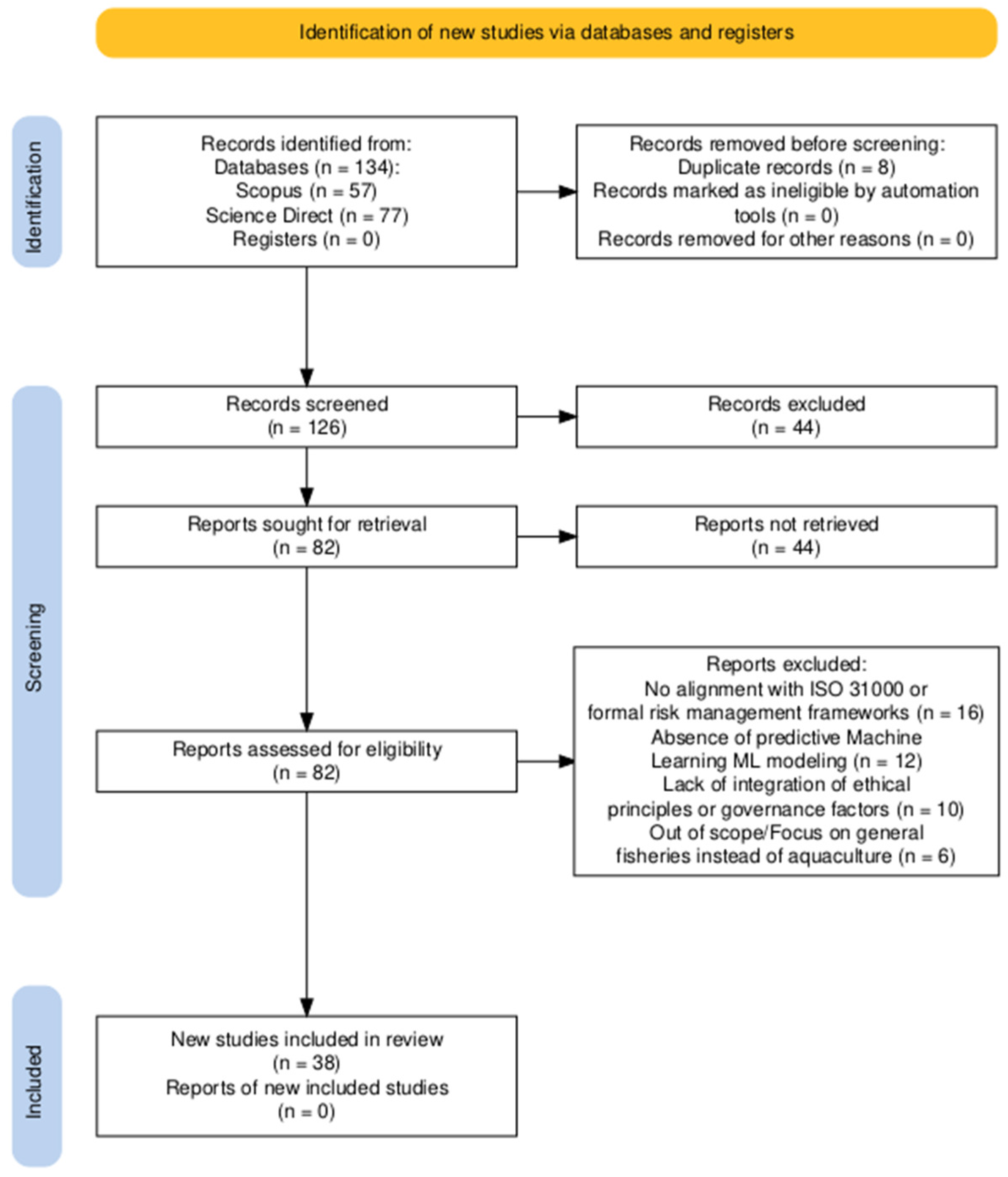
This systematic review was designed in accordance with the PRISMA 2020 framework for systematic reviews. Across all phases, transparency and completeness criteria were met (protocol definition, literature search, study selection, and results reporting) [14]. Of the 134 initial records identified, 8 were removed as duplicates. During the abstract and title screening, 82 studies were chosen for the full-text evaluation. Ultimately, 44 articles were excluded at this stage (e.g., due to lack of specific machine learning implementation, focus on non-production phases, or insufficient methodological reporting), while 38 studies met the criteria and were included in the review. The review was not previously registered in a database (such as PROSPERO). All methodological decisions were made a priori and are documented in the following subsections. The PRISMA 2020 checklist is provided as Supplementary Material (PRISMA_2020_checklist.pdf), confirming that all required elements are reported [14].

2.1. Theoretical Concepts and Risk Definitions

This review categorizes aquaculture risks into four distinct areas:
  • Biological Risk: includes threats that directly affect the survival and growth of organisms, such as disease outbreaks and parasites. Recent studies use ML to predict specific biological indicators, such as ovarian maturation in shrimp [18] or early reproductive determination in fish [19].
  • Environmental Risk: refers to factors that threaten production, such as water quality degradation and extreme weather events. Advanced architectures, such as the hybrid strategies proposed by Palanikkumar et al. (2025), are used to model complex ecological dynamics [20,21].
  • Operational Risk: related to production planning, biomass estimation, feed optimization and logistics. Establishing clear operational boundaries (e.g., for vessel operations or feed schedules) is critical for safety. AI applications in this domain often focus on automating routine tasks to reduce human error and optimize costs, such as the particle swarm optimization for production planning proposed by Cobo et al. (2019) [17,22].
  • Management Frameworks: concerns the integration of predictive models into decision-making patterns. This category includes studies that align artificial intelligence results with protocols such as ISO 31000 [17] or develop integrated decision support systems (DSSs) that connect sensor data and managerial action [12].

2.2. Eligibility Criteria

Inclusion and exclusion criteria were determined based on the PICOS model (Population, Intervention, Comparator, Outcome, Study design):
  • Population: commercial and experimental aquaculture systems, marine, freshwater, or recirculating systems (RASs) where risk management is being considered.
  • Intervention: application of AI/ML/deep learning algorithms for prognosis or analysis of specific risk factors (e.g., mortality prediction, disease diagnosis, water quality prediction, biomass estimation) [23].
  • Comparator: where available, a comparison of the proposed AI models with conventional analysis methods (e.g., linear regression, ARIMA, rule-based thresholds) or alternative ML/DL algorithms within the same study (algorithmic benchmarking) was recorded.
The existence of an explicit comparison group was not a requirement for inclusion, since much of the literature focuses on prediction or early warning models without experimental control but with evaluation through performance metrics.
  • Outcome: Performance metrics of predictive models in terms of risk management, e.g., prediction accuracy, error (RMSE, MAE), sensitivity/specificity in event detection, or the integration of results into a decision (e.g., alarm signal). It was also recorded whether the model contributed to administrative action (e.g., automatic feeding adjustment, activation of a hazard alarm).
  • Study design: Original research papers (experimental or field) and systematic reviews written in English. Official reports from international organizations [1] and established methodological guidelines [14,15] were included to provide context.
Exclusion Criteria: Articles that did not contain primary data or analysis (e.g., opinion, editorial), book chapters, conference proceedings without full text, publications predating 2015, as well as studies outside the field of productive aquaculture (e.g., management of wild fish populations or oceanography not related to farmed organisms) were excluded.

2.3. Information Sources and Search Strategy

The literature search was performed in two international databases: Scopus and ScienceDirect. In addition, the bibliographic references of important works were checked for possible additional relevant articles. The last search date was 1 December 2025. Generic terms like “Risk” were used in order to ensure ISO 31000 was not the main filter.
For each database, specialized search strings were used that combined keywords for aquaculture, risk management and artificial intelligence. For Scopus, the following string was used:
TITLE-ABS-KEY((Aquaculture OR Fish Farming OR Mariculture)
AND (Risk OR “ISO 31000” OR “Risk Assessment” OR “Early Warning”)
AND (“Machine Learning” OR “Deep Learning” OR “Artificial Intelligence” OR “Neural Network” OR “Computer Vision”))
For ScienceDirect, a free-text Boolean search was applied to the Title, Abstract and Keywords fields, using the following logical structure:
(Aquaculture OR “Fish Farming” OR Mariculture)
AND (Risk OR “Risk Assessment” OR “ISO 31000” OR “Early Warning”)
AND (“Machine Learning” OR “Deep Learning” OR “Artificial Intelligence”
OR “Neural Network” OR “Computer Vision”)
No geographical restrictions were applied. Only articles written in English, published in the period 2015–2025, were included.

2.4. Selection Process

All records retrieved from the databases were collected and managed using bibliography software Zotero (version 6.0, Corporation for Digital Scholarship, Vienna, VA, USA). Initially, duplicates (double occurrences of the same titles) were removed. Then, a two-stage process was followed:
  • Preliminary Screening: Two reviewers performed a title and abstract screening. Articles that clearly did not meet the inclusion criteria were rejected at this stage (e.g., off topic studies or without ML implementation).
  • Full-Text Evaluation: For the remaining studies, the full text was obtained and read to confirm eligibility by the same reviewers. During the full reading, the reasons for exclusion were recorded if an article ultimately did not meet the criteria.
It is noted that the process was carried out by two independent reviewers. Disagreements regarding the inclusion of studies were resolved through discussion between the reviewers. To reduce errors, a sample reliability check was performed: a random subset (~20%) of the initial records was rechecked after a few weeks to confirm the stability of the inclusion/exclusion decisions.
The PRISMA flowchart (Figure 1) summarizes the flow of articles during selection.

2.5. Data Collection Process and Data Items

Data extraction was performed by the authors, using a standardized form ( Microsoft Excel, version 2019, Microsoft Corporation, Redmond, WA, USA). For each included study, the following data were systematically collected:
  • Bibliographic data: authors, year of publication, title, journal, DOI.
  • Thematic risk domains (see Appendix A for detailed classification rules): to which sector does the application belong: Environmental (e.g., water quality, environmental parameters), Biological (organism health/diseases), Operational (e.g., production management, supply chain), Management Frameworks (e.g., risk assessment models, ISO 31000 integration). This division was based on the risk management literature, which identifies “production risks” (e.g., diseases, climate shocks) as particularly important for producers.
  • ML methodology: the type of algorithm or model used (e.g., Random Forest, Convolutional Neural Network, Long Short-Term Memory, Support Vector Classifier etc.). It was also recorded whether it was supervised, unsupervised or reinforcement learning [4,13].
  • Variables and Metrics: what data were used as inputs (e.g., water quality sensors, historical mortality records, fish images/video) and what performance metrics were reported. For continuous value prediction models (e.g., temperature or DO prediction), errors such as RMSE, MAE, and R2 were recorded. For classification models (e.g., whether a disease outbreak will occur), metrics such as Accuracy, Sensitivity, Specificity, F1-score, etc. were noted. These metrics were not pooled or statistically combined due to the variety in target values, algorithms, and methods. They were extracted as reported from the original reports.
  • Management Linkage: It was checked whether the study made explicit reference to integrating the predictive method into a decision-making framework. It was noted whether there was reference to related risk management frameworks, or if a practical use of the results was proposed.
The extracted data were organized in a table (Table S1). Each row corresponds to a study and its properties.

2.6. Quality of Reporting and Applicability Assessment

Instead of a formal risk of bias assessment, we used an assessment of quality and applicability. This assessment is adapted from methodological guidance for reviews of heterogeneous evidence [15]. This assessment does not constitute a risk of bias evaluation. The studies were evaluated based on their readiness to be implemented operationally and based on the completeness of their reporting. The evaluations have the following characteristics:
High Applicability: studies that resulted in quantitative measurements (e.g., Accuracy, RMSE, C-index) and clearly described their data sources.
Moderate Applicability: studies that lacked quantitative performance measures but provided valuable theoretical frameworks, qualitative reviews, or management strategies (labeled “Not Reported”). These are useful for setting the context (Risk Identification) but not for quantitative prediction.
Low Applicability: studies with no reference to management actions or methodology even when data and model structures are sufficient.

2.7. Synthesis Methods

Given the diversity of the identified studies, it was decided to conduct a narrative synthesis instead of a meta-analysis. The studies were grouped thematically by risk area (Environmental, Biological, Operational, Management Frameworks), and the results were summarized qualitatively by group. No quantitative combination of the results (meta-analysis) was attempted due to the inherent heterogeneity of the data and methods: the studies differed in terms of objectives (e.g., DO prediction vs. disease diagnosis), model types (e.g., Computer Vision vs. Biochemical Sensors), and units of outcome measurement. This heterogeneity makes it impractical to combine the results into a single measure; therefore, the synthesis remained descriptive and thematic.
To enhance transparency, tables and figures are presented that capture (a) the thematic distribution of studies (number of studies per risk category, per algorithm type, etc.), (b) the results of each category (e.g., range of accuracy reported for each risk type), and (c) the result of the quality assessment. Where possible, comparative trends are also reported (e.g., which algorithms tend to perform better at which type of prediction).

2.8. Reporting Bias and Certainty

No formal publication bias control (e.g., via funnel plots or statistical tests) was performed due to the nature of the synthesis (narrative, without meta-analysis). Publications with positive/successful results are likely to be favored (publication bias), which should be taken into account when assessing the overall picture. It is possible that there are informal or unpublished efforts where an ML model did not improve risk management and was therefore not published.
The certainty of evidence was not quantitatively assessed with a tool such as GRADE, as the findings are heterogeneous and primarily qualitative in nature. However, a qualitative assessment was attempted: it considered conclusions that appear in many independent studies to be of higher relevance (e.g., the value of LSTMs in water quality prediction is shown in several sources [5]), while authors are more cautious about findings that come from isolated studies or studies with unclear reporting methodology. Applicability was assessed: a finding is considered more operationally applicable if it comes from a study with application in real production conditions as opposed to laboratory tests. Overall, the methods followed ensure that the results presented are reproducible and reliable. In the next section, the results of the review are presented, starting with a summary of the included studies and continuing with the thematic synthesis by risk category [14].

3. Results

3.1. Study Selection

The study selection process is summarized in the PRISMA flowchart (Figure 1). Overall, 38 studies met the strict inclusion criteria and were included in the qualitative synthesis of the review. In addition to these analyzed studies, recent reviews and foundational articles (e.g., on methodology or state-of-the-art technologies) were cited in the Introduction and Discussion sections to provide necessary context and theoretical grounding. The detailed characteristics of the 38 included studies, including risk categories, ML algorithms, performance metrics, and key conclusions, are provided in Table S1 (Supplementary Materials).

3.2. Study Characteristics

The 38 selected studies cover a publication period from 2015 to 2025 (including early online releases scheduled for 2026). There is strong recent research activity: approximately 70% of the studies have been published in the last three years (2023–2025), indicating that the application of AI in aquaculture is a rapidly emerging field. Geographically, the studies come from diverse regions, including Europe, East Asia, Southeast Asia, and the Americas, reflecting the international nature of the challenges in aquaculture.
In terms of crop types, a significant proportion focus on finfish farming (e.g., salmon, sea bass), while fewer studies concern shellfish farming (e.g., mussels) or crustaceans (e.g., shrimp). Most papers are case studies of applying a specific algorithm to a dataset, while approximately 15% of studies are systematic reviews or large-scale studies combining multiple techniques.
Regarding ML algorithms (Table 1): About 37% of the studies used deep learning (DL) techniques, such as LSTM neural networks, CNNs, or hybrid models (e.g., CNN–LSTM combination). Another 45% utilized classic machine learning algorithms (Random Forest, SVM, Gradient Boosting). The remaining 18% involved either supporting techniques (e.g., cluster analysis for unsupervised pattern recognition) or specialized models (e.g., Bayesian networks, rule-based systems combined with ML) [24].
Performance metrics were also collected for each study. Overall, Accuracy and RMSE metrics were the most frequently reported, depending on the nature of the problem (classification vs. regression). In several cases, the studies reported very high accuracy, but it must be interpreted with caution, as a model that performs excellently on historical data is not certain to have the same success in future real scenarios if conditions change (see Section 4.3, Limitations).
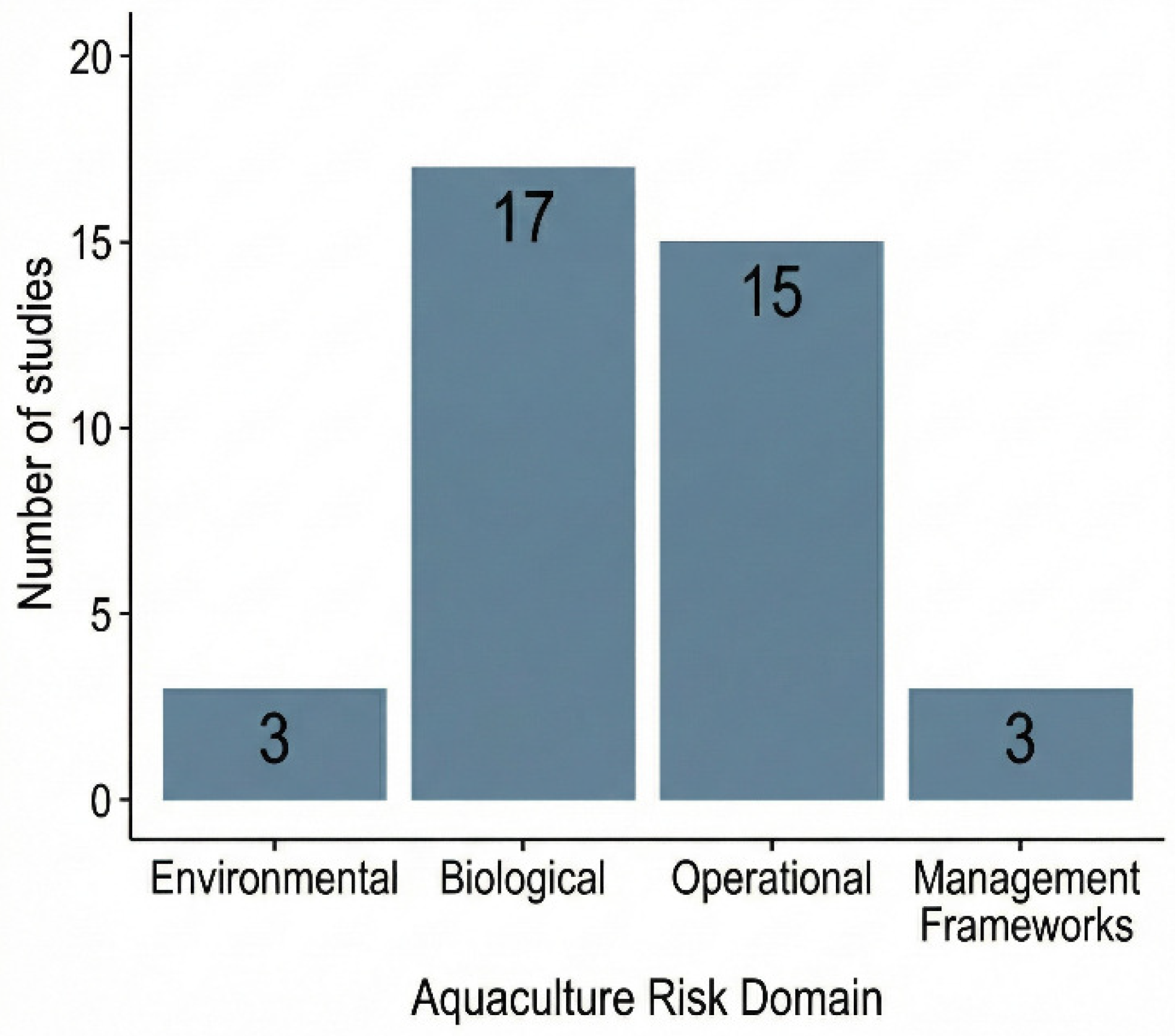
Regarding the risk domains, the studies were categorized into four main groups. Biological (17 studies), Operational (15 studies), Environmental (3 studies), and Management Frameworks (3 studies). The distribution of studies across these thematic categories is illustrated in Figure 2.
In the next section, the results are presented by thematic risk category. For each category, this section summarizes what the models did, how they performed, and whether/how they were related to risk management.

3.3. Study Quality and Applicability

Based on the criteria defined in Section 2.6, the results of the quality and applicability assessment are summarized below (Table 2):
Data Quality: The majority (20) of the studies were assessed as High Applicability based on their data sources. They used field data or large historical archives (e.g., laboratory synthetic data for model training) and clearly documented their origin. Overall, 18 studies were assessed as Moderate Applicability. This is due to the fact that they were mainly reviews or theoretical frameworks. They were based on secondary sources or literature review without the use of data sets that require technical application. No studies were found that relied exclusively on unverified data without validation (Low Applicability).
Analysis: Overall, 20 of the studies demonstrated High Applicability in this area, as they applied commonly used validation methods. Many papers used cross-validation (k-fold) or had independent test sets to evaluate their model. The remaining 18 were mainly theoretical reviews, conceptual frameworks, or expert-based models, where quantitative validation (such as cross-validation) was not applicable or was not reported.
Operational Applicability: In terms of readiness for implementation, three studies received a High Applicability score. These studies link ML outputs directly to risk management frameworks. Only three studies showed no operational integration and were classified as Low Applicability. Meanwhile, 32 studies demonstrated high applicability in measurements but were classified as Moderate Applicability in terms of integration into a single management framework. For example, models that accurately predicted water quality did not accompany the results with suggestions for automatic aeration adjustment or alarms. Disease detection models did not report whether they could be incorporated into health monitoring protocols. This disconnection reduces the practical value of the findings despite their technical accuracy.

The assessment confirms that the biggest challenge is the separation between technical design and operational implementation.
Table 2. Summary of applicability assessment (n = 38 studies).
Assessment CriterionHighModerateLow
Data Quality20180
Analysis and Validation20180
Operational Integration3323

3.4. Results of Individual Studies and Thematic Synthesis

The findings are structured into four main thematic sections, depending on the type of risk the studies concern.

3.4.1. Environmental Risk

Three studies focused on environmental and water quality parameters. The prediction of critical chemical–physical parameters, such as dissolved oxygen (DO), temperature, pH and ammonia, was in the spotlight.
Long-Short-Term Memory (LSTM) networks and their variants dominated these applications. LSTMs achieved high accuracy in predicting environmental variables. For example, the study by Li et al. (2022) combined LSTM with a temporal convolutional network (TCN) for DO prediction and achieved R2 = 0.94 with very low error (RMSE 0.34 mg/L within a typical range of 4–8 mg/L) [23], while Alluhaidan et al. (2025) [5] proposed an optimized hybrid LSTM model, which achieved 92.3% DO prediction accuracy, which is significantly higher than traditional methods. These results offer managers time to activate ventilation or other measures [5].
Several studies have looked at predicting water temperature and detecting anomalies in environmental conditions.
A common finding in environmental studies is that models often go beyond simple prediction and reach the stage of automation [4,13]. For example, an IoT system developed a mechanism that can automatically activate oxygenation pumps once the DO prediction falls below a threshold.
While the technical accuracy in predicting environmental hazards has been high, few studies have linked prediction to automated decision making. The information is there, but its use in real time has not been fully implemented.

3.4.2. Biological Risk

Seventeen studies were related to biological hazards, mainly fish diseases and mortality.
The early diagnosis of diseases in aquaculture is of great importance, as epidemics (e.g., viral or parasitic) can cause massive losses [3,25].
Two main approaches came forward: first, image or video processing to detect visible symptoms or parasites in fish (e.g., lesions, behavior), and second, analysis of environmental or production data to predict outbreak probabilities. For the first category, CNN and other deep learning models were often used. A study developed a system for detecting the parasite Cryptocaryon irritants (a parasitic “white spot” in marine fish) at an early stage through photographs from underwater cameras. For the second, Random Forest and Gradient Boosted Trees were popular algorithms, given their ability to model complex nonlinear relationships and provide variable significances [26,27,28,29,30].
Xie et al. (2025) [6] incorporated 7 years of outbreak data and environmental factors to train an early warning system for cryptocaryoniasis (parasitic marine ich disease). The Random Forest model they developed achieved a sensitivity of 98.6% in detecting weeks of high risk of outbreaks and, overall, very high accuracy (F1 0.93). In its pilot application in commercial cages, it provided predictions with 91.7% accuracy (in offshore cages). This gave producers up to 2 weeks of warning. This example demonstrates how ML can be turned into a practical tool. Managers, upon receiving such a warning, can implement timely treatments or preventive measures and thus mitigate the risk [6].
Gkikas et al. (2024) [30] used the Apache Spark (version 3.5.1, The Apache Software Foundation, Wilmington, DE, USA) platform to process a huge amount of historical mortality data from Mediterranean fish farms, applying Random Forest and Decision Trees. Random Forest excelled in mortality prediction accuracy, highlighting critical risk factors such as thermal changes and water quality. The model was able to explain 63% of the variance (R2 0.63) and had a high C-index of 0.85 for risk classification. This analysis identified that the most important factors contributing to the predictions were the average biomass per unit (MAB) and the feeding rate (SFR). Excessive density and intensive feeding increase the risk of losses. Although the study was retrospective, such results can guide decision making [30].
Recent studies have investigated the potential of ML technologies to predict parasite infestation levels [31] and toxicity events. This approach strengthens food safety protocols [32]. Advanced computational tools have been developed to simulate the life cycle characteristics and bioenergetic processes of marine organisms at various spatial and temporal scales [33].
The integration of the models into daily management varies. In some aquaculture operations, camera systems and AI are already being used to monitor animal behavior and facilitate the early diagnosis of marine parasites or diseases; however, the lack of sufficient real-time data from units, the cost of implementing sensors and the need for managers to trust the automated recommendations of the model are often cited as challenges [2,12,34,35].

3.4.3. Operational Risk

Fifteen studies fall into this category. It covers a wide range of topics such as biomass estimation and feeding control, supply chain risks, etc. Here, this study focuses on computer vision (CV) techniques for biomass estimation as well as other predictive applications for operational risks. Traditionally, biomass estimation was conducted by sampling and reduction with an error often >10–15% [36,37,38].
Yang et al. (2025) presented a fully automatic biomass estimation system for free-moving fish using deep learning models, achieving an estimation error of <5% on average in tests compared to actual measurements, which means that producers can know with high accuracy the available biomass at any time [38].
An ML model was used to predict fluctuations in the market price of salmon so that units could hedge risk in the markets [39].
Technologies are shaping the value chain. Agya et al. (2025) introduced an AI–blockchain framework to ensure transparency and trust in the supply chain [40], and Akram et al. (2026) reviewed the capabilities of Generative AI in addressing data limitations and enhancing smart farming systems [41]. Another example is the use of a decision support system for optimal harvest planning based on growth forecasts and market prices. The system advised when it is risky to delay the harvest [22].
The research found applications that link technical risk with financial risk. One study calculated the value-at-risk (VaR) of biomass. It used Monte Carlo simulation on growth forecasts and potential mortalities to estimate the distribution of final production. It achieved a 95% confidence level, which gave the minimum expected biomass.
Such approaches show that forecasting is not enough, but integration into business planning is required. Few studies have comprehensively covered this dimension [25]. Managing risk requires also defining physical boundaries. Yang et al. (2020) highlight the importance of creating operational limits to maintain safety levels and prevent accidents [17].
In the operational domain, the benefits of AI are real. Significant growth is expected here, as it directly impacts the cost and profit of the units [42,43].

3.4.4. Management Frameworks

Three studies explicitly addressed the connection between ML and standard risk management frameworks. This is also the most under-represented area in the findings, highlighting a lack of communication between technology and applied management.
The study by Theodorou and Tzovenis (2024) [16] adapted ISO 31000 to mussel farming. The authors followed the ISO framework step by step (definition of the framework, identification of risks, analysis, assessment, response) and integrated ML tools at specific stages. They used an analysis of producer questionnaires with ML clustering to identify risks that producers consider important (e.g., extreme weather events as a key risk). They created a risk management roadmap for mussel farming, where ML predictions feed into decisions [16].
The work of Luna et al. (2023) [44] provides a conceptual framework of risks that can be integrated into management systems. It maps eight risk categories and 40 individual sources of risk in aquaculture. This framework is useful because it acts as a terminology connector between data scientists and risk managers. It reports that producers underestimate some risks such as regulatory changes. This could lead to the development of an ML “early warning” model for regulatory developments [44].
Stewart-Koster et al. (2017) [45] used expert knowledge to quantify risk factors. They used Bayesian Belief Networks (BBNs) to convert expert knowledge into mathematic probabilities. By this method, a decision support model was created based on human knowledge, solving the problem of historic data deficiency [45].
These few studies indicate how integration could be accomplished through hybrid frameworks where the output of an ML model is not simply presented as an accuracy number but is integrated into a decision process.
An example of a hypothetical scenario discussed in the literature concerns an operational safety management system that follows the ISO standard. Safety indicators (e.g., weather forecasts, technical conditions) may be used to predict the possibility of fish escapes or structural damage, pointing out that risk indicators can become part of the ISO 31000 cycle [46].
Most authors simply comment on the conclusions that the results could help management but do not implement them. This leaves room for significant future research and implementation.

4. Discussion

4.1. The “Algorithm-to Action” Void

The results show that there is a significant disconnect between prediction and decision in aquaculture where the findings from algorithms often remain at the technical reference level and do not penetrate the decision workflow of the organization.
In risk management, after a risk has been analyzed and assessed, risk treatment measures must be taken, and then the process continues with monitoring. The reviewed ML studies generally deal with the stages of risk identification and analysis. Very few extend to the stage of evaluation and treatment—that is, to provide recommendations based on the prediction. Thus, there is a “discontinuity” in the cycle [44].
Potential reasons for this phenomenon are outlined below:
  • Scientific isolation of sectors: Data scientists are often not involved in the operational management of units, and on the other hand, managers may not trust or fully understand the outputs of an ML model. This leads to a lack of communication. As noted in the literature, producers may underestimate some risks or be unfamiliar with forecasting tools [44].
  • Lack of regulatory framework: There are currently no clear guidelines in the aquaculture field on how to integrate predictive models into management. While in other sectors (e.g., finance) the practice of using models is embedded, aquaculture remains at an early stage [47].
  • Technical limitations and reliability: Despite high accuracy in historical data, predictions can be uncertain (e.g., an LSTM can fail if unprecedented conditions arise that were not in the training data). Managers are hesitant to base critical decisions on a “black box” if they have no way to verify its reliability in real time. This is also related to the need for explainability (XAI); if algorithms could explain why they make a prediction, they might gain more trust [32].
This disconnection is no longer due to a lack of technical capabilities. IoT networks for data collection, reliable ML models, big data platforms for real-time processing are already in use. The issue is integration—connecting these elements into a unified decision-making system—from prediction to mechanism activation and feeding the information back to the person in charge in an understandable way. This paper confirms that such broad systems are still missing.

4.2. Implications and Proposed Framework

The findings of the review provide a basis for improvements at both the practical management and research levels. Industry players can start to adopt a “Contextualization Layer” in existing risk management systems—an intermediate stage where the technical results of ML models are translated into business terms. This layer acts as a link between the “algorithm and human”. It takes the outputs of ML models as input and passes them through filters that reflect the goals and constraints of the business. In other words, instead of the manager having to interpret numbers, the system gives him tangible options. This framework essentially implements the idea of augmented intelligence. The human remains at the center of decision making but has an “AI advisor” next to him who translates the data into understandable advice.
The findings indicate several directions from a research perspective. One is the need for more explanatory AI (XAI) in applications. For example, in studies using Random Forest or decision trees, it was easy to extract the most important features that led to the predictions. In contrast, in LSTM/CNN networks it is difficult to explain why they predict something. This not only helps build trust but also reveals new knowledge [32,48]. Another extension is the exploitation of big data. Many units are hesitant to share their data (e.g., mortality, returns) publicly. Techniques could be applied that allow the creation of collective risk models without sharing raw data where each unit trains the model locally and only the parameters are combined centrally. Finally, there is the dimension of political and regulatory support. Regulators can play a role in driving the adoption of these tools by offering certifications or incentives to units that incorporate forecasting and risk management systems—or, on the contrary, by requiring large units to have documented risk management plans in place.
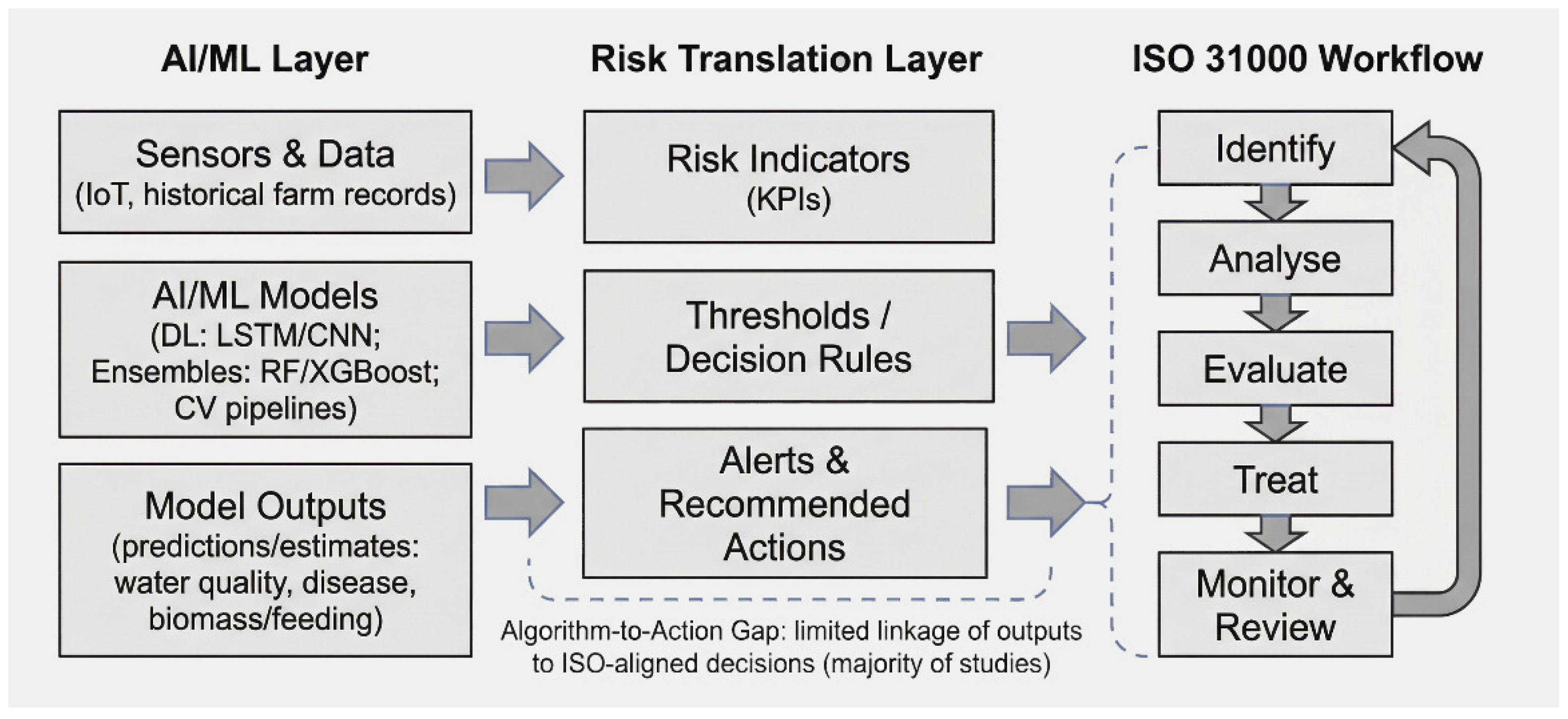
The implications of the findings suggest that the future of risk management in aquaculture will be hybrid: it will combine the computational power of ML models with the experience and judgment of managers within a decision framework that maximizes efficiency and transparency. To unify algorithms and actions, the proposed framework introduces a ‘Contextualization Layer’. This approach of creating a “Layer” that converts forecasts into actions is a step in this direction (Figure 3). This layer filters AI predictions through financial and operational constraints. A critical barrier to the adoption of such automated protocols is the “black box” nature of complex models. Recent literature emphasizes explainable artificial intelligence (XAI) as a solution. Demiray et al. (2025) and Marzidovšek et al. (2024) demonstrated that the use of explainability techniques (such as SHAP values) in the prediction of Harmful Algal Blooms (HABs) allows stakeholders to understand why an alert was triggered, thus building the trust necessary for automation [32,48]. Furthermore, Szewczyk et al. (2025) showed that ensemble forecasts provide more reliable early warnings of biological hazards than individual models, enhancing operational confidence [49].

4.3. Deployment Challenges in Aquaculture 4.0

While algorithms are improving, hardware implementation remains an obstacle. Nuangpirom et al. (2025) highlights the need to optimize ML models for low-cost edge devices to make real-time water quality prediction accessible to smaller facilities [50]. Environmental quality assessment requires models capable of simulating complex patterns over time, as proposed by Huang et al. (2024) [51]. Future systems should also leverage advanced biosensors [8] to provide the high-fidelity data required by risk models.
To overcome data scarcity in remote areas, recent studies successfully employed soft-sensors for chemical oxygen demand (COD) prediction and satellite-based remote sensing for dissolved oxygen estimation, offering scalable alternatives to expensive hardware [52,53].

4.4. Limitations

This systematic review must acknowledge some limitations. A limitation is the possibility of publication bias in the sources. It is possible that a disproportionate number of studies are identified with positive results (successful AI applications) because these tend to be published, while unsuccessful or negative applications have not been reported. Thus, the overall picture may be overly optimistic. Efforts were made to take this possibility into account in the estimates (e.g., by emphasizing that extremely high accuracies may not be replicated in all populations). However, no formal analysis was performed (e.g., funnel plot) given that there were no homogeneous quantitative data. While two large databases were covered, there is a possibility that relevant studies published in languages other than English (e.g., project reports, doctoral dissertations) may have been missed. Given that the aquaculture industry is global, with intense activity in Asia, some works in Chinese or Japanese may not have been included. Also, the rapid evolution of the field means that new results may emerge as early as 2026 that did not exist when the search was completed. Regarding the synthesis, the lack of meta-analysis could be considered a limitation because an overall effect size was not quantified. As justified, it would have been methodologically weaker to combine heterogeneous results. The decision to remain in a narrative synthesis is considered the appropriate one. Subjectivity was reduced by citing direct results from the studies and cross-referencing the conclusions between multiple sources where possible.
Overall, these limitations indicate that caution is required in generalizing. The evidence presented is based on the best available information by the end of 2025, but the user should consider the specificities of each unit and not apply the results uncritically without local adaptation.

5. Conclusions

This systematic review, fully compliant with the PRISMA 2020 statement [16], comprehensively examined the use of AI and ML algorithms in aquaculture risk management.
It was found that AI has reached a point of maturity capable of actively supporting risk management in aquaculture, resulting in the continuous emergence of ML applications that improve the prediction and detection of critical events. Models can accurately predict oxygen depletion or disease outbreaks, giving producers time to react, while computer vision techniques automate biomass estimation and the monitoring of organism welfare. All these tools, if properly utilized, have the potential to transform aquaculture into a more predictive and resilient industry. A management gap was identified and confirmed: the results of the algorithms are not automatically translated into action. However, technical achievements are encouraging. Only a small part of the studies took the step of integrating the predictions into decision making based on the ISO framework or proposing specific procedures. This suggests that the next leap for the industry is not necessarily the development of new algorithms; it is the integration of existing ones into hybrid decision-making systems [16].
A standardized data handshake protocol between AI developers and risk managers is proposed where an ML model will not be just a piece of software that gives a forecast but will be part of a risk management platform. Aquaculture units and technology providers need to work together to create integrated solutions. It will be connected to sensors, to control mechanisms, to dashboards for managers, and to action protocols. Such a system could function as a modern control center for an aquaculture facility. It continuously monitors data, predicts risks and alerts the person in charge or automatically trigger responses when needed. Ultimately, the transition to AI-powered risk management marks a shift described by three key management metaphors emerging from the literature. First, the industry is moving from “Risk as Emotions” to “Risk as Data,” where business decisions traditionally based on instinct are replaced by clear boundaries based on data [17]. Second, artificial intelligence turns the farm into a “digital twin,” allowing managers to simulate stress scenarios in a safe virtual environment before affecting the physical stock [4]. Finally, risk management evolves from a reactive action to a proactive decision, using predictive models, such as LSTM for water quality prediction, to proactively neutralize threats before mortality occurs [5].
Τhis paper acknowledges a limitation regarding the rapid technological evolution. As AI becomes embedded in science, education, and governance, future synthesis efforts may need to extend beyond standard manual protocols to include AI-assisted reviews. Τhe future research agenda must focus not only on algorithmic accuracy but on the integration of Large Language Models (LLMs) and blockchain governance to ensure the autonomous agents remain aligned with human safety protocols.
Those aquaculture businesses that embrace the culture of data, integrating AI as an integral part of the decision-making process will succeed in becoming more proactive than reactive, reducing losses, improving the welfare of farmed species and enhancing its sustainability and performance.

Supplementary Materials

The following supporting information can be downloaded at https://www.mdpi.com/article/10.3390/app16042032/s1. Table S1 containing all reported and selected studies is provided as Supplementary Material (S1.xlsx); PRISMA_2020_checklist.

Author Contributions

Conceptualization, M.C.G. and J.A.T.; Methodology, M.C.G. and D.C.G.; Validation, D.C.G., J.A.T. and S.S.; Formal Analysis, M.C.G.; Investigation, M.C.G. and D.C.G.; Resources, M.T. and S.S.; Writing—Original Draft Preparation, M.C.G.; Supervision, J.A.T. and S.S.; Writing—Review and Editing, M.C.G., M.T. and S.S.; Visualization, M.T., D.C.G. and S.S.; Supervision, J.A.T. and S.S.; Project Administration, J.A.T. All authors have read and agreed to the published version of the manuscript.

Funding

This research received no external funding.

Data Availability Statement

The full data table with the characteristics of the 38 studies (Supplementary Table S1) and the Prisma 2020 checklist are available as Supplementary Materials. Also, any additional information or primary data extracted during the review can be provided by the corresponding author upon reasonable request.

Acknowledgments

The authors would like to thank the Department of Fisheries and Aquaculture and the Computer Engineering and Informatics Department at the University of Patras, as well as SUNY Oswego, for their support and the provision of necessary resources to conduct this review.

Conflicts of Interest

The authors declare that there are no conflicts of interest.

Appendix A. Classification Rules for Risk Domains and AI/ML Methodologies

Appendix A.1. Risk Domain Classification Rules

Each study was classified into one of the following categories based on the main prediction or detection objective:
  • Environmental Risk (Water Quality/HABs/Physicochemical Instability)
The study predicts, analyzes or detects the following:
  • Dissolved oxygen, temperature, salinity, pH, NH4, NO3;
  • Harmful algal blooms;
  • General ecological/environmental stressors.
Any ML prediction of an environmental variable is classified as Environmental.
2.
Biological Risk (Disease/Mortality/Behavior/Welfare)
The study predicts or diagnoses the following:
  • Viral infections, parasites, infections;
  • Mortality or increased mortality risk;
  • Behavioral indicators of well-being.
Any pathogen related or mortality related to the ML application is classified as Biological.
3.
Operational Risk (Biomass/Feeding/Logistics/Production Efficiency)
The study predicts or estimates the following:
  • Biomass, growth, harvest timing;
  • Feeding optimization;
  • Production chain uncertainties (supply, cost, price volatility);
  • Operational performance metrics.
Any computer vision application for biomass is classified as Operational.
4.
Risk-Management Frameworks (ISO 31000/Decision Systems)
The study accomplishes the following:
  • Implements ISO 31000;
  • Proposes structured risk workflow;
  • Links ML outputs to decision rules;
These studies are classified as Frameworks.
5.
Multi-Classification Rule
If a study could fall into more than one category, it was classified under the objective of the ML model.

Appendix A.2. AI/ML Methodology Classification Rules

Each included study was assigned to one methodological category based on the algorithmic approach used for prediction or decision support.
A.
Deep Learning (DL)
Studies were classified as deep learning if neural network architecture was the primary predictive model, including but not limited to the following:
  • Convolutional Neural Networks (CNN, 2D or 3D);
  • Recurrent Neural Networks (LSTM, GRU);
  • Temporal Convolutional Networks (TCN);
  • Autoencoders;
  • Hybrid deep architectures (e.g., CNN–LSTM).
B.
Ensemble Methods
Studies were classified as ensemble methods if the primary predictive model consisted of an ensemble of base learners, including the following:
  • Random Forest;
  • Gradient Boosting Machines;
  • XGBoost;
  • LightGBM;
  • CatBoost.
C.
Hybrid Models
Studies were classified as hybrid models when the architecture combined two or more modeling paradigms in a structured manner, such as the following:
  • Deep learning combined with classical machine learning;
  • Machine learning combined with statistical or mechanistic models;
  • Rule-based systems combined with machine learning.
D.
Computer Vision Systems
Studies were classified as computer vision when the primary output was produced by image or video processing pipelines, including the following:
  • Object detection;
  • Image segmentation;
  • 3D reconstruction;
  • Visual biomass, size, or behavior estimation.
E.
Traditional Machine Learning
Studies were classified as Traditional Machine Learning when the primary algorithm belonged to classical non-ensemble, non-deep learning methods, including the following:
  • Support Vector Machines (SVM);
  • k-Nearest Neighbors (k-NN);
  • Logistic Regression;
  • Decision Trees;
  • Linear or polynomial regression.
F.
Multi-Method Decision Rule
If a study implemented more than one modeling approach, classification was based on the model identified by the authors as the primary or best-performing method.

Appendix B. Search Strategies (PRISMA 2020)

Appendix B.1. Scopus

The literature search in Scopus was conducted using a field-specific Boolean query applied to the Title, Abstract, and Keywords fields:
  • TITLE-ABS-KEY(
  • (Aquaculture OR “Fish Farming” OR Mariculture)
  • AND (Risk OR “Risk Assessment” OR “ISO 31000” OR “Early Warning”)
  • AND (“Machine Learning” OR “Deep Learning” OR “Artificial Intelligence”
  • OR “Neural Network” OR “Computer Vision”)
  • ),
  • Database: Scopus
  • Search fields: Title, Abstract, Keywords
  • Language: English
  • Publication period: 2015–2025
  • Last search date: [1 December 2025]

Appendix B.2. ScienceDirect (Elsevier)

ScienceDirect does not support Scopus specific field operators (e.g., TITLE-ABS-KEY). An equivalent free-text Boolean search was performed using the Advanced Search interface across the Title, Abstract, and Keywords fields, following the same conceptual search logic:
  • (Aquaculture OR “Fish Farming” OR Mariculture)
  • AND (Risk OR “Risk Assessment” OR “ISO 31000” OR “Early Warning”)
  • AND (“Machine Learning” OR “Deep Learning” OR “Artificial Intelligence”
  • OR “Neural Network” OR “Computer Vision”),
  • Platform: ScienceDirect (Elsevier full-text database)
  • Search fields: Title, Abstract, Keywords
  • Language: English
  • Publication period: 2015–2025
  • Last search date: [1 December 2025]

Appendix B.3. Additional Search Procedures

No automated forward citation searching tools were applied.

Appendix B.4. Search Management and Documentation

All retrieved records were exported to bibliographic management software (Zotero), where duplicates were identified and removed prior to the screening process. The search strategies were defined a priori and applied consistently across databases to ensure transparency and reproducibility in accordance with the PRISMA 2020 guidelines.

References

  1. FAO. The State of World Fisheries and Aquaculture 2020; FAO: Rome, Italy, 2020; ISBN 978-92-5-132692-3. [Google Scholar]
  2. Paul, J.E.; Nagarajan, S.; Rayappan, J.B.B.; Kulandaisamy, A.J. Combating WSSV Based Crustacean Loss through Early Pond Site Detection: A Review. Aquaculture 2025, 607, 742696. [Google Scholar] [CrossRef]
  3. Aly, S.M.; Fathi, M. Advancing Aquaculture Biosecurity: A Scientometric Analysis and Future Outlook for Disease Prevention and Environmental Sustainability. Aquac. Int. 2024, 32, 8763–8789. [Google Scholar] [CrossRef]
  4. Føre, M.; Alver, M.O.; Alfredsen, J.A.; Rasheed, A.; Hukkelås, T.; Bjelland, H.V.; Su, B.; Ohrem, S.J.; Kelasidi, E.; Norton, T.; et al. Digital Twins in Intensive Aquaculture—Challenges, Opportunities and Future Prospects. Comput. Electron. Agric. 2024, 218, 108676. [Google Scholar] [CrossRef]
  5. Alluhaidan, A.S.; Pachiyannan, P.; Aziz, R.; Basheer, S. Enhanced LSTM-Based AI Model for Accurate Dissolved Oxygen Prediction in Aquaculture Systems. Smart Agric. Technol. 2025, 12, 101140. [Google Scholar] [CrossRef]
  6. Xie, X.; Zhang, B.; Wang, X.; Jiang, Y.; Buchmann, K.; Zhou, S.; Li, Y.; Yin, F.; Galindo-Villegas, J. A Machine Learning-Driven Early Warning System for Cryptocaryoniasis in Marine Aquaculture. Parasit. Vectors 2025, 18, 490. [Google Scholar] [CrossRef]
  7. Sheik, A.G.; Sireesha, M.; Kumar, A.; Dasari, P.R.; Patnaik, R.; Bagchi, S.K.; Ansari, F.A.; Bux, F. The Role of Industry 4.0 Enabling Technologies for Predicting, and Managing of Algal Blooms: Bridging Gaps and Unlocking Potential. Mar. Pollut. Bull. 2025, 212, 117493. [Google Scholar] [CrossRef]
  8. Hassan, M.M.; Xu, Y.; Sayada, J.; Zareef, M.; Shoaib, M.; Chen, X.; Li, H.; Chen, Q. Progress of Machine Learning-Based Biosensors for the Monitoring of Food Safety: A Review. Biosens. Bioelectron. 2025, 267, 116782. [Google Scholar] [CrossRef]
  9. Wu, A.-Q.; Li, K.-L.; Song, Z.-Y.; Lou, X.; Hu, P.; Yang, W.; Wang, R.-F. Deep Learning for Sustainable Aquaculture: Opportunities and Challenges. Sustainability 2025, 17, 5084. [Google Scholar] [CrossRef]
  10. Naz, S.; Iqbal, S.; Ishaque, U.; Chatha, A.M.M. Innovative Technology and Emerging Trends in Sustainable Aquaculture: A Road to Increase Output and Environmental Resilience. Aquac. Int. 2025, 33, 634. [Google Scholar] [CrossRef]
  11. Gibbs, M.T.; Browman, H.I. Risk Assessment and Risk Management: A Primer for Marine Scientists. ICES J. Mar. Sci. 2015, 72, 992–996. [Google Scholar] [CrossRef]
  12. Saville, R.; Fujiwara, A.; Hatanaka, K.; Wada, M.; Yaman, A.; Puspasari, R.; Albasri, H.; Dwiyoga, N. AI-Powered Decision Support System for Mariculture: Real-Time Fish Mortality Prediction with Random Forest. Aquac. Eng. 2026, 112, 102621. [Google Scholar] [CrossRef]
  13. Dileep, M.R.; Sanshi, S.; Singh, M.P.; Gupta, M. Integrating Artificial Intelligence in Aquaculture: Opportunities, Risks, and Systemic Challenges. Aquac. Int. 2025, 33, 661. [Google Scholar] [CrossRef]
  14. Page, M.J.; McKenzie, J.E.; Bossuyt, P.M.; Boutron, I.; Hoffmann, T.C.; Mulrow, C.D.; Shamseer, L.; Tetzlaff, J.M.; Akl, E.A.; Brennan, S.E.; et al. The PRISMA 2020 Statement: An Updated Guideline for Reporting Systematic Reviews. BMJ 2021, 372, n71. [Google Scholar] [CrossRef]
  15. Tricco, A.C.; Lillie, E.; Zarin, W.; O’Brien, K.K.; Colquhoun, H.; Levac, D.; Moher, D.; Peters, M.D.J.; Horsley, T.; Weeks, L.; et al. PRISMA Extension for Scoping Reviews (PRISMA-ScR): Checklist and Explanation. Ann. Intern. Med. 2018, 169, 467–473. [Google Scholar] [CrossRef]
  16. Theodorou, J.A.; Tzovenis, I. Risk Management in the Greek Mussel Farming through ISO 31000. Oceanol. Hydrobiol. Stud. 2024, 53, 79–87. [Google Scholar] [CrossRef]
  17. Yang, X.; Ramezani, R.; Utne, I.B.; Mosleh, A.; Lader, P.F. Operational Limits for Aquaculture Operations from a Risk and Safety Perspective. Reliab. Eng. Syst. Saf. 2020, 204, 107208. [Google Scholar] [CrossRef]
  18. Yang, H.-Y.; Chou, H.-H.; Hung, L.-J.; Cheng, S.-W.; Huang, J.-Y.; Tien, N.-Y.; Wang, H.-C.; Hsieh, S.-Y. Machine Learning Approach for Predicting Ovarian Maturation in Penaeus Monodon. Smart Agric. Technol. 2025, 12, 101597. [Google Scholar] [CrossRef]
  19. Değirmencioğlu, T.; Kocamaz, U.E. Determination of Early Breeder in Goldfish (Carassius Auratus Linn.) with Learning Vector Quantization, Probabilistic and Pattern Recognition Neural Networks. Aquac. Eng. 2024, 106, 102441. [Google Scholar] [CrossRef]
  20. Palanikkumar, D.; Anuradha, T.; Ramalingam, J.; Sivaraju, S.S. A Hybrid Machine Learning Strategy for Aquatic Plant Surveillance in Sustainable Aqua-Ecosystems Using IoT Attributes. Aquaculture 2025, 609, 742779. [Google Scholar] [CrossRef]
  21. Yang, T.-H.; Lin, J.-C. Using Physically Estimated Temperatures as Inputs to Enhance the Performance of an LSTM Model for Predicting Water Temperatures in Fishponds. Smart Agric. Technol. 2025, 12, 101563. [Google Scholar] [CrossRef]
  22. Cobo, Á.; Llorente, I.; Luna, L.; Luna, M. A Decision Support System for Fish Farming Using Particle Swarm Optimization. Comput. Electron. Agric. 2019, 161, 121–130. [Google Scholar] [CrossRef]
  23. Li, W.; Wei, Y.; An, D.; Jiao, Y.; Wei, Q. LSTM-TCN: Dissolved Oxygen Prediction in Aquaculture, Based on Combined Model of Long Short-Term Memory Network and Temporal Convolutional Network. Environ. Sci. Pollut. Res. 2022, 29, 39545–39556. [Google Scholar] [CrossRef]
  24. Hernández-Julio, Y.F.; Prieto-Guevara, M.J.; Nieto-Bernal, W. Fuzzy Clustering and Dynamic Tables for Knowledge Discovery and Decision-Making: Analysis of the Reproductive Performance of the Marine Copepod Cyclopina sp. Aquaculture 2020, 523, 735183. [Google Scholar] [CrossRef]
  25. Ewald, C.O.; Kamm, K. On the Impact of Biological Risk in Aquaculture Valuation and Decision Making. Aquaculture 2025, 603, 742368. [Google Scholar] [CrossRef]
  26. Bernhardt, L.-V.; Hafver, A.; Usman, N.; Liu, E.Y.; Vatn, J.A.Å.; Ødegårdstuen, A.; Mortensen, H.S.; Johansen, I.B. Automated Assessment of Cardiac Morphological Variation in Atlantic Salmon (Salmo Salar L.). Aquaculture 2024, 591, 741145. [Google Scholar] [CrossRef]
  27. Sheehan, E.V.; Bridger, D.; Nancollas, S.J.; Pittman, S.J. PelagiCam: A Novel Underwater Imaging System with Computer Vision for Semi-Automated Monitoring of Mobile Marine Fauna at Offshore Structures. Environ. Monit. Assess. 2020, 192, 11. [Google Scholar] [CrossRef] [PubMed]
  28. Shreesha, S.; Pai, M.M.M.; Pai, R.M.; Verma, U. Pattern Detection and Prediction Using Deep Learning for Intelligent Decision Support to Identify Fish Behaviour in Aquaculture. Ecol. Inform. 2023, 78, 102287. [Google Scholar] [CrossRef]
  29. Aravanis, T.; Ilias, A.; Hatzilygeroudis, I.; Spiliopoulos, G. Predicting Fish-Mortality: Artificial Neural Networks vs Symbolic Regression. In Proceedings of the 2023 14th International Conference on Information, Intelligence, Systems & Applications (IISA), Volos, Greece, 10–12 July 2023; pp. 1–7. [Google Scholar]
  30. Gkikas, M.C.; Gkikas, D.C.; Vonitsanos, G.; Theodorou, J.A.; Sioutas, S. Application of Machine Learning for Predictive Analysis and Management of Mediterranean-Farmed Fish Mortalities: A Risk Management Case Study Using Apache Spark. Appl. Sci. 2024, 14, 10112. [Google Scholar] [CrossRef]
  31. Gjerde, B.; Aslam, M.L. Prediction of the Salmon Lice Density on Wild Sea Trout from the Mean Predicted Lice Density in the Sea: A Cross-Validation of the Data In. Aquaculture 2025, 599, 742149. [Google Scholar] [CrossRef]
  32. Marzidovšek, M.; Francé, J.; Podpečan, V.; Vadnjal, S.; Dolenc, J.; Mozetič, P. Explainable Machine Learning for Predicting Diarrhetic Shellfish Poisoning Events in the Adriatic Sea Using Long-Term Monitoring Data. Harmful Algae 2024, 139, 102728. [Google Scholar] [CrossRef] [PubMed]
  33. Giacoletti, A.; Bosch-Belmar, M.; Di Bona, G.; Mangano, M.C.; Stechele, B.; Sarà, G. DEBEcoMod: A Dynamic Energy Budget R Tool to Predict Life-History Traits of Marine Organisms across Time and Space. Ecol. Inform. 2024, 84, 102897. [Google Scholar] [CrossRef]
  34. Rana, M.; Rahman, A.; Hugo, D.; McCulloch, J.; Hellicar, A. Investigating Data-Driven Approaches to Understand the Interaction between Water Quality and Physiological Response of Sentinel Oysters in Natural Environment. Comput. Electron. Agric. 2020, 175, 105545. [Google Scholar] [CrossRef]
  35. Li, L.; Ren, Z.; Tang, C.; Lu, S.; Liang, Y. A Deep Learning-Based Detection Model and Illumination-Adaptive Behavioral Analysis for Soldier Crabs in the Intertidal Zone. Ecol. Inform. 2025, 90, 103338. [Google Scholar] [CrossRef]
  36. Ranjan, R.; Sharrer, K.; Tsukuda, S.; Good, C. Effects of Image Data Quality on a Convolutional Neural Network Trained In-Tank Fish Detection Model for Recirculating Aquaculture Systems. Comput. Electron. Agric. 2023, 205, 107644. [Google Scholar] [CrossRef]
  37. Wei, Y.; Wei, Q.; An, D. Intelligent Monitoring and Control Technologies of Open Sea Cage Culture: A Review. Comput. Electron. Agric. 2020, 169, 105119. [Google Scholar] [CrossRef]
  38. Yang, Y.; Zhang, L.; Liu, Z.; Luo, T.; Bao, B.; Zhou, L.; Xu, J. Fish Biomass Estimation Under Occluded Features: A Framework Combining Imputation and Regression. Fishes 2025, 10, 306. [Google Scholar] [CrossRef]
  39. Luna, M.; Pérez-Mon, O.; Becker, J.L. Forecasting and Managing Price Volatility in Salmon Production: A Hybrid System Using Conformal Prediction and Dynamic Hedging. Int. J. Prod. Econ. 2025, 291, 109726. [Google Scholar] [CrossRef]
  40. Agya, B.A.; Agyemang, P.; Anokye, K. Beyond Silos: An Integrated AI-Blockchain Framework for Sustainable Aquaculture in Ghana. Smart Agric. Technol. 2025, 12, 101576. [Google Scholar] [CrossRef]
  41. Akram, W.; Din, M.U.; Saad Saoud, L.; Hussain, I. A Review of Generative AI in Aquaculture: Applications, Case Studies and Challenges for Smart and Sustainable Farming. Aquac. Eng. 2026, 112, 102637. [Google Scholar] [CrossRef]
  42. Nguelifack, B.M.; Nguyen, K.A.T.; Nguyen, T.A.T.; Jolly, C. Modeling Shrimp Income and Disease Risks Prevalence Using Econometric and Machine Learning Approaches: Evidence from Vietnam. J. Agric. Appl. Econ. 2025, 57, 340–370. [Google Scholar] [CrossRef]
  43. Dharani Shrree, R.S.; Tanveer, M.; Puja, U.T.; Rekha, N.; Ahmed, A. Analysis of Land-based Parameters and Development of Multi-criteria Decision Support System for Demarcation of Potential Aquaculture Sites in Nagapattinam, Tamil Nadu, India. Land Degrad. Dev. 2024, 35, 1927–1937. [Google Scholar] [CrossRef]
  44. Luna, M.; Llorente, I.; Luna, L. A Conceptual Framework for Risk Management in Aquaculture. Mar. Policy 2023, 147, 105377. [Google Scholar] [CrossRef]
  45. Stewart-Koster, B.; Dieu Anh, N.; Burford, M.A.; Condon, J.; Qui, N.V.; Hiep, L.H.; Bay, D.V.; Sammut, J. Expert Based Model Building to Quantify Risk Factors in a Combined Aquaculture-Agriculture System. Agric. Syst. 2017, 157, 230–240. [Google Scholar] [CrossRef]
  46. Holmen, I.M.; Utne, I.B.; Haugen, S. Identification of Safety Indicators in Aquaculture Operations Based on Fish Escape Report Data. Aquaculture 2021, 544, 737143. [Google Scholar] [CrossRef]
  47. Ma, F.; Fan, Z.; Nikolaeva, A.; Bao, H. Redefining Aquaculture Safety with Artificial Intelligence: Design Innovations, Trends, and Future Perspectives. Fishes 2025, 10, 88. [Google Scholar] [CrossRef]
  48. Demiray, B.Z.; Mermer, O.; Baydaroğlu, Ö.; Demir, I. Predicting Harmful Algal Blooms Using Explainable Deep Learning Models: A Comparative Study. Water 2025, 17, 676. [Google Scholar] [CrossRef]
  49. Szewczyk, T.M.; Aleynik, D.; Davidson, K. Ensemble Models Improve Near-Term Forecasts of Harmful Algal Bloom and Biotoxin Risk. Harmful Algae 2025, 142, 102781. [Google Scholar] [CrossRef]
  50. Nuangpirom, P.; Pitjamit, S.; Jaikampan, V.; Peerakam, C.; Nakkiew, W.; Jewpanya, P. Machine Learning on Low-Cost Edge Devices for Real-Time Water Quality Prediction in Tilapia Aquaculture. Sensors 2025, 25, 6159. [Google Scholar] [CrossRef]
  51. Huang, Y.; Zheng, G.; Li, X.; Xiao, J.; Xu, Z.; Tian, P. Habitat Quality Evaluation and Pattern Simulation of Coastal Salt Marsh Wetlands. Sci. Total Environ. 2024, 945, 174003. [Google Scholar] [CrossRef]
  52. Huan, J.; Zheng, Y.; Xu, X.; Zhang, H.; Shi, B.; Zhang, C.; Hu, Q.; Fan, Y.; Wu, N.; Lv, J. Prediction of CODMn Concentration in Lakes Based on Spatiotemporal Feature Screening and Interpretable Learning Methods—A Study of Changdang Lake, China. Comput. Electron. Agric. 2024, 219, 108793. [Google Scholar] [CrossRef]
  53. Shi, L.; Gao, C.; Wang, T.; Liu, L.; Wu, Y.; You, X. Information Extraction of Seasonal Dissolved Oxygen in Urban Water Bodies Based on Machine Learning Using Sentinel-2 Imagery: An Open Access Application in Baiyangdian Lake. Ecol. Inform. 2024, 82, 102782. [Google Scholar] [CrossRef]
Figure 1. PRISMA 2020 flow diagram of the study selection process. Adapted from Page et al. (2021) [14] (PRISMA 2020), licensed under CC BY 4.0.
Applsci 16 02032 g001
Figure 2. Distribution of included studies by risk domain (Biological, Operational, Environmental, and Management Frameworks).
Applsci 16 02032 g002
Figure 3. Schematic illustration of the proposed integration framework. Sensor data feeds predictive models, which output risk predictions. These pass through economic/ethical filters in the Contextualization Layer, generating actionable decisions for managers, closing the ISO 31000 loop in a hybrid system.
Applsci 16 02032 g003
Table 1. Distribution of machine learning methods applied in the included studies.
ML Method CategoryNumber of StudiesPercentage (%)
Deep Learning (DL)1437%
Ensemble Methods924%
Traditional Machine Learning821%
Hybrid and Other Models410%
General AI/Frameworks38%
Total38100%
Disclaimer/Publisher’s Note: The statements, opinions and data contained in all publications are solely those of the individual author(s) and contributor(s) and not of MDPI and/or the editor(s). MDPI and/or the editor(s) disclaim responsibility for any injury to people or property resulting from any ideas, methods, instructions or products referred to in the content.