Promoting Academic Integrity in AI-Practice—The Effect of Live Coaching in Higher Education

Abstract
1. Introduction
2. Methods
2.1. Subsection
2.2. Format
- Sessions are scheduled consistently at the same time each month and are offered in the evening, allowing participation by students who are employed.
- Access credentials remain unchanged across sessions, ensuring seamless participation.
- Students may join or leave at any time, with no prior registration required.
- No minimum or maximum number of participants is prescribed; the session proceeds irrespective of group size.
- Each session is conducted by two instructors, one of whom primarily oversees chat interactions to facilitate questions and discussion alongside the live session.
2.3. Study Design
- General information about the studentsThis section captured general characteristics (degree program, study progress, frequency of AI use), as well as information on previous participation in the live coaching sessions.
- Perceived effectiveness of the live coachingThis section assessed students’ subjective evaluations of the format’s effectiveness, focusing on the following:
- Competent and responsible use of AI;
- Ethical and legal aspects;
- Scientific integrity;
- Perceived competence gains resulting from the live coaching.
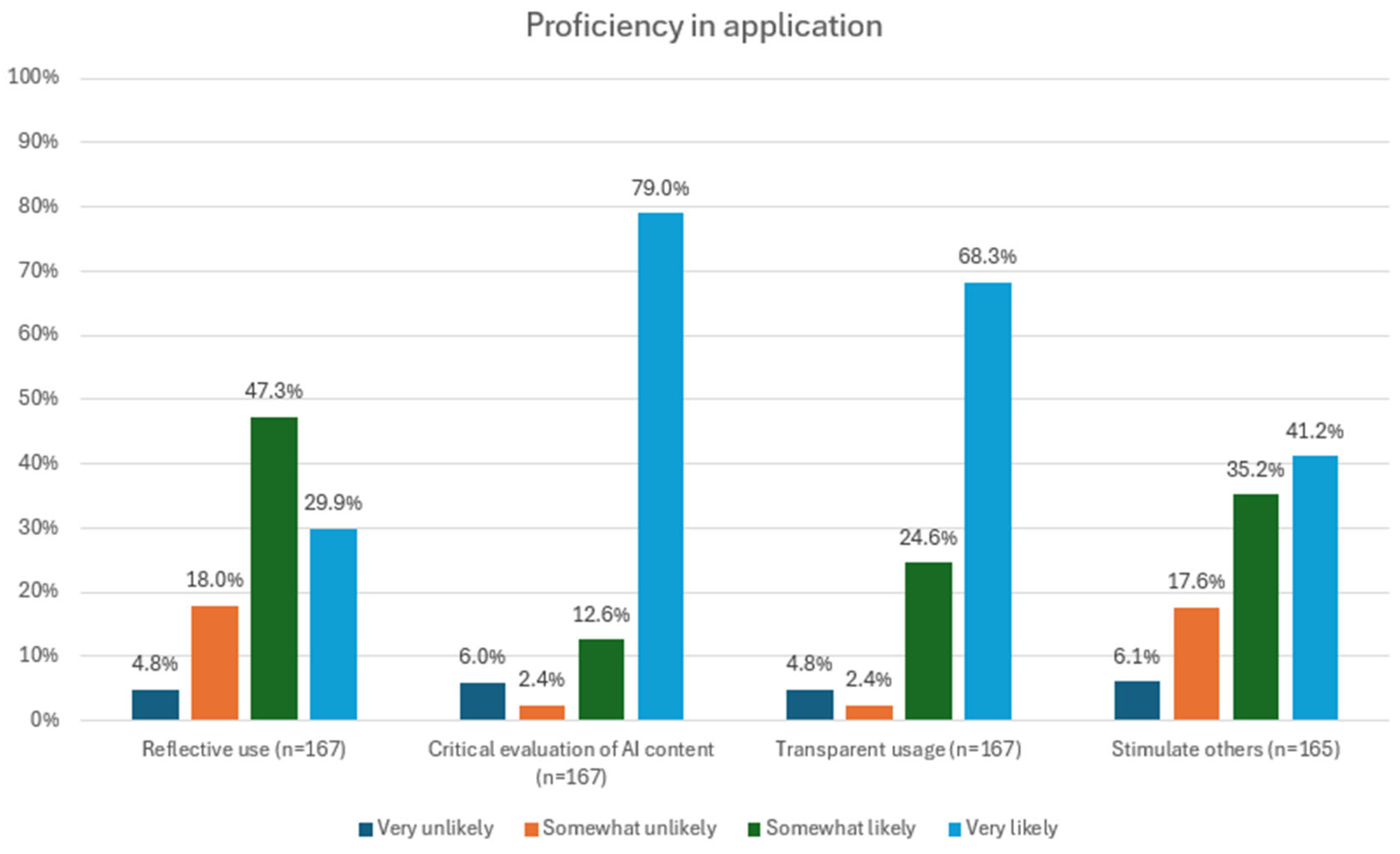
These items align with core competencies emphasized in AI-supported scientific work, including the critical evaluation of sources, ethical reflection, and responsible knowledge application [7,8,10]. Responses were measured using four-point Likert scales ranging from ‘strongly disagree’ to ‘strongly agree’. - Competence in dealing with AI outputsStudents assessed how likely they are to critically evaluate, verify, and responsibly use AI-generated results in their studies. This measure was included to capture the perceived ability to translate AI literacy into practice, addressing concerns that AI use can affect critical thinking, academic integrity, and study outcomes [11,12]. Responses were measured using a four-point Likert scale ranging from ‘very unlikely’ to ‘very likely’.
- Open-ended questionsIn addition, the questionnaire included several open-ended items allowing for qualitative assessment. These questions did not specifically address scientific integrity or ethics, but were formulated openly:
- What did you find particularly helpful in the consultation session?
- What would you like to see in future consultation sessions (content, methods, format)?
- Any further comments or feedback?
These items were included to capture students’ reflections, suggestions, and experiences in their own words, providing qualitative insights to complement the quantitative measures of AI competence and perceived effectiveness.
2.4. Implementation and Data Processing
3. Results
3.1. General Information
3.2. Perceived Effectiveness of the Live Coaching
3.3. Competence in Dealing with AI Outputs
3.4. Open-Ended Questions
3.5. Most Helpful Aspects of the Session
3.5.1. Peer Interaction
3.5.2. Respectful Interaction
3.5.3. Responsible AI Usage
3.5.4. Further Comments and Feedback
4. Discussion
4.1. Frequency of AI Usage
4.2. Phase of Study
4.3. Effectiveness
5. Conclusions
Author Contributions
Funding
Institutional Review Board Statement
Informed Consent Statement
Data Availability Statement
Acknowledgments
Conflicts of Interest
Abbreviations
| AI | Artificial intelligence |
| LLM | Large language models |
References
- Aprianto, R.; Lestari, E.P.; Sadan; Fletcher, E. Harnessing Artificial Intelligence in Higher Education: Balancing Innovation and Ethical Challenges. Int. Trans. Educ. Technol. ITEE 2024, 3, 84–93. [Google Scholar] [CrossRef]
- Chiu, T.K.F. The impact of Generative AI (GenAI) on practices, policies and research direction in education: A case of ChatGPT and Midjourney. Interact. Learn. Environ. 2024, 32, 6187–6203. [Google Scholar] [CrossRef]
- Susnjak, T.; McIntosh, T. ChatGPT: The End of Online Exam Integrity? Educ. Sci. 2024, 14, 656. [Google Scholar] [CrossRef]
- Evangelista, E.D.L. Ensuring academic integrity in the age of ChatGPT: Rethinking exam design, assessment strategies, and ethical AI policies in higher education. Contemp. Educ. Technol. 2025, 17, ep559. [Google Scholar] [CrossRef] [PubMed]
- Kamalov, F.; Santandreu Calonge, D.; Gurrib, I. New Era of Artificial Intelligence in Education: Towards a Sustainable Multifaceted Revolution. Sustainability 2023, 15, 12451. [Google Scholar] [CrossRef]
- Mosae, T.; Kaushal, R. Navigating the influence of ai tools on students’ learning experiences in higher education: A qualitative study. J. Inform. Educ. Res. 2025, 5, 1756–1763. [Google Scholar] [CrossRef]
- Weßels, D.; Bils, A.; Budde, J. Wissenschaftliche Abschlussarbeiten im KI-Zeitalter. Disruption, Herausforderungen und Neue Bewertungsansätze. Diskussionspapier Nr. 38; Hochschulforum Digitalisierung: Berlin, Germany, 2025; Available online: https://hochschulforumdigitalisierung.de/wp-content/uploads/2025/10/HFD_DP_38_wissenschaftliche_Abschlussarbeiten_im_KI-Zeitalter.pdf (accessed on 27 November 2025).
- Kirchherr, J.; Klier, J.; Lehmann-Brauns, C.; Winde, M. Future Skills: Welche Kompetenzen in Deutschland Fehlen. Stiftungsverband. Available online: https://www.stifterverband.org/medien/future-skills-welche-kompetenzen-in-deutschland-fehlen (accessed on 27 November 2025).
- Balalle, H.; Pannilage, S. Reassessing academic integrity in the age of AI: A systematic literature review on AI and academic integrity. Soc. Sci. Humanit. Open 2025, 11, 101299. [Google Scholar] [CrossRef]
- Song, N. Higher education crisis: Academic misconduct with generative AI. J. Conting. Crisis Manag. 2024, 32, e12532. [Google Scholar] [CrossRef]
- Gerlich, M. AI Tools in Society: Impacts on Cognitive Offloading and the Future of Critical Thinking. Societies 2025, 15, 6. [Google Scholar] [CrossRef]
- Abbas, M.; Jam, F.A.; Khan, T.I. Is it harmful or helpful? Examining the causes and consequences of generative AI usage among university students. Int. J. Educ. Technol. High. Educ. 2024, 21, 10. [Google Scholar] [CrossRef]
- Deutsche Gesellschaft für Hochschuldidaktik; Gesellschaft für Medien in der Wissenschaft e.V. Didaktische Handreichung zur Praktischen Nutzung von KI in der Lehre. 2025. Available online: https://www.uni-bremen.de/fileadmin/user_upload/sites/qm/Ref.13-Bilderordner/Website_HD/KI-Handreichung-dghd_GMW_V01_21102024__1_.pdf (accessed on 28 November 2025).
- Wannemacher, K.; Bosse, E.; Lübcke, M.; Kaemena, A. Wie KI Studium und Lehre Verändert. Anwendungsfelder, Use-Cases und Gelingensbedingungen. Arbeitspapier Nr. 87; Hochschulforum Digitalisierung: Berlin, Germany, 2025; Available online: https://hochschulforumdigitalisierung.de/wp-content/uploads/2025/04/HFD_AP_87_Wie_KI_Studium_und_Lehre_veraendert_final.pdf (accessed on 24 November 2025).
- Anderson, L.W.; Krathwohl, D.R. A Taxonomy for Learning, Teaching, and Assessing: A Revision of Bloom’s Taxonomy of Educational Objectives; Longman: New York, NY, USA, 2001; ISBN 978-0-8013-1903-7. Available online: https://books.google.de/books?id=EMQlAQAAIAAJ (accessed on 13 December 2025).
- UNESCO. UNESCO-Empfehlung zur Ethik der Künstlichen Intelligenz; Deutsche UNESCO-Kommission e.V.: Bonn, Germany, 2023; ISBN 978-3-947675-38-8. [Google Scholar]
- Preiß, J.; Freise, F.; Bartels, M.; Hartel, F. ChatGPT and Me 3.0. Drei Jahre Generative KI an der Universität Hamburg; Hamburg Universität: Hamburg, Germany, 2025. [Google Scholar] [CrossRef]
- von Garrel, J.; Mayer, J. Künstliche Intelligenz im Studium—Eine Quantitative Längsschnittstudie zur Nutzung KI-Basierter Tools Durch Studierende; Hochschule Darmstadt: Darmstadt, Germany, 2025. [Google Scholar] [CrossRef]
- Nadile, E.M.; Alfonso, E.; Barreiros, B.M.; Bevan-Thomas, W.D.; Brownell, S.E.; Chin, M.R.; Ferreira, I.; Ford, S.A.; Gin, L.E.; Gomez-Rosado, J.O.; et al. Call on me! Undergraduates’ perceptions of voluntarily asking and answering questions in front of large-enrollment science classes. PLoS ONE 2021, 16, e0243731. [Google Scholar] [CrossRef] [PubMed]
- Cureton, D.; Jones, J.; Hughes, J. The Postdigital University: Do We Still Need Just a Little of That Human Touch? Postdigital Sci. Educ. 2021, 3, 223–241. [Google Scholar] [CrossRef] [PubMed]
- Bell, K. Increasing undergraduate student satisfaction in Higher Education: The importance of relational pedagogy. J. Furth. High. Educ. 2022, 46, 490–503. [Google Scholar] [CrossRef]
- Hui, E.S.Y.E. Incorporating Bloom’s taxonomy into promoting cognitive thinking mechanism in artificial intelligence-supported learning environments. Interact. Learn. Environ. 2025, 3, 1087–1100. [Google Scholar] [CrossRef]
- Khatri, B.B.; Karki, P.D. Artificial Intelligence (AI) in Higher Education: Growing Academic Integrity and Ethical Concerns. Nepal. J. Dev. Rural Stud. 2023, 20, 1–7. [Google Scholar] [CrossRef]


| Variable | Category | N (%) |
|---|---|---|
| Course of Study | Bachelor’s | 132 (78.6%) |
| Master’s | 33 (19.6%) | |
| No response | 3 (1.8%) | |
| Phase of study | Early stage of study | 73 (43.5%) |
| Prior to/midst to term paper | 57 (33.9%) | |
| Prior to/midst of thesis | 37 (22.0%) | |
| No response | 1 (0.6%) | |
| Use of AI tools | No | 61 (36.3%) |
| Occasionally | 85 (50.6%) | |
| Regularly | 21(12.5%) | |
| No response | 1 (0.6%) | |
| Frequency of participation | Once | 77 (45.8%) |
| Multiple times | 65 (38.7%) | |
| Regularly | 22 (13.1%) | |
| No response | 4 (2.4%) |
Disclaimer/Publisher’s Note: The statements, opinions and data contained in all publications are solely those of the individual author(s) and contributor(s) and not of MDPI and/or the editor(s). MDPI and/or the editor(s) disclaim responsibility for any injury to people or property resulting from any ideas, methods, instructions or products referred to in the content. |
© 2026 by the authors. Licensee MDPI, Basel, Switzerland. This article is an open access article distributed under the terms and conditions of the Creative Commons Attribution (CC BY) license.
Share and Cite
Emicke, R.; Kemper, C. Promoting Academic Integrity in AI-Practice—The Effect of Live Coaching in Higher Education. Appl. Sci. 2026, 16, 2022. https://doi.org/10.3390/app16042022
Emicke R, Kemper C. Promoting Academic Integrity in AI-Practice—The Effect of Live Coaching in Higher Education. Applied Sciences. 2026; 16(4):2022. https://doi.org/10.3390/app16042022
Chicago/Turabian StyleEmicke, Renske, and Claudia Kemper. 2026. "Promoting Academic Integrity in AI-Practice—The Effect of Live Coaching in Higher Education" Applied Sciences 16, no. 4: 2022. https://doi.org/10.3390/app16042022
APA StyleEmicke, R., & Kemper, C. (2026). Promoting Academic Integrity in AI-Practice—The Effect of Live Coaching in Higher Education. Applied Sciences, 16(4), 2022. https://doi.org/10.3390/app16042022