Comparison of Different Configurations for a Shoreline Pond Electrode Station in the Case of an HVDC Transmission System—Part II: Electric Field Study for Frames of Non-Linear Novel Electrode Arrangement Based on a Simplified Analytical Model

 , , , , ,
  and
and
Featured Application
Abstract
1. Introduction
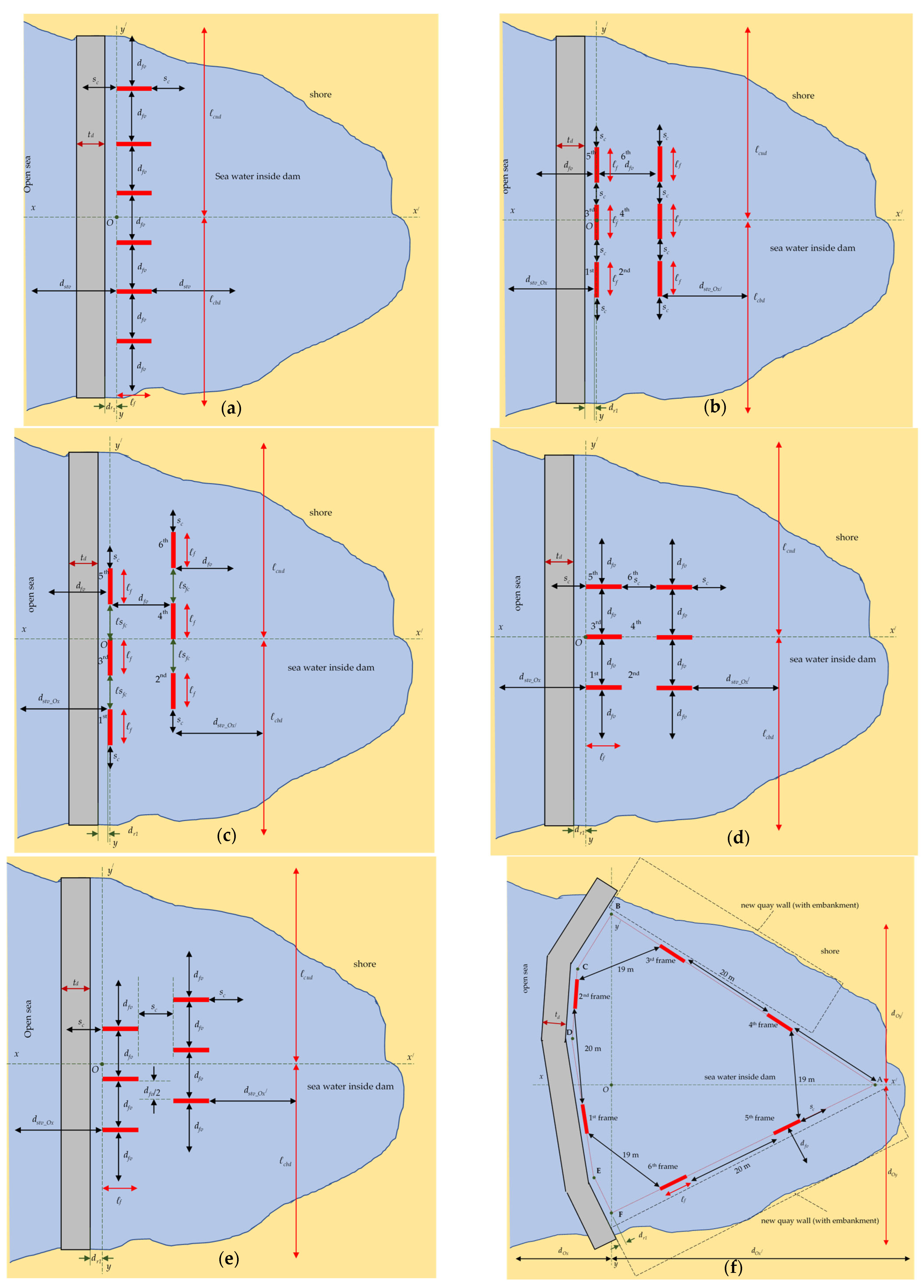
- Straight frames in a row, each placed vertically on the longitudinal axis of the dam (2nd configuration);
- Straight frames in two overlapping rows, each parallel to the longitudinal axis of the dam and aligned with each other (third configuration);
- Straight frames in two overlapping rows, each parallel to the longitudinal axis but non-overlapping on the vertical axis of the dam (fourth configuration);
- Straight frames in two successive rows, each vertical to the longitudinal axis of the dam and aligned with each other (fifth configuration);
- Straight frames in two successive rows, each vertical to the longitudinal axis of the dam and non-overlapping on the vertical one (sixth configuration);
- Straight frames in perimetrical placement to the protective dam, adapting to the outline of the pond under construction (seventh configuration);
- Straight frames adapted to a T-shaped protective dam (to increase the inner outline of the dam) (eighth configuration);
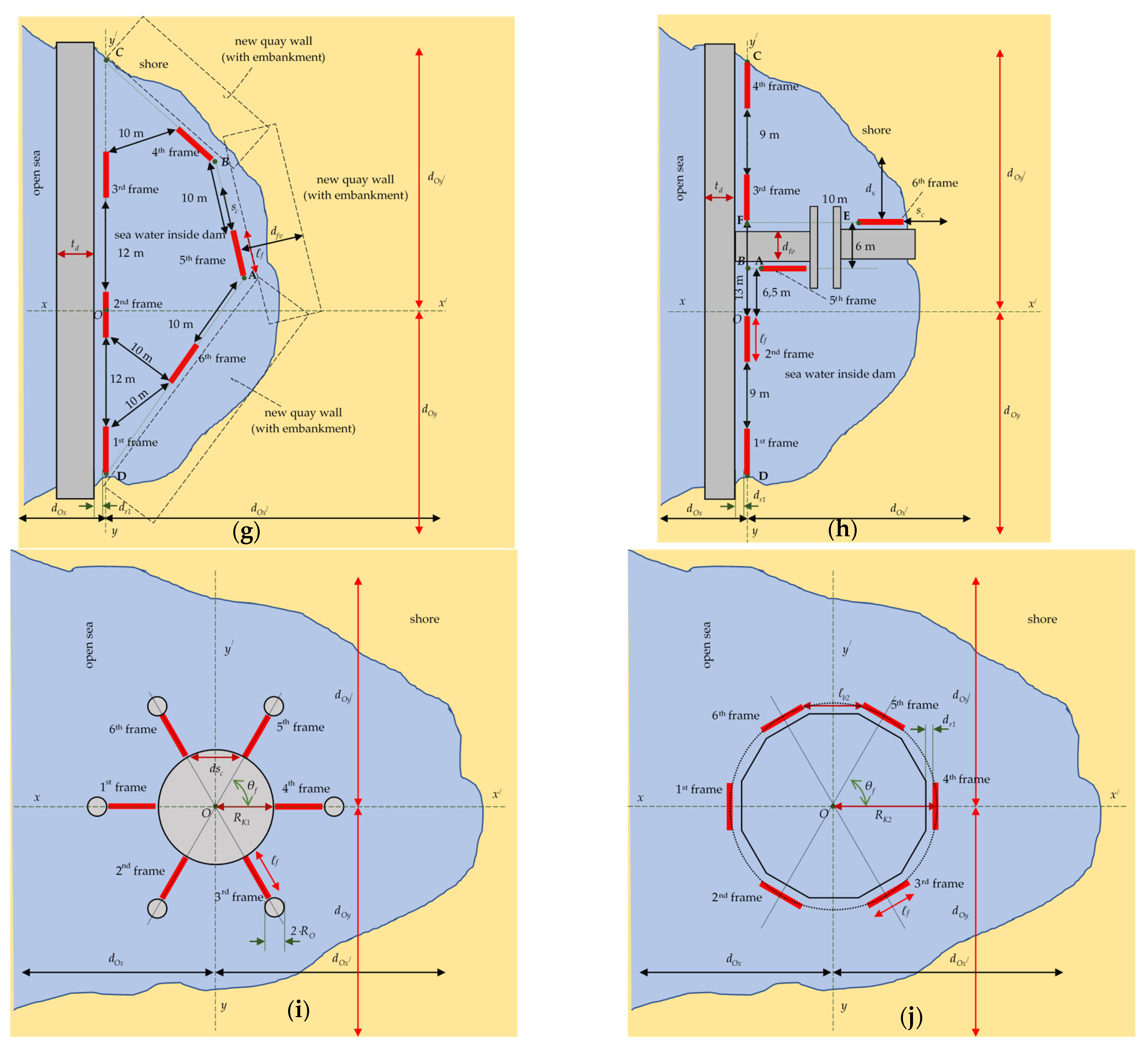
- Straight frames adapted radially to a central base with guides in open sea (ninth configuration);
- Straight frames adapted perimetrically to a central base in open sea (10th configuration).
2. Configuration of Non-Linear Frames and of Respective Electrode Stations
2.1. Pre-Existing Structure
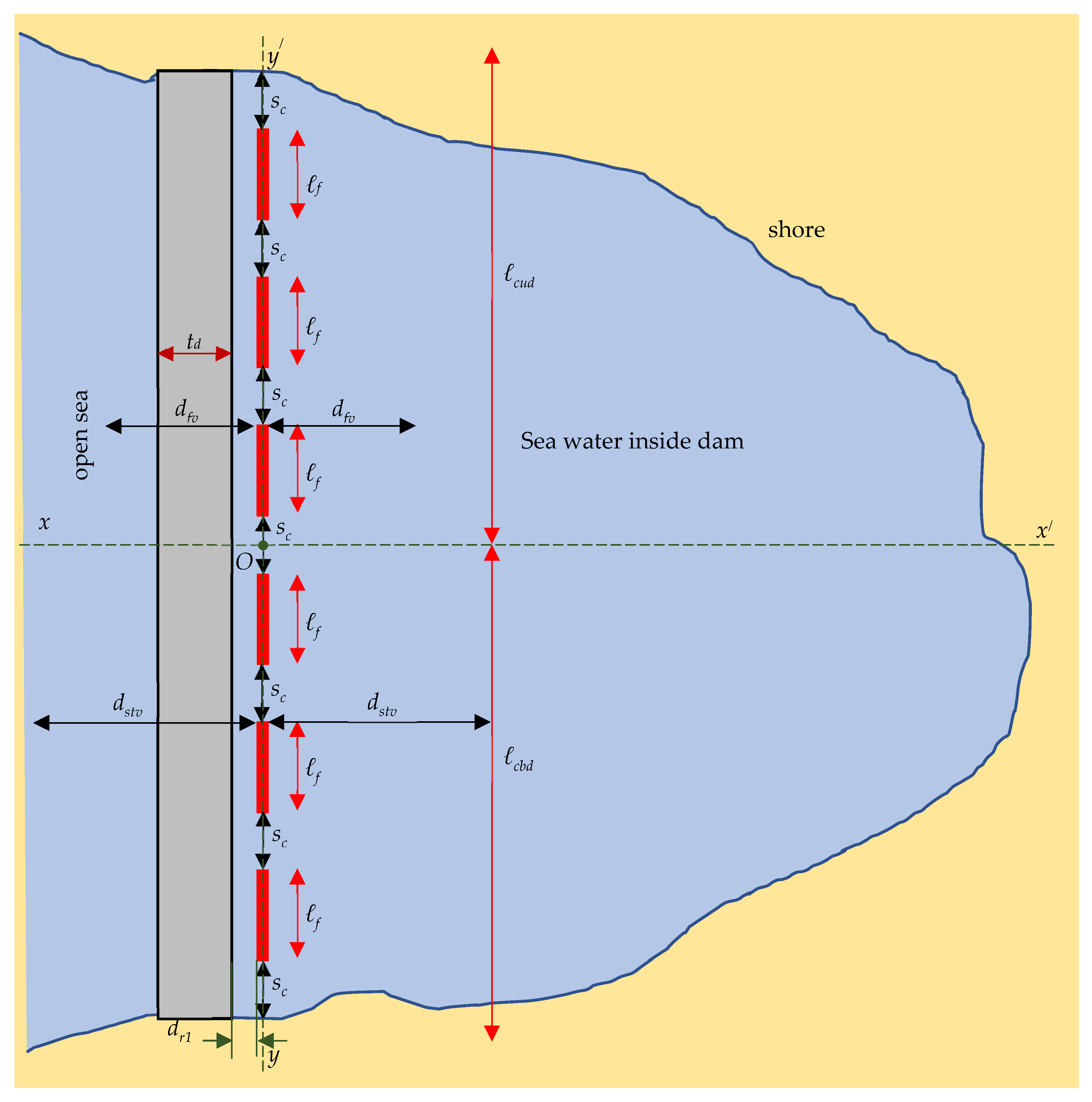
- The width of the dam td on the xΟx/ axis;
- The distance of the imaginary axis of the electrode station from the axis of the dam dr1 on the axis xΟx/;
- The frame length ℓf;
- The estimated width of the critical frame zone dfv vertical to the dam (along the xΟx/ axis) resulting from single-frame simulations;
- The distance between consecutive frames on the dam, estimated to ensure the critical zone for diver drop for repairs sc (on yΟy/), resulting from single-frame simulations;
- The width dstv of the electrode station critical zone vertical to the dam (on the xΟx/ axis) resulting from the electrode station simulations;
- The length of the electrode station critical zone ℓcbd on the dam below the centre of the dam (on the yΟy/ axis), resulting from the electrode station simulations;
- The length of the electrode station critical zone ℓcud on the dam above the centre of the dam (on the yΟy/ axis), resulting from the electrode station simulations.
2.2. Bow Frames Suitably Adapted Circumferentially to a Central Base in the Open Sea (11th Configuration)
2.3. Specially Shaped Frames Suitably Adapted to a Circular Arrangement (12th Configuration—“Birthday Cake”)
3. Application of the Analytical Methodology for the Calculation of Electric Field Strength in Non-Linear Frames
3.1. General Data
- During monopolar steady-state operation, each pole delivers a nominal power of 500 MW at 500 kV, corresponding to a current of 1000 A.
- Under fault-clearing conditions, the maximum transient current reaches 12,800 A, lasting approximately 0.5 s.
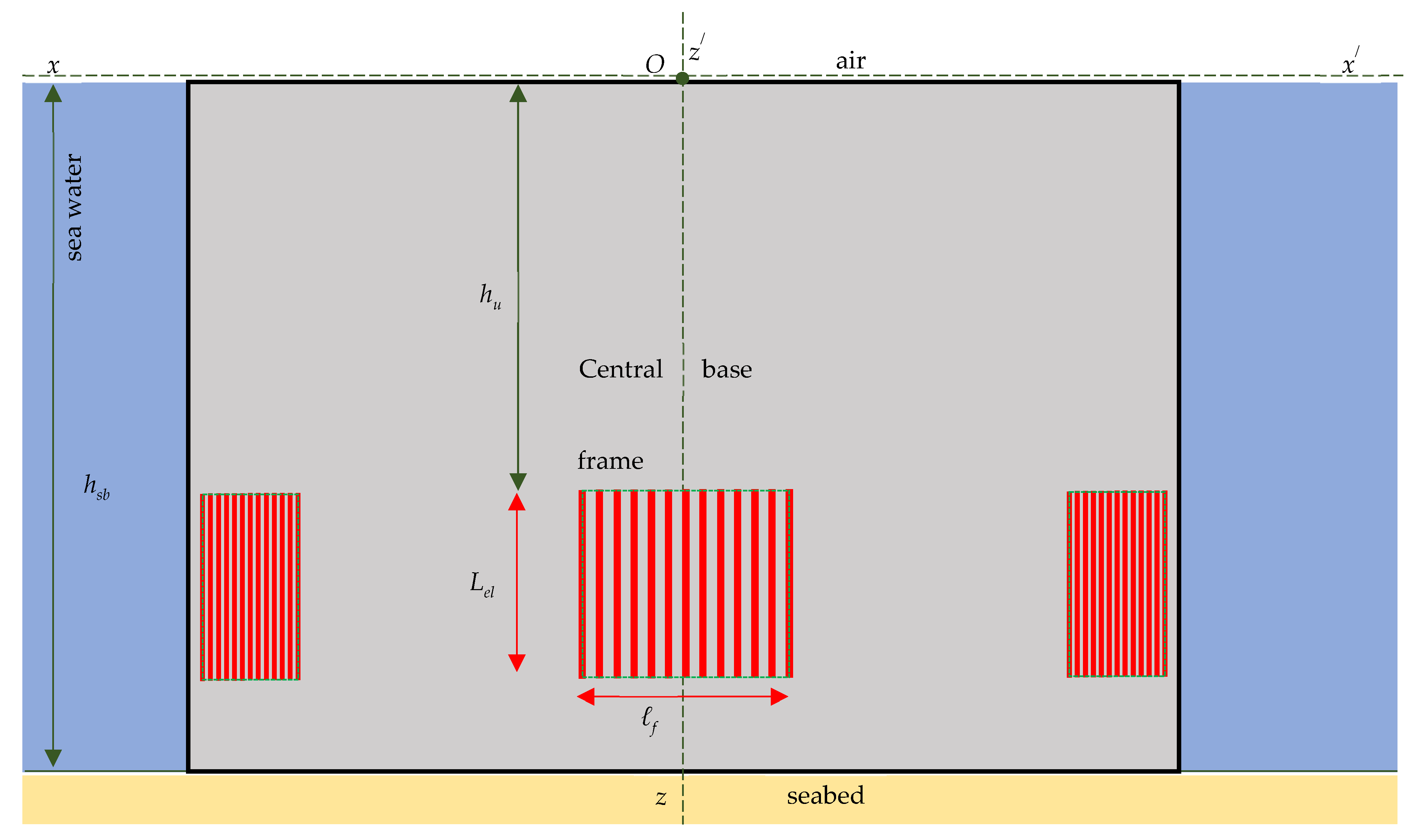
- The station employs fully reversible electrodes made of high-silicon iron in a tubular model such as type 4884 SZ (Centertec Z series, ANOTEC), compliant with ASTM A518 G3. Each unit exhibits a connection resistance of 1 mΩ, weighs about 143 kg, and has a diameter of 122 mm (=2∙ rel) and a length of 2130 mm (=Lel). According to the manufacturer [41], reliable reversible operation is achieved for current densities up to 20 A/m2.
- The electrodes are installed vertically. This arrangement provides the greatest water area possible for near-field analysis and also simplifies installation on the vertical walls of concrete breakwaters.
- Stachtoroi area: At this site, located in the Argosaronic Gulf, the plan-view angle θg (see Figure 1 of ref. [36] and Appendix A, Figure A1) is set at 210°, as determined from the station layout in ref. [4] (Figure 11). The corresponding water angle θw (Figure 2 of ref. [36]; Appendix A, Figure A2) is 0.272°, consistent with the worst-case conditions for the Aegina region listed in Table 1 of ref. [4].
- Korakia area: For the Korakia site in Crete, the plan-view angle θg (see Figure 1 of ref. [36] and Appendix A, Figure A1) is 248° according to the electrode station’s position shown in ref. [4] (Figure 12), while the respective water angle θw (Figure 2 of ref. [36]; Appendix A, Figure A2) equals 2.29° (far-region/worst-case scenario in Table 1 of ref. [4]).
- Although measured electrical resistivity ranges between 0.167 and 0.212 Ω∙m in both regions, a conservative value of 0.25 Ω∙m is used. This choice compensates for potential reductions in salinity due to freshwater inflows—particularly relevant near Korakia, where two small rivers (dry for most of the year) are present. Electrodes will also be located below the maximum depth of breaking water, as this exhibits much higher resistivity (approximately 2.00 Ω∙m).
- For reliability purposes, the station incorporates five frames (Nframe = 5) plus one as spare.
- An infinite value for soil electrical resistivity is assumed to simplify computations, providing conservative (worst-case) results.
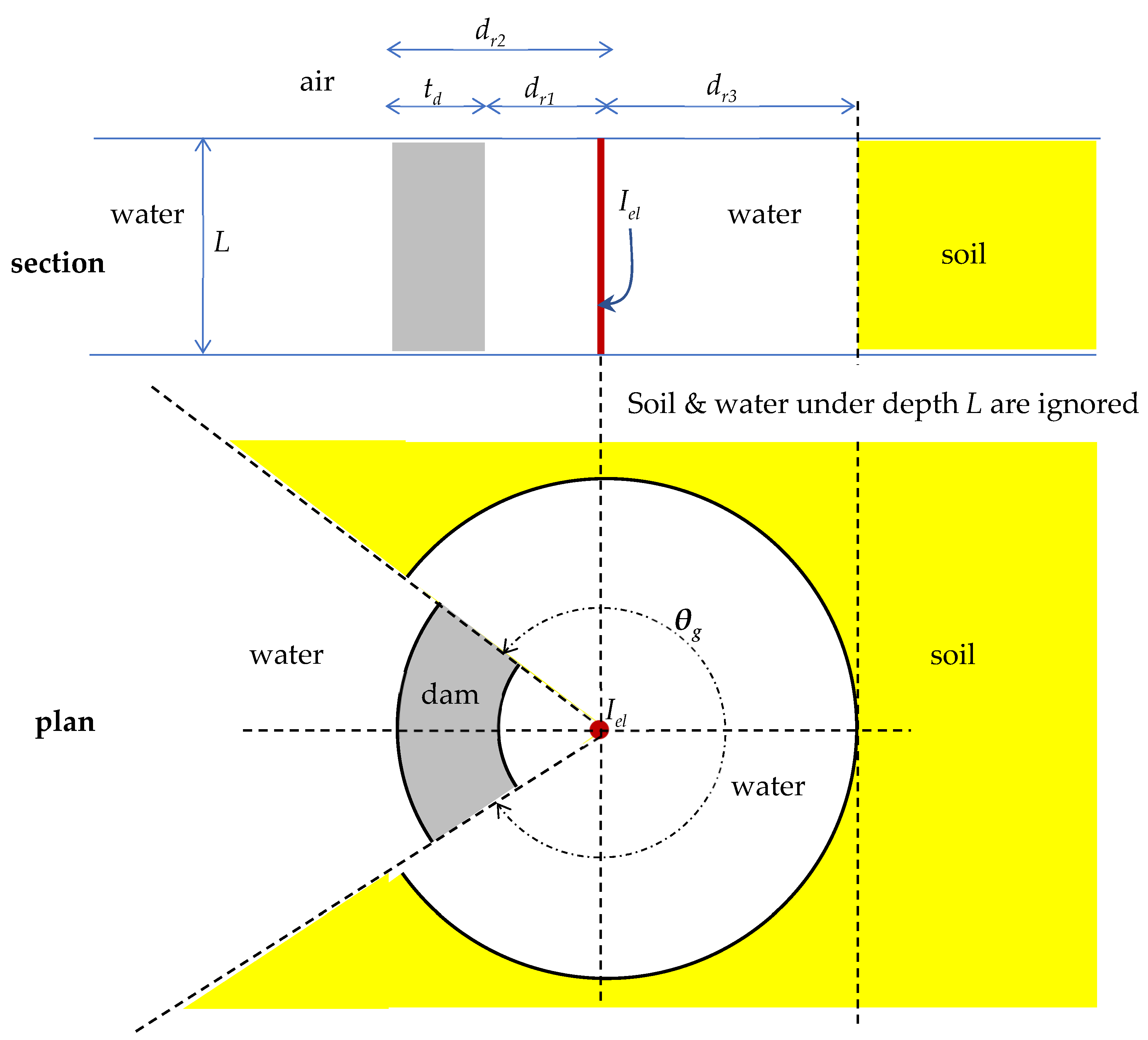
- The water sector defined by the angle θg (Figure 1 of ref. [36]; Appendix A, Figure A1) is neglected to streamline calculations—again leading to conservative outcomes.
- The influence of the breakwater/dam shown in Figure 1 of ref. [36] (Appendix A, Equation (A1)) is also ignored. This simplification affects the estimation of both the electric field strength and the absolute potential within or up to the dam boundary. The absolute potential on the dam surface can be approximated by multiplying the seawater electric field strength by the ratio of the two resistivities (ρd/ρw).
3.2. Electric Field Study of a Bow Frame
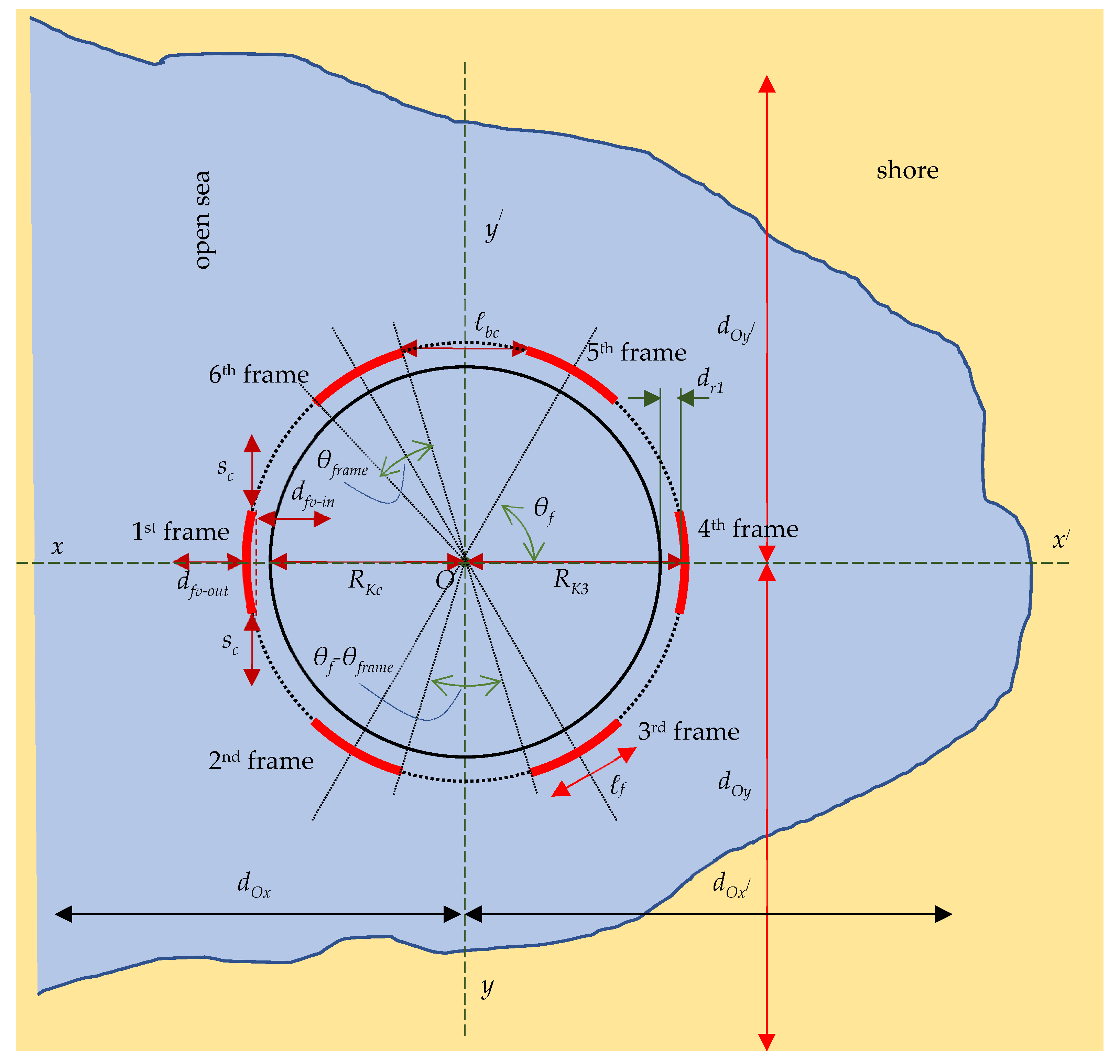
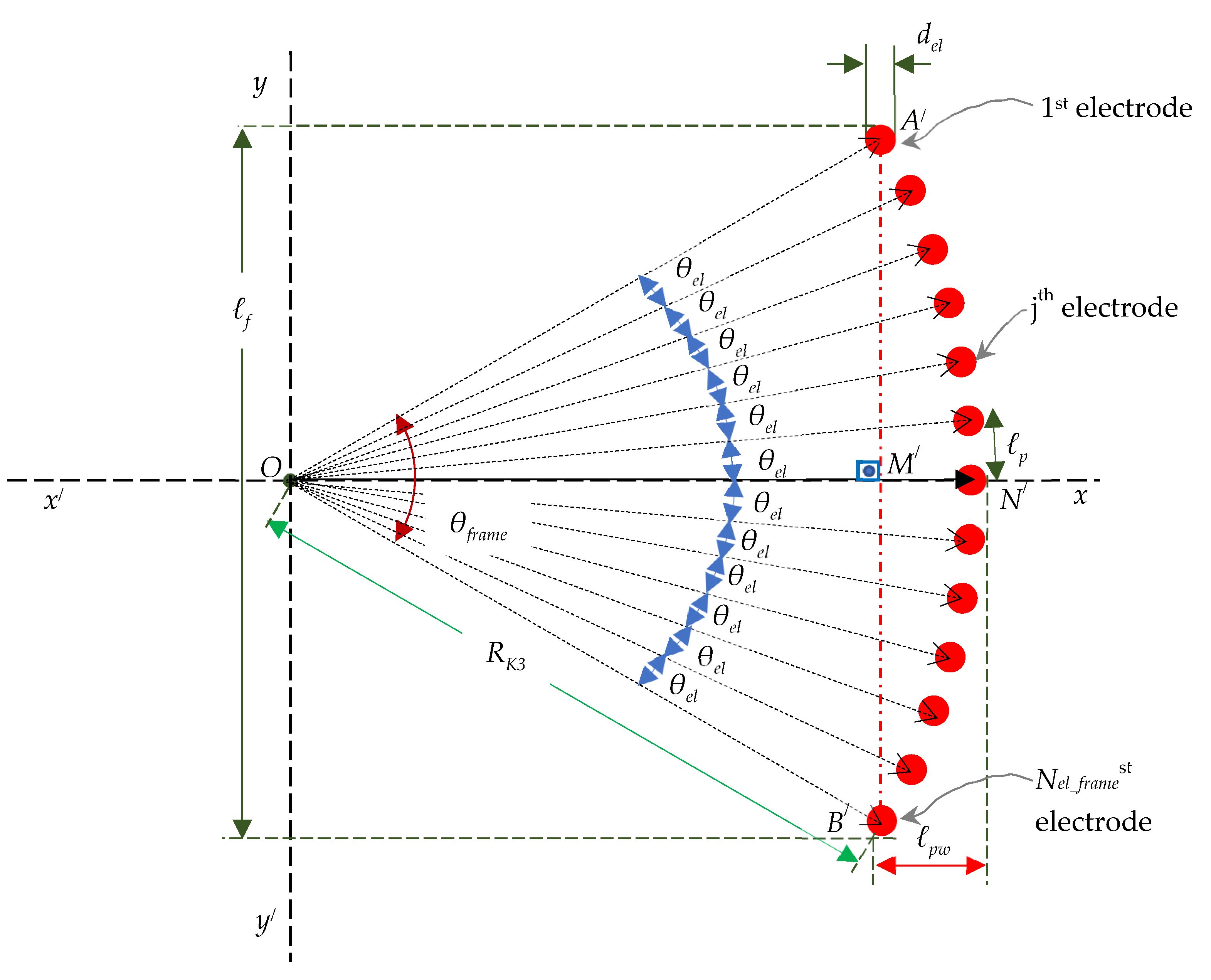
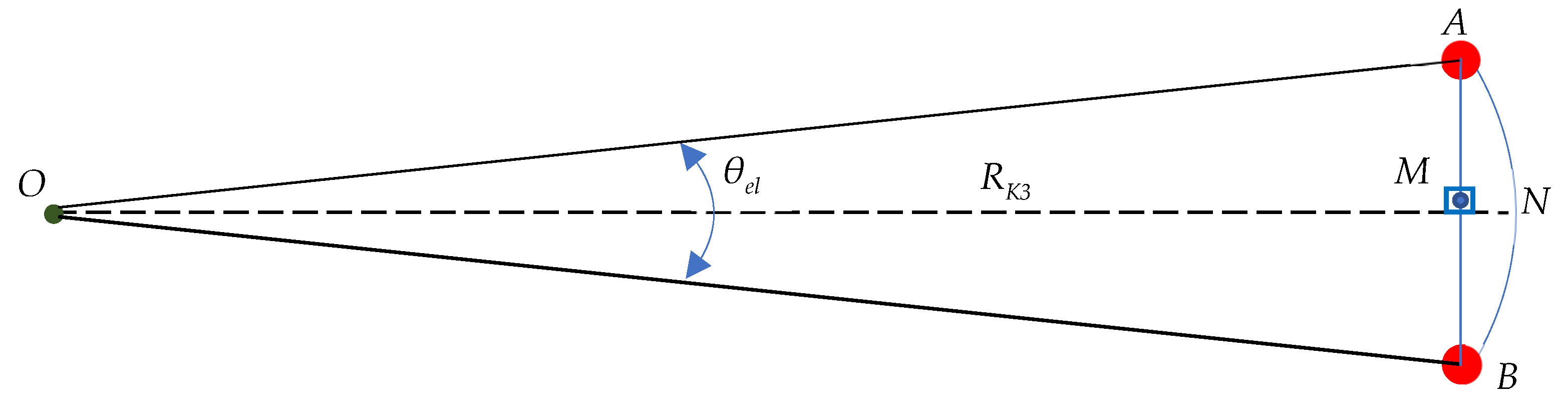
- As the radius RK3 increases, the sizes of the angles θel and θframe decrease, which is expected based on Equations (7) and (9), respectively.
- As the radius RK3 increases, the chord of the bow frame ℓf increases slightly from 5.96 m to 6.00 m, which is the length of the straight frame (for RK3 = ∞ with (Nel_frame − 1) × ℓp = (13−1) × 0.5 = 6.00 m).
- As the radius RK3 increases, the width of the bow frame ℓpw decreases from 0.30 m to 0 m for the straight frame (for RK3 = ∞).
- As the radius RK3 increases, the distance between consecutive frames ℓbc increases significantly, tending, for large values, to the corresponding radius RK3.
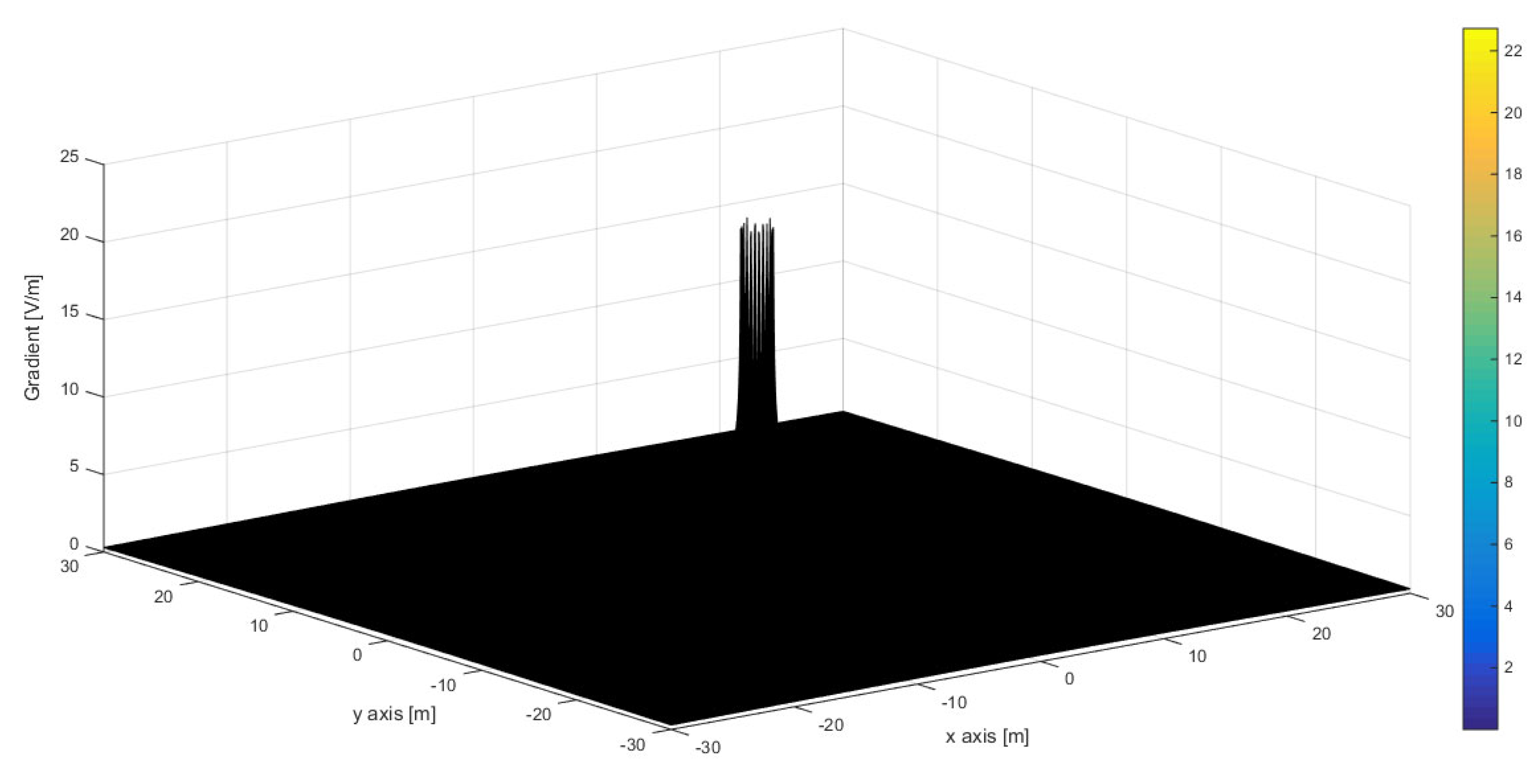
- The maximum electric field strength value is limited between the values 22.4 and 24.2 V/m, i.e., the same or slightly lower value than that of the straight frame.
- As the radius RK3 increases, the distances dfv-out and dfv-in where the electric field strength stays below the limit of 1.25 V/m (along the Ox axis on the outer and inner sides of the frame, respectively) increase, tending to 10.900 m of the straight frame from smaller values.
- The distance dfv-out is always greater than dfv-in, but the difference decreases as the radius RK3 increases.
- As the radius RK3 increases, the distance sc, where the electric field strength stays below the limit of 1.25 V/m along the Oy axis, decreases slightly, tending to 8.525 m, with a small difference of only a few cm.
- As the radius RK3 increases, the total length of the critical frame zone ℓk on the dam (on the yOy’ axis) increases slightly, tending to 23.05 m with a small difference of less than 1 cm.
- The area of the critical electric field strength areas, with values greater than 1.25 V/m, remains practically constant at 395 m2 regardless of the radius RK3.
- As the distance ℓp increases, so does the radius RK3, for which condition (13) is satisfied, although in some cases it seems to remain constant, but this is due to the simulation step of the radius RK3, which is taken as 1 m (cases for ℓp = 0.9 m and ℓp = 1.5 m).
- As the distance ℓp increases, the sizes of the angles θel and θframe and the distances ℓf and ℓpw increase, while the distance between consecutive frames ℓbc decreases.
- As the distance ℓp increases, the maximum electric field strength value decreases (in some cases where there is a small increase, this is due to the selected values of the radius RK3, which is taken as 1 m).
- As the distance ℓp increases, the distances dfv-out, dfv-in and sc decrease, while the total length of the critical frame zone ℓk on the dam (on the yOy’ axis) increases.
- As the distance ℓp increases, the area of the critical electric field strength areas, with values greater than 1.25 V/m, decreases at a small rate.
3.3. Electric Field Study of a Special-Shaped Frame Suitably Adapted to a Circular Arrangement (“Birthday Cake”) and Construction Configuration
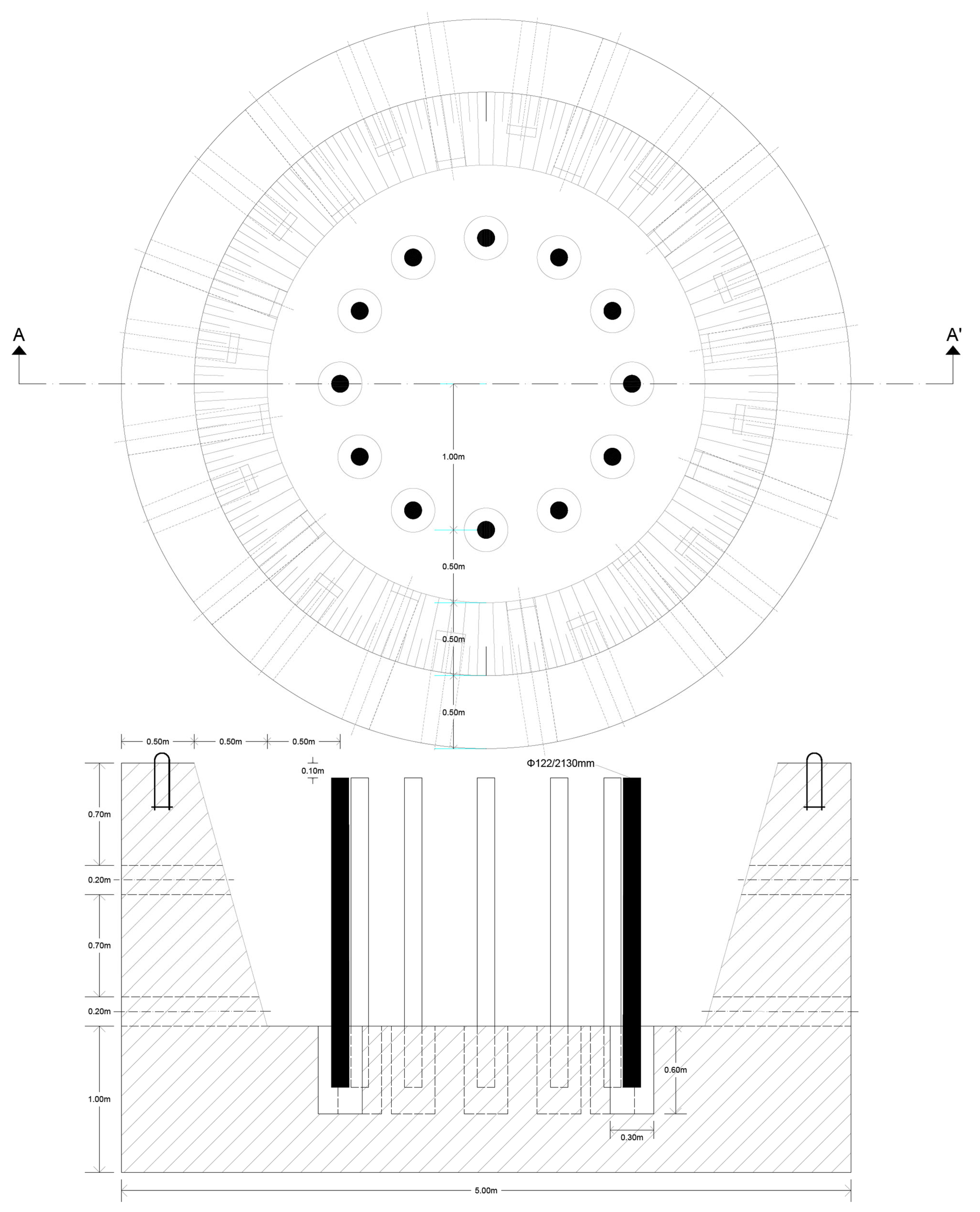
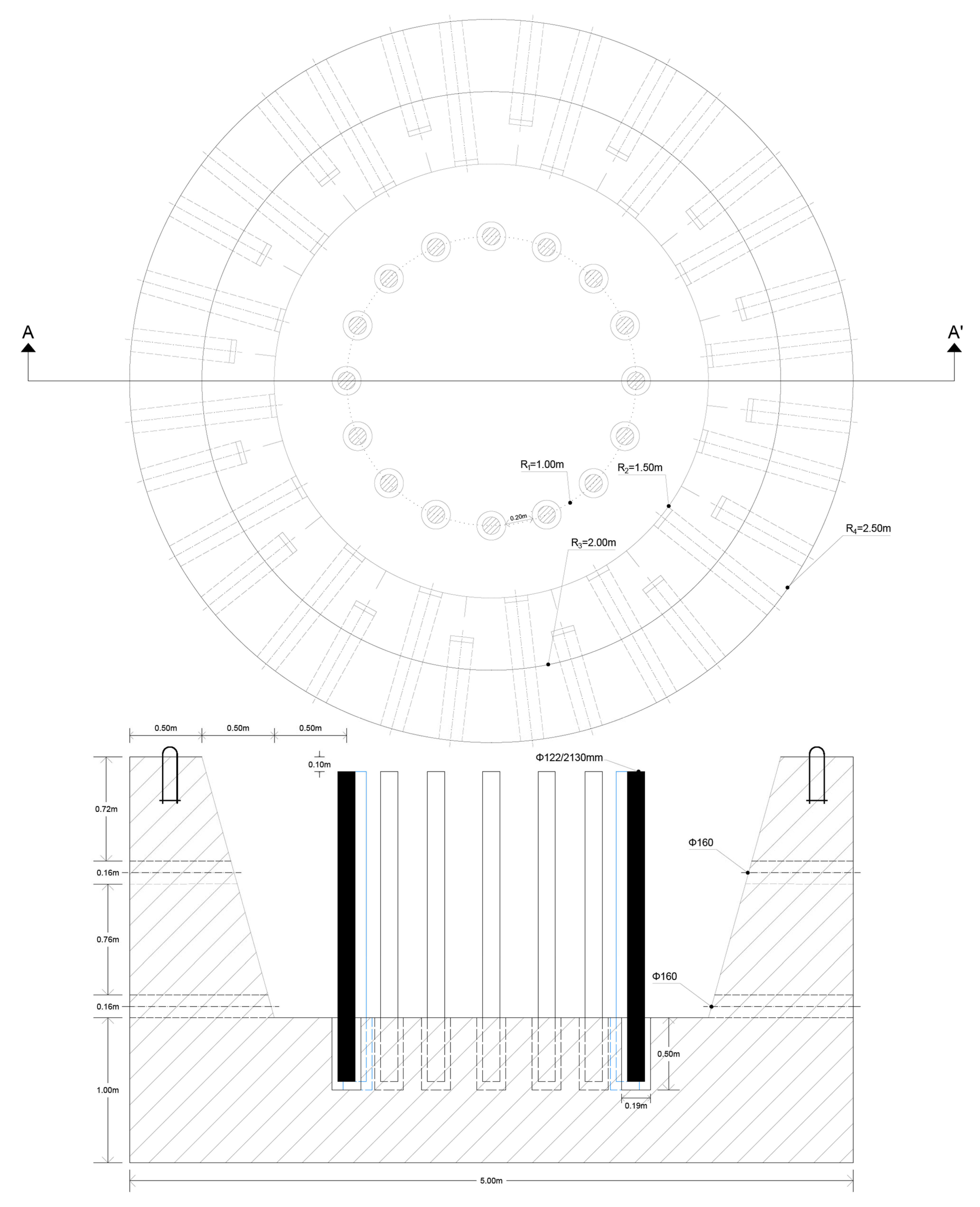
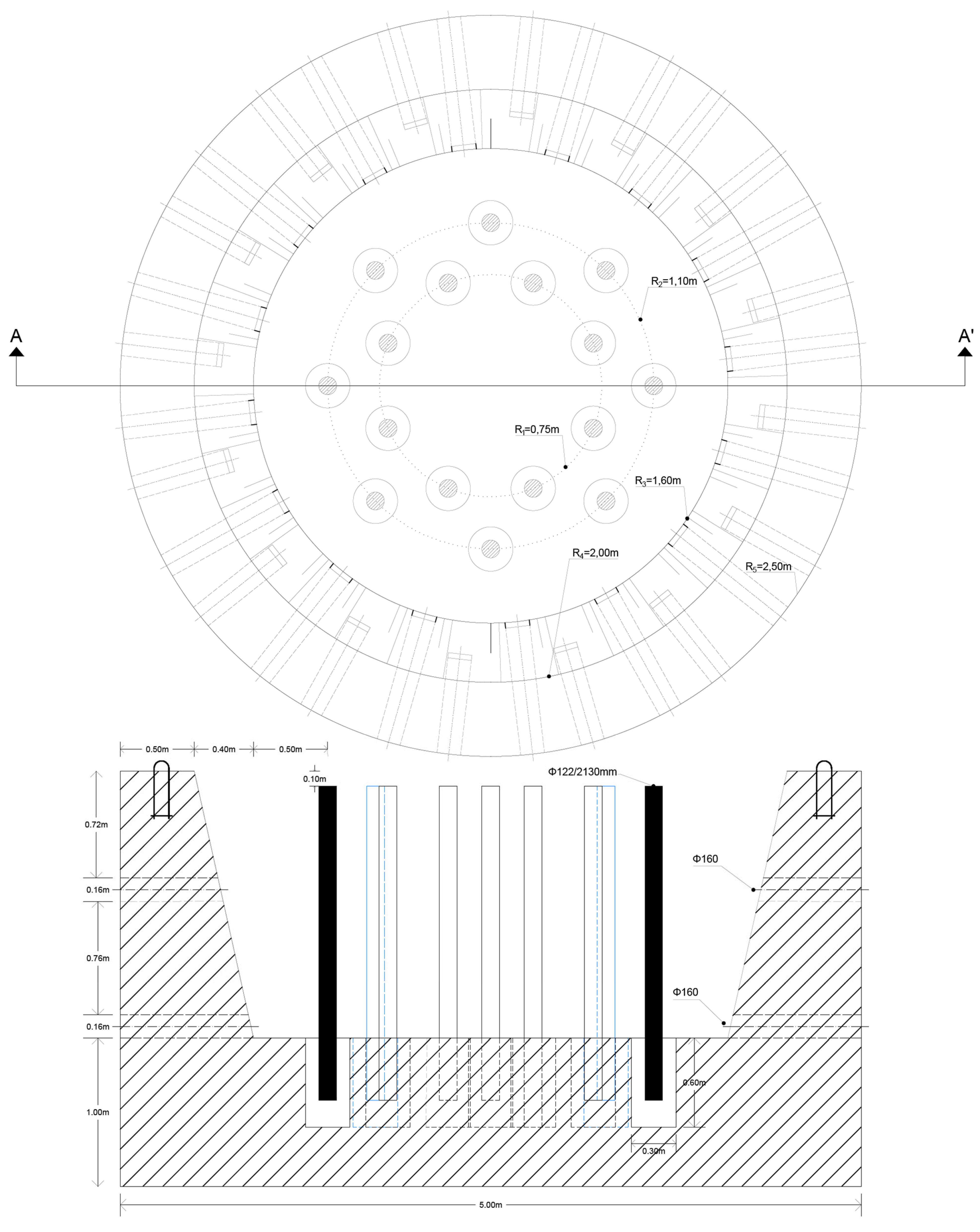
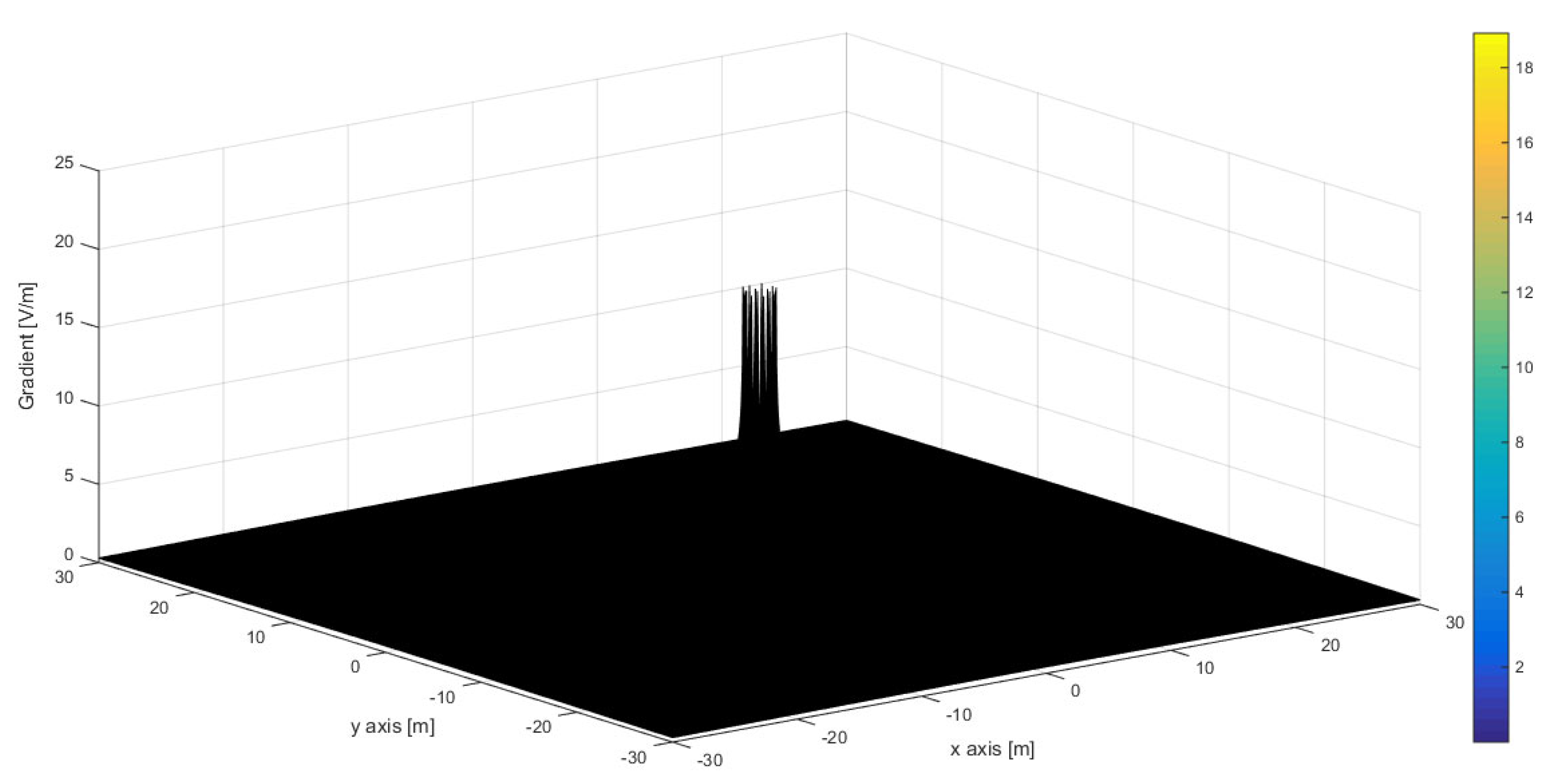
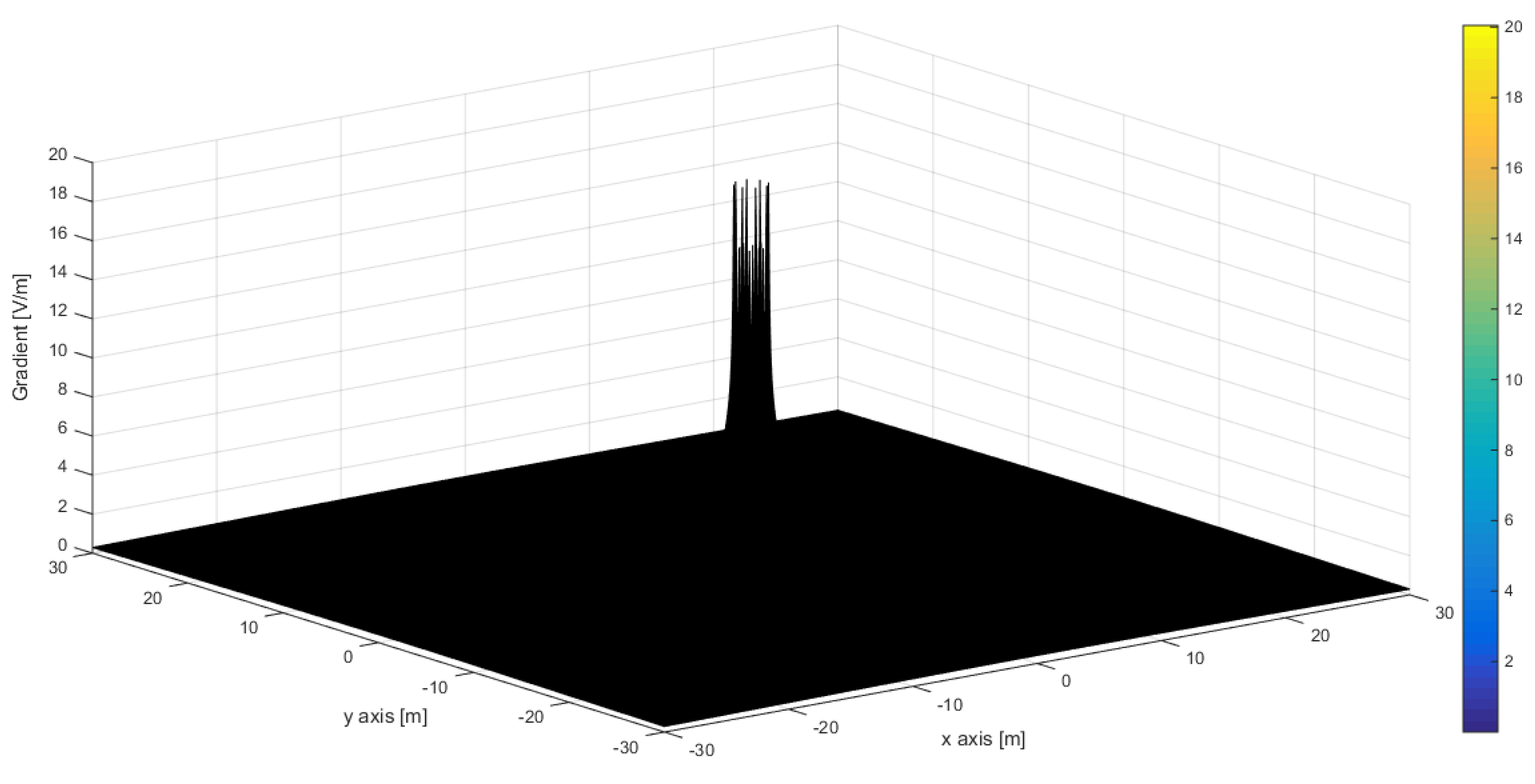
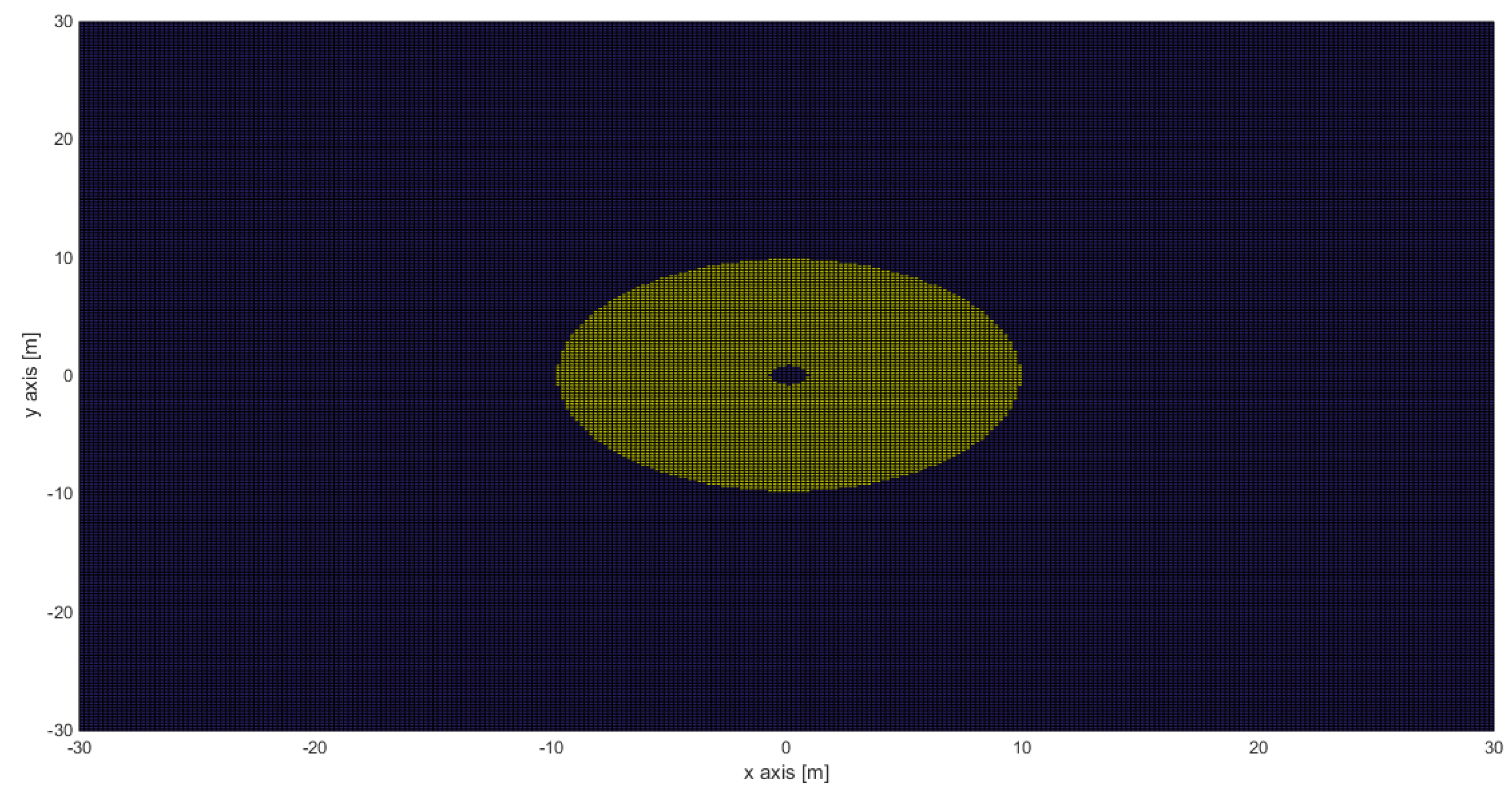
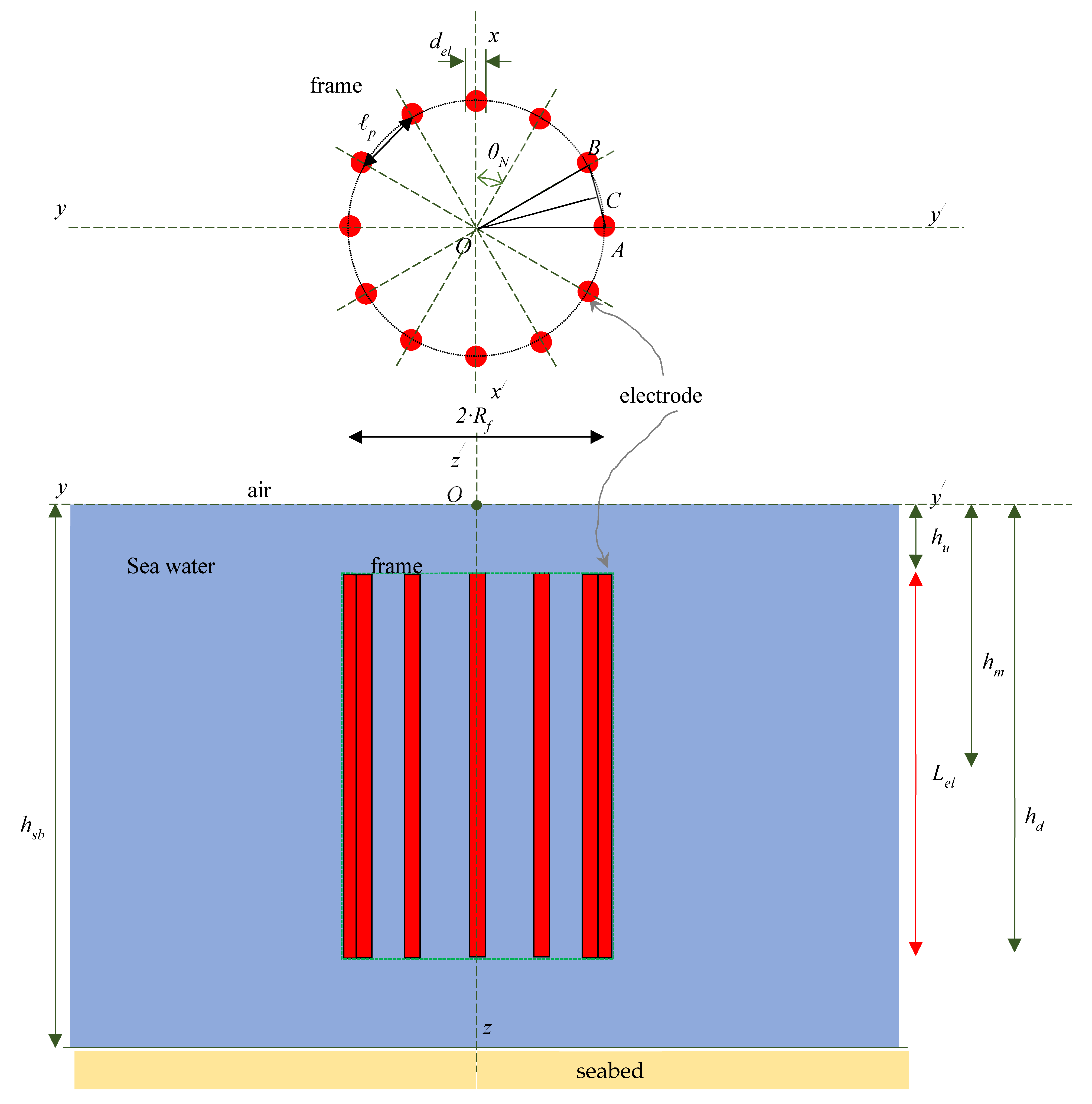
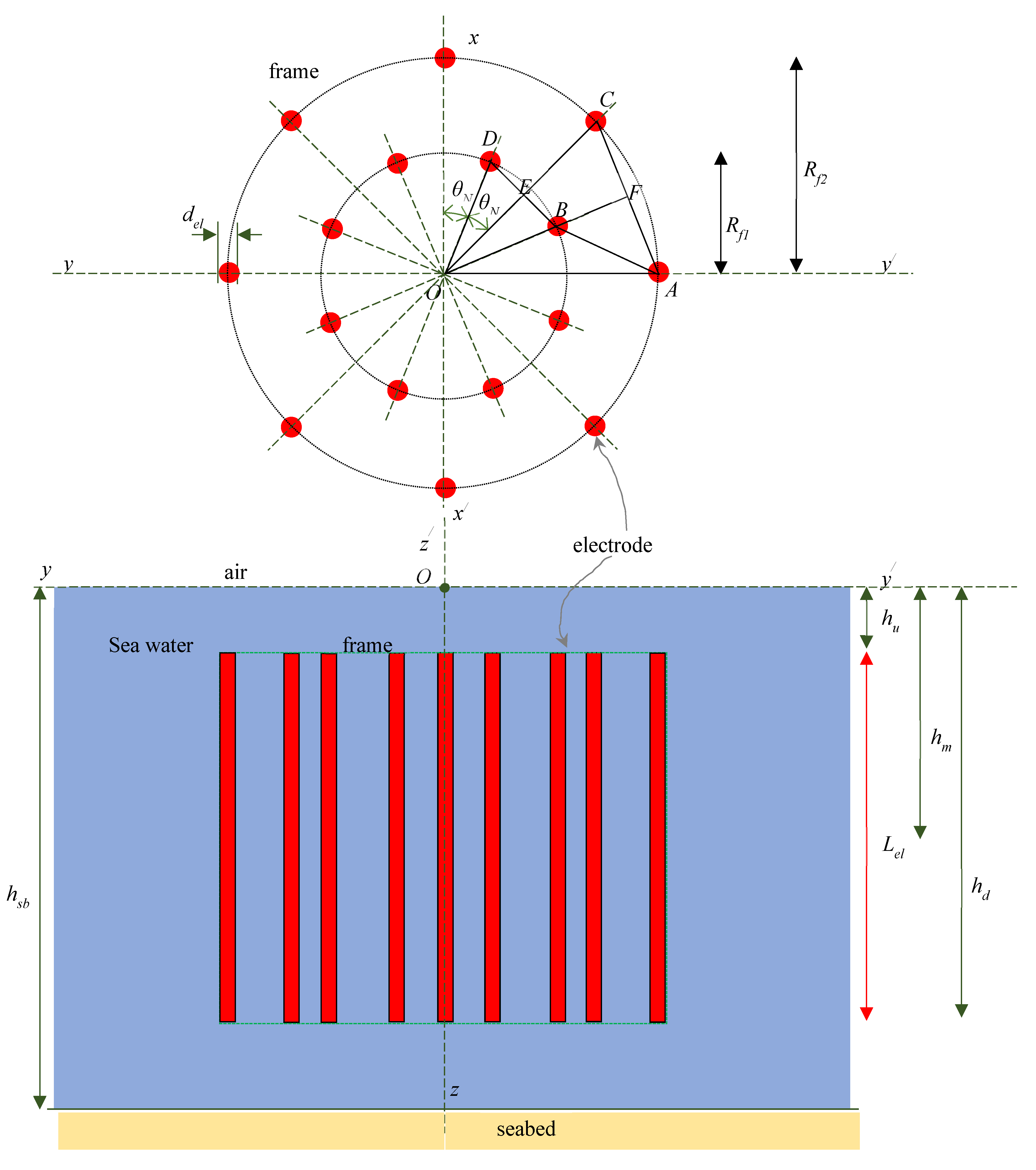
- In a circular arrangement of electrodes, when the distance between them changes, the necessary radius rκ required to reduce the electric field intensity below 1.25 V/m practically does not change. Additionally, it is found that this radius is practically the same, equal to 9.84 m, in all three construction structures studied (frame of 12 electrodes in a circular arrangement, frame of 16 electrodes in a circular arrangement, and frame of 16 electrodes in two concentric circular arrangements).
- Regarding the electric field intensity limit, equal to 2.5 V/m, it is observed that with the increase in the distance between the electrodes, there is a minimal increase in the necessary radius rκ/ (of the order of a few mm), which is required to comply with this limit for the case of a frame with a circular arrangement (as shown in Table 4). In contrast, in the case of a frame with two circular arrays, a reduction in the corresponding radius (of the order of a few mm) is observed, though this does not practically change the radius of around 4.92 m.
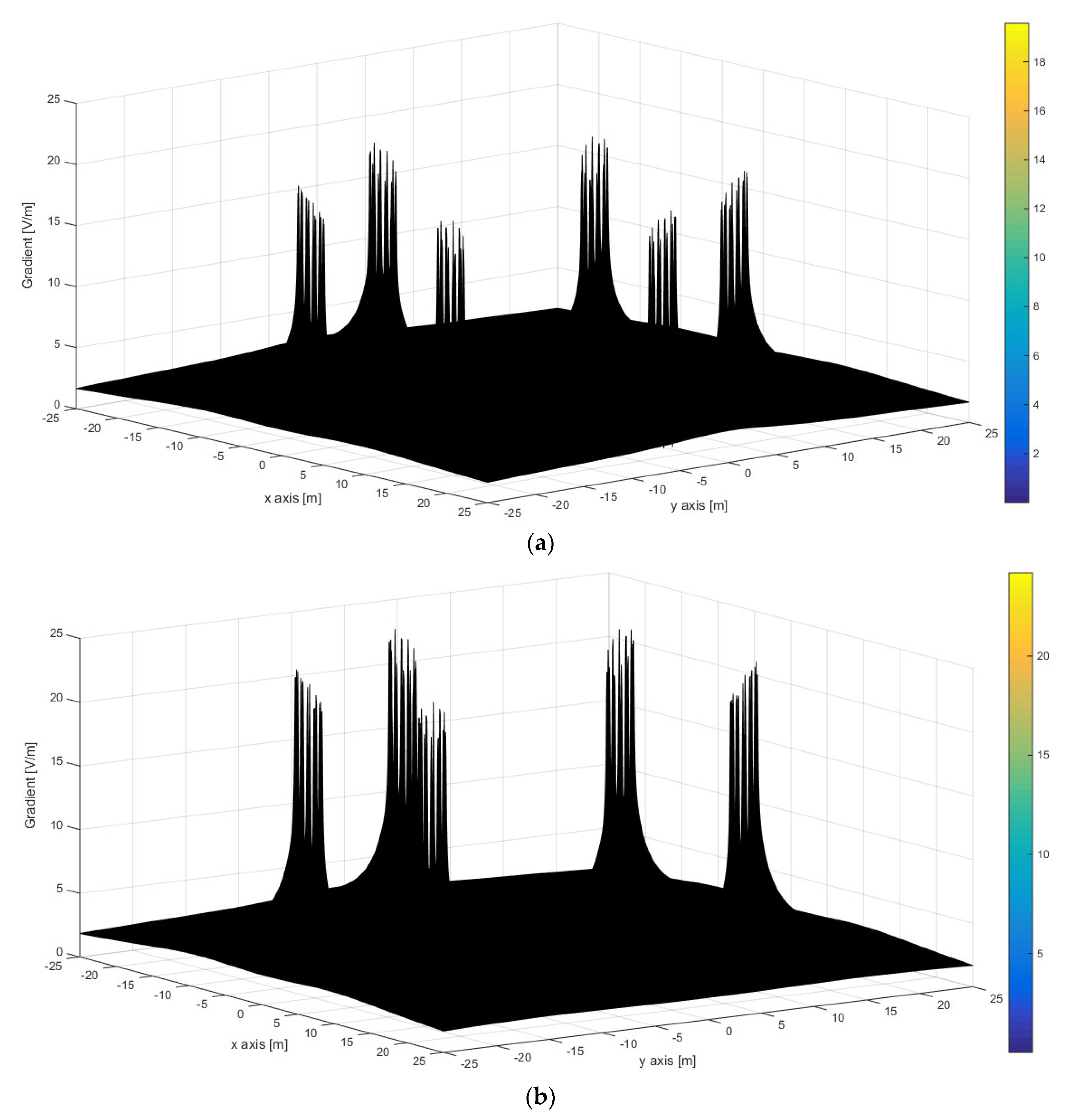
- In terms of electric field intensity, when the distance of the electrodes ℓp increases, the maximum intensity of the electric field calculated with the analytical method “C” in ref. [4] (see Appendix A) decreases. This generally expresses the distribution of the electric field in the nearby space. It is found that increasing the number of electrodes reduces the levels of electric field intensity (comparison of Figure 16 and Figure 17, i.e., a circular arrangement structure of 12 electrodes with a corresponding one of 16 electrodes), while placing the same number of electrodes in two circular arrangements leads to more intense fluctuations in the electric field (comparison of Figure 17 and Figure 18, i.e., a structure of 16 electrodes in one circular arrangement and two circular arrangements). In the calculations based on Equations (4)–(7) in ref. [4] (Equations (A4)–(A7) of Appendix A), the angle θg is taken into account, which significantly limits the active surface of the zone of action of each electrode, which in combination with the small thickness of the electrode water zone, which is equal to the active length of the electrode, leads to much higher electric field intensity values. Due to the superposition of the 12 or 16 different electrodes, higher electric field intensity values are obtained around the electrodes than those that would result if one were to study the interface of a single electrode.
- Essentially, a distance of at least 10 m is required between the circular array frames so that the developing electric field intensity from one frame falls below 1.25 V/m. Of course, when one frame is not operating, the other five are fully operational, so the corresponding distance should be significantly greater, as has been established from studies of straight frames in various arrangements (see [4,36]).
- As with linear and bow frames, increasing the length ℓp causes a decrease in the maximum value of the electric field strength, an increase in the frame dimensions (expressed through the corresponding outer radius Rf for the case of one circular arrangement and Rf2 for the case of two circular arrangements) and a very small change in the critical length of the safety zone of the birthday cake frame and the corresponding surface. Thus, again, a value of 0.5 m is chosen, which covers both the access requirements for maintenance and the possibility of easy implementation of the corresponding concrete base.
- If an isolated frame of a circular arrangement consists of Nel_frame = 13 electrodes, then the electric current per electrode is equal to Iel_mt_st = 17.955 A instead of 19.452 A for 12 electrodes. That is, the increase in the number of electrodes by 8.33% yields a decrease in the electric current per electrode by 7.70% (similarly to the density current). In the case of a length ℓp equal to 0.5 m, the maximum electric field intensity Εmax becomes 21.2780 V/m, i.e., smaller by 6.89% than the corresponding value of 22.8516 V/m for the 12 electrodes. The necessary radius of the circular arrangement Rf increases to 1.0446 m, i.e., by 8.15% compared to the case of 12 electrodes. The radius rκ for the area where the electric field intensity values are greater than 1.25 V/m remains unchanged and equal to 9.8351 m. The same occurs with radius rκ/ for the area where the electric field intensity values are greater than 2.5 V/m, taking a value equal to 4.9177 m. Thus, apart from the small reduction in density current and maximum electric field intensity, the use of 13 electrodes does not offer any other benefit other than an increase in material both in terms of electrodes by 8.33% and concrete by 5.17%.
- If an additional electrode is added at the centre of the circular arrangement (of either 12 or 16 electrodes), then the necessary radius rκ does not change, but the calculated electric field intensity is reduced. However, the available access space for the diver is reduced by half, so this addition is not considered necessary. Furthermore, due to its location (in the centre of the circle), this electrode encounters a different resistance with respect to remote earth, so, in fact, a current of different intensity will pass through.
- Among the three construction structures in Figure 13, Figure 14 and Figure 15, the structure with the 12 electrodes in a circular arrangement of radius 1.0 m is the simplest, without substantial differences from the other two in terms of field effects and the necessary radius to achieve an electric field strength below 1.25 V/m. Taking into account that close to the frame, locally higher electric field strength values are presented compared to the other two structures, for the rest of the study, the structure of Figure 13 is taken as the least favourable of the three. However, it is also the lightest during the construction phase (taking into account the 100 t limit of the installation barge).
4. Application of the Analytical Methodology for the Calculation of Electric Field Strength in the Electrode Station with Various Configurations
4.1. General Remarks
- The electric current density Jst with respect to the peripheral surface or the current per electrode Iel;
- The lengths dOy and dOy/ of the critical zone of the electrode station along the semi-axes Oy and Oy/ from the beginning of the axes;
- The maximum electric field strength in the area of the non-operational frame during maintenance Eoff;
- The maximum electric field strength of the arrangement Emax.
4.2. Eleventh Electrode Station Configuration—Bow Frames Adapted Perimetrically to a Central Base
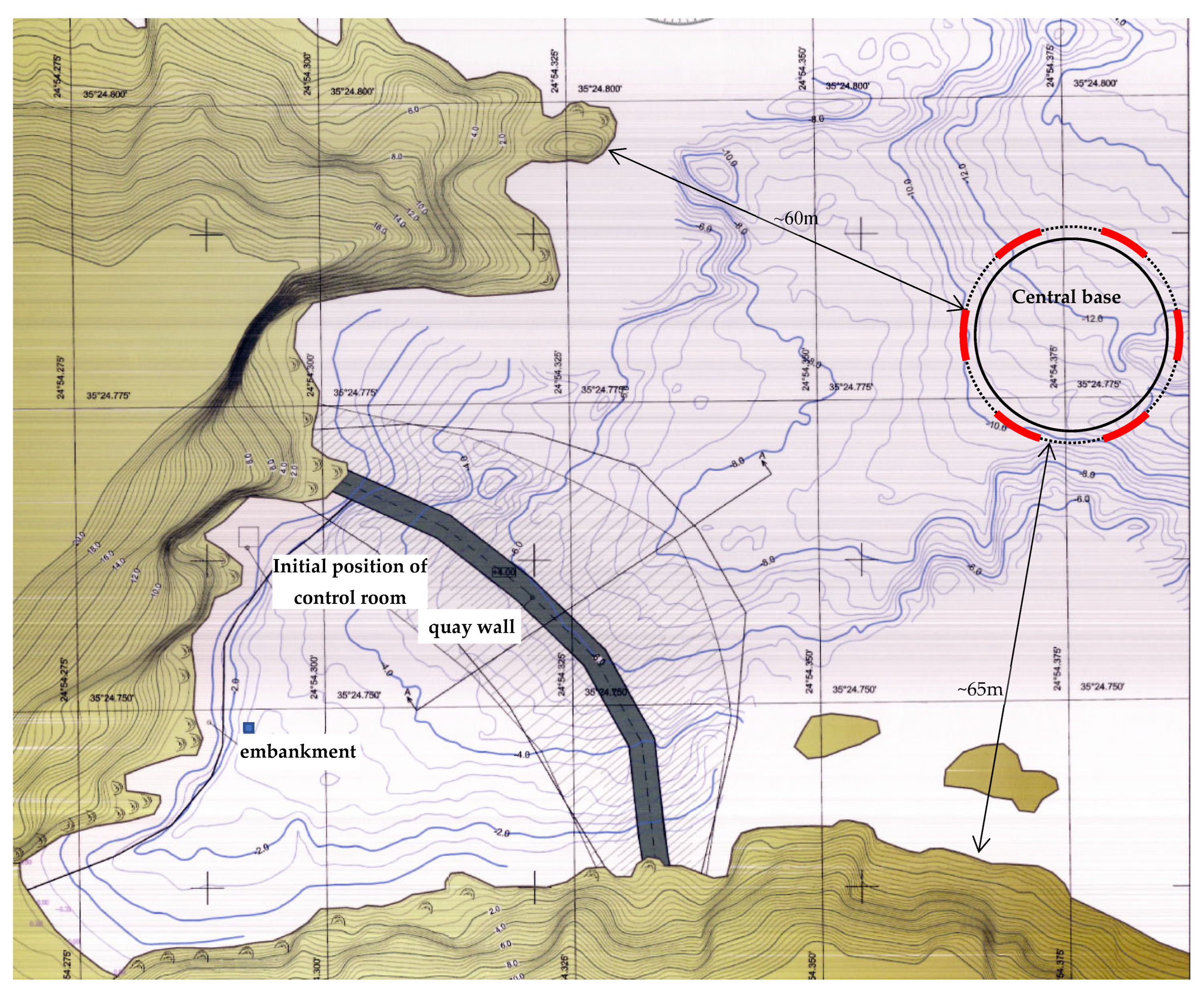
- The critical zone extends up to 58.62 m from the centre in all directions depending on how unevenly distributed the station load is (strongly approximating the results in the case of frames positioned perimetrically to a central base). This practically mirrors the behaviour of configuration 10 in ref. [36], which employs straight frames (zone breadth =58.54 m). The slightly less favourable results of a few centimetres are due to the fact that in the bow configuration, the electrodes are essentially arranged in a circular way (of radius 15 m), while in the 10th configuration in ref. [36], the straight frame is a chord of the corresponding circle of radius 15 m, so (except for the outer electrodes of each frame) the rest are located at distances less than 15 m in relation to the centre of the circle. When the structure is positioned at the 12.0 m isobath, the base centre remains more than 60 m offshore, and minimal dredging ensures that the frames lie at depths exceeding 10 m—well below the zone affected by breaking waves (as illustrated in Figure 21).
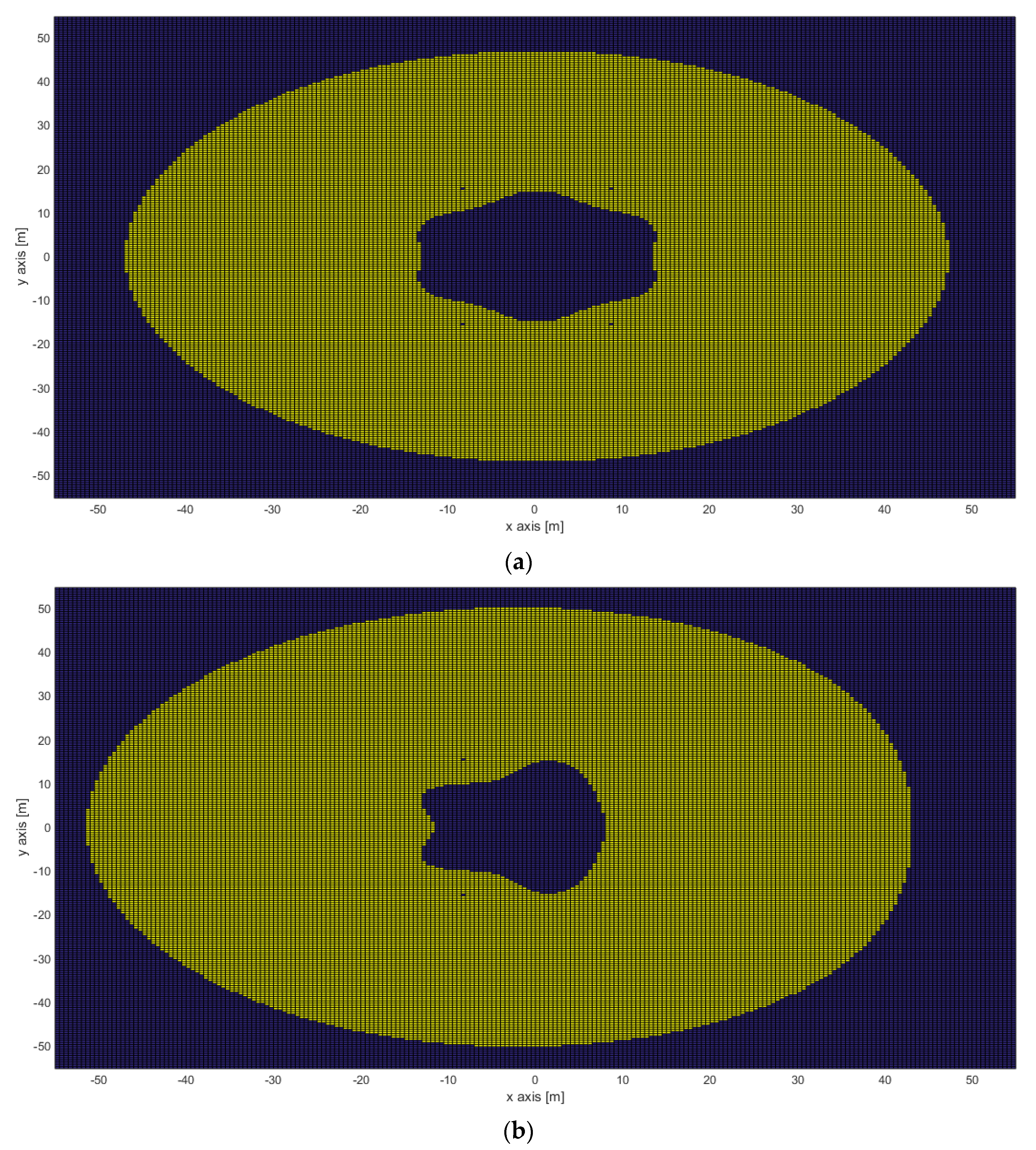
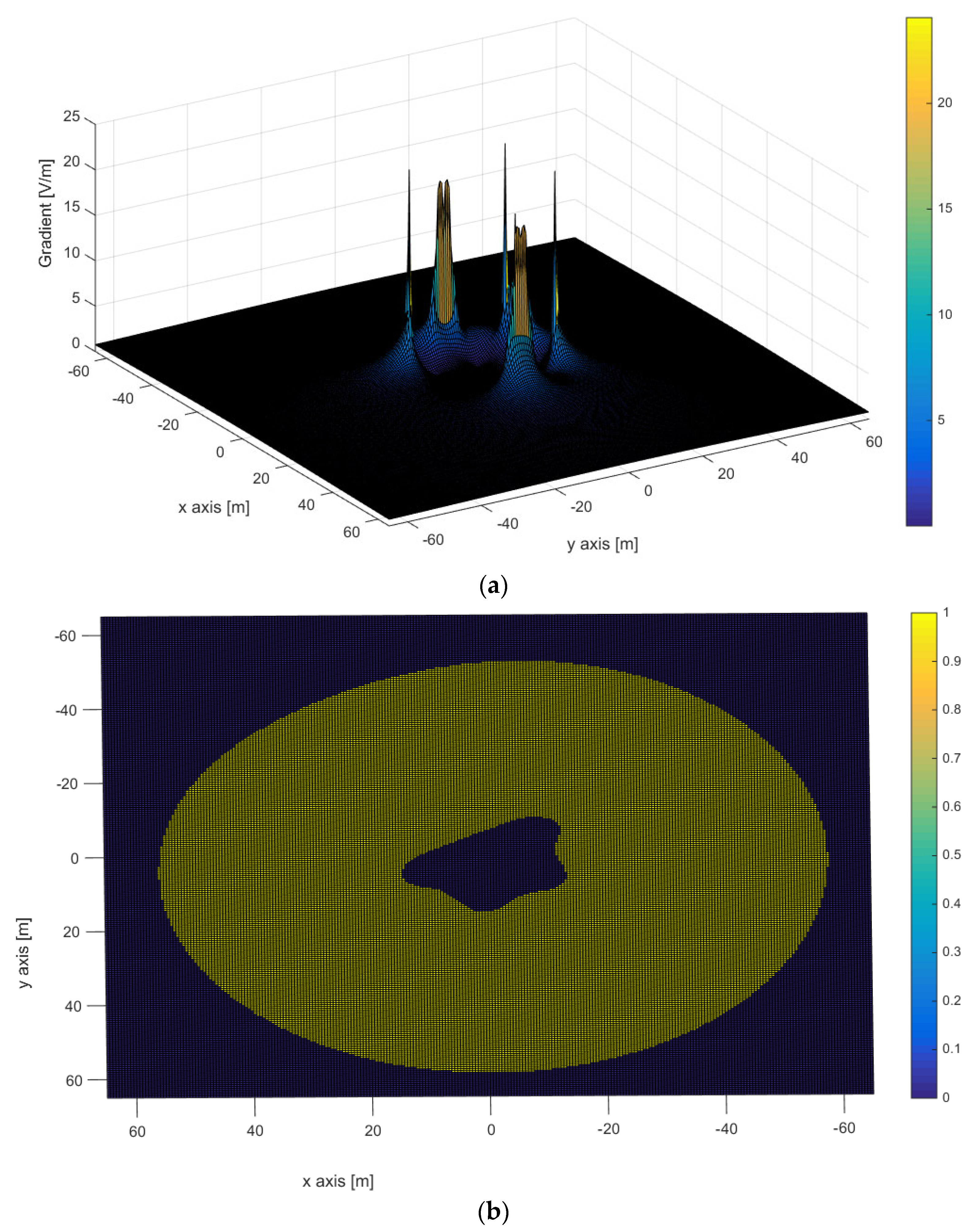
- Figure 20b illustrates areas between frames that present notable decreases in the electric field strength below 1.25 V/m. In the zone where one frame is inactive, the field strength does not exceed 2.11 V/m, which is below the 2.5 V/m safety limit. Consequently, diver safety during maintenance is not compromised. If a stricter limit of 1.25 V/m is required even around inactive frames, increasing the base radius to 28.5 m achieves this outcome. This result was established through a series of iterative simulations using base radii from 16.5 m upward in 0.5 m increments. It proves that the inner diameter of the base has negligible influence on electric field values.
- The maximum absolute potentials and the station resistance to remote earth were found to be 16.51 kV and 14.14 Ω, respectively. These are slightly lower relative to configuration 10 in ref. [36], which recorded 16.83 kV and 14.42 Ω for straight frame arrangements around a central base in open sea. Compared with all other designs in Table 10 in ref. [36], the present configuration performs better, except for the ninth configuration, which exhibits lower values (11.10 kV, 9.51 Ω) for radially positioned straight frames in open sea. This layout also demonstrates good performance under symmetrical operating conditions.
- At the centre point O of the central base, the absolute potentials that are observed are of lower absolute values than the corresponding maximum absolute potentials. This reduction results from field interaction effects, since the highest potential levels occur in the vicinity of the active frames.
- Regarding field behaviour, when a single frame is inactive, the results show patterns that closely resemble one another due to the symmetrical features of the array. Any minor discrepancies in electric field strength are attributable to the Cartesian coordinate system employed and the step size used in the simulation. Moreover, when determining the absolute potential, the specific integration path adopted in the calculation is also a decisive factor.
- Increasing the gross radius of the base RK3 from 17.0 m to 28.5 m slightly reduces the results of the electric field (from 24.74 to 24.47 V/m), ensuring that the electric field strength in the area of the frame under maintenance is below the limit of 1.25 V/m. In the case of a solid base, however, larger maximum absolute potentials and the corresponding values of the electrode station resistance, with respect to remote earth, develop, being equal to 19.38 kV and 16.61 Ω, respectively. If the base becomes hollow (e.g., with an internal radius of 14 m), the respective values are significantly reduced (15.45 kV, 13.24 Ω), even to smaller values than those of the original base (RK3 = 17.0 m).
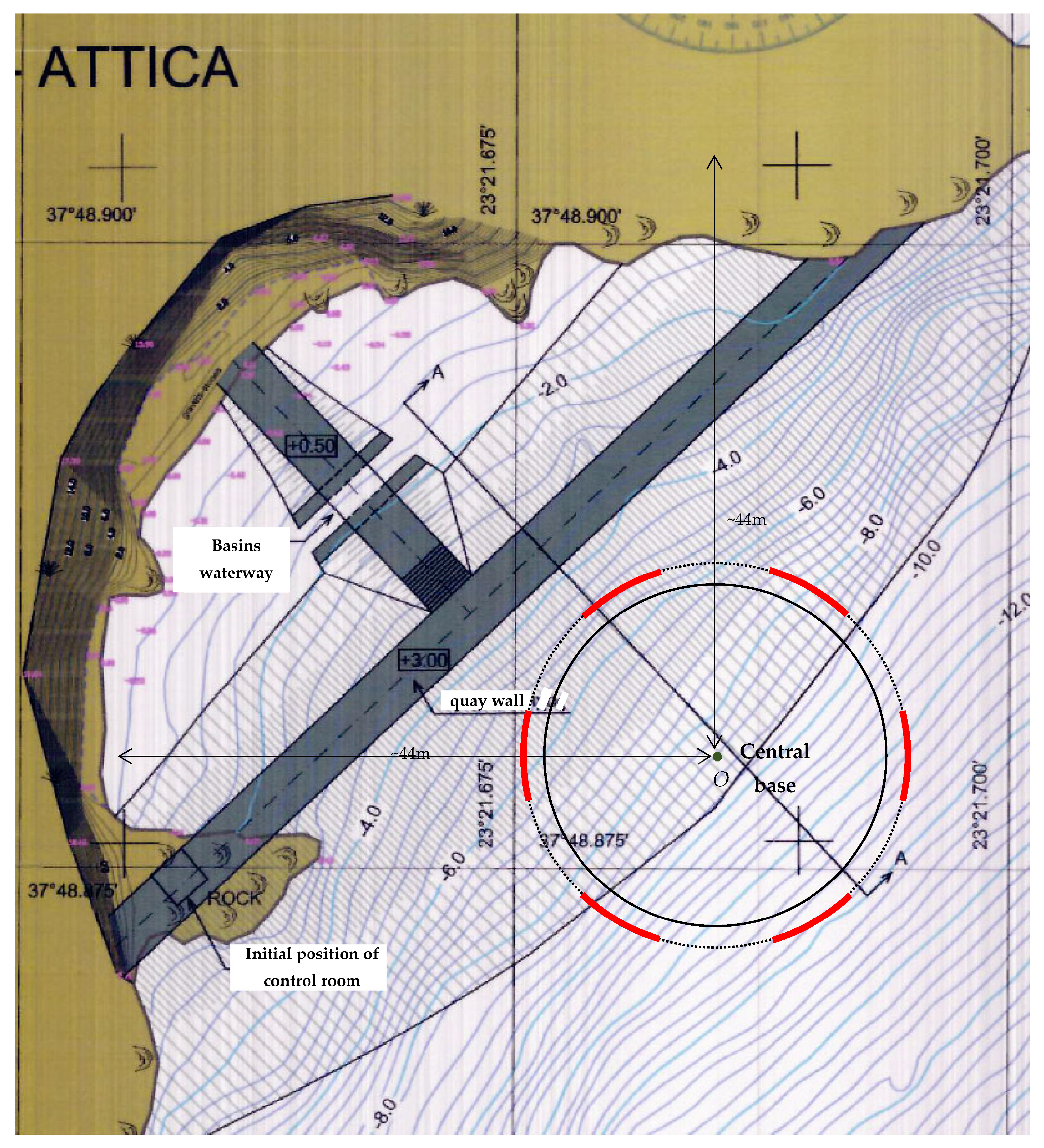
- The critical zone, measured from the centre of the arrangement, extends up to 43.92 m in all directions. This depends on how unevenly loaded the station is and practically matches the results for radially arranged frames around a central base. The behaviour is nearly identical to that of configuration 10 of Table 11 in ref. [36], which used straight frames and produced a similar value (43.90 m). The differentiations emerge from the same reasons analysed in the case of Korakia. The installation may be positioned at the 5.5 m isobath (the sum total of the 3.0 m breaking wave depth and the 2.13 m electrode height). Under these conditions, the critical electric field zone extends 28.35 m inland, while the centre of the configuration lies at the 8.8 m isobath (see Figure 22), coinciding exactly with its position in Figure 33 in ref. [36]. Alternatively, if the base is placed 44 m offshore (distance from the centre of the arrangement to the nearest shoreline), the corresponding isobath would be approximately 14 m, ensuring that the entire critical electric field zone remains fully within water.
- The difference between the maximum electric field strength for the entire electrode station and that of a single bow frame is 9.56% (18.71 V/m versus 17.08 V/m, see Table 3). This variation is smaller than that of all other configurations listed in Table 11 in ref. [36] and is also slightly below the value obtained for configuration 10, which features straight frames arranged around a central base in open sea (18.77 V/m).
- In the area of an inactive frame, local electric field strength values exceed 1.25 V/m, yet they are never measured over 1.94 V/m, remaining comfortably within the 2.5 V/m threshold. Thus, no safety hazards arise for divers performing maintenance operations. To maintain electric field strengths below 1.25 V/m (if so desired), a central base radius of approximately 21.5 m is required, as verified through successive numerical trials with radii ranging from 14.0 m up at 0.5 m steps.
- The developing maximum absolute potentials and the corresponding values of the electrode station resistance, with respect to remote earth, are ίσα με 11.64 kV and 9.98 Ω, respectively, slightly smaller than those in configuration 10 with straight frames placed around a central base in open sea in Table 11 in ref. [36] (12.07 kV, 10.34 Ω). Additionally, this value is better compared to all other configurations in ref. [36] except for the ninth configuration with straight frames placed radially to a central base in open sea (7.21 kV, 6.18 Ω of Table 11 in ref. [36]). It also behaves very well during symmetrical operation.
- At the centre point O of the central base, the absolute potentials that are observed are of lower absolute values than the corresponding maximum absolute potentials. This reduction results from field interaction effects, since the highest potential levels occur in the vicinity of the active frames.
- When a single frame is not operating, the electric field results remain practically unchanged owing to the symmetrical geometry of the array in regard to its centre O. The respective values along the dOx, dOx/, dOy and dOy/ directions would be identical if the Cartesian coordinate system were rotated accordingly. The minor deviations (limited to the fourth decimal) regarding the electric field strength magnitudes are attributed to the elementary canvas square (0.05 m × 0.05 m square elements).
- The numerical discrepancies observed in the calculation of the absolute potential are more significant than those associated with the electric field strength. This occurs because both the integration path of the electric field strength and the step size used in the numerical process significantly affect the results. The step length is not constant, varying with distance due to the considerable total completion length—approximately 150 km. Consequently, even when identical loading conditions are applied to five different frames, the calculated values are not the same. To ensure safety, the analysis consistently adopts the least favourable value.
- Increasing the gross radius of the base RK3 from 14.0 m to 21.5 m slightly reduces the results of the electric field (from 18.71 to 18.37 V/m), ensuring that the electric field strength in the area of the frame under maintenance is below the limit of 1.25 V/m. In the case of a solid base, however, larger maximum absolute potentials and the corresponding values of the electrode station resistance with respect to remote earth develop, being equal to 13.43 kV and 11.51 Ω, respectively. If the base becomes hollow (e.g., with an internal radius of 11.5 m), the corresponding values are significantly reduced (10.51 kV, 9.00 Ω) to even smaller values than those of the original base (RK3 = 14.0 m).
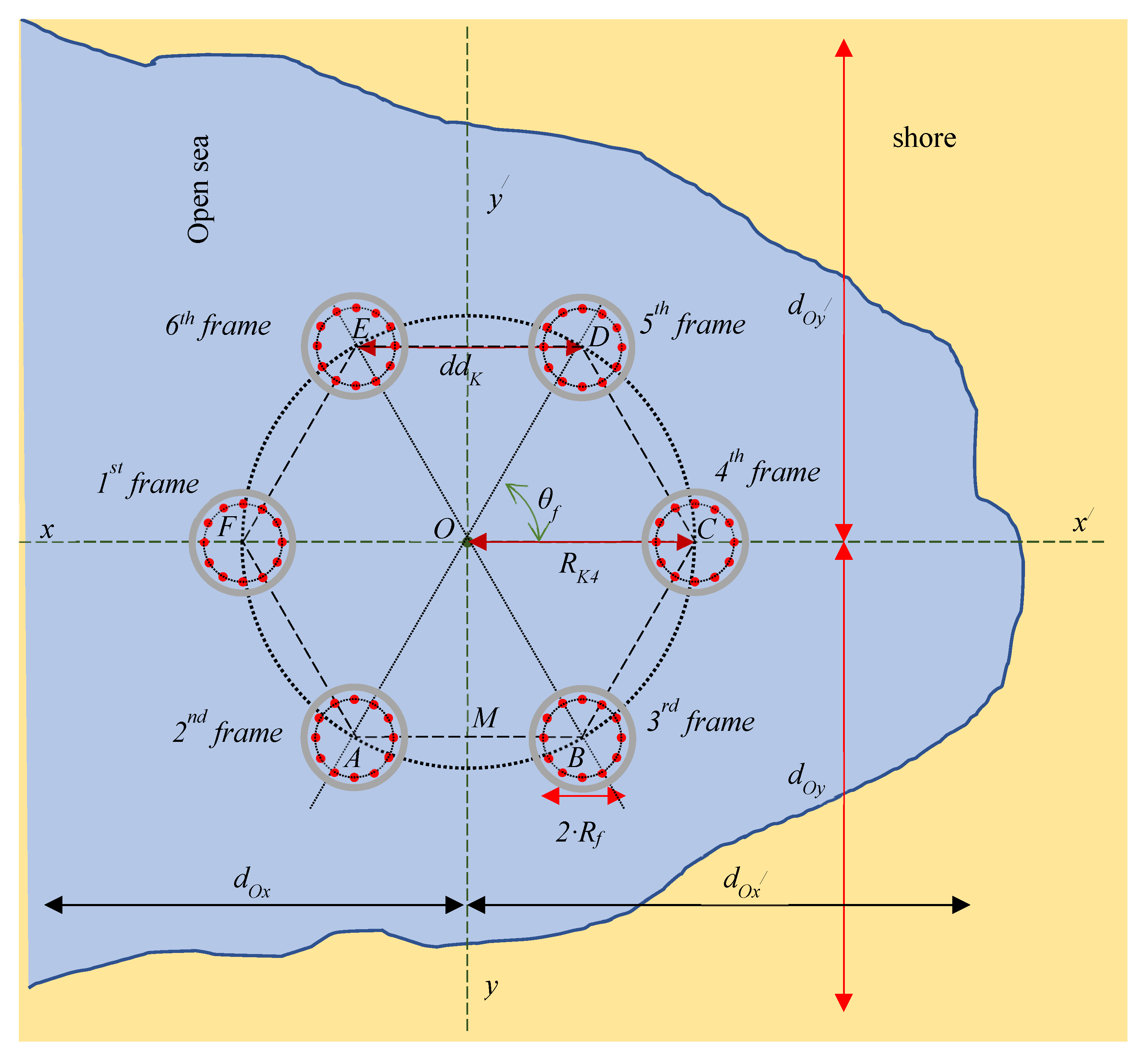
4.3. Twelfth Electrode Station Configuration—“Βirthday Cake” Frames Placed at the Vertices of an Imaginary Regular Hexagon
- The radius of the critical zone, from the centre of the arrangement, reaches up to 51.42 m in all directions depending on the uneven loading of the station. This is better for the Korakia area, which is of the order of 56 m, and worse for the Stachtoroi area, which is of the order of 44 m according to [36].
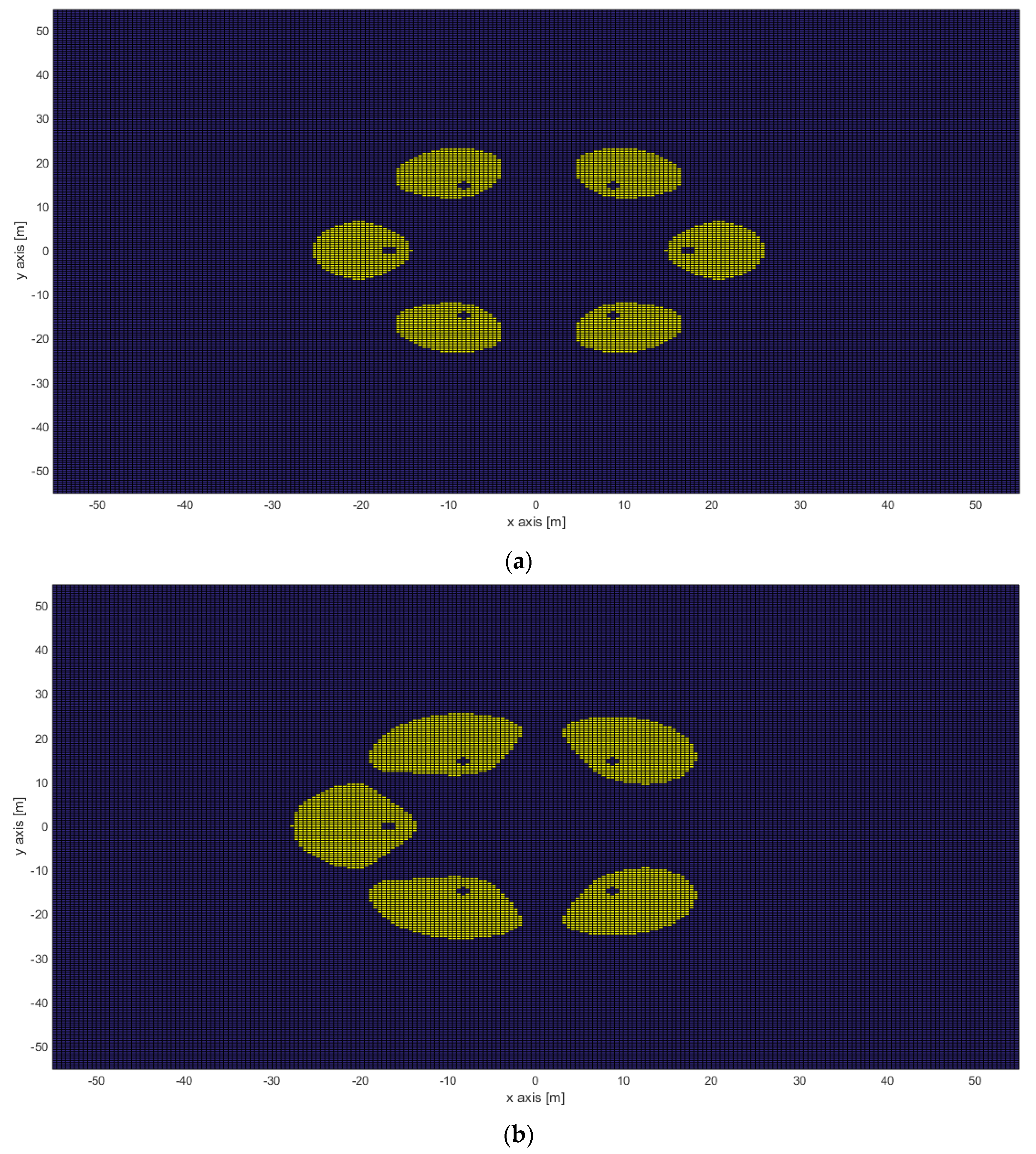
- In Figure 24, areas are observed between the electrode frames, where the electric field strength is significantly reduced below 2.5 V/m and in Figure 25 below 1.25 V/m. In the area of the frame that is set out of operation (case of Figure 24b and Figure 25b), it is below 2.5 V/m, i.e., there is no safety issue for the diver during their maintenance, but is above 1.25 V/m, reaching the value of 1.82 V/m.
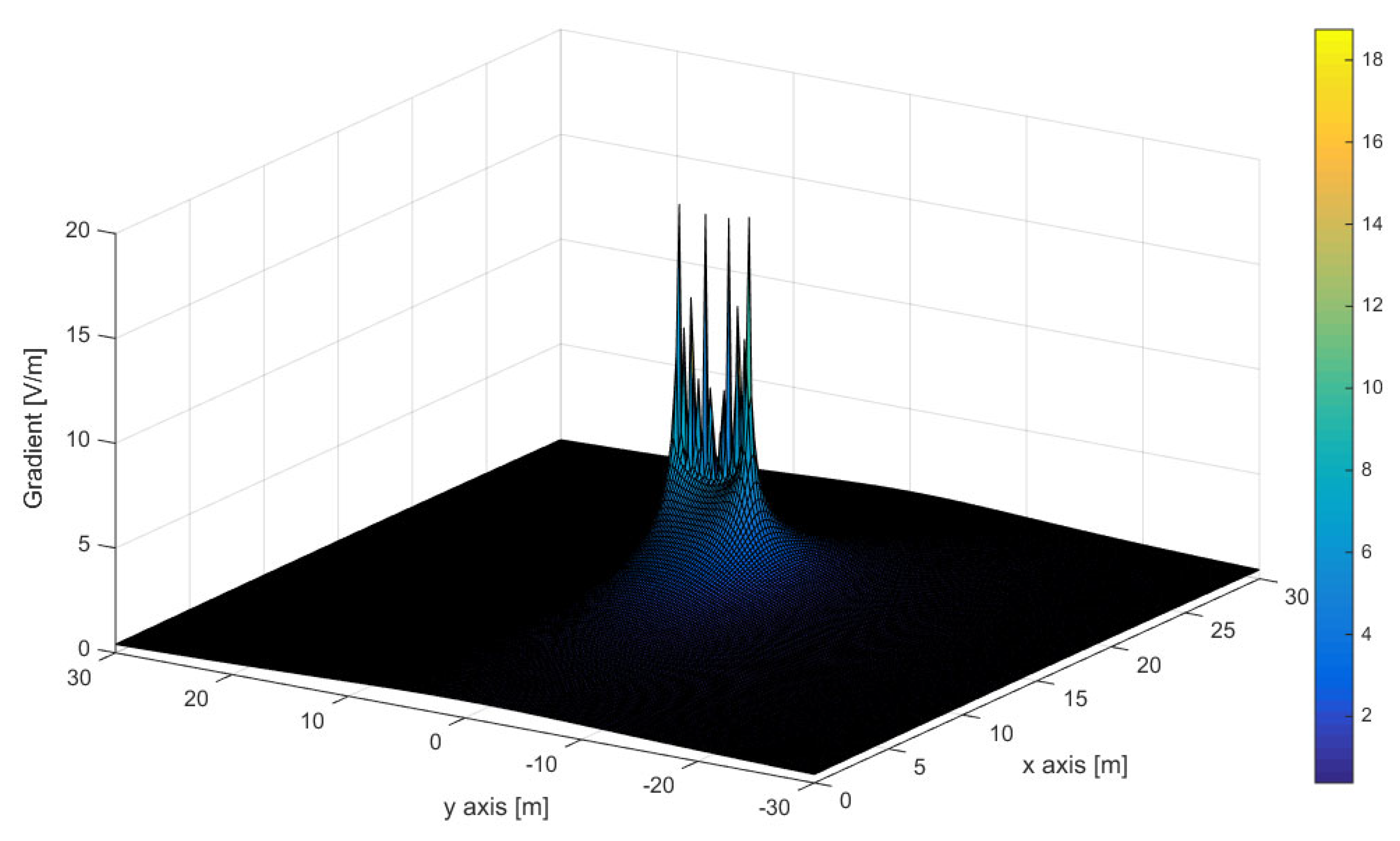
- From Figure 24 and Figure 25, it is observed that within the electrode station arrangement, there are areas with considerably reduced electric field strength values (below the limits of 2.5 or 1.25 V/m). This is due to the mutually cancelling electric fields of the diametrically opposite electrodes, both at the level of the arrangement of the six frames of the electrode station and at the level of the arrangement of electrodes within each frame, as is also clearly confirmed by Figure 19 for a single frame.
- The deviation in the maximum developing electric field strength of the electrode station compared to a single “birthday cake” frame (24.20 V/m against 22.73 V/m, according to Table 4) is of the order of 9.56%, which is moderate.
- The deviation in the maximum developing electric field strength of the electrode station compared to a single straight frame (24.20 V/m έναντι 24.06 V/m) is of the order of 0.57%, which is practically negligible and is better than all other cases for the Korakia area (Table 10 in ref. [36] and Table 5). The deviation in the maximum developing electric field strength of the electrode station compared to a single straight frame for the Stachtoroi area (24.20 V/m versus 17.96 V/m) is quite significant, of the order of 37.72%, which is greater than all other configurations (Table 11 of ref. [36] and Table 5).
- The developing maximum absolute potentials and the corresponding values of the electrode station resistance with respect to remote earth are considerably better (4.03 kV, 3.45 Ω) compared to the original structure (22.77 kV, 19.5 Ω according to Table 15 in ref. [4]) and all other modifications for the Korakia area according to Table 10 in ref. [36] and Table 5.
- The developing maximum absolute potentials and the corresponding values of the electrode station resistance with respect to remote earth are considerably better (4.16 kV, 3.56 Ω) compared to the original structure (17.30 kV, 14.82 Ω, according to Table 15 in ref. [4]) and all other modifications for the Stachtoroi area according to Table 11 in ref. [36] and Table 5.
- The reduction in the maximum value of the absolute potentials is due (beyond the symmetrical structure of the arrangement) to the use of a much smaller concrete “dam” thickness.
- The absolute potentials, which develop at the centre O of the perceived regular hexagon, take smaller absolute values than the corresponding maximum absolute potentials due to field interactions, where the larger values appear near the frames in operation.
- In Stachtoroi, the maximum value of the electric field strength increased compared to the classical designs, but due to symmetry, there are no pronounced changes in the absolute potential between the different loadings.
- The worst values of the electric field results in Stachtoroi, are due to the fact that there is no significant improvement in the angle, in terms of arc, of the “left” water dam zone in Figure 1 of ref. [36] (or Figure A1 of Appendix A) (in contrast to Korakia), while there is a significant reduction in the active length of the water layer zone (which is typically equal to the active length of the electrode). However, in the present case, it is extremely unfavourable because the respective frames will be found at a greater depth (than with all other modifications), with the consequence that the actual water zone is underdimensioned, which in the Stachtoroi area is at least three times larger in the shallows and ten times larger at the most remote base.
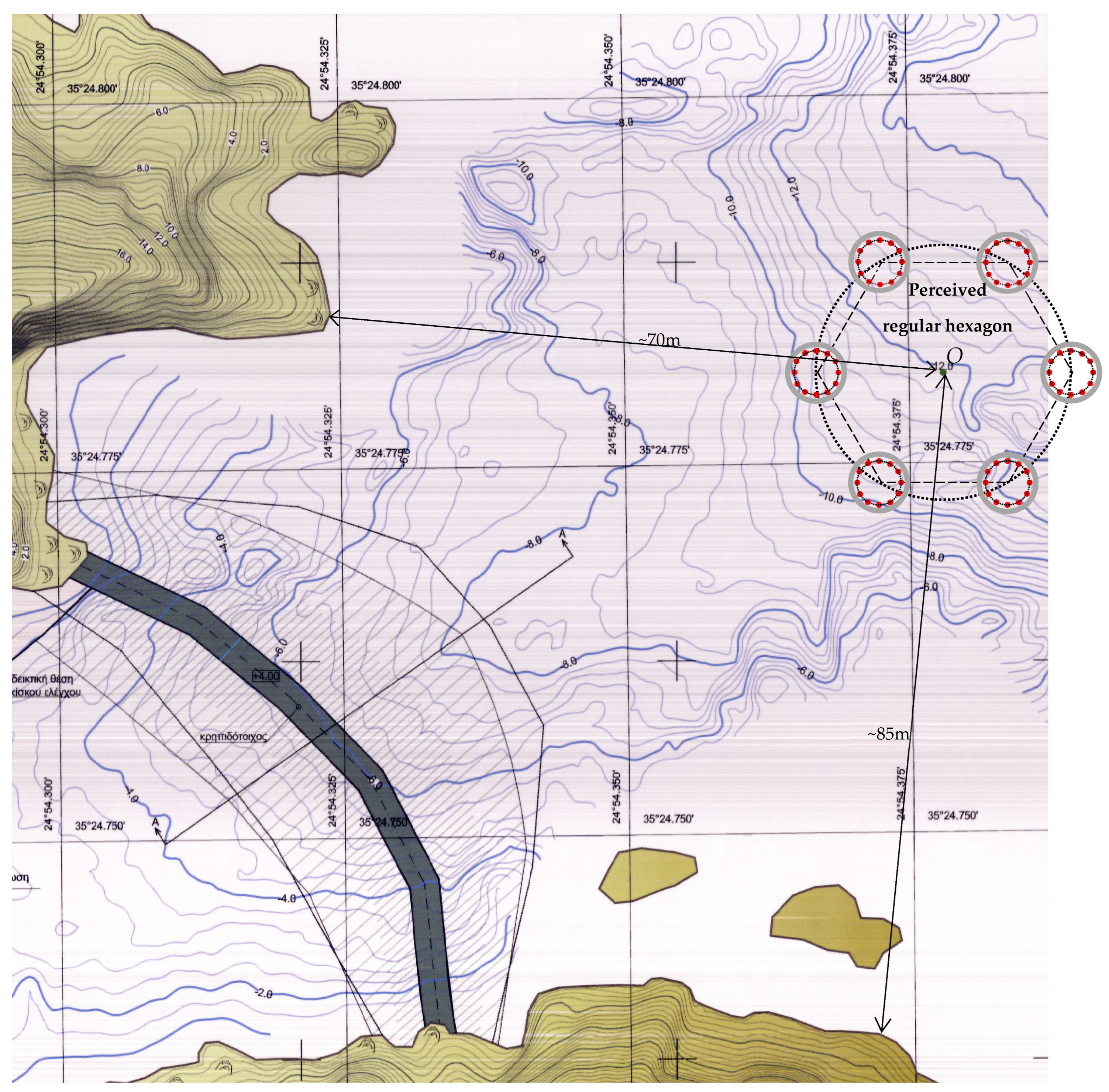
- For the Korakia area, by appropriately positioning the frames at an isobath of 10.0 m and above, as shown in Figure 26, it is ensured that the centre O of the electrode station is more than 70 m away from land, and with minimal dredging, the upper ends of the frames are at a depth of more than 7 m outside of breaking water.
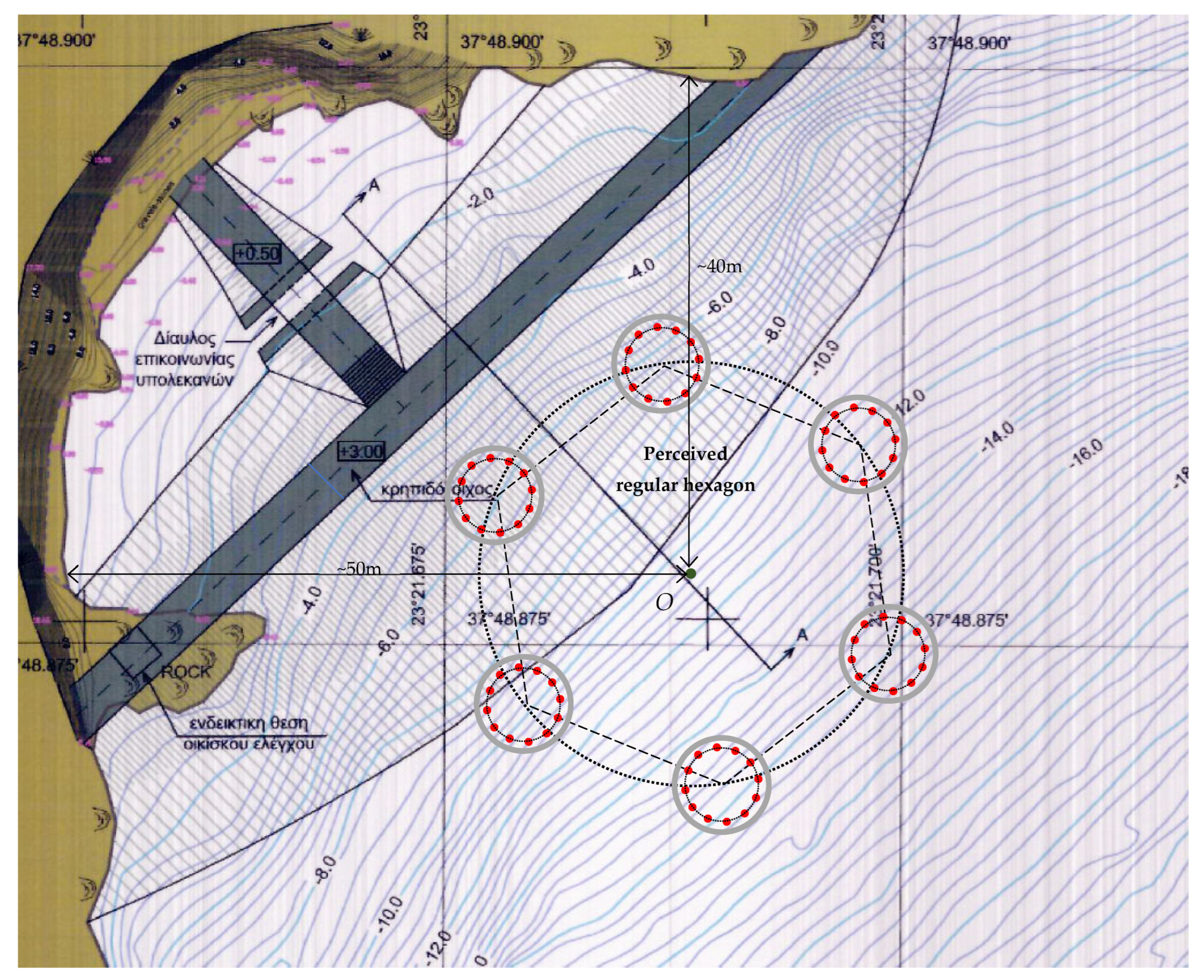
- For the Stachtoroi area, with the appropriate placement of the frames at isobaths of 5.0 m and above (as shown in Figure 27), it is ensured that the centre O of the electrode station is more than 40 m away from land and has minimal dredging, while the upper edges of the frames are at least at a depth of 2.2 m so that they never encounter breaking water.
- Spatially, it is found that the installation in Korakia is located much further from the coast, with the closest electrode bases being placed, on average, at isobaths of 10.4 m, while in Stachtoroi, the closest bases are located near the initial position of the dam placed on average at isobaths of 6.5 m. Correspondingly, the most remote bases in Korakia are placed at isobaths of 13.5 m, on average, compared to 16 m in Stachtoroi, which is due to the steep inclination of the seabed near the coast at Stachtoroi.
- The results of the field behaviour, in the case of non-operation of a frame, are completely similar due to the symmetry of the arrangement around the centre O. The respective results in dOx, dOx/, dOy and dOy/, would be the same with the appropriate rotation of the Cartesian coordinate system. The small numerical difference in the fourth significant digit in the magnitudes of the electric field strength is due to the equivalent quadratic study element of the phenomenon 0.05 m × 0.05 m.
- The radius of the critical zone from the centre of the electrode station reaches up to 51.68 m in all directions depending on how uneven the loading of the station is, which is practically the same as the results of the station with frames of 12 electrodes (a reduction of just under 1 mm). That is, there is no change in the boundaries of the radii of the zones where the electric field strength is significantly reduced below 2.5 V/m or below 1.25 V/m. This is due to the circular symmetry of the arrangement of the electrodes both at the frame level and, mainly, overall.
- The deviation of the maximum developing electric field strength of the electrode station compared to a single “birthday cake” frame (20.39 V/m against 18.92 V/m, according to Table 4) is of the order of 7.77%, which is moderate. With this arrangement, without increasing the dimensions of the structure, the field behaviour of the array was improved (for both Korakia and Stachtoroi) by increasing the number of electrode rods by 33%.
- The developing maximum absolute potentials and the corresponding values of the electrode station resistance, with respect to remote earth, are considerably better (3.02 kV, 2.59 Ω) compared to the 12-electrode structure (4.03 kV, 3.45 Ω according to Table 6) as well as to the original structure (22.77 kV, 19.5 Ω according to Table 15 in ref. [4]) and all other modifications for the Korakia area according to Table 10 in ref. [36] and Table 5.
- The developing maximum absolute potentials and the corresponding values of the electrode station resistance, with respect to remote earth, are considerably better (3.12 kV, 2.67 Ω) compared to the 12-electrode structure (4.16 kV, 3.56 Ω according to Table 6) and compared to the original structure (17.30 kV, 14.82 Ω according to Table 15 in ref. [4]) and all other modifications for the Stachtoroi area according to Table 11 in ref. [36] and Table 5.
- The worst-case scenario in terms of absolute potential and electrode station resistance to remote earth is calculated when the first frame is unloaded.
- A small decrease in the maximum value of the electric field strength;
- A significant decrease in the electric field strength in the area of the non-operating frame Eoff (falling below 1.25 V/m for RK4 = 25 m);
- A small increase in the radius of the zone (in the form of the distances |dOx/|, dOy, |dOy/|), within which the electric field strength is less than 1.25 V/m or 2.5 V/m;
- A significant decrease in the maximum value of the absolute potential, in the absolute potential at the centre O of the regular hexagon (at the vertices of which the electrode bases are placed) as well as in the electrode station resistance with respect to remote earth.
- A significant reduction in the maximum electric field strength value where, for Korakia, it is already lower compared to all modifications, while for Stachtoroi, for a length equal to 2.13 m, it falls lower compared to all configurations while it is slightly higher than the corresponding values of the perimetrical placement of bow frames around a circular central base (11th configuration in this paper), the perimetrical placement of straight frames around a central base (10th configuration in ref. [36]), and the placement of straight frames in a row perpendicular to the dam (second configuration in ref. [36]). For a larger L, the electric field decreases even further.
- A very significant reduction in the electric field strength in the area of the frame that does not operate (falling below 1.25 V/m for a zone length of 2.5 m).
- A reduction of the radius of the zone within which the electric field strength is less than 1.25 V/m or 2.5 V/m (with a greater rate of reduction for 1.25 V/m), achieving a radius of 41.74 m (for a zone length of 2.13 m), which is the respective water zone of all previous modifications, with the result that a smaller zone of influence is achieved for both Korakia (with a radius of the order of 56 m) and for Stachtoroi (with a radius of the order of 44 m).
- A significant reduction in the maximum value of the absolute potential, the absolute potential at the centre O of the regular hexagon (at the vertices of which the electrode bases are placed) and the electrode station resistance with respect to remote earth.
- The results of Table 9 are accurate for large values of water zone length L near the base but not inside the base, where the zone is actually limited to the actual length of the electrode. In addition, inside the base, there is no effect of its wall, leading to the uniformity of the electric field surrounding the base.
5. Discussion—Comparison of Different Frames and of Different Electrode Station Configurations
- The smallest value of distance dsc, which secures the diver from the critical zone, concerns the basic “birthday cake” frame, which presents a reduced value compared to the bow frame by 9.0% and compared to the straight frame by 9.75% for the case of Korakia. In contrast, for the case of Stachtoroi, the distance dsc of the bow frame presents a reduced value compared to the straight frame by 1.3% and compared to the “birthday cake” frame by 20.2%. This differentiation is due to the combination of the effects of the changes in the arc of the “left” water barrier zone of Figure 1 of ref. [36] (or Figure A1 of Appendix A) and the electric current of the frame. In particular, in the case of Korakia, the corresponding arc for the straight and bow frames is taken as 112° and for the “birthday cake” frame it is taken as 160°, i.e., it increases by 42.8%. In the case of Stachtoroi, the corresponding arc for the straight and bow frames is taken as 150° and for the “birthday cake” frame it is taken as 160°, i.e., the relative increase is considerably smaller by 6.7%. The electric current of the “birthday cake” has an 8.3% higher value compared to the other two frames. Based on Equations (4)–(9) in ref. [36] (or Equations (A4)–(A9) of Appendix A), the increase in the arc leads to a decrease in the electric field strength, in an inversely proportional manner, while the increase in the current leads to an increase in the electric field strength accordingly. This has the consequence that, in the case of Korakia, the large increase in the arc dominates over the increase in current, resulting in the “birthday cake” frame presenting better results, in contrast to the case of Stachtoroi.
- The smallest value of the area of the critical zone SC, with an electric field strength above 1.25 V/m, concerns the basic “birthday cake” frame, which, due to the symmetry of the arrangement with respect to two axes, presents a reduced value compared to the other two frames by 23% for the case of Korakia. In contrast, for the case of Stachtoroi, the area of the critical zone SC of the straight frame presents a reduced value compared to the “birthday cake” frame by 27.7%. The relative values between the straight and bow frames are identical. This behaviour is again due to the aforementioned interaction of the arc of the “left” water dam zone of Figure 1 in ref. [36] (or Figure A1 of Appendix A) and the electric current of the frame.
- The lowest value of the maximum electric field strength Emax concerns the bow frame, which presents a reduced value compared to the basic “birthday cake” frame by 0.5% and compared to the straight frame by 6.0% (for the case of Korakia) and by 24.86% and 4.9%, respectively, for the case of Stachtoroi. Here, in addition to the aforementioned interaction for the maximum value, the discretization grid of the study area near the electrodes also plays a part, which in the present simulation has been set at 0.05 m × 0.05 m.
- From the comparison between the “birthday cake” frames, there is a substantial improvement only in terms of the maximum electric field strength Emax, especially with the use of 16 electrodes in a circular arrangement, which however lags behind the bow frame and the straight frame of Stachtoroi. Nonetheless, the basic structure of Figure 13 is preferable for construction reasons because the frame of 16 electrodes in a circular arrangement requires electrodes with a base of synthetic material (untested solution) from Figure 14, while the frame of 16 electrodes in two circular arrangements from Figure 15 has much more limited room for repair with regard to the diver.
- No frame seems to clearly dominate over another except for the fact that the bow frame always gives slightly better results than the straight frame in terms of distance dsc and maximum electric field strength Emax.
- To sum up, the field behaviour of an individual frame is influenced by the number of electrodes per frame, Nel_frame, its basic dimension (frame length ℓf or frame radius Rf and other dimensioning features), and the location of the frame relative to the shore assuming that the electrode type and the loading electric current of each frame at a steady state under maintenance conditions are the same. Because the parameters interact, e.g., placing more electrodes reduces the electric current per electrode but increases their density, there is no clear mechanism for controlling the effect on the electric field strength.
- The width dOx of the critical zone of the electrode station (along the Ox semi-axis from the beginning of the axes), the width dOx/ (along the Ox/ semi-axis), the length dOy (along the Oy semi-axis), and the length dOy/ (along the Oy/ semi-axis) for an electric field strength limit above 1.25 V/m;
- The indicative equivalent area of the zone of influence SC (calculated through Equation (40) in ref. [36]);
- The maximum electric field strength Eoff (within the area of the frame that is out of operation);
- The maximum electric field strength of the arrangement Emax;
- The maximum absolute potential Vrel_max;
- The electrode-station-to-remote-earth resistance Rel.
- Based on all quantitative criteria, the 12th configuration using a 12-electrode “birthday cake” frames of a circular arrangement of radius Rf = 1.000 m placed at the vertices of a regular hexagon inscribed in a circle of radius RK4 = 17.0 m, with an electrode length taken at L = 2.13 m, is advantageous over all other configurations.
- If the electrode length is limited to L = 1.70 m (which is excessively strict), then the 12th configuration remains superior in all parameters except for widths dOx and dOx/, where it is proven inferior to the seventh and first configurations by a few meters but with no significant consequence. For example, in the 12th configuration, there is no dam, and the placement of the bases is done in the sea, as shown in Figure 26.
- The 12th configuration using 12 electrode “birthday cake” frames in a circular arrangement of radius Rf4 = 1.000 m placed at the vertices of a regular hexagon inscribed in a circle of radius RK4 = 17.0 m with an electrode length of L = 2.13 m is generally advantageous over all other configurations except for widths dOx and dOx/. There, it is proven inferior to the seventh and first configurations but with no significant consequence, since, in the 12th configuration, there is no dam and the placement of the bases is done in the sea, as shown in Figure 27. Furthermore, it is disadvantageous compared to the second configuration in ref. [36] (placement of straight frames in a row perpendicular to the dam), the 10th configuration in ref. [36] (perimetric placement of straight frames around a central base), and the 11th configuration (bow frames on a circular central base) in terms of the maximum electric field strength of the arrangement Emax by 0.25, 0.56 and 0.62 V/m, respectively (i.e., there is a small variation). In contrast, regarding other criteria, such as the maximum absolute potential Vrel_max and the electrode-station-to-remote-earth resistance Rel, it has an overwhelming advantage, achieving values that are half as high as the next best configuration (in this case, configuration 9).
- If the electrode length is limited to L = 1.70 m (which is quite strict), then the 12th configuration is superior only in the maximum electric field strength Eoff (within the area of the frame that is out of operation), maximum absolute potential Vrel_max and the electrode-station-to-remote-earth resistance Rel. Furthermore, the fifth configuration is advantageous over the lengths dOy and dOy/ and the indicative equivalent area of the zone of influence SC.
- A corresponding preliminary study and determination of the most suitable arrangement per electrode station location area (in this paper, based on electric field criteria) is required.
6. Conclusions
- Bow frames adapted perimetrically to a central circular base in open sea (11th configuration);
- “Birthday cake” frames (with the electrodes in a circular arrangement) placed at the vertices of a regular polygon inscribed in a circle in the open sea as an underwater structure (12th configuration).
Author Contributions
Funding
Institutional Review Board Statement
Informed Consent Statement
Data Availability Statement
Acknowledgments
Conflicts of Interest
Appendix A. Analytical Methodology for the Calculation of Electric Field Strength
- Determination of the minimum number of electrodes and layout configuration: The minimum number of necessary electrodes Nmin_el is determined based on the maximum nominal current Itot flowing through the electrode station as follows:where Jel is the electric current density limit per electrode, and Sp_el the area of the peripheral surface of the electrode. Let it be noted that the limits within which the electric current density will range are dependent upon the model and mode of operation, that is, steady operation (conditions of a duration equal to or higher than 10 s) and transient (durations shorter than 10 s are considered as such, for example, faults and brief overloads). Indicatively, the CIGRE B4.61 675:2017 ([1], Section 5.1.3.5) and IEC TS 62344:2013 ([12], Section 6.1.6) guidelines suggest that the electric current density be kept within the frame of 6 to 10 A/m2 with regard to sea, beach and pond electrodes so as to curtail chorine selectivity for parts in contact with the seawater. Moreover, the electric field strength in the vicinity is to be less than 1.25–2 V/m. Nonetheless, current densities are allowed to reach values up to 100 A/m2 when the electrodes are safely out of reach of persons and animals. Of course, the manufacturer’s guidelines must be taken into consideration [41] along with the type of operation [42].In the case of configuring Nframe frames with an equal number of electrodes per frame Nel_frame, Nel_frame is equal to the quotient of the total minimum number of necessary electrodes Nmin_el to the number of frames Nframe. If for reasons of reliability and maintenance an additional frame is necessary, a total of Nframe/ = (Nframe + 1) is placed. In addition, due to the linear arrangement of the electrodes in the frame, the electric current distribution is not uniform, as has been established in refs. [16,17], so an incremental correction factor β of the electric current density was taken into account during the pre-study stage (in this case equal to 6%) [4,36]. Therefore, the current densities in full load Jfu_lo and maintenance conditions Jmt are calculated as follows:In place of the Itot current, the current intensity of either the steady or the transient state can be placed, and the corresponding electric current densities of the electrodes can be obtained.
- Calculation of electric field strength per electrode: The determination is made by combining two models proposed in refs. [4,36]. In particular, for the near-field, a linear current source is considered (method “C” in ref. [4]). Figure A1 presents a simplified structure, taking into account a zone for the effective height L in cylindrical coordinates. On the “left” part, the electrode is positioned at a distance dr1 from the dam, while the depth of the dam is td. Hence, the exterior radius of the dam is dr2 = dr1 + td. On the “right” part, the electrode is at a distance dr3 from the soil, provided that the respective depth is ensured. The angle formed with the ground plane is θg.

- The electromagnetic field theory requires the continuity of the tangential electric field strength as well as of the vertical current density on the dividing surfaces.
- The non-radial currents on the surfaces r = dr1, r = dr1 & r = dr3 have been ignored.
- The infinite layer of seawater—dam—soil has a constant active thickness L, while in reality it grows significantly; e.g., at short distances it has a thickness of the order of meters, as much as the height of the electrode, while at long distances it is tens or hundreds of meters (making it too conservative and unsuitable for the far field).
- The seawater resistivity ρw, dam resistivity ρd and soil resistivity ρs are considered constant, while in reality they change (especially that of the soil). If the most unfavourable values are taken (e.g., considering the ground resistivity as infinite), the most conservative result is obtained.
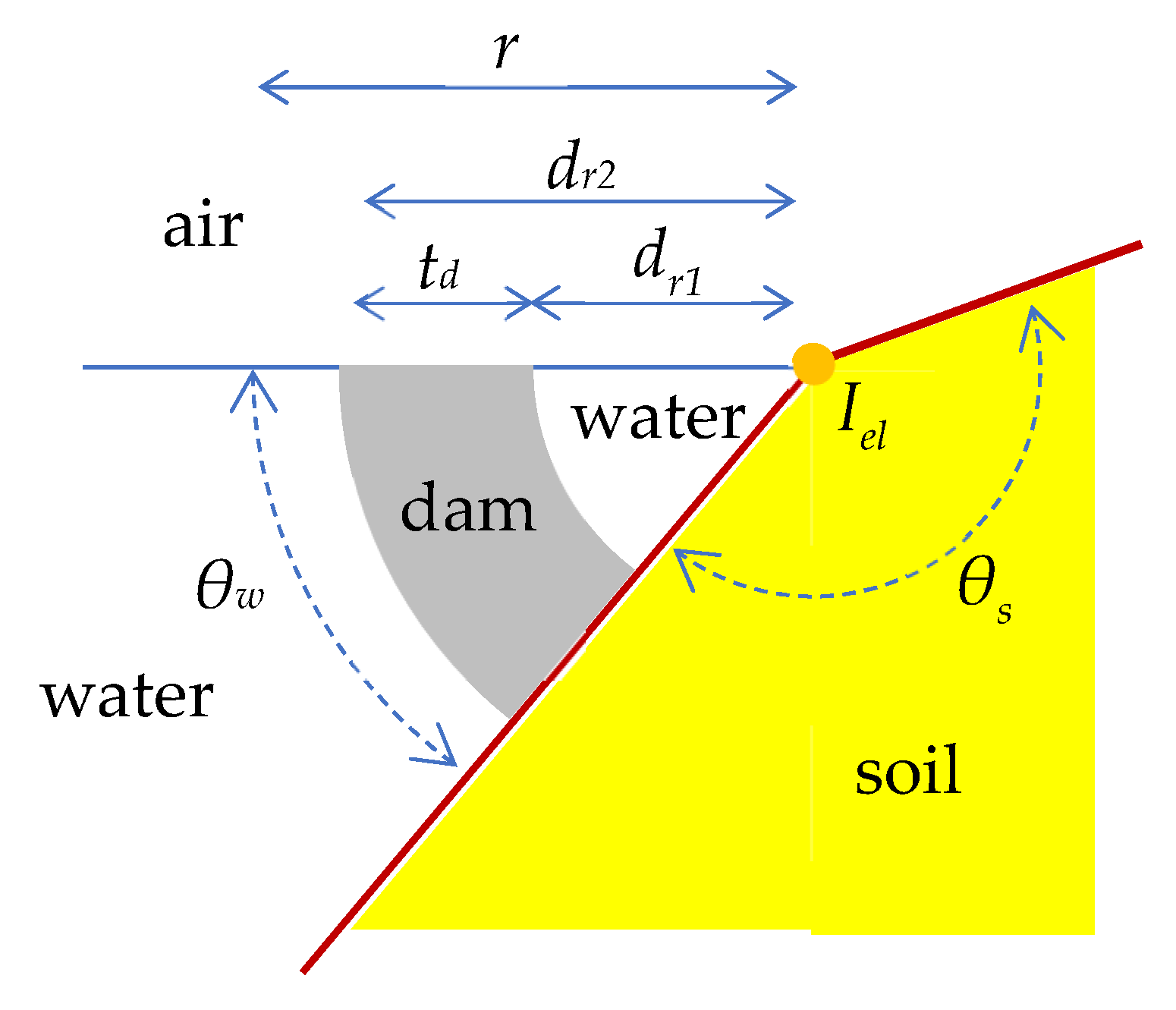
- The materials of soil, dam and seawater segments do not form uniform surfaces; their shape varies in different directions, as shown in Figure 1. However, it is a quite satisfactory approach.From the respective solution in cylindrical coordinates, as presented in detail in Section 2.3 of ref. [4], the radial components of the electric field strength in the ground Εrs, in the dam Εrd, in the water in general Εrw, and in the water in the “left” Εrw_l or in the “right” Εrw_r are derived given the total electrode current Iel, as follows:For the far field, a point current source is considered (method “B” of ref. [4], which is identical to “A” outside the dam). Practically unifying the considerations of CIGRE B4.61 675: 2017 ([1], Section 5.5.3.1 and Figure 5.35]) and IEC TS 62344: 2013 ([12], Section 6.1 and Figure 5]), the dam was added according to Figure A2, where an electrode is placed on the shore (or on the seabed in shallow waters),at the centre of the coast. The bottom of the sea is considered to be inclined with respect to the horizon, forming an angle θw. The electrode is at a distance dr1 from the dam, while the depth of the dam is td. Therefore, the exterior radius of the dam is dr2 = dr1 + td, as in the near-field calculation method. The ground has an angle θs, while the remainder is occupied by air. In addition to assumptions 1, 2, and 4, the following are also made:
- The soil does not form a wedge, and the water is also not a uniform wedge, with its shape varying in different directions. Nonetheless, this approach is better than those of IEC TS 62344: 2013 and CIGRE B4.61 675: 2017.
- The electrodes are situated in areas that are protected, such as a shore or a cave, while the exposed side of the sea is limited to an angle φ (rad) smaller than π rad. The analysis can be improved using the multiplier π/φ to the calculated distance of the remote earth.
- The actual inclination varies, both axially and radially. The analysis can be made, on the safe side, by considering different inclinations of seabed or considering always the worst-case scenario, e.g., assuming the average inclination not as the initial inclination from the coast but as the distance of interest, which is usually relatively small.From the respective solution in spherical coordinates, as presented in detail in Section 2.2 of ref. [4], the radial components of the electric field strength in the soil Εrs/, in the dam Εrd/, and in the water Εrw/, given the total electrode current intensity Iel, are derived as follows:At the points where the electric field intensities from the two models are numerically identical, going from the smaller to the greater distances, the transition from the line source model to the point source is made (which usually happens on the outer side of the dam). This is because at close range, the electric field strength, on the part of the electrode, is better described by the linear current source, while at far range, the water wedge of constant inclination better describes the physical model compared to a very limited water zone, which ignores the volume of water to the bottom, which may extend to great depths.

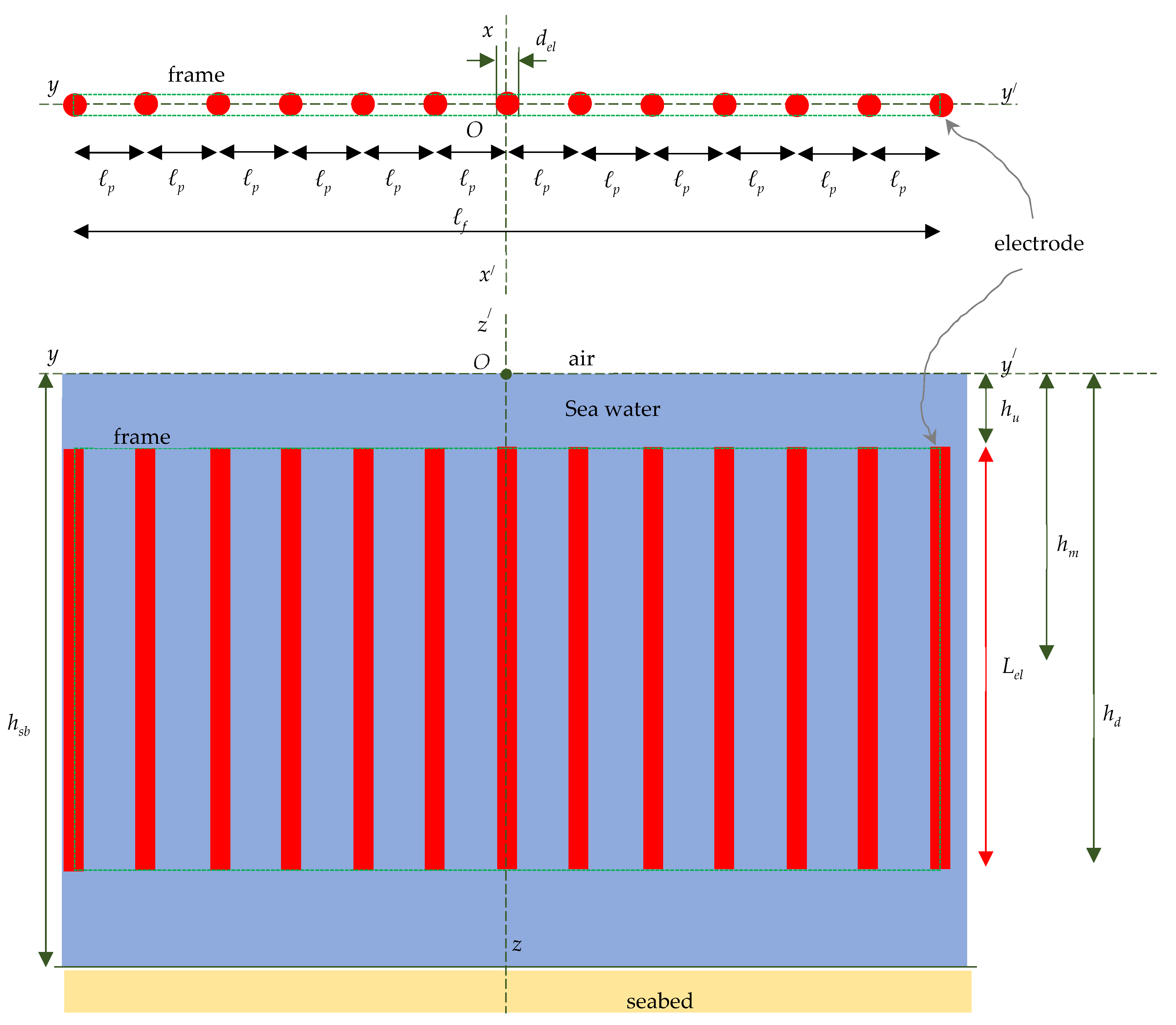
- Configuration of electrode frames: First, the electrodes are placed at suitable distances forming a frame, and each frame is made up of a number of electrodes Nel_frame with a diameter equal to del (twice the radius rel) in a suitable formation, one after the other, at a distance ℓp (measuring from each bar centre), as already shown in Figure 1.
- Formation of an electrode station of frames: The electrode frames are placed in appropriate positions, forming the electrode station. The critical zone is then determined (whether it concerns a single frame or the electrode station) based on the permissible upper limits of the electric field strength in relation to the most unfavourable developing electric field strength as determined by the interaction of all the electrodes for any operating scenario. Specifically, the typical length of the electrode station ℓstat and the surface Scr that can be exposed to critical electric field values (not necessarily all at the same time) are calculated.
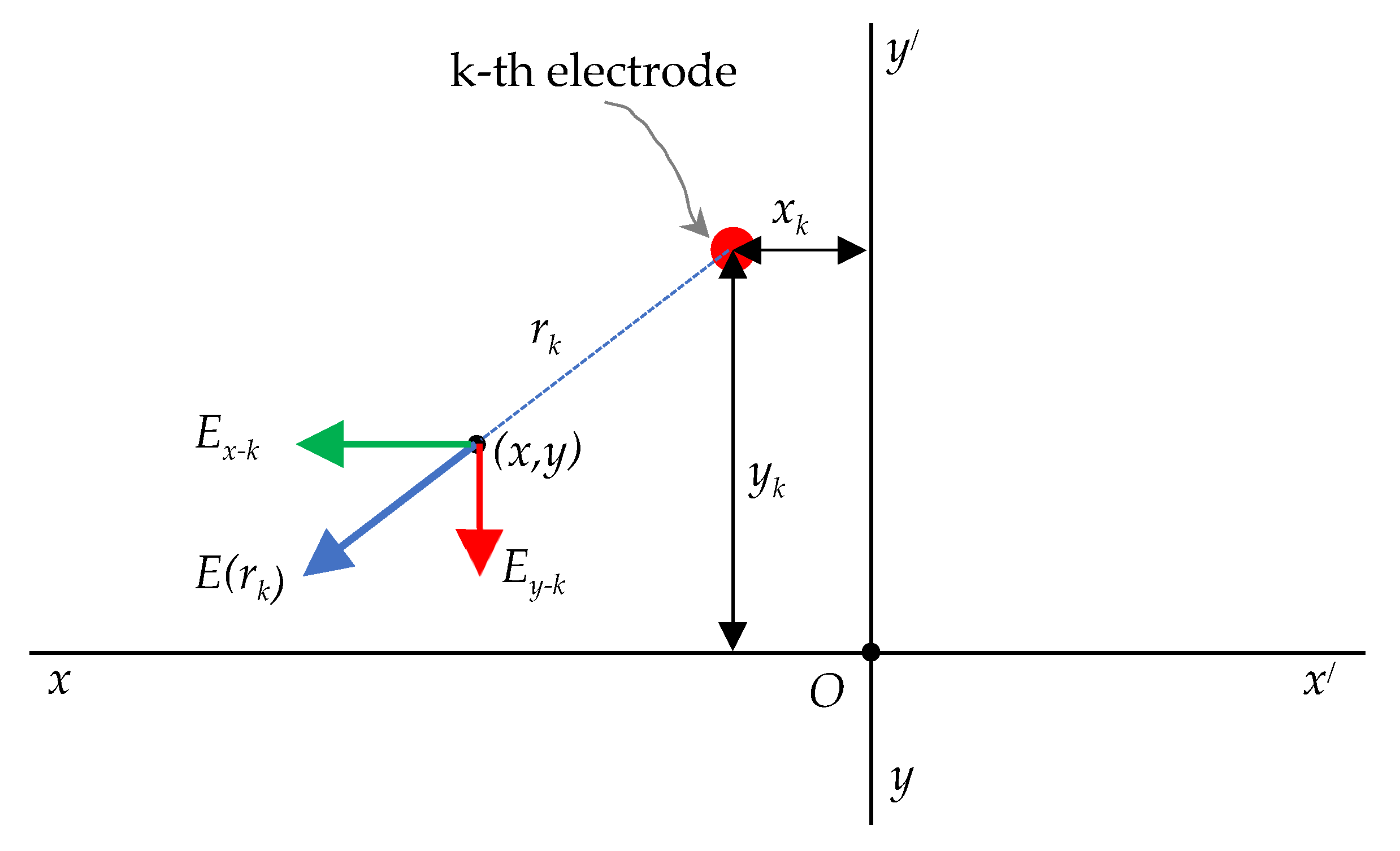
- Calculation of the electrode station electric field strength: Initially, the area of concern is the water surface, which is arranged in a suitable canvas of two-dimensional Cartesian coordinates, upon which the electrode is set in a particular position. Upon this canvas of steps dstep_x and dstep_y, the electric field strength is measured. Practically, Figure 2 and Figure 3 include the entire respective area, extending on the Ox semi-axis up to 150 km and on the yOy’ axis up to a few km. The aforementioned steps are not constant but vary, since the canvas grows gradually sparser while moving away from the electrode. The calculation of the radial electric field strength Er is then determined by employing the applied method. In this, the corresponding electrode is used as a point of reference, and the electric current is the product of the electric current density Jfu_lo or Jmt and the respective peripheral surface of the electrode Sp_el. The electric field strength of the k-th electrode is analysed into its components Εx-k and Εy-k, on xOx’ and yOy’ axes (as in Figure A3), utilising the coordinates (xk, yk) of the electrode (x,y) of the point of interest (canvas points) and the corresponding distance rk:

- Through superposition, the electric field strengths of each single electrode are added up on the axes xOx’ and yOy’, as follows:
- The calculation of the absolute electric potential is done numerically along the main directions xOx’ and yOy’ at various points of the canvas with respect to either “infinity”:
- Similarly, from the respective potential difference for specific lengths, the respective average electric field strength values are calculated:
- Determination of areas ensuring electric field strength and voltage limits according to IEC TS 62544:2013 and CIGRE B4.61 675:2017: In order for the operating conditions of the electrode station to be safe—under any operating conditions—whether it concerns the specialized maintenance staff or people and living beings in the areas of direct access, limits have been set for the electric field strength, touch voltage, step voltage, metal-to-metal touch voltage and absolute voltage with respect to remote earth. In particular, taking the most unfavourable limits from the general guidelines of IEC TS 62544:2013 [12] (p.32) and CIGRE B4.61 675:2017 [1] (p.65) as well as recommendations about the pipe-to-soil potential difference based on the applied provisions of cathodic protection [43], the necessary conditions that must be met (as they are also summarized in §2.5. of ref. [4]) are:
- Electric field strength (potential gradient) for continuous operating conditions in water should be smaller than or equal to 1.25 V/m (for marine mammals—while it could be up to 2.5 V/m when concerning humans).
- Electric field strength (potential gradient) for transient operating conditions in water should be smaller than or equal to 15 V/m.
- Potential difference between metal equipment and soil for continuous operating conditions should be smaller than or equal to 4 V. Practically, on the safe side, it could be taken as the corresponding limit for the absolute potential with respect to remote earth.
- Metal-to-metal touch voltage, touch voltage and step voltage for continuous operating conditions should be smaller than or equal to 5 V.
- Metal-to-metal touch voltage, touch voltage and step voltage for transient operating conditions should be smaller than or equal to 30 V.Conditions (4) and (5) concern the area controlled exclusively by the IPTO; therefore, conditions (1) to (3) need to be checked when designing the electrode stations.
References
- CIGRE Working Group B4.61. General Guidelines for HVDC Electrode Design, 1st ed.; CIGRE: Paris, France, 2017; Volume 675, pp. 1–150. [Google Scholar]
- Independent Power Transmission Generator S.A. Technical Description for Shoreline Electrodes for HVDC Link Attica-Creta, 3rd ed.; IPTO S.A.: Athens, Greece, 2018; pp. 1–5.
- Bouzid, M.A.; Flazi, S.; Stambouli, A.B. A cost comparison of metallic and earth return path for HVDC transmission System case study: Connection Algeria-Europe. Electr. Power Syst. Res. 2019, 171, 15–25. [Google Scholar] [CrossRef]
- Tsekouras, G.J.; Kontargyri, V.T.; Prousalidis, J.M.; Kanellos, F.D.; Tsirekis, C.D.; Leontaritis, K.; Alexandris, J.C.; Deligianni, P.M.; Kontaxis, P.A.; Moronis, A.X. Alternative Simplified Analytical Models for the Electric Field, in Shoreline Pond Electrode Preliminary Design, in the Case of HVDC Transmission Systems. Energies 2022, 15, 6493. [Google Scholar] [CrossRef]
- Brignone, M.; Mestriner, D.; Nervi, M. HVDC Sea Electrodes: On the Choice of the Right Site. In Proceedings of the 24th EEEIC International Conference on Environment and Electrical Engineering and 8th I and CPS Industrial and Commercial Power Systems Europe, EEEIC/I and CPS Europe 2024, Rome, Italy, 17–20 June 2024; no. paper 204283, p. 6. [Google Scholar]
- Meng, X.; Zhang, B.; Cao, F.; Liao, Y. Effectiveness of Measures on Natural Gas Pipelines for Mitigating the Influence of DC Ground Current. IEEE Trans. Power Deliv. 2024, 39, 2414–2423. [Google Scholar] [CrossRef]
- Brignone, M.; Mestriner, D.; Nervi, M. HVDC Sea Return Electrodes and Oil/Gas Infrastructures: Technical Challenges and Their Effective Mitigations. In Proceedings of the 2023 AEIT HVDC International Conference, Rome, Italy, 25–26 May 2023; no. paper 190832, p. 6. [Google Scholar]
- Charalambous, C.A.; Nikolaidis, A.I. Complete Method to Access the DC Corrosion Impact on Pipeline Systems During the Planning and Approval Stages of HVDC Systems with Earth Current Return. IEEE Access 2022, 10, 127550–127562. [Google Scholar] [CrossRef]
- Charalambous, C.A. Interference Activity on Pipeline Systems From VSC-Based HVDC Cable Networks with Earth/Sea Return: An Insightful Review. IEEE Trans. Power Deliv. 2021, 36, 1531–1541. [Google Scholar] [CrossRef]
- Charalambous, C.A.; Dimitriou, A.; Gonos, I.F.; Papadopoulos, T.A. Modeling and Assessment of Short-Term Electromagnetic Interference on a Railway System From Pole-to-Ground Faults on VSC-HVDC Cable Networks With Sea Electrodes. IEEE Trans. Ind. Appl. 2021, 57, 121–129. [Google Scholar] [CrossRef]
- Brignone, M.; Mestriner, D.; Molfino, P.; Nervi, M.; Marzinotto, M.; Patti, S. The Mitigation of Interference on Underground Power Lines Caused by the HVDC Electrode. Energies 2023, 16, 7769. [Google Scholar] [CrossRef]
- IEC Technical Commitee. TC115—High Voltage Direct Current (HVDC) transmission for DC voltages above 100 kV. Design of Earth Electrode Stations for High-Voltage Direct Current (HVDC) Links—General Guidelines, 1.0st ed.; IEC: Geneva, Switzerland, 2013; pp. 1–89. [Google Scholar]
- EPRI. HVDC Ground Electrode Overview, 1.0st ed.; EPRI: Palo Alto, CA, USA, 2010; p. 66. [Google Scholar]
- Sutton, S.J.; Swingler, S.J.; Lewin, P.L. HVDC Subsea Cable Electrical Return Path Schemes: Use of Sea Electrodes and Analysis of Environmental Impact, 1.1st ed.; HubNet: Southampton, UK, 2016; pp. 1–51. [Google Scholar]
- Hatch-Statnett. Newfoundland and Labrador Hydro—Lower Churchill Project—DC1110 Electrode Review—Gull Island & Soldiers Pond, 1.1st ed.; Hatch-Statnett: St. John’s, NL, Canada, 2008; Muskrat Falls Project—CE-09 Rev.1; p. 73. [Google Scholar]
- Hatch. Nalcor Energy—Lower Churchill Project—DC1250 Electrode Review Types and Locations, 1st ed.; Hatch: St. John’s, NL, Canada, 2010; Muskrat Falls Project—CE-11; p. 277. [Google Scholar]
- Hatch. Nalcor Energy—Lower Churchill Project—DC1500 Electrode Review Confirmation of Types and Site Locations, 1.1st ed.; Hatch: St. John’s, NL, Canada, 2010; Muskrat Falls Project—CE-12 Rev.1; p. 319. [Google Scholar]
- Hajiaboli, A.; Fortin, S.; Dawalibi, F.P. Numerical techniques for the analysis of HVDC sea electrodes. IEEE Trans. Ind. Appl. 2015, 51, 5175–5181. [Google Scholar] [CrossRef]
- Freschi, F.; Mitolo, M.; Tartaglia, M. An effective semianalytical method for simulating grounding grids. IEEE Trans. Ind. Appl. 2013, 49, 256–263. [Google Scholar] [CrossRef]
- Pompili, M.; Cauzillo, B.A.; Calcara, L.; Codino, A.; Sangiovanni, S. Steel reinforced concrete electrodes for HVDC submarine cables. Electr. Power Syst. Res. 2018, 163, 524–531. [Google Scholar] [CrossRef]
- Marzinotto, M.; Molfino, P.; Nervi, M. On the Measurement of Fields produced by Sea Return Electrodes for HVDC Transmission. In Proceedings of the 2020 International Symposium on Electromagnetic Compatibility—EMC EUROPE, Rome, Italy, 23–25 September 2020; pp. 1–6. [Google Scholar]
- Xu, X.; Li, Y.; Yang, S. A Coupled FEM-BEM Methodology to Calculate 3-D Earth Surface Potentials Caused by HVDC Return Currents. IEEE Trans. Magn. 2024, 60, 7400604. [Google Scholar] [CrossRef]
- Ma, J.; Dawalibi, F.P. Analysis of grounding systems in soils with finite volumes of different resistivities. IEEE Trans. Power Deliv. 2002, 17, 596–602. [Google Scholar] [CrossRef]
- Hajiaboli, A.; Fortin, S.; Dawalibi, F.P.; Zhao, P.; Ngoly, A. Analysis of grounding systems in the vicinity of hemi-spheroidal heterogeneities. IEEE Trans. Ind. Appl. 2015, 51, 5070–5077. [Google Scholar] [CrossRef]
- Brignone, M.; Karimi Qombovani, A.; Molfino, P.; Nervi, M. An algorithm for the semianalytical computation of fields emitted in layered ground by HVDC electrodes. In Proceedings of the 19th Edition of the Power Systems Computation Conference-PSCC 2016, Genova, Italy, 20–24 June 2016; pp. 1–5. [Google Scholar]
- Liu, X.; Deng, C.; Han, X.; Zhong, S.; Liu, J. Using a mixed layered soil model to optimize the layout of coastal direct current (DC) grounding electrodes. Appl. Math. Nonlinear Sci. 2024, 9, 20230229. [Google Scholar] [CrossRef]
- Thunehed, H.; GeoVista, A.B. Compilation and Evaluation Earth Current Measurements in the Forsmark Area, 1.1st ed.; Svensk Karnbranslehantering AB: Stockholm, Sweden, 2017; R-14-34; p. 46. [Google Scholar]
- Manglik, A.; Verma, S.K.; Muralidharan, D.; Sasmal, R.P. Electrical and electromagnetic investigations for HVDC ground electrode site in India. Phys. Chem. Earth 2011, 36, 1405–1411. [Google Scholar] [CrossRef]
- Da Fonseca Freire, P.E.; Pereira, S.Y.; Padilha, A.L. Adjustment of the Geoelectric Model for a Ground Electrode Design—The case of the Rio Madeira HVDC Transmission System, Brazil. Sci. Eng. 2021, 20, 137–151. [Google Scholar]
- Rusck, S. HVDC power transmission: Problems relating to earth return. Direct Curr. 1962, 11, 290–300. [Google Scholar]
- Kimbark, E.W. Direct Current Transmission, 1st ed.; Wiley Interscience: New York, NY, USA, 1971; pp. 1–496. [Google Scholar]
- Kovarsky, D.; Pinto, L.J.; Caroli, C.E.; Santos, N. Soil surface potentials induced by Itaipu HVDC ground return current. I. Theoretical evaluation. IEEE Trans. Power Deliv. 1988, 3, 1204–1210. [Google Scholar] [CrossRef]
- Marzinotto, M.; Mazzanti, G.; Nervi, M. Ground/sea return with electrode systems for HVDC transmission. Int. J. Electr. Power Energy Syst. 2018, 100, 222–230. [Google Scholar] [CrossRef]
- Girdinio, P.; Molfino, P.; Nervi, M.; Rossi, M.; Bertani, A.; Malgarotti, S. Technical and compatibility issues in the design of HVDC sea electrodes. In Proceedings of the International Symposium on Electromagnetic Compatibility—EMC EUROPE, Rome, Italy, 17–21 September 2012; pp. 1–5. [Google Scholar]
- Uhlmann, E. Power Transmission by Direct Current, 1st ed.; Springer-Verlag: New York, NY, USA, 1975; pp. 1–389. [Google Scholar]
- Kontargyri, V.T.; Tsekouras, G.J.; Prousalidis, J.M.; Tsirekis, C.D.; Leontaritis, K.; Alexandris, J.C.; Kanellos, F.D.; Deligianni, P.M.; Kontaxis, P.A.; Moronis, A.X. Comparison of Different Configurations for Shoreline Pond Electrode Station for HVDC Transmission Systems—Part I: Electric Field Study for Frames of Linear Electrode Arrangement Based on a Simplified Analytical Model. Appl. Sci. 2023, 13, 7136. [Google Scholar] [CrossRef]
- Liu, Q.; Li, L.; Zheng, J.; Guan, Z. Research on Potential Distributions of Soil Surface Caused by Ground Electrode of HVDC System in Heterogeneous Soil Structure. In Proceedings of the 2007 IEEE Power Engineering Society General Meeting, Tampa, FL, USA, 24–28 June 2007; pp. 1–4. [Google Scholar]
- Sutton, S.J.; Lewin, P.L.; Swingler, S.G. Review of global HVDC subsea cable projects and the application of sea electrodes. Electr. Power Energy Syst. 2017, 87, 121–135. [Google Scholar] [CrossRef]
- Molfino, P.; Nervi, M.; Rossi, M.; Malgarotti, S.; Odasso, A. Concept Design and Development of a Module for the Construction of Reversible HVDC Submarine Deep-Water Sea Electrodes. IEEE Trans. Power Deliv. 2017, 32, 1682–1687. [Google Scholar] [CrossRef]
- Brignone, M.; Marzinotto, M.; Mestriner, D.; Nervi, M.; Molfino, P. An Overview on Reversible Sea Return Electrodes for HVDC Links. Energies 2023, 16, 5349. [Google Scholar] [CrossRef]
- Datasheet ANOTEC. High Silicon Iron Tubular Anodes Centertec Z-Series; ANOTEC: Langley, BC, Canada, 2006; Bulletin 04-14/06.02.28. [Google Scholar]
- CIGRE Working Group B1.10. Update of Service Experience of HV Underground and Submarine Cable Systems, 1st ed.; CIGRE: Paris, France, 2009; Volume 379, pp. 1–86. [Google Scholar]
- Freire, P.E.; Fihlo, J.N.; Nicola, G.L.; Borin, P.O.; Perfeito, M.D.; Bartelotti, M.; Estrella, M.; Pereira, S.Y. Electrical interference of the Bipole I Ground Electrode from Rio Madeira HVDC Transmission System on the Bolivia-Brazil gas pipeline—Preliminary calculations and field measurements. In Proceedings of the 19th Edition of the Power Systems Computation Conference-PSCC 2016, Rio de Janeiro, Brazil, 22–24 September 2015; pp. 1–8. [Google Scholar]











| RK3 [m] | θel (°) | θframe (°) | ℓf [m] | ℓpw [m] | ℓbc [m] | Emax [V/m] | dfv-in ref. [m] | dfv-out [m] | sc [m] | ℓκ [m] | Sc [m2] | Equation (13) |
|---|---|---|---|---|---|---|---|---|---|---|---|---|
| Point | - | - | - | - | - | 229.82 | 11.215 | 22.430 | 22.430 | 503.12 | - | |
| 15 | 1.91 | 22.92 | 5.960 | 0.299 | 9.539 | 24.224 | 10.715 | 10.796 | 8.542 | 23.044 | 394.808 | No |
| 16 | 1.79 | 21.49 | 5.965 | 0.280 | 10.554 | 23.080 | 10.726 | 10.803 | 8.539 | 23.044 | 394.875 | No |
| 17 | 1.69 | 20.22 | 5.969 | 0.264 | 11.567 | 22.624 | 10.736 | 10.808 | 8.538 | 23.045 | 394.880 | Yes |
| 18 | 1.59 | 19.10 | 5.972 | 0.249 | 12.578 | 24.268 | 10.745 | 10.813 | 8.537 | 23.046 | 394.893 | Yes |
| 19 | 1.51 | 18.09 | 5.975 | 0.236 | 13.589 | 23.167 | 10.753 | 10.818 | 8.535 | 23.046 | 394.853 | Yes |
| 20 | 1.43 | 17.19 | 5.978 | 0.225 | 14.599 | 22.404 | 10.761 | 10.822 | 8.534 | 23.047 | 394.853 | Yes |
| 21 | 1.36 | 16.37 | 5.980 | 0.214 | 15.607 | 23.591 | 10.767 | 10.825 | 8.534 | 23.047 | 394.828 | Yes |
| 2000 | 0.01 | 0.17 | 6.000 | 0.002 | 1994.802 | 24.053 | 10.900 | 10.900 | 8.525 | 23.051 | 394.855 | Yes |
| ℓp [m] | RK3 [m] | θel (°) | θframe (°) | ℓf [m] | ℓpw [m] | ℓbc [m] | Emax [V/m] | dfv-in ref. [m] | dfv-out [m] | sc [m] | ℓκ [m] | Sc [m2] |
|---|---|---|---|---|---|---|---|---|---|---|---|---|
| Point | - | - | - | - | - | 229.82 | 11.215 | 22.430 | 22.430 | 395.138 | ||
| 0.2 | 14 | 0.82 | 9.82 | 2.397 | 0.051 | 11.873 | 32.573 | 11.134 | 11.146 | 10.066 | 22.530 | 395.130 |
| 0.3 | 15 | 1.15 | 13.75 | 3.591 | 0.108 | 11.782 | 27.815 | 11.037 | 11.062 | 9.531 | 22.654 | 395.140 |
| 0.4 | 16 | 1.43 | 17.19 | 4.782 | 0.180 | 11.679 | 24.957 | 10.904 | 10.949 | 9.023 | 22.827 | 395.000 |
| 0.5 | 17 | 1.69 | 20.22 | 5.969 | 0.264 | 11.567 | 22.624 | 10.736 | 10.808 | 8.538 | 23.045 | 394.880 |
| 0.6 | 18 | 1.91 | 22.92 | 7.152 | 0.359 | 11.447 | 22.677 | 10.535 | 10.641 | 8.079 | 23.310 | 394.493 |
| 0.7 | 19 | 2.11 | 25.33 | 8.332 | 0.462 | 11.322 | 21.922 | 10.298 | 10.448 | 7.644 | 23.620 | 393.853 |
| 0.8 | 20 | 2.29 | 27.50 | 9.509 | 0.573 | 11.192 | 21.523 | 10.027 | 10.232 | 7.233 | 23.975 | 393.040 |
| 0.9 | 20 | 2.58 | 30.94 | 10.670 | 0.725 | 10.035 | 20.307 | 9.698 | 9.984 | 6.848 | 24.366 | 391.758 |
| 1.0 | 21 | 2.73 | 32.74 | 11.838 | 0.851 | 9.896 | 20.897 | 9.349 | 9.722 | 6.482 | 24.802 | 390.008 |
| 1.1 | 22 | 2.87 | 34.38 | 13.004 | 0.983 | 9.755 | 20.625 | 8.959 | 9.440 | 6.136 | 25.277 | 387.610 |
| 1.2 | 23 | 2.99 | 35.88 | 14.168 | 1.118 | 9.613 | 19.555 | 8.524 | 9.137 | 5.811 | 25.789 | 384.415 |
| 1.3 | 24 | 3.10 | 37.25 | 15.329 | 1.257 | 9.468 | 20.045 | 8.043 | 8.814 | 5.505 | 26.338 | 380.318 |
| 1.4 | 25 | 3.21 | 38.51 | 16.488 | 1.398 | 9.323 | 20.060 | 7.509 | 8.472 | 5.217 | 26.922 | 375.218 |
| 1.5 | 25 | 3.44 | 41.26 | 17.616 | 1.603 | 8.141 | 19.785 | 6.866 | 8.108 | 4.953 | 27.521 | 368.773 |
| ℓp [m] | RK3 [m] | θel (°) | θframe (°) | ℓf [m] | ℓpw [m] | ℓbc [m] | Emax [V/m] | dfv-in ref. [m] | dfv-out [m] | sc [m] | ℓκ [m] | Sc [m2] |
|---|---|---|---|---|---|---|---|---|---|---|---|---|
| Point | - | - | - | - | - | 171.60 | 8.374 | 16.748 | 16.748 | 220.301 | ||
| 0.2 | 11.0 | 1.04 | 12.50 | 2.395 | 0.065 | 8.860 | 24.032 | 8.267 | 8.282 | 7.243 | 16.881 | 220.263 |
| 0.3 | 12.0 | 1.43 | 17.19 | 3.587 | 0.135 | 8.759 | 20.759 | 8.139 | 8.174 | 6.730 | 17.046 | 220.220 |
| 0.4 | 13.0 | 1.76 | 21.16 | 4.773 | 0.221 | 8.646 | 17.537 | 7.966 | 8.028 | 6.251 | 17.274 | 220.028 |
| 0.5 | 14.0 | 2.05 | 24.56 | 5.954 | 0.320 | 8.523 | 17.077 | 7.747 | 7.847 | 5.804 | 17.563 | 219.703 |
| 0.6 | 15.0 | 2.29 | 27.50 | 7.132 | 0.430 | 8.394 | 17.039 | 7.480 | 7.634 | 5.390 | 17.911 | 219.115 |
| 0.7 | 16.0 | 2.51 | 30.08 | 8.305 | 0.548 | 8.260 | 16.630 | 7.165 | 7.390 | 5.006 | 18.316 | 218.038 |
| 0.8 | 16.5 | 2.78 | 33.34 | 9.466 | 0.693 | 7.609 | 16.249 | 6.784 | 7.113 | 4.653 | 18.771 | 216.523 |
| 0.9 | 17.0 | 3.03 | 36.40 | 10.620 | 0.851 | 6.952 | 15.861 | 6.340 | 6.808 | 4.323 | 19.267 | 214.248 |
| 1 | 18.0 | 3.18 | 38.20 | 11.780 | 0.991 | 6.807 | 15.620 | 5.845 | 6.481 | 4.025 | 19.831 | 211.018 |
| 1.1 | 18.5 | 3.41 | 40.89 | 12.924 | 1.165 | 6.143 | 15.197 | 5.253 | 6.128 | 3.751 | 20.425 | 206.610 |
| 1.2 | 19.5 | 3.53 | 42.32 | 14.077 | 1.315 | 5.994 | 14.598 | 4.593 | 5.753 | 3.496 | 21.069 | 200.728 |
| 1.3 | 20.5 | 3.63 | 43.61 | 15.229 | 1.467 | 5.845 | 14.892 | 3.825 | 5.355 | 3.262 | 21.753 | 192.740 |
| 1.4 | 21.0 | 3.82 | 45.85 | 16.358 | 1.658 | 5.175 | 14.654 | 2.874 | 4.937 | 3.052 | 22.462 | 182.235 |
| 1.5 | 21.5 | 4.00 | 47.98 | 17.482 | 1.857 | 4.503 | 14.724 | 1.704 | 4.503 | 2.860 | 23.202 | 168.098 |
| 12 Electrodes in a Circular Arrangement, Ιel_mt_st = 19.452A | 16 Electrodes in a Circular Arrangement, Iel_mt_st = 14.589 A | 16 Electrodes in Two Concentric Circular Arrangements, Iel_mt_st = 14.589 A | |||||||||||
|---|---|---|---|---|---|---|---|---|---|---|---|---|---|
| ℓp [m] | Rf [m] | rK [m] | rK/ [m] | ℓp [m] | Rf [m] | rK [m] | rK/ [m] | ℓp [m] | Rf [m] | rK [m] | rK/ [m] | ℓp [m] | Rf [m] |
| 0.2 | 0.3864 | 9.8351 | 4.9177 | 32.543 | 0.5126 | 9.8338 | 4.9170 | 25.513 | 0.2613 | 0.4146 | 9.8338 | 4.9170 | 30.716 |
| 0.3 | 0.5796 | 9.8351 | 4.9177 | 26.943 | 0.7689 | 9.8338 | 4.9170 | 20.601 | 0.392 | 0.6219 | 9.8338 | 4.9170 | 26.290 |
| 0.4 | 0.7727 | 9.8351 | 4.9177 | 24.392 | 1.0252 | 9.8338 | 4.9170 | 18.548 | 0.5226 | 0.8293 | 9.8338 | 4.9170 | 22.462 |
| 0.5 | 0.9659 | 9.8351 | 4.9177 | 22.852 | 1.2815 | 9.8338 | 4.9170 | 17.240 | 0.6533 | 1.0366 | 9.8338 | 4.9170 | 20.602 |
| 0.6 | 1.1591 | 9.8351 | 4.9177 | 21.857 | 1.5377 | 9.8338 | 4.9170 | 16.476 | 0.7839 | 1.2439 | 9.8338 | 4.9169 | 19.441 |
| 0.7 | 1.3523 | 9.8351 | 4.9177 | 21.121 | 1.794 | 9.8338 | 4.9170 | 15.979 | 0.9146 | 1.4512 | 9.8338 | 4.9168 | 18.041 |
| 0.8 | 1.5455 | 9.8351 | 4.9177 | 20.580 | 2.0503 | 9.8338 | 4.9170 | 15.524 | 1.0453 | 1.6585 | 9.8338 | 4.9166 | 17.618 |
| 0.9 | 1.7387 | 9.8351 | 4.9177 | 20.135 | 2.3066 | 9.8338 | 4.9170 | 15.176 | 1.1759 | 1.8658 | 9.8338 | 4.9159 | 16.718 |
| 1.0 | 1.9319 | 9.8351 | 4.9177 | 19.743 | 2.5629 | 9.8338 | 4.9171 | 14.925 | 1.3066 | 2.0731 | 9.8338 | 4.9146 | 16.692 |
| 1.1 | 2.125 | 9.8351 | 4.9179 | 19.482 | 2.8192 | 9.8338 | 4.9196 | 14.701 | 1.4372 | 2.2804 | 9.8337 | 4.9118 | 16.327 |
| 1.2 | 2.3182 | 9.8351 | 4.9183 | 19.263 | 3.0755 | 9.8338 | 4.9197 | 14.507 | 1.5679 | 2.4878 | 9.8337 | 4.9065 | 15.812 |
| 1.3 | 2.5114 | 9.8351 | 4.9192 | 19.078 | 3.3318 | 9.8338 | 4.9265 | 14.341 | 1.6985 | 2.6951 | 9.8336 | 4.8969 | 15.395 |
| 1.4 | 2.7046 | 9.8351 | 4.9214 | 18.918 | 3.5881 | 9.8338 | 4.9460 | 14.215 | 1.8292 | 2.9024 | 9.8335 | 4.8800 | 14.942 |
| 1.5 | 2.8978 | 9.8351 | 4.9261 | 18.779 | 3.8444 | 9.8338 | 4.9932 | 14.132 | 1.9598 | 3.1097 | 9.8333 | 4.8504 | 15.375 |
| * | 1.000 | 9.8351 | 4.9177 | 22.725 | 1.000 | 9.8338 | 4.9170 | 18.920 | 0.750 | 1.100 | 9.8338 | 4.9170 | 20.049 |
| Supply Method | Jst [A/m2] | dOx [m] | dOx/ [m] | dOy [m] | dOy/ [m] | Εoff [V/m] | Εmax [V/m] | Vrel_max [V] | Rel [Ω] | VO [V] | ||
|---|---|---|---|---|---|---|---|---|---|---|---|---|
| Korakia, Crete | RK3 = 17.0 m, R1 = 0 m | 6 frames operating | 18.33 | 56.01 | −56.01 | 56.03 | −56.03 | - | 20.03 | 3761 | 3.223 | −2747 |
| 5 frames operating (except for no. 6) | 22.00 | 55.53 | −58.04 | 58.42 | −52.86 | 2.11 | 24.74 | 12,591 | 10.788 | −3141 | ||
| 5 frames operating (except for no. 5) | 22.00 | 58.04 | −55.53 | 58.42 | −52.86 | 2.11 | 24.74 | −12,372 | 10.601 | −6230 | ||
| 5 frames operating (except for no. 4) | 22.00 | 58.62 | −50.58 | 57.07 | −57.07 | 2.11 | 24.57 | −16,274 | 13.944 | −7037 | ||
| 5 frames operating (except for no. 3) | 22.00 | 58.04 | −55.53 | 52.86 | −58.42 | 2.11 | 24.74 | −12,372 | 10.601 | −6230 | ||
| 5 frames operating (except for no. 2) | 22.00 | 55.53 | −58.04 | 52.86 | −58.42 | 2.11 | 24.74 | 12,591 | 10.788 | −3141 | ||
| 5 frames operating (except for no. 1) | 22.00 | 50.58 | −58.62 | 57.07 | −57.07 | 2.11 | 24.57 | 16,505 | 14.141 | 9295 | ||
| RK3 = 28.5 m, R1 = 0 m | 5 frames operating (except for no. 6) | 22.00 | 57.45 | −59.93 | 58.84 | −52.86 | 1.24 | 24.47 | 15,449 | 13.237 | −5745 | |
| 5 frames operating (except for no. 1) | 22.00 | 42.48 | −60.37 | 57.68 | −57.68 | 1.24 | 24.04 | 19,379 | 16.604 | 9620 | ||
| RK3 = 28.5 m, R1 = 14 m | 5 frames operating (except for no. 6) | 22.00 | 57.45 | −59.93 | 58.84 | −52.86 | 1.24 | 24.47 | 15,449 | 13.237 | −6482 | |
| 5 frames operating (except for no. 1) | 22.00 | 42.48 | −60.37 | 57.68 | −57.68 | 1.24 | 24.04 | 13,415 | 11.494 | 5954 | ||
| Stachtoroi, Attica | RK3 = 14.0 m, R1 = 0 m | 6 frames operating | 18.33 | 41.9 | −41.9 | 41.82 | −41.82 | - | 15.1 | −2041 | 1.748 | −1385 |
| 5 frames operating (except for no. 6) | 22.00 | 41.55 | −43.49 | 43.75 | −39.29 | 1.94 | 18.68 | 8733 | 7.483 | −1538 | ||
| 5 frames operating (except for no. 5) | 22.00 | 43.49 | −41.55 | 43.75 | −39.29 | 1.94 | 18.68 | −8309 | 7.119 | −3850 | ||
| 5 frames operating (except for no. 4) | 22.00 | 43.92 | −37.04 | 42.73 | −42.73 | 1.94 | 18.71 | −11,203 | 9.599 | −4453 | ||
| 5 frames operating (except for no. 3) | 22.00 | 43.49 | −41.55 | 39.29 | −43.75 | 1.94 | 18.68 | −8309 | 7.119 | −3850 | ||
| 5 frames operating (except for no. 2) | 22.00 | 41.55 | −43.49 | 39.29 | −43.75 | 1.94 | 18.68 | 8733 | 7.483 | −1538 | ||
| 5 frames operating (except for no. 1) | 22.00 | 37.04 | −43.92 | 42.73 | −42.73 | 1.94 | 18.71 | 11,636 | 9.970 | 6919 | ||
| RK3 = 21.5 m, R1 = 0 m | 5 frames operating (except for no. 6) | 22.00 | 42.92 | −44.76 | 43.95 | −39.48 | 1.24 | 18.37 | 10,505 | 9.001 | −3079 | |
| 5 frames operating (except for no. 1) | 22.00 | 31.69 | −45.09 | 43.09 | −43.09 | 1.24 | 17.9 | 13,432 | 11.509 | 7203 | ||
| RK3 = 21.5 m, R1 = 11.5 m | 5 frames operating (except for no. 6) | 22.00 | 42.92 | −44.76 | 43.95 | −39.48 | 1.24 | 18.37 | 8514 | 7.295 | 4148 | |
| 5 frames operating (except for no. 1) | 22.00 | 31.69 | −45.09 | 43.09 | −43.09 | 1.24 | 17.9 | 10,505 | 9.001 | −3600 |
| Supply Method | 6 Frames Operating | 5 Frames Operating (Except for No. 6) | 5 Frames Operating (Except for No. 5) | 5 Frames Operating (Except for no. 4) | 5 Frames Operating (Except for No. 3) | 5 Frames Operating (Except for No. 2) | 5 Frames Operating (Except for No. 1) | |
|---|---|---|---|---|---|---|---|---|
| Iel_st [A] | 15.278 | 19.452 | 19.452 | 19.452 | 19.452 | 19.452 | 19.452 | |
| 2.50 V/m | dOx [m] | 25.685 | 27.191 | 27.892 | 28.001 | 27.892 | 27.191 | 18.069 |
| dOx/ [m] | −25.685 | −27.892 | −27.191 | −18.069 | −27.191 | −27.892 | −28.001 | |
| dOy [m] | 23.262 | 25.706 | 25.706 | 25.609 | 24.728 | 24.728 | 25.609 | |
| dOy/ [m] | −23.262 | −24.728 | −24.728 | −25.609 | −25.706 | −25.706 | −25.609 | |
| 1.25 V/m | dOx [m] | 47.154 | 48.908 | 51.187 | 51.685 | 51.187 | 48.908 | 42.963 |
| dOx/ [m] | −47.154 | −51.187 | −48.908 | −42.963 | −48.908 | −51.187 | −51.685 | |
| dOy [m] | 46.944 | 51.423 | 51.423 | 50.238 | 46.089 | 46.089 | 50.238 | |
| dOy/ [m] | −46.944 | −46.089 | −46.089 | −50.238 | −51.423 | −51.423 | −50.238 | |
| Εoff [V/m] | - | 1.824 | 1.825 | 1.826 | 1.824 | 1.825 | 1.826 | |
| Εmax [V/m] | 19.572 | 24.194 | 24.194 | 24.196 | 24.194 | 24.194 | 24.196 | |
| Korakia | Vrel_max [V] | 3041.00 | 3536.02 | 3477.64 | 3463.69 | 3477.64 | 3536.02 | 4025.55 |
| Rel [Ω] | 2.765 | 3.030 | 2.980 | 2.968 | 2.980 | 3.030 | 3.449 | |
| VO [V] | 1157.58 | 1172.47 | 1164.50 | 1163.49 | 1164.50 | 1172.47 | 1421.81 | |
| Stachtoroi | Vrel_max [V] | 3166.92 | 3666.87 | 3608.48 | 3594.53 | 3608.48 | 3666.87 | 4156.40 |
| Rel [Ω] | 2.879 | 3.142 | 3.092 | 3.080 | 3.092 | 3.142 | 3.561 | |
| VO [V] | 1282.77 | 1303.32 | 1295.35 | 1294.33 | 1295.35 | 1303.32 | 1552.66 |
| Supply Method | 6 Frames Operating | 5 Frames Operating (Except for No. 6) | 5 Frames Operating (Except for No. 5) | 5 Frames Operating (Except for No. 4) | 5 Frames Operating (Except for No. 3) | 5 Frames Operating (Except for No. 2) | 5 Frames Operating (Except for No. 1) | |
|---|---|---|---|---|---|---|---|---|
| Iel_st [A] | 11.458 | 14.589 | 14.589 | 14.589 | 14.589 | 14.589 | 14.589 | |
| 2.50 V/m | dOx [m] | 25.511 | 27.189 | 27.889 | 27.998 | 27.889 | 27.189 | 18.066 |
| dOx/ [m] | −25.511 | −27.889 | −27.189 | −18.066 | −27.189 | −27.889 | −27.998 | |
| dOy [m] | 23.082 | 25.703 | 25.703 | 25.606 | 24.725 | 24.725 | 25.606 | |
| dOy/ [m] | −23.082 | −24.725 | −24.725 | −25.606 | −25.703 | −25.703 | −25.606 | |
| 1.25 V/m | dOx [m] | 46.664 | 48.601 | 51.151 | 51.678 | 51.181 | 48.901 | 42.955 |
| dOx/ [m] | −46.664 | −51.181 | −48.901 | −42.955 | −48.901 | −51.181 | −51.678 | |
| dOy [m] | 46.443 | 51.416 | 51.416 | 50.231 | 46.052 | 46.082 | 50.231 | |
| dOy/ [m] | −46.443 | −46.082 | −46.082 | −50.231 | −51.416 | −51.416 | 50.231 | |
| Εoff [V/m] | - | 1.824 | 1.824 | 1.826 | 1.824 | 1.824 | 1.826 | |
| Εmax [V/m] | 16.304 | 20.390 | 20.390 | 20.346 | 20.390 | 20.390 | 20.346 | |
| Korakia | Vrel_max [V] | 2257.28 | 2651.65 | 2607.86 | 2597.40 | 2607.86 | 2651.65 | 3018.74 |
| Rel [Ω] | 2.052 | 2.272 | 2.234 | 2.226 | 2.234 | 2.272 | 2.587 | |
| VO [V] | 859.05 | 879.23 | 873.25 | 872.49 | 873.25 | 879.23 | 1066.21 | |
| Stachtoroi | Vrel_max [V] | 2350.19 | 2749.77 | 2705.98 | 2695.52 | 2705.98 | 2749.77 | 3116.86 |
| Rel [Ω] | 2.137 | 2.356 | 2.319 | 2.310 | 2.319 | 2.356 | 2.671 | |
| VO [V] | 951.951 | 977.353 | 971.376 | 970.613 | 971.376 | 977.353 | 1164.329 |
| 2.5 V/m | 1.25 V/m | Stachtoroi | Korakia | |||||||||||
|---|---|---|---|---|---|---|---|---|---|---|---|---|---|---|
| RK4 [m] | dOx [m] | |dOx/| [m] | dOy [m] = |dOy/| | dOx [m] | |dOx/| [m] | dOy [m] = |dOy/| | Eoff [V/m] | Emax [V/m] | Vrel_max [V] | Rel [Ω] | VO [V] | Vrel_max [V] | Rel [Ω] | VO [V] |
| 10 | 20.215 | 26.065 | 25.228 | 46.486 | 50.797 | 49.621 | 3.124 | 25.245 | 5635 | 4.829 | 2437 | 5505 | 4.716 | 2306 |
| 11 | 19.388 | 26.204 | 25.272 | 46.105 | 50.928 | 49.704 | 2.836 | 25.013 | 5295 | 4.537 | 2248 | 5164 | 4.425 | 2117 |
| 12 | 18.805 | 26.388 | 25.279 | 45.692 | 51.057 | 49.791 | 2.597 | 24.819 | 5017 | 4.299 | 2088 | 4486 | 3.844 | 1957 |
| 13 | 18.413 | 26.609 | 25.247 | 45.243 | 51.183 | 49.880 | 2.395 | 24.656 | 4788 | 4.102 | 1950 | 4657 | 3.990 | 1820 |
| 14 | 18.170 | 26.874 | 25.215 | 45.754 | 51.308 | 49.971 | 2.222 | 24.516 | 4592 | 3.935 | 1950 | 4461 | 3.823 | 1700 |
| 15 | 18.046 | 27.192 | 25.251 | 44.216 | 51.433 | 50.062 | 2.072 | 24.395 | 4427 | 3.793 | 1727 | 4296 | 3.681 | 1597 |
| 16 | 18.018 | 27.567 | 25.383 | 43.623 | 51.558 | 50.151 | 1.941 | 24.289 | 4283 | 3.670 | 1635 | 4152 | 3.558 | 1504 |
| 17 | 18.069 | 28.009 | 25.609 | 42.963 | 51.685 | 50.238 | 1.826 | 24.196 | 4156 | 3.561 | 1553 | 4026 | 3.449 | 1422 |
| 18 | 18.183 | 28.494 | 25.920 | 42.224 | 51.815 | 50.319 | 1.724 | 24.113 | 4046 | 3.467 | 1479 | 3915 | 3.355 | 1349 |
| 19 | 18.349 | 29.043 | 26.307 | 41.386 | 51.951 | 50.392 | 1.632 | 24.039 | 3948 | 3.383 | 1413 | 3817 | 3.271 | 1283 |
| 20 | 18.559 | 29.642 | 26.757 | 40.429 | 52.094 | 50.456 | 1.550 | 23.973 | 3860 | 3.307 | 1354 | 3729 | 3.195 | 1223 |
| 21 | 18.805 | 30.289 | 27.262 | 39.533 | 52.245 | 50.508 | 1.476 | 23.913 | 3780 | 3.239 | 1299 | 3650 | 3.127 | 1168 |
| 22 | 19.082 | 30.975 | 27.814 | 38.775 | 52.408 | 50.544 | 1.408 | 23.858 | 3708 | 3.177 | 1250 | 3577 | 3.065 | 1119 |
| 23 | 19.384 | 31.698 | 28.405 | 38.139 | 52.584 | 50.562 | 1.346 | 23.808 | 3642 | 3.120 | 1204 | 3511 | 3.008 | 1073 |
| 24 | 19.707 | 32.451 | 29.029 | 37.611 | 52.776 | 50.559 | 1.290 | 23.763 | 3582 | 3.069 | 1162 | 3451 | 2.957 | 1032 |
| 25 | 20.049 | 33.232 | 29.682 | 37.176 | 52.987 | 50.534 | 1.238 | 23.721 | 3528 | 3.023 | 1124 | 3397 | 2.911 | 992.8 |
| 2.5 V/m | 1.25 V/m | Stachtoroi | Korakia | |||||||||||
|---|---|---|---|---|---|---|---|---|---|---|---|---|---|---|
| L [m] | dOx [m] | |dOx/| [m] | dOy [m] = |dOy/| | dOx [m] | |dOx/| [m] | dOy [m] = |dOy/| | Eoff [V/m] | Emax [V/m] | Vrel_max [V] | Rel [Ω] | VO [V] | Vrel_max [V] | Rel [Ω] | VO [V] |
| 1.70 | 18.069 | 28.009 | 25.609 | 42.963 | 51.685 | 50.238 | 1.826 | 24.196 | 4156 | 3.561 | 1553 | 4026 | 3.449 | 1422 |
| 2.13 | 15.073 | 24.335 | 21.887 | 31.359 | 41.736 | 40.321 | 1.458 | 19.331 | 3328 | 2.852 | 1250 | 3224 | 2.762 | 1146 |
| 2.50 | 13.633 | 22.598 | 20.184 | 25.280 | 36.031 | 34.363 | 1.242 | 16.453 | 2842 | 2.435 | 1072 | 2753 | 2.359 | 982.9 |
| 5.00 | 10.532 | 19.096 | 16.789 | 13.633 | 22.598 | 20.184 | 0.621 | 8.227 | 1436 | 1.230 | 550.3 | 1391 | 1.192 | 505.5 |
| 10.0 | 9.643 | 18.149 | 15.872 | 10.532 | 19.096 | 16.789 | 0.310 | 4.113 | 724.9 | 0.621 | 282.3 | 702.8 | 0.602 | 260.2 |
| 15.0 | 9.562 | 18.067 | 15.779 | 9.812 | 18.332 | 16.044 | 0.207 | 2.742 | 486.0 | 0.416 | 191.0 | 471.4 | 0.404 | 176.3 |
| Korakia | Stachtoroi | |||||||||||
|---|---|---|---|---|---|---|---|---|---|---|---|---|
| Frame | Figure | Technical Characteristics | Nel_frame [-] | Iel_mt [A] | dsc [m] | Emax [V/m] | Sc [m2] | No. of table | dsc [m] | Emax [V/m] | Sc [m2] | No. of Table |
| Straight | 1 | ℓp = 0.5 m, ℓf = 6.0 m | 13 | 17.955 | 10.901 | 24.06 | 394.88 | 10 in ref. [4] | 7.951 | 17.96 | 219.69 | 11 in ref. [4] |
| Bow | 5, 6 | ℓp = 0.5 m; RK3 = 17 m, ℓf = 5.969 m (Korakia); RK3 = 14 m, ℓf = 5.954 m (Stachtoroi) | 13 | 17.955 | 10.808 | 22.62 | 394.88 | 1, 2 | 7.847 | 17.08 | 219.70 | 3 |
| Basic “Birthday cake” | 8 | Rf = 1.000 m, ℓp = 0.518 m | 12 | 19.452 | 9.835 | 22.73 | 303.88 | 4 | 9.835 | 22.73 | 303.88 | 4 |
| “Birthday cake” | 8 | Rf = 1.000 m, ℓp = 0.390 m | 16 | 14.589 | 9.834 | 18.92 | 303.80 | 4 | 9.834 | 18.92 | 303.80 | 4 |
| “Birthday cake” | 9 | Rf1 = 0.750 m, Rf2 = 1.100 m, d1 = 0.574 m, d2 = 0.842 m, d3 = 0.498 m | 16 | 14.589 | 9.834 | 20.05 | 303.80 | 4 | 9.834 | 20.05 | 303.80 | 4 |
| No. | Configuration | dOx [m] | |dOx/| [m] | dOy [m] | |dOy/| [m] | SC [m2] | Εoff [V/m] | Εmax [V/m] | Vrel_max [V] | Rel [Ω] | No. of Table |
|---|---|---|---|---|---|---|---|---|---|---|---|
| 1 | Straight frames in a row, placed parallel to a 70 m dam | 50.29 | 50.29 | 67.81 | 67.81 | 13,641 | 3.13 | 26.09 | 22,772 | 19.51 | 10 & 15 in ref. [4] |
| 2 | Straight frames in a row, placed vertical to a 70 m dam | 48.70 | 54.70 | 65.75 | 65.75 | 13,597 | 2.86 | 24.98 | 22,475 | 19.26 | 1 & 10 in ref. [36] |
| 3 | Straight frames in two overlapping rows, placed parallel to the axis of a 70 m dam, aligned with each other | 49.26 | 60.25 | 61.10 | 61.10 | 13,382 | 2.98 | 26.12 | 26,978 | 23.12 | 2 & 10 in ref. [36] |
| 4 | Straight frames in two overlapping rows, placed parallel to the axis of a 70m dam, non-overlapping on the vertical axis of the dam | 49.01 | 60.01 | 62.41 | 62.41 | 13,608 | 3.09 | 26.13 | 26,142 | 22.40 | 3 & 10 in ref. [36] |
| 5 | Straight frames in two successive rows, placed vertical to the axis of a 70 m dam, aligned with each other | 46.64 | 67.64 | 58.35 | 58.35 | 13,336 | 3.31 | 26.29 | 25,705 | 22.02 | 4 & 10 in ref. [36] |
| 6 | Straight frames in two successive rows, placed vertical to the axis of a 70 m dam, non-overlapping on the vertical axis of the dam | 46.74 | 67.74 | 58.89 | 58.89 | 13,483 | 3.42 | 26.25 | 25,942 | 22.23 | 5 & 10 in ref. [36] |
| 7 | Straight frames in perimetrical placement to a dam, adapted to a pond outline of 192.5 m | 44.60 | 74.04 | 55.80 | 62.92 | 14,085 | 1.55 | 24.78 | 21,873 | 18.74 | 6 & 10 in ref. [36] |
| 8 | Straight frames adapted to a T-shaped dam | - | - | - | - | - | - | - | - | - | - |
| 9 | Straight frames adapted radially to a central base RK1 = 11 m | 58.26 | 58.26 | 58.09 | 58.09 | 13,537 10,663 * | 2.59 | 26.13 | 11,096 | 9.507 | 8 & 10 in ref. [36] |
| 10 | Straight frames adapted perimetrically to a central base RK2 = 16.5 m | 58.54 | 58.54 | 58.36 | 58.36 | 13,666 10,766 * | 2.21 | 24.94 | 16,831 | 14.42 | 9 & 10 in ref. [36] |
| 11 | Bow frames adapted perimetrically to a central circular base RK3 = 17.0 m | 58.62 | 58.62 | 58.42 | 58.42 | 13,698 10,795 * | 2.11 | 24.74 | 16,505 | 14.14 | 5 |
| 12a | “Birthday cake” frames with Rf = 1.00 m placed on the vertices of a regular hexagon, inscribed in circle of RK4 = 17.0 m – L = 1.70 m | 51.69 | 51.69 | 50.23 | 50.23 | 10,385 8394 * | 1.83 | 24.20 | 4026 | 3.45 | 9 |
| 12b | “Birthday cake” frames with Rf = 1.00 m placed on the vertices of a regular hexagon, inscribed in circle of RK4 = 17.0 m – L = 2.13 m | 41.74 | 41.74 | 40.32 | 40.32 | 6732 5473 * | 1.46 | 19.33 | 3224 | 2.76 | 9 |
| No. | Configuration | dOx [m] | |dOx/| [m] | dOy [m] | |dOy/| [m] | SC [m2] | Εoff [V/m] | Εmax [V/m] | Vrel_max [V] | Rel [Ω] | No. of Table |
|---|---|---|---|---|---|---|---|---|---|---|---|
| 1 | Straight frames in a row, placed parallel to a 50 m dam | 36.34 | 36.34 | 52.30 | 52.30 | 7602 | 2.95 | 19.73 | 17,300 | 14.82 | 11 & 15 in ref. [2] |
| 2 | Straight frames in a row, placed vertical to a 50 m dam | 35.72 | 41.72 | 48.92 | 48.92 | 7577 | 2.87 | 19.08 | 18,397 | 15.76 | 1 & 11 in ref. [36] |
| 3 | Straight frames in two overlapping rows, placed parallel to the axis of a 50 m dam, aligned with each other | 36.78 | 44.78 | 45.70 | 45.70 | 7455 | 3.05 | 20.03 | 21,476 | 18.40 | 2 & 11 in ref. [36] |
| 4 | Straight frames in two overlapping rows, placed parallel to the axis of a 50 m dam, non-overlapping on the vertical axis of the dam | 36.95 | 44.95 | 46.27 | 46.27 | 7579 | 3.35 | 20.14 | 21,581 | 18.49 | 3 & 11 in ref. [36] |
| 5 | Straight frames in two successive rows, placed vertical to the axis of a 50 m dam, aligned with each other | 33.91 | 51.91 | 43.35 | 43.35 | 7441 | 3.25 | 20.16 | 20,235 | 17.34 | 4 & 11 in ref. [36] |
| 6 | Straight frames in two successive rows, placed vertical to the axis of a 50 m dam, non-overlapping on the vertical axis of the dam | 33.98 | 51.98 | 43.74 | 43.74 | 7520 | 3.37 | 20.12 | 20,506 | 17.57 | 5 & 11 in ref. [36] |
| 7 | Straight frames in perimetrical placement to a dam, adapted to a pond outline of 123.0 m | 32.55 | 48.12 | 44.94 | 51.61 | 7789 | 2.26 | 19.49 | 17,842 | 15.29 | 6 & 11 in ref. [36] |
| 8 | Straight frames adapted to a T-shaped dam | 34.07 | 46.48 | 43.75 | 55.85 | 7990 | 2.28 | 19.69 | 18,312 | 15.69 | 7 & 11 in ref. [36] |
| 9 | Straight frames adapted radially to a central base RK1 = 8 m | 43.57 | 43.57 | 43.43 | 43.43 | 7569 5964 * | 2.48 | 19.92 | 7214 | 6.181 | 8 & 11 in ref. [36] |
| 10 | Straight frames adapted perimetrically to a central base RK2 = 14 m | 43.90 | 43.90 | 43.73 | 43.73 | 7679 6055 * | 1.97 | 18.77 | 12,069 | 10.34 | 9 & 11 in ref. [36] |
| 11 | Bow frames adapted perimetrically to a central circular base RK3 = 14.0 m | 43.92 | 43.92 | 43.75 | 43.75 | 7686 6060 * | 1.94 | 18.71 | 11,636 | 9.97 | 5 |
| 12a | “Birthday cake” frames with Rf = 1.00 m placed on the vertices of a regular hexagon, inscribed in circle of RK4 = 17.0 m – L = 1.70 m | 51.69 | 51.69 | 50.23 | 50.23 | 10,385 8394 * | 1.83 | 24.20 | 4156 | 3.56 | 9 |
| 12b | “Birthday cake” frames with Rf = 1.00 m placed on the vertices of a regular hexagon, inscribed in circle of RK4 = 17.0 m – L = 2.13 m | 41.74 | 41.74 | 40.32 | 40.32 | 6732 5473 * | 1.46 | 19.33 | 3328 | 2.85 | 9 |
Disclaimer/Publisher’s Note: The statements, opinions and data contained in all publications are solely those of the individual author(s) and contributor(s) and not of MDPI and/or the editor(s). MDPI and/or the editor(s) disclaim responsibility for any injury to people or property resulting from any ideas, methods, instructions or products referred to in the content. |
© 2026 by the authors. Licensee MDPI, Basel, Switzerland. This article is an open access article distributed under the terms and conditions of the Creative Commons Attribution (CC BY) license.
Share and Cite
Tsekouras, G.J.; Androvitsaneas, V.P.; Kontargyri, V.T.; Prousalidis, J.M.; Tsirekis, C.D.; Leontaritis, K.; Alexandris, J.C.; Kanellos, F.D.; Deligianni, P.M.; Kontaxis, P.A.; et al. Comparison of Different Configurations for a Shoreline Pond Electrode Station in the Case of an HVDC Transmission System—Part II: Electric Field Study for Frames of Non-Linear Novel Electrode Arrangement Based on a Simplified Analytical Model. Appl. Sci. 2026, 16, 1946. https://doi.org/10.3390/app16041946
Tsekouras GJ, Androvitsaneas VP, Kontargyri VT, Prousalidis JM, Tsirekis CD, Leontaritis K, Alexandris JC, Kanellos FD, Deligianni PM, Kontaxis PA, et al. Comparison of Different Configurations for a Shoreline Pond Electrode Station in the Case of an HVDC Transmission System—Part II: Electric Field Study for Frames of Non-Linear Novel Electrode Arrangement Based on a Simplified Analytical Model. Applied Sciences. 2026; 16(4):1946. https://doi.org/10.3390/app16041946
Chicago/Turabian StyleTsekouras, George J., Vasilios P. Androvitsaneas, Vassiliki T. Kontargyri, John M. Prousalidis, Costantinos D. Tsirekis, Konstantinos Leontaritis, John C. Alexandris, Fotis D. Kanellos, Panagiota M. Deligianni, Panagiotis A. Kontaxis, and et al. 2026. "Comparison of Different Configurations for a Shoreline Pond Electrode Station in the Case of an HVDC Transmission System—Part II: Electric Field Study for Frames of Non-Linear Novel Electrode Arrangement Based on a Simplified Analytical Model" Applied Sciences 16, no. 4: 1946. https://doi.org/10.3390/app16041946
APA StyleTsekouras, G. J., Androvitsaneas, V. P., Kontargyri, V. T., Prousalidis, J. M., Tsirekis, C. D., Leontaritis, K., Alexandris, J. C., Kanellos, F. D., Deligianni, P. M., Kontaxis, P. A., & Moronis, A. X. (2026). Comparison of Different Configurations for a Shoreline Pond Electrode Station in the Case of an HVDC Transmission System—Part II: Electric Field Study for Frames of Non-Linear Novel Electrode Arrangement Based on a Simplified Analytical Model. Applied Sciences, 16(4), 1946. https://doi.org/10.3390/app16041946